Cambridge A Level Mathematics 9709 — 2011 Oct/Nov Paper 6 · Variant 2
9709/62/O/N/11 · 7 questions · 50 marks · ≈56 min
The question paper and its mark scheme, free to read here and free to download. This is Cambridge’s own paper, exactly as it was sat.
Question paper4 pages

Mark scheme5 pages
Answers below. Sit the paper first if you are practising.
Questions as text
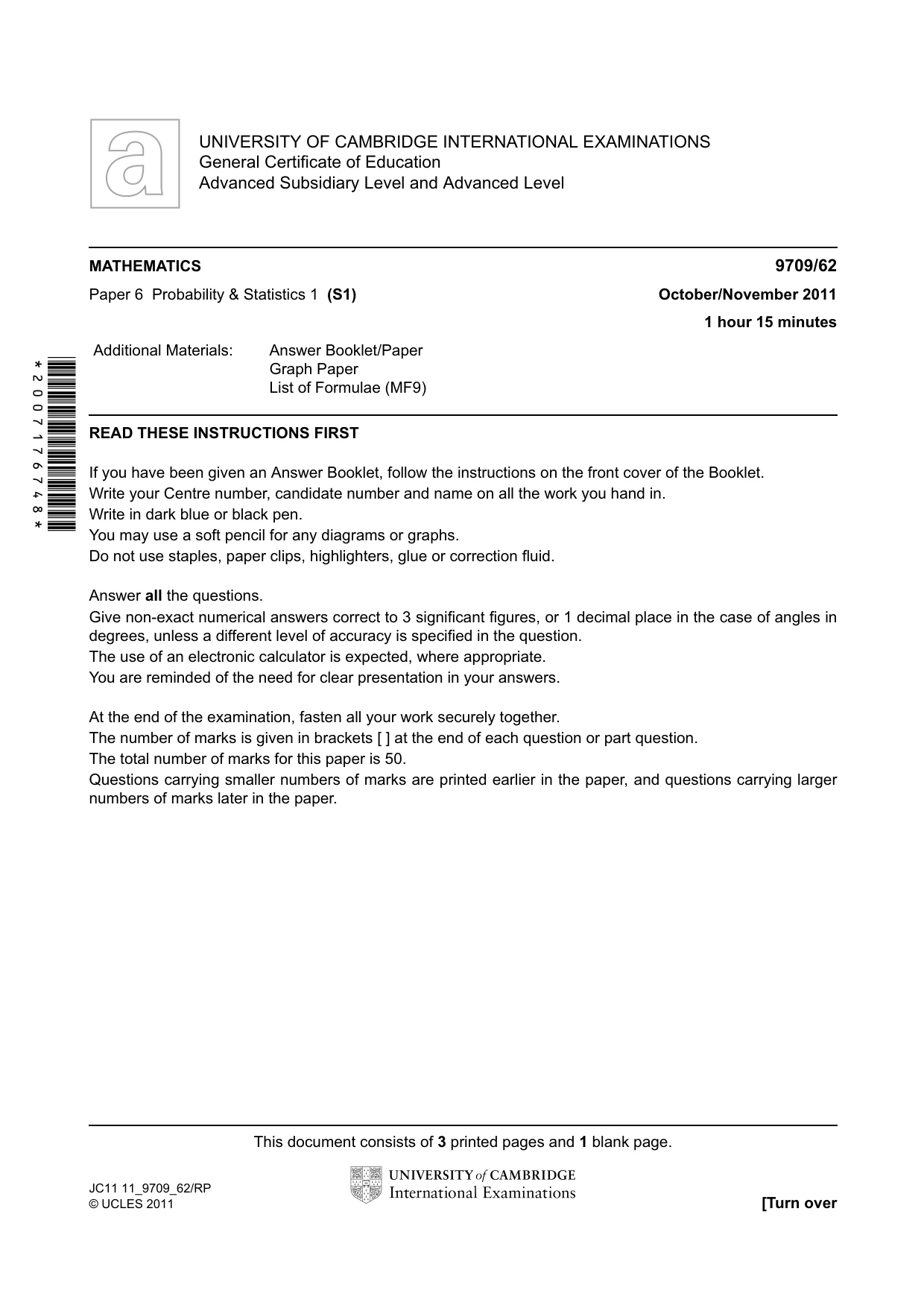
Q1 · The following are the times, in minutes, taken by 11 runners to complete a 10 km run
1 The following are the times, in minutes, taken by 11 runners to complete a 10 km run. 48.3 55.2 59.9 67.7 60.5 75.6 62.5 57.4 53.4 49.2 64.1 Find the mean and standard deviation of these times. [3]
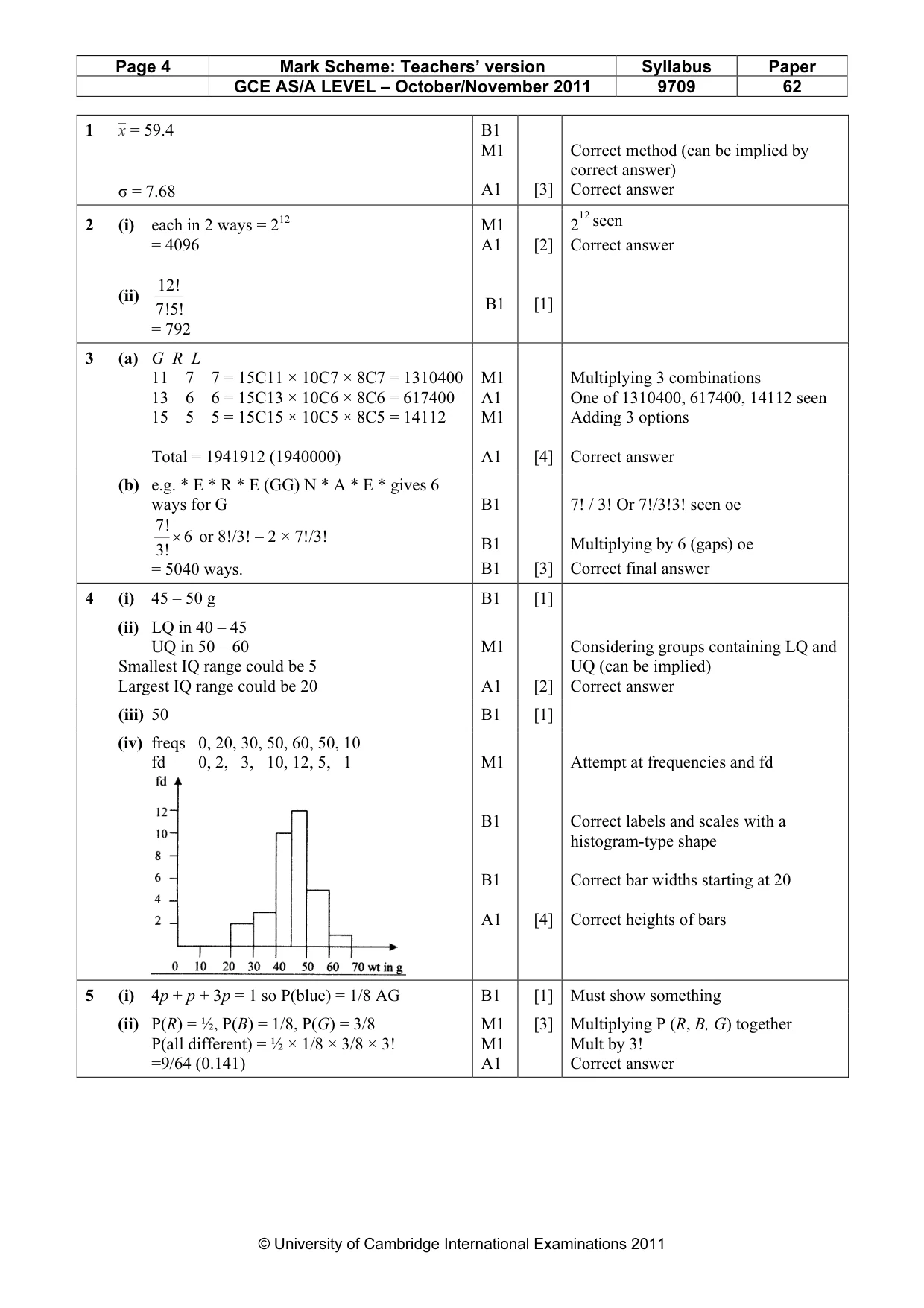
Mark scheme: 1 x¯ = 59.4 B1 M1 Correct method (can be implied by correct answer) σ = 7.68 A1 [3] Correct answer 12 12
Q2 · Twelve coins are tossed and placed in a line
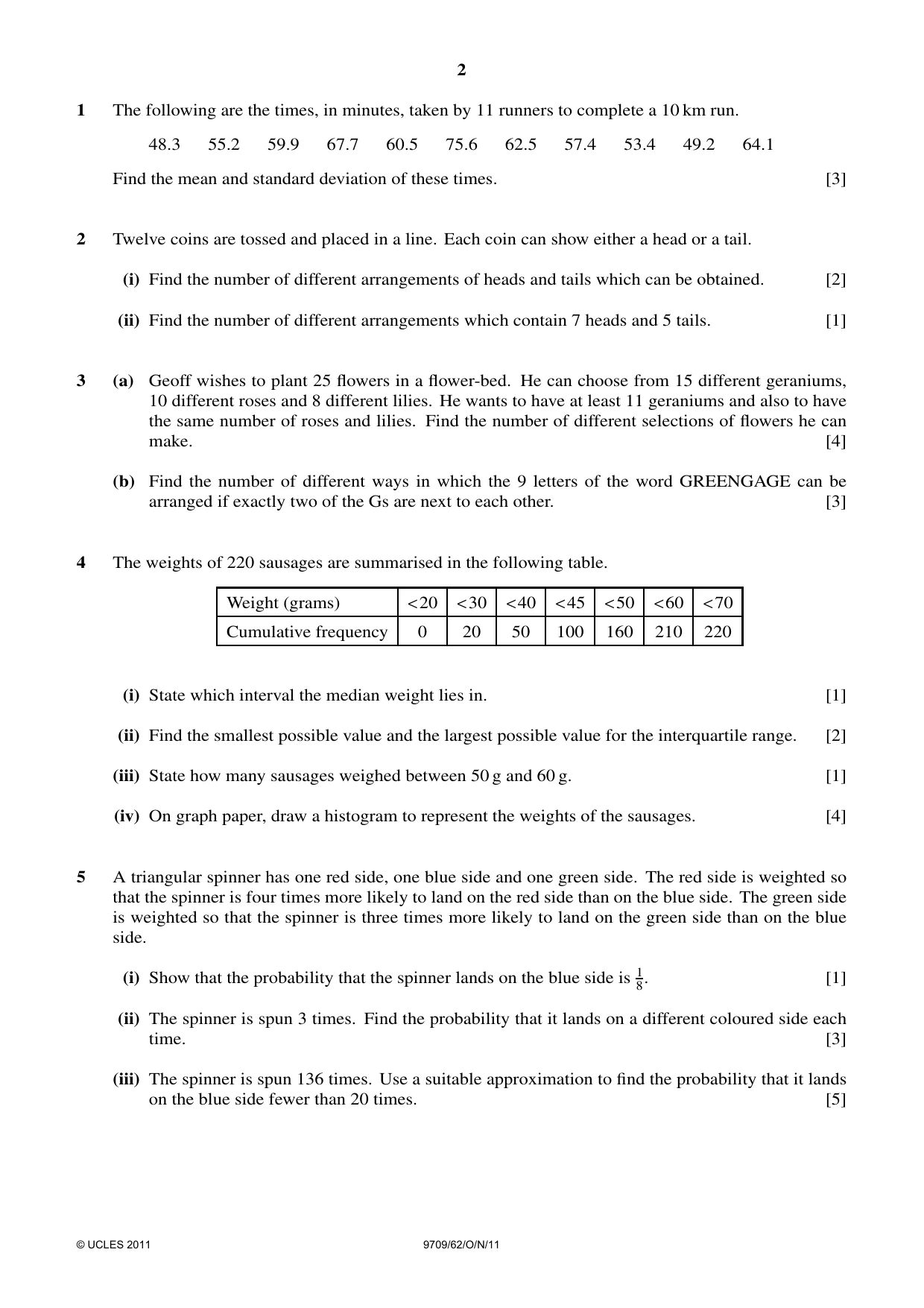
2 Twelve coins are tossed and placed in a line. Each coin can show either a head or a tail. (i) Find the number of different arrangements of heads and tails which can be obtained. [2] (ii) Find the number of different arrangements which contain 7 heads and 5 tails. [1]
Mark scheme: 12 seen2 (i) each in 2 ways = 212 M1 2 = 4096 A1 [2] Correct answer 12! (ii) B1 [1] 7!5! = 792
Q3 · Geoff wishes to plant 25 flowers in a flower-bed
3 (a) Geoff wishes to plant 25 flowers in a flower-bed. He can choose from 15 different geraniums, 10 different roses and 8 different lilies. He wants to have at least 11 geraniums and also to have the same number of roses and lilies. Find the number of different selections of flowers he can make. [4] (b) Find the number of different ways in which the 9 letters of the word GREENGAGE can be arranged if exactly two of the Gs are next to each other. [3]
Mark scheme: 3 (a) G R L 11 7 7 = 15C11 × 10C7 × 8C7 = 1310400 M1 Multiplying 3 combinations 13 6 6 = 15C13 × 10C6 × 8C6 = 617400 A1 One of 1310400, 617400, 14112 seen 15 5 5 = 15C15 × 10C5 × 8C5 = 14112 M1 Adding 3 options Total = 1941912 (1940000) A1 [4] Correct answer (b) e.g. * E * R * E (GG) N * A * E * gives 6 ways for G B1 7! / 3! Or 7!/3!3! seen oe 7! 6 or 8!/3! – 2 × 7!/3! B1 Multiplying by 6 (gaps) oe 3!× = 5040 ways. B1 [3] Correct final answer
Q4 · The weights of 220 sausages are summarised in the following table
4 The weights of 220 sausages are summarised in the following table. Weight (grams) <20 <30 <40 <45 <50 <60 <70 Cumulative frequency 0 20 50 100 160 210 220 (i) State which interval the median weight lies in. [1] (ii) Find the smallest possible value and the largest possible value for the interquartile range. [2] (iii) State how many sausages weighed between 50 g and 60 g. [1] (iv) On graph paper, draw a histogram to represent the weights of the sausages. [4]
Mark scheme: 4 (i) 45 – 50 g B1 [1] (ii) LQ in 40 – 45 UQ in 50 – 60 M1 Considering groups containing LQ and Smallest IQ range could be 5 UQ (can be implied) Largest IQ range could be 20 A1 [2] Correct answer (iii) 50 B1 [1] (iv) freqs 0, 20, 30, 50, 60, 50, 10 fd 0, 2, 3, 10, 12, 5, 1 M1 Attempt at frequencies and fd B1 Correct labels and scales with a histogram-type shape B1 Correct bar widths starting at 20 A1 [4] Correct heights of bars
Q5 · A triangular spinner has one red side, one blue side and one green side
5 A triangular spinner has one red side, one blue side and one green side. The red side is weighted so that the spinner is four times more likely to land on the red side than on the blue side. The green side is weighted so that the spinner is three times more likely to land on the green side than on the blue side. (i) Show that the probability that the spinner lands on the blue side is 8.1 [1] (ii) The spinner is spun 3 times. Find the probability that it lands on a different coloured side each time. [3] (iii) The spinner is spun 136 times. Use a suitable approximation to find the probability that it lands on the blue side fewer than 20 times. [5]
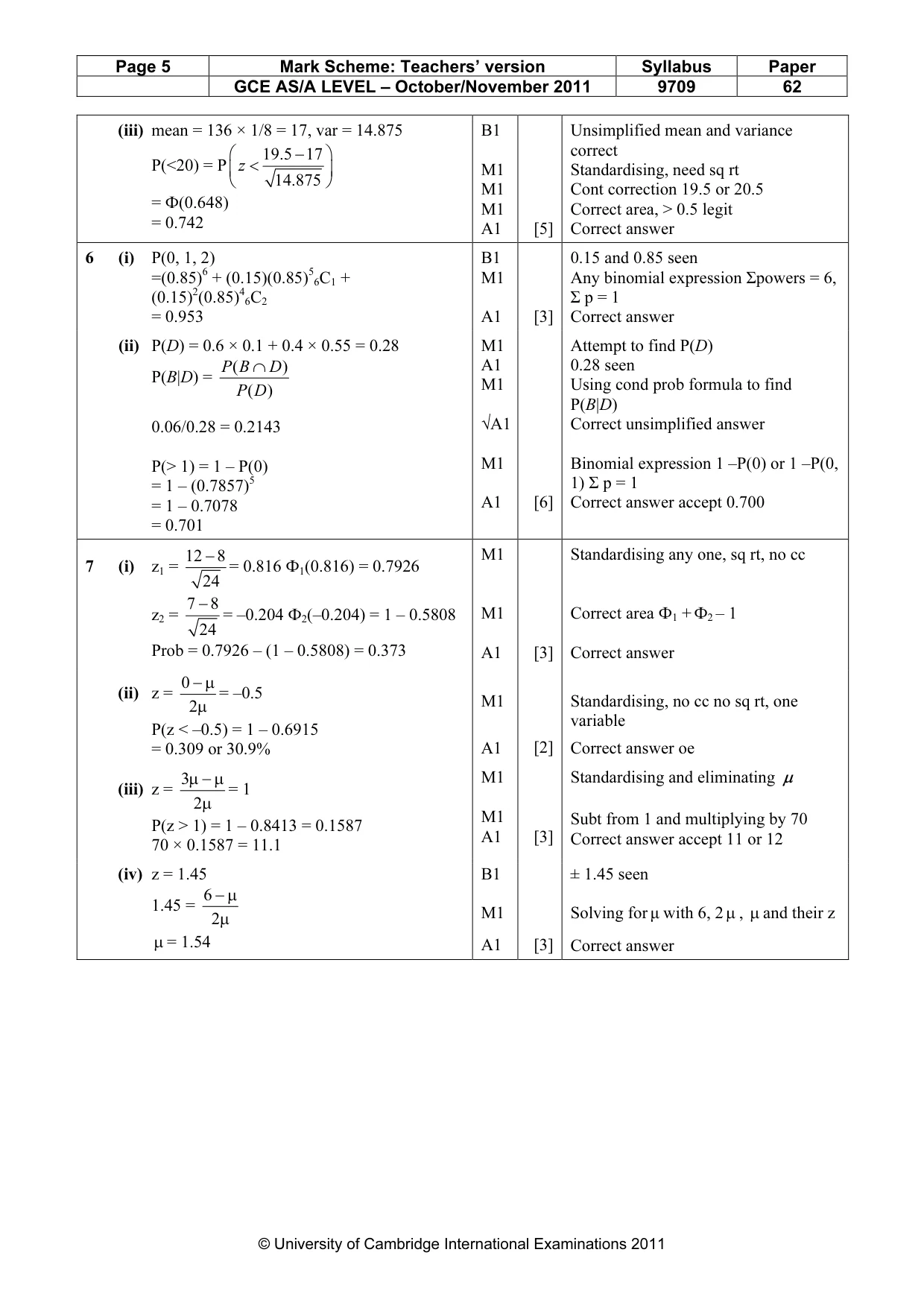
Mark scheme: 5 (i) 4p + p + 3p = 1 so P(blue) = 1/8 AG B1 [1] Must show something (ii) P(R) = ½, P(B) = 1/8, P(G) = 3/8 M1 [3] Multiplying P (R, B, G) together P(all different) = ½ × 1/8 × 3/8 × 3! M1 Mult by 3! =9/64 (0.141) A1 Correct answer GCE AS/A LEVEL – October/November 2011 9709 62 (iii) mean = 136 × 1/8 = 17, var = 14.875 B1 Unsimplified mean and variance 19.5 − 17 correct P(<20) = P z < M1 Standardising, need sq rt 14.875 M1 Cont correction 19.5 or 20.5 = Ф(0.648) M1 Correct area, > 0.5 legit = 0.742 A1 [5] Correct answer
Q6 · There are a large number of students in Luttley College
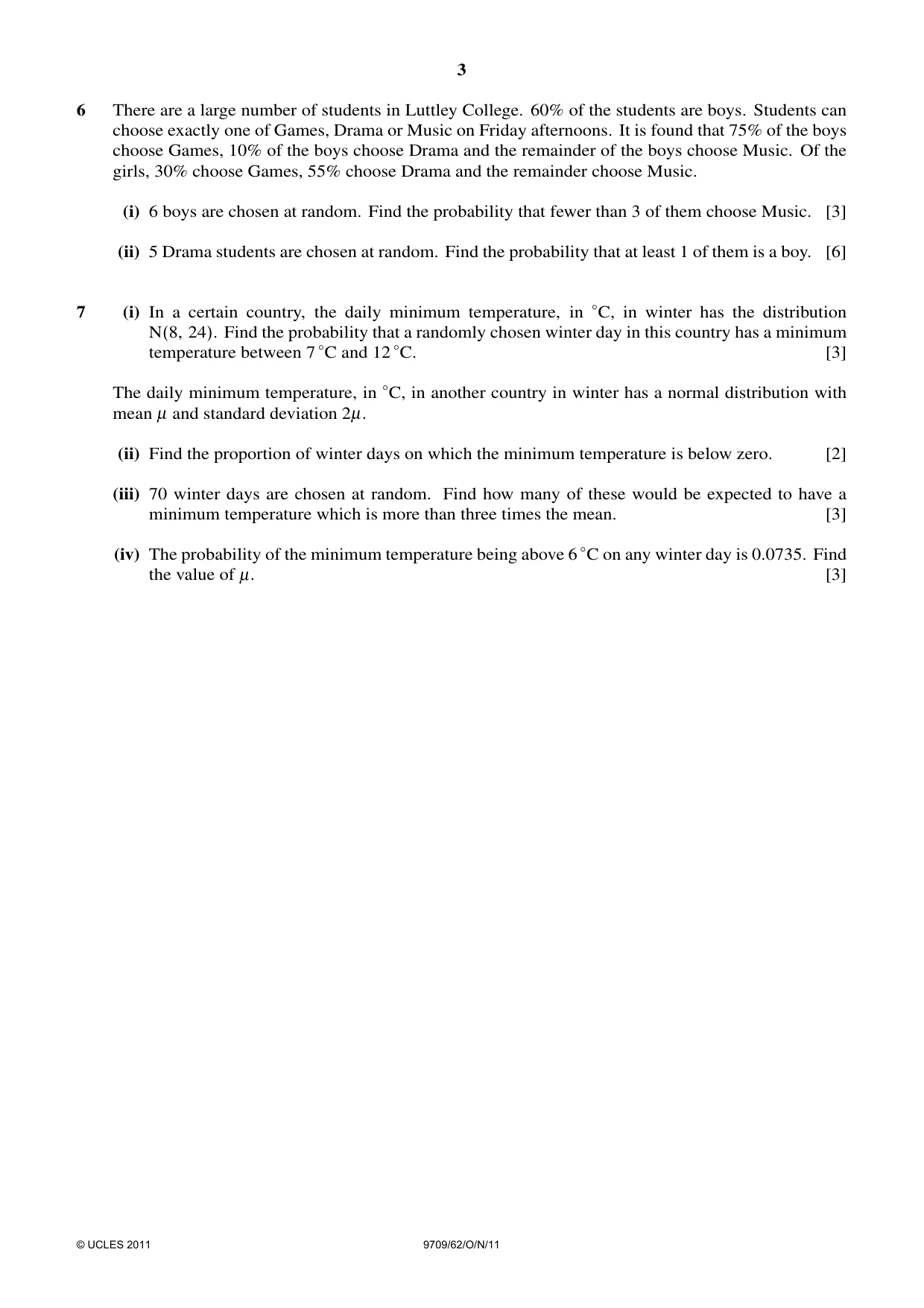
6 There are a large number of students in Luttley College. 60% of the students are boys. Students can choose exactly one of Games, Drama or Music on Friday afternoons. It is found that 75% of the boys choose Games, 10% of the boys choose Drama and the remainder of the boys choose Music. Of the girls, 30% choose Games, 55% choose Drama and the remainder choose Music. (i) 6 boys are chosen at random. Find the probability that fewer than 3 of them choose Music. [3] (ii) 5 Drama students are chosen at random. Find the probability that at least 1 of them is a boy. [6]
Mark scheme: 6 (i) P(0, 1, 2) B1 0.15 and 0.85 seen =(0.85)6 + (0.15)(0.85)56C1 + M1 Any binomial expression Σpowers = 6, (0.15)2(0.85)46C2 Σ p = 1 = 0.953 A1 [3] Correct answer (ii) P(D) = 0.6 × 0.1 + 0.4 × 0.55 = 0.28 M1 Attempt to find P(D) P ( B ∩ D ) A1 0.28 seen P(B|D) = M1 Using cond prob formula to find P ( D ) P(B|D) 0.06/0.28 = 0.2143 √A1 Correct unsimplified answer P(> 1) = 1 – P(0) M1 Binomial expression 1 –P(0) or 1 –P(0, = 1 – (0.7857)5 1) Σ p = 1 = 1 – 0.7078 A1 [6] Correct answer accept 0.700 = 0.701 12 − 8 M1 Standardising any one sq rt no cc
Q7 · In a certain country, the daily minimum temperature, in ◦C, in winter has the…
7 (i) In a certain country, the daily minimum temperature, in ◦C, in winter has the distribution N(8, 24). Find the probability that a randomly chosen winter day in this country has a minimum temperature between 7 ◦C and 12 ◦C. [3] The daily minimum temperature, in ◦C, in another country in winter has a normal distribution with mean µ and standard deviation 2µ. (ii) Find the proportion of winter days on which the minimum temperature is below zero. [2] (iii) 70 winter days are chosen at random. Find how many of these would be expected to have a minimum temperature which is more than three times the mean. [3] (iv) The probability of the minimum temperature being above 6 ◦C on any winter day is 0.0735. Find the value of µ. [3]
Mark scheme: 12 8 M1 Standardising any one, sq rt, no cc 7 (i) z1 = = 0.816 Ф1(0.816) = 0.7926 24 7 − 8 z2 = = –0.204 Ф2(–0.204) = 1 – 0.5808 M1 Correct area Ф1 + Ф2 – 1 24 Prob = 0.7926 – (1 – 0.5808) = 0.373 A1 [3] Correct answer 0 −µ (ii) z = = –0.5 M1 Standardising, no cc no sq rt, one 2µ variable P(z < –0.5) = 1 – 0.6915 = 0.309 or 30.9% A1 [2] Correct answer oe 3µ −µ M1 Standardising and eliminating µ (iii) z = = 1 2µ M1 Subt from 1 and multiplying by 70 P(z > 1) = 1 – 0.8413 = 0.1587 A1 [3] Correct answer accept 11 or 12 70 × 0.1587 = 11.1 (iv) z = 1.45 B1 ± 1.45 seen 6 −µ 1.45 = M1 Solving forµ with 6, 2µ , µ and their z 2µ µ = 1.54 A1 [3] Correct answer
What was in this paper
The subtopics covered by these 7 questions, and how many questions each got. Open one in a new tab to see every Cambridge question on it.
What you needed in this session
Cambridge’s own grade thresholds for 2011 Oct/Nov, Paper 6 · Variant 2. A higher threshold means an easier paper — the bar moves with how the cohort did.