Cambridge A Level Mathematics 9709 — 2010 Oct/Nov Paper 6 · Variant 3
9709/63/O/N/10 · 7 questions · 50 marks · ≈56 min
The question paper and its mark scheme, free to read here and free to download. This is Cambridge’s own paper, exactly as it was sat.
Question paper4 pages
Mark scheme6 pages
Answers below. Sit the paper first if you are practising.
Questions as text
Q1 · Name the distribution and suggest suitable numerical parameters that you could use to…
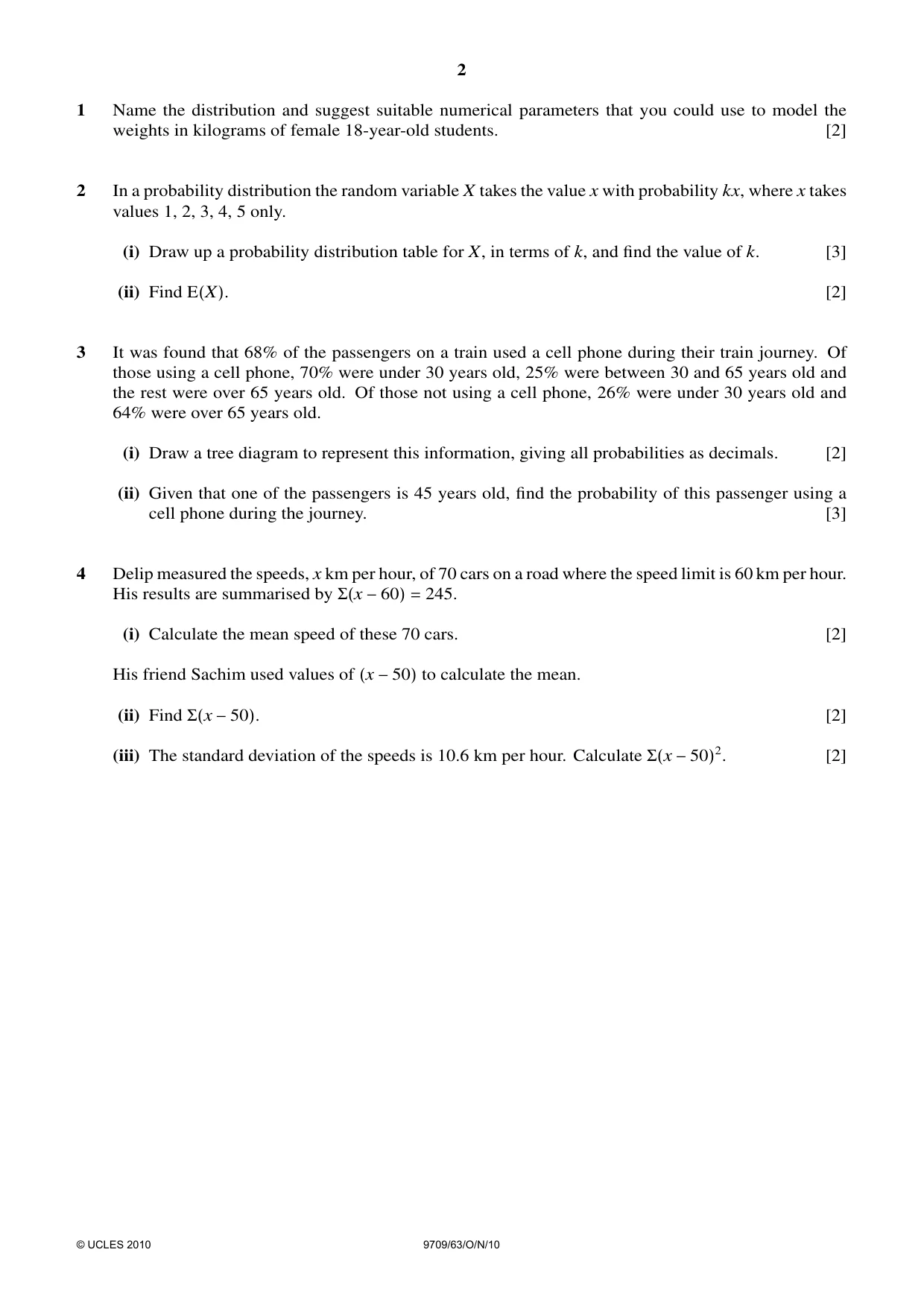
1 Name the distribution and suggest suitable numerical parameters that you could use to model the weights in kilograms of female 18-year-old students. [2]
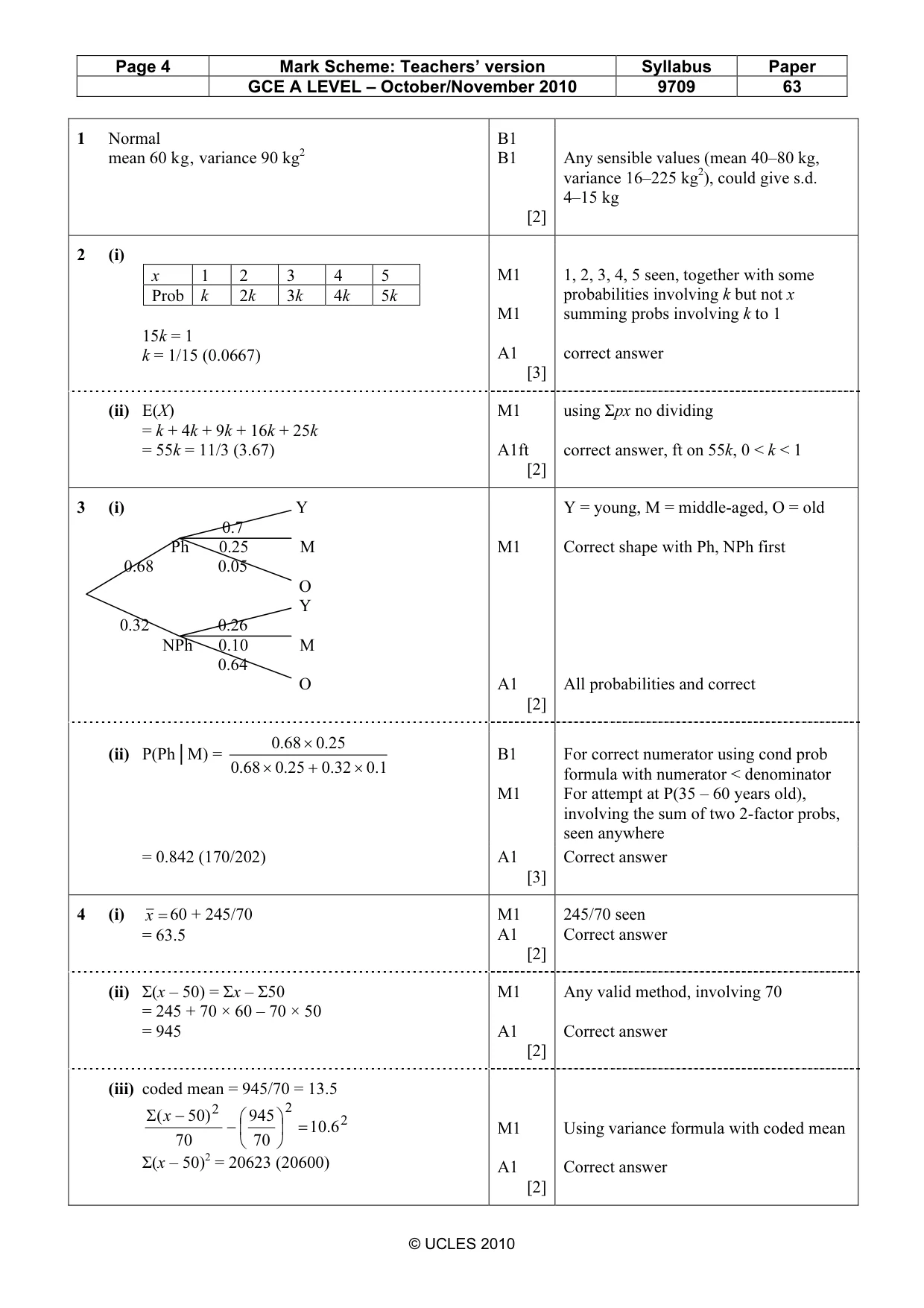
Mark scheme: 1 Normal B1 mean 60 kg, variance 90 kg2 B1 Any sensible values (mean 40–80 kg, variance 16–225 kg2), could give s.d. 4–15 kg [2]
Q2 · In a probability distribution the random variable X takes the value x with probability…
2 In a probability distribution the random variable X takes the value x with probability kx, where x takes values 1, 2, 3, 4, 5 only. (i) Draw up a probability distribution table for X, in terms of k, and find the value of k. [3] (ii) Find E(X). [2]
Mark scheme: 2 (i) x 1 2 3 4 5 M1 1, 2, 3, 4, 5 seen, together with some Prob k 2k 3k 4k 5k probabilities involving k but not x M1 summing probs involving k to 1 15k = 1 k = 1/15 (0.0667) A1 correct answer [3] (ii) E(X) M1 using Σpx no dividing = k + 4k + 9k + 16k + 25k = 55k = 11/3 (3.67) A1ft correct answer, ft on 55k, 0 < k < 1 [2]
Q3 · It was found that 68% of the passengers on a train used a cell phone during their train…
3 It was found that 68% of the passengers on a train used a cell phone during their train journey. Of those using a cell phone, 70% were under 30 years old, 25% were between 30 and 65 years old and the rest were over 65 years old. Of those not using a cell phone, 26% were under 30 years old and 64% were over 65 years old. (i) Draw a tree diagram to represent this information, giving all probabilities as decimals. [2] (ii) Given that one of the passengers is 45 years old, find the probability of this passenger using a cell phone during the journey. [3]
Mark scheme: 3 (i) Y Y = young, M = middle-aged, O = old 0.7 Ph 0.25 M M1 Correct shape with Ph, NPh first 0.68 0.05 O Y 0.32 0.26 NPh 0.10 M 0.64 O A1 All probabilities and correct [2] .068 × .025 (ii) P(Ph│M) = B1 For correct numerator using cond prob .068 × .025 + .032 × 1.0 formula with numerator < denominator M1 For attempt at P(35 – 60 years old), involving the sum of two 2-factor probs, seen anywhere = 0.842 (170/202) A1 Correct answer [3]
Q4 · Delip measured the speeds, x km per hour, of 70 cars on a road where the speed limit is…
4 Delip measured the speeds, x km per hour, of 70 cars on a road where the speed limit is 60 km per hour. His results are summarised by Σ(x −60) = 245. (i) Calculate the mean speed of these 70 cars. [2] His friend Sachim used values of (x −50) to calculate the mean. (ii) Find Σ(x −50). [2] (iii) The standard deviation of the speeds is 10.6 km per hour. Calculate Σ(x −50)2. [2]
Mark scheme: 4 (i) x = 60 + 245/70 M1 245/70 seen = 63.5 A1 Correct answer [2] (ii) Σ(x – 50) = Σx – Σ50 M1 Any valid method, involving 70 = 245 + 70 × 60 – 70 × 50 = 945 A1 Correct answer [2] (iii) coded mean = 945/70 = 13.5 2 2 Σ ( x − 50) 945 2 − = 106. M1 Using variance formula with coded mean 70 70 Σ(x – 50)2 = 20623 (20600) A1 Correct answer [2] GCE A LEVEL – October/November 2010 9709 63
Q5 · The following histogram illustrates the distribution of times, in minutes, that some…
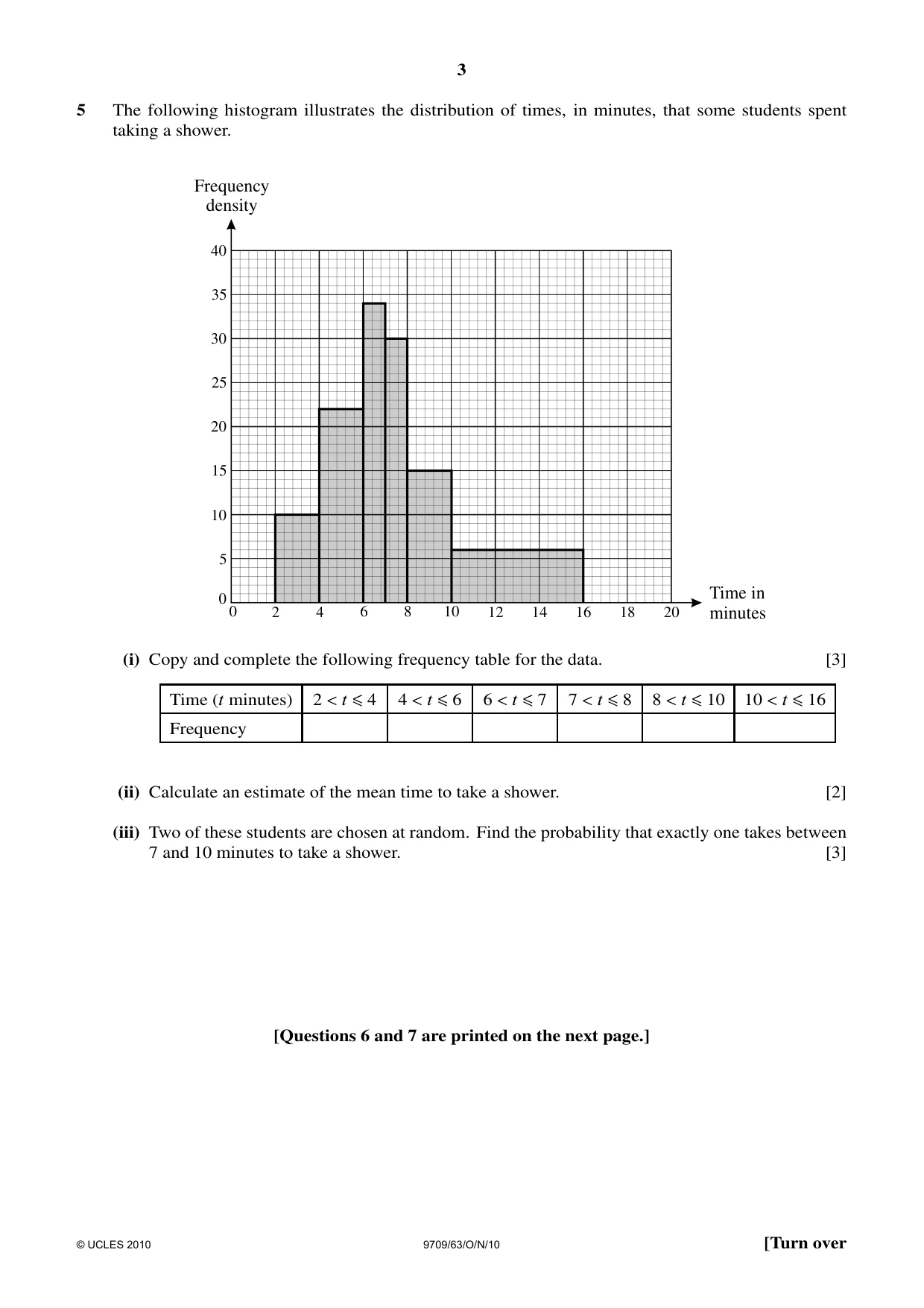
5 The following histogram illustrates the distribution of times, in minutes, that some students spent taking a shower. Frequency density 40 35 30 25 20 15 10 5 Time in 0 0 2 4 6 8 10 12 14 16 18 20 minutes (i) Copy and complete the following frequency table for the data. [3] Time (t minutes) 2 < t ≤4 4 < t ≤6 6 < t ≤7 7 < t ≤8 8 < t ≤10 10 < t ≤16 Frequency (ii) Calculate an estimate of the mean time to take a shower. [2] (iii) Two of these students are chosen at random. Find the probability that exactly one takes between 7 and 10 minutes to take a shower. [3] [Questions 6 and 7 are printed on the next page.]
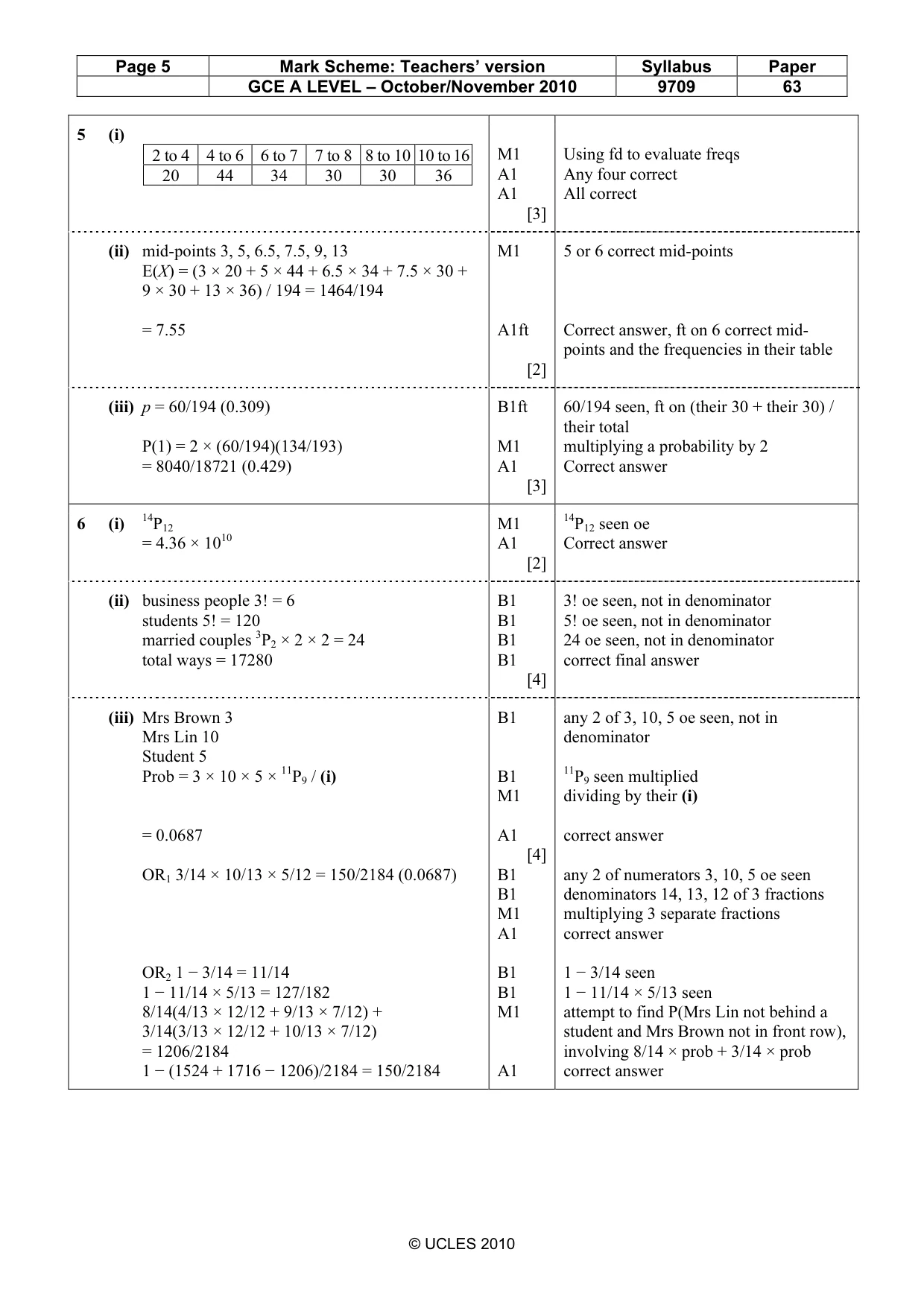
Mark scheme: 5 (i) 2 to 4 4 to 6 6 to 7 7 to 8 8 to 10 10 to 16 M1 Using fd to evaluate freqs 20 44 34 30 30 36 A1 Any four correct A1 All correct [3] (ii) mid-points 3, 5, 6.5, 7.5, 9, 13 M1 5 or 6 correct mid-points E(X) = (3 × 20 + 5 × 44 + 6.5 × 34 + 7.5 × 30 + 9 × 30 + 13 × 36) / 194 = 1464/194 = 7.55 A1ft Correct answer, ft on 6 correct mid- points and the frequencies in their table [2] (iii) p = 60/194 (0.309) B1ft 60/194 seen, ft on (their 30 + their 30) / their total P(1) = 2 × (60/194)(134/193) M1 multiplying a probability by 2 = 8040/18721 (0.429) A1 Correct answer [3] 14 14
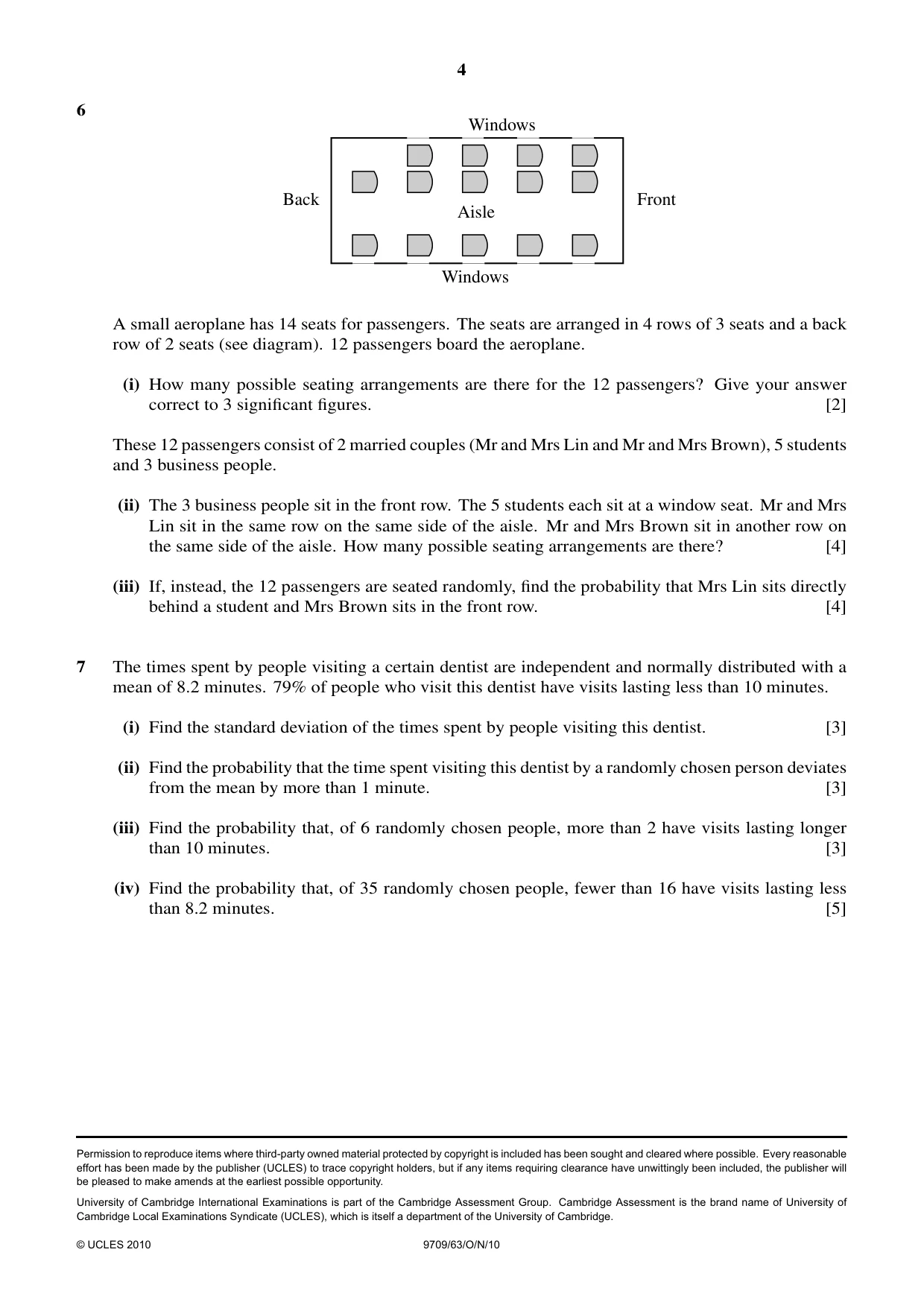
Q6 · Windows Back Front Aisle Windows A small aeroplane has 14 seats for passengers
6 Windows Back Front Aisle Windows A small aeroplane has 14 seats for passengers. The seats are arranged in 4 rows of 3 seats and a back row of 2 seats (see diagram). 12 passengers board the aeroplane. (i) How many possible seating arrangements are there for the 12 passengers? Give your answer correct to 3 significant figures. [2] These 12 passengers consist of 2 married couples (Mr and Mrs Lin and Mr and Mrs Brown), 5 students and 3 business people. (ii) The 3 business people sit in the front row. The 5 students each sit at a window seat. Mr and Mrs Lin sit in the same row on the same side of the aisle. Mr and Mrs Brown sit in another row on the same side of the aisle. How many possible seating arrangements are there? [4] (iii) If, instead, the 12 passengers are seated randomly, find the probability that Mrs Lin sits directly behind a student and Mrs Brown sits in the front row. [4]
Mark scheme: 6 (i) 14P12 M1 14P12 seen oe = 4.36 × 10¹⁰ A1 Correct answer [2] (ii) business people 3! = 6 B1 3! oe seen, not in denominator students 5! = 120 B1 5! oe seen, not in denominator married couples 3P2 × 2 × 2 = 24 B1 24 oe seen, not in denominator total ways = 17280 B1 correct final answer [4] (iii) Mrs Brown 3 B1 any 2 of 3, 10, 5 oe seen, not in Mrs Lin 10 denominator Student 5 Prob = 3 × 10 × 5 × 11P9 / (i) B1 11P9 seen multiplied M1 dividing by their (i) = 0.0687 A1 correct answer [4] OR1 3/14 × 10/13 × 5/12 = 150/2184 (0.0687) B1 any 2 of numerators 3, 10, 5 oe seen B1 denominators 14, 13, 12 of 3 fractions M1 multiplying 3 separate fractions A1 correct answer OR2 1 − 3/14 = 11/14 B1 1 − 3/14 seen 1 − 11/14 × 5/13 = 127/182 B1 1 − 11/14 × 5/13 seen 8/14(4/13 × 12/12 + 9/13 × 7/12) + M1 attempt to find P(Mrs Lin not behind a 3/14(3/13 × 12/12 + 10/13 × 7/12) student and Mrs Brown not in front row), = 1206/2184 involving 8/14 × prob + 3/14 × prob 1 − (1524 + 1716 − 1206)/2184 = 150/2184 A1 correct answer GCE A LEVEL – October/November 2010 9709 63
Q7 · The times spent by people visiting a certain dentist are independent and normally…
7 The times spent by people visiting a certain dentist are independent and normally distributed with a mean of 8.2 minutes. 79% of people who visit this dentist have visits lasting less than 10 minutes. (i) Find the standard deviation of the times spent by people visiting this dentist. [3] (ii) Find the probability that the time spent visiting this dentist by a randomly chosen person deviates from the mean by more than 1 minute. [3] (iii) Find the probability that, of 6 randomly chosen people, more than 2 have visits lasting longer than 10 minutes. [3] (iv) Find the probability that, of 35 randomly chosen people, fewer than 16 have visits lasting less than 8.2 minutes. [5]
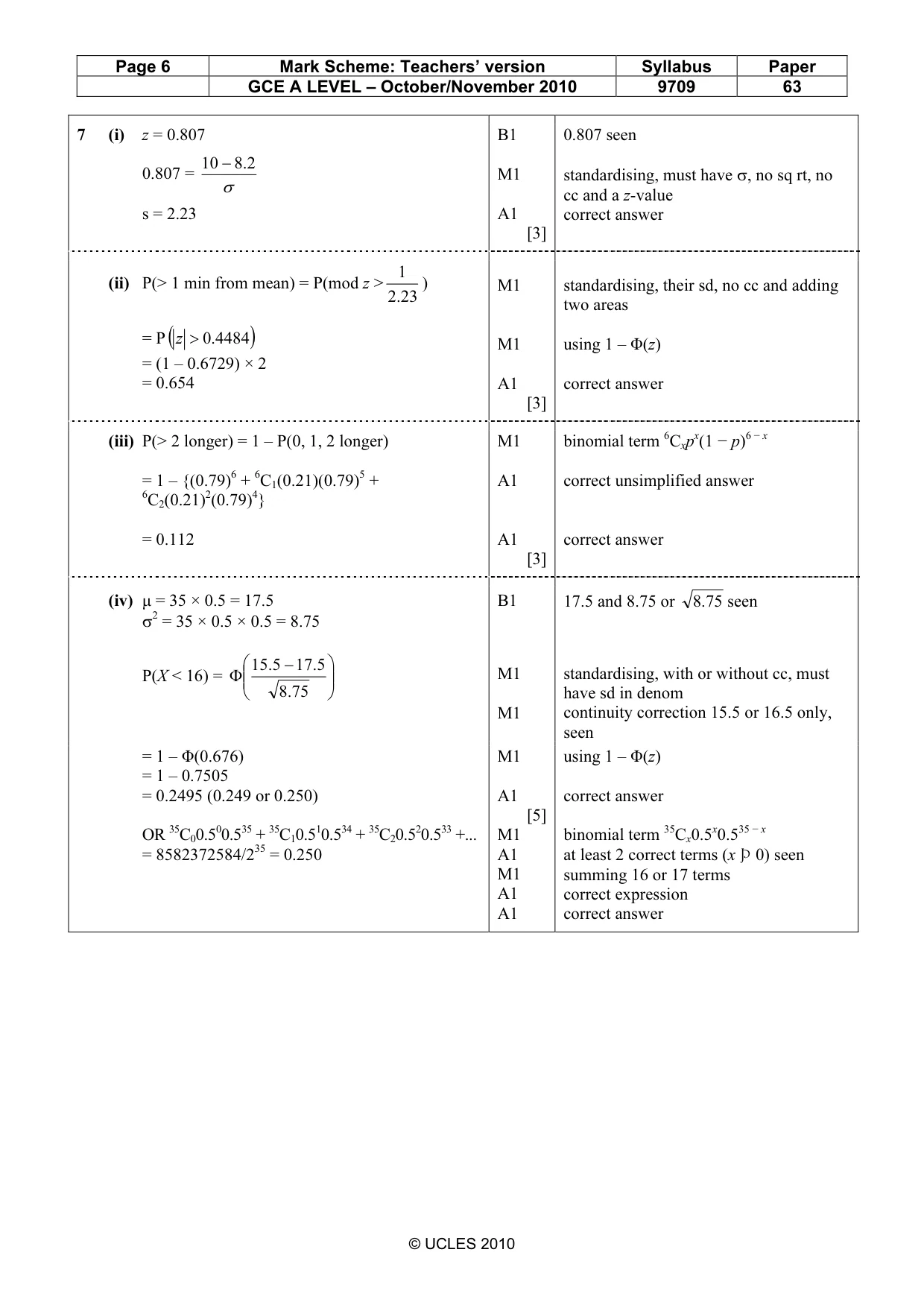
Mark scheme: 7 (i) z = 0.807 B1 0.807 seen 10 − 2.8 0.807 = M1 standardising, must have σ, no sq rt, no σ cc and a z-value s = 2.23 A1 correct answer [3] 1 (ii) P(> 1 min from mean) = P(mod z > ) M1 standardising, their sd, no cc and adding .223 two areas = P( z > .04484 ) M1 using 1 – Φ(z) = (1 – 0.6729) × 2 = 0.654 A1 correct answer [3] (iii) P(> 2 longer) = 1 – P(0, 1, 2 longer) M1 binomial term 6Cxpx(1 − p)6 − x = 1 – {(0.79)6 + 6C1(0.21)(0.79)5 + A1 correct unsimplified answer 6C2(0.21)2(0.79)4} = 0.112 A1 correct answer [3] (iv) µ = 35 × 0.5 = 17.5 B1 17.5 and 8.75 or .8 75 seen σ2 = 35 × 0.5 × 0.5 = 8.75 15 5. − 175. P(X < 16) = Φ M1 standardising, with or without cc, must .875 have sd in denom M1 continuity correction 15.5 or 16.5 only, seen = 1 – Φ(0.676) M1 using 1 – Φ(z) = 1 – 0.7505 = 0.2495 (0.249 or 0.250) A1 correct answer [5] OR 35C00.500.535 + 35C10.510.534 + 35C20.520.533 +... M1 binomial term 35Cx0.5x0.535 − x = 8582372584/235 = 0.250 A1 at least 2 correct terms (x Þ 0) seen M1 summing 16 or 17 terms A1 correct expression A1 correct answer
What was in this paper
The subtopics covered by these 7 questions, and how many questions each got. Open one in a new tab to see every Cambridge question on it.
What you needed in this session
Cambridge’s own grade thresholds for 2010 Oct/Nov, Paper 6 · Variant 3. A higher threshold means an easier paper — the bar moves with how the cohort did.