Cambridge A Level Mathematics 9709 — 2010 Oct/Nov Paper 6 · Variant 1
9709/61/O/N/10 · 7 questions · 50 marks · ≈56 min
The question paper and its mark scheme, free to read here and free to download. This is Cambridge’s own paper, exactly as it was sat.
Question paper4 pages
Mark scheme6 pages
Answers below. Sit the paper first if you are practising.
Questions as text
Q1 · Anita made observations of the maximum temperature, t ◦C, on 50 days
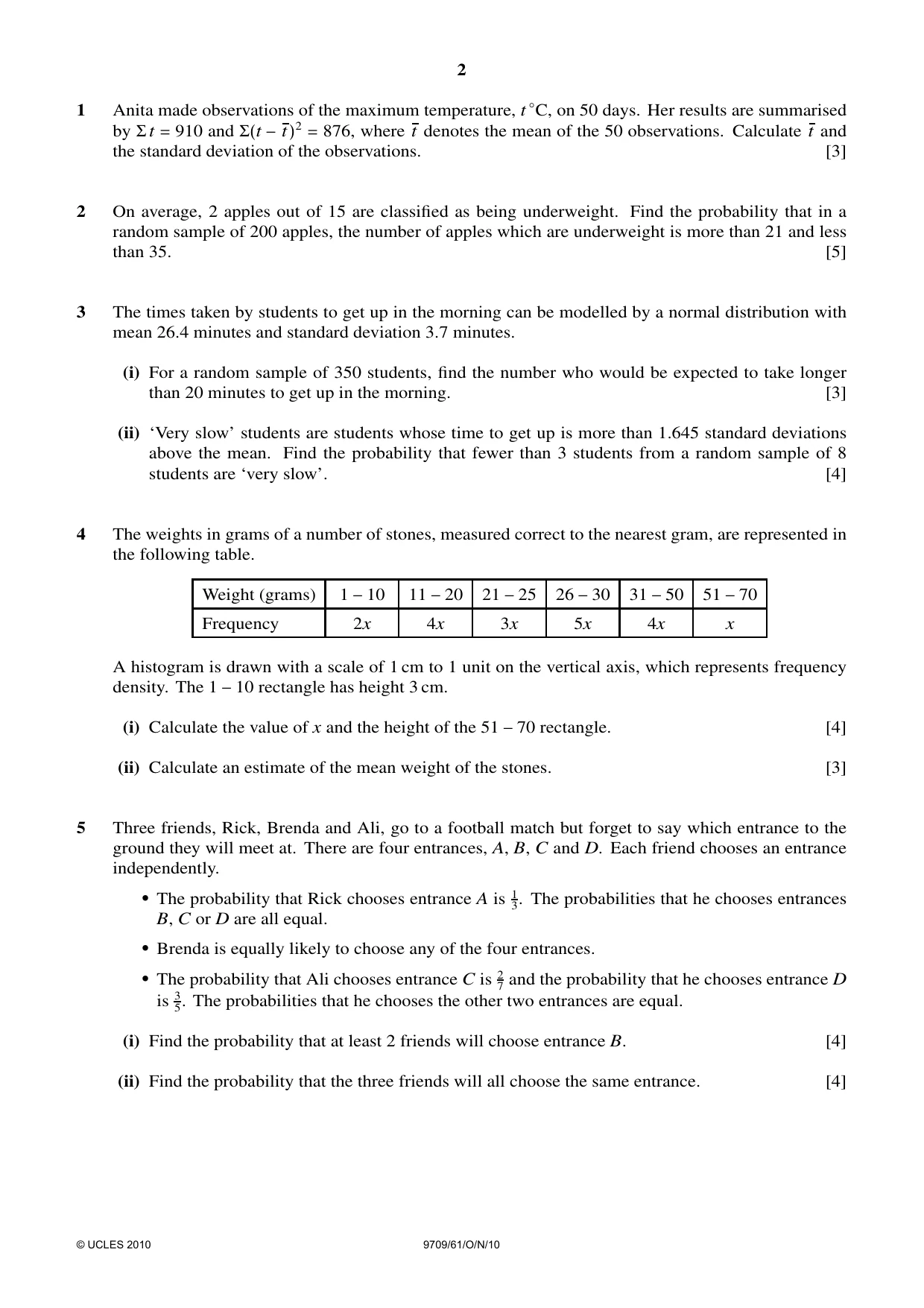
1 Anita made observations of the maximum temperature, t ◦C, on 50 days. Her results are summarised by Σ t = 910 and Σ(t −t)2 = 876, where t denotes the mean of the 50 observations. Calculate t and the standard deviation of the observations. [3]
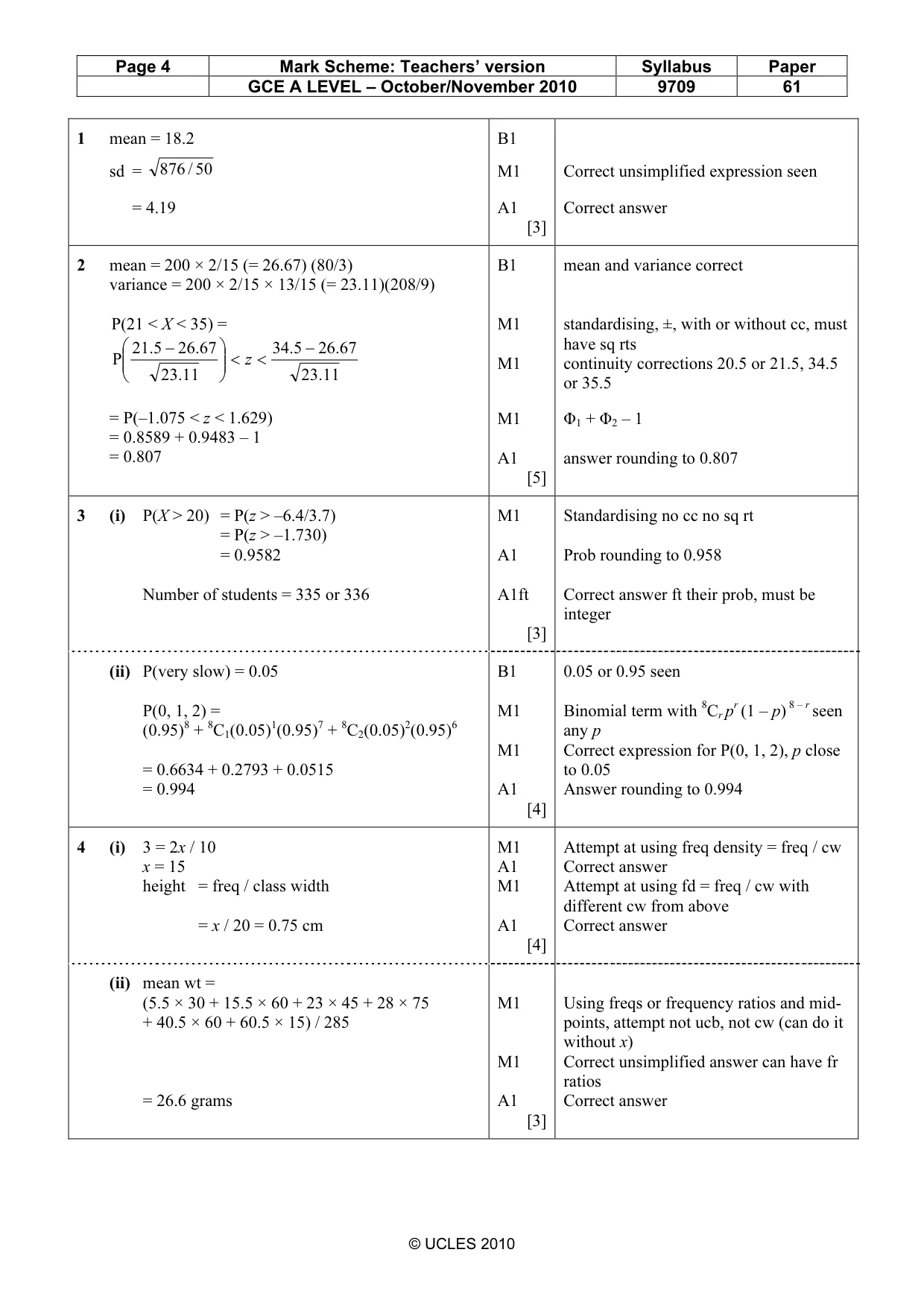
Mark scheme: 1 mean = 18.2 B1 sd = 876 / 50 M1 Correct unsimplified expression seen = 4.19 A1 Correct answer [3]
Q2 · On average, 2 apples out of 15 are classified as being underweight
2 On average, 2 apples out of 15 are classified as being underweight. Find the probability that in a random sample of 200 apples, the number of apples which are underweight is more than 21 and less than 35. [5]
Mark scheme: 2 mean = 200 × 2/15 (= 26.67) (80/3) B1 mean and variance correct variance = 200 × 2/15 × 13/15 (= 23.11)(208/9) P(21 < X < 35) = M1 standardising, ±, with or without cc, must 215. − 26.67 345. − 26.67 have sq rts P < z < M1 continuity corrections 20.5 or 21.5, 34.5 23.11 23.11 or 35.5 = P(–1.075 < z < 1.629) M1 Φ1 + Φ2 – 1 = 0.8589 + 0.9483 – 1 = 0.807 A1 answer rounding to 0.807 [5]
Q3 · The times taken by students to get up in the morning can be modelled by a normal…
3 The times taken by students to get up in the morning can be modelled by a normal distribution with mean 26.4 minutes and standard deviation 3.7 minutes. (i) For a random sample of 350 students, find the number who would be expected to take longer than 20 minutes to get up in the morning. [3] (ii) ‘Very slow’ students are students whose time to get up is more than 1.645 standard deviations above the mean. Find the probability that fewer than 3 students from a random sample of 8 students are ‘very slow’. [4]
Mark scheme: 3 (i) P(X > 20) = P(z > –6.4/3.7) M1 Standardising no cc no sq rt = P(z > –1.730) = 0.9582 A1 Prob rounding to 0.958 Number of students = 335 or 336 A1ft Correct answer ft their prob, must be integer [3] (ii) P(very slow) = 0.05 B1 0.05 or 0.95 seen P(0, 1, 2) = M1 Binomial term with 8Cr pr (1 – p) 8 – r seen (0.95)8 + 8C1(0.05)1(0.95)7 + 8C2(0.05)2(0.95)6 any p M1 Correct expression for P(0, 1, 2), p close = 0.6634 + 0.2793 + 0.0515 to 0.05 = 0.994 A1 Answer rounding to 0.994 [4]
Q4 · The weights in grams of a number of stones, measured correct to the nearest gram, are…
4 The weights in grams of a number of stones, measured correct to the nearest gram, are represented in the following table. Weight (grams) 1 −10 11 −20 21 −25 26 −30 31 −50 51 −70 Frequency 2x 4x 3x 5x 4x x A histogram is drawn with a scale of 1 cm to 1 unit on the vertical axis, which represents frequency density. The 1 −10 rectangle has height 3 cm. (i) Calculate the value of x and the height of the 51 −70 rectangle. [4] (ii) Calculate an estimate of the mean weight of the stones. [3]
Mark scheme: 4 (i) 3 = 2x / 10 M1 Attempt at using freq density = freq / cw x = 15 A1 Correct answer height = freq / class width M1 Attempt at using fd = freq / cw with different cw from above = x / 20 = 0.75 cm A1 Correct answer [4] (ii) mean wt = (5.5 × 30 + 15.5 × 60 + 23 × 45 + 28 × 75 M1 Using freqs or frequency ratios and mid- + 40.5 × 60 + 60.5 × 15) / 285 points, attempt not ucb, not cw (can do it without x) M1 Correct unsimplified answer can have fr ratios = 26.6 grams A1 Correct answer [3] GCE A LEVEL – October/November 2010 9709 61
Q5 · Three friends, Rick, Brenda and Ali, go to a football match but forget to say which…
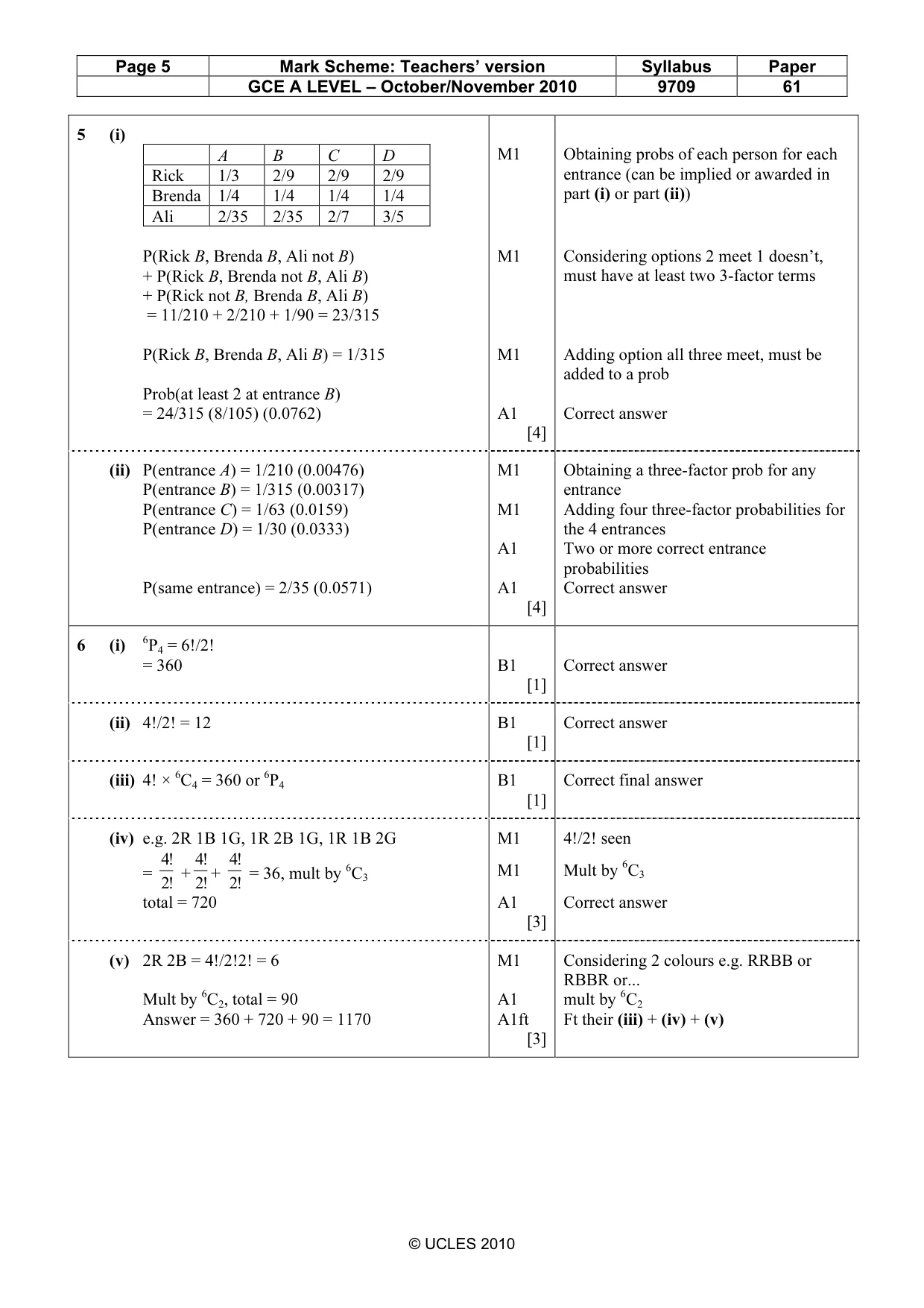
5 Three friends, Rick, Brenda and Ali, go to a football match but forget to say which entrance to the ground they will meet at. There are four entrances, A, B, C and D. Each friend chooses an entrance independently. • The probability that Rick chooses entrance A is 3.1 The probabilities that he chooses entrances B, C or D are all equal. • Brenda is equally likely to choose any of the four entrances. • The probability that Ali chooses entrance C is 72 and the probability that he chooses entrance D is 35. The probabilities that he chooses the other two entrances are equal. (i) Find the probability that at least 2 friends will choose entrance B. [4] (ii) Find the probability that the three friends will all choose the same entrance. [4]
Mark scheme: 5 (i) A B C D M1 Obtaining probs of each person for each Rick 1/3 2/9 2/9 2/9 entrance (can be implied or awarded in Brenda 1/4 1/4 1/4 1/4 part (i) or part (ii)) Ali 2/35 2/35 2/7 3/5 P(Rick B, Brenda B, Ali not B) M1 Considering options 2 meet 1 doesn’t, + P(Rick B, Brenda not B, Ali B) must have at least two 3-factor terms + P(Rick not B, Brenda B, Ali B) = 11/210 + 2/210 + 1/90 = 23/315 P(Rick B, Brenda B, Ali B) = 1/315 M1 Adding option all three meet, must be added to a prob Prob(at least 2 at entrance B) = 24/315 (8/105) (0.0762) A1 Correct answer [4] (ii) P(entrance A) = 1/210 (0.00476) M1 Obtaining a three-factor prob for any P(entrance B) = 1/315 (0.00317) entrance P(entrance C) = 1/63 (0.0159) M1 Adding four three-factor probabilities for P(entrance D) = 1/30 (0.0333) the 4 entrances A1 Two or more correct entrance probabilities P(same entrance) = 2/35 (0.0571) A1 Correct answer [4] 6
Q6 · Pegs are to be placed in the four holes shown, one in each hole
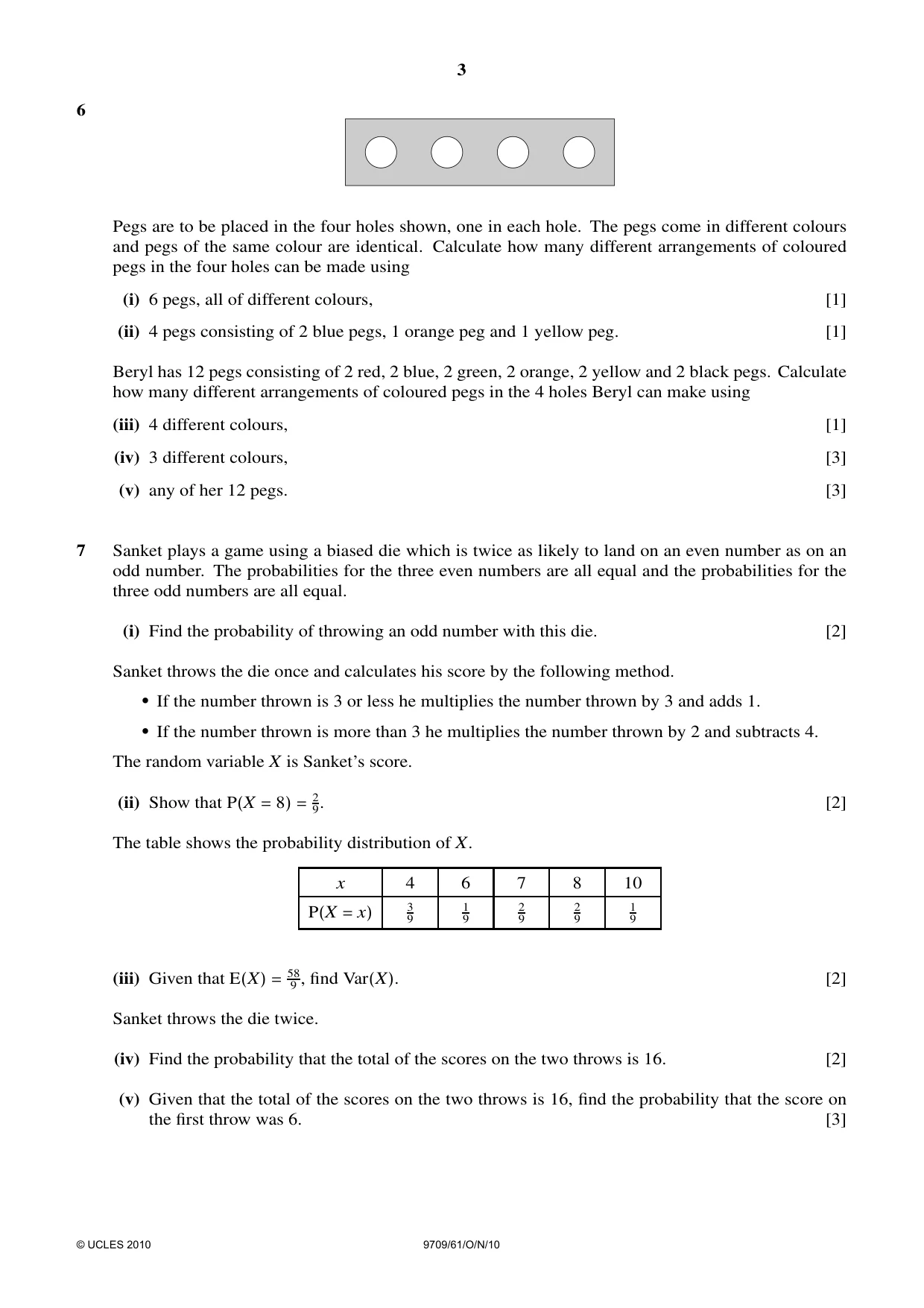
6 Pegs are to be placed in the four holes shown, one in each hole. The pegs come in different colours and pegs of the same colour are identical. Calculate how many different arrangements of coloured pegs in the four holes can be made using (i) 6 pegs, all of different colours, [1] (ii) 4 pegs consisting of 2 blue pegs, 1 orange peg and 1 yellow peg. [1] Beryl has 12 pegs consisting of 2 red, 2 blue, 2 green, 2 orange, 2 yellow and 2 black pegs. Calculate how many different arrangements of coloured pegs in the 4 holes Beryl can make using (iii) 4 different colours, [1] (iv) 3 different colours, [3] (v) any of her 12 pegs. [3]
Mark scheme: 6 (i) 6P4 = 6!/2! = 360 B1 Correct answer [1] (ii) 4!/2! = 12 B1 Correct answer [1] (iii) 4! × 6C4 = 360 or 6P4 B1 Correct final answer [1] (iv) e.g. 2R 1B 1G, 1R 2B 1G, 1R 1B 2G M1 4!/2! seen !4 !4 !4 = + + = 36, mult by 6C3 M1 Mult by 6C3 !2 !2 !2 total = 720 A1 Correct answer [3] (v) 2R 2B = 4!/2!2! = 6 M1 Considering 2 colours e.g. RRBB or RBBR or... Mult by 6C2, total = 90 A1 mult by 6C2 Answer = 360 + 720 + 90 = 1170 A1ft Ft their (iii) + (iv) + (v) [3] GCE A LEVEL – October/November 2010 9709 61
Q7 · Sanket plays a game using a biased die which is twice as likely to land on an even number…
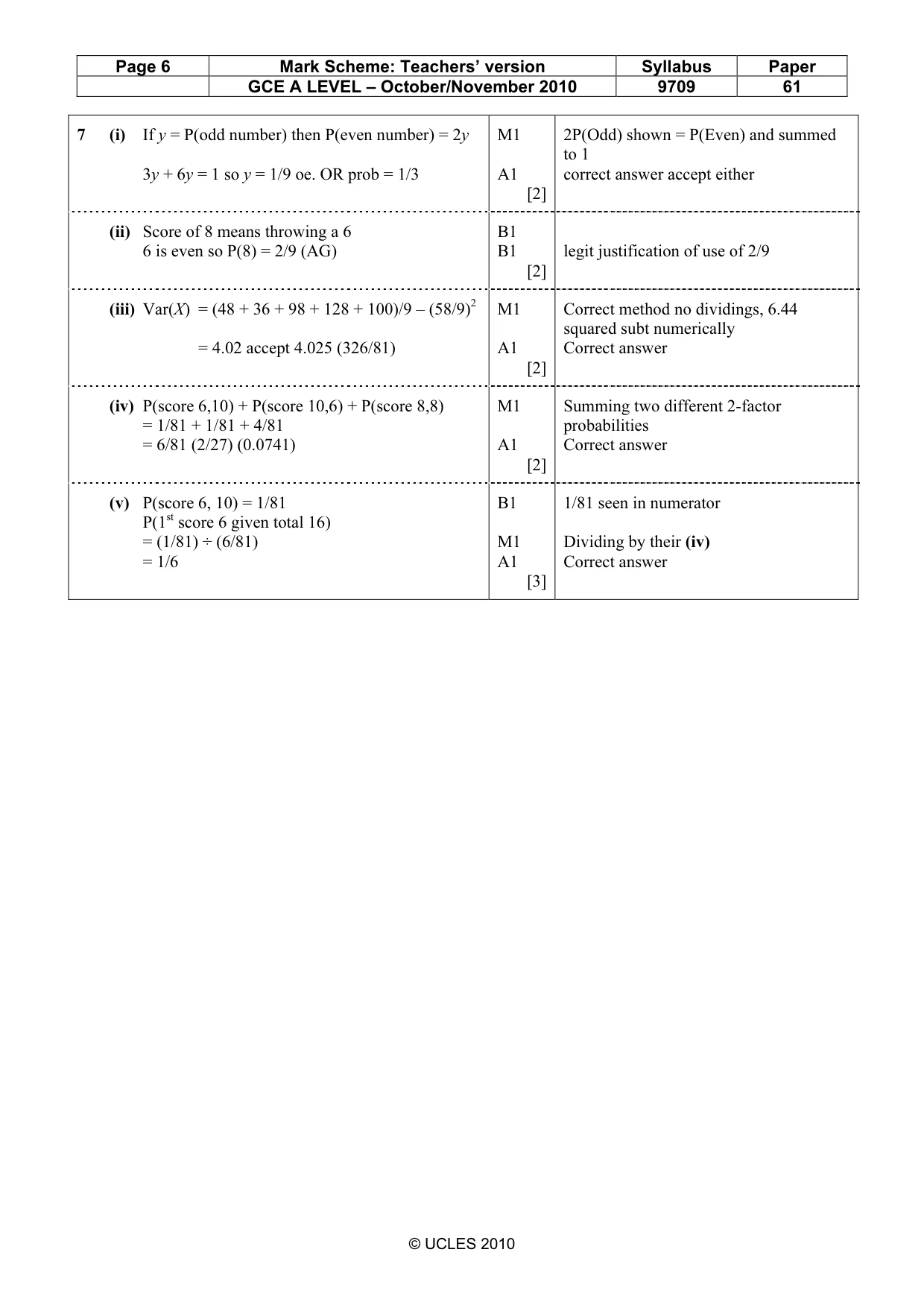
7 Sanket plays a game using a biased die which is twice as likely to land on an even number as on an odd number. The probabilities for the three even numbers are all equal and the probabilities for the three odd numbers are all equal. (i) Find the probability of throwing an odd number with this die. [2] Sanket throws the die once and calculates his score by the following method. • If the number thrown is 3 or less he multiplies the number thrown by 3 and adds 1. • If the number thrown is more than 3 he multiplies the number thrown by 2 and subtracts 4. The random variable X is Sanket’s score. (ii) Show that P(X = 8) = 29. [2] The table shows the probability distribution of X. x 4 6 7 8 10 P(X = x) 39 19 29 29 19 (iii) Given that E(X) = 589 , find Var(X). [2] Sanket throws the die twice. (iv) Find the probability that the total of the scores on the two throws is 16. [2] (v) Given that the total of the scores on the two throws is 16, find the probability that the score on the first throw was 6. [3]
Mark scheme: 7 (i) If y = P(odd number) then P(even number) = 2y M1 2P(Odd) shown = P(Even) and summed to 1 3y + 6y = 1 so y = 1/9 oe. OR prob = 1/3 A1 correct answer accept either [2] (ii) Score of 8 means throwing a 6 B1 6 is even so P(8) = 2/9 (AG) B1 legit justification of use of 2/9 [2] (iii) Var(X) = (48 + 36 + 98 + 128 + 100)/9 – (58/9)2 M1 Correct method no dividings, 6.44 squared subt numerically = 4.02 accept 4.025 (326/81) A1 Correct answer [2] (iv) P(score 6,10) + P(score 10,6) + P(score 8,8) M1 Summing two different 2-factor = 1/81 + 1/81 + 4/81 probabilities = 6/81 (2/27) (0.0741) A1 Correct answer [2] (v) P(score 6, 10) = 1/81 B1 1/81 seen in numerator P(1st score 6 given total 16) = (1/81) ÷ (6/81) M1 Dividing by their (iv) = 1/6 A1 Correct answer [3]
What was in this paper
The subtopics covered by these 7 questions, and how many questions each got. Open one in a new tab to see every Cambridge question on it.
What you needed in this session
Cambridge’s own grade thresholds for 2010 Oct/Nov, Paper 6 · Variant 1. A higher threshold means an easier paper — the bar moves with how the cohort did.