Cambridge A Level Mathematics 9709 — 2013 Oct/Nov Paper 6 · Variant 3
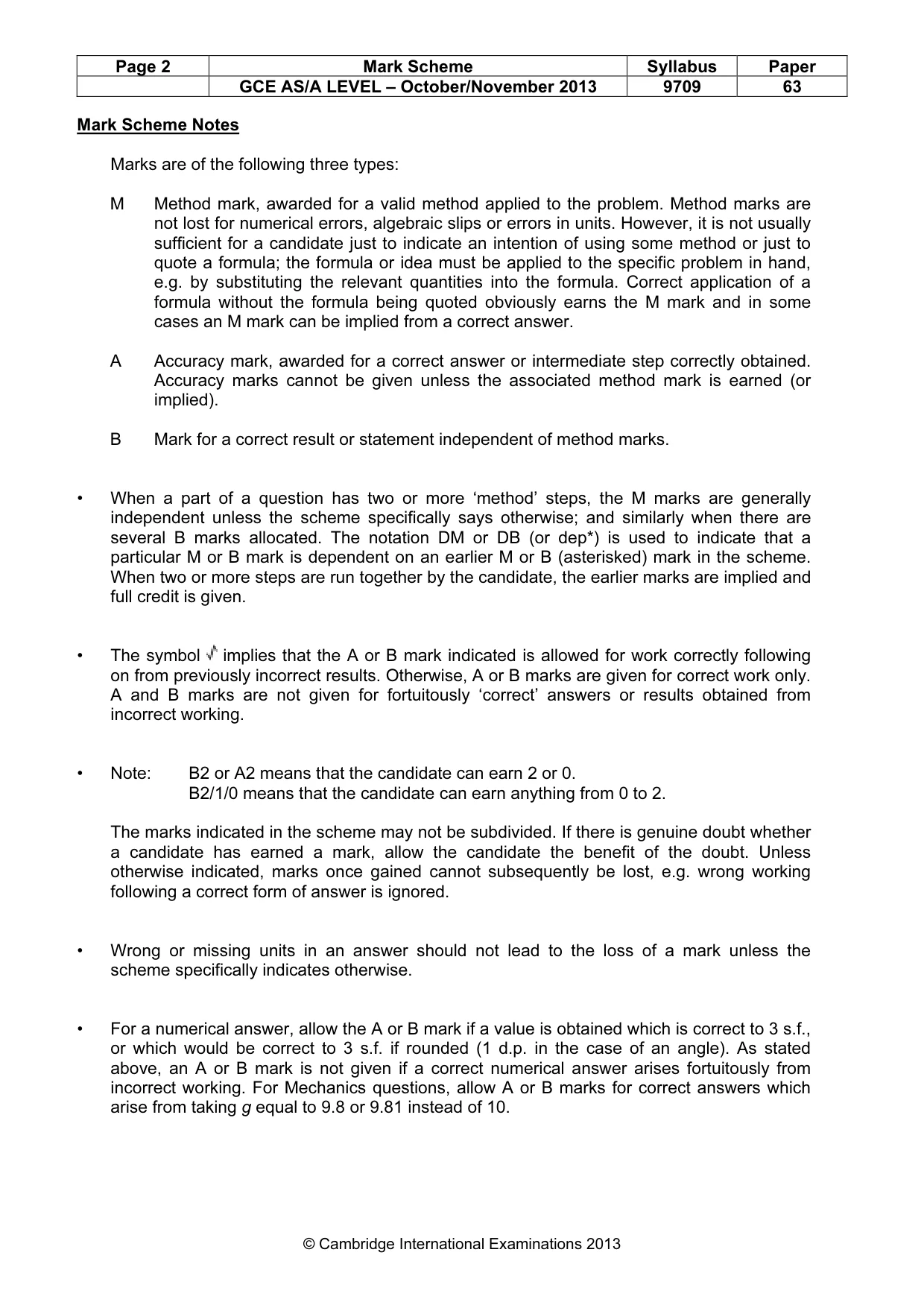
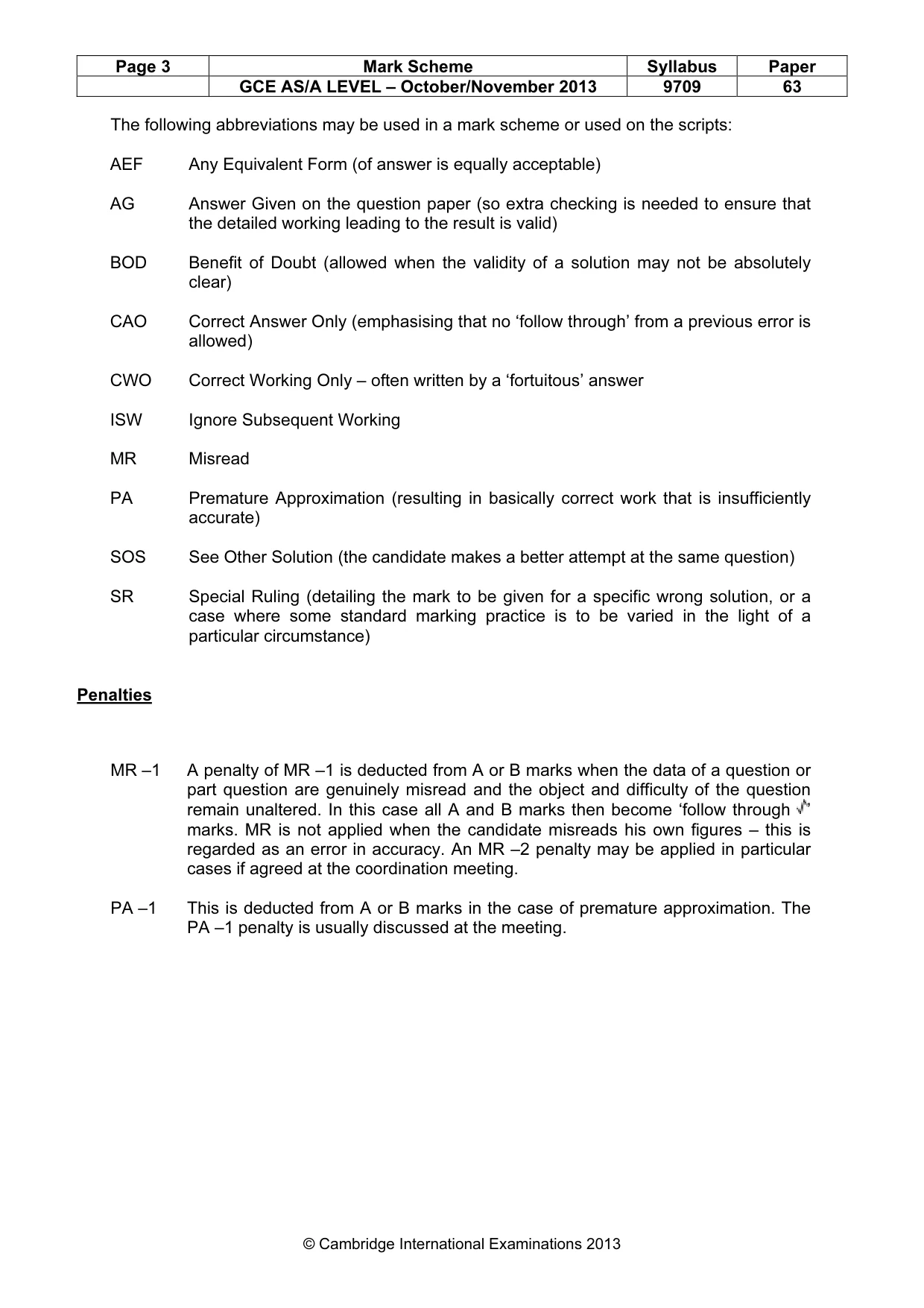
9709/63/O/N/13 · 6 questions · 50 marks · ≈56 min
The question paper and its mark scheme, free to read here and free to download. This is Cambridge’s own paper, exactly as it was sat.
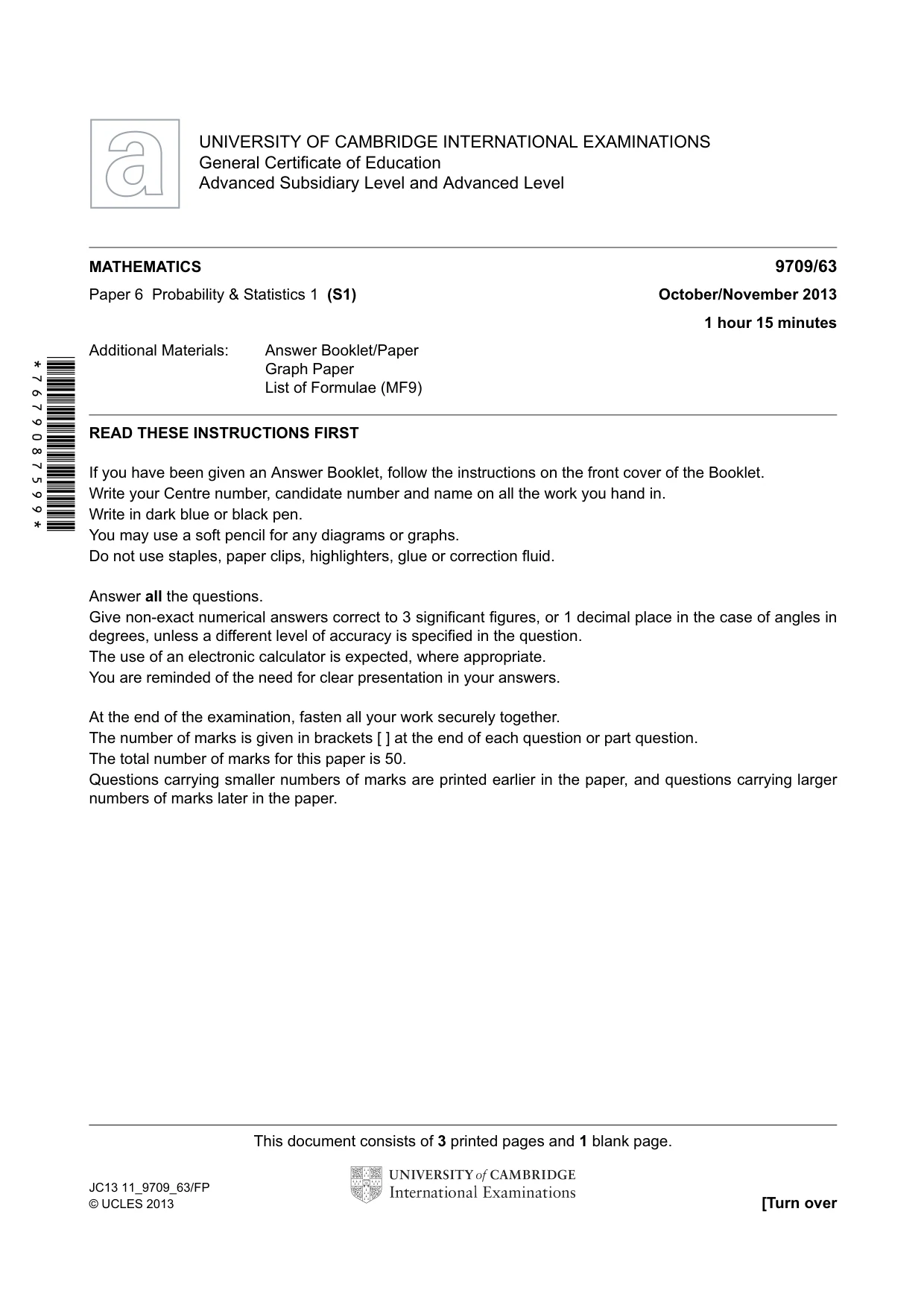
Question paper4 pages

Mark scheme6 pages
Answers below. Sit the paper first if you are practising.
Questions as text
Q1 · The distance of a student’s home from college, correct to the nearest kilometre, was…
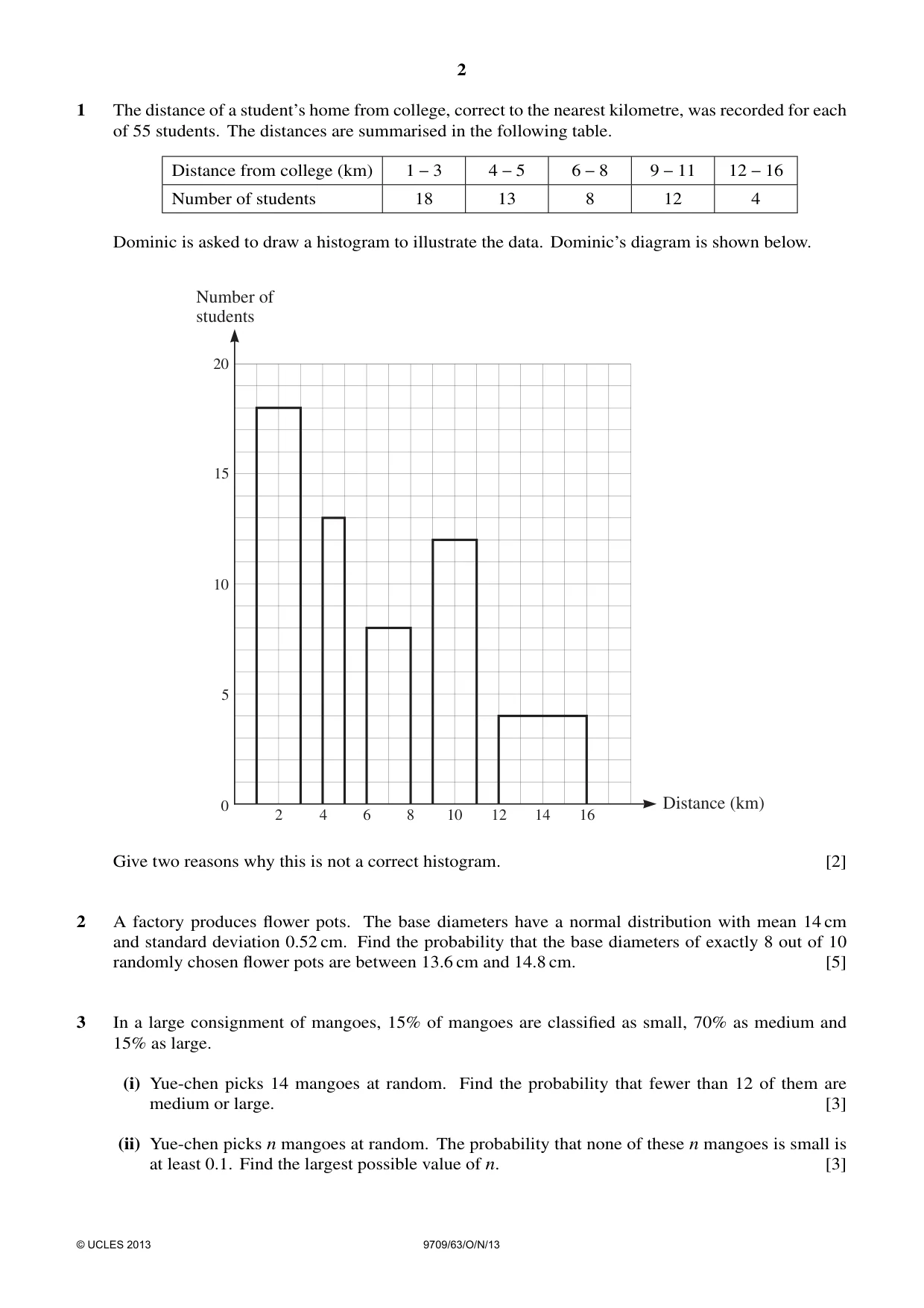
1 The distance of a student’s home from college, correct to the nearest kilometre, was recorded for each of 55 students. The distances are summarised in the following table. Distance from college (km) 1 −3 4 −5 6 −8 9 −11 12 −16 Number of students 18 13 8 12 4 Dominic is asked to draw a histogram to illustrate the data. Dominic’s diagram is shown below. Number of students 20 15 10 5 0 Distance (km) 2 4 6 8 10 12 14 16 Give two reasons why this is not a correct histogram. [2]
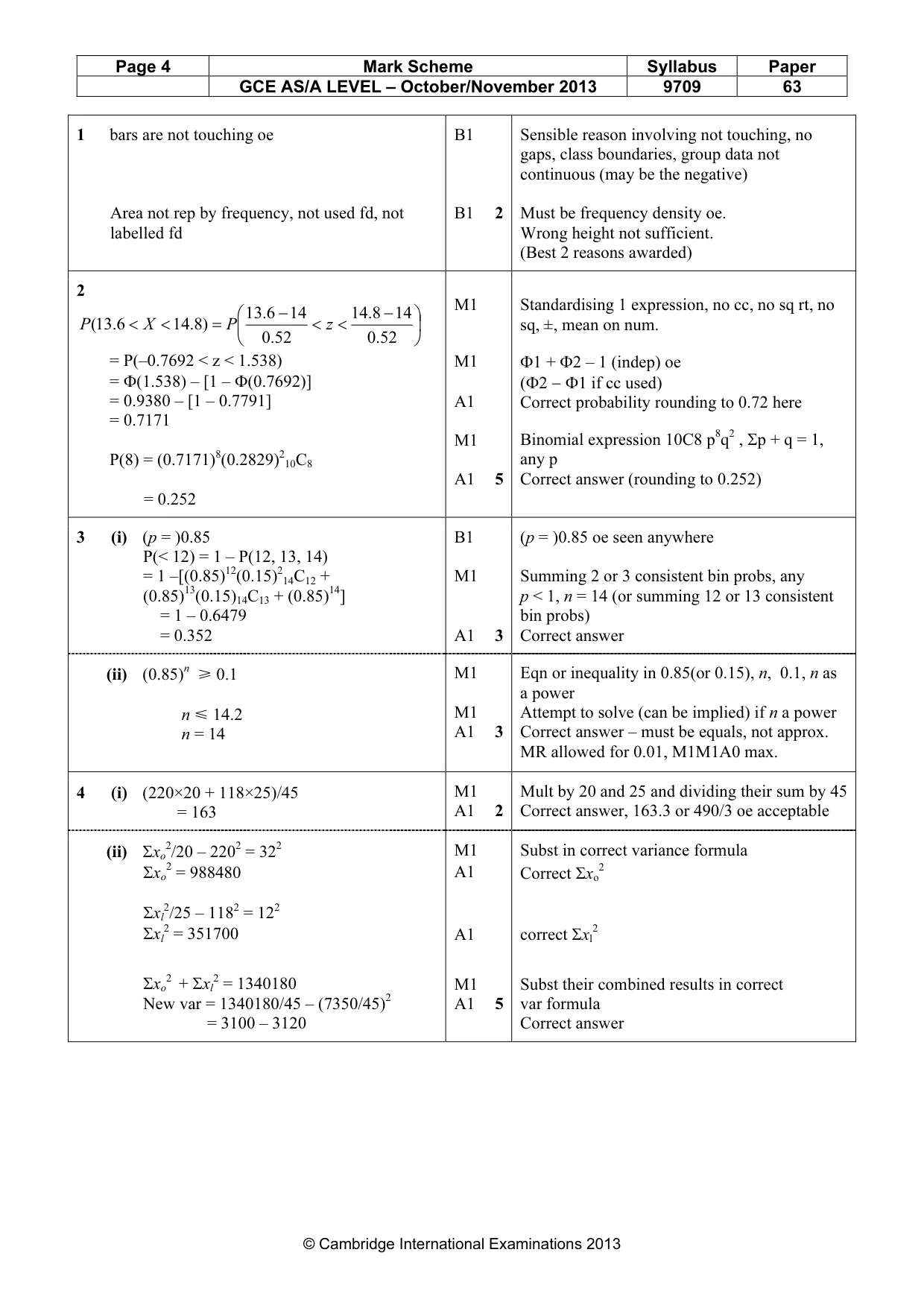
Mark scheme: 1 bars are not touching oe B1 Sensible reason involving not touching, no gaps, class boundaries, group data not continuous (may be the negative) Area not rep by frequency, not used fd, not B1 2 Must be frequency density oe. labelled fd Wrong height not sufficient. (Best 2 reasons awarded)
Q2 · A factory produces flower pots
2 A factory produces flower pots. The base diameters have a normal distribution with mean 14 cm and standard deviation 0.52 cm. Find the probability that the base diameters of exactly 8 out of 10 randomly chosen flower pots are between 13.6 cm and 14.8 cm. [5]
Mark scheme: 2 M1 Standardising 1 expression, no cc, no sq rt, no 13 6 − 14 14 8 − 14
Q3 · In a large consignment of mangoes, 15% of mangoes are classified as small, 70% as medium…
3 In a large consignment of mangoes, 15% of mangoes are classified as small, 70% as medium and 15% as large. (i) Yue-chen picks 14 mangoes at random. Find the probability that fewer than 12 of them are medium or large. [3] (ii) Yue-chen picks n mangoes at random. The probability that none of these n mangoes is small is at least 0.1. Find the largest possible value of n. [3]
Mark scheme: 3 (i) (p = )0.85 B1 (p = )0.85 oe seen anywhere P(< 12) = 1 – P(12, 13, 14) = 1 –[(0.85)12(0.15)214C12 + M1 Summing 2 or 3 consistent bin probs, any (0.85)13(0.15)14C13 + (0.85)14] p < 1, n = 14 (or summing 12 or 13 consistent = 1 – 0.6479 bin probs) = 0.352 A1 3 Correct answer (ii) (0.85)n [ 0.1 M1 Eqn or inequality in 0.85(or 0.15), n, 0.1, n as a power n Y=14.2 M1 Attempt to solve (can be implied) if n a power n = 14 A1 3 Correct answer – must be equals, not approx. MR allowed for 0.01, M1M1A0 max.
Q4 · Barry weighs 20 oranges and 25 lemons
4 Barry weighs 20 oranges and 25 lemons. For the oranges, the mean weight is 220 g and the standard deviation is 32 g. For the lemons, the mean weight is 118 g and the standard deviation is 12 g. (i) Find the mean weight of the 45 fruits. [2] (ii) The individual weights of the oranges in grams are denoted by xo, and the individual weights of the lemons in grams are denoted by xl. By first finding Σ x2o and Σ x2l , find the variance of the weights of the 45 fruits. [5]
Mark scheme: 4 (i) (220×20 + 118×25)/45 M1 Mult by 20 and 25 and dividing their sum by 45 = 163 A1 2 Correct answer, 163.3 or 490/3 oe acceptable (ii) Σxo2/20 – 2202 = 322 M1 Subst in correct variance formula Σxo2 = 988480 A1 Correct Σxo2 Σxl 2/25 – 1182 = 122 Σxl 2 = 351700 A1 correct Σxl 2 Σxo2 + Σxl 2 = 1340180 M1 Subst their combined results in correct New var = 1340180/45 – (7350/45)2 A1 5 var formula = 3100 – 3120 Correct answer GCE AS/A LEVEL – October/November 2013 9709 63
Q6 · Find the number of different ways that the 9 letters of the word AGGREGATE can be…
6 (i) Find the number of different ways that the 9 letters of the word AGGREGATE can be arranged in a line if the first letter is R. [2] (ii) Find the number of different ways that the 9 letters of the word AGGREGATE can be arranged in a line if the 3 letters G are together, both letters A are together and both letters E are together. [2] (iii) The letters G, R and T are consonants and the letters A and E are vowels. Find the number of different ways that the 9 letters of the word AGGREGATE can be arranged in a line if consonants and vowels occur alternately. [3] (iv) Find the number of different selections of 4 letters of the word AGGREGATE which contain exactly 2 Gs or exactly 3 Gs. [3]
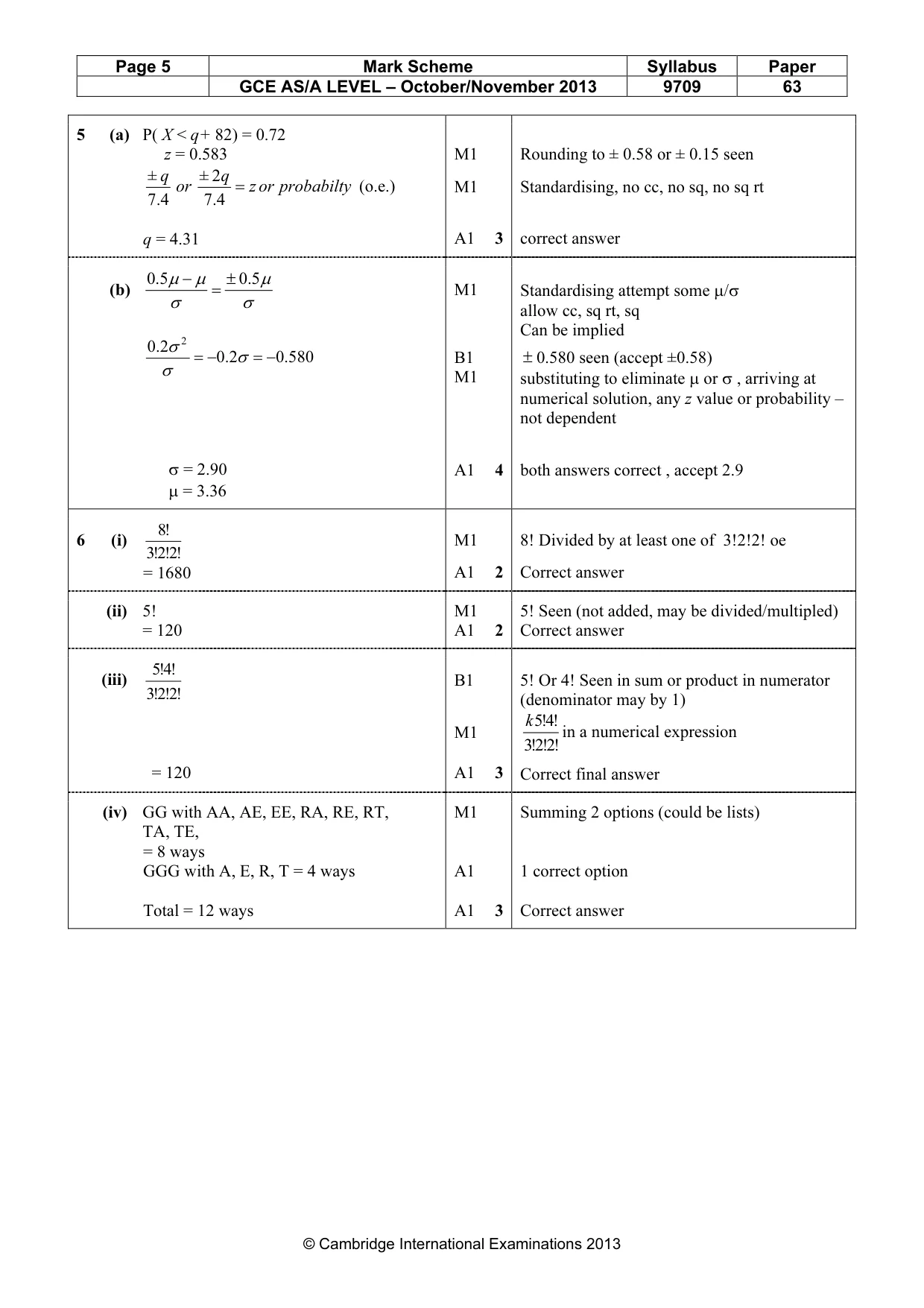
Mark scheme: !8 6 (i) M1 8! Divided by at least one of 3!2!2! oe !2!2!3 = 1680 A1 2 Correct answer (ii) 5! M1 5! Seen (not added, may be divided/multipled) = 120 A1 2 Correct answer !4!5 (iii) B1 5! Or 4! Seen in sum or product in numerator !2!2!3 (denominator may by 1) k !4!5 M1 in a numerical expression !2!2!3 = 120 A1 3 Correct final answer (iv) GG with AA, AE, EE, RA, RE, RT, M1 Summing 2 options (could be lists) TA, TE, = 8 ways GGG with A, E, R, T = 4 ways A1 1 correct option Total = 12 ways A1 3 Correct answer GCE AS/A LEVEL – October/November 2013 9709 63
Q7 · Dayo chooses two digits at random, without replacement, from the 9-digit number 113 333…
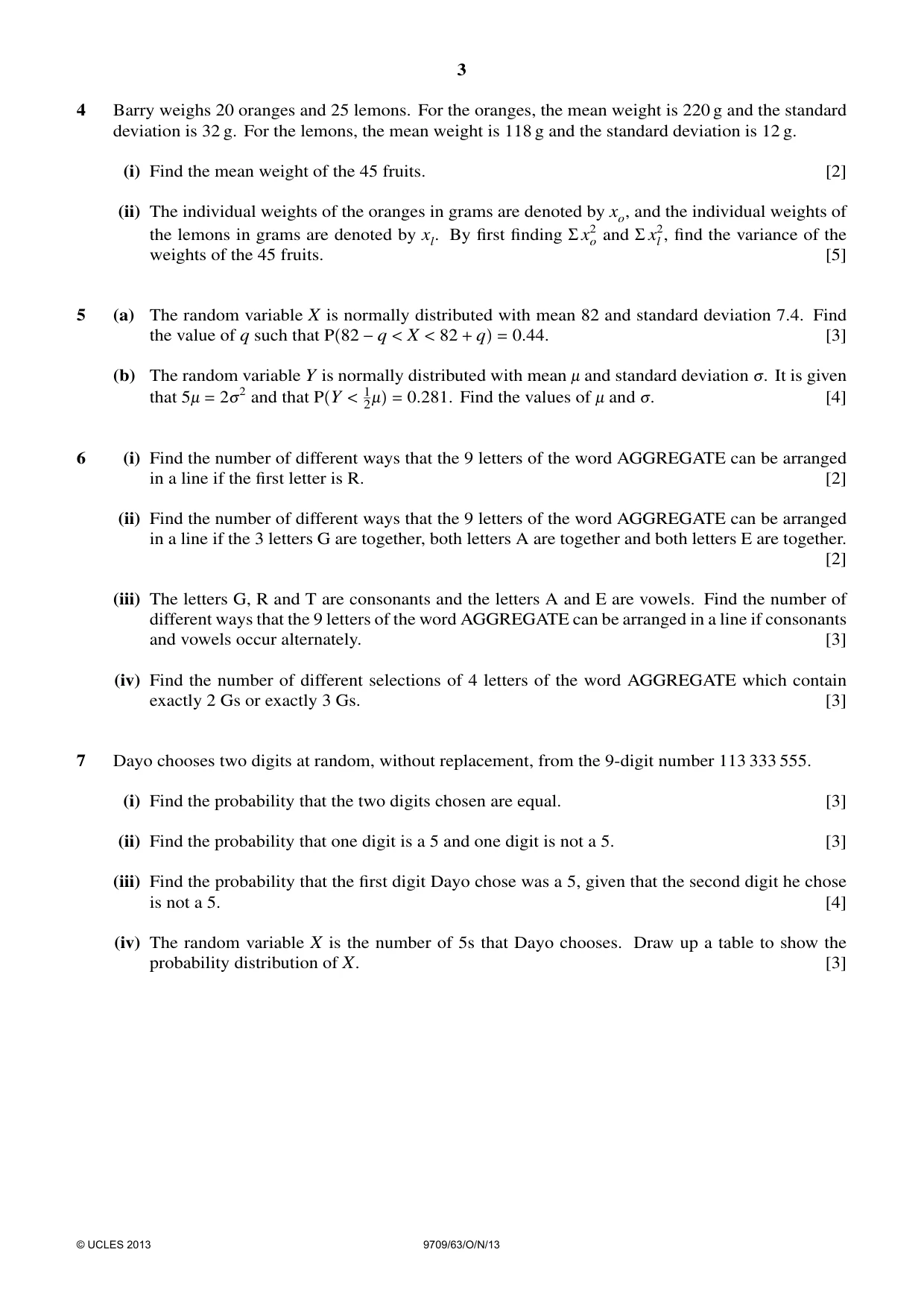
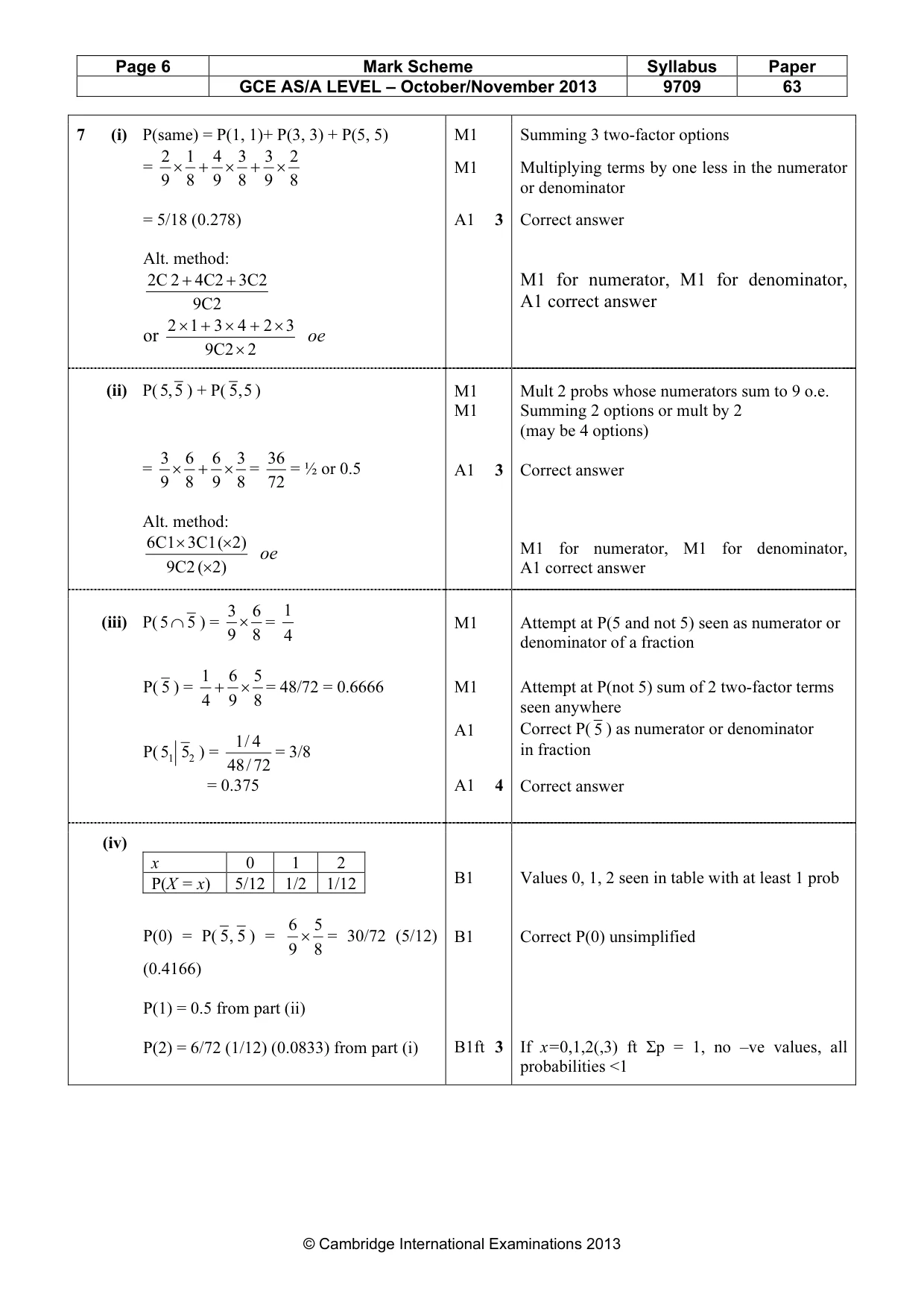
7 Dayo chooses two digits at random, without replacement, from the 9-digit number 113 333 555. (i) Find the probability that the two digits chosen are equal. [3] (ii) Find the probability that one digit is a 5 and one digit is not a 5. [3] (iii) Find the probability that the first digit Dayo chose was a 5, given that the second digit he chose is not a 5. [4] (iv) The random variable X is the number of 5s that Dayo chooses. Draw up a table to show the probability distribution of X. [3]
Mark scheme: 7 (i) P(same) = P(1, 1)+ P(3, 3) + P(5, 5) M1 Summing 3 two-factor options 2 1 4 3 3 2 = × + × + × M1 Multiplying terms by one less in the numerator 9 8 9 8 9 8 or denominator = 5/18 (0.278) A1 3 Correct answer Alt. method: 2C 2 + 4C2 + 3C2 M1 for numerator, M1 for denominator, A1 correct answer 9C2 2 × 1 + 3 × 4 + 2 × 3 or oe 9C2 × 2 (ii) P( ,5 5 ) + P( ,5 5 ) M1 Mult 2 probs whose numerators sum to 9 o.e. M1 Summing 2 options or mult by 2 (may be 4 options) 3 6 6 3 36 = × + × = = ½ or 0.5 A1 3 Correct answer 9 8 9 8 72 Alt. method: 6C1 × 3C1 (× 2) oe M1 for numerator, M1 for denominator, 9C2 (× 2) A1 correct answer 3 6 1 (iii) P( 5∩ 5 ) = × = M1 Attempt at P(5 and not 5) seen as numerator or 9 8 4 denominator of a fraction 1 6 5 P( 5 ) = + × = 48/72 = 0.6666 M1 Attempt at P(not 5) sum of 2 two-factor terms 4 9 8 seen anywhere A1 Correct P( 5 ) as numerator or denominator 1 / 4 P( 51 52 ) = = 3/8 in fraction 48 / 72 = 0.375 A1 4 Correct answer (iv) x 0 1 2 B1 Values 0, 1, 2 seen in table with at least 1 prob P(X = x) 5/12 1/2 1/12 6 5 P(0) = P( ,5 5 ) = × = 30/72 (5/12) B1 Correct P(0) unsimplified 9 8 (0.4166) P(1) = 0.5 from part (ii) P(2) = 6/72 (1/12) (0.0833) from part (i) B1ft 3 If x=0,1,2(,3) ft Σp = 1, no –ve values, all probabilities <1
What was in this paper
The subtopics covered by these 6 questions, and how many questions each got. Open one in a new tab to see every Cambridge question on it.
What you needed in this session
Cambridge’s own grade thresholds for 2013 Oct/Nov, Paper 6 · Variant 3. A higher threshold means an easier paper — the bar moves with how the cohort did.