Cambridge A Level Mathematics 9709 — 2014 Oct/Nov Paper 6 · Variant 3
9709/63/O/N/14 · 4 questions · 50 marks · ≈56 min
The question paper and its mark scheme, free to read here and free to download. This is Cambridge’s own paper, exactly as it was sat.
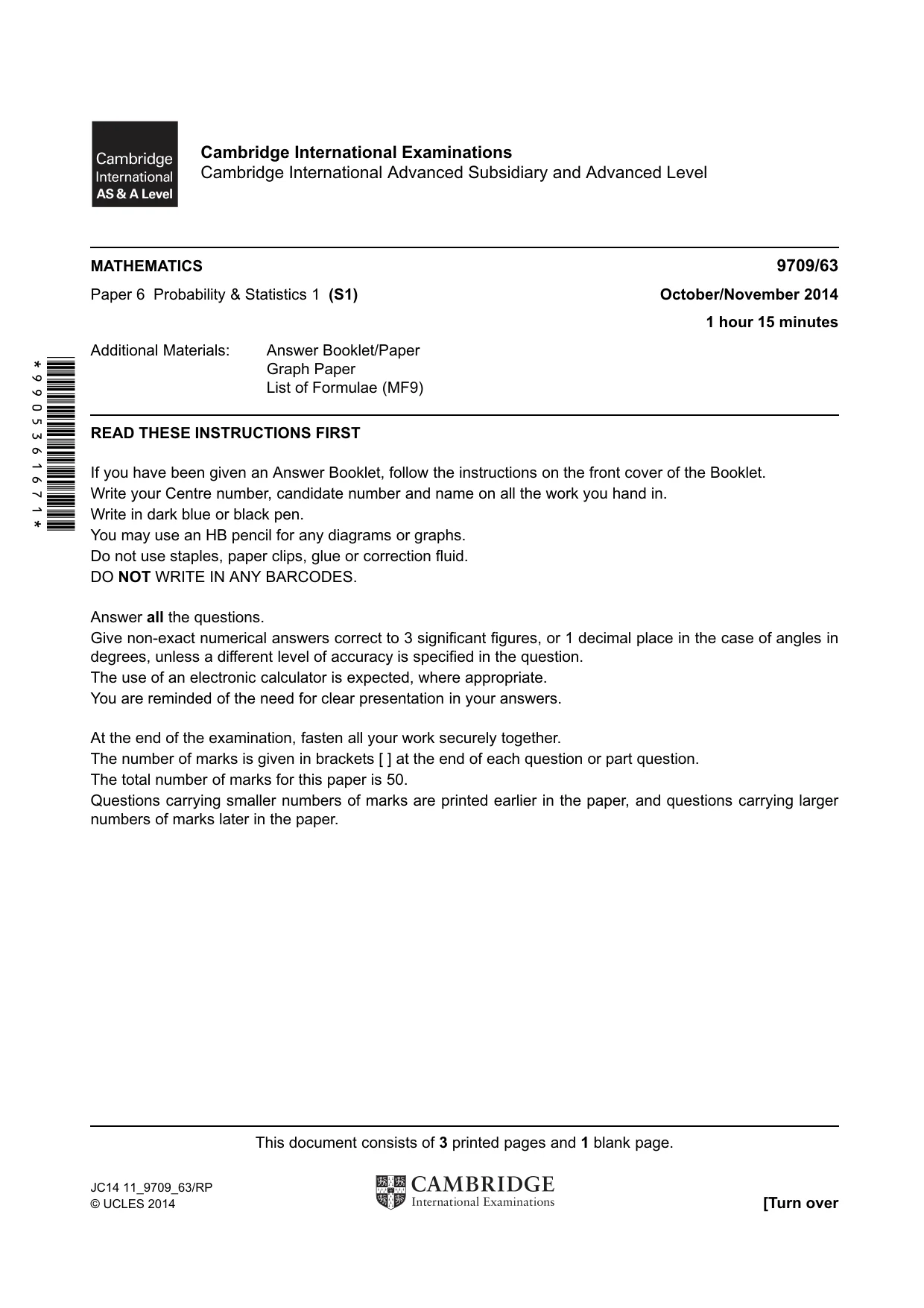
Question paper4 pages
Mark scheme7 pages
Answers below. Sit the paper first if you are practising.
Questions as text
Q1 · Packets of tea are labelled as containing 250 g
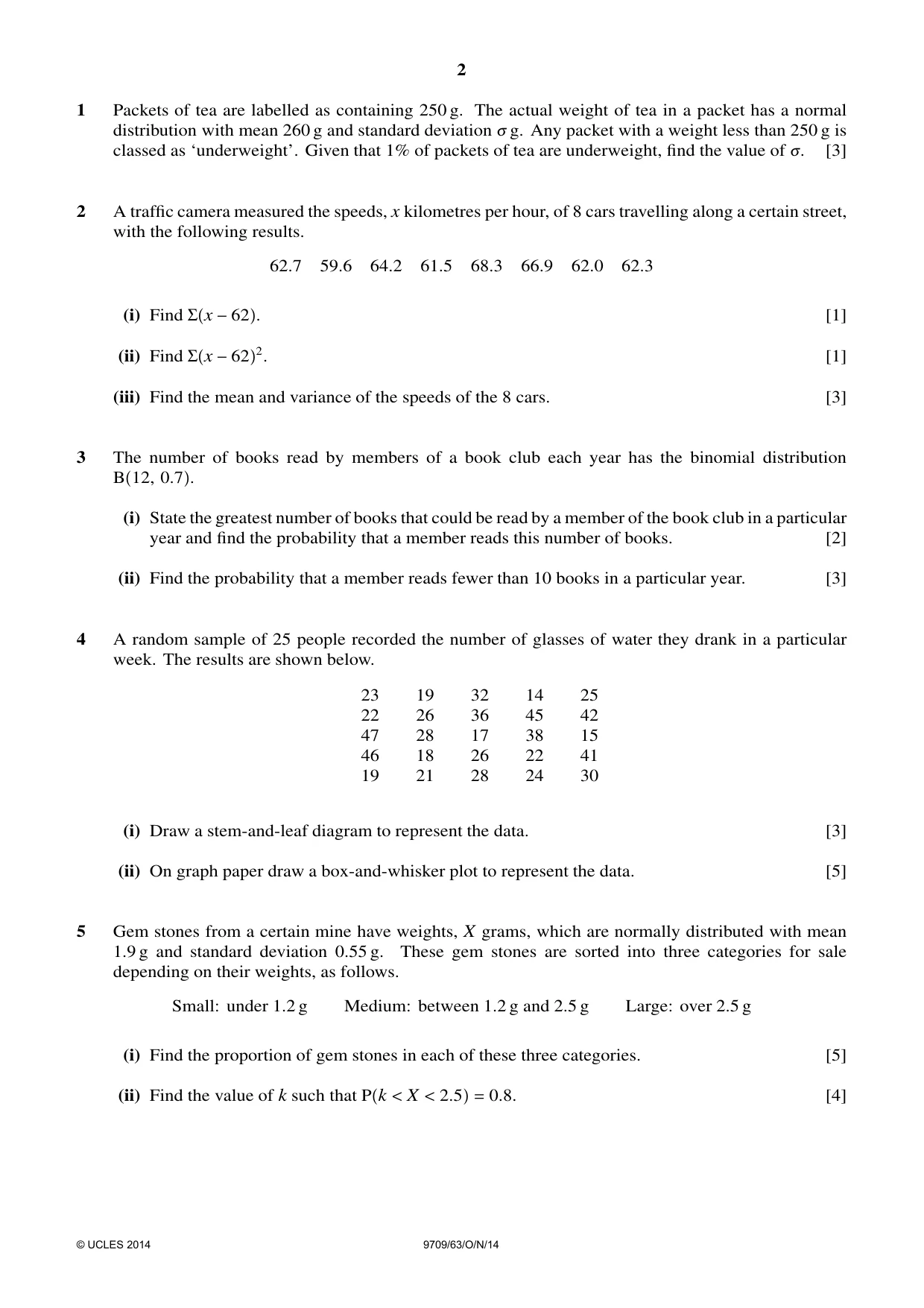
1 Packets of tea are labelled as containing 250 g. The actual weight of tea in a packet has a normal distribution with mean 260 g and standard deviation 3 g. Any packet with a weight less than 250 g is classed as ‘underweight’. Given that 1% of packets of tea are underweight, find the value of 3. [3]
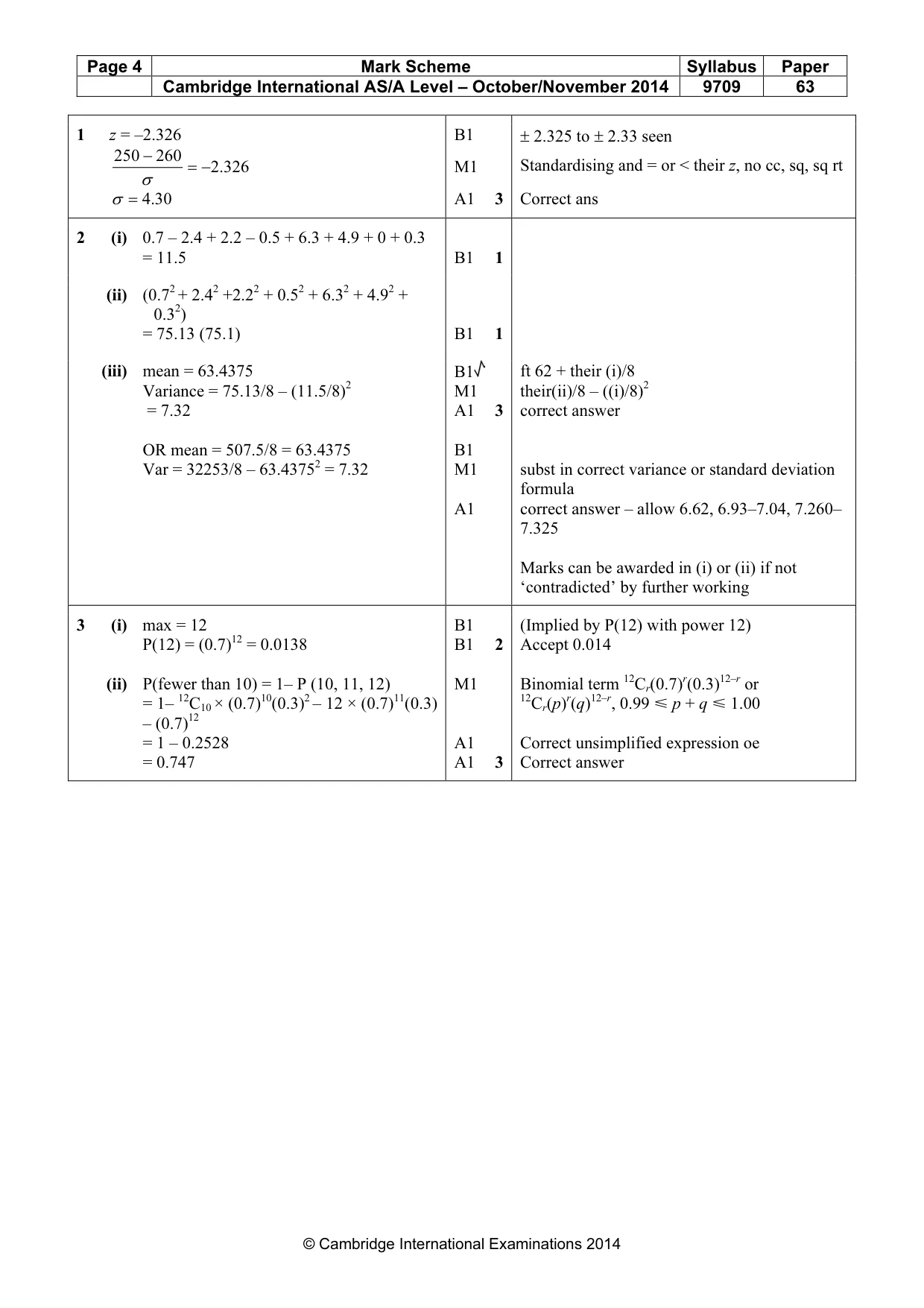
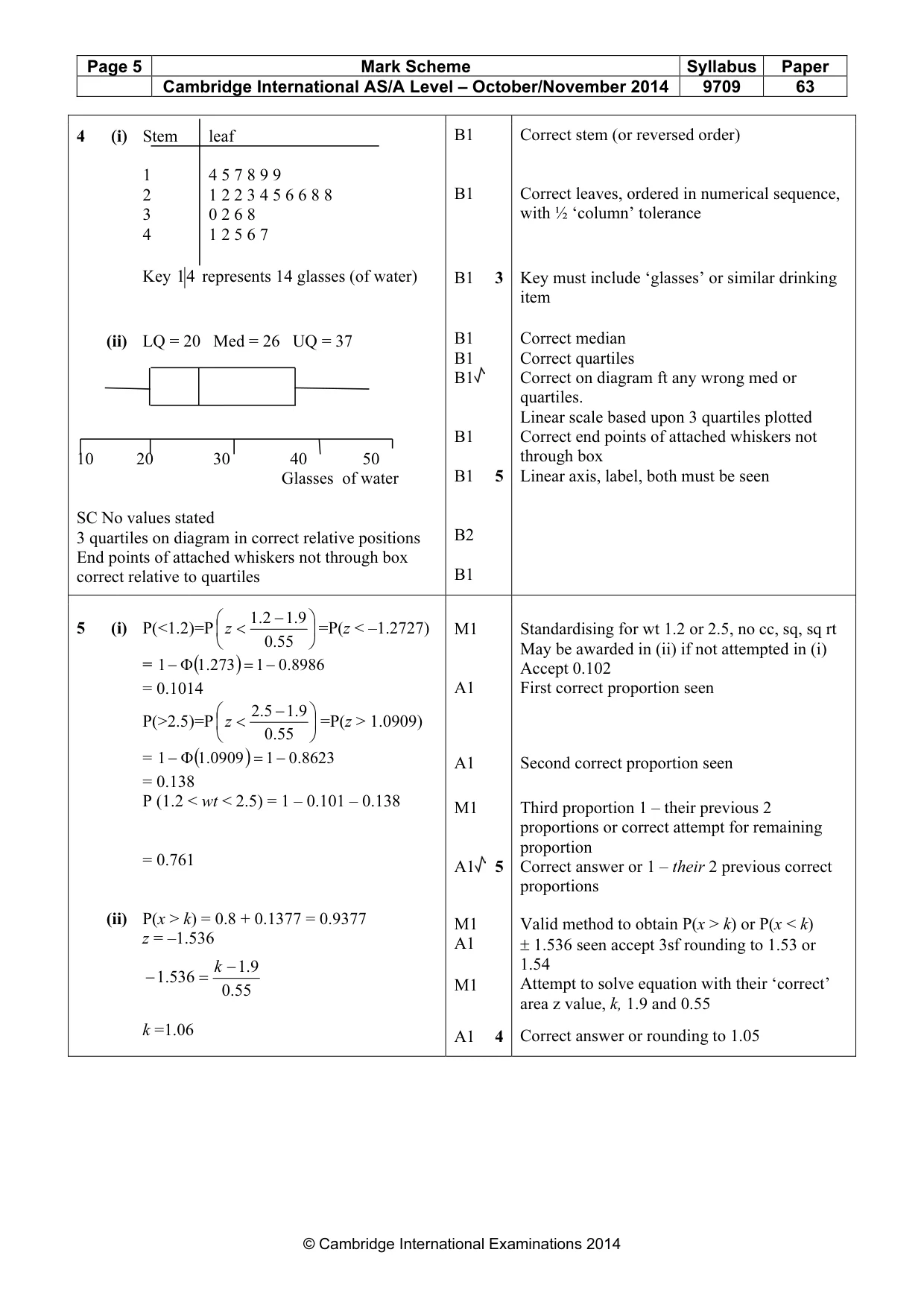
Mark scheme: 1 z = –2.326 B1 ± 2.325 to ± 2.33 seen 250 − 260 = −.2326 M1 Standardising and = or < their z, no cc, sq, sq rt σ σ = .4 30 A1 3 Correct ans
Q3 · The number of books read by members of a book club each year has the binomial…
3 The number of books read by members of a book club each year has the binomial distribution B 12, 0.7 . (i) State the greatest number of books that could be read by a member of the book club in a particular year and find the probability that a member reads this number of books. [2] (ii) Find the probability that a member reads fewer than 10 books in a particular year. [3]
Mark scheme: 3 (i) max = 12 B1 (Implied by P(12) with power 12) P(12) = (0.7)12 = 0.0138 B1 2 Accept 0.014 (ii) P(fewer than 10) = 1– P (10, 11, 12) M1 Binomial term 12Cr(0.7)r(0.3)12–r or = 1– 12C10 × (0.7)10(0.3)2 – 12 × (0.7)11(0.3) 12Cr(p)r(q)12–r, 0.99 < p + q < 1.00 – (0.7)12 = 1 – 0.2528 A1 Correct unsimplified expression oe = 0.747 A1 3 Correct answer
Q4 · A random sample of 25 people recorded the number of glasses of water they drank in a…
4 A random sample of 25 people recorded the number of glasses of water they drank in a particular week. The results are shown below. 23 19 32 14 25 22 26 36 45 42 47 28 17 38 15 46 18 26 22 41 19 21 28 24 30 (i) Draw a stem-and-leaf diagram to represent the data. [3] (ii) On graph paper draw a box-and-whisker plot to represent the data. [5]
Mark scheme: 4 (i) Stem leaf B1 Correct stem (or reversed order) 1 4 5 7 8 9 9 2 1 2 2 3 4 5 6 6 8 8 B1 Correct leaves, ordered in numerical sequence, 3 0 2 6 8 with ½ ‘column’ tolerance 4 1 2 5 6 7 Key 1 4 represents 14 glasses (of water) B1 3 Key must include ‘glasses’ or similar drinking item (ii) LQ = 20 Med = 26 UQ = 37 B1 Correct median B1 Correct quartiles B1 Correct on diagram ft any wrong med or quartiles. Linear scale based upon 3 quartiles plotted B1 Correct end points of attached whiskers not th h b
Q6 · Seven fair dice each with faces marked 1, 2, 3, 4, 5, 6 are thrown and placed in a line
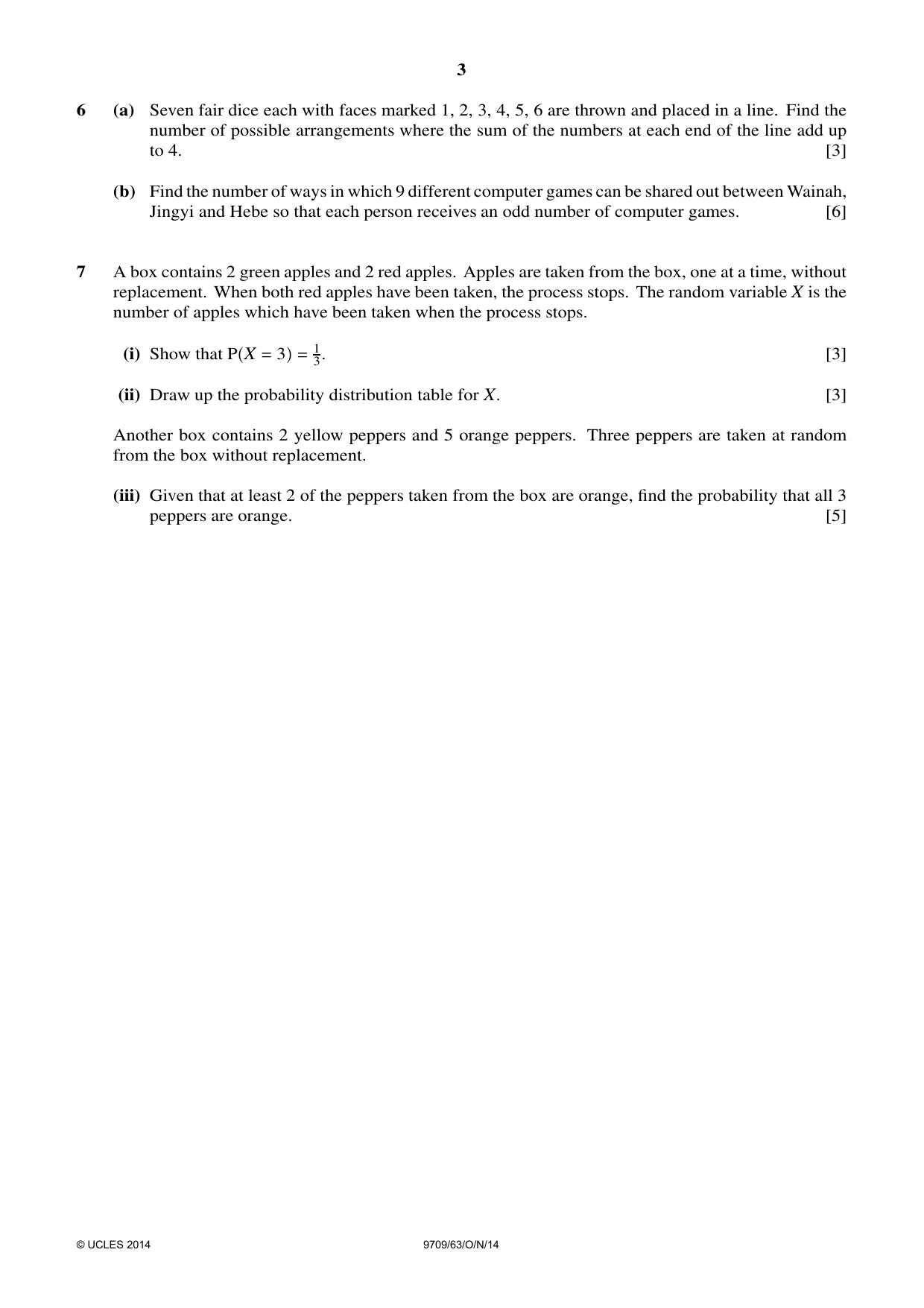
6 (a) Seven fair dice each with faces marked 1, 2, 3, 4, 5, 6 are thrown and placed in a line. Find the number of possible arrangements where the sum of the numbers at each end of the line add up to 4. [3] (b) Find the number of ways in which 9 different computer games can be shared out between Wainah, Jingyi and Hebe so that each person receives an odd number of computer games. [6]
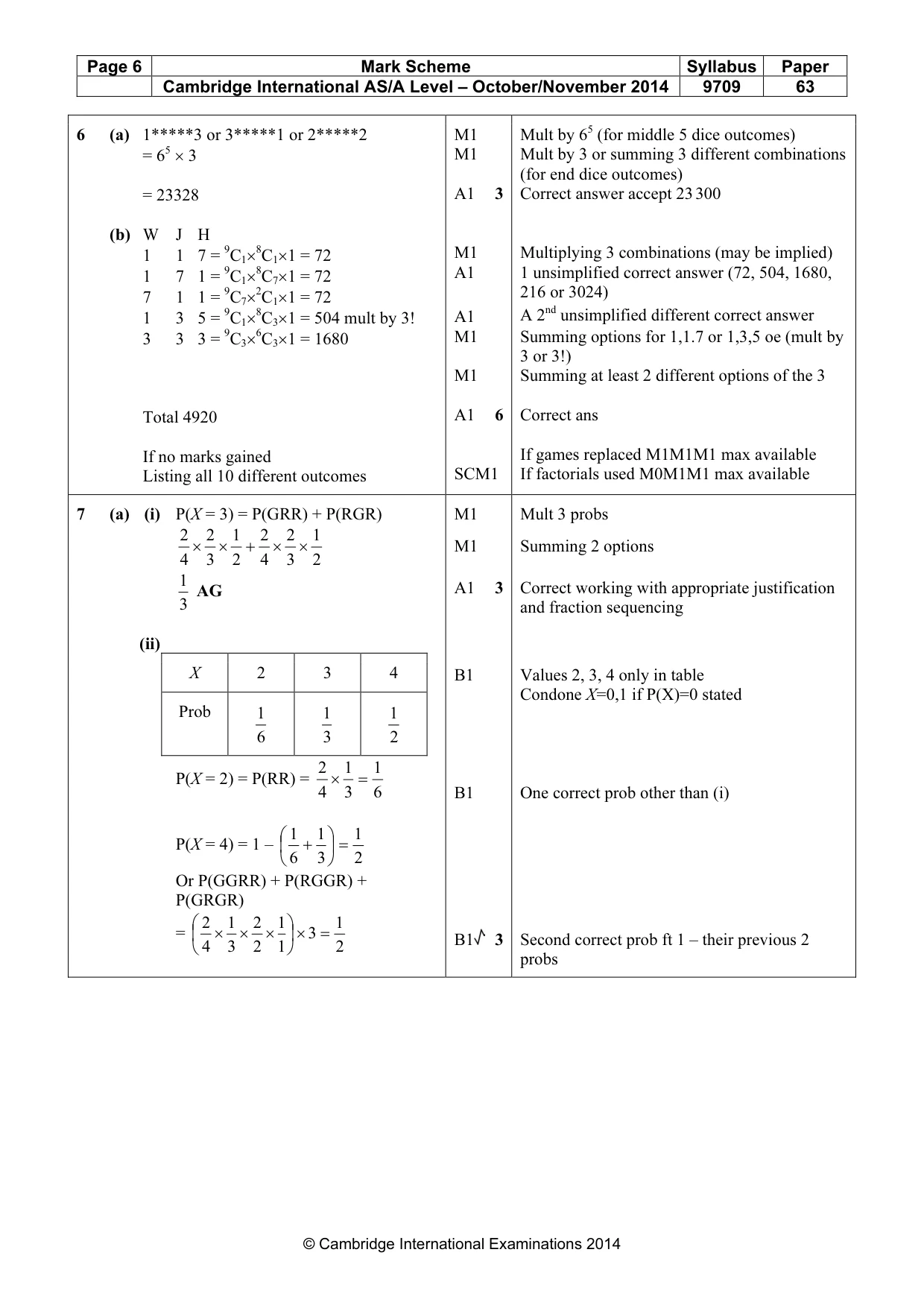
Mark scheme: 6 (a) 1*****3 or 3*****1 or 2*****2 M1 Mult by 65 (for middle 5 dice outcomes) = 65 × 3 M1 Mult by 3 or summing 3 different combinations (for end dice outcomes) = 23328 A1 3 Correct answer accept 23 300 (b) W J H 1 1 7 = 9C1×8C1×1 = 72 M1 Multiplying 3 combinations (may be implied) 1 7 1 = 9C1×8C7×1 = 72 A1 1 unsimplified correct answer (72, 504, 1680, 216 or 3024) 7 1 1 = 9C7×2C1×1 = 72 1 3 5 = 9C1×8C3×1 = 504 mult by 3! A1 A 2nd unsimplified different correct answer 3 3 3 = 9C3×6C3×1 = 1680 M1 Summing options for 1,1.7 or 1,3,5 oe (mult by 3 or 3!) M1 Summing at least 2 different options of the 3 Total 4920 A1 6 Correct ans If no marks gained If games replaced M1M1M1 max available Listing all 10 different outcomes SCM1 If factorials used M0M1M1 max available
What was in this paper
The subtopics covered by these 4 questions, and how many questions each got. Open one in a new tab to see every Cambridge question on it.
What you needed in this session
Cambridge’s own grade thresholds for 2014 Oct/Nov, Paper 6 · Variant 3. A higher threshold means an easier paper — the bar moves with how the cohort did.