Cambridge A Level Mathematics 9709 — 2013 May/June Paper 6 · Variant 3
9709/63/M/J/13 · 6 questions · 50 marks · ≈56 min
The question paper and its mark scheme, free to read here and free to download. This is Cambridge’s own paper, exactly as it was sat.
Question paper4 pages
Mark scheme6 pages
Answers below. Sit the paper first if you are practising.
Questions as text
Q1 · Q is the event ‘Nicola throws two fair dice and gets a total of 5’
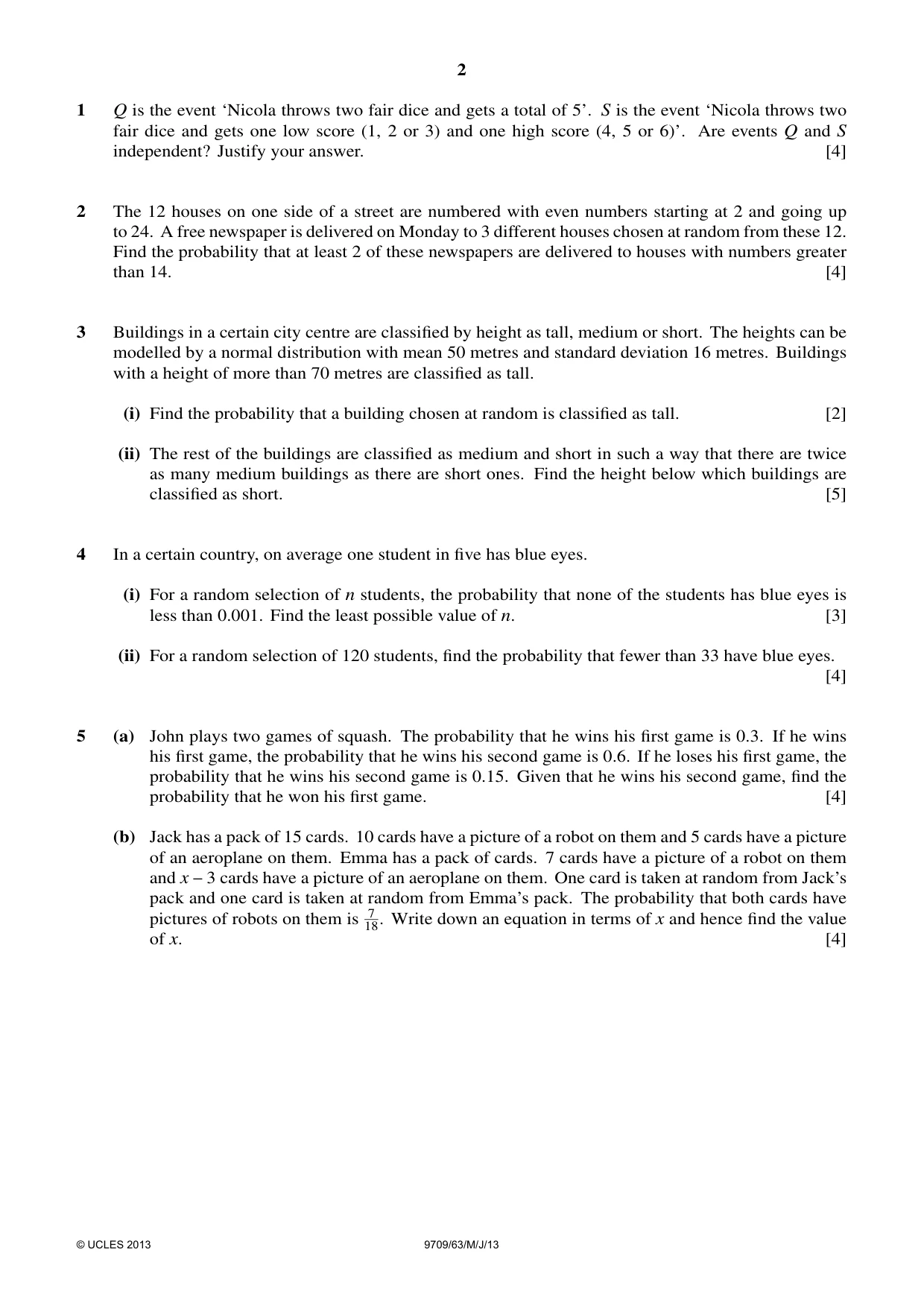
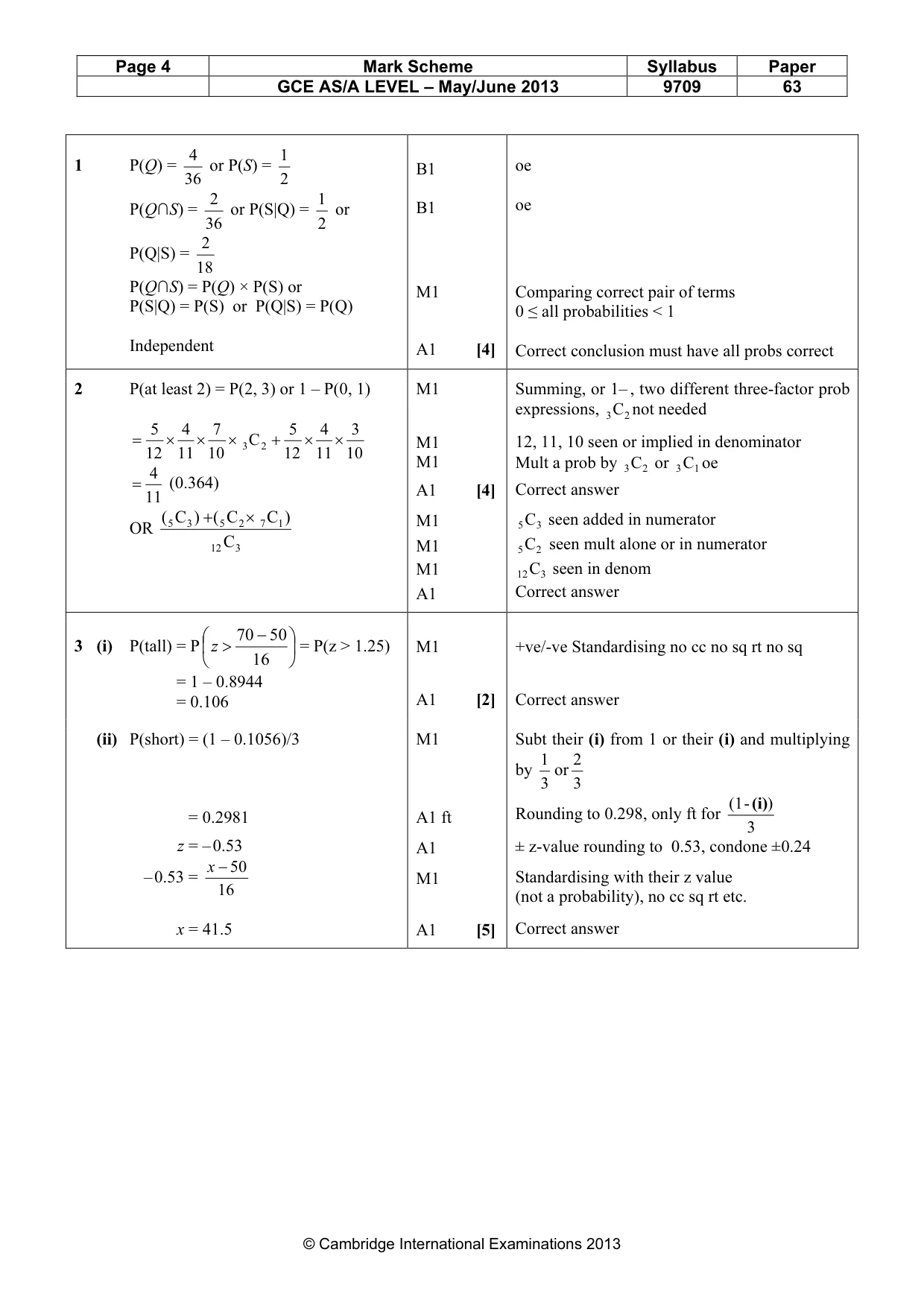
1 Q is the event ‘Nicola throws two fair dice and gets a total of 5’. S is the event ‘Nicola throws two fair dice and gets one low score (1, 2 or 3) and one high score (4, 5 or 6)’. Are events Q and S independent? Justify your answer. [4]
Mark scheme: 4 1 1 P(Q) = or P(S) = B1 oe 36 2 2 1 P(Q∩S) = or P(S|Q) = or B1 oe 36 2 2 P(Q|S) = 18 P(Q∩S) = P(Q) × P(S) or M1 Comparing correct pair of terms P(S|Q) = P(S) or P(Q|S) = P(Q) 0 ≤ all probabilities < 1 Independent A1 [4] Correct conclusion must have all probs correct
Q2 · The 12 houses on one side of a street are numbered with even numbers starting at 2 and…
2 The 12 houses on one side of a street are numbered with even numbers starting at 2 and going up to 24. A free newspaper is delivered on Monday to 3 different houses chosen at random from these 12. Find the probability that at least 2 of these newspapers are delivered to houses with numbers greater than 14. [4]
Mark scheme: 2 P(at least 2) = P(2, 3) or 1 – P(0, 1) M1 Summing, or 1– , two different three-factor prob expressions, 3C 2 not needed 5 4 7 5 4 3 = × × × 3 C 2 + × × M1 12, 11, 10 seen or implied in denominator 12 11 10 12 11 10 M1 Mult a prob by 3C 2 or 3C 1 oe 4 = (0.364) A1 [4] Correct answer 11 ( 5 C 3 ) + ( 5 C 2 × 7 C1 ) M1 5C 3 seen added in numerator OR 12 C 3 M1 5C 2 seen mult alone or in numerator M1 12C 3 seen in denom A1 Correct answer 70 −50
Q3 · Buildings in a certain city centre are classified by height as tall, medium or short
3 Buildings in a certain city centre are classified by height as tall, medium or short. The heights can be modelled by a normal distribution with mean 50 metres and standard deviation 16 metres. Buildings with a height of more than 70 metres are classified as tall. (i) Find the probability that a building chosen at random is classified as tall. [2] (ii) The rest of the buildings are classified as medium and short in such a way that there are twice as many medium buildings as there are short ones. Find the height below which buildings are classified as short. [5]
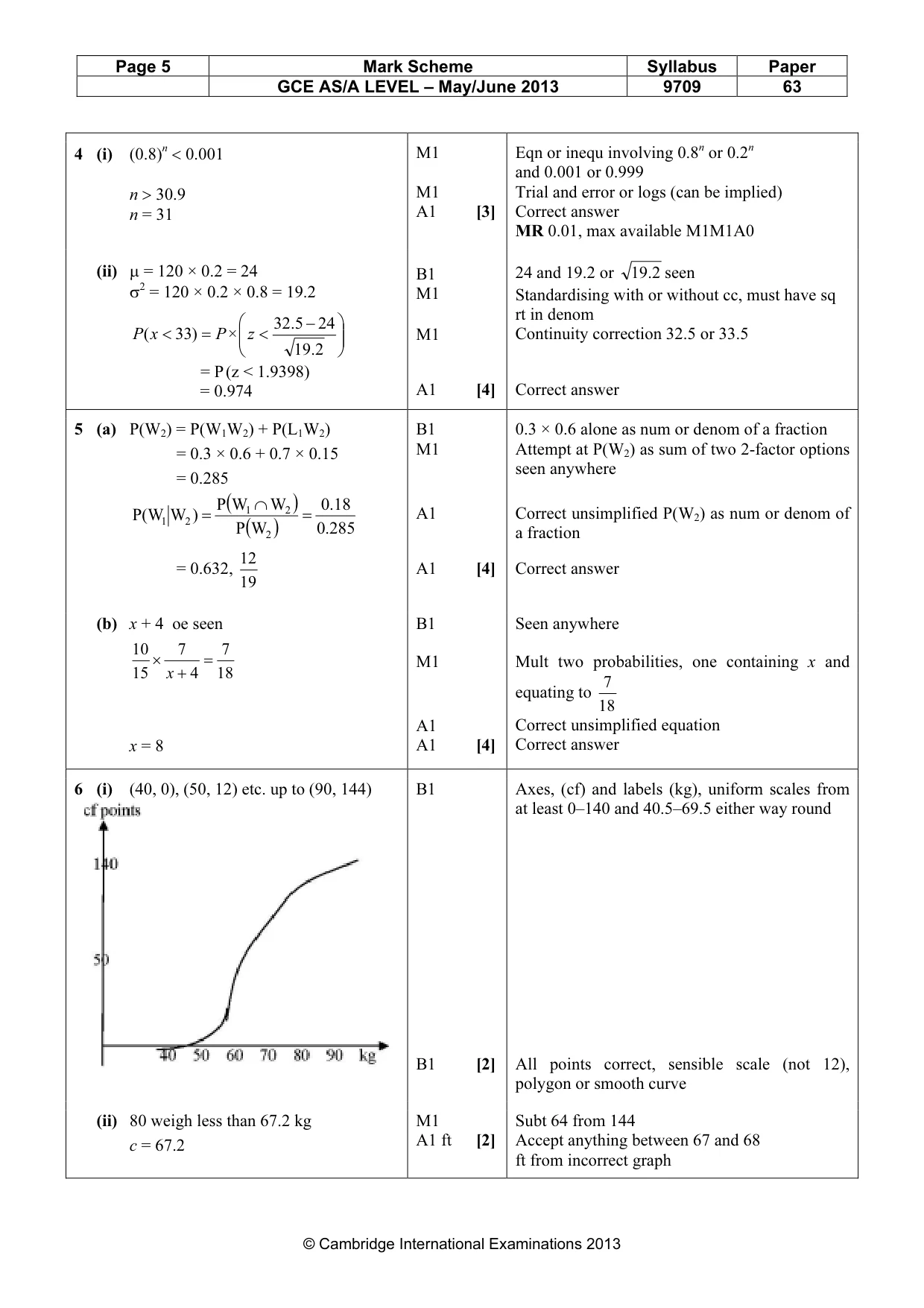
Mark scheme: 3 (i) P(tall) = P > z 70 50 = P(z > 1.25) M1 +ve/-ve Standardising no cc no sq rt no sq 16 = 1 – 0.8944 = 0.106 A1 [2] Correct answer (ii) P(short) = (1 – 0.1056)/3 M1 Subt their (i) from 1 or their (i) and multiplying 1 2 by or 3 3 (1 - (i)) = 0.2981 A1 ft Rounding to 0.298, only ft for 3 z = – 0.53 A1 ± z-value rounding to 0.53, condone ±0.24 x − 50 – 0.53 = M1 Standardising with their z value 16 (not a probability), no cc sq rt etc. x = 41.5 A1 [5] Correct answer GCE AS/A LEVEL – May/June 2013 9709 63 4 (i) (0.8)n < 0.001 M1 Eqn or inequ involving 0.8n or 0.2n and 0.001 or 0.999 n > 30.9 M1 Trial and error or logs (can be implied) n = 31 A1 [3] Correct answer MR 0.01, max available M1M1A0 (ii) µ = 120 × 0.2 = 24 B1 24 and 19.2 or 19 2. seen σ2 = 120 × 0.2 × 0.8 = 19.2 M1 Standardising with or without cc, must have sq rt in denom 32 5 −24
Q4 · In a certain country, on average one student in five has blue eyes
4 In a certain country, on average one student in five has blue eyes. (i) For a random selection of n students, the probability that none of the students has blue eyes is less than 0.001. Find the least possible value of n. [3] (ii) For a random selection of 120 students, find the probability that fewer than 33 have blue eyes. [4]
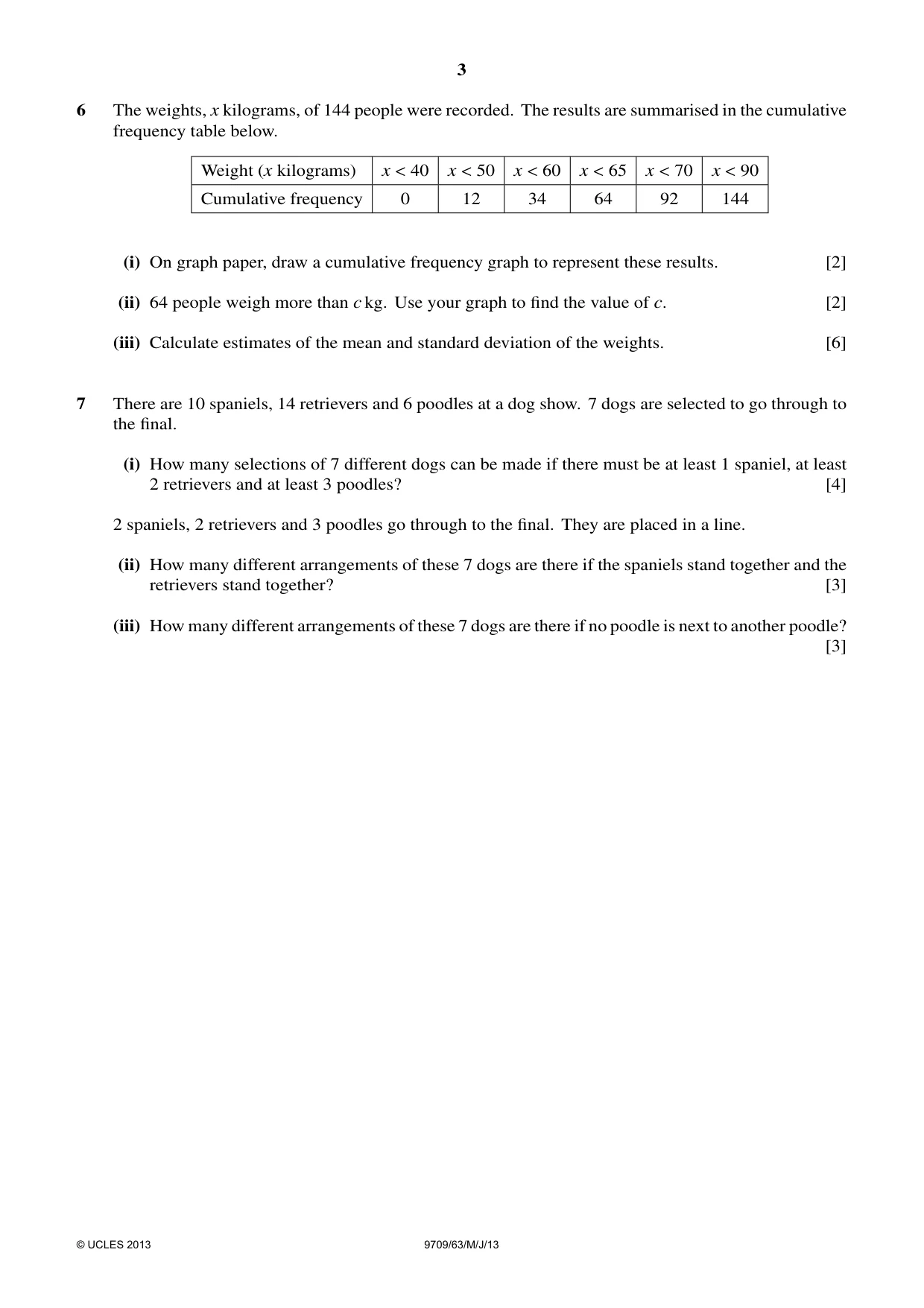
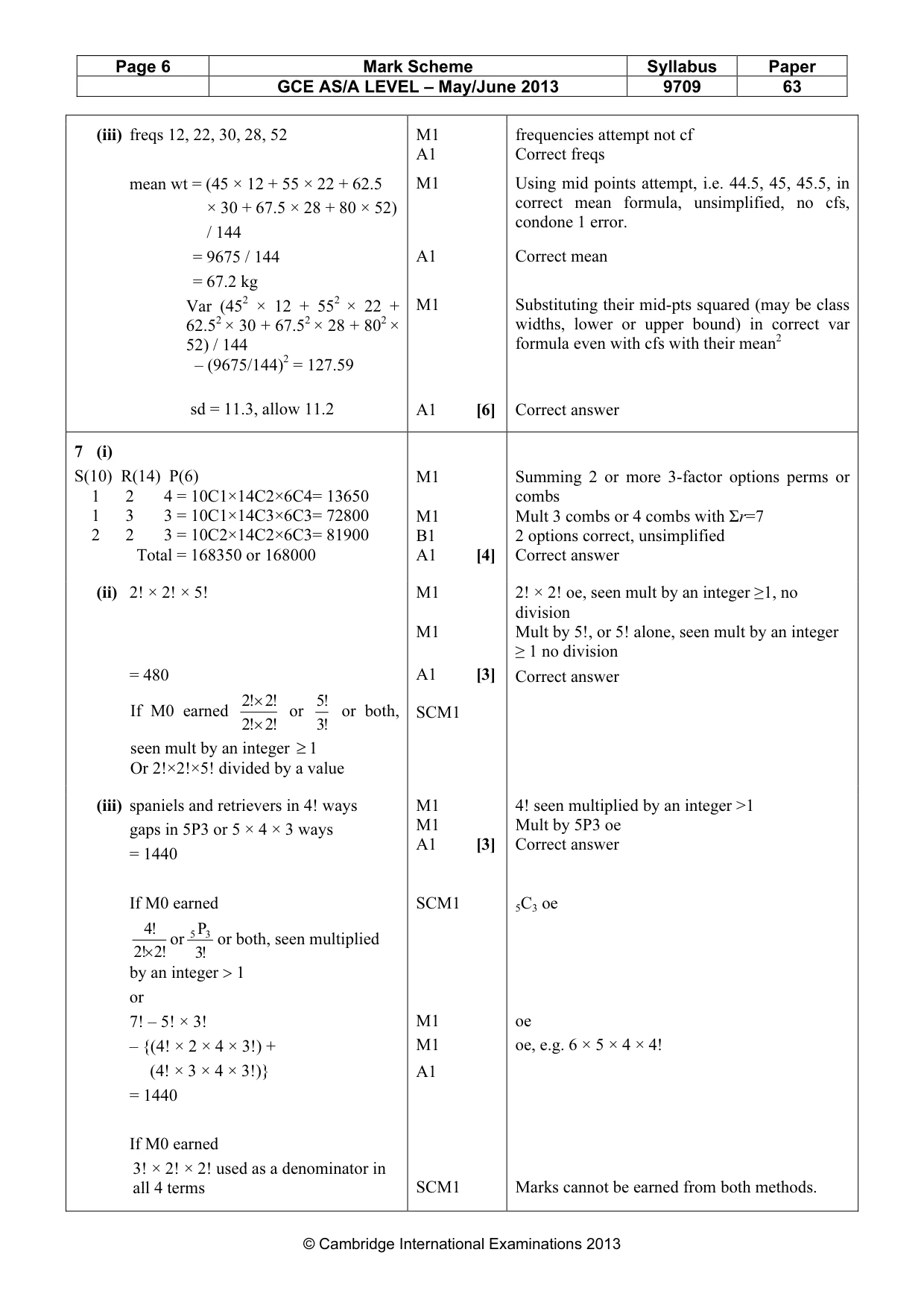
Mark scheme: M1 Mult two probabilities, one containing x and 15 x + 4 18 7 equating to 18 A1 Correct unsimplified equation x = 8 A1 [4] Correct answer 6 (i) (40, 0), (50, 12) etc. up to (90, 144) B1 Axes, (cf) and labels (kg), uniform scales from at least 0–140 and 40.5–69.5 either way round B1 [2] All points correct, sensible scale (not 12), polygon or smooth curve (ii) 80 weigh less than 67.2 kg M1 Subt 64 from 144 c = 67.2 A1 ft [2] Accept anything between 67 and 68 ft from incorrect graph GCE AS/A LEVEL – May/June 2013 9709 63 (iii) freqs 12, 22, 30, 28, 52 M1 frequencies attempt not cf A1 Correct freqs mean wt = (45 × 12 + 55 × 22 + 62.5 M1 Using mid points attempt, i.e. 44.5, 45, 45.5, in correct mean formula, unsimplified, no cfs, × 30 + 67.5 × 28 + 80 × 52) condone 1 error. / 144 = 9675 / 144 A1 Correct mean = 67.2 kg Var (452 × 12 + 552 × 22 + M1 Substituting their mid-pts squared (may be class 62.52 × 30 + 67.52 × 28 + 802 × widths, lower or upper bound) in correct var 52) / 144 formula even with cfs with their mean2 – (9675/144)2 = 127.59 sd = 11.3, allow 11.2 A1 [6] Correct answer 7 (i) S(10) R(14) P(6) M1 Summing 2 or more 3-factor options perms or 1 2 4 = 10C1×14C2×6C4= 13650 combs 1 3 3 = 10C1×14C3×6C3= 72800 M1 Mult 3 combs or 4 combs with Σr=7 2 2 3 = 10C2×14C2×6C3= 81900 B1 2 options correct, unsimplified Total = 168350 or 168000 A1 [4] Correct answer (ii) 2! × 2! × 5! M1 2! × 2! oe, seen mult by an integer ≥1, no division M1 Mult by 5!, or 5! alone, seen mult by an integer ≥ 1 no division = 480 A1 [3] Correct answer !2× !2 !5 If M0 earned or or both, SCM1 !2× !2 !3 seen mult by an integer ≥1 Or 2!×2!×5! divided by a value (iii) spaniels and retrievers in 4! ways M1 4! seen multiplied by an integer >1 M1 Mult by 5P3 oe gaps in 5P3 or 5 × 4 × 3 ways A1 [3] Correct answer = 1440 If M0 earned SCM1 5C3 oe
Q5 · John plays two games of squash
5 (a) John plays two games of squash. The probability that he wins his first game is 0.3. If he wins his first game, the probability that he wins his second game is 0.6. If he loses his first game, the probability that he wins his second game is 0.15. Given that he wins his second game, find the probability that he won his first game. [4] (b) Jack has a pack of 15 cards. 10 cards have a picture of a robot on them and 5 cards have a picture of an aeroplane on them. Emma has a pack of cards. 7 cards have a picture of a robot on them and x −3 cards have a picture of an aeroplane on them. One card is taken at random from Jack’s pack and one card is taken at random from Emma’s pack. The probability that both cards have pictures of robots on them is 18.7 Write down an equation in terms of x and hence find the value of x. [4]
Mark scheme: !4 5 P3 or or both, seen multiplied !2× !2 !3 by an integer > 1 or 7! – 5! × 3! M1 oe – {(4! × 2 × 4 × 3!) + M1 oe, e.g. 6 × 5 × 4 × 4! (4! × 3 × 4 × 3!)} A1 = 1440 If M0 earned 3! × 2! × 2! used as a denominator in all 4 terms SCM1 Marks cannot be earned from both methods.
Q7 · There are 10 spaniels, 14 retrievers and 6 poodles at a dog show
7 There are 10 spaniels, 14 retrievers and 6 poodles at a dog show. 7 dogs are selected to go through to the final. (i) How many selections of 7 different dogs can be made if there must be at least 1 spaniel, at least 2 retrievers and at least 3 poodles? [4] 2 spaniels, 2 retrievers and 3 poodles go through to the final. They are placed in a line. (ii) How many different arrangements of these 7 dogs are there if the spaniels stand together and the retrievers stand together? [3] (iii) How many different arrangements of these 7 dogs are there if no poodle is next to another poodle? [3]
Mark scheme: 10 7 7 × = M1 Mult two probabilities one containing x and
What was in this paper
The subtopics covered by these 6 questions, and how many questions each got. Open one in a new tab to see every Cambridge question on it.
What you needed in this session
Cambridge’s own grade thresholds for 2013 May/June, Paper 6 · Variant 3. A higher threshold means an easier paper — the bar moves with how the cohort did.