Cambridge A Level Mathematics 9709 — 2014 Oct/Nov Paper 6 · Variant 1
9709/61/O/N/14 · 7 questions · 50 marks · ≈56 min
The question paper and its mark scheme, free to read here and free to download. This is Cambridge’s own paper, exactly as it was sat.
Question paper4 pages
Mark scheme6 pages
Answers below. Sit the paper first if you are practising.
Questions as text
Q1 · Find the mean and variance of the following data
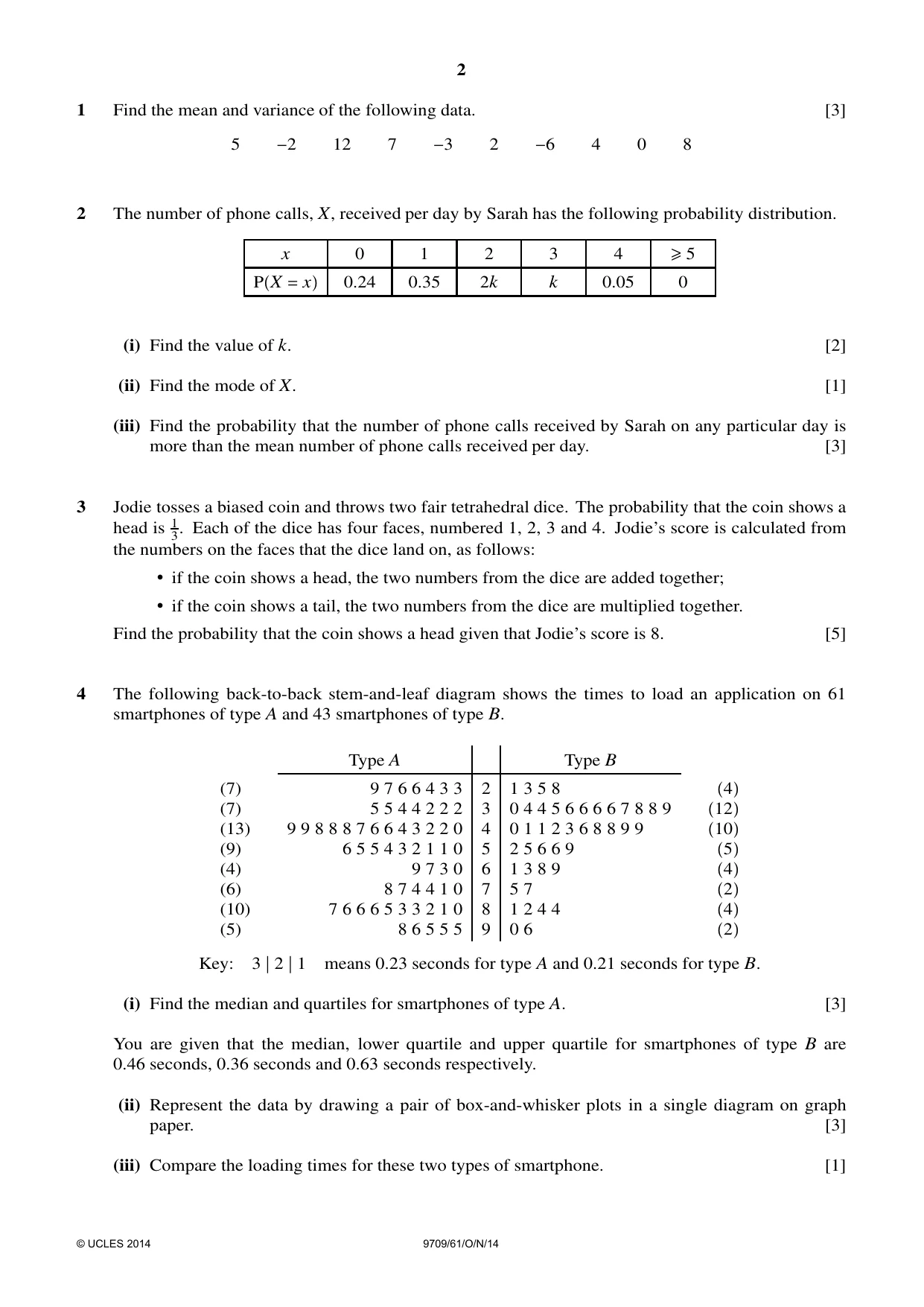
1 Find the mean and variance of the following data. [3] 5 −2 12 7 −3 2 −6 4 0 8
Mark scheme: 1 mean = (5 + (–2) + 12 + 7 + (–3) + 2 + (–6) B1 + 4 + 0 + 8) / 10 = 2.7 var = (52 + (–2)2 + … + 82) / 10 – 2.72 = M1 Subst in correct var formula must have 35.1 – 2.72 – mean2 = 27.8 A1 3 Correct answer
Q2 · The number of phone calls, X, received per day by Sarah has the following probability…
2 The number of phone calls, X, received per day by Sarah has the following probability distribution. x 0 1 2 3 4 ≥5 P X = x 0.24 0.35 2k k 0.05 0 (i) Find the value of k. [2] (ii) Find the mode of X. [1] (iii) Find the probability that the number of phone calls received by Sarah on any particular day is more than the mean number of phone calls received per day. [3]
Mark scheme: 2 (i) 0.24 + 0.35 + 2k + k +0.05 = 1 M1 Summing probs = 1 k = 0.12 A1 2 Correct answer (ii) model number is 1 B1 1 (iii) mean = 1 × 0.35 + 2 × 0.24 + 3 × 0.12 + B1 1.39 seen 4 × 0.05 M1 Finding P(X > their mean) P(>1.39) = P(2, 3, 4) = 0.41 B1 3 Correct ans following mean or mode only 1 2 l b di l d b
Q3 · Jodie tosses a biased coin and throws two fair tetrahedral dice
3 Jodie tosses a biased coin and throws two fair tetrahedral dice. The probability that the coin shows a head is 13. Each of the dice has four faces, numbered 1, 2, 3 and 4. Jodie’s score is calculated from the numbers on the faces that the dice land on, as follows: • if the coin shows a head, the two numbers from the dice are added together; • if the coin shows a tail, the two numbers from the dice are multiplied together. Find the probability that the coin shows a head given that Jodie’s score is 8. [5]
Mark scheme: 1 2 3 P(8) = P(H 4 4) + P(T 2 4) + P(T 4 2) M1 or mult by dice related prob, seen 3 3 anywhere 1 1 2 1 2 1 = × + × + × M1 Summing two or three 2-factor probs 3 16 3 16 3 16 1 2 involving and 3 3 5 5 = A1 oe seen as num or denom of a fraction 48 48 P ( H ∩ 8 ) 1 P(H | 8) = B1 oe seen as num or denom of a fraction P (8 ) 48 1 48 1 = = A1 5 Correct ans 5 5 48
Q4 · The following back-to-back stem-and-leaf diagram shows the times to load an application…
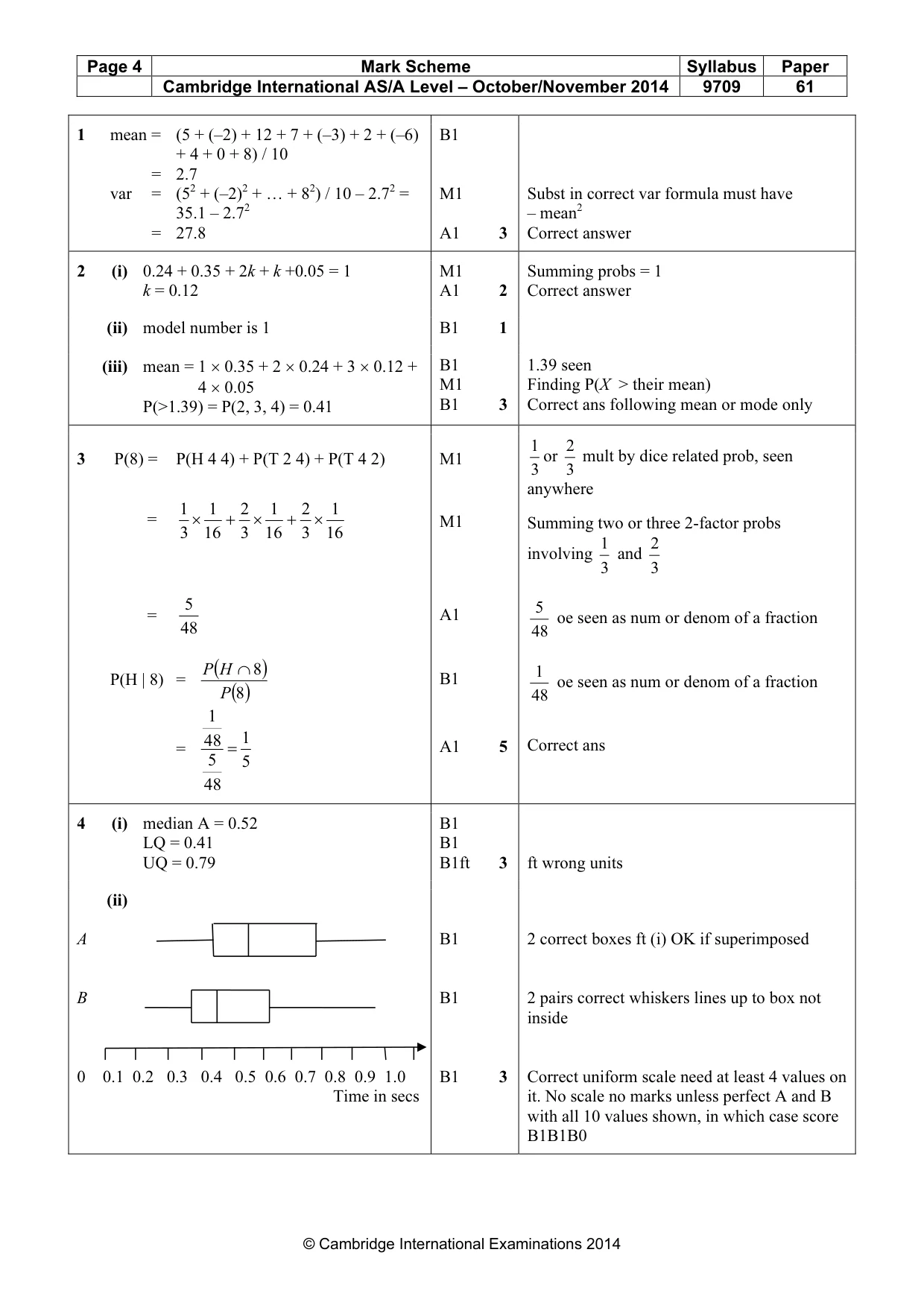
4 The following back-to-back stem-and-leaf diagram shows the times to load an application on 61 smartphones of type A and 43 smartphones of type B. Type A Type B (7) 9 7 6 6 4 3 3 2 1 3 5 8 (7) 5 5 4 4 2 2 2 3 0 4 4 5 6 6 6 6 7 8 8 9 12 (13) 9 9 8 8 8 7 6 6 4 3 2 2 0 4 0 1 1 2 3 6 8 8 9 9 10 (9) 6 5 5 4 3 2 1 1 0 5 2 5 6 6 9 (4) 9 7 3 0 6 1 3 8 9 (6) 8 7 4 4 1 0 7 5 7 (10) 7 6 6 6 5 3 3 2 1 0 8 1 2 4 4 (5) 8 6 5 5 5 9 0 6 Key: 3 | 2 | 1 means 0.23 seconds for type A and 0.21 seconds for type B. (i) Find the median and quartiles for smartphones of type A. [3] You are given that the median, lower quartile and upper quartile for smartphones of type B are 0.46 seconds, 0.36 seconds and 0.63 seconds respectively. (ii) Represent the data by drawing a pair of box-and-whisker plots in a single diagram on graph paper. [3] (iii) Compare the loading times for these two types of smartphone. [1]
Mark scheme: 4 (i) median A = 0.52 B1 LQ = 0.41 B1 UQ = 0.79 B1ft 3 ft wrong units (ii) A B1 2 correct boxes ft (i) OK if superimposed B B1 2 pairs correct whiskers lines up to box not inside
Q5 · Screws are sold in packets of 15
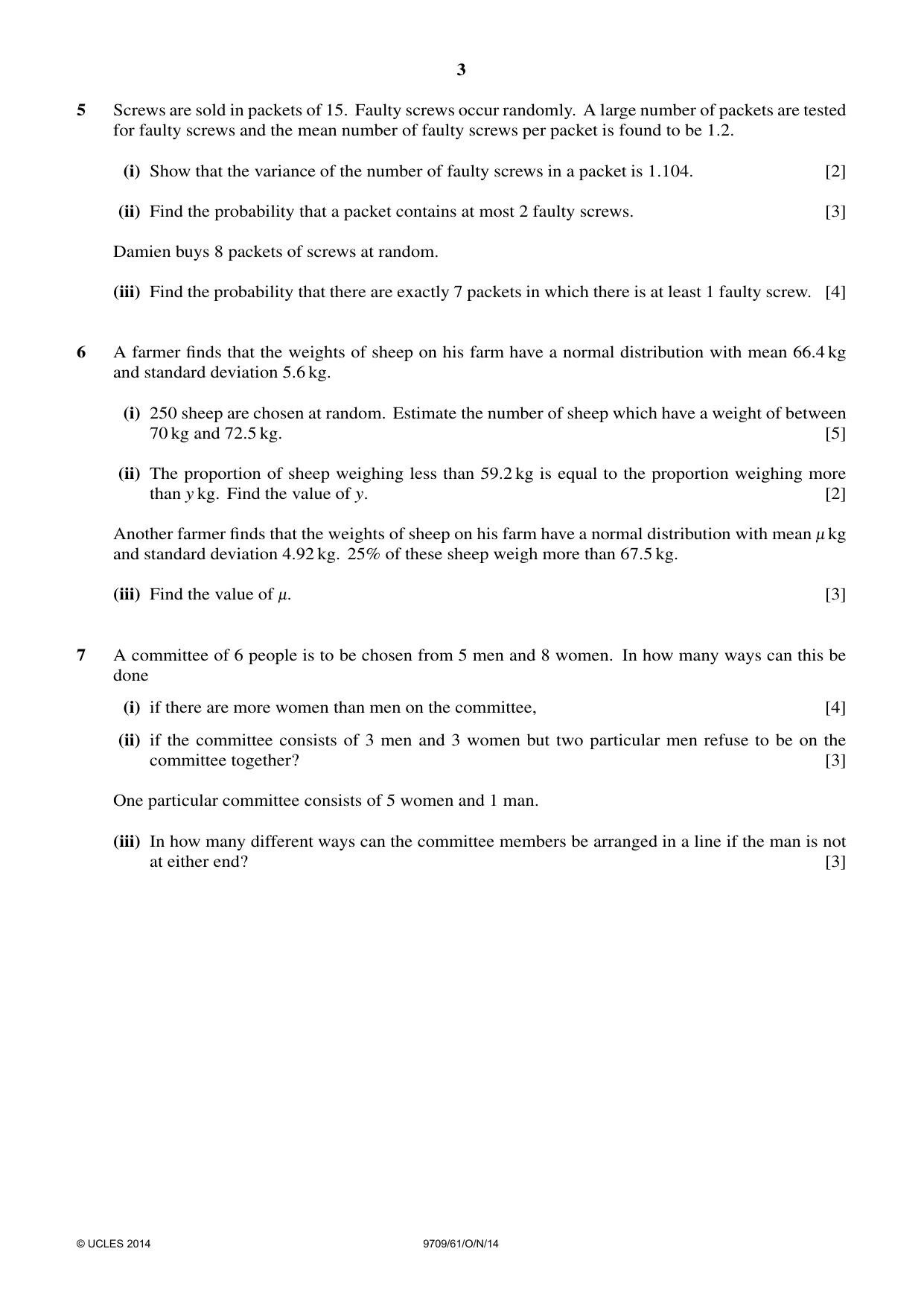
5 Screws are sold in packets of 15. Faulty screws occur randomly. A large number of packets are tested for faulty screws and the mean number of faulty screws per packet is found to be 1.2. (i) Show that the variance of the number of faulty screws in a packet is 1.104. [2] (ii) Find the probability that a packet contains at most 2 faulty screws. [3] Damien buys 8 packets of screws at random. (iii) Find the probability that there are exactly 7 packets in which there is at least 1 faulty screw. [4]
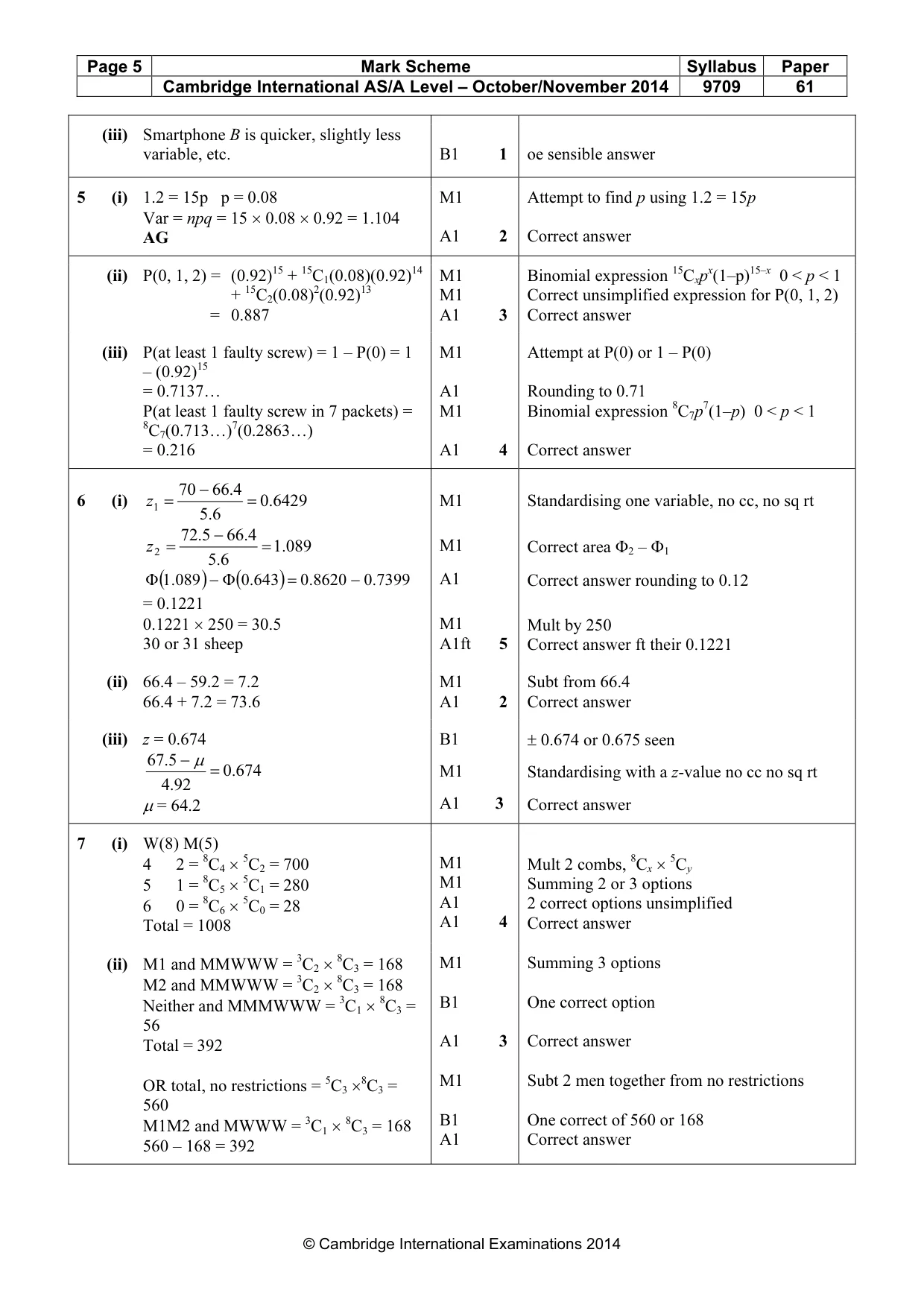
Mark scheme: 5 (i) 1.2 = 15p p = 0.08 M1 Attempt to find p using 1.2 = 15p Var = npq = 15 × 0.08 × 0.92 = 1.104 AG A1 2 Correct answer (ii) P(0, 1, 2) = (0.92)15 + 15C1(0.08)(0.92)14 M1 Binomial expression 15Cxpx(1–p)15–x 0 < p < 1 + 15C2(0.08)2(0.92)13 M1 Correct unsimplified expression for P(0, 1, 2) = 0.887 A1 3 Correct answer (iii) P(at least 1 faulty screw) = 1 – P(0) = 1 M1 Attempt at P(0) or 1 – P(0) – (0.92)15 = 0.7137… A1 Rounding to 0.71 P(at least 1 faulty screw in 7 packets) = M1 Binomial expression 8C7p7(1–p) 0 < p < 1 8C7(0.713…)7(0.2863…) = 0.216 A1 4 Correct answer 70 − 66 4
Q6 · A farmer finds that the weights of sheep on his farm have a normal distribution with mean…
6 A farmer finds that the weights of sheep on his farm have a normal distribution with mean 66.4 kg and standard deviation 5.6 kg. (i) 250 sheep are chosen at random. Estimate the number of sheep which have a weight of between 70 kg and 72.5 kg. [5] (ii) The proportion of sheep weighing less than 59.2 kg is equal to the proportion weighing more than y kg. Find the value of y. [2] Another farmer finds that the weights of sheep on his farm have a normal distribution with mean kg and standard deviation 4.92 kg. 25% of these sheep weigh more than 67.5 kg. (iii) Find the value of . [3]
Mark scheme: 70 664. 6 (i) z1 = = .06429 M1 Standardising one variable, no cc, no sq rt 6.5 725. − 664. z 2 = = .1089 M1 Correct area Φ2 – Φ1 6.5 Φ (.1 089 ) − Φ (.0 643 ) = .0 8620 − .0 7399 A1 Correct answer rounding to 0.12 = 0.1221 0.1221 × 250 = 30.5 M1 Mult by 250 30 or 31 sheep A1ft 5 Correct answer ft their 0.1221 (ii) 66.4 – 59.2 = 7.2 M1 Subt from 66.4 66.4 + 7.2 = 73.6 A1 2 Correct answer (iii) z = 0.674 B1 ± 0.674 or 0.675 seen 675. −µ = .0674 M1 Standardising with a z-value no cc no sq rt .492 µ = 64.2 A1 3 Correct answer
Q7 · A committee of 6 people is to be chosen from 5 men and 8 women
7 A committee of 6 people is to be chosen from 5 men and 8 women. In how many ways can this be done (i) if there are more women than men on the committee, [4] (ii) if the committee consists of 3 men and 3 women but two particular men refuse to be on the committee together? [3] One particular committee consists of 5 women and 1 man. (iii) In how many different ways can the committee members be arranged in a line if the man is not at either end? [3]
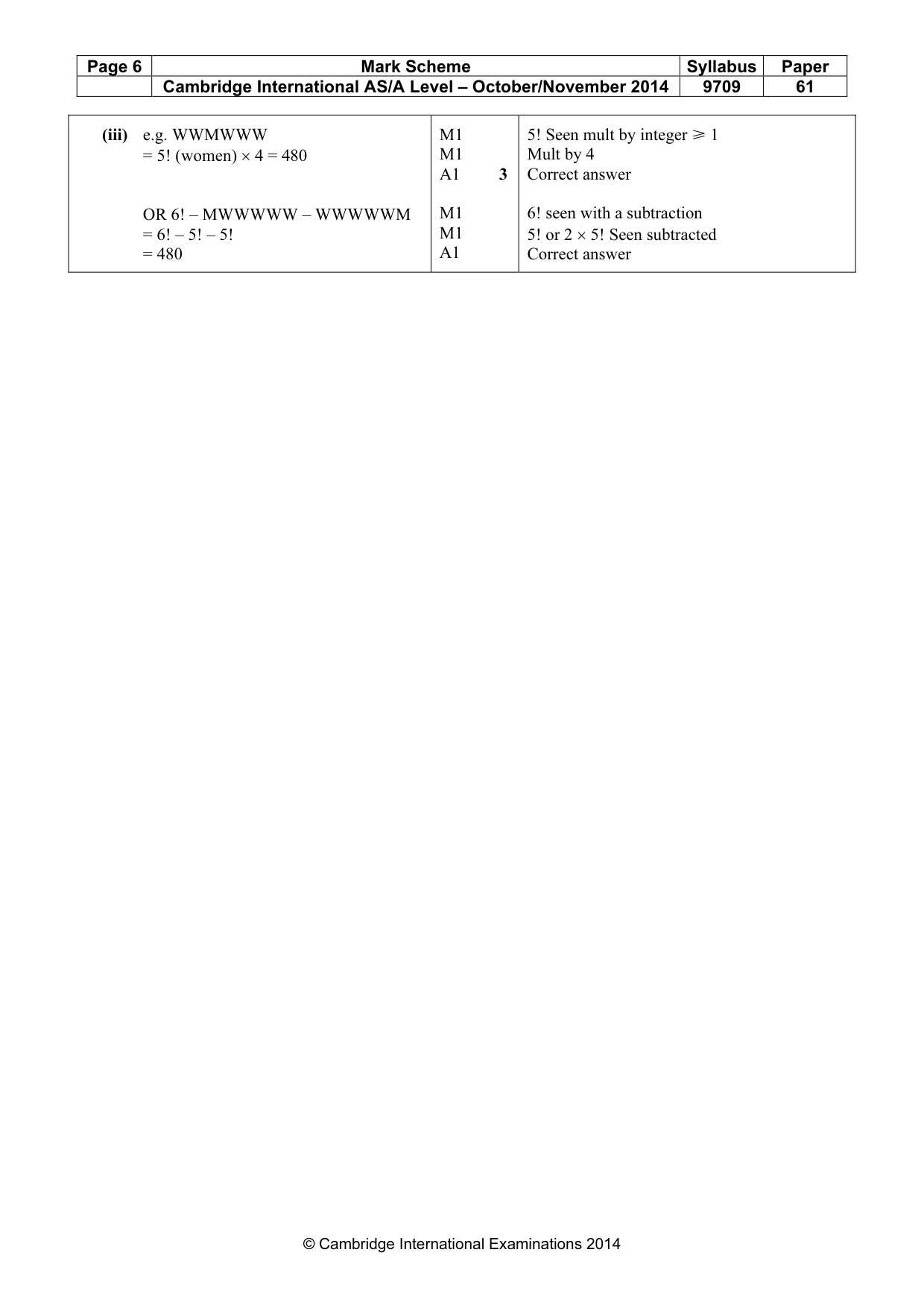
Mark scheme: 7 (i) W(8) M(5) 4 2 = 8C4 × 5C2 = 700 M1 Mult 2 combs, 8Cx × 5Cy 5 1 = 8C5 × 5C1 = 280 M1 Summing 2 or 3 options 6 0 = 8C6 × 5C0 = 28 A1 2 correct options unsimplified Total = 1008 A1 4 Correct answer (ii) M1 and MMWWW = 3C2 × 8C3 = 168 M1 Summing 3 options M2 and MMWWW = 3C2 × 8C3 = 168 Neither and MMMWWW = 3C1 × 8C3 = B1 One correct option 56 Total = 392 A1 3 Correct answer M1 Subt 2 men together from no restrictions OR total, no restrictions = 5C3 ×8C3 = 560 B1 One correct of 560 or 168 M1M2 and MWWW = 3C1 × 8C3 = 168 A1 Correct answer 560 – 168 = 392 (iii) e.g. WWMWWW M1 5! Seen mult by integer > 1 = 5! (women) × 4 = 480 M1 Mult by 4 A1 3 Correct answer OR 6! – MWWWWW – WWWWWM M1 6! seen with a subtraction = 6! – 5! – 5! M1 5! or 2 × 5! Seen subtracted = 480 A1 Correct answer
What was in this paper
The subtopics covered by these 7 questions, and how many questions each got. Open one in a new tab to see every Cambridge question on it.
What you needed in this session
Cambridge’s own grade thresholds for 2014 Oct/Nov, Paper 6 · Variant 1. A higher threshold means an easier paper — the bar moves with how the cohort did.