Cambridge A Level Mathematics 9709 — 2016 Oct/Nov Paper 6 · Variant 2
9709/62/O/N/16 · 6 questions · 50 marks · ≈56 min
The question paper and its mark scheme, free to read here and free to download. This is Cambridge’s own paper, exactly as it was sat.
Question paper4 pages


Mark scheme6 pages
Answers below. Sit the paper first if you are practising.
Questions as text
Q1 · When Anya goes to school, the probability that she walks is 0.3 and the probability that…
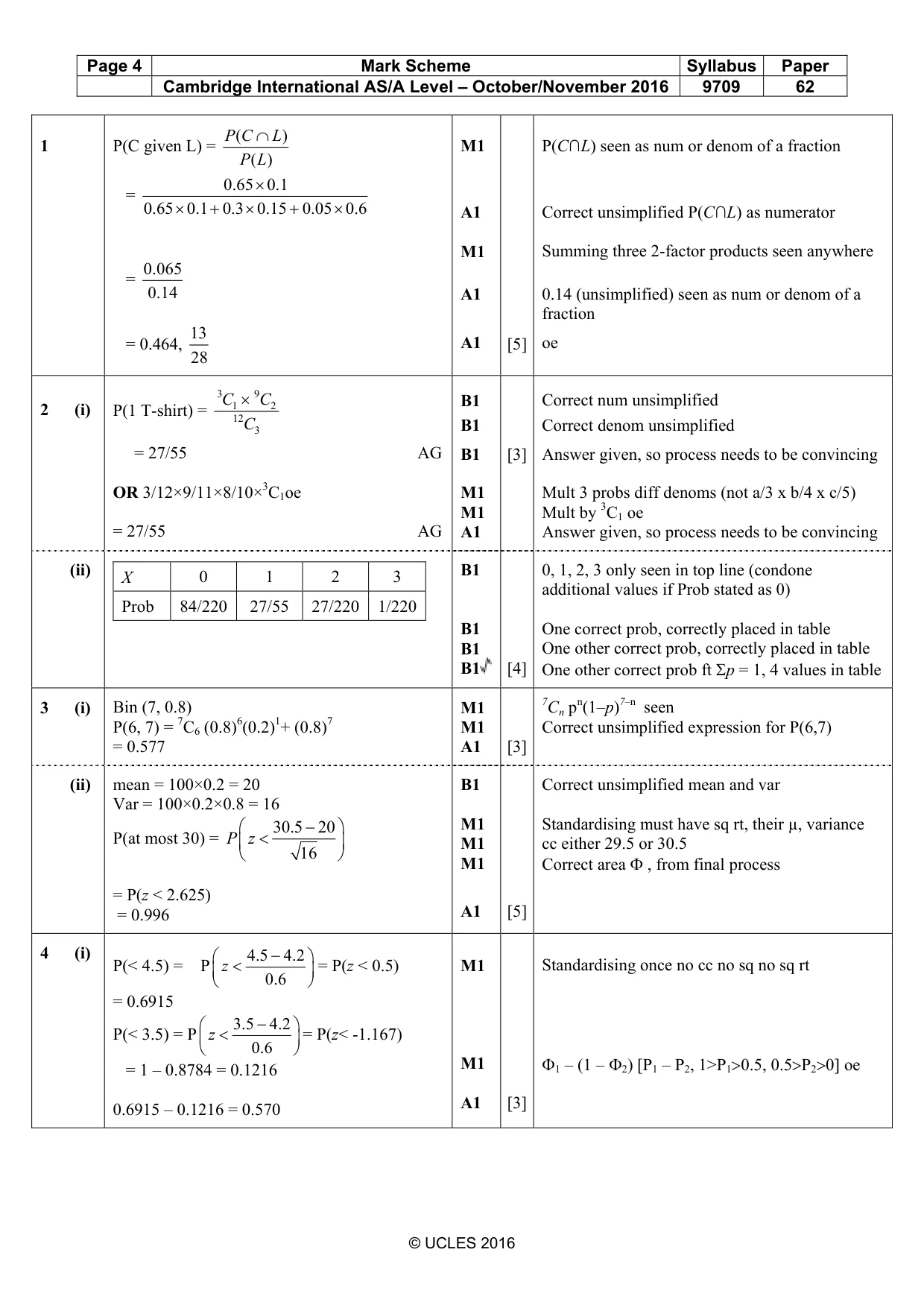
1 When Anya goes to school, the probability that she walks is 0.3 and the probability that she cycles is 0.65; if she does not walk or cycle she takes the bus. When Anya walks the probability that she is late is 0.15. When she cycles the probability that she is late is 0.1 and when she takes the bus the probability that she is late is 0.6. Given that Anya is late, find the probability that she cycles. [5]
Mark scheme: P ( C ∩ L ) 1 P(C given L) = M1 P(C∩L) seen as num or denom of a fraction P ( L ) 0.65 × 0.1 = 0.65 × 0.1 + 0.3 × 0.15 + 0.05 × 0.6 A1 Correct unsimplified P(C∩L) as numerator M1 Summing three 2-factor products seen anywhere 0.065 = 0.14 A1 0.14 (unsimplified) seen as num or denom of a fraction 13 = 0.464, A1 [5] oe 28 3C × 9C B1 Correct num unsimplified
Q2 · Noor has 3 T-shirts, 4 blouses and 5 jumpers
2 Noor has 3 T-shirts, 4 blouses and 5 jumpers. She chooses 3 items at random. The random variable X is the number of T-shirts chosen. (i) Show that the probability that Noor chooses exactly one T-shirt is 55.27 [3] (ii) Draw up the probability distribution table for X. [4]
Mark scheme: C1 × C 2 B1 Correct num unsimplified2 (i) P(1 T-shirt) = 12C3 B1 Correct denom unsimplified = 27/55 AG B1 [3] Answer given, so process needs to be convincing OR 3/12×9/11×8/10×3C1oe M1 Mult 3 probs diff denoms (not a/3 x b/4 x c/5) M1 Mult by 3C1 oe = 27/55 AG A1 Answer given, so process needs to be convincing (ii) B1 0, 1, 2, 3 only seen in top line (condone X 0 1 2 3 additional values if Prob stated as 0) Prob 84/220 27/55 27/220 1/220 B1 One correct prob, correctly placed in table B1 One other correct prob, correctly placed in table B1 [4] One other correct prob ft Σp = 1, 4 values in table
Q3 · On any day at noon, the probabilities that Kersley is asleep or studying are 0.2 and 0.6…
3 On any day at noon, the probabilities that Kersley is asleep or studying are 0.2 and 0.6 respectively. (i) Find the probability that, in any 7-day period, Kersley is either asleep or studying at noon on at least 6 days. [3] (ii) Use an approximation to find the probability that, in any period of 100 days, Kersley is asleep at noon on at most 30 days. [5]
Mark scheme: 3 (i) Bin (7, 0.8) M1 7Cn pn(1–p)7–n seen P(6, 7) = 7C6 (0.8)6(0.2)1+ (0.8)7 M1 Correct unsimplified expression for P(6,7) = 0.577 A1 [3] (ii) mean = 100×0.2 = 20 B1 Correct unsimplified mean and var Var = 100×0.2×0.8 = 16 30.5 − 20 M1 Standardising must have sq rt, their µ, variance P(at most 30) = P z < M1 cc either 29.5 or 30.5 16 M1 Correct area Φ , from final process = P(z < 2.625) = 0.996 A1 [5]
Q4 · The time taken to cook an egg by people living in a certain town has a normal…
4 The time taken to cook an egg by people living in a certain town has a normal distribution with mean 4.2 minutes and standard deviation 0.6 minutes. (i) Find the probability that a person chosen at random takes between 3.5 and 4.5 minutes to cook an egg. [3] 12% of people take more than t minutes to cook an egg. (ii) Find the value of t. [3] (iii) A random sample of n people is taken. Find the smallest possible value of n if the probability that none of these people takes more than t minutes to cook an egg is less than 0.003. [3]
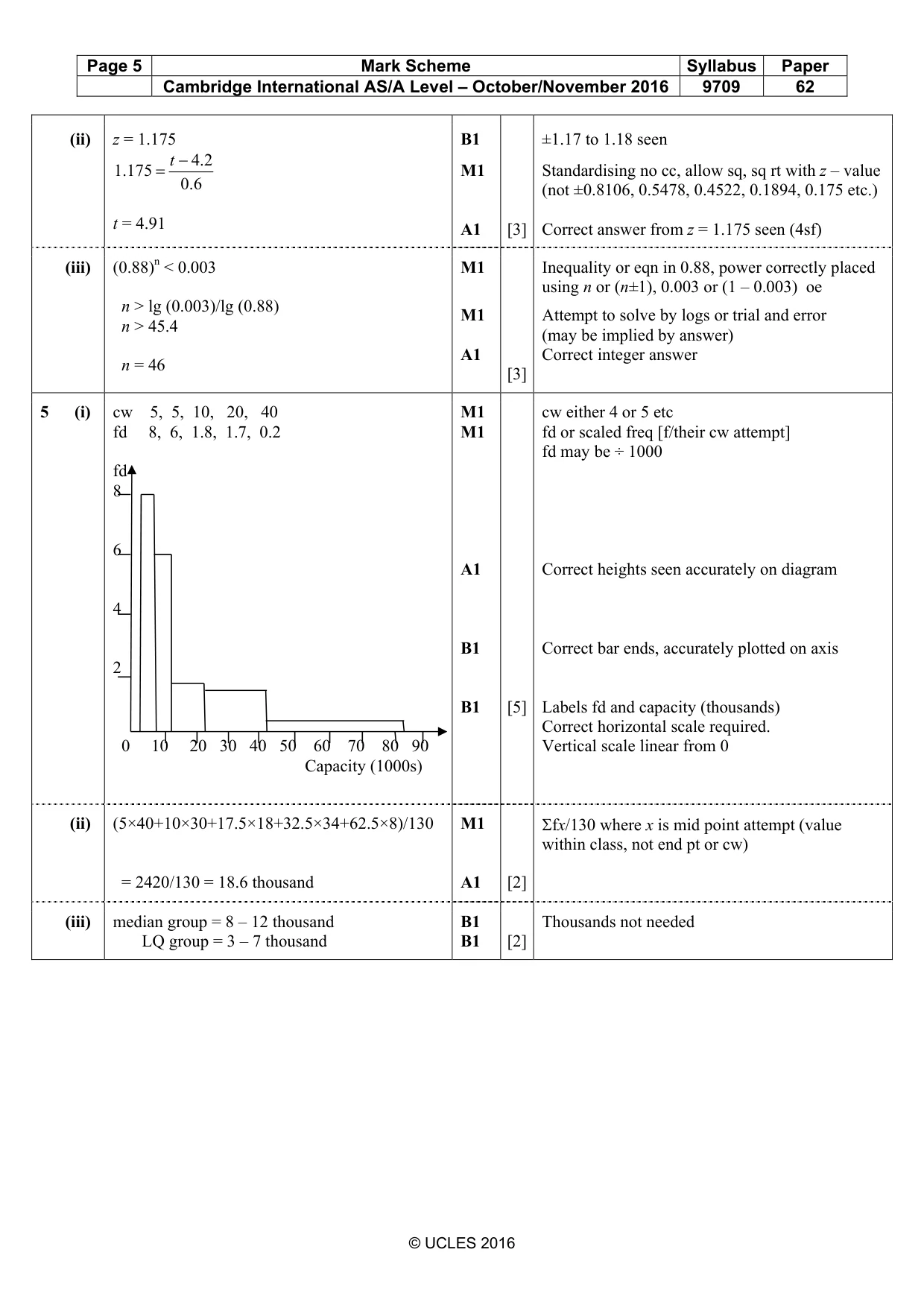
Mark scheme: 4 (i) 4.5 − 4.2 P(< 4.5) = P z < = P(z < 0.5) M1 Standardising once no cc no sq no sq rt 0.6 = 0.6915 3.5 − 4.2 P(< 3.5) = P z < = P(z< -1.167) 0.6 M1 Φ1 – (1 – Φ2) [P1 – P2, 1>P1>0.5, 0.5>P2>0] oe = 1 – 0.8784 = 0.1216 A1 [3] 0.6915 – 0.1216 = 0.570 (ii) z = 1.175 B1 ±1.17 to 1.18 seen t − 4.2 1.175 = M1 Standardising no cc, allow sq, sq rt with z – value 0.6 (not ±0.8106, 0.5478, 0.4522, 0.1894, 0.175 etc.) t = 4.91 A1 [3] Correct answer from z = 1.175 seen (4sf) (iii) (0.88)n < 0.003 M1 Inequality or eqn in 0.88, power correctly placed using n or (n±1), 0.003 or (1 – 0.003) oe n > lg (0.003)/lg (0.88) M1 Attempt to solve by logs or trial and error n > 45.4 (may be implied by answer) A1 Correct integer answer n = 46 [3]
Q5 · The number of people a football stadium can hold is called the ‘capacity’
5 The number of people a football stadium can hold is called the ‘capacity’. The capacities of 130 football stadiums in the UK, to the nearest thousand, are summarised in the table. Capacity 3000−7000 8000−12 000 13 000−22 000 23 000−42 000 43 000−82 000 Number of stadiums 40 30 18 34 8 (i) On graph paper, draw a histogram to represent this information. Use a scale of 2 cm for a capacity of 10 000 on the horizontal axis. [5] (ii) Calculate an estimate of the mean capacity of these 130 stadiums. [2] (iii) Find which class in the table contains the median and which contains the lower quartile. [2]
Mark scheme: 5 (i) cw 5, 5, 10, 20, 40 M1 cw either 4 or 5 etc fd 8, 6, 1.8, 1.7, 0.2 M1 fd or scaled freq [f/their cw attempt] fd may be ÷ 1000 fd 8 6 A1 Correct heights seen accurately on diagram 4 B1 Correct bar ends, accurately plotted on axis 2 B1 [5] Labels fd and capacity (thousands) Correct horizontal scale required. 0 10 20 30 40 50 60 70 80 90 Vertical scale linear from 0 Capacity (1000s) (ii) (5×40+10×30+17.5×18+32.5×34+62.5×8)/130 M1 Σfx/130 where x is mid point attempt (value within class, not end pt or cw) = 2420/130 = 18.6 thousand A1 [2] (iii) median group = 8 – 12 thousand B1 Thousands not needed LQ group = 3 – 7 thousand B1 [2]
Q6 · Find the number of ways all 10 letters of the word COPENHAGEN can be arranged so that (i)…
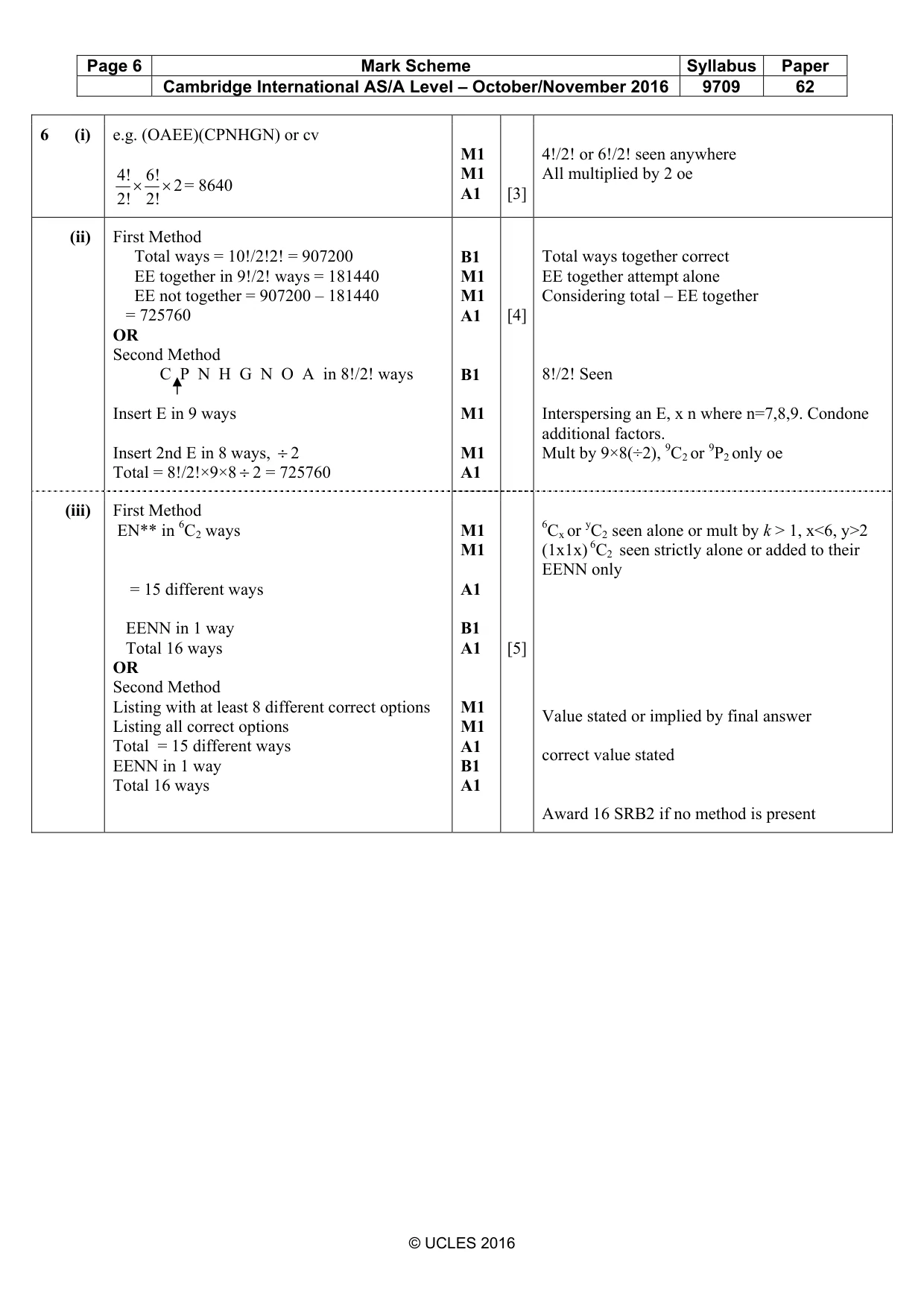
6 Find the number of ways all 10 letters of the word COPENHAGEN can be arranged so that (i) the vowels (A, E, O) are together and the consonants (C, G, H, N, P) are together, [3] (ii) the Es are not next to each other. [4] Four letters are selected from the 10 letters of the word COPENHAGEN. (iii) Find the number of different selections if the four letters must contain the same number of Es and Ns with at least one of each. [5]
Mark scheme: 6 (i) e.g. (OAEE)(CPNHGN) or cv M1 4!/2! or 6!/2! seen anywhere 4! 6! M1 All multiplied by 2 oe × × 2 = 8640 A1 [3] 2! 2! (ii) First Method Total ways = 10!/2!2! = 907200 B1 Total ways together correct EE together in 9!/2! ways = 181440 M1 EE together attempt alone EE not together = 907200 – 181440 M1 Considering total – EE together = 725760 A1 [4] OR Second Method C P N H G N O A in 8!/2! ways B1 8!/2! Seen Insert E in 9 ways M1 Interspersing an E, x n where n=7,8,9. Condone additional factors. Insert 2nd E in 8 ways, ÷ 2 M1 Mult by 9×8(÷2), 9C2 or 9P2 only oe Total = 8!/2!×9×8 ÷ 2 = 725760 A1 (iii) First Method EN** in 6C2 ways M1 6Cx or yC2 seen alone or mult by k > 1, x<6, y>2 M1 (1x1x) 6C2 seen strictly alone or added to their EENN only = 15 different ways A1 EENN in 1 way B1 Total 16 ways A1 [5] OR Second Method Listing with at least 8 different correct options M1 Value stated or implied by final answer Listing all correct options M1 Total = 15 different ways A1 correct value stated EENN in 1 way B1 Total 16 ways A1 Award 16 SRB2 if no method is present
What was in this paper
The subtopics covered by these 6 questions, and how many questions each got. Open one in a new tab to see every Cambridge question on it.
What you needed in this session
Cambridge’s own grade thresholds for 2016 Oct/Nov, Paper 6 · Variant 2. A higher threshold means an easier paper — the bar moves with how the cohort did.