Questions as text
Q1 · Justin makes tents and he advertises them on his website as being waterproof and easy to… 9084/21 May/June 2017
1 (a) Justin makes tents and he advertises them on his website as being waterproof and easy to put up. Marie owns an outdoor equipment shop and sees the advertisement for Justin’s tents. She buys 1000 tents for £15 000. The tents are very popular and Marie soon sells 100. Within a week, customers are bringing the tents back because they let water in and are hard to put up. Explain how the Supply of Goods and Services Act 1982 will apply to Marie. [10] (b) Pete runs a business which sells cars on to local garages. He advertises a car for sale for £8000 saying it has done 15 000 miles and been fitted with a new gear-box and brakes. William, a mechanic, runs a garage and he goes to look at the car Pete is selling. William buys the car for £8000 but on the way back to his garage he cannot change gear. As he tries to stop the car the brakes fail and William crashes. Explain how the Supply of Goods and Services Act 1982 will apply to William. [10] (c) Diane is a rug designer. Gary, a wool supplier, sends Diane a sample of his wool and says she must decide whether or not to buy it quickly as he has had another offer. Diane likes the colour of the wool so she buys it immediately for £10 000 and spends £40 000 setting up new machinery to make rugs. When the wool arrives it matches the sample but is thicker than the machines are designed for. This slows the machines and doubles Diane’s projected costs. Explain how the Supply of Goods and Services Act 1982 will apply to Diane. [10] (d) Describe the way in which someone who has a problem with a contract they have made would use the civil courts. Critically evaluate the effectiveness of the civil courts. [20] Source material for Question 1 Supply of Goods and Services Act 1982 Section 3 Implied terms where transfer is by description (1) This section applies where, under a contract for the transfer of goods, the transferor transfers or agrees to transfer the property in the goods by description. (2) In such a case there is an implied condition that the goods will correspond with the description. Section 4 Implied terms about quality or fitness … (2) Where, under such a contract, the transferor transfers the property in goods in the course of a business, there is an implied condition that the goods supplied under the contract are of satisfactory quality. (2A) For the purposes of this section … goods are of satisfactory quality if they meet the standard that a reasonable person would regard as satisfactory, taking account of any description of the goods, the price (if relevant) and all the other relevant circumstances. … (3) The condition implied by subsection (2) above does not extend to any matter making the quality of goods unsatisfactory─ (a) which is specifically drawn to the transferee’s attention before the contract is made, (b) where the transferee examines the goods before the contract is made, which that examination ought to reveal, or (c) where the property in the goods is transferred by reference to a sample, which would have been apparent on a reasonable examination of the sample. Section 5 Implied terms where transfer is by sample (1) This section applies where, under a contract for the transfer of goods, the transferor transfers or agrees to transfer the property in the goods by reference to a sample. (2) In such a case there is an implied condition─ (a) that the bulk will correspond with the sample in quality; and (b) that the transferee will have a reasonable opportunity of comparing the bulk with the sample; and (c) that the goods will be free from any defect, making their quality unsatisfactory, which would not be apparent on reasonable examination of the sample. Section 5A Modification of remedies for breach of statutory condition in non-consumer cases (1) Where in the case of a contract for the transfer of goods─ (a) the transferee would, apart from this subsection, have the right to treat the contract as repudiated by reason of a breach on the part of the transferor of a term implied by section 3, 4 or 5(2)(a) or (c) above, but (b) the breach is so slight that it would be unreasonable for him to do so, then … the breach is not to be treated as a breach of condition but may be treated as a breach of warranty.
50 marks
Mark scheme: Question Answer Marks 1(a) Explain how the Supply of Goods and Services Act 1982 will apply to 10 Marie. Band 1 [0 marks] Irrelevant answer. Band 2 – 3 [1–5 marks] A candidate needs to be selective in choosing the correct part of the source material. • Principle without section – understanding that Marie will be able to treat the contract as repudiated. and/or • Reference to s3 and/or s4 and/or s5A Supply of Goods and Services Act 1982 with little or no development. Band 4 [6–7 marks] Reference to some of s3 and/or s4 and/or s5A with some development and some application. Band 5 [8–10 marks] Full development of the relevant sections. Conclusion: Marie will be able to treat the contract as repudiated as the breach is not covered by s5A. The tents Marie buys should match their description under s3. Under s4(2) and s4(2)(2A) a reasonable person would expect that the tents should be easy to put up and not let water in. 1(b) Explain how the Supply of Goods and Services Act 1982 will apply to 10 William. Band 1 [0 marks] Irrelevant answer. Band 2 – 3 [1–5 marks] A candidate needs to be selective in choosing the correct part of the source material. • Principle without section – understanding that William will not be able to repudiate the contract. and/or • Reference to s3 and/or s4 and/or s5A Supply of Goods and Services Act 1982 with little or no development. Band 4 [6–7 marks] Reference to some of s3 and/or s4 and/or s5A with little development and some application. Band 5 [8–10 marks] Full development of the relevant sections. Conclusion: William will not be able to repudiate the contract under s5(A). William might come within s3 and s4(2) as the car should be of satisfactory quality. However under s4(2)(3)(b) William is a mechanic and he went to look at the car so he could have checked the work and seen that there was a problem. 1(c) Explain how the Supply of Goods and Services Act 1982 will apply to 10 Diane. Band 1 [0 marks] Irrelevant answer. Band 2 – 3 [1–5 marks] A candidate needs to be selective in choosing the correct part of the source material. • Principle without section – understanding that Diane will be able to repudiate the contract. and/or • Reference to s5 and/or s5A Supply of Goods and Services Act 1982 with little or no development Band 4 [6–7 marks] Reference to some of s5 and/or s5A with little development and some application. Band 5 [8–10 marks] Full development of the relevant sections. Conclusion: Diane will be able to repudiate the contract. Under s5(2)(a) the bulk does match the description but Diane may be able to say that she didn’t have chance to really examine the sample carefully under s5(2)(b) and Diane did not know the impact of this under s5(2)(c). Credit an alternative argument that Diane has no remedy based on s5(2)(a) as she did see the sample. Under s5A(1)(a) the doubling of the cost means the contract will be repudiated as it is not ‘slight’ under (b) 1(d) Describe the way in which someone who has a problem with a contract 20 they have made would use the civil courts. Critically evaluate the effectiveness of the civil courts. Band 1 [0 marks] Irrelevant answer. Band 2 [1–6 marks] Discusses the civil court structure and/or its effectiveness in very general terms. Band 3 [7–13 marks] Some more detailed references to the civil court structure, including the track system, but with a largely factual basis. Some general discussion of the effectiveness of the structure. Band 4/5 [14–20 marks] Very good detail on the civil court structure, including the track system, and good discussion of the effectiveness of civil courts. To reach higher marks both aspects of the question need to be dealt with in some detail with good critical awareness.
This question in 9084/21 May/June 2017
Q2 · Ali has been charged with manslaughter 9084/22 May/June 2017
1 (a) Ali has been charged with manslaughter. He appears before a magistrate so he can be committed for trial at the Crown Court. Ali shouts that he wants his case heard by at least two magistrates and in private. The magistrate tells Ali to be quiet but he starts to sing loudly and will not stop. The magistrate sends Ali out of court, looks at all the material relating to the case and commits him for trial at the Crown Court. Explain whether Ali’s committal proceedings are lawful under the Magistrates’ Courts Act 1980. [10] (b) Jasmine has been charged with burglary and Brian is the prosecuting barrister. At the committal proceedings he wants to submit a written statement from Connor, aged 16, who saw Jasmine breaking into a shop. Connor has signed the statement but it does not say how old he is. Brian is in a rush to meet with a client so he gives the statement to the magistrate and asks them to pass it on to the defence barrister. Explain whether Jasmine’s committal proceedings are lawful under the Magistrates’ Courts Act 1980. [10] (c) Jerome has been charged with the murder of a famous pop star. His barrister argues that media attention makes it hard for Jerome to get a fair trial. The magistrate agrees to hold the committal proceedings in private. The prosecution barrister, Helena, submits a written signed statement made by William, who cannot read, which says he saw Jerome at the murder scene. Explain whether Jerome’s committal proceedings are lawful under the Magistrates’ Courts Act 1980. [10] (d) Explain the selection and role of magistrates in criminal cases. Discuss their importance in the English legal system. [20] Source material for Question 1 Magistrates’ Courts Act 1980 Section 4 General nature of committal proceedings (1) The functions of examining justices* may be discharged by a single justice. (2) Examining justices shall sit in open court except where any enactment contains an express provision to the contrary and except where it appears to them as respects the whole or any part of committal proceedings that the ends of justice would not be served by their sitting in open court. (3) Subject to subsection (4) below, evidence tendered before examining justices shall be tendered in the presence of the accused. (4) Examining justices may allow evidence to be tendered before them in the absence of the accused if─ (a) they consider that by reason of his disorderly conduct before them it is not practicable for the evidence to be tendered in his presence, or (b) he cannot be present for reasons of health but is represented by a legal representative and has consented to the evidence being tendered in his absence. *An examining justice is another term for a magistrate. Section 5A Evidence which is admissible … (2) Evidence falls within this subsection if it─ (a) is tendered by or on behalf of the prosecutor, and (b) falls within subsection (3) below. (3) The following evidence falls within this subsection─ (a) written statements complying with section 5B below. Section 5B Written statements … (2) The conditions falling within this subsection are that─ (a) the statement purports to be signed by the person who made it; … (c) before the statement is tendered in evidence a copy of the statement is given, by or on behalf of the prosecutor, to each of the other parties to the proceedings. (3) The conditions falling within this subsection are that─ (a) if the statement is made by a person under 18 years old, it gives his age; (b) if it is made by a person who cannot read it, it is read to him before he signs it and is accompanied by a declaration by the person who so read the statement to the effect that it was so read.
50 marks
This question in 9084/22 May/June 2017
Q3 · Christine is the only witness to a gang murder 9084/23 May/June 2017
2 (a) Christine is the only witness to a gang murder. A member of the gang has threatened to hurt Christine badly if she gives evidence at the trial. Christine says she will only give evidence if the court does not know who she is and she does not have to go into the court room. Explain how the Coroners and Justice Act 2009 will apply to Christine. [10] (b) Piotr is a police officer who served in a specialist unit where it was his job to be part of a suspected criminal group so that he could monitor their activities. He discovered a plan for a crime and the group were arrested. Piotr wants to give evidence under another name and have his voice changed because he believes that he and his family are in danger. Explain how the Coroners and Justice Act 2009 will apply to Piotr. [10] (c) Anya’s friend, Jacquetta, has been accused of killing her own daughter. Jacquetta suffers from depression and she confessed to the killing. However, Anya saw Jacquetta’s husband, a powerful businessman, commit the crime. Anya is scared of Jacquetta’s husband but she is worried her friend will be wrongly convicted. Explain how the Coroners and Justice Act 2009 will apply to Anya. [10] (d) Describe and evaluate the role of the jury in criminal cases. [20] Source material for Question 2 Coroners and Justice Act 2009 Section 86 Witness anonymity orders … (2) The kinds of measures that may be required to be taken in relation to a witness include measures for securing one or more of the following─ (a) that the witness’s name and other identifying details may be withheld; (b) that the witness may use a pseudonym (a name which is not their real name); (c) that the witness is not asked questions of any specified description that might lead to the identification of the witness; (d) that the witness is screened to any specified extent; (e) that the witness’s voice is subjected to modulation to any specified extent. … (4) Nothing in this section authorises the court to require─ (a) the witness to be screened to such an extent that the witness cannot be seen by─ (i) the judge or other members of the court (if any); (ii) the jury (if there is one); or (iii) any interpreter or other person appointed by the court to assist the witness; (b) the witness’s voice to be modulated to such an extent that the witness’s natural voice cannot be heard by any persons within paragraph (a)(i) to (iii). Section 88 Conditions for making order … (2) The court may make such an order only if it is satisfied that Conditions A to C below are met. (3) Condition A is that the measures to be specified in the order are necessary─ (a) in order to protect the safety of the witness or another person or to prevent any serious damage to property, or (b) in order to prevent real harm to the public interest (whether affecting the carrying on of any activities in the public interest or the safety of a person involved in carrying on such activities, or otherwise). (4) Condition B is that, having regard to all the circumstances, the taking of those measures would be consistent with the defendant receiving a fair trial. (5) Condition C is that it is necessary to make the order in the interests of justice by reason of the fact that it appears to the court that─ (a) it is important that the witness should testify, and (b) the witness would not testify if the order were not made.
50 marks
Mark scheme: 2(a) Explain how the Coroners and Justice Act 2009 will apply to Christine. 10 Band 1 [0 marks] Irrelevant answer. Band 2 – 3 [1–5 marks] A candidate needs to be selective in choosing the correct part of the source material. • Principle without section – understanding that Christine will not be granted a witness anonymity order. and/or • Reference to Coroners and Justice Act 2009 s86 with little or no development. Band 4 [6–7 marks] Some development of s86 and some application. Band 5 [8–10 marks] Full development of the relevant sections. Conclusion: Christine will not be granted a witness anonymity order. She may be covered by any of s86(2)(a), (b), (c), (d) or (e) so that she can be given some protection but she will fail under s86(4) as although she can be provided with some anonymity there is nothing which says she does not need to attend court. To reach Band 5 candidates should consider two or more of the provisions in s86(2). 2(b) Explain how the Coroners and Justice Act 2009 will apply to Piotr. 10 Band 1 [0 marks] Irrelevant answer. Band 2 – 3 [1–5 marks] A candidate needs to be selective in choosing the correct part of the source material. • Principle without section – understanding that Piotr will be granted a witness anonymity order. and/or • Reference to Coroners and Justice Act 2009 s86 and s88 with little or no development. Band 4 [6–7 marks] Some development of s86 and/or s88 and some application. Band 5 [8–10 marks] Full development of the relevant sections. Conclusion: Piotr will be granted a witness anonymity order. He will be covered by s86(2)(b) as he wants to use another name and s86(2)(e) as having his voice changed protects him and his family. Although his voice can be changed this is only within the limits of s86(4)(b). Condition A under s88(3)(a) or (b) are met in protecting Piotr and his family as well as the public interest since this is a gang murder, Condition B under S88(4) is met as there needs to be a fair trial and Condition C is met under s88(5) is met as Piotr is a vital witness having worked undercover. 2(c) Explain how the Coroners and Justice Act 2009 will apply to Anya. 10 Band 1 [0 marks] Irrelevant answer. Band 2 – 3 [1–5 marks] A candidate needs to be selective in choosing the correct part of the source material. • Principle without section – understanding that Anya will be granted a witness anonymity order. and/or • Reference to Coroners and Justice Act 2009 s86 and s88 with little or no development. Band 4 [6–7 marks] Some development of s86 and/or s88 and some application. Band 5 [8–10 marks] Full development of the relevant sections. Conclusion: Anya will be granted a witness anonymity order. She may be covered by any of s86(2)(a), (b), (c), (d) or (e) so that she can be given some protection as well as under s86(4). Condition A under s88(3)(a) is met as Anya is scared of Jacquetta’s husband, Condition B under S88(4) is met as without Anya’s evidence Jacquetta may not get a fair trial and Condition C is met under s88(5) is met as Anya’s evidence is vital under (a) and without an order Anya would not meet (b) as she is frightened. Candidates can reach Band 5 having mentioned only one condition from s86(2) as long as it is applied to the scenario. 2(d) Describe and evaluate the role of the jury in criminal cases. 20 Band 1 [0 marks] Irrelevant answer. Band 2 [1–6 marks] Describes the role of the jury in a criminal trial in the Crown Court and/or evaluates this in very general terms. Band 3 [7–13 marks] Some more detailed description of the jury’s role and some general evaluation of their role in a Crown Court trial. Band 4/5 [14–20 marks] Very good detail on the role of the jury in a criminal trial in the Crown Court and very good evaluation of their role. To reach higher marks all aspects of the question need to be dealt with showing good critical awareness.
This question in 9084/23 May/June 2017
Q4 · Khalid owns a shop which sells outdoor equipment 9084/21 Oct/Nov 2017
2 (a) Khalid owns a shop which sells outdoor equipment. John is planning his first walking holiday and he asks Khalid’s advice as to the best waterproof jacket. Khalid recommends a particular jacket. John buys this jacket but does not see a small label inside which says ‘suitable for light rain only’. On the first day of John’s holiday it rains heavily. He gets so wet and cold he ends his holiday early and goes home. Explain how the Consumer Rights Act 2015 will apply to this contract. [10] (b) Alexandra wants to make a dress for a party. She sees an advertisement on the internet for some red silk sold by Zak. They speak on the phone and Alexandra tells Zak about the dress. He says the silk can be a little rough so he sends Alexandra a sample. When Alexandra sees the sample she thinks the silk will be fine so she buys 10 metres for £500. The silk that arrives matches the sample but is so hard to sew that Alexandra cannot make her dress. Explain how the Consumer Rights Act 2015 will apply to this contract. [10] (c) Kanye sees an advertisement for a car placed by XYZ Cars Ltd: ‘A great car for town driving. Has only driven 25 000 miles. Serviced from new – £5000.’ Kanye goes to see the car. He thinks the price is very cheap and pays the £5000. Three weeks later Kanye is driving in traffic. He has to stop suddenly and the brakes fail, causing him to crash. A mechanic tells Kanye the car has never been serviced and it has driven 70 000 miles. Explain how the Consumer Rights Act 2015 will apply to this contract. [10] (d) Describe the alternative methods of dispute resolution available for John, Alexandra and Kanye. Critically assess the effectiveness of these methods. [20] Source material for Question 2 Consumer Rights Act 2015 Section 9 Goods to be of satisfactory quality (1) Every contract to supply goods is to be treated as including a term that the quality of the goods is satisfactory. (2) The quality of goods is satisfactory if they meet the standard that a reasonable person would consider satisfactory, taking account of— (a) any description of the goods, (b) the price or other consideration for the goods (if relevant). (3) The quality of goods includes their state and condition; and the following aspects (among others) are in appropriate cases aspects of the quality of goods— (a) fitness for all the purposes for which goods of that kind are usually supplied; (b) appearance and finish; (c) freedom from minor defects; (d) safety; (e) durability. Section 10 Goods to be fit for particular purpose (1) Subsection (3) applies to a contract to supply goods if before the contract is made the consumer makes known to the trader (expressly or by implication) any particular purpose for which the consumer is contracting for the goods. …. (3) The contract is to be treated as including a term that the goods are reasonably fit for that purpose, whether or not that is a purpose for which goods of that kind are usually supplied. (4) Subsection (3) does not apply if the circumstances show that the consumer does not rely, or it is unreasonable for the consumer to rely, on the skill or judgment of the trader or credit-broker. Section 13 Goods to match a sample (1) This section applies to a contract to supply goods by reference to a sample of the goods that is seen or examined by the consumer before the contract is made. (2) Every contract to which this section applies is to be treated as including a term that— (a) the goods will match the sample except to the extent that any differences between the sample and the goods are brought to the consumer’s attention before the contract is made, and (b) the goods will be free from any defect that makes their quality unsatisfactory and that would not be apparent on a reasonable examination of the sample.
50 marks
Mark scheme: 2(a) Explain how the Consumer Rights Act 2015 will apply to this contract. 10 Band 1 [0 marks] Irrelevant answer. Band 2–3 [1–5 marks] A candidate needs to be selective in choosing the correct part of the source material. • Principle without section – understanding that John has made a valid contract under the CRA 2015. and/or • Reference to s9 and/or s10 Consumer Rights Act 2015 with little or no development. Band 4 [6–7 marks] Some development of s9 and/or s10 and some application. Band 5 [8–10 marks] Full development of the relevant sections. Conclusion: John has made a valid contract. Under s9(1) the coat is of satisfactory quality as it matches its description under (2) and (3). Under s10(1) John is covered as he asked Khalid for advice on a waterproof coat. He is also covered under s10(3) as the coat could be expected to be waterproof for a walking holiday. Under s10(4) it seems reasonable for John to rely on Khalid’s advice so the contract is valid. 2(b) Explain how the Consumer Rights Act 2015 will apply to this contract. 10 Band 1 [0 marks] Irrelevant answer. Band 2–3 [1–5 marks] A candidate needs to be selective in choosing the correct part of the source material. • Principle without section – understanding that Alexandra has made a valid contract under the CRA 2015. and/or • Reference to s9 and/or s13 Consumer Rights Act 2015 with little or no development. Band 4 [6–7 marks] Some development of s9 and/or s13 and some application. Band 5 [8–10 marks] Full development of the relevant sections. Conclusion: Alexandra has made a valid contract. Under s9 the silk is covered by s9(2) and under s13(1) Alexandra has seen the sample before she decides to buy the silk. Zak has told Alexandra about the roughness of the silk so she cannot claim under s13(2)(a) or under s13(2)(b) as she had chance to examine the silk and decided it would be fine for her dress. Credit a reference to s10(1) and (3) as Alexandra has told Zak what she wants to make with the silk. 2(c) Explain how the Consumer Rights Act 2015 will apply to this contract. 10 Band 1 [0 marks] Irrelevant answer. Band 2 – 3 [1–5 marks] A candidate needs to be selective in choosing the correct part of the source material. • Principle without section – understanding that Kanye has not made a valid contract under CRA 2015. and/or • Reference to s9 Consumer Rights Act 2015 with little or no development. Band 4 [6–7 marks] Some development of s9 and some application. Band 5 [8–10 marks] Full development of the relevant sections. Conclusion: Kanye has not made a valid contract. Under s9(1) the car is not of satisfactory quality and it does not match its description under s9(2)(a). It is not fit for purpose under s9(3)(a) and not safe under s9(3)(d) or durable under s9(3)(e) as it has driven so many miles without being serviced. Credit a discussion that Kanye knows the car is under-priced. 2(d) Describe the alternative methods of dispute resolution available for 20 John, Alexandra and Kanye. Critically assess the effectiveness of these methods. Band 1 [0 marks] Irrelevant answer. Band 2 [1–6 marks] Describes different types of ADR and/or their effectiveness in very general terms. Band 3 [7–13 marks] Some more detailed references to ADR methods, perhaps with examples, and/or general discussion of their effectiveness. Band 4/5 [14–20 marks] Very good explanation of ADR methods using relevant examples and good discussion of their effectiveness. To reach higher marks both aspects of the question need to be dealt with showing good critical awareness.
This question in 9084/21 Oct/Nov 2017
Q5 · Maria, aged 25, lives next door to Elsie, aged 80 9084/22 Oct/Nov 2017
2 (a) Maria, aged 25, lives next door to Elsie, aged 80. Maria throws stones at Elsie’s cat every time she sees it in her garden. Whenever Maria sees Elsie in the street she shouts abuse at her. Elsie is frightened and calls the police. An anti-social behaviour injunction is issued by the County Court. It requires Maria to not approach Elsie or interfere with her property for three months. Explain whether Maria’s injunction under the Anti-social Behaviour, Crime and Policing Act 2014 is lawful. [10] (b) Euan, aged 11, spends his evenings knocking on the doors and banging on the windows of nearby houses before running away. A neighbour takes photographs of Euan doing this and tells the police. An anti-social behaviour injunction is issued by the Youth Court. It requires Euan to be indoors every day from 17:00 to 07:00 for six months. Explain whether Euan’s injunction under the Anti-social Behaviour, Crime and Policing Act 2014 is lawful. [10] (c) Kelvin, aged 19, is upset because he was dismissed from his job at a restaurant. He now works from 11:00 to 21:00 at a supermarket. Kelvin has started going to the restaurant at 21:30 to shout at the manager as he finishes work. The manager tells the police. An anti-social behaviour injunction is issued by the Youth Court. It requires Kelvin to be home by 20:00 and not to go within 200 metres of the restaurant for a year. Explain whether Kelvin’s injunction under the Anti-social Behaviour, Crime and Policing Act 2014 is lawful. [10] (d) Injunctions are remedies which have their roots in Equity. Describe the role of Equity in the modern English legal system and critically analyse its effectiveness. [20] Source material for Question 2 Anti-social Behaviour, Crime and Policing Act 2014 Section 1 Power to grant injunctions (1) A court may grant an injunction under this section against a person aged 10 or over. … (4) An injunction under this section may for the purpose of preventing the respondent from engaging in anti-social behaviour— (a) prohibit the respondent from doing anything described in the injunction; (b) require the respondent to do anything described in the injunction. (5) Prohibitions and requirements in an injunction under this section must, so far as practicable, be such as to avoid— (a) any interference with the times, if any, at which the respondent normally works or attends school or any other educational establishment. (6) An injunction under this section must— (a) specify the period for which it has effect, or (b) state that it has effect until further order. In the case of an injunction granted before the respondent has reached the age of 18, a period must be specified and it must be no more than 12 months. … (8) An application for an injunction under this section must be made to— (a) a Youth Court, in the case of a respondent aged under 18; (b) the High Court or the County Court, in any other case. Section 2 Meaning of “anti-social behaviour” (1) “Anti-social behaviour” means— (a) conduct that has caused, or is likely to cause, harassment, alarm or distress to any person, (b) conduct capable of causing nuisance or annoyance to a person in relation to that person’s occupation of residential premises.
50 marks
Mark scheme: 2(a) Explain whether Maria’s injunction under the Anti-social Behaviour, 10 Crime and Policing Act 2014 is lawful. Band 1 [0 marks] Irrelevant answer. Band 2–3 [1–5 marks] A candidate needs to be selective in choosing the correct part of the source material. • Principle without section – understanding that Maria’s injunction is lawful. and/or • Reference to s1 and/or s2 Anti-social Behaviour, Crime and Policing Act 2014 with little or no development. Band 4 [6–7 marks] Reference to some of s1 and/or s2 with some development and some application. Band 5 [8–10 marks] Full development of the relevant sections. Conclusion: Maria’s injunction is lawful. It is covered by s1(1) as Maria is over 10. It specifies a period of three months which is valid under s1(6)(a) and it is granted by the correct court under s1(8)(b). Maria’s conduct meets s2(1)(a) as Elsie is frightened and the injunction comes within s1(4)(a) as Maria is required to stay away from Elsie and her property. 2(b) Explain whether Euan’s injunction under the Anti-social Behaviour, 10 Crime and Policing Act 2014 is lawful. Band 1 [0 marks] Irrelevant answer. Band 2–3 [1–5 marks] A candidate needs to be selective in choosing the correct part of the source material. • Principle without section – understanding that Euan’s injunction is lawful. and/or • Reference to s1 and/or s2 Anti-social Behaviour, Crime and Policing Act 2014 with little or no development. Band 4 [6–7 marks] Reference to some of s1 and/or s2 with some development and some application. Band 5 [8–10 marks] Full development of the relevant sections. Conclusion: Euan’s injunction is lawful. He is covered by s1(1) as he is over 10. The requirement for Euan to do something meets s1(4)(b), the time he has to be indoors complies with s1(5)(a) and the injunction is valid under s1(6)(b) as it is for 6 months. It has been made by the correct court under s1(8)(a) and his behaviour meets either S2(1)(a) or (b). 2(c) Explain whether Kelvin’s injunction under the Anti-social Behaviour, 10 Crime and Policing Act 2014 is lawful. Band 1 [0 marks] Irrelevant answer. Band 2–3 [1–5 marks] A candidate needs to be selective in choosing the correct part of the source material. • Principle without section – understanding that Kelvin’s injunction is not lawful. and/or • Reference to s1 and/or s2 Anti-social Behaviour, Crime and Policing Act 2014 with little or no development. Band 4 [6–7 marks] Reference to some of s1 and/or s2 with some development and some application. Band 5 [8–10 marks] Full development of the relevant sections. Conclusion: Kelvin’s injunction is not lawful. He is covered by s1(1) as he is over 10 and he meets both S1(4)(a) and (b) as he is prohibited from going near the restaurant and required to be at home by a certain time. He does come within s2(1)(a) as the restaurant manager is being targeted but the injunction is unlawful under s1(5)(a) as it means he will not be able to go to work and under s1(8)(a) because the wrong court has been applied to since Kelvin is 18. 2(d) Injunctions are remedies which have their roots in Equity. Describe the 20 role of Equity in the modern English legal system and critically analyse its effectiveness. Band 1 [0 marks] Irrelevant answer. Band 2 [1–6 marks] Discusses Equity in very general terms. Band 3 [7–13 marks] Some more detailed references to the role of Equity today and its effectiveness but there may be an over-reliance on factual material and a lack of detail or range. Band 4/5 [14–20 marks] Very good detail on the modern role of Equity and good discussion of its effectiveness. To reach higher marks all aspects of the question need to be dealt with in some detail with good critical awareness.
This question in 9084/22 Oct/Nov 2017
Q6 · Khalid owns a shop which sells outdoor equipment 9084/23 Oct/Nov 2017
2 (a) Khalid owns a shop which sells outdoor equipment. John is planning his first walking holiday and he asks Khalid’s advice as to the best waterproof jacket. Khalid recommends a particular jacket. John buys this jacket but does not see a small label inside which says ‘suitable for light rain only’. On the first day of John’s holiday it rains heavily. He gets so wet and cold he ends his holiday early and goes home. Explain how the Consumer Rights Act 2015 will apply to this contract. [10] (b) Alexandra wants to make a dress for a party. She sees an advertisement on the internet for some red silk sold by Zak. They speak on the phone and Alexandra tells Zak about the dress. He says the silk can be a little rough so he sends Alexandra a sample. When Alexandra sees the sample she thinks the silk will be fine so she buys 10 metres for £500. The silk that arrives matches the sample but is so hard to sew that Alexandra cannot make her dress. Explain how the Consumer Rights Act 2015 will apply to this contract. [10] (c) Kanye sees an advertisement for a car placed by XYZ Cars Ltd: ‘A great car for town driving. Has only driven 25 000 miles. Serviced from new – £5000.’ Kanye goes to see the car. He thinks the price is very cheap and pays the £5000. Three weeks later Kanye is driving in traffic. He has to stop suddenly and the brakes fail, causing him to crash. A mechanic tells Kanye the car has never been serviced and it has driven 70 000 miles. Explain how the Consumer Rights Act 2015 will apply to this contract. [10] (d) Describe the alternative methods of dispute resolution available for John, Alexandra and Kanye. Critically assess the effectiveness of these methods. [20] Source material for Question 2 Consumer Rights Act 2015 Section 9 Goods to be of satisfactory quality (1) Every contract to supply goods is to be treated as including a term that the quality of the goods is satisfactory. (2) The quality of goods is satisfactory if they meet the standard that a reasonable person would consider satisfactory, taking account of— (a) any description of the goods, (b) the price or other consideration for the goods (if relevant). (3) The quality of goods includes their state and condition; and the following aspects (among others) are in appropriate cases aspects of the quality of goods— (a) fitness for all the purposes for which goods of that kind are usually supplied; (b) appearance and finish; (c) freedom from minor defects; (d) safety; (e) durability. Section 10 Goods to be fit for particular purpose (1) Subsection (3) applies to a contract to supply goods if before the contract is made the consumer makes known to the trader (expressly or by implication) any particular purpose for which the consumer is contracting for the goods. …. (3) The contract is to be treated as including a term that the goods are reasonably fit for that purpose, whether or not that is a purpose for which goods of that kind are usually supplied. (4) Subsection (3) does not apply if the circumstances show that the consumer does not rely, or it is unreasonable for the consumer to rely, on the skill or judgment of the trader or credit-broker. Section 13 Goods to match a sample (1) This section applies to a contract to supply goods by reference to a sample of the goods that is seen or examined by the consumer before the contract is made. (2) Every contract to which this section applies is to be treated as including a term that— (a) the goods will match the sample except to the extent that any differences between the sample and the goods are brought to the consumer’s attention before the contract is made, and (b) the goods will be free from any defect that makes their quality unsatisfactory and that would not be apparent on a reasonable examination of the sample.
50 marks
Mark scheme: 2(a) Explain how the Consumer Rights Act 2015 will apply to this contract. 10 Band 1 [0 marks] Irrelevant answer. Band 2–3 [1–5 marks] A candidate needs to be selective in choosing the correct part of the source material. • Principle without section – understanding that John has made a valid contract under the CRA 2015. and/or • Reference to s9 and/or s10 Consumer Rights Act 2015 with little or no development. Band 4 [6–7 marks] Some development of s9 and/or s10 and some application. Band 5 [8–10 marks] Full development of the relevant sections. Conclusion: John has made a valid contract. Under s9(1) the coat is of satisfactory quality as it matches its description under (2) and (3). Under s10(1) John is covered as he asked Khalid for advice on a waterproof coat. He is also covered under s10(3) as the coat could be expected to be waterproof for a walking holiday. Under s10(4) it seems reasonable for John to rely on Khalid’s advice so the contract is valid. 2(b) Explain how the Consumer Rights Act 2015 will apply to this contract. 10 Band 1 [0 marks] Irrelevant answer. Band 2–3 [1–5 marks] A candidate needs to be selective in choosing the correct part of the source material. • Principle without section – understanding that Alexandra has made a valid contract under the CRA 2015. and/or • Reference to s9 and/or s13 Consumer Rights Act 2015 with little or no development. Band 4 [6–7 marks] Some development of s9 and/or s13 and some application. Band 5 [8–10 marks] Full development of the relevant sections. Conclusion: Alexandra has made a valid contract. Under s9 the silk is covered by s9(2) and under s13(1) Alexandra has seen the sample before she decides to buy the silk. Zak has told Alexandra about the roughness of the silk so she cannot claim under s13(2)(a) or under s13(2)(b) as she had chance to examine the silk and decided it would be fine for her dress. Credit a reference to s10(1) and (3) as Alexandra has told Zak what she wants to make with the silk. 2(c) Explain how the Consumer Rights Act 2015 will apply to this contract. 10 Band 1 [0 marks] Irrelevant answer. Band 2 – 3 [1–5 marks] A candidate needs to be selective in choosing the correct part of the source material. • Principle without section – understanding that Kanye has not made a valid contract under CRA 2015. and/or • Reference to s9 Consumer Rights Act 2015 with little or no development. Band 4 [6–7 marks] Some development of s9 and some application. Band 5 [8–10 marks] Full development of the relevant sections. Conclusion: Kanye has not made a valid contract. Under s9(1) the car is not of satisfactory quality and it does not match its description under s9(2)(a). It is not fit for purpose under s9(3)(a) and not safe under s9(3)(d) or durable under s9(3)(e) as it has driven so many miles without being serviced. Credit a discussion that Kanye knows the car is under-priced. 2(d) Describe the alternative methods of dispute resolution available for 20 John, Alexandra and Kanye. Critically assess the effectiveness of these methods. Band 1 [0 marks] Irrelevant answer. Band 2 [1–6 marks] Describes different types of ADR and/or their effectiveness in very general terms. Band 3 [7–13 marks] Some more detailed references to ADR methods, perhaps with examples, and/or general discussion of their effectiveness. Band 4/5 [14–20 marks] Very good explanation of ADR methods using relevant examples and good discussion of their effectiveness. To reach higher marks both aspects of the question need to be dealt with showing good critical awareness.
This question in 9084/23 Oct/Nov 2017
Q7 · Police Constable (PC) James is on patrol in a busy shopping centre when he hears someone… 9084/21 May/June 2018
2 (a) Police Constable (PC) James is on patrol in a busy shopping centre when he hears someone shout, ‘Help, that man in the red hat took my purse!’ PC James sees two men running towards him. One of the men, Nathan, is wearing a red hat so PC James grabs him and pulls him to the ground. Nathan refuses to give his name and is arrested. In fact, the other man had stolen the purse but removed his red hat. Explain whether Nathan’s arrest is lawful under the Police and Criminal Evidence Act 1984. [10] (b) PC Sharma has been given information about a bank robbery planned for next Saturday morning. It involves Alan, a well-known violent criminal who normally lives abroad. PC Sharma discovers that Alan intends to attack a security guard to get inside the bank. On Saturday morning she sees Alan arrive at the bank holding a knife. PC Sharma arrests Alan just as he is about to enter the bank. Explain whether Alan’s arrest is lawful under the Police and Criminal Evidence Act 1984. [10] (c) PC Kaye is walking down a street when he sees Gretchen take a bag from a tourist at a street café. He hears the tourist shout, ‘That’s my bag!’ and Gretchen starts to run. PC Kaye chases Gretchen along the busy street and catches up with her. He asks for her name and address. Gretchen tells him her name but she refuses to say where she lives. Gretchen walks away and sits in the middle of the busy street, blocking traffic, so PC Kaye arrests her. Explain whether Gretchen’s arrest is lawful under the Police and Criminal Evidence Act 1984. [10] (d) Describe the powers of the police once an arrested person is taken to the police station. Assess whether there is balance between the rights of the individual and the powers of the police. [20] Source material for Question 2 Police and Criminal Evidence Act 1984 as amended by the Serious Organised Crime and Police Act 2005 Section 24 Arrest without warrant: constables (1) A constable may arrest without a warrant— (a) anyone who is about to commit an offence; (b) anyone who is in the act of committing an offence; (c) anyone whom he has reasonable grounds for suspecting to be about to commit an offence; (d) anyone whom he has reasonable grounds for suspecting to be committing an offence. (2) If a constable has reasonable grounds for suspecting that an offence has been committed, he may arrest without a warrant anyone whom he has reasonable grounds to suspect of being guilty of it. (3) If an offence has been committed, a constable may arrest without a warrant— (a) anyone who is guilty of the offence; (b) anyone whom he has reasonable grounds for suspecting to be guilty of it. (4) But the power of summary arrest conferred by subsection (1), (2) or (3) is exercisable only if the constable has reasonable grounds for believing that for any of the reasons mentioned in subsection (5) it is necessary to arrest the person in question. (5) The reasons are— (a) to enable the name of the person in question to be ascertained (in the case where the constable does not know, and cannot readily ascertain, the person’s name, or has reasonable grounds for doubting whether a name given by the person as his name is his real name); (b) correspondingly as regards the person’s address; (c) to prevent the person in question— (i) causing physical injury to himself or any other person; (ii) suffering physical injury; (iii) causing loss of or damage to property; (iv) committing an offence against public decency (subject to subsection (6)); or (v) causing an unlawful obstruction of the highway; (d) to protect a child or other vulnerable person from the person in question; (e) to allow the prompt and effective investigation of the offence or of the conduct of the person in question; (f) to prevent any prosecution for the offence from being hindered by the disappearance of the person in question. (6) Subsection (5)(c)(iv) applies only where members of the public going about their normal business cannot reasonably be expected to avoid the person in question.
50 marks
Mark scheme: 2(a) Explain whether Nathan’s arrest is lawful under the Police and 10 Criminal Evidence Act 1984. Band 1 [0 marks] Irrelevant answer. Band 2–3 [1–5 marks] A candidate needs to be selective in choosing the correct part of the source material. • Principle without section – understanding that Nathan’s arrest is probably lawful. and/or • Reference to s24 PACE 1984 with little or no development. Band 4 [6–7 marks] Some development of s24(2) and/or (4) and/or (5) and some application. Band 5 [8–10 marks] Full development of the relevant sections. Conclusion: Nathan’s arrest is probably lawful. PC James believes a crime has been committed under s24(2) as he hears the shopper shout, he sees Nathan wearing a red hat and Nathan is running towards him. Under s24(4) it has to be necessary for PC James to arrest Nathan. This would appear to come under s24(5)(a) as Nathan will not give his name, under (c)(iii) as property has been taken or under (e) as PC James could then question Nathan and find out the truth which is that he did not steal the purse. 2(b) Explain whether Alan’s arrest is lawful under the Police and Criminal 10 Evidence Act 1984. Band 1 [0 marks] Irrelevant answer. Band 2–3 [1–5 marks] A candidate needs to be selective in choosing the correct part of the source material. • Principle without section – understanding that Alan’s arrest is lawful. and/or • Reference to s24 PACE 1984 with little or no development. Band 4 [6–7 marks] Some development of s24(1) and/or (4) and/or (5) and some application. Band 5 [8–10 marks] Full development of the relevant sections. Conclusion: Alan’s arrest is lawful. PC Sharma can arrest Alan under s24(1)(a) as he is about to commit the robbery and attack the security guard. The arrest has to be reasonable under s24(4) and this would appear to be the case under s24(5)(c)(i) as the security guard is at risk of being attacked, under (iii) as property will be taken and under (f) as Alan will leave the country if he is not arrested. 2(c) Explain whether Gretchen’s arrest is lawful under the Police and 10 Criminal Evidence Act 1984. Band 1 [0 marks] Irrelevant answer. Band 2–3 [1–5 marks] A candidate needs to be selective in choosing the correct part of the source material. • Principle without section – understanding that Gretchen’s arrest is lawful. and/or • Reference to s24 PACE 1984 with little or no development. Band 4 [6–7 marks] Some development of s24(1) and/or (3) and/or (4) and/or (5) some application. Band 5 [8–10 marks] Full development of the relevant sections. Conclusion: Gretchen’s arrest is lawful. When PC Kaye sees Gretchen, she is in the act of committing an offence under s24(1)(b)(i) and he can arrest her under s24(3)(a). His arrest has to be reasonable under s24(4) and this would appear to be the case under s24(5)(b) as she will not give her address, she may suffer physical injury under 5(c)(ii) as she is in a busy street and this would cause an obstruction to the highway under (v). 2(d) Describe the powers of the police once an arrested person is taken to 20 the police station. Assess whether there is balance between the rights of the individual and the powers of the police. Band 1 [0 marks] Irrelevant answer. Band 2 [1–6 marks] Describes the powers of the police or the rights of the individual at the police station in very general terms. Band 3 [7–13 marks] Some more detailed references to the powers of the police and the rights of the individual, perhaps with examples, and general discussion of their effectiveness. Band 4/5 [14–20 marks] Very good explanation of the powers of the police and the rights of the individual at the police station using relevant examples and good discussion of balance between the two. To reach higher marks both aspects of the question need to be dealt with showing good critical awareness.
This question in 9084/21 May/June 2018
Q8 · Jerome is about to be tried for murder 9084/22 May/June 2018
1 (a) Jerome is about to be tried for murder. Five years ago in a burglary trial, Jerome was acquitted and it was rumoured that jurors had been threatened. The prosecution lawyer thinks the same thing could happen again so he applies to the Crown Court judge for trial without a jury. The judge feels the case is very serious and that, even with police protection, the jurors will feel intimidated. Consider how the Criminal Justice Act 2003 will apply to the trial of Jerome. [10] (b) Freddie is being tried for a third time for robbery because two previous trials collapsed. After two weeks of jury deliberations, the judge receives a note saying that a juror has been given £250 not to convict Freddie. The judge calls the lawyers together and tells them she intends to continue without a jury but she does not tell them why and she does not speak to any of the jurors. The judge immediately discharges the jury and convicts Freddie. Consider how the Criminal Justice Act 2003 will apply to the trial of Freddie. [10] (c) Katrina is facing a second trial for the manslaughter of a woman in a fight. The prosecution applies to a Crown Court judge for Katrina to be tried without a jury, saying that the previous trial was abandoned because a key witness was intimidated by Katrina’s brother. The defence says this is unlikely as Katrina’s brother was in prison at the time and he remains in prison. The judge tries Katrina with a jury and she is convicted. Consider how the Criminal Justice Act 2003 will apply to the trial of Katrina. [10] (d) Evaluate the selection process of juries in the Crown Court. [20] Source material for Question 1 Criminal Justice Act 2003 Section 44 Application by prosecution for trial to be conducted without a jury where danger of jury tampering (1) This section applies where one or more defendants are to be tried on indictment for one or more offences. (2) The prosecution may apply to a judge of the Crown Court for the trial to be conducted without a jury. (3) If an application under subsection (2) is made and the judge is satisfied that both of the following two conditions are fulfilled, he must make an order that the trial is to be conducted without a jury; but if he is not so satisfied he must refuse the application. (4) The first condition is that there is evidence of a real and present danger that jury tampering would take place. (5) The second condition is that, notwithstanding any steps (including the provision of police protection) which might reasonably be taken to prevent jury tampering, the likelihood that it would take place would be so substantial as to make it necessary in the interests of justice for the trial to be conducted without a jury. (6) The following are examples of cases where there may be evidence of a real and present danger that jury tampering would take place— (a) a case where the trial is a retrial and the jury in the previous trial was discharged because jury tampering had taken place, (b) a case where jury tampering has taken place in previous criminal proceedings involving the defendant or any of the defendants, (c) a case where there has been intimidation, or attempted intimidation, of any person who is likely to be a witness in the trial. Section 46 Discharge of jury because of jury tampering (1) This section applies where— (a) a judge is minded during a trial on indictment to discharge the jury, and (b) he is so minded because jury tampering appears to have taken place. (2) Before taking any steps to discharge the jury, the judge must— (a) inform the parties that he is minded to discharge the jury, (b) inform the parties of the grounds on which he is so minded, and (c) allow the parties an opportunity to make representations. (3) Where the judge, after considering any such representations, discharges the jury, he may make an order that the trial is to continue without a jury if, but only if, he is satisfied— (a) that jury tampering has taken place, and (b) that to continue the trial without a jury would be fair to the defendant or defendants; but this is subject to subsection (4). (4) If the judge considers that it is necessary in the interests of justice for the trial to be terminated, he must terminate the trial. R v Twomey [2009] T was involved in a professional armed robbery involving firearms. Two trials had collapsed and in a third the prosecution alleged that approaches were made to two jurors and they were discharged. The presiding Judge of the Circuit said the jury could be protected and, despite the onerous burden on the police, the trial should be held with a jury. The prosecution appealed. Held: An order for non-jury trial based on evidence of tampering is an order, not for an unfair trial, but for a trial by judge alone, and such a trial is surrounded by procedural safeguards. Once the conditions in section 44 are satisfied, the trial must go ahead without a jury.
50 marks
Mark scheme: Question Answer Marks 1(a) Consider how the Criminal Justice Act 2003 will apply to the trial of 10 Jerome. Band 1 [0 marks] Irrelevant answer. Band 2–3 [1–5 marks] A candidate needs to be selective in choosing the correct part of the source material. • Principle without section – understanding that Jerome’s trial will go ahead without a jury and/or • Reference to s44 Criminal Justice Act 2003 and/or R v Twomey with little or no development. Band 4 [6–7 marks] Some development of any of s44 and/or R v Twomey and some application. Band 5 [8–10 marks] Full development of the relevant sections. Conclusion Jerome’s trial will go ahead without a jury under s44(3). He is being charged with an indictable offence under s44(1) and the application has been made to the Crown Court judge under (2). There is evidence under (4) and (5) that Jerome’s previous trial was affected so the current trial is covered by (6)(b). According to Twomey this means the trial must go ahead without a jury. Credit an alternative argument based on s44(4) that there is no real and present danger as the threats were only rumoured to have taken place and so they would would not be sufficiently substantial under (5). In consequence there is no valid example under (6) and the trial judge would refuse the application for trial without a jury under (3). If this line of reasoning is followed maximum marks can be achieved without any reference to Twomey. 1(b) Consider how the Criminal Justice Act 2003 will apply to the trial of 10 Freddie. Band 1 [0 marks] Irrelevant answer. Band 2–3 [1–5 marks] A candidate needs to be selective in choosing the correct part of the source material. • Principle without section – understanding that Freddie’s trial will have to begin again. and/or • Reference to s46 Criminal Justice Act 2003 with little or no development. Band 4 [6–7 marks] Some development of any of s46 and some application. Band 5 [8–10 marks] Full development of the relevant sections. Conclusion: the judge’s decision will not be valid and Freddie will have to be tried again. The trial may come within s46(1)(a) because the case is one to be tried on indictment and (b) due to the note sent to the judge. She meets (2)(a) as she tells the parties she intended to discharge the jury but she breaches (2)(b) by not giving reasons for her decision and (c) by not allowing representations from the lawyers. Although the trial can go ahead under (3) it would seem better under (4) to terminate it in the interests of justice. 1(c) Consider how the Criminal Justice Act 2003 will apply to the trial of 10 Katrina. Band 1 [0 marks] Irrelevant answer. Band 2–3 [1–5 marks] A candidate needs to be selective in choosing the correct part of the source material. • Principle without section – understanding that Katrina’s trial is lawful. and/or • Reference to s44 Criminal Justice Act 2003 with little or no development. Band 4 [6–7 marks] Some development of some of s44 and some application. Band 5 [8–10 marks] Full development of the relevant sections. Conclusion: Katrina’s trial is lawful. She was tried for an indictable offence under s44(1) and there was a valid application under (2). Her trial might be covered by (6)(c) as there was intimidation of a witness by Katrina’s brother in her previous trial and so he could do the same again. However, under (4) there was no real and present danger and no substantial risk under (5) since Katrina’s brother was in prison and so the judge’s refusal to grant the application under (3) was valid. 1(d) Evaluate the selection process of juries in the Crown Court. 20 Band 1 [0 marks] Irrelevant answer. Band 2 [1–6 marks] Describes and/or evaluates juries in the Crown Court in very general terms. Band 3 [7–13 marks] Some more detailed references to the selection processes of juries in the Crown Court, perhaps focused on factual aspects, and some general evaluation. Band 4/5 [14–20 marks] Very good detail on the selection processes of juries in Crown Court trials alongside good evaluation with relevant examples. To reach higher marks both parts of the question need to be dealt with in detail showing good critical awareness.
This question in 9084/22 May/June 2018
Q9 · Mumtaz, a solicitor, wants to appeal to the Supreme Court on behalf of her client, Peter… 9084/22 May/June 2018
2 (a) Mumtaz, a solicitor, wants to appeal to the Supreme Court on behalf of her client, Peter, who has been convicted of murder. While in prison, Peter prepares a 30-page handwritten document explaining his case, which is hard to read. Peter tells Mumtaz it must be included with the appeal application. Mumtaz signs and sends the application, which states that the judge in the previous court went against the Human Rights Act 1998. She includes Peter’s document, but forgets to include the fee for the appeal. Explain how the Supreme Court Practice Direction will apply to Mumtaz’s application. [10] (b) Robert is a solicitor taking his first appeal to the Supreme Court. He sends a draft application to the Registrar, who sends it back suggesting some changes. Robert improves his application and sends both versions, signed by his client. He includes the citation of the Court of Appeal decision he is appealing against, as well as the lower court references and the subject matter catchwords, plus the prescribed fee. The application covers six sides of A4 paper and is bound on the left-hand side. He takes the original application and three copies, as well as a copy of the order appealed against, to the Registry. Explain how the Supreme Court Practice Direction will apply to Robert’s application. [10] (c) Ellen is a solicitor appealing to the Supreme Court for a reference to the Court of Justice of the European Union. Her client, ABC Fisheries, believes the law on what fish they can catch needs clarifying. The application is 10 pages of A4 paper in which ABC Fisheries writes about what they think is wrong with the European Union. Ellen signs the application and includes the prescribed fee and all the necessary copies. The application is considered by two Justices. Explain how the Supreme Court Practice Direction will apply to this application. [10] (d) Describe the role of the Supreme Court in developing precedent and assess its effectiveness in doing so. [20] Source material for Question 2 The Supreme Court of the United Kingdom Practice Direction 3 – Applications for Permission to Appeal 3.1.1 Applications for permission to appeal are considered by an Appeal Panel, consisting of at least three Justices. Applications are generally decided on paper, without a hearing, and it is essential that the application is in the correct form. 3.1.2 An application for permission to appeal must be produced in Form 1 on A4 paper, securely bound on the left, using both sides of the paper. The application should set out briefly the facts and points of law and include a brief summary of the reasons why permission should be granted. The grounds of appeal should not normally exceed 10 pages of A4 size, bearing in mind that the judgments of the courts below will be available to the Justices. The Registrar will reject any application where the grounds appear without adequate explanation from counsel to be excessive in length or where the application fails to identify the relevant issues. Applications which are not legible or which are not produced in the required form will not be accepted. Parties may consult the Registry at any stage of preparation of the application, and may submit applications in draft for approval. Amendments to applications are allowed where the Registrar is satisfied that this will assist the Appeal Panel and will not unfairly prejudice the respondents or cause undue delay. Any amendments must be served on the respondents. 3.1.3 If an application for permission to appeal a. asks the Supreme Court to depart from one of its own decisions or from one made by the House of Lords; b. seeks a declaration of incompatibility under the Human Rights Act 1998; or c. seeks a reference to the Court of Justice of the European Union this should be stated clearly in the application and full details must be given. 3.1.4 An application for permission to appeal must be signed by the appellant or his agent. 3.1.5 The application for permission to appeal should include the neutral citation of the judgment appealed against, the references of any law report in the courts below, and subject matter catchwords for indexing (whether or not the case has been reported). … 3.1.7 … the original application together with 3 copies must be filed at the Registry together with the prescribed fee, a copy of the order appealed against and, if separate, a copy of the order of the court below refusing permission to appeal …
50 marks
Mark scheme: 2(a) Explain how the Supreme Court Practice Direction will apply to 10 Mumtaz’s application Band 1 [0 marks] Irrelevant answer. Band 2–3 [1–5 marks] A candidate needs to be selective in choosing the correct part of the source material. • Principle without section – understanding that Mumtaz’s application will not be successful. and/or • Reference to Supreme Court Practice Direction 3 with little or no development. Band 4 [6–7 marks] Some development of 3.1.2 and/or 3.1.3 and/or 3.1.4 and/or 3.1.7 and some application. Band 5 [8–10 marks] Full development of the relevant sections. Conclusion: Mumtaz’s application will not succeed. Peter’s document is too long and hard to read under 3.1.2. Although the grounds are valid under 3.1.3(b) and Mumtaz can act as Peter’s agent under 3.1.4 the application will also fail as she does not include the fee required under 3.1.7. 2(b) Explain how the Supreme Court Practice Direction will apply to Robert’s 10 application. Band 1 [0 marks] Irrelevant answer. Band 2–3 [1–5 marks] A candidate needs to be selective in choosing the correct part of the source material. • Principle without section – understanding that Robert’s application will be successful. and/or • Reference to Supreme Court Practice Direction 3 with little or no development. Band 4 [6–7 marks] Some development of 3.1.2 and/or 3.1.4 and/or 3.1.5 and/or 3.1.7 and some application. Band 5 [8–10 marks] Full development of the relevant sections. Conclusion: Robert’s application will be successful. He has taken advice on his draft and submitted everything in the correct format under 3.1.2. His application is valid because it is signed as required under 3.1.4. He fulfills 3.1.5 as he has cited the previous appeal and he meets the requirements for submission at the Registry under 3.1.7. 2(c) Explain how the Supreme Court Practice Direction will apply to this 10 application. Band 1 [0 marks] Irrelevant answer. Band 2–3 [1–5 marks] A candidate needs to be selective in choosing the correct part of the source material. • Principle without section – understanding that Ellen’s application will not be successful. and/or • Reference to Supreme Court Practice Direction 3 with little or no development. Band 4 [6–7 marks] Some development of 3.1.1 and/or 3.1.2 and/or 3.1.3 and/or 3.1.4 and/or 3.1.7 and some application. Band 5 [8–10 marks] Full development of the relevant sections. Conclusion: Ellen’s application will not be successful under 3.1.2 as although it is the correct length ABC Fisheries have not set out the reasons for their appeal. The application would be valid under 3.1.3(c), it meets 3.1.4 as Ellen signs it and it fulfills 3.1.7 as she includes the fee and the necessary paperwork. The application will fail under 3.1.1 as the required minimum of three Justices are not available. 2(d) Describe the role of the Supreme Court in developing precedent and 20 assess its effectiveness in doing so. Band 1 [0 marks] Irrelevant answer. Band 2 [1–6 marks] Describes the role of the Supreme Court in precedent or makes very basic comments. Band 3 [7–13 marks] Some more detailed references to the role of the Supreme Court, perhaps with a factual basis, and some general discussion of its effectiveness. Band 4/5 [14–20 marks] Very good detail on the role of the Supreme Court in developing precedent and very good discussion of its effectiveness in doing so. To reach higher marks all aspects of the question need to be dealt with showing good critical awareness.
This question in 9084/22 May/June 2018
Q10 · Captain Smith has docked his UK registered ship in the Chinese port of Shanghai for some… 9084/23 May/June 2018
2 (a) Captain Smith has docked his UK registered ship in the Chinese port of Shanghai for some repairs. Dipak, a crew member, has been in trouble for fighting and as a punishment Captain Smith orders Dipak to paint part of the side of the ship. Dipak is looking for a life jacket when Captain Smith orders him to begin painting immediately. Dipak starts climbing down a ladder without a life jacket, falls into the water and drowns. Explain how the Merchant Shipping Act 1995 will apply to Captain Smith. [10] (b) Piotr is the engineer on a Japanese registered ship docked in the UK port of Southampton. A crew member tells Piotr that the engine is getting dangerously hot. Piotr has a quick look at the engine but decides that the crew member is mistaken. Normally, Piotr records all his work in a log book but as he has made no repairs he decides not to do so. The next day the ship leaves Southampton and five hours later the engine catches fire, causing £100 000 worth of damage. Explain how the Merchant Shipping Act 1995 will apply to Piotr. [10] (c) Isabella is employed as a navigator on a UK registered ship docked in London. She has trouble sleeping and a doctor prescribes medication, telling her to take only one tablet when she goes to bed. That night, Isabella takes one of the tablets. Nothing happens so she takes a second tablet and eventually falls asleep. The next morning, Isabella feels very sleepy but says nothing and starts work at 6am. She falls asleep in front of the navigation screen, causing the ship to crash into a fishing boat, killing its captain. Explain how the Merchant Shipping Act 1995 will apply to Isabella. [10] (d) Explain the pre-trial processes used in triable either way cases and assess their effectiveness. [20] Source material for Question 2 Merchant Shipping Act 1995 Section 58 Conduct endangering ships, structures or individuals (1) This section applies— (a) to the master of, or any seaman employed in, a United Kingdom ship; and (b) to the master of, or any seaman employed in, a ship which— (i) is registered under the law of any country outside the United Kingdom; and (ii) is in a port in the United Kingdom or within United Kingdom waters while proceeding to or from any such port. (2) If a person to whom this section applies, while on board his ship or in its immediate vicinity— (a) does any act which causes or is likely to cause— (i) the loss or destruction of or serious damage to his ship or its machinery, navigational equipment or safety equipment, or (ii) the loss or destruction of or serious damage to any other ship or any structure, or (iii) the death of or serious injury to any person, or (b) omits to do anything required— (i) to preserve his ship or its machinery, navigational equipment or safety equipment from being lost, destroyed or seriously damaged, or (ii) to preserve any person on board his ship from death or serious injury, or (iii) to prevent his ship from causing the loss or destruction of or serious damage to any other ship or any structure, or the death of or serious injury to any person not on board his ship, and either of the conditions specified in subsection (3) below is satisfied with respect to that act or omission, he shall … be guilty of an offence. (3) Those conditions are— (a) that the act or omission was deliberate or amounted to a breach or neglect of duty; (b) that the master or seaman in question was under the influence of drink or a drug at the time of the act or omission. … (5) A person guilty of an offence under this section shall be liable— (a) on summary conviction, to a fine not exceeding the statutory maximum; (b) on conviction on indictment, to imprisonment for a term not exceeding two years or a fine, or both.
50 marks
Mark scheme: 2(a) Explain how the Merchant Shipping Act 1995 will apply to Captain 10 Smith. Band 1 [0 marks] Irrelevant answer. Band 2–3 [1–5 marks] A candidate needs to be selective in choosing the correct part of the source material. • Principle without section – understanding that Captain Smith has committed an offence. and/or • Reference to s58 Merchant Shipping Act 1995 with little or no development. Band 4 [6–7 marks] Some development of s58(1)(a) and/or s58(2)(a)(iii) and/or s58(2)(b)(ii) and/or s58(3)(a) and/or s58(5)(b) and some application. Band 5 [8–10 marks] Full development of the relevant sections. Conclusion: Captain Smith has committed what is likely to be an indictable offence under s58(5)(b). He is the master of the ship under s58(1)(a) and the ship is registered in the UK. He does an act under s58(2)(a)(iii) in ordering Dipak over the side without a life jacket and this was deliberate under s58(3)(a). Credit an alternative argument based on an omission under s58(2)(b)(ii). Captain Smith has committed an offence under s58(5)(b) as Dipak has died. 2(b) Explain how the Merchant Shipping Act 1995 will apply to Piotr. 10 Band 1 [0 marks] Irrelevant answer. Band 2–3 [1–5 marks] A candidate needs to be selective in choosing the correct part of the source material. • Principle without section – understanding that Piotr has committed an offence. and/or • Reference to s58 Merchant Shipping Act 1995 with little or no development. Band 4 [6–7 marks] Some development of s58(1)(b)(i) and (ii) and/or s58(2)(b)(i) and/or s53(3)(a) and/or s58(5) and some application. Band 5 [8–10 marks] Full development of the relevant sections. Conclusion: Piotr has committed an offence under s58(5) – credit discussion of category of offence. Piotr is covered by s58(1)(b)(i) and (ii) as he is employed on a ship registered in Japan but docked in a UK port. He only has a quick look at the engine which brings him within s58(2)(b)(i) and his failure to check properly or to make any record in the log book comes under s58(3)(a). His offence will be covered by s58(5)(a) or (b) – credit can be gained for either alternative as long as there is reasoning to a logical conclusion. 2(c) Explain how the Merchant Shipping Act 1995 will apply to Isabella. 10 Band 1 [0 marks] Irrelevant answer. Band 2–3 [1–5 marks] A candidate needs to be selective in choosing the correct part of the source material. • Principle without section – understanding that Isabella has committed an offence. and/or • Reference to s58 Merchant Shipping Act 1995 with little or no development. Band 4 [6–7 marks] Some development of s58(1)(a) and/or s58(2)(b)(iii) and/or s58(3)(b) and/or s58(5) and some application. Band 5 [8–10 marks] Full development of the relevant sections. Conclusion: Isabella has committed an offence under s58(5) and it is likely to be (b) as the fishing boat captain is killed. She is covered by s58(1)(a) as she is employed on a UK registered ship. Under s58(2)(b)(iii) she has failed to say she feels unfit for work due to the sleeping pills she has taken which would bring her within s58(3)(a) and she also comes within s58(3)(b) as she was under the influence of the sleeping pills at the time the ship crashed. 2(d) Explain the pre-trial processes used in triable either way cases and 20 assess their effectiveness. Band 1 [0 marks] Irrelevant answer. Band 2 [1–6 marks] Describes and/or discusses pre-trial criminal procedures in triable either way offences in very general terms. Band 3 [7–13 marks] More detailed references to pre-trial criminal procedure in triable either way offences and some discussion of their effectiveness but with a largely factual basis. Band 4/5 [14–20 marks] Very good explanation of the pre-trial criminal procedures in triable wither way offences and a good discussion of their effectiveness. To reach higher marks candidates need to engage with both aspects of the question showing good critical awareness.
This question in 9084/23 May/June 2018
Q11 · Frank has been a Member of Parliament (MP) for 20 years 9084/21 Oct/Nov 2018
1 (a) Frank has been a Member of Parliament (MP) for 20 years. He has been reported to the Committee on Standards for sending inappropriate emails to a female colleague. The Committee suspends Frank from sitting as an MP for a month. The Speaker gives notice of what has happened to the petition officer, who organises a recall petition. Frank is a very popular MP and out of 100 000 registered voters, less than 5 per cent sign the petition. Explain how the Recall of MPs Act 2015 will apply to Frank. [10] (b) Anya has been an MP for 10 years when she is convicted of theft. She appeals against her conviction but before the appeal hearing the Speaker tells the petition officer in Anya’s constituency of her conviction. The petition officer is interviewed on local radio and says he will set up a recall petition at his office the next day. Fifty per cent of registered voters sign the petition. Anya’s appeal is successful and her conviction is overturned. Explain how the Recall of MPs Act 2015 will apply to Anya. [10] (c) Carl is an MP who is convicted of making false claims for his travelling expenses. He appeals but his conviction is upheld six months later. The next day, the Speaker informs the petition officer. In an interview on local television on 1 June, the petition officer says that copies of the petition are available in nine shops across the town and that there is a month in which to sign. On 1 July, 80 per cent of registered voters have signed the petition. Explain how the Recall of MPs Act 2015 will apply to Carl. [10] (d) Explain the sources of ideas for legislation and the process by which they become Acts of Parliament. Assess the effectiveness of these processes. [20] Source material for Question 1 Recall of MPs Act 2015 Section 1 How an MP becomes subject to a recall petition process (1) An MP becomes subject to a recall petition process if— (a) the first, second or third recall condition has been met in relation to the MP, and (b) the Speaker gives notice of that fact under section 5. (2) In this Act “recall petition” means a petition calling— (a) for an MP to lose his or her seat in the House of Commons, and (b) for a by-election to be held to decide who should be the MP for the constituency in question. (3) The first recall condition is that— (a) the MP has, after becoming an MP, been convicted in the United Kingdom of an offence and sentenced or ordered to be imprisoned or detained, and (b) the appeal period expires without the conviction, sentence or order having being overturned on appeal. (4) The second recall condition is that, following on from a report from the Committee on Standards in relation to the MP, the House of Commons orders the suspension of the MP from the service of the House for a specified period of the requisite length. (5) A specified period is “of the requisite length” for the purposes of subsection (4) if— (a) where the period is expressed as a number of sitting days, the period specified is of at least 10 sitting days, or (b) in any other case, the period specified (however expressed) is a period of at least 14 days. (6) … (9) The third recall condition is that— (a) the MP has, after becoming an MP, been convicted of an offence under section 10 of the Parliamentary Standards Act 2009 (offence of providing false or misleading information for allowances claims), and (b) the appeal period expires without the conviction having been overturned on appeal. Section 5 Speaker’s notice that first, second or third recall condition has been met (1) As soon as reasonably practicable after becoming aware that the first, second or third recall condition has been met in relation to an MP, the Speaker must give notice of that fact to the petition officer for the MP’s constituency. Section 7 Where and from when the recall petition may be signed (1) Where the petition officer for a constituency receives a Speaker’s notice, the officer must, as soon as reasonably practicable, designate— (a) a place, or places, at which a recall petition is to be made available for signing, and (b) a day from which the petition is to be made available for signing. (2) A maximum of 10 places may be designated under subsection (1)(a). Section 14 Determination of whether recall petition successful (3) For the purposes of this Act, a recall petition is successful if the number of persons who validly sign the petition is at least 10% of the number of eligible registered electors.
50 marks
Mark scheme: Question Answer Marks 1(a) Explain how the Recall of MPs Act 2015 will apply to Frank. 10 Band 1 [0 marks] Irrelevant answer. Band 2–3 [1–5 marks] A candidate needs to be selective in choosing the correct part of the source material. • Principle without section – understanding that Frank will continue as an MP and/or • Reference to s1 and/or s14 Recall of MPs Act 2015 with little or no development Band 4 [6–7 marks] Some development of any of s1 and/or s14 and some application Band 5 [8–10 marks] Full development of the relevant sections. Conclusion: Frank will be able to remain as an MP. He does meet the requirements of s1 as he has been suspended under s1(4) and the sanction is valid under s1(5)(b). However, even though the recall petition is lawful under s1(1) less than 10% of voters support it and so under s14(3) it will not be successful. 1(b) Explain how the Recall of MPs Act 2015 will apply to Anya. 10 Band 1 [0 marks] Irrelevant answer. Band 2–3 [1–5 marks] A candidate needs to be selective in choosing the correct part of the source material. • Principle without section – understanding that Anya can continue as an MP. and/or • Reference to s1 and/or s5 and/or s7 and/or s14 Recall of MPs Act 2015 with little or no development. Band 4 [6–7 marks] Some development of any of s1 and/or s5 and/or s7 and/or s14 and some application. Band 5 [8–10 marks] Full development of the relevant sections. Conclusion: Anya will be able to remain as an MP. She has the potential to be covered by s1(3) but this does not apply under (b) as her appeal is successful. There is a breach of s5 as the Speaker acted before the appeal was heard. Although the petition is set up lawfully under s7 and a valid number of voters sign it under s14 the result will not stand as Anya’s conviction is overturned. 1(c) Explain how the Recall of MPs Act 2015 will apply to Carl. 10 Band 1 [0 marks] Irrelevant answer. Band 2–3 [1–5 marks] A candidate needs to be selective in choosing the correct part of the source material. • Principle without section – understanding that Carl will have to face a by-election. and/or • Reference to s1 and/or s5 and/or s7 and/or s14 Recall of MPs Act 2015 with little or no development Band 4 [6–7 marks] Some development of some of s1 and/or s5 and/or s7 and/or s14 and some application. Band 5 [8–10 marks] Full development of the relevant sections. Conclusion: Carl will have to face a by-election after a successful recall petition. He has been convicted under s1(9)(a) and this conviction stands under (b). The Speaker has acted legitimately under s5 by telling the petition officer the next day. The recall petition is valid under s7 in terms of time and number of places where it can be signed and the result is enough for recall under s14(3). 1(d) Explain the sources of ideas for legislation and the process by which 20 they become Acts of Parliament. Assess the effectiveness of these processes. Band 1 [0 marks] Irrelevant answer. Band 2 [1–6 marks] Discusses sources of legislation and/or the legislative process in very general terms. Band 3 [7–13 marks] Some more detailed references to sources of legislation or the legislative process but with a largely factual basis. Some general mention of critical effectiveness but lacking in detail or range Band 4–5 [14–20 marks] Very good discussion of the sources of legislation and the legislative process supported by the use of relevant examples. Good discussion on the effectiveness of such processes. To reach higher marks all aspects of the question need to be dealt with in some detail with good critical awareness.
This question in 9084/21 Oct/Nov 2018
Q12 · Roger is a property developer who wants to build some houses on farmland 9084/22 Oct/Nov 2018
1 (a) Roger is a property developer who wants to build some houses on farmland. He knows a local farmer has land to sell but this has been blocked by the local council. Robert offers his friend Nigel, who is a member of the council, £10 000 to vote for the land to be sold at the next council meeting. Nigel says this is illegal. A day later, Roger transfers £10 000 to Nigel’s bank account. Nigel votes for the land to be sold at the next council meeting. Explain how the Bribery Act 2010 will apply to Roger. [10] (b) Angie opens a hairdressing and beauty salon on a street where Rupert already runs a hairdressing business from his home. Angie pays her friend, Sue, £500 to help her put Rupert out of business by telling the police that Rupert attacked her while she was in his house getting a haircut. Rupert is charged and the story is reported in the local newspaper. Rupert’s customers now go to Angie’s salon. Explain how the Bribery Act 2010 will apply to Angie. [10] (c) Gunther has developed a new car. He knows the car uses a lot of fuel so he tells Daniel, the government tester, that he will buy him an expensive holiday if he says the car uses little fuel. In the test the car does use a lot of fuel but in his report Daniel lies and says the car uses little fuel. As a result of Daniel’s report, Gunther sells many more cars than he expected and buys Daniel an expensive holiday. Explain how the Bribery Act 2010 will apply to Gunther. [10] (d) Describe the pre-trial processes used to allocate triable either way offences for trial. Assess the effectiveness of these processes. [20] Source material for Question 1 Bribery Act 2010 Section 1 Offences of bribing another person (1) A person (“P”) is guilty of an offence if either of the following cases applies (2) Case 1 is where— (a) P offers, promises or gives a financial or other advantage to another person, and (b) P intends the advantage— (i) to induce a person to perform improperly a relevant function or activity, or (ii) to reward a person for the improper performance of such a function or activity. (3) Case 2 is where— (a) P offers, promises or gives a financial or other advantage to another person, and (b) P knows or believes that the acceptance of the advantage would itself constitute the improper performance of a relevant function or activity. Section 3 Function or activity to which bribe relates (1) For the purposes of this Act a function or activity is a relevant function or activity if— (a) it falls within subsection (2), and (b) meets one or more of conditions A to C. (2) The following functions and activities fall within this subsection— (a) any function of a public nature, (b) any activity connected with a business, (c) any activity performed in the course of a person’s employment, (d) any activity performed by or on behalf of a body of persons (3) Condition A is that a person performing the function or activity is expected to perform it in good faith. (4) Condition B is that a person performing the function or activity is expected to perform it impartially. (5) Condition C is that a person performing the function or activity is in a position of trust by virtue of performing it. Section 4 Improper performance to which bribe relates (1) For the purposes of this Act a relevant function or activity— (a) is performed improperly if it is performed in breach of a relevant expectation, and (b) is to be treated as being performed improperly if there is a failure to perform the function or activity and that failure is itself a breach of a relevant expectation. (2) In subsection (1) “relevant expectation”— (a) in relation to a function or activity which meets condition A or B, means the expectation mentioned in the condition concerned, and (b) in relation to a function or activity which meets condition C, means any expectation as to the manner in which, or the reasons for which, the function or activity will be performed that arises from the position of trust mentioned in that condition.
50 marks
Mark scheme: Question Answer Marks 1(a) Explain how the Bribery Act 2010 will apply to Roger. 10 Band 1 [0 marks] Irrelevant answer. Band 2–3 [1–5 marks] A candidate needs to be selective in choosing the correct part of the source material. • Principle without section – understanding that Roger has committed a bribery offence. and/or • Reference to s1 and/or s3 Bribery Act 2010 with little or no development Band 4 [6–7 marks] Some development of any of s1 and/or s3 and some application Band 5 [8–10 marks] Full development of the relevant sections. Conclusion: Roger has committed an offence. It will be a Case 2 offence under s1(3) as he has given a financial advantage to Nigel under (a) and he knows this is unlawful under (b). Candidates can be credited for concluding this is a Case 1 offence under s1(2) with clear application. It is covered by s3(2)(a) as council business is of a public nature or s3(2)(b) as the situation involved a business. Nigel is in a position of trust under s3(5) which meets Condition C. Candidates can be credited for applying other Conditions if this is accompanied by clear citation and application. 1(b) Explain how the Bribery Act 2010 will apply to Angie. 10 Band 1 [0 marks] Irrelevant answer. Band 2–3 [1–5 marks] A candidate needs to be selective in choosing the correct part of the source material. • Principle without section – understanding that Angie has committed a bribery offence. and/or • Reference to s1 and/or s3 Bribery Act 2010 with little or no development. Band 4 [6–7 marks] Some development of any of s1 and/or s3 and some application. Band 5 [8–10 marks] Full development of the relevant sections. Conclusion: Angie has committed an offence. It will be a Case 1 offence under s1(2) as she pays Sue money under (a) and intends that this will persuade her to lie under (b)(i). This is covered by s3(2)(b) as it concerns a business and there is a breach of s3(3) as Sue does not report what happened in good faith which meets Condition A. 1(c) Explain how the Bribery Act 2010 will apply to Gunther. 10 Band 1 [0 marks] Irrelevant answer. Band 2–3 [1–5 marks] A candidate needs to be selective in choosing the correct part of the source material. • Principle without section – understanding that Gunther has committed a bribery offence. and/or • Reference to s1 and/or s3 and/or s4 Bribery Act 2010 with little or no development Band 4 [6–7 marks] Some development of some of s1 and/or s3 and/or s4 and some application. Band 5 [8–10 marks] Full development of the relevant sections. Conclusion: Gunther has committed an offence. This will be a Case 2 offence as Gunther believes his promise of a holiday will lead Daniel to lie in the course of his employment and so come under s1(3)(b). Candidates can be credited for concluding this is a Case 1 offence under s1(2) with clear application. Daniel’s misleading report would come under s3(2)(c) as he writes it in the course of his employment; candidates can also be credited for s3(2)(a) or (c) if there is clear application. Gunther is covered by any of s3(3), (4) or (5) depending on a candidate’s reasoning. He is also covered by s4(1) as he does not do his job properly. Candidates can reach the bottom of Band 5 without citation and application of s4. 1(d) Describe the pre-trial processes used to allocate triable either way 20 offences for trial. Assess the effectiveness of these processes. Band 1 [0 marks] Irrelevant answer. Band 2 [1–6 marks] Describes the pre-trial criminal processes for triable either way offences and/or their effectiveness in very general terms. Band 3 [7–13 marks] Some more detailed references to pre-trial criminal processes for triable either way offences but with a largely factual basis. Some general discussion of the effectiveness of these processes. Band 4/5 [14–20 marks] Very good detail on pre-trial criminal processes for triable either way offences and good discussion of their effectiveness. Factual content relates to pre-trial matters and not to the role of the police and the CPS in deciding whether to charge. Material on issues such as bail and legal aid are only relevant in the pre-trial context. Material on the trial process does not attract credit. To reach higher marks both aspects of the question need to be dealt with in some detail with good critical awareness.
This question in 9084/22 Oct/Nov 2018
Q13 · Frank has been a Member of Parliament (MP) for 20 years 9084/23 Oct/Nov 2018
1 (a) Frank has been a Member of Parliament (MP) for 20 years. He has been reported to the Committee on Standards for sending inappropriate emails to a female colleague. The Committee suspends Frank from sitting as an MP for a month. The Speaker gives notice of what has happened to the petition officer, who organises a recall petition. Frank is a very popular MP and out of 100 000 registered voters, less than 5 per cent sign the petition. Explain how the Recall of MPs Act 2015 will apply to Frank. [10] (b) Anya has been an MP for 10 years when she is convicted of theft. She appeals against her conviction but before the appeal hearing the Speaker tells the petition officer in Anya’s constituency of her conviction. The petition officer is interviewed on local radio and says he will set up a recall petition at his office the next day. Fifty per cent of registered voters sign the petition. Anya’s appeal is successful and her conviction is overturned. Explain how the Recall of MPs Act 2015 will apply to Anya. [10] (c) Carl is an MP who is convicted of making false claims for his travelling expenses. He appeals but his conviction is upheld six months later. The next day, the Speaker informs the petition officer. In an interview on local television on 1 June, the petition officer says that copies of the petition are available in nine shops across the town and that there is a month in which to sign. On 1 July, 80 per cent of registered voters have signed the petition. Explain how the Recall of MPs Act 2015 will apply to Carl. [10] (d) Explain the sources of ideas for legislation and the process by which they become Acts of Parliament. Assess the effectiveness of these processes. [20] Source material for Question 1 Recall of MPs Act 2015 Section 1 How an MP becomes subject to a recall petition process (1) An MP becomes subject to a recall petition process if— (a) the first, second or third recall condition has been met in relation to the MP, and (b) the Speaker gives notice of that fact under section 5. (2) In this Act “recall petition” means a petition calling— (a) for an MP to lose his or her seat in the House of Commons, and (b) for a by-election to be held to decide who should be the MP for the constituency in question. (3) The first recall condition is that— (a) the MP has, after becoming an MP, been convicted in the United Kingdom of an offence and sentenced or ordered to be imprisoned or detained, and (b) the appeal period expires without the conviction, sentence or order having being overturned on appeal. (4) The second recall condition is that, following on from a report from the Committee on Standards in relation to the MP, the House of Commons orders the suspension of the MP from the service of the House for a specified period of the requisite length. (5) A specified period is “of the requisite length” for the purposes of subsection (4) if— (a) where the period is expressed as a number of sitting days, the period specified is of at least 10 sitting days, or (b) in any other case, the period specified (however expressed) is a period of at least 14 days. (6) … (9) The third recall condition is that— (a) the MP has, after becoming an MP, been convicted of an offence under section 10 of the Parliamentary Standards Act 2009 (offence of providing false or misleading information for allowances claims), and (b) the appeal period expires without the conviction having been overturned on appeal. Section 5 Speaker’s notice that first, second or third recall condition has been met (1) As soon as reasonably practicable after becoming aware that the first, second or third recall condition has been met in relation to an MP, the Speaker must give notice of that fact to the petition officer for the MP’s constituency. Section 7 Where and from when the recall petition may be signed (1) Where the petition officer for a constituency receives a Speaker’s notice, the officer must, as soon as reasonably practicable, designate— (a) a place, or places, at which a recall petition is to be made available for signing, and (b) a day from which the petition is to be made available for signing. (2) A maximum of 10 places may be designated under subsection (1)(a). Section 14 Determination of whether recall petition successful (3) For the purposes of this Act, a recall petition is successful if the number of persons who validly sign the petition is at least 10% of the number of eligible registered electors.
50 marks
Mark scheme: Question Answer Marks 1(a) Explain how the Recall of MPs Act 2015 will apply to Frank. 10 Band 1 [0 marks] Irrelevant answer. Band 2–3 [1–5 marks] A candidate needs to be selective in choosing the correct part of the source material. • Principle without section – understanding that Frank will continue as an MP and/or • Reference to s1 and/or s14 Recall of MPs Act 2015 with little or no development Band 4 [6–7 marks] Some development of any of s1 and/or s14 and some application Band 5 [8–10 marks] Full development of the relevant sections. Conclusion: Frank will be able to remain as an MP. He does meet the requirements of s1 as he has been suspended under s1(4) and the sanction is valid under s1(5)(b). However, even though the recall petition is lawful under s1(1) less than 10% of voters support it and so under s14(3) it will not be successful. 1(b) Explain how the Recall of MPs Act 2015 will apply to Anya. 10 Band 1 [0 marks] Irrelevant answer. Band 2–3 [1–5 marks] A candidate needs to be selective in choosing the correct part of the source material. • Principle without section – understanding that Anya can continue as an MP. and/or • Reference to s1 and/or s5 and/or s7 and/or s14 Recall of MPs Act 2015 with little or no development. Band 4 [6–7 marks] Some development of any of s1 and/or s5 and/or s7 and/or s14 and some application. Band 5 [8–10 marks] Full development of the relevant sections. Conclusion: Anya will be able to remain as an MP. She has the potential to be covered by s1(3) but this does not apply under (b) as her appeal is successful. There is a breach of s5 as the Speaker acted before the appeal was heard. Although the petition is set up lawfully under s7 and a valid number of voters sign it under s14 the result will not stand as Anya’s conviction is overturned. 1(c) Explain how the Recall of MPs Act 2015 will apply to Carl. 10 Band 1 [0 marks] Irrelevant answer. Band 2–3 [1–5 marks] A candidate needs to be selective in choosing the correct part of the source material. • Principle without section – understanding that Carl will have to face a by-election. and/or • Reference to s1 and/or s5 and/or s7 and/or s14 Recall of MPs Act 2015 with little or no development Band 4 [6–7 marks] Some development of some of s1 and/or s5 and/or s7 and/or s14 and some application. Band 5 [8–10 marks] Full development of the relevant sections. Conclusion: Carl will have to face a by-election after a successful recall petition. He has been convicted under s1(9)(a) and this conviction stands under (b). The Speaker has acted legitimately under s5 by telling the petition officer the next day. The recall petition is valid under s7 in terms of time and number of places where it can be signed and the result is enough for recall under s14(3). 1(d) Explain the sources of ideas for legislation and the process by which 20 they become Acts of Parliament. Assess the effectiveness of these processes. Band 1 [0 marks] Irrelevant answer. Band 2 [1–6 marks] Discusses sources of legislation and/or the legislative process in very general terms. Band 3 [7–13 marks] Some more detailed references to sources of legislation or the legislative process but with a largely factual basis. Some general mention of critical effectiveness but lacking in detail or range Band 4–5 [14–20 marks] Very good discussion of the sources of legislation and the legislative process supported by the use of relevant examples. Good discussion on the effectiveness of such processes. To reach higher marks all aspects of the question need to be dealt with in some detail with good critical awareness.
This question in 9084/23 Oct/Nov 2018
Q14 · Steve has just been appointed and designated by the Lord Chancellor as a court security… 9084/22 May/June 2019
1 (a) Steve has just been appointed and designated by the Lord Chancellor as a court security officer. Part of his training was about the use of bags to transport bombs. Steve is on duty in his uniform when he sees Jessica in the court building coffee shop with a large bag which she keeps looking at nervously. Steve is suspicious and follows Jessica down a corridor leading to the ladies’ lavatory. He asks to look in the bag but Jessica refuses and Steve takes the bag from her. Explain how the Courts Act 2003 will apply to Steve. [10] (b) Fatima was appointed and designated by the Lord Chancellor as a court security officer 10 years ago. Gary is visiting the court building and he is wearing a coat with lots of pockets. Fatima is on duty in her uniform at the entrance and she asks Gary to take off his coat so she can search the pockets. Gary runs past Fatima into the court building. Fatima chases Gary and knocks him to the floor, breaking his arm. Explain how the Courts Act 2003 will apply to Fatima. [10] (c) Jeff was appointed and designated by the Lord Chancellor as a court security officer a year ago. He is called to a courtroom where the judge complains that he has been threatened by Martha. Jeff grabs Martha, removes her from the courtroom and takes her to the court building entrance. Martha shouts: ‘You can’t do this to me! Who are you?’ Jeff is wearing his uniform but has left his identity badge at home. He pushes Martha out of the court building. Explain how the Courts Act 2003 will apply to Jeff. [10] (d) Describe the mode of trial process in relation to triable either way offences. Assess the advantages and disadvantages of this process. [20] Source material for Question 1 Courts Act 2003 Section 51 Court security officers (1) A court security officer is a person who is— (a) appointed by the Lord Chancellor, and (b) designated by the Lord Chancellor as a court security officer. (2) … (3) For the purposes of this Part a court security officer who is not readily identifiable as such (whether by means of his uniform or badge or otherwise), is not to be regarded as acting in the execution of his duty. 52 Powers of search (1) A court security officer acting in the execution of his duty may search— (a) any person who is in, or seeking to enter, a court building, and (b) any article in the possession of such a person. (2) Subsection (1) does not authorise the officer to require a person to remove any of his clothing other than a coat, jacket, headgear, gloves or footwear. (3) In this Part “court building” means any building— (a) where the business of any of the courts referred to in section 1 is carried on, and (b) to which the public has access. 53 Powers to exclude, remove or restrain persons (1) A court security officer acting in the execution of his duty may exclude or remove from a court building, or a part of a court building, any person who refuses— (a) to permit a search under section 52(1), or (b) to surrender an article in his possession when asked to do so under section 54(1). (2) A court security officer acting in the execution of his duty may— (a) restrain any person who is in a court building, or (b) exclude or remove any person from a court building, or a part of a court building, if it is reasonably necessary to do so for one of the purposes given in subsection (3). (3) The purposes are— (a) enabling court business to be carried on without interference or delay; (b) maintaining order; (c) securing the safety of any person in the court building. (4) A court security officer acting in the execution of his duty may remove any person from a courtroom at the request of a judge or a justice of the peace. (5) The powers conferred by subsections (1), (2) and (4) include power to use reasonable force, where necessary. 54 Surrender and seizure of articles (1) If a court security officer acting in the execution of his duty reasonably believes that an article in the possession of a person who is in, or seeking to enter, a court building ought to be surrendered on any of the grounds given in subsection (3), he must ask the person to surrender the article. (2) If the person refuses to surrender the article, the officer may seize it. (3) The grounds are that the article— (a) may jeopardise the maintenance of order in the court building (or a part of it), (b) may put the safety of any person in the court building at risk, or (c) may be evidence of, or in relation to, an offence.
50 marks
Mark scheme: Question Answer Marks 1(a) Explain how the Courts Act 2003 will apply to Steve. 10 Band 1 [0 marks] Irrelevant answer. Band 2–3 [1–5 marks] A candidate needs to be selective in choosing the correct part of the source material. • Principle without section – understanding that Steve is acting in the execution of his duty and/or • Reference to any of s51 and/or s52 and/or s54 Courts Act 2003 with little or no development. Band 4 [6–7 marks] Some development of any of s51 and/or s52 and/or s54 Courts Act 2003 and some application. Band 5 [8–10 marks] Full development of the relevant sections. Conclusion: Steve is acting within the execution of his duty. He is lawfully working as a court security officer under s51(1)(a) and (b). He is also readily identifiable under s1(3) as he is wearing his uniform. Under s52(1)(a) he would be able to search Jessica as she is in the court building and he can search her bag under s52(1)(b) as it is an article in her possession. Credit can be given for amplification of the court building given in s52(3)((b) but this is not needed for full marks. Steve is likely to be acting reasonably under s54(1) and since Jessica refuses to hand the bag over he can seize it under (2) on the grounds that a bomb would damage the building under (3)(a) or people under (3)(b). 1(b) Explain how the Courts Act 2003 will apply to Fatima. 10 Band 1 [0 marks] Irrelevant answer. Band 2–3 [1–5 marks] A candidate needs to be selective in choosing the correct part of the source material. • Principle without section – understanding that Fatima is probably acting in the execution of her duty and/or • Reference to any of s51 and/or s52 and/or s53 Courts Act 2003 with little or no development. Band 4 [6–7 marks] Some development of any of s51 and/or s52 and/or s53 Courts Act 2003 and some application. Band 5 [8–10 marks] Full development of the relevant sections. Conclusion: Fatima is probably acting in the execution of her duty. She is lawfully appointed under s51(a) and (b) and she is readily identifiable as a court security officer under s51(3) as she is wearing her uniform. She conducts a lawful search under s52(1) as Gary is seeking to enter the court building and asking him to remove his coat is covered by s52(2). Credit can be given for amplification of the court building given in s52(3)(b) but this is not needed for full marks. Chasing and restraining Gary would be covered by s53(2) and this is probably to maintain order under (3)(b). The broken arm would probably be covered under s53(5) as reasonable force in the situation. Credit an alternative argument if fully supported by evidence. 1(c) Explain how the Courts Act 2003 will apply to Jeff. 10 Band 1 [0 marks] Irrelevant answer. Band 2 – 3 [1–5 marks] A candidate needs to be selective in choosing the correct part of the source material. • Principle without section – understanding that Jeff is acting in the execution of his duty and/or • Reference to any of s51 and/or s53 Courts Act 2003 with little or no development. Band 4 [6–7 marks] Some development of any of s51 and/or s53 Courts Act 2003 and some application. Band 5 [8–10 marks] Full development of the relevant sections. Conclusion: Jeff is acting in the execution of his duty. He has been lawfully appointed and designated under s51(1). He is also acting lawfully under s53(4) as the judge has requested Martha’s removal. Jeff is able to exclude Martha under s53(2)(b) and under (3)(c) as the judge has been threatened. Jeff is wearing his uniform which makes him identifiable even though he has left his identity badge at home and so he is acting in the execution of this duty under s51(3). When Jeff pushes Martha this would be classed as reasonable force under s53(5). 1(d) Describe the mode of trial process in relation to triable either way 20 offences. Assess the advantages and disadvantages of this process. Band 1 [0 marks] Irrelevant answer. Band 2 [1–6 marks] Describes the mode of trial process relating to triable either way offences and/or discusses the advantages and disadvantages of the process in very general terms. Band 3 [7–13 marks] Some more detailed references to the mode of trial process relating to triable either way offences, perhaps focused on factual aspects, and some general discussion of the advantages and disadvantages of this process. Band 4–5 [14–20 marks] Very good detail on the mode of trial process relating to triable either way offences alongside good discussion of the advantages and disadvantages of this process. To reach higher marks both parts of the question need to be dealt with in detail showing good critical awareness.
This question in 9084/22 May/June 2019
Q15 · Jack’s company is in dispute with a company run by Tim 9084/22 May/June 2019
2 (a) Jack’s company is in dispute with a company run by Tim. There is a written agreement to go to arbitration attached to the contract over which they are now in dispute. Jack and Tim signed the contract but not the agreement. The agreement says there should be one arbitrator. Jack sends Tim a letter suggesting Richard as the arbitrator but Tim does not respond. Explain how the Arbitration Act 1996 will apply in the dispute between Jack and Tim. [10] (b) Danal and Franco each own a business. In a meeting by video conference, they agree to a panel of three arbitrators in the event of a dispute. Franco’s secretary records this in writing at the meeting. Danal and Franco have a dispute but cannot agree how to pick the arbitration panel. Danal writes to Franco and asks him to choose an arbitrator. Franco sends Danal a name a week later and Danal sends a second name to Franco a week after that. The two arbitrators pick a third person and begin their arbitration. Explain how the Arbitration Act 1996 will apply in the dispute between Danal and Franco. [10] (c) Marian and Nicola make a contract. They agree by telephone to choose one arbitrator each if they have a dispute. Marian tells Nicola that she has made a written note of the conversation. A year later there is a dispute. Nicola writes to Marian naming Desmond as her chosen arbitrator. Marian writes back five days later refusing Desmond. Marian does not suggest an alternative. Nicola writes to Marian saying she is going to appoint Desmond as sole arbitrator. Marian writes to Nicola saying she has applied to the court to have Desmond’s appointment set aside. Explain how the Arbitration Act 1996 will apply in the dispute between Marian and Nicola. [10] (d) Describe the forms of alternative dispute resolution other than arbitration. Assess the advantages and disadvantages of such methods as a means of resolving civil disputes. [20] Source material for Question 2 Arbitration Act 1996 Section 5 Agreements to be in writing. (1) The provisions of this Part apply only where the arbitration agreement is in writing, and any other agreement between the parties as to any matter is effective for the purposes of this Part only if in writing. The expressions “agreement”, “agree” and “agreed” shall be construed accordingly. (2) There is an agreement in writing— (a) if the agreement is made in writing (whether or not it is signed by the parties), (b) if the agreement is made by exchange of communications in writing, or (c) if the agreement is evidenced in writing. (3) Where parties agree otherwise than in writing by reference to terms which are in writing, they make an agreement in writing. (4) An agreement is evidenced in writing if an agreement made otherwise than in writing is recorded by one of the parties, or by a third party, with the authority of the parties to the agreement. (5) …. Section 16 Procedure for appointment of arbitrators. (1) The parties are free to agree on the procedure for appointing the arbitrator or arbitrators, including the procedure for appointing any chairman or umpire. (2) If or to the extent that there is no such agreement, the following provisions apply. (3) If the tribunal is to consist of a sole arbitrator, the parties shall jointly appoint the arbitrator not later than 28 days after service of a request in writing by either party to do so. (4) If the tribunal is to consist of two arbitrators, each party shall appoint one arbitrator not later than 14 days after service of a request in writing by either party to do so. (5) If the tribunal is to consist of three arbitrators— (a) each party shall appoint one arbitrator not later than 14 days after service of a request in writing by either party to do so, and (b) the two so appointed shall forthwith appoint a third arbitrator as the chairman of the tribunal. (6) … Section 17 Power in case of default to appoint sole arbitrator. (1) Unless the parties otherwise agree, where each of two parties to an arbitration agreement is to appoint an arbitrator and one party (“the party in default”) refuses to do so, or fails to do so within the time specified, the other party, having duly appointed his arbitrator, may give notice in writing to the party in default that he proposes to appoint his arbitrator to act as sole arbitrator. (2) If the party in default does not within 7 clear days of that notice being given— (a) make the required appointment, and (b) notify the other party that he has done so, the other party may appoint his arbitrator as sole arbitrator whose award shall be binding on both parties as if he had been so appointed by agreement. (3) Where a sole arbitrator has been appointed under subsection (2), the party in default may (upon notice to the appointing party) apply to the court which may set aside the appointment.
50 marks
Mark scheme: 2(a) Explain how the Arbitration Act 1996 will apply in the dispute between 10 Jack and Tim. Band 1 [0 marks] Irrelevant answer. Band 2–3 [1–5 marks] A candidate needs to be selective in choosing the correct part of the source material. • Principle without section – understanding that Tim should respond to Jack’s suggestion and/or • Reference to s5 and/or s16 Arbitration Act 1996 with little or no development. Band 4 [6–7 marks] Some development of any of s5 and/or s16 Arbitration Act 1996 and some application. Band 5 [8–10 marks] Full development of the relevant sections. Conclusion: Tim should respond to Jack’s suggestion. There is a valid agreement under s5(1) and(2)(a) as the written agreement is attached to the contract and it does not matter that the agreement is not signed. As the parties have not settled on an arbitration procedure using s16(1) then s16(2) applies. Under s16(3) Tim should respond to Jack’s suggestion. 2(b) Explain how the Arbitration Act 1996 will apply in the dispute between 10 Danal and Franco. Band 1 [0 marks] Irrelevant answer. Band 2–3 [1–5 marks] A candidate needs to be selective in choosing the correct part of the source material. • Principle without section – understanding that the panel picked by Danal and Franco can conduct the arbitration and/or • Reference to s5 and/or s16 Arbitration Act 1996 with little or no development. Band 4 [6–7 marks] Some development of any of s5 and/or s16 Arbitration Act 1996 and some application. Band 5 [8–10 marks] Full development of the relevant sections. Conclusion: the panel put together by Danal and Franco can conduct the arbitration. Although they have not made a written agreement there is an agreement evidenced in writing under s5(2)(c) and the secretary recording their agreement at the meeting comes under s5(4). As there is no agreement using s16(1) as to how to conduct an arbitration, the provisions in s16(2) will apply. S16(5) will be used as they have agreed on three arbitrators; (a) is met as they both propose one name within the time limit and (b) is met as those two then appoint a third arbitrator which is a validly constituted panel. 2(c) Explain how the Arbitration Act 1996 will apply in the dispute between 10 Marian and Nicola. Band 1 [0 marks] Irrelevant answer. Band 2–3 [1–5 marks] A candidate needs to be selective in choosing the correct part of the source material. • Principle without section – understanding that Nicola is entitled to appoint Desmond as the sole arbitrator and/or • Reference to s5 and/or s16 and/or s17 Arbitration Act 1996 with little or no development. Band 4 [6–7 marks] Some development of any of s5 and/or s16 and/or s17 Arbitration Act 1996 and some application. Band 5 [8–10 marks] Full development of the relevant sections. Conclusion: Nicola is entitled to appoint Desmond as the sole arbitrator. There is an agreement to be bound by the clause in the contract under s5(2)(c) and (4) as Marian tells Nicola she has made a note of their telephone conversation. The situation comes within s16(4) as they have agreed to use two arbitrators, with Nicola and Marian appointing one each. They come within s17(1) as they cannot agree on the process once there is a dispute. Marian would appear to fail under s17(2) as she does not follow the correct procedure. 2(d) Describe the forms of alternative dispute resolution other than 20 arbitration. Assess the advantages and disadvantages of such methods as a means of resolving civil disputes. Band 1 [0 marks] Irrelevant answer. Band 2 [1–6 marks] Describes negotiation, mediation and conciliation and/or some assessment of the advantages and disadvantages of these methods in very general terms. Band 3 [7–13 marks] Some more detailed description of methods of ADR other than arbitration, perhaps with a factual focus, and some general assessment of the advantages and disadvantages they provide. Band 4–5 [14–20 marks] Very good description of ADR methods and very good assessment of the advantages and disadvantages of these methods of resolving civil disputes. To reach higher marks, all aspects of the question need to be dealt with showing good critical awareness.
This question in 9084/22 May/June 2019
Q16 · Jakob, a barrister, is making an application for an appeal to the Supreme Court 9084/23 May/June 2019
1 (a) Jakob, a barrister, is making an application for an appeal to the Supreme Court. Five days after filing the facts and issues he applies for a three day hearing to be heard in private but does not explain why and does not communicate this to the other party. After the appeal Jakob is sent the judgment. There is an error but because Jakob is busy, he does not send a correction to the Judicial Support section until the night before the judgment is made public. Explain how the Supreme Court Practice Direction will apply to Jakob. [10] (b) Maria, a barrister, suggests to all the other counsel that they should not wear court dress at a Supreme Court appeal. All except one agree. Maria requests that the appeal be heard on a Friday and that three barristers should speak for each party in the case. Two weeks before the hearing she requests that a transcript be made and the losing party pay for this. The hearing is moved to a Thursday and Maria does not appear in court dress. Explain how the Supreme Court Practice Direction will apply to Maria. [10] (c) Andreas, a barrister, makes an application for an appeal in the Supreme Court. He asks for a two day hearing and names the barristers who will speak a week before the hearing. He also indicates that all parties are free one week either side of the date applied for. At the hearing he addresses the female judge as ‘My Lady’. Andreas wins the appeal and he is told that he will receive the judgment on the next Thursday before it is made public on the following Wednesday. Explain how the Supreme Court Practice Direction will apply to Andreas. [10] (d) Explain the role of the Supreme Court and the Court of Appeal (Civil Division) in developing precedent. Assess the effectiveness of these two courts in developing precedent. [20] Source material for Question 1 Adapted from the Supreme Court of the United Kingdom Practice Direction 6 - The Appeal Hearing Fixing the hearing date 6.2.1 Within 7 days after the filing of the statement of facts and issues, the parties must notify the Registrar that the appeal is ready to list and specify the number of hours that their respective counsel estimate to be necessary for their oral submissions. 6.2.2 Subject to any directions by the Court before or at the hearing, counsel are expected to confine their submissions to the time indicated in their estimates. The Registrar must be informed at once of any alteration to the original estimate. Not more than two days are normally allowed for the hearing of an appeal and appeals are listed for hearing on this basis. Estimates of more than two days must be fully explained in writing to the Registrar and may be referred to the presiding Justice. Counsel should agree an order of speeches and timetable for the hearing and submit it to the Registry at least 3 working days before the hearing. 6.2.3 The Registrar will subsequently inform the parties of the date fixed for the hearing. The hearing 6.6.1 The Registrar lists appeals taking into account the convenience of all the parties. Provisional dates are agreed with the parties well in advance of the hearing and every effort is made to keep to these dates. Counsel, solicitors and parties are, however, advised to hold themselves in readiness during the week before and the week following the provisional date given. 6.6.2 Parties should inform the Registry as early as possible of the names of counsel they have briefed. 6.6.3 The Court usually hears appeals on Mondays from 11.00am to 1pm and from 2pm to 4pm and on Tuesdays to Thursdays from 10.30am to 1pm and from 2pm to 4pm. 6.6.4 Only in wholly exceptional circumstances will the Court consider sitting in private. Any request for the Court to sit in private should be addressed to the Registrar and should be copied to the other parties. The request should set out fully the reasons why it is made and the request together with any objections filed by the other parties will normally be referred to the presiding Justice. 6.6.5 No more than two counsel will be heard on behalf of a party. 6.6.6 If a party wishes to obtain a full transcript of the hearing, he must notify the Registrar not less than 7 days before the hearing and costs must be borne by the party making such a request. 6.6.7 The Registrar will on request inform the parties of the intended constitution of the Court for the hearing of a forthcoming appeal; this will be subject to possible alteration. Counsel should assume that the Court will have read the printed cases and the judgment under appeal but not all the papers which have been filed. The Justices should be addressed as ‘My Lord’ or ‘My Lady’ as the case may be. 6.6.8 Provided that all Counsel in the case agree, they may communicate to the Registrar their wish to dispense with part or all of court dress. Place and time of judgment 6.8.1 Judgments are given on a day notified in advance. One week's notice is normally given. If judgment is to be handed down on a Wednesday, copies will be released on the previous Thursday. Conditions under which judgments are released in advance 6.8.4 It is the duty of counsel to check the judgment for typographical errors and minor inaccuracies. In the case of apparent error or ambiguity in the judgment, counsel are requested to inform the Judicial Support section no later than two working days before the date judgment is to be given.
50 marks
Mark scheme: Question Answer Marks 1(a) Explain how the Supreme Court Practice Direction will apply to Jakob. 10 Band 1 [0 marks] Irrelevant answer. Band 2–3 [1–5 marks] A candidate needs to be selective in choosing the correct part of the source material. • Principle without section – understanding that Jakob has breached several aspects of Practice Direction 6 and his application will fail and/or • Reference to Practice Direction 6 with little or no development. Band 4 [6–7 marks] Some development of Practice Direction 6 and some application. Band 5 [8–10 marks] Full development of the relevant sections. Conclusion: Jakob has breached several aspects of Practice Direction 6 and so his application will fail. He has met the requirements of 6.2.1 but he has breached 6.2.2 as he has requested a three day hearing and not given reasons. He has also breached 6.6.4 by asking for a private hearing without telling the other party or giving reasons. He breaches 6.8.4 as he does not send corrections to the Judicial Support section until the night before the judgment is made public. 1(b) Explain how the Supreme Court Practice Direction will apply to Maria. 10 Band 1 [0 marks] Irrelevant answer. Band 2–3 [1–5 marks] A candidate needs to be selective in choosing the correct part of the source material. • Principle without section – understanding that Maria has breached several aspects of Practice Direction 6 and her application will fail and/or • Reference to Practice Direction 6 with little or no development. Band 4 [6–7 marks] Some development of Practice Direction 6 and some application. Band 5 [8–10 marks] Full development of the relevant sections. Conclusion: understanding that Maria has breached several aspects of Practice Direction 6 and so her application will fail. Maria has breached 6.6.8 by not appearing in court dress as all counsel did not agree and the Registrar has not been notified. She also breaches 6.6.3 by asking for the hearing to be on a Friday. She breaches 6.6.5 by asking for three barristers to be heard and 6.6.6 because, although she makes her application for the appeal to be recorded in good time, she asks the losing party to pay. 1(c) Explain how the Supreme Court Practice Direction will apply to 10 Andreas. Band 1 [0 marks] Irrelevant answer. Band 2–3 [1–5 marks] A candidate needs to be selective in choosing the correct part of the source material. • Principle without section – understanding that Andreas meets all the requirements of Practice Direction 6 and his application will succeed and/or • Reference to Practice Direction 6 with little or no development. Band 4 [6–7 marks] Some development of Practice Direction 6 and some application. Band 5 [8–10 marks] Full development of the relevant sections. Conclusion: understanding that Andreas meets all requirements of Practice Direction 6 and so his application will succeed. Andreas has met 6.2.2 as he has asked for a hearing for the correct length and 6.6.2 as he has given the details required. He also meets 6.6.1 by keeping time free either side of the projected date. He meets 6.6.7 by referring to the female judge by the correct title and the terms of the release of the judgment meet 6.8.1. 1(d) Explain the role of the Supreme Court and the Court of Appeal (Civil 20 Division) in developing precedent. Assess the effectiveness of these two courts in developing precedent. Band 1 [0 marks] Irrelevant answer. Band 2 [1–6 marks] Describes the role of the Supreme Court and the Court of Appeal (Civil Division) in developing precedent and/or assesses their effectiveness in doing so in very general terms. Band 3 [7–13 marks] Some more detailed references to the role of the Supreme Court and the Court of Appeal (Civil Division) in developing precedent, perhaps focused on factual aspects, and some general assessment of their effectiveness. Band 4–5 [14–20 marks] Very good detail on the role of the Supreme Court and the Court of Appeal (Civil Division) in developing precedent alongside good assessment of their effectiveness with relevant examples. To reach higher marks both parts of the question need to be dealt with in detail showing good critical awareness and with a clear focus on the courts specified.
This question in 9084/23 May/June 2019
Q17 · Roberto appears at Barchester Crown Court on 1 March on a charge of robbery 9084/23 May/June 2019
2 (a) Roberto appears at Barchester Crown Court on 1 March on a charge of robbery. Roberto shouts abuse in court and so he does not hear the judge grant him bail to appear again on 1 April. Roberto does not appear on 1 April. He is arrested on 2 April trying to break into a bank in a town 30 miles from Barchester. He tells police that he didn’t know he should have been in court as he had been sent nothing in writing. Explain how the Bail Act 1976 will apply to Roberto. [10] (b) Anna has been charged with fraud and at her trial she is bailed to appear again on 10 February. She says she has to sit an important examination on that day and the court puts her court appearance back to 17 February. On 12 February the local police hear that Anna is planning to fly to Australia on 13 February. When Anna arrives at the airport, the police are waiting and they arrest her. The next day Anna is brought before a local magistrate and remanded in custody. Explain how the Bail Act 1976 will apply to Anna. [10] (c) Yang is standing trial at his local court and he is bailed to appear on 5 October with his father standing as a surety. Yang misses court on 5 October but is able to prove he was in hospital and his court appearance is rescheduled to 15 October. Yang’s father writes to the local police on 10 October saying he cannot stand as a surety as Yang has told him he will not attend court. The police arrest Yang on 11 October and the same day the local court bails Yang to stay with his brother until 15 October. Explain how the Bail Act 1976 will apply to Yang. [10] (d) Describe the way in which courts decide whether or not to grant bail and the factors they take into account. Assess the advantages and disadvantages of bail. [20] Source material for Question 2 Bail Act 1976 Section 6 Offence of absconding by person released on bail. (1) If a person who has been released on bail in criminal proceedings fails without reasonable cause to surrender to custody he shall be guilty of an offence. (2) If a person who— (a) has been released on bail in criminal proceedings, and (b) having reasonable cause therefore, has failed to surrender to custody, or fails to surrender to custody at the appointed place as soon after the appointed time as is reasonably practicable he shall be guilty of an offence. (3) It shall be for the accused to prove that he had reasonable cause for his failure to surrender to custody. (4) A failure to give to a person granted bail in criminal proceedings a copy of the record of the decision shall not constitute a reasonable cause for that person’s failure to surrender to custody. (5) An offence under subsection (1) or (2) above shall be punishable either on summary conviction or as if it were a criminal contempt of court. Section 7 Liability to arrest for absconding or breaking conditions of bail. (1) If a person who has been released on bail in criminal proceedings and is under a duty to surrender into the custody of a court fails to surrender to custody at the time appointed for him to do so the court may issue a warrant for his arrest. (2) If a person who has been released on bail in criminal proceedings absents himself from the court at any time after he has surrendered into the custody of the court and before the court is ready to begin or to resume the hearing of the proceedings, the court may issue a warrant for his arrest; but no warrant shall be issued under this subsection where that person is absent in accordance with leave given to him by or on behalf of the court. (3) A person who has been released on bail in criminal proceedings and is under a duty to surrender into the custody of a court may be arrested without warrant by a constable— (a) if the constable has reasonable grounds for believing that that person is not likely to surrender to custody; (b) if the constable has reasonable grounds for believing that that person is likely to break any of the conditions of his bail or has reasonable grounds for suspecting that that person has broken any of those conditions; or (c) in a case where that person was released on bail with one or more surety* or sureties, if a surety notifies a constable in writing that that person is unlikely to surrender to custody and that for that reason the surety wishes to be relieved of his obligations as a surety. (4) A person arrested in pursuance of subsection (3) above— (a) shall, except where he was arrested within 24 hours of the time appointed for him to surrender to custody, be brought as soon as practicable and in any event within 24 hours after his arrest before a justice of the peace for the area in which he was arrested; and (b) in the said excepted case shall be brought before the court at which he was to have surrendered to custody. (5) A justice of the peace before whom a person is brought under subsection (4) above may, if of the opinion that that person— (a) is not likely to surrender to custody, or (b) has broken or is likely to break any condition of his bail, remand him in custody or commit him to custody, as the case may require, or alternatively, grant him bail subject to the same or to different conditions, but if not of that opinion shall grant him bail subject to the same conditions (if any) as were originally imposed. *Surety: a person who takes responsibility for another’s appearance in court.
50 marks
Mark scheme: 2(a) Explain how the Bail Act 1976 will apply to Roberto. 10 Band 1 [0 marks] Irrelevant answer. Band 2–3 [1–5 marks] A candidate needs to be selective in choosing the correct part of the source material. • Principle without section – understanding that Roberto has committed an offence under s6 Bail Act 1976. and/or • Reference to any of s6(1) and/or (3) and/or (4) and/or (5) Bail Act 1976 with little or no development. Band 4 [6–7 marks] Some development of any of s6(1) and/or (3) and/or (4) and/or (5) Bail Act 1976 and some application. Band 5 [8–10 marks] Full development of the relevant sections. Conclusion: Roberto has committed an offence punishable by summary conviction under s6(5). He is covered by (1) as he had no good reason to miss his appearance on 1 April. The fact that he was shouting in court will make his case under (3) hard to prove and the fact that he did not receive a letter under (4) is irrelevant. 2(b) Explain how the Bail Act 1976 will apply to Anna. 10 Band 1 [0 marks] Irrelevant answer. Band 2–3 [1–5 marks] A candidate needs to be selective in choosing the correct part of the source material. • Principle without section – understanding that Anna is liable to arrest under s7 Bail Act 1976 and/or • Reference to any of s7(2) and/or (3) and/or (4) and/or (5) with little or no development. Band 4 [6–7 marks] Some development of any of s7(2) and/or (3) and/or (4) and/or (5) Bail Act 1976 and some application. Band 5 [8–10 marks] Full development of the relevant sections. Conclusion: Anna is liable to arrest under s7. She comes within (2) as she has been given an extension on her original bail date due to her examination. As the police believe she is going to leave the country her arrest is lawful under (3)(a). She is covered by (4)(a) as she is brought before a court within the specified time limit and the magistrate is entitled to remand her in custody under (5)(a). 2(c) Explain how the Bail Act 1976 will apply to Yang. 10 Band 1 [0 marks] Irrelevant answer. Band 2–3 [1–5 marks] A candidate needs to be selective in choosing the correct part of the source material. • Principle without section – understanding that Yang’s bail conditions can be varied under s7 Bail Act 1976 and/or • Reference to any of s6 and/or s7(3) and/or (4) and/or (5) Bail Act 1976 with little or no development. Band 4 [6–7 marks] Some development of any of s6 and/or s7(3) and/or (4) and/or (5) Bail Act 1976 and some application. Band 5 [8–10 marks] Full development of the relevant sections. Conclusion: Yang’s bail conditions can be varied under s7 Bail Act 1976. He does not commit an offence under s6 as although he meets both s6(2(a) and (b) he has reasonable cause for his nonappearance on 5 October under s6(3) as he was in hospital. However there is an issue under 7(3)(c) as Yang’s father will no longer be a surety. According to 7(4)(a) Yang’s arrest is lawful. As Yang has told his father he is not going to appear in court on October 15 he is likely to fulfil the requirements of s7(5) and the change to his bail conditions is valid. 2(d) Describe the way in which courts decide whether or not to grant bail 20 and the factors they take into account. Assess the advantages and disadvantages of bail. Band 1 [0 marks] Irrelevant answer. Band 2 [1–6 marks] Describes the role of the court in granting bail and the factors they take into account and/or assesses the advantages and disadvantages of bail in very general terms. Band 3 [7–13 marks] Some more detailed references to the role of the court in granting bail and the factors they take into account, perhaps with a factual basis, and/or some assessment of the advantages and disadvantages of bail. Band 4–5 [14–20 marks] Very good detail on the role of the court in granting bail and the factors they take into account and very good discussion of the advantages and disadvantages of bail. To reach higher marks all aspects of the question need to be dealt with showing good critical awareness.
This question in 9084/23 May/June 2019
Q18 · Richard works for the UK government security services 9084/21 Oct/Nov 2019
1 (a) Richard works for the UK government security services. Sue is a suspected terrorist. Richard’s boss instructs him to find out Sue’s plans. Richard contacts the private telecommunications operator with whom Sue has a mobile (cell) phone contract. He gets permission to get Sue’s calls and messages diverted so he can hear them. As a result, Sue is arrested in London in relation to serious terrorism offences. Explain how the Investigatory Powers Act 2016 will apply to Richard. [10] (b) Amanda, a UK police officer, pretends to belong to a local criminal gang. Her senior officer gets permission from the public telecommunications operator to fit a tracking device to a mobile phone. He authorises Amanda to give a gang member, Phil, the mobile phone. A month later, Amanda is moved to another department but she continues to track Phil’s phone. Amanda tells the police about a robbery she hears Phil planning on his phone. Explain how the Investigatory Powers Act 2016 will apply to Amanda. [10] (c) Frank works for the UK government customs authority. He believes that Charlie, an Australian businessman based in London, is importing animals illegally. Frank’s boss gets permission to access Charlie’s mobile phone, which uses a private telecommunications operator. Frank monitors Charlie’s phone for several weeks. He hears a phone call between Charlie and another man when they are both in Australia, about importing animals. When the animals arrive on a plane from Australia they are seized by Frank. Explain how the Investigatory Powers Act 2016 will apply to Frank. [10] (d) Describe the appeal system used in criminal cases. Assess the effectiveness of this system. [20] Source material for Question 1 Investigatory Powers Act 2016 Section 3 Offence of unlawful interception (1) A person commits an offence if— (a) the person intentionally intercepts a communication in the course of its transmission by means of— (i) a public telecommunication system or (ii) a private telecommunication system (b) the interception is carried out in the United Kingdom, and (c) the person does not have lawful authority to carry out the interception. (2) But it is not an offence under subsection (1) for a person to intercept a communication in the course of its transmission by means of a private telecommunication system if the person— (a) is a person with a right to control the operation or use of the system, or (b) has the express or implied consent of such a person to carry out the interception. Section 4 Definition of “interception” etc. (1) For the purposes of this Act, a person intercepts a communication in the course of its transmission by means of a telecommunication system if, and only if— (a) the person does a relevant act in relation to the system, and (b) the effect of the relevant act is to make any content of the communication available, at a relevant time, to a person who is not the sender or intended recipient of the communication. (2) In this section “relevant act”, in relation to a telecommunication system, means— (a) modifying, or interfering with, the system or its operation; (b) monitoring transmissions made by means of the system; (c) monitoring transmissions to or from apparatus that is part of the system. (3) For the purposes of this section references to modifying a telecommunication system include references to attaching any apparatus to, or otherwise modifying or interfering with— (a) any part of the system, or (b) any apparatus used for making transmissions to or from apparatus that is part of the system. (4) (5) (6) (7) … (8) For the purposes of this Act the interception of a communication is carried out in the United Kingdom if, and only if— (a) the relevant act is carried out by conduct within the United Kingdom, and (b) the communication is intercepted— (i) in the course of its transmission by means of a public telecommunication system, or (ii) in the course of its transmission by means of a private telecommunication system in a case where the sender or intended recipient of the communication is in the United Kingdom.
50 marks
Mark scheme: Question Answer Marks 1(a) Explain how the Investigatory Powers Act 2016 will apply to Richard. 10 Band 1 [0 marks] Irrelevant answer. Band 2–3 [1–5 marks] A candidate needs to be selective in choosing the correct part of the source material. • Principle without section – understanding that Richard has not committed an offence. and/or • Reference to s3 and/or s4 Investigatory Powers Act 2016 with little or no development Band 4 [6–7 marks] Some development of any of s3 and/or s4 and some application Band 5 [8–10 marks] Full development of the relevant sections. Conclusion: Richard has not committed an offence. He falls under s3(1)(a)(ii) as he intentionally intercepts Sue’s phone which uses a private telecommunications system and under (b) this is done in the UK but Richard does have lawful authority under (c) as he has been instructed to find out Sue’s plans. This means it is likely he has consent under s3(2)(b) to track Sue’s calls and messages. Richard falls under s4(1) and (2)(b) or (c) as he diverts and listens to Sue’s calls and messages. 1(b) Explain how the Investigatory Powers Act 2016 will apply to Amanda. 10 Band 1 [0 marks] Irrelevant answer. Band 2–3 [1–5 marks] A candidate needs to be selective in choosing the correct part of the source material. • Principle without section – understanding that Amanda may or may not have committed an offence. and/or • Reference to s3 and/or s4 Investigatory Powers Act 2016 with little or no development. Band 4 [6–7 marks] Some development of any of s3 and/or s4 and some application. Band 5 [8–10 marks] Full development of the relevant sections. Conclusion: Amanda may or may not have committed an offence. She is covered by s3(1)(a) as she intentionally tracks Phil using a phone which comes under (i) as it is a public telecommunications system and by (b) as this happens in the UK. Under (c) she has been moved to another job but Amanda may have implied permission as she is still a serving police officer. She meets s4(1) as there has been an act under (2)(c) and a modification to Phil’s phone under (3)(b), all of which happened in the UK and is within s4(8). Any conclusion must be supported by relevant evidence. 1(c) Explain how the Investigatory Powers Act 2016 will apply to Frank. 10 Band 1 [0 marks] Irrelevant answer. Band 2–3 [1–5 marks] A candidate needs to be selective in choosing the correct part of the source material. • Principle without section – understanding that Frank has committed an offence. and/or • Reference to s3 and/or s4 Investigatory Powers Act 2016 with little or no development Band 4 [6–7 marks] Some development of some of s3 and/or s4 and some application. Band 5 [8–10 marks] Full development of the relevant sections. Conclusion: Frank has committed an offence. He meets the requirements of s3(1)(a)(ii) as a private telecommunications system, (b) as he intercepts Charlie’s calls from the UK and he may meet (c) as it is his boss who has lawful authority. However, Frank may be covered by s3(2)(b) as he has implied permission via his boss. He also meets s4(1) and (2)(b) or (c) but is caught by s4(8)(b)(ii) because both Charlie and the man he calls about the animals are in Australia and not the UK. 1(d) Describe the appeal system used in criminal cases. Assess the 20 effectiveness of this system. Band 1 [0 marks] Irrelevant answer. Band 2 [1–6 marks] Describes the criminal appeal system and/or assesses its effectiveness in very general terms. Band 3 [7–13 marks] Some more detailed description of the criminal appeal process, perhaps dealing with the different courts or the rights of both prosecution and defence but with a largely factual basis. Some general assessment of the effectiveness of the appeal process, perhaps in relation to miscarriages of justice, but lacking in detail or range. Band 4–5 [14–20 marks] Very good discussion of all aspects of the criminal appeal system alongside good assessment of the effectiveness of the system. To reach higher marks all aspects of the question need to be dealt with in some detail with good critical awareness.
This question in 9084/21 Oct/Nov 2019
Q19 · Richard works for the UK government security services 9084/23 Oct/Nov 2019
1 (a) Richard works for the UK government security services. Sue is a suspected terrorist. Richard’s boss instructs him to find out Sue’s plans. Richard contacts the private telecommunications operator with whom Sue has a mobile (cell) phone contract. He gets permission to get Sue’s calls and messages diverted so he can hear them. As a result, Sue is arrested in London in relation to serious terrorism offences. Explain how the Investigatory Powers Act 2016 will apply to Richard. [10] (b) Amanda, a UK police officer, pretends to belong to a local criminal gang. Her senior officer gets permission from the public telecommunications operator to fit a tracking device to a mobile phone. He authorises Amanda to give a gang member, Phil, the mobile phone. A month later, Amanda is moved to another department but she continues to track Phil’s phone. Amanda tells the police about a robbery she hears Phil planning on his phone. Explain how the Investigatory Powers Act 2016 will apply to Amanda. [10] (c) Frank works for the UK government customs authority. He believes that Charlie, an Australian businessman based in London, is importing animals illegally. Frank’s boss gets permission to access Charlie’s mobile phone, which uses a private telecommunications operator. Frank monitors Charlie’s phone for several weeks. He hears a phone call between Charlie and another man when they are both in Australia, about importing animals. When the animals arrive on a plane from Australia they are seized by Frank. Explain how the Investigatory Powers Act 2016 will apply to Frank. [10] (d) Describe the appeal system used in criminal cases. Assess the effectiveness of this system. [20] Source material for Question 1 Investigatory Powers Act 2016 Section 3 Offence of unlawful interception (1) A person commits an offence if— (a) the person intentionally intercepts a communication in the course of its transmission by means of— (i) a public telecommunication system or (ii) a private telecommunication system (b) the interception is carried out in the United Kingdom, and (c) the person does not have lawful authority to carry out the interception. (2) But it is not an offence under subsection (1) for a person to intercept a communication in the course of its transmission by means of a private telecommunication system if the person— (a) is a person with a right to control the operation or use of the system, or (b) has the express or implied consent of such a person to carry out the interception. Section 4 Definition of “interception” etc. (1) For the purposes of this Act, a person intercepts a communication in the course of its transmission by means of a telecommunication system if, and only if— (a) the person does a relevant act in relation to the system, and (b) the effect of the relevant act is to make any content of the communication available, at a relevant time, to a person who is not the sender or intended recipient of the communication. (2) In this section “relevant act”, in relation to a telecommunication system, means— (a) modifying, or interfering with, the system or its operation; (b) monitoring transmissions made by means of the system; (c) monitoring transmissions to or from apparatus that is part of the system. (3) For the purposes of this section references to modifying a telecommunication system include references to attaching any apparatus to, or otherwise modifying or interfering with— (a) any part of the system, or (b) any apparatus used for making transmissions to or from apparatus that is part of the system. (4) (5) (6) (7) … (8) For the purposes of this Act the interception of a communication is carried out in the United Kingdom if, and only if— (a) the relevant act is carried out by conduct within the United Kingdom, and (b) the communication is intercepted— (i) in the course of its transmission by means of a public telecommunication system, or (ii) in the course of its transmission by means of a private telecommunication system in a case where the sender or intended recipient of the communication is in the United Kingdom.
50 marks
Mark scheme: Question Answer Marks 1(a) Explain how the Investigatory Powers Act 2016 will apply to Richard. 10 Band 1 [0 marks] Irrelevant answer. Band 2–3 [1–5 marks] A candidate needs to be selective in choosing the correct part of the source material. • Principle without section – understanding that Richard has not committed an offence. and/or • Reference to s3 and/or s4 Investigatory Powers Act 2016 with little or no development Band 4 [6–7 marks] Some development of any of s3 and/or s4 and some application Band 5 [8–10 marks] Full development of the relevant sections. Conclusion: Richard has not committed an offence. He falls under s3(1)(a)(ii) as he intentionally intercepts Sue’s phone which uses a private telecommunications system and under (b) this is done in the UK but Richard does have lawful authority under (c) as he has been instructed to find out Sue’s plans. This means it is likely he has consent under s3(2)(b) to track Sue’s calls and messages. Richard falls under s4(1) and (2)(b) or (c) as he diverts and listens to Sue’s calls and messages. 1(b) Explain how the Investigatory Powers Act 2016 will apply to Amanda. 10 Band 1 [0 marks] Irrelevant answer. Band 2–3 [1–5 marks] A candidate needs to be selective in choosing the correct part of the source material. • Principle without section – understanding that Amanda may or may not have committed an offence. and/or • Reference to s3 and/or s4 Investigatory Powers Act 2016 with little or no development. Band 4 [6–7 marks] Some development of any of s3 and/or s4 and some application. Band 5 [8–10 marks] Full development of the relevant sections. Conclusion: Amanda may or may not have committed an offence. She is covered by s3(1)(a) as she intentionally tracks Phil using a phone which comes under (i) as it is a public telecommunications system and by (b) as this happens in the UK. Under (c) she has been moved to another job but Amanda may have implied permission as she is still a serving police officer. She meets s4(1) as there has been an act under (2)(c) and a modification to Phil’s phone under (3)(b), all of which happened in the UK and is within s4(8). Any conclusion must be supported by relevant evidence. 1(c) Explain how the Investigatory Powers Act 2016 will apply to Frank. 10 Band 1 [0 marks] Irrelevant answer. Band 2–3 [1–5 marks] A candidate needs to be selective in choosing the correct part of the source material. • Principle without section – understanding that Frank has committed an offence. and/or • Reference to s3 and/or s4 Investigatory Powers Act 2016 with little or no development Band 4 [6–7 marks] Some development of some of s3 and/or s4 and some application. Band 5 [8–10 marks] Full development of the relevant sections. Conclusion: Frank has committed an offence. He meets the requirements of s3(1)(a)(ii) as a private telecommunications system, (b) as he intercepts Charlie’s calls from the UK and he may meet (c) as it is his boss who has lawful authority. However, Frank may be covered by s3(2)(b) as he has implied permission via his boss. He also meets s4(1) and (2)(b) or (c) but is caught by s4(8)(b)(ii) because both Charlie and the man he calls about the animals are in Australia and not the UK. 1(d) Describe the appeal system used in criminal cases. Assess the 20 effectiveness of this system. Band 1 [0 marks] Irrelevant answer. Band 2 [1–6 marks] Describes the criminal appeal system and/or assesses its effectiveness in very general terms. Band 3 [7–13 marks] Some more detailed description of the criminal appeal process, perhaps dealing with the different courts or the rights of both prosecution and defence but with a largely factual basis. Some general assessment of the effectiveness of the appeal process, perhaps in relation to miscarriages of justice, but lacking in detail or range. Band 4–5 [14–20 marks] Very good discussion of all aspects of the criminal appeal system alongside good assessment of the effectiveness of the system. To reach higher marks all aspects of the question need to be dealt with in some detail with good critical awareness.
This question in 9084/23 Oct/Nov 2019
Q20 · Simon and Miguel are football fans on their way to a match 9084/22 May/June 2020
1 (a) Simon and Miguel are football fans on their way to a match. Outside the football stadium they see some rival fans. Simon and Miguel start shouting. Simon runs towards the rival fans waving a metal bar and a fight begins. Phil, one of the rival fans, grabs Miguel and knocks him to the ground, ripping his coat. Another fan who is waiting to enter the stadium is frightened and calls the police. When the police arrive everyone is arrested. Miguel says he only shouted the name of his football club. Explain how the Public Order Act 1986 will apply in this situation. [10] (b) Junaid is eating in a restaurant. William, the waiter, spills some food on Junaid’s expensive new jacket. William is laughing as he apologises. Junaid gets up and pushes William, who pushes him back. Junaid throws a plate at William which almost hits someone at the next table. William throws a glass at Junaid. Scared diners run outside and call the police. As the police arrive Junaid runs out of the restaurant chased by William, who now has a large knife in his hand. One of the diners faints. William tries to attack a police officer with the knife before he is arrested. Explain how the Public Order Act 1986 will apply in this situation. [10] (c) Clare, a gang member, is inside her flat when she sees a rival gang member, Sue, in the street outside. Clare shouts out of the window: ‘I’m going to get you!’ Clare leaves her flat, taking her fierce dog with her, and she sees Sue in the town square. They start fighting and a worker in an office overlooking the square calls the police. As the police arrive, Clare and her dog run off. A police officer gives chase and Clare encourages her dog to attack the police officer before she is arrested. Explain how the Public Order Act 1986 will apply in this situation. [10] (d) Describe the tools, other than the rules of statutory interpretation, available to judges. Assess the effectiveness of these tools. [20] Source material for Question 1 Public Order Act 1986 Section 2 Violent disorder. (1) Where 3 or more persons who are present together use or threaten unlawful violence and the conduct of them (taken together) is such as would cause a person of reasonable firmness present at the scene to fear for his personal safety, each of the persons using or threatening unlawful violence is guilty of violent disorder. (2) It is immaterial whether or not the 3 or more use or threaten unlawful violence simultaneously. (3) No person of reasonable firmness need actually be, or be likely to be, present at the scene. (4) Violent disorder may be committed in private as well as in public places. R v NW (2010) Held: the term ‘present together’ in the Public Order Act 1986 s.2 meant no more than being in the same place at the same time; there was no requirement that there was a common purpose among those using or threatening violence. As such a school girl’s conviction for violent disorder, where she resisted arrest and members of the public became involved and issued threats of violence, was safe. Section 3 Affray. (1) A person is guilty of affray if he uses or threatens unlawful violence towards another and his conduct is such as would cause a person of reasonable firmness present at the scene to fear for his personal safety. (2) Where 2 or more persons use or threaten the unlawful violence, it is the conduct of them taken together that must be considered for the purposes of subsection (1). (3) For the purposes of this section a threat cannot be made by the use of words alone. (4) No person of reasonable firmness need actually be, or be likely to be, present at the scene. (5) Affray may be committed in private as well as in public places. Section 8 Interpretation. In this Part— ‘violence’ means any violent conduct, so that— (a) except in the context of affray, it includes violent conduct towards property as well as violent conduct towards persons, and (b) it is not restricted to conduct causing or intended to cause injury or damage but includes any other violent conduct (for example, throwing at or towards a person a missile of a kind capable of causing injury which does not hit or falls short). R v Dixon (1993) D was convicted of affray where he and his Alsatian type dog were pursued by two police officers and cornered in the driveway of a house and he repeated ‘go on, go on’ to the dog who ran forward and bit the police officers. D’s appeal failed. R v Sanchez (1996) S had been convicted of an affray when she had lunged at her boyfriend with a knife in a car park and her appeal succeeded. A ‘person of reasonable firmness’ who must be concerned for an affray offence to be committed, must be a third party, and not the victim of the affray. The trial judge had failed to direct the jury to consider whether a reasonable hypothetical bystander would have feared for his personal safety.
50 marks
Mark scheme: Question Answer Marks 1(a) Explain how the Public Order Act 1986 will apply in this situation. 10 Band 1 [0 marks] Irrelevant answer. Band 2/3 [1–5 marks] A candidate needs to be selective in choosing the correct part of the source material. • Principle without section – understanding that an offence of violent disorder has not been committed. and/or • Reference to s2 and/or s8 Public Order Act 1986 and/or R v NW with little or no development. Band 4 [6–7 marks] Some development of s2 and/or s8 Public Order Act 1986 and/or R v NW and some application. Band 5 [8–10 marks] Full development of the relevant sections. Conclusion: an offence of violent disorder has not been committed. Under s2(1) there are three or more persons as Simon and Miguel engage with the rival fans, Phil retaliates and a reasonable person in the form of the frightened fan calls the police. It does not matter under (2) that Phil’s force comes later and the violence occurs outside the football ground which is a public place under (4). R v NW would be applied in relation to Phil. Simon would be covered by s8 when he waves the metal bar. However, the offence is not committed if Miguel is only shouting the name of his football club as that is not a threat of violence. 1(b) Explain how the Public Order Act 1986 will apply in this situation. 10 Band 1 [0 marks] Irrelevant answer. Band 2/3 [1–5 marks] A candidate needs to be selective in choosing the correct part of the source material. • Principle without section – understanding that an offence has been committed. and/or • Reference to s3 and/or s8 Public Order Act 1986 and/or R v Sanchez with little or no development. Band 4 [6–7 marks] Some development of s3 and/or s8 Public Order Act 1986 and/or R v Sanchez and some application. Band 5 [8–10 marks] Full development of the relevant sections. Conclusion: an offence of affray has been committed. Under s3(1) the initial push by Junaid could be unlawful violence and the other diners are frightened. The behaviour of both Junaid and William would be covered by (2) when they throw things at each other. The throwing of the items at each other also satisfies s8(a) and (b). When William tries to attack the police officer with a knife and a diner faints R v Sanchez can be applied to complete the offence. 1(c) Explain how the Public Order Act 1986 will apply in this situation. 10 Band 1 [0 marks] Irrelevant answer. Band 2/3 [1–5 marks] A candidate needs to be selective in choosing the correct part of the source material. • Principle without section – understanding that an offence of affray has been committed. and/or • Reference to s3 and/or s8 Public Order Act 1986 and/or R v Dixon with little or no development. Band 4 [6–7 marks] Some development of s3 and/or s8 Public Order Act 1986 and/or R v Dixon and some application. Band 5 [8–10 marks] Full development of the relevant sections. Conclusion: an offence of affray has been committed. When Sue shouts at Clare from her flat there is no affray as under s3(5) the offence cannot be committed by words alone. There is an offence under s3(2) when Sue and Clare fight in the square and under (4) it does not matter that the person who is frightened and calls the police is not actually in the square. The town square is a public place, satisfying (5) and there is violent conduct sufficient under s8(a) and (b). When Clare urges her dog to attack the police officer this is covered by R v Dixon and an offence is committed. 1(d) Describe the tools, other than the rules of statutory interpretation, 20 available to judges. Assess the effectiveness of these tools. Band 1 [0 marks] Irrelevant answer. Band 2 [1–6 marks] Describes the tools judges can use and/or assess their effectiveness in very general terms. Band 3 [7–13 marks] Some more detailed description of the tools used by judges, perhaps with a factual approach, and/or some assessment of their effectiveness. Band 4/5 [14–20 marks] Very good discussion of both the tools judges can use (such as internal and external aids and rules of language) and good assessment of their effectiveness. To reach higher marks, candidates need to deal with both parts of the question, showing a good level of detail and good critical awareness linked to the question.
This question in 9084/22 May/June 2020
Q21 · Kate wants to bring a case against her employer, Bill, to an Employment Tribunal so she… 9084/23 May/June 2020
2 (a) Kate wants to bring a case against her employer, Bill, to an Employment Tribunal so she completes and sends in the prescribed form. The Tribunal agrees to hear her claim and sends her form and a response form to Bill, telling him he has 14 days to reply or lose the case. Bill sends a letter to Kate and to the Tribunal 10 days later requesting an extension because he is ill. Kate writes to the Tribunal two days later opposing the extension but the Employment Judge grants Bill’s extension without a hearing. Explain how the Employment Tribunals Rules of Procedure 2013 will apply to Kate. [10] (b) Paul’s dispute with his employer, Charles, is to be heard in an Employment Tribunal on 10 June. On 5 June, William, a key witness, sends his evidence to the Tribunal and to Paul in writing as he cannot attend the hearing. Charles gives his evidence by telephone through loudspeakers so that everyone can hear him. The Tribunal panel is made up of three people and two decide in Paul’s favour. Their judgment explains how the law has been applied and the financial award sets out what Charles must pay Paul. Explain how the Employment Tribunals Rules of Procedure 2013 will apply to Paul. [10] (c) Amir is bringing a case against his employer, Sheena, in an Employment Tribunal. He sends the prescribed completed claim form to the Tribunal. It rejects one of his claims but sends the other to Sheena with a response form, which she completes and returns. On the day of the hearing, Sheena’s husband, Hamish, represents her as she has been admitted to hospital. The Tribunal gives Amir an hour to present his evidence. After an hour, Amir is still presenting evidence but the Tribunal tells him they have heard enough. There is a unanimous decision in favour of Sheena. Explain how the Employment Tribunals Rules of Procedure 2013 will apply to Amir. [10] (d) Describe the work of tribunals. Assess the advantages and disadvantages of tribunals. [20] Source material for Question 2 The Employment Tribunals Rules of Procedure 2013 Rule 8 (1) A claim shall be started by presenting a completed claim form (using a prescribed form). Rule 15 The Tribunal shall send a copy of the claim form, together with a prescribed response form, to each respondent with a notice which includes information on— (a) whether any part of the claim has been rejected; and (b) how to submit a response to the claim, the time limit for doing so and what will happen if a response is not received by the Tribunal within that time limit. Rule 16 (1) The response shall be on a prescribed form and presented to the tribunal office within 28 days of the date that the copy of the claim form was sent by the Tribunal. Rule 20 (1) An application for an extension of time for presenting a response shall be presented in writing and copied to the claimant. It shall set out the reason why the extension is sought and shall, except where the time limit has not yet expired, be accompanied by a draft of the response which the respondent wishes to present or an explanation of why that is not possible and if the respondent wishes to request a hearing this shall be requested in the application. (2) The claimant may within 7 days of receipt of the application give reasons in writing explaining why the application is opposed. (3) An Employment Judge may determine the application without a hearing. Rule 42 The Tribunal shall consider any written representations from a party, including a party who does not propose to attend the hearing, if they are delivered to the Tribunal and to all other parties not less than 7 days before the hearing. Rule 45 A Tribunal may impose limits on the time that a party may take in presenting evidence, questioning witnesses or making submissions, and may prevent the party from proceeding beyond any time so allotted. Rule 46 A hearing may be conducted, in whole or in part, by use of electronic communication (including by telephone) provided that the Tribunal considers that it would be just and equitable to do so and provided that the parties and members of the public attending the hearing are able to hear what the Tribunal hears and see any witness as seen by the Tribunal. Rule 47 If a party fails to attend or to be represented at the hearing, the Tribunal may dismiss the claim or proceed with the hearing in the absence of that party. Before doing so, it shall consider any information which is available to it, after any enquiries that may be practicable, about the reasons for the party’s absence. Rule 49 Where a Tribunal is composed of three persons any decision may be made by a majority and if it is composed of two persons the Employment Judge has a second or casting vote. Rule 61 (5) In the case of a judgment the reasons shall: identify the issues which the Tribunal has determined, state the findings of fact made in relation to those issues, concisely identify the relevant law, and state how that law has been applied to those findings in order to decide the issues. Where the judgment includes a financial award the reasons shall identify, by means of a table or otherwise,
50 marks
Mark scheme: 2(a) Explain how the Employment Tribunals Rules of Procedure 2013 will 10 apply to Kate. Band 1 [0 marks] Irrelevant answer. Band 2/3 [1–5 marks] A candidate needs to be selective in choosing the correct part of the source material. • Principle without section – understanding that Kate can bring her case but she will have to wait until Bill is better. and/or • Reference to Rule 8 and/or 15 and/or 20 Employment Tribunals Rules of Procedure 2013 with little or no development. Band 4 [6–7 marks] Some development of any of Rule 8 and/or 15 and/or 20 Employment Tribunals Rules of Procedure 2013 and some application. Band 5 [8–10 marks] Full development of the relevant sections. Conclusion: Kate will have to wait for Bill to get better. She has made a valid application under Rule 8. The Tribunal’s response meets the requirements of Rule 15. Bill’s letter appears to meet Rule 20(1) as he explains why he cannot respond. Kate’s opposition meets 20(2) but the Judge’s decision under 20(3) appears to be valid as it can be done without a hearing. 2(b) Explain how the Employment Tribunals Rules of Procedure 2013 will 10 apply to Paul. Band 1 [0 marks] Irrelevant answer. Band 2/3 [1–5 marks] A candidate needs to be selective in choosing the correct part of the source material. • Principle without section – understanding that Paul will win his case as the process has been conducted properly. and/or • Reference to Rule 42 and/or 46 and/or 49 and/or 61 Employment Tribunals Rules of Procedure 2013 with little or no development. Band 4 [6–7 marks] Some development of any of Rule 42 and/or 46 and/or 49 and/or 61 Employment Tribunals Rules of Procedure 2013 and some application. Band 5 [8–10 marks] Full development of the relevant sections. Conclusion: Paul will win his case. William’s evidence can be considered under Rule 42 as it is sent to all the parties and within the time limit. When Charles gives his evidence by telephone this is admissible under Rule 46 as everyone in the room can hear it. The decision is valid under Rule 49 as it is made by a majority of the Tribunal members and what it contains meets Rule 61. 2(c) Explain how the Employment Tribunals Rules of Procedure 2013 will 10 apply to Amir. Band 1 [0 marks] Irrelevant answer. Band 2/3 [1–5 marks] A candidate needs to be selective in choosing the correct part of the source material. • Principle without section – understanding that the hearing has been properly conducted and concluded in Sheena’s favour. and/or • Reference to of Rule 8 and/or 15 and/or 16 and/or 45 and/or 47 and/or 49 Employment Tribunals Rules of Procedure 2013 with little or no development. Band 4 [6–7 marks] Some development of any of Rule 8 and/or 15 and/or 45 and/or 47 and/or 49 Employment Tribunals Rules of Procedure 2013 and some application. Band 5 [8–10 marks] Full development of the relevant sections. Conclusion: Amir’s case has been properly conducted and decided. He has sent the proper form under Rule 8 and the rejection of one part is allowed under Rule 15. The restriction on the time Amir has is valid under Rule 45 but the hearing can proceed under Rule 47 even though Hamish speaks for Sheena and the decision is valid under Rule 49. 2(d) Describe the work of tribunals. Assess the advantages and 20 disadvantages of tribunals. Band 1 [0 marks] Irrelevant answer. Band 2 [1–6 marks] Describes the work of tribunals and/or assesses their advantages and disadvantages in very general terms. Band 3 [7–13 marks] Some more detailed references to work of tribunals, which may include examples of tribunals as well as their composition and procedures, but perhaps focused on factual aspects and/or some general assessment of their advantages and disadvantages. Band 4/5 [14–20 marks] Very good detail on the work of tribunals and good assessment of their advantages and disadvantages. To reach higher marks all parts of the question need to be dealt with in detail showing good critical awareness.
This question in 9084/23 May/June 2020
Q22 · Carly, a tenant, brings an action against her landlord, Harold 9084/21 Oct/Nov 2020
2 (a) Carly, a tenant, brings an action against her landlord, Harold. She claims £750 for essential repairs to the property which she had paid for following his refusal to pay for the work to be done. The case is allocated to the small claims court and Carly receives a letter containing standard directions and a date for a half day hearing 28 days in the future. On the day of the hearing Harold does not attend but he sends his brother to speak on his behalf. Carly attends the hearing and the judge decides in her favour based on her evidence. Explain how the Civil Procedure Rules 1998 will apply in this situation. [10] (b) Paul pays Franco £6000 to build a garage for his car. Franco does not follow Paul’s measurements and the garage is too small. Paul decides to take Franco to court. Both agree that they want the dispute resolved quickly. The court allocates the case and writes to Paul and Franco with the special direction that there will be a 1 day hearing 14 days in the future. Eight days before the hearing Paul has to go on a business trip. He sends a letter to the court and to Franco on that day to say he cannot attend but that he wants the hearing to go ahead. Paul attaches his paperwork to the letter. On the day of the hearing the judge finds in Franco’s favour. Explain how the Civil Procedure Rules 1998 will apply in this situation. [10] (c) Anita wants to make a personal injury claim for £900 against her employer, Richard, for an accident when she tripped over a loose computer cable at work and cut her head. All the correct procedures for the hearing are followed. On the day of the hearing Anita has a heart attack and is admitted to hospital. As Anita misses the hearing the judge strikes out her claim. Anita applies to the court a week later to have the judgment set aside as there are many witnesses who saw the loose cable. Explain how the Civil Procedure Rules 1998 will apply in this situation. [10] (d) Describe the allocation and trial processes of both fast-track and multi-track civil cases. Assess the effectiveness of the civil justice system. [20] Source material for Question 2 Civil Procedure Rules 1998 Part 27 – Small Claims Track 27.1 (1) … (2) A claim being dealt with under this Part is called a small claim. The small claims track will be the normal track for – • any claim which has a financial value of not more than £10 000 subject to the special provisions about claims for personal injuries and housing disrepair claims; • any claim for personal injuries which has a financial value of not more than £10 000 where the claim for damages for personal injuries is not more than £1000; and • any claim which includes a claim by a tenant of residential premises against his landlord for repairs or other work to the premises where the estimated cost of the repairs or other work is not more than £1000 and the financial value of any other claim for damages is not more than £1000. 27.4 (1) After allocation the court will – (a) give standard directions and fix a date for the final hearing; or (b) give special directions and fix a date for the final hearing; (2) The court will – (a) give the parties at least 21 days’ notice of the date fixed for the final hearing, unless the parties agree to accept less notice; and (b) inform them of the amount of time allowed for the final hearing. 27.9 (1) If a party who does not attend a final hearing – (a) has given written notice to the court and the other party at least 7 days before the hearing date that he will not attend; (b) has served on the other party at least 7 days before the hearing date any other documents which he has filed with the court; and (c) has, in his written notice, requested the court to decide the claim in his absence and has confirmed his compliance with paragraphs (a) and (b) above, the court will take into account that party’s statement of case and any other documents he has filed and served when it decides the claim. (2) If a claimant does not – (a) attend the hearing; and (b) give the notice referred to in paragraph (1), the court may strike out the claim. (3) If – (a) a defendant does not – (i) attend the hearing; or (ii) give the notice referred to in paragraph (1); and (b) the claimant either – (i) does attend the hearing; or (ii) gives the notice referred to in paragraph (1), the court may decide the claim on the basis of the evidence of the claimant alone. Section 27.11 overleaf 27.11 (1) A party – (a) who was neither present nor represented at the hearing of the claim; and (b) who has not given written notice to the court under rule 27.9(1), may apply for an order that a judgment under this Part shall be set aside and the claim re-heard. (2) A party who applies for an order setting aside a judgment under this rule must make the application not more than 14 days after the day on which notice of the judgment was served on him. (3) The court may grant an application under paragraph (2) only if the applicant – (a) had a good reason for not attending or being represented at the hearing or giving written notice to the court under rule 27.9(1); and (b) has a reasonable prospect of success at the hearing.
50 marks
Mark scheme: 2(a) Explain how the Civil Procedure Rules 1998 will apply in this situation. 10 Band 1 [0 marks] Irrelevant answer. Band 2–3 [1–5 marks] A candidate needs to be selective in choosing the correct part of the source material. • Principle without section – understanding that Carly’s claim has been handled correctly and she will succeed and/or • Reference to 27.1 and/or 27.4 and/or 27.9 Civil Procedure Rules 1998 with little or no development. Band 4 [6–7 marks] Some development of any of 27.1 and/or 27.4 and/or 27.9 and some application. Band 5 [8–10 marks] Full development of the relevant sections. Conclusion: Carly’s claim has been handled correctly and she will be entitled to her remedy. Her claim is covered by 27.1(2) as she is a residential tenant and Harold is her landlord. When the claim is allocated, 27.4(1)(a) is met as standard directions are issued and a date fixed. The notice of the date meets 27(4)(2)(a) as it is more than 21 days in the future and (b) as Carly is informed of the half day hearing by letter. When Harold does not attend the hearing this meets 27.9(3)(a)(i), but Carly does attend under (b)(i) and this allows the judge to find in her favour. 2(b) Explain how the Civil Procedure Rules 1998 will apply in this situation. 10 Band 1 [0 marks] Irrelevant answer. Band 2–3 [1–5 marks] A candidate needs to be selective in choosing the correct part of the source material. • Principle without section – understanding that Paul’s claim has been correctly handled although he is unsuccessful and/or • Reference to 27.1 and/or 27.4 and/or 27.9 Civil Procedure Rules 1998 with little or no development. Band 4 [6–7 marks] Some development of any of 27.1 and/or 27.4 and/or 27.9 and some application. Band 5 [8–10 marks] Full development of the relevant sections. Conclusion: although Paul’s claim is not successful it has been correctly handled so he will not have grounds for an appeal. The claim meets 27.1(2) as it is for £6000 which is within the financial limit. As both men agree to a quick resolution this would be covered by 27.4(1)(b) and the terms of (2)(a) and (b) are met. When Paul has to go on a business trip he meets 27.9(1)(a) as he has written to the court and Franco, (b) as he has submitted paperwork and (c) as he agrees the hearing can go ahead. 2(c) Explain how the Civil Procedure Rules 1998 will apply in this situation. 10 Band 1 [0 marks] Irrelevant answer. Band 2–3 [1–5 marks] A candidate needs to be selective in choosing the correct part of the source material. • Principle without section – understanding that Anita will be able to get the court’s decision set aside and have a new hearing and/or • Reference to 27.1 and/or 27.9 and/or 27.11 Civil Procedure Rules 1998 with little or no development. Band 4 [6–7 marks] Some development of any of 27.1 and/or 27.9 and/or 27.11 and some application. Band 5 [8–10 marks] Full development of the relevant sections. Conclusion: the decision against Anita will be set aside and the case reheard. Anita’s case is covered by 27.1(2) as her claim is for personal injury, but below the court’s limit. Anita’s absence at the hearing is covered by 27.9(2) as she misses the hearing without giving notice. However, under 27.11(1) Anita meets (a) as she missed the hearing and (b) as she did not provide an explanation. She meets (2)(b) as her application is within 14 days, she meets (3)(a) as being in hospital is a good reason and under (b) there is lots of evidence against Richard which means Anita has a reasonable chance of success. 2(d) Describe the allocation and trial processes of both fast-track and 20 multi-track civil cases. Assess the effectiveness of the civil justice system. Band 1 [0 marks] Irrelevant answer. Band 2 [1–6 marks] Describes the allocation and trial processes of one or both types of case and/or evaluates the effectiveness of the civil justice system in very general terms. Band 3 [7–13 marks] Some more detailed references to the allocation and trial processes of both types of case, perhaps focused on factual aspects such as the financial and legal complexity points alongside the formality and structure of trial processes and/or some general assessment of the effectiveness system in terms of area such as expense, delay, reform and legal aid. Band 4/5 [14–20 marks] Very good detail on the allocation and trial processes of both types of case and good assessment of the effectiveness of the civil justice system. To reach higher marks, all parts of the question need to be dealt with in detail showing good critical awareness.
This question in 9084/21 Oct/Nov 2020
Q23 · Sergeant Ali is a serving police officer 9084/22 Oct/Nov 2020
1 (a) Sergeant Ali is a serving police officer. He applies to be a custody officer at his local police station. He is interviewed by the chief police officer for the area covering the police station and is appointed as the new custody officer. A week later Sergeant Ali is on duty and he is very busy. Fred is brought into the police station, having been arrested without a warrant for burglary. Sergeant Ali knows Fred has previous convictions for burglary and locks him in a police station cell so that he can question him later. Explain how the Police and Criminal Evidence Act 1984 will apply in this situation. [10] (b) Police Constable (PC) Walker is on duty when Edward is brought in, having been arrested with a warrant for theft. Everyone else, including the custody officer, is out dealing with a major incident. PC Walker believes Edward will destroy the stolen property if he is released, so he locks him in a police station cell. A few minutes later, PC Walker goes to Edward’s cell to start a written record of the grounds for detention but Edward attacks him. PC Walker leaves Edward in the cell and starts the written record back at his desk. Explain how the Police and Criminal Evidence Act 1984 will apply in this situation. [10] (c) Derek and Juan are at the police station having been arrested and charged with manslaughter. The custody officer, Sergeant Kent, hears Juan telling Derek he will leave the UK if he can. When Sergeant Kent asks Derek for his name and address he stays silent. Both men are detained in police station cells. Sergeant Kent starts a written record of the grounds for detention for both Derek and Juan. He reviews Juan’s detention after four hours but is called away to an emergency and it is eight hours later when he reviews Derek’s detention. Explain how the Police and Criminal Evidence Act 1984 will apply in this situation. [10] (d) Describe the powers of the police in relation to detention and treatment of suspects at the police station. Assess the balance between these powers and the protection of the individual. [20] Source material for Question 1 Police and Criminal Evidence Act 1984 Section 36 Custody officers at police stations. (1) One or more custody officers shall be appointed for each designated police station. (2) A custody officer for a police station shall be appointed— (a) by the chief officer of police for the area in which the designated police station is situated; or (b) by such other police officer as the chief officer of police for that area may direct. (3) No officer may be appointed a custody officer unless the officer is of at least the rank of sergeant. (4) An officer of any rank may perform the functions of a custody officer at a designated police station if a custody officer is not readily available to perform them. Section 37 Duties of custody officer before charge. (1) Where— (a) a person is arrested for an offence— (i) without a warrant; or (ii) under a warrant, (b) the custody officer at each police station where he is detained after his arrest shall determine whether he has before him sufficient evidence to charge that person with the offence for which he was arrested and may detain him at the police station for such period as is necessary to enable him to do so. … (3) If the custody officer has reasonable grounds for believing that the person’s detention without being charged is necessary to secure or preserve evidence relating to an offence for which the person is under arrest or to obtain such evidence by questioning the person, he may authorise the person arrested to be kept in police detention. (4) Where a custody officer authorises a person who has not been charged to be kept in police detention, he shall, as soon as is practicable, make a written record of the grounds for the detention. (5) Subject to subsection (6) below, the written record shall be made in the presence of the person arrested who shall at that time be informed by the custody officer of the grounds for his detention. (6) Subsection (5) above shall not apply where the person arrested is, at the time when the written record is made— (a) incapable of understanding what is said to him; (b) violent or likely to become violent; or (c) in urgent need of medical attention. Section 38 Duties of custody officer after charge. (1) Where a person has been arrested and charged with an offence, the custody officer shall order his release from police detention, either on bail or without bail, unless— (a) If the person arrested is an adult— (i) his name or address cannot be ascertained or the custody officer has reasonable grounds for doubting whether a name or address furnished by him as his name or address is his real name or address; (ii) the custody officer has reasonable grounds for believing that the person arrested will fail to appear in court to answer to bail; (iii) in the case of a person arrested for an imprisonable offence, the custody officer has reasonable grounds for believing that the detention of the person arrested is necessary to prevent him from committing an offence. Section 40 is overleaf. Section 40 Review of police detention. (1) Reviews of the detention of each person in police detention in connection with the investigation of an offence shall be carried out periodically in accordance with the following provisions of this section— (a) in the case of a person who has been arrested and charged, by the custody officer; and (b) in the case of a person who has been arrested but not charged, by an officer of at least the rank of inspector who has not been directly involved in the investigation. … (3) The first review shall be not later than six hours after the detention was first authorised.
50 marks
Mark scheme: Question Answer Marks 1(a) Explain how the Police and Criminal Evidence Act 1984 will apply in this 10 situation. Band 1 [0 marks] Irrelevant answer. Band 2–3 [1–5 marks] A candidate needs to be selective in choosing the correct part of the source material. • Principle without section – understanding that Sergeant Ali has been validly appointed and Fred can be detained lawfully and/or • Reference to s36 and/or s37 Police and Criminal Evidence Act 1984 with little or no development. Band 4 [6–7 marks] Some development of s36 and/or s37 Police and Criminal Evidence Act 1984 and some application. Band 5 [8–10 marks] Full development of the relevant sections. Conclusion: Sergeant Ali has been validly appointed and his detention of Fred is lawful. Sergeant Ali meets s36(1) and also (2)(a) as he has been appointed by the chief police officer for his area. His appointment also meets (3) as he is a sergeant. When Fred is brought into the police station this meets the requirements of s37(1)(a)(i) and the detention can take place under (b) so Sergeant Ali can question Fred later. 1(b) Explain how the Police and Criminal Evidence Act 1984 will apply in this 10 situation. Band 1 [0 marks] Irrelevant answer. Band 2–3 [1–5 marks] A candidate needs to be selective in choosing the correct part of the source material. • Principle without section – PC Walker acting as the custody officer is lawful as is his detention of Edward and/or • Reference to s36 and/or s37 Police and Criminal Evidence Act 1984 with little or no development. Band 4 [6–7 marks] Some development of s36 and/or s37 Police and Criminal Evidence Act 1984 and some application. Band 5 [8–10 marks] Full development of the relevant sections. Conclusion: PC Walker acts lawfully as a custody officer and in his detention of Edward. Using s36(4) PC Walker can act as a custody officer in this situation as all the other officers are out of the station. His detention of Edward is lawful under s37(1)(a)(ii) and under (3) due to the fear of evidence being destroyed. PC Walker meets (4) as he goes to Edward’s cell a few minutes later and (5) as he tries to take the statement in Edward’s presence, but he is covered by (6)(b) as Edward attacks him. 1(c) Explain how the Police and Criminal Evidence Act 1984 will apply in this 10 situation. Band 1 [0 marks] Irrelevant answer. Band 2–3 [1–5 marks] A candidate needs to be selective in choosing the correct part of the source material. • Principle without section – understanding that Juan’s continued detention by Sergeant Kent is lawful but Derek’s is not and/or • Reference to s38 and/or s40 Police and Criminal Evidence Act 1984 with little or no development. Band 4 [6–7 marks] Some development of s38 and/or s40 Police and Criminal Evidence Act 1984 and some application. Band 5 [8–10 marks] Full development of the relevant sections. Conclusion: Juan’s continued detention by Sergeant Kent is lawful, but Derek’s is not. Juan: Sergeant Kent can detain him under s38(1)(a)(ii) as he has heard Juan telling Derek he will leave the UK if he can. The review of Juan’s detention is lawful under s40(1)(a) as he has been arrested and charged and it is done by the custody officer. It also meets s40(3) as it is within the six-hour time limit. Derek: Sergeant Kent can detain Derek under s38(1)(a)(i) as he will not give his name and address. Although Derek’s review meets s40(1)(a) because it is done by Sergeant Kent as the custody officer, it is not lawful under s40(3) as the eight hour delay is beyond the permissible time frame of six hours. 1(d) Describe the powers of the police in relation to detention and treatment 20 of suspects at the police station. Assess the balance between these powers and the protection of the individual. Band 1 [0 marks] Irrelevant answer. Band 2 [1–6 marks] Describes the powers of the police once a suspect has reached the police station and/or evaluates the balance between these powers and the protection of the individual in very general terms. Band 3 [7–13 marks] Some more detailed description of the powers of the police at the police station such as detention times, interview, conditions for the suspect and the taking of samples, perhaps with a factual approach, and/or some assessment of how the balance is struck between the powers the police need to do their job and the rights of the individual to be protected. Band 4/5 [14–20 marks] Very good discussion of the range of police powers once a suspect is taken to the police station and good evaluation of the balance which needs to be struck between police powers and the protection of individual suspects. To reach higher marks, candidates need to deal with both parts of the question, showing a good level of detail and good critical awareness linked to the question.
This question in 9084/22 Oct/Nov 2020
Q24 · Francis owns and runs a factory which makes chutney 9084/22 Oct/Nov 2020
2 (a) Francis owns and runs a factory which makes chutney. He installs a new machine for mixing chutney and trains his employees how to use it. The manufacturer has sent a warning that safety glasses must be worn in case hot chutney splashes up. Francis does not attach the warning to the machine. Francis tells Anna, an employee, to mix chutney using the new machine. Anna missed the training because she was sick. She is injured when hot chutney splashes into her eye and she is not wearing safety glasses. Explain how the Health and Safety at Work Act 1974 will apply in this situation. [10] (b) Juanita owns and runs a factory in which dangerous acid is used. The acid should be stored in a locked cupboard. Pavel, an employee, goes to put some acid in the cupboard and finds the lock is broken. Pavel tells Juanita but a week later the lock is not fixed. Pavel reports Juanita to the local enforcing authority. An inspector visits the factory, takes photographs of the broken lock and tells Juanita he will issue a prohibition notice in 24 hours because of the risk of serious injury to an employee. Explain how the Health and Safety at Work Act 1974 will apply in this situation. [10] (c) Clement runs a building site. He has been reported to the local enforcing authority for making his employees use unsafe tools. George, an inspector, arranges to visit Clement’s building site at 11:00 on a Monday morning. He finds an electrical saw fixed to a bench without a safety guard being used and he is told an employee was badly injured using the saw two days earlier. George issues an immediate prohibition notice which says the saw must be dismantled because it is dangerous and it cannot be used until a safety guard is fitted. Explain how the Health and Safety at Work Act 1974 will apply in this situation. [10] (d) Many laws, such as the Health and Safety at Work Act 1974 have to be reformed so that they continue to work effectively. Describe the different bodies that can make proposals for law reform. Assess the effectiveness of these bodies. [20] Source material for Question 2 Health and Safety at Work Act 1974 (as amended by the Consumer Protection Act 1987 and the Deregulation Act 2015) 2 General duties of employers to their employees. (1) It shall be the duty of every employer to ensure, so far as is reasonably practicable, the health, safety and welfare at work of all his employees. (2) Without prejudice to the generality of an employer’s duty under the preceding subsection, the matters to which that duty extends include in particular— (a) the provision and maintenance of plant and systems of work that are, so far as is reasonably practicable, safe and without risks to health; (b) arrangements for ensuring, so far as is reasonably practicable, safety and absence of risks to health in connection with the use, handling, storage and transport of articles and substances; (c) the provision of such information, instruction, training and supervision as is necessary to ensure, so far as is reasonably practicable, the health and safety at work of his employees. 7 General duties of employees at work. It shall be the duty of every employee while at work— (a) to take reasonable care for the health and safety of himself and of other persons who may be affected by his acts or omissions at work; and (b) as regards any duty or requirement imposed on his employer or any other person by or under any of the relevant statutory provisions, to co-operate with him so far as is necessary to enable that duty or requirement to be performed or complied with. 20 Powers of inspectors. … (2) The powers of an inspector referred to in the preceding subsection are the following, namely— (a) at any reasonable time (or, in a situation which in his opinion is or may be dangerous, at any time) to enter any premises which he has reason to believe it is necessary for him to enter; … (f) to take such measurements and photographs and make such recordings as he considers necessary for the purpose of any examination or investigation; … (h) in the case of any article found in any premises which he has power to enter, being an article which appears to him to have caused or to be likely to cause danger to health or safety, to cause it to be dismantled; 22 Prohibition notices. … (2) If an inspector is of the opinion that, as carried on, the activities involve a risk of serious personal injury, the inspector may serve a prohibition notice. (3) A prohibition notice shall— (a) state that the inspector is of the said opinion; (b) specify the matters which in his opinion give or, as the case may be, will give rise to the said risk; … (d) direct that the activities to which the notice relates shall not be carried on by the person on whom the notice is served unless the matters specified in the notice in pursuance of paragraph (b) above have been remedied. (4) A direction contained in a prohibition notice in pursuance of subsection (3)(d) above shall take effect— (a) at the end of the period specified in the notice; or (b) if the notice so declares, immediately.
50 marks
Mark scheme: 2(a) Explain how the Health and Safety at Work Act 1974 will apply in this 10 situation. Band 1 [0 marks] Irrelevant answer. Band 2–3 [1–5 marks] A candidate needs to be selective in choosing the correct part of the source material. • Principle without section – understanding that Francis will be responsible for Anna’s injury and/or • Reference to s2 and/or s7 Health and Safety at Work Act 1974 with little or no development. Band 4 [6–7 marks] Some development of s2 and/or s7 and some application. Band 5 [8–10 marks] Full development of the relevant sections. Conclusion: it seems likely that Francis will be responsible for Anna’s injury. He meets s2(2)(c) as he does organise training, but he is in breach of the same provision because he does not attach the warning to the machine. Francis also appears to fail under 2(1) as he has not done all that is practicable since he does not attach the manufacturer’s warning; this would seem to be covered by s2(2)(a) as well although the latter is not required for full marks. Although under s7(a) Anna must take reasonable care of her own health and safety, Francis is in breach when she does not wear the safety glasses as there is no requirement for her to find out about training she missed; however credit can be given for an alternative argument that under s7(a) Anna is in breach as she should have found out what was said at the training she missed because she was sick. 2(b) Explain how the Health and Safety at Work Act 1974 will apply in this 10 situation. Band 1 [0 marks] Irrelevant answer. Band 2–3 [1–5 marks] A candidate needs to be selective in choosing the correct part of the source material. • Principle without section – understanding that Juanita has breached the 1974 Act and the prohibition notice is valid and/or • Reference to s2 and/or s7 and/or s20 and/or s22 Health and Safety at Work Act 1974 with little or no development. Band 4 [6–7 marks] Some development of s2 and/or s7 and/or s20 and/or s22 and some application. Band 5 [8–10 marks] Full development of the relevant sections. Conclusion: Juanita has breached s2(2)(b) as the broken lock means the acid cannot be stored safely and she does not act when Pavel reports this to her. Pavel is covered by s7(a) as he acts on behalf of himself and other workers and under (b) as he tells Juanita what she needs to do. The inspector is able to enter the factory under s20(2)(a) because of the presence of dangerous acid and take photographs under (f). The inspector will be able to issue a prohibition notice under s22(2). 2(c) Explain how the Health and Safety at Work Act 1974 will apply in this 10 situation. Band 1 [0 marks] Irrelevant answer. Band 2 – 3 [1–5 marks] A candidate needs to be selective in choosing the correct part of the source material. • Principle without section – understanding that Clement has breached the Act and the immediate prohibition order issued by George is valid and/or • Reference to s2 and/or s20 and/or s22 Health and Safety at Work Act 1974 with little or no development. Band 4 [6–7 marks] Some development of s2 and/or s20 and/or s22 and some application. Band 5 [8–10 marks] Full development of the relevant sections. Conclusion: Clement is in breach of the 1974 Act and the notice issued by George is valid. Clement has breached s2(1), although this is not needed for full marks, as unsafe equipment comes under s2(2)(a) or the saw can be classed as an article under s2(2)(b). George’s visit is at a reasonable time under s20(2)(a). George is entitled to order the saw be dismantled under s20(2)(h) and the immediate prohibition notice is valid under s22(4)(b) as it meets s22(3)(b) as he identifies the saw as the source of the risk, although this is not needed for full marks, and s23(3)(d) as the saw cannot be used until the safety guard has been fitted. 2(d) Describe the different bodies that can make proposals for law reform. 20 Assess the effectiveness of these bodies. Band 1 [0 marks] Irrelevant answer. Band 2 [1–6 marks] Describes the different bodies who can make proposals for law reform and/or assesses their effectiveness in very general terms. Band 3 [7–13 marks] Some more detailed references on the bodies who can make proposals for law reform, perhaps focused on a factual approach in relation to any or all of the judges, parliament, public opinion, pressure groups and the Law Commission and/or some general assessment of their effectiveness, perhaps considering areas such as a lack of parliamentary will or time, political difficulties or resulting bad laws. Band 4/5 [14–20 marks] Very good detail on the different bodies who make proposals for law reform and good assessment of their effectiveness. To reach higher marks, all parts of the question need to be dealt with in detail showing good critical awareness.
This question in 9084/22 Oct/Nov 2020
Q25 · Carly, a tenant, brings an action against her landlord, Harold 9084/23 Oct/Nov 2020
2 (a) Carly, a tenant, brings an action against her landlord, Harold. She claims £750 for essential repairs to the property which she had paid for following his refusal to pay for the work to be done. The case is allocated to the small claims court and Carly receives a letter containing standard directions and a date for a half day hearing 28 days in the future. On the day of the hearing Harold does not attend but he sends his brother to speak on his behalf. Carly attends the hearing and the judge decides in her favour based on her evidence. Explain how the Civil Procedure Rules 1998 will apply in this situation. [10] (b) Paul pays Franco £6000 to build a garage for his car. Franco does not follow Paul’s measurements and the garage is too small. Paul decides to take Franco to court. Both agree that they want the dispute resolved quickly. The court allocates the case and writes to Paul and Franco with the special direction that there will be a 1 day hearing 14 days in the future. Eight days before the hearing Paul has to go on a business trip. He sends a letter to the court and to Franco on that day to say he cannot attend but that he wants the hearing to go ahead. Paul attaches his paperwork to the letter. On the day of the hearing the judge finds in Franco’s favour. Explain how the Civil Procedure Rules 1998 will apply in this situation. [10] (c) Anita wants to make a personal injury claim for £900 against her employer, Richard, for an accident when she tripped over a loose computer cable at work and cut her head. All the correct procedures for the hearing are followed. On the day of the hearing Anita has a heart attack and is admitted to hospital. As Anita misses the hearing the judge strikes out her claim. Anita applies to the court a week later to have the judgment set aside as there are many witnesses who saw the loose cable. Explain how the Civil Procedure Rules 1998 will apply in this situation. [10] (d) Describe the allocation and trial processes of both fast-track and multi-track civil cases. Assess the effectiveness of the civil justice system. [20] Source material for Question 2 Civil Procedure Rules 1998 Part 27 – Small Claims Track 27.1 (1) … (2) A claim being dealt with under this Part is called a small claim. The small claims track will be the normal track for – • any claim which has a financial value of not more than £10 000 subject to the special provisions about claims for personal injuries and housing disrepair claims; • any claim for personal injuries which has a financial value of not more than £10 000 where the claim for damages for personal injuries is not more than £1000; and • any claim which includes a claim by a tenant of residential premises against his landlord for repairs or other work to the premises where the estimated cost of the repairs or other work is not more than £1000 and the financial value of any other claim for damages is not more than £1000. 27.4 (1) After allocation the court will – (a) give standard directions and fix a date for the final hearing; or (b) give special directions and fix a date for the final hearing; (2) The court will – (a) give the parties at least 21 days’ notice of the date fixed for the final hearing, unless the parties agree to accept less notice; and (b) inform them of the amount of time allowed for the final hearing. 27.9 (1) If a party who does not attend a final hearing – (a) has given written notice to the court and the other party at least 7 days before the hearing date that he will not attend; (b) has served on the other party at least 7 days before the hearing date any other documents which he has filed with the court; and (c) has, in his written notice, requested the court to decide the claim in his absence and has confirmed his compliance with paragraphs (a) and (b) above, the court will take into account that party’s statement of case and any other documents he has filed and served when it decides the claim. (2) If a claimant does not – (a) attend the hearing; and (b) give the notice referred to in paragraph (1), the court may strike out the claim. (3) If – (a) a defendant does not – (i) attend the hearing; or (ii) give the notice referred to in paragraph (1); and (b) the claimant either – (i) does attend the hearing; or (ii) gives the notice referred to in paragraph (1), the court may decide the claim on the basis of the evidence of the claimant alone. Section 27.11 overleaf 27.11 (1) A party – (a) who was neither present nor represented at the hearing of the claim; and (b) who has not given written notice to the court under rule 27.9(1), may apply for an order that a judgment under this Part shall be set aside and the claim re-heard. (2) A party who applies for an order setting aside a judgment under this rule must make the application not more than 14 days after the day on which notice of the judgment was served on him. (3) The court may grant an application under paragraph (2) only if the applicant – (a) had a good reason for not attending or being represented at the hearing or giving written notice to the court under rule 27.9(1); and (b) has a reasonable prospect of success at the hearing.
50 marks
Mark scheme: 2(a) Explain how the Civil Procedure Rules 1998 will apply in this situation. 10 Band 1 [0 marks] Irrelevant answer. Band 2–3 [1–5 marks] A candidate needs to be selective in choosing the correct part of the source material. • Principle without section – understanding that Carly’s claim has been handled correctly and she will succeed and/or • Reference to 27.1 and/or 27.4 and/or 27.9 Civil Procedure Rules 1998 with little or no development. Band 4 [6–7 marks] Some development of any of 27.1 and/or 27.4 and/or 27.9 and some application. Band 5 [8–10 marks] Full development of the relevant sections. Conclusion: Carly’s claim has been handled correctly and she will be entitled to her remedy. Her claim is covered by 27.1(2) as she is a residential tenant and Harold is her landlord. When the claim is allocated, 27.4(1)(a) is met as standard directions are issued and a date fixed. The notice of the date meets 27(4)(2)(a) as it is more than 21 days in the future and (b) as Carly is informed of the half day hearing by letter. When Harold does not attend the hearing this meets 27.9(3)(a)(i), but Carly does attend under (b)(i) and this allows the judge to find in her favour. 2(b) Explain how the Civil Procedure Rules 1998 will apply in this situation. 10 Band 1 [0 marks] Irrelevant answer. Band 2–3 [1–5 marks] A candidate needs to be selective in choosing the correct part of the source material. • Principle without section – understanding that Paul’s claim has been correctly handled although he is unsuccessful and/or • Reference to 27.1 and/or 27.4 and/or 27.9 Civil Procedure Rules 1998 with little or no development. Band 4 [6–7 marks] Some development of any of 27.1 and/or 27.4 and/or 27.9 and some application. Band 5 [8–10 marks] Full development of the relevant sections. Conclusion: although Paul’s claim is not successful it has been correctly handled so he will not have grounds for an appeal. The claim meets 27.1(2) as it is for £6000 which is within the financial limit. As both men agree to a quick resolution this would be covered by 27.4(1)(b) and the terms of (2)(a) and (b) are met. When Paul has to go on a business trip he meets 27.9(1)(a) as he has written to the court and Franco, (b) as he has submitted paperwork and (c) as he agrees the hearing can go ahead. 2(c) Explain how the Civil Procedure Rules 1998 will apply in this situation. 10 Band 1 [0 marks] Irrelevant answer. Band 2–3 [1–5 marks] A candidate needs to be selective in choosing the correct part of the source material. • Principle without section – understanding that Anita will be able to get the court’s decision set aside and have a new hearing and/or • Reference to 27.1 and/or 27.9 and/or 27.11 Civil Procedure Rules 1998 with little or no development. Band 4 [6–7 marks] Some development of any of 27.1 and/or 27.9 and/or 27.11 and some application. Band 5 [8–10 marks] Full development of the relevant sections. Conclusion: the decision against Anita will be set aside and the case reheard. Anita’s case is covered by 27.1(2) as her claim is for personal injury, but below the court’s limit. Anita’s absence at the hearing is covered by 27.9(2) as she misses the hearing without giving notice. However, under 27.11(1) Anita meets (a) as she missed the hearing and (b) as she did not provide an explanation. She meets (2)(b) as her application is within 14 days, she meets (3)(a) as being in hospital is a good reason and under (b) there is lots of evidence against Richard which means Anita has a reasonable chance of success. 2(d) Describe the allocation and trial processes of both fast-track and 20 multi-track civil cases. Assess the effectiveness of the civil justice system. Band 1 [0 marks] Irrelevant answer. Band 2 [1–6 marks] Describes the allocation and trial processes of one or both types of case and/or evaluates the effectiveness of the civil justice system in very general terms. Band 3 [7–13 marks] Some more detailed references to the allocation and trial processes of both types of case, perhaps focused on factual aspects such as the financial and legal complexity points alongside the formality and structure of trial processes and/or some general assessment of the effectiveness system in terms of area such as expense, delay, reform and legal aid. Band 4/5 [14–20 marks] Very good detail on the allocation and trial processes of both types of case and good assessment of the effectiveness of the civil justice system. To reach higher marks, all parts of the question need to be dealt with in detail showing good critical awareness.
This question in 9084/23 Oct/Nov 2020
Q26 · Carlos knows that his friend, Andreas, would like to own a motorbike but cannot afford to… 9084/21 May/June 2021
1 (a) Carlos knows that his friend, Andreas, would like to own a motorbike but cannot afford to buy one. One day Andreas arrives at Carlos’s house on an expensive new motorbike. Andreas says it has been loaned to him by his boss. In fact Andreas has taken the motorbike without his boss’s permission. Andreas invites Carlos to go for a ride and he accepts. At his trial for theft, Andreas argues that he often heard his boss joking about employees wanting to ride his motorbike and so he really thought his boss would not mind him taking it. Explain how the Theft Act 1968 will apply to both Andreas and Carlos in this situation. [10] (b) Natalie breaks into premises, belonging to Brian, to steal a car. Unknown to Natalie, she sets off a burglar alarm linked to the local police station. As she hears police sirens approaching Natalie drives the car away from the premises. She is driving on the wrong side of the road when she loses control, crashing into a house and damaging both the house and the car. Natalie is arrested and she gives the name of her identical twin sister, Roberta, who is on holiday in the United States. Roberta is prosecuted but at her trial she is able to show she was not in the country on the date of the offence. Explain how the Theft Act 1968 will apply to both Natalie and Roberta in this situation. [10] (c) Bob and his friend, Tom, are both in debt. They go to the home of Bob’s father to ask if he will lend them some money. Bob’s father refuses to lend any money so Bob and Tom break into his garage to see if there is anything they can steal and sell. Tom sees a very expensive pedal cycle and rides home on it. Bob finds the key to his father’s car and drives it away from the house at speed. He is going so fast he crashes into a man, injuring him badly. Explain how the Theft Act 1968 will apply to both Bob and Tom in this situation. [10] (d) Describe the factors considered when hearing an application for bail and the conditions which may be imposed. Assess the effectiveness of these factors and conditions in the bail process. [20] Source material for Question 1 Theft Act 1968 Section 12 Taking motor vehicle or other conveyance without authority. (1) Subject to subsections (5) and (6) below, a person shall be guilty of an offence if, without having the consent of the owner or other lawful authority, he takes any conveyance for his own or another’s use or, knowing that any conveyance has been taken without such authority, drives it or allows himself to be carried in or on it. … (5) Subsection (1) above shall not apply in relation to pedal cycles; but, subject to subsection (6) below, a person who, without having the consent of the owner or other lawful authority, takes a pedal cycle for his own or another’s use, or rides a pedal cycle knowing it to have been taken without such authority, shall on summary conviction be liable to a fine not exceeding level 3 on the standard scale. (6) A person does not commit an offence under this section by anything done in the belief that he has lawful authority to do it or that he would have the owner’s consent if the owner knew of his doing it and the circumstances of it. (7) For purposes of this section— (a) “conveyance” means any conveyance constructed or adapted for the carriage of a person or persons whether by land, water or air, except that it does not include a conveyance constructed or adapted for use only under the control of a person not carried in or on it, and “drive” shall be construed accordingly; … Section 12A Aggravated vehicle‑taking. (1) Subject to subsection (3) below, a person is guilty of aggravated taking of a vehicle if— (a) he commits an offence under section 12(1) above (in this section referred to as a “basic offence”) in relation to a mechanically propelled vehicle; and (b) it is proved that, at any time after the vehicle was unlawfully taken (whether by him or another) and before it was recovered, the vehicle was driven, or injury or damage was caused, in one or more of the circumstances set out in paragraphs (a) to (d) of subsection (2) below. (2) The circumstances referred to in subsection (1)(b) above are— (a) that the vehicle was driven dangerously on a road or other public place; (b) that, owing to the driving of the vehicle, an accident occurred by which injury was caused to any person; (c) that, owing to the driving of the vehicle, an accident occurred by which damage was caused to any property, other than the vehicle; (d) that damage was caused to the vehicle. (3) A person is not guilty of an offence under this section if he proves that, as regards any such proven driving, injury or damage as is referred to in subsection (1)(b) above, either— (a) the driving, accident or damage referred to in subsection (2) above occurred before he committed the basic offence; or (b) he was neither in nor on nor in the immediate vicinity of the vehicle when that driving, accident or damage occurred. … (7) For the purposes of this section a vehicle is driven dangerously if— (a) it is driven in a way which falls far below what would be expected of a competent and careful driver; and (b) it would be obvious to a competent and careful driver that driving the vehicle in that way would be dangerous. …
50 marks
Mark scheme: Question Answer Marks 1(a) Explain how the Theft Act 1968 will apply to both Andreas and Carlos 10 in this situation. Band 1 [0 marks] Irrelevant answer. Band 2–3 [1–5 marks] A candidate needs to be selective in choosing the correct part of the source material. • Principle without section – understanding that both Andreas and Carlos have committed an offence and/or • Reference to s12 Theft Act 1968 with little or no development Band 4 [6–7 marks] Some development of s12 and some application. Band 5 [8–10 marks] Full development of the relevant sections. Conclusion: both Andreas and Carlos have committed an offence. Andreas has committed an offence under s12(1) as he took his boss’s motorbike without permission and a motorbike is a conveyance under s12(7)(a). He may make an argument based on s12(6) but it is unlikely this will be believed. Carlos has also committed an offence under s12(1) as he rode on the motorbike with Andreas. 1(b) Explain how the Theft Act 1968 will apply to both Natalie and Roberta 10 in this situation. Band 1 [0 marks] Irrelevant answer. Band 2–3 [1–5 marks] A candidate needs to be selective in choosing the correct part of the source material. • Principle without section – understanding that Roberta has not committed an offence but Natalie has and/or • Reference to s12 and/or s12A with little or no development. Band 4 [6–7 marks] Some development of any of s12 and/or s12A and some application. Band 5 [8–10 marks] Full development of the relevant sections. Conclusion: Roberta has not committed an offence as under s12A(3)(b) she can prove she was in another country. Natalie has committed an offence under s12(1) as she has taken a conveyance and a car is classed as such under s12(7). She commits an offence under s12A(1)(a) and (b) as she stole the car and caused damage. This is dealt with under s12A(2)(a) as she was driving on the wrong side of the road, (2)(c) as there is damage to the house and (2)(d) as there is damage to the car. Natalie also meets s12A(7)(a) and (b) as she is driving dangerously. Candidates can access Band 5 without s12(1) if they have cited and applied s12A; alternatively they can access Band 5 without each of the categories of s12A(2); alternatively they can access Band 5 without s12A(7)(a) and (b). 1(c) Explain how the Theft Act 1968 will apply to both Bob and Tom in this 10 situation. Band 1 [0 marks] Irrelevant answer. Band 2–3 [1–5 marks] A candidate needs to be selective in choosing the correct part of the source material. • Principle without section – understanding that both Bob and Tom have committed offences and/or • Reference to s12 and s12A Theft Act 1968 with little or no development Band 4 [6–7 marks] Some development of any of s12 and/or s12A and some application. Band 5 [8–10 marks] Full development of the relevant sections. Conclusion: Tom commits an offence under s12(5) as he does not have permission to take the pedal cycle. Bob commits an offence under s12(1)(a) and (b) as he stole the car and caused damage. He also commits an offence under s12A as he took the car under (1)(a), injury was caused under (1)(b) and he was driving dangerously under s12A(7)(a) and (b). He is covered by s12A(2)(a) as he was driving on a road and by (2)(b) as injury was caused. 1(d) Describe the factors considered when hearing an application for bail 20 and the conditions which may be imposed. Assess the effectiveness of these factors and conditions in the bail process. Band 1 [0 marks] Irrelevant answer. Band 2 [1–6 marks] Describes the factors and conditions in bail and/or assessing their effectiveness in the bail process in very general terms. Band 3 [7–13 marks] Some more detailed references to the factors and conditions in bail, perhaps with a factual approach, and/or some assessment of the effectiveness of the impact they have on the bail process in terms of determining whether a person is suitable to be granted bail and how to make sure that they return for their trial. Band 4/5 [14–20 marks] Very good detail of both the factors and conditions in bail and good assessment of their effectiveness, which could include addressing wider issues of policy such as the need to facilitate the criminal justice process balanced against the need to protect the rights of a person who is innocent until proved guilty. To reach higher marks, candidates need to deal with both parts of the question, showing a good level of detail and good critical awareness linked to the question.
This question in 9084/21 May/June 2021
Q27 · Richard, aged 75, is very ill and wants to leave money to his favourite charity when he… 9084/22 May/June 2021
2 (a) Richard, aged 75, is very ill and wants to leave money to his favourite charity when he dies. He is not strong enough to write a will. He tells his best friend, Ben, what to write. He asks Ben to sign the will on his behalf. Richard acknowledges what Ben has written. Andrew and Fred, who are in the room when the will is written, both attest and sign the will. Three weeks later Richard dies. Fred has no recollection of being a witness as he has a brain disease which a doctor says he has been suffering from for a year. Explain how the Wills Act 1837 will apply in this situation. [10] (b) Julia, aged 30, writes her will. She signs it in the presence of four witnesses who attest and sign the will. Adam is one of the witnesses and Julia has asked him to be the executor of her will. Julia leaves a large bequest to her nephew, Paul. When Julia dies, Adam acts as executor. Adam discovers that Paul has died but has two children who are alive and so Paul’s bequest is paid to them. Explain how the Wills Act 1837 will apply in this situation. [10] (c) Ralph, aged 55, writes his will the day before he gets married. Under the will his brother, Tim, will receive a bequest of £10 000 and the rest of his estate will pass to Ralph’s wife, Flora, once they are married. Ralph signs this will in the presence of two witnesses who both attest and sign it. Ralph marries Flora but he dies a year later. The executor finds Ralph’s will made the day before his wedding folded up in his desk drawer underneath a new one, signed and validly witnessed the week before he died, leaving all of his estate to Tim. Explain how the Wills Act 1837 will apply in this situation. [10] (d) Describe the remedies available in Equity and assess the extent to which they lead to fairness in the law. [20] Source material for Question 2 Wills Act 1837 Section 7 No will of a person under age valid. No will made by any person under the age of eighteen years shall be valid. Section 9 Signing and attestation of wills. No will shall be valid unless— (a) it is in writing, and signed by the testator, or by some other person in his presence and by his direction; and (b) it appears that the testator intended by his signature to give effect to the will; and (c) the signature is made or acknowledged by the testator in the presence of two or more witnesses present at the same time; and (d) each witness either— (i) attests and signs the will; or (ii) acknowledges his signature, in the presence of the testator (but not necessarily in the presence of any other witness), but no form of attestation shall be necessary. Section 14 Will not to be void on account of incompetency of attesting witness. If any person who shall attest the execution of a will shall at the time of the execution thereof or at any time afterwards be incompetent to be admitted a witness to prove the execution thereof, such will shall not on that account be invalid. Section 17 Executor shall be admitted a witness. No person shall, on account of his being an executor of a will, be incompetent to be admitted a witness to prove the execution of such will, or a witness to prove the validity or invalidity thereof. Section 18 Wills to be revoked by marriage, except in certain cases. (1) Subject to subsections (2) to (5) below, a will shall be revoked by the testator’s marriage. (2) … (3) Where it appears from a will that at the time it was made the testator was expecting to be married to a particular person and that he intended that the will should not be revoked by the marriage, the will shall not be revoked by his marriage to that person. (4) … Section 20 No will to be revoked but by another will or codicil, or by a writing executed like a will, or by destruction. No will or codicil, or any part thereof, shall be revoked otherwise than as aforesaid, or by another will or codicil executed in manner herein‑before required, or by some writing declaring an intention to revoke the same, and executed in the manner in which a will is herein‑before required to be executed, or by the burning, tearing, or otherwise destroying the same by the testator, or by some person in his presence and by his direction, with the intention of revoking the same. Section 33 Gifts to children or other issue who leave issue living at the testator’s death shall not lapse. (1) Where— (a) a will contains a devise or bequest to a child or remoter descendant of the testator; and (b) the intended beneficiary dies before the testator, leaving issue; and (c) issue of the intended beneficiary are living at the testator’s death, then, unless a contrary intention appears by the will, the devise or bequest shall take effect as a devise or bequest to the issue living at the testator’s death. (2) …
50 marks
Mark scheme: 2(a) Explain how the Wills Act 1837 will apply in this situation. 10 Band 1 [0 marks] Irrelevant answer. Band 2–3 [1–5 marks] A candidate needs to be selective in choosing the correct part of the source material. • Principle without section – understanding that Richard’s will is valid and/or • Reference to s7 and/or s9 and/or s14 Wills Act 1837 with little or no development Band 4 [6–7 marks] Some development of s7 and/or s9 and/or s14 Wills Act 1837 and some application. Band 5 [8–10 marks] Full development of the relevant sections. Conclusion: Richard’s will is valid. He meets s7 as he is over 18. He also meets s9(a) as the will is written and signed by Ben at Richard’s direction and under (b) he wants to be sure the charity is entitled to his estate. Under (c) Richard has acknowledged the will when Andrew and Fred are present and under (d)(i) they have both attested and signed the will. Under s14 Fred’s inability to recall being a witness does not make the will void. 2(b) Explain how the Wills Act 1837 will apply in this situation. 10 Band 1 [0 marks] Irrelevant answer. Band 2–3 [1–5 marks] A candidate needs to be selective in choosing the correct part of the source material. • Principle without section – understanding that Julia’s will is valid and the bequest can be made to Paul’s children and/or • Reference to s7 and/or s9 and/or s17 and/or s33 Wills Act 1837 with little or no development. Band 4 [6–7 marks] Some development of s7 and/or s9 and/or s17 and/or s33 Wills Act 1837 and some application. Band 5 [8–10 marks] Full development of the relevant sections. Conclusion: Julia’s will is valid and the bequest can be paid to Paul’s children. Under s7 the will is valid as Julia is over 18 and she meets the requirements of s9 as she has written and signed her will in the presence of four witnesses. Under s17 Adam can be both a witness and an executor so the will remains valid. Under s33(1)(a) a nephew would be classed as a remoter descendant and under (b) Paul has died but under (c) he has living children. As there is nothing in the will to suggest they should not receive the bequest the payment to them is valid. 2(c) Explain how the Wills Act 1837 will apply in this situation. 10 Band 1 [0 marks] Irrelevant answer. Band 2– 3 [1–5 marks] A candidate needs to be selective in choosing the correct part of the source material. • Principle without section – understanding that Ralph’s new will is valid and/or • Reference to s7 and/or s9 and/or s18 and/or s20 Wills Act 1837 with little or no development Band 4 [6–7 marks] Some development of s7 and/or s9 and/or s18 and/or s20 Wills Act 1837 and some application. Band 5 [8–10 marks] Full development of the relevant sections. Conclusion: Ralph’s new will is valid. Ralph’s will the day before his marriage is valid as it meets s7 and s9. It would appear that the will would be valid under s18 as Ralph wants his brother to benefit but that his wife should get all the rest of his estate. Under s20 it would appear that the will discovered after Ralph’s death is valid as it has been written, signed and validly witnessed a week before his death. Candidates can achieve maximum marks through the use of s7, s9 and s20 if the law is accurately and thoroughly applied to a logical conclusion. 2(d) Describe the remedies available in Equity and assess the extent to 20 which they lead to fairness in the law. Band 1 [0 marks] Irrelevant answer. Band 2 [1–6 marks] Describes the equitable remedies and/or assesses the extent to which they lead to fairness in the law in very general terms. Band 3 [7–13 marks] Some more detailed references to a range of equitable remedies, perhaps focused on the factual aspects and using cases or examples as illustrations, and/or some general assessment of the extent to which these remedies lead to fairness, perhaps considering areas such as the range of situations covered by equitable remedies and the way in which Equity has developed new remedies as needed. Band 4/5 [14–20 marks] Very good description of the range of traditional and modern equitable remedies with a good range of examples as illustrations, and good assessment of the extent to which these remedies provide fairness; this may, but need not, include a comparison with the normal civil remedy of damages and the policy considered in the application of equitable remedies.
This question in 9084/22 May/June 2021
Q28 · Richard, a farmer in England, is digging up a field which belongs to him but that he has… 9084/23 May/June 2021
2 (a) Richard, a farmer in England, is digging up a field which belongs to him but that he has not used for some years. Suddenly, he sees something in the soil reflecting the sunlight. He finds 20 coins which appear to be made of gold, showing the head of a king. That night Richard uses the internet and discovers that the king on the coins lived over 400 years ago. The next day Richard notifies the local district coroner of his find. Explain how the Treasure Act 1996 will apply in this situation. [10] (b) Sonia is walking along a beach in Wales at low tide when she sees a wooden structure which has been exposed by the sea. She takes a photograph and, using the internet, discovers that what she has seen is part of a boat which was common over 1000 years ago. Sonia sends her picture to a local museum. The boat is of a class designated by the Secretary of State as of outstanding historical importance. The beach on which it was found belongs to the Crown. The boat is to be transferred to the National Museum of Wales. It is worth £500 000 and Sonia is offered a reward of £50. Explain how the Treasure Act 1996 will apply in this situation. [10] (c) Arthur finds a solid silver sword in a field in England when he is walking his dog. Nine days later Arthur notifies the local district coroner, who says there must be an inquest and he notifies the British Museum. At the inquest the local district coroner rules that the sword, which is worth at least £200 000, belongs to the Crown as there is no record of who owns the land. The sword is transferred to the British Museum and the Secretary of State pays Arthur a reward of £175 000. Explain how the Treasure Act 1996 will apply in this situation. [10] (d) The literal, golden and mischief rules of statutory interpretation are not the whole story. Describe the methods by which judges interpret statutes, other than the application of these three rules. Assess the effectiveness of these methods in ensuring fairness. [20] Source material for Question 2 Treasure Act 1996 Section 1 Meaning of “treasure”. (1) Treasure is— (a) any object at least 300 years old when found which— (i) is not a coin but has metallic content of which at least 10 per cent by weight is precious metal; (ii) when found, is one of at least two coins in the same find which are at least 300 years old at that time and have that percentage of precious metal; or (iii) when found, is one of at least ten coins in the same find which are at least 300 years old at that time; (b) any object at least 200 years old when found which belongs to a class designated under section 2(1); Section 2 Power to alter meaning. (1) The Secretary of State may by order, for the purposes of section 1(1)(b), designate any class of object which he considers to be of outstanding historical, archaeological or cultural importance. Section 3 Supplementary. (1) This section supplements section 1. (2) “Coin” includes any metal token which was, or can reasonably be assumed to have been, used or intended for use as or instead of money. (3) “Precious metal” means gold or silver. Section 4 Ownership of treasure which is found. (1) When treasure is found, it vests, …— (a) in the landowner; (b) otherwise, in the Crown. Section 8 Duty of finder to notify coroner. (1) A person who finds an object which he believes or has reasonable grounds for believing is treasure must notify the coroner for the district in which the object was found before the end of the notice period. (2) The notice period is fourteen days beginning with— (a) the day after the find; or (b) if later, the day on which the finder first believes or has reason to believe the object is treasure. Section 9 Procedure for inquests. … (2) A coroner proposing to conduct an inquest must notify— (a) the British Museum, if his district is in England; or (b) the National Museum of Wales, if it is in Wales. Section 10 Rewards. (1) This section applies if treasure— (a) has vested in the Crown under section 4; and (b) is to be transferred to a museum. … (3) If the Secretary of State determines that a reward is to be paid, he must also determine, in whatever way he thinks fit— (a) the treasure’s market value; (b) the amount of the reward; (c) to whom the reward is to be payable; and (d) if it is to be payable to more than one person, how much each is to receive.
50 marks
Mark scheme: 2(a) Explain how the Treasure Act 1996 will apply in this situation. 10 Band 1 [0 marks] Irrelevant answer. Band 2–3 [1–5 marks] A candidate needs to be selective in choosing the correct part of the source material. • Principle without section – understanding that all the correct procedures have been followed by Richard and his find will be classed as treasure and/or • Reference to s1 and/or s3 and/or s4 and/or s8 Treasure Act 1996 with little or no development. Band 4 [6–7 marks] Some development of any of s1 and/or s3 and/or s4 and/or s8 and some application. Band 5 [8–10 marks] Full development of the relevant sections. Conclusion: all the correct procedures have been followed and Richard’s find will be classed as treasure. The finding of 20 coins together which are over 300 years old is covered by s1(a)(iii). His find appears to meet the definition of coin provided in s3(2) and is likely to meet s3(3) as they appear to be gold. Under s4(1)(a) the treasure will belong to Richard as he is the landowner. Richard also meets the procedural requirements as he notifies his local coroner under s8(1) and he meets (2) as he does so the day after he finds the coins. As the coins ‘appear’ to be gold it is possible to obtain maximum marks without a consideration of s3(3). 2(b) Explain how the Treasure Act 1996 will apply in this situation. 10 Band 1 [0 marks] Irrelevant answer. Band 2–3 [1–5 marks] A candidate needs to be selective in choosing the correct part of the source material. • Principle without section – understanding that Sonia is entitled to a reward but that the sum paid may be inadequate and/or • Reference to s1 and/or s2 and/or s4 and/or s10 Treasure Act 1996 with little or no development. Band 4 [6–7 marks] Some development of any of s1 and/or s2 and/or s4 and/or s10 and some application. Band 5 [8–10 marks] Full development of the relevant sections. Conclusion: Sonia is entitled to a reward but the sum paid may be too low. What she has discovered is covered by s2(1) and thus it is treasure under s1(1)(b). The treasure is covered by s4(1)(b) as the beach on which it is found belongs to the Crown. Sonia is entitled to a reward under s10(1)(a) as the treasure is vested in the Crown as the landowner and under (b) as it is to go to the National Museum of Wales. The reward paid to Sonia as finder does meet the criteria for s10(4) and for most of s10(3) although it could be argued under (b) that the amount of the reward is not in line with the market value of the boat which is a consideration under s10(3)(a). 2(c) Explain how the Treasure Act 1996 will apply in this situation. 10 Band 1 [0 marks] Irrelevant answer. Band 2–3 [1–5 marks] A candidate needs to be selective in choosing the correct part of the source material. • Principle without section – understanding that all the correct procedures have been followed and that the reward Arthur receives is fair. and/or • Reference to s1 and/or s3 and/or s4 and/or s8 and/or s9 and/or s10 Treasure Act 1996 with little or no development. Band 4 [6–7 marks] Some development of any of s1 and/or s3 and/or s4 and/or s8 and/or s9 and/or s10 and some application. Band 5 [8–10 marks] Full development of the relevant sections. Conclusion: all the correct procedures have been followed and the reward Arthur receives is fair. The sword meets s1(1)(a) as it is clearly over 300 years old. It also meets s3(3) as silver is a precious metal. Under s4(1)(b) the treasure will vest in the Crown as the landowner is unknown. Arthur is within the time limit for notifying the coroner under s8(1) and (2)(a). The correct procedures are followed at the inquest under s9(2)(a) and the amount of reward paid to Arthur meets s10(4) as it does not exceed the sword’s market value. 2(d) ‘The literal, golden and mischief rules of statutory interpretation are 20 not the whole story.’ Describe the methods by which judges interpret statutes, other than the application of these three rules. Assess the effectiveness of these methods in ensuring fairness. Band 1 [0 marks] Irrelevant answer. Band 2 [1–6 marks] Describes the other methods judges can use and/or evaluates their effectiveness in very general terms. Band 3 [7–13 marks] Some more detailed description of the other methods used by judges, perhaps with a factual approach and some case examples, and/or some assessment of their effectiveness, perhaps including the flexibility they allow judges in interpretation and lead to fairness. Band 4/5 [14–20 marks] Very good description of both the methods judges can use, for example internal and external aids as well as rules of language and presumptions, and good assessment of their effectiveness, which may include wider policy issues such as the extent of a judge’s role in interpretation and the problems this has caused for fairness. To reach higher marks, candidates need to deal with both parts of the question, showing a good level of detail and good critical awareness linked to the question. Reference to the purposive approach can be credited but not in the context of the three rules.
This question in 9084/23 May/June 2021
Q29 · Roger makes a Freedom of Information (FOI) request to a university for details of its… 9084/21 May/June 2022
2 (a) Roger makes a Freedom of Information (FOI) request to a university for details of its admission statistics. He sends an email to the Admissions Department at the university on 1 October 2019 and includes his name and email address along with details of the statistics he wants to see. On 8 October 2019 Roger receives an email from the university which contains the information he asked for. Explain how the Freedom of Information Act 2000 will apply in this situation. [10] (b) Elyana lives on a busy street in a town in Wales. She writes an FOI request to her community council which includes her name and address, asking about the number of parking fines given on the street where she lives. Her letter arrives at the community council offices on a Saturday but it is read on the following Monday. A week later Elyana receives a letter from the community council refusing her request as it answered an identical FOI request from her one month earlier. Explain how the Freedom of Information Act 2000 will apply in this situation. [10] (c) Richard is very concerned about where soldiers in the army are located. He makes an FOI request in the proper form to the Ministry of Defence (MOD, a government department) on 1 November 2019 asking where soldiers are located in the UK. On the twentieth working day after he sends his request Richard receives a reply. The MOD says it has this information but refuses his request on the basis that the number and location of soldiers is a matter of national security. Explain how the Freedom of Information Act 2000 will apply in this situation. [10] (d) Describe the role of the European Court of Human Rights. Assess the impact the Court has had on English law. [20] Source material for Question 2 Freedom of Information Act 2000 (adapted) Section 1 General right of access to information held by public authorities. (1) Any person making a request for information to a public authority is entitled— (a) to be informed in writing by the public authority whether it holds information of the description specified in the request, and (b) if that is the case, to have that information communicated to him. Section 3 Public authorities. (1) In this Act “public authority” means any body which, any other person who, or the holder of any office which is listed in Schedule 1. Section 8 Request for information. (1) In this Act any reference to a “request for information” is a reference to such a request which— (a) is in writing, (b) states the name of the applicant and an address for correspondence, and (c) describes the information requested. (2) For the purposes of subsection (1)(a), a request is to be treated as made in writing where the text of the request is transmitted by electronic means. Section 10 Time for compliance with request. (1) A public authority must comply with section 1(1) promptly and in any event not later than the twentieth working day following the date of receipt. (2), (3), (4), (5) … (6) In this section “the date of receipt” means the day on which the public authority receives the request for information, “working day” means any day other than a Saturday, a Sunday, Christmas Day or Good Friday. Section 14 Vexatious or repeated requests. (1) Section 1(1) does not oblige a public authority to comply with a request for information if the request is vexatious. (2) Where a public authority has previously complied with a request for information which was made by any person, it is not obliged to comply with a subsequent identical or substantially similar request from that person unless a reasonable interval has elapsed between compliance with the previous request and the making of the current request. Section 17 Refusal of request. (1) A public authority which, in relation to any request for information, is to any extent relying on a claim that information is exempt information must, within the time for complying with section 1(1), give the applicant a notice which— (a) states that fact, (b) specifies the exemption in question, and (c) states (if that would not otherwise be apparent) why the exemption applies. Section 24 National security. (1) Information can be exempt if the exemption is required for the purpose of safeguarding national security. SCHEDULE 1 Public authorities appears on page 6. SCHEDULE 1 Public authorities Part I General 1 Any government department Part II Local government 7 A local authority within the meaning of the Local Government Act 1972, namely— (a) in England, a county council, a London borough council, a district council or a parish council, (b) in Wales, a county council, a county borough council or a community council. Part IV Maintained schools and other educational institutions 53 (1) The governing body of— (a) an institution within the further education section, or (b) a university.
50 marks
Mark scheme: 2(a) Explain how the Freedom of Information Act 2000 will apply in this 10 situation. Band 1 [0 marks] Irrelevant answer. Band 23 [15 marks] A candidate needs to be selective in choosing the correct part of the source material. Principle without section – understanding that Roger is entitled to the information and that the FOI has been answered in full and/or Reference to s1 and/or s3 and/or s8 and/or s10 and/or Schedule 1 53 Freedom of Information Act 2000 with little or no development Band 4 [67 marks] Some development of any of s1 and/or s3 and/or s8 and/or s10 and/or Schedule 1 53 and some application Band 5 [810 marks] Full development of the relevant sections. Conclusion: Roger is making a valid FOI request and the university has followed the law correctly. Roger’s request is met under s1(1)(a) as they respond in writing and with the information he requests which meets (b). A university is a public authority under s3(1) as a university is named in 53(1)(b) of Schedule 1. His application meets s8(1)(b) as it states his name and an email address and (c) as it describes the information requested; it also meets s8(2) as an FOI by email is acceptable as it is seen as writing under s8(1)(a) and the university replies within the time limit set by s10(1). 2(b) Explain how the Freedom of Information Act 2000 will apply in this 10 situation. Band 1 [0 marks] Irrelevant answer. Band 23 [1–5 marks] A candidate needs to be selective in choosing the correct part of the source material. Principle without section – understanding that although Elyana’s request is validly made the council can refuse the request as it has already been answered recently. and/or Reference to s1 and/or s3 and/or s8 and/or s10 and/or s14 and/or Schedule 1 7(b) Freedom of Information Act 2000 with little or no development. Band 4 [67 marks] Some development of any of s1 and/or s3 and/or s8 and/or s10 and/or s14 and/or Schedule 1 7(b) and some application. Band 5 [810 marks] Full development of the relevant sections. Conclusion: Elyana has made a valid request but the council is entitled to refuse to answer it as they have already supplied identical information in the last month. Under s3 a community council in Wales is a public authority as listed in 7(b) of Schedule 1. Elyana meets s8(1)(b) as her request contains her name and address, it meets (a) as it is in writing, and it meets (c) as it contains details of what she wants. The request is not received on a working day under s10(6) but the council respond withing the time limit in s10(1). The community council can refuse Elyana’s repeated request under s14(2) using the framework in s17. 2(c) Explain how the Freedom of Information Act 2000 will apply in this 10 situation. Band 1 [0 marks] Irrelevant answer. Band 23 [15 marks] A candidate needs to be selective in choosing the correct part of the source material. Principle without section – understanding that the decision not to answer Richard’s request is valid and/or Reference to s1 and/or s3 and/or s10 and/or s17 and/or Schedule 1 1 Freedom of information Act 2000 with little or no development Band 4 [67 marks] Some development of any of s1 and/or s3 and/or s10 and/or s17 and/or Schedule 1 1 and some application. Band 5 [810 marks] Full development of the relevant sections. Conclusion: Although the MOD do hold the information Richard wants under s1(a) they do not meet (b) as they do not pass it on. The MOD meets s3 as this is a public authority under Part 1 of Schedule 1. The procedure under s10(1) has been followed correctly as Richard receives a response on the twentieth working day. The MOD is entitled to refuse Richard’s request using s17 and based on s24. 2(d) Describe the role of the European Court of Human Rights. Assess the 20 impact the Court has had on English law. Band 1 [0 marks] Irrelevant answer. Band 2 [16 marks] Describes the role of the ECtHR, with or without any reference to examples and/or assessment of its impact in very general terms. Band 3 [713 marks] Some more detailed references to the role of the ECtHR, perhaps with a factual approach such as the ways in which cases can be brought by both states and individuals and how cases are decided with some use of examples and/or some general assessment of the impact on English law in relation to policy, Convention rights or the Human Rights Act 1998. Band 4/5 [1420 marks] Very good detail on all aspects of the role of the Court accompanied by wide ranging use of relevant examples and good assessment of its impact in English law across a range of issues.
This question in 9084/21 May/June 2022
Q30 · Donald is a solicitor 9084/22 May/June 2022
1 (a) Donald is a solicitor. His client has instructed him to appeal to the Court of Appeal against a decision made in the High Court. Donald files an appellant’s notice by completing a Form N161 and he sends this with the appropriate fee to the Civil Appeals Office Registry in London. He includes three copies of the appellant’s notice along with one copy of each of the sealed order of the decision of the High Court, a skeleton argument on behalf of his client and an approved transcript of the High Court judgment. Donald also includes a copy of the appellant’s notice to be sent back to him so that he can serve it on the respondent. Explain how Practice Direction 52C 2017 will apply in this situation. [10] (b) Glenda, a solicitor, is representing Miranda in making an appeal to the Court of Appeal. Miranda is in dispute with her business associate, Calvin. Glenda correctly files the appeal with the Civil Appeals Office Registry. She submits all the relevant paperwork, saying that the decision of the lower court against Miranda is unjust. In her skeleton argument Glenda says that the correct procedures were not followed in the previous hearing. The paperwork is returned to Glenda and she serves the notice to appeal and the skeleton argument in respect of the application on Calvin personally at his office. Three days later Glenda realises she did not serve the evidence in support of the appeal. She takes it to Calvin’s office but he is not there. Explain how Practice Direction 52C 2017 will apply in this situation. [10] (c) Mustapha and Dipak are in a dispute. Dipak lost in the lower court and now the case is due to go to the Court of Appeal. Dipak instructs his solicitor, Jessica, to complete all the relevant paperwork and serve the correct documents on Mustapha. When the documents are served on Mustapha he files a respondent’s notice. This is because Mustapha believes that the lower court’s decision should be upheld for reasons other than those given by that court. The permission for appeal application is considered by a judge, who decides an oral hearing should be held 10 days later. As the case is complex the judge directs that Mustapha should attend and so Jessica sends him a copy of her skeleton argument. At the hearing Jessica refers to additional documents that Mustapha has not seen before. Explain how Practice Direction 52C 2017 will apply in this situation. [10] (d) Describe binding, persuasive and original precedent, using cases to illustrate your answer. Assess the effectiveness of the Court of Appeal in developing precedent. [20] Source material for Question 1 Practice Direction 52C 2017 – appeals to the Court of Appeal (amended) 3 Filing the appellant’s notice and accompanying documents (1) An appellant’s notice (Form N161) must be filed and served in all cases. The appellant’s notice must be accompanied by the appropriate fee or, if appropriate, a fee remission certificate. (2) The appellant’s notice and accompanying documents must be filed in the Civil Appeals Office Registry, Room E307, Royal Courts of Justice, Strand, London, WC2A 2LL. (3) At the same time as filing an appellant’s notice, the appellant must provide for the use of the court three copies of the appellant’s notice and one copy of each of the following – (a) the sealed order or tribunal determination being appealed; (b) (c) (d) (e) (f) … (g) the appellant’s skeleton argument in support of the appeal; (h) the approved transcript of the judgment. (4) The appellant must also provide to the court one copy of the appellant’s notice for each respondent for sealing by the court and return to the appellant for service. 5 Grounds of appeal (1) The grounds of appeal must identify as concisely as possible the respects in which the judgment of the court below is – (a) wrong; or (b) unjust because of a serious procedural or other irregularity. (2) The reasons why the decision under appeal is wrong or unjust must not be included in the grounds of appeal and must be confined to the skeleton argument. 7 Service on the respondent 7.1 The Civil Appeals Office will not serve documents. Where service is required by the Rules or this Practice Direction, it must be effected by the parties. 7.1A The appellant’s skeleton argument in respect of an application for permission to appeal must be served on each respondent at the same time as service of the appellant’s notice. 7.2 The evidence in support of any application made in an appellant’s notice must be filed and served with the appellant’s notice. 8 Respondent’s notice (1) A respondent who seeks to appeal against any part of the order made by the court below must file an appeal notice. (2) A respondent who seeks a variation of the order of the lower court must file an appeal notice and must obtain permission to appeal. (3) A respondent who seeks to contend that the order of the court below should be upheld for reasons other than those given by that court must file a respondent’s notice. 15 Determination of applications for permission to appeal (1) Applications for permission to appeal will be determined by the court without a hearing unless the judge considering the application directs that the application be determined at an oral hearing. (2) If a judge directs that an oral hearing should take place, the hearing will be listed before the same judge no later than 14 days after the direction was given, unless the court directs otherwise. 16 Permission hearing (1) The court will notify the respondent of any oral hearing but the respondent is not expected to attend unless the court so directs. (2) If the court directs the respondent to attend the permission hearing, the appellant must supply the respondent with a copy of the skeleton argument and any documents to which the appellant intends to refer.
50 marks
Mark scheme: Question Answer Marks 1(a) Explain how Practice Direction 52C 2017 will apply in this situation. 10 Band 1 [0 marks] Irrelevant answer. Band 23 [15 marks] A candidate needs to be selective in choosing the correct part of the source material. Principle without section – understanding that Donald has completed all the correct steps for his application to be heard and/or Reference to 3 Practice Direction 52C 2017 with little or no development Band 4 [67 marks] Some development of 3 Practice Direction 52C 2017 and some application Band 5 [810 marks] Full development of the relevant sections. Conclusion: Donald has done all he should in pursuit of his client’s application. He has met 3(1) as he has completed the correct form and he has included the appropriate fee. It would also appear that he has sent the form to the address detailed in 3(2). He has complied with 3(3) as he has filed the appellant’s notice and supplied three copies of the notice as well as meeting 3(3)(a) as he has included the sealed order from the High Court, 3(3)(g) as he has included a skeleton argument and 3(3)(h) as he has included the judgment’s approved transcript. He has also met 3(4) as he has included the notice to be returned to him to serve on the respondent. 1(b) Explain how Practice Direction 52C 2017 will apply in this situation. 10 Band 1 [0 marks] Irrelevant answer. Band 23 [15 marks] A candidate needs to be selective in choosing the correct part of the source material. Principle without section – understanding that most but not all of the procedural steps have been followed correctly and so Miranda’s application for an appeal may not succeed and/or Reference to 3 and/or 5 and/or7 Practice Direction 52C 2017 with little or no development. Band 4 [67 marks] Some development of 3 and/or 5 and/or7 Practice Direction 52C 2017 and some application. Band 5 [810 marks] Full development of the relevant sections. Conclusion: the application for an appeal Glenda makes on behalf of Miranda may not succeed. Glenda has followed 3 as she has filed her appeal successfully. She meets 5(1)(b) as she has set out why the lower court’s decision is unjust and she meets (2) as this is in her skeleton argument. She meets 7.1 as she serves most of the paperwork on Calvin ‘personally’. She meets 7.1A as she serves the appellant’s notice and the skeleton argument at the same time. However, the application may fail under 7.2 as the evidence is only served three days later, when it should have been served at the same time as the rest of the paperwork, and he is not there in person. 1(c) Explain how Practice Direction 52C 2017 will apply in this situation. 10 Band 1 [0 marks] Irrelevant answer. Band 23 [15 marks] A candidate needs to be selective in choosing the correct part of the source material. Principle without section – understanding that not all the necessary steps have been followed and so Jessica’s application will fail at the hearing and/or Reference to 8 and/or 15 and/or 16 Practice Direction 52C 2017 with little or no development Band 4 [67 marks] Some development of 8 and/or 15 and/or 16 Practice Direction 52C 2017 and some application. Band 5 [810 marks] Full development of the relevant sections. Conclusion: Jessica’s appeal may fail at the hearing as she has not followed all the correct steps. Mustapha meets 8(1) when he files an appeal notice and 8(3) when he contests the court’s decision. The judge meets 15(1) by deciding that an oral hearing will take place and 15(2) as it is within the 14 day time limit. The direction for Mustapha to appear is permitted under 16(1) but there is a problem under 16(2) as Jessica introduces new documents and this means the application will fail. 1(d) Describe binding, persuasive and original precedent, using cases to 20 illustrate your answer. Assess the effectiveness of the Court of Appeal in developing precedent. Band 1 [0 marks] Irrelevant answer. Band 2 [16 marks] Describes at least one of the different types of precedent in general terms and/or evaluates the effectiveness of the Court of Appeal in very general terms. Band 3 [713 marks] Some more detailed description of the different types of precedent, perhaps with limited case illustration and not all types covered, and/or some more detailed assessment of the effectiveness of one division of the Court of Appeal or more general assessment of both divisions but there may be no or only a passing reference to its relationship with the Supreme Court. Band 4/5 [1420 marks] Very good description of all the different types of precedent and full and clear illustration using cases for each type and good assessment of the effectiveness of both divisions of the Court of Appeal and in the context of its relationship with the Supreme Court. To reach higher marks candidates need to deal with both parts of the question, showing a good level of detail and good critical awareness linked to the question.
This question in 9084/22 May/June 2022
Q31 · Henri and Guy are members of a criminal gang 9084/23 May/June 2022
1 (a) Henri and Guy are members of a criminal gang. They are hiding in a house in England with money stolen from a bank. One morning Henri hears a loud noise and someone shouts, “Police. Open the door.” Henri and Guy hide under their beds and the police break down the door to enter the house. Police Constable (PC) Brown grabs Henri, who punches PC Brown. Guy runs out into the street. He is chased and caught by Pablo who is part of a Spanish police force working in PC Brown’s team for one year. Explain how the Police Act 1996 will apply in this situation. [10] (b) Mark has just completed a prison sentence. He has a grudge against the police as he believes they planted false evidence which led to his conviction. Mark wants to cause trouble for the police and he starts visiting a club where local officers, special constables and members of the British Transport Police meet when they are not on duty. Over a period of months he makes statements that convince them he is also a police officer. He tells them that they are being made to work too hard and that they should go on strike. Over a hundred police officers go on strike as a result of what Mark says. Explain how the Police Act 1996 will apply in this situation. [10] (c) Thomas and Jack have a cupboard full of items of police uniform which belonged to their father, a police officer who died two years ago. Thomas and Jack were supposed to return all the items but they failed to do so. Thomas is invited to a fancy dress party. He dresses up in some of his father’s old uniform, including a hat which clearly shows the name of the police force his father belonged to. Jack wants to go to a concert in the local town where he knows non-uniformed police officers will be on patrol. He puts his father’s identification badge round his neck and goes to the concert venue. At the entrance he shows the identification badge to the concert organiser and is let in for free as the organiser thinks Jack is one of the non-uniformed police officers patrolling the concert. Explain how the Police Act 1996 will apply in this situation. [10] (d) Describe the powers of the police to stop and search. Assess the extent to which these powers are effective in helping the police do their job. [20] Source material for Question 1 Police Act 1996 Section 89 Assaults on constables. (1) Any person who assaults a constable in the execution of his duty, or a person assisting a constable in the execution of his duty, shall be guilty of an offence and liable on summary conviction to imprisonment for a term not exceeding six months or to a fine not exceeding level 5 on the standard scale, or to both. (2) Any person who resists or wilfully obstructs a constable in the execution of his duty, or a person assisting a constable in the execution of his duty, shall be guilty of an offence and liable on summary conviction to imprisonment for a term not exceeding one month or to a fine not exceeding level 3 on the standard scale, or to both. (3) … (4) In this section references to a person assisting a constable in the execution of his duty include references to any person who is neither a constable nor in the company of a constable but who— (a) is a member of an international joint investigation team that is led by a member of a police force; and (b) is carrying out his functions as a member of that team. Section 90 Impersonation, etc. (1) Any person who with intent to deceive impersonates a member of a police force or special constable, or makes any statement or does any act calculated falsely to suggest that he is such a member or constable, shall be guilty of an offence and liable on summary conviction to imprisonment for a term not exceeding six months or to a fine not exceeding level 5 on the standard scale, or to both. (2) Any person who, not being a constable, wears any article of police uniform in circumstances where it gives him an appearance so nearly resembling that of a member of a police force as to be calculated to deceive shall be guilty of an offence and liable on summary conviction to a fine not exceeding level 3 on the standard scale. (3) Any person who, not being a member of a police force or special constable, has in his possession any article of police uniform shall, unless he proves that he obtained possession of that article lawfully and has possession of it for a lawful purpose, be guilty of an offence and liable on summary conviction to a fine not exceeding level 1 on the standard scale. (4) In this section— (a) “article of police uniform” means any article of uniform or any distinctive badge or mark or document of identification usually issued to members of police forces or special constables, or anything having the appearance of such an article, badge, mark or document, and (b) “special constable” means a special constable appointed for a police area. Section 91 Causing disaffection. (1) Any person who causes, or attempts to cause, or does any act calculated to cause, disaffection amongst the members of any police force, or induces or attempts to induce, or does any act calculated to induce, any member of a police force to withhold his services, shall be guilty of an offence and liable— (a) on summary conviction, to imprisonment for a term not exceeding six months or to a fine not exceeding the statutory maximum, or to both; (b) on conviction on indictment, to imprisonment for a term not exceeding two years or to a fine, or to both. (2) This section applies in the case of— (a) special constables appointed for a police area, (b) members of the Civil Nuclear Constabulary, and (c) members of the British Transport Police Force, as it applies in the case of members of a police force.
50 marks
Mark scheme: Question Answer Marks 1(a) Explain how the Police Act 1996 will apply in this situation. 10 Band 1 [0 marks] Irrelevant answer. Band 2 - 3 [15 marks] A candidate needs to be selective in choosing the correct part of the source material. Principle without section – both Henri and Guy have committed offences and/or Reference to s89 Police Act 1996 with little or no development Band 4 [67 marks] Some development of s89 Police Act 1996 and some application Band 5 [810 marks] Full development of the relevant sections. Conclusion: both Henri and Guy have committed offences. Henri commits an offence under s89(1) when he punches PC Brown as he is doing his job lawfully when he enters the house. Guy commits an offence under (2) as he tries to run away and the person who catches him meets (4)(a) as he is part of an international team led by PC Brown and he is doing his job under (b). 1(b) Explain how the Police Act 1996 will apply in this situation. 10 Band 1 [0 marks] Irrelevant answer. Band 2 3 [15 marks] A candidate needs to be selective in choosing the correct part of the source material. Principle without section – understanding that Mark has committed more than one offence and/or Reference to s90 and/or s91 Police Act 1996 with little or no development. Band 4 [67 marks] Some development of s90 and/or s91 Police Act 1996 and some application. Band 5 [810 marks] Full development of the relevant sections. Conclusion: Mark has committed more than one offence. He commits an offence under s90(1) as he makes statements to suggest he is a police officer and he intends the people at the club believe him because of his grudge against the police. He also commits an offence under s91(1) because his words lead the officers to go on strike. He meets s91(2) as some of the people are police officers as well as (a) as some are special constables and (c) as some are members of the British Transport Police. Given the seriousness of the result of the strike Mark commits an offence under s91(1)(a) or (b). 1(c) Explain how the Police Act 1996 will apply in this situation. 10 Band 1 [0 marks] Irrelevant answer. Band 2 3 [15 marks] A candidate needs to be selective in choosing the correct part of the source material. Principle without section – understanding that both Thomas and Jack have committed offences and/or Reference to s90 Police Act 1996 with little or no development Band 4 [67 marks] Some development of s90 Police Act 1996 and some application. Band 5 [810 marks] Full development of the relevant sections. Conclusion: both Thomas and Jack have committed offences. Thomas does not commit an offence under s90(2) as dressing is up is just for a party and there is no intention to deceive. However, he commits an offence under s90(3) as he has kept items of police uniform; although he might have come by them lawfully he does not have them for a lawful purpose as he knows they should have been handed back. The wearing of the police hat is covered by (4)(a) as an article of uniform. Jack also commits an offence under (3). In addition he commits an offence under (2) as he knows plain clothes officers are due to be at the concert and thus he has calculated to deceive so as to get into the concert for free. His father’s identification badge would be covered by (4)(a). 1(d) Describe the powers of the police to stop and search. Assess the extent 20 to which these powers are effective in helping the police do their job. Band 1 [0 marks] Irrelevant answer. Band 2 [16 marks] Describes the powers of the police of stop and search and/or assesses their effectiveness in very general terms. Band 3 [713 marks] Some more detailed description of some powers of the police of stop and search, perhaps with a focus on PACE 1984, and/or some assessment of the effectiveness of these powers in helping the police to do their job. Band 4/5 [1420 marks] Very good discussion of a wide range of police powers in relation to stop and search, using statutes and Codes of Practice alongside relevant case examples and good assessment as to their effectiveness, perhaps looking at wider issues such as policy and the way in which these powers are used amongst certain communities and categories of offender. To reach higher marks candidates need to deal with both parts of the question, showing a good level of detail and good critical awareness linked to the question.
This question in 9084/23 May/June 2022
Q32 · Gary and Henry are two businessmen who are in dispute over a contract 9084/21 Oct/Nov 2022
2 (a) Gary and Henry are two businessmen who are in dispute over a contract. They do not decide on the size of the tribunal, so their lawyers agree to appoint two arbitrators and the arbitrators then appoint an additional arbitrator, John, to sit as its chairman. Gary and Henry agree to the tribunal, but they make no agreement about John’s role as chairman. As the arbitration begins a decision needs to be made about the use of witnesses but the arbitrators cannot agree. The two arbitrators vote, one supports the use of witnesses but the other does not. John votes to allow the use of witnesses. Explain how the Arbitration Act 1996 will apply in this situation. [10] (b) Dasha and Maria both run businesses and they are using arbitration to settle a dispute about deliveries. They appoint a tribunal of four arbitrators. In addition Michael is appointed as an umpire. They give him permission to attend the hearings but they make no decision about his role if the tribunal cannot agree. When the arbitration begins Michael attends and he is given some of the materials relating to the dispute. The arbitrators resolve the dispute but they cannot agree on the size of the arbitration award. They give notice in writing to Michael, who takes over and makes the award. Explain how the Arbitration Act 1996 will apply in this situation. [10] (c) Jakob and Helga are using arbitration to settle a dispute between their businesses. After a week Carolina, one of their arbitrators, resigns from the tribunal. Jakob and Helga agree with Carolina that they will pay some expenses but no fee and that she has no further liability in the arbitration. A month later, Pieter, another of the arbitrators, dies. Most of the decisions have been made but the size of the award has not been settled. Jakob and Helga agree on a process to appoint a new arbitrator and that all the decisions previously made by Pieter and the rest of the tribunal should still apply. Pieter did not make any appointments to the tribunal. Explain how the Arbitration Act 1996 will apply in this situation. [10] (d) Describe how methods of alternative dispute resolution (ADR), other than arbitration, are used to settle disputes. Assess the extent to which ADR is more effective than using the civil courts to settle disputes. [20] Source material for Question 2 Arbitration Act 1996 Section 15 The arbitral tribunal. (1) The parties are free to agree on the number of arbitrators to form the tribunal and whether there is to be a chairman or umpire. (2) Unless otherwise agreed by the parties, an agreement that the number of arbitrators shall be two or any other even number shall be understood as requiring the appointment of an additional arbitrator as chairman of the tribunal. (3) If there is no agreement as to the number of arbitrators, the tribunal shall consist of a sole arbitrator. Section 20 Chairman. (1) Where the parties have agreed that there is to be a chairman, they are free to agree what the functions of the chairman are to be in relation to the making of decisions, orders and awards. (2) If or to the extent that there is no such agreement, the following provisions apply. (3) Decisions, orders and awards shall be made by all or a majority of the arbitrators (including the chairman). (4) The view of the chairman shall prevail in relation to a decision, order or award in respect of which there is neither unanimity nor a majority under subsection (3). Section 21 Umpire. (1) Where the parties have agreed that there is to be an umpire, they are free to agree what the functions of the umpire are to be, and in particular— (a) whether he is to attend the proceedings, and (b) when he is to replace the other arbitrators as the tribunal with power to make decisions, orders and awards. (2) If or to the extent that there is no such agreement, the following provisions apply. (3) The umpire shall attend the proceedings and be supplied with the same documents and other materials as are supplied to the other arbitrators. (4) Decisions, orders and awards shall be made by the other arbitrators unless and until they cannot agree on a matter relating to the arbitration. In that event they shall forthwith give notice in writing to the parties and the umpire, whereupon the umpire shall replace them as the tribunal with power to make decisions, orders and awards as if he were sole arbitrator. Section 25 Resignation of arbitrator. (1) The parties are free to agree with an arbitrator as to the consequences of his resignation as regards— (a) his entitlement (if any) to fees or expenses, and (b) any liability thereby incurred by him. Section 26 Death of arbitrator or person appointing him. (1) The authority of an arbitrator is personal and ceases on his death. (2) Unless otherwise agreed by the parties, the death of the person by whom an arbitrator was appointed does not revoke the arbitrator’s authority. Section 27 Filling of vacancy, etc. (1) Where an arbitrator ceases to hold office, the parties are free to agree— (a) whether and if so how the vacancy is to be filled, (b) whether and if so to what extent the previous proceedings should stand, and (c) what effect (if any) his ceasing to hold office has on any appointment made by him (alone or jointly).
50 marks
Mark scheme: 2(a) Explain how the Arbitration Act 1996 will apply in this situation. 10 Band 1 [0 marks] Irrelevant answer. Band 2–3 [1–5 marks] A candidate needs to be selective in choosing the correct part of the source material. • Principle without section – understanding that the arbitration panel is lawfully constituted and its decision to use witnesses permitted and/or • Reference to s15 and/or s20 Arbitration Act 1996 with little or no development. Band 4 [6–7 marks] Some development of any of s15 and/or s16 Arbitration Act 1996 and some application. Band 5 [8–10 marks] Full development of the relevant sections. Conclusion: the panel has been properly put together and John as chairman has the power to make the decision about witnesses in the dispute between Gary and Henry. Under s15(2) the agreement made by their lawyers as to the number of arbitrators they want and that they want a chairman is valid. As there has been no agreement as to John’s function under s20(1) then (2) applies. Since there is no majority under s20(3) John’s view prevails under (4) and the use of witnesses will be permitted. Candidates can be credited for the use of s15(1) in relation to the lawyers acting on behalf of Gary and Henry but this is not required for full marks. 2(b) Explain how the Arbitration Act 1996 will apply in this situation. 10 Band 1 [0 marks] Irrelevant answer. Band 2–3 [1–5 marks] A candidate needs to be selective in choosing the correct part of the source material. • Principle without section – understanding that the panel is correctly put together and Michael can act as umpire but it is unlikely his award is valid and/or • Reference to s15 and/or s21 Arbitration Act 1996 with little or no development. Band 4 [6–7 marks] Some development of any of s15 and/or s21 Arbitration Act 1996 and some application. Band 5 [8–10 marks] Full development of the relevant sections. Conclusion: Although the panel is correctly put together and Michael can act as umpire it is unlikely his award is valid. The appointment of the panel and Michael as umpire is valid under s15(1). Under s21(1)(a) the decision to allow Michael to attend the proceedings is lawful but (b) is not met and so (2) will apply. There may be a problem under (3) as although Michael is allowed to attend he is given only some of the paperwork. There is also a problem under (4) as although the panel write to Michael they do not write to Dasha and Maria so it seems likely the award will not be valid. 2(c) Explain how the Arbitration Act 1996 will apply in this situation. 10 Band 1 [0 marks] Irrelevant answer. Band 2–3 [1–5 marks] A candidate needs to be selective in choosing the correct part of the source material. • Principle without section – understanding that Jakob and Helga have followed all the correct steps and so the arbitration can continue. and/or • Reference to s25 and/or s26 and/or s27 Arbitration Act 1996 with little or no development. Band 4 [6–7 marks] Some development of any of s25 and/or s26 and/or s27 Arbitration Act 1996 and some application. Band 5 [8–10 marks] Full development of the relevant sections. Conclusion: the arbitration between Jakob and Helga can continue, including the size of the award. When Carolina resigns s25(1)(a) is met as Jakob and Helga agree to pay expenses but not a fee and (b) is met as they agree her liability ceases. When Pieter dies under s26(1) his personal authority ceases. Under s27(1)(a) Jakob and Helga have agreed how the vacancy is to be filled, under (b) they have agreed that Pieter’s decisions still stand and (c) is fulfilled as Pieter did not make any appointments. 2(d) Describe how methods of alternative dispute resolution (ADR), other 20 than arbitration, are used to settle disputes. Assess the extent to which ADR is more effective than using the civil courts to settle disputes. Band 1 [0 marks] Irrelevant answer. Band 2 [1–6 marks] Describes one or some of negotiation, mediation and conciliation and/or assesses their effectiveness compared to civil courts in very general terms. Band 3 [7–13 marks] Some more detailed references to more than one of negotiation, mediation and conciliation, perhaps with a more factual focus on how they work along with limited use of cases and/or examples and/or some general assessment of their effectiveness compared to civil courts which might explore issues such as speed and cost. Band 4/5 [14–20 marks] Very good detail on a range of negotiation, mediation and conciliation with good use of relevant examples and good assessment of their effectiveness compared to civil courts looking at both good points and problem areas such as a lack of personnel in ADR which leads to delay and expense and the limits of ADR which can then still lead to using the civil court system. To reach higher marks all parts of the question need to be dealt with in detail showing good critical awareness.
This question in 9084/21 Oct/Nov 2022
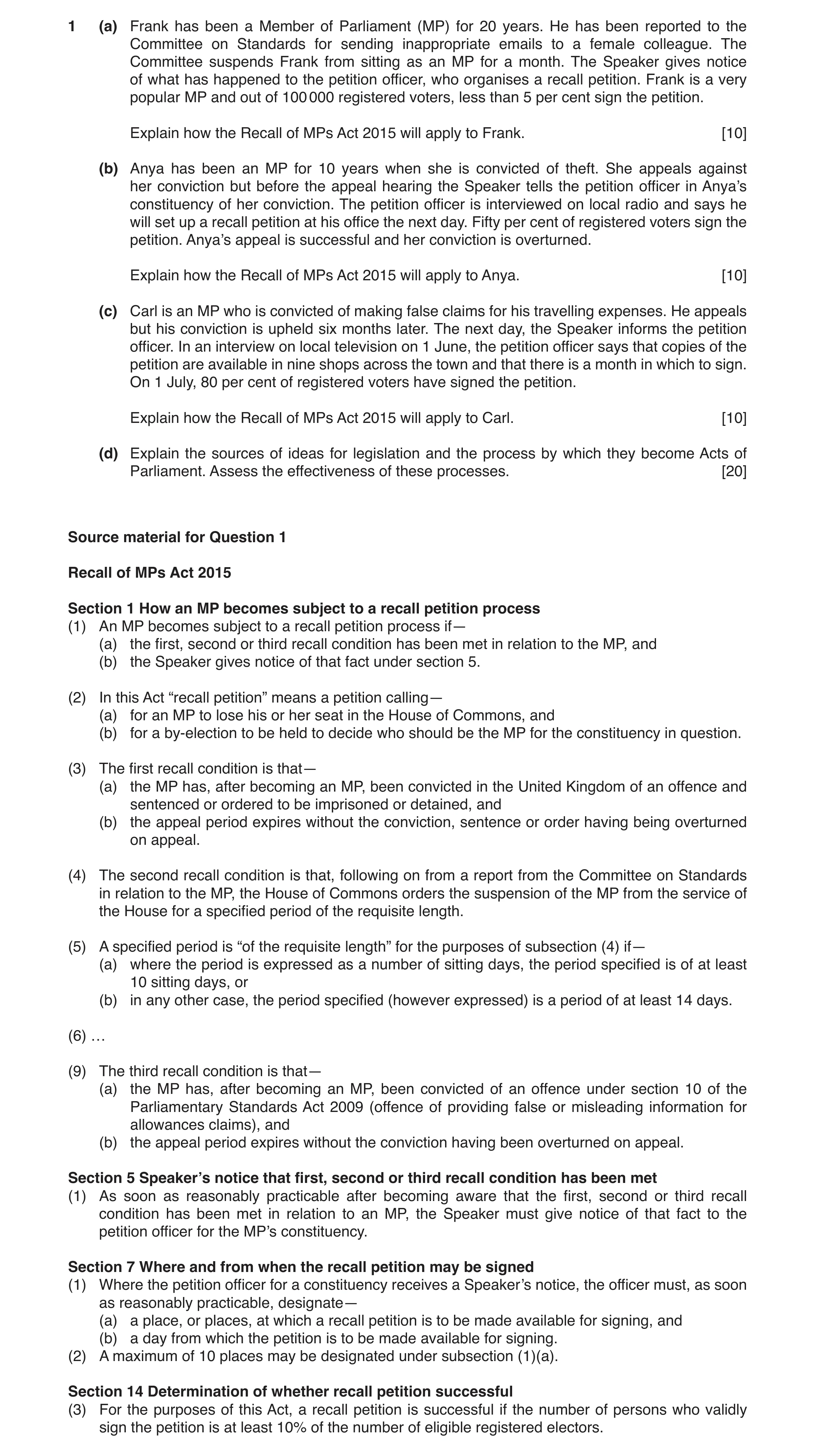
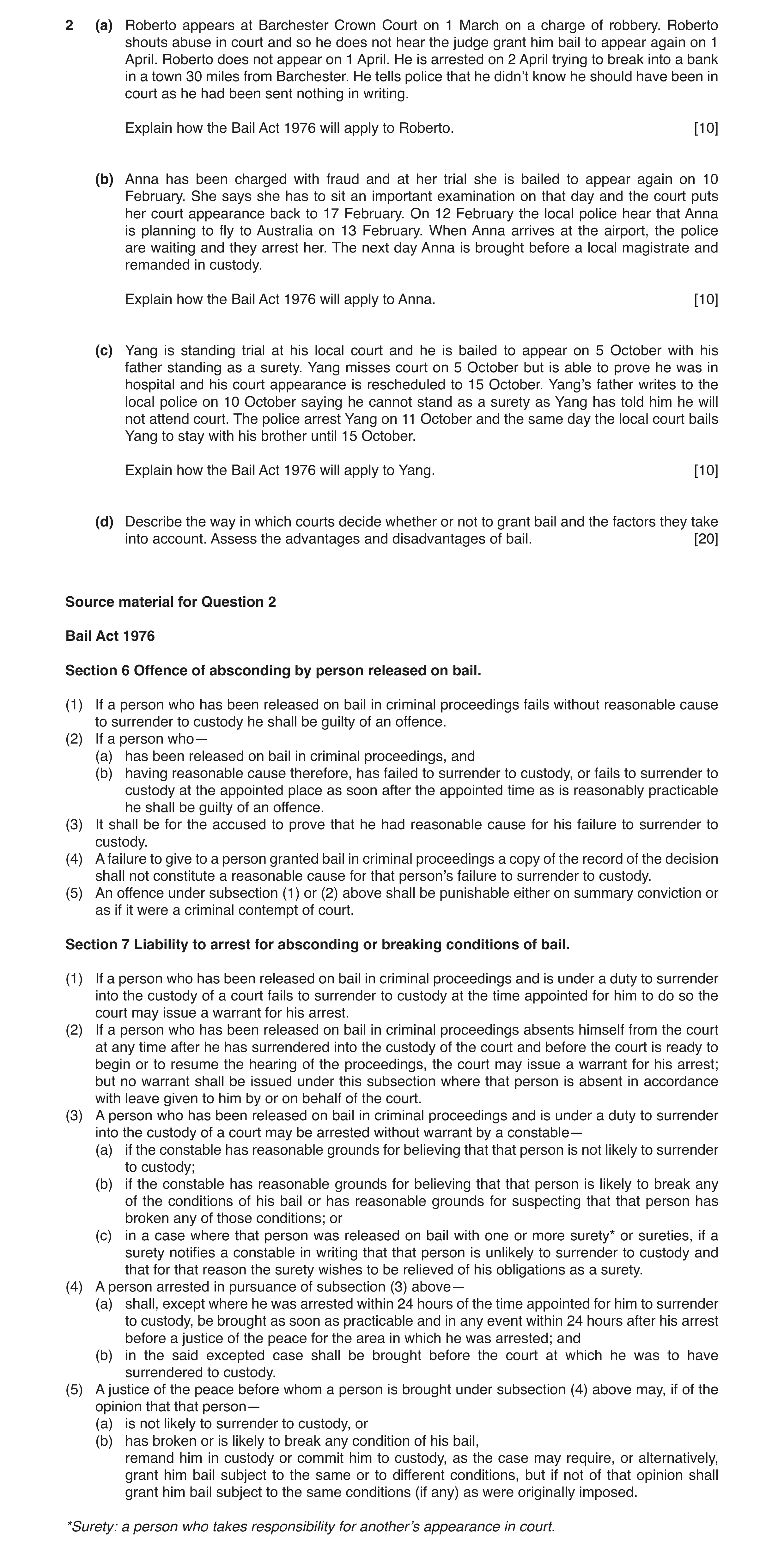
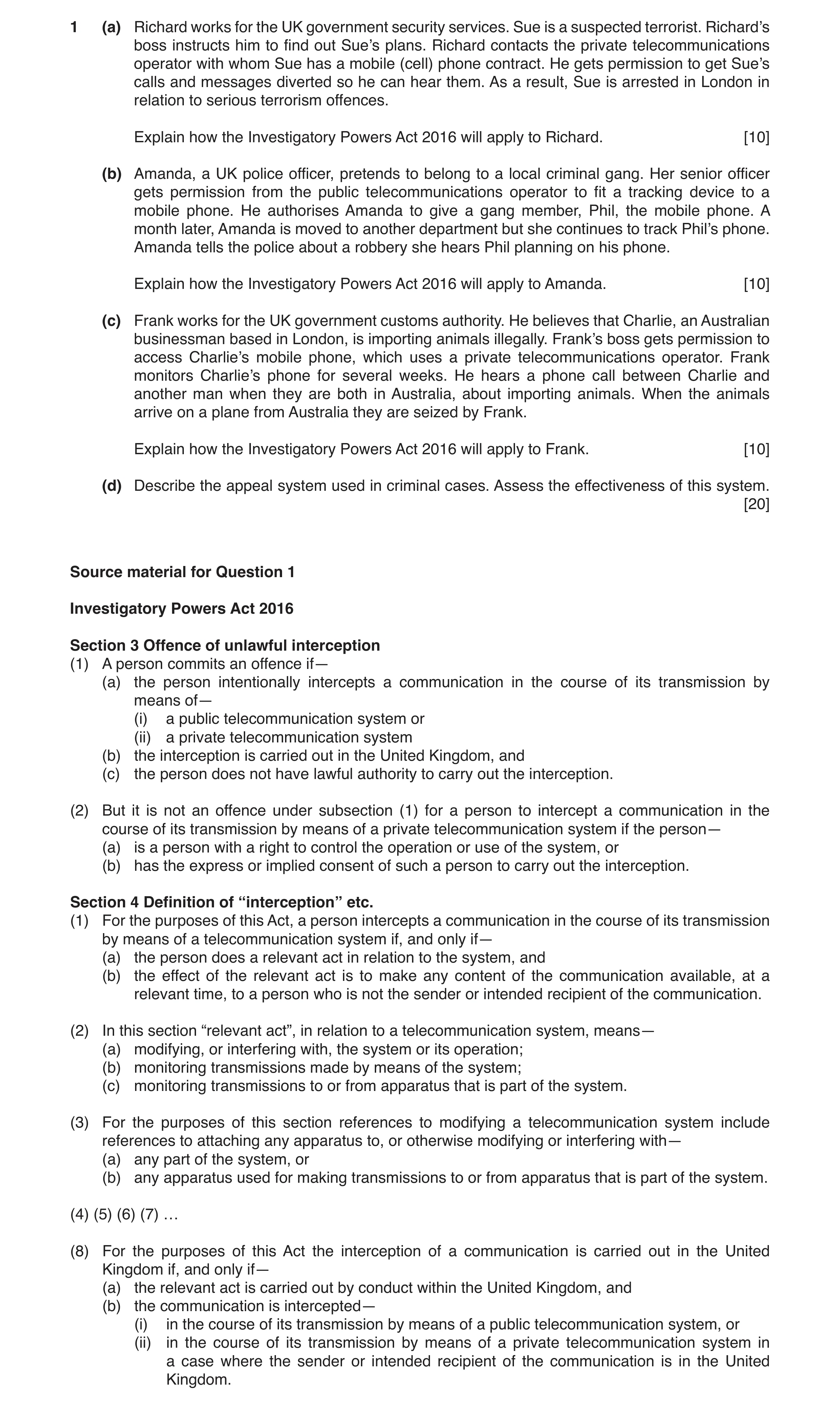
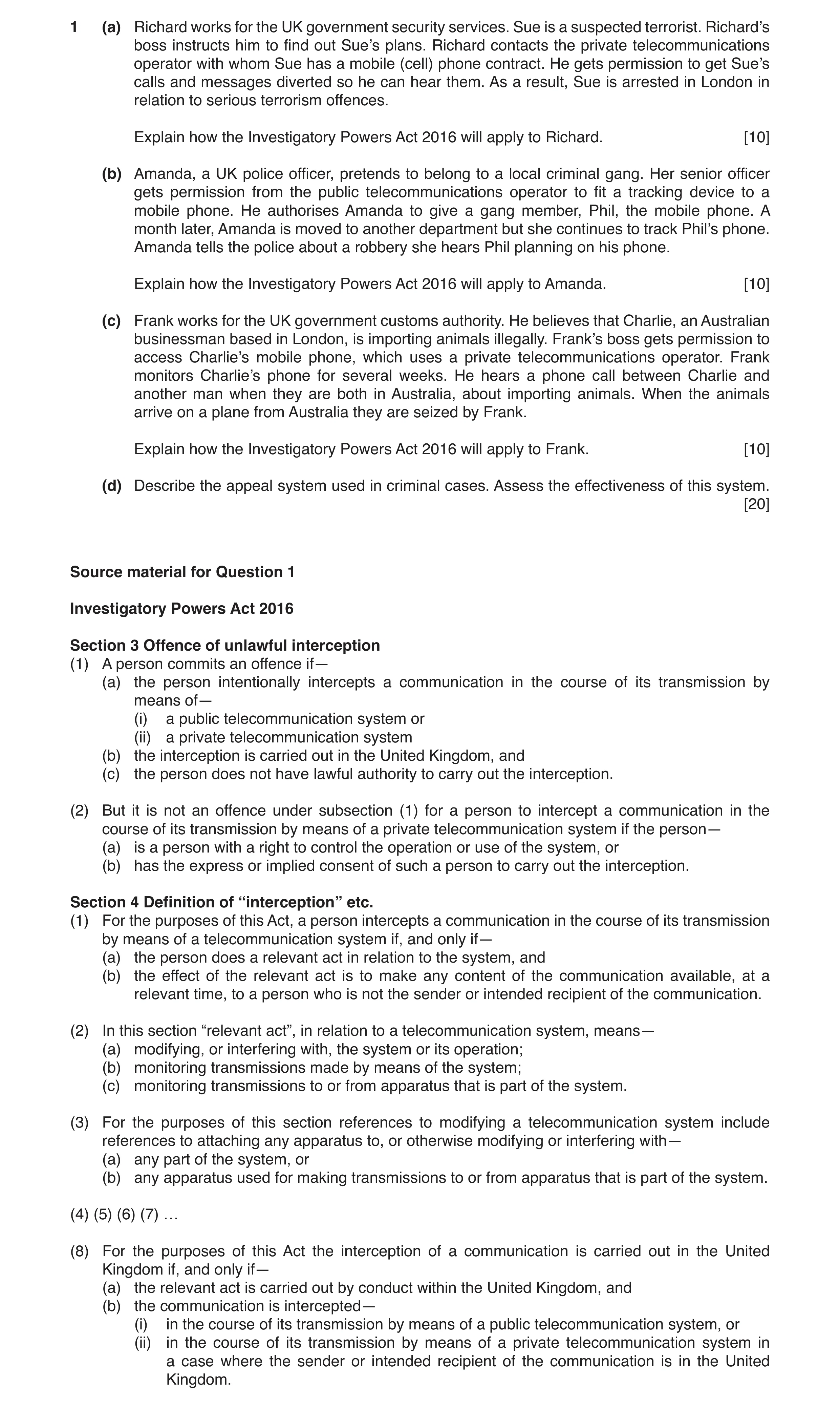
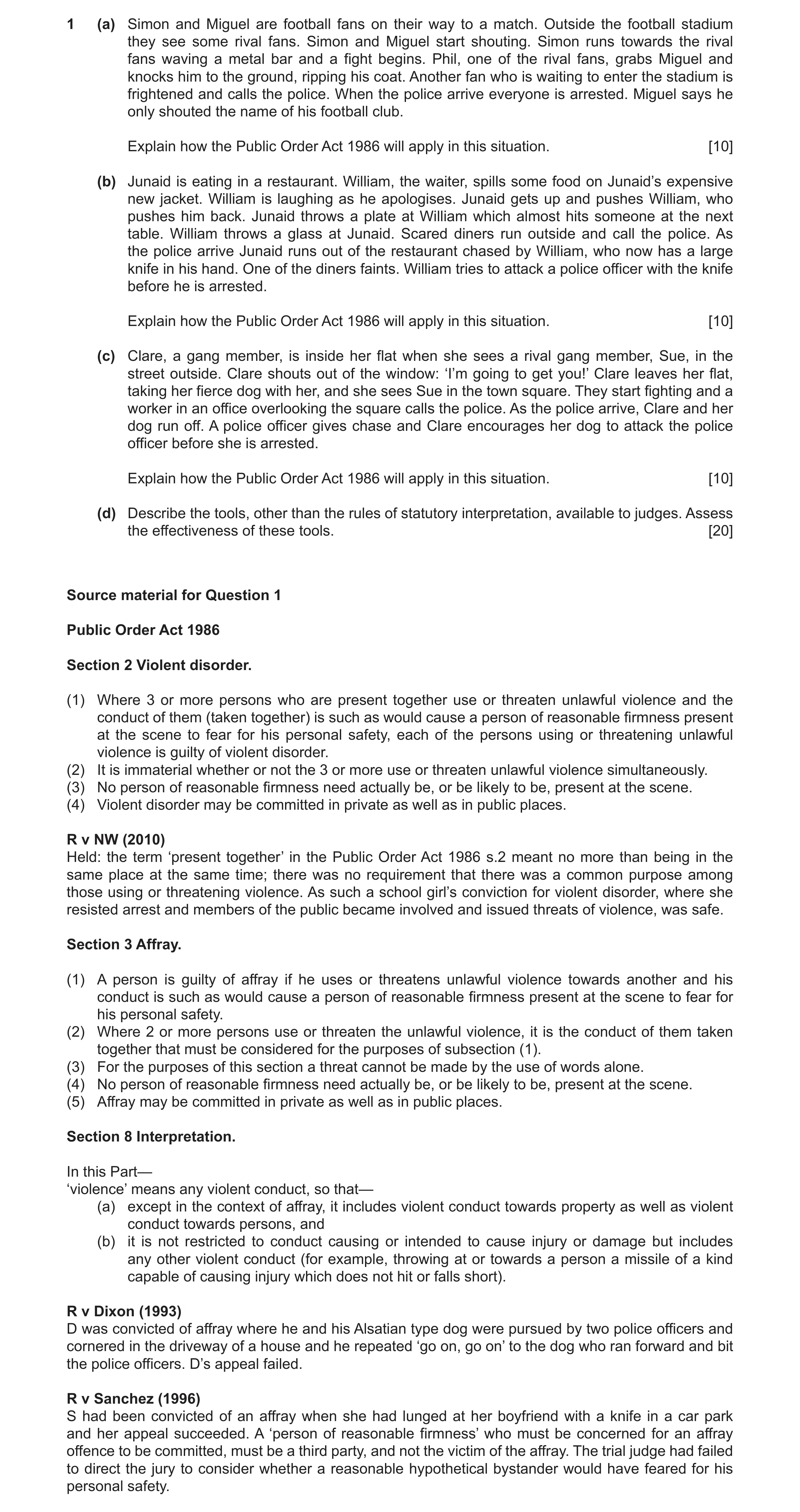
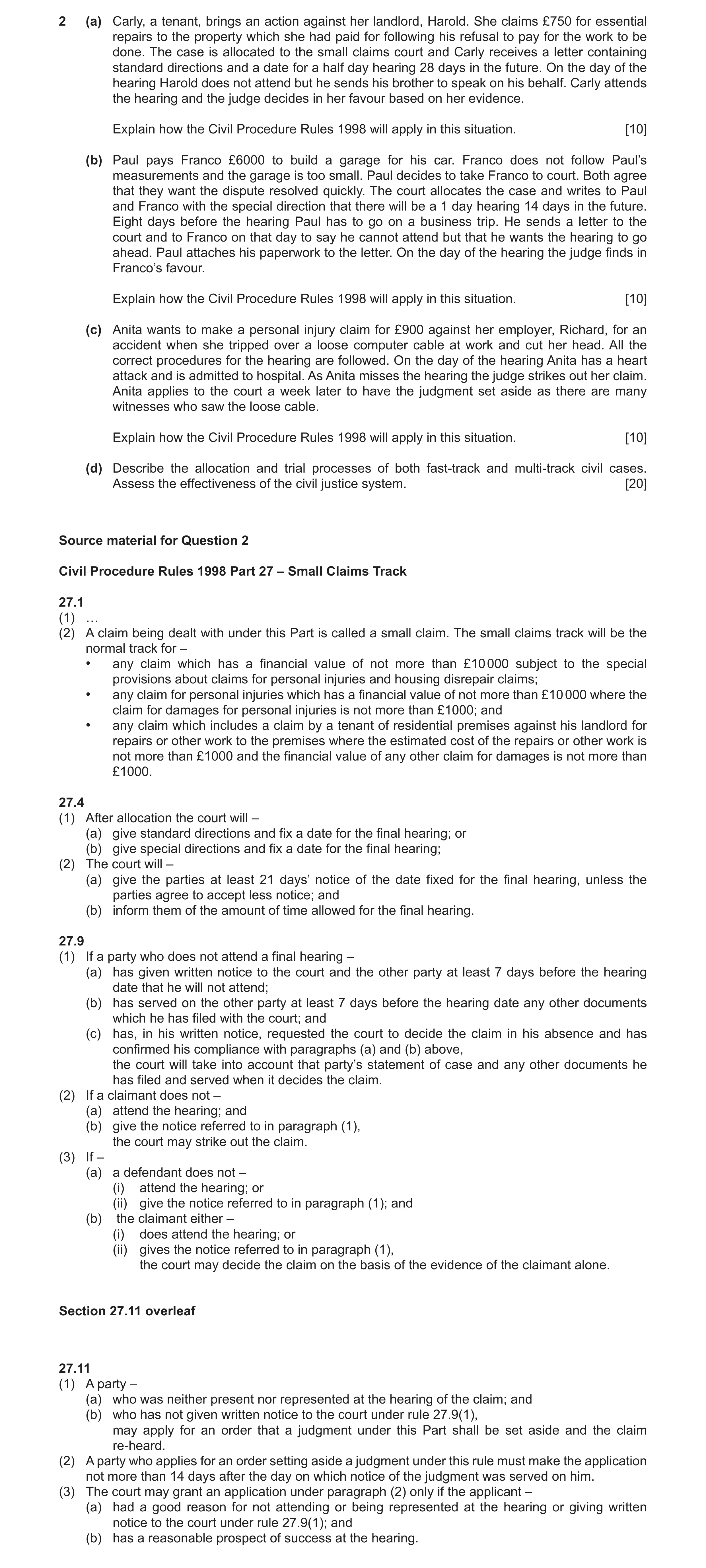
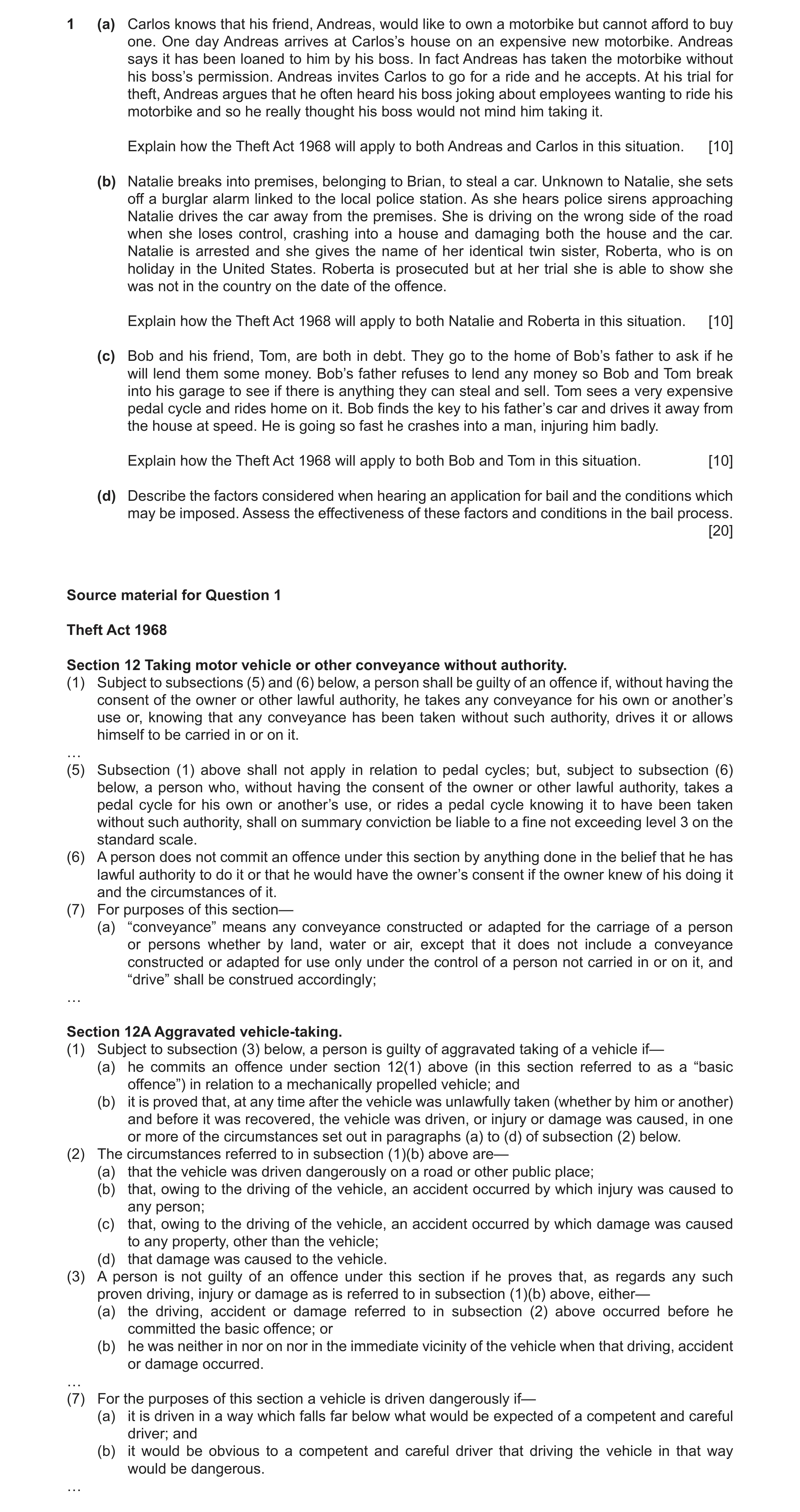
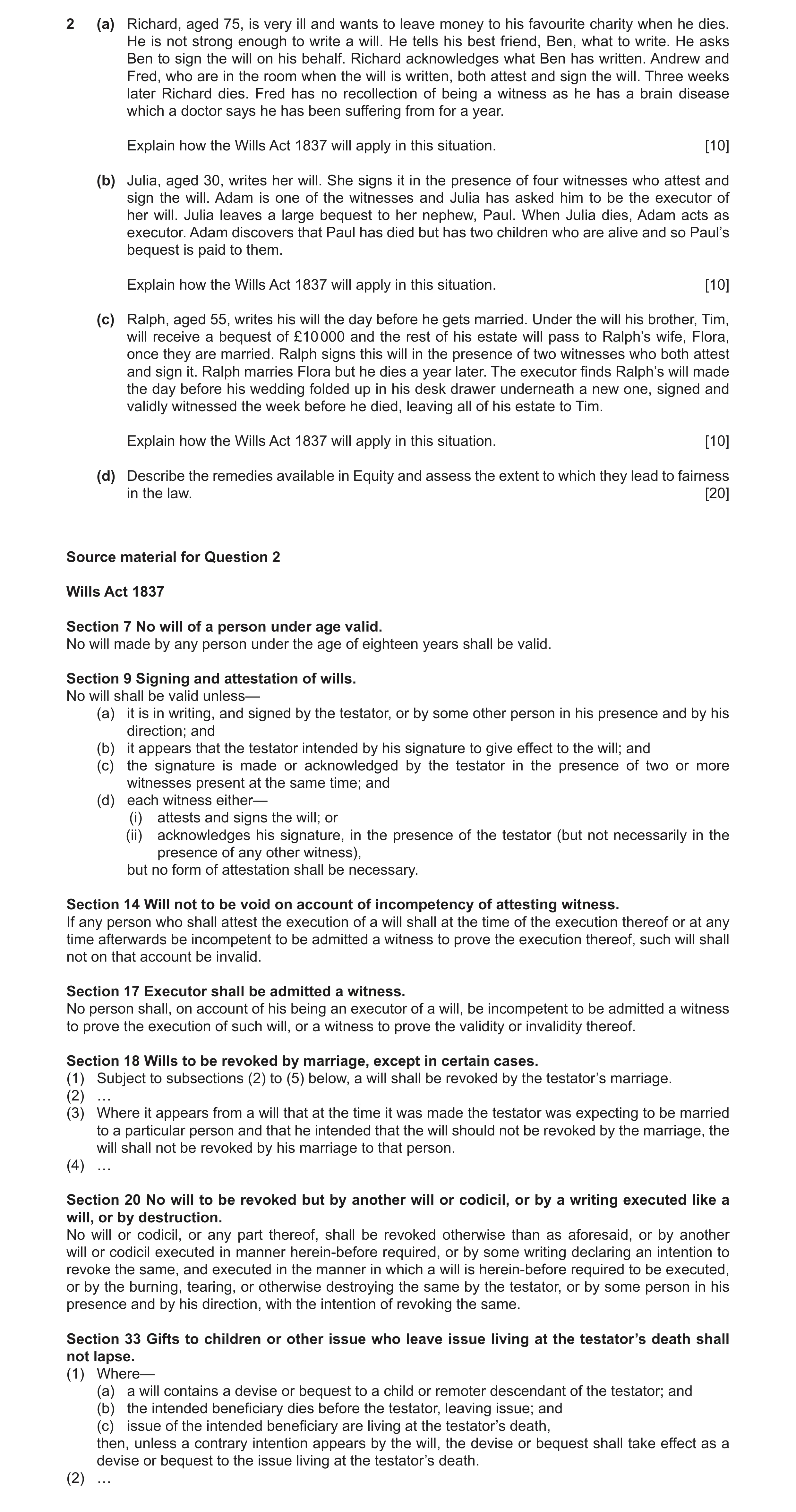
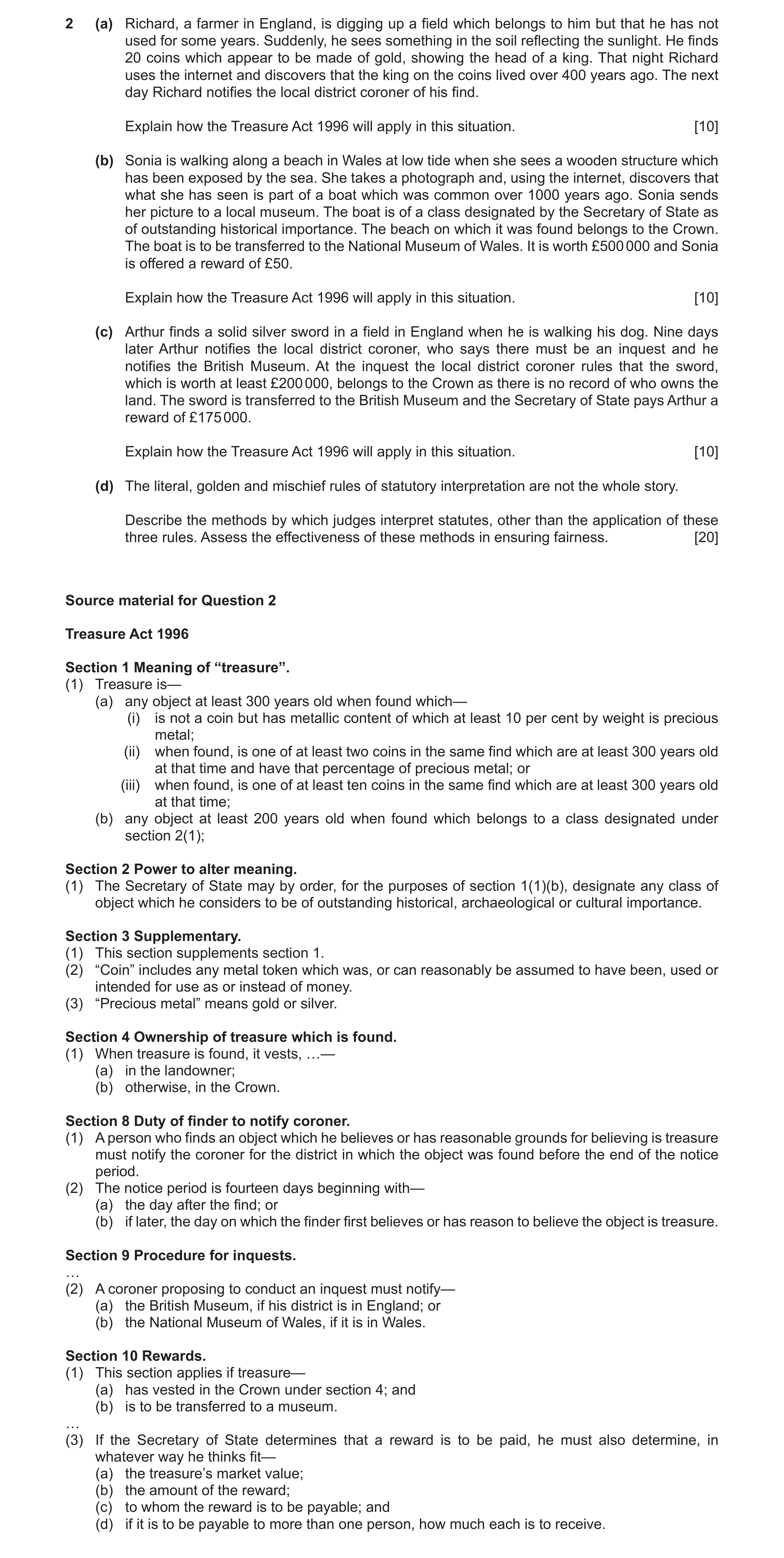
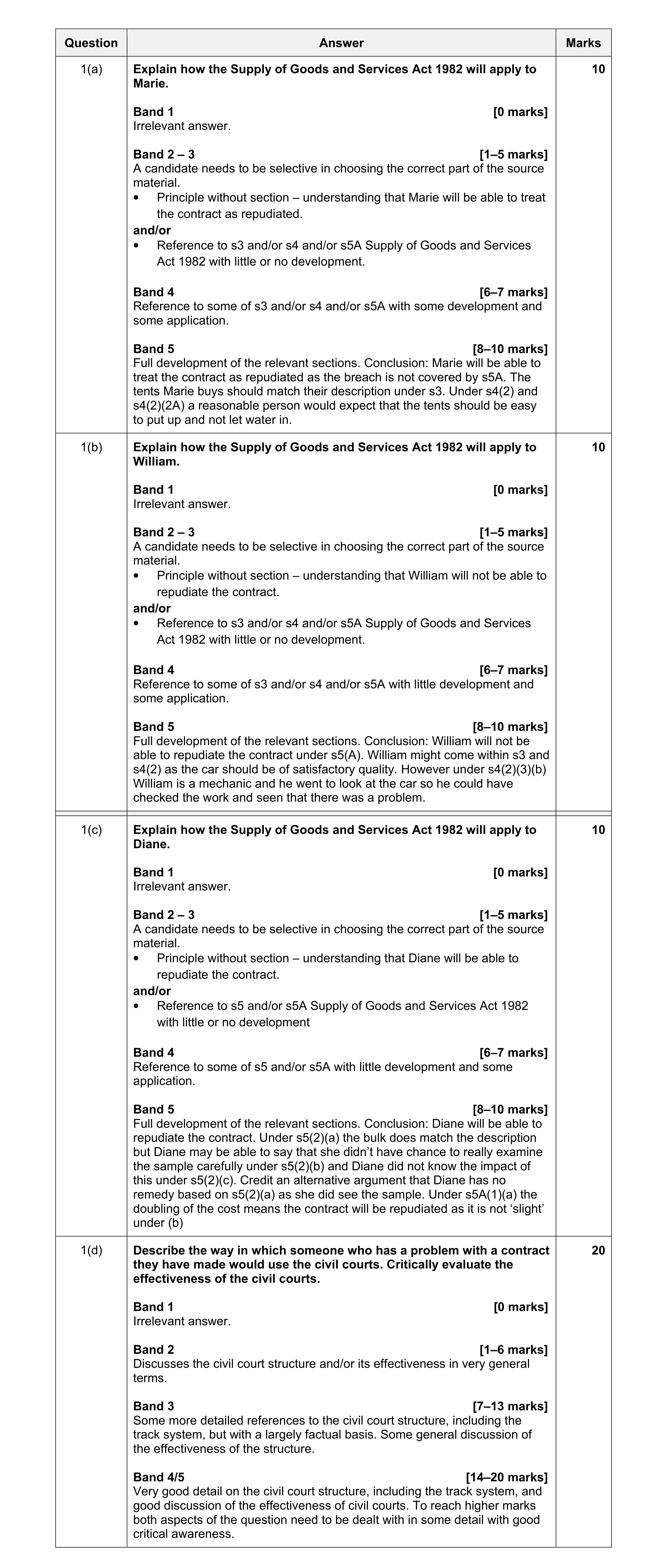 50
50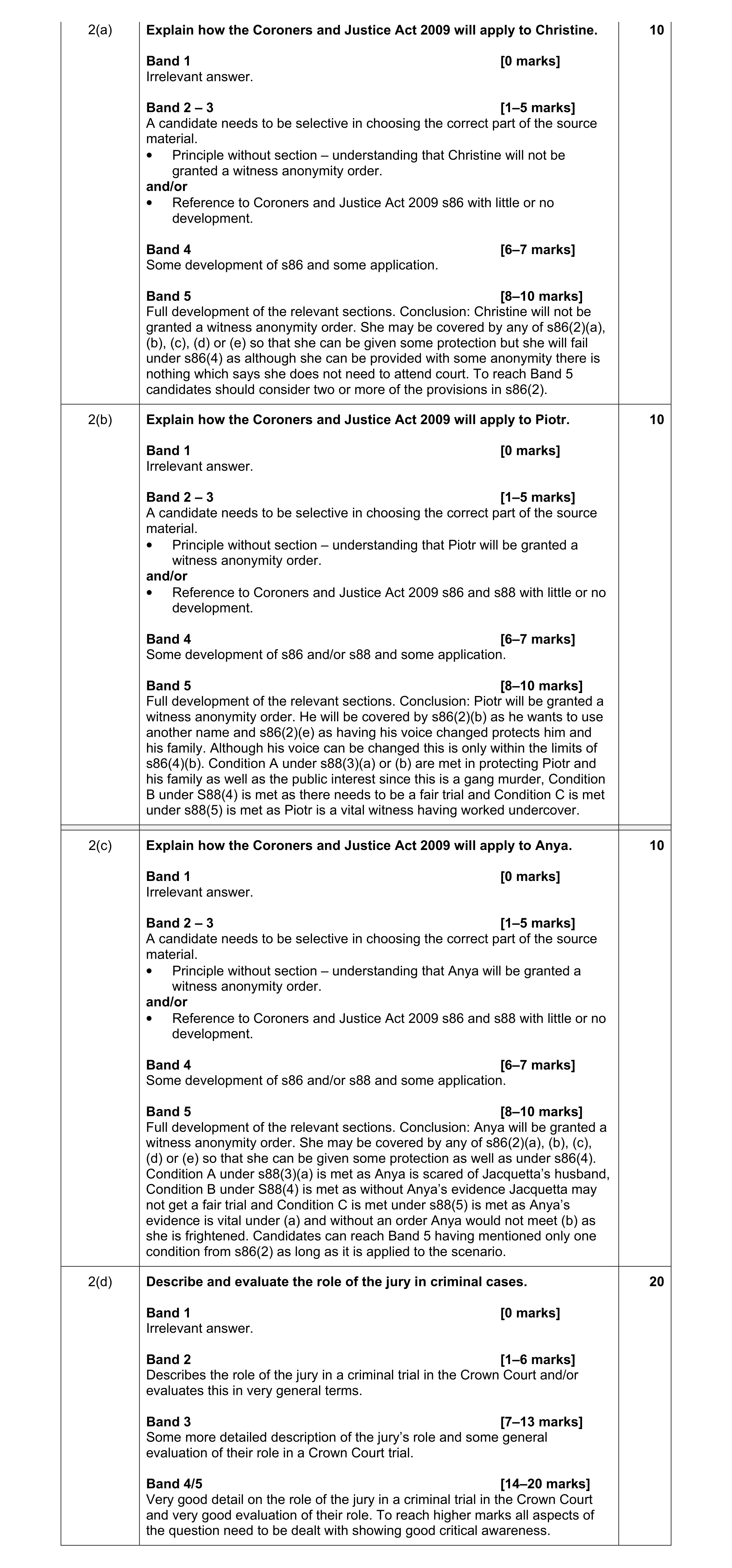 50
50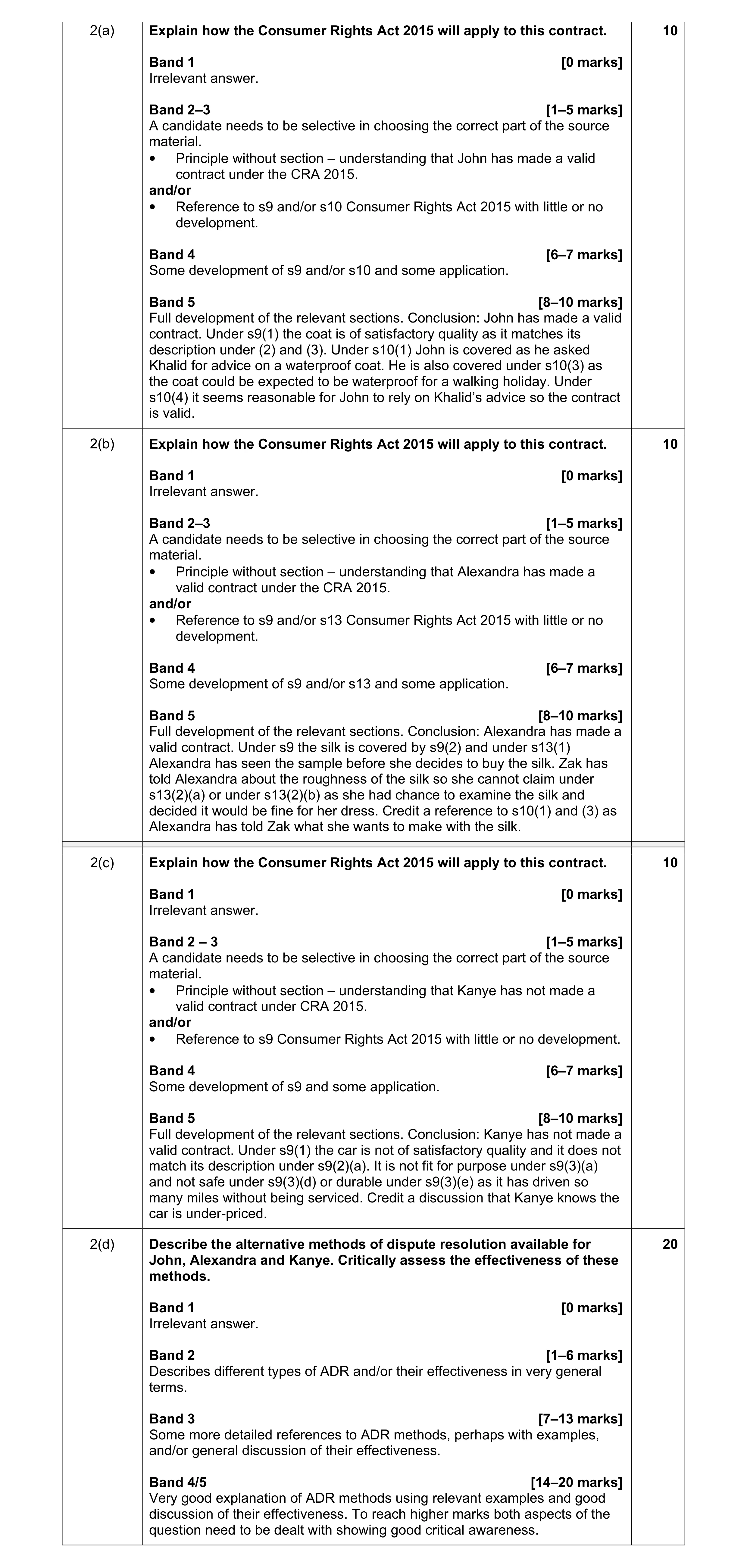 50
50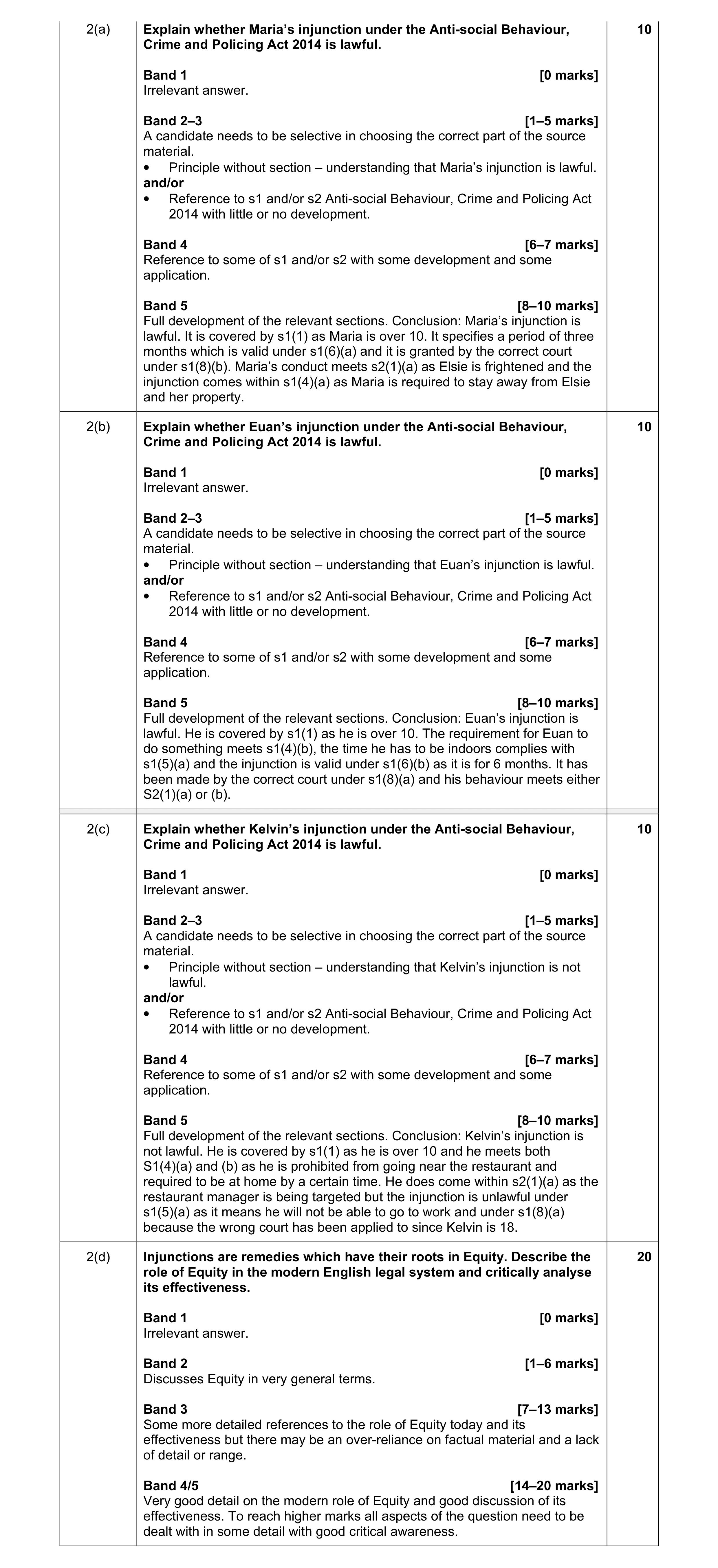 50
50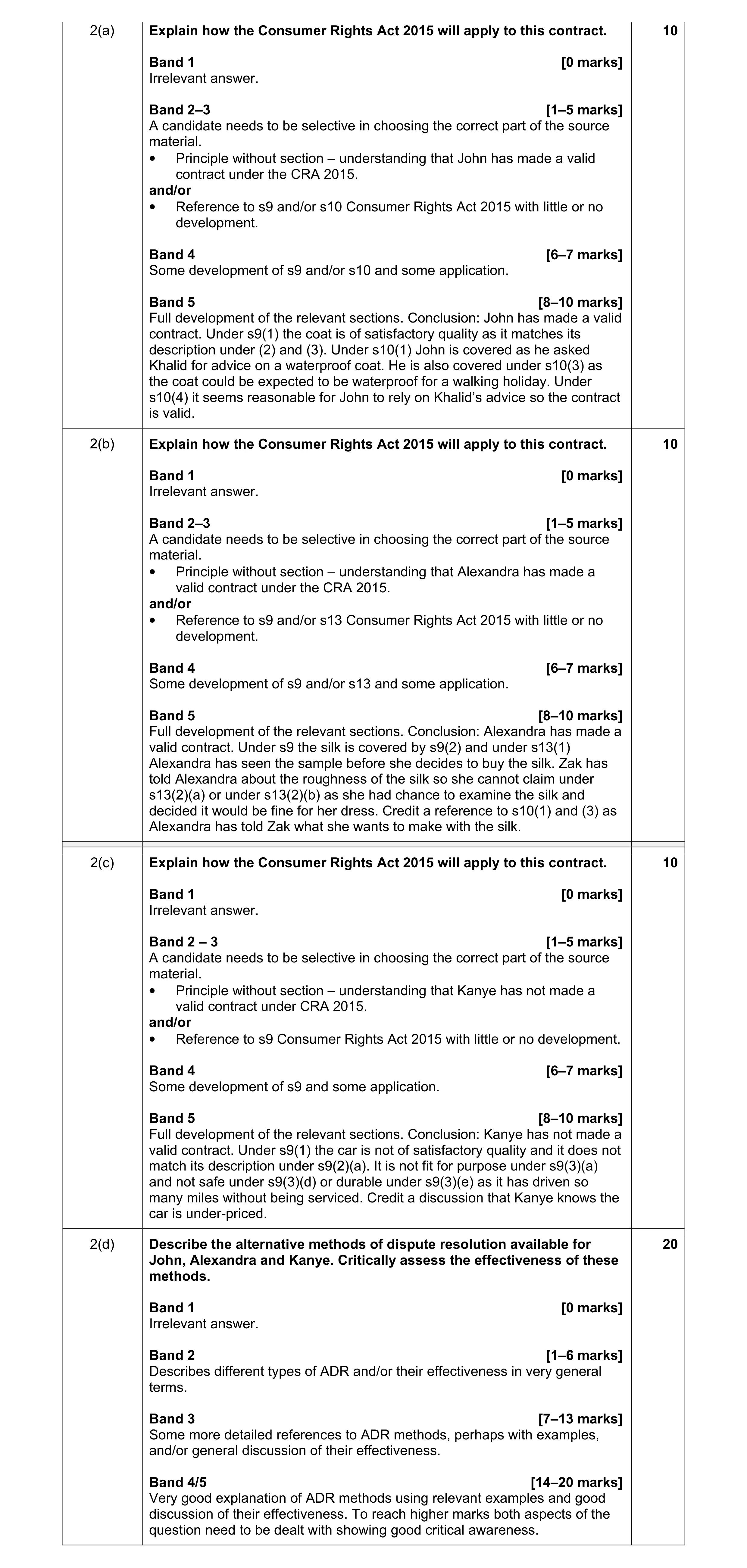 50
50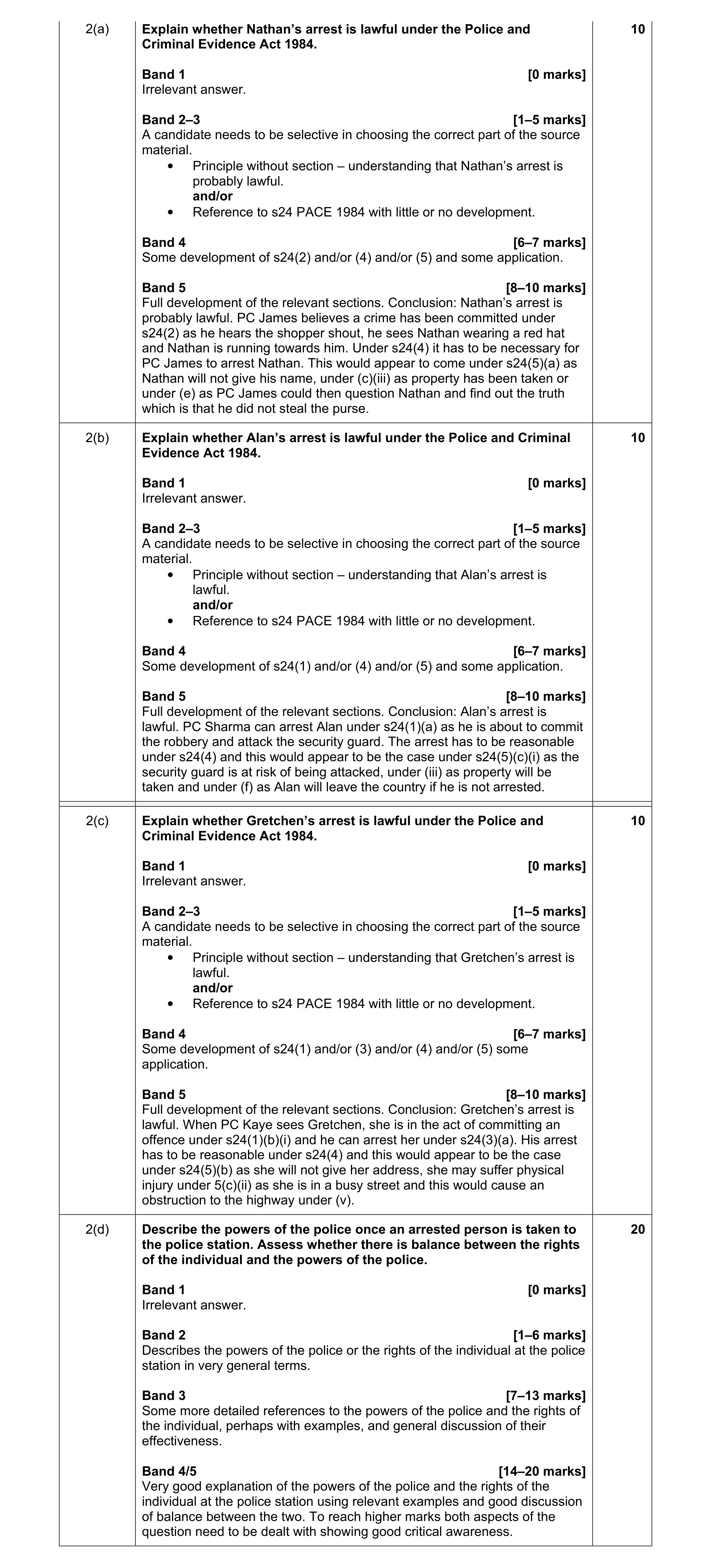 50
50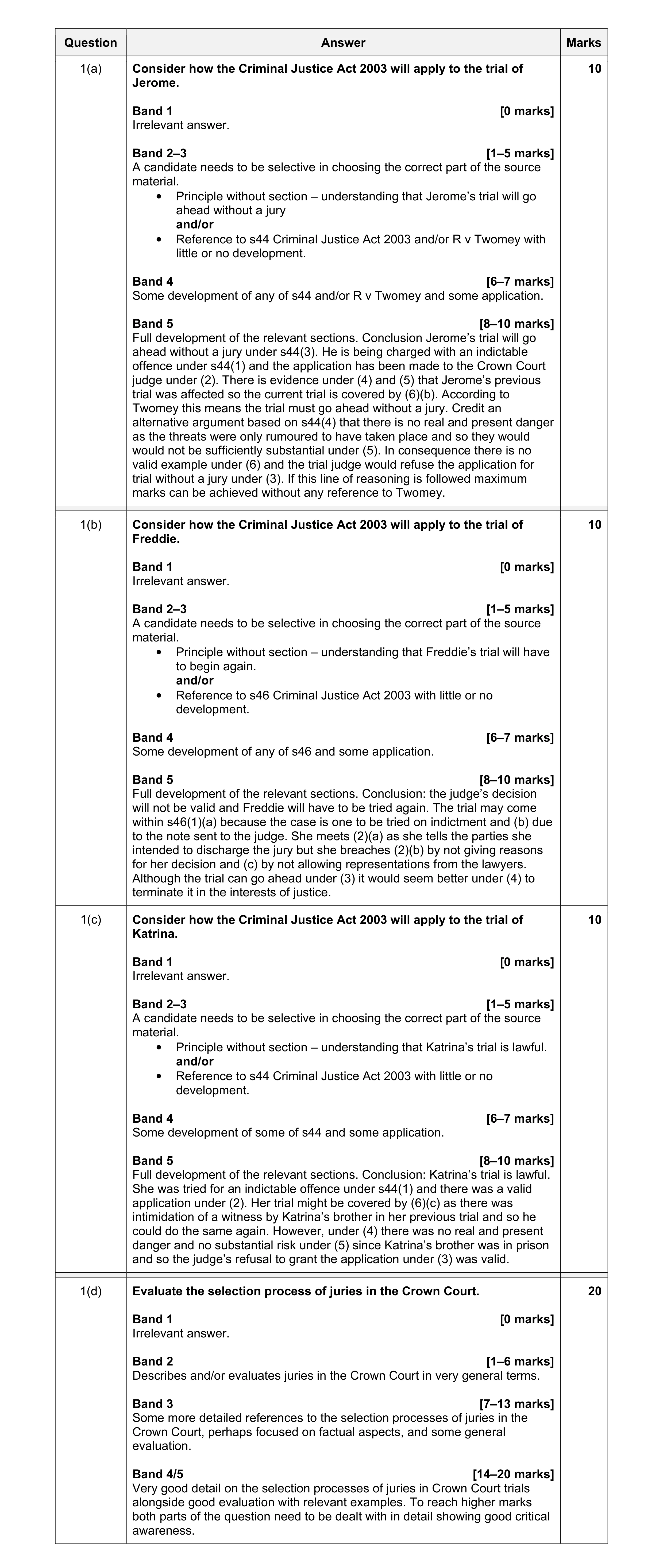 50
50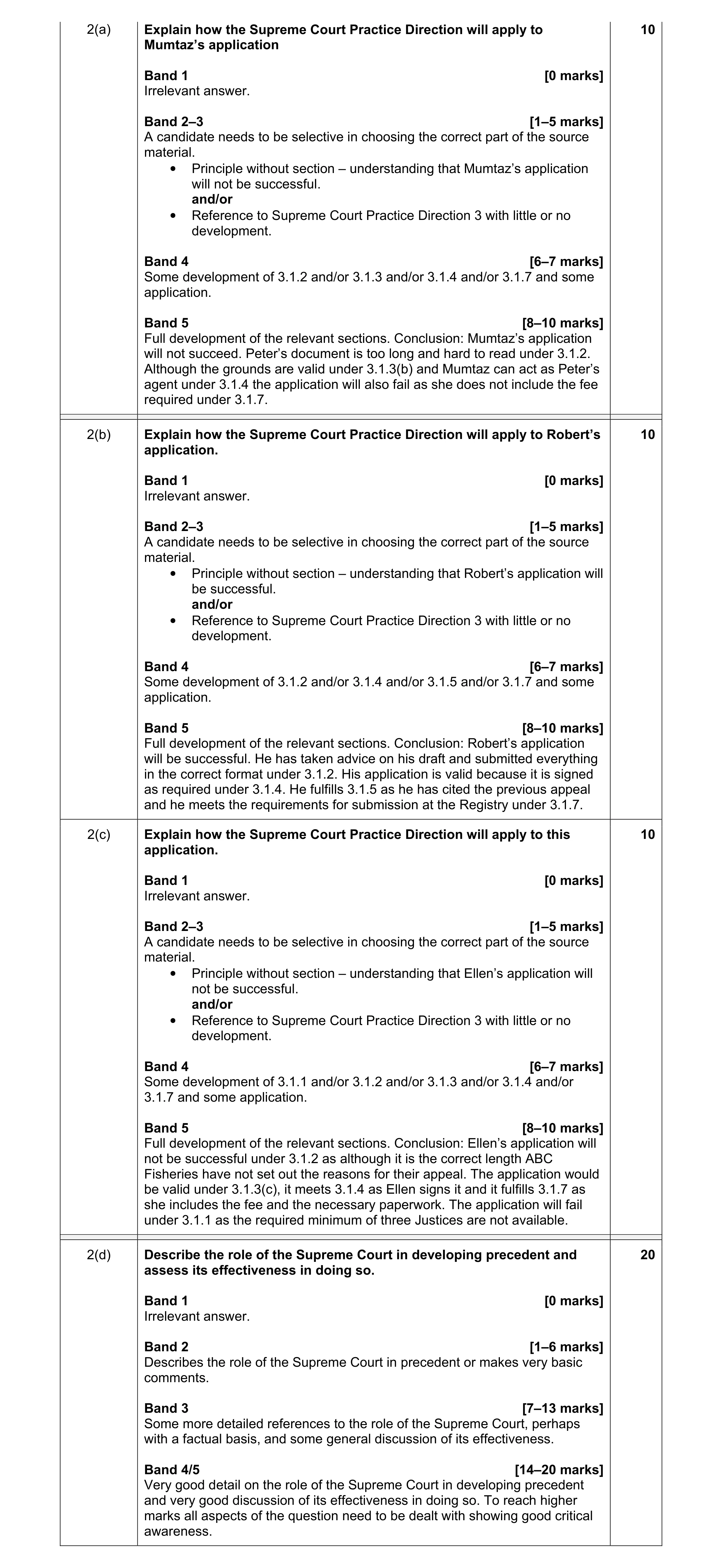 50
50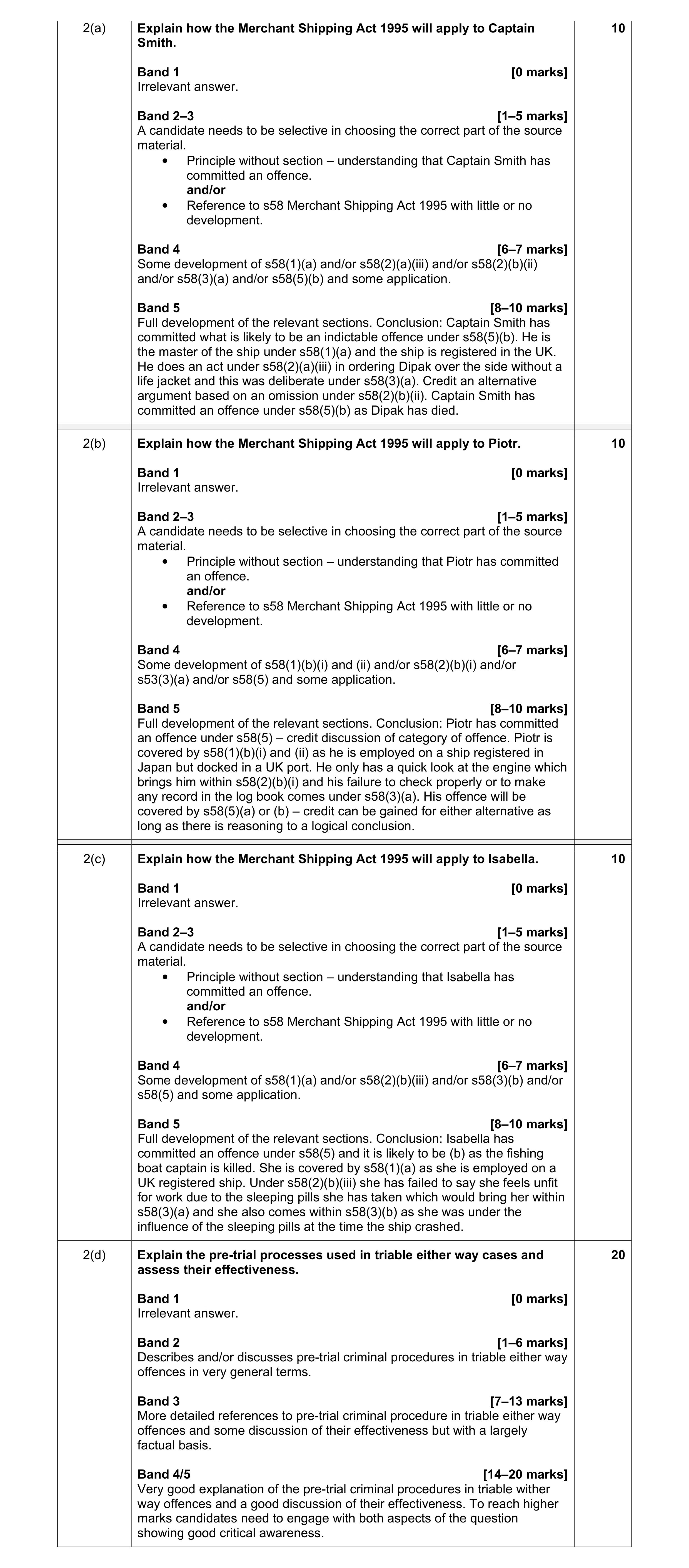 50
50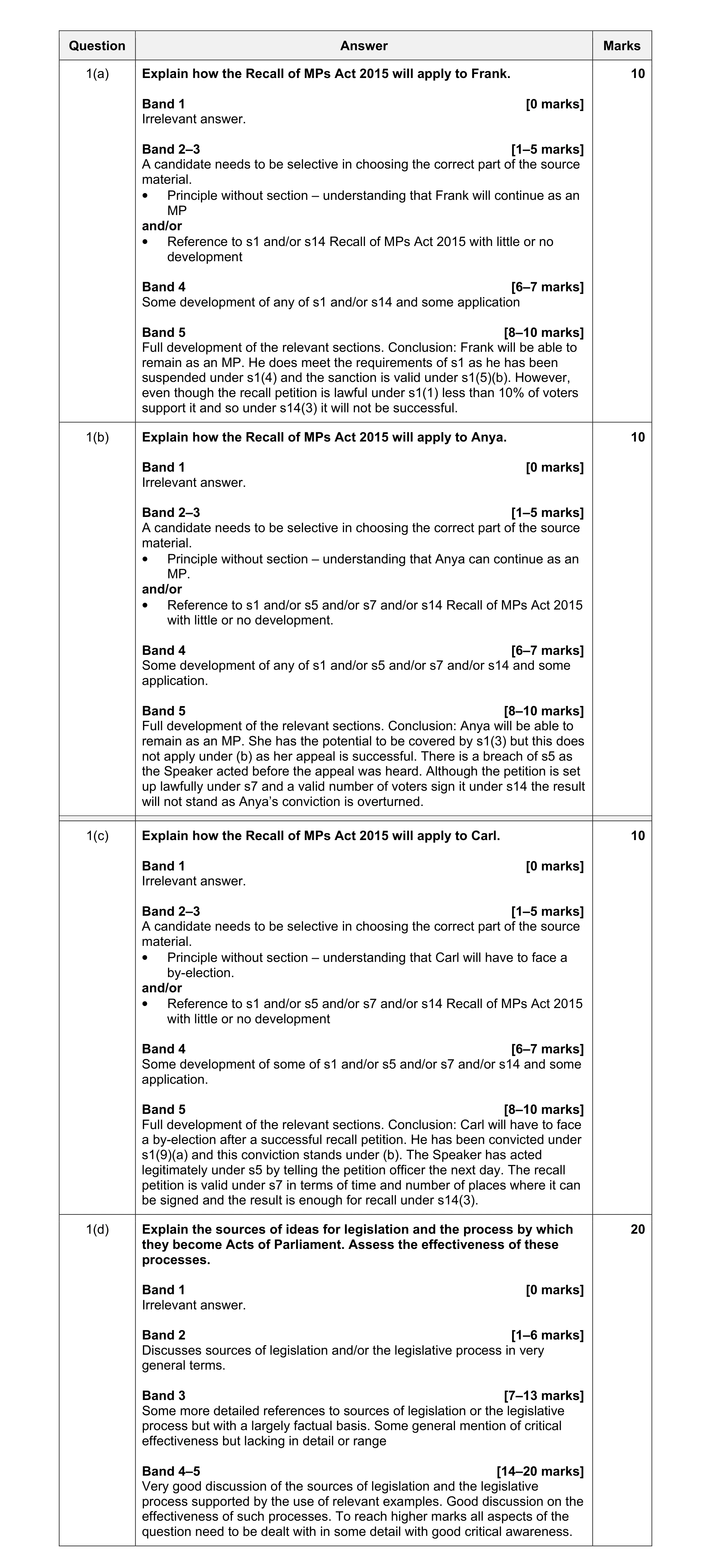 50
50 50
50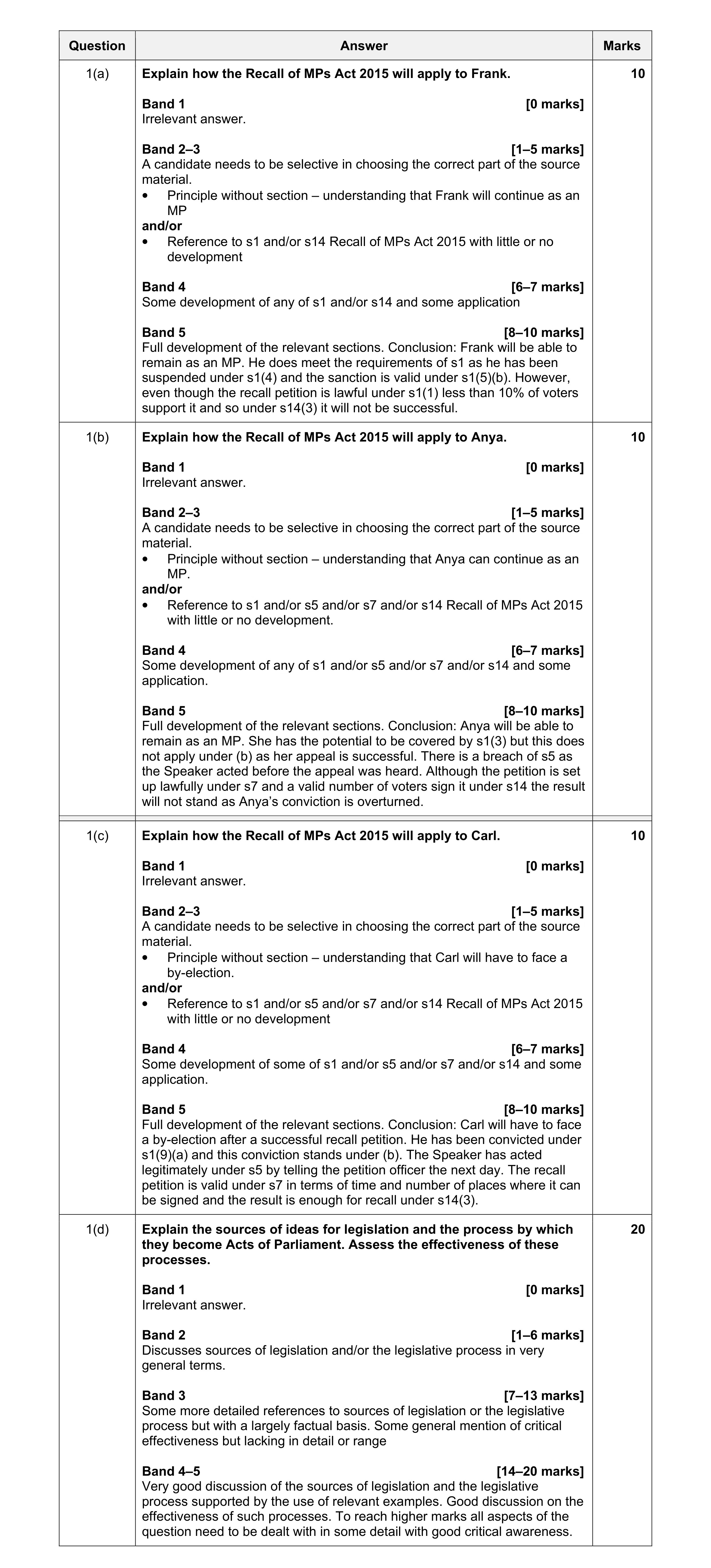 50
50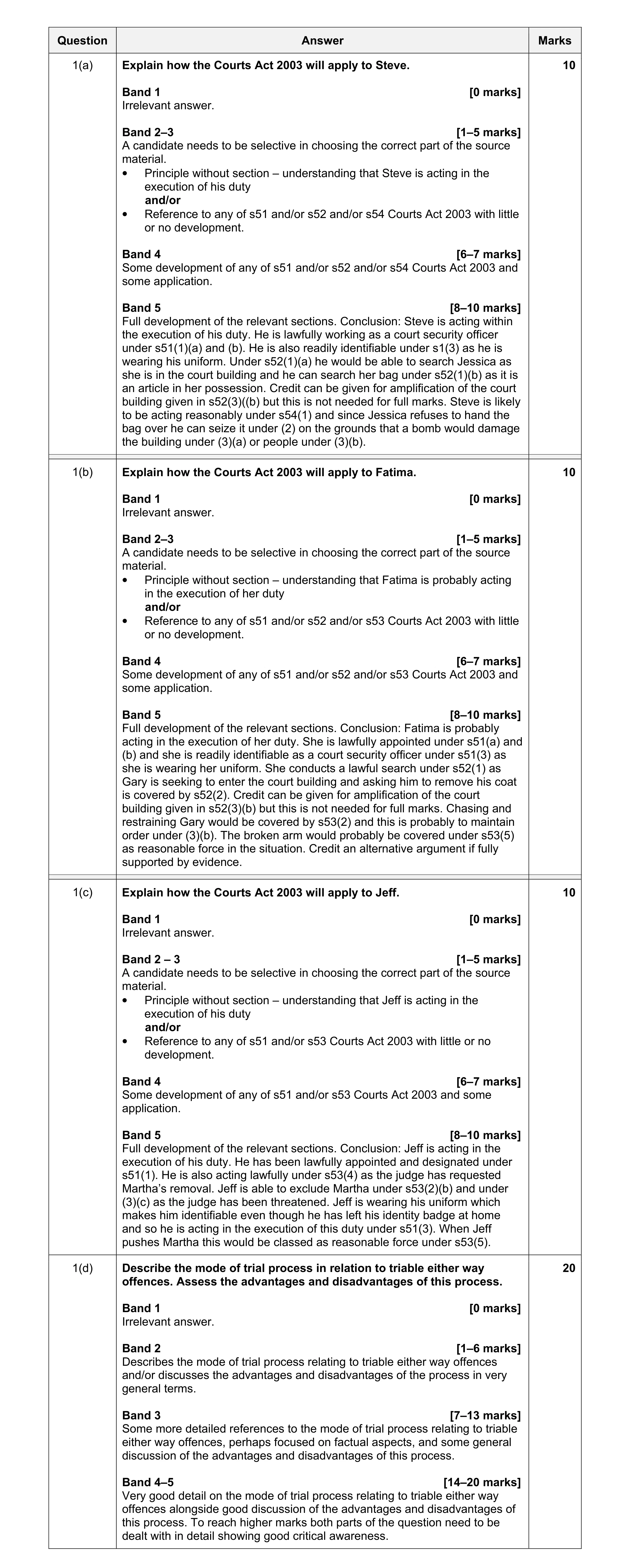 50
50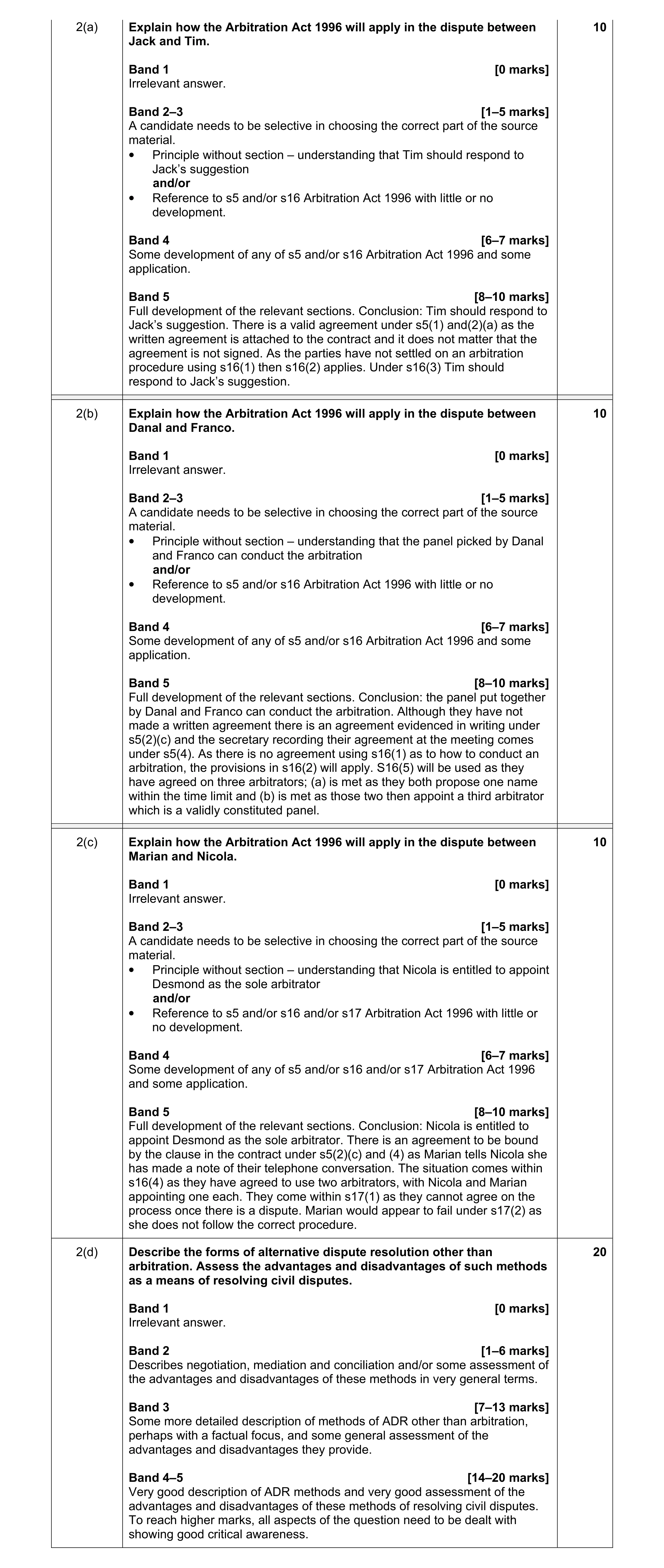 50
50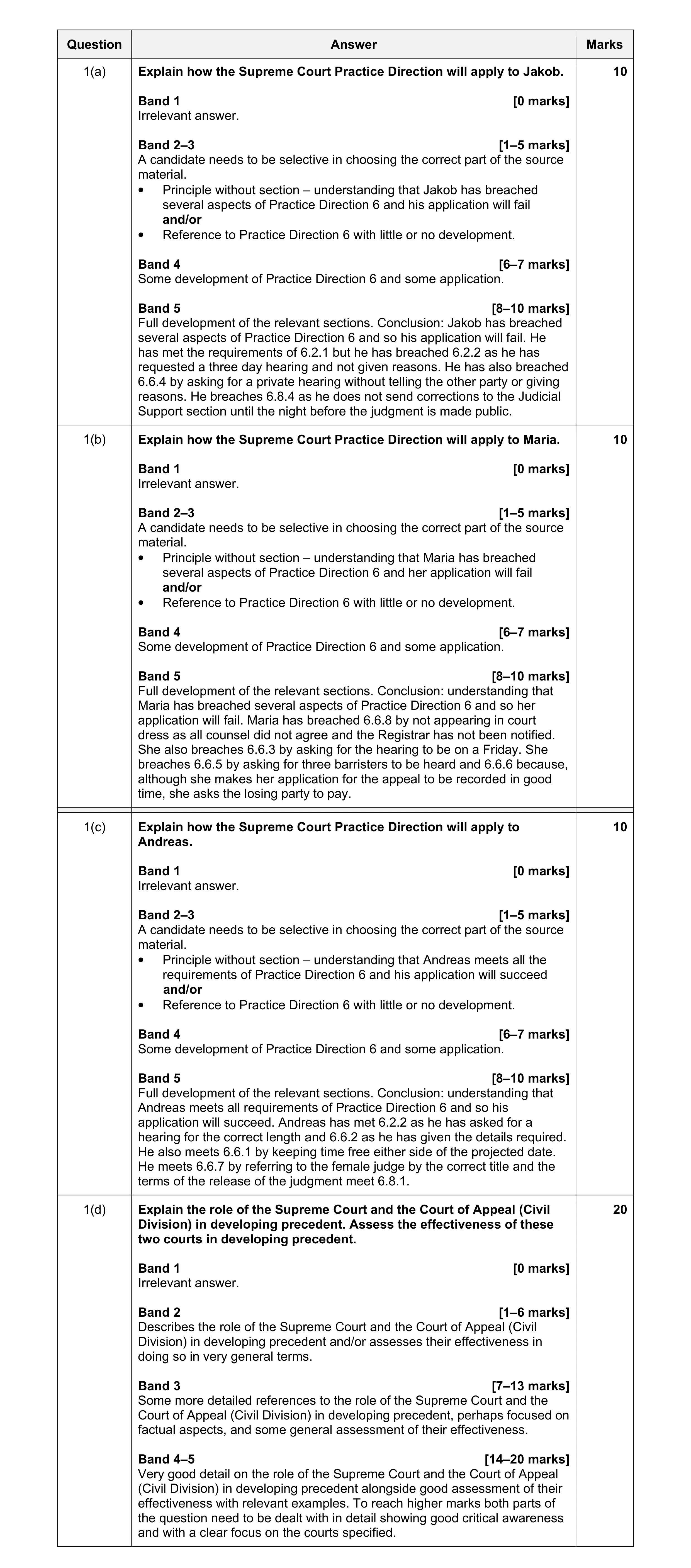 50
50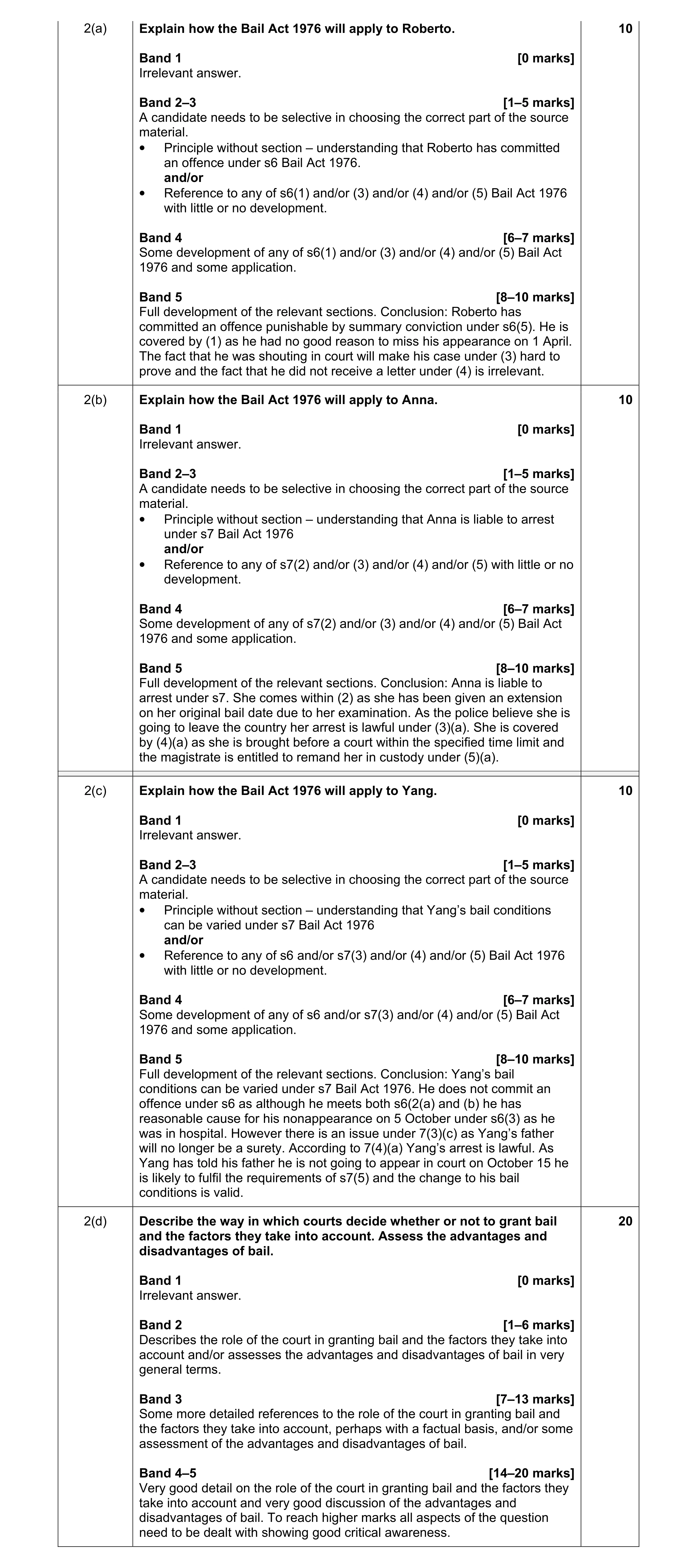 50
50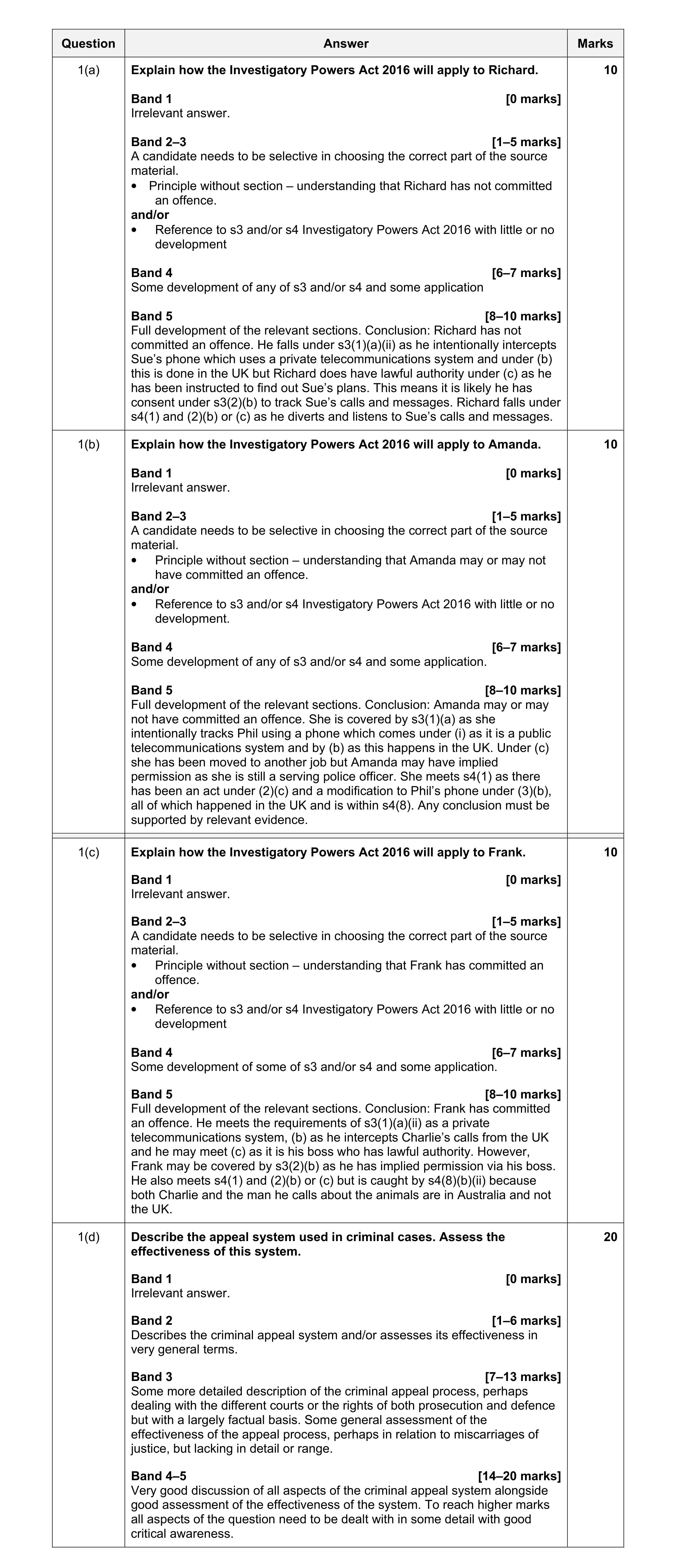 50
50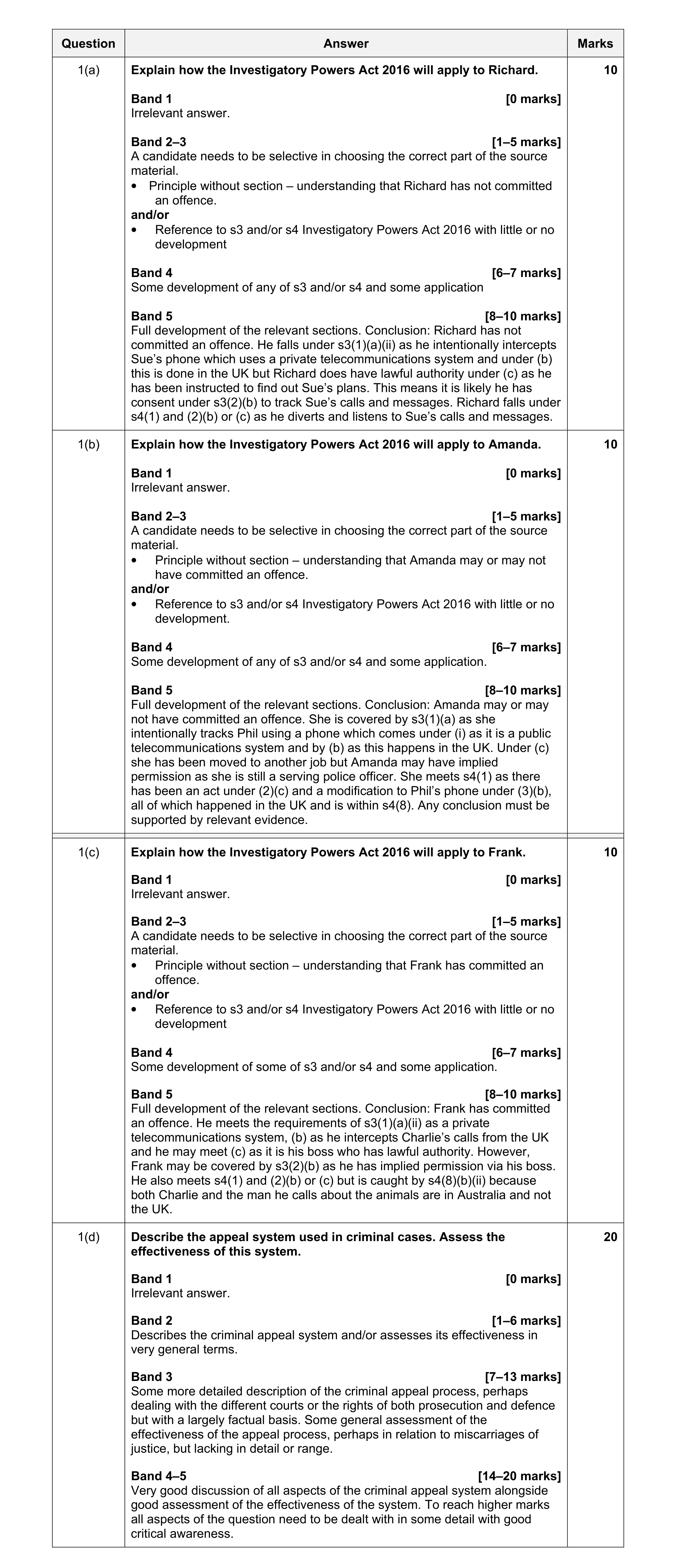 50
50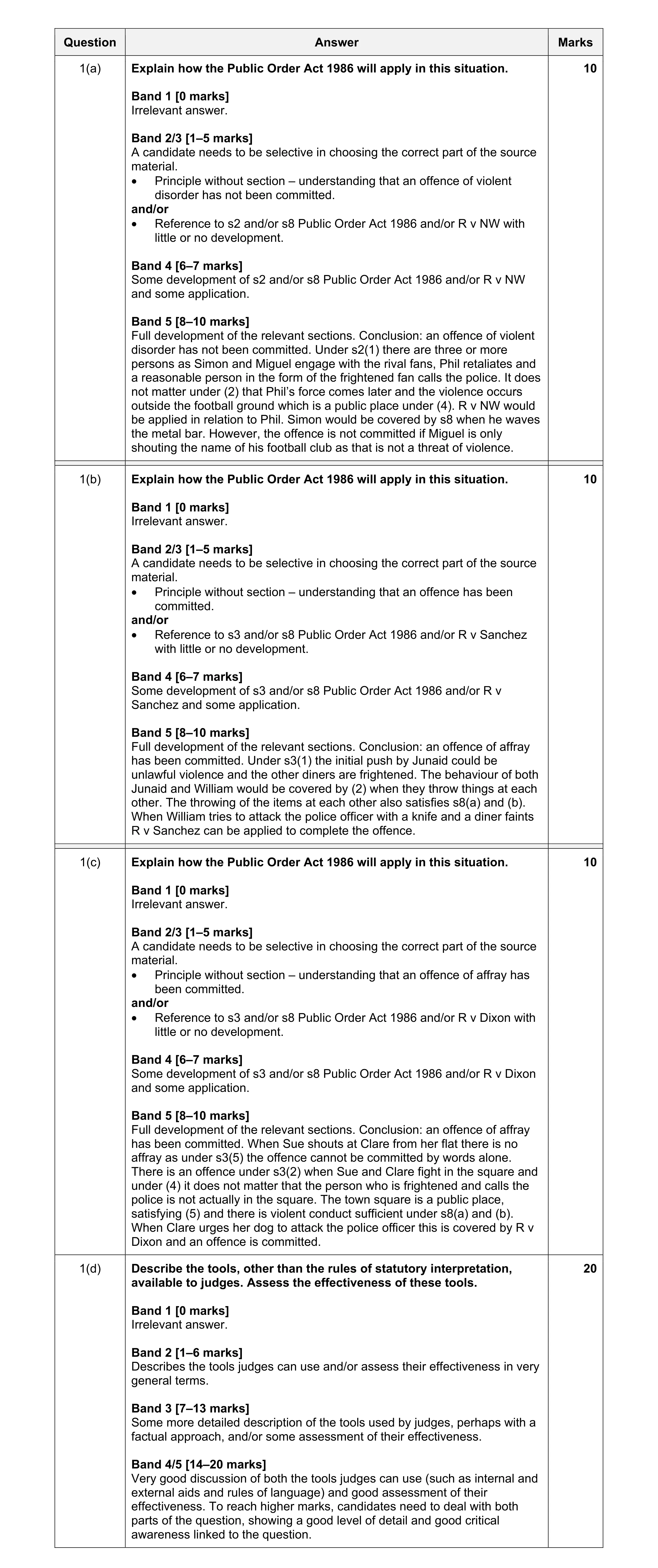 50
50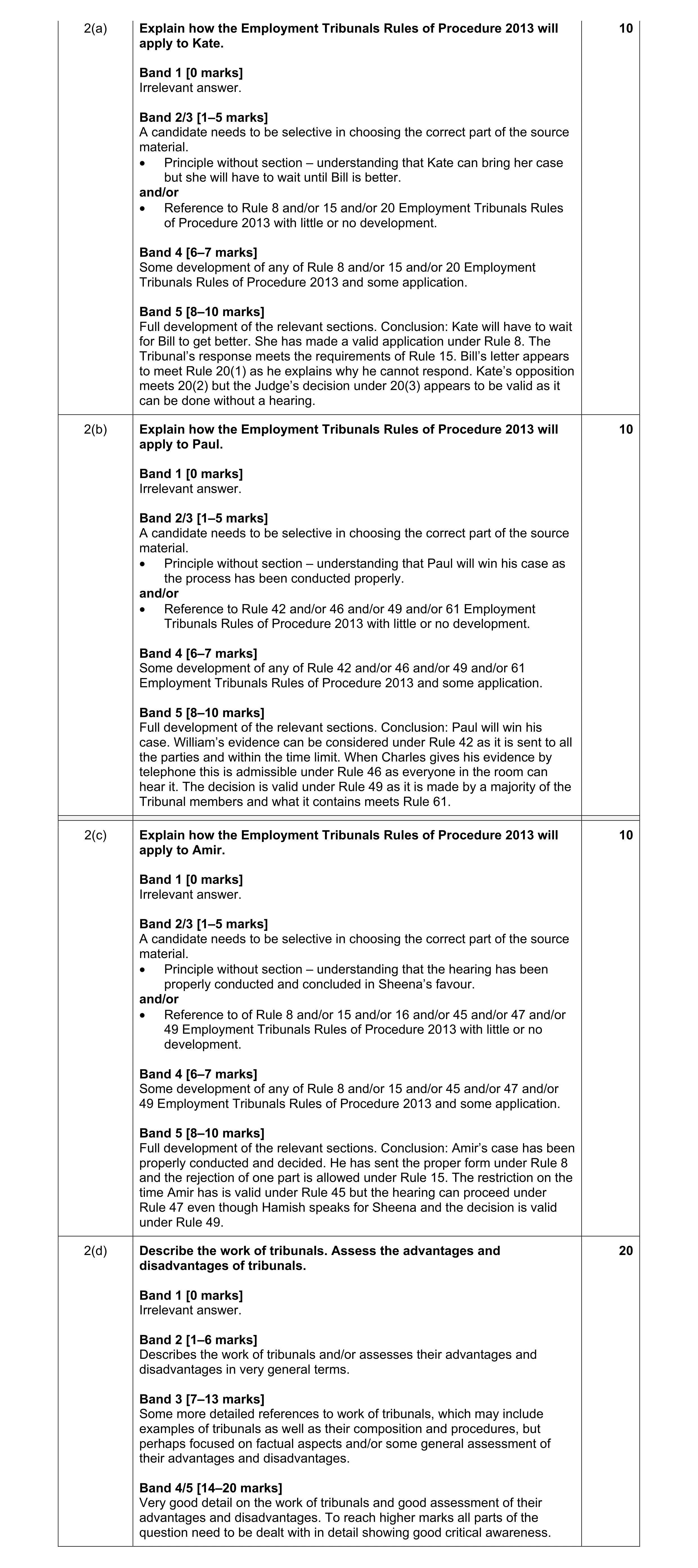 50
50 50
50 50
50 50
50 50
50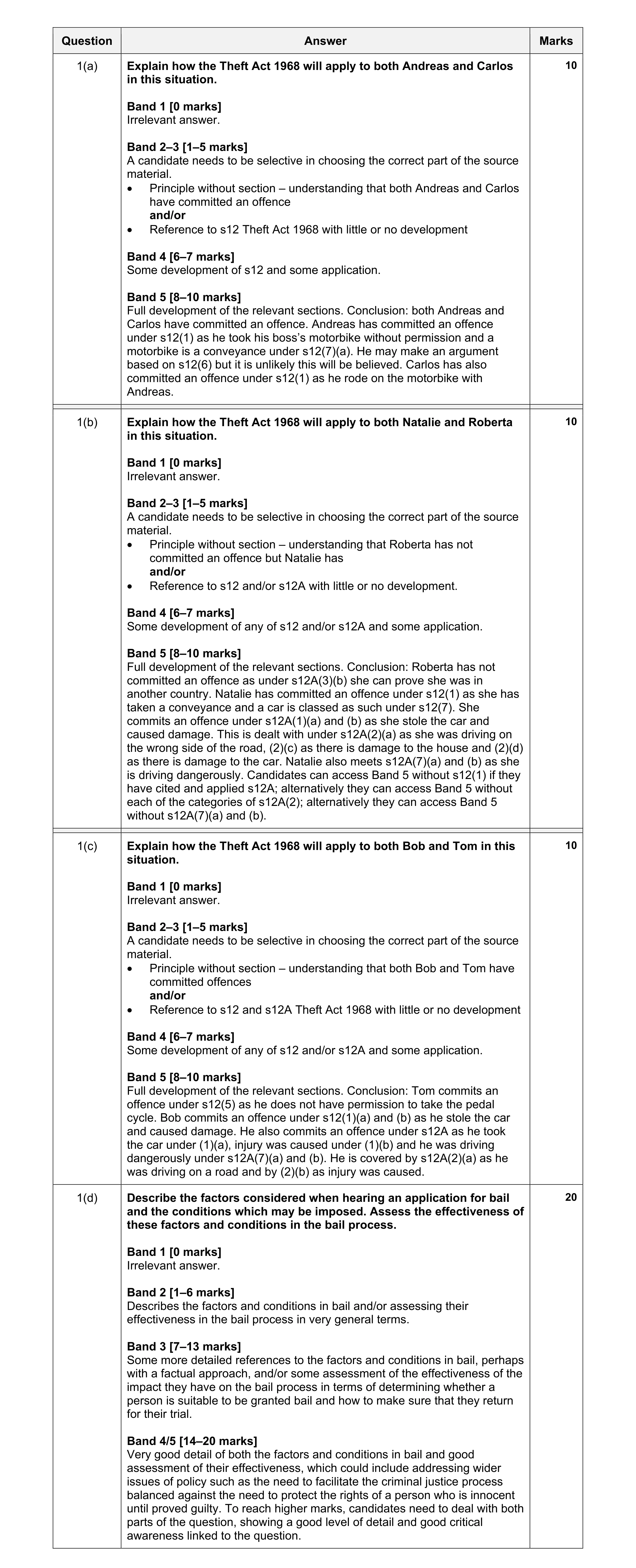 50
50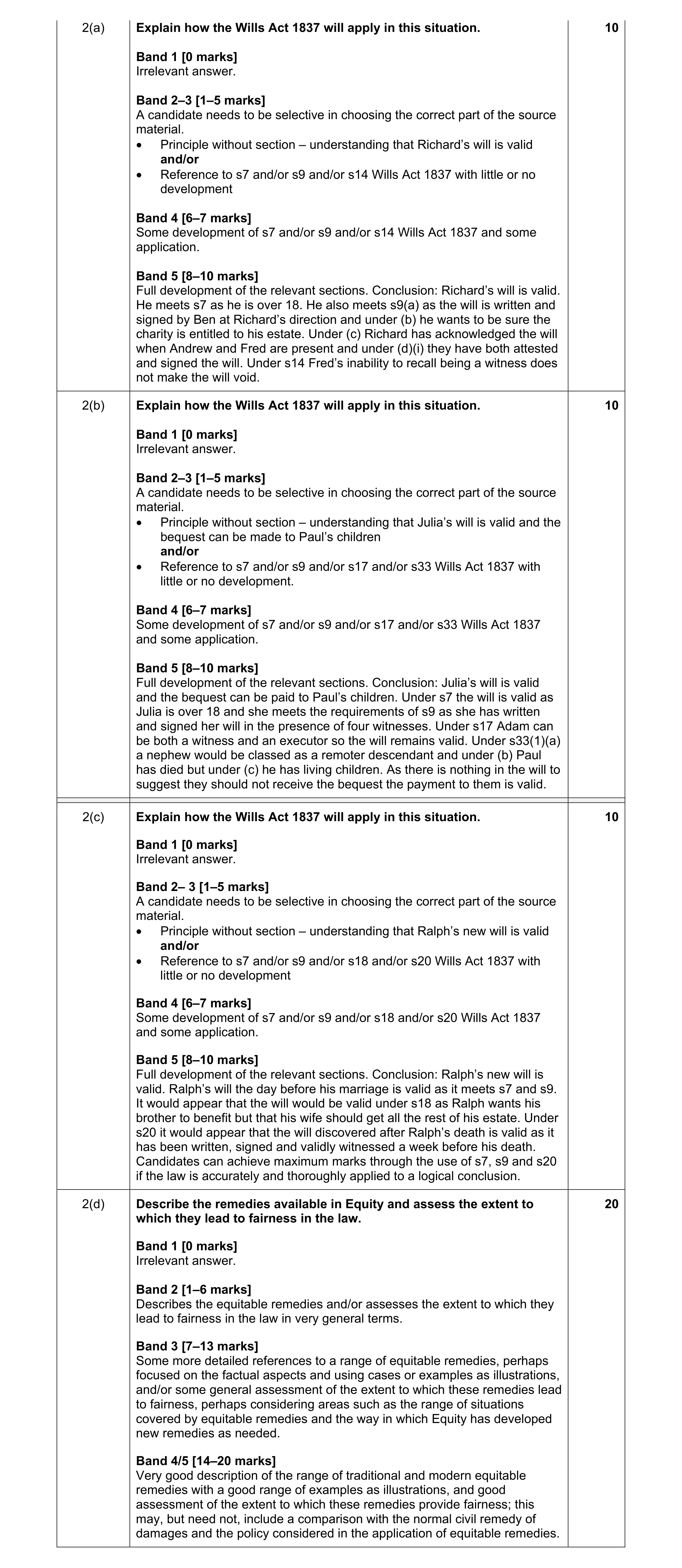 50
50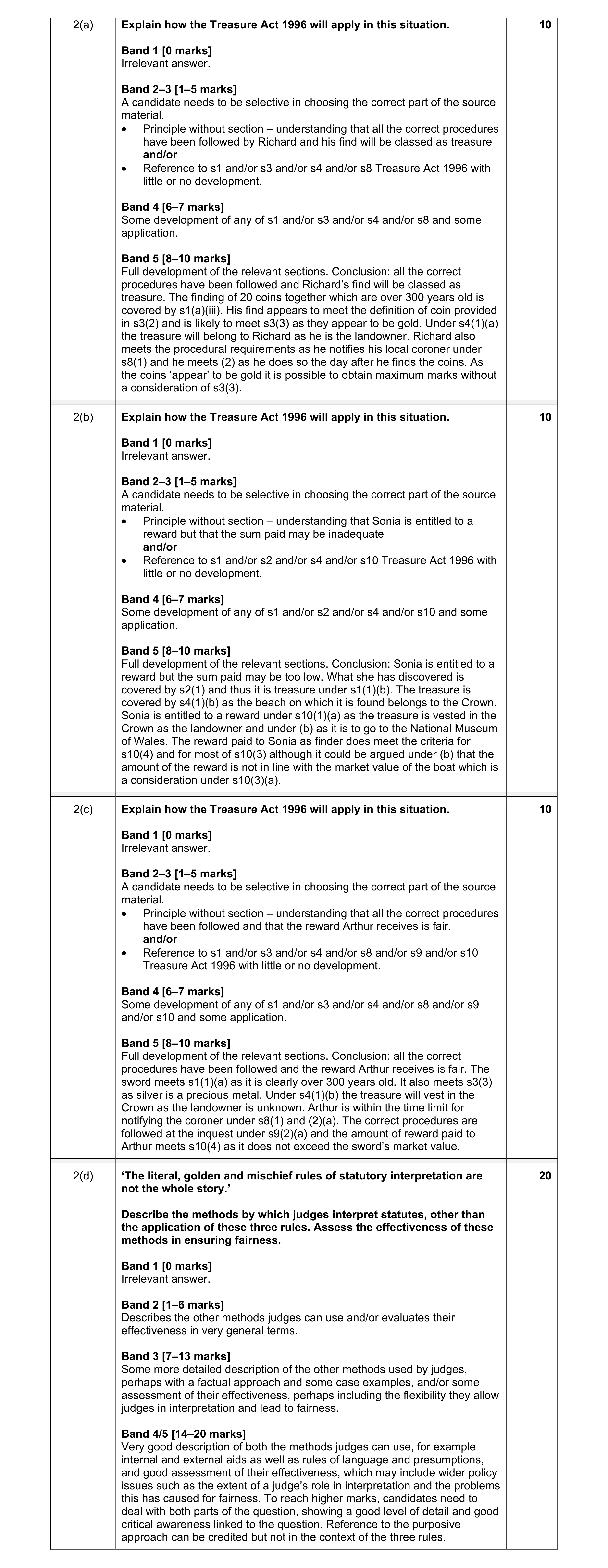 50
50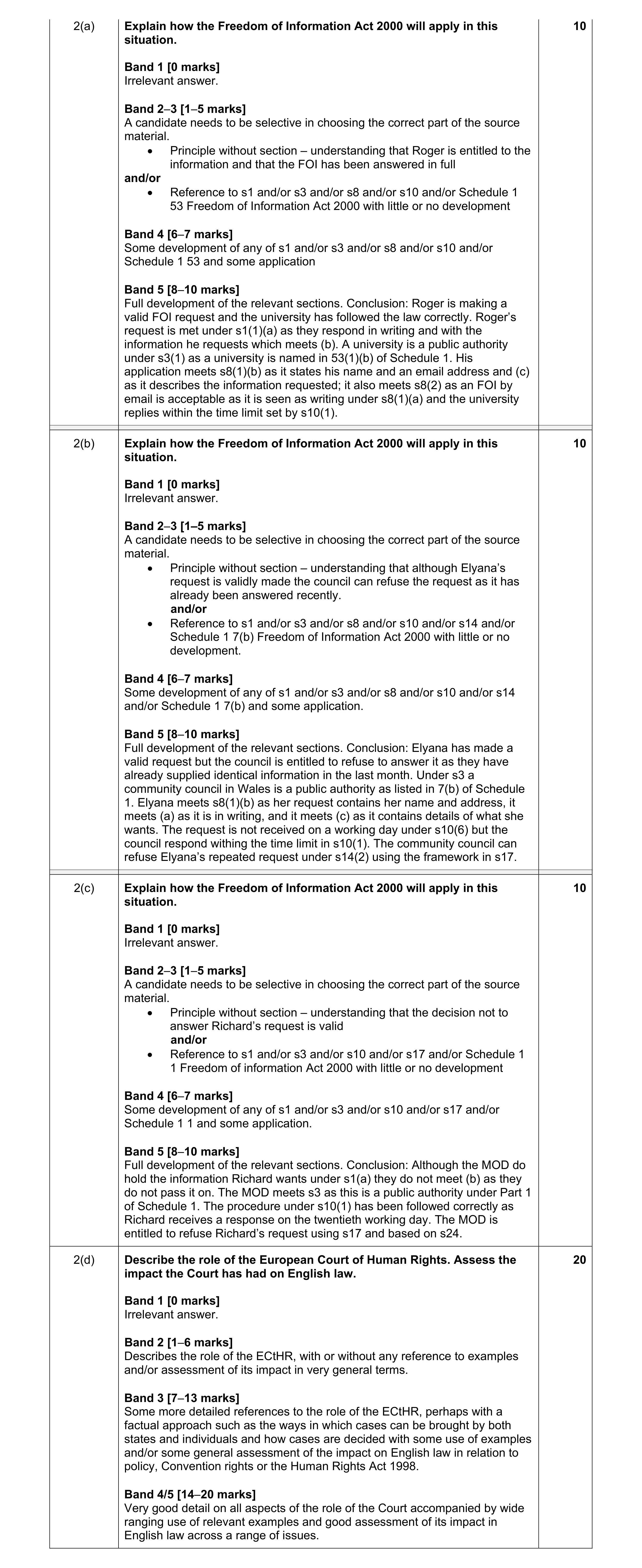 50
50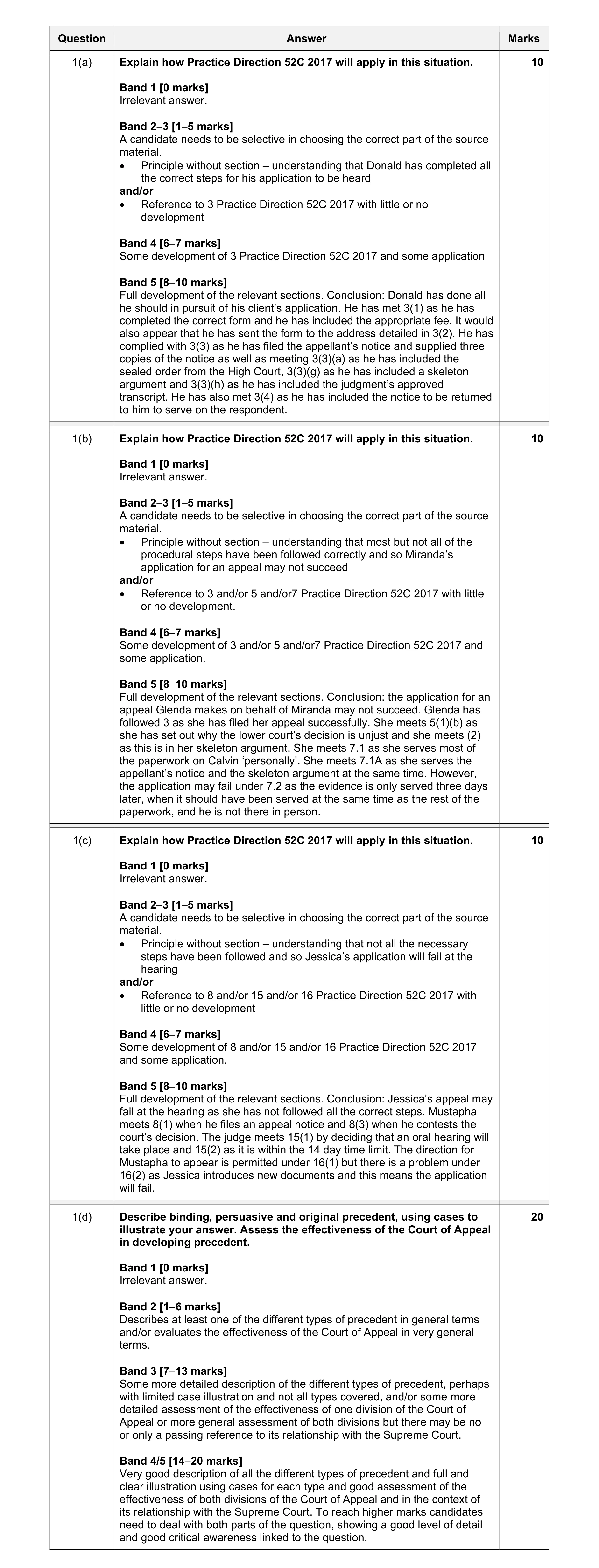 50
50 50
50 50
50