Cambridge A Level Law 9084 — 2018 Oct/Nov Paper 2 · Variant 2
9084/22/O/N/18 · 2 questions · 50 marks · ≈56 min
The question paper and its mark scheme, free to read here and free to download. This is Cambridge’s own paper, exactly as it was sat.
Question paper8 pages
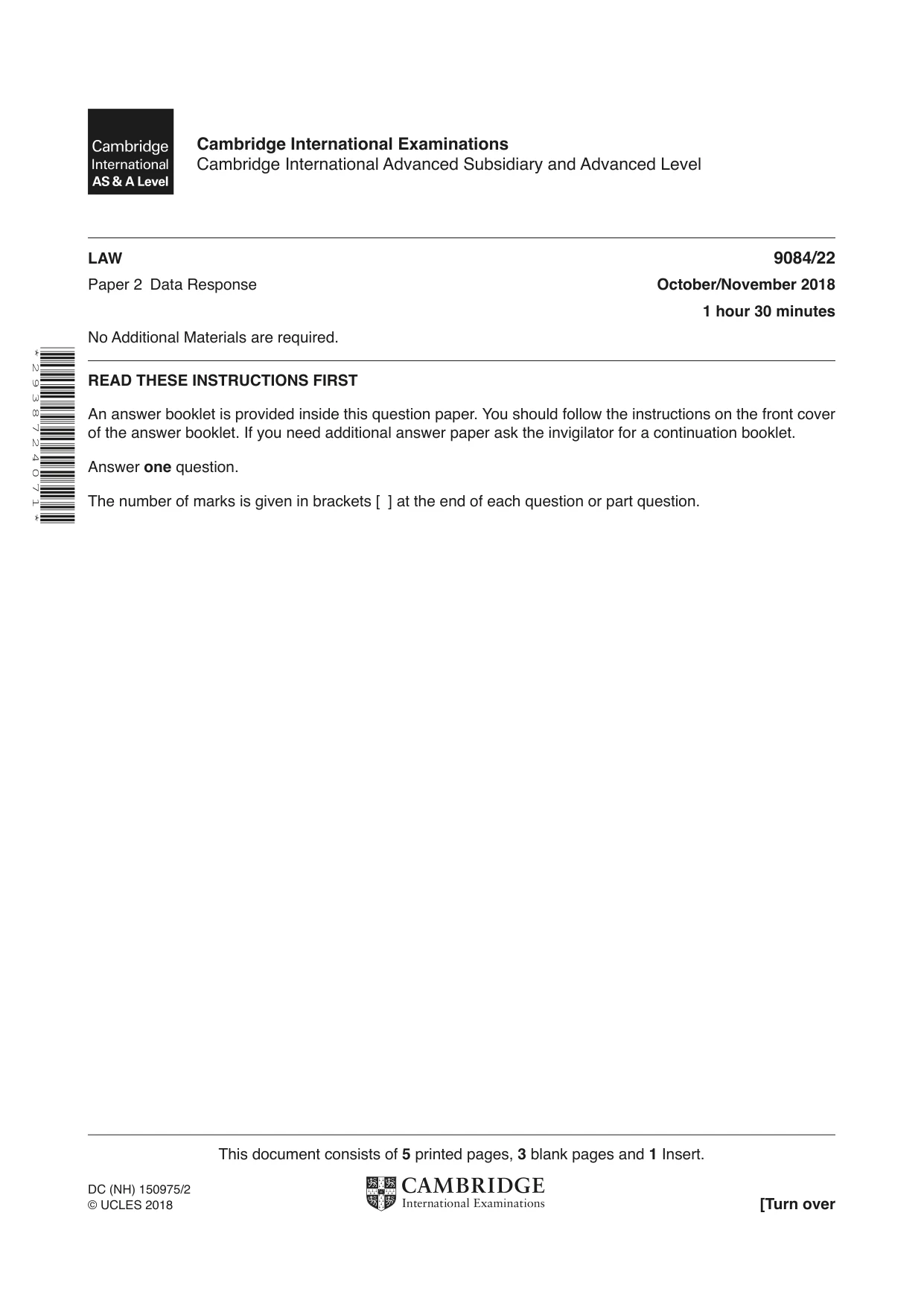
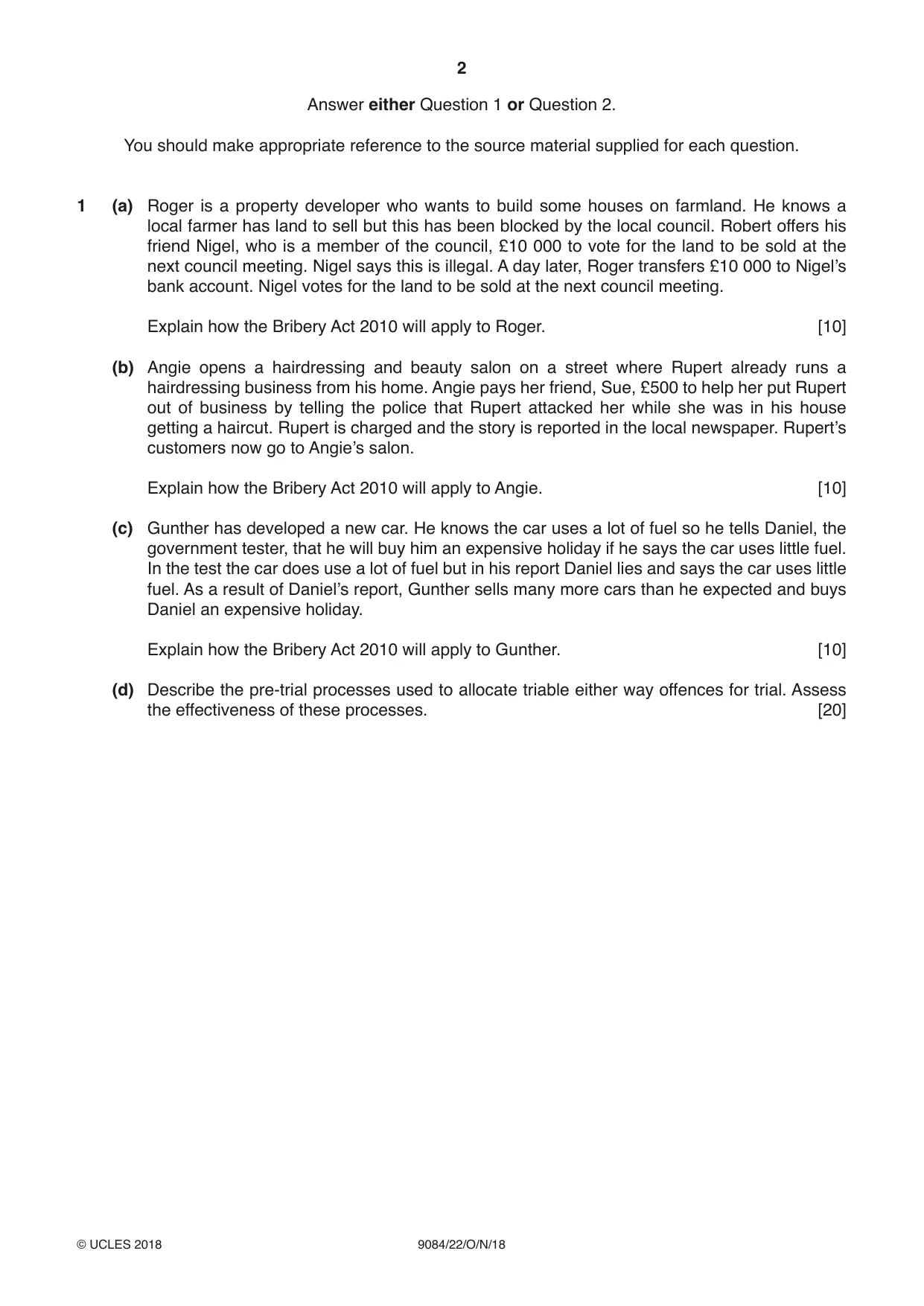
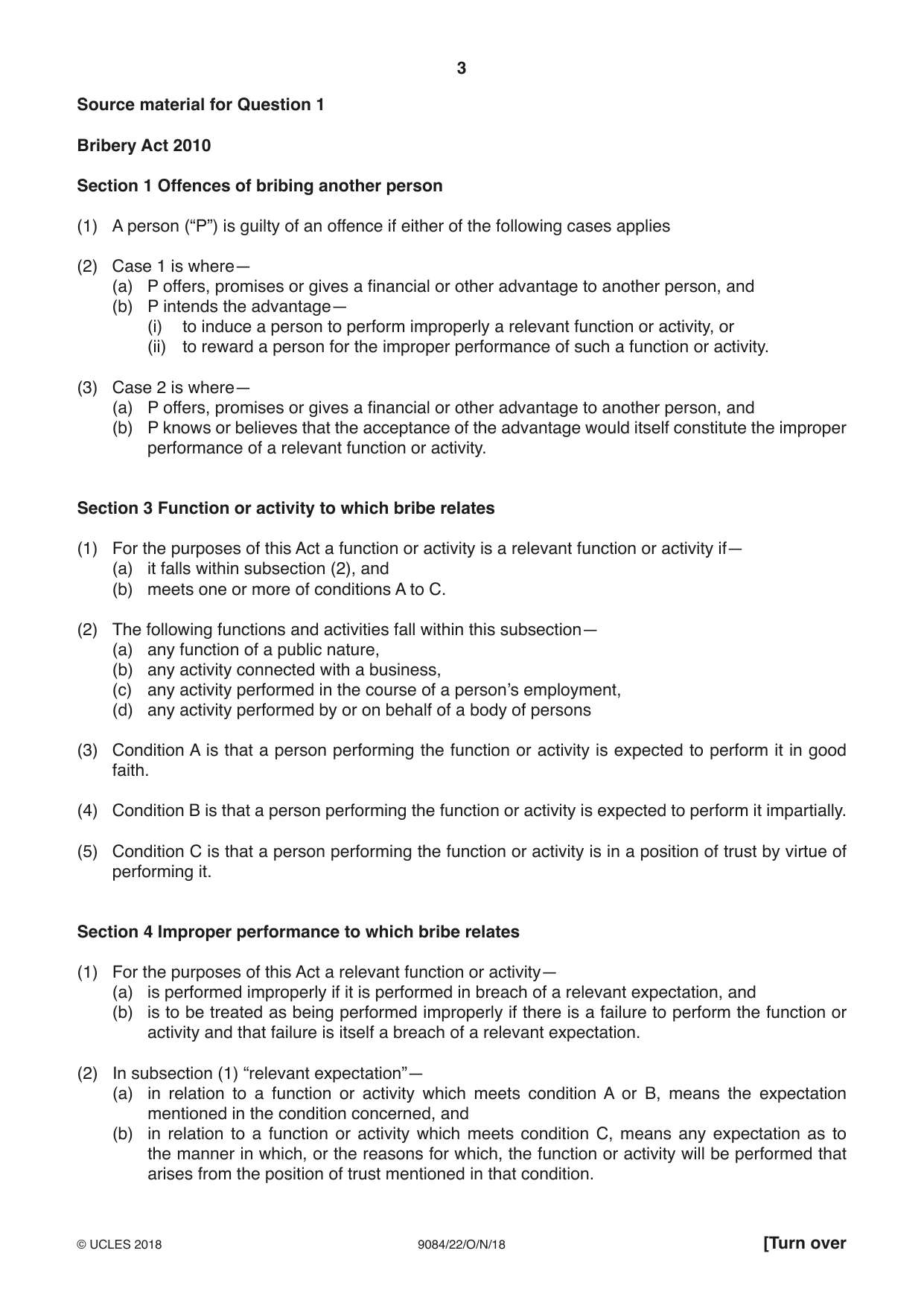
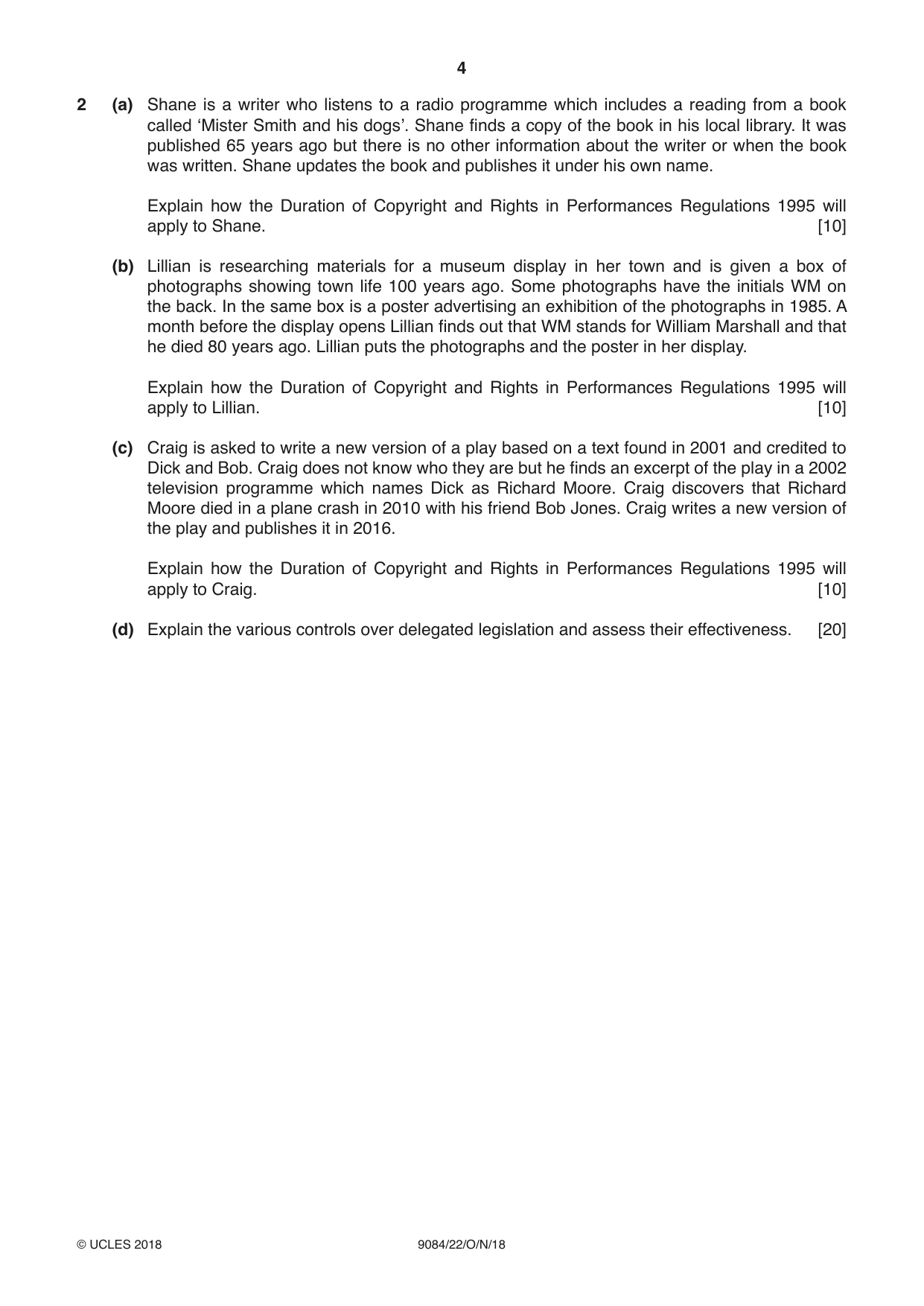



Mark scheme8 pages
Answers below. Sit the paper first if you are practising.
Questions as text
Q1 · Roger is a property developer who wants to build some houses on farmland
1 (a) Roger is a property developer who wants to build some houses on farmland. He knows a local farmer has land to sell but this has been blocked by the local council. Robert offers his friend Nigel, who is a member of the council, £10 000 to vote for the land to be sold at the next council meeting. Nigel says this is illegal. A day later, Roger transfers £10 000 to Nigel’s bank account. Nigel votes for the land to be sold at the next council meeting. Explain how the Bribery Act 2010 will apply to Roger. [10] (b) Angie opens a hairdressing and beauty salon on a street where Rupert already runs a hairdressing business from his home. Angie pays her friend, Sue, £500 to help her put Rupert out of business by telling the police that Rupert attacked her while she was in his house getting a haircut. Rupert is charged and the story is reported in the local newspaper. Rupert’s customers now go to Angie’s salon. Explain how the Bribery Act 2010 will apply to Angie. [10] (c) Gunther has developed a new car. He knows the car uses a lot of fuel so he tells Daniel, the government tester, that he will buy him an expensive holiday if he says the car uses little fuel. In the test the car does use a lot of fuel but in his report Daniel lies and says the car uses little fuel. As a result of Daniel’s report, Gunther sells many more cars than he expected and buys Daniel an expensive holiday. Explain how the Bribery Act 2010 will apply to Gunther. [10] (d) Describe the pre-trial processes used to allocate triable either way offences for trial. Assess the effectiveness of these processes. [20] Source material for Question 1 Bribery Act 2010 Section 1 Offences of bribing another person (1) A person (“P”) is guilty of an offence if either of the following cases applies (2) Case 1 is where— (a) P offers, promises or gives a financial or other advantage to another person, and (b) P intends the advantage— (i) to induce a person to perform improperly a relevant function or activity, or (ii) to reward a person for the improper performance of such a function or activity. (3) Case 2 is where— (a) P offers, promises or gives a financial or other advantage to another person, and (b) P knows or believes that the acceptance of the advantage would itself constitute the improper performance of a relevant function or activity. Section 3 Function or activity to which bribe relates (1) For the purposes of this Act a function or activity is a relevant function or activity if— (a) it falls within subsection (2), and (b) meets one or more of conditions A to C. (2) The following functions and activities fall within this subsection— (a) any function of a public nature, (b) any activity connected with a business, (c) any activity performed in the course of a person’s employment, (d) any activity performed by or on behalf of a body of persons (3) Condition A is that a person performing the function or activity is expected to perform it in good faith. (4) Condition B is that a person performing the function or activity is expected to perform it impartially. (5) Condition C is that a person performing the function or activity is in a position of trust by virtue of performing it. Section 4 Improper performance to which bribe relates (1) For the purposes of this Act a relevant function or activity— (a) is performed improperly if it is performed in breach of a relevant expectation, and (b) is to be treated as being performed improperly if there is a failure to perform the function or activity and that failure is itself a breach of a relevant expectation. (2) In subsection (1) “relevant expectation”— (a) in relation to a function or activity which meets condition A or B, means the expectation mentioned in the condition concerned, and (b) in relation to a function or activity which meets condition C, means any expectation as to the manner in which, or the reasons for which, the function or activity will be performed that arises from the position of trust mentioned in that condition.
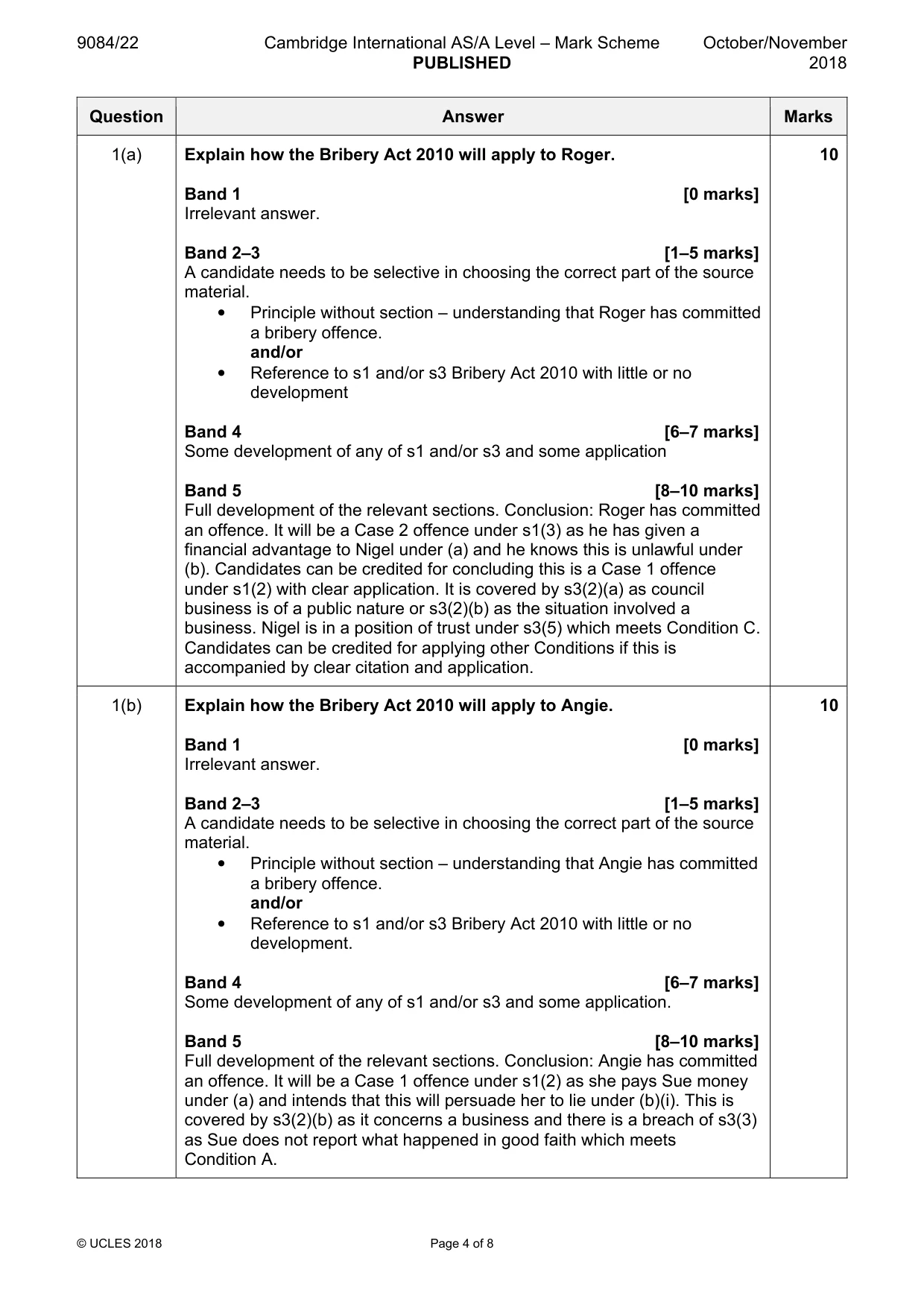
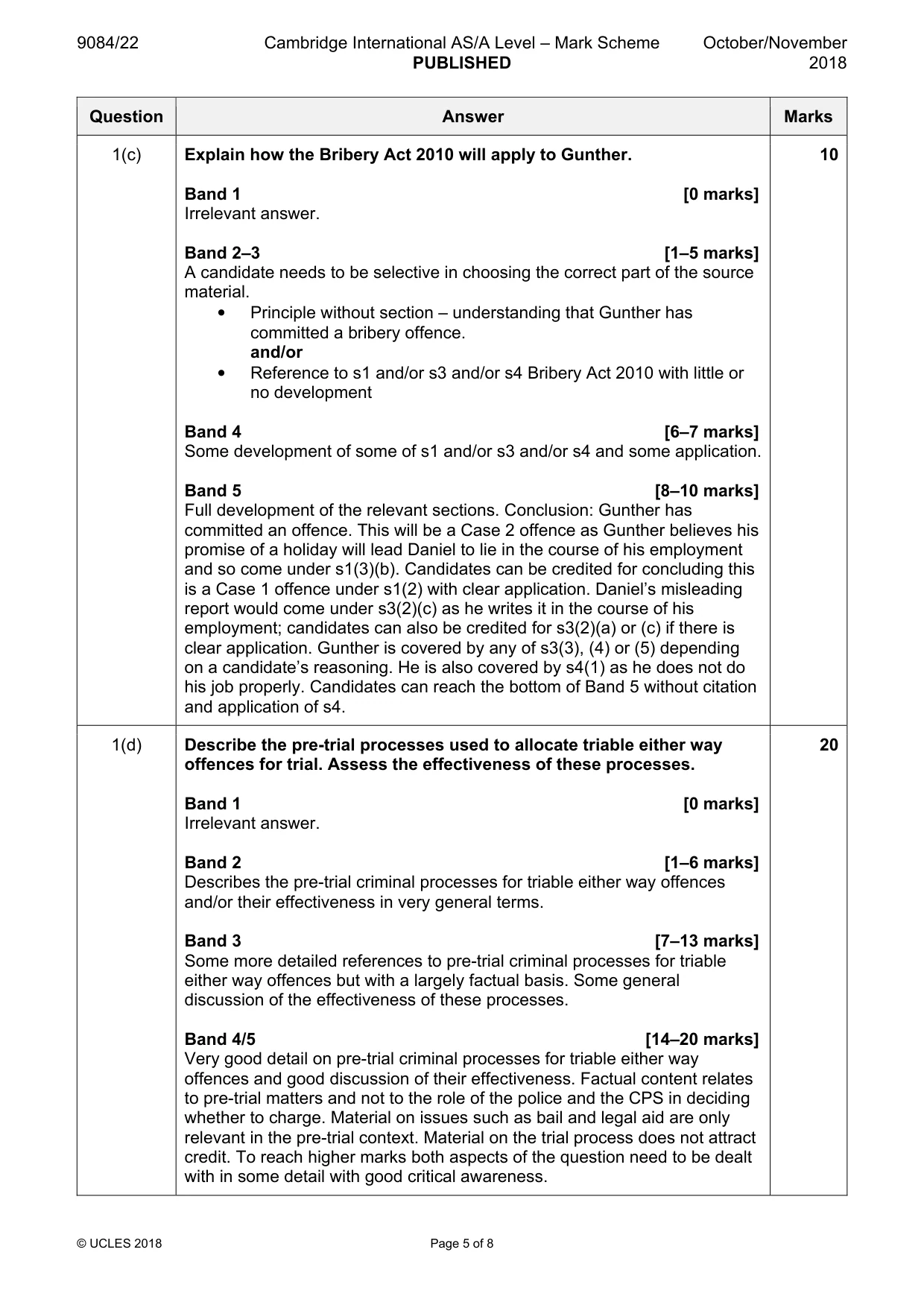
Mark scheme: Question Answer Marks 1(a) Explain how the Bribery Act 2010 will apply to Roger. 10 Band 1 [0 marks] Irrelevant answer. Band 2–3 [1–5 marks] A candidate needs to be selective in choosing the correct part of the source material. • Principle without section – understanding that Roger has committed a bribery offence. and/or • Reference to s1 and/or s3 Bribery Act 2010 with little or no development Band 4 [6–7 marks] Some development of any of s1 and/or s3 and some application Band 5 [8–10 marks] Full development of the relevant sections. Conclusion: Roger has committed an offence. It will be a Case 2 offence under s1(3) as he has given a financial advantage to Nigel under (a) and he knows this is unlawful under (b). Candidates can be credited for concluding this is a Case 1 offence under s1(2) with clear application. It is covered by s3(2)(a) as council business is of a public nature or s3(2)(b) as the situation involved a business. Nigel is in a position of trust under s3(5) which meets Condition C. Candidates can be credited for applying other Conditions if this is accompanied by clear citation and application. 1(b) Explain how the Bribery Act 2010 will apply to Angie. 10 Band 1 [0 marks] Irrelevant answer. Band 2–3 [1–5 marks] A candidate needs to be selective in choosing the correct part of the source material. • Principle without section – understanding that Angie has committed a bribery offence. and/or • Reference to s1 and/or s3 Bribery Act 2010 with little or no development. Band 4 [6–7 marks] Some development of any of s1 and/or s3 and some application. Band 5 [8–10 marks] Full development of the relevant sections. Conclusion: Angie has committed an offence. It will be a Case 1 offence under s1(2) as she pays Sue money under (a) and intends that this will persuade her to lie under (b)(i). This is covered by s3(2)(b) as it concerns a business and there is a breach of s3(3) as Sue does not report what happened in good faith which meets Condition A. 1(c) Explain how the Bribery Act 2010 will apply to Gunther. 10 Band 1 [0 marks] Irrelevant answer. Band 2–3 [1–5 marks] A candidate needs to be selective in choosing the correct part of the source material. • Principle without section – understanding that Gunther has committed a bribery offence. and/or • Reference to s1 and/or s3 and/or s4 Bribery Act 2010 with little or no development Band 4 [6–7 marks] Some development of some of s1 and/or s3 and/or s4 and some application. Band 5 [8–10 marks] Full development of the relevant sections. Conclusion: Gunther has committed an offence. This will be a Case 2 offence as Gunther believes his promise of a holiday will lead Daniel to lie in the course of his employment and so come under s1(3)(b). Candidates can be credited for concluding this is a Case 1 offence under s1(2) with clear application. Daniel’s misleading report would come under s3(2)(c) as he writes it in the course of his employment; candidates can also be credited for s3(2)(a) or (c) if there is clear application. Gunther is covered by any of s3(3), (4) or (5) depending on a candidate’s reasoning. He is also covered by s4(1) as he does not do his job properly. Candidates can reach the bottom of Band 5 without citation and application of s4. 1(d) Describe the pre-trial processes used to allocate triable either way 20 offences for trial. Assess the effectiveness of these processes. Band 1 [0 marks] Irrelevant answer. Band 2 [1–6 marks] Describes the pre-trial criminal processes for triable either way offences and/or their effectiveness in very general terms. Band 3 [7–13 marks] Some more detailed references to pre-trial criminal processes for triable either way offences but with a largely factual basis. Some general discussion of the effectiveness of these processes. Band 4/5 [14–20 marks] Very good detail on pre-trial criminal processes for triable either way offences and good discussion of their effectiveness. Factual content relates to pre-trial matters and not to the role of the police and the CPS in deciding whether to charge. Material on issues such as bail and legal aid are only relevant in the pre-trial context. Material on the trial process does not attract credit. To reach higher marks both aspects of the question need to be dealt with in some detail with good critical awareness.
Q2 · Shane is a writer who listens to a radio programme which includes a reading from a book…
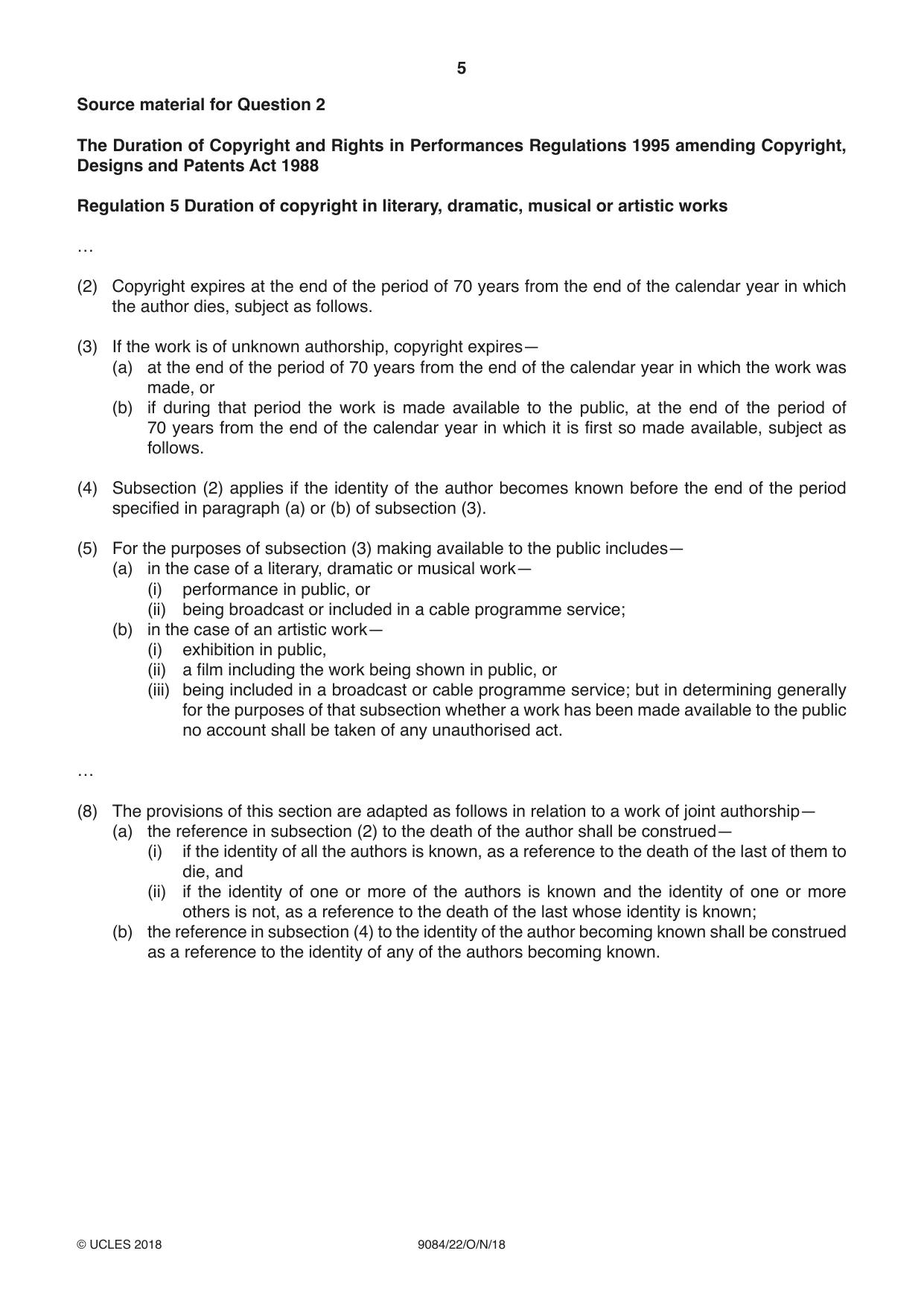
2 (a) Shane is a writer who listens to a radio programme which includes a reading from a book called ‘Mister Smith and his dogs’. Shane finds a copy of the book in his local library. It was published 65 years ago but there is no other information about the writer or when the book was written. Shane updates the book and publishes it under his own name. Explain how the Duration of Copyright and Rights in Performances Regulations 1995 will apply to Shane. [10] (b) Lillian is researching materials for a museum display in her town and is given a box of photographs showing town life 100 years ago. Some photographs have the initials WM on the back. In the same box is a poster advertising an exhibition of the photographs in 1985. A month before the display opens Lillian finds out that WM stands for William Marshall and that he died 80 years ago. Lillian puts the photographs and the poster in her display. Explain how the Duration of Copyright and Rights in Performances Regulations 1995 will apply to Lillian. [10] (c) Craig is asked to write a new version of a play based on a text found in 2001 and credited to Dick and Bob. Craig does not know who they are but he finds an excerpt of the play in a 2002 television programme which names Dick as Richard Moore. Craig discovers that Richard Moore died in a plane crash in 2010 with his friend Bob Jones. Craig writes a new version of the play and publishes it in 2016. Explain how the Duration of Copyright and Rights in Performances Regulations 1995 will apply to Craig. [10] (d) Explain the various controls over delegated legislation and assess their effectiveness. [20] Source material for Question 2 The Duration of Copyright and Rights in Performances Regulations 1995 amending Copyright, Designs and Patents Act 1988 Regulation 5 Duration of copyright in literary, dramatic, musical or artistic works … (2) Copyright expires at the end of the period of 70 years from the end of the calendar year in which the author dies, subject as follows. (3) If the work is of unknown authorship, copyright expires— (a) at the end of the period of 70 years from the end of the calendar year in which the work was made, or (b) if during that period the work is made available to the public, at the end of the period of 70 years from the end of the calendar year in which it is first so made available, subject as follows. (4) Subsection (2) applies if the identity of the author becomes known before the end of the period specified in paragraph (a) or (b) of subsection (3). (5) For the purposes of subsection (3) making available to the public includes— (a) in the case of a literary, dramatic or musical work— (i) performance in public, or (ii) being broadcast or included in a cable programme service; (b) in the case of an artistic work— (i) exhibition in public, (ii) a film including the work being shown in public, or (iii) being included in a broadcast or cable programme service; but in determining generally for the purposes of that subsection whether a work has been made available to the public no account shall be taken of any unauthorised act. … (8) The provisions of this section are adapted as follows in relation to a work of joint authorship— (a) the reference in subsection (2) to the death of the author shall be construed— (i) if the identity of all the authors is known, as a reference to the death of the last of them to die, and (ii) if the identity of one or more of the authors is known and the identity of one or more others is not, as a reference to the death of the last whose identity is known; (b) the reference in subsection (4) to the identity of the author becoming known shall be construed as a reference to the identity of any of the authors becoming known.
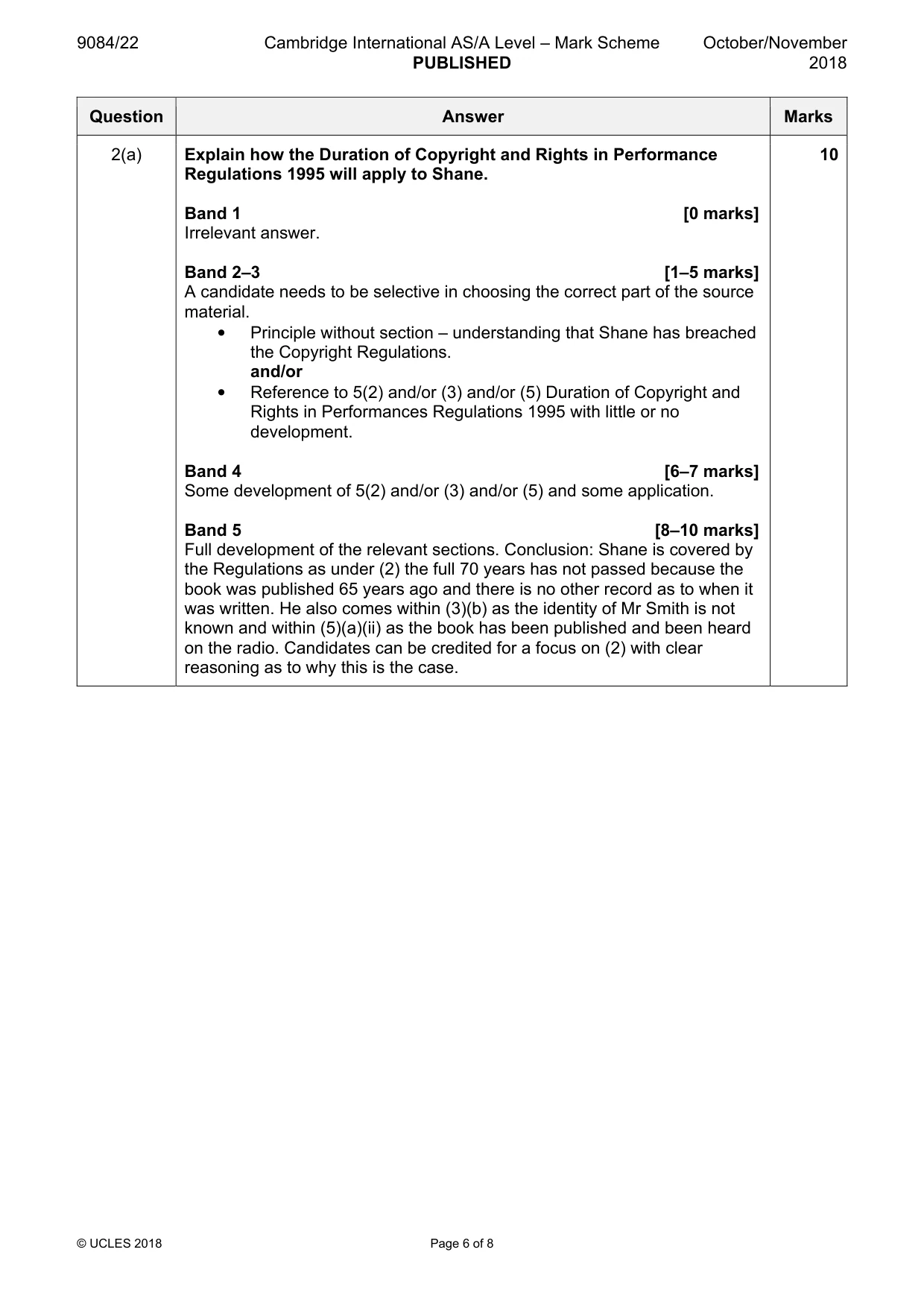
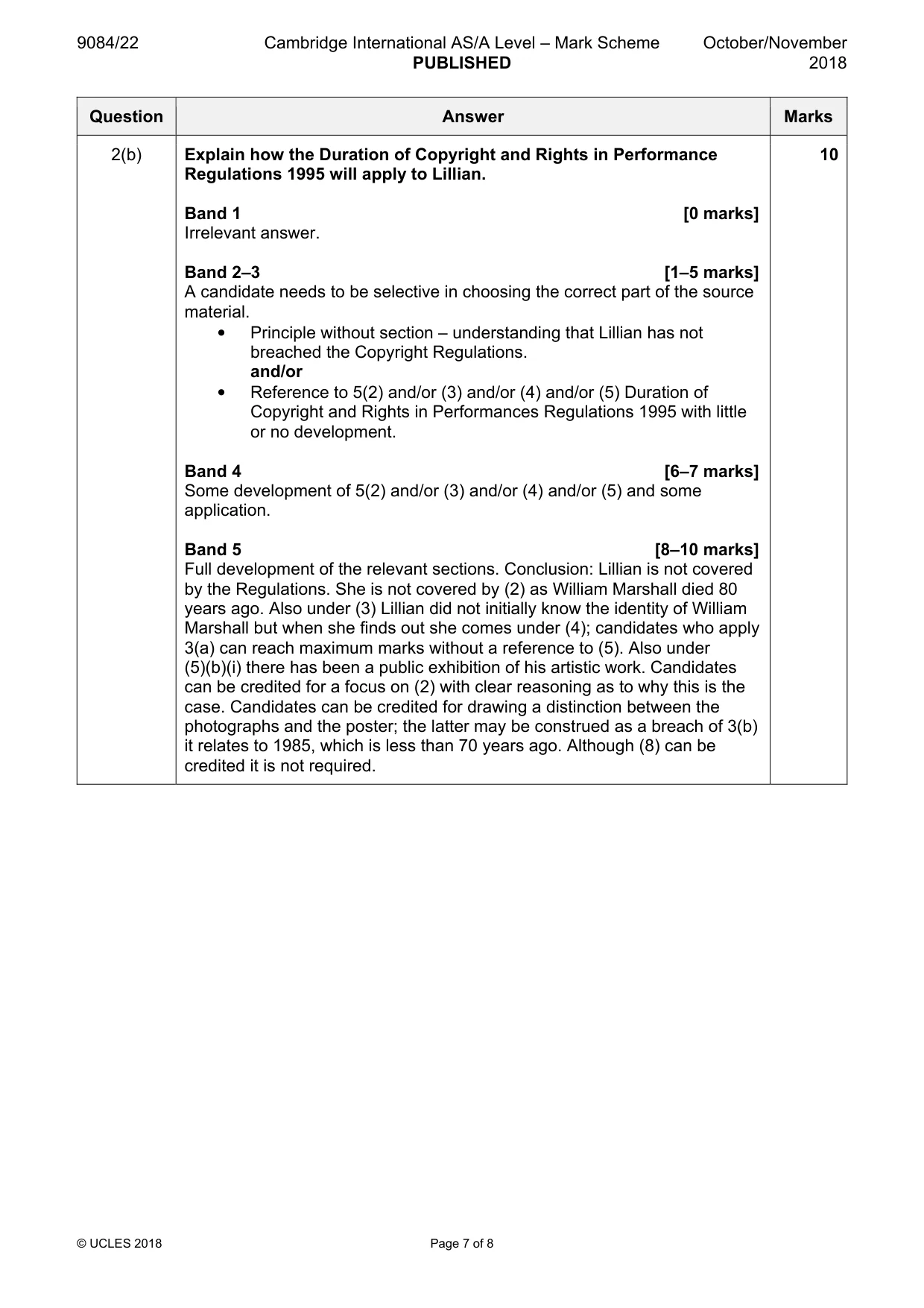
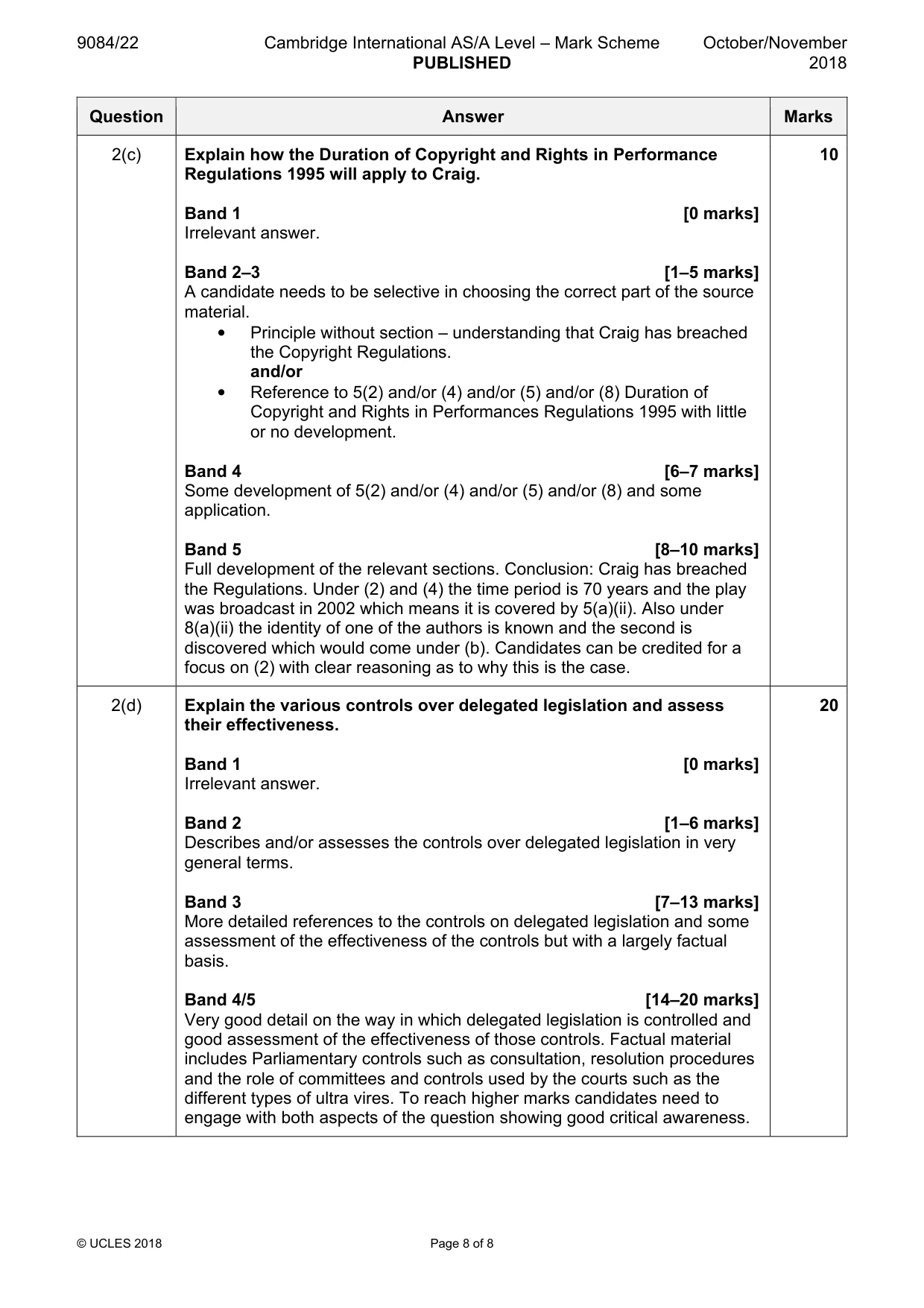
Mark scheme: 2(a) Explain how the Duration of Copyright and Rights in Performance 10 Regulations 1995 will apply to Shane. Band 1 [0 marks] Irrelevant answer. Band 2–3 [1–5 marks] A candidate needs to be selective in choosing the correct part of the source material. • Principle without section – understanding that Shane has breached the Copyright Regulations. and/or • Reference to 5(2) and/or (3) and/or (5) Duration of Copyright and Rights in Performances Regulations 1995 with little or no development. Band 4 [6–7 marks] Some development of 5(2) and/or (3) and/or (5) and some application. Band 5 [8–10 marks] Full development of the relevant sections. Conclusion: Shane is covered by the Regulations as under (2) the full 70 years has not passed because the book was published 65 years ago and there is no other record as to when it was written. He also comes within (3)(b) as the identity of Mr Smith is not known and within (5)(a)(ii) as the book has been published and been heard on the radio. Candidates can be credited for a focus on (2) with clear reasoning as to why this is the case. 2(b) Explain how the Duration of Copyright and Rights in Performance 10 Regulations 1995 will apply to Lillian. Band 1 [0 marks] Irrelevant answer. Band 2–3 [1–5 marks] A candidate needs to be selective in choosing the correct part of the source material. • Principle without section – understanding that Lillian has not breached the Copyright Regulations. and/or • Reference to 5(2) and/or (3) and/or (4) and/or (5) Duration of Copyright and Rights in Performances Regulations 1995 with little or no development. Band 4 [6–7 marks] Some development of 5(2) and/or (3) and/or (4) and/or (5) and some application. Band 5 [8–10 marks] Full development of the relevant sections. Conclusion: Lillian is not covered by the Regulations. She is not covered by (2) as William Marshall died 80 years ago. Also under (3) Lillian did not initially know the identity of William Marshall but when she finds out she comes under (4); candidates who apply 3(a) can reach maximum marks without a reference to (5). Also under (5)(b)(i) there has been a public exhibition of his artistic work. Candidates can be credited for a focus on (2) with clear reasoning as to why this is the case. Candidates can be credited for drawing a distinction between the photographs and the poster; the latter may be construed as a breach of 3(b) it relates to 1985, which is less than 70 years ago. Although (8) can be credited it is not required. 2(c) Explain how the Duration of Copyright and Rights in Performance 10 Regulations 1995 will apply to Craig. Band 1 [0 marks] Irrelevant answer. Band 2–3 [1–5 marks] A candidate needs to be selective in choosing the correct part of the source material. • Principle without section – understanding that Craig has breached the Copyright Regulations. and/or • Reference to 5(2) and/or (4) and/or (5) and/or (8) Duration of Copyright and Rights in Performances Regulations 1995 with little or no development. Band 4 [6–7 marks] Some development of 5(2) and/or (4) and/or (5) and/or (8) and some application. Band 5 [8–10 marks] Full development of the relevant sections. Conclusion: Craig has breached the Regulations. Under (2) and (4) the time period is 70 years and the play was broadcast in 2002 which means it is covered by 5(a)(ii). Also under 8(a)(ii) the identity of one of the authors is known and the second is discovered which would come under (b). Candidates can be credited for a focus on (2) with clear reasoning as to why this is the case. 2(d) Explain the various controls over delegated legislation and assess 20 their effectiveness. Band 1 [0 marks] Irrelevant answer. Band 2 [1–6 marks] Describes and/or assesses the controls over delegated legislation in very general terms. Band 3 [7–13 marks] More detailed references to the controls on delegated legislation and some assessment of the effectiveness of the controls but with a largely factual basis. Band 4/5 [14–20 marks] Very good detail on the way in which delegated legislation is controlled and good assessment of the effectiveness of those controls. Factual material includes Parliamentary controls such as consultation, resolution procedures and the role of committees and controls used by the courts such as the different types of ultra vires. To reach higher marks candidates need to engage with both aspects of the question showing good critical awareness.
What was in this paper
The subtopics covered by these 2 questions, and how many questions each got. Open one in a new tab to see every Cambridge question on it.
1Principles and sources of English law This topic introduces the principles behind English law and the modern day sources of English law. This topic is an opportunity to reflect on the key concepts of justice, fairness and morality; power and its limits; and effectiveness and certainty1What you needed in this session
Cambridge’s own grade thresholds for 2018 Oct/Nov, Paper 2 · Variant 2. A higher threshold means an easier paper — the bar moves with how the cohort did.