Cambridge A Level Law 9084 — 2020 Oct/Nov Paper 2 · Variant 3
9084/23/O/N/20 · 2 questions · 50 marks · ≈56 min
The question paper and its mark scheme, free to read here and free to download. This is Cambridge’s own paper, exactly as it was sat.
Question paper8 pages



Mark scheme9 pages
Answers below. Sit the paper first if you are practising.
Questions as text
Q1 · Pablo owns a van which he must by law drive at no more than 50 miles per hour (mph)
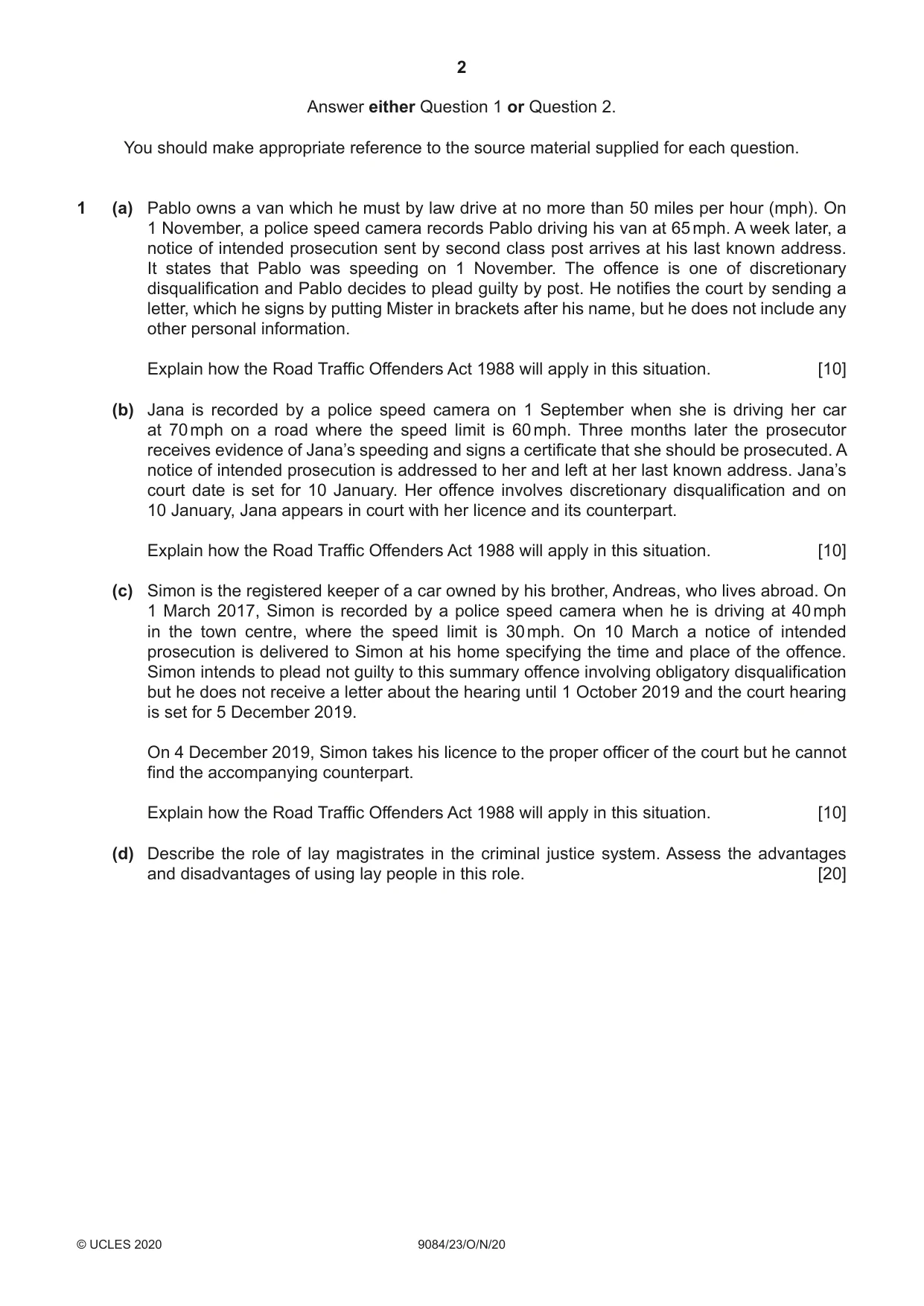
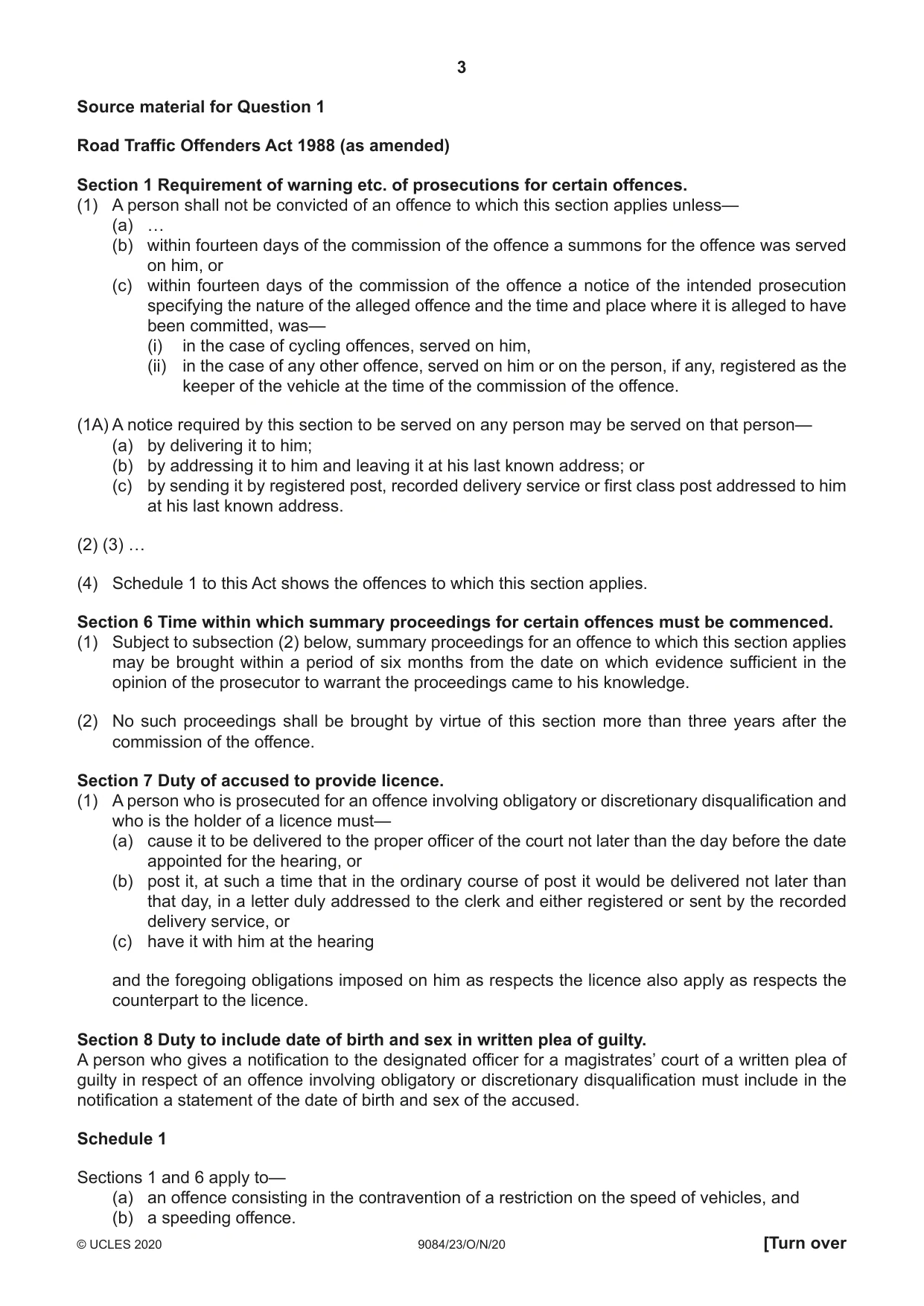
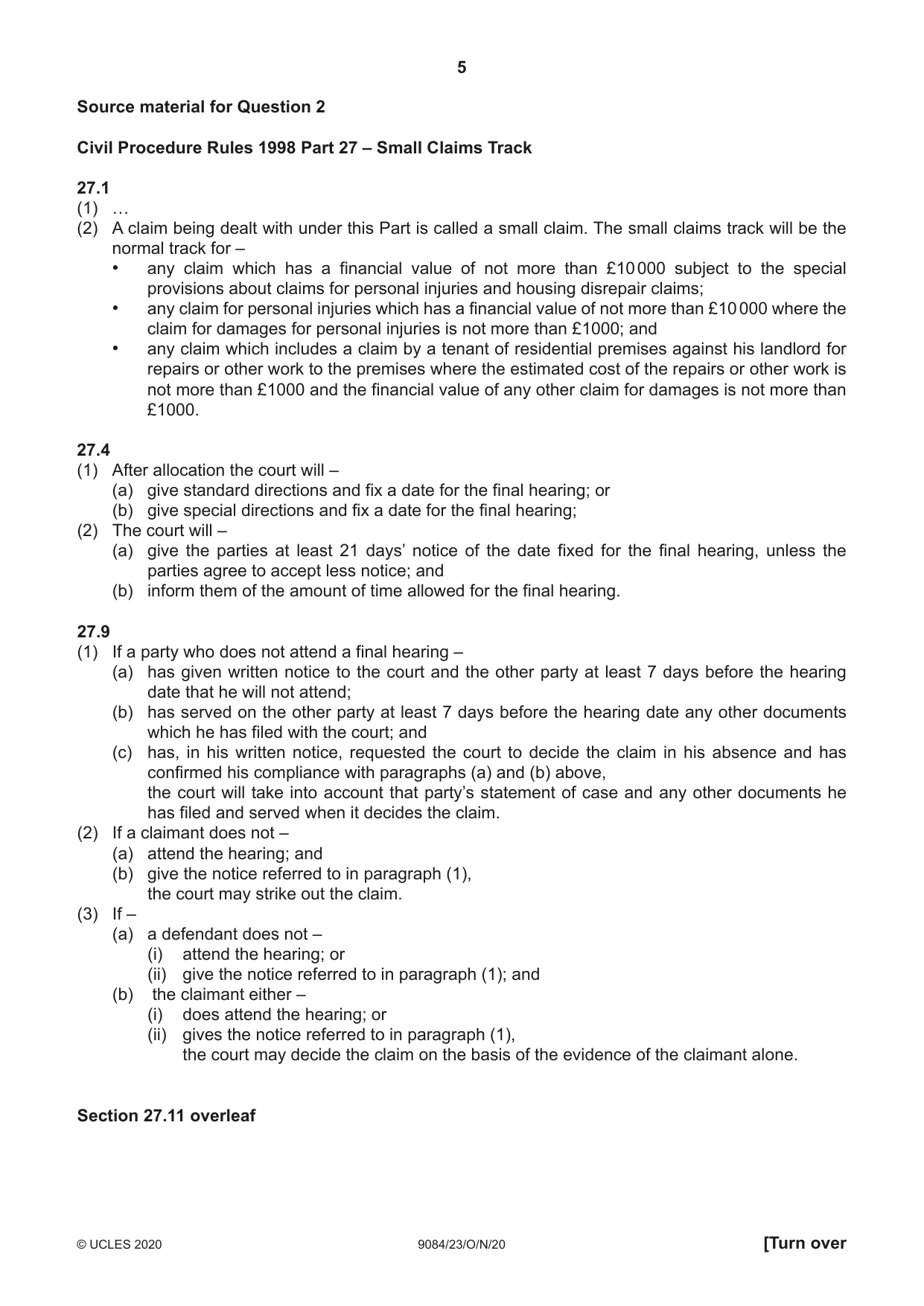
1 (a) Pablo owns a van which he must by law drive at no more than 50 miles per hour (mph). On 1 November, a police speed camera records Pablo driving his van at 65 mph. A week later, a notice of intended prosecution sent by second class post arrives at his last known address. It states that Pablo was speeding on 1 November. The offence is one of discretionary disqualification and Pablo decides to plead guilty by post. He notifies the court by sending a letter, which he signs by putting Mister in brackets after his name, but he does not include any other personal information. Explain how the Road Traffic Offenders Act 1988 will apply in this situation. [10] (b) Jana is recorded by a police speed camera on 1 September when she is driving her car at 70 mph on a road where the speed limit is 60 mph. Three months later the prosecutor receives evidence of Jana’s speeding and signs a certificate that she should be prosecuted. A notice of intended prosecution is addressed to her and left at her last known address. Jana’s court date is set for 10 January. Her offence involves discretionary disqualification and on 10 January, Jana appears in court with her licence and its counterpart. Explain how the Road Traffic Offenders Act 1988 will apply in this situation. [10] (c) Simon is the registered keeper of a car owned by his brother, Andreas, who lives abroad. On 1 March 2017, Simon is recorded by a police speed camera when he is driving at 40 mph in the town centre, where the speed limit is 30 mph. On 10 March a notice of intended prosecution is delivered to Simon at his home specifying the time and place of the offence. Simon intends to plead not guilty to this summary offence involving obligatory disqualification but he does not receive a letter about the hearing until 1 October 2019 and the court hearing is set for 5 December 2019. On 4 December 2019, Simon takes his licence to the proper officer of the court but he cannot find the accompanying counterpart. Explain how the Road Traffic Offenders Act 1988 will apply in this situation. [10] (d) Describe the role of lay magistrates in the criminal justice system. Assess the advantages and disadvantages of using lay people in this role. [20] Source material for Question 1 Road Traffic Offenders Act 1988 (as amended) Section 1 Requirement of warning etc. of prosecutions for certain offences. (1) A person shall not be convicted of an offence to which this section applies unless— (a) … (b) within fourteen days of the commission of the offence a summons for the offence was served on him, or (c) within fourteen days of the commission of the offence a notice of the intended prosecution specifying the nature of the alleged offence and the time and place where it is alleged to have been committed, was— (i) in the case of cycling offences, served on him, (ii) in the case of any other offence, served on him or on the person, if any, registered as the keeper of the vehicle at the time of the commission of the offence. (1A) A notice required by this section to be served on any person may be served on that person— (a) by delivering it to him; (b) by addressing it to him and leaving it at his last known address; or (c) by sending it by registered post, recorded delivery service or first class post addressed to him at his last known address. (2) (3) … (4) Schedule 1 to this Act shows the offences to which this section applies. Section 6 Time within which summary proceedings for certain offences must be commenced. (1) Subject to subsection (2) below, summary proceedings for an offence to which this section applies may be brought within a period of six months from the date on which evidence sufficient in the opinion of the prosecutor to warrant the proceedings came to his knowledge. (2) No such proceedings shall be brought by virtue of this section more than three years after the commission of the offence. Section 7 Duty of accused to provide licence. (1) A person who is prosecuted for an offence involving obligatory or discretionary disqualification and who is the holder of a licence must— (a) cause it to be delivered to the proper officer of the court not later than the day before the date appointed for the hearing, or (b) post it, at such a time that in the ordinary course of post it would be delivered not later than that day, in a letter duly addressed to the clerk and either registered or sent by the recorded delivery service, or (c) have it with him at the hearing and the foregoing obligations imposed on him as respects the licence also apply as respects the counterpart to the licence. Section 8 Duty to include date of birth and sex in written plea of guilty. A person who gives a notification to the designated officer for a magistrates’ court of a written plea of guilty in respect of an offence involving obligatory or discretionary disqualification must include in the notification a statement of the date of birth and sex of the accused. Schedule 1 Sections 1 and 6 apply to— (a) an offence consisting in the contravention of a restriction on the speed of vehicles, and (b) a speeding offence.
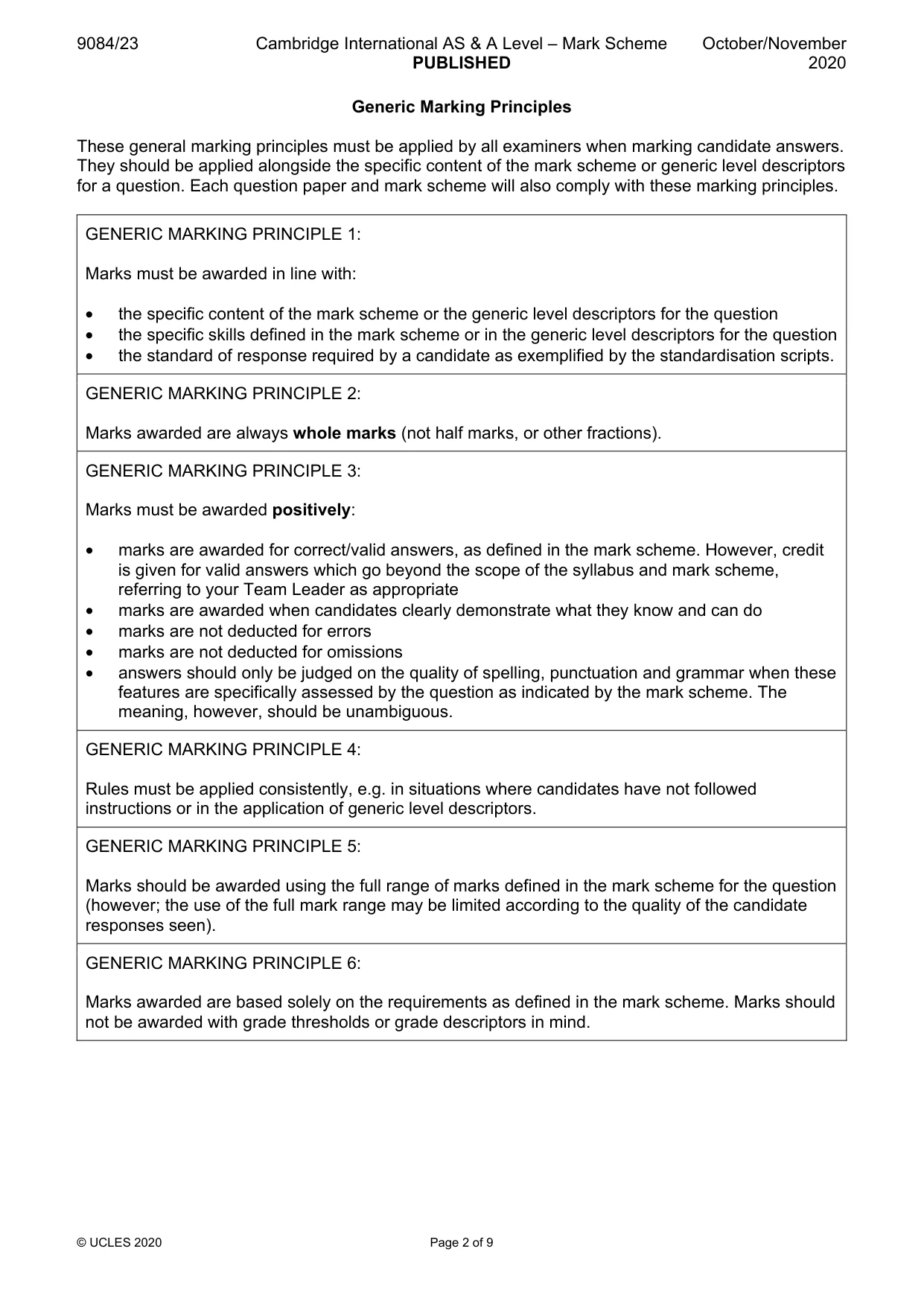
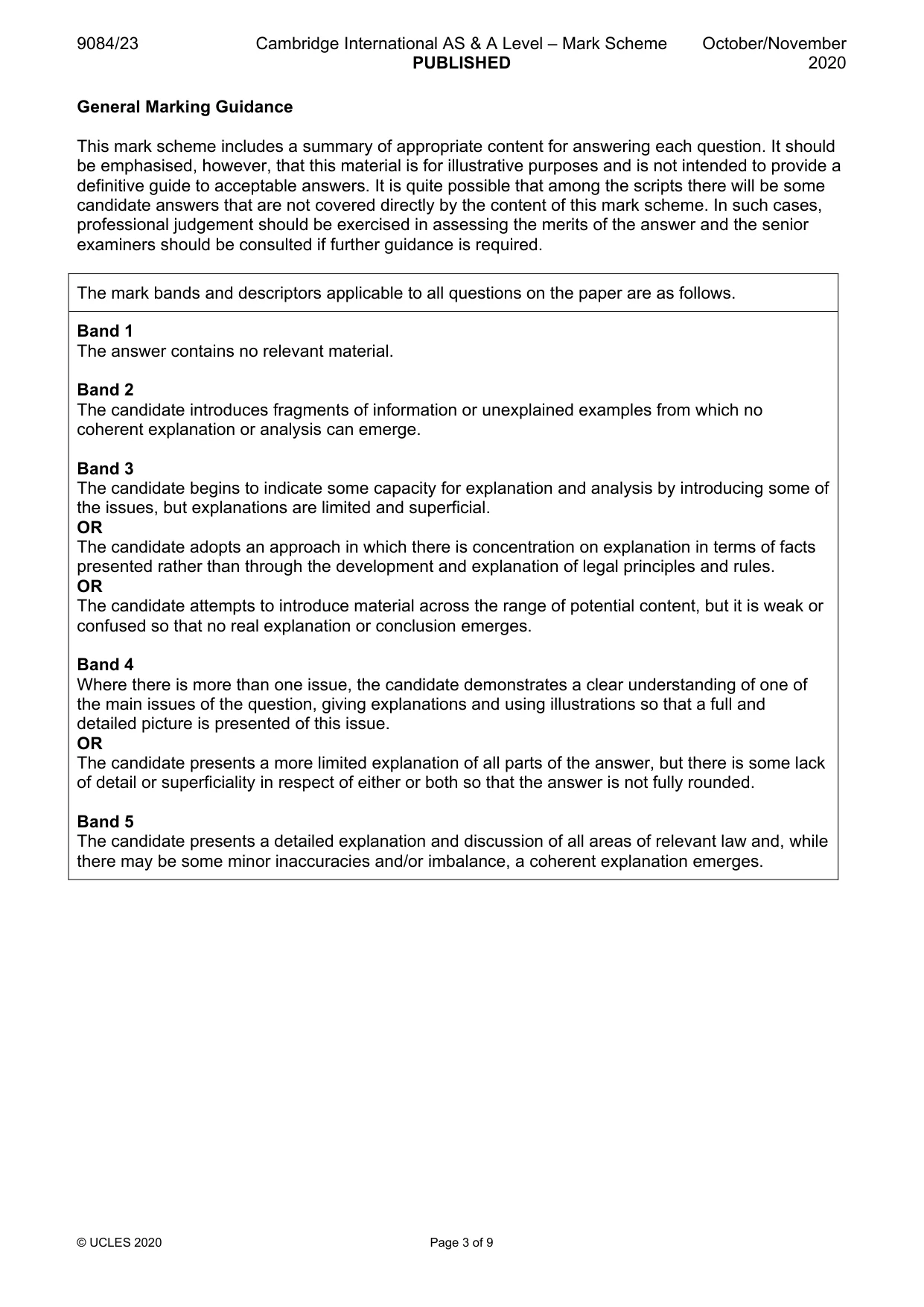
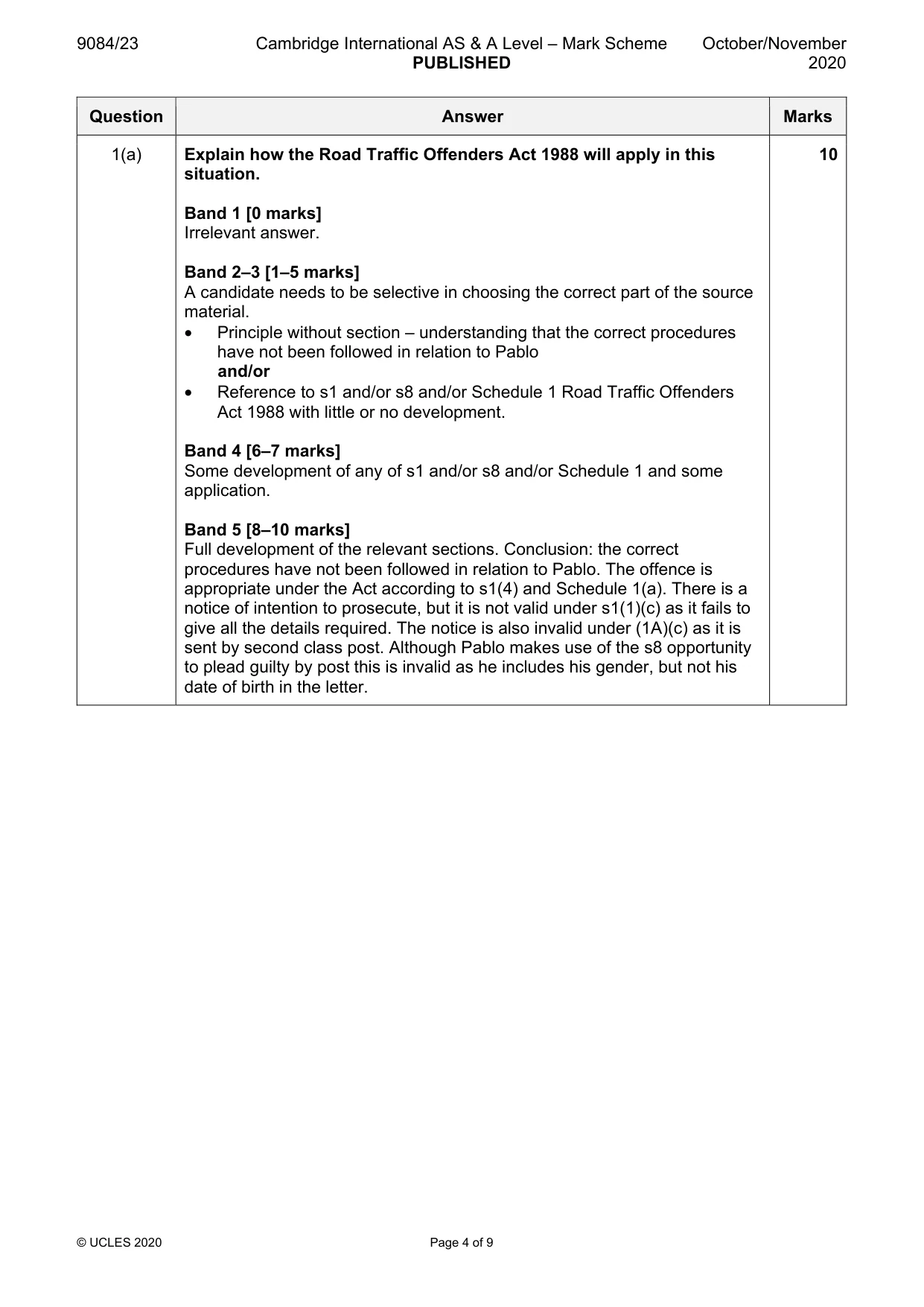
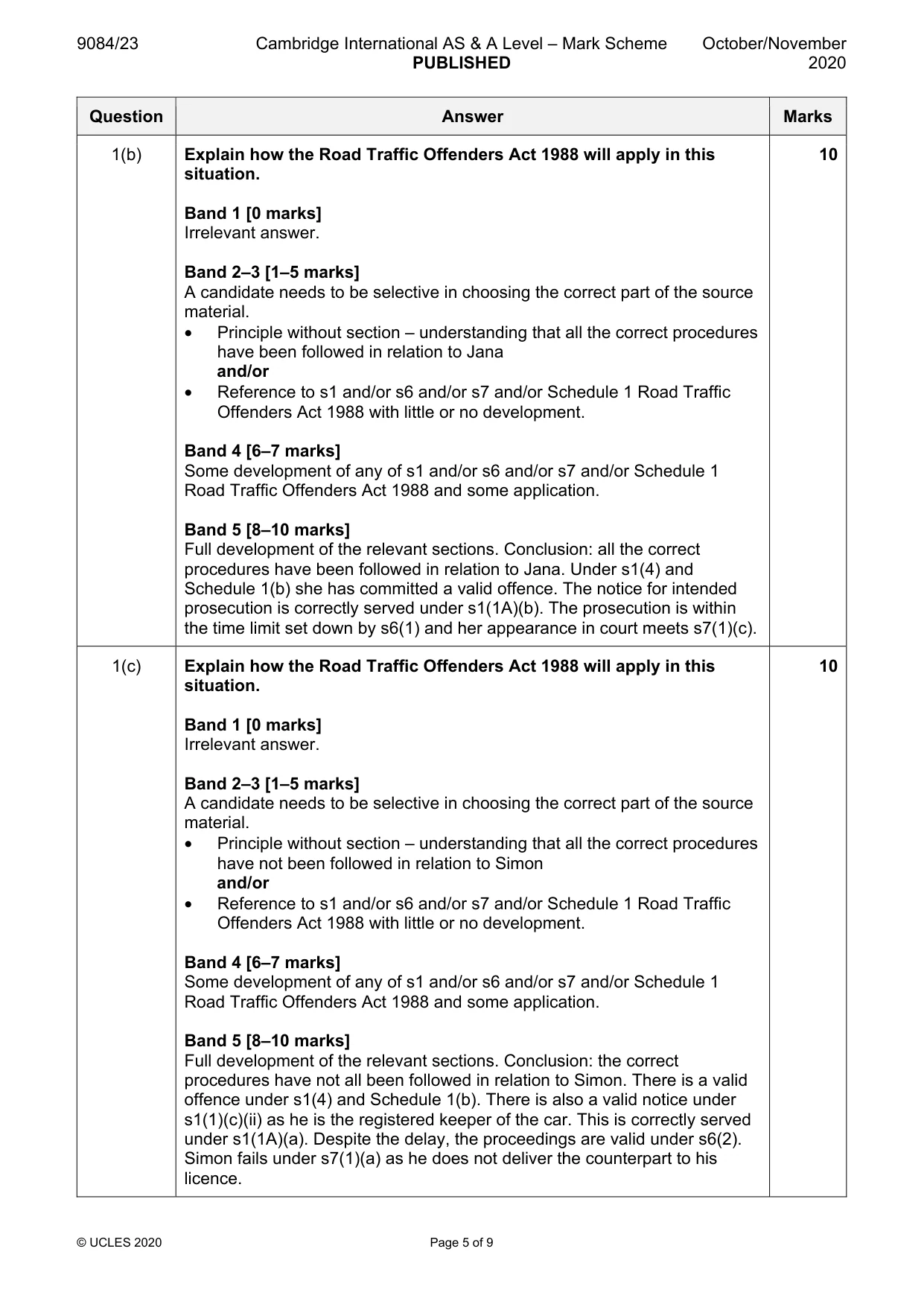
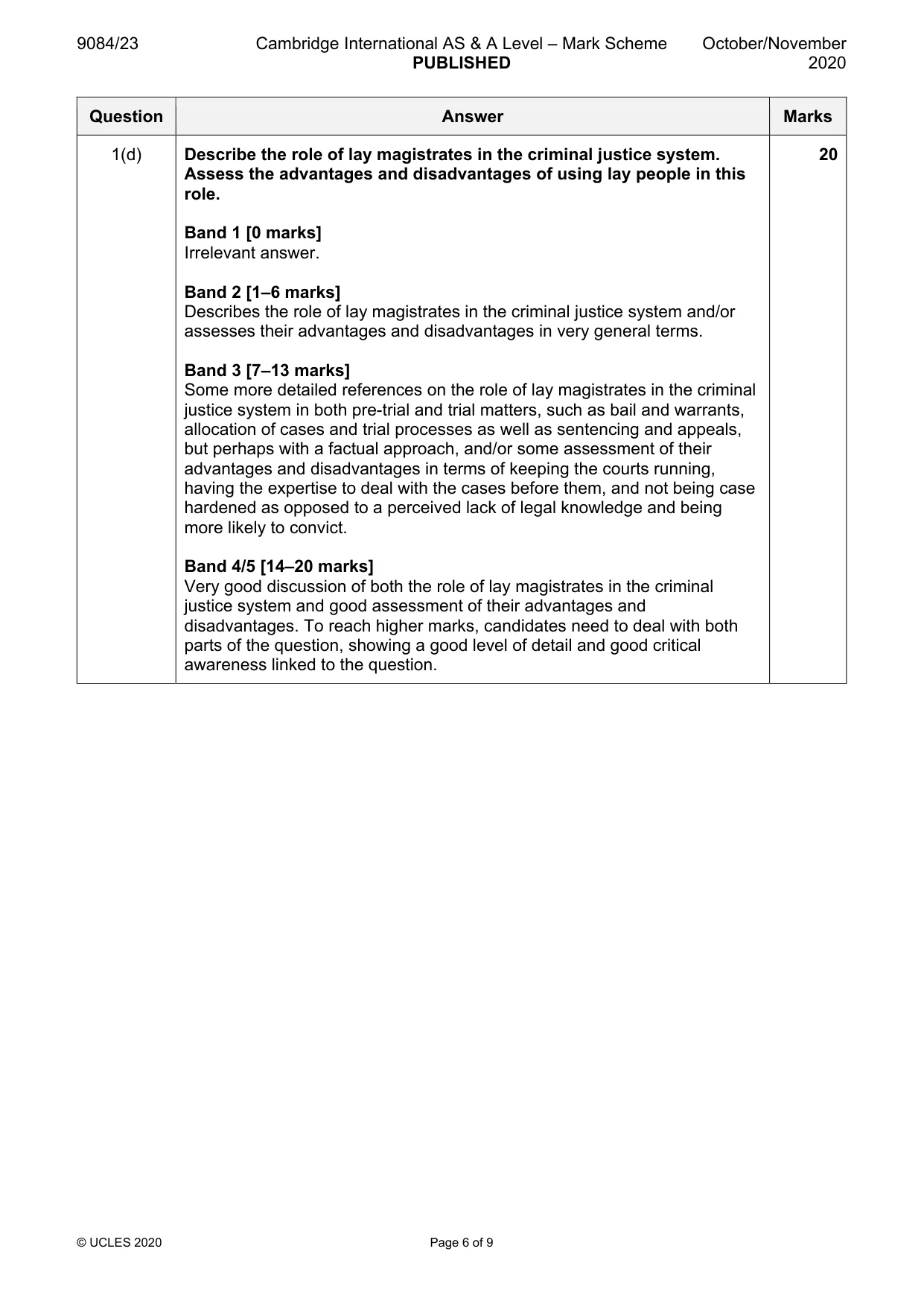
Mark scheme: Question Answer Marks 1(a) Explain how the Road Traffic Offenders Act 1988 will apply in this 10 situation. Band 1 [0 marks] Irrelevant answer. Band 2–3 [1–5 marks] A candidate needs to be selective in choosing the correct part of the source material. • Principle without section – understanding that the correct procedures have not been followed in relation to Pablo and/or • Reference to s1 and/or s8 and/or Schedule 1 Road Traffic Offenders Act 1988 with little or no development. Band 4 [6–7 marks] Some development of any of s1 and/or s8 and/or Schedule 1 and some application. Band 5 [8–10 marks] Full development of the relevant sections. Conclusion: the correct procedures have not been followed in relation to Pablo. The offence is appropriate under the Act according to s1(4) and Schedule 1(a). There is a notice of intention to prosecute, but it is not valid under s1(1)(c) as it fails to give all the details required. The notice is also invalid under (1A)(c) as it is sent by second class post. Although Pablo makes use of the s8 opportunity to plead guilty by post this is invalid as he includes his gender, but not his date of birth in the letter. 1(b) Explain how the Road Traffic Offenders Act 1988 will apply in this 10 situation. Band 1 [0 marks] Irrelevant answer. Band 2–3 [1–5 marks] A candidate needs to be selective in choosing the correct part of the source material. • Principle without section – understanding that all the correct procedures have been followed in relation to Jana and/or • Reference to s1 and/or s6 and/or s7 and/or Schedule 1 Road Traffic Offenders Act 1988 with little or no development. Band 4 [6–7 marks] Some development of any of s1 and/or s6 and/or s7 and/or Schedule 1 Road Traffic Offenders Act 1988 and some application. Band 5 [8–10 marks] Full development of the relevant sections. Conclusion: all the correct procedures have been followed in relation to Jana. Under s1(4) and Schedule 1(b) she has committed a valid offence. The notice for intended prosecution is correctly served under s1(1A)(b). The prosecution is within the time limit set down by s6(1) and her appearance in court meets s7(1)(c). 1(c) Explain how the Road Traffic Offenders Act 1988 will apply in this 10 situation. Band 1 [0 marks] Irrelevant answer. Band 2–3 [1–5 marks] A candidate needs to be selective in choosing the correct part of the source material. • Principle without section – understanding that all the correct procedures have not been followed in relation to Simon and/or • Reference to s1 and/or s6 and/or s7 and/or Schedule 1 Road Traffic Offenders Act 1988 with little or no development. Band 4 [6–7 marks] Some development of any of s1 and/or s6 and/or s7 and/or Schedule 1 Road Traffic Offenders Act 1988 and some application. Band 5 [8–10 marks] Full development of the relevant sections. Conclusion: the correct procedures have not all been followed in relation to Simon. There is a valid offence under s1(4) and Schedule 1(b). There is also a valid notice under s1(1)(c)(ii) as he is the registered keeper of the car. This is correctly served under s1(1A)(a). Despite the delay, the proceedings are valid under s6(2). Simon fails under s7(1)(a) as he does not deliver the counterpart to his licence. 1(d) Describe the role of lay magistrates in the criminal justice system. 20 Assess the advantages and disadvantages of using lay people in this role. Band 1 [0 marks] Irrelevant answer. Band 2 [1–6 marks] Describes the role of lay magistrates in the criminal justice system and/or assesses their advantages and disadvantages in very general terms. Band 3 [7–13 marks] Some more detailed references on the role of lay magistrates in the criminal justice system in both pre-trial and trial matters, such as bail and warrants, allocation of cases and trial processes as well as sentencing and appeals, but perhaps with a factual approach, and/or some assessment of their advantages and disadvantages in terms of keeping the courts running, having the expertise to deal with the cases before them, and not being case hardened as opposed to a perceived lack of legal knowledge and being more likely to convict. Band 4/5 [14–20 marks] Very good discussion of both the role of lay magistrates in the criminal justice system and good assessment of their advantages and disadvantages. To reach higher marks, candidates need to deal with both parts of the question, showing a good level of detail and good critical awareness linked to the question.
Q2 · Carly, a tenant, brings an action against her landlord, Harold
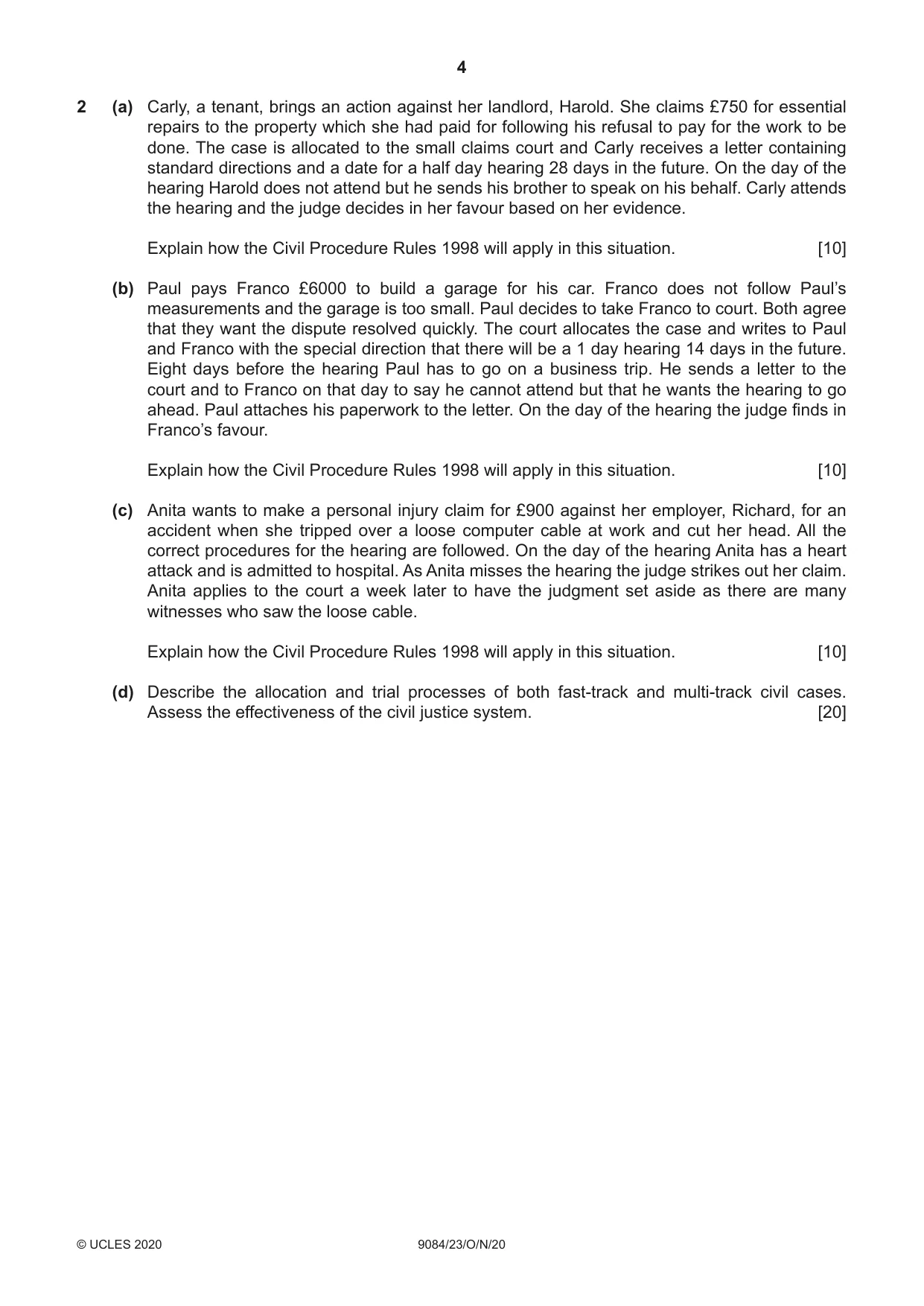
2 (a) Carly, a tenant, brings an action against her landlord, Harold. She claims £750 for essential repairs to the property which she had paid for following his refusal to pay for the work to be done. The case is allocated to the small claims court and Carly receives a letter containing standard directions and a date for a half day hearing 28 days in the future. On the day of the hearing Harold does not attend but he sends his brother to speak on his behalf. Carly attends the hearing and the judge decides in her favour based on her evidence. Explain how the Civil Procedure Rules 1998 will apply in this situation. [10] (b) Paul pays Franco £6000 to build a garage for his car. Franco does not follow Paul’s measurements and the garage is too small. Paul decides to take Franco to court. Both agree that they want the dispute resolved quickly. The court allocates the case and writes to Paul and Franco with the special direction that there will be a 1 day hearing 14 days in the future. Eight days before the hearing Paul has to go on a business trip. He sends a letter to the court and to Franco on that day to say he cannot attend but that he wants the hearing to go ahead. Paul attaches his paperwork to the letter. On the day of the hearing the judge finds in Franco’s favour. Explain how the Civil Procedure Rules 1998 will apply in this situation. [10] (c) Anita wants to make a personal injury claim for £900 against her employer, Richard, for an accident when she tripped over a loose computer cable at work and cut her head. All the correct procedures for the hearing are followed. On the day of the hearing Anita has a heart attack and is admitted to hospital. As Anita misses the hearing the judge strikes out her claim. Anita applies to the court a week later to have the judgment set aside as there are many witnesses who saw the loose cable. Explain how the Civil Procedure Rules 1998 will apply in this situation. [10] (d) Describe the allocation and trial processes of both fast-track and multi-track civil cases. Assess the effectiveness of the civil justice system. [20] Source material for Question 2 Civil Procedure Rules 1998 Part 27 – Small Claims Track 27.1 (1) … (2) A claim being dealt with under this Part is called a small claim. The small claims track will be the normal track for – • any claim which has a financial value of not more than £10 000 subject to the special provisions about claims for personal injuries and housing disrepair claims; • any claim for personal injuries which has a financial value of not more than £10 000 where the claim for damages for personal injuries is not more than £1000; and • any claim which includes a claim by a tenant of residential premises against his landlord for repairs or other work to the premises where the estimated cost of the repairs or other work is not more than £1000 and the financial value of any other claim for damages is not more than £1000. 27.4 (1) After allocation the court will – (a) give standard directions and fix a date for the final hearing; or (b) give special directions and fix a date for the final hearing; (2) The court will – (a) give the parties at least 21 days’ notice of the date fixed for the final hearing, unless the parties agree to accept less notice; and (b) inform them of the amount of time allowed for the final hearing. 27.9 (1) If a party who does not attend a final hearing – (a) has given written notice to the court and the other party at least 7 days before the hearing date that he will not attend; (b) has served on the other party at least 7 days before the hearing date any other documents which he has filed with the court; and (c) has, in his written notice, requested the court to decide the claim in his absence and has confirmed his compliance with paragraphs (a) and (b) above, the court will take into account that party’s statement of case and any other documents he has filed and served when it decides the claim. (2) If a claimant does not – (a) attend the hearing; and (b) give the notice referred to in paragraph (1), the court may strike out the claim. (3) If – (a) a defendant does not – (i) attend the hearing; or (ii) give the notice referred to in paragraph (1); and (b) the claimant either – (i) does attend the hearing; or (ii) gives the notice referred to in paragraph (1), the court may decide the claim on the basis of the evidence of the claimant alone. Section 27.11 overleaf 27.11 (1) A party – (a) who was neither present nor represented at the hearing of the claim; and (b) who has not given written notice to the court under rule 27.9(1), may apply for an order that a judgment under this Part shall be set aside and the claim re-heard. (2) A party who applies for an order setting aside a judgment under this rule must make the application not more than 14 days after the day on which notice of the judgment was served on him. (3) The court may grant an application under paragraph (2) only if the applicant – (a) had a good reason for not attending or being represented at the hearing or giving written notice to the court under rule 27.9(1); and (b) has a reasonable prospect of success at the hearing.
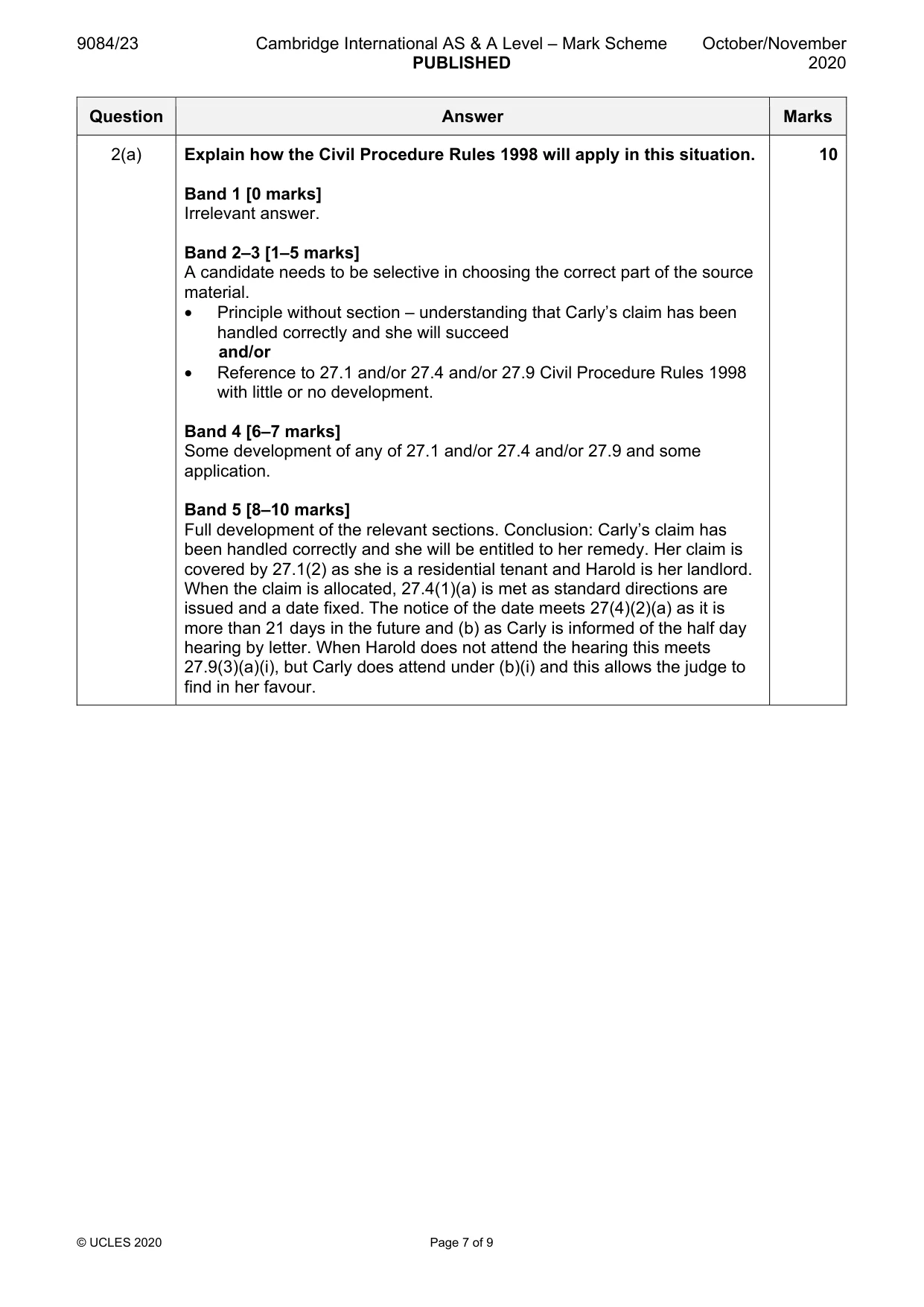
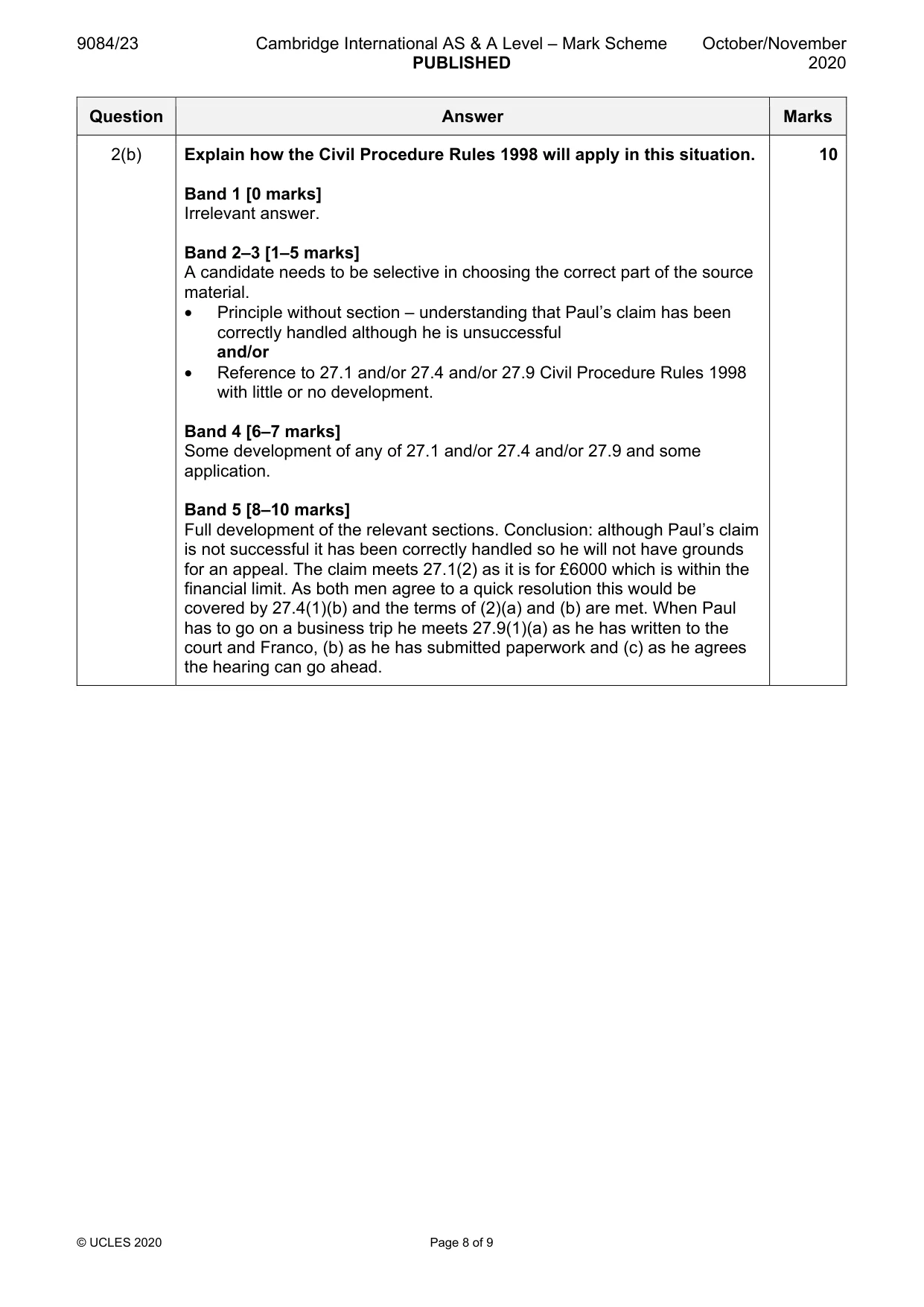
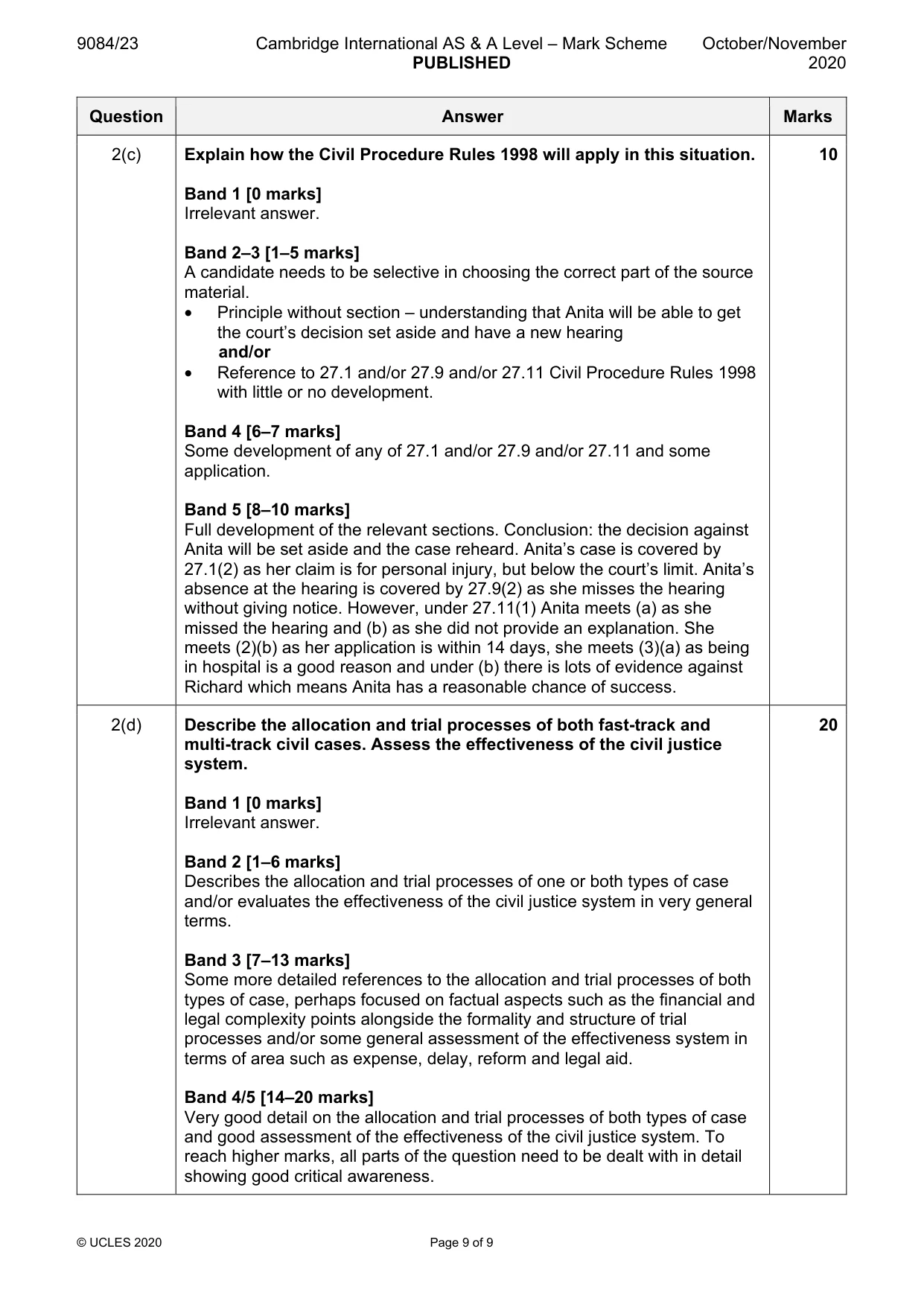
Mark scheme: 2(a) Explain how the Civil Procedure Rules 1998 will apply in this situation. 10 Band 1 [0 marks] Irrelevant answer. Band 2–3 [1–5 marks] A candidate needs to be selective in choosing the correct part of the source material. • Principle without section – understanding that Carly’s claim has been handled correctly and she will succeed and/or • Reference to 27.1 and/or 27.4 and/or 27.9 Civil Procedure Rules 1998 with little or no development. Band 4 [6–7 marks] Some development of any of 27.1 and/or 27.4 and/or 27.9 and some application. Band 5 [8–10 marks] Full development of the relevant sections. Conclusion: Carly’s claim has been handled correctly and she will be entitled to her remedy. Her claim is covered by 27.1(2) as she is a residential tenant and Harold is her landlord. When the claim is allocated, 27.4(1)(a) is met as standard directions are issued and a date fixed. The notice of the date meets 27(4)(2)(a) as it is more than 21 days in the future and (b) as Carly is informed of the half day hearing by letter. When Harold does not attend the hearing this meets 27.9(3)(a)(i), but Carly does attend under (b)(i) and this allows the judge to find in her favour. 2(b) Explain how the Civil Procedure Rules 1998 will apply in this situation. 10 Band 1 [0 marks] Irrelevant answer. Band 2–3 [1–5 marks] A candidate needs to be selective in choosing the correct part of the source material. • Principle without section – understanding that Paul’s claim has been correctly handled although he is unsuccessful and/or • Reference to 27.1 and/or 27.4 and/or 27.9 Civil Procedure Rules 1998 with little or no development. Band 4 [6–7 marks] Some development of any of 27.1 and/or 27.4 and/or 27.9 and some application. Band 5 [8–10 marks] Full development of the relevant sections. Conclusion: although Paul’s claim is not successful it has been correctly handled so he will not have grounds for an appeal. The claim meets 27.1(2) as it is for £6000 which is within the financial limit. As both men agree to a quick resolution this would be covered by 27.4(1)(b) and the terms of (2)(a) and (b) are met. When Paul has to go on a business trip he meets 27.9(1)(a) as he has written to the court and Franco, (b) as he has submitted paperwork and (c) as he agrees the hearing can go ahead. 2(c) Explain how the Civil Procedure Rules 1998 will apply in this situation. 10 Band 1 [0 marks] Irrelevant answer. Band 2–3 [1–5 marks] A candidate needs to be selective in choosing the correct part of the source material. • Principle without section – understanding that Anita will be able to get the court’s decision set aside and have a new hearing and/or • Reference to 27.1 and/or 27.9 and/or 27.11 Civil Procedure Rules 1998 with little or no development. Band 4 [6–7 marks] Some development of any of 27.1 and/or 27.9 and/or 27.11 and some application. Band 5 [8–10 marks] Full development of the relevant sections. Conclusion: the decision against Anita will be set aside and the case reheard. Anita’s case is covered by 27.1(2) as her claim is for personal injury, but below the court’s limit. Anita’s absence at the hearing is covered by 27.9(2) as she misses the hearing without giving notice. However, under 27.11(1) Anita meets (a) as she missed the hearing and (b) as she did not provide an explanation. She meets (2)(b) as her application is within 14 days, she meets (3)(a) as being in hospital is a good reason and under (b) there is lots of evidence against Richard which means Anita has a reasonable chance of success. 2(d) Describe the allocation and trial processes of both fast-track and 20 multi-track civil cases. Assess the effectiveness of the civil justice system. Band 1 [0 marks] Irrelevant answer. Band 2 [1–6 marks] Describes the allocation and trial processes of one or both types of case and/or evaluates the effectiveness of the civil justice system in very general terms. Band 3 [7–13 marks] Some more detailed references to the allocation and trial processes of both types of case, perhaps focused on factual aspects such as the financial and legal complexity points alongside the formality and structure of trial processes and/or some general assessment of the effectiveness system in terms of area such as expense, delay, reform and legal aid. Band 4/5 [14–20 marks] Very good detail on the allocation and trial processes of both types of case and good assessment of the effectiveness of the civil justice system. To reach higher marks, all parts of the question need to be dealt with in detail showing good critical awareness.
What was in this paper
The subtopics covered by these 2 questions, and how many questions each got. Open one in a new tab to see every Cambridge question on it.
1Sentencing in England and Wales This topic is about the sentences that can be handed down to both adult and young offenders who have been convicted of offences. This topic is an opportunity to reflect on the key concepts of liability, justice, fairness, power and its limits, and effectiveness1What you needed in this session
Cambridge’s own grade thresholds for 2020 Oct/Nov, Paper 2 · Variant 3. A higher threshold means an easier paper — the bar moves with how the cohort did.