Cambridge A Level Law 9084 — 2021 May/June Paper 2 · Variant 2
9084/22/M/J/21 · 2 questions · 50 marks · ≈56 min
The question paper and its mark scheme, free to read here and free to download. This is Cambridge’s own paper, exactly as it was sat.
Question paper8 pages
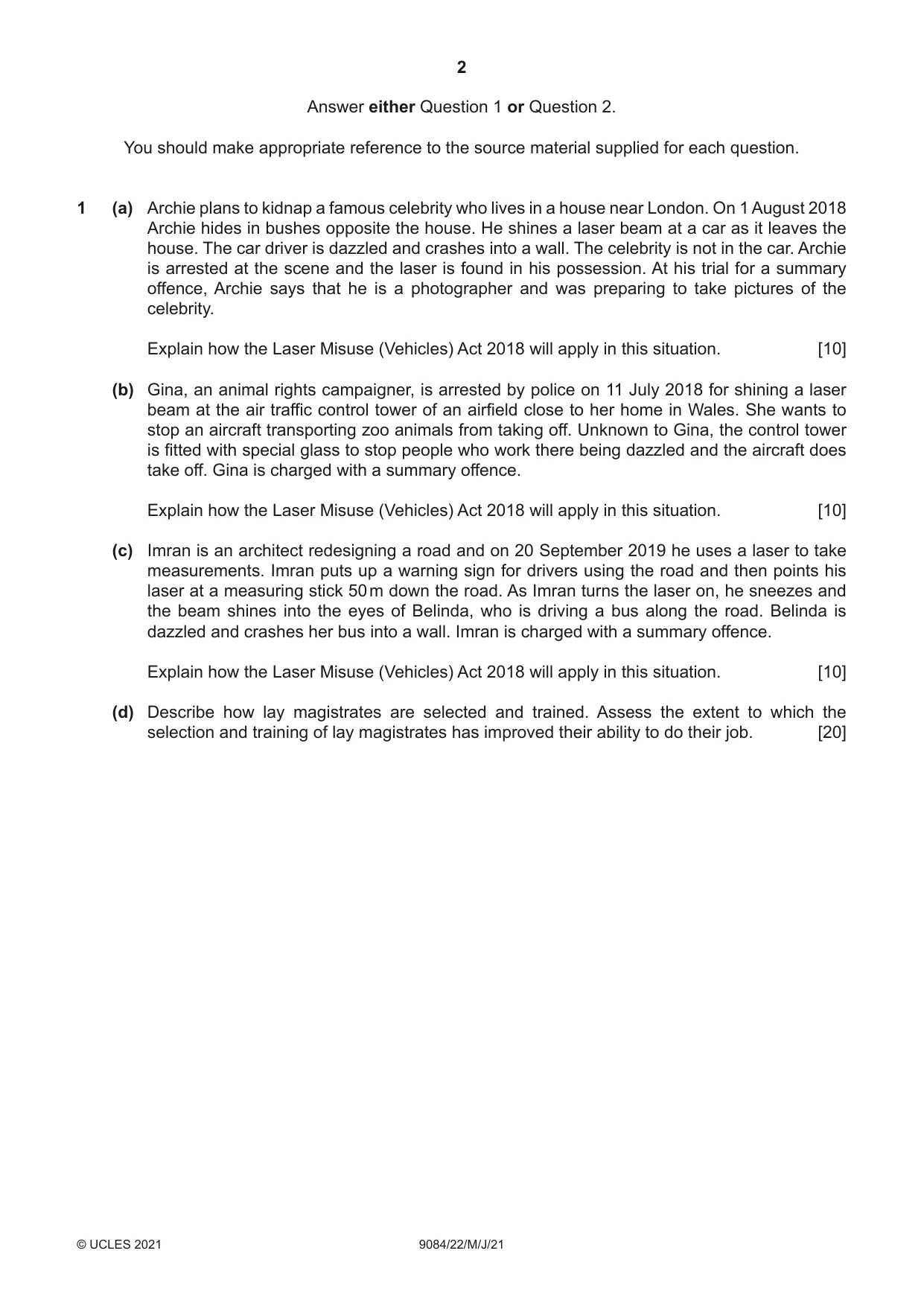
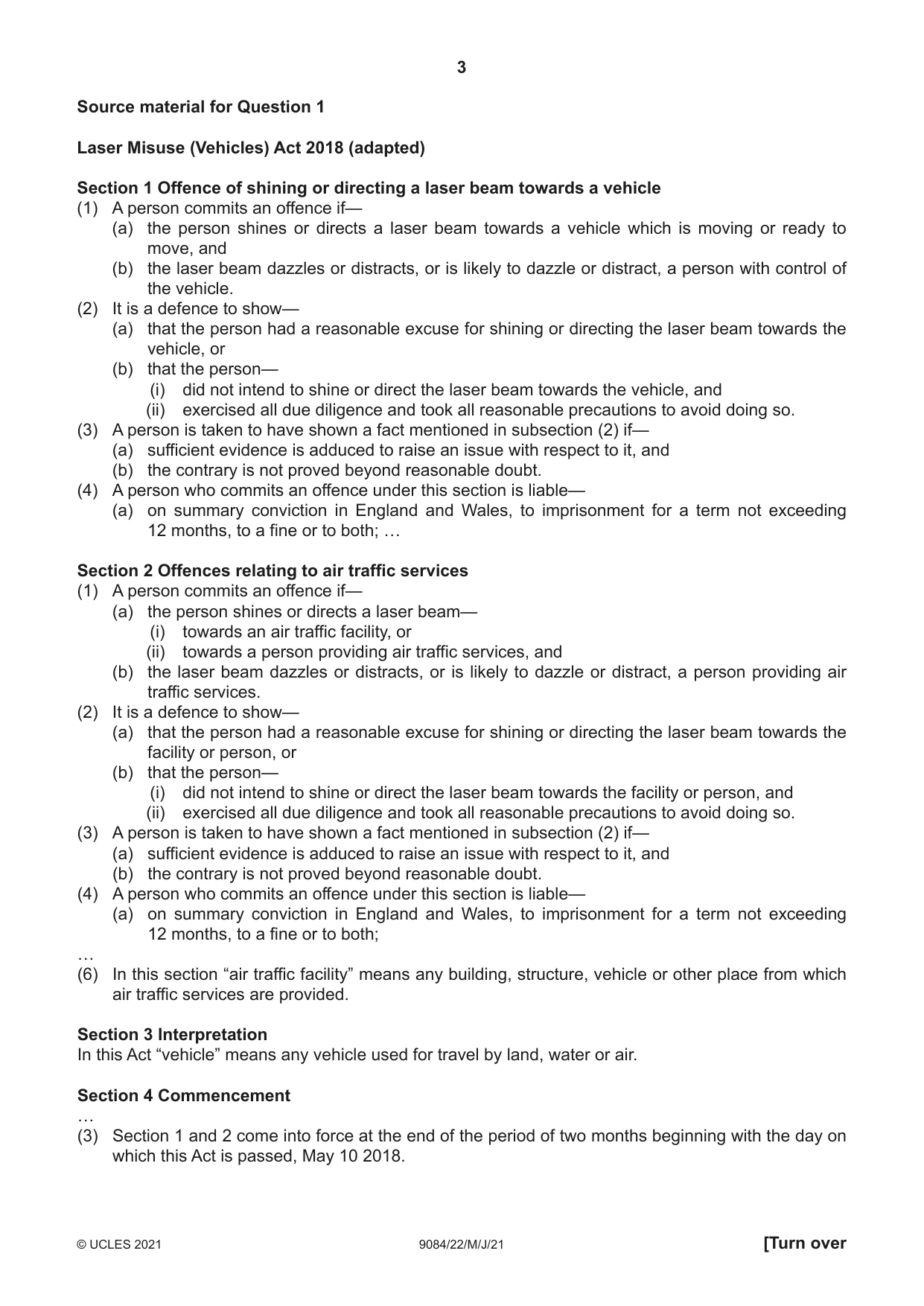
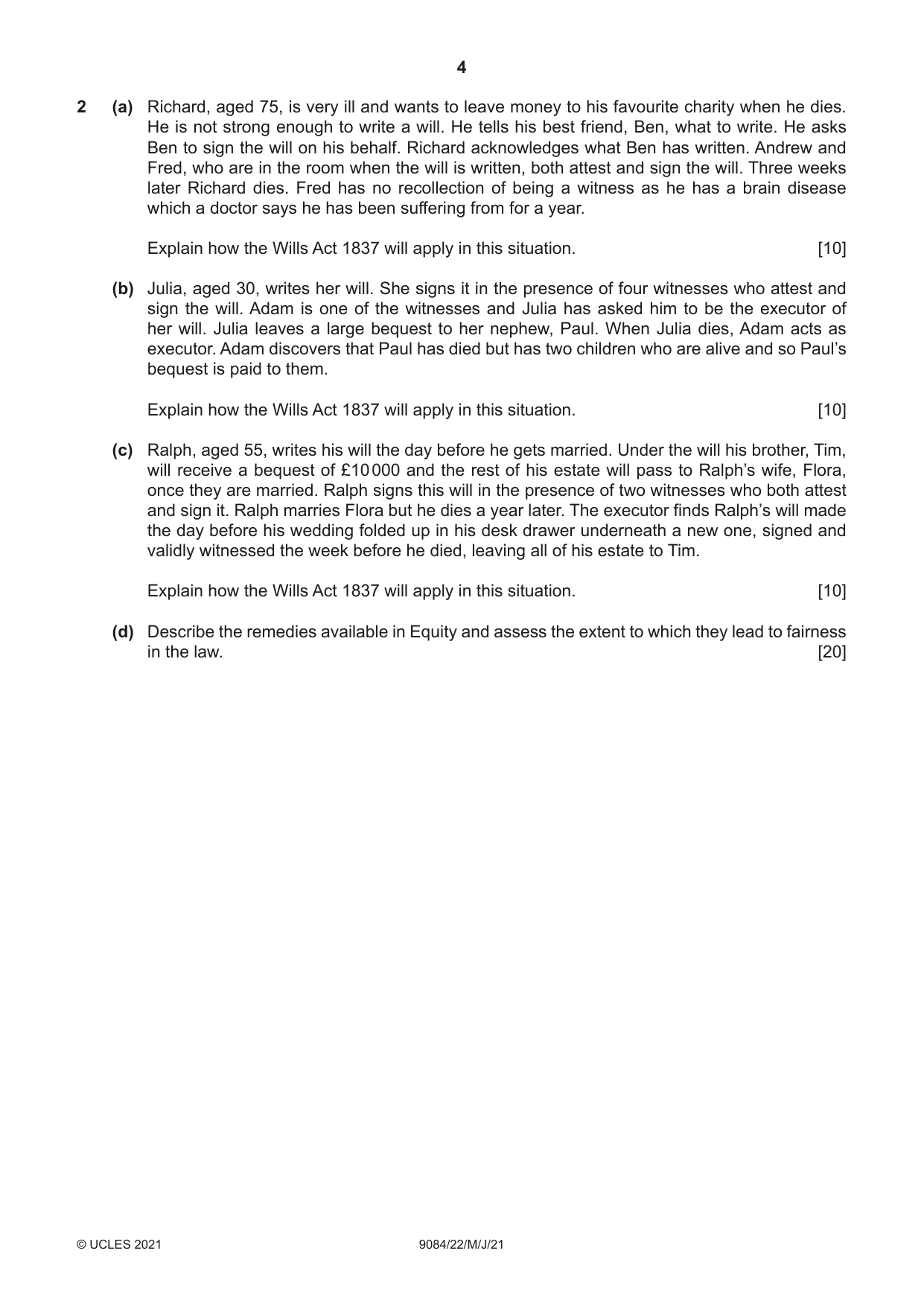



Mark scheme10 pages
Answers below. Sit the paper first if you are practising.
Questions as text
Q1 · Archie plans to kidnap a famous celebrity who lives in a house near London
1 (a) Archie plans to kidnap a famous celebrity who lives in a house near London. On 1 August 2018 Archie hides in bushes opposite the house. He shines a laser beam at a car as it leaves the house. The car driver is dazzled and crashes into a wall. The celebrity is not in the car. Archie is arrested at the scene and the laser is found in his possession. At his trial for a summary offence, Archie says that he is a photographer and was preparing to take pictures of the celebrity. Explain how the Laser Misuse (Vehicles) Act 2018 will apply in this situation. [10] (b) Gina, an animal rights campaigner, is arrested by police on 11 July 2018 for shining a laser beam at the air traffic control tower of an airfield close to her home in Wales. She wants to stop an aircraft transporting zoo animals from taking off. Unknown to Gina, the control tower is fitted with special glass to stop people who work there being dazzled and the aircraft does take off. Gina is charged with a summary offence. Explain how the Laser Misuse (Vehicles) Act 2018 will apply in this situation. [10] (c) Imran is an architect redesigning a road and on 20 September 2019 he uses a laser to take measurements. Imran puts up a warning sign for drivers using the road and then points his laser at a measuring stick 50 m down the road. As Imran turns the laser on, he sneezes and the beam shines into the eyes of Belinda, who is driving a bus along the road. Belinda is dazzled and crashes her bus into a wall. Imran is charged with a summary offence. Explain how the Laser Misuse (Vehicles) Act 2018 will apply in this situation. [10] (d) Describe how lay magistrates are selected and trained. Assess the extent to which the selection and training of lay magistrates has improved their ability to do their job. [20] Source material for Question 1 Laser Misuse (Vehicles) Act 2018 (adapted) Section 1 Offence of shining or directing a laser beam towards a vehicle (1) A person commits an offence if— (a) the person shines or directs a laser beam towards a vehicle which is moving or ready to move, and (b) the laser beam dazzles or distracts, or is likely to dazzle or distract, a person with control of the vehicle. (2) It is a defence to show— (a) that the person had a reasonable excuse for shining or directing the laser beam towards the vehicle, or (b) that the person— (i) did not intend to shine or direct the laser beam towards the vehicle, and (ii) exercised all due diligence and took all reasonable precautions to avoid doing so. (3) A person is taken to have shown a fact mentioned in subsection (2) if— (a) sufficient evidence is adduced to raise an issue with respect to it, and (b) the contrary is not proved beyond reasonable doubt. (4) A person who commits an offence under this section is liable— (a) on summary conviction in England and Wales, to imprisonment for a term not exceeding 12 months, to a fine or to both; … Section 2 Offences relating to air traffic services (1) A person commits an offence if— (a) the person shines or directs a laser beam— (i) towards an air traffic facility, or (ii) towards a person providing air traffic services, and (b) the laser beam dazzles or distracts, or is likely to dazzle or distract, a person providing air traffic services. (2) It is a defence to show— (a) that the person had a reasonable excuse for shining or directing the laser beam towards the facility or person, or (b) that the person— (i) did not intend to shine or direct the laser beam towards the facility or person, and (ii) exercised all due diligence and took all reasonable precautions to avoid doing so. (3) A person is taken to have shown a fact mentioned in subsection (2) if— (a) sufficient evidence is adduced to raise an issue with respect to it, and (b) the contrary is not proved beyond reasonable doubt. (4) A person who commits an offence under this section is liable— (a) on summary conviction in England and Wales, to imprisonment for a term not exceeding 12 months, to a fine or to both; … (6) In this section “air traffic facility” means any building, structure, vehicle or other place from which air traffic services are provided. Section 3 Interpretation In this Act “vehicle” means any vehicle used for travel by land, water or air. Section 4 Commencement … (3) Section 1 and 2 come into force at the end of the period of two months beginning with the day on which this Act is passed, May 10 2018.
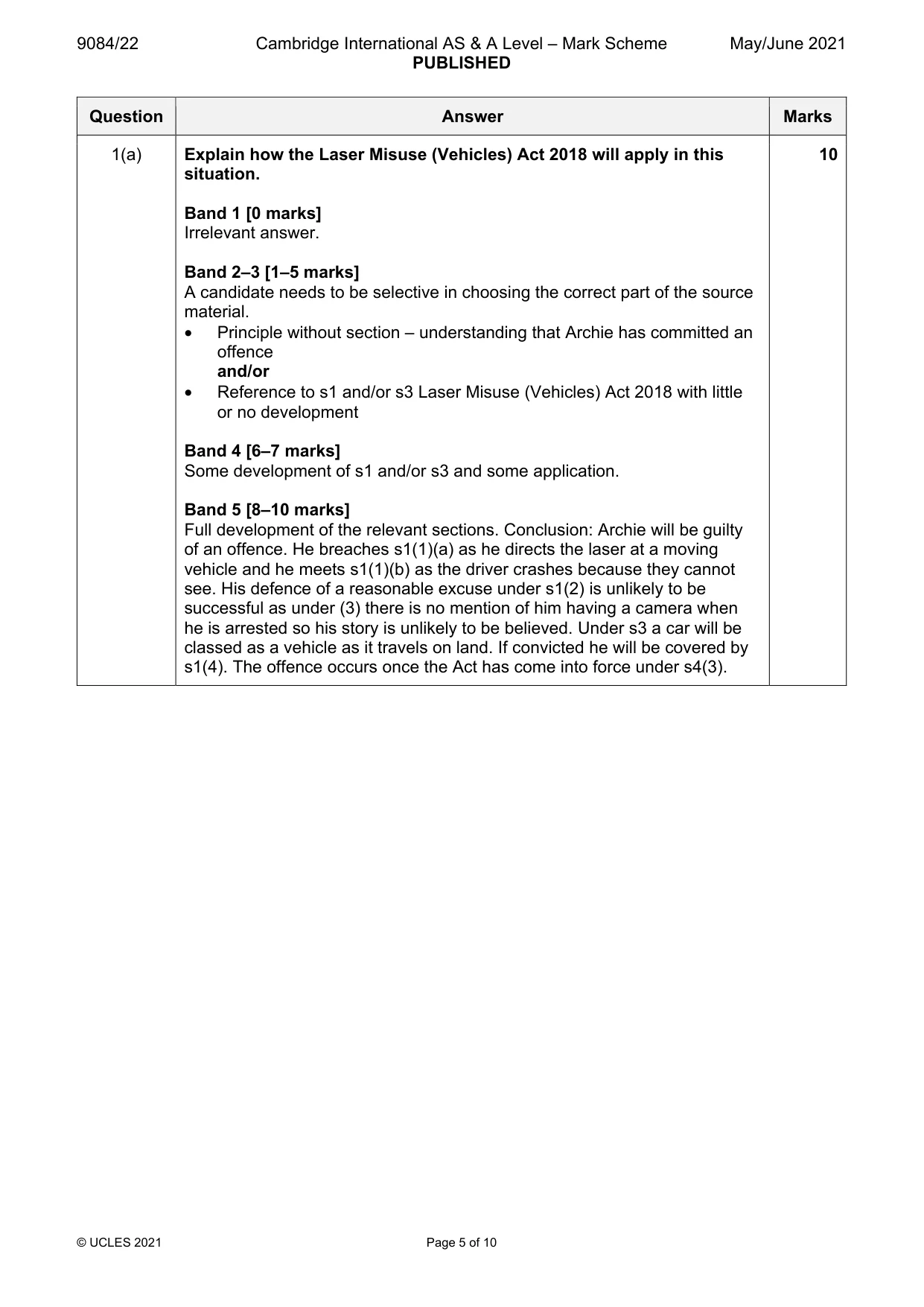
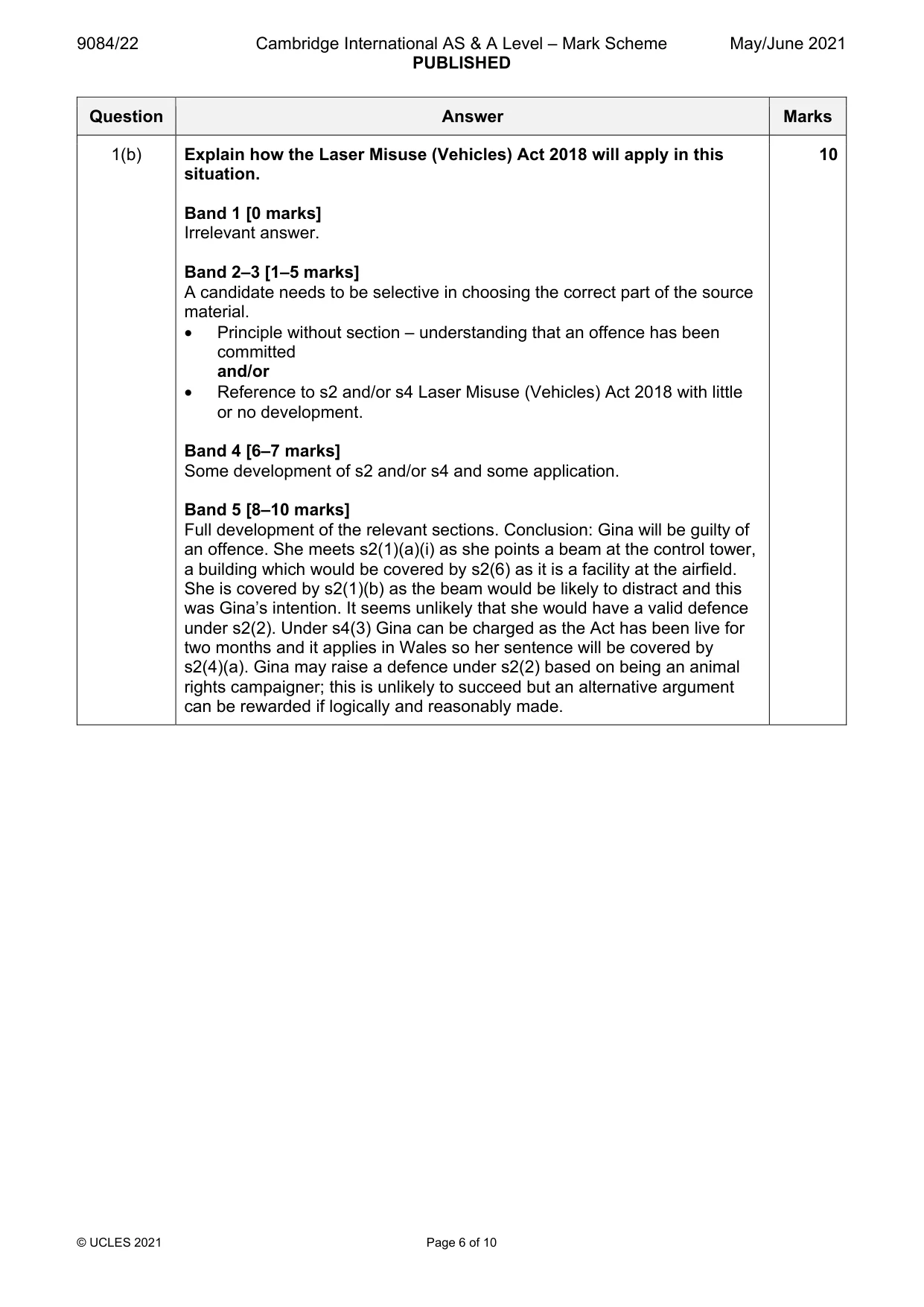
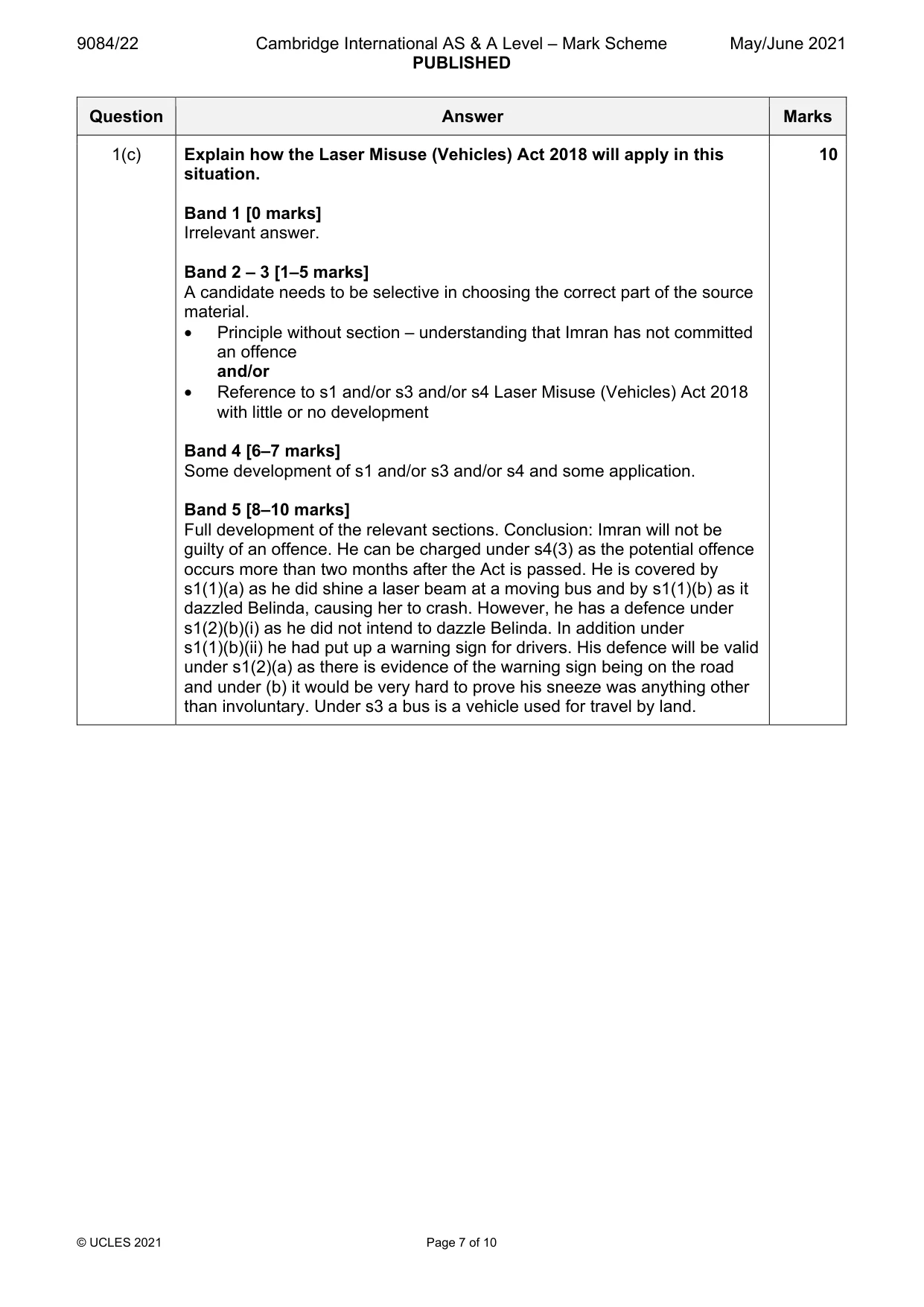
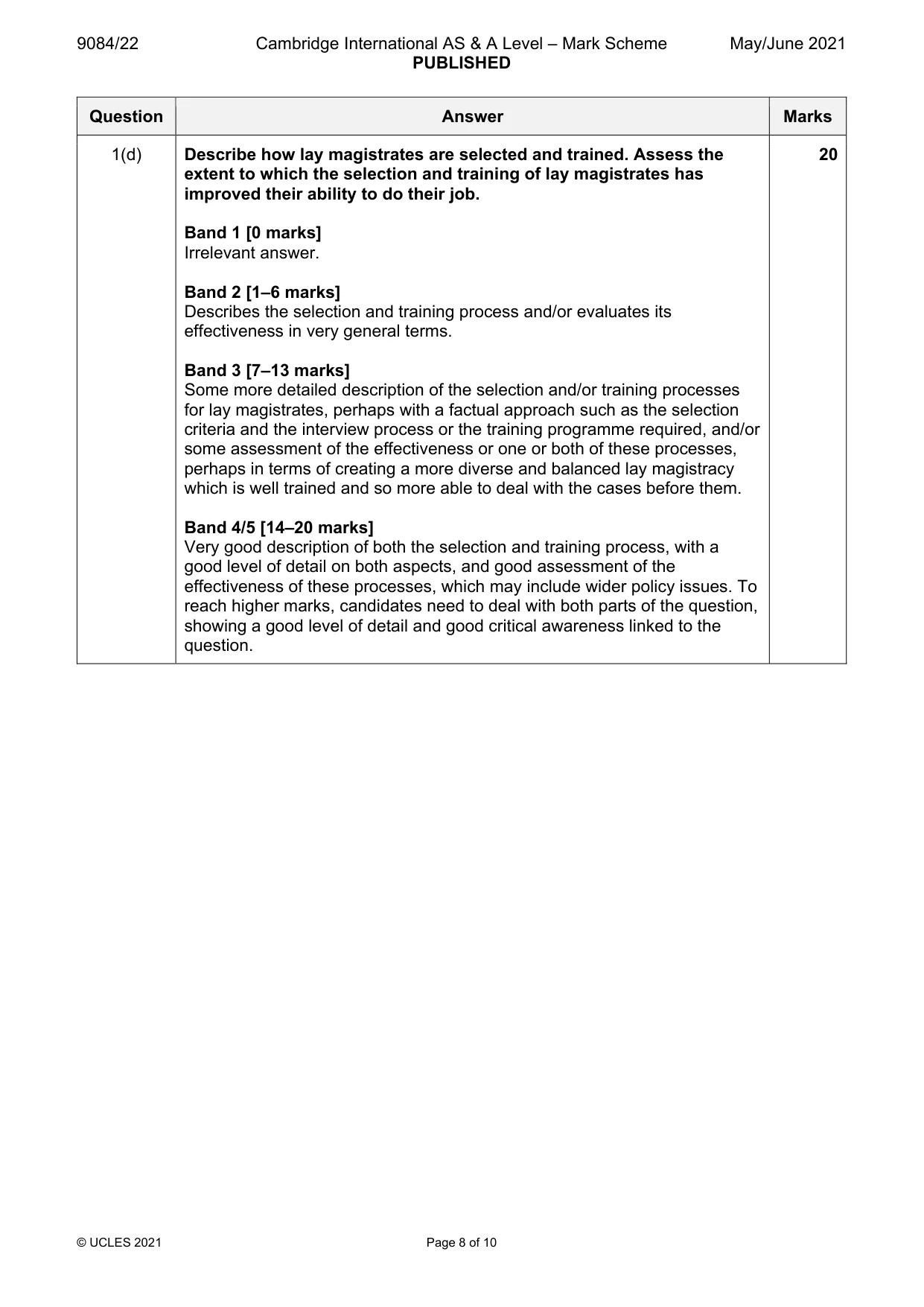
Mark scheme: Question Answer Marks 1(a) Explain how the Laser Misuse (Vehicles) Act 2018 will apply in this 10 situation. Band 1 [0 marks] Irrelevant answer. Band 2–3 [1–5 marks] A candidate needs to be selective in choosing the correct part of the source material. • Principle without section – understanding that Archie has committed an offence and/or • Reference to s1 and/or s3 Laser Misuse (Vehicles) Act 2018 with little or no development Band 4 [6–7 marks] Some development of s1 and/or s3 and some application. Band 5 [8–10 marks] Full development of the relevant sections. Conclusion: Archie will be guilty of an offence. He breaches s1(1)(a) as he directs the laser at a moving vehicle and he meets s1(1)(b) as the driver crashes because they cannot see. His defence of a reasonable excuse under s1(2) is unlikely to be successful as under (3) there is no mention of him having a camera when he is arrested so his story is unlikely to be believed. Under s3 a car will be classed as a vehicle as it travels on land. If convicted he will be covered by s1(4). The offence occurs once the Act has come into force under s4(3). 1(b) Explain how the Laser Misuse (Vehicles) Act 2018 will apply in this 10 situation. Band 1 [0 marks] Irrelevant answer. Band 2–3 [1–5 marks] A candidate needs to be selective in choosing the correct part of the source material. • Principle without section – understanding that an offence has been committed and/or • Reference to s2 and/or s4 Laser Misuse (Vehicles) Act 2018 with little or no development. Band 4 [6–7 marks] Some development of s2 and/or s4 and some application. Band 5 [8–10 marks] Full development of the relevant sections. Conclusion: Gina will be guilty of an offence. She meets s2(1)(a)(i) as she points a beam at the control tower, a building which would be covered by s2(6) as it is a facility at the airfield. She is covered by s2(1)(b) as the beam would be likely to distract and this was Gina’s intention. It seems unlikely that she would have a valid defence under s2(2). Under s4(3) Gina can be charged as the Act has been live for two months and it applies in Wales so her sentence will be covered by s2(4)(a). Gina may raise a defence under s2(2) based on being an animal rights campaigner; this is unlikely to succeed but an alternative argument can be rewarded if logically and reasonably made. 1(c) Explain how the Laser Misuse (Vehicles) Act 2018 will apply in this 10 situation. Band 1 [0 marks] Irrelevant answer. Band 2 – 3 [1–5 marks] A candidate needs to be selective in choosing the correct part of the source material. • Principle without section – understanding that Imran has not committed an offence and/or • Reference to s1 and/or s3 and/or s4 Laser Misuse (Vehicles) Act 2018 with little or no development Band 4 [6–7 marks] Some development of s1 and/or s3 and/or s4 and some application. Band 5 [8–10 marks] Full development of the relevant sections. Conclusion: Imran will not be guilty of an offence. He can be charged under s4(3) as the potential offence occurs more than two months after the Act is passed. He is covered by s1(1)(a) as he did shine a laser beam at a moving bus and by s1(1)(b) as it dazzled Belinda, causing her to crash. However, he has a defence under s1(2)(b)(i) as he did not intend to dazzle Belinda. In addition under s1(1)(b)(ii) he had put up a warning sign for drivers. His defence will be valid under s1(2)(a) as there is evidence of the warning sign being on the road and under (b) it would be very hard to prove his sneeze was anything other than involuntary. Under s3 a bus is a vehicle used for travel by land. 1(d) Describe how lay magistrates are selected and trained. Assess the 20 extent to which the selection and training of lay magistrates has improved their ability to do their job. Band 1 [0 marks] Irrelevant answer. Band 2 [1–6 marks] Describes the selection and training process and/or evaluates its effectiveness in very general terms. Band 3 [7–13 marks] Some more detailed description of the selection and/or training processes for lay magistrates, perhaps with a factual approach such as the selection criteria and the interview process or the training programme required, and/or some assessment of the effectiveness or one or both of these processes, perhaps in terms of creating a more diverse and balanced lay magistracy which is well trained and so more able to deal with the cases before them. Band 4/5 [14–20 marks] Very good description of both the selection and training process, with a good level of detail on both aspects, and good assessment of the effectiveness of these processes, which may include wider policy issues. To reach higher marks, candidates need to deal with both parts of the question, showing a good level of detail and good critical awareness linked to the question.
Q2 · Richard, aged 75, is very ill and wants to leave money to his favourite charity when he…
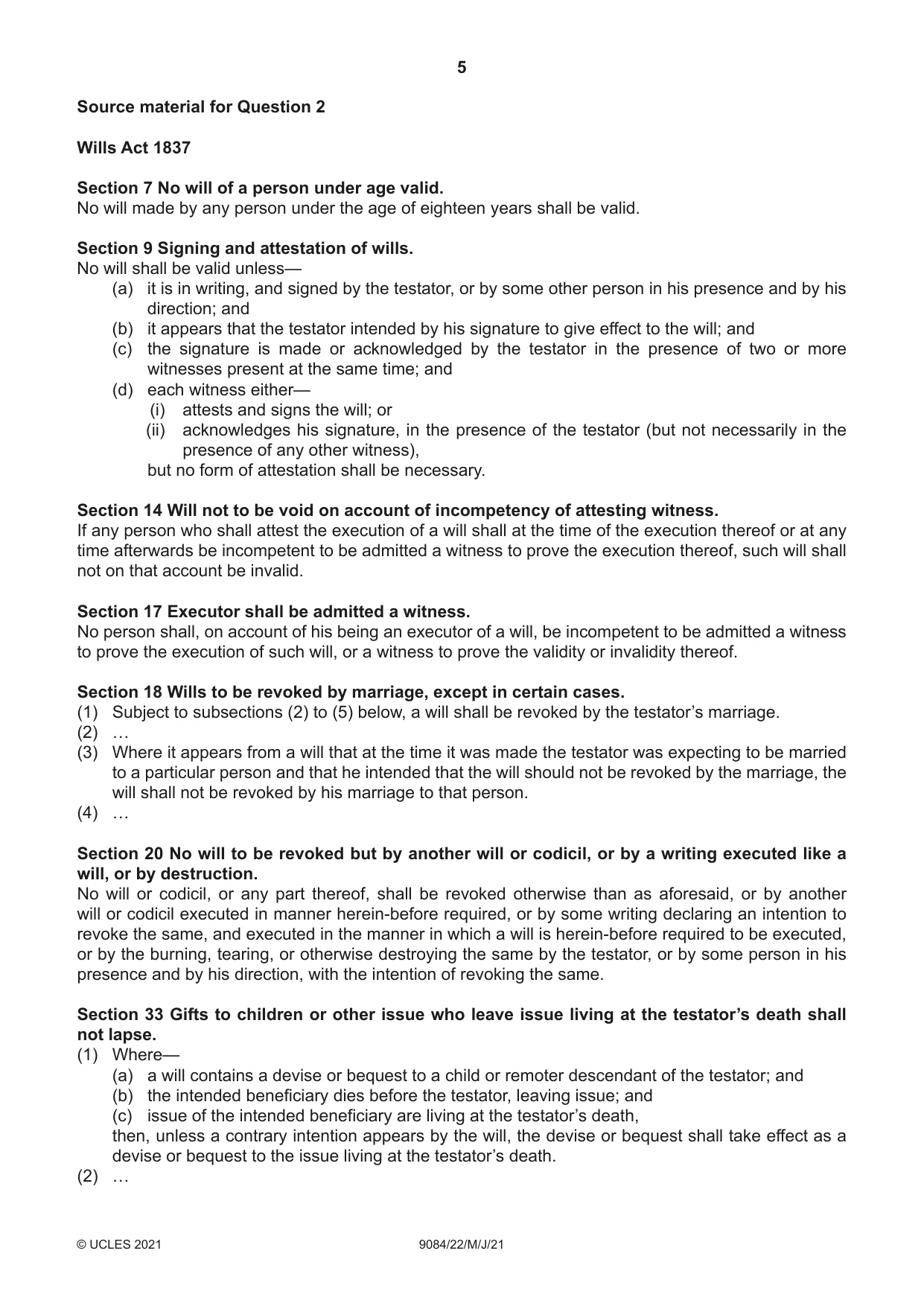
2 (a) Richard, aged 75, is very ill and wants to leave money to his favourite charity when he dies. He is not strong enough to write a will. He tells his best friend, Ben, what to write. He asks Ben to sign the will on his behalf. Richard acknowledges what Ben has written. Andrew and Fred, who are in the room when the will is written, both attest and sign the will. Three weeks later Richard dies. Fred has no recollection of being a witness as he has a brain disease which a doctor says he has been suffering from for a year. Explain how the Wills Act 1837 will apply in this situation. [10] (b) Julia, aged 30, writes her will. She signs it in the presence of four witnesses who attest and sign the will. Adam is one of the witnesses and Julia has asked him to be the executor of her will. Julia leaves a large bequest to her nephew, Paul. When Julia dies, Adam acts as executor. Adam discovers that Paul has died but has two children who are alive and so Paul’s bequest is paid to them. Explain how the Wills Act 1837 will apply in this situation. [10] (c) Ralph, aged 55, writes his will the day before he gets married. Under the will his brother, Tim, will receive a bequest of £10 000 and the rest of his estate will pass to Ralph’s wife, Flora, once they are married. Ralph signs this will in the presence of two witnesses who both attest and sign it. Ralph marries Flora but he dies a year later. The executor finds Ralph’s will made the day before his wedding folded up in his desk drawer underneath a new one, signed and validly witnessed the week before he died, leaving all of his estate to Tim. Explain how the Wills Act 1837 will apply in this situation. [10] (d) Describe the remedies available in Equity and assess the extent to which they lead to fairness in the law. [20] Source material for Question 2 Wills Act 1837 Section 7 No will of a person under age valid. No will made by any person under the age of eighteen years shall be valid. Section 9 Signing and attestation of wills. No will shall be valid unless— (a) it is in writing, and signed by the testator, or by some other person in his presence and by his direction; and (b) it appears that the testator intended by his signature to give effect to the will; and (c) the signature is made or acknowledged by the testator in the presence of two or more witnesses present at the same time; and (d) each witness either— (i) attests and signs the will; or (ii) acknowledges his signature, in the presence of the testator (but not necessarily in the presence of any other witness), but no form of attestation shall be necessary. Section 14 Will not to be void on account of incompetency of attesting witness. If any person who shall attest the execution of a will shall at the time of the execution thereof or at any time afterwards be incompetent to be admitted a witness to prove the execution thereof, such will shall not on that account be invalid. Section 17 Executor shall be admitted a witness. No person shall, on account of his being an executor of a will, be incompetent to be admitted a witness to prove the execution of such will, or a witness to prove the validity or invalidity thereof. Section 18 Wills to be revoked by marriage, except in certain cases. (1) Subject to subsections (2) to (5) below, a will shall be revoked by the testator’s marriage. (2) … (3) Where it appears from a will that at the time it was made the testator was expecting to be married to a particular person and that he intended that the will should not be revoked by the marriage, the will shall not be revoked by his marriage to that person. (4) … Section 20 No will to be revoked but by another will or codicil, or by a writing executed like a will, or by destruction. No will or codicil, or any part thereof, shall be revoked otherwise than as aforesaid, or by another will or codicil executed in manner herein‑before required, or by some writing declaring an intention to revoke the same, and executed in the manner in which a will is herein‑before required to be executed, or by the burning, tearing, or otherwise destroying the same by the testator, or by some person in his presence and by his direction, with the intention of revoking the same. Section 33 Gifts to children or other issue who leave issue living at the testator’s death shall not lapse. (1) Where— (a) a will contains a devise or bequest to a child or remoter descendant of the testator; and (b) the intended beneficiary dies before the testator, leaving issue; and (c) issue of the intended beneficiary are living at the testator’s death, then, unless a contrary intention appears by the will, the devise or bequest shall take effect as a devise or bequest to the issue living at the testator’s death. (2) …
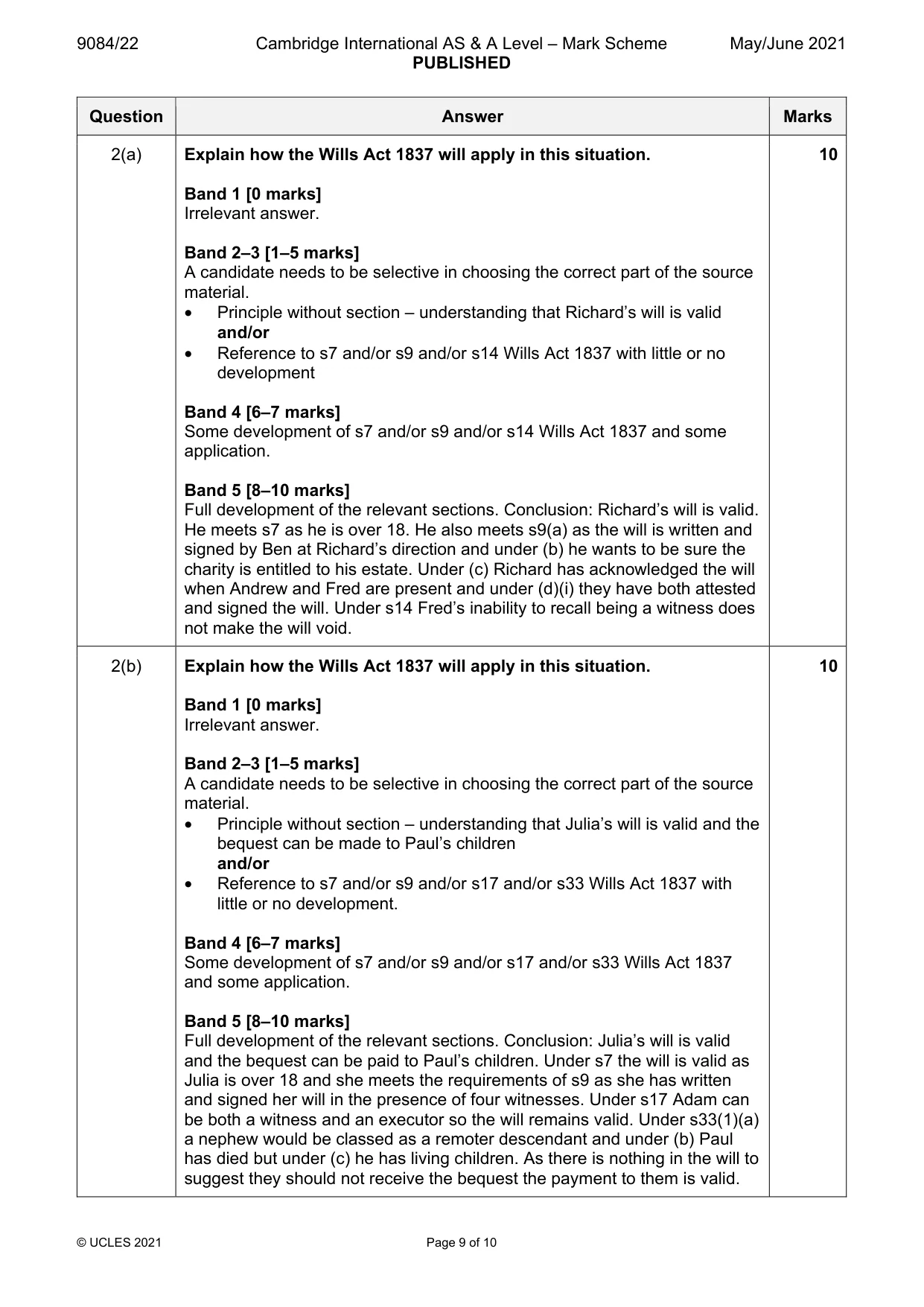
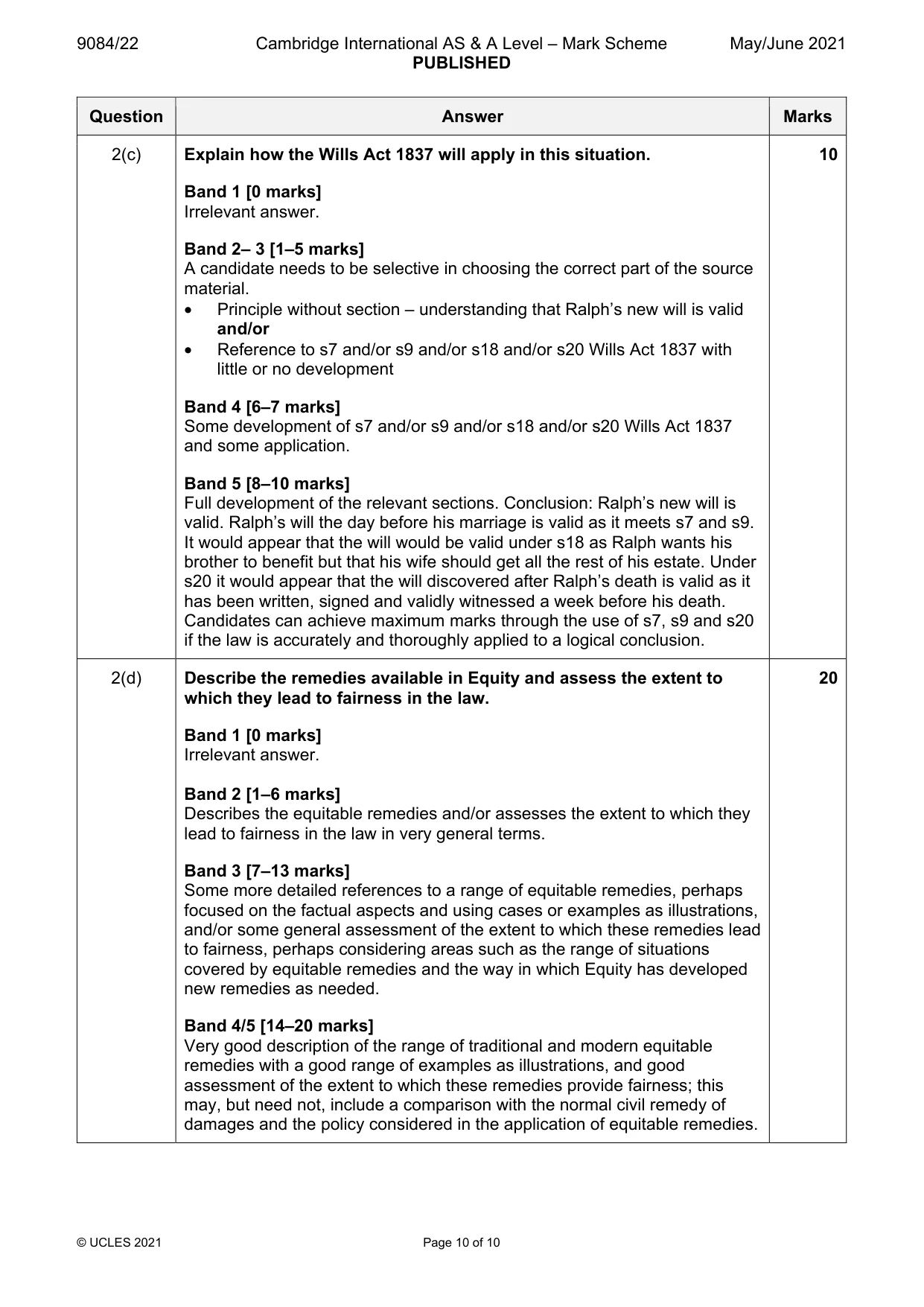
Mark scheme: 2(a) Explain how the Wills Act 1837 will apply in this situation. 10 Band 1 [0 marks] Irrelevant answer. Band 2–3 [1–5 marks] A candidate needs to be selective in choosing the correct part of the source material. • Principle without section – understanding that Richard’s will is valid and/or • Reference to s7 and/or s9 and/or s14 Wills Act 1837 with little or no development Band 4 [6–7 marks] Some development of s7 and/or s9 and/or s14 Wills Act 1837 and some application. Band 5 [8–10 marks] Full development of the relevant sections. Conclusion: Richard’s will is valid. He meets s7 as he is over 18. He also meets s9(a) as the will is written and signed by Ben at Richard’s direction and under (b) he wants to be sure the charity is entitled to his estate. Under (c) Richard has acknowledged the will when Andrew and Fred are present and under (d)(i) they have both attested and signed the will. Under s14 Fred’s inability to recall being a witness does not make the will void. 2(b) Explain how the Wills Act 1837 will apply in this situation. 10 Band 1 [0 marks] Irrelevant answer. Band 2–3 [1–5 marks] A candidate needs to be selective in choosing the correct part of the source material. • Principle without section – understanding that Julia’s will is valid and the bequest can be made to Paul’s children and/or • Reference to s7 and/or s9 and/or s17 and/or s33 Wills Act 1837 with little or no development. Band 4 [6–7 marks] Some development of s7 and/or s9 and/or s17 and/or s33 Wills Act 1837 and some application. Band 5 [8–10 marks] Full development of the relevant sections. Conclusion: Julia’s will is valid and the bequest can be paid to Paul’s children. Under s7 the will is valid as Julia is over 18 and she meets the requirements of s9 as she has written and signed her will in the presence of four witnesses. Under s17 Adam can be both a witness and an executor so the will remains valid. Under s33(1)(a) a nephew would be classed as a remoter descendant and under (b) Paul has died but under (c) he has living children. As there is nothing in the will to suggest they should not receive the bequest the payment to them is valid. 2(c) Explain how the Wills Act 1837 will apply in this situation. 10 Band 1 [0 marks] Irrelevant answer. Band 2– 3 [1–5 marks] A candidate needs to be selective in choosing the correct part of the source material. • Principle without section – understanding that Ralph’s new will is valid and/or • Reference to s7 and/or s9 and/or s18 and/or s20 Wills Act 1837 with little or no development Band 4 [6–7 marks] Some development of s7 and/or s9 and/or s18 and/or s20 Wills Act 1837 and some application. Band 5 [8–10 marks] Full development of the relevant sections. Conclusion: Ralph’s new will is valid. Ralph’s will the day before his marriage is valid as it meets s7 and s9. It would appear that the will would be valid under s18 as Ralph wants his brother to benefit but that his wife should get all the rest of his estate. Under s20 it would appear that the will discovered after Ralph’s death is valid as it has been written, signed and validly witnessed a week before his death. Candidates can achieve maximum marks through the use of s7, s9 and s20 if the law is accurately and thoroughly applied to a logical conclusion. 2(d) Describe the remedies available in Equity and assess the extent to 20 which they lead to fairness in the law. Band 1 [0 marks] Irrelevant answer. Band 2 [1–6 marks] Describes the equitable remedies and/or assesses the extent to which they lead to fairness in the law in very general terms. Band 3 [7–13 marks] Some more detailed references to a range of equitable remedies, perhaps focused on the factual aspects and using cases or examples as illustrations, and/or some general assessment of the extent to which these remedies lead to fairness, perhaps considering areas such as the range of situations covered by equitable remedies and the way in which Equity has developed new remedies as needed. Band 4/5 [14–20 marks] Very good description of the range of traditional and modern equitable remedies with a good range of examples as illustrations, and good assessment of the extent to which these remedies provide fairness; this may, but need not, include a comparison with the normal civil remedy of damages and the policy considered in the application of equitable remedies.
What was in this paper
The subtopics covered by these 2 questions, and how many questions each got. Open one in a new tab to see every Cambridge question on it.
1Machinery of justice This topic introduces the institutions and processes involved in the resolution of civil and criminal matters. This topic is an opportunity to reflect on the key concepts of power and its limits; justice, fairness and morality; effectiveness and certainty; and liability1What you needed in this session
Cambridge’s own grade thresholds for 2021 May/June, Paper 2 · Variant 2. A higher threshold means an easier paper — the bar moves with how the cohort did.