Cambridge A Level Law 9084 — 2021 May/June Paper 2 · Variant 1
9084/21/M/J/21 · 2 questions · 50 marks · ≈56 min
The question paper and its mark scheme, free to read here and free to download. This is Cambridge’s own paper, exactly as it was sat.
Question paper8 pages



Mark scheme10 pages
Answers below. Sit the paper first if you are practising.
Questions as text
Q1 · Carlos knows that his friend, Andreas, would like to own a motorbike but cannot afford to…
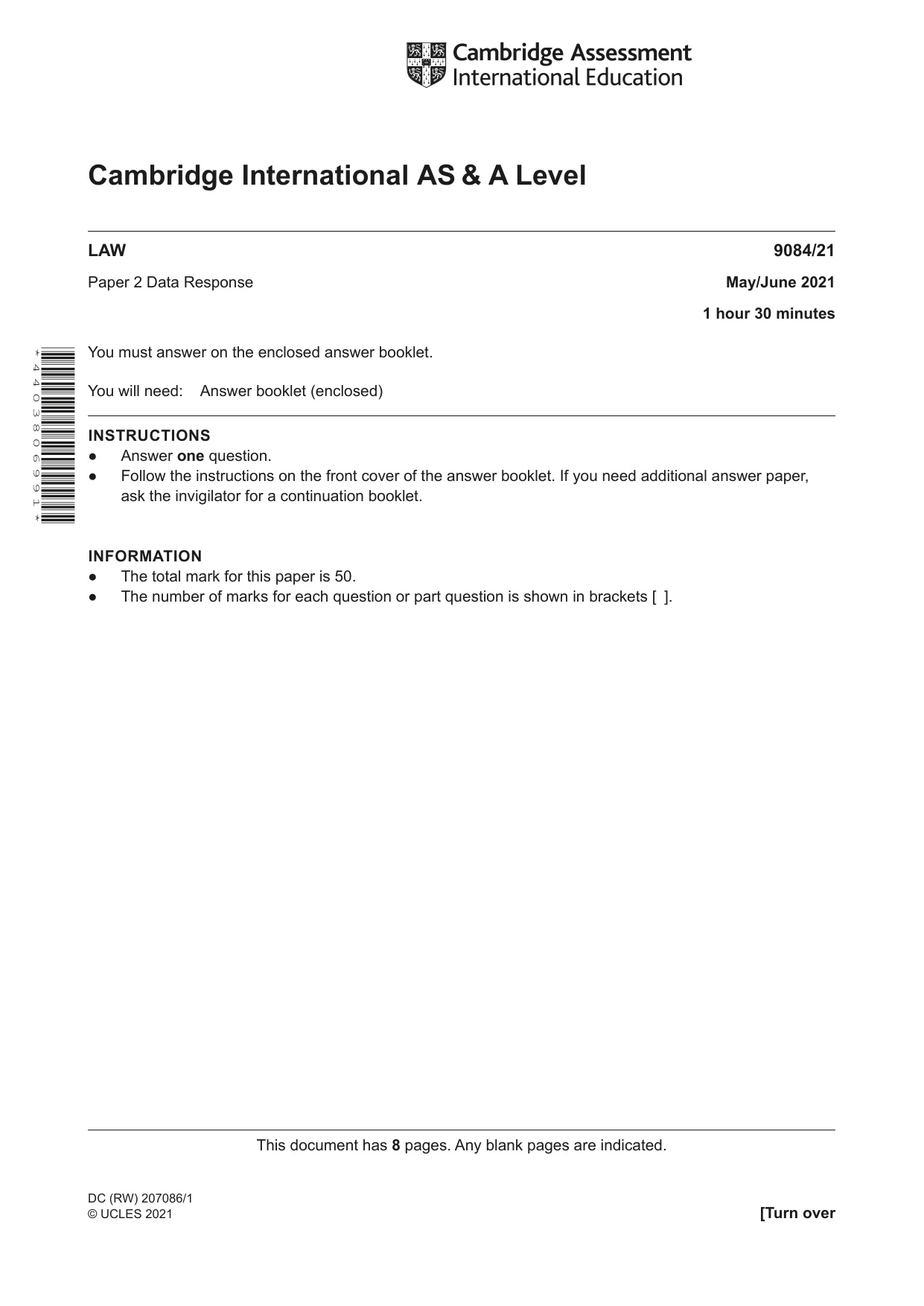
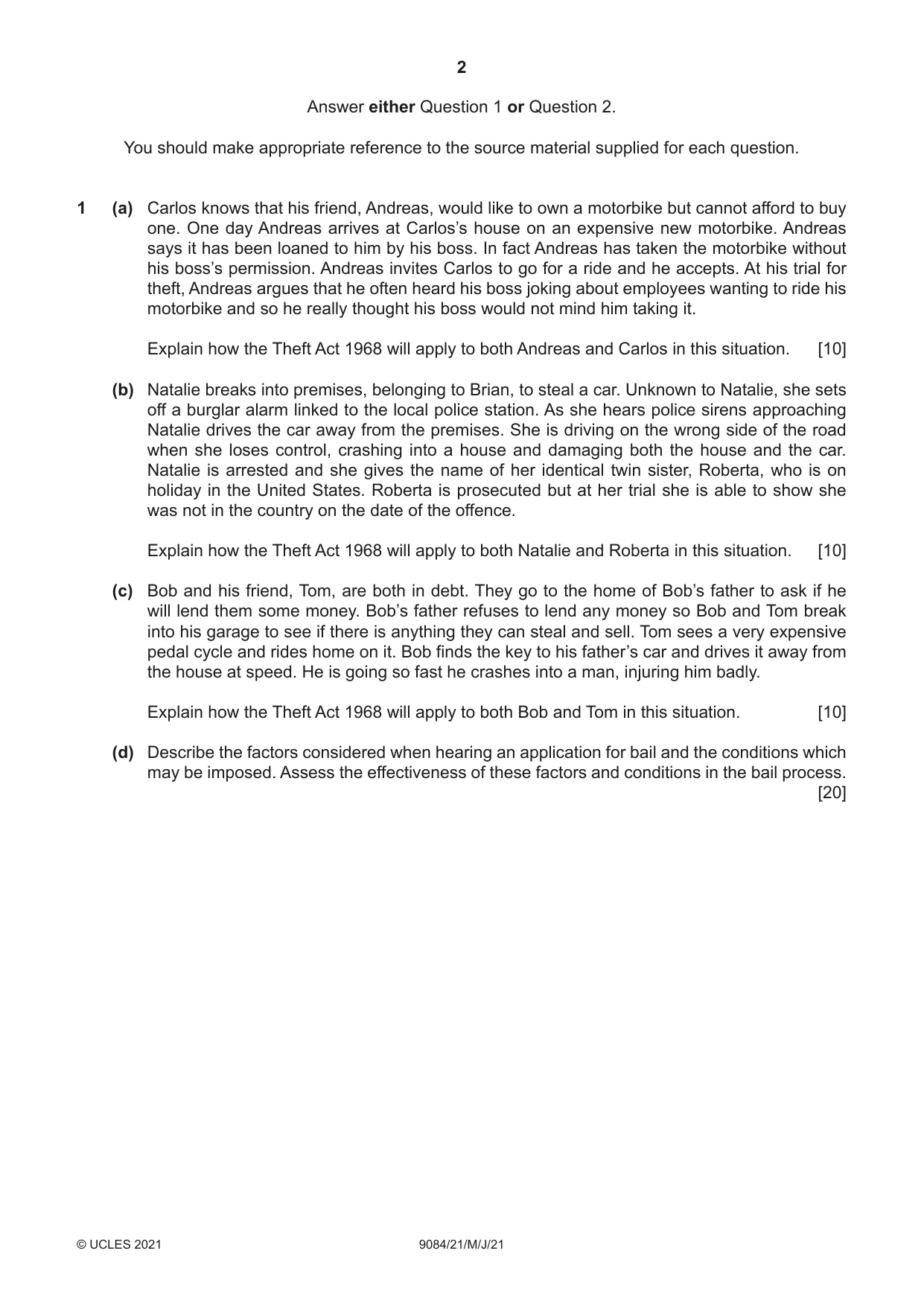
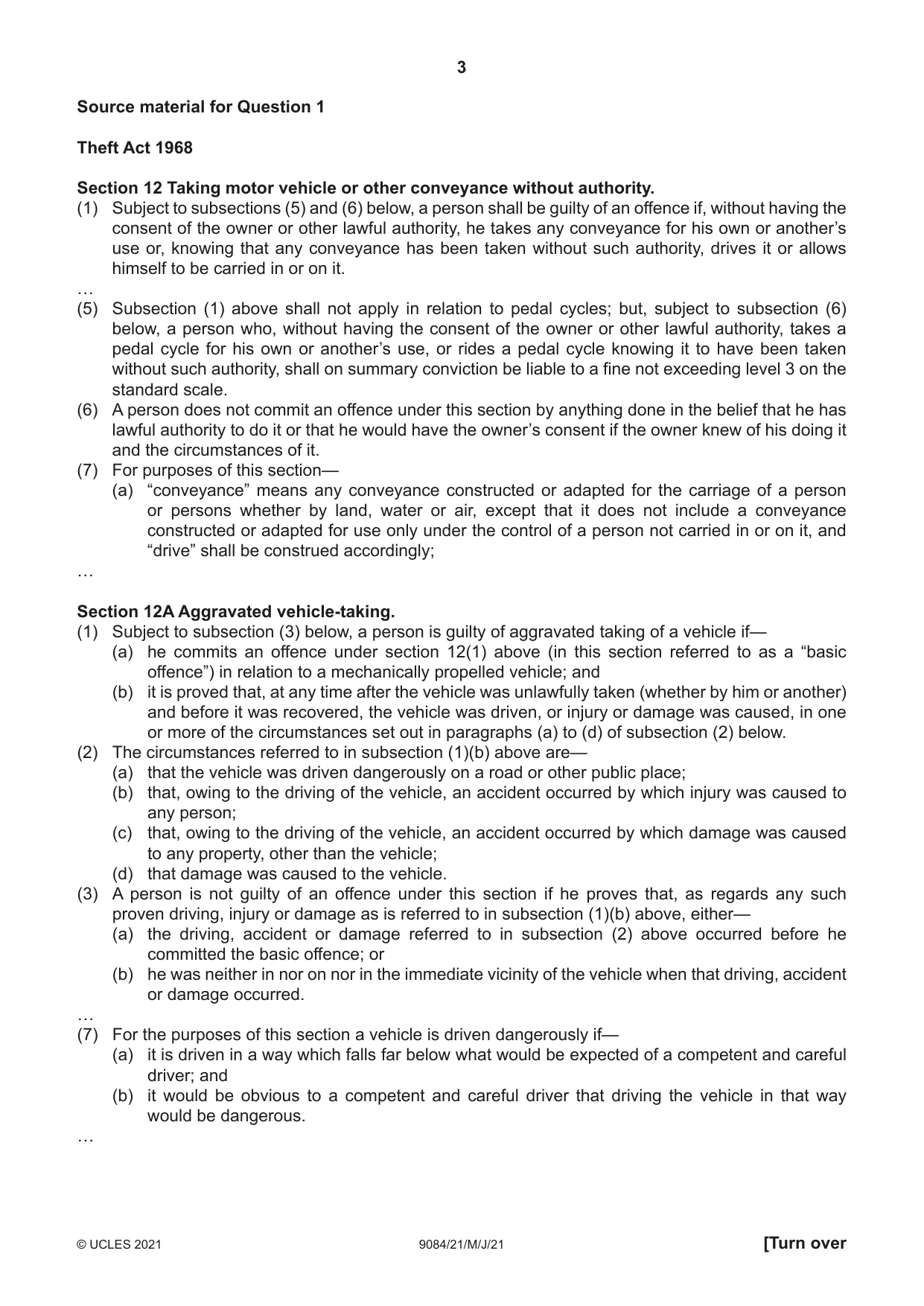
1 (a) Carlos knows that his friend, Andreas, would like to own a motorbike but cannot afford to buy one. One day Andreas arrives at Carlos’s house on an expensive new motorbike. Andreas says it has been loaned to him by his boss. In fact Andreas has taken the motorbike without his boss’s permission. Andreas invites Carlos to go for a ride and he accepts. At his trial for theft, Andreas argues that he often heard his boss joking about employees wanting to ride his motorbike and so he really thought his boss would not mind him taking it. Explain how the Theft Act 1968 will apply to both Andreas and Carlos in this situation. [10] (b) Natalie breaks into premises, belonging to Brian, to steal a car. Unknown to Natalie, she sets off a burglar alarm linked to the local police station. As she hears police sirens approaching Natalie drives the car away from the premises. She is driving on the wrong side of the road when she loses control, crashing into a house and damaging both the house and the car. Natalie is arrested and she gives the name of her identical twin sister, Roberta, who is on holiday in the United States. Roberta is prosecuted but at her trial she is able to show she was not in the country on the date of the offence. Explain how the Theft Act 1968 will apply to both Natalie and Roberta in this situation. [10] (c) Bob and his friend, Tom, are both in debt. They go to the home of Bob’s father to ask if he will lend them some money. Bob’s father refuses to lend any money so Bob and Tom break into his garage to see if there is anything they can steal and sell. Tom sees a very expensive pedal cycle and rides home on it. Bob finds the key to his father’s car and drives it away from the house at speed. He is going so fast he crashes into a man, injuring him badly. Explain how the Theft Act 1968 will apply to both Bob and Tom in this situation. [10] (d) Describe the factors considered when hearing an application for bail and the conditions which may be imposed. Assess the effectiveness of these factors and conditions in the bail process. [20] Source material for Question 1 Theft Act 1968 Section 12 Taking motor vehicle or other conveyance without authority. (1) Subject to subsections (5) and (6) below, a person shall be guilty of an offence if, without having the consent of the owner or other lawful authority, he takes any conveyance for his own or another’s use or, knowing that any conveyance has been taken without such authority, drives it or allows himself to be carried in or on it. … (5) Subsection (1) above shall not apply in relation to pedal cycles; but, subject to subsection (6) below, a person who, without having the consent of the owner or other lawful authority, takes a pedal cycle for his own or another’s use, or rides a pedal cycle knowing it to have been taken without such authority, shall on summary conviction be liable to a fine not exceeding level 3 on the standard scale. (6) A person does not commit an offence under this section by anything done in the belief that he has lawful authority to do it or that he would have the owner’s consent if the owner knew of his doing it and the circumstances of it. (7) For purposes of this section— (a) “conveyance” means any conveyance constructed or adapted for the carriage of a person or persons whether by land, water or air, except that it does not include a conveyance constructed or adapted for use only under the control of a person not carried in or on it, and “drive” shall be construed accordingly; … Section 12A Aggravated vehicle‑taking. (1) Subject to subsection (3) below, a person is guilty of aggravated taking of a vehicle if— (a) he commits an offence under section 12(1) above (in this section referred to as a “basic offence”) in relation to a mechanically propelled vehicle; and (b) it is proved that, at any time after the vehicle was unlawfully taken (whether by him or another) and before it was recovered, the vehicle was driven, or injury or damage was caused, in one or more of the circumstances set out in paragraphs (a) to (d) of subsection (2) below. (2) The circumstances referred to in subsection (1)(b) above are— (a) that the vehicle was driven dangerously on a road or other public place; (b) that, owing to the driving of the vehicle, an accident occurred by which injury was caused to any person; (c) that, owing to the driving of the vehicle, an accident occurred by which damage was caused to any property, other than the vehicle; (d) that damage was caused to the vehicle. (3) A person is not guilty of an offence under this section if he proves that, as regards any such proven driving, injury or damage as is referred to in subsection (1)(b) above, either— (a) the driving, accident or damage referred to in subsection (2) above occurred before he committed the basic offence; or (b) he was neither in nor on nor in the immediate vicinity of the vehicle when that driving, accident or damage occurred. … (7) For the purposes of this section a vehicle is driven dangerously if— (a) it is driven in a way which falls far below what would be expected of a competent and careful driver; and (b) it would be obvious to a competent and careful driver that driving the vehicle in that way would be dangerous. …
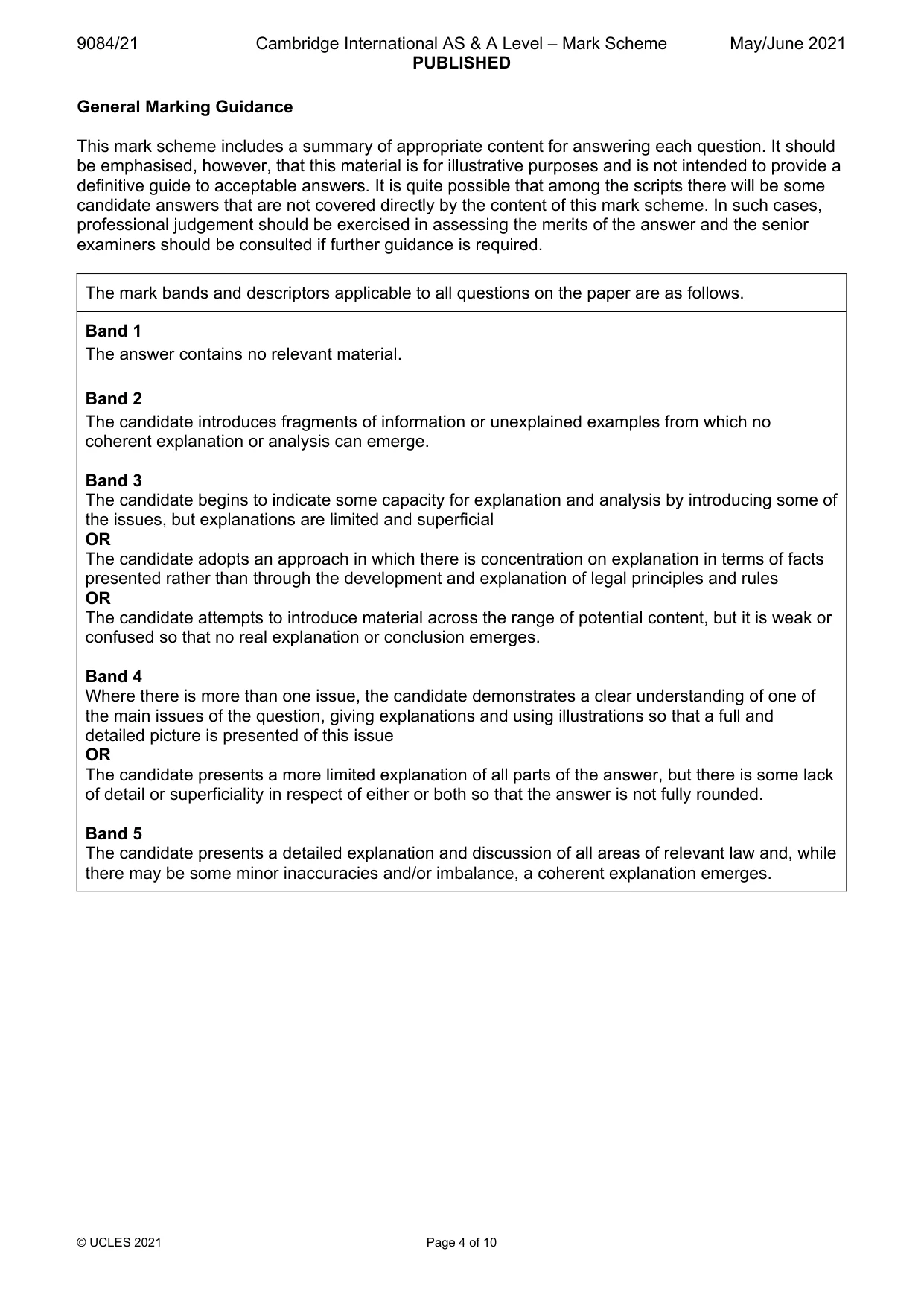
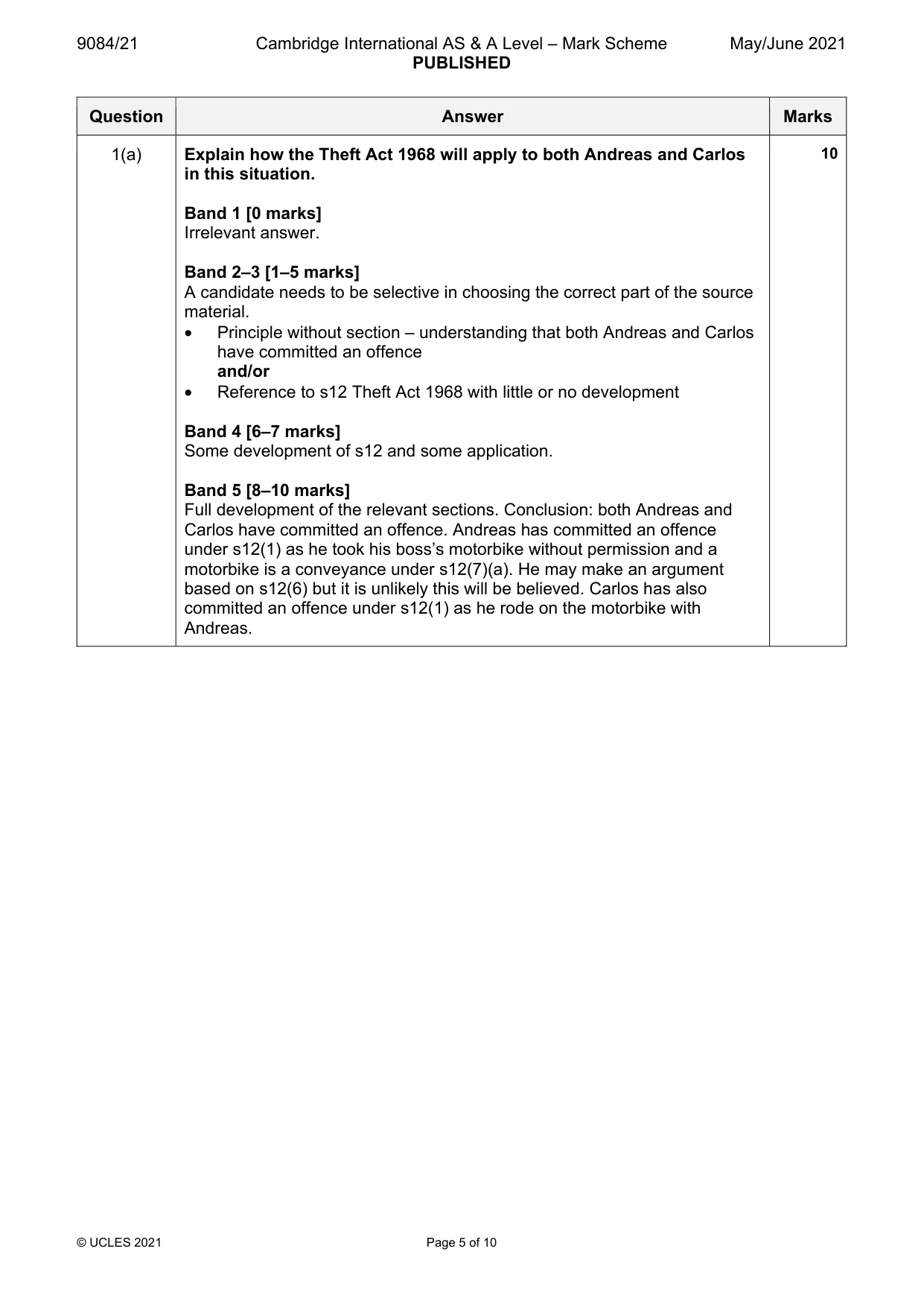
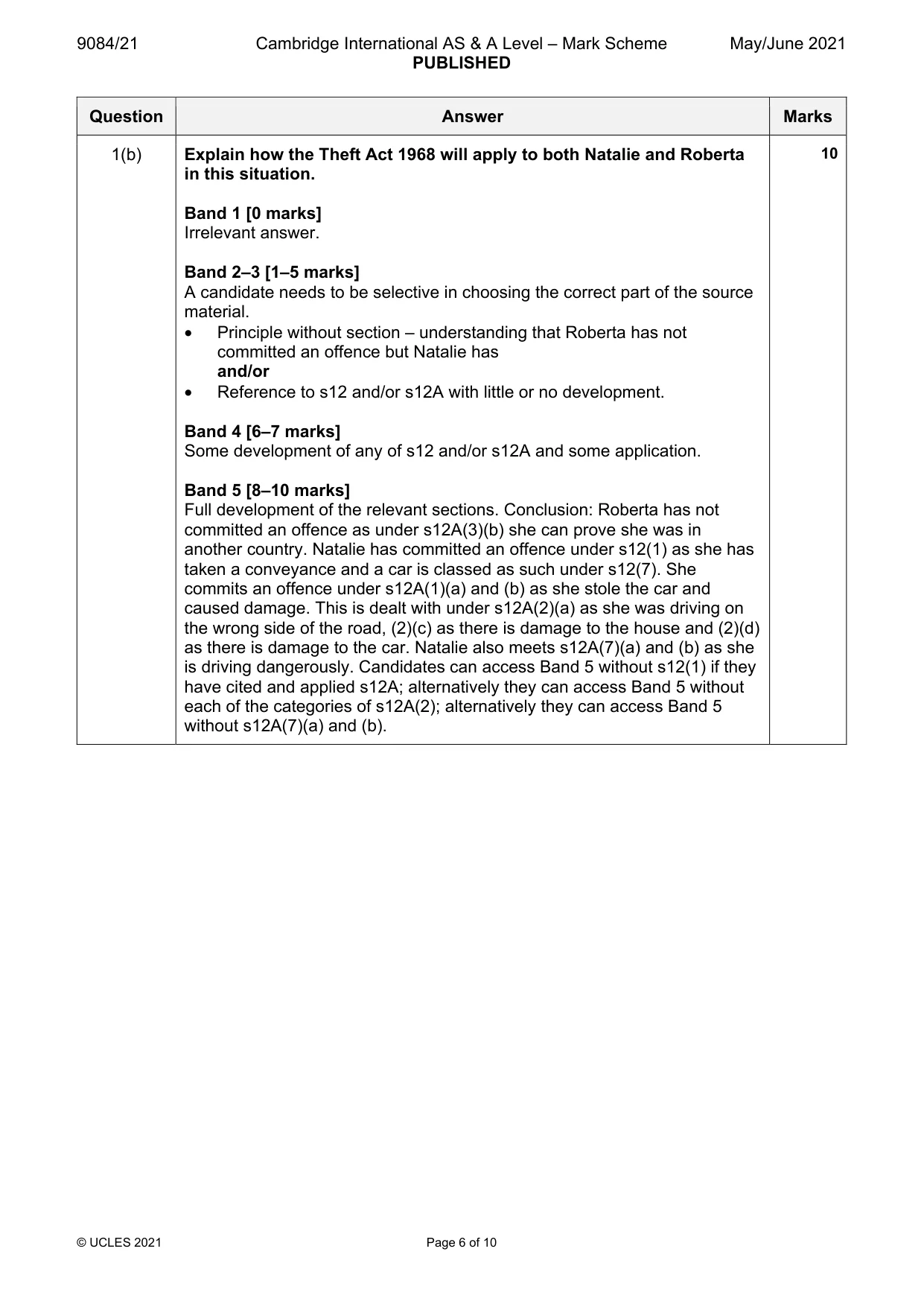
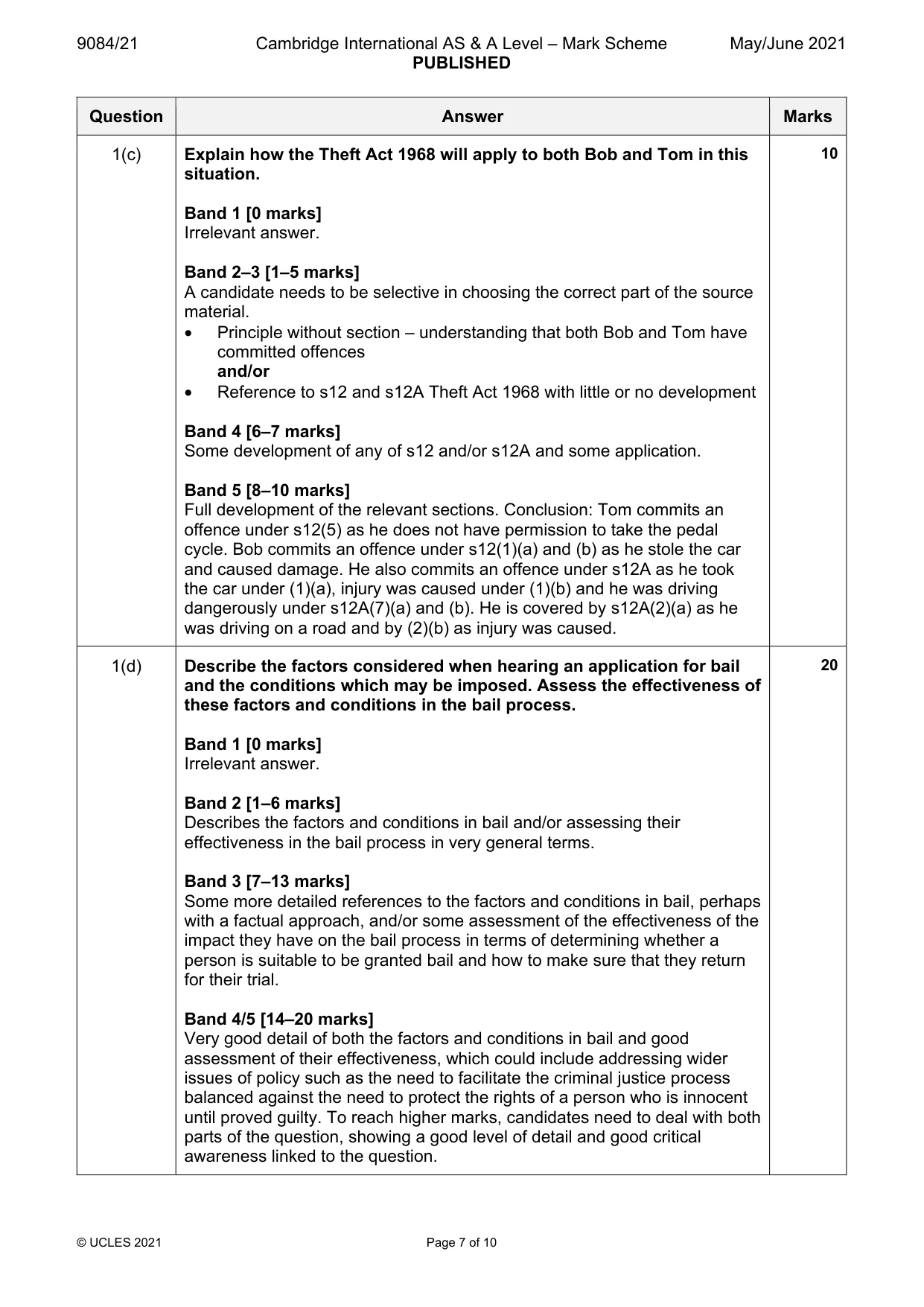
Mark scheme: Question Answer Marks 1(a) Explain how the Theft Act 1968 will apply to both Andreas and Carlos 10 in this situation. Band 1 [0 marks] Irrelevant answer. Band 2–3 [1–5 marks] A candidate needs to be selective in choosing the correct part of the source material. • Principle without section – understanding that both Andreas and Carlos have committed an offence and/or • Reference to s12 Theft Act 1968 with little or no development Band 4 [6–7 marks] Some development of s12 and some application. Band 5 [8–10 marks] Full development of the relevant sections. Conclusion: both Andreas and Carlos have committed an offence. Andreas has committed an offence under s12(1) as he took his boss’s motorbike without permission and a motorbike is a conveyance under s12(7)(a). He may make an argument based on s12(6) but it is unlikely this will be believed. Carlos has also committed an offence under s12(1) as he rode on the motorbike with Andreas. 1(b) Explain how the Theft Act 1968 will apply to both Natalie and Roberta 10 in this situation. Band 1 [0 marks] Irrelevant answer. Band 2–3 [1–5 marks] A candidate needs to be selective in choosing the correct part of the source material. • Principle without section – understanding that Roberta has not committed an offence but Natalie has and/or • Reference to s12 and/or s12A with little or no development. Band 4 [6–7 marks] Some development of any of s12 and/or s12A and some application. Band 5 [8–10 marks] Full development of the relevant sections. Conclusion: Roberta has not committed an offence as under s12A(3)(b) she can prove she was in another country. Natalie has committed an offence under s12(1) as she has taken a conveyance and a car is classed as such under s12(7). She commits an offence under s12A(1)(a) and (b) as she stole the car and caused damage. This is dealt with under s12A(2)(a) as she was driving on the wrong side of the road, (2)(c) as there is damage to the house and (2)(d) as there is damage to the car. Natalie also meets s12A(7)(a) and (b) as she is driving dangerously. Candidates can access Band 5 without s12(1) if they have cited and applied s12A; alternatively they can access Band 5 without each of the categories of s12A(2); alternatively they can access Band 5 without s12A(7)(a) and (b). 1(c) Explain how the Theft Act 1968 will apply to both Bob and Tom in this 10 situation. Band 1 [0 marks] Irrelevant answer. Band 2–3 [1–5 marks] A candidate needs to be selective in choosing the correct part of the source material. • Principle without section – understanding that both Bob and Tom have committed offences and/or • Reference to s12 and s12A Theft Act 1968 with little or no development Band 4 [6–7 marks] Some development of any of s12 and/or s12A and some application. Band 5 [8–10 marks] Full development of the relevant sections. Conclusion: Tom commits an offence under s12(5) as he does not have permission to take the pedal cycle. Bob commits an offence under s12(1)(a) and (b) as he stole the car and caused damage. He also commits an offence under s12A as he took the car under (1)(a), injury was caused under (1)(b) and he was driving dangerously under s12A(7)(a) and (b). He is covered by s12A(2)(a) as he was driving on a road and by (2)(b) as injury was caused. 1(d) Describe the factors considered when hearing an application for bail 20 and the conditions which may be imposed. Assess the effectiveness of these factors and conditions in the bail process. Band 1 [0 marks] Irrelevant answer. Band 2 [1–6 marks] Describes the factors and conditions in bail and/or assessing their effectiveness in the bail process in very general terms. Band 3 [7–13 marks] Some more detailed references to the factors and conditions in bail, perhaps with a factual approach, and/or some assessment of the effectiveness of the impact they have on the bail process in terms of determining whether a person is suitable to be granted bail and how to make sure that they return for their trial. Band 4/5 [14–20 marks] Very good detail of both the factors and conditions in bail and good assessment of their effectiveness, which could include addressing wider issues of policy such as the need to facilitate the criminal justice process balanced against the need to protect the rights of a person who is innocent until proved guilty. To reach higher marks, candidates need to deal with both parts of the question, showing a good level of detail and good critical awareness linked to the question.
Q2 · Khalid buys a second hand car
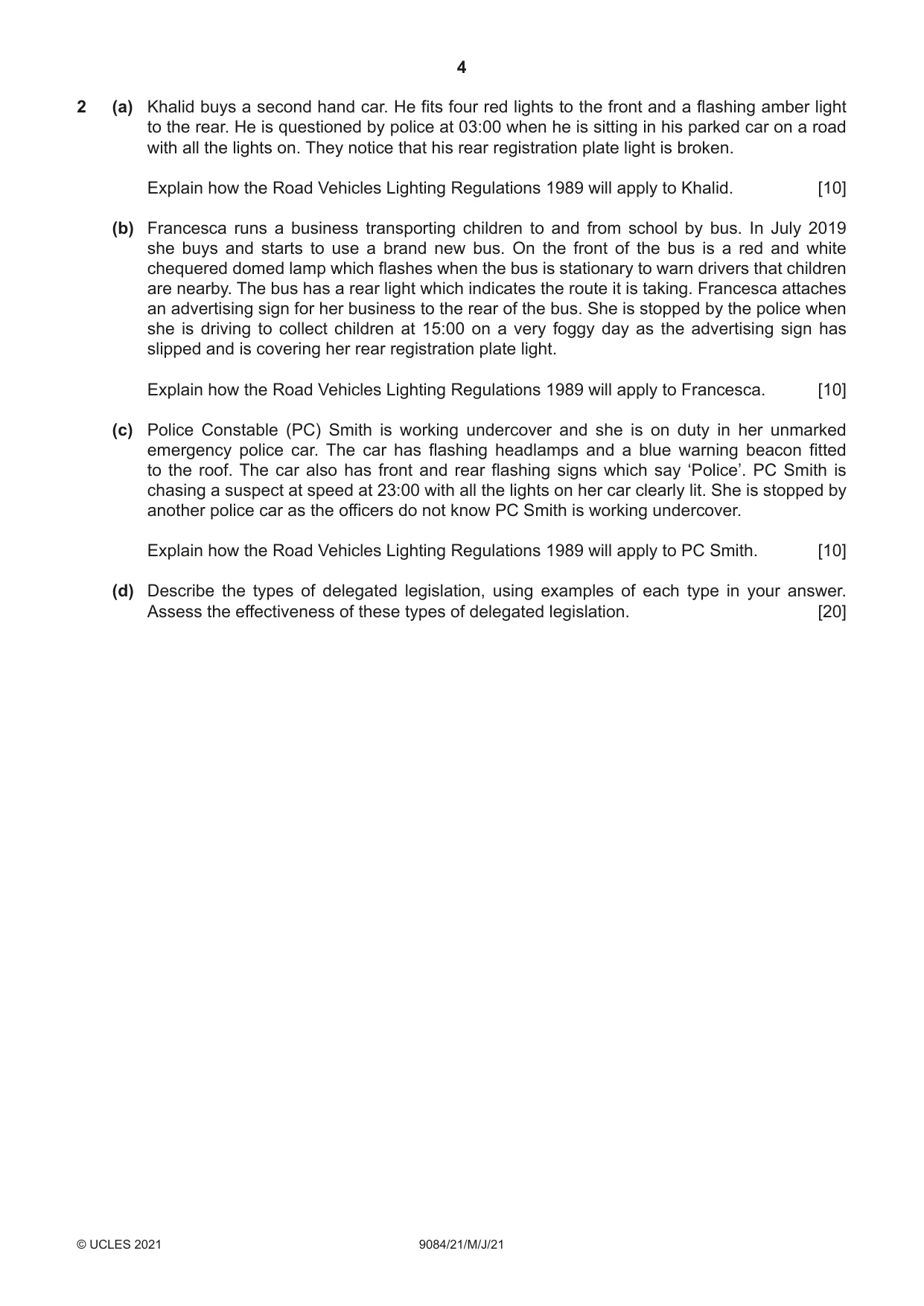
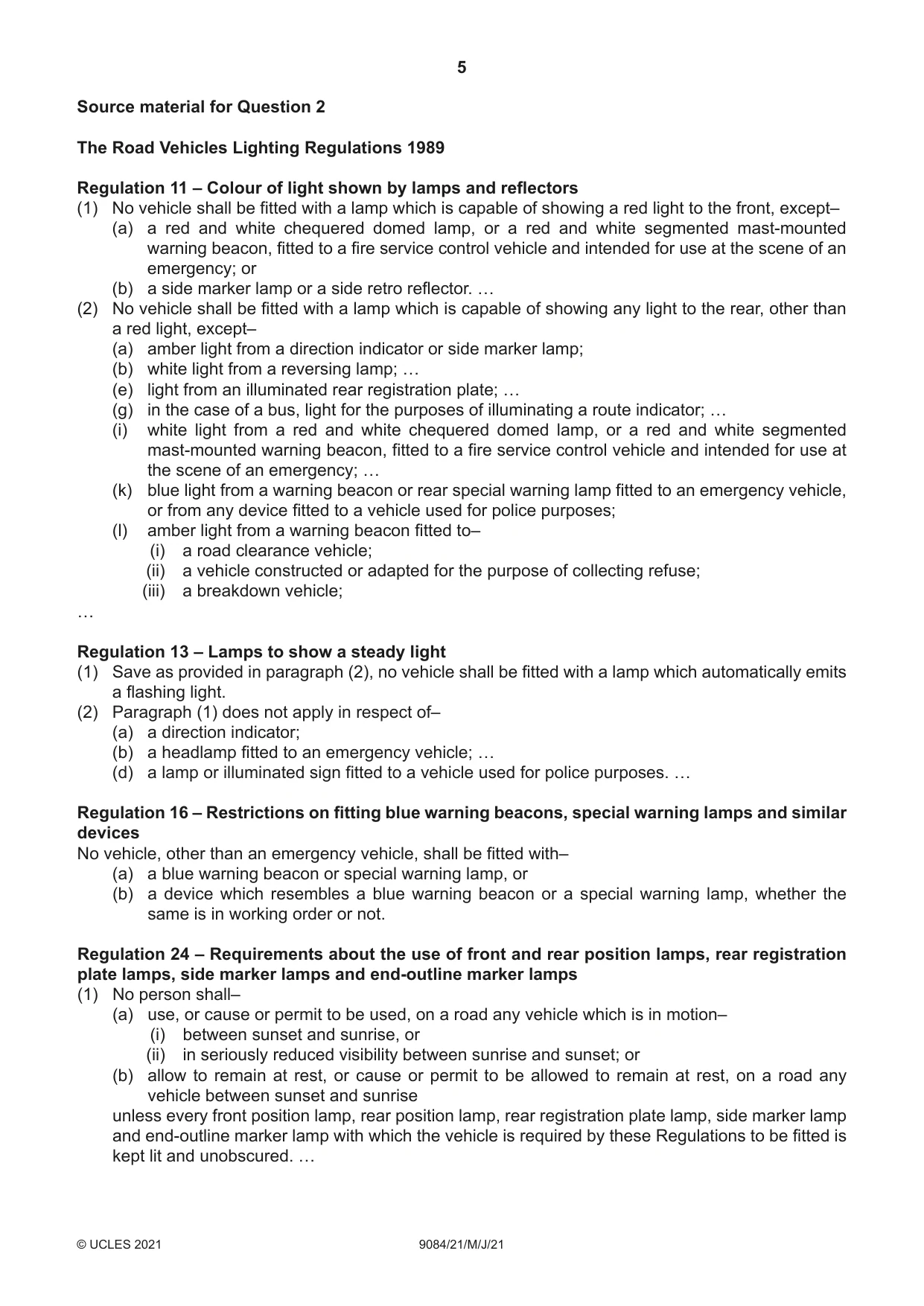
2 (a) Khalid buys a second hand car. He fits four red lights to the front and a flashing amber light to the rear. He is questioned by police at 03:00 when he is sitting in his parked car on a road with all the lights on. They notice that his rear registration plate light is broken. Explain how the Road Vehicles Lighting Regulations 1989 will apply to Khalid. [10] (b) Francesca runs a business transporting children to and from school by bus. In July 2019 she buys and starts to use a brand new bus. On the front of the bus is a red and white chequered domed lamp which flashes when the bus is stationary to warn drivers that children are nearby. The bus has a rear light which indicates the route it is taking. Francesca attaches an advertising sign for her business to the rear of the bus. She is stopped by the police when she is driving to collect children at 15:00 on a very foggy day as the advertising sign has slipped and is covering her rear registration plate light. Explain how the Road Vehicles Lighting Regulations 1989 will apply to Francesca. [10] (c) Police Constable (PC) Smith is working undercover and she is on duty in her unmarked emergency police car. The car has flashing headlamps and a blue warning beacon fitted to the roof. The car also has front and rear flashing signs which say ‘Police’. PC Smith is chasing a suspect at speed at 23:00 with all the lights on her car clearly lit. She is stopped by another police car as the officers do not know PC Smith is working undercover. Explain how the Road Vehicles Lighting Regulations 1989 will apply to PC Smith. [10] (d) Describe the types of delegated legislation, using examples of each type in your answer. Assess the effectiveness of these types of delegated legislation. [20] Source material for Question 2 The Road Vehicles Lighting Regulations 1989 Regulation 11 – Colour of light shown by lamps and reflectors (1) No vehicle shall be fitted with a lamp which is capable of showing a red light to the front, except– (a) a red and white chequered domed lamp, or a red and white segmented mast‑mounted warning beacon, fitted to a fire service control vehicle and intended for use at the scene of an emergency; or (b) a side marker lamp or a side retro reflector. … (2) No vehicle shall be fitted with a lamp which is capable of showing any light to the rear, other than a red light, except– (a) amber light from a direction indicator or side marker lamp; (b) white light from a reversing lamp; … (e) light from an illuminated rear registration plate; … (g) in the case of a bus, light for the purposes of illuminating a route indicator; … (i) white light from a red and white chequered domed lamp, or a red and white segmented mast‑mounted warning beacon, fitted to a fire service control vehicle and intended for use at the scene of an emergency; … (k) blue light from a warning beacon or rear special warning lamp fitted to an emergency vehicle, or from any device fitted to a vehicle used for police purposes; (l) amber light from a warning beacon fitted to– (i) a road clearance vehicle; (ii) a vehicle constructed or adapted for the purpose of collecting refuse; (iii) a breakdown vehicle; … Regulation 13 – Lamps to show a steady light (1) Save as provided in paragraph (2), no vehicle shall be fitted with a lamp which automatically emits a flashing light. (2) Paragraph (1) does not apply in respect of– (a) a direction indicator; (b) a headlamp fitted to an emergency vehicle; … (d) a lamp or illuminated sign fitted to a vehicle used for police purposes. … Regulation 16 – Restrictions on fitting blue warning beacons, special warning lamps and similar devices No vehicle, other than an emergency vehicle, shall be fitted with– (a) a blue warning beacon or special warning lamp, or (b) a device which resembles a blue warning beacon or a special warning lamp, whether the same is in working order or not. Regulation 24 – Requirements about the use of front and rear position lamps, rear registration plate lamps, side marker lamps and end‑outline marker lamps (1) No person shall– (a) use, or cause or permit to be used, on a road any vehicle which is in motion– (i) between sunset and sunrise, or (ii) in seriously reduced visibility between sunrise and sunset; or (b) allow to remain at rest, or cause or permit to be allowed to remain at rest, on a road any vehicle between sunset and sunrise unless every front position lamp, rear position lamp, rear registration plate lamp, side marker lamp and end‑outline marker lamp with which the vehicle is required by these Regulations to be fitted is kept lit and unobscured. …
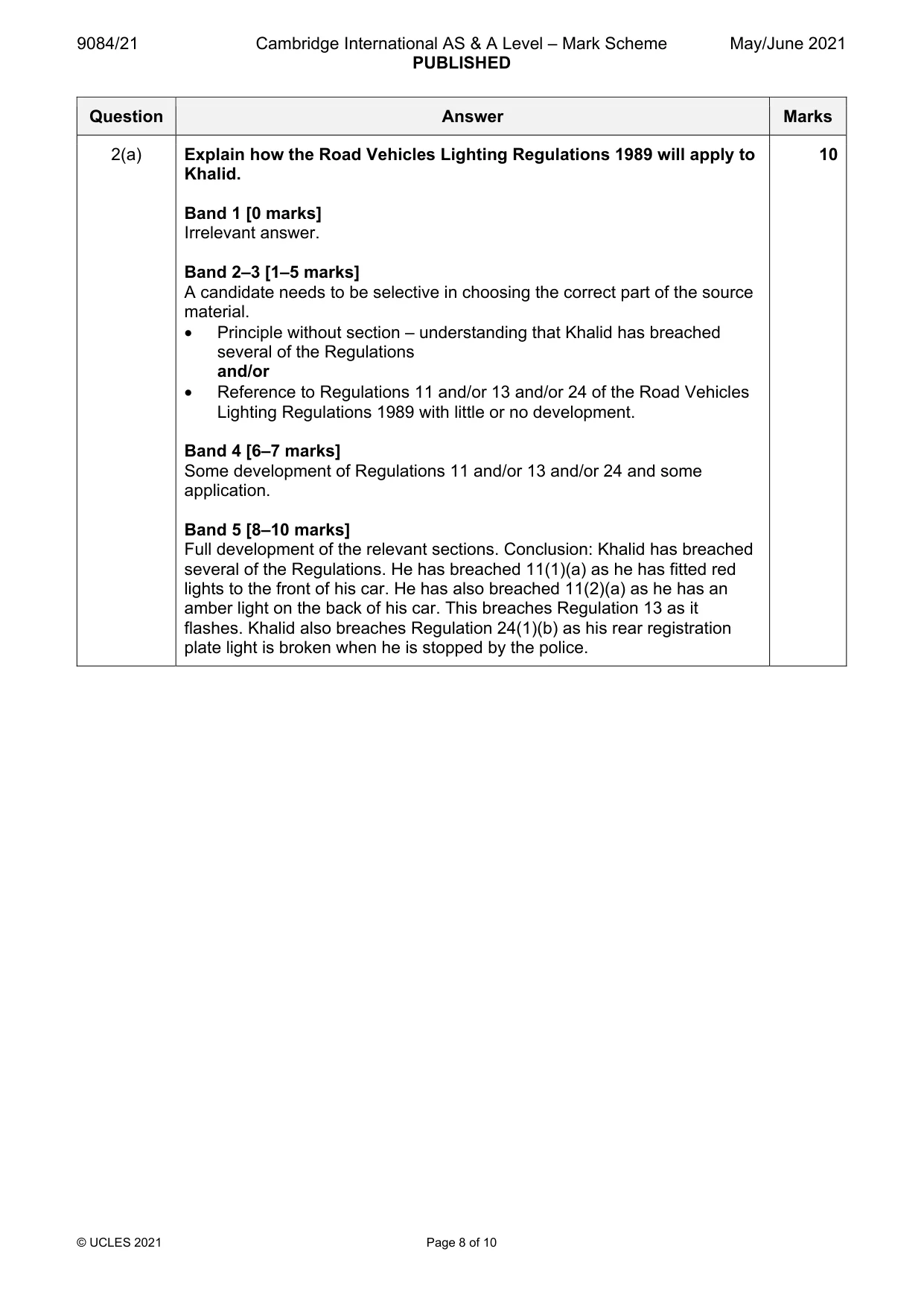
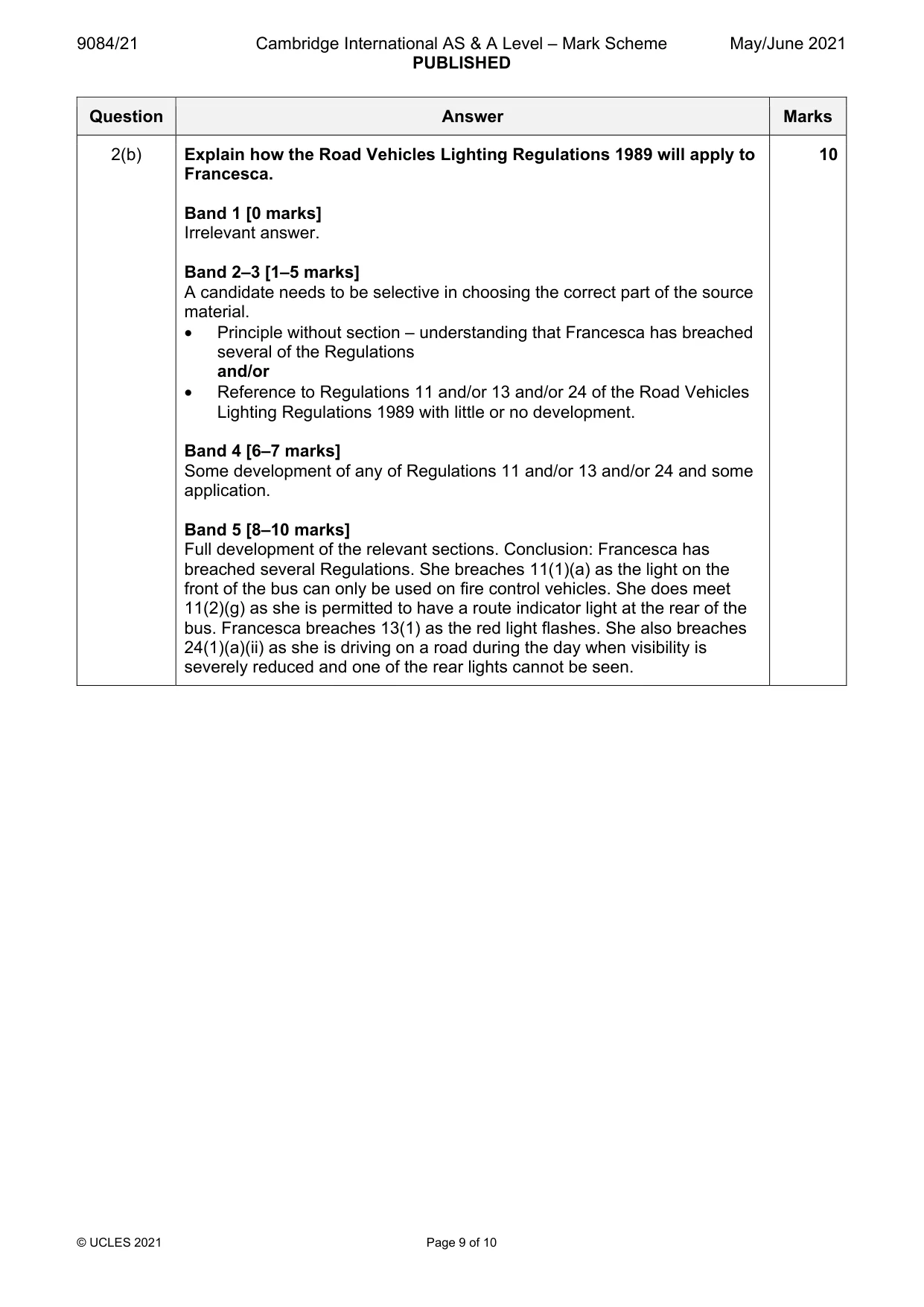
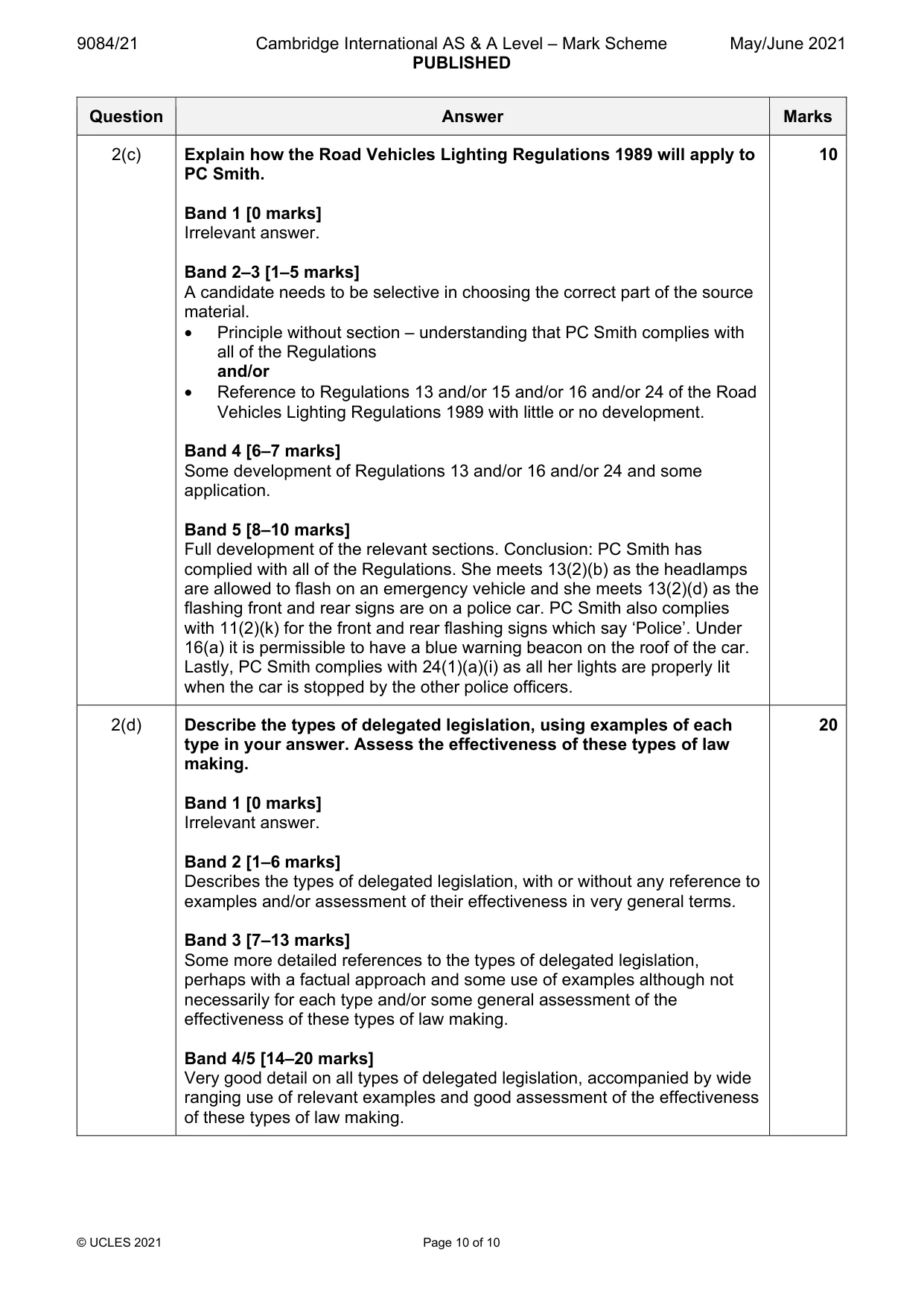
Mark scheme: 2(a) Explain how the Road Vehicles Lighting Regulations 1989 will apply to 10 Khalid. Band 1 [0 marks] Irrelevant answer. Band 2–3 [1–5 marks] A candidate needs to be selective in choosing the correct part of the source material. • Principle without section – understanding that Khalid has breached several of the Regulations and/or • Reference to Regulations 11 and/or 13 and/or 24 of the Road Vehicles Lighting Regulations 1989 with little or no development. Band 4 [6–7 marks] Some development of Regulations 11 and/or 13 and/or 24 and some application. Band 5 [8–10 marks] Full development of the relevant sections. Conclusion: Khalid has breached several of the Regulations. He has breached 11(1)(a) as he has fitted red lights to the front of his car. He has also breached 11(2)(a) as he has an amber light on the back of his car. This breaches Regulation 13 as it flashes. Khalid also breaches Regulation 24(1)(b) as his rear registration plate light is broken when he is stopped by the police. 2(b) Explain how the Road Vehicles Lighting Regulations 1989 will apply to 10 Francesca. Band 1 [0 marks] Irrelevant answer. Band 2–3 [1–5 marks] A candidate needs to be selective in choosing the correct part of the source material. • Principle without section – understanding that Francesca has breached several of the Regulations and/or • Reference to Regulations 11 and/or 13 and/or 24 of the Road Vehicles Lighting Regulations 1989 with little or no development. Band 4 [6–7 marks] Some development of any of Regulations 11 and/or 13 and/or 24 and some application. Band 5 [8–10 marks] Full development of the relevant sections. Conclusion: Francesca has breached several Regulations. She breaches 11(1)(a) as the light on the front of the bus can only be used on fire control vehicles. She does meet 11(2)(g) as she is permitted to have a route indicator light at the rear of the bus. Francesca breaches 13(1) as the red light flashes. She also breaches 24(1)(a)(ii) as she is driving on a road during the day when visibility is severely reduced and one of the rear lights cannot be seen. 2(c) Explain how the Road Vehicles Lighting Regulations 1989 will apply to 10 PC Smith. Band 1 [0 marks] Irrelevant answer. Band 2–3 [1–5 marks] A candidate needs to be selective in choosing the correct part of the source material. • Principle without section – understanding that PC Smith complies with all of the Regulations and/or • Reference to Regulations 13 and/or 15 and/or 16 and/or 24 of the Road Vehicles Lighting Regulations 1989 with little or no development. Band 4 [6–7 marks] Some development of Regulations 13 and/or 16 and/or 24 and some application. Band 5 [8–10 marks] Full development of the relevant sections. Conclusion: PC Smith has complied with all of the Regulations. She meets 13(2)(b) as the headlamps are allowed to flash on an emergency vehicle and she meets 13(2)(d) as the flashing front and rear signs are on a police car. PC Smith also complies with 11(2)(k) for the front and rear flashing signs which say ‘Police’. Under 16(a) it is permissible to have a blue warning beacon on the roof of the car. Lastly, PC Smith complies with 24(1)(a)(i) as all her lights are properly lit when the car is stopped by the other police officers. 2(d) Describe the types of delegated legislation, using examples of each 20 type in your answer. Assess the effectiveness of these types of law making. Band 1 [0 marks] Irrelevant answer. Band 2 [1–6 marks] Describes the types of delegated legislation, with or without any reference to examples and/or assessment of their effectiveness in very general terms. Band 3 [7–13 marks] Some more detailed references to the types of delegated legislation, perhaps with a factual approach and some use of examples although not necessarily for each type and/or some general assessment of the effectiveness of these types of law making. Band 4/5 [14–20 marks] Very good detail on all types of delegated legislation, accompanied by wide ranging use of relevant examples and good assessment of the effectiveness of these types of law making.
What was in this paper
The subtopics covered by these 2 questions, and how many questions each got. Open one in a new tab to see every Cambridge question on it.
1Offences against property This topic is about the components of substantive offences against property. This topic is an opportunity to reflect on the key concepts of liability, justice, fairness, effectiveness and certainty1What you needed in this session
Cambridge’s own grade thresholds for 2021 May/June, Paper 2 · Variant 1. A higher threshold means an easier paper — the bar moves with how the cohort did.