Cambridge A Level Law 9084 — 2018 May/June Paper 2 · Variant 2
9084/22/M/J/18 · 2 questions · 50 marks · ≈56 min
The question paper and its mark scheme, free to read here and free to download. This is Cambridge’s own paper, exactly as it was sat.
Question paper8 pages



Mark scheme9 pages
Answers below. Sit the paper first if you are practising.

Questions as text
Q1 · Jerome is about to be tried for murder
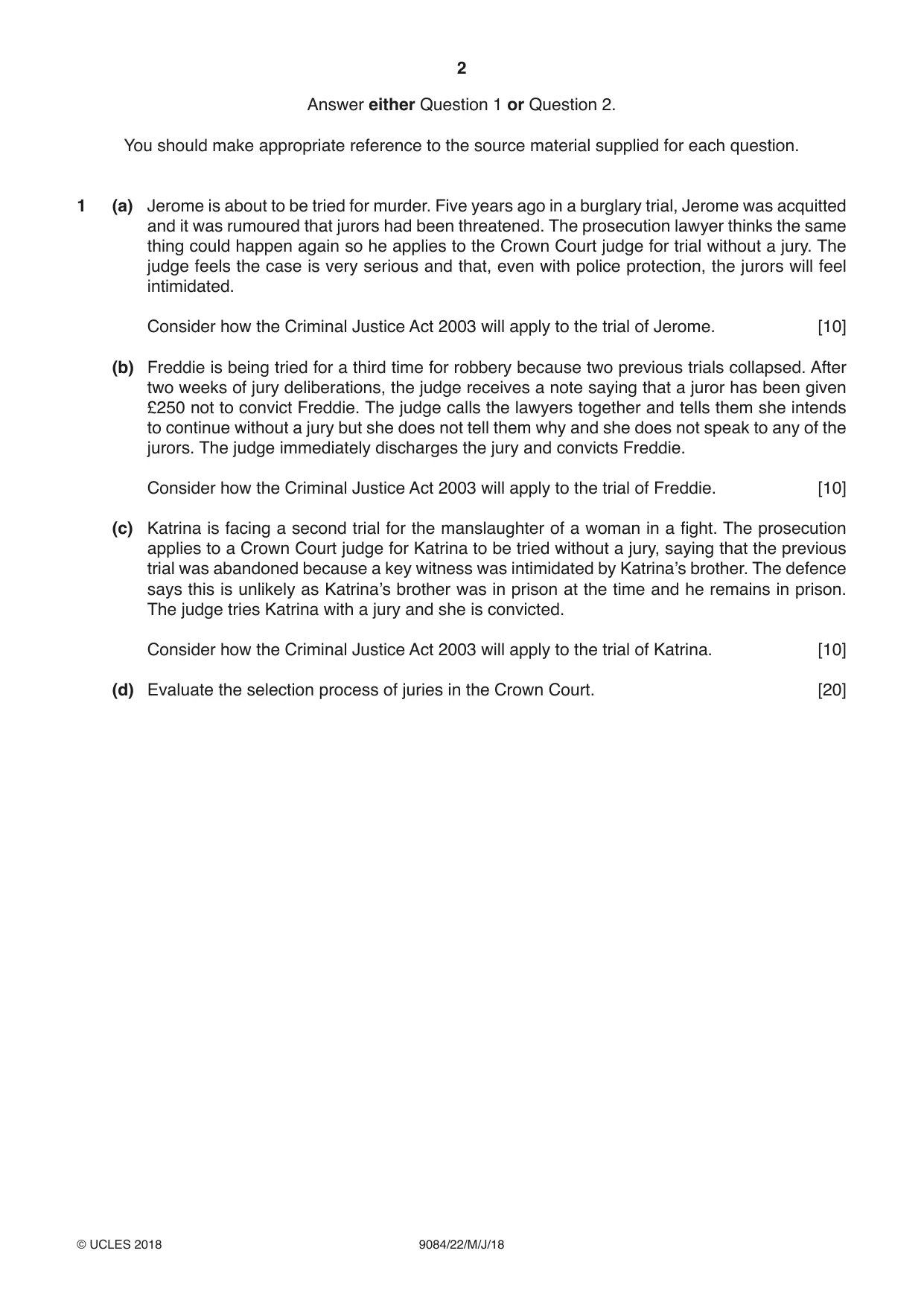
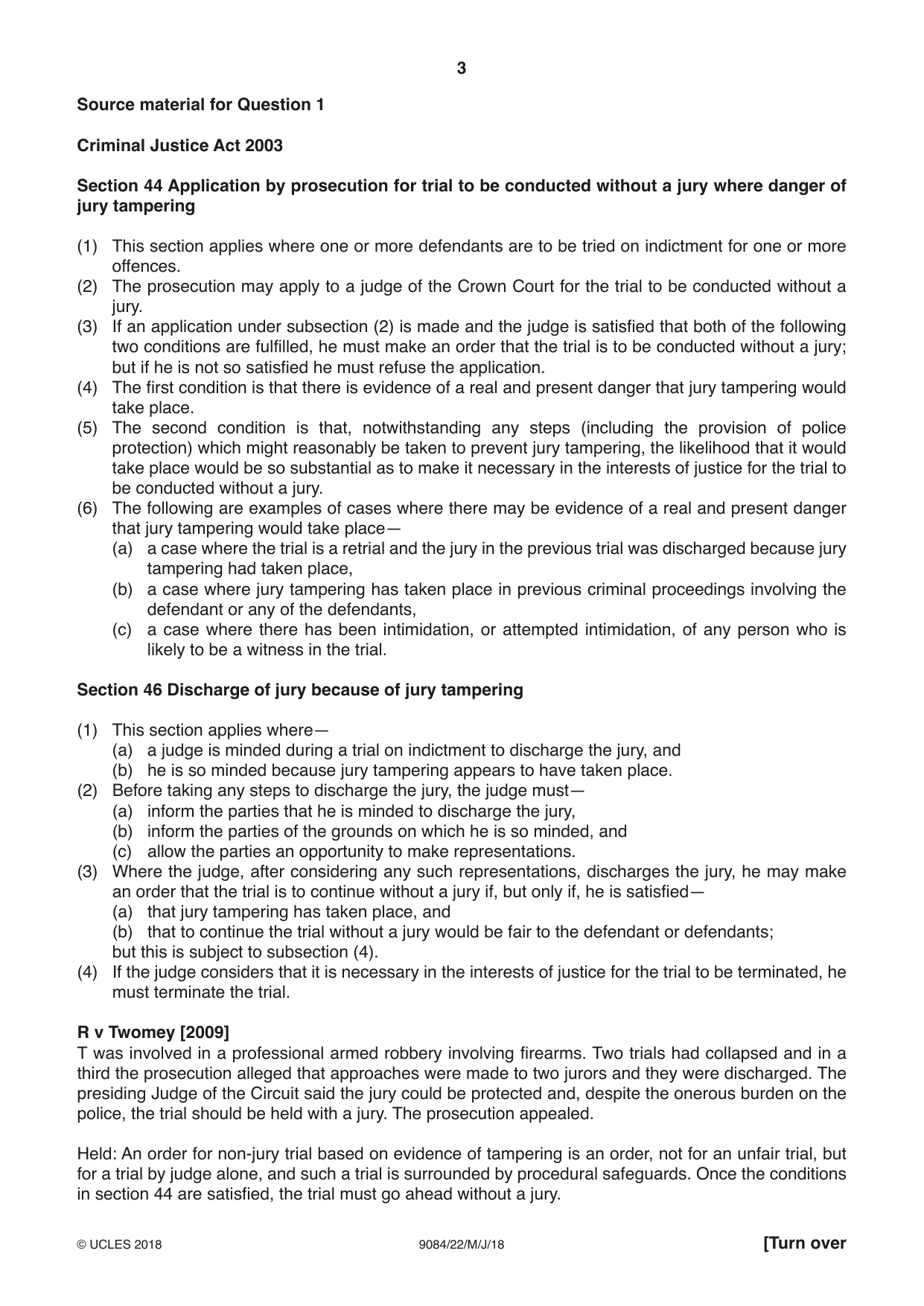
1 (a) Jerome is about to be tried for murder. Five years ago in a burglary trial, Jerome was acquitted and it was rumoured that jurors had been threatened. The prosecution lawyer thinks the same thing could happen again so he applies to the Crown Court judge for trial without a jury. The judge feels the case is very serious and that, even with police protection, the jurors will feel intimidated. Consider how the Criminal Justice Act 2003 will apply to the trial of Jerome. [10] (b) Freddie is being tried for a third time for robbery because two previous trials collapsed. After two weeks of jury deliberations, the judge receives a note saying that a juror has been given £250 not to convict Freddie. The judge calls the lawyers together and tells them she intends to continue without a jury but she does not tell them why and she does not speak to any of the jurors. The judge immediately discharges the jury and convicts Freddie. Consider how the Criminal Justice Act 2003 will apply to the trial of Freddie. [10] (c) Katrina is facing a second trial for the manslaughter of a woman in a fight. The prosecution applies to a Crown Court judge for Katrina to be tried without a jury, saying that the previous trial was abandoned because a key witness was intimidated by Katrina’s brother. The defence says this is unlikely as Katrina’s brother was in prison at the time and he remains in prison. The judge tries Katrina with a jury and she is convicted. Consider how the Criminal Justice Act 2003 will apply to the trial of Katrina. [10] (d) Evaluate the selection process of juries in the Crown Court. [20] Source material for Question 1 Criminal Justice Act 2003 Section 44 Application by prosecution for trial to be conducted without a jury where danger of jury tampering (1) This section applies where one or more defendants are to be tried on indictment for one or more offences. (2) The prosecution may apply to a judge of the Crown Court for the trial to be conducted without a jury. (3) If an application under subsection (2) is made and the judge is satisfied that both of the following two conditions are fulfilled, he must make an order that the trial is to be conducted without a jury; but if he is not so satisfied he must refuse the application. (4) The first condition is that there is evidence of a real and present danger that jury tampering would take place. (5) The second condition is that, notwithstanding any steps (including the provision of police protection) which might reasonably be taken to prevent jury tampering, the likelihood that it would take place would be so substantial as to make it necessary in the interests of justice for the trial to be conducted without a jury. (6) The following are examples of cases where there may be evidence of a real and present danger that jury tampering would take place— (a) a case where the trial is a retrial and the jury in the previous trial was discharged because jury tampering had taken place, (b) a case where jury tampering has taken place in previous criminal proceedings involving the defendant or any of the defendants, (c) a case where there has been intimidation, or attempted intimidation, of any person who is likely to be a witness in the trial. Section 46 Discharge of jury because of jury tampering (1) This section applies where— (a) a judge is minded during a trial on indictment to discharge the jury, and (b) he is so minded because jury tampering appears to have taken place. (2) Before taking any steps to discharge the jury, the judge must— (a) inform the parties that he is minded to discharge the jury, (b) inform the parties of the grounds on which he is so minded, and (c) allow the parties an opportunity to make representations. (3) Where the judge, after considering any such representations, discharges the jury, he may make an order that the trial is to continue without a jury if, but only if, he is satisfied— (a) that jury tampering has taken place, and (b) that to continue the trial without a jury would be fair to the defendant or defendants; but this is subject to subsection (4). (4) If the judge considers that it is necessary in the interests of justice for the trial to be terminated, he must terminate the trial. R v Twomey [2009] T was involved in a professional armed robbery involving firearms. Two trials had collapsed and in a third the prosecution alleged that approaches were made to two jurors and they were discharged. The presiding Judge of the Circuit said the jury could be protected and, despite the onerous burden on the police, the trial should be held with a jury. The prosecution appealed. Held: An order for non-jury trial based on evidence of tampering is an order, not for an unfair trial, but for a trial by judge alone, and such a trial is surrounded by procedural safeguards. Once the conditions in section 44 are satisfied, the trial must go ahead without a jury.
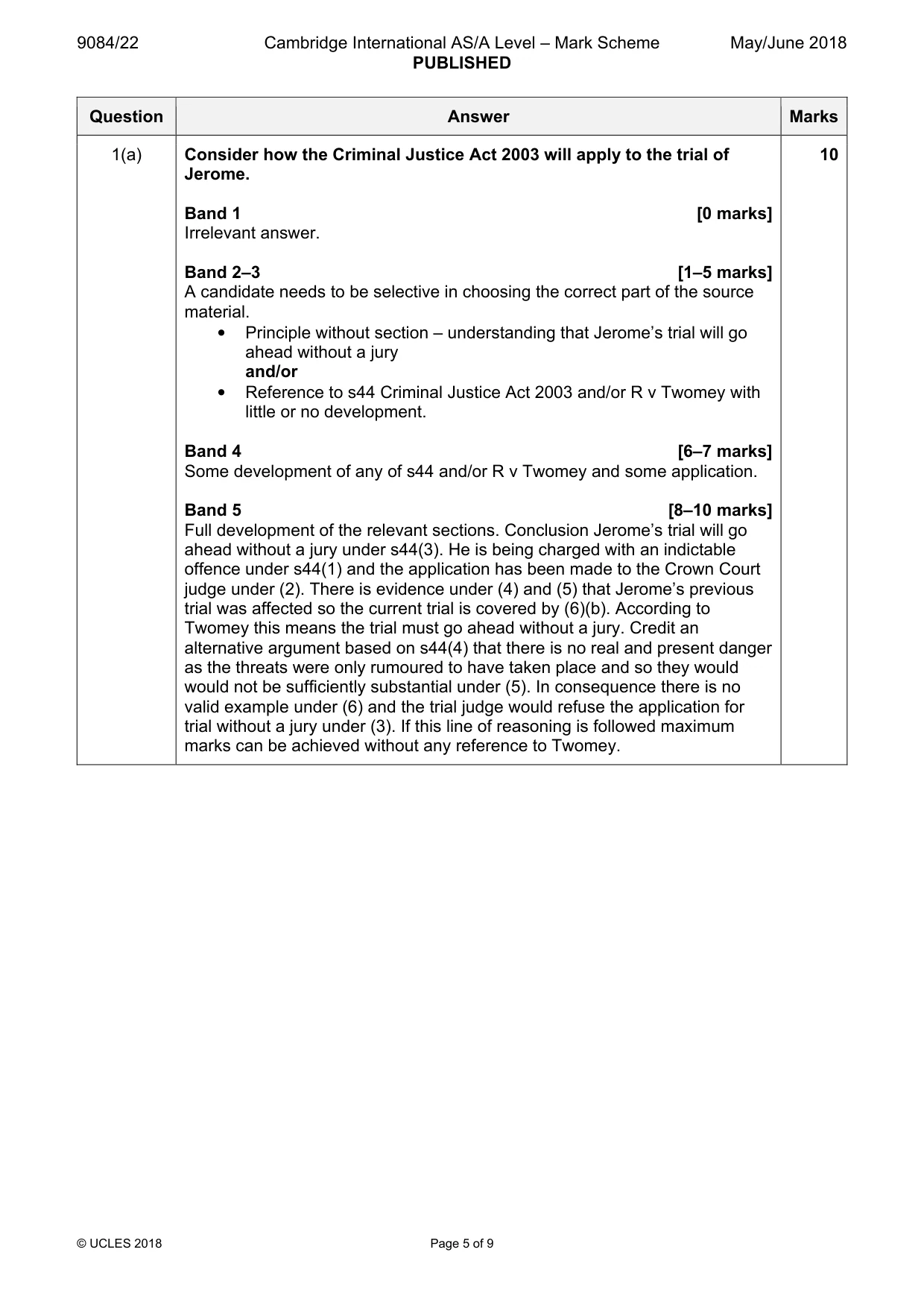
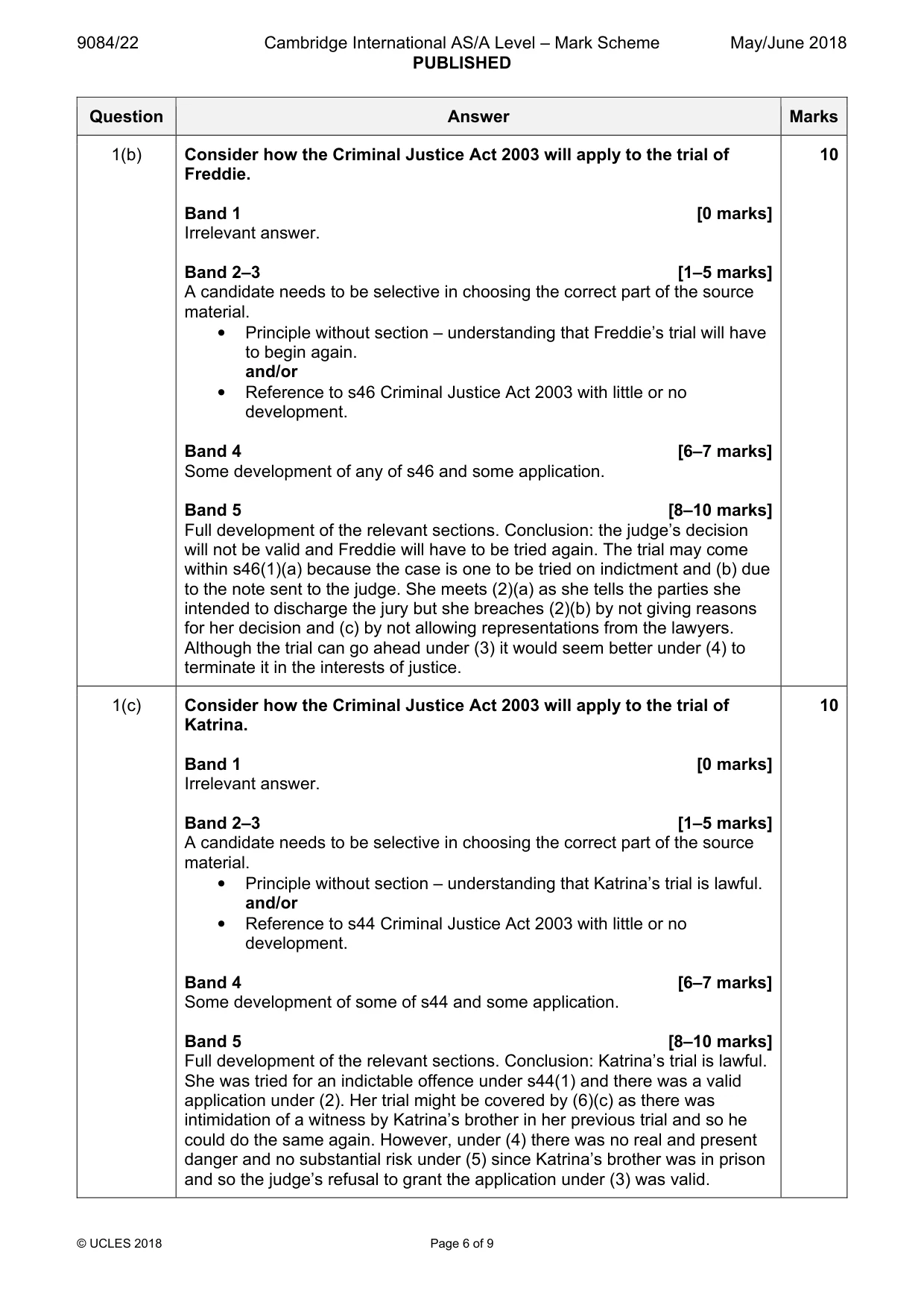
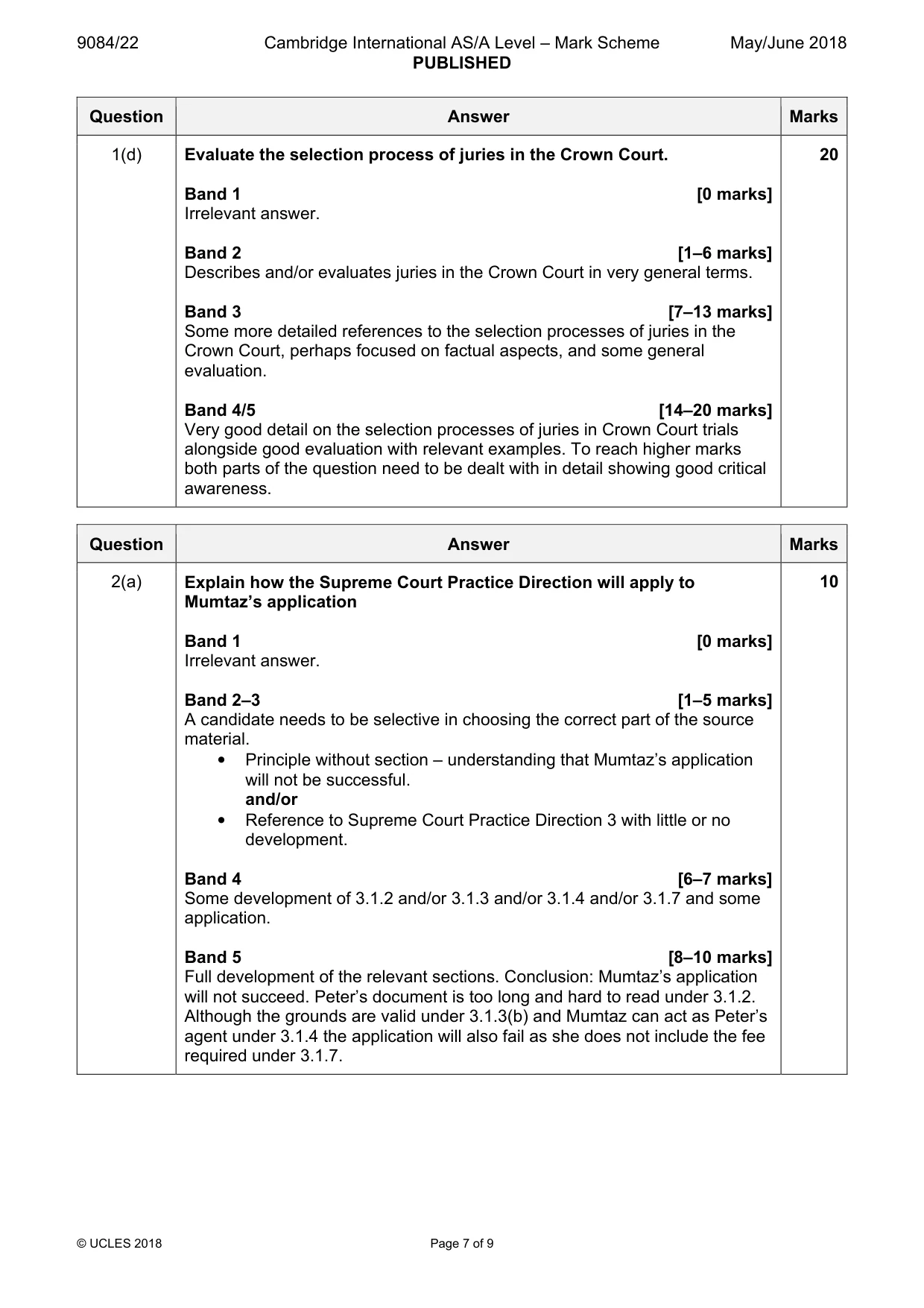
Mark scheme: Question Answer Marks 1(a) Consider how the Criminal Justice Act 2003 will apply to the trial of 10 Jerome. Band 1 [0 marks] Irrelevant answer. Band 2–3 [1–5 marks] A candidate needs to be selective in choosing the correct part of the source material. • Principle without section – understanding that Jerome’s trial will go ahead without a jury and/or • Reference to s44 Criminal Justice Act 2003 and/or R v Twomey with little or no development. Band 4 [6–7 marks] Some development of any of s44 and/or R v Twomey and some application. Band 5 [8–10 marks] Full development of the relevant sections. Conclusion Jerome’s trial will go ahead without a jury under s44(3). He is being charged with an indictable offence under s44(1) and the application has been made to the Crown Court judge under (2). There is evidence under (4) and (5) that Jerome’s previous trial was affected so the current trial is covered by (6)(b). According to Twomey this means the trial must go ahead without a jury. Credit an alternative argument based on s44(4) that there is no real and present danger as the threats were only rumoured to have taken place and so they would would not be sufficiently substantial under (5). In consequence there is no valid example under (6) and the trial judge would refuse the application for trial without a jury under (3). If this line of reasoning is followed maximum marks can be achieved without any reference to Twomey. 1(b) Consider how the Criminal Justice Act 2003 will apply to the trial of 10 Freddie. Band 1 [0 marks] Irrelevant answer. Band 2–3 [1–5 marks] A candidate needs to be selective in choosing the correct part of the source material. • Principle without section – understanding that Freddie’s trial will have to begin again. and/or • Reference to s46 Criminal Justice Act 2003 with little or no development. Band 4 [6–7 marks] Some development of any of s46 and some application. Band 5 [8–10 marks] Full development of the relevant sections. Conclusion: the judge’s decision will not be valid and Freddie will have to be tried again. The trial may come within s46(1)(a) because the case is one to be tried on indictment and (b) due to the note sent to the judge. She meets (2)(a) as she tells the parties she intended to discharge the jury but she breaches (2)(b) by not giving reasons for her decision and (c) by not allowing representations from the lawyers. Although the trial can go ahead under (3) it would seem better under (4) to terminate it in the interests of justice. 1(c) Consider how the Criminal Justice Act 2003 will apply to the trial of 10 Katrina. Band 1 [0 marks] Irrelevant answer. Band 2–3 [1–5 marks] A candidate needs to be selective in choosing the correct part of the source material. • Principle without section – understanding that Katrina’s trial is lawful. and/or • Reference to s44 Criminal Justice Act 2003 with little or no development. Band 4 [6–7 marks] Some development of some of s44 and some application. Band 5 [8–10 marks] Full development of the relevant sections. Conclusion: Katrina’s trial is lawful. She was tried for an indictable offence under s44(1) and there was a valid application under (2). Her trial might be covered by (6)(c) as there was intimidation of a witness by Katrina’s brother in her previous trial and so he could do the same again. However, under (4) there was no real and present danger and no substantial risk under (5) since Katrina’s brother was in prison and so the judge’s refusal to grant the application under (3) was valid. 1(d) Evaluate the selection process of juries in the Crown Court. 20 Band 1 [0 marks] Irrelevant answer. Band 2 [1–6 marks] Describes and/or evaluates juries in the Crown Court in very general terms. Band 3 [7–13 marks] Some more detailed references to the selection processes of juries in the Crown Court, perhaps focused on factual aspects, and some general evaluation. Band 4/5 [14–20 marks] Very good detail on the selection processes of juries in Crown Court trials alongside good evaluation with relevant examples. To reach higher marks both parts of the question need to be dealt with in detail showing good critical awareness.
Q2 · Mumtaz, a solicitor, wants to appeal to the Supreme Court on behalf of her client, Peter…
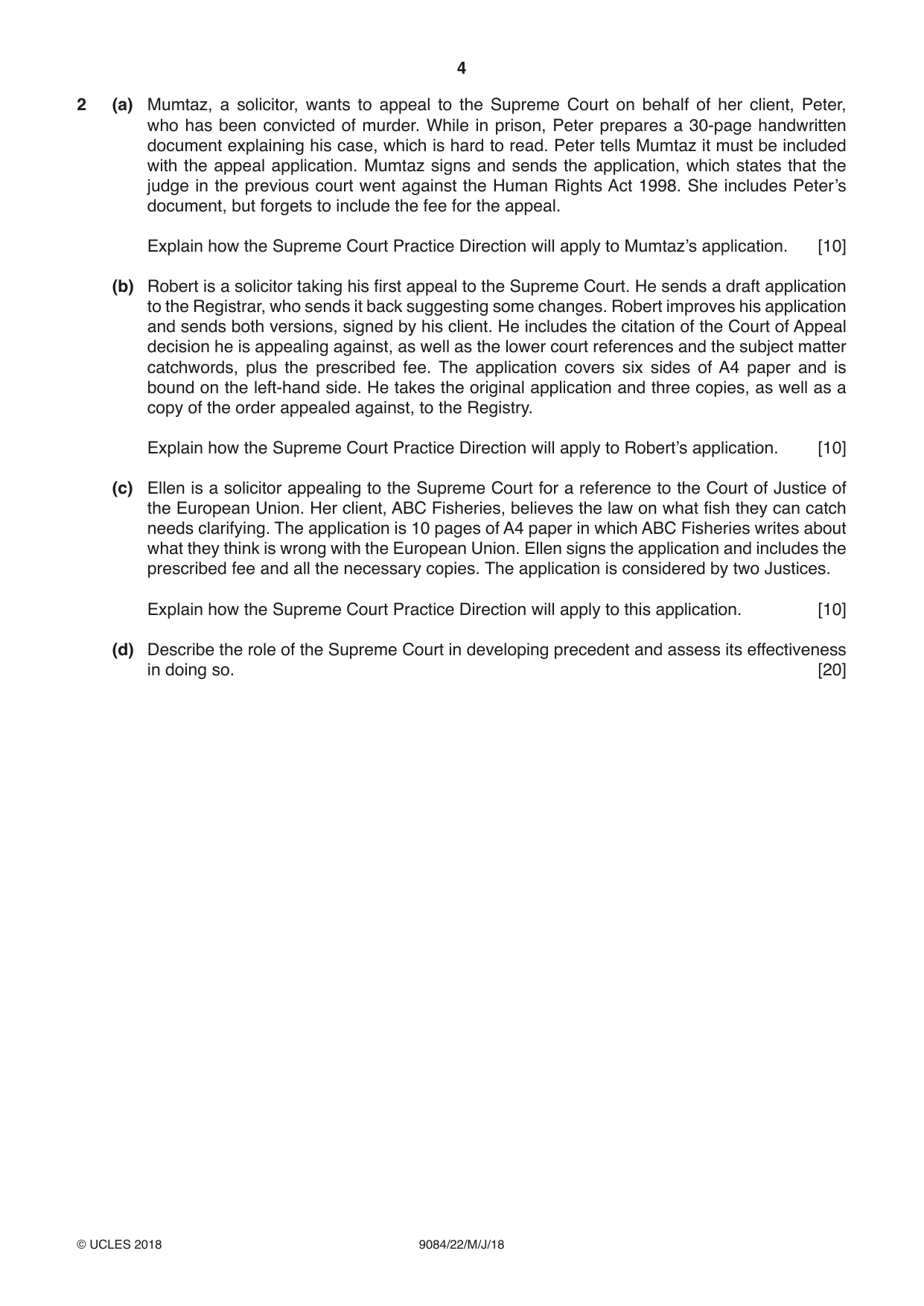
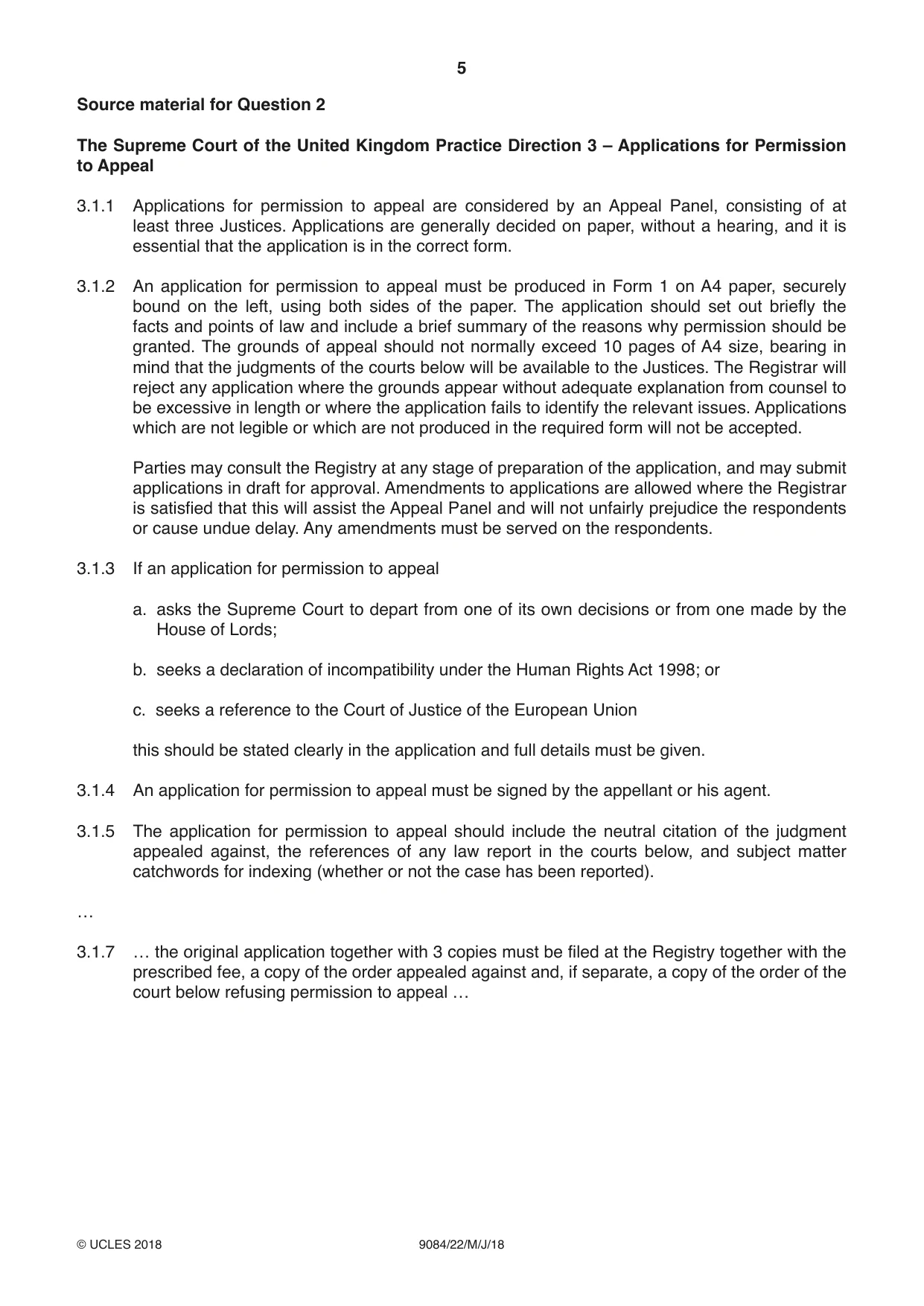
2 (a) Mumtaz, a solicitor, wants to appeal to the Supreme Court on behalf of her client, Peter, who has been convicted of murder. While in prison, Peter prepares a 30-page handwritten document explaining his case, which is hard to read. Peter tells Mumtaz it must be included with the appeal application. Mumtaz signs and sends the application, which states that the judge in the previous court went against the Human Rights Act 1998. She includes Peter’s document, but forgets to include the fee for the appeal. Explain how the Supreme Court Practice Direction will apply to Mumtaz’s application. [10] (b) Robert is a solicitor taking his first appeal to the Supreme Court. He sends a draft application to the Registrar, who sends it back suggesting some changes. Robert improves his application and sends both versions, signed by his client. He includes the citation of the Court of Appeal decision he is appealing against, as well as the lower court references and the subject matter catchwords, plus the prescribed fee. The application covers six sides of A4 paper and is bound on the left-hand side. He takes the original application and three copies, as well as a copy of the order appealed against, to the Registry. Explain how the Supreme Court Practice Direction will apply to Robert’s application. [10] (c) Ellen is a solicitor appealing to the Supreme Court for a reference to the Court of Justice of the European Union. Her client, ABC Fisheries, believes the law on what fish they can catch needs clarifying. The application is 10 pages of A4 paper in which ABC Fisheries writes about what they think is wrong with the European Union. Ellen signs the application and includes the prescribed fee and all the necessary copies. The application is considered by two Justices. Explain how the Supreme Court Practice Direction will apply to this application. [10] (d) Describe the role of the Supreme Court in developing precedent and assess its effectiveness in doing so. [20] Source material for Question 2 The Supreme Court of the United Kingdom Practice Direction 3 – Applications for Permission to Appeal 3.1.1 Applications for permission to appeal are considered by an Appeal Panel, consisting of at least three Justices. Applications are generally decided on paper, without a hearing, and it is essential that the application is in the correct form. 3.1.2 An application for permission to appeal must be produced in Form 1 on A4 paper, securely bound on the left, using both sides of the paper. The application should set out briefly the facts and points of law and include a brief summary of the reasons why permission should be granted. The grounds of appeal should not normally exceed 10 pages of A4 size, bearing in mind that the judgments of the courts below will be available to the Justices. The Registrar will reject any application where the grounds appear without adequate explanation from counsel to be excessive in length or where the application fails to identify the relevant issues. Applications which are not legible or which are not produced in the required form will not be accepted. Parties may consult the Registry at any stage of preparation of the application, and may submit applications in draft for approval. Amendments to applications are allowed where the Registrar is satisfied that this will assist the Appeal Panel and will not unfairly prejudice the respondents or cause undue delay. Any amendments must be served on the respondents. 3.1.3 If an application for permission to appeal a. asks the Supreme Court to depart from one of its own decisions or from one made by the House of Lords; b. seeks a declaration of incompatibility under the Human Rights Act 1998; or c. seeks a reference to the Court of Justice of the European Union this should be stated clearly in the application and full details must be given. 3.1.4 An application for permission to appeal must be signed by the appellant or his agent. 3.1.5 The application for permission to appeal should include the neutral citation of the judgment appealed against, the references of any law report in the courts below, and subject matter catchwords for indexing (whether or not the case has been reported). … 3.1.7 … the original application together with 3 copies must be filed at the Registry together with the prescribed fee, a copy of the order appealed against and, if separate, a copy of the order of the court below refusing permission to appeal …
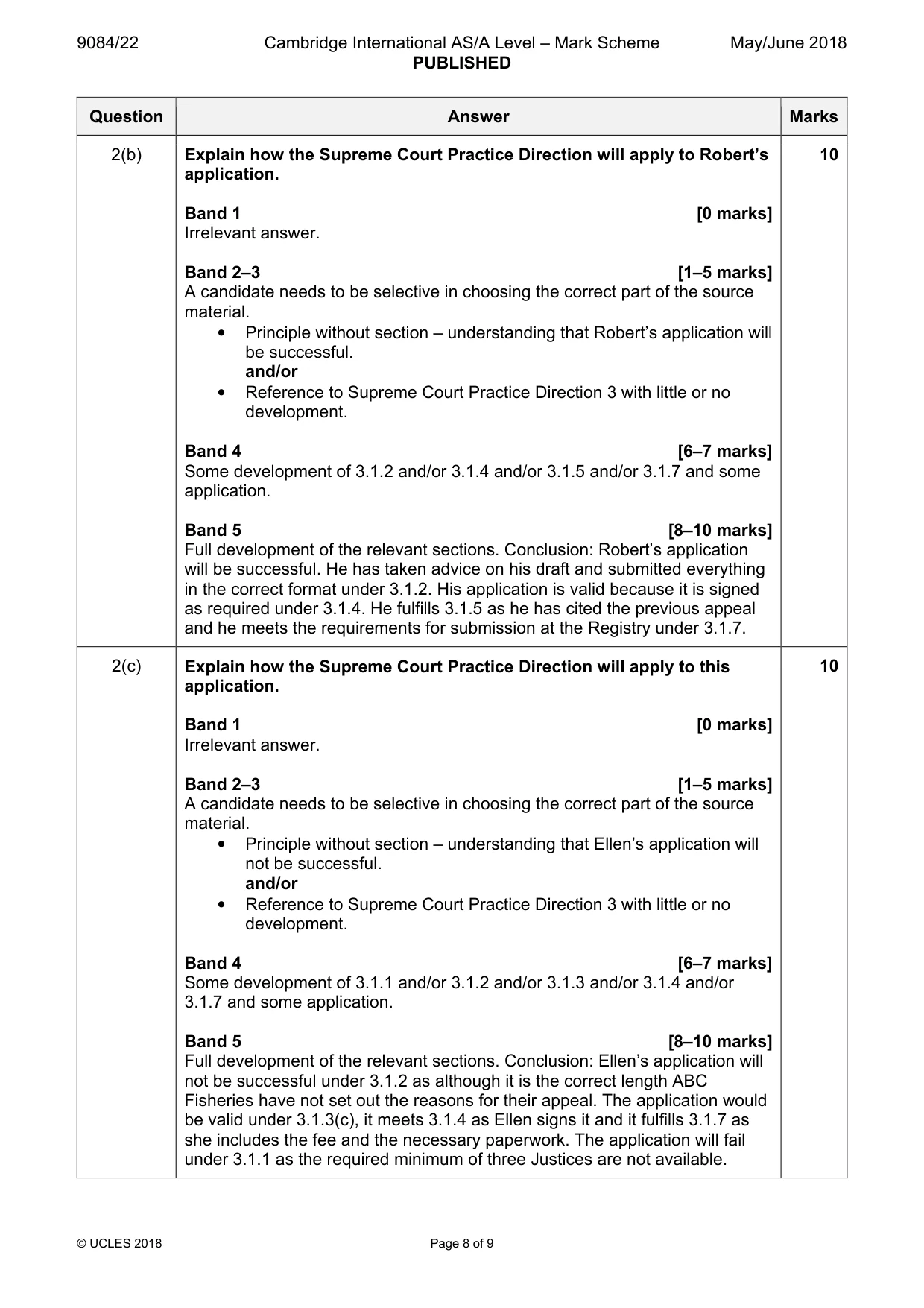
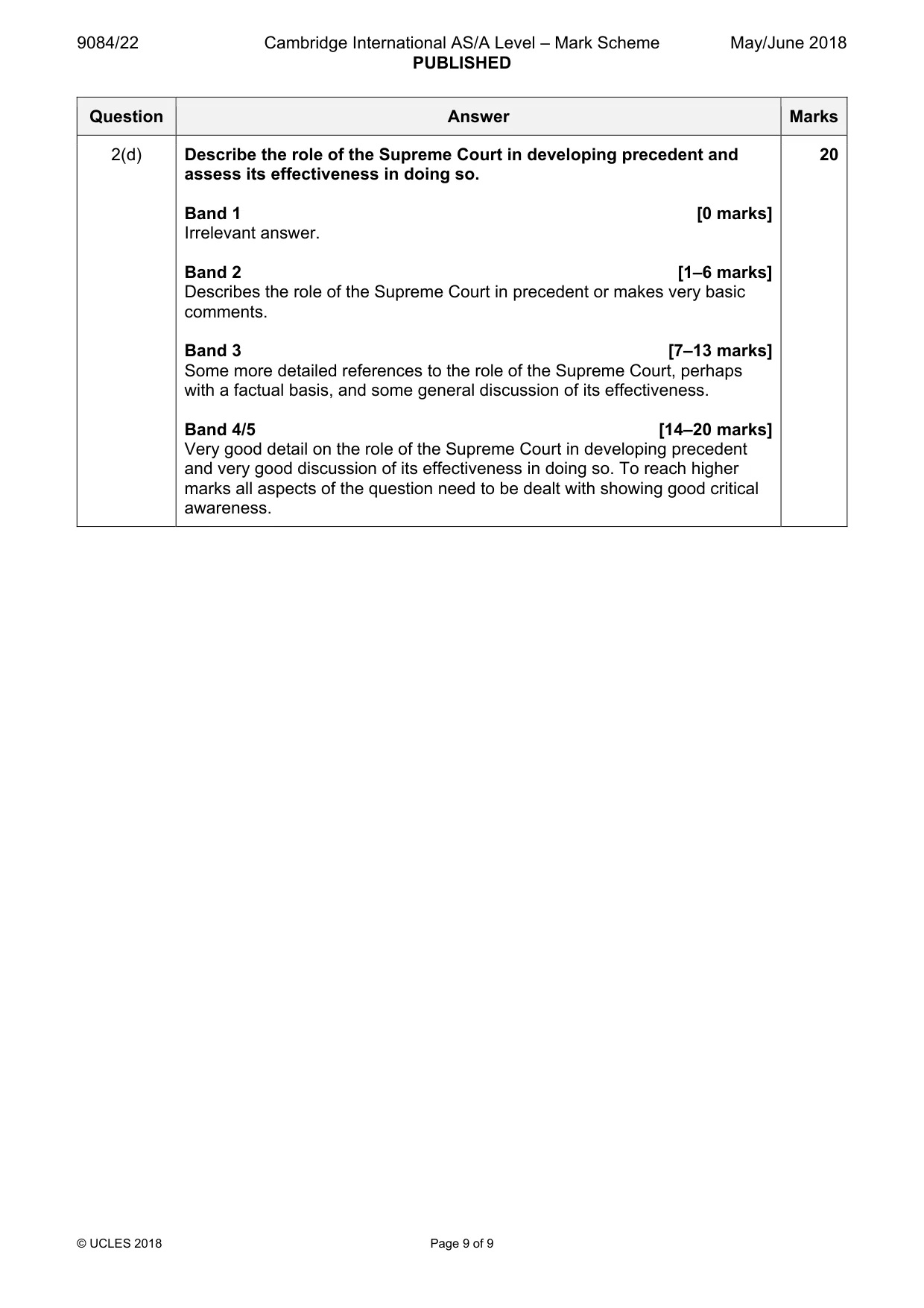
Mark scheme: 2(a) Explain how the Supreme Court Practice Direction will apply to 10 Mumtaz’s application Band 1 [0 marks] Irrelevant answer. Band 2–3 [1–5 marks] A candidate needs to be selective in choosing the correct part of the source material. • Principle without section – understanding that Mumtaz’s application will not be successful. and/or • Reference to Supreme Court Practice Direction 3 with little or no development. Band 4 [6–7 marks] Some development of 3.1.2 and/or 3.1.3 and/or 3.1.4 and/or 3.1.7 and some application. Band 5 [8–10 marks] Full development of the relevant sections. Conclusion: Mumtaz’s application will not succeed. Peter’s document is too long and hard to read under 3.1.2. Although the grounds are valid under 3.1.3(b) and Mumtaz can act as Peter’s agent under 3.1.4 the application will also fail as she does not include the fee required under 3.1.7. 2(b) Explain how the Supreme Court Practice Direction will apply to Robert’s 10 application. Band 1 [0 marks] Irrelevant answer. Band 2–3 [1–5 marks] A candidate needs to be selective in choosing the correct part of the source material. • Principle without section – understanding that Robert’s application will be successful. and/or • Reference to Supreme Court Practice Direction 3 with little or no development. Band 4 [6–7 marks] Some development of 3.1.2 and/or 3.1.4 and/or 3.1.5 and/or 3.1.7 and some application. Band 5 [8–10 marks] Full development of the relevant sections. Conclusion: Robert’s application will be successful. He has taken advice on his draft and submitted everything in the correct format under 3.1.2. His application is valid because it is signed as required under 3.1.4. He fulfills 3.1.5 as he has cited the previous appeal and he meets the requirements for submission at the Registry under 3.1.7. 2(c) Explain how the Supreme Court Practice Direction will apply to this 10 application. Band 1 [0 marks] Irrelevant answer. Band 2–3 [1–5 marks] A candidate needs to be selective in choosing the correct part of the source material. • Principle without section – understanding that Ellen’s application will not be successful. and/or • Reference to Supreme Court Practice Direction 3 with little or no development. Band 4 [6–7 marks] Some development of 3.1.1 and/or 3.1.2 and/or 3.1.3 and/or 3.1.4 and/or 3.1.7 and some application. Band 5 [8–10 marks] Full development of the relevant sections. Conclusion: Ellen’s application will not be successful under 3.1.2 as although it is the correct length ABC Fisheries have not set out the reasons for their appeal. The application would be valid under 3.1.3(c), it meets 3.1.4 as Ellen signs it and it fulfills 3.1.7 as she includes the fee and the necessary paperwork. The application will fail under 3.1.1 as the required minimum of three Justices are not available. 2(d) Describe the role of the Supreme Court in developing precedent and 20 assess its effectiveness in doing so. Band 1 [0 marks] Irrelevant answer. Band 2 [1–6 marks] Describes the role of the Supreme Court in precedent or makes very basic comments. Band 3 [7–13 marks] Some more detailed references to the role of the Supreme Court, perhaps with a factual basis, and some general discussion of its effectiveness. Band 4/5 [14–20 marks] Very good detail on the role of the Supreme Court in developing precedent and very good discussion of its effectiveness in doing so. To reach higher marks all aspects of the question need to be dealt with showing good critical awareness.
What was in this paper
The subtopics covered by these 2 questions, and how many questions each got. Open one in a new tab to see every Cambridge question on it.
What you needed in this session
Cambridge’s own grade thresholds for 2018 May/June, Paper 2 · Variant 2. A higher threshold means an easier paper — the bar moves with how the cohort did.