Cambridge A Level Law 9084 — 2020 May/June Paper 2 · Variant 2
9084/22/M/J/20 · 2 questions · 100 marks · ≈113 min
The question paper and its mark scheme, free to read here and free to download. This is Cambridge’s own paper, exactly as it was sat.
Question paper8 pages
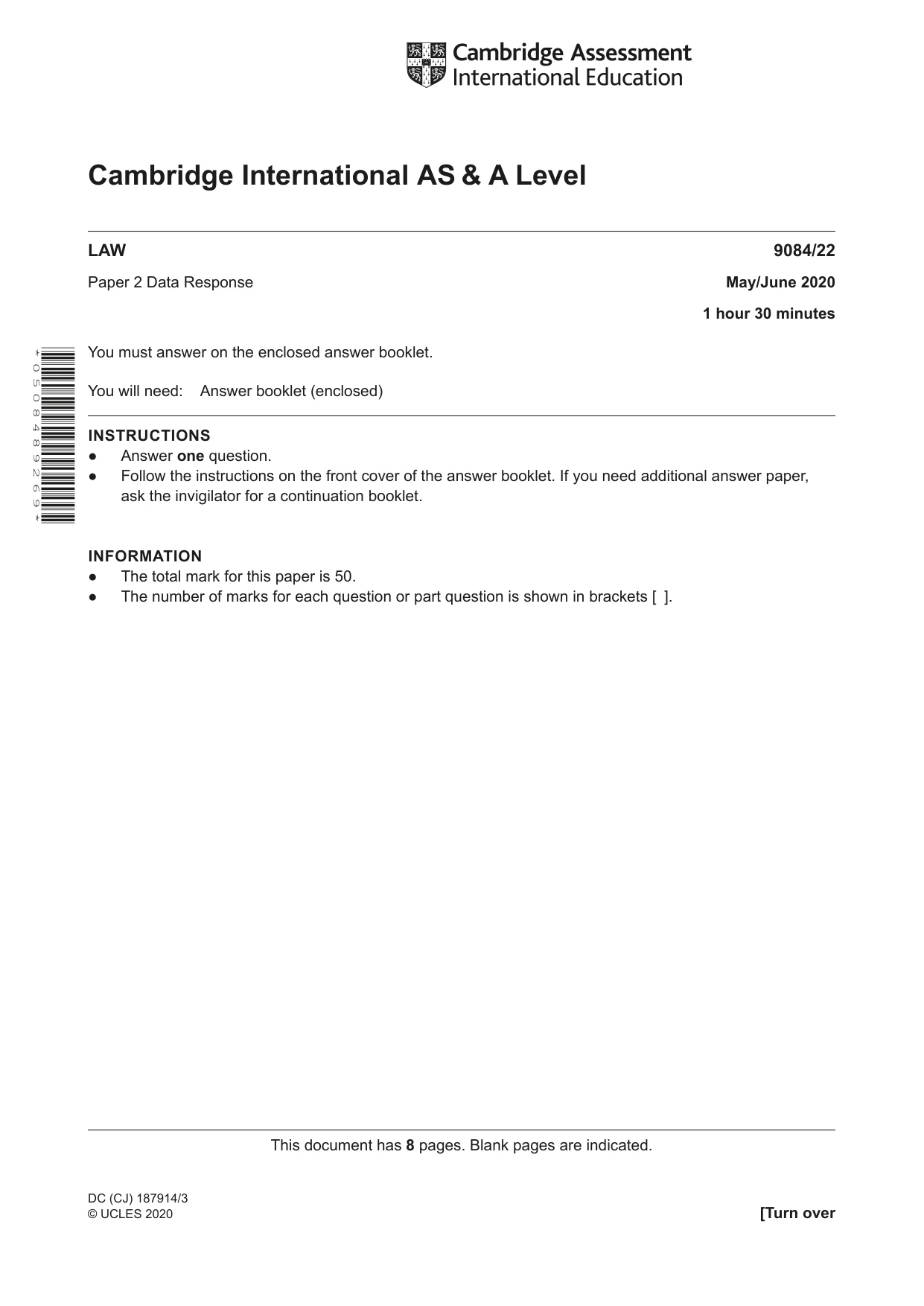
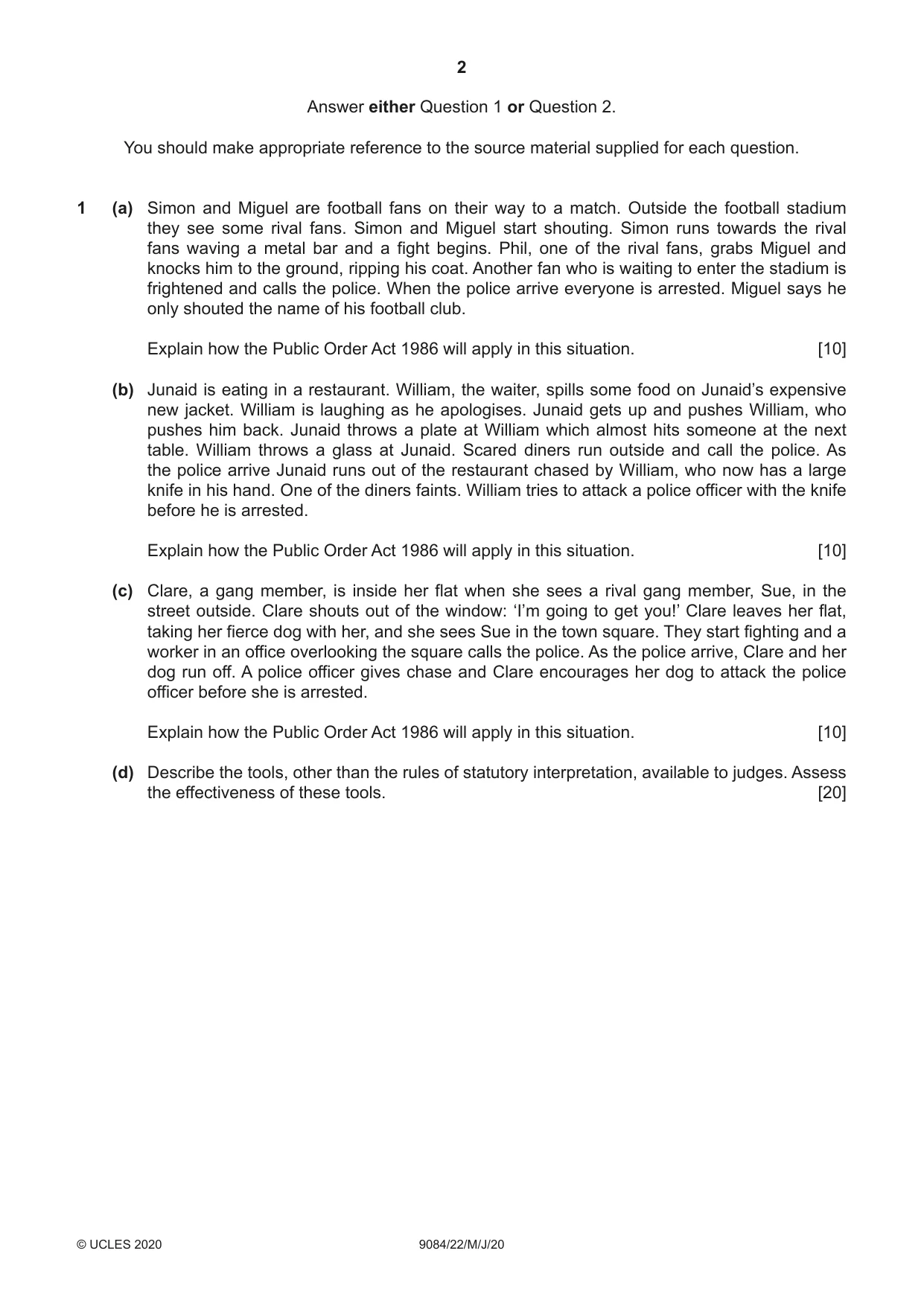
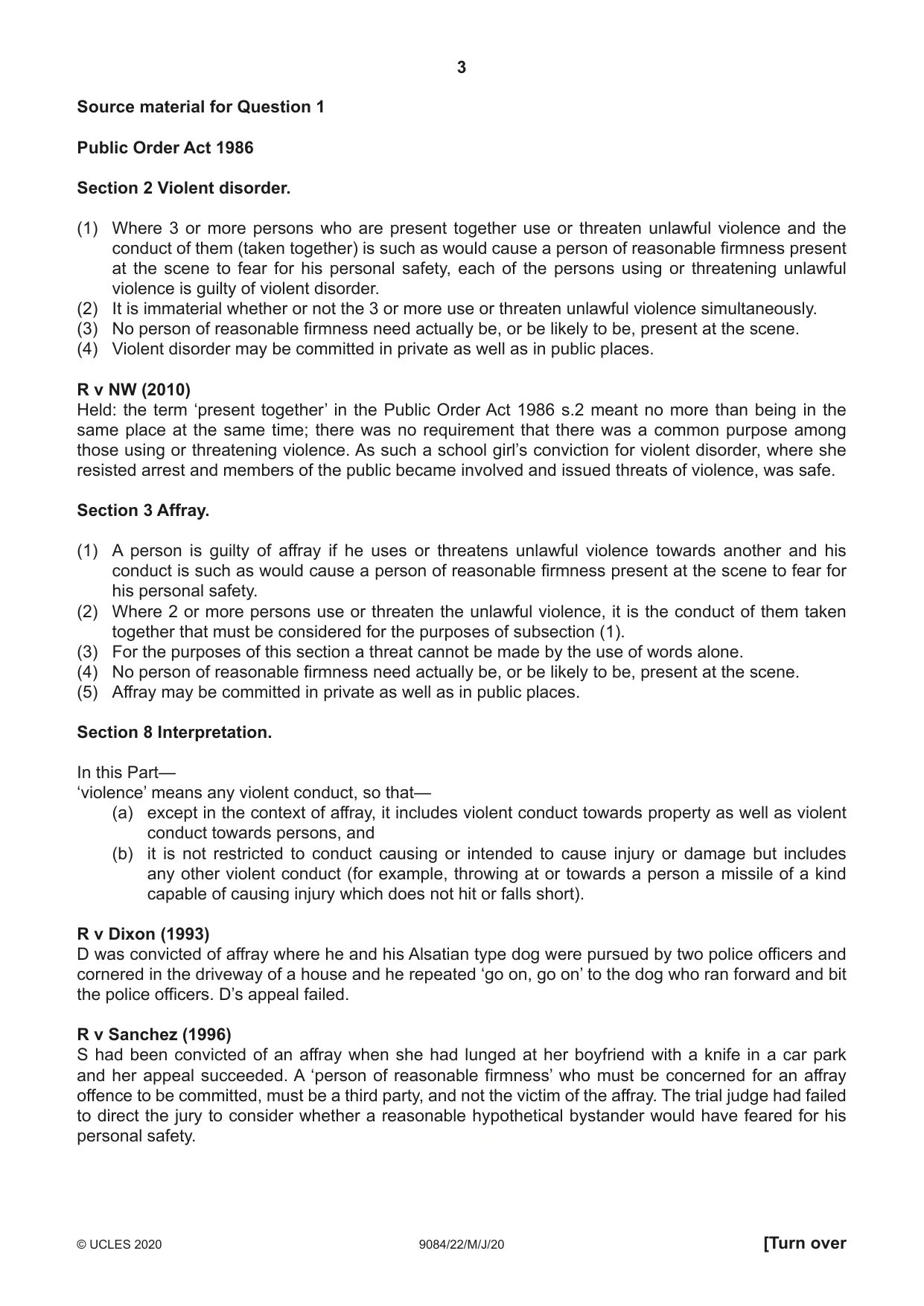
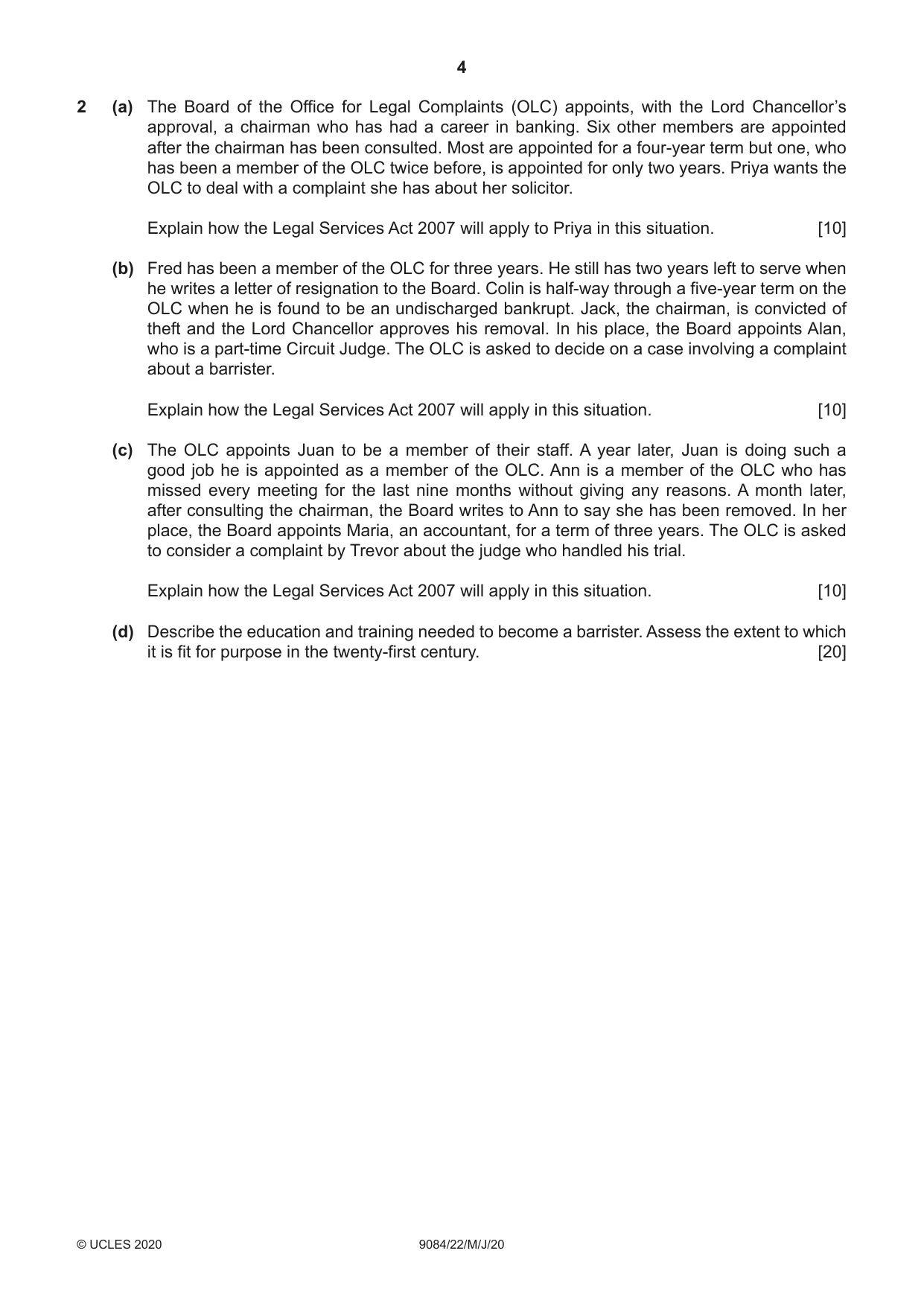



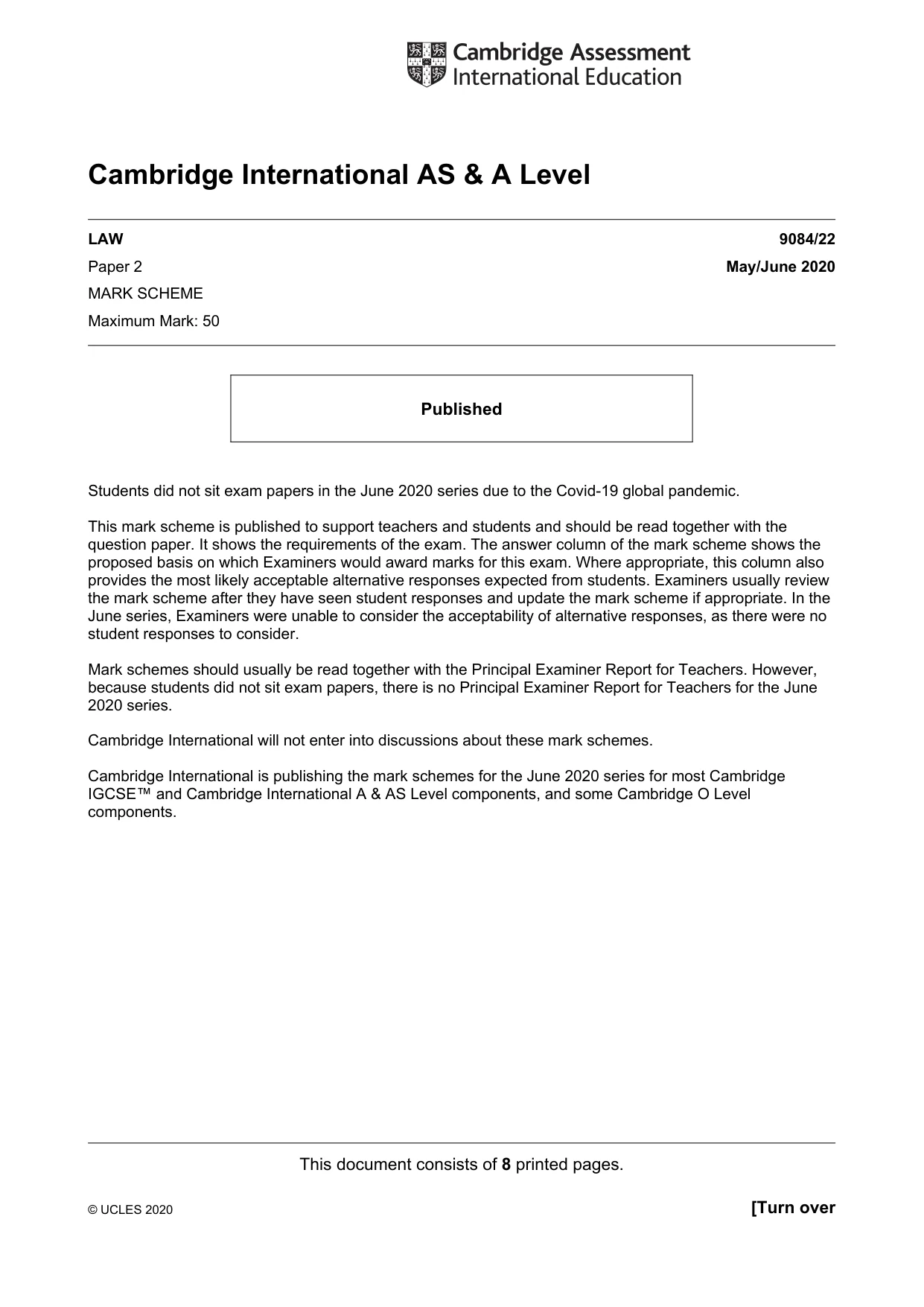
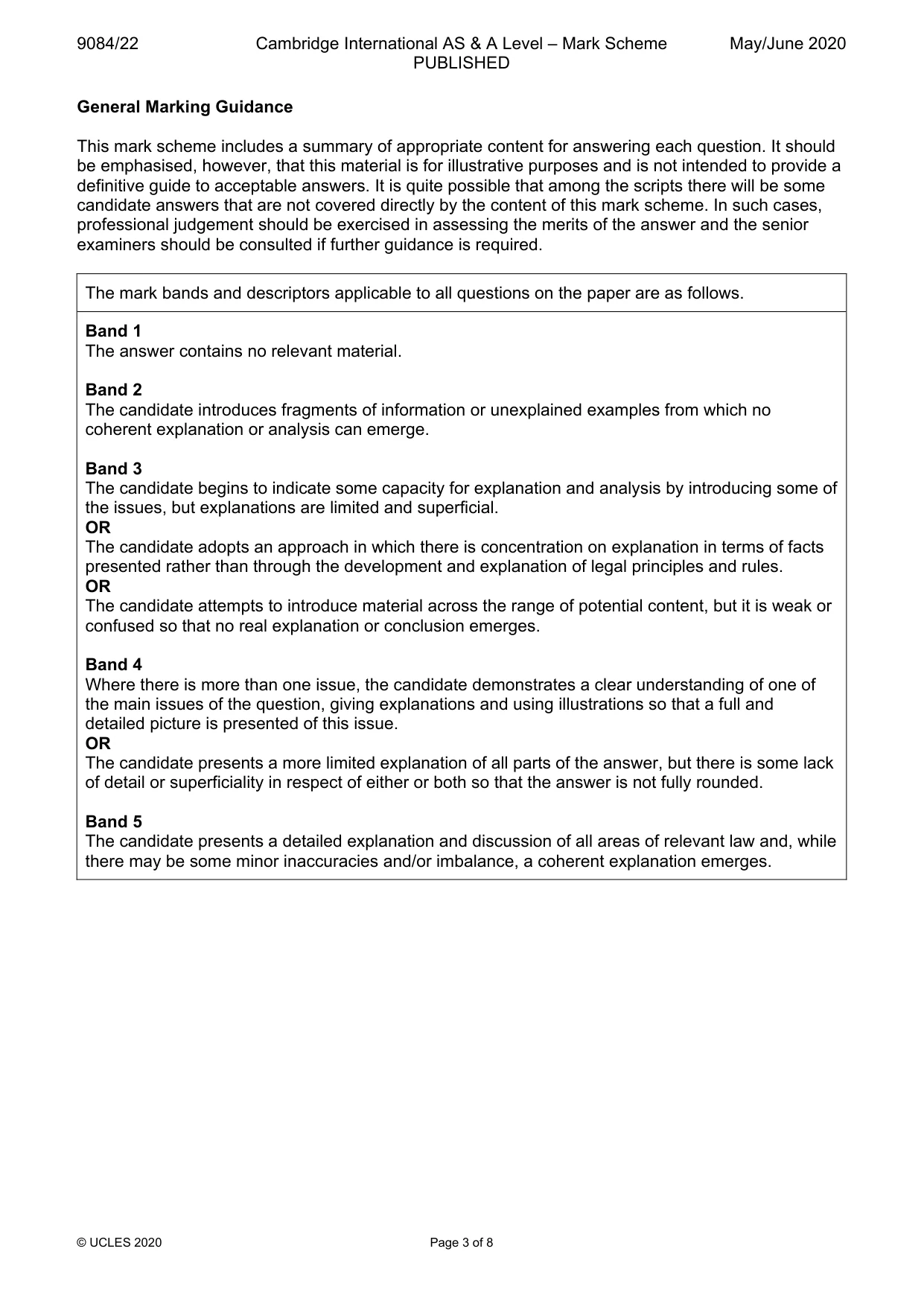
Mark scheme8 pages
Answers below. Sit the paper first if you are practising.
Questions as text
Q1 · Simon and Miguel are football fans on their way to a match
1 (a) Simon and Miguel are football fans on their way to a match. Outside the football stadium they see some rival fans. Simon and Miguel start shouting. Simon runs towards the rival fans waving a metal bar and a fight begins. Phil, one of the rival fans, grabs Miguel and knocks him to the ground, ripping his coat. Another fan who is waiting to enter the stadium is frightened and calls the police. When the police arrive everyone is arrested. Miguel says he only shouted the name of his football club. Explain how the Public Order Act 1986 will apply in this situation. [10] (b) Junaid is eating in a restaurant. William, the waiter, spills some food on Junaid’s expensive new jacket. William is laughing as he apologises. Junaid gets up and pushes William, who pushes him back. Junaid throws a plate at William which almost hits someone at the next table. William throws a glass at Junaid. Scared diners run outside and call the police. As the police arrive Junaid runs out of the restaurant chased by William, who now has a large knife in his hand. One of the diners faints. William tries to attack a police officer with the knife before he is arrested. Explain how the Public Order Act 1986 will apply in this situation. [10] (c) Clare, a gang member, is inside her flat when she sees a rival gang member, Sue, in the street outside. Clare shouts out of the window: ‘I’m going to get you!’ Clare leaves her flat, taking her fierce dog with her, and she sees Sue in the town square. They start fighting and a worker in an office overlooking the square calls the police. As the police arrive, Clare and her dog run off. A police officer gives chase and Clare encourages her dog to attack the police officer before she is arrested. Explain how the Public Order Act 1986 will apply in this situation. [10] (d) Describe the tools, other than the rules of statutory interpretation, available to judges. Assess the effectiveness of these tools. [20] Source material for Question 1 Public Order Act 1986 Section 2 Violent disorder. (1) Where 3 or more persons who are present together use or threaten unlawful violence and the conduct of them (taken together) is such as would cause a person of reasonable firmness present at the scene to fear for his personal safety, each of the persons using or threatening unlawful violence is guilty of violent disorder. (2) It is immaterial whether or not the 3 or more use or threaten unlawful violence simultaneously. (3) No person of reasonable firmness need actually be, or be likely to be, present at the scene. (4) Violent disorder may be committed in private as well as in public places. R v NW (2010) Held: the term ‘present together’ in the Public Order Act 1986 s.2 meant no more than being in the same place at the same time; there was no requirement that there was a common purpose among those using or threatening violence. As such a school girl’s conviction for violent disorder, where she resisted arrest and members of the public became involved and issued threats of violence, was safe. Section 3 Affray. (1) A person is guilty of affray if he uses or threatens unlawful violence towards another and his conduct is such as would cause a person of reasonable firmness present at the scene to fear for his personal safety. (2) Where 2 or more persons use or threaten the unlawful violence, it is the conduct of them taken together that must be considered for the purposes of subsection (1). (3) For the purposes of this section a threat cannot be made by the use of words alone. (4) No person of reasonable firmness need actually be, or be likely to be, present at the scene. (5) Affray may be committed in private as well as in public places. Section 8 Interpretation. In this Part— ‘violence’ means any violent conduct, so that— (a) except in the context of affray, it includes violent conduct towards property as well as violent conduct towards persons, and (b) it is not restricted to conduct causing or intended to cause injury or damage but includes any other violent conduct (for example, throwing at or towards a person a missile of a kind capable of causing injury which does not hit or falls short). R v Dixon (1993) D was convicted of affray where he and his Alsatian type dog were pursued by two police officers and cornered in the driveway of a house and he repeated ‘go on, go on’ to the dog who ran forward and bit the police officers. D’s appeal failed. R v Sanchez (1996) S had been convicted of an affray when she had lunged at her boyfriend with a knife in a car park and her appeal succeeded. A ‘person of reasonable firmness’ who must be concerned for an affray offence to be committed, must be a third party, and not the victim of the affray. The trial judge had failed to direct the jury to consider whether a reasonable hypothetical bystander would have feared for his personal safety.
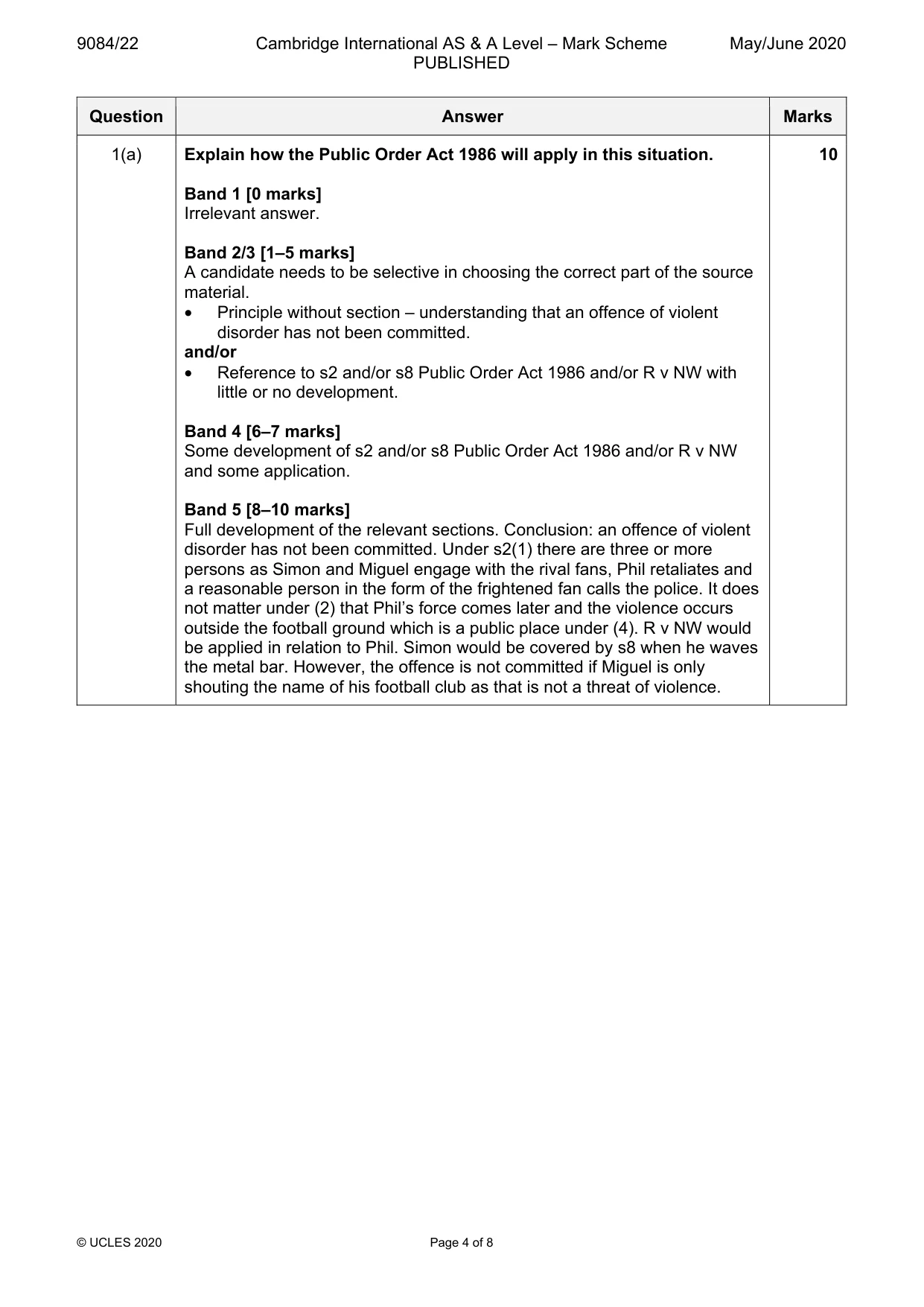
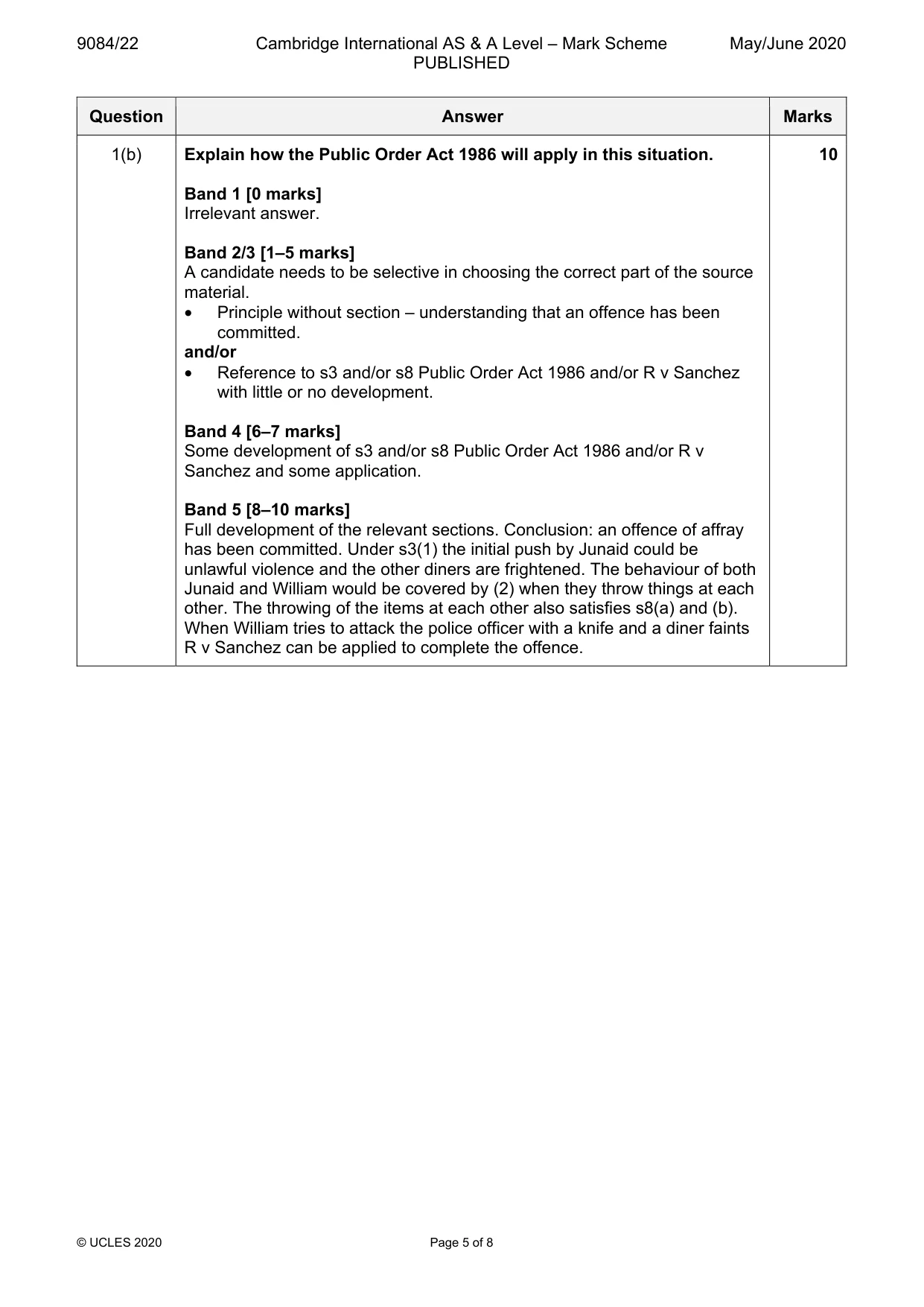
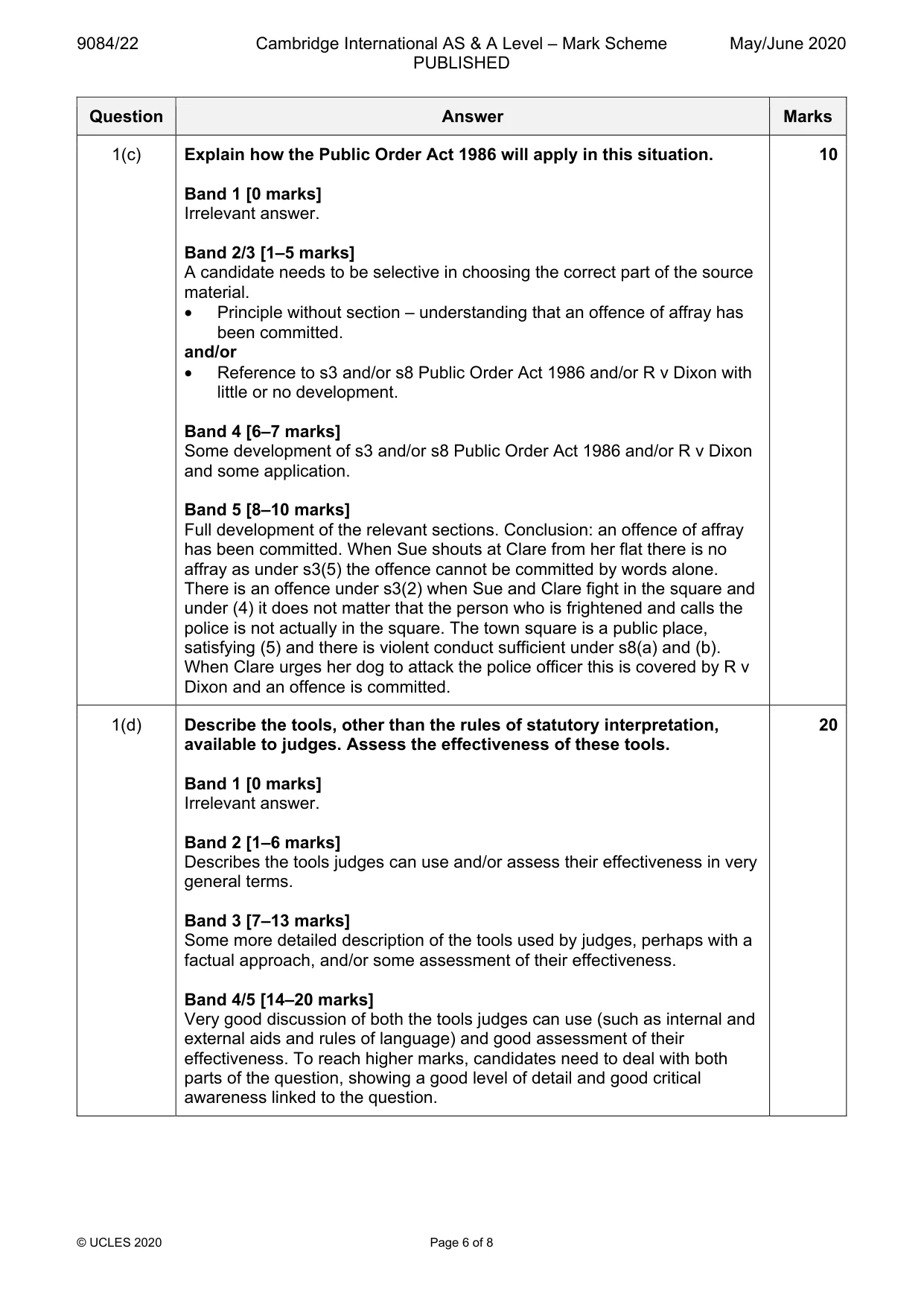
Mark scheme: Question Answer Marks 1(a) Explain how the Public Order Act 1986 will apply in this situation. 10 Band 1 [0 marks] Irrelevant answer. Band 2/3 [1–5 marks] A candidate needs to be selective in choosing the correct part of the source material. • Principle without section – understanding that an offence of violent disorder has not been committed. and/or • Reference to s2 and/or s8 Public Order Act 1986 and/or R v NW with little or no development. Band 4 [6–7 marks] Some development of s2 and/or s8 Public Order Act 1986 and/or R v NW and some application. Band 5 [8–10 marks] Full development of the relevant sections. Conclusion: an offence of violent disorder has not been committed. Under s2(1) there are three or more persons as Simon and Miguel engage with the rival fans, Phil retaliates and a reasonable person in the form of the frightened fan calls the police. It does not matter under (2) that Phil’s force comes later and the violence occurs outside the football ground which is a public place under (4). R v NW would be applied in relation to Phil. Simon would be covered by s8 when he waves the metal bar. However, the offence is not committed if Miguel is only shouting the name of his football club as that is not a threat of violence. 1(b) Explain how the Public Order Act 1986 will apply in this situation. 10 Band 1 [0 marks] Irrelevant answer. Band 2/3 [1–5 marks] A candidate needs to be selective in choosing the correct part of the source material. • Principle without section – understanding that an offence has been committed. and/or • Reference to s3 and/or s8 Public Order Act 1986 and/or R v Sanchez with little or no development. Band 4 [6–7 marks] Some development of s3 and/or s8 Public Order Act 1986 and/or R v Sanchez and some application. Band 5 [8–10 marks] Full development of the relevant sections. Conclusion: an offence of affray has been committed. Under s3(1) the initial push by Junaid could be unlawful violence and the other diners are frightened. The behaviour of both Junaid and William would be covered by (2) when they throw things at each other. The throwing of the items at each other also satisfies s8(a) and (b). When William tries to attack the police officer with a knife and a diner faints R v Sanchez can be applied to complete the offence. 1(c) Explain how the Public Order Act 1986 will apply in this situation. 10 Band 1 [0 marks] Irrelevant answer. Band 2/3 [1–5 marks] A candidate needs to be selective in choosing the correct part of the source material. • Principle without section – understanding that an offence of affray has been committed. and/or • Reference to s3 and/or s8 Public Order Act 1986 and/or R v Dixon with little or no development. Band 4 [6–7 marks] Some development of s3 and/or s8 Public Order Act 1986 and/or R v Dixon and some application. Band 5 [8–10 marks] Full development of the relevant sections. Conclusion: an offence of affray has been committed. When Sue shouts at Clare from her flat there is no affray as under s3(5) the offence cannot be committed by words alone. There is an offence under s3(2) when Sue and Clare fight in the square and under (4) it does not matter that the person who is frightened and calls the police is not actually in the square. The town square is a public place, satisfying (5) and there is violent conduct sufficient under s8(a) and (b). When Clare urges her dog to attack the police officer this is covered by R v Dixon and an offence is committed. 1(d) Describe the tools, other than the rules of statutory interpretation, 20 available to judges. Assess the effectiveness of these tools. Band 1 [0 marks] Irrelevant answer. Band 2 [1–6 marks] Describes the tools judges can use and/or assess their effectiveness in very general terms. Band 3 [7–13 marks] Some more detailed description of the tools used by judges, perhaps with a factual approach, and/or some assessment of their effectiveness. Band 4/5 [14–20 marks] Very good discussion of both the tools judges can use (such as internal and external aids and rules of language) and good assessment of their effectiveness. To reach higher marks, candidates need to deal with both parts of the question, showing a good level of detail and good critical awareness linked to the question.
Q2 · The Board of the Office for Legal Complaints (OLC) appoints, with the Lord Chancellor’s…
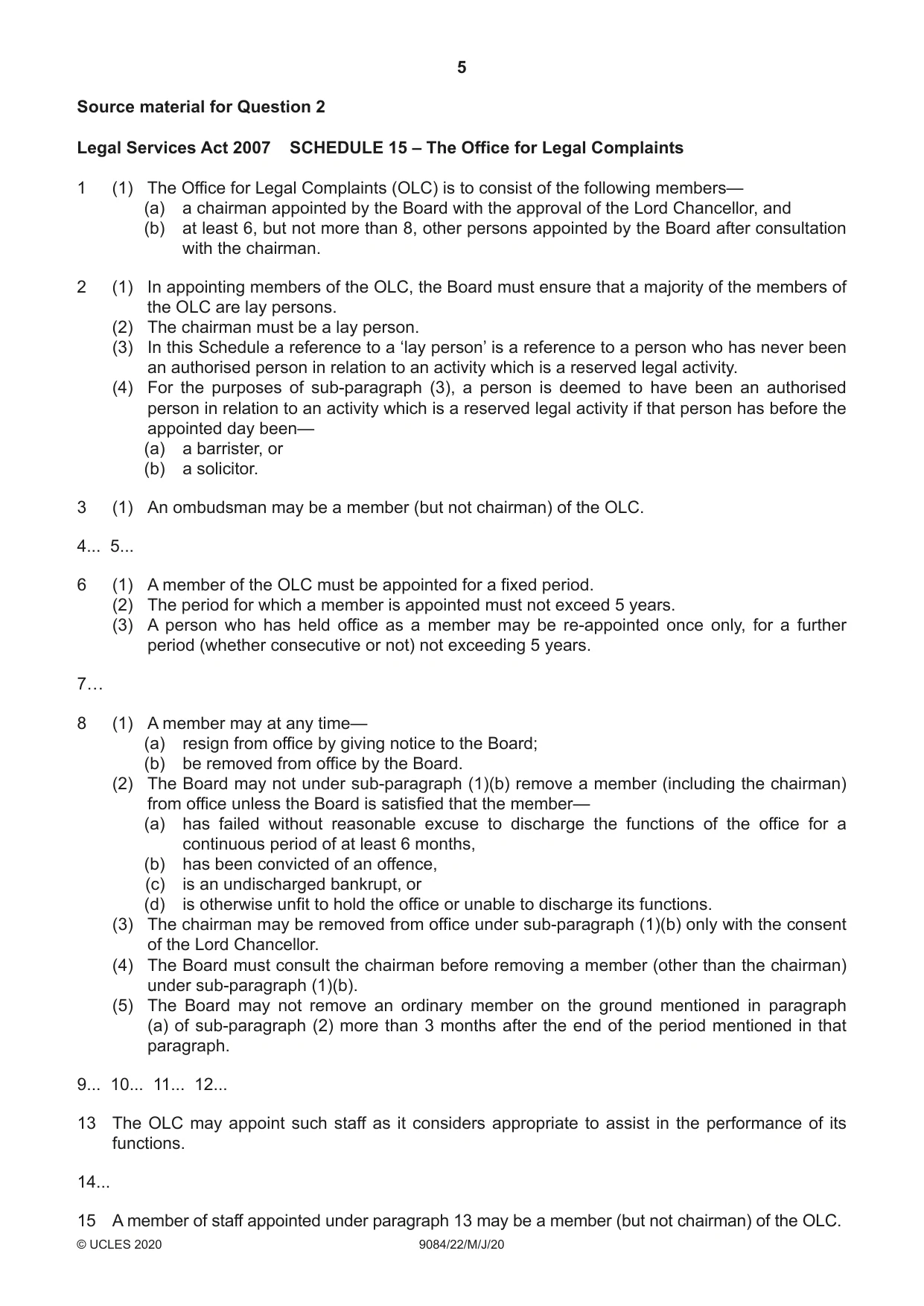
2 (a) The Board of the Office for Legal Complaints (OLC) appoints, with the Lord Chancellor’s approval, a chairman who has had a career in banking. Six other members are appointed after the chairman has been consulted. Most are appointed for a four-year term but one, who has been a member of the OLC twice before, is appointed for only two years. Priya wants the OLC to deal with a complaint she has about her solicitor. Explain how the Legal Services Act 2007 will apply to Priya in this situation. [10] (b) Fred has been a member of the OLC for three years. He still has two years left to serve when he writes a letter of resignation to the Board. Colin is half-way through a five-year term on the OLC when he is found to be an undischarged bankrupt. Jack, the chairman, is convicted of theft and the Lord Chancellor approves his removal. In his place, the Board appoints Alan, who is a part-time Circuit Judge. The OLC is asked to decide on a case involving a complaint about a barrister. Explain how the Legal Services Act 2007 will apply in this situation. [10] (c) The OLC appoints Juan to be a member of their staff. A year later, Juan is doing such a good job he is appointed as a member of the OLC. Ann is a member of the OLC who has missed every meeting for the last nine months without giving any reasons. A month later, after consulting the chairman, the Board writes to Ann to say she has been removed. In her place, the Board appoints Maria, an accountant, for a term of three years. The OLC is asked to consider a complaint by Trevor about the judge who handled his trial. Explain how the Legal Services Act 2007 will apply in this situation. [10] (d) Describe the education and training needed to become a barrister. Assess the extent to which it is fit for purpose in the twenty-first century. [20] Source material for Question 2 Legal Services Act 2007 SCHEDULE 15 – The Office for Legal Complaints 1 (1) The Office for Legal Complaints (OLC) is to consist of the following members— (a) a chairman appointed by the Board with the approval of the Lord Chancellor, and (b) at least 6, but not more than 8, other persons appointed by the Board after consultation with the chairman. 2 (1) In appointing members of the OLC, the Board must ensure that a majority of the members of the OLC are lay persons. (2) The chairman must be a lay person. (3) In this Schedule a reference to a ‘lay person’ is a reference to a person who has never been an authorised person in relation to an activity which is a reserved legal activity. (4) For the purposes of sub-paragraph (3), a person is deemed to have been an authorised person in relation to an activity which is a reserved legal activity if that person has before the appointed day been— (a) a barrister, or (b) a solicitor. 3 (1) An ombudsman may be a member (but not chairman) of the OLC. 4... 5... 6 (1) A member of the OLC must be appointed for a fixed period. (2) The period for which a member is appointed must not exceed 5 years. (3) A person who has held office as a member may be re-appointed once only, for a further period (whether consecutive or not) not exceeding 5 years. 7… 8 (1) A member may at any time— (a) resign from office by giving notice to the Board; (b) be removed from office by the Board. (2) The Board may not under sub-paragraph (1)(b) remove a member (including the chairman) from office unless the Board is satisfied that the member— (a) has failed without reasonable excuse to discharge the functions of the office for a continuous period of at least 6 months, (b) has been convicted of an offence, (c) is an undischarged bankrupt, or (d) is otherwise unfit to hold the office or unable to discharge its functions. (3) The chairman may be removed from office under sub-paragraph (1)(b) only with the consent of the Lord Chancellor. (4) The Board must consult the chairman before removing a member (other than the chairman) under sub-paragraph (1)(b). (5) The Board may not remove an ordinary member on the ground mentioned in paragraph (a) of sub-paragraph (2) more than 3 months after the end of the period mentioned in that paragraph. 9... 10... 11... 12... 13 The OLC may appoint such staff as it considers appropriate to assist in the performance of its functions. 14...
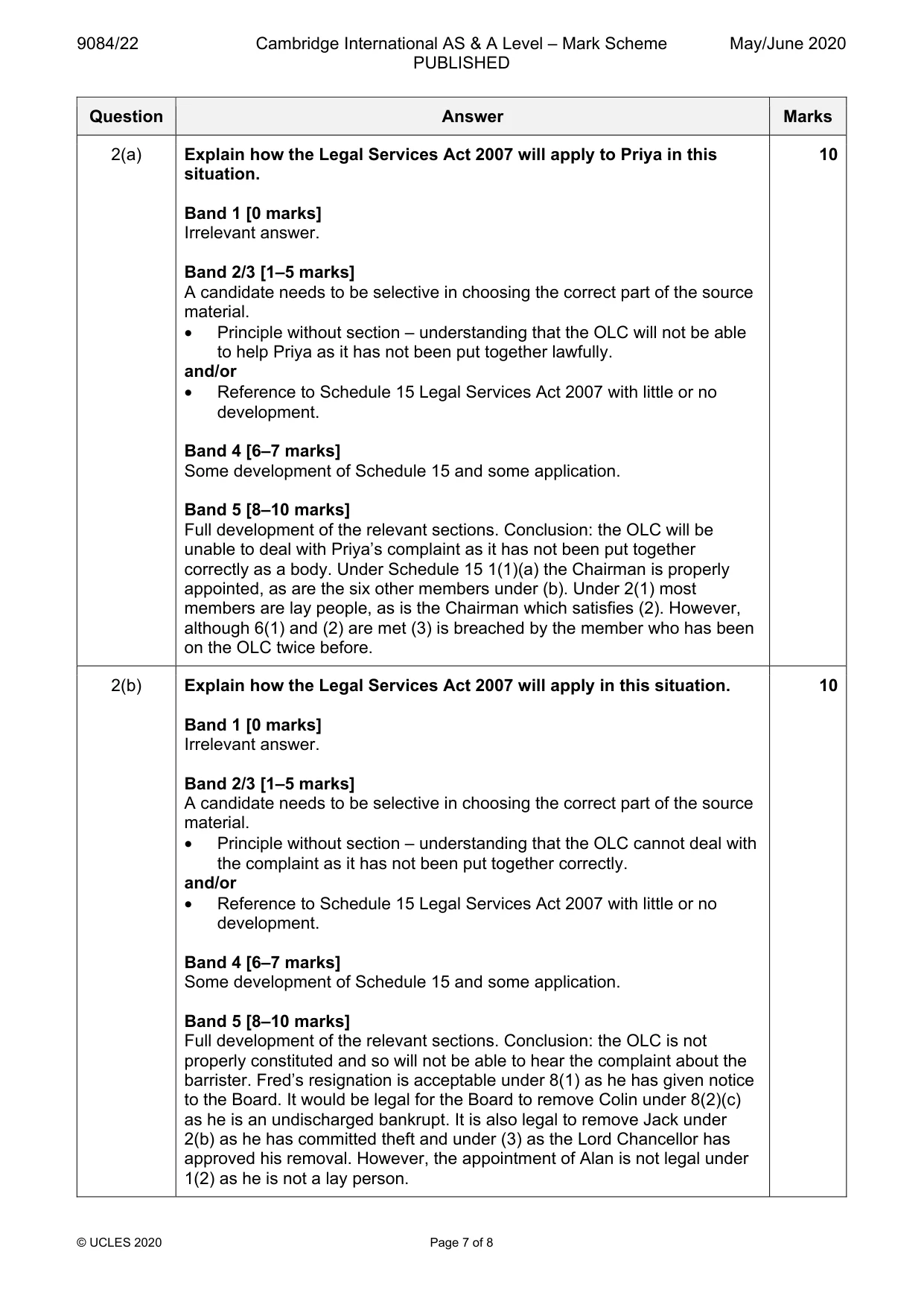
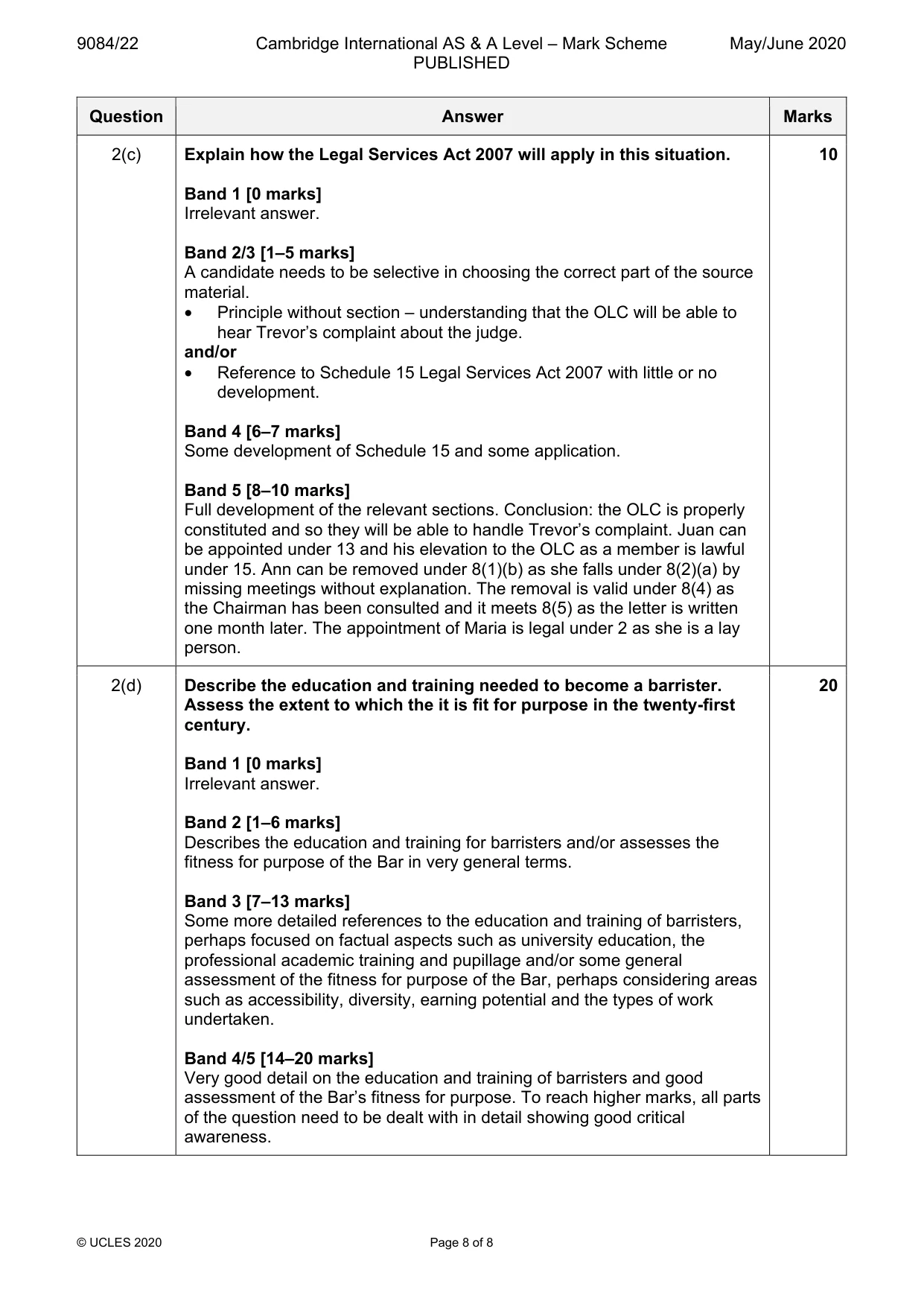
Mark scheme: 2(a) Explain how the Legal Services Act 2007 will apply to Priya in this 10 situation. Band 1 [0 marks] Irrelevant answer. Band 2/3 [1–5 marks] A candidate needs to be selective in choosing the correct part of the source material. • Principle without section – understanding that the OLC will not be able to help Priya as it has not been put together lawfully. and/or • Reference to Schedule 15 Legal Services Act 2007 with little or no development. Band 4 [6–7 marks] Some development of Schedule 15 and some application. Band 5 [8–10 marks] Full development of the relevant sections. Conclusion: the OLC will be unable to deal with Priya’s complaint as it has not been put together correctly as a body. Under Schedule 15 1(1)(a) the Chairman is properly appointed, as are the six other members under (b). Under 2(1) most members are lay people, as is the Chairman which satisfies (2). However, although 6(1) and (2) are met (3) is breached by the member who has been on the OLC twice before. 2(b) Explain how the Legal Services Act 2007 will apply in this situation. 10 Band 1 [0 marks] Irrelevant answer. Band 2/3 [1–5 marks] A candidate needs to be selective in choosing the correct part of the source material. • Principle without section – understanding that the OLC cannot deal with the complaint as it has not been put together correctly. and/or • Reference to Schedule 15 Legal Services Act 2007 with little or no development. Band 4 [6–7 marks] Some development of Schedule 15 and some application. Band 5 [8–10 marks] Full development of the relevant sections. Conclusion: the OLC is not properly constituted and so will not be able to hear the complaint about the barrister. Fred’s resignation is acceptable under 8(1) as he has given notice to the Board. It would be legal for the Board to remove Colin under 8(2)(c) as he is an undischarged bankrupt. It is also legal to remove Jack under 2(b) as he has committed theft and under (3) as the Lord Chancellor has approved his removal. However, the appointment of Alan is not legal under 1(2) as he is not a lay person. 2(c) Explain how the Legal Services Act 2007 will apply in this situation. 10 Band 1 [0 marks] Irrelevant answer. Band 2/3 [1–5 marks] A candidate needs to be selective in choosing the correct part of the source material. • Principle without section – understanding that the OLC will be able to hear Trevor’s complaint about the judge. and/or • Reference to Schedule 15 Legal Services Act 2007 with little or no development. Band 4 [6–7 marks] Some development of Schedule 15 and some application. Band 5 [8–10 marks] Full development of the relevant sections. Conclusion: the OLC is properly constituted and so they will be able to handle Trevor’s complaint. Juan can be appointed under 13 and his elevation to the OLC as a member is lawful under 15. Ann can be removed under 8(1)(b) as she falls under 8(2)(a) by missing meetings without explanation. The removal is valid under 8(4) as the Chairman has been consulted and it meets 8(5) as the letter is written one month later. The appointment of Maria is legal under 2 as she is a lay person. 2(d) Describe the education and training needed to become a barrister. 20 Assess the extent to which the it is fit for purpose in the twenty-first century. Band 1 [0 marks] Irrelevant answer. Band 2 [1–6 marks] Describes the education and training for barristers and/or assesses the fitness for purpose of the Bar in very general terms. Band 3 [7–13 marks] Some more detailed references to the education and training of barristers, perhaps focused on factual aspects such as university education, the professional academic training and pupillage and/or some general assessment of the fitness for purpose of the Bar, perhaps considering areas such as accessibility, diversity, earning potential and the types of work undertaken. Band 4/5 [14–20 marks] Very good detail on the education and training of barristers and good assessment of the Bar’s fitness for purpose. To reach higher marks, all parts of the question need to be dealt with in detail showing good critical awareness.
What was in this paper
The subtopics covered by these 2 questions, and how many questions each got. Open one in a new tab to see every Cambridge question on it.
1Legal personnel This topic focusses on the key legal personnel involved in the resolution of legal matters. This topic is an opportunity to reflect on the key concepts of justice, fairness and morality; power and its limits; and effectiveness and certainty1