Cambridge A Level Law 9084 — 2022 May/June Paper 2 · Variant 1
9084/21/M/J/22 · 2 questions · 50 marks · ≈56 min
The question paper and its mark scheme, free to read here and free to download. This is Cambridge’s own paper, exactly as it was sat.
Question paper8 pages



Mark scheme11 pages
Answers below. Sit the paper first if you are practising.
Questions as text
Q1 · Having successfully completed all her courses, Angela has recently qualified as a…
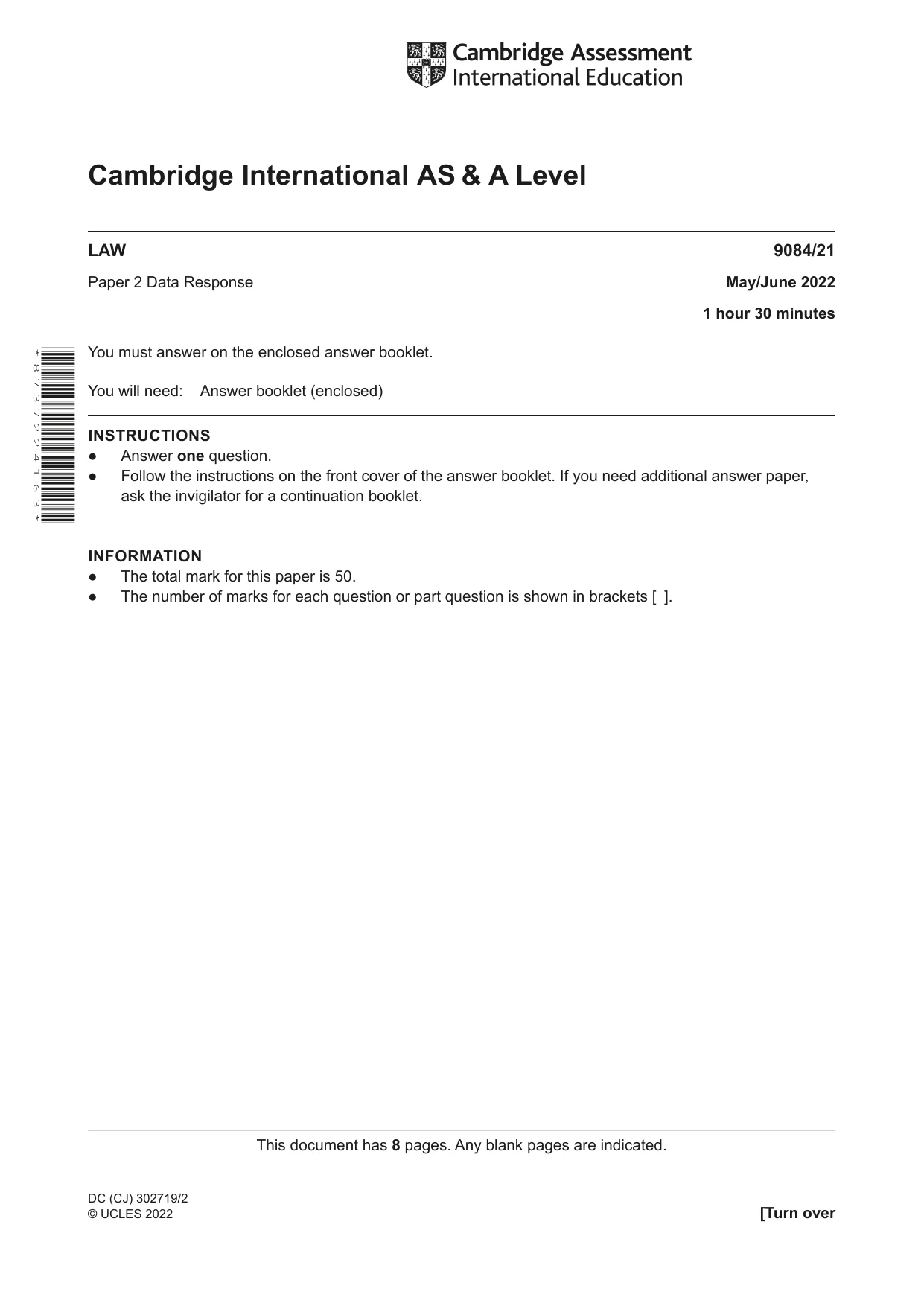
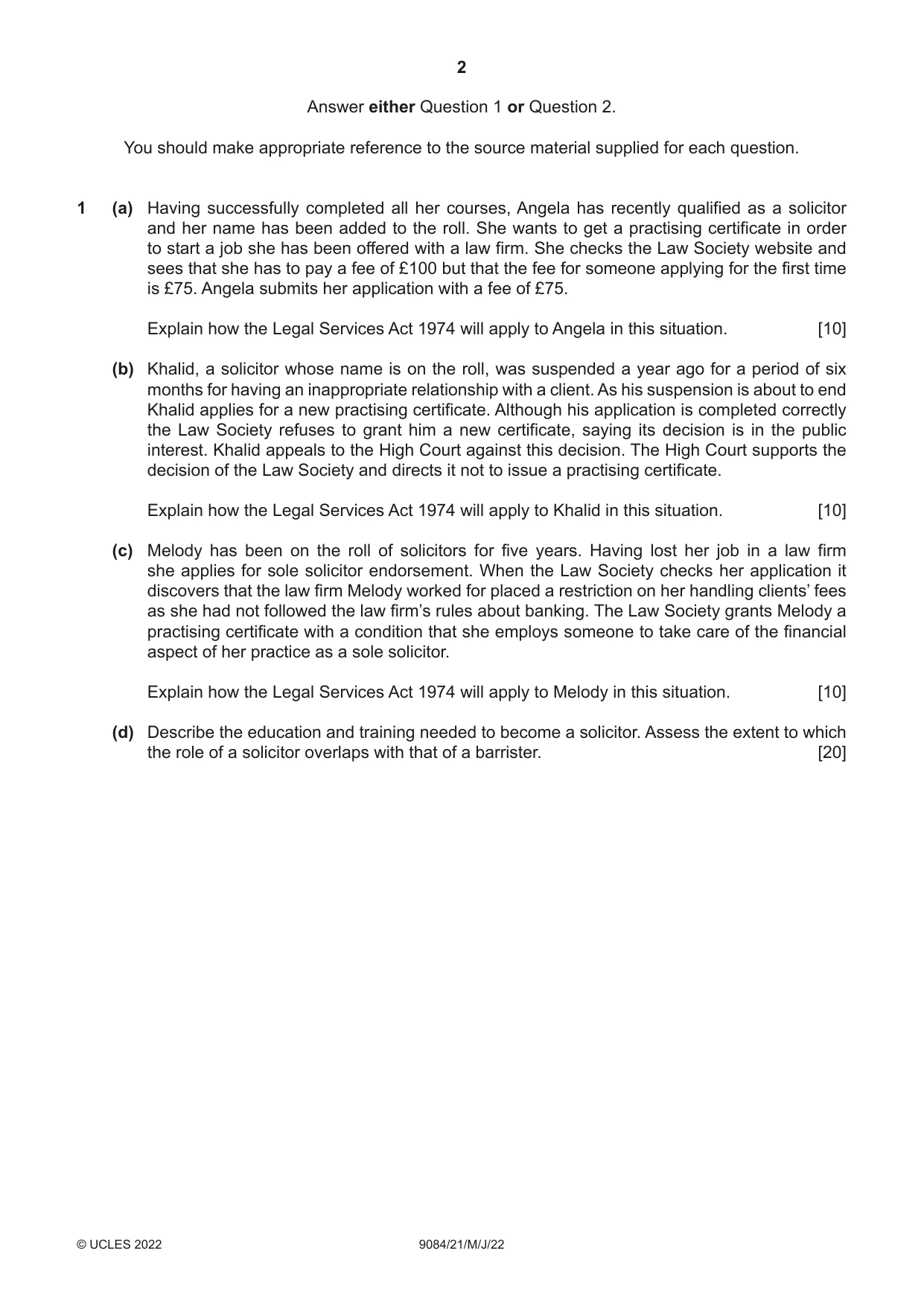
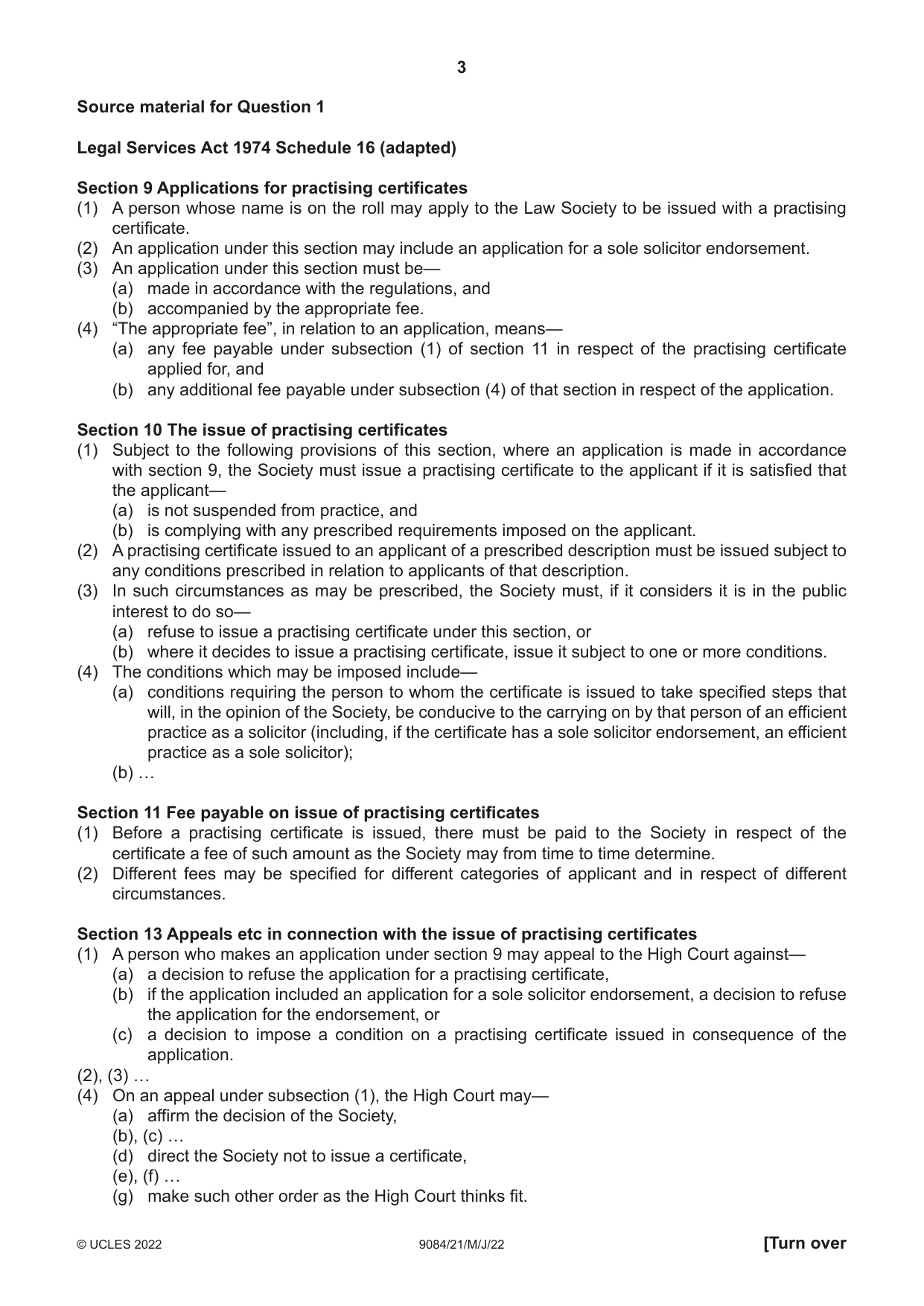
1 (a) Having successfully completed all her courses, Angela has recently qualified as a solicitor and her name has been added to the roll. She wants to get a practising certificate in order to start a job she has been offered with a law firm. She checks the Law Society website and sees that she has to pay a fee of £100 but that the fee for someone applying for the first time is £75. Angela submits her application with a fee of £75. Explain how the Legal Services Act 1974 will apply to Angela in this situation. [10] (b) Khalid, a solicitor whose name is on the roll, was suspended a year ago for a period of six months for having an inappropriate relationship with a client. As his suspension is about to end Khalid applies for a new practising certificate. Although his application is completed correctly the Law Society refuses to grant him a new certificate, saying its decision is in the public interest. Khalid appeals to the High Court against this decision. The High Court supports the decision of the Law Society and directs it not to issue a practising certificate. Explain how the Legal Services Act 1974 will apply to Khalid in this situation. [10] (c) Melody has been on the roll of solicitors for five years. Having lost her job in a law firm she applies for sole solicitor endorsement. When the Law Society checks her application it discovers that the law firm Melody worked for placed a restriction on her handling clients’ fees as she had not followed the law firm’s rules about banking. The Law Society grants Melody a practising certificate with a condition that she employs someone to take care of the financial aspect of her practice as a sole solicitor. Explain how the Legal Services Act 1974 will apply to Melody in this situation. [10] (d) Describe the education and training needed to become a solicitor. Assess the extent to which the role of a solicitor overlaps with that of a barrister. [20] Source material for Question 1 Legal Services Act 1974 Schedule 16 (adapted) Section 9 Applications for practising certificates (1) A person whose name is on the roll may apply to the Law Society to be issued with a practising certificate. (2) An application under this section may include an application for a sole solicitor endorsement. (3) An application under this section must be— (a) made in accordance with the regulations, and (b) accompanied by the appropriate fee. (4) “The appropriate fee”, in relation to an application, means— (a) any fee payable under subsection (1) of section 11 in respect of the practising certificate applied for, and (b) any additional fee payable under subsection (4) of that section in respect of the application. Section 10 The issue of practising certificates (1) Subject to the following provisions of this section, where an application is made in accordance with section 9, the Society must issue a practising certificate to the applicant if it is satisfied that the applicant— (a) is not suspended from practice, and (b) is complying with any prescribed requirements imposed on the applicant. (2) A practising certificate issued to an applicant of a prescribed description must be issued subject to any conditions prescribed in relation to applicants of that description. (3) In such circumstances as may be prescribed, the Society must, if it considers it is in the public interest to do so— (a) refuse to issue a practising certificate under this section, or (b) where it decides to issue a practising certificate, issue it subject to one or more conditions. (4) The conditions which may be imposed include— (a) conditions requiring the person to whom the certificate is issued to take specified steps that will, in the opinion of the Society, be conducive to the carrying on by that person of an efficient practice as a solicitor (including, if the certificate has a sole solicitor endorsement, an efficient practice as a sole solicitor); (b) … Section 11 Fee payable on issue of practising certificates (1) Before a practising certificate is issued, there must be paid to the Society in respect of the certificate a fee of such amount as the Society may from time to time determine. (2) Different fees may be specified for different categories of applicant and in respect of different circumstances. Section 13 Appeals etc in connection with the issue of practising certificates (1) A person who makes an application under section 9 may appeal to the High Court against— (a) a decision to refuse the application for a practising certificate, (b) if the application included an application for a sole solicitor endorsement, a decision to refuse the application for the endorsement, or (c) a decision to impose a condition on a practising certificate issued in consequence of the application. (2), (3) … (4) On an appeal under subsection (1), the High Court may— (a) affirm the decision of the Society, (b), (c) … (d) direct the Society not to issue a certificate, (e), (f) … (g) make such other order as the High Court thinks fit.
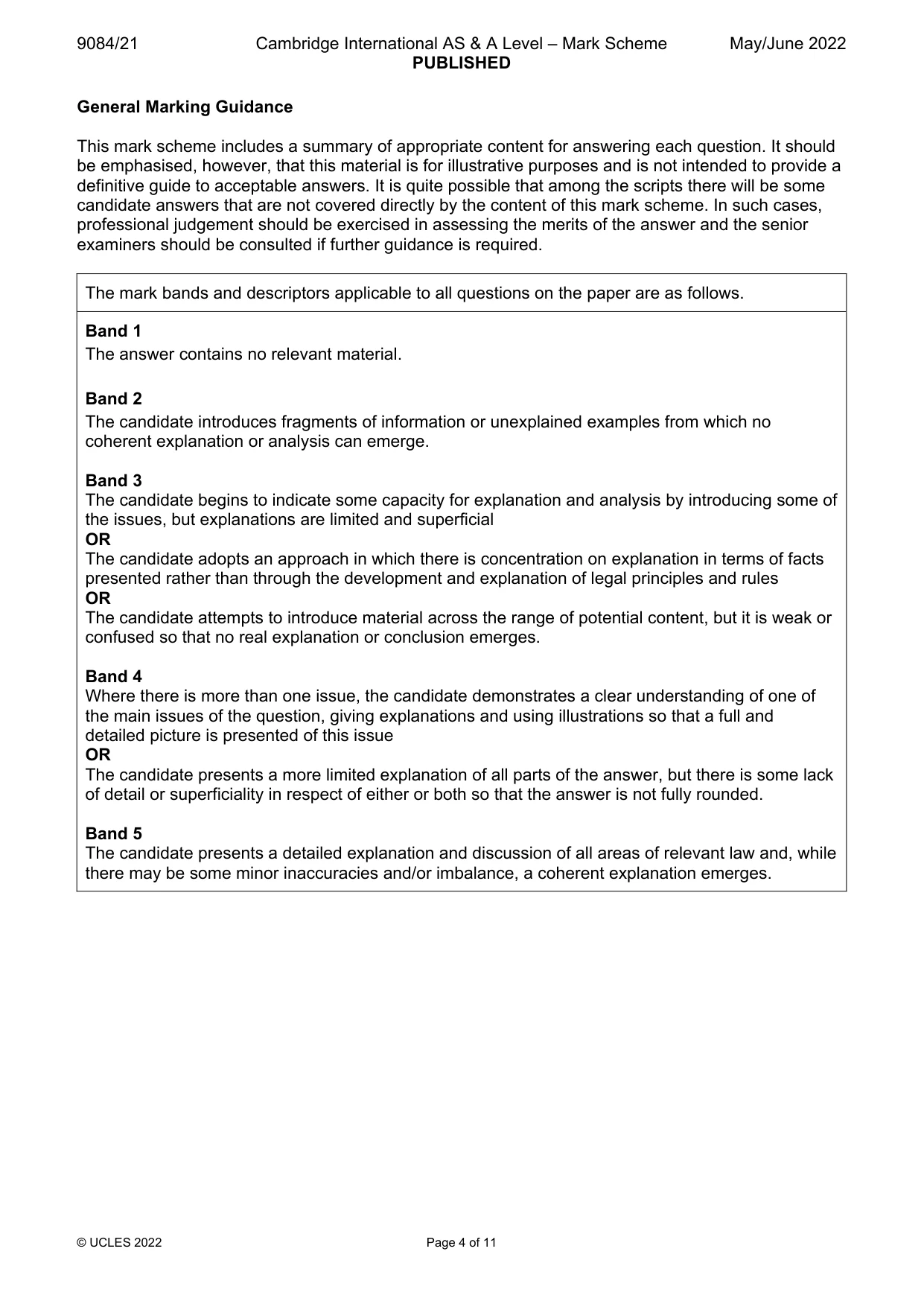
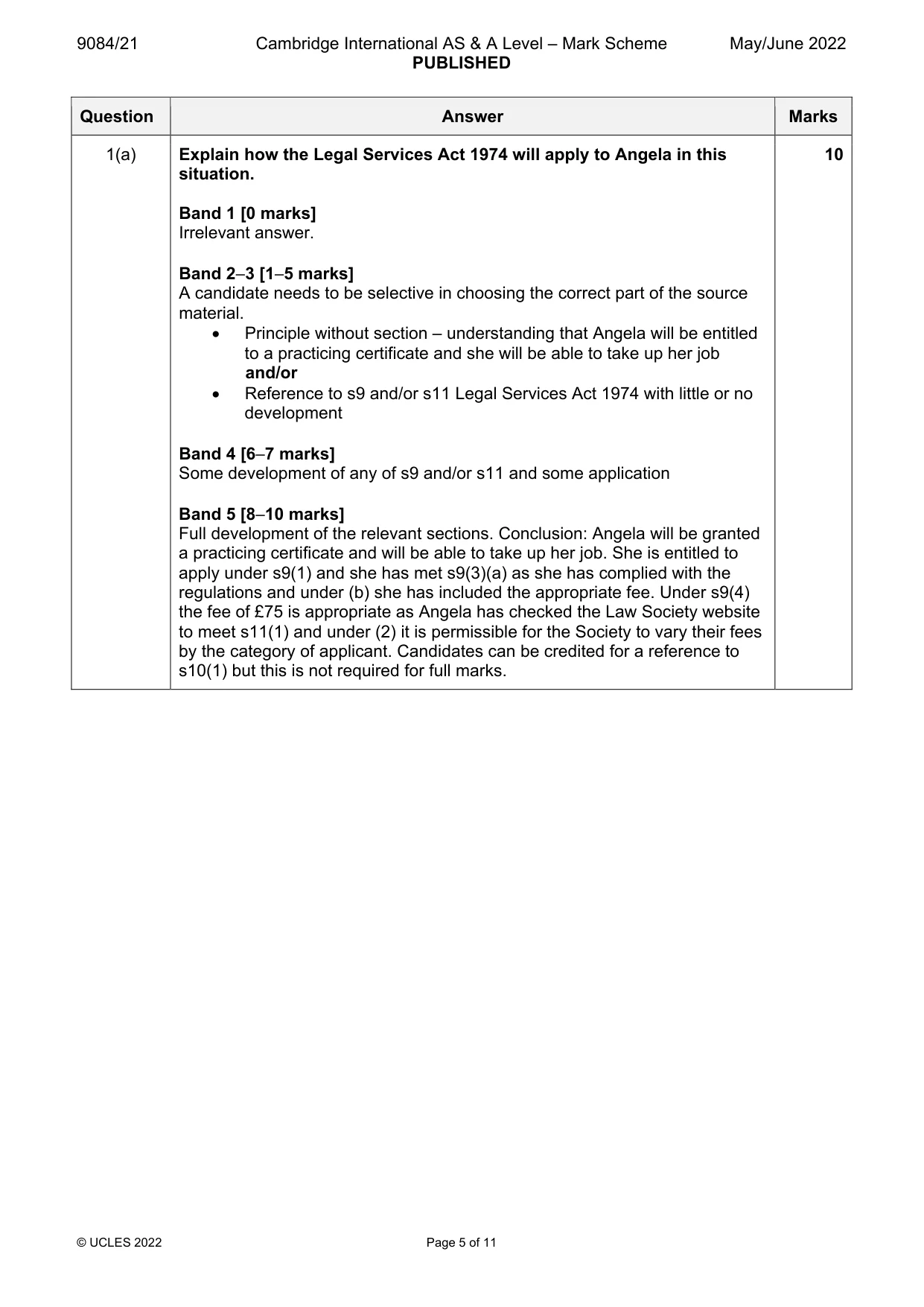
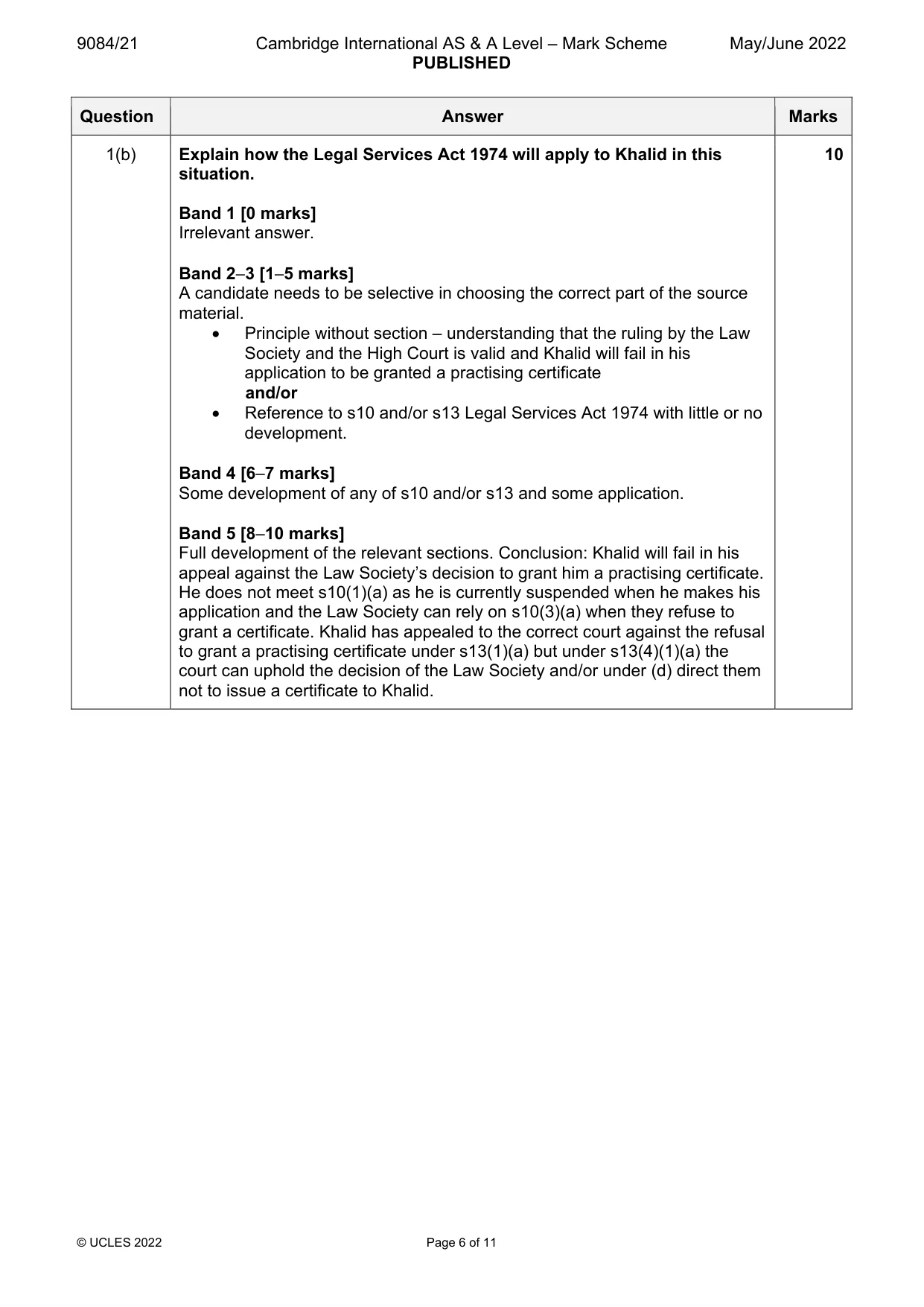
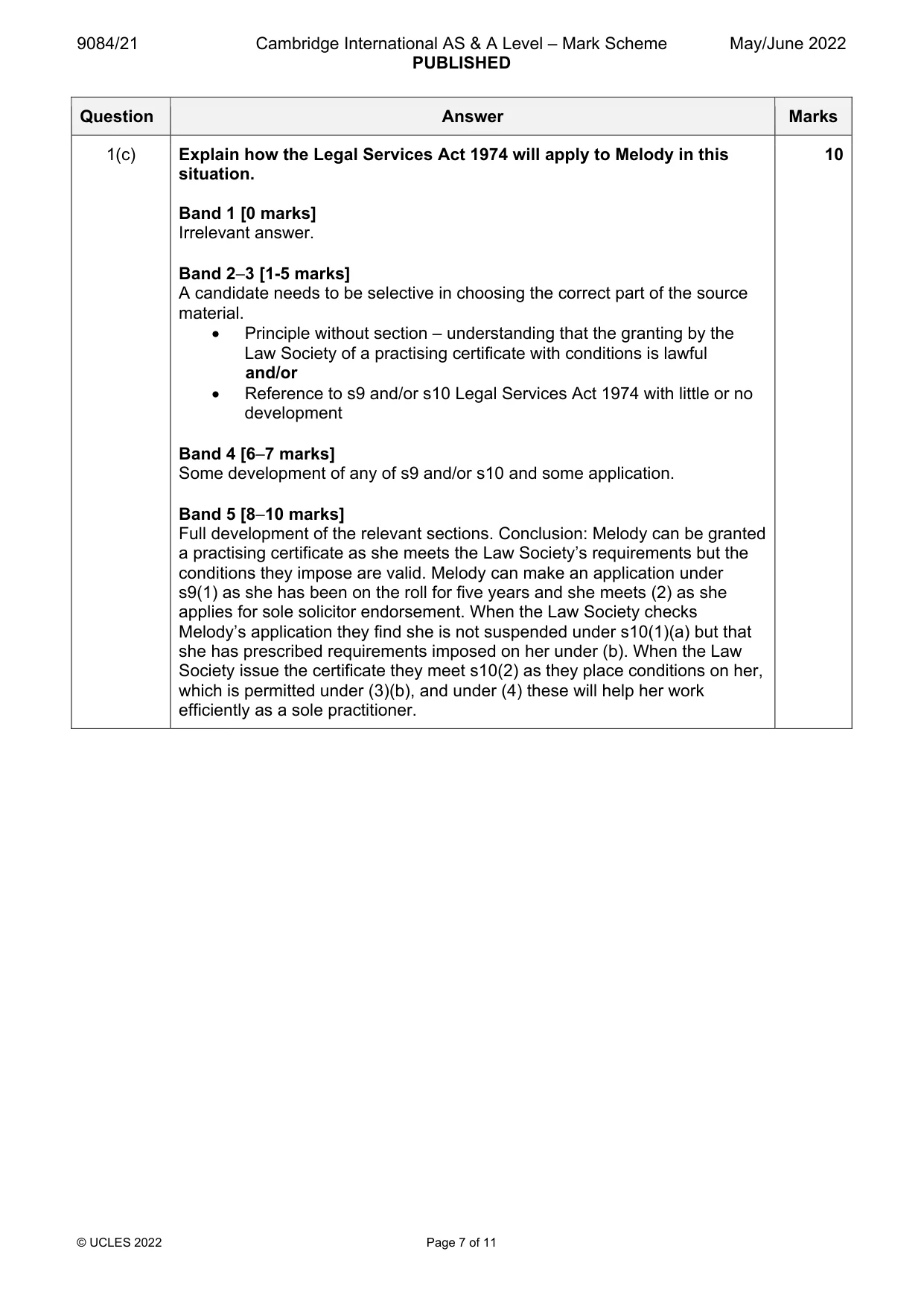
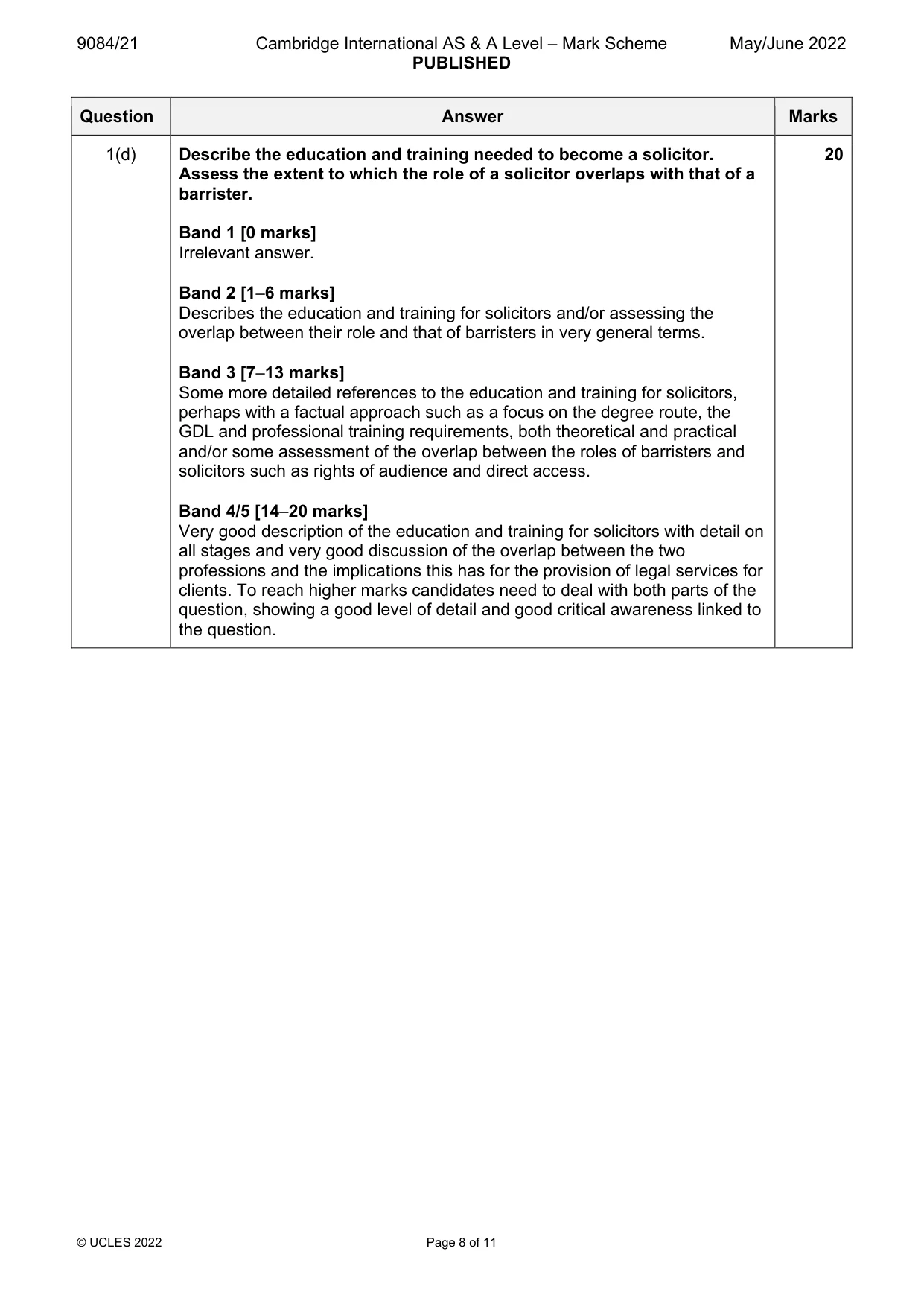
Mark scheme: Question Answer Marks 1(a) Explain how the Legal Services Act 1974 will apply to Angela in this 10 situation. Band 1 [0 marks] Irrelevant answer. Band 23 [15 marks] A candidate needs to be selective in choosing the correct part of the source material. Principle without section – understanding that Angela will be entitled to a practicing certificate and she will be able to take up her job and/or Reference to s9 and/or s11 Legal Services Act 1974 with little or no development Band 4 [67 marks] Some development of any of s9 and/or s11 and some application Band 5 [810 marks] Full development of the relevant sections. Conclusion: Angela will be granted a practicing certificate and will be able to take up her job. She is entitled to apply under s9(1) and she has met s9(3)(a) as she has complied with the regulations and under (b) she has included the appropriate fee. Under s9(4) the fee of £75 is appropriate as Angela has checked the Law Society website to meet s11(1) and under (2) it is permissible for the Society to vary their fees by the category of applicant. Candidates can be credited for a reference to s10(1) but this is not required for full marks. 1(b) Explain how the Legal Services Act 1974 will apply to Khalid in this 10 situation. Band 1 [0 marks] Irrelevant answer. Band 23 [15 marks] A candidate needs to be selective in choosing the correct part of the source material. Principle without section – understanding that the ruling by the Law Society and the High Court is valid and Khalid will fail in his application to be granted a practising certificate and/or Reference to s10 and/or s13 Legal Services Act 1974 with little or no development. Band 4 [67 marks] Some development of any of s10 and/or s13 and some application. Band 5 [810 marks] Full development of the relevant sections. Conclusion: Khalid will fail in his appeal against the Law Society’s decision to grant him a practising certificate. He does not meet s10(1)(a) as he is currently suspended when he makes his application and the Law Society can rely on s10(3)(a) when they refuse to grant a certificate. Khalid has appealed to the correct court against the refusal to grant a practising certificate under s13(1)(a) but under s13(4)(1)(a) the court can uphold the decision of the Law Society and/or under (d) direct them not to issue a certificate to Khalid. 1(c) Explain how the Legal Services Act 1974 will apply to Melody in this 10 situation. Band 1 [0 marks] Irrelevant answer. Band 23 [1-5 marks] A candidate needs to be selective in choosing the correct part of the source material. Principle without section – understanding that the granting by the Law Society of a practising certificate with conditions is lawful and/or Reference to s9 and/or s10 Legal Services Act 1974 with little or no development Band 4 [67 marks] Some development of any of s9 and/or s10 and some application. Band 5 [810 marks] Full development of the relevant sections. Conclusion: Melody can be granted a practising certificate as she meets the Law Society’s requirements but the conditions they impose are valid. Melody can make an application under s9(1) as she has been on the roll for five years and she meets (2) as she applies for sole solicitor endorsement. When the Law Society checks Melody’s application they find she is not suspended under s10(1)(a) but that she has prescribed requirements imposed on her under (b). When the Law Society issue the certificate they meet s10(2) as they place conditions on her, which is permitted under (3)(b), and under (4) these will help her work efficiently as a sole practitioner. 1(d) Describe the education and training needed to become a solicitor. 20 Assess the extent to which the role of a solicitor overlaps with that of a barrister. Band 1 [0 marks] Irrelevant answer. Band 2 [16 marks] Describes the education and training for solicitors and/or assessing the overlap between their role and that of barristers in very general terms. Band 3 [713 marks] Some more detailed references to the education and training for solicitors, perhaps with a factual approach such as a focus on the degree route, the GDL and professional training requirements, both theoretical and practical and/or some assessment of the overlap between the roles of barristers and solicitors such as rights of audience and direct access. Band 4/5 [1420 marks] Very good description of the education and training for solicitors with detail on all stages and very good discussion of the overlap between the two professions and the implications this has for the provision of legal services for clients. To reach higher marks candidates need to deal with both parts of the question, showing a good level of detail and good critical awareness linked to the question.
Q2 · Roger makes a Freedom of Information (FOI) request to a university for details of its…
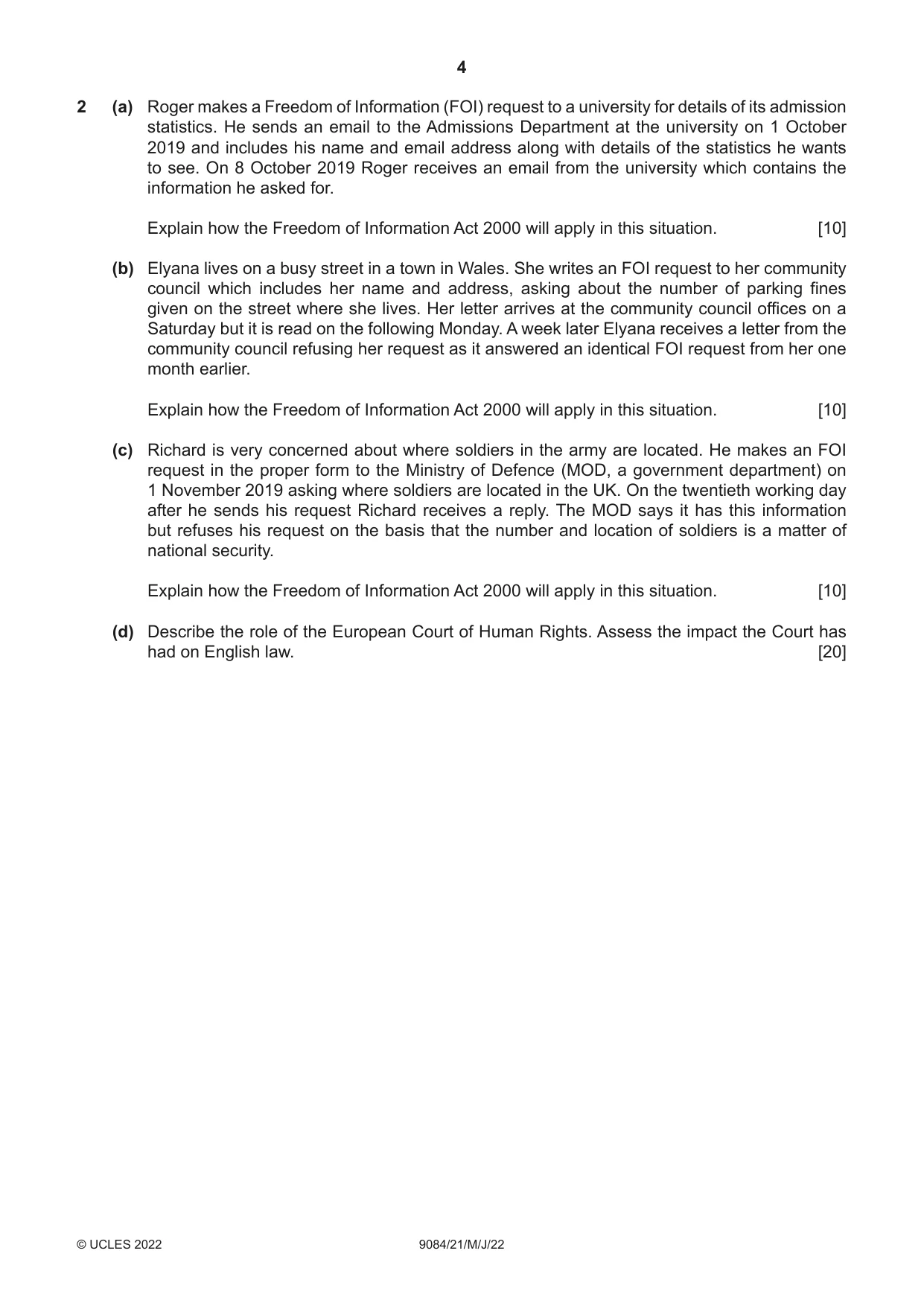
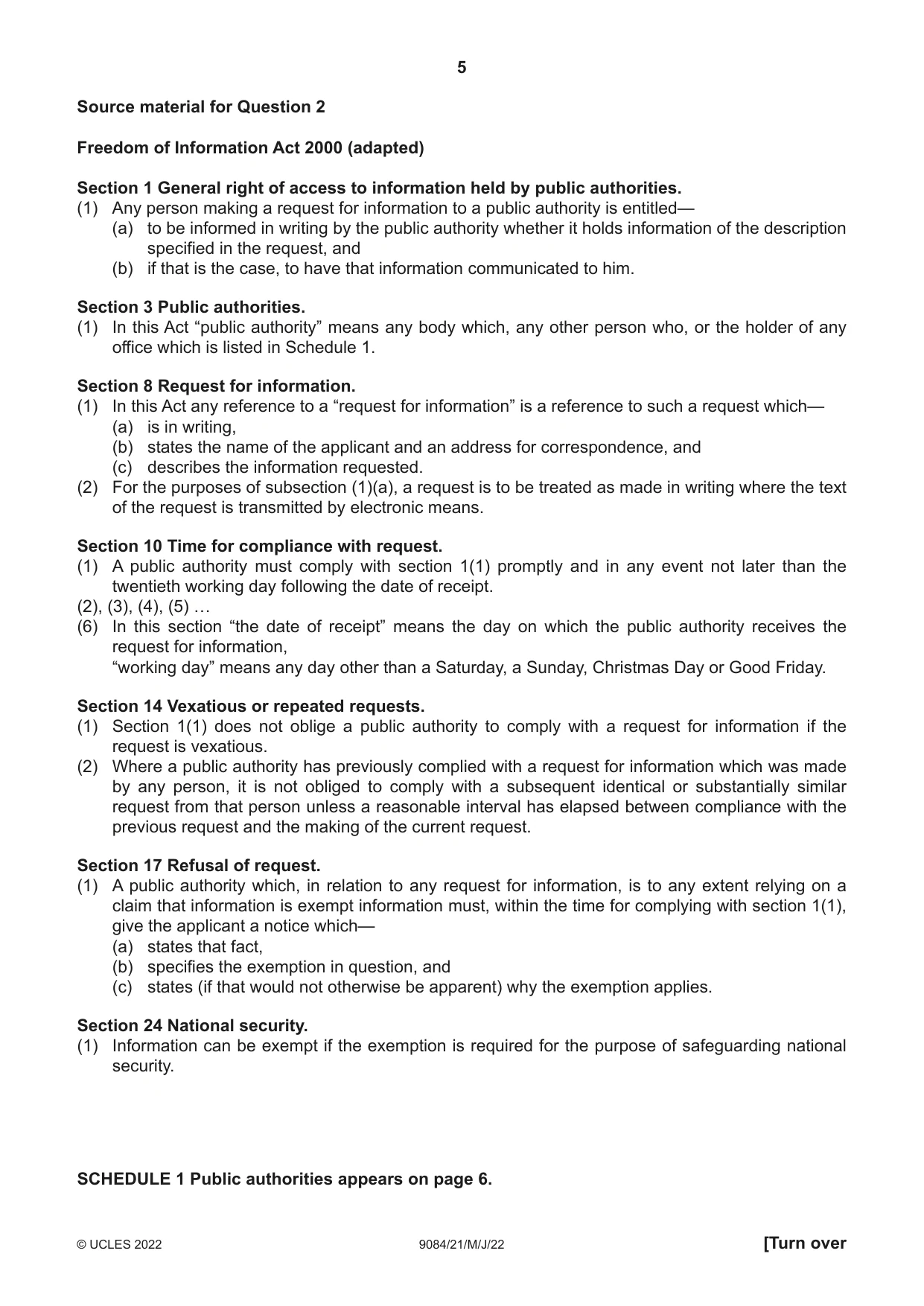
2 (a) Roger makes a Freedom of Information (FOI) request to a university for details of its admission statistics. He sends an email to the Admissions Department at the university on 1 October 2019 and includes his name and email address along with details of the statistics he wants to see. On 8 October 2019 Roger receives an email from the university which contains the information he asked for. Explain how the Freedom of Information Act 2000 will apply in this situation. [10] (b) Elyana lives on a busy street in a town in Wales. She writes an FOI request to her community council which includes her name and address, asking about the number of parking fines given on the street where she lives. Her letter arrives at the community council offices on a Saturday but it is read on the following Monday. A week later Elyana receives a letter from the community council refusing her request as it answered an identical FOI request from her one month earlier. Explain how the Freedom of Information Act 2000 will apply in this situation. [10] (c) Richard is very concerned about where soldiers in the army are located. He makes an FOI request in the proper form to the Ministry of Defence (MOD, a government department) on 1 November 2019 asking where soldiers are located in the UK. On the twentieth working day after he sends his request Richard receives a reply. The MOD says it has this information but refuses his request on the basis that the number and location of soldiers is a matter of national security. Explain how the Freedom of Information Act 2000 will apply in this situation. [10] (d) Describe the role of the European Court of Human Rights. Assess the impact the Court has had on English law. [20] Source material for Question 2 Freedom of Information Act 2000 (adapted) Section 1 General right of access to information held by public authorities. (1) Any person making a request for information to a public authority is entitled— (a) to be informed in writing by the public authority whether it holds information of the description specified in the request, and (b) if that is the case, to have that information communicated to him. Section 3 Public authorities. (1) In this Act “public authority” means any body which, any other person who, or the holder of any office which is listed in Schedule 1. Section 8 Request for information. (1) In this Act any reference to a “request for information” is a reference to such a request which— (a) is in writing, (b) states the name of the applicant and an address for correspondence, and (c) describes the information requested. (2) For the purposes of subsection (1)(a), a request is to be treated as made in writing where the text of the request is transmitted by electronic means. Section 10 Time for compliance with request. (1) A public authority must comply with section 1(1) promptly and in any event not later than the twentieth working day following the date of receipt. (2), (3), (4), (5) … (6) In this section “the date of receipt” means the day on which the public authority receives the request for information, “working day” means any day other than a Saturday, a Sunday, Christmas Day or Good Friday. Section 14 Vexatious or repeated requests. (1) Section 1(1) does not oblige a public authority to comply with a request for information if the request is vexatious. (2) Where a public authority has previously complied with a request for information which was made by any person, it is not obliged to comply with a subsequent identical or substantially similar request from that person unless a reasonable interval has elapsed between compliance with the previous request and the making of the current request. Section 17 Refusal of request. (1) A public authority which, in relation to any request for information, is to any extent relying on a claim that information is exempt information must, within the time for complying with section 1(1), give the applicant a notice which— (a) states that fact, (b) specifies the exemption in question, and (c) states (if that would not otherwise be apparent) why the exemption applies. Section 24 National security. (1) Information can be exempt if the exemption is required for the purpose of safeguarding national security. SCHEDULE 1 Public authorities appears on page 6. SCHEDULE 1 Public authorities Part I General 1 Any government department Part II Local government 7 A local authority within the meaning of the Local Government Act 1972, namely— (a) in England, a county council, a London borough council, a district council or a parish council, (b) in Wales, a county council, a county borough council or a community council. Part IV Maintained schools and other educational institutions 53 (1) The governing body of— (a) an institution within the further education section, or (b) a university.
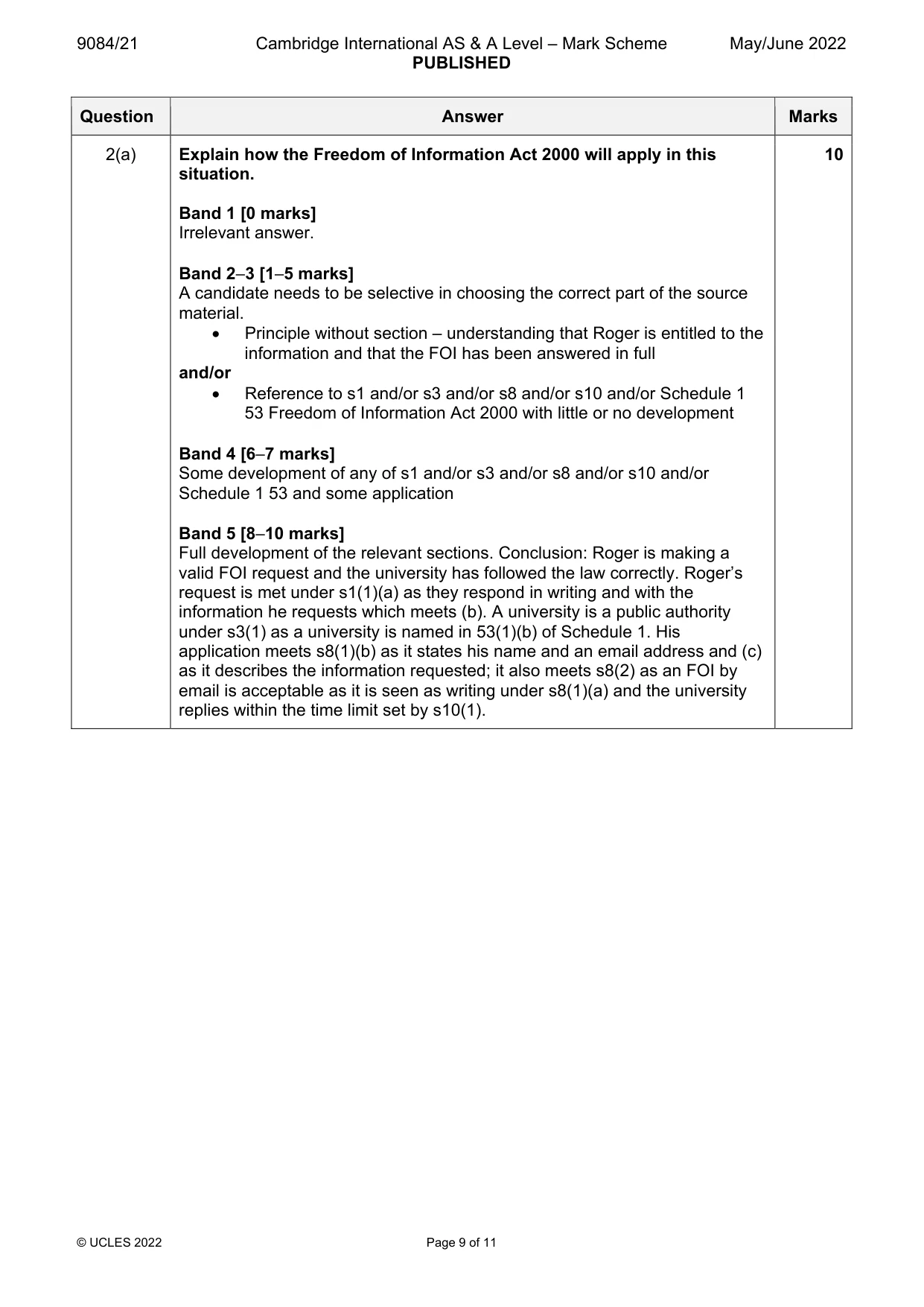
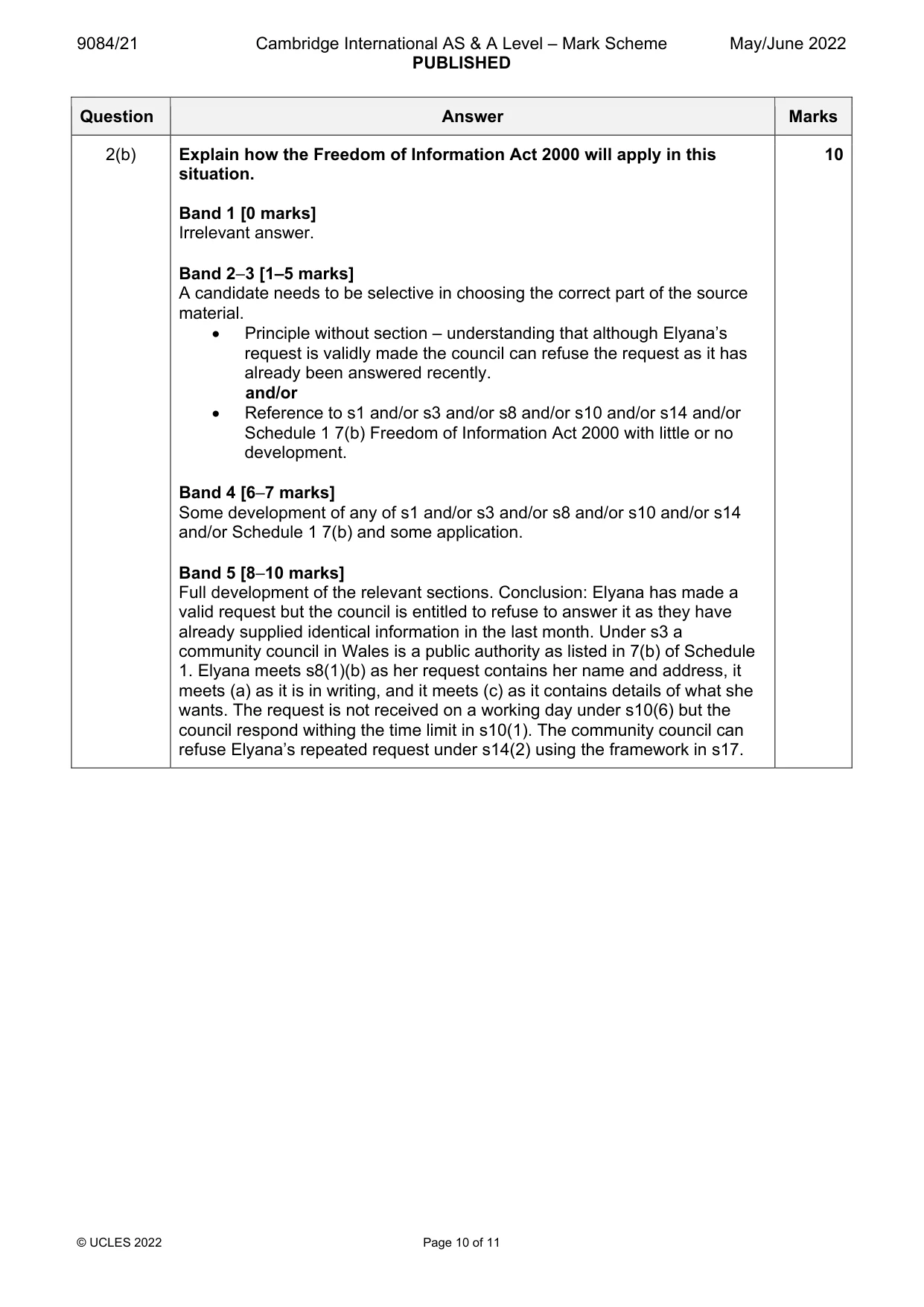
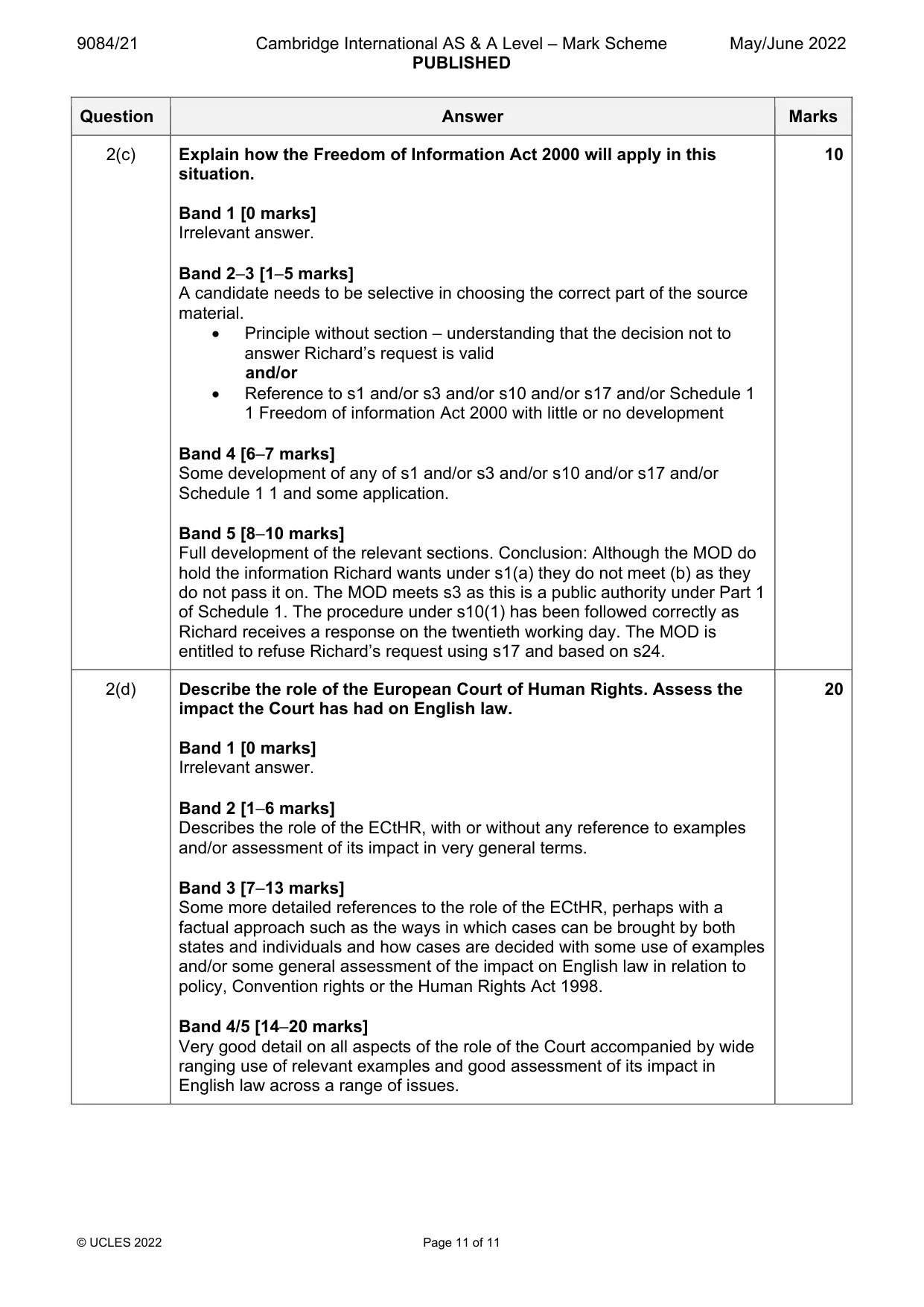
Mark scheme: 2(a) Explain how the Freedom of Information Act 2000 will apply in this 10 situation. Band 1 [0 marks] Irrelevant answer. Band 23 [15 marks] A candidate needs to be selective in choosing the correct part of the source material. Principle without section – understanding that Roger is entitled to the information and that the FOI has been answered in full and/or Reference to s1 and/or s3 and/or s8 and/or s10 and/or Schedule 1 53 Freedom of Information Act 2000 with little or no development Band 4 [67 marks] Some development of any of s1 and/or s3 and/or s8 and/or s10 and/or Schedule 1 53 and some application Band 5 [810 marks] Full development of the relevant sections. Conclusion: Roger is making a valid FOI request and the university has followed the law correctly. Roger’s request is met under s1(1)(a) as they respond in writing and with the information he requests which meets (b). A university is a public authority under s3(1) as a university is named in 53(1)(b) of Schedule 1. His application meets s8(1)(b) as it states his name and an email address and (c) as it describes the information requested; it also meets s8(2) as an FOI by email is acceptable as it is seen as writing under s8(1)(a) and the university replies within the time limit set by s10(1). 2(b) Explain how the Freedom of Information Act 2000 will apply in this 10 situation. Band 1 [0 marks] Irrelevant answer. Band 23 [1–5 marks] A candidate needs to be selective in choosing the correct part of the source material. Principle without section – understanding that although Elyana’s request is validly made the council can refuse the request as it has already been answered recently. and/or Reference to s1 and/or s3 and/or s8 and/or s10 and/or s14 and/or Schedule 1 7(b) Freedom of Information Act 2000 with little or no development. Band 4 [67 marks] Some development of any of s1 and/or s3 and/or s8 and/or s10 and/or s14 and/or Schedule 1 7(b) and some application. Band 5 [810 marks] Full development of the relevant sections. Conclusion: Elyana has made a valid request but the council is entitled to refuse to answer it as they have already supplied identical information in the last month. Under s3 a community council in Wales is a public authority as listed in 7(b) of Schedule 1. Elyana meets s8(1)(b) as her request contains her name and address, it meets (a) as it is in writing, and it meets (c) as it contains details of what she wants. The request is not received on a working day under s10(6) but the council respond withing the time limit in s10(1). The community council can refuse Elyana’s repeated request under s14(2) using the framework in s17. 2(c) Explain how the Freedom of Information Act 2000 will apply in this 10 situation. Band 1 [0 marks] Irrelevant answer. Band 23 [15 marks] A candidate needs to be selective in choosing the correct part of the source material. Principle without section – understanding that the decision not to answer Richard’s request is valid and/or Reference to s1 and/or s3 and/or s10 and/or s17 and/or Schedule 1 1 Freedom of information Act 2000 with little or no development Band 4 [67 marks] Some development of any of s1 and/or s3 and/or s10 and/or s17 and/or Schedule 1 1 and some application. Band 5 [810 marks] Full development of the relevant sections. Conclusion: Although the MOD do hold the information Richard wants under s1(a) they do not meet (b) as they do not pass it on. The MOD meets s3 as this is a public authority under Part 1 of Schedule 1. The procedure under s10(1) has been followed correctly as Richard receives a response on the twentieth working day. The MOD is entitled to refuse Richard’s request using s17 and based on s24. 2(d) Describe the role of the European Court of Human Rights. Assess the 20 impact the Court has had on English law. Band 1 [0 marks] Irrelevant answer. Band 2 [16 marks] Describes the role of the ECtHR, with or without any reference to examples and/or assessment of its impact in very general terms. Band 3 [713 marks] Some more detailed references to the role of the ECtHR, perhaps with a factual approach such as the ways in which cases can be brought by both states and individuals and how cases are decided with some use of examples and/or some general assessment of the impact on English law in relation to policy, Convention rights or the Human Rights Act 1998. Band 4/5 [1420 marks] Very good detail on all aspects of the role of the Court accompanied by wide ranging use of relevant examples and good assessment of its impact in English law across a range of issues.
What was in this paper
The subtopics covered by these 2 questions, and how many questions each got. Open one in a new tab to see every Cambridge question on it.
1Machinery of justice This topic introduces the institutions and processes involved in the resolution of civil and criminal matters. This topic is an opportunity to reflect on the key concepts of power and its limits; justice, fairness and morality; effectiveness and certainty; and liability1What you needed in this session
Cambridge’s own grade thresholds for 2022 May/June, Paper 2 · Variant 1. A higher threshold means an easier paper — the bar moves with how the cohort did.