Cambridge A Level Law 9084 — 2022 May/June Paper 2 · Variant 2
9084/22/M/J/22 · 2 questions · 50 marks · ≈56 min
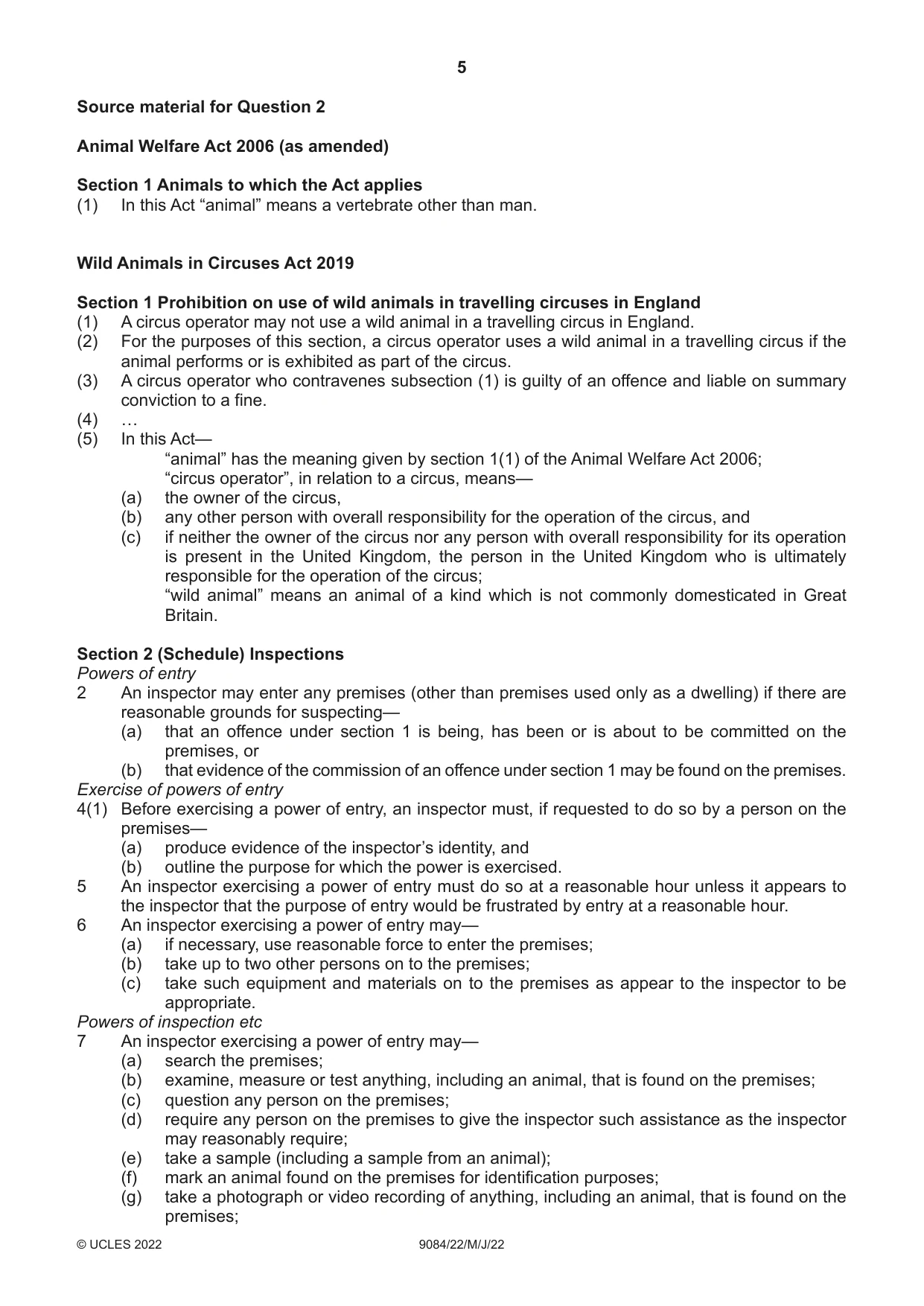
The question paper and its mark scheme, free to read here and free to download. This is Cambridge’s own paper, exactly as it was sat.
Question paper8 pages
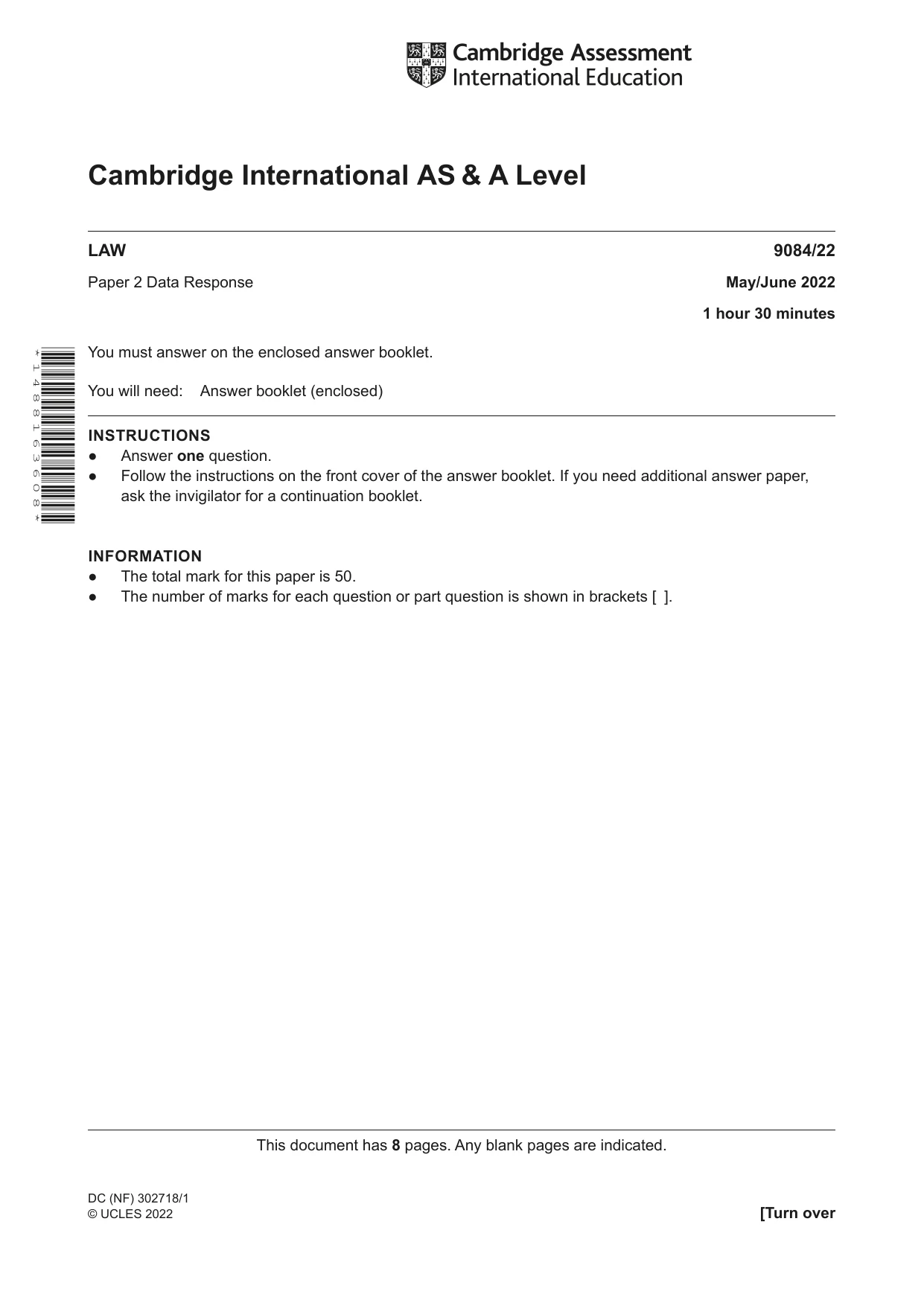
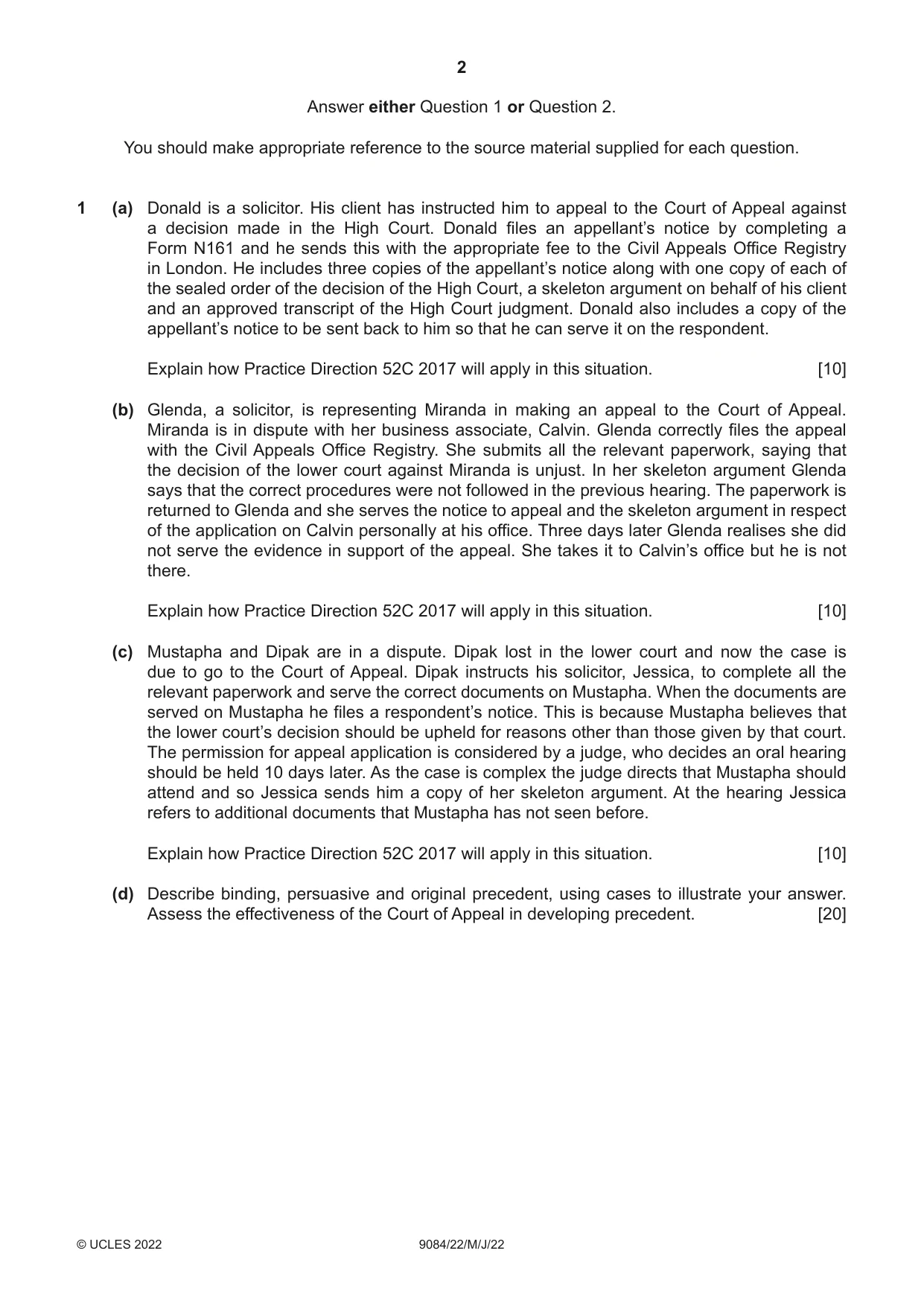
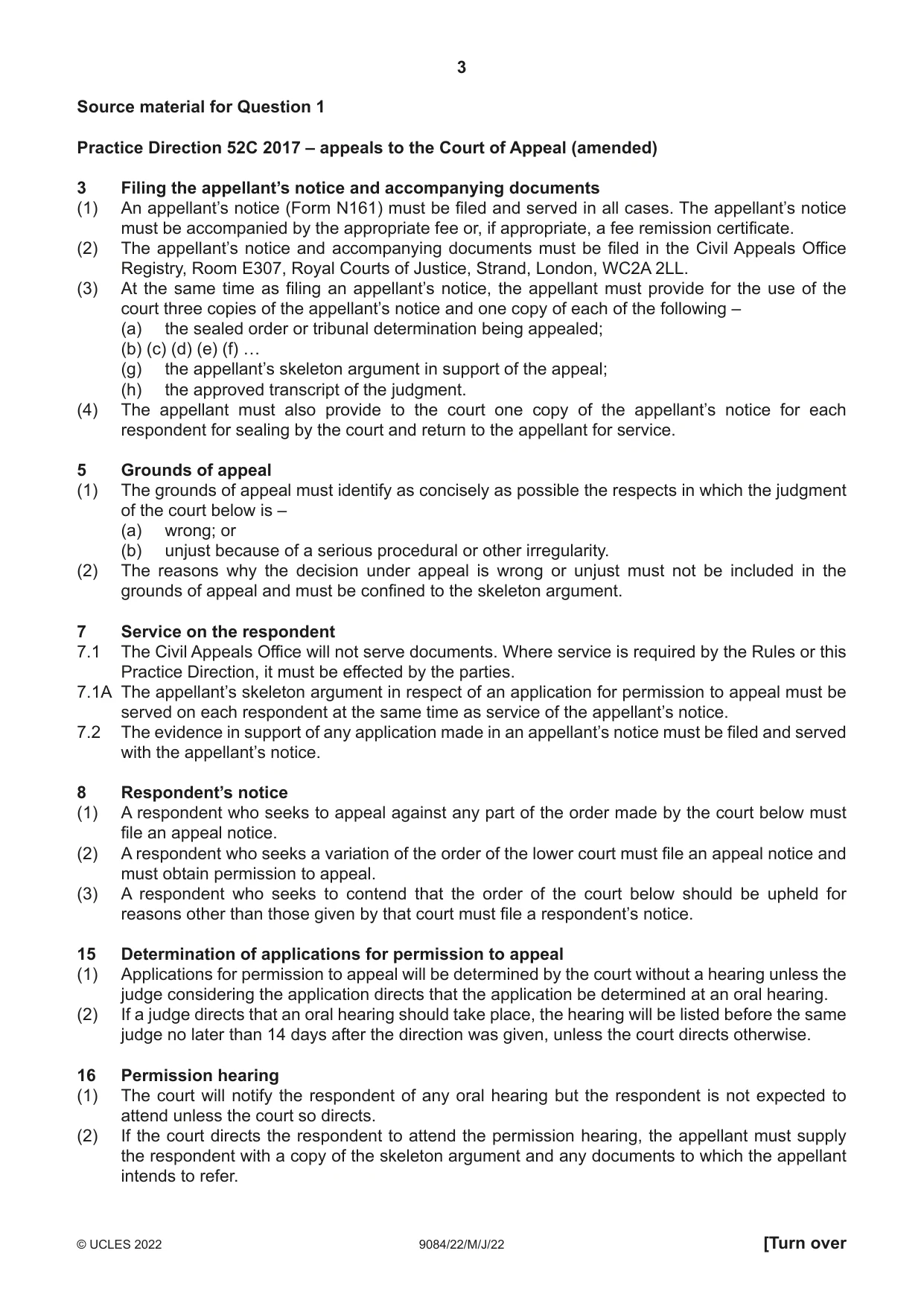
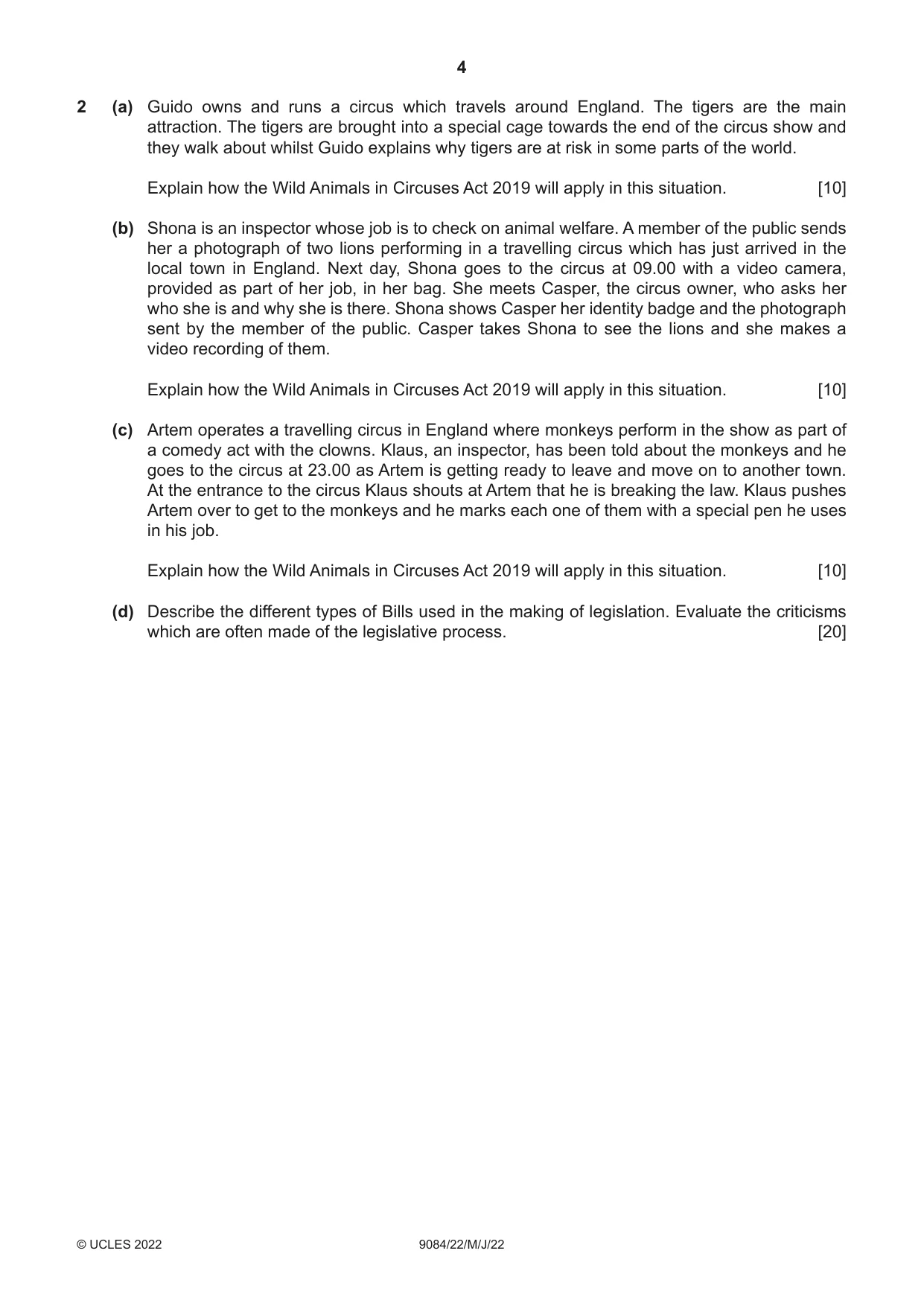



Mark scheme12 pages
Answers below. Sit the paper first if you are practising.
Questions as text
Q1 · Donald is a solicitor
1 (a) Donald is a solicitor. His client has instructed him to appeal to the Court of Appeal against a decision made in the High Court. Donald files an appellant’s notice by completing a Form N161 and he sends this with the appropriate fee to the Civil Appeals Office Registry in London. He includes three copies of the appellant’s notice along with one copy of each of the sealed order of the decision of the High Court, a skeleton argument on behalf of his client and an approved transcript of the High Court judgment. Donald also includes a copy of the appellant’s notice to be sent back to him so that he can serve it on the respondent. Explain how Practice Direction 52C 2017 will apply in this situation. [10] (b) Glenda, a solicitor, is representing Miranda in making an appeal to the Court of Appeal. Miranda is in dispute with her business associate, Calvin. Glenda correctly files the appeal with the Civil Appeals Office Registry. She submits all the relevant paperwork, saying that the decision of the lower court against Miranda is unjust. In her skeleton argument Glenda says that the correct procedures were not followed in the previous hearing. The paperwork is returned to Glenda and she serves the notice to appeal and the skeleton argument in respect of the application on Calvin personally at his office. Three days later Glenda realises she did not serve the evidence in support of the appeal. She takes it to Calvin’s office but he is not there. Explain how Practice Direction 52C 2017 will apply in this situation. [10] (c) Mustapha and Dipak are in a dispute. Dipak lost in the lower court and now the case is due to go to the Court of Appeal. Dipak instructs his solicitor, Jessica, to complete all the relevant paperwork and serve the correct documents on Mustapha. When the documents are served on Mustapha he files a respondent’s notice. This is because Mustapha believes that the lower court’s decision should be upheld for reasons other than those given by that court. The permission for appeal application is considered by a judge, who decides an oral hearing should be held 10 days later. As the case is complex the judge directs that Mustapha should attend and so Jessica sends him a copy of her skeleton argument. At the hearing Jessica refers to additional documents that Mustapha has not seen before. Explain how Practice Direction 52C 2017 will apply in this situation. [10] (d) Describe binding, persuasive and original precedent, using cases to illustrate your answer. Assess the effectiveness of the Court of Appeal in developing precedent. [20] Source material for Question 1 Practice Direction 52C 2017 – appeals to the Court of Appeal (amended) 3 Filing the appellant’s notice and accompanying documents (1) An appellant’s notice (Form N161) must be filed and served in all cases. The appellant’s notice must be accompanied by the appropriate fee or, if appropriate, a fee remission certificate. (2) The appellant’s notice and accompanying documents must be filed in the Civil Appeals Office Registry, Room E307, Royal Courts of Justice, Strand, London, WC2A 2LL. (3) At the same time as filing an appellant’s notice, the appellant must provide for the use of the court three copies of the appellant’s notice and one copy of each of the following – (a) the sealed order or tribunal determination being appealed; (b) (c) (d) (e) (f) … (g) the appellant’s skeleton argument in support of the appeal; (h) the approved transcript of the judgment. (4) The appellant must also provide to the court one copy of the appellant’s notice for each respondent for sealing by the court and return to the appellant for service. 5 Grounds of appeal (1) The grounds of appeal must identify as concisely as possible the respects in which the judgment of the court below is – (a) wrong; or (b) unjust because of a serious procedural or other irregularity. (2) The reasons why the decision under appeal is wrong or unjust must not be included in the grounds of appeal and must be confined to the skeleton argument. 7 Service on the respondent 7.1 The Civil Appeals Office will not serve documents. Where service is required by the Rules or this Practice Direction, it must be effected by the parties. 7.1A The appellant’s skeleton argument in respect of an application for permission to appeal must be served on each respondent at the same time as service of the appellant’s notice. 7.2 The evidence in support of any application made in an appellant’s notice must be filed and served with the appellant’s notice. 8 Respondent’s notice (1) A respondent who seeks to appeal against any part of the order made by the court below must file an appeal notice. (2) A respondent who seeks a variation of the order of the lower court must file an appeal notice and must obtain permission to appeal. (3) A respondent who seeks to contend that the order of the court below should be upheld for reasons other than those given by that court must file a respondent’s notice. 15 Determination of applications for permission to appeal (1) Applications for permission to appeal will be determined by the court without a hearing unless the judge considering the application directs that the application be determined at an oral hearing. (2) If a judge directs that an oral hearing should take place, the hearing will be listed before the same judge no later than 14 days after the direction was given, unless the court directs otherwise. 16 Permission hearing (1) The court will notify the respondent of any oral hearing but the respondent is not expected to attend unless the court so directs. (2) If the court directs the respondent to attend the permission hearing, the appellant must supply the respondent with a copy of the skeleton argument and any documents to which the appellant intends to refer.
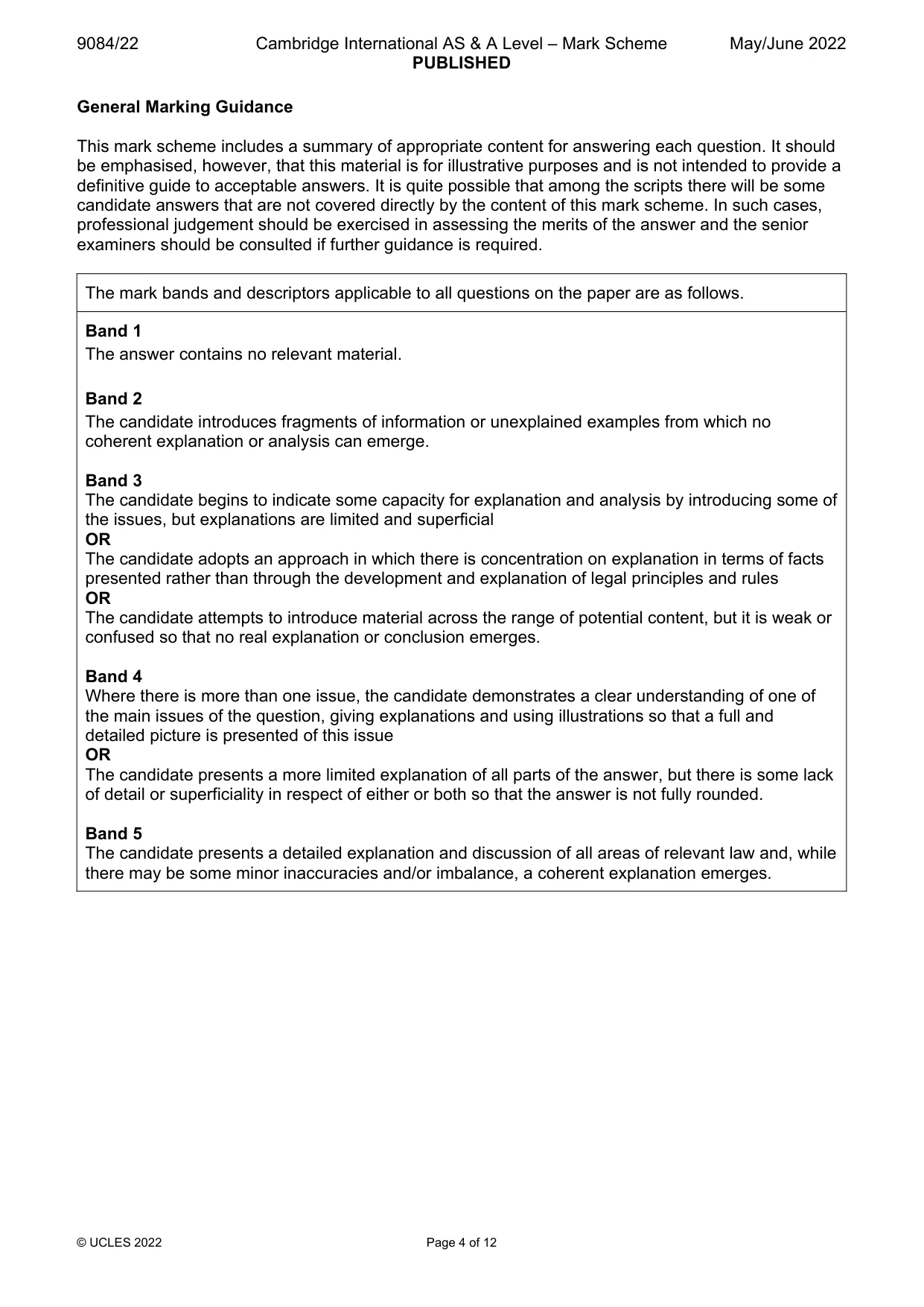
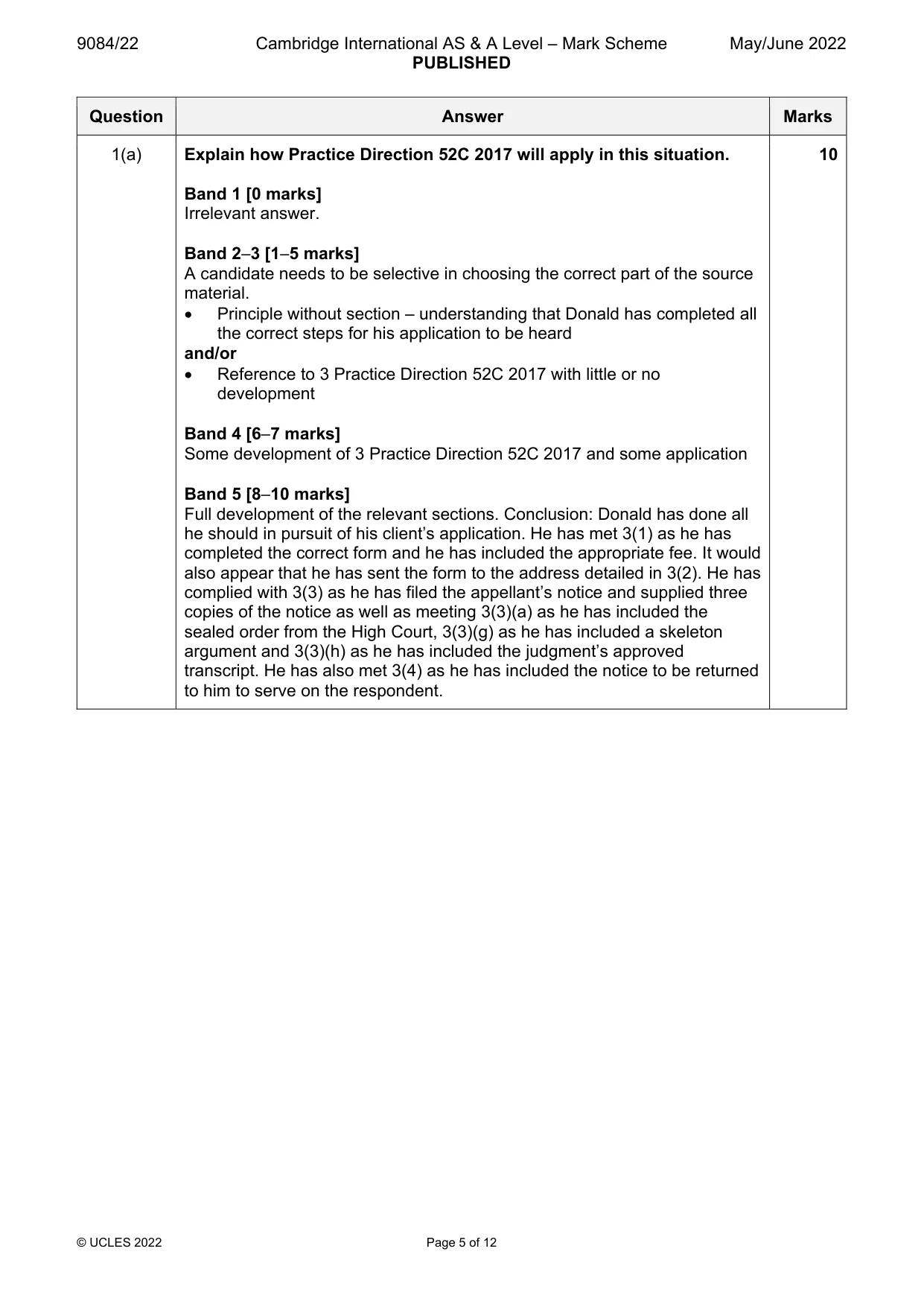
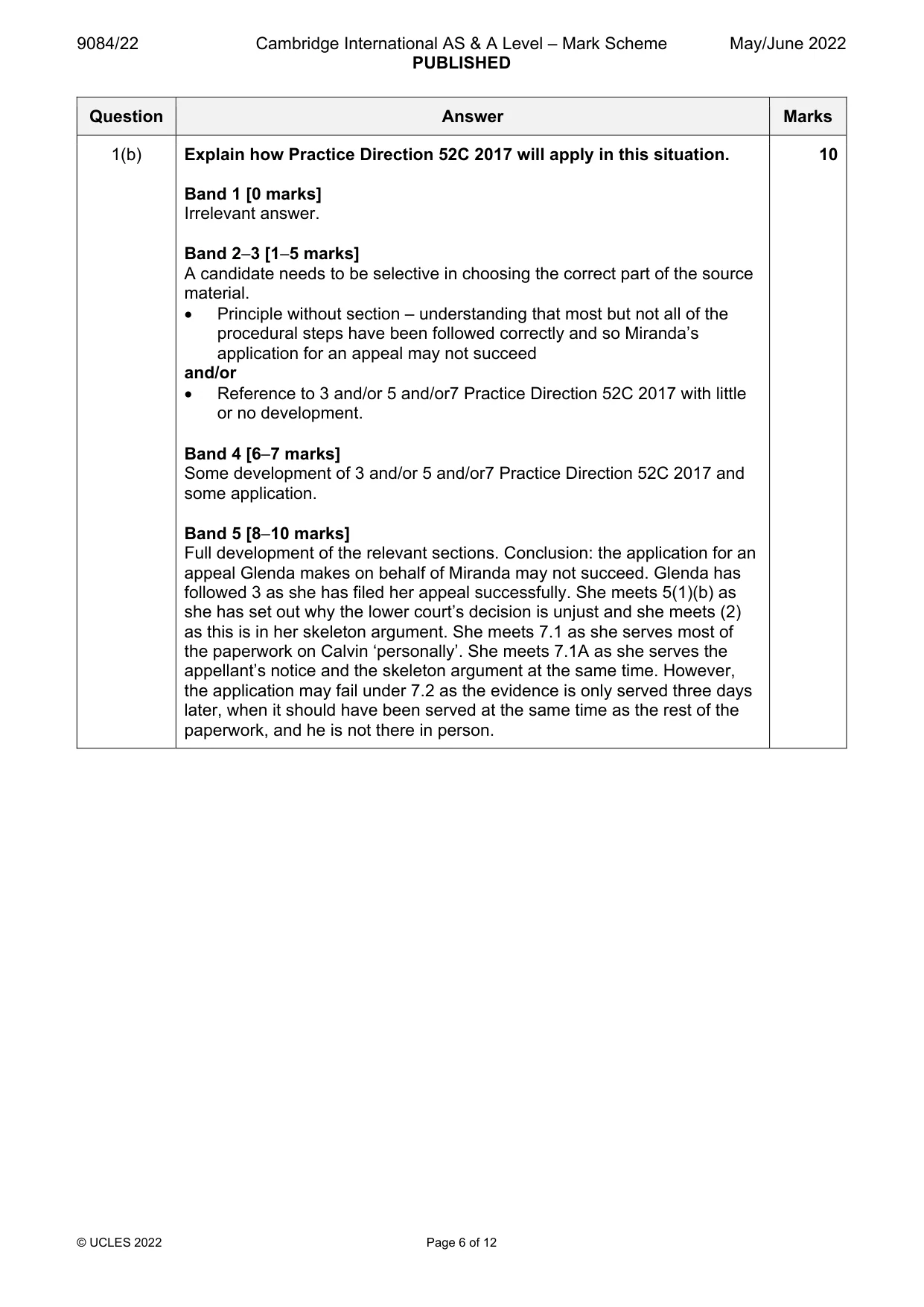
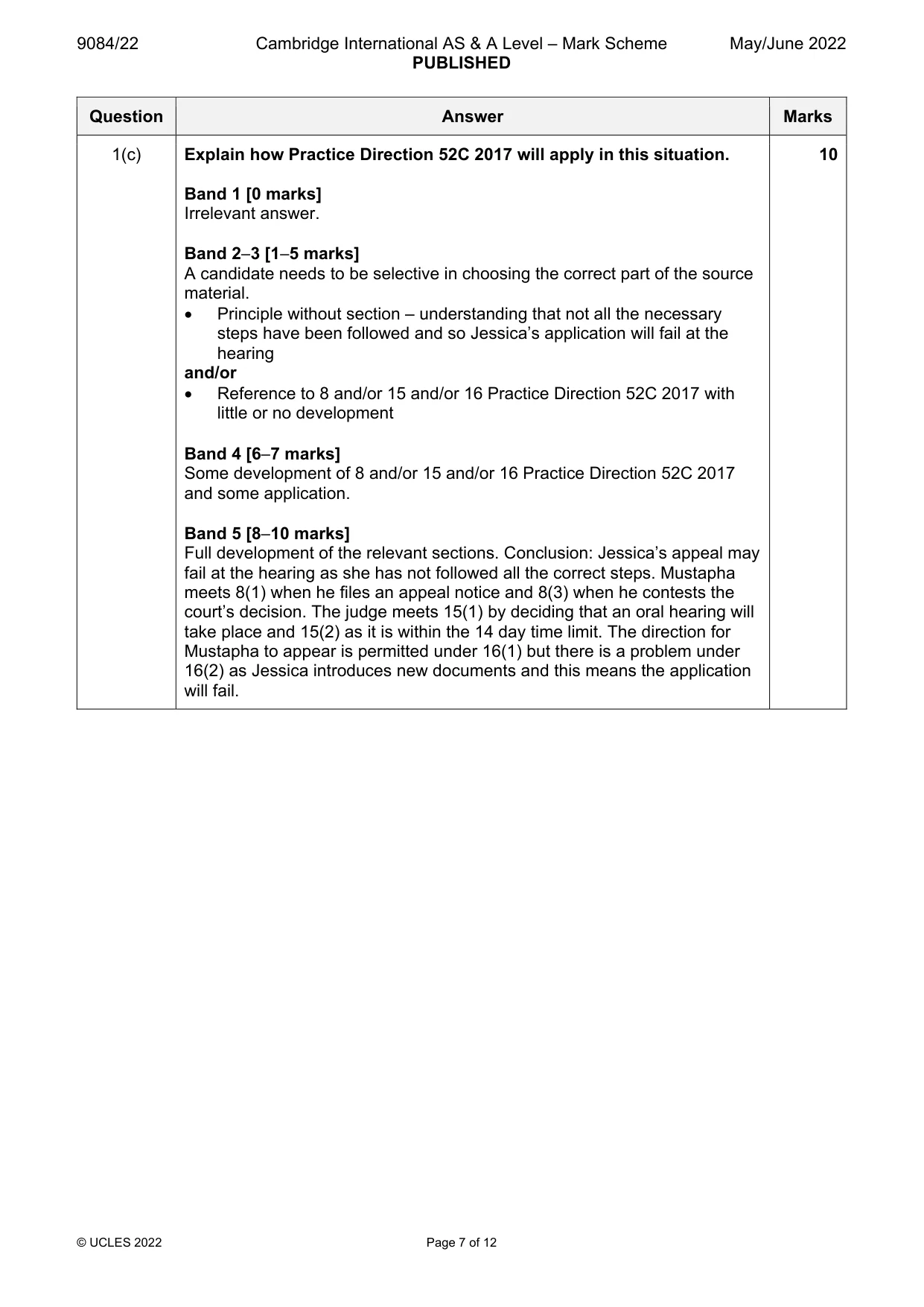
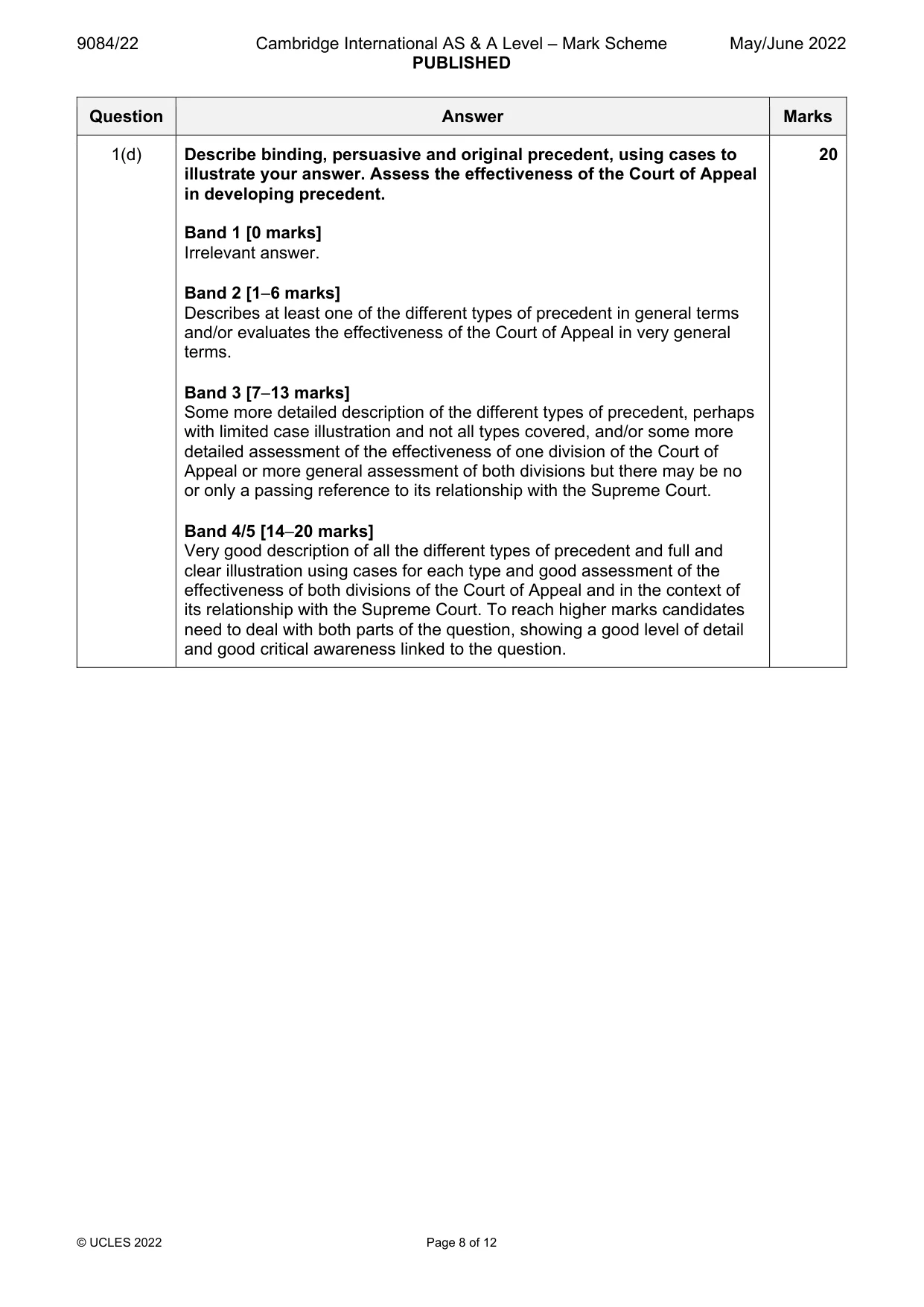
Mark scheme: Question Answer Marks 1(a) Explain how Practice Direction 52C 2017 will apply in this situation. 10 Band 1 [0 marks] Irrelevant answer. Band 23 [15 marks] A candidate needs to be selective in choosing the correct part of the source material. Principle without section – understanding that Donald has completed all the correct steps for his application to be heard and/or Reference to 3 Practice Direction 52C 2017 with little or no development Band 4 [67 marks] Some development of 3 Practice Direction 52C 2017 and some application Band 5 [810 marks] Full development of the relevant sections. Conclusion: Donald has done all he should in pursuit of his client’s application. He has met 3(1) as he has completed the correct form and he has included the appropriate fee. It would also appear that he has sent the form to the address detailed in 3(2). He has complied with 3(3) as he has filed the appellant’s notice and supplied three copies of the notice as well as meeting 3(3)(a) as he has included the sealed order from the High Court, 3(3)(g) as he has included a skeleton argument and 3(3)(h) as he has included the judgment’s approved transcript. He has also met 3(4) as he has included the notice to be returned to him to serve on the respondent. 1(b) Explain how Practice Direction 52C 2017 will apply in this situation. 10 Band 1 [0 marks] Irrelevant answer. Band 23 [15 marks] A candidate needs to be selective in choosing the correct part of the source material. Principle without section – understanding that most but not all of the procedural steps have been followed correctly and so Miranda’s application for an appeal may not succeed and/or Reference to 3 and/or 5 and/or7 Practice Direction 52C 2017 with little or no development. Band 4 [67 marks] Some development of 3 and/or 5 and/or7 Practice Direction 52C 2017 and some application. Band 5 [810 marks] Full development of the relevant sections. Conclusion: the application for an appeal Glenda makes on behalf of Miranda may not succeed. Glenda has followed 3 as she has filed her appeal successfully. She meets 5(1)(b) as she has set out why the lower court’s decision is unjust and she meets (2) as this is in her skeleton argument. She meets 7.1 as she serves most of the paperwork on Calvin ‘personally’. She meets 7.1A as she serves the appellant’s notice and the skeleton argument at the same time. However, the application may fail under 7.2 as the evidence is only served three days later, when it should have been served at the same time as the rest of the paperwork, and he is not there in person. 1(c) Explain how Practice Direction 52C 2017 will apply in this situation. 10 Band 1 [0 marks] Irrelevant answer. Band 23 [15 marks] A candidate needs to be selective in choosing the correct part of the source material. Principle without section – understanding that not all the necessary steps have been followed and so Jessica’s application will fail at the hearing and/or Reference to 8 and/or 15 and/or 16 Practice Direction 52C 2017 with little or no development Band 4 [67 marks] Some development of 8 and/or 15 and/or 16 Practice Direction 52C 2017 and some application. Band 5 [810 marks] Full development of the relevant sections. Conclusion: Jessica’s appeal may fail at the hearing as she has not followed all the correct steps. Mustapha meets 8(1) when he files an appeal notice and 8(3) when he contests the court’s decision. The judge meets 15(1) by deciding that an oral hearing will take place and 15(2) as it is within the 14 day time limit. The direction for Mustapha to appear is permitted under 16(1) but there is a problem under 16(2) as Jessica introduces new documents and this means the application will fail. 1(d) Describe binding, persuasive and original precedent, using cases to 20 illustrate your answer. Assess the effectiveness of the Court of Appeal in developing precedent. Band 1 [0 marks] Irrelevant answer. Band 2 [16 marks] Describes at least one of the different types of precedent in general terms and/or evaluates the effectiveness of the Court of Appeal in very general terms. Band 3 [713 marks] Some more detailed description of the different types of precedent, perhaps with limited case illustration and not all types covered, and/or some more detailed assessment of the effectiveness of one division of the Court of Appeal or more general assessment of both divisions but there may be no or only a passing reference to its relationship with the Supreme Court. Band 4/5 [1420 marks] Very good description of all the different types of precedent and full and clear illustration using cases for each type and good assessment of the effectiveness of both divisions of the Court of Appeal and in the context of its relationship with the Supreme Court. To reach higher marks candidates need to deal with both parts of the question, showing a good level of detail and good critical awareness linked to the question.
Q2 · Guido owns and runs a circus which travels around England
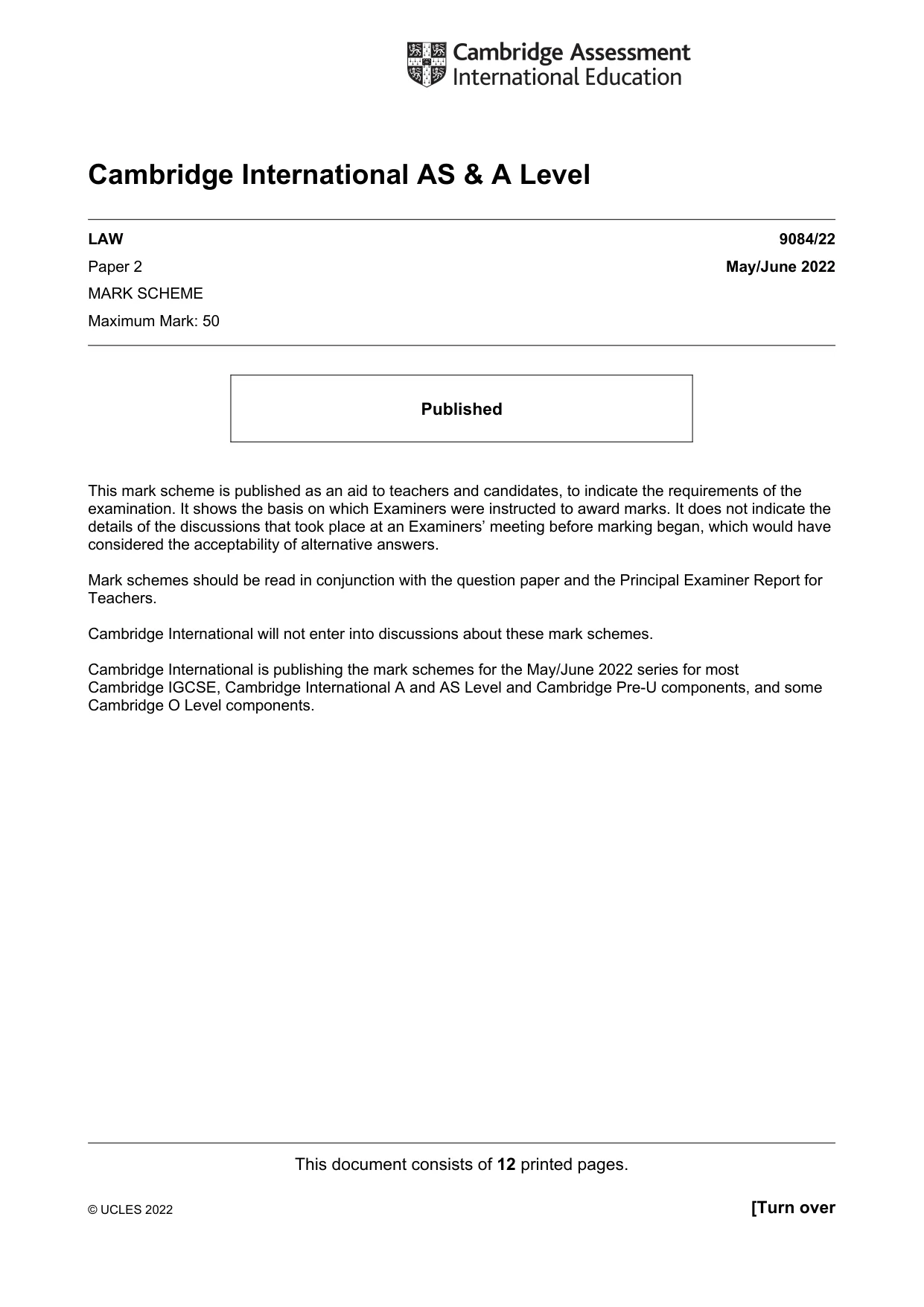
2 (a) Guido owns and runs a circus which travels around England. The tigers are the main attraction. The tigers are brought into a special cage towards the end of the circus show and they walk about whilst Guido explains why tigers are at risk in some parts of the world. Explain how the Wild Animals in Circuses Act 2019 will apply in this situation. [10] (b) Shona is an inspector whose job is to check on animal welfare. A member of the public sends her a photograph of two lions performing in a travelling circus which has just arrived in the local town in England. Next day, Shona goes to the circus at 09.00 with a video camera, provided as part of her job, in her bag. She meets Casper, the circus owner, who asks her who she is and why she is there. Shona shows Casper her identity badge and the photograph sent by the member of the public. Casper takes Shona to see the lions and she makes a video recording of them. Explain how the Wild Animals in Circuses Act 2019 will apply in this situation. [10] (c) Artem operates a travelling circus in England where monkeys perform in the show as part of a comedy act with the clowns. Klaus, an inspector, has been told about the monkeys and he goes to the circus at 23.00 as Artem is getting ready to leave and move on to another town. At the entrance to the circus Klaus shouts at Artem that he is breaking the law. Klaus pushes Artem over to get to the monkeys and he marks each one of them with a special pen he uses in his job. Explain how the Wild Animals in Circuses Act 2019 will apply in this situation. [10] (d) Describe the different types of Bills used in the making of legislation. Evaluate the criticisms which are often made of the legislative process. [20] Source material for Question 2 Animal Welfare Act 2006 (as amended) Section 1 Animals to which the Act applies (1) In this Act “animal” means a vertebrate other than man. Wild Animals in Circuses Act 2019 Section 1 Prohibition on use of wild animals in travelling circuses in England (1) A circus operator may not use a wild animal in a travelling circus in England. (2) For the purposes of this section, a circus operator uses a wild animal in a travelling circus if the animal performs or is exhibited as part of the circus. (3) A circus operator who contravenes subsection (1) is guilty of an offence and liable on summary conviction to a fine. (4) … (5) In this Act— “animal” has the meaning given by section 1(1) of the Animal Welfare Act 2006; “circus operator”, in relation to a circus, means— (a) the owner of the circus, (b) any other person with overall responsibility for the operation of the circus, and (c) if neither the owner of the circus nor any person with overall responsibility for its operation is present in the United Kingdom, the person in the United Kingdom who is ultimately responsible for the operation of the circus; “wild animal” means an animal of a kind which is not commonly domesticated in Great Britain. Section 2 (Schedule) Inspections Powers of entry 2 An inspector may enter any premises (other than premises used only as a dwelling) if there are reasonable grounds for suspecting— (a) that an offence under section 1 is being, has been or is about to be committed on the premises, or (b) that evidence of the commission of an offence under section 1 may be found on the premises. Exercise of powers of entry 4(1) Before exercising a power of entry, an inspector must, if requested to do so by a person on the premises— (a) produce evidence of the inspector’s identity, and (b) outline the purpose for which the power is exercised. 5 An inspector exercising a power of entry must do so at a reasonable hour unless it appears to the inspector that the purpose of entry would be frustrated by entry at a reasonable hour. 6 An inspector exercising a power of entry may— (a) if necessary, use reasonable force to enter the premises; (b) take up to two other persons on to the premises; (c) take such equipment and materials on to the premises as appear to the inspector to be appropriate. Powers of inspection etc 7 An inspector exercising a power of entry may— (a) search the premises; (b) examine, measure or test anything, including an animal, that is found on the premises; (c) question any person on the premises; (d) require any person on the premises to give the inspector such assistance as the inspector may reasonably require; (e) take a sample (including a sample from an animal); (f) mark an animal found on the premises for identification purposes; (g) take a photograph or video recording of anything, including an animal, that is found on the
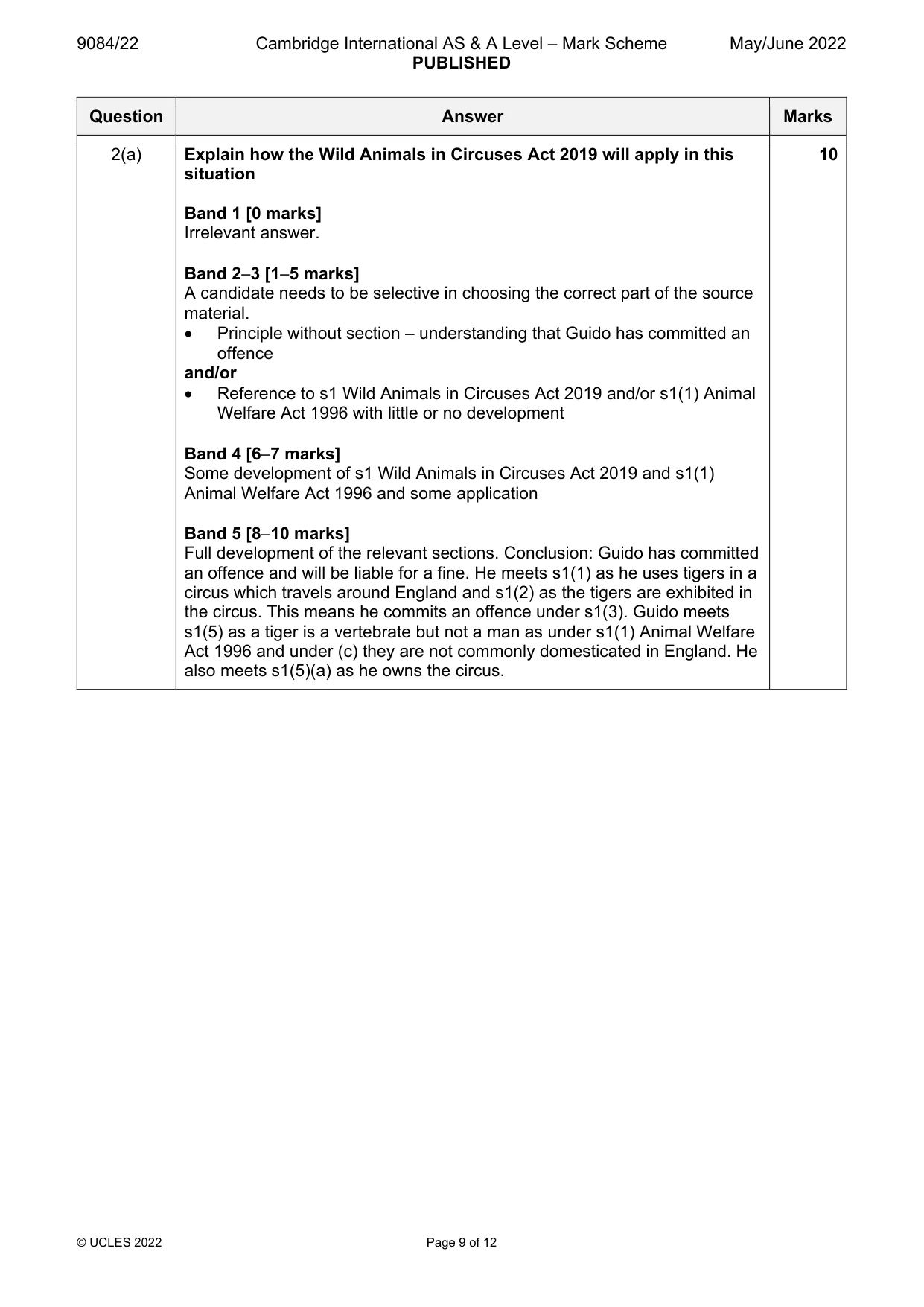
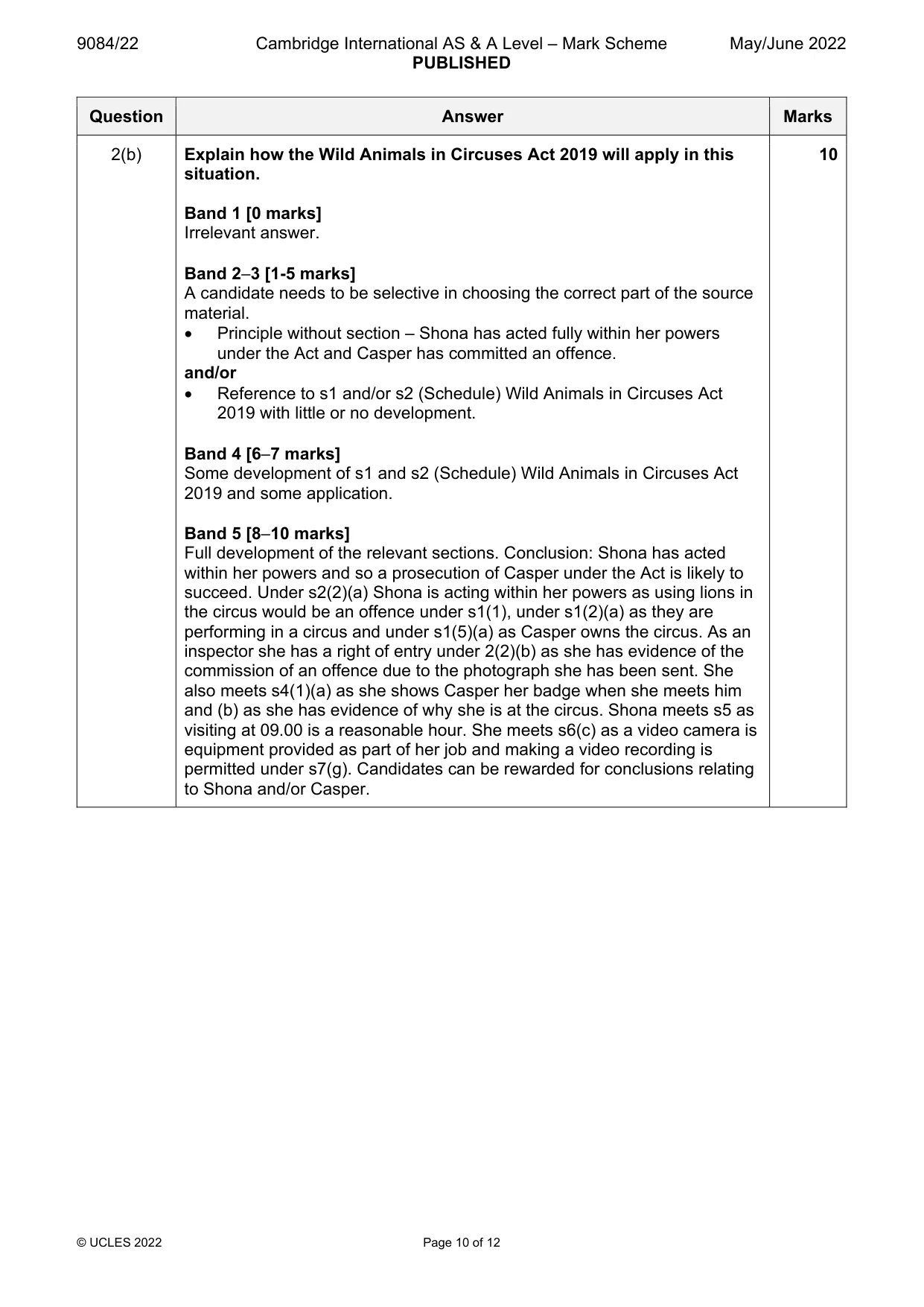
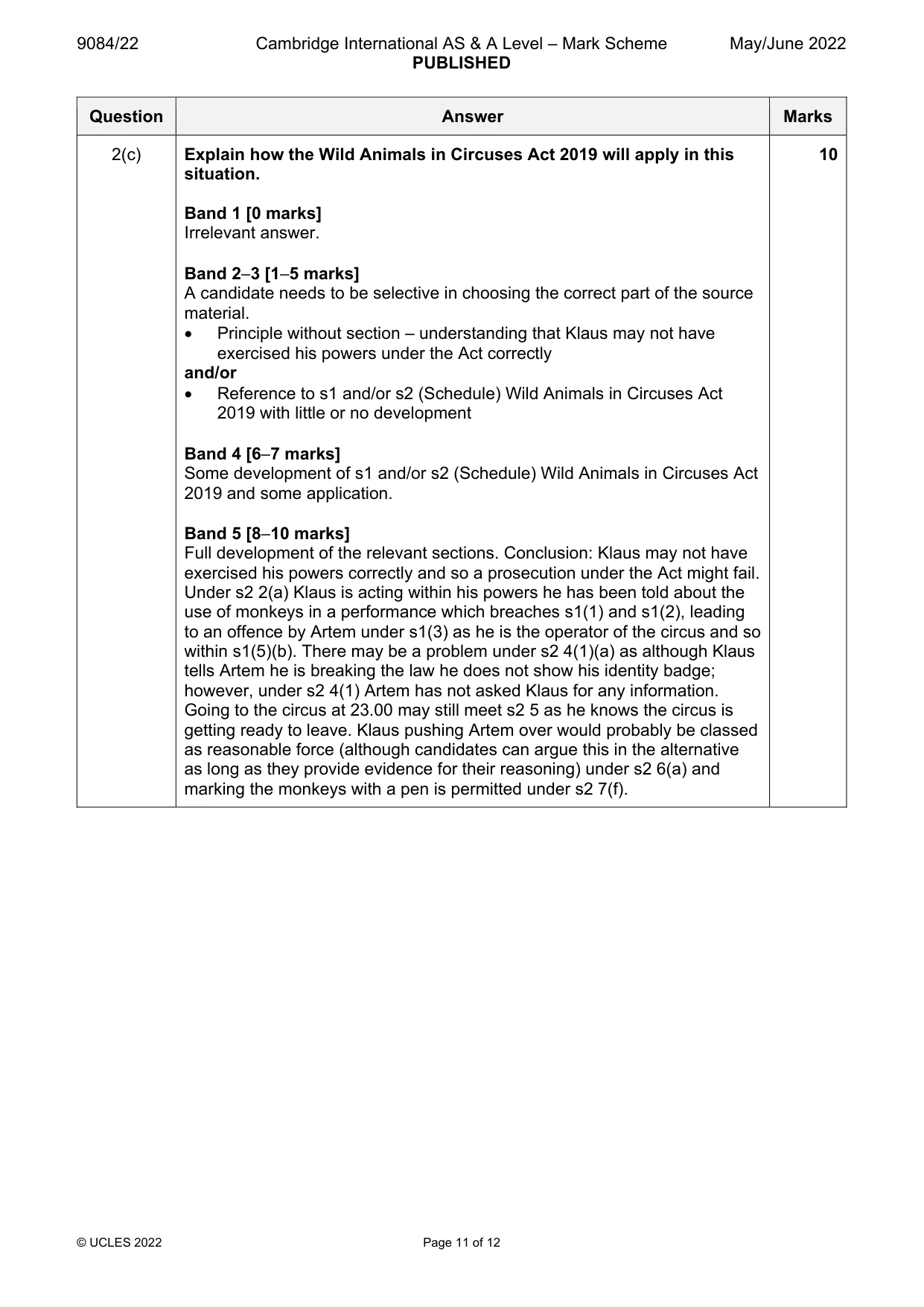
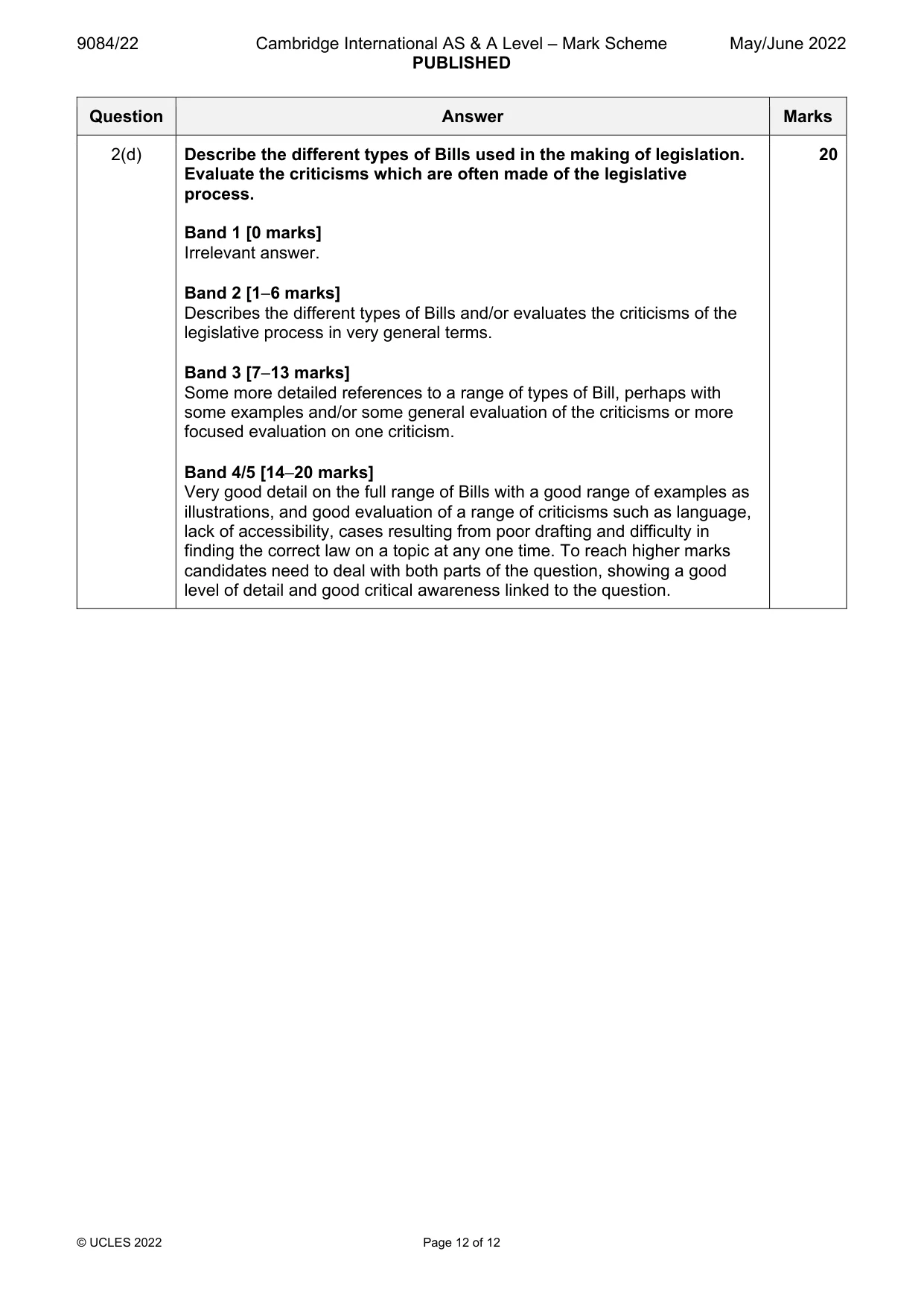
Mark scheme: 2(a) Explain how the Wild Animals in Circuses Act 2019 will apply in this 10 situation Band 1 [0 marks] Irrelevant answer. Band 23 [15 marks] A candidate needs to be selective in choosing the correct part of the source material. Principle without section – understanding that Guido has committed an offence and/or Reference to s1 Wild Animals in Circuses Act 2019 and/or s1(1) Animal Welfare Act 1996 with little or no development Band 4 [67 marks] Some development of s1 Wild Animals in Circuses Act 2019 and s1(1) Animal Welfare Act 1996 and some application Band 5 [810 marks] Full development of the relevant sections. Conclusion: Guido has committed an offence and will be liable for a fine. He meets s1(1) as he uses tigers in a circus which travels around England and s1(2) as the tigers are exhibited in the circus. This means he commits an offence under s1(3). Guido meets s1(5) as a tiger is a vertebrate but not a man as under s1(1) Animal Welfare Act 1996 and under (c) they are not commonly domesticated in England. He also meets s1(5)(a) as he owns the circus. 2(b) Explain how the Wild Animals in Circuses Act 2019 will apply in this 10 situation. Band 1 [0 marks] Irrelevant answer. Band 23 [1-5 marks] A candidate needs to be selective in choosing the correct part of the source material. Principle without section – Shona has acted fully within her powers under the Act and Casper has committed an offence. and/or Reference to s1 and/or s2 (Schedule) Wild Animals in Circuses Act 2019 with little or no development. Band 4 [67 marks] Some development of s1 and s2 (Schedule) Wild Animals in Circuses Act 2019 and some application. Band 5 [810 marks] Full development of the relevant sections. Conclusion: Shona has acted within her powers and so a prosecution of Casper under the Act is likely to succeed. Under s2(2)(a) Shona is acting within her powers as using lions in the circus would be an offence under s1(1), under s1(2)(a) as they are performing in a circus and under s1(5)(a) as Casper owns the circus. As an inspector she has a right of entry under 2(2)(b) as she has evidence of the commission of an offence due to the photograph she has been sent. She also meets s4(1)(a) as she shows Casper her badge when she meets him and (b) as she has evidence of why she is at the circus. Shona meets s5 as visiting at 09.00 is a reasonable hour. She meets s6(c) as a video camera is equipment provided as part of her job and making a video recording is permitted under s7(g). Candidates can be rewarded for conclusions relating to Shona and/or Casper. 2(c) Explain how the Wild Animals in Circuses Act 2019 will apply in this 10 situation. Band 1 [0 marks] Irrelevant answer. Band 23 [15 marks] A candidate needs to be selective in choosing the correct part of the source material. Principle without section – understanding that Klaus may not have exercised his powers under the Act correctly and/or Reference to s1 and/or s2 (Schedule) Wild Animals in Circuses Act 2019 with little or no development Band 4 [67 marks] Some development of s1 and/or s2 (Schedule) Wild Animals in Circuses Act 2019 and some application. Band 5 [810 marks] Full development of the relevant sections. Conclusion: Klaus may not have exercised his powers correctly and so a prosecution under the Act might fail. Under s2 2(a) Klaus is acting within his powers he has been told about the use of monkeys in a performance which breaches s1(1) and s1(2), leading to an offence by Artem under s1(3) as he is the operator of the circus and so within s1(5)(b). There may be a problem under s2 4(1)(a) as although Klaus tells Artem he is breaking the law he does not show his identity badge; however, under s2 4(1) Artem has not asked Klaus for any information. Going to the circus at 23.00 may still meet s2 5 as he knows the circus is getting ready to leave. Klaus pushing Artem over would probably be classed as reasonable force (although candidates can argue this in the alternative as long as they provide evidence for their reasoning) under s2 6(a) and marking the monkeys with a pen is permitted under s2 7(f). 2(d) Describe the different types of Bills used in the making of legislation. 20 Evaluate the criticisms which are often made of the legislative process. Band 1 [0 marks] Irrelevant answer. Band 2 [16 marks] Describes the different types of Bills and/or evaluates the criticisms of the legislative process in very general terms. Band 3 [713 marks] Some more detailed references to a range of types of Bill, perhaps with some examples and/or some general evaluation of the criticisms or more focused evaluation on one criticism. Band 4/5 [1420 marks] Very good detail on the full range of Bills with a good range of examples as illustrations, and good evaluation of a range of criticisms such as language, lack of accessibility, cases resulting from poor drafting and difficulty in finding the correct law on a topic at any one time. To reach higher marks candidates need to deal with both parts of the question, showing a good level of detail and good critical awareness linked to the question.
What was in this paper
The subtopics covered by these 2 questions, and how many questions each got. Open one in a new tab to see every Cambridge question on it.
1Machinery of justice This topic introduces the institutions and processes involved in the resolution of civil and criminal matters. This topic is an opportunity to reflect on the key concepts of power and its limits; justice, fairness and morality; effectiveness and certainty; and liability1What you needed in this session
Cambridge’s own grade thresholds for 2022 May/June, Paper 2 · Variant 2. A higher threshold means an easier paper — the bar moves with how the cohort did.