Cambridge A Level Law 9084 — 2018 May/June Paper 2 · Variant 1
9084/21/M/J/18 · 2 questions · 50 marks · ≈56 min
The question paper and its mark scheme, free to read here and free to download. This is Cambridge’s own paper, exactly as it was sat.
Question paper8 pages
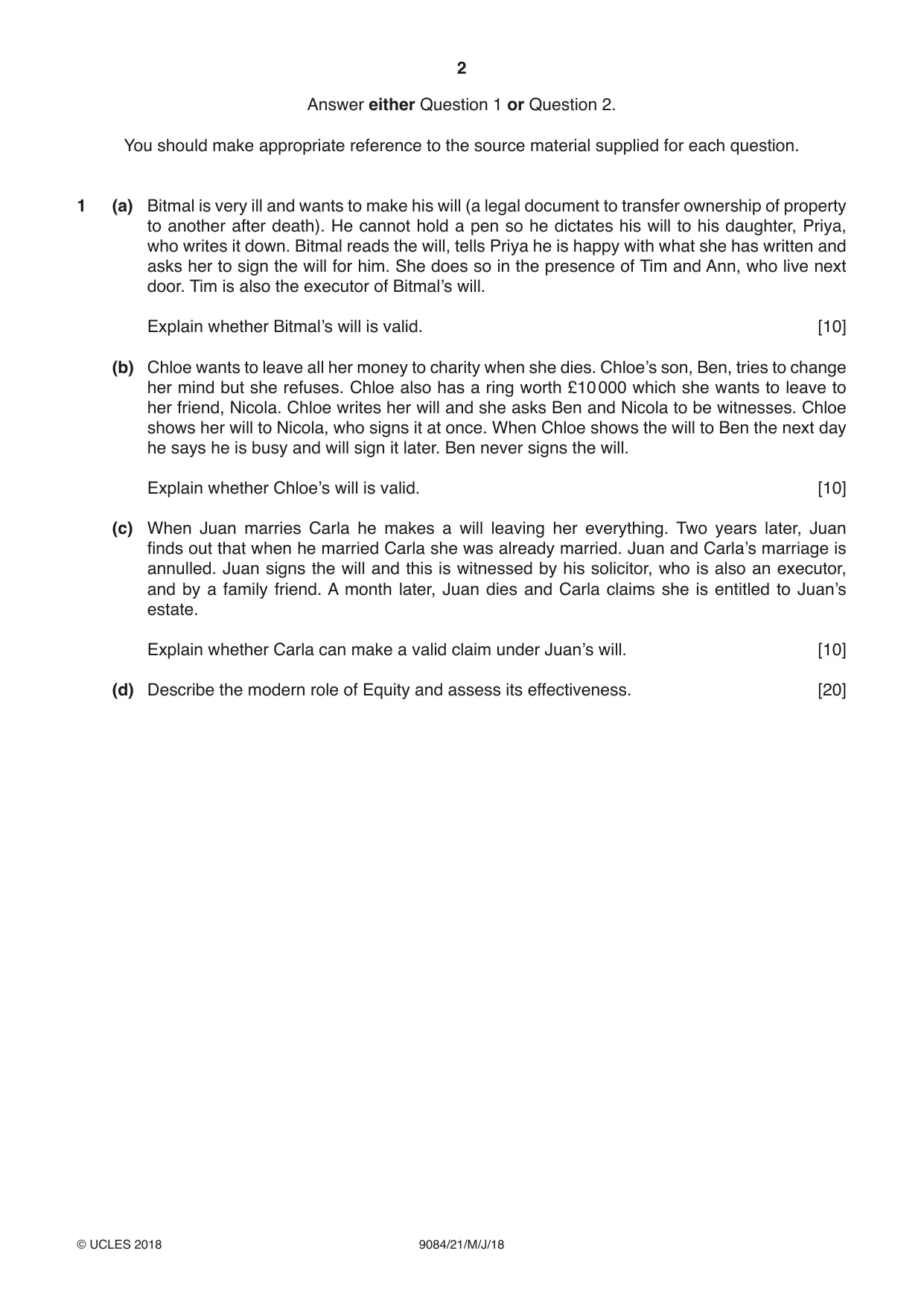
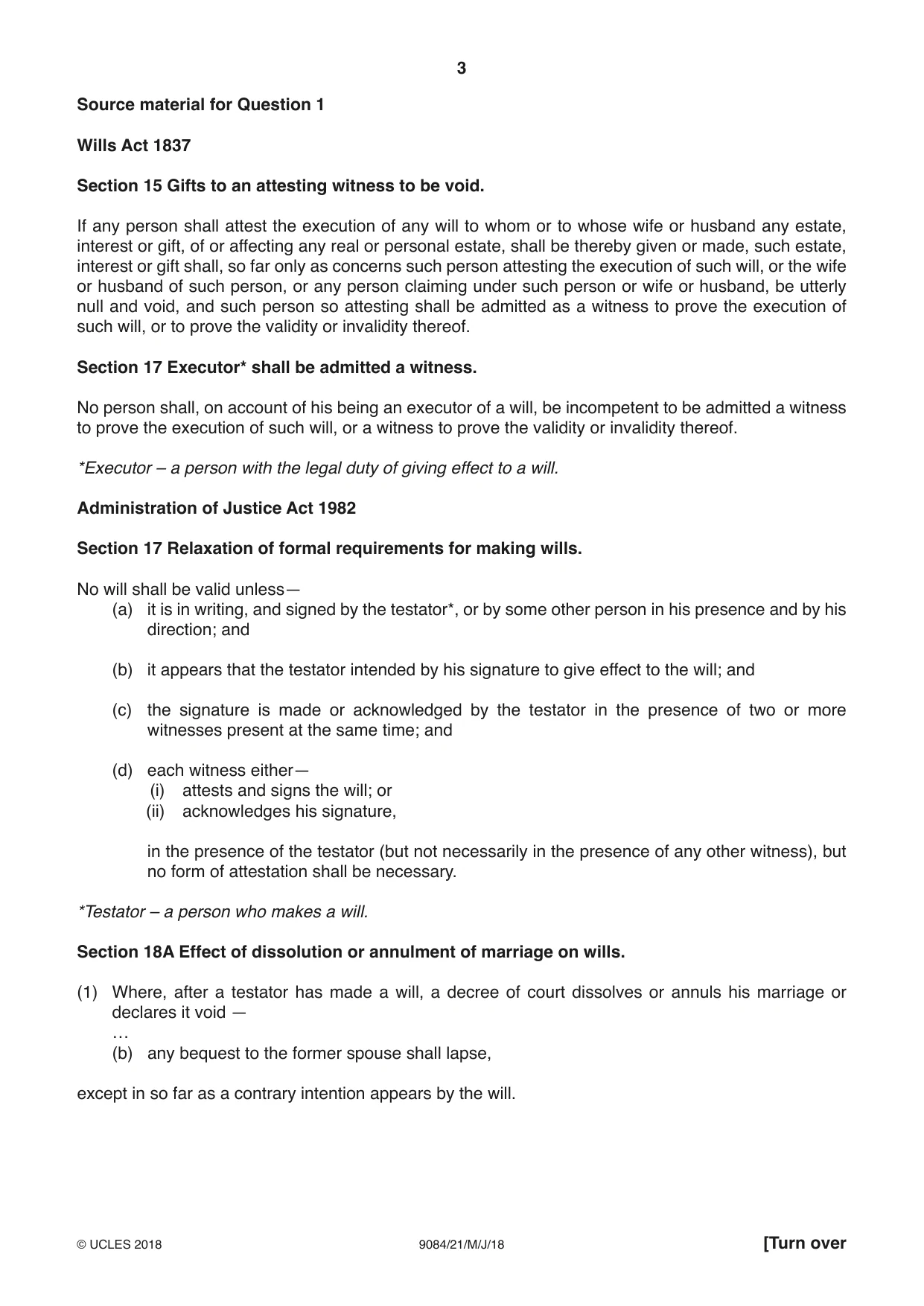
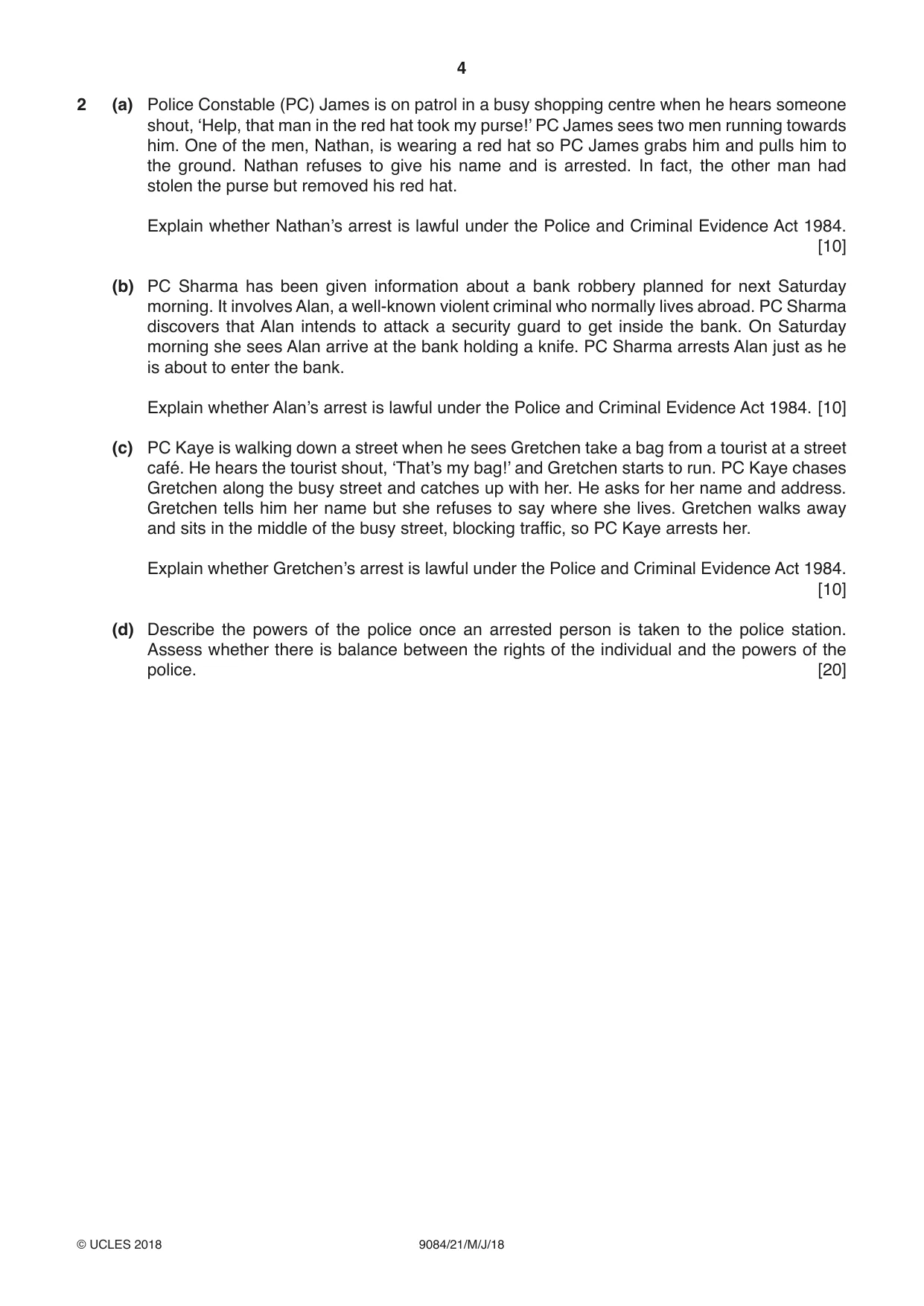



Mark scheme8 pages
Answers below. Sit the paper first if you are practising.
Questions as text
Q1 · Bitmal is very ill and wants to make his will (a legal document to transfer ownership of…
1 (a) Bitmal is very ill and wants to make his will (a legal document to transfer ownership of property to another after death). He cannot hold a pen so he dictates his will to his daughter, Priya, who writes it down. Bitmal reads the will, tells Priya he is happy with what she has written and asks her to sign the will for him. She does so in the presence of Tim and Ann, who live next door. Tim is also the executor of Bitmal’s will. Explain whether Bitmal’s will is valid. [10] (b) Chloe wants to leave all her money to charity when she dies. Chloe’s son, Ben, tries to change her mind but she refuses. Chloe also has a ring worth £10 000 which she wants to leave to her friend, Nicola. Chloe writes her will and she asks Ben and Nicola to be witnesses. Chloe shows her will to Nicola, who signs it at once. When Chloe shows the will to Ben the next day he says he is busy and will sign it later. Ben never signs the will. Explain whether Chloe’s will is valid. [10] (c) When Juan marries Carla he makes a will leaving her everything. Two years later, Juan finds out that when he married Carla she was already married. Juan and Carla’s marriage is annulled. Juan signs the will and this is witnessed by his solicitor, who is also an executor, and by a family friend. A month later, Juan dies and Carla claims she is entitled to Juan’s estate. Explain whether Carla can make a valid claim under Juan’s will. [10] (d) Describe the modern role of Equity and assess its effectiveness. [20] Source material for Question 1 Wills Act 1837 Section 15 Gifts to an attesting witness to be void. If any person shall attest the execution of any will to whom or to whose wife or husband any estate, interest or gift, of or affecting any real or personal estate, shall be thereby given or made, such estate, interest or gift shall, so far only as concerns such person attesting the execution of such will, or the wife or husband of such person, or any person claiming under such person or wife or husband, be utterly null and void, and such person so attesting shall be admitted as a witness to prove the execution of such will, or to prove the validity or invalidity thereof. Section 17 Executor* shall be admitted a witness. No person shall, on account of his being an executor of a will, be incompetent to be admitted a witness to prove the execution of such will, or a witness to prove the validity or invalidity thereof. *Executor – a person with the legal duty of giving effect to a will. Administration of Justice Act 1982 Section 17 Relaxation of formal requirements for making wills. No will shall be valid unless— (a) it is in writing, and signed by the testator*, or by some other person in his presence and by his direction; and (b) it appears that the testator intended by his signature to give effect to the will; and (c) the signature is made or acknowledged by the testator in the presence of two or more witnesses present at the same time; and (d) each witness either— (i) attests and signs the will; or (ii) acknowledges his signature, in the presence of the testator (but not necessarily in the presence of any other witness), but no form of attestation shall be necessary. *Testator – a person who makes a will. Section 18A Effect of dissolution or annulment of marriage on wills. (1) Where, after a testator has made a will, a decree of court dissolves or annuls his marriage or declares it void — … (b) any bequest to the former spouse shall lapse, except in so far as a contrary intention appears by the will.
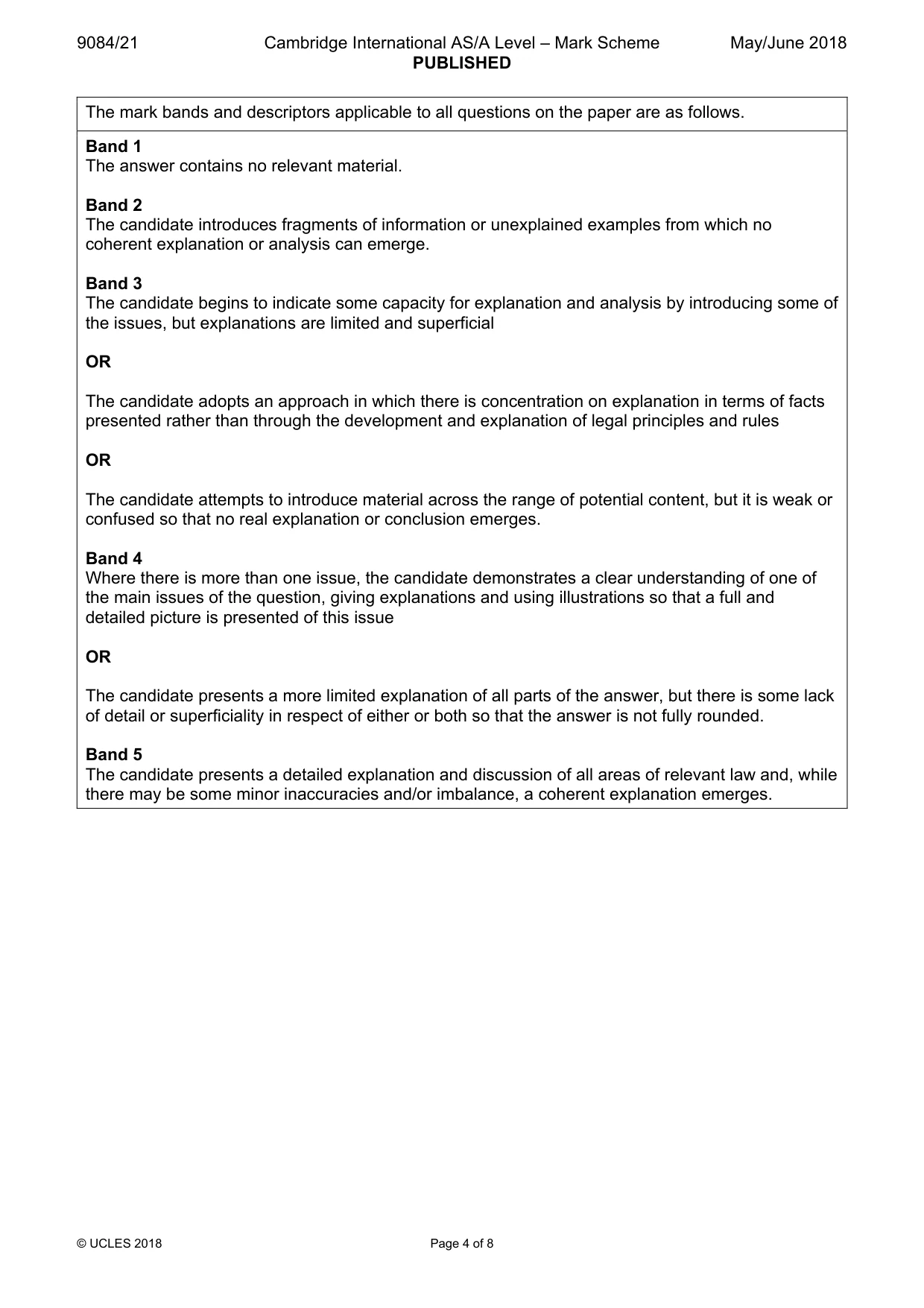
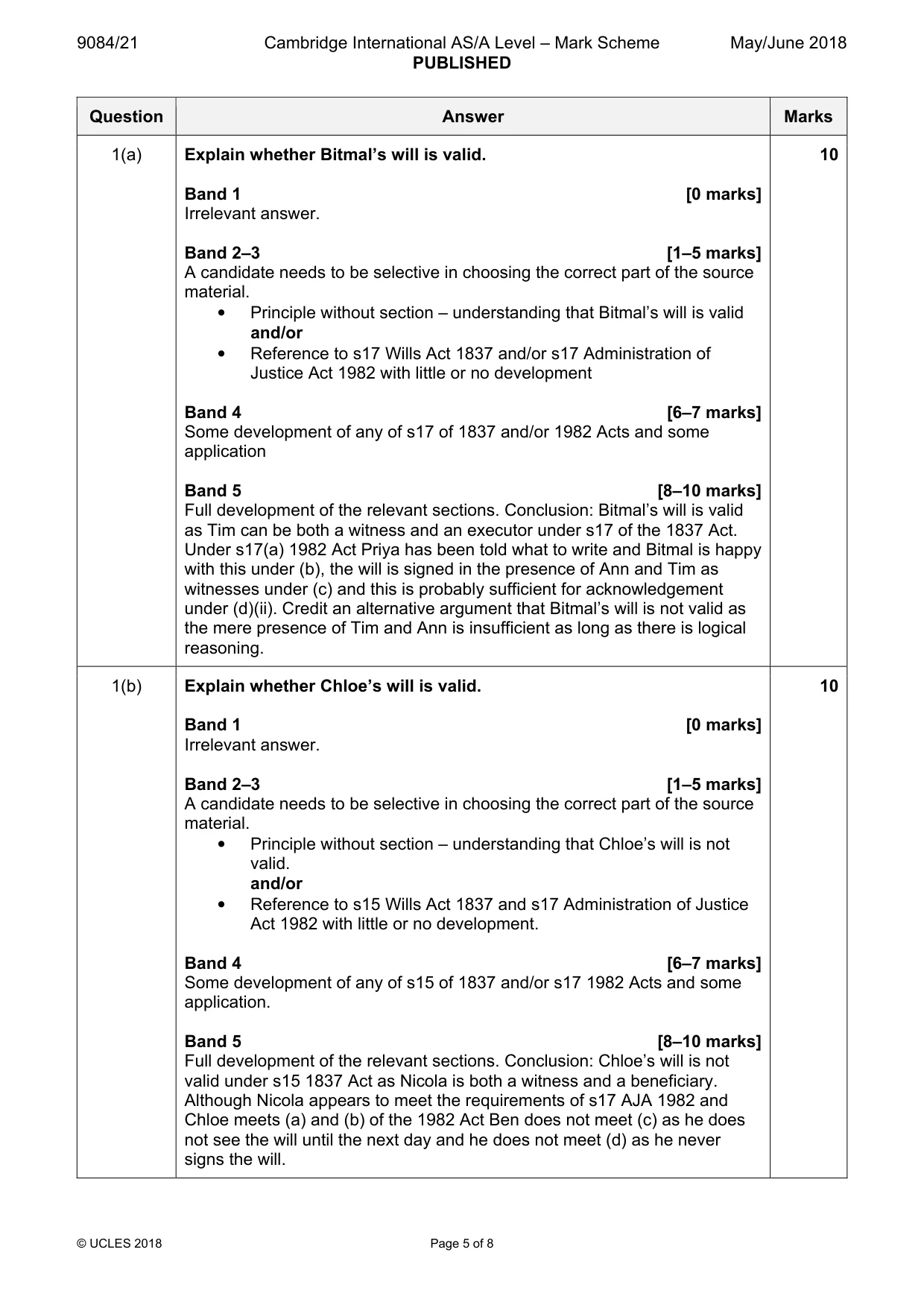
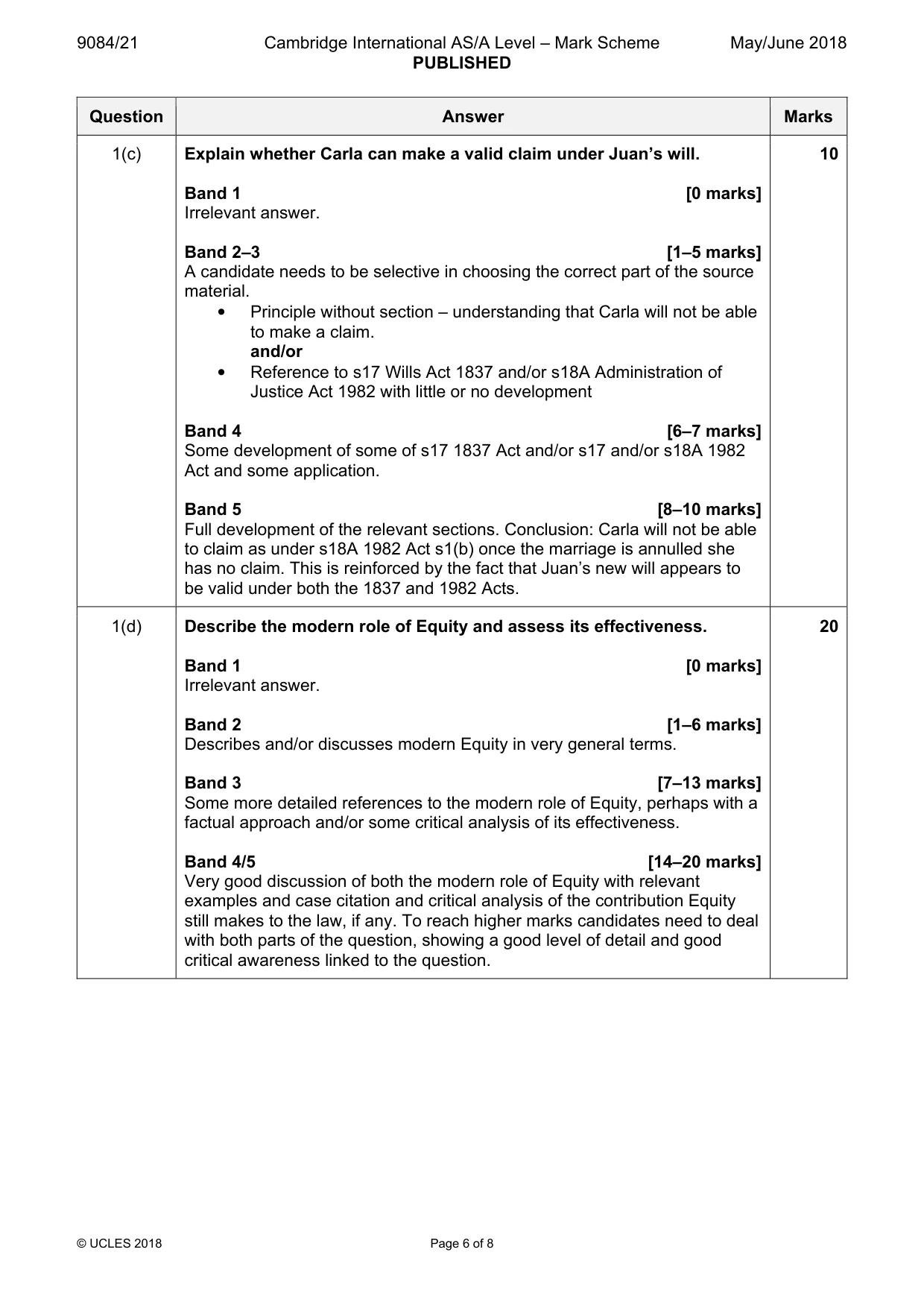
Mark scheme: Question Answer Marks 1(a) Explain whether Bitmal’s will is valid. 10 Band 1 [0 marks] Irrelevant answer. Band 2–3 [1–5 marks] A candidate needs to be selective in choosing the correct part of the source material. • Principle without section – understanding that Bitmal’s will is valid and/or • Reference to s17 Wills Act 1837 and/or s17 Administration of Justice Act 1982 with little or no development Band 4 [6–7 marks] Some development of any of s17 of 1837 and/or 1982 Acts and some application Band 5 [8–10 marks] Full development of the relevant sections. Conclusion: Bitmal’s will is valid as Tim can be both a witness and an executor under s17 of the 1837 Act. Under s17(a) 1982 Act Priya has been told what to write and Bitmal is happy with this under (b), the will is signed in the presence of Ann and Tim as witnesses under (c) and this is probably sufficient for acknowledgement under (d)(ii). Credit an alternative argument that Bitmal’s will is not valid as the mere presence of Tim and Ann is insufficient as long as there is logical reasoning. 1(b) Explain whether Chloe’s will is valid. 10 Band 1 [0 marks] Irrelevant answer. Band 2–3 [1–5 marks] A candidate needs to be selective in choosing the correct part of the source material. • Principle without section – understanding that Chloe’s will is not valid. and/or • Reference to s15 Wills Act 1837 and s17 Administration of Justice Act 1982 with little or no development. Band 4 [6–7 marks] Some development of any of s15 of 1837 and/or s17 1982 Acts and some application. Band 5 [8–10 marks] Full development of the relevant sections. Conclusion: Chloe’s will is not valid under s15 1837 Act as Nicola is both a witness and a beneficiary. Although Nicola appears to meet the requirements of s17 AJA 1982 and Chloe meets (a) and (b) of the 1982 Act Ben does not meet (c) as he does not see the will until the next day and he does not meet (d) as he never signs the will. 1(c) Explain whether Carla can make a valid claim under Juan’s will. 10 Band 1 [0 marks] Irrelevant answer. Band 2–3 [1–5 marks] A candidate needs to be selective in choosing the correct part of the source material. • Principle without section – understanding that Carla will not be able to make a claim. and/or • Reference to s17 Wills Act 1837 and/or s18A Administration of Justice Act 1982 with little or no development Band 4 [6–7 marks] Some development of some of s17 1837 Act and/or s17 and/or s18A 1982 Act and some application. Band 5 [8–10 marks] Full development of the relevant sections. Conclusion: Carla will not be able to claim as under s18A 1982 Act s1(b) once the marriage is annulled she has no claim. This is reinforced by the fact that Juan’s new will appears to be valid under both the 1837 and 1982 Acts. 1(d) Describe the modern role of Equity and assess its effectiveness. 20 Band 1 [0 marks] Irrelevant answer. Band 2 [1–6 marks] Describes and/or discusses modern Equity in very general terms. Band 3 [7–13 marks] Some more detailed references to the modern role of Equity, perhaps with a factual approach and/or some critical analysis of its effectiveness. Band 4/5 [14–20 marks] Very good discussion of both the modern role of Equity with relevant examples and case citation and critical analysis of the contribution Equity still makes to the law, if any. To reach higher marks candidates need to deal with both parts of the question, showing a good level of detail and good critical awareness linked to the question.
Q2 · Police Constable (PC) James is on patrol in a busy shopping centre when he hears someone…
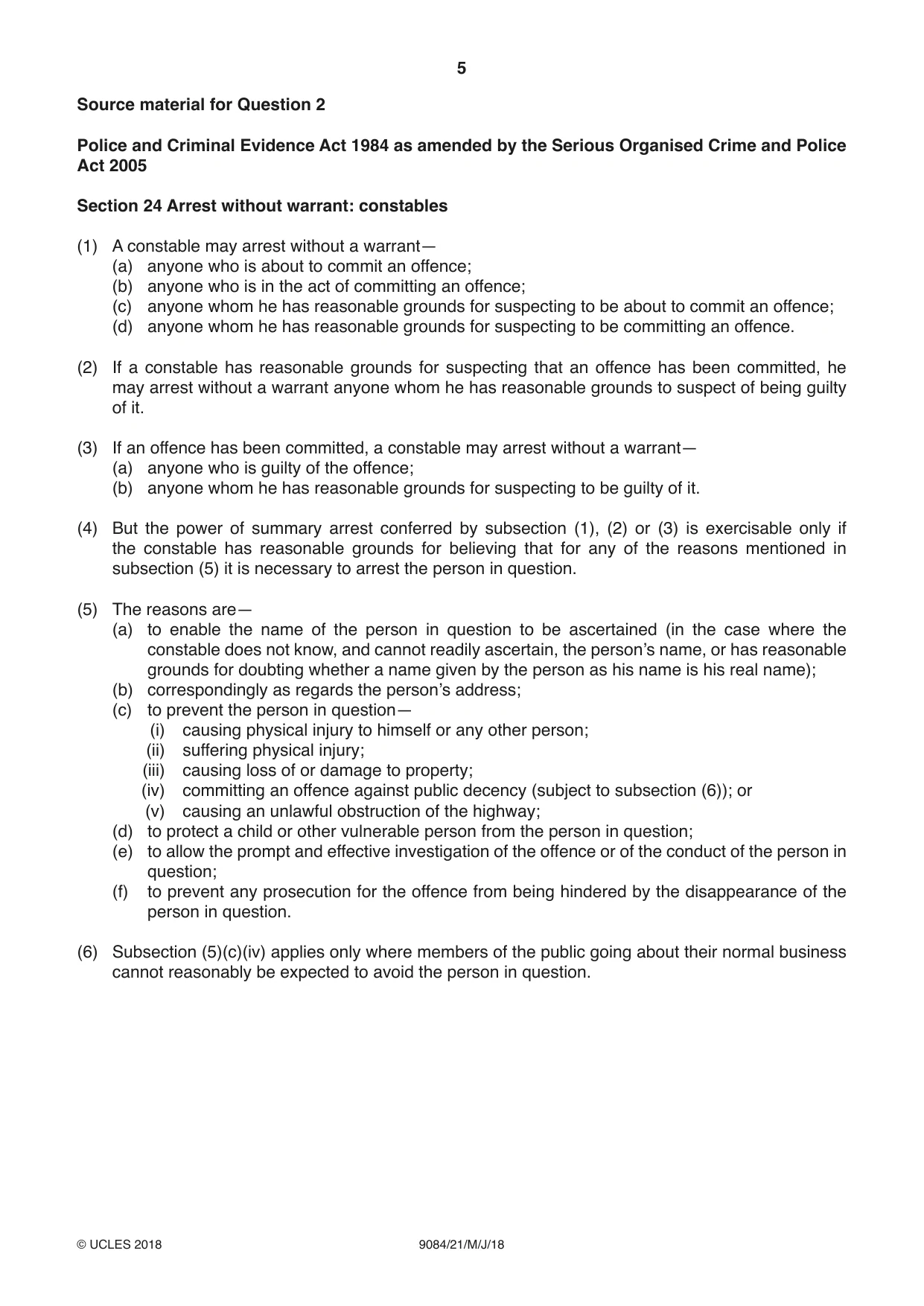
2 (a) Police Constable (PC) James is on patrol in a busy shopping centre when he hears someone shout, ‘Help, that man in the red hat took my purse!’ PC James sees two men running towards him. One of the men, Nathan, is wearing a red hat so PC James grabs him and pulls him to the ground. Nathan refuses to give his name and is arrested. In fact, the other man had stolen the purse but removed his red hat. Explain whether Nathan’s arrest is lawful under the Police and Criminal Evidence Act 1984. [10] (b) PC Sharma has been given information about a bank robbery planned for next Saturday morning. It involves Alan, a well-known violent criminal who normally lives abroad. PC Sharma discovers that Alan intends to attack a security guard to get inside the bank. On Saturday morning she sees Alan arrive at the bank holding a knife. PC Sharma arrests Alan just as he is about to enter the bank. Explain whether Alan’s arrest is lawful under the Police and Criminal Evidence Act 1984. [10] (c) PC Kaye is walking down a street when he sees Gretchen take a bag from a tourist at a street café. He hears the tourist shout, ‘That’s my bag!’ and Gretchen starts to run. PC Kaye chases Gretchen along the busy street and catches up with her. He asks for her name and address. Gretchen tells him her name but she refuses to say where she lives. Gretchen walks away and sits in the middle of the busy street, blocking traffic, so PC Kaye arrests her. Explain whether Gretchen’s arrest is lawful under the Police and Criminal Evidence Act 1984. [10] (d) Describe the powers of the police once an arrested person is taken to the police station. Assess whether there is balance between the rights of the individual and the powers of the police. [20] Source material for Question 2 Police and Criminal Evidence Act 1984 as amended by the Serious Organised Crime and Police Act 2005 Section 24 Arrest without warrant: constables (1) A constable may arrest without a warrant— (a) anyone who is about to commit an offence; (b) anyone who is in the act of committing an offence; (c) anyone whom he has reasonable grounds for suspecting to be about to commit an offence; (d) anyone whom he has reasonable grounds for suspecting to be committing an offence. (2) If a constable has reasonable grounds for suspecting that an offence has been committed, he may arrest without a warrant anyone whom he has reasonable grounds to suspect of being guilty of it. (3) If an offence has been committed, a constable may arrest without a warrant— (a) anyone who is guilty of the offence; (b) anyone whom he has reasonable grounds for suspecting to be guilty of it. (4) But the power of summary arrest conferred by subsection (1), (2) or (3) is exercisable only if the constable has reasonable grounds for believing that for any of the reasons mentioned in subsection (5) it is necessary to arrest the person in question. (5) The reasons are— (a) to enable the name of the person in question to be ascertained (in the case where the constable does not know, and cannot readily ascertain, the person’s name, or has reasonable grounds for doubting whether a name given by the person as his name is his real name); (b) correspondingly as regards the person’s address; (c) to prevent the person in question— (i) causing physical injury to himself or any other person; (ii) suffering physical injury; (iii) causing loss of or damage to property; (iv) committing an offence against public decency (subject to subsection (6)); or (v) causing an unlawful obstruction of the highway; (d) to protect a child or other vulnerable person from the person in question; (e) to allow the prompt and effective investigation of the offence or of the conduct of the person in question; (f) to prevent any prosecution for the offence from being hindered by the disappearance of the person in question. (6) Subsection (5)(c)(iv) applies only where members of the public going about their normal business cannot reasonably be expected to avoid the person in question.
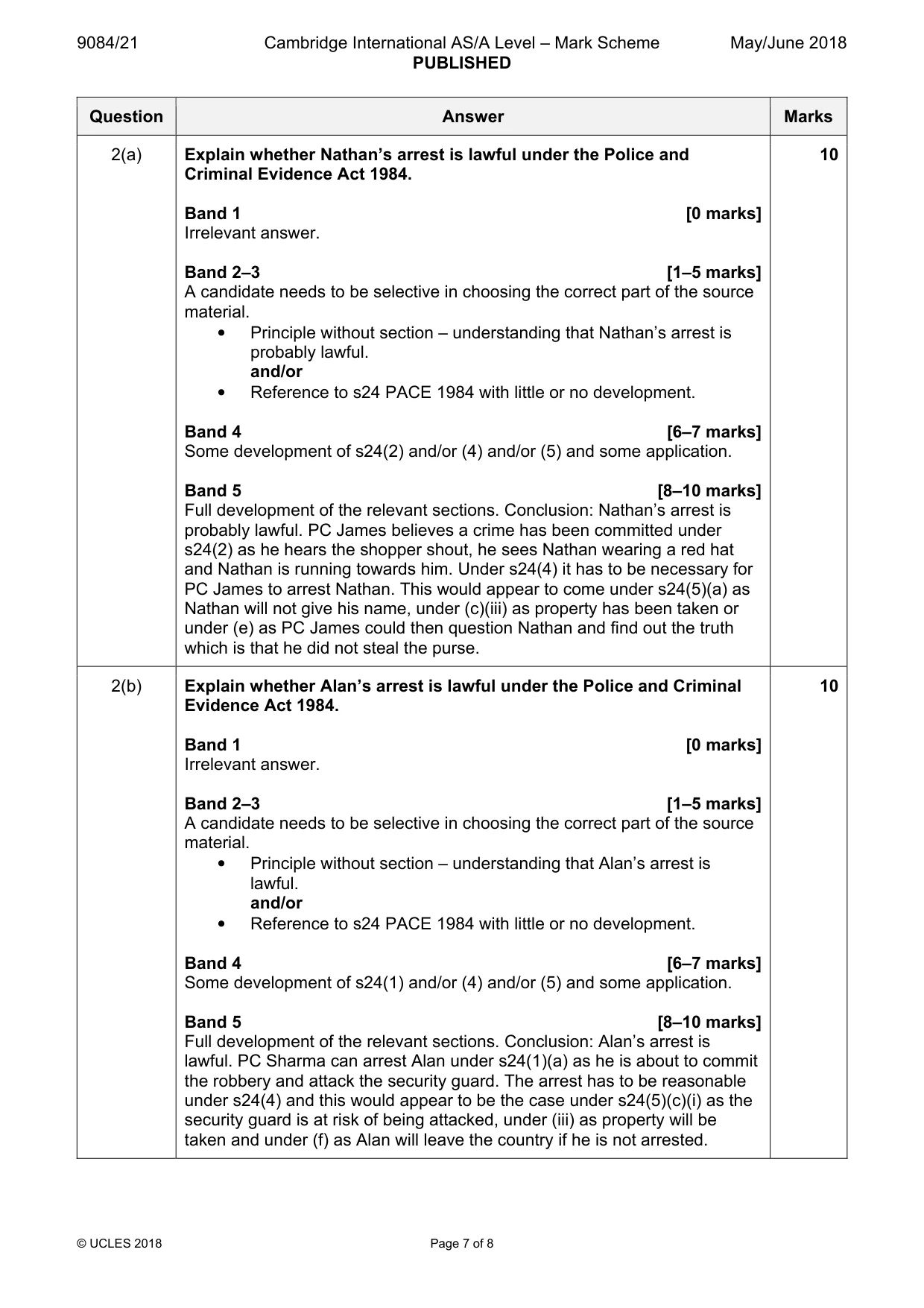
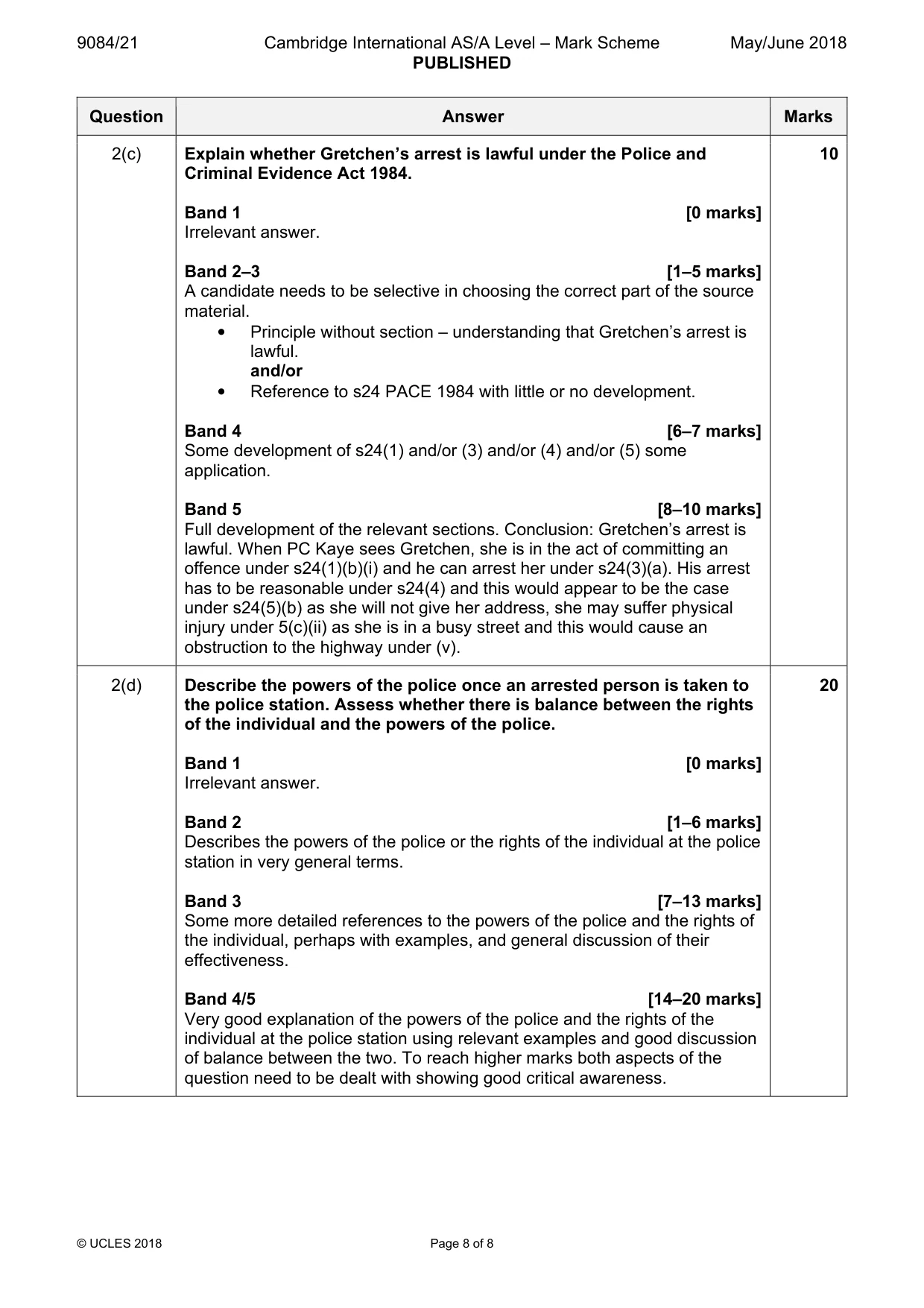
Mark scheme: 2(a) Explain whether Nathan’s arrest is lawful under the Police and 10 Criminal Evidence Act 1984. Band 1 [0 marks] Irrelevant answer. Band 2–3 [1–5 marks] A candidate needs to be selective in choosing the correct part of the source material. • Principle without section – understanding that Nathan’s arrest is probably lawful. and/or • Reference to s24 PACE 1984 with little or no development. Band 4 [6–7 marks] Some development of s24(2) and/or (4) and/or (5) and some application. Band 5 [8–10 marks] Full development of the relevant sections. Conclusion: Nathan’s arrest is probably lawful. PC James believes a crime has been committed under s24(2) as he hears the shopper shout, he sees Nathan wearing a red hat and Nathan is running towards him. Under s24(4) it has to be necessary for PC James to arrest Nathan. This would appear to come under s24(5)(a) as Nathan will not give his name, under (c)(iii) as property has been taken or under (e) as PC James could then question Nathan and find out the truth which is that he did not steal the purse. 2(b) Explain whether Alan’s arrest is lawful under the Police and Criminal 10 Evidence Act 1984. Band 1 [0 marks] Irrelevant answer. Band 2–3 [1–5 marks] A candidate needs to be selective in choosing the correct part of the source material. • Principle without section – understanding that Alan’s arrest is lawful. and/or • Reference to s24 PACE 1984 with little or no development. Band 4 [6–7 marks] Some development of s24(1) and/or (4) and/or (5) and some application. Band 5 [8–10 marks] Full development of the relevant sections. Conclusion: Alan’s arrest is lawful. PC Sharma can arrest Alan under s24(1)(a) as he is about to commit the robbery and attack the security guard. The arrest has to be reasonable under s24(4) and this would appear to be the case under s24(5)(c)(i) as the security guard is at risk of being attacked, under (iii) as property will be taken and under (f) as Alan will leave the country if he is not arrested. 2(c) Explain whether Gretchen’s arrest is lawful under the Police and 10 Criminal Evidence Act 1984. Band 1 [0 marks] Irrelevant answer. Band 2–3 [1–5 marks] A candidate needs to be selective in choosing the correct part of the source material. • Principle without section – understanding that Gretchen’s arrest is lawful. and/or • Reference to s24 PACE 1984 with little or no development. Band 4 [6–7 marks] Some development of s24(1) and/or (3) and/or (4) and/or (5) some application. Band 5 [8–10 marks] Full development of the relevant sections. Conclusion: Gretchen’s arrest is lawful. When PC Kaye sees Gretchen, she is in the act of committing an offence under s24(1)(b)(i) and he can arrest her under s24(3)(a). His arrest has to be reasonable under s24(4) and this would appear to be the case under s24(5)(b) as she will not give her address, she may suffer physical injury under 5(c)(ii) as she is in a busy street and this would cause an obstruction to the highway under (v). 2(d) Describe the powers of the police once an arrested person is taken to 20 the police station. Assess whether there is balance between the rights of the individual and the powers of the police. Band 1 [0 marks] Irrelevant answer. Band 2 [1–6 marks] Describes the powers of the police or the rights of the individual at the police station in very general terms. Band 3 [7–13 marks] Some more detailed references to the powers of the police and the rights of the individual, perhaps with examples, and general discussion of their effectiveness. Band 4/5 [14–20 marks] Very good explanation of the powers of the police and the rights of the individual at the police station using relevant examples and good discussion of balance between the two. To reach higher marks both aspects of the question need to be dealt with showing good critical awareness.
What was in this paper
The subtopics covered by these 2 questions, and how many questions each got. Open one in a new tab to see every Cambridge question on it.
1Principles and sources of English law This topic introduces the principles behind English law and the modern day sources of English law. This topic is an opportunity to reflect on the key concepts of justice, fairness and morality; power and its limits; and effectiveness and certainty1What you needed in this session
Cambridge’s own grade thresholds for 2018 May/June, Paper 2 · Variant 1. A higher threshold means an easier paper — the bar moves with how the cohort did.