Cambridge A Level Law 9084 — 2022 May/June Paper 2 · Variant 3
9084/23/M/J/22 · 2 questions · 50 marks · ≈56 min
The question paper and its mark scheme, free to read here and free to download. This is Cambridge’s own paper, exactly as it was sat.
Question paper8 pages
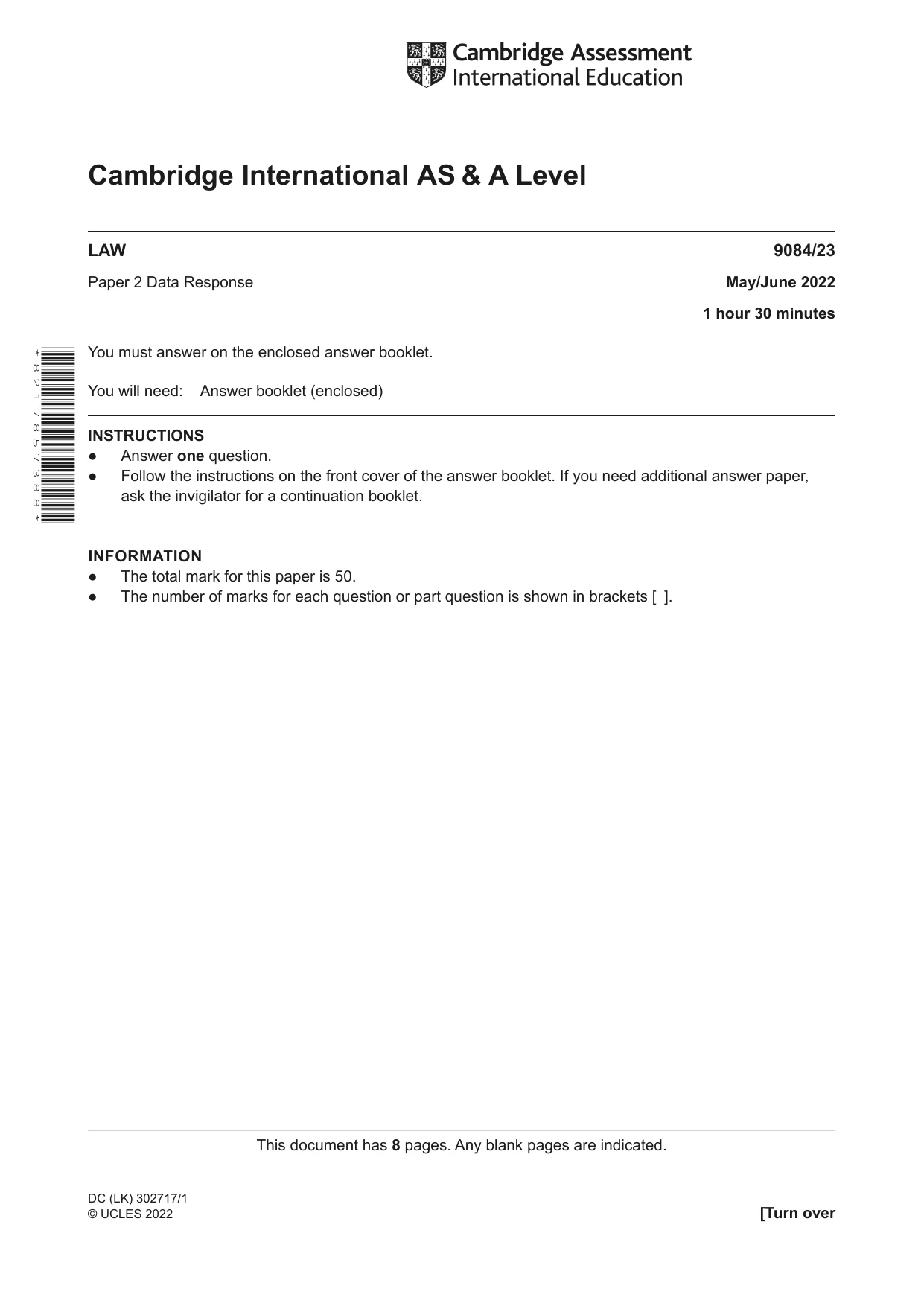



Mark scheme9 pages
Answers below. Sit the paper first if you are practising.
Questions as text
Q1 · Henri and Guy are members of a criminal gang
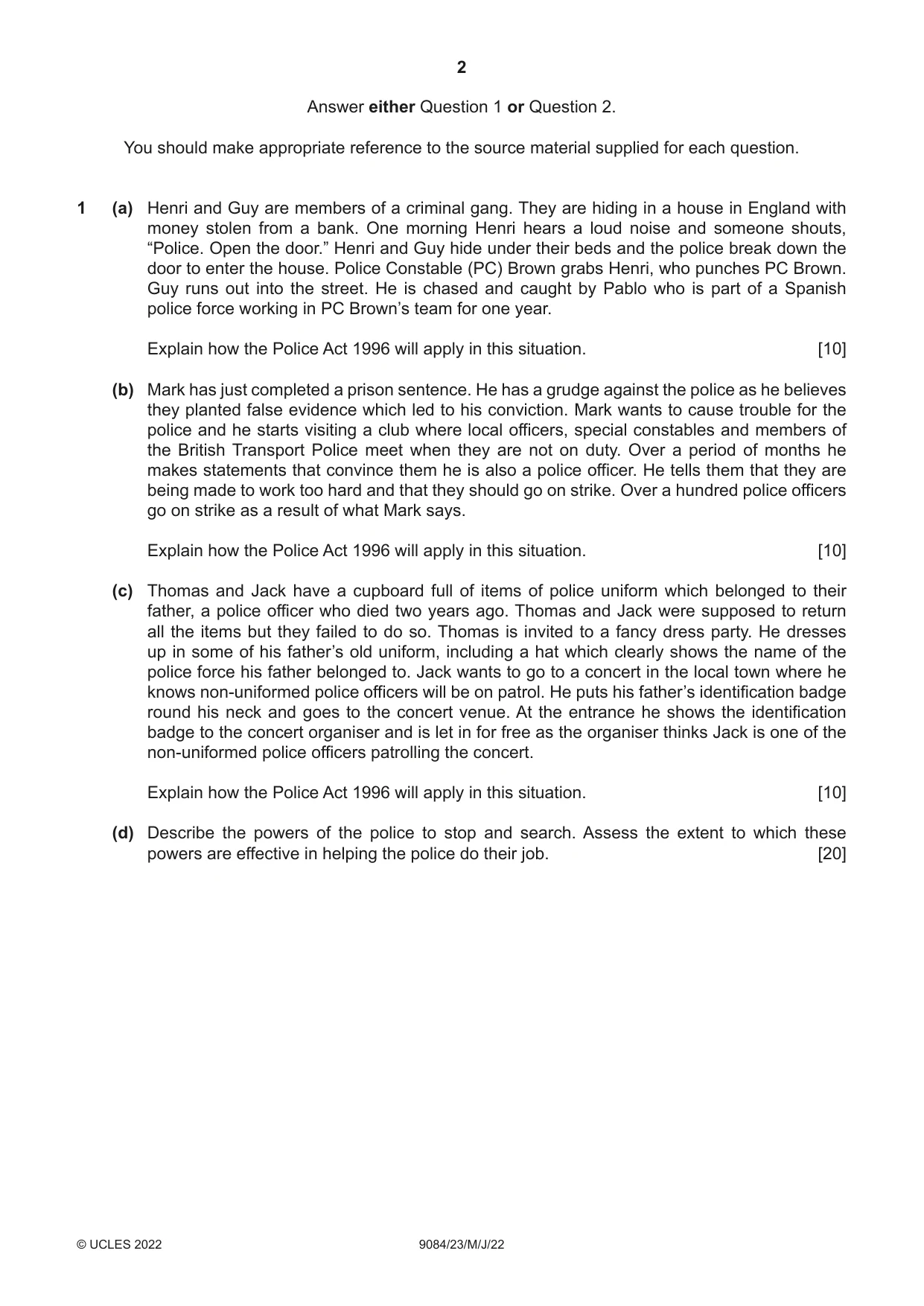
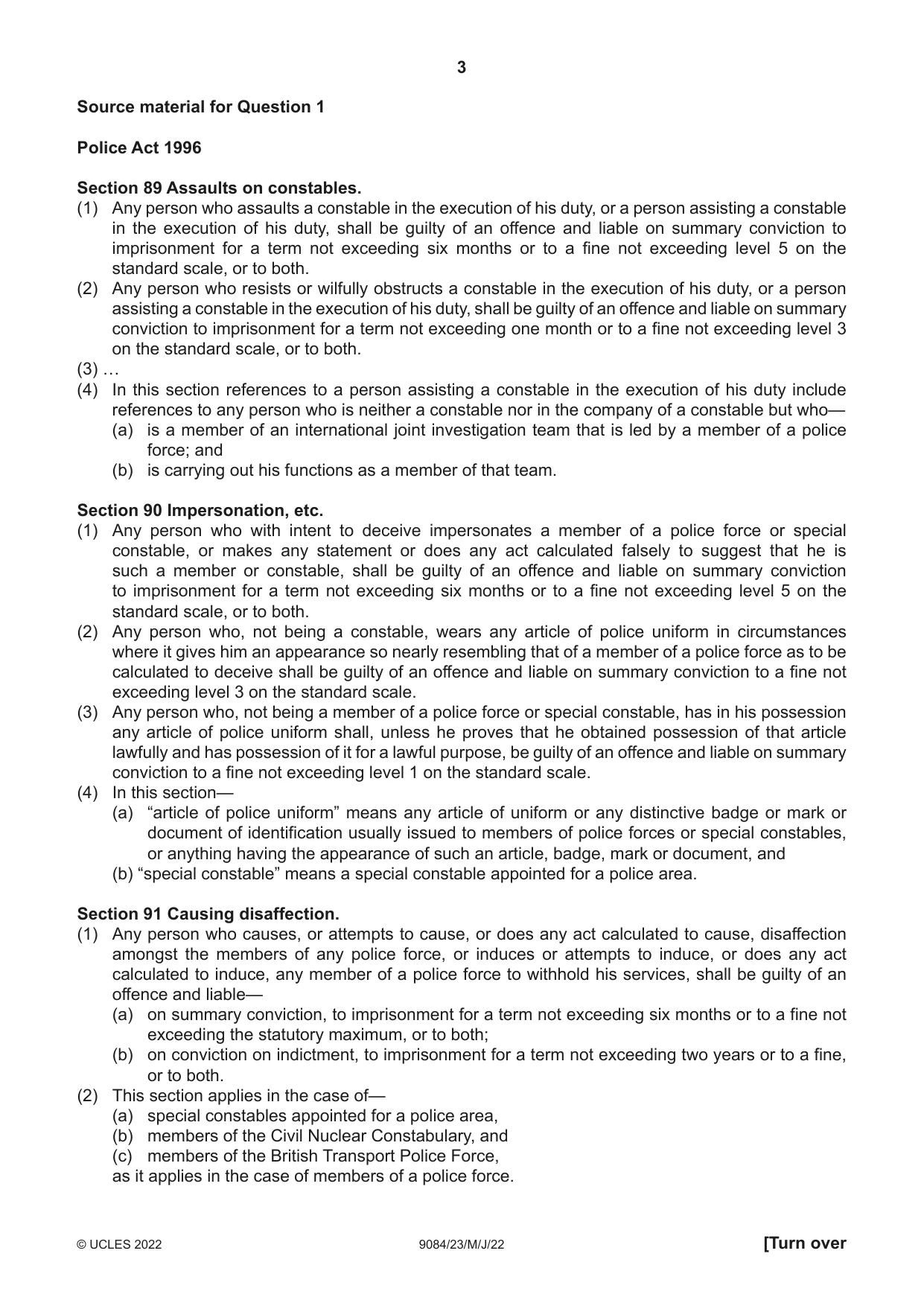
1 (a) Henri and Guy are members of a criminal gang. They are hiding in a house in England with money stolen from a bank. One morning Henri hears a loud noise and someone shouts, “Police. Open the door.” Henri and Guy hide under their beds and the police break down the door to enter the house. Police Constable (PC) Brown grabs Henri, who punches PC Brown. Guy runs out into the street. He is chased and caught by Pablo who is part of a Spanish police force working in PC Brown’s team for one year. Explain how the Police Act 1996 will apply in this situation. [10] (b) Mark has just completed a prison sentence. He has a grudge against the police as he believes they planted false evidence which led to his conviction. Mark wants to cause trouble for the police and he starts visiting a club where local officers, special constables and members of the British Transport Police meet when they are not on duty. Over a period of months he makes statements that convince them he is also a police officer. He tells them that they are being made to work too hard and that they should go on strike. Over a hundred police officers go on strike as a result of what Mark says. Explain how the Police Act 1996 will apply in this situation. [10] (c) Thomas and Jack have a cupboard full of items of police uniform which belonged to their father, a police officer who died two years ago. Thomas and Jack were supposed to return all the items but they failed to do so. Thomas is invited to a fancy dress party. He dresses up in some of his father’s old uniform, including a hat which clearly shows the name of the police force his father belonged to. Jack wants to go to a concert in the local town where he knows non-uniformed police officers will be on patrol. He puts his father’s identification badge round his neck and goes to the concert venue. At the entrance he shows the identification badge to the concert organiser and is let in for free as the organiser thinks Jack is one of the non-uniformed police officers patrolling the concert. Explain how the Police Act 1996 will apply in this situation. [10] (d) Describe the powers of the police to stop and search. Assess the extent to which these powers are effective in helping the police do their job. [20] Source material for Question 1 Police Act 1996 Section 89 Assaults on constables. (1) Any person who assaults a constable in the execution of his duty, or a person assisting a constable in the execution of his duty, shall be guilty of an offence and liable on summary conviction to imprisonment for a term not exceeding six months or to a fine not exceeding level 5 on the standard scale, or to both. (2) Any person who resists or wilfully obstructs a constable in the execution of his duty, or a person assisting a constable in the execution of his duty, shall be guilty of an offence and liable on summary conviction to imprisonment for a term not exceeding one month or to a fine not exceeding level 3 on the standard scale, or to both. (3) … (4) In this section references to a person assisting a constable in the execution of his duty include references to any person who is neither a constable nor in the company of a constable but who— (a) is a member of an international joint investigation team that is led by a member of a police force; and (b) is carrying out his functions as a member of that team. Section 90 Impersonation, etc. (1) Any person who with intent to deceive impersonates a member of a police force or special constable, or makes any statement or does any act calculated falsely to suggest that he is such a member or constable, shall be guilty of an offence and liable on summary conviction to imprisonment for a term not exceeding six months or to a fine not exceeding level 5 on the standard scale, or to both. (2) Any person who, not being a constable, wears any article of police uniform in circumstances where it gives him an appearance so nearly resembling that of a member of a police force as to be calculated to deceive shall be guilty of an offence and liable on summary conviction to a fine not exceeding level 3 on the standard scale. (3) Any person who, not being a member of a police force or special constable, has in his possession any article of police uniform shall, unless he proves that he obtained possession of that article lawfully and has possession of it for a lawful purpose, be guilty of an offence and liable on summary conviction to a fine not exceeding level 1 on the standard scale. (4) In this section— (a) “article of police uniform” means any article of uniform or any distinctive badge or mark or document of identification usually issued to members of police forces or special constables, or anything having the appearance of such an article, badge, mark or document, and (b) “special constable” means a special constable appointed for a police area. Section 91 Causing disaffection. (1) Any person who causes, or attempts to cause, or does any act calculated to cause, disaffection amongst the members of any police force, or induces or attempts to induce, or does any act calculated to induce, any member of a police force to withhold his services, shall be guilty of an offence and liable— (a) on summary conviction, to imprisonment for a term not exceeding six months or to a fine not exceeding the statutory maximum, or to both; (b) on conviction on indictment, to imprisonment for a term not exceeding two years or to a fine, or to both. (2) This section applies in the case of— (a) special constables appointed for a police area, (b) members of the Civil Nuclear Constabulary, and (c) members of the British Transport Police Force, as it applies in the case of members of a police force.
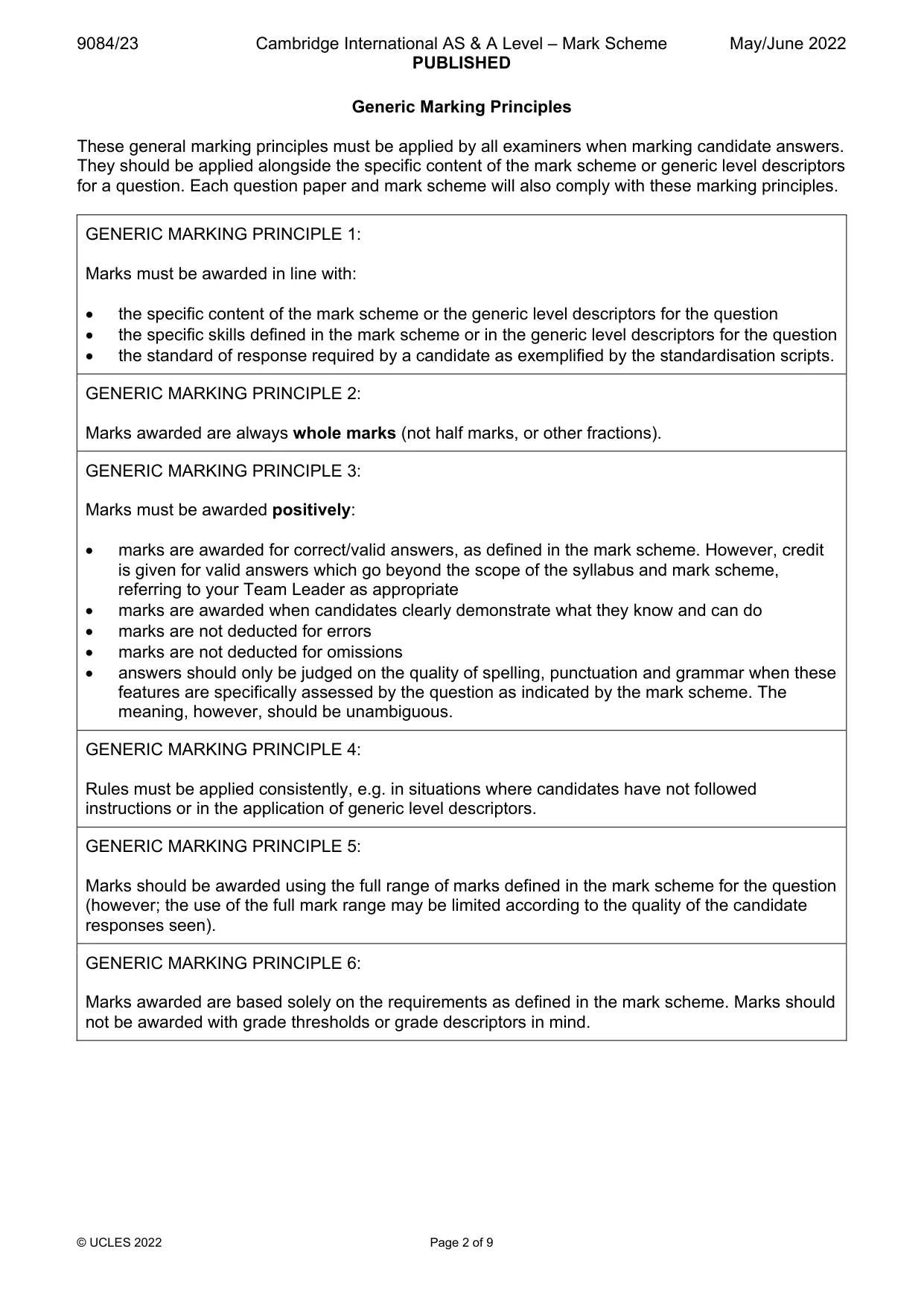
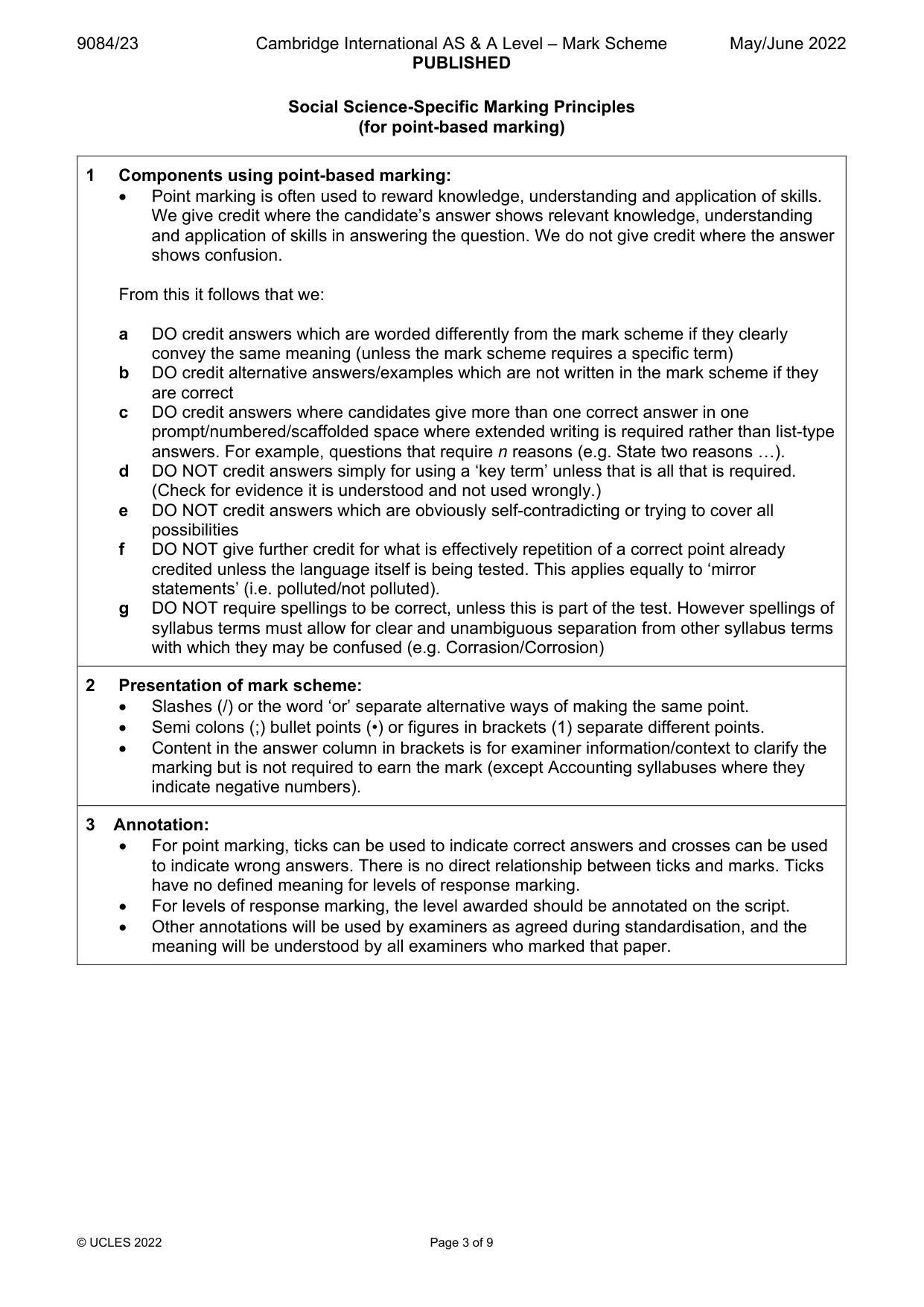
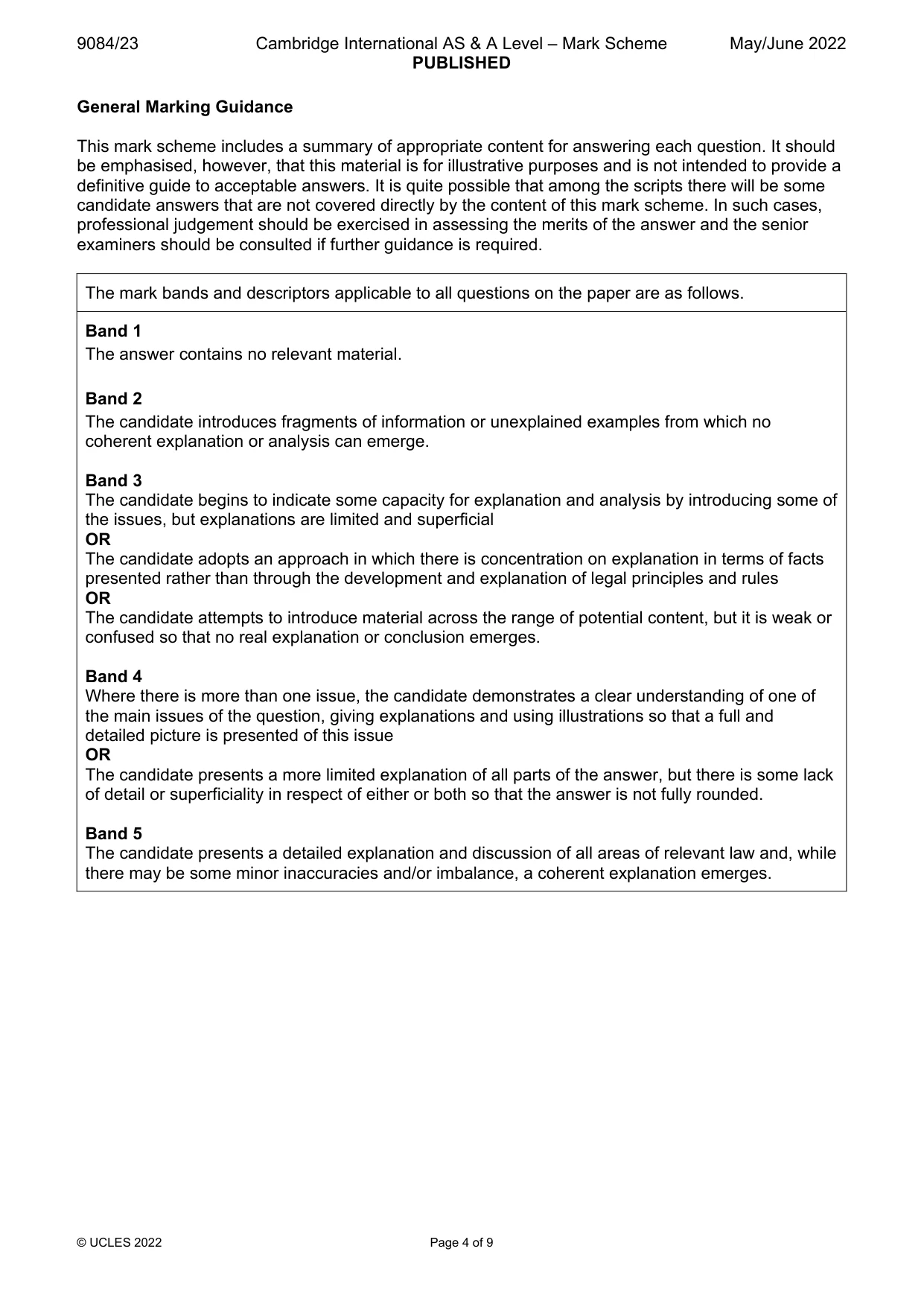
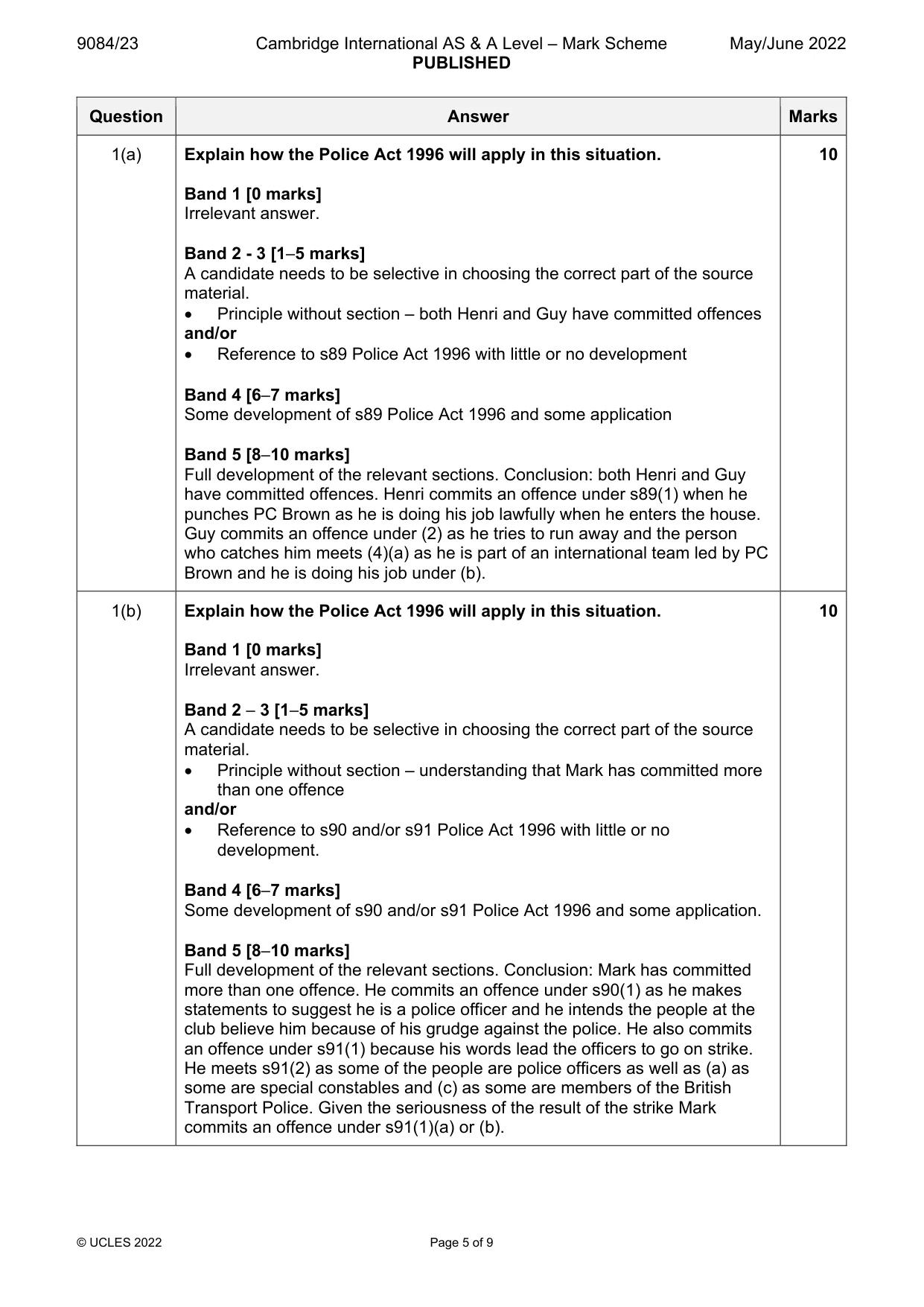
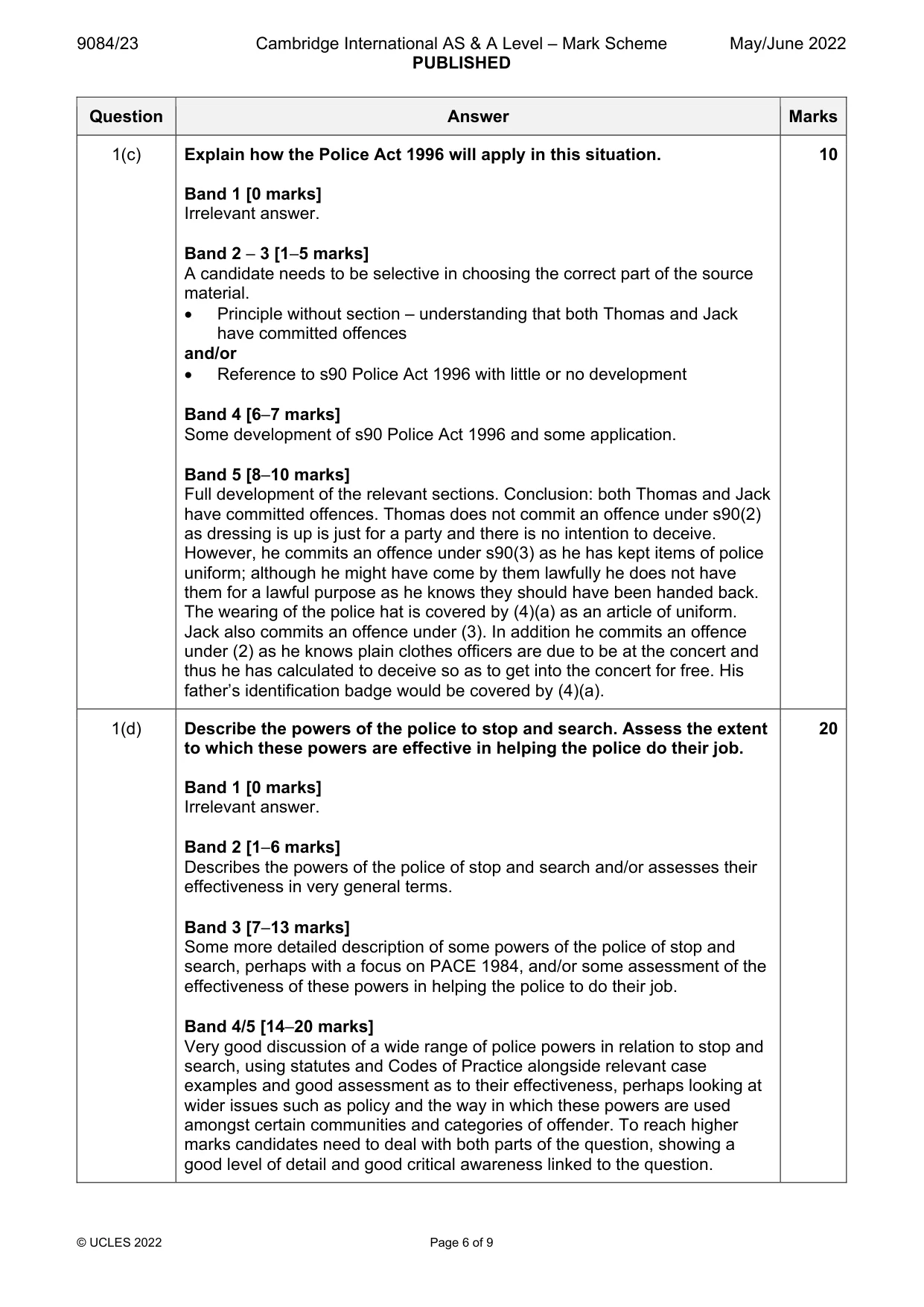
Mark scheme: Question Answer Marks 1(a) Explain how the Police Act 1996 will apply in this situation. 10 Band 1 [0 marks] Irrelevant answer. Band 2 - 3 [15 marks] A candidate needs to be selective in choosing the correct part of the source material. Principle without section – both Henri and Guy have committed offences and/or Reference to s89 Police Act 1996 with little or no development Band 4 [67 marks] Some development of s89 Police Act 1996 and some application Band 5 [810 marks] Full development of the relevant sections. Conclusion: both Henri and Guy have committed offences. Henri commits an offence under s89(1) when he punches PC Brown as he is doing his job lawfully when he enters the house. Guy commits an offence under (2) as he tries to run away and the person who catches him meets (4)(a) as he is part of an international team led by PC Brown and he is doing his job under (b). 1(b) Explain how the Police Act 1996 will apply in this situation. 10 Band 1 [0 marks] Irrelevant answer. Band 2 3 [15 marks] A candidate needs to be selective in choosing the correct part of the source material. Principle without section – understanding that Mark has committed more than one offence and/or Reference to s90 and/or s91 Police Act 1996 with little or no development. Band 4 [67 marks] Some development of s90 and/or s91 Police Act 1996 and some application. Band 5 [810 marks] Full development of the relevant sections. Conclusion: Mark has committed more than one offence. He commits an offence under s90(1) as he makes statements to suggest he is a police officer and he intends the people at the club believe him because of his grudge against the police. He also commits an offence under s91(1) because his words lead the officers to go on strike. He meets s91(2) as some of the people are police officers as well as (a) as some are special constables and (c) as some are members of the British Transport Police. Given the seriousness of the result of the strike Mark commits an offence under s91(1)(a) or (b). 1(c) Explain how the Police Act 1996 will apply in this situation. 10 Band 1 [0 marks] Irrelevant answer. Band 2 3 [15 marks] A candidate needs to be selective in choosing the correct part of the source material. Principle without section – understanding that both Thomas and Jack have committed offences and/or Reference to s90 Police Act 1996 with little or no development Band 4 [67 marks] Some development of s90 Police Act 1996 and some application. Band 5 [810 marks] Full development of the relevant sections. Conclusion: both Thomas and Jack have committed offences. Thomas does not commit an offence under s90(2) as dressing is up is just for a party and there is no intention to deceive. However, he commits an offence under s90(3) as he has kept items of police uniform; although he might have come by them lawfully he does not have them for a lawful purpose as he knows they should have been handed back. The wearing of the police hat is covered by (4)(a) as an article of uniform. Jack also commits an offence under (3). In addition he commits an offence under (2) as he knows plain clothes officers are due to be at the concert and thus he has calculated to deceive so as to get into the concert for free. His father’s identification badge would be covered by (4)(a). 1(d) Describe the powers of the police to stop and search. Assess the extent 20 to which these powers are effective in helping the police do their job. Band 1 [0 marks] Irrelevant answer. Band 2 [16 marks] Describes the powers of the police of stop and search and/or assesses their effectiveness in very general terms. Band 3 [713 marks] Some more detailed description of some powers of the police of stop and search, perhaps with a focus on PACE 1984, and/or some assessment of the effectiveness of these powers in helping the police to do their job. Band 4/5 [1420 marks] Very good discussion of a wide range of police powers in relation to stop and search, using statutes and Codes of Practice alongside relevant case examples and good assessment as to their effectiveness, perhaps looking at wider issues such as policy and the way in which these powers are used amongst certain communities and categories of offender. To reach higher marks candidates need to deal with both parts of the question, showing a good level of detail and good critical awareness linked to the question.
Q2 · The Lord Chancellor wants to create a new Law Commission
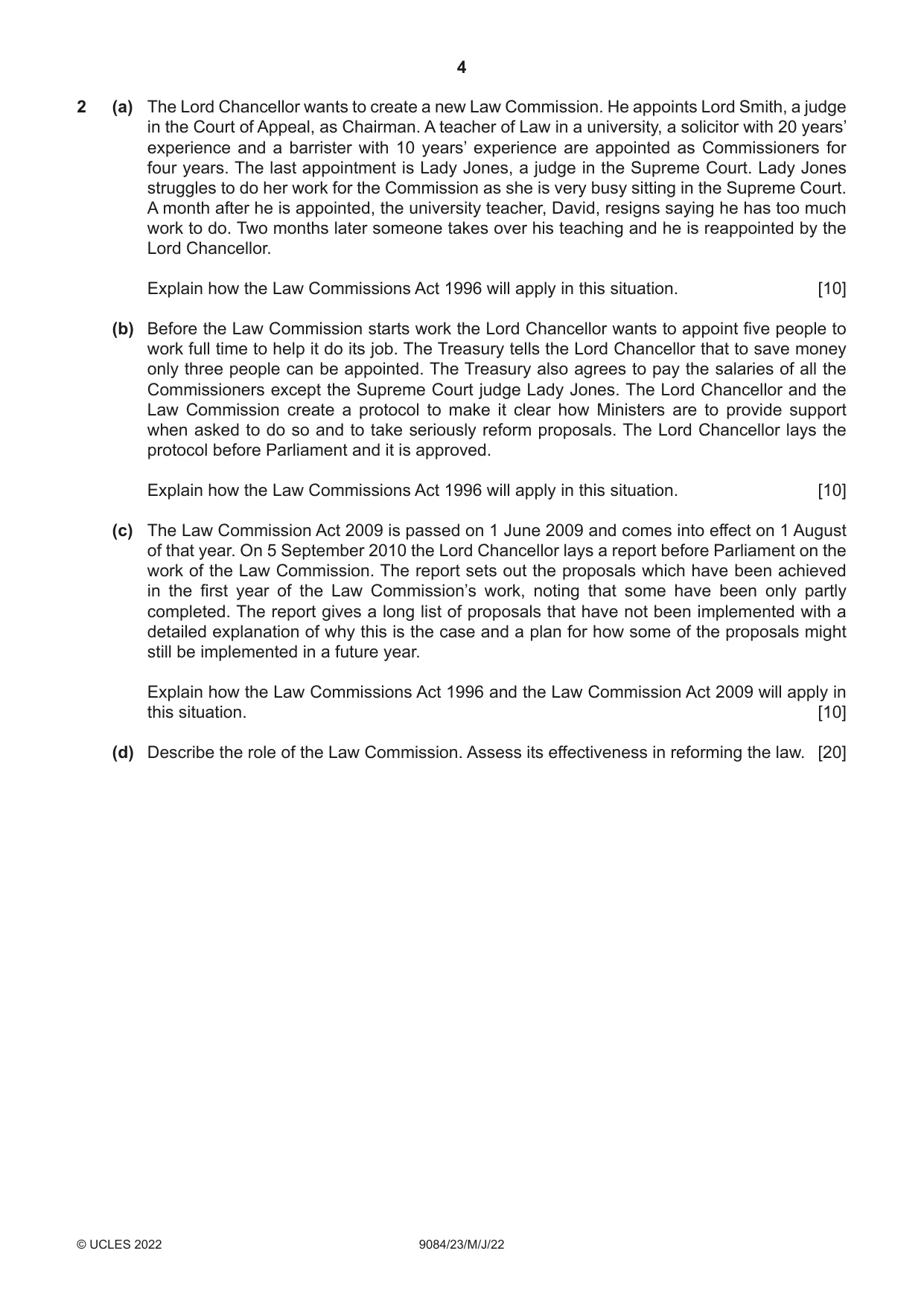
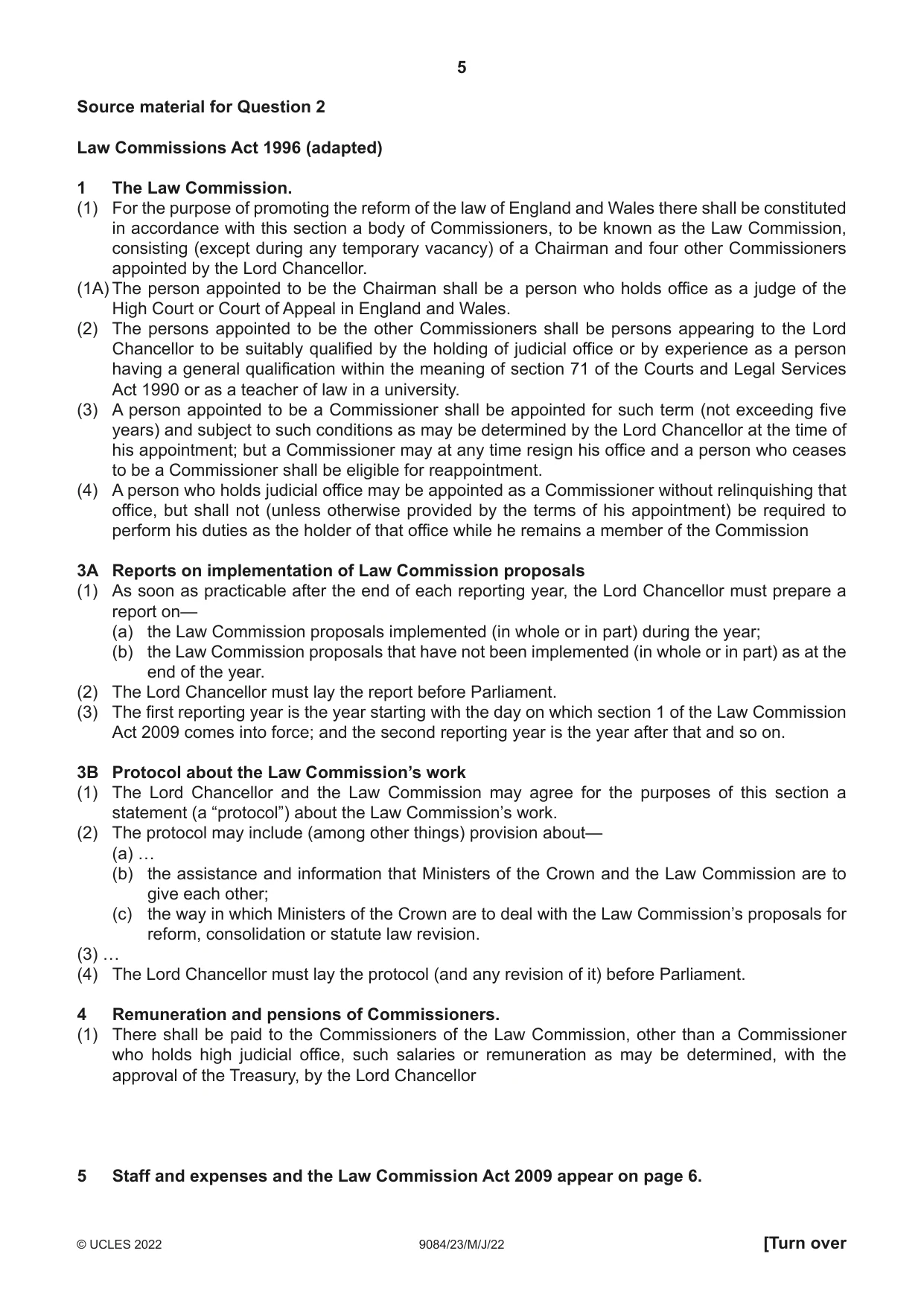
2 (a) The Lord Chancellor wants to create a new Law Commission. He appoints Lord Smith, a judge in the Court of Appeal, as Chairman. A teacher of Law in a university, a solicitor with 20 years’ experience and a barrister with 10 years’ experience are appointed as Commissioners for four years. The last appointment is Lady Jones, a judge in the Supreme Court. Lady Jones struggles to do her work for the Commission as she is very busy sitting in the Supreme Court. A month after he is appointed, the university teacher, David, resigns saying he has too much work to do. Two months later someone takes over his teaching and he is reappointed by the Lord Chancellor. Explain how the Law Commissions Act 1996 will apply in this situation. [10] (b) Before the Law Commission starts work the Lord Chancellor wants to appoint five people to work full time to help it do its job. The Treasury tells the Lord Chancellor that to save money only three people can be appointed. The Treasury also agrees to pay the salaries of all the Commissioners except the Supreme Court judge Lady Jones. The Lord Chancellor and the Law Commission create a protocol to make it clear how Ministers are to provide support when asked to do so and to take seriously reform proposals. The Lord Chancellor lays the protocol before Parliament and it is approved. Explain how the Law Commissions Act 1996 will apply in this situation. [10] (c) The Law Commission Act 2009 is passed on 1 June 2009 and comes into effect on 1 August of that year. On 5 September 2010 the Lord Chancellor lays a report before Parliament on the work of the Law Commission. The report sets out the proposals which have been achieved in the first year of the Law Commission’s work, noting that some have been only partly completed. The report gives a long list of proposals that have not been implemented with a detailed explanation of why this is the case and a plan for how some of the proposals might still be implemented in a future year. Explain how the Law Commissions Act 1996 and the Law Commission Act 2009 will apply in this situation. [10] (d) Describe the role of the Law Commission. Assess its effectiveness in reforming the law. [20] Source material for Question 2 Law Commissions Act 1996 (adapted) 1 The Law Commission. (1) For the purpose of promoting the reform of the law of England and Wales there shall be constituted in accordance with this section a body of Commissioners, to be known as the Law Commission, consisting (except during any temporary vacancy) of a Chairman and four other Commissioners appointed by the Lord Chancellor. (1A) The person appointed to be the Chairman shall be a person who holds office as a judge of the High Court or Court of Appeal in England and Wales. (2) The persons appointed to be the other Commissioners shall be persons appearing to the Lord Chancellor to be suitably qualified by the holding of judicial office or by experience as a person having a general qualification within the meaning of section 71 of the Courts and Legal Services Act 1990 or as a teacher of law in a university. (3) A person appointed to be a Commissioner shall be appointed for such term (not exceeding five years) and subject to such conditions as may be determined by the Lord Chancellor at the time of his appointment; but a Commissioner may at any time resign his office and a person who ceases to be a Commissioner shall be eligible for reappointment. (4) A person who holds judicial office may be appointed as a Commissioner without relinquishing that office, but shall not (unless otherwise provided by the terms of his appointment) be required to perform his duties as the holder of that office while he remains a member of the Commission 3A Reports on implementation of Law Commission proposals (1) As soon as practicable after the end of each reporting year, the Lord Chancellor must prepare a report on— (a) the Law Commission proposals implemented (in whole or in part) during the year; (b) the Law Commission proposals that have not been implemented (in whole or in part) as at the end of the year. (2) The Lord Chancellor must lay the report before Parliament. (3) The first reporting year is the year starting with the day on which section 1 of the Law Commission Act 2009 comes into force; and the second reporting year is the year after that and so on. 3B Protocol about the Law Commission’s work (1) The Lord Chancellor and the Law Commission may agree for the purposes of this section a statement (a “protocol”) about the Law Commission’s work. (2) The protocol may include (among other things) provision about— (a) … (b) the assistance and information that Ministers of the Crown and the Law Commission are to give each other; (c) the way in which Ministers of the Crown are to deal with the Law Commission’s proposals for reform, consolidation or statute law revision. (3) … (4) The Lord Chancellor must lay the protocol (and any revision of it) before Parliament. 4 Remuneration and pensions of Commissioners. (1) There shall be paid to the Commissioners of the Law Commission, other than a Commissioner who holds high judicial office, such salaries or remuneration as may be determined, with the approval of the Treasury, by the Lord Chancellor 5 Staff and expenses and the Law Commission Act 2009 appear on page 6. 5 Staff and expenses. (1) The Lord Chancellor may appoint such officers and servants of the Law Commission as he may, with the approval of the Treasury as to number and conditions of service, determine. Law Commission Act 2009 Section 3 Commencement and short title (1) This Act comes into force at the end of the period of 2 months beginning with the day on which it is passed.
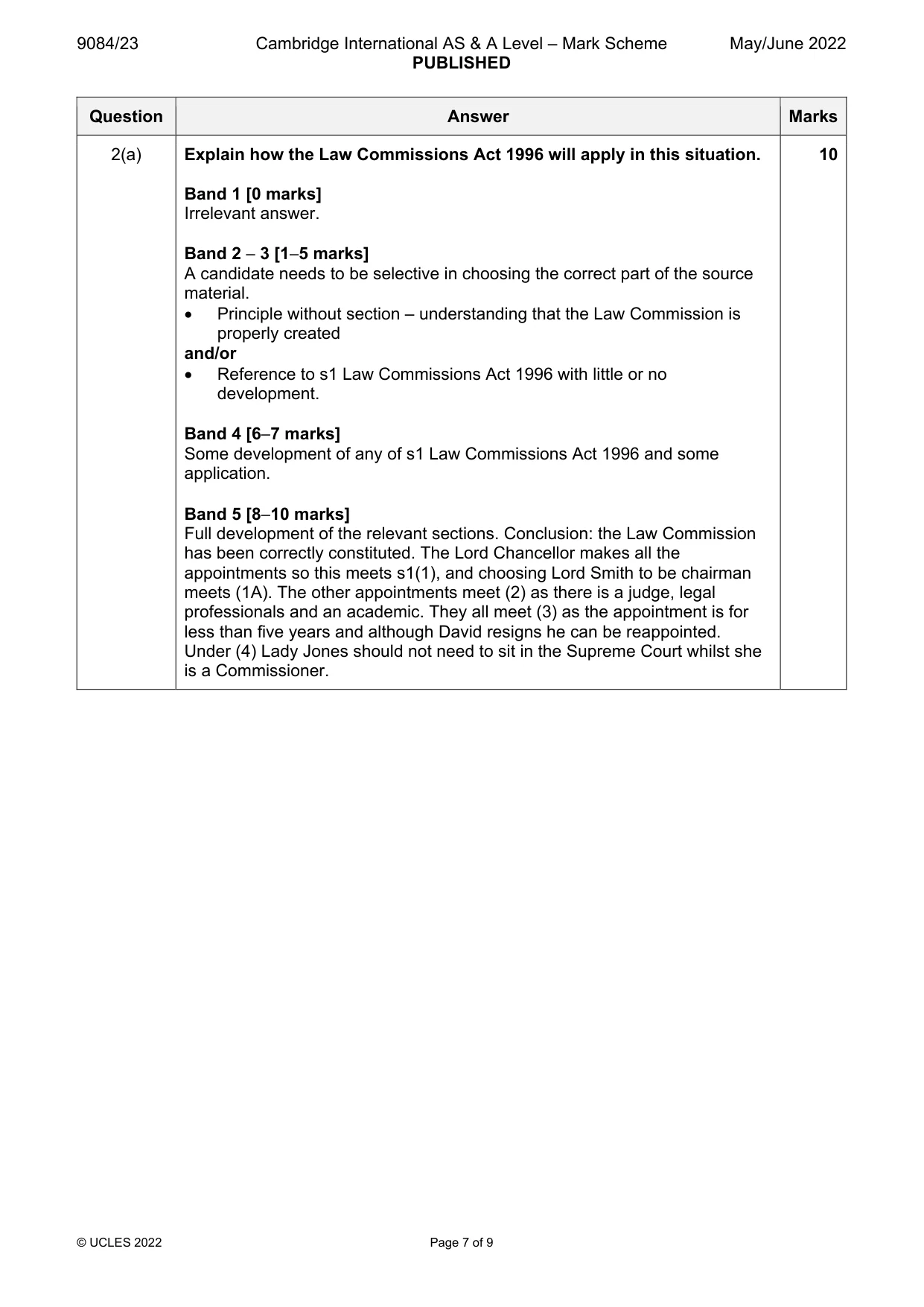
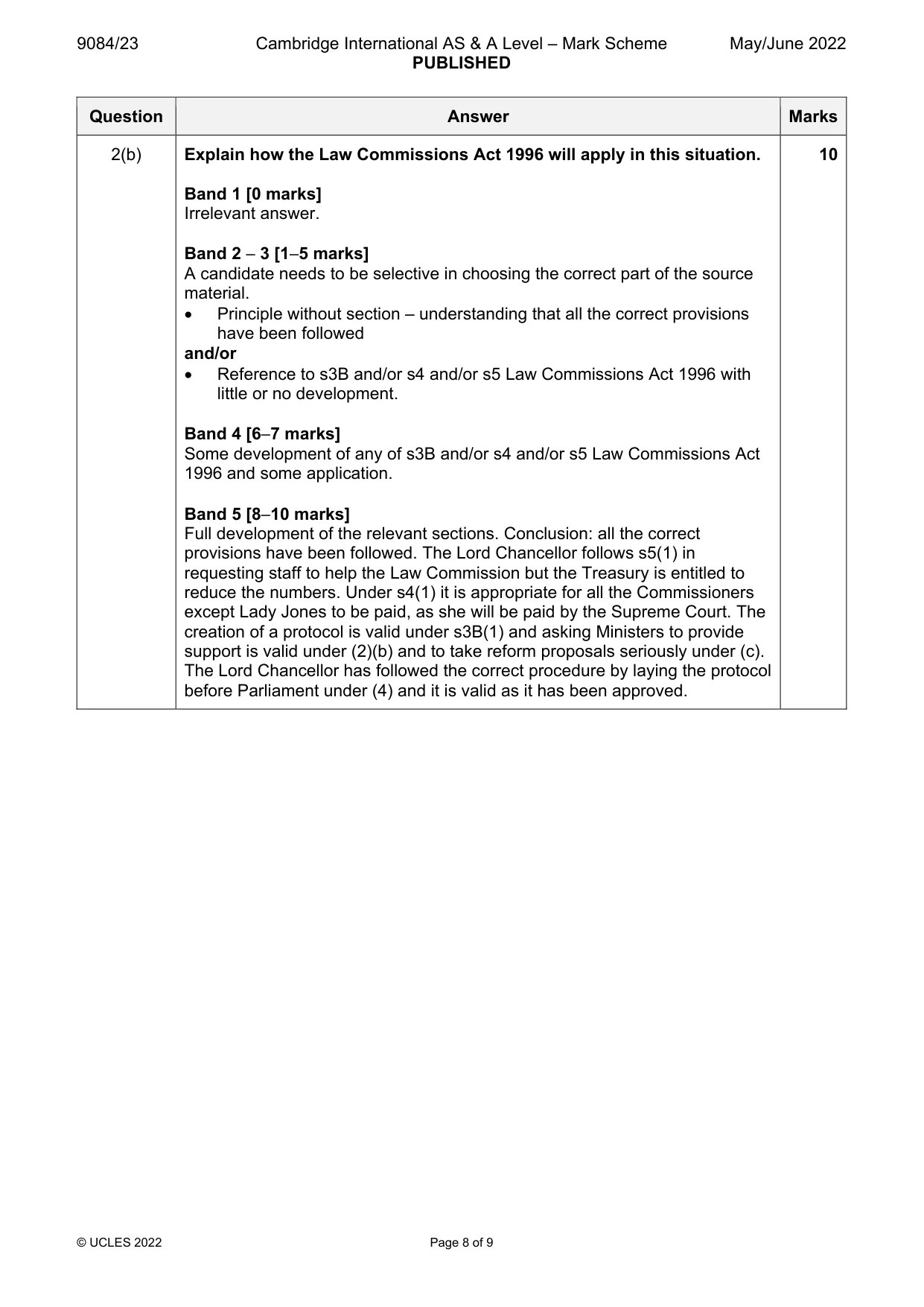
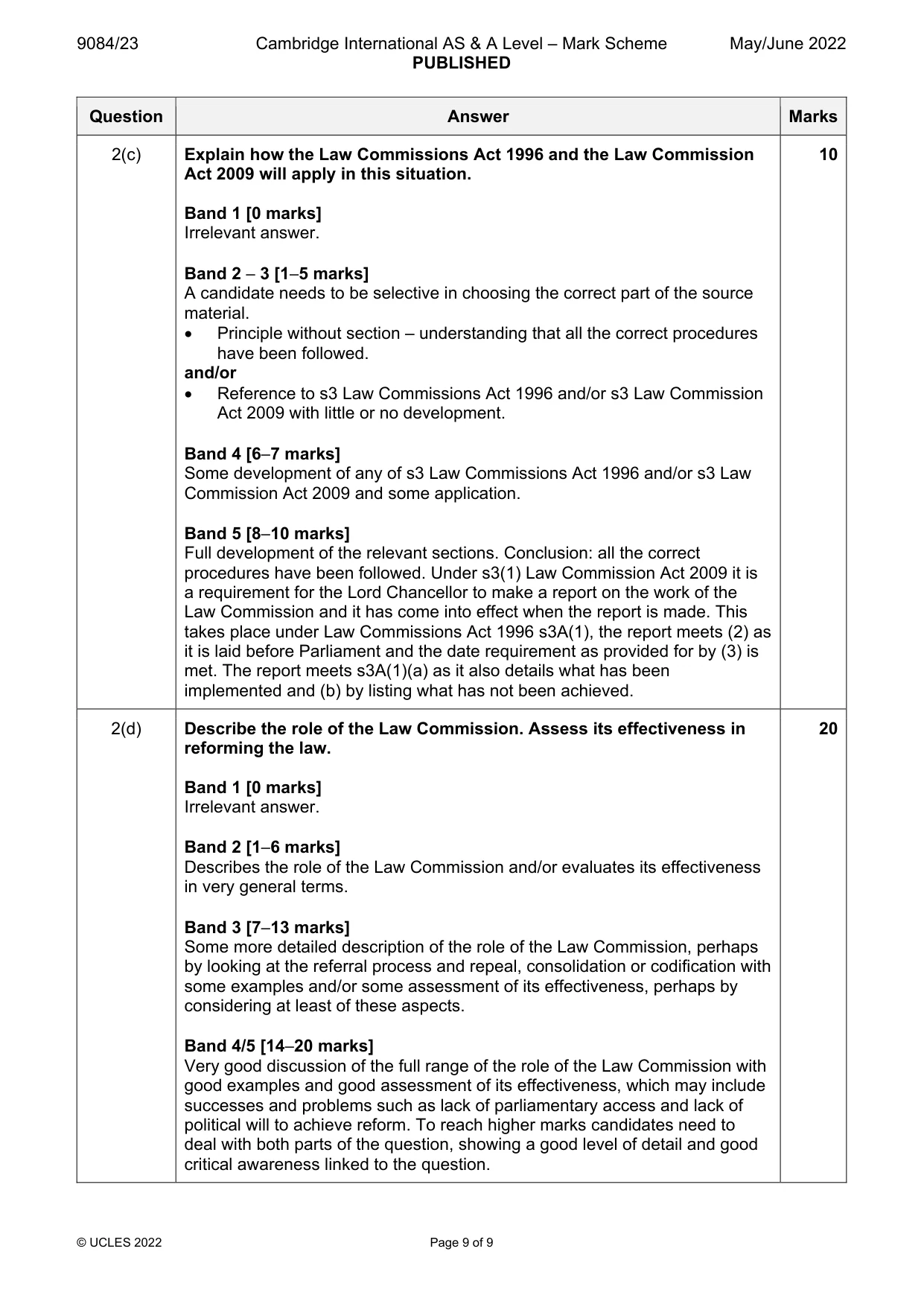
Mark scheme: 2(a) Explain how the Law Commissions Act 1996 will apply in this situation. 10 Band 1 [0 marks] Irrelevant answer. Band 2 3 [15 marks] A candidate needs to be selective in choosing the correct part of the source material. Principle without section – understanding that the Law Commission is properly created and/or Reference to s1 Law Commissions Act 1996 with little or no development. Band 4 [67 marks] Some development of any of s1 Law Commissions Act 1996 and some application. Band 5 [810 marks] Full development of the relevant sections. Conclusion: the Law Commission has been correctly constituted. The Lord Chancellor makes all the appointments so this meets s1(1), and choosing Lord Smith to be chairman meets (1A). The other appointments meet (2) as there is a judge, legal professionals and an academic. They all meet (3) as the appointment is for less than five years and although David resigns he can be reappointed. Under (4) Lady Jones should not need to sit in the Supreme Court whilst she is a Commissioner. 2(b) Explain how the Law Commissions Act 1996 will apply in this situation. 10 Band 1 [0 marks] Irrelevant answer. Band 2 3 [15 marks] A candidate needs to be selective in choosing the correct part of the source material. Principle without section – understanding that all the correct provisions have been followed and/or Reference to s3B and/or s4 and/or s5 Law Commissions Act 1996 with little or no development. Band 4 [67 marks] Some development of any of s3B and/or s4 and/or s5 Law Commissions Act 1996 and some application. Band 5 [810 marks] Full development of the relevant sections. Conclusion: all the correct provisions have been followed. The Lord Chancellor follows s5(1) in requesting staff to help the Law Commission but the Treasury is entitled to reduce the numbers. Under s4(1) it is appropriate for all the Commissioners except Lady Jones to be paid, as she will be paid by the Supreme Court. The creation of a protocol is valid under s3B(1) and asking Ministers to provide support is valid under (2)(b) and to take reform proposals seriously under (c). The Lord Chancellor has followed the correct procedure by laying the protocol before Parliament under (4) and it is valid as it has been approved. 2(c) Explain how the Law Commissions Act 1996 and the Law Commission 10 Act 2009 will apply in this situation. Band 1 [0 marks] Irrelevant answer. Band 2 3 [15 marks] A candidate needs to be selective in choosing the correct part of the source material. Principle without section – understanding that all the correct procedures have been followed. and/or Reference to s3 Law Commissions Act 1996 and/or s3 Law Commission Act 2009 with little or no development. Band 4 [67 marks] Some development of any of s3 Law Commissions Act 1996 and/or s3 Law Commission Act 2009 and some application. Band 5 [810 marks] Full development of the relevant sections. Conclusion: all the correct procedures have been followed. Under s3(1) Law Commission Act 2009 it is a requirement for the Lord Chancellor to make a report on the work of the Law Commission and it has come into effect when the report is made. This takes place under Law Commissions Act 1996 s3A(1), the report meets (2) as it is laid before Parliament and the date requirement as provided for by (3) is met. The report meets s3A(1)(a) as it also details what has been implemented and (b) by listing what has not been achieved. 2(d) Describe the role of the Law Commission. Assess its effectiveness in 20 reforming the law. Band 1 [0 marks] Irrelevant answer. Band 2 [16 marks] Describes the role of the Law Commission and/or evaluates its effectiveness in very general terms. Band 3 [713 marks] Some more detailed description of the role of the Law Commission, perhaps by looking at the referral process and repeal, consolidation or codification with some examples and/or some assessment of its effectiveness, perhaps by considering at least of these aspects. Band 4/5 [1420 marks] Very good discussion of the full range of the role of the Law Commission with good examples and good assessment of its effectiveness, which may include successes and problems such as lack of parliamentary access and lack of political will to achieve reform. To reach higher marks candidates need to deal with both parts of the question, showing a good level of detail and good critical awareness linked to the question.
What was in this paper
The subtopics covered by these 2 questions, and how many questions each got. Open one in a new tab to see every Cambridge question on it.
1Machinery of justice This topic introduces the institutions and processes involved in the resolution of civil and criminal matters. This topic is an opportunity to reflect on the key concepts of power and its limits; justice, fairness and morality; effectiveness and certainty; and liability1What you needed in this session
Cambridge’s own grade thresholds for 2022 May/June, Paper 2 · Variant 3. A higher threshold means an easier paper — the bar moves with how the cohort did.