Cambridge A Level Law 9084 — 2019 May/June Paper 2 · Variant 3
9084/23/M/J/19 · 2 questions · 50 marks · ≈56 min
The question paper and its mark scheme, free to read here and free to download. This is Cambridge’s own paper, exactly as it was sat.
Question paper8 pages
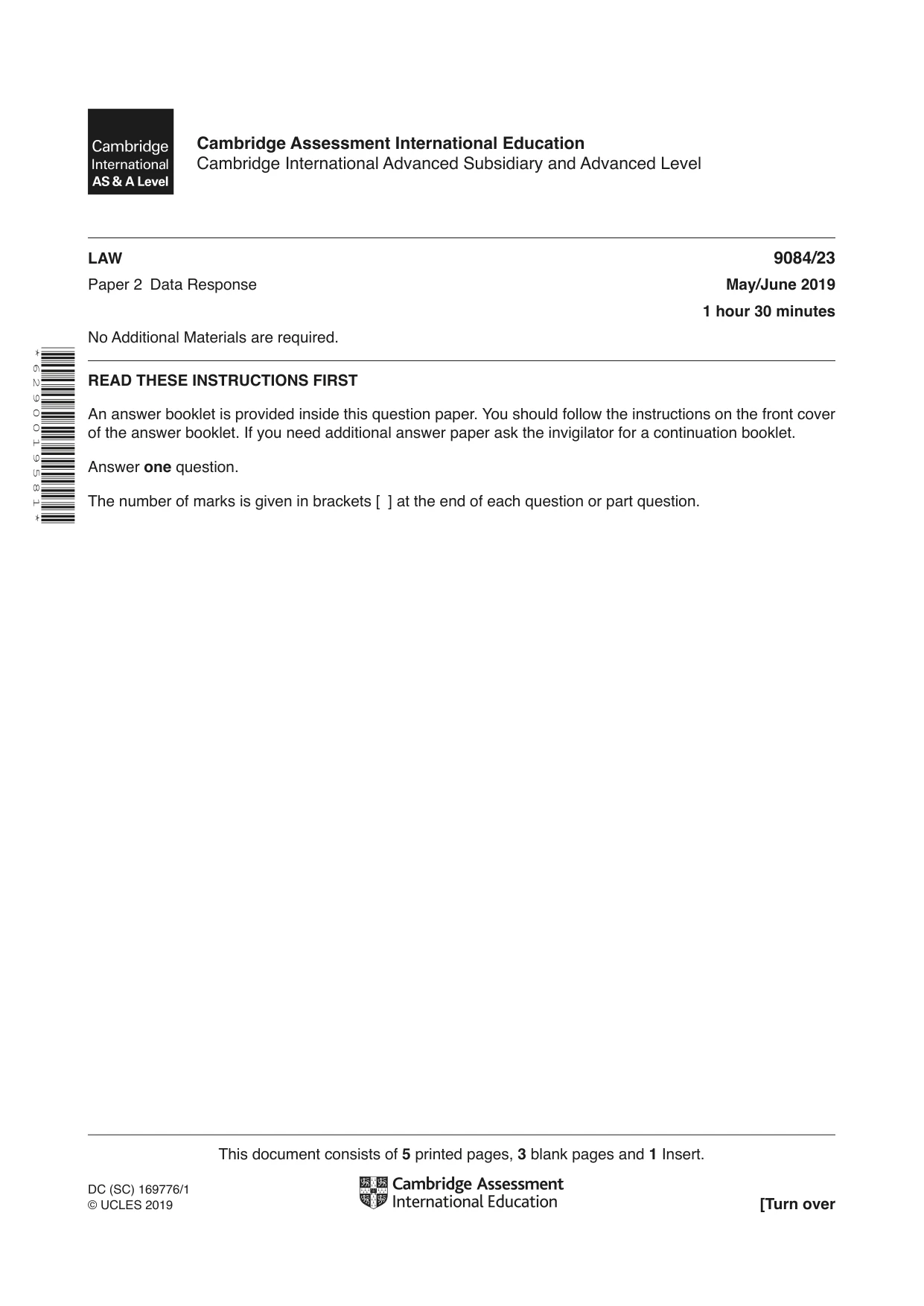
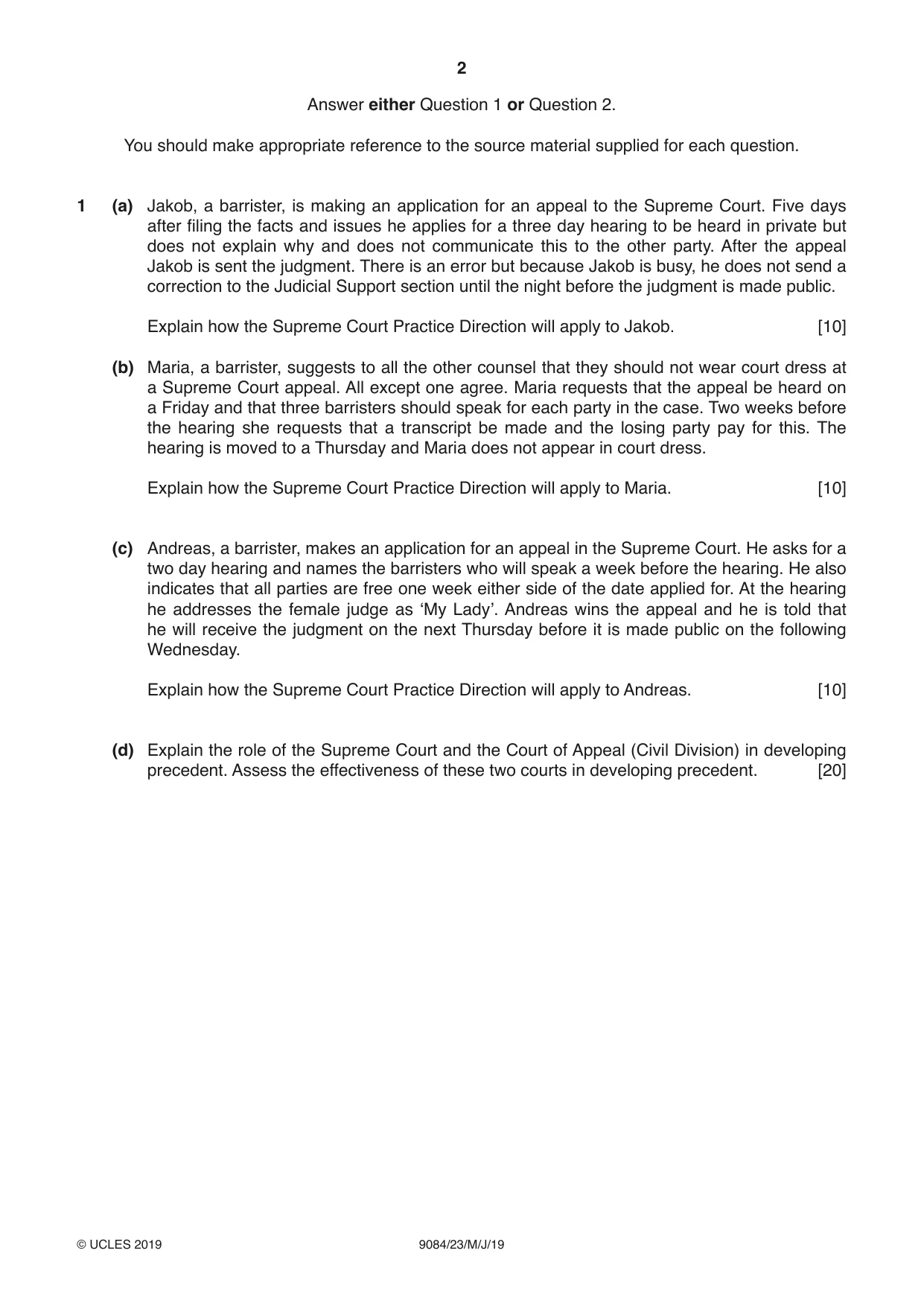
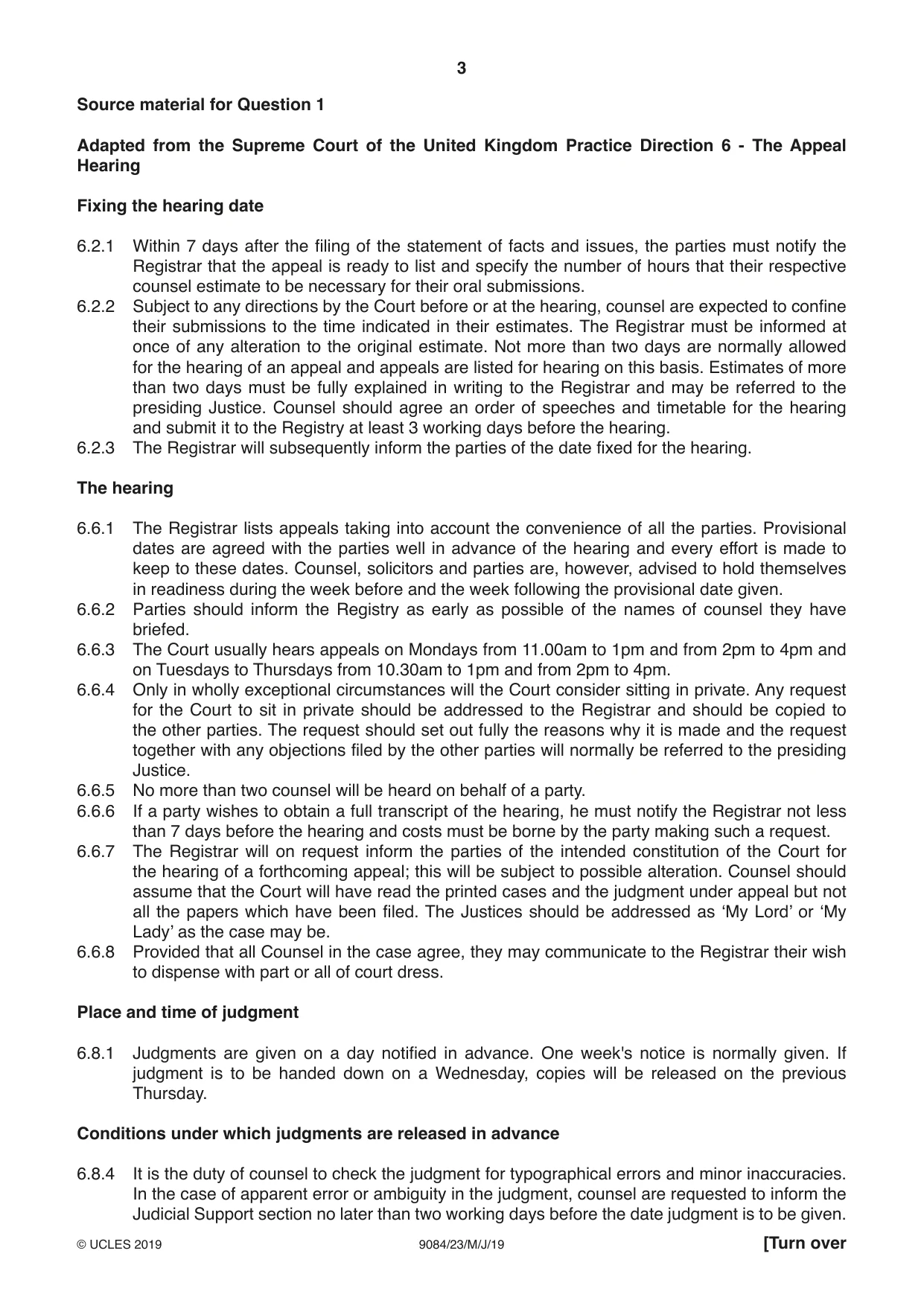
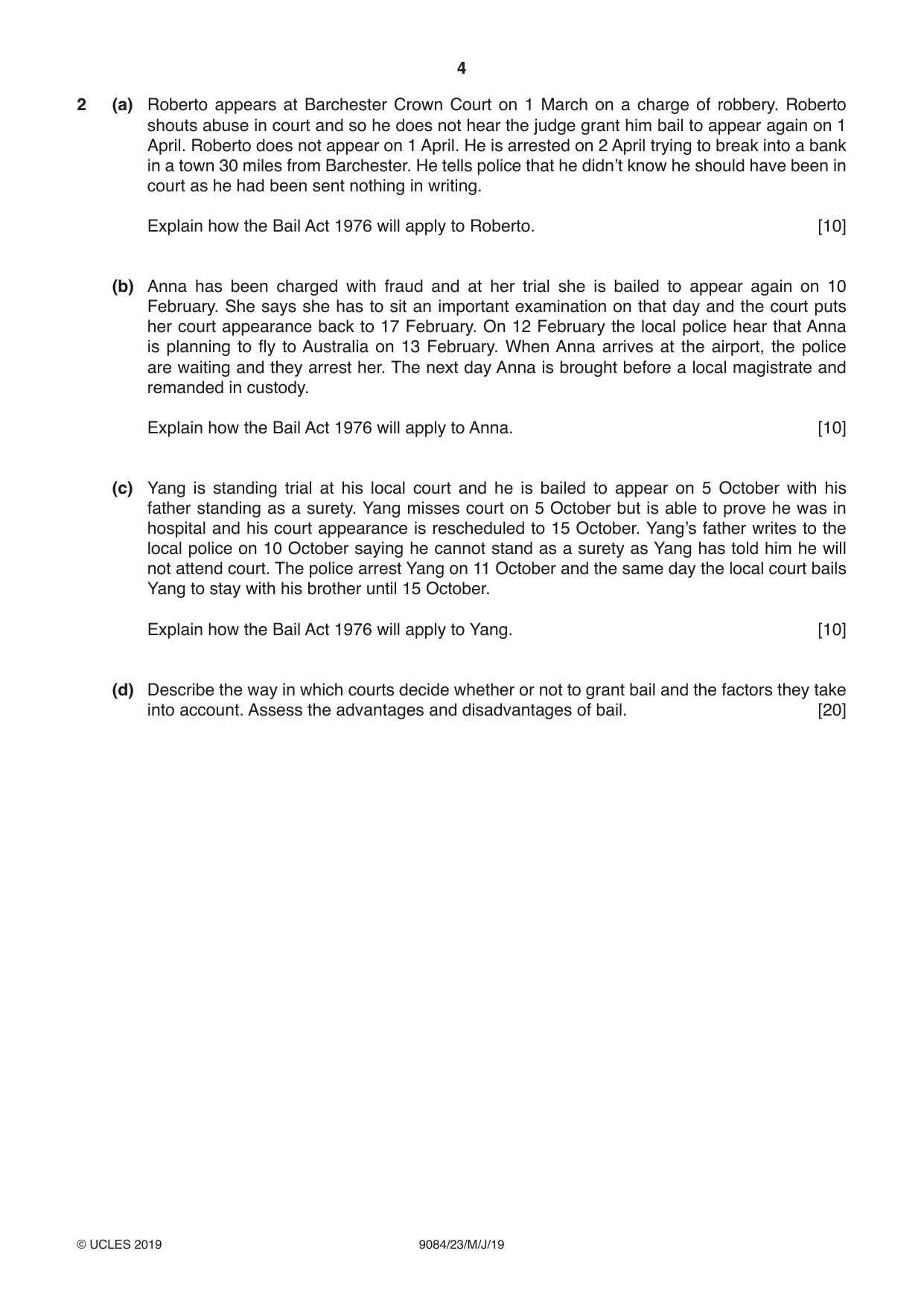



Mark scheme7 pages
Answers below. Sit the paper first if you are practising.
Questions as text
Q1 · Jakob, a barrister, is making an application for an appeal to the Supreme Court
1 (a) Jakob, a barrister, is making an application for an appeal to the Supreme Court. Five days after filing the facts and issues he applies for a three day hearing to be heard in private but does not explain why and does not communicate this to the other party. After the appeal Jakob is sent the judgment. There is an error but because Jakob is busy, he does not send a correction to the Judicial Support section until the night before the judgment is made public. Explain how the Supreme Court Practice Direction will apply to Jakob. [10] (b) Maria, a barrister, suggests to all the other counsel that they should not wear court dress at a Supreme Court appeal. All except one agree. Maria requests that the appeal be heard on a Friday and that three barristers should speak for each party in the case. Two weeks before the hearing she requests that a transcript be made and the losing party pay for this. The hearing is moved to a Thursday and Maria does not appear in court dress. Explain how the Supreme Court Practice Direction will apply to Maria. [10] (c) Andreas, a barrister, makes an application for an appeal in the Supreme Court. He asks for a two day hearing and names the barristers who will speak a week before the hearing. He also indicates that all parties are free one week either side of the date applied for. At the hearing he addresses the female judge as ‘My Lady’. Andreas wins the appeal and he is told that he will receive the judgment on the next Thursday before it is made public on the following Wednesday. Explain how the Supreme Court Practice Direction will apply to Andreas. [10] (d) Explain the role of the Supreme Court and the Court of Appeal (Civil Division) in developing precedent. Assess the effectiveness of these two courts in developing precedent. [20] Source material for Question 1 Adapted from the Supreme Court of the United Kingdom Practice Direction 6 - The Appeal Hearing Fixing the hearing date 6.2.1 Within 7 days after the filing of the statement of facts and issues, the parties must notify the Registrar that the appeal is ready to list and specify the number of hours that their respective counsel estimate to be necessary for their oral submissions. 6.2.2 Subject to any directions by the Court before or at the hearing, counsel are expected to confine their submissions to the time indicated in their estimates. The Registrar must be informed at once of any alteration to the original estimate. Not more than two days are normally allowed for the hearing of an appeal and appeals are listed for hearing on this basis. Estimates of more than two days must be fully explained in writing to the Registrar and may be referred to the presiding Justice. Counsel should agree an order of speeches and timetable for the hearing and submit it to the Registry at least 3 working days before the hearing. 6.2.3 The Registrar will subsequently inform the parties of the date fixed for the hearing. The hearing 6.6.1 The Registrar lists appeals taking into account the convenience of all the parties. Provisional dates are agreed with the parties well in advance of the hearing and every effort is made to keep to these dates. Counsel, solicitors and parties are, however, advised to hold themselves in readiness during the week before and the week following the provisional date given. 6.6.2 Parties should inform the Registry as early as possible of the names of counsel they have briefed. 6.6.3 The Court usually hears appeals on Mondays from 11.00am to 1pm and from 2pm to 4pm and on Tuesdays to Thursdays from 10.30am to 1pm and from 2pm to 4pm. 6.6.4 Only in wholly exceptional circumstances will the Court consider sitting in private. Any request for the Court to sit in private should be addressed to the Registrar and should be copied to the other parties. The request should set out fully the reasons why it is made and the request together with any objections filed by the other parties will normally be referred to the presiding Justice. 6.6.5 No more than two counsel will be heard on behalf of a party. 6.6.6 If a party wishes to obtain a full transcript of the hearing, he must notify the Registrar not less than 7 days before the hearing and costs must be borne by the party making such a request. 6.6.7 The Registrar will on request inform the parties of the intended constitution of the Court for the hearing of a forthcoming appeal; this will be subject to possible alteration. Counsel should assume that the Court will have read the printed cases and the judgment under appeal but not all the papers which have been filed. The Justices should be addressed as ‘My Lord’ or ‘My Lady’ as the case may be. 6.6.8 Provided that all Counsel in the case agree, they may communicate to the Registrar their wish to dispense with part or all of court dress. Place and time of judgment 6.8.1 Judgments are given on a day notified in advance. One week's notice is normally given. If judgment is to be handed down on a Wednesday, copies will be released on the previous Thursday. Conditions under which judgments are released in advance 6.8.4 It is the duty of counsel to check the judgment for typographical errors and minor inaccuracies. In the case of apparent error or ambiguity in the judgment, counsel are requested to inform the Judicial Support section no later than two working days before the date judgment is to be given.
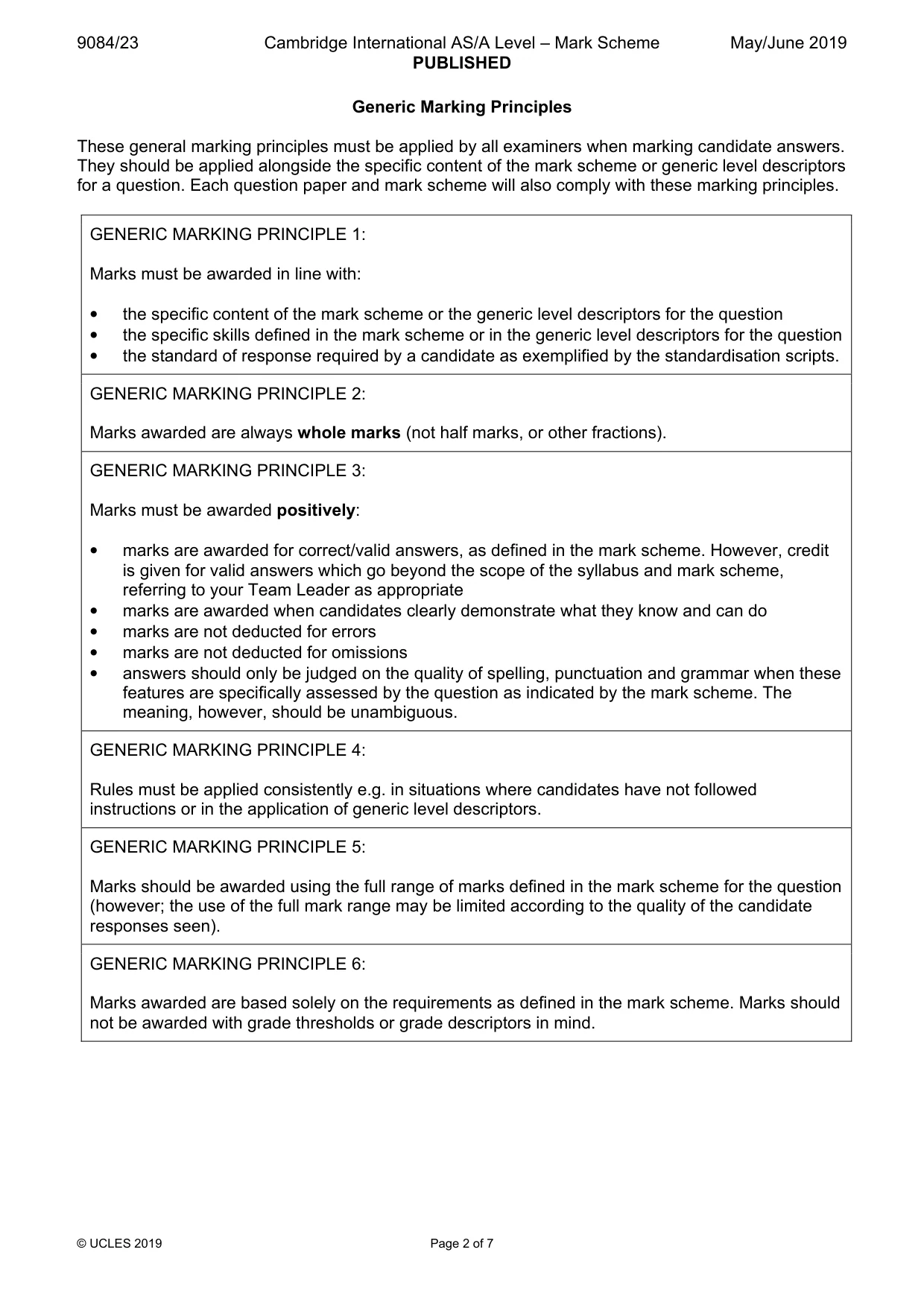
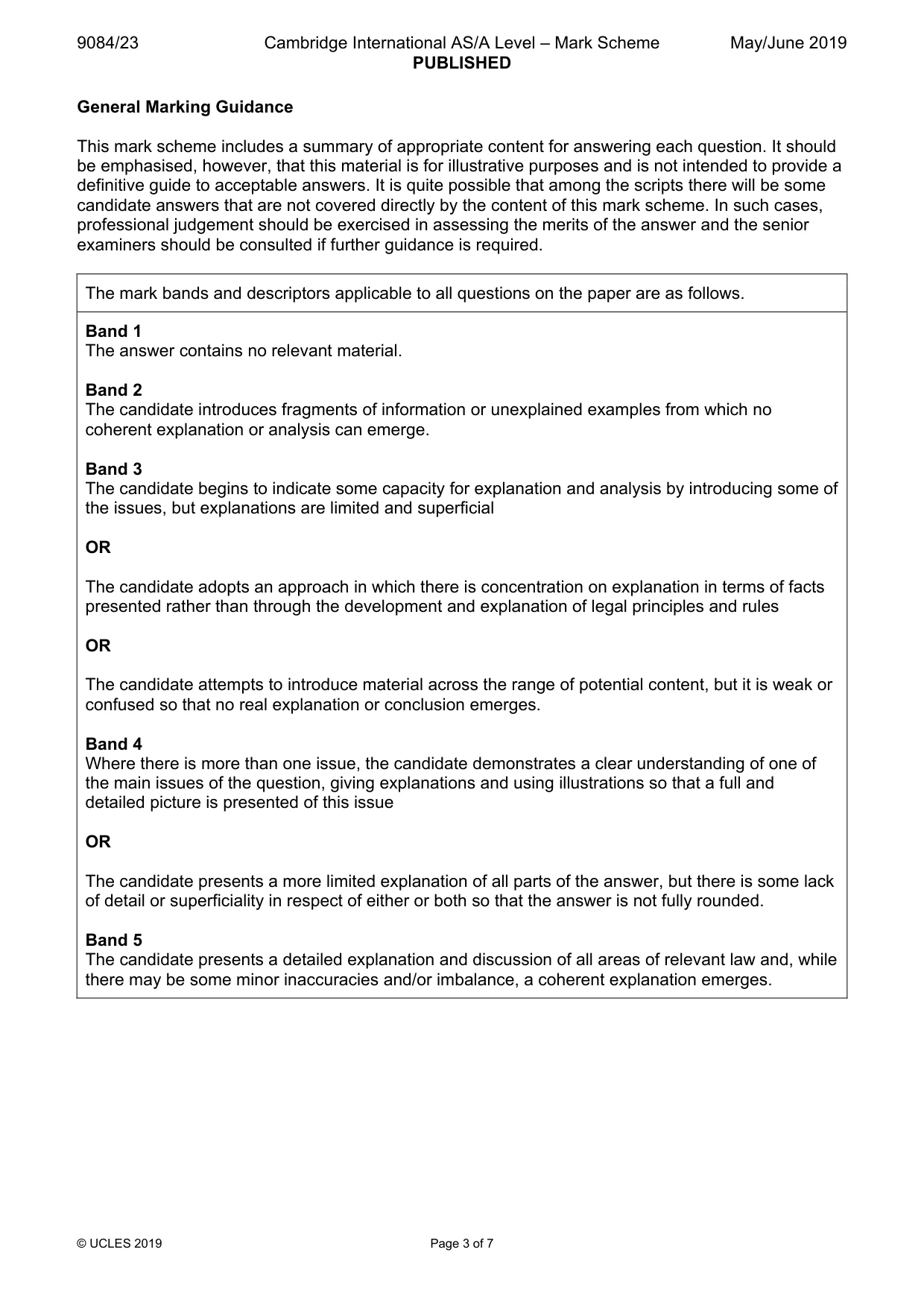
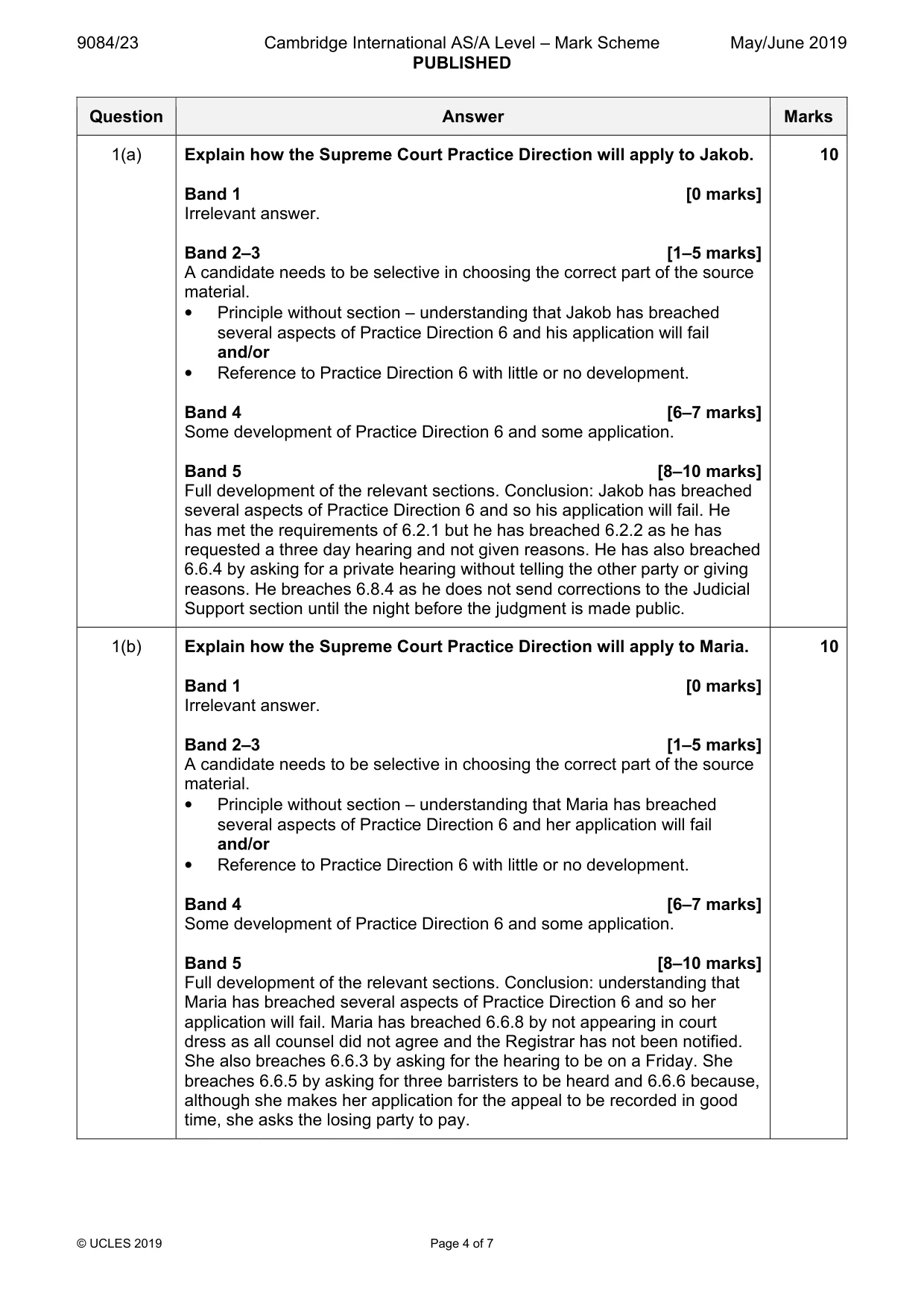
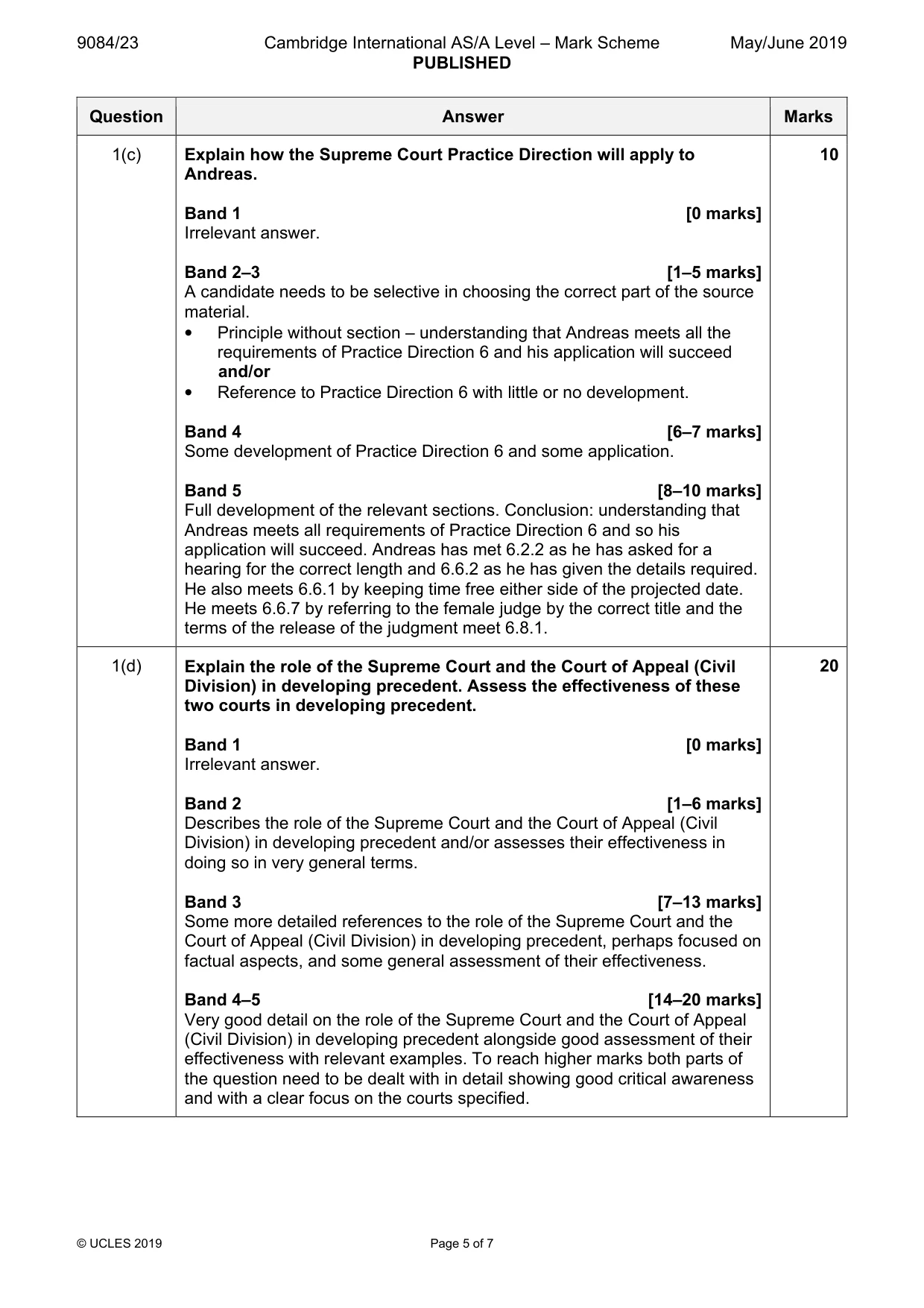
Mark scheme: Question Answer Marks 1(a) Explain how the Supreme Court Practice Direction will apply to Jakob. 10 Band 1 [0 marks] Irrelevant answer. Band 2–3 [1–5 marks] A candidate needs to be selective in choosing the correct part of the source material. • Principle without section – understanding that Jakob has breached several aspects of Practice Direction 6 and his application will fail and/or • Reference to Practice Direction 6 with little or no development. Band 4 [6–7 marks] Some development of Practice Direction 6 and some application. Band 5 [8–10 marks] Full development of the relevant sections. Conclusion: Jakob has breached several aspects of Practice Direction 6 and so his application will fail. He has met the requirements of 6.2.1 but he has breached 6.2.2 as he has requested a three day hearing and not given reasons. He has also breached 6.6.4 by asking for a private hearing without telling the other party or giving reasons. He breaches 6.8.4 as he does not send corrections to the Judicial Support section until the night before the judgment is made public. 1(b) Explain how the Supreme Court Practice Direction will apply to Maria. 10 Band 1 [0 marks] Irrelevant answer. Band 2–3 [1–5 marks] A candidate needs to be selective in choosing the correct part of the source material. • Principle without section – understanding that Maria has breached several aspects of Practice Direction 6 and her application will fail and/or • Reference to Practice Direction 6 with little or no development. Band 4 [6–7 marks] Some development of Practice Direction 6 and some application. Band 5 [8–10 marks] Full development of the relevant sections. Conclusion: understanding that Maria has breached several aspects of Practice Direction 6 and so her application will fail. Maria has breached 6.6.8 by not appearing in court dress as all counsel did not agree and the Registrar has not been notified. She also breaches 6.6.3 by asking for the hearing to be on a Friday. She breaches 6.6.5 by asking for three barristers to be heard and 6.6.6 because, although she makes her application for the appeal to be recorded in good time, she asks the losing party to pay. 1(c) Explain how the Supreme Court Practice Direction will apply to 10 Andreas. Band 1 [0 marks] Irrelevant answer. Band 2–3 [1–5 marks] A candidate needs to be selective in choosing the correct part of the source material. • Principle without section – understanding that Andreas meets all the requirements of Practice Direction 6 and his application will succeed and/or • Reference to Practice Direction 6 with little or no development. Band 4 [6–7 marks] Some development of Practice Direction 6 and some application. Band 5 [8–10 marks] Full development of the relevant sections. Conclusion: understanding that Andreas meets all requirements of Practice Direction 6 and so his application will succeed. Andreas has met 6.2.2 as he has asked for a hearing for the correct length and 6.6.2 as he has given the details required. He also meets 6.6.1 by keeping time free either side of the projected date. He meets 6.6.7 by referring to the female judge by the correct title and the terms of the release of the judgment meet 6.8.1. 1(d) Explain the role of the Supreme Court and the Court of Appeal (Civil 20 Division) in developing precedent. Assess the effectiveness of these two courts in developing precedent. Band 1 [0 marks] Irrelevant answer. Band 2 [1–6 marks] Describes the role of the Supreme Court and the Court of Appeal (Civil Division) in developing precedent and/or assesses their effectiveness in doing so in very general terms. Band 3 [7–13 marks] Some more detailed references to the role of the Supreme Court and the Court of Appeal (Civil Division) in developing precedent, perhaps focused on factual aspects, and some general assessment of their effectiveness. Band 4–5 [14–20 marks] Very good detail on the role of the Supreme Court and the Court of Appeal (Civil Division) in developing precedent alongside good assessment of their effectiveness with relevant examples. To reach higher marks both parts of the question need to be dealt with in detail showing good critical awareness and with a clear focus on the courts specified.
Q2 · Roberto appears at Barchester Crown Court on 1 March on a charge of robbery
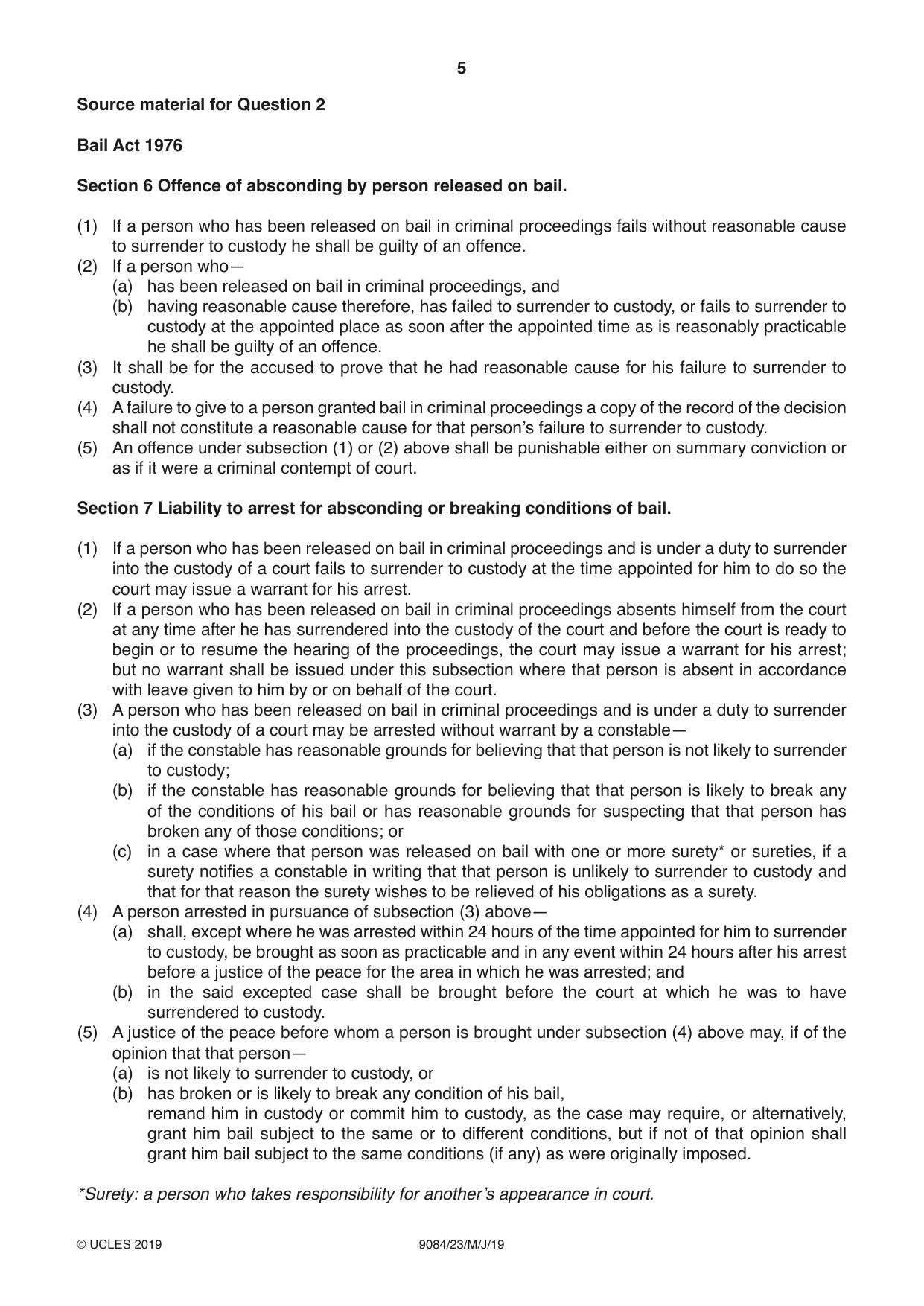
2 (a) Roberto appears at Barchester Crown Court on 1 March on a charge of robbery. Roberto shouts abuse in court and so he does not hear the judge grant him bail to appear again on 1 April. Roberto does not appear on 1 April. He is arrested on 2 April trying to break into a bank in a town 30 miles from Barchester. He tells police that he didn’t know he should have been in court as he had been sent nothing in writing. Explain how the Bail Act 1976 will apply to Roberto. [10] (b) Anna has been charged with fraud and at her trial she is bailed to appear again on 10 February. She says she has to sit an important examination on that day and the court puts her court appearance back to 17 February. On 12 February the local police hear that Anna is planning to fly to Australia on 13 February. When Anna arrives at the airport, the police are waiting and they arrest her. The next day Anna is brought before a local magistrate and remanded in custody. Explain how the Bail Act 1976 will apply to Anna. [10] (c) Yang is standing trial at his local court and he is bailed to appear on 5 October with his father standing as a surety. Yang misses court on 5 October but is able to prove he was in hospital and his court appearance is rescheduled to 15 October. Yang’s father writes to the local police on 10 October saying he cannot stand as a surety as Yang has told him he will not attend court. The police arrest Yang on 11 October and the same day the local court bails Yang to stay with his brother until 15 October. Explain how the Bail Act 1976 will apply to Yang. [10] (d) Describe the way in which courts decide whether or not to grant bail and the factors they take into account. Assess the advantages and disadvantages of bail. [20] Source material for Question 2 Bail Act 1976 Section 6 Offence of absconding by person released on bail. (1) If a person who has been released on bail in criminal proceedings fails without reasonable cause to surrender to custody he shall be guilty of an offence. (2) If a person who— (a) has been released on bail in criminal proceedings, and (b) having reasonable cause therefore, has failed to surrender to custody, or fails to surrender to custody at the appointed place as soon after the appointed time as is reasonably practicable he shall be guilty of an offence. (3) It shall be for the accused to prove that he had reasonable cause for his failure to surrender to custody. (4) A failure to give to a person granted bail in criminal proceedings a copy of the record of the decision shall not constitute a reasonable cause for that person’s failure to surrender to custody. (5) An offence under subsection (1) or (2) above shall be punishable either on summary conviction or as if it were a criminal contempt of court. Section 7 Liability to arrest for absconding or breaking conditions of bail. (1) If a person who has been released on bail in criminal proceedings and is under a duty to surrender into the custody of a court fails to surrender to custody at the time appointed for him to do so the court may issue a warrant for his arrest. (2) If a person who has been released on bail in criminal proceedings absents himself from the court at any time after he has surrendered into the custody of the court and before the court is ready to begin or to resume the hearing of the proceedings, the court may issue a warrant for his arrest; but no warrant shall be issued under this subsection where that person is absent in accordance with leave given to him by or on behalf of the court. (3) A person who has been released on bail in criminal proceedings and is under a duty to surrender into the custody of a court may be arrested without warrant by a constable— (a) if the constable has reasonable grounds for believing that that person is not likely to surrender to custody; (b) if the constable has reasonable grounds for believing that that person is likely to break any of the conditions of his bail or has reasonable grounds for suspecting that that person has broken any of those conditions; or (c) in a case where that person was released on bail with one or more surety* or sureties, if a surety notifies a constable in writing that that person is unlikely to surrender to custody and that for that reason the surety wishes to be relieved of his obligations as a surety. (4) A person arrested in pursuance of subsection (3) above— (a) shall, except where he was arrested within 24 hours of the time appointed for him to surrender to custody, be brought as soon as practicable and in any event within 24 hours after his arrest before a justice of the peace for the area in which he was arrested; and (b) in the said excepted case shall be brought before the court at which he was to have surrendered to custody. (5) A justice of the peace before whom a person is brought under subsection (4) above may, if of the opinion that that person— (a) is not likely to surrender to custody, or (b) has broken or is likely to break any condition of his bail, remand him in custody or commit him to custody, as the case may require, or alternatively, grant him bail subject to the same or to different conditions, but if not of that opinion shall grant him bail subject to the same conditions (if any) as were originally imposed. *Surety: a person who takes responsibility for another’s appearance in court.
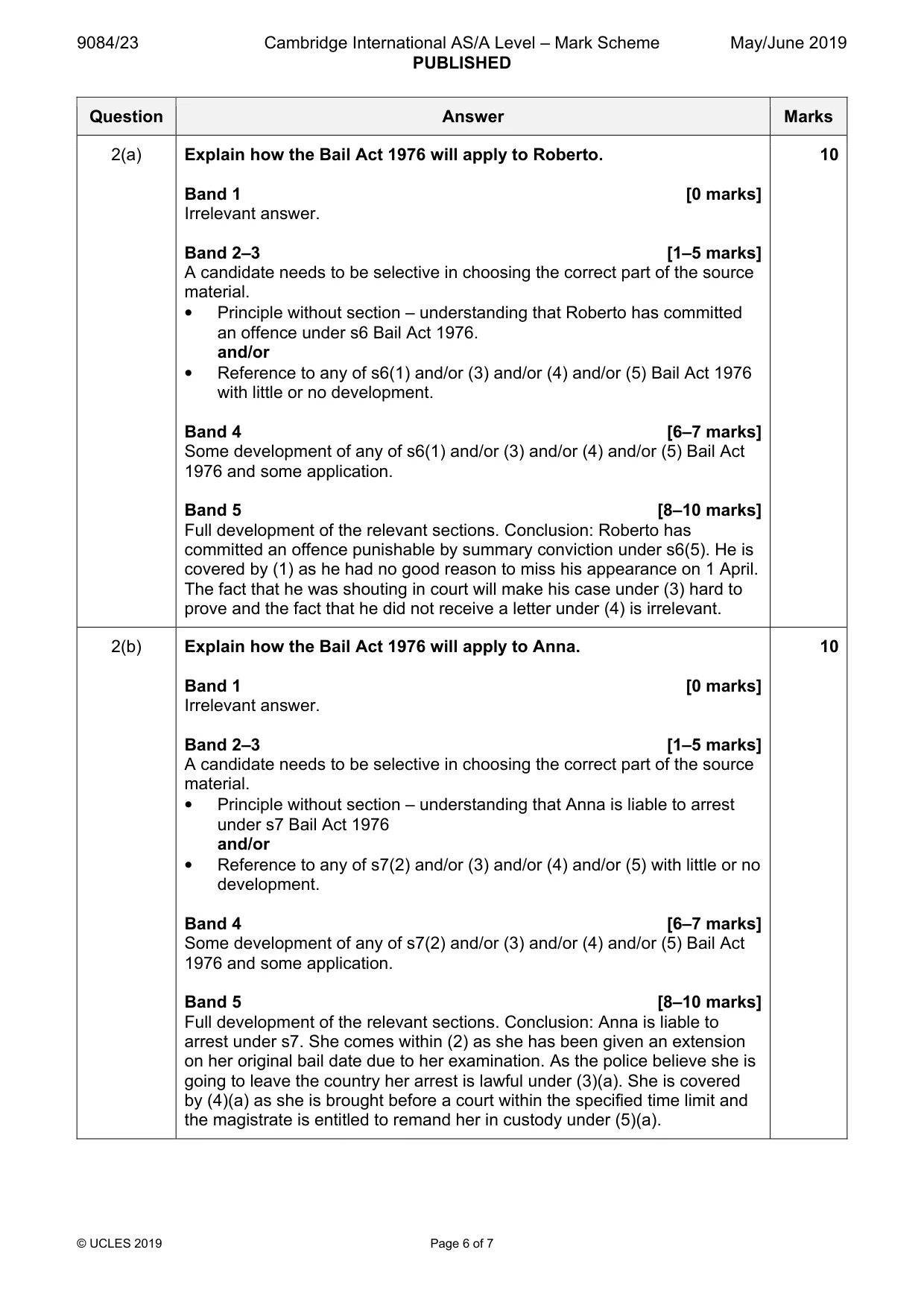
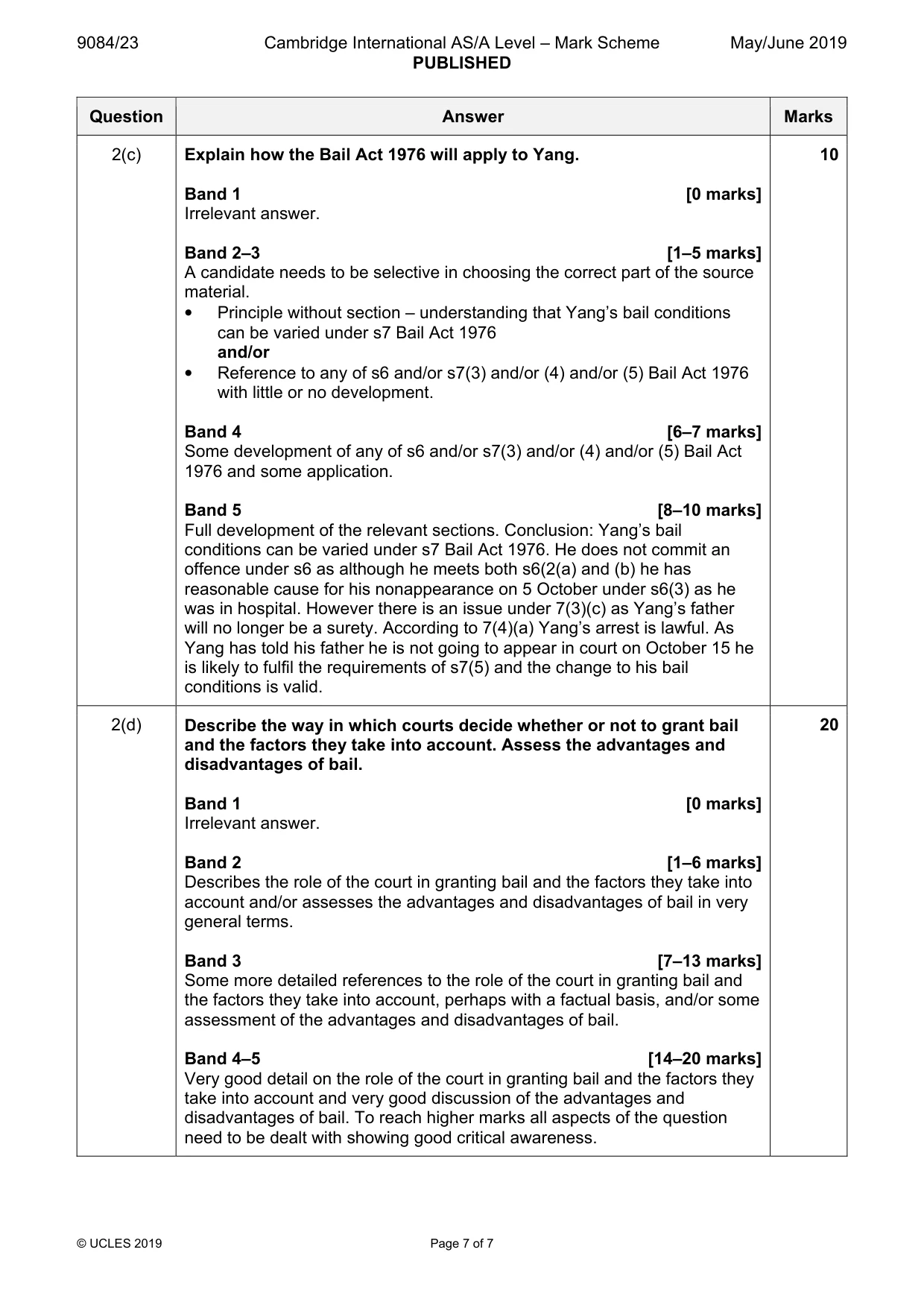
Mark scheme: 2(a) Explain how the Bail Act 1976 will apply to Roberto. 10 Band 1 [0 marks] Irrelevant answer. Band 2–3 [1–5 marks] A candidate needs to be selective in choosing the correct part of the source material. • Principle without section – understanding that Roberto has committed an offence under s6 Bail Act 1976. and/or • Reference to any of s6(1) and/or (3) and/or (4) and/or (5) Bail Act 1976 with little or no development. Band 4 [6–7 marks] Some development of any of s6(1) and/or (3) and/or (4) and/or (5) Bail Act 1976 and some application. Band 5 [8–10 marks] Full development of the relevant sections. Conclusion: Roberto has committed an offence punishable by summary conviction under s6(5). He is covered by (1) as he had no good reason to miss his appearance on 1 April. The fact that he was shouting in court will make his case under (3) hard to prove and the fact that he did not receive a letter under (4) is irrelevant. 2(b) Explain how the Bail Act 1976 will apply to Anna. 10 Band 1 [0 marks] Irrelevant answer. Band 2–3 [1–5 marks] A candidate needs to be selective in choosing the correct part of the source material. • Principle without section – understanding that Anna is liable to arrest under s7 Bail Act 1976 and/or • Reference to any of s7(2) and/or (3) and/or (4) and/or (5) with little or no development. Band 4 [6–7 marks] Some development of any of s7(2) and/or (3) and/or (4) and/or (5) Bail Act 1976 and some application. Band 5 [8–10 marks] Full development of the relevant sections. Conclusion: Anna is liable to arrest under s7. She comes within (2) as she has been given an extension on her original bail date due to her examination. As the police believe she is going to leave the country her arrest is lawful under (3)(a). She is covered by (4)(a) as she is brought before a court within the specified time limit and the magistrate is entitled to remand her in custody under (5)(a). 2(c) Explain how the Bail Act 1976 will apply to Yang. 10 Band 1 [0 marks] Irrelevant answer. Band 2–3 [1–5 marks] A candidate needs to be selective in choosing the correct part of the source material. • Principle without section – understanding that Yang’s bail conditions can be varied under s7 Bail Act 1976 and/or • Reference to any of s6 and/or s7(3) and/or (4) and/or (5) Bail Act 1976 with little or no development. Band 4 [6–7 marks] Some development of any of s6 and/or s7(3) and/or (4) and/or (5) Bail Act 1976 and some application. Band 5 [8–10 marks] Full development of the relevant sections. Conclusion: Yang’s bail conditions can be varied under s7 Bail Act 1976. He does not commit an offence under s6 as although he meets both s6(2(a) and (b) he has reasonable cause for his nonappearance on 5 October under s6(3) as he was in hospital. However there is an issue under 7(3)(c) as Yang’s father will no longer be a surety. According to 7(4)(a) Yang’s arrest is lawful. As Yang has told his father he is not going to appear in court on October 15 he is likely to fulfil the requirements of s7(5) and the change to his bail conditions is valid. 2(d) Describe the way in which courts decide whether or not to grant bail 20 and the factors they take into account. Assess the advantages and disadvantages of bail. Band 1 [0 marks] Irrelevant answer. Band 2 [1–6 marks] Describes the role of the court in granting bail and the factors they take into account and/or assesses the advantages and disadvantages of bail in very general terms. Band 3 [7–13 marks] Some more detailed references to the role of the court in granting bail and the factors they take into account, perhaps with a factual basis, and/or some assessment of the advantages and disadvantages of bail. Band 4–5 [14–20 marks] Very good detail on the role of the court in granting bail and the factors they take into account and very good discussion of the advantages and disadvantages of bail. To reach higher marks all aspects of the question need to be dealt with showing good critical awareness.
What was in this paper
The subtopics covered by these 2 questions, and how many questions each got. Open one in a new tab to see every Cambridge question on it.
What you needed in this session
Cambridge’s own grade thresholds for 2019 May/June, Paper 2 · Variant 3. A higher threshold means an easier paper — the bar moves with how the cohort did.