Cambridge A Level Law 9084 — 2020 May/June Paper 2 · Variant 3
9084/23/M/J/20 · 2 questions · 100 marks · ≈113 min
The question paper and its mark scheme, free to read here and free to download. This is Cambridge’s own paper, exactly as it was sat.
Question paper8 pages
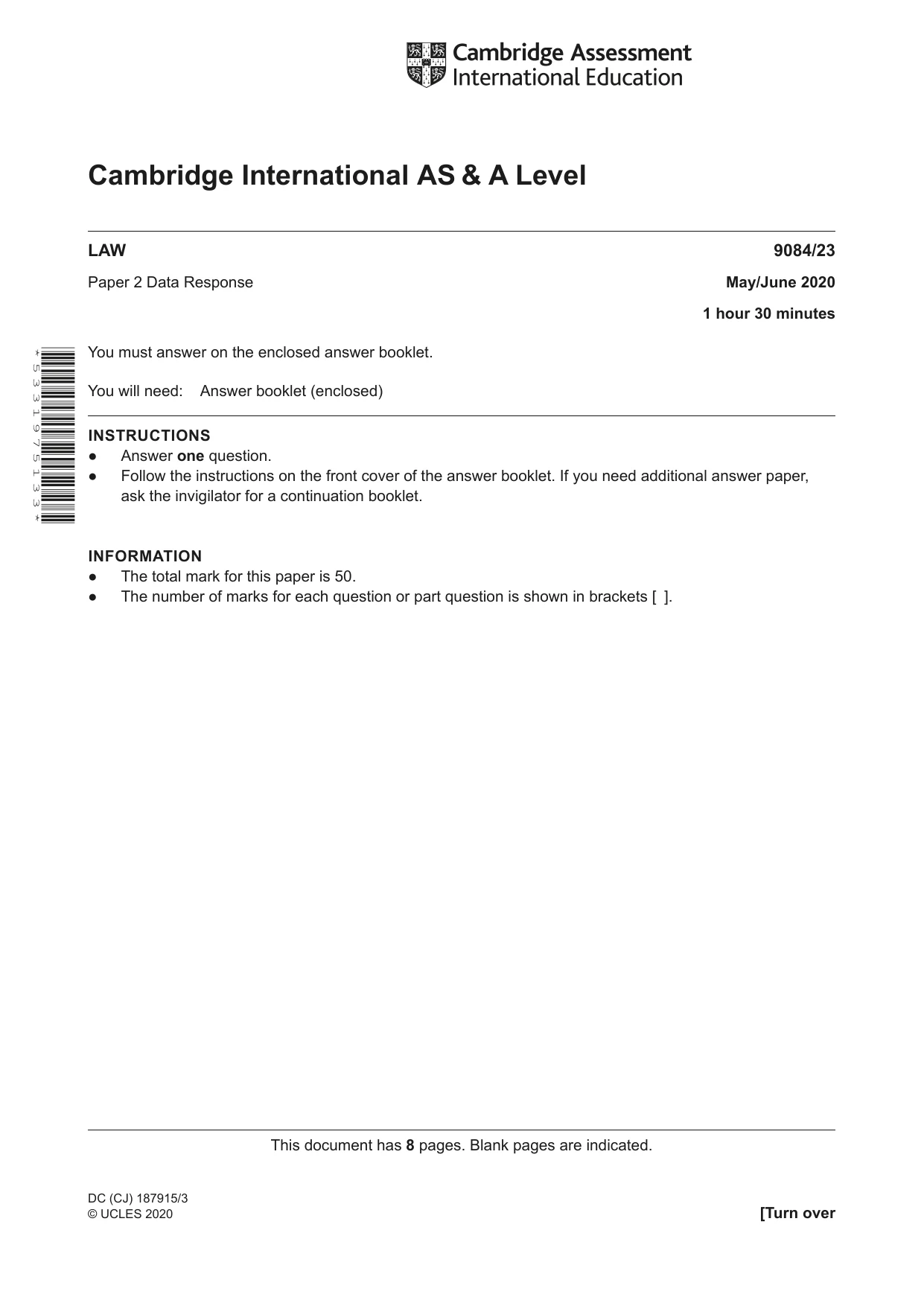
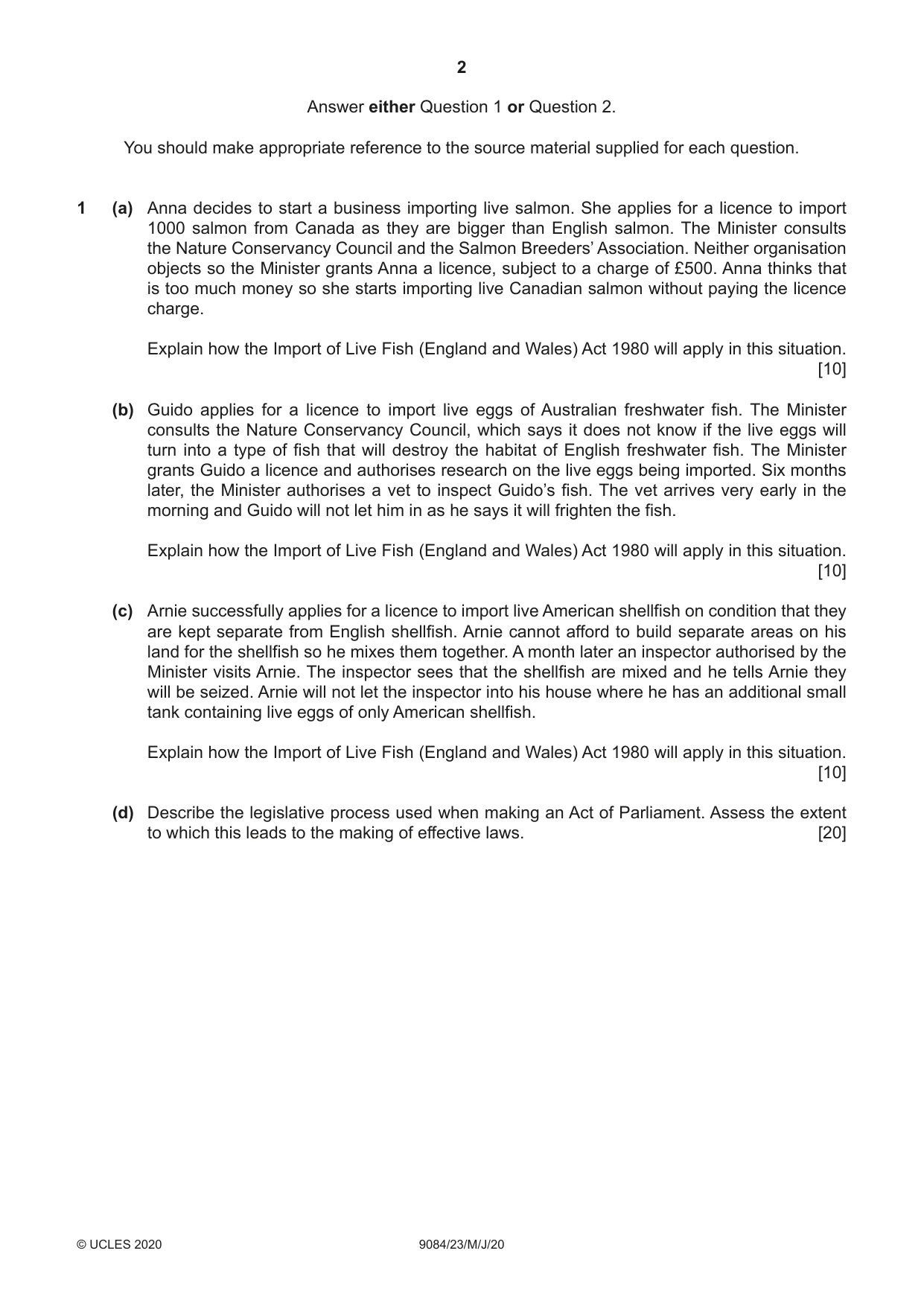

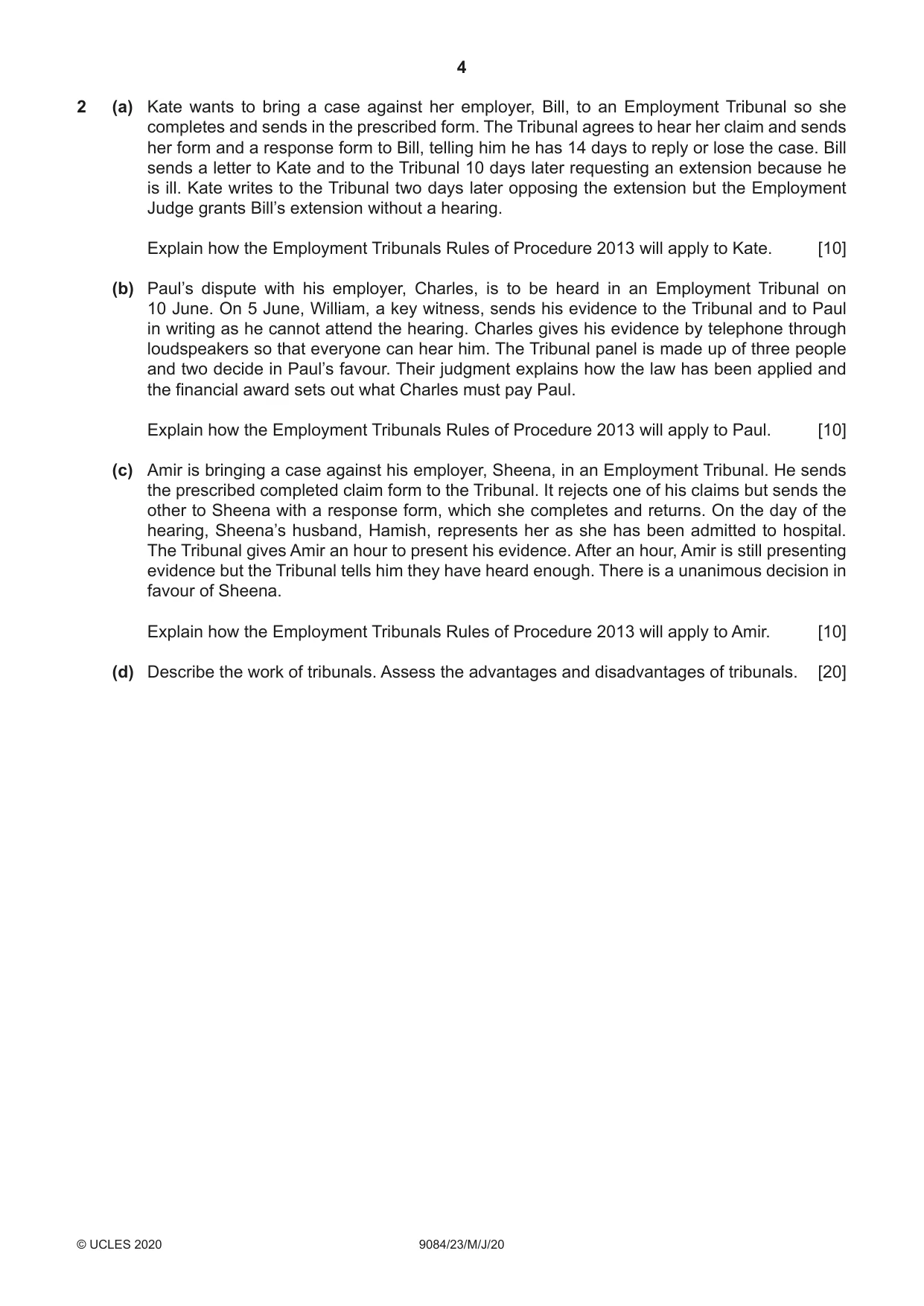
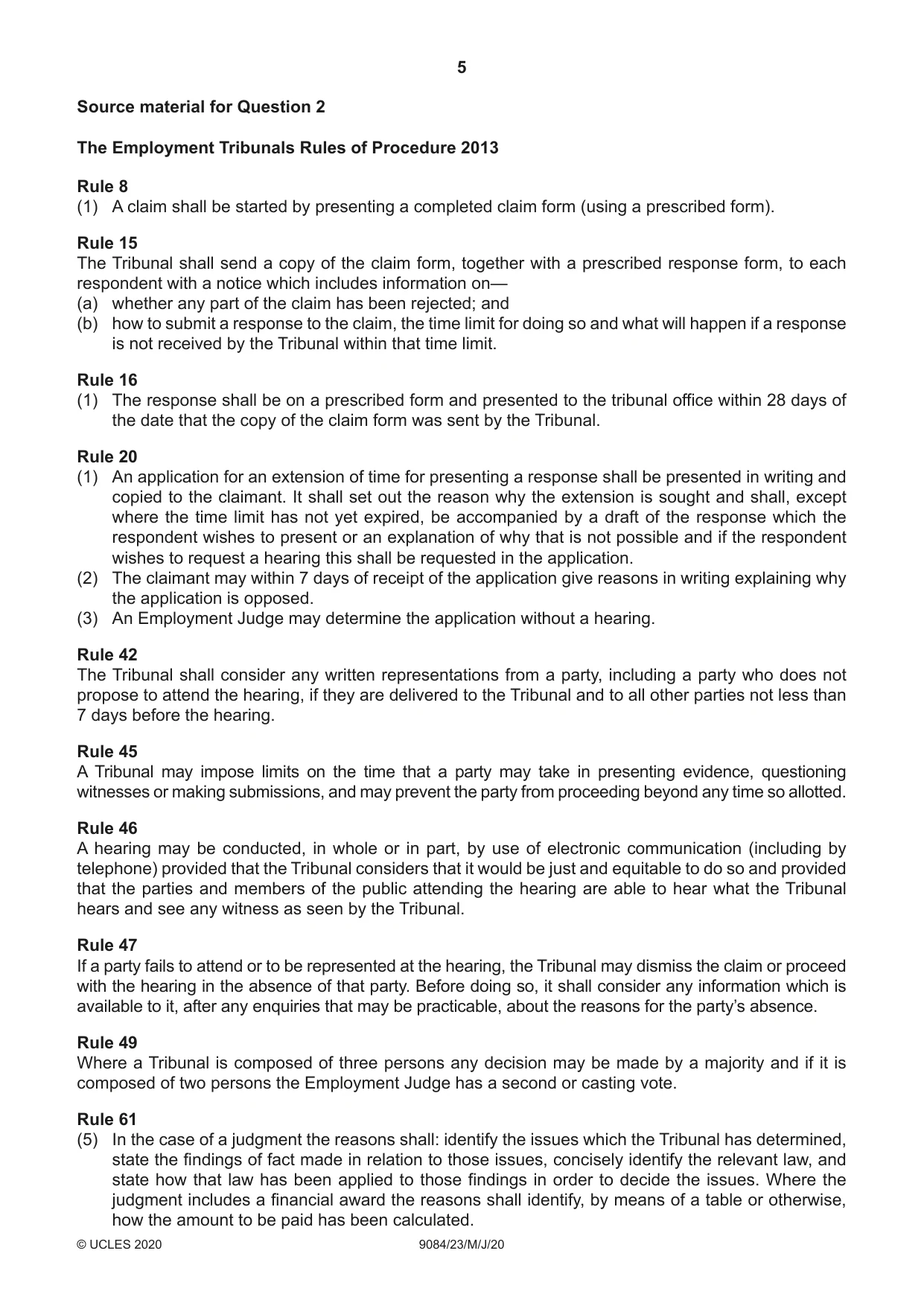



Mark scheme7 pages
Answers below. Sit the paper first if you are practising.
Questions as text
Q1 · Anna decides to start a business importing live salmon
1 (a) Anna decides to start a business importing live salmon. She applies for a licence to import 1000 salmon from Canada as they are bigger than English salmon. The Minister consults the Nature Conservancy Council and the Salmon Breeders’ Association. Neither organisation objects so the Minister grants Anna a licence, subject to a charge of £500. Anna thinks that is too much money so she starts importing live Canadian salmon without paying the licence charge. Explain how the Import of Live Fish (England and Wales) Act 1980 will apply in this situation. [10] (b) Guido applies for a licence to import live eggs of Australian freshwater fish. The Minister consults the Nature Conservancy Council, which says it does not know if the live eggs will turn into a type of fish that will destroy the habitat of English freshwater fish. The Minister grants Guido a licence and authorises research on the live eggs being imported. Six months later, the Minister authorises a vet to inspect Guido’s fish. The vet arrives very early in the morning and Guido will not let him in as he says it will frighten the fish. Explain how the Import of Live Fish (England and Wales) Act 1980 will apply in this situation. [10] (c) Arnie successfully applies for a licence to import live American shellfish on condition that they are kept separate from English shellfish. Arnie cannot afford to build separate areas on his land for the shellfish so he mixes them together. A month later an inspector authorised by the Minister visits Arnie. The inspector sees that the shellfish are mixed and he tells Arnie they will be seized. Arnie will not let the inspector into his house where he has an additional small tank containing live eggs of only American shellfish. Explain how the Import of Live Fish (England and Wales) Act 1980 will apply in this situation. [10] (d) Describe the legislative process used when making an Act of Parliament. Assess the extent to which this leads to the making of effective laws. [20] Source material for Question 1 Import of Live Fish (England and Wales) Act 1980 Section 1 (1) Subject to subsection (2) below, the Minister may by order forbid either absolutely or except under this section, the import into, or the keeping or the release, in any part of England and Wales of live fish, or live eggs of fish, of a species which is not native to England and Wales and which in the opinion of the Minister might compete with, displace, prey on or harm the habitat of any freshwater fish, shellfish or salmon in England and Wales. (2) Before determining whether or not to make an order under this section, the Minister shall consult the Nature Conservancy Council and any other person with whom the Minister considers that consultation is appropriate. (3) The Minister may, subject to such conditions as he thinks fit, grant a licence to any person to import or keep live fish, or the live eggs of fish, of a species specified in an order under this section and the Minister may revoke or vary any such licence. (4) An order under this section may authorise the making of a charge for a licence under this section and shall specify a maximum charge. Section 2 (1) While an order under section 1 of this Act is in force any officer commissioned by the Commissioners of Customs and Excise, a police constable or a person duly authorised by the Minister may at all reasonable times, on production of his authority if so required, enter and inspect any land occupied by a person holding a licence granted under that section and any other land upon which he has reason to believe that live fish, or the live eggs of fish, of the species specified in the order are being kept or may be found. (2) In this section “land” includes land covered with water but does not include a dwelling-house. Section 3 (1) Subject to subsection (2) below, any person who— (a) imports or attempts to import into, or keeps or releases, in any part of England and Wales any live fish, or the live eggs of fish, of a species specified in an order under section 1 of this Act (i) in a case where the order forbids absolutely such import, keeping or release; (ii) without having a valid licence granted under the said section 1 authorising such import or keeping, in a case where the order forbids the import or keeping except under such a licence; (b) being the holder of a licence granted to him under the said section 1, acts in contravention of or fails to comply with any term of the licence; (c) obstructs any person from entering or inspecting any land in pursuance of section 2 of this Act; shall be guilty of an offence under this Act. (2) A person shall not be guilty of an offence under this Act in respect of any act if he does the act for some scientific or research purpose authorised by the Minister. (3) …. (4) Any person who is empowered to enter land under section 2 of this Act may seize any fish or eggs with respect to which he has reason to believe that an offence under paragraph (a) or (b) of subsection (1) above has been committed, and may detain them pending the determination of any proceedings to be instituted under the said paragraph (a) or (b), or until the Minister is satisfied
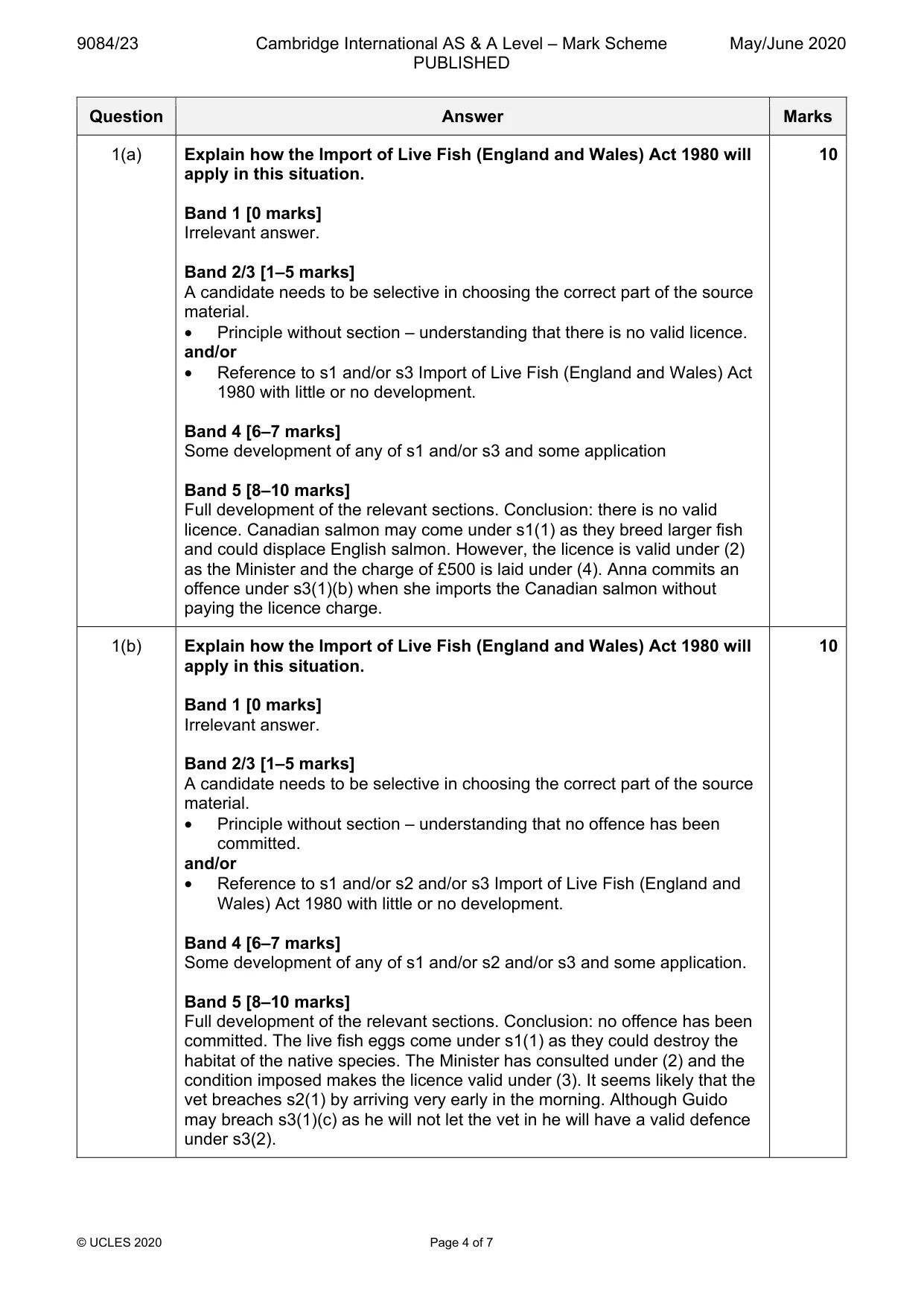
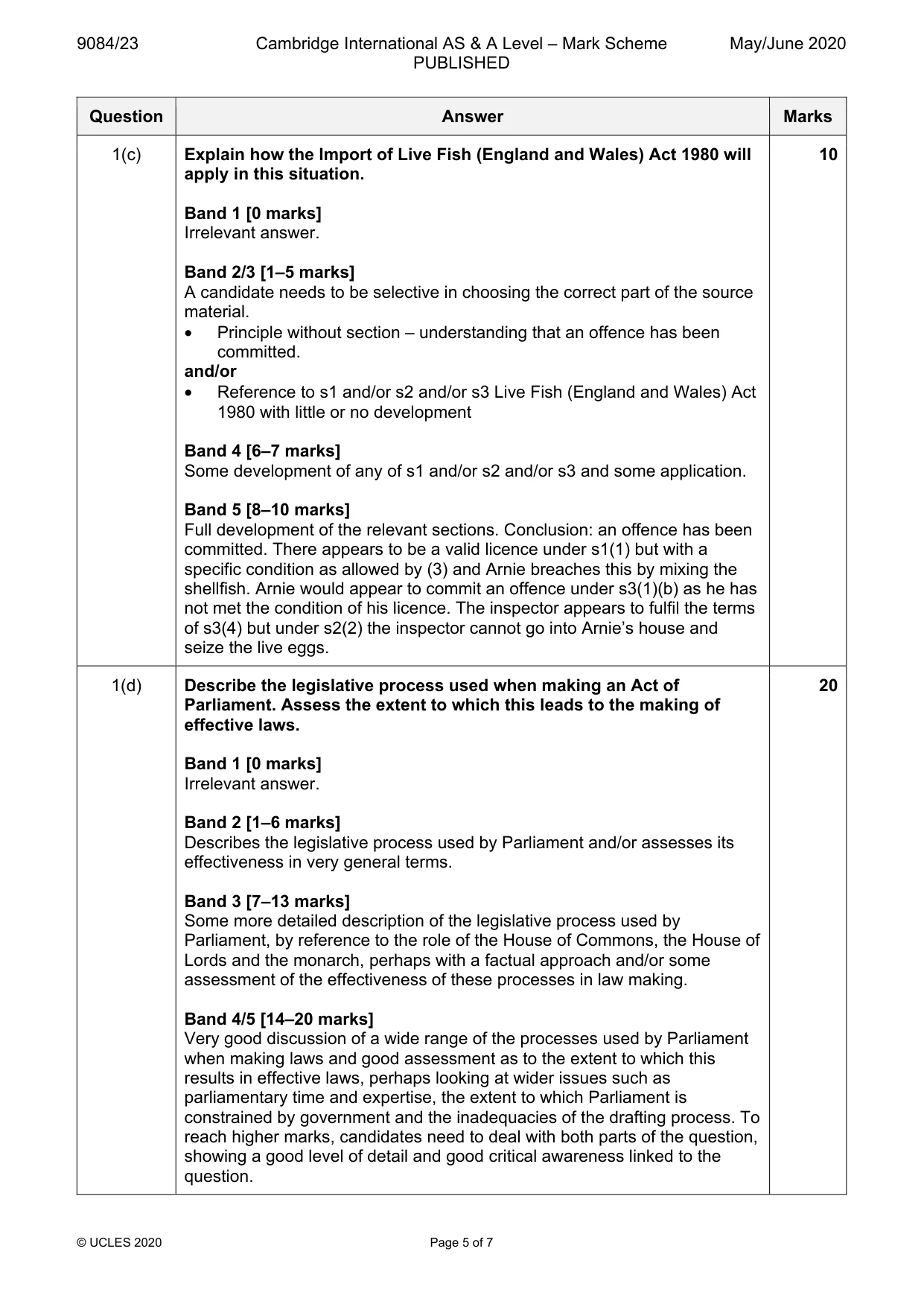
Mark scheme: Question Answer Marks 1(a) Explain how the Import of Live Fish (England and Wales) Act 1980 will 10 apply in this situation. Band 1 [0 marks] Irrelevant answer. Band 2/3 [1–5 marks] A candidate needs to be selective in choosing the correct part of the source material. • Principle without section – understanding that there is no valid licence. and/or • Reference to s1 and/or s3 Import of Live Fish (England and Wales) Act 1980 with little or no development. Band 4 [6–7 marks] Some development of any of s1 and/or s3 and some application Band 5 [8–10 marks] Full development of the relevant sections. Conclusion: there is no valid licence. Canadian salmon may come under s1(1) as they breed larger fish and could displace English salmon. However, the licence is valid under (2) as the Minister and the charge of £500 is laid under (4). Anna commits an offence under s3(1)(b) when she imports the Canadian salmon without paying the licence charge. 1(b) Explain how the Import of Live Fish (England and Wales) Act 1980 will 10 apply in this situation. Band 1 [0 marks] Irrelevant answer. Band 2/3 [1–5 marks] A candidate needs to be selective in choosing the correct part of the source material. • Principle without section – understanding that no offence has been committed. and/or • Reference to s1 and/or s2 and/or s3 Import of Live Fish (England and Wales) Act 1980 with little or no development. Band 4 [6–7 marks] Some development of any of s1 and/or s2 and/or s3 and some application. Band 5 [8–10 marks] Full development of the relevant sections. Conclusion: no offence has been committed. The live fish eggs come under s1(1) as they could destroy the habitat of the native species. The Minister has consulted under (2) and the condition imposed makes the licence valid under (3). It seems likely that the vet breaches s2(1) by arriving very early in the morning. Although Guido may breach s3(1)(c) as he will not let the vet in he will have a valid defence under s3(2). 1(c) Explain how the Import of Live Fish (England and Wales) Act 1980 will 10 apply in this situation. Band 1 [0 marks] Irrelevant answer. Band 2/3 [1–5 marks] A candidate needs to be selective in choosing the correct part of the source material. • Principle without section – understanding that an offence has been committed. and/or • Reference to s1 and/or s2 and/or s3 Live Fish (England and Wales) Act 1980 with little or no development Band 4 [6–7 marks] Some development of any of s1 and/or s2 and/or s3 and some application. Band 5 [8–10 marks] Full development of the relevant sections. Conclusion: an offence has been committed. There appears to be a valid licence under s1(1) but with a specific condition as allowed by (3) and Arnie breaches this by mixing the shellfish. Arnie would appear to commit an offence under s3(1)(b) as he has not met the condition of his licence. The inspector appears to fulfil the terms of s3(4) but under s2(2) the inspector cannot go into Arnie’s house and seize the live eggs. 1(d) Describe the legislative process used when making an Act of 20 Parliament. Assess the extent to which this leads to the making of effective laws. Band 1 [0 marks] Irrelevant answer. Band 2 [1–6 marks] Describes the legislative process used by Parliament and/or assesses its effectiveness in very general terms. Band 3 [7–13 marks] Some more detailed description of the legislative process used by Parliament, by reference to the role of the House of Commons, the House of Lords and the monarch, perhaps with a factual approach and/or some assessment of the effectiveness of these processes in law making. Band 4/5 [14–20 marks] Very good discussion of a wide range of the processes used by Parliament when making laws and good assessment as to the extent to which this results in effective laws, perhaps looking at wider issues such as parliamentary time and expertise, the extent to which Parliament is constrained by government and the inadequacies of the drafting process. To reach higher marks, candidates need to deal with both parts of the question, showing a good level of detail and good critical awareness linked to the question.
Q2 · Kate wants to bring a case against her employer, Bill, to an Employment Tribunal so she…
2 (a) Kate wants to bring a case against her employer, Bill, to an Employment Tribunal so she completes and sends in the prescribed form. The Tribunal agrees to hear her claim and sends her form and a response form to Bill, telling him he has 14 days to reply or lose the case. Bill sends a letter to Kate and to the Tribunal 10 days later requesting an extension because he is ill. Kate writes to the Tribunal two days later opposing the extension but the Employment Judge grants Bill’s extension without a hearing. Explain how the Employment Tribunals Rules of Procedure 2013 will apply to Kate. [10] (b) Paul’s dispute with his employer, Charles, is to be heard in an Employment Tribunal on 10 June. On 5 June, William, a key witness, sends his evidence to the Tribunal and to Paul in writing as he cannot attend the hearing. Charles gives his evidence by telephone through loudspeakers so that everyone can hear him. The Tribunal panel is made up of three people and two decide in Paul’s favour. Their judgment explains how the law has been applied and the financial award sets out what Charles must pay Paul. Explain how the Employment Tribunals Rules of Procedure 2013 will apply to Paul. [10] (c) Amir is bringing a case against his employer, Sheena, in an Employment Tribunal. He sends the prescribed completed claim form to the Tribunal. It rejects one of his claims but sends the other to Sheena with a response form, which she completes and returns. On the day of the hearing, Sheena’s husband, Hamish, represents her as she has been admitted to hospital. The Tribunal gives Amir an hour to present his evidence. After an hour, Amir is still presenting evidence but the Tribunal tells him they have heard enough. There is a unanimous decision in favour of Sheena. Explain how the Employment Tribunals Rules of Procedure 2013 will apply to Amir. [10] (d) Describe the work of tribunals. Assess the advantages and disadvantages of tribunals. [20] Source material for Question 2 The Employment Tribunals Rules of Procedure 2013 Rule 8 (1) A claim shall be started by presenting a completed claim form (using a prescribed form). Rule 15 The Tribunal shall send a copy of the claim form, together with a prescribed response form, to each respondent with a notice which includes information on— (a) whether any part of the claim has been rejected; and (b) how to submit a response to the claim, the time limit for doing so and what will happen if a response is not received by the Tribunal within that time limit. Rule 16 (1) The response shall be on a prescribed form and presented to the tribunal office within 28 days of the date that the copy of the claim form was sent by the Tribunal. Rule 20 (1) An application for an extension of time for presenting a response shall be presented in writing and copied to the claimant. It shall set out the reason why the extension is sought and shall, except where the time limit has not yet expired, be accompanied by a draft of the response which the respondent wishes to present or an explanation of why that is not possible and if the respondent wishes to request a hearing this shall be requested in the application. (2) The claimant may within 7 days of receipt of the application give reasons in writing explaining why the application is opposed. (3) An Employment Judge may determine the application without a hearing. Rule 42 The Tribunal shall consider any written representations from a party, including a party who does not propose to attend the hearing, if they are delivered to the Tribunal and to all other parties not less than 7 days before the hearing. Rule 45 A Tribunal may impose limits on the time that a party may take in presenting evidence, questioning witnesses or making submissions, and may prevent the party from proceeding beyond any time so allotted. Rule 46 A hearing may be conducted, in whole or in part, by use of electronic communication (including by telephone) provided that the Tribunal considers that it would be just and equitable to do so and provided that the parties and members of the public attending the hearing are able to hear what the Tribunal hears and see any witness as seen by the Tribunal. Rule 47 If a party fails to attend or to be represented at the hearing, the Tribunal may dismiss the claim or proceed with the hearing in the absence of that party. Before doing so, it shall consider any information which is available to it, after any enquiries that may be practicable, about the reasons for the party’s absence. Rule 49 Where a Tribunal is composed of three persons any decision may be made by a majority and if it is composed of two persons the Employment Judge has a second or casting vote. Rule 61 (5) In the case of a judgment the reasons shall: identify the issues which the Tribunal has determined, state the findings of fact made in relation to those issues, concisely identify the relevant law, and state how that law has been applied to those findings in order to decide the issues. Where the judgment includes a financial award the reasons shall identify, by means of a table or otherwise,
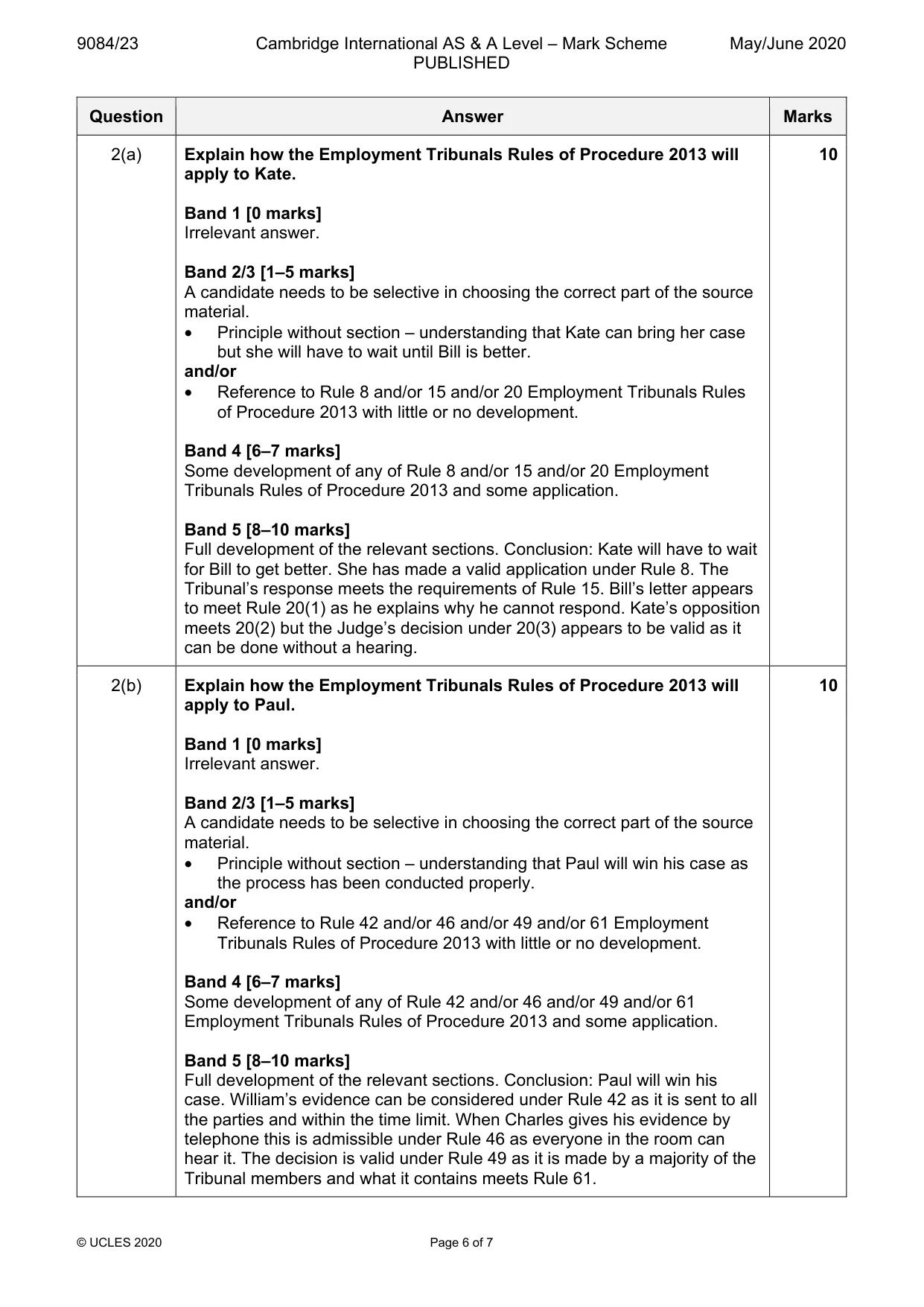
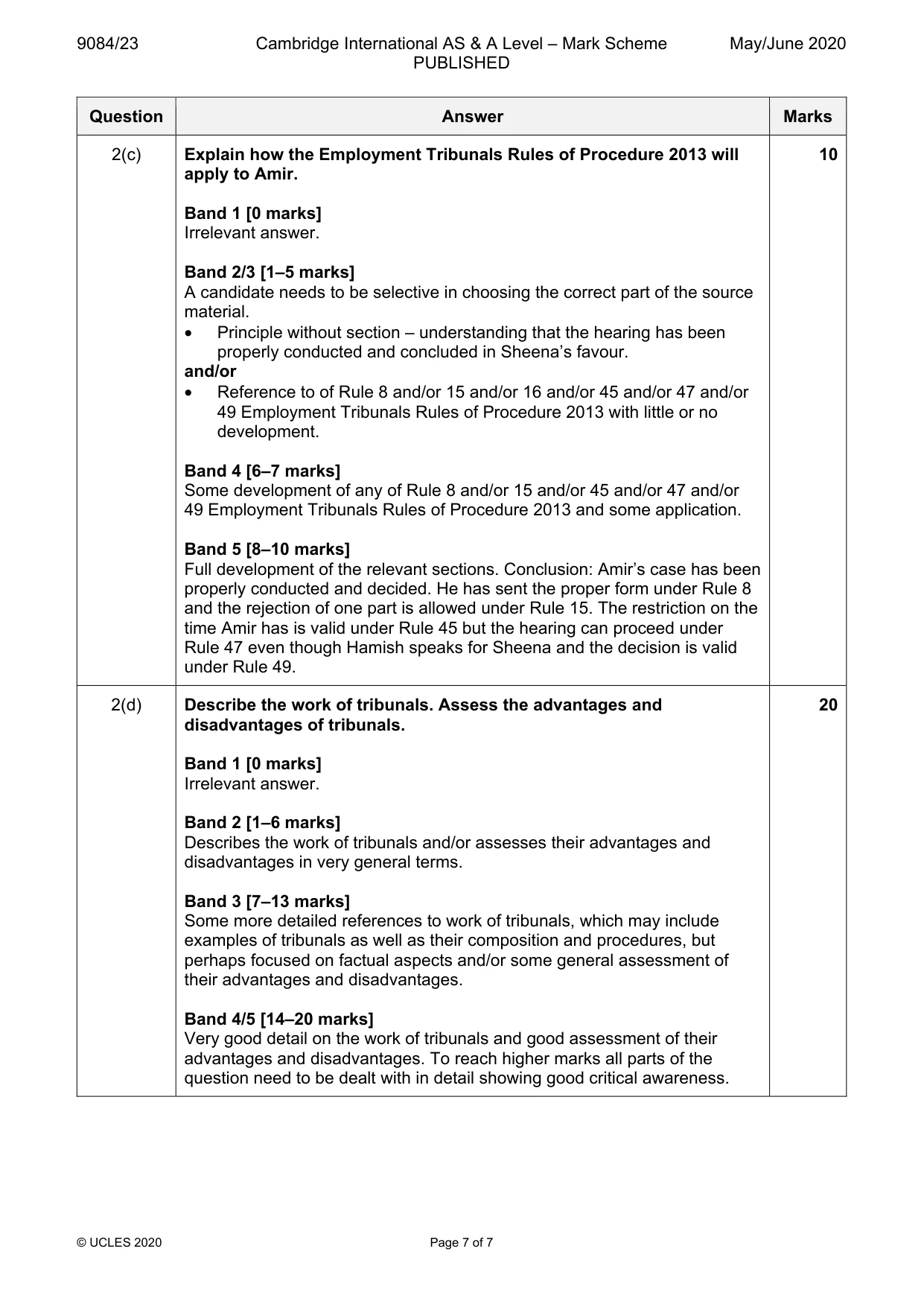
Mark scheme: 2(a) Explain how the Employment Tribunals Rules of Procedure 2013 will 10 apply to Kate. Band 1 [0 marks] Irrelevant answer. Band 2/3 [1–5 marks] A candidate needs to be selective in choosing the correct part of the source material. • Principle without section – understanding that Kate can bring her case but she will have to wait until Bill is better. and/or • Reference to Rule 8 and/or 15 and/or 20 Employment Tribunals Rules of Procedure 2013 with little or no development. Band 4 [6–7 marks] Some development of any of Rule 8 and/or 15 and/or 20 Employment Tribunals Rules of Procedure 2013 and some application. Band 5 [8–10 marks] Full development of the relevant sections. Conclusion: Kate will have to wait for Bill to get better. She has made a valid application under Rule 8. The Tribunal’s response meets the requirements of Rule 15. Bill’s letter appears to meet Rule 20(1) as he explains why he cannot respond. Kate’s opposition meets 20(2) but the Judge’s decision under 20(3) appears to be valid as it can be done without a hearing. 2(b) Explain how the Employment Tribunals Rules of Procedure 2013 will 10 apply to Paul. Band 1 [0 marks] Irrelevant answer. Band 2/3 [1–5 marks] A candidate needs to be selective in choosing the correct part of the source material. • Principle without section – understanding that Paul will win his case as the process has been conducted properly. and/or • Reference to Rule 42 and/or 46 and/or 49 and/or 61 Employment Tribunals Rules of Procedure 2013 with little or no development. Band 4 [6–7 marks] Some development of any of Rule 42 and/or 46 and/or 49 and/or 61 Employment Tribunals Rules of Procedure 2013 and some application. Band 5 [8–10 marks] Full development of the relevant sections. Conclusion: Paul will win his case. William’s evidence can be considered under Rule 42 as it is sent to all the parties and within the time limit. When Charles gives his evidence by telephone this is admissible under Rule 46 as everyone in the room can hear it. The decision is valid under Rule 49 as it is made by a majority of the Tribunal members and what it contains meets Rule 61. 2(c) Explain how the Employment Tribunals Rules of Procedure 2013 will 10 apply to Amir. Band 1 [0 marks] Irrelevant answer. Band 2/3 [1–5 marks] A candidate needs to be selective in choosing the correct part of the source material. • Principle without section – understanding that the hearing has been properly conducted and concluded in Sheena’s favour. and/or • Reference to of Rule 8 and/or 15 and/or 16 and/or 45 and/or 47 and/or 49 Employment Tribunals Rules of Procedure 2013 with little or no development. Band 4 [6–7 marks] Some development of any of Rule 8 and/or 15 and/or 45 and/or 47 and/or 49 Employment Tribunals Rules of Procedure 2013 and some application. Band 5 [8–10 marks] Full development of the relevant sections. Conclusion: Amir’s case has been properly conducted and decided. He has sent the proper form under Rule 8 and the rejection of one part is allowed under Rule 15. The restriction on the time Amir has is valid under Rule 45 but the hearing can proceed under Rule 47 even though Hamish speaks for Sheena and the decision is valid under Rule 49. 2(d) Describe the work of tribunals. Assess the advantages and 20 disadvantages of tribunals. Band 1 [0 marks] Irrelevant answer. Band 2 [1–6 marks] Describes the work of tribunals and/or assesses their advantages and disadvantages in very general terms. Band 3 [7–13 marks] Some more detailed references to work of tribunals, which may include examples of tribunals as well as their composition and procedures, but perhaps focused on factual aspects and/or some general assessment of their advantages and disadvantages. Band 4/5 [14–20 marks] Very good detail on the work of tribunals and good assessment of their advantages and disadvantages. To reach higher marks all parts of the question need to be dealt with in detail showing good critical awareness.
What was in this paper
The subtopics covered by these 2 questions, and how many questions each got. Open one in a new tab to see every Cambridge question on it.
1Offences against property This topic is about the components of substantive offences against property. This topic is an opportunity to reflect on the key concepts of liability, justice, fairness, effectiveness and certainty1