Cambridge A Level Law 9084 — 2017 Oct/Nov Paper 2 · Variant 3
9084/23/O/N/17 · 2 questions · 50 marks · ≈56 min
The question paper and its mark scheme, free to read here and free to download. This is Cambridge’s own paper, exactly as it was sat.
Question paper8 pages
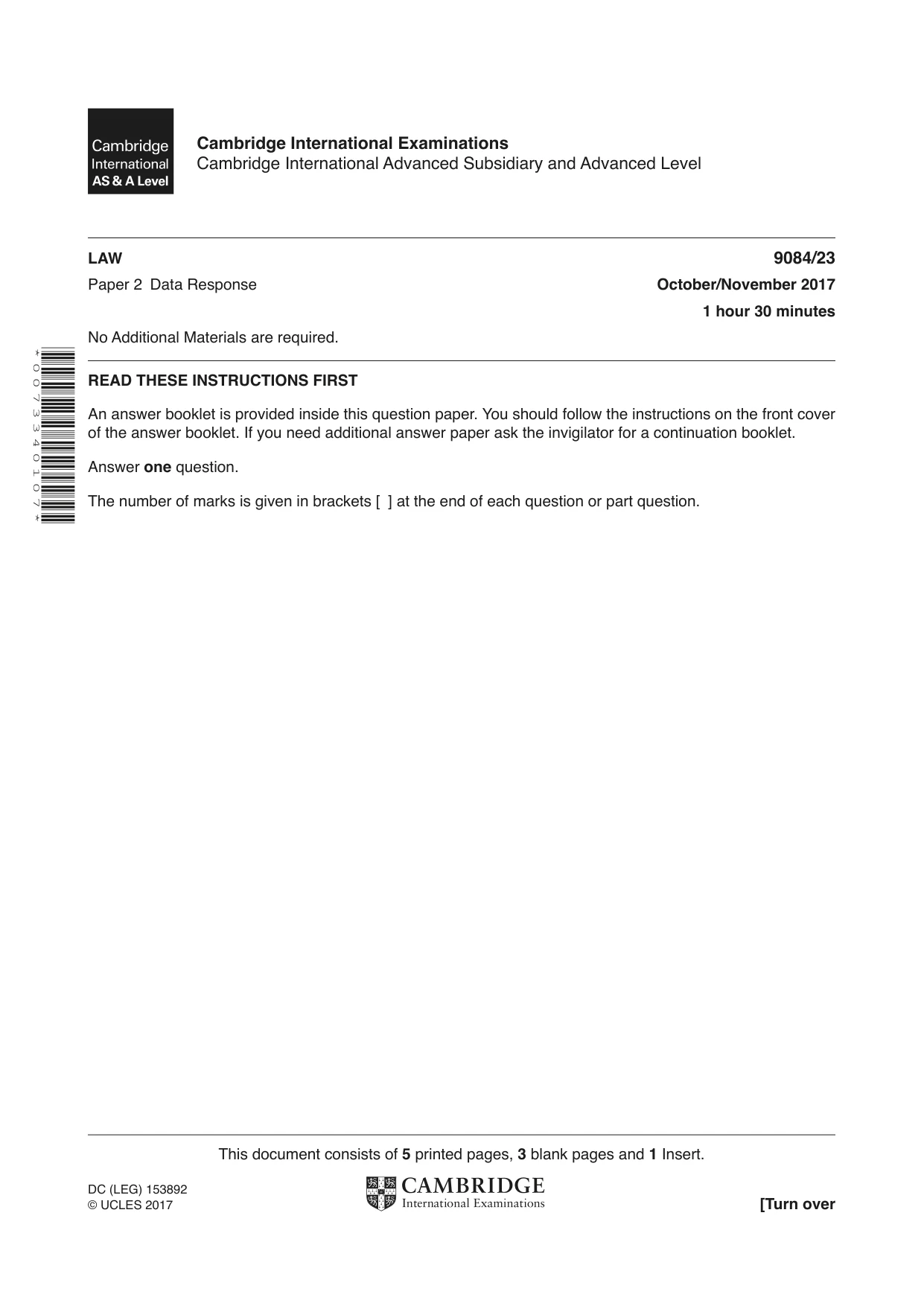
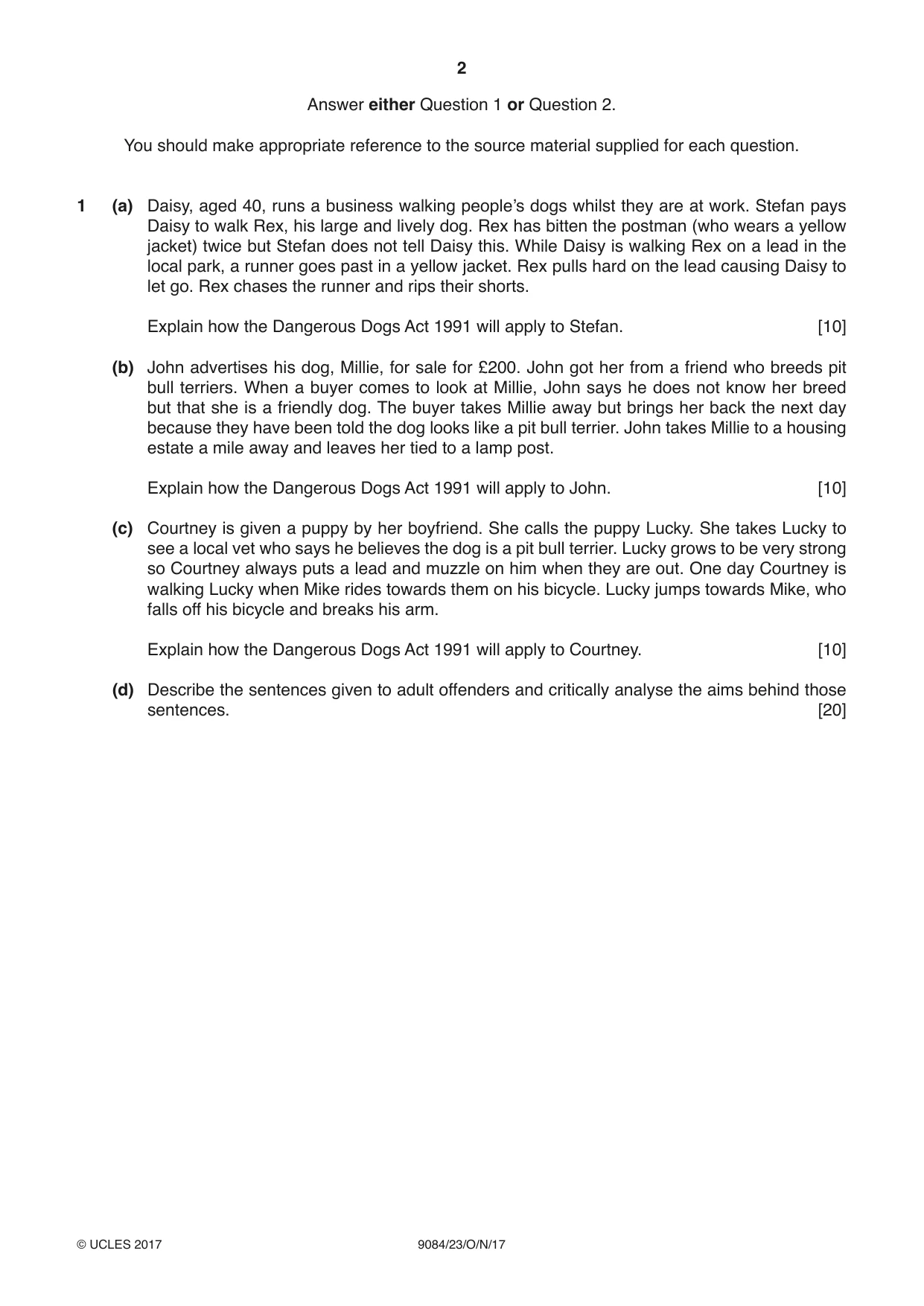
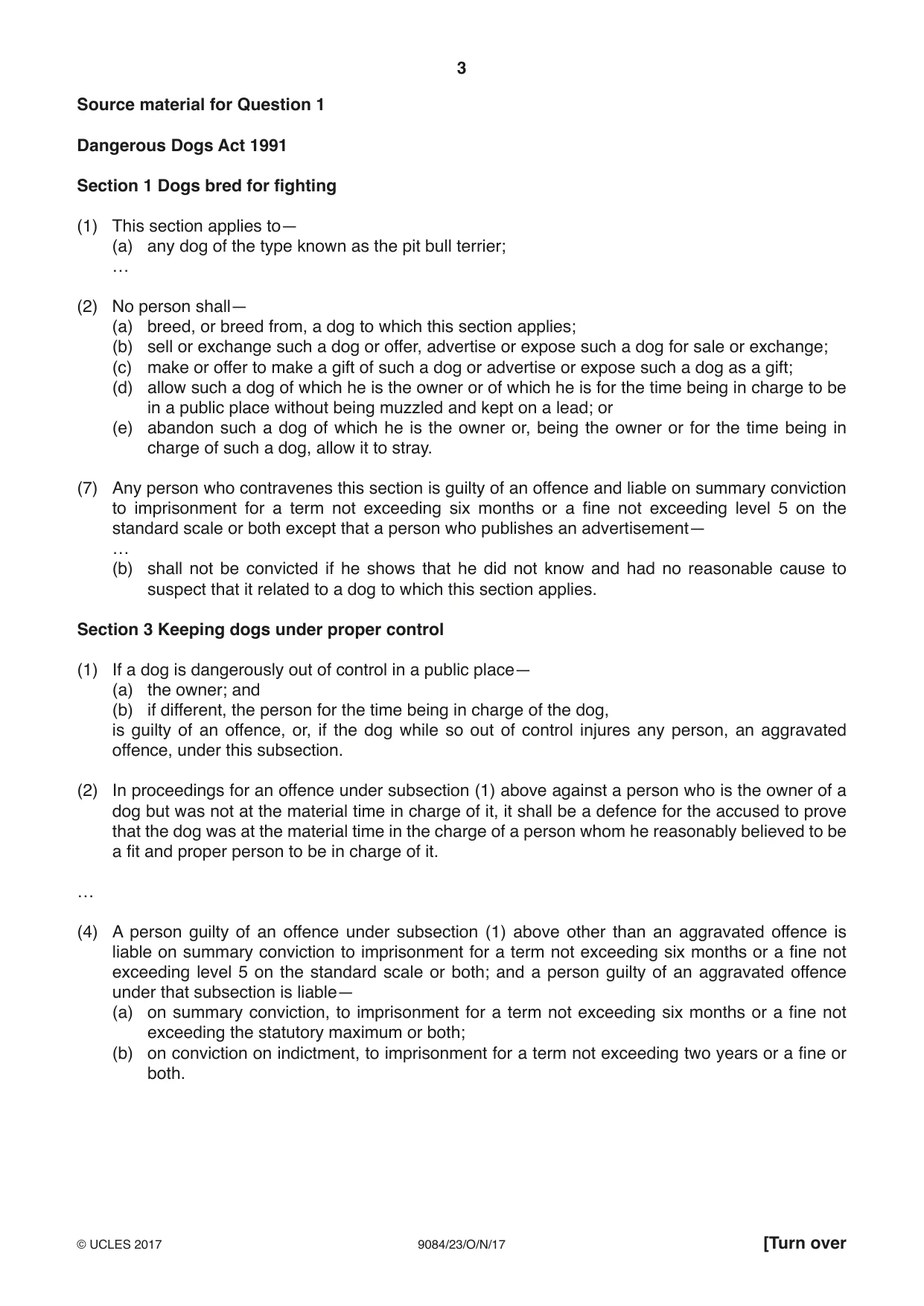
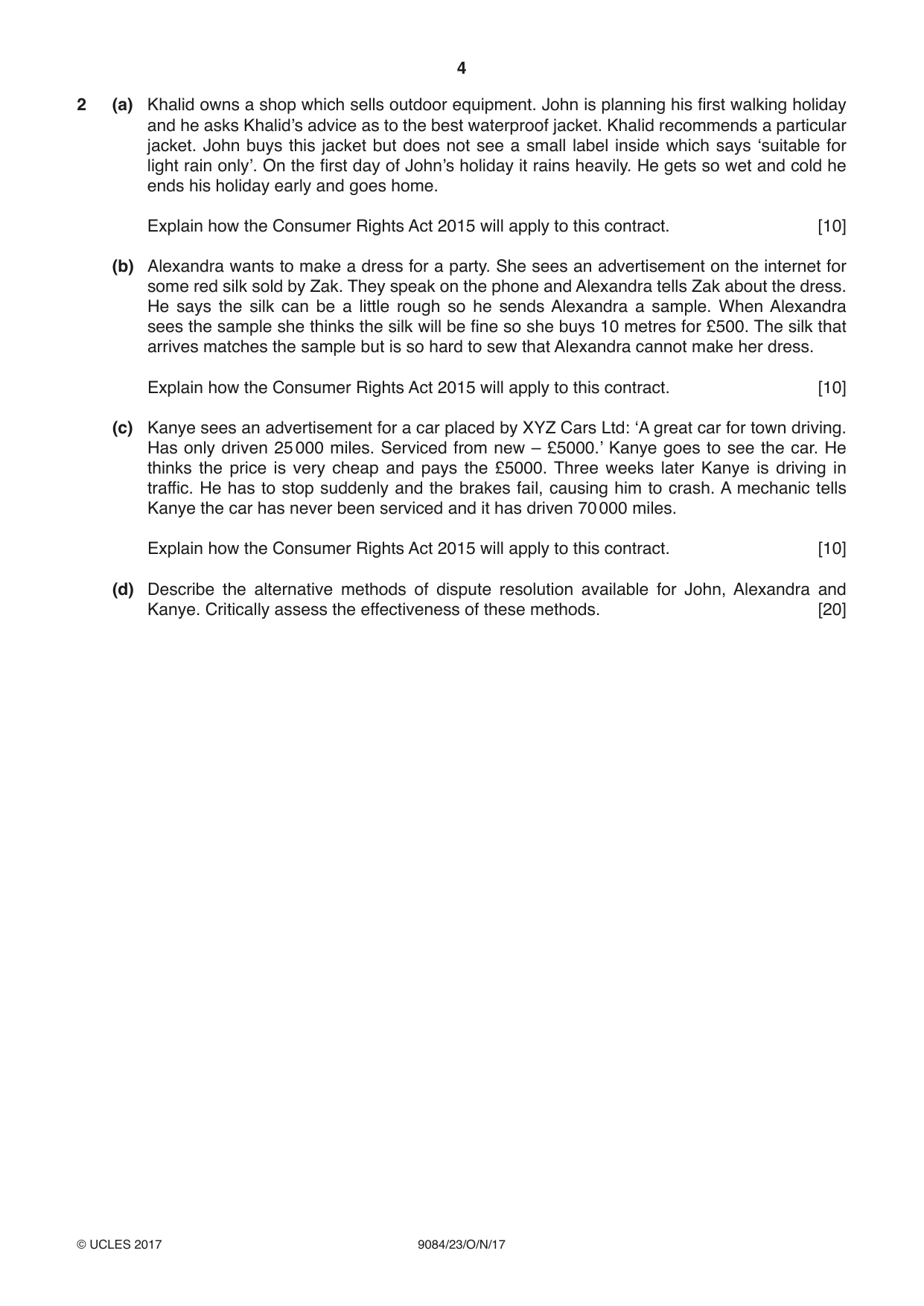


Mark scheme6 pages
Answers below. Sit the paper first if you are practising.
Questions as text
Q1 · Daisy, aged 40, runs a business walking people’s dogs whilst they are at work
1 (a) Daisy, aged 40, runs a business walking people’s dogs whilst they are at work. Stefan pays Daisy to walk Rex, his large and lively dog. Rex has bitten the postman (who wears a yellow jacket) twice but Stefan does not tell Daisy this. While Daisy is walking Rex on a lead in the local park, a runner goes past in a yellow jacket. Rex pulls hard on the lead causing Daisy to let go. Rex chases the runner and rips their shorts. Explain how the Dangerous Dogs Act 1991 will apply to Stefan. [10] (b) John advertises his dog, Millie, for sale for £200. John got her from a friend who breeds pit bull terriers. When a buyer comes to look at Millie, John says he does not know her breed but that she is a friendly dog. The buyer takes Millie away but brings her back the next day because they have been told the dog looks like a pit bull terrier. John takes Millie to a housing estate a mile away and leaves her tied to a lamp post. Explain how the Dangerous Dogs Act 1991 will apply to John. [10] (c) Courtney is given a puppy by her boyfriend. She calls the puppy Lucky. She takes Lucky to see a local vet who says he believes the dog is a pit bull terrier. Lucky grows to be very strong so Courtney always puts a lead and muzzle on him when they are out. One day Courtney is walking Lucky when Mike rides towards them on his bicycle. Lucky jumps towards Mike, who falls off his bicycle and breaks his arm. Explain how the Dangerous Dogs Act 1991 will apply to Courtney. [10] (d) Describe the sentences given to adult offenders and critically analyse the aims behind those sentences. [20] Source material for Question 1 Dangerous Dogs Act 1991 Section 1 Dogs bred for fighting (1) This section applies to— (a) any dog of the type known as the pit bull terrier; … (2) No person shall— (a) breed, or breed from, a dog to which this section applies; (b) sell or exchange such a dog or offer, advertise or expose such a dog for sale or exchange; (c) make or offer to make a gift of such a dog or advertise or expose such a dog as a gift; (d) allow such a dog of which he is the owner or of which he is for the time being in charge to be in a public place without being muzzled and kept on a lead; or (e) abandon such a dog of which he is the owner or, being the owner or for the time being in charge of such a dog, allow it to stray. (7) Any person who contravenes this section is guilty of an offence and liable on summary conviction to imprisonment for a term not exceeding six months or a fine not exceeding level 5 on the standard scale or both except that a person who publishes an advertisement— … (b) shall not be convicted if he shows that he did not know and had no reasonable cause to suspect that it related to a dog to which this section applies. Section 3 Keeping dogs under proper control (1) If a dog is dangerously out of control in a public place— (a) the owner; and (b) if different, the person for the time being in charge of the dog, is guilty of an offence, or, if the dog while so out of control injures any person, an aggravated offence, under this subsection. (2) In proceedings for an offence under subsection (1) above against a person who is the owner of a dog but was not at the material time in charge of it, it shall be a defence for the accused to prove that the dog was at the material time in the charge of a person whom he reasonably believed to be a fit and proper person to be in charge of it. … (4) A person guilty of an offence under subsection (1) above other than an aggravated offence is liable on summary conviction to imprisonment for a term not exceeding six months or a fine not exceeding level 5 on the standard scale or both; and a person guilty of an aggravated offence under that subsection is liable— (a) on summary conviction, to imprisonment for a term not exceeding six months or a fine not exceeding the statutory maximum or both; (b) on conviction on indictment, to imprisonment for a term not exceeding two years or a fine or both.
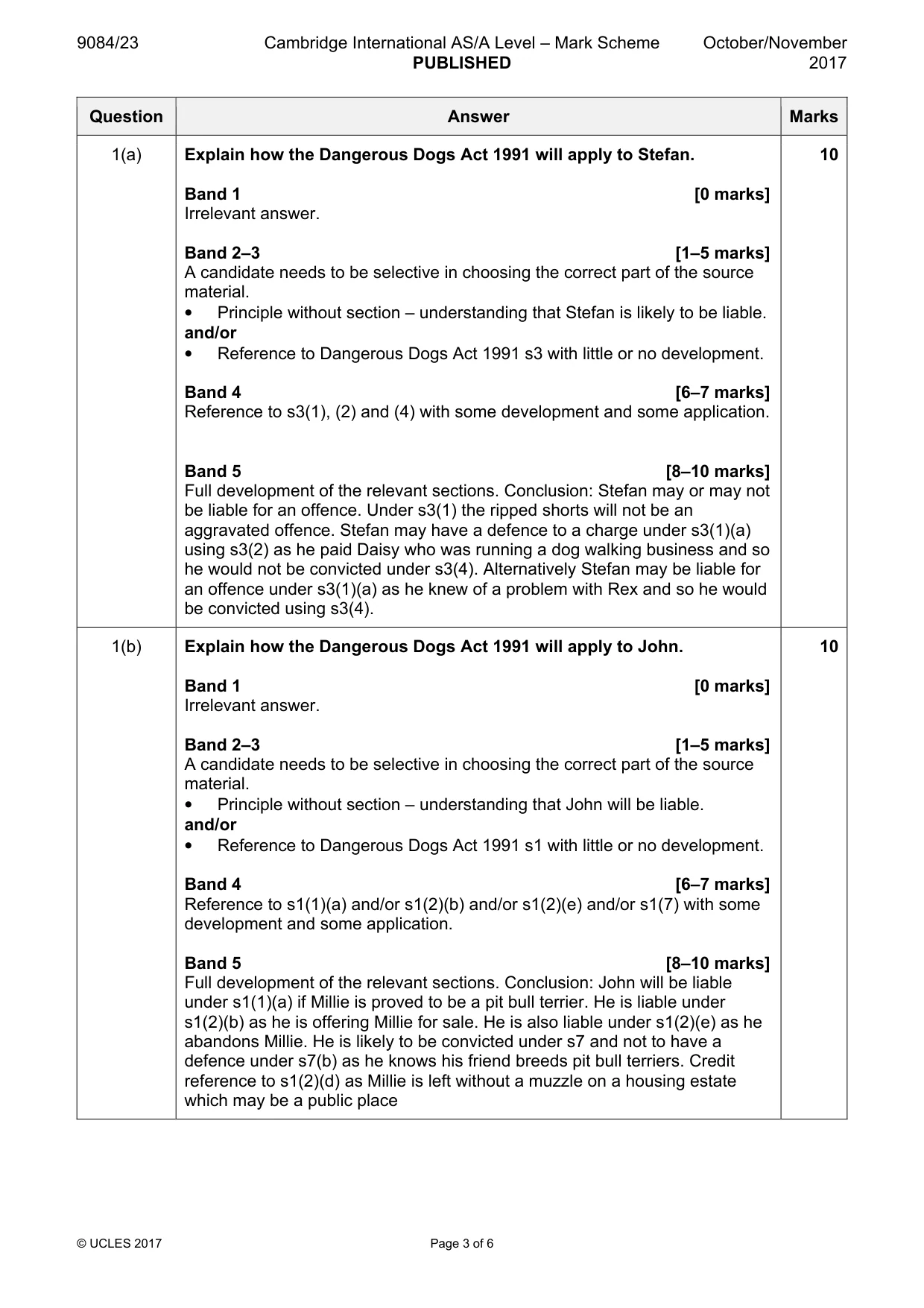
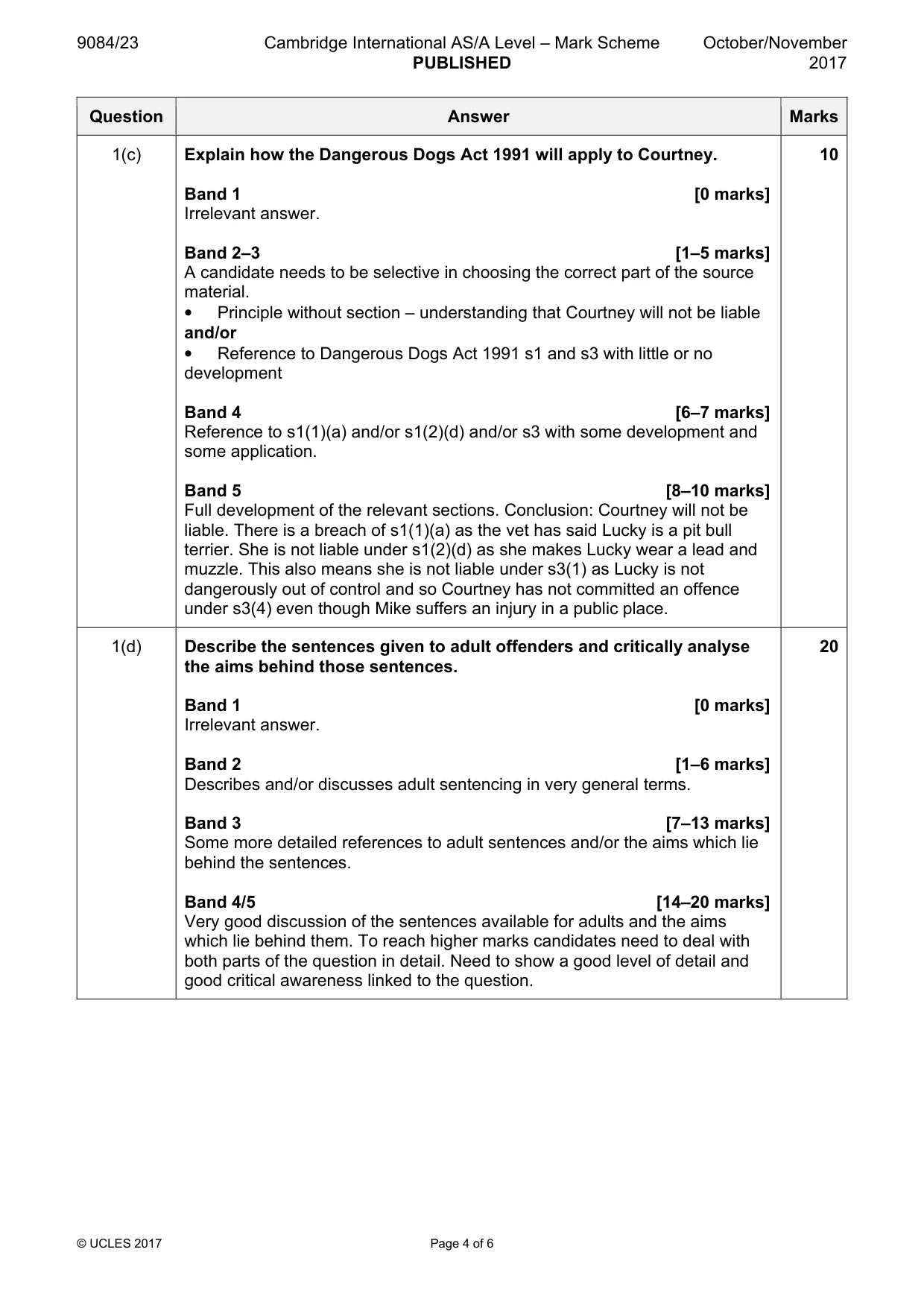
Mark scheme: Question Answer Marks 1(a) Explain how the Dangerous Dogs Act 1991 will apply to Stefan. 10 Band 1 [0 marks] Irrelevant answer. Band 2–3 [1–5 marks] A candidate needs to be selective in choosing the correct part of the source material. • Principle without section – understanding that Stefan is likely to be liable. and/or • Reference to Dangerous Dogs Act 1991 s3 with little or no development. Band 4 [6–7 marks] Reference to s3(1), (2) and (4) with some development and some application. Band 5 [8–10 marks] Full development of the relevant sections. Conclusion: Stefan may or may not be liable for an offence. Under s3(1) the ripped shorts will not be an aggravated offence. Stefan may have a defence to a charge under s3(1)(a) using s3(2) as he paid Daisy who was running a dog walking business and so he would not be convicted under s3(4). Alternatively Stefan may be liable for an offence under s3(1)(a) as he knew of a problem with Rex and so he would be convicted using s3(4). 1(b) Explain how the Dangerous Dogs Act 1991 will apply to John. 10 Band 1 [0 marks] Irrelevant answer. Band 2–3 [1–5 marks] A candidate needs to be selective in choosing the correct part of the source material. • Principle without section – understanding that John will be liable. and/or • Reference to Dangerous Dogs Act 1991 s1 with little or no development. Band 4 [6–7 marks] Reference to s1(1)(a) and/or s1(2)(b) and/or s1(2)(e) and/or s1(7) with some development and some application. Band 5 [8–10 marks] Full development of the relevant sections. Conclusion: John will be liable under s1(1)(a) if Millie is proved to be a pit bull terrier. He is liable under s1(2)(b) as he is offering Millie for sale. He is also liable under s1(2)(e) as he abandons Millie. He is likely to be convicted under s7 and not to have a defence under s7(b) as he knows his friend breeds pit bull terriers. Credit reference to s1(2)(d) as Millie is left without a muzzle on a housing estate which may be a public place 1(c) Explain how the Dangerous Dogs Act 1991 will apply to Courtney. 10 Band 1 [0 marks] Irrelevant answer. Band 2–3 [1–5 marks] A candidate needs to be selective in choosing the correct part of the source material. • Principle without section – understanding that Courtney will not be liable and/or • Reference to Dangerous Dogs Act 1991 s1 and s3 with little or no development Band 4 [6–7 marks] Reference to s1(1)(a) and/or s1(2)(d) and/or s3 with some development and some application. Band 5 [8–10 marks] Full development of the relevant sections. Conclusion: Courtney will not be liable. There is a breach of s1(1)(a) as the vet has said Lucky is a pit bull terrier. She is not liable under s1(2)(d) as she makes Lucky wear a lead and muzzle. This also means she is not liable under s3(1) as Lucky is not dangerously out of control and so Courtney has not committed an offence under s3(4) even though Mike suffers an injury in a public place. 1(d) Describe the sentences given to adult offenders and critically analyse 20 the aims behind those sentences. Band 1 [0 marks] Irrelevant answer. Band 2 [1–6 marks] Describes and/or discusses adult sentencing in very general terms. Band 3 [7–13 marks] Some more detailed references to adult sentences and/or the aims which lie behind the sentences. Band 4/5 [14–20 marks] Very good discussion of the sentences available for adults and the aims which lie behind them. To reach higher marks candidates need to deal with both parts of the question in detail. Need to show a good level of detail and good critical awareness linked to the question.
Q2 · Khalid owns a shop which sells outdoor equipment
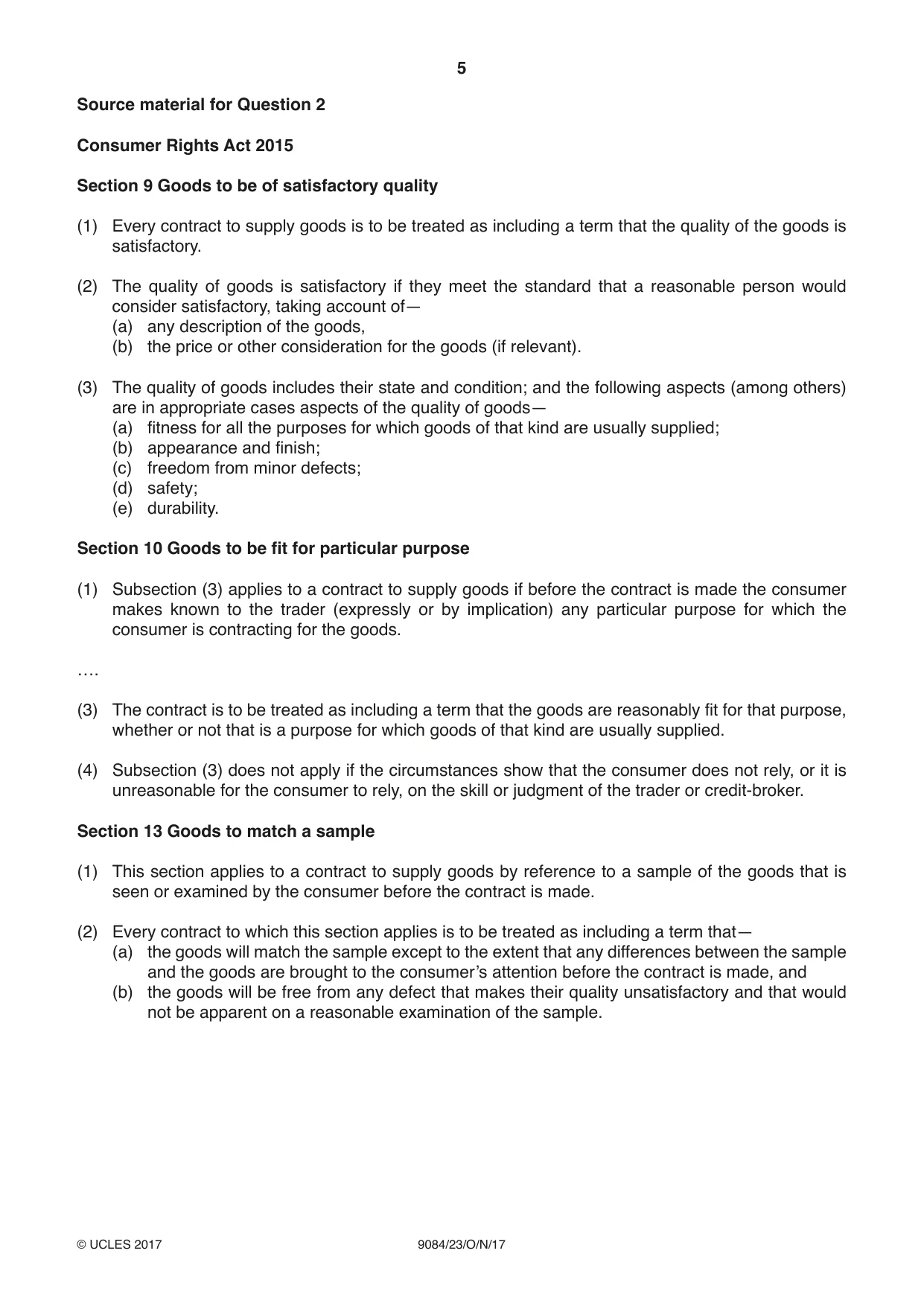
2 (a) Khalid owns a shop which sells outdoor equipment. John is planning his first walking holiday and he asks Khalid’s advice as to the best waterproof jacket. Khalid recommends a particular jacket. John buys this jacket but does not see a small label inside which says ‘suitable for light rain only’. On the first day of John’s holiday it rains heavily. He gets so wet and cold he ends his holiday early and goes home. Explain how the Consumer Rights Act 2015 will apply to this contract. [10] (b) Alexandra wants to make a dress for a party. She sees an advertisement on the internet for some red silk sold by Zak. They speak on the phone and Alexandra tells Zak about the dress. He says the silk can be a little rough so he sends Alexandra a sample. When Alexandra sees the sample she thinks the silk will be fine so she buys 10 metres for £500. The silk that arrives matches the sample but is so hard to sew that Alexandra cannot make her dress. Explain how the Consumer Rights Act 2015 will apply to this contract. [10] (c) Kanye sees an advertisement for a car placed by XYZ Cars Ltd: ‘A great car for town driving. Has only driven 25 000 miles. Serviced from new – £5000.’ Kanye goes to see the car. He thinks the price is very cheap and pays the £5000. Three weeks later Kanye is driving in traffic. He has to stop suddenly and the brakes fail, causing him to crash. A mechanic tells Kanye the car has never been serviced and it has driven 70 000 miles. Explain how the Consumer Rights Act 2015 will apply to this contract. [10] (d) Describe the alternative methods of dispute resolution available for John, Alexandra and Kanye. Critically assess the effectiveness of these methods. [20] Source material for Question 2 Consumer Rights Act 2015 Section 9 Goods to be of satisfactory quality (1) Every contract to supply goods is to be treated as including a term that the quality of the goods is satisfactory. (2) The quality of goods is satisfactory if they meet the standard that a reasonable person would consider satisfactory, taking account of— (a) any description of the goods, (b) the price or other consideration for the goods (if relevant). (3) The quality of goods includes their state and condition; and the following aspects (among others) are in appropriate cases aspects of the quality of goods— (a) fitness for all the purposes for which goods of that kind are usually supplied; (b) appearance and finish; (c) freedom from minor defects; (d) safety; (e) durability. Section 10 Goods to be fit for particular purpose (1) Subsection (3) applies to a contract to supply goods if before the contract is made the consumer makes known to the trader (expressly or by implication) any particular purpose for which the consumer is contracting for the goods. …. (3) The contract is to be treated as including a term that the goods are reasonably fit for that purpose, whether or not that is a purpose for which goods of that kind are usually supplied. (4) Subsection (3) does not apply if the circumstances show that the consumer does not rely, or it is unreasonable for the consumer to rely, on the skill or judgment of the trader or credit-broker. Section 13 Goods to match a sample (1) This section applies to a contract to supply goods by reference to a sample of the goods that is seen or examined by the consumer before the contract is made. (2) Every contract to which this section applies is to be treated as including a term that— (a) the goods will match the sample except to the extent that any differences between the sample and the goods are brought to the consumer’s attention before the contract is made, and (b) the goods will be free from any defect that makes their quality unsatisfactory and that would not be apparent on a reasonable examination of the sample.
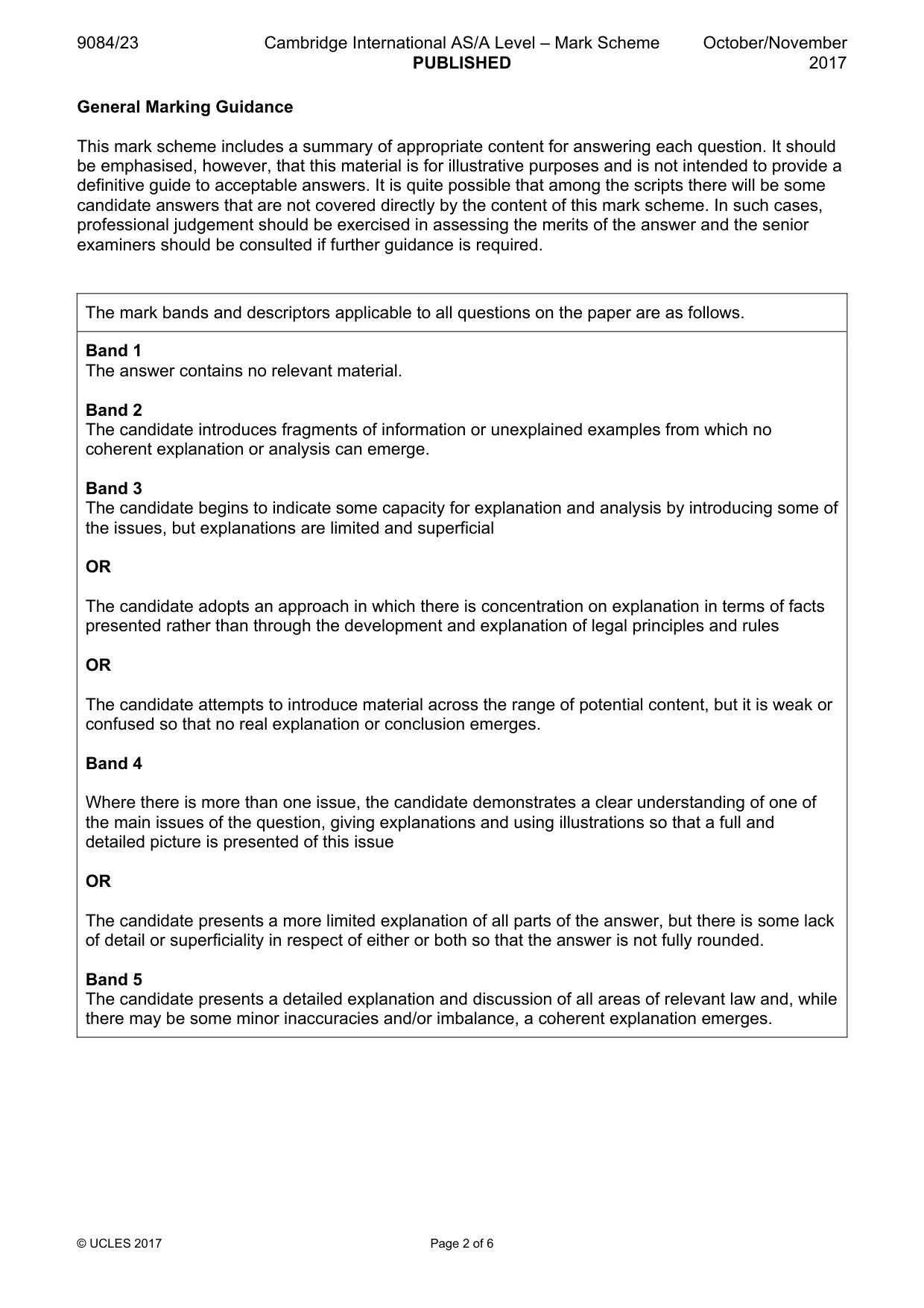
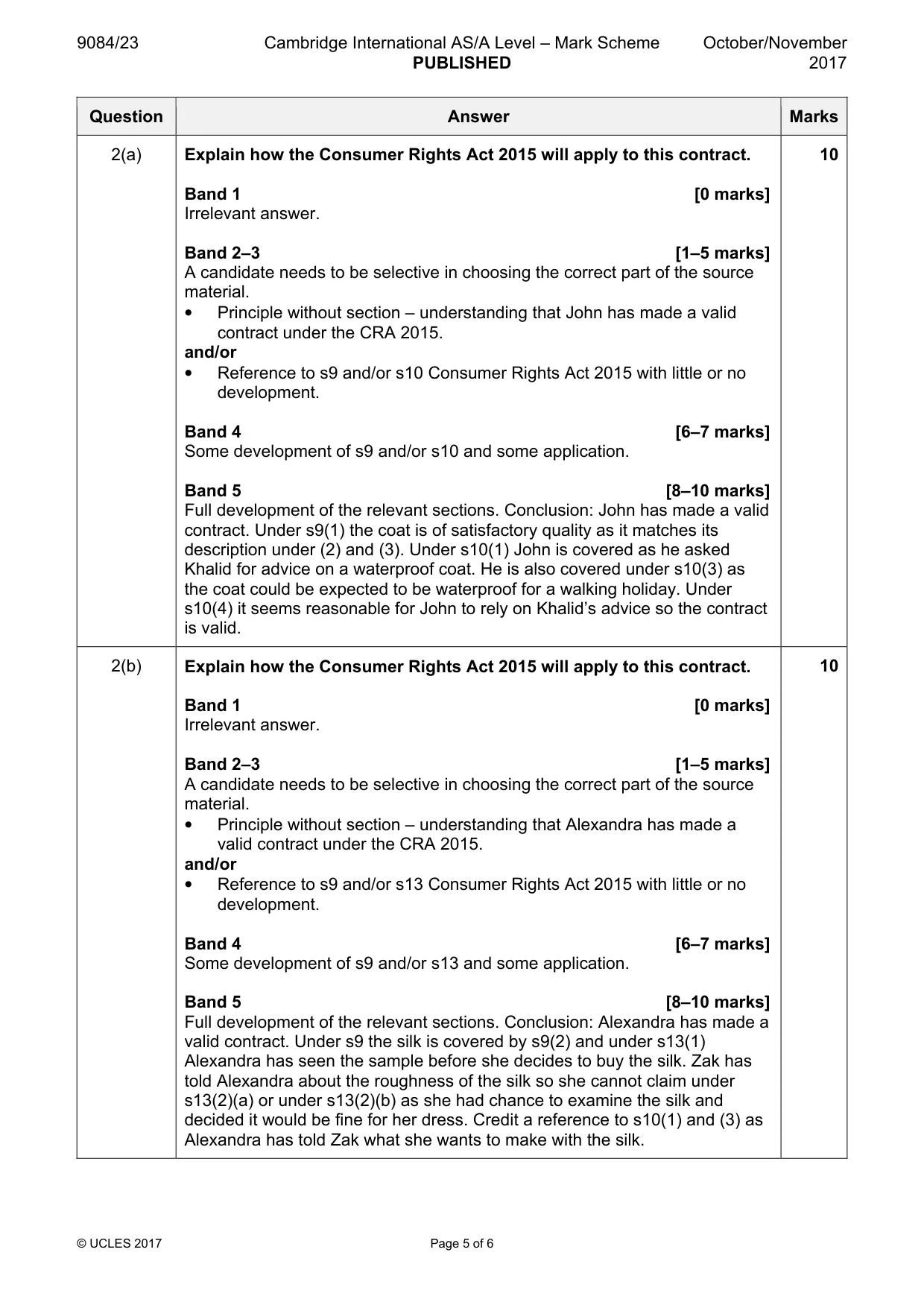
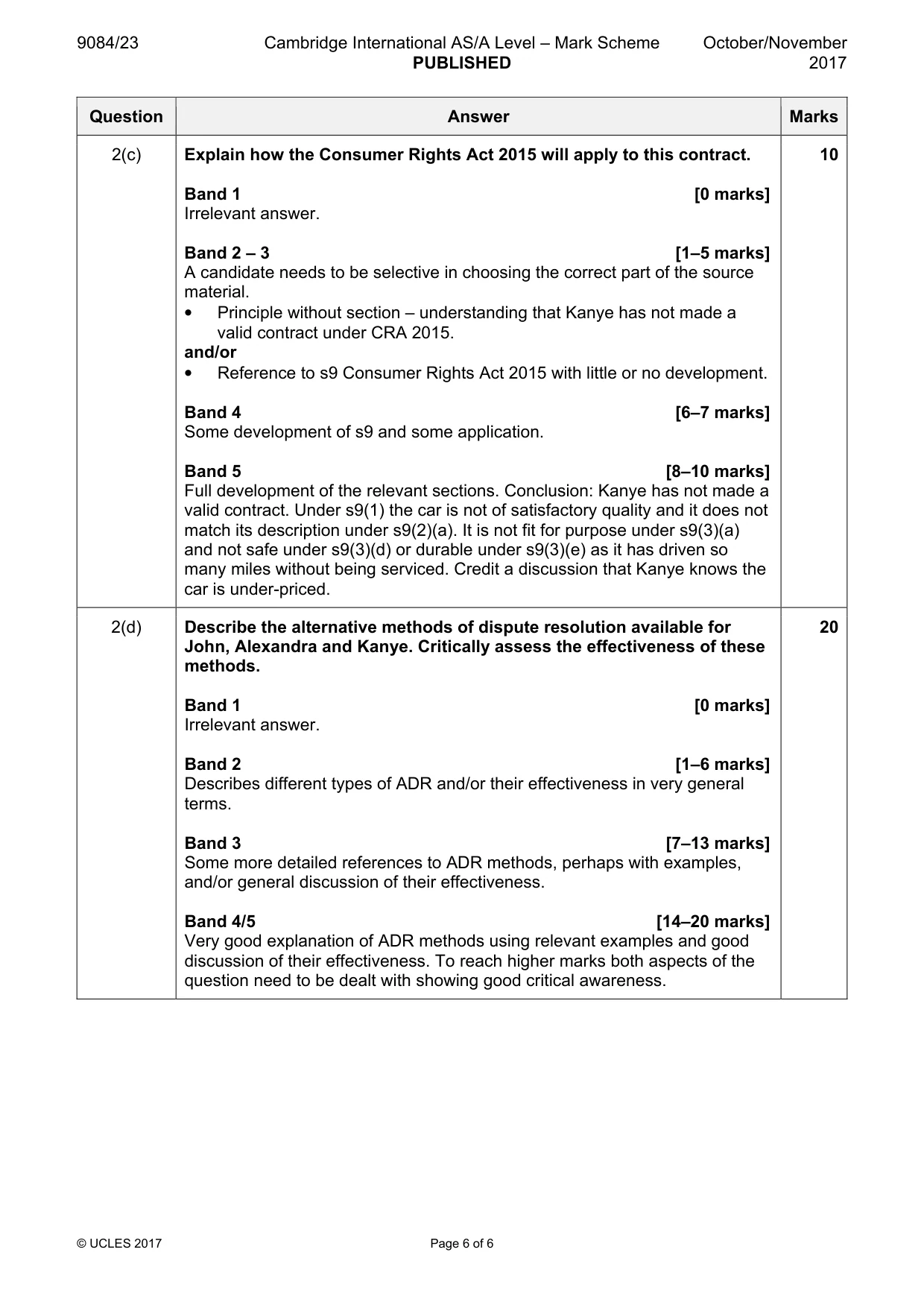
Mark scheme: 2(a) Explain how the Consumer Rights Act 2015 will apply to this contract. 10 Band 1 [0 marks] Irrelevant answer. Band 2–3 [1–5 marks] A candidate needs to be selective in choosing the correct part of the source material. • Principle without section – understanding that John has made a valid contract under the CRA 2015. and/or • Reference to s9 and/or s10 Consumer Rights Act 2015 with little or no development. Band 4 [6–7 marks] Some development of s9 and/or s10 and some application. Band 5 [8–10 marks] Full development of the relevant sections. Conclusion: John has made a valid contract. Under s9(1) the coat is of satisfactory quality as it matches its description under (2) and (3). Under s10(1) John is covered as he asked Khalid for advice on a waterproof coat. He is also covered under s10(3) as the coat could be expected to be waterproof for a walking holiday. Under s10(4) it seems reasonable for John to rely on Khalid’s advice so the contract is valid. 2(b) Explain how the Consumer Rights Act 2015 will apply to this contract. 10 Band 1 [0 marks] Irrelevant answer. Band 2–3 [1–5 marks] A candidate needs to be selective in choosing the correct part of the source material. • Principle without section – understanding that Alexandra has made a valid contract under the CRA 2015. and/or • Reference to s9 and/or s13 Consumer Rights Act 2015 with little or no development. Band 4 [6–7 marks] Some development of s9 and/or s13 and some application. Band 5 [8–10 marks] Full development of the relevant sections. Conclusion: Alexandra has made a valid contract. Under s9 the silk is covered by s9(2) and under s13(1) Alexandra has seen the sample before she decides to buy the silk. Zak has told Alexandra about the roughness of the silk so she cannot claim under s13(2)(a) or under s13(2)(b) as she had chance to examine the silk and decided it would be fine for her dress. Credit a reference to s10(1) and (3) as Alexandra has told Zak what she wants to make with the silk. 2(c) Explain how the Consumer Rights Act 2015 will apply to this contract. 10 Band 1 [0 marks] Irrelevant answer. Band 2 – 3 [1–5 marks] A candidate needs to be selective in choosing the correct part of the source material. • Principle without section – understanding that Kanye has not made a valid contract under CRA 2015. and/or • Reference to s9 Consumer Rights Act 2015 with little or no development. Band 4 [6–7 marks] Some development of s9 and some application. Band 5 [8–10 marks] Full development of the relevant sections. Conclusion: Kanye has not made a valid contract. Under s9(1) the car is not of satisfactory quality and it does not match its description under s9(2)(a). It is not fit for purpose under s9(3)(a) and not safe under s9(3)(d) or durable under s9(3)(e) as it has driven so many miles without being serviced. Credit a discussion that Kanye knows the car is under-priced. 2(d) Describe the alternative methods of dispute resolution available for 20 John, Alexandra and Kanye. Critically assess the effectiveness of these methods. Band 1 [0 marks] Irrelevant answer. Band 2 [1–6 marks] Describes different types of ADR and/or their effectiveness in very general terms. Band 3 [7–13 marks] Some more detailed references to ADR methods, perhaps with examples, and/or general discussion of their effectiveness. Band 4/5 [14–20 marks] Very good explanation of ADR methods using relevant examples and good discussion of their effectiveness. To reach higher marks both aspects of the question need to be dealt with showing good critical awareness.
What was in this paper
The subtopics covered by these 2 questions, and how many questions each got. Open one in a new tab to see every Cambridge question on it.
1Offences against property This topic is about the components of substantive offences against property. This topic is an opportunity to reflect on the key concepts of liability, justice, fairness, effectiveness and certainty1What you needed in this session
Cambridge’s own grade thresholds for 2017 Oct/Nov, Paper 2 · Variant 3. A higher threshold means an easier paper — the bar moves with how the cohort did.