Cambridge A Level Law 9084 — 2019 May/June Paper 2 · Variant 2
9084/22/M/J/19 · 2 questions · 50 marks · ≈56 min
The question paper and its mark scheme, free to read here and free to download. This is Cambridge’s own paper, exactly as it was sat.
Question paper8 pages
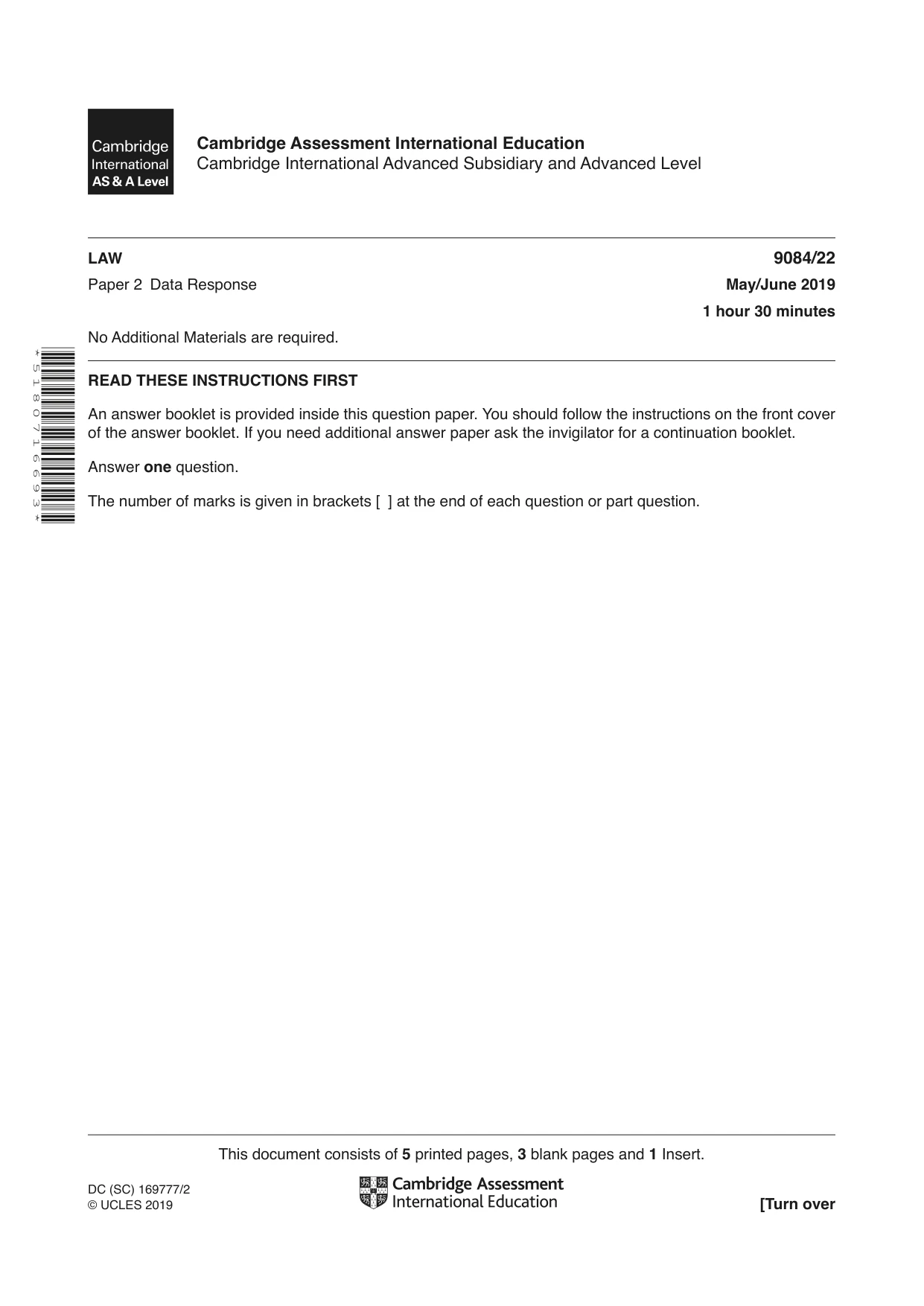
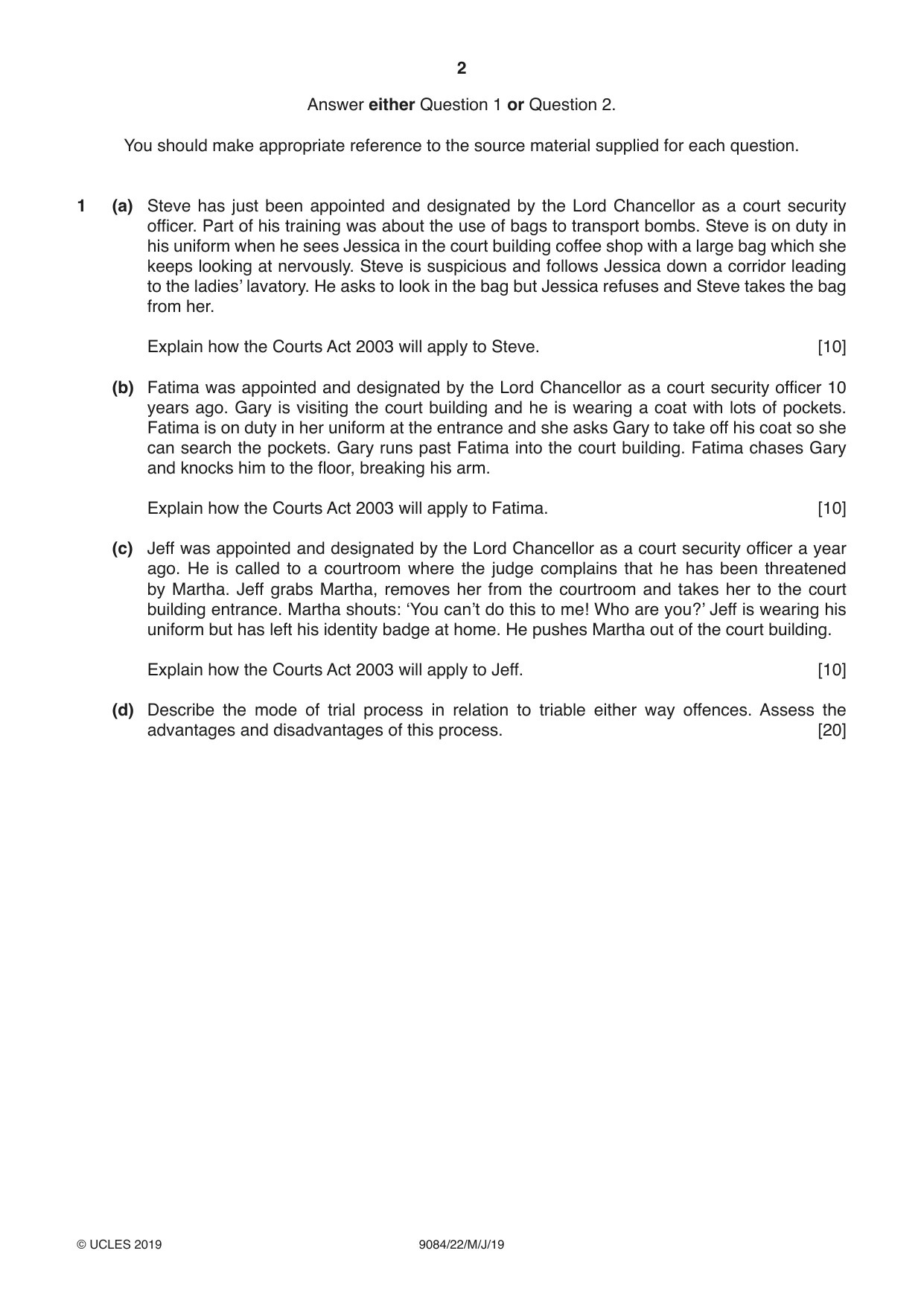
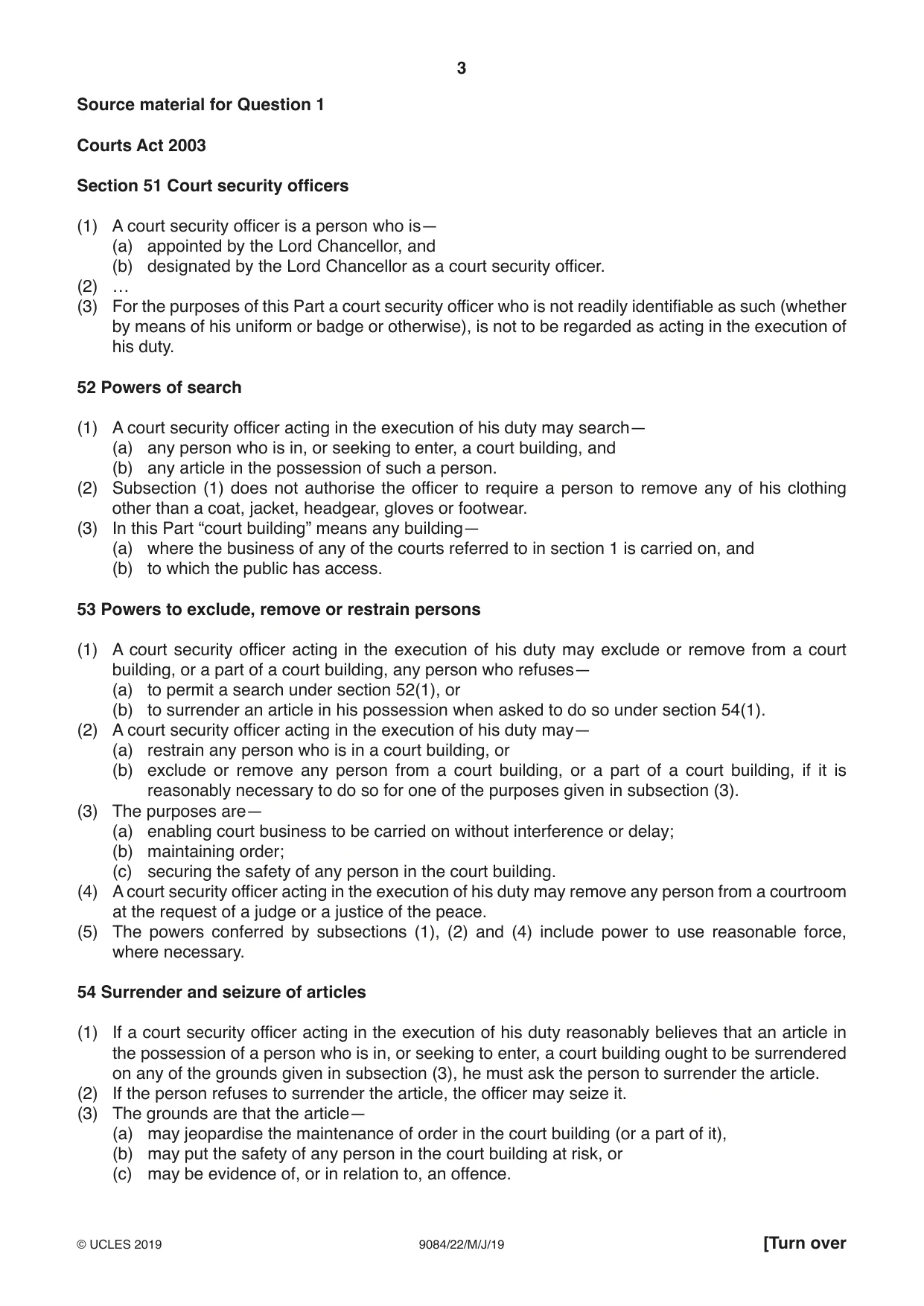
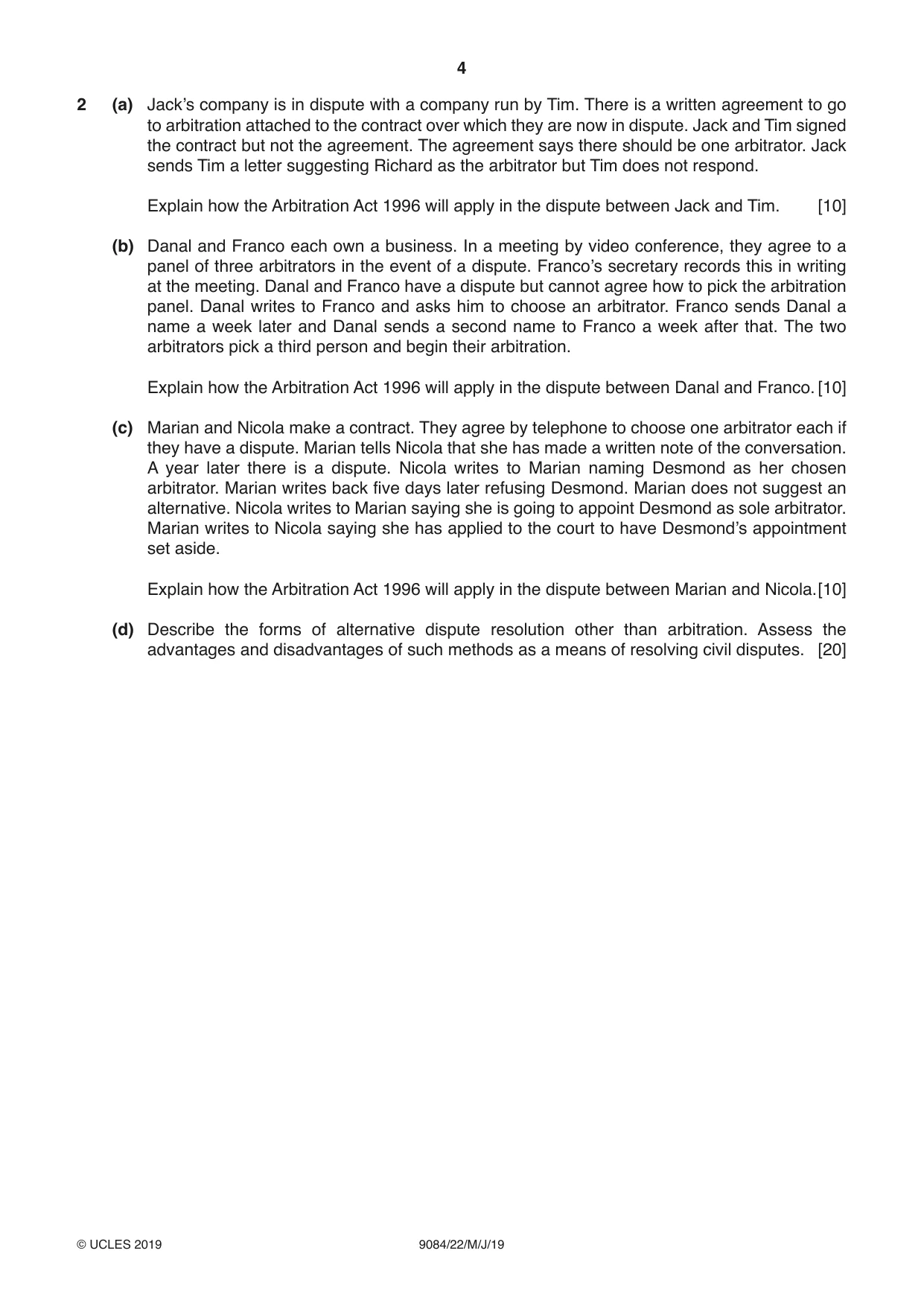



Mark scheme9 pages
Answers below. Sit the paper first if you are practising.
Questions as text
Q1 · Steve has just been appointed and designated by the Lord Chancellor as a court security…
1 (a) Steve has just been appointed and designated by the Lord Chancellor as a court security officer. Part of his training was about the use of bags to transport bombs. Steve is on duty in his uniform when he sees Jessica in the court building coffee shop with a large bag which she keeps looking at nervously. Steve is suspicious and follows Jessica down a corridor leading to the ladies’ lavatory. He asks to look in the bag but Jessica refuses and Steve takes the bag from her. Explain how the Courts Act 2003 will apply to Steve. [10] (b) Fatima was appointed and designated by the Lord Chancellor as a court security officer 10 years ago. Gary is visiting the court building and he is wearing a coat with lots of pockets. Fatima is on duty in her uniform at the entrance and she asks Gary to take off his coat so she can search the pockets. Gary runs past Fatima into the court building. Fatima chases Gary and knocks him to the floor, breaking his arm. Explain how the Courts Act 2003 will apply to Fatima. [10] (c) Jeff was appointed and designated by the Lord Chancellor as a court security officer a year ago. He is called to a courtroom where the judge complains that he has been threatened by Martha. Jeff grabs Martha, removes her from the courtroom and takes her to the court building entrance. Martha shouts: ‘You can’t do this to me! Who are you?’ Jeff is wearing his uniform but has left his identity badge at home. He pushes Martha out of the court building. Explain how the Courts Act 2003 will apply to Jeff. [10] (d) Describe the mode of trial process in relation to triable either way offences. Assess the advantages and disadvantages of this process. [20] Source material for Question 1 Courts Act 2003 Section 51 Court security officers (1) A court security officer is a person who is— (a) appointed by the Lord Chancellor, and (b) designated by the Lord Chancellor as a court security officer. (2) … (3) For the purposes of this Part a court security officer who is not readily identifiable as such (whether by means of his uniform or badge or otherwise), is not to be regarded as acting in the execution of his duty. 52 Powers of search (1) A court security officer acting in the execution of his duty may search— (a) any person who is in, or seeking to enter, a court building, and (b) any article in the possession of such a person. (2) Subsection (1) does not authorise the officer to require a person to remove any of his clothing other than a coat, jacket, headgear, gloves or footwear. (3) In this Part “court building” means any building— (a) where the business of any of the courts referred to in section 1 is carried on, and (b) to which the public has access. 53 Powers to exclude, remove or restrain persons (1) A court security officer acting in the execution of his duty may exclude or remove from a court building, or a part of a court building, any person who refuses— (a) to permit a search under section 52(1), or (b) to surrender an article in his possession when asked to do so under section 54(1). (2) A court security officer acting in the execution of his duty may— (a) restrain any person who is in a court building, or (b) exclude or remove any person from a court building, or a part of a court building, if it is reasonably necessary to do so for one of the purposes given in subsection (3). (3) The purposes are— (a) enabling court business to be carried on without interference or delay; (b) maintaining order; (c) securing the safety of any person in the court building. (4) A court security officer acting in the execution of his duty may remove any person from a courtroom at the request of a judge or a justice of the peace. (5) The powers conferred by subsections (1), (2) and (4) include power to use reasonable force, where necessary. 54 Surrender and seizure of articles (1) If a court security officer acting in the execution of his duty reasonably believes that an article in the possession of a person who is in, or seeking to enter, a court building ought to be surrendered on any of the grounds given in subsection (3), he must ask the person to surrender the article. (2) If the person refuses to surrender the article, the officer may seize it. (3) The grounds are that the article— (a) may jeopardise the maintenance of order in the court building (or a part of it), (b) may put the safety of any person in the court building at risk, or (c) may be evidence of, or in relation to, an offence.
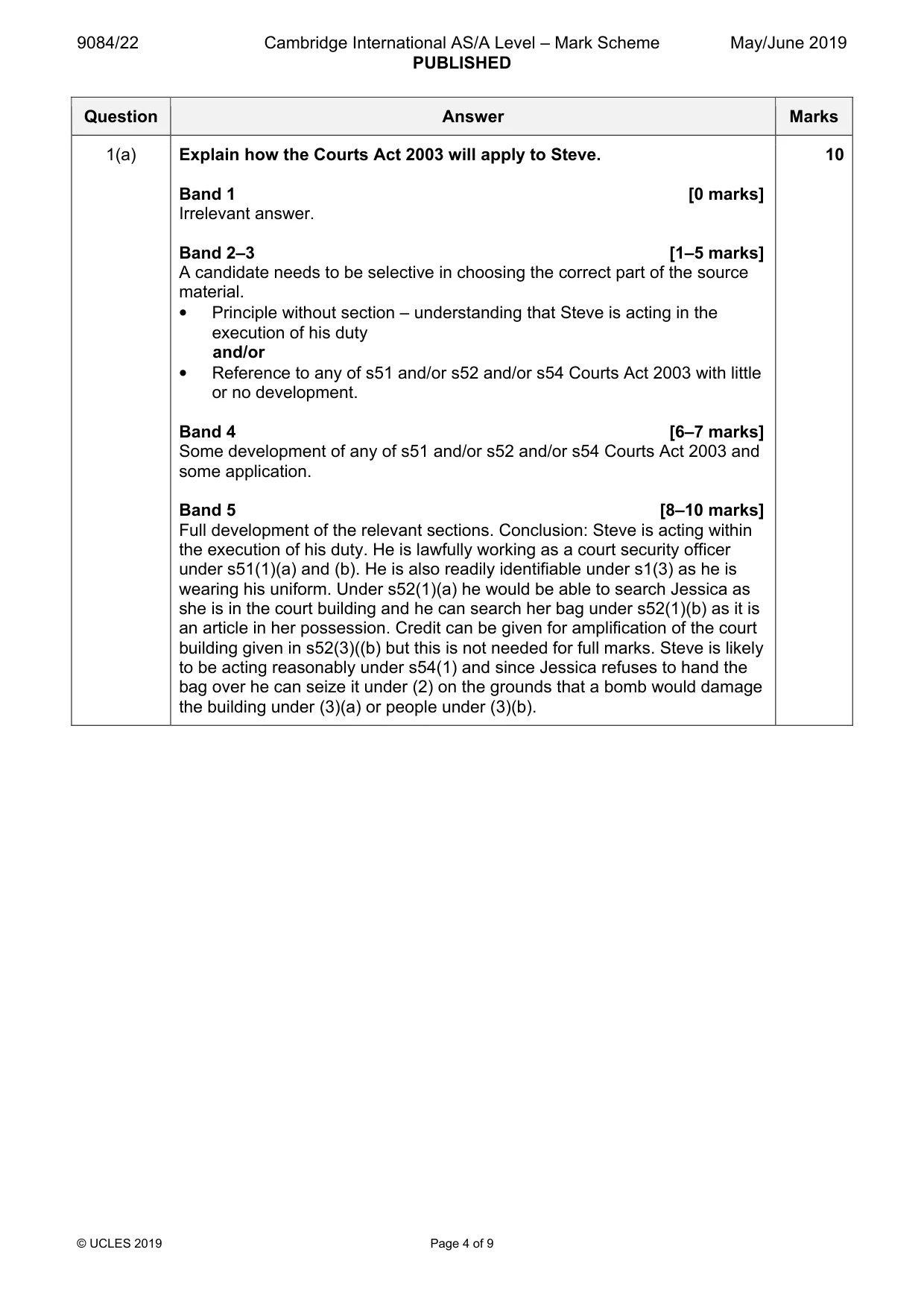
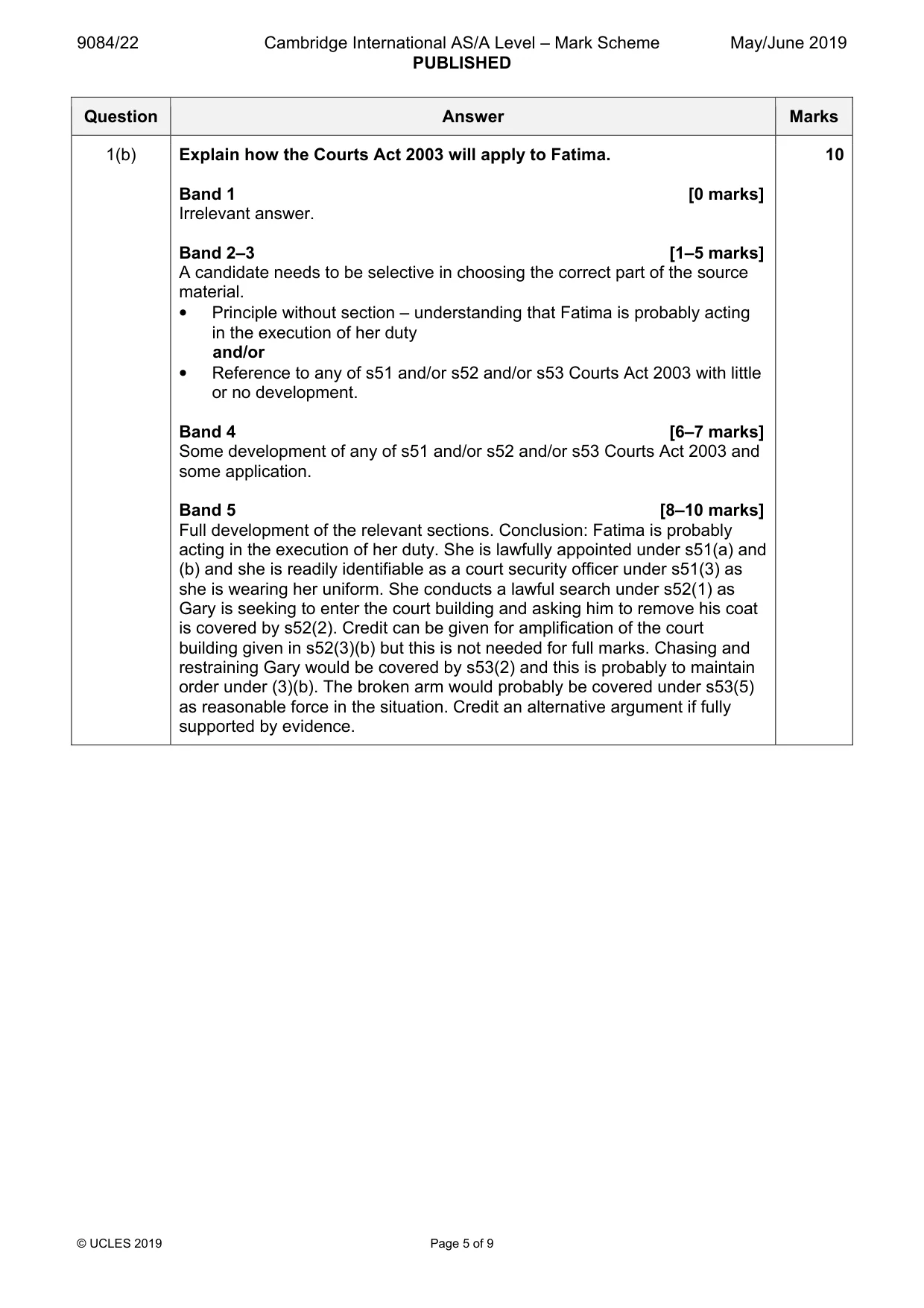
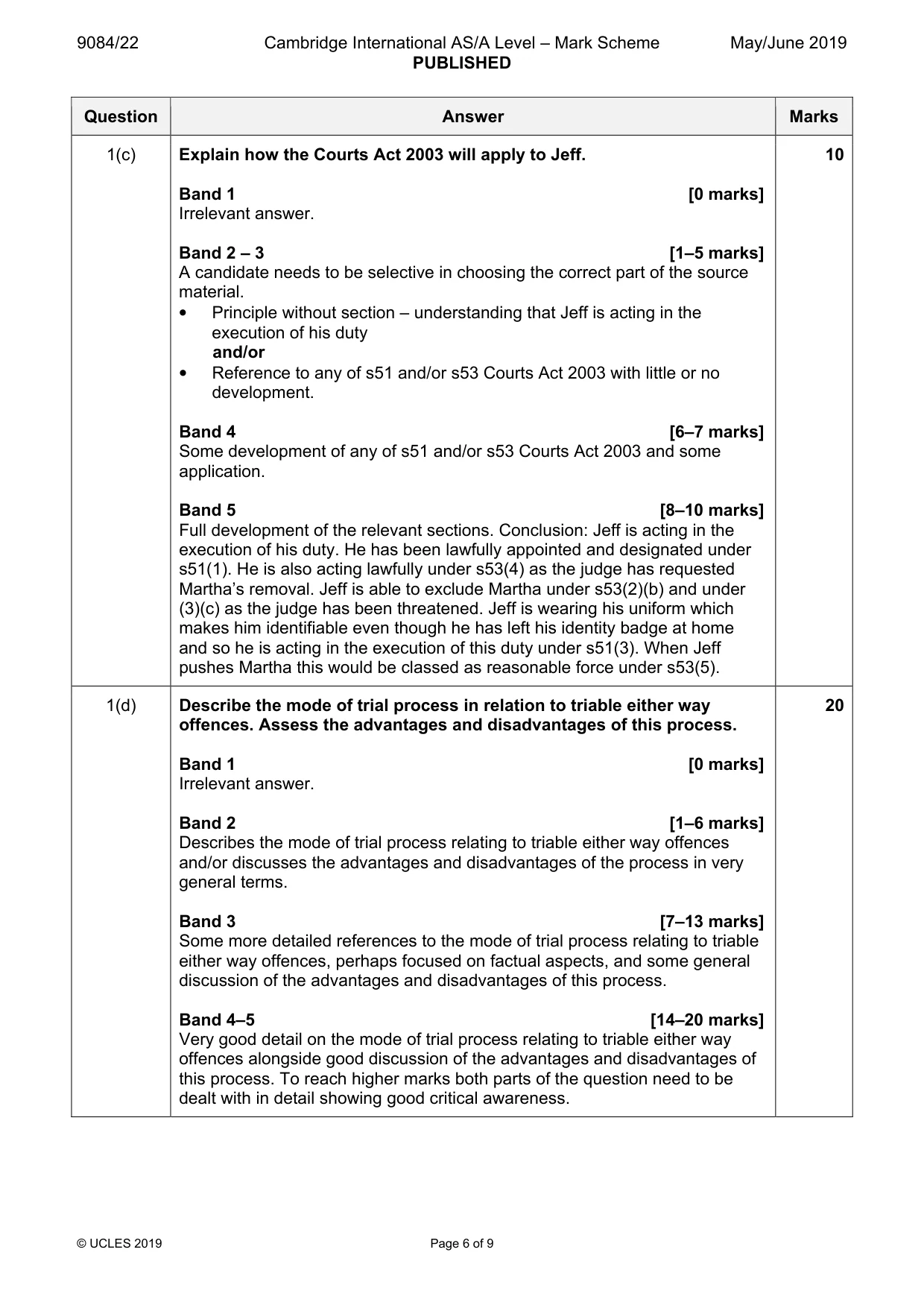
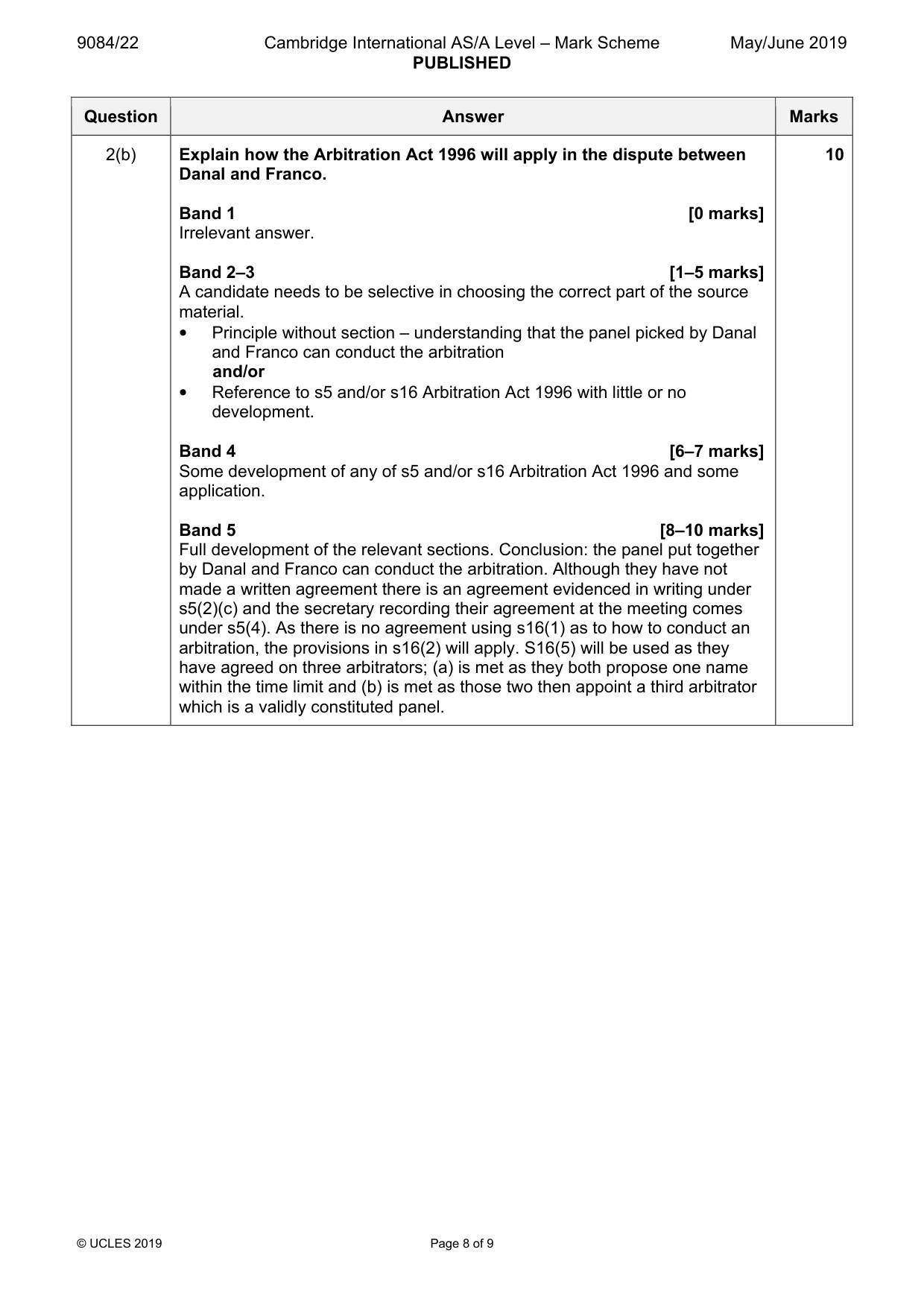
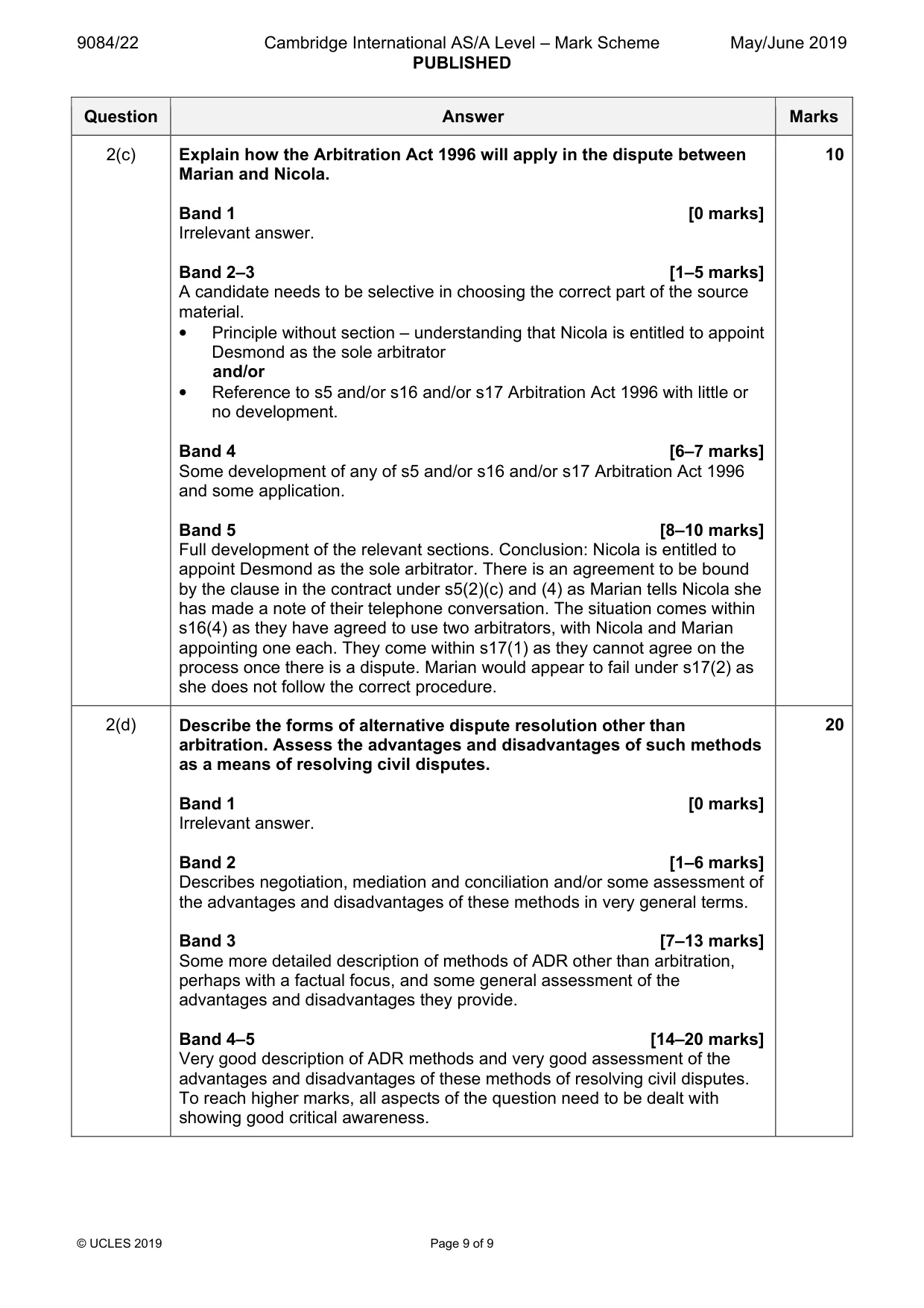
Mark scheme: Question Answer Marks 1(a) Explain how the Courts Act 2003 will apply to Steve. 10 Band 1 [0 marks] Irrelevant answer. Band 2–3 [1–5 marks] A candidate needs to be selective in choosing the correct part of the source material. • Principle without section – understanding that Steve is acting in the execution of his duty and/or • Reference to any of s51 and/or s52 and/or s54 Courts Act 2003 with little or no development. Band 4 [6–7 marks] Some development of any of s51 and/or s52 and/or s54 Courts Act 2003 and some application. Band 5 [8–10 marks] Full development of the relevant sections. Conclusion: Steve is acting within the execution of his duty. He is lawfully working as a court security officer under s51(1)(a) and (b). He is also readily identifiable under s1(3) as he is wearing his uniform. Under s52(1)(a) he would be able to search Jessica as she is in the court building and he can search her bag under s52(1)(b) as it is an article in her possession. Credit can be given for amplification of the court building given in s52(3)((b) but this is not needed for full marks. Steve is likely to be acting reasonably under s54(1) and since Jessica refuses to hand the bag over he can seize it under (2) on the grounds that a bomb would damage the building under (3)(a) or people under (3)(b). 1(b) Explain how the Courts Act 2003 will apply to Fatima. 10 Band 1 [0 marks] Irrelevant answer. Band 2–3 [1–5 marks] A candidate needs to be selective in choosing the correct part of the source material. • Principle without section – understanding that Fatima is probably acting in the execution of her duty and/or • Reference to any of s51 and/or s52 and/or s53 Courts Act 2003 with little or no development. Band 4 [6–7 marks] Some development of any of s51 and/or s52 and/or s53 Courts Act 2003 and some application. Band 5 [8–10 marks] Full development of the relevant sections. Conclusion: Fatima is probably acting in the execution of her duty. She is lawfully appointed under s51(a) and (b) and she is readily identifiable as a court security officer under s51(3) as she is wearing her uniform. She conducts a lawful search under s52(1) as Gary is seeking to enter the court building and asking him to remove his coat is covered by s52(2). Credit can be given for amplification of the court building given in s52(3)(b) but this is not needed for full marks. Chasing and restraining Gary would be covered by s53(2) and this is probably to maintain order under (3)(b). The broken arm would probably be covered under s53(5) as reasonable force in the situation. Credit an alternative argument if fully supported by evidence. 1(c) Explain how the Courts Act 2003 will apply to Jeff. 10 Band 1 [0 marks] Irrelevant answer. Band 2 – 3 [1–5 marks] A candidate needs to be selective in choosing the correct part of the source material. • Principle without section – understanding that Jeff is acting in the execution of his duty and/or • Reference to any of s51 and/or s53 Courts Act 2003 with little or no development. Band 4 [6–7 marks] Some development of any of s51 and/or s53 Courts Act 2003 and some application. Band 5 [8–10 marks] Full development of the relevant sections. Conclusion: Jeff is acting in the execution of his duty. He has been lawfully appointed and designated under s51(1). He is also acting lawfully under s53(4) as the judge has requested Martha’s removal. Jeff is able to exclude Martha under s53(2)(b) and under (3)(c) as the judge has been threatened. Jeff is wearing his uniform which makes him identifiable even though he has left his identity badge at home and so he is acting in the execution of this duty under s51(3). When Jeff pushes Martha this would be classed as reasonable force under s53(5). 1(d) Describe the mode of trial process in relation to triable either way 20 offences. Assess the advantages and disadvantages of this process. Band 1 [0 marks] Irrelevant answer. Band 2 [1–6 marks] Describes the mode of trial process relating to triable either way offences and/or discusses the advantages and disadvantages of the process in very general terms. Band 3 [7–13 marks] Some more detailed references to the mode of trial process relating to triable either way offences, perhaps focused on factual aspects, and some general discussion of the advantages and disadvantages of this process. Band 4–5 [14–20 marks] Very good detail on the mode of trial process relating to triable either way offences alongside good discussion of the advantages and disadvantages of this process. To reach higher marks both parts of the question need to be dealt with in detail showing good critical awareness.
Q2 · Jack’s company is in dispute with a company run by Tim
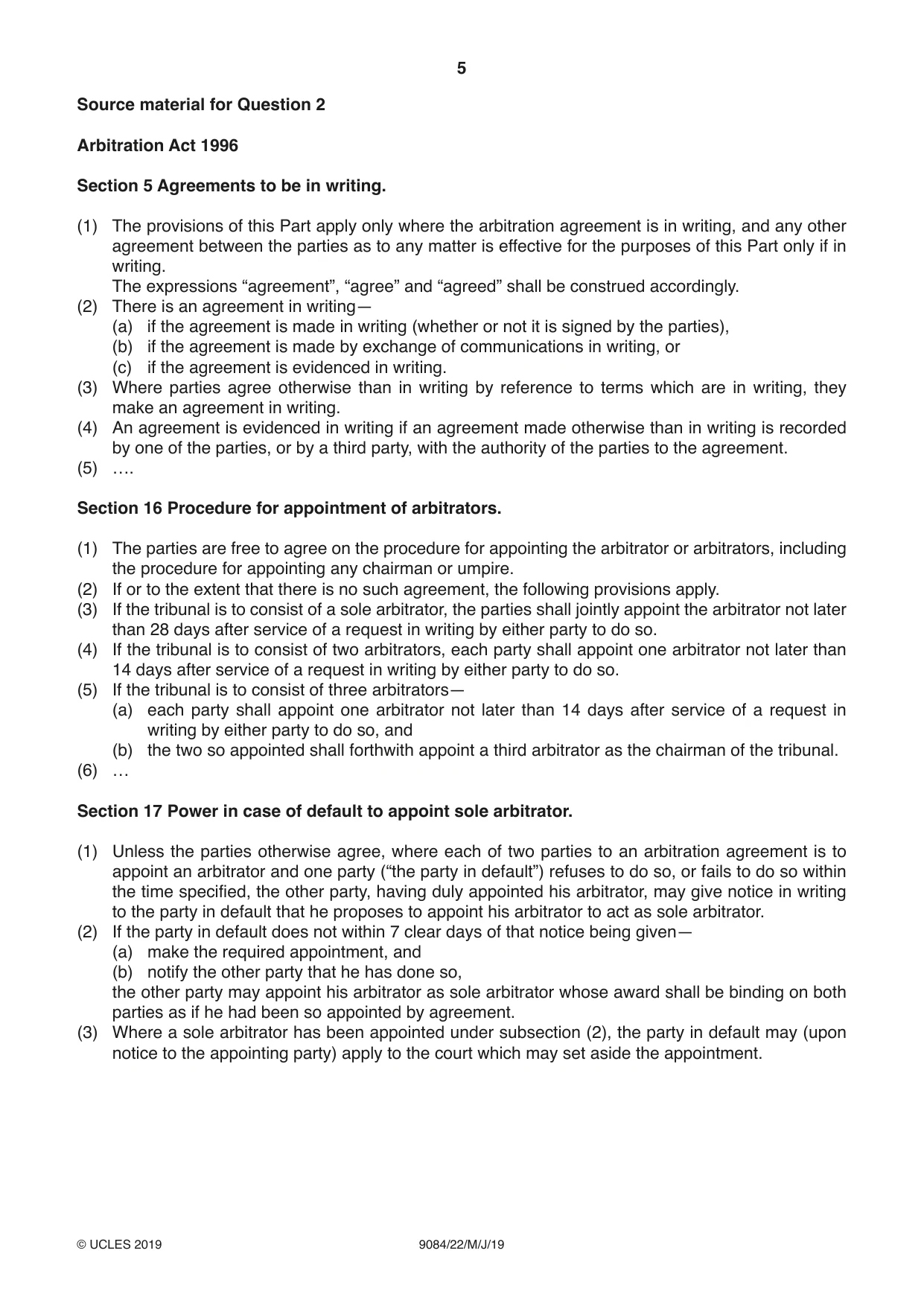
2 (a) Jack’s company is in dispute with a company run by Tim. There is a written agreement to go to arbitration attached to the contract over which they are now in dispute. Jack and Tim signed the contract but not the agreement. The agreement says there should be one arbitrator. Jack sends Tim a letter suggesting Richard as the arbitrator but Tim does not respond. Explain how the Arbitration Act 1996 will apply in the dispute between Jack and Tim. [10] (b) Danal and Franco each own a business. In a meeting by video conference, they agree to a panel of three arbitrators in the event of a dispute. Franco’s secretary records this in writing at the meeting. Danal and Franco have a dispute but cannot agree how to pick the arbitration panel. Danal writes to Franco and asks him to choose an arbitrator. Franco sends Danal a name a week later and Danal sends a second name to Franco a week after that. The two arbitrators pick a third person and begin their arbitration. Explain how the Arbitration Act 1996 will apply in the dispute between Danal and Franco. [10] (c) Marian and Nicola make a contract. They agree by telephone to choose one arbitrator each if they have a dispute. Marian tells Nicola that she has made a written note of the conversation. A year later there is a dispute. Nicola writes to Marian naming Desmond as her chosen arbitrator. Marian writes back five days later refusing Desmond. Marian does not suggest an alternative. Nicola writes to Marian saying she is going to appoint Desmond as sole arbitrator. Marian writes to Nicola saying she has applied to the court to have Desmond’s appointment set aside. Explain how the Arbitration Act 1996 will apply in the dispute between Marian and Nicola. [10] (d) Describe the forms of alternative dispute resolution other than arbitration. Assess the advantages and disadvantages of such methods as a means of resolving civil disputes. [20] Source material for Question 2 Arbitration Act 1996 Section 5 Agreements to be in writing. (1) The provisions of this Part apply only where the arbitration agreement is in writing, and any other agreement between the parties as to any matter is effective for the purposes of this Part only if in writing. The expressions “agreement”, “agree” and “agreed” shall be construed accordingly. (2) There is an agreement in writing— (a) if the agreement is made in writing (whether or not it is signed by the parties), (b) if the agreement is made by exchange of communications in writing, or (c) if the agreement is evidenced in writing. (3) Where parties agree otherwise than in writing by reference to terms which are in writing, they make an agreement in writing. (4) An agreement is evidenced in writing if an agreement made otherwise than in writing is recorded by one of the parties, or by a third party, with the authority of the parties to the agreement. (5) …. Section 16 Procedure for appointment of arbitrators. (1) The parties are free to agree on the procedure for appointing the arbitrator or arbitrators, including the procedure for appointing any chairman or umpire. (2) If or to the extent that there is no such agreement, the following provisions apply. (3) If the tribunal is to consist of a sole arbitrator, the parties shall jointly appoint the arbitrator not later than 28 days after service of a request in writing by either party to do so. (4) If the tribunal is to consist of two arbitrators, each party shall appoint one arbitrator not later than 14 days after service of a request in writing by either party to do so. (5) If the tribunal is to consist of three arbitrators— (a) each party shall appoint one arbitrator not later than 14 days after service of a request in writing by either party to do so, and (b) the two so appointed shall forthwith appoint a third arbitrator as the chairman of the tribunal. (6) … Section 17 Power in case of default to appoint sole arbitrator. (1) Unless the parties otherwise agree, where each of two parties to an arbitration agreement is to appoint an arbitrator and one party (“the party in default”) refuses to do so, or fails to do so within the time specified, the other party, having duly appointed his arbitrator, may give notice in writing to the party in default that he proposes to appoint his arbitrator to act as sole arbitrator. (2) If the party in default does not within 7 clear days of that notice being given— (a) make the required appointment, and (b) notify the other party that he has done so, the other party may appoint his arbitrator as sole arbitrator whose award shall be binding on both parties as if he had been so appointed by agreement. (3) Where a sole arbitrator has been appointed under subsection (2), the party in default may (upon notice to the appointing party) apply to the court which may set aside the appointment.
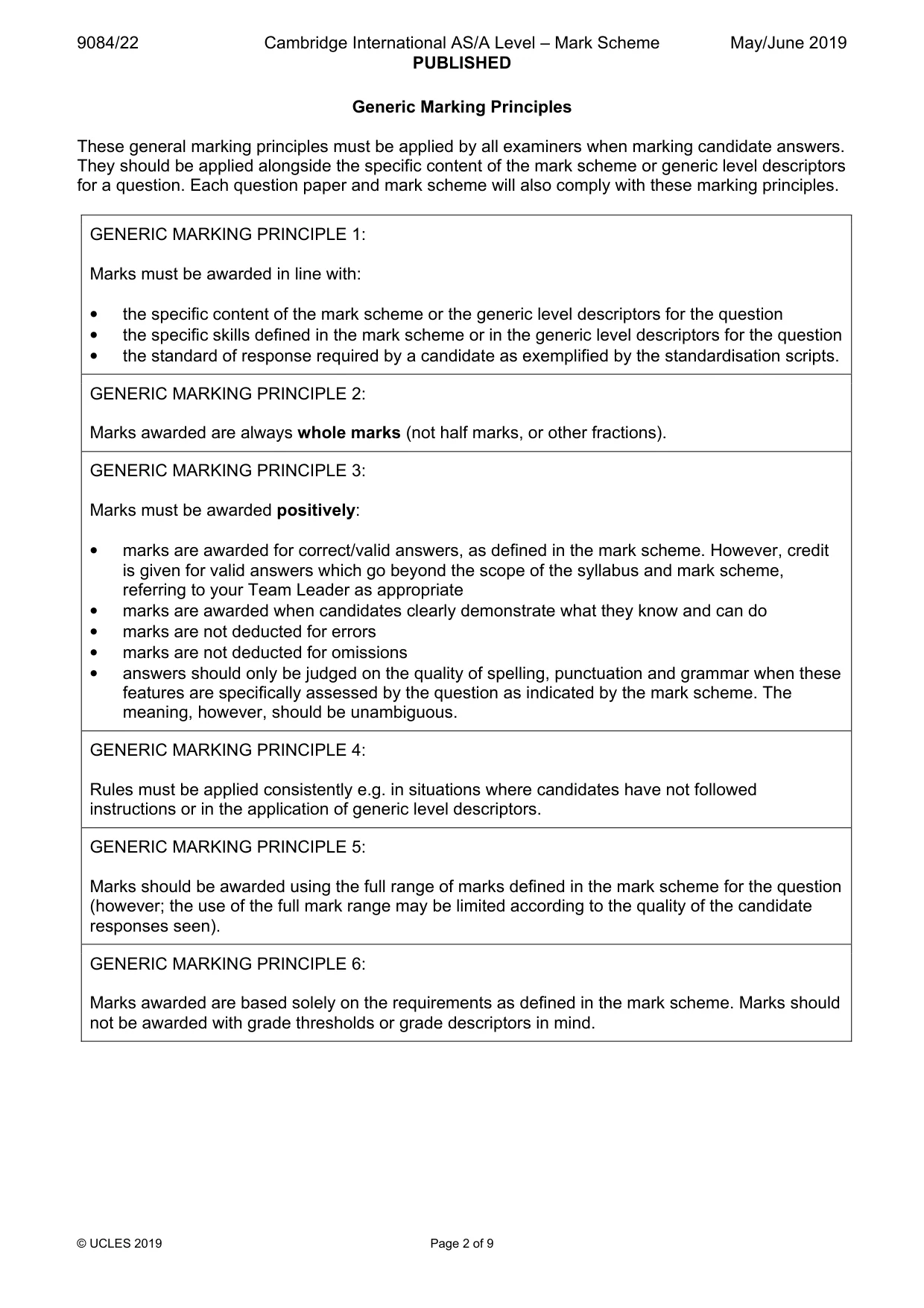
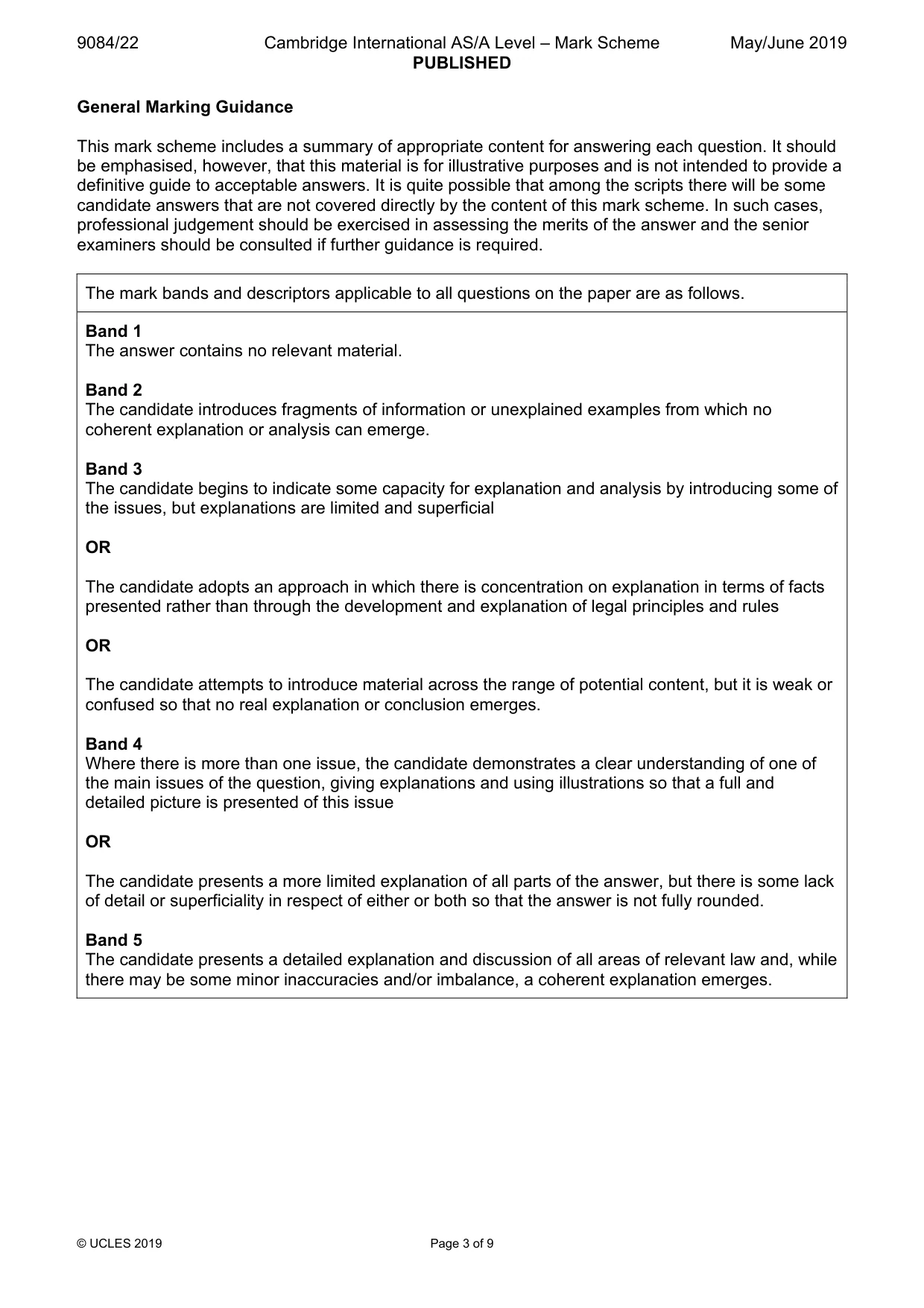
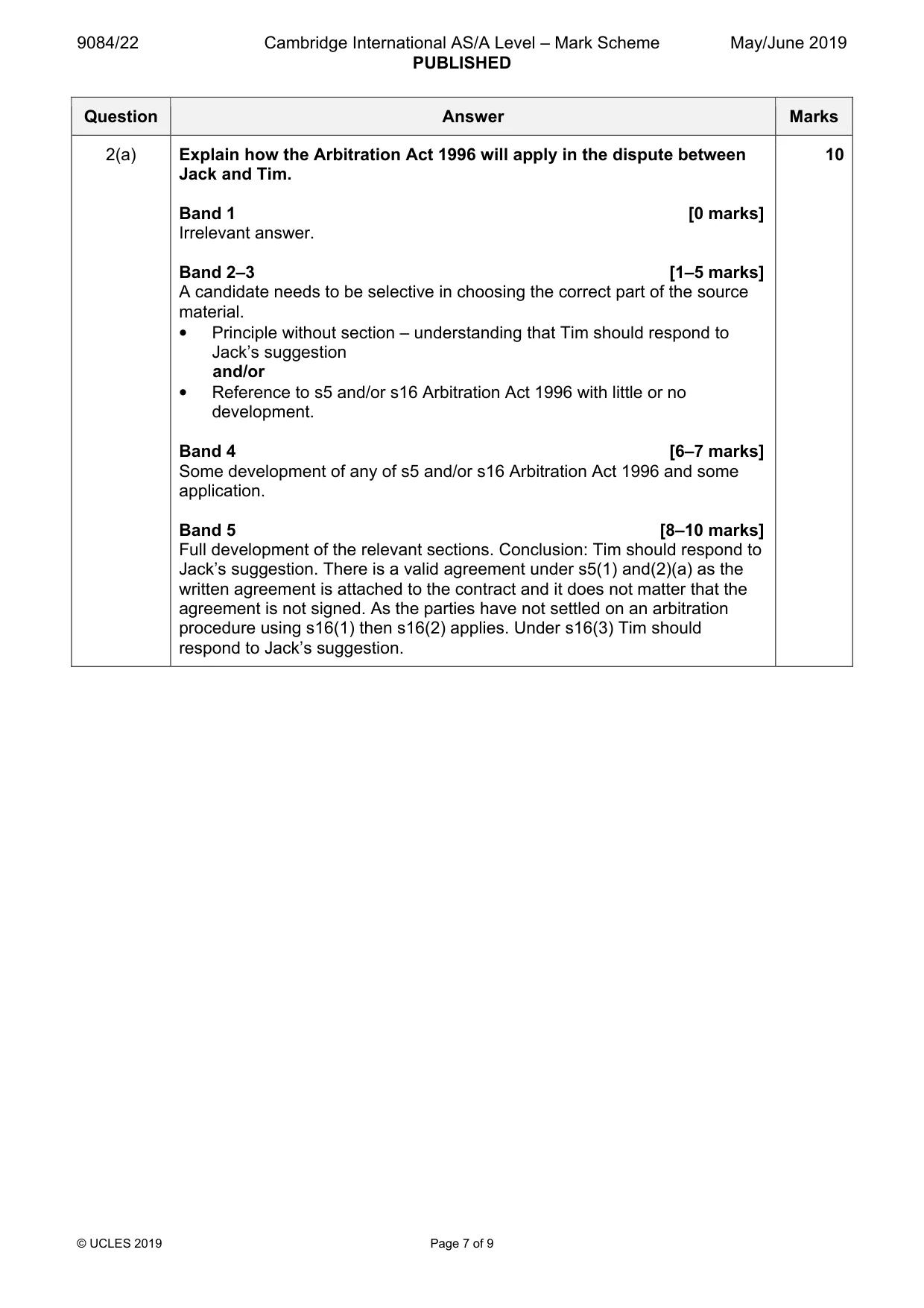
Mark scheme: 2(a) Explain how the Arbitration Act 1996 will apply in the dispute between 10 Jack and Tim. Band 1 [0 marks] Irrelevant answer. Band 2–3 [1–5 marks] A candidate needs to be selective in choosing the correct part of the source material. • Principle without section – understanding that Tim should respond to Jack’s suggestion and/or • Reference to s5 and/or s16 Arbitration Act 1996 with little or no development. Band 4 [6–7 marks] Some development of any of s5 and/or s16 Arbitration Act 1996 and some application. Band 5 [8–10 marks] Full development of the relevant sections. Conclusion: Tim should respond to Jack’s suggestion. There is a valid agreement under s5(1) and(2)(a) as the written agreement is attached to the contract and it does not matter that the agreement is not signed. As the parties have not settled on an arbitration procedure using s16(1) then s16(2) applies. Under s16(3) Tim should respond to Jack’s suggestion. 2(b) Explain how the Arbitration Act 1996 will apply in the dispute between 10 Danal and Franco. Band 1 [0 marks] Irrelevant answer. Band 2–3 [1–5 marks] A candidate needs to be selective in choosing the correct part of the source material. • Principle without section – understanding that the panel picked by Danal and Franco can conduct the arbitration and/or • Reference to s5 and/or s16 Arbitration Act 1996 with little or no development. Band 4 [6–7 marks] Some development of any of s5 and/or s16 Arbitration Act 1996 and some application. Band 5 [8–10 marks] Full development of the relevant sections. Conclusion: the panel put together by Danal and Franco can conduct the arbitration. Although they have not made a written agreement there is an agreement evidenced in writing under s5(2)(c) and the secretary recording their agreement at the meeting comes under s5(4). As there is no agreement using s16(1) as to how to conduct an arbitration, the provisions in s16(2) will apply. S16(5) will be used as they have agreed on three arbitrators; (a) is met as they both propose one name within the time limit and (b) is met as those two then appoint a third arbitrator which is a validly constituted panel. 2(c) Explain how the Arbitration Act 1996 will apply in the dispute between 10 Marian and Nicola. Band 1 [0 marks] Irrelevant answer. Band 2–3 [1–5 marks] A candidate needs to be selective in choosing the correct part of the source material. • Principle without section – understanding that Nicola is entitled to appoint Desmond as the sole arbitrator and/or • Reference to s5 and/or s16 and/or s17 Arbitration Act 1996 with little or no development. Band 4 [6–7 marks] Some development of any of s5 and/or s16 and/or s17 Arbitration Act 1996 and some application. Band 5 [8–10 marks] Full development of the relevant sections. Conclusion: Nicola is entitled to appoint Desmond as the sole arbitrator. There is an agreement to be bound by the clause in the contract under s5(2)(c) and (4) as Marian tells Nicola she has made a note of their telephone conversation. The situation comes within s16(4) as they have agreed to use two arbitrators, with Nicola and Marian appointing one each. They come within s17(1) as they cannot agree on the process once there is a dispute. Marian would appear to fail under s17(2) as she does not follow the correct procedure. 2(d) Describe the forms of alternative dispute resolution other than 20 arbitration. Assess the advantages and disadvantages of such methods as a means of resolving civil disputes. Band 1 [0 marks] Irrelevant answer. Band 2 [1–6 marks] Describes negotiation, mediation and conciliation and/or some assessment of the advantages and disadvantages of these methods in very general terms. Band 3 [7–13 marks] Some more detailed description of methods of ADR other than arbitration, perhaps with a factual focus, and some general assessment of the advantages and disadvantages they provide. Band 4–5 [14–20 marks] Very good description of ADR methods and very good assessment of the advantages and disadvantages of these methods of resolving civil disputes. To reach higher marks, all aspects of the question need to be dealt with showing good critical awareness.
What was in this paper
The subtopics covered by these 2 questions, and how many questions each got. Open one in a new tab to see every Cambridge question on it.
What you needed in this session
Cambridge’s own grade thresholds for 2019 May/June, Paper 2 · Variant 2. A higher threshold means an easier paper — the bar moves with how the cohort did.