Cambridge A Level Law 9084 — 2020 Oct/Nov Paper 2 · Variant 2
9084/22/O/N/20 · 2 questions · 50 marks · ≈56 min
The question paper and its mark scheme, free to read here and free to download. This is Cambridge’s own paper, exactly as it was sat.
Question paper8 pages



Mark scheme10 pages
Answers below. Sit the paper first if you are practising.
Questions as text
Q1 · Sergeant Ali is a serving police officer
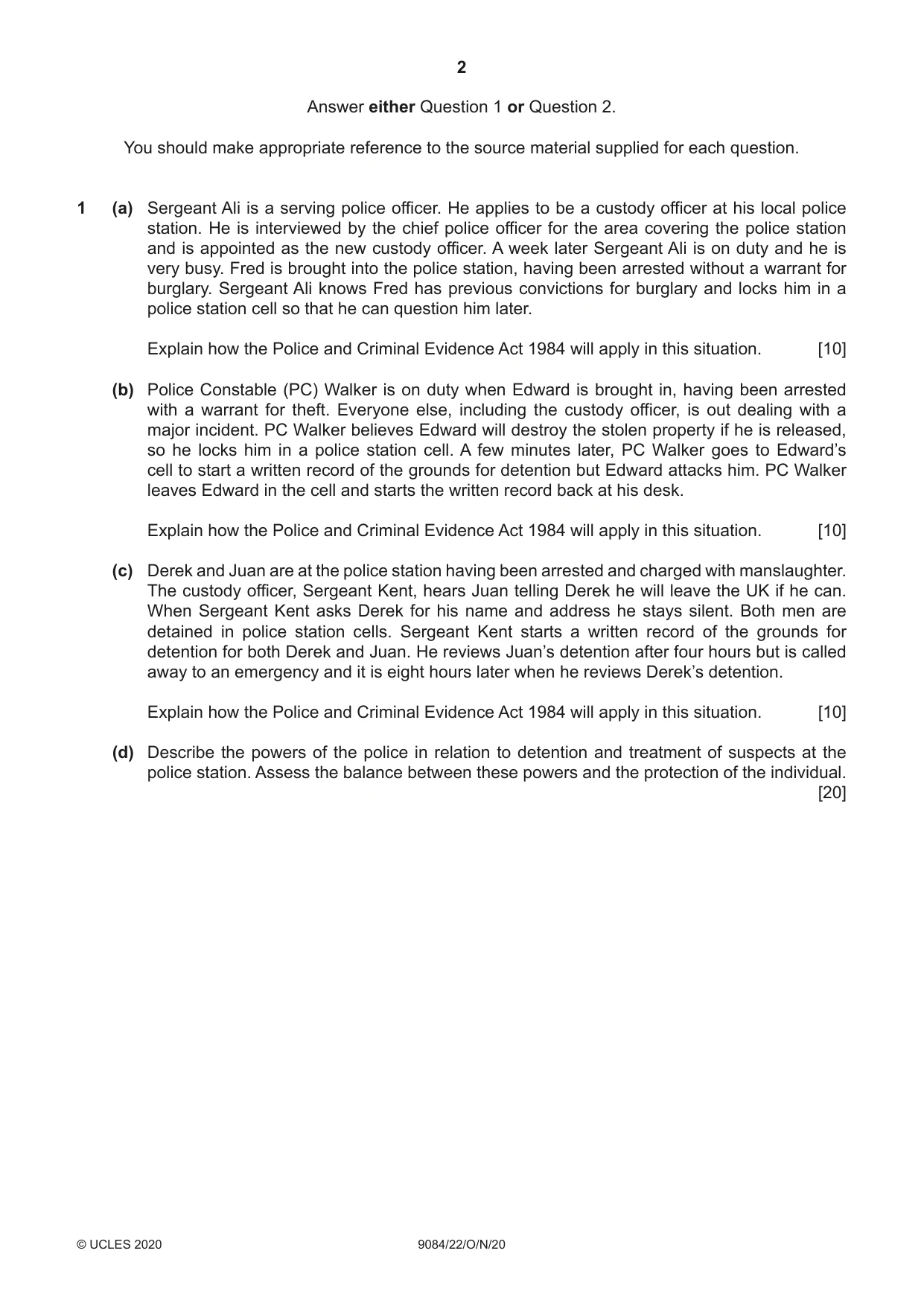
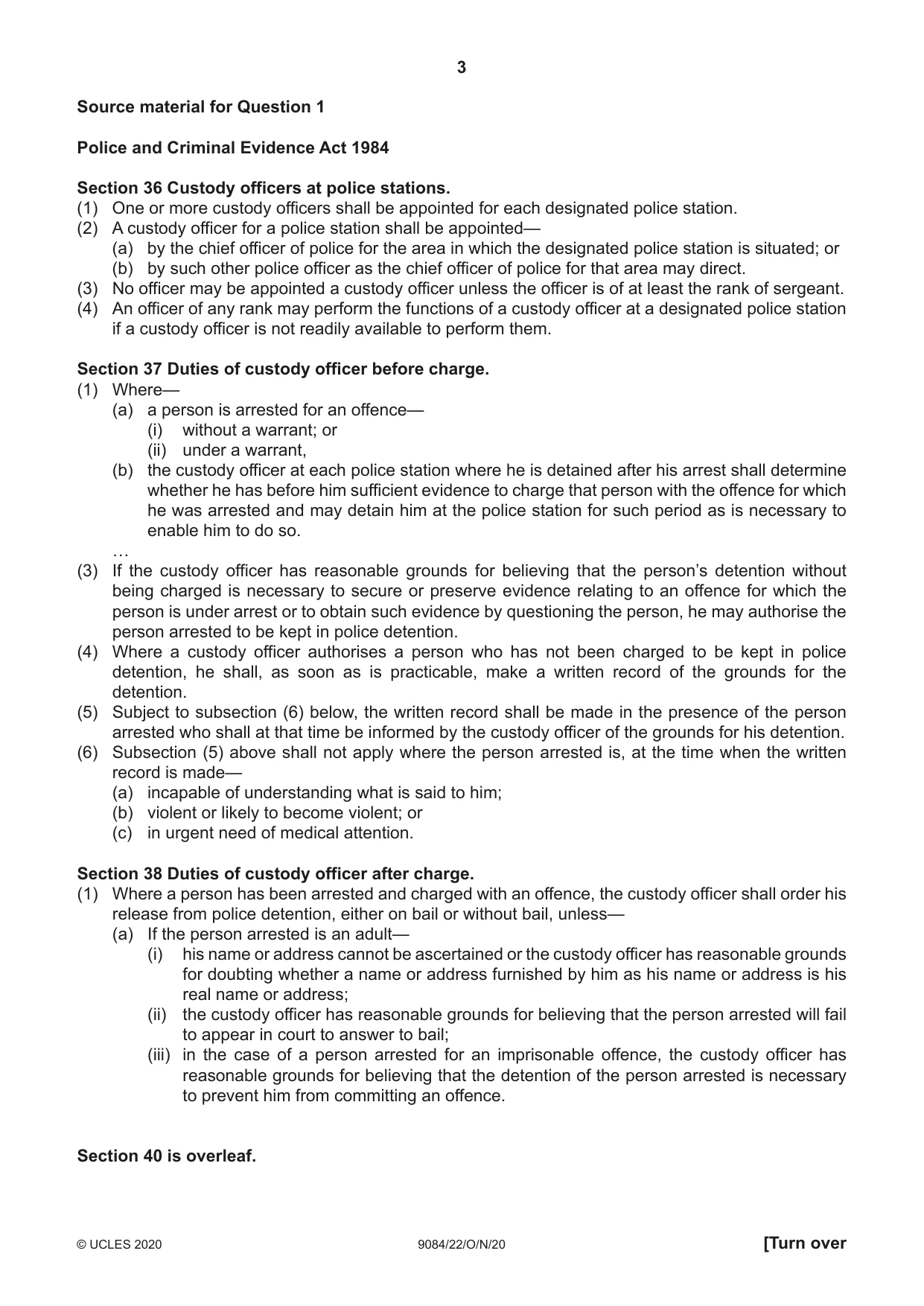
1 (a) Sergeant Ali is a serving police officer. He applies to be a custody officer at his local police station. He is interviewed by the chief police officer for the area covering the police station and is appointed as the new custody officer. A week later Sergeant Ali is on duty and he is very busy. Fred is brought into the police station, having been arrested without a warrant for burglary. Sergeant Ali knows Fred has previous convictions for burglary and locks him in a police station cell so that he can question him later. Explain how the Police and Criminal Evidence Act 1984 will apply in this situation. [10] (b) Police Constable (PC) Walker is on duty when Edward is brought in, having been arrested with a warrant for theft. Everyone else, including the custody officer, is out dealing with a major incident. PC Walker believes Edward will destroy the stolen property if he is released, so he locks him in a police station cell. A few minutes later, PC Walker goes to Edward’s cell to start a written record of the grounds for detention but Edward attacks him. PC Walker leaves Edward in the cell and starts the written record back at his desk. Explain how the Police and Criminal Evidence Act 1984 will apply in this situation. [10] (c) Derek and Juan are at the police station having been arrested and charged with manslaughter. The custody officer, Sergeant Kent, hears Juan telling Derek he will leave the UK if he can. When Sergeant Kent asks Derek for his name and address he stays silent. Both men are detained in police station cells. Sergeant Kent starts a written record of the grounds for detention for both Derek and Juan. He reviews Juan’s detention after four hours but is called away to an emergency and it is eight hours later when he reviews Derek’s detention. Explain how the Police and Criminal Evidence Act 1984 will apply in this situation. [10] (d) Describe the powers of the police in relation to detention and treatment of suspects at the police station. Assess the balance between these powers and the protection of the individual. [20] Source material for Question 1 Police and Criminal Evidence Act 1984 Section 36 Custody officers at police stations. (1) One or more custody officers shall be appointed for each designated police station. (2) A custody officer for a police station shall be appointed— (a) by the chief officer of police for the area in which the designated police station is situated; or (b) by such other police officer as the chief officer of police for that area may direct. (3) No officer may be appointed a custody officer unless the officer is of at least the rank of sergeant. (4) An officer of any rank may perform the functions of a custody officer at a designated police station if a custody officer is not readily available to perform them. Section 37 Duties of custody officer before charge. (1) Where— (a) a person is arrested for an offence— (i) without a warrant; or (ii) under a warrant, (b) the custody officer at each police station where he is detained after his arrest shall determine whether he has before him sufficient evidence to charge that person with the offence for which he was arrested and may detain him at the police station for such period as is necessary to enable him to do so. … (3) If the custody officer has reasonable grounds for believing that the person’s detention without being charged is necessary to secure or preserve evidence relating to an offence for which the person is under arrest or to obtain such evidence by questioning the person, he may authorise the person arrested to be kept in police detention. (4) Where a custody officer authorises a person who has not been charged to be kept in police detention, he shall, as soon as is practicable, make a written record of the grounds for the detention. (5) Subject to subsection (6) below, the written record shall be made in the presence of the person arrested who shall at that time be informed by the custody officer of the grounds for his detention. (6) Subsection (5) above shall not apply where the person arrested is, at the time when the written record is made— (a) incapable of understanding what is said to him; (b) violent or likely to become violent; or (c) in urgent need of medical attention. Section 38 Duties of custody officer after charge. (1) Where a person has been arrested and charged with an offence, the custody officer shall order his release from police detention, either on bail or without bail, unless— (a) If the person arrested is an adult— (i) his name or address cannot be ascertained or the custody officer has reasonable grounds for doubting whether a name or address furnished by him as his name or address is his real name or address; (ii) the custody officer has reasonable grounds for believing that the person arrested will fail to appear in court to answer to bail; (iii) in the case of a person arrested for an imprisonable offence, the custody officer has reasonable grounds for believing that the detention of the person arrested is necessary to prevent him from committing an offence. Section 40 is overleaf. Section 40 Review of police detention. (1) Reviews of the detention of each person in police detention in connection with the investigation of an offence shall be carried out periodically in accordance with the following provisions of this section— (a) in the case of a person who has been arrested and charged, by the custody officer; and (b) in the case of a person who has been arrested but not charged, by an officer of at least the rank of inspector who has not been directly involved in the investigation. … (3) The first review shall be not later than six hours after the detention was first authorised.
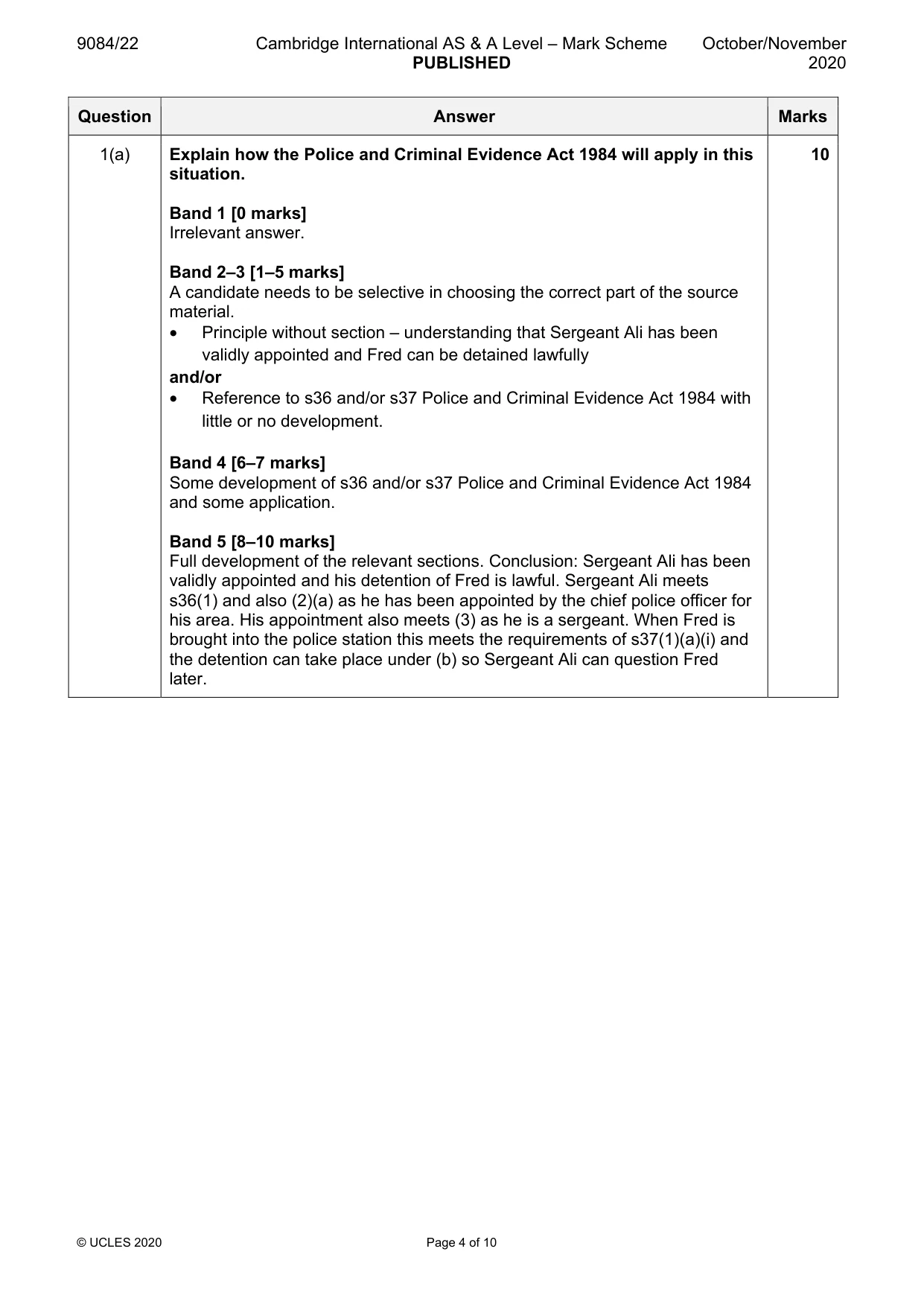
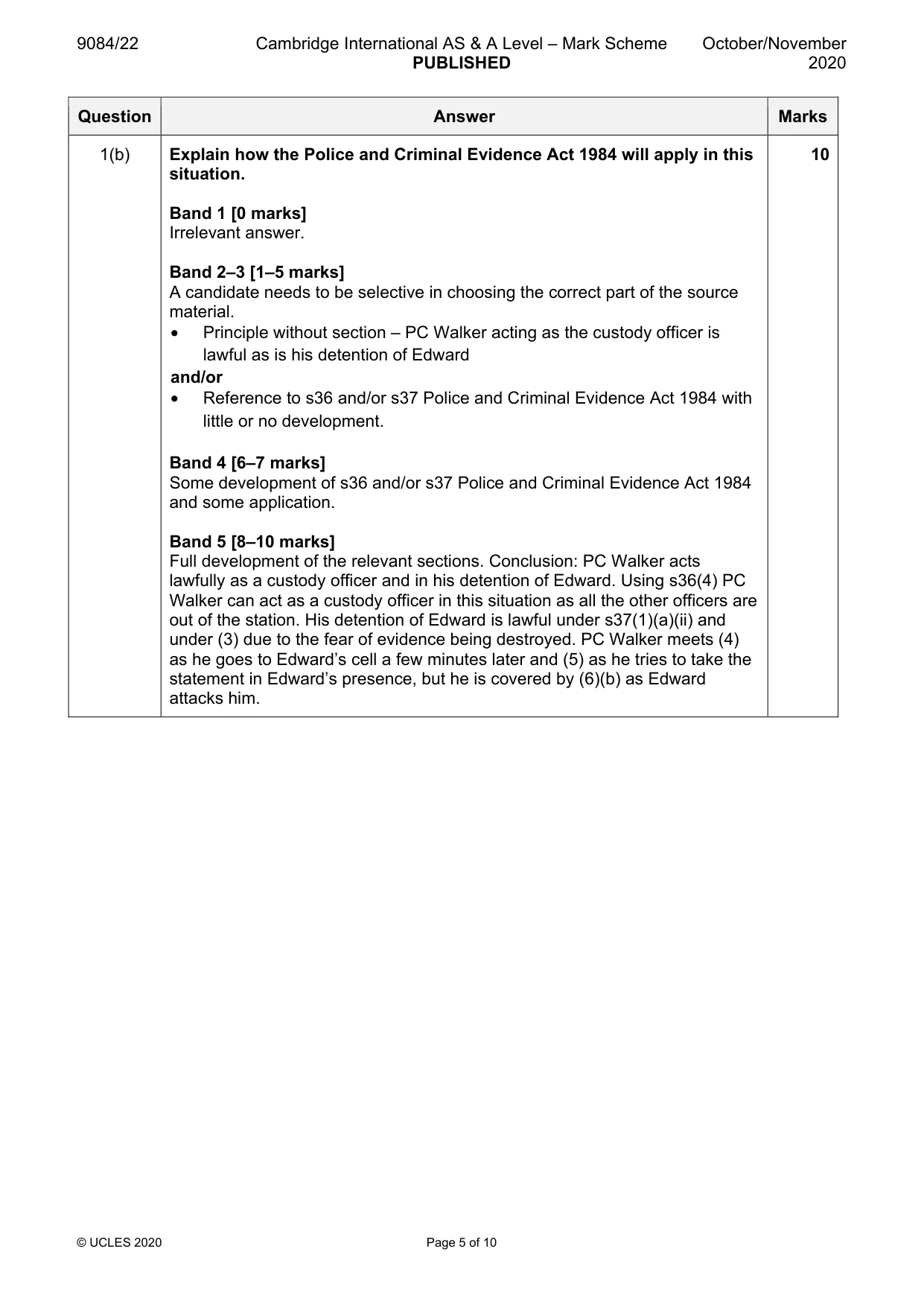
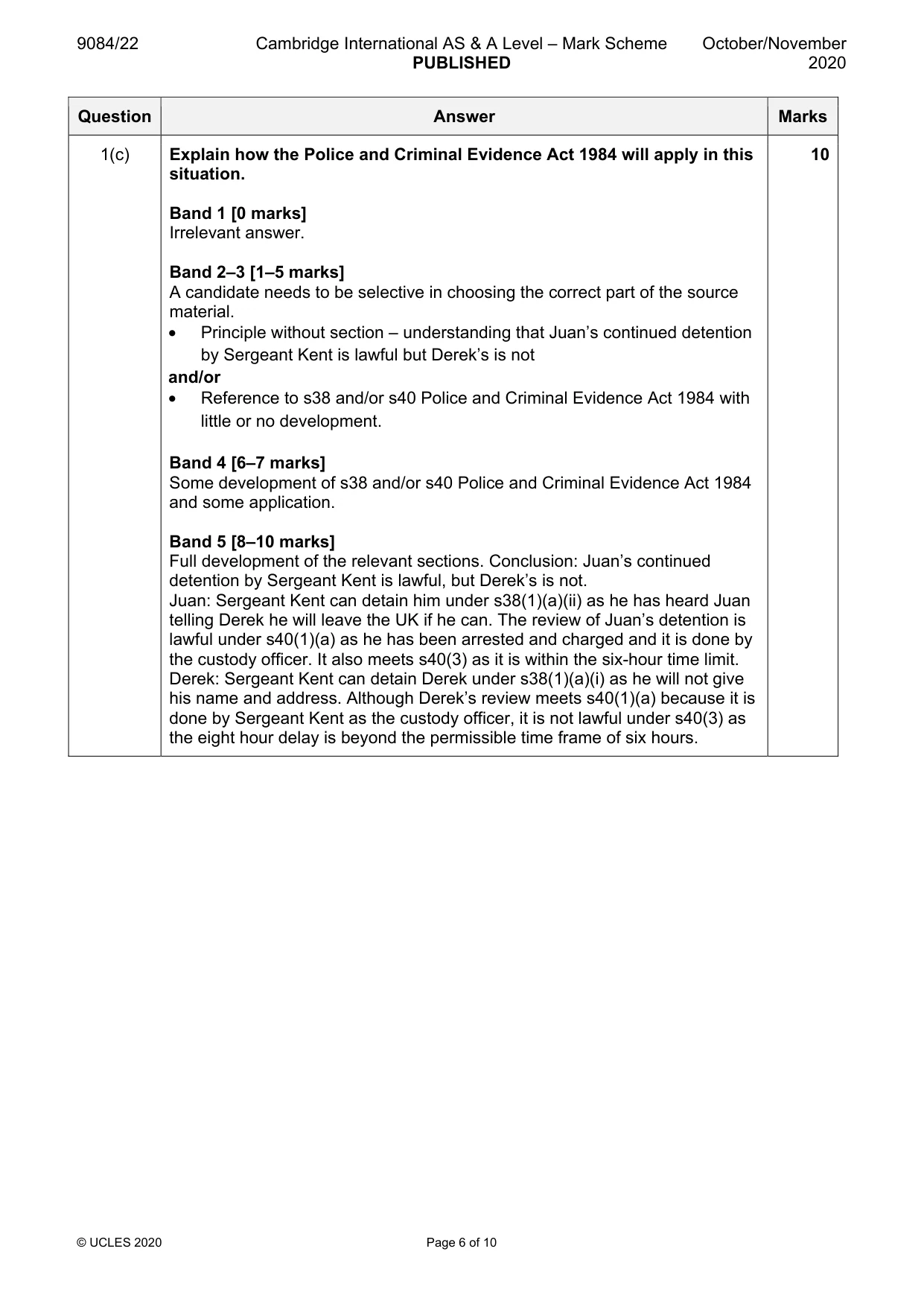
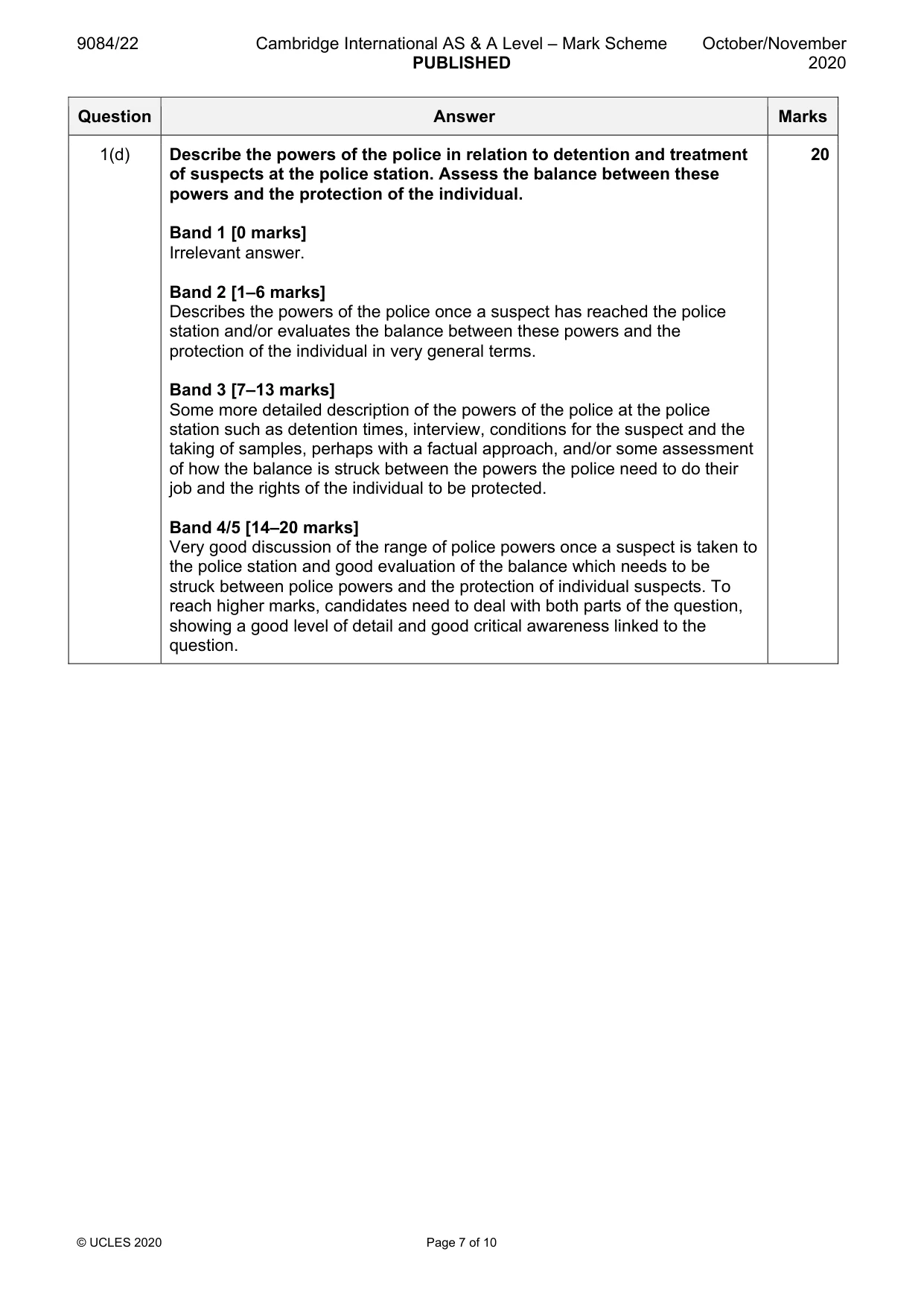
Mark scheme: Question Answer Marks 1(a) Explain how the Police and Criminal Evidence Act 1984 will apply in this 10 situation. Band 1 [0 marks] Irrelevant answer. Band 2–3 [1–5 marks] A candidate needs to be selective in choosing the correct part of the source material. • Principle without section – understanding that Sergeant Ali has been validly appointed and Fred can be detained lawfully and/or • Reference to s36 and/or s37 Police and Criminal Evidence Act 1984 with little or no development. Band 4 [6–7 marks] Some development of s36 and/or s37 Police and Criminal Evidence Act 1984 and some application. Band 5 [8–10 marks] Full development of the relevant sections. Conclusion: Sergeant Ali has been validly appointed and his detention of Fred is lawful. Sergeant Ali meets s36(1) and also (2)(a) as he has been appointed by the chief police officer for his area. His appointment also meets (3) as he is a sergeant. When Fred is brought into the police station this meets the requirements of s37(1)(a)(i) and the detention can take place under (b) so Sergeant Ali can question Fred later. 1(b) Explain how the Police and Criminal Evidence Act 1984 will apply in this 10 situation. Band 1 [0 marks] Irrelevant answer. Band 2–3 [1–5 marks] A candidate needs to be selective in choosing the correct part of the source material. • Principle without section – PC Walker acting as the custody officer is lawful as is his detention of Edward and/or • Reference to s36 and/or s37 Police and Criminal Evidence Act 1984 with little or no development. Band 4 [6–7 marks] Some development of s36 and/or s37 Police and Criminal Evidence Act 1984 and some application. Band 5 [8–10 marks] Full development of the relevant sections. Conclusion: PC Walker acts lawfully as a custody officer and in his detention of Edward. Using s36(4) PC Walker can act as a custody officer in this situation as all the other officers are out of the station. His detention of Edward is lawful under s37(1)(a)(ii) and under (3) due to the fear of evidence being destroyed. PC Walker meets (4) as he goes to Edward’s cell a few minutes later and (5) as he tries to take the statement in Edward’s presence, but he is covered by (6)(b) as Edward attacks him. 1(c) Explain how the Police and Criminal Evidence Act 1984 will apply in this 10 situation. Band 1 [0 marks] Irrelevant answer. Band 2–3 [1–5 marks] A candidate needs to be selective in choosing the correct part of the source material. • Principle without section – understanding that Juan’s continued detention by Sergeant Kent is lawful but Derek’s is not and/or • Reference to s38 and/or s40 Police and Criminal Evidence Act 1984 with little or no development. Band 4 [6–7 marks] Some development of s38 and/or s40 Police and Criminal Evidence Act 1984 and some application. Band 5 [8–10 marks] Full development of the relevant sections. Conclusion: Juan’s continued detention by Sergeant Kent is lawful, but Derek’s is not. Juan: Sergeant Kent can detain him under s38(1)(a)(ii) as he has heard Juan telling Derek he will leave the UK if he can. The review of Juan’s detention is lawful under s40(1)(a) as he has been arrested and charged and it is done by the custody officer. It also meets s40(3) as it is within the six-hour time limit. Derek: Sergeant Kent can detain Derek under s38(1)(a)(i) as he will not give his name and address. Although Derek’s review meets s40(1)(a) because it is done by Sergeant Kent as the custody officer, it is not lawful under s40(3) as the eight hour delay is beyond the permissible time frame of six hours. 1(d) Describe the powers of the police in relation to detention and treatment 20 of suspects at the police station. Assess the balance between these powers and the protection of the individual. Band 1 [0 marks] Irrelevant answer. Band 2 [1–6 marks] Describes the powers of the police once a suspect has reached the police station and/or evaluates the balance between these powers and the protection of the individual in very general terms. Band 3 [7–13 marks] Some more detailed description of the powers of the police at the police station such as detention times, interview, conditions for the suspect and the taking of samples, perhaps with a factual approach, and/or some assessment of how the balance is struck between the powers the police need to do their job and the rights of the individual to be protected. Band 4/5 [14–20 marks] Very good discussion of the range of police powers once a suspect is taken to the police station and good evaluation of the balance which needs to be struck between police powers and the protection of individual suspects. To reach higher marks, candidates need to deal with both parts of the question, showing a good level of detail and good critical awareness linked to the question.
Q2 · Francis owns and runs a factory which makes chutney
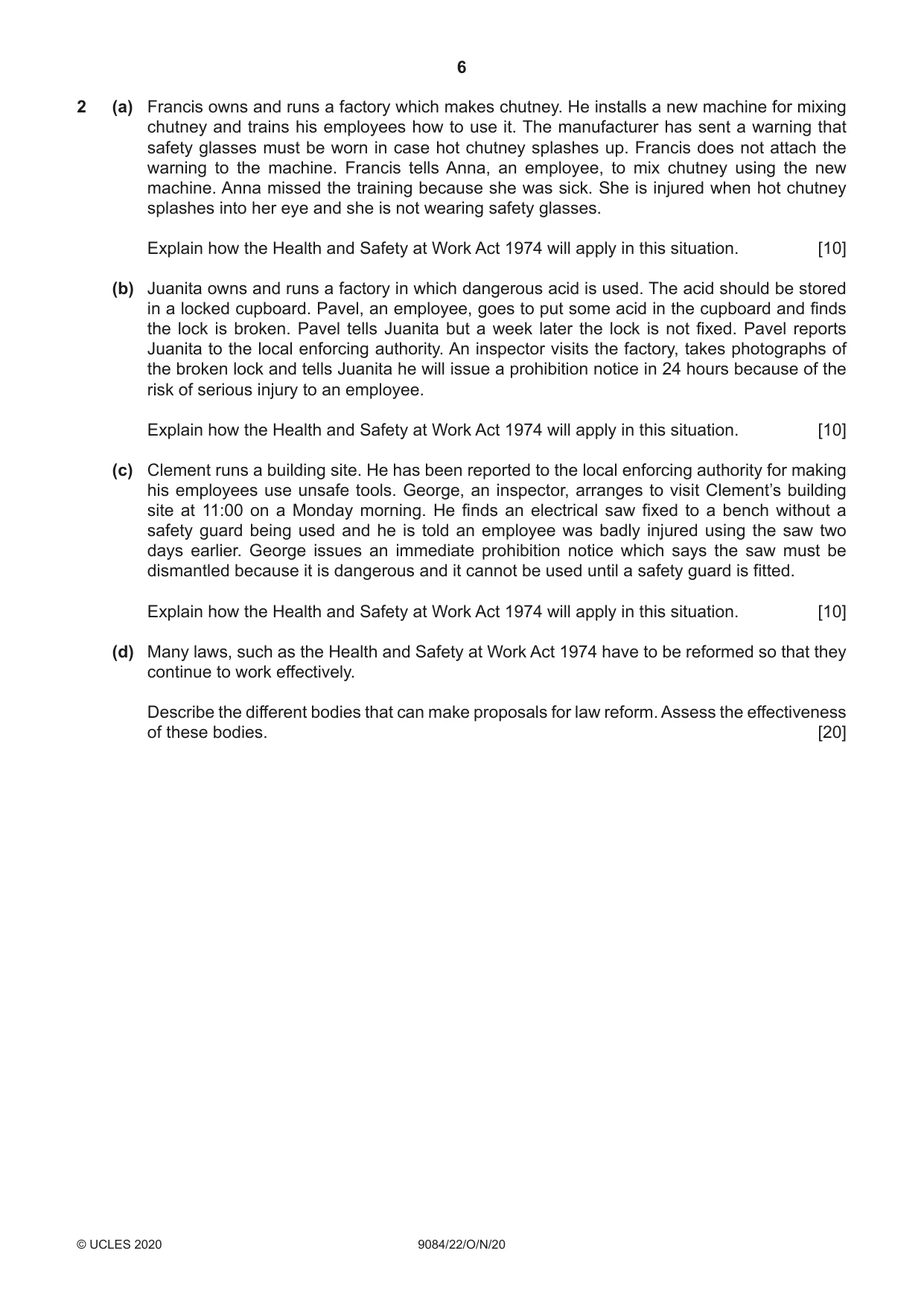
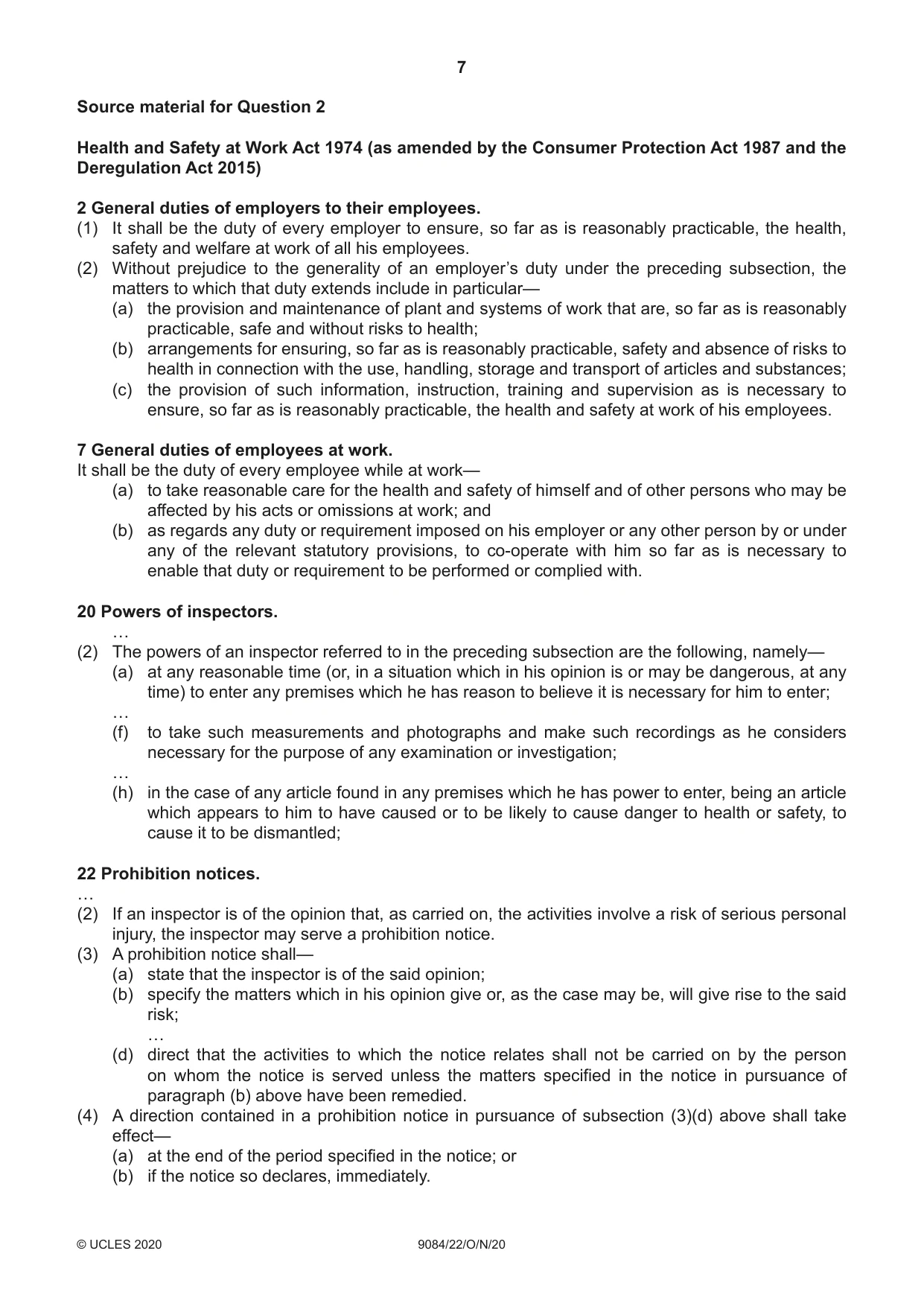
2 (a) Francis owns and runs a factory which makes chutney. He installs a new machine for mixing chutney and trains his employees how to use it. The manufacturer has sent a warning that safety glasses must be worn in case hot chutney splashes up. Francis does not attach the warning to the machine. Francis tells Anna, an employee, to mix chutney using the new machine. Anna missed the training because she was sick. She is injured when hot chutney splashes into her eye and she is not wearing safety glasses. Explain how the Health and Safety at Work Act 1974 will apply in this situation. [10] (b) Juanita owns and runs a factory in which dangerous acid is used. The acid should be stored in a locked cupboard. Pavel, an employee, goes to put some acid in the cupboard and finds the lock is broken. Pavel tells Juanita but a week later the lock is not fixed. Pavel reports Juanita to the local enforcing authority. An inspector visits the factory, takes photographs of the broken lock and tells Juanita he will issue a prohibition notice in 24 hours because of the risk of serious injury to an employee. Explain how the Health and Safety at Work Act 1974 will apply in this situation. [10] (c) Clement runs a building site. He has been reported to the local enforcing authority for making his employees use unsafe tools. George, an inspector, arranges to visit Clement’s building site at 11:00 on a Monday morning. He finds an electrical saw fixed to a bench without a safety guard being used and he is told an employee was badly injured using the saw two days earlier. George issues an immediate prohibition notice which says the saw must be dismantled because it is dangerous and it cannot be used until a safety guard is fitted. Explain how the Health and Safety at Work Act 1974 will apply in this situation. [10] (d) Many laws, such as the Health and Safety at Work Act 1974 have to be reformed so that they continue to work effectively. Describe the different bodies that can make proposals for law reform. Assess the effectiveness of these bodies. [20] Source material for Question 2 Health and Safety at Work Act 1974 (as amended by the Consumer Protection Act 1987 and the Deregulation Act 2015) 2 General duties of employers to their employees. (1) It shall be the duty of every employer to ensure, so far as is reasonably practicable, the health, safety and welfare at work of all his employees. (2) Without prejudice to the generality of an employer’s duty under the preceding subsection, the matters to which that duty extends include in particular— (a) the provision and maintenance of plant and systems of work that are, so far as is reasonably practicable, safe and without risks to health; (b) arrangements for ensuring, so far as is reasonably practicable, safety and absence of risks to health in connection with the use, handling, storage and transport of articles and substances; (c) the provision of such information, instruction, training and supervision as is necessary to ensure, so far as is reasonably practicable, the health and safety at work of his employees. 7 General duties of employees at work. It shall be the duty of every employee while at work— (a) to take reasonable care for the health and safety of himself and of other persons who may be affected by his acts or omissions at work; and (b) as regards any duty or requirement imposed on his employer or any other person by or under any of the relevant statutory provisions, to co-operate with him so far as is necessary to enable that duty or requirement to be performed or complied with. 20 Powers of inspectors. … (2) The powers of an inspector referred to in the preceding subsection are the following, namely— (a) at any reasonable time (or, in a situation which in his opinion is or may be dangerous, at any time) to enter any premises which he has reason to believe it is necessary for him to enter; … (f) to take such measurements and photographs and make such recordings as he considers necessary for the purpose of any examination or investigation; … (h) in the case of any article found in any premises which he has power to enter, being an article which appears to him to have caused or to be likely to cause danger to health or safety, to cause it to be dismantled; 22 Prohibition notices. … (2) If an inspector is of the opinion that, as carried on, the activities involve a risk of serious personal injury, the inspector may serve a prohibition notice. (3) A prohibition notice shall— (a) state that the inspector is of the said opinion; (b) specify the matters which in his opinion give or, as the case may be, will give rise to the said risk; … (d) direct that the activities to which the notice relates shall not be carried on by the person on whom the notice is served unless the matters specified in the notice in pursuance of paragraph (b) above have been remedied. (4) A direction contained in a prohibition notice in pursuance of subsection (3)(d) above shall take effect— (a) at the end of the period specified in the notice; or (b) if the notice so declares, immediately.
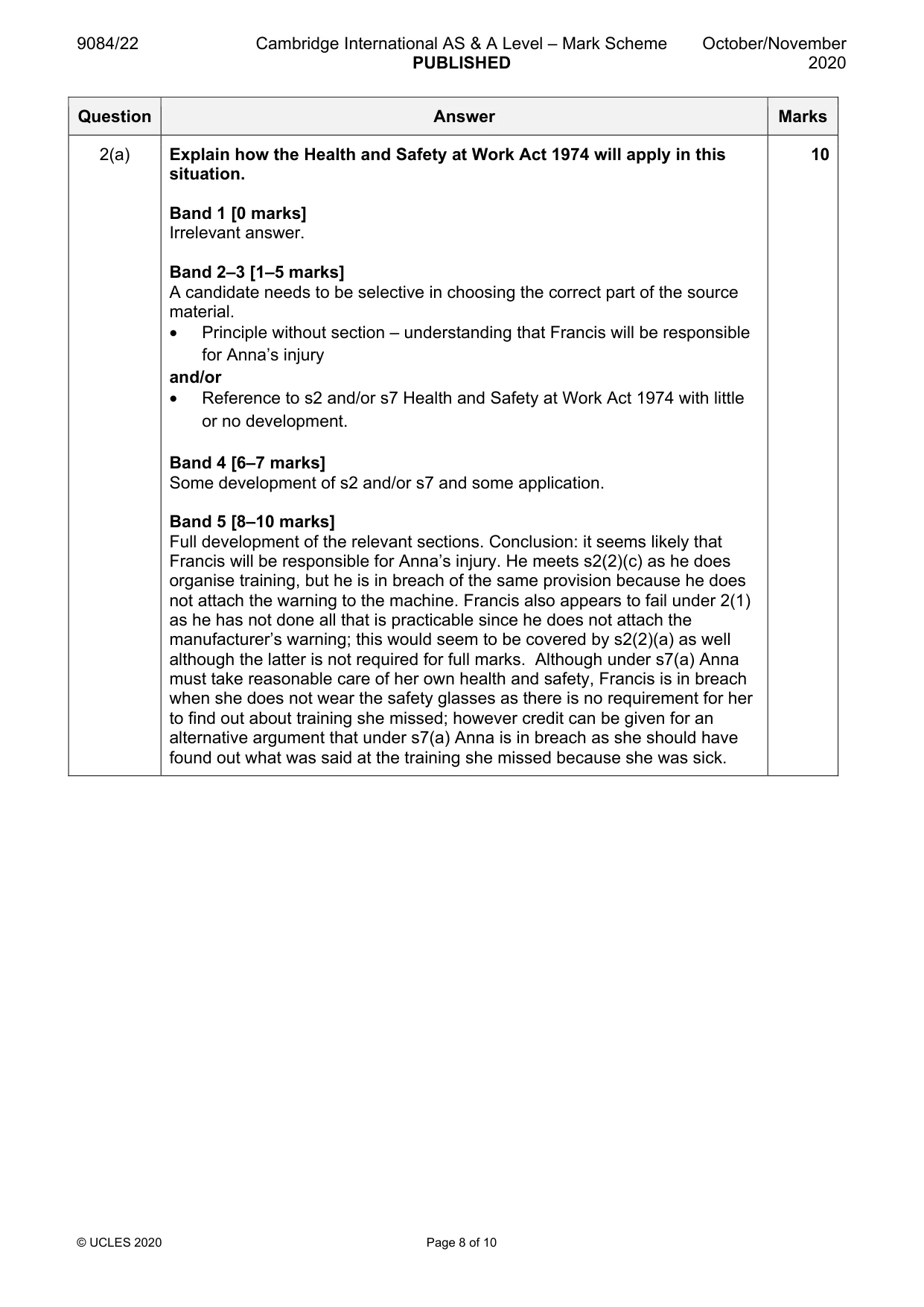
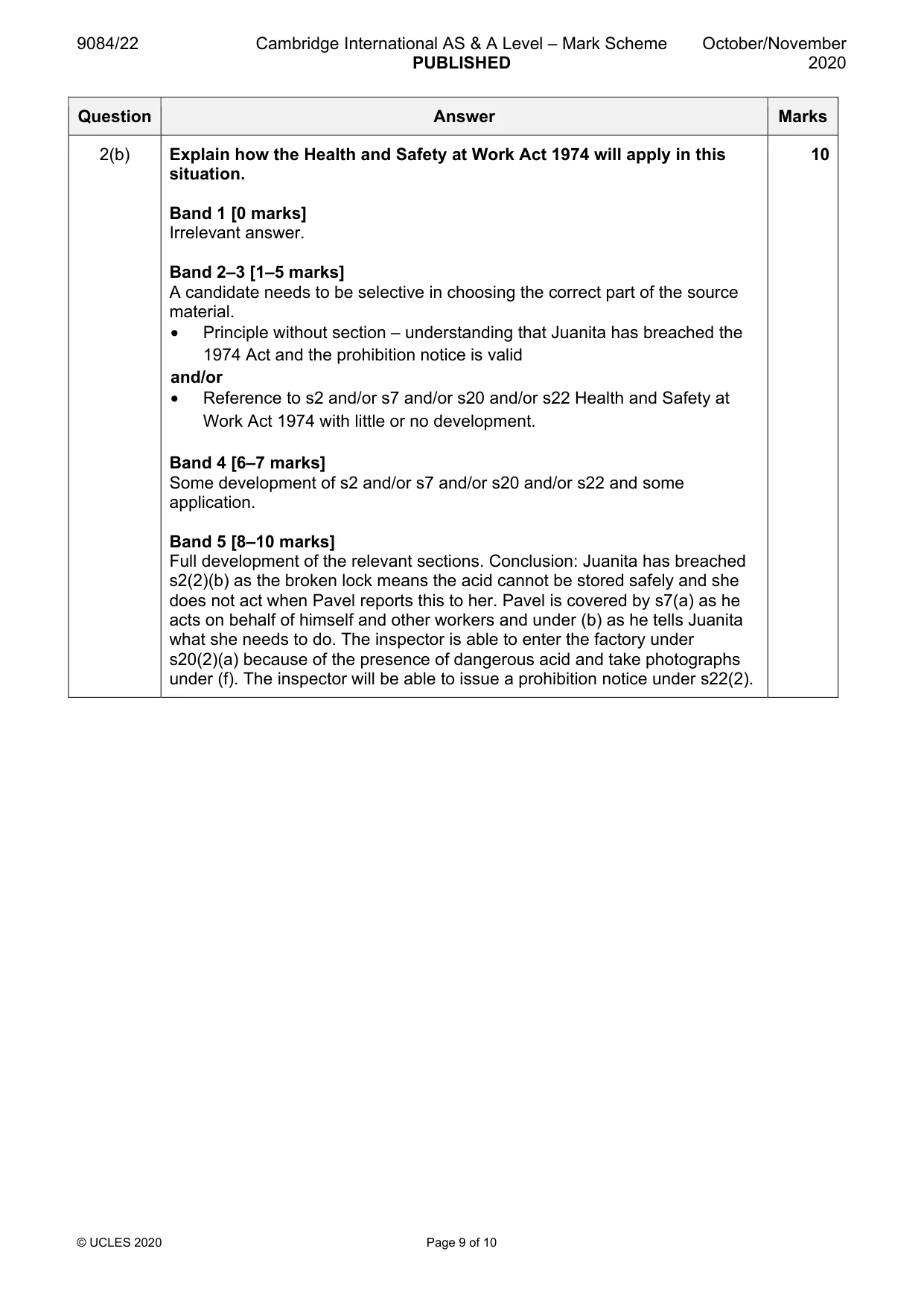
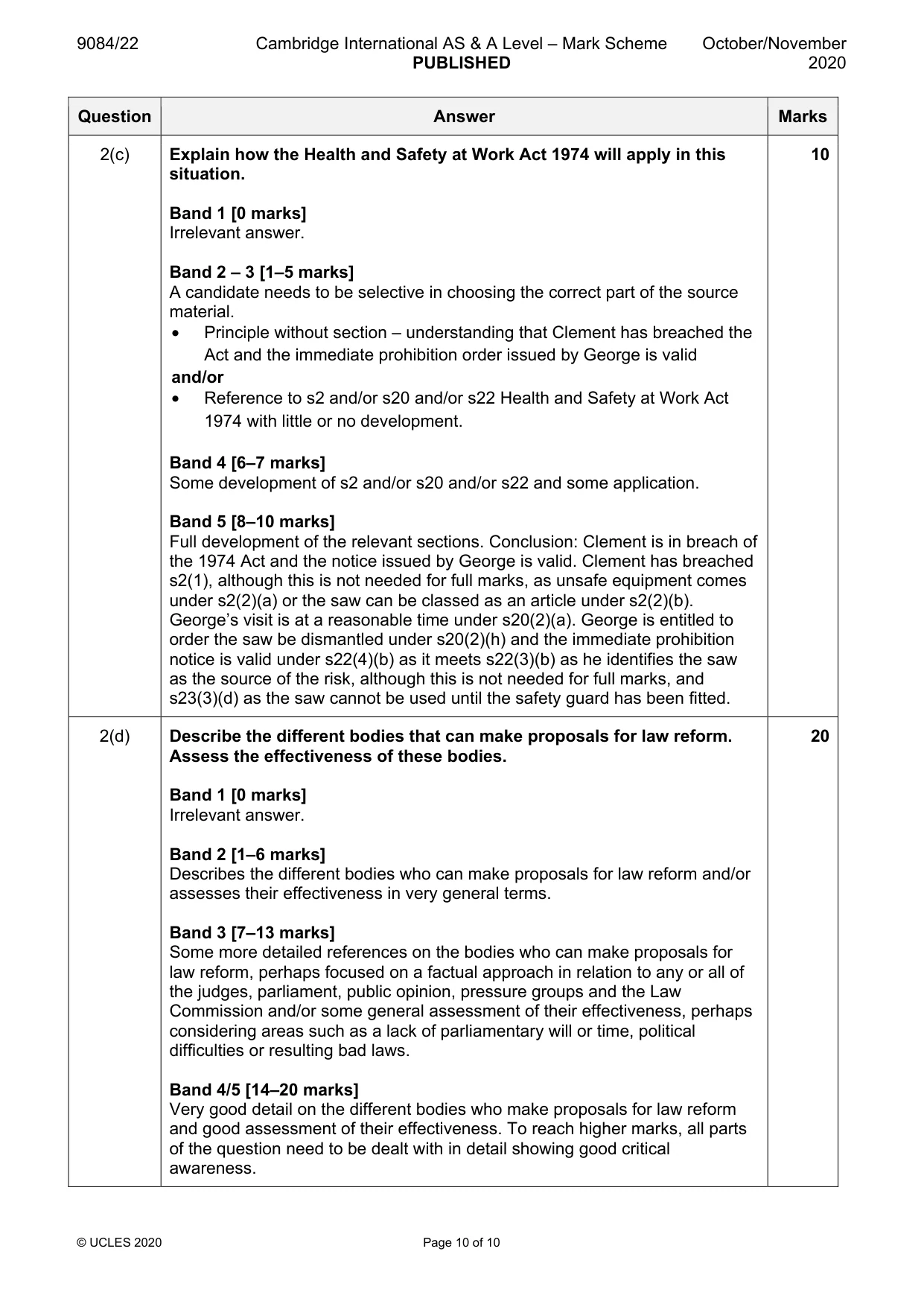
Mark scheme: 2(a) Explain how the Health and Safety at Work Act 1974 will apply in this 10 situation. Band 1 [0 marks] Irrelevant answer. Band 2–3 [1–5 marks] A candidate needs to be selective in choosing the correct part of the source material. • Principle without section – understanding that Francis will be responsible for Anna’s injury and/or • Reference to s2 and/or s7 Health and Safety at Work Act 1974 with little or no development. Band 4 [6–7 marks] Some development of s2 and/or s7 and some application. Band 5 [8–10 marks] Full development of the relevant sections. Conclusion: it seems likely that Francis will be responsible for Anna’s injury. He meets s2(2)(c) as he does organise training, but he is in breach of the same provision because he does not attach the warning to the machine. Francis also appears to fail under 2(1) as he has not done all that is practicable since he does not attach the manufacturer’s warning; this would seem to be covered by s2(2)(a) as well although the latter is not required for full marks. Although under s7(a) Anna must take reasonable care of her own health and safety, Francis is in breach when she does not wear the safety glasses as there is no requirement for her to find out about training she missed; however credit can be given for an alternative argument that under s7(a) Anna is in breach as she should have found out what was said at the training she missed because she was sick. 2(b) Explain how the Health and Safety at Work Act 1974 will apply in this 10 situation. Band 1 [0 marks] Irrelevant answer. Band 2–3 [1–5 marks] A candidate needs to be selective in choosing the correct part of the source material. • Principle without section – understanding that Juanita has breached the 1974 Act and the prohibition notice is valid and/or • Reference to s2 and/or s7 and/or s20 and/or s22 Health and Safety at Work Act 1974 with little or no development. Band 4 [6–7 marks] Some development of s2 and/or s7 and/or s20 and/or s22 and some application. Band 5 [8–10 marks] Full development of the relevant sections. Conclusion: Juanita has breached s2(2)(b) as the broken lock means the acid cannot be stored safely and she does not act when Pavel reports this to her. Pavel is covered by s7(a) as he acts on behalf of himself and other workers and under (b) as he tells Juanita what she needs to do. The inspector is able to enter the factory under s20(2)(a) because of the presence of dangerous acid and take photographs under (f). The inspector will be able to issue a prohibition notice under s22(2). 2(c) Explain how the Health and Safety at Work Act 1974 will apply in this 10 situation. Band 1 [0 marks] Irrelevant answer. Band 2 – 3 [1–5 marks] A candidate needs to be selective in choosing the correct part of the source material. • Principle without section – understanding that Clement has breached the Act and the immediate prohibition order issued by George is valid and/or • Reference to s2 and/or s20 and/or s22 Health and Safety at Work Act 1974 with little or no development. Band 4 [6–7 marks] Some development of s2 and/or s20 and/or s22 and some application. Band 5 [8–10 marks] Full development of the relevant sections. Conclusion: Clement is in breach of the 1974 Act and the notice issued by George is valid. Clement has breached s2(1), although this is not needed for full marks, as unsafe equipment comes under s2(2)(a) or the saw can be classed as an article under s2(2)(b). George’s visit is at a reasonable time under s20(2)(a). George is entitled to order the saw be dismantled under s20(2)(h) and the immediate prohibition notice is valid under s22(4)(b) as it meets s22(3)(b) as he identifies the saw as the source of the risk, although this is not needed for full marks, and s23(3)(d) as the saw cannot be used until the safety guard has been fitted. 2(d) Describe the different bodies that can make proposals for law reform. 20 Assess the effectiveness of these bodies. Band 1 [0 marks] Irrelevant answer. Band 2 [1–6 marks] Describes the different bodies who can make proposals for law reform and/or assesses their effectiveness in very general terms. Band 3 [7–13 marks] Some more detailed references on the bodies who can make proposals for law reform, perhaps focused on a factual approach in relation to any or all of the judges, parliament, public opinion, pressure groups and the Law Commission and/or some general assessment of their effectiveness, perhaps considering areas such as a lack of parliamentary will or time, political difficulties or resulting bad laws. Band 4/5 [14–20 marks] Very good detail on the different bodies who make proposals for law reform and good assessment of their effectiveness. To reach higher marks, all parts of the question need to be dealt with in detail showing good critical awareness.
What was in this paper
The subtopics covered by these 2 questions, and how many questions each got. Open one in a new tab to see every Cambridge question on it.
What you needed in this session
Cambridge’s own grade thresholds for 2020 Oct/Nov, Paper 2 · Variant 2. A higher threshold means an easier paper — the bar moves with how the cohort did.