Cambridge A Level Law 9084 — 2021 May/June Paper 2 · Variant 3
9084/23/M/J/21 · 2 questions · 50 marks · ≈56 min
The question paper and its mark scheme, free to read here and free to download. This is Cambridge’s own paper, exactly as it was sat.
Question paper8 pages
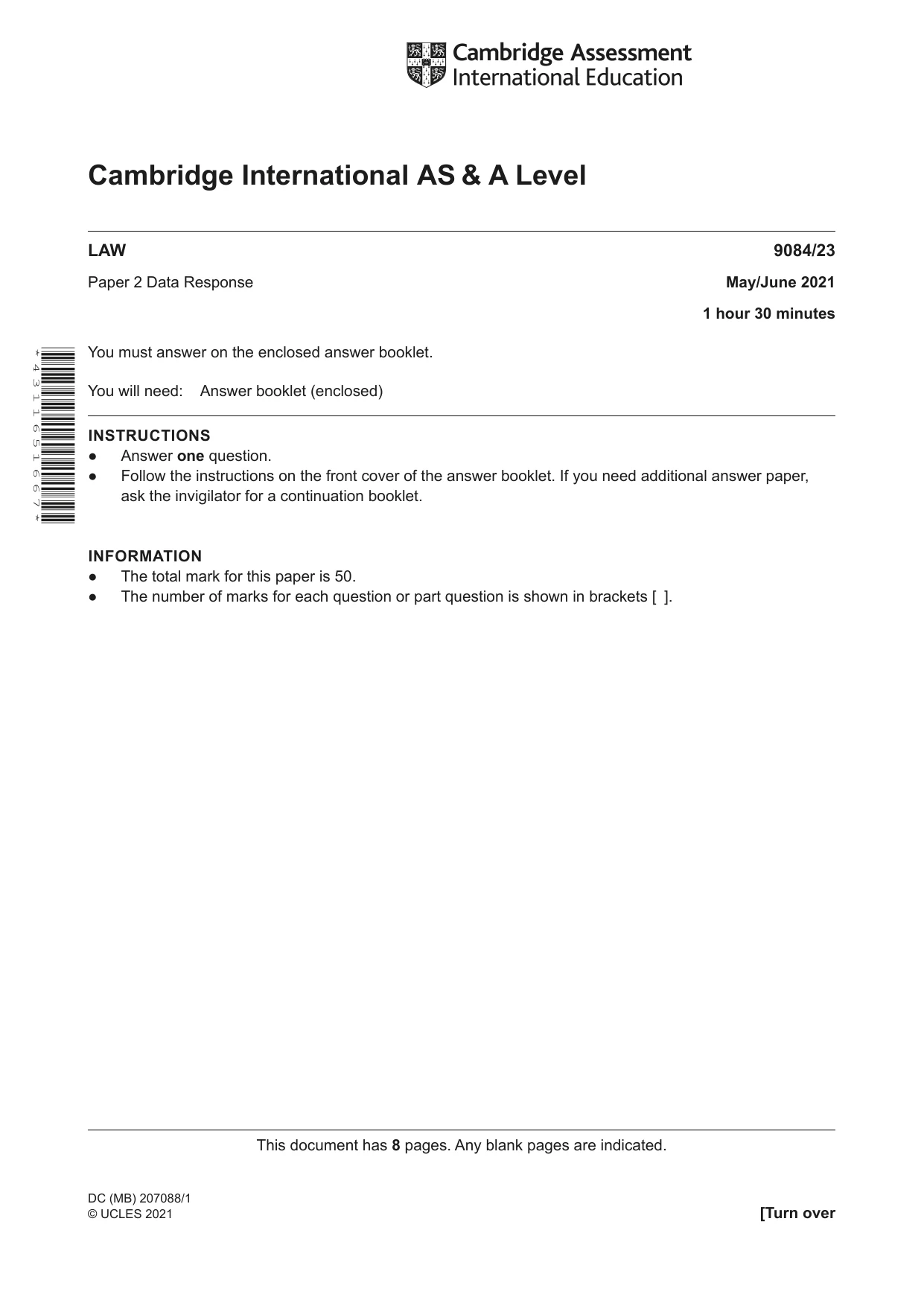
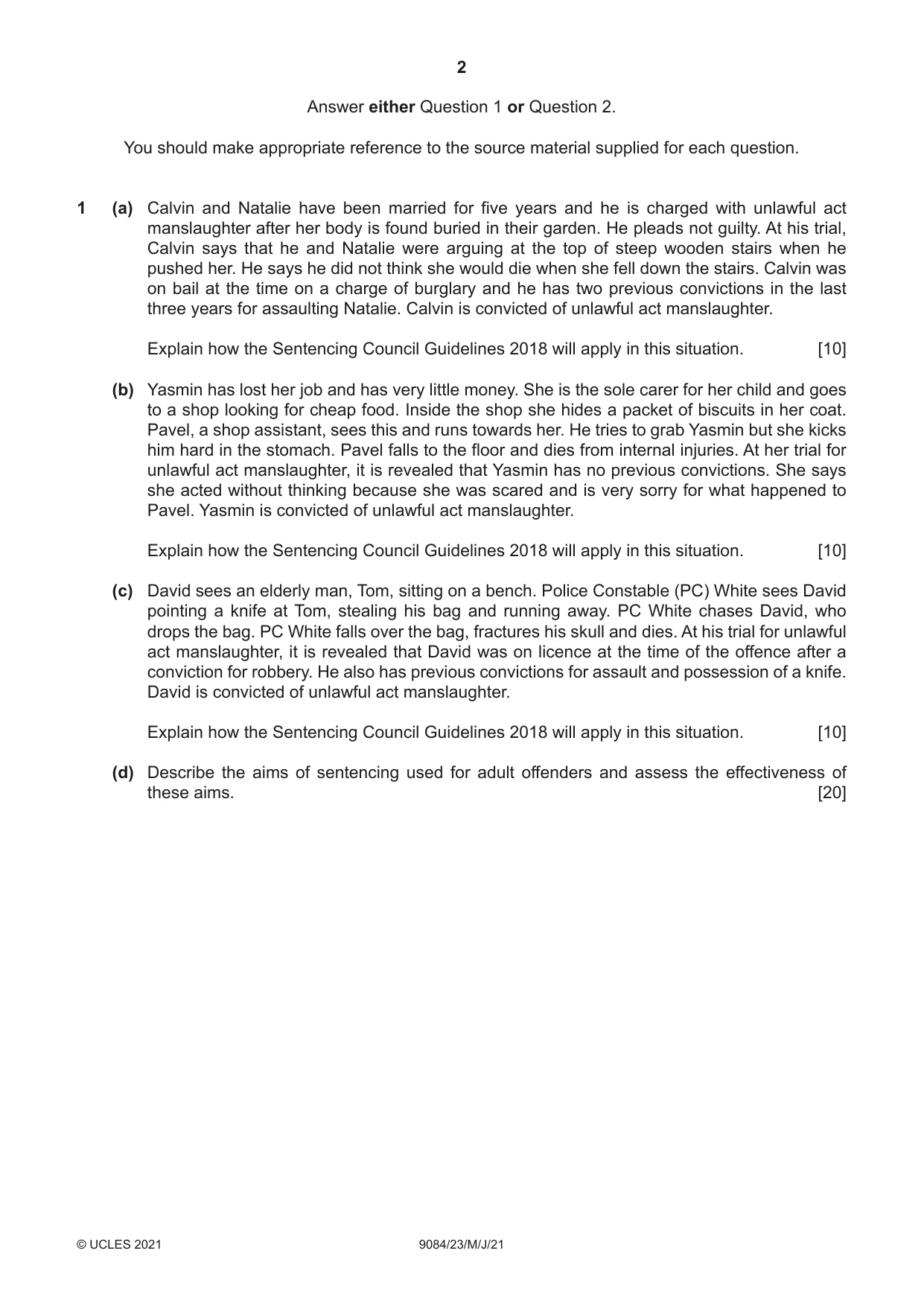
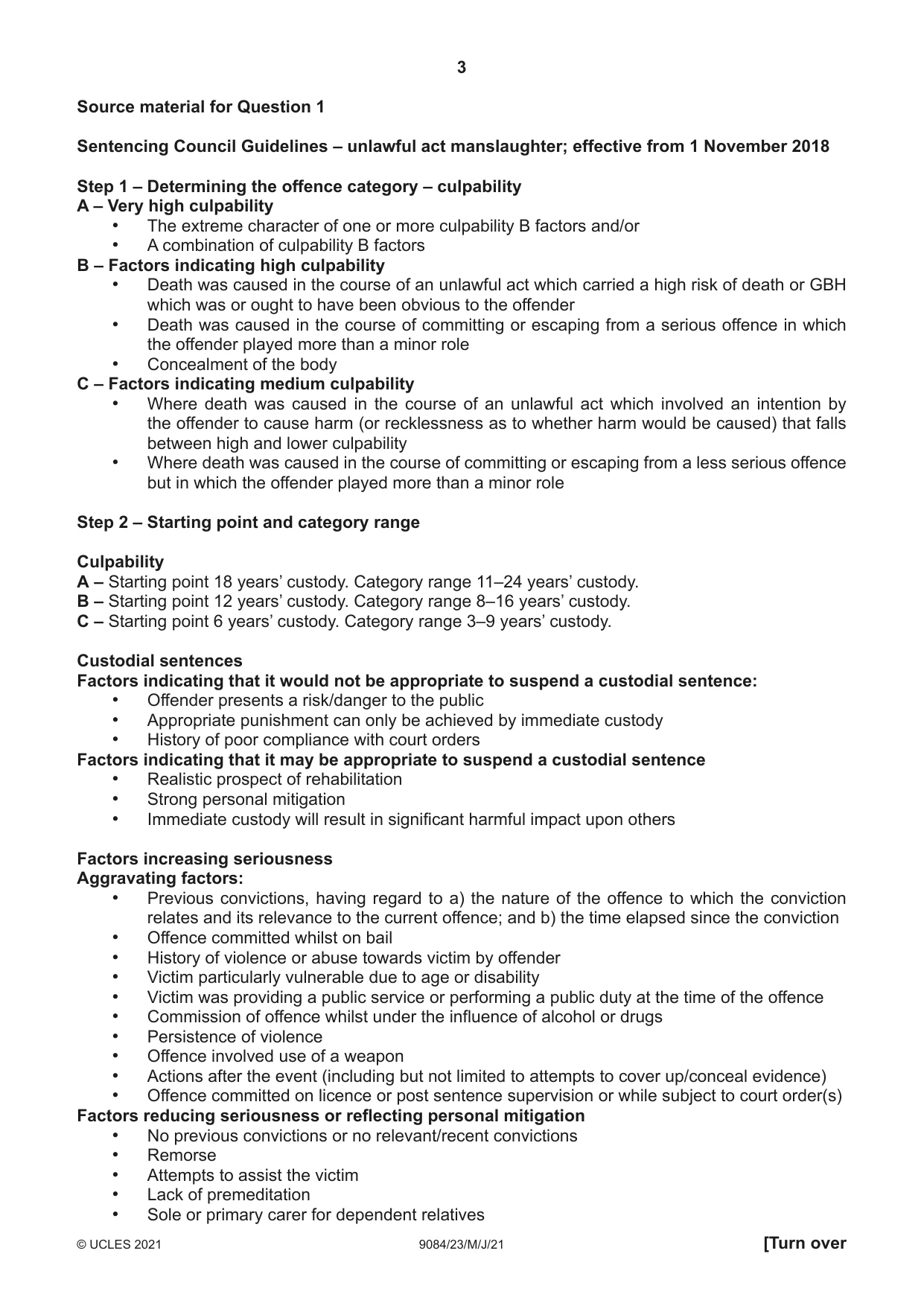
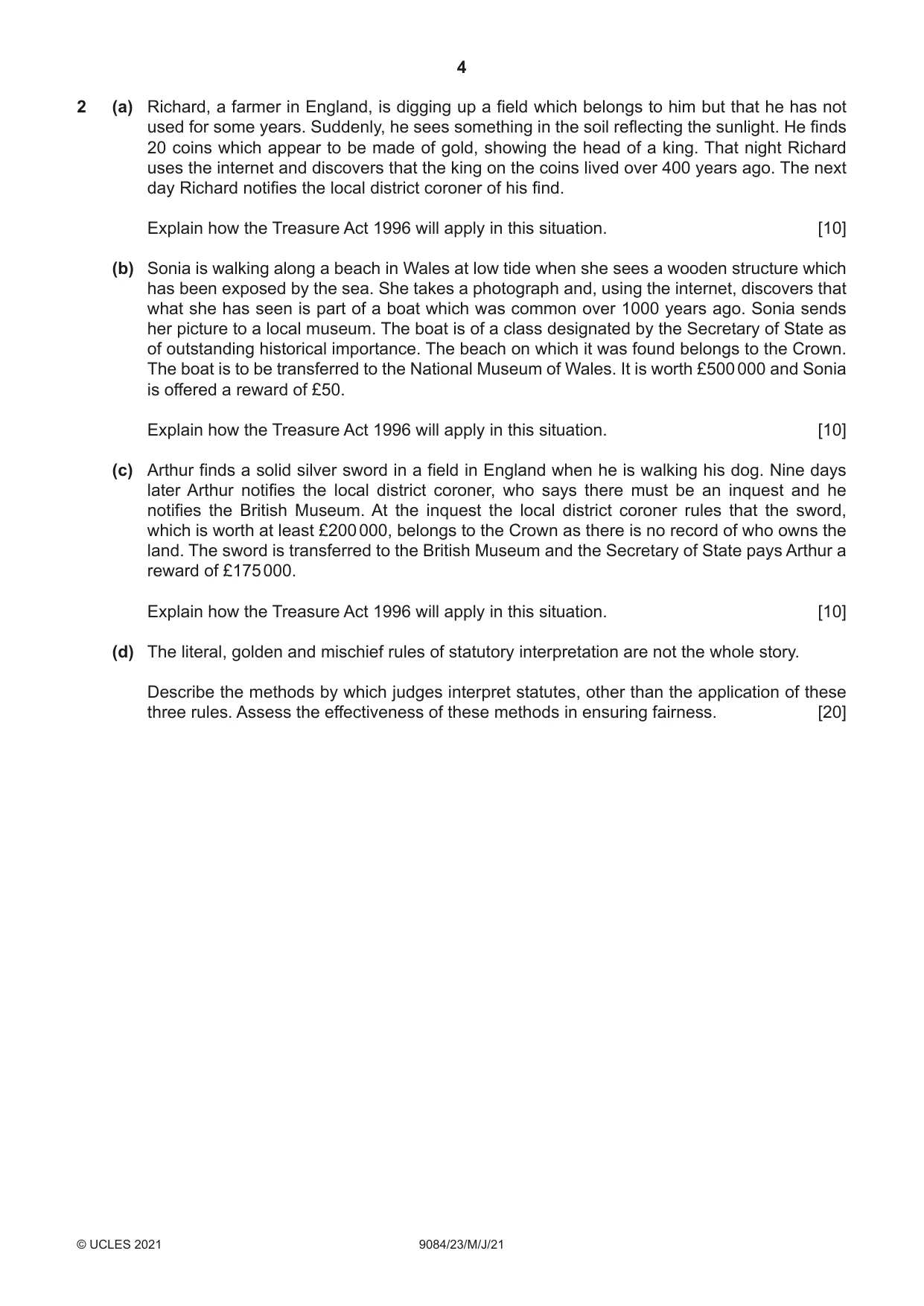



Mark scheme12 pages
Answers below. Sit the paper first if you are practising.
Questions as text
Q1 · Calvin and Natalie have been married for five years and he is charged with unlawful act…
1 (a) Calvin and Natalie have been married for five years and he is charged with unlawful act manslaughter after her body is found buried in their garden. He pleads not guilty. At his trial, Calvin says that he and Natalie were arguing at the top of steep wooden stairs when he pushed her. He says he did not think she would die when she fell down the stairs. Calvin was on bail at the time on a charge of burglary and he has two previous convictions in the last three years for assaulting Natalie. Calvin is convicted of unlawful act manslaughter. Explain how the Sentencing Council Guidelines 2018 will apply in this situation. [10] (b) Yasmin has lost her job and has very little money. She is the sole carer for her child and goes to a shop looking for cheap food. Inside the shop she hides a packet of biscuits in her coat. Pavel, a shop assistant, sees this and runs towards her. He tries to grab Yasmin but she kicks him hard in the stomach. Pavel falls to the floor and dies from internal injuries. At her trial for unlawful act manslaughter, it is revealed that Yasmin has no previous convictions. She says she acted without thinking because she was scared and is very sorry for what happened to Pavel. Yasmin is convicted of unlawful act manslaughter. Explain how the Sentencing Council Guidelines 2018 will apply in this situation. [10] (c) David sees an elderly man, Tom, sitting on a bench. Police Constable (PC) White sees David pointing a knife at Tom, stealing his bag and running away. PC White chases David, who drops the bag. PC White falls over the bag, fractures his skull and dies. At his trial for unlawful act manslaughter, it is revealed that David was on licence at the time of the offence after a conviction for robbery. He also has previous convictions for assault and possession of a knife. David is convicted of unlawful act manslaughter. Explain how the Sentencing Council Guidelines 2018 will apply in this situation. [10] (d) Describe the aims of sentencing used for adult offenders and assess the effectiveness of these aims. [20] Source material for Question 1 Sentencing Council Guidelines – unlawful act manslaughter; effective from 1 November 2018 Step 1 – Determining the offence category – culpability A – Very high culpability • The extreme character of one or more culpability B factors and/or • A combination of culpability B factors B – Factors indicating high culpability • Death was caused in the course of an unlawful act which carried a high risk of death or GBH which was or ought to have been obvious to the offender • Death was caused in the course of committing or escaping from a serious offence in which the offender played more than a minor role • Concealment of the body C – Factors indicating medium culpability • Where death was caused in the course of an unlawful act which involved an intention by the offender to cause harm (or recklessness as to whether harm would be caused) that falls between high and lower culpability • Where death was caused in the course of committing or escaping from a less serious offence but in which the offender played more than a minor role Step 2 – Starting point and category range Culpability A – Starting point 18 years’ custody. Category range 11–24 years’ custody. B – Starting point 12 years’ custody. Category range 8–16 years’ custody. C – Starting point 6 years’ custody. Category range 3–9 years’ custody. Custodial sentences Factors indicating that it would not be appropriate to suspend a custodial sentence: • Offender presents a risk/danger to the public • Appropriate punishment can only be achieved by immediate custody • History of poor compliance with court orders Factors indicating that it may be appropriate to suspend a custodial sentence • Realistic prospect of rehabilitation • Strong personal mitigation • Immediate custody will result in significant harmful impact upon others Factors increasing seriousness Aggravating factors: • Previous convictions, having regard to a) the nature of the offence to which the conviction relates and its relevance to the current offence; and b) the time elapsed since the conviction • Offence committed whilst on bail • History of violence or abuse towards victim by offender • Victim particularly vulnerable due to age or disability • Victim was providing a public service or performing a public duty at the time of the offence • Commission of offence whilst under the influence of alcohol or drugs • Persistence of violence • Offence involved use of a weapon • Actions after the event (including but not limited to attempts to cover up/conceal evidence) • Offence committed on licence or post sentence supervision or while subject to court order(s) Factors reducing seriousness or reflecting personal mitigation • No previous convictions or no relevant/recent convictions • Remorse • Attempts to assist the victim • Lack of premeditation • Sole or primary carer for dependent relatives
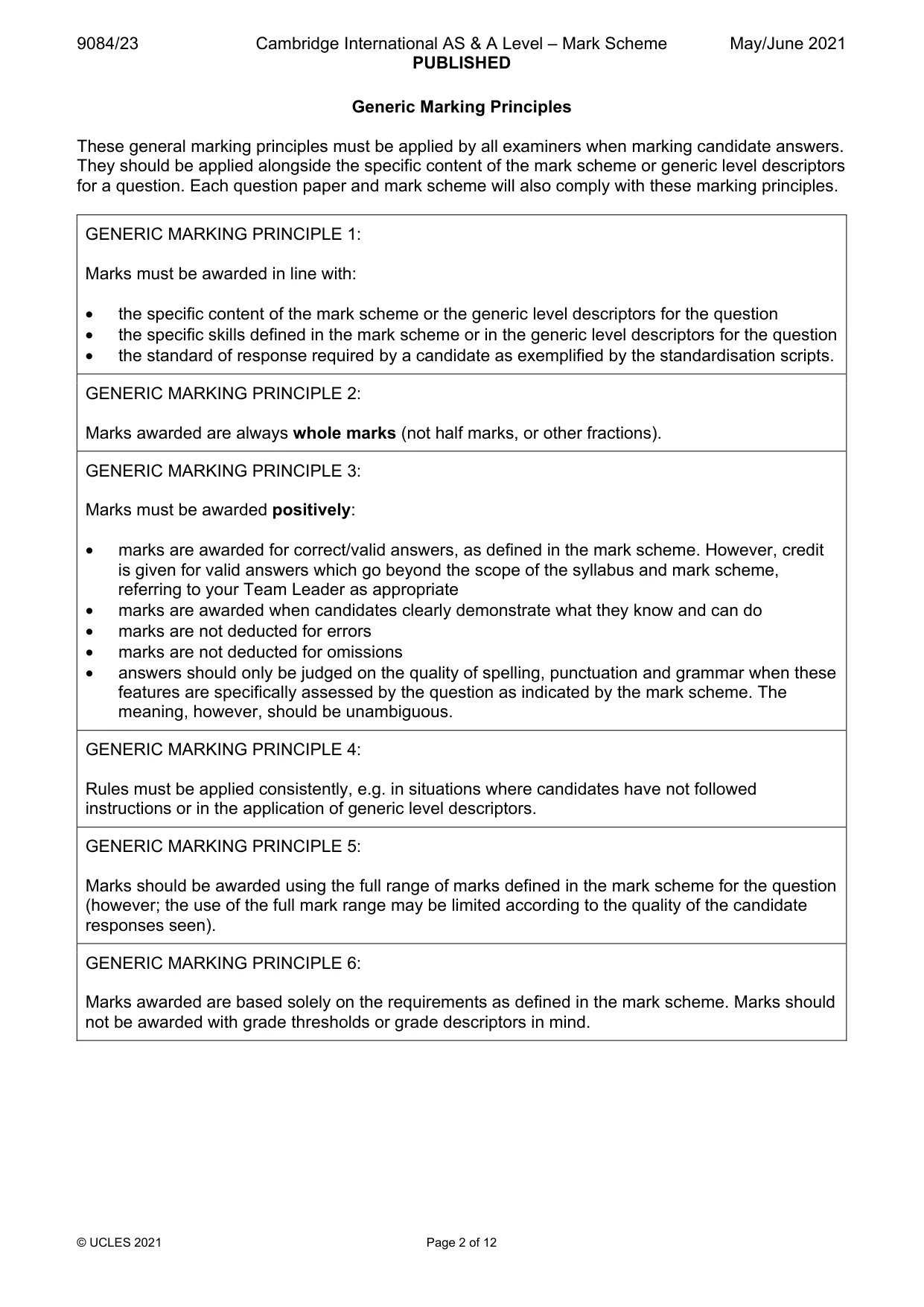
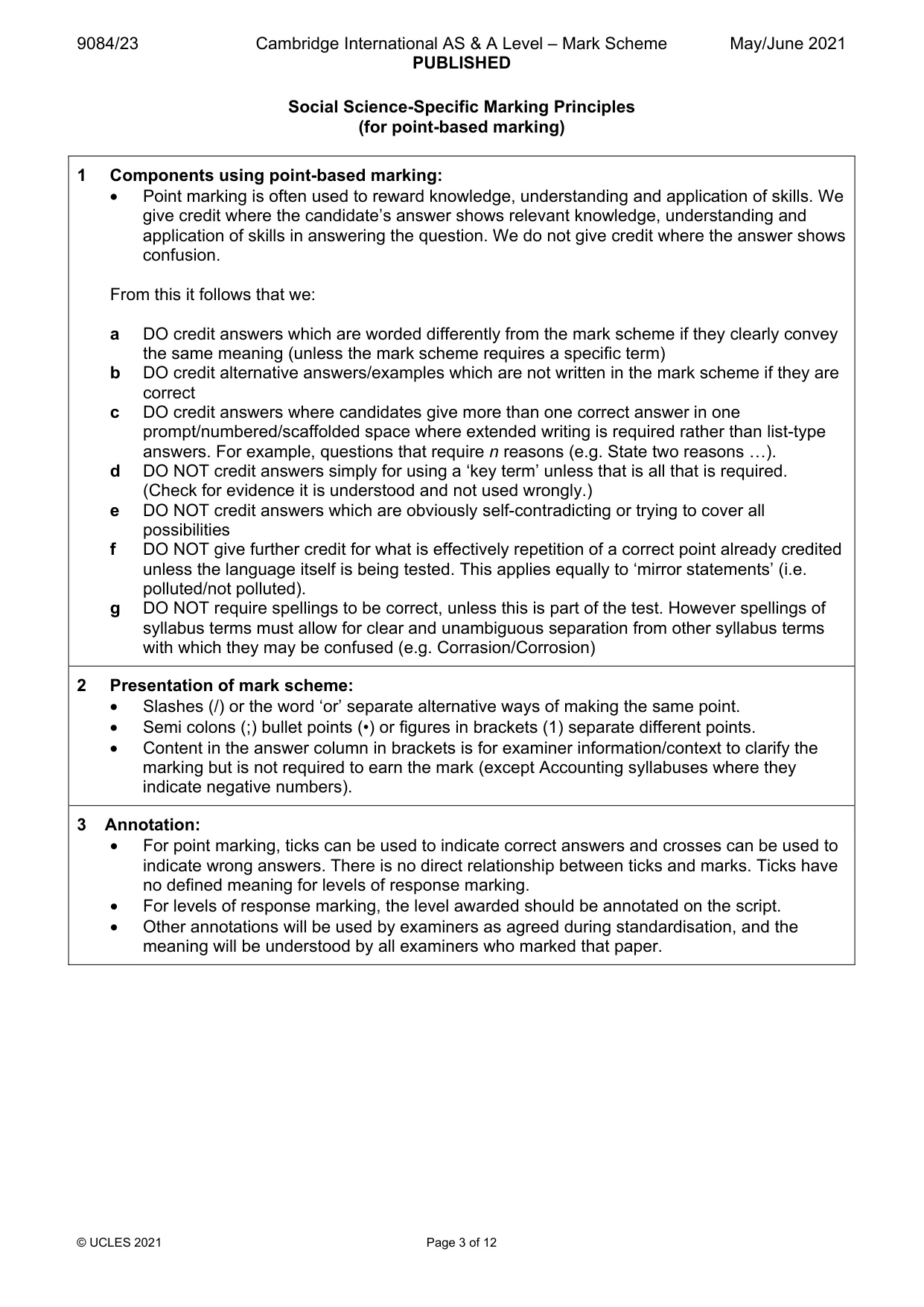
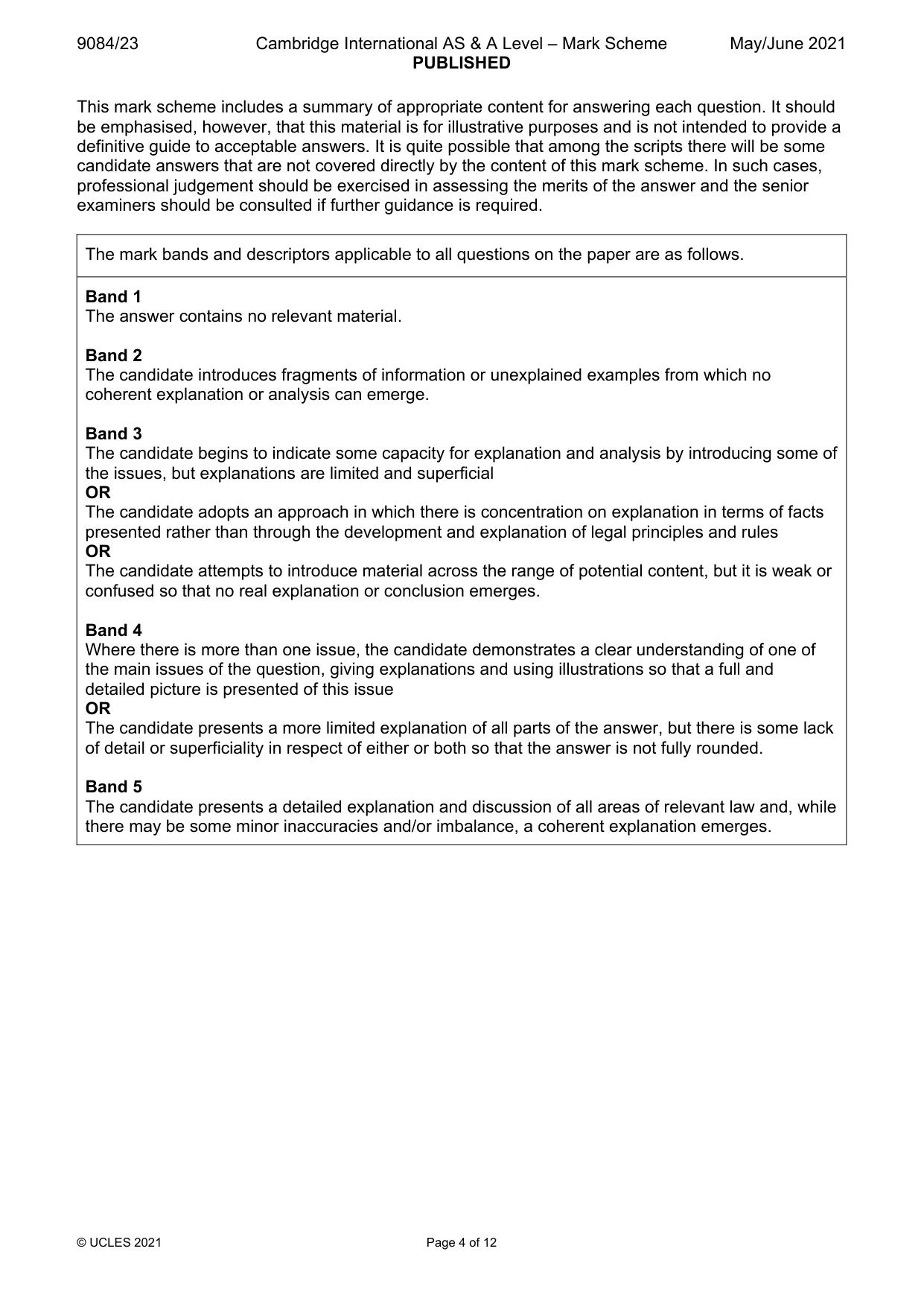
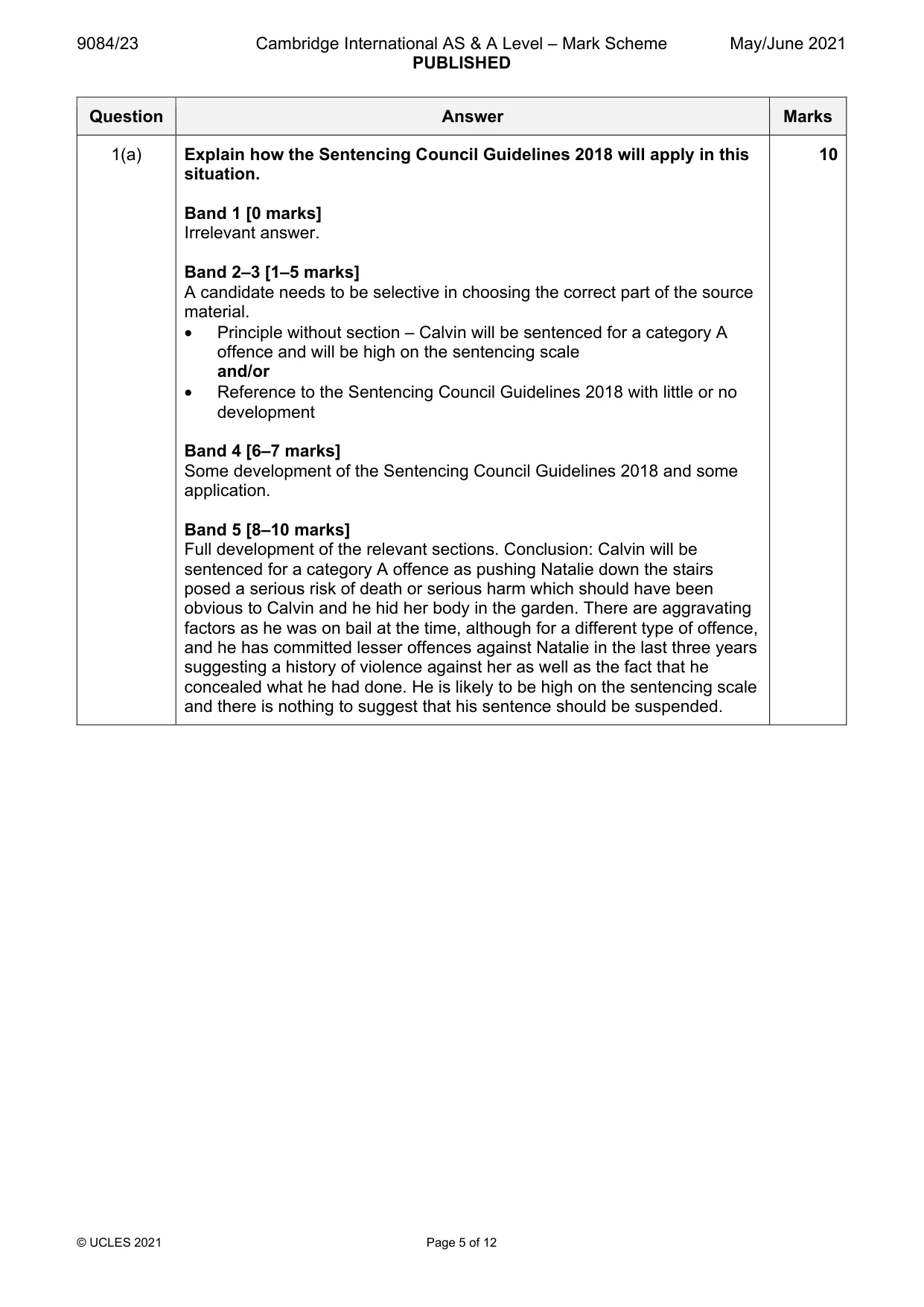
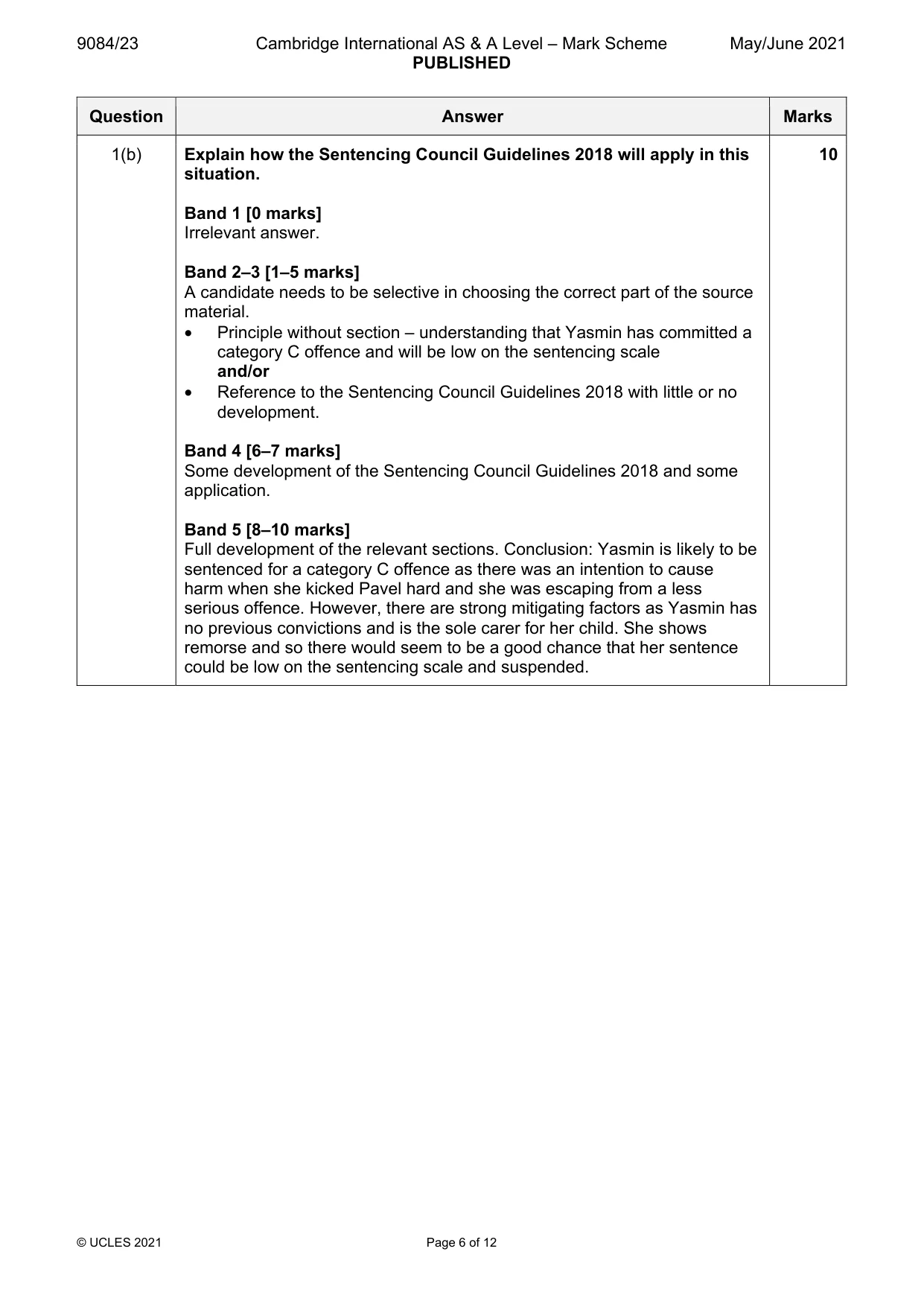
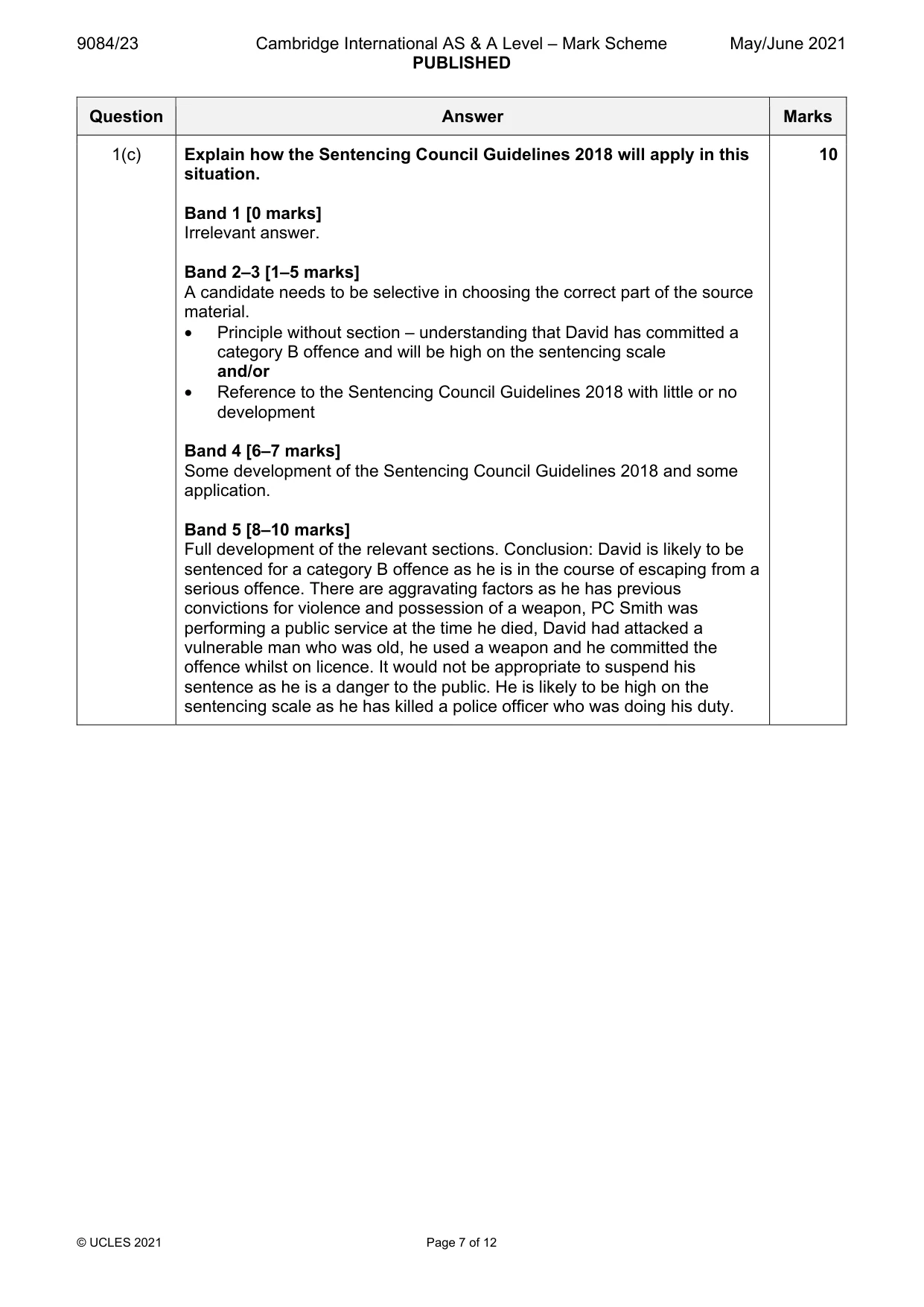
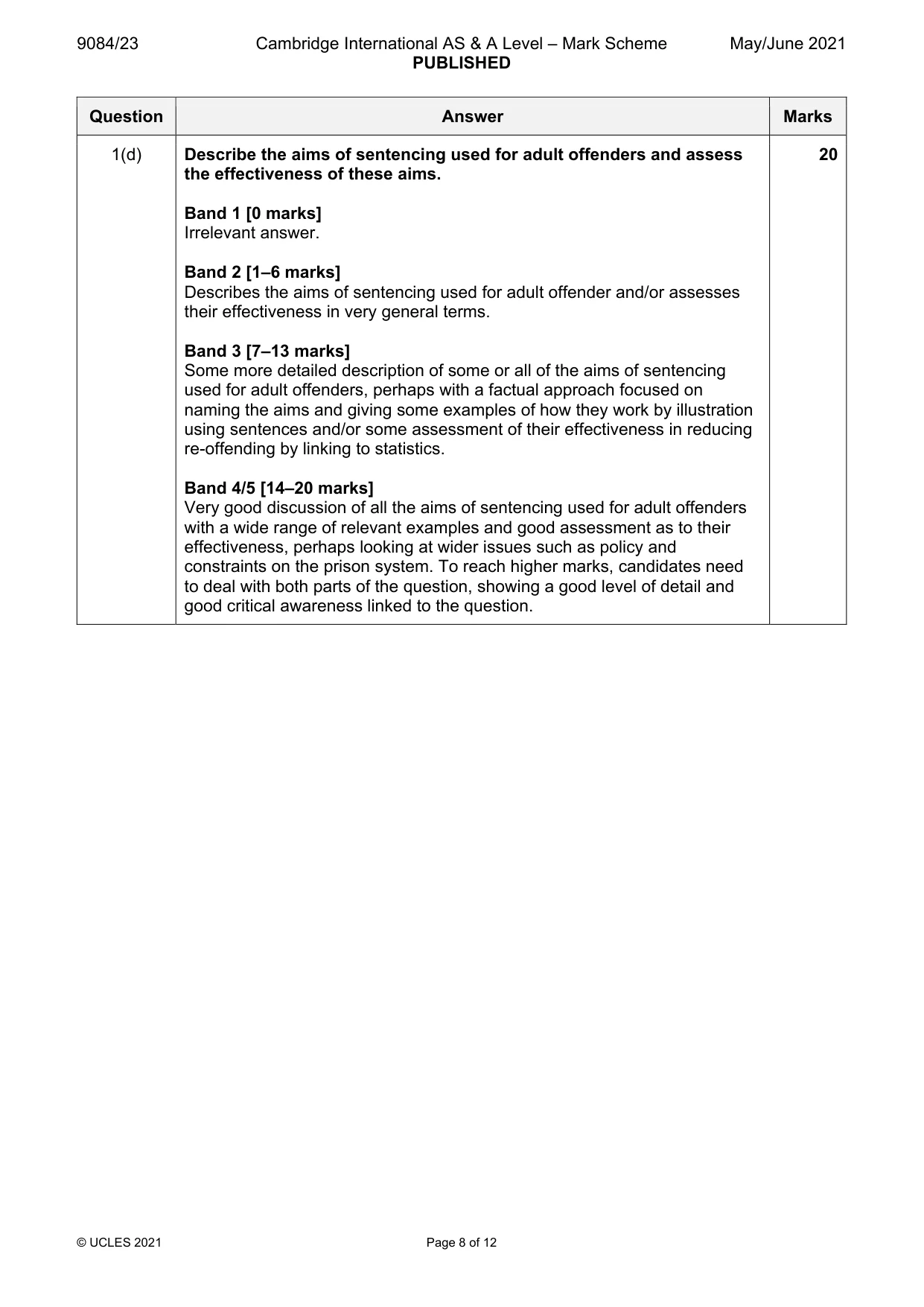
Mark scheme: Question Answer Marks 1(a) Explain how the Sentencing Council Guidelines 2018 will apply in this 10 situation. Band 1 [0 marks] Irrelevant answer. Band 2–3 [1–5 marks] A candidate needs to be selective in choosing the correct part of the source material. • Principle without section – Calvin will be sentenced for a category A offence and will be high on the sentencing scale and/or • Reference to the Sentencing Council Guidelines 2018 with little or no development Band 4 [6–7 marks] Some development of the Sentencing Council Guidelines 2018 and some application. Band 5 [8–10 marks] Full development of the relevant sections. Conclusion: Calvin will be sentenced for a category A offence as pushing Natalie down the stairs posed a serious risk of death or serious harm which should have been obvious to Calvin and he hid her body in the garden. There are aggravating factors as he was on bail at the time, although for a different type of offence, and he has committed lesser offences against Natalie in the last three years suggesting a history of violence against her as well as the fact that he concealed what he had done. He is likely to be high on the sentencing scale and there is nothing to suggest that his sentence should be suspended. 1(b) Explain how the Sentencing Council Guidelines 2018 will apply in this 10 situation. Band 1 [0 marks] Irrelevant answer. Band 2–3 [1–5 marks] A candidate needs to be selective in choosing the correct part of the source material. • Principle without section – understanding that Yasmin has committed a category C offence and will be low on the sentencing scale and/or • Reference to the Sentencing Council Guidelines 2018 with little or no development. Band 4 [6–7 marks] Some development of the Sentencing Council Guidelines 2018 and some application. Band 5 [8–10 marks] Full development of the relevant sections. Conclusion: Yasmin is likely to be sentenced for a category C offence as there was an intention to cause harm when she kicked Pavel hard and she was escaping from a less serious offence. However, there are strong mitigating factors as Yasmin has no previous convictions and is the sole carer for her child. She shows remorse and so there would seem to be a good chance that her sentence could be low on the sentencing scale and suspended. 1(c) Explain how the Sentencing Council Guidelines 2018 will apply in this 10 situation. Band 1 [0 marks] Irrelevant answer. Band 2–3 [1–5 marks] A candidate needs to be selective in choosing the correct part of the source material. • Principle without section – understanding that David has committed a category B offence and will be high on the sentencing scale and/or • Reference to the Sentencing Council Guidelines 2018 with little or no development Band 4 [6–7 marks] Some development of the Sentencing Council Guidelines 2018 and some application. Band 5 [8–10 marks] Full development of the relevant sections. Conclusion: David is likely to be sentenced for a category B offence as he is in the course of escaping from a serious offence. There are aggravating factors as he has previous convictions for violence and possession of a weapon, PC Smith was performing a public service at the time he died, David had attacked a vulnerable man who was old, he used a weapon and he committed the offence whilst on licence. It would not be appropriate to suspend his sentence as he is a danger to the public. He is likely to be high on the sentencing scale as he has killed a police officer who was doing his duty. 1(d) Describe the aims of sentencing used for adult offenders and assess 20 the effectiveness of these aims. Band 1 [0 marks] Irrelevant answer. Band 2 [1–6 marks] Describes the aims of sentencing used for adult offender and/or assesses their effectiveness in very general terms. Band 3 [7–13 marks] Some more detailed description of some or all of the aims of sentencing used for adult offenders, perhaps with a factual approach focused on naming the aims and giving some examples of how they work by illustration using sentences and/or some assessment of their effectiveness in reducing re-offending by linking to statistics. Band 4/5 [14–20 marks] Very good discussion of all the aims of sentencing used for adult offenders with a wide range of relevant examples and good assessment as to their effectiveness, perhaps looking at wider issues such as policy and constraints on the prison system. To reach higher marks, candidates need to deal with both parts of the question, showing a good level of detail and good critical awareness linked to the question.
Q2 · Richard, a farmer in England, is digging up a field which belongs to him but that he has…
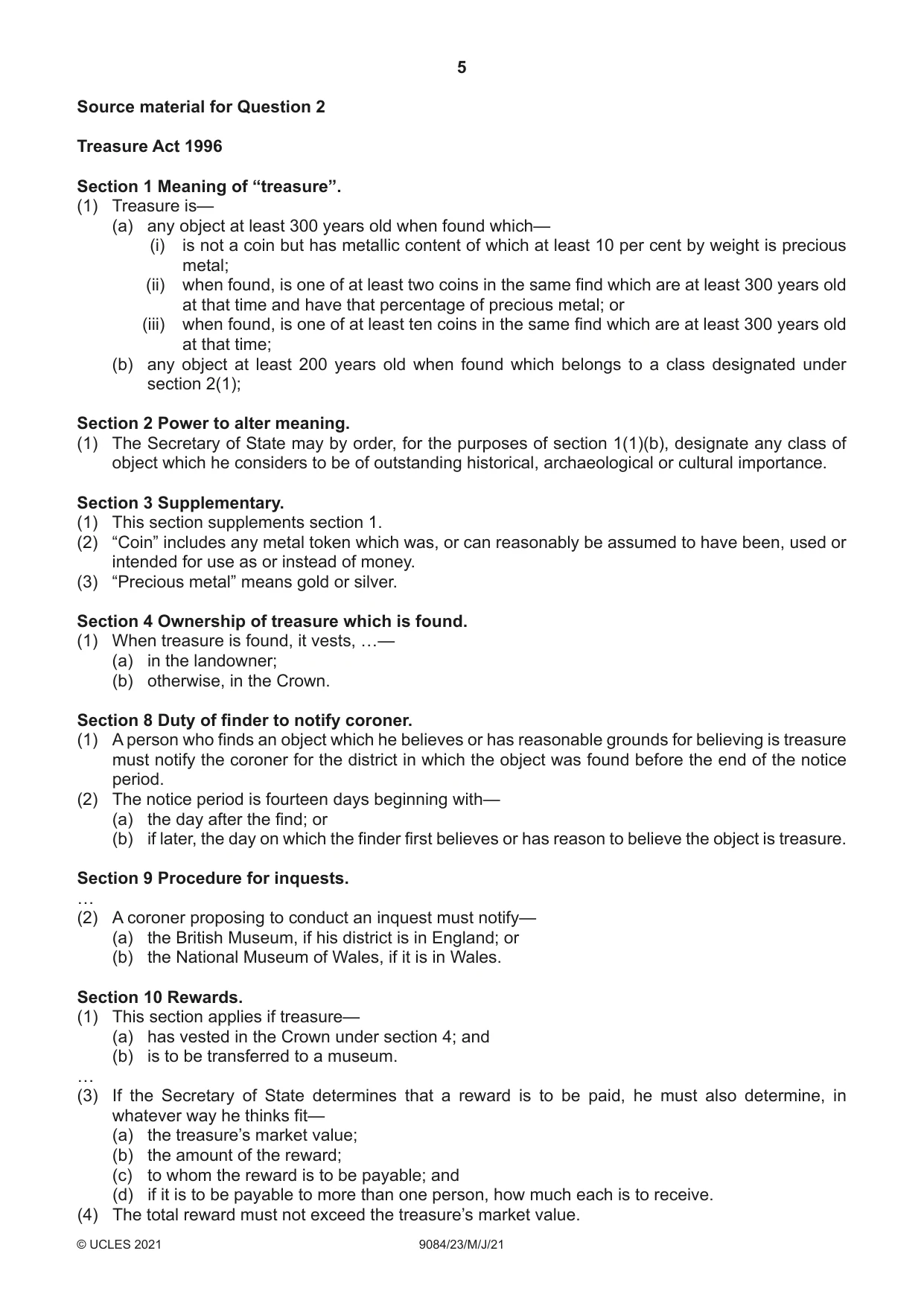
2 (a) Richard, a farmer in England, is digging up a field which belongs to him but that he has not used for some years. Suddenly, he sees something in the soil reflecting the sunlight. He finds 20 coins which appear to be made of gold, showing the head of a king. That night Richard uses the internet and discovers that the king on the coins lived over 400 years ago. The next day Richard notifies the local district coroner of his find. Explain how the Treasure Act 1996 will apply in this situation. [10] (b) Sonia is walking along a beach in Wales at low tide when she sees a wooden structure which has been exposed by the sea. She takes a photograph and, using the internet, discovers that what she has seen is part of a boat which was common over 1000 years ago. Sonia sends her picture to a local museum. The boat is of a class designated by the Secretary of State as of outstanding historical importance. The beach on which it was found belongs to the Crown. The boat is to be transferred to the National Museum of Wales. It is worth £500 000 and Sonia is offered a reward of £50. Explain how the Treasure Act 1996 will apply in this situation. [10] (c) Arthur finds a solid silver sword in a field in England when he is walking his dog. Nine days later Arthur notifies the local district coroner, who says there must be an inquest and he notifies the British Museum. At the inquest the local district coroner rules that the sword, which is worth at least £200 000, belongs to the Crown as there is no record of who owns the land. The sword is transferred to the British Museum and the Secretary of State pays Arthur a reward of £175 000. Explain how the Treasure Act 1996 will apply in this situation. [10] (d) The literal, golden and mischief rules of statutory interpretation are not the whole story. Describe the methods by which judges interpret statutes, other than the application of these three rules. Assess the effectiveness of these methods in ensuring fairness. [20] Source material for Question 2 Treasure Act 1996 Section 1 Meaning of “treasure”. (1) Treasure is— (a) any object at least 300 years old when found which— (i) is not a coin but has metallic content of which at least 10 per cent by weight is precious metal; (ii) when found, is one of at least two coins in the same find which are at least 300 years old at that time and have that percentage of precious metal; or (iii) when found, is one of at least ten coins in the same find which are at least 300 years old at that time; (b) any object at least 200 years old when found which belongs to a class designated under section 2(1); Section 2 Power to alter meaning. (1) The Secretary of State may by order, for the purposes of section 1(1)(b), designate any class of object which he considers to be of outstanding historical, archaeological or cultural importance. Section 3 Supplementary. (1) This section supplements section 1. (2) “Coin” includes any metal token which was, or can reasonably be assumed to have been, used or intended for use as or instead of money. (3) “Precious metal” means gold or silver. Section 4 Ownership of treasure which is found. (1) When treasure is found, it vests, …— (a) in the landowner; (b) otherwise, in the Crown. Section 8 Duty of finder to notify coroner. (1) A person who finds an object which he believes or has reasonable grounds for believing is treasure must notify the coroner for the district in which the object was found before the end of the notice period. (2) The notice period is fourteen days beginning with— (a) the day after the find; or (b) if later, the day on which the finder first believes or has reason to believe the object is treasure. Section 9 Procedure for inquests. … (2) A coroner proposing to conduct an inquest must notify— (a) the British Museum, if his district is in England; or (b) the National Museum of Wales, if it is in Wales. Section 10 Rewards. (1) This section applies if treasure— (a) has vested in the Crown under section 4; and (b) is to be transferred to a museum. … (3) If the Secretary of State determines that a reward is to be paid, he must also determine, in whatever way he thinks fit— (a) the treasure’s market value; (b) the amount of the reward; (c) to whom the reward is to be payable; and (d) if it is to be payable to more than one person, how much each is to receive.
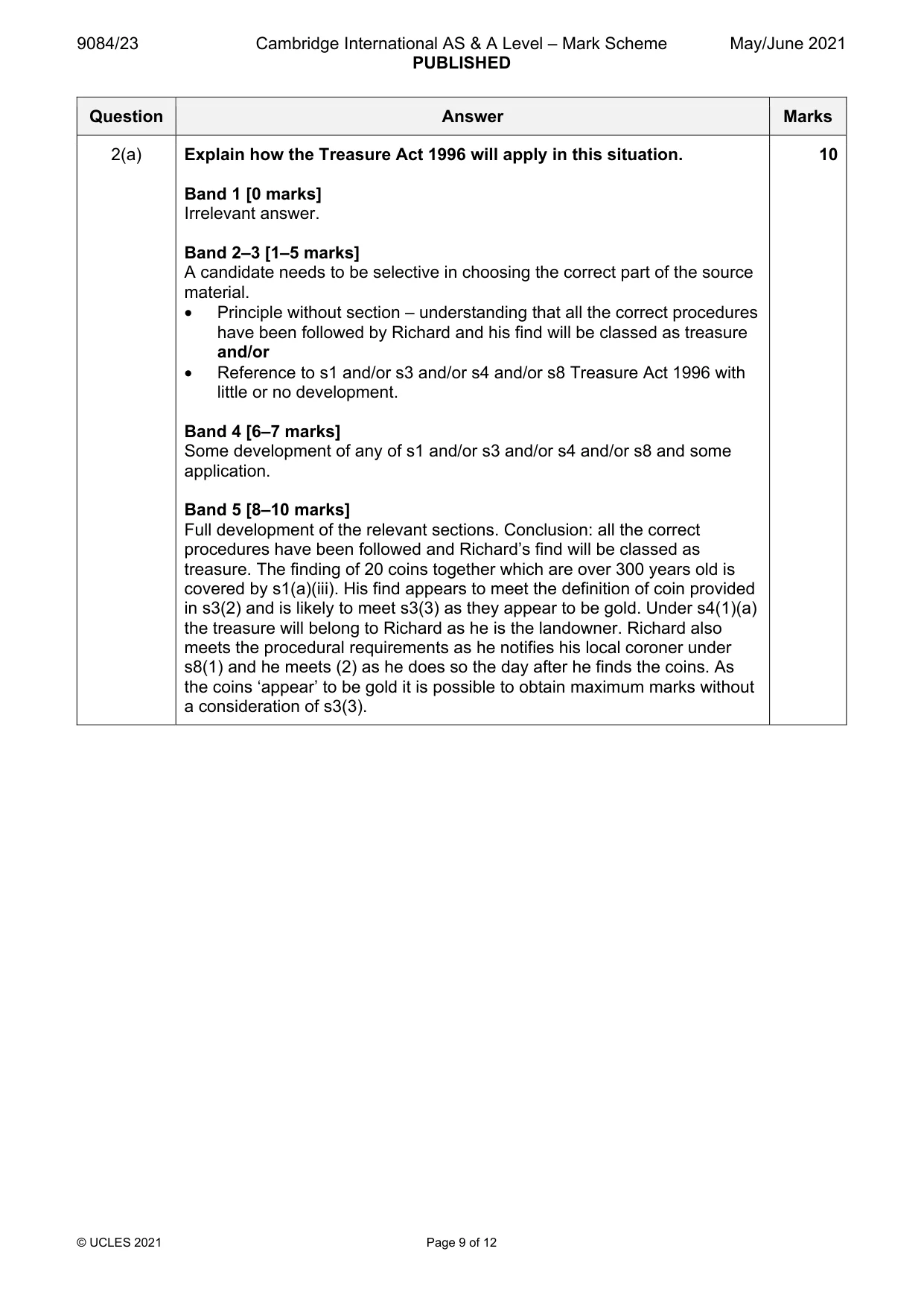
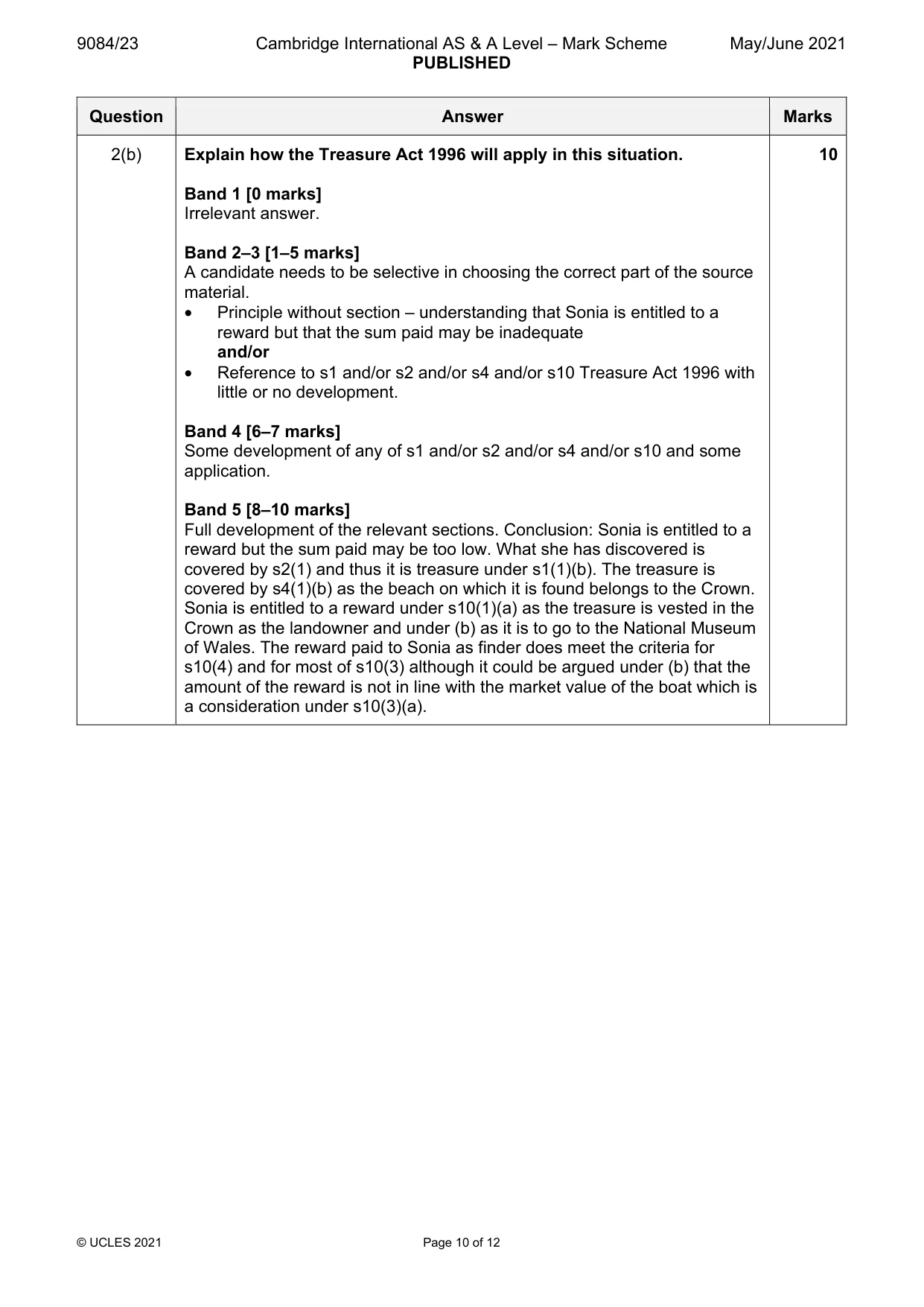
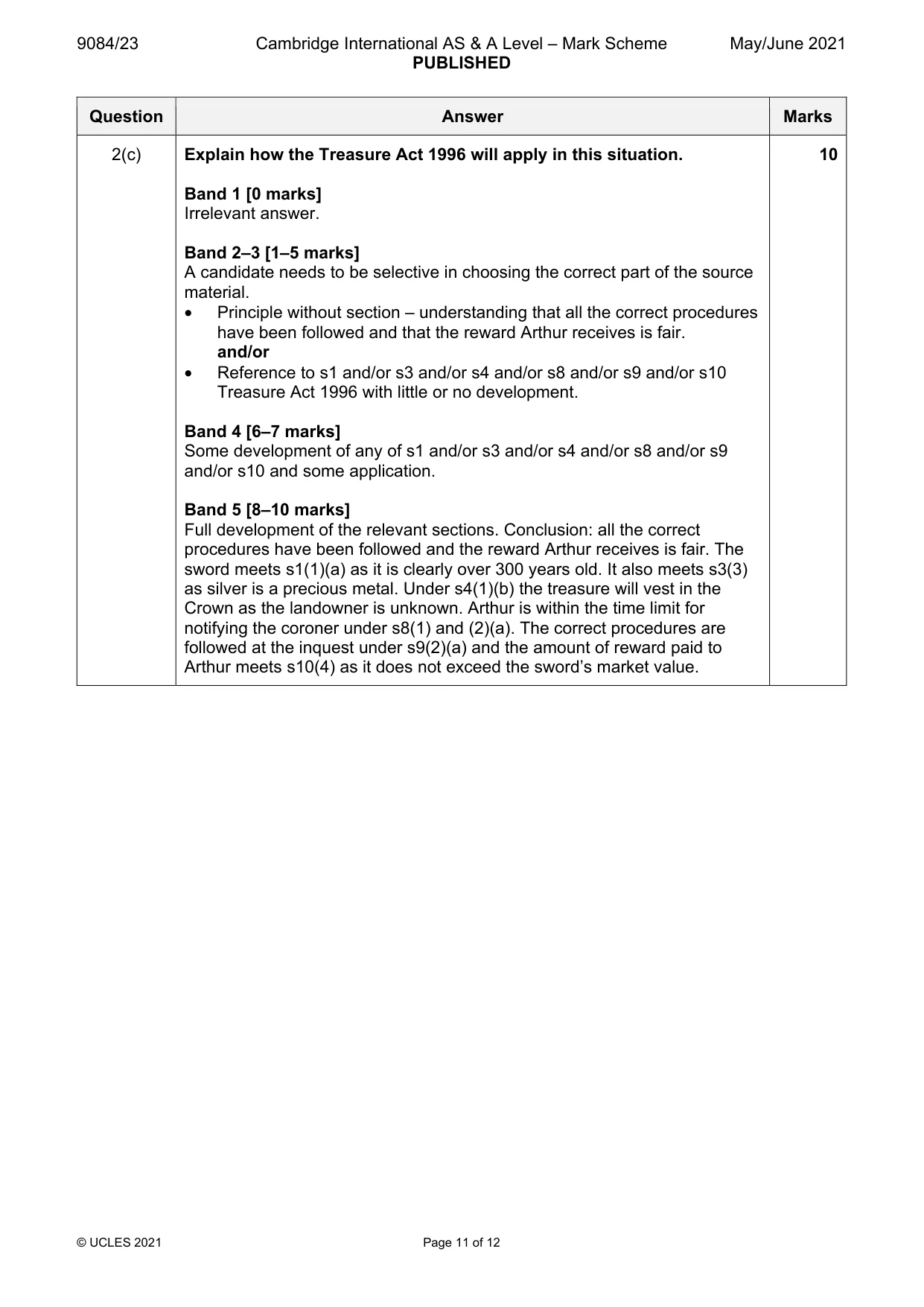
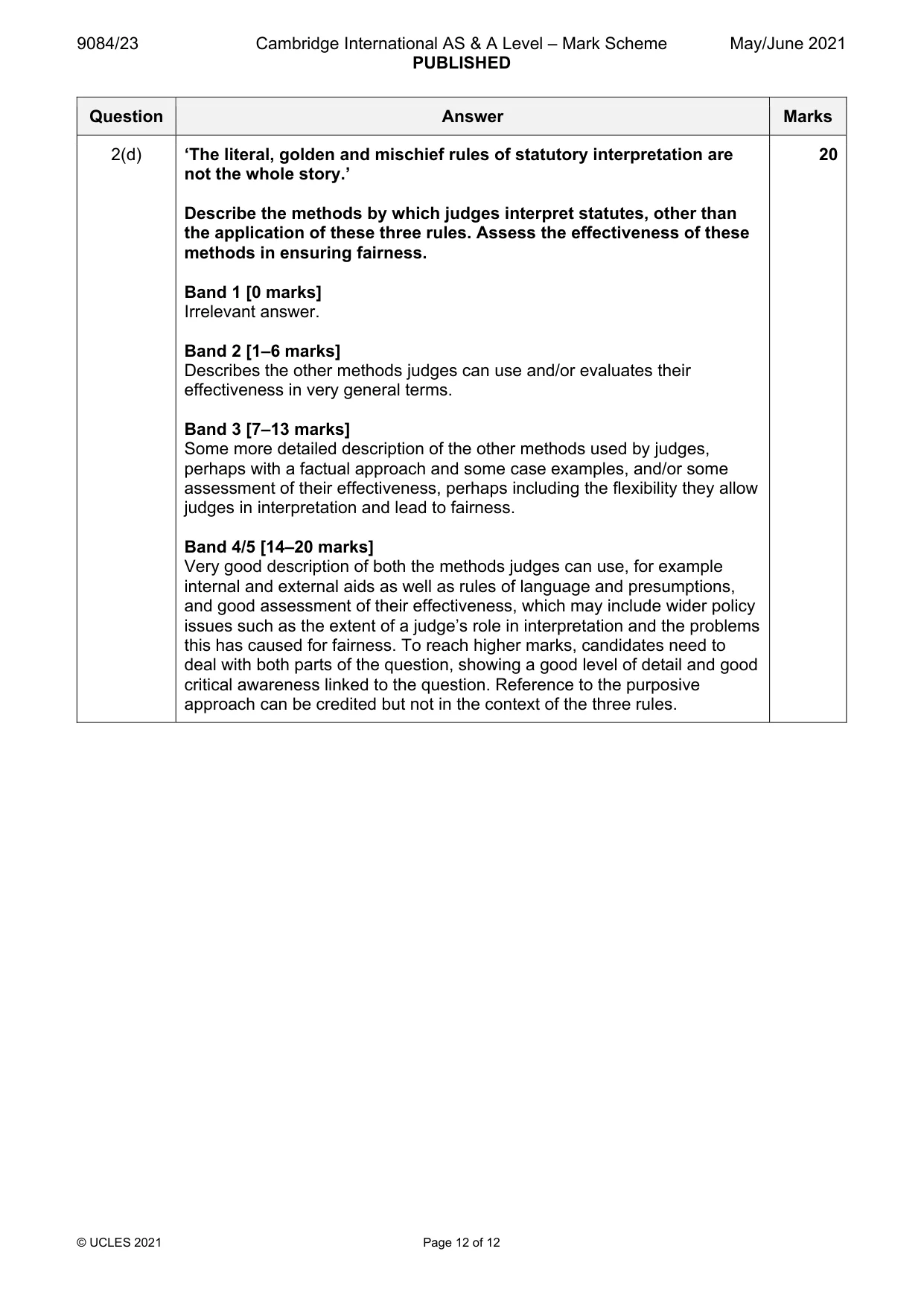
Mark scheme: 2(a) Explain how the Treasure Act 1996 will apply in this situation. 10 Band 1 [0 marks] Irrelevant answer. Band 2–3 [1–5 marks] A candidate needs to be selective in choosing the correct part of the source material. • Principle without section – understanding that all the correct procedures have been followed by Richard and his find will be classed as treasure and/or • Reference to s1 and/or s3 and/or s4 and/or s8 Treasure Act 1996 with little or no development. Band 4 [6–7 marks] Some development of any of s1 and/or s3 and/or s4 and/or s8 and some application. Band 5 [8–10 marks] Full development of the relevant sections. Conclusion: all the correct procedures have been followed and Richard’s find will be classed as treasure. The finding of 20 coins together which are over 300 years old is covered by s1(a)(iii). His find appears to meet the definition of coin provided in s3(2) and is likely to meet s3(3) as they appear to be gold. Under s4(1)(a) the treasure will belong to Richard as he is the landowner. Richard also meets the procedural requirements as he notifies his local coroner under s8(1) and he meets (2) as he does so the day after he finds the coins. As the coins ‘appear’ to be gold it is possible to obtain maximum marks without a consideration of s3(3). 2(b) Explain how the Treasure Act 1996 will apply in this situation. 10 Band 1 [0 marks] Irrelevant answer. Band 2–3 [1–5 marks] A candidate needs to be selective in choosing the correct part of the source material. • Principle without section – understanding that Sonia is entitled to a reward but that the sum paid may be inadequate and/or • Reference to s1 and/or s2 and/or s4 and/or s10 Treasure Act 1996 with little or no development. Band 4 [6–7 marks] Some development of any of s1 and/or s2 and/or s4 and/or s10 and some application. Band 5 [8–10 marks] Full development of the relevant sections. Conclusion: Sonia is entitled to a reward but the sum paid may be too low. What she has discovered is covered by s2(1) and thus it is treasure under s1(1)(b). The treasure is covered by s4(1)(b) as the beach on which it is found belongs to the Crown. Sonia is entitled to a reward under s10(1)(a) as the treasure is vested in the Crown as the landowner and under (b) as it is to go to the National Museum of Wales. The reward paid to Sonia as finder does meet the criteria for s10(4) and for most of s10(3) although it could be argued under (b) that the amount of the reward is not in line with the market value of the boat which is a consideration under s10(3)(a). 2(c) Explain how the Treasure Act 1996 will apply in this situation. 10 Band 1 [0 marks] Irrelevant answer. Band 2–3 [1–5 marks] A candidate needs to be selective in choosing the correct part of the source material. • Principle without section – understanding that all the correct procedures have been followed and that the reward Arthur receives is fair. and/or • Reference to s1 and/or s3 and/or s4 and/or s8 and/or s9 and/or s10 Treasure Act 1996 with little or no development. Band 4 [6–7 marks] Some development of any of s1 and/or s3 and/or s4 and/or s8 and/or s9 and/or s10 and some application. Band 5 [8–10 marks] Full development of the relevant sections. Conclusion: all the correct procedures have been followed and the reward Arthur receives is fair. The sword meets s1(1)(a) as it is clearly over 300 years old. It also meets s3(3) as silver is a precious metal. Under s4(1)(b) the treasure will vest in the Crown as the landowner is unknown. Arthur is within the time limit for notifying the coroner under s8(1) and (2)(a). The correct procedures are followed at the inquest under s9(2)(a) and the amount of reward paid to Arthur meets s10(4) as it does not exceed the sword’s market value. 2(d) ‘The literal, golden and mischief rules of statutory interpretation are 20 not the whole story.’ Describe the methods by which judges interpret statutes, other than the application of these three rules. Assess the effectiveness of these methods in ensuring fairness. Band 1 [0 marks] Irrelevant answer. Band 2 [1–6 marks] Describes the other methods judges can use and/or evaluates their effectiveness in very general terms. Band 3 [7–13 marks] Some more detailed description of the other methods used by judges, perhaps with a factual approach and some case examples, and/or some assessment of their effectiveness, perhaps including the flexibility they allow judges in interpretation and lead to fairness. Band 4/5 [14–20 marks] Very good description of both the methods judges can use, for example internal and external aids as well as rules of language and presumptions, and good assessment of their effectiveness, which may include wider policy issues such as the extent of a judge’s role in interpretation and the problems this has caused for fairness. To reach higher marks, candidates need to deal with both parts of the question, showing a good level of detail and good critical awareness linked to the question. Reference to the purposive approach can be credited but not in the context of the three rules.
What was in this paper
The subtopics covered by these 2 questions, and how many questions each got. Open one in a new tab to see every Cambridge question on it.
1Sentencing in England and Wales This topic is about the sentences that can be handed down to both adult and young offenders who have been convicted of offences. This topic is an opportunity to reflect on the key concepts of liability, justice, fairness, power and its limits, and effectiveness1What you needed in this session
Cambridge’s own grade thresholds for 2021 May/June, Paper 2 · Variant 3. A higher threshold means an easier paper — the bar moves with how the cohort did.