Cambridge A Level Law 9084 — 2017 May/June Paper 2 · Variant 1
9084/21/M/J/17 · 2 questions · 100 marks · ≈113 min
The question paper and its mark scheme, free to read here and free to download. This is Cambridge’s own paper, exactly as it was sat.
Question paper8 pages
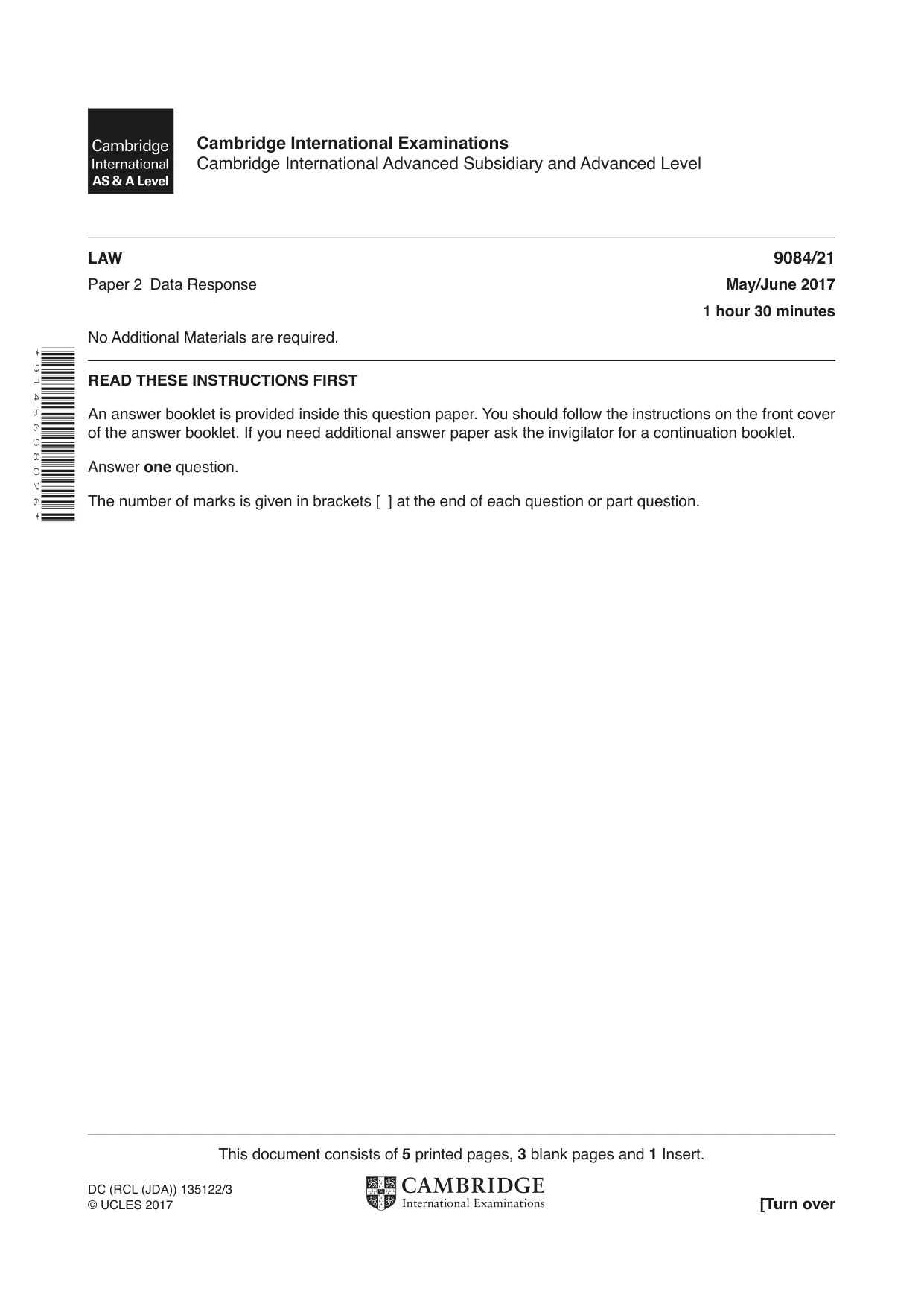



Mark scheme6 pages
Answers below. Sit the paper first if you are practising.
Questions as text
Q1 · Justin makes tents and he advertises them on his website as being waterproof and easy to…
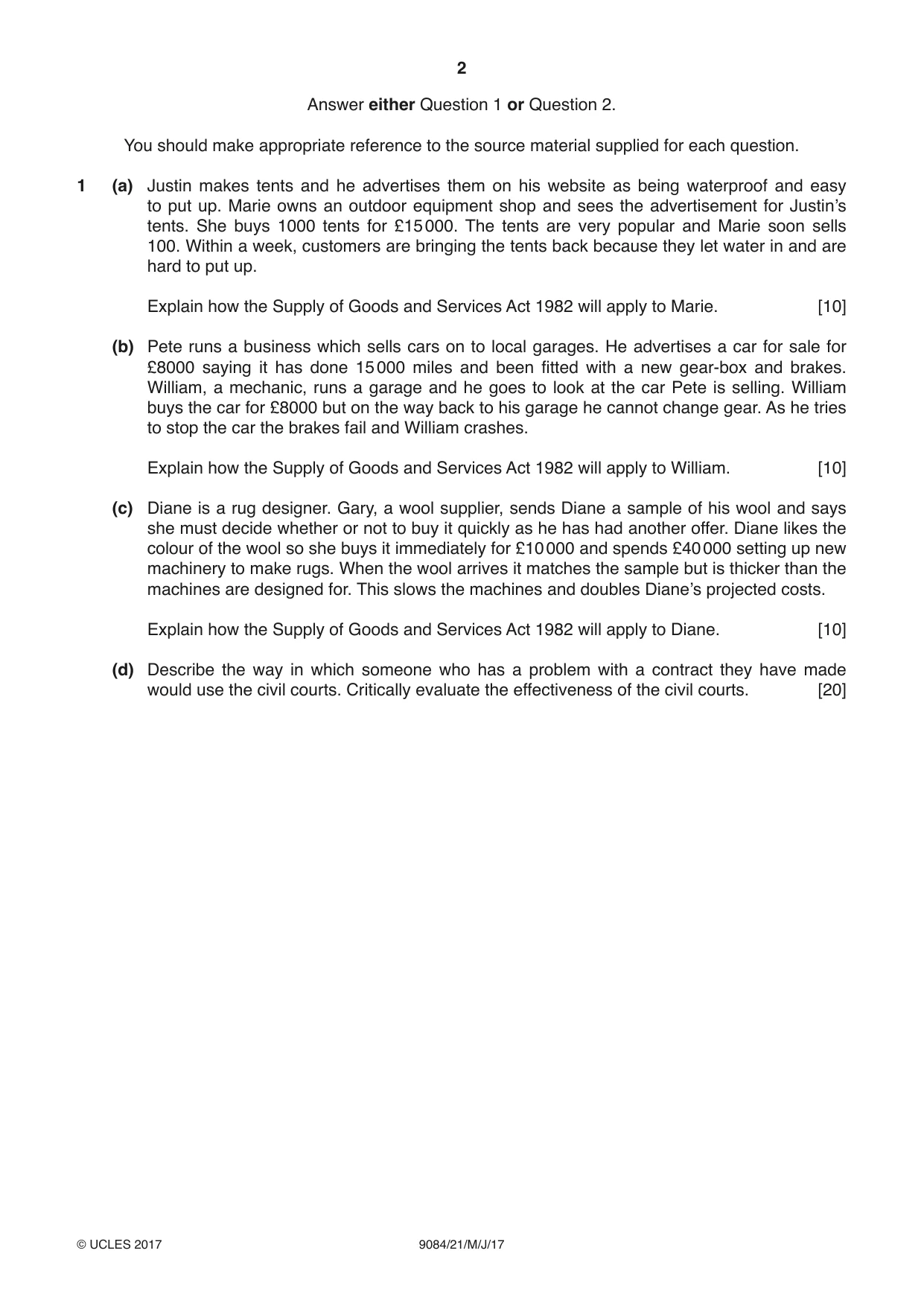
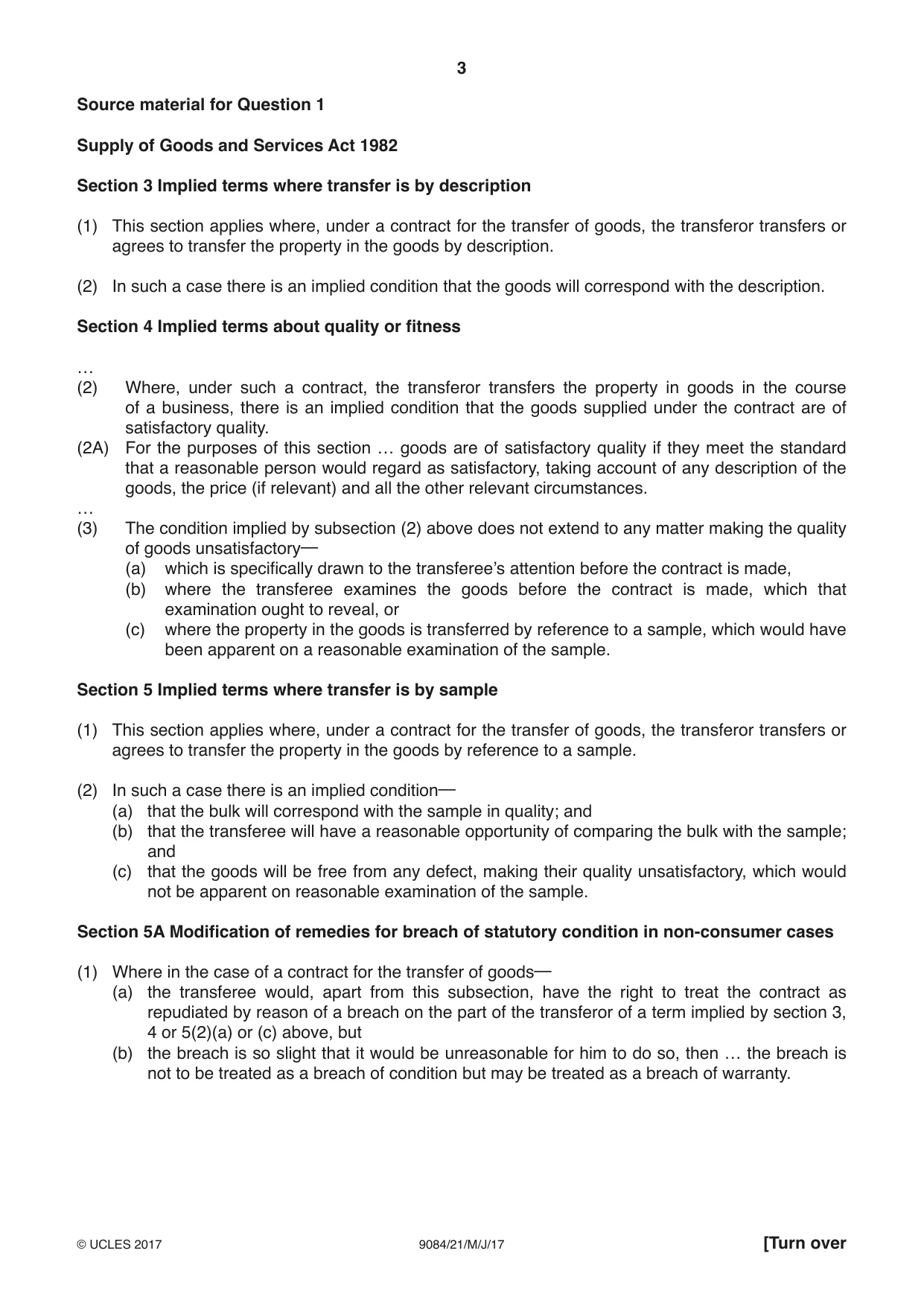
1 (a) Justin makes tents and he advertises them on his website as being waterproof and easy to put up. Marie owns an outdoor equipment shop and sees the advertisement for Justin’s tents. She buys 1000 tents for £15 000. The tents are very popular and Marie soon sells 100. Within a week, customers are bringing the tents back because they let water in and are hard to put up. Explain how the Supply of Goods and Services Act 1982 will apply to Marie. [10] (b) Pete runs a business which sells cars on to local garages. He advertises a car for sale for £8000 saying it has done 15 000 miles and been fitted with a new gear-box and brakes. William, a mechanic, runs a garage and he goes to look at the car Pete is selling. William buys the car for £8000 but on the way back to his garage he cannot change gear. As he tries to stop the car the brakes fail and William crashes. Explain how the Supply of Goods and Services Act 1982 will apply to William. [10] (c) Diane is a rug designer. Gary, a wool supplier, sends Diane a sample of his wool and says she must decide whether or not to buy it quickly as he has had another offer. Diane likes the colour of the wool so she buys it immediately for £10 000 and spends £40 000 setting up new machinery to make rugs. When the wool arrives it matches the sample but is thicker than the machines are designed for. This slows the machines and doubles Diane’s projected costs. Explain how the Supply of Goods and Services Act 1982 will apply to Diane. [10] (d) Describe the way in which someone who has a problem with a contract they have made would use the civil courts. Critically evaluate the effectiveness of the civil courts. [20] Source material for Question 1 Supply of Goods and Services Act 1982 Section 3 Implied terms where transfer is by description (1) This section applies where, under a contract for the transfer of goods, the transferor transfers or agrees to transfer the property in the goods by description. (2) In such a case there is an implied condition that the goods will correspond with the description. Section 4 Implied terms about quality or fitness … (2) Where, under such a contract, the transferor transfers the property in goods in the course of a business, there is an implied condition that the goods supplied under the contract are of satisfactory quality. (2A) For the purposes of this section … goods are of satisfactory quality if they meet the standard that a reasonable person would regard as satisfactory, taking account of any description of the goods, the price (if relevant) and all the other relevant circumstances. … (3) The condition implied by subsection (2) above does not extend to any matter making the quality of goods unsatisfactory─ (a) which is specifically drawn to the transferee’s attention before the contract is made, (b) where the transferee examines the goods before the contract is made, which that examination ought to reveal, or (c) where the property in the goods is transferred by reference to a sample, which would have been apparent on a reasonable examination of the sample. Section 5 Implied terms where transfer is by sample (1) This section applies where, under a contract for the transfer of goods, the transferor transfers or agrees to transfer the property in the goods by reference to a sample. (2) In such a case there is an implied condition─ (a) that the bulk will correspond with the sample in quality; and (b) that the transferee will have a reasonable opportunity of comparing the bulk with the sample; and (c) that the goods will be free from any defect, making their quality unsatisfactory, which would not be apparent on reasonable examination of the sample. Section 5A Modification of remedies for breach of statutory condition in non-consumer cases (1) Where in the case of a contract for the transfer of goods─ (a) the transferee would, apart from this subsection, have the right to treat the contract as repudiated by reason of a breach on the part of the transferor of a term implied by section 3, 4 or 5(2)(a) or (c) above, but (b) the breach is so slight that it would be unreasonable for him to do so, then … the breach is not to be treated as a breach of condition but may be treated as a breach of warranty.
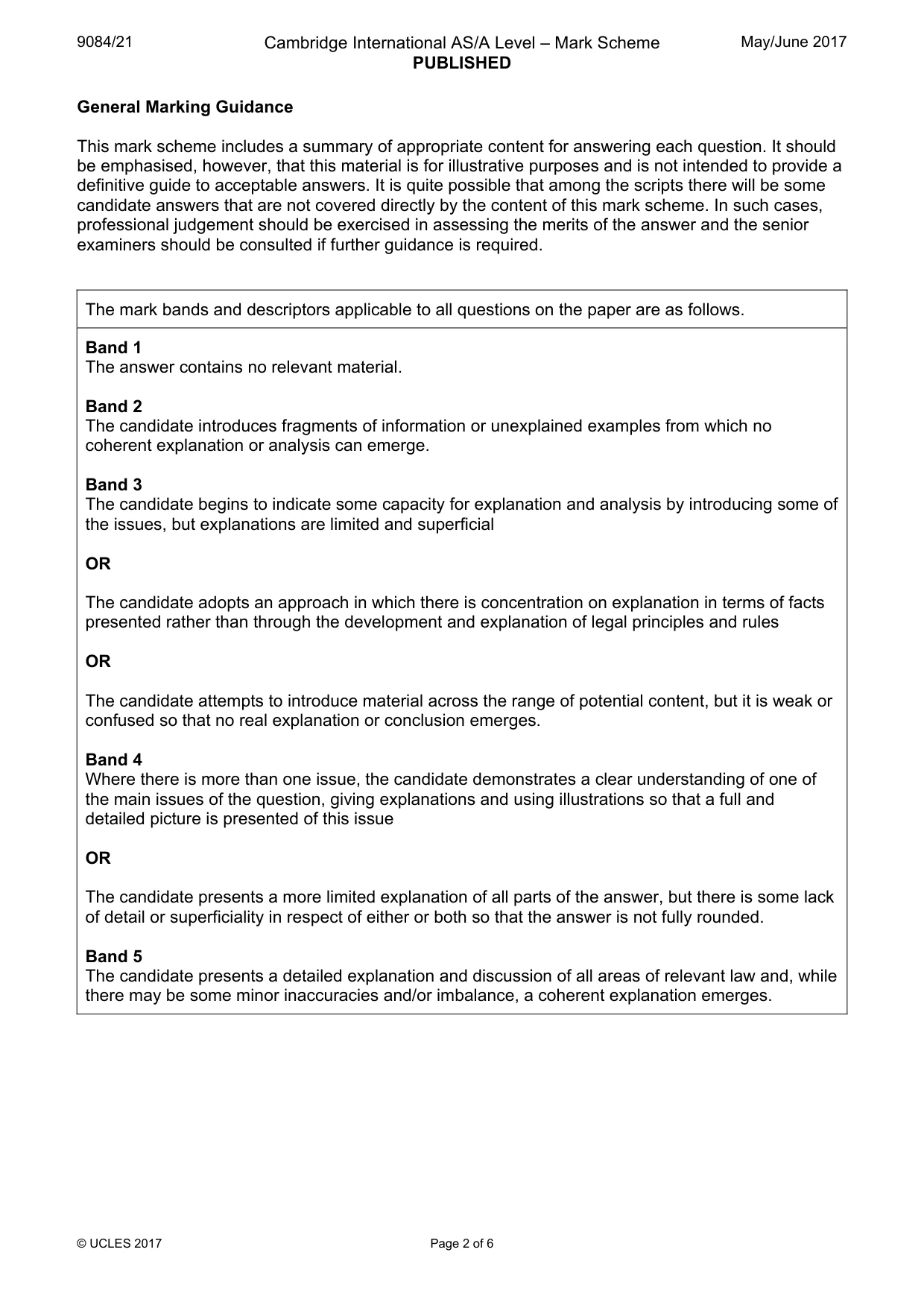
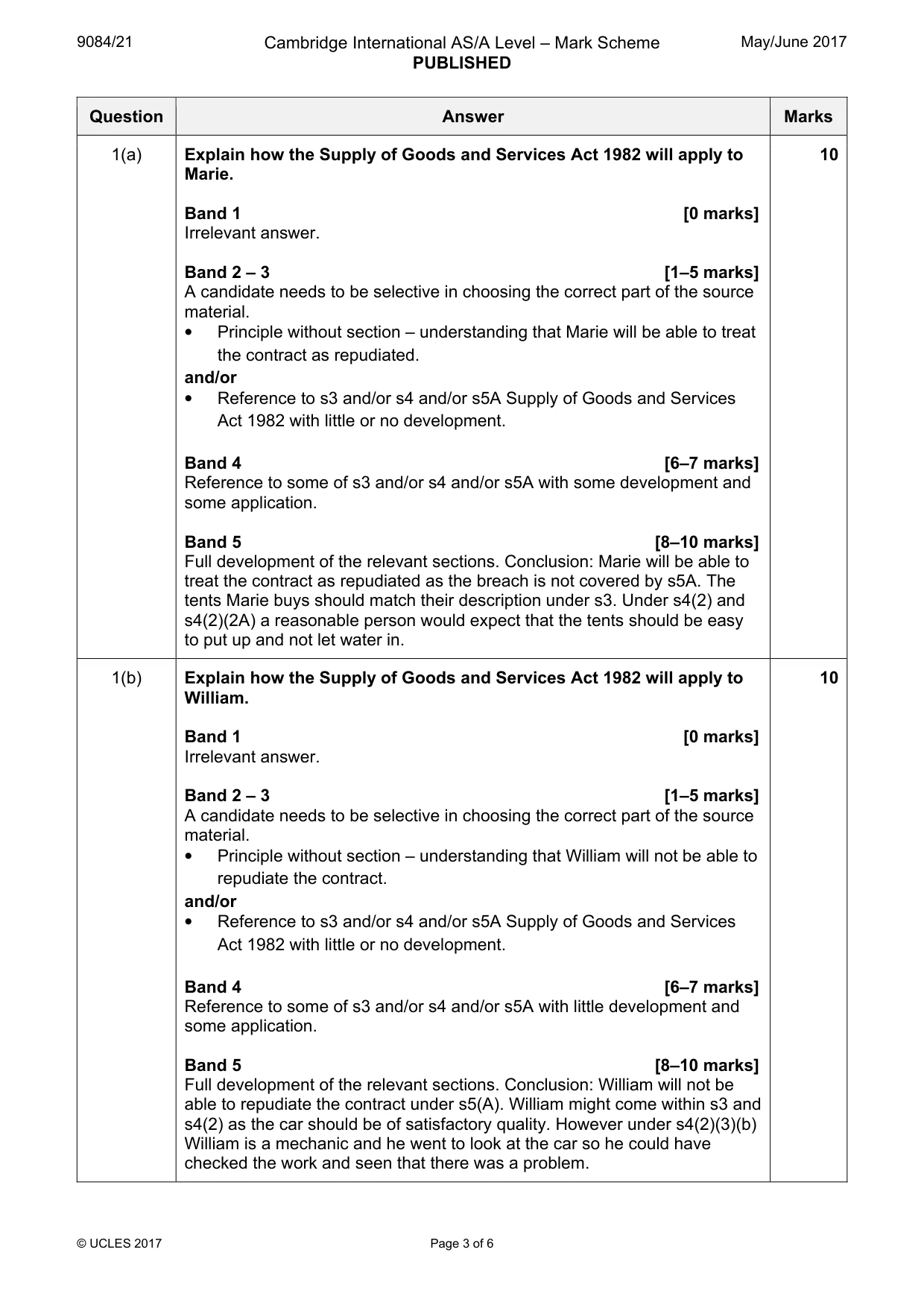
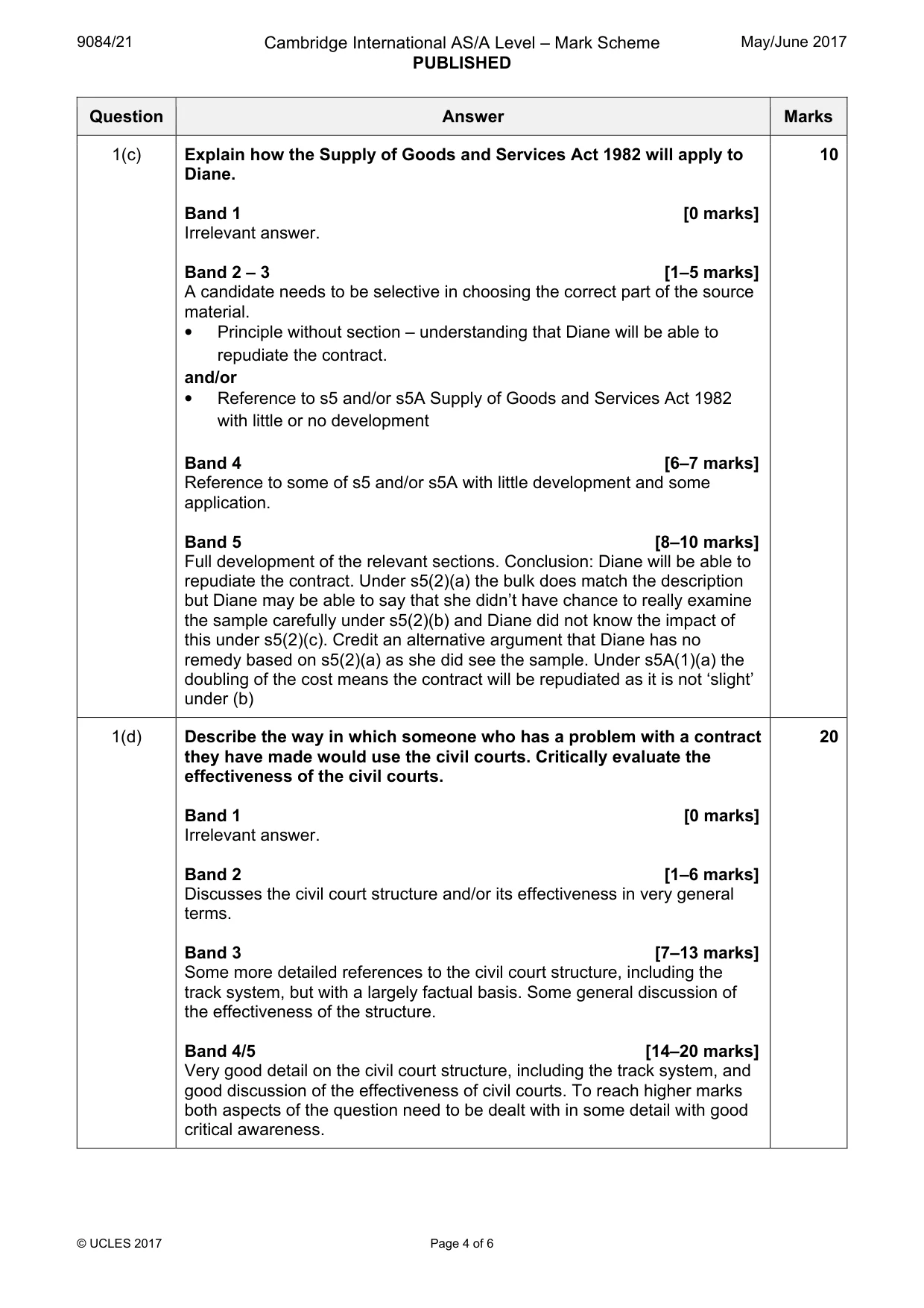
Mark scheme: Question Answer Marks 1(a) Explain how the Supply of Goods and Services Act 1982 will apply to 10 Marie. Band 1 [0 marks] Irrelevant answer. Band 2 – 3 [1–5 marks] A candidate needs to be selective in choosing the correct part of the source material. • Principle without section – understanding that Marie will be able to treat the contract as repudiated. and/or • Reference to s3 and/or s4 and/or s5A Supply of Goods and Services Act 1982 with little or no development. Band 4 [6–7 marks] Reference to some of s3 and/or s4 and/or s5A with some development and some application. Band 5 [8–10 marks] Full development of the relevant sections. Conclusion: Marie will be able to treat the contract as repudiated as the breach is not covered by s5A. The tents Marie buys should match their description under s3. Under s4(2) and s4(2)(2A) a reasonable person would expect that the tents should be easy to put up and not let water in. 1(b) Explain how the Supply of Goods and Services Act 1982 will apply to 10 William. Band 1 [0 marks] Irrelevant answer. Band 2 – 3 [1–5 marks] A candidate needs to be selective in choosing the correct part of the source material. • Principle without section – understanding that William will not be able to repudiate the contract. and/or • Reference to s3 and/or s4 and/or s5A Supply of Goods and Services Act 1982 with little or no development. Band 4 [6–7 marks] Reference to some of s3 and/or s4 and/or s5A with little development and some application. Band 5 [8–10 marks] Full development of the relevant sections. Conclusion: William will not be able to repudiate the contract under s5(A). William might come within s3 and s4(2) as the car should be of satisfactory quality. However under s4(2)(3)(b) William is a mechanic and he went to look at the car so he could have checked the work and seen that there was a problem. 1(c) Explain how the Supply of Goods and Services Act 1982 will apply to 10 Diane. Band 1 [0 marks] Irrelevant answer. Band 2 – 3 [1–5 marks] A candidate needs to be selective in choosing the correct part of the source material. • Principle without section – understanding that Diane will be able to repudiate the contract. and/or • Reference to s5 and/or s5A Supply of Goods and Services Act 1982 with little or no development Band 4 [6–7 marks] Reference to some of s5 and/or s5A with little development and some application. Band 5 [8–10 marks] Full development of the relevant sections. Conclusion: Diane will be able to repudiate the contract. Under s5(2)(a) the bulk does match the description but Diane may be able to say that she didn’t have chance to really examine the sample carefully under s5(2)(b) and Diane did not know the impact of this under s5(2)(c). Credit an alternative argument that Diane has no remedy based on s5(2)(a) as she did see the sample. Under s5A(1)(a) the doubling of the cost means the contract will be repudiated as it is not ‘slight’ under (b) 1(d) Describe the way in which someone who has a problem with a contract 20 they have made would use the civil courts. Critically evaluate the effectiveness of the civil courts. Band 1 [0 marks] Irrelevant answer. Band 2 [1–6 marks] Discusses the civil court structure and/or its effectiveness in very general terms. Band 3 [7–13 marks] Some more detailed references to the civil court structure, including the track system, but with a largely factual basis. Some general discussion of the effectiveness of the structure. Band 4/5 [14–20 marks] Very good detail on the civil court structure, including the track system, and good discussion of the effectiveness of civil courts. To reach higher marks both aspects of the question need to be dealt with in some detail with good critical awareness.
Q2 · Giovanni is shopping in a supermarket
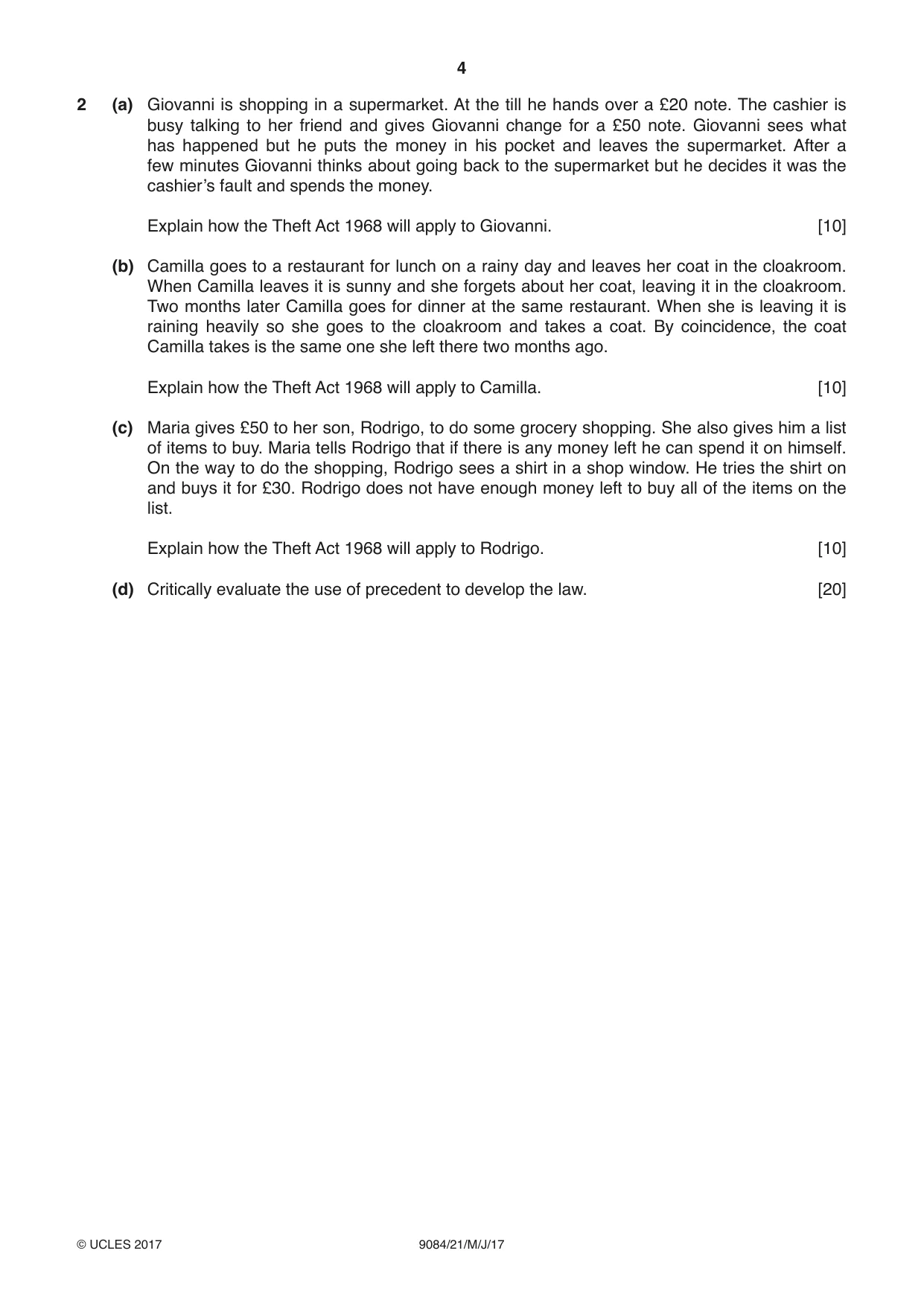
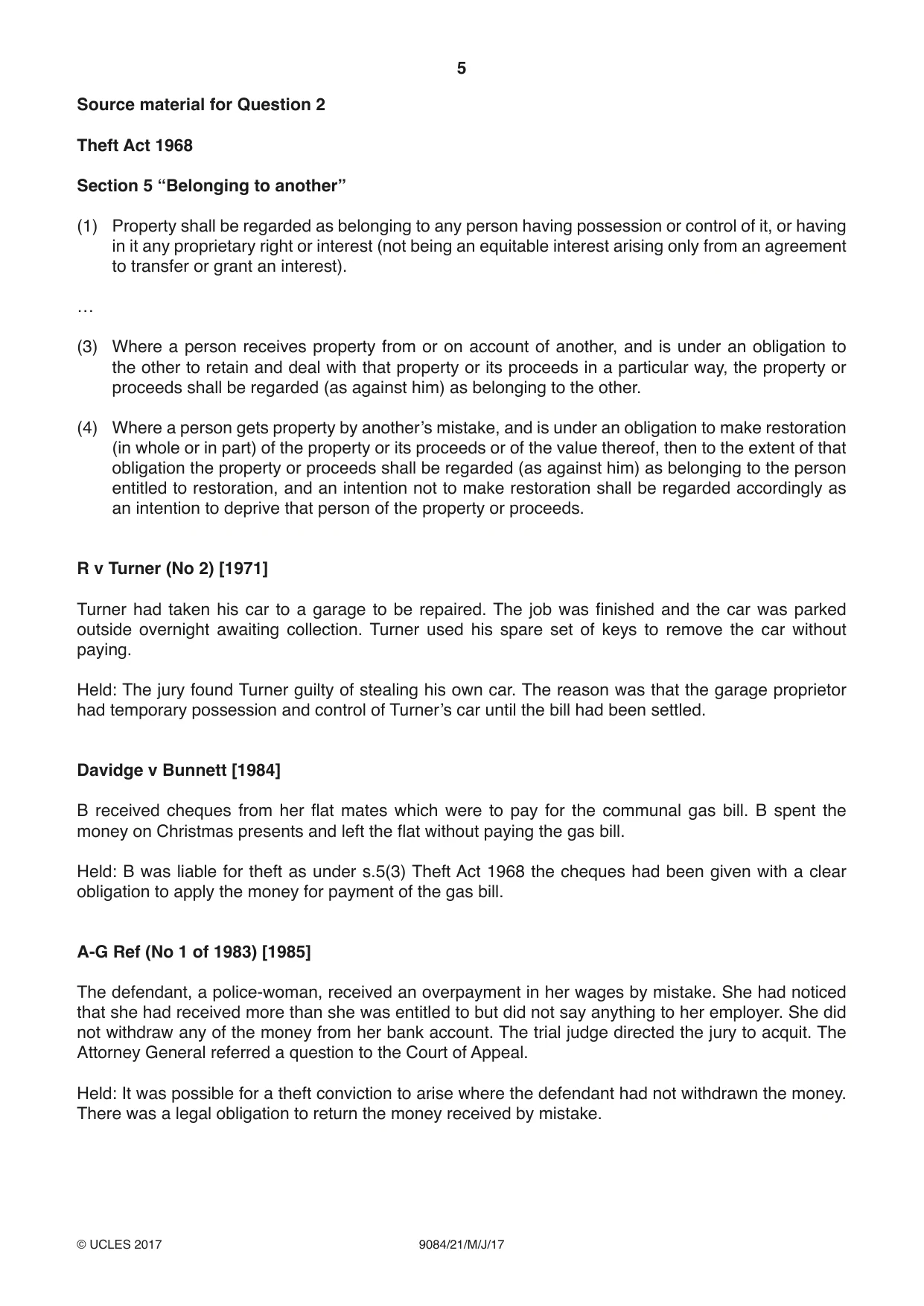
2 (a) Giovanni is shopping in a supermarket. At the till he hands over a £20 note. The cashier is busy talking to her friend and gives Giovanni change for a £50 note. Giovanni sees what has happened but he puts the money in his pocket and leaves the supermarket. After a few minutes Giovanni thinks about going back to the supermarket but he decides it was the cashier’s fault and spends the money. Explain how the Theft Act 1968 will apply to Giovanni. [10] (b) Camilla goes to a restaurant for lunch on a rainy day and leaves her coat in the cloakroom. When Camilla leaves it is sunny and she forgets about her coat, leaving it in the cloakroom. Two months later Camilla goes for dinner at the same restaurant. When she is leaving it is raining heavily so she goes to the cloakroom and takes a coat. By coincidence, the coat Camilla takes is the same one she left there two months ago. Explain how the Theft Act 1968 will apply to Camilla. [10] (c) Maria gives £50 to her son, Rodrigo, to do some grocery shopping. She also gives him a list of items to buy. Maria tells Rodrigo that if there is any money left he can spend it on himself. On the way to do the shopping, Rodrigo sees a shirt in a shop window. He tries the shirt on and buys it for £30. Rodrigo does not have enough money left to buy all of the items on the list. Explain how the Theft Act 1968 will apply to Rodrigo. [10] (d) Critically evaluate the use of precedent to develop the law. [20] Source material for Question 2 Theft Act 1968 Section 5 “Belonging to another” (1) Property shall be regarded as belonging to any person having possession or control of it, or having in it any proprietary right or interest (not being an equitable interest arising only from an agreement to transfer or grant an interest). … (3) Where a person receives property from or on account of another, and is under an obligation to the other to retain and deal with that property or its proceeds in a particular way, the property or proceeds shall be regarded (as against him) as belonging to the other. (4) Where a person gets property by another’s mistake, and is under an obligation to make restoration (in whole or in part) of the property or its proceeds or of the value thereof, then to the extent of that obligation the property or proceeds shall be regarded (as against him) as belonging to the person entitled to restoration, and an intention not to make restoration shall be regarded accordingly as an intention to deprive that person of the property or proceeds. R v Turner (No 2) [1971] Turner had taken his car to a garage to be repaired. The job was finished and the car was parked outside overnight awaiting collection. Turner used his spare set of keys to remove the car without paying. Held: The jury found Turner guilty of stealing his own car. The reason was that the garage proprietor had temporary possession and control of Turner’s car until the bill had been settled. Davidge v Bunnett [1984] B received cheques from her flat mates which were to pay for the communal gas bill. B spent the money on Christmas presents and left the flat without paying the gas bill. Held: B was liable for theft as under s.5(3) Theft Act 1968 the cheques had been given with a clear obligation to apply the money for payment of the gas bill. A-G Ref (No 1 of 1983) [1985] The defendant, a police-woman, received an overpayment in her wages by mistake. She had noticed that she had received more than she was entitled to but did not say anything to her employer. She did not withdraw any of the money from her bank account. The trial judge directed the jury to acquit. The Attorney General referred a question to the Court of Appeal. Held: It was possible for a theft conviction to arise where the defendant had not withdrawn the money. There was a legal obligation to return the money received by mistake.
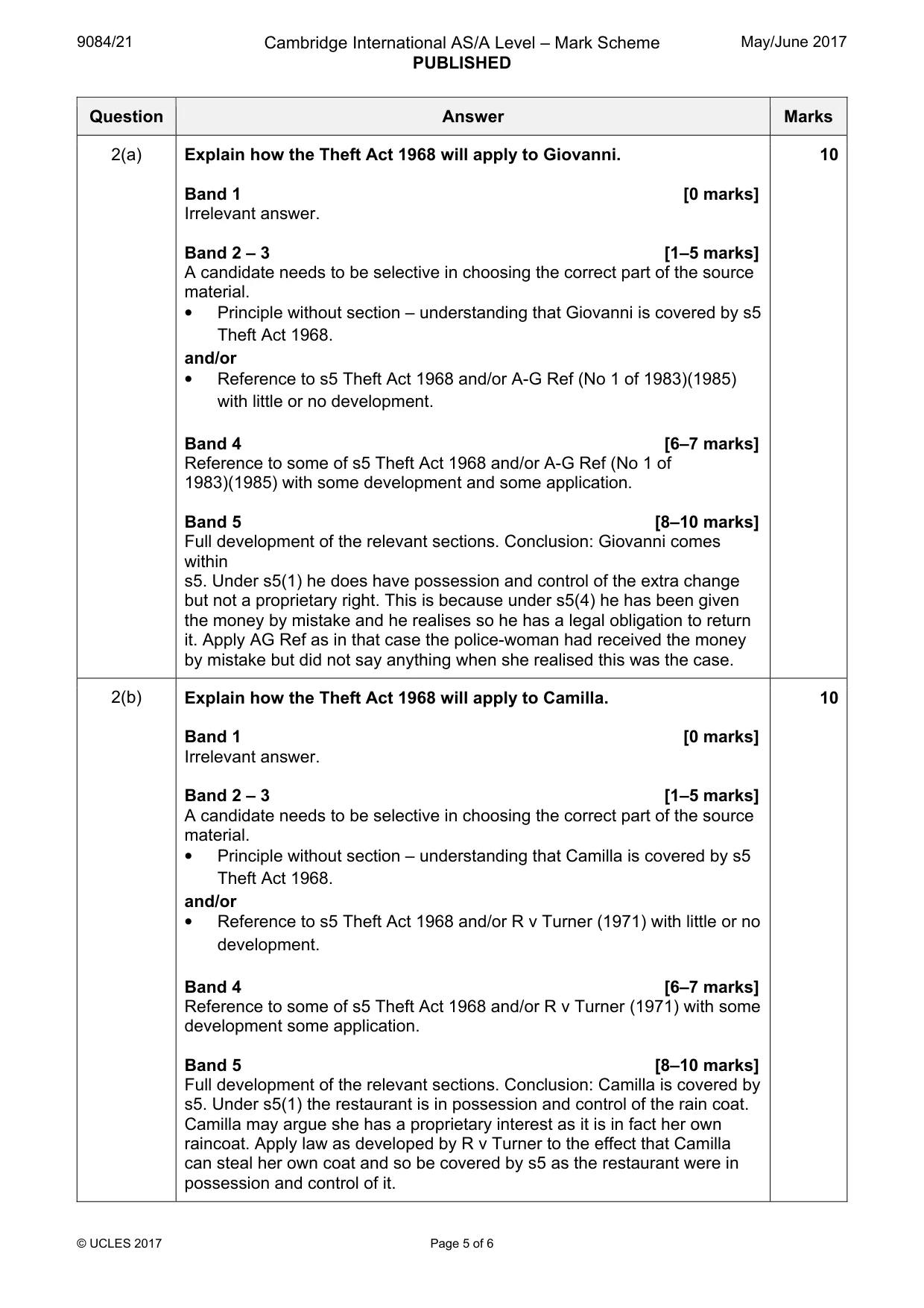
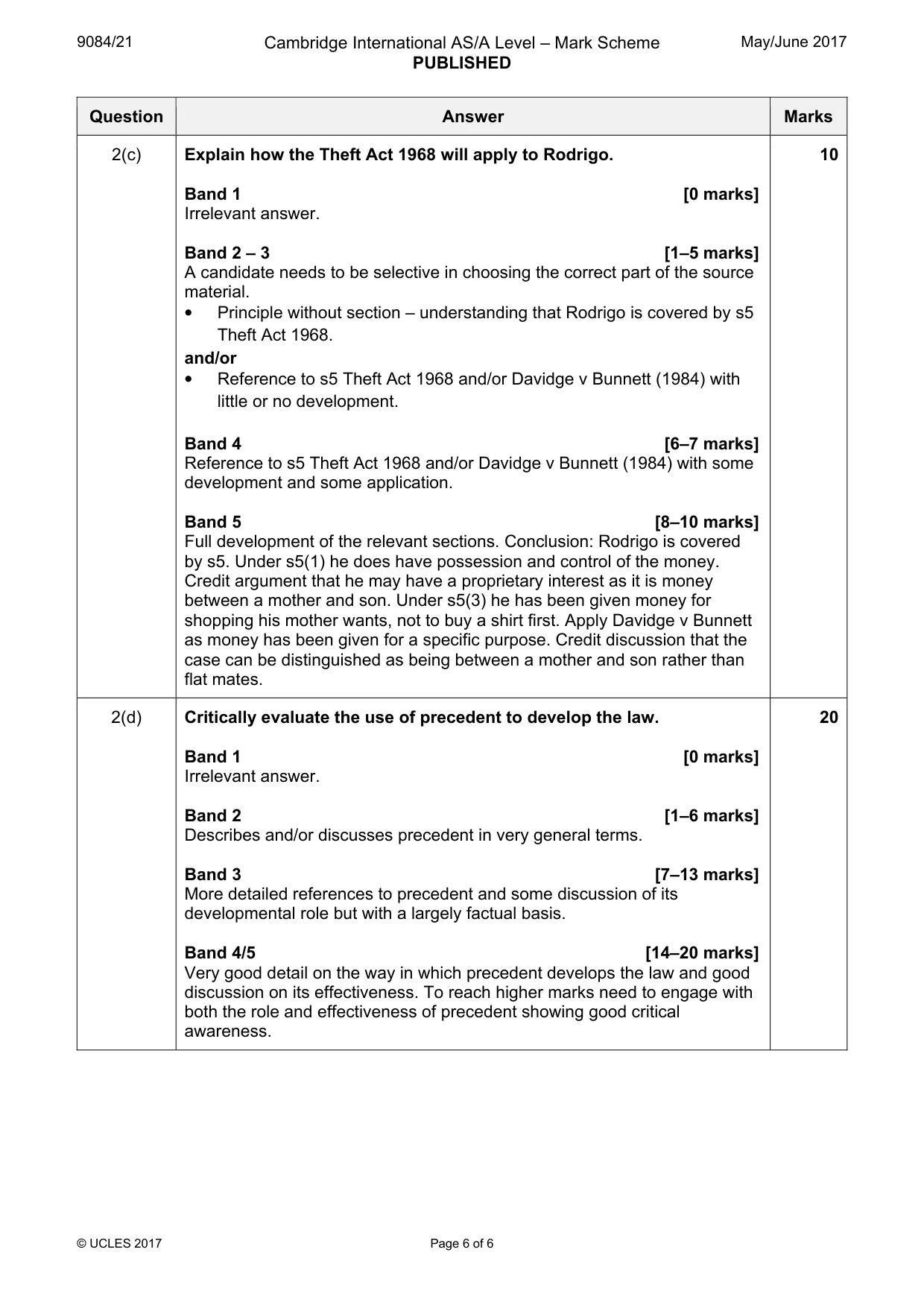
Mark scheme: 2(a) Explain how the Theft Act 1968 will apply to Giovanni. 10 Band 1 [0 marks] Irrelevant answer. Band 2 – 3 [1–5 marks] A candidate needs to be selective in choosing the correct part of the source material. • Principle without section – understanding that Giovanni is covered by s5 Theft Act 1968. and/or • Reference to s5 Theft Act 1968 and/or A-G Ref (No 1 of 1983)(1985) with little or no development. Band 4 [6–7 marks] Reference to some of s5 Theft Act 1968 and/or A-G Ref (No 1 of 1983)(1985) with some development and some application. Band 5 [8–10 marks] Full development of the relevant sections. Conclusion: Giovanni comes within s5. Under s5(1) he does have possession and control of the extra change but not a proprietary right. This is because under s5(4) he has been given the money by mistake and he realises so he has a legal obligation to return it. Apply AG Ref as in that case the police-woman had received the money by mistake but did not say anything when she realised this was the case. 2(b) Explain how the Theft Act 1968 will apply to Camilla. 10 Band 1 [0 marks] Irrelevant answer. Band 2 – 3 [1–5 marks] A candidate needs to be selective in choosing the correct part of the source material. • Principle without section – understanding that Camilla is covered by s5 Theft Act 1968. and/or • Reference to s5 Theft Act 1968 and/or R v Turner (1971) with little or no development. Band 4 [6–7 marks] Reference to some of s5 Theft Act 1968 and/or R v Turner (1971) with some development some application. Band 5 [8–10 marks] Full development of the relevant sections. Conclusion: Camilla is covered by s5. Under s5(1) the restaurant is in possession and control of the rain coat. Camilla may argue she has a proprietary interest as it is in fact her own raincoat. Apply law as developed by R v Turner to the effect that Camilla can steal her own coat and so be covered by s5 as the restaurant were in possession and control of it. 2(c) Explain how the Theft Act 1968 will apply to Rodrigo. 10 Band 1 [0 marks] Irrelevant answer. Band 2 – 3 [1–5 marks] A candidate needs to be selective in choosing the correct part of the source material. • Principle without section – understanding that Rodrigo is covered by s5 Theft Act 1968. and/or • Reference to s5 Theft Act 1968 and/or Davidge v Bunnett (1984) with little or no development. Band 4 [6–7 marks] Reference to s5 Theft Act 1968 and/or Davidge v Bunnett (1984) with some development and some application. Band 5 [8–10 marks] Full development of the relevant sections. Conclusion: Rodrigo is covered by s5. Under s5(1) he does have possession and control of the money. Credit argument that he may have a proprietary interest as it is money between a mother and son. Under s5(3) he has been given money for shopping his mother wants, not to buy a shirt first. Apply Davidge v Bunnett as money has been given for a specific purpose. Credit discussion that the case can be distinguished as being between a mother and son rather than flat mates. 2(d) Critically evaluate the use of precedent to develop the law. 20 Band 1 [0 marks] Irrelevant answer. Band 2 [1–6 marks] Describes and/or discusses precedent in very general terms. Band 3 [7–13 marks] More detailed references to precedent and some discussion of its developmental role but with a largely factual basis. Band 4/5 [14–20 marks] Very good detail on the way in which precedent develops the law and good discussion on its effectiveness. To reach higher marks need to engage with both the role and effectiveness of precedent showing good critical awareness.
What was in this paper
The subtopics covered by these 2 questions, and how many questions each got. Open one in a new tab to see every Cambridge question on it.
1Offences against property This topic is about the components of substantive offences against property. This topic is an opportunity to reflect on the key concepts of liability, justice, fairness, effectiveness and certainty1