Cambridge A Level Law 9084 — 2017 May/June Paper 2 · Variant 3
9084/23/M/J/17 · 2 questions · 100 marks · ≈113 min
The question paper and its mark scheme, free to read here and free to download. This is Cambridge’s own paper, exactly as it was sat.
Question paper8 pages
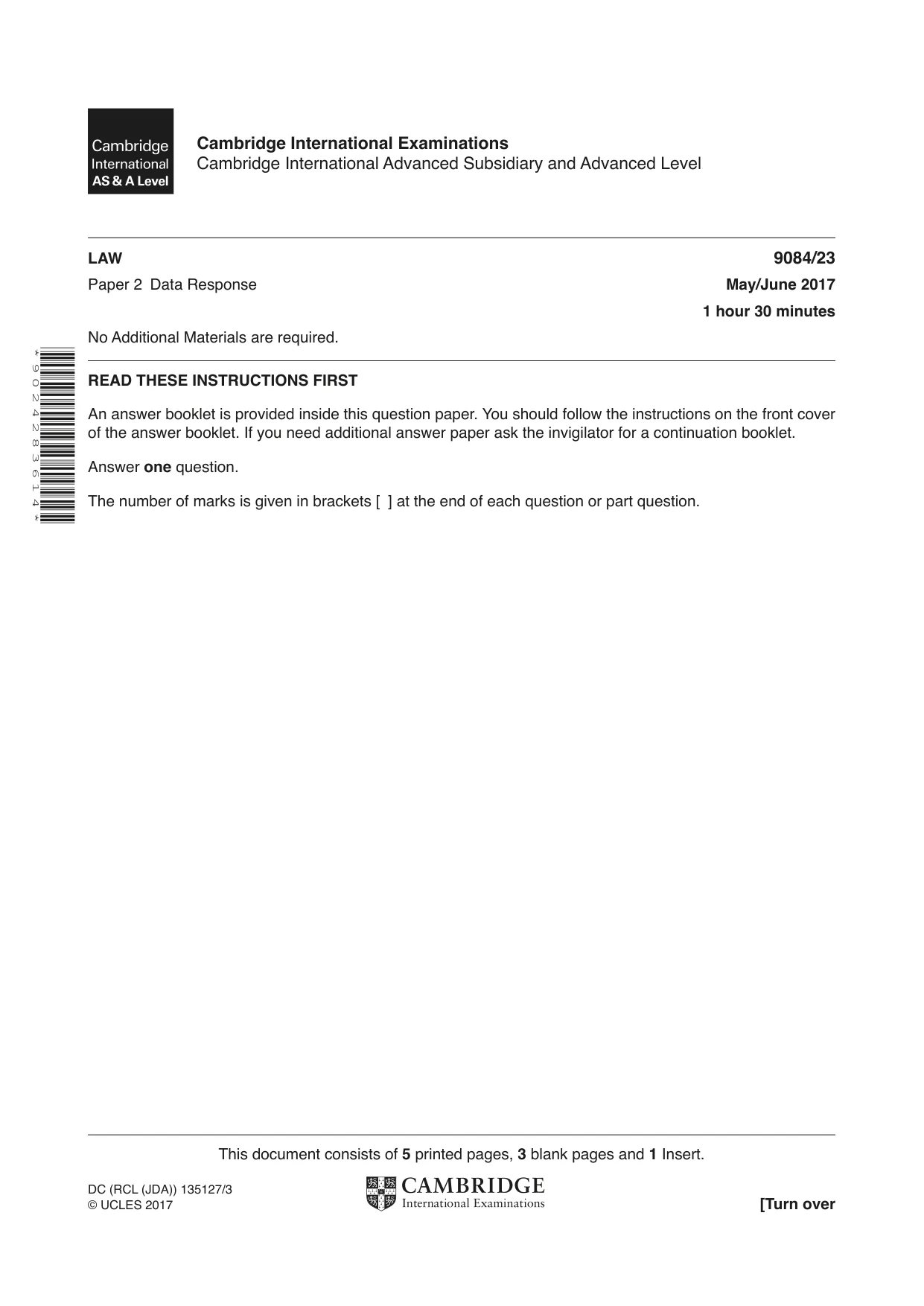
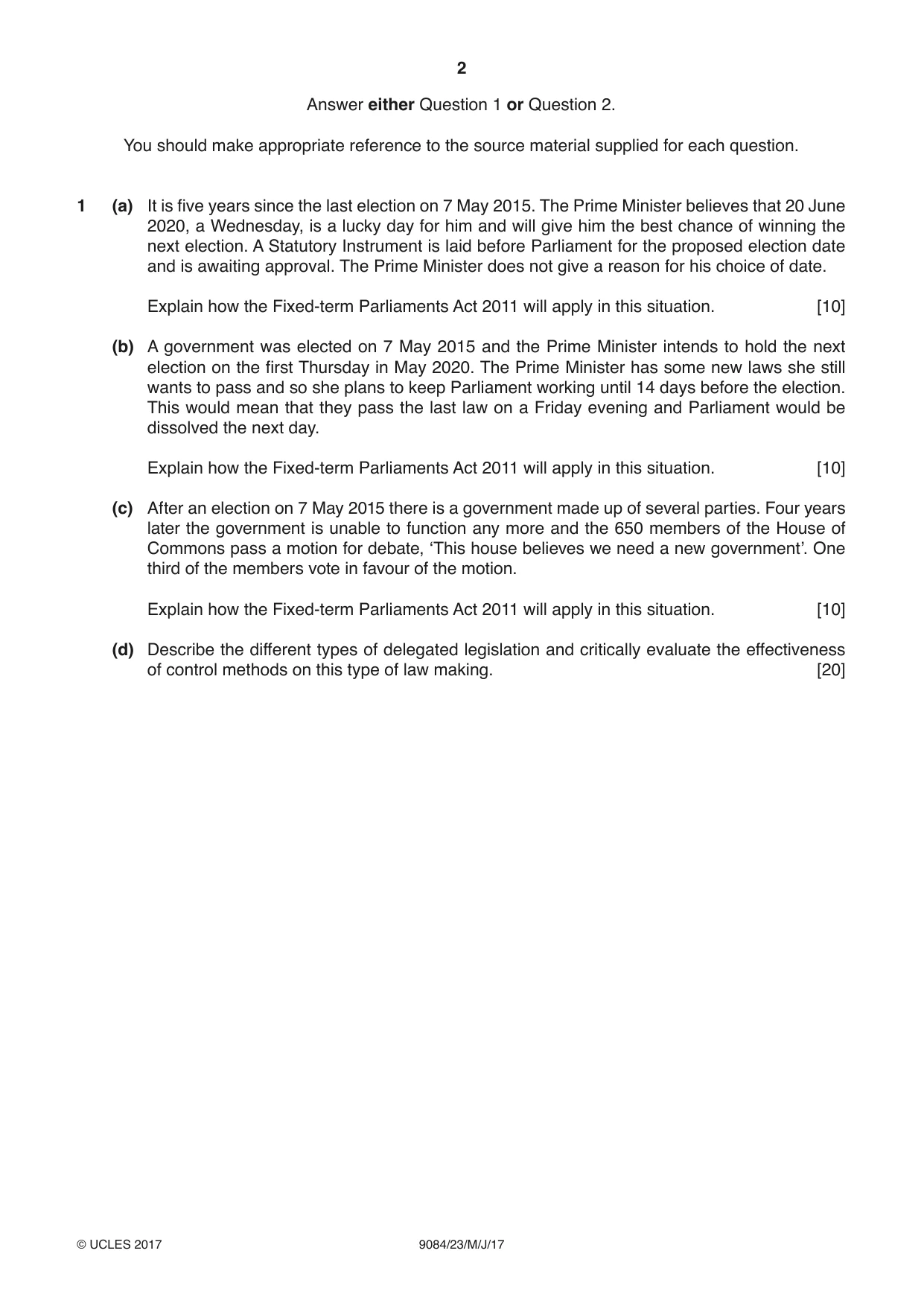
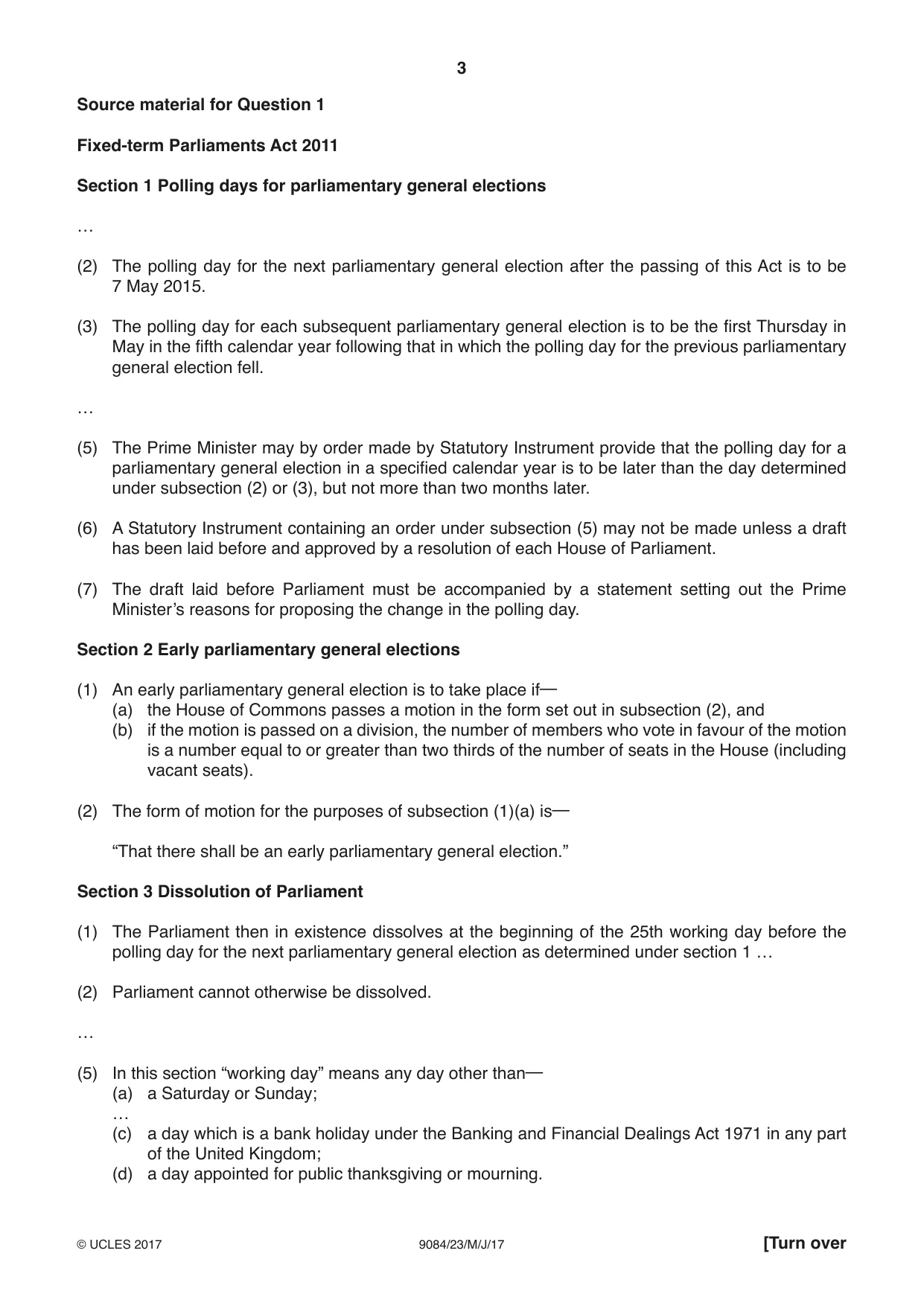
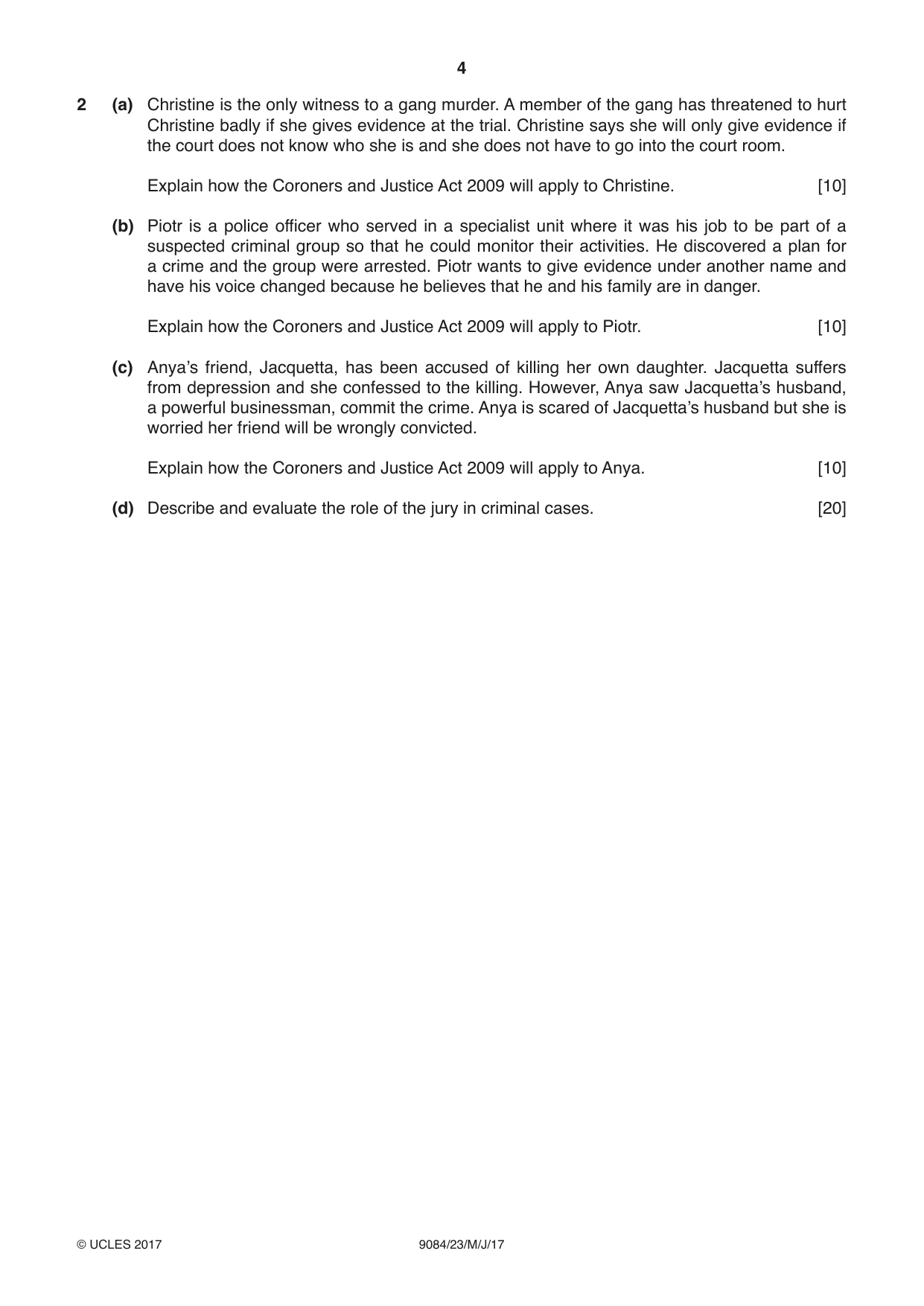



Mark scheme6 pages
Answers below. Sit the paper first if you are practising.
Questions as text
Q1 · It is five years since the last election on 7 May 2015
1 (a) It is five years since the last election on 7 May 2015. The Prime Minister believes that 20 June 2020, a Wednesday, is a lucky day for him and will give him the best chance of winning the next election. A Statutory Instrument is laid before Parliament for the proposed election date and is awaiting approval. The Prime Minister does not give a reason for his choice of date. Explain how the Fixed-term Parliaments Act 2011 will apply in this situation. [10] (b) A government was elected on 7 May 2015 and the Prime Minister intends to hold the next election on the first Thursday in May 2020. The Prime Minister has some new laws she still wants to pass and so she plans to keep Parliament working until 14 days before the election. This would mean that they pass the last law on a Friday evening and Parliament would be dissolved the next day. Explain how the Fixed-term Parliaments Act 2011 will apply in this situation. [10] (c) After an election on 7 May 2015 there is a government made up of several parties. Four years later the government is unable to function any more and the 650 members of the House of Commons pass a motion for debate, ‘This house believes we need a new government’. One third of the members vote in favour of the motion. Explain how the Fixed-term Parliaments Act 2011 will apply in this situation. [10] (d) Describe the different types of delegated legislation and critically evaluate the effectiveness of control methods on this type of law making. [20] Source material for Question 1 Fixed-term Parliaments Act 2011 Section 1 Polling days for parliamentary general elections … (2) The polling day for the next parliamentary general election after the passing of this Act is to be 7 May 2015. (3) The polling day for each subsequent parliamentary general election is to be the first Thursday in May in the fifth calendar year following that in which the polling day for the previous parliamentary general election fell. … (5) The Prime Minister may by order made by Statutory Instrument provide that the polling day for a parliamentary general election in a specified calendar year is to be later than the day determined under subsection (2) or (3), but not more than two months later. (6) A Statutory Instrument containing an order under subsection (5) may not be made unless a draft has been laid before and approved by a resolution of each House of Parliament. (7) The draft laid before Parliament must be accompanied by a statement setting out the Prime Minister’s reasons for proposing the change in the polling day. Section 2 Early parliamentary general elections (1) An early parliamentary general election is to take place if─ (a) the House of Commons passes a motion in the form set out in subsection (2), and (b) if the motion is passed on a division, the number of members who vote in favour of the motion is a number equal to or greater than two thirds of the number of seats in the House (including vacant seats). (2) The form of motion for the purposes of subsection (1)(a) is─ “That there shall be an early parliamentary general election.” Section 3 Dissolution of Parliament (1) The Parliament then in existence dissolves at the beginning of the 25th working day before the polling day for the next parliamentary general election as determined under section 1 … (2) Parliament cannot otherwise be dissolved. … (5) In this section “working day” means any day other than─ (a) a Saturday or Sunday; … (c) a day which is a bank holiday under the Banking and Financial Dealings Act 1971 in any part of the United Kingdom; (d) a day appointed for public thanksgiving or mourning.
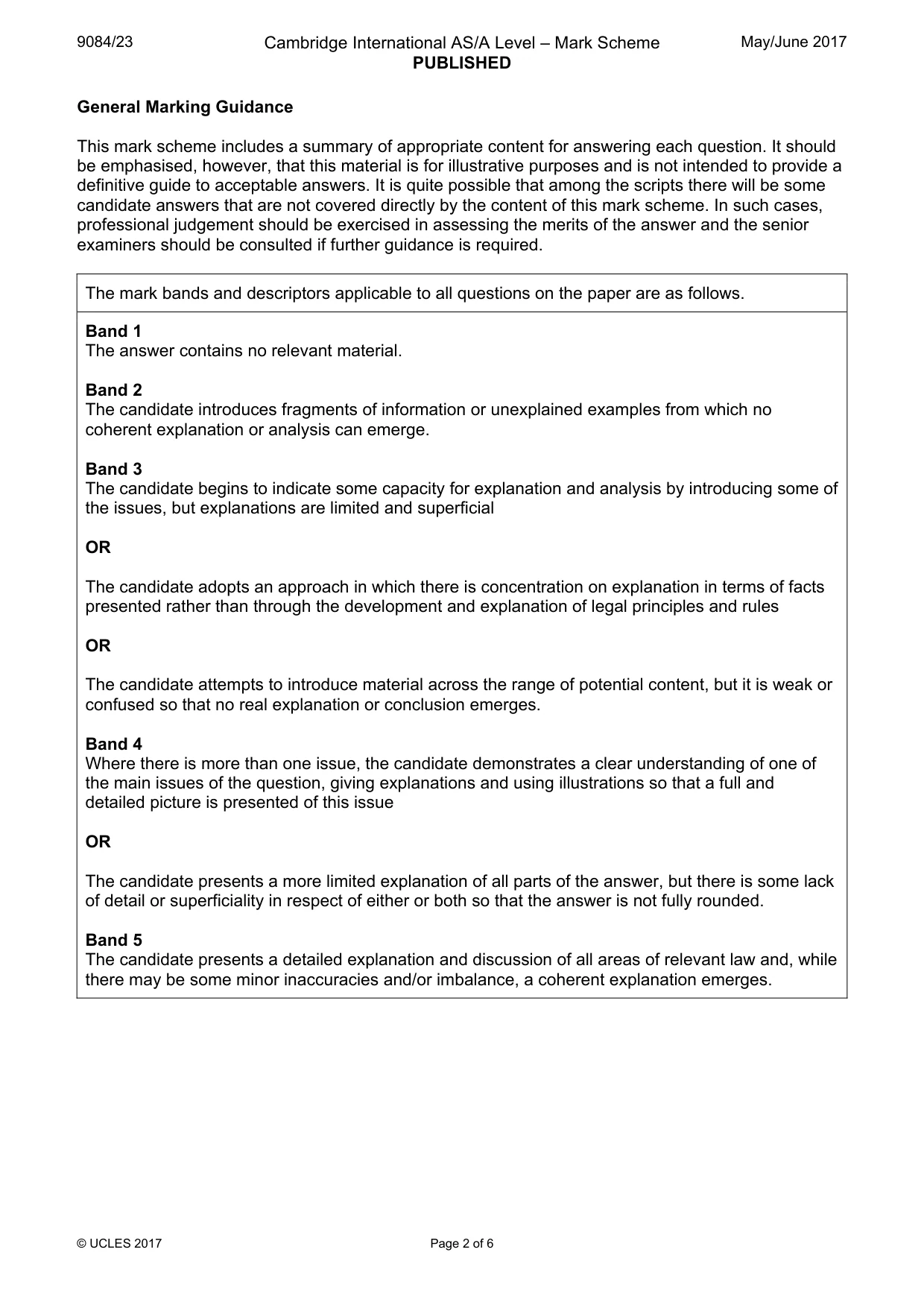
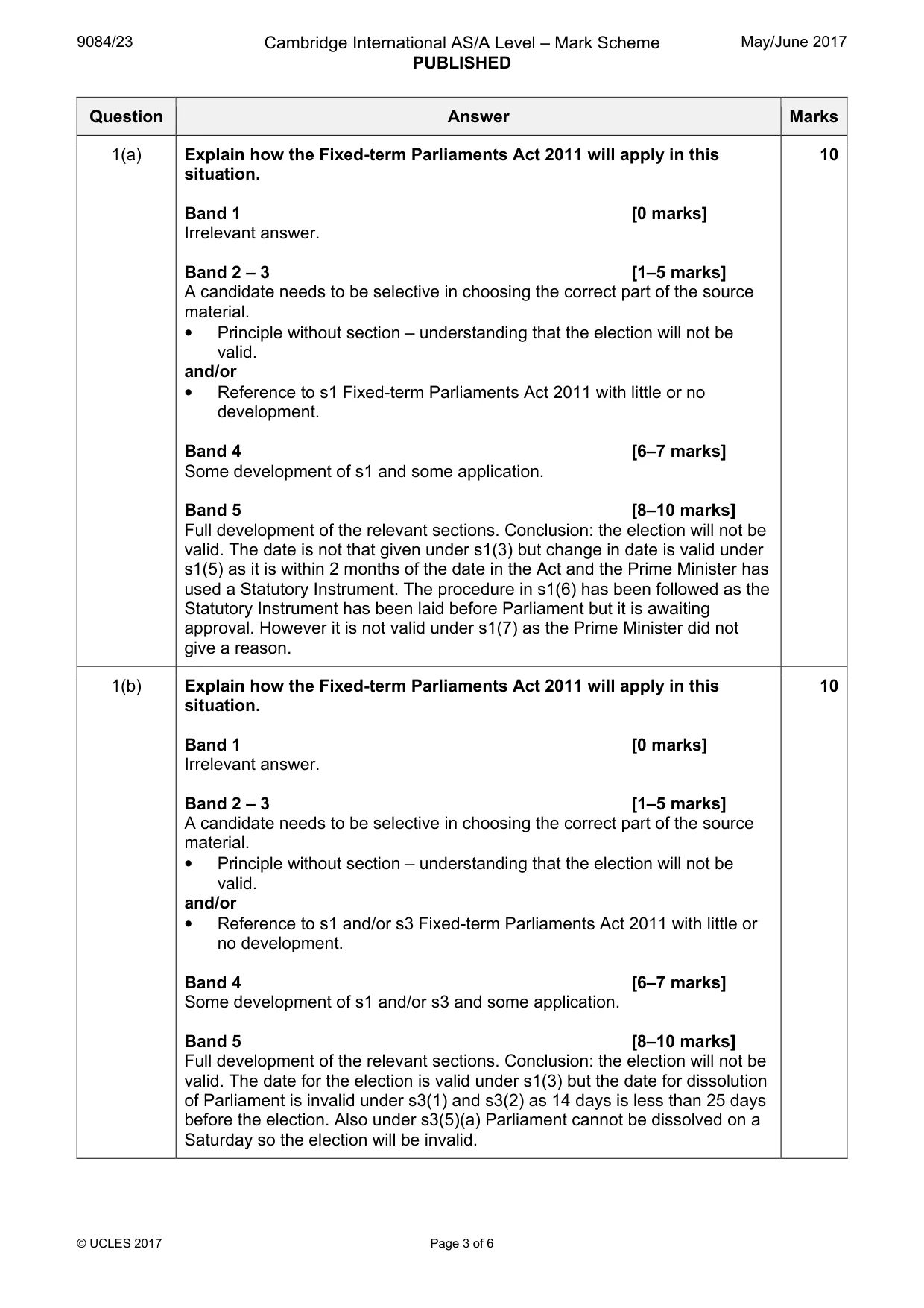
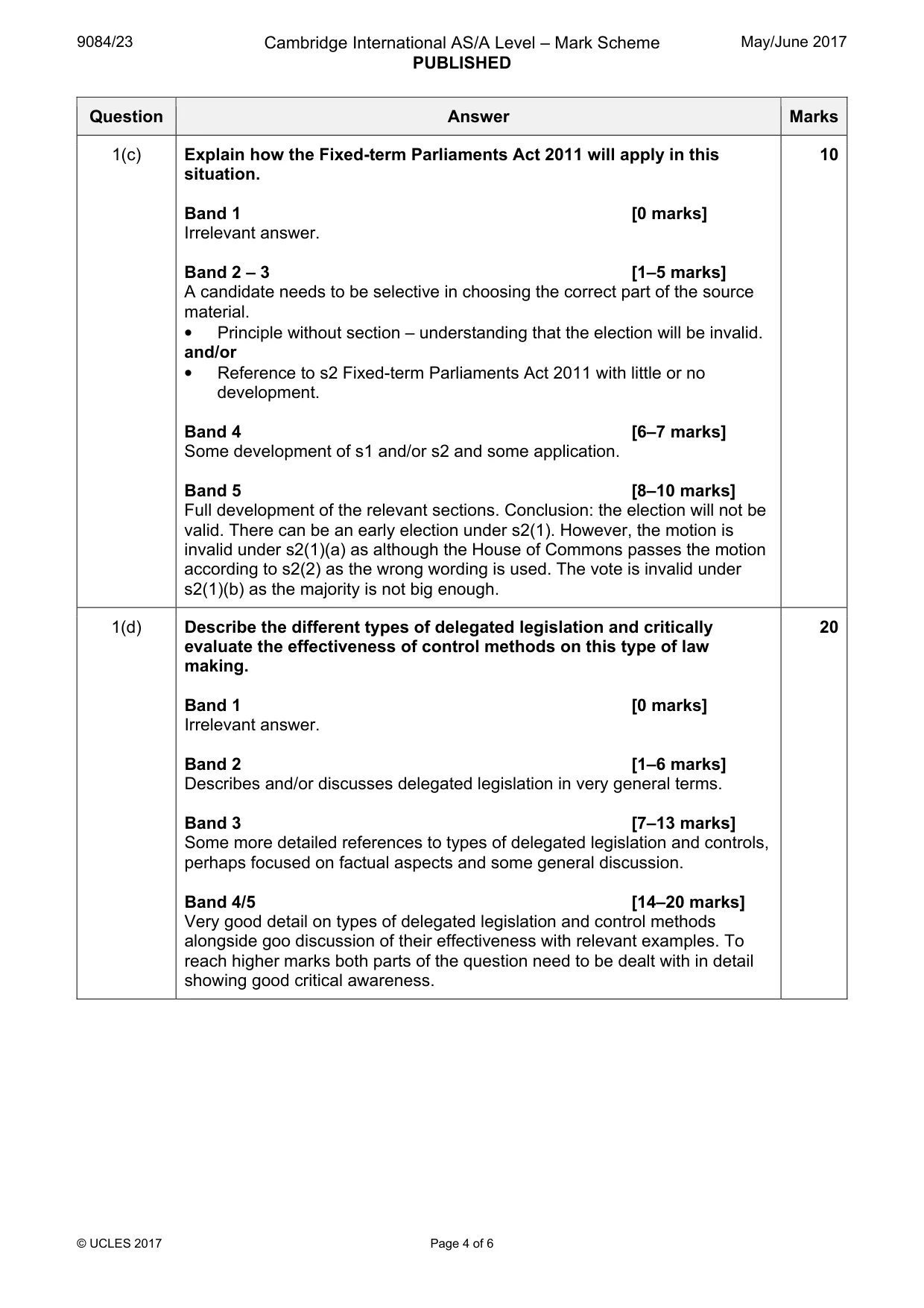
Mark scheme: Question Answer Marks 1(a) Explain how the Fixed-term Parliaments Act 2011 will apply in this 10 situation. Band 1 [0 marks] Irrelevant answer. Band 2 – 3 [1–5 marks] A candidate needs to be selective in choosing the correct part of the source material. • Principle without section – understanding that the election will not be valid. and/or • Reference to s1 Fixed-term Parliaments Act 2011 with little or no development. Band 4 [6–7 marks] Some development of s1 and some application. Band 5 [8–10 marks] Full development of the relevant sections. Conclusion: the election will not be valid. The date is not that given under s1(3) but change in date is valid under s1(5) as it is within 2 months of the date in the Act and the Prime Minister has used a Statutory Instrument. The procedure in s1(6) has been followed as the Statutory Instrument has been laid before Parliament but it is awaiting approval. However it is not valid under s1(7) as the Prime Minister did not give a reason. 1(b) Explain how the Fixed-term Parliaments Act 2011 will apply in this 10 situation. Band 1 [0 marks] Irrelevant answer. Band 2 – 3 [1–5 marks] A candidate needs to be selective in choosing the correct part of the source material. • Principle without section – understanding that the election will not be valid. and/or • Reference to s1 and/or s3 Fixed-term Parliaments Act 2011 with little or no development. Band 4 [6–7 marks] Some development of s1 and/or s3 and some application. Band 5 [8–10 marks] Full development of the relevant sections. Conclusion: the election will not be valid. The date for the election is valid under s1(3) but the date for dissolution of Parliament is invalid under s3(1) and s3(2) as 14 days is less than 25 days before the election. Also under s3(5)(a) Parliament cannot be dissolved on a Saturday so the election will be invalid. 1(c) Explain how the Fixed-term Parliaments Act 2011 will apply in this 10 situation. Band 1 [0 marks] Irrelevant answer. Band 2 – 3 [1–5 marks] A candidate needs to be selective in choosing the correct part of the source material. • Principle without section – understanding that the election will be invalid. and/or • Reference to s2 Fixed-term Parliaments Act 2011 with little or no development. Band 4 [6–7 marks] Some development of s1 and/or s2 and some application. Band 5 [8–10 marks] Full development of the relevant sections. Conclusion: the election will not be valid. There can be an early election under s2(1). However, the motion is invalid under s2(1)(a) as although the House of Commons passes the motion according to s2(2) as the wrong wording is used. The vote is invalid under s2(1)(b) as the majority is not big enough. 1(d) Describe the different types of delegated legislation and critically 20 evaluate the effectiveness of control methods on this type of law making. Band 1 [0 marks] Irrelevant answer. Band 2 [1–6 marks] Describes and/or discusses delegated legislation in very general terms. Band 3 [7–13 marks] Some more detailed references to types of delegated legislation and controls, perhaps focused on factual aspects and some general discussion. Band 4/5 [14–20 marks] Very good detail on types of delegated legislation and control methods alongside goo discussion of their effectiveness with relevant examples. To reach higher marks both parts of the question need to be dealt with in detail showing good critical awareness.
Q2 · Christine is the only witness to a gang murder
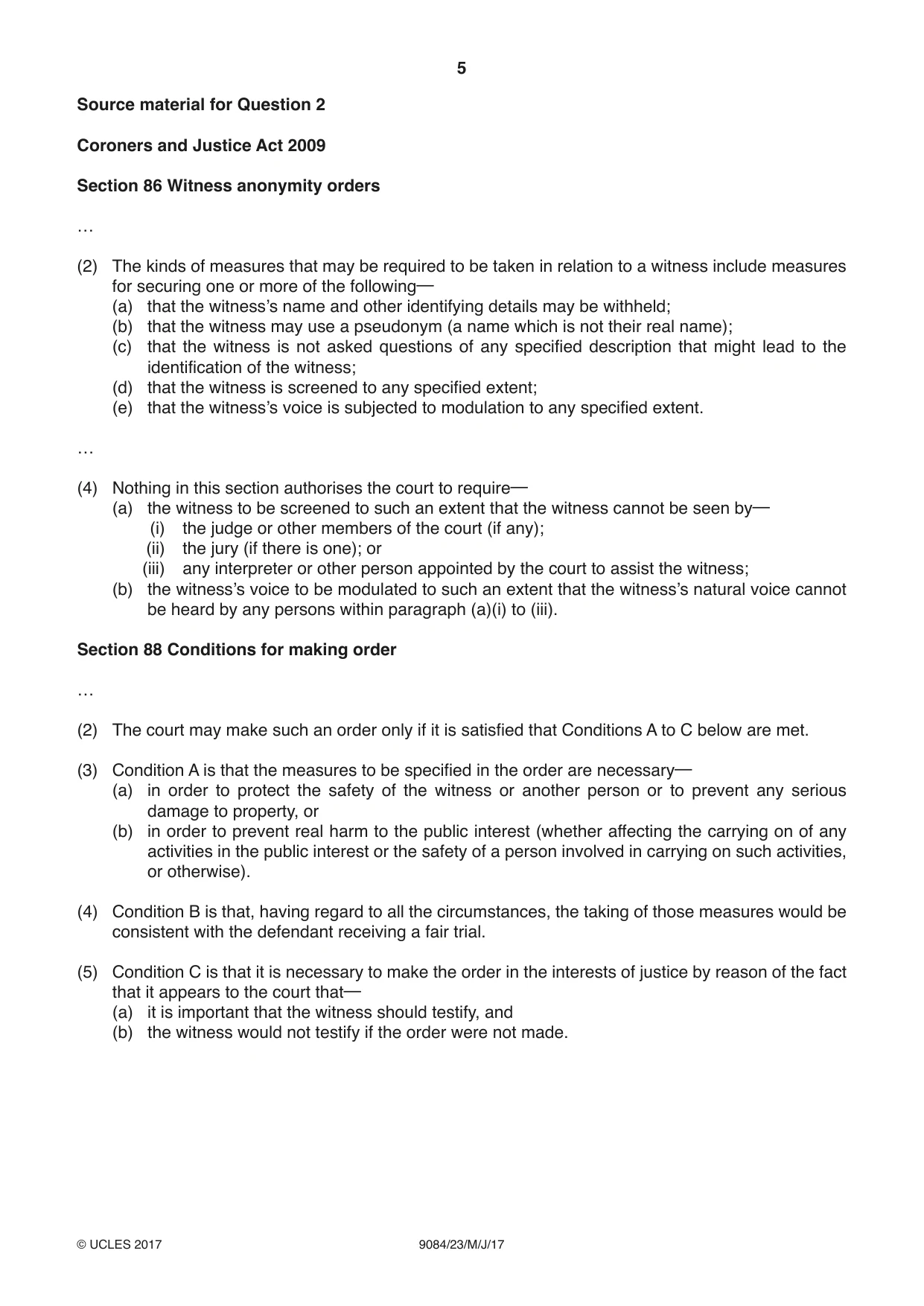
2 (a) Christine is the only witness to a gang murder. A member of the gang has threatened to hurt Christine badly if she gives evidence at the trial. Christine says she will only give evidence if the court does not know who she is and she does not have to go into the court room. Explain how the Coroners and Justice Act 2009 will apply to Christine. [10] (b) Piotr is a police officer who served in a specialist unit where it was his job to be part of a suspected criminal group so that he could monitor their activities. He discovered a plan for a crime and the group were arrested. Piotr wants to give evidence under another name and have his voice changed because he believes that he and his family are in danger. Explain how the Coroners and Justice Act 2009 will apply to Piotr. [10] (c) Anya’s friend, Jacquetta, has been accused of killing her own daughter. Jacquetta suffers from depression and she confessed to the killing. However, Anya saw Jacquetta’s husband, a powerful businessman, commit the crime. Anya is scared of Jacquetta’s husband but she is worried her friend will be wrongly convicted. Explain how the Coroners and Justice Act 2009 will apply to Anya. [10] (d) Describe and evaluate the role of the jury in criminal cases. [20] Source material for Question 2 Coroners and Justice Act 2009 Section 86 Witness anonymity orders … (2) The kinds of measures that may be required to be taken in relation to a witness include measures for securing one or more of the following─ (a) that the witness’s name and other identifying details may be withheld; (b) that the witness may use a pseudonym (a name which is not their real name); (c) that the witness is not asked questions of any specified description that might lead to the identification of the witness; (d) that the witness is screened to any specified extent; (e) that the witness’s voice is subjected to modulation to any specified extent. … (4) Nothing in this section authorises the court to require─ (a) the witness to be screened to such an extent that the witness cannot be seen by─ (i) the judge or other members of the court (if any); (ii) the jury (if there is one); or (iii) any interpreter or other person appointed by the court to assist the witness; (b) the witness’s voice to be modulated to such an extent that the witness’s natural voice cannot be heard by any persons within paragraph (a)(i) to (iii). Section 88 Conditions for making order … (2) The court may make such an order only if it is satisfied that Conditions A to C below are met. (3) Condition A is that the measures to be specified in the order are necessary─ (a) in order to protect the safety of the witness or another person or to prevent any serious damage to property, or (b) in order to prevent real harm to the public interest (whether affecting the carrying on of any activities in the public interest or the safety of a person involved in carrying on such activities, or otherwise). (4) Condition B is that, having regard to all the circumstances, the taking of those measures would be consistent with the defendant receiving a fair trial. (5) Condition C is that it is necessary to make the order in the interests of justice by reason of the fact that it appears to the court that─ (a) it is important that the witness should testify, and (b) the witness would not testify if the order were not made.
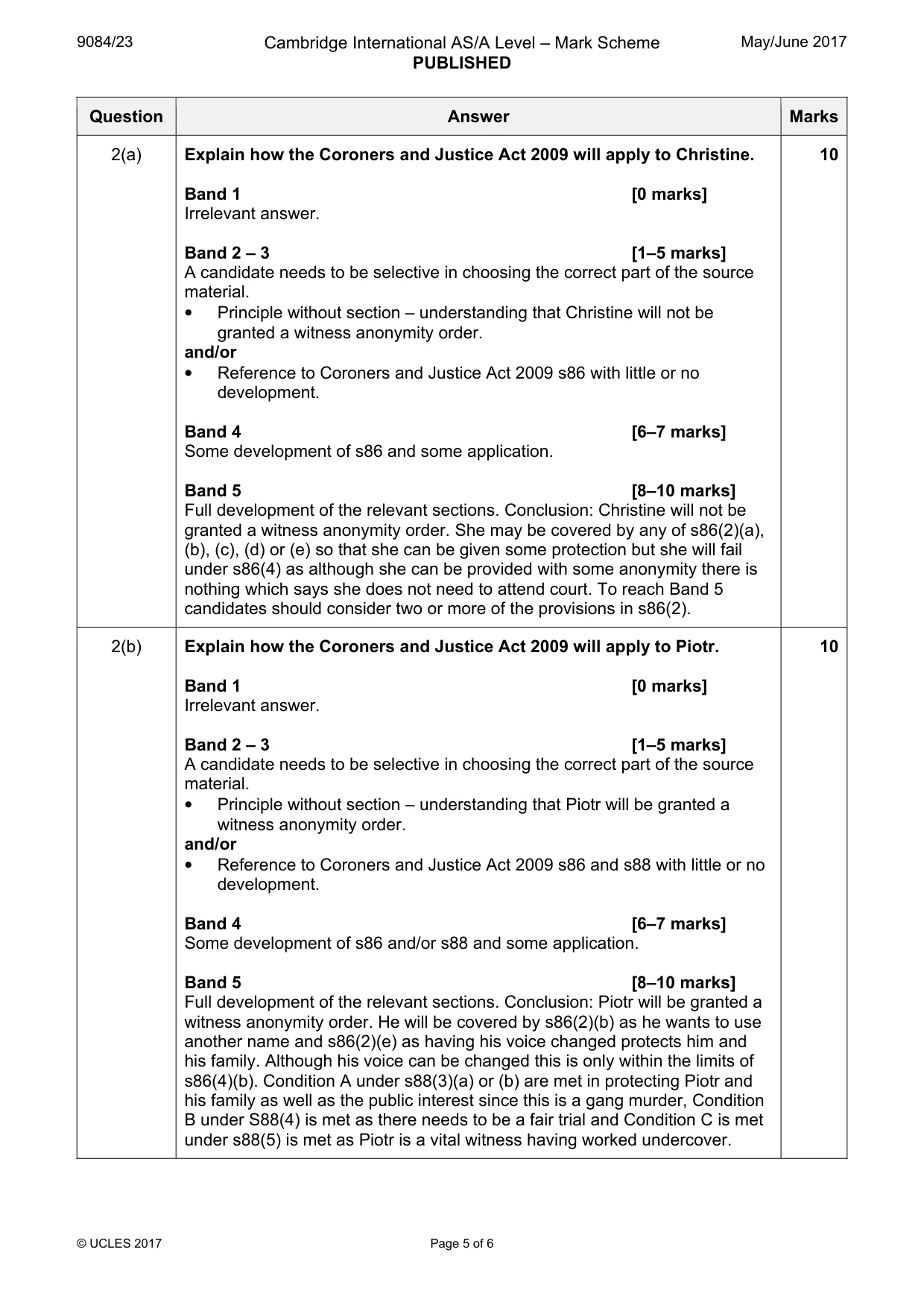
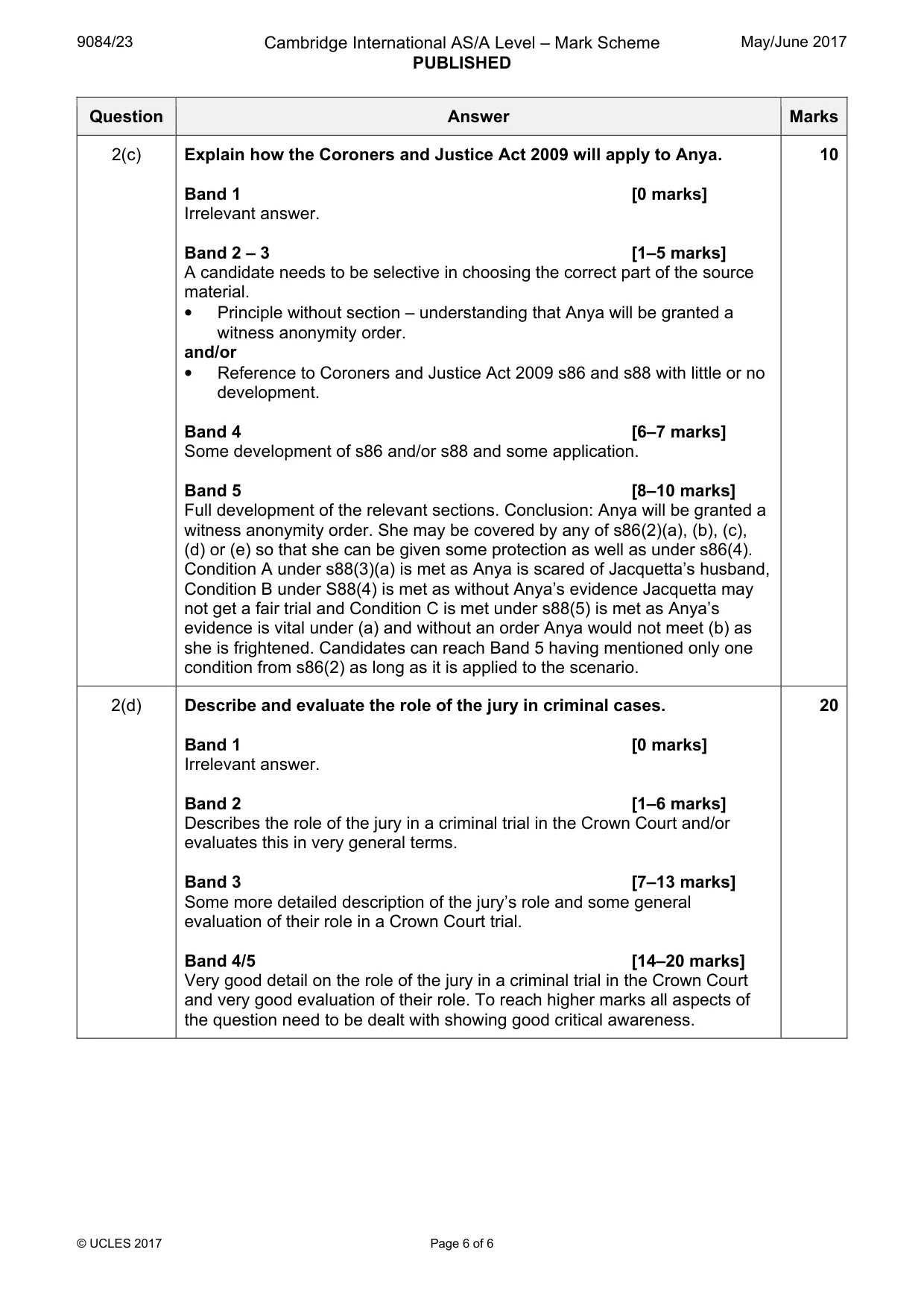
Mark scheme: 2(a) Explain how the Coroners and Justice Act 2009 will apply to Christine. 10 Band 1 [0 marks] Irrelevant answer. Band 2 – 3 [1–5 marks] A candidate needs to be selective in choosing the correct part of the source material. • Principle without section – understanding that Christine will not be granted a witness anonymity order. and/or • Reference to Coroners and Justice Act 2009 s86 with little or no development. Band 4 [6–7 marks] Some development of s86 and some application. Band 5 [8–10 marks] Full development of the relevant sections. Conclusion: Christine will not be granted a witness anonymity order. She may be covered by any of s86(2)(a), (b), (c), (d) or (e) so that she can be given some protection but she will fail under s86(4) as although she can be provided with some anonymity there is nothing which says she does not need to attend court. To reach Band 5 candidates should consider two or more of the provisions in s86(2). 2(b) Explain how the Coroners and Justice Act 2009 will apply to Piotr. 10 Band 1 [0 marks] Irrelevant answer. Band 2 – 3 [1–5 marks] A candidate needs to be selective in choosing the correct part of the source material. • Principle without section – understanding that Piotr will be granted a witness anonymity order. and/or • Reference to Coroners and Justice Act 2009 s86 and s88 with little or no development. Band 4 [6–7 marks] Some development of s86 and/or s88 and some application. Band 5 [8–10 marks] Full development of the relevant sections. Conclusion: Piotr will be granted a witness anonymity order. He will be covered by s86(2)(b) as he wants to use another name and s86(2)(e) as having his voice changed protects him and his family. Although his voice can be changed this is only within the limits of s86(4)(b). Condition A under s88(3)(a) or (b) are met in protecting Piotr and his family as well as the public interest since this is a gang murder, Condition B under S88(4) is met as there needs to be a fair trial and Condition C is met under s88(5) is met as Piotr is a vital witness having worked undercover. 2(c) Explain how the Coroners and Justice Act 2009 will apply to Anya. 10 Band 1 [0 marks] Irrelevant answer. Band 2 – 3 [1–5 marks] A candidate needs to be selective in choosing the correct part of the source material. • Principle without section – understanding that Anya will be granted a witness anonymity order. and/or • Reference to Coroners and Justice Act 2009 s86 and s88 with little or no development. Band 4 [6–7 marks] Some development of s86 and/or s88 and some application. Band 5 [8–10 marks] Full development of the relevant sections. Conclusion: Anya will be granted a witness anonymity order. She may be covered by any of s86(2)(a), (b), (c), (d) or (e) so that she can be given some protection as well as under s86(4). Condition A under s88(3)(a) is met as Anya is scared of Jacquetta’s husband, Condition B under S88(4) is met as without Anya’s evidence Jacquetta may not get a fair trial and Condition C is met under s88(5) is met as Anya’s evidence is vital under (a) and without an order Anya would not meet (b) as she is frightened. Candidates can reach Band 5 having mentioned only one condition from s86(2) as long as it is applied to the scenario. 2(d) Describe and evaluate the role of the jury in criminal cases. 20 Band 1 [0 marks] Irrelevant answer. Band 2 [1–6 marks] Describes the role of the jury in a criminal trial in the Crown Court and/or evaluates this in very general terms. Band 3 [7–13 marks] Some more detailed description of the jury’s role and some general evaluation of their role in a Crown Court trial. Band 4/5 [14–20 marks] Very good detail on the role of the jury in a criminal trial in the Crown Court and very good evaluation of their role. To reach higher marks all aspects of the question need to be dealt with showing good critical awareness.
What was in this paper
The subtopics covered by these 2 questions, and how many questions each got. Open one in a new tab to see every Cambridge question on it.
1Principles and sources of English law This topic introduces the principles behind English law and the modern day sources of English law. This topic is an opportunity to reflect on the key concepts of justice, fairness and morality; power and its limits; and effectiveness and certainty1