Cambridge A Level Law 9084 — 2018 Oct/Nov Paper 2 · Variant 1
9084/21/O/N/18 · 2 questions · 50 marks · ≈56 min
The question paper and its mark scheme, free to read here and free to download. This is Cambridge’s own paper, exactly as it was sat.
Question paper8 pages
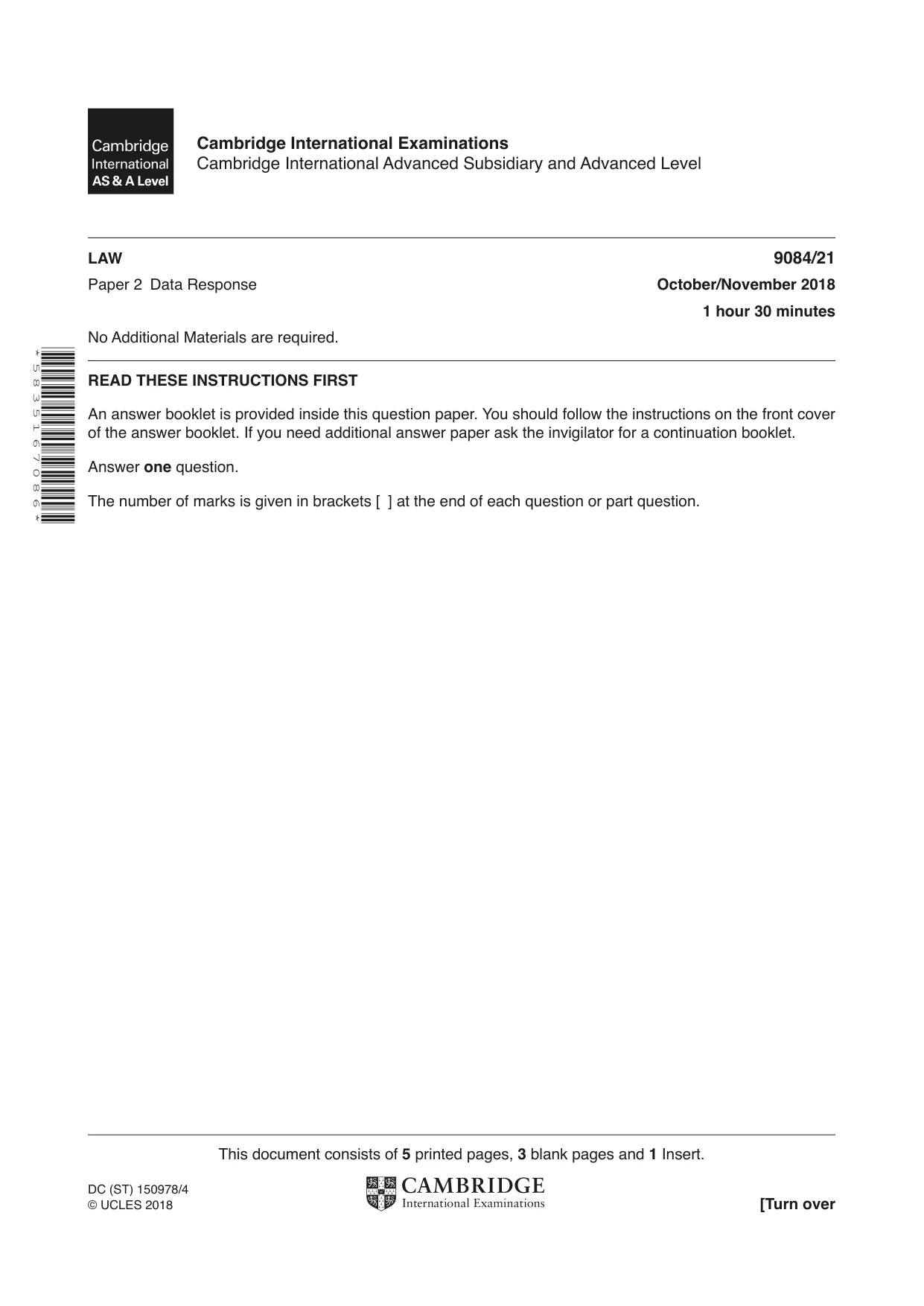
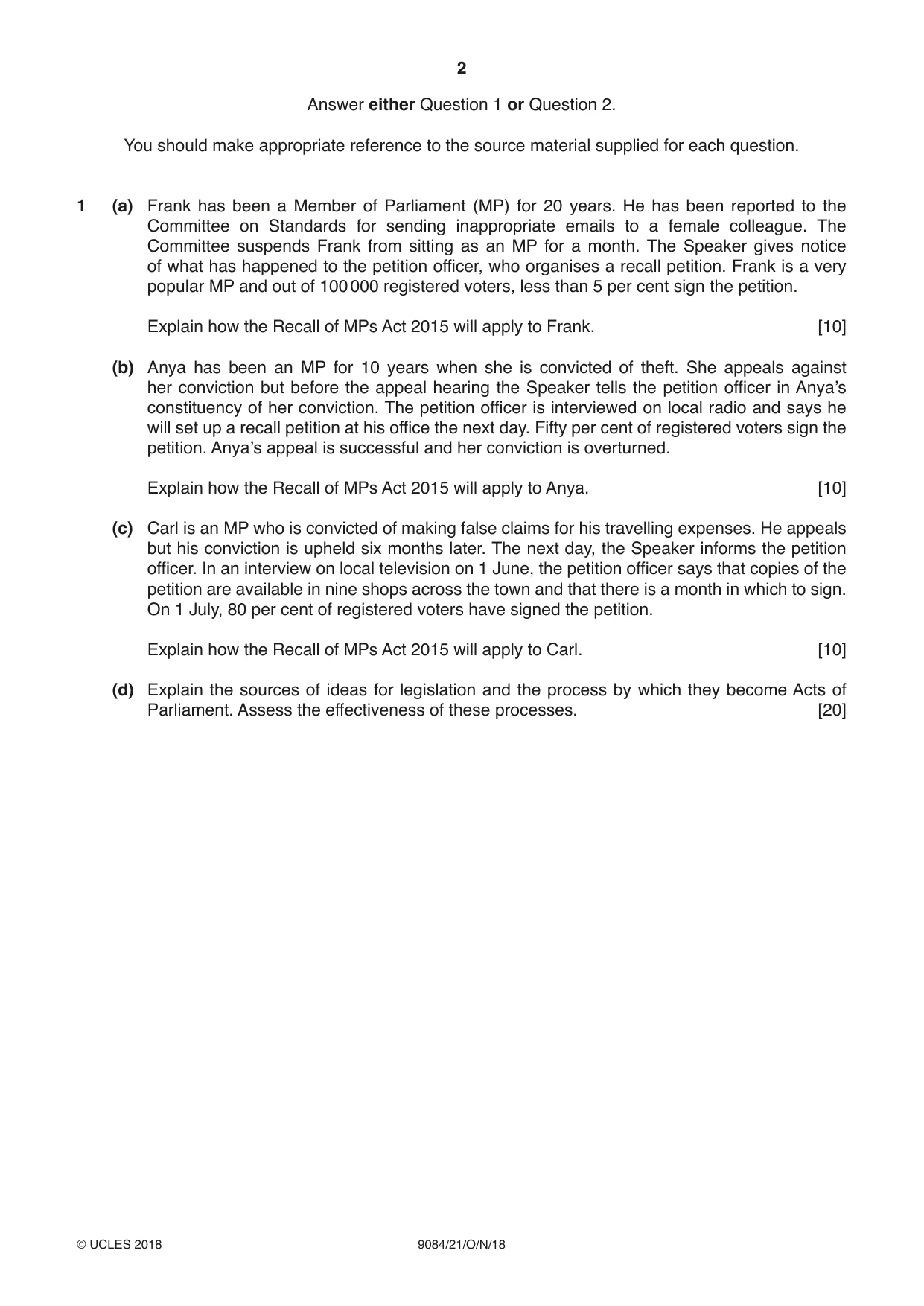
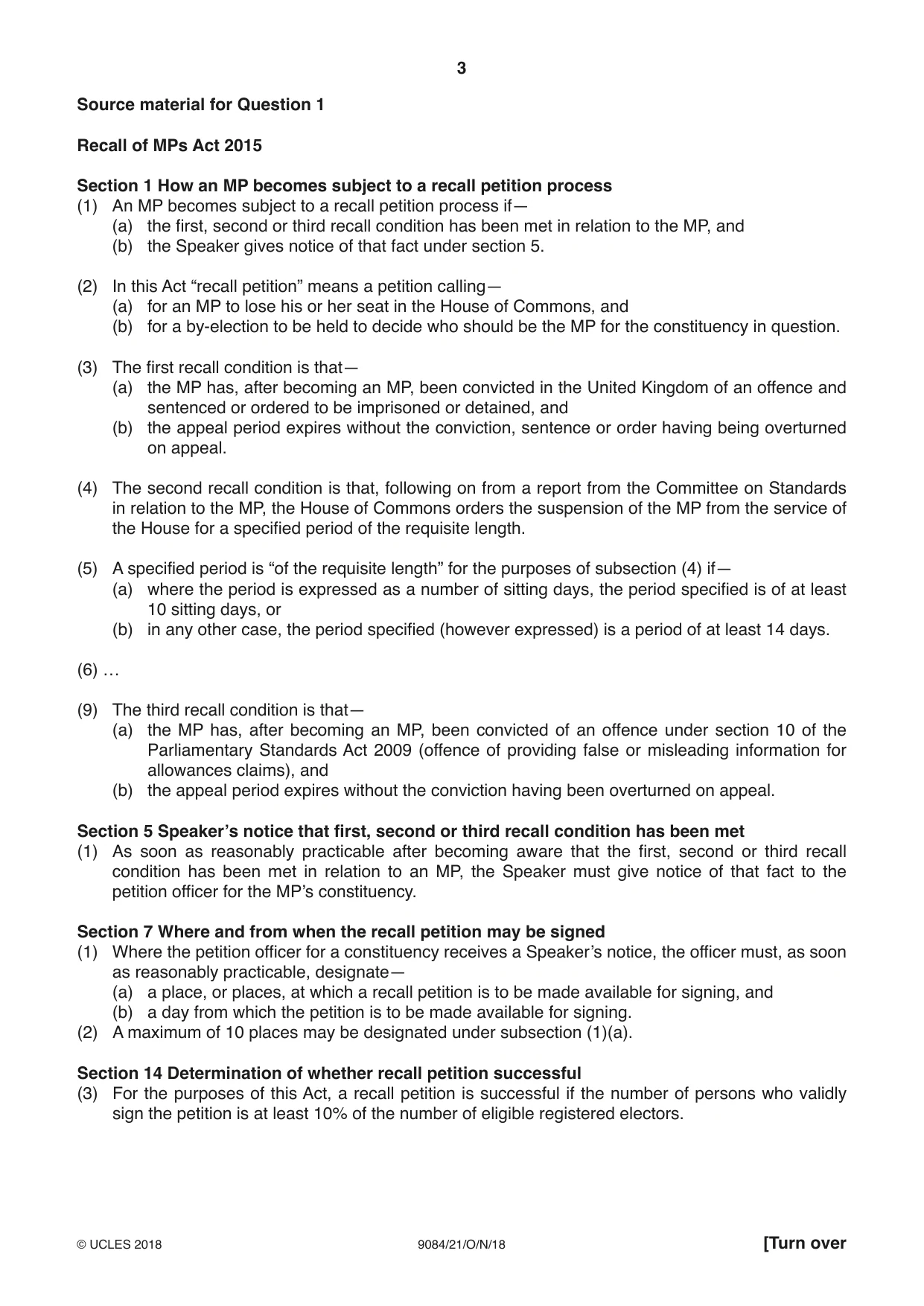
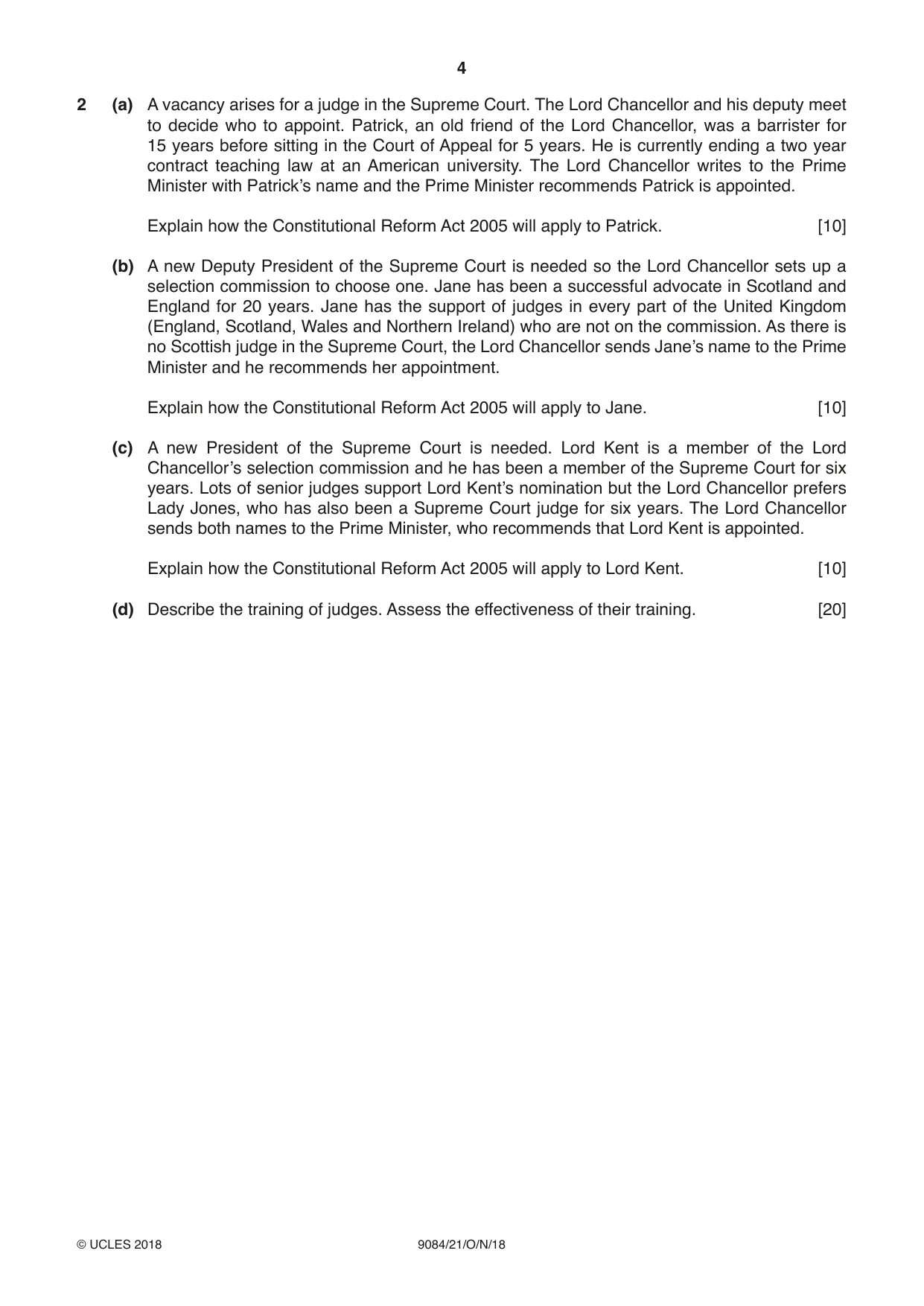



Mark scheme7 pages
Answers below. Sit the paper first if you are practising.
Questions as text
Q1 · Frank has been a Member of Parliament (MP) for 20 years
1 (a) Frank has been a Member of Parliament (MP) for 20 years. He has been reported to the Committee on Standards for sending inappropriate emails to a female colleague. The Committee suspends Frank from sitting as an MP for a month. The Speaker gives notice of what has happened to the petition officer, who organises a recall petition. Frank is a very popular MP and out of 100 000 registered voters, less than 5 per cent sign the petition. Explain how the Recall of MPs Act 2015 will apply to Frank. [10] (b) Anya has been an MP for 10 years when she is convicted of theft. She appeals against her conviction but before the appeal hearing the Speaker tells the petition officer in Anya’s constituency of her conviction. The petition officer is interviewed on local radio and says he will set up a recall petition at his office the next day. Fifty per cent of registered voters sign the petition. Anya’s appeal is successful and her conviction is overturned. Explain how the Recall of MPs Act 2015 will apply to Anya. [10] (c) Carl is an MP who is convicted of making false claims for his travelling expenses. He appeals but his conviction is upheld six months later. The next day, the Speaker informs the petition officer. In an interview on local television on 1 June, the petition officer says that copies of the petition are available in nine shops across the town and that there is a month in which to sign. On 1 July, 80 per cent of registered voters have signed the petition. Explain how the Recall of MPs Act 2015 will apply to Carl. [10] (d) Explain the sources of ideas for legislation and the process by which they become Acts of Parliament. Assess the effectiveness of these processes. [20] Source material for Question 1 Recall of MPs Act 2015 Section 1 How an MP becomes subject to a recall petition process (1) An MP becomes subject to a recall petition process if— (a) the first, second or third recall condition has been met in relation to the MP, and (b) the Speaker gives notice of that fact under section 5. (2) In this Act “recall petition” means a petition calling— (a) for an MP to lose his or her seat in the House of Commons, and (b) for a by-election to be held to decide who should be the MP for the constituency in question. (3) The first recall condition is that— (a) the MP has, after becoming an MP, been convicted in the United Kingdom of an offence and sentenced or ordered to be imprisoned or detained, and (b) the appeal period expires without the conviction, sentence or order having being overturned on appeal. (4) The second recall condition is that, following on from a report from the Committee on Standards in relation to the MP, the House of Commons orders the suspension of the MP from the service of the House for a specified period of the requisite length. (5) A specified period is “of the requisite length” for the purposes of subsection (4) if— (a) where the period is expressed as a number of sitting days, the period specified is of at least 10 sitting days, or (b) in any other case, the period specified (however expressed) is a period of at least 14 days. (6) … (9) The third recall condition is that— (a) the MP has, after becoming an MP, been convicted of an offence under section 10 of the Parliamentary Standards Act 2009 (offence of providing false or misleading information for allowances claims), and (b) the appeal period expires without the conviction having been overturned on appeal. Section 5 Speaker’s notice that first, second or third recall condition has been met (1) As soon as reasonably practicable after becoming aware that the first, second or third recall condition has been met in relation to an MP, the Speaker must give notice of that fact to the petition officer for the MP’s constituency. Section 7 Where and from when the recall petition may be signed (1) Where the petition officer for a constituency receives a Speaker’s notice, the officer must, as soon as reasonably practicable, designate— (a) a place, or places, at which a recall petition is to be made available for signing, and (b) a day from which the petition is to be made available for signing. (2) A maximum of 10 places may be designated under subsection (1)(a). Section 14 Determination of whether recall petition successful (3) For the purposes of this Act, a recall petition is successful if the number of persons who validly sign the petition is at least 10% of the number of eligible registered electors.
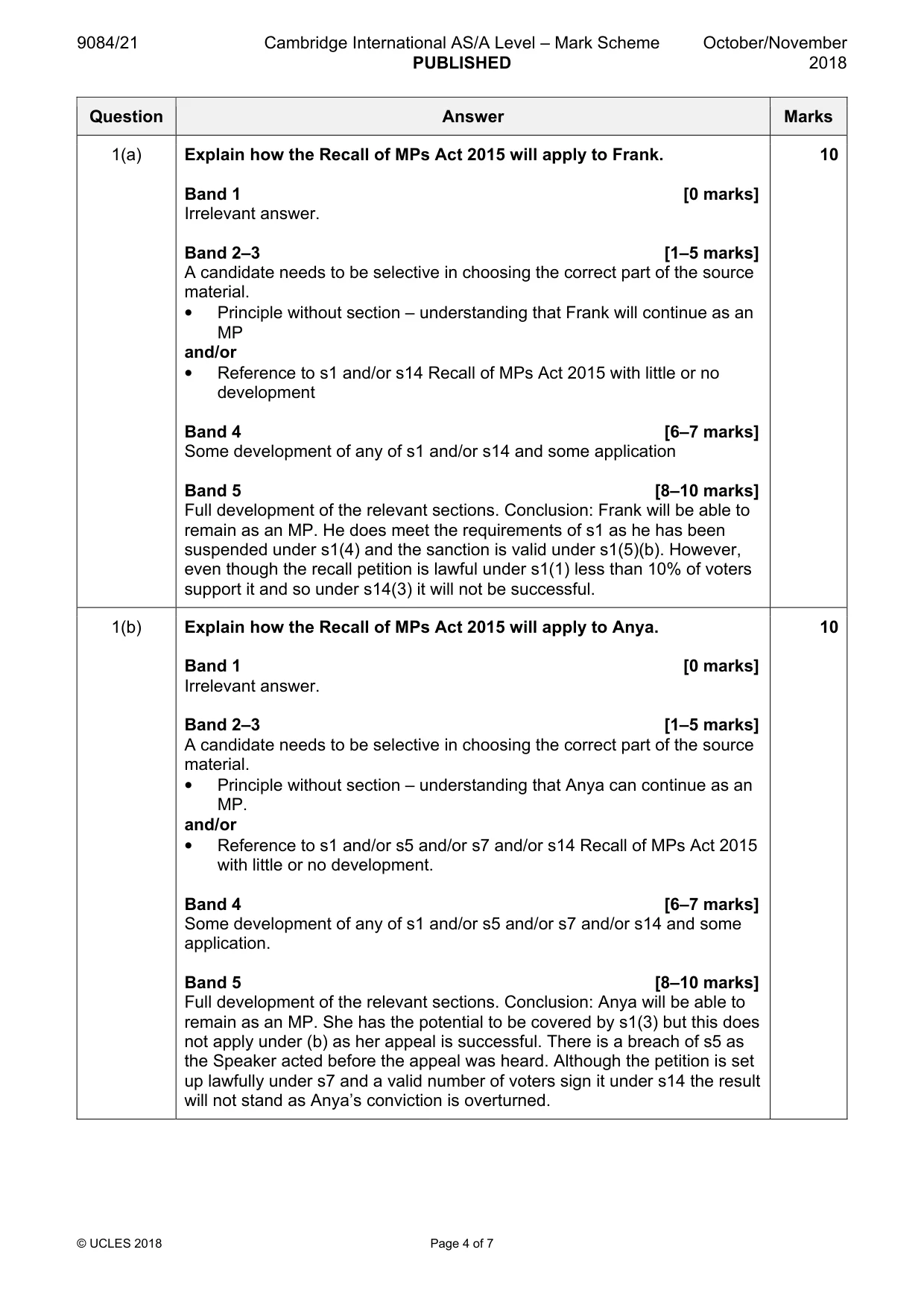
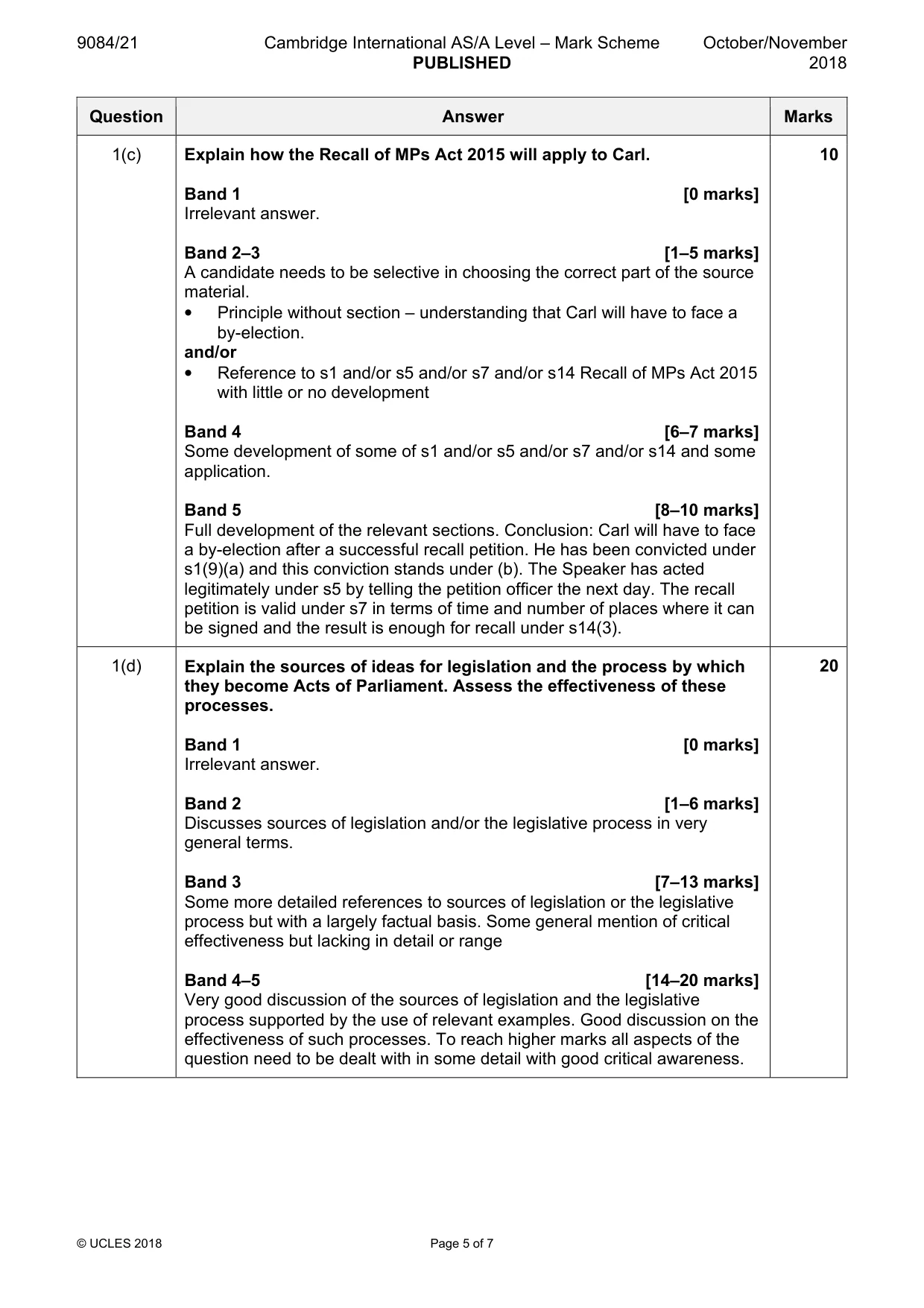
Mark scheme: Question Answer Marks 1(a) Explain how the Recall of MPs Act 2015 will apply to Frank. 10 Band 1 [0 marks] Irrelevant answer. Band 2–3 [1–5 marks] A candidate needs to be selective in choosing the correct part of the source material. • Principle without section – understanding that Frank will continue as an MP and/or • Reference to s1 and/or s14 Recall of MPs Act 2015 with little or no development Band 4 [6–7 marks] Some development of any of s1 and/or s14 and some application Band 5 [8–10 marks] Full development of the relevant sections. Conclusion: Frank will be able to remain as an MP. He does meet the requirements of s1 as he has been suspended under s1(4) and the sanction is valid under s1(5)(b). However, even though the recall petition is lawful under s1(1) less than 10% of voters support it and so under s14(3) it will not be successful. 1(b) Explain how the Recall of MPs Act 2015 will apply to Anya. 10 Band 1 [0 marks] Irrelevant answer. Band 2–3 [1–5 marks] A candidate needs to be selective in choosing the correct part of the source material. • Principle without section – understanding that Anya can continue as an MP. and/or • Reference to s1 and/or s5 and/or s7 and/or s14 Recall of MPs Act 2015 with little or no development. Band 4 [6–7 marks] Some development of any of s1 and/or s5 and/or s7 and/or s14 and some application. Band 5 [8–10 marks] Full development of the relevant sections. Conclusion: Anya will be able to remain as an MP. She has the potential to be covered by s1(3) but this does not apply under (b) as her appeal is successful. There is a breach of s5 as the Speaker acted before the appeal was heard. Although the petition is set up lawfully under s7 and a valid number of voters sign it under s14 the result will not stand as Anya’s conviction is overturned. 1(c) Explain how the Recall of MPs Act 2015 will apply to Carl. 10 Band 1 [0 marks] Irrelevant answer. Band 2–3 [1–5 marks] A candidate needs to be selective in choosing the correct part of the source material. • Principle without section – understanding that Carl will have to face a by-election. and/or • Reference to s1 and/or s5 and/or s7 and/or s14 Recall of MPs Act 2015 with little or no development Band 4 [6–7 marks] Some development of some of s1 and/or s5 and/or s7 and/or s14 and some application. Band 5 [8–10 marks] Full development of the relevant sections. Conclusion: Carl will have to face a by-election after a successful recall petition. He has been convicted under s1(9)(a) and this conviction stands under (b). The Speaker has acted legitimately under s5 by telling the petition officer the next day. The recall petition is valid under s7 in terms of time and number of places where it can be signed and the result is enough for recall under s14(3). 1(d) Explain the sources of ideas for legislation and the process by which 20 they become Acts of Parliament. Assess the effectiveness of these processes. Band 1 [0 marks] Irrelevant answer. Band 2 [1–6 marks] Discusses sources of legislation and/or the legislative process in very general terms. Band 3 [7–13 marks] Some more detailed references to sources of legislation or the legislative process but with a largely factual basis. Some general mention of critical effectiveness but lacking in detail or range Band 4–5 [14–20 marks] Very good discussion of the sources of legislation and the legislative process supported by the use of relevant examples. Good discussion on the effectiveness of such processes. To reach higher marks all aspects of the question need to be dealt with in some detail with good critical awareness.
Q2 · A vacancy arises for a judge in the Supreme Court
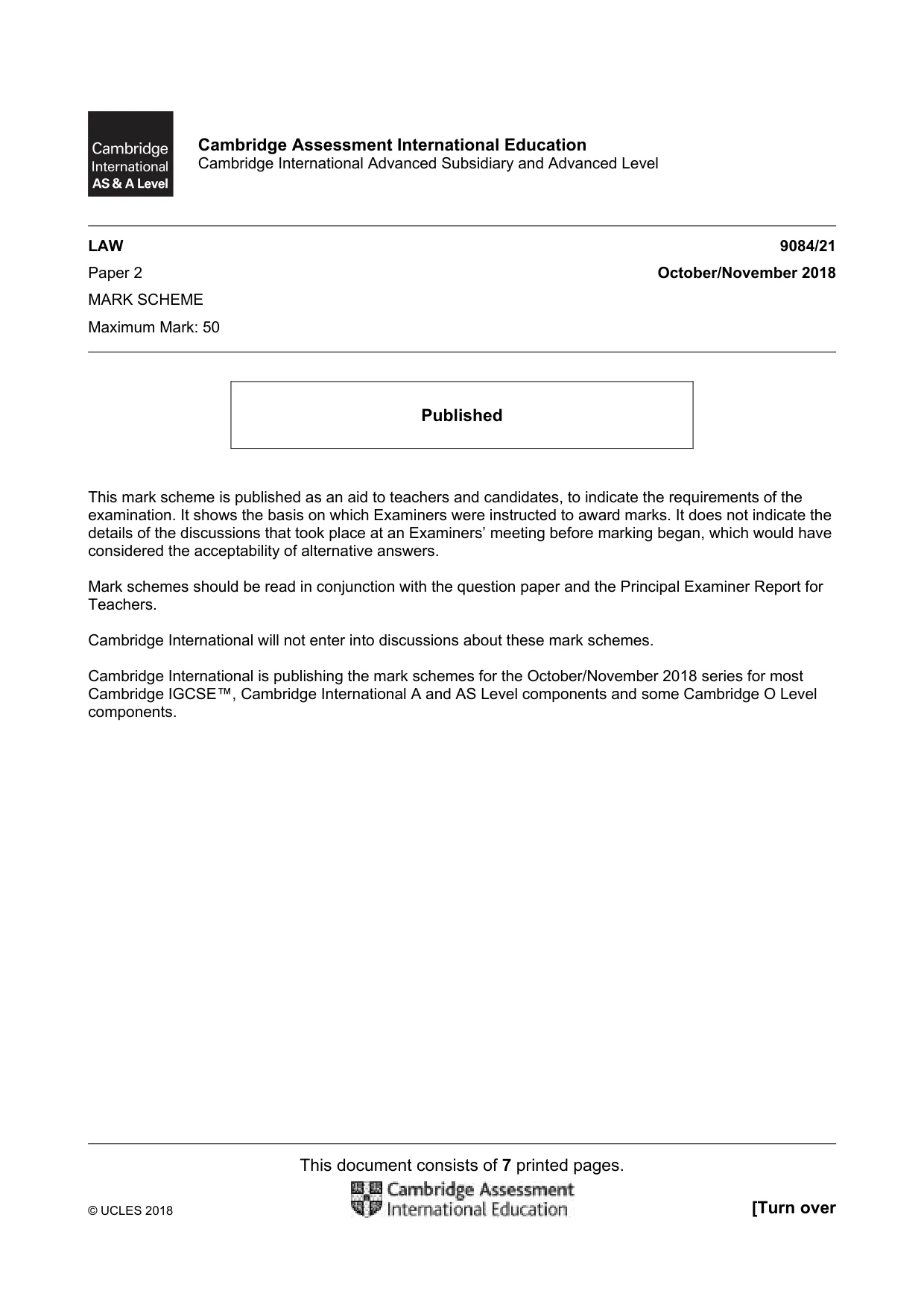
2 (a) A vacancy arises for a judge in the Supreme Court. The Lord Chancellor and his deputy meet to decide who to appoint. Patrick, an old friend of the Lord Chancellor, was a barrister for 15 years before sitting in the Court of Appeal for 5 years. He is currently ending a two year contract teaching law at an American university. The Lord Chancellor writes to the Prime Minister with Patrick’s name and the Prime Minister recommends Patrick is appointed. Explain how the Constitutional Reform Act 2005 will apply to Patrick. [10] (b) A new Deputy President of the Supreme Court is needed so the Lord Chancellor sets up a selection commission to choose one. Jane has been a successful advocate in Scotland and England for 20 years. Jane has the support of judges in every part of the United Kingdom (England, Scotland, Wales and Northern Ireland) who are not on the commission. As there is no Scottish judge in the Supreme Court, the Lord Chancellor sends Jane’s name to the Prime Minister and he recommends her appointment. Explain how the Constitutional Reform Act 2005 will apply to Jane. [10] (c) A new President of the Supreme Court is needed. Lord Kent is a member of the Lord Chancellor’s selection commission and he has been a member of the Supreme Court for six years. Lots of senior judges support Lord Kent’s nomination but the Lord Chancellor prefers Lady Jones, who has also been a Supreme Court judge for six years. The Lord Chancellor sends both names to the Prime Minister, who recommends that Lord Kent is appointed. Explain how the Constitutional Reform Act 2005 will apply to Lord Kent. [10] (d) Describe the training of judges. Assess the effectiveness of their training. [20] Source material for Question 2 Constitutional Reform Act 2005 Section 25 Qualification for appointment to the Supreme Court (1) A person is not qualified to be appointed a judge of the Supreme Court unless he has (at any time) — (a) held high judicial office for a period of at least 2 years, (b) satisfied the judicial-appointment eligibility condition on a 15-year basis, or (c) been a qualifying practitioner for a period of at least 15 years. Section 26 Selection of members of the Court (1) This section applies to a recommendation for an appointment to one of the following offices— (a) judge of the Supreme Court; (b) President of the Court; (c) Deputy President of the Court. (2) A recommendation may be made only by the Prime Minister. (3) The Prime Minister— (a) must recommend any person whose name is notified to him by the Lord Chancellor; (b) may not recommend any other person. (4) A person who is not a judge of the Court must be recommended for appointment as a judge if his name is notified to the Prime Minister for an appointment as President or Deputy President. (5) If there is a vacancy in one of the offices mentioned in subsection (1), or it appears to him that there will soon be such a vacancy, the Lord Chancellor must convene a selection commission for the selection of a person to be recommended. Section 27 Selection process … (2) As part of the selection process the commission must consult each of the following— (a) such of the senior judges as are not members of the commission and are not willing to be considered for selection; (b) the Lord Chancellor; … (5) Selection must be on merit. (6) A person may be selected only if he meets the requirements of section 25. (7) A person may not be selected if he is a member of the commission. (8) In making selections for the appointment of judges of the Court the commission must ensure that between them the judges will have knowledge of, and experience of practice in, the law of each part of the United Kingdom. … (10) Any selection must be of one person only.
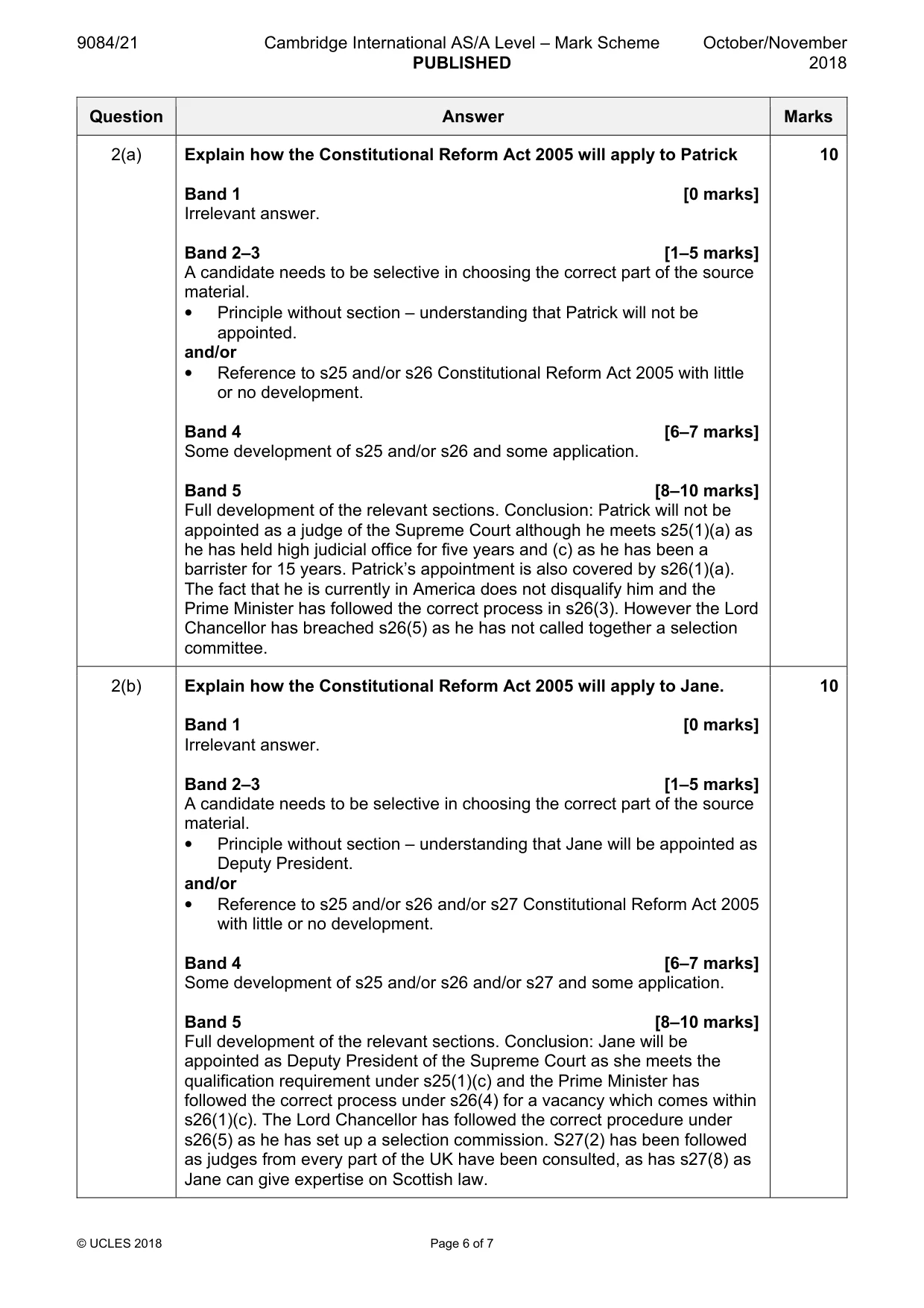
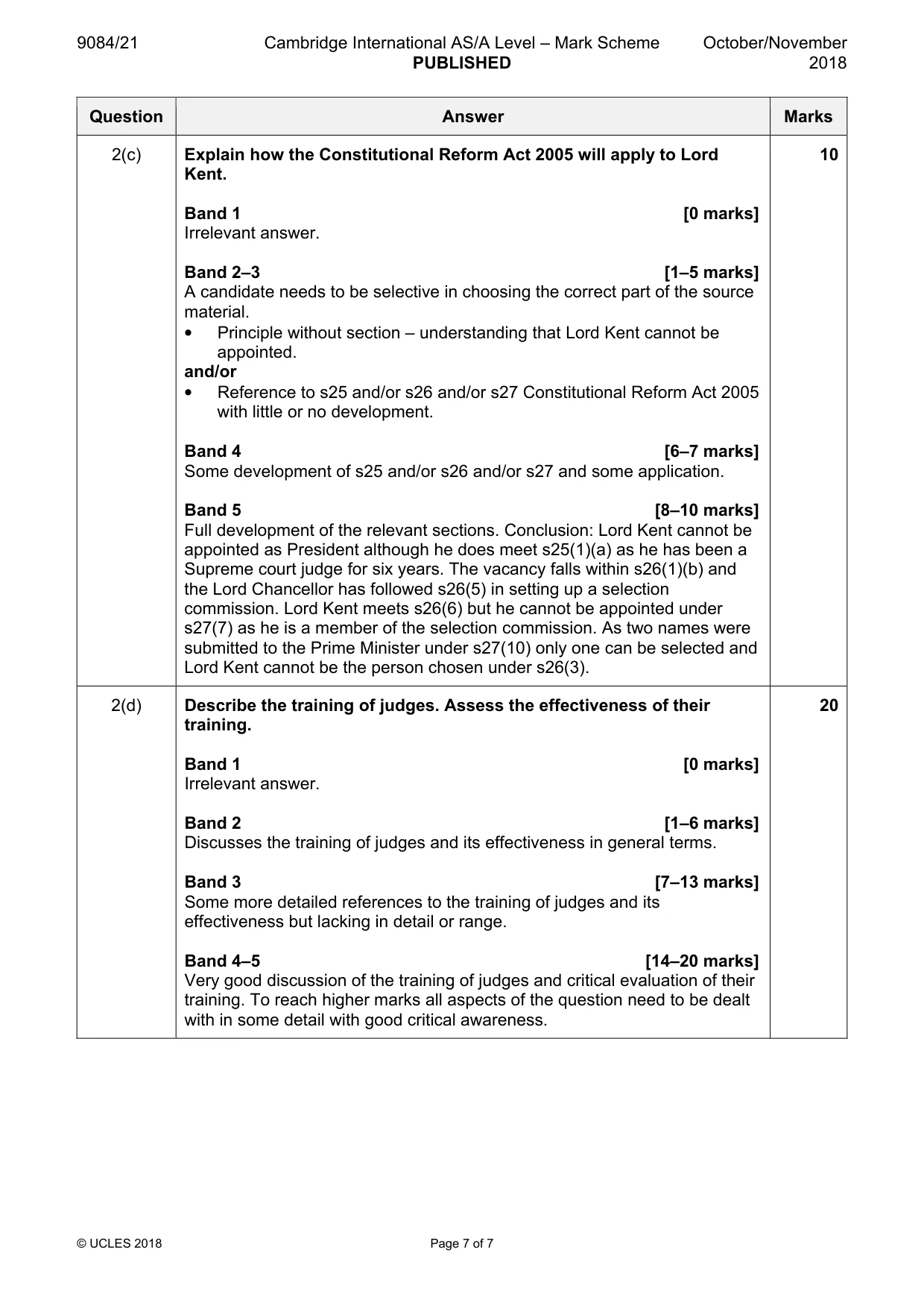
Mark scheme: 2(a) Explain how the Constitutional Reform Act 2005 will apply to Patrick 10 Band 1 [0 marks] Irrelevant answer. Band 2–3 [1–5 marks] A candidate needs to be selective in choosing the correct part of the source material. • Principle without section – understanding that Patrick will not be appointed. and/or • Reference to s25 and/or s26 Constitutional Reform Act 2005 with little or no development. Band 4 [6–7 marks] Some development of s25 and/or s26 and some application. Band 5 [8–10 marks] Full development of the relevant sections. Conclusion: Patrick will not be appointed as a judge of the Supreme Court although he meets s25(1)(a) as he has held high judicial office for five years and (c) as he has been a barrister for 15 years. Patrick’s appointment is also covered by s26(1)(a). The fact that he is currently in America does not disqualify him and the Prime Minister has followed the correct process in s26(3). However the Lord Chancellor has breached s26(5) as he has not called together a selection committee. 2(b) Explain how the Constitutional Reform Act 2005 will apply to Jane. 10 Band 1 [0 marks] Irrelevant answer. Band 2–3 [1–5 marks] A candidate needs to be selective in choosing the correct part of the source material. • Principle without section – understanding that Jane will be appointed as Deputy President. and/or • Reference to s25 and/or s26 and/or s27 Constitutional Reform Act 2005 with little or no development. Band 4 [6–7 marks] Some development of s25 and/or s26 and/or s27 and some application. Band 5 [8–10 marks] Full development of the relevant sections. Conclusion: Jane will be appointed as Deputy President of the Supreme Court as she meets the qualification requirement under s25(1)(c) and the Prime Minister has followed the correct process under s26(4) for a vacancy which comes within s26(1)(c). The Lord Chancellor has followed the correct procedure under s26(5) as he has set up a selection commission. S27(2) has been followed as judges from every part of the UK have been consulted, as has s27(8) as Jane can give expertise on Scottish law. 2(c) Explain how the Constitutional Reform Act 2005 will apply to Lord 10 Kent. Band 1 [0 marks] Irrelevant answer. Band 2–3 [1–5 marks] A candidate needs to be selective in choosing the correct part of the source material. • Principle without section – understanding that Lord Kent cannot be appointed. and/or • Reference to s25 and/or s26 and/or s27 Constitutional Reform Act 2005 with little or no development. Band 4 [6–7 marks] Some development of s25 and/or s26 and/or s27 and some application. Band 5 [8–10 marks] Full development of the relevant sections. Conclusion: Lord Kent cannot be appointed as President although he does meet s25(1)(a) as he has been a Supreme court judge for six years. The vacancy falls within s26(1)(b) and the Lord Chancellor has followed s26(5) in setting up a selection commission. Lord Kent meets s26(6) but he cannot be appointed under s27(7) as he is a member of the selection commission. As two names were submitted to the Prime Minister under s27(10) only one can be selected and Lord Kent cannot be the person chosen under s26(3). 2(d) Describe the training of judges. Assess the effectiveness of their 20 training. Band 1 [0 marks] Irrelevant answer. Band 2 [1–6 marks] Discusses the training of judges and its effectiveness in general terms. Band 3 [7–13 marks] Some more detailed references to the training of judges and its effectiveness but lacking in detail or range. Band 4–5 [14–20 marks] Very good discussion of the training of judges and critical evaluation of their training. To reach higher marks all aspects of the question need to be dealt with in some detail with good critical awareness.
What was in this paper
The subtopics covered by these 2 questions, and how many questions each got. Open one in a new tab to see every Cambridge question on it.
1Machinery of justice This topic introduces the institutions and processes involved in the resolution of civil and criminal matters. This topic is an opportunity to reflect on the key concepts of power and its limits; justice, fairness and morality; effectiveness and certainty; and liability1What you needed in this session
Cambridge’s own grade thresholds for 2018 Oct/Nov, Paper 2 · Variant 1. A higher threshold means an easier paper — the bar moves with how the cohort did.