Cambridge A Level Law 9084 — 2019 Oct/Nov Paper 2 · Variant 3
9084/23/O/N/19 · 2 questions · 50 marks · ≈56 min
The question paper and its mark scheme, free to read here and free to download. This is Cambridge’s own paper, exactly as it was sat.
Question paper8 pages



Mark scheme6 pages
Answers below. Sit the paper first if you are practising.

Questions as text
Q1 · Richard works for the UK government security services
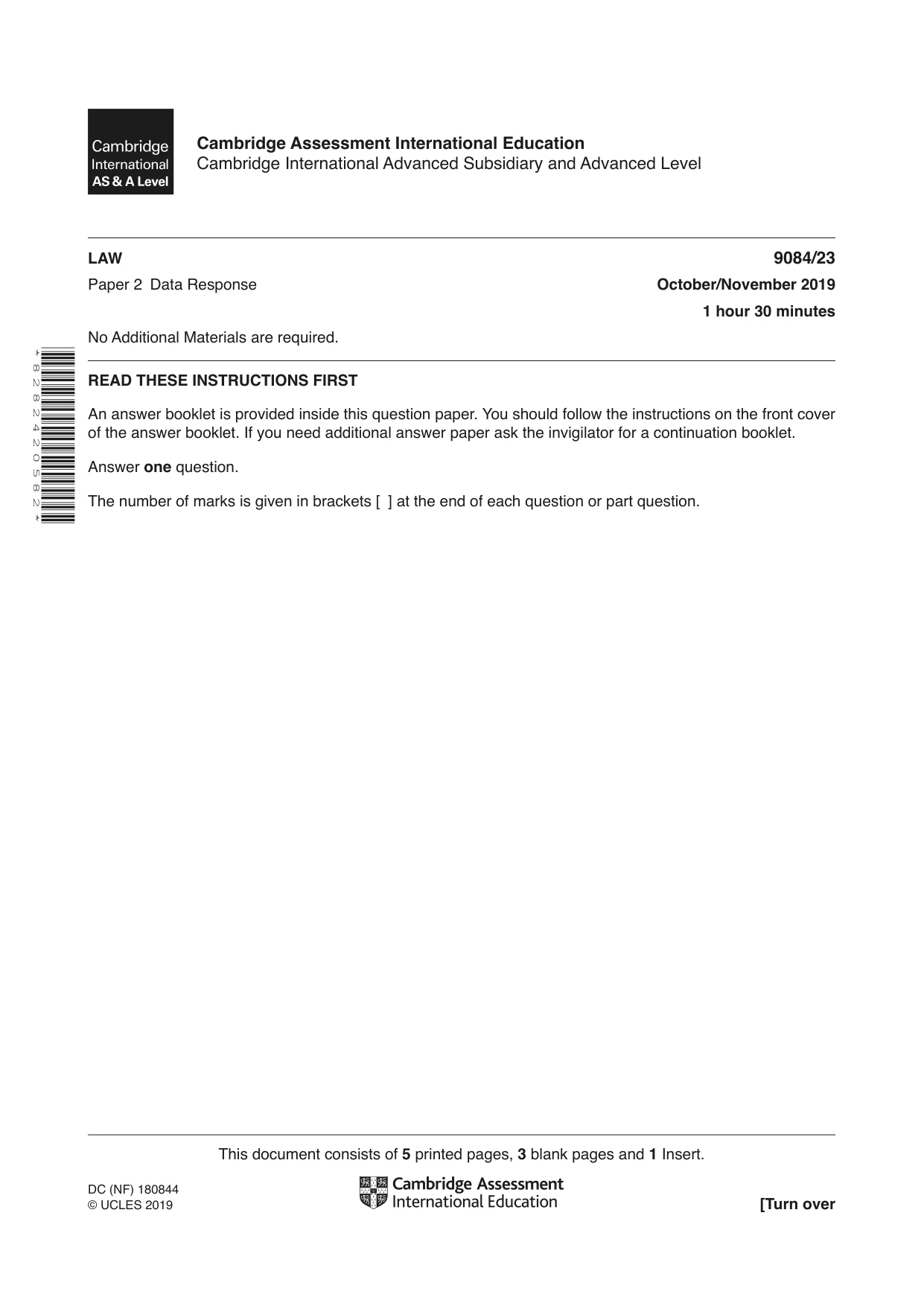
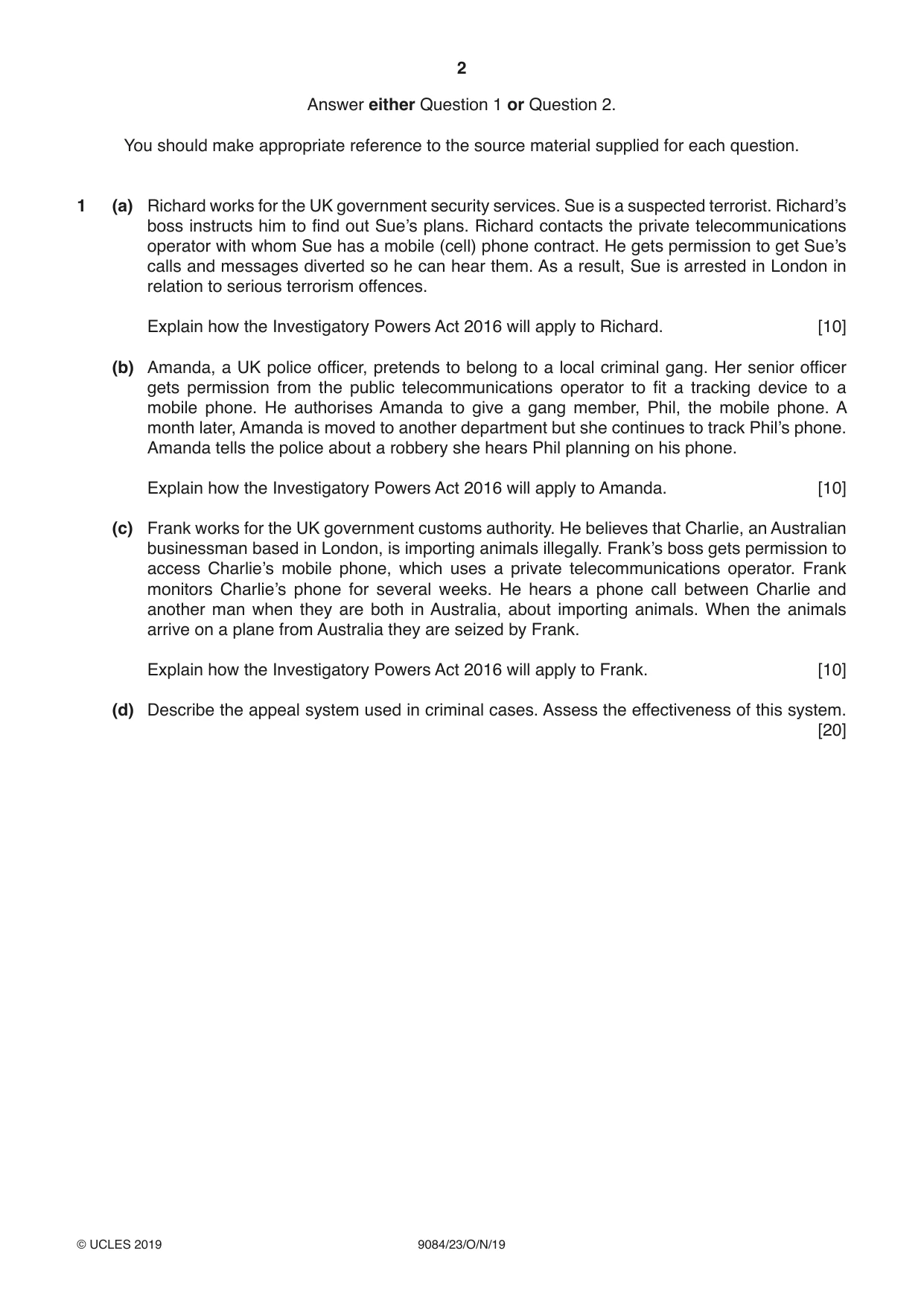
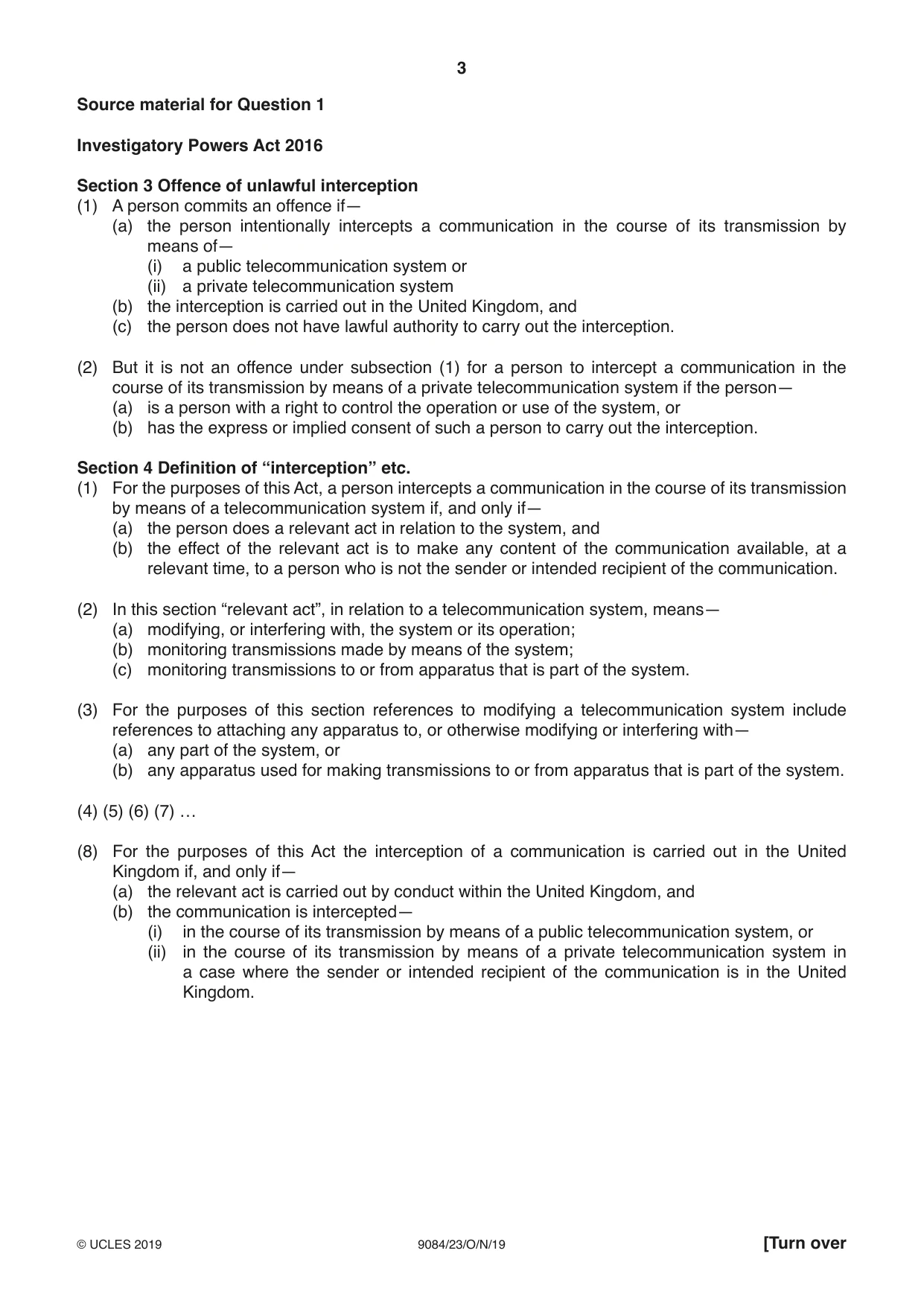
1 (a) Richard works for the UK government security services. Sue is a suspected terrorist. Richard’s boss instructs him to find out Sue’s plans. Richard contacts the private telecommunications operator with whom Sue has a mobile (cell) phone contract. He gets permission to get Sue’s calls and messages diverted so he can hear them. As a result, Sue is arrested in London in relation to serious terrorism offences. Explain how the Investigatory Powers Act 2016 will apply to Richard. [10] (b) Amanda, a UK police officer, pretends to belong to a local criminal gang. Her senior officer gets permission from the public telecommunications operator to fit a tracking device to a mobile phone. He authorises Amanda to give a gang member, Phil, the mobile phone. A month later, Amanda is moved to another department but she continues to track Phil’s phone. Amanda tells the police about a robbery she hears Phil planning on his phone. Explain how the Investigatory Powers Act 2016 will apply to Amanda. [10] (c) Frank works for the UK government customs authority. He believes that Charlie, an Australian businessman based in London, is importing animals illegally. Frank’s boss gets permission to access Charlie’s mobile phone, which uses a private telecommunications operator. Frank monitors Charlie’s phone for several weeks. He hears a phone call between Charlie and another man when they are both in Australia, about importing animals. When the animals arrive on a plane from Australia they are seized by Frank. Explain how the Investigatory Powers Act 2016 will apply to Frank. [10] (d) Describe the appeal system used in criminal cases. Assess the effectiveness of this system. [20] Source material for Question 1 Investigatory Powers Act 2016 Section 3 Offence of unlawful interception (1) A person commits an offence if— (a) the person intentionally intercepts a communication in the course of its transmission by means of— (i) a public telecommunication system or (ii) a private telecommunication system (b) the interception is carried out in the United Kingdom, and (c) the person does not have lawful authority to carry out the interception. (2) But it is not an offence under subsection (1) for a person to intercept a communication in the course of its transmission by means of a private telecommunication system if the person— (a) is a person with a right to control the operation or use of the system, or (b) has the express or implied consent of such a person to carry out the interception. Section 4 Definition of “interception” etc. (1) For the purposes of this Act, a person intercepts a communication in the course of its transmission by means of a telecommunication system if, and only if— (a) the person does a relevant act in relation to the system, and (b) the effect of the relevant act is to make any content of the communication available, at a relevant time, to a person who is not the sender or intended recipient of the communication. (2) In this section “relevant act”, in relation to a telecommunication system, means— (a) modifying, or interfering with, the system or its operation; (b) monitoring transmissions made by means of the system; (c) monitoring transmissions to or from apparatus that is part of the system. (3) For the purposes of this section references to modifying a telecommunication system include references to attaching any apparatus to, or otherwise modifying or interfering with— (a) any part of the system, or (b) any apparatus used for making transmissions to or from apparatus that is part of the system. (4) (5) (6) (7) … (8) For the purposes of this Act the interception of a communication is carried out in the United Kingdom if, and only if— (a) the relevant act is carried out by conduct within the United Kingdom, and (b) the communication is intercepted— (i) in the course of its transmission by means of a public telecommunication system, or (ii) in the course of its transmission by means of a private telecommunication system in a case where the sender or intended recipient of the communication is in the United Kingdom.
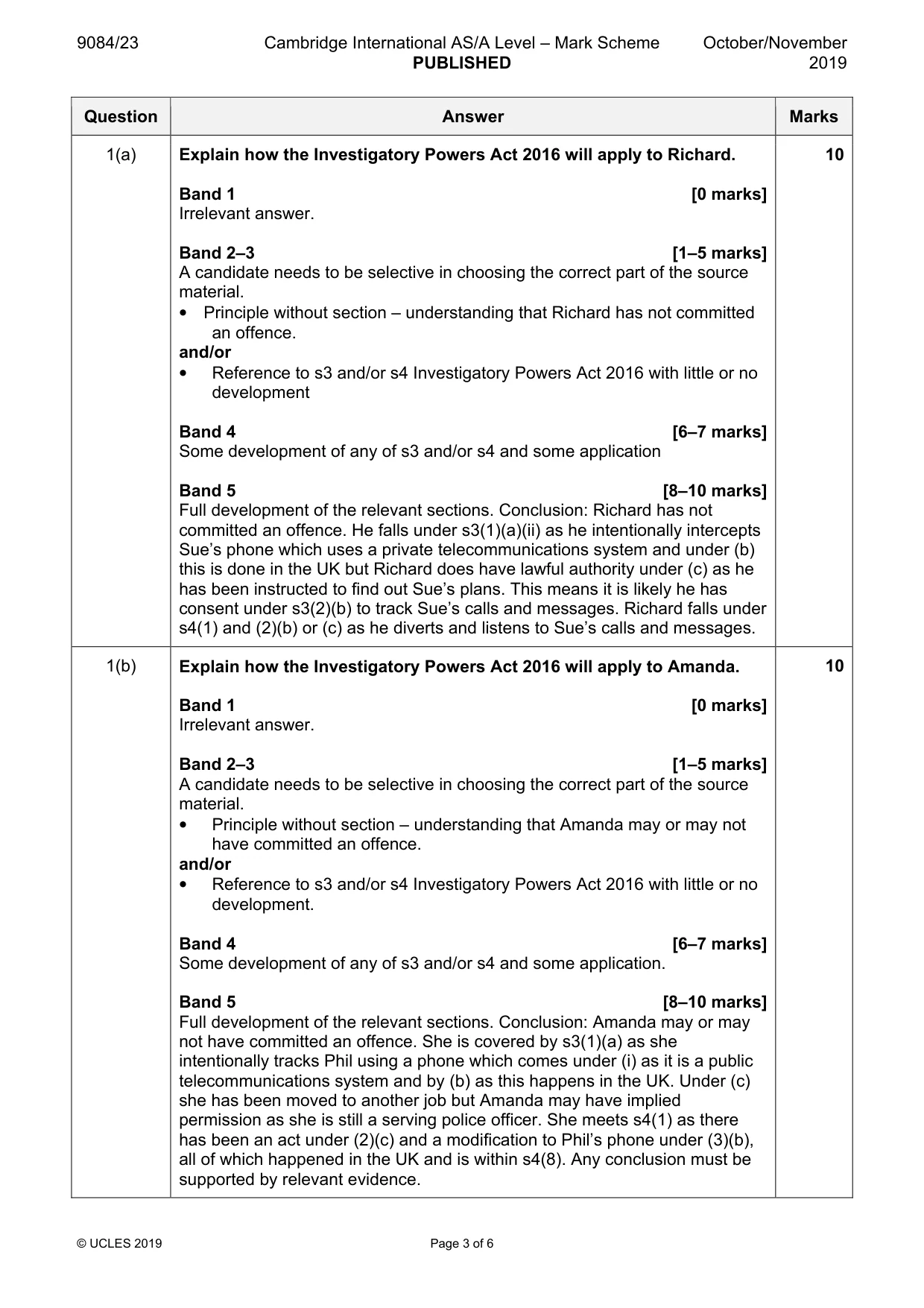
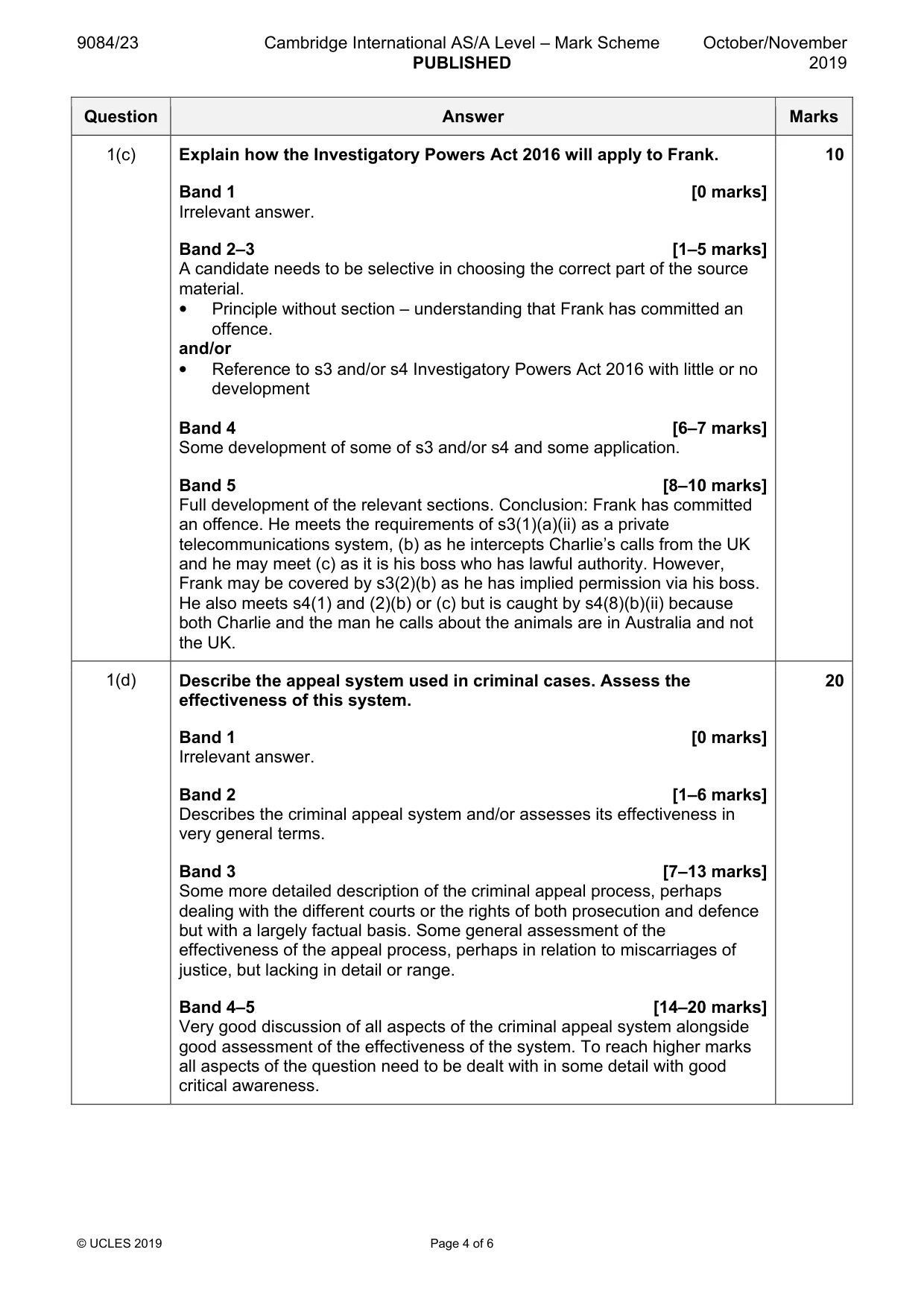
Mark scheme: Question Answer Marks 1(a) Explain how the Investigatory Powers Act 2016 will apply to Richard. 10 Band 1 [0 marks] Irrelevant answer. Band 2–3 [1–5 marks] A candidate needs to be selective in choosing the correct part of the source material. • Principle without section – understanding that Richard has not committed an offence. and/or • Reference to s3 and/or s4 Investigatory Powers Act 2016 with little or no development Band 4 [6–7 marks] Some development of any of s3 and/or s4 and some application Band 5 [8–10 marks] Full development of the relevant sections. Conclusion: Richard has not committed an offence. He falls under s3(1)(a)(ii) as he intentionally intercepts Sue’s phone which uses a private telecommunications system and under (b) this is done in the UK but Richard does have lawful authority under (c) as he has been instructed to find out Sue’s plans. This means it is likely he has consent under s3(2)(b) to track Sue’s calls and messages. Richard falls under s4(1) and (2)(b) or (c) as he diverts and listens to Sue’s calls and messages. 1(b) Explain how the Investigatory Powers Act 2016 will apply to Amanda. 10 Band 1 [0 marks] Irrelevant answer. Band 2–3 [1–5 marks] A candidate needs to be selective in choosing the correct part of the source material. • Principle without section – understanding that Amanda may or may not have committed an offence. and/or • Reference to s3 and/or s4 Investigatory Powers Act 2016 with little or no development. Band 4 [6–7 marks] Some development of any of s3 and/or s4 and some application. Band 5 [8–10 marks] Full development of the relevant sections. Conclusion: Amanda may or may not have committed an offence. She is covered by s3(1)(a) as she intentionally tracks Phil using a phone which comes under (i) as it is a public telecommunications system and by (b) as this happens in the UK. Under (c) she has been moved to another job but Amanda may have implied permission as she is still a serving police officer. She meets s4(1) as there has been an act under (2)(c) and a modification to Phil’s phone under (3)(b), all of which happened in the UK and is within s4(8). Any conclusion must be supported by relevant evidence. 1(c) Explain how the Investigatory Powers Act 2016 will apply to Frank. 10 Band 1 [0 marks] Irrelevant answer. Band 2–3 [1–5 marks] A candidate needs to be selective in choosing the correct part of the source material. • Principle without section – understanding that Frank has committed an offence. and/or • Reference to s3 and/or s4 Investigatory Powers Act 2016 with little or no development Band 4 [6–7 marks] Some development of some of s3 and/or s4 and some application. Band 5 [8–10 marks] Full development of the relevant sections. Conclusion: Frank has committed an offence. He meets the requirements of s3(1)(a)(ii) as a private telecommunications system, (b) as he intercepts Charlie’s calls from the UK and he may meet (c) as it is his boss who has lawful authority. However, Frank may be covered by s3(2)(b) as he has implied permission via his boss. He also meets s4(1) and (2)(b) or (c) but is caught by s4(8)(b)(ii) because both Charlie and the man he calls about the animals are in Australia and not the UK. 1(d) Describe the appeal system used in criminal cases. Assess the 20 effectiveness of this system. Band 1 [0 marks] Irrelevant answer. Band 2 [1–6 marks] Describes the criminal appeal system and/or assesses its effectiveness in very general terms. Band 3 [7–13 marks] Some more detailed description of the criminal appeal process, perhaps dealing with the different courts or the rights of both prosecution and defence but with a largely factual basis. Some general assessment of the effectiveness of the appeal process, perhaps in relation to miscarriages of justice, but lacking in detail or range. Band 4–5 [14–20 marks] Very good discussion of all aspects of the criminal appeal system alongside good assessment of the effectiveness of the system. To reach higher marks all aspects of the question need to be dealt with in some detail with good critical awareness.
Q2 · Graham has just bought himself a new sports car
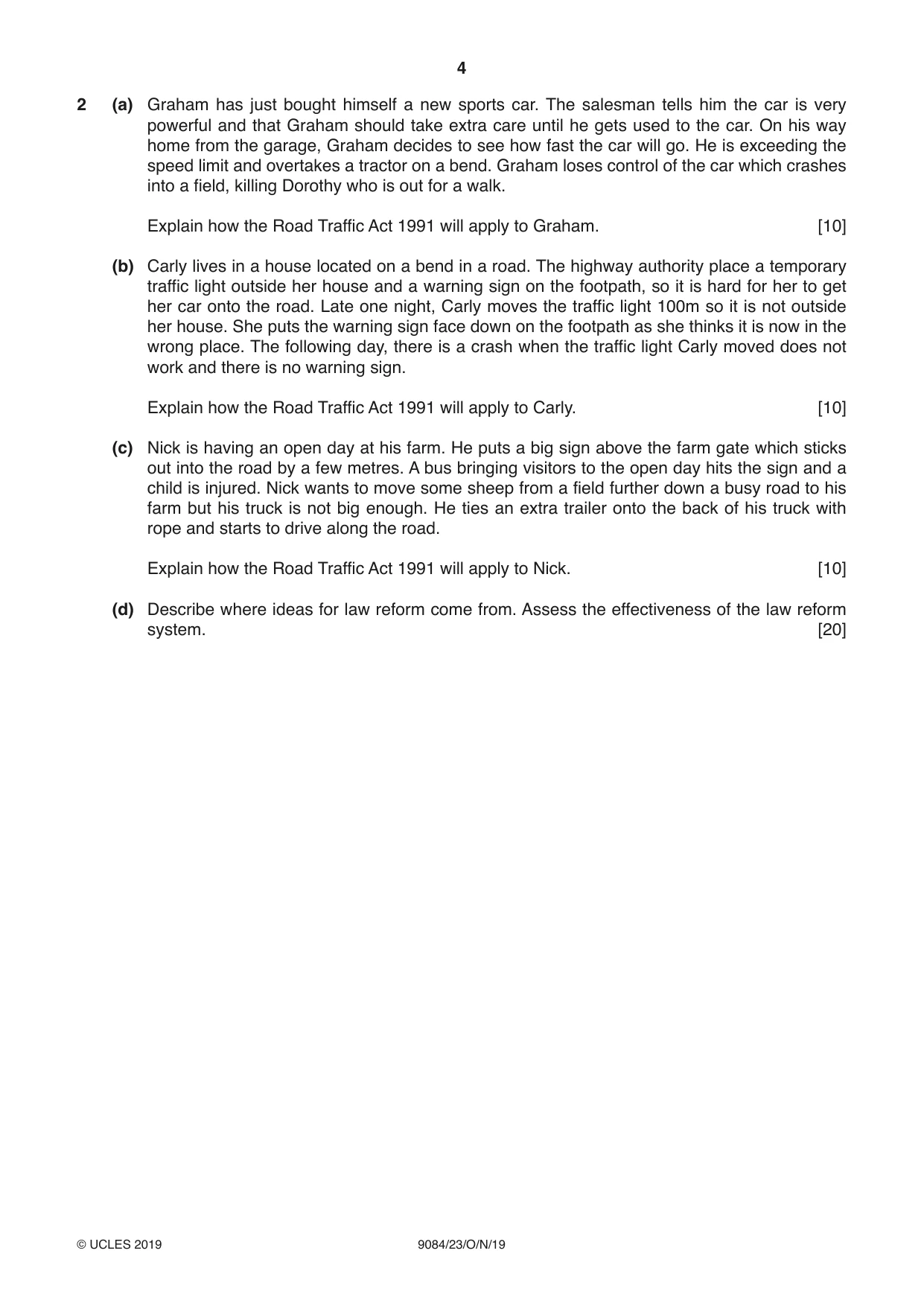
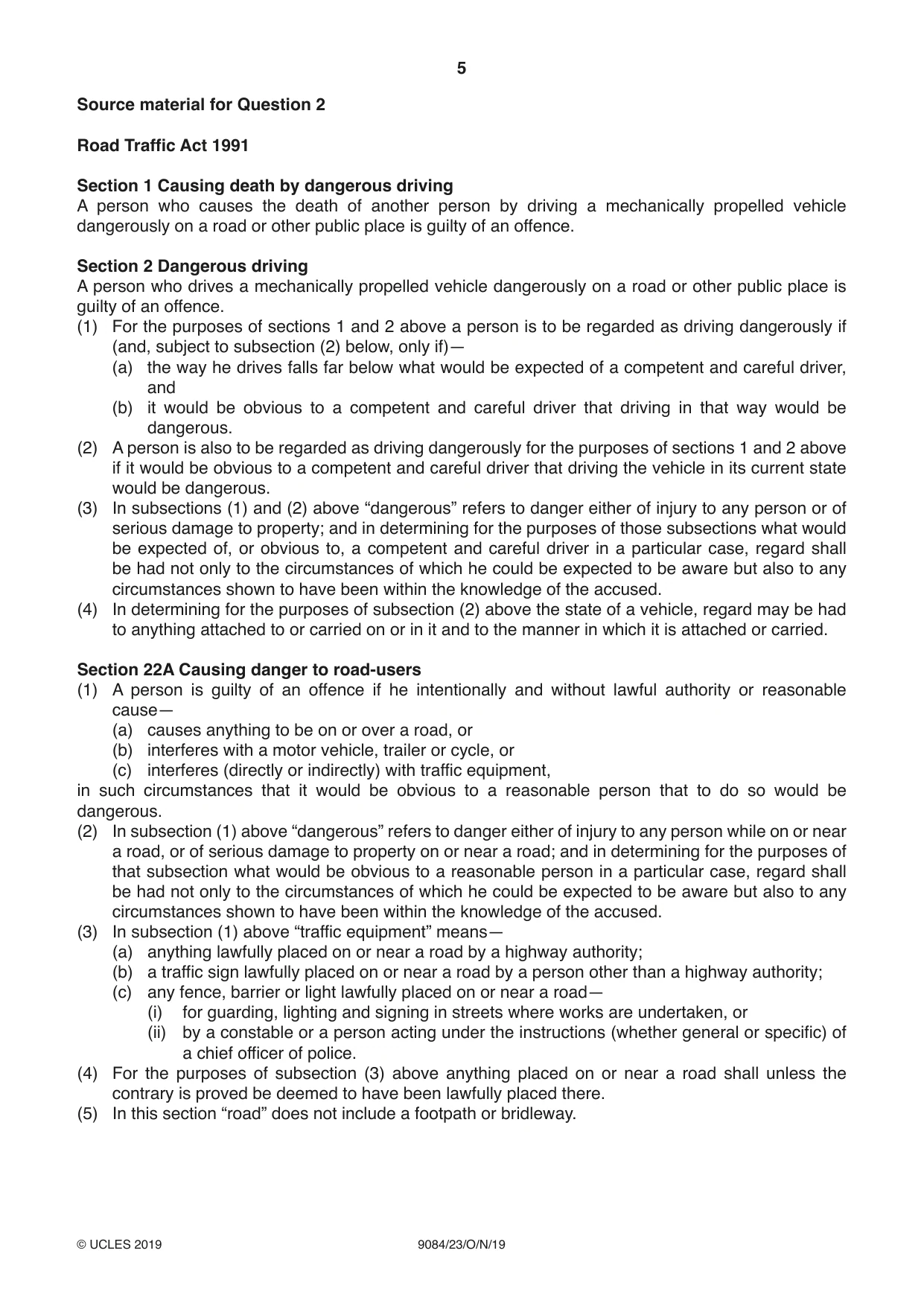
2 (a) Graham has just bought himself a new sports car. The salesman tells him the car is very powerful and that Graham should take extra care until he gets used to the car. On his way home from the garage, Graham decides to see how fast the car will go. He is exceeding the speed limit and overtakes a tractor on a bend. Graham loses control of the car which crashes into a field, killing Dorothy who is out for a walk. Explain how the Road Traffic Act 1991 will apply to Graham. [10] (b) Carly lives in a house located on a bend in a road. The highway authority place a temporary traffic light outside her house and a warning sign on the footpath, so it is hard for her to get her car onto the road. Late one night, Carly moves the traffic light 100m so it is not outside her house. She puts the warning sign face down on the footpath as she thinks it is now in the wrong place. The following day, there is a crash when the traffic light Carly moved does not work and there is no warning sign. Explain how the Road Traffic Act 1991 will apply to Carly. [10] (c) Nick is having an open day at his farm. He puts a big sign above the farm gate which sticks out into the road by a few metres. A bus bringing visitors to the open day hits the sign and a child is injured. Nick wants to move some sheep from a field further down a busy road to his farm but his truck is not big enough. He ties an extra trailer onto the back of his truck with rope and starts to drive along the road. Explain how the Road Traffic Act 1991 will apply to Nick. [10] (d) Describe where ideas for law reform come from. Assess the effectiveness of the law reform system. [20] Source material for Question 2 Road Traffic Act 1991 Section 1 Causing death by dangerous driving A person who causes the death of another person by driving a mechanically propelled vehicle dangerously on a road or other public place is guilty of an offence. Section 2 Dangerous driving A person who drives a mechanically propelled vehicle dangerously on a road or other public place is guilty of an offence. (1) For the purposes of sections 1 and 2 above a person is to be regarded as driving dangerously if (and, subject to subsection (2) below, only if)— (a) the way he drives falls far below what would be expected of a competent and careful driver, and (b) it would be obvious to a competent and careful driver that driving in that way would be dangerous. (2) A person is also to be regarded as driving dangerously for the purposes of sections 1 and 2 above if it would be obvious to a competent and careful driver that driving the vehicle in its current state would be dangerous. (3) In subsections (1) and (2) above “dangerous” refers to danger either of injury to any person or of serious damage to property; and in determining for the purposes of those subsections what would be expected of, or obvious to, a competent and careful driver in a particular case, regard shall be had not only to the circumstances of which he could be expected to be aware but also to any circumstances shown to have been within the knowledge of the accused. (4) In determining for the purposes of subsection (2) above the state of a vehicle, regard may be had to anything attached to or carried on or in it and to the manner in which it is attached or carried. Section 22A Causing danger to road-users (1) A person is guilty of an offence if he intentionally and without lawful authority or reasonable cause— (a) causes anything to be on or over a road, or (b) interferes with a motor vehicle, trailer or cycle, or (c) interferes (directly or indirectly) with traffic equipment, in such circumstances that it would be obvious to a reasonable person that to do so would be dangerous. (2) In subsection (1) above “dangerous” refers to danger either of injury to any person while on or near a road, or of serious damage to property on or near a road; and in determining for the purposes of that subsection what would be obvious to a reasonable person in a particular case, regard shall be had not only to the circumstances of which he could be expected to be aware but also to any circumstances shown to have been within the knowledge of the accused. (3) In subsection (1) above “traffic equipment” means— (a) anything lawfully placed on or near a road by a highway authority; (b) a traffic sign lawfully placed on or near a road by a person other than a highway authority; (c) any fence, barrier or light lawfully placed on or near a road— (i) for guarding, lighting and signing in streets where works are undertaken, or (ii) by a constable or a person acting under the instructions (whether general or specific) of a chief officer of police. (4) For the purposes of subsection (3) above anything placed on or near a road shall unless the contrary is proved be deemed to have been lawfully placed there. (5) In this section “road” does not include a footpath or bridleway.
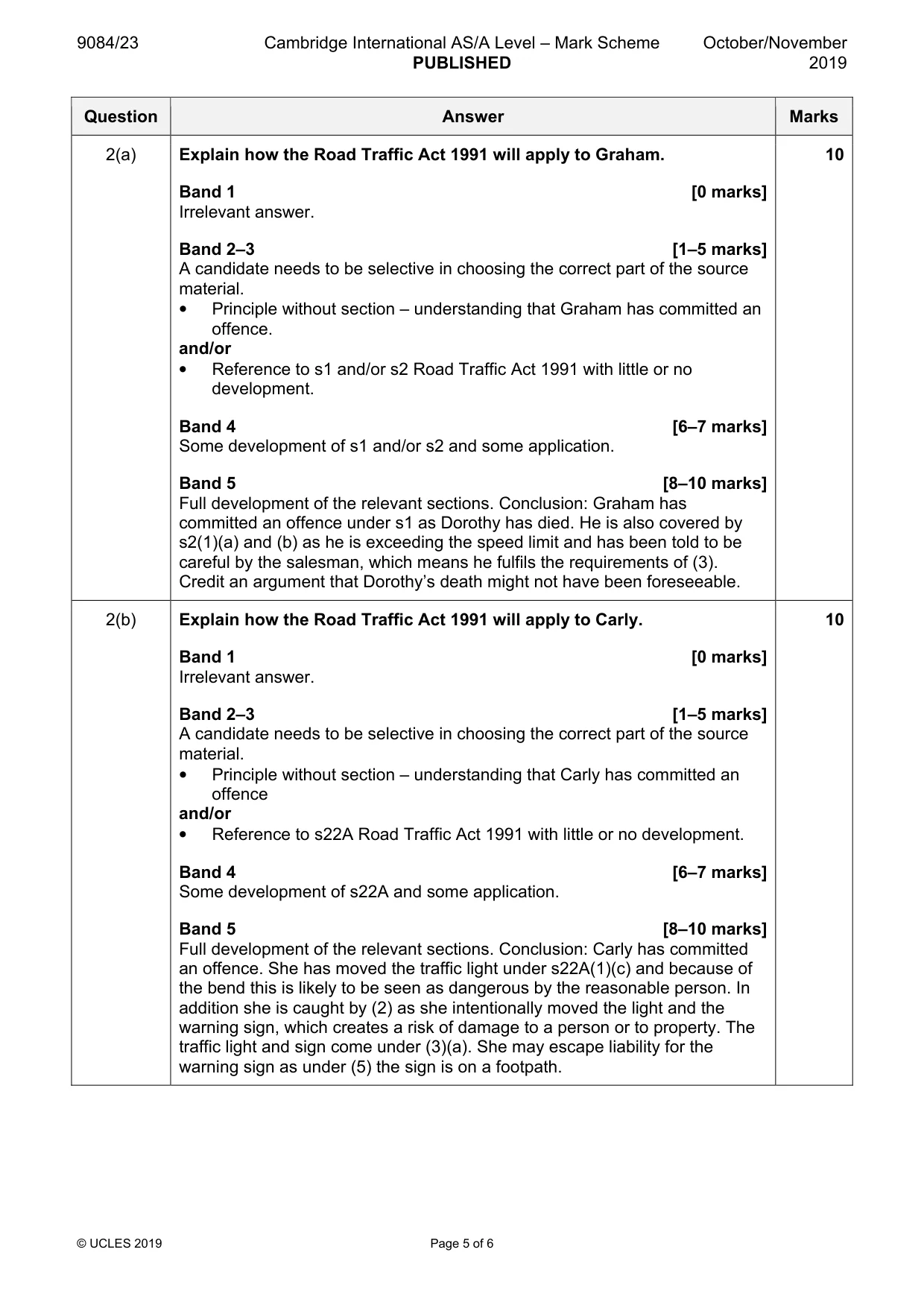
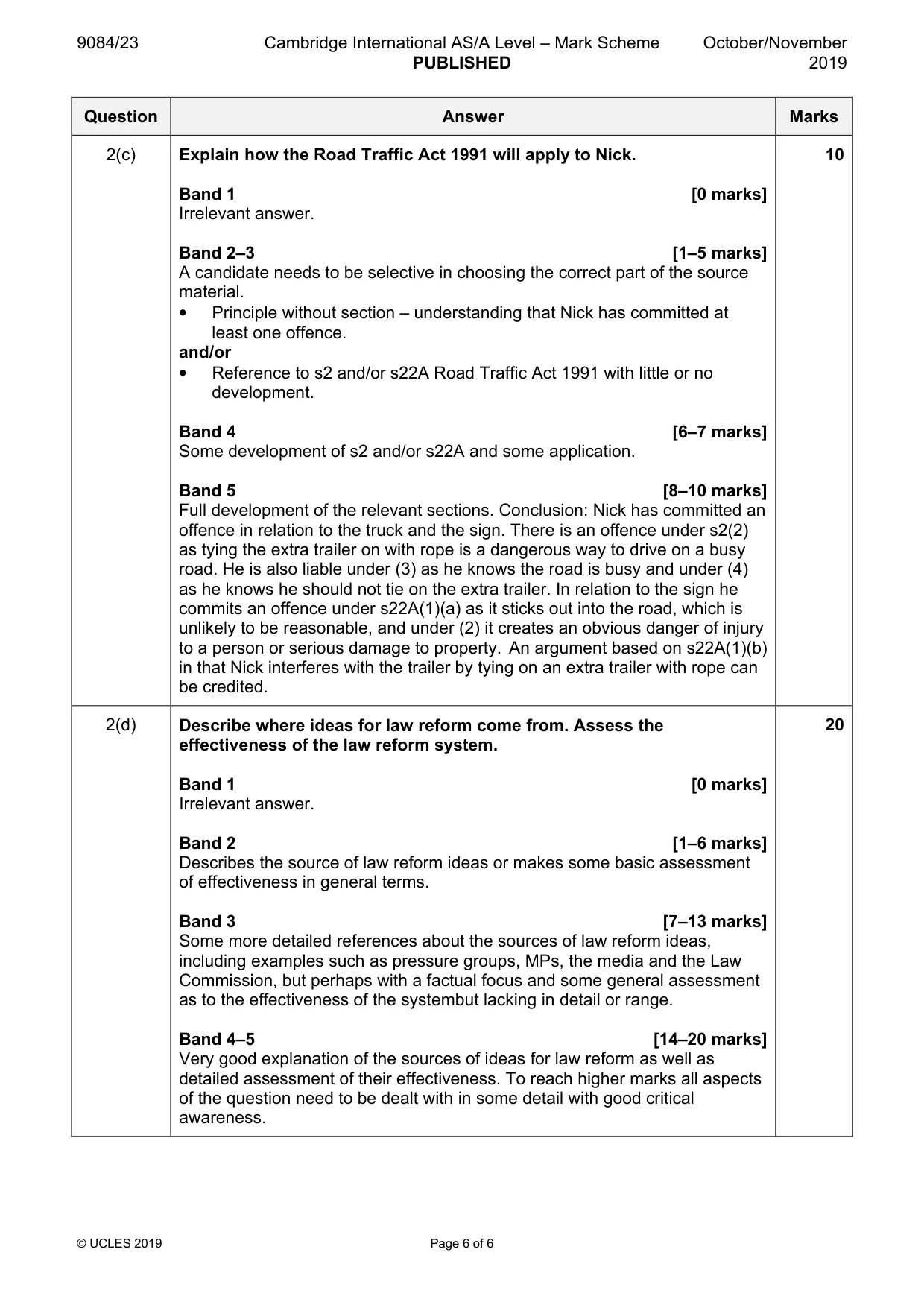
Mark scheme: 2(a) Explain how the Road Traffic Act 1991 will apply to Graham. 10 Band 1 [0 marks] Irrelevant answer. Band 2–3 [1–5 marks] A candidate needs to be selective in choosing the correct part of the source material. • Principle without section – understanding that Graham has committed an offence. and/or • Reference to s1 and/or s2 Road Traffic Act 1991 with little or no development. Band 4 [6–7 marks] Some development of s1 and/or s2 and some application. Band 5 [8–10 marks] Full development of the relevant sections. Conclusion: Graham has committed an offence under s1 as Dorothy has died. He is also covered by s2(1)(a) and (b) as he is exceeding the speed limit and has been told to be careful by the salesman, which means he fulfils the requirements of (3). Credit an argument that Dorothy’s death might not have been foreseeable. 2(b) Explain how the Road Traffic Act 1991 will apply to Carly. 10 Band 1 [0 marks] Irrelevant answer. Band 2–3 [1–5 marks] A candidate needs to be selective in choosing the correct part of the source material. • Principle without section – understanding that Carly has committed an offence and/or • Reference to s22A Road Traffic Act 1991 with little or no development. Band 4 [6–7 marks] Some development of s22A and some application. Band 5 [8–10 marks] Full development of the relevant sections. Conclusion: Carly has committed an offence. She has moved the traffic light under s22A(1)(c) and because of the bend this is likely to be seen as dangerous by the reasonable person. In addition she is caught by (2) as she intentionally moved the light and the warning sign, which creates a risk of damage to a person or to property. The traffic light and sign come under (3)(a). She may escape liability for the warning sign as under (5) the sign is on a footpath. 2(c) Explain how the Road Traffic Act 1991 will apply to Nick. 10 Band 1 [0 marks] Irrelevant answer. Band 2–3 [1–5 marks] A candidate needs to be selective in choosing the correct part of the source material. • Principle without section – understanding that Nick has committed at least one offence. and/or • Reference to s2 and/or s22A Road Traffic Act 1991 with little or no development. Band 4 [6–7 marks] Some development of s2 and/or s22A and some application. Band 5 [8–10 marks] Full development of the relevant sections. Conclusion: Nick has committed an offence in relation to the truck and the sign. There is an offence under s2(2) as tying the extra trailer on with rope is a dangerous way to drive on a busy road. He is also liable under (3) as he knows the road is busy and under (4) as he knows he should not tie on the extra trailer. In relation to the sign he commits an offence under s22A(1)(a) as it sticks out into the road, which is unlikely to be reasonable, and under (2) it creates an obvious danger of injury to a person or serious damage to property. An argument based on s22A(1)(b) in that Nick interferes with the trailer by tying on an extra trailer with rope can be credited. 2(d) Describe where ideas for law reform come from. Assess the 20 effectiveness of the law reform system. Band 1 [0 marks] Irrelevant answer. Band 2 [1–6 marks] Describes the source of law reform ideas or makes some basic assessment of effectiveness in general terms. Band 3 [7–13 marks] Some more detailed references about the sources of law reform ideas, including examples such as pressure groups, MPs, the media and the Law Commission, but perhaps with a factual focus and some general assessment as to the effectiveness of the systembut lacking in detail or range. Band 4–5 [14–20 marks] Very good explanation of the sources of ideas for law reform as well as detailed assessment of their effectiveness. To reach higher marks all aspects of the question need to be dealt with in some detail with good critical awareness.
What was in this paper
The subtopics covered by these 2 questions, and how many questions each got. Open one in a new tab to see every Cambridge question on it.
1Principles and sources of English law This topic introduces the principles behind English law and the modern day sources of English law. This topic is an opportunity to reflect on the key concepts of justice, fairness and morality; power and its limits; and effectiveness and certainty1What you needed in this session
Cambridge’s own grade thresholds for 2019 Oct/Nov, Paper 2 · Variant 3. A higher threshold means an easier paper — the bar moves with how the cohort did.