Cambridge A Level Law 9084 — 2018 May/June Paper 2 · Variant 3
9084/23/M/J/18 · 2 questions · 50 marks · ≈56 min
The question paper and its mark scheme, free to read here and free to download. This is Cambridge’s own paper, exactly as it was sat.
Question paper8 pages
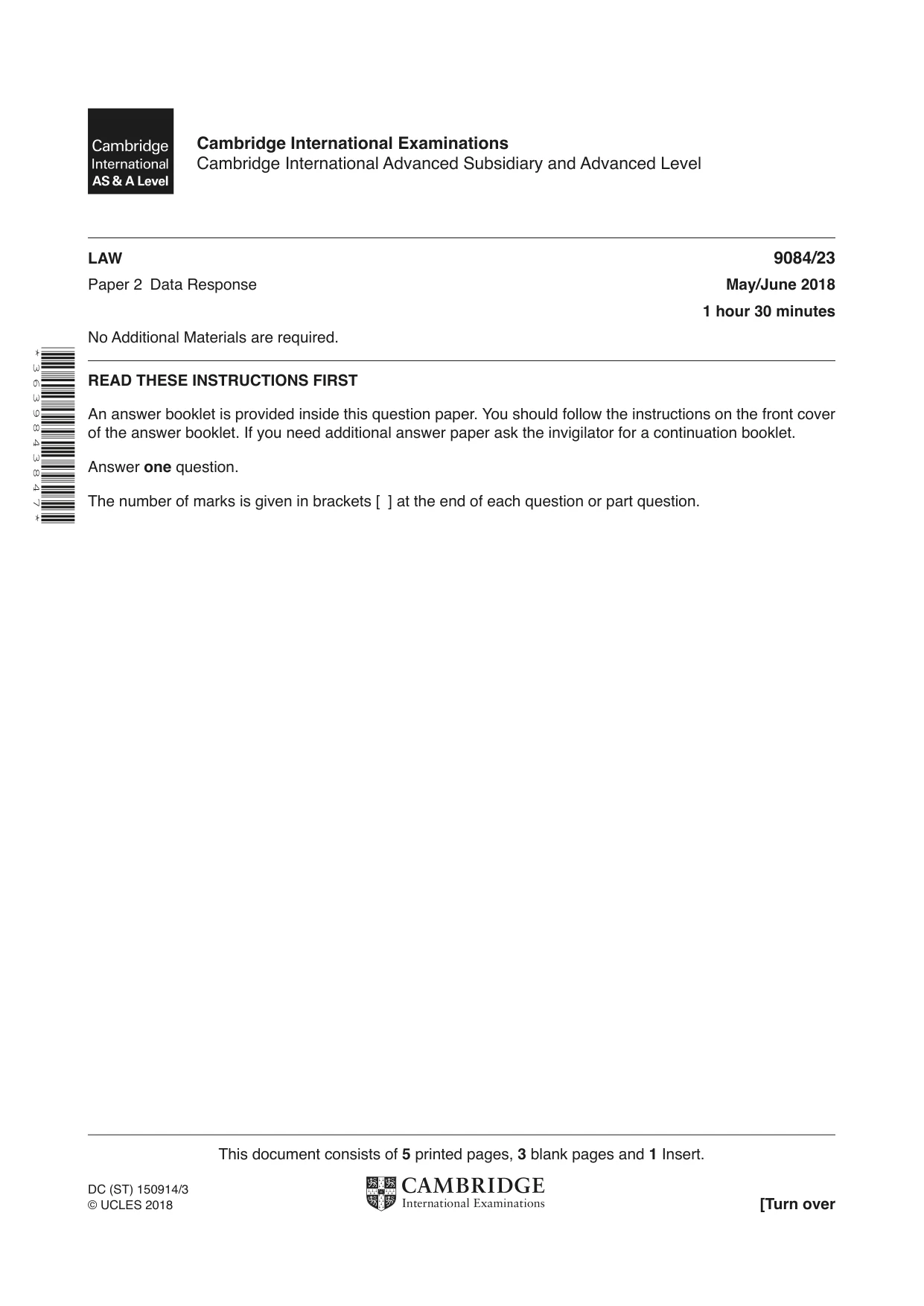



Mark scheme8 pages
Answers below. Sit the paper first if you are practising.
Questions as text
Q1 · Ralph has finished his exercise routine at the gym, where he is a member
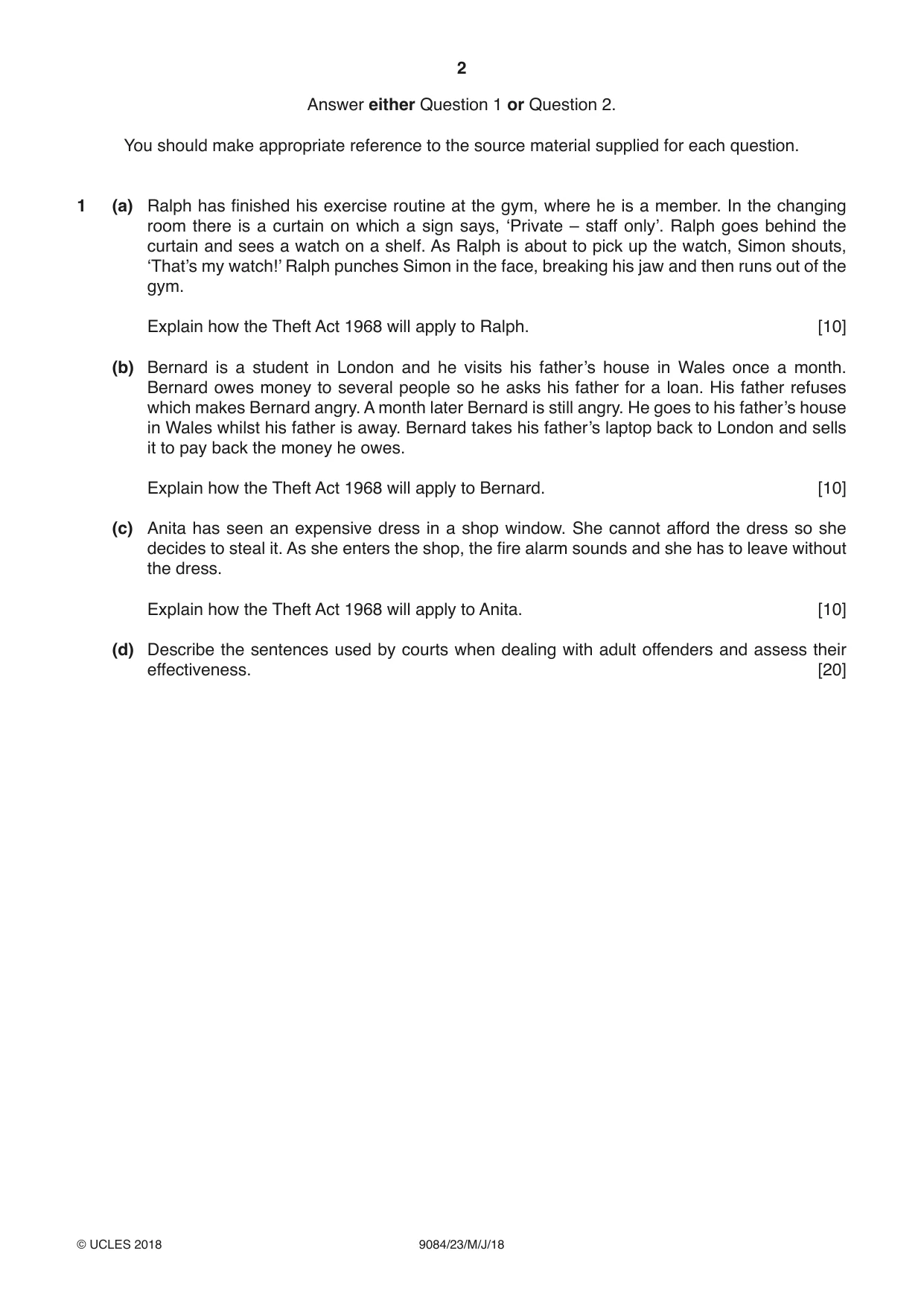
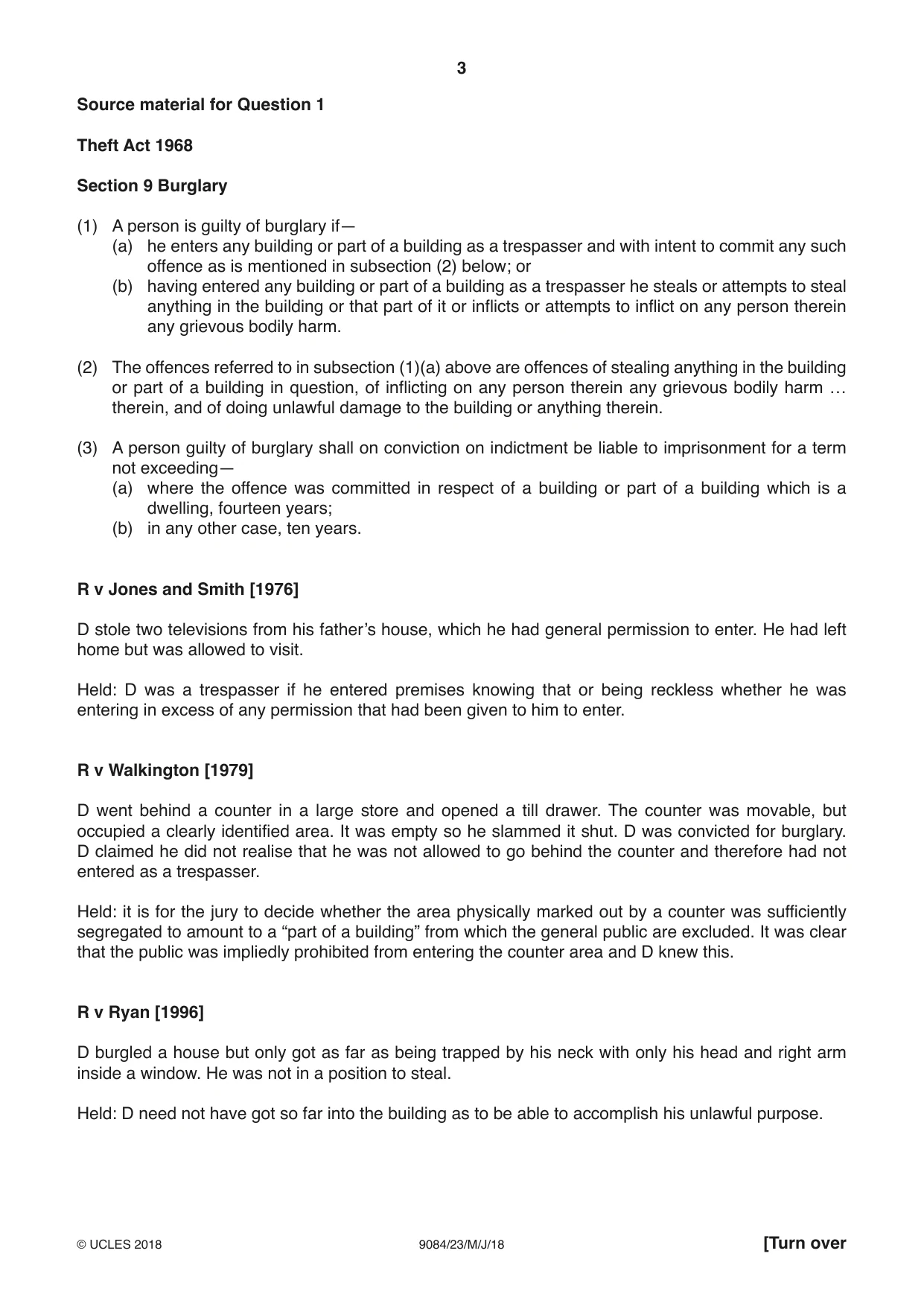
1 (a) Ralph has finished his exercise routine at the gym, where he is a member. In the changing room there is a curtain on which a sign says, ‘Private – staff only’. Ralph goes behind the curtain and sees a watch on a shelf. As Ralph is about to pick up the watch, Simon shouts, ‘That’s my watch!’ Ralph punches Simon in the face, breaking his jaw and then runs out of the gym. Explain how the Theft Act 1968 will apply to Ralph. [10] (b) Bernard is a student in London and he visits his father’s house in Wales once a month. Bernard owes money to several people so he asks his father for a loan. His father refuses which makes Bernard angry. A month later Bernard is still angry. He goes to his father’s house in Wales whilst his father is away. Bernard takes his father’s laptop back to London and sells it to pay back the money he owes. Explain how the Theft Act 1968 will apply to Bernard. [10] (c) Anita has seen an expensive dress in a shop window. She cannot afford the dress so she decides to steal it. As she enters the shop, the fire alarm sounds and she has to leave without the dress. Explain how the Theft Act 1968 will apply to Anita. [10] (d) Describe the sentences used by courts when dealing with adult offenders and assess their effectiveness. [20] Source material for Question 1 Theft Act 1968 Section 9 Burglary (1) A person is guilty of burglary if— (a) he enters any building or part of a building as a trespasser and with intent to commit any such offence as is mentioned in subsection (2) below; or (b) having entered any building or part of a building as a trespasser he steals or attempts to steal anything in the building or that part of it or inflicts or attempts to inflict on any person therein any grievous bodily harm. (2) The offences referred to in subsection (1)(a) above are offences of stealing anything in the building or part of a building in question, of inflicting on any person therein any grievous bodily harm … therein, and of doing unlawful damage to the building or anything therein. (3) A person guilty of burglary shall on conviction on indictment be liable to imprisonment for a term not exceeding— (a) where the offence was committed in respect of a building or part of a building which is a dwelling, fourteen years; (b) in any other case, ten years. R v Jones and Smith [1976] D stole two televisions from his father’s house, which he had general permission to enter. He had left home but was allowed to visit. Held: D was a trespasser if he entered premises knowing that or being reckless whether he was entering in excess of any permission that had been given to him to enter. R v Walkington [1979] D went behind a counter in a large store and opened a till drawer. The counter was movable, but occupied a clearly identified area. It was empty so he slammed it shut. D was convicted for burglary. D claimed he did not realise that he was not allowed to go behind the counter and therefore had not entered as a trespasser. Held: it is for the jury to decide whether the area physically marked out by a counter was sufficiently segregated to amount to a “part of a building” from which the general public are excluded. It was clear that the public was impliedly prohibited from entering the counter area and D knew this. R v Ryan [1996] D burgled a house but only got as far as being trapped by his neck with only his head and right arm inside a window. He was not in a position to steal. Held: D need not have got so far into the building as to be able to accomplish his unlawful purpose.
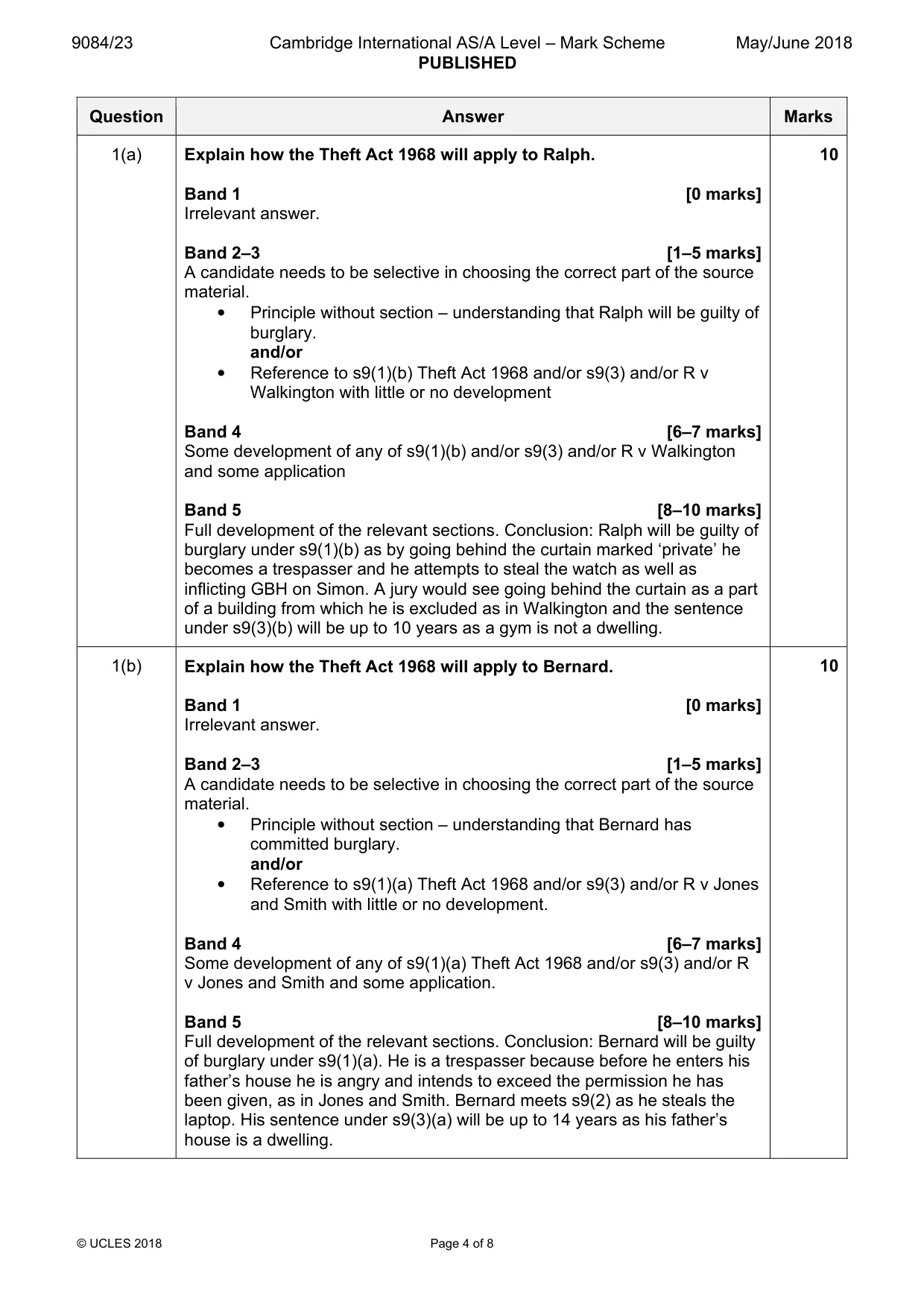
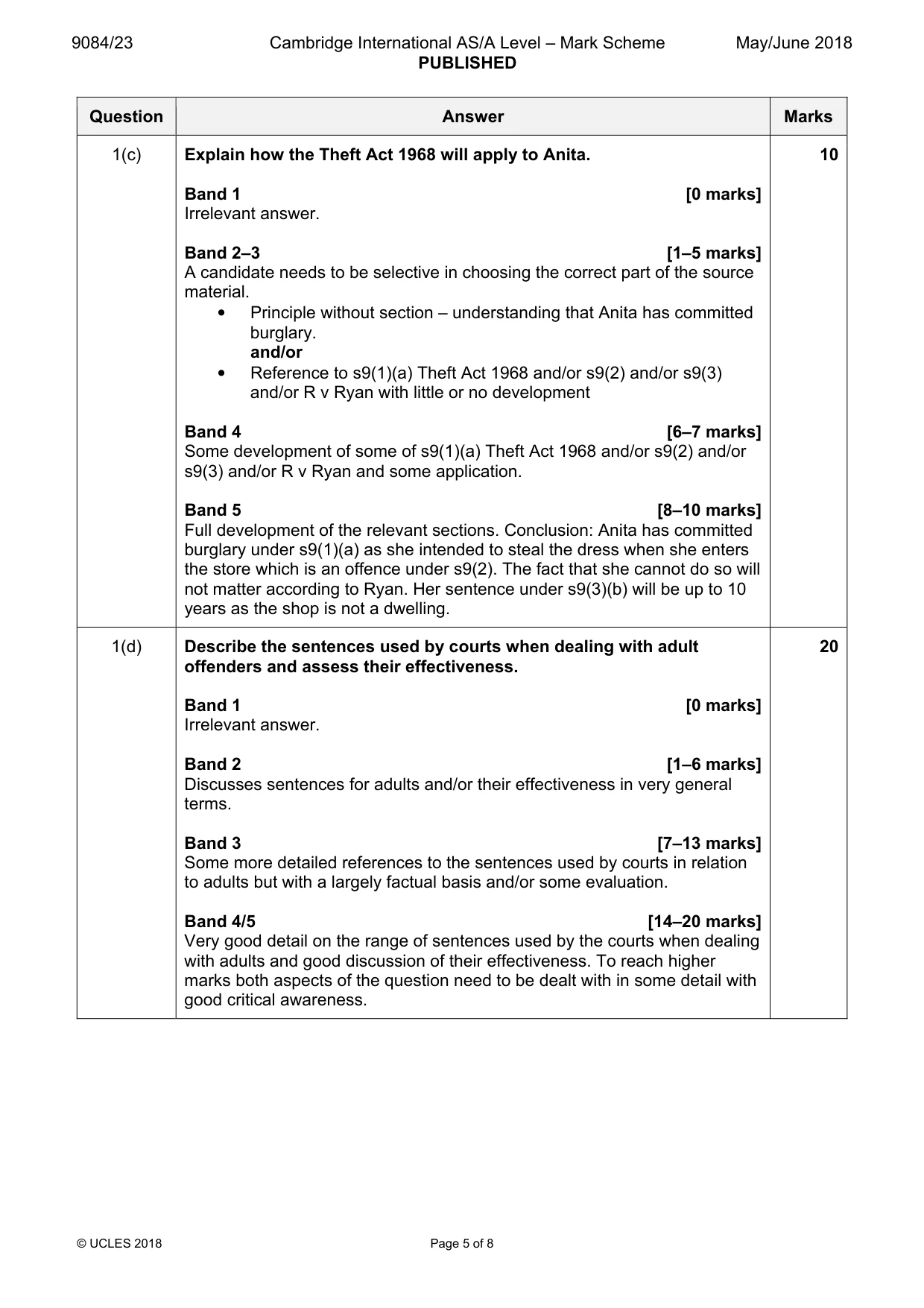
Mark scheme: Question Answer Marks 1(a) Explain how the Theft Act 1968 will apply to Ralph. 10 Band 1 [0 marks] Irrelevant answer. Band 2–3 [1–5 marks] A candidate needs to be selective in choosing the correct part of the source material. • Principle without section – understanding that Ralph will be guilty of burglary. and/or • Reference to s9(1)(b) Theft Act 1968 and/or s9(3) and/or R v Walkington with little or no development Band 4 [6–7 marks] Some development of any of s9(1)(b) and/or s9(3) and/or R v Walkington and some application Band 5 [8–10 marks] Full development of the relevant sections. Conclusion: Ralph will be guilty of burglary under s9(1)(b) as by going behind the curtain marked ‘private’ he becomes a trespasser and he attempts to steal the watch as well as inflicting GBH on Simon. A jury would see going behind the curtain as a part of a building from which he is excluded as in Walkington and the sentence under s9(3)(b) will be up to 10 years as a gym is not a dwelling. 1(b) Explain how the Theft Act 1968 will apply to Bernard. 10 Band 1 [0 marks] Irrelevant answer. Band 2–3 [1–5 marks] A candidate needs to be selective in choosing the correct part of the source material. • Principle without section – understanding that Bernard has committed burglary. and/or • Reference to s9(1)(a) Theft Act 1968 and/or s9(3) and/or R v Jones and Smith with little or no development. Band 4 [6–7 marks] Some development of any of s9(1)(a) Theft Act 1968 and/or s9(3) and/or R v Jones and Smith and some application. Band 5 [8–10 marks] Full development of the relevant sections. Conclusion: Bernard will be guilty of burglary under s9(1)(a). He is a trespasser because before he enters his father’s house he is angry and intends to exceed the permission he has been given, as in Jones and Smith. Bernard meets s9(2) as he steals the laptop. His sentence under s9(3)(a) will be up to 14 years as his father’s house is a dwelling. 1(c) Explain how the Theft Act 1968 will apply to Anita. 10 Band 1 [0 marks] Irrelevant answer. Band 2–3 [1–5 marks] A candidate needs to be selective in choosing the correct part of the source material. • Principle without section – understanding that Anita has committed burglary. and/or • Reference to s9(1)(a) Theft Act 1968 and/or s9(2) and/or s9(3) and/or R v Ryan with little or no development Band 4 [6–7 marks] Some development of some of s9(1)(a) Theft Act 1968 and/or s9(2) and/or s9(3) and/or R v Ryan and some application. Band 5 [8–10 marks] Full development of the relevant sections. Conclusion: Anita has committed burglary under s9(1)(a) as she intended to steal the dress when she enters the store which is an offence under s9(2). The fact that she cannot do so will not matter according to Ryan. Her sentence under s9(3)(b) will be up to 10 years as the shop is not a dwelling. 1(d) Describe the sentences used by courts when dealing with adult 20 offenders and assess their effectiveness. Band 1 [0 marks] Irrelevant answer. Band 2 [1–6 marks] Discusses sentences for adults and/or their effectiveness in very general terms. Band 3 [7–13 marks] Some more detailed references to the sentences used by courts in relation to adults but with a largely factual basis and/or some evaluation. Band 4/5 [14–20 marks] Very good detail on the range of sentences used by the courts when dealing with adults and good discussion of their effectiveness. To reach higher marks both aspects of the question need to be dealt with in some detail with good critical awareness.
Q2 · Captain Smith has docked his UK registered ship in the Chinese port of Shanghai for some…
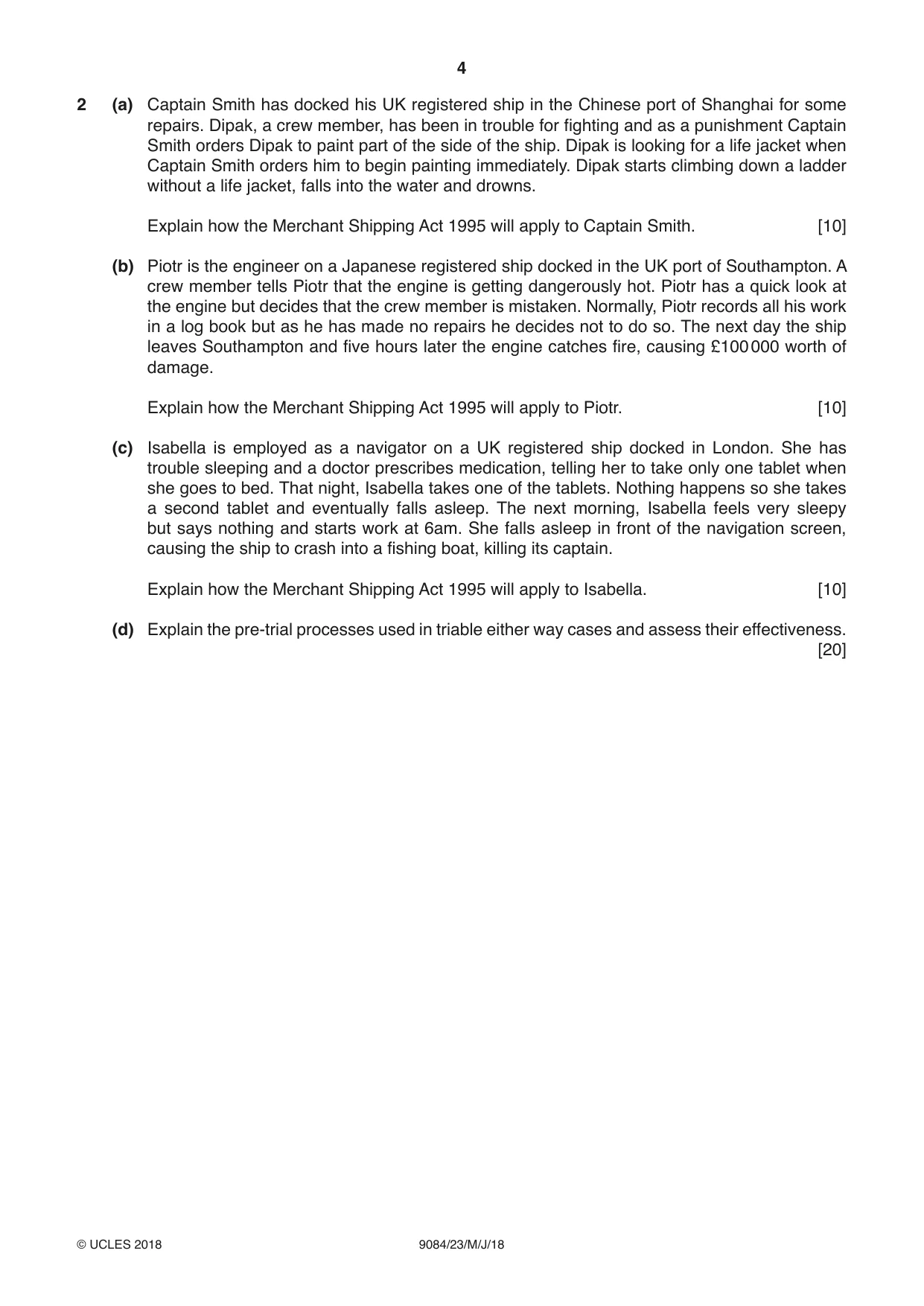
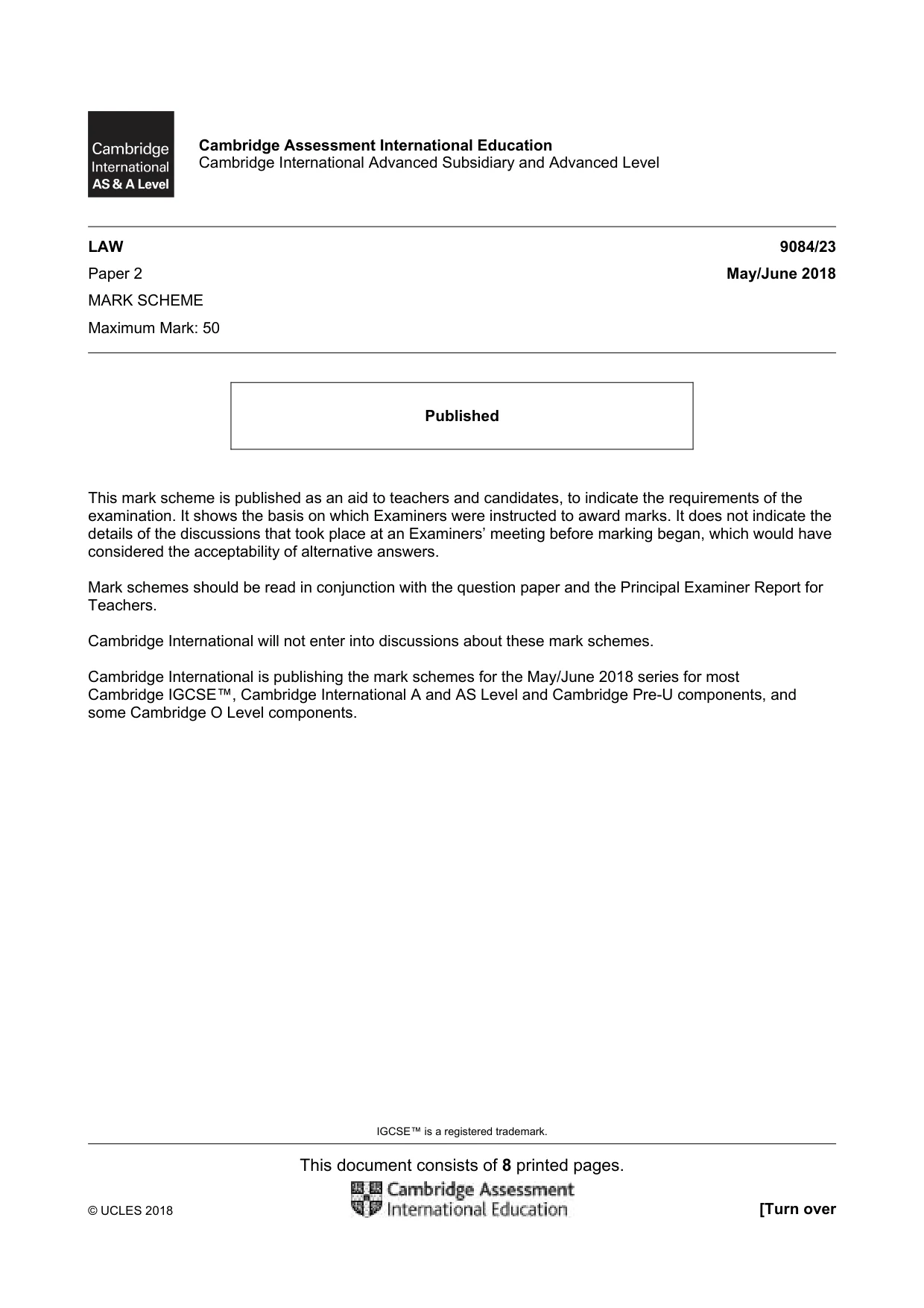
2 (a) Captain Smith has docked his UK registered ship in the Chinese port of Shanghai for some repairs. Dipak, a crew member, has been in trouble for fighting and as a punishment Captain Smith orders Dipak to paint part of the side of the ship. Dipak is looking for a life jacket when Captain Smith orders him to begin painting immediately. Dipak starts climbing down a ladder without a life jacket, falls into the water and drowns. Explain how the Merchant Shipping Act 1995 will apply to Captain Smith. [10] (b) Piotr is the engineer on a Japanese registered ship docked in the UK port of Southampton. A crew member tells Piotr that the engine is getting dangerously hot. Piotr has a quick look at the engine but decides that the crew member is mistaken. Normally, Piotr records all his work in a log book but as he has made no repairs he decides not to do so. The next day the ship leaves Southampton and five hours later the engine catches fire, causing £100 000 worth of damage. Explain how the Merchant Shipping Act 1995 will apply to Piotr. [10] (c) Isabella is employed as a navigator on a UK registered ship docked in London. She has trouble sleeping and a doctor prescribes medication, telling her to take only one tablet when she goes to bed. That night, Isabella takes one of the tablets. Nothing happens so she takes a second tablet and eventually falls asleep. The next morning, Isabella feels very sleepy but says nothing and starts work at 6am. She falls asleep in front of the navigation screen, causing the ship to crash into a fishing boat, killing its captain. Explain how the Merchant Shipping Act 1995 will apply to Isabella. [10] (d) Explain the pre-trial processes used in triable either way cases and assess their effectiveness. [20] Source material for Question 2 Merchant Shipping Act 1995 Section 58 Conduct endangering ships, structures or individuals (1) This section applies— (a) to the master of, or any seaman employed in, a United Kingdom ship; and (b) to the master of, or any seaman employed in, a ship which— (i) is registered under the law of any country outside the United Kingdom; and (ii) is in a port in the United Kingdom or within United Kingdom waters while proceeding to or from any such port. (2) If a person to whom this section applies, while on board his ship or in its immediate vicinity— (a) does any act which causes or is likely to cause— (i) the loss or destruction of or serious damage to his ship or its machinery, navigational equipment or safety equipment, or (ii) the loss or destruction of or serious damage to any other ship or any structure, or (iii) the death of or serious injury to any person, or (b) omits to do anything required— (i) to preserve his ship or its machinery, navigational equipment or safety equipment from being lost, destroyed or seriously damaged, or (ii) to preserve any person on board his ship from death or serious injury, or (iii) to prevent his ship from causing the loss or destruction of or serious damage to any other ship or any structure, or the death of or serious injury to any person not on board his ship, and either of the conditions specified in subsection (3) below is satisfied with respect to that act or omission, he shall … be guilty of an offence. (3) Those conditions are— (a) that the act or omission was deliberate or amounted to a breach or neglect of duty; (b) that the master or seaman in question was under the influence of drink or a drug at the time of the act or omission. … (5) A person guilty of an offence under this section shall be liable— (a) on summary conviction, to a fine not exceeding the statutory maximum; (b) on conviction on indictment, to imprisonment for a term not exceeding two years or a fine, or both.
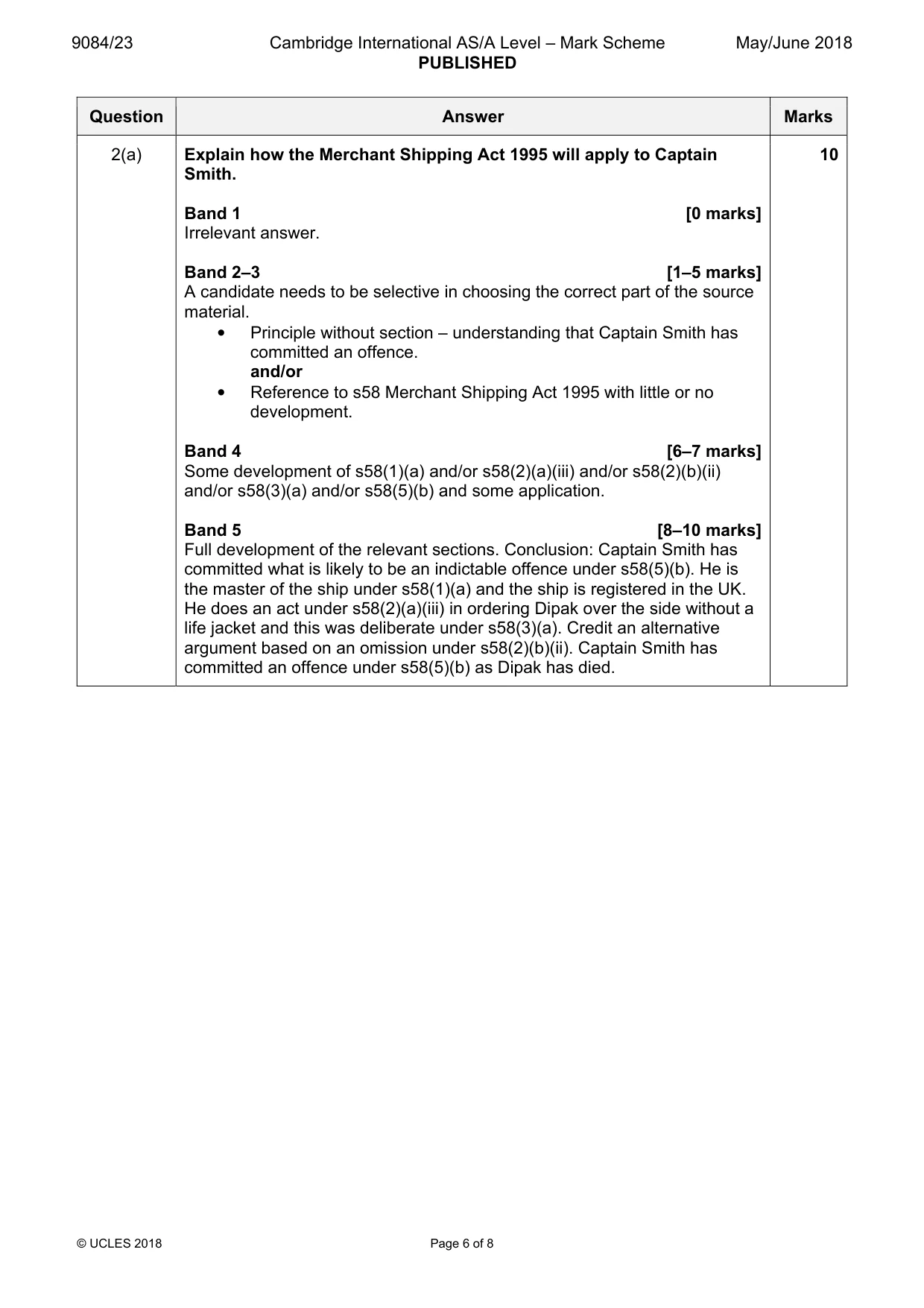
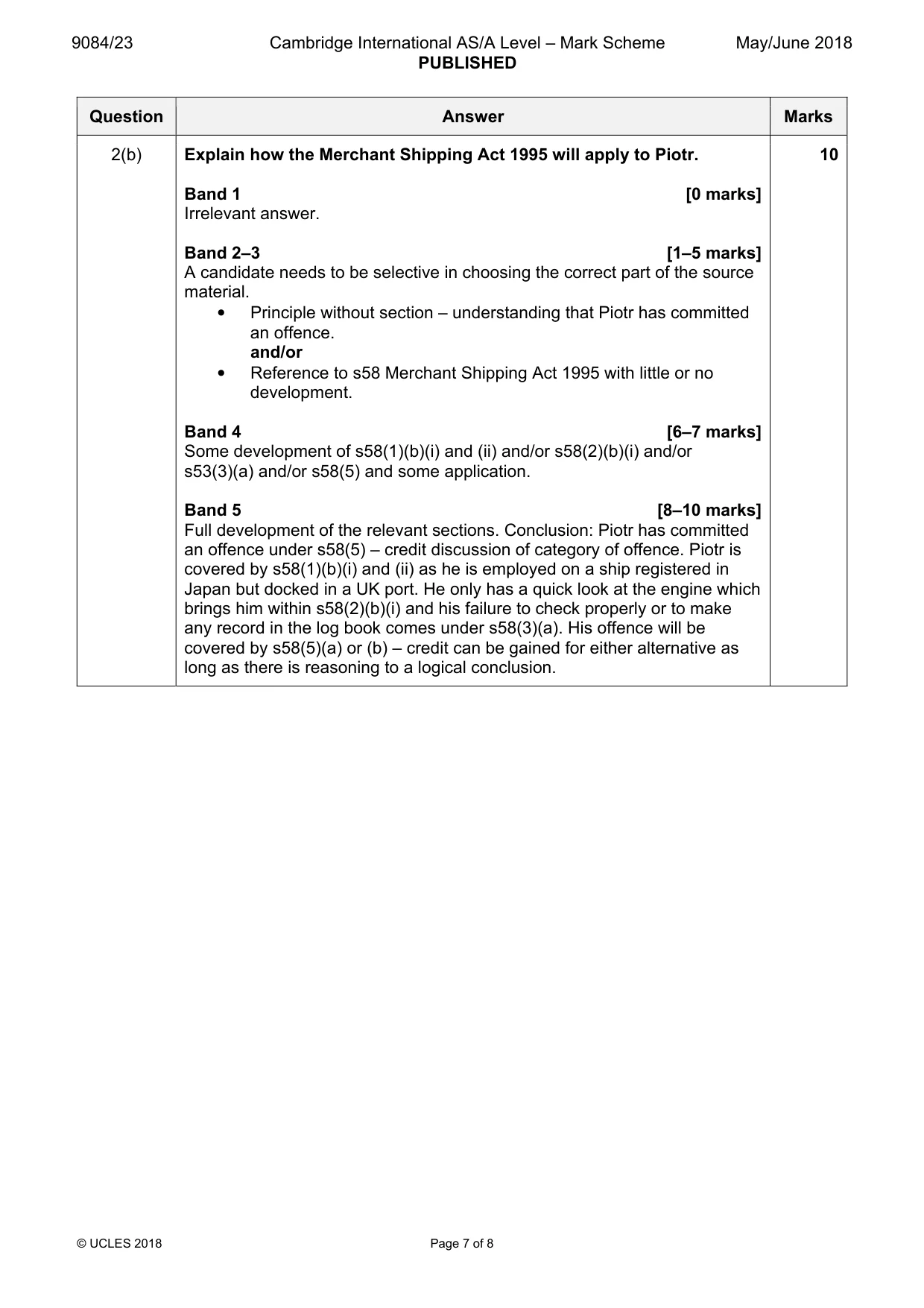
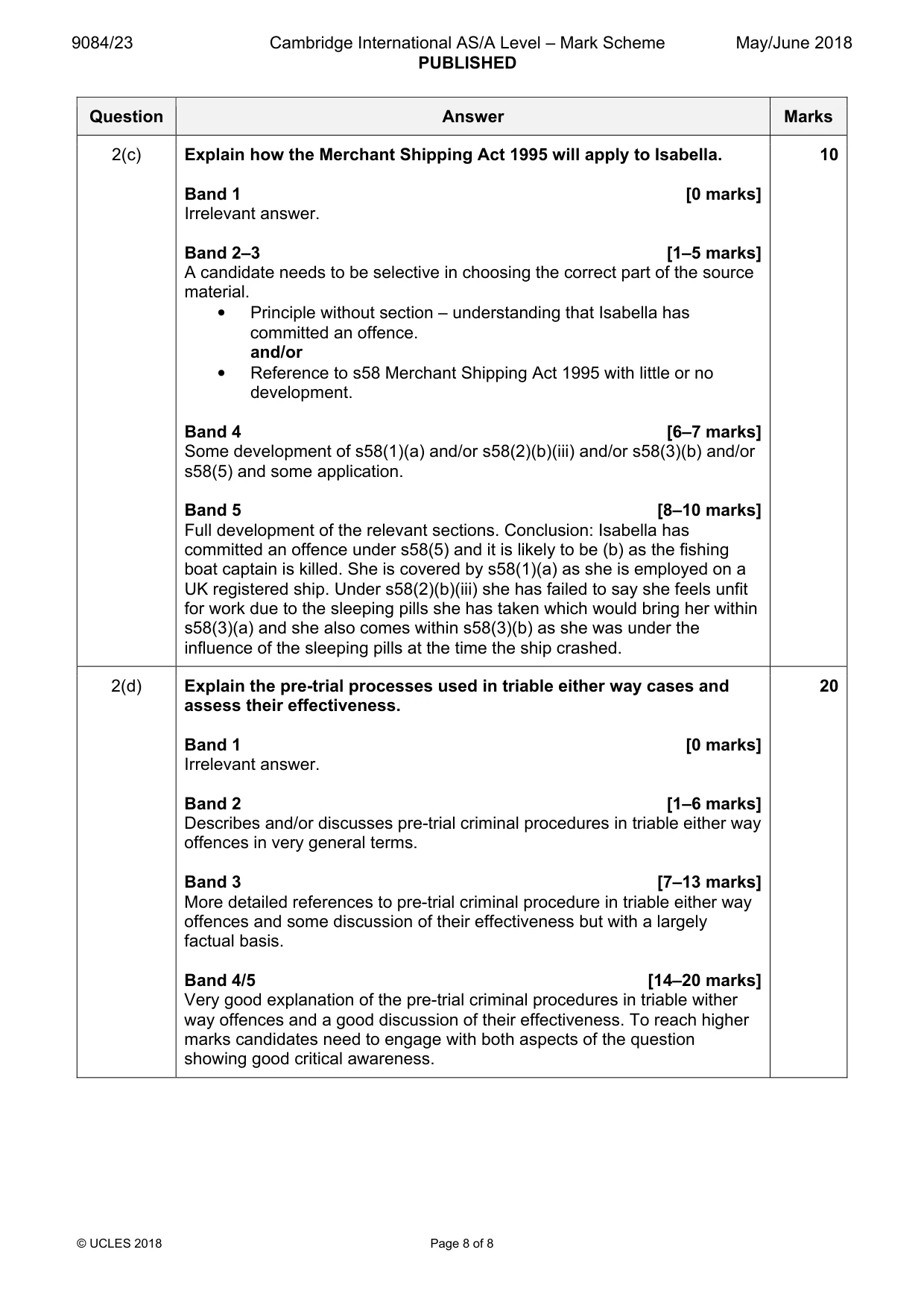
Mark scheme: 2(a) Explain how the Merchant Shipping Act 1995 will apply to Captain 10 Smith. Band 1 [0 marks] Irrelevant answer. Band 2–3 [1–5 marks] A candidate needs to be selective in choosing the correct part of the source material. • Principle without section – understanding that Captain Smith has committed an offence. and/or • Reference to s58 Merchant Shipping Act 1995 with little or no development. Band 4 [6–7 marks] Some development of s58(1)(a) and/or s58(2)(a)(iii) and/or s58(2)(b)(ii) and/or s58(3)(a) and/or s58(5)(b) and some application. Band 5 [8–10 marks] Full development of the relevant sections. Conclusion: Captain Smith has committed what is likely to be an indictable offence under s58(5)(b). He is the master of the ship under s58(1)(a) and the ship is registered in the UK. He does an act under s58(2)(a)(iii) in ordering Dipak over the side without a life jacket and this was deliberate under s58(3)(a). Credit an alternative argument based on an omission under s58(2)(b)(ii). Captain Smith has committed an offence under s58(5)(b) as Dipak has died. 2(b) Explain how the Merchant Shipping Act 1995 will apply to Piotr. 10 Band 1 [0 marks] Irrelevant answer. Band 2–3 [1–5 marks] A candidate needs to be selective in choosing the correct part of the source material. • Principle without section – understanding that Piotr has committed an offence. and/or • Reference to s58 Merchant Shipping Act 1995 with little or no development. Band 4 [6–7 marks] Some development of s58(1)(b)(i) and (ii) and/or s58(2)(b)(i) and/or s53(3)(a) and/or s58(5) and some application. Band 5 [8–10 marks] Full development of the relevant sections. Conclusion: Piotr has committed an offence under s58(5) – credit discussion of category of offence. Piotr is covered by s58(1)(b)(i) and (ii) as he is employed on a ship registered in Japan but docked in a UK port. He only has a quick look at the engine which brings him within s58(2)(b)(i) and his failure to check properly or to make any record in the log book comes under s58(3)(a). His offence will be covered by s58(5)(a) or (b) – credit can be gained for either alternative as long as there is reasoning to a logical conclusion. 2(c) Explain how the Merchant Shipping Act 1995 will apply to Isabella. 10 Band 1 [0 marks] Irrelevant answer. Band 2–3 [1–5 marks] A candidate needs to be selective in choosing the correct part of the source material. • Principle without section – understanding that Isabella has committed an offence. and/or • Reference to s58 Merchant Shipping Act 1995 with little or no development. Band 4 [6–7 marks] Some development of s58(1)(a) and/or s58(2)(b)(iii) and/or s58(3)(b) and/or s58(5) and some application. Band 5 [8–10 marks] Full development of the relevant sections. Conclusion: Isabella has committed an offence under s58(5) and it is likely to be (b) as the fishing boat captain is killed. She is covered by s58(1)(a) as she is employed on a UK registered ship. Under s58(2)(b)(iii) she has failed to say she feels unfit for work due to the sleeping pills she has taken which would bring her within s58(3)(a) and she also comes within s58(3)(b) as she was under the influence of the sleeping pills at the time the ship crashed. 2(d) Explain the pre-trial processes used in triable either way cases and 20 assess their effectiveness. Band 1 [0 marks] Irrelevant answer. Band 2 [1–6 marks] Describes and/or discusses pre-trial criminal procedures in triable either way offences in very general terms. Band 3 [7–13 marks] More detailed references to pre-trial criminal procedure in triable either way offences and some discussion of their effectiveness but with a largely factual basis. Band 4/5 [14–20 marks] Very good explanation of the pre-trial criminal procedures in triable wither way offences and a good discussion of their effectiveness. To reach higher marks candidates need to engage with both aspects of the question showing good critical awareness.
What was in this paper
The subtopics covered by these 2 questions, and how many questions each got. Open one in a new tab to see every Cambridge question on it.
1Offences against property This topic is about the components of substantive offences against property. This topic is an opportunity to reflect on the key concepts of liability, justice, fairness, effectiveness and certainty1What you needed in this session
Cambridge’s own grade thresholds for 2018 May/June, Paper 2 · Variant 3. A higher threshold means an easier paper — the bar moves with how the cohort did.