Cambridge A Level Law 9084 — 2017 May/June Paper 2 · Variant 2
9084/22/M/J/17 · 2 questions · 100 marks · ≈113 min
The question paper and its mark scheme, free to read here and free to download. This is Cambridge’s own paper, exactly as it was sat.
Question paper8 pages
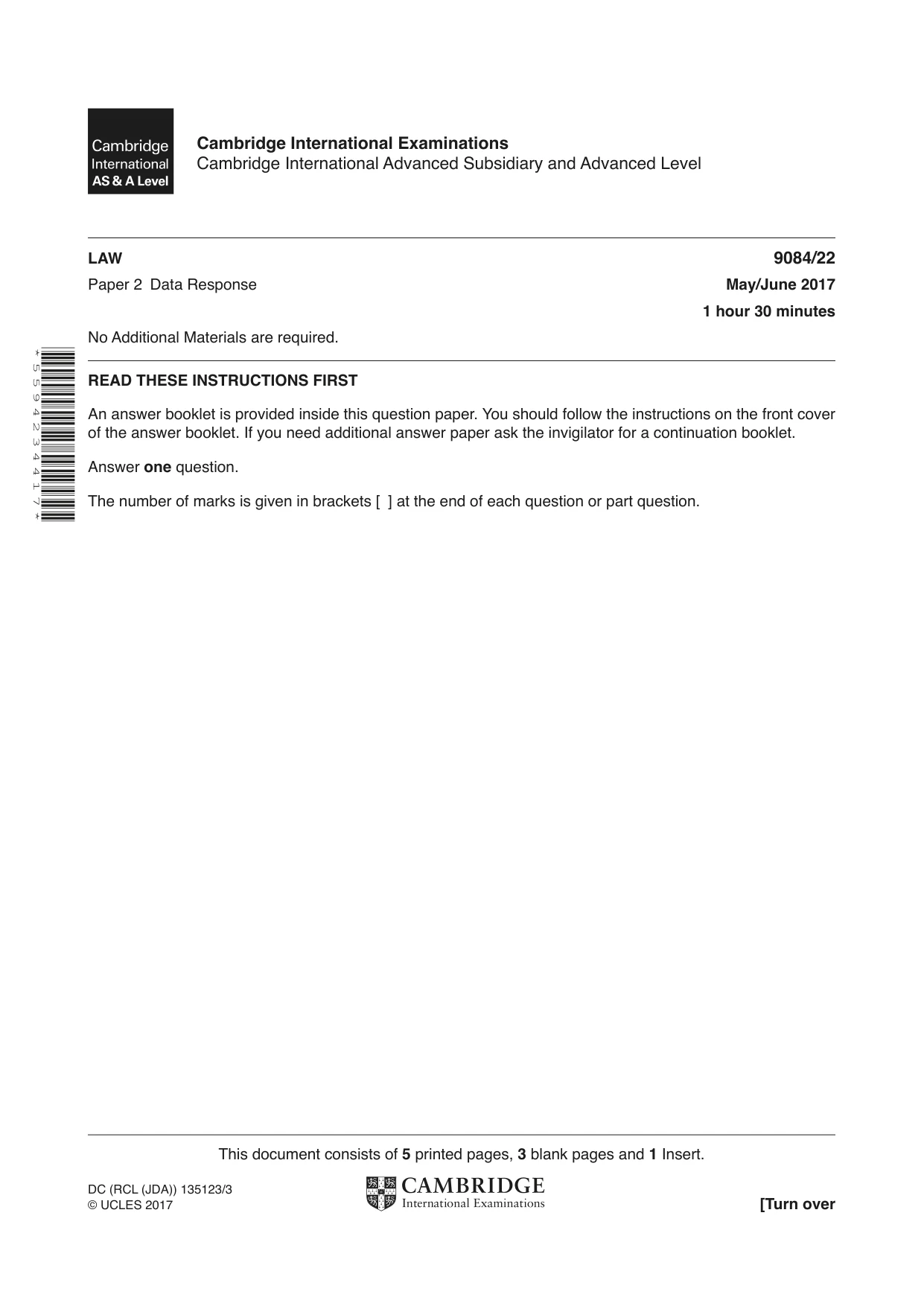



Mark scheme
No mark scheme is in the library for this paper.
Questions as text
Q1 · Ali has been charged with manslaughter
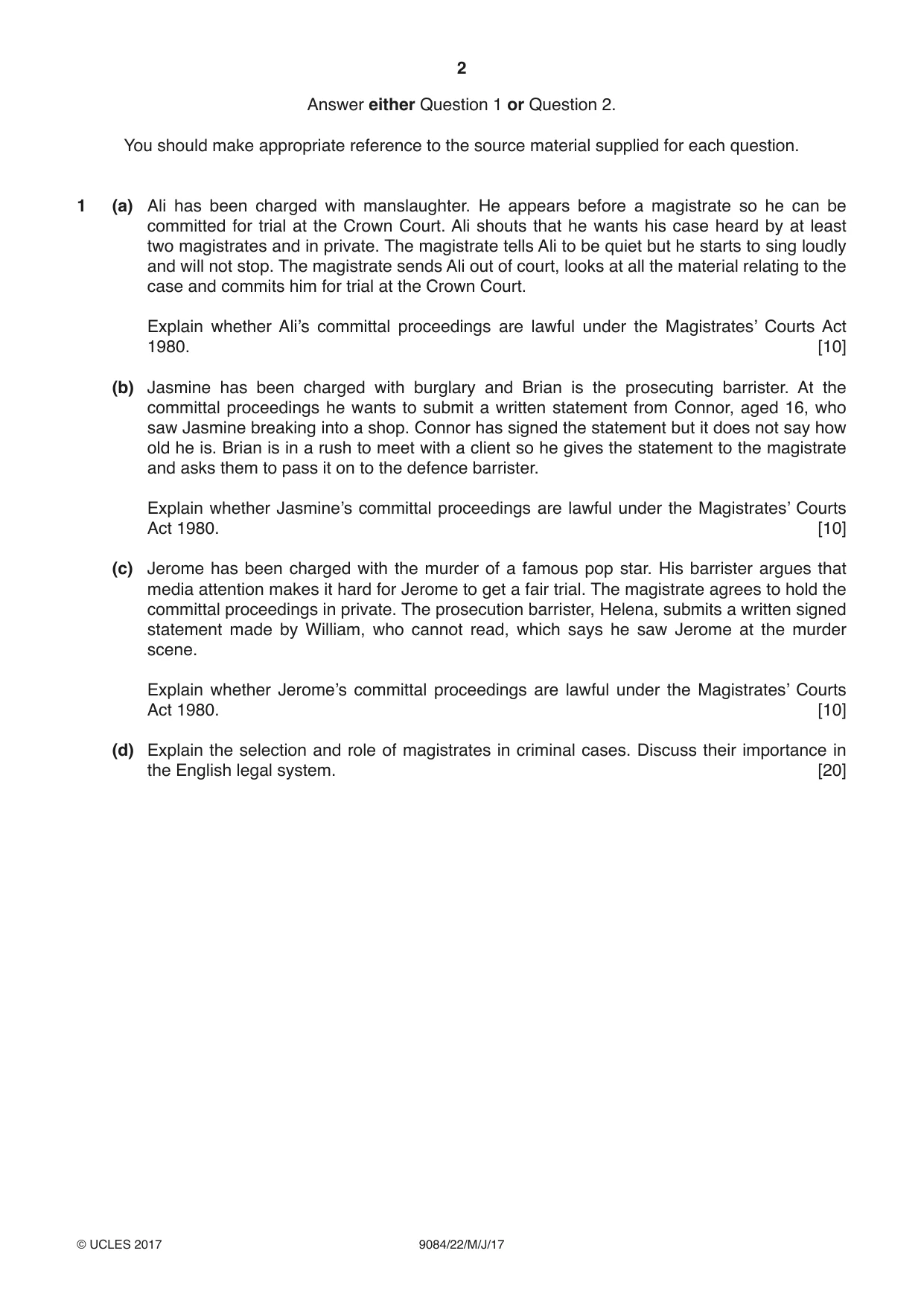
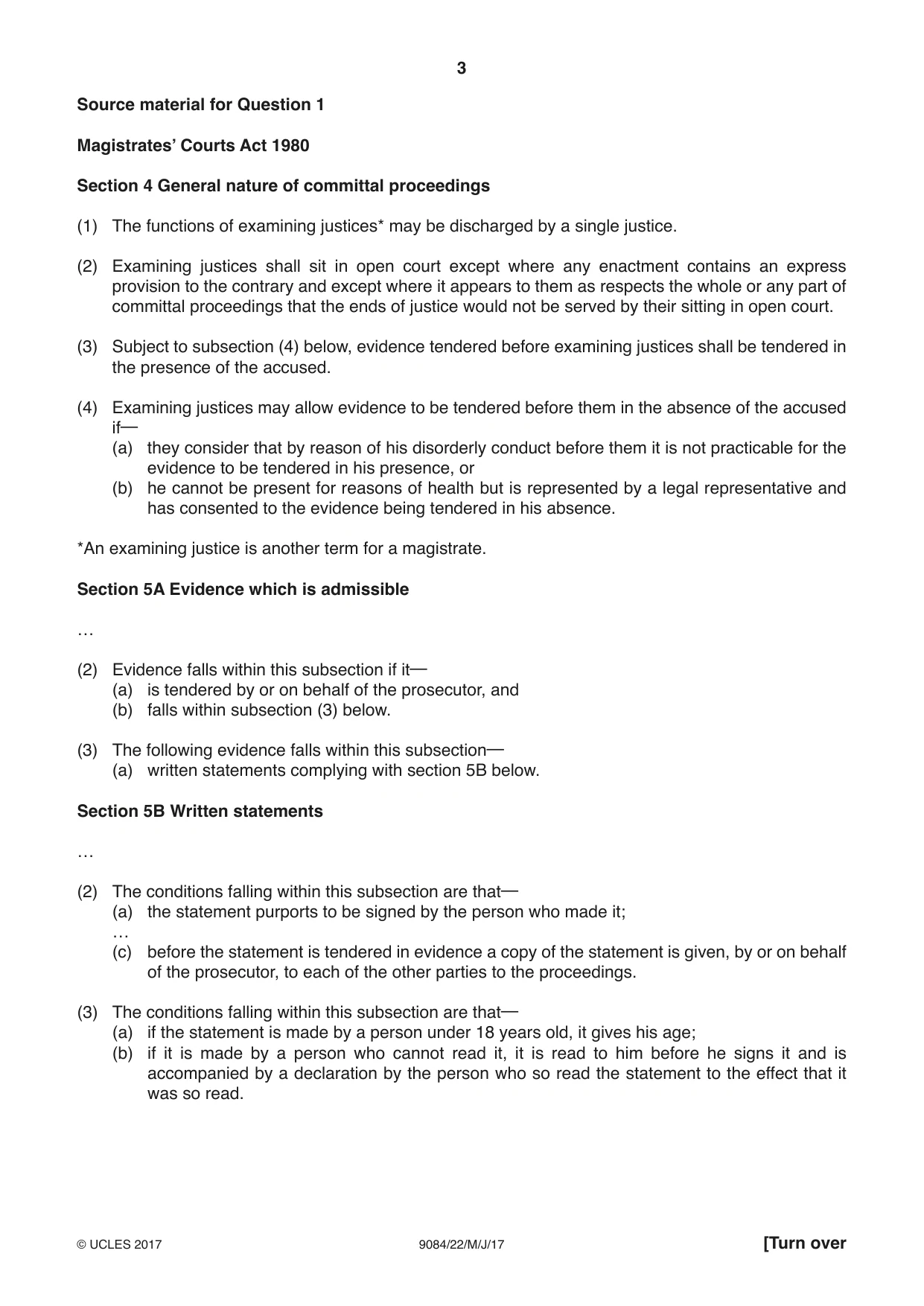
1 (a) Ali has been charged with manslaughter. He appears before a magistrate so he can be committed for trial at the Crown Court. Ali shouts that he wants his case heard by at least two magistrates and in private. The magistrate tells Ali to be quiet but he starts to sing loudly and will not stop. The magistrate sends Ali out of court, looks at all the material relating to the case and commits him for trial at the Crown Court. Explain whether Ali’s committal proceedings are lawful under the Magistrates’ Courts Act 1980. [10] (b) Jasmine has been charged with burglary and Brian is the prosecuting barrister. At the committal proceedings he wants to submit a written statement from Connor, aged 16, who saw Jasmine breaking into a shop. Connor has signed the statement but it does not say how old he is. Brian is in a rush to meet with a client so he gives the statement to the magistrate and asks them to pass it on to the defence barrister. Explain whether Jasmine’s committal proceedings are lawful under the Magistrates’ Courts Act 1980. [10] (c) Jerome has been charged with the murder of a famous pop star. His barrister argues that media attention makes it hard for Jerome to get a fair trial. The magistrate agrees to hold the committal proceedings in private. The prosecution barrister, Helena, submits a written signed statement made by William, who cannot read, which says he saw Jerome at the murder scene. Explain whether Jerome’s committal proceedings are lawful under the Magistrates’ Courts Act 1980. [10] (d) Explain the selection and role of magistrates in criminal cases. Discuss their importance in the English legal system. [20] Source material for Question 1 Magistrates’ Courts Act 1980 Section 4 General nature of committal proceedings (1) The functions of examining justices* may be discharged by a single justice. (2) Examining justices shall sit in open court except where any enactment contains an express provision to the contrary and except where it appears to them as respects the whole or any part of committal proceedings that the ends of justice would not be served by their sitting in open court. (3) Subject to subsection (4) below, evidence tendered before examining justices shall be tendered in the presence of the accused. (4) Examining justices may allow evidence to be tendered before them in the absence of the accused if─ (a) they consider that by reason of his disorderly conduct before them it is not practicable for the evidence to be tendered in his presence, or (b) he cannot be present for reasons of health but is represented by a legal representative and has consented to the evidence being tendered in his absence. *An examining justice is another term for a magistrate. Section 5A Evidence which is admissible … (2) Evidence falls within this subsection if it─ (a) is tendered by or on behalf of the prosecutor, and (b) falls within subsection (3) below. (3) The following evidence falls within this subsection─ (a) written statements complying with section 5B below. Section 5B Written statements … (2) The conditions falling within this subsection are that─ (a) the statement purports to be signed by the person who made it; … (c) before the statement is tendered in evidence a copy of the statement is given, by or on behalf of the prosecutor, to each of the other parties to the proceedings. (3) The conditions falling within this subsection are that─ (a) if the statement is made by a person under 18 years old, it gives his age; (b) if it is made by a person who cannot read it, it is read to him before he signs it and is accompanied by a declaration by the person who so read the statement to the effect that it was so read.
Q2 · Jamal passed his driving test on June 1 2015
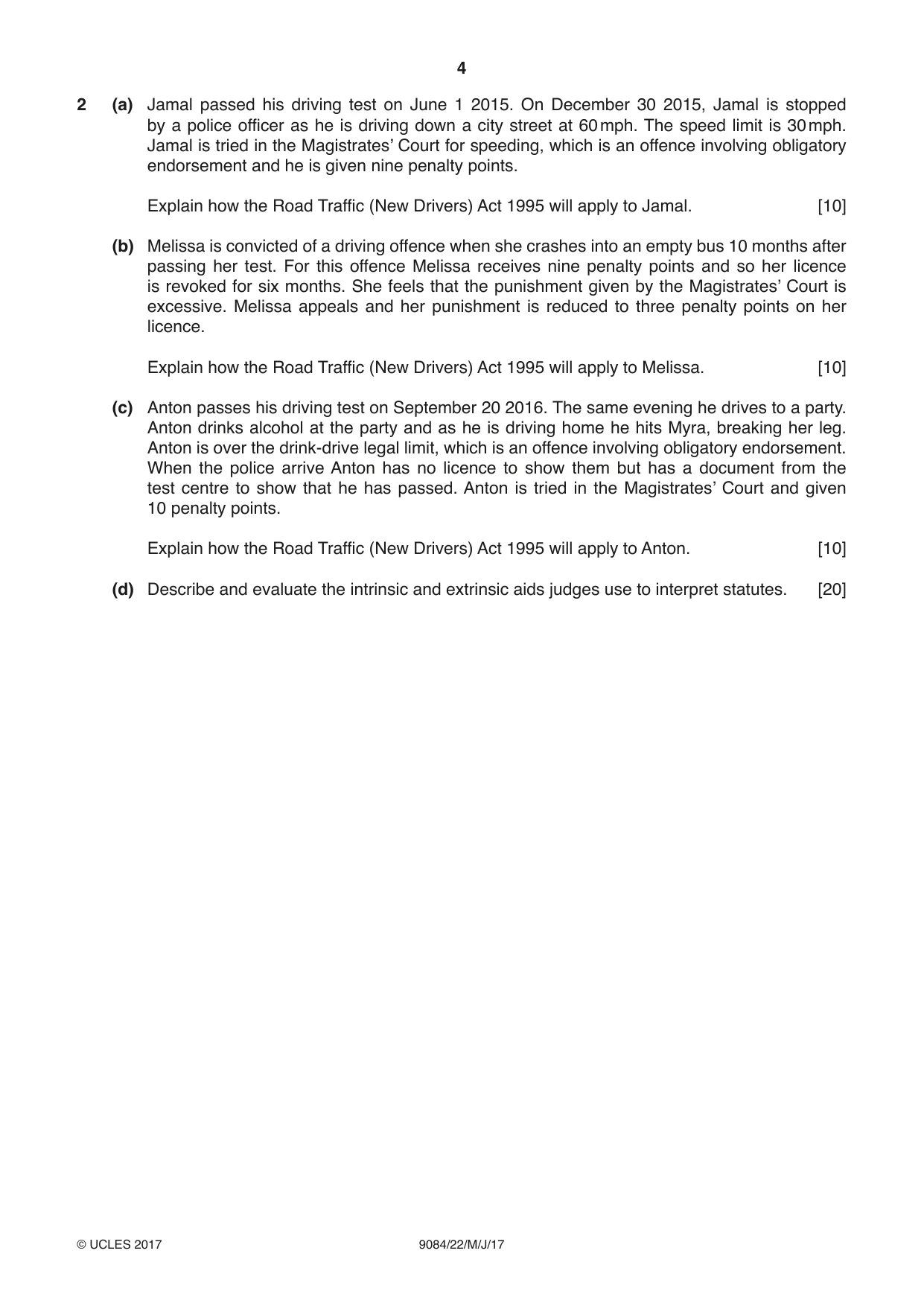
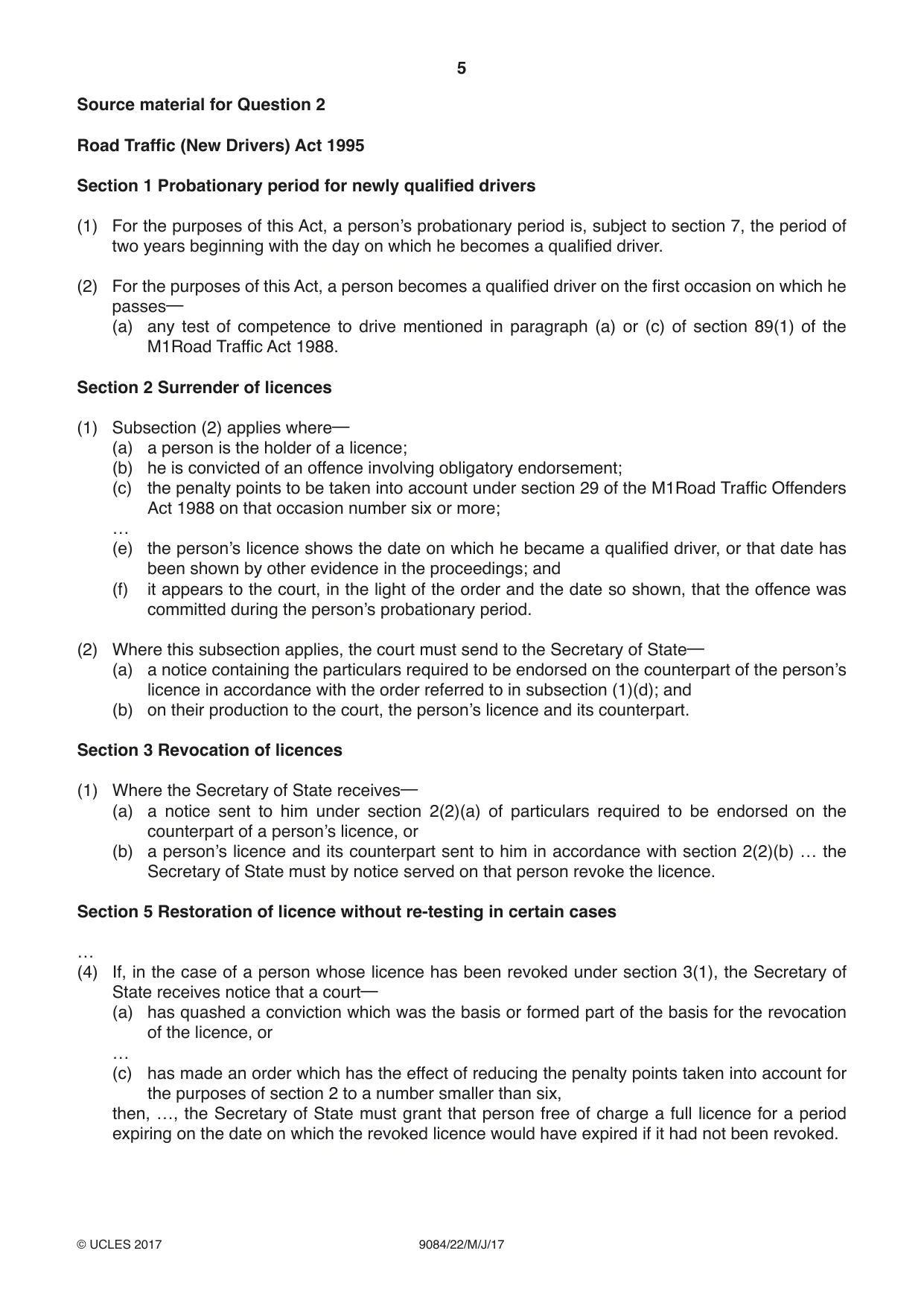
2 (a) Jamal passed his driving test on June 1 2015. On December 30 2015, Jamal is stopped by a police officer as he is driving down a city street at 60 mph. The speed limit is 30 mph. Jamal is tried in the Magistrates’ Court for speeding, which is an offence involving obligatory endorsement and he is given nine penalty points. Explain how the Road Traffic (New Drivers) Act 1995 will apply to Jamal. [10] (b) Melissa is convicted of a driving offence when she crashes into an empty bus 10 months after passing her test. For this offence Melissa receives nine penalty points and so her licence is revoked for six months. She feels that the punishment given by the Magistrates’ Court is excessive. Melissa appeals and her punishment is reduced to three penalty points on her licence. Explain how the Road Traffic (New Drivers) Act 1995 will apply to Melissa. [10] (c) Anton passes his driving test on September 20 2016. The same evening he drives to a party. Anton drinks alcohol at the party and as he is driving home he hits Myra, breaking her leg. Anton is over the drink-drive legal limit, which is an offence involving obligatory endorsement. When the police arrive Anton has no licence to show them but has a document from the test centre to show that he has passed. Anton is tried in the Magistrates’ Court and given 10 penalty points. Explain how the Road Traffic (New Drivers) Act 1995 will apply to Anton. [10] (d) Describe and evaluate the intrinsic and extrinsic aids judges use to interpret statutes. [20] Source material for Question 2 Road Traffic (New Drivers) Act 1995 Section 1 Probationary period for newly qualified drivers (1) For the purposes of this Act, a person’s probationary period is, subject to section 7, the period of two years beginning with the day on which he becomes a qualified driver. (2) For the purposes of this Act, a person becomes a qualified driver on the first occasion on which he passes─ (a) any test of competence to drive mentioned in paragraph (a) or (c) of section 89(1) of the M1Road Traffic Act 1988. Section 2 Surrender of licences (1) Subsection (2) applies where─ (a) a person is the holder of a licence; (b) he is convicted of an offence involving obligatory endorsement; (c) the penalty points to be taken into account under section 29 of the M1Road Traffic Offenders Act 1988 on that occasion number six or more; … (e) the person’s licence shows the date on which he became a qualified driver, or that date has been shown by other evidence in the proceedings; and (f) it appears to the court, in the light of the order and the date so shown, that the offence was committed during the person’s probationary period. (2) Where this subsection applies, the court must send to the Secretary of State─ (a) a notice containing the particulars required to be endorsed on the counterpart of the person’s licence in accordance with the order referred to in subsection (1)(d); and (b) on their production to the court, the person’s licence and its counterpart. Section 3 Revocation of licences (1) Where the Secretary of State receives─ (a) a notice sent to him under section 2(2)(a) of particulars required to be endorsed on the counterpart of a person’s licence, or (b) a person’s licence and its counterpart sent to him in accordance with section 2(2)(b) … the Secretary of State must by notice served on that person revoke the licence. Section 5 Restoration of licence without re-testing in certain cases … (4) If, in the case of a person whose licence has been revoked under section 3(1), the Secretary of State receives notice that a court─ (a) has quashed a conviction which was the basis or formed part of the basis for the revocation of the licence, or … (c) has made an order which has the effect of reducing the penalty points taken into account for the purposes of section 2 to a number smaller than six, then, …, the Secretary of State must grant that person free of charge a full licence for a period expiring on the date on which the revoked licence would have expired if it had not been revoked.
What was in this paper
The subtopics covered by these 2 questions, and how many questions each got. Open one in a new tab to see every Cambridge question on it.
1Sentencing in England and Wales This topic is about the sentences that can be handed down to both adult and young offenders who have been convicted of offences. This topic is an opportunity to reflect on the key concepts of liability, justice, fairness, power and its limits, and effectiveness1