Cambridge A Level Law 9084 — 2017 Oct/Nov Paper 2 · Variant 2
9084/22/O/N/17 · 2 questions · 50 marks · ≈56 min
The question paper and its mark scheme, free to read here and free to download. This is Cambridge’s own paper, exactly as it was sat.
Question paper8 pages



Mark scheme6 pages
Answers below. Sit the paper first if you are practising.
Questions as text
Q1 · Jethro runs a magazine that often prints cartoons critical of public figures
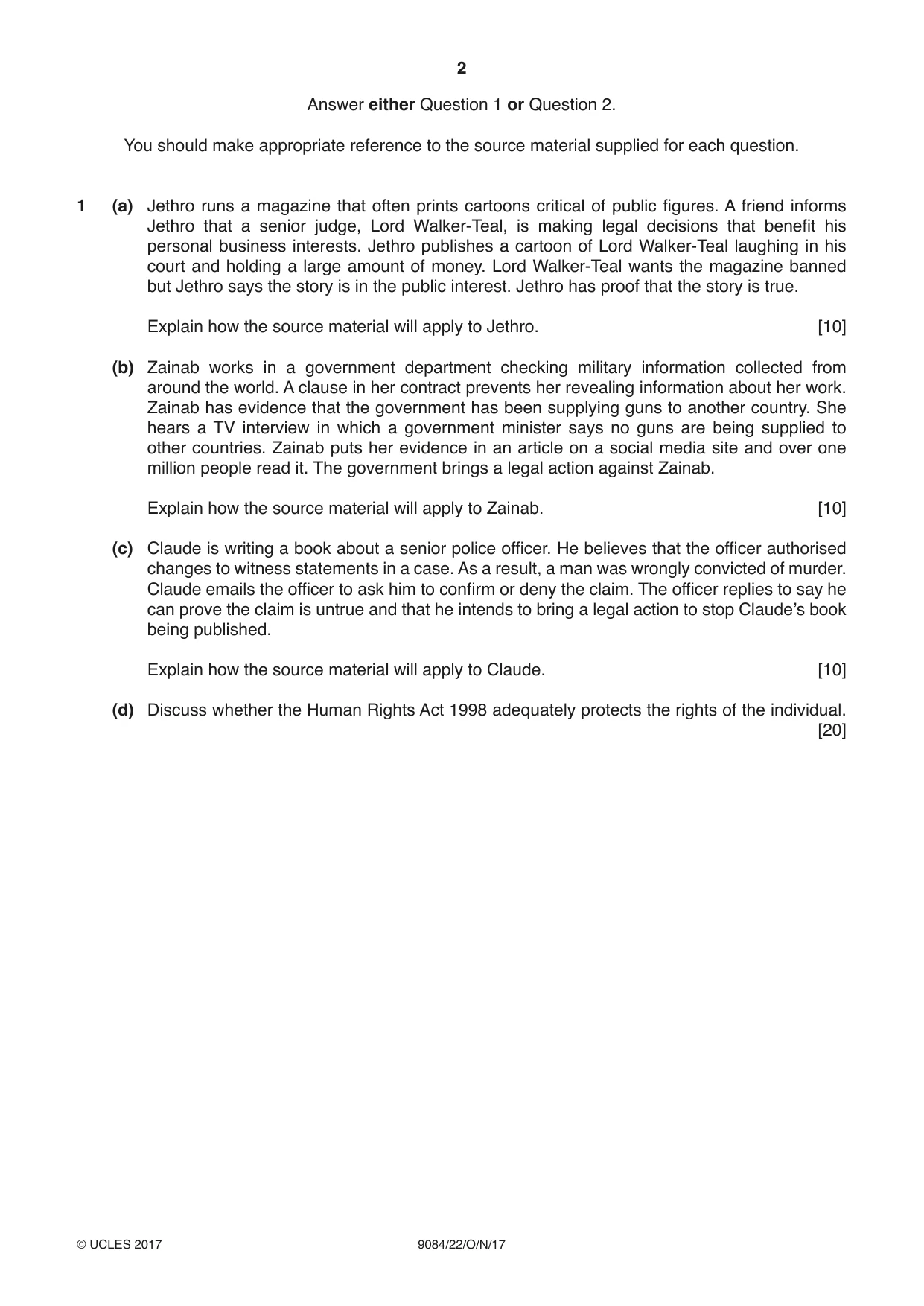
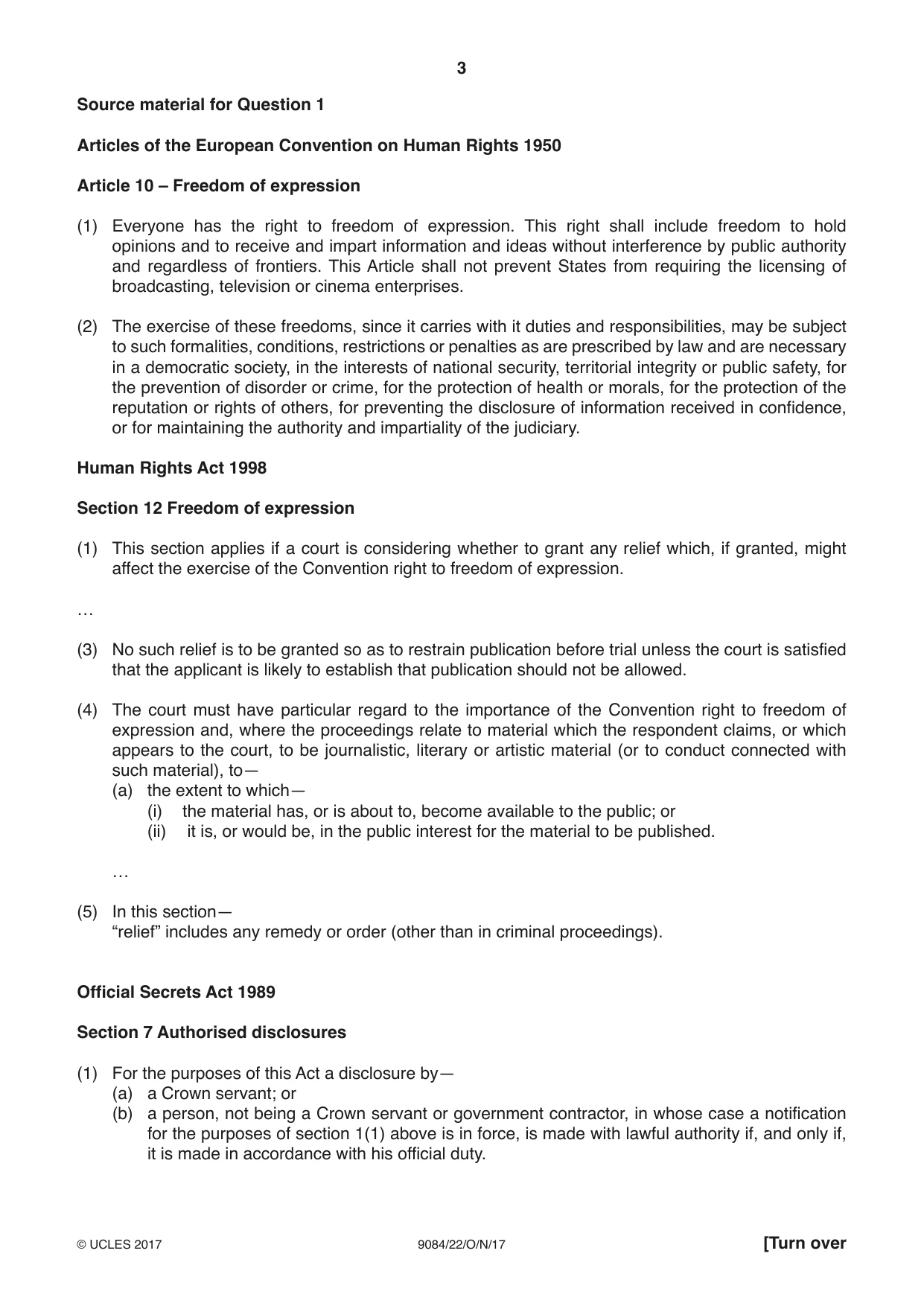
1 (a) Jethro runs a magazine that often prints cartoons critical of public figures. A friend informs Jethro that a senior judge, Lord Walker-Teal, is making legal decisions that benefit his personal business interests. Jethro publishes a cartoon of Lord Walker-Teal laughing in his court and holding a large amount of money. Lord Walker-Teal wants the magazine banned but Jethro says the story is in the public interest. Jethro has proof that the story is true. Explain how the source material will apply to Jethro. [10] (b) Zainab works in a government department checking military information collected from around the world. A clause in her contract prevents her revealing information about her work. Zainab has evidence that the government has been supplying guns to another country. She hears a TV interview in which a government minister says no guns are being supplied to other countries. Zainab puts her evidence in an article on a social media site and over one million people read it. The government brings a legal action against Zainab. Explain how the source material will apply to Zainab. [10] (c) Claude is writing a book about a senior police officer. He believes that the officer authorised changes to witness statements in a case. As a result, a man was wrongly convicted of murder. Claude emails the officer to ask him to confirm or deny the claim. The officer replies to say he can prove the claim is untrue and that he intends to bring a legal action to stop Claude’s book being published. Explain how the source material will apply to Claude. [10] (d) Discuss whether the Human Rights Act 1998 adequately protects the rights of the individual. [20] Source material for Question 1 Articles of the European Convention on Human Rights 1950 Article 10 – Freedom of expression (1) Everyone has the right to freedom of expression. This right shall include freedom to hold opinions and to receive and impart information and ideas without interference by public authority and regardless of frontiers. This Article shall not prevent States from requiring the licensing of broadcasting, television or cinema enterprises. (2) The exercise of these freedoms, since it carries with it duties and responsibilities, may be subject to such formalities, conditions, restrictions or penalties as are prescribed by law and are necessary in a democratic society, in the interests of national security, territorial integrity or public safety, for the prevention of disorder or crime, for the protection of health or morals, for the protection of the reputation or rights of others, for preventing the disclosure of information received in confidence, or for maintaining the authority and impartiality of the judiciary. Human Rights Act 1998 Section 12 Freedom of expression (1) This section applies if a court is considering whether to grant any relief which, if granted, might affect the exercise of the Convention right to freedom of expression. … (3) No such relief is to be granted so as to restrain publication before trial unless the court is satisfied that the applicant is likely to establish that publication should not be allowed. (4) The court must have particular regard to the importance of the Convention right to freedom of expression and, where the proceedings relate to material which the respondent claims, or which appears to the court, to be journalistic, literary or artistic material (or to conduct connected with such material), to— (a) the extent to which— (i) the material has, or is about to, become available to the public; or (ii) it is, or would be, in the public interest for the material to be published. … (5) In this section— “relief” includes any remedy or order (other than in criminal proceedings). Official Secrets Act 1989 Section 7 Authorised disclosures (1) For the purposes of this Act a disclosure by— (a) a Crown servant; or (b) a person, not being a Crown servant or government contractor, in whose case a notification for the purposes of section 1(1) above is in force, is made with lawful authority if, and only if, it is made in accordance with his official duty.
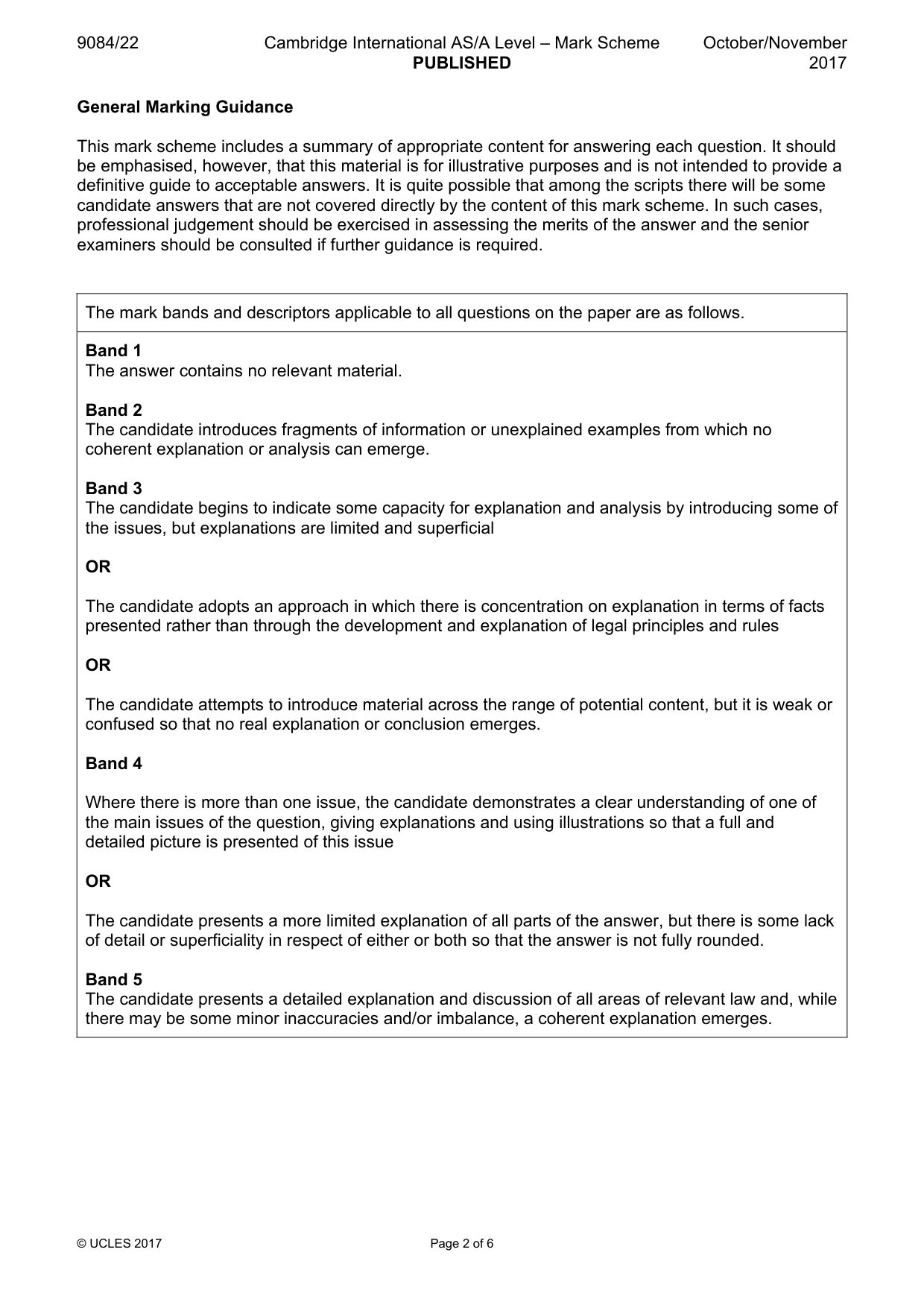
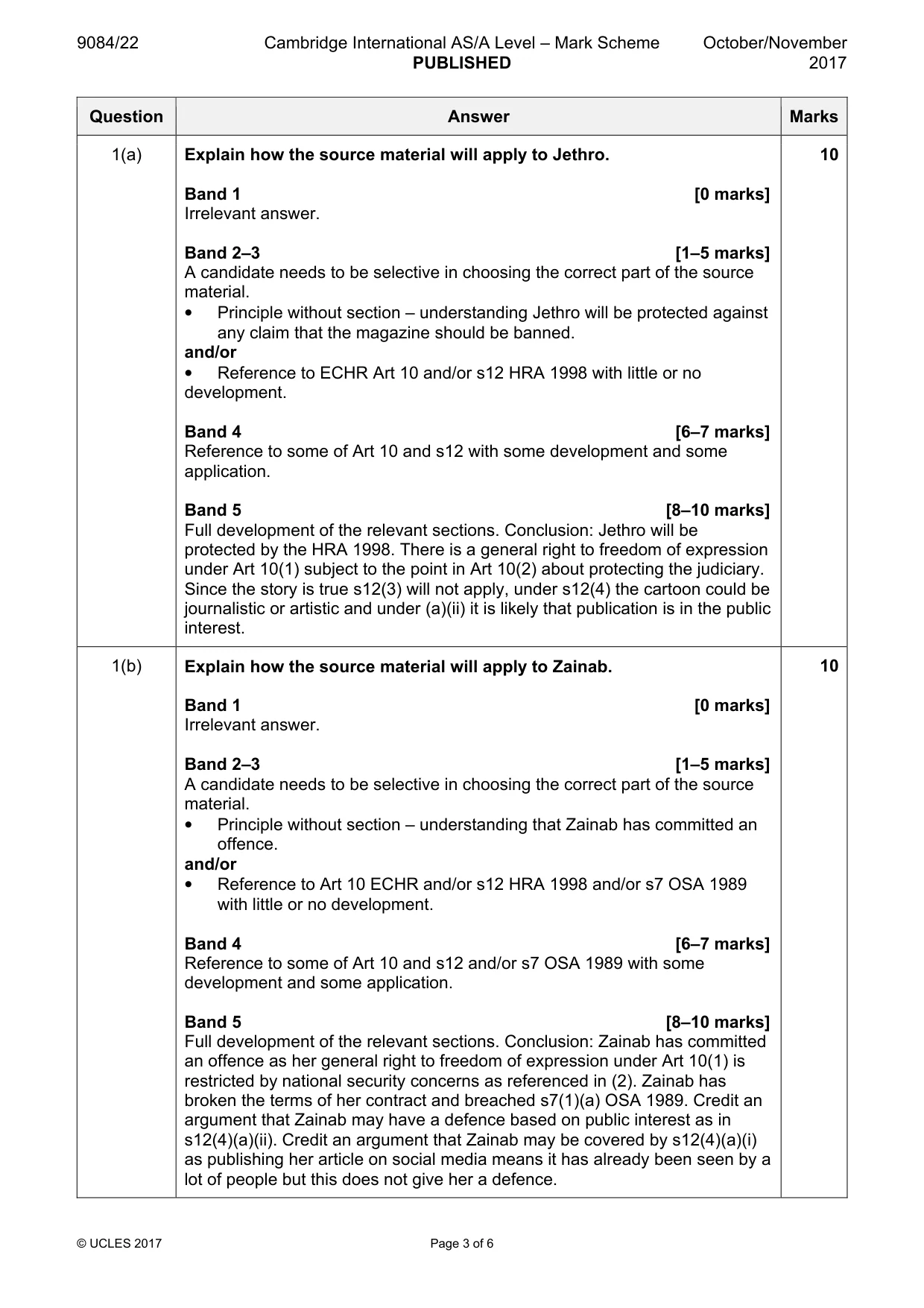
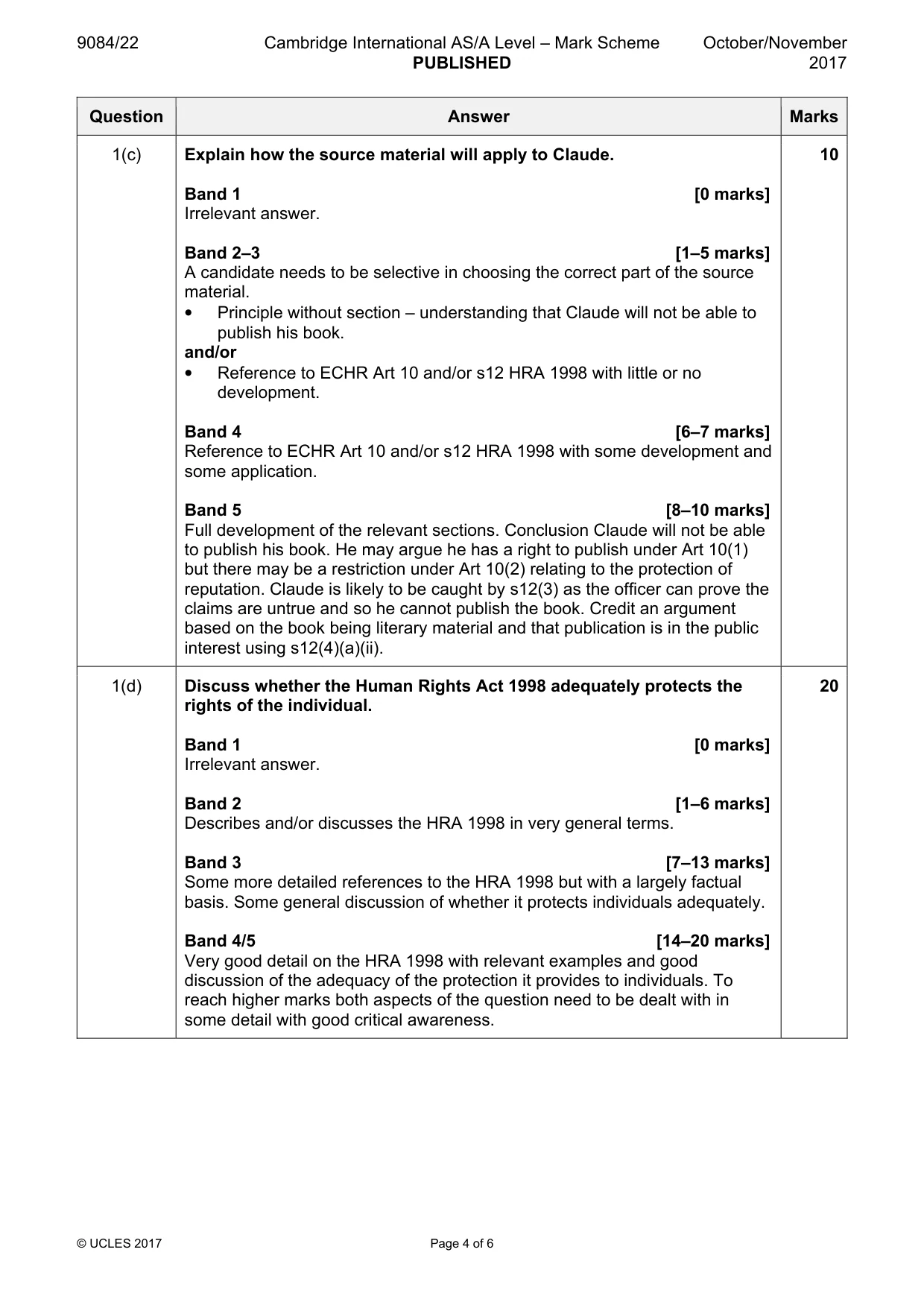
Mark scheme: Question Answer Marks 1(a) Explain how the source material will apply to Jethro. 10 Band 1 [0 marks] Irrelevant answer. Band 2–3 [1–5 marks] A candidate needs to be selective in choosing the correct part of the source material. • Principle without section – understanding Jethro will be protected against any claim that the magazine should be banned. and/or • Reference to ECHR Art 10 and/or s12 HRA 1998 with little or no development. Band 4 [6–7 marks] Reference to some of Art 10 and s12 with some development and some application. Band 5 [8–10 marks] Full development of the relevant sections. Conclusion: Jethro will be protected by the HRA 1998. There is a general right to freedom of expression under Art 10(1) subject to the point in Art 10(2) about protecting the judiciary. Since the story is true s12(3) will not apply, under s12(4) the cartoon could be journalistic or artistic and under (a)(ii) it is likely that publication is in the public interest. 1(b) Explain how the source material will apply to Zainab. 10 Band 1 [0 marks] Irrelevant answer. Band 2–3 [1–5 marks] A candidate needs to be selective in choosing the correct part of the source material. • Principle without section – understanding that Zainab has committed an offence. and/or • Reference to Art 10 ECHR and/or s12 HRA 1998 and/or s7 OSA 1989 with little or no development. Band 4 [6–7 marks] Reference to some of Art 10 and s12 and/or s7 OSA 1989 with some development and some application. Band 5 [8–10 marks] Full development of the relevant sections. Conclusion: Zainab has committed an offence as her general right to freedom of expression under Art 10(1) is restricted by national security concerns as referenced in (2). Zainab has broken the terms of her contract and breached s7(1)(a) OSA 1989. Credit an argument that Zainab may have a defence based on public interest as in s12(4)(a)(ii). Credit an argument that Zainab may be covered by s12(4)(a)(i) as publishing her article on social media means it has already been seen by a lot of people but this does not give her a defence. 1(c) Explain how the source material will apply to Claude. 10 Band 1 [0 marks] Irrelevant answer. Band 2–3 [1–5 marks] A candidate needs to be selective in choosing the correct part of the source material. • Principle without section – understanding that Claude will not be able to publish his book. and/or • Reference to ECHR Art 10 and/or s12 HRA 1998 with little or no development. Band 4 [6–7 marks] Reference to ECHR Art 10 and/or s12 HRA 1998 with some development and some application. Band 5 [8–10 marks] Full development of the relevant sections. Conclusion Claude will not be able to publish his book. He may argue he has a right to publish under Art 10(1) but there may be a restriction under Art 10(2) relating to the protection of reputation. Claude is likely to be caught by s12(3) as the officer can prove the claims are untrue and so he cannot publish the book. Credit an argument based on the book being literary material and that publication is in the public interest using s12(4)(a)(ii). 1(d) Discuss whether the Human Rights Act 1998 adequately protects the 20 rights of the individual. Band 1 [0 marks] Irrelevant answer. Band 2 [1–6 marks] Describes and/or discusses the HRA 1998 in very general terms. Band 3 [7–13 marks] Some more detailed references to the HRA 1998 but with a largely factual basis. Some general discussion of whether it protects individuals adequately. Band 4/5 [14–20 marks] Very good detail on the HRA 1998 with relevant examples and good discussion of the adequacy of the protection it provides to individuals. To reach higher marks both aspects of the question need to be dealt with in some detail with good critical awareness.
Q2 · Maria, aged 25, lives next door to Elsie, aged 80
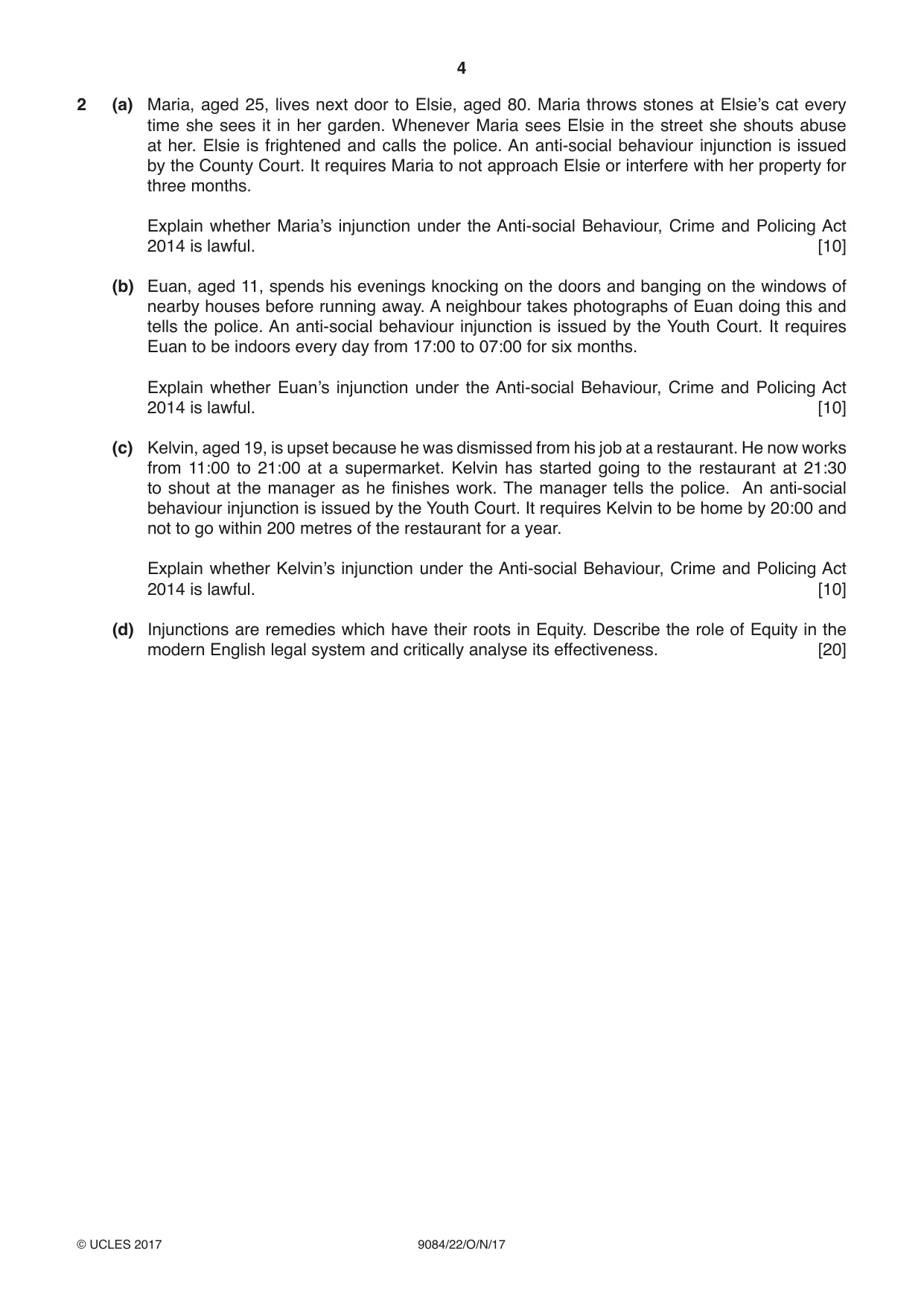
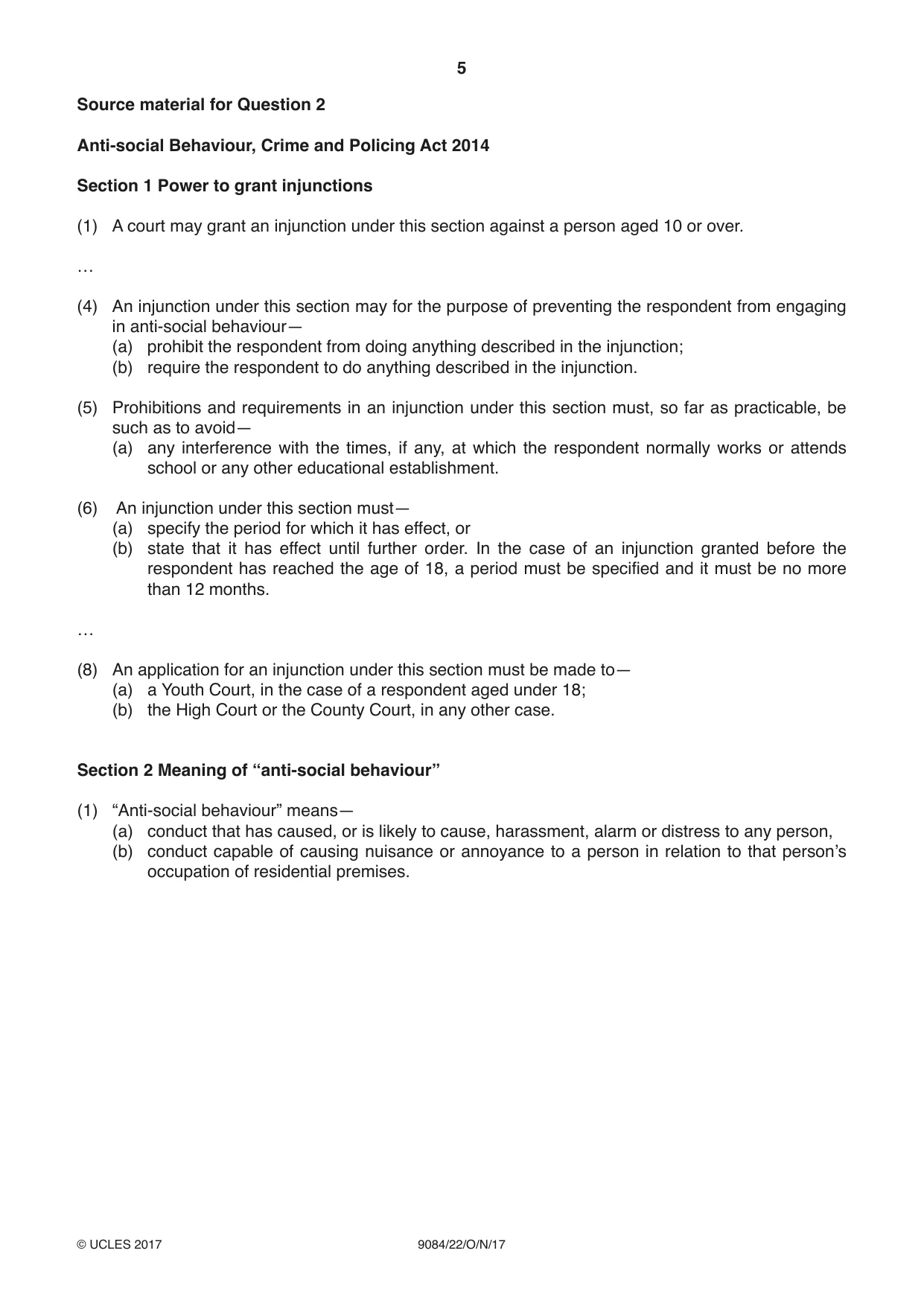
2 (a) Maria, aged 25, lives next door to Elsie, aged 80. Maria throws stones at Elsie’s cat every time she sees it in her garden. Whenever Maria sees Elsie in the street she shouts abuse at her. Elsie is frightened and calls the police. An anti-social behaviour injunction is issued by the County Court. It requires Maria to not approach Elsie or interfere with her property for three months. Explain whether Maria’s injunction under the Anti-social Behaviour, Crime and Policing Act 2014 is lawful. [10] (b) Euan, aged 11, spends his evenings knocking on the doors and banging on the windows of nearby houses before running away. A neighbour takes photographs of Euan doing this and tells the police. An anti-social behaviour injunction is issued by the Youth Court. It requires Euan to be indoors every day from 17:00 to 07:00 for six months. Explain whether Euan’s injunction under the Anti-social Behaviour, Crime and Policing Act 2014 is lawful. [10] (c) Kelvin, aged 19, is upset because he was dismissed from his job at a restaurant. He now works from 11:00 to 21:00 at a supermarket. Kelvin has started going to the restaurant at 21:30 to shout at the manager as he finishes work. The manager tells the police. An anti-social behaviour injunction is issued by the Youth Court. It requires Kelvin to be home by 20:00 and not to go within 200 metres of the restaurant for a year. Explain whether Kelvin’s injunction under the Anti-social Behaviour, Crime and Policing Act 2014 is lawful. [10] (d) Injunctions are remedies which have their roots in Equity. Describe the role of Equity in the modern English legal system and critically analyse its effectiveness. [20] Source material for Question 2 Anti-social Behaviour, Crime and Policing Act 2014 Section 1 Power to grant injunctions (1) A court may grant an injunction under this section against a person aged 10 or over. … (4) An injunction under this section may for the purpose of preventing the respondent from engaging in anti-social behaviour— (a) prohibit the respondent from doing anything described in the injunction; (b) require the respondent to do anything described in the injunction. (5) Prohibitions and requirements in an injunction under this section must, so far as practicable, be such as to avoid— (a) any interference with the times, if any, at which the respondent normally works or attends school or any other educational establishment. (6) An injunction under this section must— (a) specify the period for which it has effect, or (b) state that it has effect until further order. In the case of an injunction granted before the respondent has reached the age of 18, a period must be specified and it must be no more than 12 months. … (8) An application for an injunction under this section must be made to— (a) a Youth Court, in the case of a respondent aged under 18; (b) the High Court or the County Court, in any other case. Section 2 Meaning of “anti-social behaviour” (1) “Anti-social behaviour” means— (a) conduct that has caused, or is likely to cause, harassment, alarm or distress to any person, (b) conduct capable of causing nuisance or annoyance to a person in relation to that person’s occupation of residential premises.
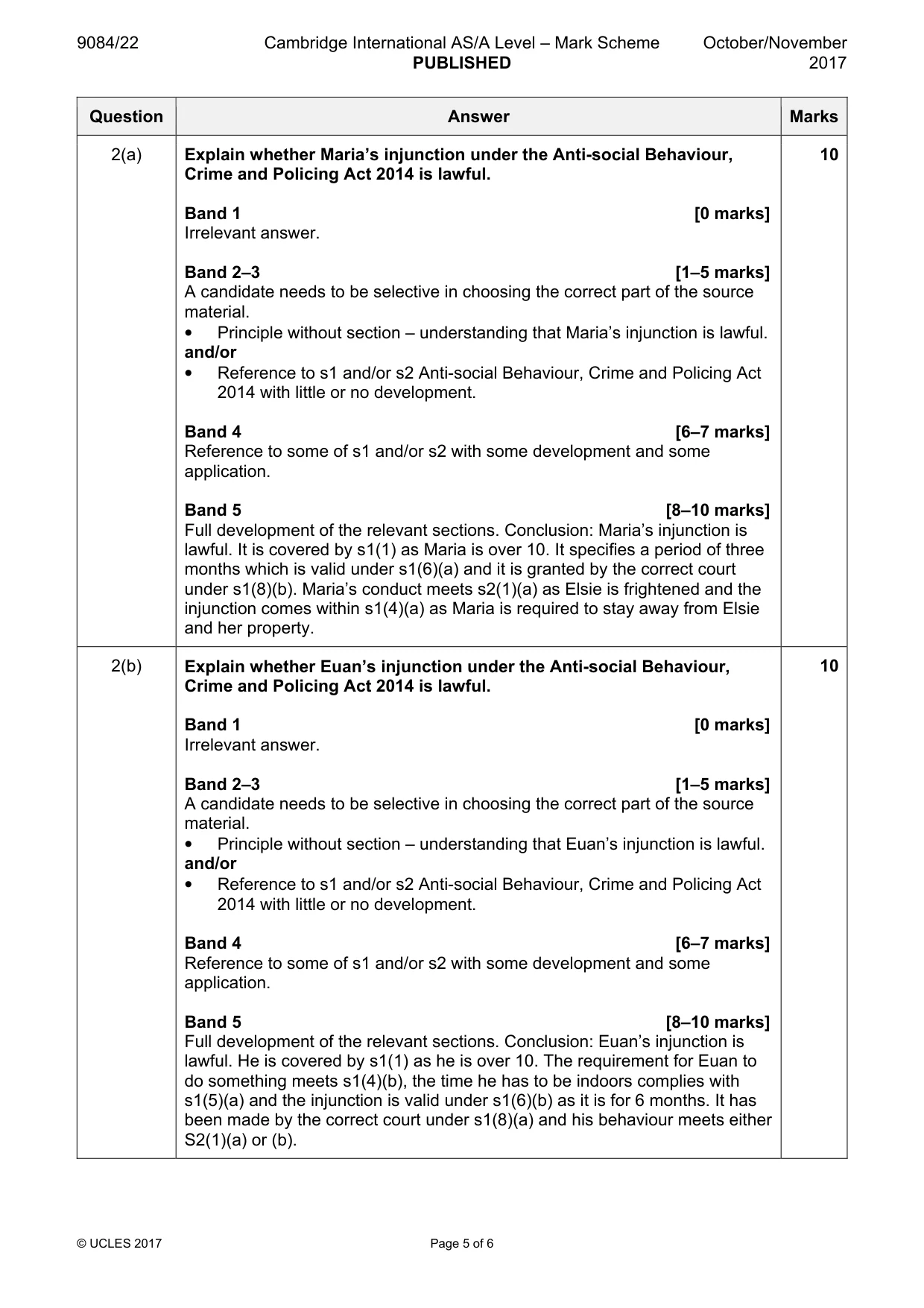
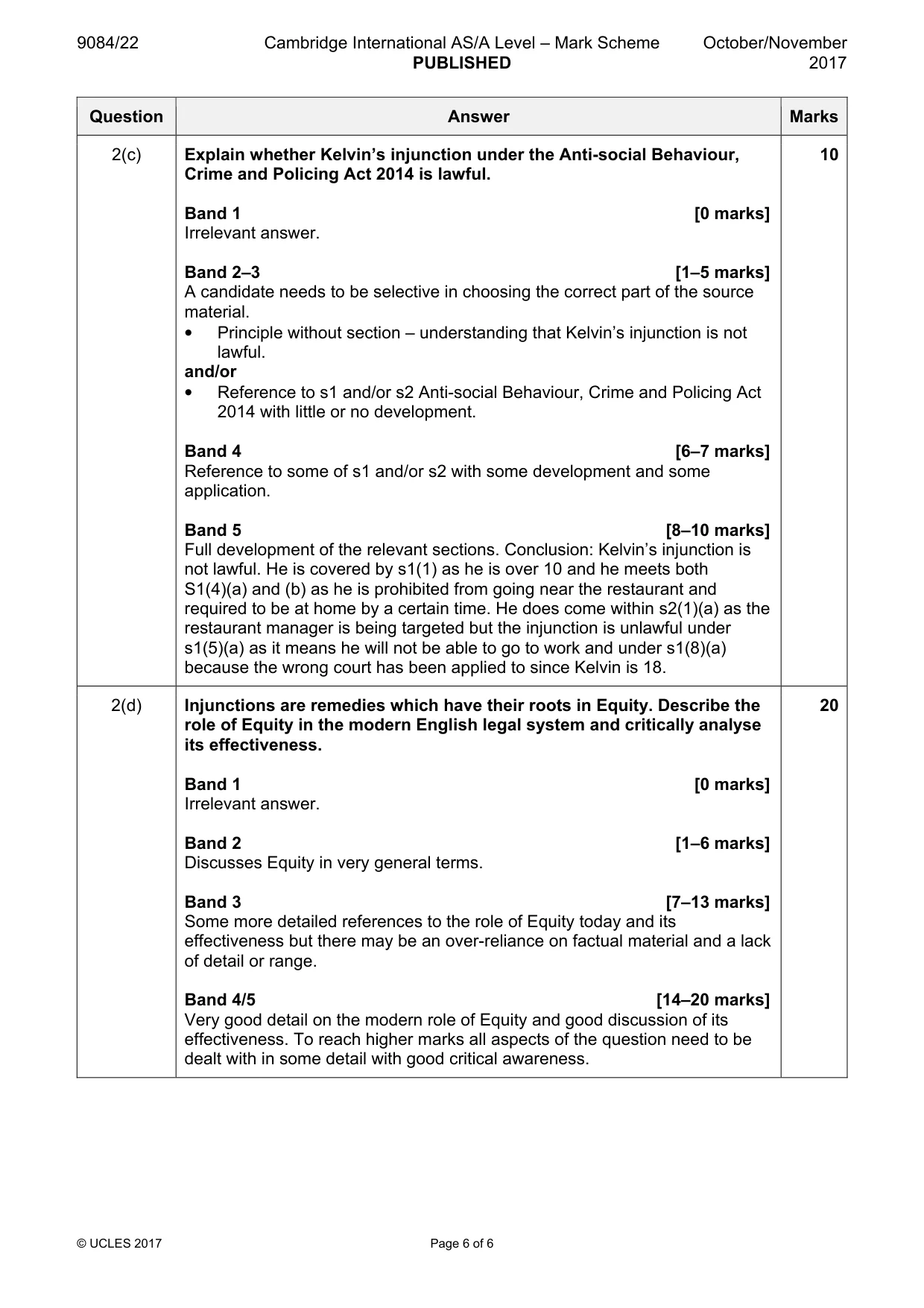
Mark scheme: 2(a) Explain whether Maria’s injunction under the Anti-social Behaviour, 10 Crime and Policing Act 2014 is lawful. Band 1 [0 marks] Irrelevant answer. Band 2–3 [1–5 marks] A candidate needs to be selective in choosing the correct part of the source material. • Principle without section – understanding that Maria’s injunction is lawful. and/or • Reference to s1 and/or s2 Anti-social Behaviour, Crime and Policing Act 2014 with little or no development. Band 4 [6–7 marks] Reference to some of s1 and/or s2 with some development and some application. Band 5 [8–10 marks] Full development of the relevant sections. Conclusion: Maria’s injunction is lawful. It is covered by s1(1) as Maria is over 10. It specifies a period of three months which is valid under s1(6)(a) and it is granted by the correct court under s1(8)(b). Maria’s conduct meets s2(1)(a) as Elsie is frightened and the injunction comes within s1(4)(a) as Maria is required to stay away from Elsie and her property. 2(b) Explain whether Euan’s injunction under the Anti-social Behaviour, 10 Crime and Policing Act 2014 is lawful. Band 1 [0 marks] Irrelevant answer. Band 2–3 [1–5 marks] A candidate needs to be selective in choosing the correct part of the source material. • Principle without section – understanding that Euan’s injunction is lawful. and/or • Reference to s1 and/or s2 Anti-social Behaviour, Crime and Policing Act 2014 with little or no development. Band 4 [6–7 marks] Reference to some of s1 and/or s2 with some development and some application. Band 5 [8–10 marks] Full development of the relevant sections. Conclusion: Euan’s injunction is lawful. He is covered by s1(1) as he is over 10. The requirement for Euan to do something meets s1(4)(b), the time he has to be indoors complies with s1(5)(a) and the injunction is valid under s1(6)(b) as it is for 6 months. It has been made by the correct court under s1(8)(a) and his behaviour meets either S2(1)(a) or (b). 2(c) Explain whether Kelvin’s injunction under the Anti-social Behaviour, 10 Crime and Policing Act 2014 is lawful. Band 1 [0 marks] Irrelevant answer. Band 2–3 [1–5 marks] A candidate needs to be selective in choosing the correct part of the source material. • Principle without section – understanding that Kelvin’s injunction is not lawful. and/or • Reference to s1 and/or s2 Anti-social Behaviour, Crime and Policing Act 2014 with little or no development. Band 4 [6–7 marks] Reference to some of s1 and/or s2 with some development and some application. Band 5 [8–10 marks] Full development of the relevant sections. Conclusion: Kelvin’s injunction is not lawful. He is covered by s1(1) as he is over 10 and he meets both S1(4)(a) and (b) as he is prohibited from going near the restaurant and required to be at home by a certain time. He does come within s2(1)(a) as the restaurant manager is being targeted but the injunction is unlawful under s1(5)(a) as it means he will not be able to go to work and under s1(8)(a) because the wrong court has been applied to since Kelvin is 18. 2(d) Injunctions are remedies which have their roots in Equity. Describe the 20 role of Equity in the modern English legal system and critically analyse its effectiveness. Band 1 [0 marks] Irrelevant answer. Band 2 [1–6 marks] Discusses Equity in very general terms. Band 3 [7–13 marks] Some more detailed references to the role of Equity today and its effectiveness but there may be an over-reliance on factual material and a lack of detail or range. Band 4/5 [14–20 marks] Very good detail on the modern role of Equity and good discussion of its effectiveness. To reach higher marks all aspects of the question need to be dealt with in some detail with good critical awareness.
What was in this paper
The subtopics covered by these 2 questions, and how many questions each got. Open one in a new tab to see every Cambridge question on it.
1Principles and sources of English law This topic introduces the principles behind English law and the modern day sources of English law. This topic is an opportunity to reflect on the key concepts of justice, fairness and morality; power and its limits; and effectiveness and certainty1What you needed in this session
Cambridge’s own grade thresholds for 2017 Oct/Nov, Paper 2 · Variant 2. A higher threshold means an easier paper — the bar moves with how the cohort did.