Cambridge A Level Law 9084 — 2022 Oct/Nov Paper 2 · Variant 1
9084/21/O/N/22 · 2 questions · 50 marks · ≈56 min
The question paper and its mark scheme, free to read here and free to download. This is Cambridge’s own paper, exactly as it was sat.
Question paper8 pages
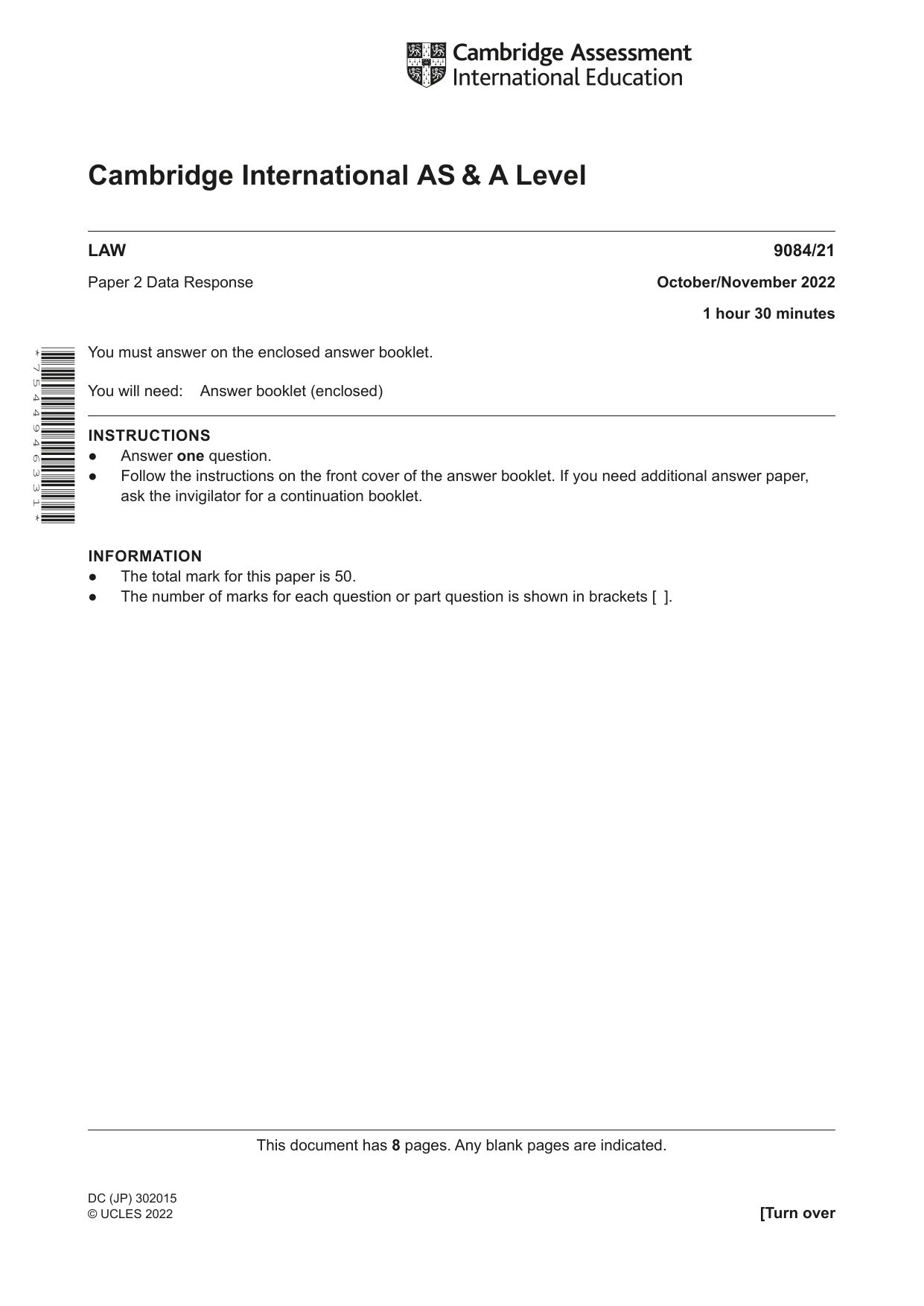
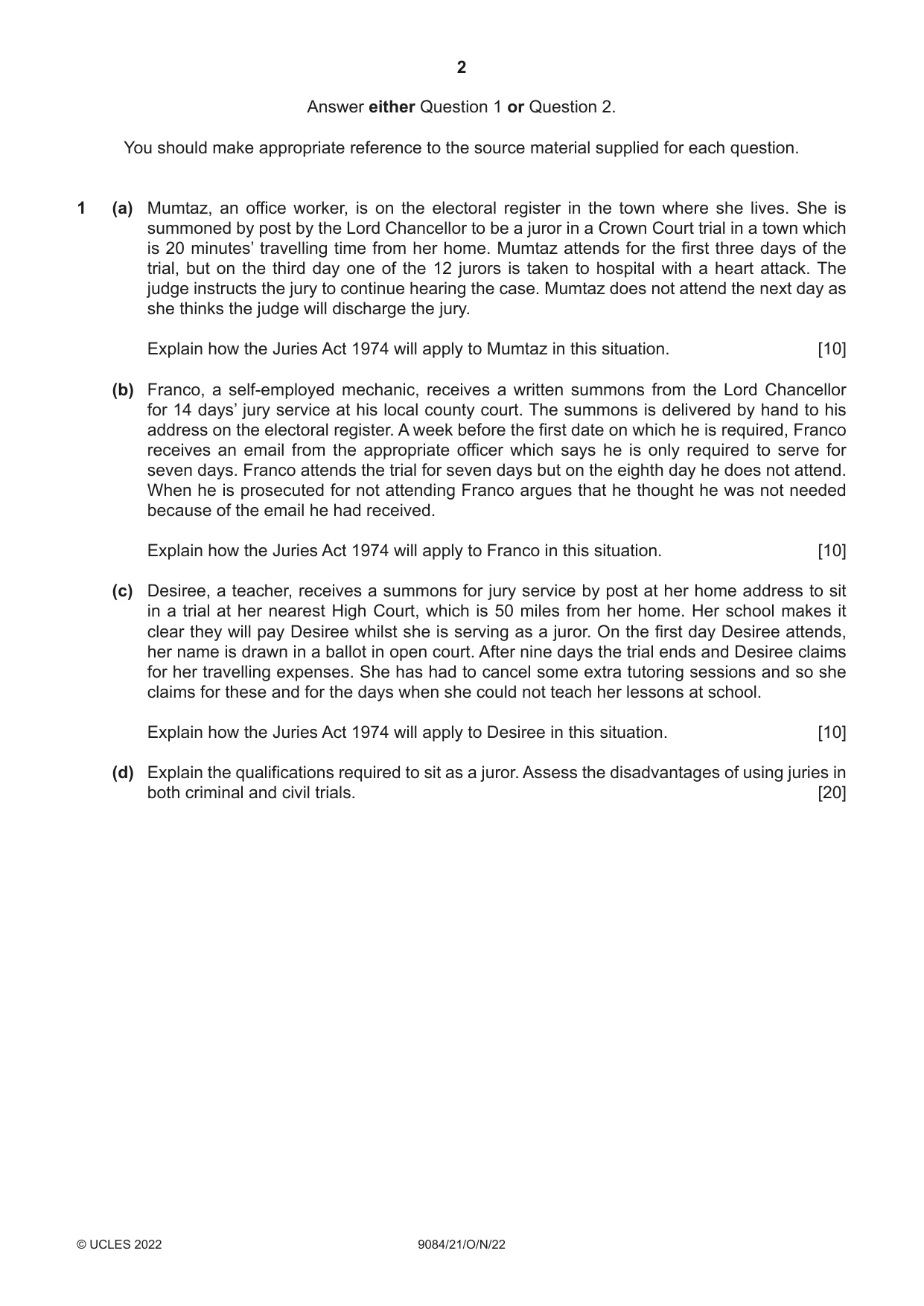
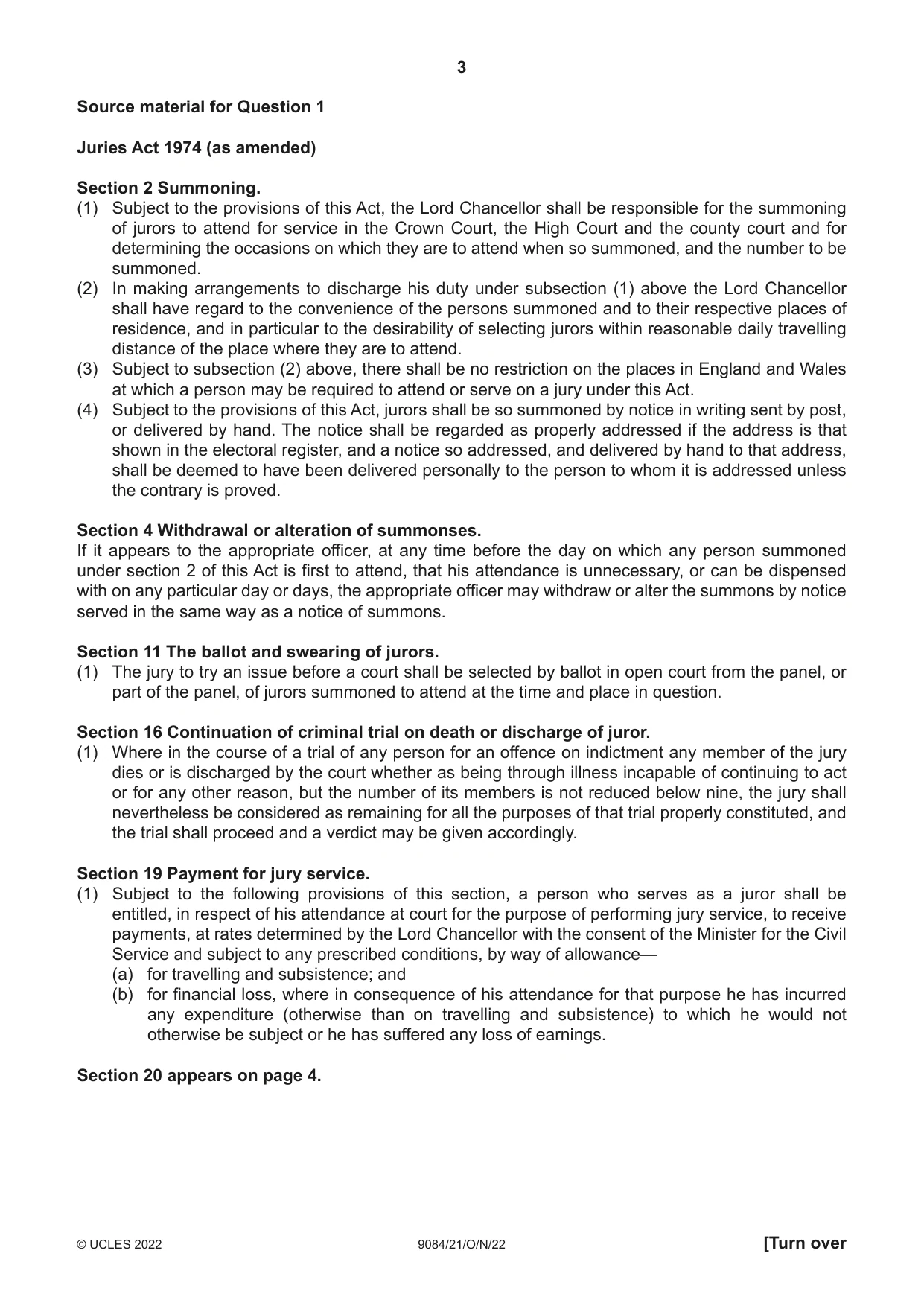
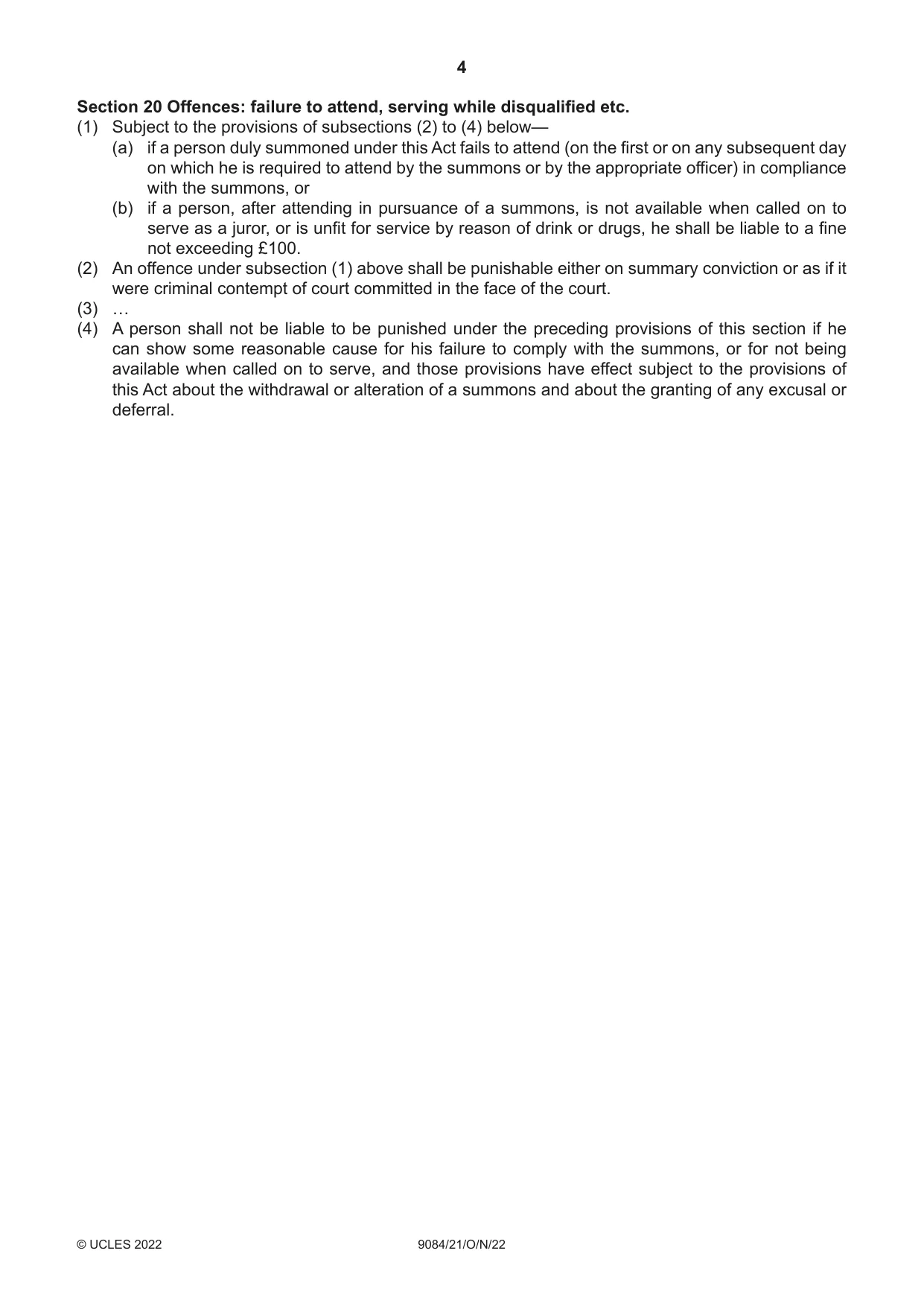

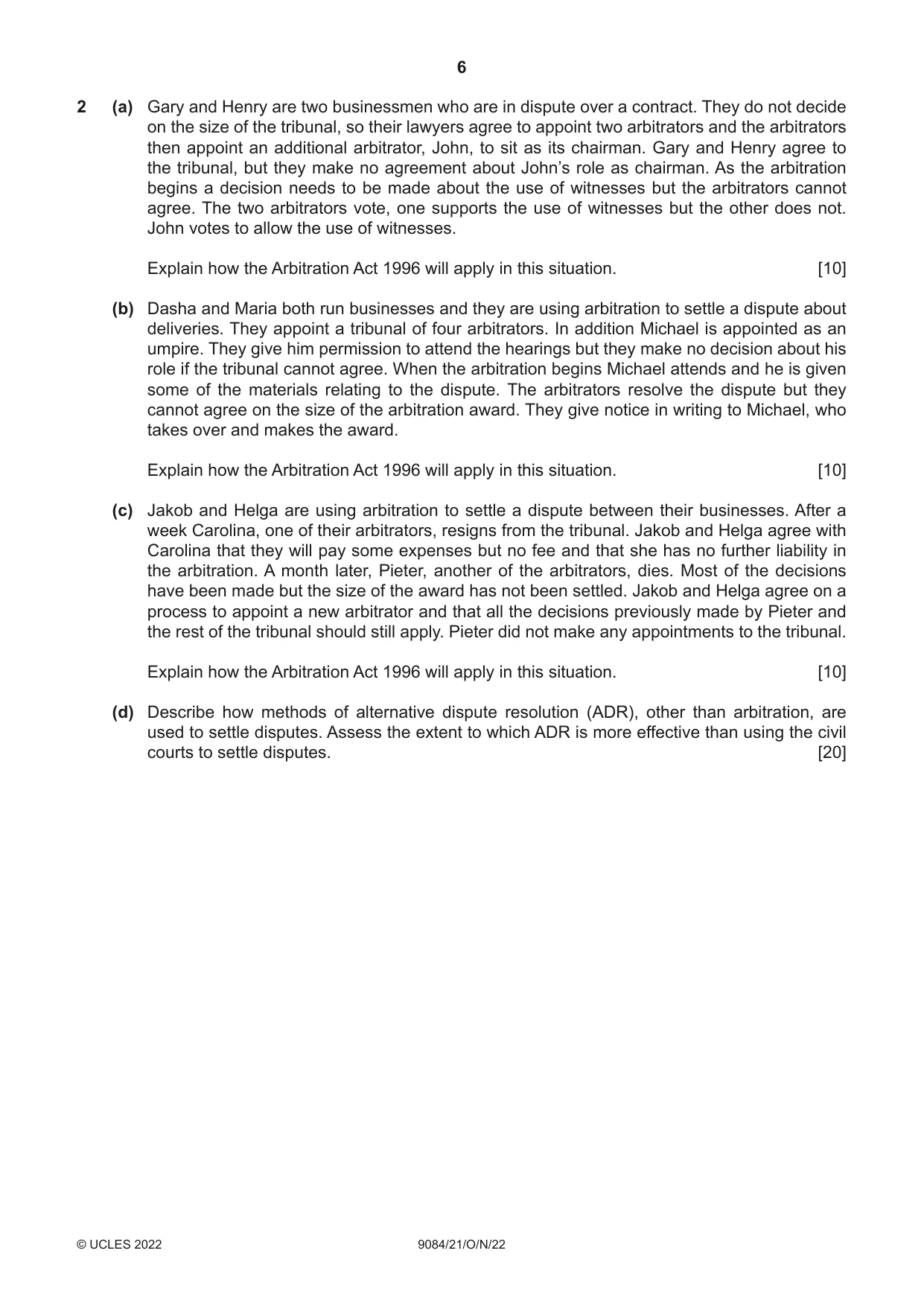
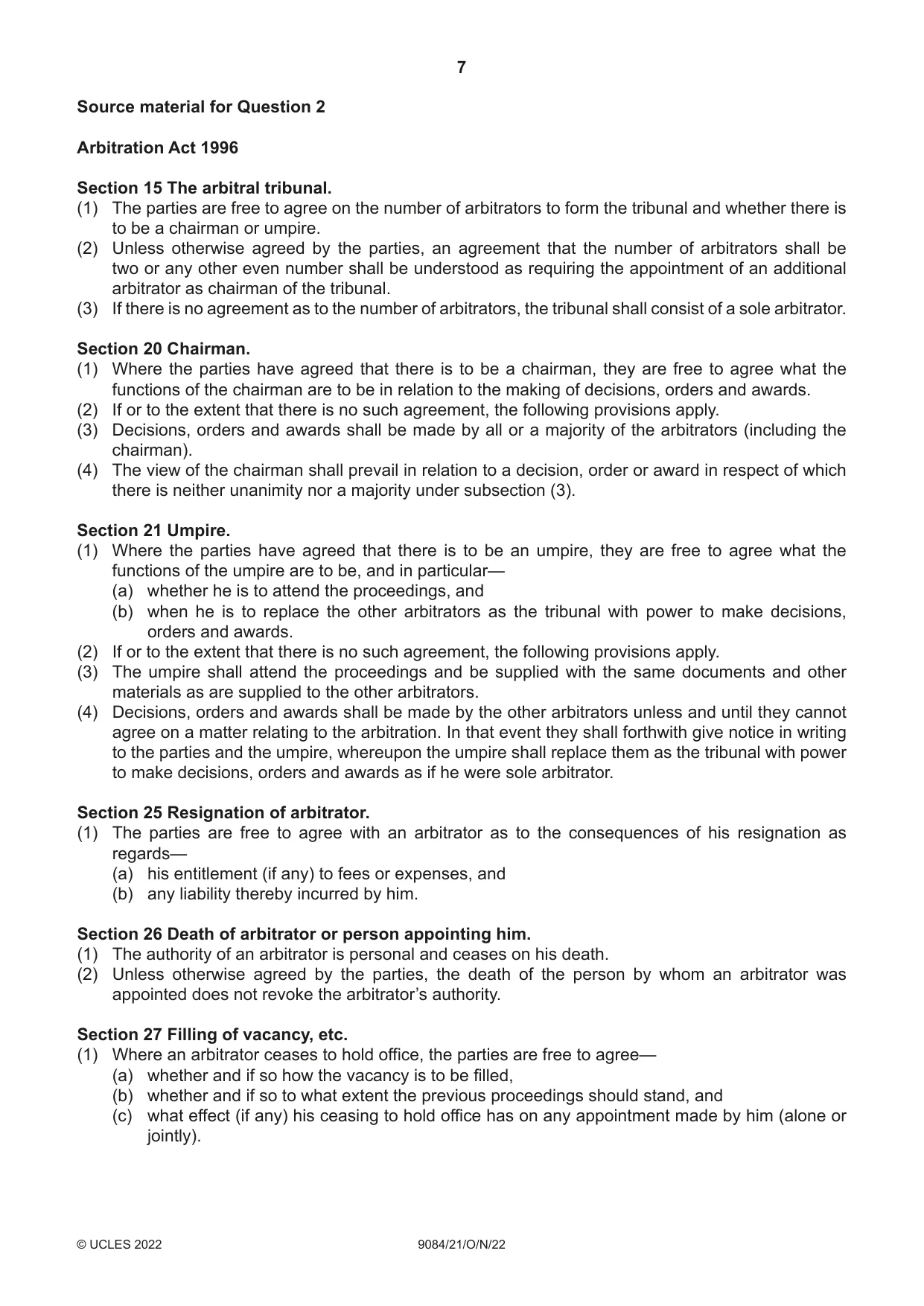

Mark scheme13 pages
Answers below. Sit the paper first if you are practising.

Questions as text
Q1 · Mumtaz, an office worker, is on the electoral register in the town where she lives
1 (a) Mumtaz, an office worker, is on the electoral register in the town where she lives. She is summoned by post by the Lord Chancellor to be a juror in a Crown Court trial in a town which is 20 minutes’ travelling time from her home. Mumtaz attends for the first three days of the trial, but on the third day one of the 12 jurors is taken to hospital with a heart attack. The judge instructs the jury to continue hearing the case. Mumtaz does not attend the next day as she thinks the judge will discharge the jury. Explain how the Juries Act 1974 will apply to Mumtaz in this situation. [10] (b) Franco, a self-employed mechanic, receives a written summons from the Lord Chancellor for 14 days’ jury service at his local county court. The summons is delivered by hand to his address on the electoral register. A week before the first date on which he is required, Franco receives an email from the appropriate officer which says he is only required to serve for seven days. Franco attends the trial for seven days but on the eighth day he does not attend. When he is prosecuted for not attending Franco argues that he thought he was not needed because of the email he had received. Explain how the Juries Act 1974 will apply to Franco in this situation. [10] (c) Desiree, a teacher, receives a summons for jury service by post at her home address to sit in a trial at her nearest High Court, which is 50 miles from her home. Her school makes it clear they will pay Desiree whilst she is serving as a juror. On the first day Desiree attends, her name is drawn in a ballot in open court. After nine days the trial ends and Desiree claims for her travelling expenses. She has had to cancel some extra tutoring sessions and so she claims for these and for the days when she could not teach her lessons at school. Explain how the Juries Act 1974 will apply to Desiree in this situation. [10] (d) Explain the qualifications required to sit as a juror. Assess the disadvantages of using juries in both criminal and civil trials. [20] Source material for Question 1 Juries Act 1974 (as amended) Section 2 Summoning. (1) Subject to the provisions of this Act, the Lord Chancellor shall be responsible for the summoning of jurors to attend for service in the Crown Court, the High Court and the county court and for determining the occasions on which they are to attend when so summoned, and the number to be summoned. (2) In making arrangements to discharge his duty under subsection (1) above the Lord Chancellor shall have regard to the convenience of the persons summoned and to their respective places of residence, and in particular to the desirability of selecting jurors within reasonable daily travelling distance of the place where they are to attend. (3) Subject to subsection (2) above, there shall be no restriction on the places in England and Wales at which a person may be required to attend or serve on a jury under this Act. (4) Subject to the provisions of this Act, jurors shall be so summoned by notice in writing sent by post, or delivered by hand. The notice shall be regarded as properly addressed if the address is that shown in the electoral register, and a notice so addressed, and delivered by hand to that address, shall be deemed to have been delivered personally to the person to whom it is addressed unless the contrary is proved. Section 4 Withdrawal or alteration of summonses. If it appears to the appropriate officer, at any time before the day on which any person summoned under section 2 of this Act is first to attend, that his attendance is unnecessary, or can be dispensed with on any particular day or days, the appropriate officer may withdraw or alter the summons by notice served in the same way as a notice of summons. Section 11 The ballot and swearing of jurors. (1) The jury to try an issue before a court shall be selected by ballot in open court from the panel, or part of the panel, of jurors summoned to attend at the time and place in question. Section 16 Continuation of criminal trial on death or discharge of juror. (1) Where in the course of a trial of any person for an offence on indictment any member of the jury dies or is discharged by the court whether as being through illness incapable of continuing to act or for any other reason, but the number of its members is not reduced below nine, the jury shall nevertheless be considered as remaining for all the purposes of that trial properly constituted, and the trial shall proceed and a verdict may be given accordingly. Section 19 Payment for jury service. (1) Subject to the following provisions of this section, a person who serves as a juror shall be entitled, in respect of his attendance at court for the purpose of performing jury service, to receive payments, at rates determined by the Lord Chancellor with the consent of the Minister for the Civil Service and subject to any prescribed conditions, by way of allowance— (a) for travelling and subsistence; and (b) for financial loss, where in consequence of his attendance for that purpose he has incurred any expenditure (otherwise than on travelling and subsistence) to which he would not otherwise be subject or he has suffered any loss of earnings. Section 20 appears on page 4. Section 20 Offences: failure to attend, serving while disqualified etc. (1) Subject to the provisions of subsections (2) to (4) below— (a) if a person duly summoned under this Act fails to attend (on the first or on any subsequent day on which he is required to attend by the summons or by the appropriate officer) in compliance with the summons, or (b) if a person, after attending in pursuance of a summons, is not available when called on to serve as a juror, or is unfit for service by reason of drink or drugs, he shall be liable to a fine not exceeding £100. (2) An offence under subsection (1) above shall be punishable either on summary conviction or as if it were criminal contempt of court committed in the face of the court. (3) … (4) A person shall not be liable to be punished under the preceding provisions of this section if he can show some reasonable cause for his failure to comply with the summons, or for not being available when called on to serve, and those provisions have effect subject to the provisions of this Act about the withdrawal or alteration of a summons and about the granting of any excusal or deferral.
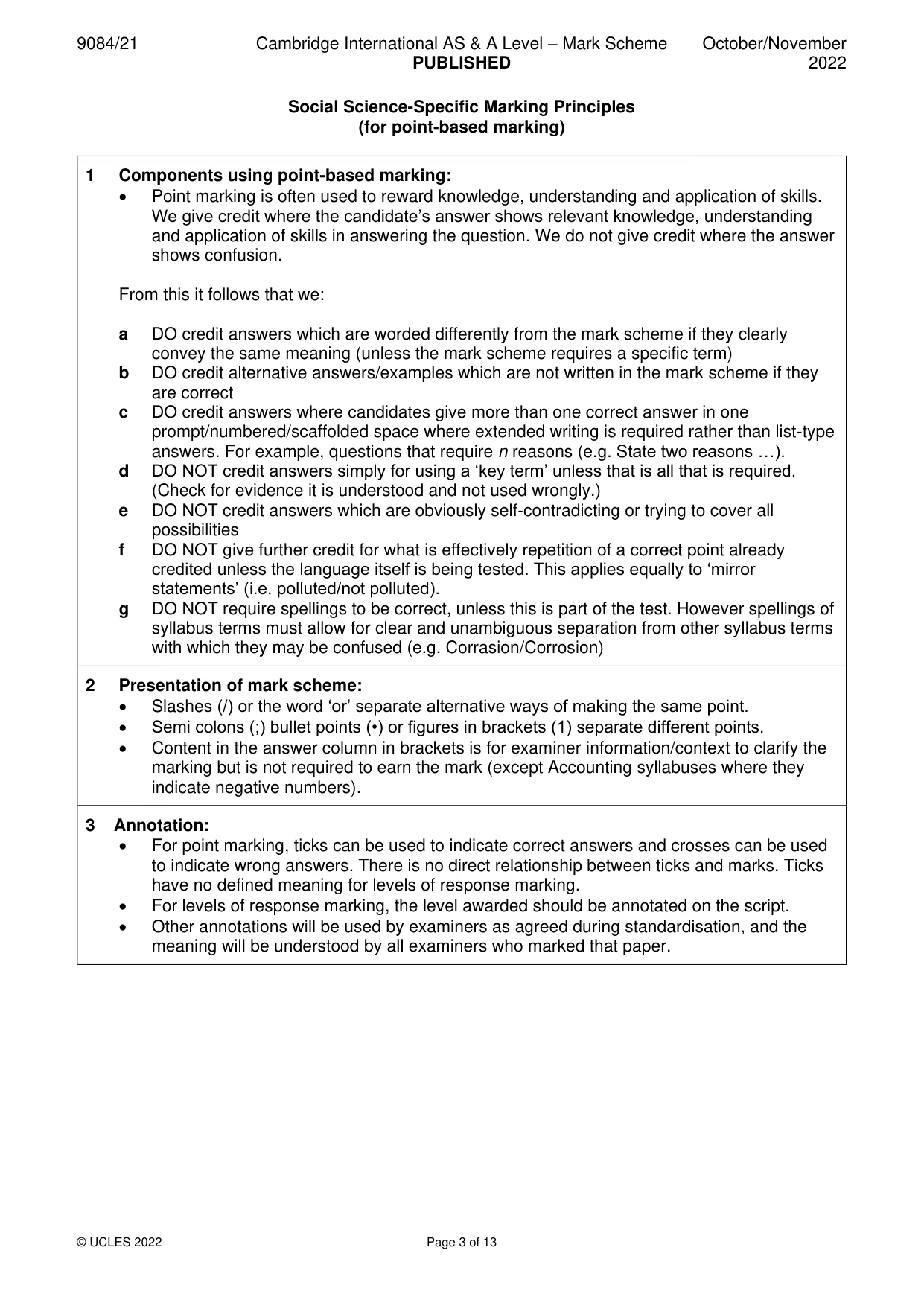
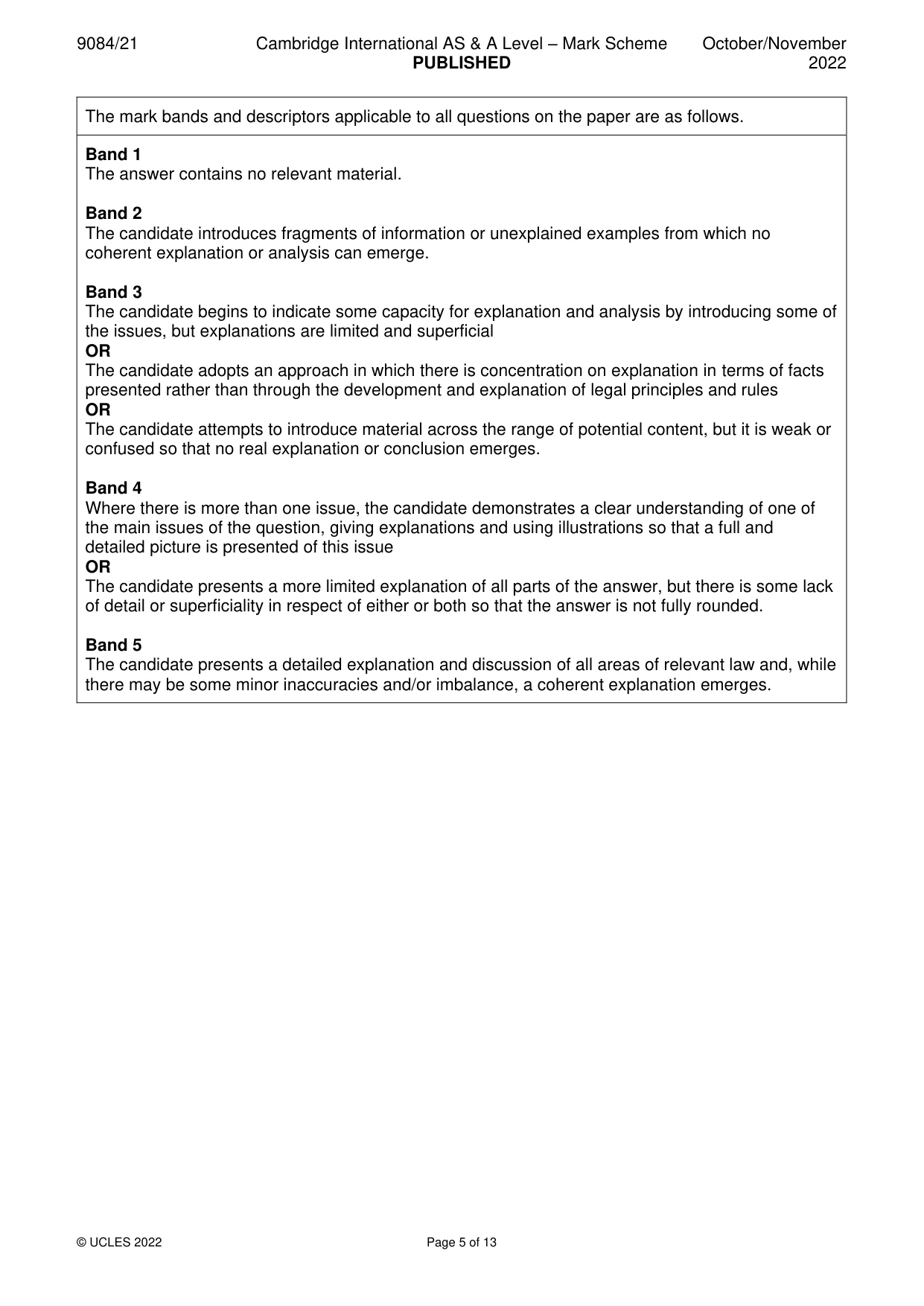
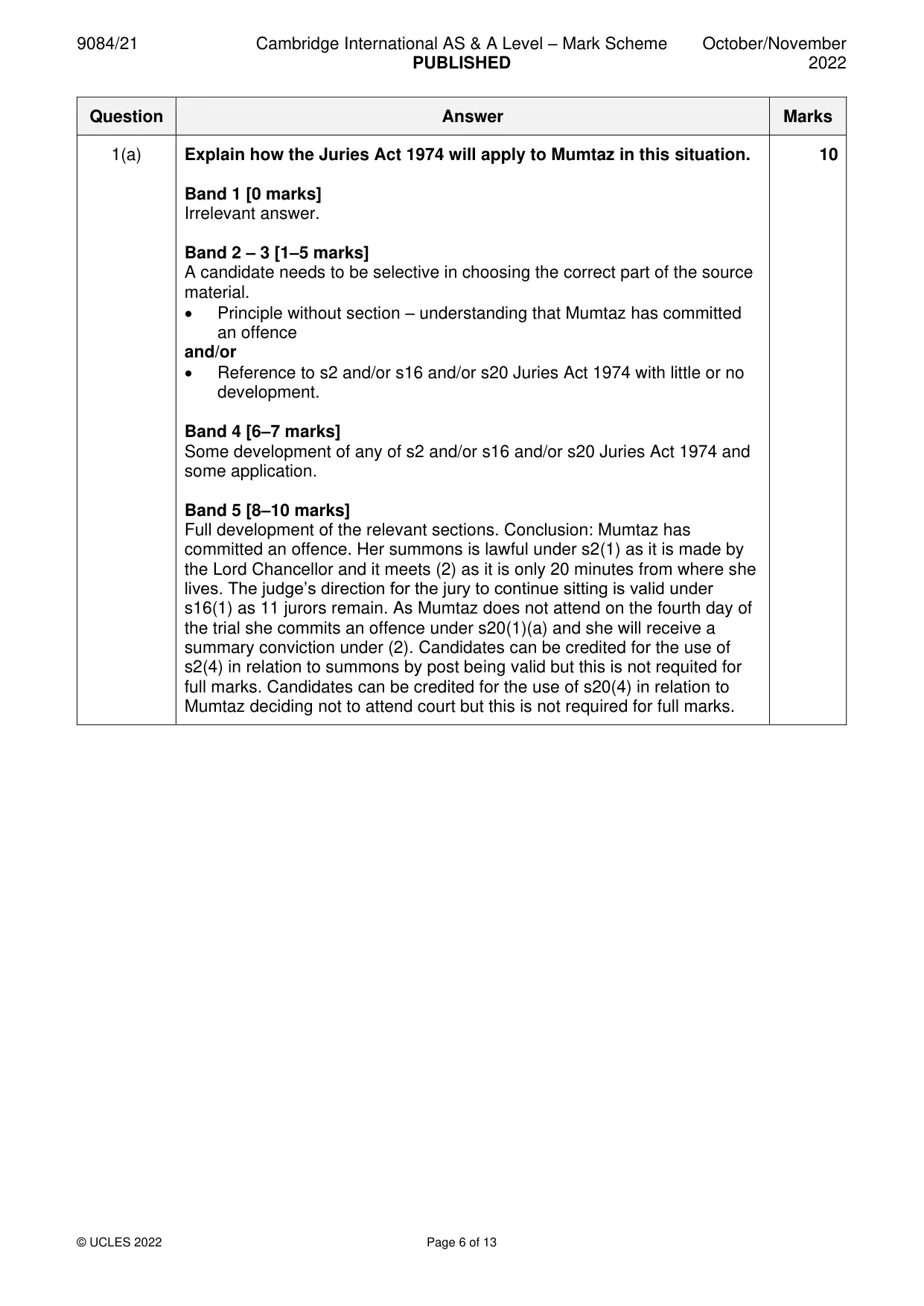
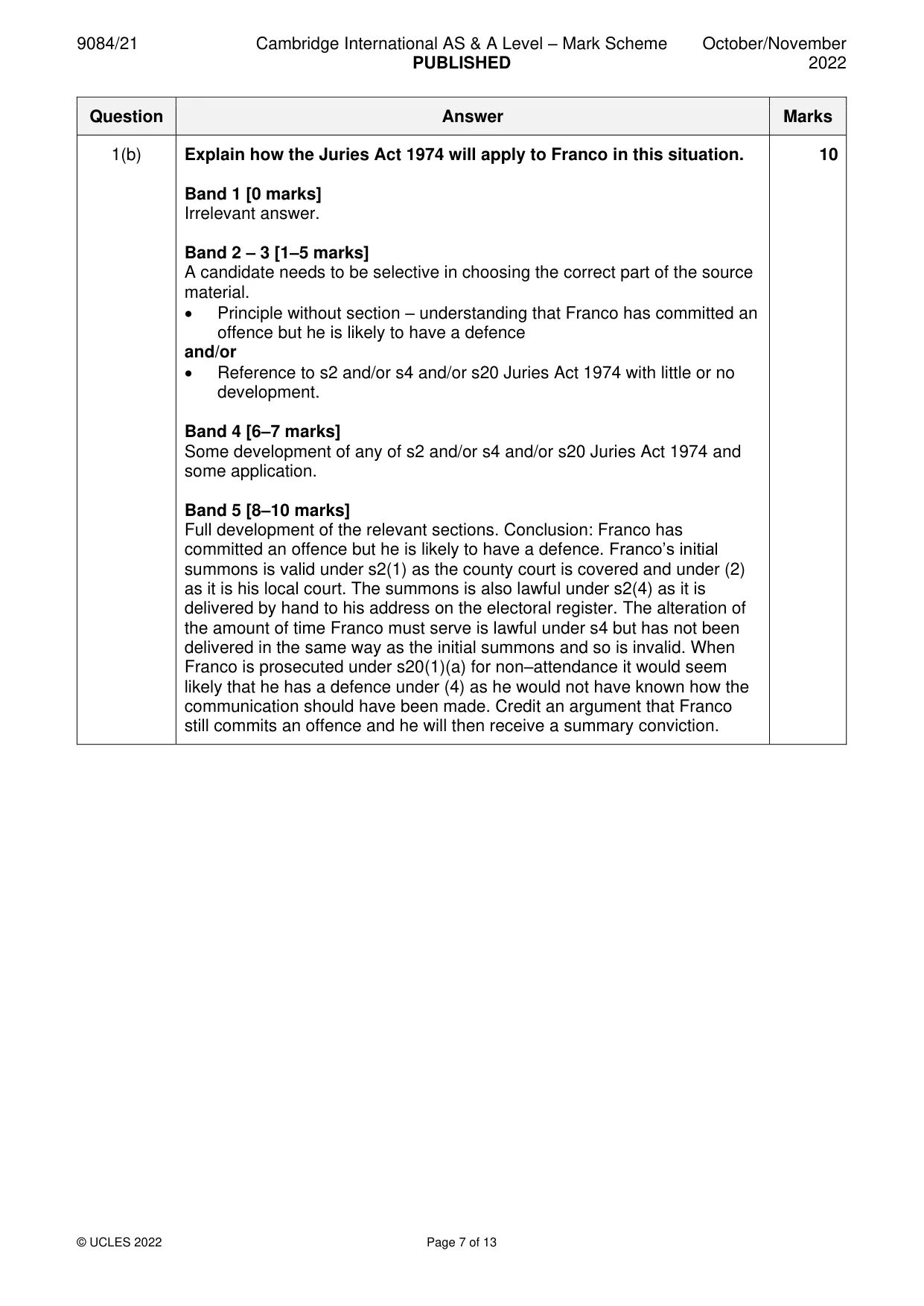
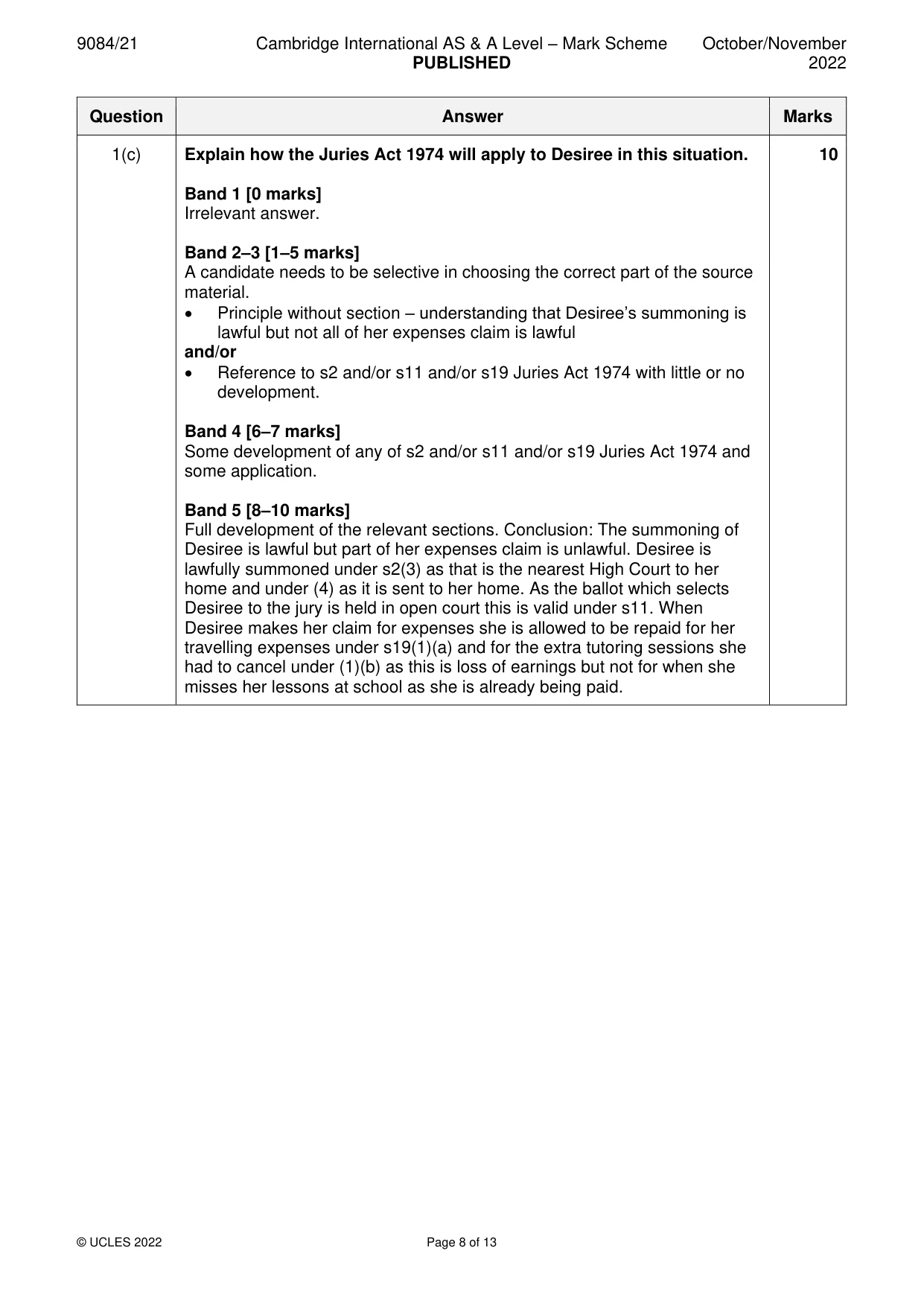
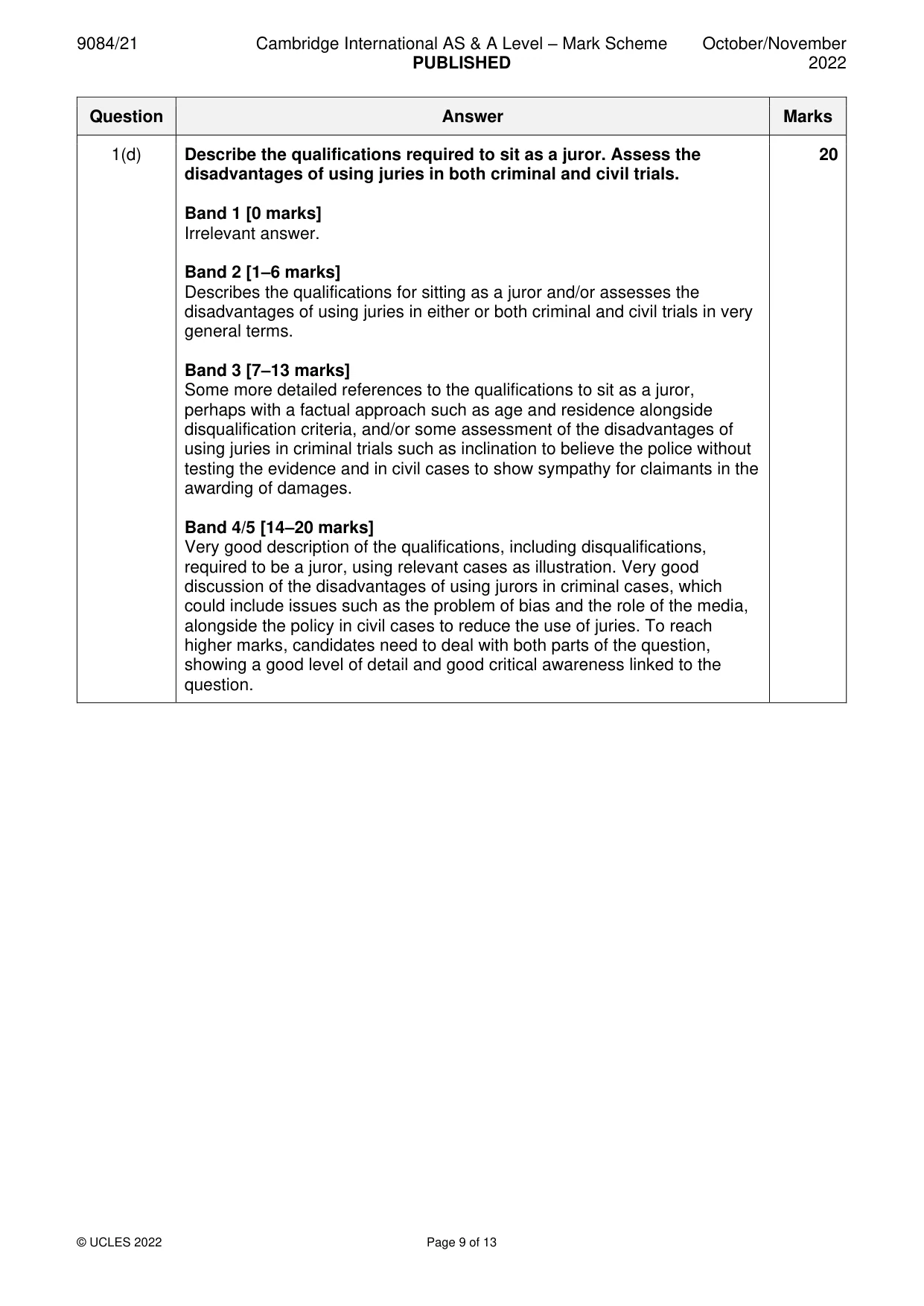
Mark scheme: Question Answer Marks 1(a) Explain how the Juries Act 1974 will apply to Mumtaz in this situation. 10 Band 1 [0 marks] Irrelevant answer. Band 2 – 3 [1–5 marks] A candidate needs to be selective in choosing the correct part of the source material. • Principle without section – understanding that Mumtaz has committed an offence and/or • Reference to s2 and/or s16 and/or s20 Juries Act 1974 with little or no development. Band 4 [6–7 marks] Some development of any of s2 and/or s16 and/or s20 Juries Act 1974 and some application. Band 5 [8–10 marks] Full development of the relevant sections. Conclusion: Mumtaz has committed an offence. Her summons is lawful under s2(1) as it is made by the Lord Chancellor and it meets (2) as it is only 20 minutes from where she lives. The judge’s direction for the jury to continue sitting is valid under s16(1) as 11 jurors remain. As Mumtaz does not attend on the fourth day of the trial she commits an offence under s20(1)(a) and she will receive a summary conviction under (2). Candidates can be credited for the use of s2(4) in relation to summons by post being valid but this is not requited for full marks. Candidates can be credited for the use of s20(4) in relation to Mumtaz deciding not to attend court but this is not required for full marks. 1(b) Explain how the Juries Act 1974 will apply to Franco in this situation. 10 Band 1 [0 marks] Irrelevant answer. Band 2 – 3 [1–5 marks] A candidate needs to be selective in choosing the correct part of the source material. • Principle without section – understanding that Franco has committed an offence but he is likely to have a defence and/or • Reference to s2 and/or s4 and/or s20 Juries Act 1974 with little or no development. Band 4 [6–7 marks] Some development of any of s2 and/or s4 and/or s20 Juries Act 1974 and some application. Band 5 [8–10 marks] Full development of the relevant sections. Conclusion: Franco has committed an offence but he is likely to have a defence. Franco’s initial summons is valid under s2(1) as the county court is covered and under (2) as it is his local court. The summons is also lawful under s2(4) as it is delivered by hand to his address on the electoral register. The alteration of the amount of time Franco must serve is lawful under s4 but has not been delivered in the same way as the initial summons and so is invalid. When Franco is prosecuted under s20(1)(a) for non–attendance it would seem likely that he has a defence under (4) as he would not have known how the communication should have been made. Credit an argument that Franco still commits an offence and he will then receive a summary conviction. 1(c) Explain how the Juries Act 1974 will apply to Desiree in this situation. 10 Band 1 [0 marks] Irrelevant answer. Band 2–3 [1–5 marks] A candidate needs to be selective in choosing the correct part of the source material. • Principle without section – understanding that Desiree’s summoning is lawful but not all of her expenses claim is lawful and/or • Reference to s2 and/or s11 and/or s19 Juries Act 1974 with little or no development. Band 4 [6–7 marks] Some development of any of s2 and/or s11 and/or s19 Juries Act 1974 and some application. Band 5 [8–10 marks] Full development of the relevant sections. Conclusion: The summoning of Desiree is lawful but part of her expenses claim is unlawful. Desiree is lawfully summoned under s2(3) as that is the nearest High Court to her home and under (4) as it is sent to her home. As the ballot which selects Desiree to the jury is held in open court this is valid under s11. When Desiree makes her claim for expenses she is allowed to be repaid for her travelling expenses under s19(1)(a) and for the extra tutoring sessions she had to cancel under (1)(b) as this is loss of earnings but not for when she misses her lessons at school as she is already being paid. 1(d) Describe the qualifications required to sit as a juror. Assess the 20 disadvantages of using juries in both criminal and civil trials. Band 1 [0 marks] Irrelevant answer. Band 2 [1–6 marks] Describes the qualifications for sitting as a juror and/or assesses the disadvantages of using juries in either or both criminal and civil trials in very general terms. Band 3 [7–13 marks] Some more detailed references to the qualifications to sit as a juror, perhaps with a factual approach such as age and residence alongside disqualification criteria, and/or some assessment of the disadvantages of using juries in criminal trials such as inclination to believe the police without testing the evidence and in civil cases to show sympathy for claimants in the awarding of damages. Band 4/5 [14–20 marks] Very good description of the qualifications, including disqualifications, required to be a juror, using relevant cases as illustration. Very good discussion of the disadvantages of using jurors in criminal cases, which could include issues such as the problem of bias and the role of the media, alongside the policy in civil cases to reduce the use of juries. To reach higher marks, candidates need to deal with both parts of the question, showing a good level of detail and good critical awareness linked to the question.
Q2 · Gary and Henry are two businessmen who are in dispute over a contract
2 (a) Gary and Henry are two businessmen who are in dispute over a contract. They do not decide on the size of the tribunal, so their lawyers agree to appoint two arbitrators and the arbitrators then appoint an additional arbitrator, John, to sit as its chairman. Gary and Henry agree to the tribunal, but they make no agreement about John’s role as chairman. As the arbitration begins a decision needs to be made about the use of witnesses but the arbitrators cannot agree. The two arbitrators vote, one supports the use of witnesses but the other does not. John votes to allow the use of witnesses. Explain how the Arbitration Act 1996 will apply in this situation. [10] (b) Dasha and Maria both run businesses and they are using arbitration to settle a dispute about deliveries. They appoint a tribunal of four arbitrators. In addition Michael is appointed as an umpire. They give him permission to attend the hearings but they make no decision about his role if the tribunal cannot agree. When the arbitration begins Michael attends and he is given some of the materials relating to the dispute. The arbitrators resolve the dispute but they cannot agree on the size of the arbitration award. They give notice in writing to Michael, who takes over and makes the award. Explain how the Arbitration Act 1996 will apply in this situation. [10] (c) Jakob and Helga are using arbitration to settle a dispute between their businesses. After a week Carolina, one of their arbitrators, resigns from the tribunal. Jakob and Helga agree with Carolina that they will pay some expenses but no fee and that she has no further liability in the arbitration. A month later, Pieter, another of the arbitrators, dies. Most of the decisions have been made but the size of the award has not been settled. Jakob and Helga agree on a process to appoint a new arbitrator and that all the decisions previously made by Pieter and the rest of the tribunal should still apply. Pieter did not make any appointments to the tribunal. Explain how the Arbitration Act 1996 will apply in this situation. [10] (d) Describe how methods of alternative dispute resolution (ADR), other than arbitration, are used to settle disputes. Assess the extent to which ADR is more effective than using the civil courts to settle disputes. [20] Source material for Question 2 Arbitration Act 1996 Section 15 The arbitral tribunal. (1) The parties are free to agree on the number of arbitrators to form the tribunal and whether there is to be a chairman or umpire. (2) Unless otherwise agreed by the parties, an agreement that the number of arbitrators shall be two or any other even number shall be understood as requiring the appointment of an additional arbitrator as chairman of the tribunal. (3) If there is no agreement as to the number of arbitrators, the tribunal shall consist of a sole arbitrator. Section 20 Chairman. (1) Where the parties have agreed that there is to be a chairman, they are free to agree what the functions of the chairman are to be in relation to the making of decisions, orders and awards. (2) If or to the extent that there is no such agreement, the following provisions apply. (3) Decisions, orders and awards shall be made by all or a majority of the arbitrators (including the chairman). (4) The view of the chairman shall prevail in relation to a decision, order or award in respect of which there is neither unanimity nor a majority under subsection (3). Section 21 Umpire. (1) Where the parties have agreed that there is to be an umpire, they are free to agree what the functions of the umpire are to be, and in particular— (a) whether he is to attend the proceedings, and (b) when he is to replace the other arbitrators as the tribunal with power to make decisions, orders and awards. (2) If or to the extent that there is no such agreement, the following provisions apply. (3) The umpire shall attend the proceedings and be supplied with the same documents and other materials as are supplied to the other arbitrators. (4) Decisions, orders and awards shall be made by the other arbitrators unless and until they cannot agree on a matter relating to the arbitration. In that event they shall forthwith give notice in writing to the parties and the umpire, whereupon the umpire shall replace them as the tribunal with power to make decisions, orders and awards as if he were sole arbitrator. Section 25 Resignation of arbitrator. (1) The parties are free to agree with an arbitrator as to the consequences of his resignation as regards— (a) his entitlement (if any) to fees or expenses, and (b) any liability thereby incurred by him. Section 26 Death of arbitrator or person appointing him. (1) The authority of an arbitrator is personal and ceases on his death. (2) Unless otherwise agreed by the parties, the death of the person by whom an arbitrator was appointed does not revoke the arbitrator’s authority. Section 27 Filling of vacancy, etc. (1) Where an arbitrator ceases to hold office, the parties are free to agree— (a) whether and if so how the vacancy is to be filled, (b) whether and if so to what extent the previous proceedings should stand, and (c) what effect (if any) his ceasing to hold office has on any appointment made by him (alone or jointly).
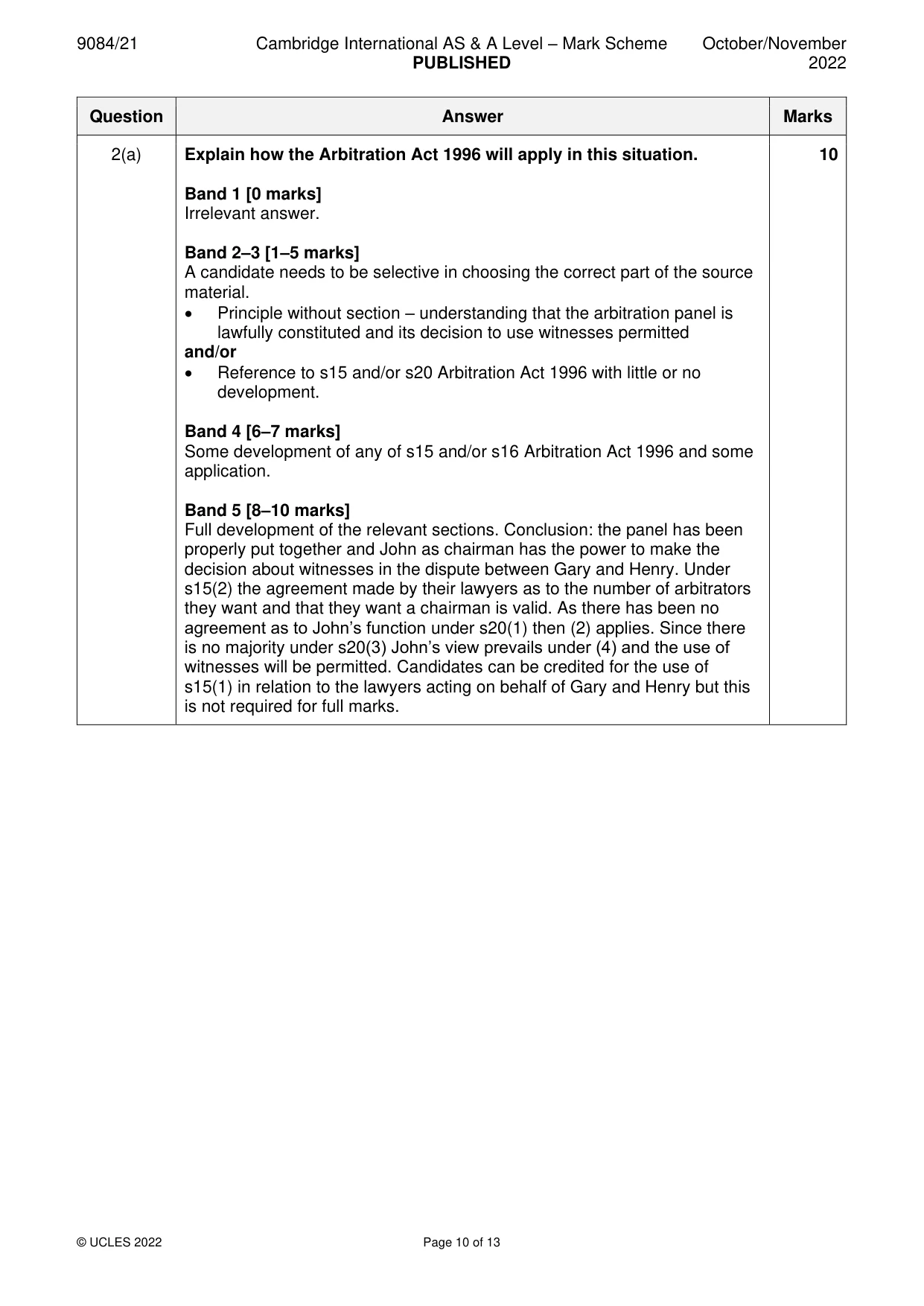
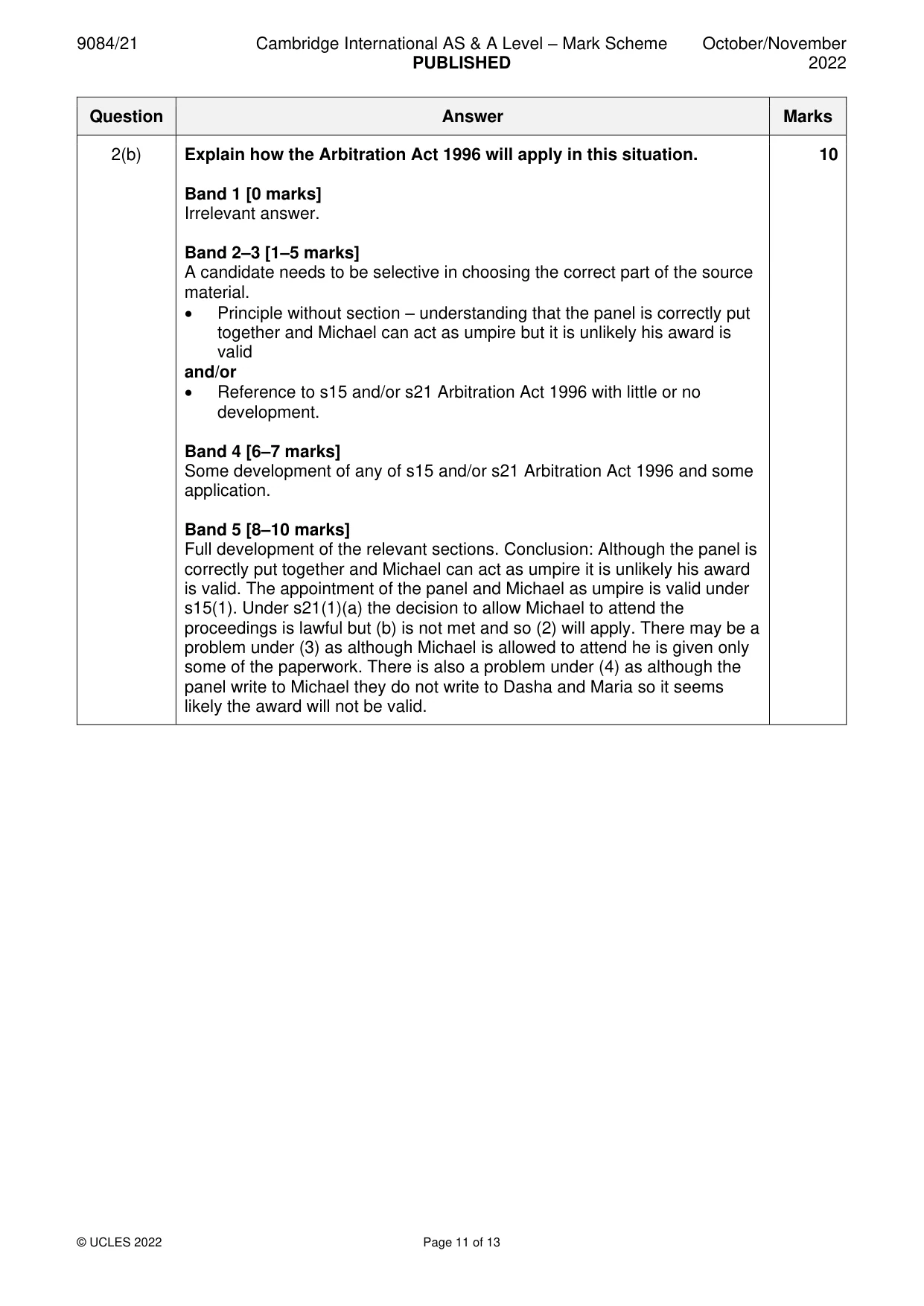
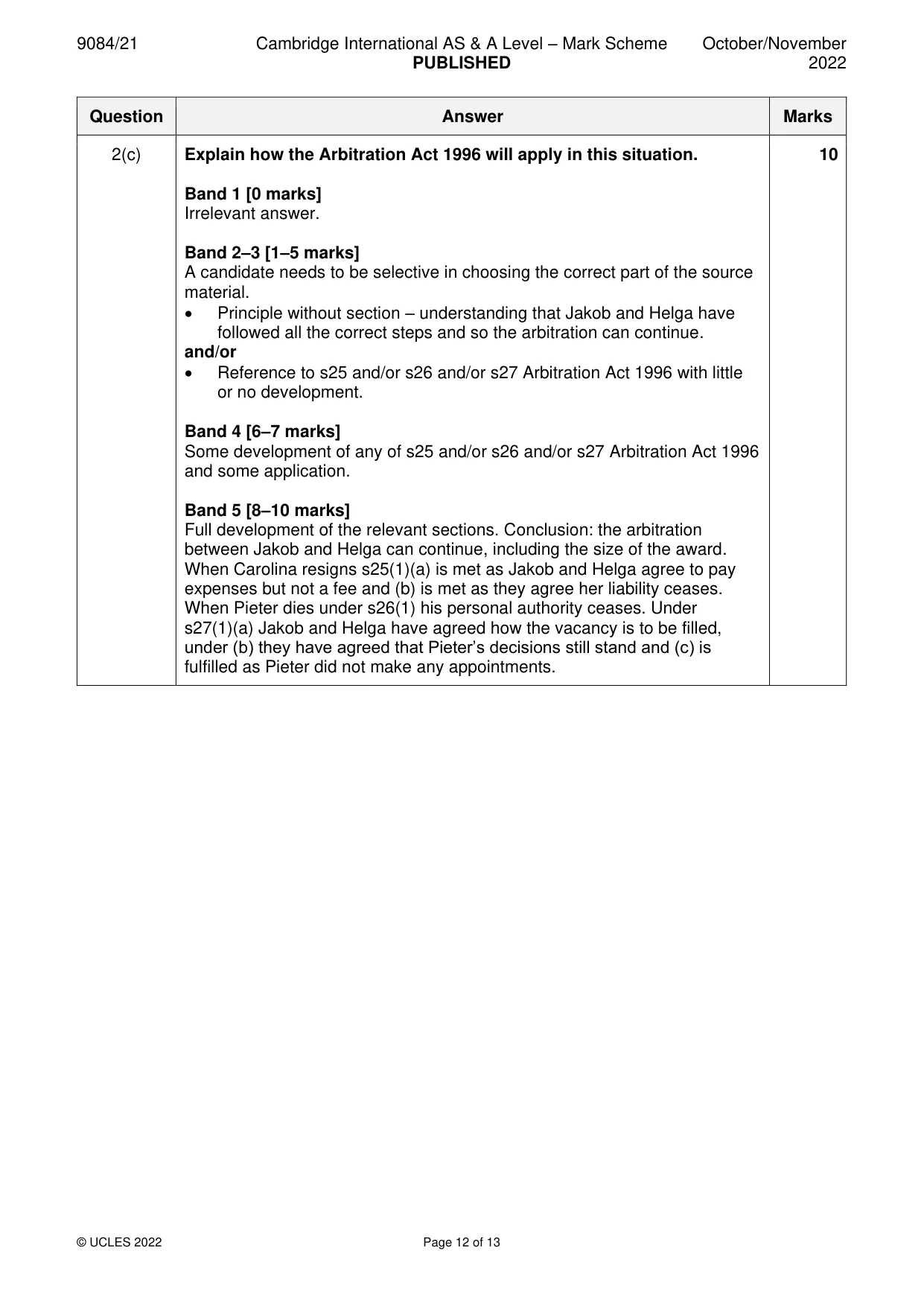
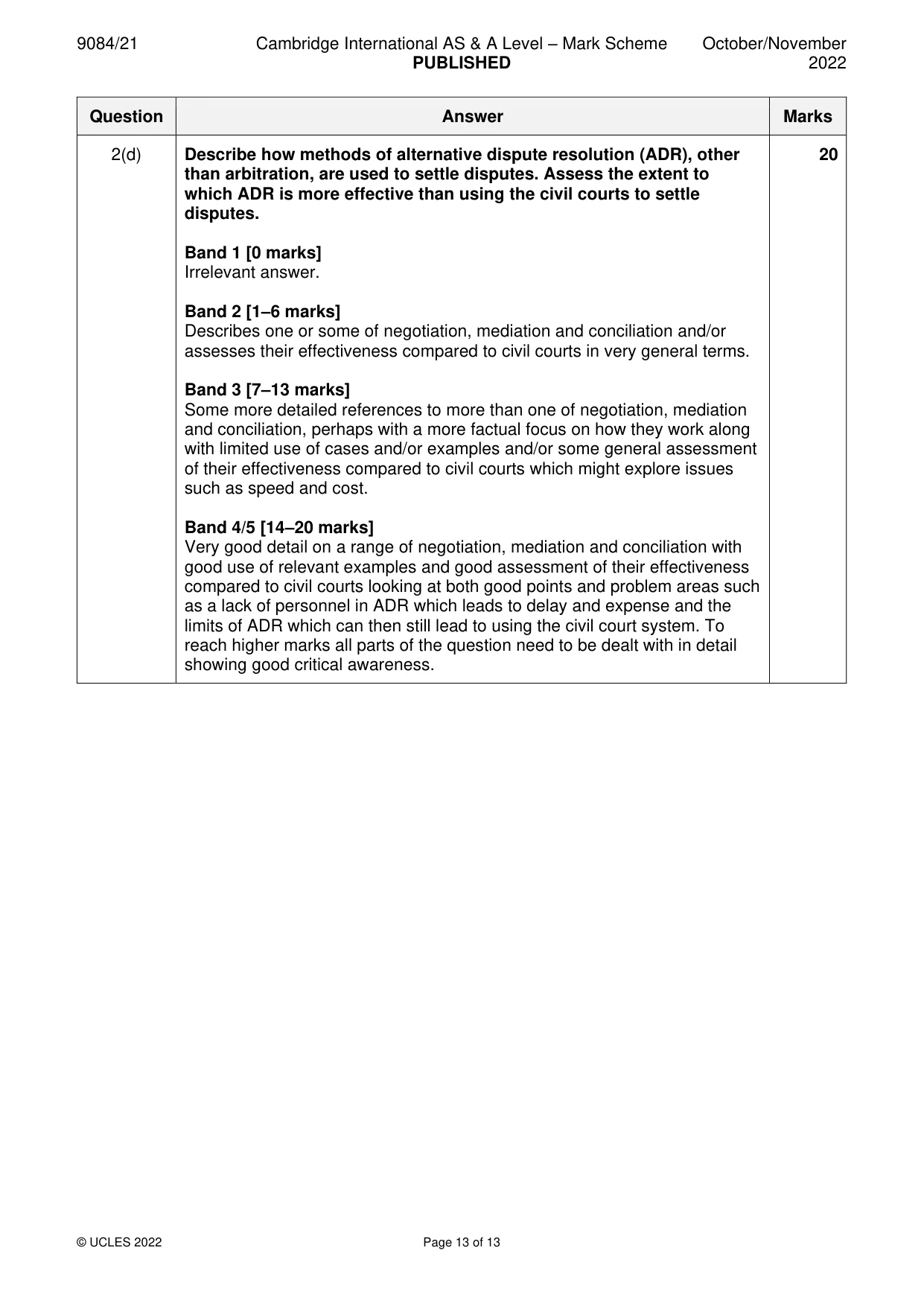
Mark scheme: 2(a) Explain how the Arbitration Act 1996 will apply in this situation. 10 Band 1 [0 marks] Irrelevant answer. Band 2–3 [1–5 marks] A candidate needs to be selective in choosing the correct part of the source material. • Principle without section – understanding that the arbitration panel is lawfully constituted and its decision to use witnesses permitted and/or • Reference to s15 and/or s20 Arbitration Act 1996 with little or no development. Band 4 [6–7 marks] Some development of any of s15 and/or s16 Arbitration Act 1996 and some application. Band 5 [8–10 marks] Full development of the relevant sections. Conclusion: the panel has been properly put together and John as chairman has the power to make the decision about witnesses in the dispute between Gary and Henry. Under s15(2) the agreement made by their lawyers as to the number of arbitrators they want and that they want a chairman is valid. As there has been no agreement as to John’s function under s20(1) then (2) applies. Since there is no majority under s20(3) John’s view prevails under (4) and the use of witnesses will be permitted. Candidates can be credited for the use of s15(1) in relation to the lawyers acting on behalf of Gary and Henry but this is not required for full marks. 2(b) Explain how the Arbitration Act 1996 will apply in this situation. 10 Band 1 [0 marks] Irrelevant answer. Band 2–3 [1–5 marks] A candidate needs to be selective in choosing the correct part of the source material. • Principle without section – understanding that the panel is correctly put together and Michael can act as umpire but it is unlikely his award is valid and/or • Reference to s15 and/or s21 Arbitration Act 1996 with little or no development. Band 4 [6–7 marks] Some development of any of s15 and/or s21 Arbitration Act 1996 and some application. Band 5 [8–10 marks] Full development of the relevant sections. Conclusion: Although the panel is correctly put together and Michael can act as umpire it is unlikely his award is valid. The appointment of the panel and Michael as umpire is valid under s15(1). Under s21(1)(a) the decision to allow Michael to attend the proceedings is lawful but (b) is not met and so (2) will apply. There may be a problem under (3) as although Michael is allowed to attend he is given only some of the paperwork. There is also a problem under (4) as although the panel write to Michael they do not write to Dasha and Maria so it seems likely the award will not be valid. 2(c) Explain how the Arbitration Act 1996 will apply in this situation. 10 Band 1 [0 marks] Irrelevant answer. Band 2–3 [1–5 marks] A candidate needs to be selective in choosing the correct part of the source material. • Principle without section – understanding that Jakob and Helga have followed all the correct steps and so the arbitration can continue. and/or • Reference to s25 and/or s26 and/or s27 Arbitration Act 1996 with little or no development. Band 4 [6–7 marks] Some development of any of s25 and/or s26 and/or s27 Arbitration Act 1996 and some application. Band 5 [8–10 marks] Full development of the relevant sections. Conclusion: the arbitration between Jakob and Helga can continue, including the size of the award. When Carolina resigns s25(1)(a) is met as Jakob and Helga agree to pay expenses but not a fee and (b) is met as they agree her liability ceases. When Pieter dies under s26(1) his personal authority ceases. Under s27(1)(a) Jakob and Helga have agreed how the vacancy is to be filled, under (b) they have agreed that Pieter’s decisions still stand and (c) is fulfilled as Pieter did not make any appointments. 2(d) Describe how methods of alternative dispute resolution (ADR), other 20 than arbitration, are used to settle disputes. Assess the extent to which ADR is more effective than using the civil courts to settle disputes. Band 1 [0 marks] Irrelevant answer. Band 2 [1–6 marks] Describes one or some of negotiation, mediation and conciliation and/or assesses their effectiveness compared to civil courts in very general terms. Band 3 [7–13 marks] Some more detailed references to more than one of negotiation, mediation and conciliation, perhaps with a more factual focus on how they work along with limited use of cases and/or examples and/or some general assessment of their effectiveness compared to civil courts which might explore issues such as speed and cost. Band 4/5 [14–20 marks] Very good detail on a range of negotiation, mediation and conciliation with good use of relevant examples and good assessment of their effectiveness compared to civil courts looking at both good points and problem areas such as a lack of personnel in ADR which leads to delay and expense and the limits of ADR which can then still lead to using the civil court system. To reach higher marks all parts of the question need to be dealt with in detail showing good critical awareness.
What was in this paper
The subtopics covered by these 2 questions, and how many questions each got. Open one in a new tab to see every Cambridge question on it.
1Machinery of justice This topic introduces the institutions and processes involved in the resolution of civil and criminal matters. This topic is an opportunity to reflect on the key concepts of power and its limits; justice, fairness and morality; effectiveness and certainty; and liability1What you needed in this session
Cambridge’s own grade thresholds for 2022 Oct/Nov, Paper 2 · Variant 1. A higher threshold means an easier paper — the bar moves with how the cohort did.