Questions as text
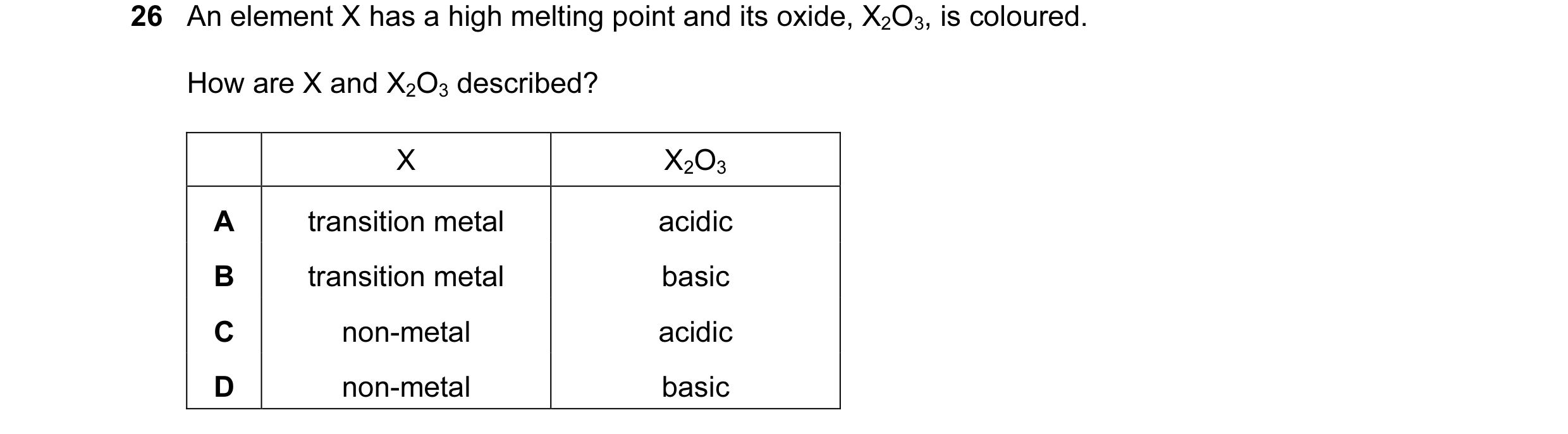
Q1 · An element X has a high melting point and its oxide, X2O3, is coloured 0654/11 May/June 2006
26 An element X has a high melting point and its oxide, X2O3, is coloured. How are X and X2O3 described? X X2O3 A transition metal acidic B transition metal basic C non-metal acidic D non-metal basic
1 marks
Answer: B
This question in 0654/11 May/June 2006
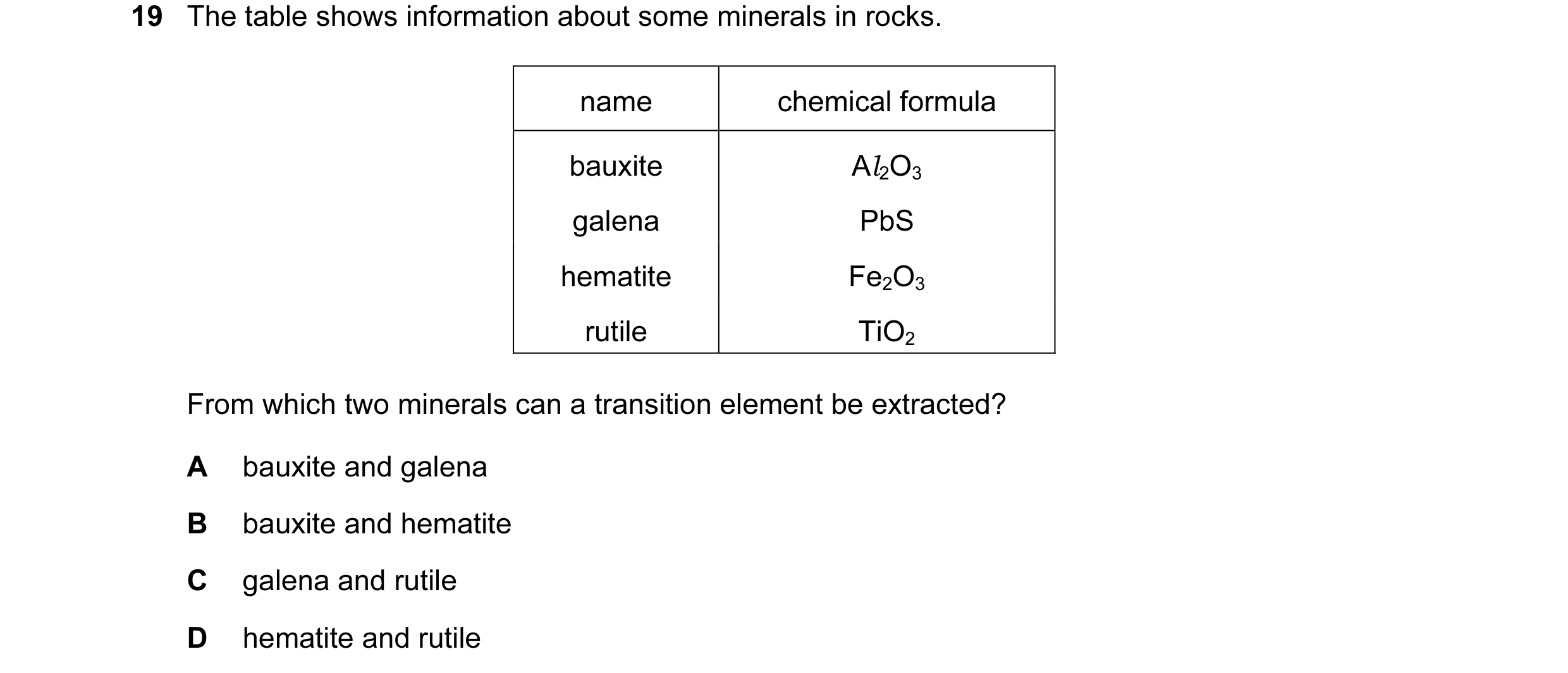
Q2 · The table shows information about some minerals in rocks 0654/11 Oct/Nov 2008
19 The table shows information about some minerals in rocks. name chemical formula bauxite Al2O3 galena PbS hematite Fe2O3 rutile TiO2 From which two minerals can a transition element be extracted? A bauxite and galena B bauxite and hematite C galena and rutile D hematite and rutile
1 marks
Answer: D
This question in 0654/11 Oct/Nov 2008
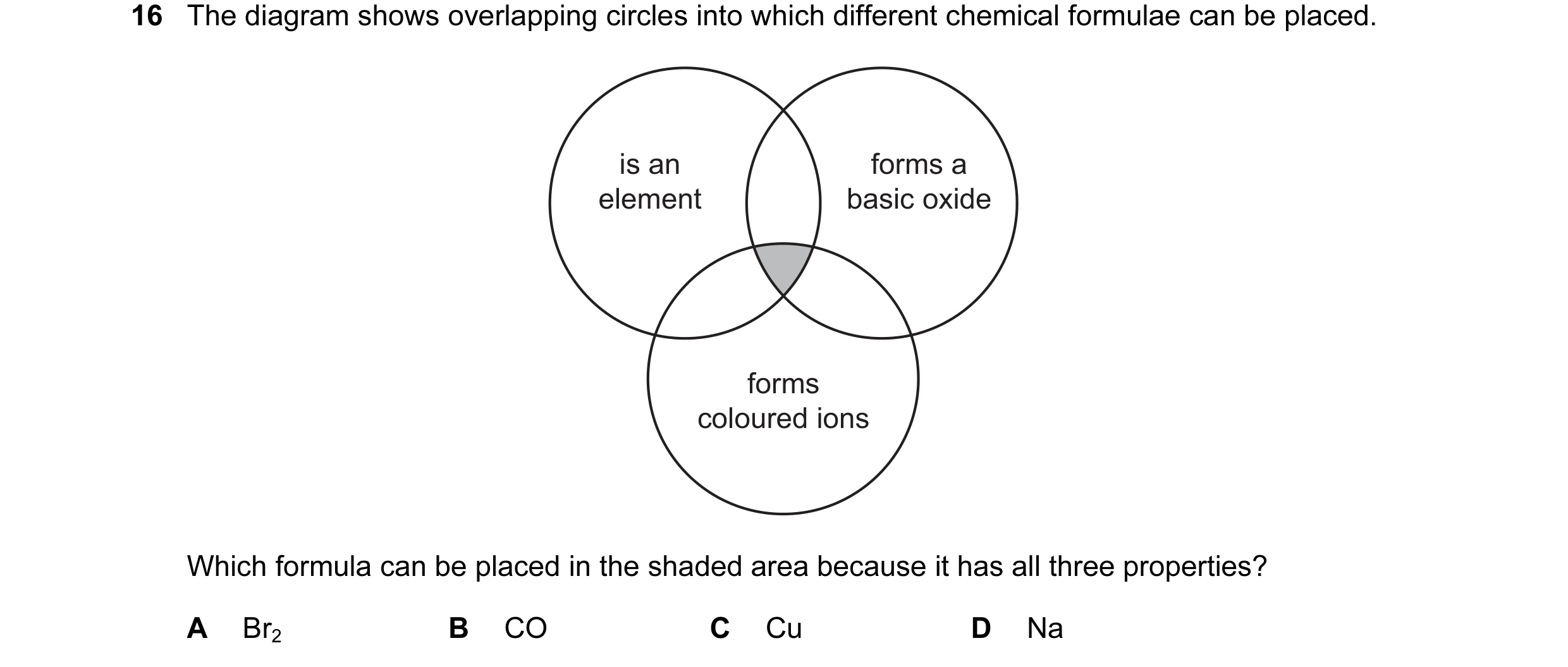
Q3 · The diagram shows overlapping circles into which different chemical formulae can be placed 0654/11 May/June 2013
16 The diagram shows overlapping circles into which different chemical formulae can be placed. is an forms a element basic oxide forms coloured ions Which formula can be placed in the shaded area because it has all three properties? A Br2 B CO C Cu D Na
1 marks
Answer: C
This question in 0654/11 May/June 2013
Q4 · The diagram shows overlapping circles into which different chemical formulae can be placed 0654/13 May/June 2013
14 The diagram shows overlapping circles into which different chemical formulae can be placed. is an forms a element basic oxide forms coloured ions Which formula can be placed in the shaded area because it has all three properties? A Br2 B CO C Cu D Na
1 marks
Answer: C
This question in 0654/13 May/June 2013
Q5 · The box shows four substances 0654/13 Oct/Nov 2013
21 The box shows four substances. Br2 CO Cu Na Which substance is an element that forms a basic oxide and coloured compounds? A Br2 B CO C Cu D Na
1 marks
Answer: C
This question in 0654/13 Oct/Nov 2013
Q6 · The first row of the transition elements is shown 0654/11 Oct/Nov 2014
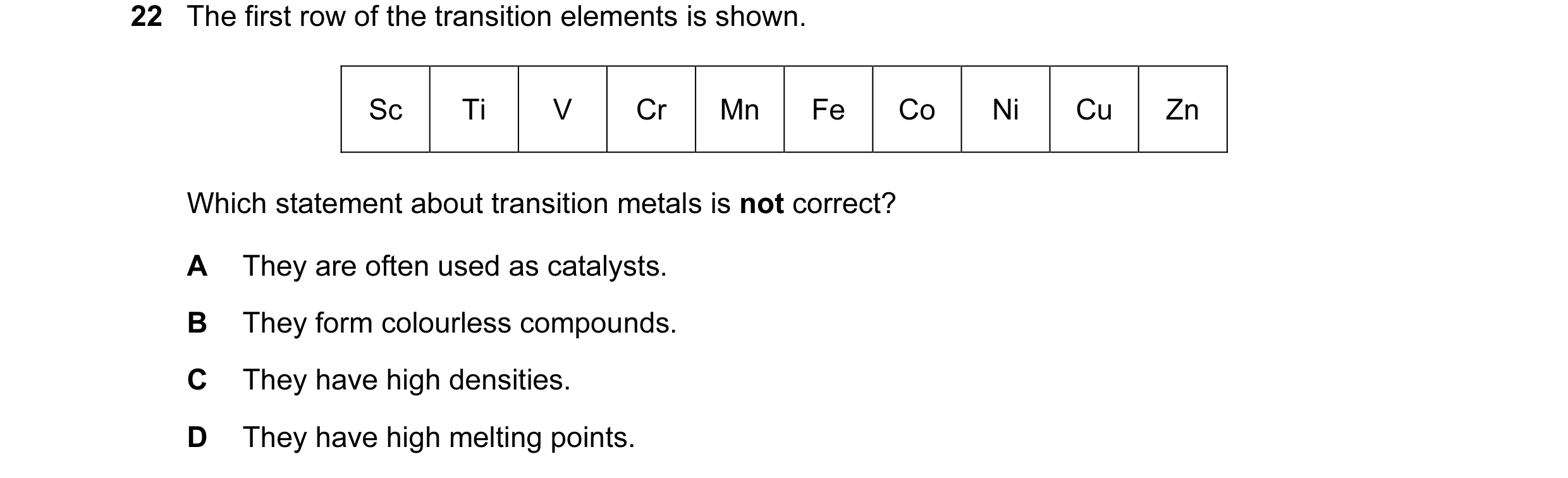
22 The first row of the transition elements is shown. Sc Ti V Cr Mn Fe Co Ni Cu Zn Which statement about transition metals is not correct? A They are often used as catalysts. B They form colourless compounds. C They have high densities. D They have high melting points.
1 marks
Answer: B
This question in 0654/11 Oct/Nov 2014
Q7 · The first row of the transition elements is shown 0654/12 Oct/Nov 2014
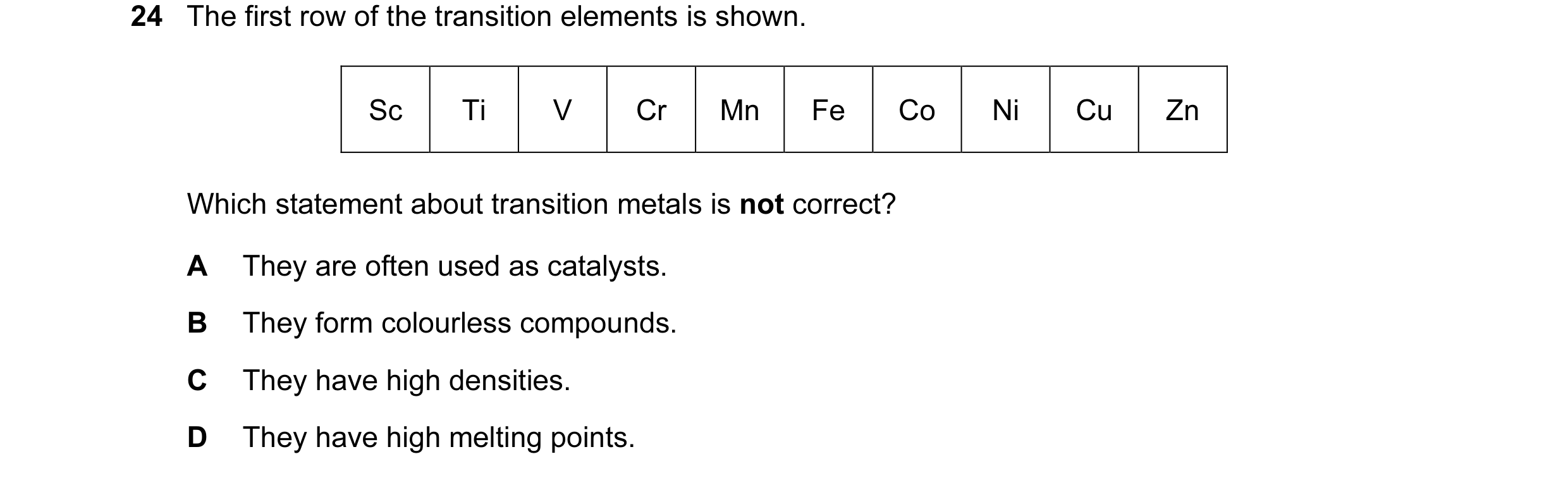
24 The first row of the transition elements is shown. Sc Ti V Cr Mn Fe Co Ni Cu Zn Which statement about transition metals is not correct? A They are often used as catalysts. B They form colourless compounds. C They have high densities. D They have high melting points.
1 marks
Answer: B
This question in 0654/12 Oct/Nov 2014
Q8 · Which element can be used as a catalyst? 0654/13 Oct/Nov 2014
22 Which element can be used as a catalyst? A palladium (proton number 46) B phosphorus (proton number 15) C polonium (proton number 84) D potassium (proton number 19)
1 marks
Answer: A
This question in 0654/13 Oct/Nov 2014
Q9 · The table shows information about some minerals 0654/11 May/June 2015
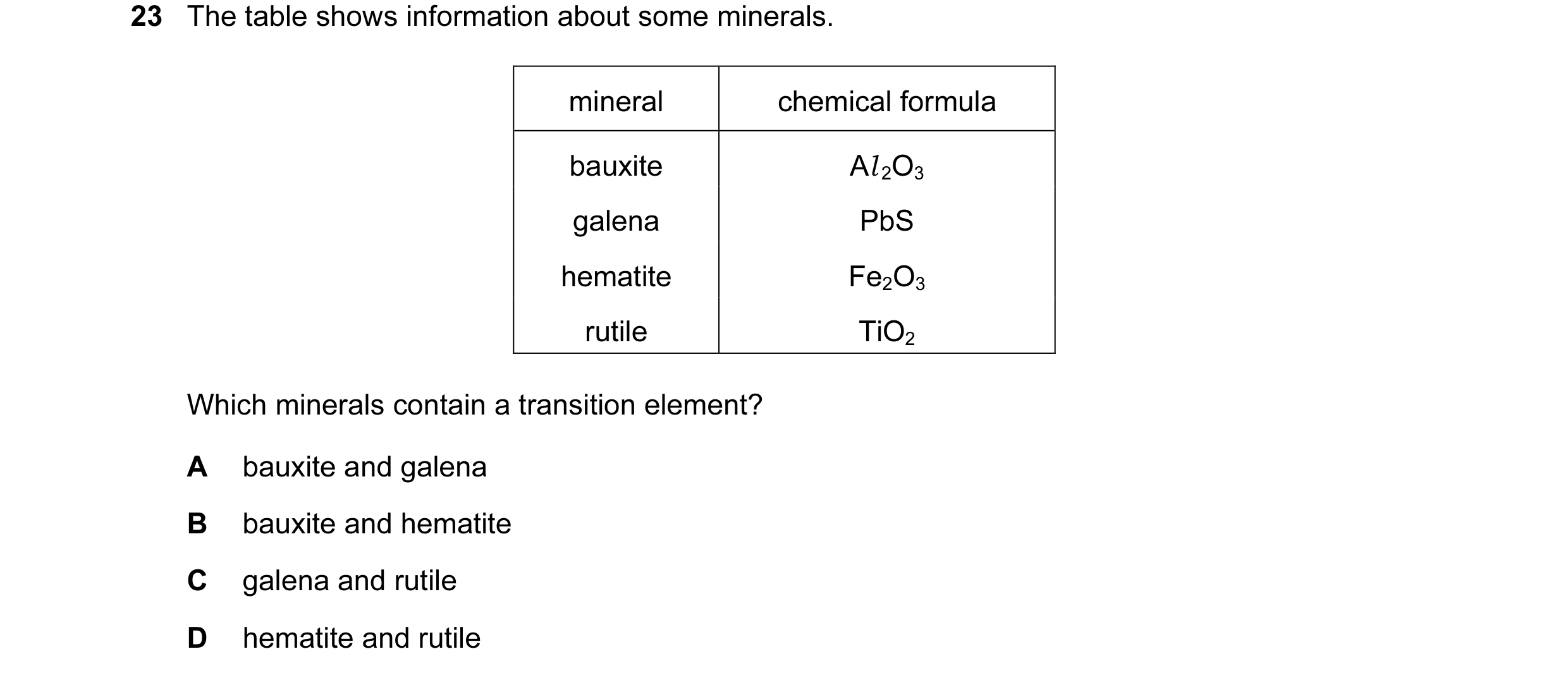
23 The table shows information about some minerals. mineral chemical formula bauxite Al 2O3 galena PbS hematite Fe2O3 rutile TiO2 Which minerals contain a transition element? A bauxite and galena B bauxite and hematite C galena and rutile D hematite and rutile
1 marks
Answer: D
This question in 0654/11 May/June 2015
Q10 · The table shows information about some minerals 0654/12 May/June 2015
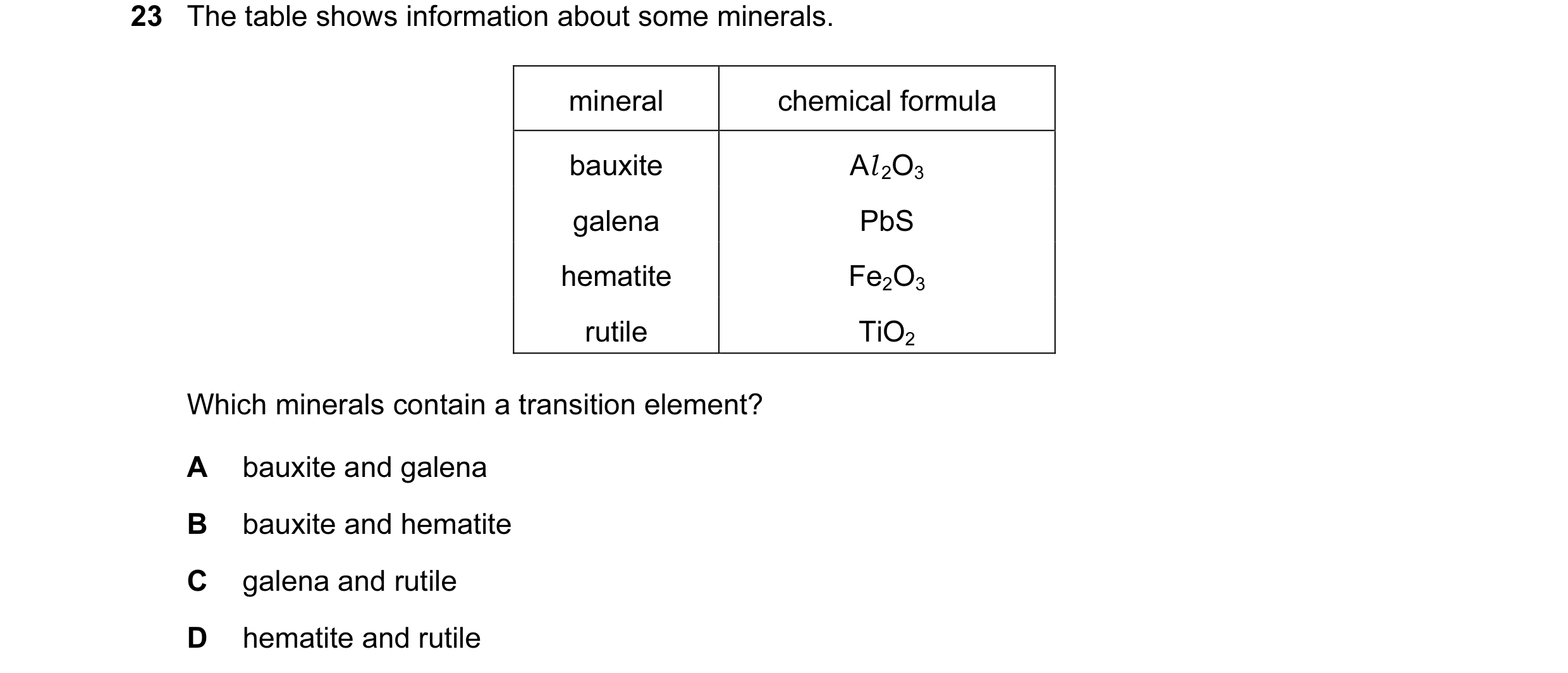
23 The table shows information about some minerals. mineral chemical formula bauxite Al 2O3 galena PbS hematite Fe2O3 rutile TiO2 Which minerals contain a transition element? A bauxite and galena B bauxite and hematite C galena and rutile D hematite and rutile
1 marks
Answer: D
This question in 0654/12 May/June 2015
Q11 · The table shows information about some minerals 0654/13 May/June 2015
23 The table shows information about some minerals. mineral chemical formula bauxite Al 2O3 galena PbS hematite Fe2O3 rutile TiO2 Which minerals contain a transition element? A bauxite and galena B bauxite and hematite C galena and rutile D hematite and rutile
1 marks
Answer: D
This question in 0654/13 May/June 2015
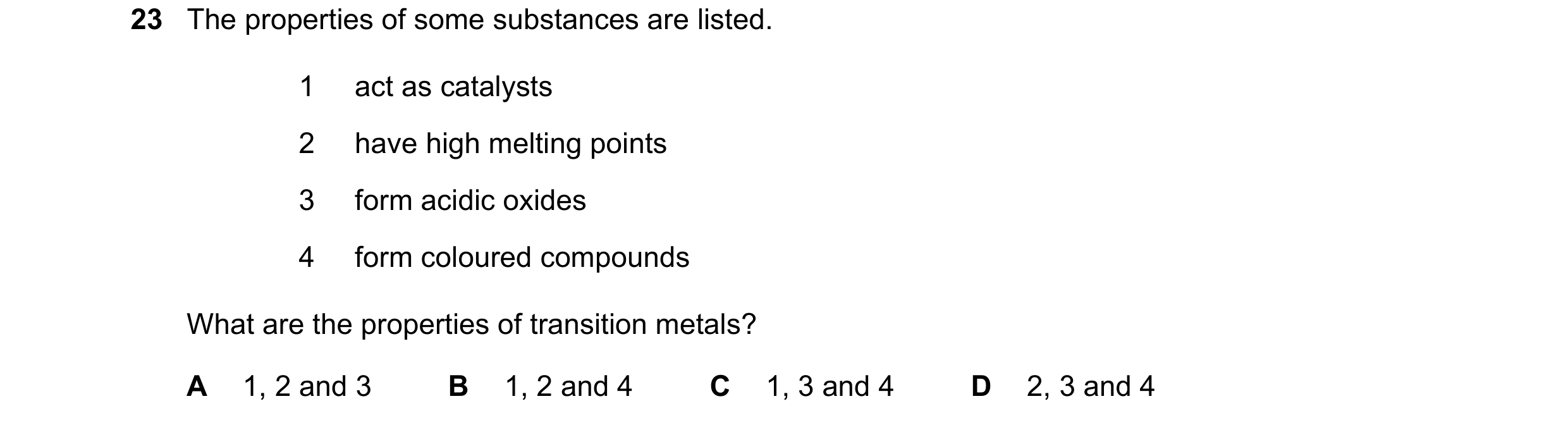
Q12 · The properties of some substances are listed 0654/12 Oct/Nov 2016
23 The properties of some substances are listed. 1 act as catalysts 2 have high melting points 3 form acidic oxides 4 form coloured compounds What are the properties of transition metals? A 1, 2 and 3 B 1, 2 and 4 C 1, 3 and 4 D 2, 3 and 4
1 marks
Answer: B
This question in 0654/12 Oct/Nov 2016
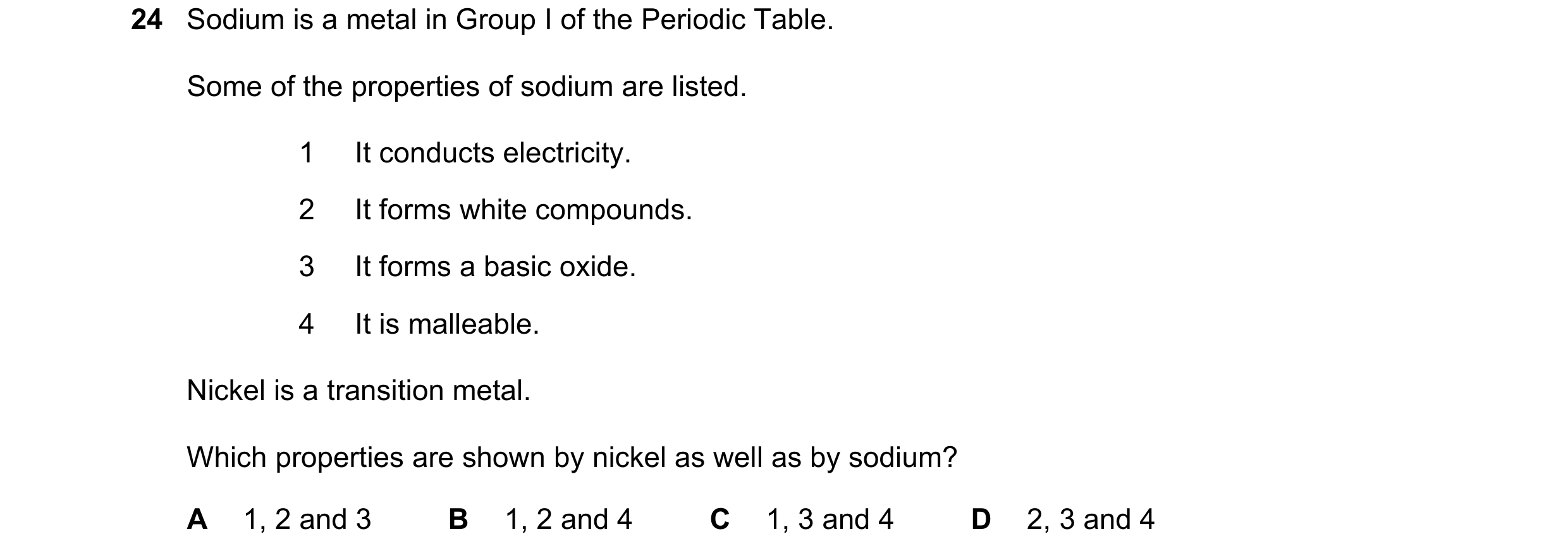
Q13 · Sodium is a metal in Group I of the Periodic Table 0654/12 Oct/Nov 2017
24 Sodium is a metal in Group I of the Periodic Table. Some of the properties of sodium are listed. 1 It conducts electricity. 2 It forms white compounds. 3 It forms a basic oxide. 4 It is malleable. Nickel is a transition metal. Which properties are shown by nickel as well as by sodium? A 1, 2 and 3 B 1, 2 and 4 C 1, 3 and 4 D 2, 3 and 4
1 marks
Answer: C
This question in 0654/12 Oct/Nov 2017
Q14 · Part of the Periodic Table is shown 0654/11 Oct/Nov 2018
22 Part of the Periodic Table is shown. The letters are not the symbols of the elements. Which element has a high density and forms coloured compounds? A B C D
1 marks
Answer: C
This question in 0654/11 Oct/Nov 2018
Q15 · Which statement describes a transition metal? 0654/13 Oct/Nov 2018
22 Which statement describes a transition metal? A It has a high melting point, high density and forms a blue coloured sulfate. B It has a high melting point, high density and forms a white coloured chloride. C It has a high melting point, low density and forms a yellow coloured sulfate. D It has a low melting point, low density and forms a white coloured nitrate.
1 marks
Answer: A
This question in 0654/13 Oct/Nov 2018
Q16 · What is a property of transition elements? 0654/11 May/June 2020
22 What is a property of transition elements? A They form coloured compounds. B They form diatomic molecules. C They have low densities. D They have low melting points.
1 marks
Answer: A
This question in 0654/11 May/June 2020
Q17 · Which property is not shown by transition elements? 0654/11 Oct/Nov 2020
22 Which property is not shown by transition elements? A They can act as catalysts. B They form coloured compounds. C They have high melting points. D They have low densities.
1 marks
Answer: D
This question in 0654/11 Oct/Nov 2020
Q18 · Which statement describes transition elements? 0654/12 Oct/Nov 2020
22 Which statement describes transition elements? A They form colourless compounds. B They have low densities. C They have low melting points. D They often act as catalysts.
1 marks
Answer: D
This question in 0654/12 Oct/Nov 2020
Q19 · Which elements in the Periodic Table form coloured compounds? 0654/12 Feb/March 2021
22 Which elements in the Periodic Table form coloured compounds? A Group I metals B halogens C noble gases D transition metals
1 marks
Answer: D
This question in 0654/12 Feb/March 2021
Q20 · Some properties of different metals are shown 0654/12 Oct/Nov 2021
21 Some properties of different metals are shown. density colour of compound melting point / C g / cm3 formed by the metal 1 1.54 851 white 2 8.91 1455 green 3 5.80 1890 lilac 4 11.3 328 white Which metals are transition elements? A 1 and 2 B 1 and 4 C 2 and 3 D 3 and 4
1 marks
Answer: C
This question in 0654/12 Oct/Nov 2021
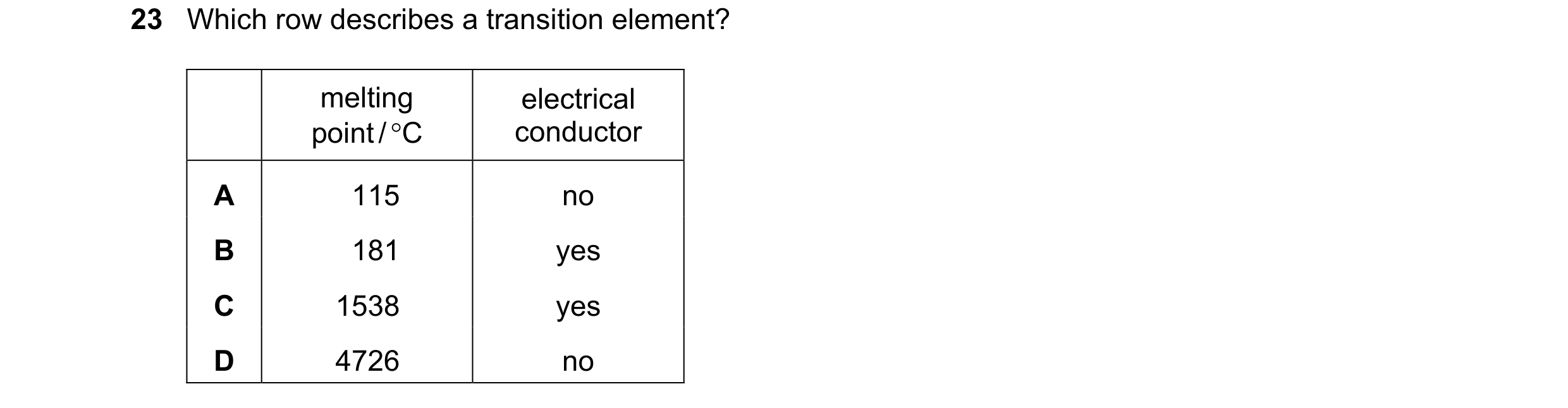
Q21 · Which row describes a transition element? 0654/12 May/June 2022
23 Which row describes a transition element? melting electrical point / C conductor A 115 no B 181 yes C 1538 yes D 4726 no
1 marks
Answer: C
This question in 0654/12 May/June 2022
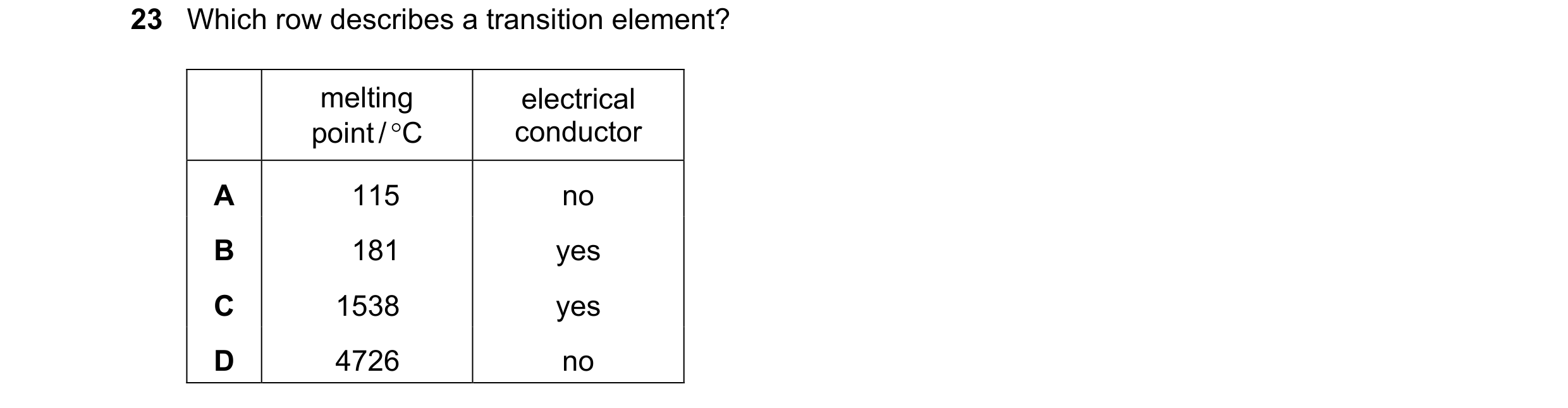
Q22 · Which row describes a transition element? 0654/13 May/June 2022
23 Which row describes a transition element? melting electrical point / C conductor A 115 no B 181 yes C 1538 yes D 4726 no
1 marks
Answer: C
This question in 0654/13 May/June 2022
Q23 · What is not a property of transition elements? 0654/13 Oct/Nov 2022
21 What is not a property of transition elements? A They often act as catalysts. B They form coloured compounds. C They have high densities. D They have low melting points.
1 marks
Answer: D
This question in 0654/13 Oct/Nov 2022
Q24 · The diagram shows overlapping circles into which different chemical formulae can be placed 0654/12 Feb/March 2023
22 The diagram shows overlapping circles into which different chemical formulae can be placed. is an forms a element basic oxide forms coloured ions Which formula can be placed in the shaded area because it has all three properties? A Br2 B CO C Cu D Na
1 marks
Answer: C
This question in 0654/12 Feb/March 2023
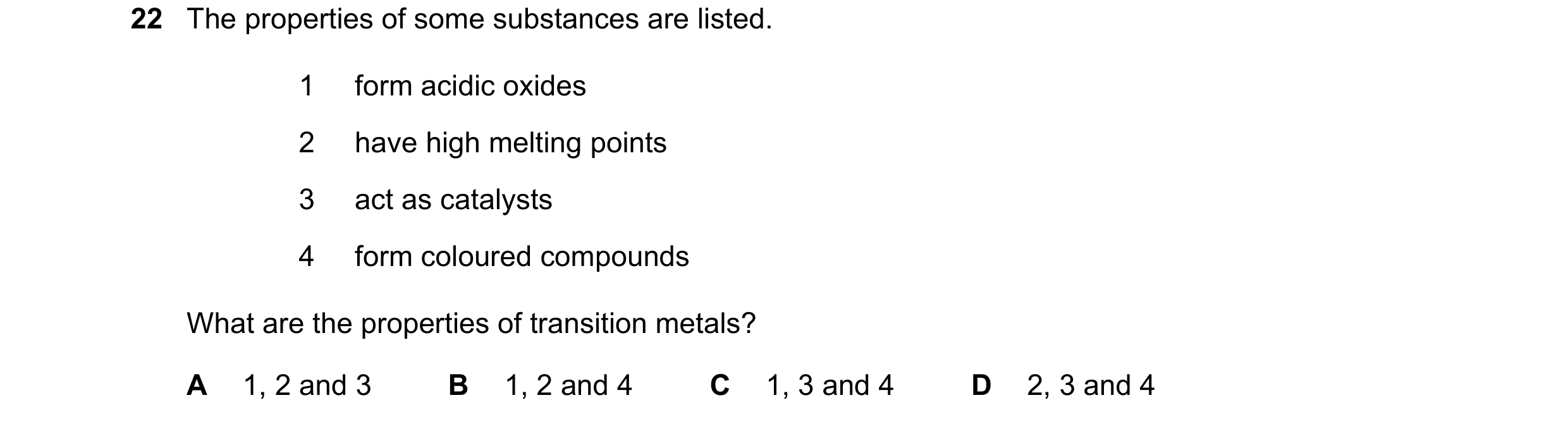
Q25 · The properties of some substances are listed 0654/11 May/June 2023
22 The properties of some substances are listed. 1 form acidic oxides 2 have high melting points 3 act as catalysts 4 form coloured compounds What are the properties of transition metals? A 1, 2 and 3 B 1, 2 and 4 C 1, 3 and 4 D 2, 3 and 4
1 marks
Answer: D
This question in 0654/11 May/June 2023
Q26 · The box lists four substances 0654/12 May/June 2023
22 The box lists four substances. Br2 CO Cu Na Which substance is an element that forms a basic oxide and coloured compounds? A Br2 B CO C Cu D Na
1 marks
Answer: C
This question in 0654/12 May/June 2023
Q27 · The box lists four substances 0654/13 May/June 2023
22 The box lists four substances. Br2 CO Cu Na Which substance is an element that forms a basic oxide and coloured compounds? A Br2 B CO C Cu D Na
1 marks
Answer: C
This question in 0654/13 May/June 2023
Q28 · Element X increases the rate of some reactions 0654/12 Feb/March 2024
23 Element X increases the rate of some reactions. Element X is unchanged at the end of these reactions. What is the position of element X in the Periodic Table? I II III IV V VI VII 0 B C A D
1 marks
Answer: D
This question in 0654/12 Feb/March 2024
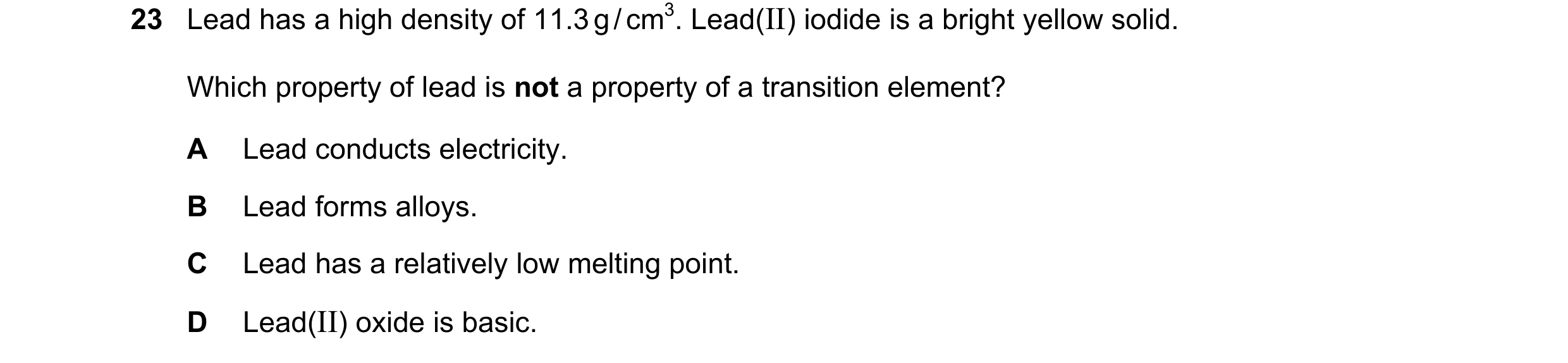
Q29 · Lead has a high density of 11.3 g / cm3 0654/11 May/June 2024
23 Lead has a high density of 11.3 g / cm3. Lead(II) iodide is a bright yellow solid. Which property of lead is not a property of a transition element? A Lead conducts electricity. B Lead forms alloys. C Lead has a relatively low melting point. D Lead(II) oxide is basic.
1 marks
Answer: C
This question in 0654/11 May/June 2024
Q30 · Manganese is a transition element 0654/12 May/June 2024
23 Manganese is a transition element. What is a property of manganese? A high melting point B low density C thermal insulator D transparent
1 marks
Answer: A
This question in 0654/12 May/June 2024
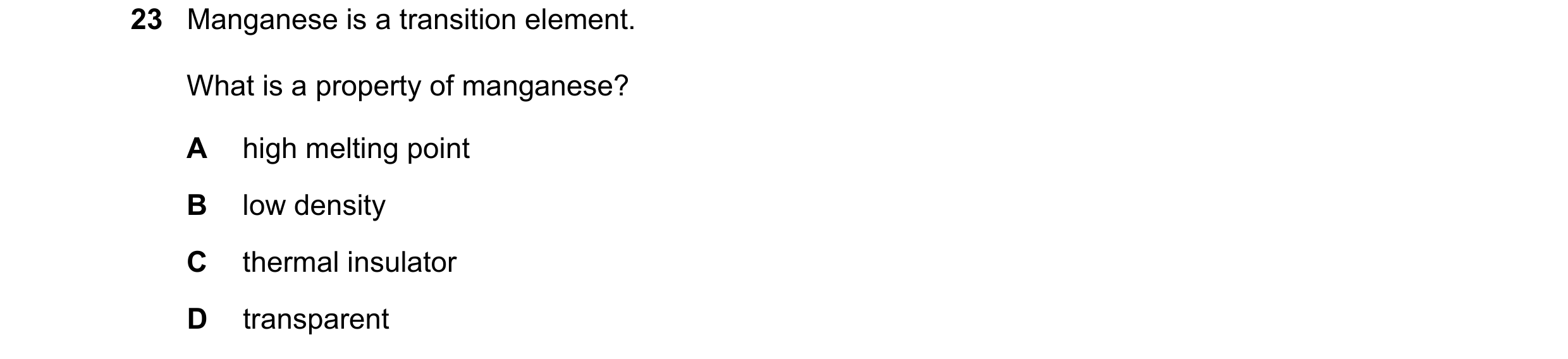
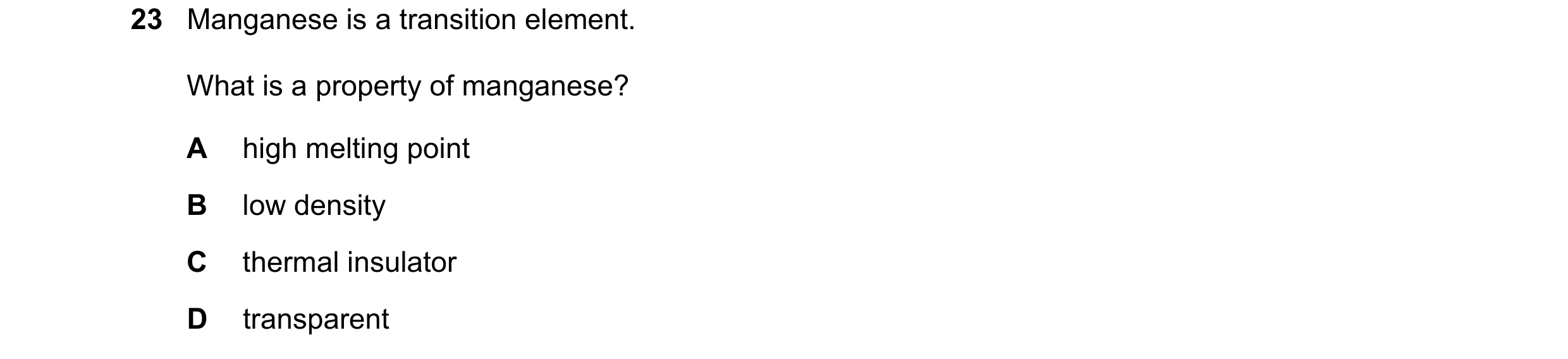
Q31 · Manganese is a transition element 0654/13 May/June 2024
23 Manganese is a transition element. What is a property of manganese? A high melting point B low density C thermal insulator D transparent
1 marks
Answer: A
This question in 0654/13 May/June 2024
Q32 · What is not a property of transition elements? 0654/11 Oct/Nov 2024
24 What is not a property of transition elements? A form coloured compounds B good electrical conductivity C high melting point D low density
1 marks
Answer: D
This question in 0654/11 Oct/Nov 2024
Q33 · Which element causes a compound to be coloured? 0654/12 May/June 2025
18 Which element causes a compound to be coloured? A a Group I element B a Group II element C a Group VIII element D a transition element
1 marks
Answer: D
This question in 0654/12 May/June 2025
Q34 · Which element causes a compound to be coloured? 0654/13 May/June 2025
18 Which element causes a compound to be coloured? A a Group I element B a Group II element C a Group VIII element D a transition element
1 marks
Answer: D
This question in 0654/13 May/June 2025
 1 / 9
1 / 9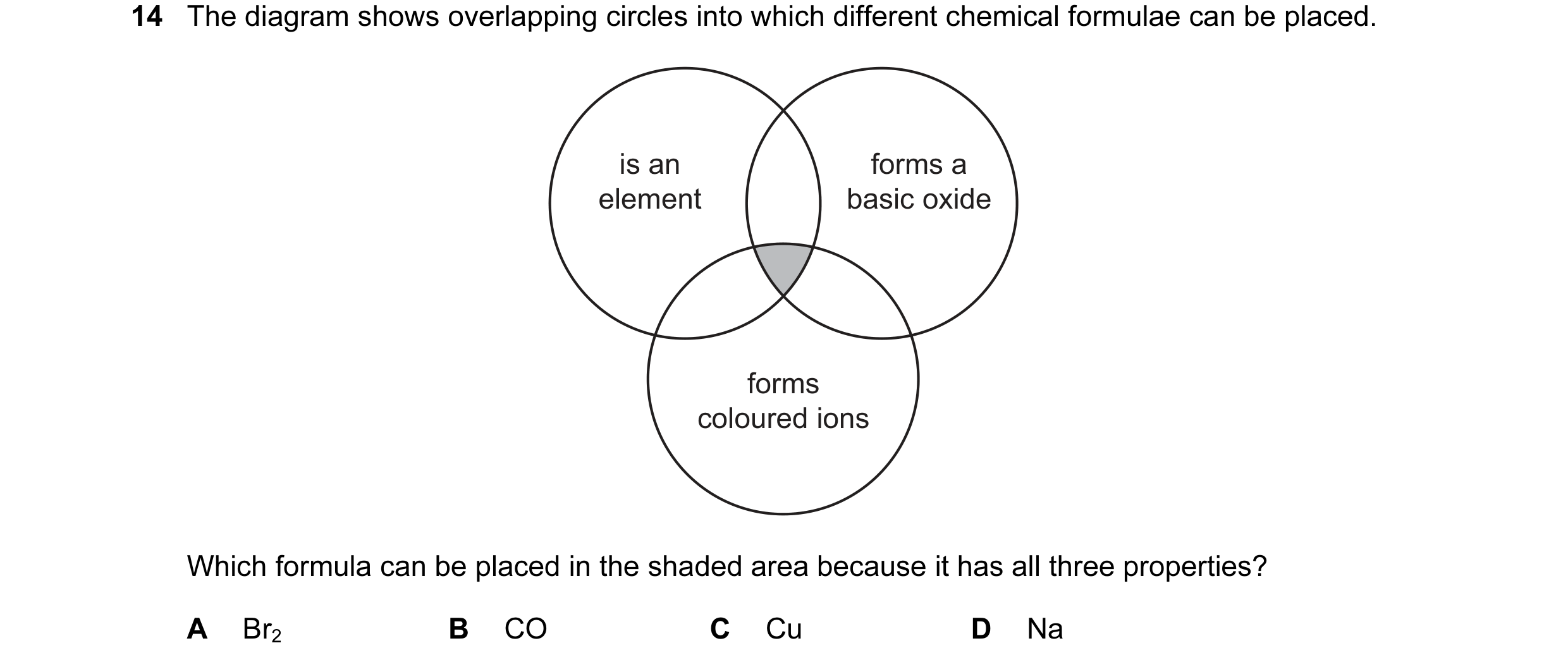

 2 / 9
2 / 9
 3 / 9
3 / 9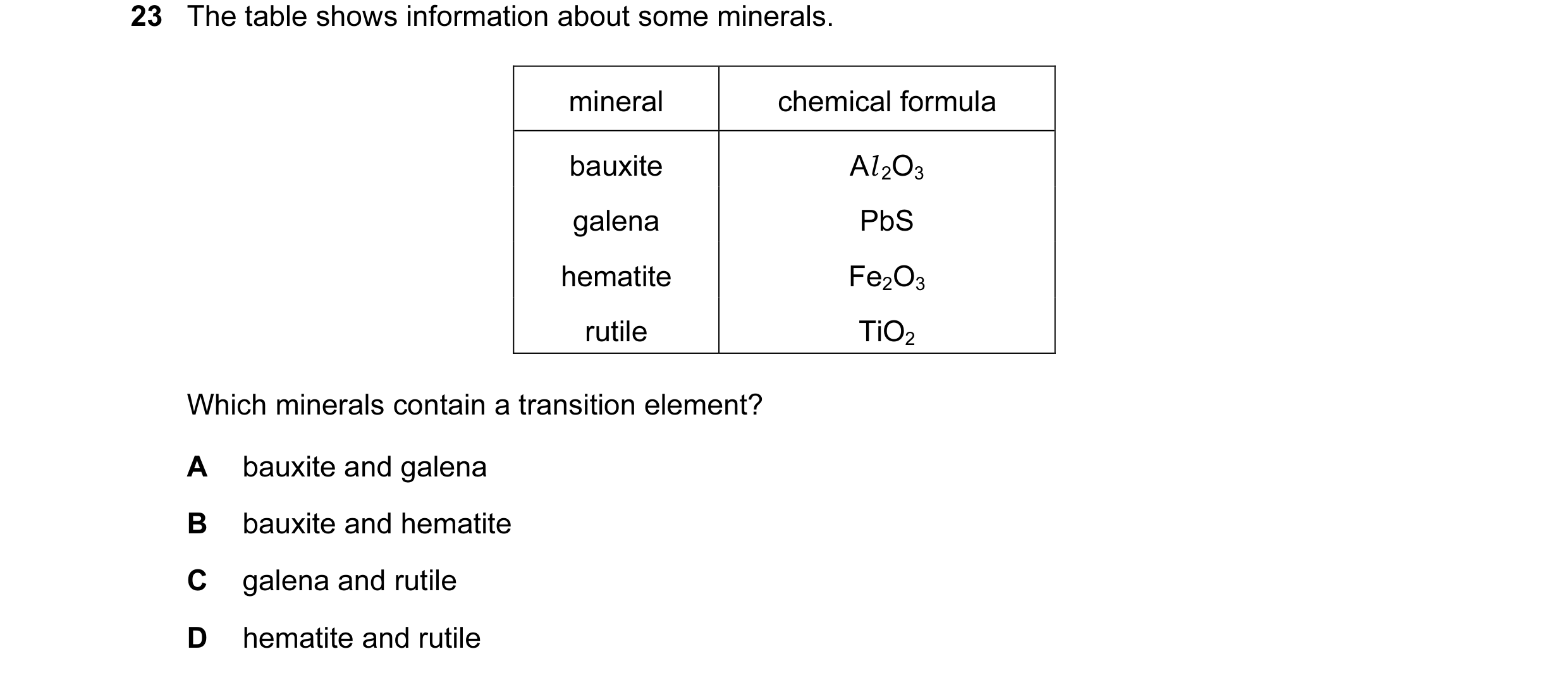
 4 / 9
4 / 9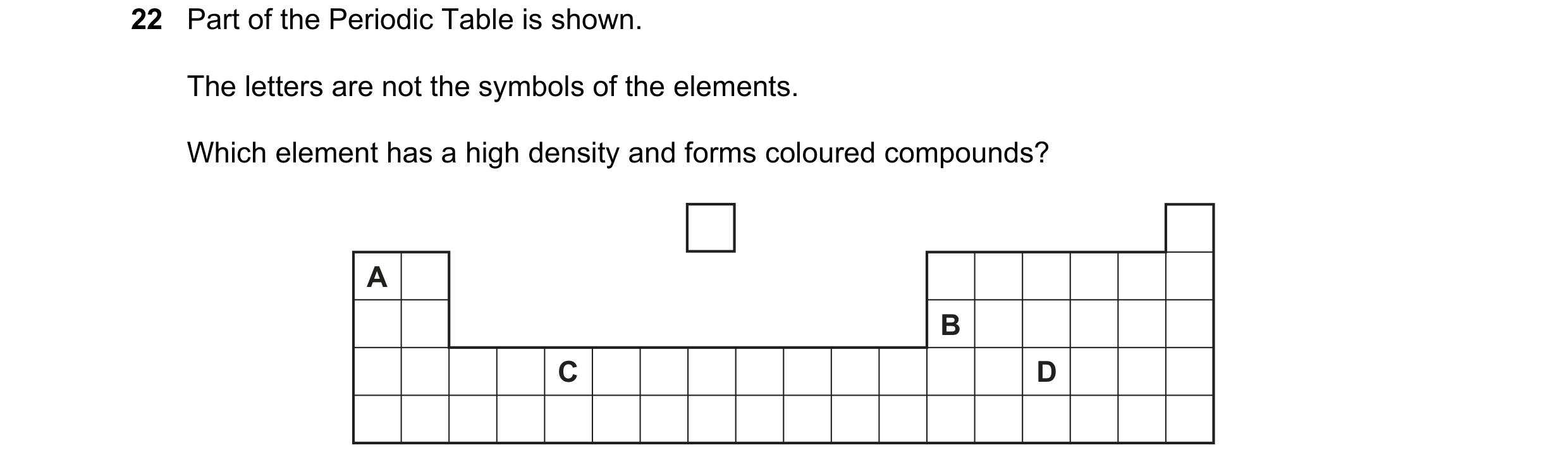




 5 / 9
5 / 9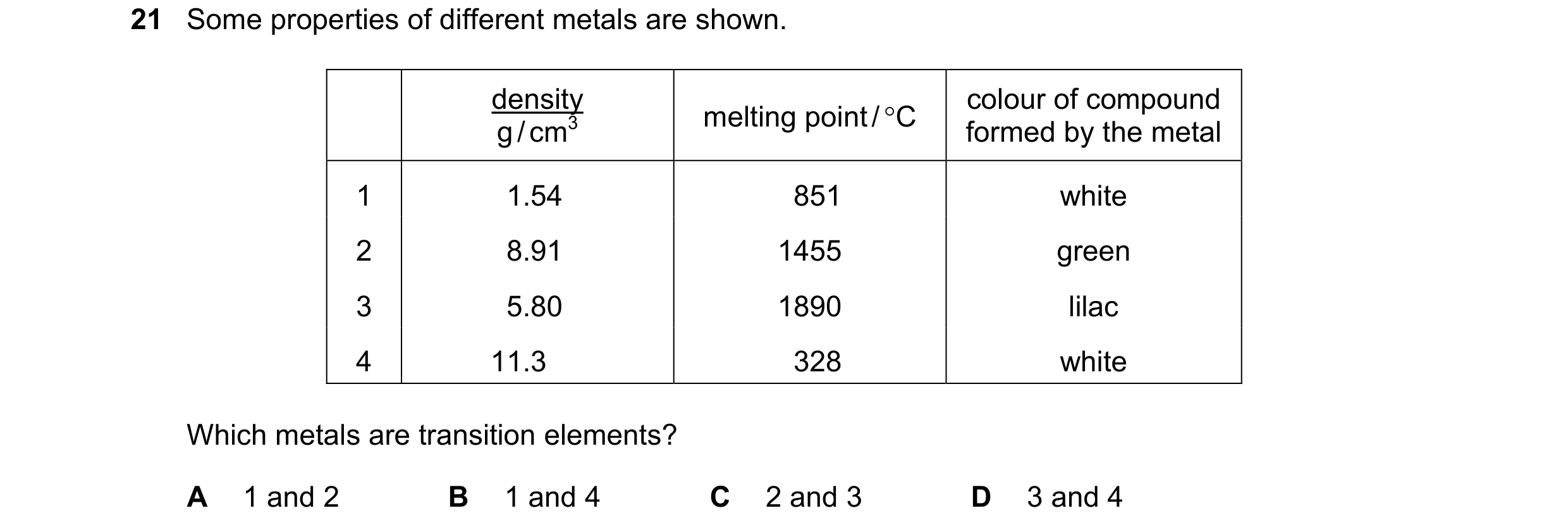
 6 / 9
6 / 9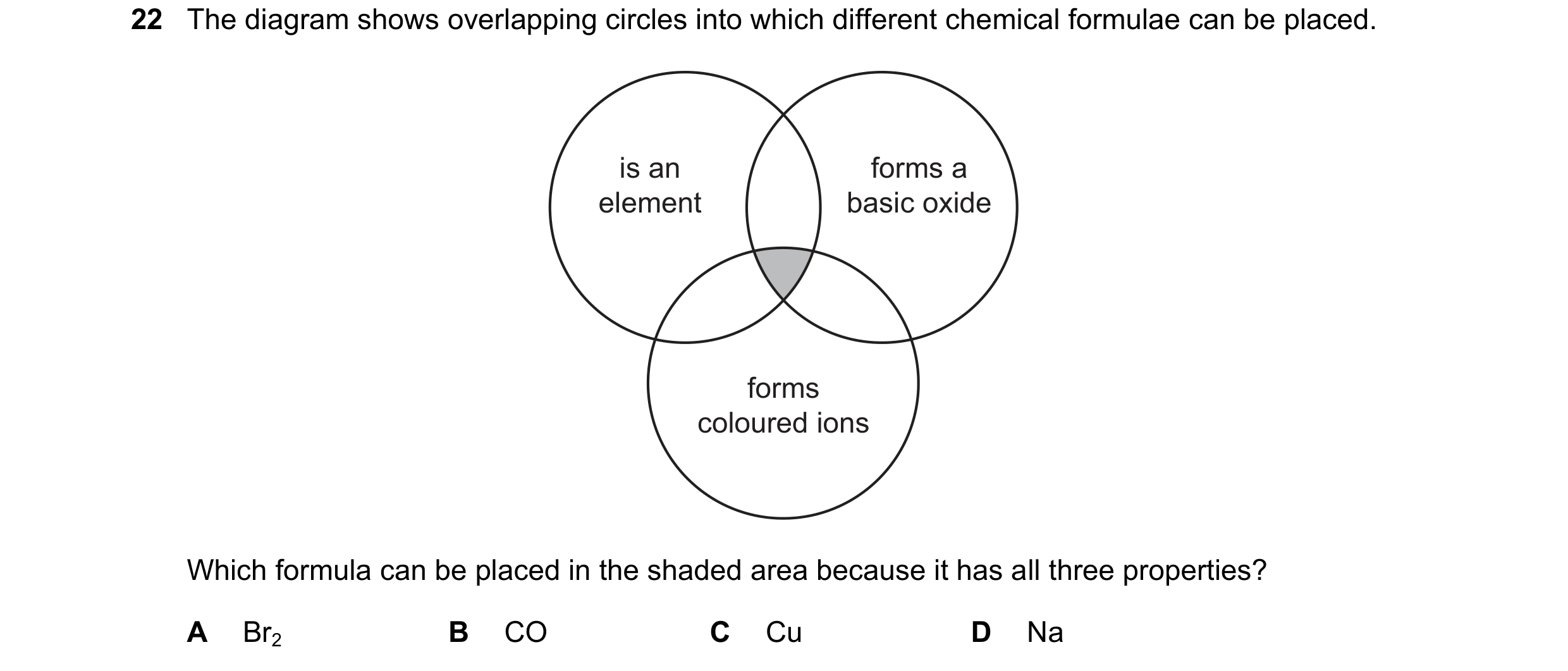

 7 / 9
7 / 9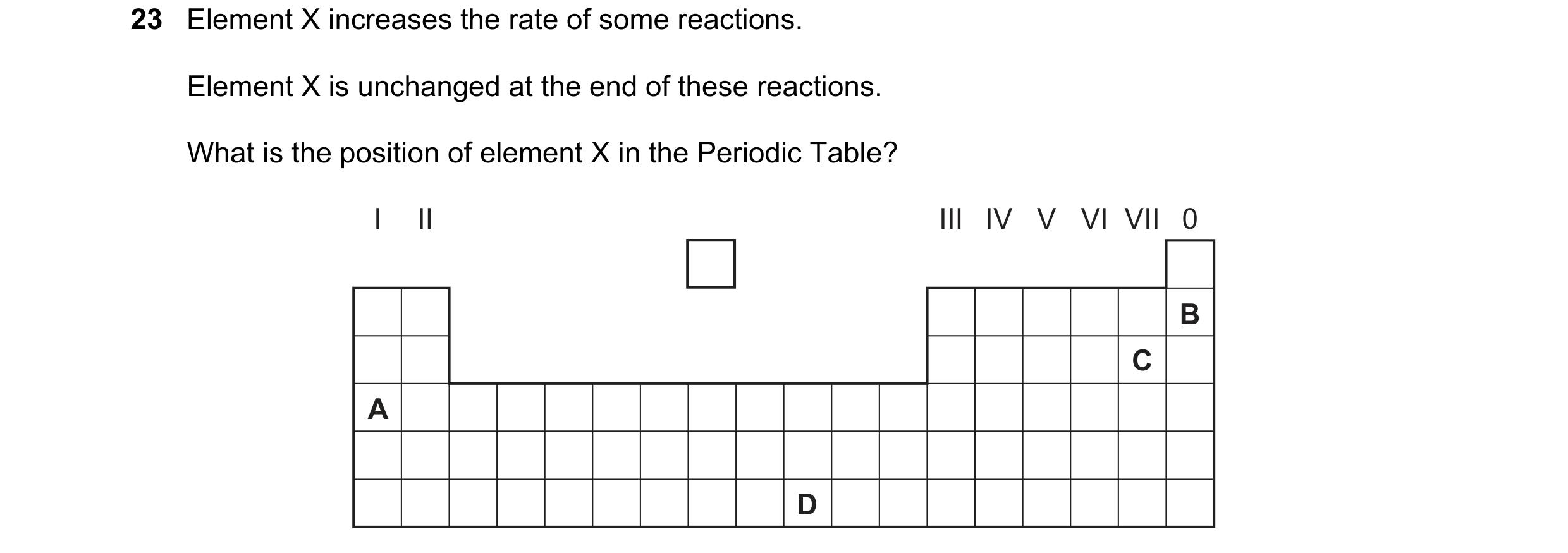
 8 / 9
8 / 9
 9 / 9
9 / 9