Questions as text
Q1 · In which industrial process is sulfuric acid made? 0654/21 May/June 2017
20 In which industrial process is sulfuric acid made? A the catalytic cracking of alkanes B the Contact process C the production of iron D the thermal decomposition of limestone
1 marks
Answer: B
This question in 0654/21 May/June 2017
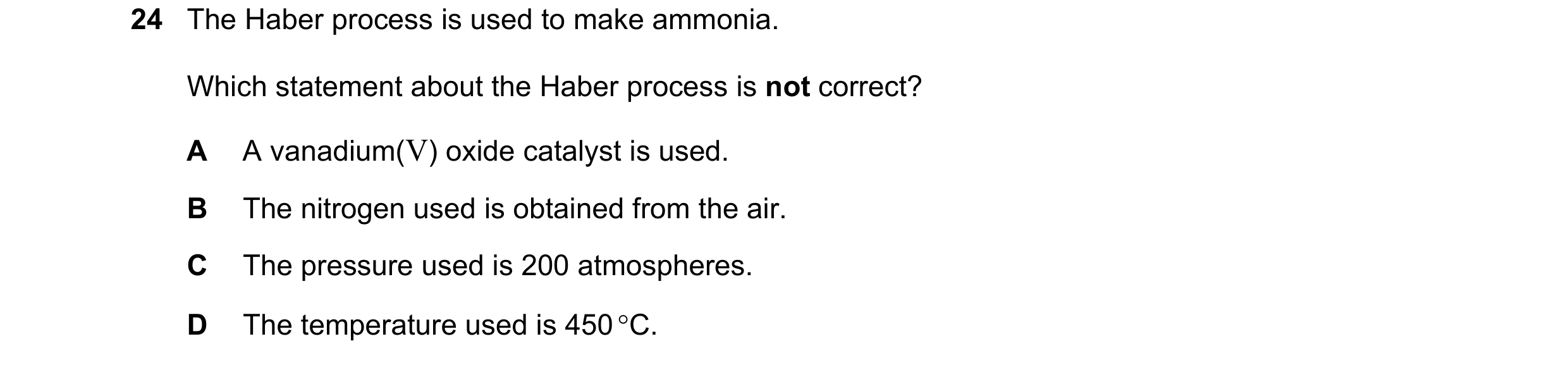
Q2 · The Haber process is used to make ammonia 0654/21 May/June 2017
24 The Haber process is used to make ammonia. Which statement about the Haber process is not correct? A A vanadium(V) oxide catalyst is used. B The nitrogen used is obtained from the air. C The pressure used is 200 atmospheres. D The temperature used is 450 °C.
1 marks
Answer: A
This question in 0654/21 May/June 2017
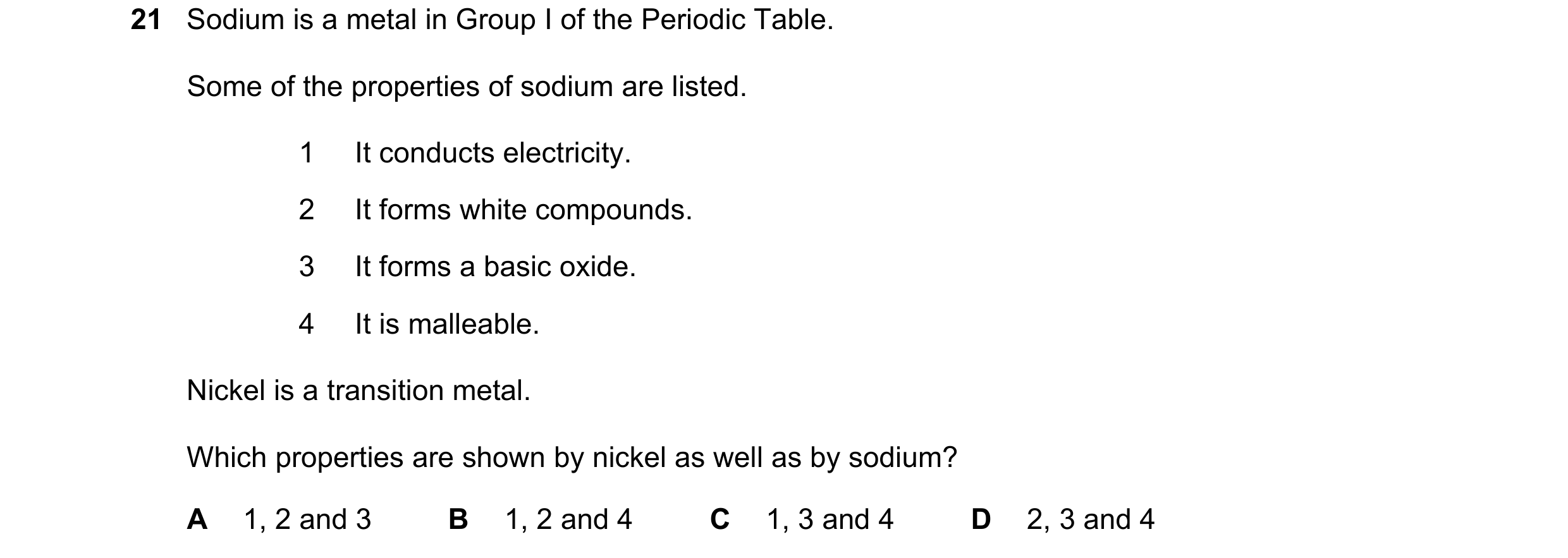
Q3 · Sodium is a metal in Group I of the Periodic Table 0654/22 Oct/Nov 2017
21 Sodium is a metal in Group I of the Periodic Table. Some of the properties of sodium are listed. 1 It conducts electricity. 2 It forms white compounds. 3 It forms a basic oxide. 4 It is malleable. Nickel is a transition metal. Which properties are shown by nickel as well as by sodium? A 1, 2 and 3 B 1, 2 and 4 C 1, 3 and 4 D 2, 3 and 4
1 marks
Answer: C
This question in 0654/22 Oct/Nov 2017
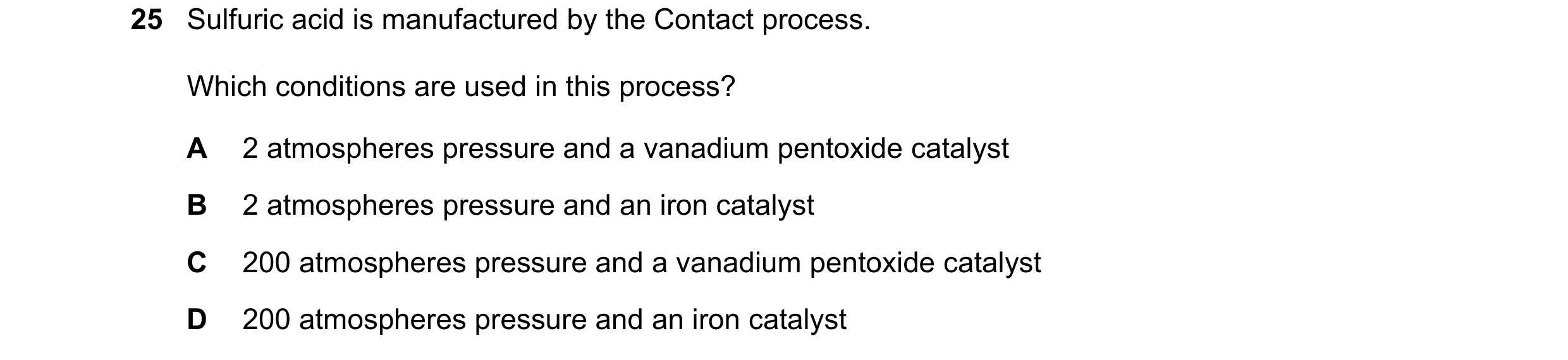
Q4 · Sulfuric acid is manufactured by the Contact process 0654/21 Oct/Nov 2018
25 Sulfuric acid is manufactured by the Contact process. Which conditions are used in this process? A 2 atmospheres pressure and a vanadium pentoxide catalyst B 2 atmospheres pressure and an iron catalyst C 200 atmospheres pressure and a vanadium pentoxide catalyst D 200 atmospheres pressure and an iron catalyst
1 marks
Answer: A
This question in 0654/21 Oct/Nov 2018
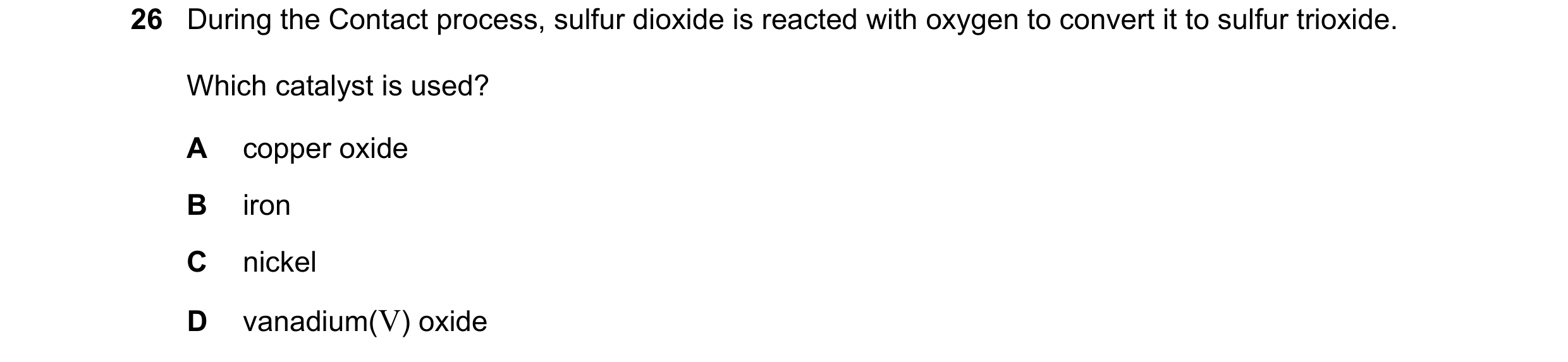
Q5 · During the Contact process, sulfur dioxide is reacted with oxygen to convert it to sulfur… 0654/21 Oct/Nov 2019
26 During the Contact process, sulfur dioxide is reacted with oxygen to convert it to sulfur trioxide. Which catalyst is used? A copper oxide B iron C nickel D vanadium(V) oxide
1 marks
Answer: D
This question in 0654/21 Oct/Nov 2019
Q6 · The Contact process is used to manufacture sulfuric acid 0654/21 Oct/Nov 2020
25 The Contact process is used to manufacture sulfuric acid. Which statement about the Contact process is not correct? A A nickel catalyst is used. B Sulfur dioxide reacts with oxygen to form sulfur trioxide. C Sulfur burns to form sulfur dioxide. D Sulfur trioxide dissolves in concentrated sulfuric acid to form oleum.
1 marks
Answer: A
This question in 0654/21 Oct/Nov 2020
Q7 · The Contact process is used to manufacture sulfuric acid 0654/22 Oct/Nov 2020
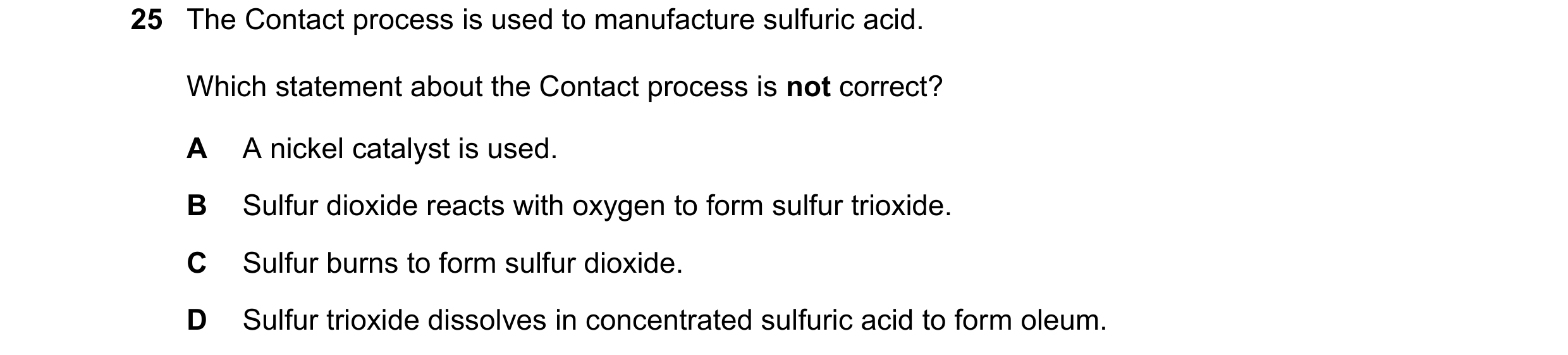
25 The Contact process is used to manufacture sulfuric acid. Which statement about the Contact process is not correct? A A nickel catalyst is used. B Sulfur dioxide reacts with oxygen to form sulfur trioxide. C Sulfur burns to form sulfur dioxide. D Sulfur trioxide dissolves in concentrated sulfuric acid to form oleum.
1 marks
Answer: A
This question in 0654/22 Oct/Nov 2020
Q8 · Which elements in the Periodic Table form coloured compounds? 0654/22 Feb/March 2021
23 Which elements in the Periodic Table form coloured compounds? A Group I metals B halogens C noble gases D transition metals
1 marks
Answer: D
This question in 0654/22 Feb/March 2021
Q9 · Which row about the Contact process is correct? 0654/21 May/June 2021
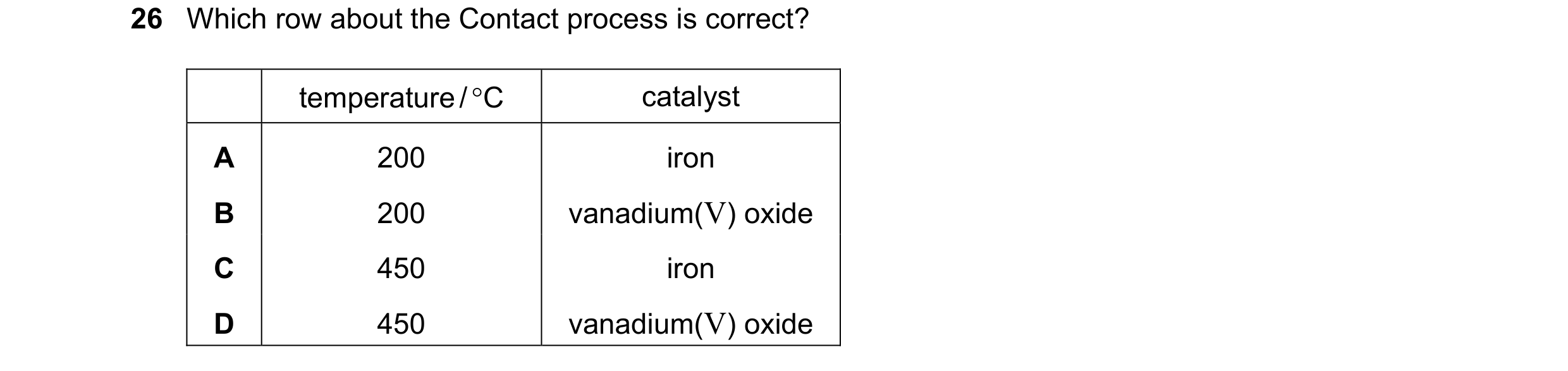
26 Which row about the Contact process is correct? temperature / C catalyst A 200 iron B 200 vanadium(V) oxide C 450 iron D 450 vanadium(V) oxide
1 marks
Answer: D
This question in 0654/21 May/June 2021
Q10 · Which row about the Contact process is correct? 0654/23 May/June 2021
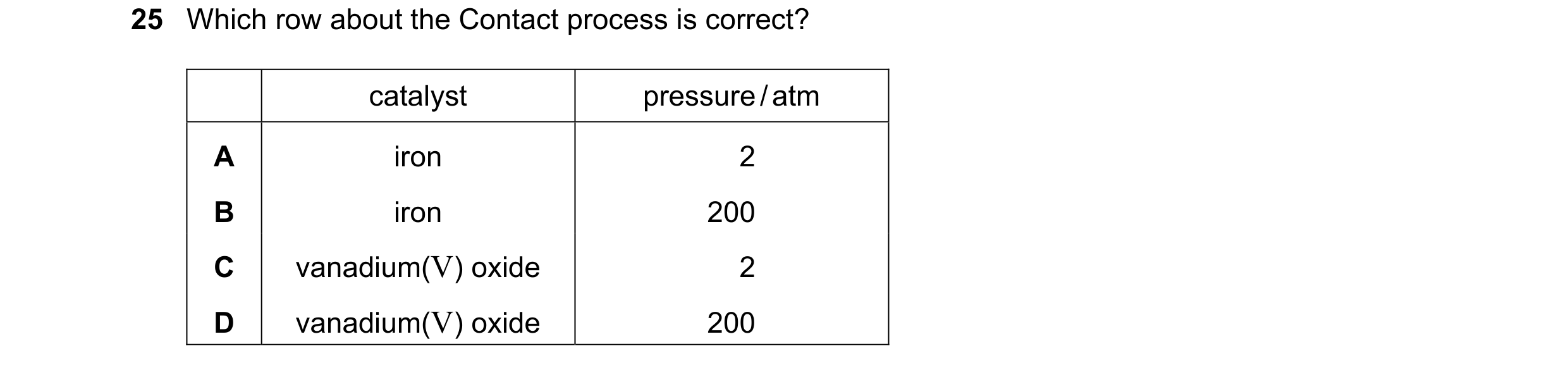
25 Which row about the Contact process is correct? catalyst pressure / atm A iron 2 B iron 200 C vanadium(V) oxide 2 D vanadium(V) oxide 200
1 marks
Answer: C
This question in 0654/23 May/June 2021
Q11 · Some properties of different metals are shown 0654/22 Oct/Nov 2021
21 Some properties of different metals are shown. density colour of compound melting point / C g / cm3 formed by the metal 1 1.54 851 white 2 8.91 1455 green 3 5.80 1890 lilac 4 11.3 328 white Which metals are transition elements? A 1 and 2 B 1 and 4 C 2 and 3 D 3 and 4
1 marks
Answer: C
This question in 0654/22 Oct/Nov 2021
Q12 · What is not a property of transition elements? 0654/23 Oct/Nov 2022
21 What is not a property of transition elements? A They often act as catalysts. B They form coloured compounds. C They have high densities. D They have low melting points.
1 marks
Answer: D
This question in 0654/23 Oct/Nov 2022
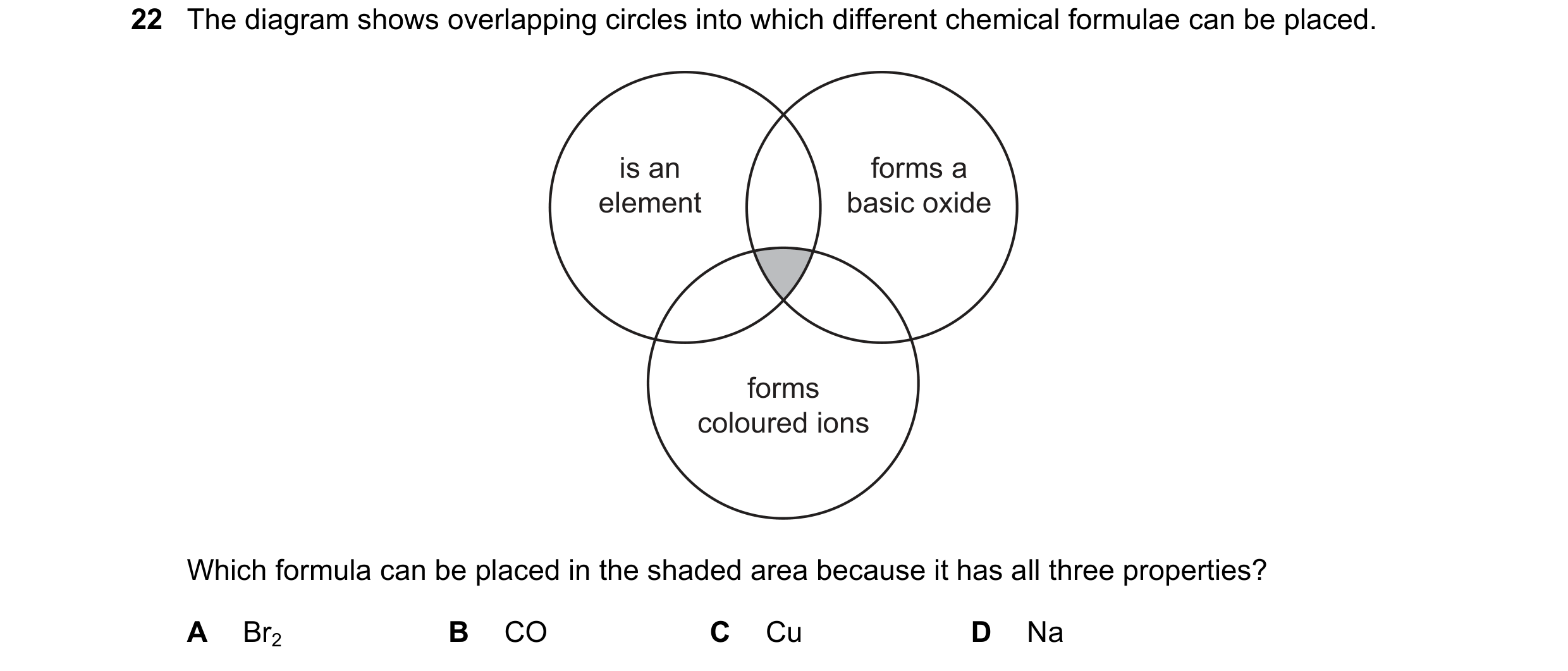
Q13 · The diagram shows overlapping circles into which different chemical formulae can be placed 0654/22 Feb/March 2023
22 The diagram shows overlapping circles into which different chemical formulae can be placed. is an forms a element basic oxide forms coloured ions Which formula can be placed in the shaded area because it has all three properties? A Br2 B CO C Cu D Na
1 marks
Answer: C
This question in 0654/22 Feb/March 2023
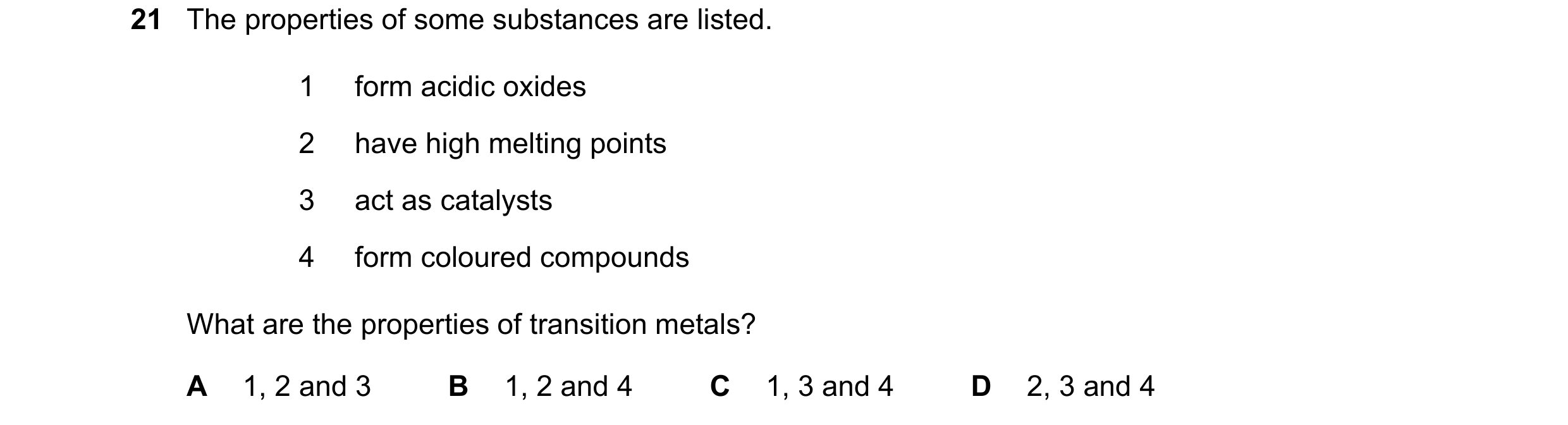
Q14 · The properties of some substances are listed 0654/21 May/June 2023
21 The properties of some substances are listed. 1 form acidic oxides 2 have high melting points 3 act as catalysts 4 form coloured compounds What are the properties of transition metals? A 1, 2 and 3 B 1, 2 and 4 C 1, 3 and 4 D 2, 3 and 4
1 marks
Answer: D
This question in 0654/21 May/June 2023
Q15 · The box lists four substances 0654/22 May/June 2023
21 The box lists four substances. Br2 CO Cu Na Which substance is an element that forms a basic oxide and coloured compounds? A Br2 B CO C Cu D Na
1 marks
Answer: C
This question in 0654/22 May/June 2023
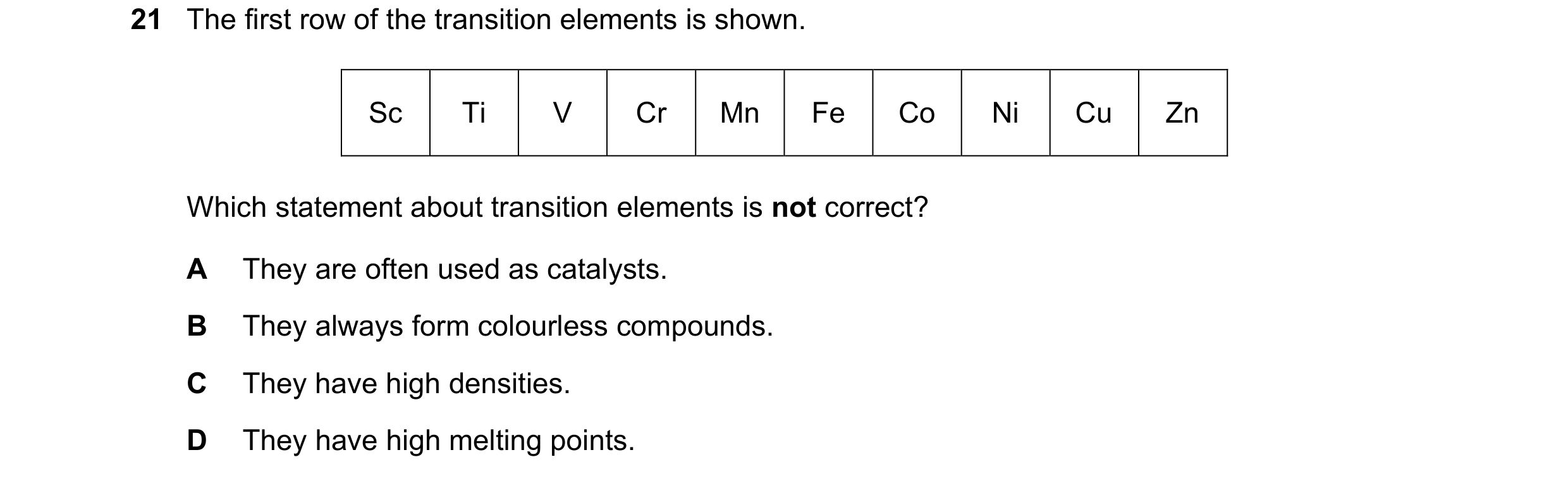
Q16 · The first row of the transition elements is shown 0654/23 May/June 2023
21 The first row of the transition elements is shown. Sc Ti V Cr Mn Fe Co Ni Cu Zn Which statement about transition elements is not correct? A They are often used as catalysts. B They always form colourless compounds. C They have high densities. D They have high melting points.
1 marks
Answer: B
This question in 0654/23 May/June 2023
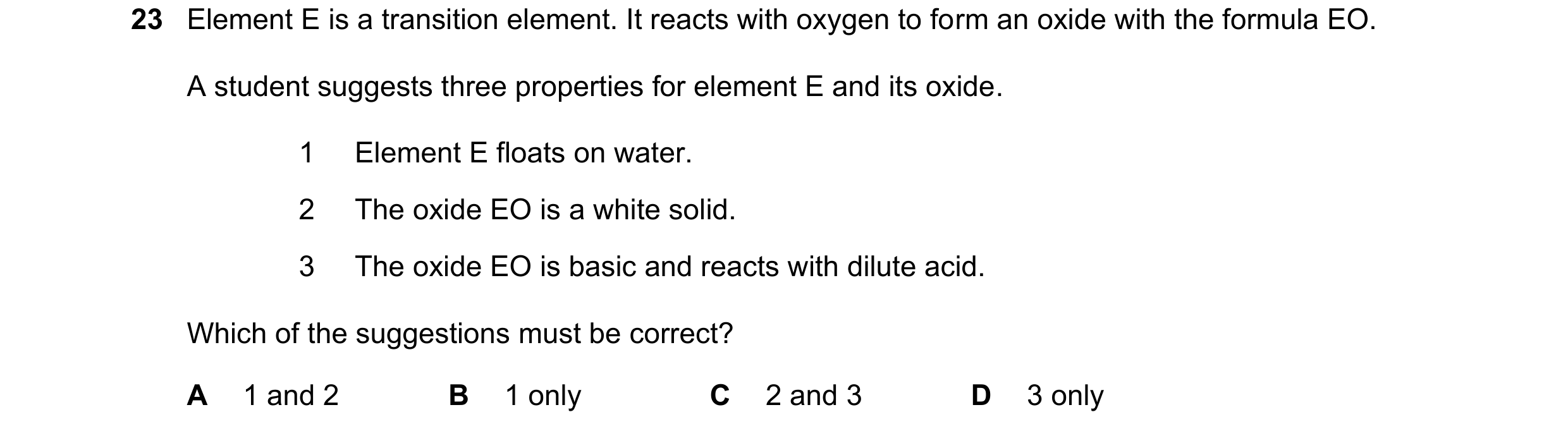
Q17 · Element E is a transition element 0654/22 Feb/March 2024
23 Element E is a transition element. It reacts with oxygen to form an oxide with the formula EO. A student suggests three properties for element E and its oxide. 1 Element E floats on water. 2 The oxide EO is a white solid. 3 The oxide EO is basic and reacts with dilute acid. Which of the suggestions must be correct? A 1 and 2 B 1 only C 2 and 3 D 3 only
1 marks
Answer: D
This question in 0654/22 Feb/March 2024
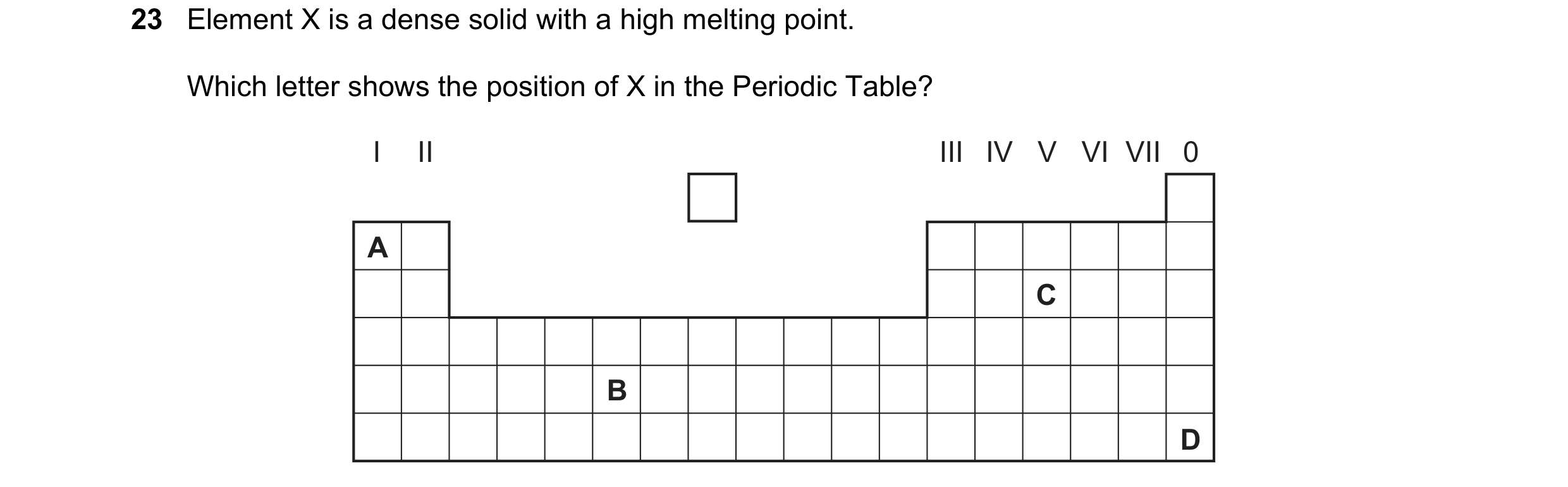
Q18 · Element X is a dense solid with a high melting point 0654/21 May/June 2024
23 Element X is a dense solid with a high melting point. Which letter shows the position of X in the Periodic Table? I II III IV V VI VII 0 A C B D
1 marks
Answer: B
This question in 0654/21 May/June 2024
Q19 · Copper is a transition element 0654/22 May/June 2024
21 Copper is a transition element. Which row shows two properties of copper? property 1 property 2 A high melting point forms coloured compounds B high melting point forms white compounds C low melting point forms coloured compounds D low melting point forms white compounds
1 marks
Answer: A
This question in 0654/22 May/June 2024
Q20 · Which statement describes a typical transition element? 0654/23 Oct/Nov 2024
23 Which statement describes a typical transition element? A It has a high melting point, high density and forms a coloured salt. B It has a high melting point, low density and forms a white salt. C It has a low melting point, low density and forms a coloured salt. D It has a low melting point, high density and forms a white salt.
1 marks
Answer: A
This question in 0654/23 Oct/Nov 2024

 1 / 5
1 / 5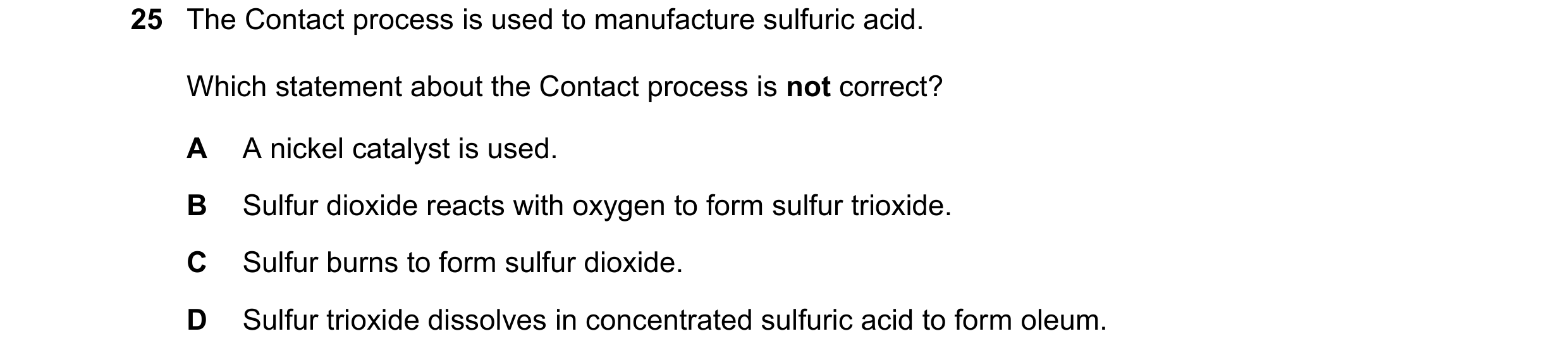

 2 / 5
2 / 5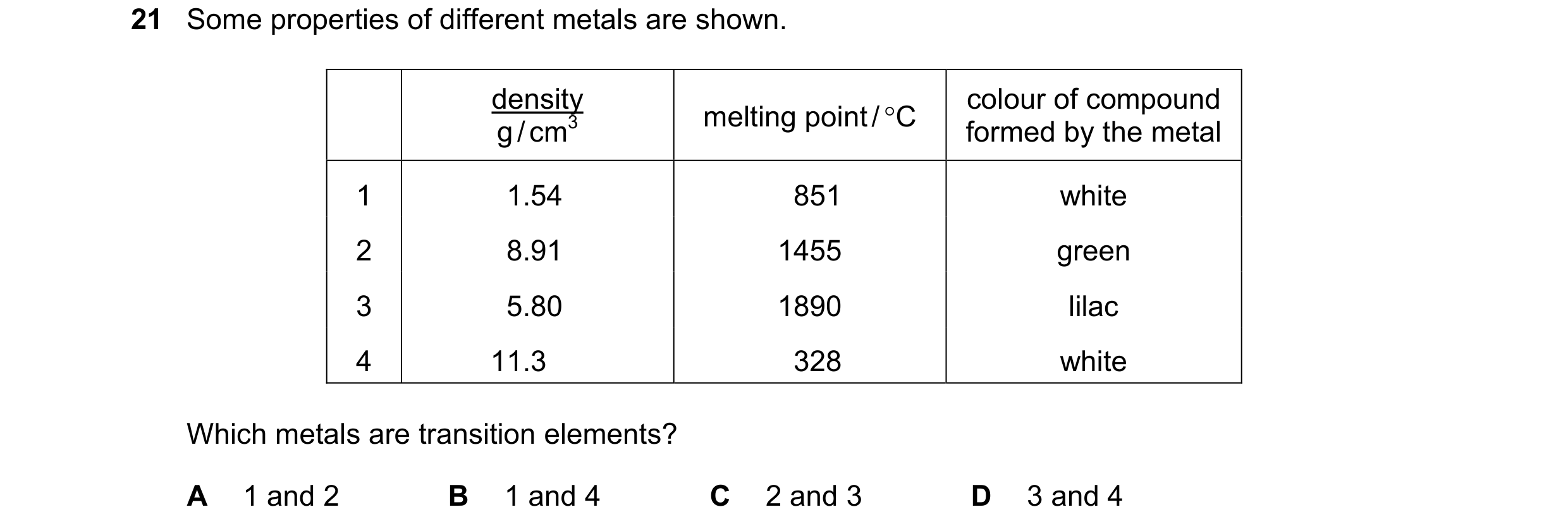

 3 / 5
3 / 5
 4 / 5
4 / 5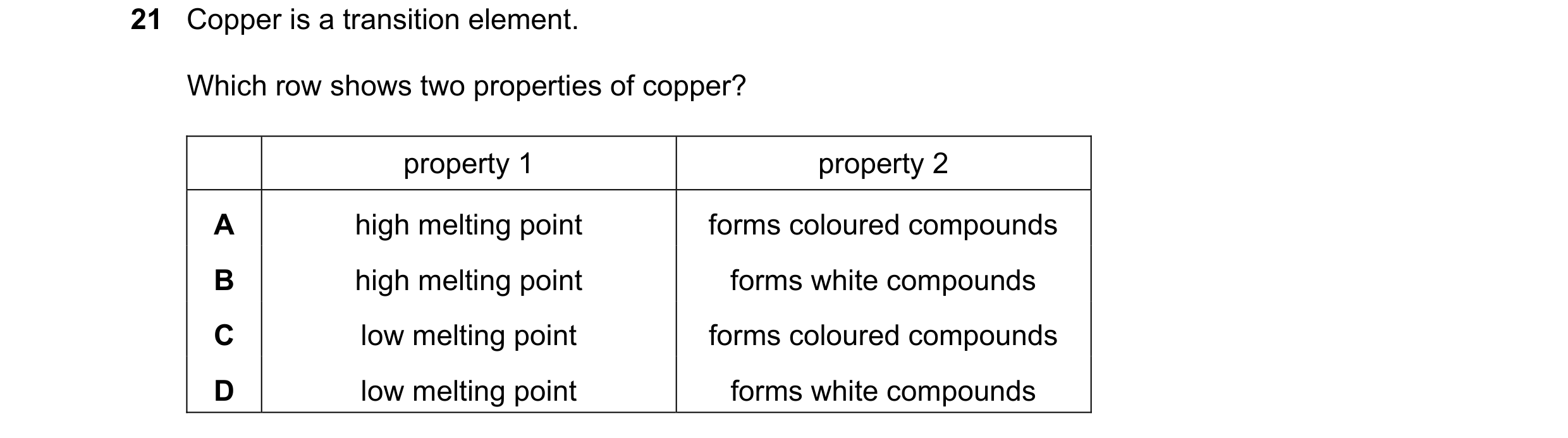
 5 / 5
5 / 5