Questions as text
Q1 · The structure of a molecule of an alkane 0654/32 Oct/Nov 2017
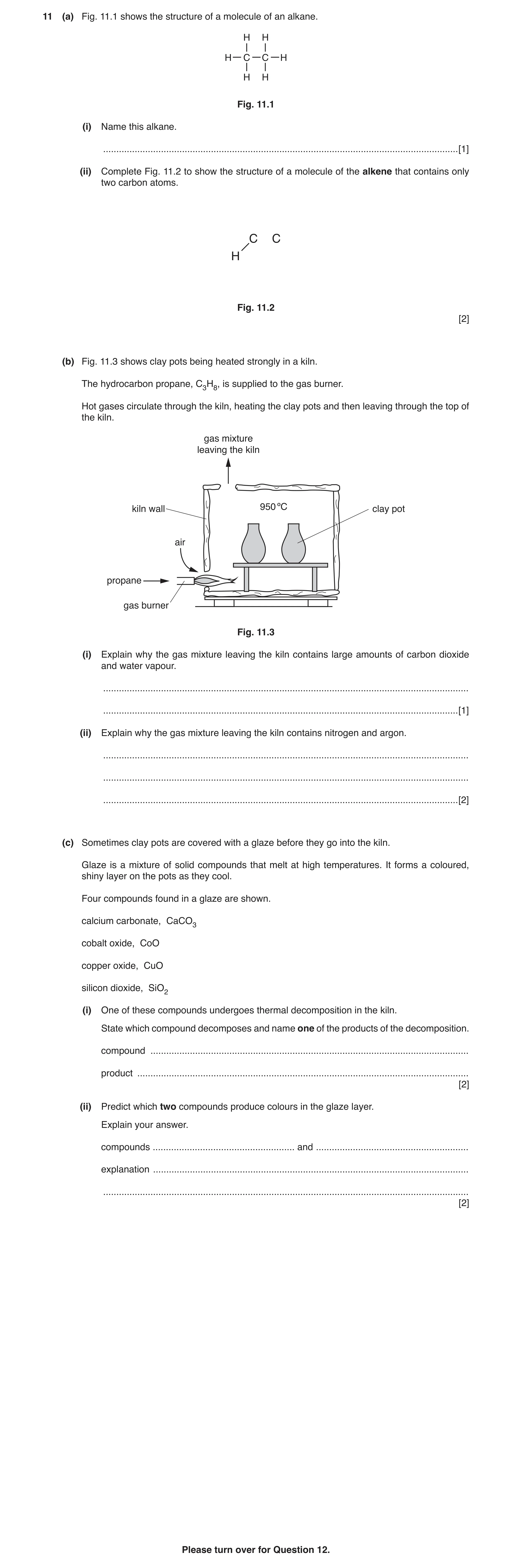
11 (a) Fig. 11.1 shows the structure of a molecule of an alkane. H H H C C H H H Fig. 11.1 (i) Name this alkane. … [1] (ii) Complete Fig. 11.2 to show the structure of a molecule of the alkene that contains only two carbon atoms. C C H Fig. 11.2 [2] (b) Fig. 11.3 shows clay pots being heated strongly in a kiln. The hydrocarbon propane, C3H8, is supplied to the gas burner. Hot gases circulate through the kiln, heating the clay pots and then leaving through the top of the kiln. gas mixture leaving the kiln kiln wall 950 ºC clay pot air propane gas burner Fig. 11.3 (i) Explain why the gas mixture leaving the kiln contains large amounts of carbon dioxide and water vapour. … … [1] (ii) Explain why the gas mixture leaving the kiln contains nitrogen and argon. … … … [2] (c) Sometimes clay pots are covered with a glaze before they go into the kiln. Glaze is a mixture of solid compounds that melt at high temperatures. It forms a coloured, shiny layer on the pots as they cool. Four compounds found in a glaze are shown. calcium carbonate, CaCO3 cobalt oxide, CoO copper oxide, CuO silicon dioxide, SiO2 (i) One of these compounds undergoes thermal decomposition in the kiln. State which compound decomposes and name one of the products of the decomposition. compound … product … [2] (ii) Predict which two compounds produce colours in the glaze layer. Explain your answer. compounds … and … explanation … … [2] Please turn over for Question 12.
10 marks
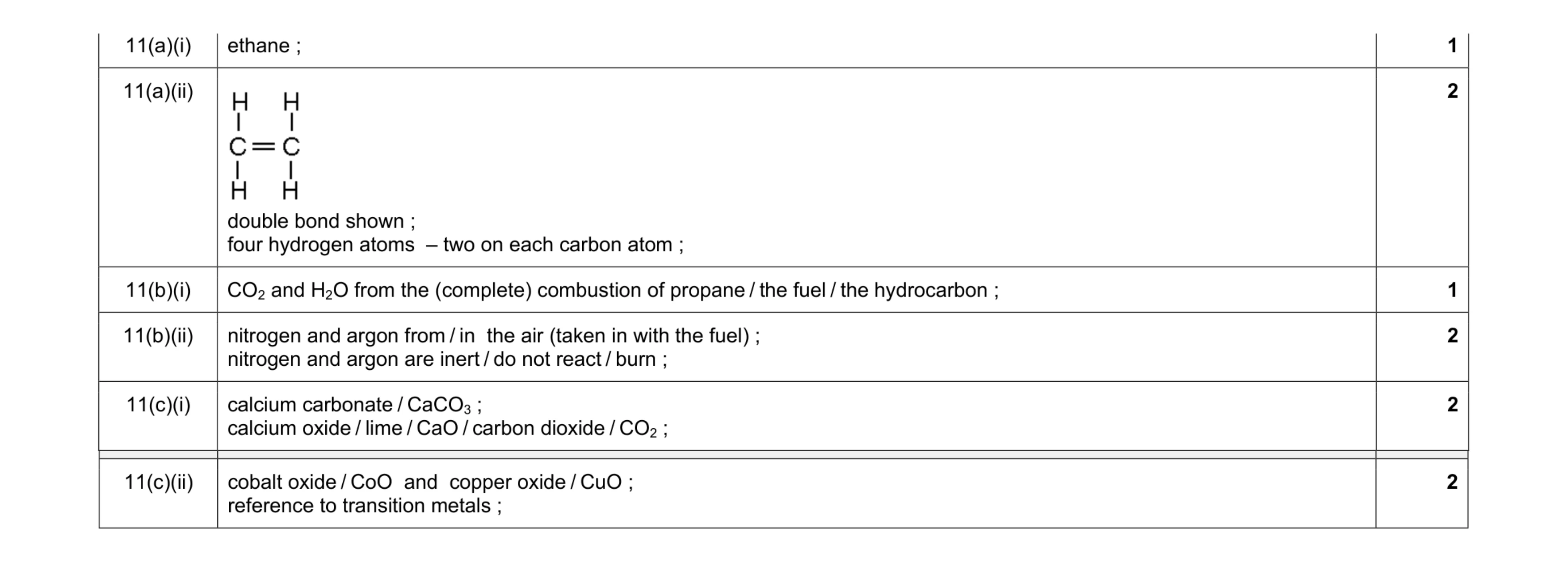
Mark scheme: 11(a)(i) ethane ; 1 11(a)(ii) double bond shown ; four hydrogen atoms – two on each carbon atom ; 2 11(b)(i) CO2 and H2O from the (complete) combustion of propane / the fuel / the hydrocarbon ; 1 11(b)(ii) nitrogen and argon from / in the air (taken in with the fuel) ; nitrogen and argon are inert / do not react / burn ; 2 11(c)(i) calcium carbonate / CaCO3 ; calcium oxide / lime / CaO / carbon dioxide / CO2 ; 2 Question Answer Marks 11(c)(ii) cobalt oxide / CoO and copper oxide / CuO ; reference to transition metals ; 2
This question in 0654/32 Oct/Nov 2017
Q2 · Calcium, copper, iron and potassium are metallic elements in the fourth period of the… 0654/33 Oct/Nov 2018
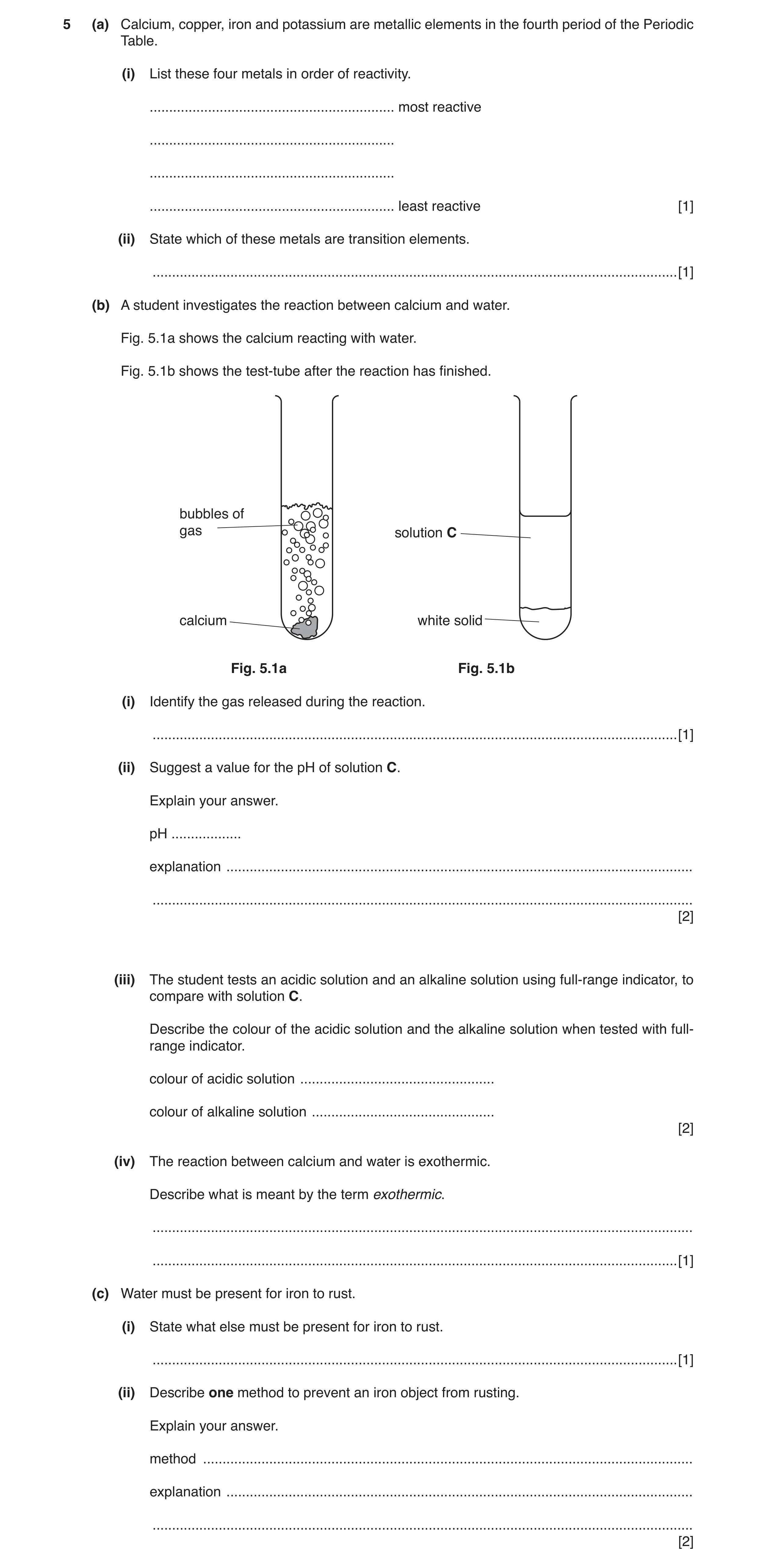
5 (a) Calcium, copper, iron and potassium are metallic elements in the fourth period of the Periodic Table. (i) List these four metals in order of reactivity. … most reactive … … … least reactive [1] (ii) State which of these metals are transition elements. … [1] (b) A student investigates the reaction between calcium and water. Fig. 5.1a shows the calcium reacting with water. Fig. 5.1b shows the test-tube after the reaction has finished. bubbles of gas solution C calcium white solid Fig. 5.1a Fig. 5.1b (i) Identify the gas released during the reaction. … [1] (ii) Suggest a value for the pH of solution C. Explain your answer. pH … explanation … … [2] (iii) The student tests an acidic solution and an alkaline solution using full-range indicator, to compare with solution C. Describe the colour of the acidic solution and the alkaline solution when tested with full- range indicator. colour of acidic solution … colour of alkaline solution … [2] (iv) The reaction between calcium and water is exothermic. Describe what is meant by the term exothermic. … … [1] (c) Water must be present for iron to rust. (i) State what else must be present for iron to rust. … [1] (ii) Describe one method to prevent an iron object from rusting. Explain your answer. method … explanation … … [2]
11 marks
Mark scheme: 5(a)(i) potassium calcium iron copper ; 1 5(a)(ii) copper and iron ; 1 5(b)(i) hydrogen / H2 ; 1 5(b)(ii) 9–14 ; solution becomes alkaline / contains a base / calcium hydroxide ; 2 5(b)(iii) acid – red / orange / yellow ; alkali – blue / purple ; 2 5(b)(iv) temperature increases ; (thermal) energy given out; max 1 5(c)(i) oxygen ; 1 5(c)(ii) cover with oil / grease / paint / electroplate ; (form a barrier to) prevent contact / reaction (between iron and air / water) ; 2
This question in 0654/33 Oct/Nov 2018
Q3 · Some volcanoes release the element sulfur 0654/33 Oct/Nov 2018
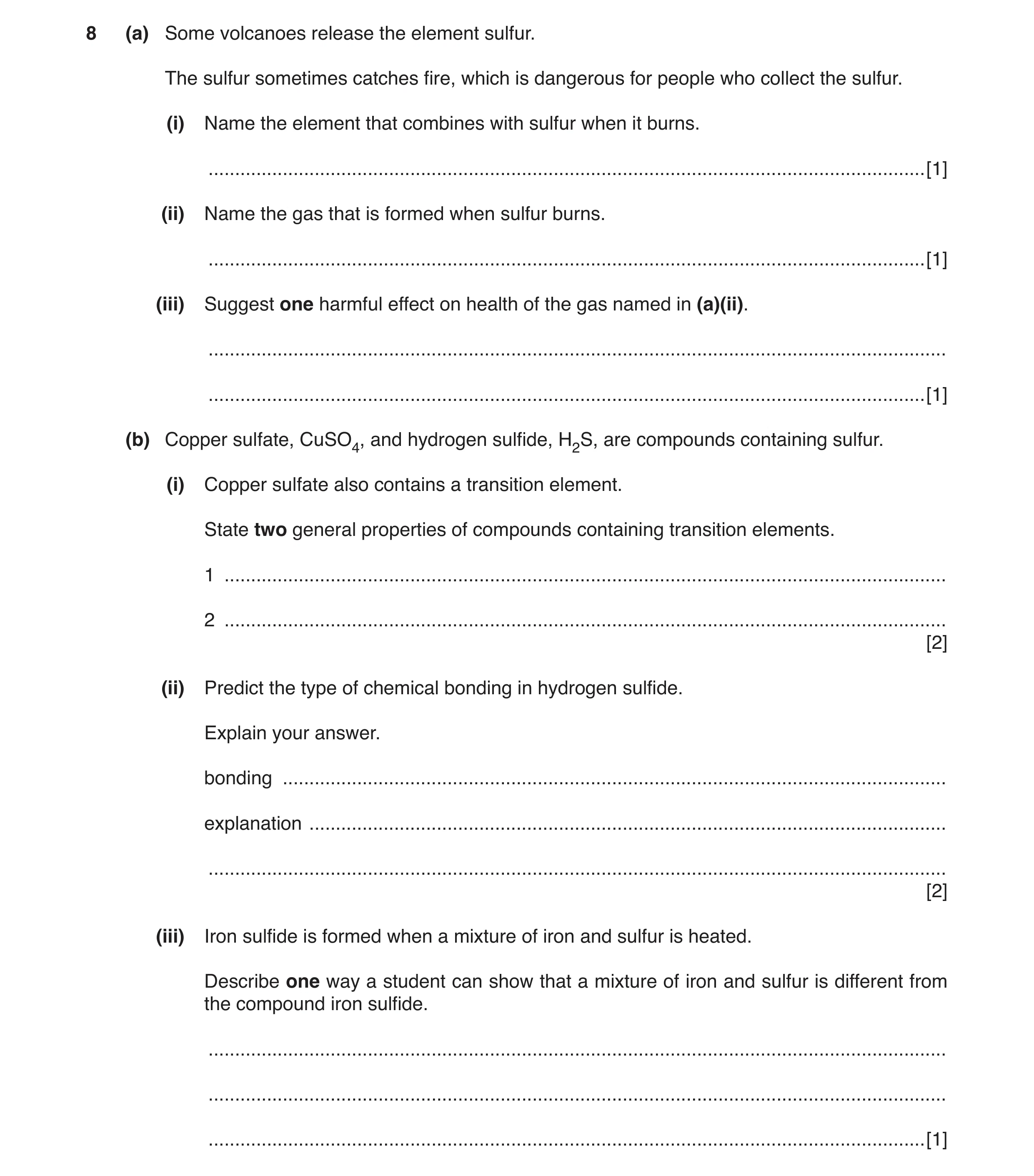
8 (a) Some volcanoes release the element sulfur. The sulfur sometimes catches fire, which is dangerous for people who collect the sulfur. (i) Name the element that combines with sulfur when it burns. … [1] (ii) Name the gas that is formed when sulfur burns. … [1] (iii) Suggest one harmful effect on health of the gas named in (a)(ii). … … [1] (b) Copper sulfate, CuSO4, and hydrogen sulfide, H2S, are compounds containing sulfur. (i) Copper sulfate also contains a transition element. State two general properties of compounds containing transition elements. 1 … 2 … [2] (ii) Predict the type of chemical bonding in hydrogen sulfide. Explain your answer. bonding … explanation … … [2] (iii) Iron sulfide is formed when a mixture of iron and sulfur is heated. Describe one way a student can show that a mixture of iron and sulfur is different from the compound iron sulfide. … … … [1]
8 marks
Mark scheme: 8(a)(i) oxygen ; 1 8(a)(ii) sulfur dioxide ; 1 8(a)(iii) sulfur dioxide is poisonous / causes breathing ; 1 8(b)(i) coloured compounds ; catalysts ; 2 8(b)(ii) covalent ; hydrogen sulfide is non-metal bonded to non-metal ; 2 8(b)(iii) idea that a magnet / water can separate the mixture or that dilute acid produces different gases with the mixture and compound or a lens shows separate pieces of sulfur and iron in the mixture or AVP ; 1
This question in 0654/33 Oct/Nov 2018
Q4 · Meteorites fall to Earth from space 0654/33 Oct/Nov 2019
5 (a) Meteorites fall to Earth from space. Some meteorites are mixtures of iron, nickel and other metals. (i) State the term used for a mixture of metals. … [1] (ii) Metals tend to be shiny and some are sonorous (make a ringing sound when struck). State two other physical properties of metals. 1 … 2 … [2] (iii) Name the collection of metals in the Periodic Table that contains iron and nickel. … [1] (b) A teacher uses the apparatus shown in Fig. 5.1 to heat four different mixtures containing a powdered metal oxide and powdered carbon. mixture of powdered metal oxide and powdered carbon strong heat Fig. 5.1 His observations are shown in Table 5.1. Table 5.1 mixture observation calcium oxide + carbon no reaction copper oxide + carbon exothermic reaction lead oxide + carbon exothermic reaction magnesium oxide + carbon no reaction Use ideas about reactivity to explain the observations. … … … [2] (c) The symbol equation for the reaction between zinc oxide and carbon is shown. 2ZnO + C 2Zn + CO2 Use the substances involved in this reaction to describe reduction and oxidation. … … … … [2] [Total: 8]
8 marks
Mark scheme: 5(a)(i) alloy ; 1 5(a)(ii) two from: malleable ; ductile ; good electrical conductors ; good thermal conductors ; high m.pt / b.pt. ; high density ; max 2 2 5(a)(iii) transition elements / metals ; 1 5(b) calcium and magnesium more reactive than carbon (so no reaction) ; carbon more reactive than copper and lead (so reaction observed) ; 2 5(c) zinc oxide has lost oxygen and so is reduced ; carbon has gained oxygen and so is oxidised ; 2
This question in 0654/33 Oct/Nov 2019
Q5 · Calcium and copper are metals 0654/31 May/June 2020
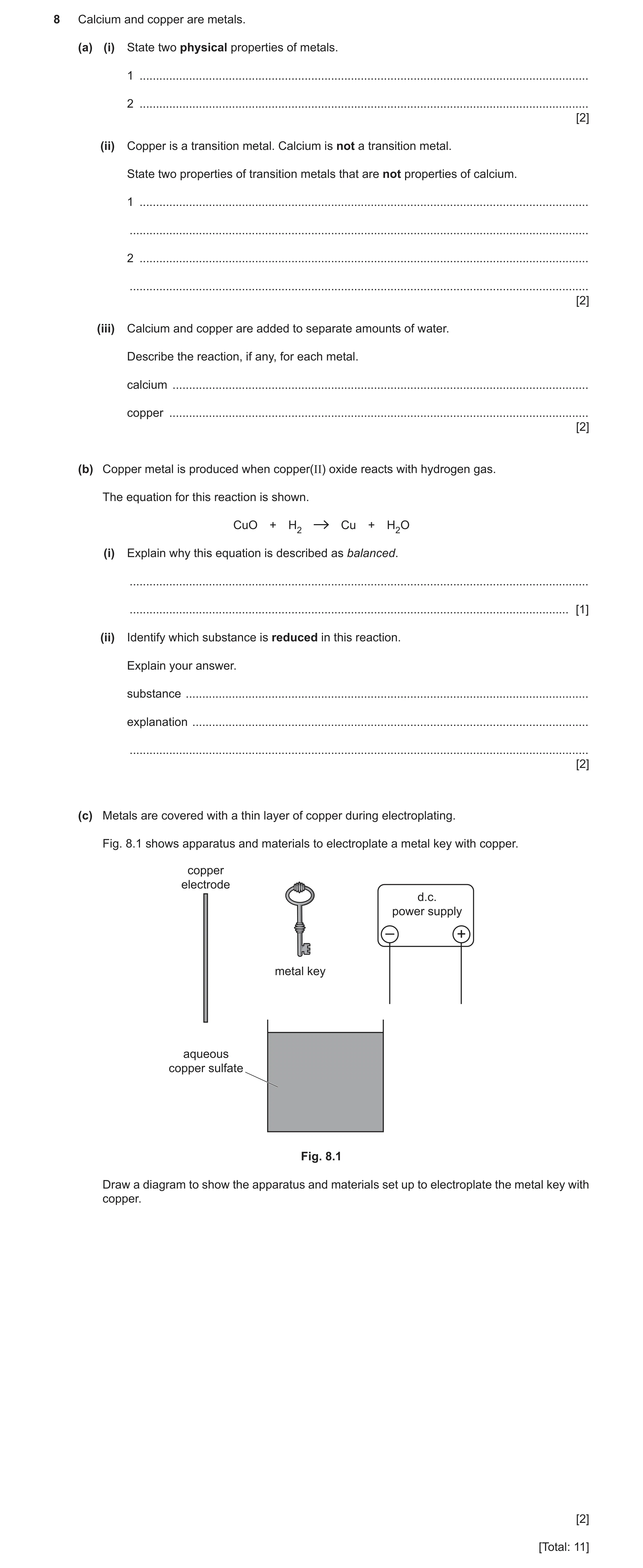
8 Calcium and copper are metals. (a) (i) State two physical properties of metals. 1 … 2 … [2] (ii) Copper is a transition metal. Calcium is not a transition metal. State two properties of transition metals that are not properties of calcium. 1 … … 2 … … [2] (iii) Calcium and copper are added to separate amounts of water. Describe the reaction, if any, for each metal. calcium … copper … [2] (b) Copper metal is produced when copper(II) oxide reacts with hydrogen gas. The equation for this reaction is shown. CuO + H2 Cu + H2O (i) Explain why this equation is described as balanced. … … [1] (ii) Identify which substance is reduced in this reaction. Explain your answer. substance … explanation … … [2] (c) Metals are covered with a thin layer of copper during electroplating. Fig. 8.1 shows apparatus and materials to electroplate a metal key with copper. copper electrode d.c. power supply – + metal key aqueous copper sulfate Fig. 8.1 Draw a diagram to show the apparatus and materials set up to electroplate the metal key with copper. [2] [Total: 11]
11 marks
Mark scheme: 8(a)(i) any two from: (good) electrical conductor (good) thermal conductor solid / high melting / boiling point malleable / ductile lustrous / sonorous ;; 8(a)(ii) (a transition metal ) forms coloured compounds ; can act as a catalyst ; has (relatively) high density / melting point ; max 2 8(a)(iii) (calcium) gas evolved / metal dissolves / white insoluble solid forms ; (copper) no change ; 2 8(b)(i) same number of all types of atom on LHS and on RHS / shown in reactants and products ; 1 8(b)(ii) Cu2+ ; reference to the loss of oxygen ; 2 Question Answer Marks 8(c) key and copper electrode connected and dipping into the solution ; correct polarity ; 2
This question in 0654/31 May/June 2020
Q6 · Copper and sodium are metals 0654/32 Feb/March 2021
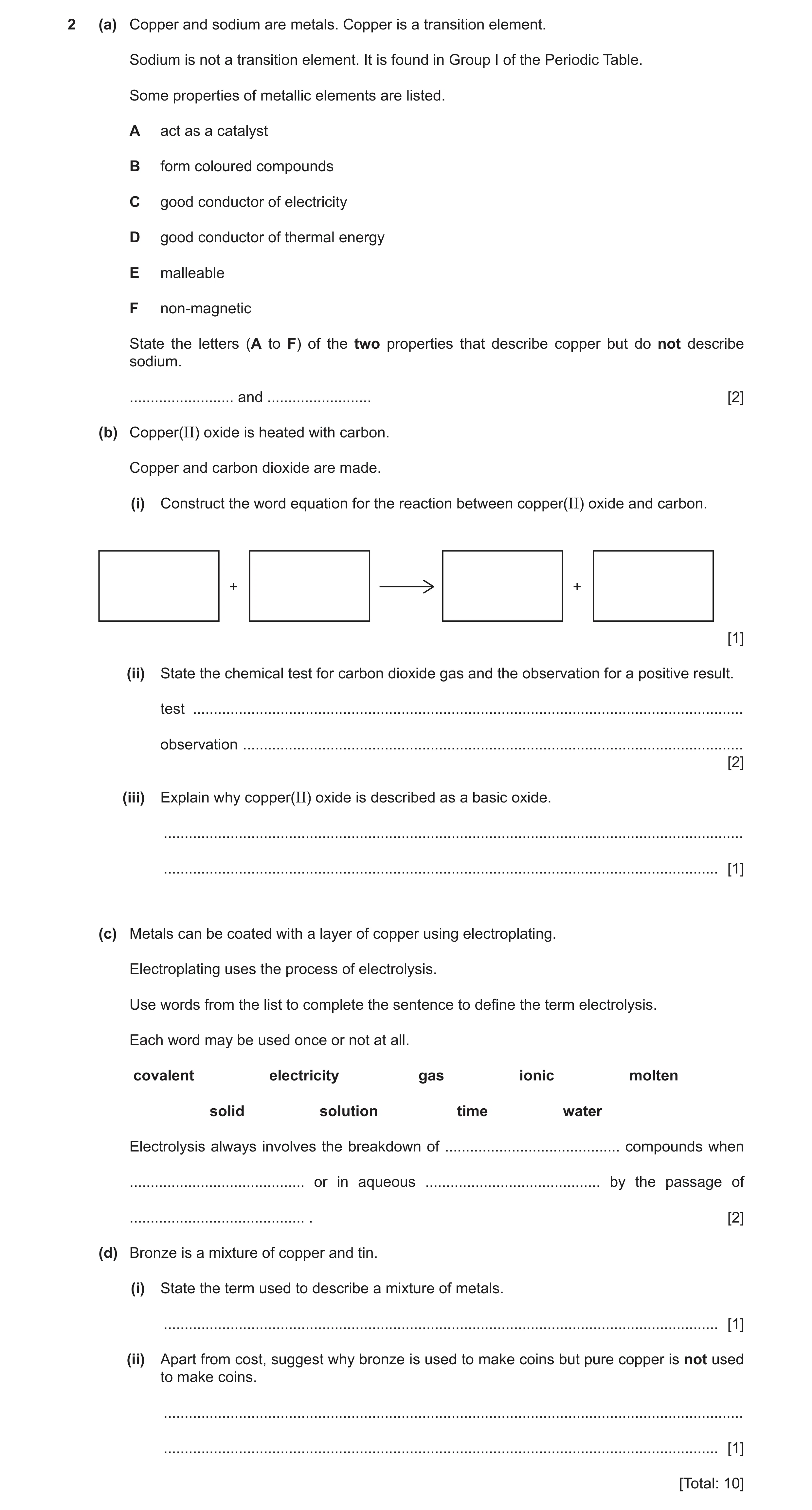
2 (a) Copper and sodium are metals. Copper is a transition element. Sodium is not a transition element. It is found in Group I of the Periodic Table. Some properties of metallic elements are listed. A act as a catalyst B form coloured compounds C good conductor of electricity D good conductor of thermal energy E malleable F non-magnetic State the letters (A to F) of the two properties that describe copper but do not describe sodium. … and … [2] (b) Copper(II) oxide is heated with carbon. Copper and carbon dioxide are made. (i) Construct the word equation for the reaction between copper(II) oxide and carbon. + + [1] (ii) State the chemical test for carbon dioxide gas and the observation for a positive result. test … observation … [2] (iii) Explain why copper(II) oxide is described as a basic oxide. … … [1] (c) Metals can be coated with a layer of copper using electroplating. Electroplating uses the process of electrolysis. Use words from the list to complete the sentence to define the term electrolysis. Each word may be used once or not at all. covalent electricity gas ionic molten solid solution time water Electrolysis always involves the breakdown of … compounds when … or in aqueous … by the passage of … . [2] (d) Bronze is a mixture of copper and tin. (i) State the term used to describe a mixture of metals. … [1] (ii) Apart from cost, suggest why bronze is used to make coins but pure copper is not used to make coins. … … [1] [Total: 10]
10 marks
Mark scheme: 2(a) A; B; 2 2(b)(i) copper oxide + carbon → copper + carbon dioxide; 1 Question Answer Marks 2(b)(ii) (bubble through) limewater; goes cloudy / milky; 2 2(b)(iii) produces solution with pH above 7 / copper(II) oxide is a metal oxide; 1 2(c) ionic molten solution electricity;; 2 2(d)(i) alloy; 1 2(d)(ii) tougher / stronger; 1
This question in 0654/32 Feb/March 2021
Q7 · Information about four metallic elements 0654/31 May/June 2021
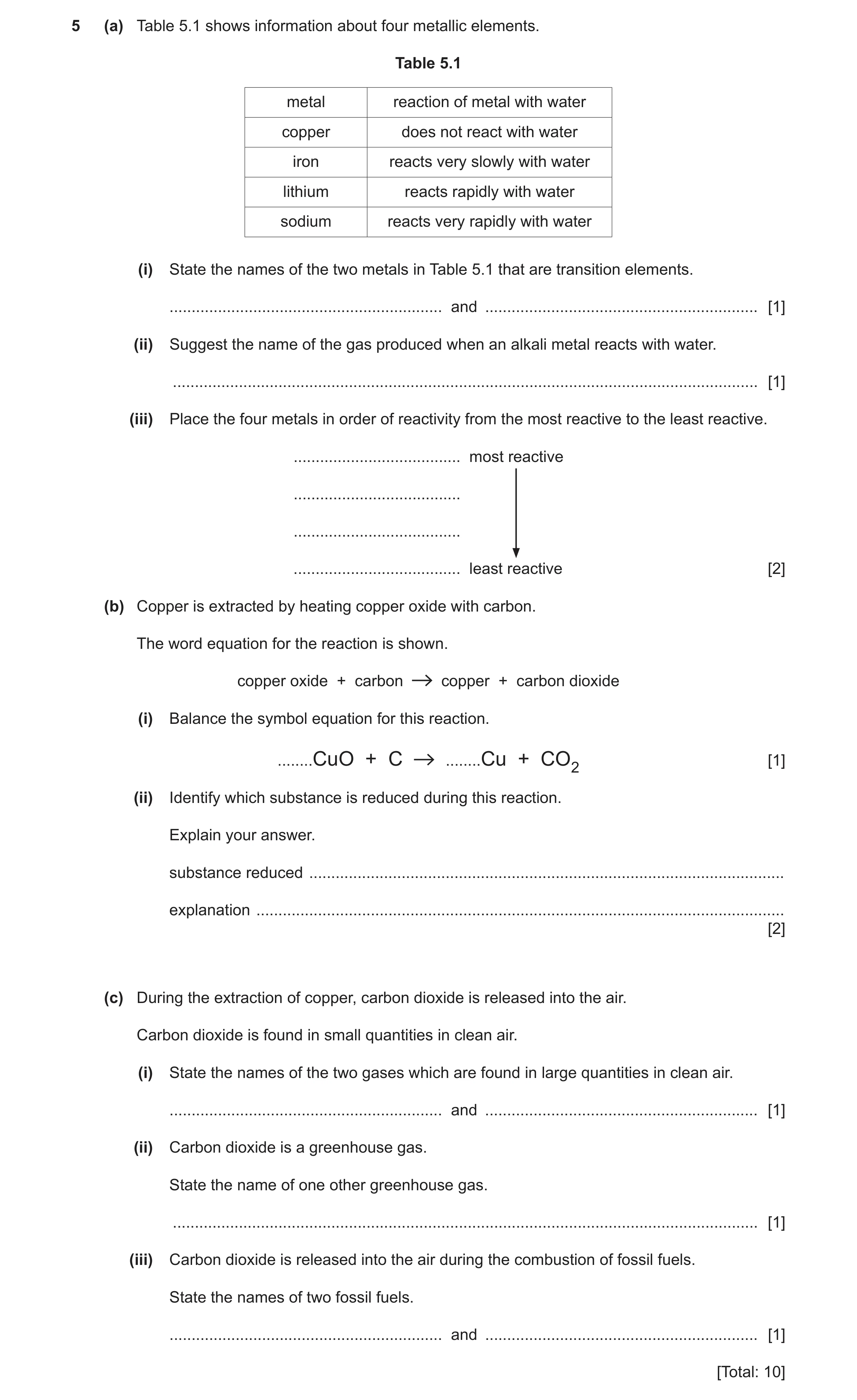
5 (a) Table 5.1 shows information about four metallic elements. Table 5.1 metal reaction of metal with water copper does not react with water iron reacts very slowly with water lithium reacts rapidly with water sodium reacts very rapidly with water (i) State the names of the two metals in Table 5.1 that are transition elements. … and … [1] (ii) Suggest the name of the gas produced when an alkali metal reacts with water. … [1] (iii) Place the four metals in order of reactivity from the most reactive to the least reactive. … most reactive … … … least reactive [2] (b) Copper is extracted by heating copper oxide with carbon. The word equation for the reaction is shown. copper oxide + carbon copper + carbon dioxide (i) Balance the symbol equation for this reaction. [1] … CuO + C … Cu + CO2 (ii) Identify which substance is reduced during this reaction. Explain your answer. substance reduced … explanation … [2] (c) During the extraction of copper, carbon dioxide is released into the air. Carbon dioxide is found in small quantities in clean air. (i) State the names of the two gases which are found in large quantities in clean air. … and … [1] (ii) Carbon dioxide is a greenhouse gas. State the name of one other greenhouse gas. … [1] (iii) Carbon dioxide is released into the air during the combustion of fossil fuels. State the names of two fossil fuels. … and … [1] [Total: 10]
10 marks
Mark scheme: 5(a)(i) copper and iron ; 1 5(a)(ii) hydrogen ; 1 5(a)(iii) sodium lithium iron copper ;; 2 5(b)(i) 2CuO + C → 2Cu + CO2 ; 1 5(b)(ii) copper oxide ; loses oxygen ; 2 Question Answer Marks 5(c)(i) oxygen and nitrogen ; (both required) 1 5(c)(ii) methane ; 1 5(c)(iii) coal / petroleum / natural gas – any two for 1 mark ; 1
This question in 0654/31 May/June 2021
Q8 · Iron is an element in Period 4 of the Periodic Table 0654/31 Oct/Nov 2021
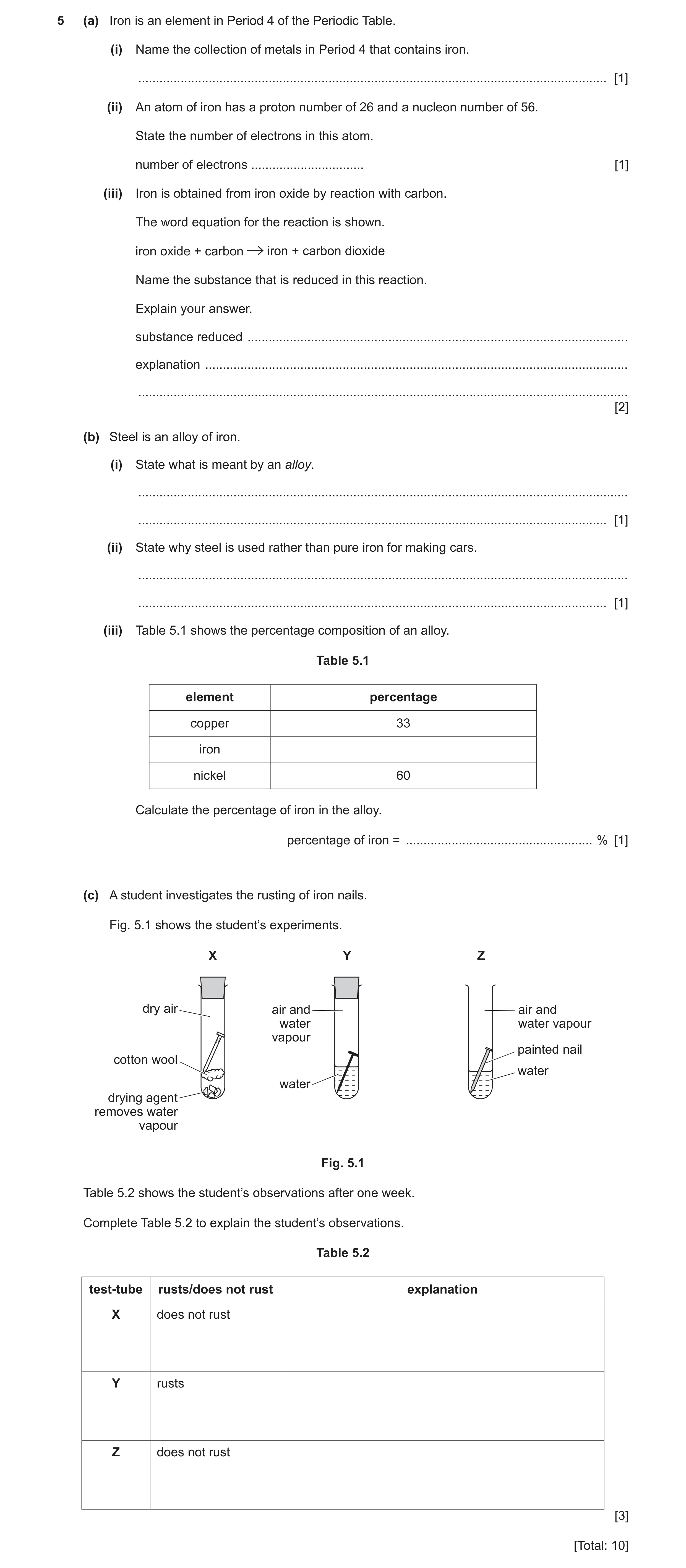
5 (a) Iron is an element in Period 4 of the Periodic Table. (i) Name the collection of metals in Period 4 that contains iron. … [1] (ii) An atom of iron has a proton number of 26 and a nucleon number of 56. State the number of electrons in this atom. number of electrons … [1] (iii) Iron is obtained from iron oxide by reaction with carbon. The word equation for the reaction is shown. iron oxide + carbon iron + carbon dioxide Name the substance that is reduced in this reaction. Explain your answer. substance reduced … explanation … … [2] (b) Steel is an alloy of iron. (i) State what is meant by an alloy. … … [1] (ii) State why steel is used rather than pure iron for making cars. … … [1] (iii) Table 5.1 shows the percentage composition of an alloy. Table 5.1 element percentage copper 33 iron nickel 60 Calculate the percentage of iron in the alloy. percentage of iron = … % [1] (c) A student investigates the rusting of iron nails. Fig. 5.1 shows the student’s experiments. X Y Z dry air air and air and water water vapour vapour painted nail cotton wool water water drying agent removes water vapour Fig. 5.1 Table 5.2 shows the student’s observations after one week. Complete Table 5.2 to explain the student’s observations. Table 5.2 test-tube rusts/does not rust explanation X does not rust Y rusts Z does not rust [3] [Total: 10]
10 marks
Mark scheme: 5(a)(i) transition elements / transition metals ; 1 5(a)(ii) 26 ; 1 5(a)(iii) iron oxide ; loses oxygen ; 2 5(b)(i) mixture of metals / mixture of metal and other element ; 1 5(b)(ii) stronger ; 1 5(b)(iii) 7% ; 1 5(c) (tube X does not rust) – no water present ; (tube Y rusts) – oxygen (air) and water present ; (tube Z does not rust) – no air and water can reach nail ; 3
This question in 0654/31 Oct/Nov 2021
Q9 · An atom of copper has a proton number of 29 and a nucleon number of 63 0654/31 Oct/Nov 2022
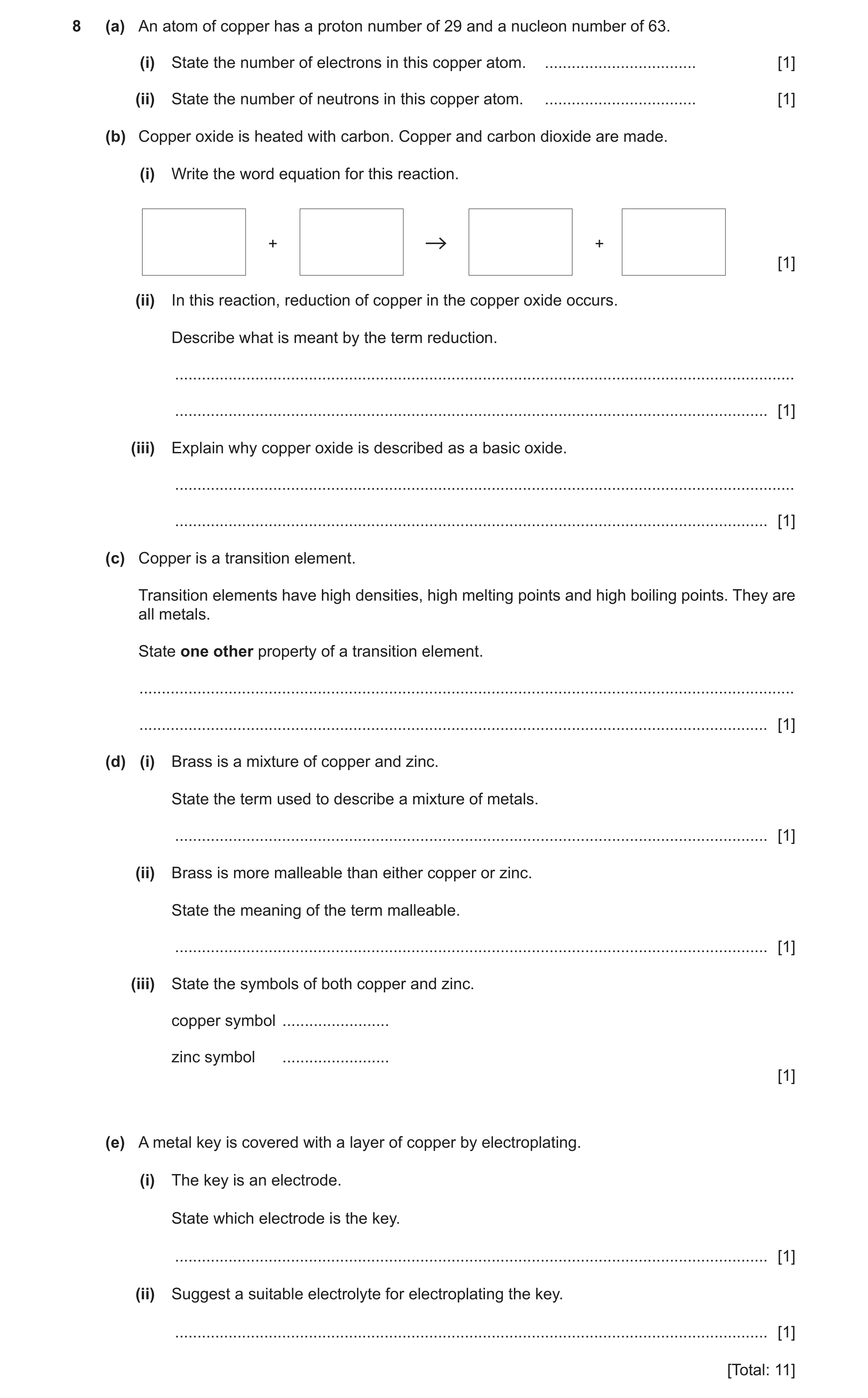
8 (a) An atom of copper has a proton number of 29 and a nucleon number of 63. (i) State the number of electrons in this copper atom. … [1] (ii) State the number of neutrons in this copper atom. … [1] (b) Copper oxide is heated with carbon. Copper and carbon dioxide are made. (i) Write the word equation for this reaction. + + [1] (ii) In this reaction, reduction of copper in the copper oxide occurs. Describe what is meant by the term reduction. … … [1] (iii) Explain why copper oxide is described as a basic oxide. … … [1] (c) Copper is a transition element. Transition elements have high densities, high melting points and high boiling points. They are all metals. State one other property of a transition element. … … [1] (d) (i) Brass is a mixture of copper and zinc. State the term used to describe a mixture of metals. … [1] (ii) Brass is more malleable than either copper or zinc. State the meaning of the term malleable. … [1] (iii) State the symbols of both copper and zinc. copper symbol … zinc symbol … [1] (e) A metal key is covered with a layer of copper by electroplating. (i) The key is an electrode. State which electrode is the key. … [1] (ii) Suggest a suitable electrolyte for electroplating the key. … [1] [Total: 11]
11 marks
Mark scheme: 8(a)(i) 29 ; 1 8(a)(ii) 34 ; 1 8(b)(i) copper oxide + carbon → copper + carbon dioxide ; 1 8(b)(ii) loss of oxygen ; 1 8(b)(iii) metal oxide / reacts with an acid to make a salt / neutralises an acid ; 1 8(c) any one from: 1 forms coloured compounds ; acts as catalyst ; variable valency ; 8(d)(i) alloy ; 1 8(d)(ii) can be beaten into shape; 1 8(d)(iii) Cu and Zn ; 1 8(e)(i) cathode / negative ; 1 8(e)(ii) copper (II) sulfate ; 1
This question in 0654/31 Oct/Nov 2022
Q10 · An isotope of magnesium has a proton number (atomic number) of 12 and a nucleon number… 0654/32 Oct/Nov 2022
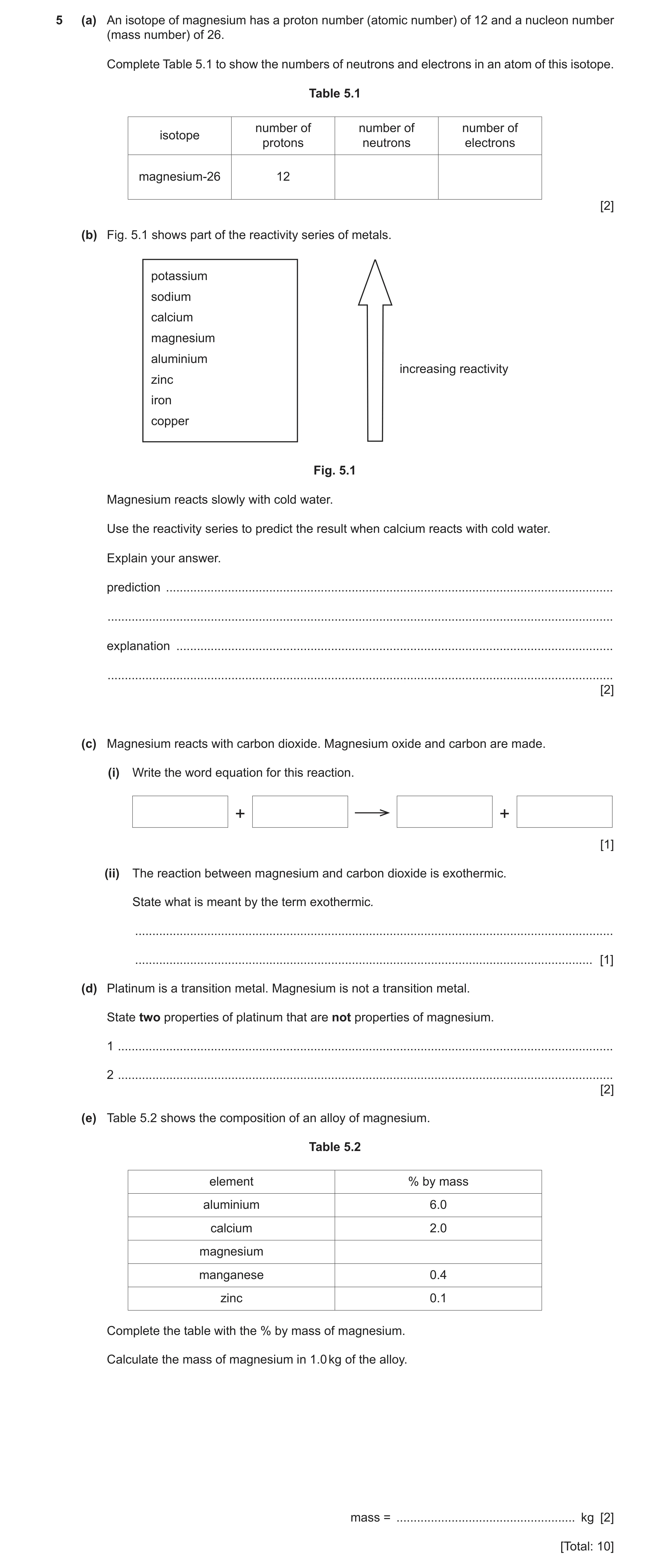
5 (a) An isotope of magnesium has a proton number (atomic number) of 12 and a nucleon number (mass number) of 26. Complete Table 5.1 to show the numbers of neutrons and electrons in an atom of this isotope. Table 5.1 number of number of number of isotope protons neutrons electrons magnesium-26 12 [2] (b) Fig. 5.1 shows part of the reactivity series of metals. potassium sodium calcium magnesium aluminium increasing reactivity zinc iron copper Fig. 5.1 Magnesium reacts slowly with cold water. Use the reactivity series to predict the result when calcium reacts with cold water. Explain your answer. prediction … … explanation … … [2] (c) Magnesium reacts with carbon dioxide. Magnesium oxide and carbon are made. (i) Write the word equation for this reaction. + + [1] (ii) The reaction between magnesium and carbon dioxide is exothermic. State what is meant by the term exothermic. … … [1] (d) Platinum is a transition metal. Magnesium is not a transition metal. State two properties of platinum that are not properties of magnesium. 1 … 2 … [2] (e) Table 5.2 shows the composition of an alloy of magnesium. Table 5.2 element % by mass aluminium 6.0 calcium 2.0 magnesium manganese 0.4 zinc 0.1 Complete the table with the % by mass of magnesium. Calculate the mass of magnesium in 1.0 kg of the alloy. mass = … kg [2] [Total: 10]
10 marks
Mark scheme: 5(a) 2 isotope number of number of number of protons neutrons electrons magnesium-26 12 14; 12; 5(b) calcium reacts quickly/quicker ; 2 calcium is higher in reactivity series than magnesium ; 5(c)(i) magnesium + carbon dioxide → magnesium oxide + carbon ; 1 5(c)(ii) releases (thermal) energy ; 1 5(d) any two from: 2 forms coloured compounds ; acts as catalyst ; variable valency ; 5(e) 91.5 (%) ; 2 0.915 (kg) ;
This question in 0654/32 Oct/Nov 2022
Q11 · The apparatus and reagents used to make a salt 0654/33 Oct/Nov 2022
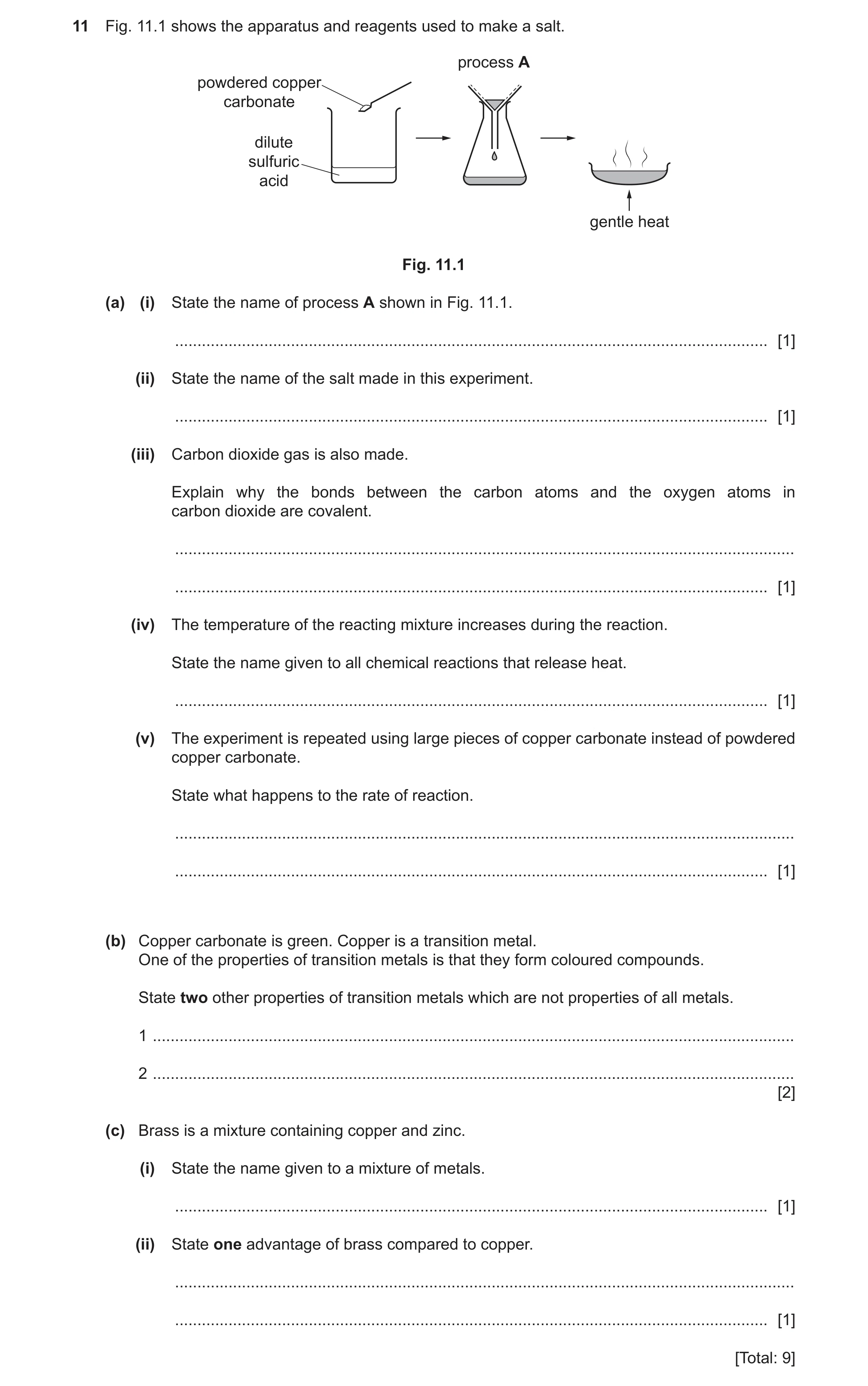
11 Fig. 11.1 shows the apparatus and reagents used to make a salt. process A powdered copper carbonate dilute sulfuric acid gentle heat Fig. 11.1 (a) (i) State the name of process A shown in Fig. 11.1. … [1] (ii) State the name of the salt made in this experiment. … [1] (iii) Carbon dioxide gas is also made. Explain why the bonds between the carbon atoms and the oxygen atoms in carbon dioxide are covalent. … … [1] (iv) The temperature of the reacting mixture increases during the reaction. State the name given to all chemical reactions that release heat. … [1] (v) The experiment is repeated using large pieces of copper carbonate instead of powdered copper carbonate. State what happens to the rate of reaction. … … [1] (b) Copper carbonate is green. Copper is a transition metal. One of the properties of transition metals is that they form coloured compounds. State two other properties of transition metals which are not properties of all metals. 1 … 2 … [2] (c) Brass is a mixture containing copper and zinc. (i) State the name given to a mixture of metals. … [1] (ii) State one advantage of brass compared to copper. … … [1] [Total: 9]
9 marks
Mark scheme: 11(a)(i) filtration ; 1 11(a)(ii) copper sulfate ; 1 11(a)(iii) two non-metals bonding / electrons are shared ; 1 11(a)(iv) exothermic ; 1 11(a)(v) (rate of reaction) decreases ; 1 11(b) any two from: 2 high density ; catalyst ; variable valency ; 11(c)(i) alloy ; 1 11(c)(ii) stronger / any valid point ; 1
This question in 0654/33 Oct/Nov 2022
Q12 · State the name given to mixtures made from a metal with other elements 0654/32 Feb/March 2023
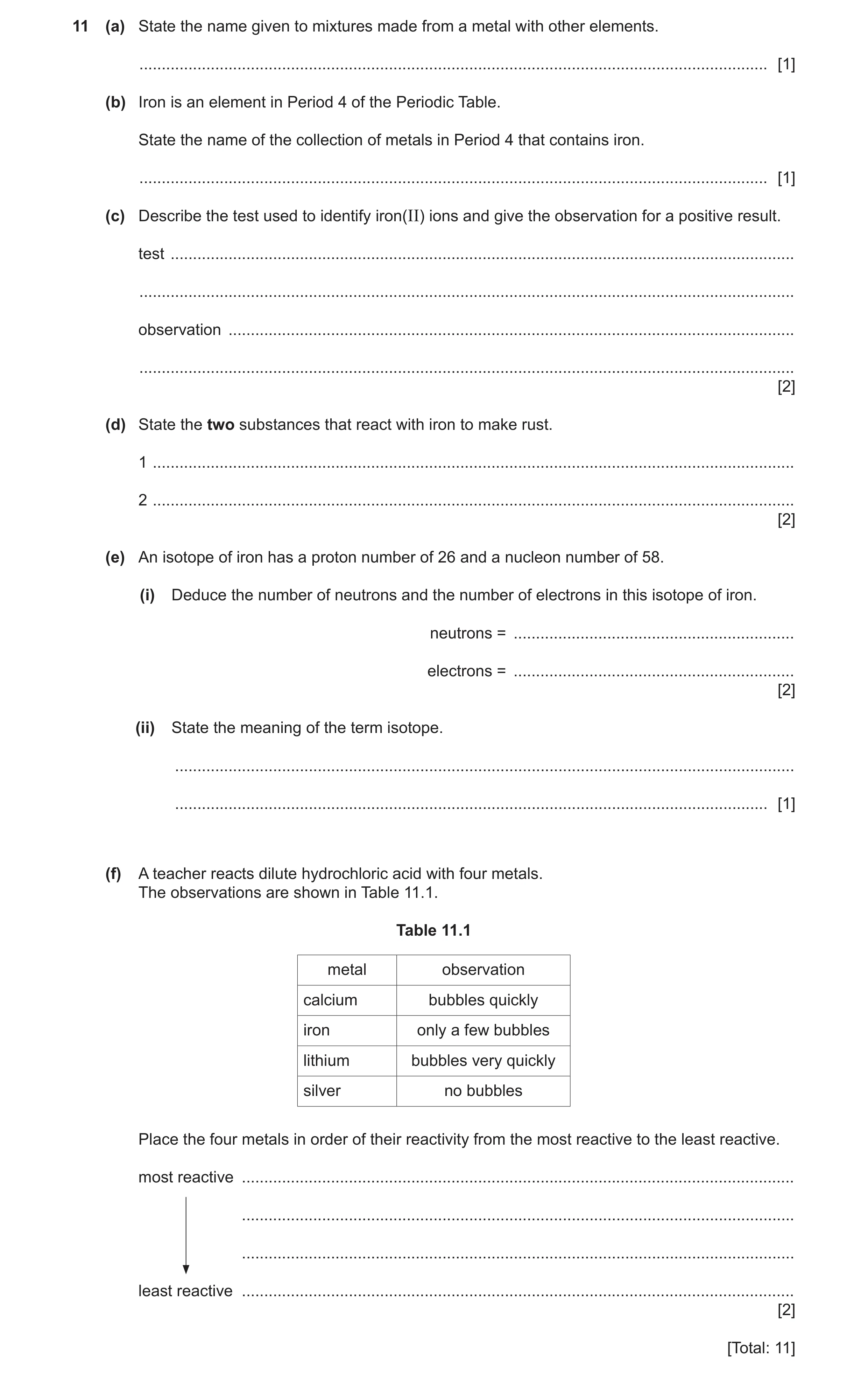
11 (a) State the name given to mixtures made from a metal with other elements. … [1] (b) Iron is an element in Period 4 of the Periodic Table. State the name of the collection of metals in Period 4 that contains iron. … [1] (c) Describe the test used to identify iron(II) ions and give the observation for a positive result. test … … observation … … [2] (d) State the two substances that react with iron to make rust. 1 … 2 … [2] (e) An isotope of iron has a proton number of 26 and a nucleon number of 58. (i) Deduce the number of neutrons and the number of electrons in this isotope of iron. neutrons = … electrons = … [2] (ii) State the meaning of the term isotope. … … [1] (f) A teacher reacts dilute hydrochloric acid with four metals. The observations are shown in Table 11.1. Table 11.1 metal observation calcium bubbles quickly iron only a few bubbles lithium bubbles very quickly silver no bubbles Place the four metals in order of their reactivity from the most reactive to the least reactive. most reactive … … … least reactive … [2] [Total: 11]
11 marks
Mark scheme: 11(a) alloy ; 1 11(b) transition elements / metals ; 1 11(c) aqueous sodium hydroxide ; 2 green precipitate ; 11(d) oxygen ; 2 water ; 11(e)(i) neutrons = 32 ; 2 electrons = 26 ; 11(e)(ii) atoms of the same element that have different numbers of neutrons ; 1 11(f) lithium 2 calcium iron silver lithium and / or silver correct ; all else correct ;
This question in 0654/32 Feb/March 2023
Q13 · Iron is extracted from its ore by reduction in a blast furnace 0654/31 May/June 2025
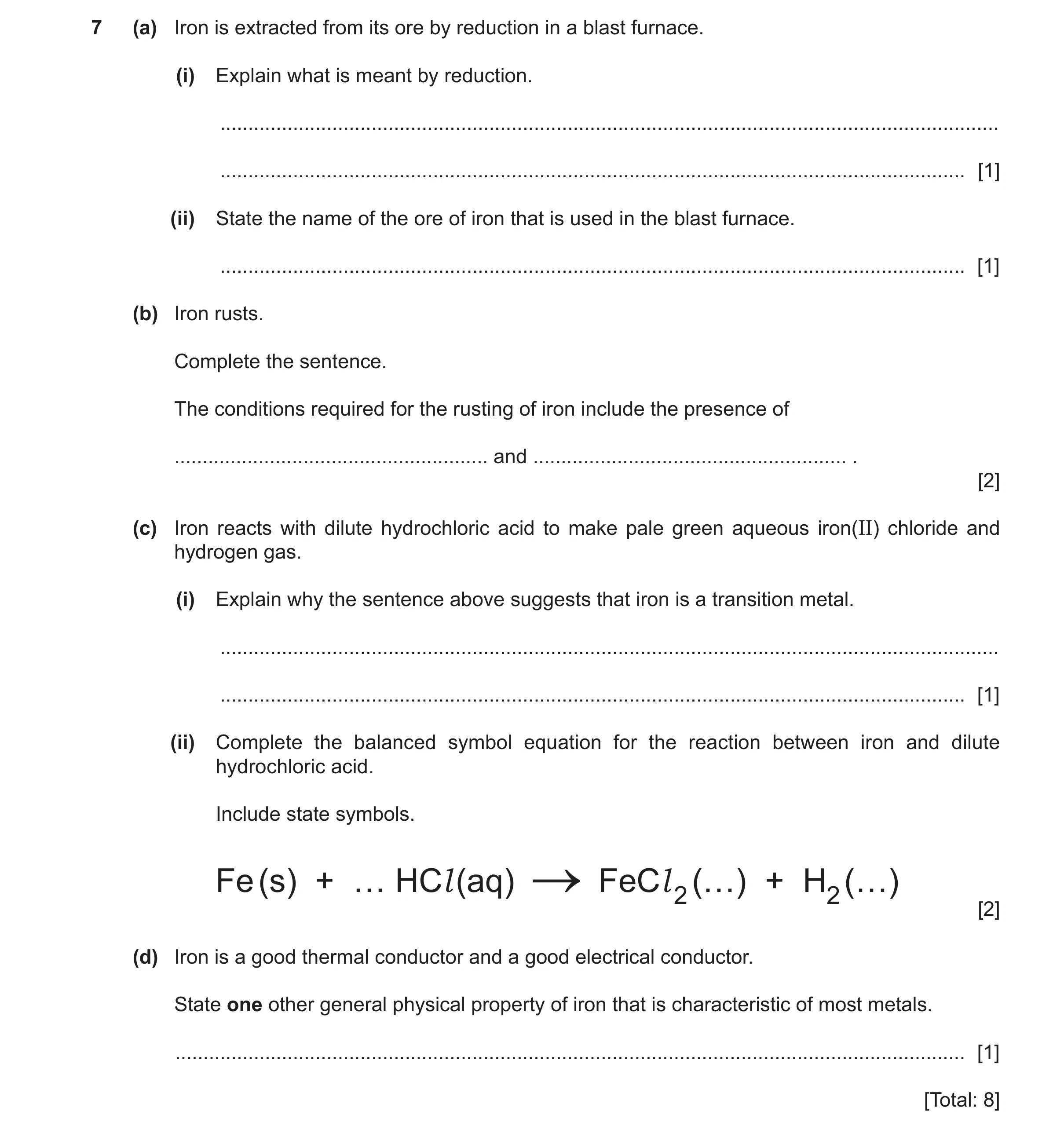
7 (a) Iron is extracted from its ore by reduction in a blast furnace. (i) Explain what is meant by reduction. … … [1] (ii) State the name of the ore of iron that is used in the blast furnace. … [1] (b) Iron rusts. Complete the sentence. The conditions required for the rusting of iron include the presence of … and … . [2] (c) Iron reacts with dilute hydrochloric acid to make pale green aqueous iron(II) chloride and hydrogen gas. (i) Explain why the sentence above suggests that iron is a transition metal. … … [1] (ii) Complete the balanced symbol equation for the reaction between iron and dilute hydrochloric acid. Include state symbols. Fe (s) + … HCl (aq) FeCl (…) + (…) 2 H2 [2] (d) Iron is a good thermal conductor and a good electrical conductor. State one other general physical property of iron that is characteristic of most metals. … [1] [Total: 8]
8 marks
Mark scheme: 7(a)(i) loss of oxygen ; 1 7(a)(ii) hematite ; 1 7(b) oxygen ; 2 water ; 7(c)(i) forms coloured compound ; 1 7(c)(ii) Fe (s) + 2 HCl (aq) → FeCl2 (aq) + H2 (g) 2 balancing ; both state symbols ; 7(d) high melting/boiling point / malleable / ductile ; 1
This question in 0654/31 May/June 2025
 5 / 19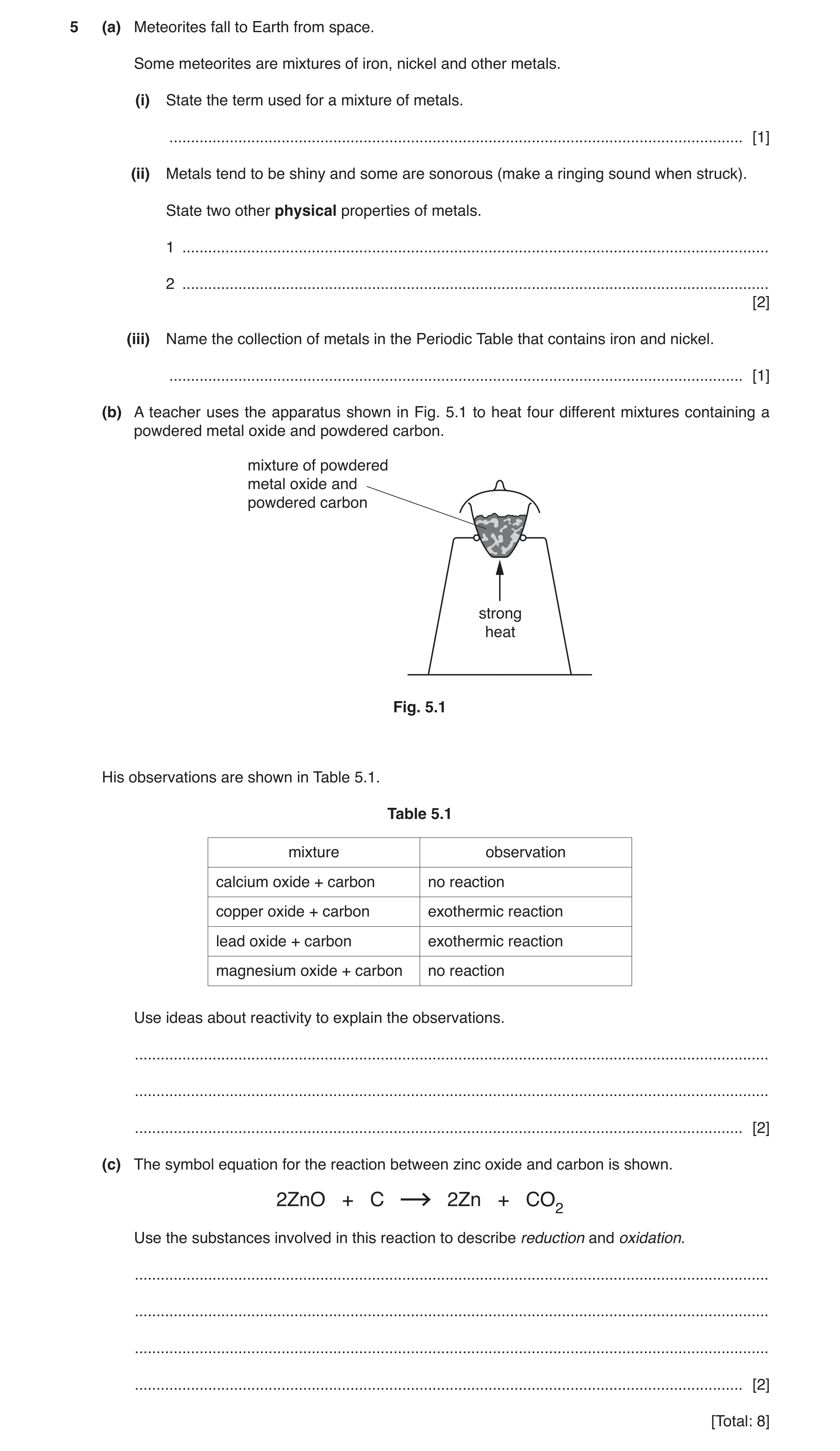
 19 / 19
 10
10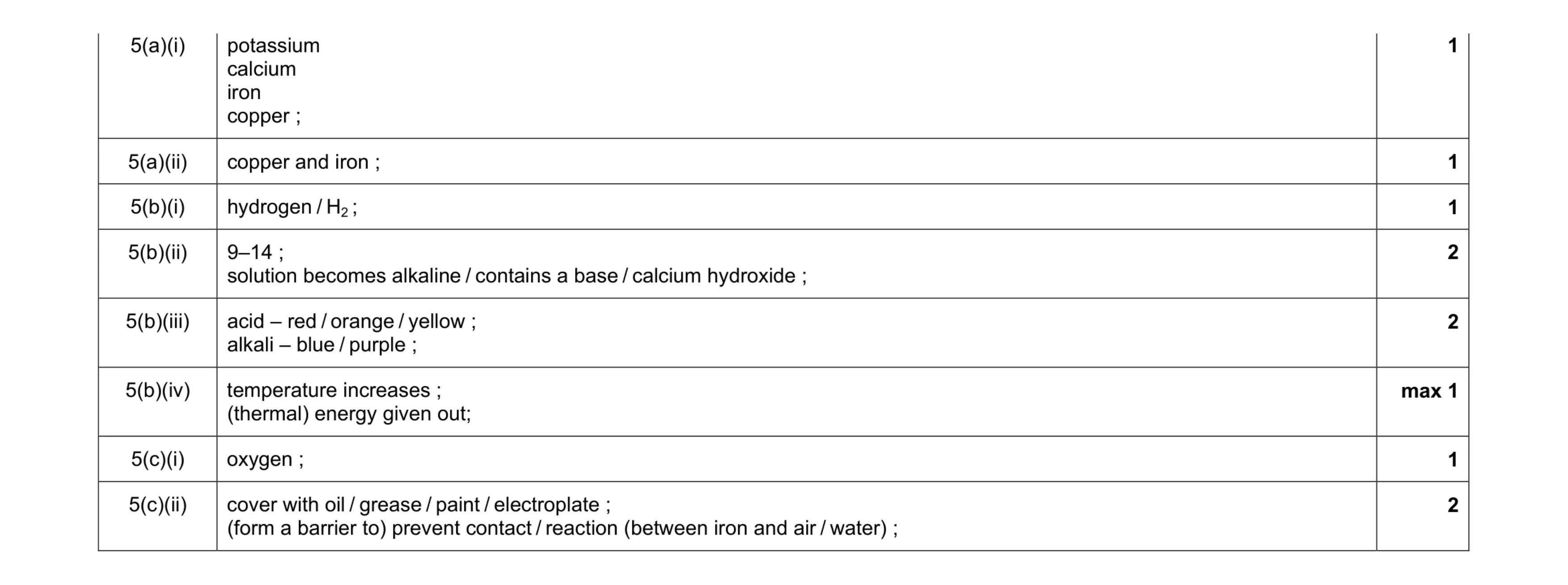 11
11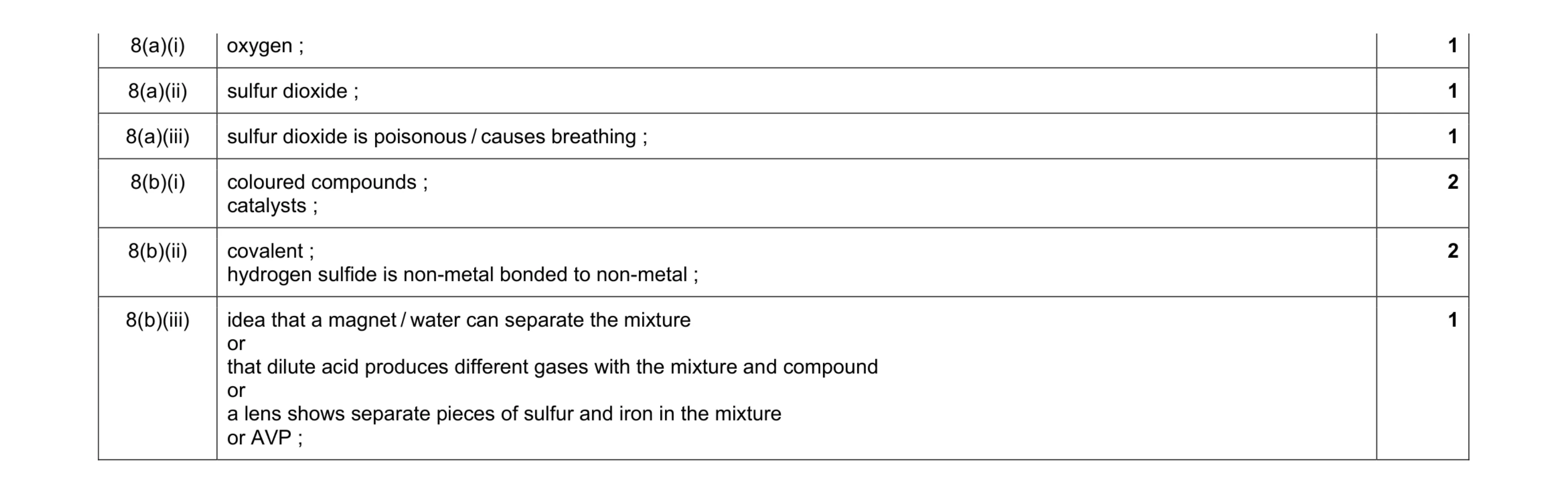 8
8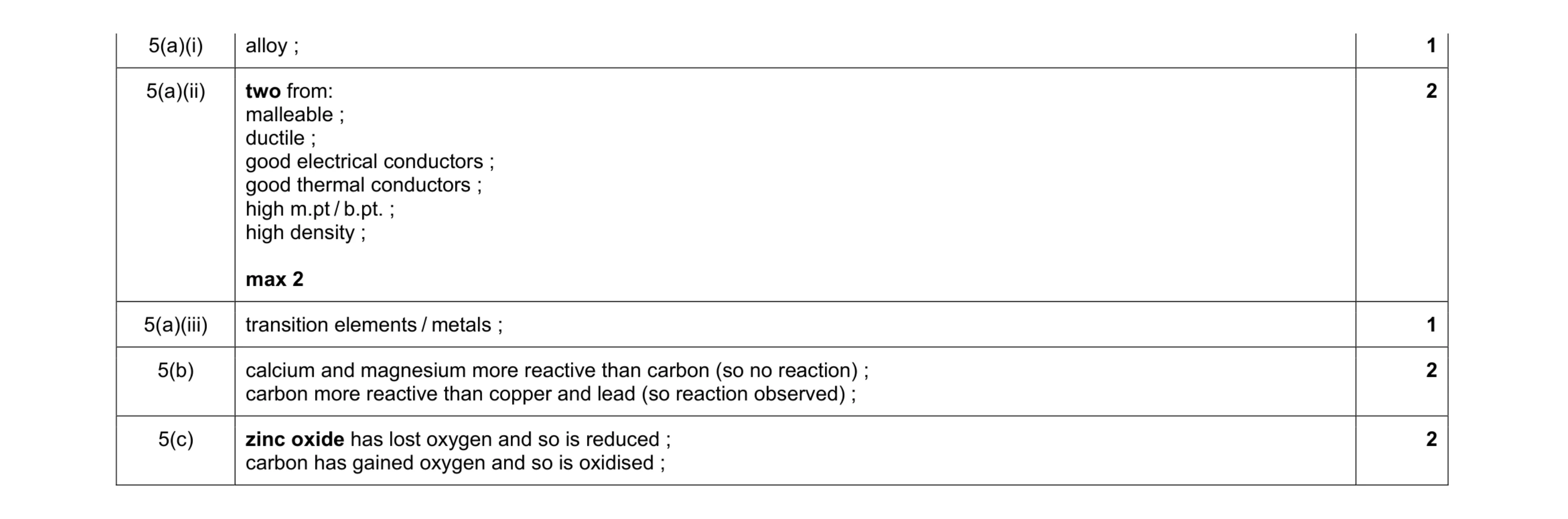 8
8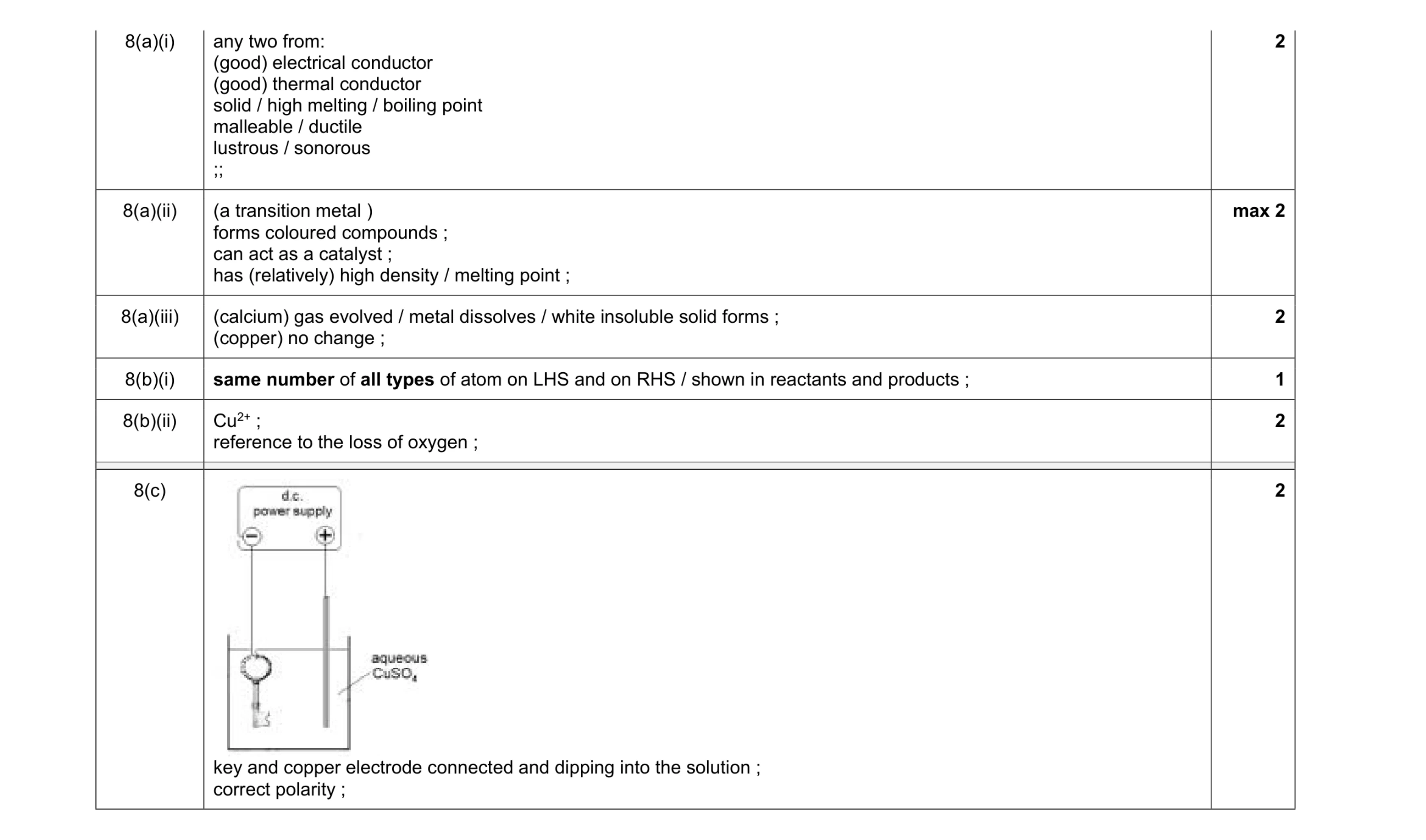 11
11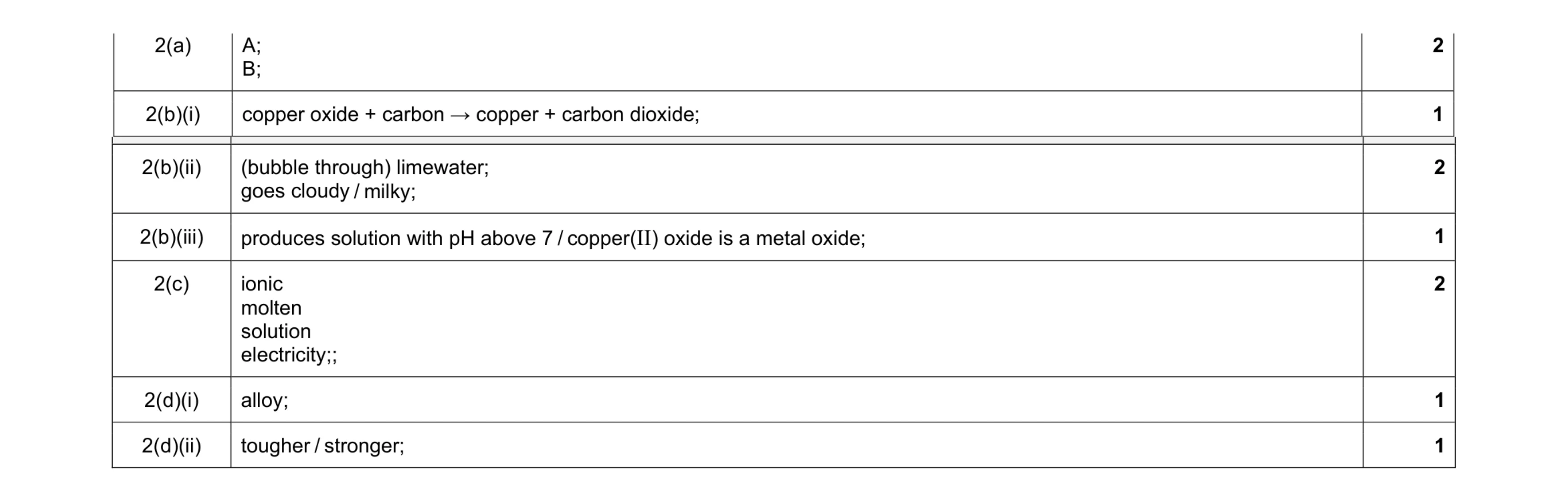 10
10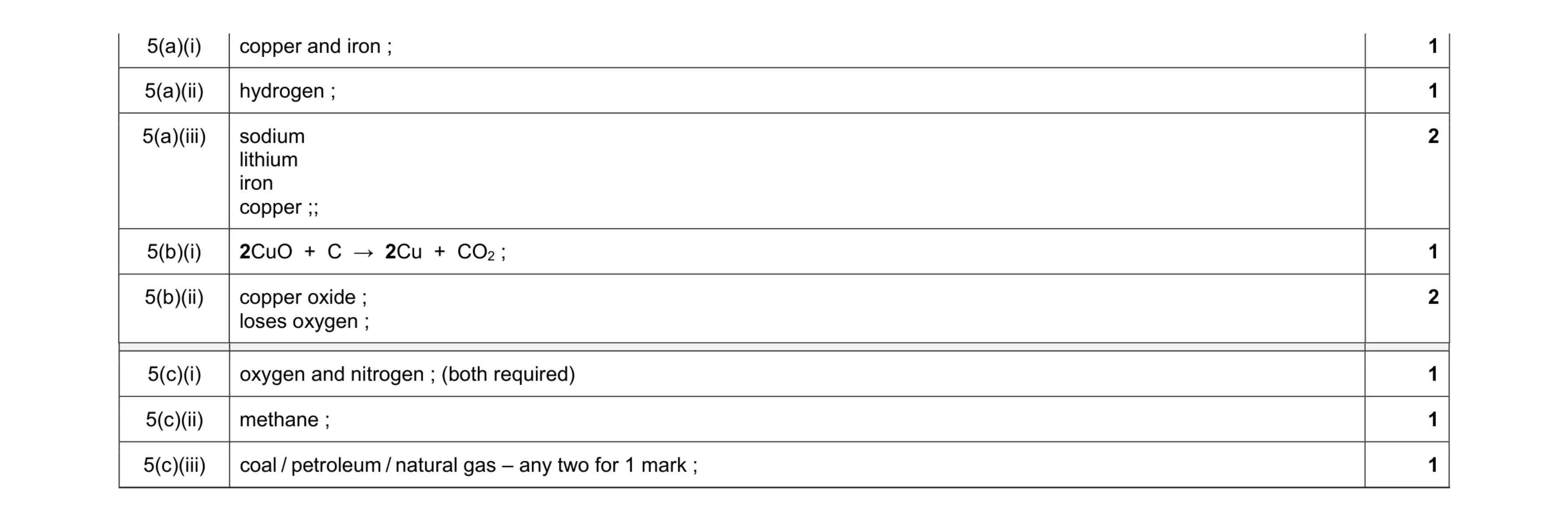 10
10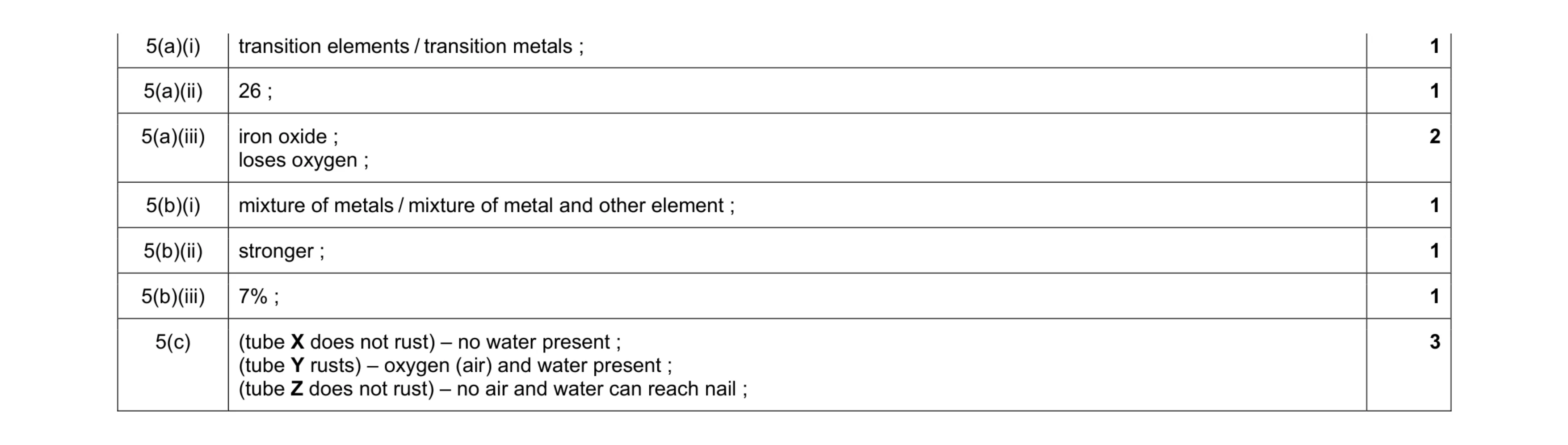 10
10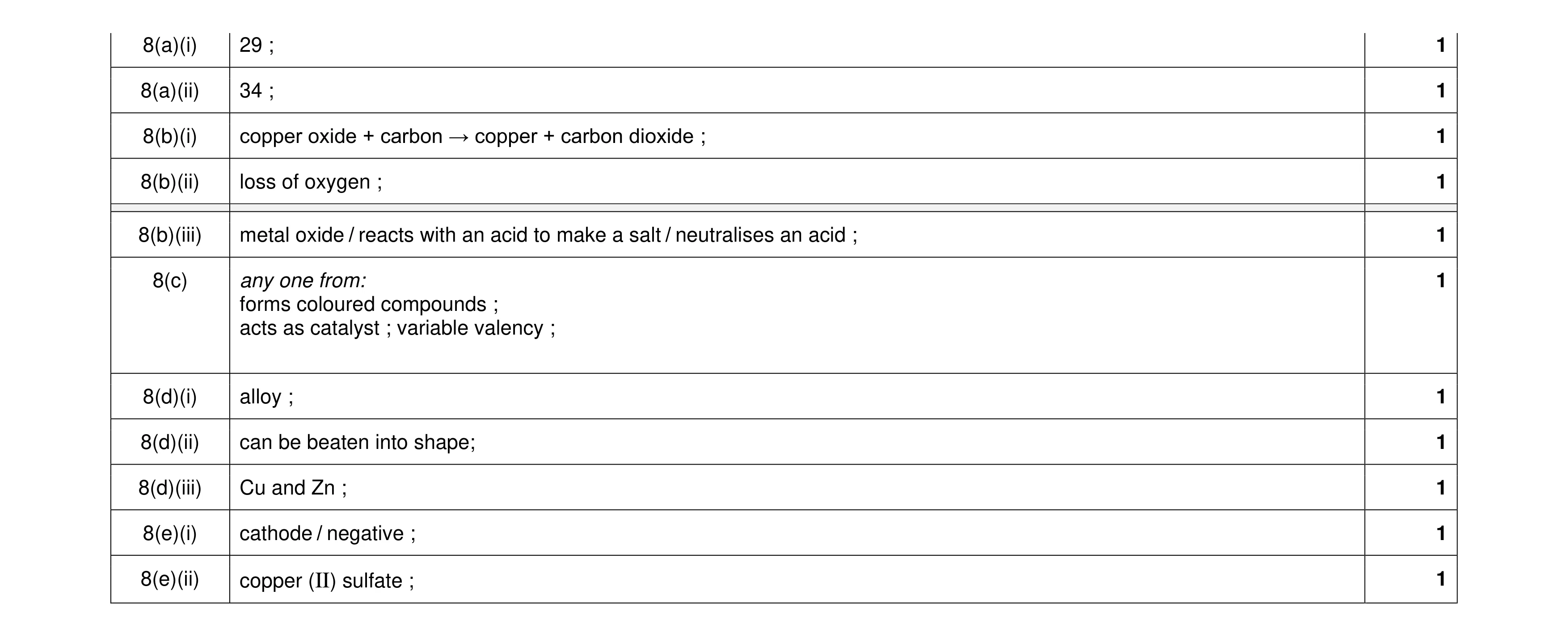 11
11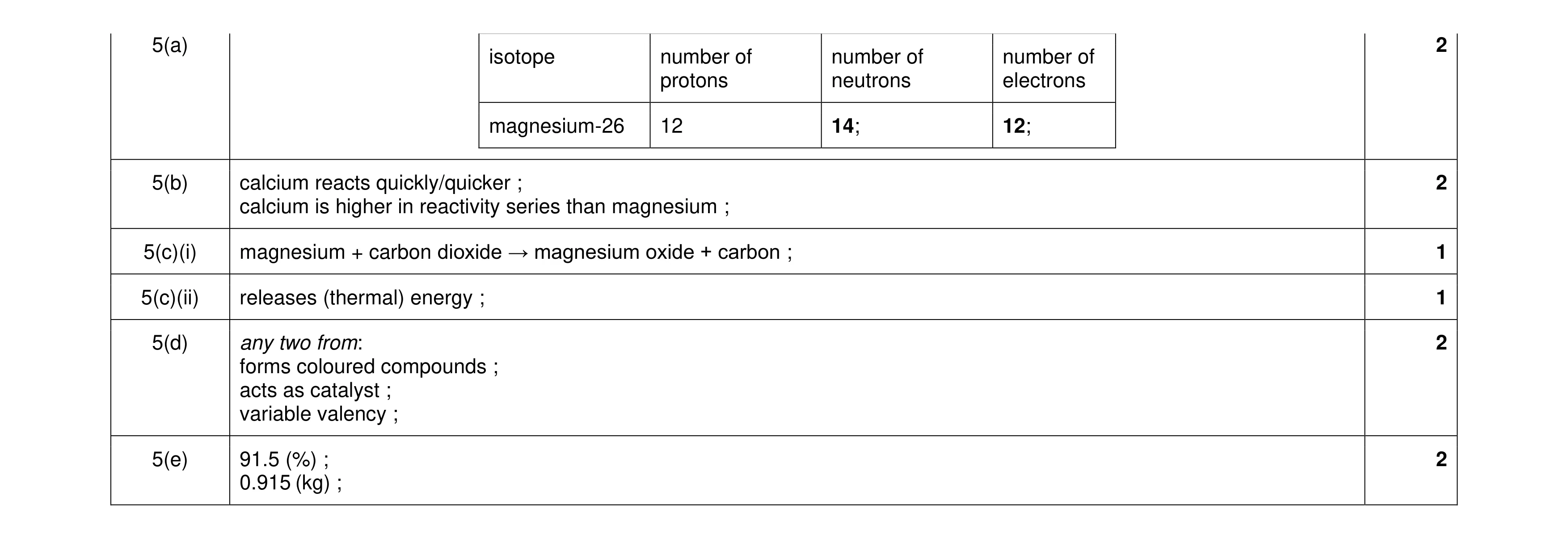 10
10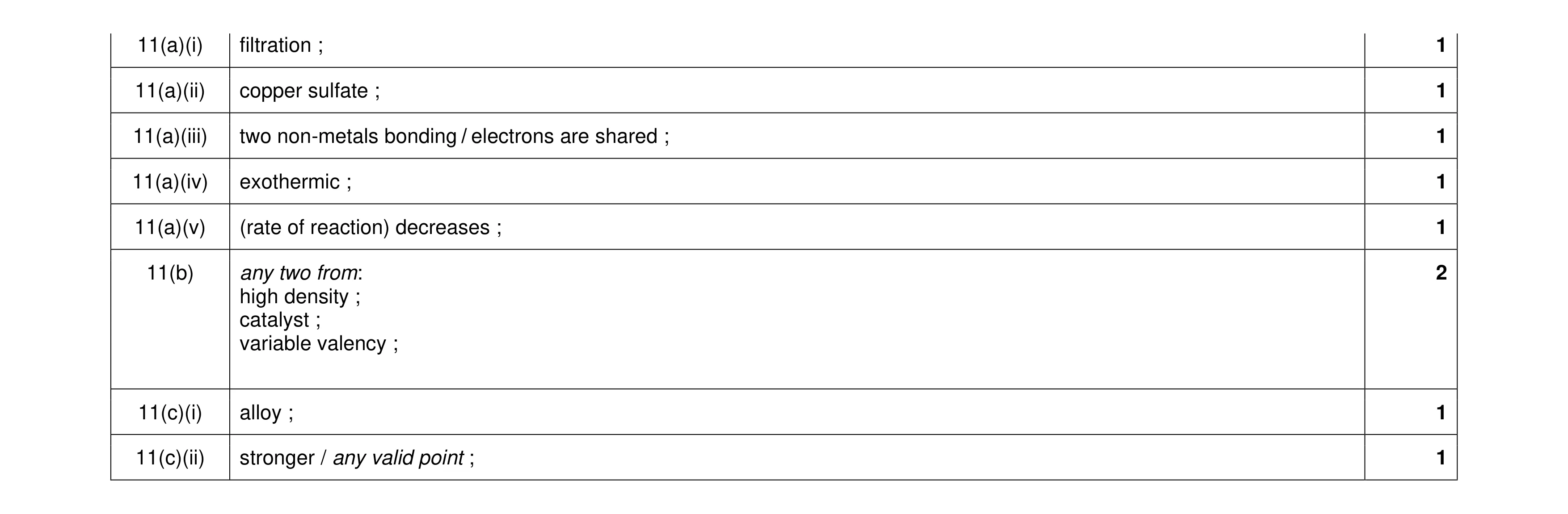 9
9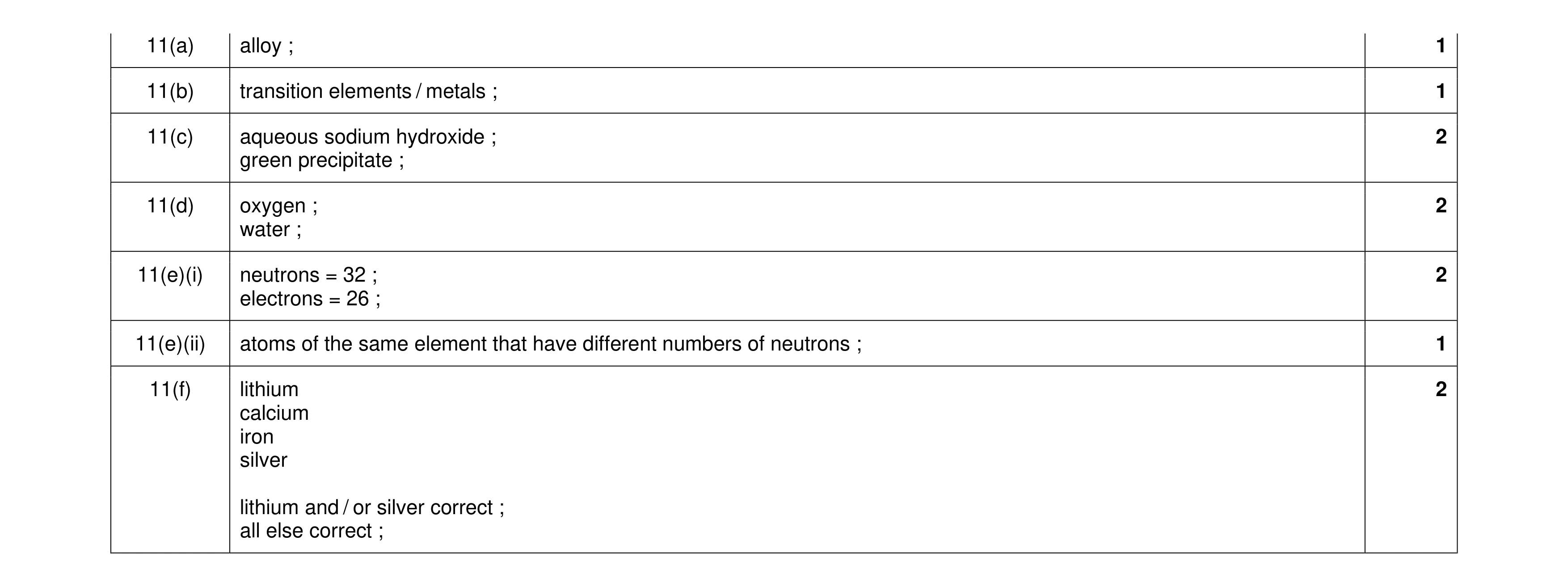 11
11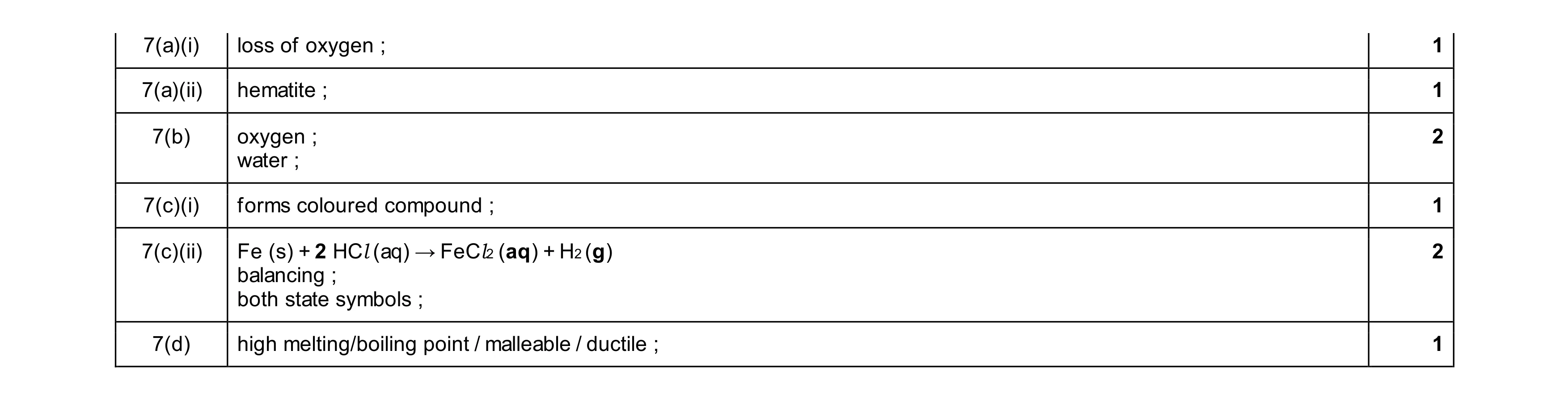 8
8