Questions as text
Q1 · The structure of a molecule of an alkane 0654/42 Oct/Nov 2017
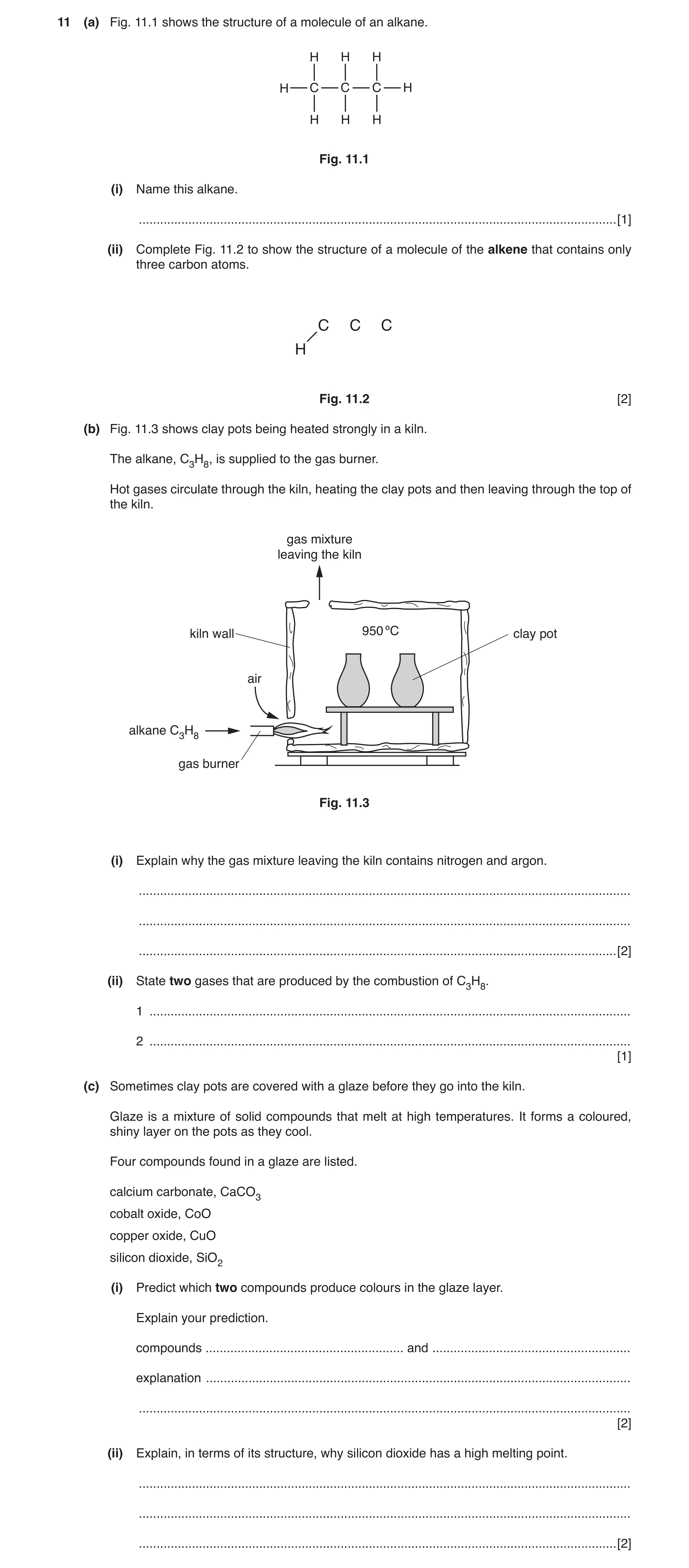
11 (a) Fig. 11.1 shows the structure of a molecule of an alkane. H H H H C C C H H H H Fig. 11.1 (i) Name this alkane. … [1] (ii) Complete Fig. 11.2 to show the structure of a molecule of the alkene that contains only three carbon atoms. C C C H Fig. 11.2 [2] (b) Fig. 11.3 shows clay pots being heated strongly in a kiln. The alkane, C3H8, is supplied to the gas burner. Hot gases circulate through the kiln, heating the clay pots and then leaving through the top of the kiln. gas mixture leaving the kiln kiln wall 950 ºC clay pot air alkane C3H8 gas burner Fig. 11.3 (i) Explain why the gas mixture leaving the kiln contains nitrogen and argon. … … … [2] (ii) State two gases that are produced by the combustion of C3H8. 1 … 2 … [1] (c) Sometimes clay pots are covered with a glaze before they go into the kiln. Glaze is a mixture of solid compounds that melt at high temperatures. It forms a coloured, shiny layer on the pots as they cool. Four compounds found in a glaze are listed. calcium carbonate, CaCO3 cobalt oxide, CoO copper oxide, CuO silicon dioxide, SiO2 (i) Predict which two compounds produce colours in the glaze layer. Explain your prediction. compounds … and … explanation … … [2] (ii) Explain, in terms of its structure, why silicon dioxide has a high melting point. … … … [2]
10 marks
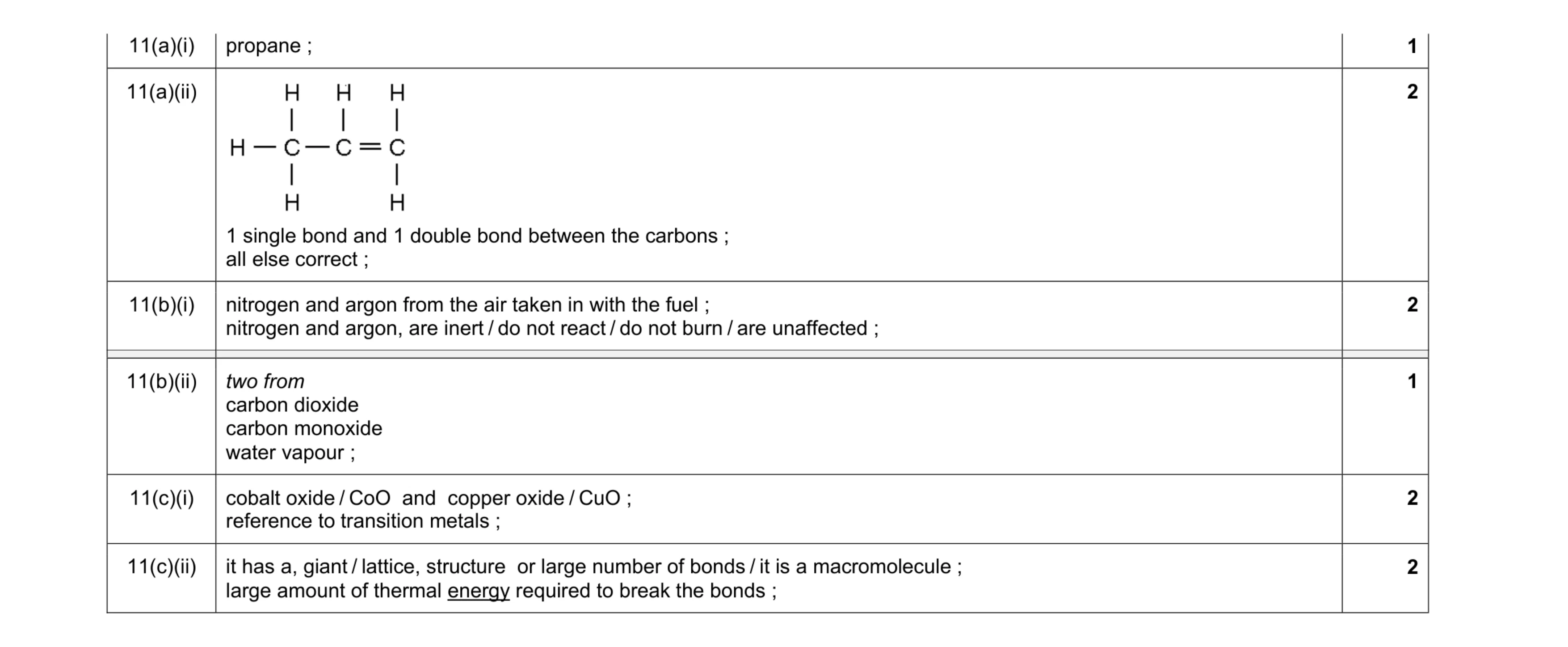
Mark scheme: 11(a)(i) propane ; 1 11(a)(ii) 1 single bond and 1 double bond between the carbons ; all else correct ; 2 11(b)(i) nitrogen and argon from the air taken in with the fuel ; nitrogen and argon, are inert / do not react / do not burn / are unaffected ; 2 Question Answer Marks 11(b)(ii) two from carbon dioxide carbon monoxide water vapour ; 1 11(c)(i) cobalt oxide / CoO and copper oxide / CuO ; reference to transition metals ; 2 11(c)(ii) it has a, giant / lattice, structure or large number of bonds / it is a macromolecule ; large amount of thermal energy required to break the bonds ; 2
This question in 0654/42 Oct/Nov 2017
Q2 · Alkanes and alkenes are homologous series of hydrocarbons 0654/43 Oct/Nov 2017
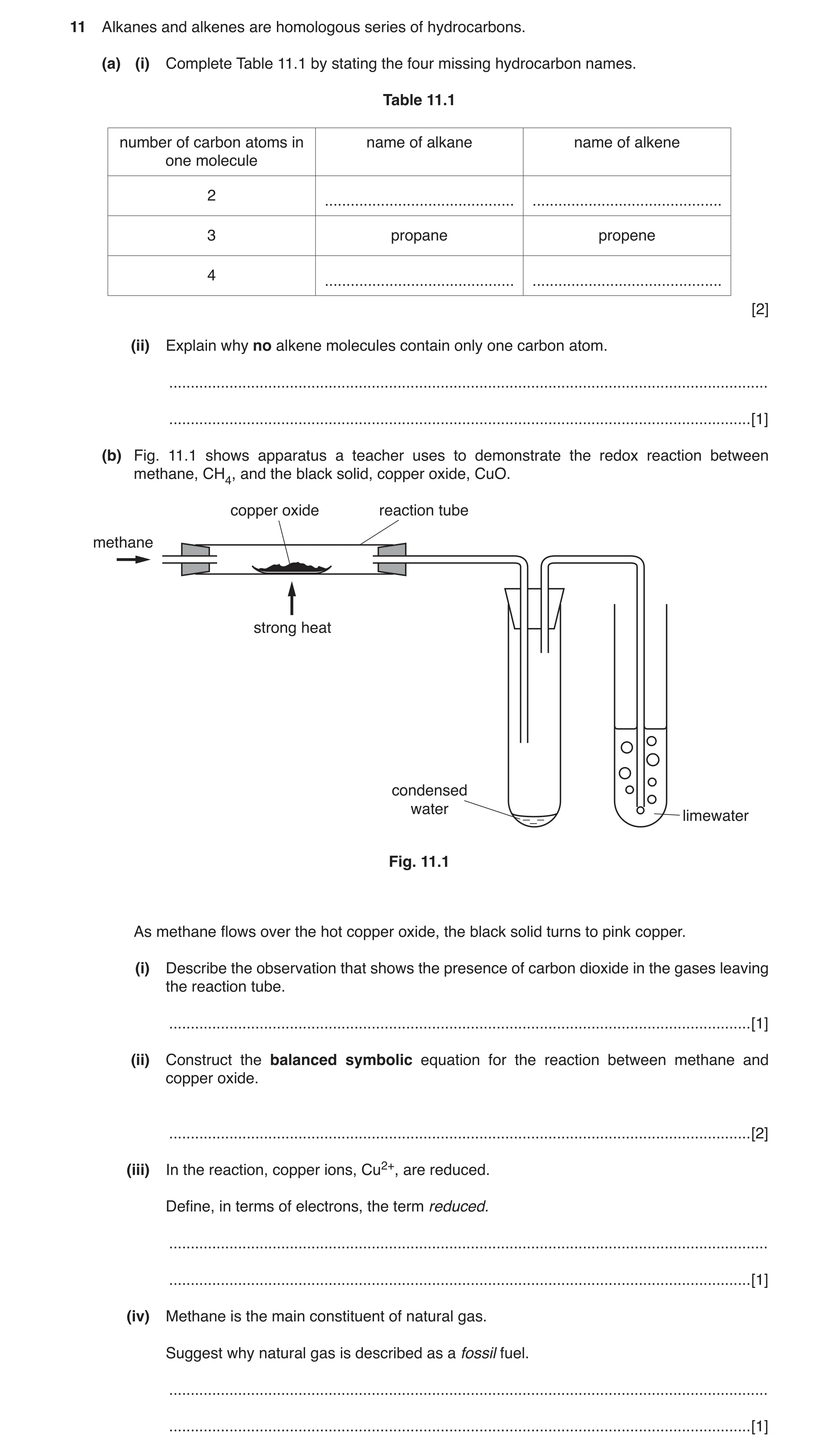
11 Alkanes and alkenes are homologous series of hydrocarbons. (a) (i) Complete Table 11.1 by stating the four missing hydrocarbon names. Table 11.1 number of carbon atoms in name of alkane name of alkene one molecule 2 … … 3 propane propene 4 … … [2] (ii) Explain why no alkene molecules contain only one carbon atom. … … [1] (b) Fig. 11.1 shows apparatus a teacher uses to demonstrate the redox reaction between methane, CH4, and the black solid, copper oxide, CuO. copper oxide reaction tube methane strong heat condensed water limewater Fig. 11.1 As methane flows over the hot copper oxide, the black solid turns to pink copper. (i) Describe the observation that shows the presence of carbon dioxide in the gases leaving the reaction tube. … [1] (ii) Construct the balanced symbolic equation for the reaction between methane and copper oxide. … [2] (iii) In the reaction, copper ions, Cu2+, are reduced. Define, in terms of electrons, the term reduced. … … [1] (iv) Methane is the main constituent of natural gas. Suggest why natural gas is described as a fossil fuel. … … [1]
8 marks
Mark scheme: 11(a)(i) ethane ethene butane butane 2 or 3 correct ; 4 correct ; 2 11(a)(ii) the idea that at least two carbon atoms required for double bond ; 1 11(b)(i) limewater goes milky ; 1 Question Answer Marks 11(b)(ii) 4CuO + CH4 → 4Cu + CO2 + 2H2O correct formulae ; correctly balanced ; 2 11(b)(iii) (copper ions) gain electrons ; 1 11(b)(iv) reference to time required for formation / AVP ; 1
This question in 0654/43 Oct/Nov 2017
Question 3 0654/41 Oct/Nov 2018
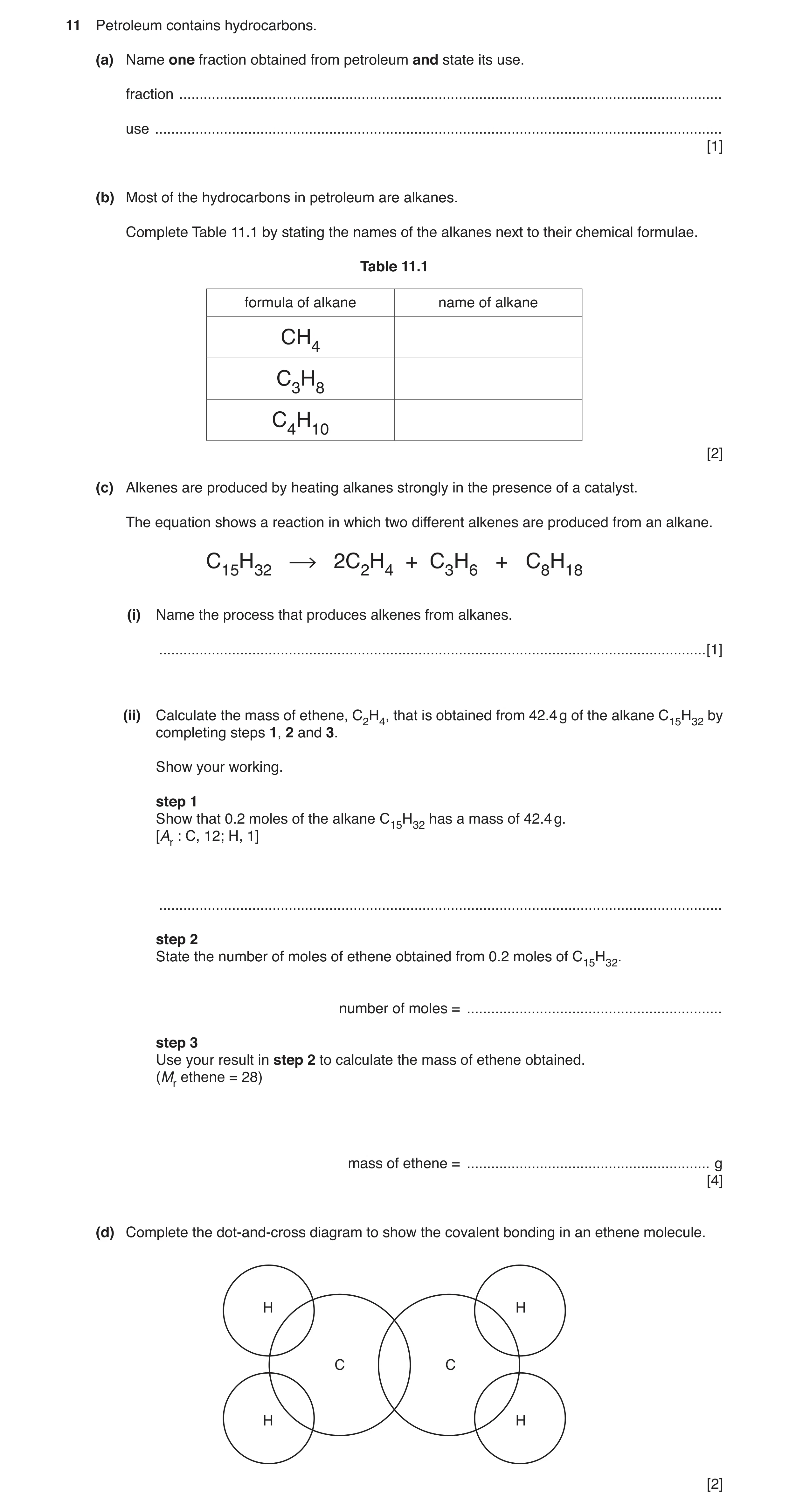
11 Petroleum contains hydrocarbons. (a) Name one fraction obtained from petroleum and state its use. fraction … use … [1] (b) Most of the hydrocarbons in petroleum are alkanes. Complete Table 11.1 by stating the names of the alkanes next to their chemical formulae. Table 11.1 formula of alkane name of alkane CH4 C3H8 C4H10 [2] (c) Alkenes are produced by heating alkanes strongly in the presence of a catalyst. The equation shows a reaction in which two different alkenes are produced from an alkane. C15H32 2C2H4 + C3H6 + C8H18 (i) Name the process that produces alkenes from alkanes. … [1] (ii) Calculate the mass of ethene, C2H4, that is obtained from 42.4 g of the alkane C15H32 by completing steps 1, 2 and 3. Show your working. step 1 Show that 0.2 moles of the alkane C15H32 has a mass of 42.4 g. [Ar : C, 12; H, 1] … step 2 State the number of moles of ethene obtained from 0.2 moles of C15H32. number of moles = … step 3 Use your result in step 2 to calculate the mass of ethene obtained. (Mr ethene = 28) mass of ethene = … g [4] (d) Complete the dot-and-cross diagram to show the covalent bonding in an ethene molecule. H H C C H H [2]
10 marks
Mark scheme: 11(a) refinery gas / gasoline / diesel / gas oil for fuel ; 1 11(b) methane propane butane 2 correct ; 3 correct ; 2 11(c)(i) (catalytic / thermal) cracking ; 1 11(c)(ii) step 1 calculate Mr (12 × 15) + (1 × 32) OR 212 ; moles = 42.4 ÷ 212 (= 0.2) / 0.2 × 212 (= 42.4) ; step 2 0.2 × 2 OR 0.4 ; step 3 0.4 × 28 = 1.2 (g) ; 4 11(d) two shared pairs between carbons ; four shared pairs between carbon and hydrogens ; 2
This question in 0654/41 Oct/Nov 2018
Q4 · Polymers form from monomer units 0654/42 Oct/Nov 2018
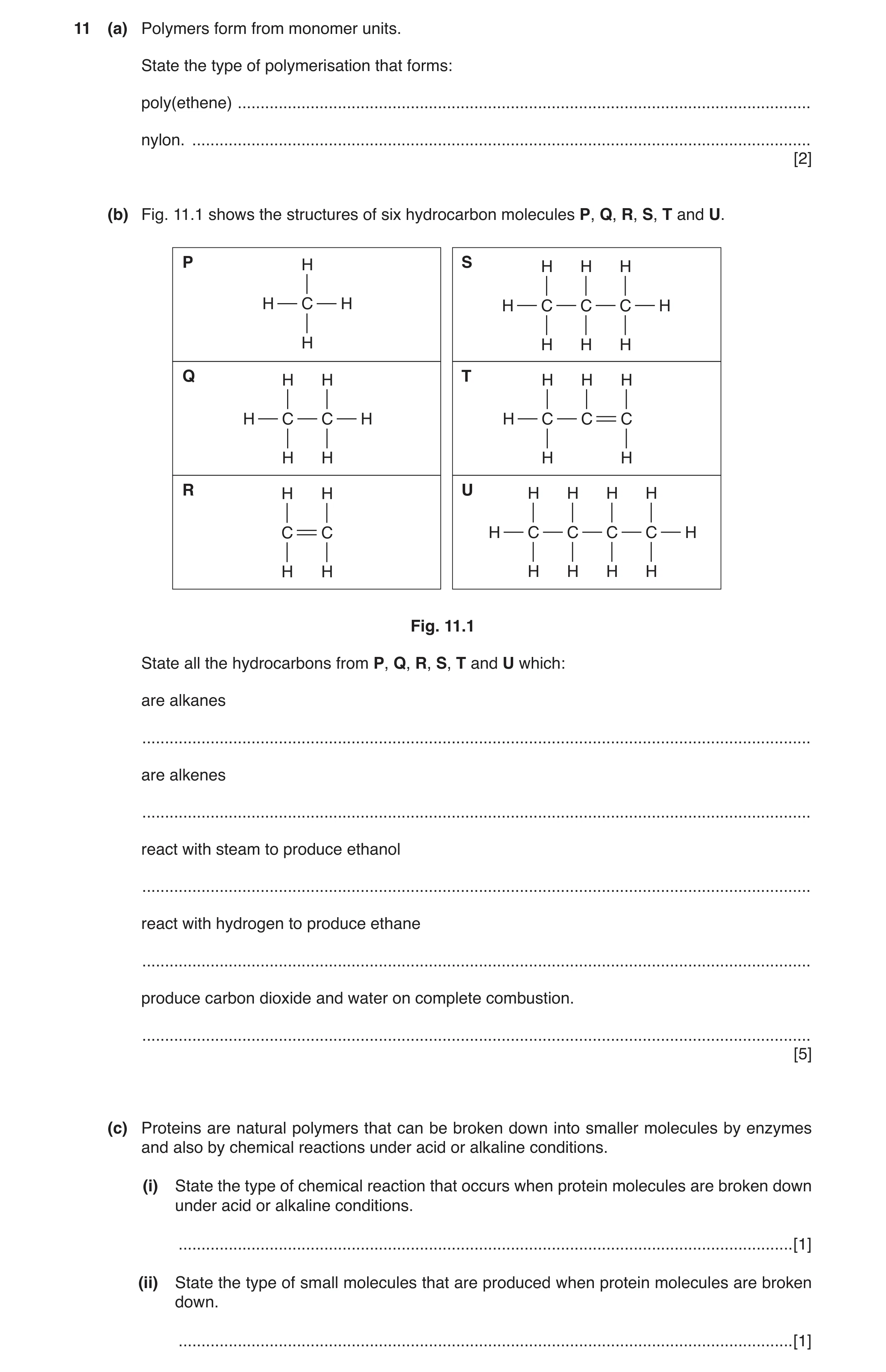
11 (a) Polymers form from monomer units. State the type of polymerisation that forms: poly(ethene) … nylon. … [2] (b) Fig. 11.1 shows the structures of six hydrocarbon molecules P, Q, R, S, T and U. P H S H H H H C H H C C C H H H H H Q H H T H H H H C C H H C C C H H H H R H H U H H H H C C H C C C C H H H H H H H Fig. 11.1 State all the hydrocarbons from P, Q, R, S, T and U which: are alkanes … are alkenes … react with steam to produce ethanol … react with hydrogen to produce ethane … produce carbon dioxide and water on complete combustion. … [5] (c) Proteins are natural polymers that can be broken down into smaller molecules by enzymes and also by chemical reactions under acid or alkaline conditions. (i) State the type of chemical reaction that occurs when protein molecules are broken down under acid or alkaline conditions. … [1] (ii) State the type of small molecules that are produced when protein molecules are broken down. … [1]
9 marks
Mark scheme: 11(a) addition ; condensation ; 2 11(b) Alkanes P Q S U ; Alkenes R T ; produce ethanol R ; produce ethane R ; combustion P Q R S T U / all of them ; 5 11(c)(i) (acid or alkaline) hydrolysis ; 1 11(c)(ii) amino acids ; 1
This question in 0654/42 Oct/Nov 2018
Q5 · The composition of clean air and of natural gas 0654/42 May/June 2019
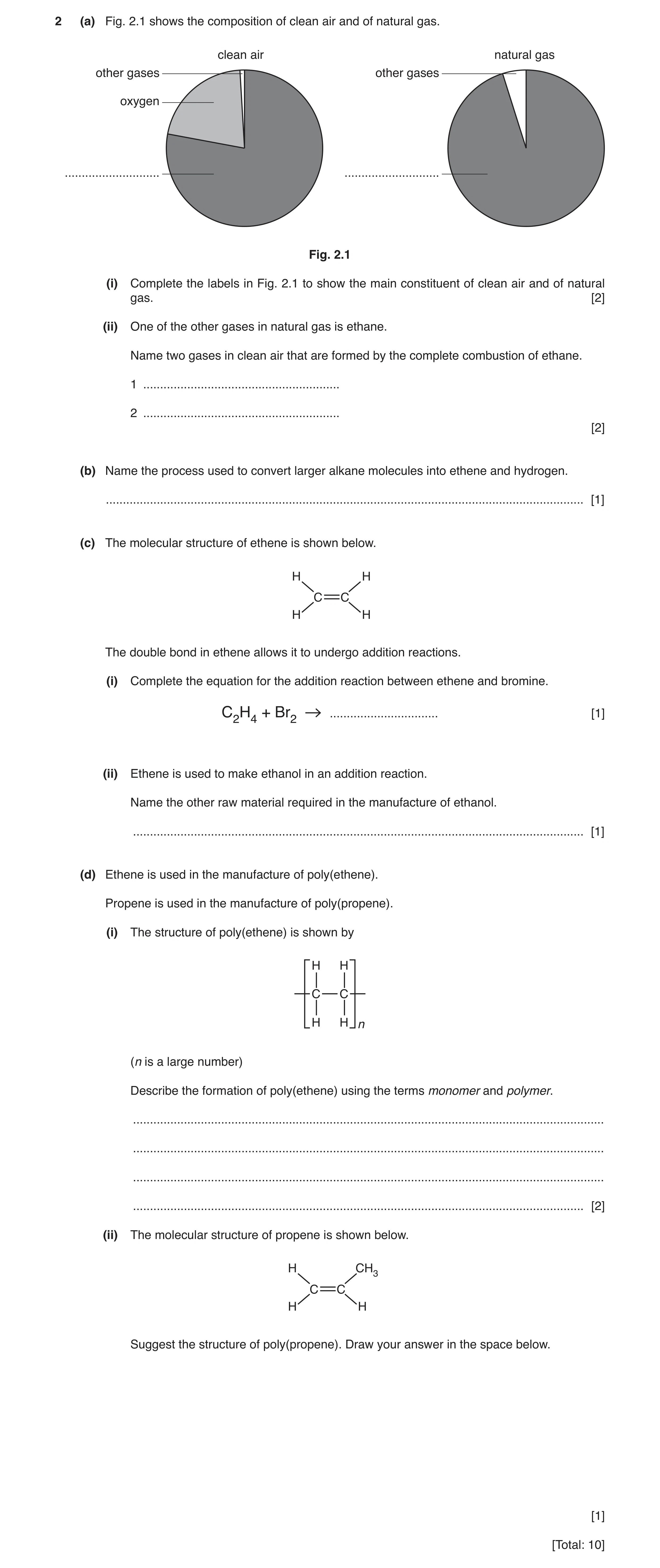
2 (a) Fig. 2.1 shows the composition of clean air and of natural gas. clean air natural gas other gases other gases oxygen … … Fig. 2.1 (i) Complete the labels in Fig. 2.1 to show the main constituent of clean air and of natural gas. [2] (ii) One of the other gases in natural gas is ethane. Name two gases in clean air that are formed by the complete combustion of ethane. 1 … 2 … [2] (b) Name the process used to convert larger alkane molecules into ethene and hydrogen. … [1] (c) The molecular structure of ethene is shown below. H H C C H H The double bond in ethene allows it to undergo addition reactions. (i) Complete the equation for the addition reaction between ethene and bromine. … [1] C2H4 + Br2 (ii) Ethene is used to make ethanol in an addition reaction. Name the other raw material required in the manufacture of ethanol. … [1] (d) Ethene is used in the manufacture of poly(ethene). Propene is used in the manufacture of poly(propene). (i) The structure of poly(ethene) is shown by H H C C H H n (n is a large number) Describe the formation of poly(ethene) using the terms monomer and polymer. … … … … [2] (ii) The molecular structure of propene is shown below. H CH3 C C H H Suggest the structure of poly(propene). Draw your answer in the space below. [1] [Total: 10]
10 marks
Mark scheme: 2(a)(i) nitrogen ; methane ; 2 2(a)(ii) carbon dioxide ; water (vapour) ; 2 2(b) cracking ; 1 2(c)(i) C2H4Br2 ; 1 2(c)(ii) steam / water (vapour) ; 1 2 (d)(i) ethene is monomer ; many, monomers / molecules, join to make a (long chain) polymer ; 2 2(d)(ii) H CH3 | | ------C---C------ | | H H n ; 1
This question in 0654/42 May/June 2019
Q6 · A petrol engine in a car uses a mixture of air and gasoline 0654/41 Oct/Nov 2019
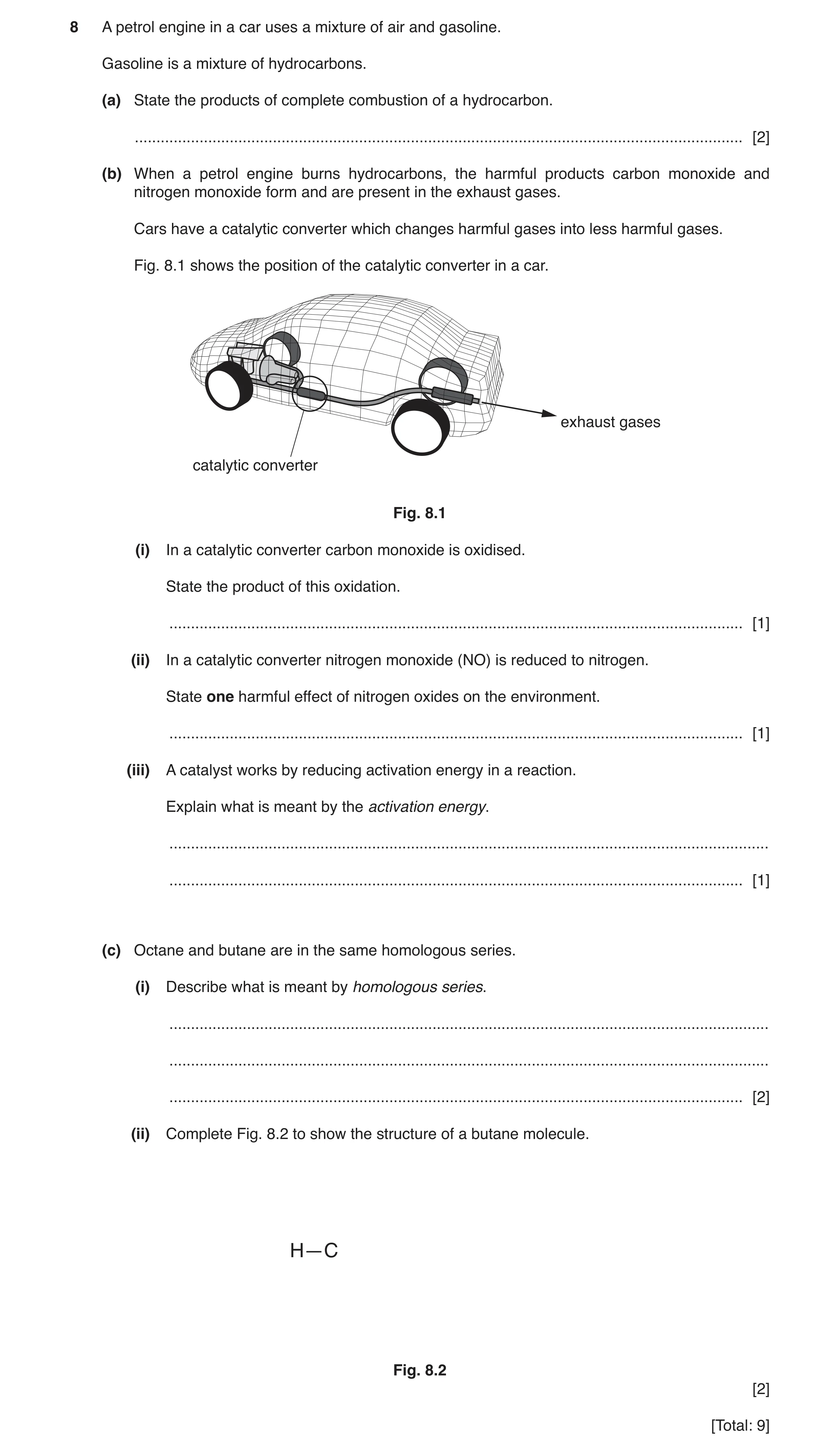
8 A petrol engine in a car uses a mixture of air and gasoline. Gasoline is a mixture of hydrocarbons. (a) State the products of complete combustion of a hydrocarbon. … [2] (b) When a petrol engine burns hydrocarbons, the harmful products carbon monoxide and nitrogen monoxide form and are present in the exhaust gases. Cars have a catalytic converter which changes harmful gases into less harmful gases. Fig. 8.1 shows the position of the catalytic converter in a car. exhaust gases catalytic converter Fig. 8.1 (i) In a catalytic converter carbon monoxide is oxidised. State the product of this oxidation. … [1] (ii) In a catalytic converter nitrogen monoxide (NO) is reduced to nitrogen. State one harmful effect of nitrogen oxides on the environment. … [1] (iii) A catalyst works by reducing activation energy in a reaction. Explain what is meant by the activation energy. … … [1] (c) Octane and butane are in the same homologous series. (i) Describe what is meant by homologous series. … … … [2] (ii) Complete Fig. 8.2 to show the structure of a butane molecule. H—C Fig. 8.2 [2] [Total: 9]
9 marks
Mark scheme: 8(a) carbon dioxide ; water ; 2 8(b)(i) carbon dioxide ; 1 8(b)(ii) acid rain / named effect of acid rain / respiratory disease ; 1 8(b)(iii) minimum energy for particles / reactants to react ; 1 8(c)(i) same general formula ; similar chemical properties ; 2 8(c)(ii) H H H H | | | | H – C – C – C – C – H | | | | H H H H chain of 4 C ; all else correct ; 2
This question in 0654/41 Oct/Nov 2019
Q7 · Petroleum is separated into useful chemicals by fractional distillation 0654/41 May/June 2020
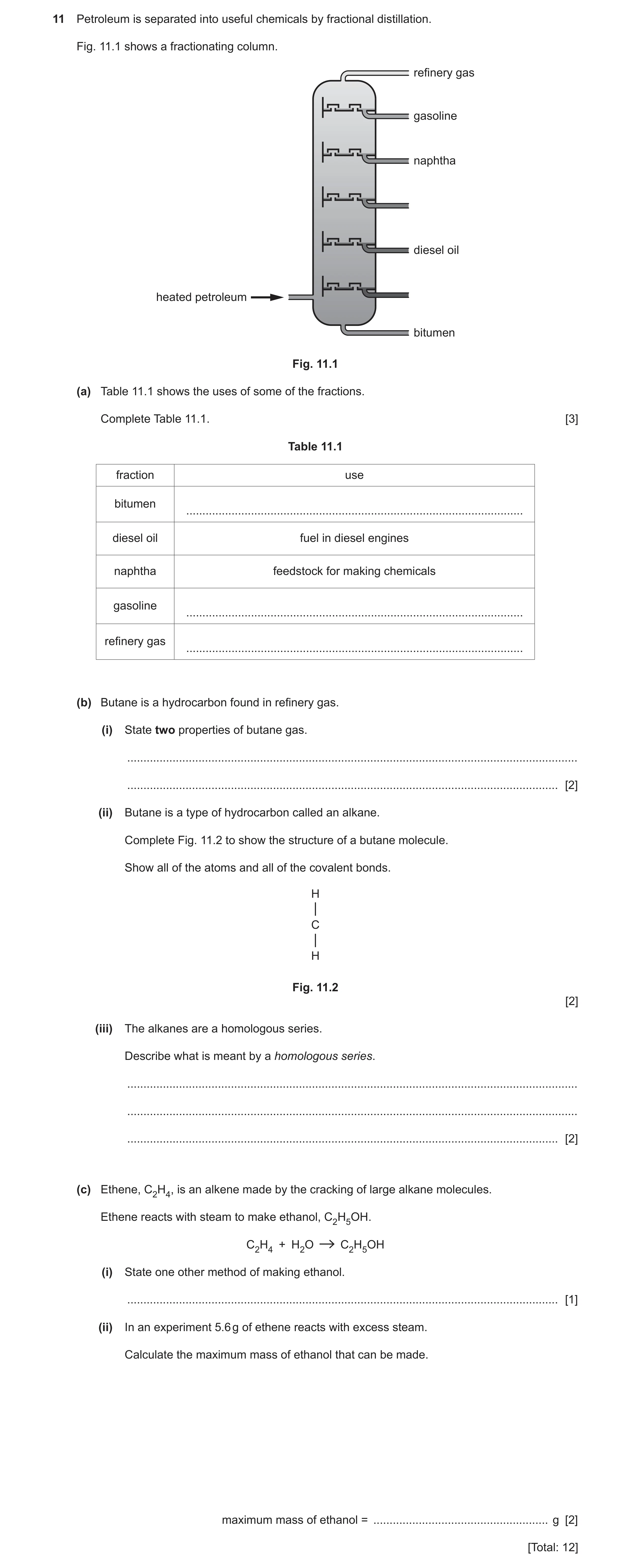
11 Petroleum is separated into useful chemicals by fractional distillation. Fig. 11.1 shows a fractionating column. refinery gas gasoline naphtha diesel oil heated petroleum bitumen Fig. 11.1 (a) Table 11.1 shows the uses of some of the fractions. Complete Table 11.1. [3] Table 11.1 fraction use bitumen … diesel oil fuel in diesel engines naphtha feedstock for making chemicals gasoline … refinery gas … (b) Butane is a hydrocarbon found in refinery gas. (i) State two properties of butane gas. … … [2] (ii) Butane is a type of hydrocarbon called an alkane. Complete Fig. 11.2 to show the structure of a butane molecule. Show all of the atoms and all of the covalent bonds. H C H Fig. 11.2 [2] (iii) The alkanes are a homologous series. Describe what is meant by a homologous series. … … … [2] (c) Ethene, C2H4, is an alkene made by the cracking of large alkane molecules. Ethene reacts with steam to make ethanol, C2H5OH. C2H4 + H2O C2H5OH (i) State one other method of making ethanol. … [1] (ii) In an experiment 5.6 g of ethene reacts with excess steam. Calculate the maximum mass of ethanol that can be made. maximum mass of ethanol = … g [2] [Total: 12]
12 marks
Mark scheme: 11(a) bitumen – road surfaces ; gasoline – fuel in cars ; refinery gas – bottled gas for heating or cooking or camping ; 3 Question Answer Marks 11(b)(i) low boiling point colourless ignites easily unreactive any general property of a gas ;; max 2 11(b)(ii) 1 mark for structure with 4 carbon atoms ; 1 mark for the rest of the structure correctly drawn ; 2 11(b)(iii) (family of compounds with) same general formula ; similar chemical properties ; 2 11(c)(i) fermentation 1 11(c)(ii) relative molecular mass of C2H4 =28 and of C2H5OH = 46 or (46 × 5.6) ÷ 28 ; = 9.2 ; 2
This question in 0654/41 May/June 2020
Q8 · Propane and propene are both hydrocarbons 0654/42 Oct/Nov 2020
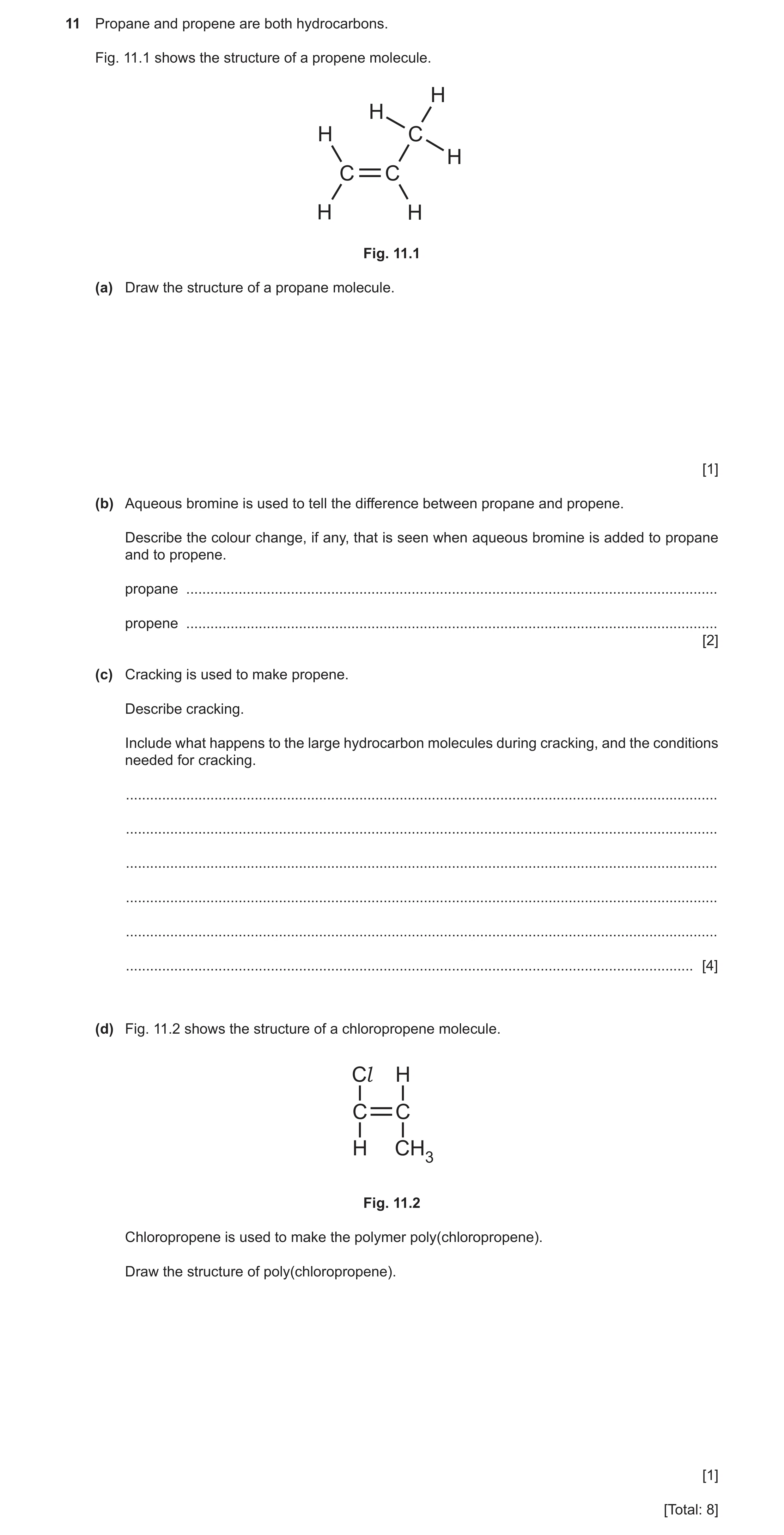
11 Propane and propene are both hydrocarbons. Fig. 11.1 shows the structure of a propene molecule. H H H C H C C H H Fig. 11.1 (a) Draw the structure of a propane molecule. [1] (b) Aqueous bromine is used to tell the difference between propane and propene. Describe the colour change, if any, that is seen when aqueous bromine is added to propane and to propene. propane … propene … [2] (c) Cracking is used to make propene. Describe cracking. Include what happens to the large hydrocarbon molecules during cracking, and the conditions needed for cracking. … … … … … … [4] (d) Fig. 11.2 shows the structure of a chloropropene molecule. Cl H C C H CH3 Fig. 11.2 Chloropropene is used to make the polymer poly(chloropropene). Draw the structure of poly(chloropropene). [1] [Total: 8]
8 marks
Mark scheme: 11(a) ; 1 11(b) bromine water remains orange (with propane) / bromine water is not decolourised (with propane) ; bromine water is decolourised (with propene) / bromine water changes from orange to colourless (with propene) ; 2 11(c) large hydrocarbon molecules are broken down / split up (into smaller molecules) ; to make, alkenes / named alkene other than propene ; plus any two from: high temperature / 300 to 600 °C ; catalyst / correctly named catalyst e.g. zeolite or porcelain ; high pressure / 50 to 200 atmospheres ; max 4 11(d) n ; 1
This question in 0654/42 Oct/Nov 2020
Q9 · Petroleum is a fossil fuel 0654/42 Feb/March 2021
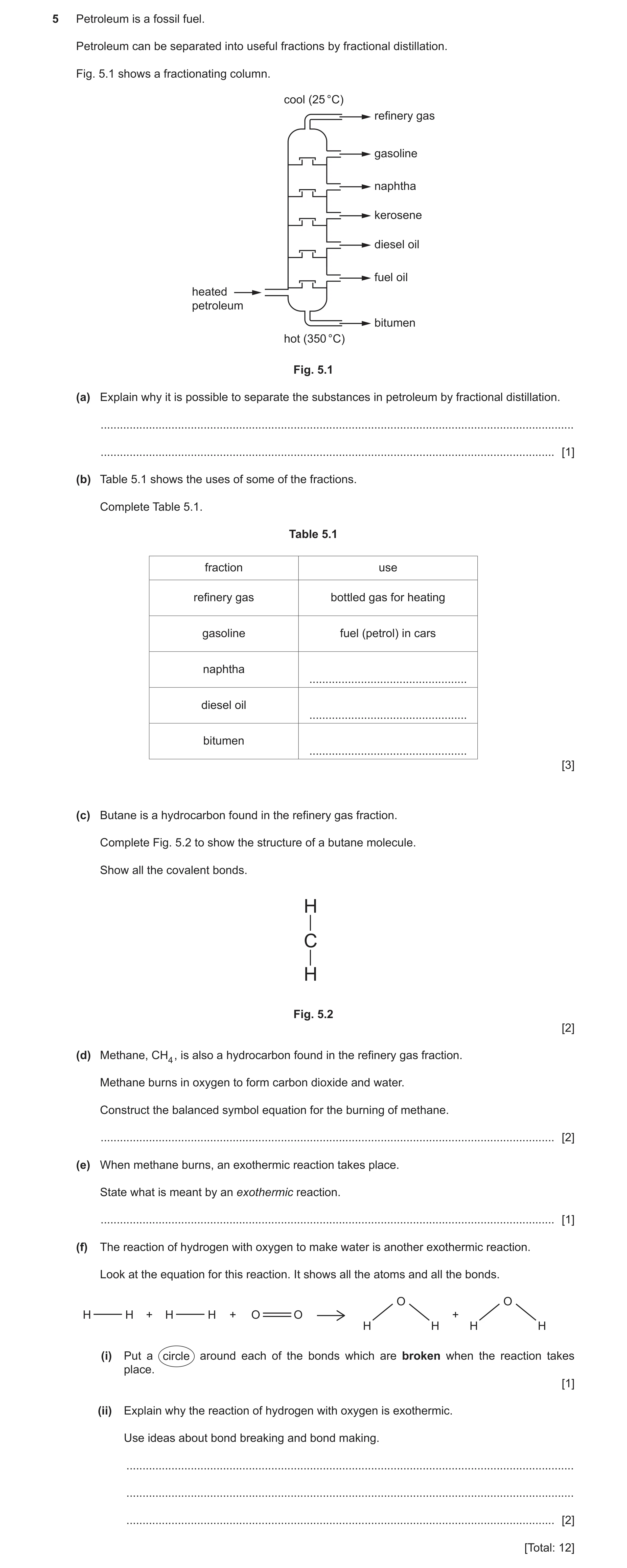
5 Petroleum is a fossil fuel. Petroleum can be separated into useful fractions by fractional distillation. Fig. 5.1 shows a fractionating column. cool (25 °C) refinery gas gasoline naphtha kerosene diesel oil fuel oil heated petroleum bitumen hot (350 °C) Fig. 5.1 (a) Explain why it is possible to separate the substances in petroleum by fractional distillation. … … [1] (b) Table 5.1 shows the uses of some of the fractions. Complete Table 5.1. Table 5.1 fraction use refinery gas bottled gas for heating gasoline fuel (petrol) in cars naphtha … diesel oil … bitumen … [3] (c) Butane is a hydrocarbon found in the refinery gas fraction. Complete Fig. 5.2 to show the structure of a butane molecule. Show all the covalent bonds. H C H Fig. 5.2 [2] (d) Methane, CH4 , is also a hydrocarbon found in the refinery gas fraction. Methane burns in oxygen to form carbon dioxide and water. Construct the balanced symbol equation for the burning of methane. … [2] (e) When methane burns, an exothermic reaction takes place. State what is meant by an exothermic reaction. … [1] (f) The reaction of hydrogen with oxygen to make water is another exothermic reaction. Look at the equation for this reaction. It shows all the atoms and all the bonds. O O H H + H H + O O + H H H H (i) Put a circle around each of the bonds which are broken when the reaction takes place. [1] (ii) Explain why the reaction of hydrogen with oxygen is exothermic. Use ideas about bond breaking and bond making. … … … [2] [Total: 12]
12 marks
Mark scheme: 5(a) substances have different boiling points ; 1 5(b) fraction use refinery gas bottled gas for heating gasoline fuel (petrol) in cars naphtha feedstock for making chemicals ; diesel oil fuel in diesel engines ; bitumen road surfaces ; 3 Question Answer Marks 5(c) ;; 2 5(d) CH4 + 2O2 → CO2 + 2H2O ;; 2 5(e) reaction in which thermal energy is given out ; 1 5(f)(i) + → ; 1 5(f)(ii) bond breaking is endothermic / owtte AND bond making is exothermic / owtte ; more energy is given out in bond making than is taken in in bond breaking ; 2
This question in 0654/42 Feb/March 2021
Q10 · Ethene and propene are both members of the homologous series called the alkenes 0654/41 May/June 2021
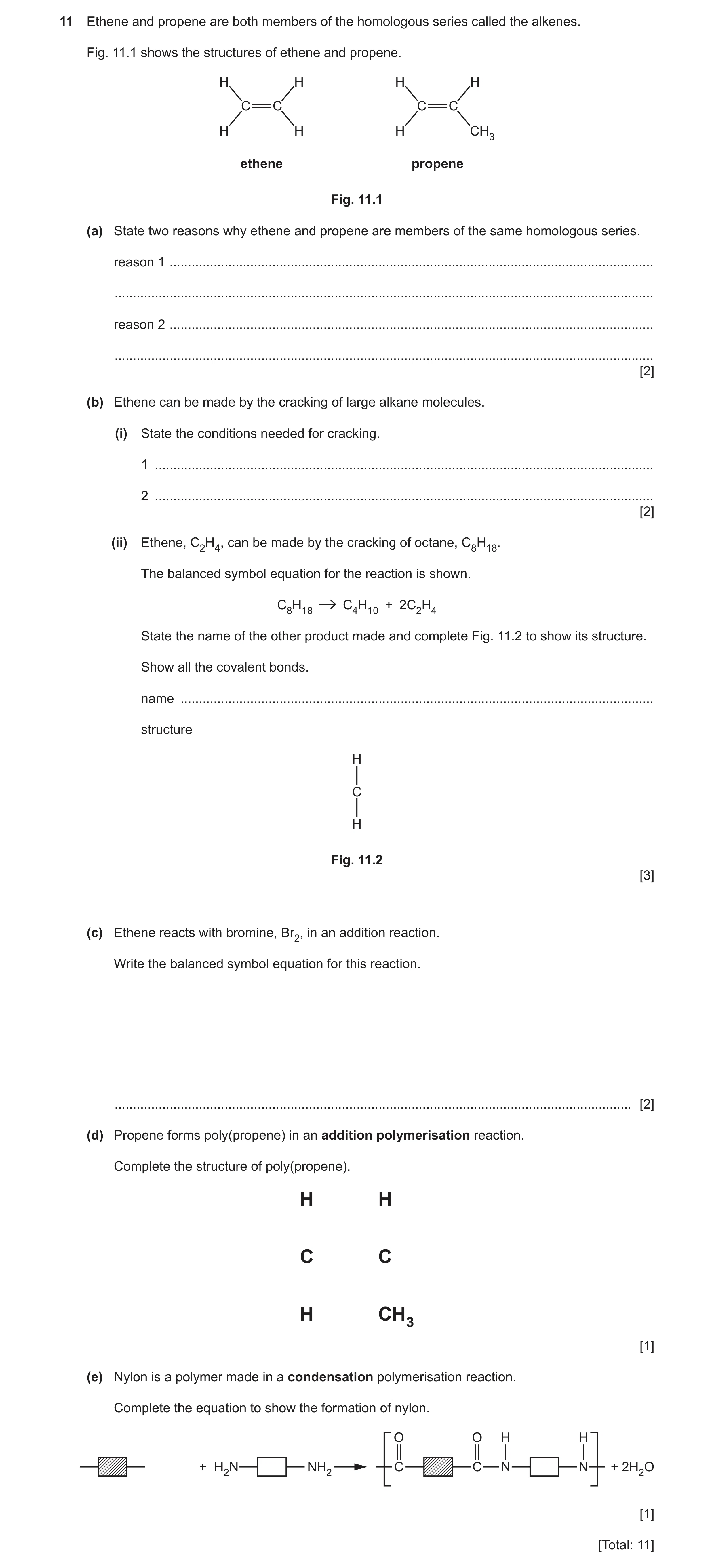
11 Ethene and propene are both members of the homologous series called the alkenes. Fig. 11.1 shows the structures of ethene and propene. H H H H C C C C H H H CH3 ethene propene Fig. 11.1 (a) State two reasons why ethene and propene are members of the same homologous series. reason 1 … … reason 2 … … [2] (b) Ethene can be made by the cracking of large alkane molecules. (i) State the conditions needed for cracking. 1 … 2 … [2] (ii) Ethene, C2H4, can be made by the cracking of octane, C8H18. The balanced symbol equation for the reaction is shown. C8H18 C4H10 + 2C2H4 State the name of the other product made and complete Fig. 11.2 to show its structure. Show all the covalent bonds. name … structure H C H Fig. 11.2 [3] (c) Ethene reacts with bromine, Br2, in an addition reaction. Write the balanced symbol equation for this reaction. … [2] (d) Propene forms poly(propene) in an addition polymerisation reaction. Complete the structure of poly(propene). H H C C H CH3 [1] (e) Nylon is a polymer made in a condensation polymerisation reaction. Complete the equation to show the formation of nylon. O O H H + H2N NH2 C C N N + 2H2O [1] [Total: 11]
11 marks
Mark scheme: 11(a) both have same functional group / both have (carbon to carbon) double bond ; both have same general formula / CnH2n ; both have similar (chemical) reactions ; trend in / similar, physical properties ; max 2 11(b)(i) high temperature / specified elevated temperature ; high pressure / specified elevated pressure ; catalyst / named catalyst ; AVP ; max 2 2 11(b)(ii) butane ; ;; 3 11(c) C2H4 + Br2 → C2H4Br2 C2H4Br2 ; then all else correct ; 2 Question Answer Marks 11(d) ; 1 11(e) ; 1
This question in 0654/41 May/June 2021
Q11 · The fractional distillation of petroleum makes useful fractions 0654/43 May/June 2021
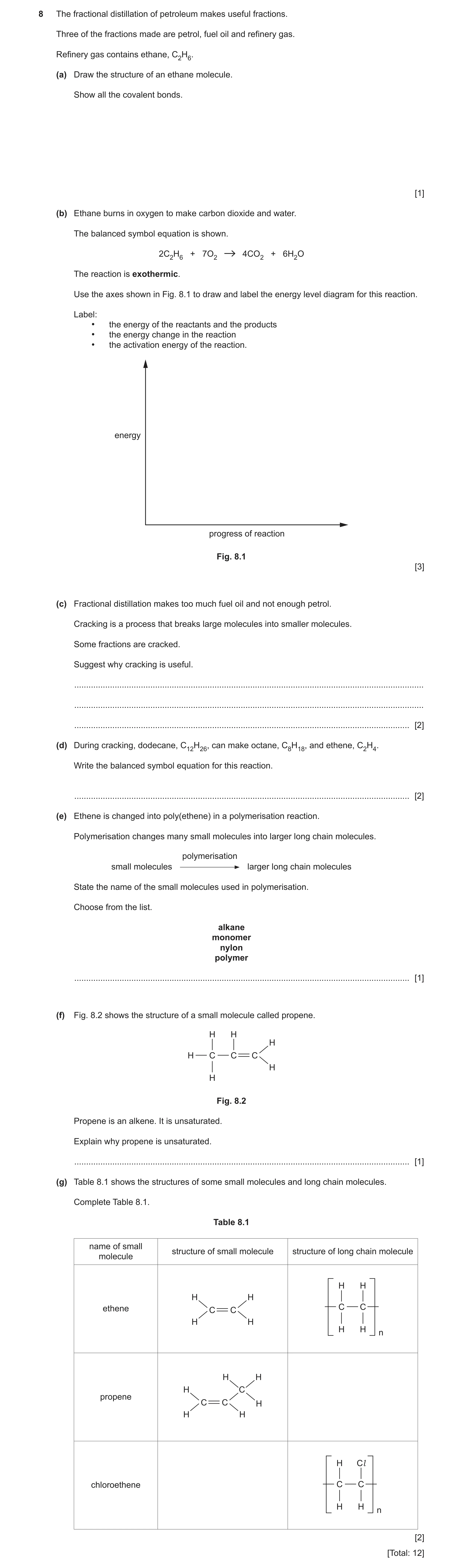
8 The fractional distillation of petroleum makes useful fractions. Three of the fractions made are petrol, fuel oil and refinery gas. Refinery gas contains ethane, C2H6. (a) Draw the structure of an ethane molecule. Show all the covalent bonds. [1] (b) Ethane burns in oxygen to make carbon dioxide and water. The balanced symbol equation is shown. 2C2H6 + 7O2 4CO2 + 6H2O The reaction is exothermic. Use the axes shown in Fig. 8.1 to draw and label the energy level diagram for this reaction. Label: • the energy of the reactants and the products • the energy change in the reaction • the activation energy of the reaction. energy progress of reaction Fig. 8.1 [3] (c) Fractional distillation makes too much fuel oil and not enough petrol. Cracking is a process that breaks large molecules into smaller molecules. Some fractions are cracked. Suggest why cracking is useful. … … … [2] (d) During cracking, dodecane, C12H26, can make octane, C8H18, and ethene, C2H4. Write the balanced symbol equation for this reaction. … [2] (e) Ethene is changed into poly(ethene) in a polymerisation reaction. Polymerisation changes many small molecules into larger long chain molecules. polymerisation small molecules larger long chain molecules State the name of the small molecules used in polymerisation. Choose from the list. alkane monomer nylon polymer … [1] (f) Fig. 8.2 shows the structure of a small molecule called propene. H H H H C C C H H Fig. 8.2 Propene is an alkene. It is unsaturated. Explain why propene is unsaturated. … [1] (g) Table 8.1 shows the structures of some small molecules and long chain molecules. Complete Table 8.1. Table 8.1 name of small structure of small molecule structure of long chain molecule molecule H H H H ethene C C C C H H H H n H H H C propene C C H H H H Cl chloroethene C C H H n [2] [Total: 12]
12 marks
Mark scheme: 8(a) ; 8(b) products shown below reactants ; energy change or correctly labelled ; activation energy correctly labelled ; 3 8(c) cracking makes more petrol / matches supply with demand ; cracking makes alkanes which can be used as fuels ; cracking makes alkenes which can be used to make plastics / alcohol / ethanol ; max 2 2 Activation Energy Energy Energy Change Question Answer Marks 8(d) C12H26 → C8H18 + 2C2H4 formulae ; balancing ; 2 8(e) monomer ; 1 8(f) (propene contains) a (carbon to carbon) double bond ; 1 8(g) (propene) (chloroethene) 2
This question in 0654/43 May/June 2021
Q12 · Large hydrocarbon molecules can be cracked to make smaller molecules 0654/42 Oct/Nov 2021
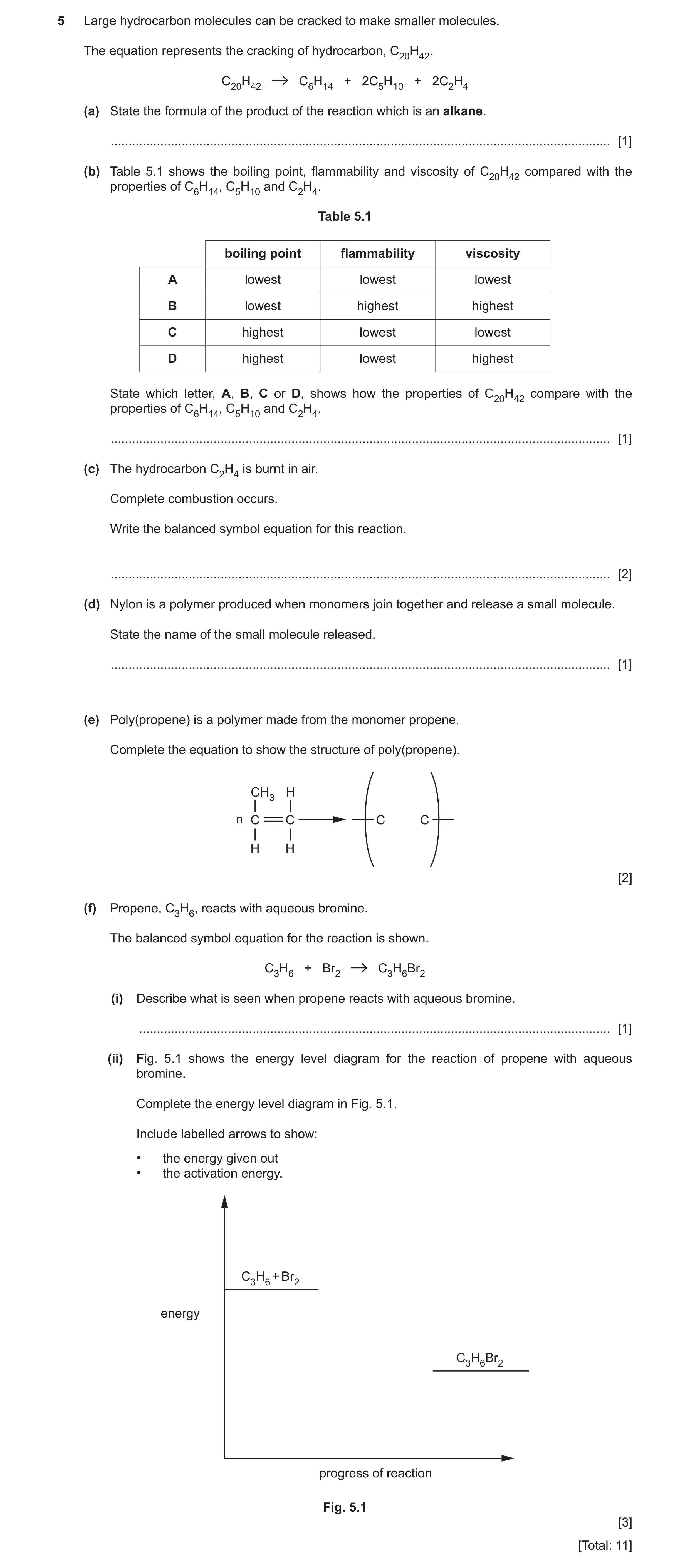
5 Large hydrocarbon molecules can be cracked to make smaller molecules. The equation represents the cracking of hydrocarbon, C20H42. C20H42 C6H14 + 2C5H10 + 2C2H4 (a) State the formula of the product of the reaction which is an alkane. … [1] (b) Table 5.1 shows the boiling point, flammability and viscosity of C20H42 compared with the properties of C6H14, C5H10 and C2H4. Table 5.1 boiling point flammability viscosity A lowest lowest lowest B lowest highest highest C highest lowest lowest D highest lowest highest State which letter, A, B, C or D, shows how the properties of C20H42 compare with the properties of C6H14, C5H10 and C2H4. … [1] (c) The hydrocarbon C2H4 is burnt in air. Complete combustion occurs. Write the balanced symbol equation for this reaction. … [2] (d) Nylon is a polymer produced when monomers join together and release a small molecule. State the name of the small molecule released. … [1] (e) Poly(propene) is a polymer made from the monomer propene. Complete the equation to show the structure of poly(propene). CH3 H n C C C C H H [2] (f) Propene, C3H6, reacts with aqueous bromine. The balanced symbol equation for the reaction is shown. C3H6 + Br2 C3H6Br2 (i) Describe what is seen when propene reacts with aqueous bromine. … [1] (ii) Fig. 5.1 shows the energy level diagram for the reaction of propene with aqueous bromine. Complete the energy level diagram in Fig. 5.1. Include labelled arrows to show: • the energy given out • the activation energy. C3H6 + Br2 energy C3H6Br2 progress of reaction Fig. 5.1 [3] [Total: 11]
11 marks
Mark scheme: 5(a) C6H14 ; 1 5(b) D ; 1 5(c) C2H4 + 3O2 → 2 CO2 + 2H2O ;; 2 5(d) water ; 1 5(e) ;; 2 5(f)(i) (aqueous bromine is) decolourised / changes from orange or yellow to colourless ; 1 5(f)(ii) ;;; 3 activation energy energy given out
This question in 0654/42 Oct/Nov 2021
Q13 · Fractional distillation of petroleum makes useful fractions 0654/42 May/June 2022
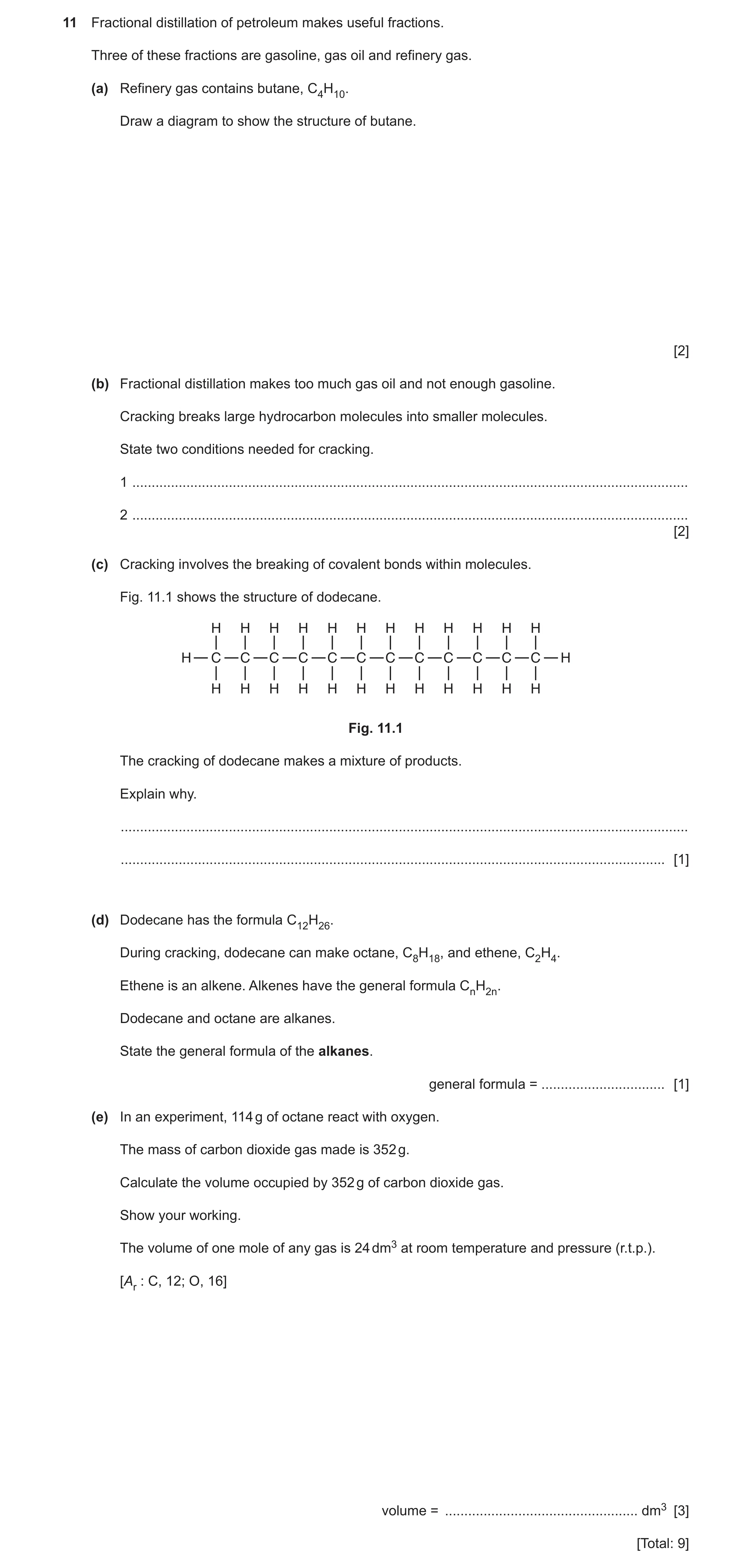
11 Fractional distillation of petroleum makes useful fractions. Three of these fractions are gasoline, gas oil and refinery gas. (a) Refinery gas contains butane, C4H10. Draw a diagram to show the structure of butane. [2] (b) Fractional distillation makes too much gas oil and not enough gasoline. Cracking breaks large hydrocarbon molecules into smaller molecules. State two conditions needed for cracking. 1 … 2 … [2] (c) Cracking involves the breaking of covalent bonds within molecules. Fig. 11.1 shows the structure of dodecane. H H H H H H H H H H H H H C C C C C C C C C C C C H H H H H H H H H H H H H Fig. 11.1 The cracking of dodecane makes a mixture of products. Explain why. … … [1] (d) Dodecane has the formula C12H26. During cracking, dodecane can make octane, C8H18, and ethene, C2H4. Ethene is an alkene. Alkenes have the general formula CnH2n. Dodecane and octane are alkanes. State the general formula of the alkanes. general formula = … [1] (e) In an experiment, 114 g of octane react with oxygen. The mass of carbon dioxide gas made is 352 g. Calculate the volume occupied by 352 g of carbon dioxide gas. Show your working. The volume of one mole of any gas is 24 dm3 at room temperature and pressure (r.t.p.). [Ar : C, 12; O, 16] volume = … dm3 [3] [Total: 9]
9 marks
Mark scheme: 11(a) ;; 2 11(b) any two from: (named) catalyst ; high temperature ; high pressure ; 2 11(c) idea that any bond within the molecule can break ; 1 11(d) CnH2n+2 ; 1 11(e) Mr of CO2 = 44 ; Moles of CO2 = 352 ÷ 44 = 8 ; Volume of CO2 = 8 24 = 192 dm³ ; 3
This question in 0654/42 May/June 2022
Q14 · Petroleum is a fossil fuel 0654/43 May/June 2022
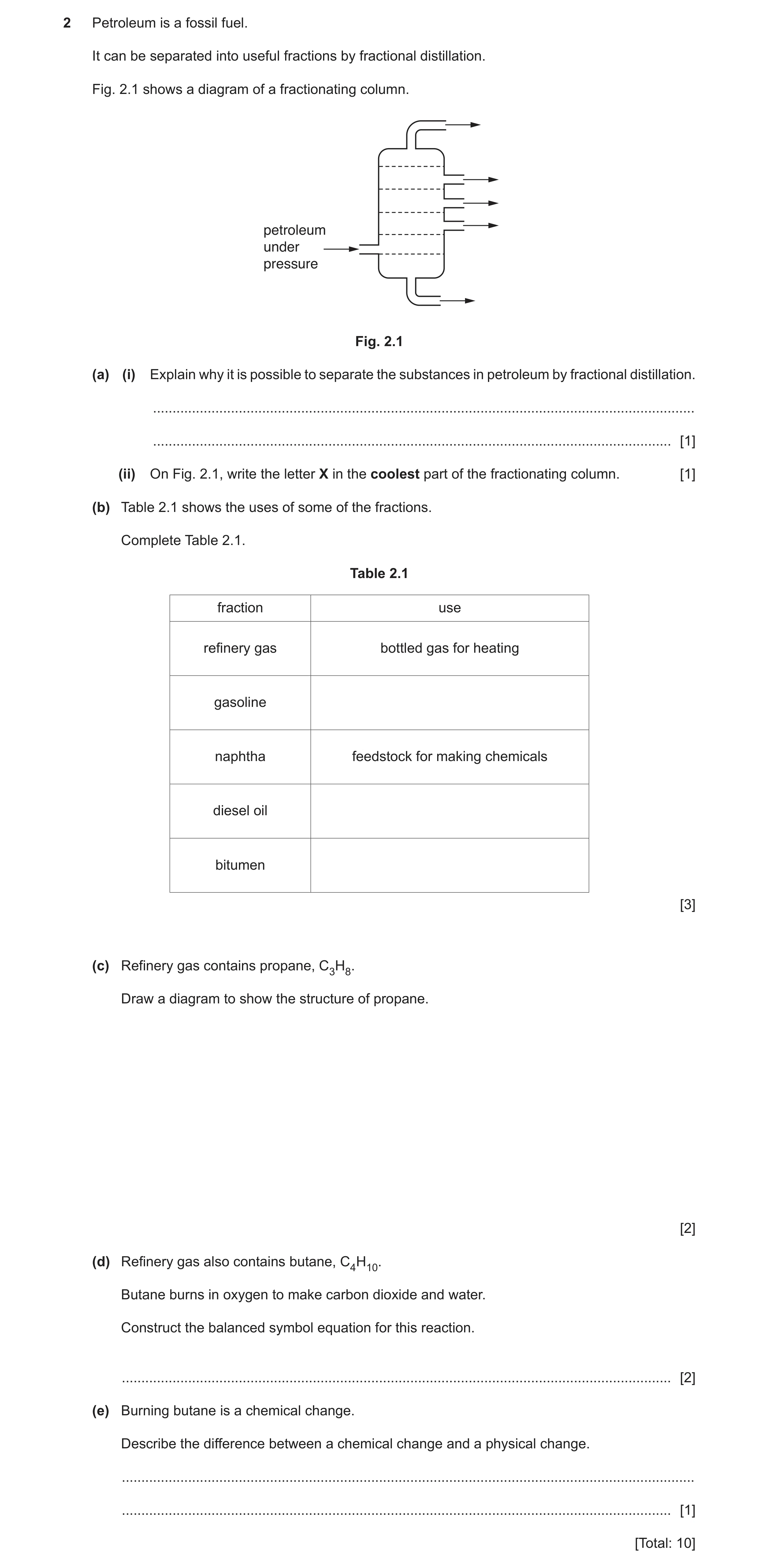
2 Petroleum is a fossil fuel. It can be separated into useful fractions by fractional distillation. Fig. 2.1 shows a diagram of a fractionating column. petroleum under pressure Fig. 2.1 (a) (i) Explain why it is possible to separate the substances in petroleum by fractional distillation. … … [1] (ii) On Fig. 2.1, write the letter X in the coolest part of the fractionating column. [1] (b) Table 2.1 shows the uses of some of the fractions. Complete Table 2.1. Table 2.1 fraction use refinery gas bottled gas for heating gasoline naphtha feedstock for making chemicals diesel oil bitumen [3] (c) Refinery gas contains propane, C3H8. Draw a diagram to show the structure of propane. [2] (d) Refinery gas also contains butane, C4H10. Butane burns in oxygen to make carbon dioxide and water. Construct the balanced symbol equation for this reaction. … [2] (e) Burning butane is a chemical change. Describe the difference between a chemical change and a physical change. … … [1] [Total: 10]
10 marks
Mark scheme: 2(a)(i) (fractions have) different boiling points ; 1 2(a)(ii) X marked inside the top of the column, above the top dotted line ; 1 Question Answer Marks 2(b) fraction use refinery gas bottled gas for heating gasoline fuel in cars ; naphtha feedstock for making chemicals diesel oil fuel in diesel engines ; bitumen road surfaces ; 3 2(c) ;; 2 2(d) 2C4H10 + 13O2 8CO2 + 10H2O correct formulae ; correct balancing ; 2 2(e) (in a chemical change) a new substance is made / owtte ; 1
This question in 0654/43 May/June 2022
Q15 · Alkanes are a type of hydrocarbon 0654/41 Oct/Nov 2022
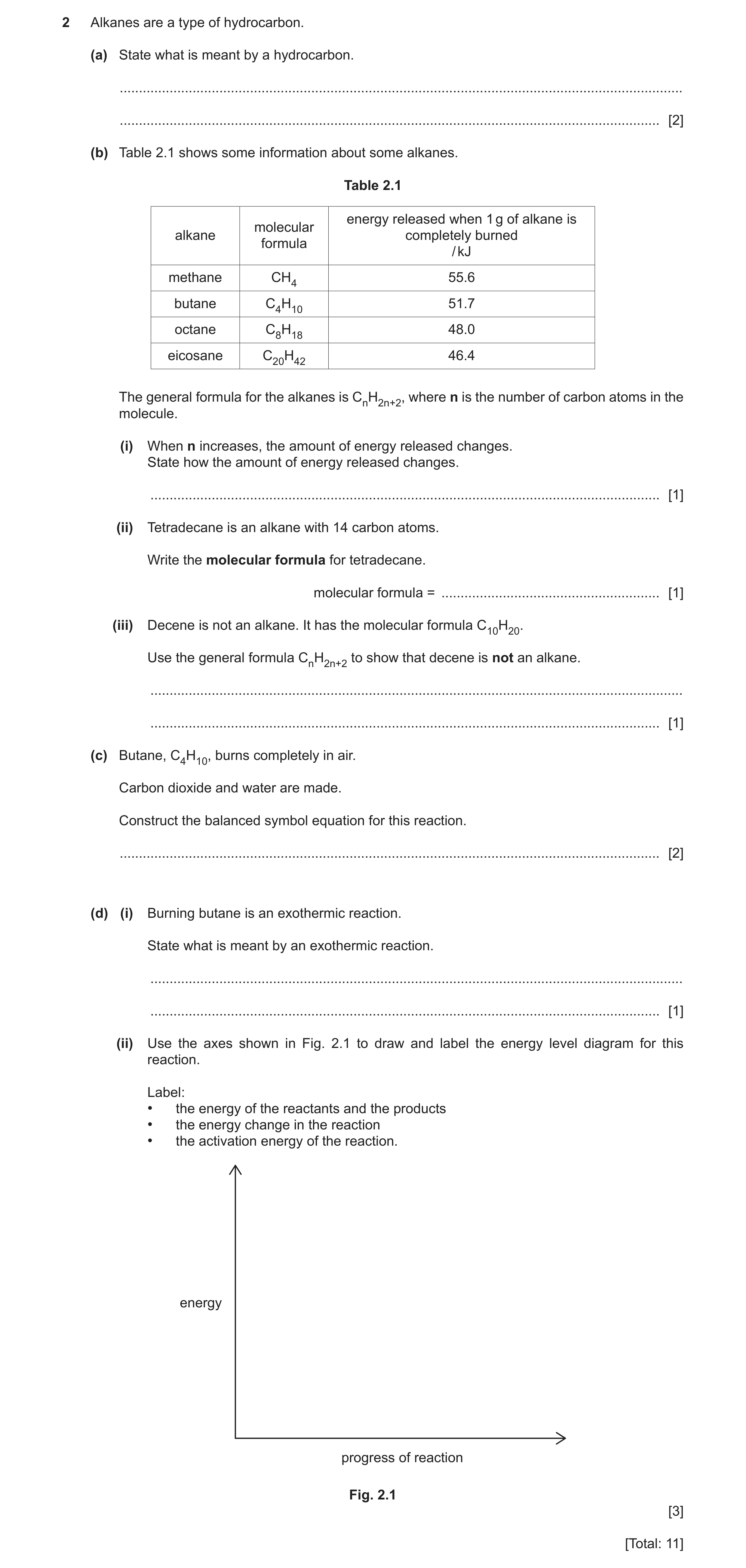
2 Alkanes are a type of hydrocarbon. (a) State what is meant by a hydrocarbon. … … [2] (b) Table 2.1 shows some information about some alkanes. Table 2.1 energy released when 1 g of alkane is molecular alkane completely burned formula / kJ methane CH4 55.6 butane C4H10 51.7 octane C8H18 48.0 eicosane C20H42 46.4 The general formula for the alkanes is CnH2n+2, where n is the number of carbon atoms in the molecule. (i) When n increases, the amount of energy released changes. State how the amount of energy released changes. … [1] (ii) Tetradecane is an alkane with 14 carbon atoms. Write the molecular formula for tetradecane. molecular formula = … [1] (iii) Decene is not an alkane. It has the molecular formula C10H20. Use the general formula CnH2n+2 to show that decene is not an alkane. … … [1] (c) Butane, C4H10, burns completely in air. Carbon dioxide and water are made. Construct the balanced symbol equation for this reaction. … [2] (d) (i) Burning butane is an exothermic reaction. State what is meant by an exothermic reaction. … … [1] (ii) Use the axes shown in Fig. 2.1 to draw and label the energy level diagram for this reaction. Label: • the energy of the reactants and the products • the energy change in the reaction • the activation energy of the reaction. energy progress of reaction Fig. 2.1 [3] [Total: 11]
11 marks
Mark scheme: 2(a) (compound that contains) carbon and hydrogen ; 2 only / owtte ; 2(b)(i) decreases / owtte ; 1 2(b)(ii) C14H30 ; 1 2(b)(iii) idea that if n = 10 then H will be 22, but in decene it is 20 ; 1 2(c) 2C4H10 + 13O2→8CO2 + 10H2O 2 correct formulae ; correct balancing ; 2(d)(i) (reaction in which) energy is given out / heat is given out ; 1 2(d)(ii) 3 products shown below reactants; energy change or H correctly labelled; activation energy or Ea correctly labelled;
This question in 0654/41 Oct/Nov 2022
Q16 · Ethane and ethene are members of two different homologous series 0654/42 Oct/Nov 2022
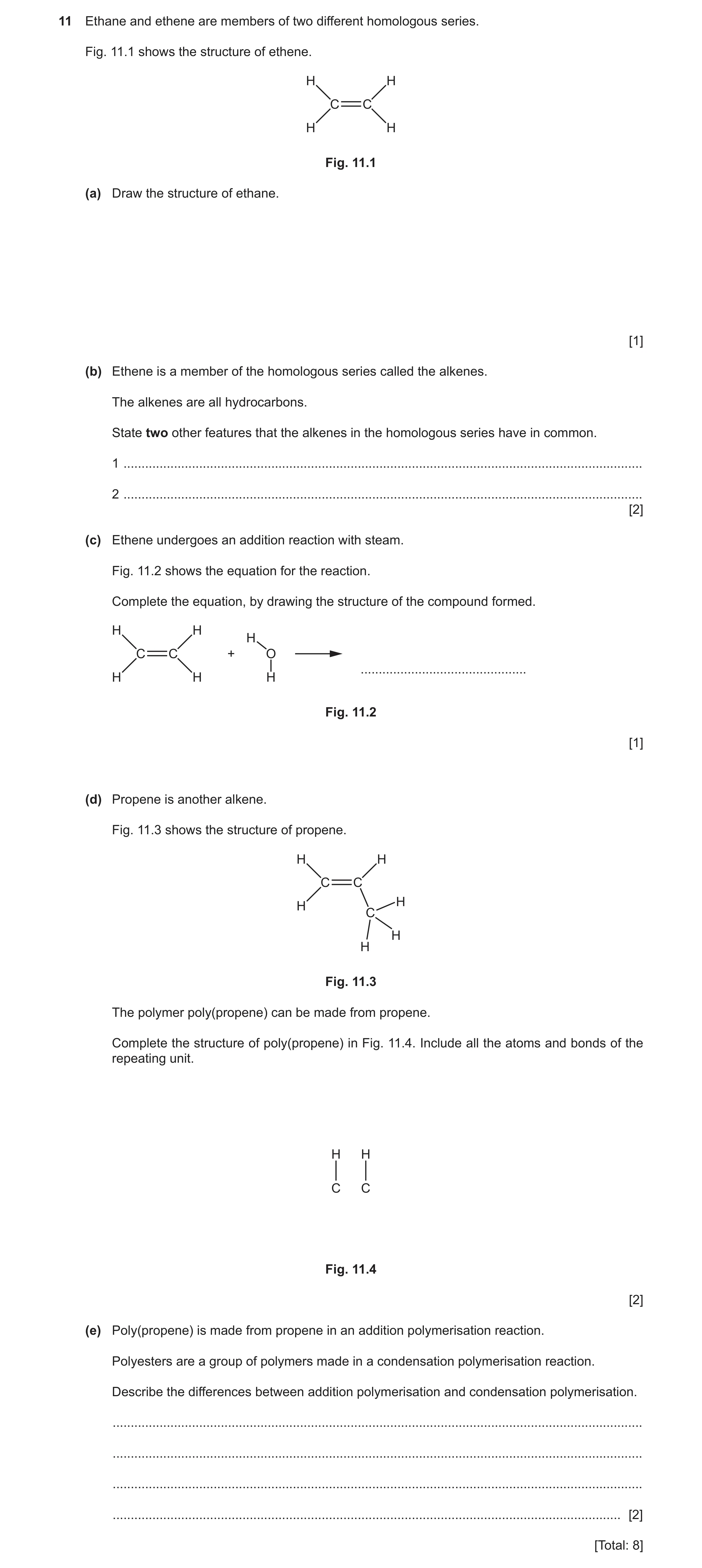
11 Ethane and ethene are members of two different homologous series. Fig. 11.1 shows the structure of ethene. H H C C H H Fig. 11.1 (a) Draw the structure of ethane. [1] (b) Ethene is a member of the homologous series called the alkenes. The alkenes are all hydrocarbons. State two other features that the alkenes in the homologous series have in common. 1 … 2 … [2] (c) Ethene undergoes an addition reaction with steam. Fig. 11.2 shows the equation for the reaction. Complete the equation, by drawing the structure of the compound formed. H H H C C + O … H H H Fig. 11.2 [1] (d) Propene is another alkene. Fig. 11.3 shows the structure of propene. H H C C H H C H H Fig. 11.3 The polymer poly(propene) can be made from propene. Complete the structure of poly(propene) in Fig. 11.4. Include all the atoms and bonds of the repeating unit. H H C C Fig. 11.4 [2] (e) Poly(propene) is made from propene in an addition polymerisation reaction. Polyesters are a group of polymers made in a condensation polymerisation reaction. Describe the differences between addition polymerisation and condensation polymerisation. … … … … [2] [Total: 8]
8 marks
Mark scheme: 11(a) 1 ; 11(b) any two from: 2 same general formula / have formula C2H2 ; similar chemical properties ; contain (at least one) double bond ; 11(c) 1 ; 11(d) 2 mark for single bond between carbon atoms ; mark for rest of structure correct ; 11(e) addition polymerisation requires one monomer / condensation 2 polymerisation requires two monomers ; addition polymerisation produces a polymer only / condensation polymerisation produces a polymer molecule and a small molecule ;
This question in 0654/42 Oct/Nov 2022
Q17 · Alkanes are saturated hydrocarbons 0654/42 May/June 2023
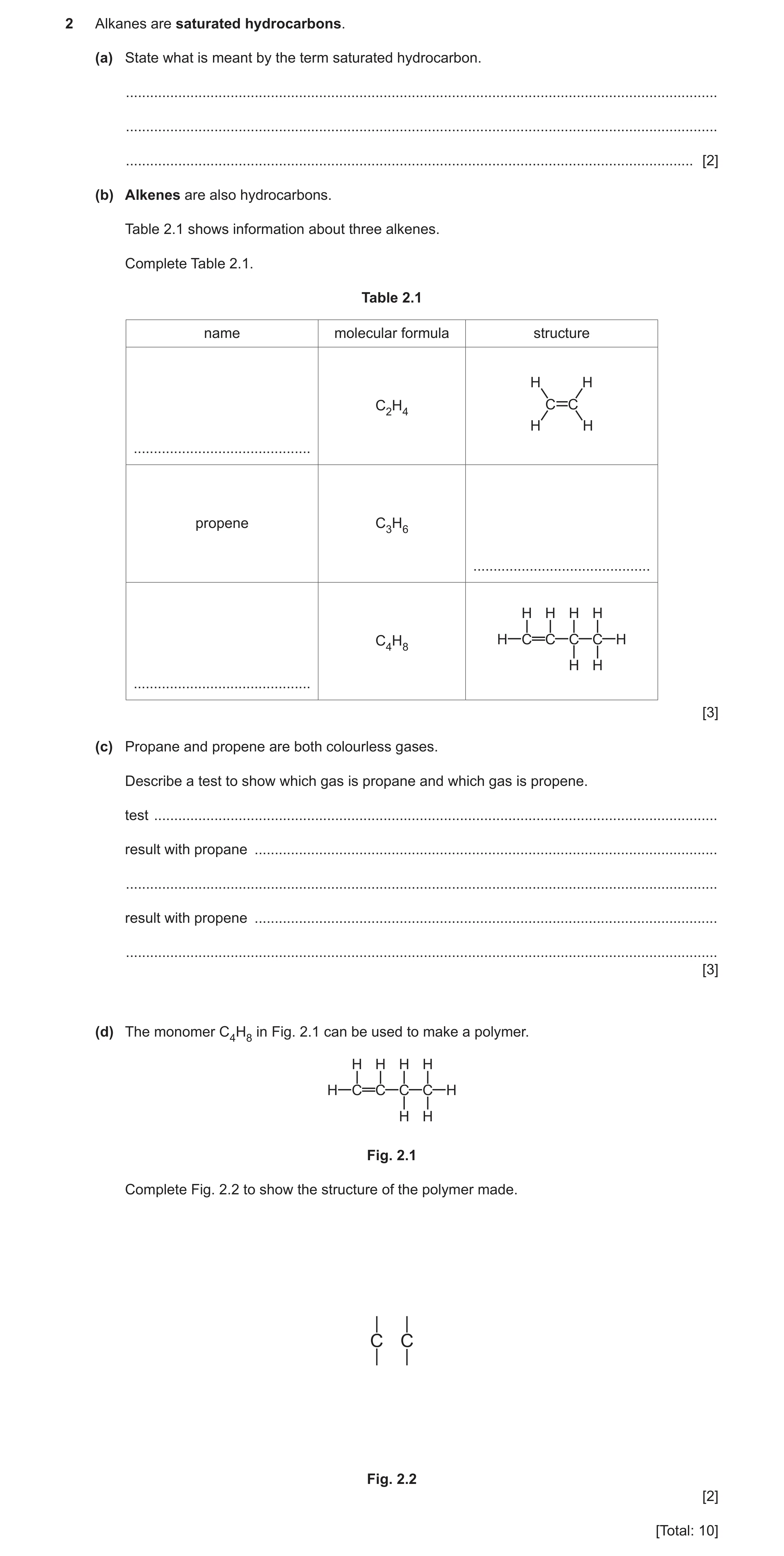
2 Alkanes are saturated hydrocarbons. (a) State what is meant by the term saturated hydrocarbon. … … … [2] (b) Alkenes are also hydrocarbons. Table 2.1 shows information about three alkenes. Complete Table 2.1. Table 2.1 name molecular formula structure H H C2H4 C C H H … propene C3H6 … H H H H C4H8 H C C C C H H H … [3] (c) Propane and propene are both colourless gases. Describe a test to show which gas is propane and which gas is propene. test … result with propane … … result with propene … … [3] (d) The monomer C4H8 in Fig. 2.1 can be used to make a polymer. H H H H H C C C C H H H Fig. 2.1 Complete Fig. 2.2 to show the structure of the polymer made. C C Fig. 2.2 [2] [Total: 10]
10 marks
Mark scheme: 2(a) (saturated) – contains only single (covalent) bonds ; (hydrocarbon) – contains only hydrogen and carbon atoms ; 2 Question Answer Marks 2(b) name molecular formula structure ethene ; C2H4 propene C3H6 ; butene ; C4H8 3 2(c) test – aqueous bromine ; result with propane – (aqueous bromine) stays orange / brown or no change ; result with propene – (aqueous bromine) is decolourised / turns colourless ; 3 Question Answer Marks 2(d) ;; 2
This question in 0654/42 May/June 2023
Q18 · Crude oil contains hydrocarbon molecules 0654/41 Oct/Nov 2023
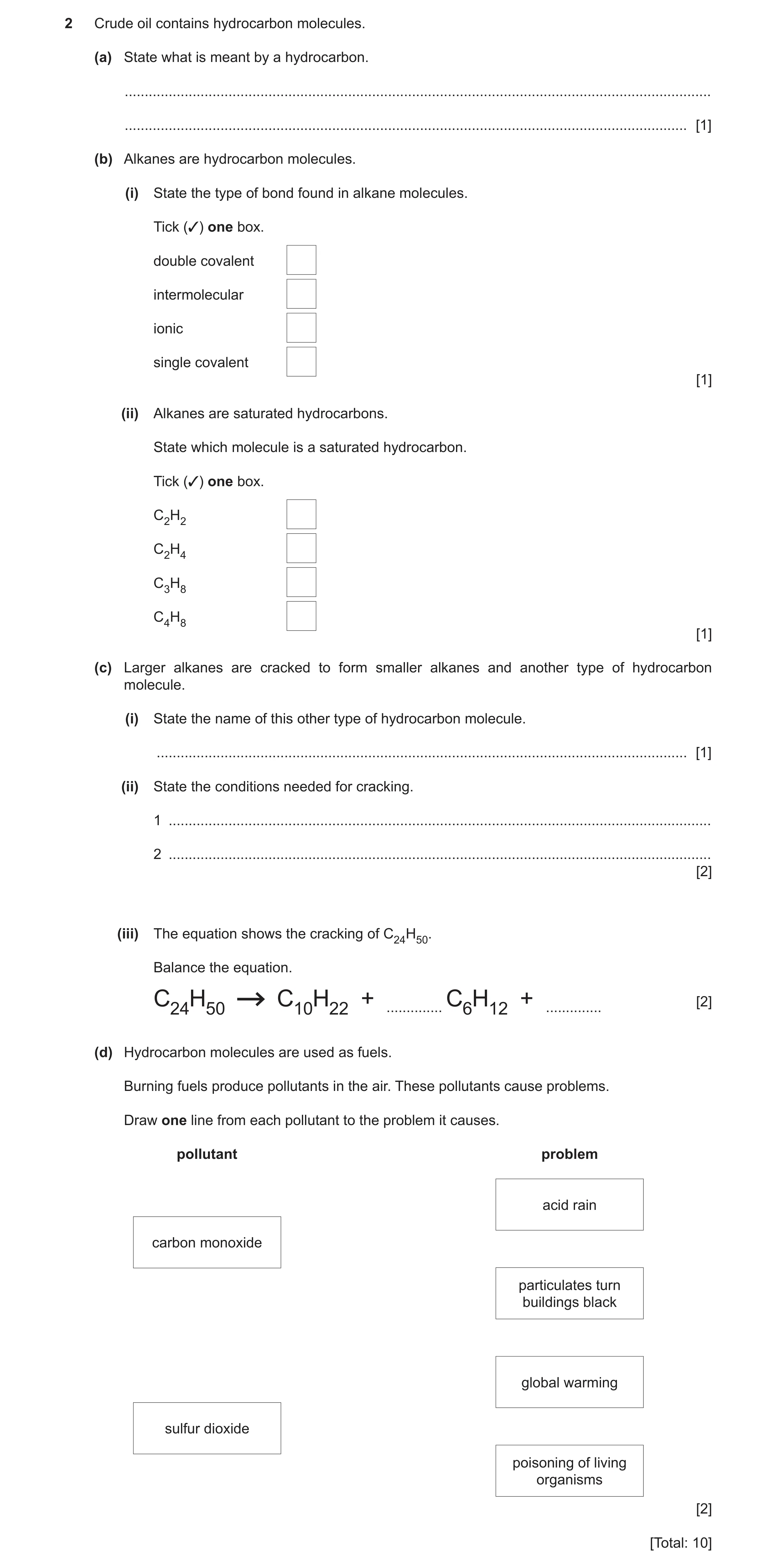
2 Crude oil contains hydrocarbon molecules. (a) State what is meant by a hydrocarbon. … … [1] (b) Alkanes are hydrocarbon molecules. (i) State the type of bond found in alkane molecules. Tick (3) one box. double covalent intermolecular ionic single covalent [1] (ii) Alkanes are saturated hydrocarbons. State which molecule is a saturated hydrocarbon. Tick (3) one box. C2H2 C2H4 C3H8 C4H8 [1] (c) Larger alkanes are cracked to form smaller alkanes and another type of hydrocarbon molecule. (i) State the name of this other type of hydrocarbon molecule. … [1] (ii) State the conditions needed for cracking. 1 … 2 … [2] (iii) The equation shows the cracking of C24H50. Balance the equation. [2] C24H50 C10H22 + … C6H12 + … (d) Hydrocarbon molecules are used as fuels. Burning fuels produce pollutants in the air. These pollutants cause problems. Draw one line from each pollutant to the problem it causes. pollutant problem acid rain carbon monoxide particulates turn buildings black global warming sulfur dioxide poisoning of living organisms [2] [Total: 10]
10 marks
Mark scheme: 2(a) (compound that) contains only carbon and hydrogen (atoms) ; 1 2(b)(i) single covalent ; 1 2(b)(ii) C3H8 ; 1 2(c)(i) alkene ; 1 2(c)(ii) high temperature ; 2 catalyst ; 2(c)(iii) C24H50 → C10H22 + 2 C6H12 + C2H4 2 correct number of C in products ; correct number of H in products ; 2(d) 2 pollutant problem acid rain carbon monoxide particulates turn buildings black global warming sulfur dioxide poisoning of living organisms correct link for carbon monoxide ; correct link for sulfur dioxide ;
This question in 0654/41 Oct/Nov 2023
Q19 · The element carbon exists as 3 naturally occurring isotopes 0654/42 Oct/Nov 2023
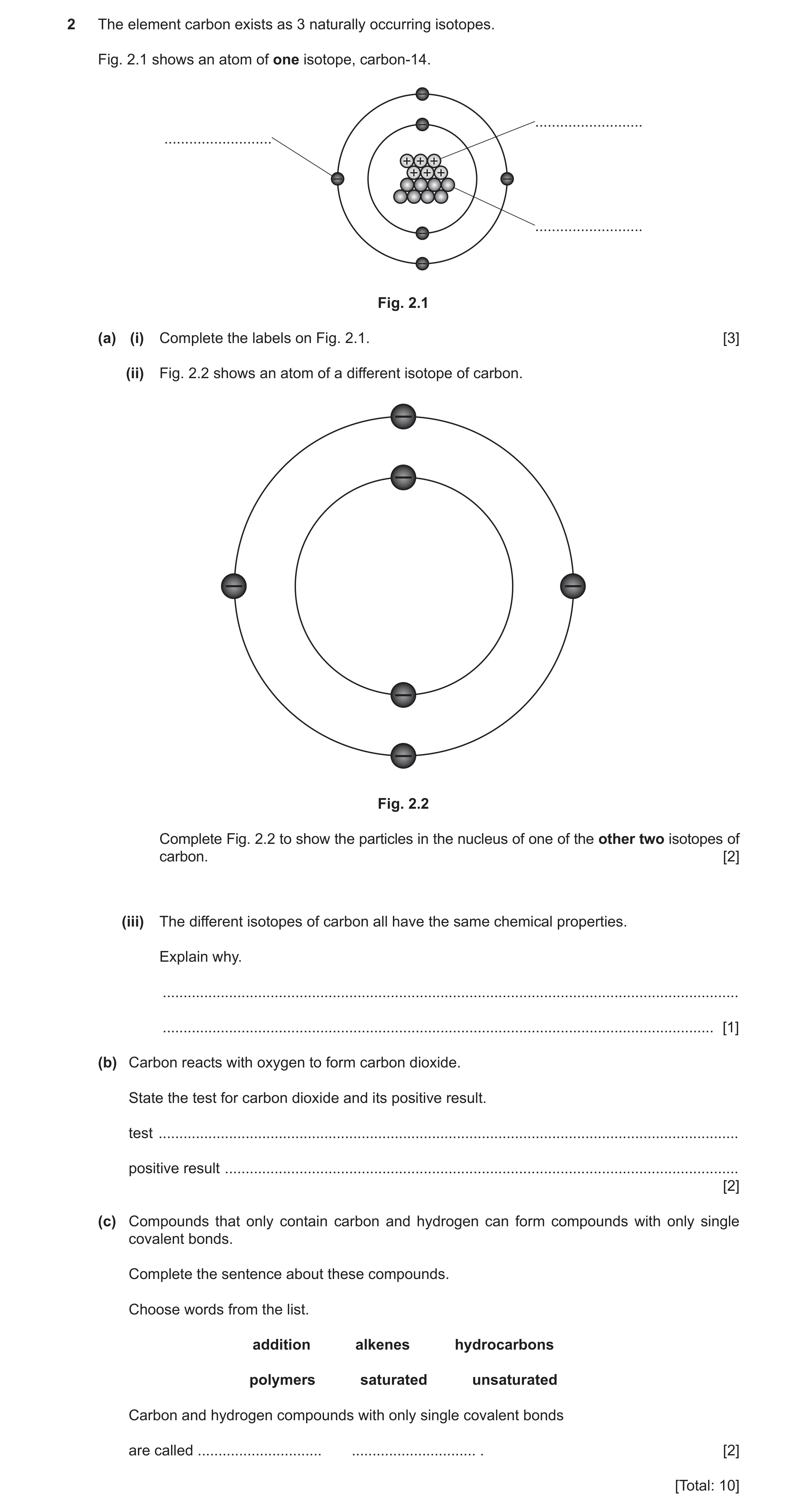
2 The element carbon exists as 3 naturally occurring isotopes. Fig. 2.1 shows an atom of one isotope, carbon-14. – – … … + + + + + + – – … – – Fig. 2.1 (a) (i) Complete the labels on Fig. 2.1. [3] (ii) Fig. 2.2 shows an atom of a different isotope of carbon. – – – – – – Fig. 2.2 Complete Fig. 2.2 to show the particles in the nucleus of one of the other two isotopes of carbon. [2] (iii) The different isotopes of carbon all have the same chemical properties. Explain why. … … [1] (b) Carbon reacts with oxygen to form carbon dioxide. State the test for carbon dioxide and its positive result. test … positive result … [2] (c) Compounds that only contain carbon and hydrogen can form compounds with only single covalent bonds. Complete the sentence about these compounds. Choose words from the list. addition alkenes hydrocarbons polymers saturated unsaturated Carbon and hydrogen compounds with only single covalent bonds are called … … . [2] [Total: 10]
10 marks
Mark scheme: 2(a)(i) 3 proton ; electron ; neutron ; 2(a)(ii) 6 protons ; 2 6 or 7 neutrons ; 2(a)(iii) same number of electrons in the outer shell ; 1 2(b) test: limewater ; 2 observation: milky / cloudy / white precipitate ; 2(c) saturated ; 2 hydrocarbons ;
This question in 0654/42 Oct/Nov 2023
Q20 · Butane, C4H10, is an alkane 0654/42 Feb/March 2024
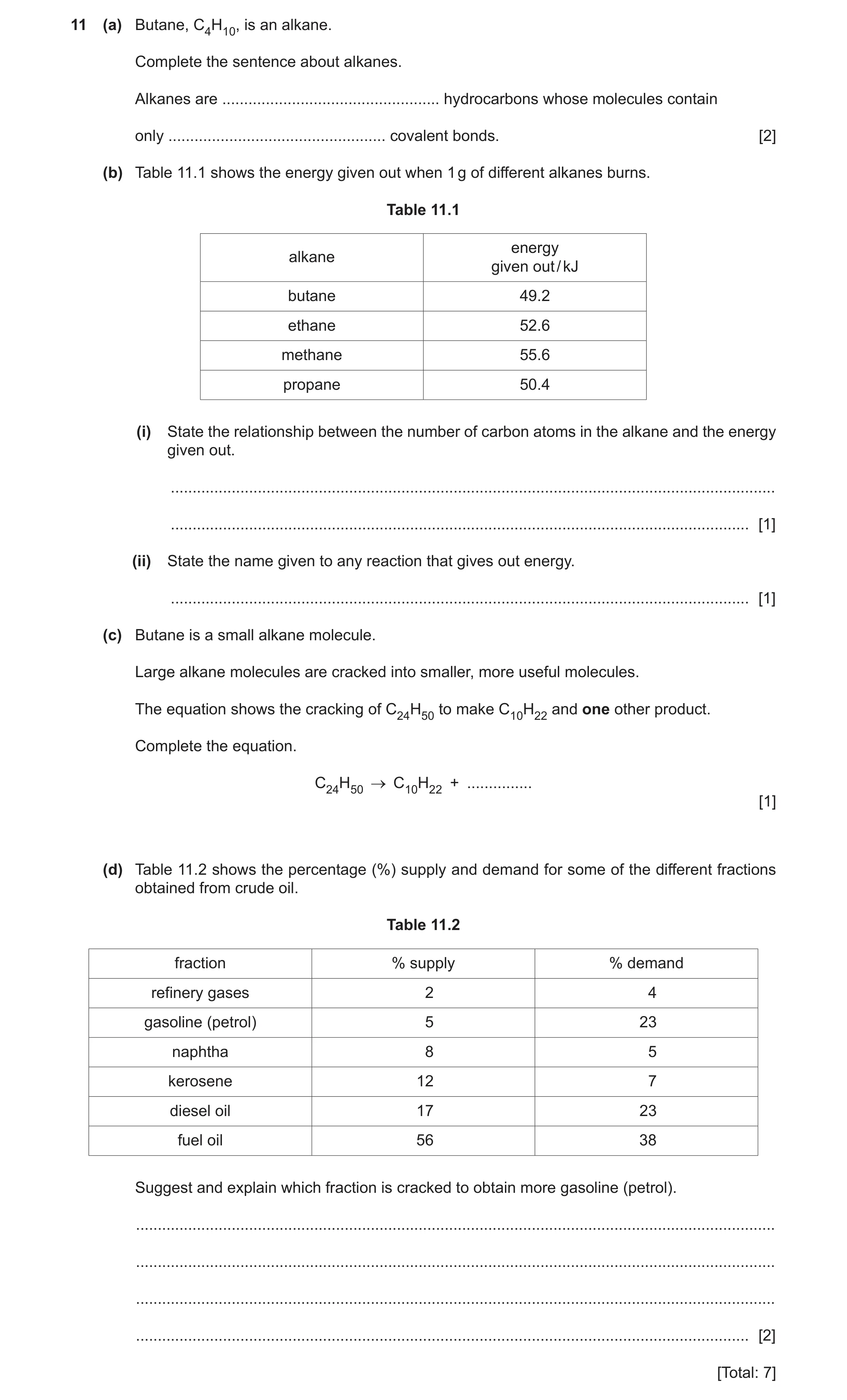
11 (a) Butane, C4H10, is an alkane. Complete the sentence about alkanes. Alkanes are … hydrocarbons whose molecules contain only … covalent bonds. [2] (b) Table 11.1 shows the energy given out when 1 g of different alkanes burns. Table 11.1 energy alkane given out / kJ butane 49.2 ethane 52.6 methane 55.6 propane 50.4 (i) State the relationship between the number of carbon atoms in the alkane and the energy given out. … … [1] (ii) State the name given to any reaction that gives out energy. … [1] (c) Butane is a small alkane molecule. Large alkane molecules are cracked into smaller, more useful molecules. The equation shows the cracking of C24H50 to make C10H22 and one other product. Complete the equation. C24H50 C10H22 + … [1] (d) Table 11.2 shows the percentage (%) supply and demand for some of the different fractions obtained from crude oil. Table 11.2 fraction % supply % demand refinery gases 2 4 gasoline (petrol) 5 23 naphtha 8 5 kerosene 12 7 diesel oil 17 23 fuel oil 56 38 Suggest and explain which fraction is cracked to obtain more gasoline (petrol). … … … … [2] [Total: 7]
7 marks
Mark scheme: 11(a) saturated ; 2 single; 11(b)(i) idea that the higher the number of carbon atoms the lower the energy given out / ORA ✓ 1 11(b)(ii) exothermic ; 1 11(c) C14H28 ; 1 11(d) fuel oil / kerosene / naphtha ; 2 idea that the supply is greater than the demand ;
This question in 0654/42 Feb/March 2024
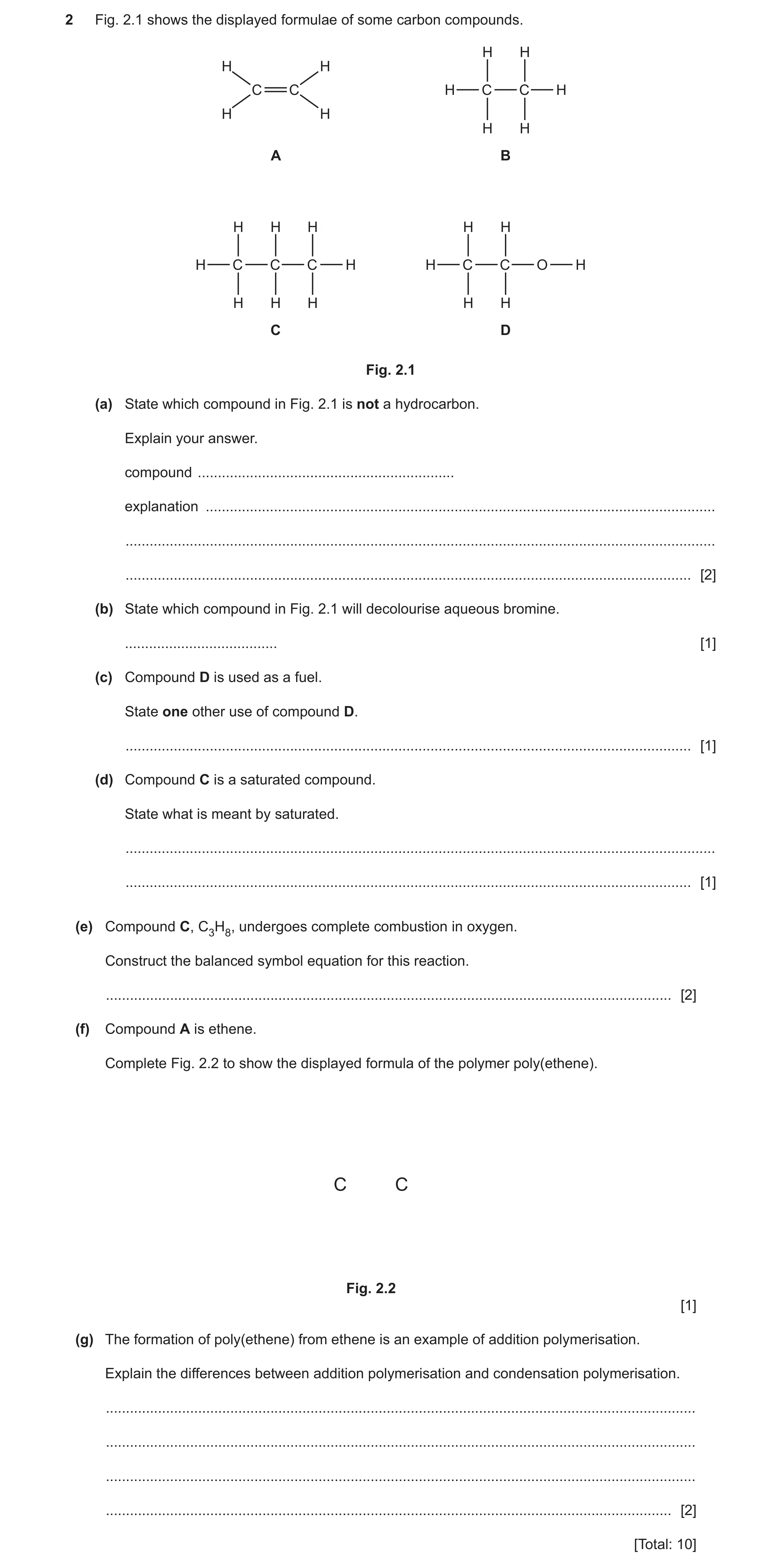
Q21 · The displayed formulae of some carbon compounds 0654/43 Oct/Nov 2024
2 Fig. 2.1 shows the displayed formulae of some carbon compounds. H H H H C C H C C H H H H H A B H H H H H H C C C H H C C O H H H H H H C D Fig. 2.1 (a) State which compound in Fig. 2.1 is not a hydrocarbon. Explain your answer. compound … explanation … … … [2] (b) State which compound in Fig. 2.1 will decolourise aqueous bromine. … [1] (c) Compound D is used as a fuel. State one other use of compound D. … [1] (d) Compound C is a saturated compound. State what is meant by saturated. … … [1] (e) Compound C, C3H8, undergoes complete combustion in oxygen. Construct the balanced symbol equation for this reaction. … [2] (f) Compound A is ethene. Complete Fig. 2.2 to show the displayed formula of the polymer poly(ethene). C C Fig. 2.2 [1] (g) The formation of poly(ethene) from ethene is an example of addition polymerisation. Explain the differences between addition polymerisation and condensation polymerisation. … … … … [2] [Total: 10]
10 marks
Mark scheme: 2(a) D ; 2 contains oxygen / does not contain only carbon and hydrogen ; 2(b) A ; 1 2(c) solvent ; 1 2(d) contains only C-C single bonds ; 1 2(e) C3H8 + 5O2 → 3CO2 + 4H2O 2 correct formulae (reactants in either order and products in either order) ; balanced correctly ; 2(f) 1 2(g) addition polymerisation 2 only occurs in unsaturated monomers or monomers that contain C=C bonds / idea that involves the addition of many (identical) monomers (to make a long chained polymer) / monomers have one functional group / forms the polymer molecule only ; condensation polymerisation idea that two different monomers join together / (forms the polymer molecule and one) water molecule (per linkage) / monomers have two functional groups (one at each end) ;
This question in 0654/43 Oct/Nov 2024
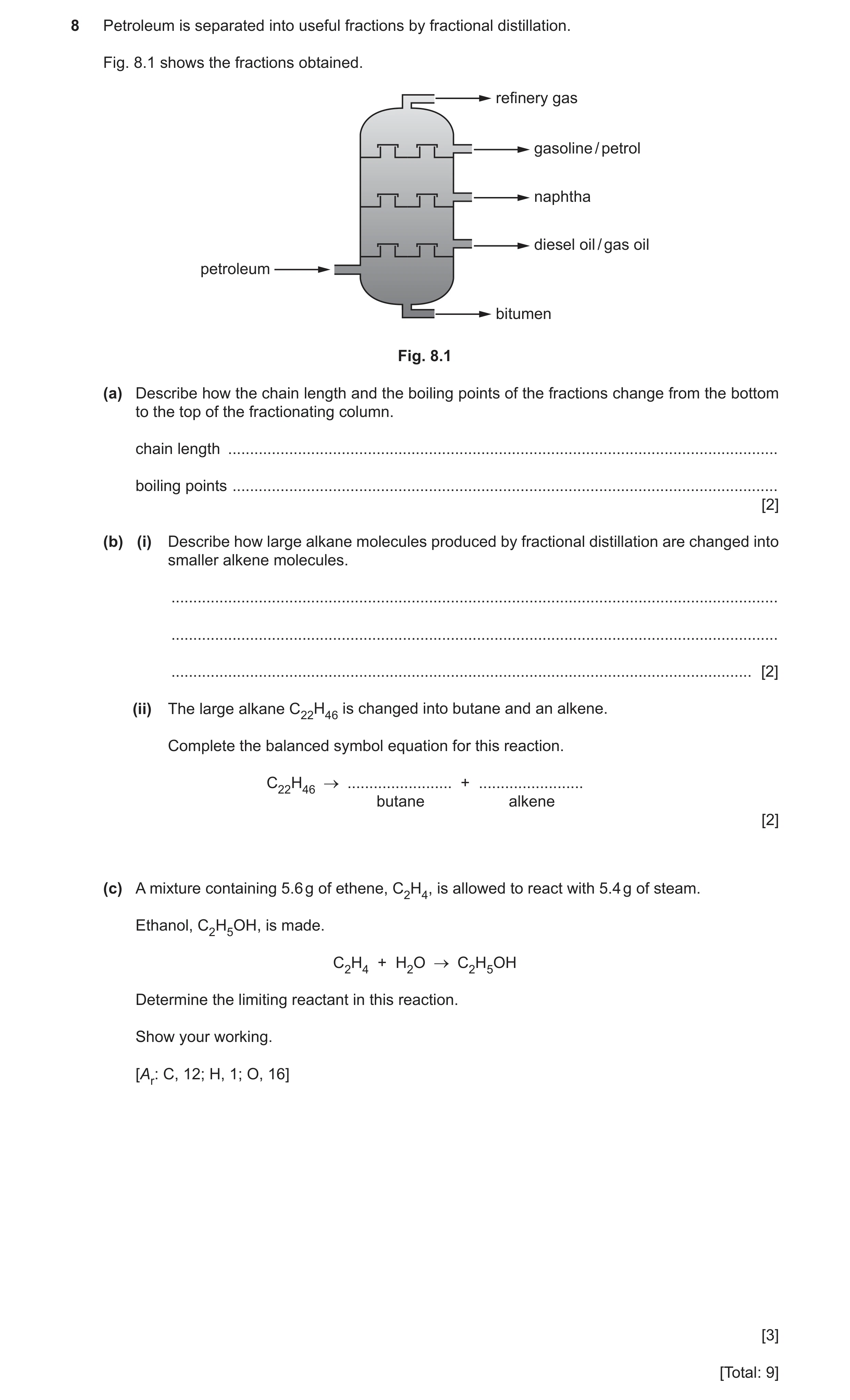
Q22 · Petroleum is separated into useful fractions by fractional distillation 0654/41 May/June 2025
8 Petroleum is separated into useful fractions by fractional distillation. Fig. 8.1 shows the fractions obtained. refinery gas gasoline / petrol naphtha diesel oil / gas oil petroleum bitumen Fig. 8.1 (a) Describe how the chain length and the boiling points of the fractions change from the bottom to the top of the fractionating column. chain length … boiling points … [2] (b) (i) Describe how large alkane molecules produced by fractional distillation are changed into smaller alkene molecules. … … … [2] (ii) The large alkane C22H46 is changed into butane and an alkene. Complete the balanced symbol equation for this reaction. C22H46 … + … butane alkene [2] (c) A mixture containing 5.6 g of ethene, C2H4, is allowed to react with 5.4 g of steam. Ethanol, C2H5OH, is made. C2H4 + H2O C2H5OH Determine the limiting reactant in this reaction. Show your working. [Ar: C, 12; H, 1; O, 16] [3] [Total: 9]
9 marks
Mark scheme: 8(a) (chain length) decreases / AW ; 2 (boiling point) decreases / AW ; 8(b)(i) cracking ; 2 (use of a) high temperature / catalyst ; 8(b)(ii) C4H10 ; 2 C18H36 ; 8(c) moles of ethene = 5.6 28 = 0.2 (mol) ; 3 moles of steam = 5.4 18 = 0.3 (mol) ; (there are less moles of ethene) so ethene is the limiting reactant ;
This question in 0654/41 May/June 2025
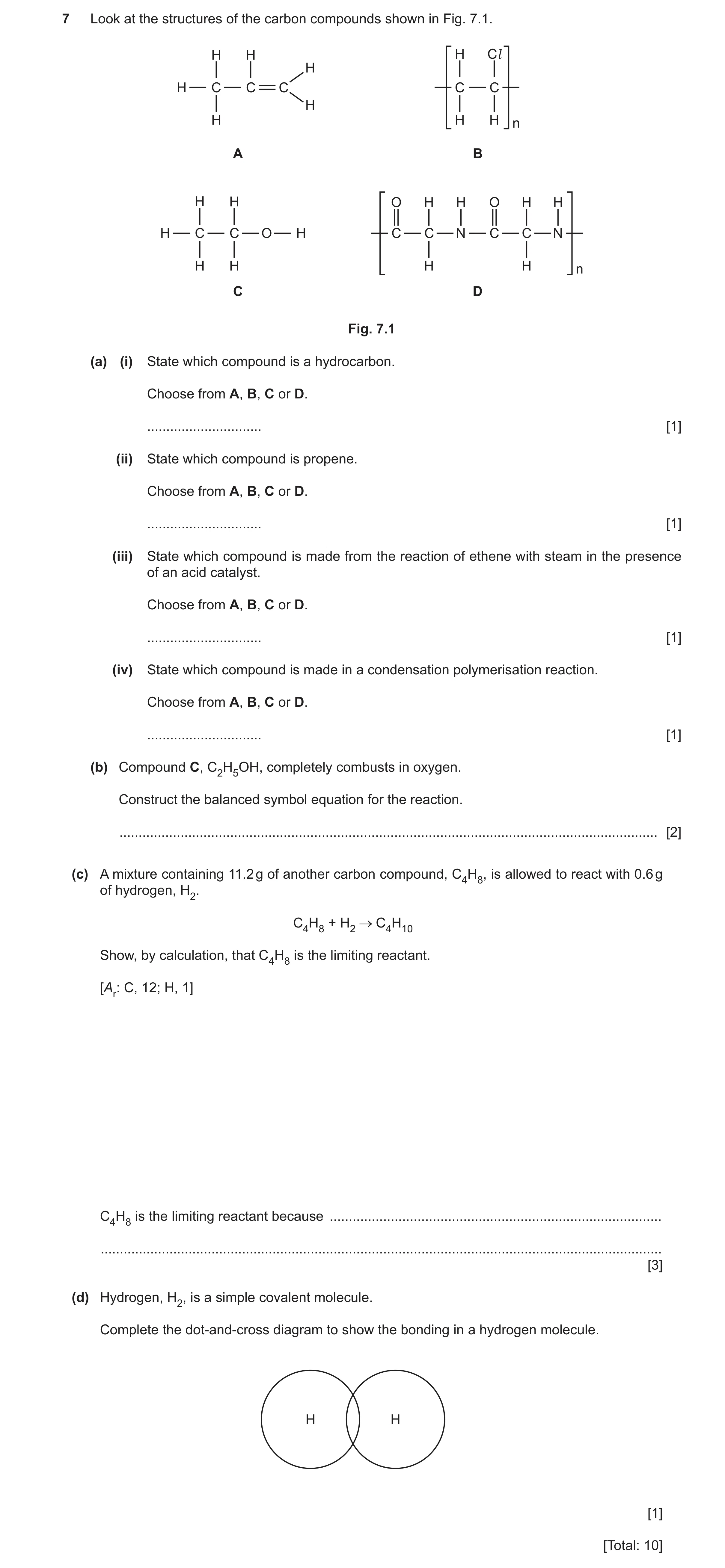
Q23 · Look at the structures of the carbon compounds shown in Fig 0654/43 May/June 2025
7 Look at the structures of the carbon compounds shown in Fig. 7.1. H H H Cl H H C C C C C H H H H n A B H H O H H O H H H C C O H C C N C C N H H H H n C D Fig. 7.1 (a) (i) State which compound is a hydrocarbon. Choose from A, B, C or D. … [1] (ii) State which compound is propene. Choose from A, B, C or D. … [1] (iii) State which compound is made from the reaction of ethene with steam in the presence of an acid catalyst. Choose from A, B, C or D. … [1] (iv) State which compound is made in a condensation polymerisation reaction. Choose from A, B, C or D. … [1] (b) Compound C, C2H5OH, completely combusts in oxygen. Construct the balanced symbol equation for the reaction. … [2] (c) A mixture containing 11.2 g of another carbon compound, C4H8, is allowed to react with 0.6 g of hydrogen, H2. C4H8 + H2 C4H10 Show, by calculation, that C4H8 is the limiting reactant. [Ar: C, 12; H, 1] C4H8 is the limiting reactant because … … [3] (d) Hydrogen, H2, is a simple covalent molecule. Complete the dot-and-cross diagram to show the bonding in a hydrogen molecule. H H [1] [Total: 10]
10 marks
Mark scheme: 7(a)(i) A; 1 7(a)(ii) A; 1 7(a)(iii) C; 1 7(a)(iv) D; 1 7(b) C2H5OH + 3O2 → 2CO2 + 3H2O 2 correct formulae; correct balancing; 7(c) moles of C4H8 = 11.2 = 0.2; 3 56 moles of H2 = 0.6 = 0.3; 2 (C4H8 is limiting because) 0.2 mol is less than the 0.3 mol of H2; 7(d) 1 ; ;
This question in 0654/43 May/June 2025
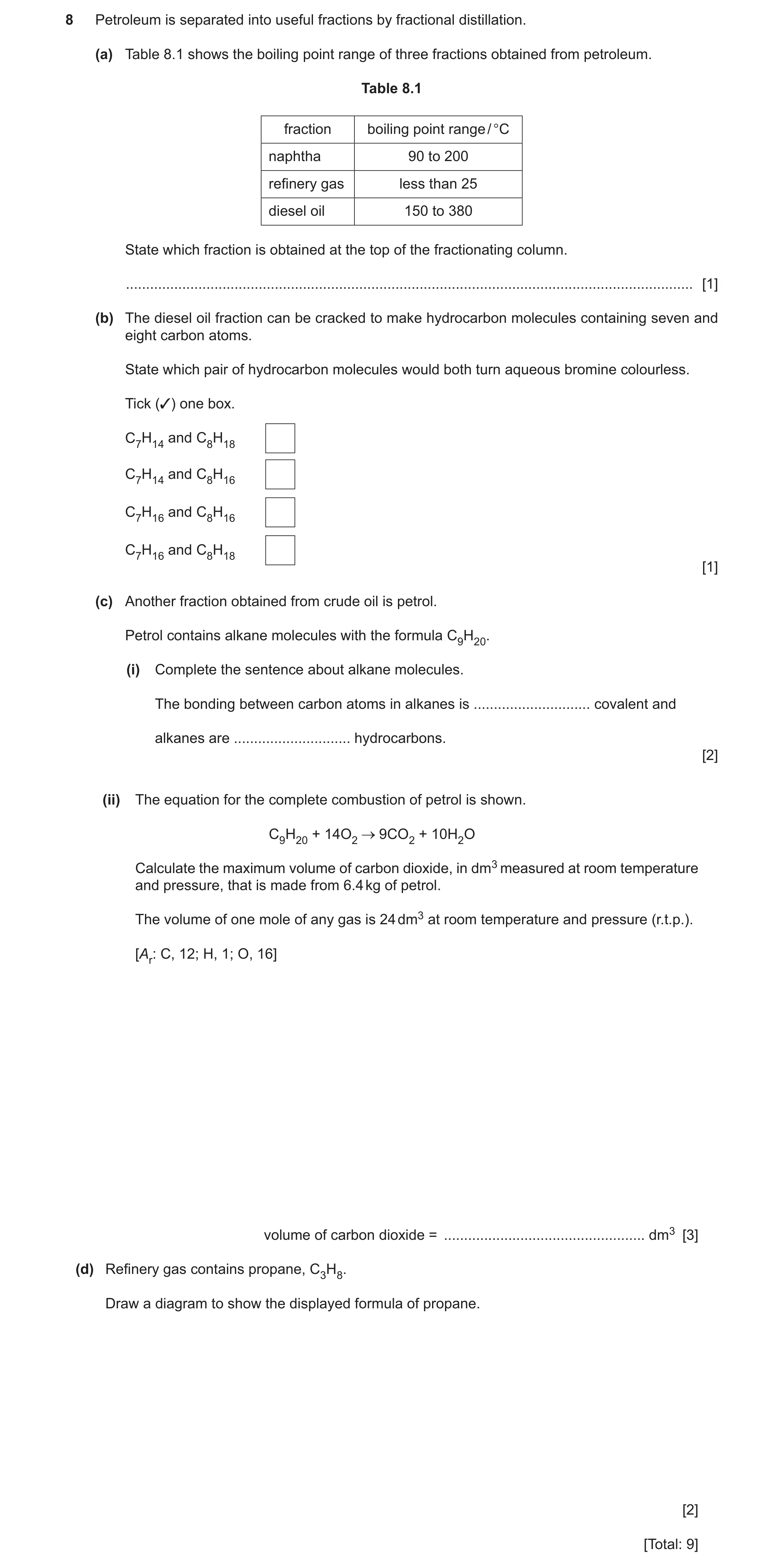
Q24 · Petroleum is separated into useful fractions by fractional distillation 0654/41 Oct/Nov 2025
8 Petroleum is separated into useful fractions by fractional distillation. (a) Table 8.1 shows the boiling point range of three fractions obtained from petroleum. Table 8.1 fraction boiling point range / °C naphtha 90 to 200 refinery gas less than 25 diesel oil 150 to 380 State which fraction is obtained at the top of the fractionating column. … [1] (b) The diesel oil fraction can be cracked to make hydrocarbon molecules containing seven and eight carbon atoms. State which pair of hydrocarbon molecules would both turn aqueous bromine colourless. Tick (✓) one box. C7H14 and C8H18 C7H14 and C8H16 C7H16 and C8H16 C7H16 and C8H18 [1] (c) Another fraction obtained from crude oil is petrol. Petrol contains alkane molecules with the formula C9H20. (i) Complete the sentence about alkane molecules. The bonding between carbon atoms in alkanes is … covalent and alkanes are … hydrocarbons. [2] (ii) The equation for the complete combustion of petrol is shown. C9H20 + 14O2 9CO2 + 10H2O Calculate the maximum volume of carbon dioxide, in dm3 measured at room temperature and pressure, that is made from 6.4 kg of petrol. The volume of one mole of any gas is 24 dm3 at room temperature and pressure (r.t.p.). [Ar: C, 12; H, 1; O, 16] volume of carbon dioxide = … dm3 [3] (d) Refinery gas contains propane, C3H8. Draw a diagram to show the displayed formula of propane. [2] [Total: 9]
9 marks
Mark scheme: 8(a) refinery gas ; 1 8(b) C7H14 and C8H16 ; 1 8(c)(i) single ; 2 saturated ; 8(c)(ii) (moles of C9H20 = 6400 ÷ 128 =) 50 ; 3 (moles of CO2 = 9 50 =) 450 ; (volume of CO2 = 450 24 =) 10 800 (dm³) ; OR (mass of CO2 = (396 ÷ 128) 6400 =) 19 800 (g); (moles of CO2 = 19 800 ÷ 44 =) 450 ; (volume of CO2 = 450 24 =) 10 800 (dm³) ; 8(d) 2 chain of three carbons each joined by a single bond = 1 mark eight hydrogens joined to carbons by single bonds = 1 mark
This question in 0654/41 Oct/Nov 2025
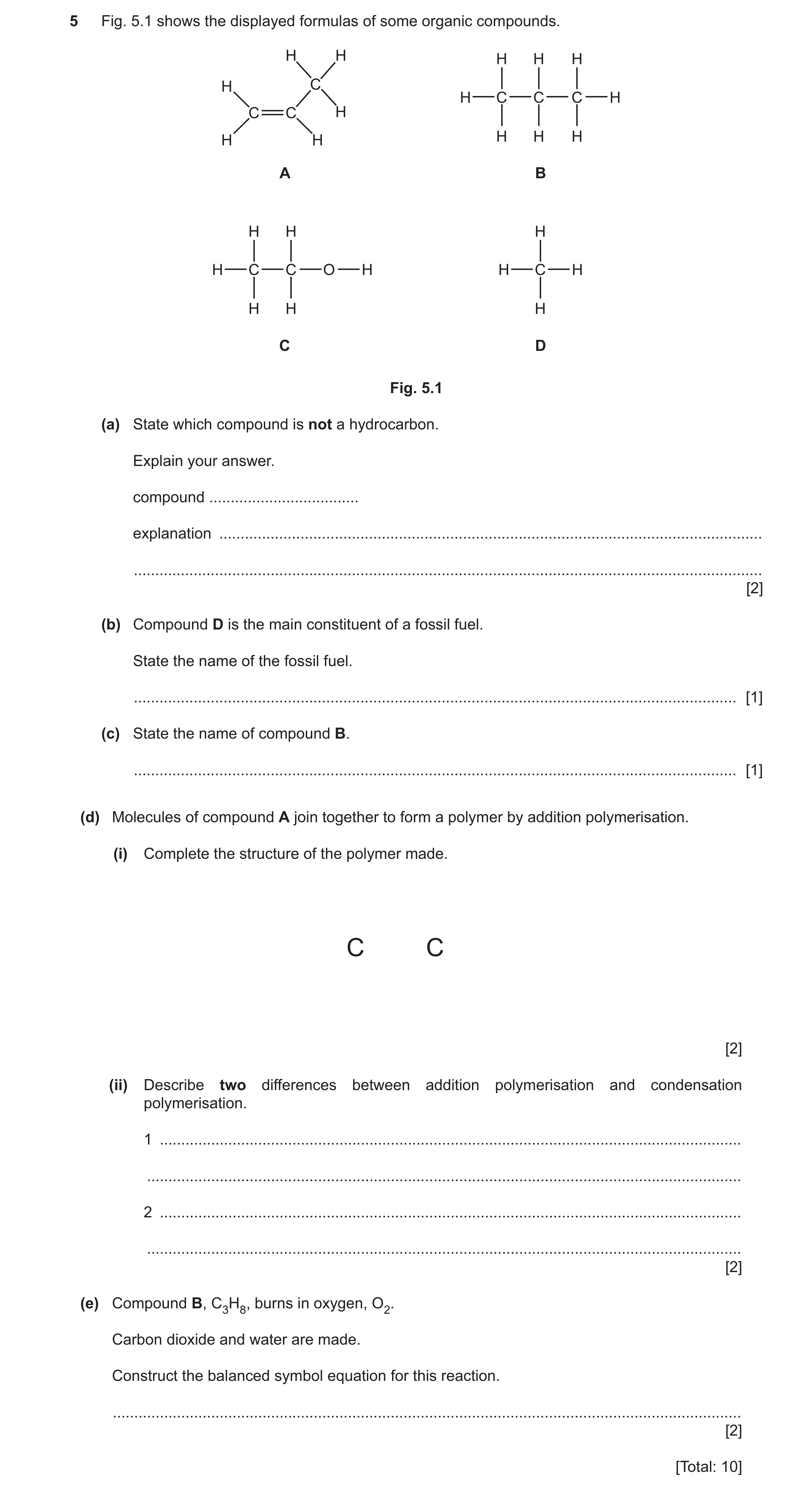
Q25 · The displayed formulas of some organic compounds 0654/43 Oct/Nov 2025
5 Fig. 5.1 shows the displayed formulas of some organic compounds. H H H H H H C H C C C H C C H H H H H H A B H H H H C C O H H C H H H H C D Fig. 5.1 (a) State which compound is not a hydrocarbon. Explain your answer. compound … explanation … … [2] (b) Compound D is the main constituent of a fossil fuel. State the name of the fossil fuel. … [1] (c) State the name of compound B. … [1] (d) Molecules of compound A join together to form a polymer by addition polymerisation. (i) Complete the structure of the polymer made. C C [2] (ii) Describe two differences between addition polymerisation and condensation polymerisation. 1 … … 2 … … [2] (e) Compound B, C3H8, burns in oxygen, O2. Carbon dioxide and water are made. Construct the balanced symbol equation for this reaction. … [2] [Total: 10]
10 marks
Mark scheme: 5(a) C ; 2 (C) contains oxygen / (C) does not contain only carbon and hydrogen / hydrocarbons only contains hydrogen and carbon ; 5(b) natural gas ; 1 5(c) propane ; 1 5(d)(i) 2 1 mark for single bond between carbon atoms 1 mark for rest of structure correct 5(d)(ii) any two from: 2 addition polymerisation • only occurs in unsaturated monomers / monomers that contain C = C bonds ; • idea that it involves the same type of monomer/unit ; • only forms the polymer molecule ; condensation polymerisation • idea that it involves different types of monomers / units ; • forms (the polymer molecule and one) water (molecule per linkage) ; 5(e) C3H8 + 5O2 → 3CO2 + 4H2O ;; 2 1 mark for correct formulae 1 mark for correct balanced equation
This question in 0654/43 Oct/Nov 2025
 10
10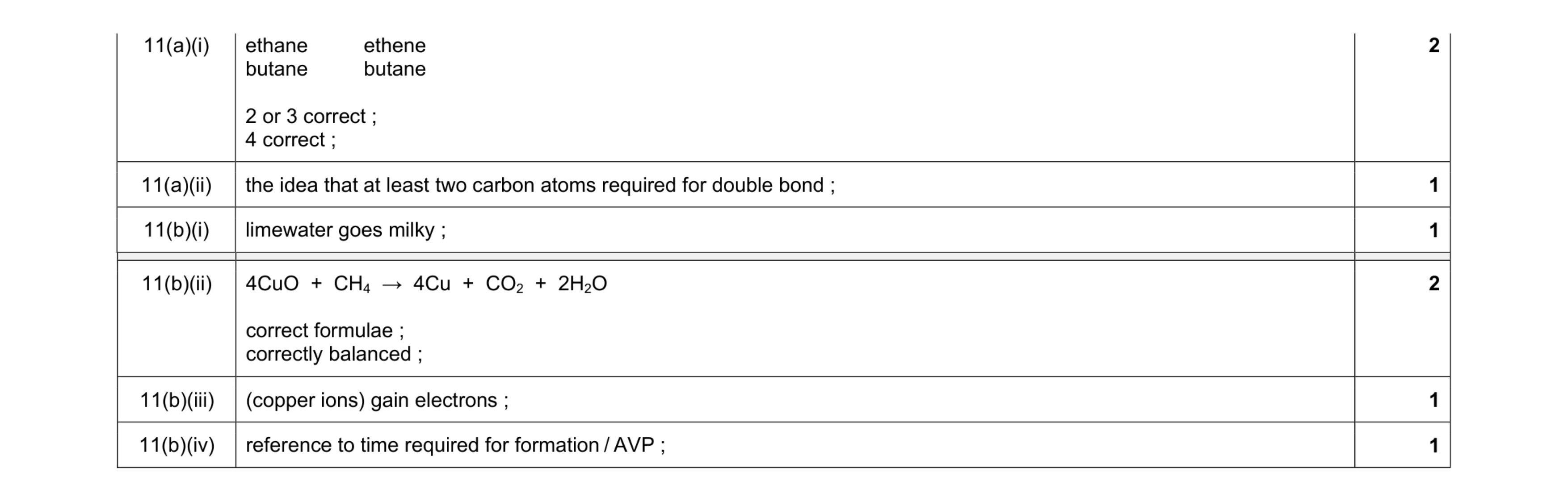 8
8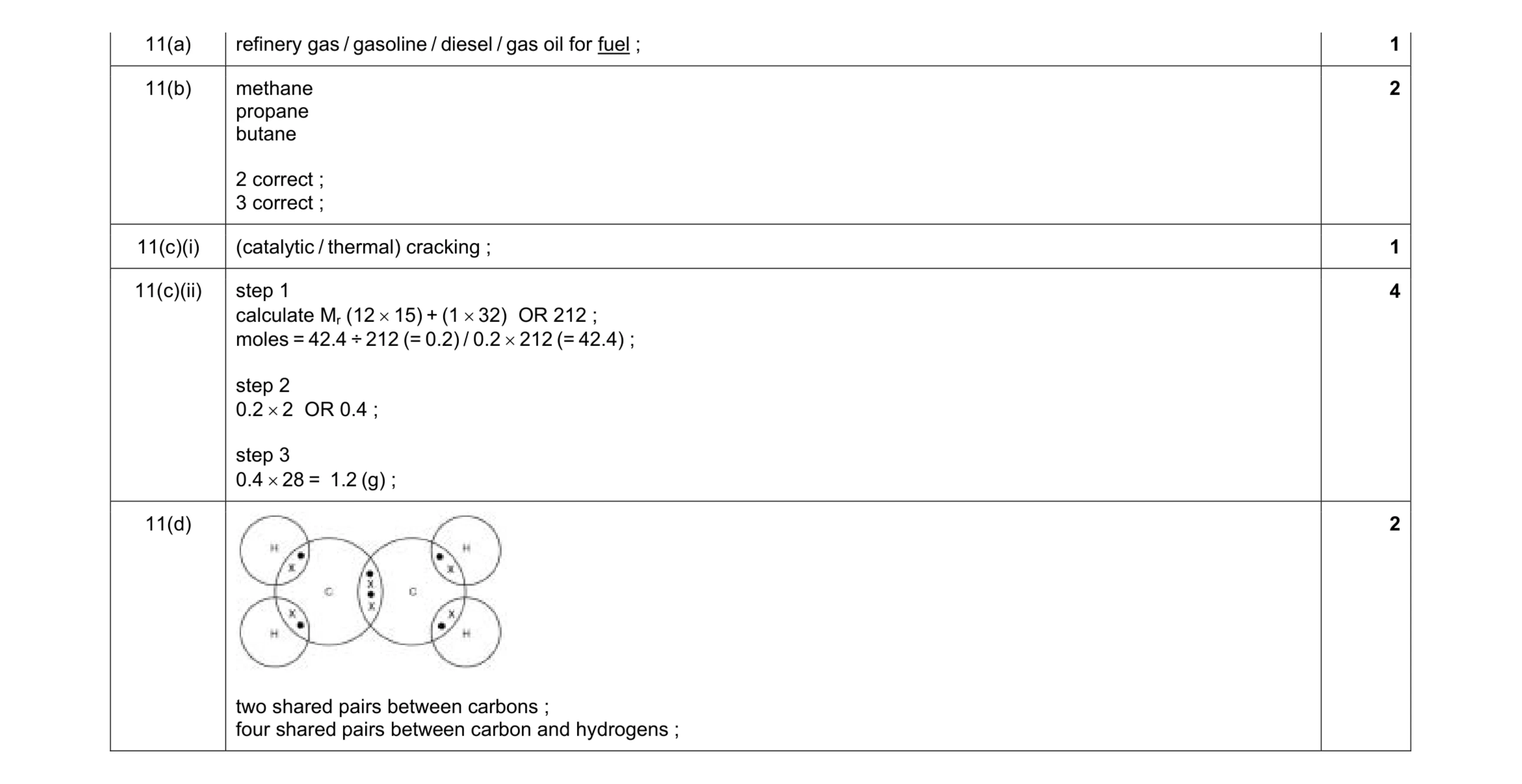 10
10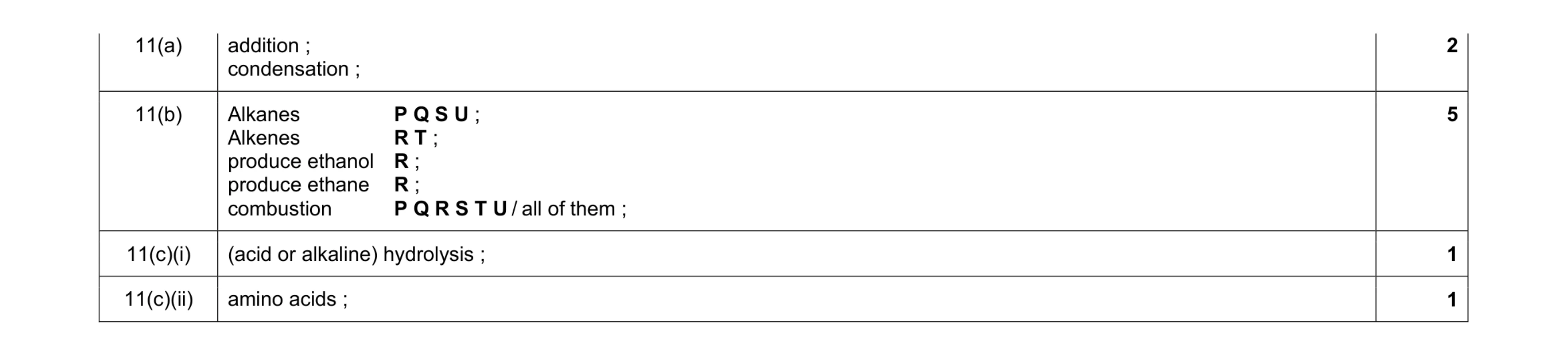 9
9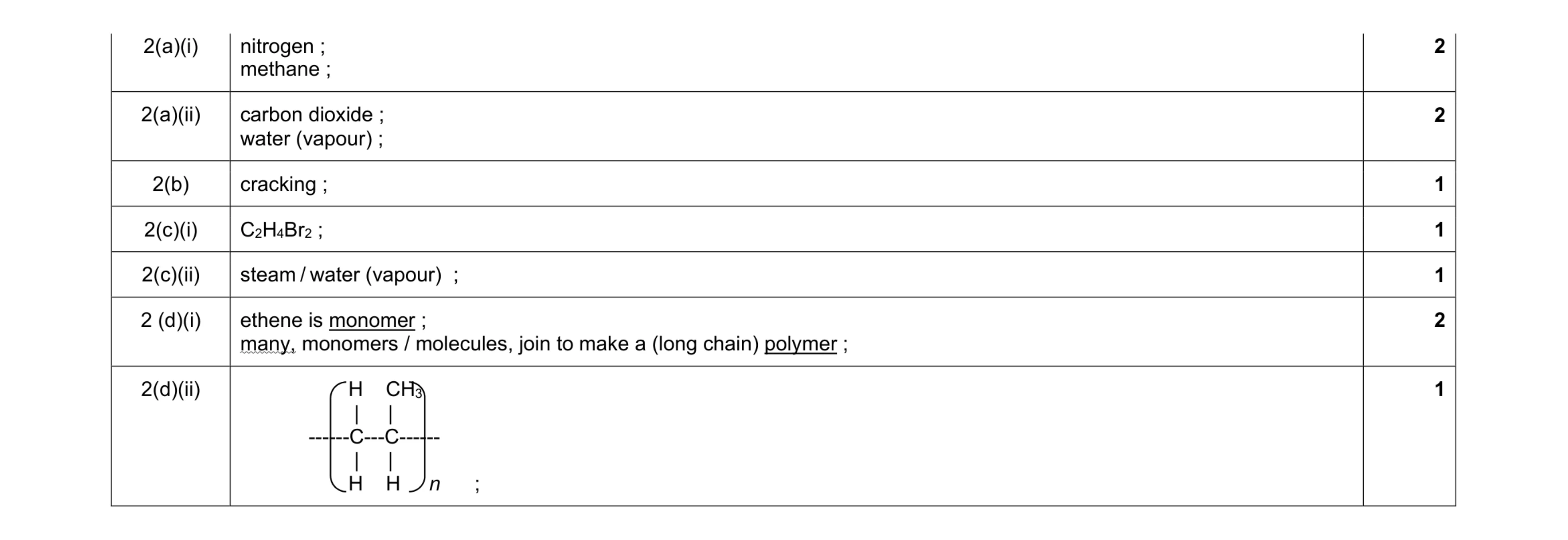 10
10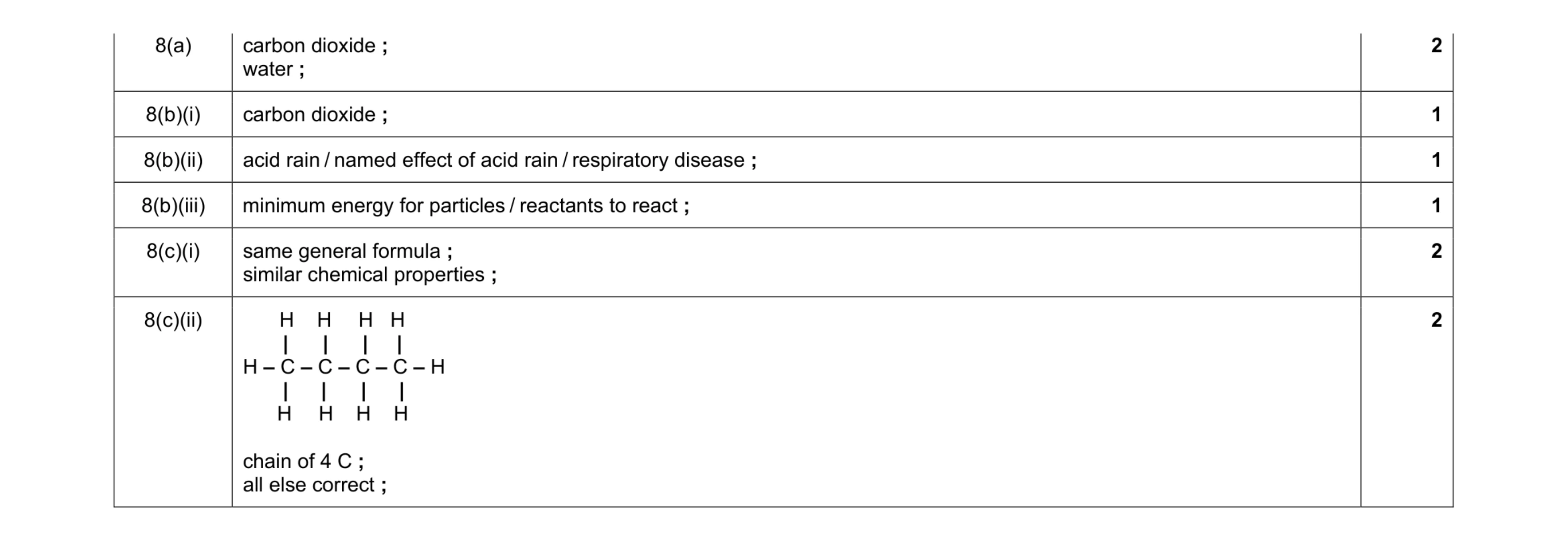 9
9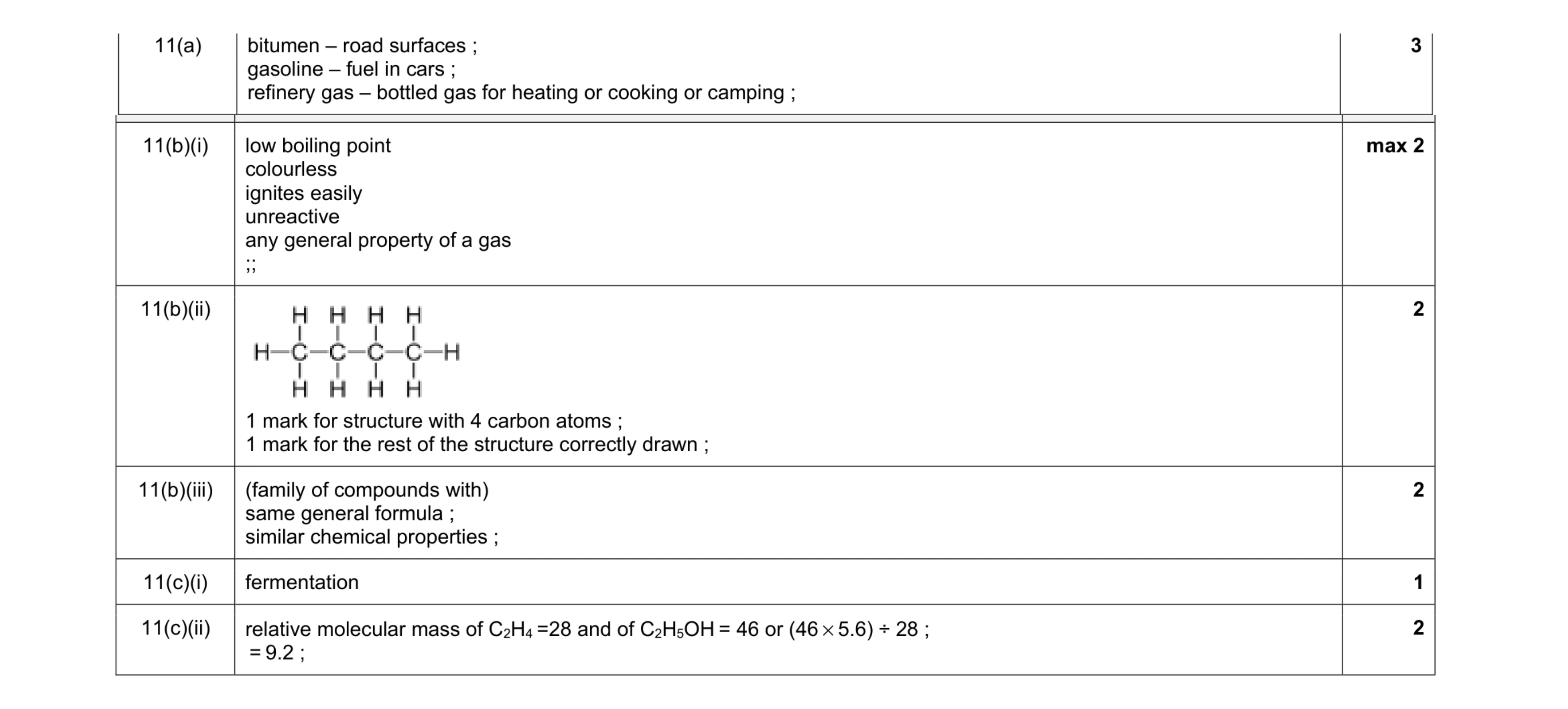 12
12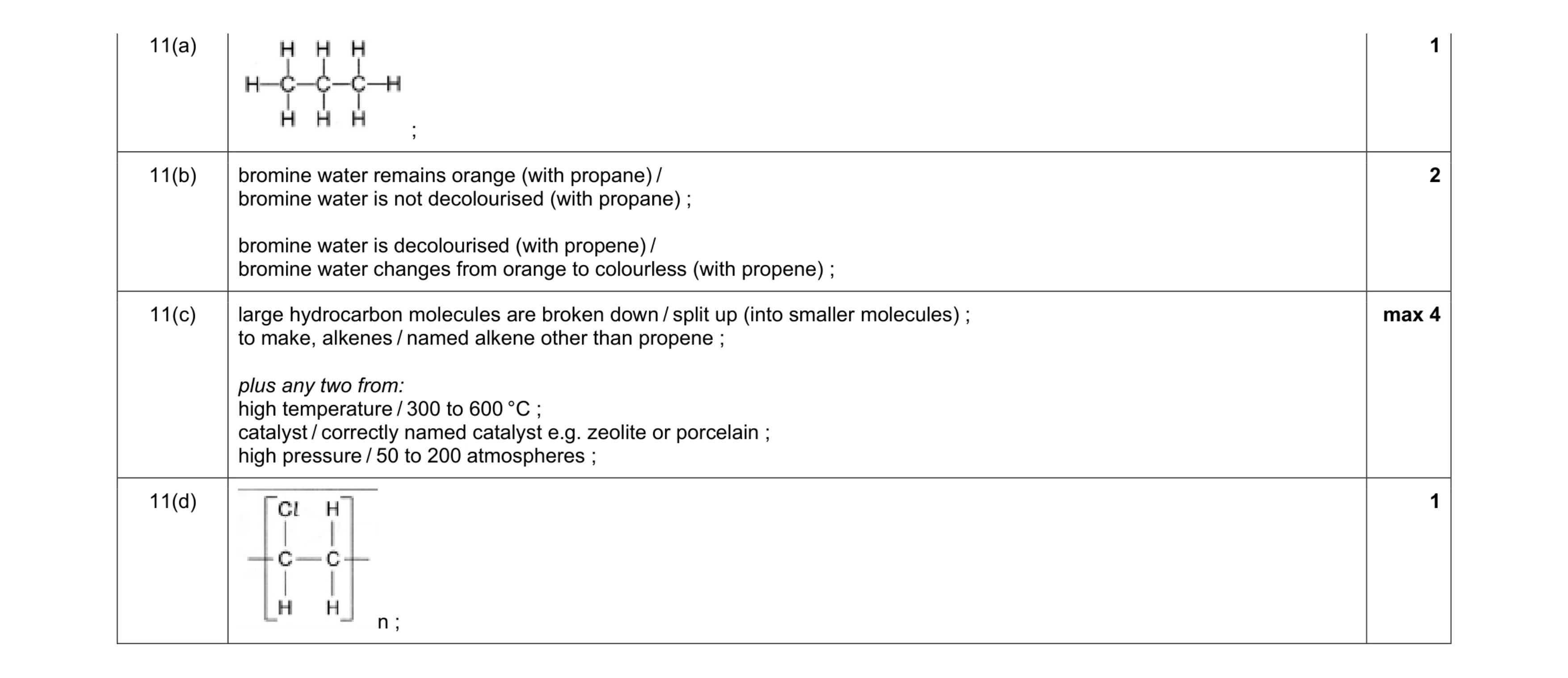 8
8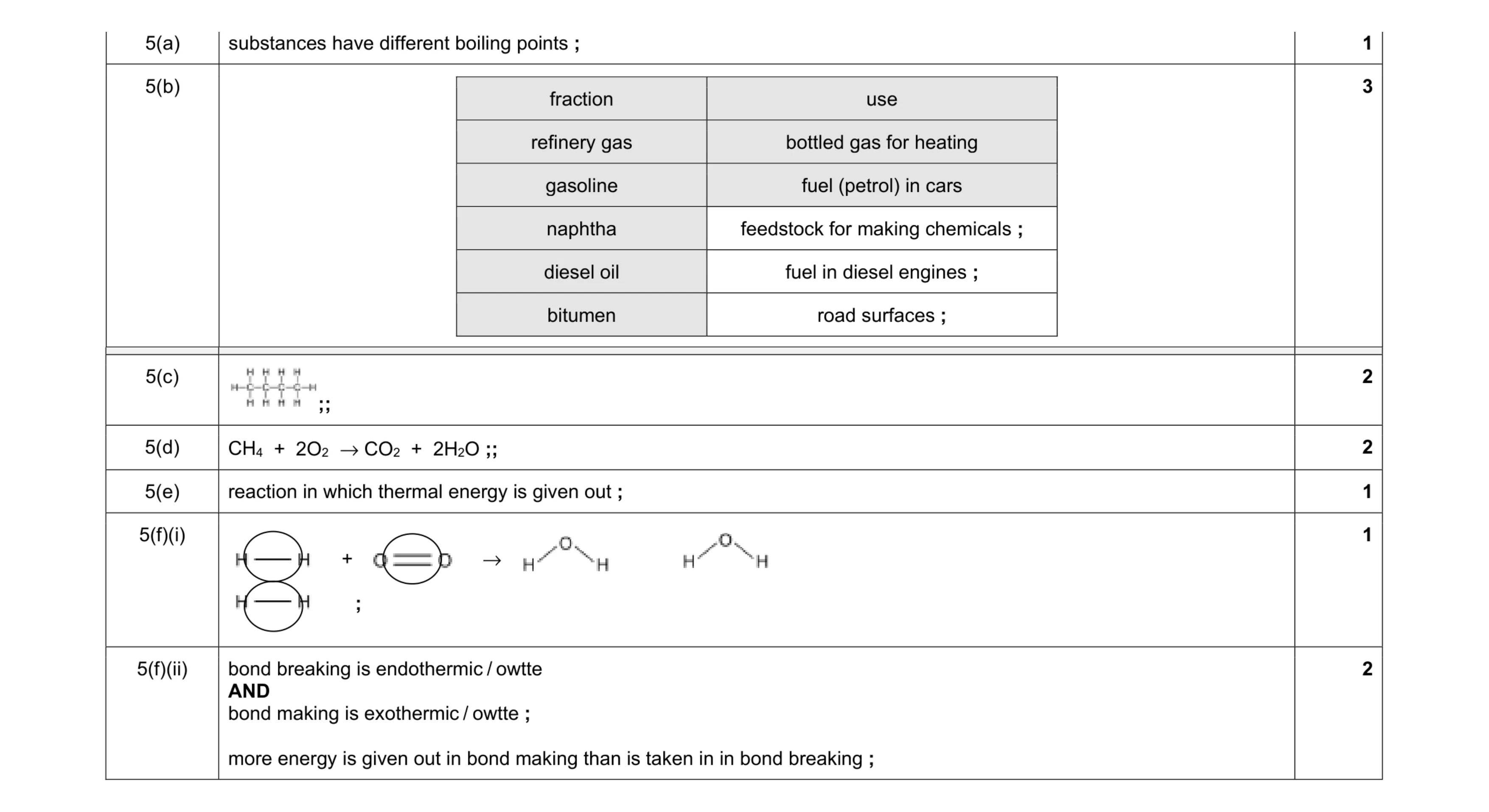 12
12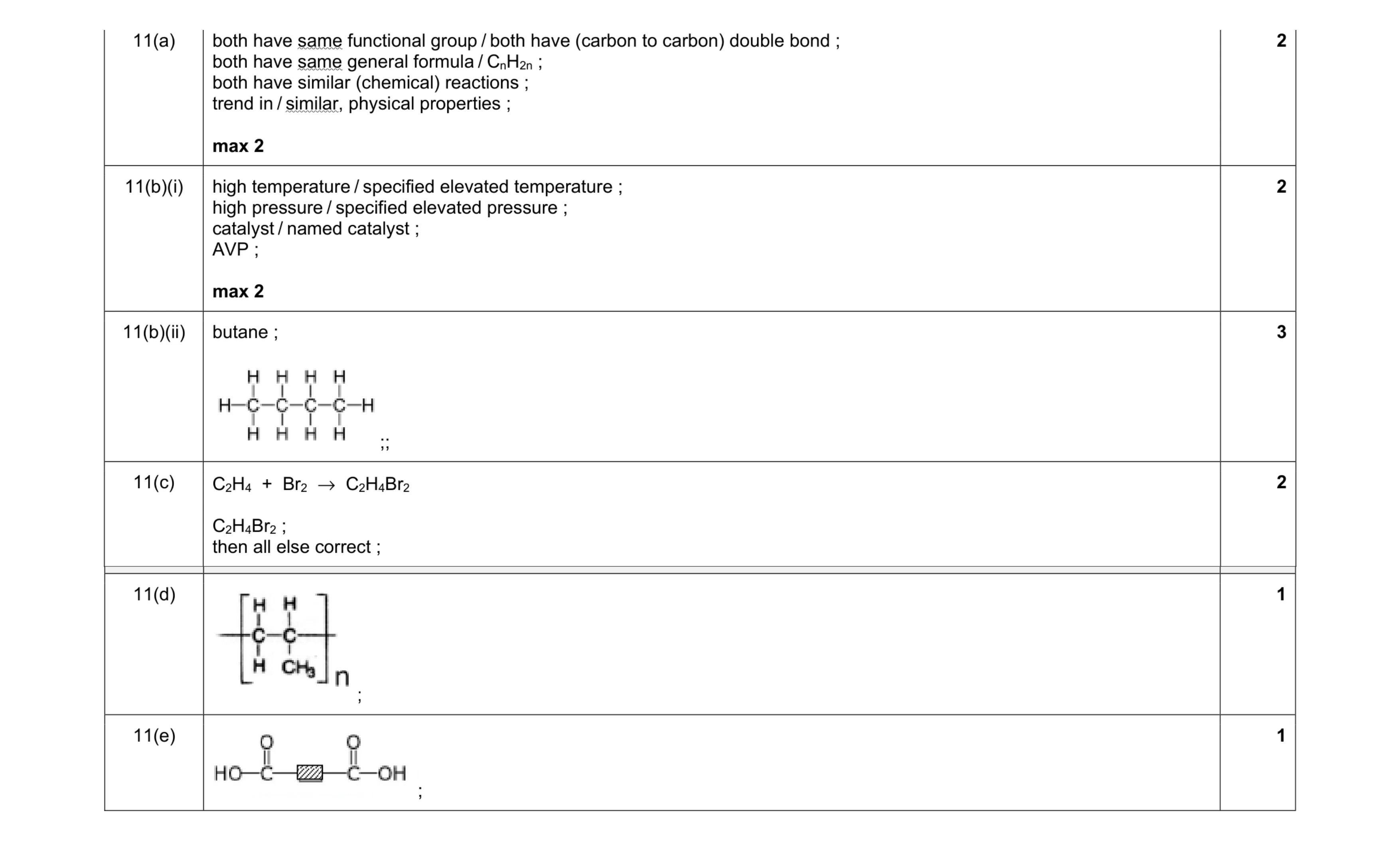 11
11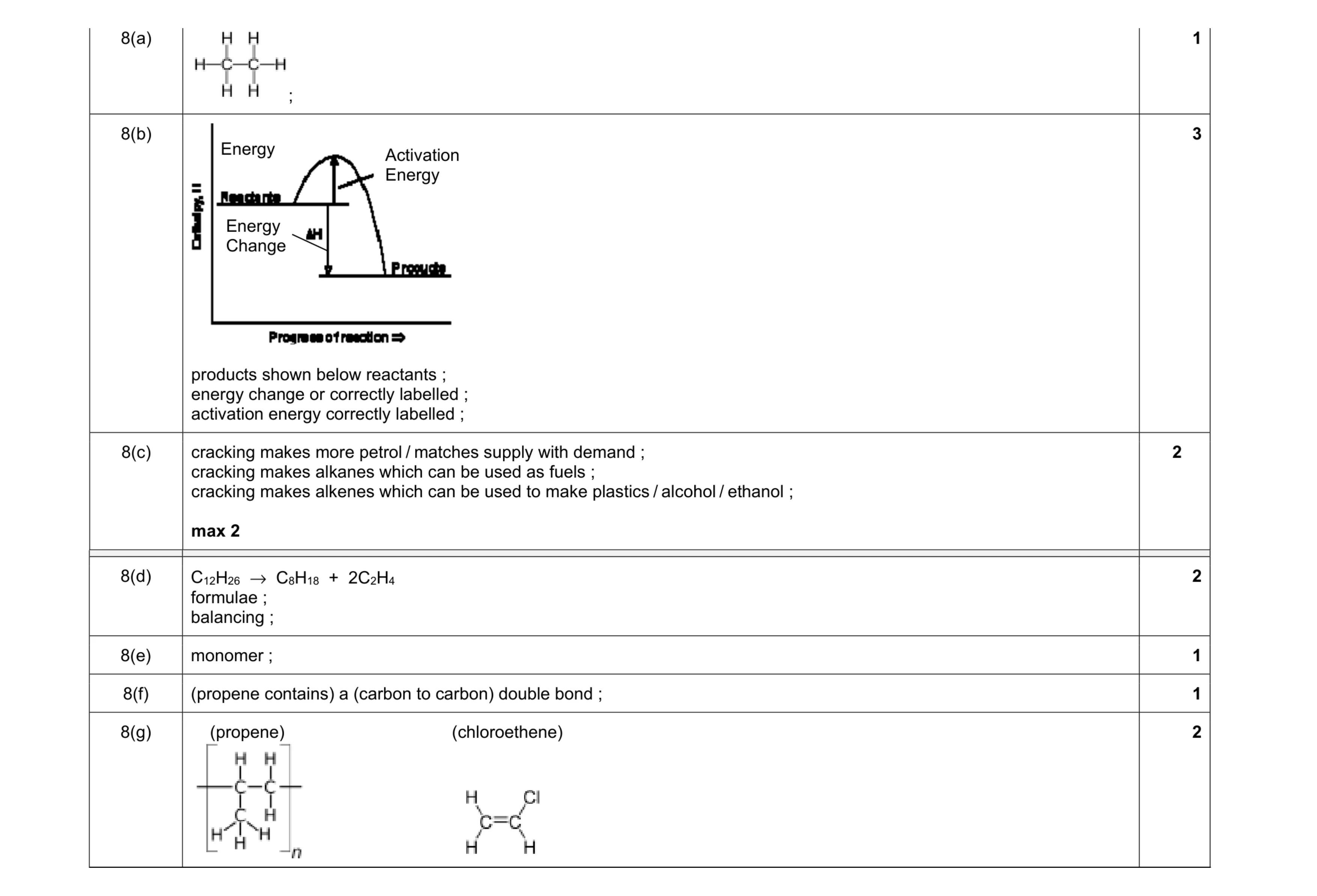 12
12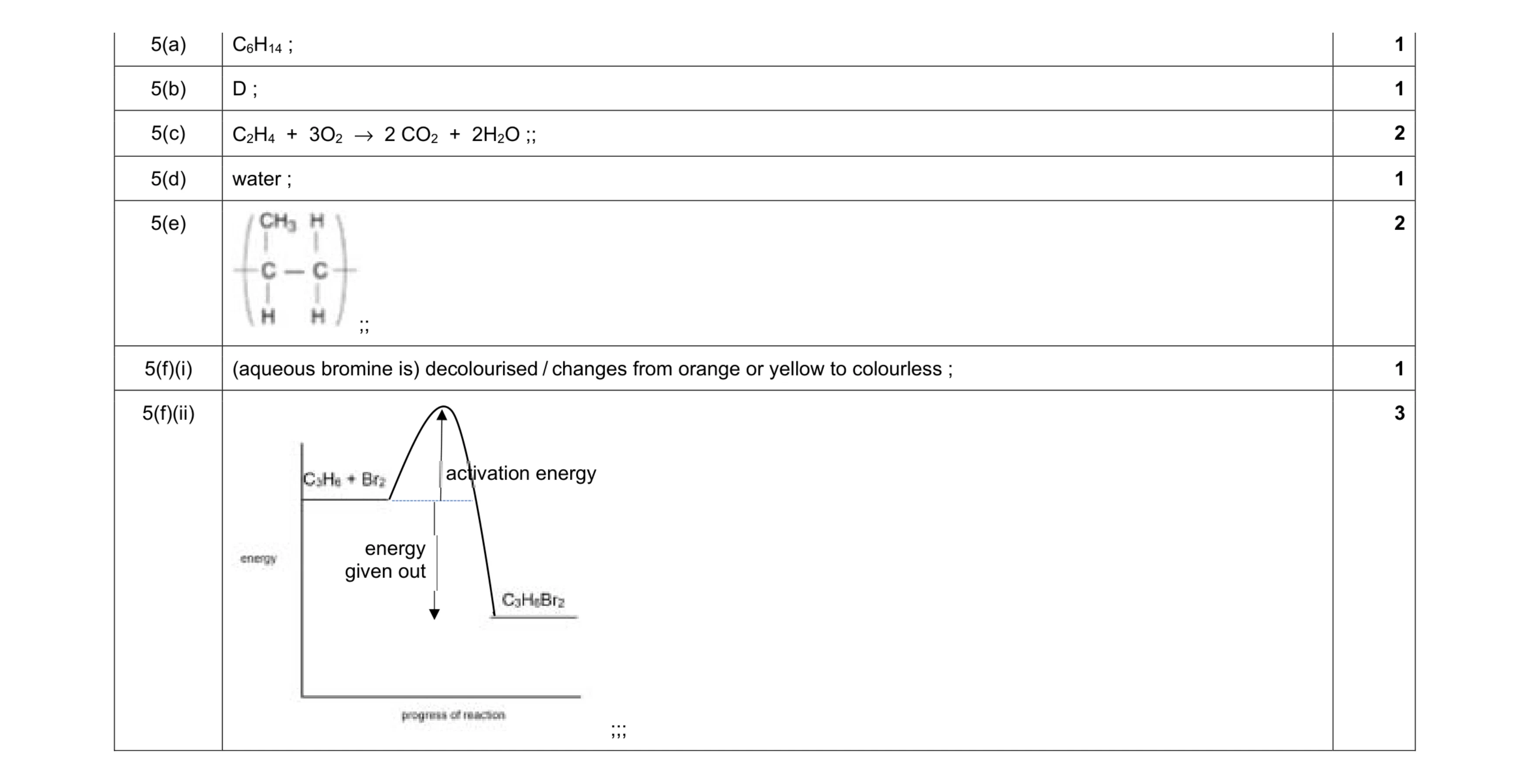 11
11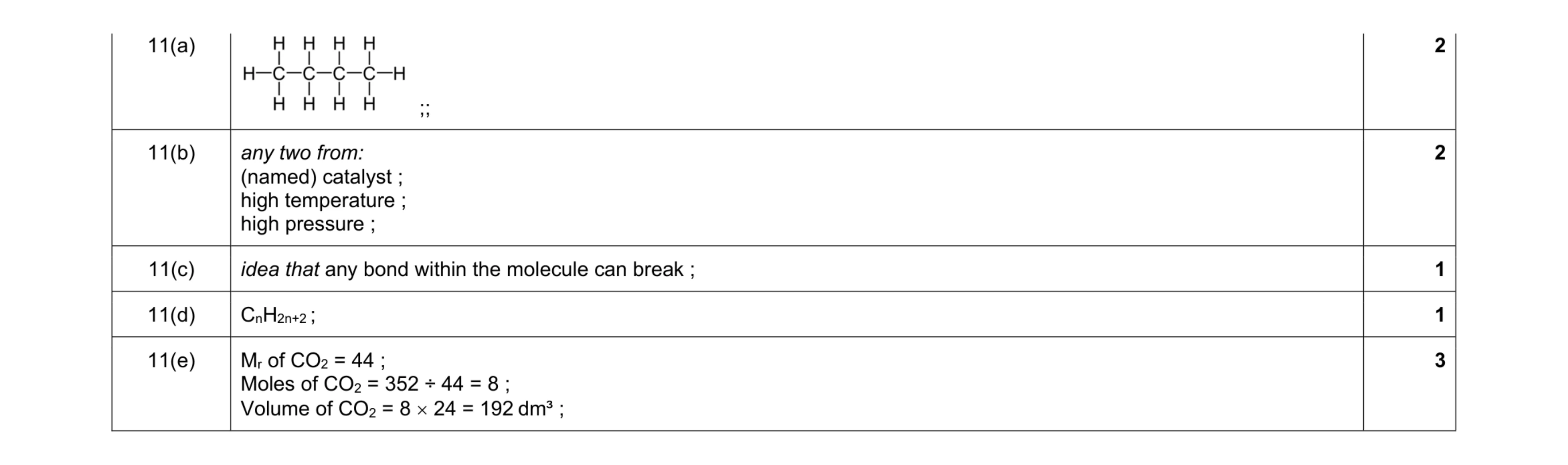 9
9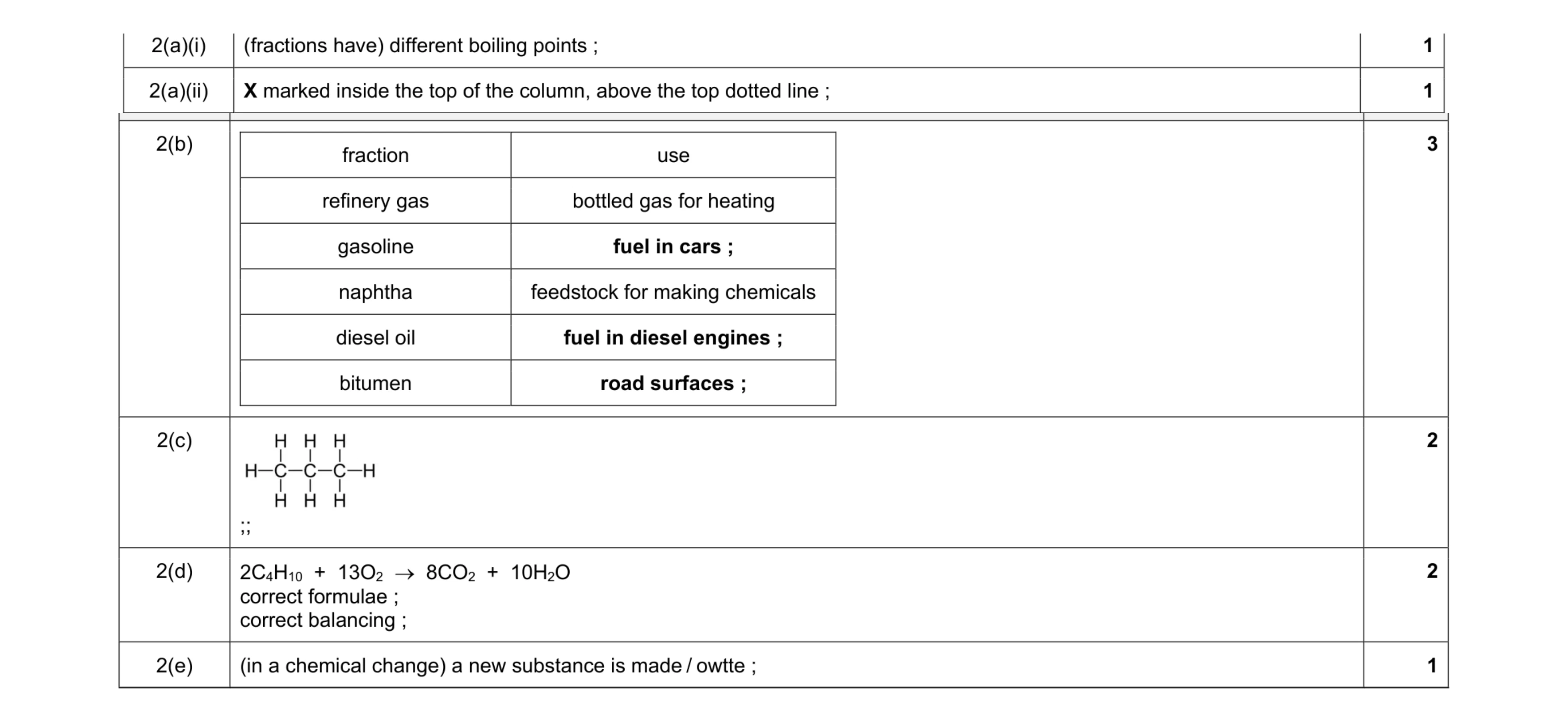 10
10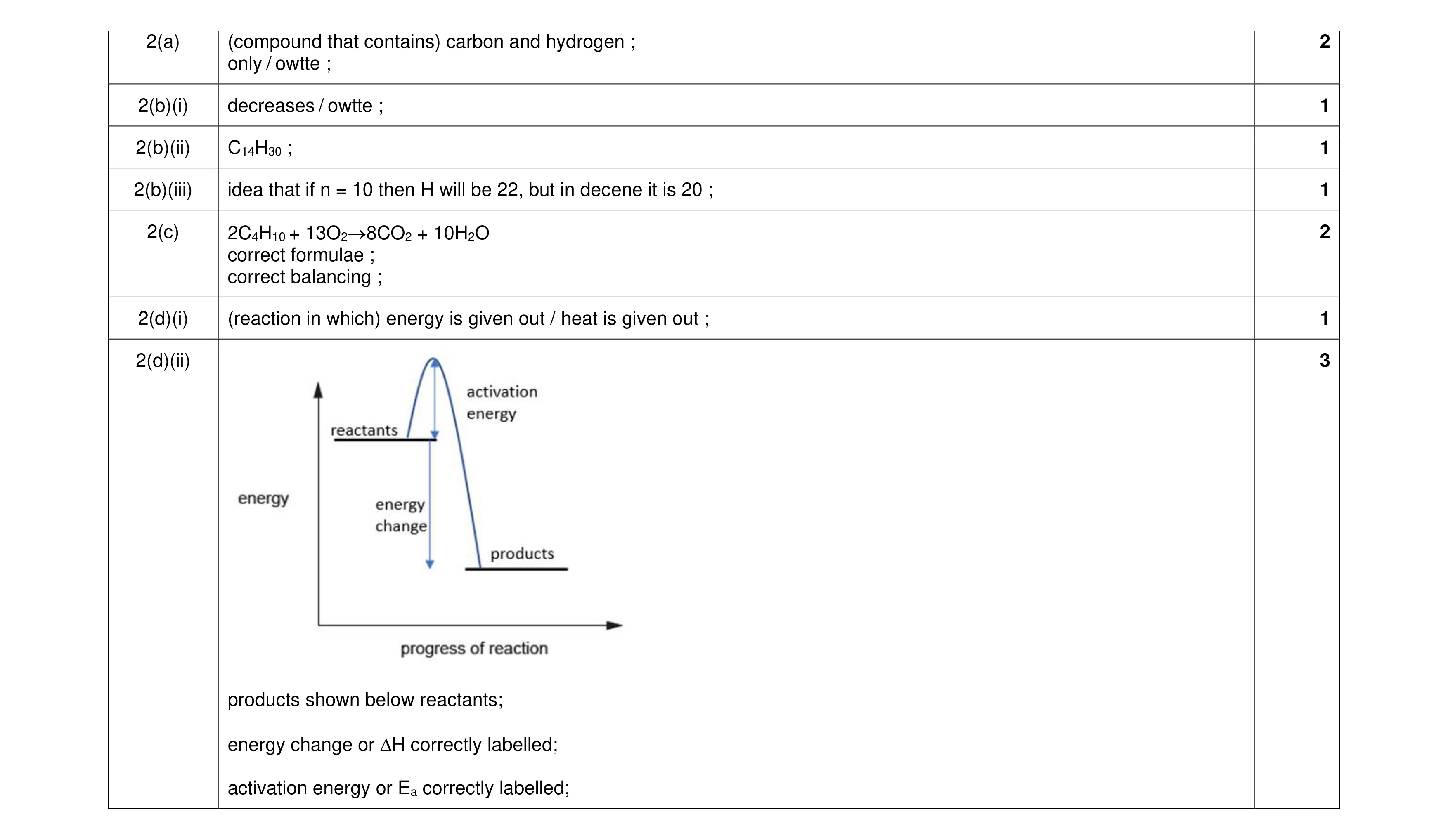 11
11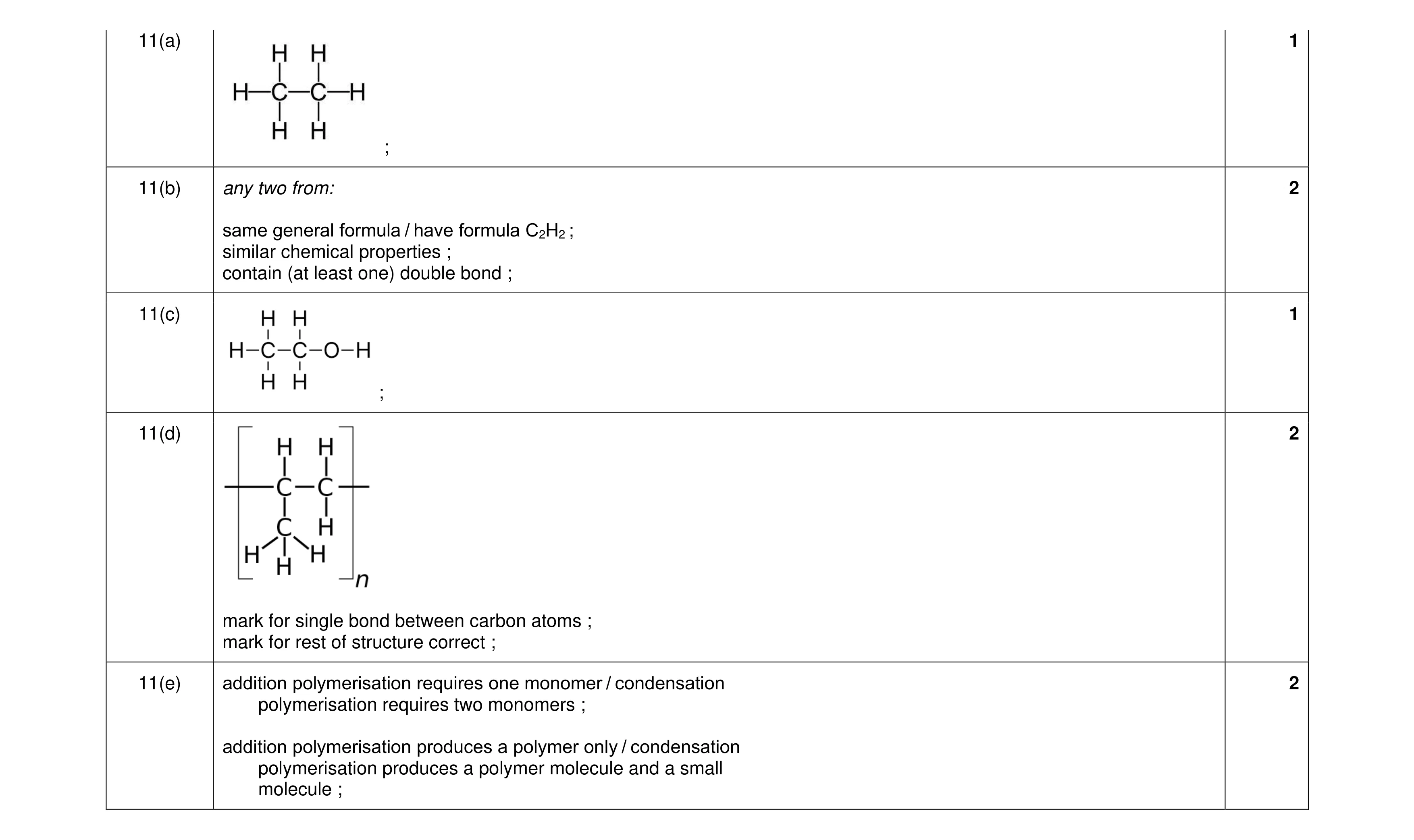 8
8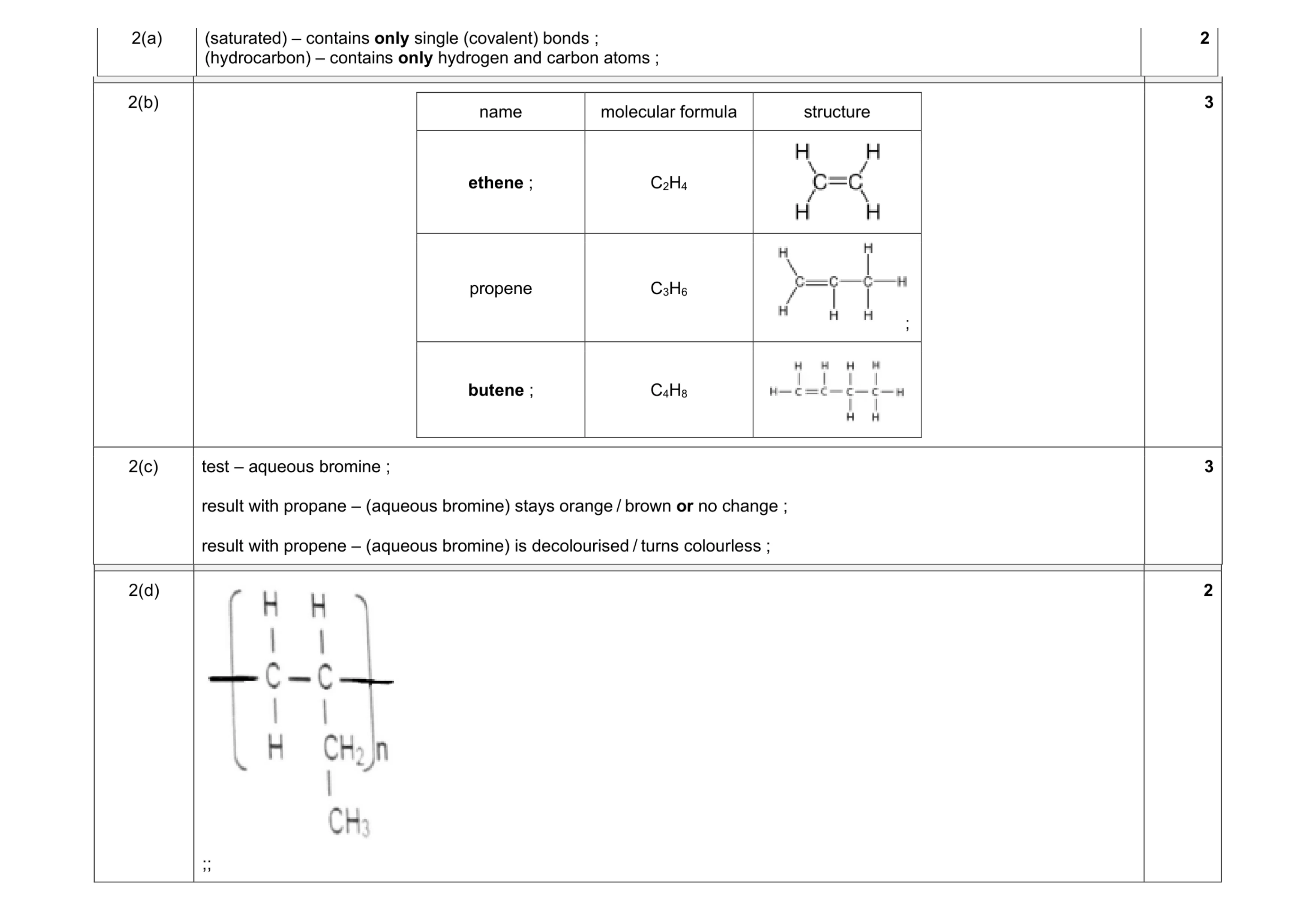 10
10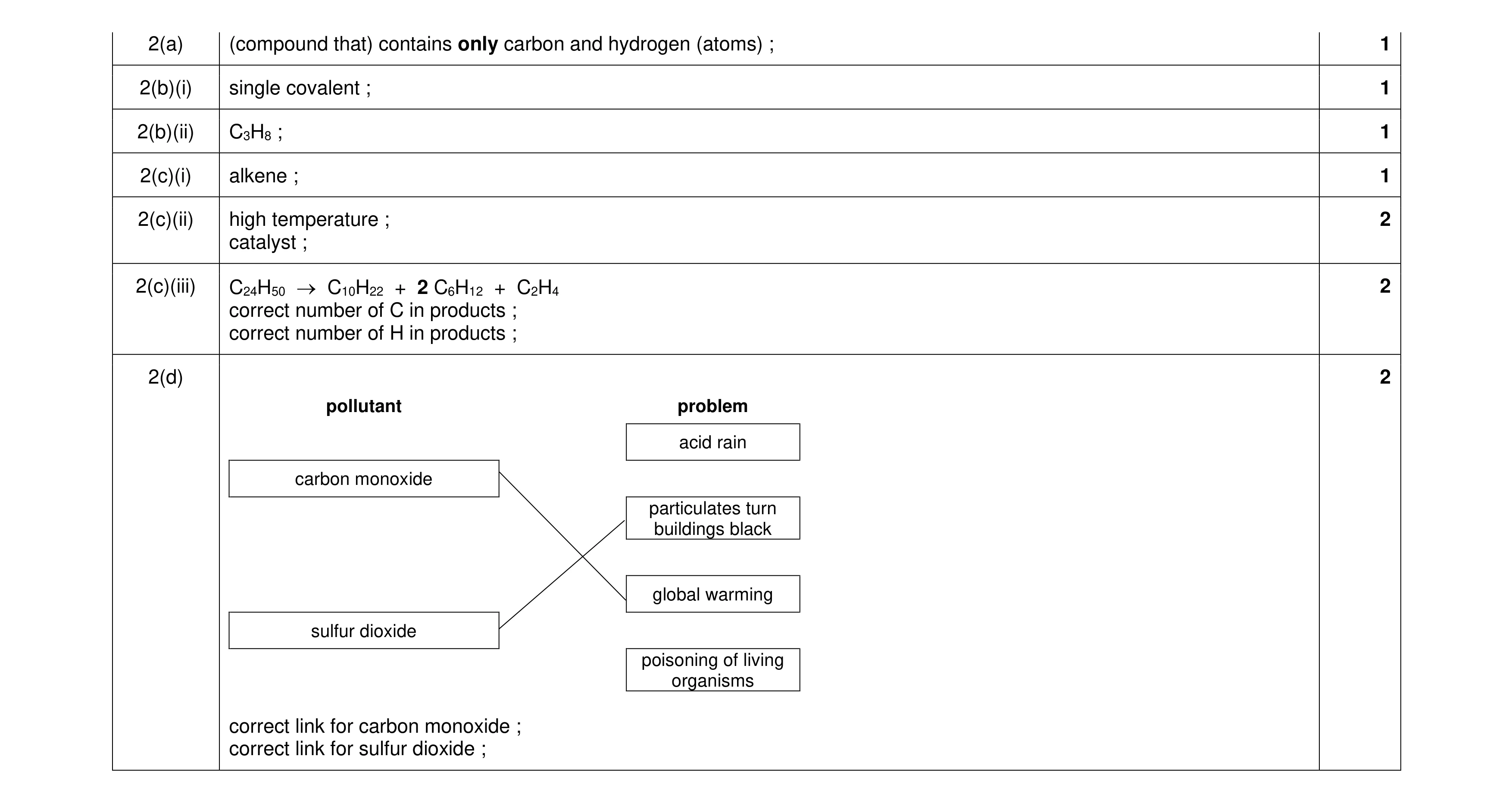 10
10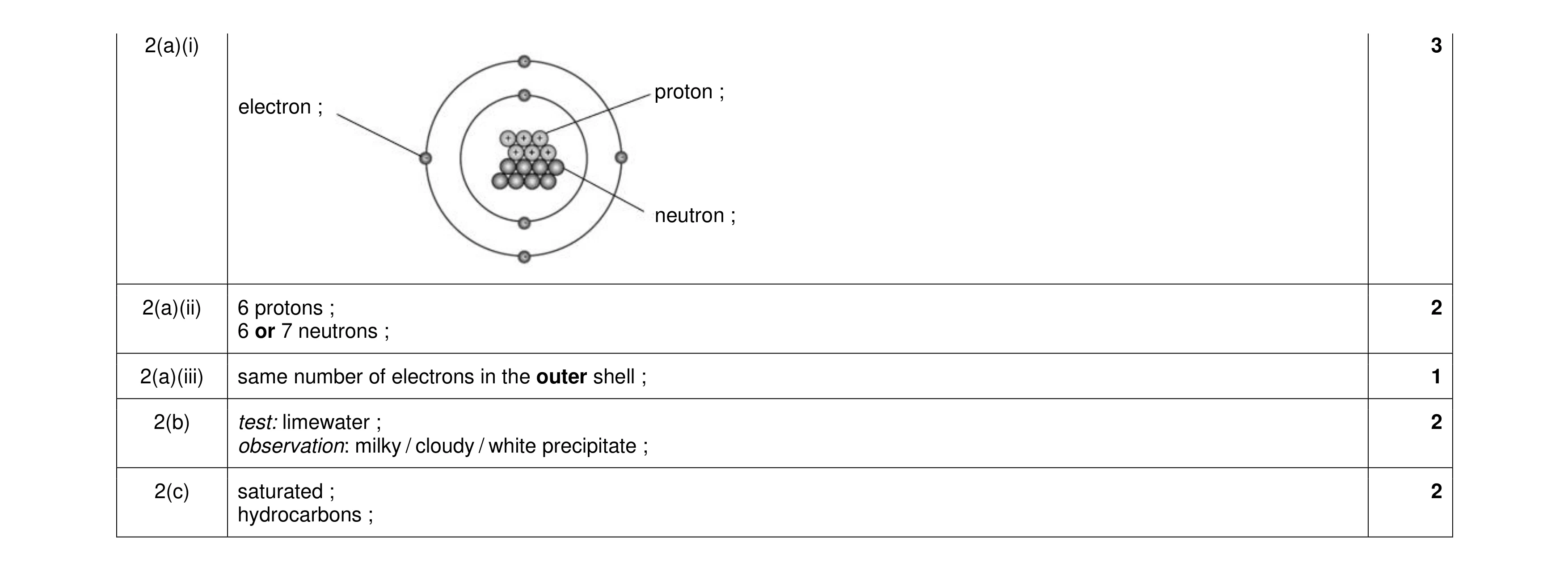 10
10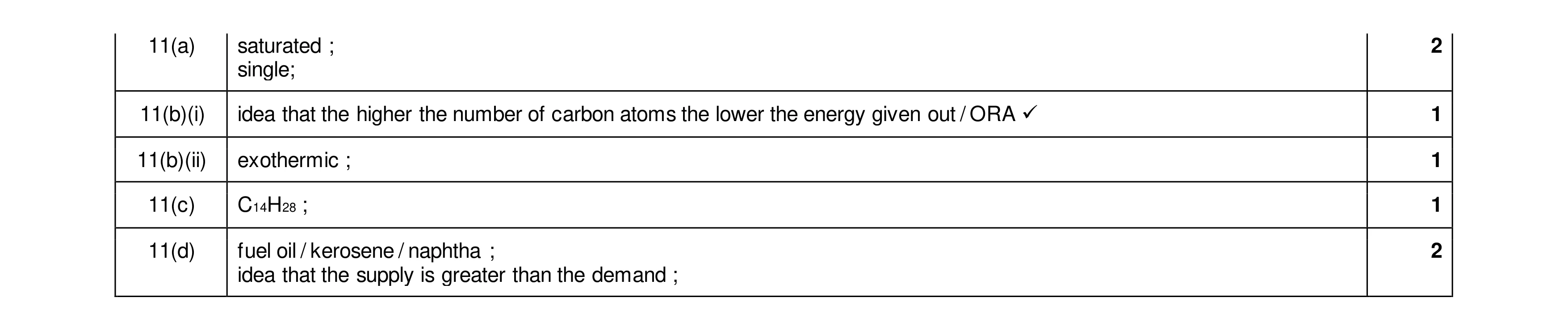 7
7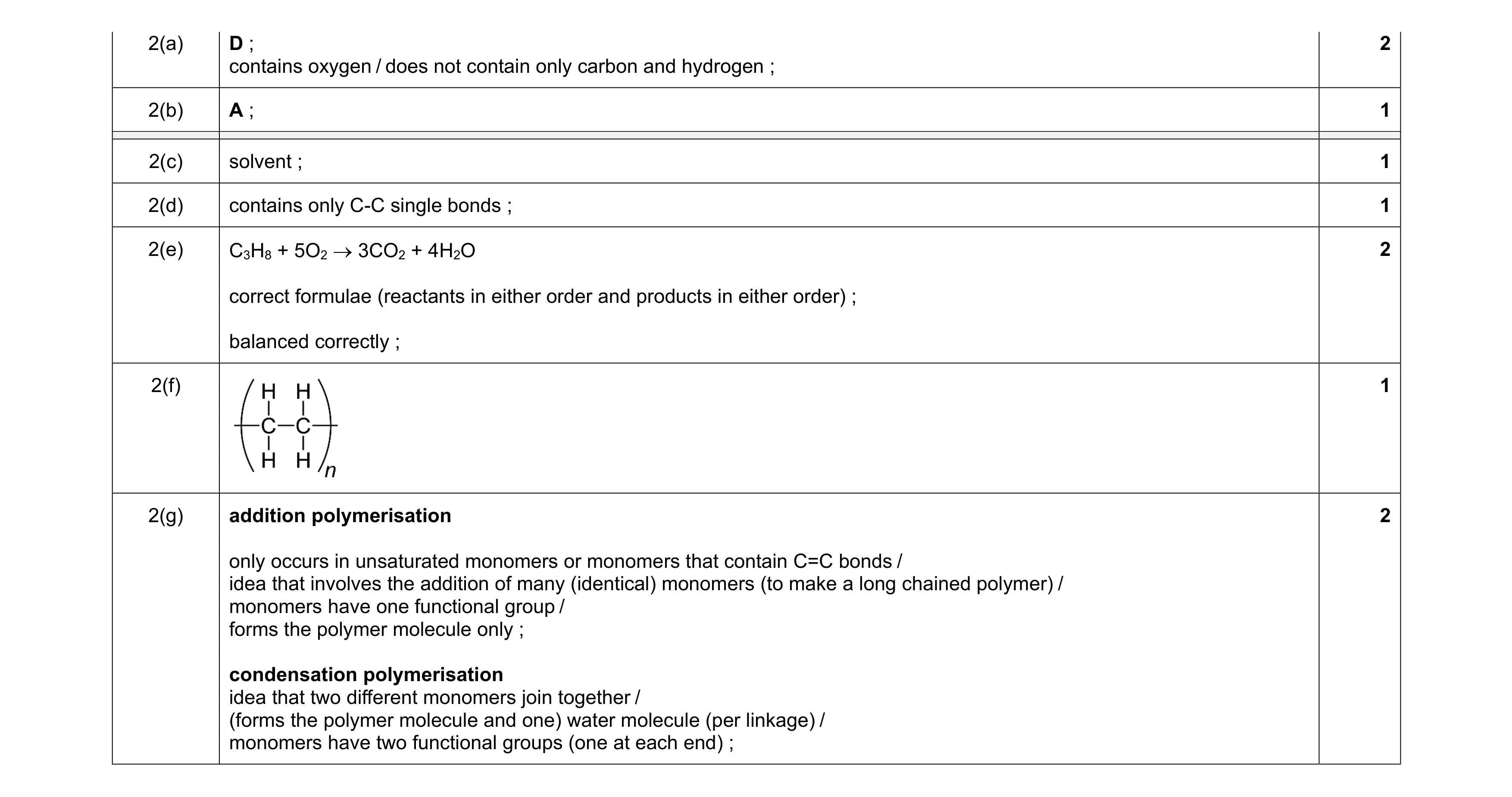 10
10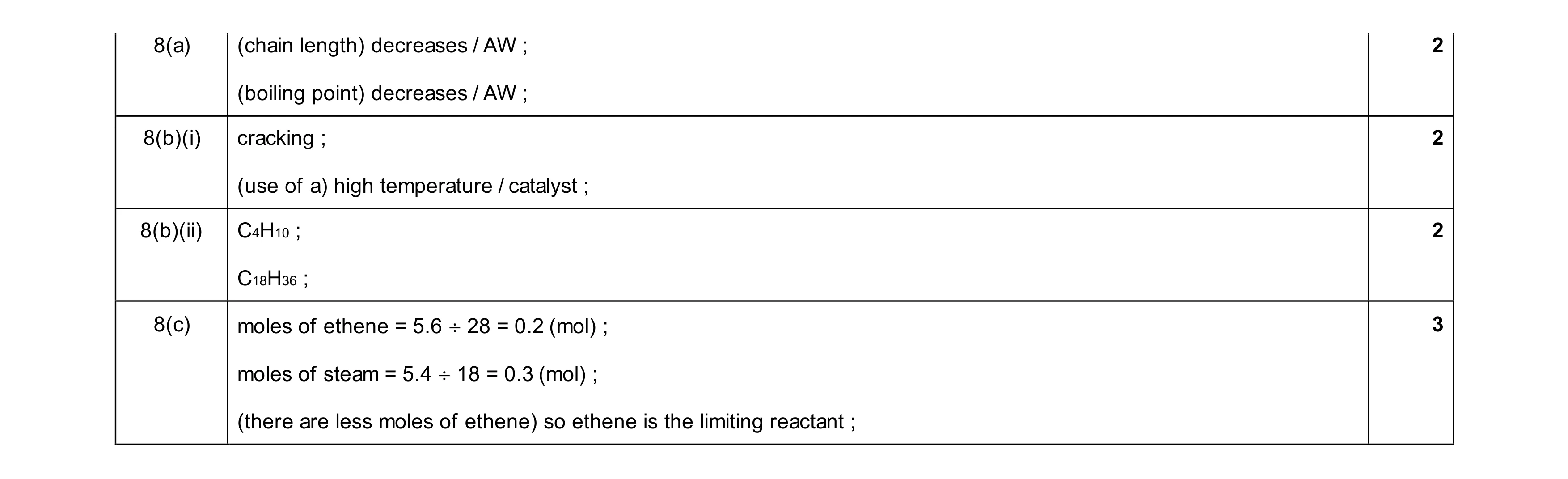 9
9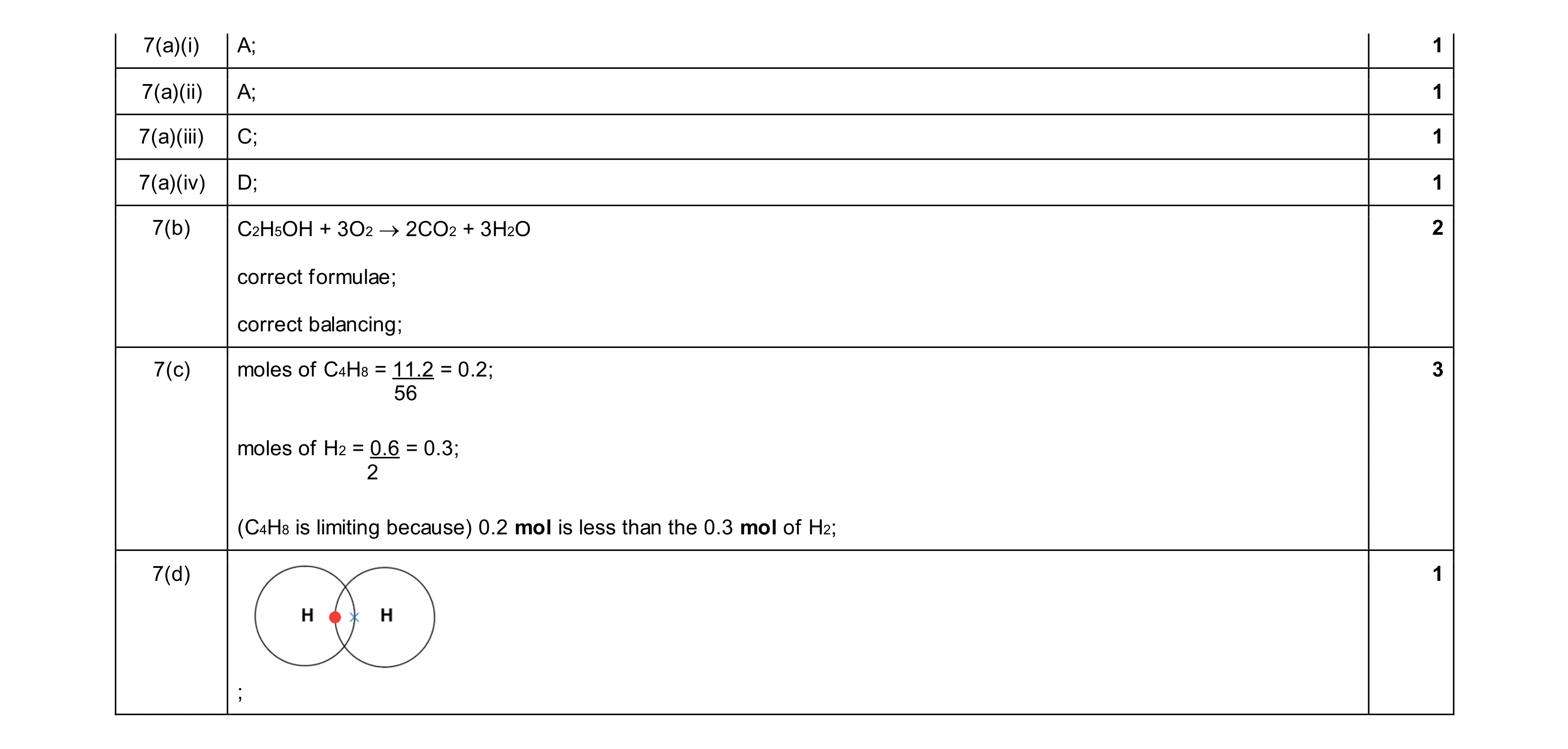 10
10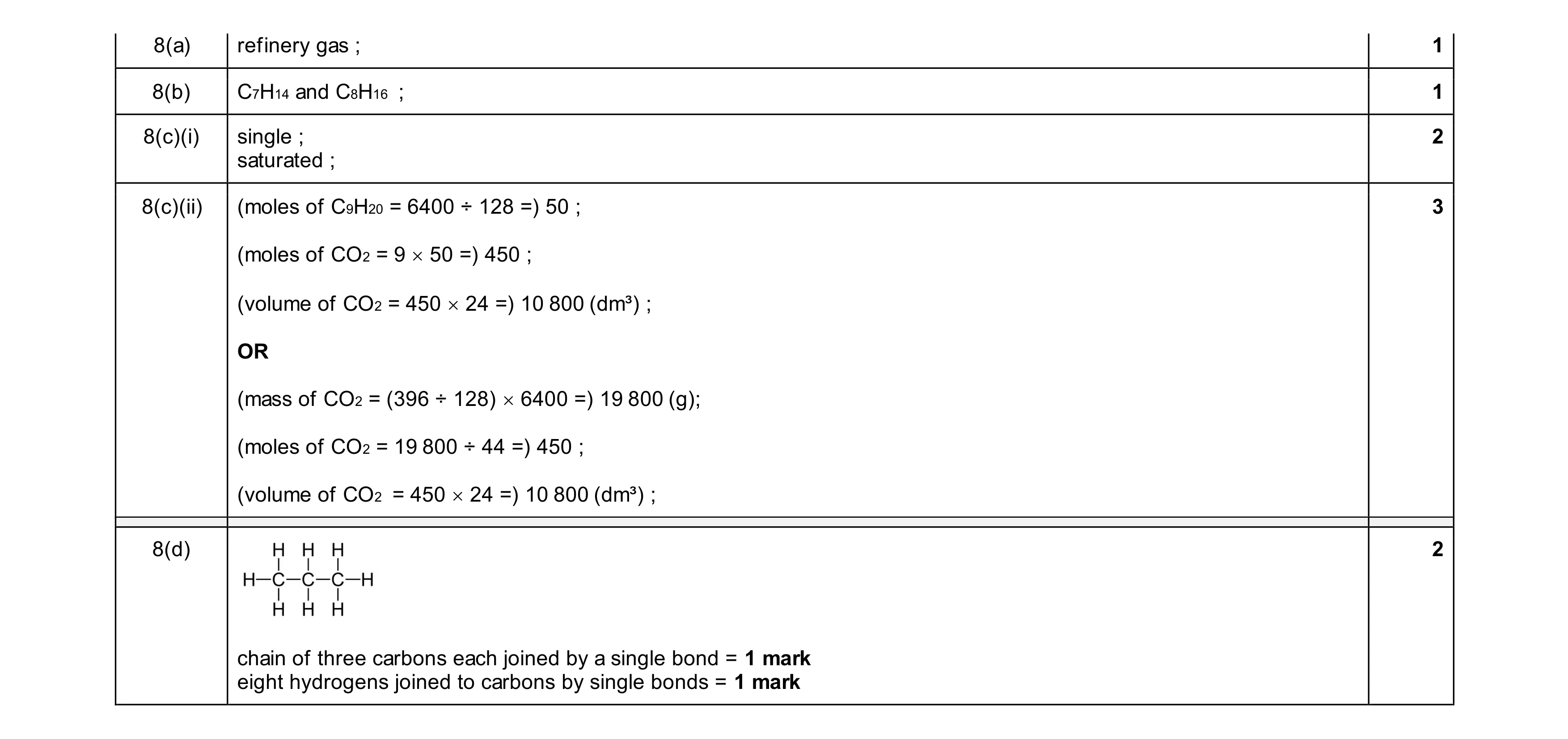 9
9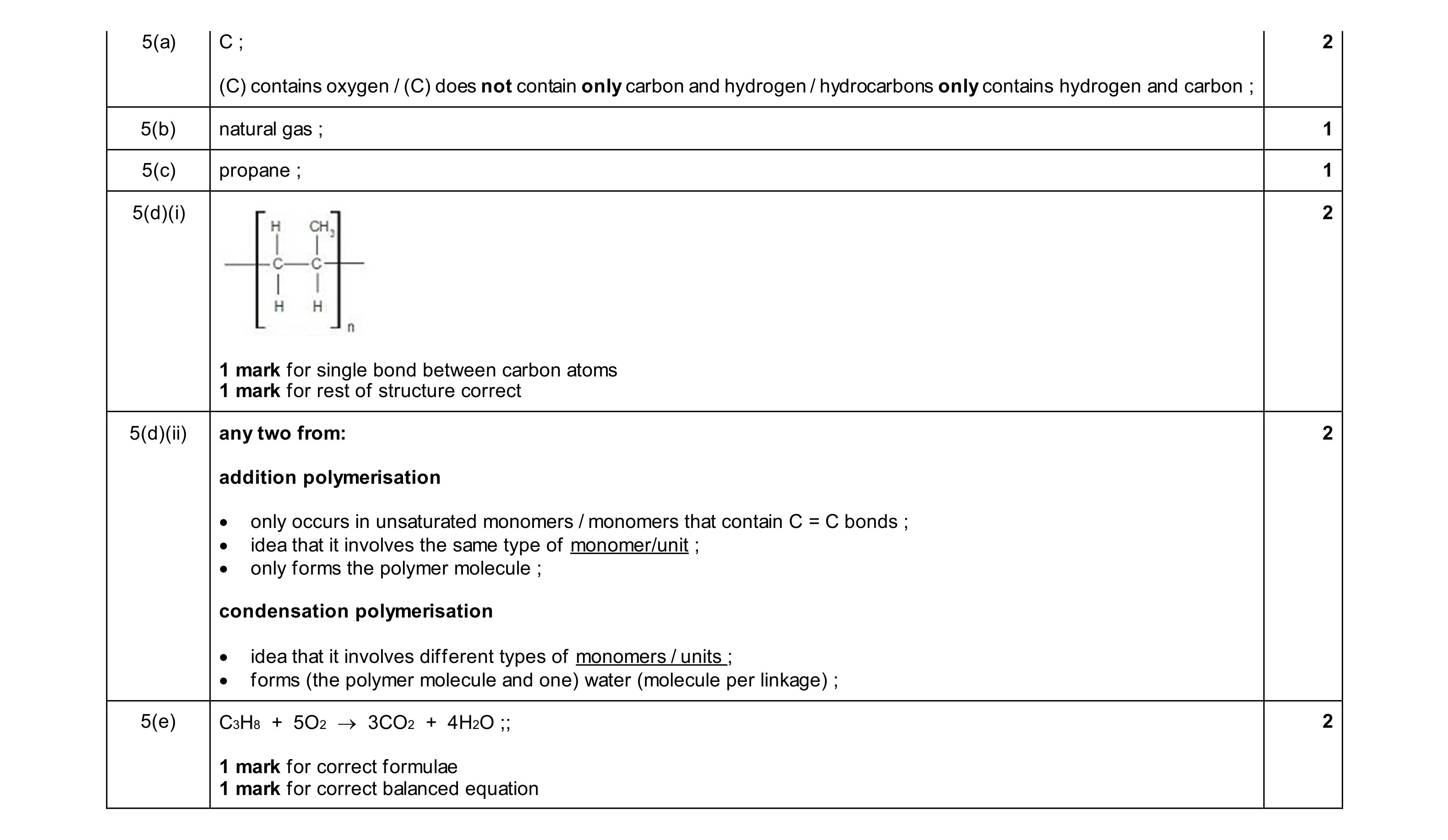 10
10