Questions as text
Q1 · Natural gas and petroleum are fossil fuels 0654/31 May/June 2017
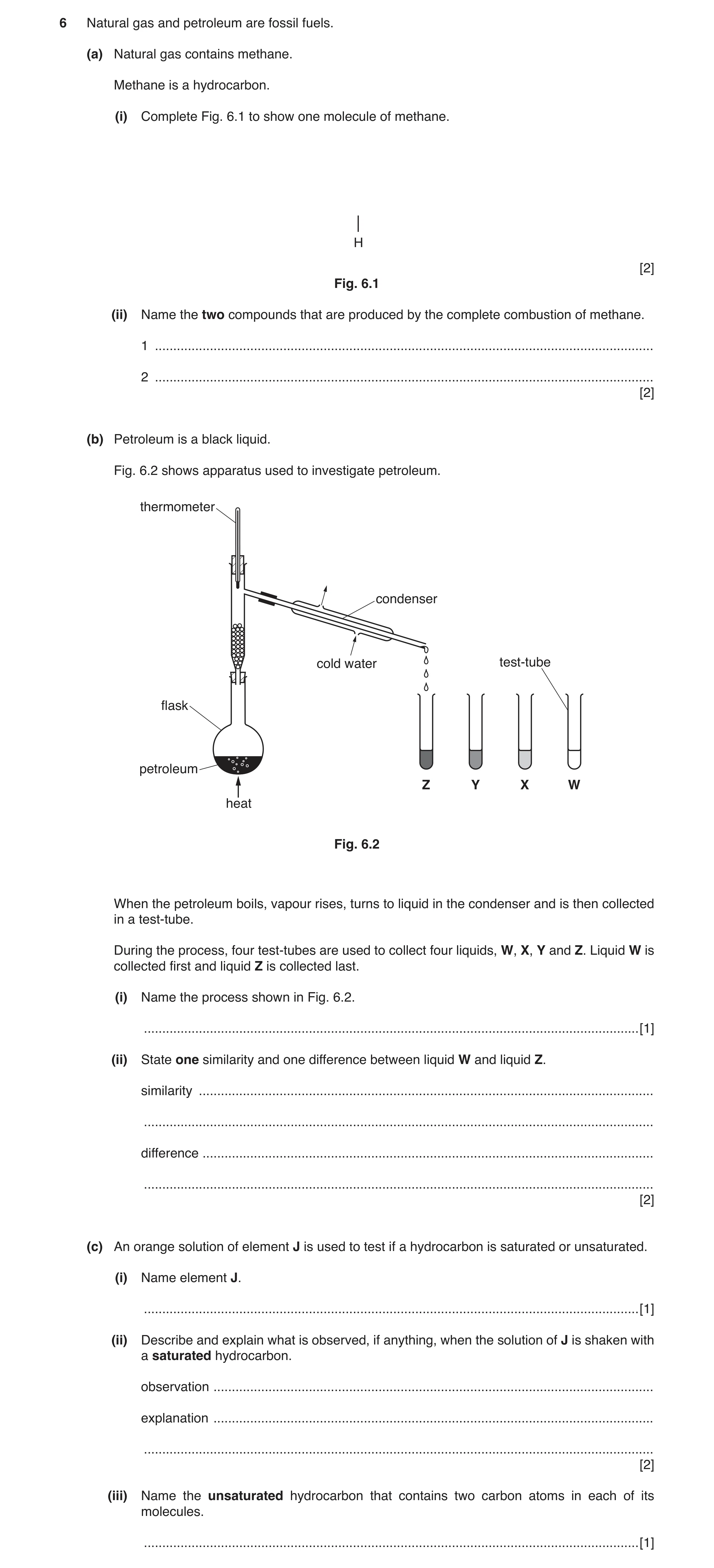
6 Natural gas and petroleum are fossil fuels. (a) Natural gas contains methane. Methane is a hydrocarbon. (i) Complete Fig. 6.1 to show one molecule of methane. H [2] Fig. 6.1 (ii) Name the two compounds that are produced by the complete combustion of methane. 1 … 2 … [2] (b) Petroleum is a black liquid. Fig. 6.2 shows apparatus used to investigate petroleum. thermometer condenser cold water test-tube flask petroleum Z Y X W heat Fig. 6.2 When the petroleum boils, vapour rises, turns to liquid in the condenser and is then collected in a test-tube. During the process, four test-tubes are used to collect four liquids, W, X, Y and Z. Liquid W is collected first and liquid Z is collected last. (i) Name the process shown in Fig. 6.2. … [1] (ii) State one similarity and one difference between liquid W and liquid Z. similarity … … difference … … [2] (c) An orange solution of element J is used to test if a hydrocarbon is saturated or unsaturated. (i) Name element J. … [1] (ii) Describe and explain what is observed, if anything, when the solution of J is shaken with a saturated hydrocarbon. observation … explanation … … [2] (iii) Name the unsaturated hydrocarbon that contains two carbon atoms in each of its molecules. … [1]
11 marks
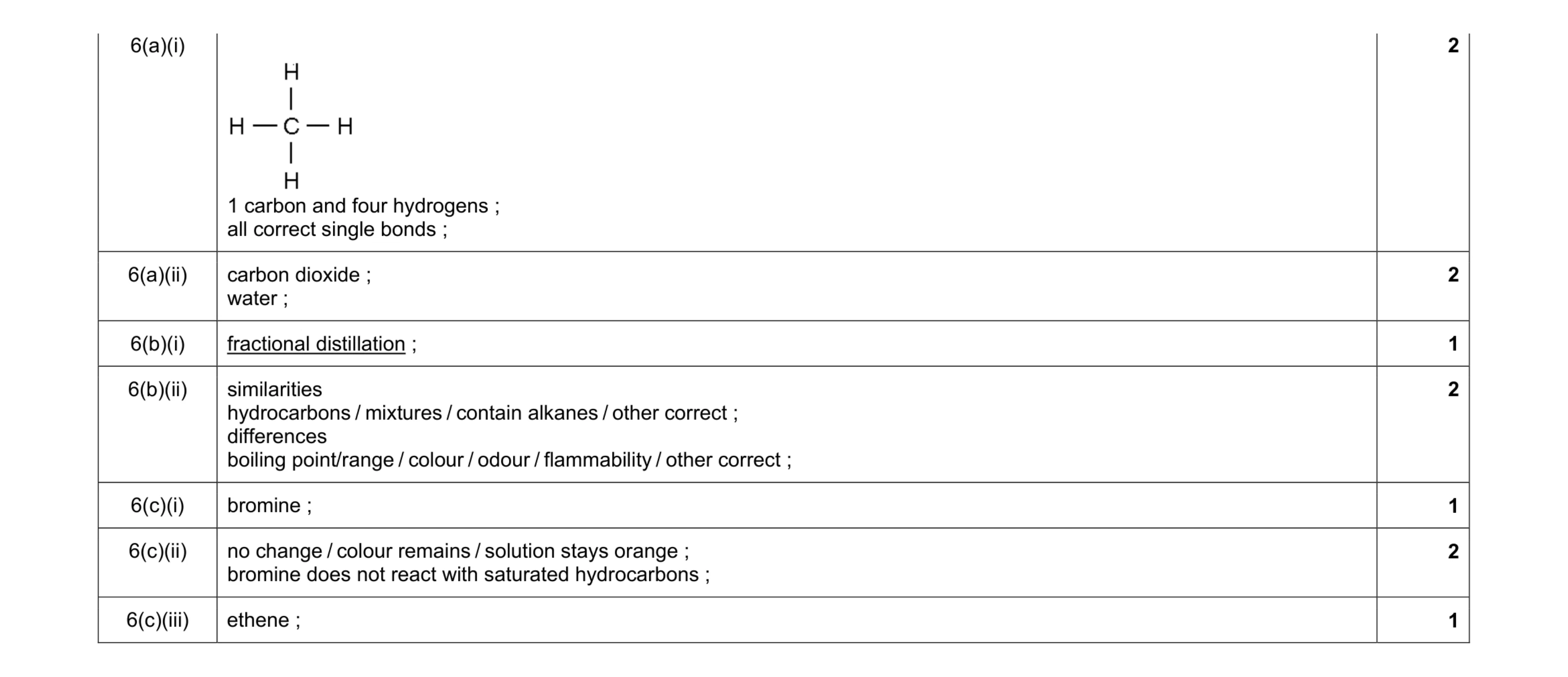
Mark scheme: 6(a)(i) 1 carbon and four hydrogens ; all correct single bonds ; 2 6(a)(ii) carbon dioxide ; water ; 2 6(b)(i) fractional distillation ; 1 6(b)(ii) similarities hydrocarbons / mixtures / contain alkanes / other correct ; differences boiling point/range / colour / odour / flammability / other correct ; 2 6(c)(i) bromine ; 1 6(c)(ii) no change / colour remains / solution stays orange ; bromine does not react with saturated hydrocarbons ; 2 6(c)(iii) ethene ; 1
This question in 0654/31 May/June 2017
Q2 · Most of the compounds in petroleum contain only the elements carbon and hydrogen 0654/32 May/June 2017
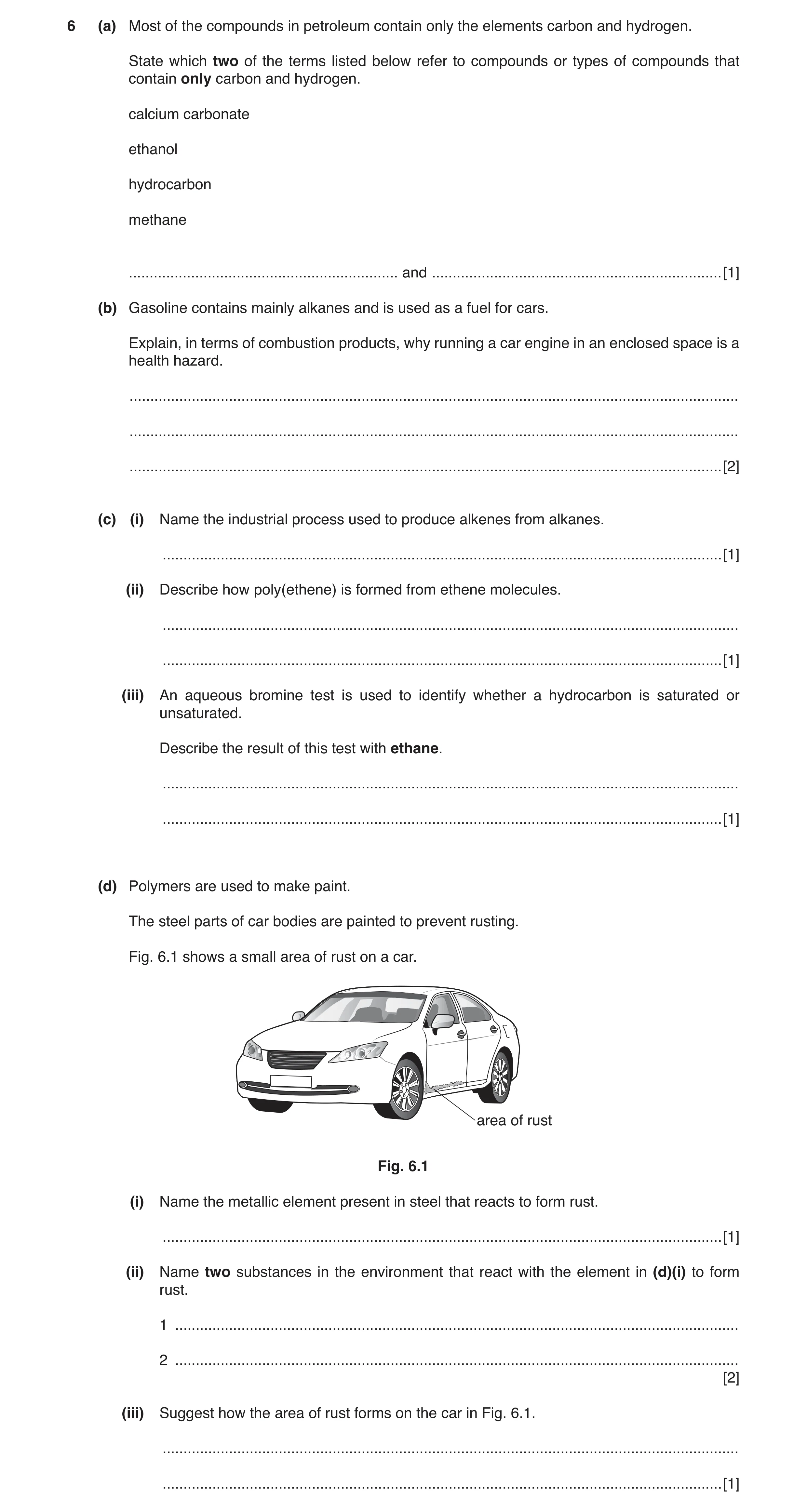
6 (a) Most of the compounds in petroleum contain only the elements carbon and hydrogen. State which two of the terms listed below refer to compounds or types of compounds that contain only carbon and hydrogen. calcium carbonate ethanol hydrocarbon methane … and … [1] (b) Gasoline contains mainly alkanes and is used as a fuel for cars. Explain, in terms of combustion products, why running a car engine in an enclosed space is a health hazard. … … … [2] (c) (i) Name the industrial process used to produce alkenes from alkanes. … [1] (ii) Describe how poly(ethene) is formed from ethene molecules. … … [1] (iii) An aqueous bromine test is used to identify whether a hydrocarbon is saturated or unsaturated. Describe the result of this test with ethane. … … [1] (d) Polymers are used to make paint. The steel parts of car bodies are painted to prevent rusting. Fig. 6.1 shows a small area of rust on a car. area of rust Fig. 6.1 (i) Name the metallic element present in steel that reacts to form rust. … [1] (ii) Name two substances in the environment that react with the element in (d)(i) to form rust. 1 … 2 … [2] (iii) Suggest how the area of rust forms on the car in Fig. 6.1. … … [1]
10 marks
Mark scheme: 6(a) hydrocarbon and methane ; 1 6(b) reference to release / build-up of carbon dioxide / carbon monoxide ; reference to dangers of poisoning / suffocation / death ; 2 6(c)(i) (catalytic) cracking ; 1 6(c)(ii) ethene molecules join together / form (long) chains ; 1 6(c)(iii) no reaction ; no colour change / stays orange ; 1 6(d)(i) iron ; 1 6(d)(ii) air / oxygen ; water ; 2 6(d)(iii) any reasonable source of damage / cause of paint removal ; 1
This question in 0654/32 May/June 2017
Q3 · Petroleum is a liquid fossil fuel 0654/31 Oct/Nov 2017
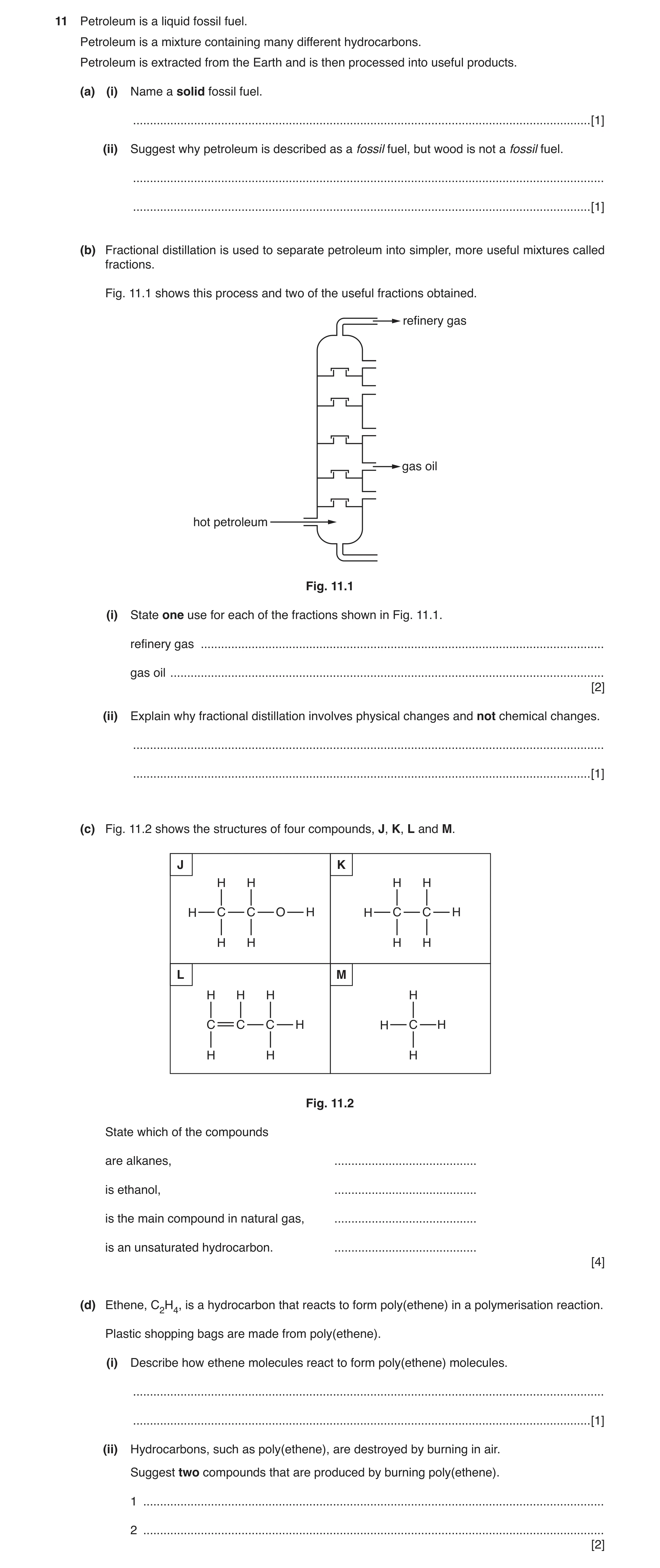
11 Petroleum is a liquid fossil fuel. Petroleum is a mixture containing many different hydrocarbons. Petroleum is extracted from the Earth and is then processed into useful products. (a) (i) Name a solid fossil fuel. … [1] (ii) Suggest why petroleum is described as a fossil fuel, but wood is not a fossil fuel. … … [1] (b) Fractional distillation is used to separate petroleum into simpler, more useful mixtures called fractions. Fig. 11.1 shows this process and two of the useful fractions obtained. refinery gas gas oil hot petroleum Fig. 11.1 (i) State one use for each of the fractions shown in Fig. 11.1. refinery gas … gas oil … [2] (ii) Explain why fractional distillation involves physical changes and not chemical changes. … … [1] (c) Fig. 11.2 shows the structures of four compounds, J, K, L and M. J K H H H H H C C O H H C C H H H H H L M H H H H C C C H H C H H H H Fig. 11.2 State which of the compounds are alkanes, … is ethanol, … is the main compound in natural gas, … is an unsaturated hydrocarbon. … [4] (d) Ethene, C2H4, is a hydrocarbon that reacts to form poly(ethene) in a polymerisation reaction. Plastic shopping bags are made from poly(ethene). (i) Describe how ethene molecules react to form poly(ethene) molecules. … … [1] (ii) Hydrocarbons, such as poly(ethene), are destroyed by burning in air. Suggest two compounds that are produced by burning poly(ethene). 1 … 2 … [2]
12 marks
Mark scheme: 11(a)(i) coal ; 1 11(a)(ii) reference to long time required to form fossil fuels ; 1 11(b)(i) heating / cooking ; fuel for diesel engines / fuel for named heavy vehicle ; 2 11(b)(ii) no new compounds / separation of existing compounds from a mixture ; 1 11(c) alkanes K M ; ethanol J ; natural gas M ; unsaturated L ; 4 11(d)(i) join together (in chains) / owtte ; 1 11(d)(ii) carbon dioxide ; carbon monoxide ; water ; max 2
This question in 0654/31 Oct/Nov 2017
Q4 · The structure of a molecule of an alkane 0654/32 Oct/Nov 2017
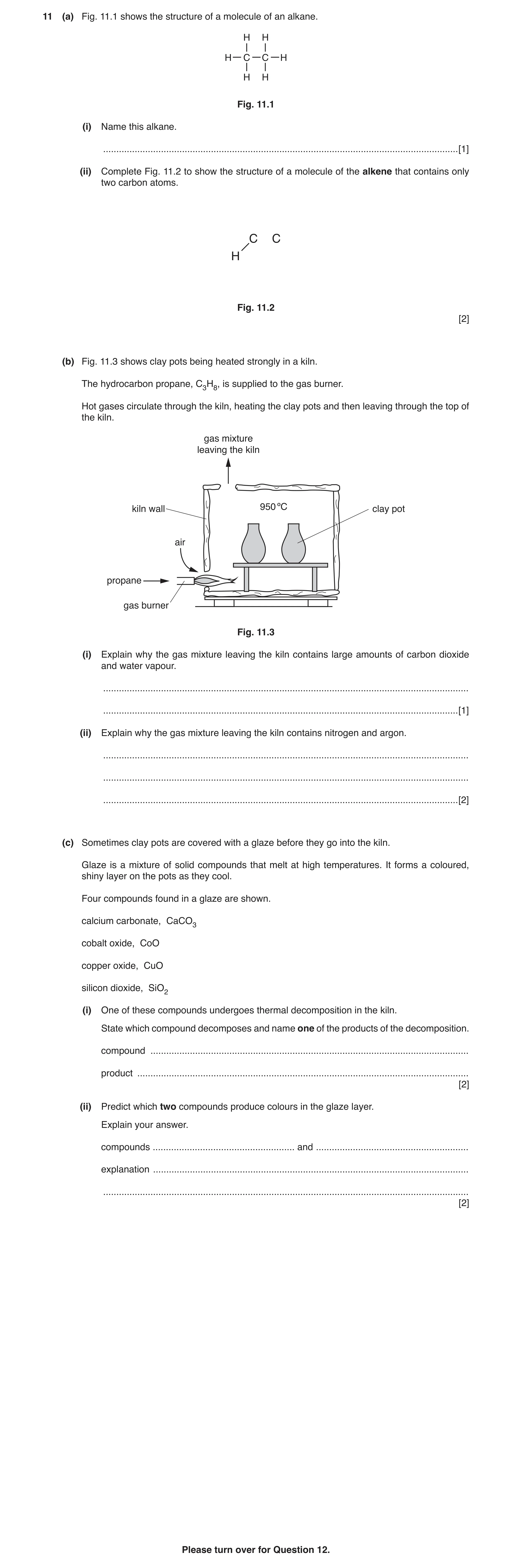
11 (a) Fig. 11.1 shows the structure of a molecule of an alkane. H H H C C H H H Fig. 11.1 (i) Name this alkane. … [1] (ii) Complete Fig. 11.2 to show the structure of a molecule of the alkene that contains only two carbon atoms. C C H Fig. 11.2 [2] (b) Fig. 11.3 shows clay pots being heated strongly in a kiln. The hydrocarbon propane, C3H8, is supplied to the gas burner. Hot gases circulate through the kiln, heating the clay pots and then leaving through the top of the kiln. gas mixture leaving the kiln kiln wall 950 ºC clay pot air propane gas burner Fig. 11.3 (i) Explain why the gas mixture leaving the kiln contains large amounts of carbon dioxide and water vapour. … … [1] (ii) Explain why the gas mixture leaving the kiln contains nitrogen and argon. … … … [2] (c) Sometimes clay pots are covered with a glaze before they go into the kiln. Glaze is a mixture of solid compounds that melt at high temperatures. It forms a coloured, shiny layer on the pots as they cool. Four compounds found in a glaze are shown. calcium carbonate, CaCO3 cobalt oxide, CoO copper oxide, CuO silicon dioxide, SiO2 (i) One of these compounds undergoes thermal decomposition in the kiln. State which compound decomposes and name one of the products of the decomposition. compound … product … [2] (ii) Predict which two compounds produce colours in the glaze layer. Explain your answer. compounds … and … explanation … … [2] Please turn over for Question 12.
10 marks
Mark scheme: 11(a)(i) ethane ; 1 11(a)(ii) double bond shown ; four hydrogen atoms – two on each carbon atom ; 2 11(b)(i) CO2 and H2O from the (complete) combustion of propane / the fuel / the hydrocarbon ; 1 11(b)(ii) nitrogen and argon from / in the air (taken in with the fuel) ; nitrogen and argon are inert / do not react / burn ; 2 11(c)(i) calcium carbonate / CaCO3 ; calcium oxide / lime / CaO / carbon dioxide / CO2 ; 2 Question Answer Marks 11(c)(ii) cobalt oxide / CoO and copper oxide / CuO ; reference to transition metals ; 2
This question in 0654/32 Oct/Nov 2017
Q5 · Coal, natural gas and biogas are all fuels that provide useful energy 0654/33 Oct/Nov 2017
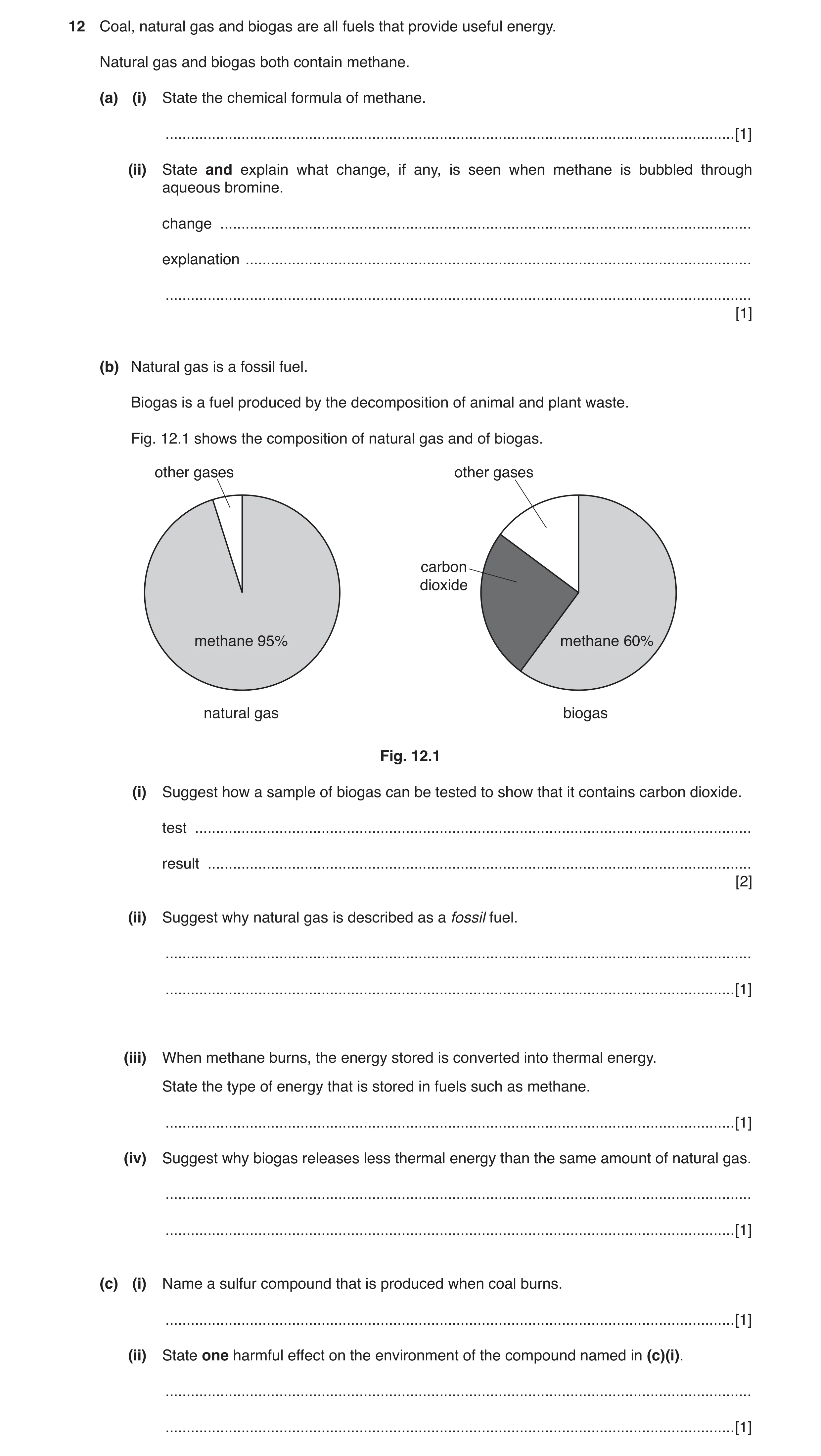
12 Coal, natural gas and biogas are all fuels that provide useful energy. Natural gas and biogas both contain methane. (a) (i) State the chemical formula of methane. … [1] (ii) State and explain what change, if any, is seen when methane is bubbled through aqueous bromine. change … explanation … … [1] (b) Natural gas is a fossil fuel. Biogas is a fuel produced by the decomposition of animal and plant waste. Fig. 12.1 shows the composition of natural gas and of biogas. other gases other gases carbon dioxide methane 95% methane 60% natural gas biogas Fig. 12.1 (i) Suggest how a sample of biogas can be tested to show that it contains carbon dioxide. test … result … [2] (ii) Suggest why natural gas is described as a fossil fuel. … … [1] (iii) When methane burns, the energy stored is converted into thermal energy. State the type of energy that is stored in fuels such as methane. … [1] (iv) Suggest why biogas releases less thermal energy than the same amount of natural gas. … … [1] (c) (i) Name a sulfur compound that is produced when coal burns. … [1] (ii) State one harmful effect on the environment of the compound named in (c)(i). … … [1]
9 marks
Mark scheme: 12(a)(i) CH4 ; 1 12(a)(ii) no change AND methane saturated / cannot be unsaturated ; 1 Question Answer Marks 12(b)(i) limewater ; turns milky ; 2 12(b)(ii) reference to time required to form / ovp ; 1 12(b)(iii) chemical ; 1 12(b)(iv) contains less flammable gas / only the methane can burn ; 1 12(c)(i) sulfur dioxide ; 1 12(c)(ii) reference to acid rain / consequence of acid rain ; 1
This question in 0654/33 Oct/Nov 2017
Q6 · Useful products containing hydrocarbons are obtained from petroleum 0654/31 Oct/Nov 2018
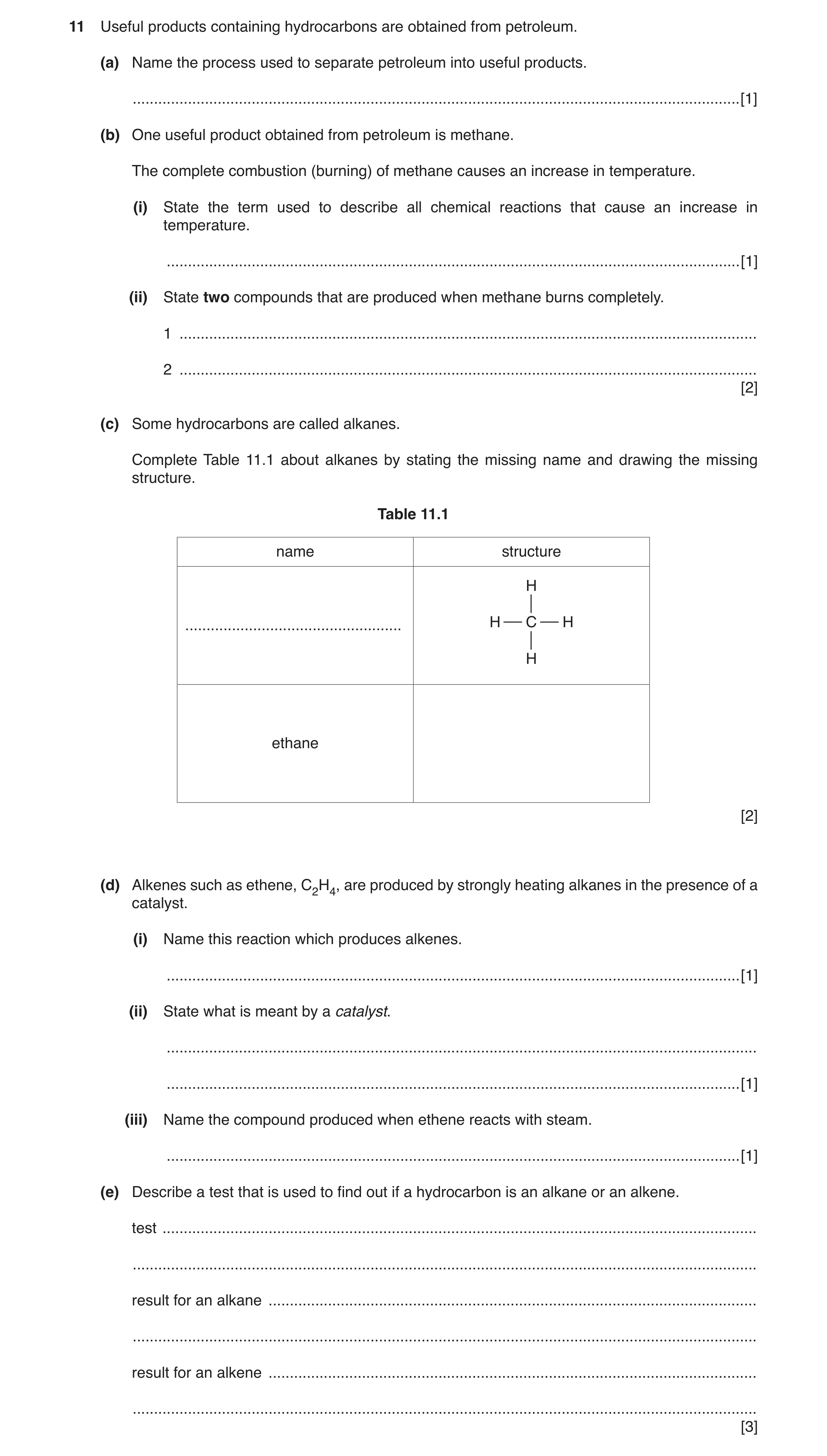
11 Useful products containing hydrocarbons are obtained from petroleum. (a) Name the process used to separate petroleum into useful products. … [1] (b) One useful product obtained from petroleum is methane. The complete combustion (burning) of methane causes an increase in temperature. (i) State the term used to describe all chemical reactions that cause an increase in temperature. … [1] (ii) State two compounds that are produced when methane burns completely. 1 … 2 … [2] (c) Some hydrocarbons are called alkanes. Complete Table 11.1 about alkanes by stating the missing name and drawing the missing structure. Table 11.1 name structure H … H C H H ethane [2] (d) Alkenes such as ethene, C2H4, are produced by strongly heating alkanes in the presence of a catalyst. (i) Name this reaction which produces alkenes. … [1] (ii) State what is meant by a catalyst. … … [1] (iii) Name the compound produced when ethene reacts with steam. … [1] (e) Describe a test that is used to find out if a hydrocarbon is an alkane or an alkene. test … … result for an alkane … … result for an alkene … … [3]
12 marks
Mark scheme: 11(a) fractional distillation ; 1 11(b)(i) exothermic ; 1 11(b)(ii) carbon dioxide ; water ; 2 11(c) methane ; ; 2 11(d)(i) (catalytic / thermal) cracking ; 1 11(d)(ii) speeds up a reaction ; 1 11(d)(iii) ethanol ; 1 11(e) (react with / shake with ) bromine (solution) ; (with alkane) no change / no reaction / mixture remains orange ; (with alkene) orange to colourless ; 3
This question in 0654/31 Oct/Nov 2018
Q7 · Natural gas is used as a fuel 0654/32 Oct/Nov 2018
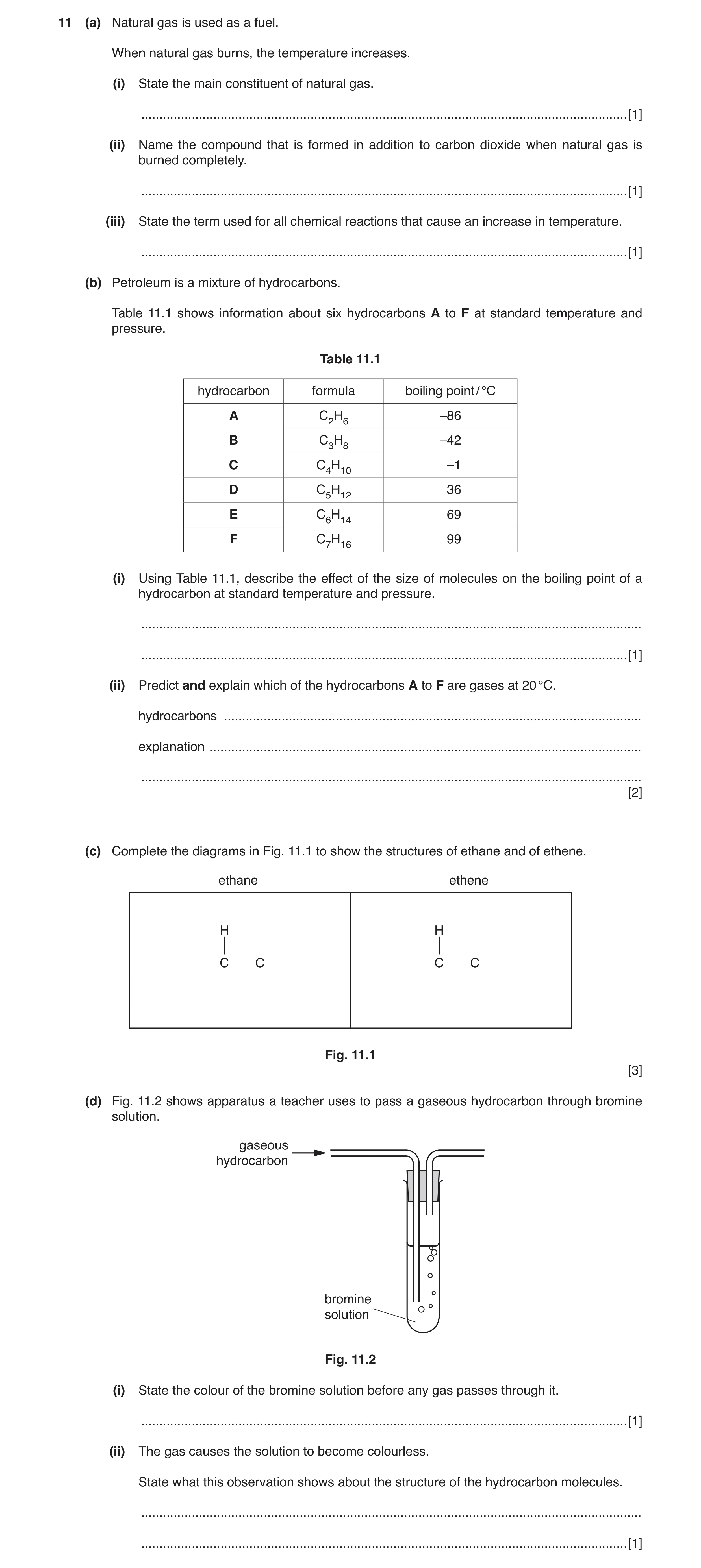
11 (a) Natural gas is used as a fuel. When natural gas burns, the temperature increases. (i) State the main constituent of natural gas. … [1] (ii) Name the compound that is formed in addition to carbon dioxide when natural gas is burned completely. … [1] (iii) State the term used for all chemical reactions that cause an increase in temperature. … [1] (b) Petroleum is a mixture of hydrocarbons. Table 11.1 shows information about six hydrocarbons A to F at standard temperature and pressure. Table 11.1 hydrocarbon formula boiling point / °C A C2H6 –86 B C3H8 –42 C C4H10 –1 D C5H12 36 E C6H14 69 F C7H16 99 (i) Using Table 11.1, describe the effect of the size of molecules on the boiling point of a hydrocarbon at standard temperature and pressure. … … [1] (ii) Predict and explain which of the hydrocarbons A to F are gases at 20 °C. hydrocarbons … explanation … … [2] (c) Complete the diagrams in Fig. 11.1 to show the structures of ethane and of ethene. ethane ethene H H C C C C Fig. 11.1 [3] (d) Fig. 11.2 shows apparatus a teacher uses to pass a gaseous hydrocarbon through bromine solution. gaseous hydrocarbon bromine solution Fig. 11.2 (i) State the colour of the bromine solution before any gas passes through it. … [1] (ii) The gas causes the solution to become colourless. State what this observation shows about the structure of the hydrocarbon molecules. … … [1]
11 marks
Mark scheme: 11(a)(i) methane / CH4; 1 11(a)(ii) water; 1 11(a)(iii) exothermic; 1 11(b)(i) the larger the molecules the higher the boiling point; 1 11(b)(ii) A B C; boiling point is below 20 °C / at 20 °C they will have boiled; 2 11(c) single C-C in ethane and double C=C in ethene; 6 × H and all correct in ethane; 4 × H and all correct in ethene; 3 11(d)(i) orange / brown / yellow; 1 11(d)(ii) unsaturated / contain double (C to C) bonds; 1
This question in 0654/32 Oct/Nov 2018
Q8 · State the names and percentages of the two main gases in air 0654/31 Oct/Nov 2019
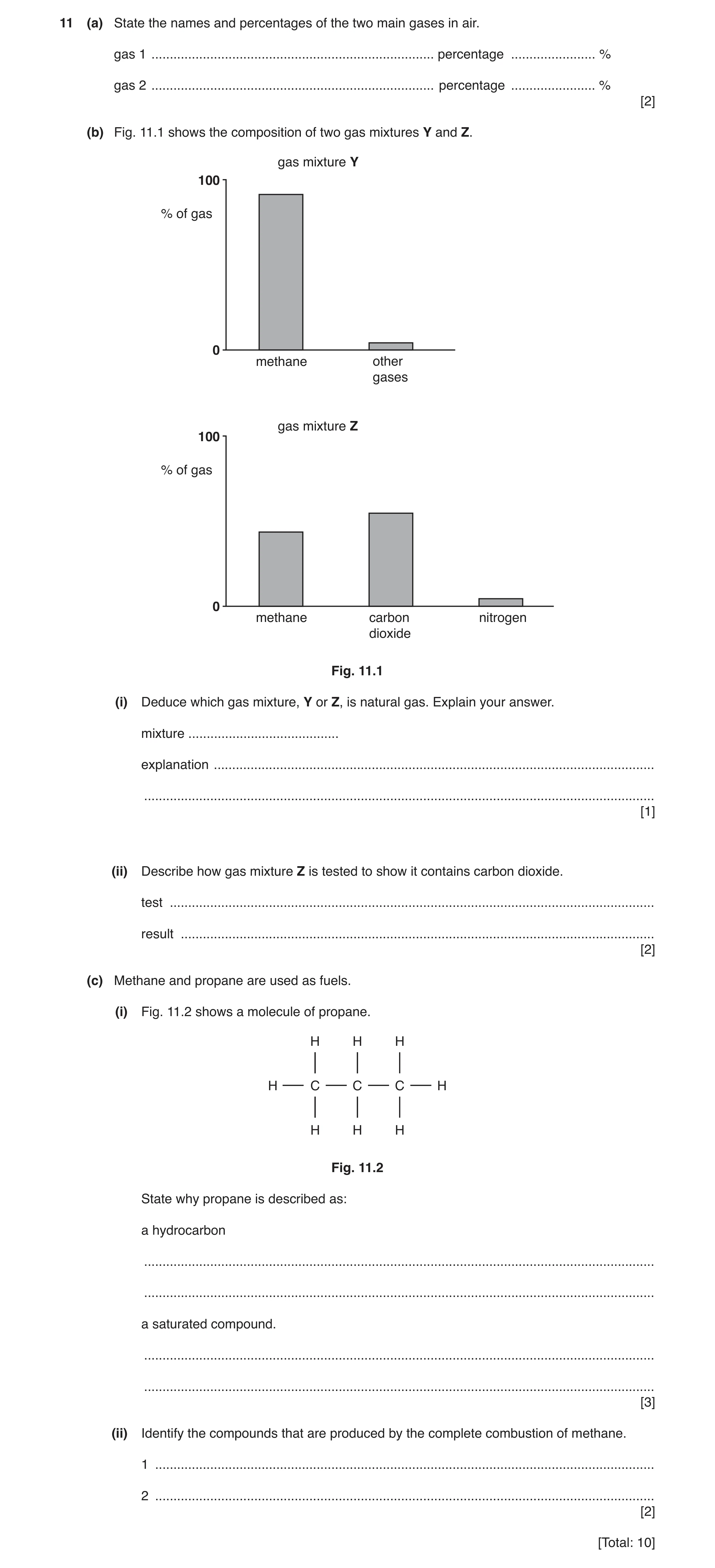
11 (a) State the names and percentages of the two main gases in air. gas 1 … percentage … % gas 2 … percentage … % [2] (b) Fig. 11.1 shows the composition of two gas mixtures Y and Z. gas mixture Y 100 % of gas 0 methane other gases gas mixture Z 100 % of gas 0 methane carbon nitrogen dioxide Fig. 11.1 (i) Deduce which gas mixture, Y or Z, is natural gas. Explain your answer. mixture … explanation … … [1] (ii) Describe how gas mixture Z is tested to show it contains carbon dioxide. test … result … [2] (c) Methane and propane are used as fuels. (i) Fig. 11.2 shows a molecule of propane. H H H H C C C H H H H Fig. 11.2 State why propane is described as: a hydrocarbon … … a saturated compound. … … [3] (ii) Identify the compounds that are produced by the complete combustion of methane. 1 … 2 … [2] [Total: 10]
10 marks
Mark scheme: 11(a) nitrogen 78% ; oxygen 21% ; 2 11(b)(i) (Y) natural gas is mainly methane / main gas in Z is not methane / owtte ; 1 11(b)(ii) limewater ; turns milky / cloudy / white precipitate ; 2 11(c)(i) hydrocarbon compound containing hydrogen and carbon ; only (hydrogen and carbon ) ; saturated contains only C-C single bonds ; 3 11(c)(ii) carbon dioxide / CO2 ; water (vapour) / H2O ; 2
This question in 0654/31 Oct/Nov 2019
Q9 · The structure of three molecules, ethene, ethanol and methane 0654/33 Oct/Nov 2019
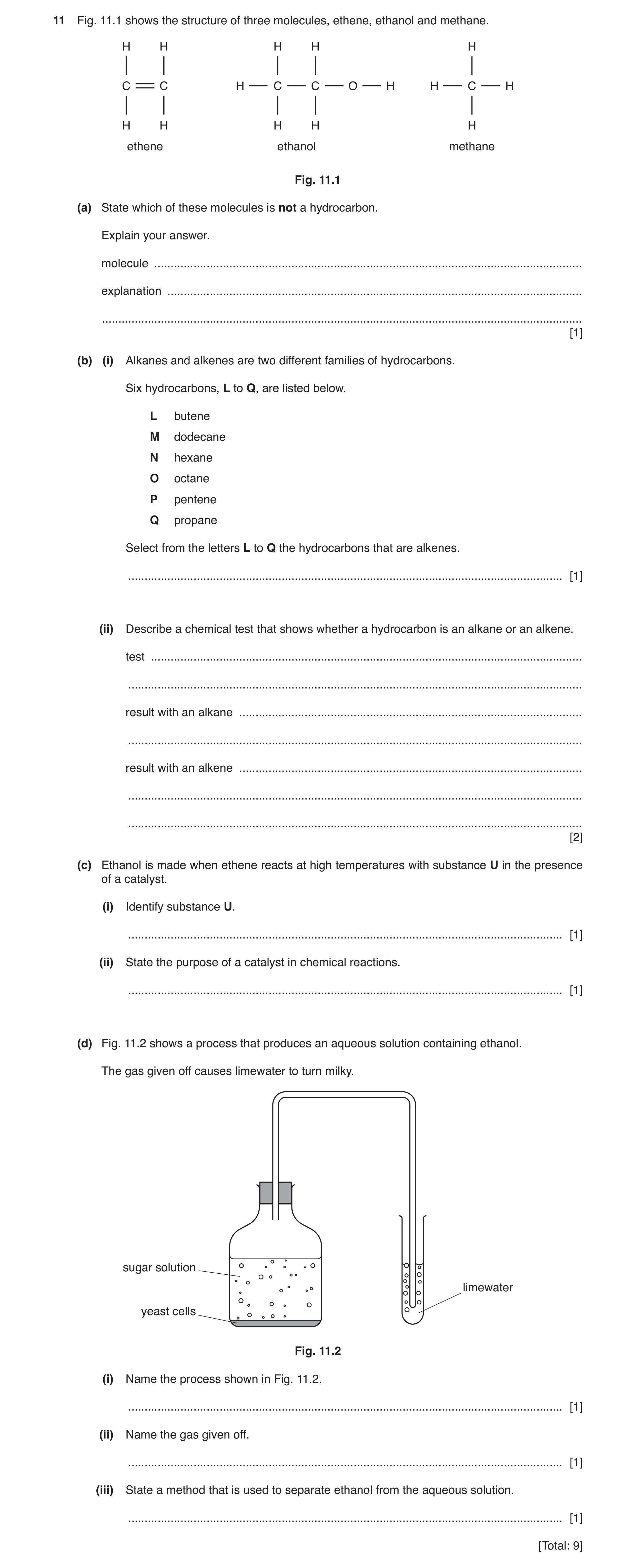
11 Fig. 11.1 shows the structure of three molecules, ethene, ethanol and methane. H H H H H C C H C C O H H C H H H H H H ethene ethanol methane Fig. 11.1 (a) State which of these molecules is not a hydrocarbon. Explain your answer. molecule … explanation … … [1] (b) (i) Alkanes and alkenes are two different families of hydrocarbons. Six hydrocarbons, L to Q, are listed below. L butene M dodecane N hexane O octane P pentene Q propane Select from the letters L to Q the hydrocarbons that are alkenes. … [1] (ii) Describe a chemical test that shows whether a hydrocarbon is an alkane or an alkene. test … … result with an alkane … … result with an alkene … … … [2] (c) Ethanol is made when ethene reacts at high temperatures with substance U in the presence of a catalyst. (i) Identify substance U. … [1] (ii) State the purpose of a catalyst in chemical reactions. … [1] (d) Fig. 11.2 shows a process that produces an aqueous solution containing ethanol. The gas given off causes limewater to turn milky. sugar solution limewater yeast cells Fig. 11.2 (i) Name the process shown in Fig. 11.2. … [1] (ii) Name the gas given off. … [1] (iii) State a method that is used to separate ethanol from the aqueous solution. … [1] [Total: 9]
9 marks
Mark scheme: 11(a) (ethanol) hydrocarbons contain only carbon and hydrogen / do not contain oxygen / (ethanol) contains oxygen ; 1 11(b)(i) L and P ; 1 11(b)(ii) reaction with (aqueous) bromine ; alkanes – no reaction / remains orange / coloured and alkenes – orange to colourless / bromine decolourised ; 2 11(c)(i) steam / H2O ; 1 11(c)(ii) increases reaction rate ; 1 11(d)(i) fermentation ; 1 11(d)(ii) carbon dioxide ; 1 11(d)(iii) distillation ; 1
This question in 0654/33 Oct/Nov 2019
Q10 · The molecular structures of four carbon compounds, A, B, C and D 0654/32 Oct/Nov 2020
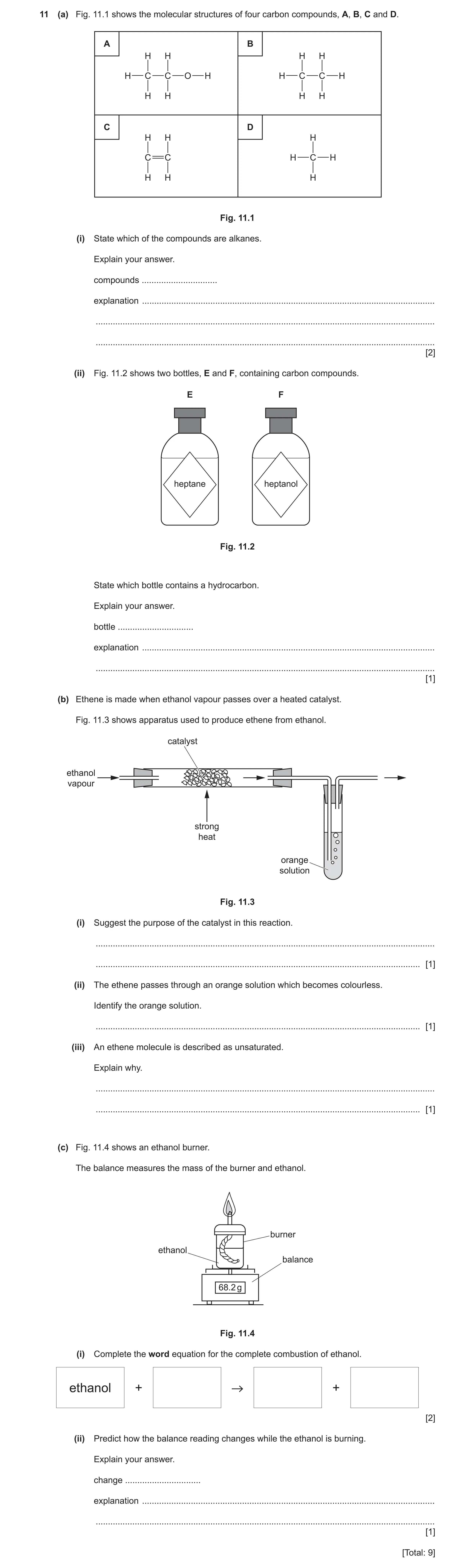
11 (a) Fig. 11.1 shows the molecular structures of four carbon compounds, A, B, C and D. A B H H H H H C C O H H C C H H H H H C D H H H C C H C H H H H Fig. 11.1 (i) State which of the compounds are alkanes. Explain your answer. compounds … explanation … … … [2] (ii) Fig. 11.2 shows two bottles, E and F, containing carbon compounds. E F heptane heptanol Fig. 11.2 State which bottle contains a hydrocarbon. Explain your answer. bottle … explanation … … [1] (b) Ethene is made when ethanol vapour passes over a heated catalyst. Fig. 11.3 shows apparatus used to produce ethene from ethanol. catalyst ethanol vapour strong heat orange solution Fig. 11.3 (i) Suggest the purpose of the catalyst in this reaction. … … [1] (ii) The ethene passes through an orange solution which becomes colourless. Identify the orange solution. … [1] (iii) An ethene molecule is described as unsaturated. Explain why. … … [1] (c) Fig. 11.4 shows an ethanol burner. The balance measures the mass of the burner and ethanol. burner ethanol balance 68.2 g Fig. 11.4 (i) Complete the word equation for the complete combustion of ethanol. ethanol + + [2] (ii) Predict how the balance reading changes while the ethanol is burning. Explain your answer. change … explanation … … [1] [Total: 9]
9 marks
Mark scheme: 11(a)(i) (B and D ) they are hydrocarbons / contain only hydrogen and carbon ; they contain only single bonds / they are saturated ; 2 11(a)(ii) (bottle E / heptane) name ending -ane denotes an alkane ; alkanes are hydrocarbons ; name ending -ol shows it is not a hydrocarbon / is an alcohol / contains oxygen ; max 1 1 11(b)(i) increases the rate (of reaction) ; 1 11(b)(ii) aqueous bromine / bromine water / bromine solution ; 1 11(b)(iii) molecules contain a double bond (between carbon atoms) / molecule does not contain the maximum possible number of hydrogen atoms ; 1 11(c)(i) + oxygen ; → carbon dioxide + water ; 2 11(c)(ii) (balance reading decreases) gases / carbon dioxide / water vapour released ; 1
This question in 0654/32 Oct/Nov 2020
Q11 · Methane is a greenhouse gas 0654/32 Oct/Nov 2021
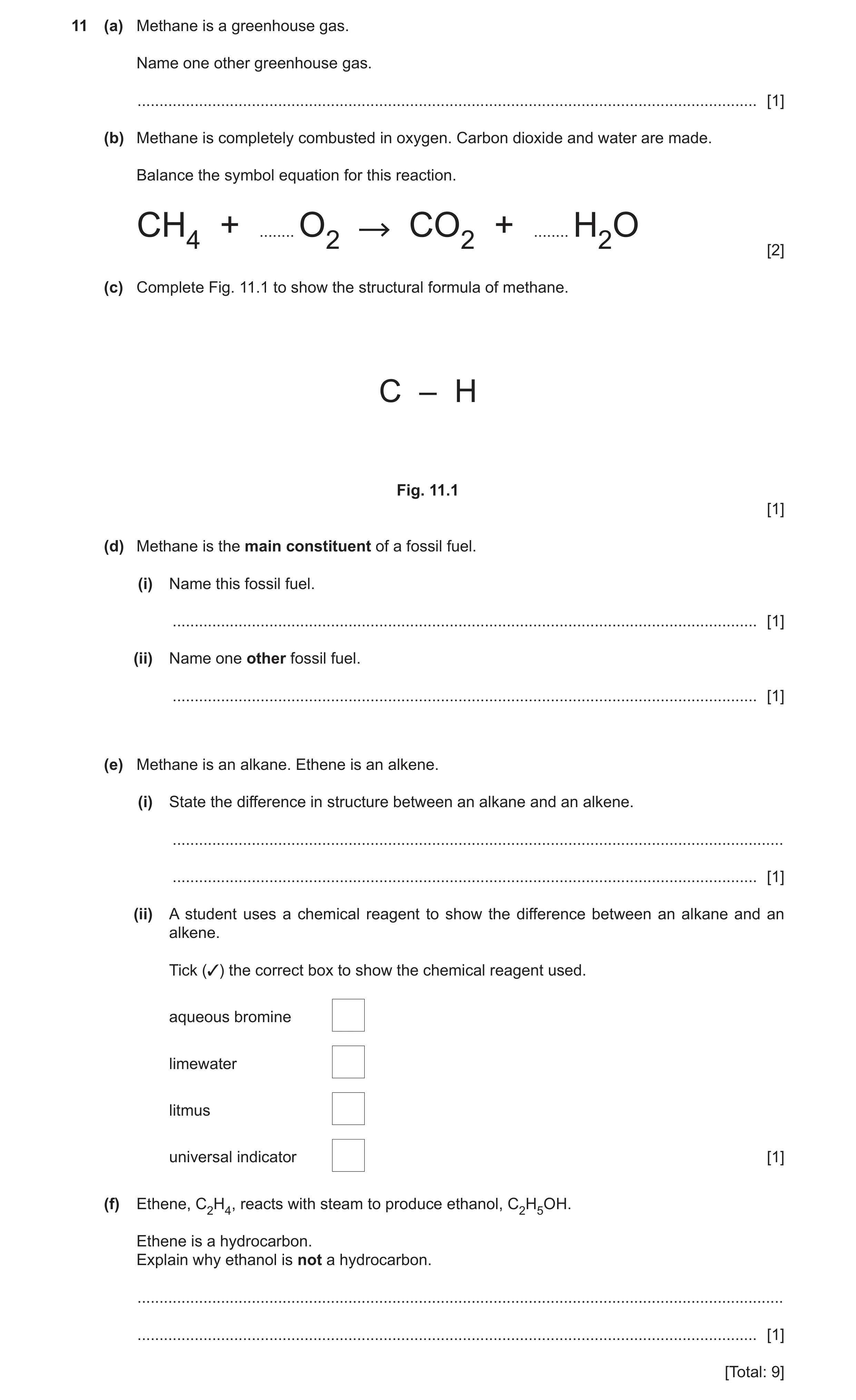
11 (a) Methane is a greenhouse gas. Name one other greenhouse gas. … [1] (b) Methane is completely combusted in oxygen. Carbon dioxide and water are made. Balance the symbol equation for this reaction. … … CH4 + O2 CO2 + H2O [2] (c) Complete Fig. 11.1 to show the structural formula of methane. C – H Fig. 11.1 [1] (d) Methane is the main constituent of a fossil fuel. (i) Name this fossil fuel. … [1] (ii) Name one other fossil fuel. … [1] (e) Methane is an alkane. Ethene is an alkene. (i) State the difference in structure between an alkane and an alkene. … … [1] (ii) A student uses a chemical reagent to show the difference between an alkane and an alkene. Tick (3) the correct box to show the chemical reagent used. aqueous bromine limewater litmus universal indicator [1] (f) Ethene, C2H4, reacts with steam to produce ethanol, C2H5OH. Ethene is a hydrocarbon. Explain why ethanol is not a hydrocarbon. … … [1] [Total: 9]
9 marks
Mark scheme: 11(a) carbon dioxide ; 1 11(b) (CH4 +) 2 (O2 → CO2 +) 2 (H2O) ;; 2 11(c) ; 1 11(d)(i) natural gas ; 1 11(d)(ii) coal / petroleum ; 1 11(e)(i) alkane has no double bonds C-C bonds / alkene has a C-C double bond / alkane has only single bonds ; 1 11(e)(ii) aqueous bromine ; 1 11(f) contains oxygen / does not just contain hydrogen and carbon ; 1
This question in 0654/32 Oct/Nov 2021
Q12 · Petroleum is separated into useful fractions by fractional distillation 0654/33 Oct/Nov 2021
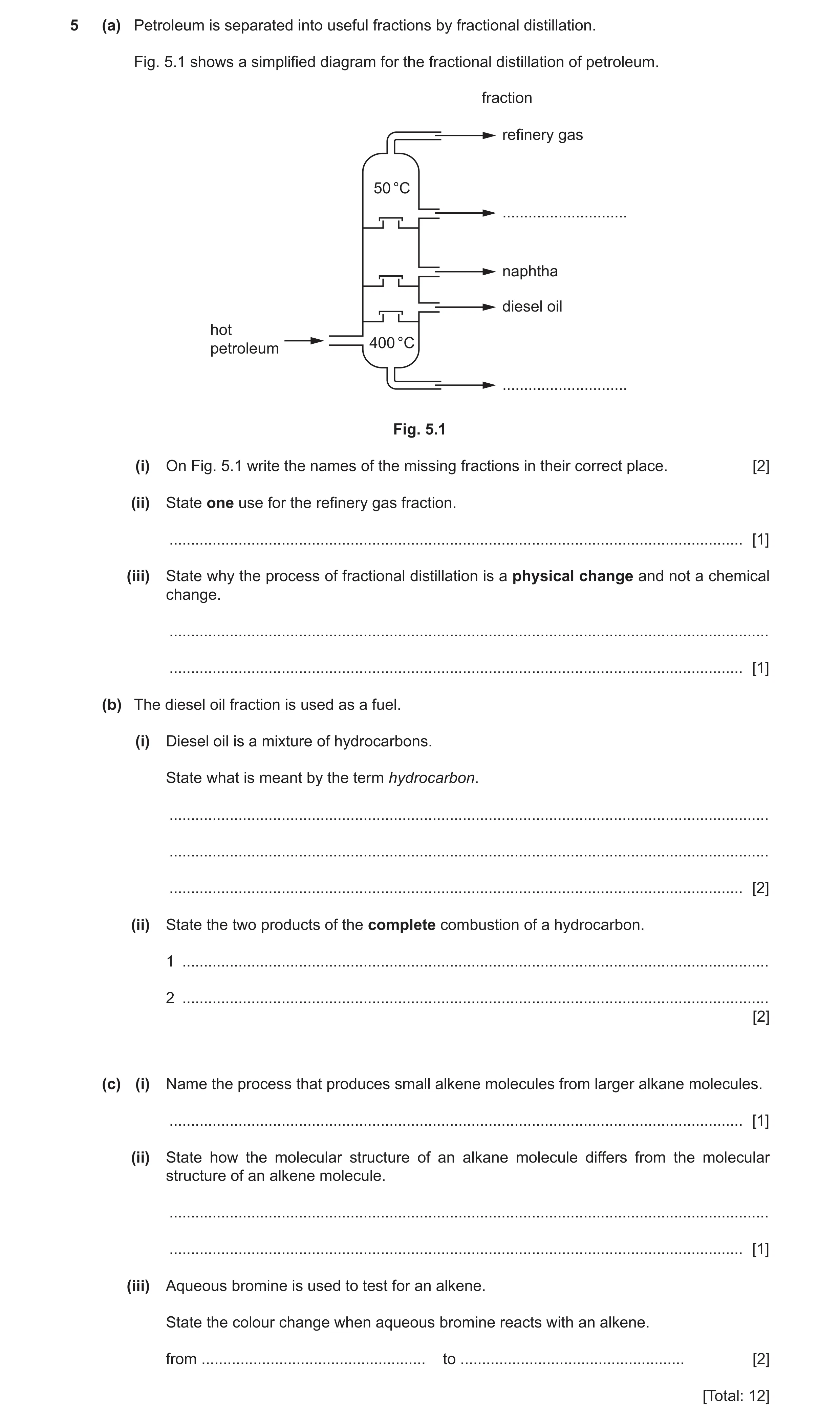
5 (a) Petroleum is separated into useful fractions by fractional distillation. Fig. 5.1 shows a simplified diagram for the fractional distillation of petroleum. fraction refinery gas 50 °C … naphtha diesel oil hot 400 °C petroleum … Fig. 5.1 (i) On Fig. 5.1 write the names of the missing fractions in their correct place. [2] (ii) State one use for the refinery gas fraction. … [1] (iii) State why the process of fractional distillation is a physical change and not a chemical change. … … [1] (b) The diesel oil fraction is used as a fuel. (i) Diesel oil is a mixture of hydrocarbons. State what is meant by the term hydrocarbon. … … … [2] (ii) State the two products of the complete combustion of a hydrocarbon. 1 … 2 … [2] (c) (i) Name the process that produces small alkene molecules from larger alkane molecules. … [1] (ii) State how the molecular structure of an alkane molecule differs from the molecular structure of an alkene molecule. … … [1] (iii) Aqueous bromine is used to test for an alkene. State the colour change when aqueous bromine reacts with an alkene. from … to … [2] [Total: 12]
12 marks
Mark scheme: 5(a)(i) gasoline ; bitumen ; 2 5(a)(ii) fuel ; 1 5(a)(iii) no new substances formed ; 1 5(b)(i) substance that contains carbon and hydrogen (atoms) ; only ; 2 5(b)(ii) carbon dioxide ; water ; 2 Question Answer Marks 5(c)(i) cracking ; 1 5(c)(ii) alkane does not contain a C-C double bond / alkene does contain a C-C double bond / contains only single bonds ; 1 5(c)(iii) orange ; to colourless ; 2
This question in 0654/33 Oct/Nov 2021
Q13 · Methane is a hydrocarbon 0654/32 Feb/March 2022
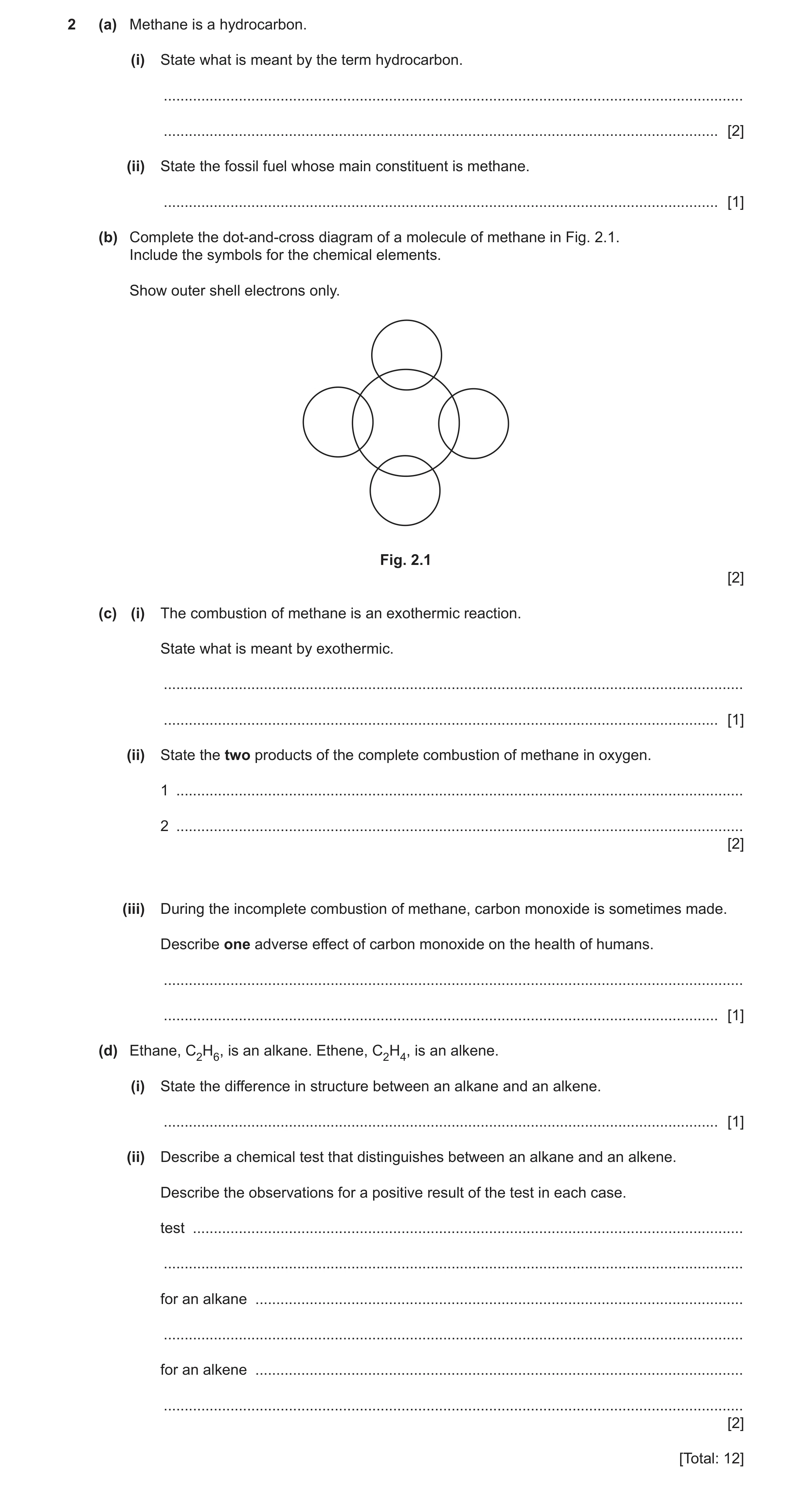
2 (a) Methane is a hydrocarbon. (i) State what is meant by the term hydrocarbon. … … [2] (ii) State the fossil fuel whose main constituent is methane. … [1] (b) Complete the dot-and-cross diagram of a molecule of methane in Fig. 2.1. Include the symbols for the chemical elements. Show outer shell electrons only. Fig. 2.1 [2] (c) (i) The combustion of methane is an exothermic reaction. State what is meant by exothermic. … … [1] (ii) State the two products of the complete combustion of methane in oxygen. 1 … 2 … [2] (iii) During the incomplete combustion of methane, carbon monoxide is sometimes made. Describe one adverse effect of carbon monoxide on the health of humans. … … [1] (d) Ethane, C2H6, is an alkane. Ethene, C2H4, is an alkene. (i) State the difference in structure between an alkane and an alkene. … [1] (ii) Describe a chemical test that distinguishes between an alkane and an alkene. Describe the observations for a positive result of the test in each case. test … … for an alkane … … for an alkene … … [2] [Total: 12]
12 marks
Mark scheme: 2(a)(i) contains carbon and hydrogen (atoms); only ; 2 2(a)(ii) natural gas; 1 2(b) correct symbols; 4 bonding pairs and all else correct; 2 2(c)(i) gives out (thermal) energy; 1 2(c)(ii) carbon dioxide; water; 2 Question Answer Marks 2(c)(iii) death / poisoning / CO is toxic / reduces the oxygen carrying capacity of the red blood cells ; 1 2(d)(i) alkene contains a double bond / alkane only has single bonds; 1 2(d)(ii) aqueous bromine ; alkane – no colour change and alkene – orange to colourless / goes colourless; 2
This question in 0654/32 Feb/March 2022
Q14 · The structures of four molecules, P, Q, R and S 0654/33 May/June 2022
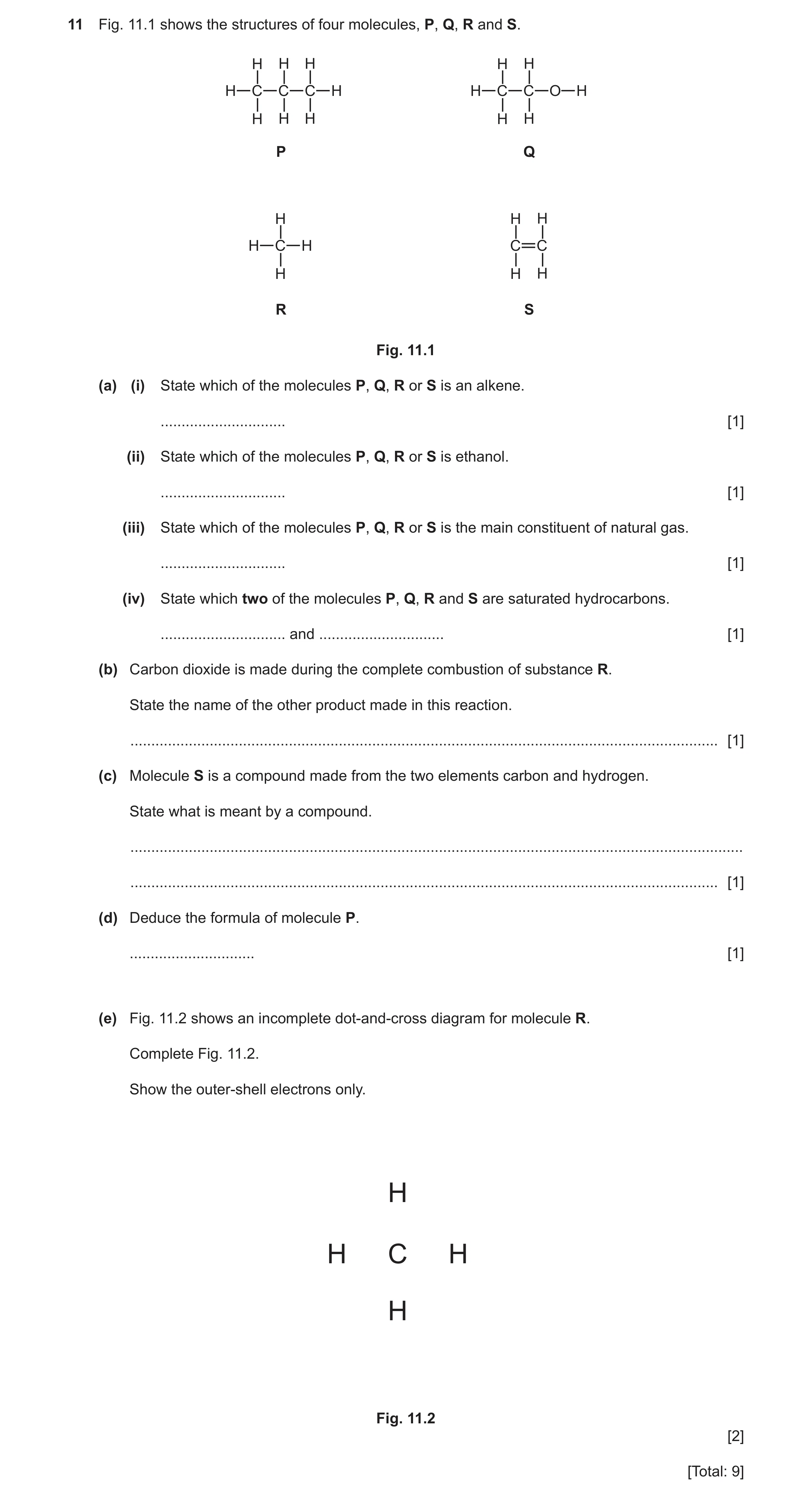
11 Fig. 11.1 shows the structures of four molecules, P, Q, R and S. H H H H H H C C C H H C C O H H H H H H P Q H H H H C H C C H H H R S Fig. 11.1 (a) (i) State which of the molecules P, Q, R or S is an alkene. … [1] (ii) State which of the molecules P, Q, R or S is ethanol. … [1] (iii) State which of the molecules P, Q, R or S is the main constituent of natural gas. … [1] (iv) State which two of the molecules P, Q, R and S are saturated hydrocarbons. … and … [1] (b) Carbon dioxide is made during the complete combustion of substance R. State the name of the other product made in this reaction. … [1] (c) Molecule S is a compound made from the two elements carbon and hydrogen. State what is meant by a compound. … … [1] (d) Deduce the formula of molecule P. … [1] (e) Fig. 11.2 shows an incomplete dot-and-cross diagram for molecule R. Complete Fig. 11.2. Show the outer-shell electrons only. H H C H H Fig. 11.2 [2] [Total: 9]
9 marks
Mark scheme: 11(a)(i) S; 1 11(a)(ii) Q; 1 11(a)(iii) R; 1 Question Answer Marks 11(a)(iv) P and R ; 1 11(b) water ; 1 11(c) a compound contains two or more elements chemically combined; 1 11(d) C3H8 ; 1 11(e) one bonding pairs; all else correct ; 2
This question in 0654/33 May/June 2022
Q15 · Three hydrocarbon molecules, A, B and C 0654/31 Oct/Nov 2022
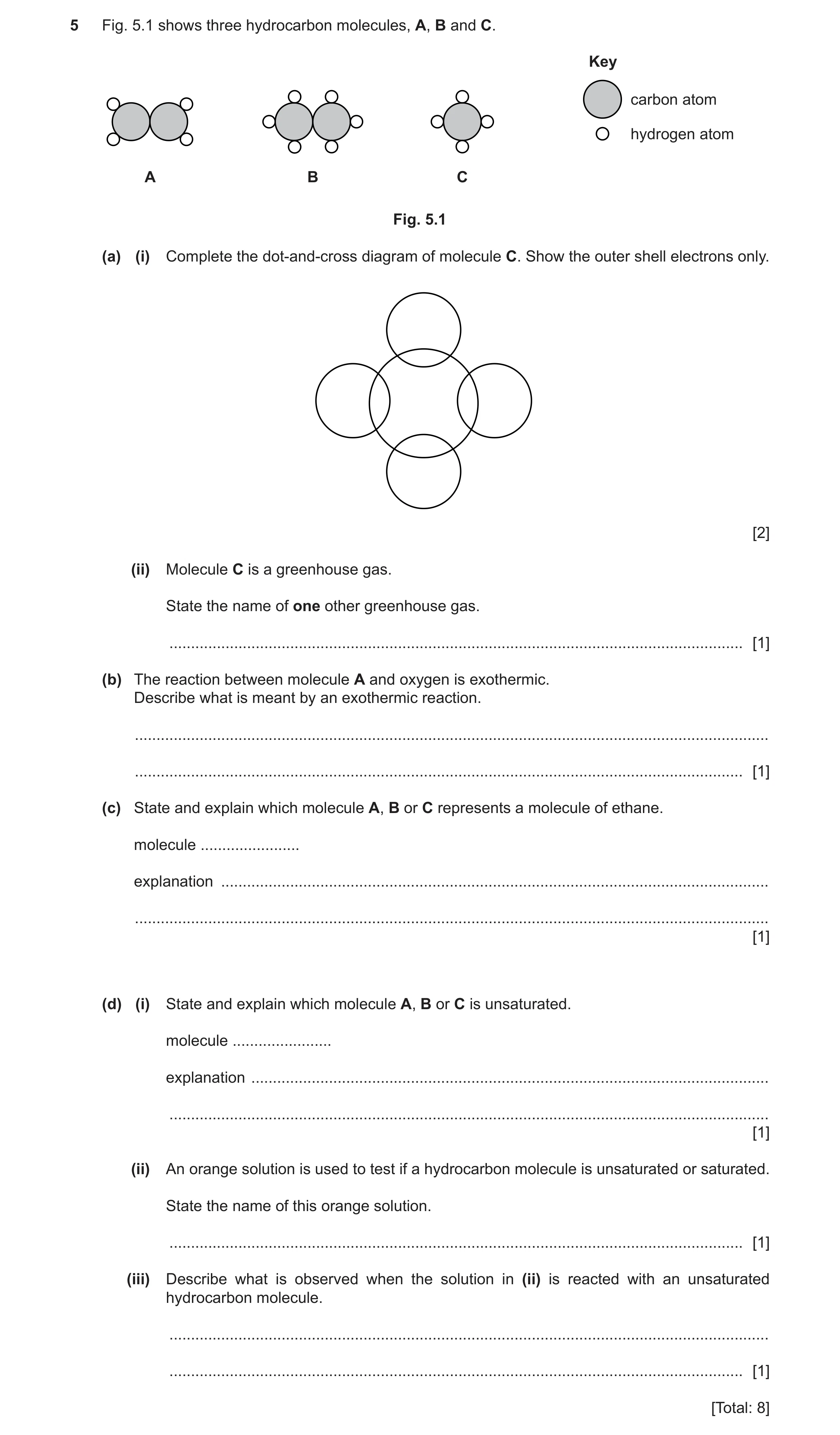
5 Fig. 5.1 shows three hydrocarbon molecules, A, B and C. Key carbon atom hydrogen atom A B C Fig. 5.1 (a) (i) Complete the dot-and-cross diagram of molecule C. Show the outer shell electrons only. [2] (ii) Molecule C is a greenhouse gas. State the name of one other greenhouse gas. … [1] (b) The reaction between molecule A and oxygen is exothermic. Describe what is meant by an exothermic reaction. … … [1] (c) State and explain which molecule A, B or C represents a molecule of ethane. molecule … explanation … … [1] (d) (i) State and explain which molecule A, B or C is unsaturated. molecule … explanation … … [1] (ii) An orange solution is used to test if a hydrocarbon molecule is unsaturated or saturated. State the name of this orange solution. … [1] (iii) Describe what is observed when the solution in (ii) is reacted with an unsaturated hydrocarbon molecule. … … [1] [Total: 8]
8 marks
Mark scheme: 5(a)(i) 1 shared pair ; 2 all else correct ; 5(a)(ii) water vapour ; carbon dioxide ; 1 5(b) (thermal) energy released ; 1 5(c) B – no mark and 1 has formula C2H6 ; 5(d)(i) A – no mark and 1 has two carbons but only four hydrogens / has general formula CnH2n ; 5(d)(ii) (aqueous) bromine ; 1 5(d)(iii) decolourises ; 1
This question in 0654/31 Oct/Nov 2022
Q16 · Petroleum is a raw material for the production of useful substances 0654/32 Oct/Nov 2022
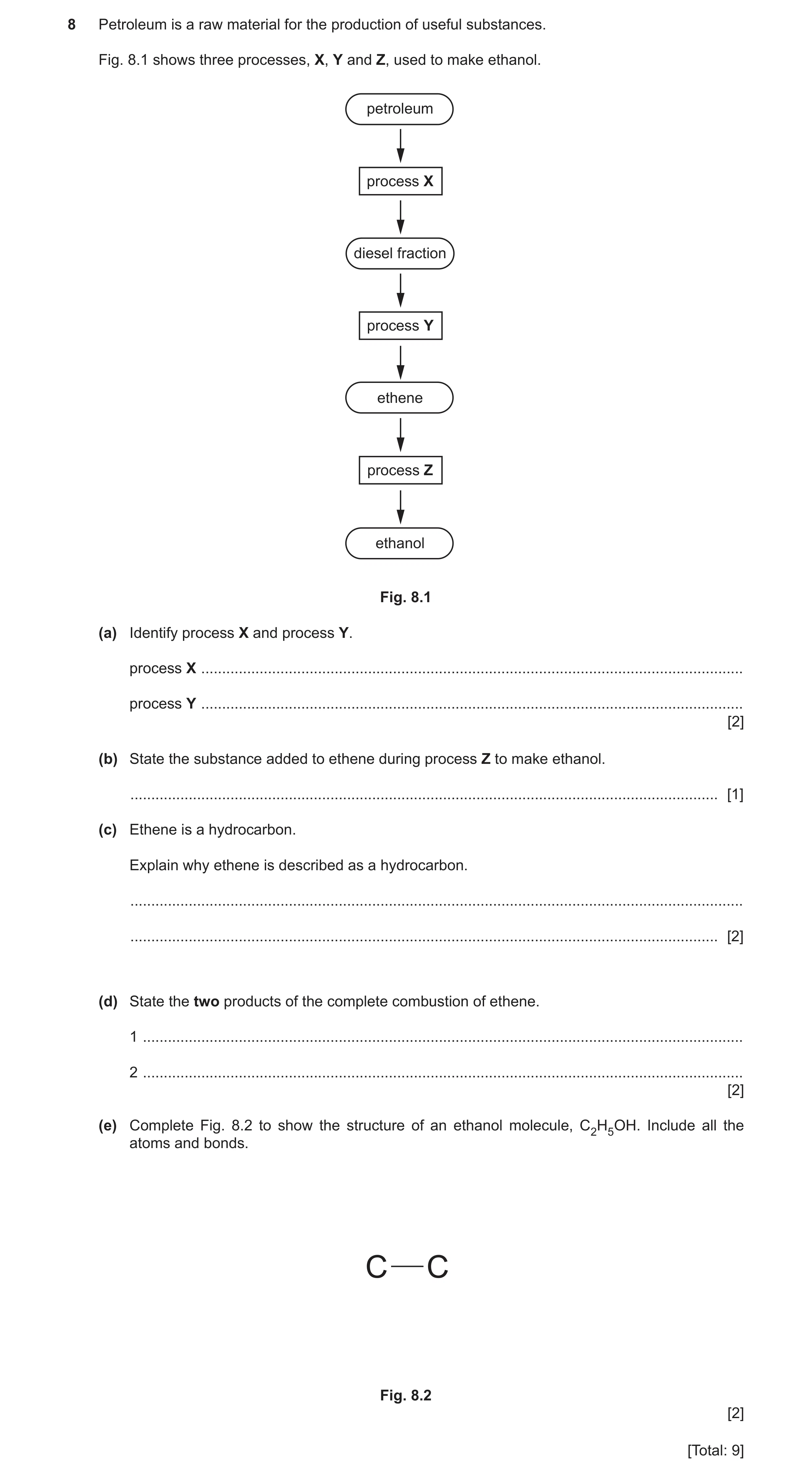
8 Petroleum is a raw material for the production of useful substances. Fig. 8.1 shows three processes, X, Y and Z, used to make ethanol. petroleum process X diesel fraction process Y ethene process Z ethanol Fig. 8.1 (a) Identify process X and process Y. process X … process Y … [2] (b) State the substance added to ethene during process Z to make ethanol. … [1] (c) Ethene is a hydrocarbon. Explain why ethene is described as a hydrocarbon. … … [2] (d) State the two products of the complete combustion of ethene. 1 … 2 … [2] (e) Complete Fig. 8.2 to show the structure of an ethanol molecule, C2H5OH. Include all the atoms and bonds. C C Fig. 8.2 [2] [Total: 9]
9 marks
Mark scheme: 8(a) process X – fractional distillation ; 2 process Y – cracking ; 8(b) steam ; 1 8(c) contains carbon and hydrogen (atoms) ; 2 only ; 8(d) carbon dioxide ; 2 water ; 8(e) 2 O – H attached to carbon ; all else correct ;
This question in 0654/32 Oct/Nov 2022
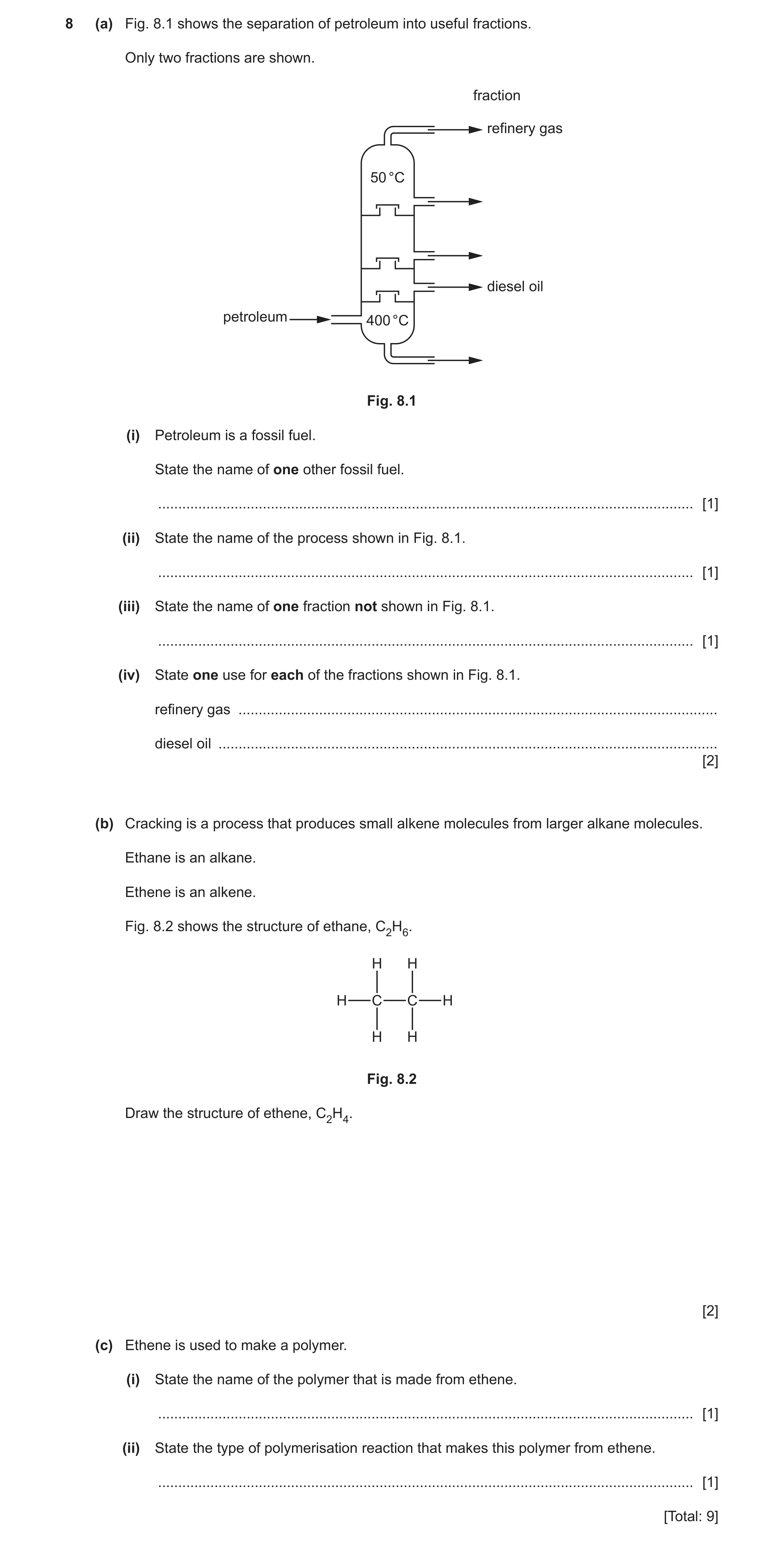
Q17 · The separation of petroleum into useful fractions 0654/32 May/June 2023
8 (a) Fig. 8.1 shows the separation of petroleum into useful fractions. Only two fractions are shown. fraction refinery gas 50 °C diesel oil petroleum 400 °C Fig. 8.1 (i) Petroleum is a fossil fuel. State the name of one other fossil fuel. … [1] (ii) State the name of the process shown in Fig. 8.1. … [1] (iii) State the name of one fraction not shown in Fig. 8.1. … [1] (iv) State one use for each of the fractions shown in Fig. 8.1. refinery gas … diesel oil … [2] (b) Cracking is a process that produces small alkene molecules from larger alkane molecules. Ethane is an alkane. Ethene is an alkene. Fig. 8.2 shows the structure of ethane, C2H6. H H H C C H H H Fig. 8.2 Draw the structure of ethene, C2H4. [2] (c) Ethene is used to make a polymer. (i) State the name of the polymer that is made from ethene. … [1] (ii) State the type of polymerisation reaction that makes this polymer from ethene. … [1] [Total: 9]
9 marks
Mark scheme: 8(a)(i) coal / natural gas ; 1 8(a)(ii) fractional distillation ; 1 8(a)(iii) gasoline / naphtha / bitumen ; 1 8(a)(iv) (bottled gas for) heating and cooking ; fuel for diesel engines ; 2 8(b) carbon carbon double bond ; all else correct ; 2 8(c)(i) poly(ethene) ; 1 8(c)(ii) addition (polymerisation) ; 1
This question in 0654/32 May/June 2023
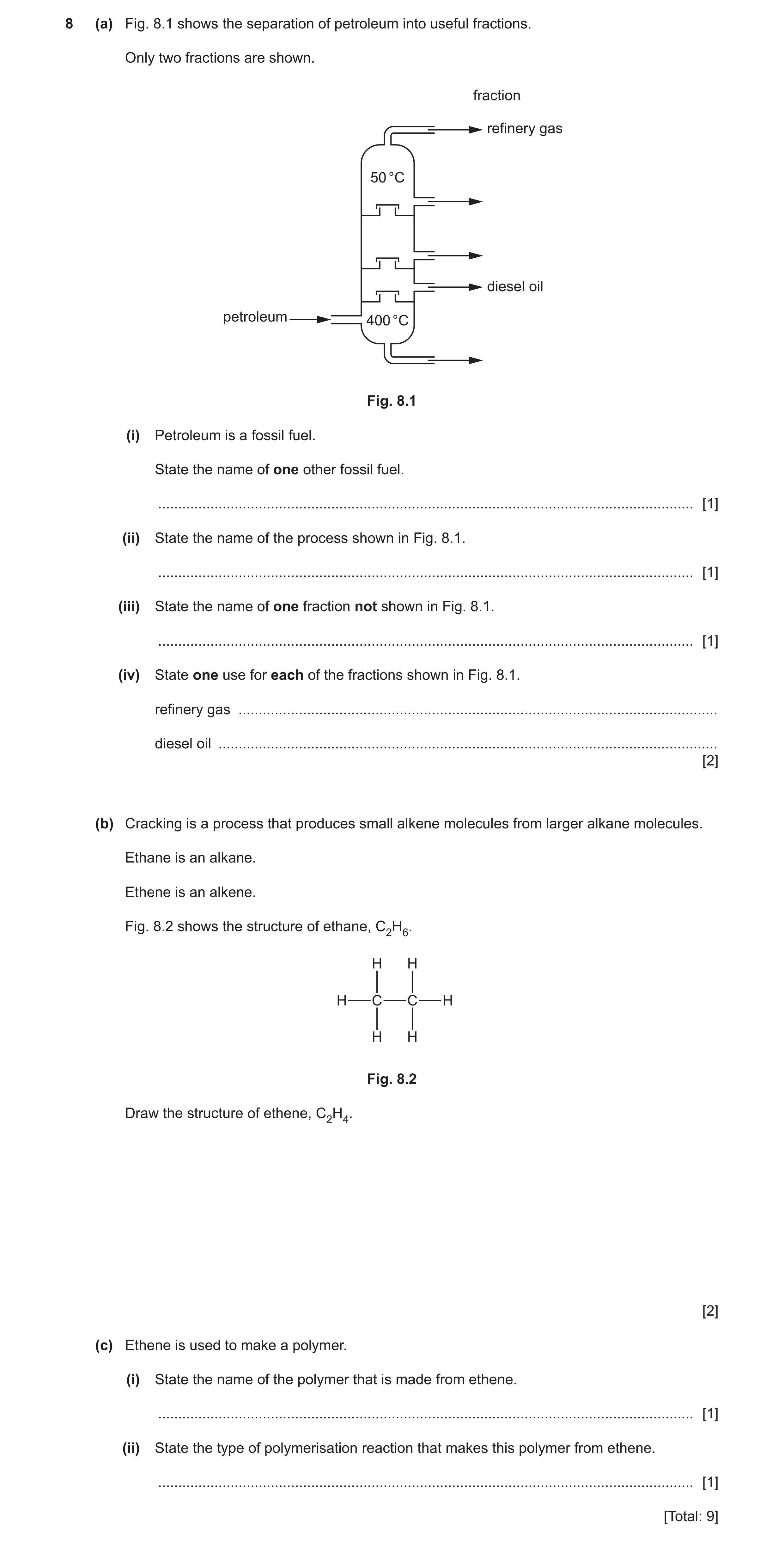
Q18 · The separation of petroleum into useful fractions 0654/33 May/June 2023
8 (a) Fig. 8.1 shows the separation of petroleum into useful fractions. Only two fractions are shown. fraction refinery gas 50 °C diesel oil petroleum 400 °C Fig. 8.1 (i) Petroleum is a fossil fuel. State the name of one other fossil fuel. … [1] (ii) State the name of the process shown in Fig. 8.1. … [1] (iii) State the name of one fraction not shown in Fig. 8.1. … [1] (iv) State one use for each of the fractions shown in Fig. 8.1. refinery gas … diesel oil … [2] (b) Cracking is a process that produces small alkene molecules from larger alkane molecules. Ethane is an alkane. Ethene is an alkene. Fig. 8.2 shows the structure of ethane, C2H6. H H H C C H H H Fig. 8.2 Draw the structure of ethene, C2H4. [2] (c) Ethene is used to make a polymer. (i) State the name of the polymer that is made from ethene. … [1] (ii) State the type of polymerisation reaction that makes this polymer from ethene. … [1] [Total: 9]
9 marks
Mark scheme: 8(a)(i) coal / natural gas ; 1 8(a)(ii) fractional distillation ; 1 8(a)(iii) gasoline / naphtha / bitumen ; 1 8(a)(iv) (bottled gas for) heating and cooking ; fuel for diesel engines ; 2 8(b) carbon carbon double bond ; all else correct ; 2 8(c)(i) poly(ethene) ; 1 8(c)(ii) addition (polymerisation) ; 1
This question in 0654/33 May/June 2023
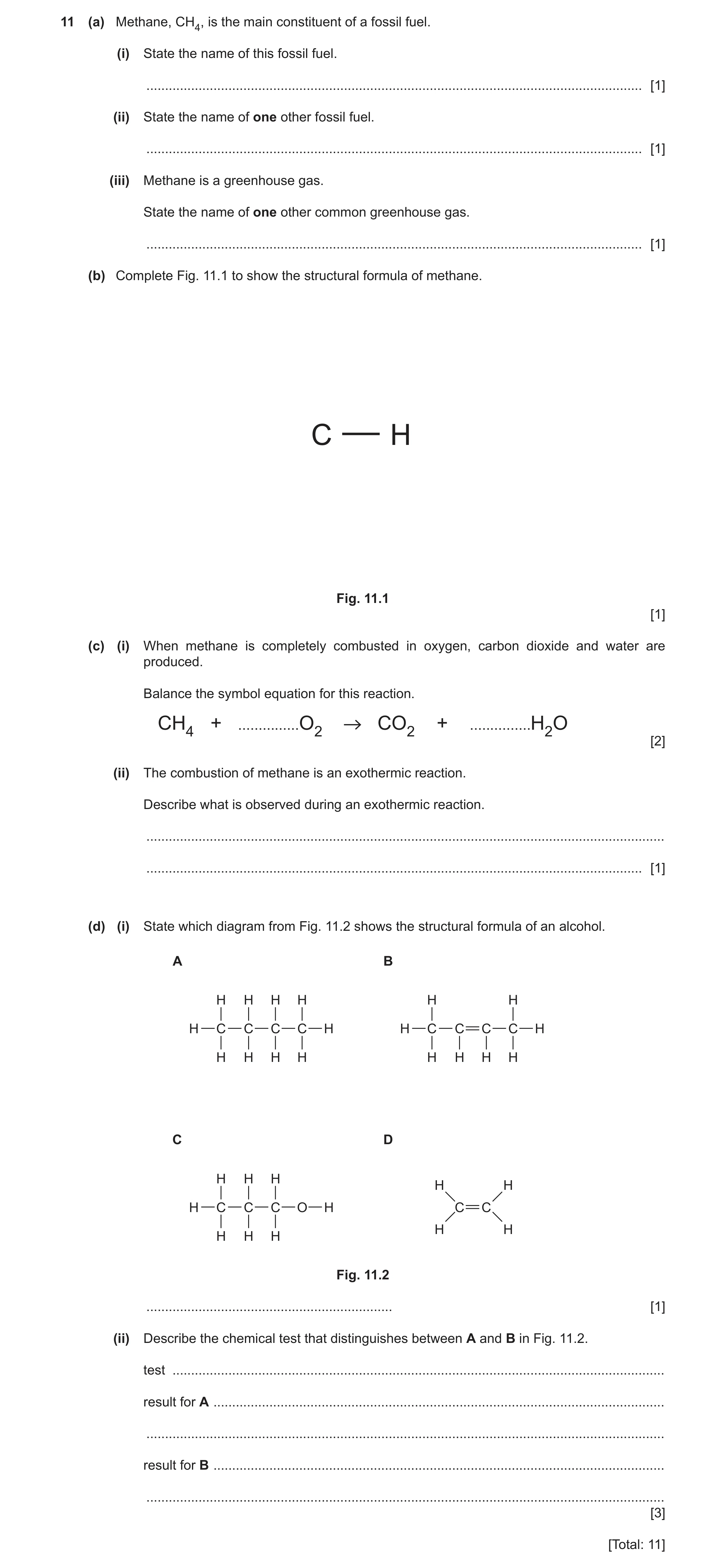
Q19 · Methane, CH4, is the main constituent of a fossil fuel 0654/32 Oct/Nov 2023
11 (a) Methane, CH4, is the main constituent of a fossil fuel. (i) State the name of this fossil fuel. … [1] (ii) State the name of one other fossil fuel. … [1] (iii) Methane is a greenhouse gas. State the name of one other common greenhouse gas. … [1] (b) Complete Fig. 11.1 to show the structural formula of methane. C H Fig. 11.1 [1] (c) (i) When methane is completely combusted in oxygen, carbon dioxide and water are produced. Balance the symbol equation for this reaction. CH4 + … O2 CO2 + … H2O [2] (ii) The combustion of methane is an exothermic reaction. Describe what is observed during an exothermic reaction. … … [1] (d) (i) State which diagram from Fig. 11.2 shows the structural formula of an alcohol. A B H H H H H H H C C C C H H C C C C H H H H H H H H H C D H H H H H H C C C O H C C H H H H H Fig. 11.2 … [1] (ii) Describe the chemical test that distinguishes between A and B in Fig. 11.2. test … result for A … … result for B … … [3] [Total: 11]
11 marks
Mark scheme: 11(a)(i) natural gas ; 1 11(a)(ii) coal / petroleum ; 1 11(a)(iii) carbon dioxide ; 1 11(b) 1 ; 11(c)(i) 2 (O2) ; 2 2 (H2O) ; 11(c)(ii) temperature rise ; 1 11(d)(i) C 1 11(d)(ii) test – aqueous bromine ; 3 A – no change / stays orange ; B – decolorises (from orange to colourless) ;
This question in 0654/32 Oct/Nov 2023
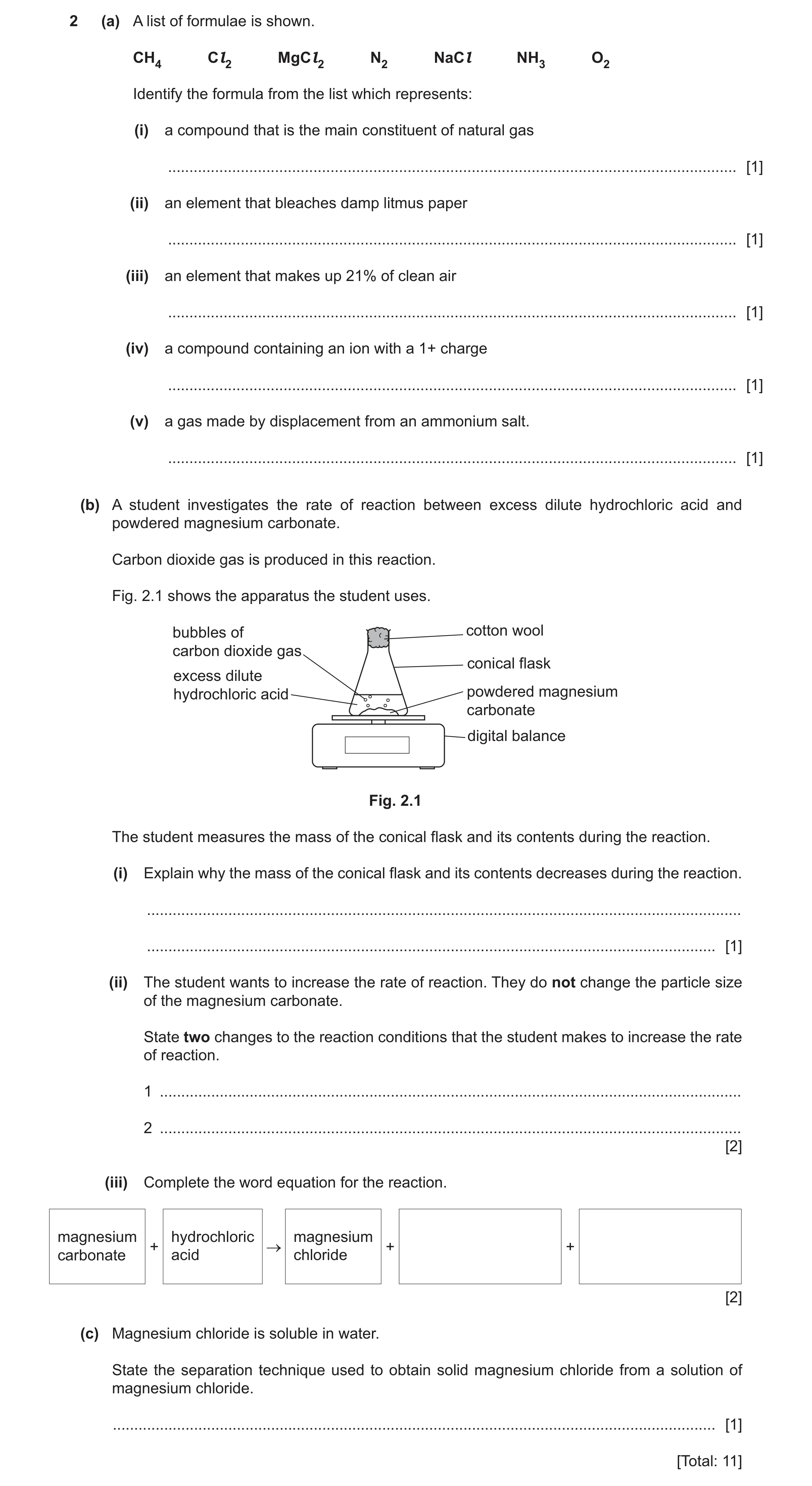
Q20 · A list of formulae is shown 0654/31 Oct/Nov 2024
2 (a) A list of formulae is shown. CH4 Cl 2 MgCl 2 N2 NaCl NH3 O2 Identify the formula from the list which represents: (i) a compound that is the main constituent of natural gas … [1] (ii) an element that bleaches damp litmus paper … [1] (iii) an element that makes up 21% of clean air … [1] (iv) a compound containing an ion with a 1+ charge … [1] (v) a gas made by displacement from an ammonium salt. … [1] (b) A student investigates the rate of reaction between excess dilute hydrochloric acid and powdered magnesium carbonate. Carbon dioxide gas is produced in this reaction. Fig. 2.1 shows the apparatus the student uses. bubbles of cotton wool carbon dioxide gas conical flask excess dilute hydrochloric acid powdered magnesium carbonate digital balance Fig. 2.1 The student measures the mass of the conical flask and its contents during the reaction. (i) Explain why the mass of the conical flask and its contents decreases during the reaction. … … [1] (ii) The student wants to increase the rate of reaction. They do not change the particle size of the magnesium carbonate. State two changes to the reaction conditions that the student makes to increase the rate of reaction. 1 … 2 … [2] (iii) Complete the word equation for the reaction. magnesium hydrochloric magnesium + + + carbonate acid chloride [2] (c) Magnesium chloride is soluble in water. State the separation technique used to obtain solid magnesium chloride from a solution of magnesium chloride. … [1] [Total: 11]
11 marks
Mark scheme: 2(a)(i) CH4 ; 1 2(a)(ii) Cl2 ; 1 2(a)(iii) O2 ; 1 2(a)(iv) NaCl ; 1 2(a)(v) NH3 ; 1 2(b)(i) carbon dioxide is lost ; 1 2(b)(ii) increase temperature (of acid) ; 2 increase concentration (of acid) ; 2(b)(iii) carbon dioxide ; 2 water ; 2(c) crystallisation ; 1
This question in 0654/31 Oct/Nov 2024
Q21 · Ethene, C2H4, is a hydrocarbon 0654/32 Feb/March 2025
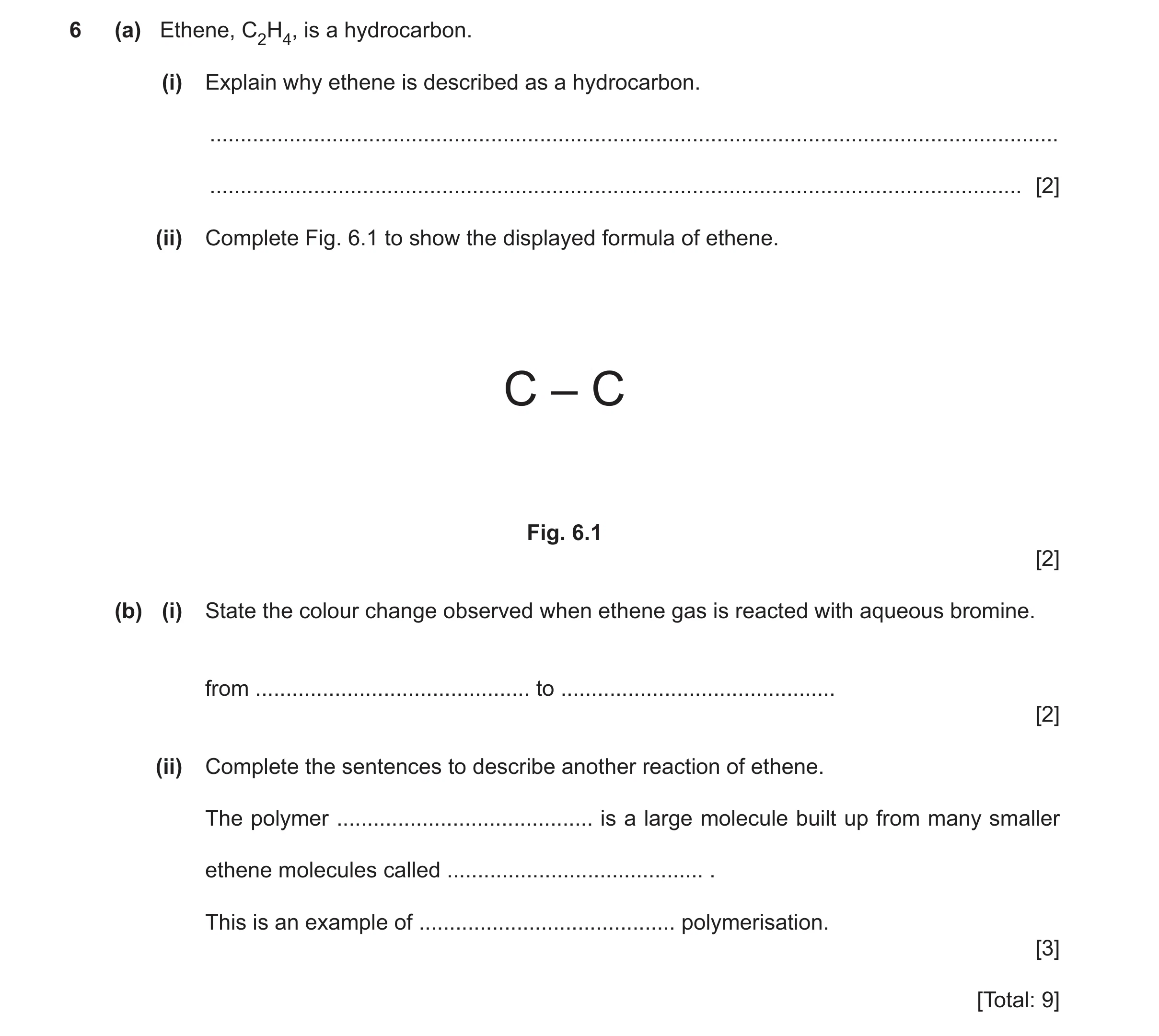
6 (a) Ethene, C2H4, is a hydrocarbon. (i) Explain why ethene is described as a hydrocarbon. … … [2] (ii) Complete Fig. 6.1 to show the displayed formula of ethene. C – C Fig. 6.1 [2] (b) (i) State the colour change observed when ethene gas is reacted with aqueous bromine. from … to … [2] (ii) Complete the sentences to describe another reaction of ethene. The polymer … is a large molecule built up from many smaller ethene molecules called … . This is an example of … polymerisation. [3] [Total: 9]
9 marks
Mark scheme: 6(a)(i) contains carbon and hydrogen ; 2 only ; 6(a)(ii) 2 double bond ; all else correct ; 6(b)(i) (from) orange ; 2 (to) colourless ; 6(b)(ii) polyethene ; 3 monomers ; addition ;
This question in 0654/32 Feb/March 2025
Q22 · Natural gas and petroleum are two fossil fuels 0654/31 May/June 2025
8 (a) Natural gas and petroleum are two fossil fuels. (i) State the name of one other fossil fuel. … [1] (ii) State the name of the main compound present in natural gas. … [1] (b) Fig. 8.1 shows the process used to make refinery gas, gasoline / petrol, naphtha, diesel oil / gas oil and bitumen from petroleum. refinery gas gasoline / petrol naphtha diesel oil / gas oil petroleum bitumen Fig. 8.1 (i) State the name of the process shown in Fig. 8.1. … [1] (ii) Explain why the process identified in (b)(i) is a physical change and not a chemical change. … … [1] (iii) State one use for bitumen. … [1] (c) Octane is a hydrocarbon obtained from petroleum. Fig. 8.2 shows the structure of a molecule of octane. H H H H H H H H H C C C C C C C C H H H H H H H H H octane Fig. 8.2 (i) Explain why octane is a hydrocarbon. … … [2] (ii) State the formula of octane. … [1] (iii) State the type of chemical bonding present in octane. … [1] (iv) Explain why octane is described as a saturated hydrocarbon. … … [1] (v) State the two products of the complete combustion of octane. … and … [2] [Total: 12]
12 marks
Mark scheme: 8(a)(i) coal ; 1 8(a)(ii) methane ; 1 8(b)(i) fractional distillation ; 1 8(b)(ii) no new substances made ; 1 8(b)(iii) road surfaces ; 1 8(c)(i) contains carbon and hydrogen (atoms) ; 2 only (carbon and hydrogen) ; 8(c)(ii) C8H18 ; 1 8(c)(iii) covalent ; 1 8(c)(iv) only C-C / single bonds / does not contain a C=C / double bond ; 1 8(c)(v) carbon dioxide ; 2 water ;
This question in 0654/31 May/June 2025
Q23 · Methane, CH4, is a saturated hydrocarbon 0654/31 Oct/Nov 2025
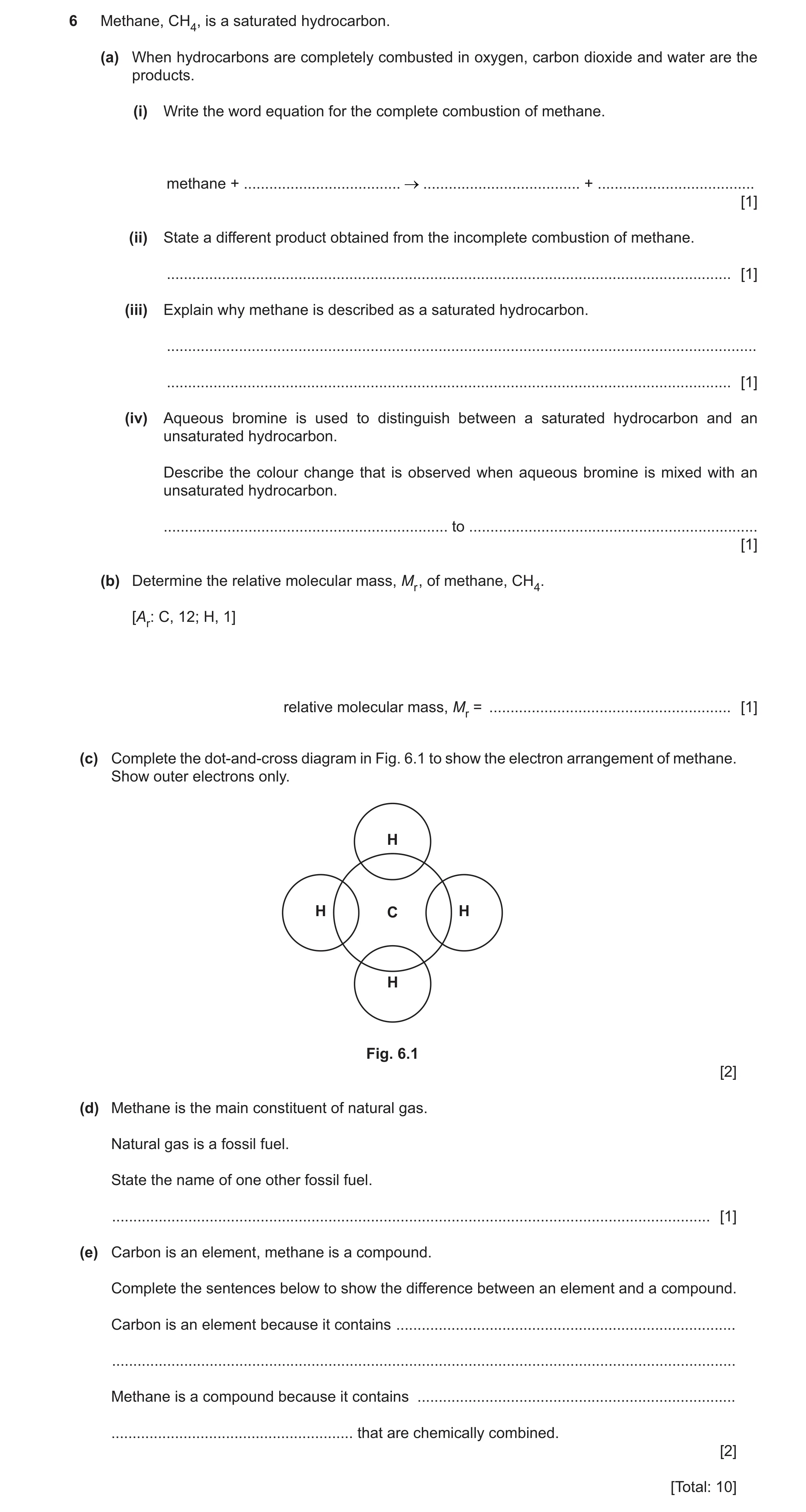
6 Methane, CH4, is a saturated hydrocarbon. (a) When hydrocarbons are completely combusted in oxygen, carbon dioxide and water are the products. (i) Write the word equation for the complete combustion of methane. methane + … … + … [1] (ii) State a different product obtained from the incomplete combustion of methane. … [1] (iii) Explain why methane is described as a saturated hydrocarbon. … … [1] (iv) Aqueous bromine is used to distinguish between a saturated hydrocarbon and an unsaturated hydrocarbon. Describe the colour change that is observed when aqueous bromine is mixed with an unsaturated hydrocarbon. … to … [1] (b) Determine the relative molecular mass, Mr , of methane, CH4. [Ar: C, 12; H, 1] relative molecular mass, Mr = … [1] (c) Complete the dot-and-cross diagram in Fig. 6.1 to show the electron arrangement of methane. Show outer electrons only. H H C H H Fig. 6.1 [2] (d) Methane is the main constituent of natural gas. Natural gas is a fossil fuel. State the name of one other fossil fuel. … [1] (e) Carbon is an element, methane is a compound. Complete the sentences below to show the difference between an element and a compound. Carbon is an element because it contains … … Methane is a compound because it contains … … that are chemically combined. [2] [Total: 10]
10 marks
Mark scheme: 6(a)(i) methane + oxygen → carbon dioxide + water ; 1 6(a)(ii) carbon monoxide / carbon ; 1 6(a)(iii) contains only single bonds ; 1 6(a)(iv) orange to colourless ; 1 6(b) 16 ; 1 6(c) one shared pair correct ; 2 all else correct ; 6(d) coal or petroleum; 1 6(e) (element) 2 only one type of atom ; (compound) two (or more) elements / two (or more) types of atom ;
This question in 0654/31 Oct/Nov 2025
Q24 · Ethane, C2H6, is an alkane 0654/32 Oct/Nov 2025
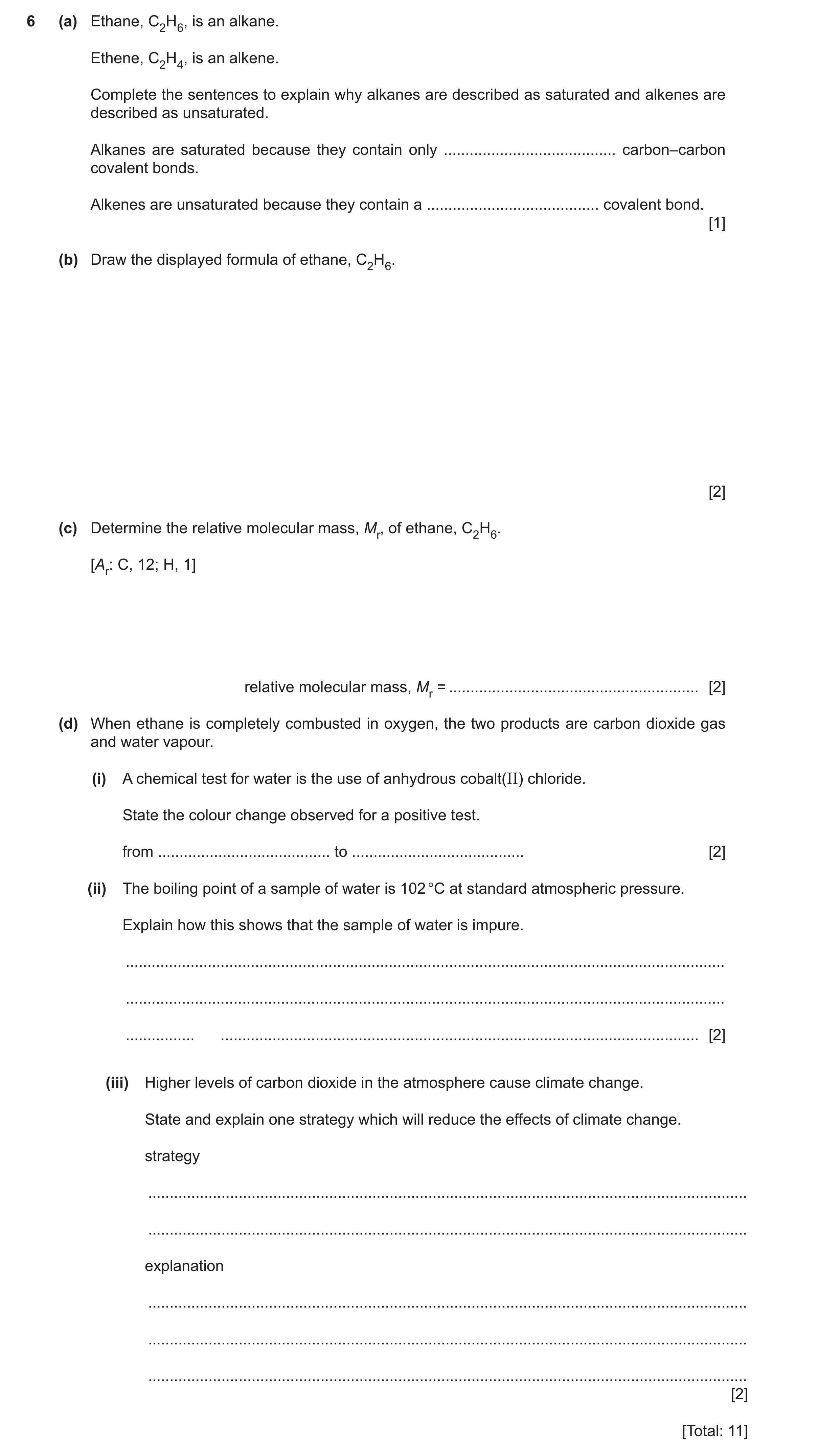
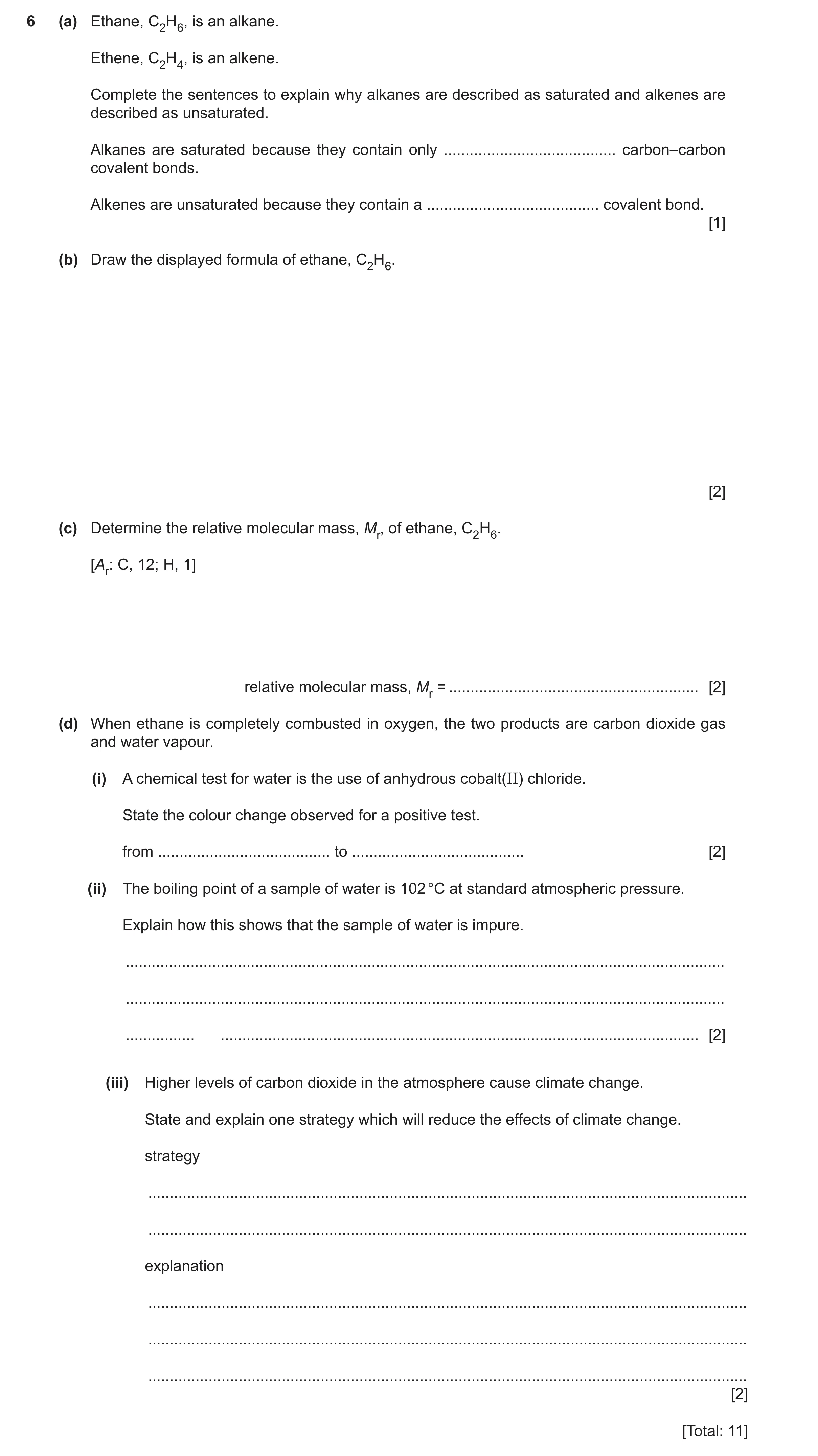
6 (a) Ethane, C2H6, is an alkane. Ethene, C2H4, is an alkene. Complete the sentences to explain why alkanes are described as saturated and alkenes are described as unsaturated. Alkanes are saturated because they contain only … carbon–carbon covalent bonds. Alkenes are unsaturated because they contain a … covalent bond. [1] (b) Draw the displayed formula of ethane, C2H6. [2] (c) Determine the relative molecular mass, Mr, of ethane, C2H6. [Ar: C, 12; H, 1] relative molecular mass, Mr = … [2] (d) When ethane is completely combusted in oxygen, the two products are carbon dioxide gas and water vapour. (i) A chemical test for water is the use of anhydrous cobalt(II) chloride. State the colour change observed for a positive test. from … to … [2] (ii) The boiling point of a sample of water is 102 °C at standard atmospheric pressure. Explain how this shows that the sample of water is impure. … … … … [2] (iii) Higher levels of carbon dioxide in the atmosphere cause climate change. State and explain one strategy which will reduce the effects of climate change. strategy … … explanation … … … [2] [Total: 11]
11 marks
Mark scheme: 6(a) single and double ; 1 6(b) 2 carbon – carbon single bond ; all else correct ; 6(c) 24 + 6 or 2 12 + 6 1 ; 2 30 ; 6(d)(i) blue ; 2 (to) pink ; 6(d)(ii) pure water boils at 100 °C ; 2 impurities increase boiling point / AW ; 6(d)(iii) planting trees / planting plants ; 2 CO2 removed by trees / CO2 removed by plants ; OR reduction in livestock farming ; less CO2 emitted / less methane emitted ; OR decreasing use of fossil fuels ; less CO2 produced (during combustion) ; OR increasing use of hydrogen / increasing use of renewables ; no CO2 produced ;
This question in 0654/32 Oct/Nov 2025
Q25 · Ethane, C2H6, is an alkane 0654/33 Oct/Nov 2025
6 (a) Ethane, C2H6, is an alkane. Ethene, C2H4, is an alkene. Complete the sentences to explain why alkanes are described as saturated and alkenes are described as unsaturated. Alkanes are saturated because they contain only … carbon–carbon covalent bonds. Alkenes are unsaturated because they contain a … covalent bond. [1] (b) Draw the displayed formula of ethane, C2H6. [2] (c) Determine the relative molecular mass, Mr, of ethane, C2H6. [Ar: C, 12; H, 1] relative molecular mass, Mr = … [2] (d) When ethane is completely combusted in oxygen, the two products are carbon dioxide gas and water vapour. (i) A chemical test for water is the use of anhydrous cobalt(II) chloride. State the colour change observed for a positive test. from … to … [2] (ii) The boiling point of a sample of water is 102 °C at standard atmospheric pressure. Explain how this shows that the sample of water is impure. … … … … [2] (iii) Higher levels of carbon dioxide in the atmosphere cause climate change. State and explain one strategy which will reduce the effects of climate change. strategy … … explanation … … … [2] [Total: 11]
11 marks
Mark scheme: 6(a) single and double ; 1 6(b) 2 carbon – carbon single bond ; all else correct ; 6(c) 24 + 6 or 2 12 + 6 1 ; 2 30 ; 6(d)(i) blue ; 2 (to) pink ; 6(d)(ii) pure water boils at 100 °C ; 2 impurities increase boiling point / AW ; 6(d)(iii) planting trees / planting plants ; 2 CO2 removed by trees / CO2 removed by plants ; OR reduction in livestock farming ; less CO2 emitted / less methane emitted ; OR decreasing use of fossil fuels ; less CO2 produced (during combustion) ; OR increasing use of hydrogen / increasing use of renewables ; no CO2 produced ;
This question in 0654/33 Oct/Nov 2025
 32 / 38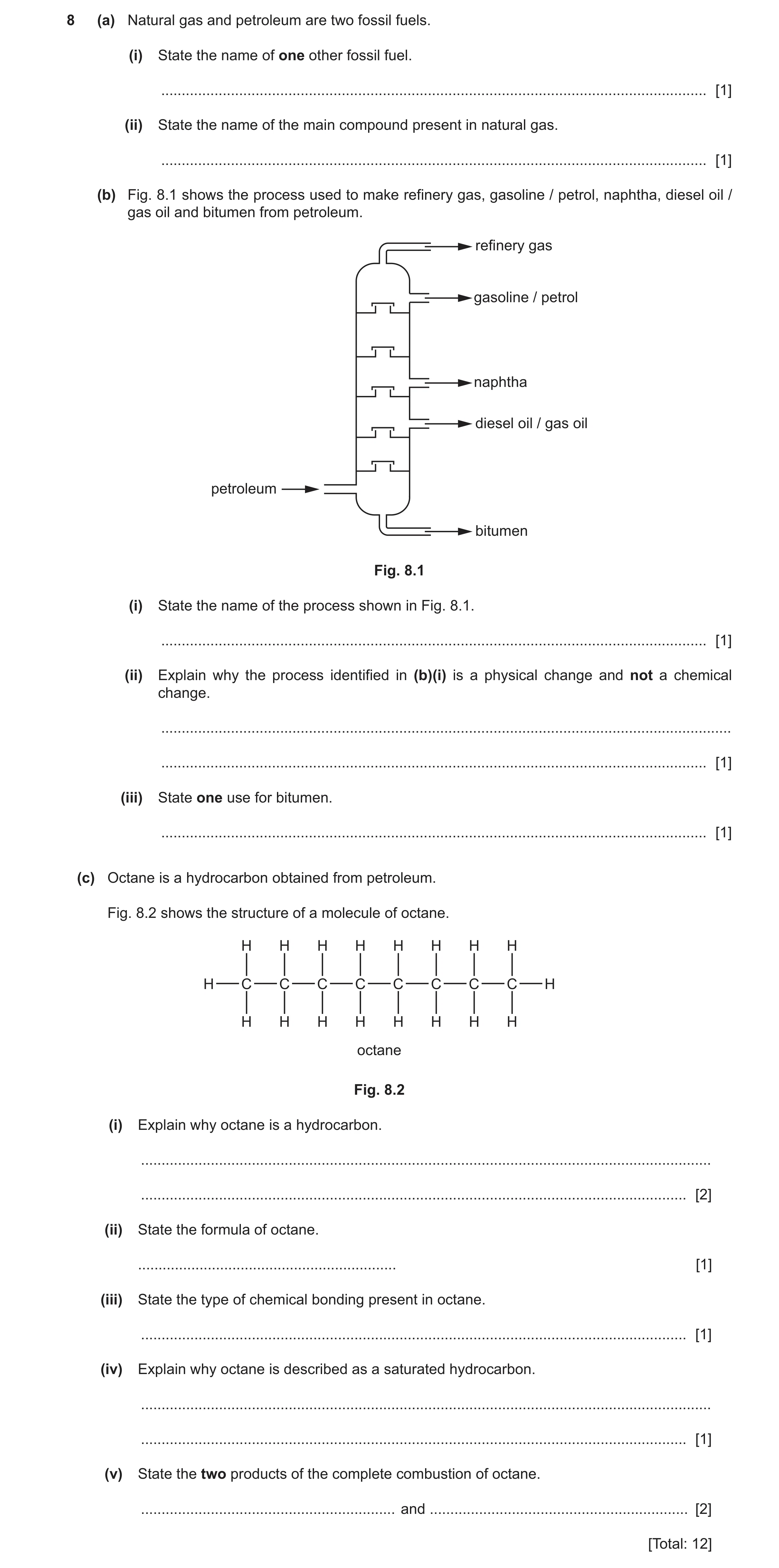
 11
11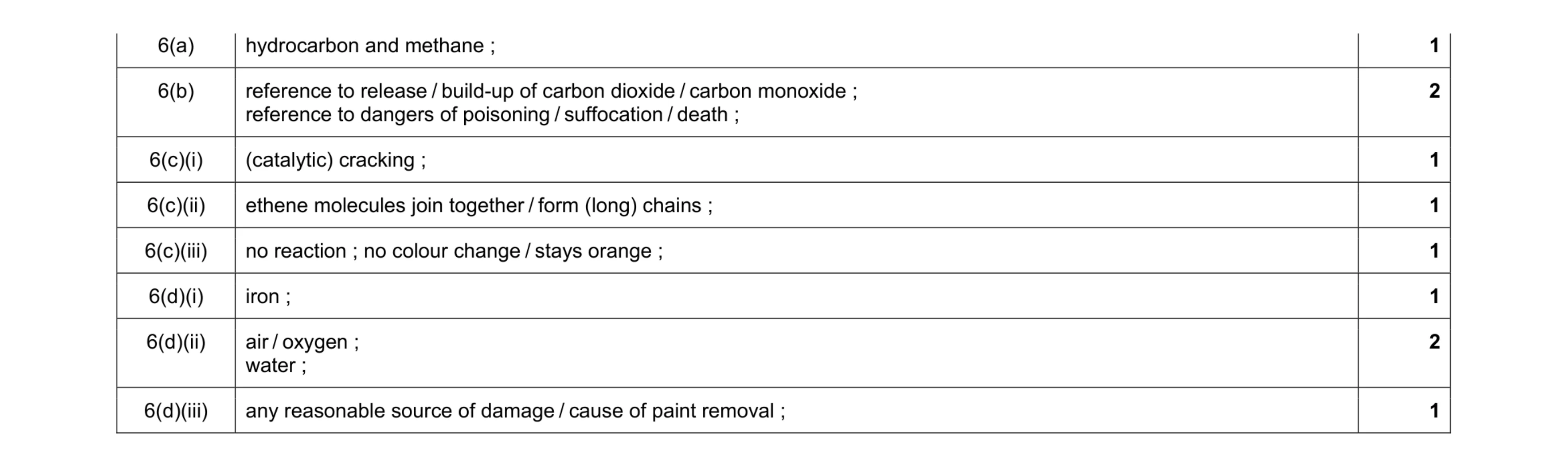 10
10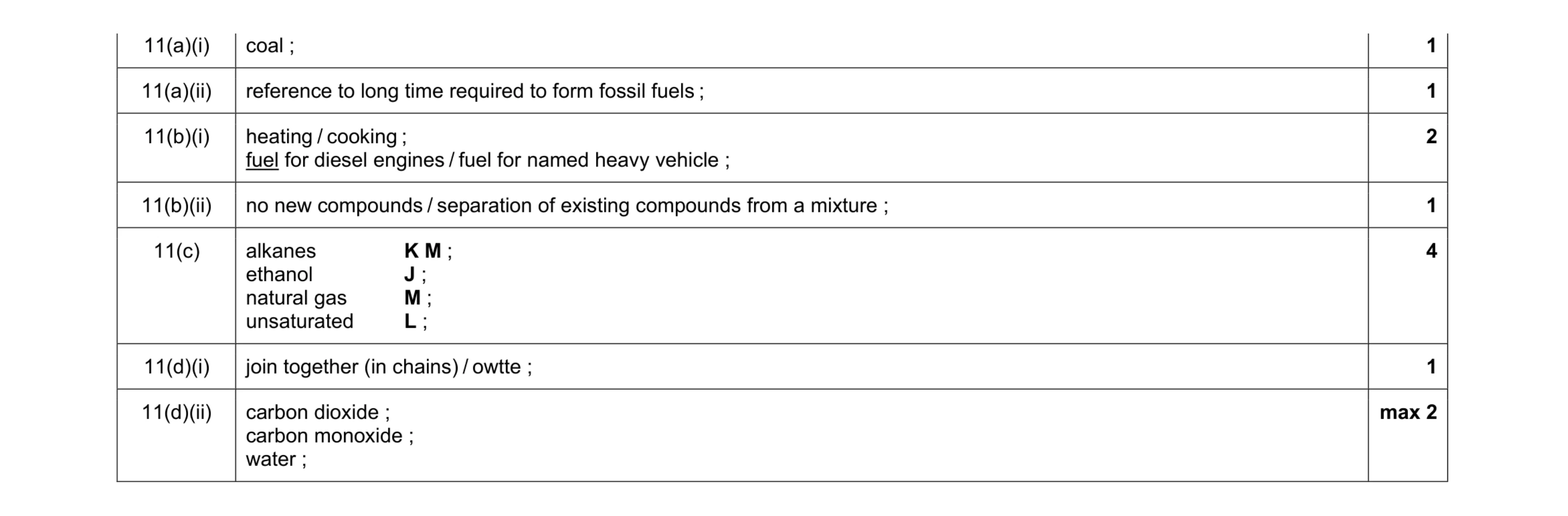 12
12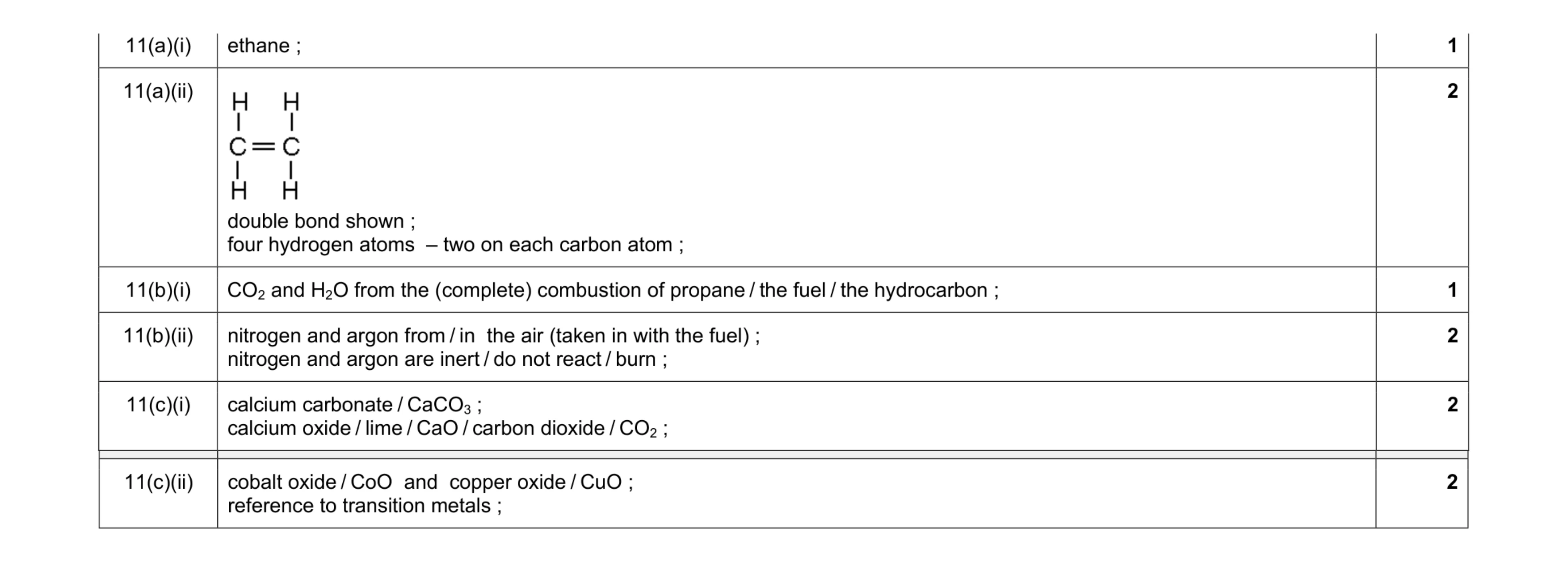 10
10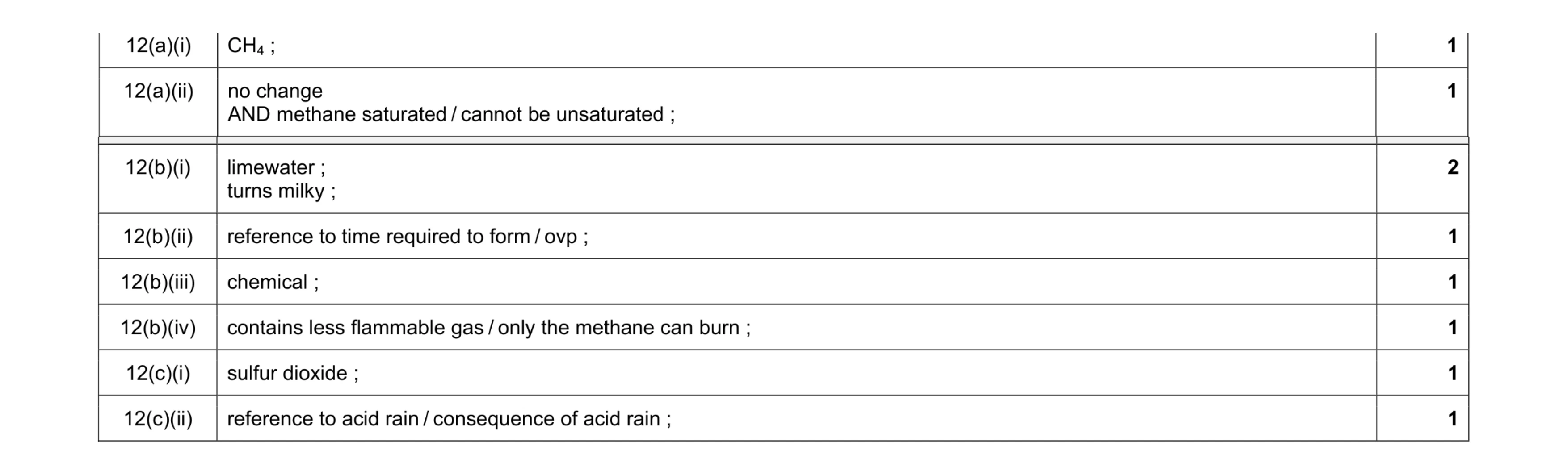 9
9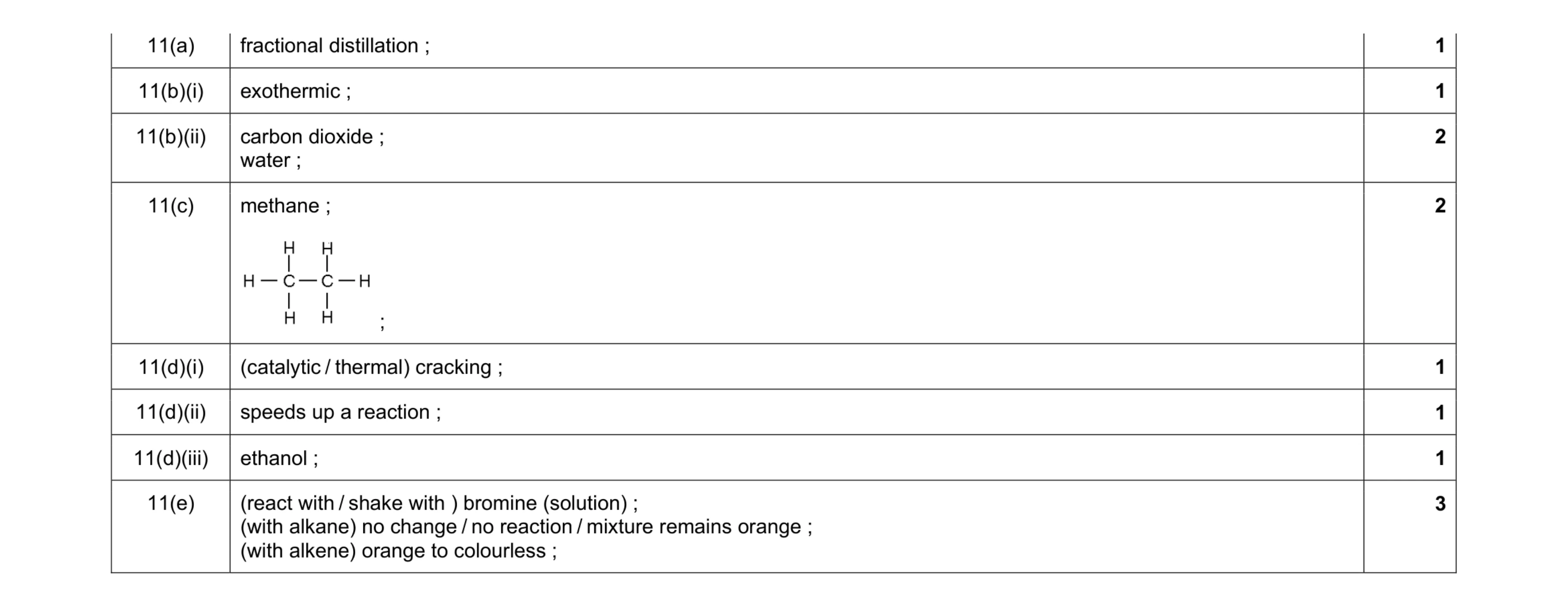 12
12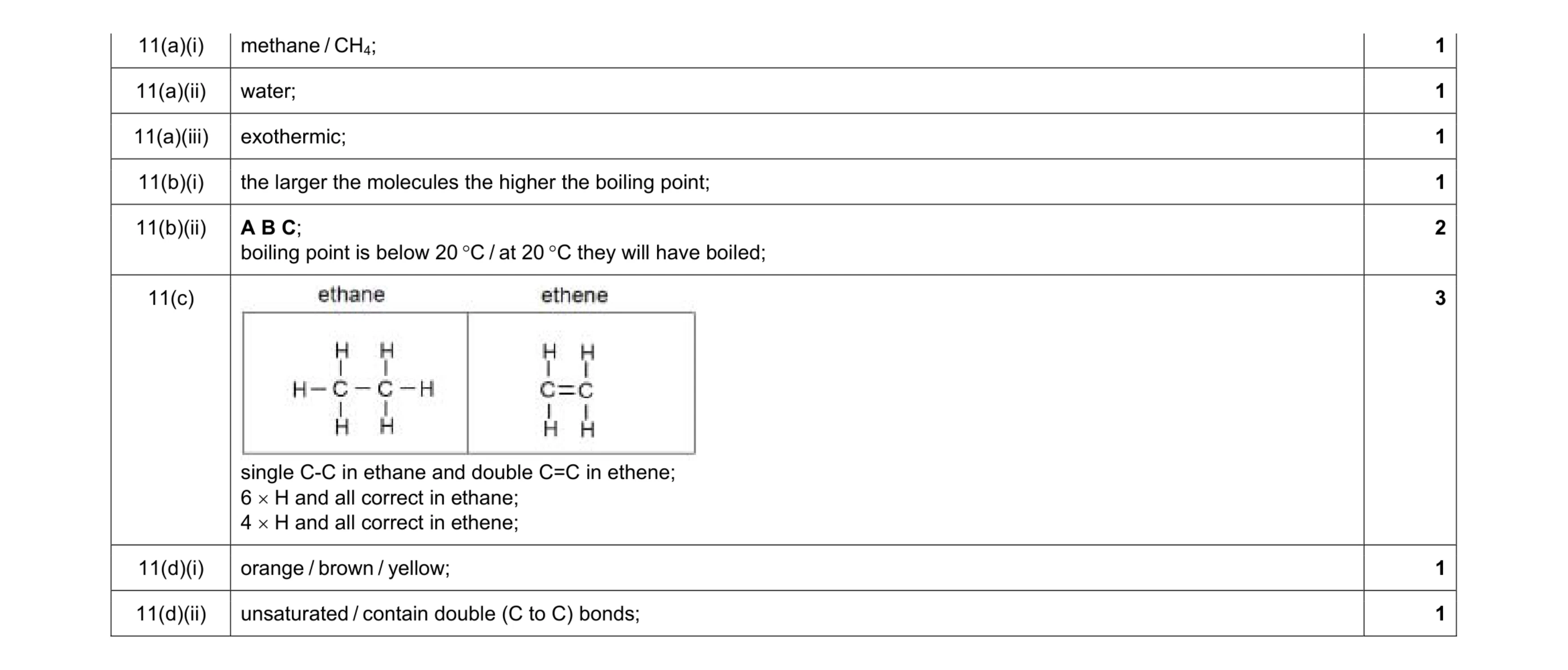 11
11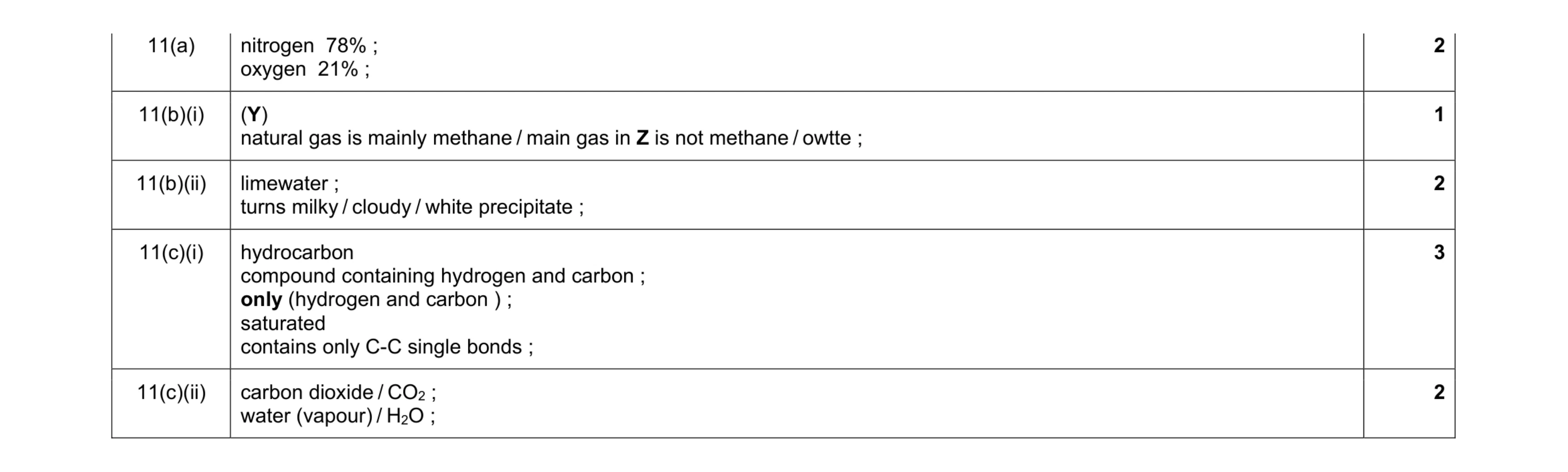 10
10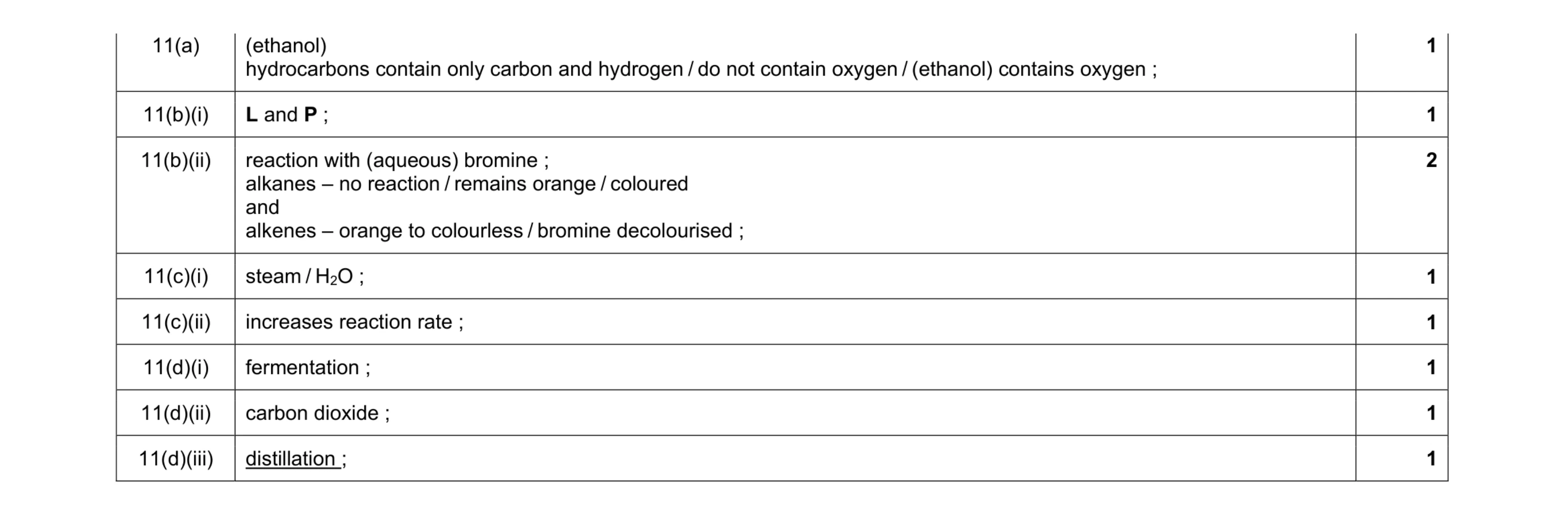 9
9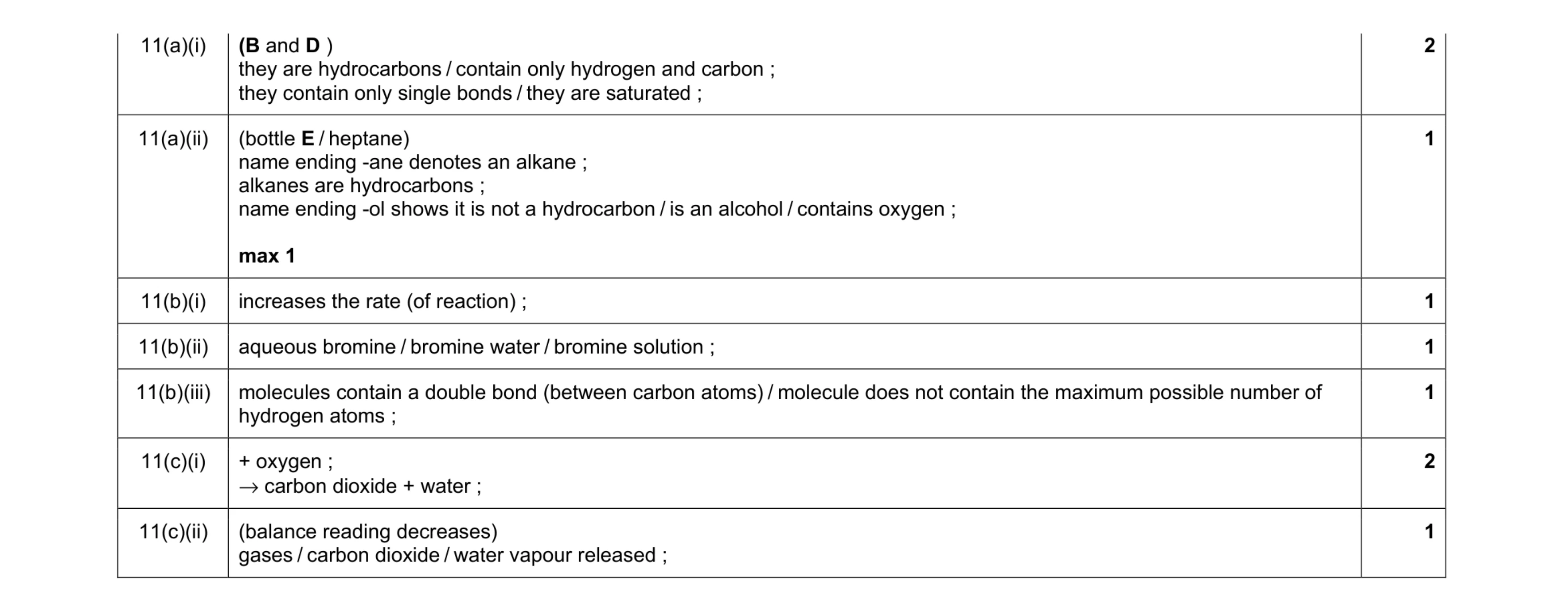 9
9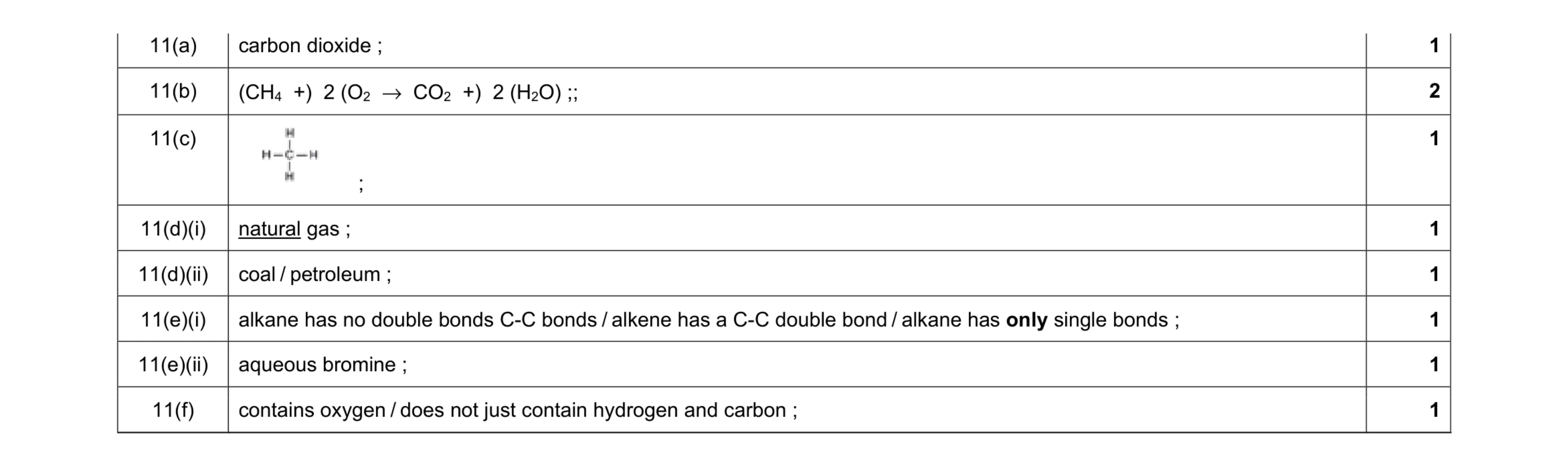 9
9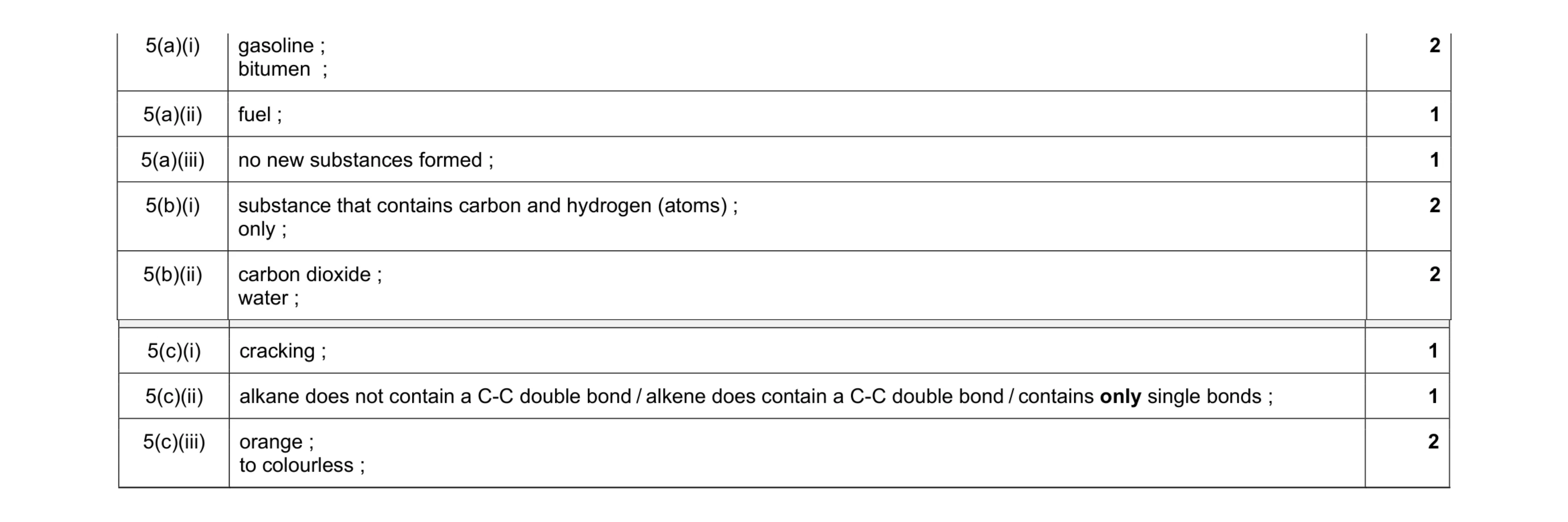 12
12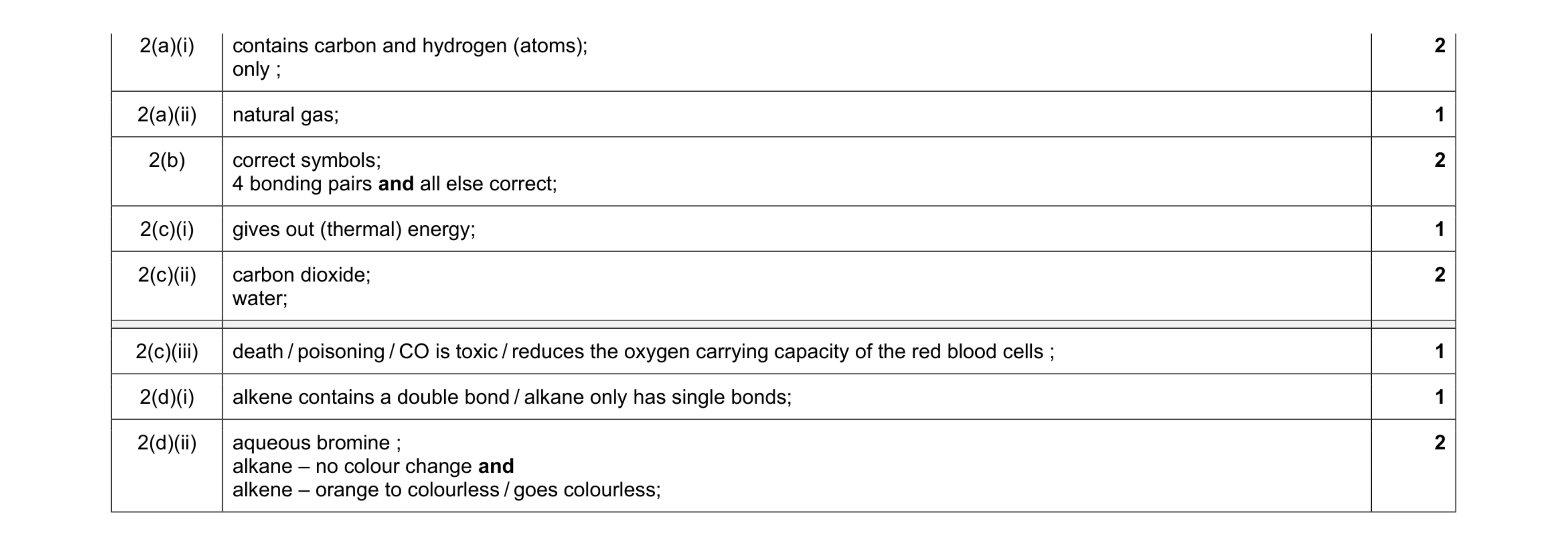 12
12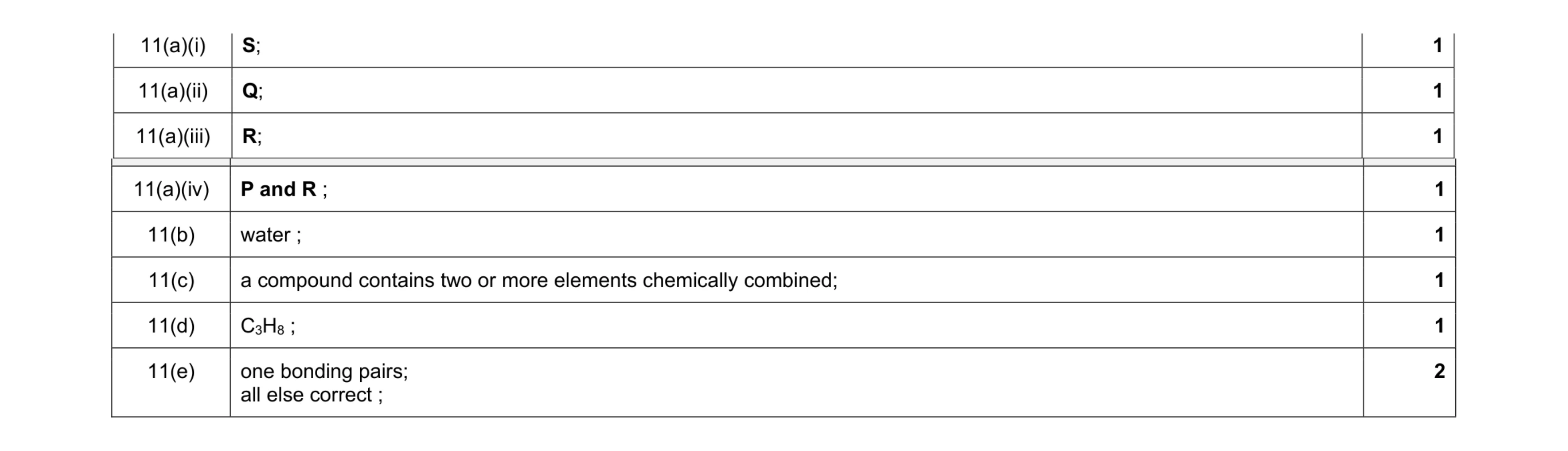 9
9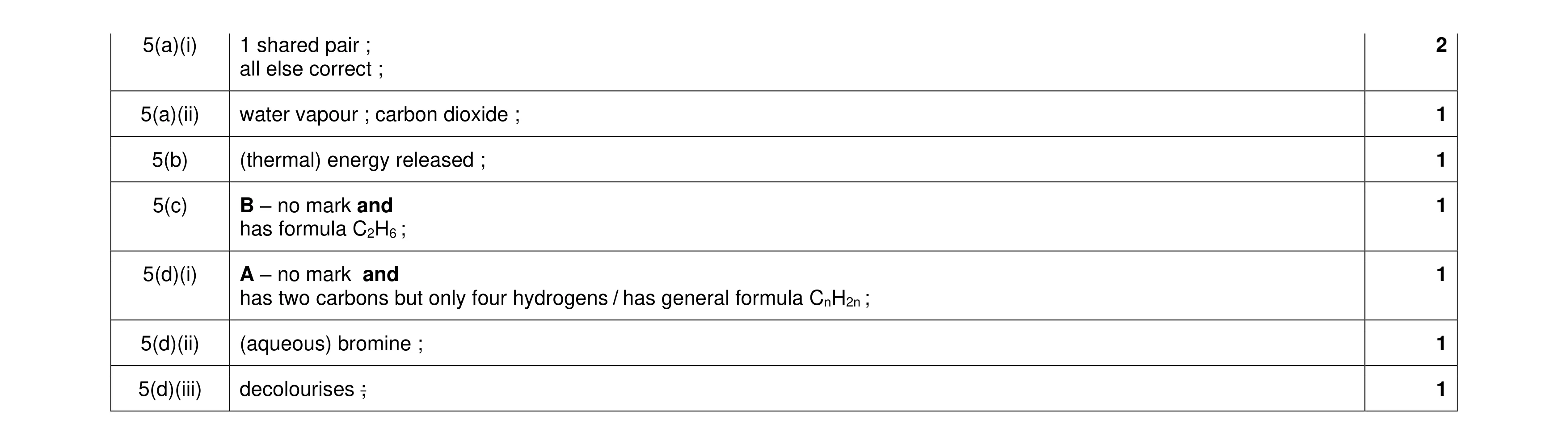 8
8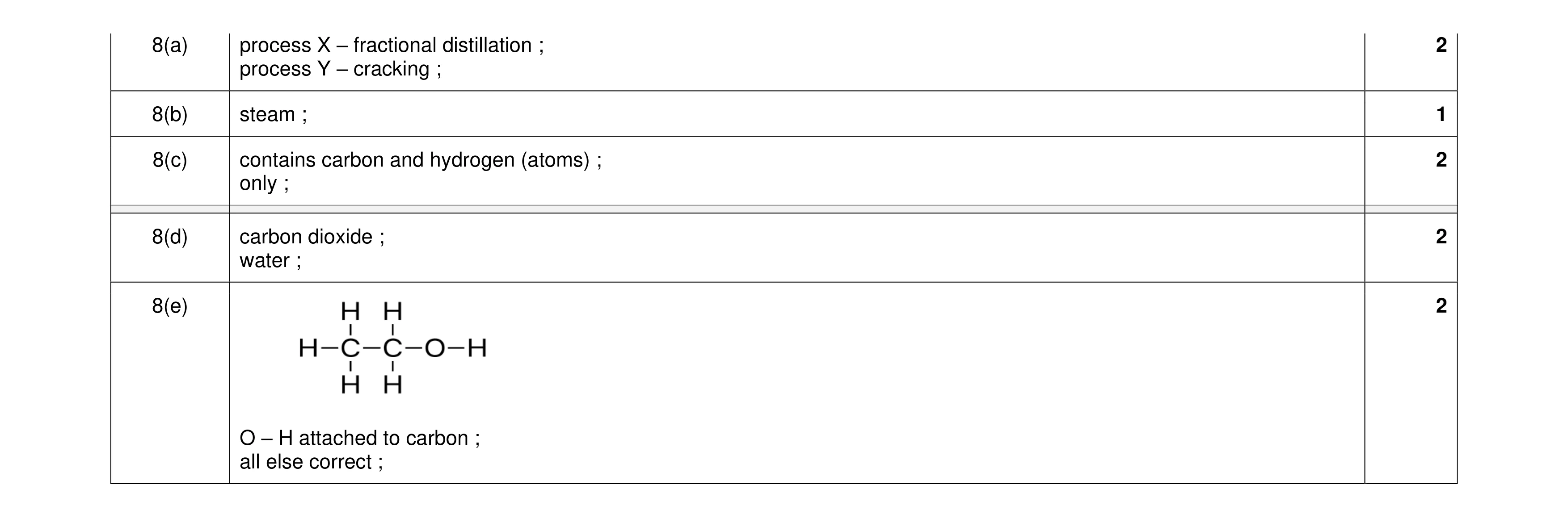 9
9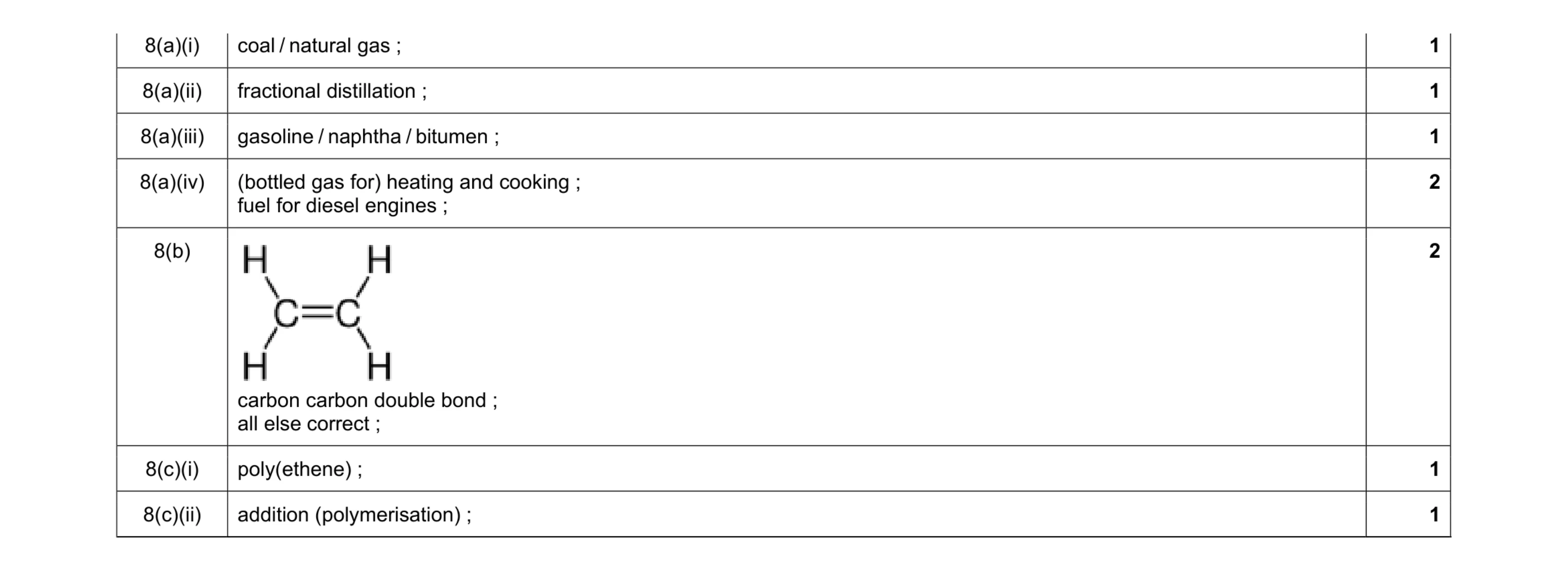 9
9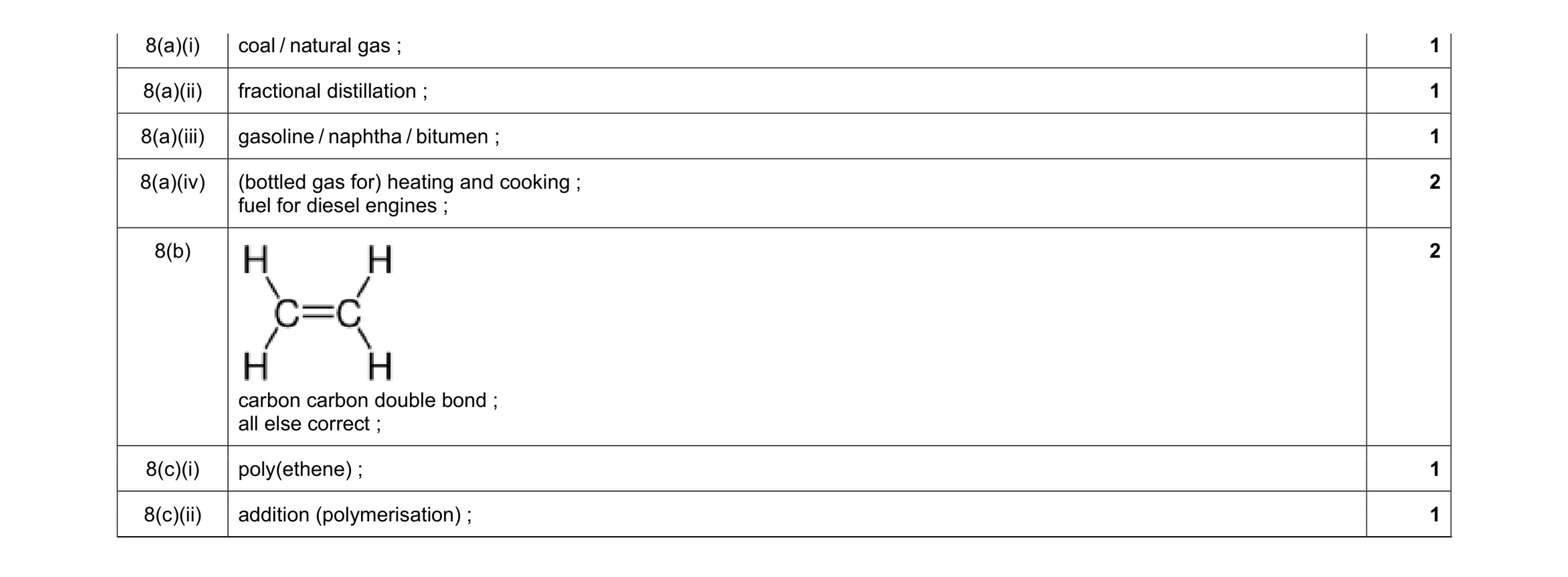 9
9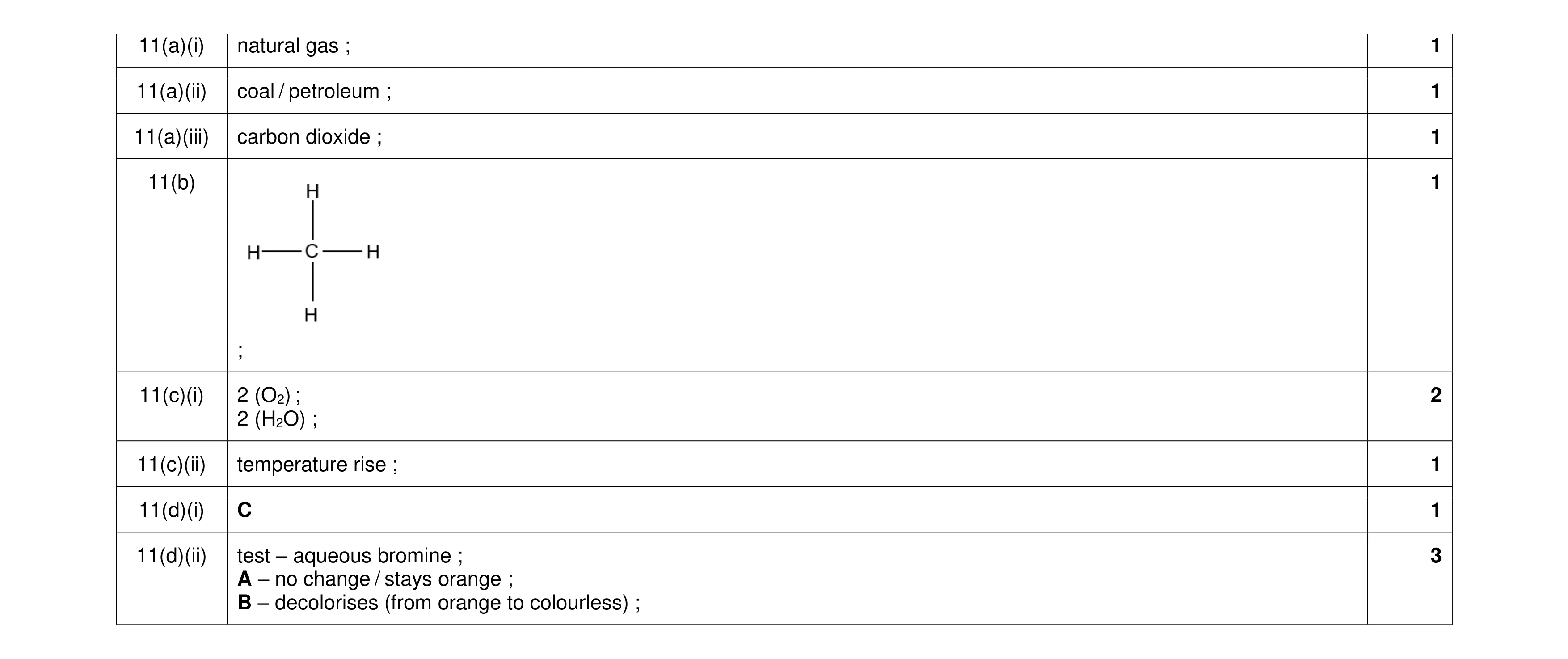 11
11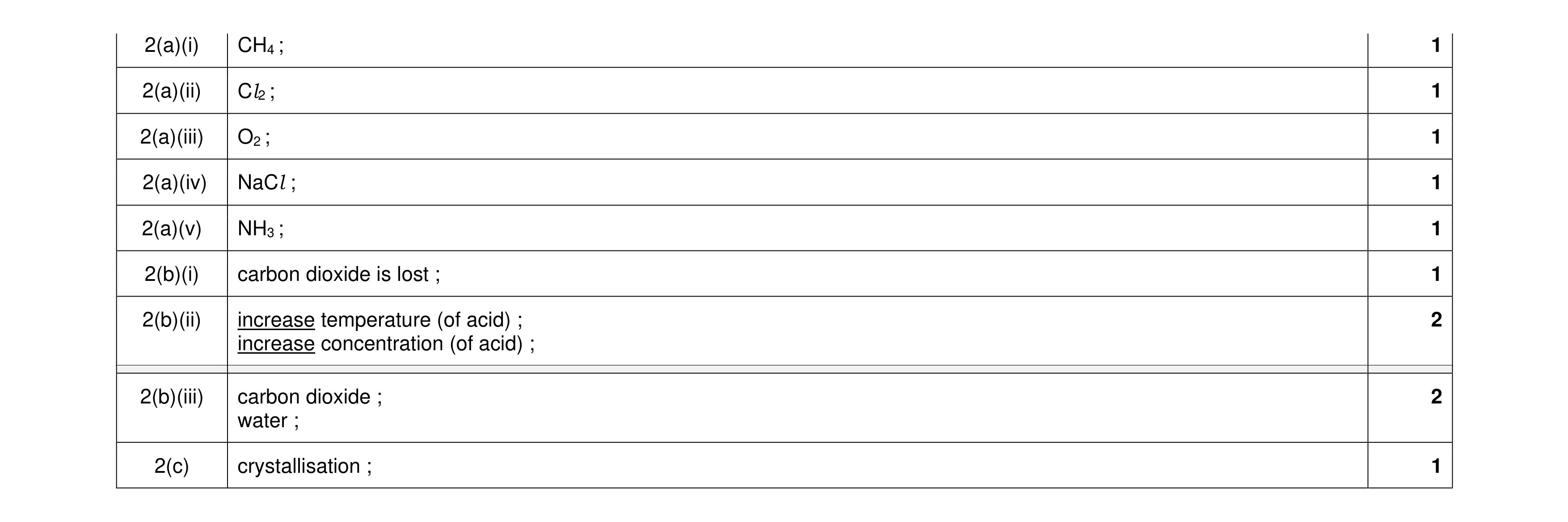 11
11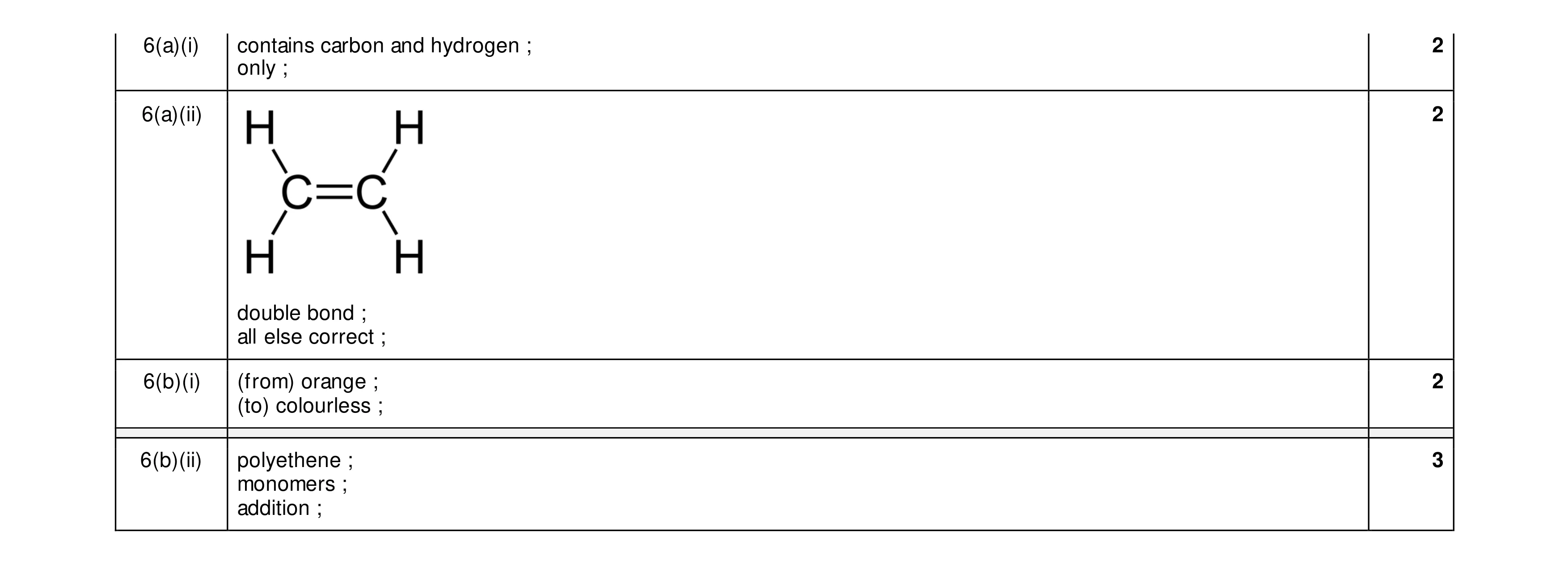 9
9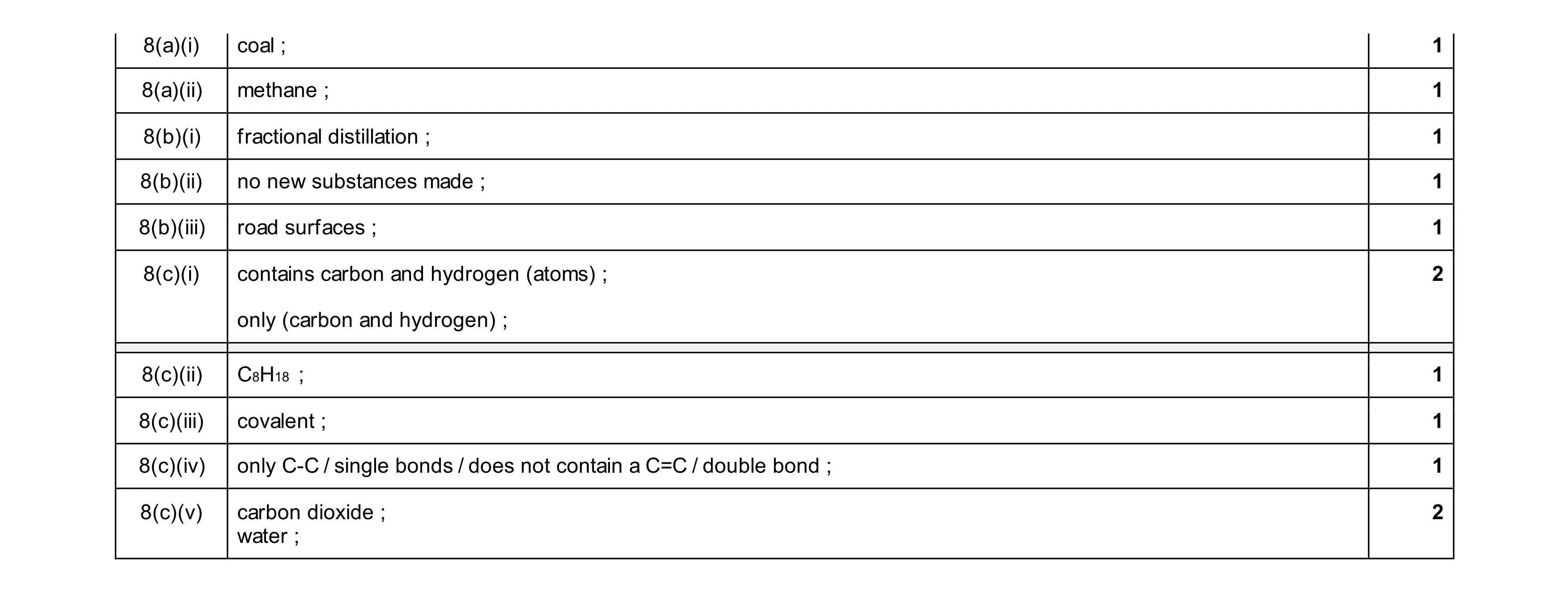 12
12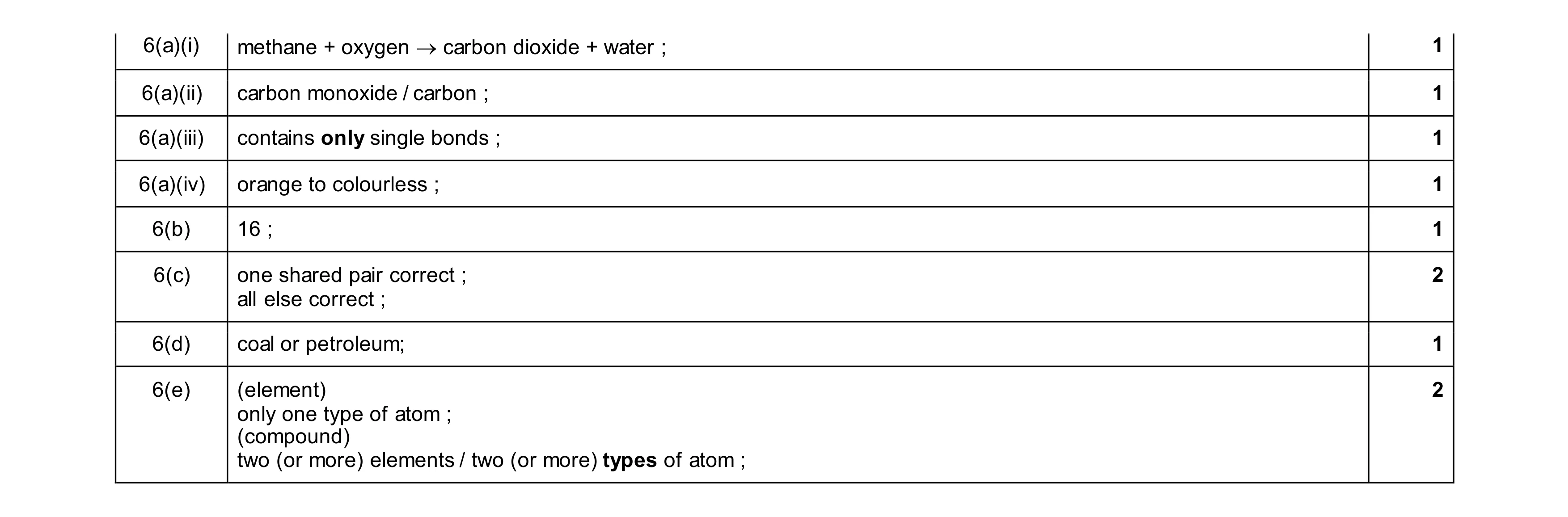 10
10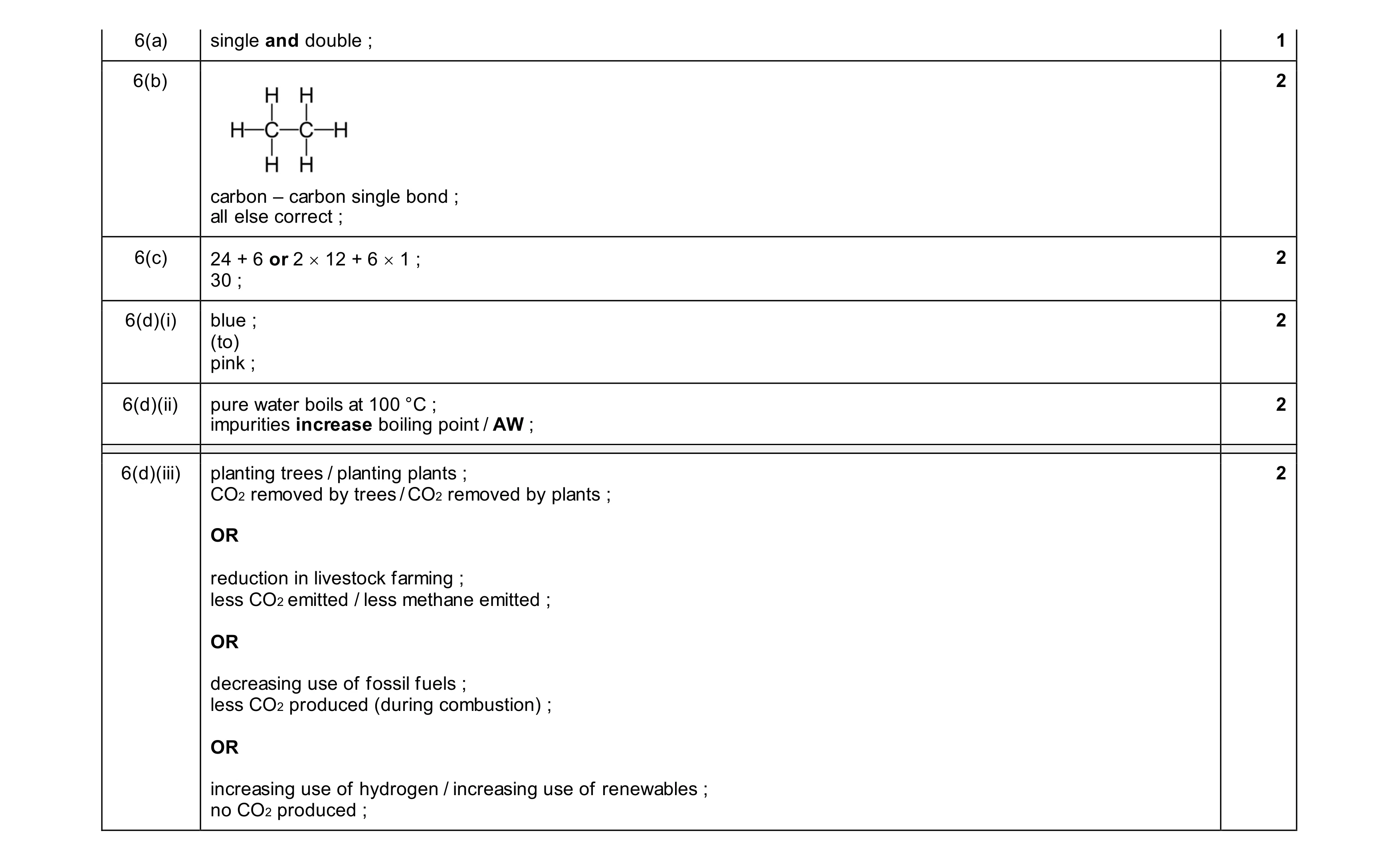 11
11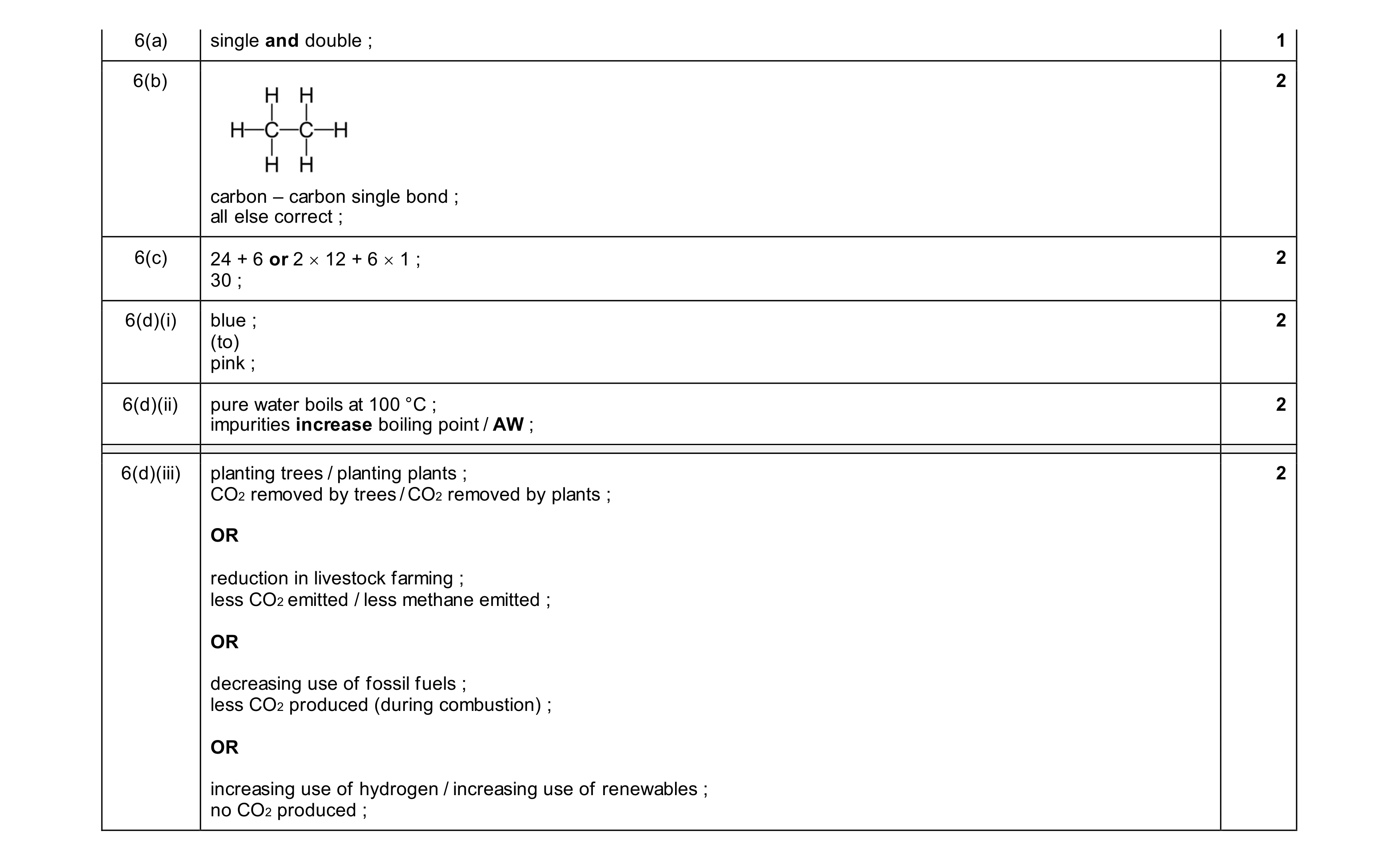 11
11