Questions as text
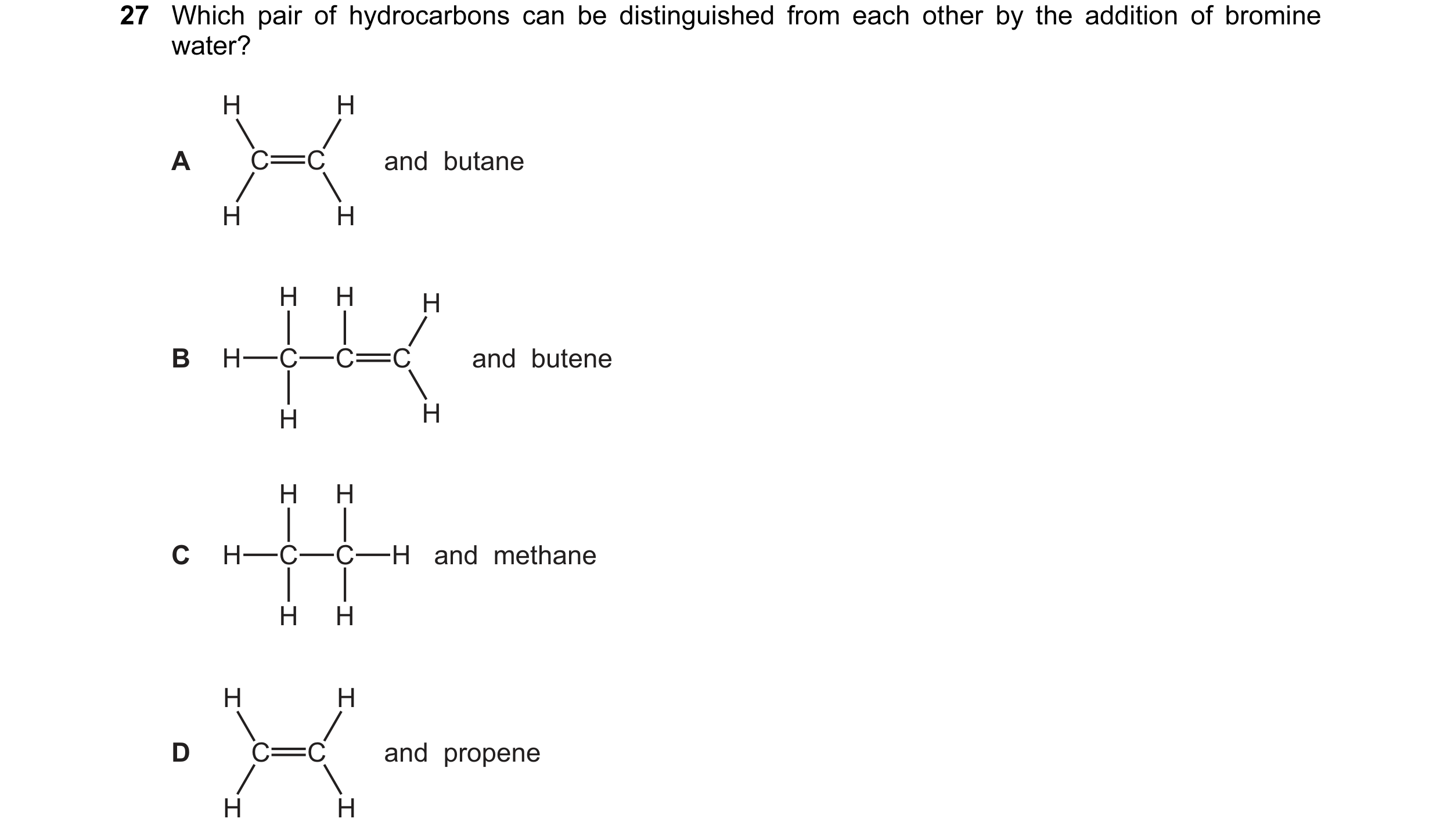
Q1 · Which pair of hydrocarbons can be distinguished from each other by the addition of… 0653/22 Feb/March 2017
27 Which pair of hydrocarbons can be distinguished from each other by the addition of bromine water? H H A C C and butane H H H H H B H C C C and butene H H H H C H C C H and methane H H H H D C C and propene H H
1 marks
Answer: A
This question in 0653/22 Feb/March 2017
Q2 · Which substance rapidly turns bromine from orange to colourless? 0653/23 May/June 2017
27 Which substance rapidly turns bromine from orange to colourless? A ethane B ethanol C ethene D methane
1 marks
Answer: C
This question in 0653/23 May/June 2017
Q3 · Which process is an example of thermal decomposition? 0653/21 Oct/Nov 2017
27 Which process is an example of thermal decomposition? A cracking an alkane B electrolysis of molten lead(II) bromide C extraction of iron in a blast furnace D fractional distillation of petroleum
1 marks
Answer: A
This question in 0653/21 Oct/Nov 2017
Q4 · Which statement about hydrocarbons is not correct? 0653/23 May/June 2018
27 Which statement about hydrocarbons is not correct? A Alkenes are made by cracking alkanes. B Butene decolourises bromine. C C2H4 is an alkene. D Ethanol is an alkane.
1 marks
Answer: D
This question in 0653/23 May/June 2018
Q5 · Which diagram represents the bonding in a molecule of ethene? 0653/21 Oct/Nov 2018
16 Which diagram represents the bonding in a molecule of ethene? A B C D H H H H H H H C C H H C C H C C C C H H H H H H
1 marks
Answer: D
This question in 0653/21 Oct/Nov 2018
Q6 · Which molecule contains a double covalent bond? 0653/22 Oct/Nov 2018
16 Which molecule contains a double covalent bond? A ethene B methane C nitrogen D water
1 marks
Answer: A
This question in 0653/22 Oct/Nov 2018
Q7 · Which substance rapidly decolourises bromine? 0653/23 Oct/Nov 2018
27 Which substance rapidly decolourises bromine? A B C D H H H H H H H H H H C H H C C H H C C C H C C C OH H H H H H H H H
1 marks
Answer: C
This question in 0653/23 Oct/Nov 2018
Q8 · Which reaction equation represents cracking? 0653/21 May/June 2019
27 Which reaction equation represents cracking? A CH4 + 2O2 → CO2 + 2H2O B C2H4 + Br2 → C2H4Br2 C nC2H4 → ( C2H2 ) n D C2H6 → C2H4 + H2
1 marks
Answer: D
This question in 0653/21 May/June 2019
Q9 · Which substances react together? 0653/23 May/June 2019
26 Which substances react together? 1 ethene and methane 2 ethene and bromine 3 ethene and oxygen A 1, 2 and 3 B 1 and 2 only C 1 and 3 only D 2 and 3 only
1 marks
Answer: D
This question in 0653/23 May/June 2019
Q10 · Which statement about cracking is not correct? 0653/23 May/June 2019
27 Which statement about cracking is not correct? A A high temperature and a catalyst are used. B Alkenes are made. C Hydrogen can be made. D Larger alkanes are made from smaller alkanes.
1 marks
Answer: D
This question in 0653/23 May/June 2019
Q11 · Which hydrocarbons belong to the same homologous series? 0653/22 Oct/Nov 2019
27 Which hydrocarbons belong to the same homologous series? A C2H2, C2H4, C2H6 B CH4, C2H4, C3H4 C C2H4, C3H6, C4H8 D C2H4, C3H8, C4H10
1 marks
Answer: C
This question in 0653/22 Oct/Nov 2019
Q12 · What can be produced when naphtha is cracked? 0653/21 Oct/Nov 2020
27 What can be produced when naphtha is cracked? A alkanes, alkenes and hydrogen B alkanes and alkenes only C alkanes and hydrogen only D alkenes only
1 marks
Answer: A
This question in 0653/21 Oct/Nov 2020
Q13 · Which statement about hydrocarbons is not correct? 0653/22 Feb/March 2021
27 Which statement about hydrocarbons is not correct? A Alkenes are made by cracking alkanes. B Butene decolourises aqueous bromine. C C2H4 is used to make poly(ethene). D The general formula of alkanes is CnH2n.
1 marks
Answer: D
This question in 0653/22 Feb/March 2021
Q14 · Which description identifies the monomer that is used to form poly(ethene) by addition… 0653/22 Feb/March 2022
27 Which description identifies the monomer that is used to form poly(ethene) by addition polymerisation? A saturated alkane B saturated alkene C unsaturated alkane D unsaturated alkene
1 marks
Answer: D
This question in 0653/22 Feb/March 2022
Q15 · Which substance rapidly turns aqueous bromine from orange to colourless? 0653/21 May/June 2022
27 Which substance rapidly turns aqueous bromine from orange to colourless? A ethane B ethanol C ethene D methane
1 marks
Answer: C
This question in 0653/21 May/June 2022
Q16 · Which substance rapidly turns aqueous bromine from orange to colourless? 0653/22 May/June 2022
27 Which substance rapidly turns aqueous bromine from orange to colourless? A ethane B ethanol C ethene D methane
1 marks
Answer: C
This question in 0653/22 May/June 2022
Q17 · Which substance rapidly turns aqueous bromine from orange to colourless? 0653/23 May/June 2022
27 Which substance rapidly turns aqueous bromine from orange to colourless? A ethane B ethanol C ethene D methane
1 marks
Answer: C
This question in 0653/23 May/June 2022
Q18 · Which process is an example of thermal decomposition? 0653/21 Oct/Nov 2022
27 Which process is an example of thermal decomposition? A cracking an alkane B electrolysis of molten lead(II) bromide C extraction of iron in the blast furnace D fractional distillation of petroleum
1 marks
Answer: A
This question in 0653/21 Oct/Nov 2022
Q19 · Which process is an example of thermal decomposition? 0653/22 Oct/Nov 2022
27 Which process is an example of thermal decomposition? A cracking an alkane B electrolysis of molten lead(II) bromide C extraction of iron in the blast furnace D fractional distillation of petroleum
1 marks
Answer: A
This question in 0653/22 Oct/Nov 2022
Q20 · Which statement about the homologous series of alkenes is correct? 0653/22 Feb/March 2023
27 Which statement about the homologous series of alkenes is correct? A They are all saturated hydrocarbons. B They all have the same physical properties. C Their molecules have the same ratio of carbon atoms to hydrogen atoms. D They all have the same molecular formula.
1 marks
Answer: C
This question in 0653/22 Feb/March 2023
Q21 · What are the products of cracking large alkane molecules? 0653/21 May/June 2023
27 What are the products of cracking large alkane molecules? A smaller alkanes only B smaller alkenes only C smaller alkanes, alkenes and hydrogen D smaller alkanes and hydrogen only
1 marks
Answer: C
This question in 0653/21 May/June 2023
Q22 · Which equation represents cracking? 0653/22 May/June 2023
27 Which equation represents cracking? A C6H14 2C3H6 + H2 B C3H8 + 5O2 3CO2 + 4H2O C nCH2=CH2 poly(ethene) D CH2=CH2 + Br2 CH2BrCH2Br
1 marks
Answer: A
This question in 0653/22 May/June 2023
Q23 · Which structure represents a molecule that is not formed during cracking of large alkane… 0653/23 May/June 2023
27 Which structure represents a molecule that is not formed during cracking of large alkane molecules? A B C D H H H O H C H C C H H H H H H H
1 marks
Answer: D
This question in 0653/23 May/June 2023
Q24 · An equation representing the cracking of octacosane, C28H58, is shown 0653/22 Feb/March 2024
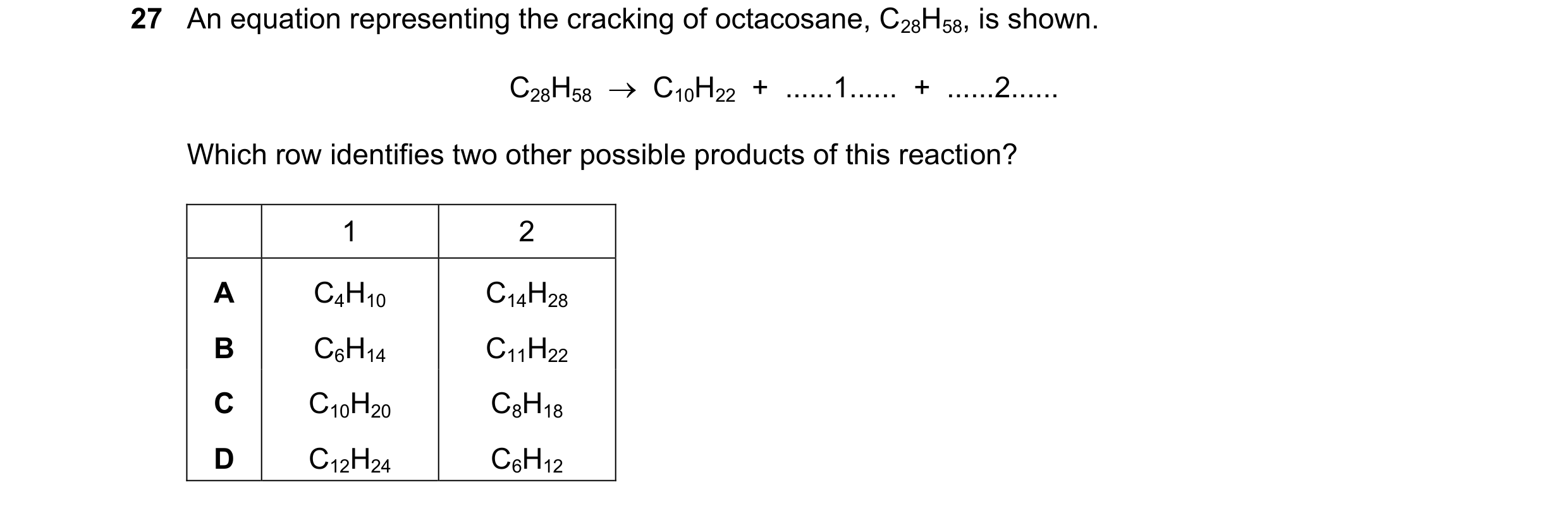
27 An equation representing the cracking of octacosane, C28H58, is shown. C28H58 C10H22 + … 1 … + … 2 … Which row identifies two other possible products of this reaction? 1 2 A C4H10 C14H28 B C6H14 C11H22 C C10H20 C8H18 D C12H24 C6H12
1 marks
Answer: D
This question in 0653/22 Feb/March 2024
Q25 · Which products are obtained by the cracking of larger alkane molecules? 0653/21 May/June 2024
27 Which products are obtained by the cracking of larger alkane molecules? A smaller alkane molecules, smaller alkene molecules and hydrogen B smaller alkane molecules only C smaller alkene molecules and hydrogen only D smaller alkene molecules only
1 marks
Answer: A
This question in 0653/21 May/June 2024
Q26 · Which statement about alkenes is correct? 0653/22 May/June 2024
26 Which statement about alkenes is correct? A They are saturated hydrocarbons. B They have the general formula CnH2n+2. C They have similar chemical properties. D They are all gases at room temperature.
1 marks
Answer: C
This question in 0653/22 May/June 2024
Q27 · A hydrocarbon with the formula C9H20 is cracked to form one molecule of ethene and two… 0653/22 May/June 2024
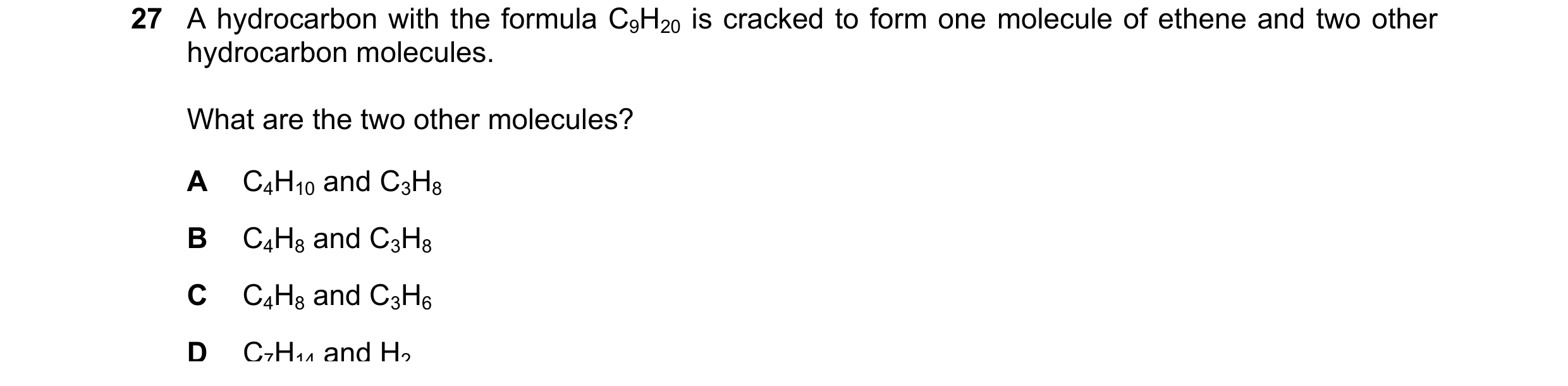
27 A hydrocarbon with the formula C9H20 is cracked to form one molecule of ethene and two other hydrocarbon molecules. What are the two other molecules? A C4H10 and C3H8 B C4H8 and C3H8 C C4H8 and C3H6 D C7H14 and H2
1 marks
Answer: B
This question in 0653/22 May/June 2024
Q28 · Which statement about cracking is correct? 0653/21 Oct/Nov 2024
27 Which statement about cracking is correct? A Alkanes are produced, which are used to make polymers. B Low temperatures are used. C Alkenes are the only products. D A catalyst is used.
1 marks
Answer: D
This question in 0653/21 Oct/Nov 2024
Q29 · Which dot-and-cross diagram represents the bonding in a molecule of ethene? 0653/23 Oct/Nov 2024
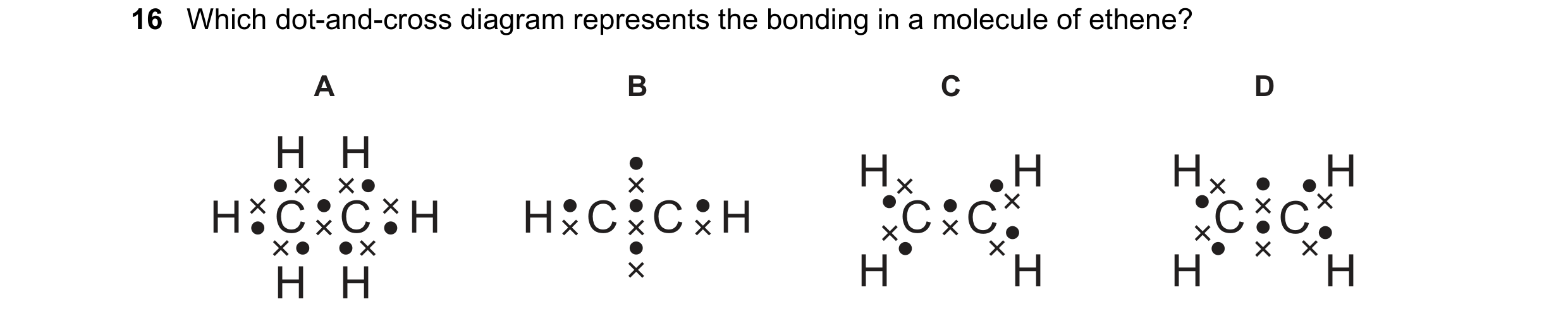
16 Which dot-and-cross diagram represents the bonding in a molecule of ethene? A B C D H H H H H H H C C H H C C H C C C C H H H H H H
1 marks
Answer: D
This question in 0653/23 Oct/Nov 2024
Q30 · Two different bottles each contain a colourless liquid 0653/23 Oct/Nov 2024
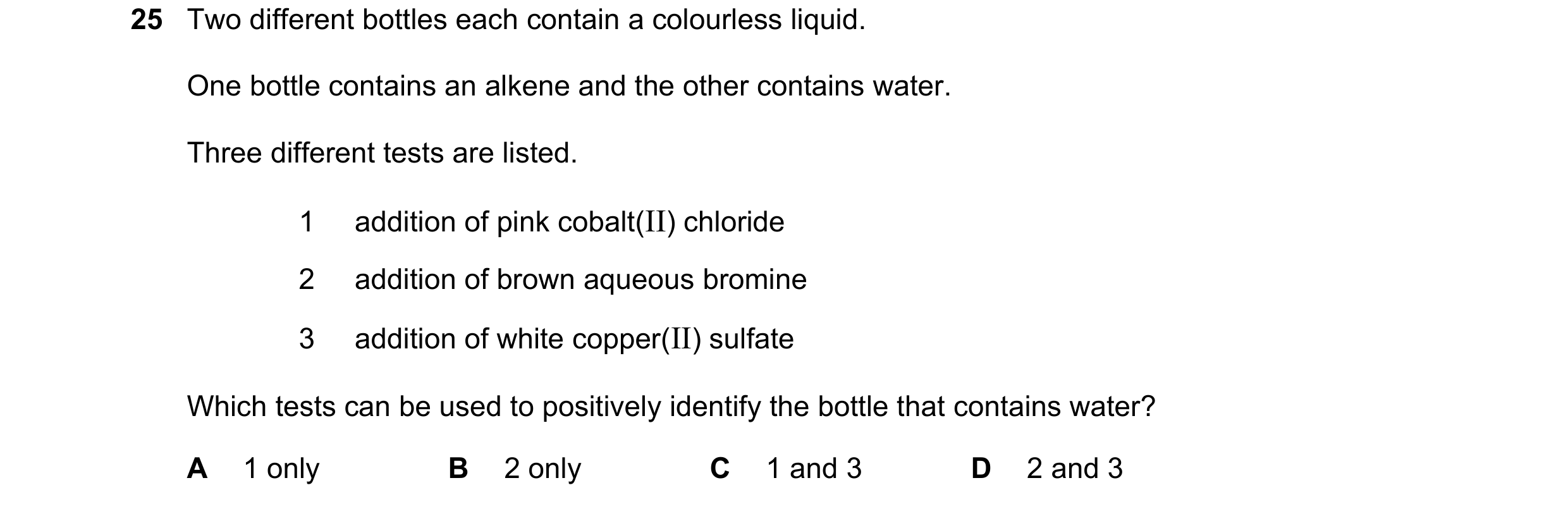
25 Two different bottles each contain a colourless liquid. One bottle contains an alkene and the other contains water. Three different tests are listed. 1 addition of pink cobalt(II) chloride 2 addition of brown aqueous bromine 3 addition of white copper(II) sulfate Which tests can be used to positively identify the bottle that contains water? A 1 only B 2 only C 1 and 3 D 2 and 3
1 marks
Answer: C
This question in 0653/23 Oct/Nov 2024
Q31 · Which type of reaction occurs when alkenes react with bromine? 0653/21 May/June 2025
25 Which type of reaction occurs when alkenes react with bromine? A addition B combustion C displacement D polymerisation
1 marks
Answer: A
This question in 0653/21 May/June 2025
Q32 · Which equation represents cracking? 0653/21 Oct/Nov 2025
23 Which equation represents cracking? A C10H22 2C2H4 + C6H12 + H2 B C10H20 + H2 C10H22 C 2C10H22 + 21O2 20CO + 22H2O D 2C10H22 + 31O2 20CO2 + 22H2O
1 marks
Answer: A
This question in 0653/21 Oct/Nov 2025
Q33 · Four statements about alkenes are listed 0653/22 Oct/Nov 2025
27 Four statements about alkenes are listed. 1 They turn aqueous bromine from colourless to orange. 2 They are reactants in addition reactions. 3 They react with steam in the presence of an acid catalyst. 4 They react with hydrogen without a catalyst. Which statements are correct? A 1 and 2 B 1 and 3 C 2 and 3 D 3 and 4
1 marks
Answer: C
This question in 0653/22 Oct/Nov 2025


 1 / 7
1 / 7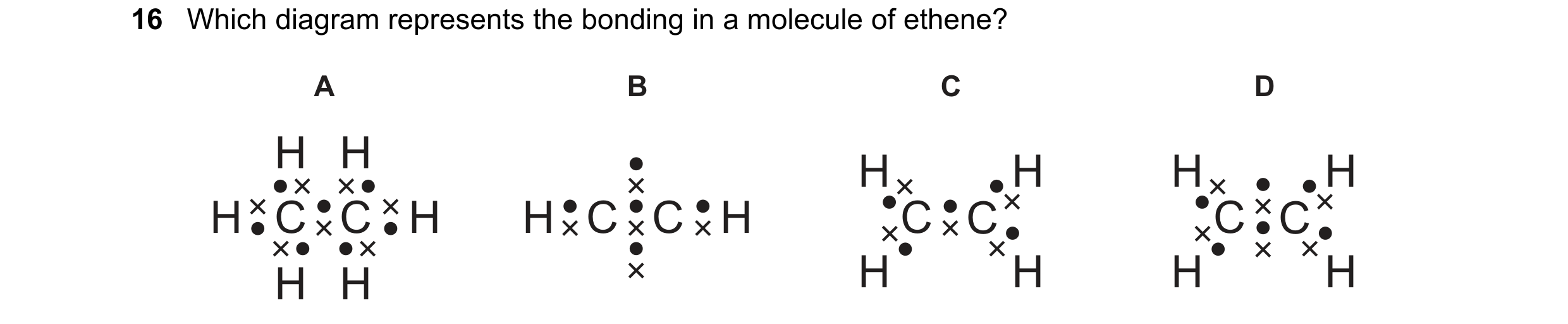




 2 / 7
2 / 7



 3 / 7
3 / 7




 4 / 7
4 / 7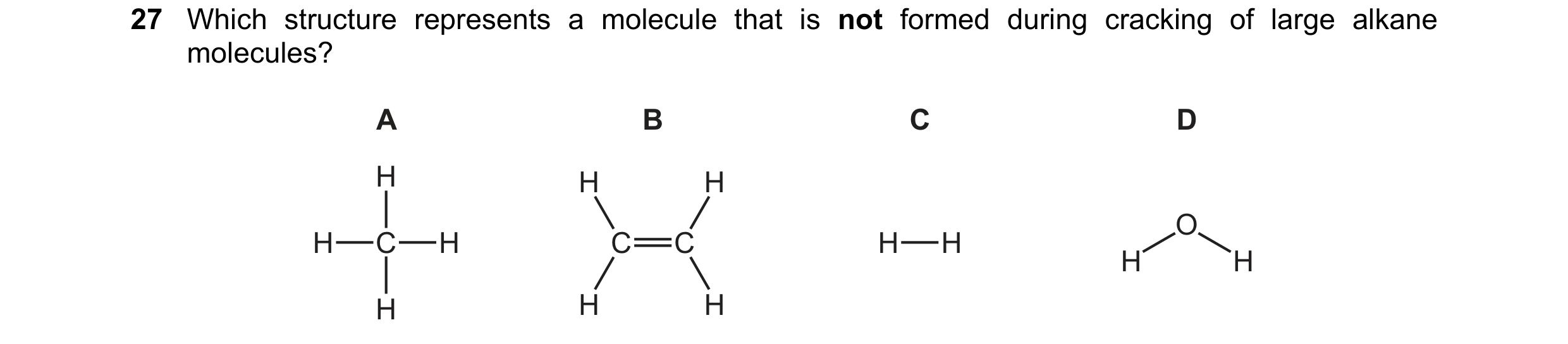


 5 / 7
5 / 7

 6 / 7
6 / 7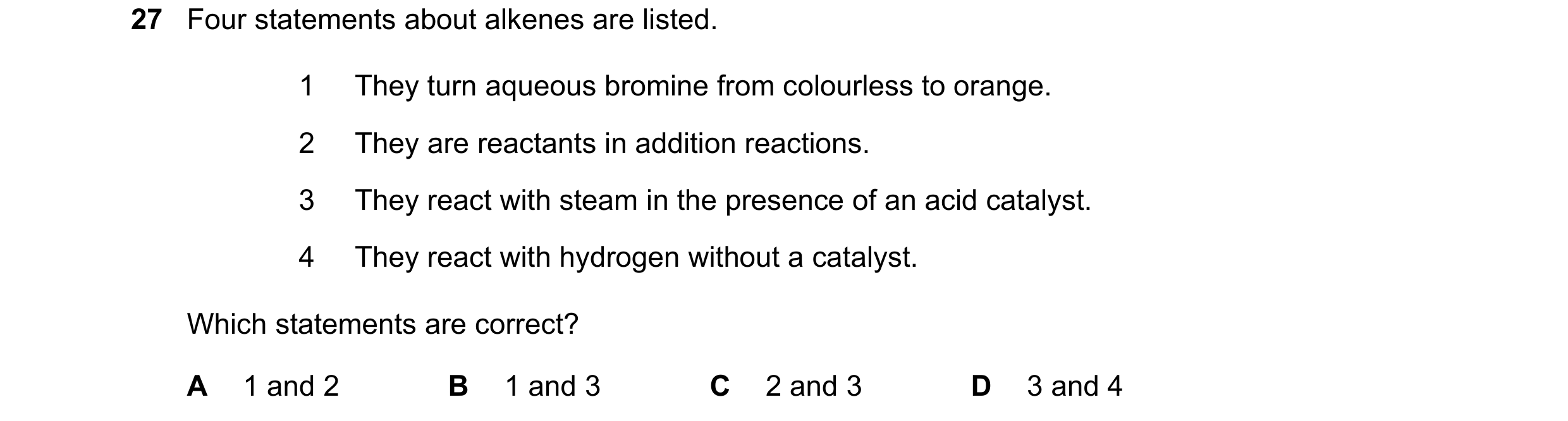 7 / 7
7 / 7