Questions as text
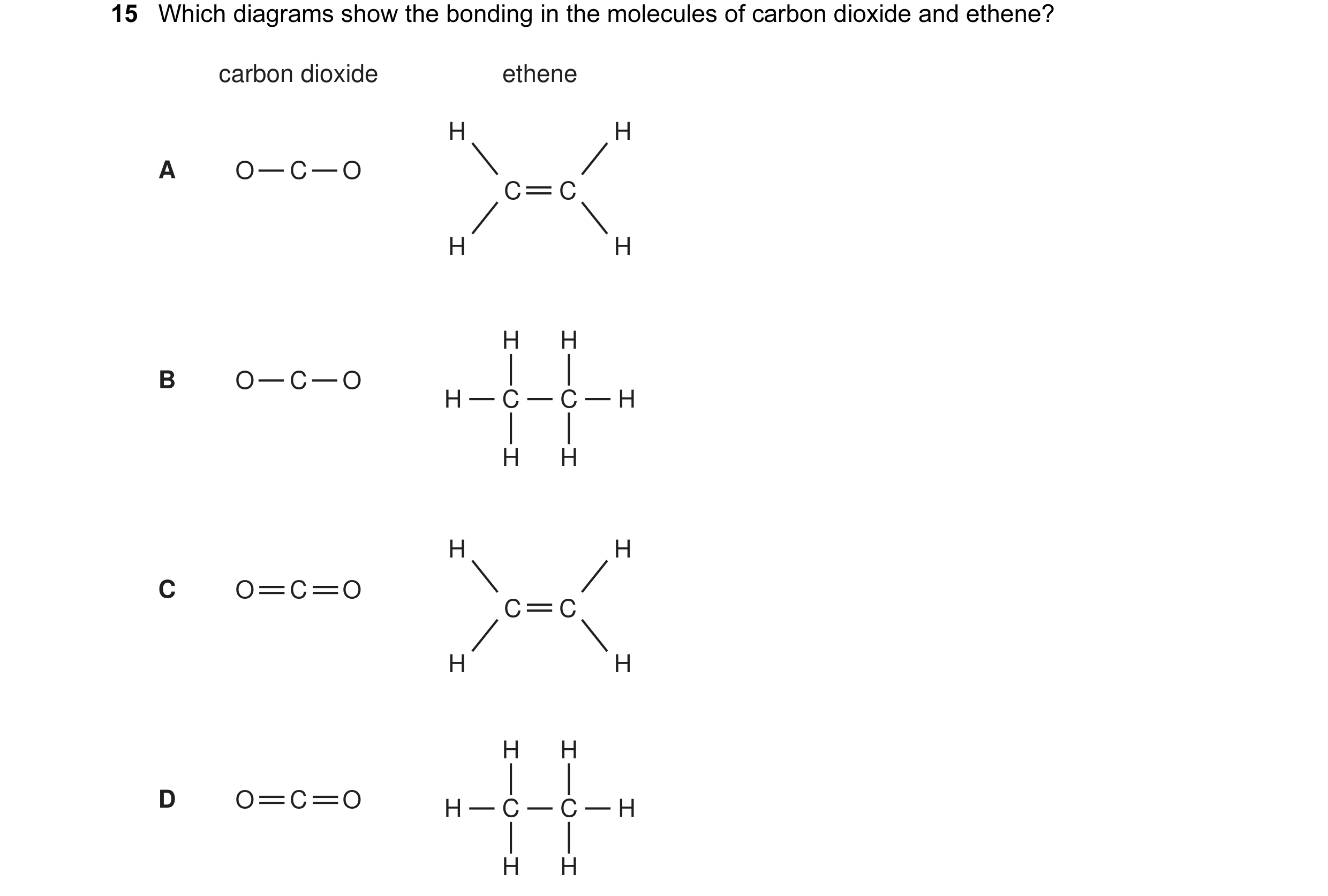
Q1 · Which diagrams show the bonding in the molecules of carbon dioxide and ethene? 0653/11 Oct/Nov 2005
15 Which diagrams show the bonding in the molecules of carbon dioxide and ethene? carbon dioxide ethene H H A O C O C C H H H H B O C O H C C H H H H H C O C O C C H H H H D O C O H C C H H H
1 marks
Answer: C
This question in 0653/11 Oct/Nov 2005
Q2 · Some man-made polymers, for example, poly(ethene), are made from monomers that join… 0653/11 May/June 2006
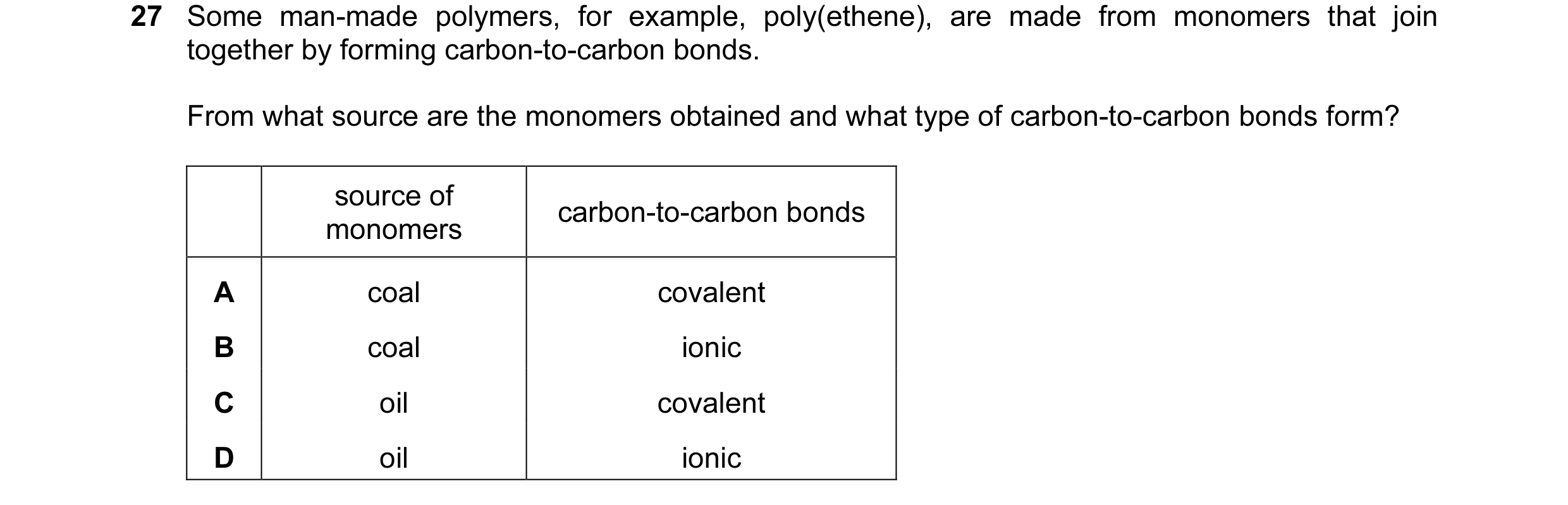
27 Some man-made polymers, for example, poly(ethene), are made from monomers that join together by forming carbon-to-carbon bonds. From what source are the monomers obtained and what type of carbon-to-carbon bonds form? source of carbon-to-carbon bonds monomers A coal covalent B coal ionic C oil covalent D oil ionic
1 marks
Answer: C
This question in 0653/11 May/June 2006
Q3 · Which gases have covalent molecules that contain one or more double bonds? 0653/11 Oct/Nov 2008
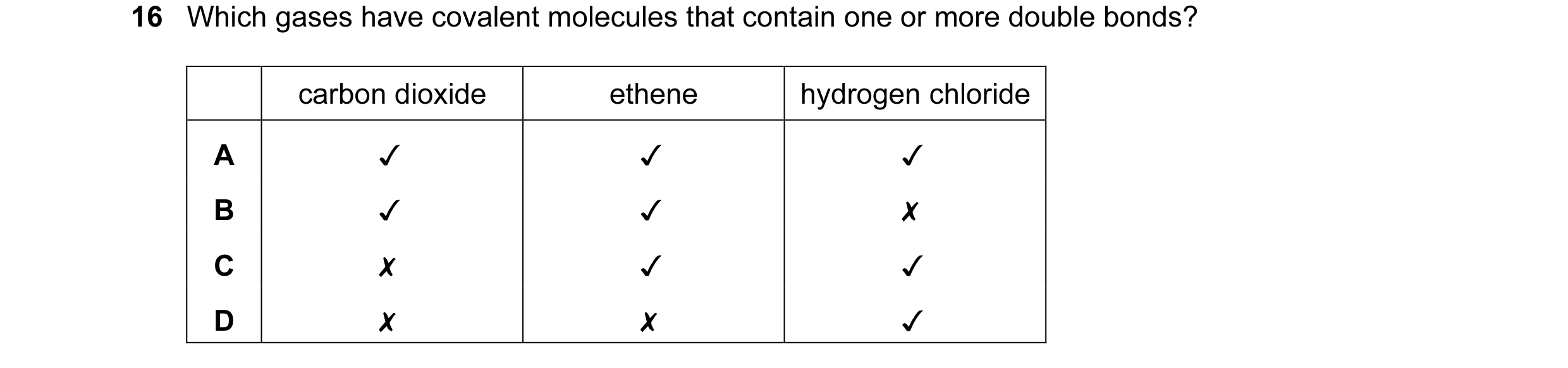
16 Which gases have covalent molecules that contain one or more double bonds?
carbon dioxide ethene hydrogen chloride
A v v v
B v v x
Cc x v v
D x x v
1 marks
Answer: B
This question in 0653/11 Oct/Nov 2008
Q4 · Which equation shows the complete combustion of a hydrocarbon? 0653/11 May/June 2009
25 Which equation shows the complete combustion of a hydrocarbon? A C2H4 + 2O2 → 2CO + 2H2O B C2H4 + 3O2 → 2CO2 + 2H2O C C2H6O + 2O2 → 2CO + 3H2O D C2H6O + 3O2 → 2CO2 + 3H2O
1 marks
Answer: B
This question in 0653/11 May/June 2009
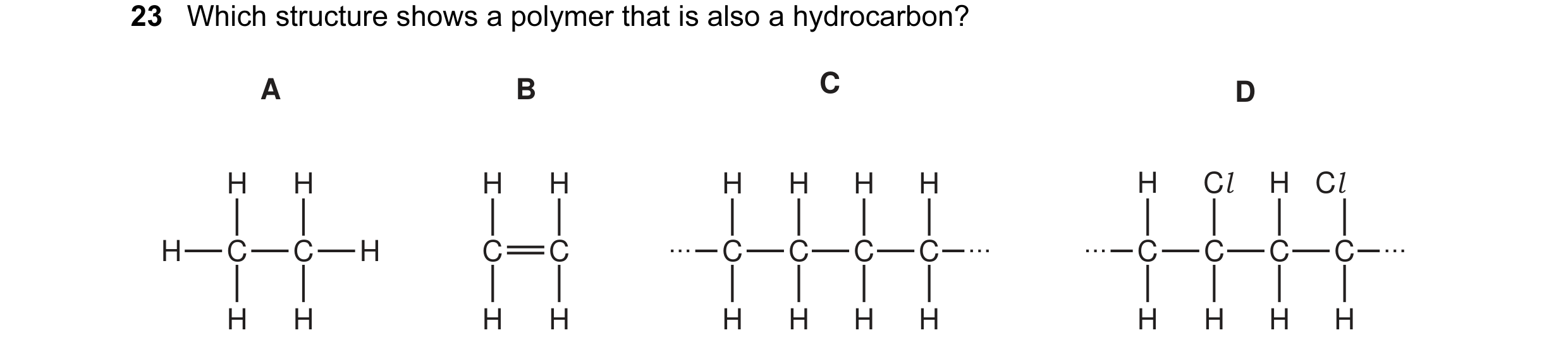
Q5 · Which structure shows a polymer that is also a hydrocarbon? 0653/12 Oct/Nov 2010
23 Which structure shows a polymer that is also a hydrocarbon? A B C D H H H H H H H H H Cl H Cl H C C H C C C C C C C C C C H H H H H H H H H H H H
1 marks
Answer: C
This question in 0653/12 Oct/Nov 2010
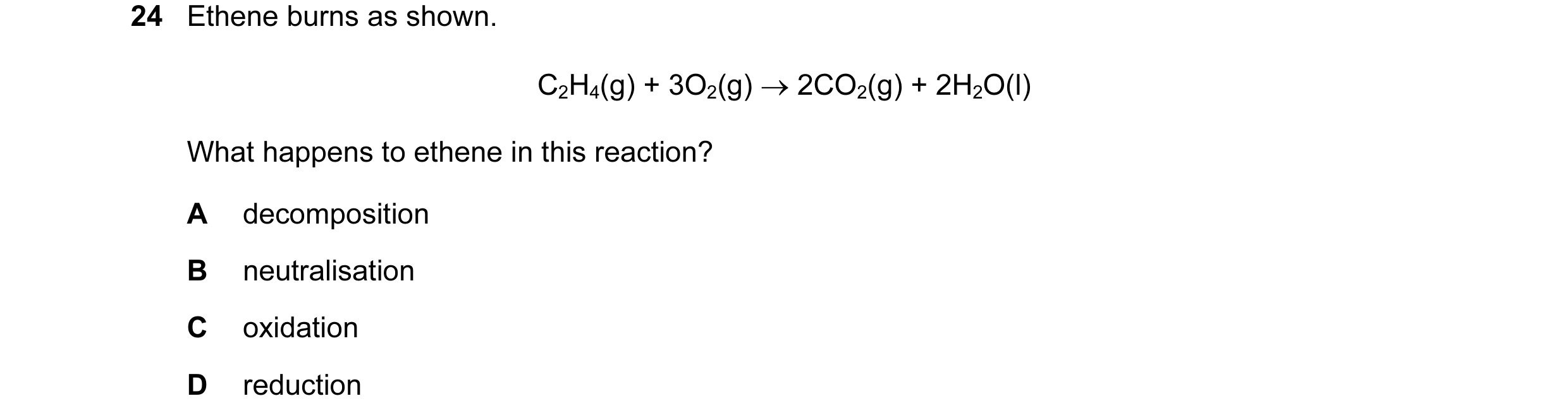
Q6 · Ethene burns as shown 0653/12 Oct/Nov 2011
24 Ethene burns as shown. C2H4(g) + 3O2(g) → 2CO2(g) + 2H2O(l) What happens to ethene in this reaction? A decomposition B neutralisation C oxidation D reduction
1 marks
Answer: C
This question in 0653/12 Oct/Nov 2011
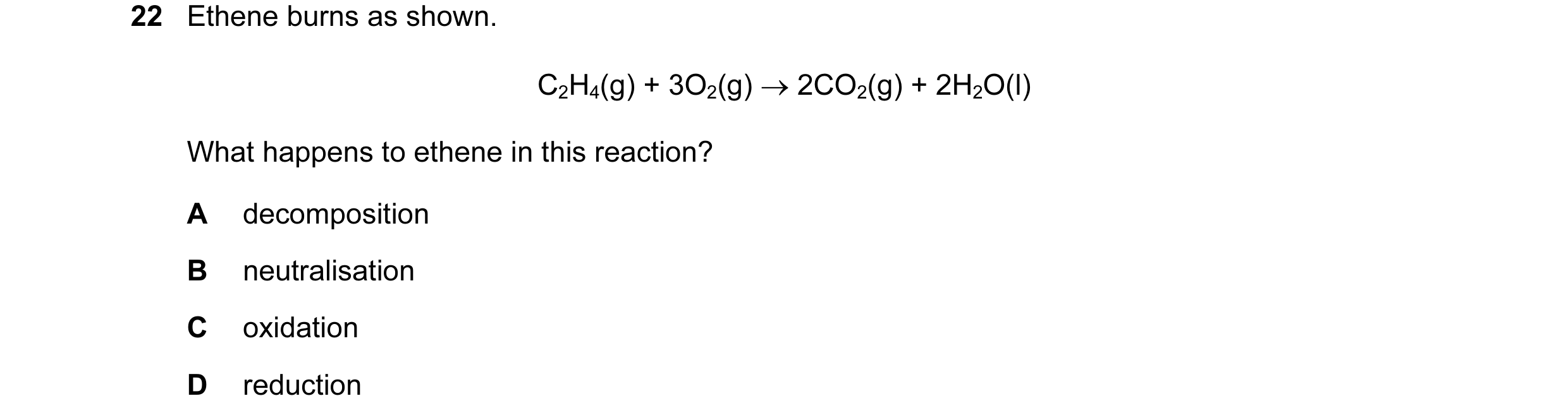
Q7 · Ethene burns as shown 0653/13 Oct/Nov 2011
22 Ethene burns as shown. C2H4(g) + 3O2(g) → 2CO2(g) + 2H2O(l) What happens to ethene in this reaction? A decomposition B neutralisation C oxidation D reduction
1 marks
Answer: C
This question in 0653/13 Oct/Nov 2011
Q8 · Which statement about organic compounds is not correct? 0653/11 May/June 2018
27 Which statement about organic compounds is not correct? A An ethene molecule contains a double bond. B Molecules of ethane and ethanol contain the same number of carbon atoms. C The complete combustion of hydrocarbons produces carbon dioxide and water. D The main constituent of natural gas is ethane.
1 marks
Answer: D
This question in 0653/11 May/June 2018
Q9 · P, Q, R and S are four hydrocarbons 0653/12 Feb/March 2019
27 P, Q, R and S are four hydrocarbons. P is unsaturated. Q contains only single covalent bonds. R undergoes addition polymerisation. S decolourises bromine water. Which row identifies these hydrocarbons? P Q R S A alkane alkene alkane alkane B alkene alkane alkane alkene C alkene alkane alkene alkane D alkene alkane alkene alkene
1 marks
Answer: D
This question in 0653/12 Feb/March 2019
Q10 · Which substances react together? 0653/13 May/June 2019
27 Which substances react together? 1 ethene and methane 2 ethene and bromine 3 ethene and oxygen A 1, 2 and 3 B 1 and 2 only C 1 and 3 only D 2 and 3 only
1 marks
Answer: D
This question in 0653/13 May/June 2019
Q11 · Which statement about hydrocarbons is correct? 0653/12 Feb/March 2021
27 Which statement about hydrocarbons is correct? A Alkanes are produced by cracking alkenes. B Alkanes decolourise bromine water. C Alkenes are saturated hydrocarbons. D Alkenes contain a double bond.
1 marks
Answer: D
This question in 0653/12 Feb/March 2021
Q12 · Which statement about ethene is not correct? 0653/11 May/June 2021
27 Which statement about ethene is not correct? A It is used to make an addition polymer. B It decolourises aqueous bromine. C It is a saturated hydrocarbon. D It is formed by cracking larger alkanes.
1 marks
Answer: C
This question in 0653/11 May/June 2021
Q13 · Which process produces alkenes? 0653/12 May/June 2021
27 Which process produces alkenes? A cracking B fractional distillation C polymerisation D reduction
1 marks
Answer: A
This question in 0653/12 May/June 2021
Q14 · Which substance turns aqueous bromine colourless? 0653/13 May/June 2021
27 Which substance turns aqueous bromine colourless? A an alkane B an alkene C a saturated hydrocarbon D poly(ethene)
1 marks
Answer: B
This question in 0653/13 May/June 2021
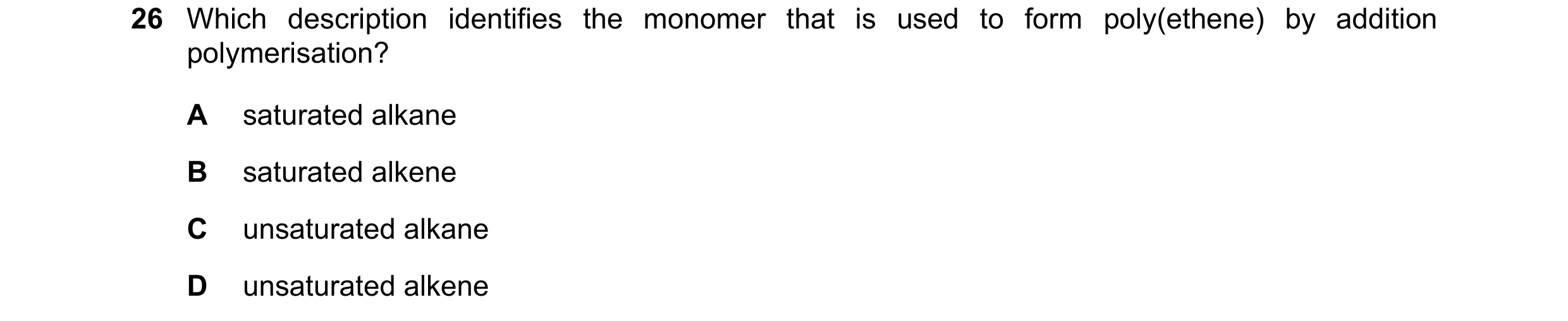
Q15 · Which description identifies the monomer that is used to form poly(ethene) by addition… 0653/12 Feb/March 2022
26 Which description identifies the monomer that is used to form poly(ethene) by addition polymerisation? A saturated alkane B saturated alkene C unsaturated alkane D unsaturated alkene
1 marks
Answer: D
This question in 0653/12 Feb/March 2022
Q16 · What is produced by cracking? 0653/12 Feb/March 2023
27 What is produced by cracking? A alkenes B fractions C naphtha D polymers
1 marks
Answer: A
This question in 0653/12 Feb/March 2023
Q17 · Which process is used to make poly(ethene)? 0653/11 Oct/Nov 2023
27 Which process is used to make poly(ethene)? A addition polymerisation B cracking C fractional distillation D reacting ethane molecules together
1 marks
Answer: A
This question in 0653/11 Oct/Nov 2023
Q18 · Which process is used to produce alkenes? 0653/12 Oct/Nov 2023
27 Which process is used to produce alkenes? A addition polymerisation B combustion C cracking D fractional distillation
1 marks
Answer: C
This question in 0653/12 Oct/Nov 2023
Q19 · Which process is used to produce alkenes? 0653/13 Oct/Nov 2023
27 Which process is used to produce alkenes? A addition polymerisation B combustion C cracking D fractional distillation
1 marks
Answer: C
This question in 0653/13 Oct/Nov 2023
Q20 · Which statement about hydrocarbons is correct? 0653/12 Feb/March 2024
27 Which statement about hydrocarbons is correct? A Alkanes rapidly decolourise bromine water. B Alkanes are unsaturated hydrocarbons. C Alkenes have double covalent bonds. D Alkenes are the main constituent of natural gas.
1 marks
Answer: C
This question in 0653/12 Feb/March 2024
Q21 · Which statement about alkenes is correct? 0653/12 Oct/Nov 2024
27 Which statement about alkenes is correct? A They are manufactured in addition polymerisation reactions. B They react with aqueous bromine to give colourless products. C They are compounds containing carbon, hydrogen and oxygen. D They are cracked to produce other compounds.
1 marks
Answer: B
This question in 0653/12 Oct/Nov 2024
Q22 · Which statement about alkenes is correct? 0653/13 Oct/Nov 2024
27 Which statement about alkenes is correct? A They are manufactured in addition polymerisation reactions. B They react with aqueous bromine to give colourless products. C They are compounds containing carbon, hydrogen and oxygen. D They are cracked to produce other compounds.
1 marks
Answer: B
This question in 0653/13 Oct/Nov 2024
Q23 · Which statement about alkenes is correct? 0653/11 Oct/Nov 2025
26 Which statement about alkenes is correct? A They are less reactive than alkanes. B They are unsaturated compounds. C They are polymers. D They turn aqueous bromine orange-brown.
1 marks
Answer: B
This question in 0653/11 Oct/Nov 2025
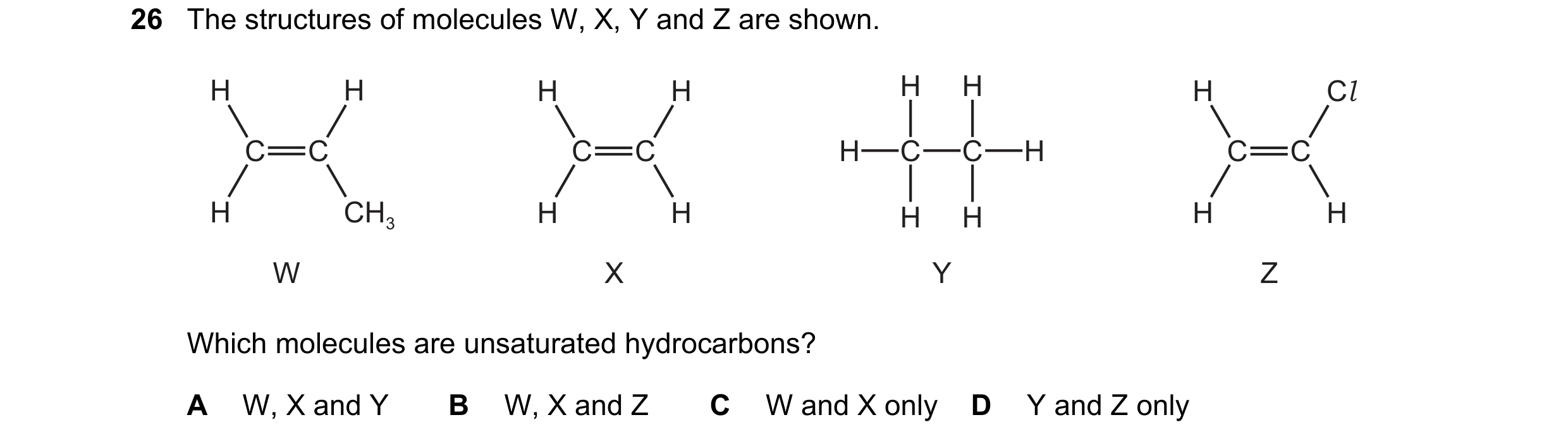
Q24 · The structures of molecules W, X, Y and Z are shown 0653/12 Oct/Nov 2025
26 The structures of molecules W, X, Y and Z are shown. H H H H H H H Cl C C C C H C C H C C H CH3 H H H H H H W X Y Z Which molecules are unsaturated hydrocarbons? A W, X and Y B W, X and Z C W and X only D Y and Z only
1 marks
Answer: C
This question in 0653/12 Oct/Nov 2025
Q25 · The structures of molecules W, X, Y and Z are shown 0653/13 Oct/Nov 2025
26 The structures of molecules W, X, Y and Z are shown. H H H H H H H Cl C C C C H C C H C C H CH3 H H H H H H W X Y Z Which molecules are unsaturated hydrocarbons? A W, X and Y B W, X and Z C W and X only D Y and Z only
1 marks
Answer: C
This question in 0653/13 Oct/Nov 2025
 1 / 6
1 / 6
 2 / 6
2 / 6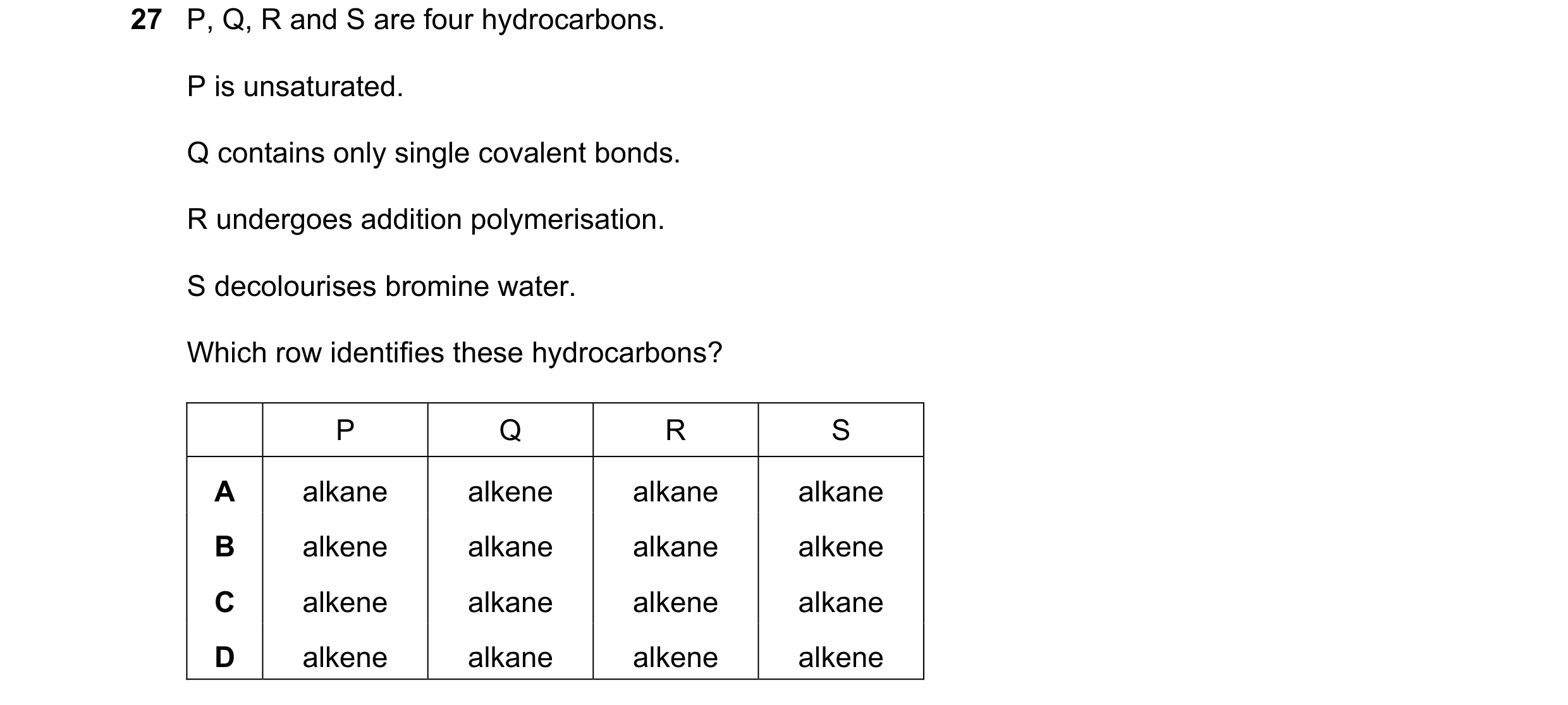



 3 / 6
3 / 6



 4 / 6
4 / 6



 5 / 6
5 / 6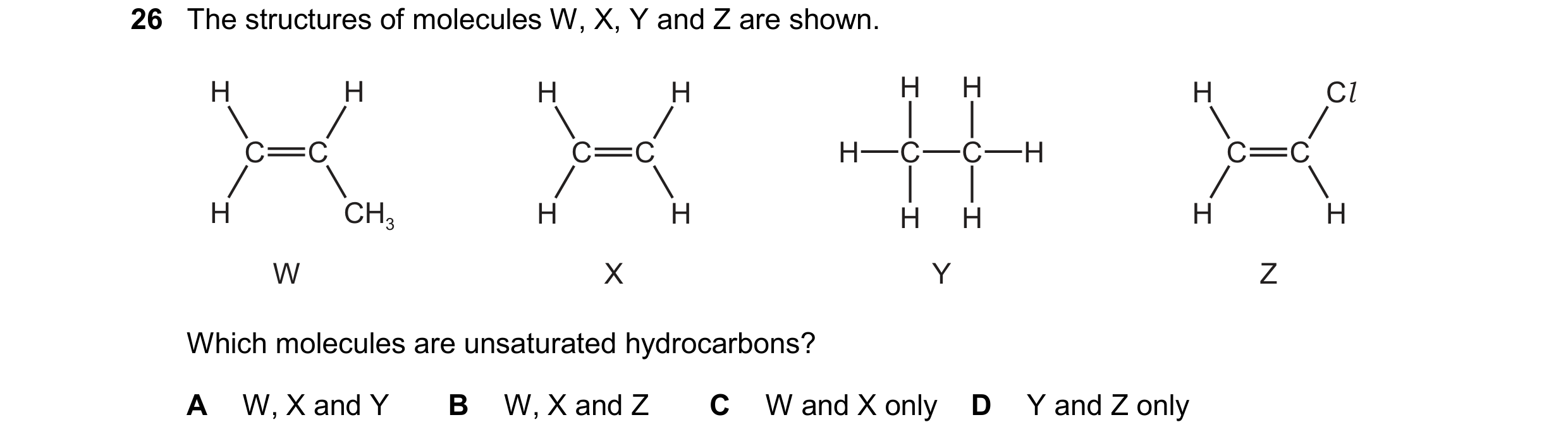 6 / 6
6 / 6