Questions as text
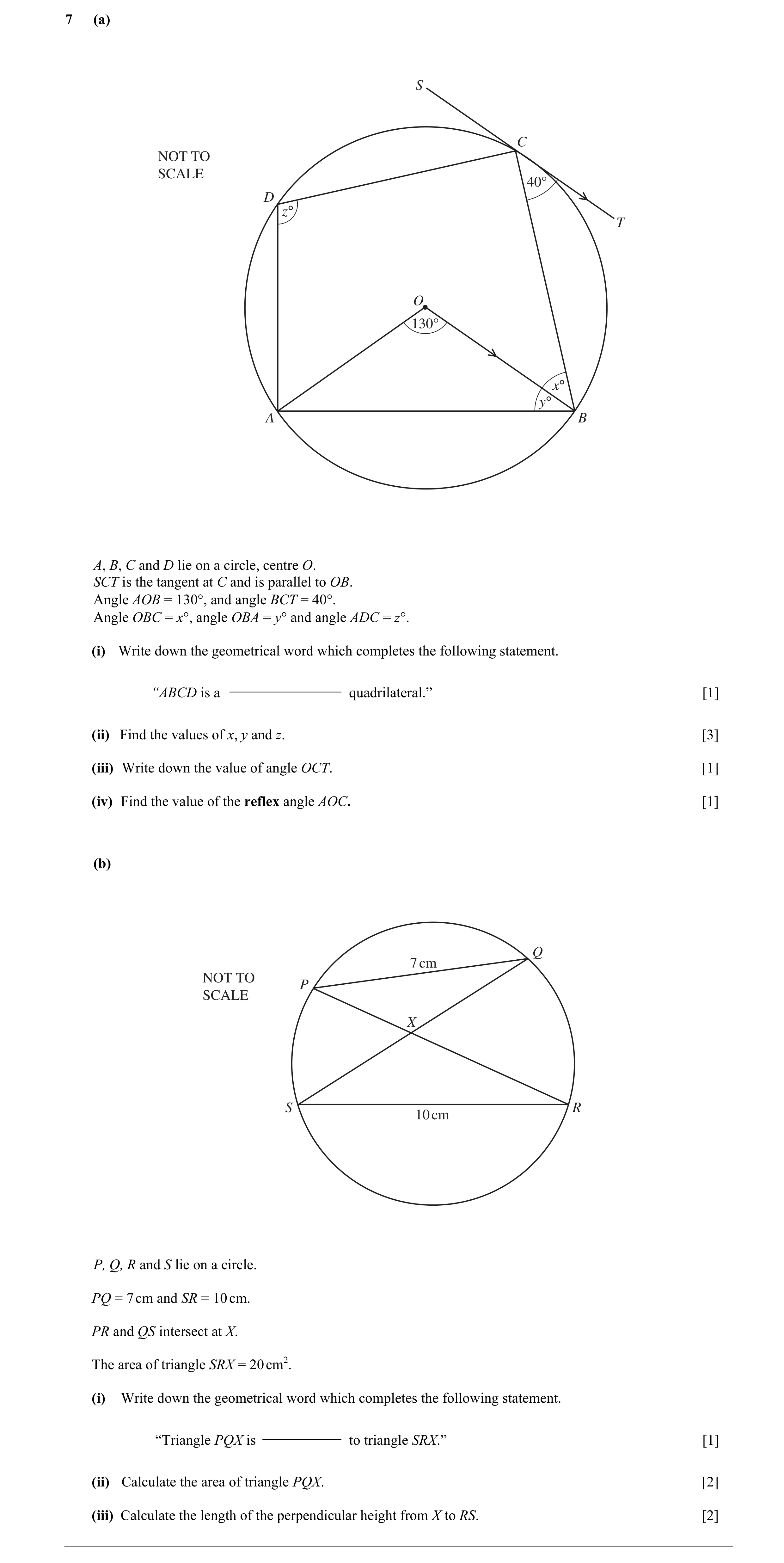
Q1 · S C NOT TO SCALE 40° D z° T O 130° x° y° A B A, B, C and D lie on a circle, centre O 0580/41 May/June 2008
7 (a) S C NOT TO SCALE 40° D z° T O 130° x° y° A B A, B, C and D lie on a circle, centre O. SCT is the tangent at C and is parallel to OB. Angle AOB = 130°, and angle BCT = 40°. Angle OBC = x°, angle OBA = y° and angle ADC = z°. (i) Write down the geometrical word which completes the following statement. “ABCD is a quadrilateral.” [1] (ii) Find the values of x, y and z. [3] (iii) Write down the value of angle OCT. [1] (iv) Find the value of the reflex angle AOC. [1] (b) Q 7 cm NOT TO P SCALE X S R 10 cm P, Q, R and S lie on a circle. PQ = 7 cm and SR = 10 cm. PR and QS intersect at X. The area of triangle SRX = 20 cm2. (i) Write down the geometrical word which completes the following statement. “Triangle PQX is to triangle SRX.” [1] (ii) Calculate the area of triangle PQX. [2] (iii) Calculate the length of the perpendicular height from X to RS. [2]
11 marks
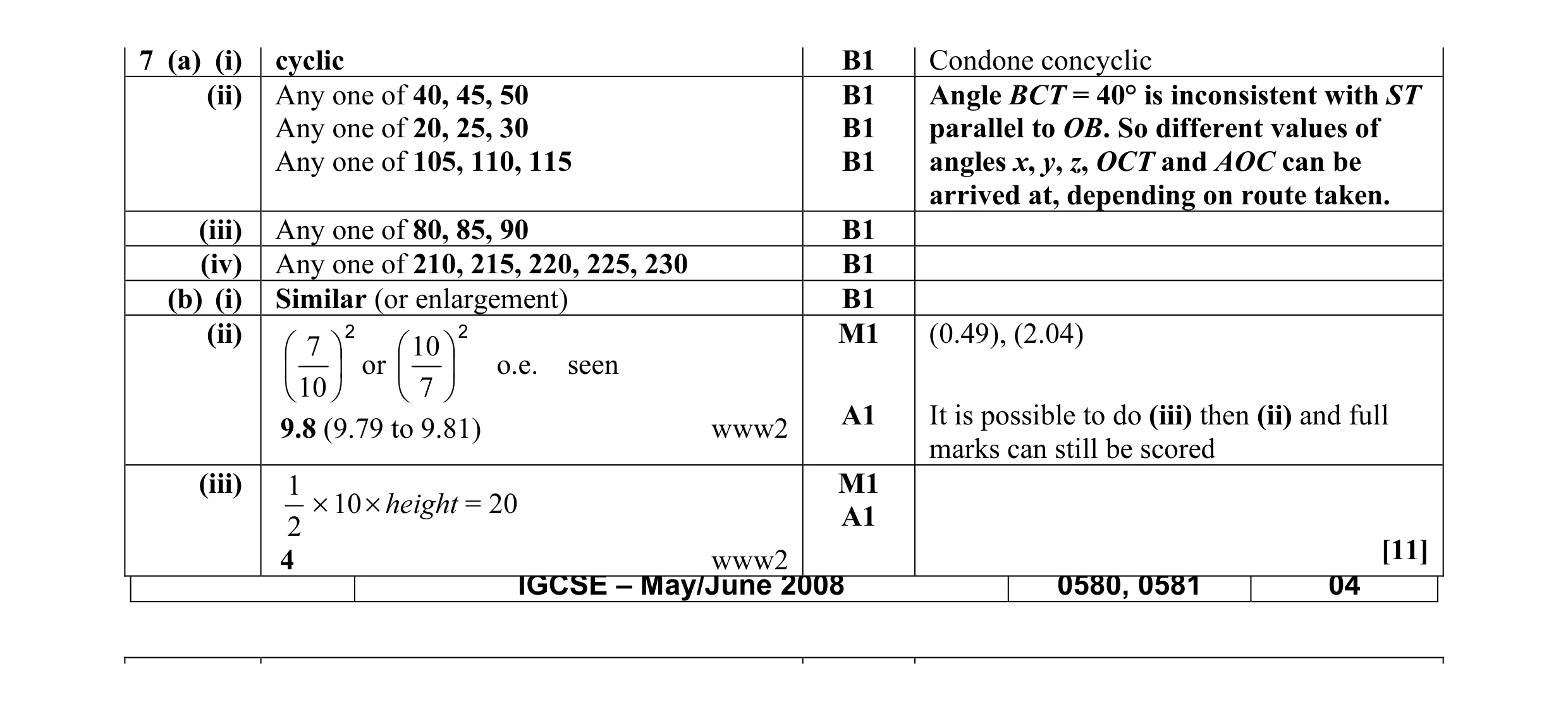
Mark scheme: 7 (a) (i) cyclic B1 Condone concyclic (ii) Any one of 40, 45, 50 B1 Angle BCT = 40° is inconsistent with ST Any one of 20, 25, 30 B1 parallel to OB. So different values of Any one of 105, 110, 115 B1 angles x, y, z, OCT and AOC can be arrived at, depending on route taken. (iii) Any one of 80, 85, 90 B1 (iv) Any one of 210, 215, 220, 225, 230 B1 (b) (i) Similar (or enlargement) B1 (ii) 2 2 M1 (0.49), (2.04) 7 10 or o.e. seen 10 7 A1 It is possible to do (iii) then (ii) and full 9.8 (9.79 to 9.81) www2 marks can still be scored (iii) 1 M1 ×10×height = 20 A1 2 [11] 4 www2 IGCSE – May/June 2008 0580, 0581 04
This question in 0580/41 May/June 2008
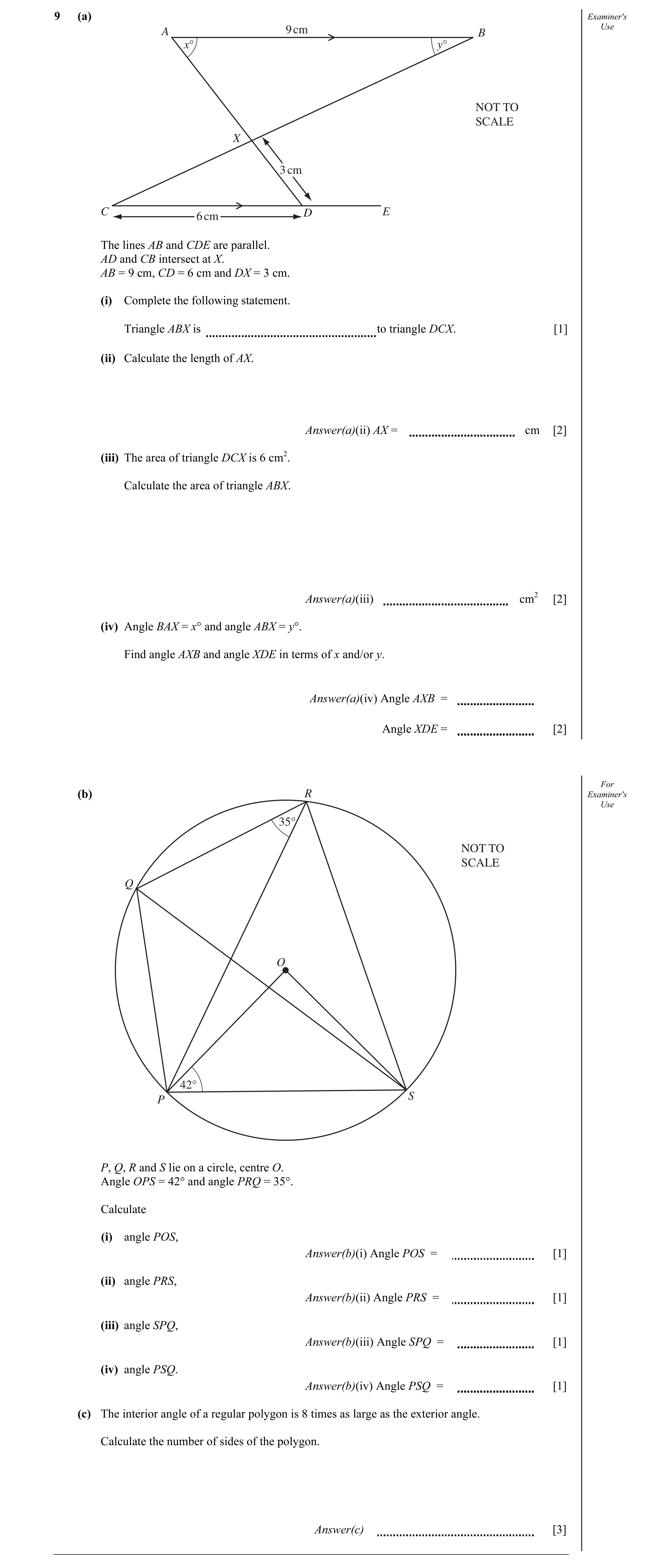
Q2 · Examiner's A 9 cm B Use x° y° NOT TO SCALE X 3 cm C D E 6 cm The lines AB and CDE are… 0580/42 May/June 2010
9 (a) Examiner's A 9 cm B Use x° y° NOT TO SCALE X 3 cm C D E 6 cm The lines AB and CDE are parallel. AD and CB intersect at X. AB = 9 cm, CD = 6 cm and DX = 3 cm. (i) Complete the following statement. Triangle ABX is to triangle DCX. [1] (ii) Calculate the length of AX. Answer(a)(ii) AX = cm [2] (iii) The area of triangle DCX is 6 cm2. Calculate the area of triangle ABX. Answer(a)(iii) cm2 [2] (iv) Angle BAX = x° and angle ABX = y°. Find angle AXB and angle XDE in terms of x and/or y. Answer(a)(iv) Angle AXB = Angle XDE = [2] For (b) R Examiner's Use 35° NOT TO SCALE Q O 42° S P P, Q, R and S lie on a circle, centre O. Angle OPS = 42° and angle PRQ = 35°. Calculate (i) angle POS, Answer(b)(i) Angle POS = [1] (ii) angle PRS, Answer(b)(ii) Angle PRS = [1] (iii) angle SPQ, Answer(b)(iii) Angle SPQ = [1] (iv) angle PSQ. Answer(b)(iv) Angle PSQ = [1] (c) The interior angle of a regular polygon is 8 times as large as the exterior angle. Calculate the number of sides of the polygon. Answer(c) [3]
14 marks
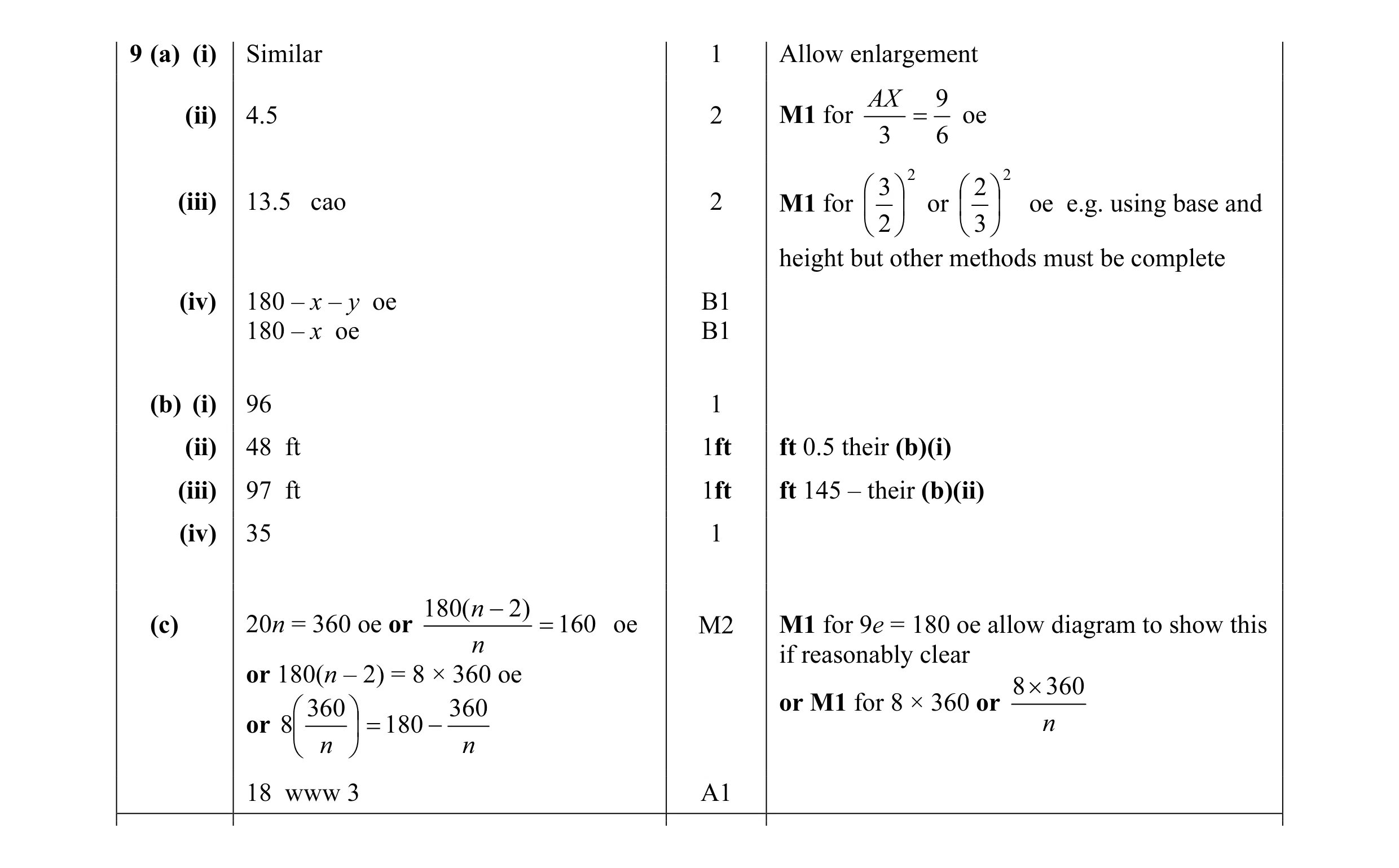
Mark scheme: 9 (a) (i) Similar 1 Allow enlargement AX 9 (ii) 4.5 2 M1 for = oe 3 6 2 2 3 2 (iii) 13.5 cao 2 M1 for or oe e.g. using base and 2 3 height but other methods must be complete (iv) 180 – x – y oe B1 180 – x oe B1 (b) (i) 96 1 (ii) 48 ft 1ft ft 0.5 their (b)(i) (iii) 97 ft 1ft ft 145 – their (b)(ii) (iv) 35 1 180( n − 2) (c) 20n = 360 oe or = 160 oe M2 M1 for 9e = 180 oe allow diagram to show this n if reasonably clear or 180(n – 2) = 8 × 360 oe 8× 360 360 360 or M1 for 8 × 360 or or 8 = 180 − n n n 18 www 3 A1
This question in 0580/42 May/June 2010
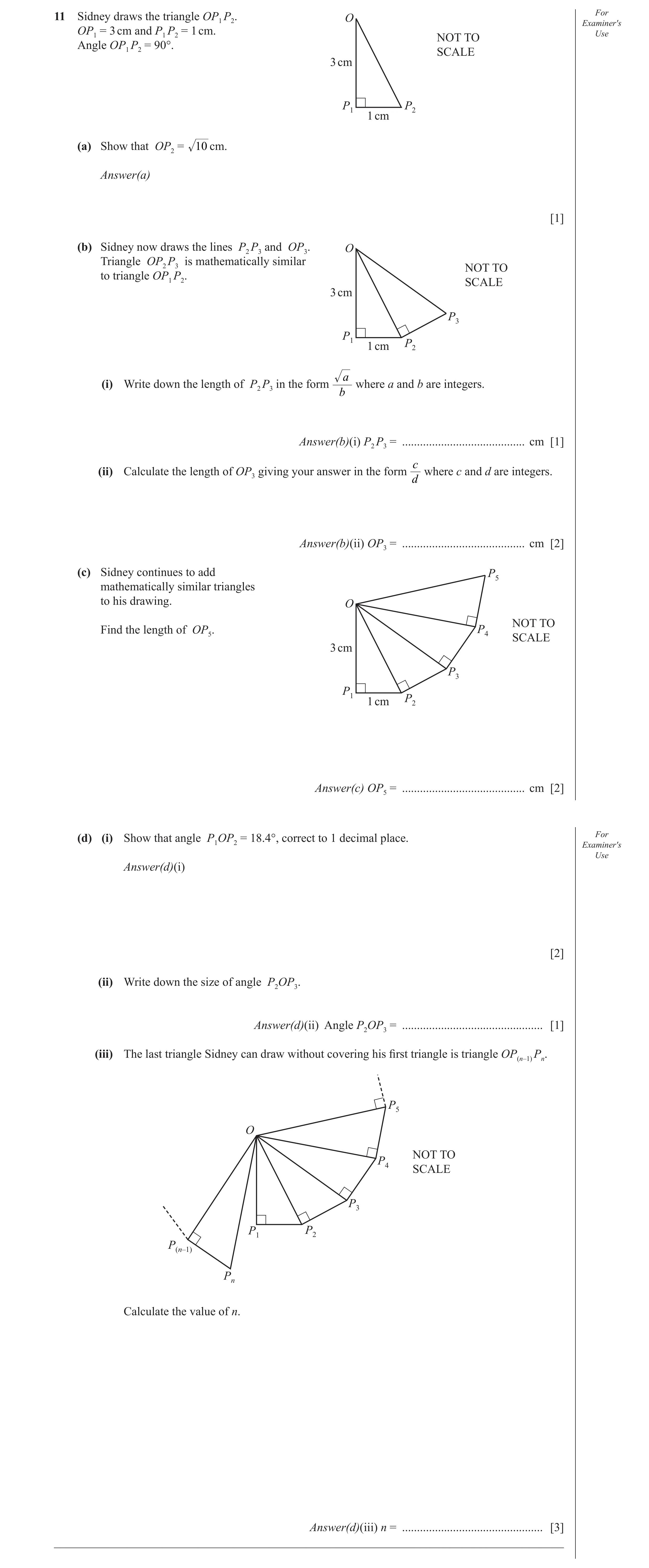
Q3 · Sidney draws the triangle OP1 P2 0580/42 May/June 2013
11 Sidney draws the triangle OP1 P2. O For Examiner′s OP1 = 3 cm and P1 P2 = 1 cm. Use NOT TO Angle OP1 P2 = 90°. SCALE 3 cm P1 P2 1 cm (a) Show that OP2 = 10 cm. Answer(a) [1] (b) Sidney now draws the lines P2 P3 and OP3. O Triangle OP2 P3 is mathematically similar NOT TO to triangle OP1 P2. SCALE 3 cm P3 P1 1 cm P2 a (i) Write down the length of P2 P3 in the form where a and b are integers. b Answer(b)(i) P2 P3 = … cm [1] c (ii) Calculate the length of OP3 giving your answer in the form where c and d are integers. d Answer(b)(ii) OP3 = … cm [2] (c) Sidney continues to add P5 mathematically similar triangles to his drawing. O NOT TO Find the length of OP5. P4 SCALE 3 cm P3 P1 1 cm P2 Answer(c) OP5 = … cm [2] (d) (i) Show that angle P1OP2 = 18.4°, correct to 1 decimal place. For Examiner′s Use Answer(d)(i) [2] (ii) Write down the size of angle P2OP3. Answer(d)(ii) Angle P2OP3 = … [1] (iii) The last triangle Sidney can draw without covering his fi rst triangle is triangle OP(n–1) Pn. P5 O NOT TO P4 SCALE P3 P1 P2 P(n–1) Pn Calculate the value of n. Answer(d)(iii) n = … [3] _____________________________________________________________________________________
12 marks
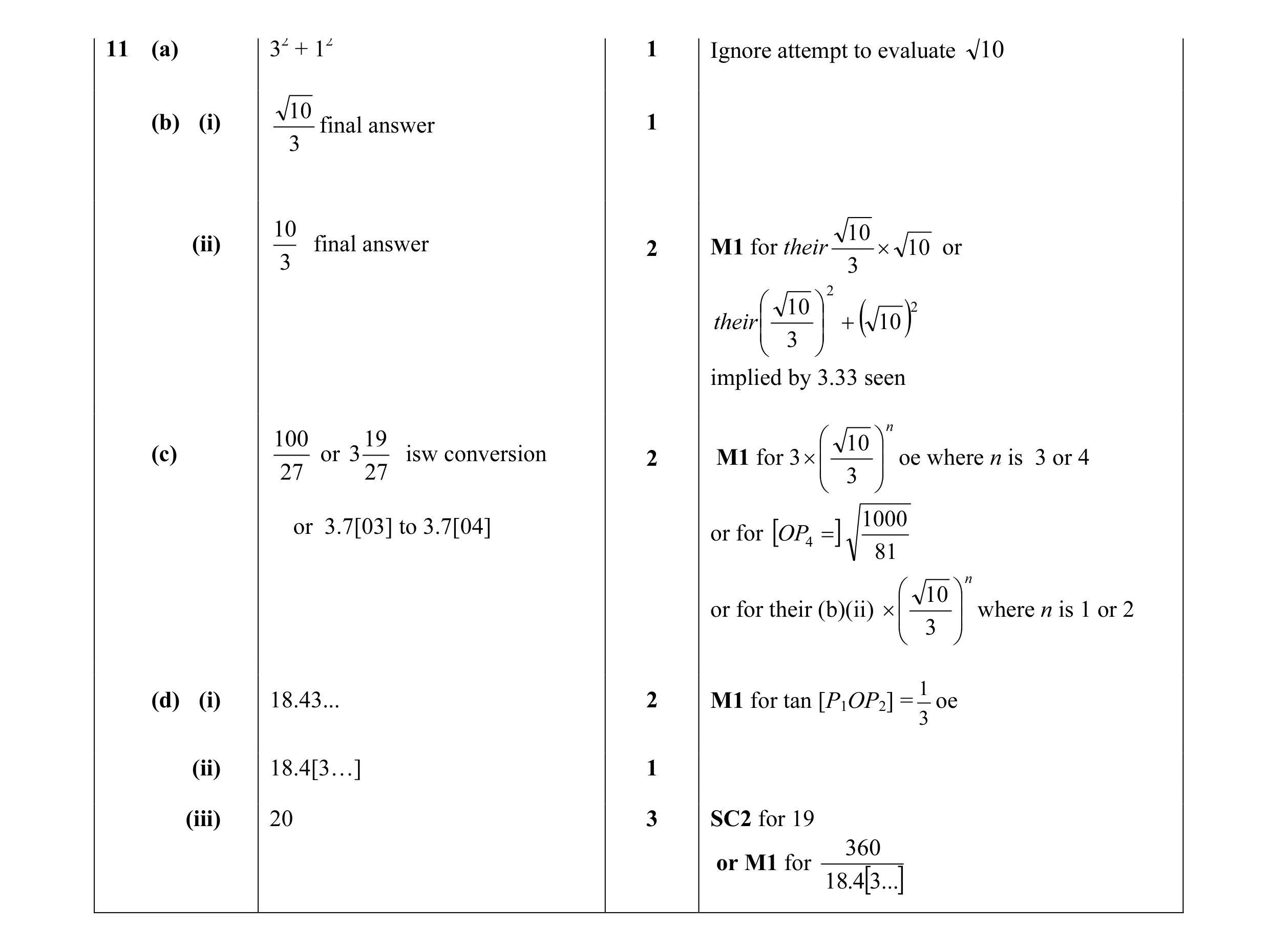
Mark scheme: 11 (a) 32 + 12 1 Ignore attempt to evaluate 10 10 (b) (i) final answer 1 3 10 10 (ii) final answer 2 M1 for their × 10 or 3 3 2 10 2 their 3 + ( 10 ) implied by 3.33 seen n 100 19 10 or 3 (c) oe where n is 3 or 4 27 27 isw conversion 2 M1 for 3 × 3 1000 or 3.7[03] to 3.7[04] or for [OP4 = ] 81 n 10 where n is 1 or 2 or for their (b)(ii) × 3 1 (d) (i) 18.43... 2 M1 for tan [P1OP2] = oe 3 (ii) 18.4[3…] 1 (iii) 20 3 SC2 for 19 360 or M1 for 184.[3...]
This question in 0580/42 May/June 2013
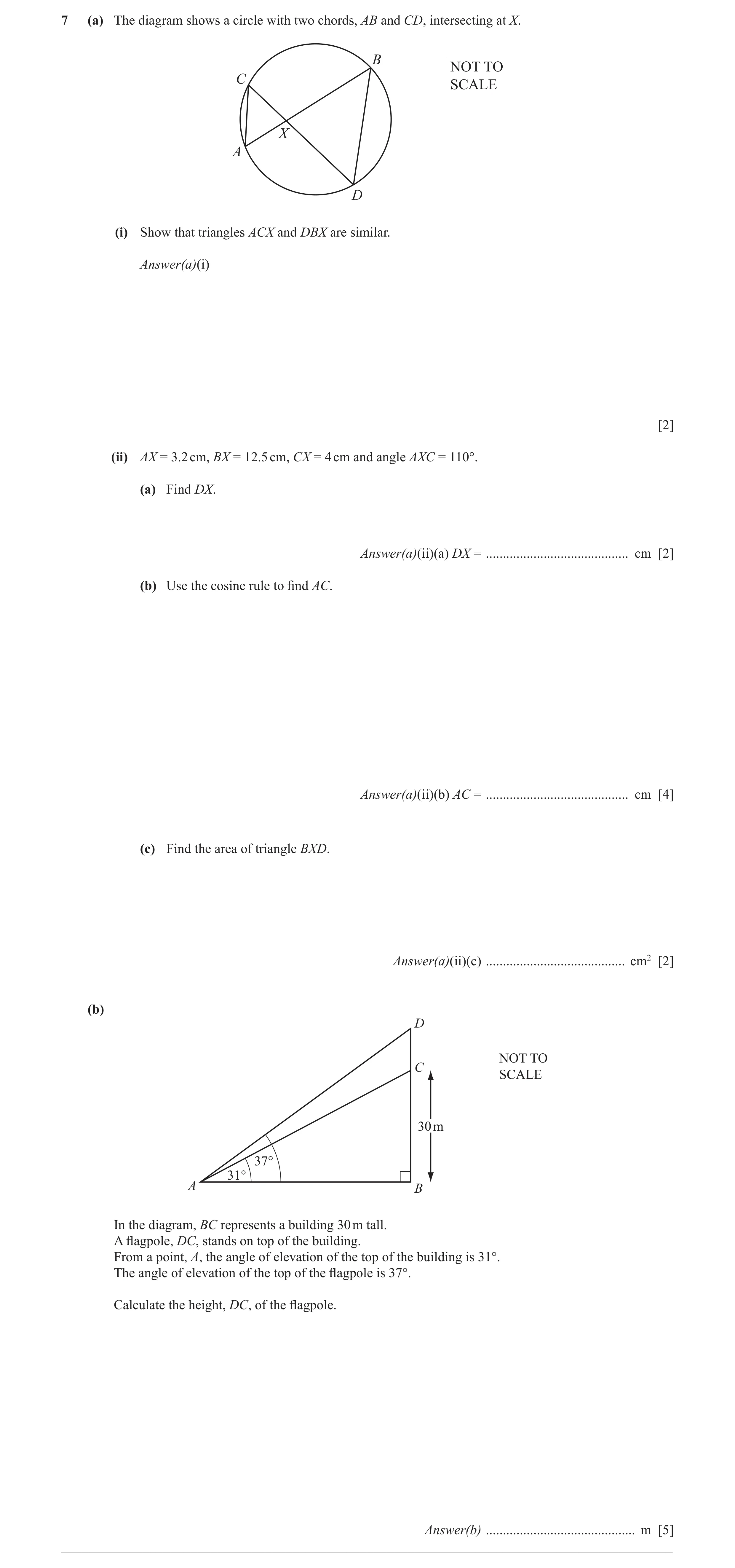
Q4 · The diagram shows a circle with two chords, AB and CD, intersecting at X 0580/41 Oct/Nov 2014
7 (a) The diagram shows a circle with two chords, AB and CD, intersecting at X. B NOT TO C SCALE X A D (i) Show that triangles ACX and DBX are similar. Answer(a)(i) [2] (ii) AX = 3.2 cm, BX = 12.5 cm, CX = 4 cm and angle AXC = 110°. (a) Find DX. Answer(a)(ii)(a) DX = … cm [2] (b) Use the cosine rule to fi nd AC. Answer(a)(ii)(b) AC = … cm [4] (c) Find the area of triangle BXD. Answer(a)(ii)(c) … cm2 [2] (b) D NOT TO C SCALE 30 m 37° 31° A B In the diagram, BC represents a building 30 m tall. A fl agpole, DC, stands on top of the building. From a point, A, the angle of elevation of the top of the building is 31°. The angle of elevation of the top of the fl agpole is 37°. Calculate the height, DC, of the fl agpole. Answer(b) … m [5] __________________________________________________________________________________________
15 marks
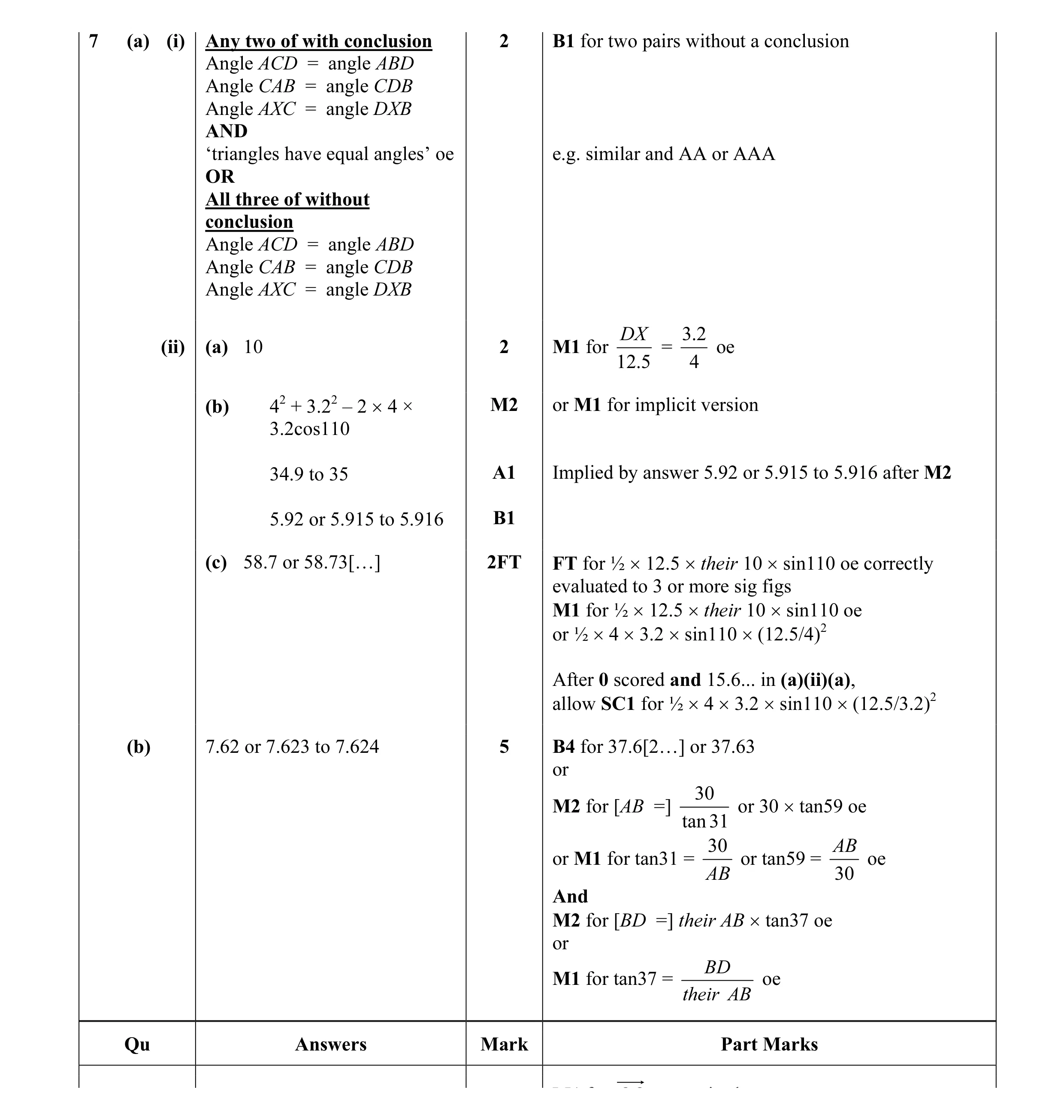
Mark scheme: 7 (a) (i) Any two of with conclusion 2 B1 for two pairs without a conclusion Angle ACD = angle ABD Angle CAB = angle CDB Angle AXC = angle DXB AND ‘triangles have equal angles’ oe e.g. similar and AA or AAA OR All three of without conclusion Angle ACD = angle ABD Angle CAB = angle CDB Angle AXC = angle DXB DX 2.3 (ii) (a) 10 2 M1 for = oe 125. 4 (b) 42 + 3.22 – 2 × 4 × M2 or M1 for implicit version 3.2cos110 34.9 to 35 A1 Implied by answer 5.92 or 5.915 to 5.916 after M2 5.92 or 5.915 to 5.916 B1 (c) 58.7 or 58.73[…] 2FT FT for ½ × 12.5 × their 10 × sin110 oe correctly evaluated to 3 or more sig figs M1 for ½ × 12.5 × their 10 × sin110 oe or ½ × 4 × 3.2 × sin110 × (12.5/4)2 After 0 scored and 15.6... in (a)(ii)(a), allow SC1 for ½ × 4 × 3.2 × sin110 × (12.5/3.2)2 (b) 7.62 or 7.623 to 7.624 5 B4 for 37.6[2…] or 37.63 or 30 M2 for [AB =] or 30 × tan59 oe tan 31 30 AB or M1 for tan31 = or tan59 = oe AB 30 And M2 for [BD =] their AB × tan37 oe or BD M1 for tan37 = oe their AB Qu Answers Mark Part Marks 1 f OQ i d
This question in 0580/41 Oct/Nov 2014
Q5 · E D 120° 140° NOT TO SCALE F C A B In the hexagon ABCDEF, AB is parallel to ED and AF is… 0580/43 May/June 2015
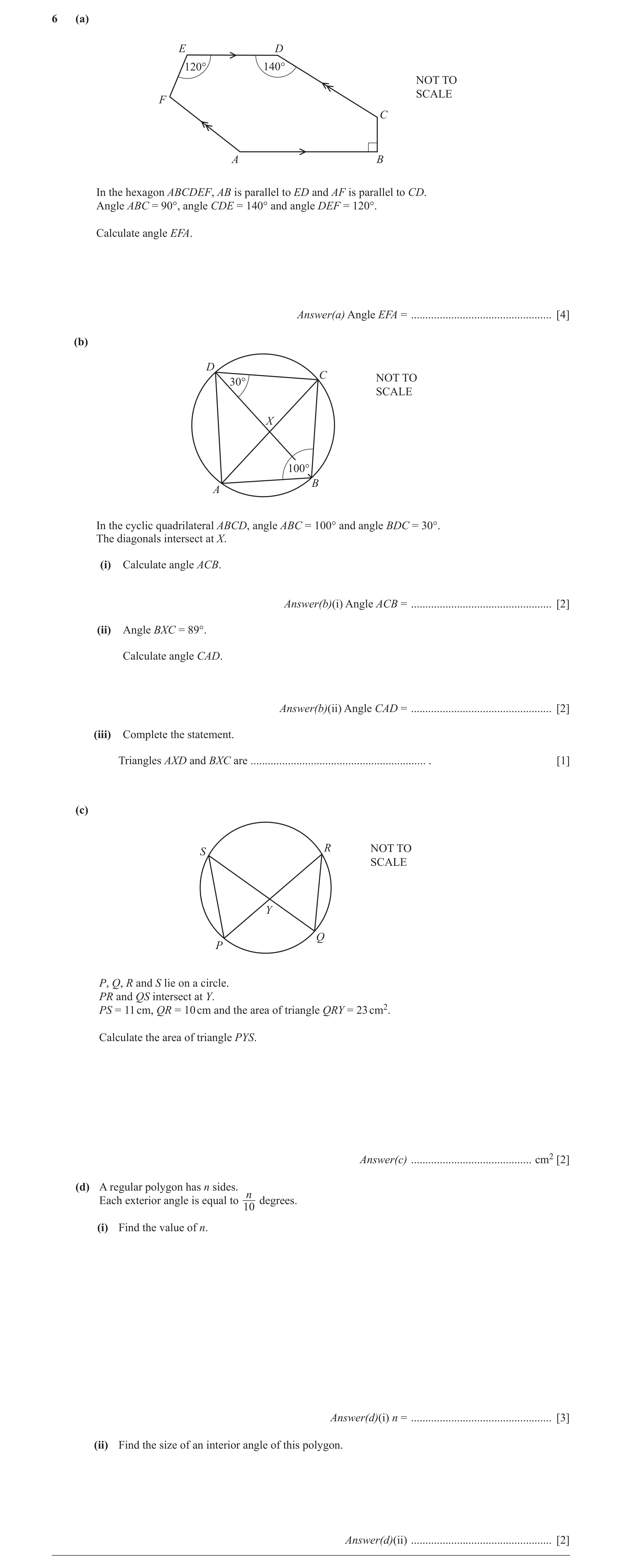
6 (a) E D 120° 140° NOT TO SCALE F C A B In the hexagon ABCDEF, AB is parallel to ED and AF is parallel to CD. Angle ABC = 90°, angle CDE = 140° and angle DEF = 120°. Calculate angle EFA. Answer(a) Angle EFA = … [4] (b) D C NOT TO 30° SCALE X 100° B A In the cyclic quadrilateral ABCD, angle ABC = 100° and angle BDC = 30°. The diagonals intersect at X. (i) Calculate angle ACB. Answer(b)(i) Angle ACB = … [2] (ii) Angle BXC = 89°. Calculate angle CAD. Answer(b)(ii) Angle CAD = … [2] (iii) Complete the statement. Triangles AXD and BXC are … . [1] (c) R NOT TO S SCALE Y Q P P, Q, R and S lie on a circle. PR and QS intersect at Y. PS = 11 cm, QR = 10 cm and the area of triangle QRY = 23 cm2. Calculate the area of triangle PYS. Answer(c) … cm2 [2] (d) A regular polygon has n sides. n Each exterior angle is equal to 10 degrees. (i) Find the value of n. Answer(d)(i) n = … [3] (ii) Find the size of an interior angle of this polygon. Answer(d)(ii) … [2]
16 marks
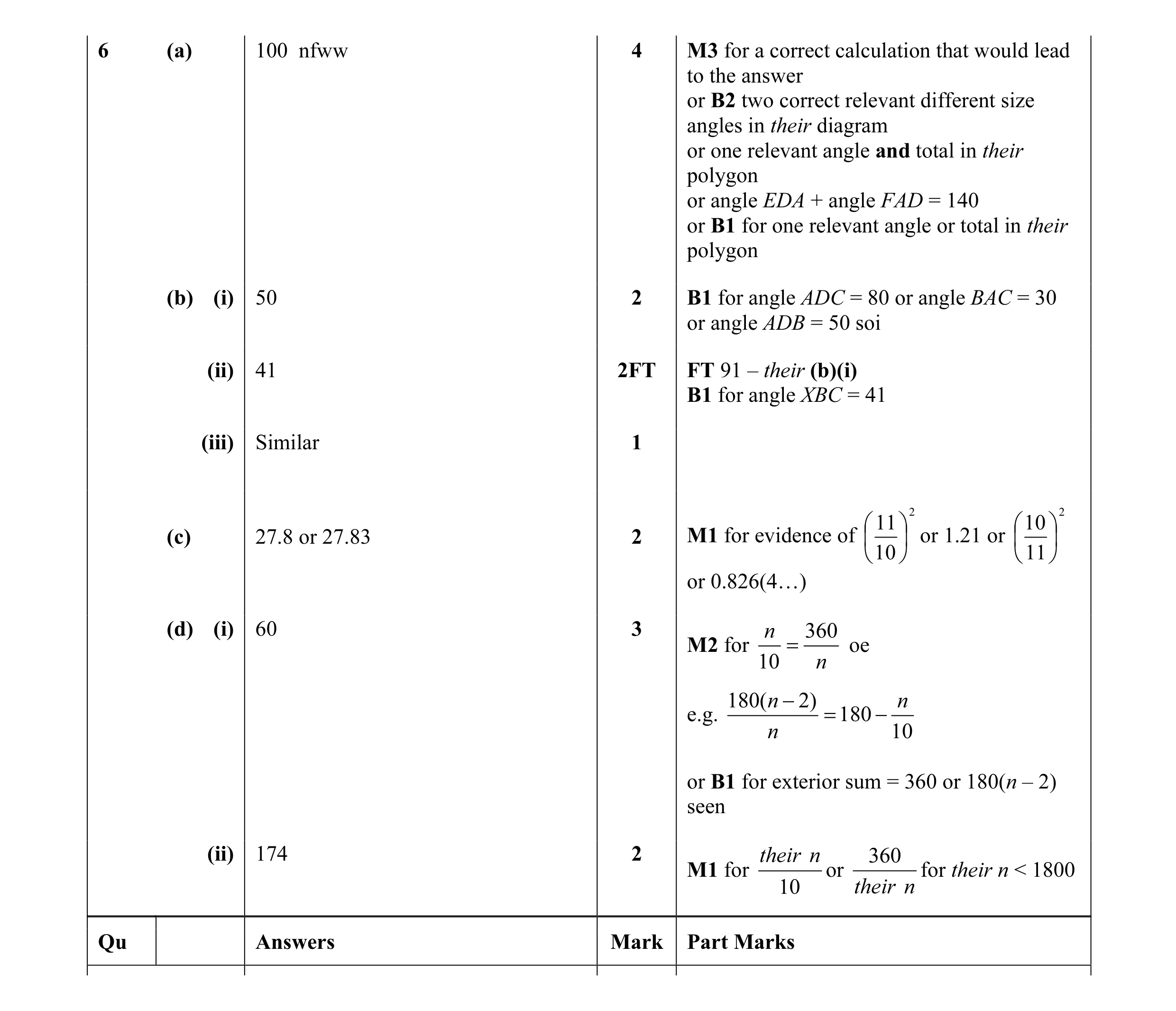
Mark scheme: 6 (a) 100 nfww 4 M3 for a correct calculation that would lead to the answer or B2 two correct relevant different size angles in their diagram or one relevant angle and total in their polygon or angle EDA + angle FAD = 140 or B1 for one relevant angle or total in their polygon (b) (i) 50 2 B1 for angle ADC = 80 or angle BAC = 30 or angle ADB = 50 soi (ii) 41 2FT FT 91 – their (b)(i) B1 for angle XBC = 41 (iii) Similar 1 2 10 2 (c) 27.8 or 27.83 2 M1 for evidence of 11 or 1.21 or 10 11 or 0.826(4…) (d) (i) 60 3 n 360 M2 for = oe 10 n 180( n − 2) n e.g. = 180 − n 10 or B1 for exterior sum = 360 or 180(n – 2) seen (ii) 174 2 their n 360 M1 for or for their n < 1800 10 their n Qu Answers Mark Part Marks
This question in 0580/43 May/June 2015
Q6 · C NOT TO SCALE D A B In the diagram, D is on AC so that angle ADB = angle ABC 0580/43 Oct/Nov 2015
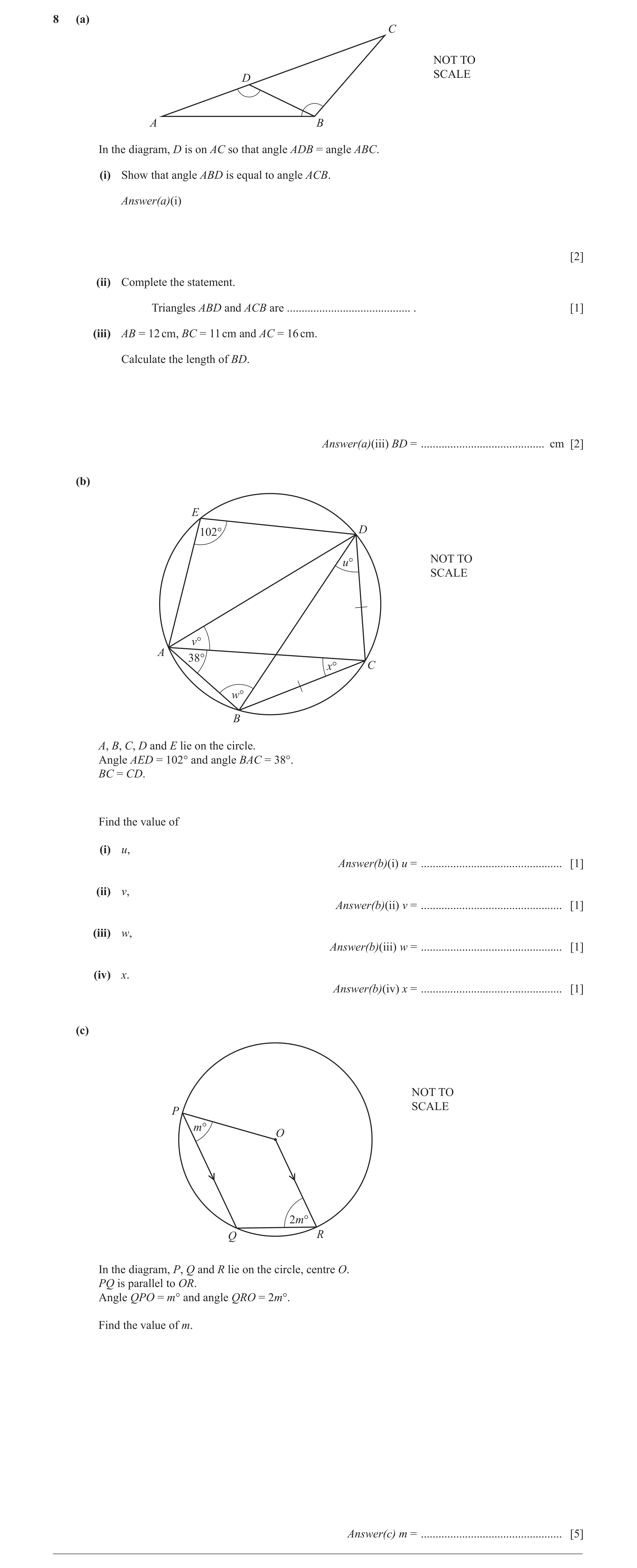
8 (a) C NOT TO SCALE D A B In the diagram, D is on AC so that angle ADB = angle ABC. (i) Show that angle ABD is equal to angle ACB. Answer(a)(i) [2] (ii) Complete the statement. Triangles ABD and ACB are … . [1] (iii) AB = 12 cm, BC = 11 cm and AC = 16 cm. Calculate the length of BD. Answer(a)(iii) BD = … cm [2] (b) E 102° D NOT TO u° SCALE v° A 38° x° C w° B A, B, C, D and E lie on the circle. Angle AED = 102° and angle BAC = 38°. BC = CD. Find the value of (i) u, Answer(b)(i) u = … [1] (ii) v, Answer(b)(ii) v = … [1] (iii) w, Answer(b)(iii) w = … [1] (iv) x. Answer(b)(iv) x = … [1] (c) NOT TO SCALE P m° O 2m° Q R In the diagram, P, Q and R lie on the circle, centre O. PQ is parallel to OR. Angle QPO = m° and angle QRO = 2m°. Find the value of m. Answer(c) m = … [5] __________________________________________________________________________________________
14 marks
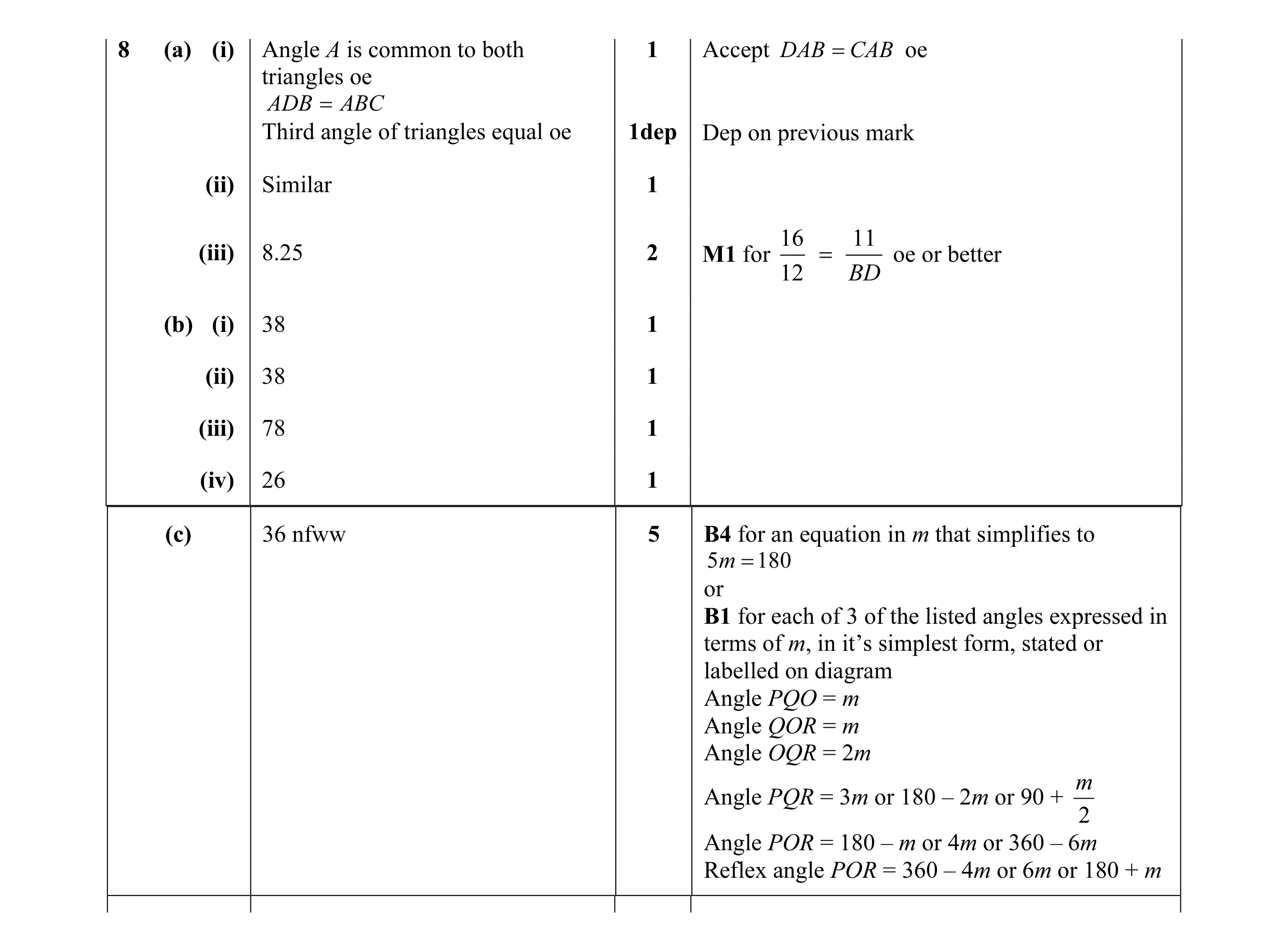
Mark scheme: 8 (a) (i) Angle A is common to both 1 Accept DAB = CAB oe triangles oe ADB = ABC Third angle of triangles equal oe 1dep Dep on previous mark (ii) Similar 1 16 11 (iii) 8.25 2 M1 for = oe or better 12 BD (b) (i) 38 1 (ii) 38 1 (iii) 78 1 (iv) 26 1 (c) 36 nfww 5 B4 for an equation in m that simplifies to 5 m = 180 or B1 for each of 3 of the listed angles expressed in terms of m, in it’s simplest form, stated or labelled on diagram Angle PQO = m Angle QOR = m Angle OQR = 2m m Angle PQR = 3m or 180 – 2m or 90 + 2 Angle POR = 180 – m or 4m or 360 – 6m Reflex angle POR = 360 – 4m or 6m or 180 + m
This question in 0580/43 Oct/Nov 2015
Q7 · In this question use a ruler and compasses only 0580/42 Feb/March 2016
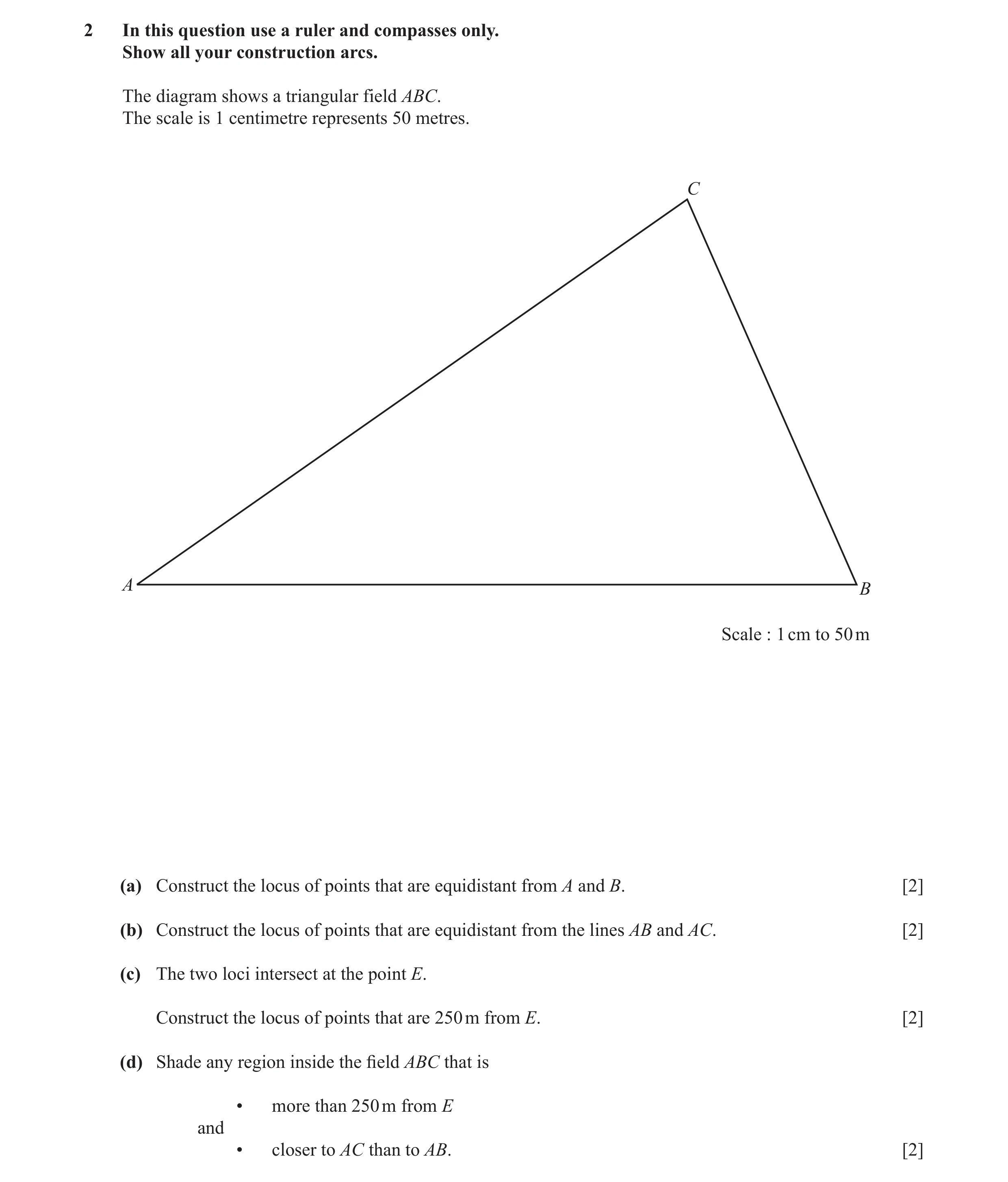
2 In this question use a ruler and compasses only. Show all your construction arcs. The diagram shows a triangular field ABC. The scale is 1 centimetre represents 50 metres. C A B Scale : 1 cm to 50 m (a) Construct the locus of points that are equidistant from A and B. [2] (b) Construct the locus of points that are equidistant from the lines AB and AC. [2] (c) The two loci intersect at the point E. Construct the locus of points that are 250 m from E. [2] (d) Shade any region inside the field ABC that is • more than 250 m from E and • closer to AC than to AB. [2]
8 marks
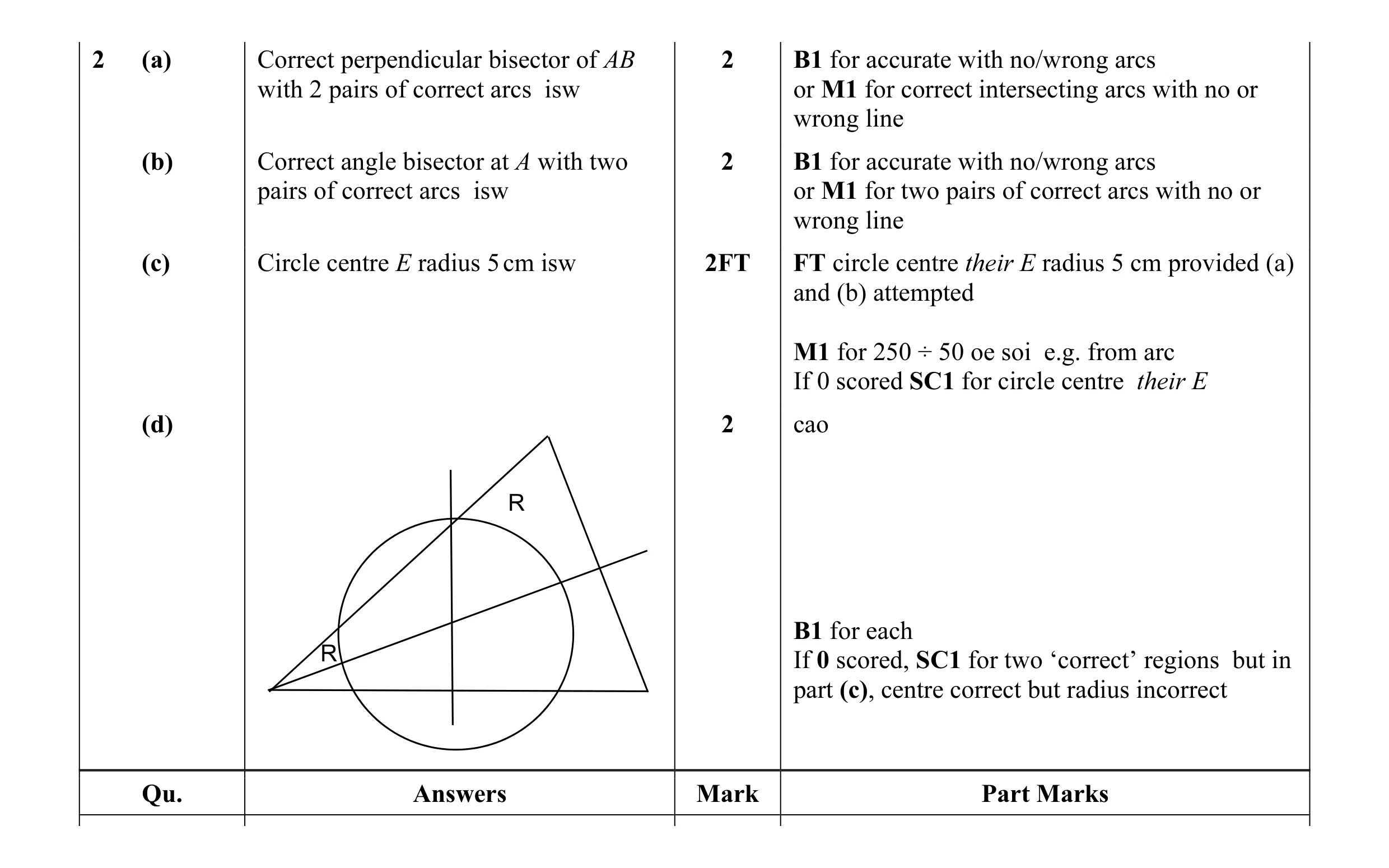
Mark scheme: 2 (a) Correct perpendicular bisector of AB 2 B1 for accurate with no/wrong arcs with 2 pairs of correct arcs isw or M1 for correct intersecting arcs with no or wrong line (b) Correct angle bisector at A with two 2 B1 for accurate with no/wrong arcs pairs of correct arcs isw or M1 for two pairs of correct arcs with no or wrong line (c) Circle centre E radius 5 cm isw 2FT FT circle centre their E radius 5 cm provided (a) and (b) attempted M1 for 250 ÷ 50 oe soi e.g. from arc If 0 scored SC1 for circle centre their E (d) 2 cao R B1 for each R If 0 scored, SC1 for two ‘correct’ regions but in part (c), centre correct but radius incorrect Qu. Answers Mark Part Marks
This question in 0580/42 Feb/March 2016
Q8 · C u° NOT TO SCALE O v° D B A 80° E A, B, C and D lie on the circle, centre O 0580/42 Oct/Nov 2016
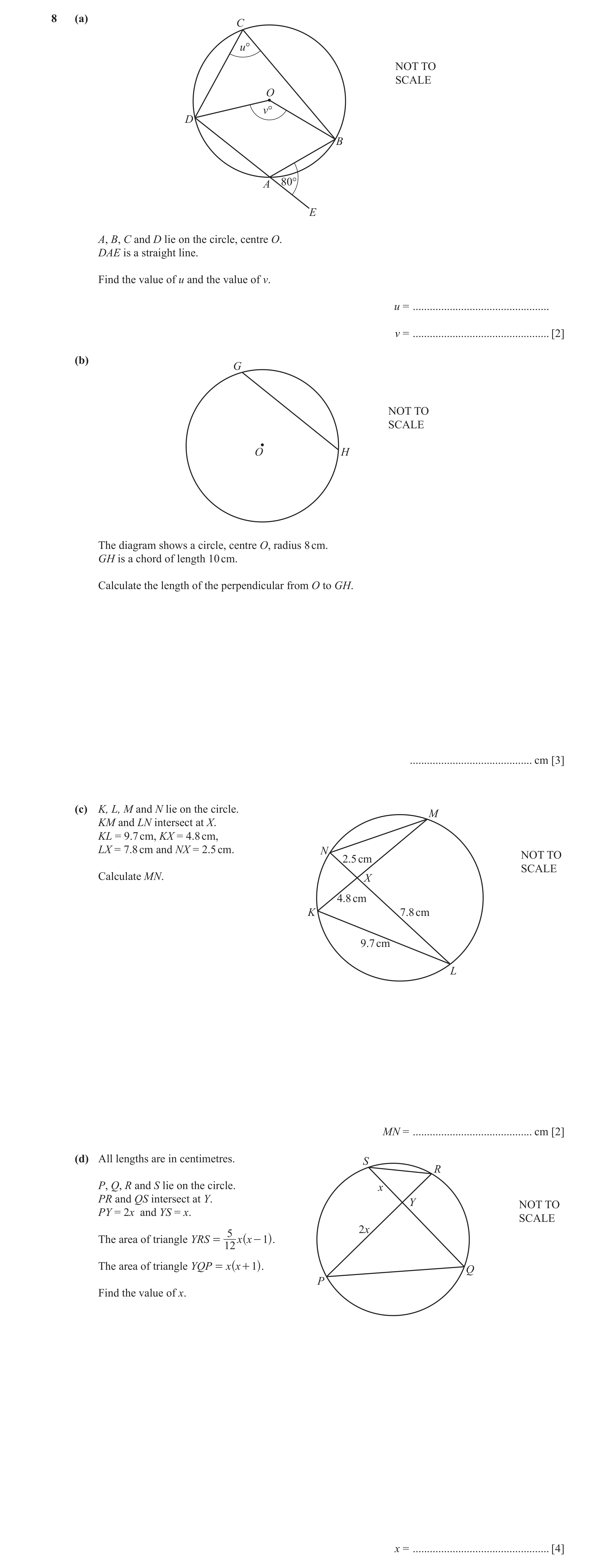
8 (a) C u° NOT TO SCALE O v° D B A 80° E A, B, C and D lie on the circle, centre O. DAE is a straight line. Find the value of u and the value of v. u = … v = … [2] (b) G NOT TO SCALE O H The diagram shows a circle, centre O, radius 8 cm. GH is a chord of length 10 cm. Calculate the length of the perpendicular from O to GH. … cm [3] (c) K, L, M and N lie on the circle. M KM and LN intersect at X. KL = 9.7 cm, KX = 4.8 cm, LX = 7.8 cm and NX = 2.5 cm. N NOT TO 2.5 cm SCALE Calculate MN. X 4.8 cm K 7.8 cm 9.7 cm L MN = … cm [2] (d) All lengths are in centimetres. S R P, Q, R and S lie on the circle. x PR and QS intersect at Y. Y NOT TO PY = 2x and YS = x. SCALE 2x 5 The area of triangle YRS = x ^x - 1h. 12 The area of triangle YQP = x ^x + 1h. Q P Find the value of x. x = … [4]
11 marks
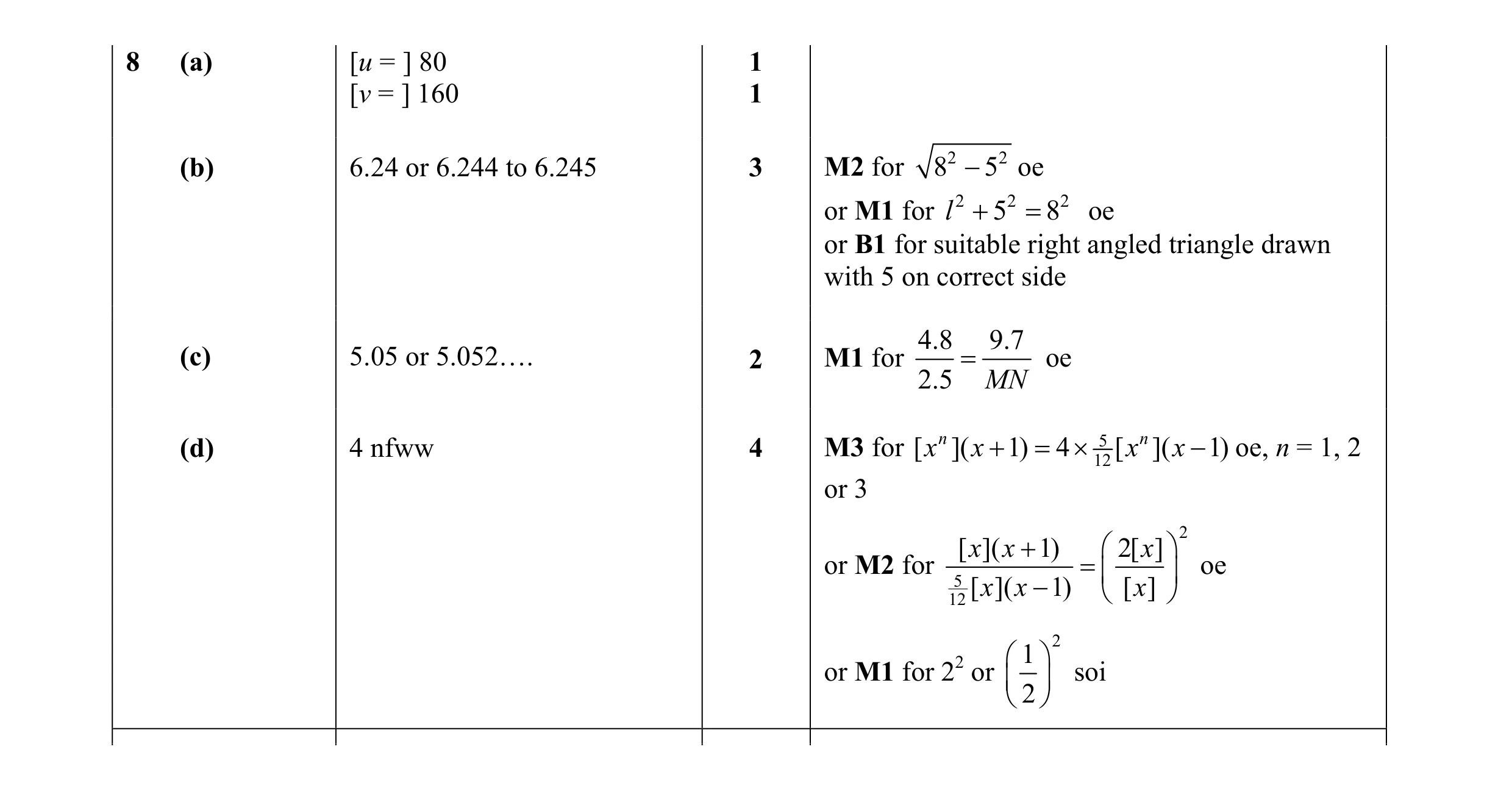
Mark scheme: 8 (a) [u = ] 80 1 [v = ] 160 1 (b) 6.24 or 6.244 to 6.245 3 M2 for 8 2 − 5 2 oe or M1 for l 2 + 52 = 82 oe or B1 for suitable right angled triangle drawn with 5 on correct side 4.8 9.7 (c) 5.05 or 5.052…. 2 M1 for = oe 2.5 MN (d) 4 nfww 4 M3 for [ x n ]( x + 1) = 4 × 125 [ x n ]( x − 1) oe, n = 1, 2 or 3 [ x ]( x + 1) 2[ x ] 2 or M2 for = oe 5 12 [ x ]( x − 1) [ x ] 1 2 or M1 for 22 or soi 2
This question in 0580/42 Oct/Nov 2016
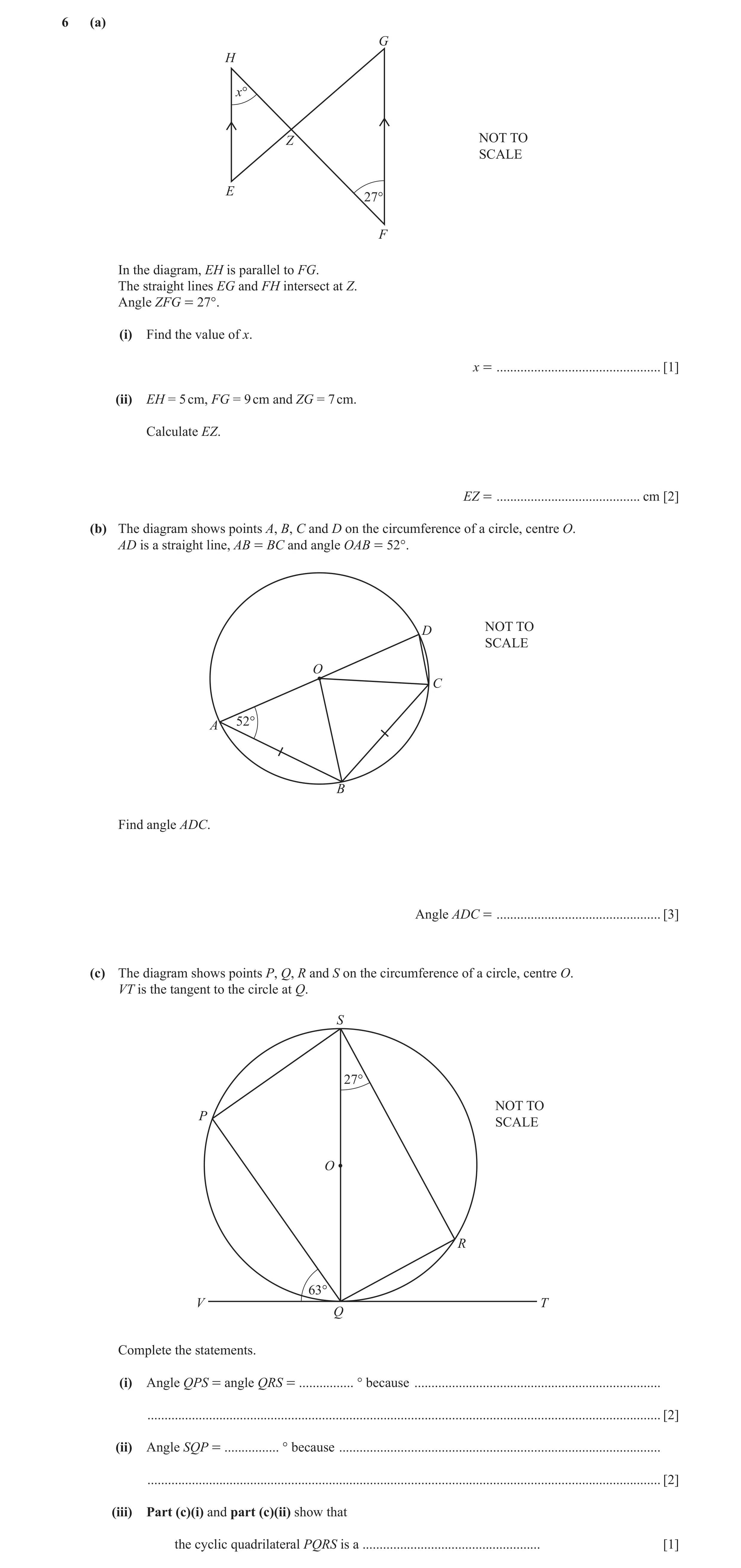
Q9 · G H x° Z NOT TO SCALE E 27° F In the diagram, EH is parallel to FG 0580/42 Feb/March 2017
6 (a) G H x° Z NOT TO SCALE E 27° F In the diagram, EH is parallel to FG. The straight lines EG and FH intersect at Z. Angle ZFG = 27°. (i) Find the value of x. x = … [1] (ii) EH = 5 cm, FG = 9 cm and ZG = 7 cm. Calculate EZ. EZ = … cm [2] (b) The diagram shows points A, B, C and D on the circumference of a circle, centre O. AD is a straight line, AB = BC and angle OAB = 52°. D NOT TO SCALE O C A 52° B Find angle ADC. Angle ADC = … [3] (c) The diagram shows points P, Q, R and S on the circumference of a circle, centre O. VT is the tangent to the circle at Q. S 27° NOT TO P SCALE O R 63° V T Q Complete the statements. (i) Angle QPS = angle QRS = … ° because … … [2] (ii) Angle SQP = … ° because … … [2] (iii) Part (c)(i) and part (c)(ii) show that the cyclic quadrilateral PQRS is a … [1]
11 marks
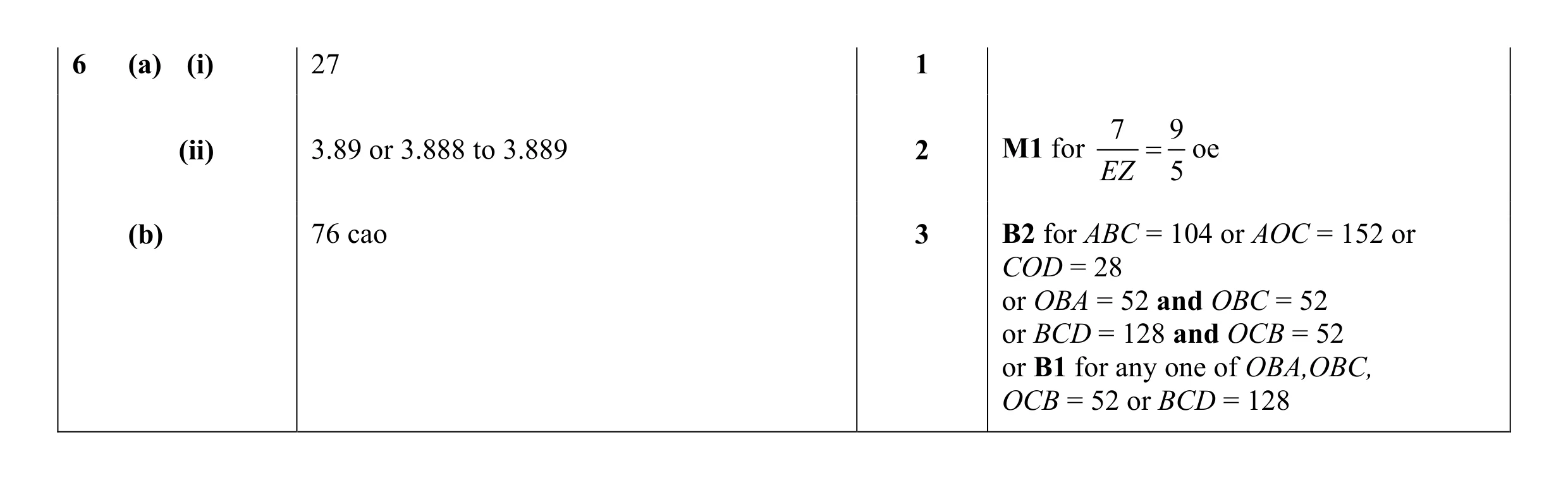
Mark scheme: 6 (a) (i) 27 1 7 9 (ii) 3.89 or 3.888 to 3.889 2 M1 for = oe EZ 5 (b) 76 cao 3 B2 for ABC = 104 or AOC = 152 or COD = 28 or OBA = 52 and OBC = 52 or BCD = 128 and OCB = 52 or B1 for any one of OBA,OBC, OCB = 52 or BCD = 128
This question in 0580/42 Feb/March 2017
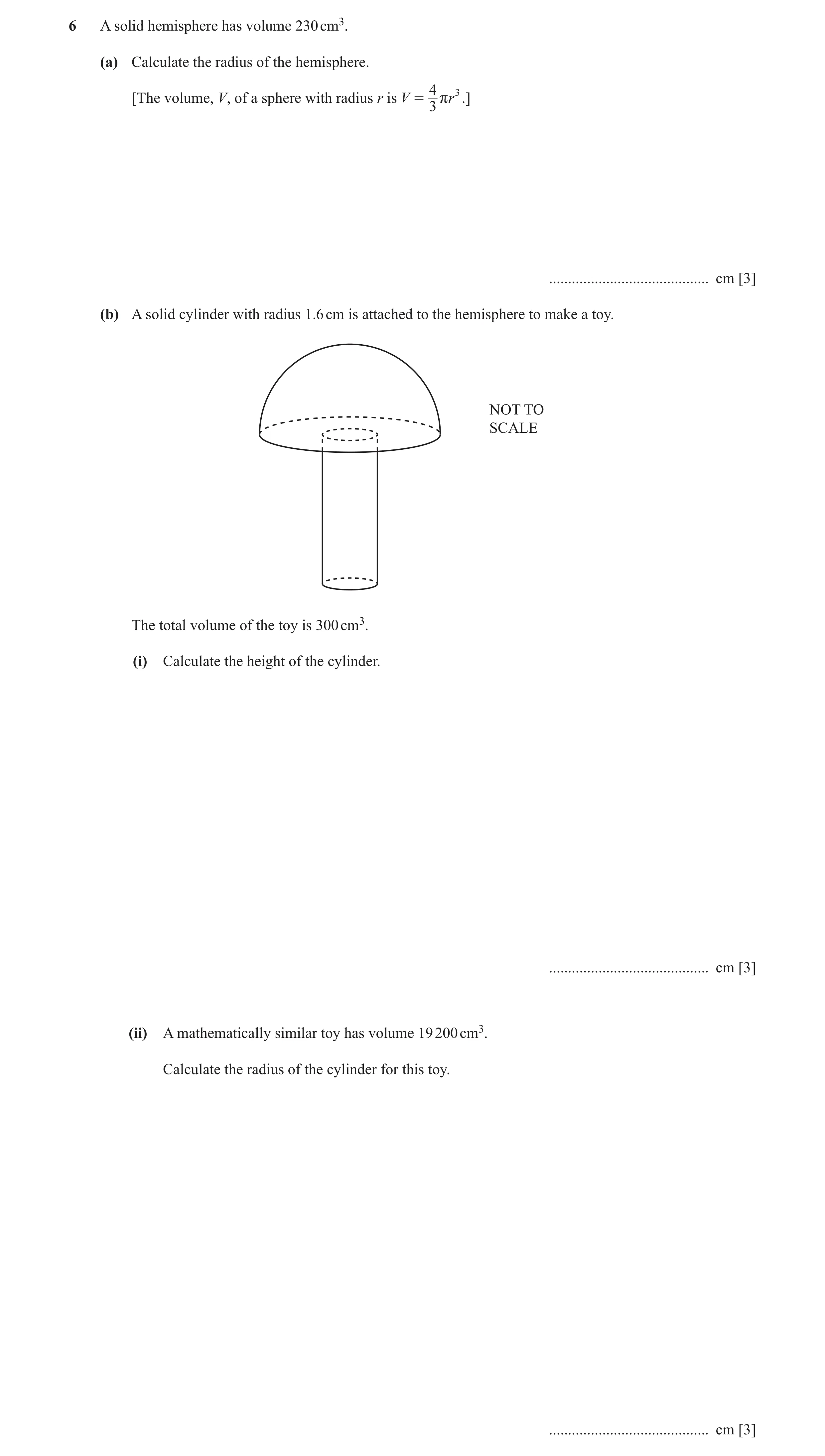
Q10 · A solid hemisphere has volume 230 cm3 0580/41 May/June 2018
6 A solid hemisphere has volume 230 cm3. (a) Calculate the radius of the hemisphere. 4 3 [The volume, V, of a sphere with radius r is V = r r .] 3 … cm [3] (b) A solid cylinder with radius 1.6 cm is attached to the hemisphere to make a toy. NOT TO SCALE The total volume of the toy is 300 cm3. (i) Calculate the height of the cylinder. … cm [3] (ii) A mathematically similar toy has volume 19 200 cm3. Calculate the radius of the cylinder for this toy. … cm [3]
9 marks
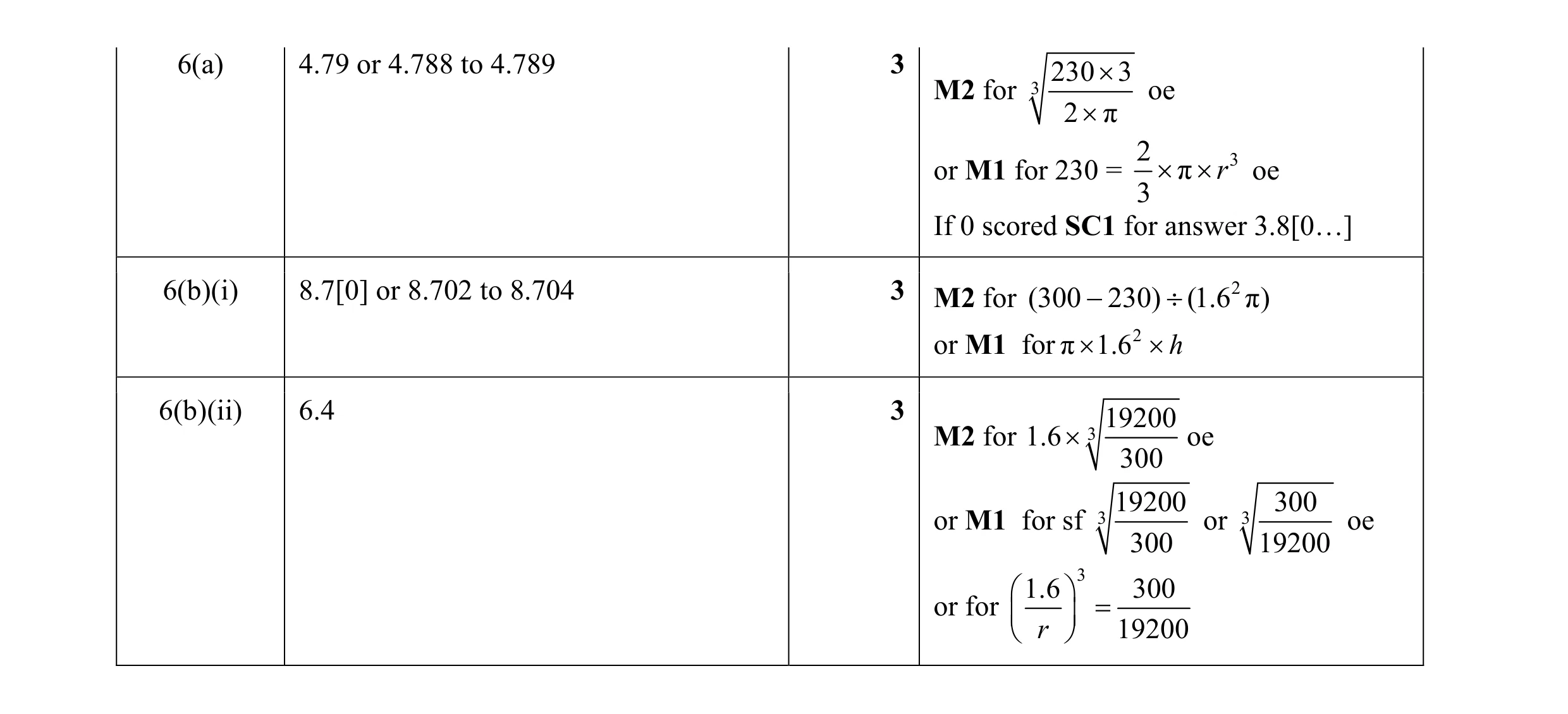
Mark scheme: 6(a) 4.79 or 4.788 to 4.789 3 230 × 3 M2 for 3 oe 2 × π 2 3 or M1 for 230 = × π ×r oe 3 If 0 scored SC1 for answer 3.8[0…] 6(b)(i) 8.7[0] or 8.702 to 8.704 3 M2 for (300 − 230) ÷ (1.6 2 π) or M1 for π × 1.6 2 × h 6(b)(ii) 6.4 3 19200 M2 for 1.6 × 3 oe 300 19200 300 or M1 for sf 3 or 3 oe 300 19200 1.6 3 300 or for = r 19200
This question in 0580/41 May/June 2018
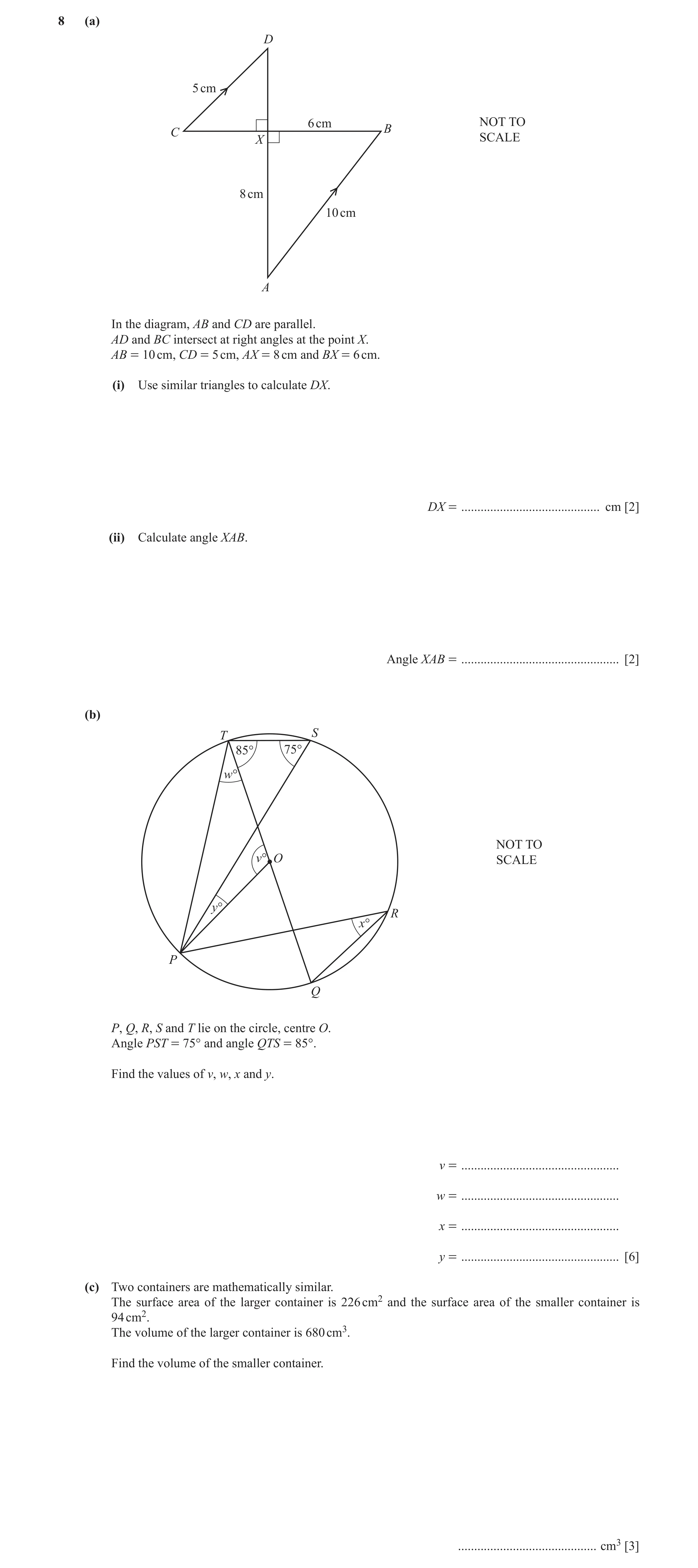
Q11 · D 5 cm 6 cm NOT TO B C X SCALE 8 cm 10 cm A In the diagram, AB and CD are parallel 0580/43 Oct/Nov 2018
8 (a) D 5 cm 6 cm NOT TO B C X SCALE 8 cm 10 cm A In the diagram, AB and CD are parallel. AD and BC intersect at right angles at the point X. AB = 10 cm, CD = 5 cm, AX = 8 cm and BX = 6 cm. (i) Use similar triangles to calculate DX. DX = … cm [2] (ii) Calculate angle XAB. Angle XAB = … [2] (b) T S 85° 75° w° NOT TO v° O SCALE y° R x° P Q P, Q, R, S and T lie on the circle, centre O. Angle PST = 75° and angle QTS = 85°. Find the values of v, w, x and y. v = … w = … x = … y = … [6] (c) Two containers are mathematically similar. The surface area of the larger container is 226 cm2 and the surface area of the smaller container is 94 cm2. The volume of the larger container is 680 cm3. Find the volume of the smaller container. … cm3 [3]
13 marks
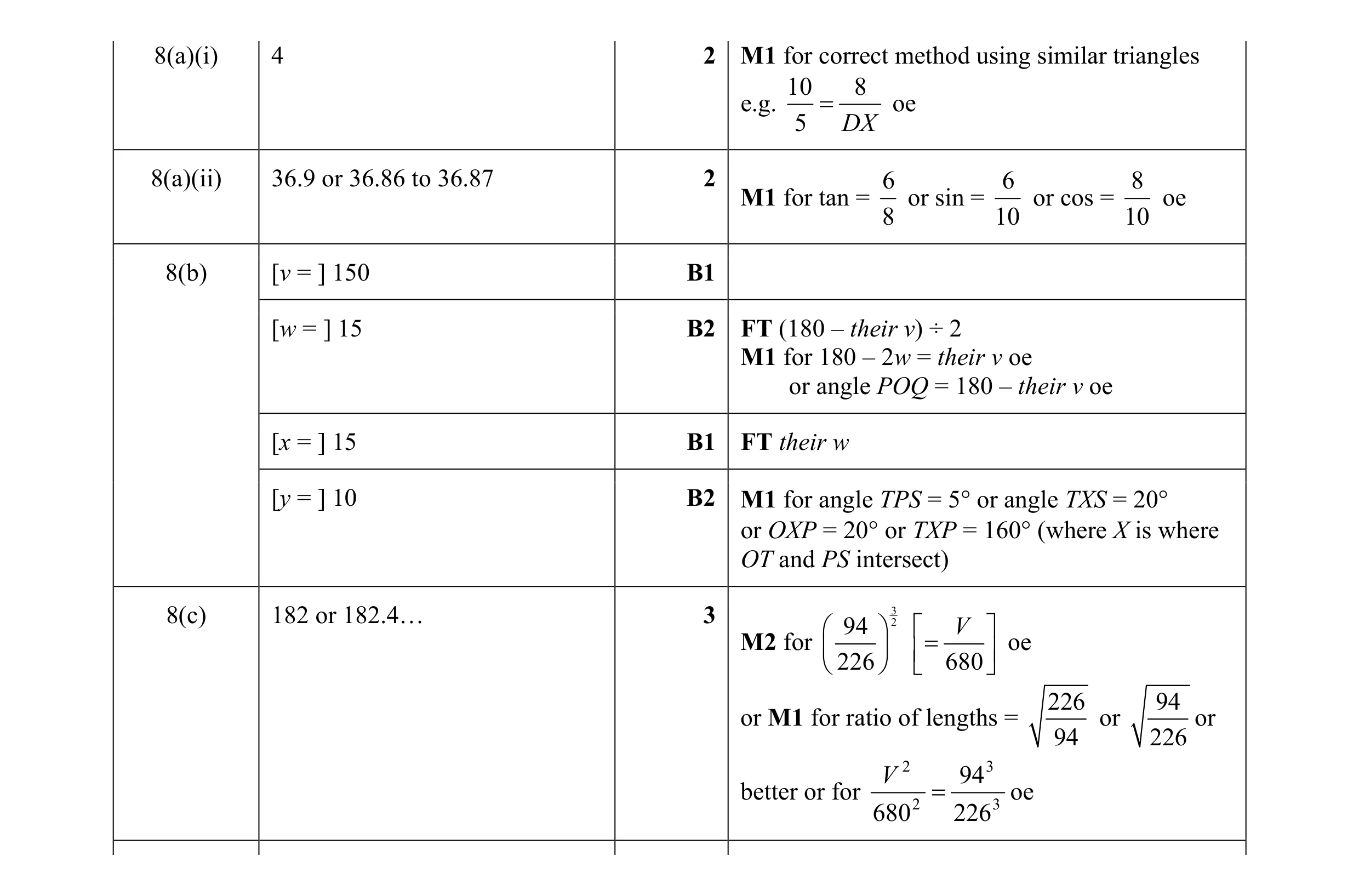
Mark scheme: 8(a)(i) 4 2 M1 for correct method using similar triangles 10 8 e.g. = oe 5 DX 8(a)(ii) 36.9 or 36.86 to 36.87 2 6 6 8 M1 for tan = or sin = or cos = oe 8 10 10 8(b) [v = ] 150 B1 [w = ] 15 B2 FT (180 – their v) ÷ 2 M1 for 180 – 2w = their v oe or angle POQ = 180 – their v oe [x = ] 15 B1 FT their w [y = ] 10 B2 M1 for angle TPS = 5° or angle TXS = 20° or OXP = 20° or TXP = 160° (where X is where OT and PS intersect) 8(c) 182 or 182.4… 3 32 94 V M2 for = oe 226 680 226 94 or M1 for ratio of lengths = or or 94 226 V 2 94 3 better or for = oe 680 2 226 3
This question in 0580/43 Oct/Nov 2018
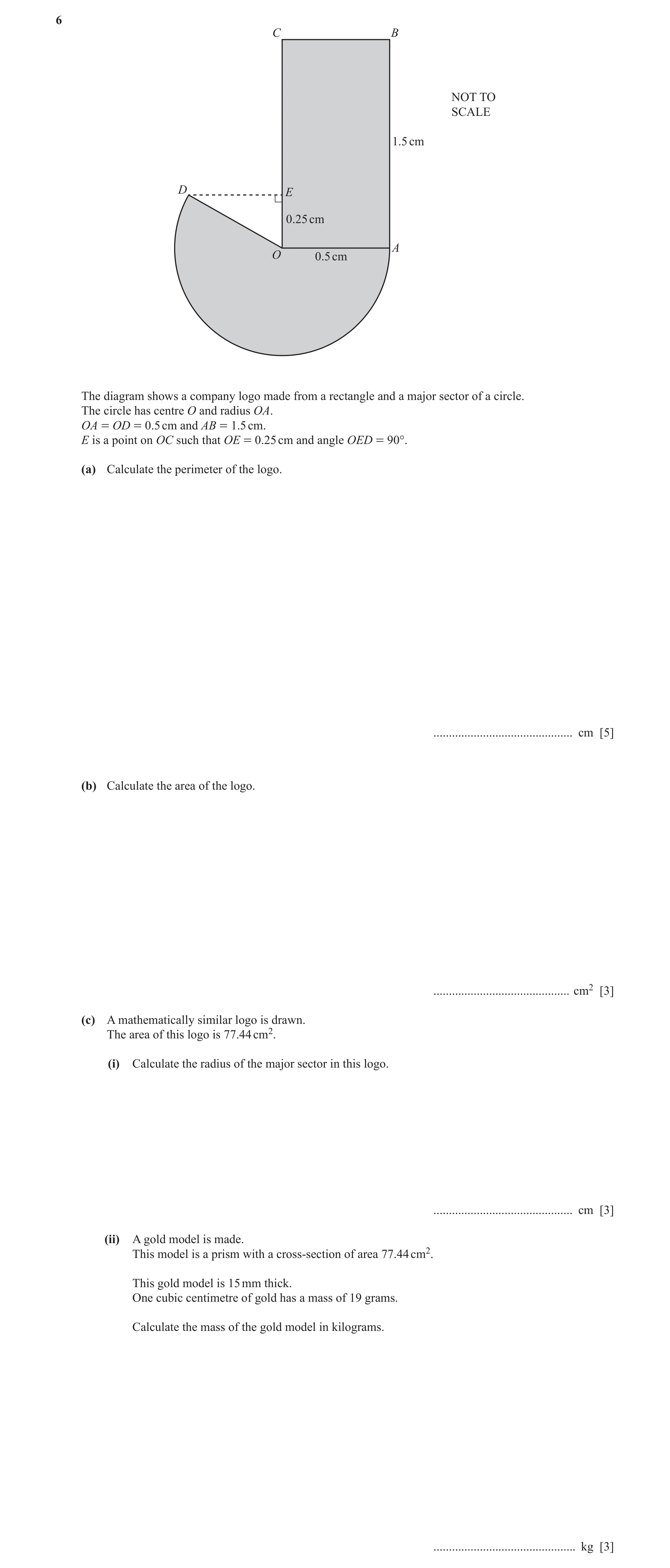
Q12 · C B NOT TO SCALE 1.5 cm D E 0.25 cm A O 0.5 cm The diagram shows a company logo made from… 0580/42 Feb/March 2019
6 C B NOT TO SCALE 1.5 cm D E 0.25 cm A O 0.5 cm The diagram shows a company logo made from a rectangle and a major sector of a circle. The circle has centre O and radius OA. OA = OD = 0.5 cm and AB = 1.5 cm. E is a point on OC such that OE = 0.25 cm and angle OED = 90°. (a) Calculate the perimeter of the logo. … cm [5] (b) Calculate the area of the logo. … cm2 [3] (c) A mathematically similar logo is drawn. The area of this logo is 77.44 cm2. (i) Calculate the radius of the major sector in this logo. … cm [3] (ii) A gold model is made. This model is a prism with a cross-section of area 77.44 cm2. This gold model is 15 mm thick. One cubic centimetre of gold has a mass of 19 grams. Calculate the mass of the gold model in kilograms. … kg [3]
14 marks
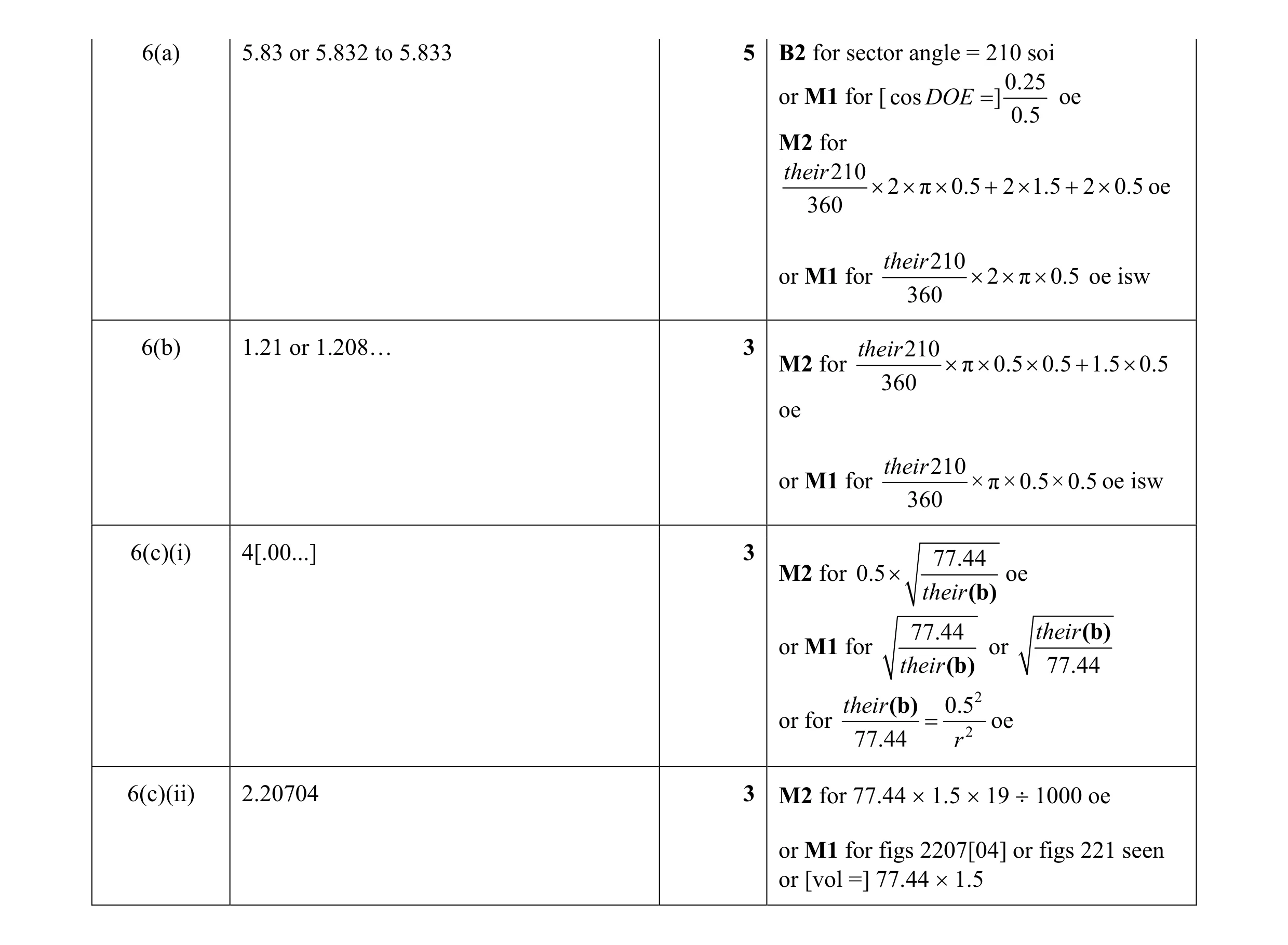
Mark scheme: 6(a) 5.83 or 5.832 to 5.833 5 B2 for sector angle = 210 soi 0.25 or M1 for [ cos DOE = ] oe 0.5 M2 for their 210 × 2 × π × 0.5 + 2 × 1.5 + 2 × 0.5 oe 360 their 210 or M1 for × 2 × π × 0.5 oe isw 360 6(b) 1.21 or 1.208… 3 their 210 M2 for × π × 0.5 × 0.5 + 1.5 × 0.5 360 oe their 210 or M1 for × π×0.5×0.5 oe isw 360 6(c)(i) 4[.00...] 3 77.44 M2 for 0.5× oe their (b) 77.44 their (b) or M1 for or their (b) 77.44 their (b) 0.5 2 or for = oe 77.44 r 2 6(c)(ii) 2.20704 3 M2 for 77.44 × 1.5 × 19 ÷ 1000 oe or M1 for figs 2207[04] or figs 221 seen or [vol =] 77.44 × 1.5
This question in 0580/42 Feb/March 2019
Q13 · The volume of a solid metal sphere is 24 430 cm3 0580/42 May/June 2019
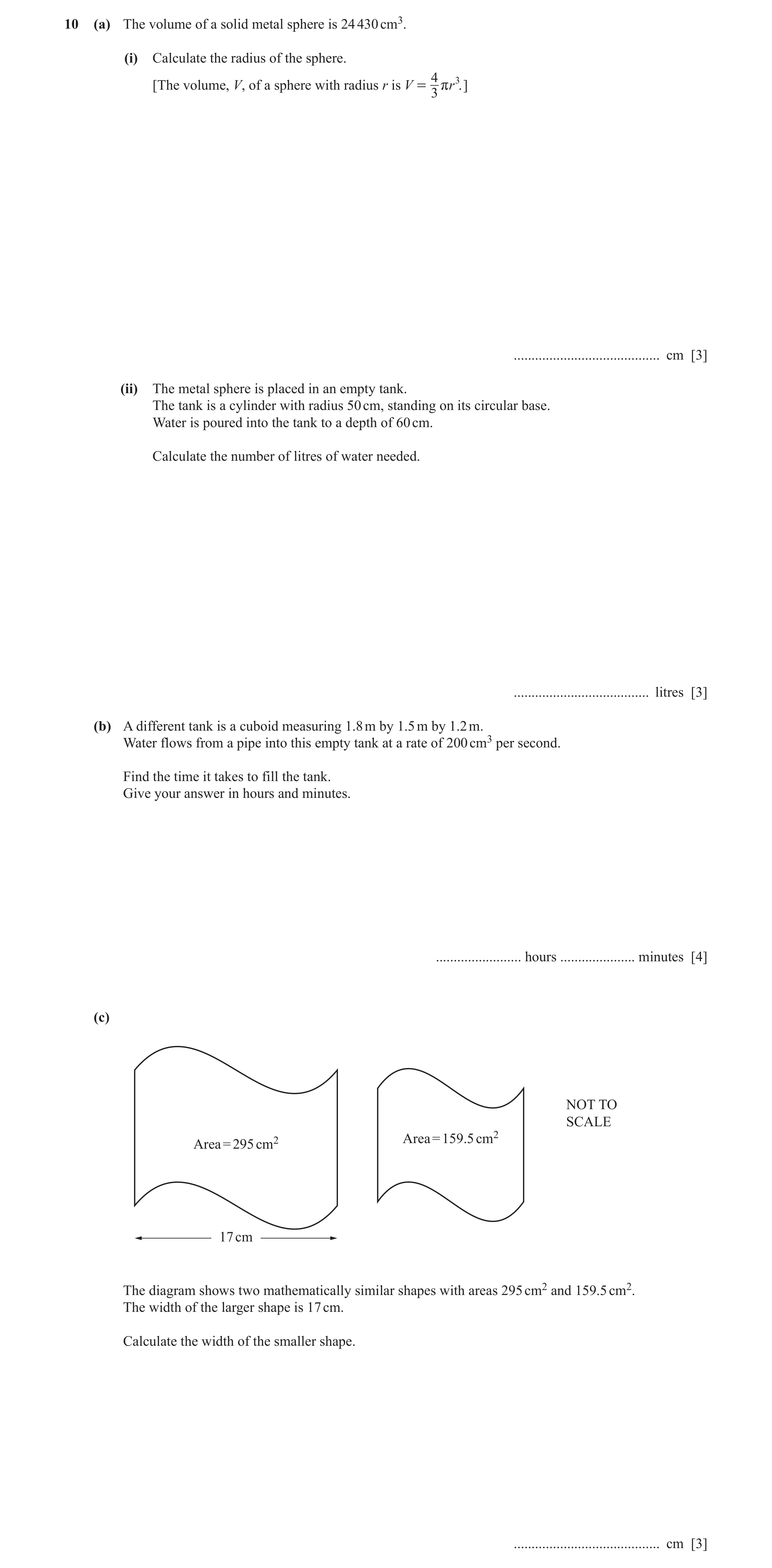
10 (a) The volume of a solid metal sphere is 24 430 cm3. (i) Calculate the radius of the sphere. 4 3 [The volume, V, of a sphere with radius r is V = r r . ] 3 … cm [3] (ii) The metal sphere is placed in an empty tank. The tank is a cylinder with radius 50 cm, standing on its circular base. Water is poured into the tank to a depth of 60 cm. Calculate the number of litres of water needed. … litres [3] (b) A different tank is a cuboid measuring 1.8 m by 1.5 m by 1.2 m. Water flows from a pipe into this empty tank at a rate of 200 cm3 per second. Find the time it takes to fill the tank. Give your answer in hours and minutes. … hours … minutes [4] (c) NOT TO SCALE Area = 159.5 cm2 Area = 295 cm2 17 cm The diagram shows two mathematically similar shapes with areas 295 cm2 and 159.5 cm2. The width of the larger shape is 17 cm. Calculate the width of the smaller shape. … cm [3]
13 marks
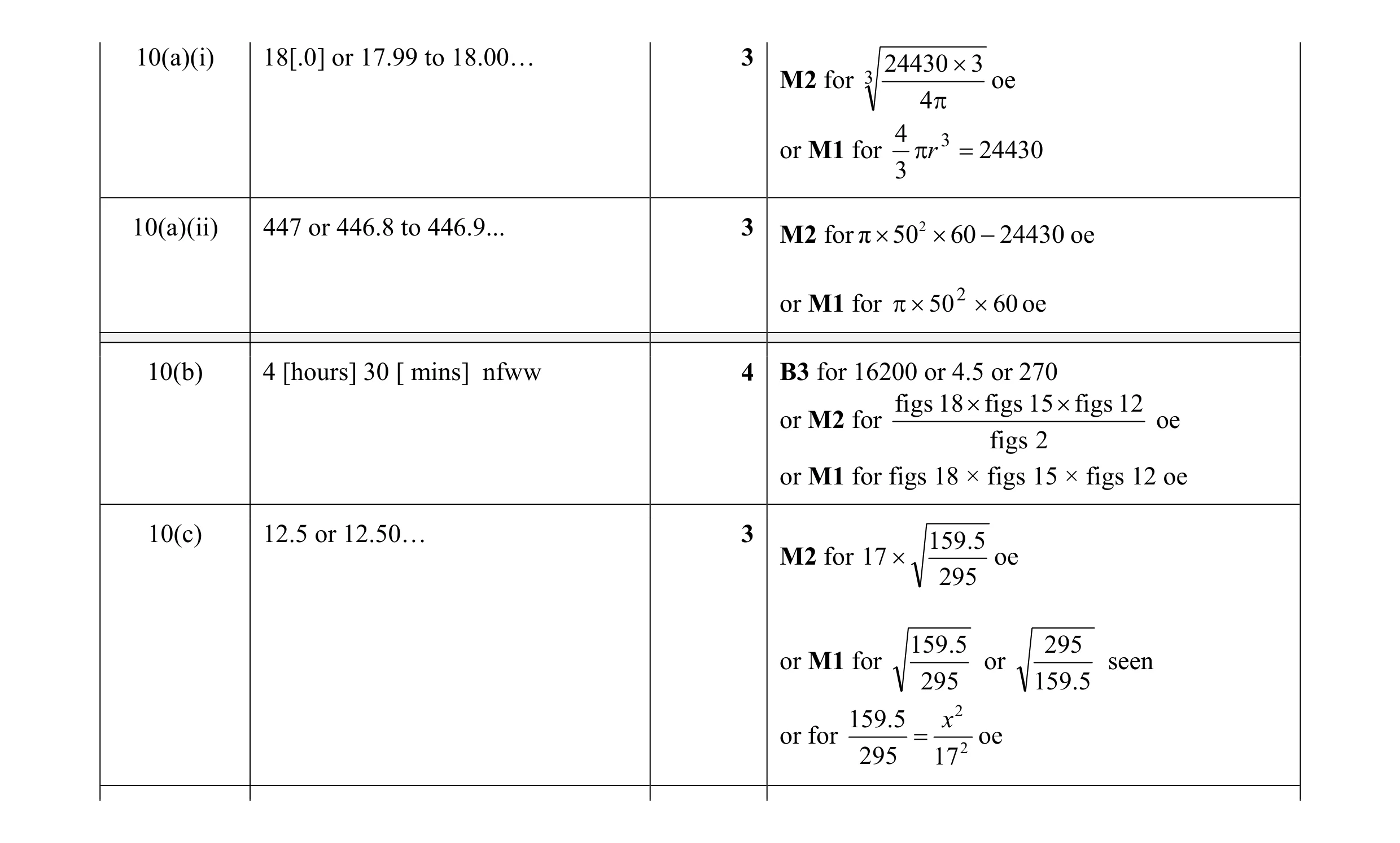
Mark scheme: 10(a)(i) 18[.0] or 17.99 to 18.00… 3 24430 × 3 M2 for 3 oe 4 π 4 3 or M1 for πr = 24430 3 10(a)(ii) 447 or 446.8 to 446.9... 3 M2 for π × 50 2 × 60 − 24430 oe or M1 for π × 502 × 60 oe 10(b) 4 [hours] 30 [ mins] nfww 4 B3 for 16200 or 4.5 or 270 figs 18 × figs 15 × figs 12 or M2 for oe figs 2 or M1 for figs 18 × figs 15 × figs 12 oe 10(c) 12.5 or 12.50… 3 159 5. M2 for 17 × oe 295 159 5. 295 or M1 for or seen 295 159 5. 159.5 x 2 or for = oe 295 17 2
This question in 0580/42 May/June 2019
Q14 · Calculate the external curved surface area of a cylinder with radius 8 m and height 19 m 0580/41 Oct/Nov 2019
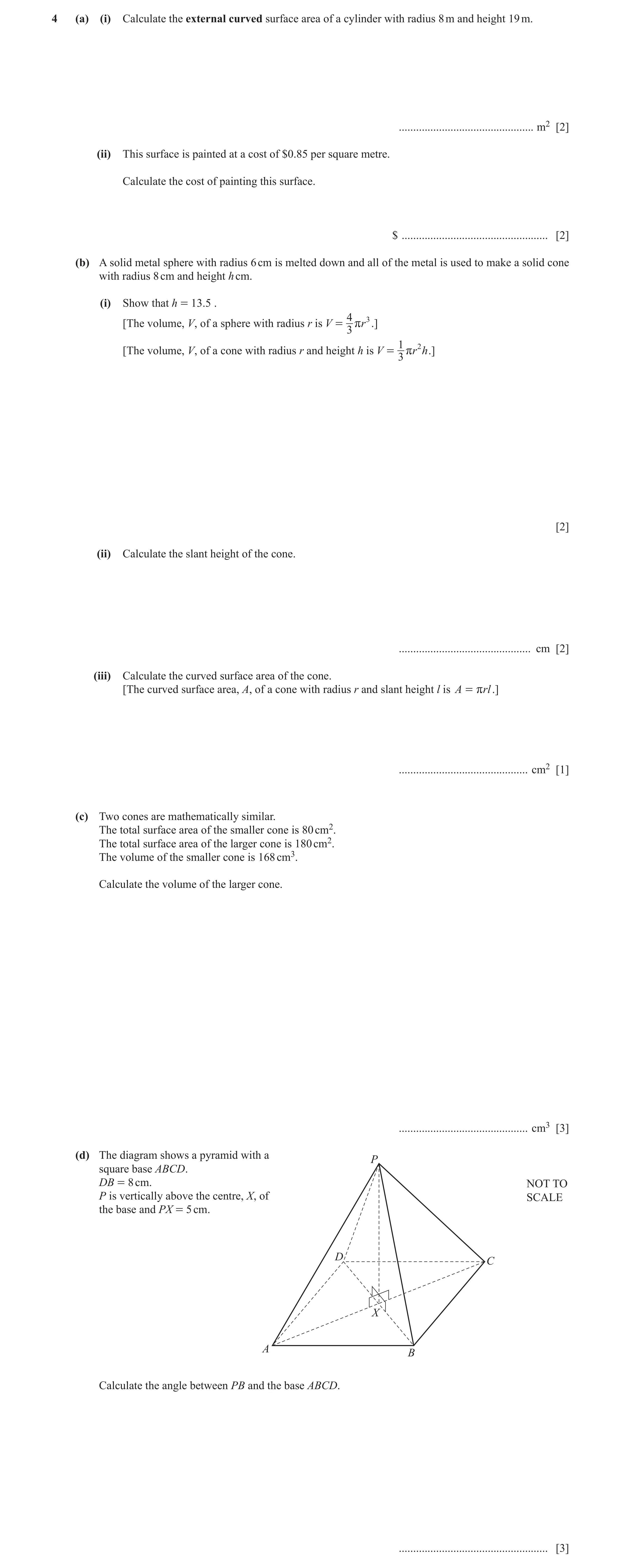
4 (a) (i) Calculate the external curved surface area of a cylinder with radius 8 m and height 19 m. … m2 [2] (ii) This surface is painted at a cost of $0.85 per square metre. Calculate the cost of painting this surface. $ … [2] (b) A solid metal sphere with radius 6 cm is melted down and all of the metal is used to make a solid cone with radius 8 cm and height h cm. (i) Show that h = 13.5 . 4 3 [The volume, V, of a sphere with radius r is V = r r .] 3 1 2 [The volume, V, of a cone with radius r and height h is V = r r h .] 3 [2] (ii) Calculate the slant height of the cone. … cm [2] (iii) Calculate the curved surface area of the cone. [The curved surface area, A, of a cone with radius r and slant height l is A = r rl .] … cm2 [1] (c) Two cones are mathematically similar. The total surface area of the smaller cone is 80 cm2. The total surface area of the larger cone is 180 cm2. The volume of the smaller cone is 168 cm3. Calculate the volume of the larger cone. … cm3 [3] (d) The diagram shows a pyramid with a P square base ABCD. DB = 8 cm. NOT TO P is vertically above the centre, X, of SCALE the base and PX = 5 cm. D C X A B Calculate the angle between PB and the base ABCD. … [3]
15 marks
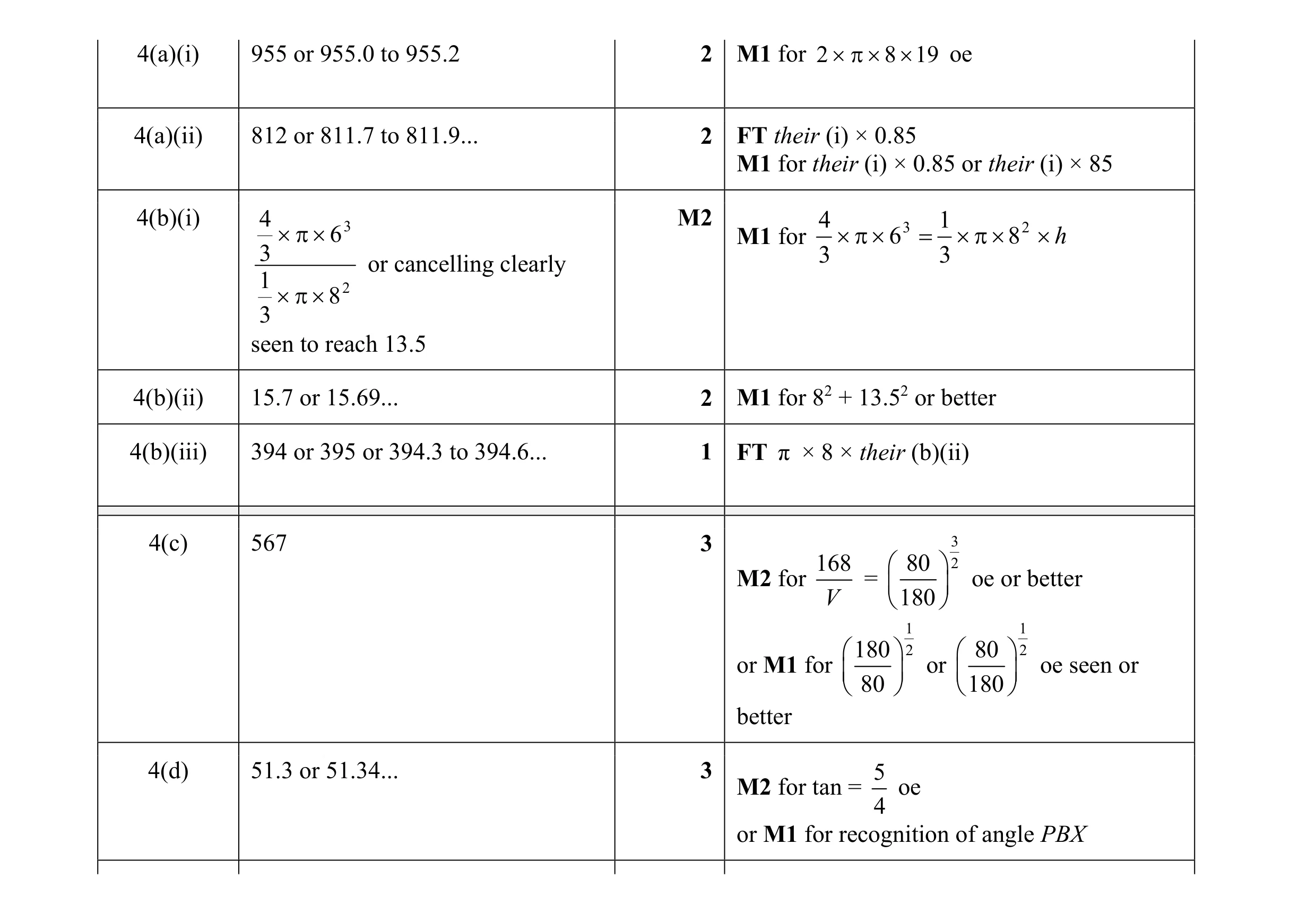
Mark scheme: 4(a)(i) 955 or 955.0 to 955.2 2 M1 for 2 × π × 8 × 19 oe 4(a)(ii) 812 or 811.7 to 811.9... 2 FT their (i) × 0.85 M1 for their (i) × 0.85 or their (i) × 85 4(b)(i) 4 3 M2 4 3 1 2 × π × 6 M1 for × π × 6 = × π × 8 × h 3 3 3 or cancelling clearly 1 2 × π × 8 3 seen to reach 13.5 4(b)(ii) 15.7 or 15.69... 2 M1 for 82 + 13.52 or better 4(b)(iii) 394 or 395 or 394.3 to 394.6... 1 FT π × 8 × their (b)(ii) 4(c) 567 3 3 168 80 2 M2 for = oe or better V 180 1 1 180 2 80 2 or M1 for or oe seen or 80 180 better 4(d) 51.3 or 51.34... 3 5 M2 for tan = oe 4 or M1 for recognition of angle PBX
This question in 0580/41 Oct/Nov 2019
Q15 · A D NOT TO 128°128° SCALE 28° C O 30° B In the diagram, A, B, C and D lie on the circle… 0580/43 Oct/Nov 2019
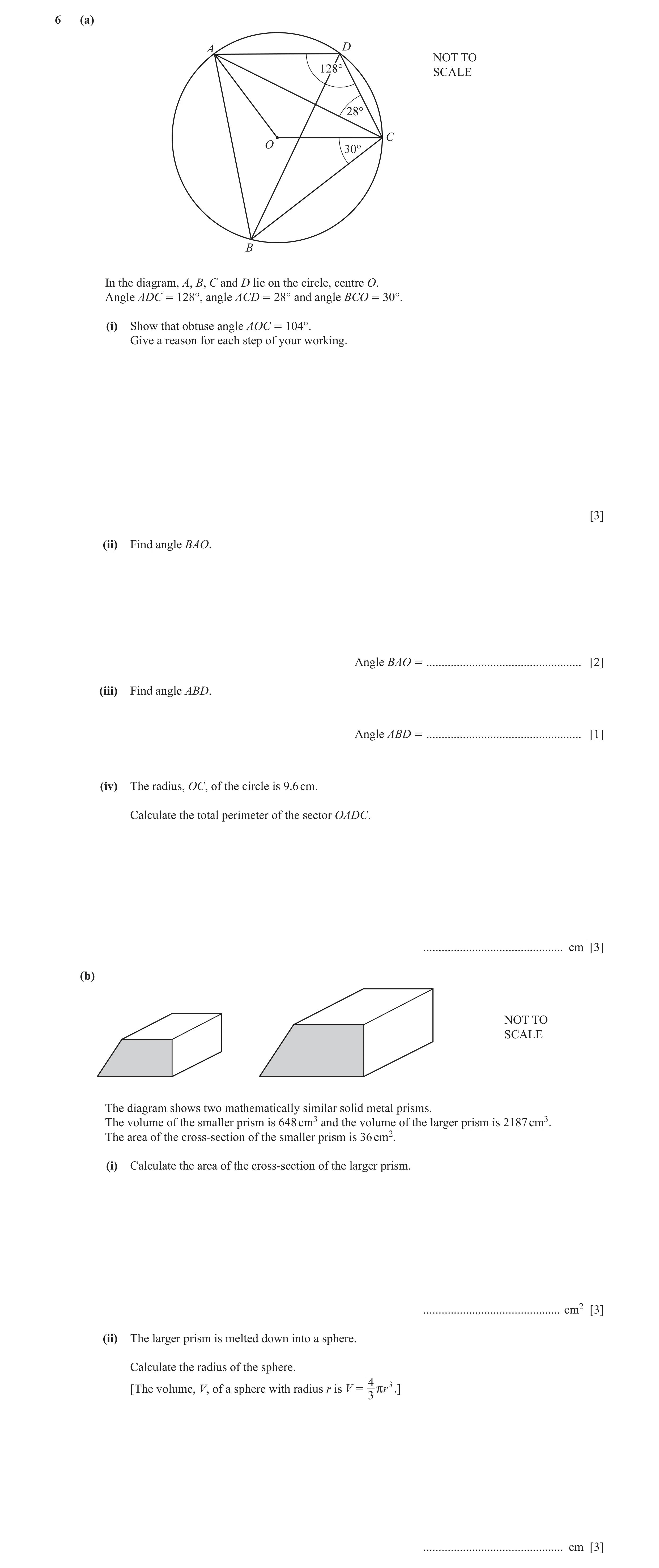
6 (a) A D NOT TO 128°128° SCALE 28° C O 30° B In the diagram, A, B, C and D lie on the circle, centre O. Angle ADC = 128°, angle ACD = 28° and angle BCO = 30°. (i) Show that obtuse angle AOC = 104°. Give a reason for each step of your working. [3] (ii) Find angle BAO. Angle BAO = … [2] (iii) Find angle ABD. Angle ABD = … [1] (iv) The radius, OC, of the circle is 9.6 cm. Calculate the total perimeter of the sector OADC. … cm [3] (b) NOT TO SCALE The diagram shows two mathematically similar solid metal prisms. The volume of the smaller prism is 648 cm3 and the volume of the larger prism is 2187 cm3. The area of the cross-section of the smaller prism is 36 cm2. (i) Calculate the area of the cross-section of the larger prism. … cm2 [3] (ii) The larger prism is melted down into a sphere. Calculate the radius of the sphere. 4 3 [The volume, V, of a sphere with radius r is V = r r .] 3 … cm [3]
15 marks
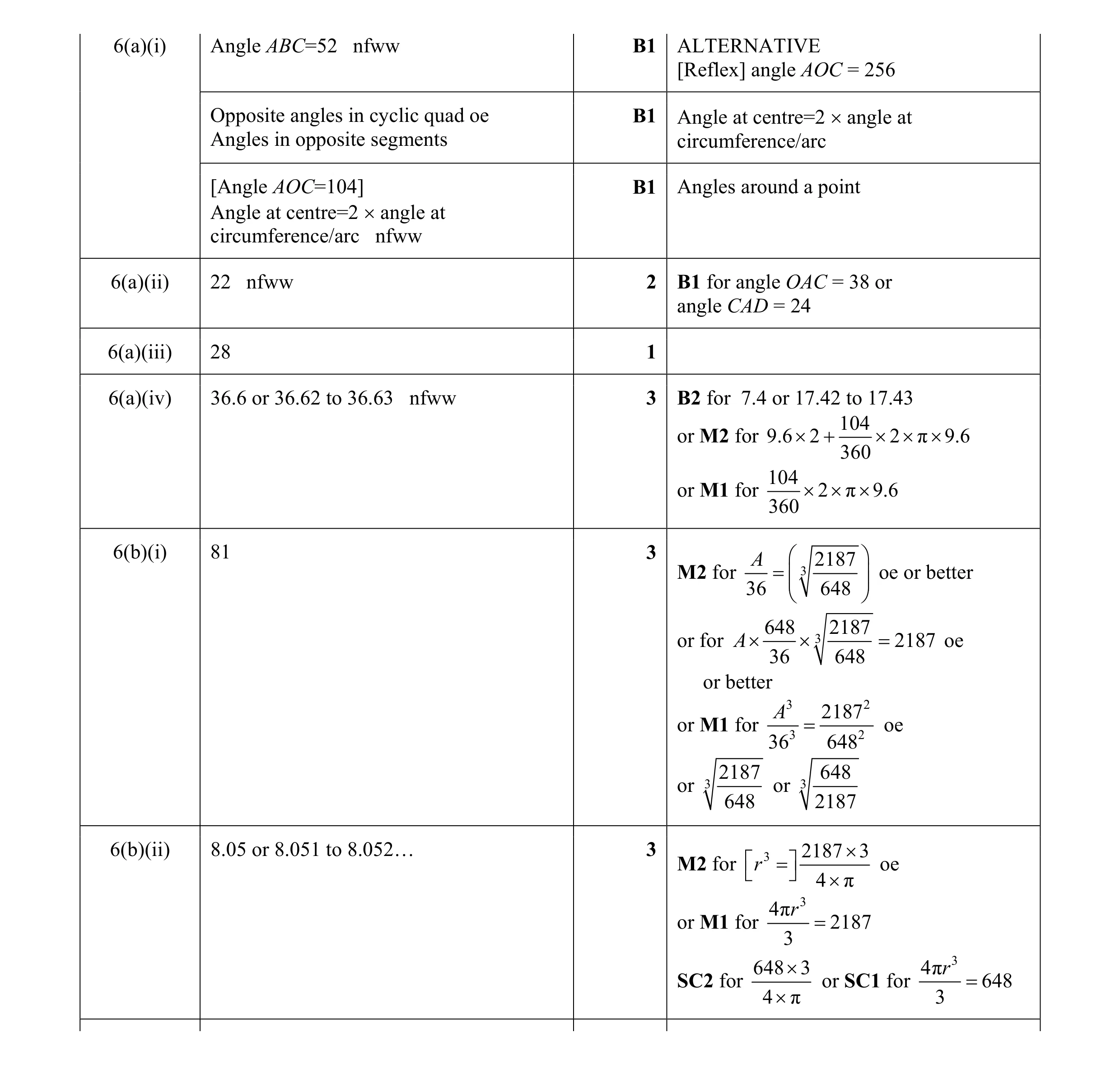
Mark scheme: 6(a)(i) Angle ABC=52 nfww B1 ALTERNATIVE [Reflex] angle AOC = 256 Opposite angles in cyclic quad oe B1 Angle at centre=2 × angle at Angles in opposite segments circumference/arc [Angle AOC=104] B1 Angles around a point Angle at centre=2 × angle at circumference/arc nfww 6(a)(ii) 22 nfww 2 B1 for angle OAC = 38 or angle CAD = 24 6(a)(iii) 28 1 6(a)(iv) 36.6 or 36.62 to 36.63 nfww 3 B2 for 7.4 or 17.42 to 17.43 104 or M2 for 9.6 × 2 + × 2 × π × 9.6 360 104 or M1 for × 2 × π × 9.6 360 6(b)(i) 81 3 A 2187 M2 for = 3 oe or better 36 648 648 2187 or for A × × 3 = 2187 oe 36 648 or better A3 2187 2 or M1 for = oe 36 3 648 2 2187 648 or 3 or 3 648 2187 6(b)(ii) 8.05 or 8.051 to 8.052… 3 3 2187 × 3 M2 for r = oe 4 × π 4πr 3 or M1 for = 2187 3 648 × 3 4πr 3 SC2 for or SC1 for = 648 4 × π 3
This question in 0580/43 Oct/Nov 2019
Q16 · Manjeet uses 220 litres of water each day 0580/42 Feb/March 2020
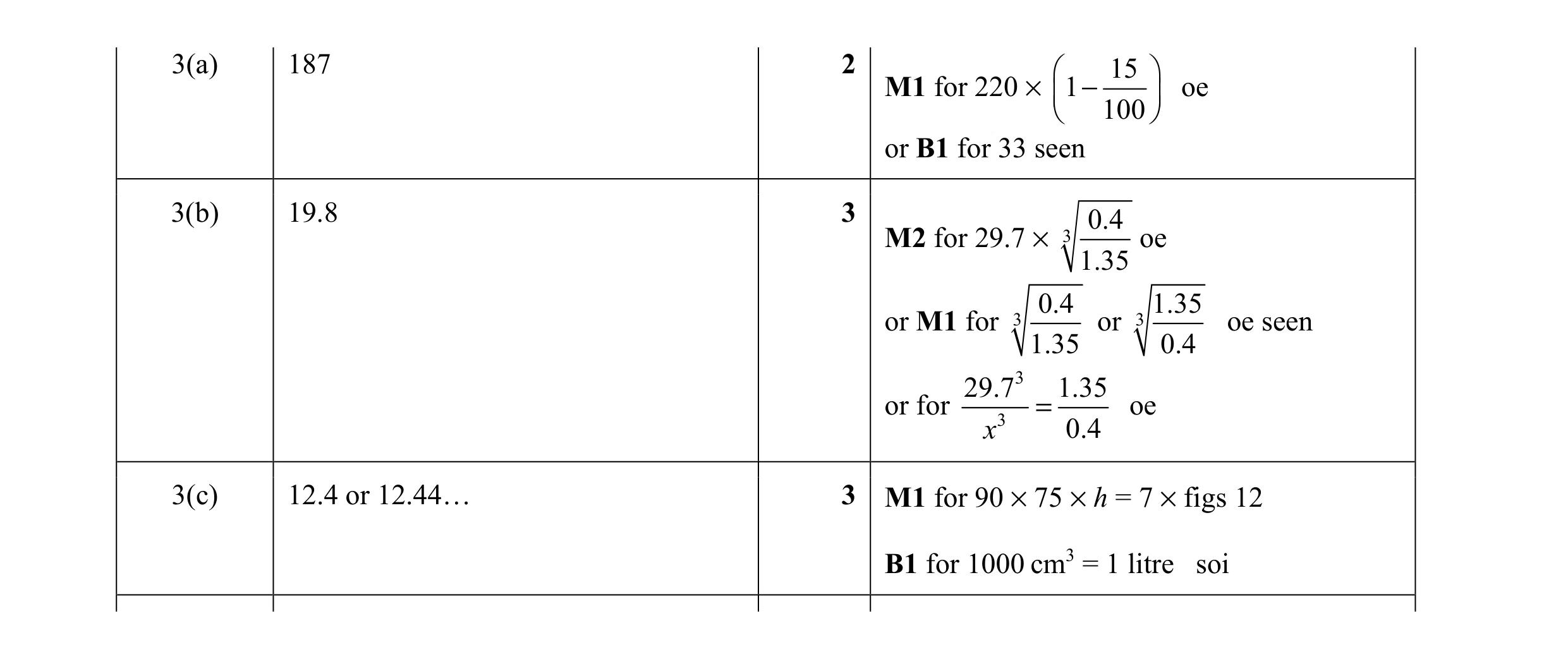
3 (a) Manjeet uses 220 litres of water each day. She reduces the amount of water she uses by 15%. Calculate the number of litres of water she now uses each day. … litres [2] (b) Manjeet has two mathematically similar bottles in her bathroom. The large bottle holds 1.35 litres and is 29.7 cm high. The small bottle holds 0.4 litres. Calculate the height of the small bottle. … cm [3] (c) Water from Manjeet’s shower flows at a rate of 12 litres per minute. The water from the shower flows into a tank that is a cuboid of length 90 cm and width 75 cm. Calculate the increase in the level of water in the tank when the shower is used for 7 minutes. … cm [3]
8 marks
Mark scheme: 3(a) 187 2 15 M1 for 220 × 1 − oe 100 or B1 for 33 seen 3(b) 19.8 3 0.4 M2 for 29.7 × 3 oe 1.35 0.4 1.35 or M1 for 3 or 3 oe seen 1.35 0.4 29.7 3 1.35 or for = oe x 3 0.4 3(c) 12.4 or 12.44… 3 M1 for 90 × 75 × h = 7 × figs 12 B1 for 1000 cm3 = 1 litre soi
This question in 0580/42 Feb/March 2020
Q17 · C R NOT TO SCALE A B 8 cm P Q 12 cm Triangle ABC is mathematically similar to triangle PQR 0580/42 May/June 2020
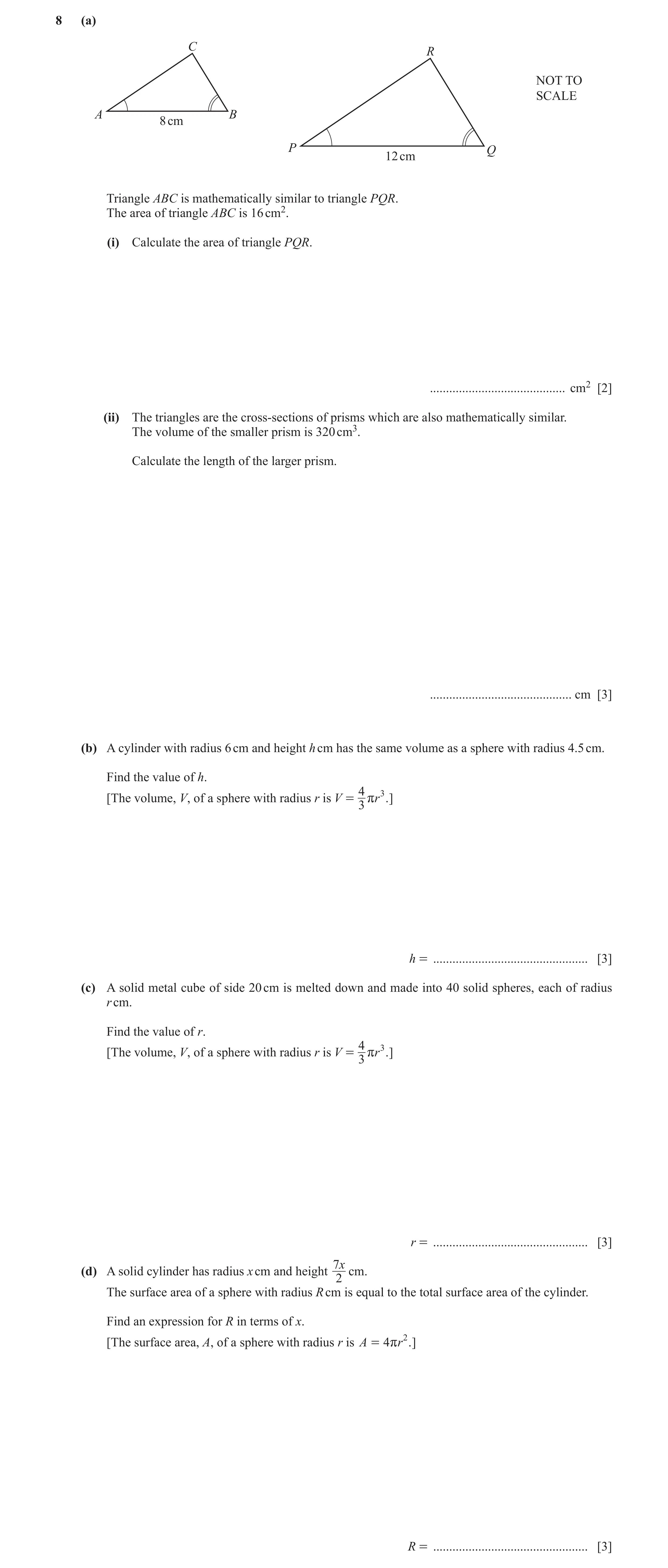
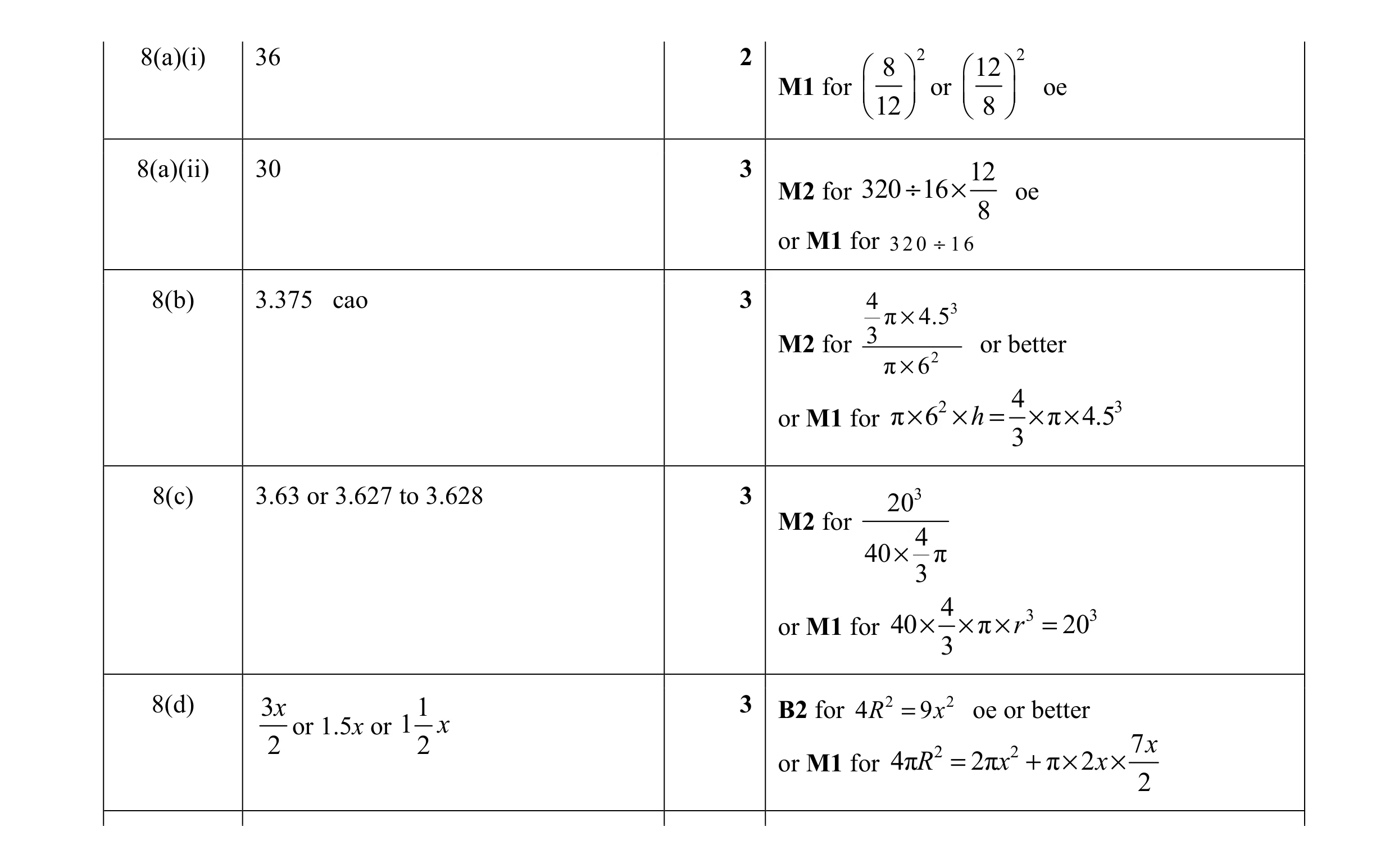
8 (a) C R NOT TO SCALE A B 8 cm P Q 12 cm Triangle ABC is mathematically similar to triangle PQR. The area of triangle ABC is 16 cm2. (i) Calculate the area of triangle PQR. … cm2 [2] (ii) The triangles are the cross-sections of prisms which are also mathematically similar. The volume of the smaller prism is 320 cm3. Calculate the length of the larger prism. … cm [3] (b) A cylinder with radius 6 cm and height h cm has the same volume as a sphere with radius 4.5 cm. Find the value of h. 4 3 [The volume, V, of a sphere with radius r is V = rr . ] 3 h = … [3] (c) A solid metal cube of side 20 cm is melted down and made into 40 solid spheres, each of radius r cm. Find the value of r. 4 3 [The volume, V, of a sphere with radius r is V = rr . ] 3 r = … [3] 7x(d) A solid cylinder has radius x cm and height cm. 2 The surface area of a sphere with radius R cm is equal to the total surface area of the cylinder. Find an expression for R in terms of x. [The surface area, A, of a sphere with radius r is A = 4rr 2 . ] R = … [3]
14 marks
Mark scheme: 8(a)(i) 36 2 2 2 8 12 M1 for or oe 12 8 8(a)(ii) 30 3 12 M2 for 320 ÷ 16 × oe 8 or M1 for 320 ÷ 16 8(b) 3.375 cao 3 4 3 π × 4.5 3 M2 for or better π × 6 2 2 4 3 or M1 for π × 6 × h = × π × 4.5 3 8(c) 3.63 or 3.627 to 3.628 3 20 3 M2 for 4 40 × π 3 4 3 3 or M1 for 40 × × π × r = 20 3 8(d) 3x 1 3 B2 for 4 R 2 = 9 x 2 oe or better or 1.5x or x 2 12 2 2 7 x or M1 for 4πR = 2πx + π × 2 x × 2
This question in 0580/42 May/June 2020
Q18 · D x° z° E NOT TO SCALE P 80° C v° y° w° 40° A B Q The points A, B, C, D and E lie on the… 0580/42 Oct/Nov 2020
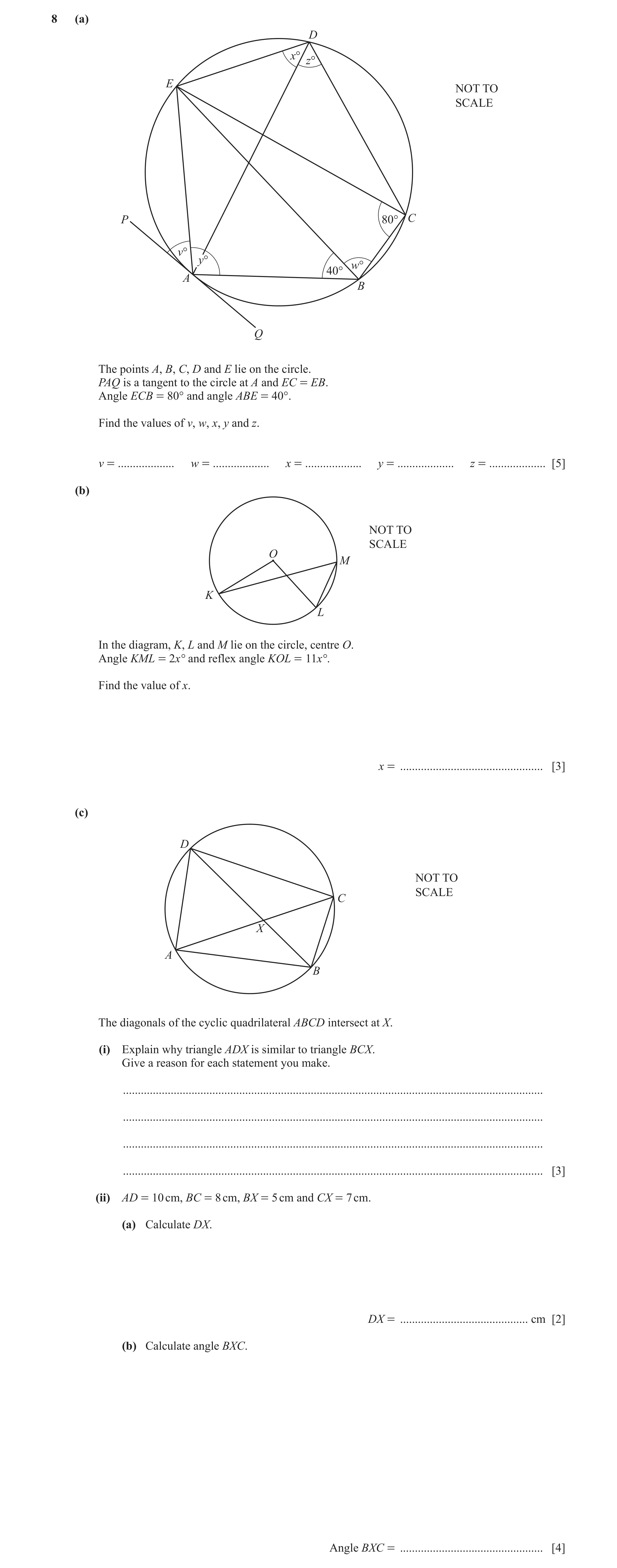
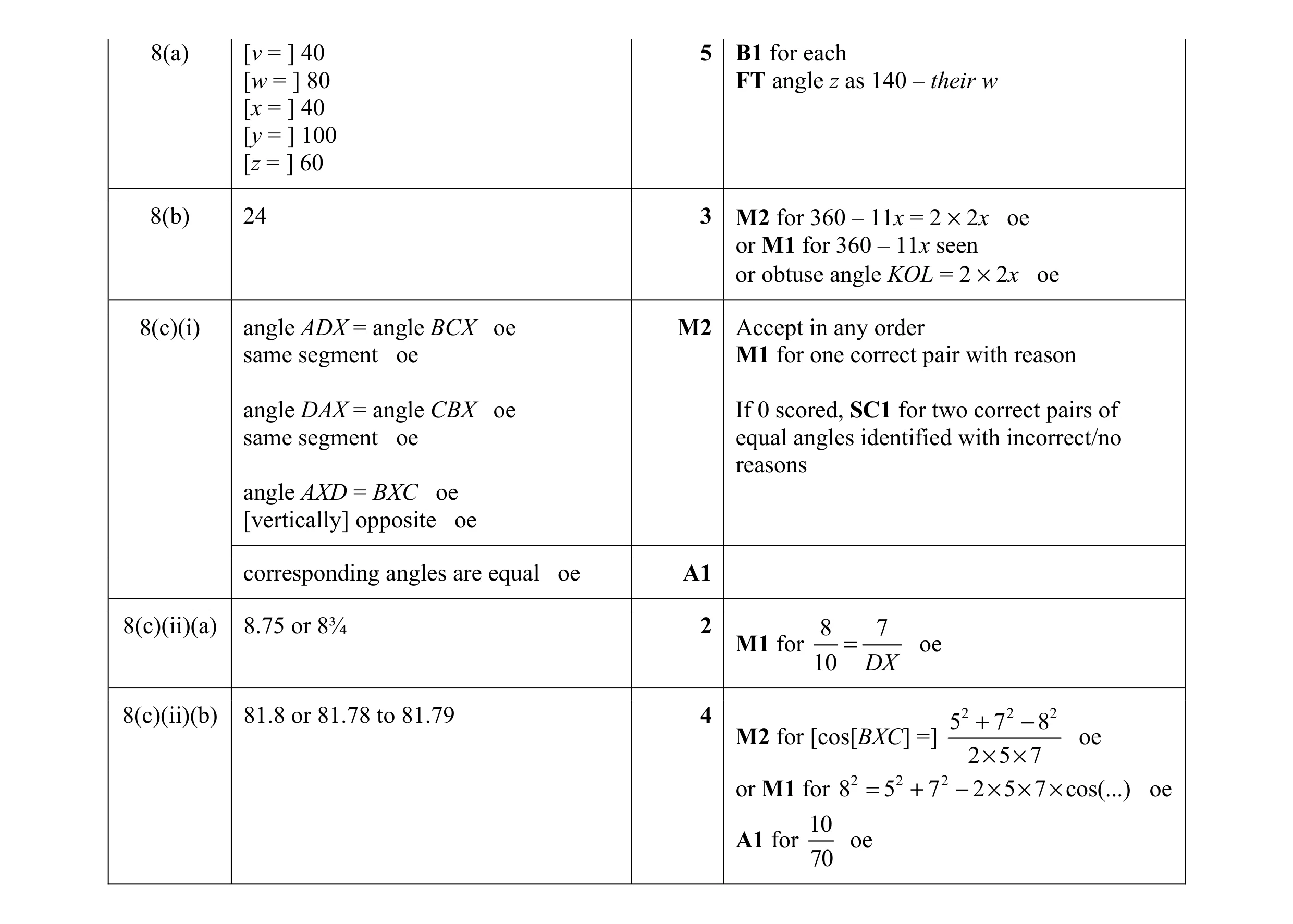
8 (a) D x° z° E NOT TO SCALE P 80° C v° y° w° 40° A B Q The points A, B, C, D and E lie on the circle. PAQ is a tangent to the circle at A and EC = EB. Angle ECB = 80° and angle ABE = 40°. Find the values of v, w, x, y and z. v = … w = … x = … y = … z = … [5] (b) NOT TO SCALE O M K L In the diagram, K, L and M lie on the circle, centre O. Angle KML = 2x° and reflex angle KOL = 11x°. Find the value of x. x = … [3] (c) D NOT TO SCALE C X A B The diagonals of the cyclic quadrilateral ABCD intersect at X. (i) Explain why triangle ADX is similar to triangle BCX. Give a reason for each statement you make. … … … … [3] (ii) AD = 10 cm, BC = 8 cm, BX = 5 cm and CX = 7 cm. (a) Calculate DX. DX = … cm [2] (b) Calculate angle BXC. Angle BXC = … [4]
17 marks
Mark scheme: 8(a) [v = ] 40 5 B1 for each [w = ] 80 FT angle z as 140 – their w [x = ] 40 [y = ] 100 [z = ] 60 8(b) 24 3 M2 for 360 – 11x = 2 × 2x oe or M1 for 360 – 11x seen or obtuse angle KOL = 2 × 2x oe 8(c)(i) angle ADX = angle BCX oe M2 Accept in any order same segment oe M1 for one correct pair with reason angle DAX = angle CBX oe If 0 scored, SC1 for two correct pairs of same segment oe equal angles identified with incorrect/no reasons angle AXD = BXC oe [vertically] opposite oe corresponding angles are equal oe A1 8(c)(ii)(a) 8.75 or 8¾ 2 8 7 M1 for = oe 10 DX 8(c)(ii)(b) 81.8 or 81.78 to 81.79 4 5 2 + 7 2 − 8 2 M2 for [cos[BXC] =] oe 2 × 5 × 7 or M1 for 8 2 = 5 2 + 7 2 −×2 5 × 7 × cos(...) oe 10 A1 for oe 70
This question in 0580/42 Oct/Nov 2020
Q19 · NOT TO SCALE 6.3 cm R cm 2.4 cm The diagram shows a solid cone and a solid hemisphere 0580/41 May/June 2021
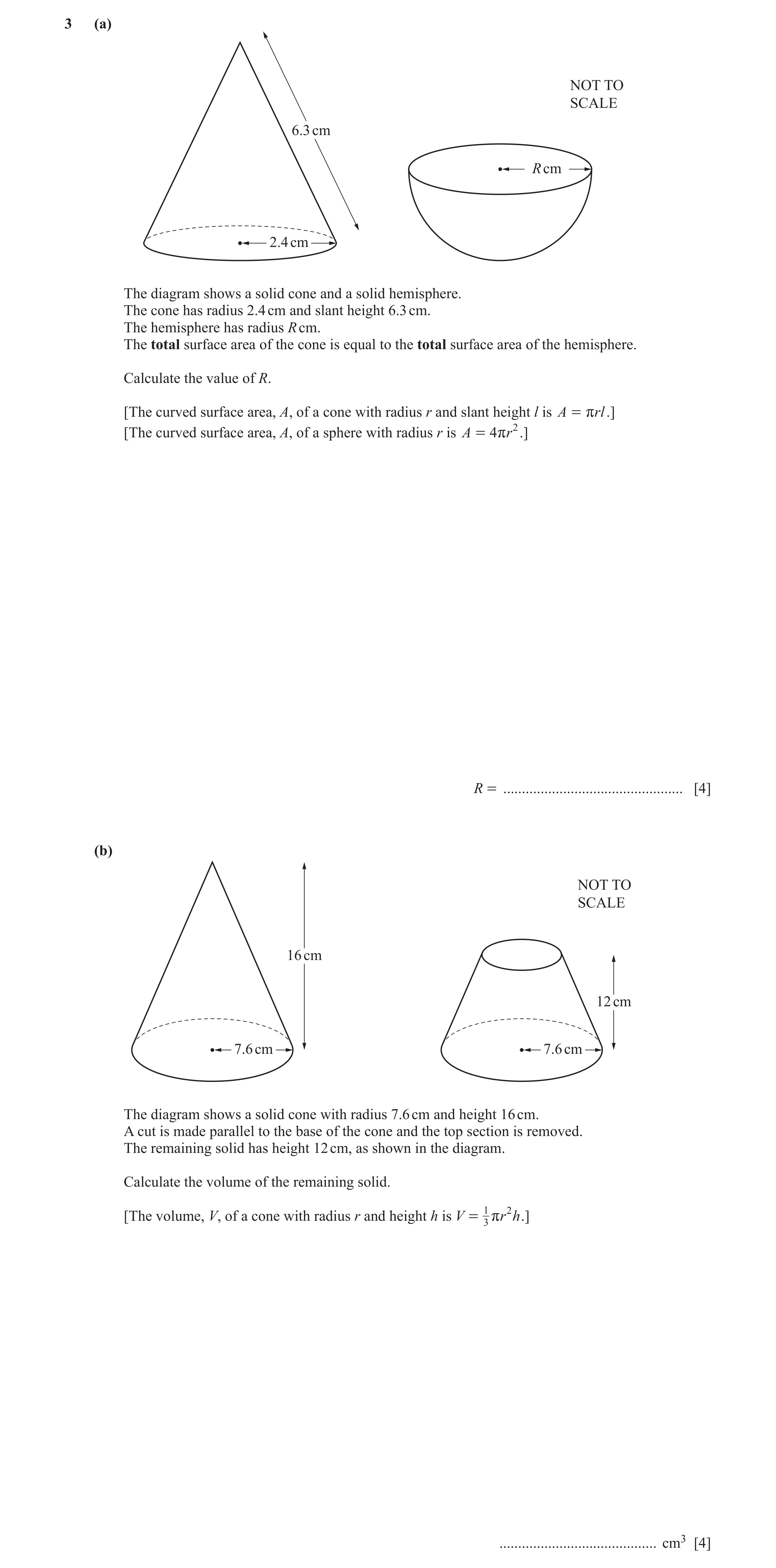
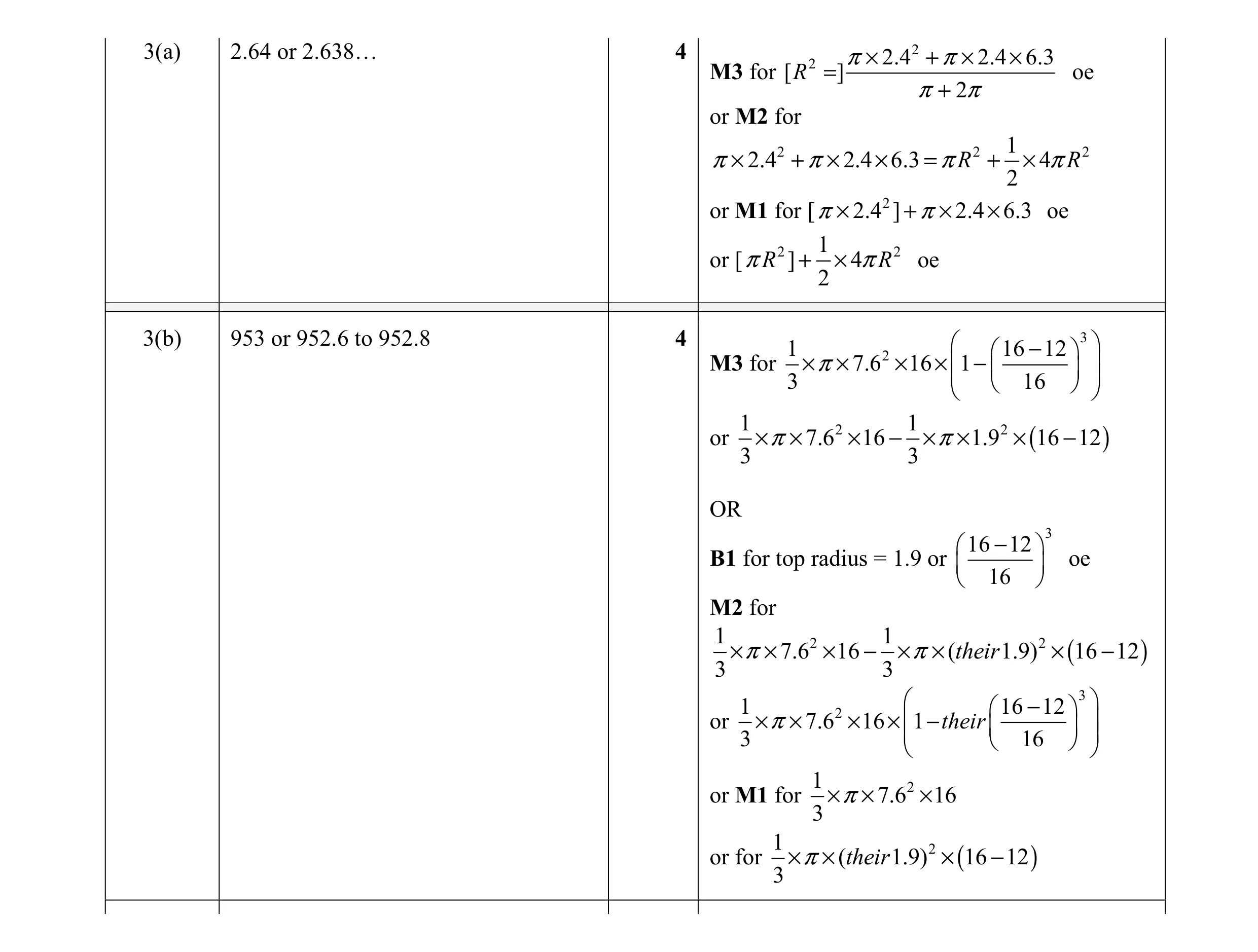
3 (a) NOT TO SCALE 6.3 cm R cm 2.4 cm The diagram shows a solid cone and a solid hemisphere. The cone has radius 2.4 cm and slant height 6.3 cm. The hemisphere has radius R cm. The total surface area of the cone is equal to the total surface area of the hemisphere. Calculate the value of R. [The curved surface area, A, of a cone with radius r and slant height l is A = rrl .] [The curved surface area, A, of a sphere with radius r is A = 4rr 2 .] R = … [4] (b) NOT TO SCALE 16 cm 12 cm 7.6 cm 7.6 cm The diagram shows a solid cone with radius 7.6 cm and height 16 cm. A cut is made parallel to the base of the cone and the top section is removed. The remaining solid has height 12 cm, as shown in the diagram. Calculate the volume of the remaining solid. r r h .] [The volume, V, of a cone with radius r and height h is V = 13 2 … cm3 [4]
8 marks
Mark scheme: 3(a) 2.64 or 2.638… 4 2 π × 2.4 2 + π × 2.4 × 6.3 M3 for [ R = ] oe π + 2π or M2 for 2 2 1 2 π× 2.4 + π× 2.4 × 6.3 = πR + × 4πR 2 or M1 for [ π × 2.4 2 ] + π× 2.4 × 6.3 oe 2 1 2 or [ πR ] + × 4πR oe 2 3(b) 953 or 952.6 to 952.8 4 16 − 12 3 1 2 M3 for × π× 7.6 × 16 × 1 − 3 16 1 2 1 2 or × π× 7.6 × 16 − × π× 1.9 × (16 − 12 ) 3 3 OR 16 − 12 3 B1 for top radius = 1.9 or oe 16 M2 for 1 2 1 2 × π× 7.6 × 16 − × π× (their 1.9) × (16 − 12 ) 3 3 16 − 12 3 1 2 or × π× 7.6 × 16 × 1 − their 3 16 1 2 or M1 for × π× 7.6 × 16 3 1 2 or for × π× (their 1.9) × (16 − 12 ) 3
This question in 0580/41 May/June 2021
Q20 · Find the size of an exterior angle of a regular polygon with 18 sides 0580/41 May/June 2021
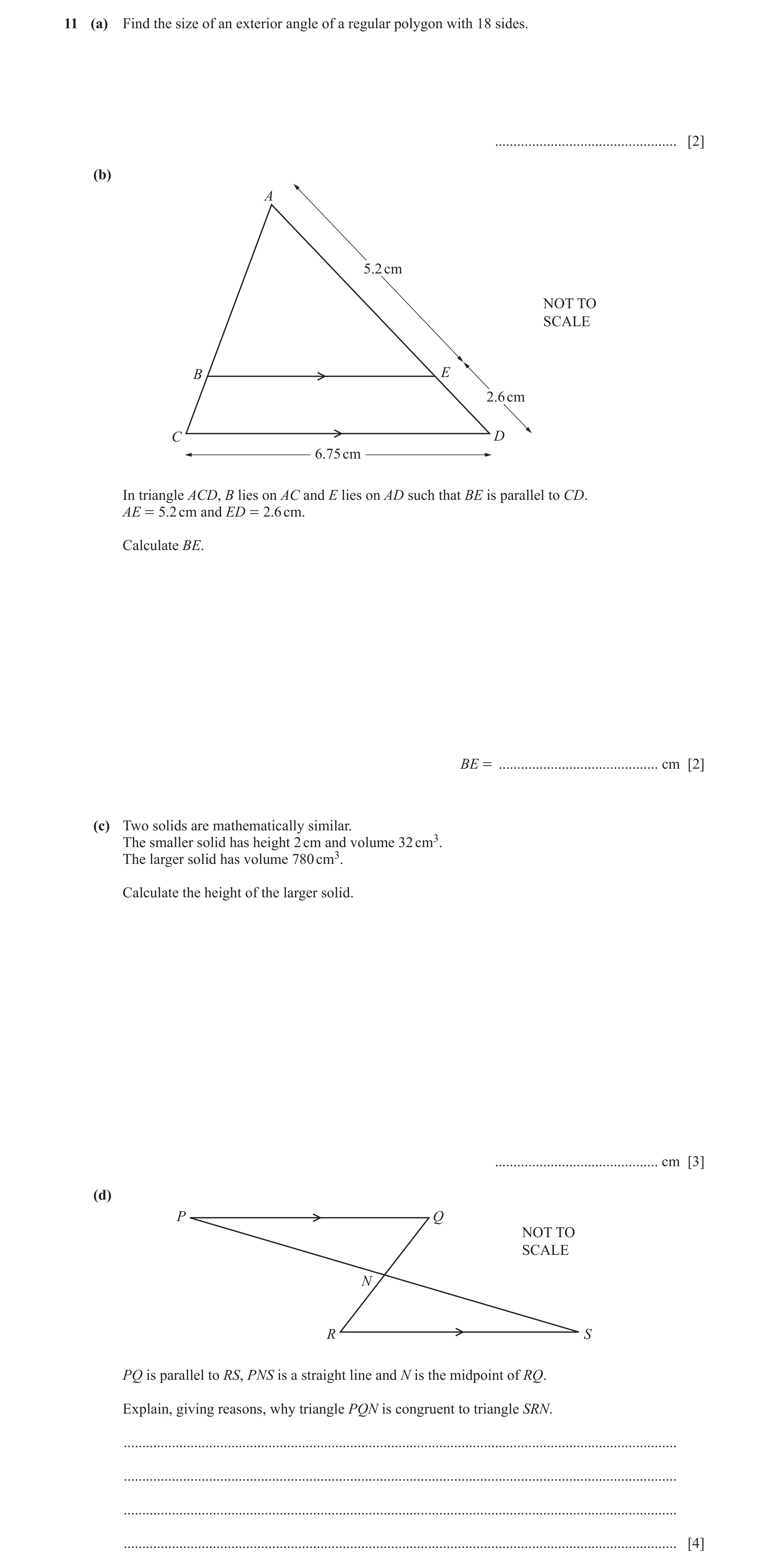
11 (a) Find the size of an exterior angle of a regular polygon with 18 sides. … [2] (b) A 5.2 cm NOT TO SCALE B E 2.6 cm C D 6.75 cm In triangle ACD, B lies on AC and E lies on AD such that BE is parallel to CD. AE = 5.2 cm and ED = 2.6 cm. Calculate BE. BE = … cm [2] (c) Two solids are mathematically similar. The smaller solid has height 2 cm and volume 32 cm3. The larger solid has volume 780 cm3. Calculate the height of the larger solid. … cm [3] (d) P Q NOT TO SCALE N R S PQ is parallel to RS, PNS is a straight line and N is the midpoint of RQ. Explain, giving reasons, why triangle PQN is congruent to triangle SRN. … … … … [4]
11 marks
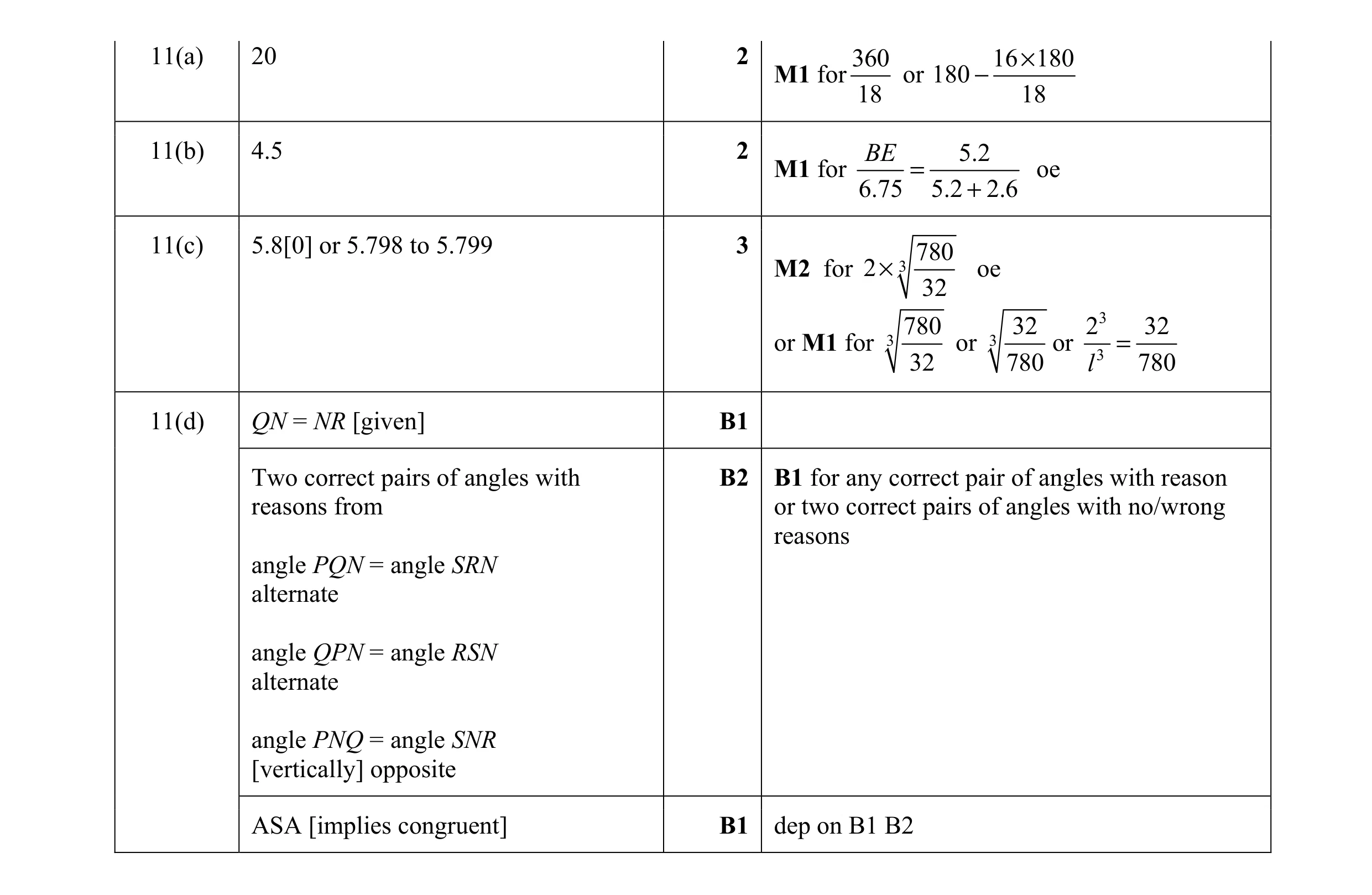
Mark scheme: 11(a) 20 2 360 16 × 180 M1 for or 180 − 18 18 11(b) 4.5 2 BE 5.2 M1 for = oe 6.75 5.2 + 2.6 11(c) 5.8[0] or 5.798 to 5.799 3 780 M2 for 2 × 3 oe 32 780 32 2 3 32 or M1 for 3 or 3 or = 32 780 l 3 780 11(d) QN = NR [given] B1 Two correct pairs of angles with B2 B1 for any correct pair of angles with reason reasons from or two correct pairs of angles with no/wrong reasons angle PQN = angle SRN alternate angle QPN = angle RSN alternate angle PNQ = angle SNR [vertically] opposite ASA [implies congruent] B1 dep on B1 B2
This question in 0580/41 May/June 2021
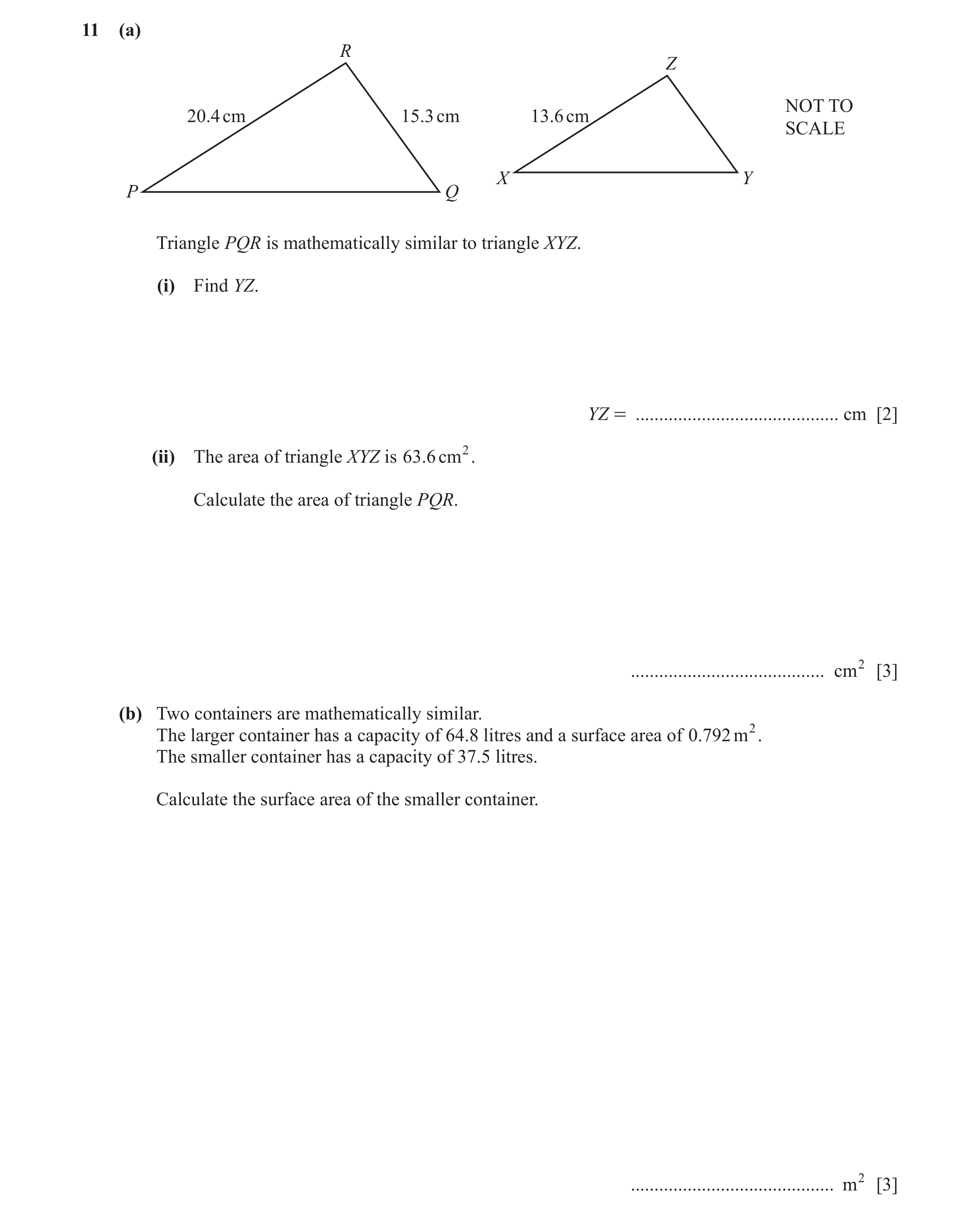
Q21 · R Z NOT TO 20.4 cm 15.3 cm 13.6 cm SCALE X Y P Q Triangle PQR is mathematically similar… 0580/42 Oct/Nov 2021
11 (a) R Z NOT TO 20.4 cm 15.3 cm 13.6 cm SCALE X Y P Q Triangle PQR is mathematically similar to triangle XYZ. (i) Find YZ. YZ = … cm [2] (ii) The area of triangle XYZ is 63.6 cm 2. Calculate the area of triangle PQR. … cm2 [3] (b) Two containers are mathematically similar. The larger container has a capacity of 64.8 litres and a surface area of 0.792 m 2. The smaller container has a capacity of 37.5 litres. Calculate the surface area of the smaller container. … m2 [3]
8 marks
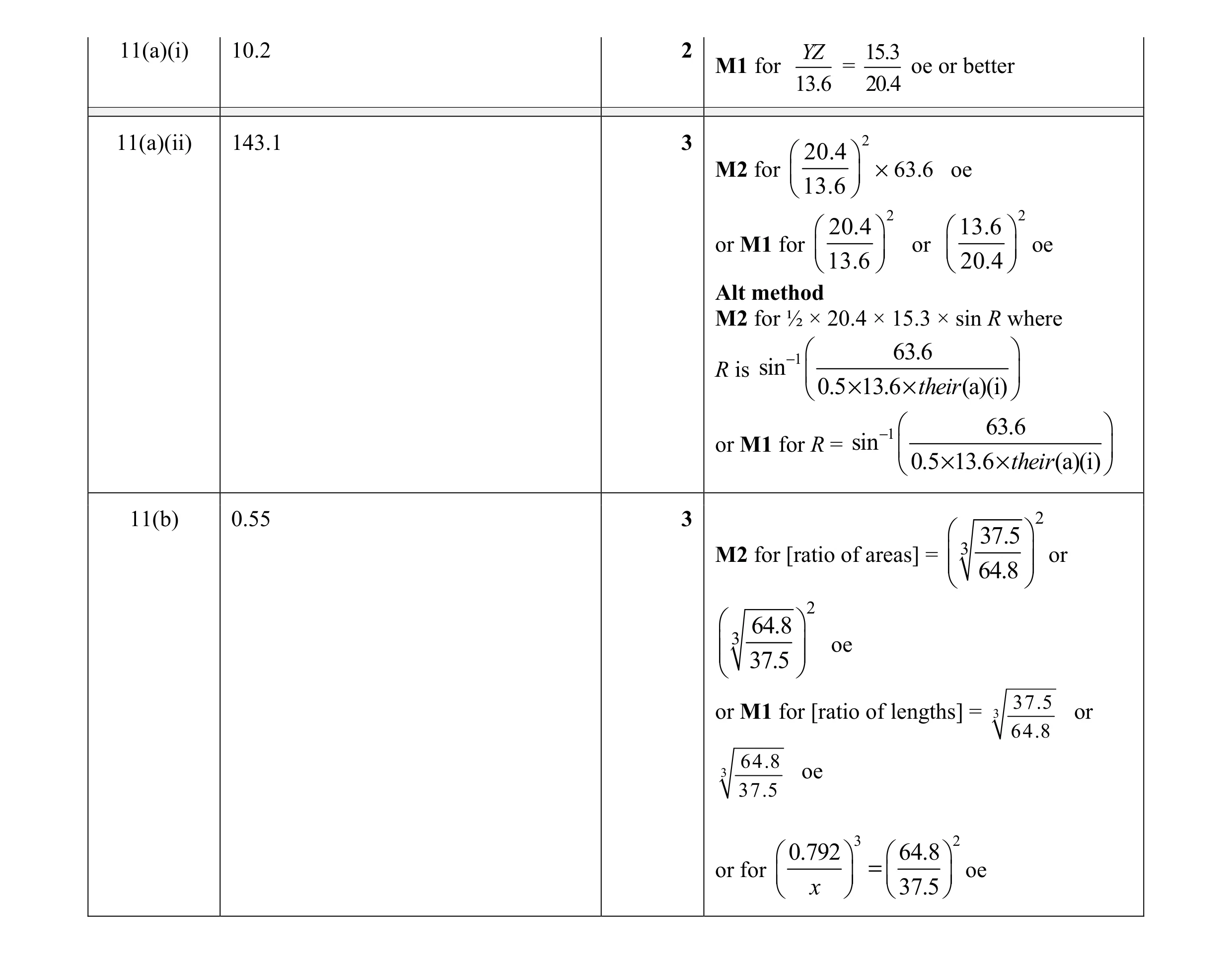
Mark scheme: 11(a)(i) 10.2 2 YZ 15.3 M1 for = oe or better 13.6 20.4 11(a)(ii) 143.1 3 2 20.4 M2 for × 63.6 oe 13.6 20.4 2 13.6 2 or M1 for or oe 13.6 20.4 Alt method M2 for ½ × 20.4 × 15.3 × sin R where −1 63.6 R is sin 0.5 ×13.6 × their (a)(i) −1 63.6 or M1 for R = sin 0.5 ×13.6 × their (a)(i) 11(b) 0.55 3 2 37.5 M2 for [ratio of areas] = 3 or 64.8 2 64.8 3 oe 37.5 37.5 or M1 for [ratio of lengths] = 3 or 64.8 64.8 3 oe 37.5 0.792 3 64.8 2 or for = oe x 37.5
This question in 0580/42 Oct/Nov 2021
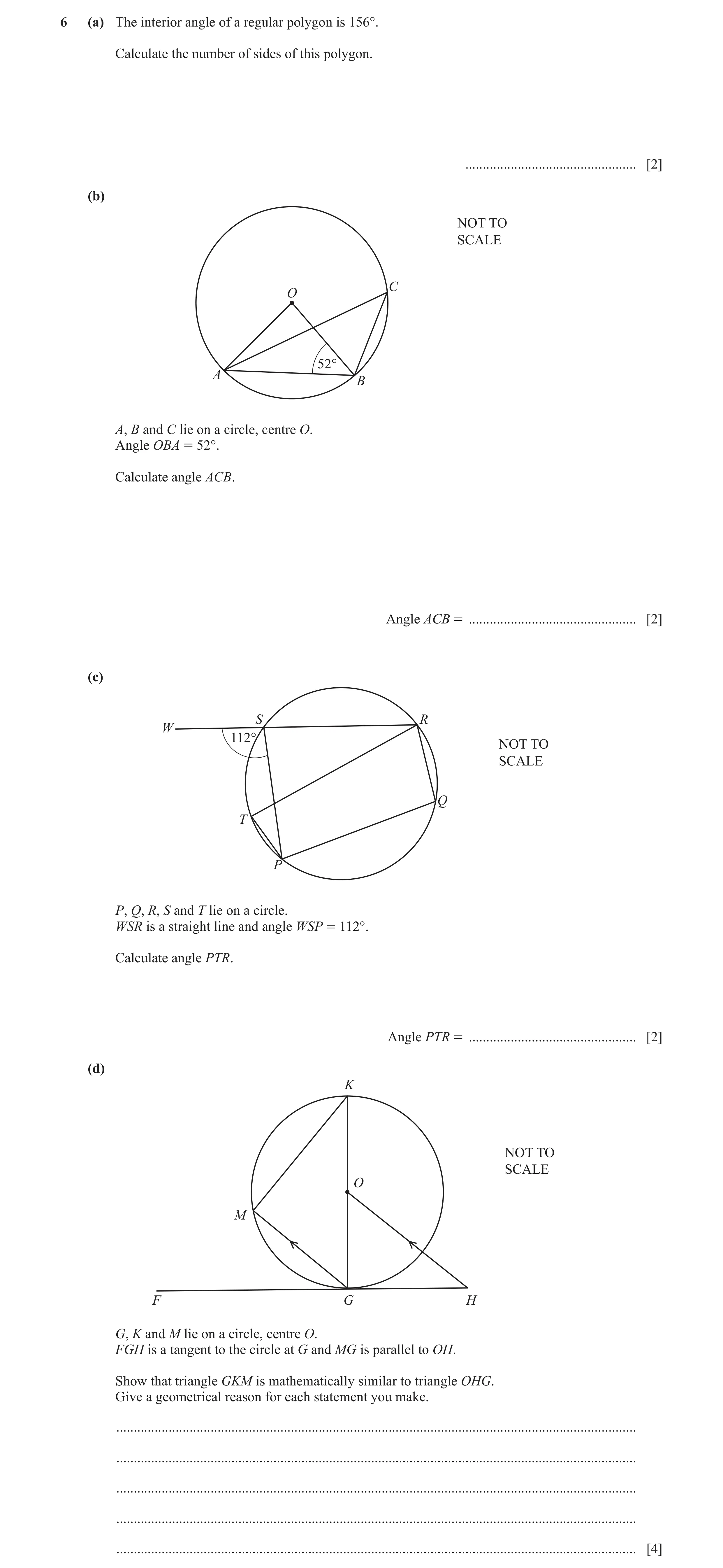
Q22 · The interior angle of a regular polygon is 156° 0580/42 Feb/March 2022
6 (a) The interior angle of a regular polygon is 156°. Calculate the number of sides of this polygon. … [2] (b) NOT TO SCALE C O 52° A B A, B and C lie on a circle, centre O. Angle OBA = 52°. Calculate angle ACB. Angle ACB = … [2] (c) S R W 112° NOT TO SCALE Q T P P, Q, R, S and T lie on a circle. WSR is a straight line and angle WSP = 112°. Calculate angle PTR. Angle PTR = … [2] (d) K NOT TO SCALE O M F G H G, K and M lie on a circle, centre O. FGH is a tangent to the circle at G and MG is parallel to OH. Show that triangle GKM is mathematically similar to triangle OHG. Give a geometrical reason for each statement you make. … … … … … [4]
10 marks
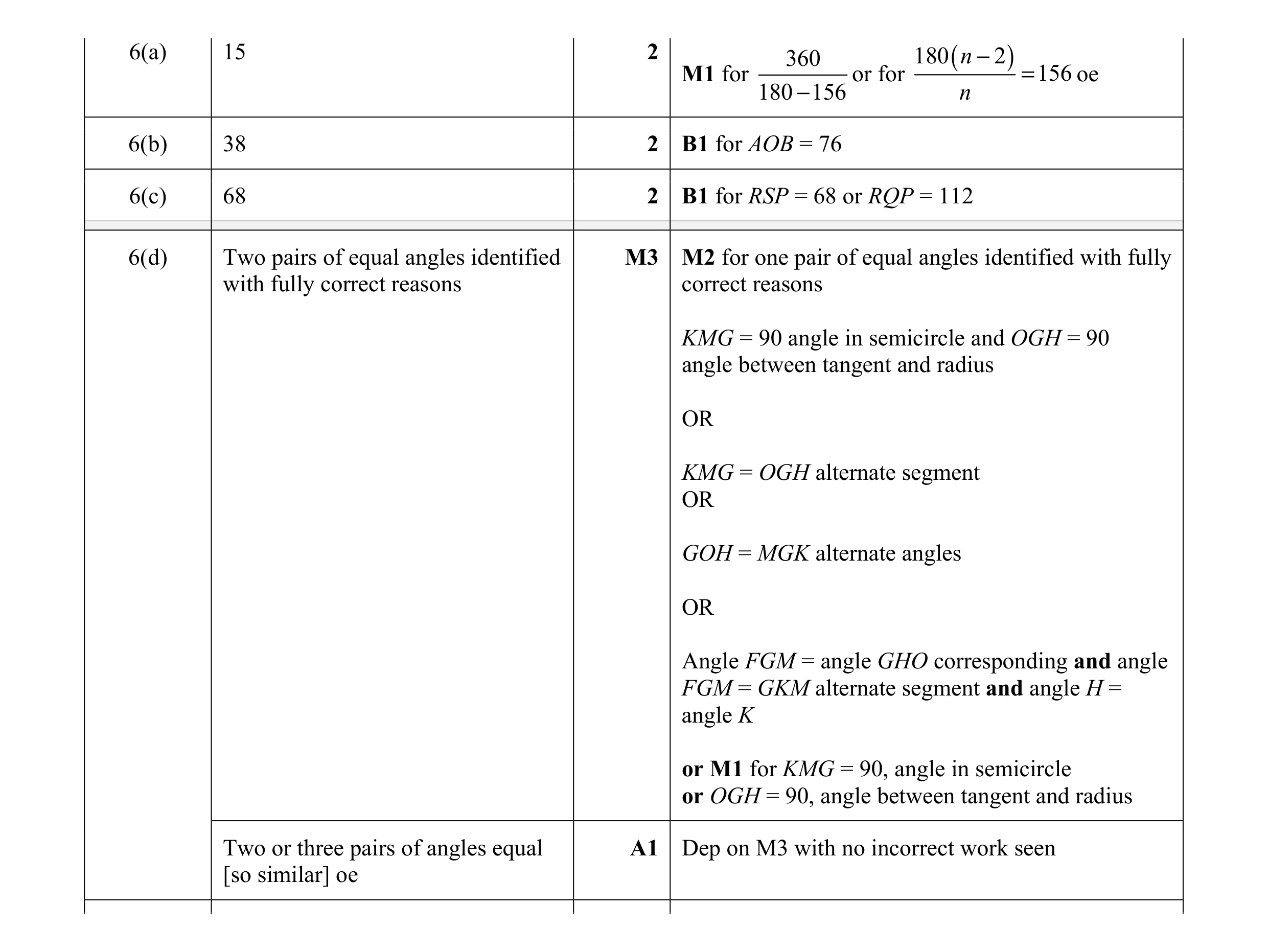
Mark scheme: 6(a) 15 2 360 180 ( n − 2 ) M1 for or for = 156 oe 180 − 156 n 6(b) 38 2 B1 for AOB = 76 6(c) 68 2 B1 for RSP = 68 or RQP = 112 6(d) Two pairs of equal angles identified M3 M2 for one pair of equal angles identified with fully with fully correct reasons correct reasons KMG = 90 angle in semicircle and OGH = 90 angle between tangent and radius OR KMG = OGH alternate segment OR GOH = MGK alternate angles OR Angle FGM = angle GHO corresponding and angle FGM = GKM alternate segment and angle H = angle K or M1 for KMG = 90, angle in semicircle or OGH = 90, angle between tangent and radius Two or three pairs of angles equal A1 Dep on M3 with no incorrect work seen [so similar] oe
This question in 0580/42 Feb/March 2022
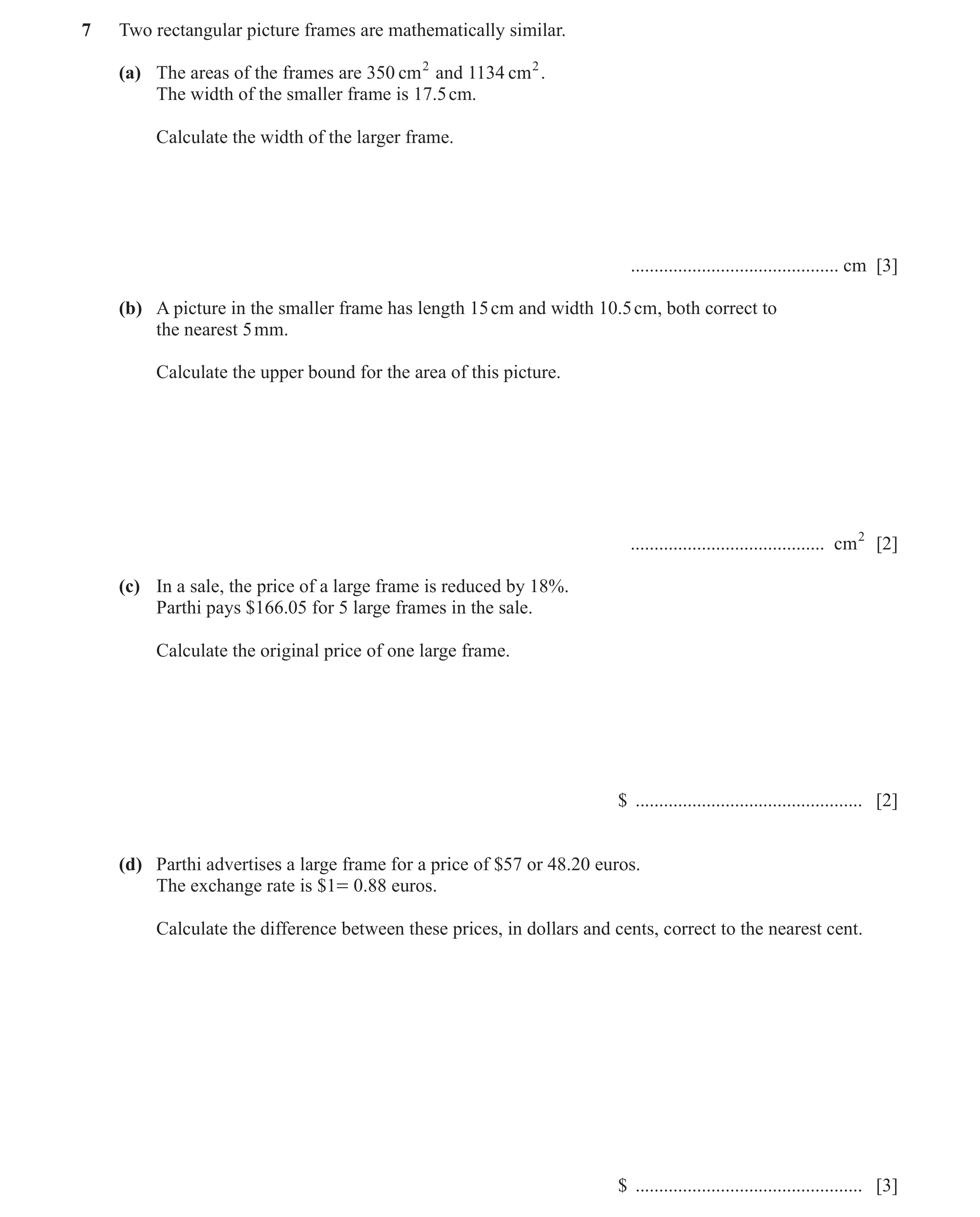
Q23 · Two rectangular picture frames are mathematically similar 0580/42 Feb/March 2022
7 Two rectangular picture frames are mathematically similar. (a) The areas of the frames are 350 cm2 and 1134 cm2. The width of the smaller frame is 17.5 cm. Calculate the width of the larger frame. … cm [3] (b) A picture in the smaller frame has length 15 cm and width 10.5 cm, both correct to the nearest 5 mm. Calculate the upper bound for the area of this picture. … cm2 [2] (c) In a sale, the price of a large frame is reduced by 18%. Parthi pays $166.05 for 5 large frames in the sale. Calculate the original price of one large frame. $ … [2] (d) Parthi advertises a large frame for a price of $57 or 48.20 euros. The exchange rate is $1= 0.88 euros. Calculate the difference between these prices, in dollars and cents, correct to the nearest cent. $ … [3]
10 marks
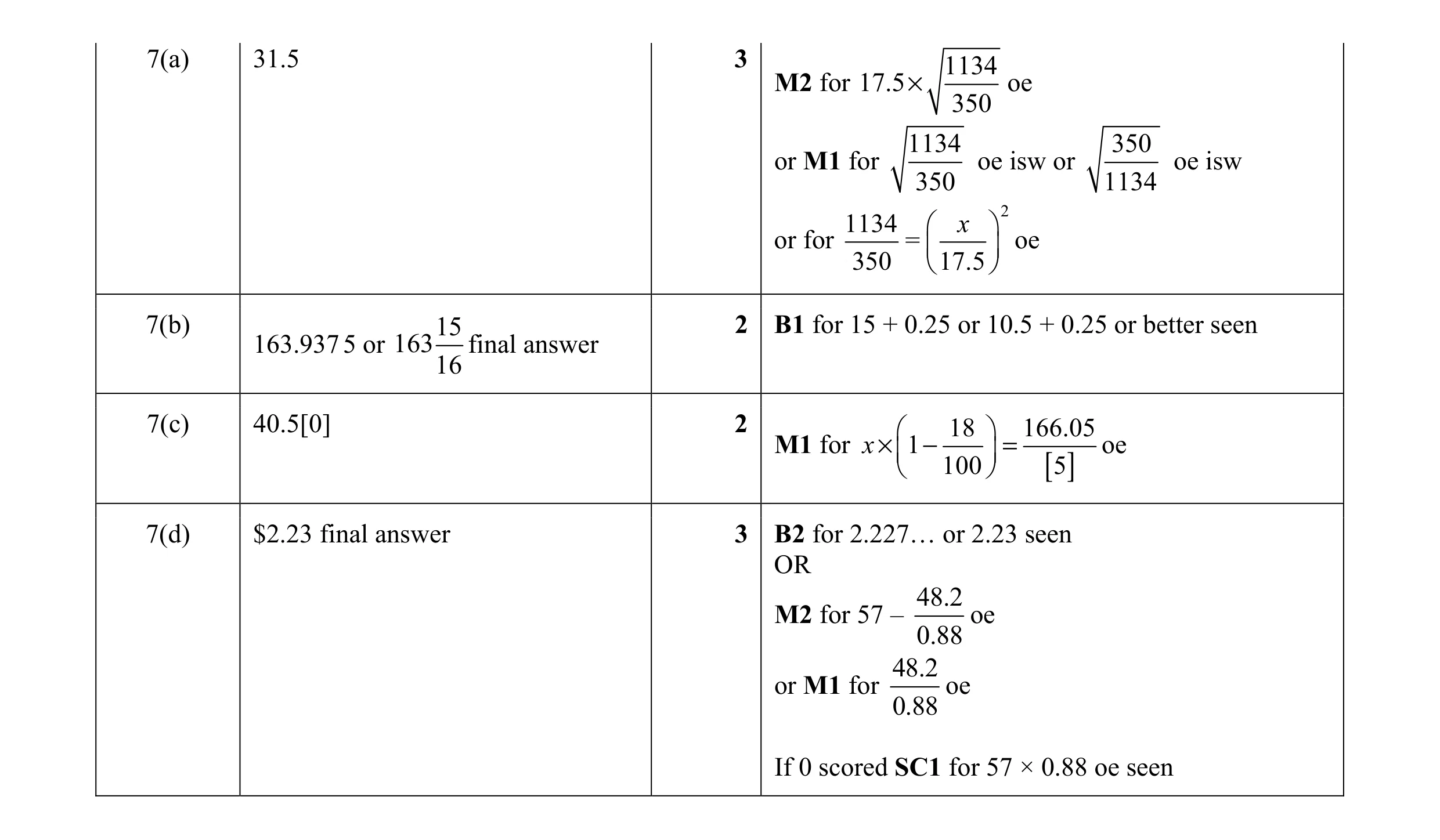
Mark scheme: 7(a) 31.5 3 1134 M2 for 17.5 × oe 350 1134 350 or M1 for oe isw or oe isw 350 1134 1134 x 2 or for = oe 350 17.5 7(b) 15 2 B1 for 15 + 0.25 or 10.5 + 0.25 or better seen 163.937 5 or 16316 final answer 7(c) 40.5[0] 2 18 166.05 M1 for x × 1 − = oe 100 [ 5 ] 7(d) $2.23 final answer 3 B2 for 2.227… or 2.23 seen OR 48.2 M2 for 57 – oe 0.88 48.2 or M1 for oe 0.88 If 0 scored SC1 for 57 × 0.88 oe seen
This question in 0580/42 Feb/March 2022
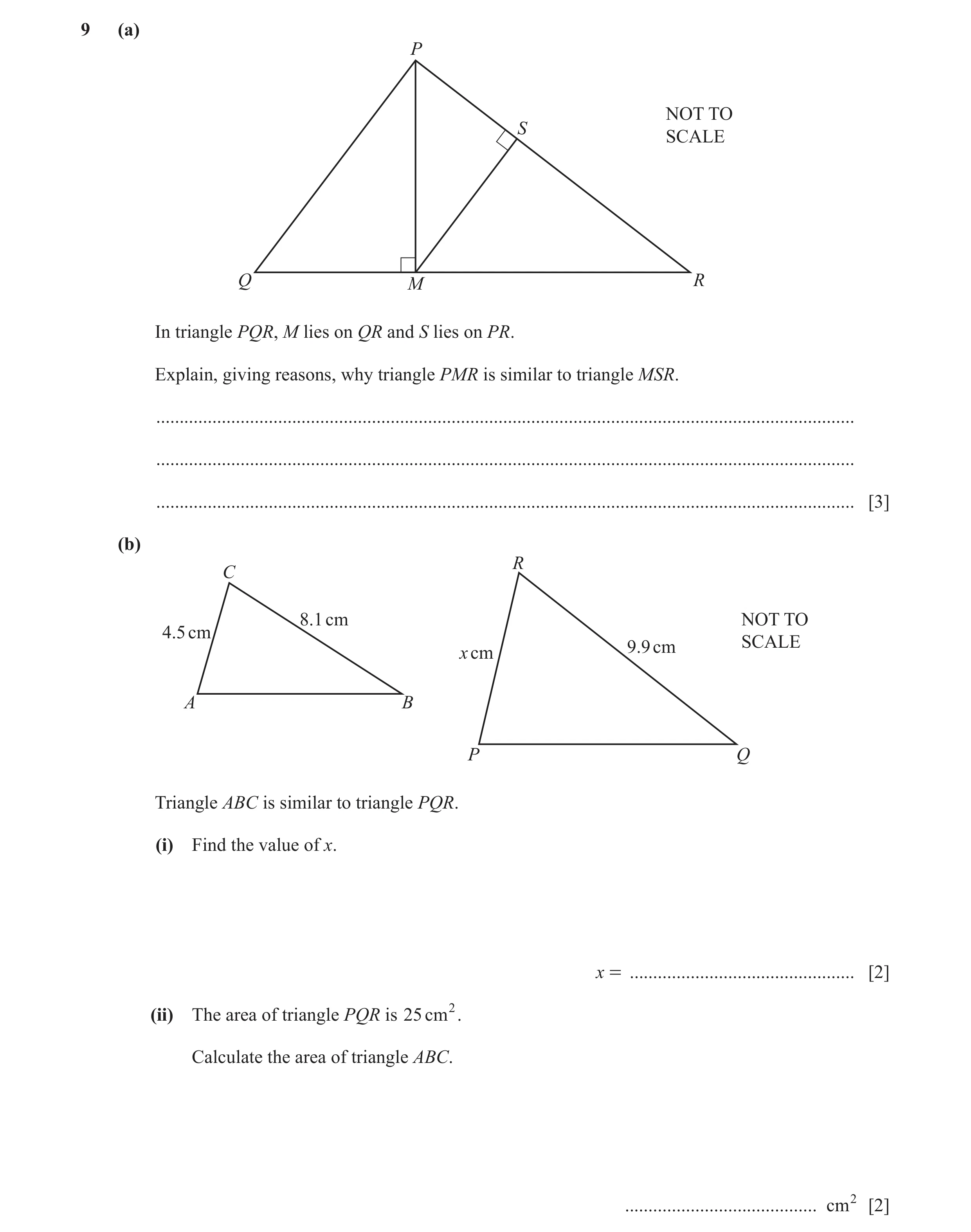
Q24 · P NOT TO S SCALE Q M R In triangle PQR, M lies on QR and S lies on PR 0580/42 May/June 2022
9 (a) P NOT TO S SCALE Q M R In triangle PQR, M lies on QR and S lies on PR. Explain, giving reasons, why triangle PMR is similar to triangle MSR. … … … [3] (b) R C 8.1 cm NOT TO 4.5 cm SCALE 9.9 cm x cm A B P Q Triangle ABC is similar to triangle PQR. (i) Find the value of x. x = … [2] (ii) The area of triangle PQR is 25 cm 2. Calculate the area of triangle ABC. … cm2 [2]
7 marks
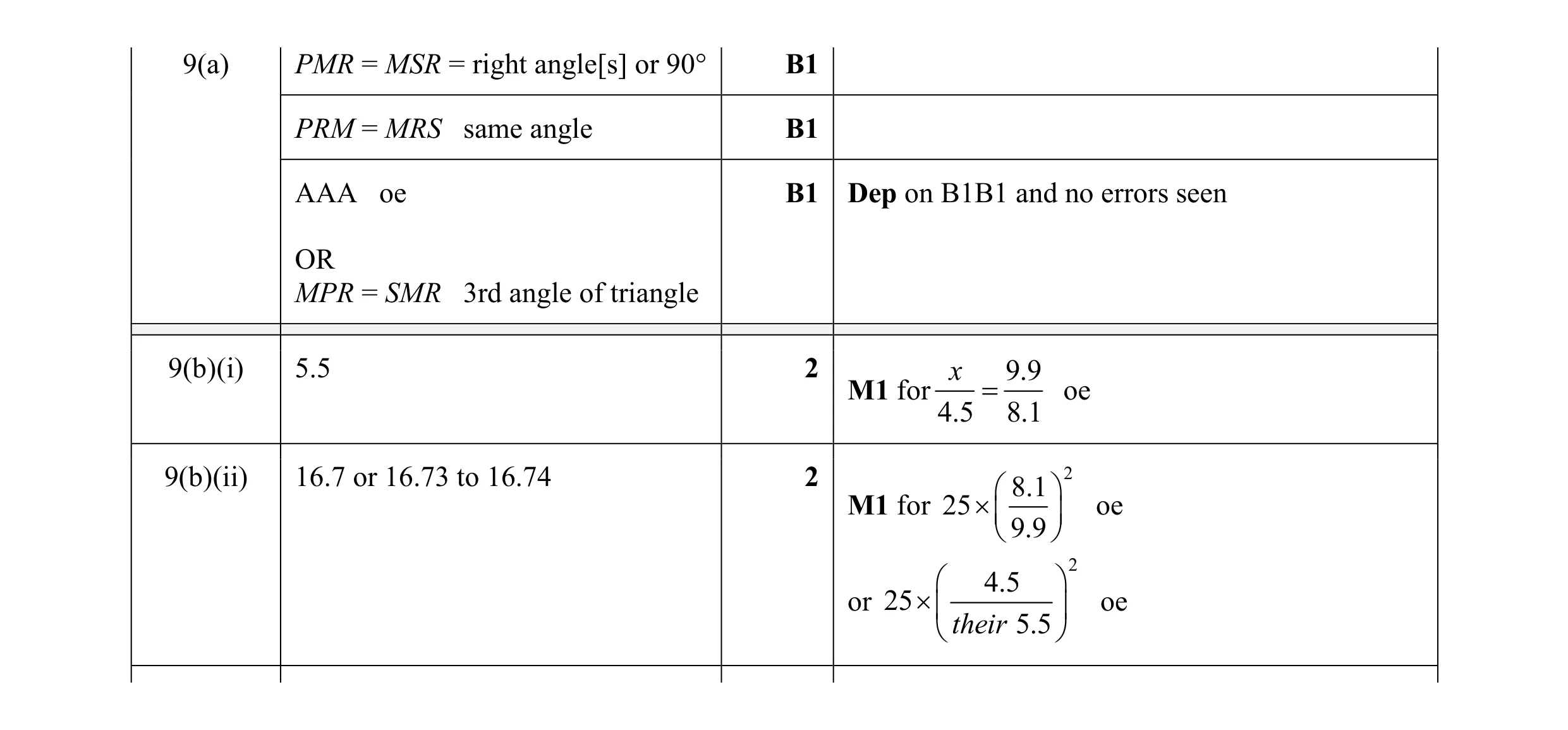
Mark scheme: 9(a) PMR = MSR = right angle[s] or 90° B1 PRM = MRS same angle B1 AAA oe B1 Dep on B1B1 and no errors seen OR MPR = SMR 3rd angle of triangle 9(b)(i) 5.5 2 x 9.9 M1 for oe 4.5 8.1 9(b)(ii) 16.7 or 16.73 to 16.74 2 2 8.1 M1 for 25 oe 9.9 4.5 2 or 25 oe their 5.5
This question in 0580/42 May/June 2022
Q25 · Y 7 6 5 4 A 3 T 2 1 – 6 – 5 – 4 – 3 – 2 – 1 0 1 2 3 4 5 6 7 x – 1 – 2 – 3 – 4 – 5 (i)… 0580/43 May/June 2022
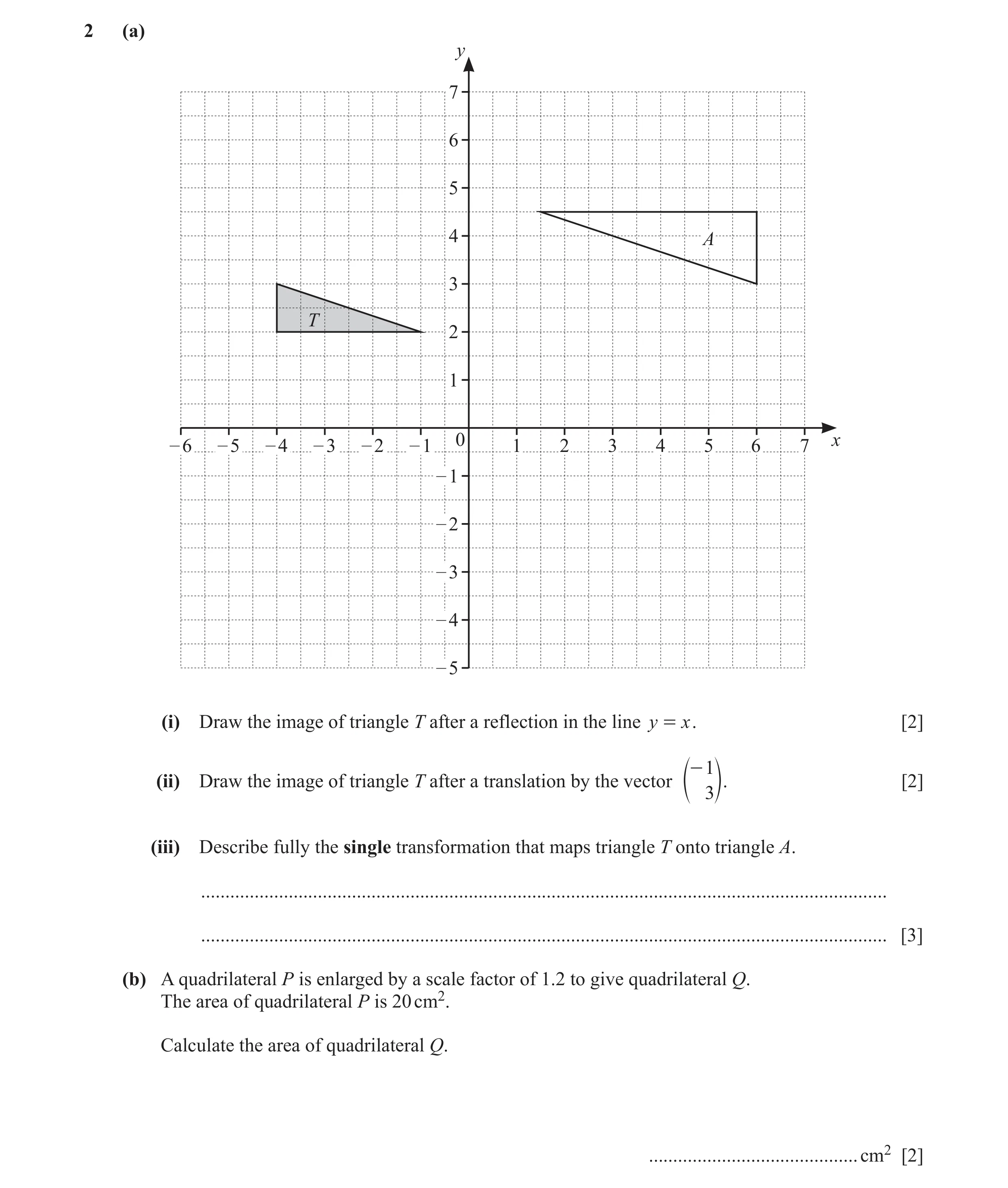
2 (a) y 7 6 5 4 A 3 T 2 1 – 6 – 5 – 4 – 3 – 2 – 1 0 1 2 3 4 5 6 7 x – 1 – 2 – 3 – 4 – 5 (i) Draw the image of triangle T after a reflection in the line y = x . [2] - 1 (ii) Draw the image of triangle T after a translation by the vector [2] e 3o. (iii) Describe fully the single transformation that maps triangle T onto triangle A. … … [3] (b) A quadrilateral P is enlarged by a scale factor of 1.2 to give quadrilateral Q. The area of quadrilateral P is 20 cm2. Calculate the area of quadrilateral Q. … cm2 [2]
9 marks
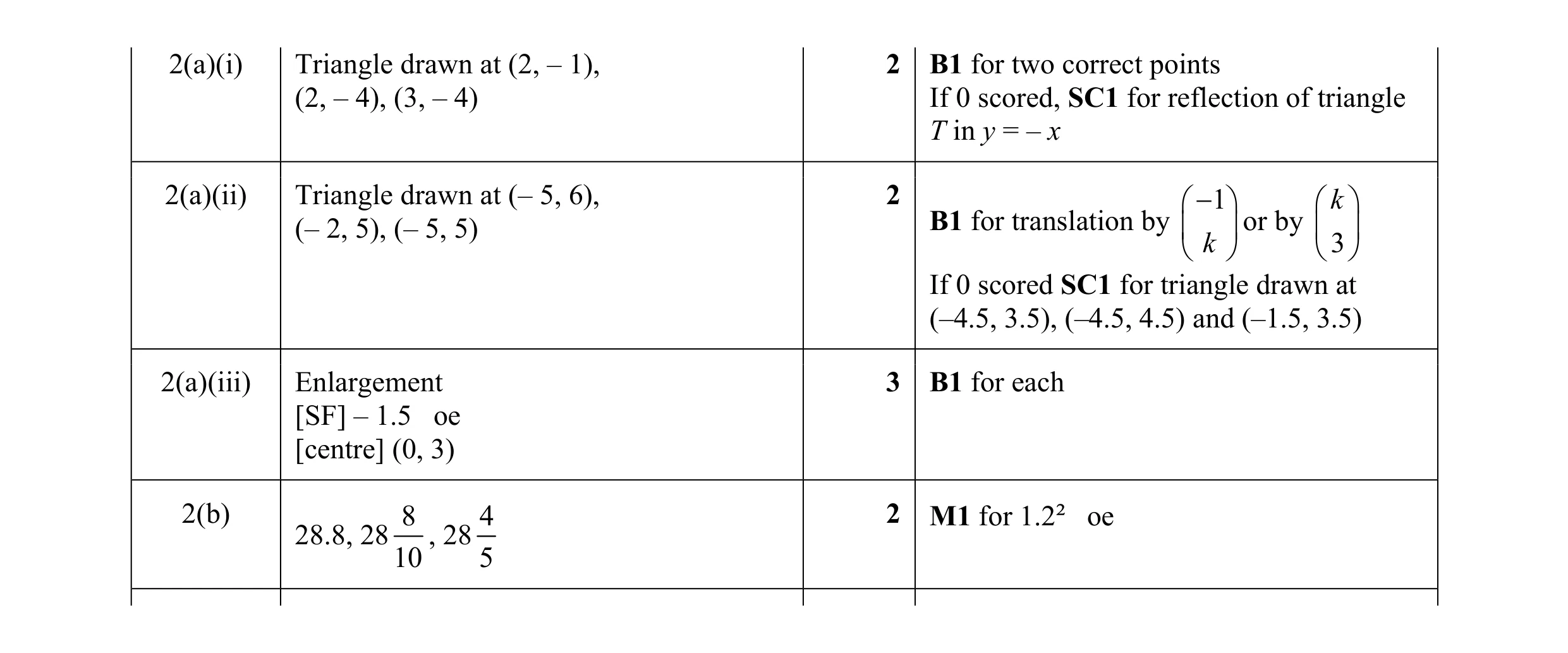
Mark scheme: 2(a)(i) Triangle drawn at (2, – 1), 2 B1 for two correct points (2, – 4), (3, – 4) If 0 scored, SC1 for reflection of triangle T in y = – x 2(a)(ii) Triangle drawn at (– 5, 6), 2 1 k (– 2, 5), (– 5, 5) B1 for translation by or by k 3 If 0 scored SC1 for triangle drawn at (–4.5, 3.5), (–4.5, 4.5) and (–1.5, 3.5) 2(a)(iii) Enlargement 3 B1 for each [SF] – 1.5 oe [centre] (0, 3) 2(b) 8 4 2 M1 for 1.2² oe 28.8, 28 , 28 10 5
This question in 0580/43 May/June 2022
Q26 · C NOT TO SCALE ( x + 3) cm A ( 2x + 5) cm B The diagram shows a right-angled triangle ABC 0580/42 May/June 2023
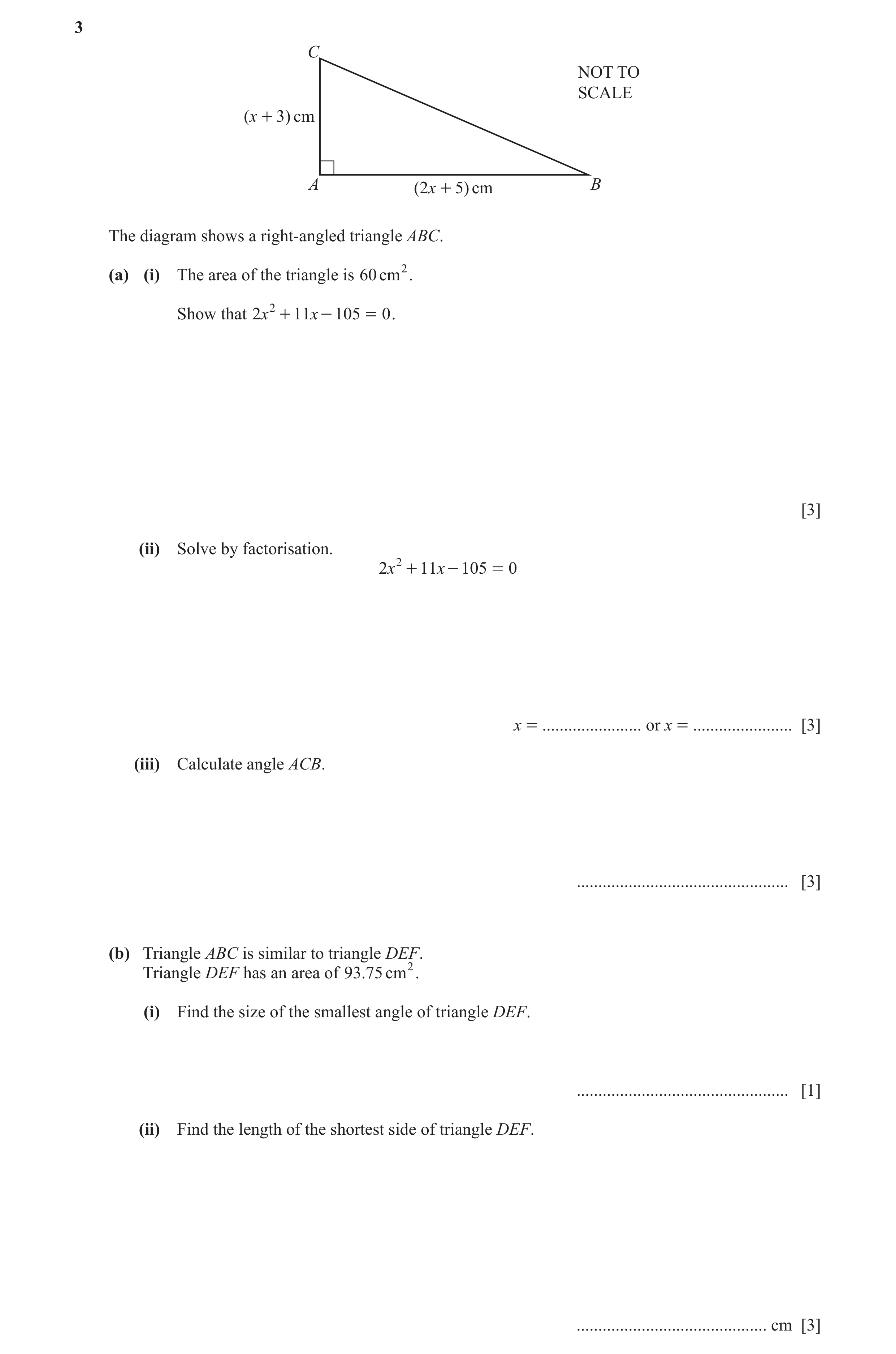
3 C NOT TO SCALE ( x + 3) cm A ( 2x + 5) cm B The diagram shows a right-angled triangle ABC. (a) (i) The area of the triangle is 60 cm 2. Show that 2x 2 + 11 x - 105 = 0 . [3] (ii) Solve by factorisation. 2x 2 + 11x - 105 = 0 x = … or x = … [3] (iii) Calculate angle ACB. … [3] (b) Triangle ABC is similar to triangle DEF. Triangle DEF has an area of 93.75 cm 2. (i) Find the size of the smallest angle of triangle DEF. … [1] (ii) Find the length of the shortest side of triangle DEF. … cm [3]
13 marks
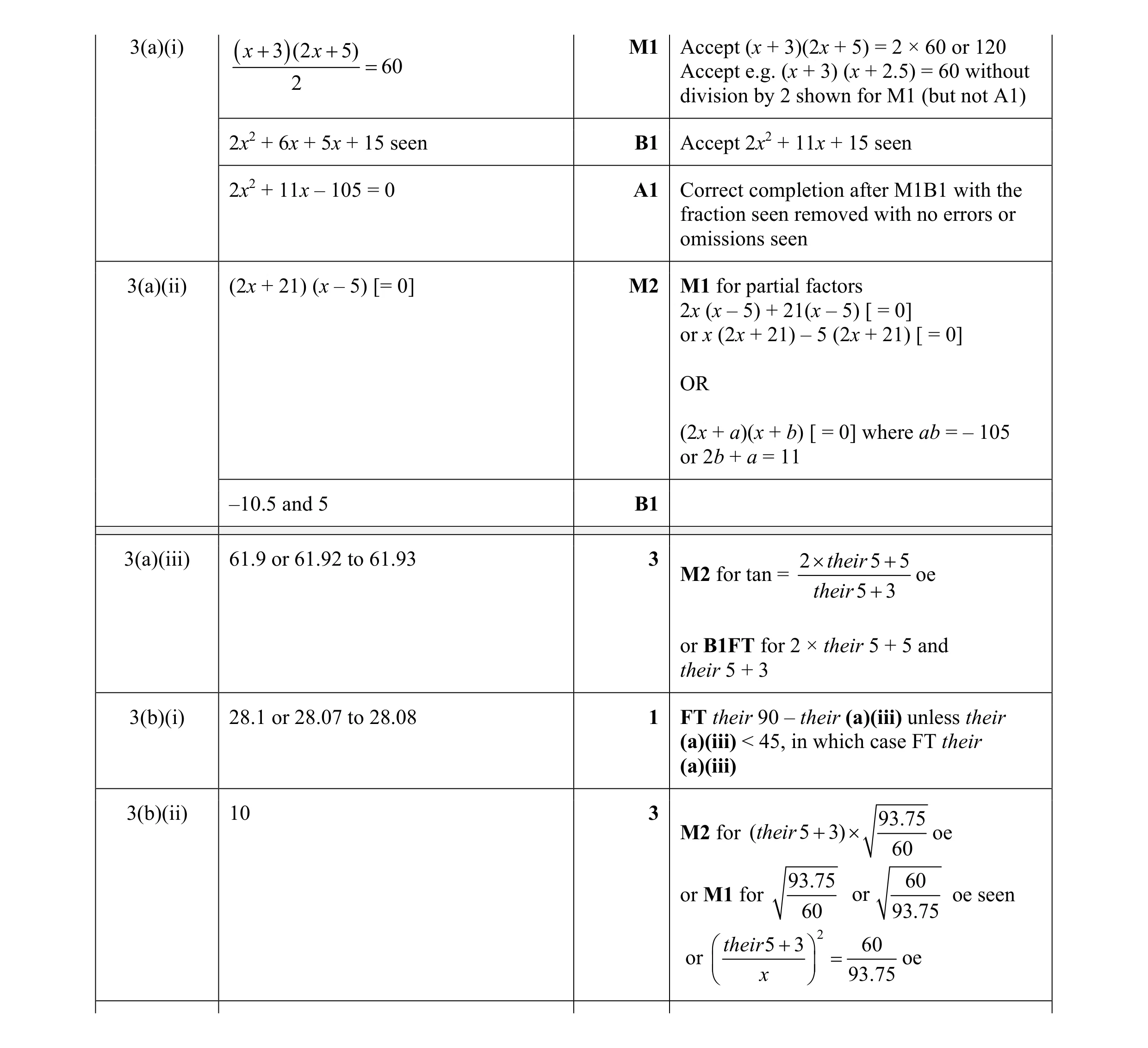
Mark scheme: 3(a)(i) x 3 (2 x 5) M1 Accept (x + 3)(2x + 5) = 2 × 60 or 120 60 Accept e.g. (x + 3) (x + 2.5) = 60 without 2 division by 2 shown for M1 (but not A1) 2x2 + 6x + 5x + 15 seen B1 Accept 2x2 + 11x + 15 seen 2x2 + 11x – 105 = 0 A1 Correct completion after M1B1 with the fraction seen removed with no errors or omissions seen 3(a)(ii) (2x + 21) (x – 5) [= 0] M2 M1 for partial factors 2x (x – 5) + 21(x – 5) [ = 0] or x (2x + 21) – 5 (2x + 21) [ = 0] OR (2x + a)(x + b) [ = 0] where ab = – 105 or 2b + a = 11 –10.5 and 5 B1 3(a)(iii) 61.9 or 61.92 to 61.93 3 2 their 5 5 M2 for tan = oe their 5 3 or B1FT for 2 × their 5 + 5 and their 5 + 3 3(b)(i) 28.1 or 28.07 to 28.08 1 FT their 90 – their (a)(iii) unless their (a)(iii) < 45, in which case FT their (a)(iii) 3(b)(ii) 10 3 93.75 M2 for (their 5 3) oe 60 93.75 60 or M1 for or oe seen 60 93.75 their 5 3 2 60 oe or x 93.75
This question in 0580/42 May/June 2023
Q27 · The scale drawing shows two sides, AB and BC, of a field 0580/43 May/June 2023
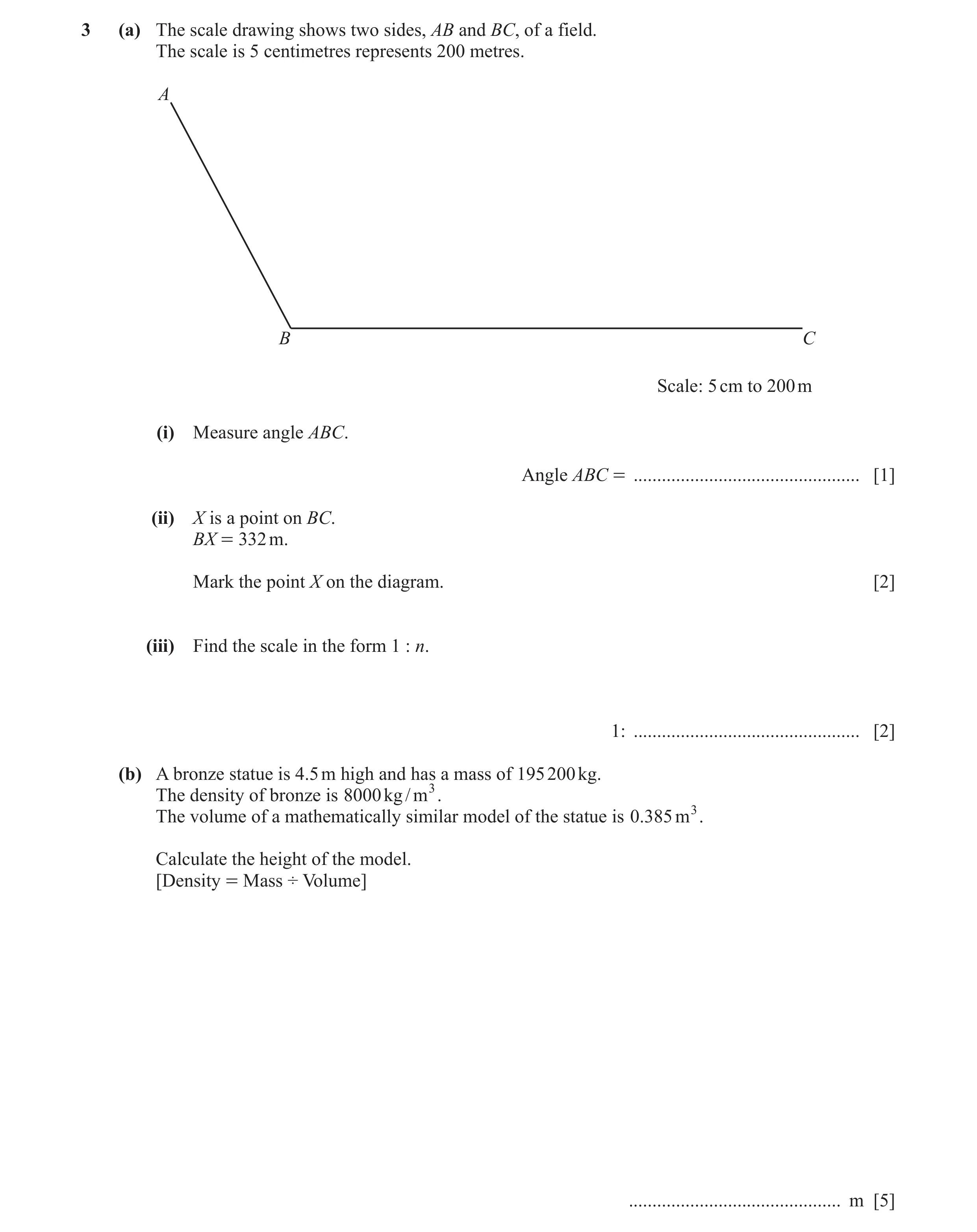
3 (a) The scale drawing shows two sides, AB and BC, of a field. The scale is 5 centimetres represents 200 metres. A B C Scale: 5 cm to 200 m (i) Measure angle ABC. Angle ABC = … [1] (ii) X is a point on BC. BX = 332 m. Mark the point X on the diagram. [2] (iii) Find the scale in the form 1 : n. 1: … [2] (b) A bronze statue is 4.5 m high and has a mass of 195 200 kg. The density of bronze is 8000 kg / m 3. The volume of a mathematically similar model of the statue is 0.385 m 3. Calculate the height of the model. [Density = Mass ÷ Volume] … m [5]
10 marks
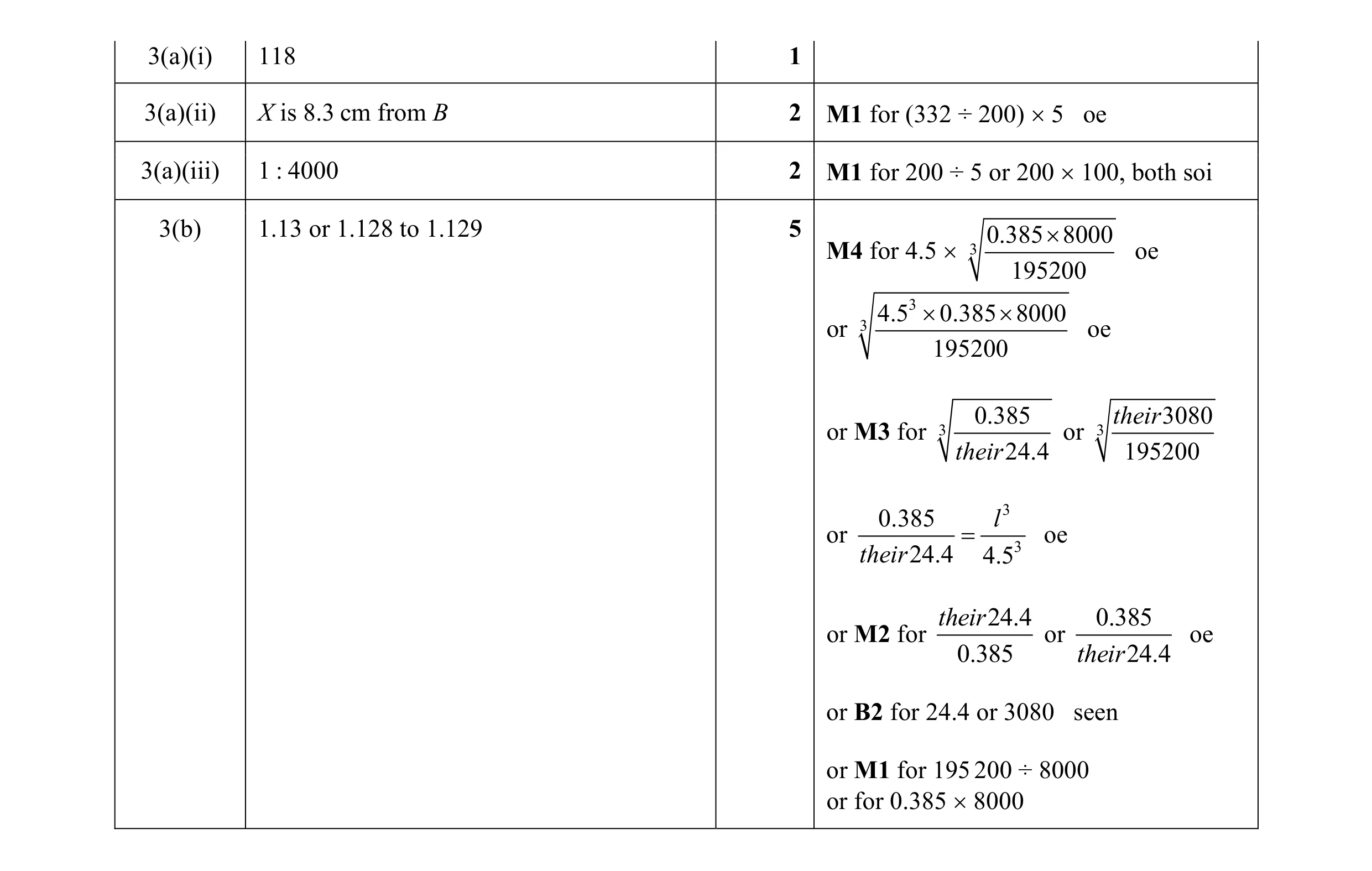
Mark scheme: 3(a)(i) 118 1 3(a)(ii) X is 8.3 cm from B 2 M1 for (332 ÷ 200) 5 oe 3(a)(iii) 1 : 4000 2 M1 for 200 ÷ 5 or 200 100, both soi 3(b) 1.13 or 1.128 to 1.129 5 0.385 8000 M4 for 4.5 3 oe 195200 4.53 0.385 8000 or 3 oe 195200 0.385 their 3080 or M3 for 3 or 3 their 24.4 195200 0.385 l 3 or oe their 24.4 4.53 their 24.4 0.385 or M2 for or oe 0.385 their 24.4 or B2 for 24.4 or 3080 seen or M1 for 195 200 ÷ 8000 or for 0.385 8000
This question in 0580/43 May/June 2023
Q28 · 3.63.6 cmcm 6.5 cm NOT TO SCALE 5.4 cm The diagram shows a solid formed by joining two… 0580/41 Oct/Nov 2023
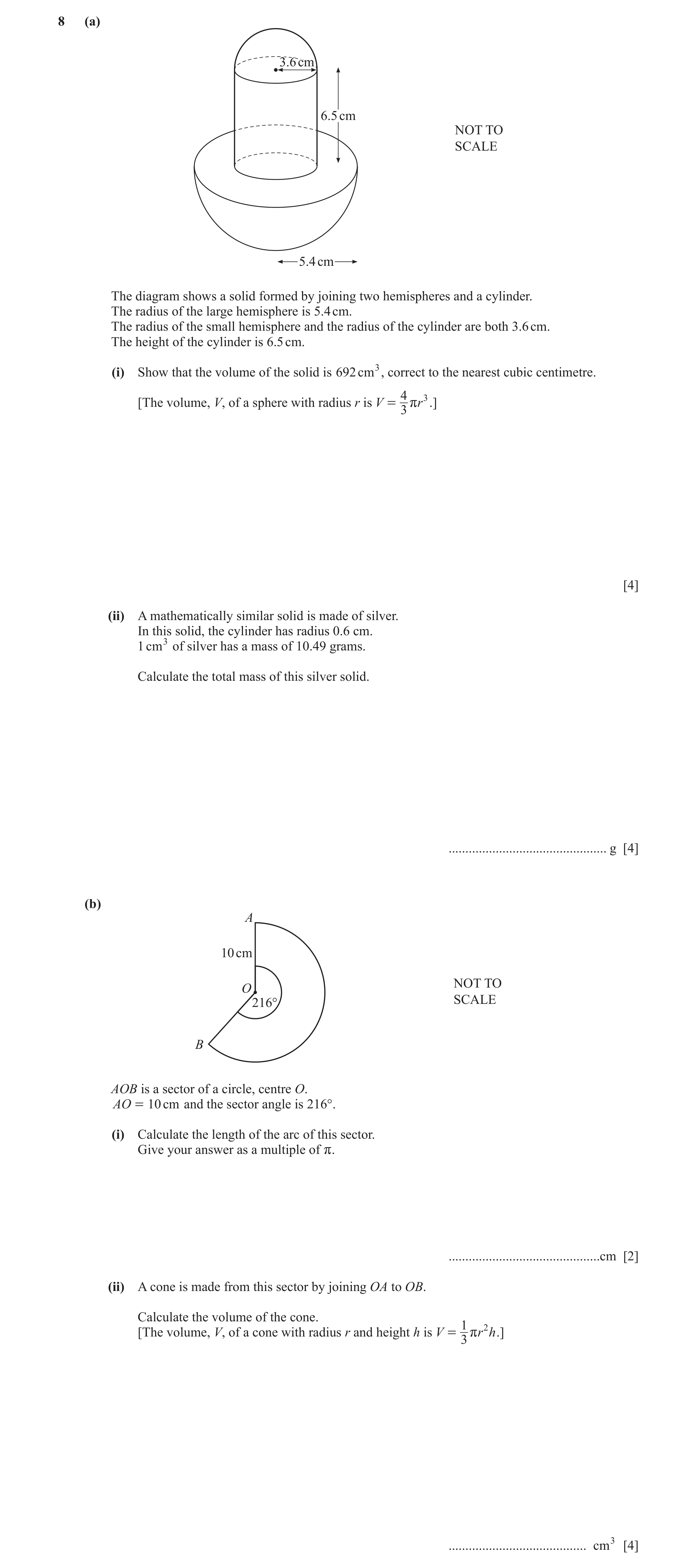
8 (a) 3.63.6 cmcm 6.5 cm NOT TO SCALE 5.4 cm The diagram shows a solid formed by joining two hemispheres and a cylinder. The radius of the large hemisphere is 5.4 cm. The radius of the small hemisphere and the radius of the cylinder are both 3.6 cm. The height of the cylinder is 6.5 cm. (i) Show that the volume of the solid is 692 cm 3, correct to the nearest cubic centimetre. 4 3 [The volume, V, of a sphere with radius r is V = rr .] 3 [4] (ii) A mathematically similar solid is made of silver. In this solid, the cylinder has radius 0.6 cm. 1 cm 3 of silver has a mass of 10.49 grams. Calculate the total mass of this silver solid. … g [4] (b) A 10 cm NOT TO O 216° SCALE B AOB is a sector of a circle, centre O. AO = 10 cm and the sector angle is 216°. (i) Calculate the length of the arc of this sector. Give your answer as a multiple of r. … cm [2] (ii) A cone is made from this sector by joining OA to OB. Calculate the volume of the cone. 1 2 [The volume, V, of a cone with radius r and height h is V = rr h .] 3 … cm3 [4]
14 marks
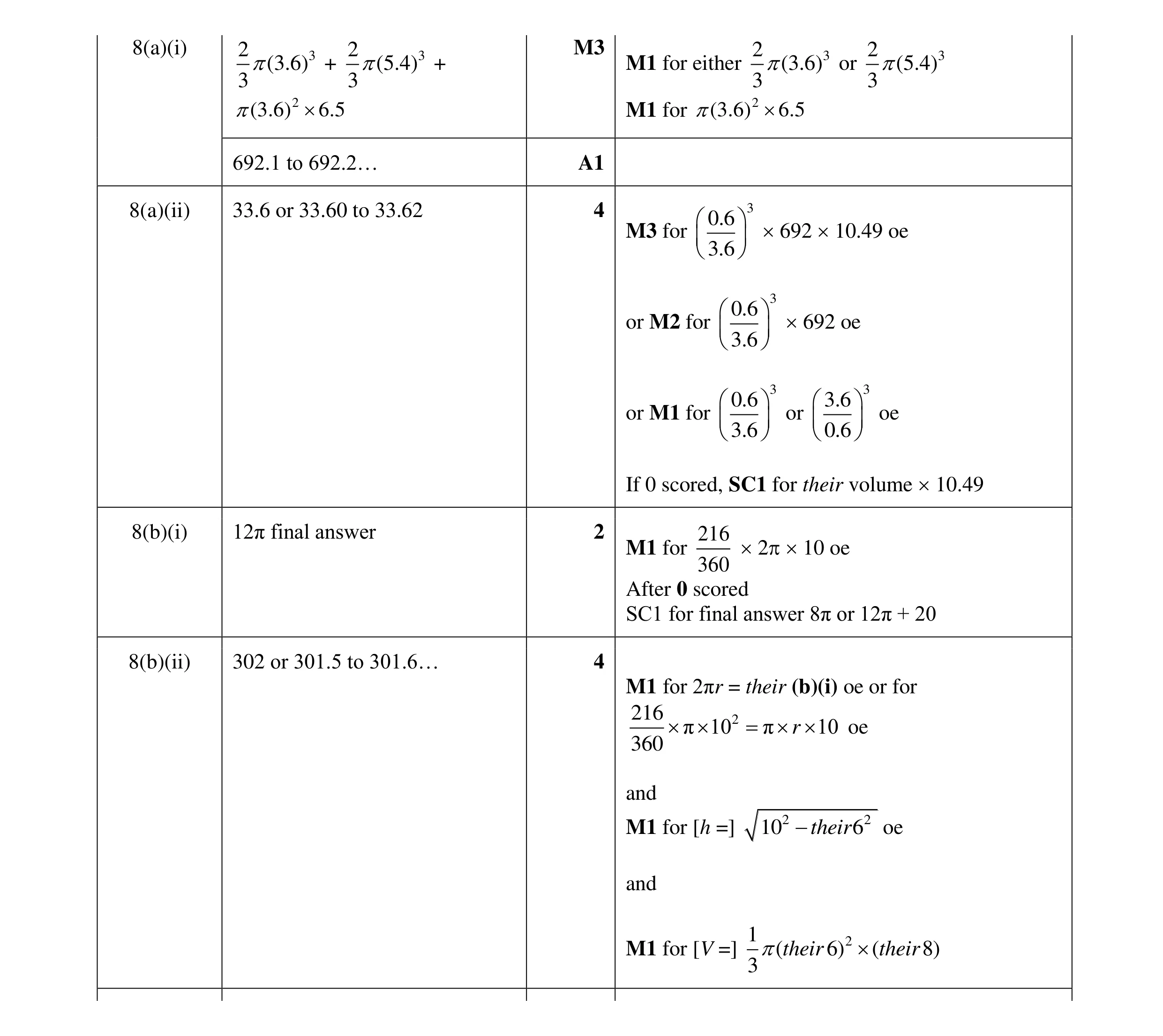
Mark scheme: 8(a)(i) 2 3 2 3 M3 2 3 2 3 3(3.6) + 3(5.4) + M1 for either 3(3.6) or 3(5.4) (3.6) 2 6.5 M1 for (3.6) 2 6.5 692.1 to 692.2… A1 8(a)(ii) 33.6 or 33.60 to 33.62 4 3 0.6 M3 for 692 10.49 oe 3.6 0.6 3 or M2 for 692 oe 3.6 0.6 3 3.6 3 or M1 for or oe 3.6 0.6 If 0 scored, SC1 for their volume 10.49 8(b)(i) 12π final answer 2 216 M1 for 2 10 oe 360 After 0 scored SC1 for final answer 8π or 12π + 20 8(b)(ii) 302 or 301.5 to 301.6… 4 M1 for 2πr = their (b)(i) oe or for 216 2 π 10 = π r 10 oe 360 and M1 for [h =] 10 2 − their 6 2 oe and 1 2 M1 for [V =] (their 6) (their 8) 3
This question in 0580/41 Oct/Nov 2023
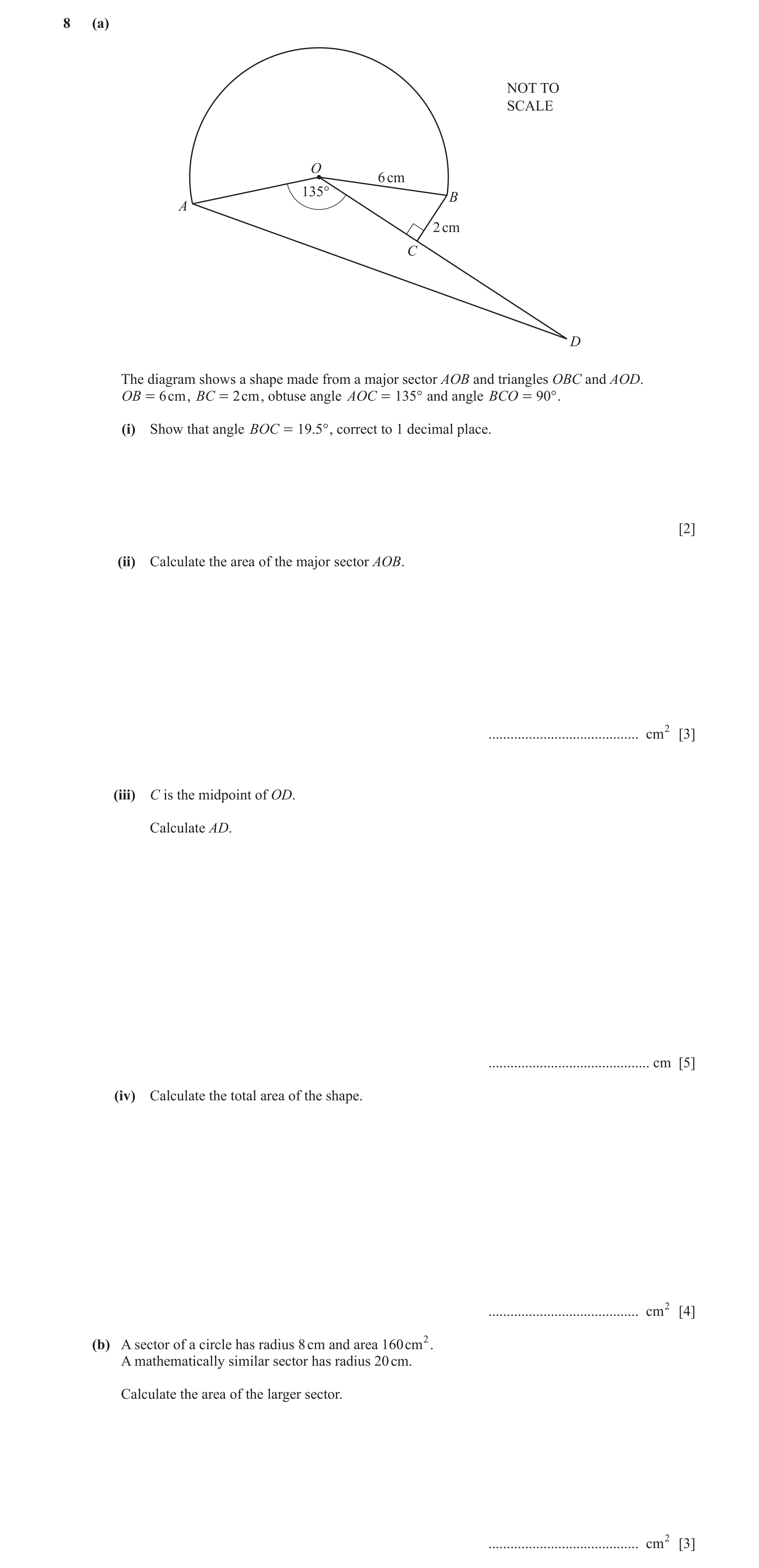
Q29 · NOT TO SCALE O 6 cm 135° B A 2 cm C D The diagram shows a shape made from a major sector… 0580/43 Oct/Nov 2023
8 (a) NOT TO SCALE O 6 cm 135° B A 2 cm C D The diagram shows a shape made from a major sector AOB and triangles OBC and AOD. OB = 6cm , BC = 2cm , obtuse angle AOC = 135° and angle BCO = 90° . (i) Show that angle BOC = 19.5° , correct to 1 decimal place. [2] (ii) Calculate the area of the major sector AOB. … cm2 [3] (iii) C is the midpoint of OD. Calculate AD. … cm [5] (iv) Calculate the total area of the shape. … cm2 [4] (b) A sector of a circle has radius 8 cm and area 160cm2. A mathematically similar sector has radius 20 cm. Calculate the area of the larger sector. … cm2 [3]
17 marks
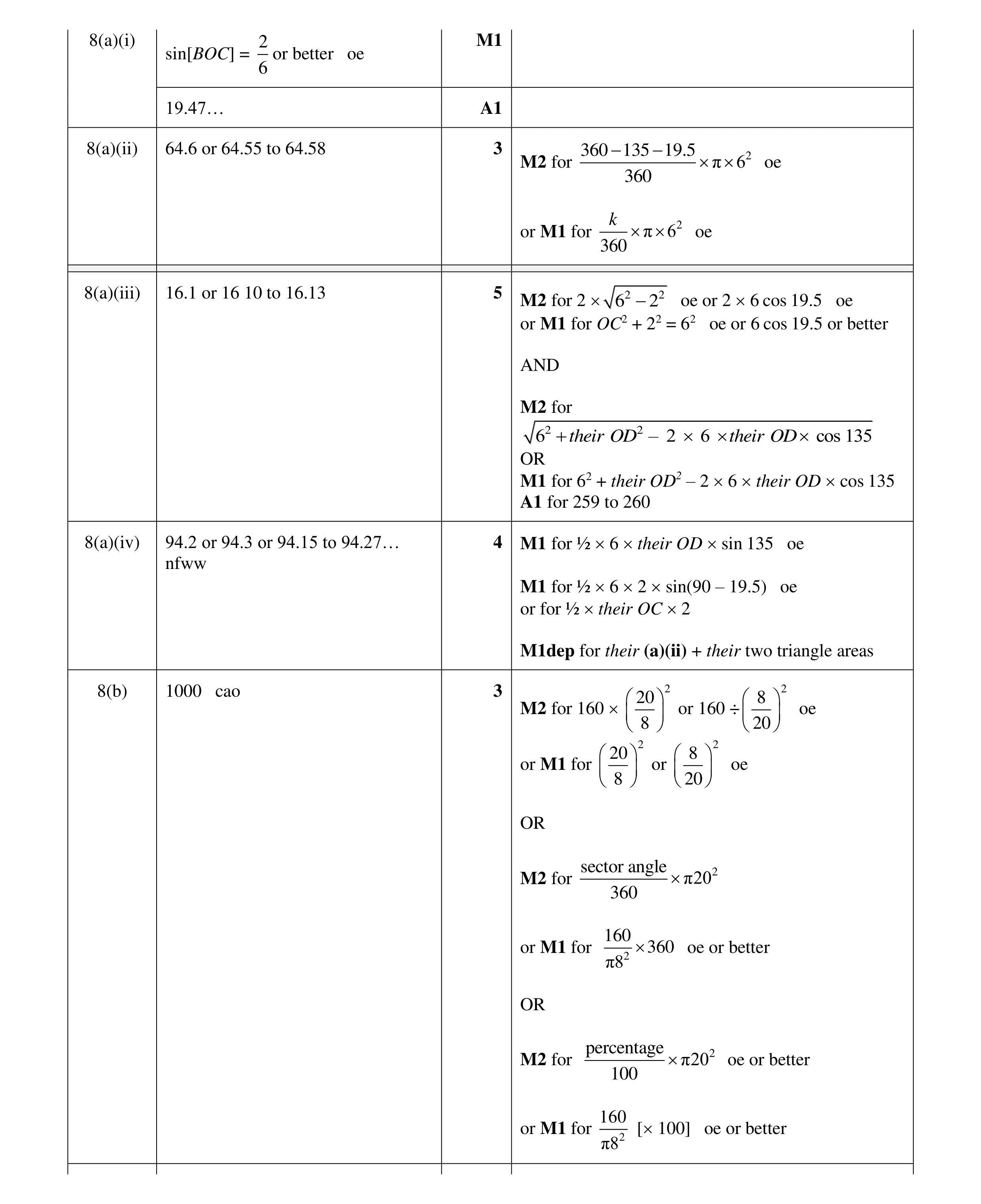
Mark scheme: 8(a)(i) 2 M1 sin[BOC] = or better oe 6 19.47… A1 8(a)(ii) 64.6 or 64.55 to 64.58 3 360 − 135 − 19.5 2 M2 for π 6 oe 360 k 2 or M1 for π 6 oe 360 8(a)(iii) 16.1 or 16 10 to 16.13 5 2 2 M2 for 2 6 − 2 oe or 2 6 cos 19.5 oe or M1 for OC2 + 22 = 62 oe or 6 cos 19.5 or better AND M2 for 62 + their OD2 – 2 6 their OD cos 135 OR M1 for 62 + their OD2 – 2 6 their OD cos 135 A1 for 259 to 260 8(a)(iv) 94.2 or 94.3 or 94.15 to 94.27… 4 M1 for ½ 6 their OD sin 135 oe nfww M1 for ½ 6 2 sin(90 – 19.5) oe or for ½ their OC 2 M1dep for their (a)(ii) + their two triangle areas 8(b) 1000 cao 3 2 2 20 8 M2 for 160 or 160 ÷ oe 8 20 20 2 8 2 or M1 for or oe 8 20 OR sector angle 2 M2 for π20 360 160 or M1 for 360 oe or better π82 OR percentage 2 M2 for π20 oe or better 100 160 or M1 for [ 100] oe or better π8 2
This question in 0580/43 Oct/Nov 2023
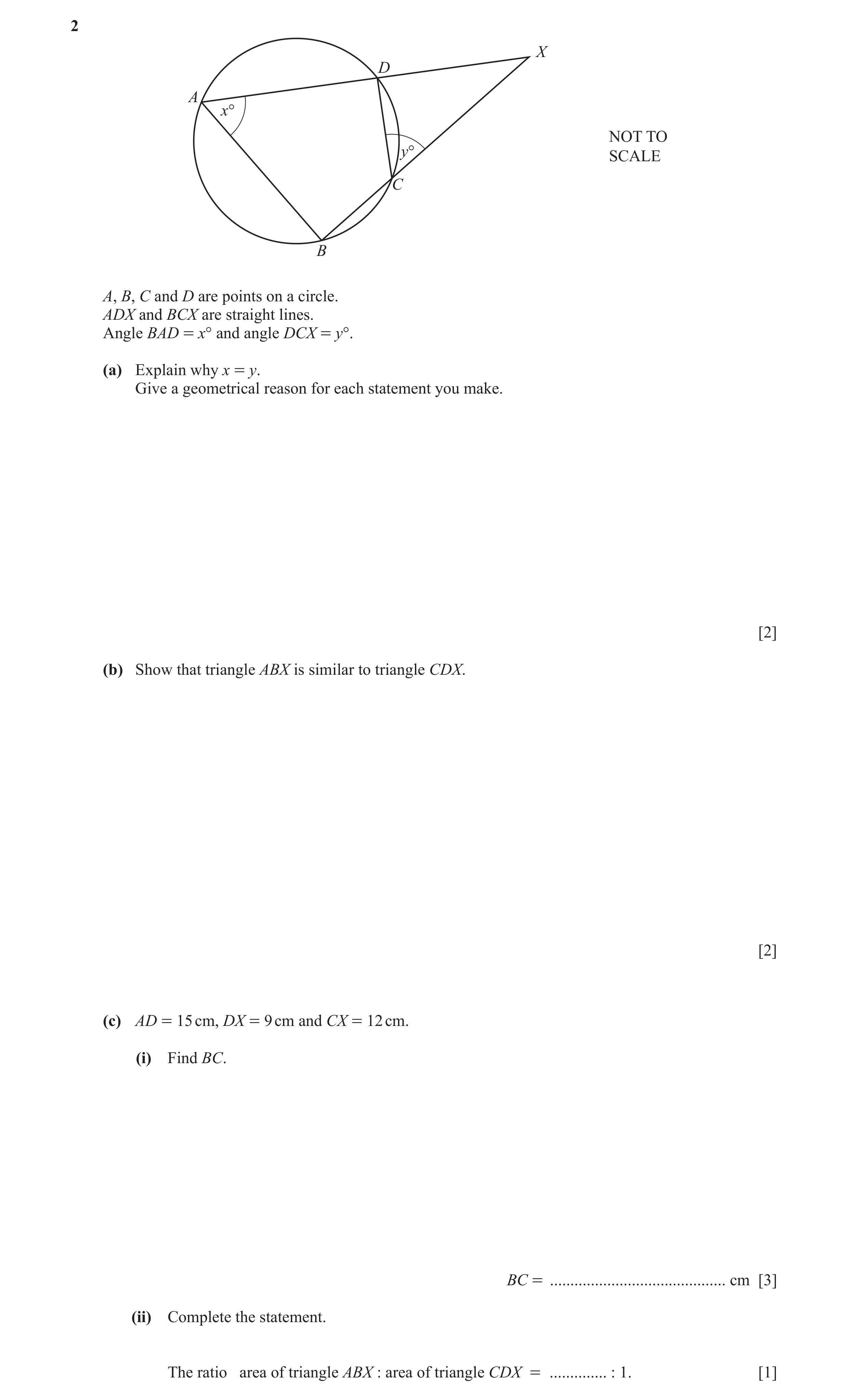
Q30 · X D A x° NOT TO y° SCALE C B A, B, C and D are points on a circle 0580/42 Feb/March 2024
2 X D A x° NOT TO y° SCALE C B A, B, C and D are points on a circle. ADX and BCX are straight lines. Angle BAD = x° and angle DCX = y°. (a) Explain why x = y. Give a geometrical reason for each statement you make. [2] (b) Show that triangle ABX is similar to triangle CDX. [2] (c) AD = 15 cm, DX = 9 cm and CX = 12 cm. (i) Find BC. BC = … cm [3] (ii) Complete the statement. The ratio area of triangle ABX : area of triangle CDX = … : 1. [1]
8 marks
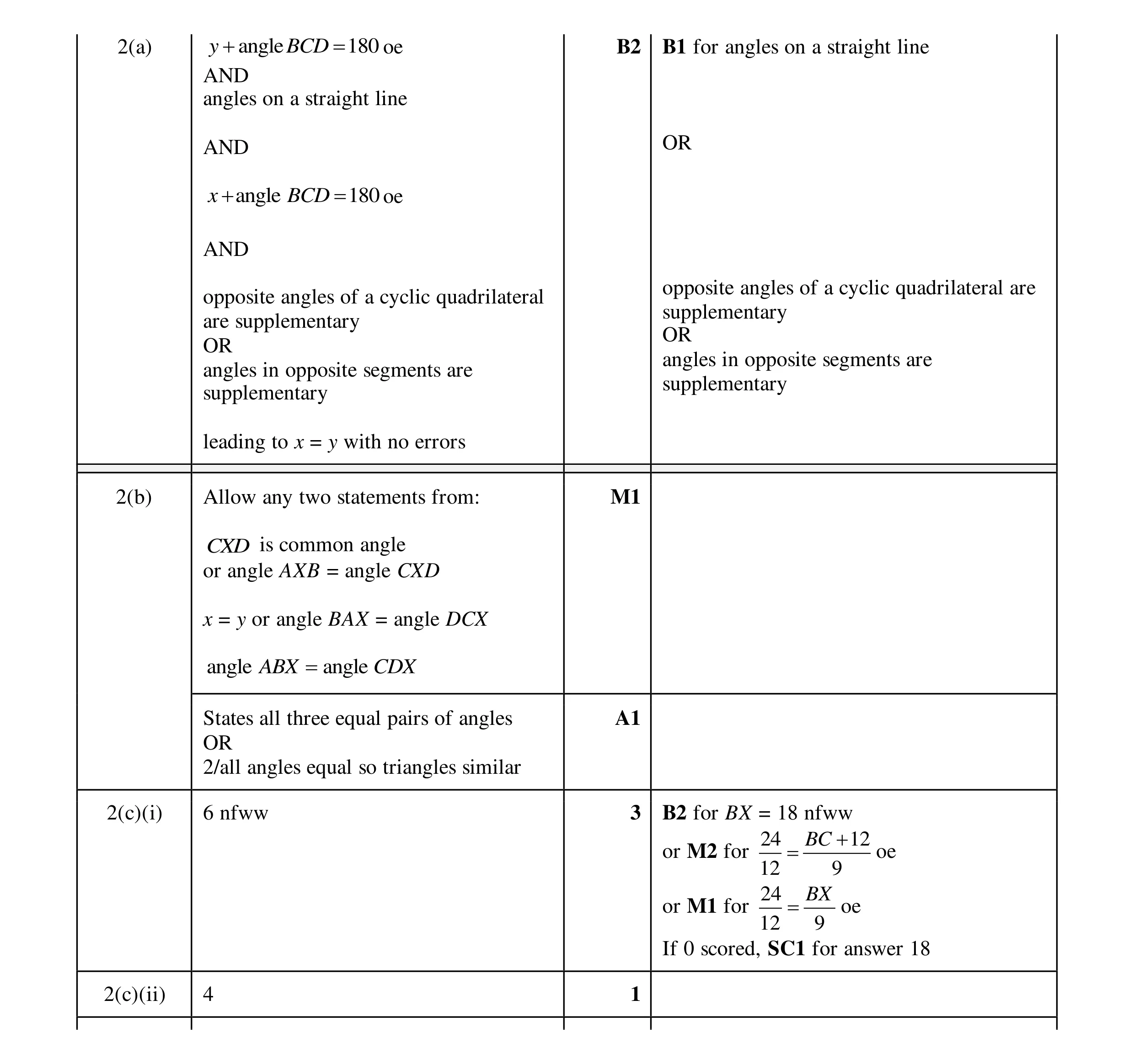
Mark scheme: 2(a) y + angle BCD = 180 oe B2 B1 for angles on a straight line AND angles on a straight line AND OR x + angle BCD = 180 oe AND opposite angles of a cyclic quadrilateral are opposite angles of a cyclic quadrilateral supplementary are supplementary OR OR angles in opposite segments are angles in opposite segments are supplementary supplementary leading to x = y with no errors 2(b) Allow any two statements from: M1 CXD is common angle or angle AXB = angle CXD x = y or angle BAX = angle DCX angle ABX = angle CDX States all three equal pairs of angles A1 OR 2/all angles equal so triangles similar 2(c)(i) 6 nfww 3 B2 for BX = 18 nfww 24 BC + 12 or M2 for = oe 12 9 24 BX or M1 for = oe 12 9 If 0 scored, SC1 for answer 18 2(c)(ii) 4 1
This question in 0580/42 Feb/March 2024
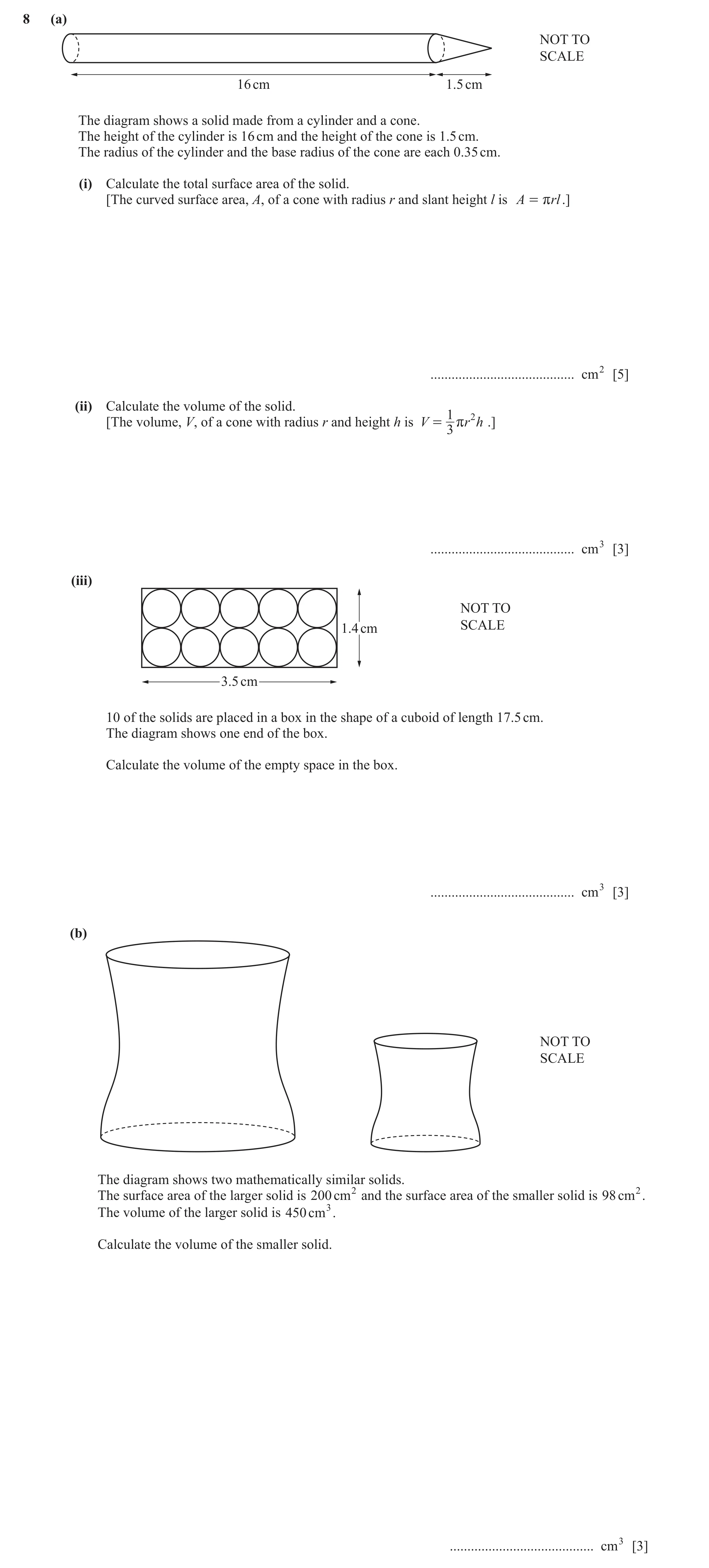
Q31 · NOT TO SCALE 16 cm 1.5 cm The diagram shows a solid made from a cylinder and a cone 0580/43 May/June 2024
8 (a) NOT TO SCALE 16 cm 1.5 cm The diagram shows a solid made from a cylinder and a cone. The height of the cylinder is 16 cm and the height of the cone is 1.5 cm. The radius of the cylinder and the base radius of the cone are each 0.35 cm. (i) Calculate the total surface area of the solid. [The curved surface area, A, of a cone with radius r and slant height l is A = rrl .] … cm2 [5] (ii) Calculate the volume of the solid. 1 2 [The volume, V, of a cone with radius r and height h is V = rr h .] 3 … cm3 [3] (iii) NOT TO 1.4 cm SCALE 3.5 cm 10 of the solids are placed in a box in the shape of a cuboid of length 17.5 cm. The diagram shows one end of the box. Calculate the volume of the empty space in the box. … cm3 [3] (b) NOT TO SCALE The diagram shows two mathematically similar solids. The surface area of the larger solid is 200 cm 2 and the surface area of the smaller solid is 98 cm 2. The volume of the larger solid is 450 cm 3. Calculate the volume of the smaller solid. … cm3 [3]
14 marks
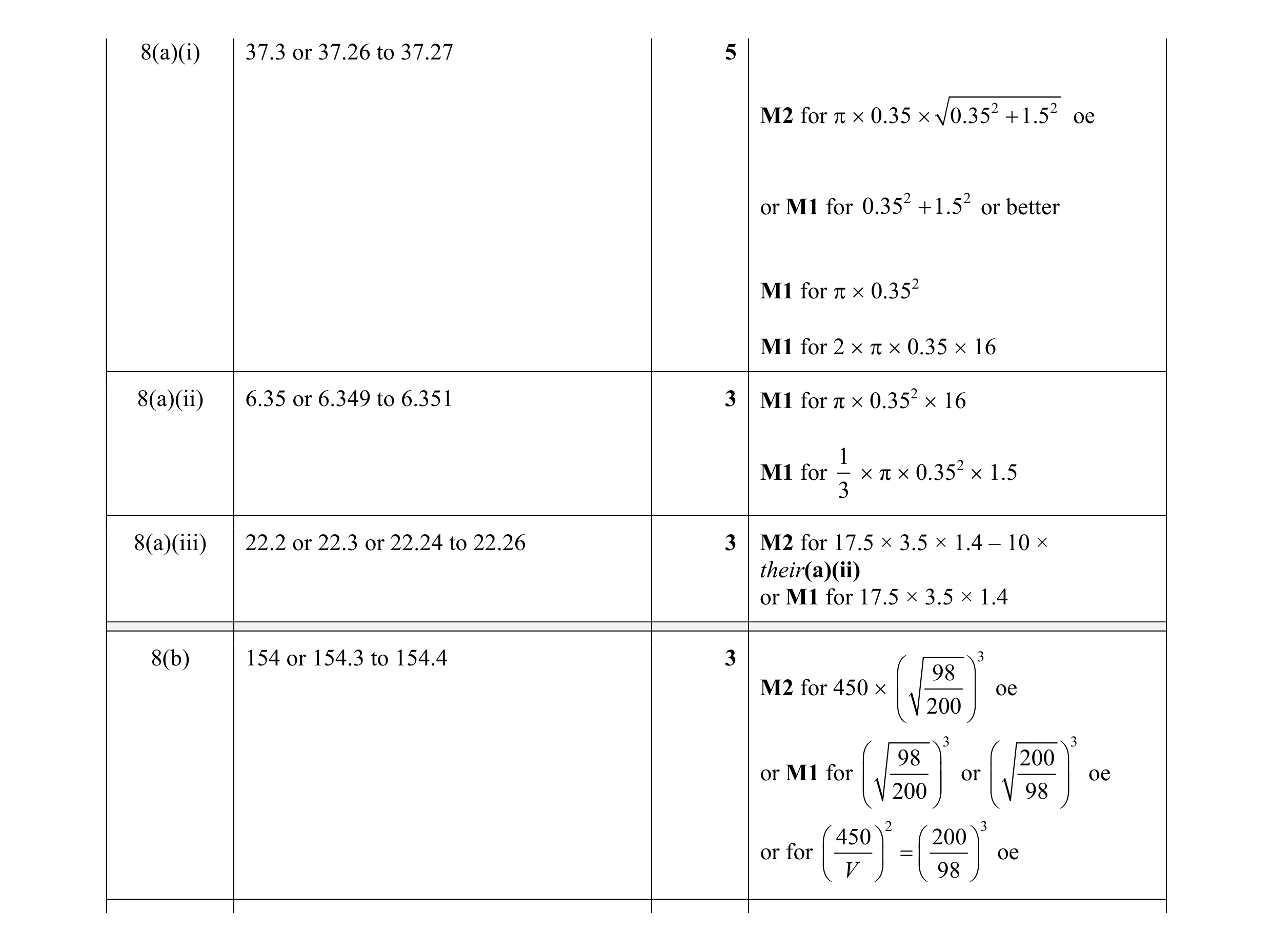
Mark scheme: 8(a)(i) 37.3 or 37.26 to 37.27 5 M2 for 0.35 0.35 2 1.5 2 oe or M1 for 0.35 2 1.5 2 or better M1 for 0.352 M1 for 2 0.35 16 8(a)(ii) 6.35 or 6.349 to 6.351 3 M1 for π 0.352 16 1 M1 for π 0.352 1.5 3 8(a)(iii) 22.2 or 22.3 or 22.24 to 22.26 3 M2 for 17.5 × 3.5 × 1.4 – 10 × their(a)(ii) or M1 for 17.5 × 3.5 × 1.4 8(b) 154 or 154.3 to 154.4 3 3 98 M2 for 450 oe 200 98 3 200 3 or M1 for or oe 200 98 450 2 200 3 or for oe V 98
This question in 0580/43 May/June 2024
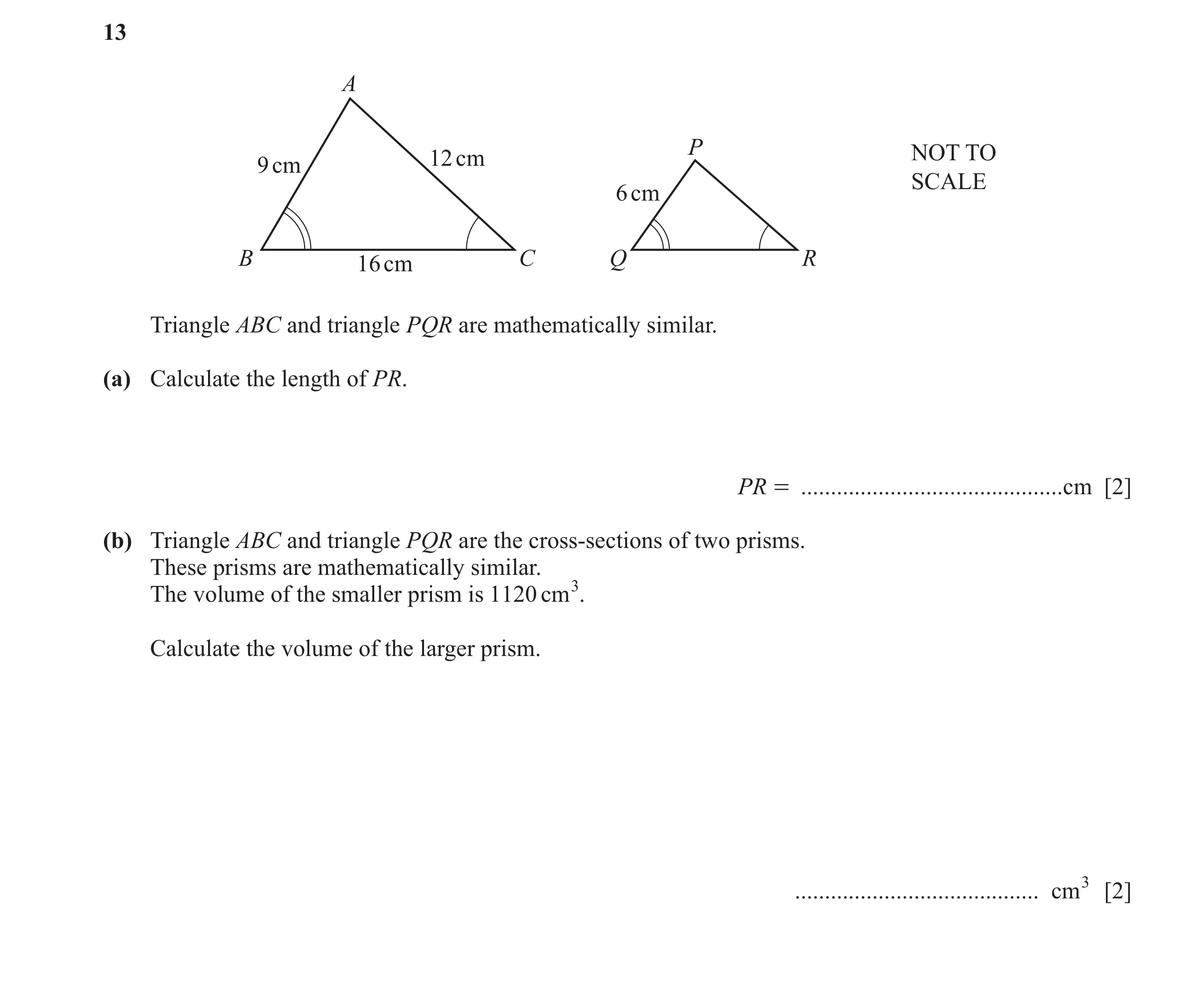
Q32 · A P NOT TO 12 cm 9 cm SCALE 6 cm B 16 cm C Q R Triangle ABC and triangle PQR are… 0580/42 May/June 2025
13 A P NOT TO 12 cm 9 cm SCALE 6 cm B 16 cm C Q R Triangle ABC and triangle PQR are mathematically similar. (a) Calculate the length of PR. PR = … cm [2] (b) Triangle ABC and triangle PQR are the cross-sections of two prisms. These prisms are mathematically similar. The volume of the smaller prism is 1120 cm 3. Calculate the volume of the larger prism. … cm3 [2]
4 marks
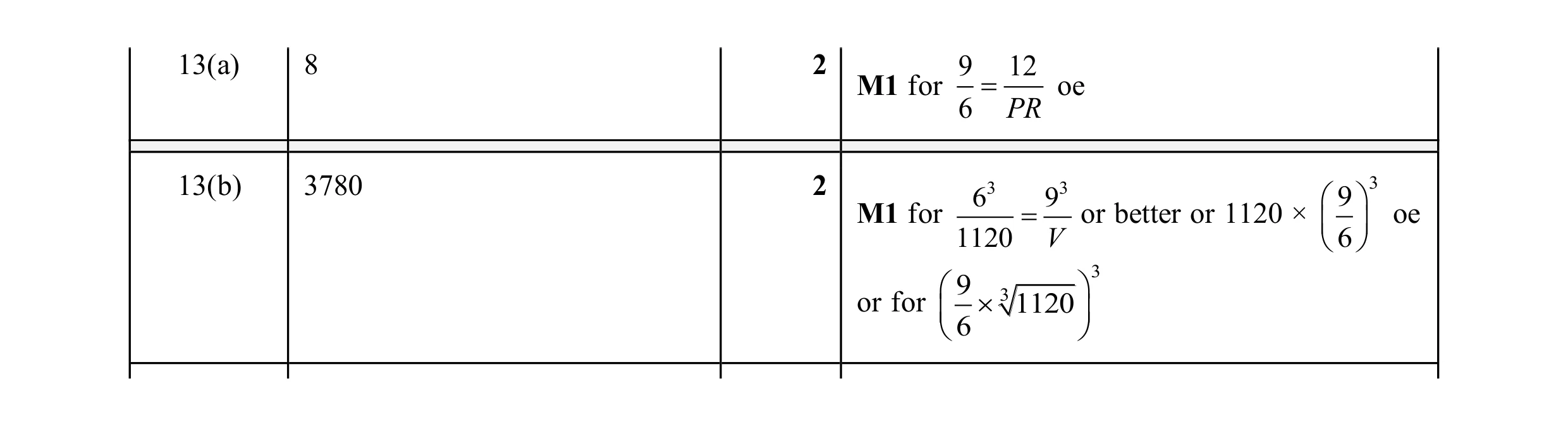
Mark scheme: 13(a) 8 2 9 12 M1 for = oe 6 PR 13(b) 3780 2 3 3 3 6 9 9 M1 for = or better or 1120 × oe 1120 V 6 9 3 3 or for 1120 6
This question in 0580/42 May/June 2025
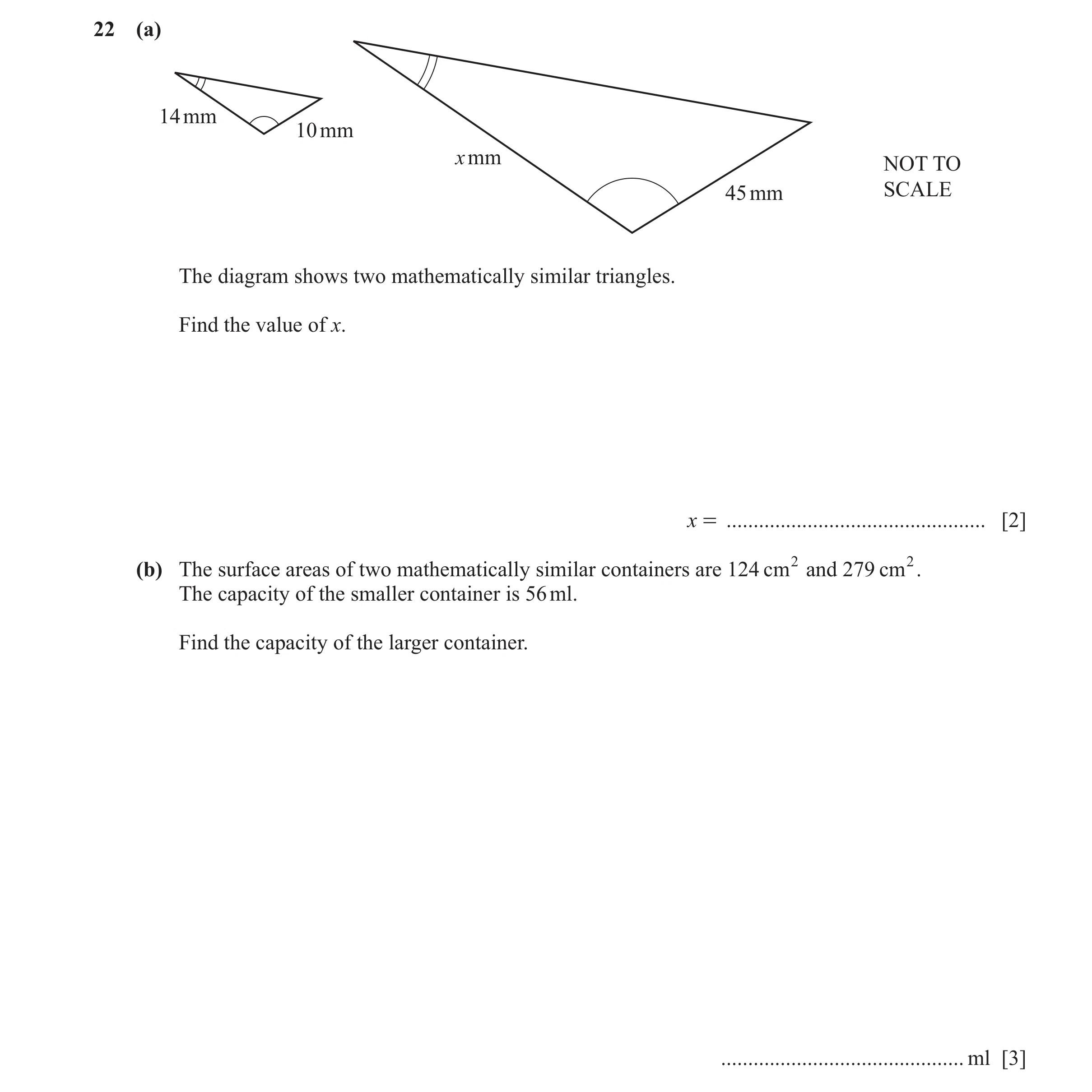
Q33 · 14 mm 10 mm x mm NOT TO 45 mm SCALE The diagram shows two mathematically similar triangles 0580/43 Oct/Nov 2025
22 (a) 14 mm 10 mm x mm NOT TO 45 mm SCALE The diagram shows two mathematically similar triangles. Find the value of x. x = … [2] (b) The surface areas of two mathematically similar containers are 124 cm2 and 279 cm2. The capacity of the smaller container is 56 ml. Find the capacity of the larger container. … ml [3]
5 marks
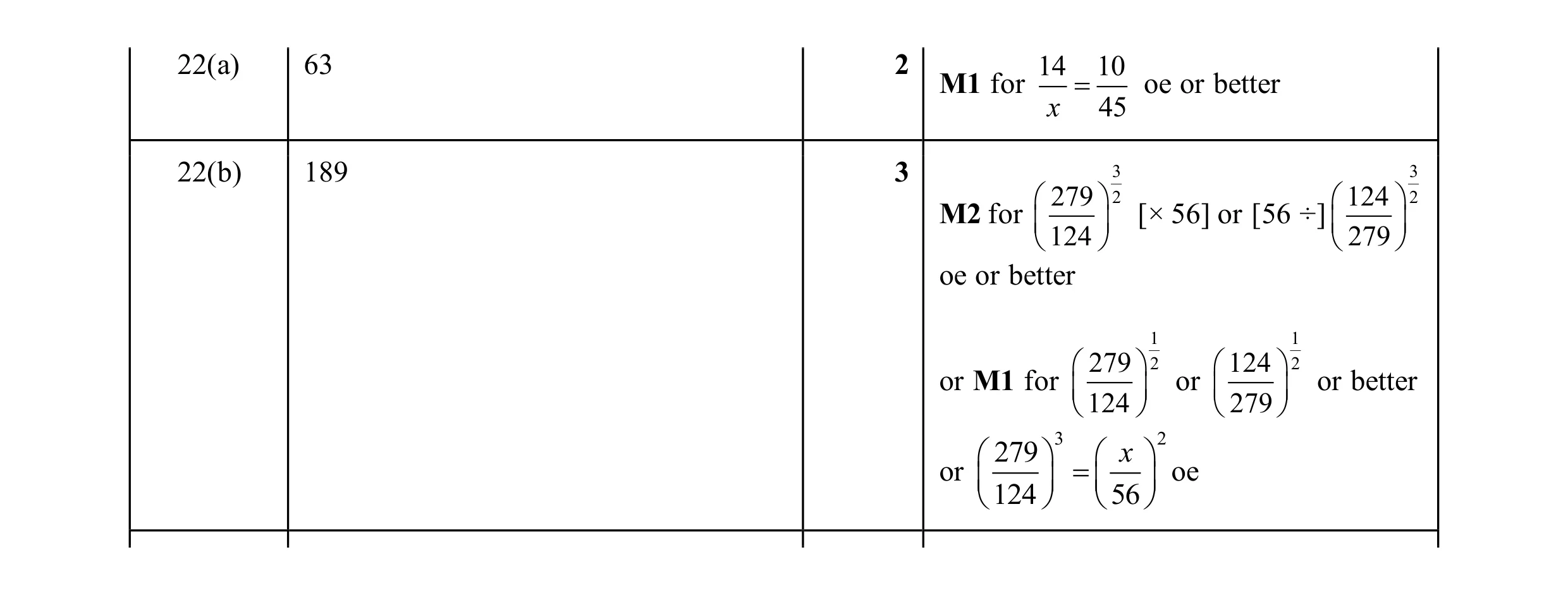
Mark scheme: 22(a) 63 2 14 10 M1 for = oe or better x 45 22(b) 189 3 3 3 279 2 124 2 M2 for [× 56] or [56 ÷] 124 279 oe or better 1 1 279 2 124 2 or M1 for or or better 124 279 279 3 x 2 or = oe 124 56
This question in 0580/43 Oct/Nov 2025
 13 / 52
 28 / 52
 36 / 52
 39 / 52
 40 / 52
 41 / 52
 44 / 52
 51 / 52
 52 / 52
 11
 14
 12
 15
 16
 14
 8
 11
 11
 9
 13
 14
 13
 15
 15
 8
 14
 17
 8
 11
 8
 10
 10
 7
 9
 13
 10
 14
 17
 8
 14
 4
 5