Cambridge IGCSE Mathematics 0580 — 2022 May/June Paper 4 · Variant 3
0580/43/M/J/22 · 10 questions · 130 marks · ≈146 min
The question paper and its mark scheme, free to read here and free to download. This is Cambridge’s own paper, exactly as it was sat.
Question paper20 pages
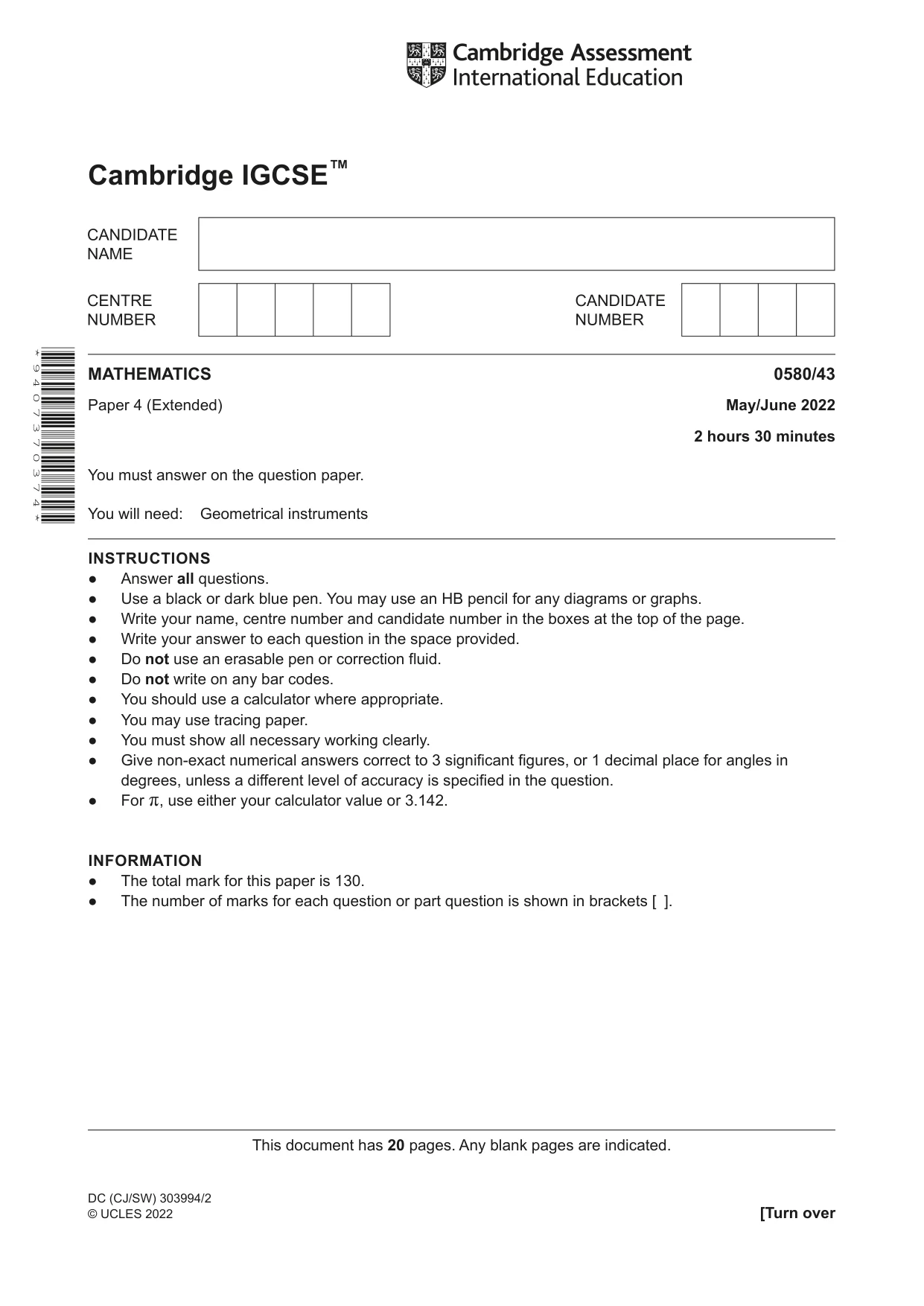

Mark scheme11 pages
Answers below. Sit the paper first if you are practising.
Questions as text
Q1 · Here is part of a bus timetable
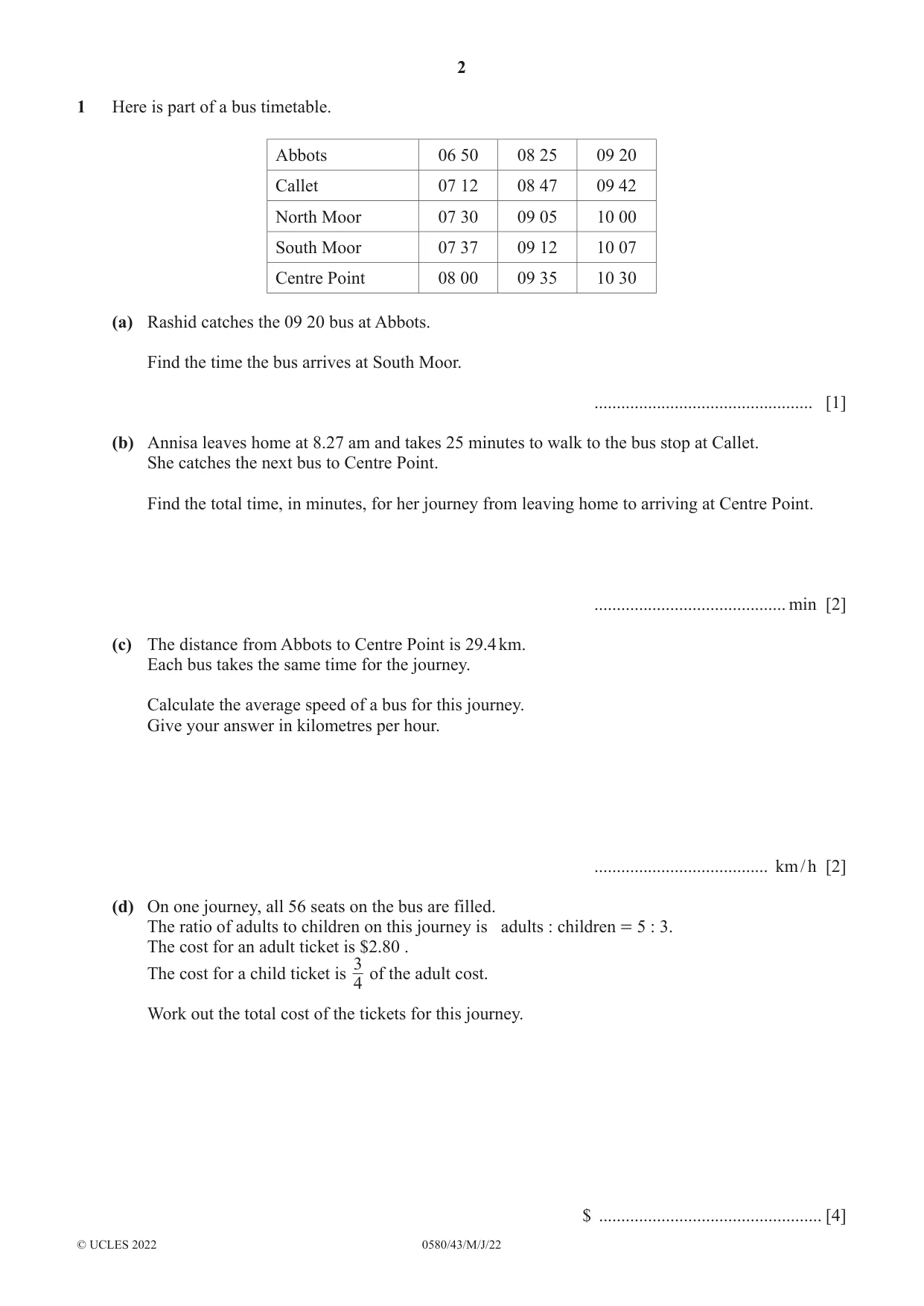
1 Here is part of a bus timetable. Abbots 06 50 08 25 09 20 Callet 07 12 08 47 09 42 North Moor 07 30 09 05 10 00 South Moor 07 37 09 12 10 07 Centre Point 08 00 09 35 10 30 (a) Rashid catches the 09 20 bus at Abbots. Find the time the bus arrives at South Moor. ................................................. [1] (b) Annisa leaves home at 8.27 am and takes 25 minutes to walk to the bus stop at Callet. She catches the next bus to Centre Point. Find the total time, in minutes, for her journey from leaving home to arriving at Centre Point. ........................................... min [2] (c) The distance from Abbots to Centre Point is 29.4 km. Each bus takes the same time for the journey. Calculate the average speed of a bus for this journey. Give your answer in kilometres per hour. ....................................... km / h [2] (d) On one journey, all 56 seats on the bus are filled. The ratio of adults to children on this journey is adults : children = 5 : 3. The cost for an adult ticket is $2.80 . 3 The cost for a child ticket is of the adult cost. 4 Work out the total cost of the tickets for this journey. $ .................................................. [4]
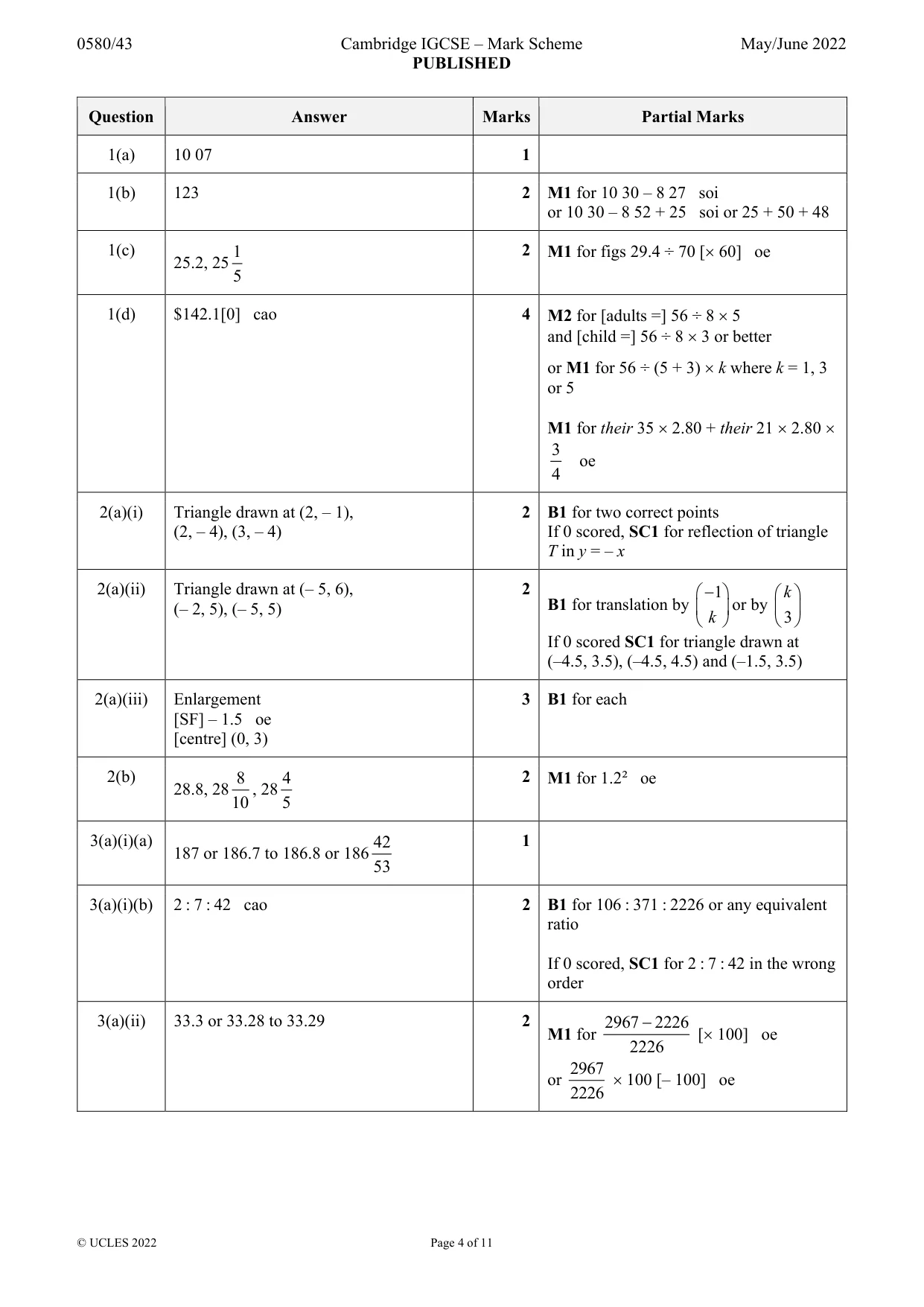
Mark scheme: Question Answer Marks Partial Marks 1(a) 10 07 1 1(b) 123 2 M1 for 10 30 – 8 27 soi or 10 30 – 8 52 + 25 soi or 25 + 50 + 48 1(c) 1 2 M1 for figs 29.4 ÷ 70 [ 60] oe 25.2, 25 5 1(d) $142.1[0] cao 4 M2 for [adults =] 56 ÷ 8 5 and [child =] 56 ÷ 8 3 or better or M1 for 56 ÷ (5 + 3) k where k = 1, 3 or 5 M1 for their 35 2.80 + their 21 2.80 3 oe 4
Q2 · Y 7 6 5 4 A 3 T 2 1 – 6 – 5 – 4 – 3 – 2 – 1 0 1 2 3 4 5 6 7 x – 1 – 2 – 3 – 4 – 5 (i)…
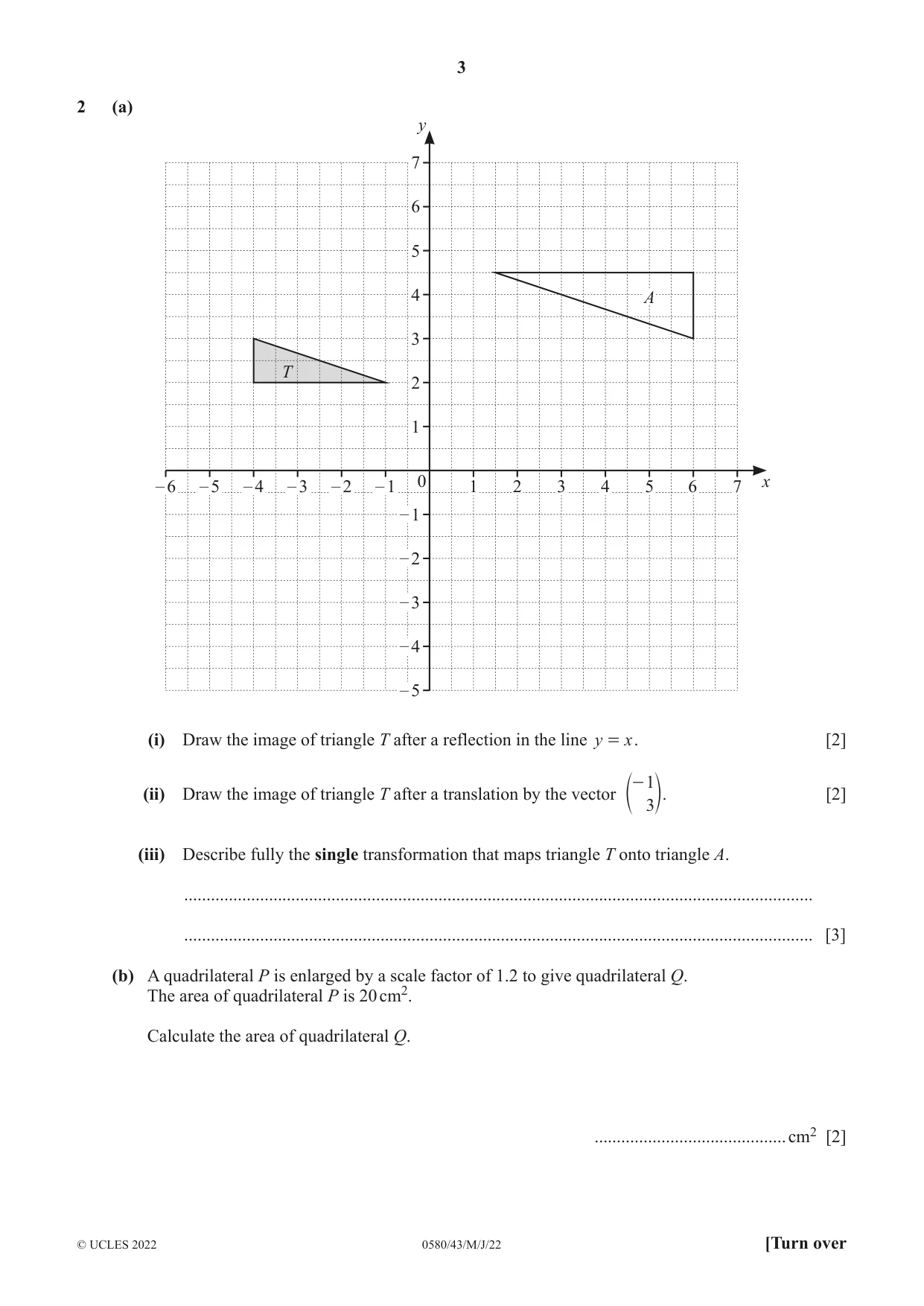
2 (a) y 7 6 5 4 A 3 T 2 1 – 6 – 5 – 4 – 3 – 2 – 1 0 1 2 3 4 5 6 7 x – 1 – 2 – 3 – 4 – 5 (i) Draw the image of triangle T after a reflection in the line y = x . [2] - 1 (ii) Draw the image of triangle T after a translation by the vector [2] e 3o. (iii) Describe fully the single transformation that maps triangle T onto triangle A. ............................................................................................................................................. ............................................................................................................................................. [3] (b) A quadrilateral P is enlarged by a scale factor of 1.2 to give quadrilateral Q. The area of quadrilateral P is 20 cm2. Calculate the area of quadrilateral Q. ...........................................cm2 [2]
Mark scheme: 2(a)(i) Triangle drawn at (2, – 1), 2 B1 for two correct points (2, – 4), (3, – 4) If 0 scored, SC1 for reflection of triangle T in y = – x 2(a)(ii) Triangle drawn at (– 5, 6), 2 1 k (– 2, 5), (– 5, 5) B1 for translation by or by k 3 If 0 scored SC1 for triangle drawn at (–4.5, 3.5), (–4.5, 4.5) and (–1.5, 3.5) 2(a)(iii) Enlargement 3 B1 for each [SF] – 1.5 oe [centre] (0, 3) 2(b) 8 4 2 M1 for 1.2² oe 28.8, 28 , 28 10 5
Q3 · The table shows the numbers of tigers reported to be living in the wild in the year 2014…
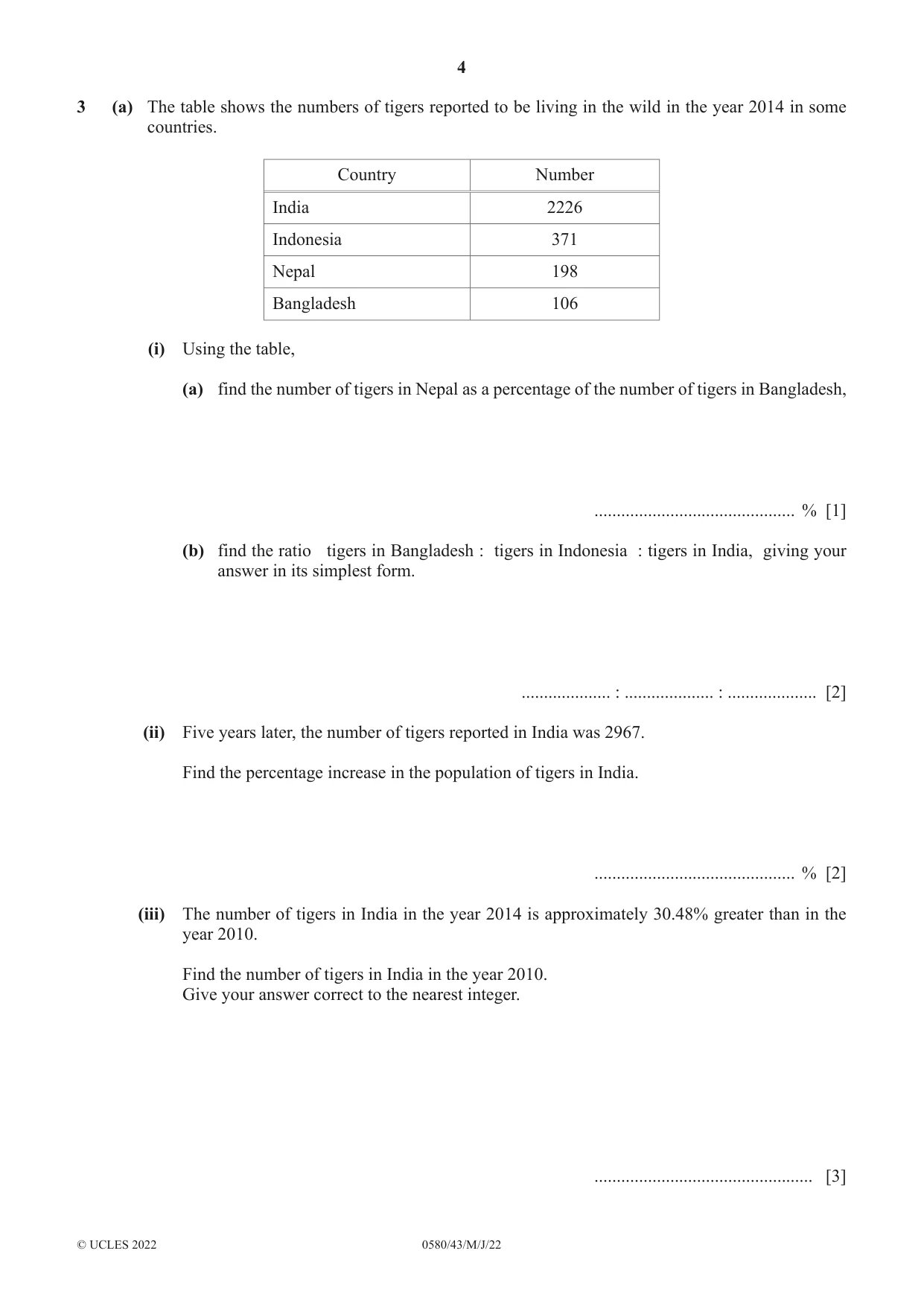
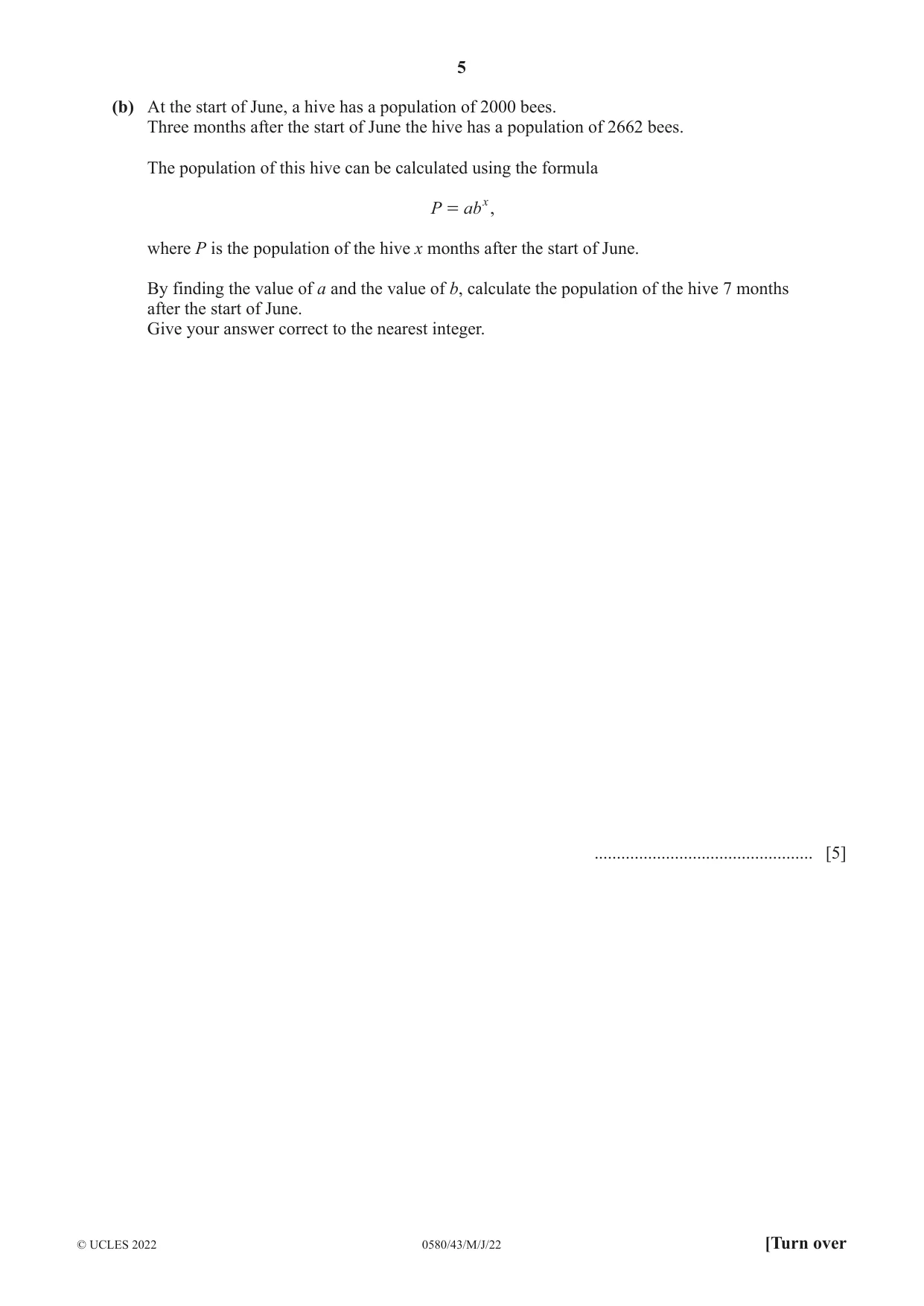
3 (a) The table shows the numbers of tigers reported to be living in the wild in the year 2014 in some countries. Country Number India 2226 Indonesia 371 Nepal 198 Bangladesh 106 (i) Using the table, (a) find the number of tigers in Nepal as a percentage of the number of tigers in Bangladesh, ............................................. % [1] (b) find the ratio tigers in Bangladesh : tigers in Indonesia : tigers in India, giving your answer in its simplest form. .................... : .................... : .................... [2] (ii) Five years later, the number of tigers reported in India was 2967. Find the percentage increase in the population of tigers in India. ............................................. % [2] (iii) The number of tigers in India in the year 2014 is approximately 30.48% greater than in the year 2010. Find the number of tigers in India in the year 2010. Give your answer correct to the nearest integer. ................................................. [3] (b) At the start of June, a hive has a population of 2000 bees. Three months after the start of June the hive has a population of 2662 bees. The population of this hive can be calculated using the formula P = abx , where P is the population of the hive x months after the start of June. By finding the value of a and the value of b, calculate the population of the hive 7 months after the start of June. Give your answer correct to the nearest integer. ................................................. [5]
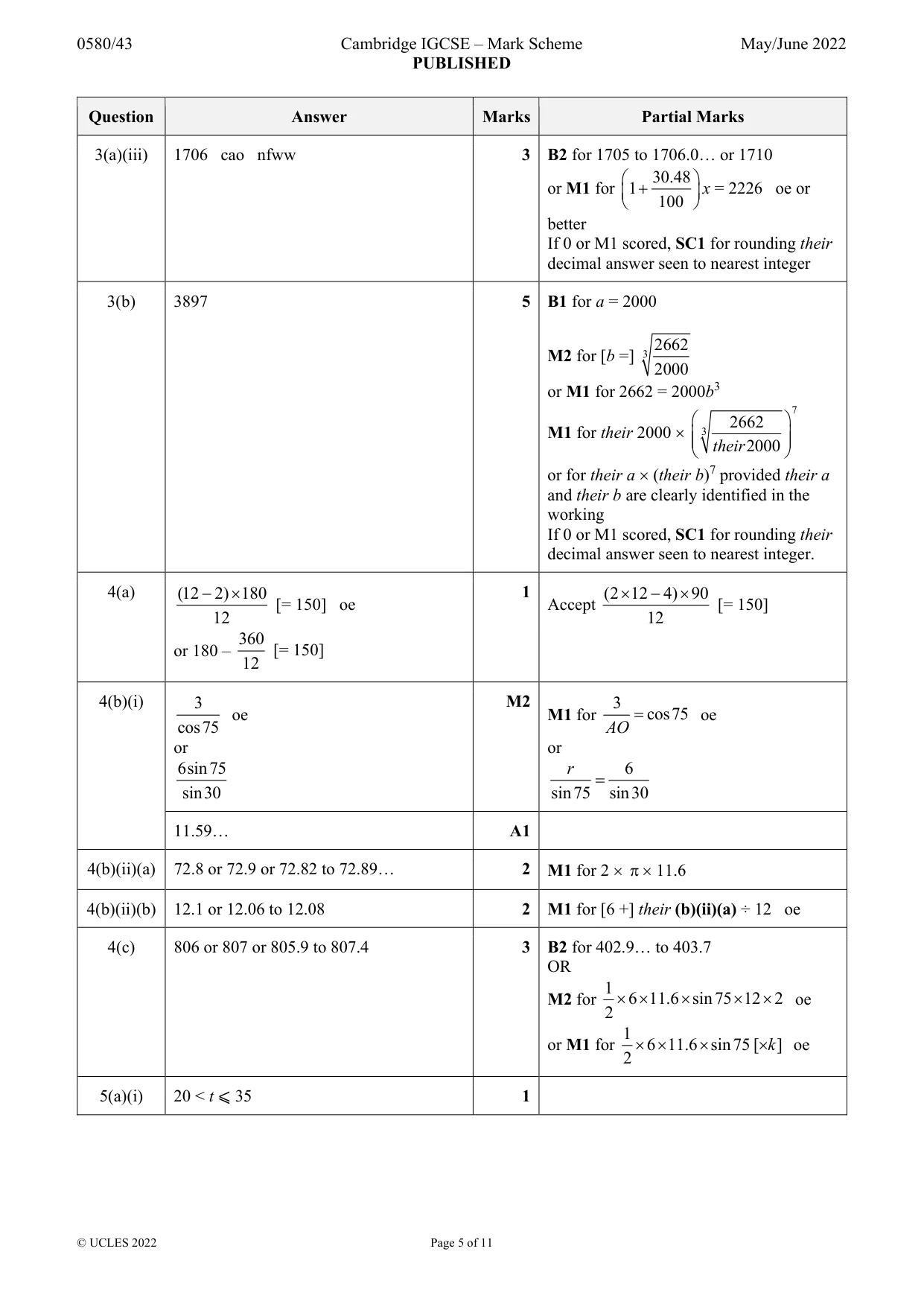
Mark scheme: 3(a)(i)(a) 42 1 187 or 186.7 to 186.8 or 186 53 3(a)(i)(b) 2 : 7 : 42 cao 2 B1 for 106 : 371 : 2226 or any equivalent ratio If 0 scored, SC1 for 2 : 7 : 42 in the wrong order 3(a)(ii) 33.3 or 33.28 to 33.29 2 2967 2226 M1 for [ 100] oe 2226 2967 or 100 [– 100] oe 2226 3(a)(iii) 1706 cao nfww 3 B2 for 1705 to 1706.0… or 1710 30.48 or M1 for 1 x = 2226 oe or 100 better If 0 or M1 scored, SC1 for rounding their decimal answer seen to nearest integer 3(b) 3897 5 B1 for a = 2000 2662 M2 for [b =] 3 2000 or M1 for 2662 = 2000b3 2662 7 M1 for their 2000 3 their 2000 or for their a (their b)7 provided their a and their b are clearly identified in the working If 0 or M1 scored, SC1 for rounding their decimal answer seen to nearest integer.
Q4 · A regular 12-sided polygon has side length 6 cm
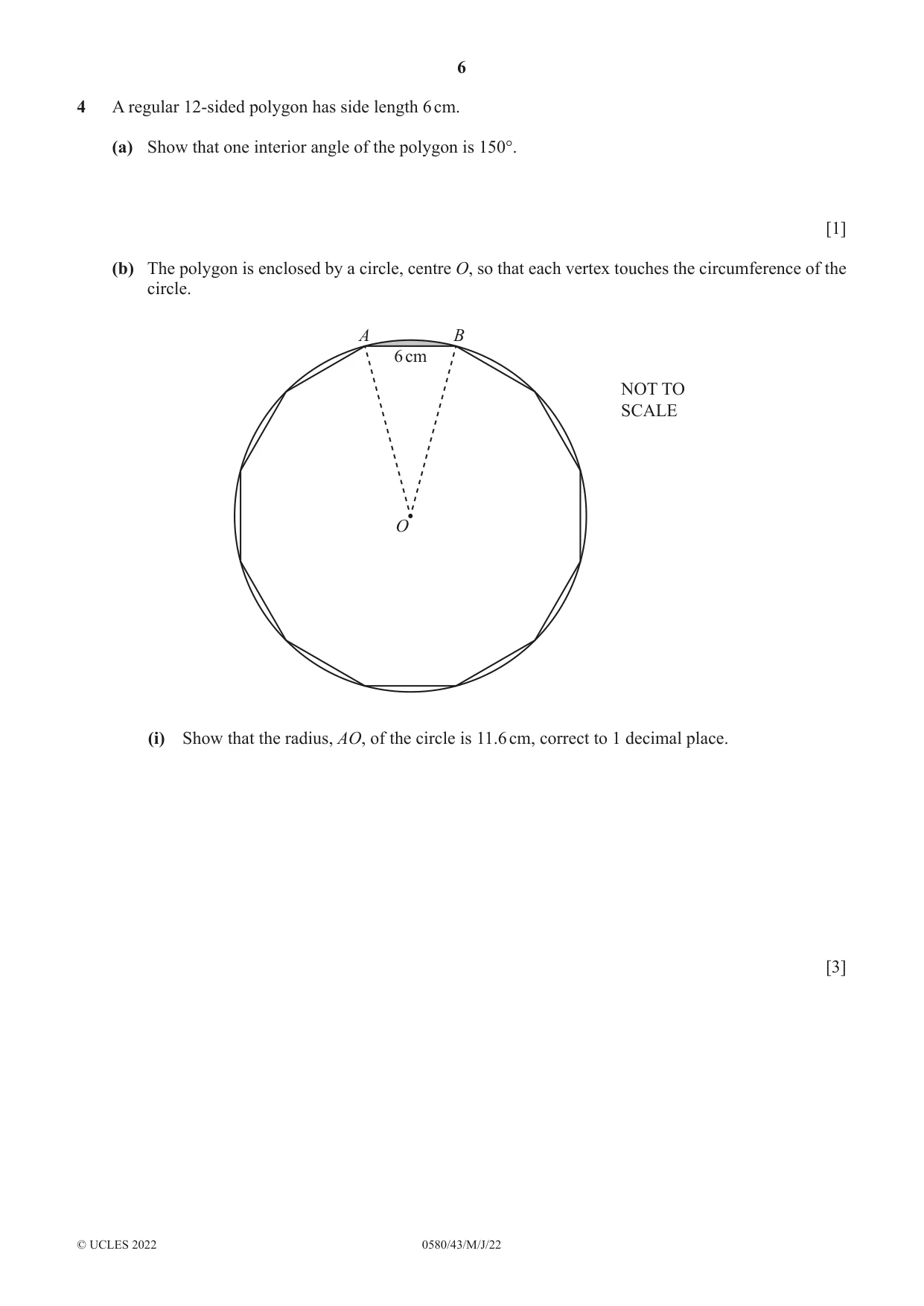
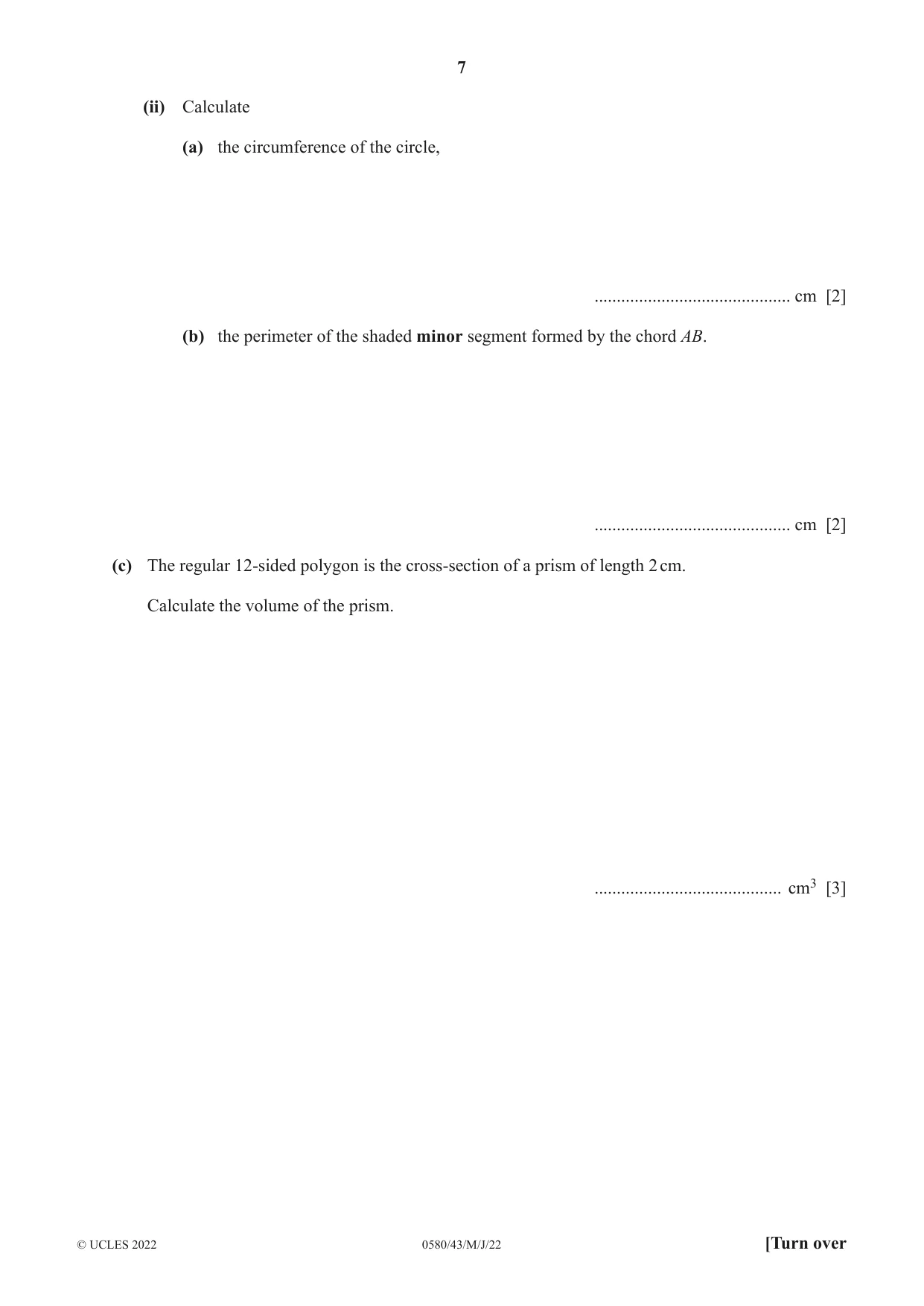
4 A regular 12-sided polygon has side length 6 cm. (a) Show that one interior angle of the polygon is 150°. [1] (b) The polygon is enclosed by a circle, centre O, so that each vertex touches the circumference of the circle. A B 6 cm NOT TO SCALE O (i) Show that the radius, AO, of the circle is 11.6 cm, correct to 1 decimal place. [3] (ii) Calculate (a) the circumference of the circle, ............................................ cm [2] (b) the perimeter of the shaded minor segment formed by the chord AB. ............................................ cm [2] (c) The regular 12-sided polygon is the cross-section of a prism of length 2 cm. Calculate the volume of the prism. .......................................... cm3 [3]
Mark scheme: 4(a) (12 2) 180 1 (2 12 4) 90 [= 150] oe Accept [= 150] 12 12 360 or 180 – [= 150] 12 4(b)(i) 3 M2 3 oe M1 for cos75 oe cos75 AO or or 6sin75 r 6 sin30 sin75 sin30 11.59… A1 4(b)(ii)(a) 72.8 or 72.9 or 72.82 to 72.89… 2 M1 for 2 11.6 4(b)(ii)(b) 12.1 or 12.06 to 12.08 2 M1 for [6 +] their (b)(ii)(a) ÷ 12 oe 4(c) 806 or 807 or 805.9 to 807.4 3 B2 for 402.9… to 403.7 OR 1 M2 for 6 11.6 sin75 12 2 oe 2 1 or M1 for 6 11.6 sin75 [k ] oe 2
Q5 · The time, t minutes, taken by each of 80 people to travel to work is recorded
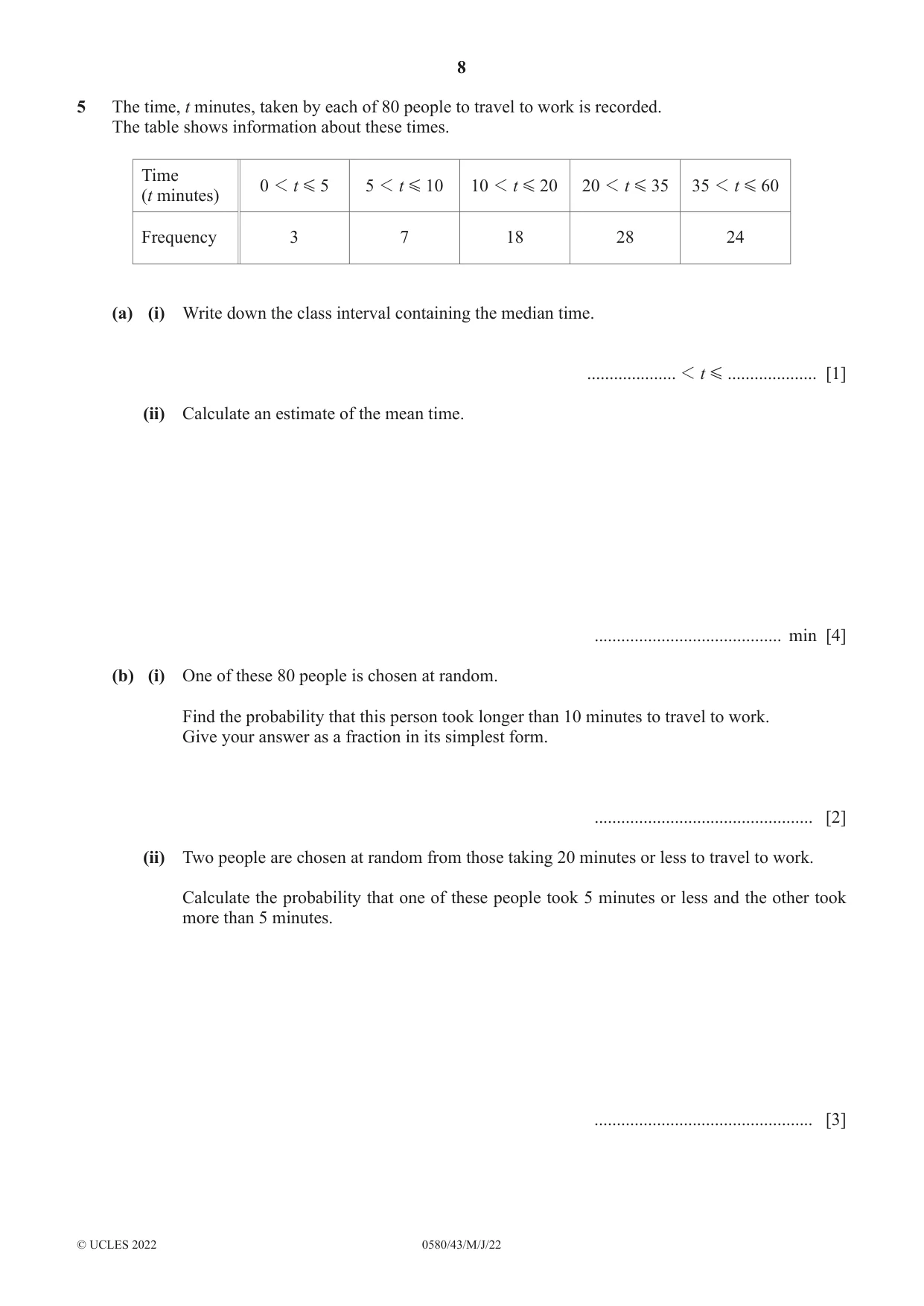
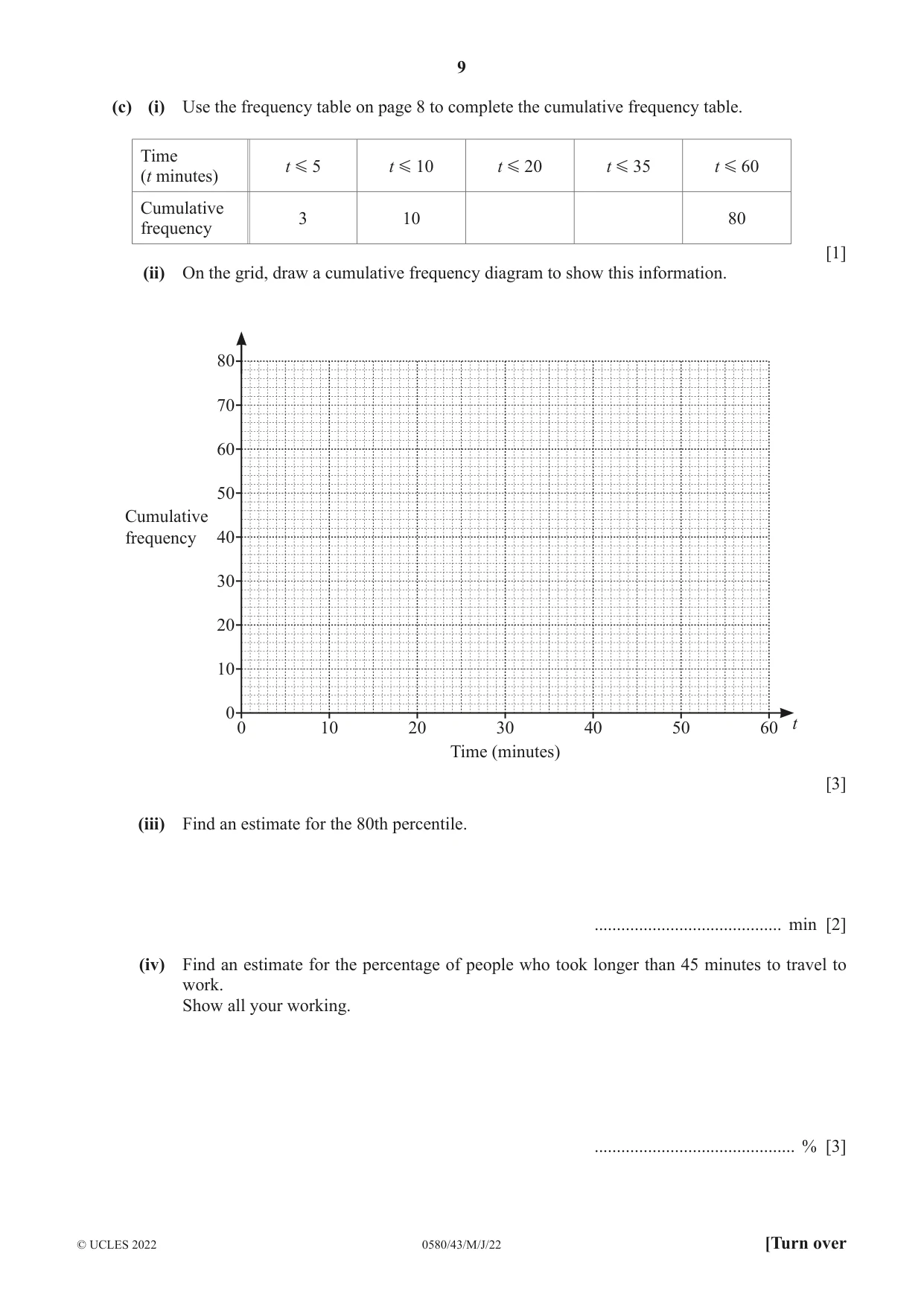
5 The time, t minutes, taken by each of 80 people to travel to work is recorded. The table shows information about these times. Time 0 1 t G 5 5 1 t G 10 10 1 t G 20 20 1 t G 35 35 1 t G 60 (t minutes) Frequency 3 7 18 28 24 (a) (i) Write down the class interval containing the median time. .................... 1 t G .................... [1] (ii) Calculate an estimate of the mean time. .......................................... min [4] (b) (i) One of these 80 people is chosen at random. Find the probability that this person took longer than 10 minutes to travel to work. Give your answer as a fraction in its simplest form. ................................................. [2] (ii) Two people are chosen at random from those taking 20 minutes or less to travel to work. Calculate the probability that one of these people took 5 minutes or less and the other took more than 5 minutes. ................................................. [3] (c) (i) Use the frequency table on page 8 to complete the cumulative frequency table. Time t G 5 t G 10 t G 20 t G 35 t G 60 (t minutes) Cumulative 3 10 80 frequency [1] (ii) On the grid, draw a cumulative frequency diagram to show this information. 80 70 60 50 Cumulative frequency 40 30 20 10 0 0 10 20 30 40 50 60 t Time (minutes) [3] (iii) Find an estimate for the 80th percentile. .......................................... min [2] (iv) Find an estimate for the percentage of people who took longer than 45 minutes to travel to work. Show all your working. ............................................. % [3]
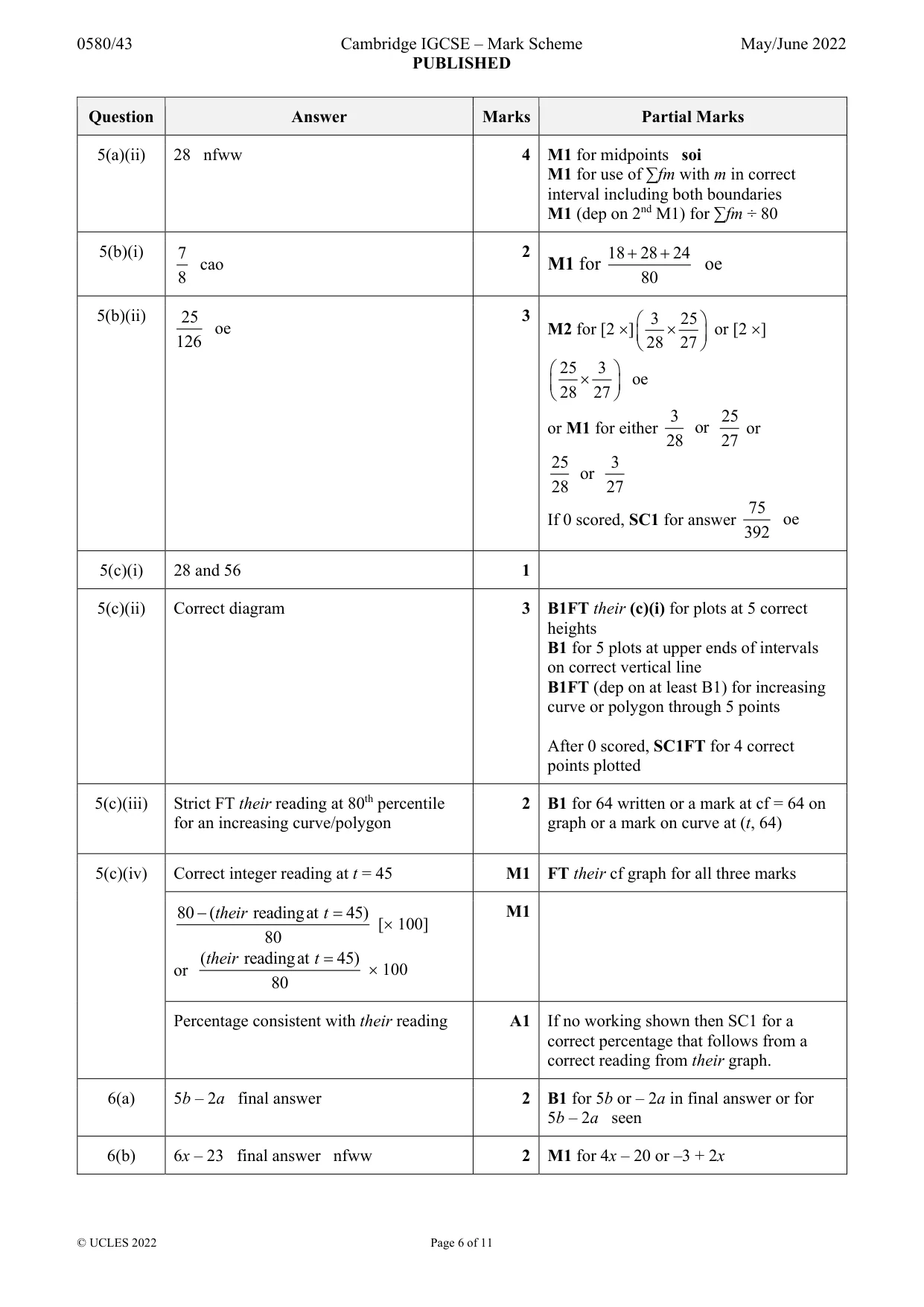
Mark scheme: 5(a)(i) 20 < t ⩽ 35 1 5(a)(ii) 28 nfww 4 M1 for midpoints soi M1 for use of ∑fm with m in correct interval including both boundaries M1 (dep on 2nd M1) for ∑fm ÷ 80 5(b)(i) 7 2 18 28 24 cao M1 for oe 8 80 5(b)(ii) 25 3 3 25 oe M2 for [2 ] or [2 ] 126 28 27 25 3 oe 28 27 3 25 or M1 for either or or 28 27 25 3 or 28 27 75 If 0 scored, SC1 for answer oe 392 5(c)(i) 28 and 56 1 5(c)(ii) Correct diagram 3 B1FT their (c)(i) for plots at 5 correct heights B1 for 5 plots at upper ends of intervals on correct vertical line B1FT (dep on at least B1) for increasing curve or polygon through 5 points After 0 scored, SC1FT for 4 correct points plotted 5(c)(iii) Strict FT their reading at 80th percentile 2 B1 for 64 written or a mark at cf = 64 on for an increasing curve/polygon graph or a mark on curve at (t, 64) 5(c)(iv) Correct integer reading at t = 45 M1 FT their cf graph for all three marks 80 (their readingat t 45) M1 [ 100] 80 (their readingat t 45) or 100 80 Percentage consistent with their reading A1 If no working shown then SC1 for a correct percentage that follows from a correct reading from their graph.
Question 6
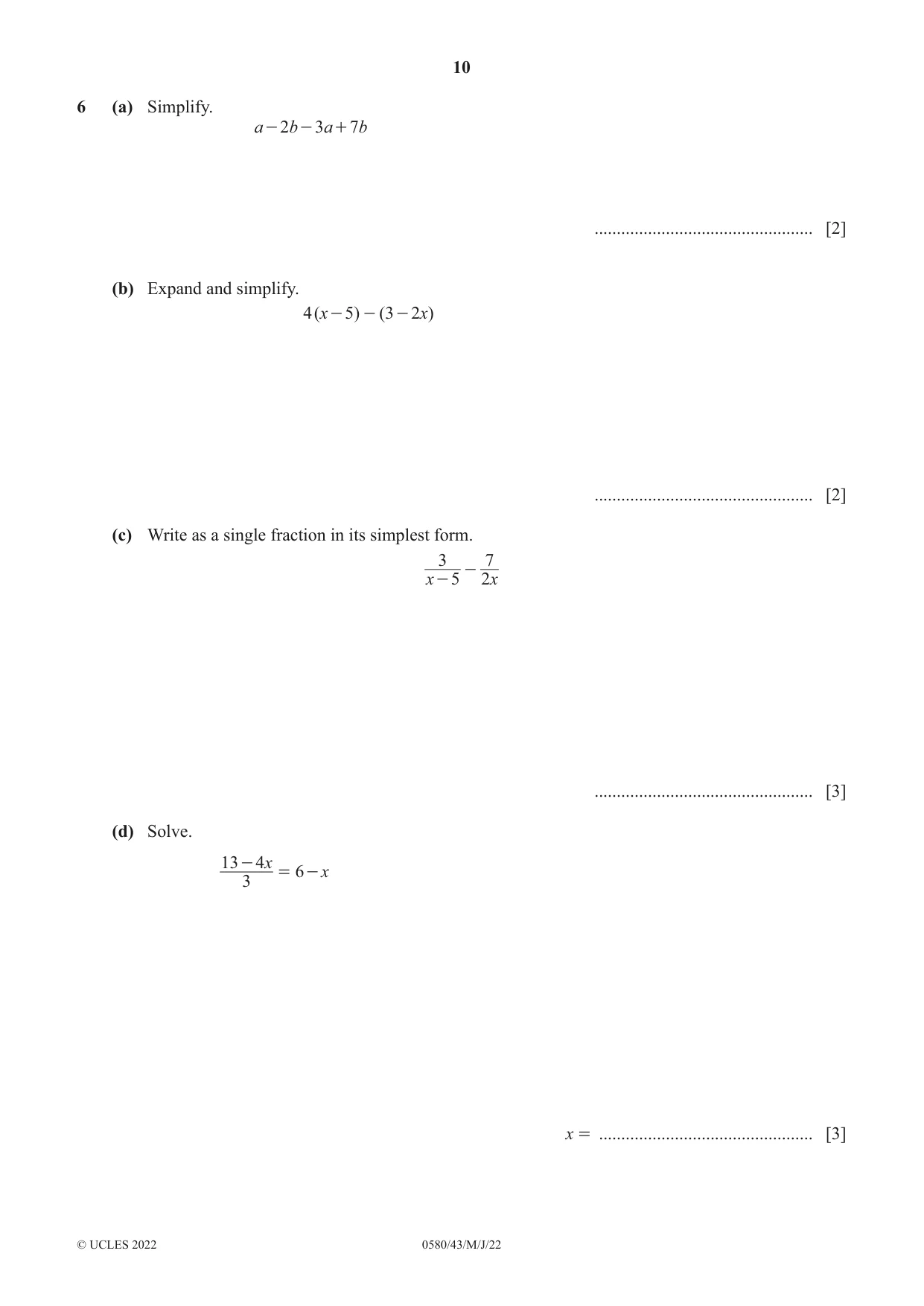
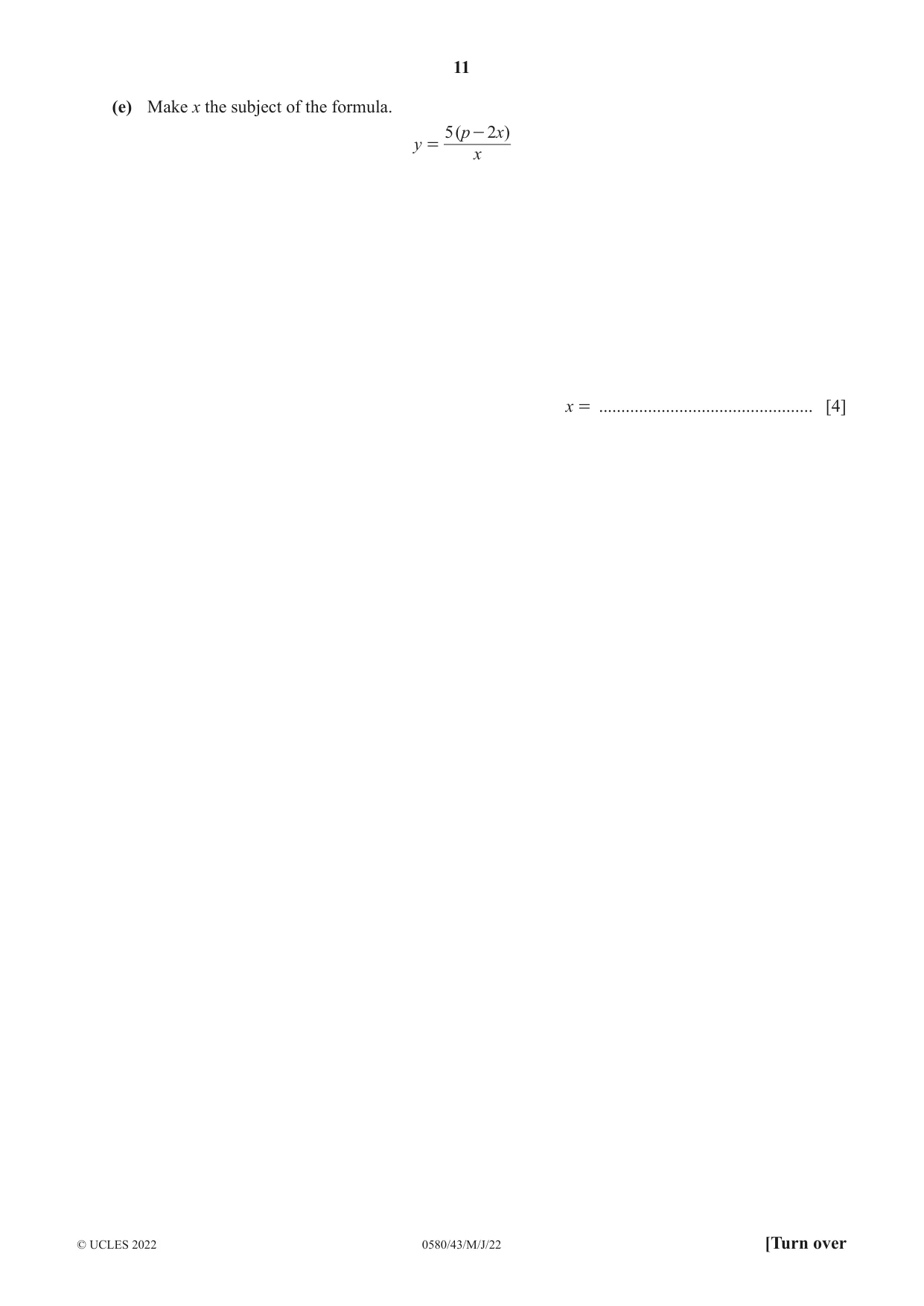
6 (a) Simplify. a - 2b - 3a + 7b ................................................. [2] (b) Expand and simplify. 4 ( x - 5) - ( 3 - 2x) ................................................. [2] (c) Write as a single fraction in its simplest form. 3 7 - x - 5 2x ................................................. [3] (d) Solve. 13 - 4x = 6 - x 3 x = ................................................ [3] (e) Make x the subject of the formula. 5 ( p - 2x) y = x x = ................................................ [4]
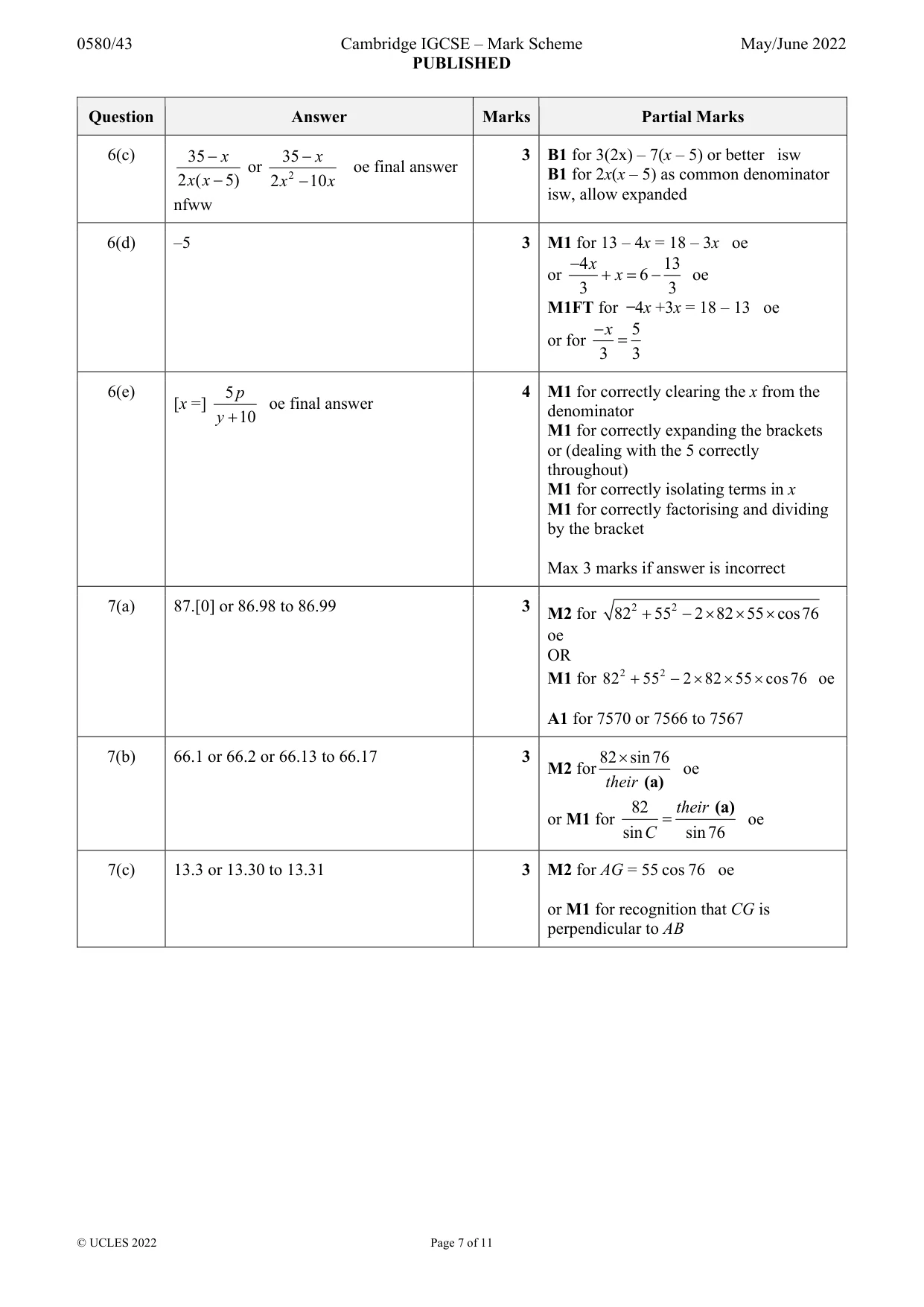
Mark scheme: 6(a) 5b – 2a final answer 2 B1 for 5b or – 2a in final answer or for 5b – 2a seen 6(b) 6x – 23 final answer nfww 2 M1 for 4x – 20 or –3 + 2x 6(c) 35 x 35 x 3 B1 for 3(2x) – 7(x – 5) or better isw or oe final answer 2 B1 for 2x(x – 5) as common denominator 2 x ( x 5) 2 x 10 x isw, allow expanded nfww 6(d) –5 3 M1 for 13 – 4x = 18 – 3x oe 4 x 13 or x 6 oe 3 3 M1FT for 4x +3x = 18 – 13 oe x 5 or for 3 3 6(e) 5 p 4 M1 for correctly clearing the x from the [x =] oe final answer denominator y 10 M1 for correctly expanding the brackets or (dealing with the 5 correctly throughout) M1 for correctly isolating terms in x M1 for correctly factorising and dividing by the bracket Max 3 marks if answer is incorrect
Q7 · B 82 m NOT TO A 76° SCALE 55 m C The diagram shows a field ABC
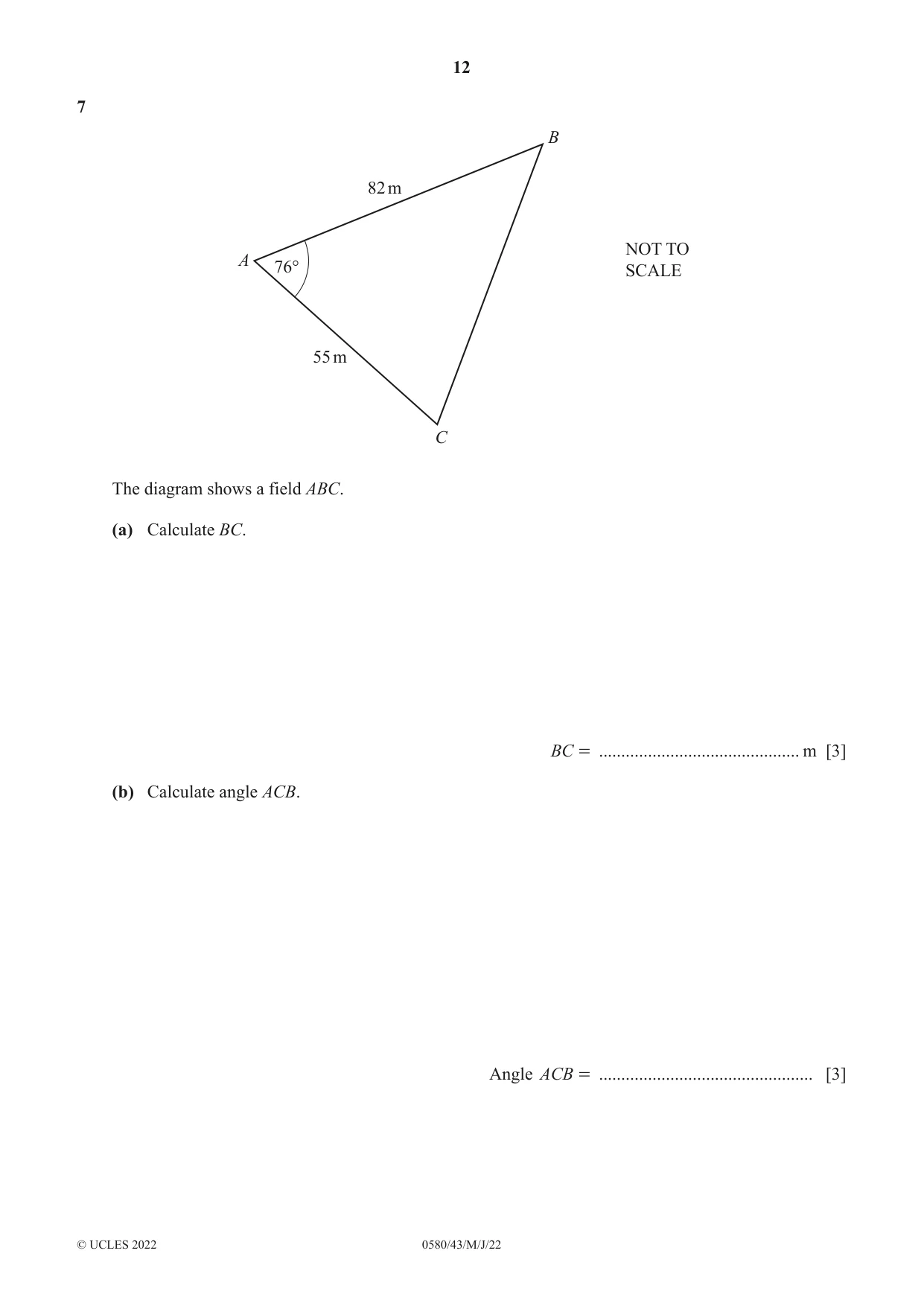
7 B 82 m NOT TO A 76° SCALE 55 m C The diagram shows a field ABC. (a) Calculate BC. BC = ............................................. m [3] (b) Calculate angle ACB. Angle ACB = ................................................ [3] (c) A gate, G, lies on AB at the shortest distance from C. Calculate AG. AG = ............................................ m [3] (d) A different triangular field PQR has the same area as ABC. PQ = 90 m and QR = 60 m. Work out the two possible values of angle PQR. Angle PQR = ..................................... or ..................................... [5]
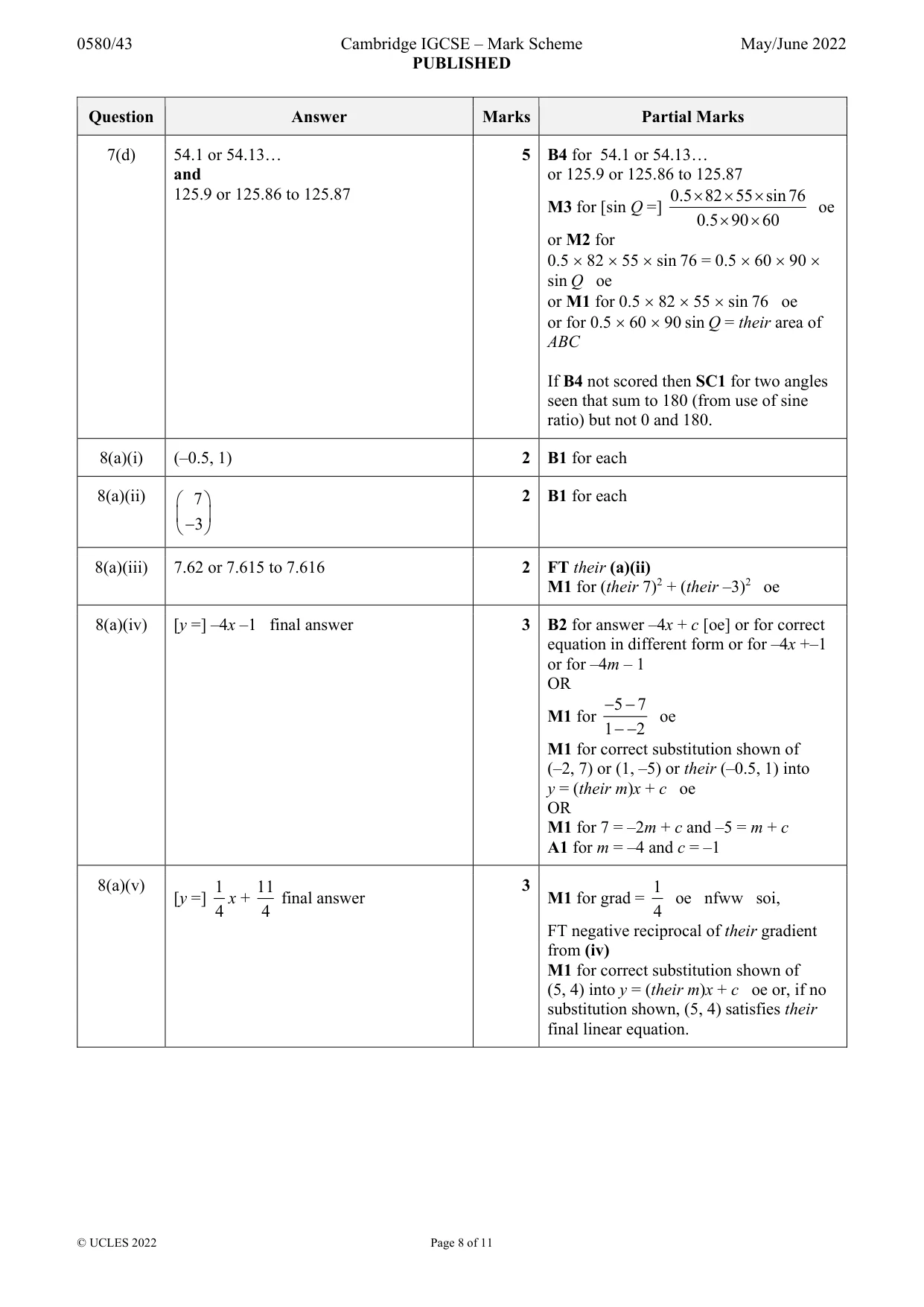
Mark scheme: 7(a) 87.[0] or 86.98 to 86.99 3 2 2 M2 for 82 55 2 82 55 cos76 oe OR M1 for 82 2 55 2 2 82 55 cos76 oe A1 for 7570 or 7566 to 7567 7(b) 66.1 or 66.2 or 66.13 to 66.17 3 82 sin76 M2 for oe their (a) or M1 for 82 their (a) oe sin C sin76 7(c) 13.3 or 13.30 to 13.31 3 M2 for AG = 55 cos 76 oe or M1 for recognition that CG is perpendicular to AB 7(d) 54.1 or 54.13… 5 B4 for 54.1 or 54.13… and or 125.9 or 125.86 to 125.87 125.9 or 125.86 to 125.87 0.5 82 55 sin76 M3 for [sin Q =] oe 0.5 90 60 or M2 for 0.5 82 55 sin 76 = 0.5 60 90 sin Q oe or M1 for 0.5 82 55 sin 76 oe or for 0.5 60 90 sin Q = their area of ABC If B4 not scored then SC1 for two angles seen that sum to 180 (from use of sine ratio) but not 0 and 180.
Q8 · A has coordinates ( - 2 , 7) , B has coordinates ( 1 , - 5 ) and C has coordinates ( 5, 4)
8 (a) A has coordinates ( - 2 , 7) , B has coordinates ( 1 , - 5 ) and C has coordinates ( 5, 4) . (i) Find the coordinates of the midpoint of the line AB. (...................... , ...................... ) [2] (ii) Find AC. AC = [2] f p (iii) Find AC . ................................................. [2] (iv) Find the equation of the line AB. Give your answer in the form y = mx + c . y = ................................................ [3] (v) Find the equation of the line perpendicular to AB that passes through C. Give your answer in the form y = mx + c . y = ................................................ [3] (b) The graphs of y + 5 x = 8 and y = 2x 2 + 6x - 13 intersect at the points P and Q. Find the coordinates of P and the coordinates of Q. Show all your working. P ( ...................... , ...................... ) Q ( ...................... , ...................... ) [6]
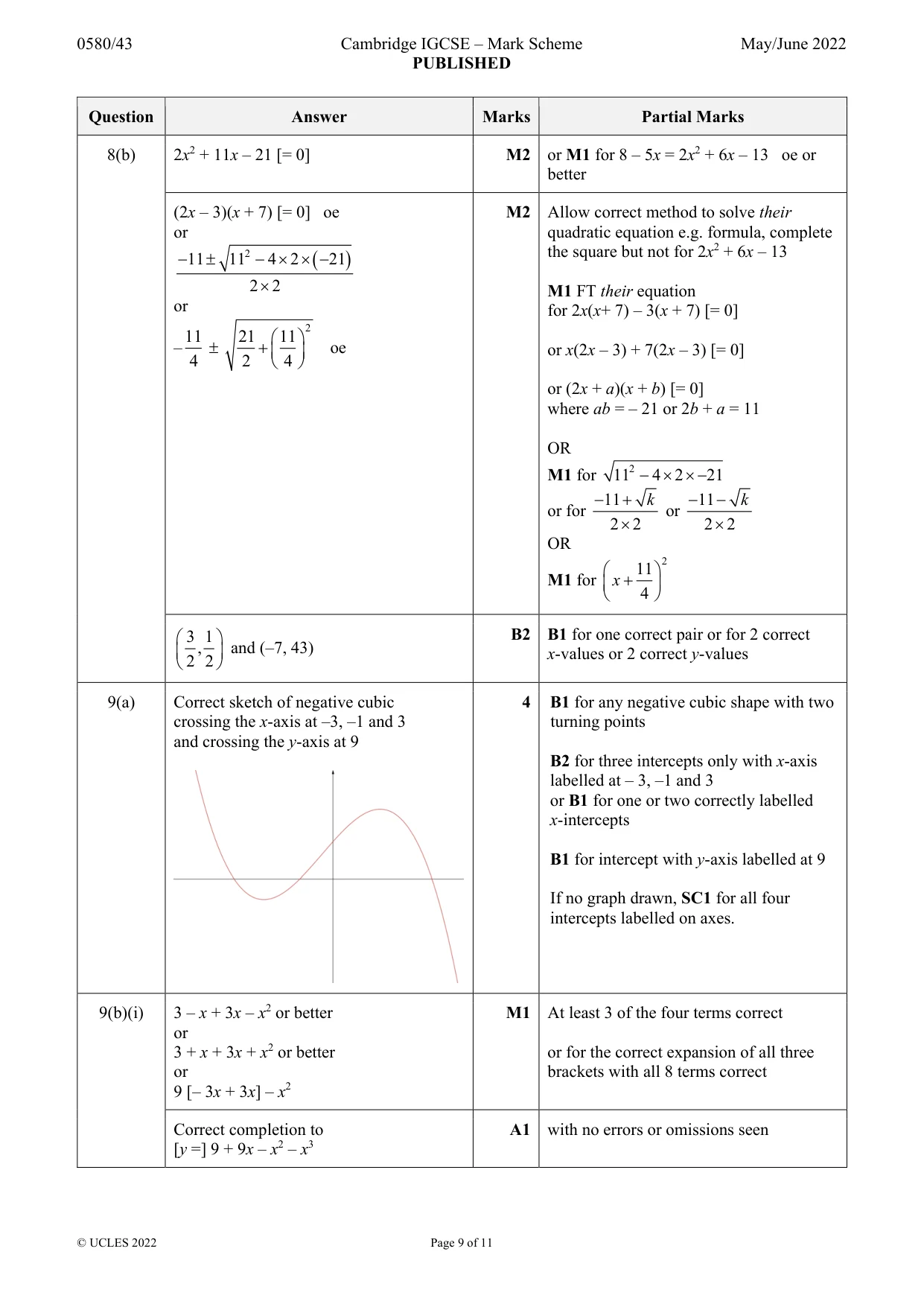
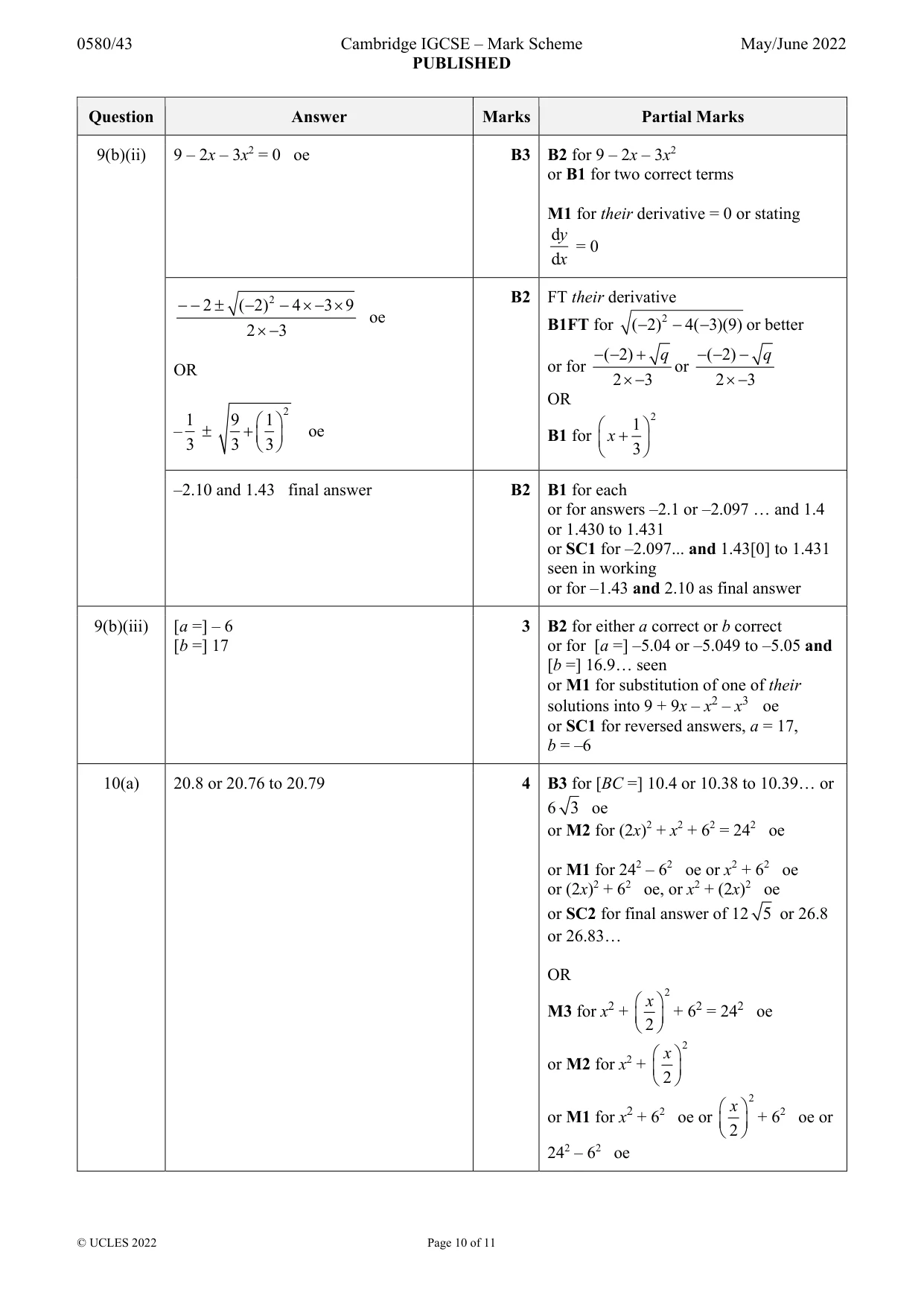
Mark scheme: 8(a)(i) (–0.5, 1) 2 B1 for each 8(a)(ii) 7 2 B1 for each 3 8(a)(iii) 7.62 or 7.615 to 7.616 2 FT their (a)(ii) M1 for (their 7)2 + (their –3)2 oe 8(a)(iv) [y =] –4x –1 final answer 3 B2 for answer –4x + c [oe] or for correct equation in different form or for –4x +–1 or for –4m – 1 OR 5 7 M1 for oe 1 2 M1 for correct substitution shown of (–2, 7) or (1, –5) or their (–0.5, 1) into y = (their m)x + c oe OR M1 for 7 = –2m + c and –5 = m + c A1 for m = –4 and c = –1 8(a)(v) 1 11 3 1 [y =] x + final answer M1 for grad = oe nfww soi, 4 4 4 FT negative reciprocal of their gradient from (iv) M1 for correct substitution shown of (5, 4) into y = (their m)x + c oe or, if no substitution shown, (5, 4) satisfies their final linear equation. 8(b) 2x2 + 11x – 21 [= 0] M2 or M1 for 8 – 5x = 2x2 + 6x – 13 oe or better (2x – 3)(x + 7) [= 0] oe M2 Allow correct method to solve their or quadratic equation e.g. formula, complete 2 the square but not for 2x2 + 6x – 13 11 11 4 2 21 2 2 M1 FT their equation or for 2x(x+ 7) – 3(x + 7) [= 0] –11 21 11 2 oe or x(2x – 3) + 7(2x – 3) [= 0] 4 2 4 or (2x + a)(x + b) [= 0] where ab = – 21 or 2b + a = 11 OR M1 for 112 4 2 21 11 k 11 k or for or 2 2 2 2 OR 11 2 M1 for x 4 3 1 B2 B1 for one correct pair or for 2 correct , and (–7, 43) x-values or 2 correct y-values 2 2
Q9 · Sketch the graph of y = ( x + 1)( 3 - x)(3 + x) , indicating the coordinates of the…
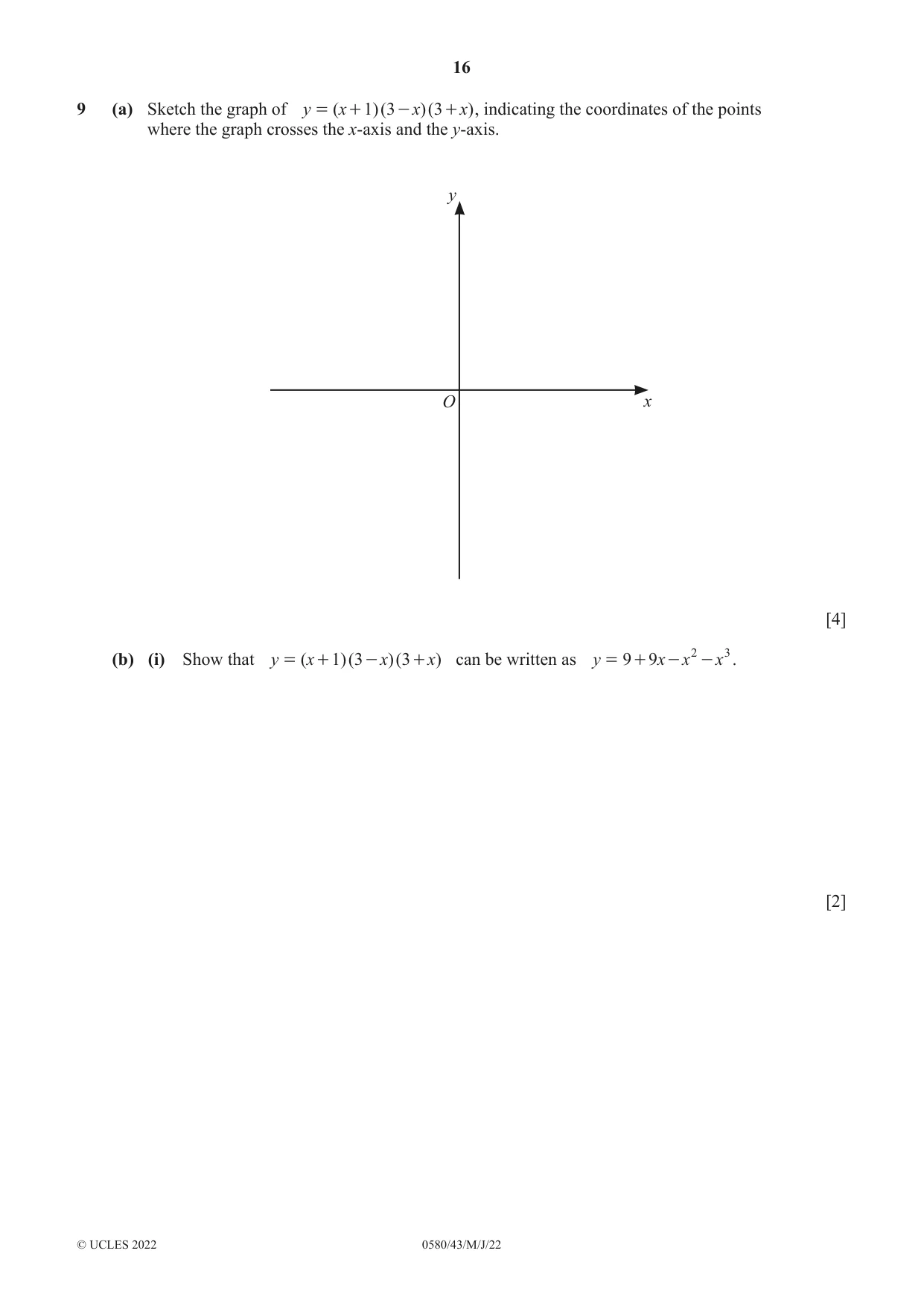
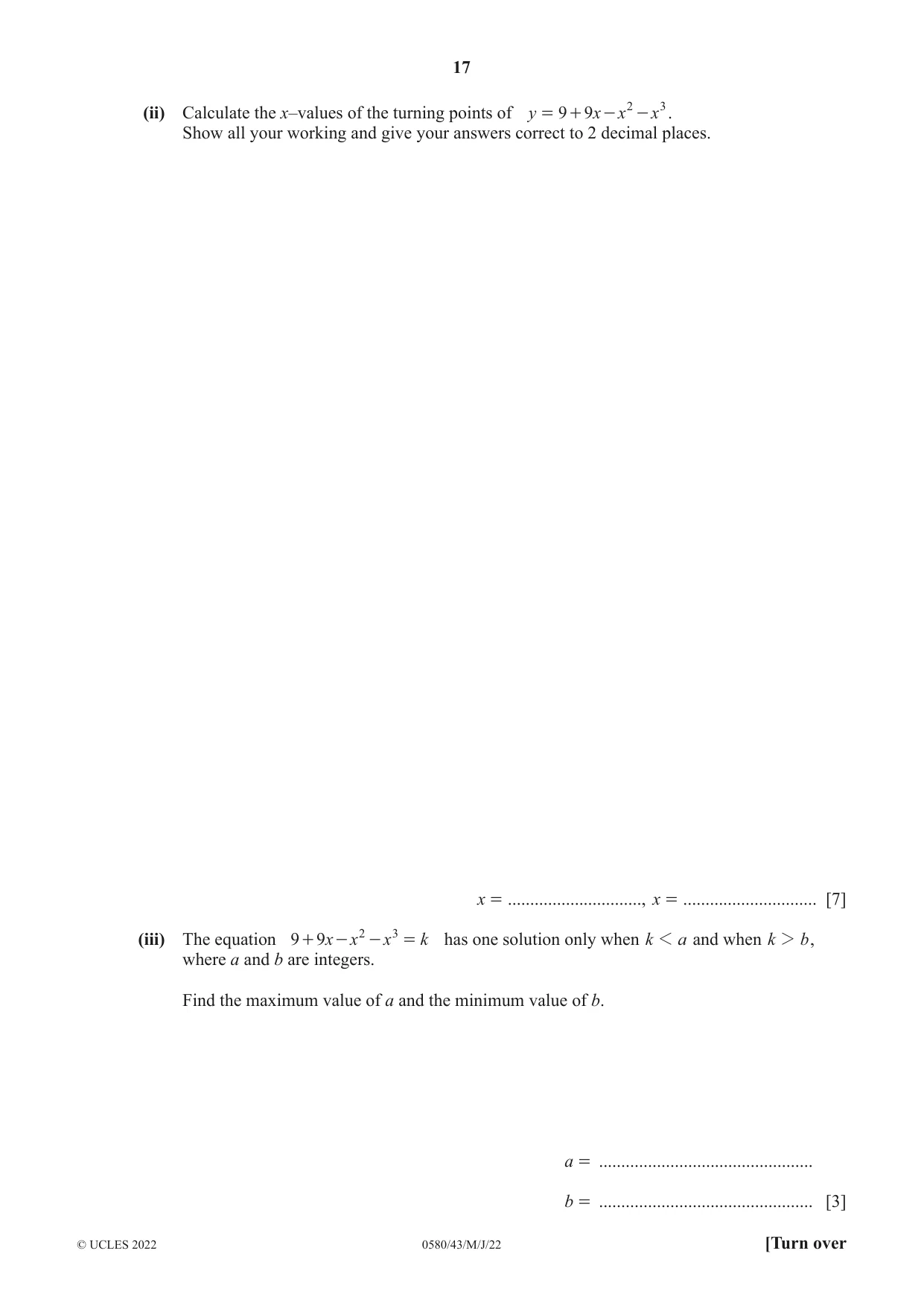
9 (a) Sketch the graph of y = ( x + 1)( 3 - x)(3 + x) , indicating the coordinates of the points where the graph crosses the x-axis and the y-axis. y O x [4] (b) (i) Show that y = ( x + 1)( 3 - x)(3 + x) can be written as y = 9 + 9 x - x 2 - x 3 . [2] (ii) Calculate the x–values of the turning points of y = 9 + 9x - x 2 - x 3 . Show all your working and give your answers correct to 2 decimal places. x = .............................., x = .............................. [7] (iii) The equation 9 + 9x - x 2 - x 3 = k has one solution only when k 1 a and when k 2 b , where a and b are integers. Find the maximum value of a and the minimum value of b. a = ................................................ b = ................................................ [3]
Mark scheme: 9(a) Correct sketch of negative cubic 4 B1 for any negative cubic shape with two crossing the x-axis at –3, –1 and 3 turning points and crossing the y-axis at 9 B2 for three intercepts only with x-axis labelled at – 3, –1 and 3 or B1 for one or two correctly labelled x-intercepts B1 for intercept with y-axis labelled at 9 If no graph drawn, SC1 for all four intercepts labelled on axes. 9(b)(i) 3 – x + 3x – x2 or better M1 At least 3 of the four terms correct or 3 + x + 3x + x2 or better or for the correct expansion of all three or brackets with all 8 terms correct 9 [– 3x + 3x] – x2 Correct completion to A1 with no errors or omissions seen [y =] 9 + 9x – x2 – x3 9(b)(ii) 9 – 2x – 3x2 = 0 oe B3 B2 for 9 – 2x – 3x2 or B1 for two correct terms M1 for their derivative = 0 or stating dy = 0 dx 2 B2 FT their derivative 2 ( 2) 4 3 9 oe 2 B1FT for ( 2) 4( 3)(9) or better 2 3 ( 2) q ( 2) q OR or for or 2 3 2 3 OR 1 9 1 2 1 2 – oe B1 for x 3 3 3 3 –2.10 and 1.43 final answer B2 B1 for each or for answers –2.1 or –2.097 … and 1.4 or 1.430 to 1.431 or SC1 for –2.097... and 1.43[0] to 1.431 seen in working or for –1.43 and 2.10 as final answer 9(b)(iii) [a =] – 6 3 B2 for either a correct or b correct [b =] 17 or for [a =] –5.04 or –5.049 to –5.05 and [b =] 16.9… seen or M1 for substitution of one of their solutions into 9 + 9x – x2 – x3 oe or SC1 for reversed answers, a = 17, b = –6
Q10 · H G NOT TO E F SCALE 6 cm 24 cm D C A B The diagram shows a cuboid ABCDEFGH
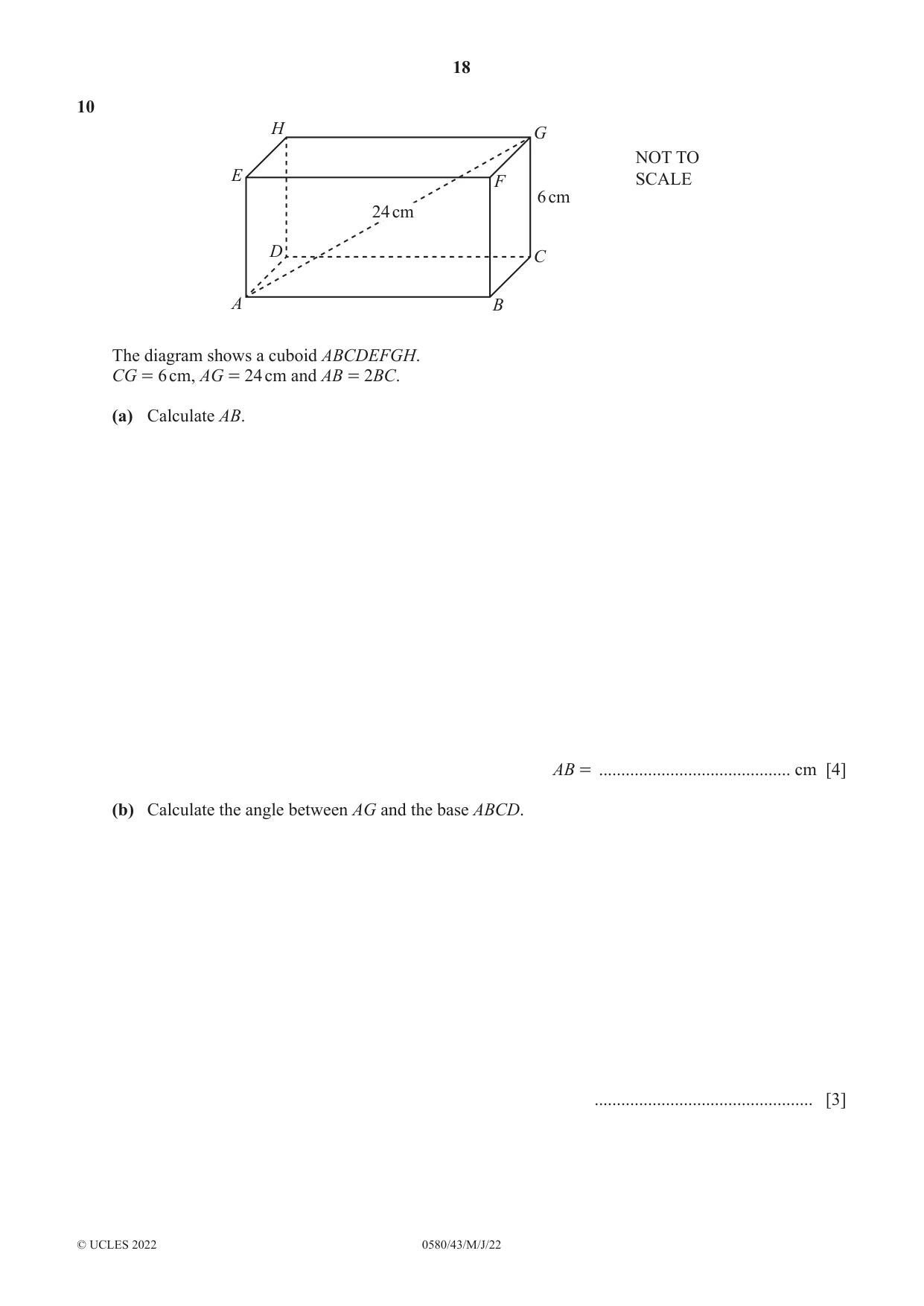
10 H G NOT TO E F SCALE 6 cm 24 cm D C A B The diagram shows a cuboid ABCDEFGH. CG = 6 cm, AG = 24 cm and AB = 2BC. (a) Calculate AB. AB = ........................................... cm [4] (b) Calculate the angle between AG and the base ABCD. ................................................. [3]
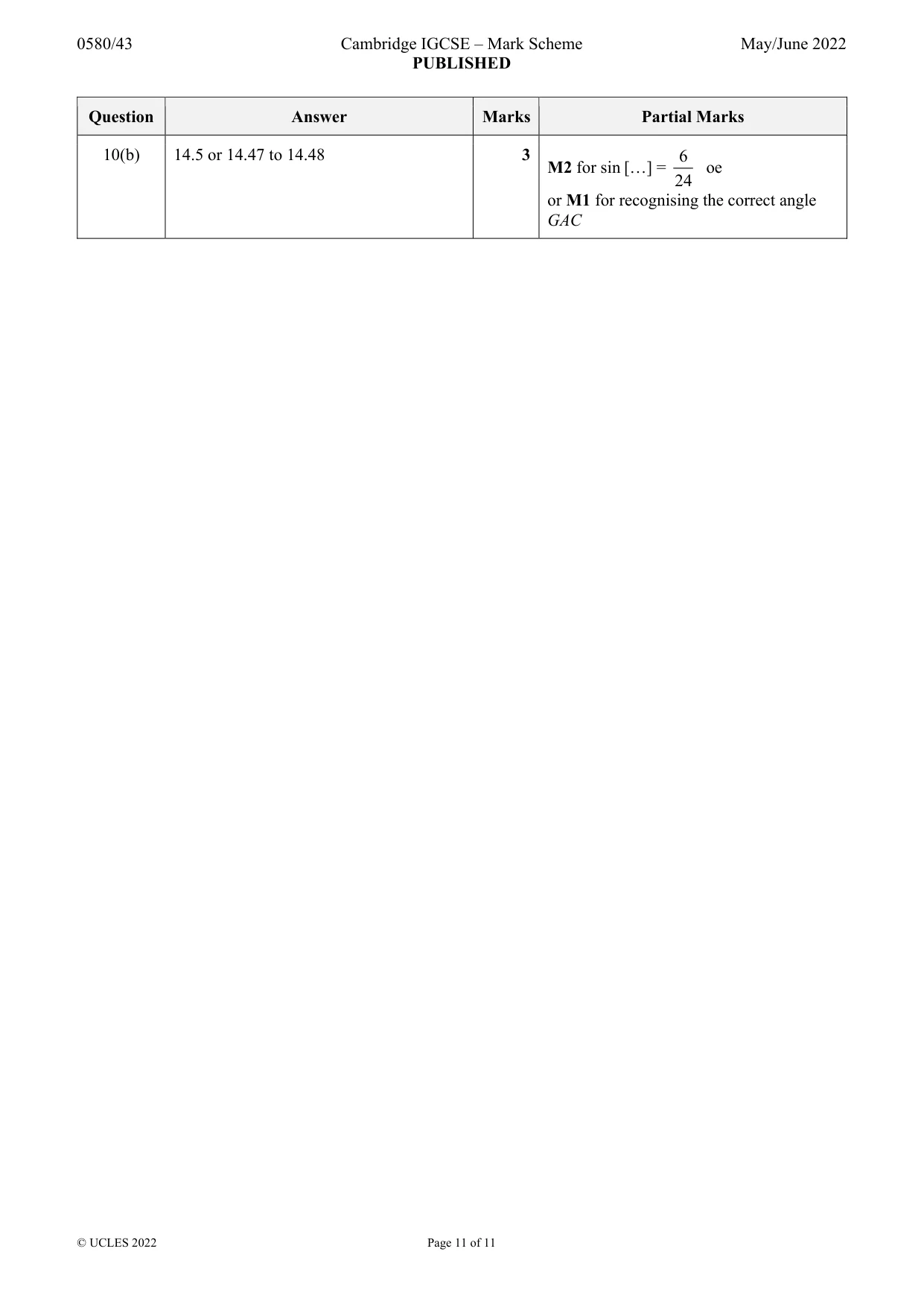
Mark scheme: 10(a) 20.8 or 20.76 to 20.79 4 B3 for [BC =] 10.4 or 10.38 to 10.39… or 6 3 oe or M2 for (2x)2 + x2 + 62 = 242 oe or M1 for 242 – 62 oe or x2 + 62 oe or (2x)2 + 62 oe, or x2 + (2x)2 oe or SC2 for final answer of 12 5 or 26.8 or 26.83… OR x 2 M3 for x2 + + 62 = 242 oe 2 x 2 or M2 for x2 + 2 x 2 or M1 for x2 + 62 oe or + 62 oe or 2 242 – 62 oe 10(b) 14.5 or 14.47 to 14.48 3 6 M2 for sin […] = oe 24 or M1 for recognising the correct angle GAC
What was in this paper
The subtopics covered by these 10 questions, and how many questions each got. Open one in a new tab to see every Cambridge question on it.
What you needed in this session
Cambridge’s own grade thresholds for 2022 May/June, Paper 4 · Variant 3. A higher threshold means an easier paper — the bar moves with how the cohort did.