Cambridge IGCSE Mathematics 0580 — 2016 Feb/March Paper 4 · Variant 2
0580/42/F/M/16 · 11 questions · 130 marks · ≈146 min
The question paper and its mark scheme, free to read here and free to download. This is Cambridge’s own paper, exactly as it was sat.
Question paper16 pages
Mark scheme6 pages
Answers below. Sit the paper first if you are practising.
Questions as text
Q1 · Aasha, Biren and Cemal share $640 in the ratio 8 : 15 : 9
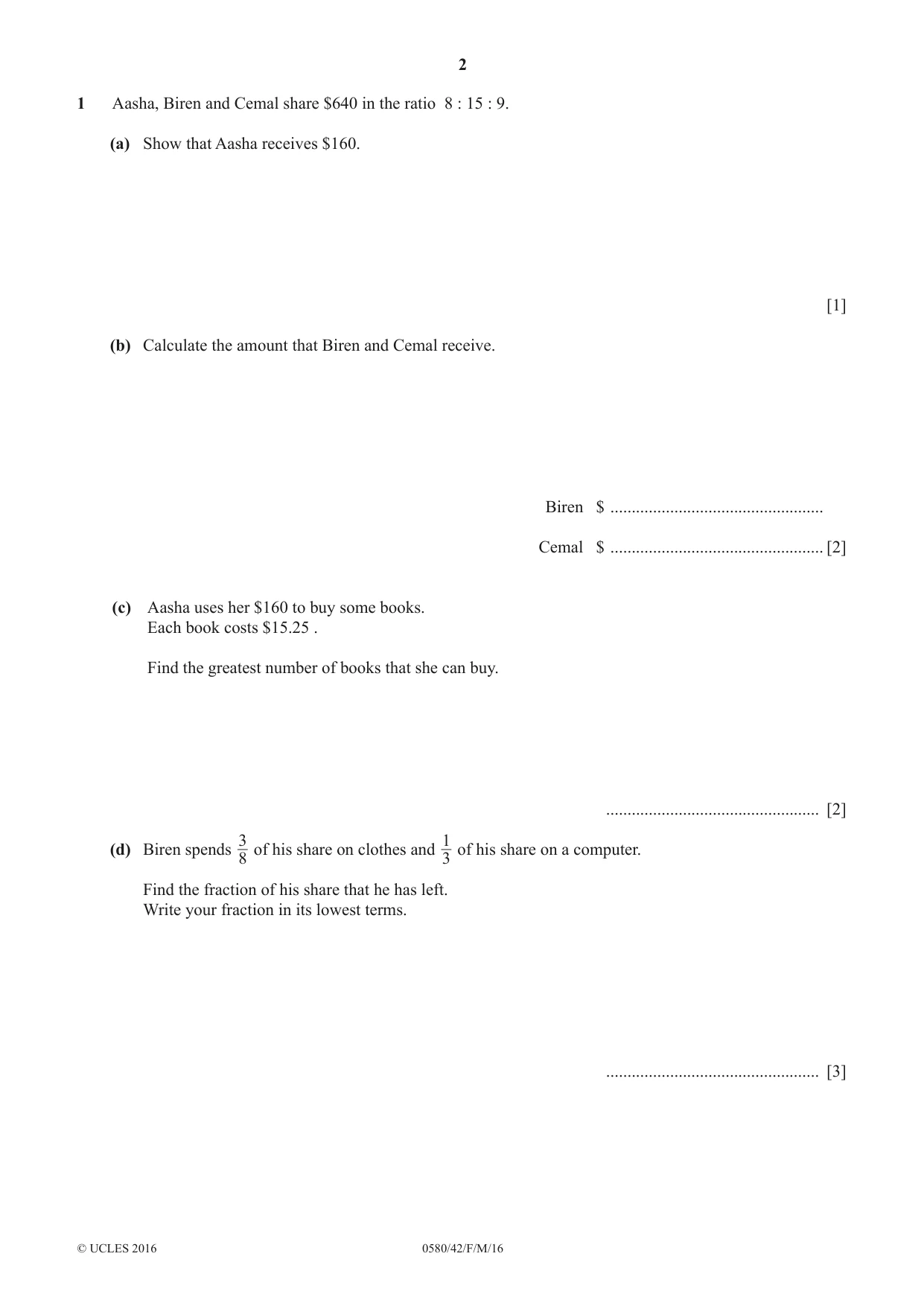
1 Aasha, Biren and Cemal share $640 in the ratio 8 : 15 : 9. (a) Show that Aasha receives $160. [1] (b) Calculate the amount that Biren and Cemal receive. Biren $ .................................................. Cemal $ .................................................. [2] (c) Aasha uses her $160 to buy some books. Each book costs $15.25 . Find the greatest number of books that she can buy. .................................................. [2] 3 1 (d) Biren spends of his share on clothes and of his share on a computer. 8 3 Find the fraction of his share that he has left. Write your fraction in its lowest terms. .................................................. [3]
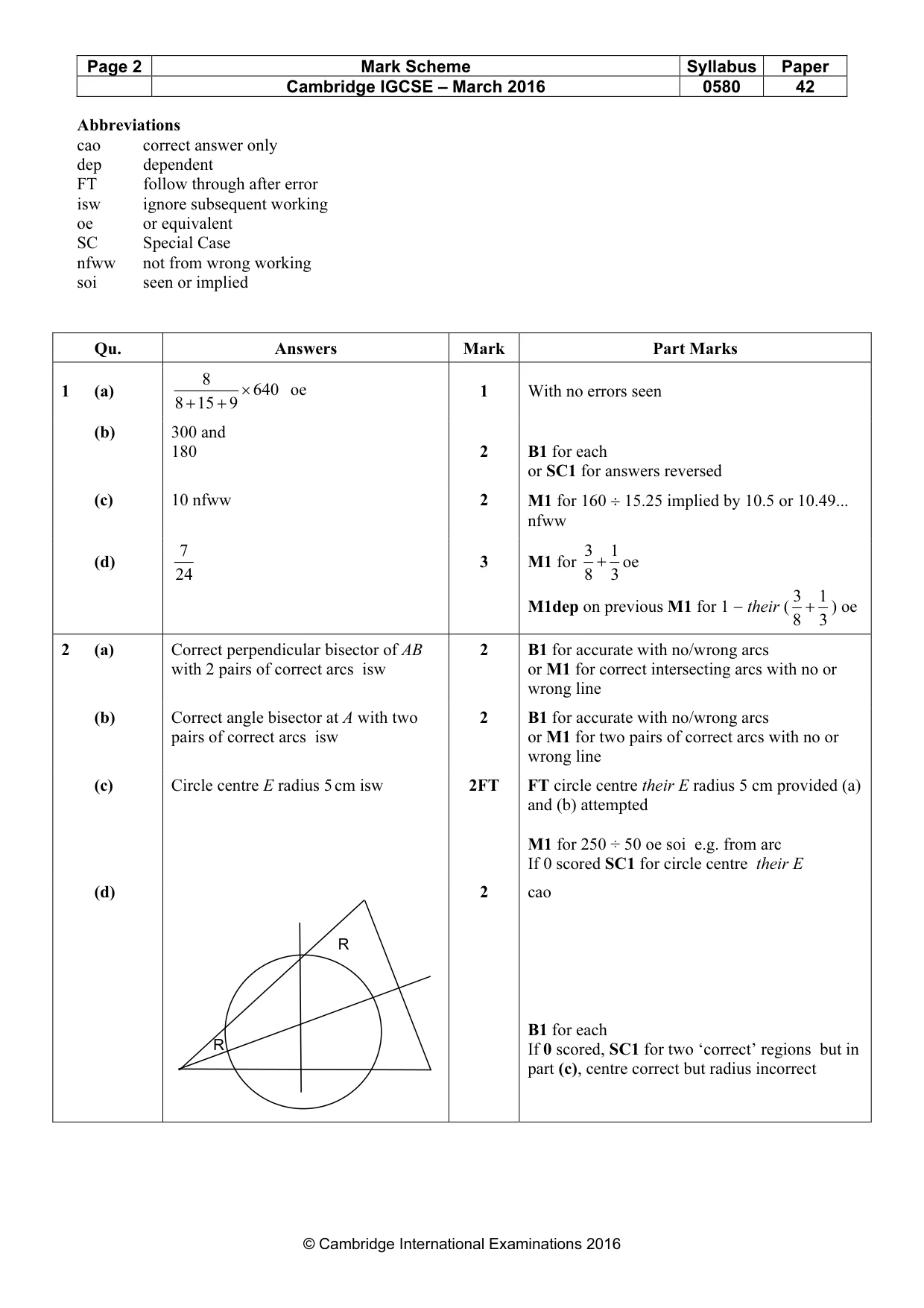
Mark scheme: 8 1 (a) × 640 oe 1 With no errors seen 8 + 15 + 9 (b) 300 and 180 2 B1 for each or SC1 for answers reversed (c) 10 nfww 2 M1 for 160 ÷ 15.25 implied by 10.5 or 10.49... nfww 7 3 1 (d) 3 M1 for + oe 24 8 3 3 1 M1dep on previous M1 for 1 − their ( + ) oe 8 3
Q2 · In this question use a ruler and compasses only
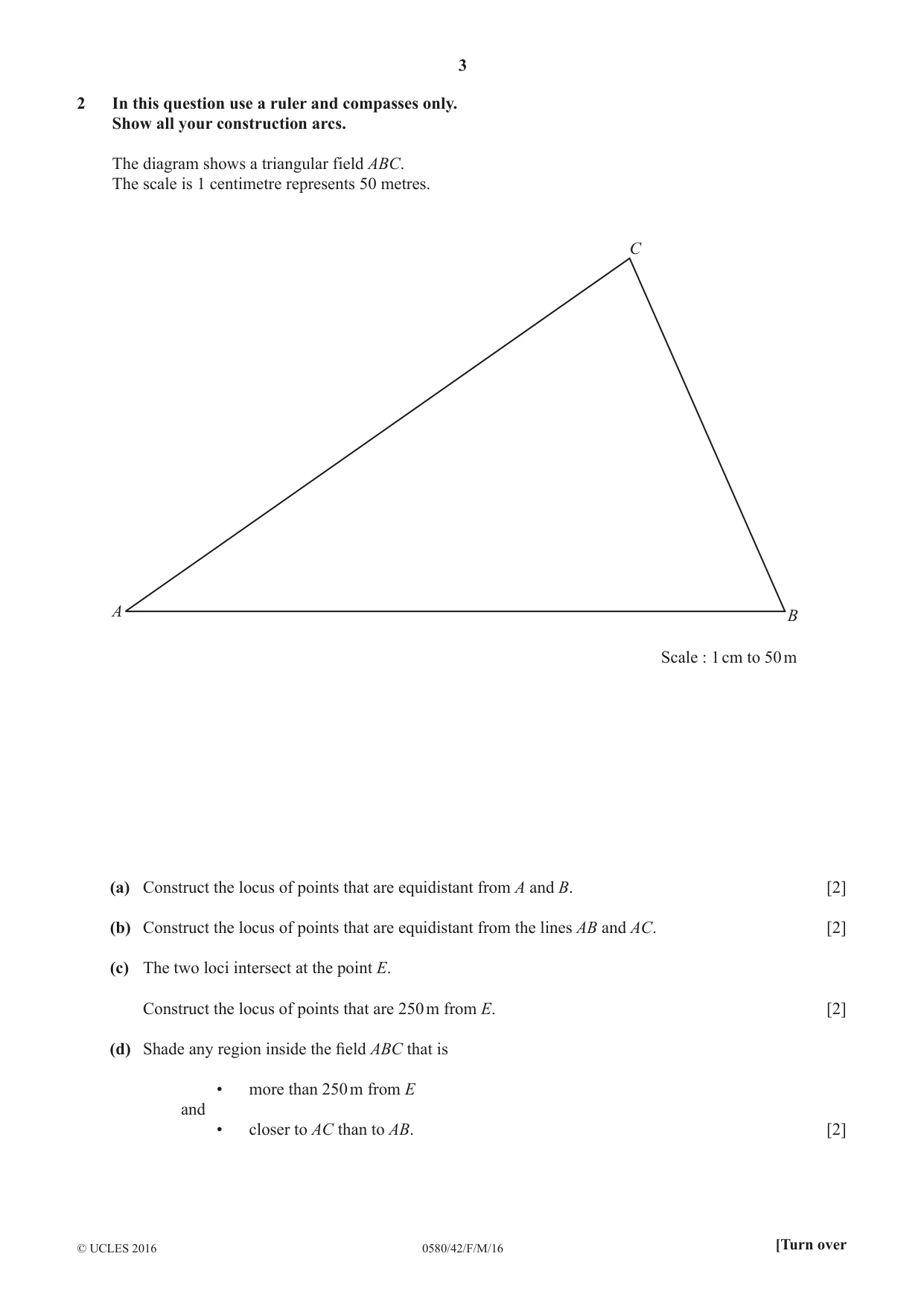
2 In this question use a ruler and compasses only. Show all your construction arcs. The diagram shows a triangular field ABC. The scale is 1 centimetre represents 50 metres. C A B Scale : 1 cm to 50 m (a) Construct the locus of points that are equidistant from A and B. [2] (b) Construct the locus of points that are equidistant from the lines AB and AC. [2] (c) The two loci intersect at the point E. Construct the locus of points that are 250 m from E. [2] (d) Shade any region inside the field ABC that is • more than 250 m from E and • closer to AC than to AB. [2]
Mark scheme: 2 (a) Correct perpendicular bisector of AB 2 B1 for accurate with no/wrong arcs with 2 pairs of correct arcs isw or M1 for correct intersecting arcs with no or wrong line (b) Correct angle bisector at A with two 2 B1 for accurate with no/wrong arcs pairs of correct arcs isw or M1 for two pairs of correct arcs with no or wrong line (c) Circle centre E radius 5 cm isw 2FT FT circle centre their E radius 5 cm provided (a) and (b) attempted M1 for 250 ÷ 50 oe soi e.g. from arc If 0 scored SC1 for circle centre their E (d) 2 cao R B1 for each R If 0 scored, SC1 for two ‘correct’ regions but in part (c), centre correct but radius incorrect Qu. Answers Mark Part Marks
Q3 · Davinder asked some people if they ate mangoes, pineapples or bananas last week
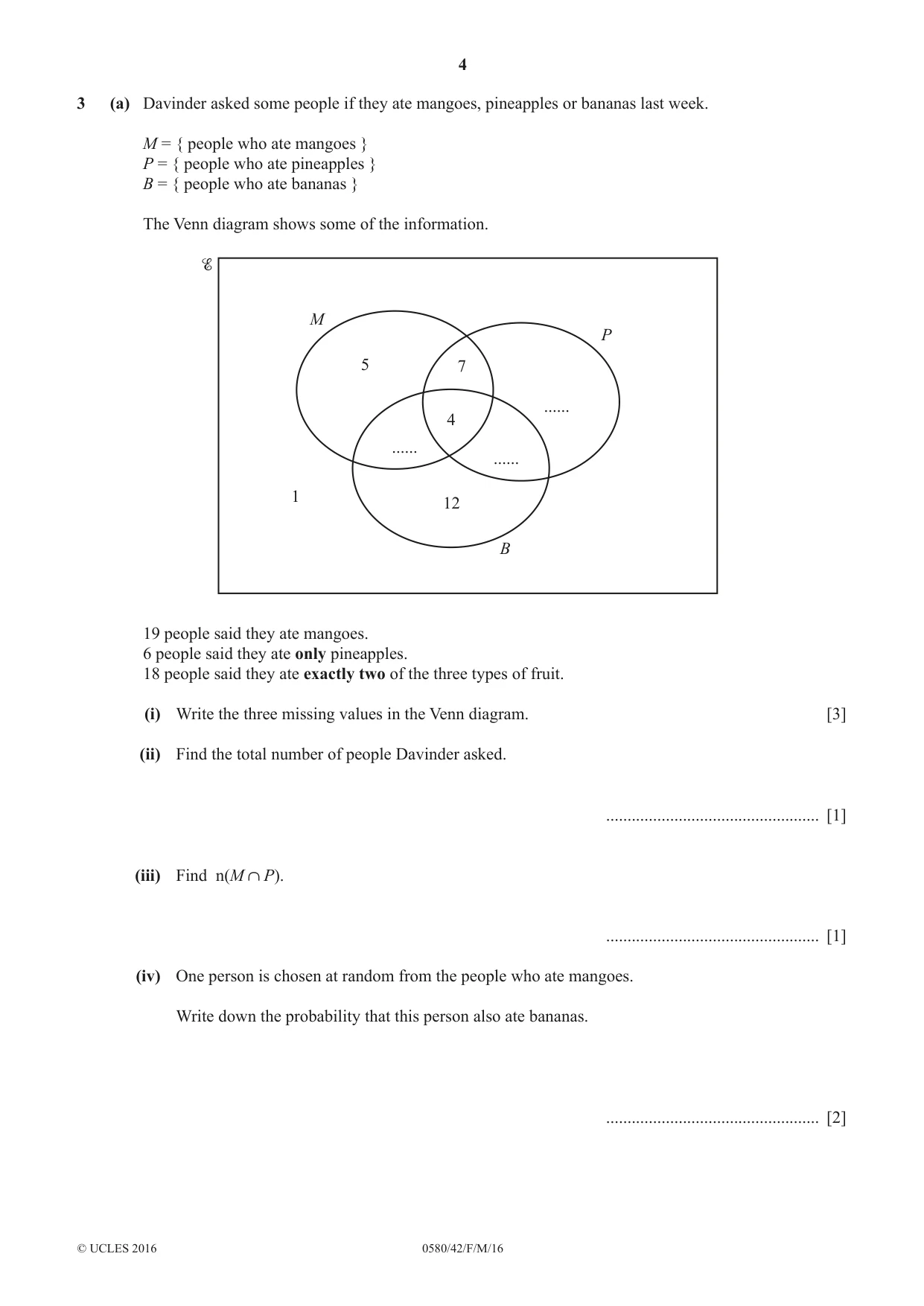
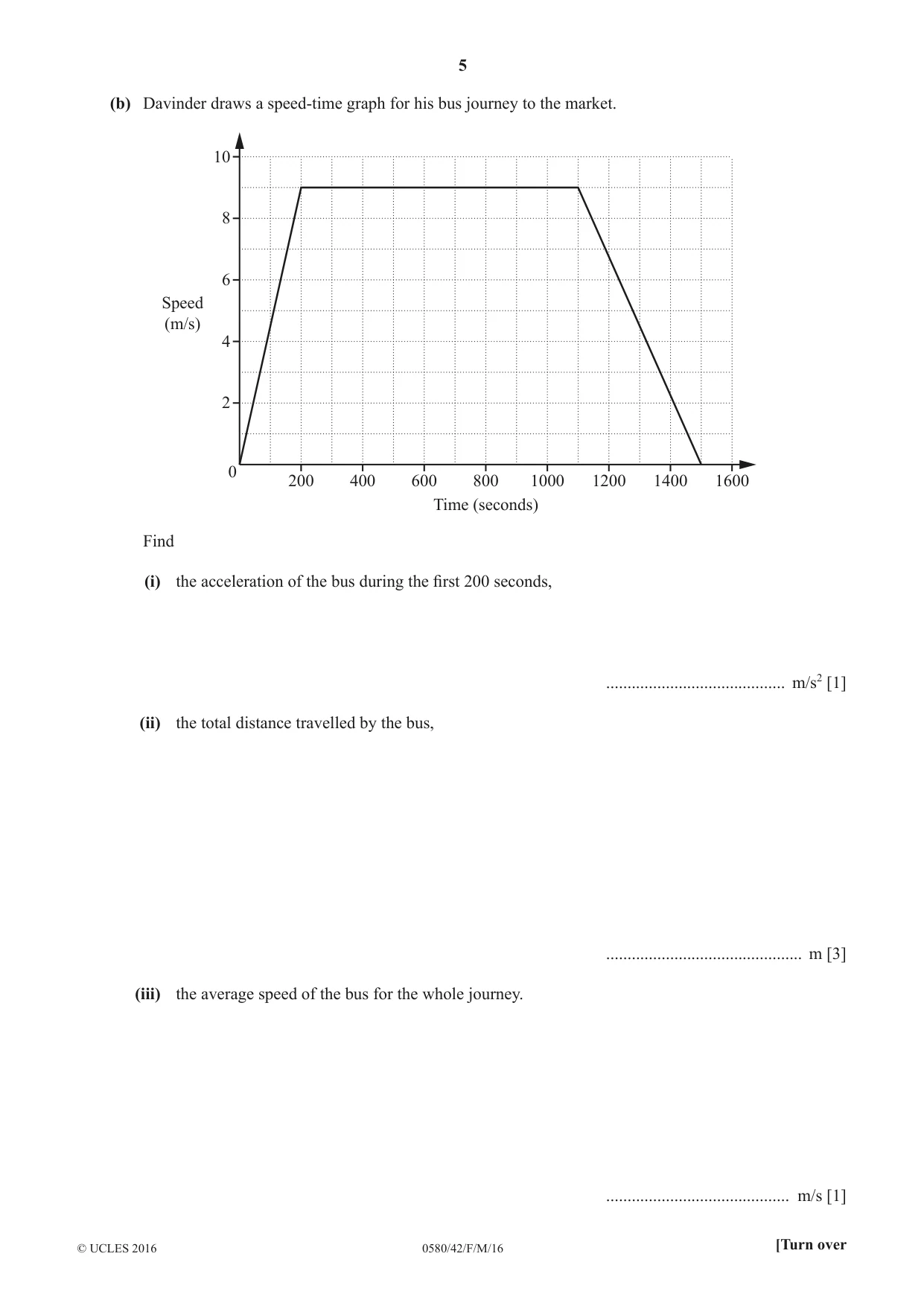
3 (a) Davinder asked some people if they ate mangoes, pineapples or bananas last week. M = { people who ate mangoes } P = { people who ate pineapples } B = { people who ate bananas } The Venn diagram shows some of the information. M P 5 7 ...... 4 ...... ...... 1 12 B 19 people said they ate mangoes. 6 people said they ate only pineapples. 18 people said they ate exactly two of the three types of fruit. (i) Write the three missing values in the Venn diagram. [3] (ii) Find the total number of people Davinder asked. .................................................. [1] (iii) Find n(M P). .................................................. [1] (iv) One person is chosen at random from the people who ate mangoes. Write down the probability that this person also ate bananas. .................................................. [2] (b) Davinder draws a speed-time graph for his bus journey to the market. 10 8 6 Speed (m/s) 4 2 0 200 400 600 800 1000 1200 1400 1600 Time (seconds) Find (i) the acceleration of the bus during the first 200 seconds, .......................................... m/s2 [1] (ii) the total distance travelled by the bus, .............................................. m [3] (iii) the average speed of the bus for the whole journey. ........................................... m/s [1]
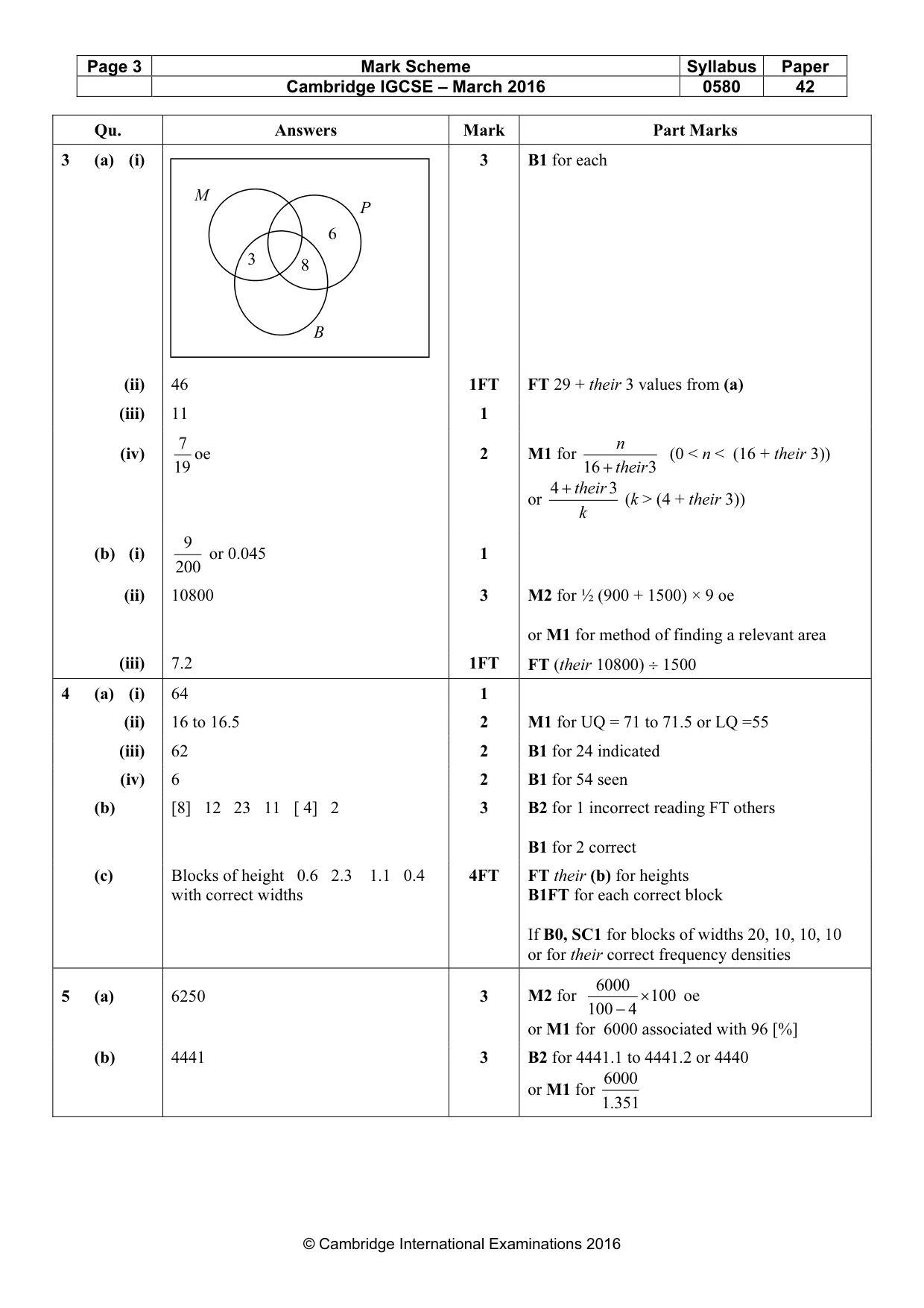
Mark scheme: 3 (a) (i) 3 B1 for each M P 6 3 8 B (ii) 46 1FT FT 29 + their 3 values from (a) (iii) 11 1 7 n (iv) oe 2 M1 for (0 < n < (16 + their 3)) 19 16 + their 3 4 + their 3 or (k > (4 + their 3)) k 9 (b) (i) or 0.045 1 200 (ii) 10800 3 M2 for ½ (900 + 1500) × 9 oe or M1 for method of finding a relevant area (iii) 7.2 1FT FT (their 10800) ÷ 1500
Q4 · The cumulative frequency diagram shows information about the time taken, t minutes, by 60…
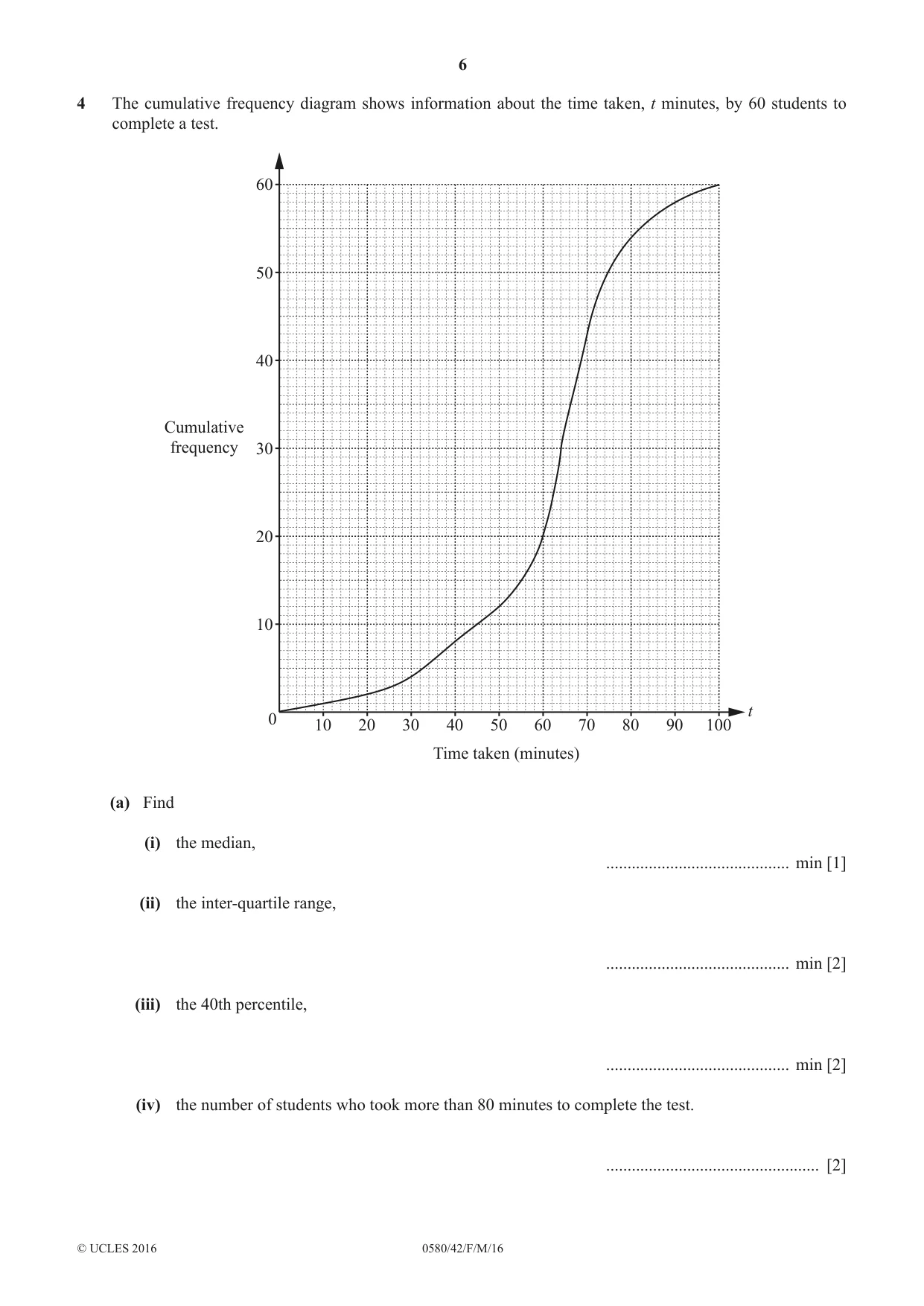
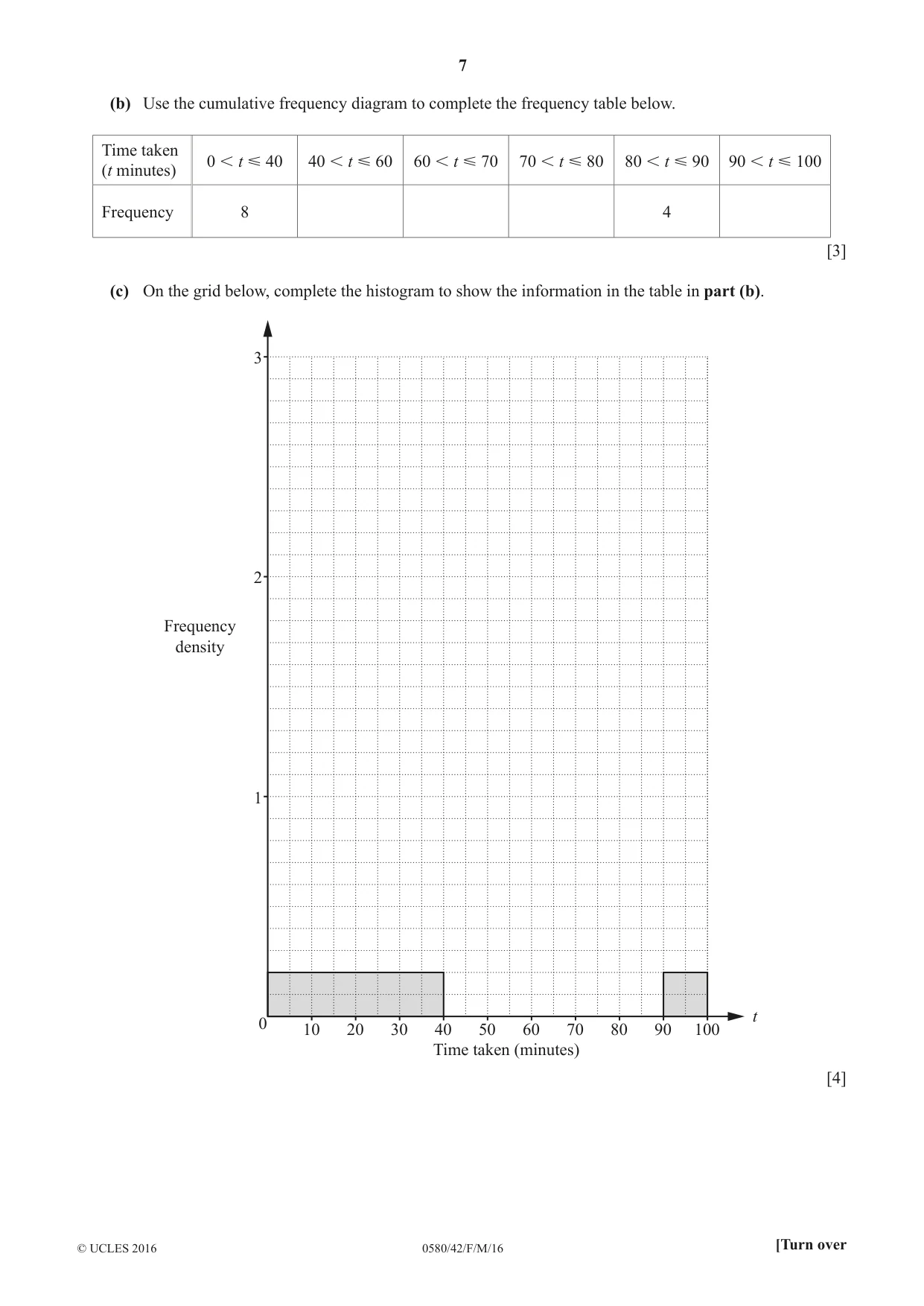
4 The cumulative frequency diagram shows information about the time taken, t minutes, by 60 students to complete a test. 60 50 40 Cumulative frequency 30 20 10 t 0 10 20 30 40 50 60 70 80 90 100 Time taken (minutes) (a) Find (i) the median, ........................................... min [1] (ii) the inter-quartile range, ........................................... min [2] (iii) the 40th percentile, ........................................... min [2] (iv) the number of students who took more than 80 minutes to complete the test. .................................................. [2] (b) Use the cumulative frequency diagram to complete the frequency table below. Time taken 0 t 40 40 t 60 60 t 70 70 t 80 80 t 90 90 t 100(t minutes) Frequency 8 4 [3] (c) On the grid below, complete the histogram to show the information in the table in part (b). 3 2 Frequency density 1 t 0 10 20 30 40 50 60 70 80 90 100 Time taken (minutes) [4]
Mark scheme: 4 (a) (i) 64 1 (ii) 16 to 16.5 2 M1 for UQ = 71 to 71.5 or LQ =55 (iii) 62 2 B1 for 24 indicated (iv) 6 2 B1 for 54 seen (b) [8] 12 23 11 [ 4] 2 3 B2 for 1 incorrect reading FT others B1 for 2 correct (c) Blocks of height 0.6 2.3 1.1 0.4 4FT FT their (b) for heights with correct widths B1FT for each correct block If B0, SC1 for blocks of widths 20, 10, 10, 10 or for their correct frequency densities 6000
Q5 · Meena sells her car for $6000
5 (a) Meena sells her car for $6000. This is a loss of 4% on the price she paid. Calculate the price Meena paid for the car. $ ................................................. [3] (b) Eisha changes some euros (€) into dollars ($) when the exchange rate is €1 = $1.351 . She receives $6000. Calculate how many euros Eisha changes. Give your answer correct to the nearest euro. € ................................................. [3] (c) Meena and Eisha both invest their $6000. Meena invests her $6000 at a rate of 1.5% per year compound interest. Eisha invests her $6000 in a bank that pays simple interest. After 8 years, their investments are worth the same amount. Calculate the rate of simple interest per year that Eisha received. .............................................. % [5]
Mark scheme: 6000 5 (a) 6250 3 M2 for × 100 oe 100 − 4 or M1 for 6000 associated with 96 [%] (b) 4441 3 B2 for 4441.1 to 4441.2 or 4440 6000 or M1 for 1.351 Qu. Answers Mark Part Marks 8 1.5 (c) 1.58 or 1.581… 5 M1 for 6000 × 1 + oe 100 A1 for 6758.95….... or 6758.96 to 3 sf or better or 758.95 or 758.96 rounded or truncated to 3 sf and M2 for 8 100 {their (6000 × 1.015 ) − 6000} × oe 6000 × 8 6000 × r × 8 or M1 for oe 100
Q6 · Y 8 7 6 Z 5 4 X Y 3 2 1 x –5 –4 –3 –2 –1 0 1 2 3 4 5 6 7 –1 –2 (a) Describe fully the…
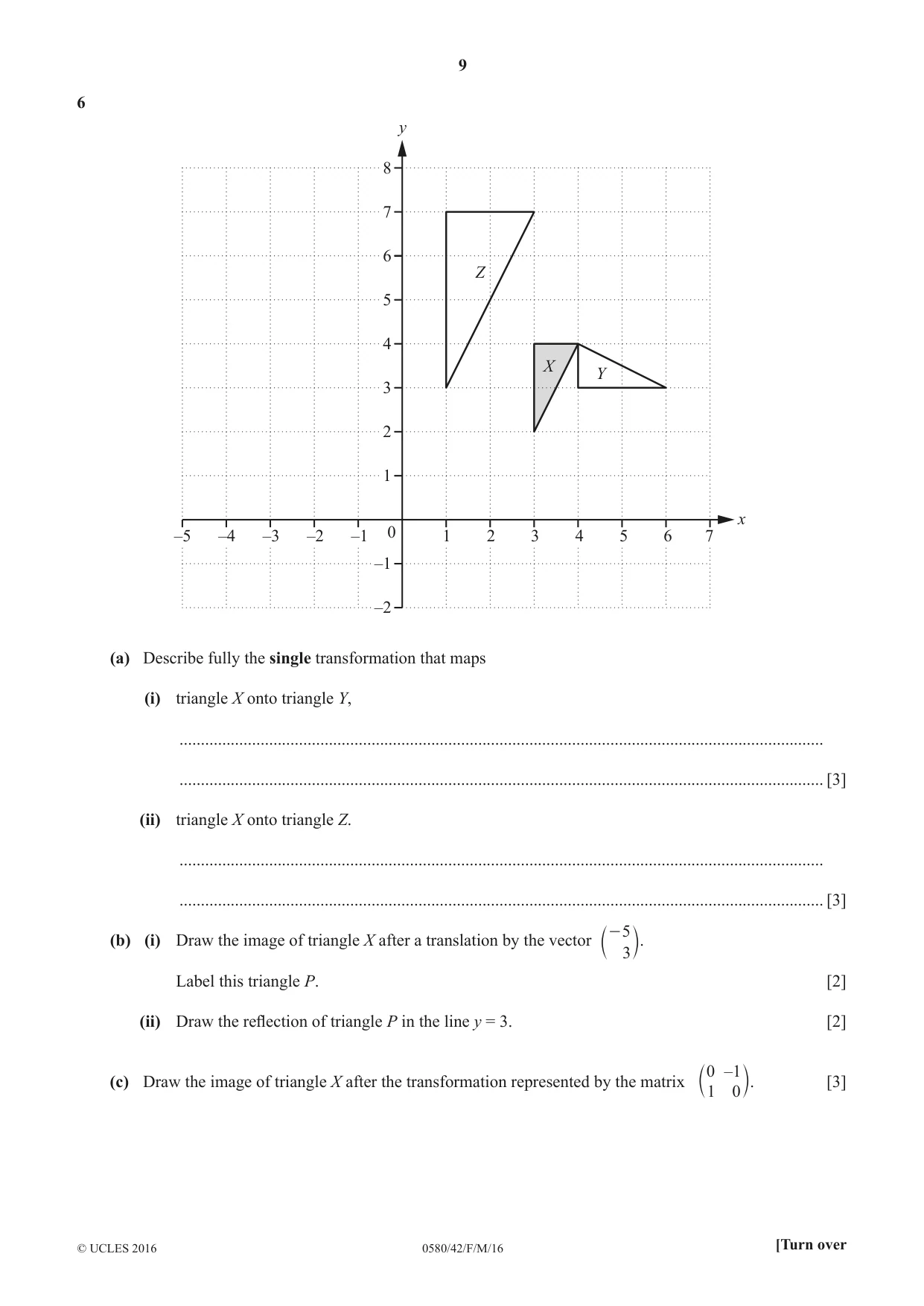
6 y 8 7 6 Z 5 4 X Y 3 2 1 x –5 –4 –3 –2 –1 0 1 2 3 4 5 6 7 –1 –2 (a) Describe fully the single transformation that maps (i) triangle X onto triangle Y, ....................................................................................................................................................... ....................................................................................................................................................... [3] (ii) triangle X onto triangle Z. ....................................................................................................................................................... ....................................................................................................................................................... [3] - 5 (b) (i) Draw the image of triangle X after a translation by the vector c 3 m. Label this triangle P. [2] (ii) Draw the reflection of triangle P in the line y = 3. [2] 0 –1 (c) Draw the image of triangle X after the transformation represented by the matrix [3] c 1 0 m.
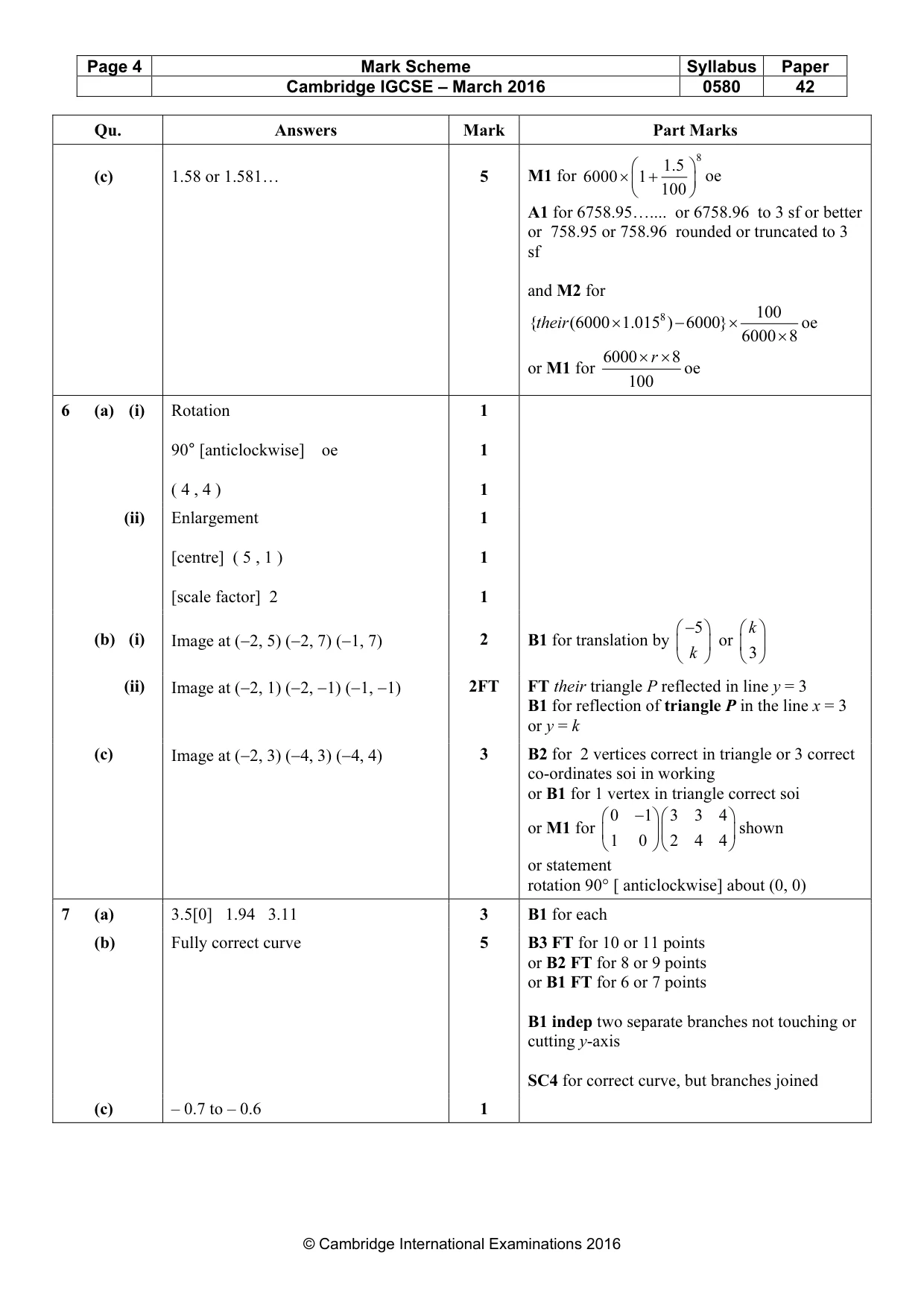
Mark scheme: 6 (a) (i) Rotation 1 90° [anticlockwise] oe 1 ( 4 , 4 ) 1 (ii) Enlargement 1 [centre] ( 5 , 1 ) 1 [scale factor] 2 1 − 5 k (b) (i) Image at (−2, 5) (−2, 7) (−1, 7) 2 B1 for translation by or k 3 (ii) Image at (−2, 1) (−2, −1) (−1, −1) 2FT FT their triangle P reflected in line y = 3 B1 for reflection of triangle P in the line x = 3 or y = k (c) Image at (−2, 3) (−4, 3) (−4, 4) 3 B2 for 2 vertices correct in triangle or 3 correct co-ordinates soi in working or B1 for 1 vertex in triangle correct soi 0 − 1 3 3 4 or M1 for shown 1 0 2 4 4 or statement rotation 90° [ anticlockwise] about (0, 0)
Q7 · The table shows some values of y = x + , x !
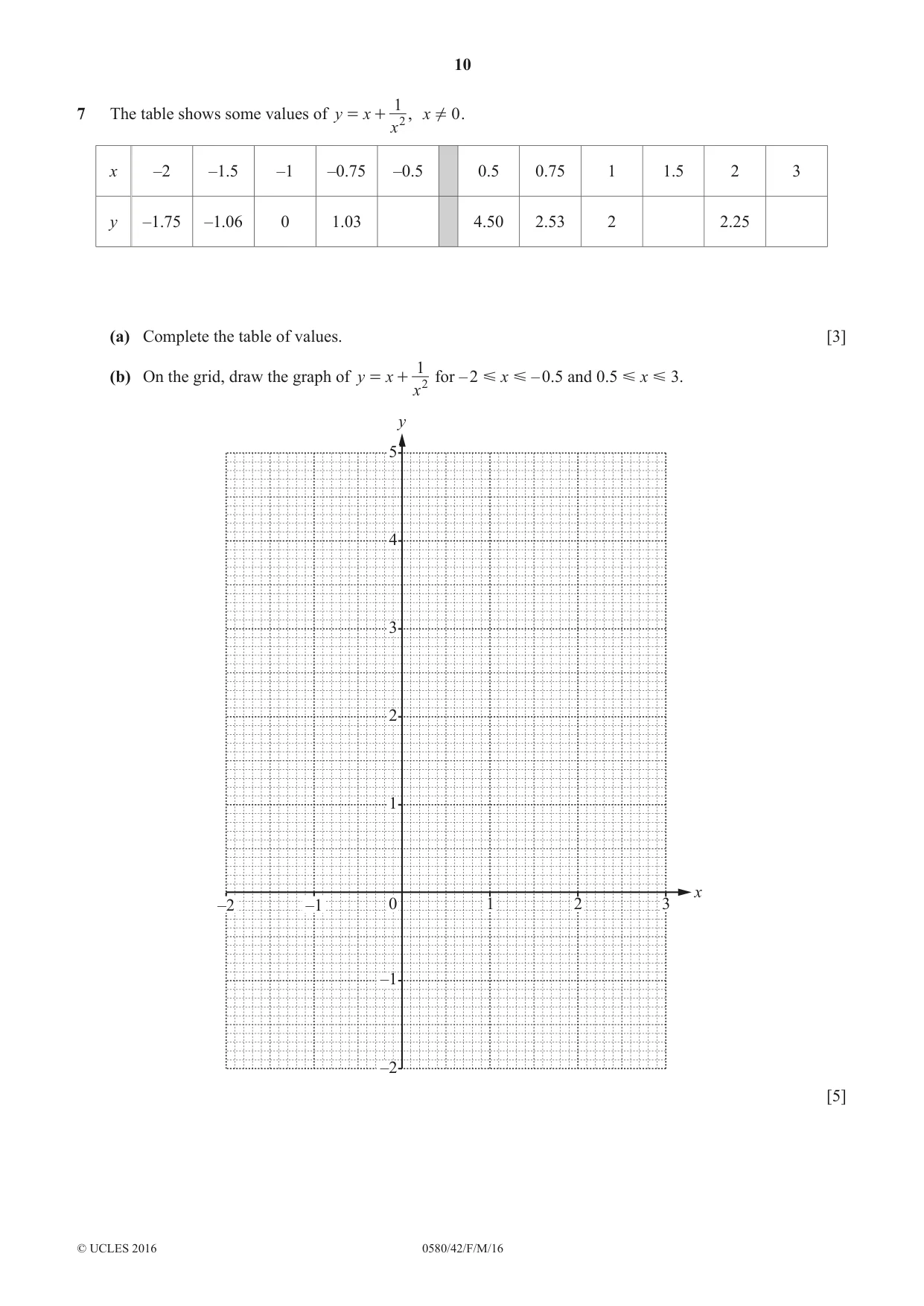
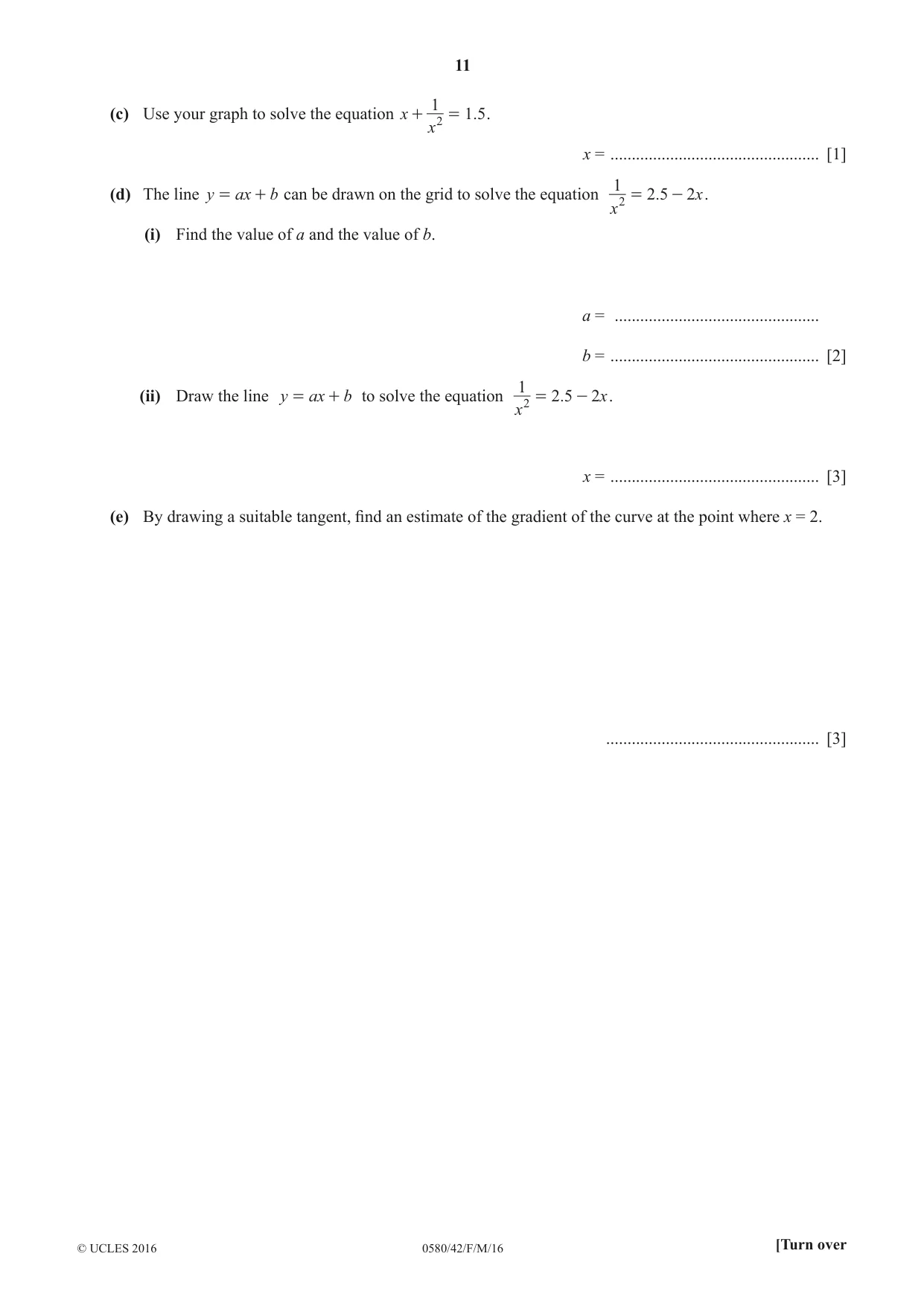
17 The table shows some values of y = x + , x ! 0 . x 2 x –2 –1.5 –1 –0.75 –0.5 0.5 0.75 1 1.5 2 3 y –1.75 –1.06 0 1.03 4.50 2.53 2 2.25 (a) Complete the table of values. [3] 1 (b) On the grid, draw the graph of y = x + for – 2 x – 0.5 and 0.5 x 3. x 2 y 5 4 3 2 1 x –2 –1 0 1 2 3 –1 –2 [5] 1(c) Use your graph to solve the equation x + = 1.5 . x 2 x = ................................................. [1] 1(d) The line y = ax + b can be drawn on the grid to solve the equation = 2.5 - 2 x . x 2 (i) Find the value of a and the value of b. a = ................................................ b = ................................................. [2] 1 (ii) Draw the line y = ax + b to solve the equation = 2.5 - 2 x . x 2 x = ................................................. [3] (e) By drawing a suitable tangent, find an estimate of the gradient of the curve at the point where x = 2. .................................................. [3]
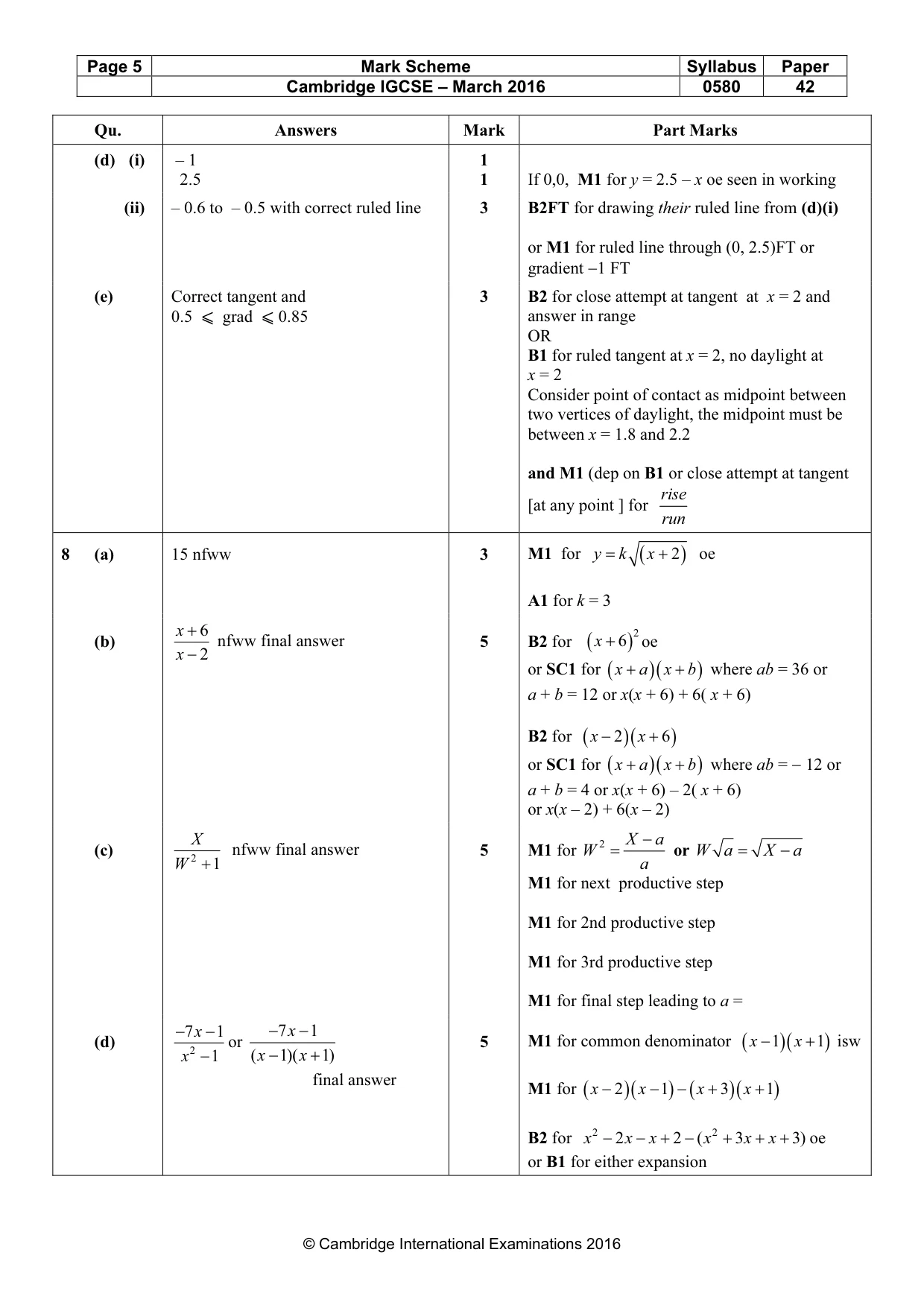
Mark scheme: 7 (a) 3.5[0] 1.94 3.11 3 B1 for each (b) Fully correct curve 5 B3 FT for 10 or 11 points or B2 FT for 8 or 9 points or B1 FT for 6 or 7 points B1 indep two separate branches not touching or cutting y-axis SC4 for correct curve, but branches joined (c) – 0.7 to – 0.6 1 Qu. Answers Mark Part Marks (d) (i) – 1 1 2.5 1 If 0,0, M1 for y = 2.5 – x oe seen in working (ii) – 0.6 to – 0.5 with correct ruled line 3 B2FT for drawing their ruled line from (d)(i) or M1 for ruled line through (0, 2.5)FT or gradient −1 FT (e) Correct tangent and 3 B2 for close attempt at tangent at x = 2 and 0.5 ⩽ grad ⩽ 0.85 answer in range OR B1 for ruled tangent at x = 2, no daylight at x = 2 Consider point of contact as midpoint between two vertices of daylight, the midpoint must be between x = 1.8 and 2.2 and M1 (dep on B1 or close attempt at tangent rise [at any point ] for run ( )
Q8 · Y is directly proportional to the positive square root of ^ x + 2h
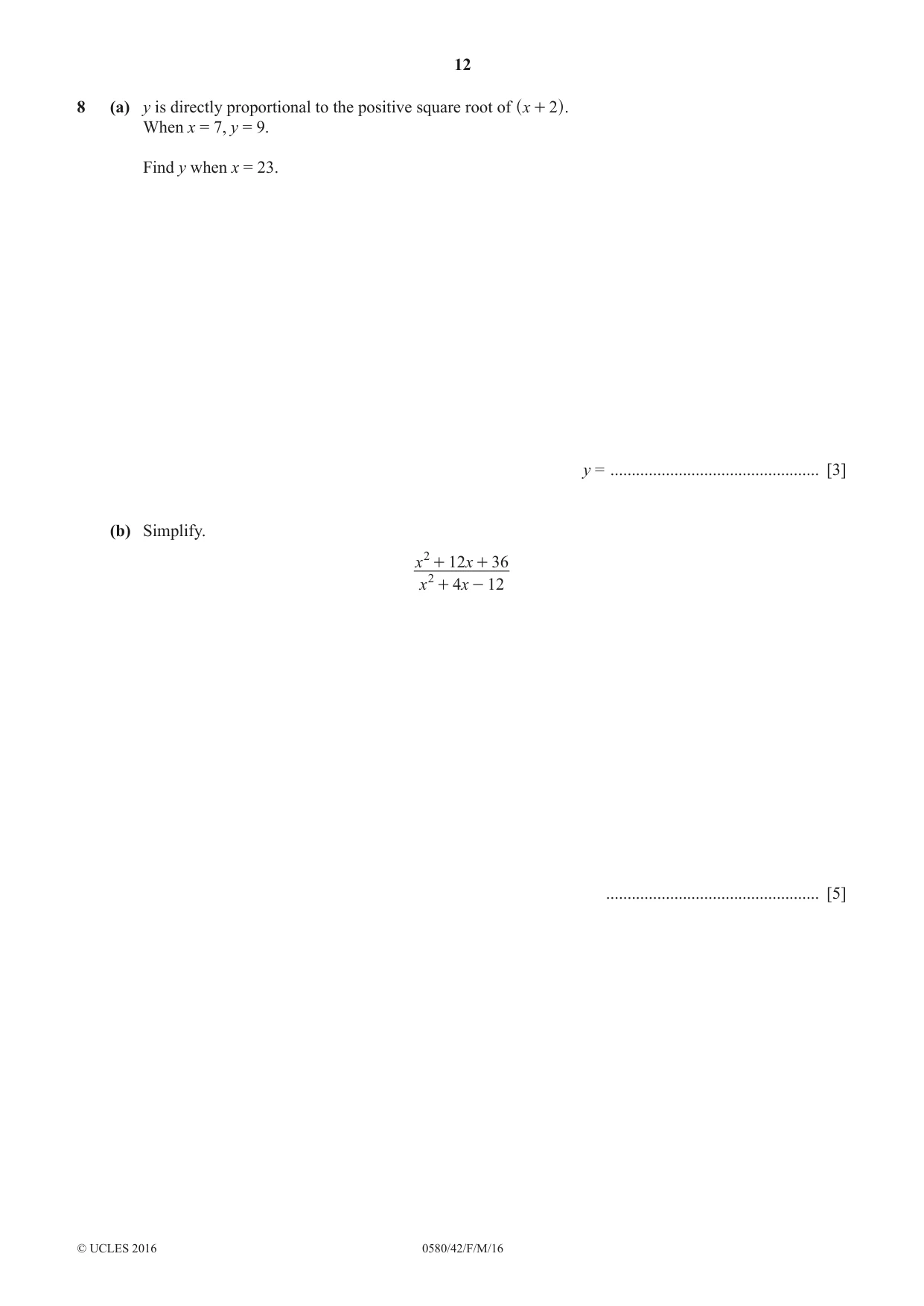
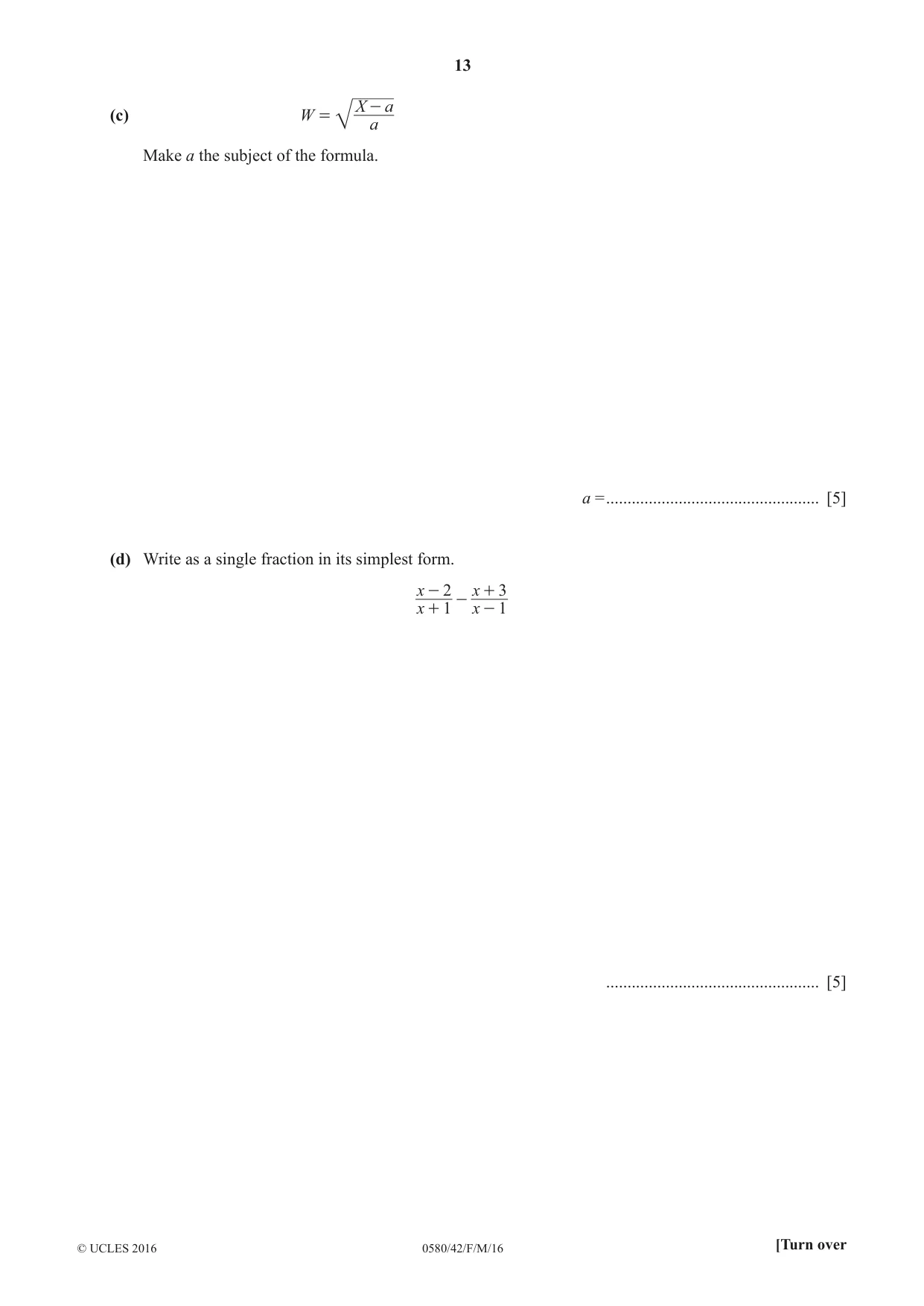
8 (a) y is directly proportional to the positive square root of ^ x + 2h. When x = 7, y = 9. Find y when x = 23. y = ................................................. [3] (b) Simplify. x 2 + 12x + 36 x 2 + 4x - 12 .................................................. [5] X - a(c) W = a Make a the subject of the formula. a = .................................................. [5] (d) Write as a single fraction in its simplest form. x - 2 x + 3 - x + 1 x - 1 .................................................. [5]
Mark scheme: 8 (a) 15 nfww 3 M1 for y = k ( x + 2 ) oe A1 for k = 3 x + 6 2 (b) nfww final answer 5 B2 for ( x + 6 ) oe x − 2 or SC1 for ( x + a )( x + b ) where ab = 36 or a + b = 12 or x(x + 6) + 6( x + 6) B2 for ( x − 2 )( x + 6 ) or SC1 for ( x + a )( x + b ) where ab = − 12 or a + b = 4 or x(x + 6) – 2( x + 6) or x(x – 2) + 6(x – 2) X 2 X − a (c) 2 nfww final answer 5 M1 for W = or W a = X − a W + 1 a M1 for next productive step M1 for 2nd productive step M1 for 3rd productive step M1 for final step leading to a = −7 x − 1 −7 x − 1 (d) 2 or 5 M1 for common denominator ( x − 1)( x + 1) isw x − 1 ( x − 1)( x + 1) final answer M1 for ( x − 2 )( x − 1) − ( x + 3 )( x + 1) B2 for x 2 − 2 x − x + 2 − ( x 2 + 3 x + x + 3) oe or B1 for either expansion Qu. Answers Mark Part Marks
Q9 · S R G NOT TO T Q SCALE y O x P O is the origin and OPQRST is a regular hexagon
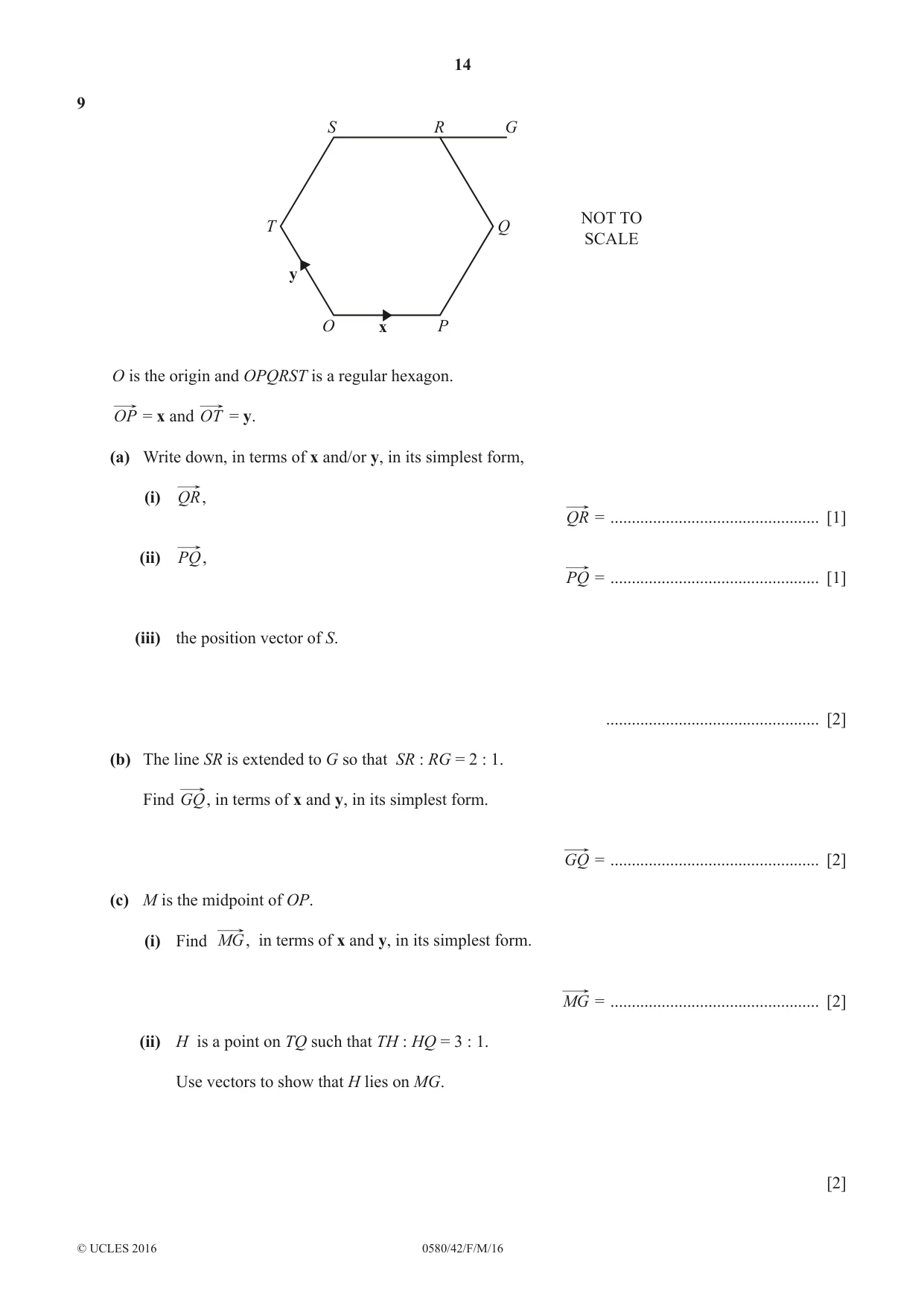
9 S R G NOT TO T Q SCALE y O x P O is the origin and OPQRST is a regular hexagon. OP = x and OT = y. (a) Write down, in terms of x and/or y, in its simplest form, (i) QR , Q R = ................................................. [1] (ii) PQ, PQ = ................................................. [1] (iii) the position vector of S. .................................................. [2] (b) The line SR is extended to G so that SR : RG = 2 : 1. Find GQ, in terms of x and y, in its simplest form. GQ = ................................................. [2] (c) M is the midpoint of OP. (i) Find MG, in terms of x and y, in its simplest form. MG = ................................................. [2] (ii) H is a point on TQ such that TH : HQ = 3 : 1. Use vectors to show that H lies on MG. [2]
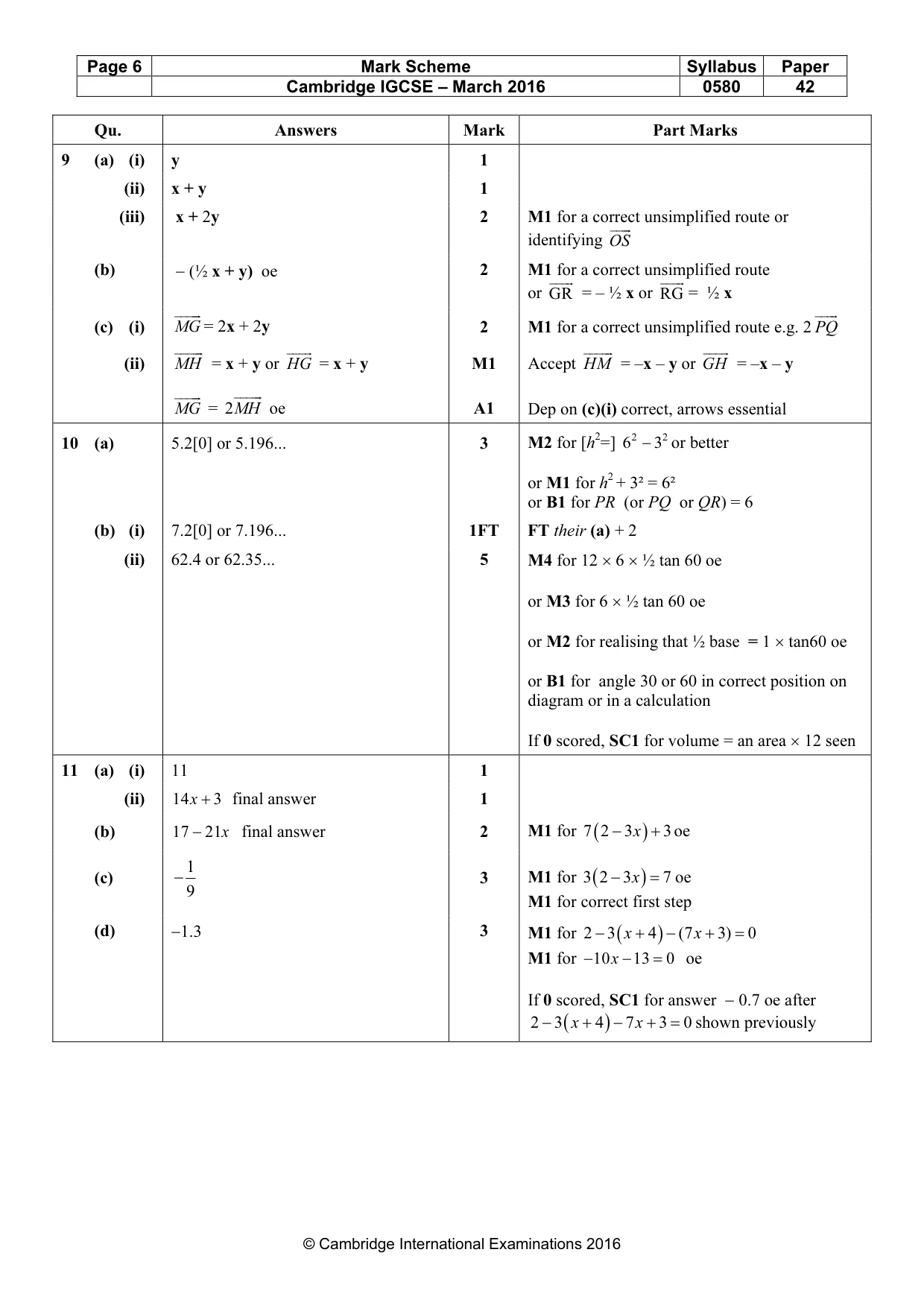
Mark scheme: 9 (a) (i) y 1 (ii) x + y 1 (iii) x + 2y 2 M1 for a correct unsimplified route or identifying OS (b) − (½ x + y) oe 2 M1 for a correct unsimplified route or GR = – ½ x or RG = ½ x (c) (i) MG = 2x + 2y 2 M1 for a correct unsimplified route e.g. 2 PQ (ii) MH = x + y or HG = x + y M1 Accept HM = –x – y or GH = –x – y MG = 2 MH oe A1 Dep on (c)(i) correct, arrows essential 2 2 2
Q10 · The ten circles in the diagram each have radius 1 cm
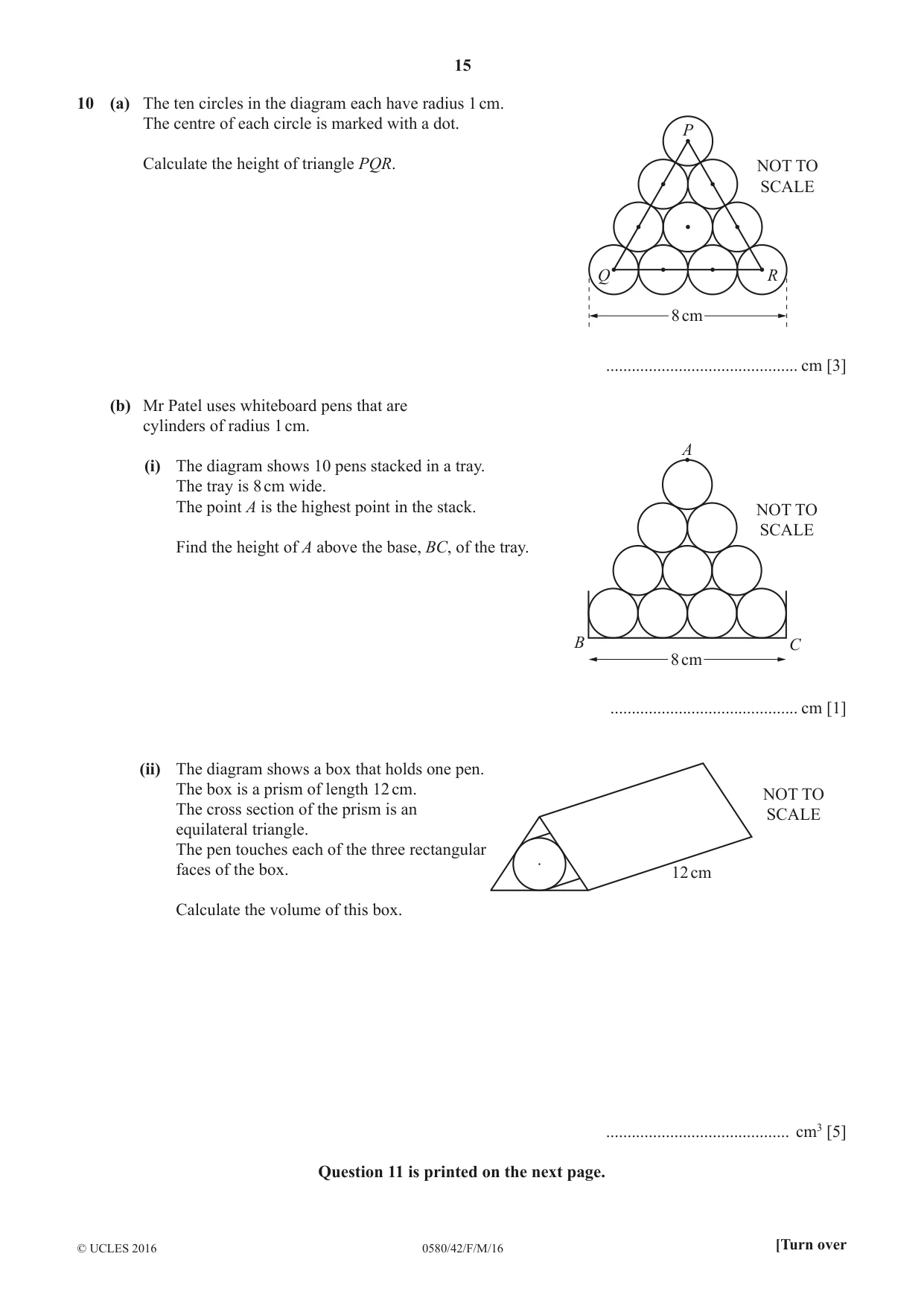
10 (a) The ten circles in the diagram each have radius 1 cm. The centre of each circle is marked with a dot. P Calculate the height of triangle PQR. NOT TO SCALE Q R 8 cm ............................................. cm [3] (b) Mr Patel uses whiteboard pens that are cylinders of radius 1 cm. A (i) The diagram shows 10 pens stacked in a tray. The tray is 8 cm wide. The point A is the highest point in the stack. NOT TO SCALE Find the height of A above the base, BC, of the tray. B C 8 cm ............................................ cm [1] (ii) The diagram shows a box that holds one pen. The box is a prism of length 12 cm. NOT TO The cross section of the prism is an SCALE equilateral triangle. The pen touches each of the three rectangular faces of the box. 12 cm Calculate the volume of this box. ........................................... cm3 [5] Question 11 is printed on the next page.
Mark scheme: 10 (a) 5.2[0] or 5.196... 3 M2 for [h2=] 6 2 − 3 2 or better or M1 for h2 + 3² = 6² or B1 for PR (or PQ or QR) = 6 (b) (i) 7.2[0] or 7.196... 1FT FT their (a) + 2 (ii) 62.4 or 62.35... 5 M4 for 12 × 6 × ½ tan 60 oe or M3 for 6 × ½ tan 60 oe or M2 for realising that ½ base = 1 × tan60 oe or B1 for angle 30 or 60 in correct position on diagram or in a calculation If 0 scored, SC1 for volume = an area × 12 seen
Q11 · F(x) = 2 − 3x g(x) = 7x + 3 (a) Find (i) f(−3), .......................................
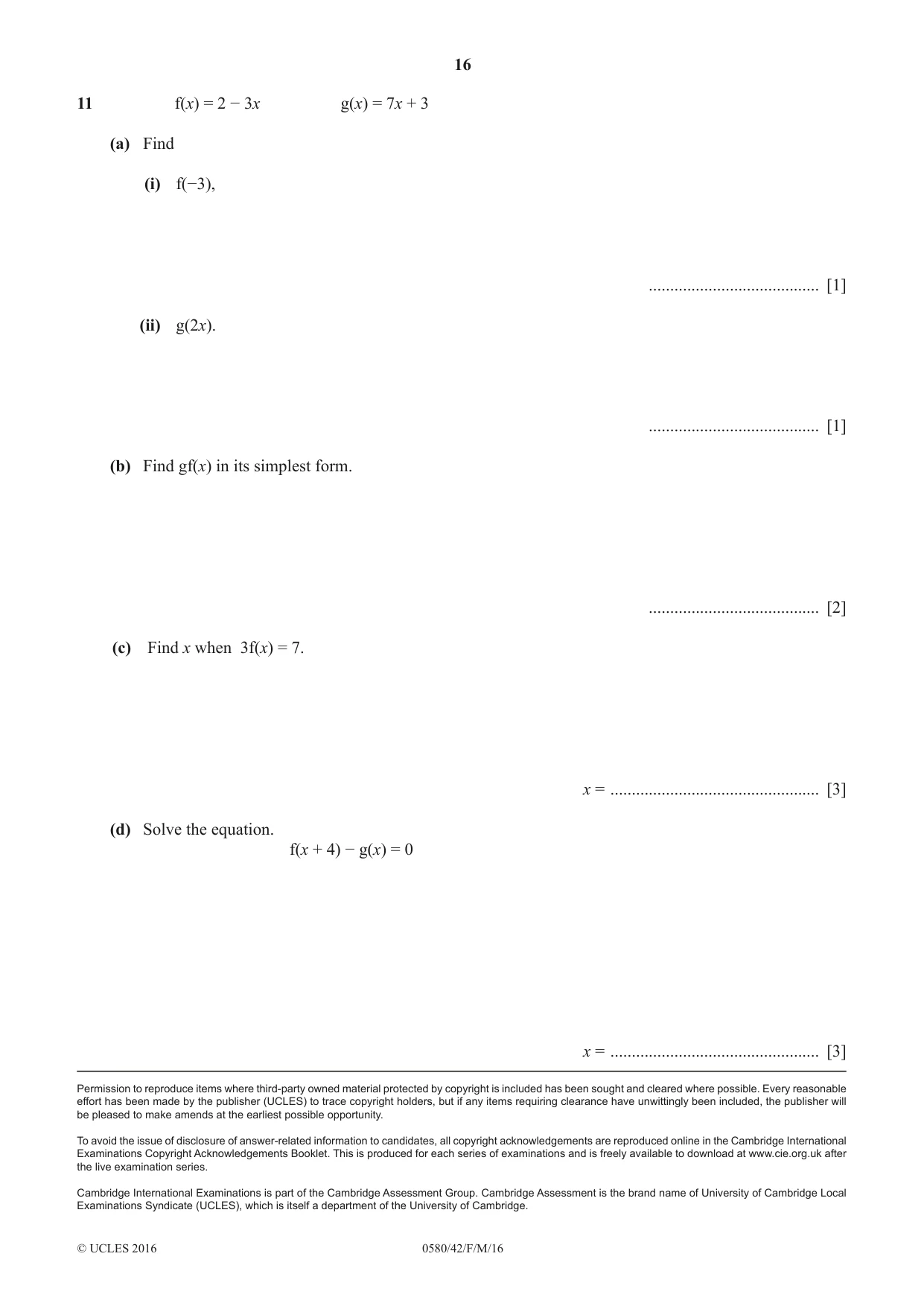
11 f(x) = 2 − 3x g(x) = 7x + 3 (a) Find (i) f(−3), ........................................ [1] (ii) g(2x). ........................................ [1] (b) Find gf(x) in its simplest form. ........................................ [2] (c) Find x when 3f(x) = 7. x = ................................................. [3] (d) Solve the equation. f(x + 4) − g(x) = 0 x = ................................................. [3]
Mark scheme: 11 (a) (i) 11 1 (ii) 14 x + 3 final answer 1 (b) 17 − 21x final answer 2 M1 for 7 ( 2 − 3 x ) + 3 oe 1 (c) − 3 M1 for 3 ( 2 − 3 x ) = 7 oe 9 M1 for correct first step (d) −1.3 3 M1 for 2 − 3 ( x + 4 ) − (7 x + 3) = 0 M1 for − 10 x − 13 = 0 oe If 0 scored, SC1 for answer − 0.7 oe after 2 − 3 ( x + 4 ) − 7 x + 3 = 0 shown previously
What was in this paper
The subtopics covered by these 11 questions, and how many questions each got. Open one in a new tab to see every Cambridge question on it.
What you needed in this session
Cambridge’s own grade thresholds for 2016 Feb/March, Paper 4 · Variant 2. A higher threshold means an easier paper — the bar moves with how the cohort did.