Cambridge IGCSE Mathematics 0580 — 2021 Oct/Nov Paper 4 · Variant 2
0580/42/O/N/21 · 11 questions · 130 marks · ≈146 min
The question paper and its mark scheme, free to read here and free to download. This is Cambridge’s own paper, exactly as it was sat.
Question paper20 pages
Mark scheme10 pages
Answers below. Sit the paper first if you are practising.
Questions as text
Q1 · Malena has 450 fruit trees
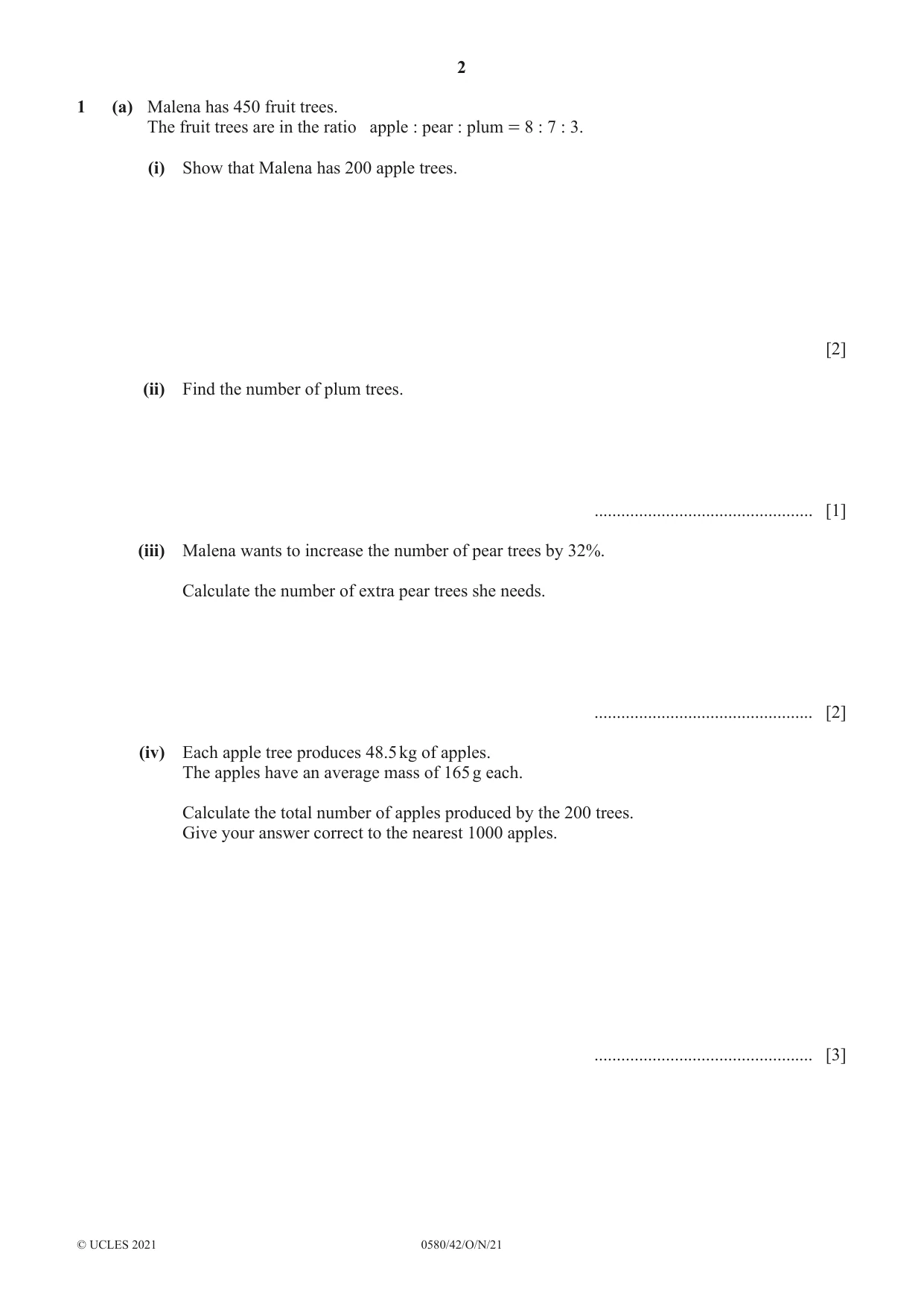
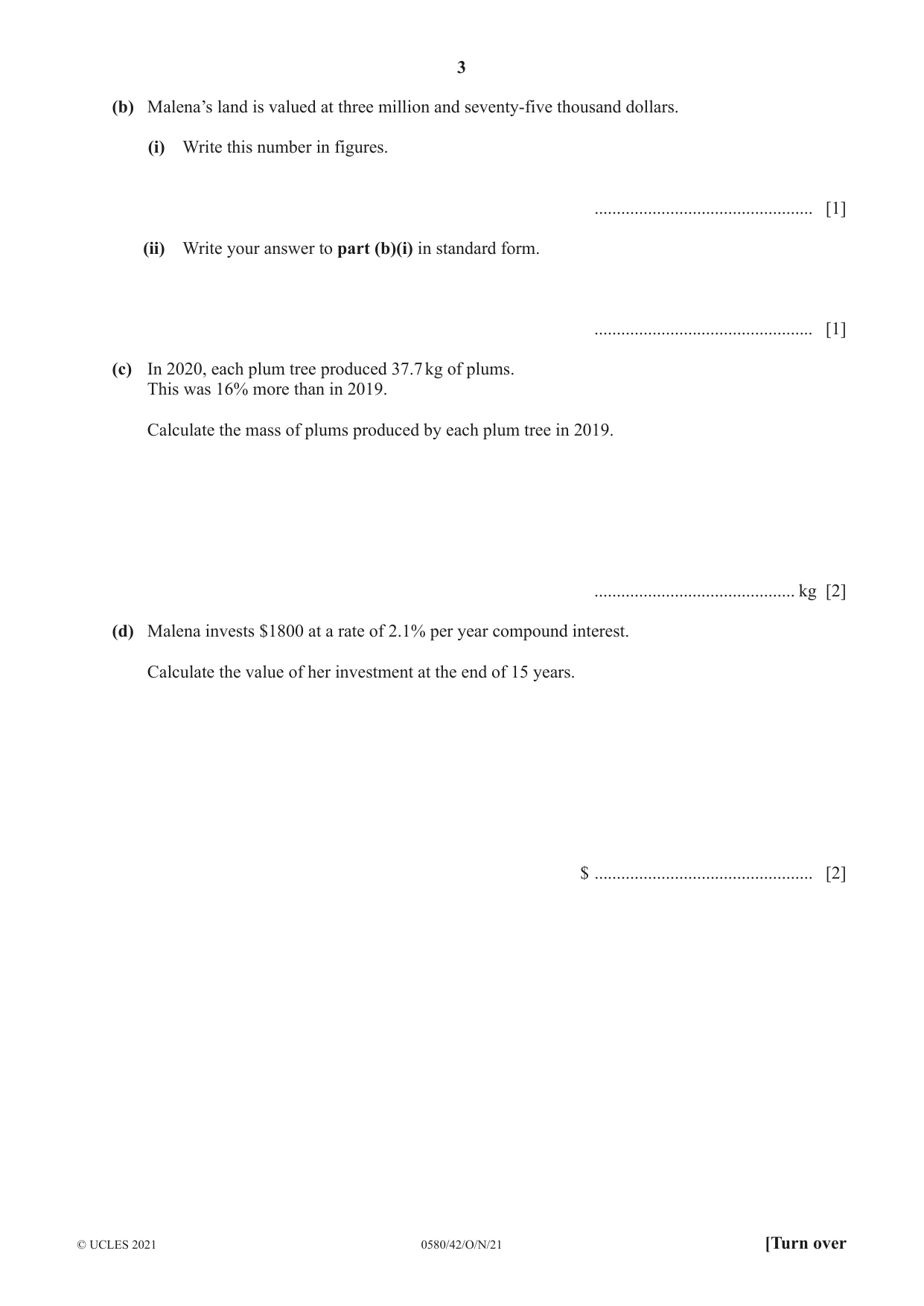
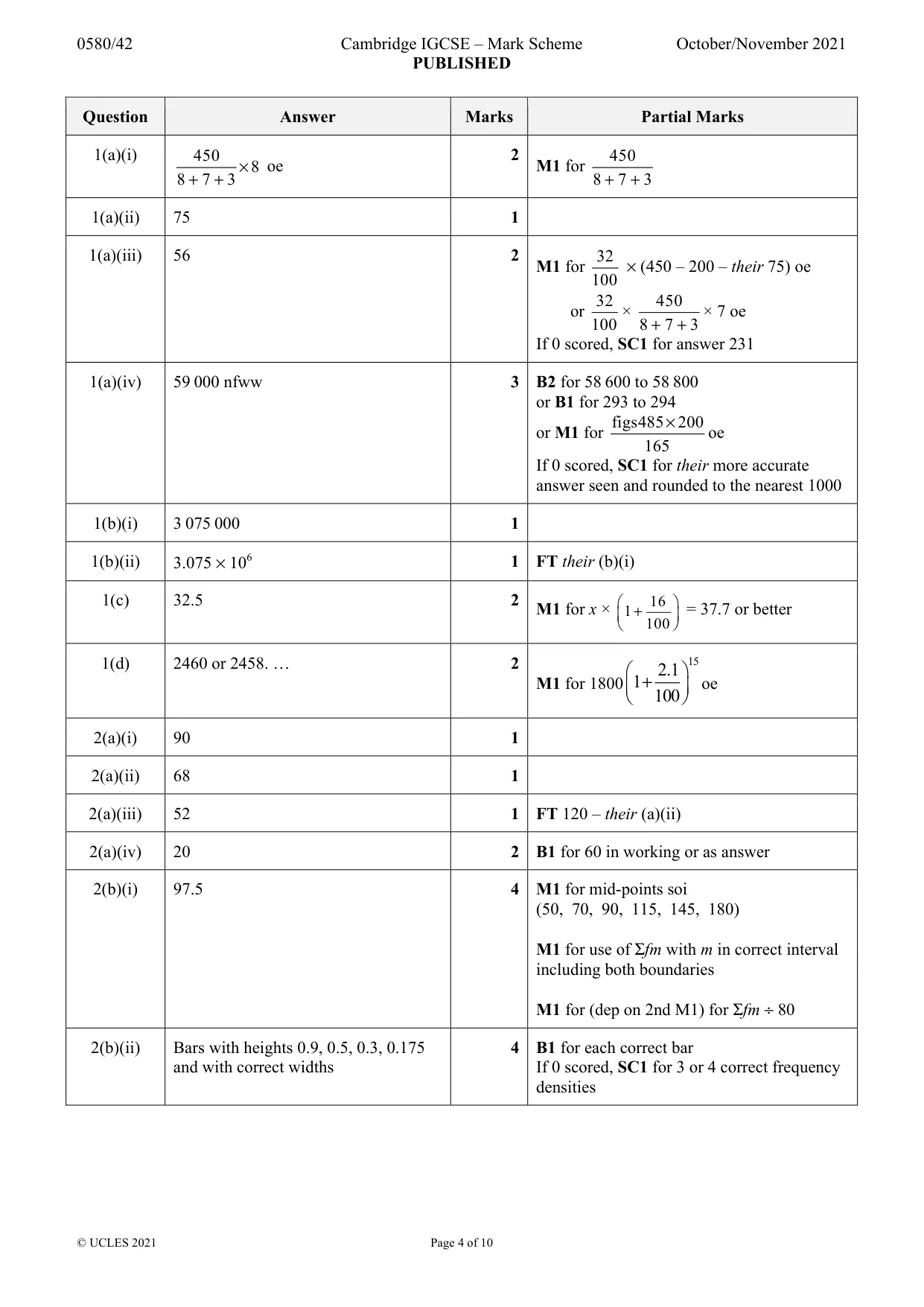
1 (a) Malena has 450 fruit trees. The fruit trees are in the ratio apple : pear : plum = 8 : 7 : 3. (i) Show that Malena has 200 apple trees. [2] (ii) Find the number of plum trees. ................................................. [1] (iii) Malena wants to increase the number of pear trees by 32%. Calculate the number of extra pear trees she needs. ................................................. [2] (iv) Each apple tree produces 48.5 kg of apples. The apples have an average mass of 165 g each. Calculate the total number of apples produced by the 200 trees. Give your answer correct to the nearest 1000 apples. ................................................. [3] (b) Malena’s land is valued at three million and seventy-five thousand dollars. (i) Write this number in figures. ................................................. [1] (ii) Write your answer to part (b)(i) in standard form. ................................................. [1] (c) In 2020, each plum tree produced 37.7 kg of plums. This was 16% more than in 2019. Calculate the mass of plums produced by each plum tree in 2019. ............................................. kg [2] (d) Malena invests $1800 at a rate of 2.1% per year compound interest. Calculate the value of her investment at the end of 15 years. $ ................................................. [2]
Mark scheme: Question Answer Marks Partial Marks 1(a)(i) 450 2 450 × 8 oe M1 for 8 + 7 + 3 8 + 7 + 3 1(a)(ii) 75 1 1(a)(iii) 56 2 32 M1 for × (450 – 200 – their 75) oe 100 32 450 or × × 7 oe 100 8 + 7 + 3 If 0 scored, SC1 for answer 231 1(a)(iv) 59 000 nfww 3 B2 for 58 600 to 58 800 or B1 for 293 to 294 figs485 × 200 or M1 for oe 165 If 0 scored, SC1 for their more accurate answer seen and rounded to the nearest 1000 1(b)(i) 3 075 000 1 1(b)(ii) 3.075 × 10⁶ 1 FT their (b)(i) 1(c) 32.5 2 16 M1 for x × 1 + = 37.7 or better 100 1(d) 2460 or 2458. … 2 15 2.1 M1 for 1800 1 + oe 100
Q2 · The cumulative frequency diagram shows information about the floor area, a m 2, of each…
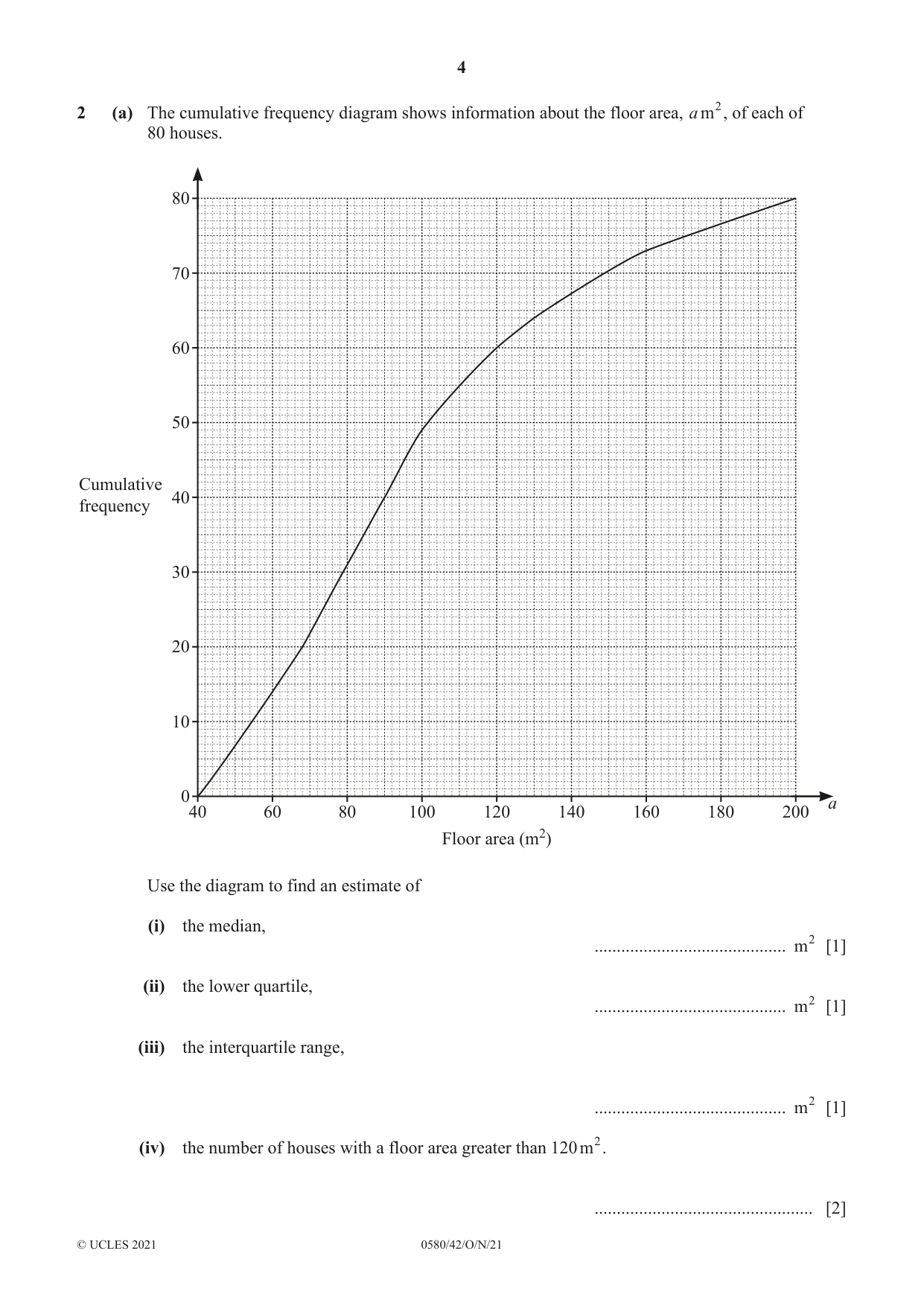
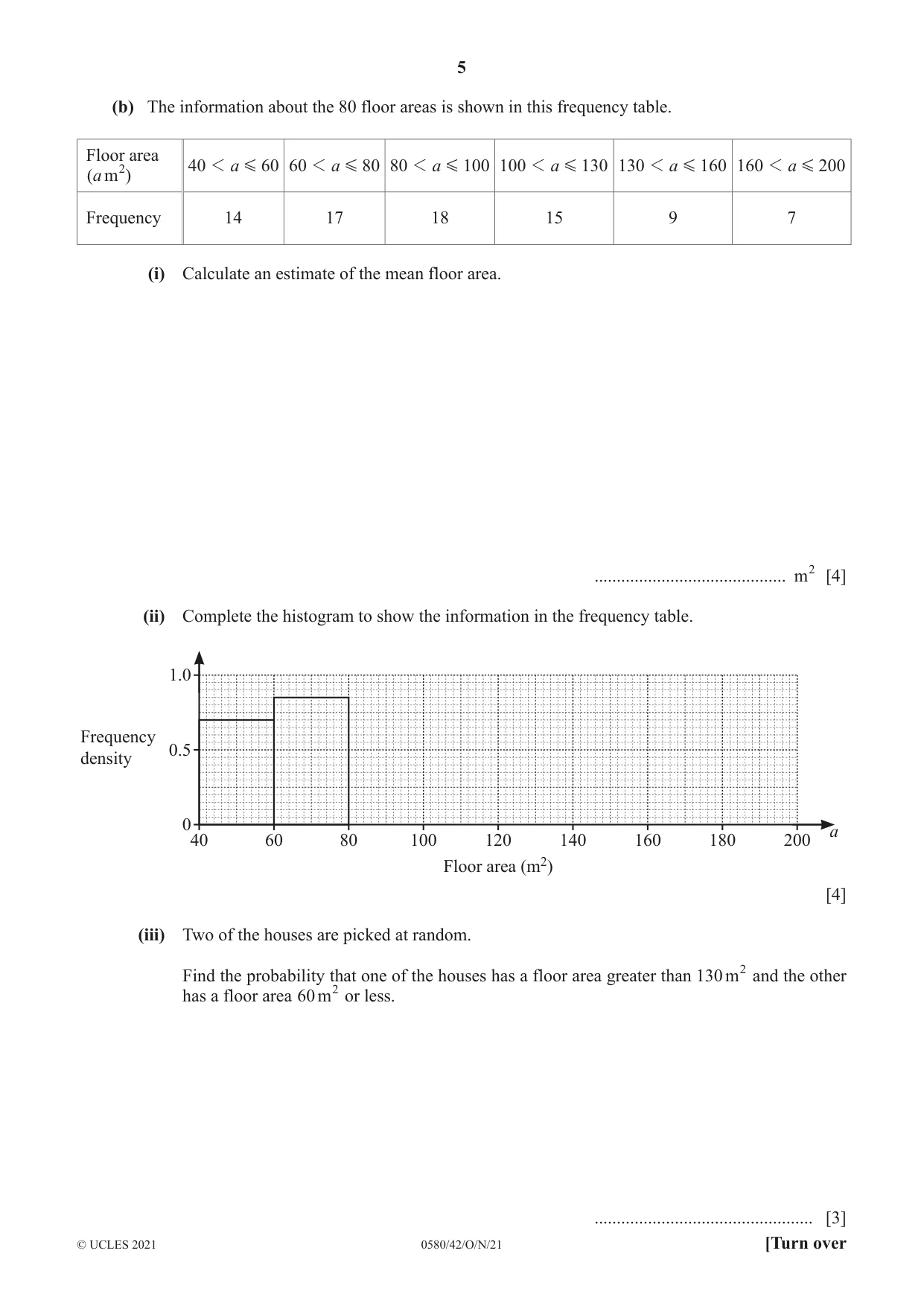
2 (a) The cumulative frequency diagram shows information about the floor area, a m 2, of each of 80 houses. 80 70 60 50 Cumulative 40frequency 30 20 10 0 a 40 60 80 100 120 140 160 180 200 Floor area (m2) Use the diagram to find an estimate of (i) the median, ........................................... m2 [1] (ii) the lower quartile, ........................................... m2 [1] (iii) the interquartile range, ........................................... m2 [1] (iv) the number of houses with a floor area greater than 120 m2. ................................................. [2] (b) The information about the 80 floor areas is shown in this frequency table. Floor area 2 40 1 a G 60 60 1 a G 80 8 0 1 a G 100 100 1 a G 130 130 1 a G 160 160 1 a G 200 ( a m ) Frequency 14 17 18 15 9 7 (i) Calculate an estimate of the mean floor area. ........................................... m2 [4] (ii) Complete the histogram to show the information in the frequency table. 1.0 Frequency 0.5density 0 a 40 60 80 100 120 140 160 180 200 Floor area (m2) [4] (iii) Two of the houses are picked at random. Find the probability that one of the houses has a floor area greater than 130 m 2 and the other has a floor area 60 m 2 or less. ................................................. [3]
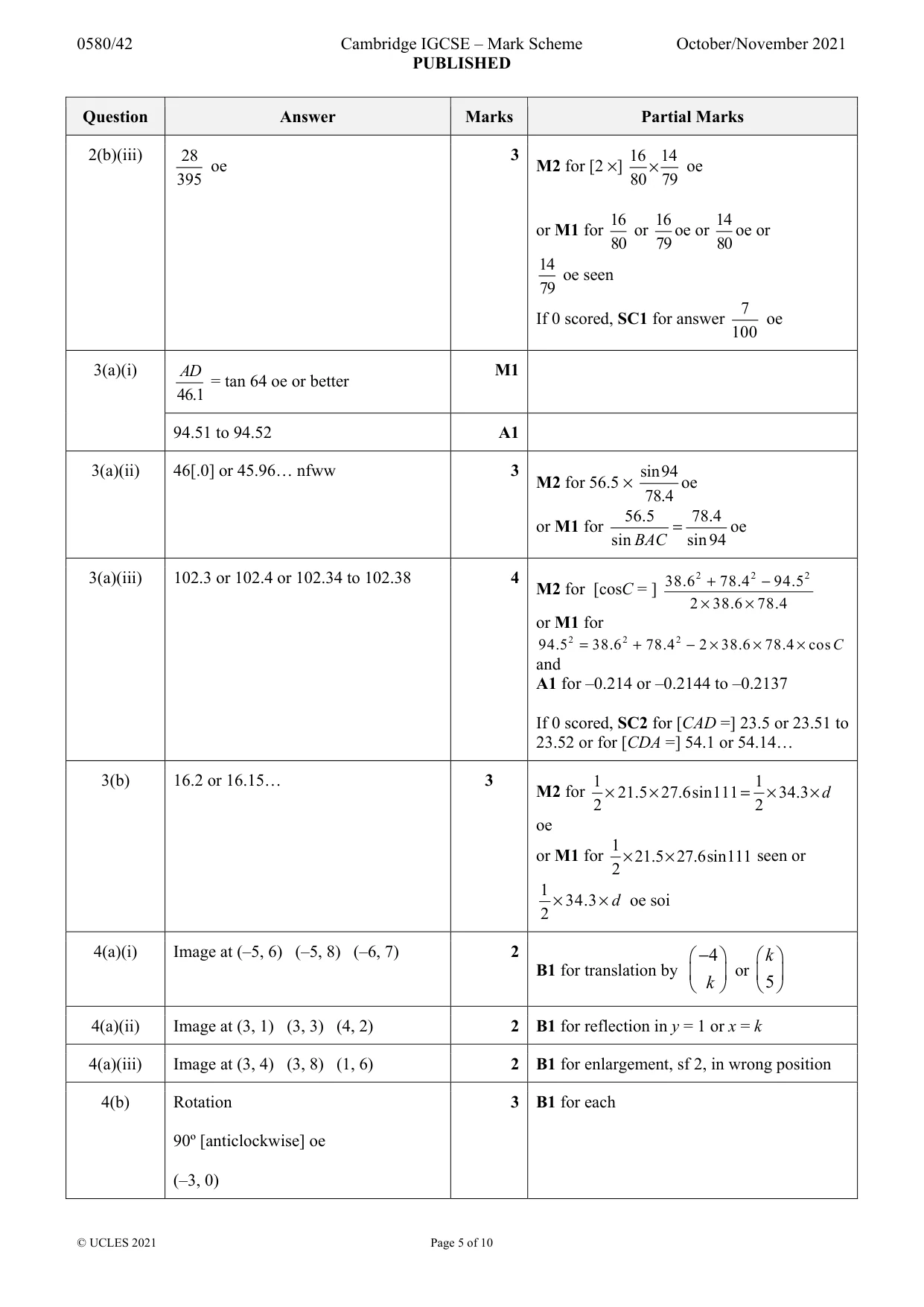
Mark scheme: 2(a)(i) 90 1 2(a)(ii) 68 1 2(a)(iii) 52 1 FT 120 – their (a)(ii) 2(a)(iv) 20 2 B1 for 60 in working or as answer 2(b)(i) 97.5 4 M1 for mid-points soi (50, 70, 90, 115, 145, 180) M1 for use of Σfm with m in correct interval including both boundaries M1 for (dep on 2nd M1) for Σfm ÷ 80 2(b)(ii) Bars with heights 0.9, 0.5, 0.3, 0.175 4 B1 for each correct bar and with correct widths If 0 scored, SC1 for 3 or 4 correct frequency densities 2(b)(iii) 28 3 16 14 oe M2 for [2 ×] × oe 395 80 79 16 16 14 or M1 for or oe or oe or 80 79 80 14 oe seen 79 7 If 0 scored, SC1 for answer oe 100
Q3 · C 38.6 m 56.5 m D B 94° 78.4 m NOT TO SCALE 46.1 m 64° E A ABCDE is a pentagon
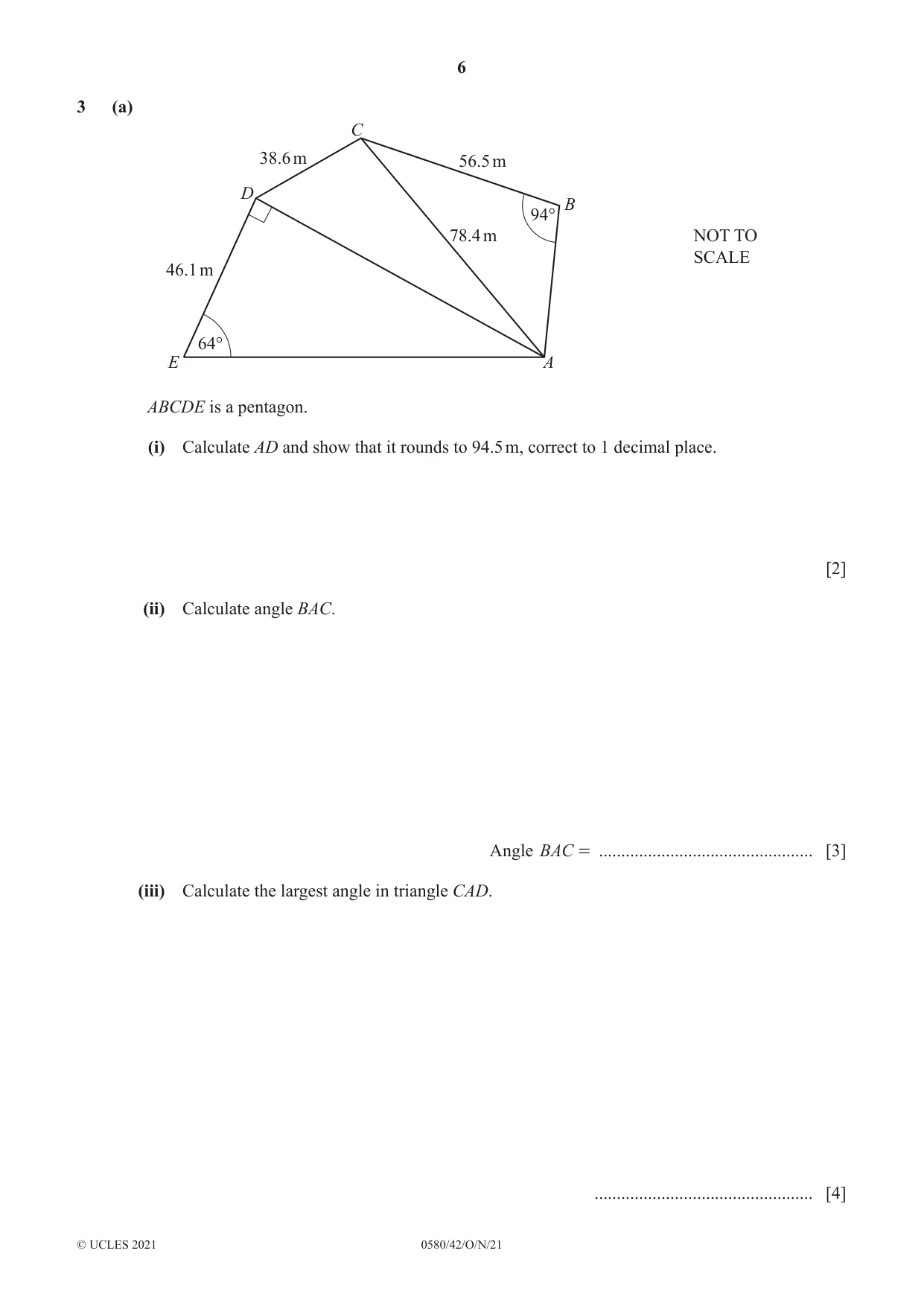
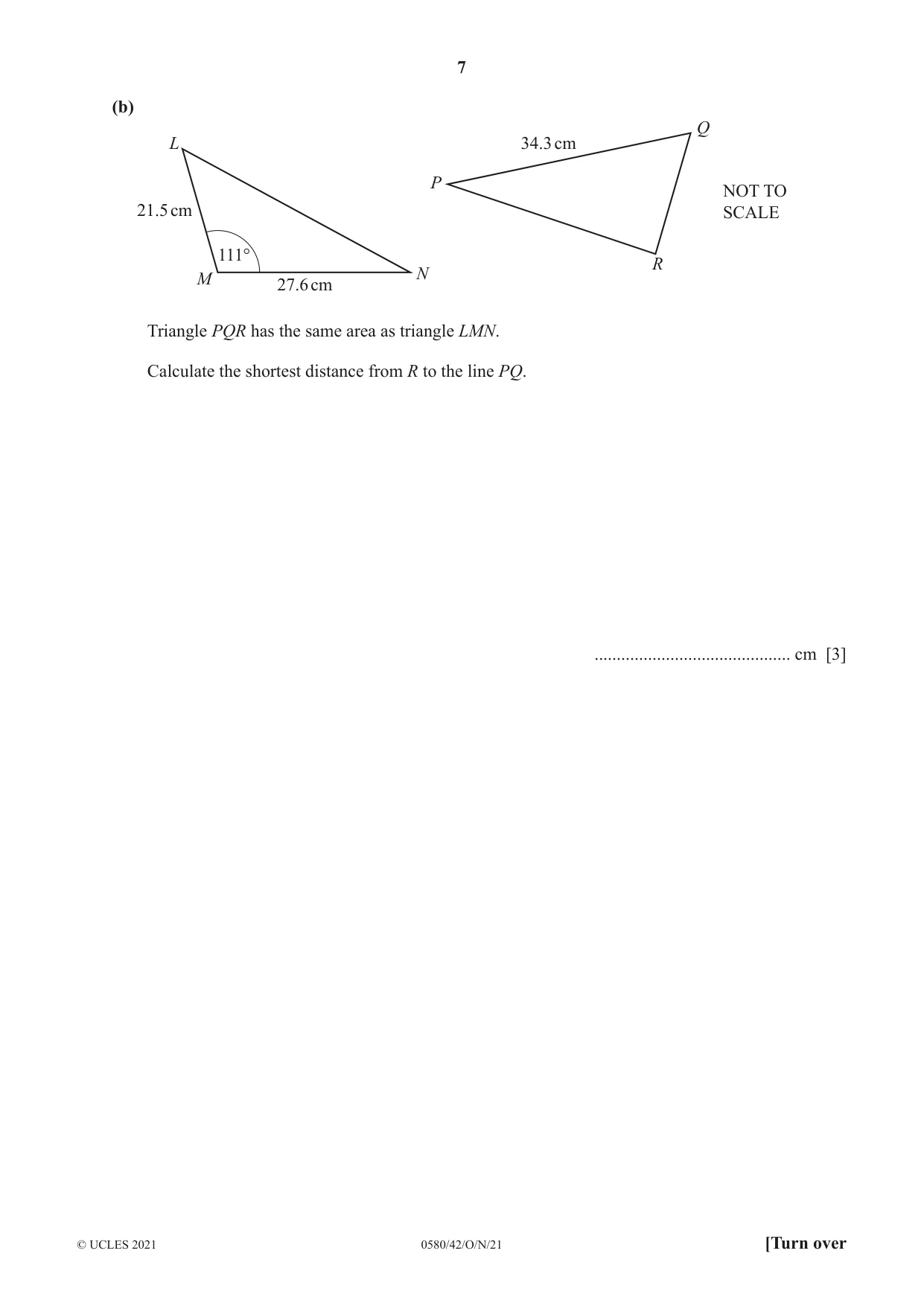
3 (a) C 38.6 m 56.5 m D B 94° 78.4 m NOT TO SCALE 46.1 m 64° E A ABCDE is a pentagon. (i) Calculate AD and show that it rounds to 94.5 m, correct to 1 decimal place. [2] (ii) Calculate angle BAC. Angle BAC = ................................................ [3] (iii) Calculate the largest angle in triangle CAD. ................................................. [4] (b) Q L 34.3 cm P NOT TO 21.5 cm SCALE 111° R N M 27.6 cm Triangle PQR has the same area as triangle LMN. Calculate the shortest distance from R to the line PQ. ............................................ cm [3]
Mark scheme: 3(a)(i) AD M1 = tan 64 oe or better 46.1 94.51 to 94.52 A1 3(a)(ii) 46[.0] or 45.96… nfww 3 sin94 M2 for 56.5 × oe 78.4 56.5 78.4 or M1 for = oe sin BAC sin94 3(a)(iii) 102.3 or 102.4 or 102.34 to 102.38 4 38.6 2 + 78.4 2 − 94.5 2 M2 for [cosC = ] 2 × 38.6 × 78.4 or M1 for 94.5 2 = 38.6 2 + 78.4 2 − 2 × 38.6 × 78.4 × cos C and A1 for –0.214 or –0.2144 to –0.2137 If 0 scored, SC2 for [CAD =] 23.5 or 23.51 to 23.52 or for [CDA =] 54.1 or 54.14… 3(b) 16.2 or 16.15… 3 1 1 M2 for × 21.5 × 27.6sin111 = × 34.3 × d 2 2 oe 1 or M1 for × 21.5 × 27.6sin111 seen or 2 1 × 34.3 × d oe soi 2
Q4 · Y 9 8 7 6 5 4 3 A 2 B 1 – 7 – 6 – 5 – 4 – 3 – 2 – 1 0 1 2 3 4 5 6 x – 1 – 2 – 3 (a) On…
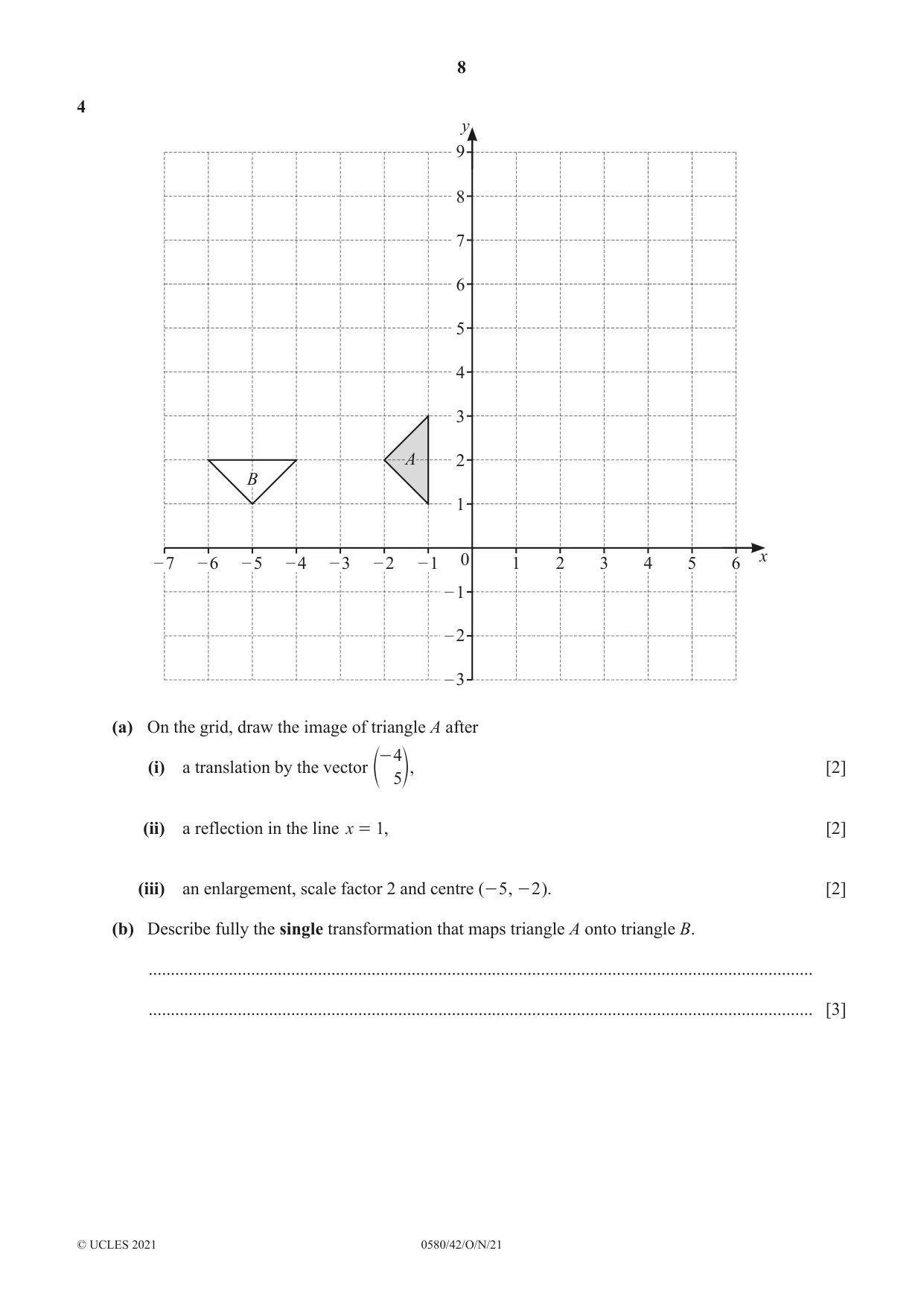
4 y 9 8 7 6 5 4 3 A 2 B 1 – 7 – 6 – 5 – 4 – 3 – 2 – 1 0 1 2 3 4 5 6 x – 1 – 2 – 3 (a) On the grid, draw the image of triangle A after - 4 (i) a translation by the vector [2] e 5o, (ii) a reflection in the line x = 1, [2] (iii) an enlargement, scale factor 2 and centre ( - 5 , - 2 ). [2] (b) Describe fully the single transformation that maps triangle A onto triangle B. ..................................................................................................................................................... ..................................................................................................................................................... [3]
Mark scheme: 4(a)(i) Image at (–5, 6) (–5, 8) (–6, 7) 2 − 4 k B1 for translation by or k 5 4(a)(ii) Image at (3, 1) (3, 3) (4, 2) 2 B1 for reflection in y = 1 or x = k 4(a)(iii) Image at (3, 4) (3, 8) (1, 6) 2 B1 for enlargement, sf 2, in wrong position 4(b) Rotation 3 B1 for each 90º [anticlockwise] oe (–3, 0)
Q5 · The table shows some values for y = x 3 - 3x 2 + 3
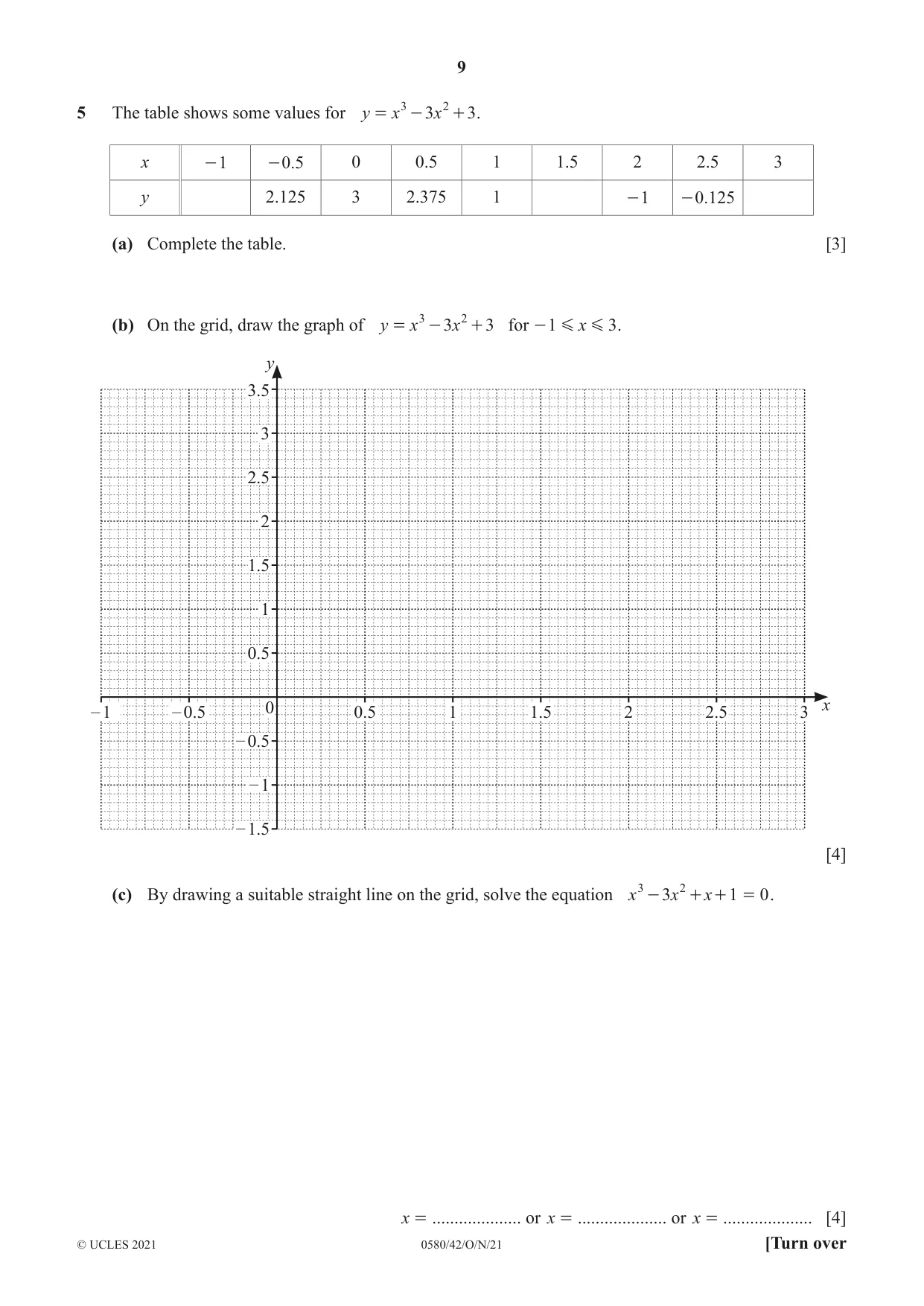
5 The table shows some values for y = x 3 - 3x 2 + 3 . x - 1 - .05 0 0.5 1 1.5 2 2.5 3 y 2.125 3 2.375 1 - 1 - .0125 (a) Complete the table. [3] (b) On the grid, draw the graph of y = x 3 - 3x 2 + 3 for - 1 G x G 3 . y 3.5 3 2.5 2 1.5 1 0.5 – 1 – 0.5 0 0.5 1 1.5 2 2.5 3 x – 0.5 – 1 – 1.5 [4] (c) By drawing a suitable straight line on the grid, solve the equation x 3 - 3x 2 + x + 1 = 0 . x = .................... or x = .................... or x = .................... [4]
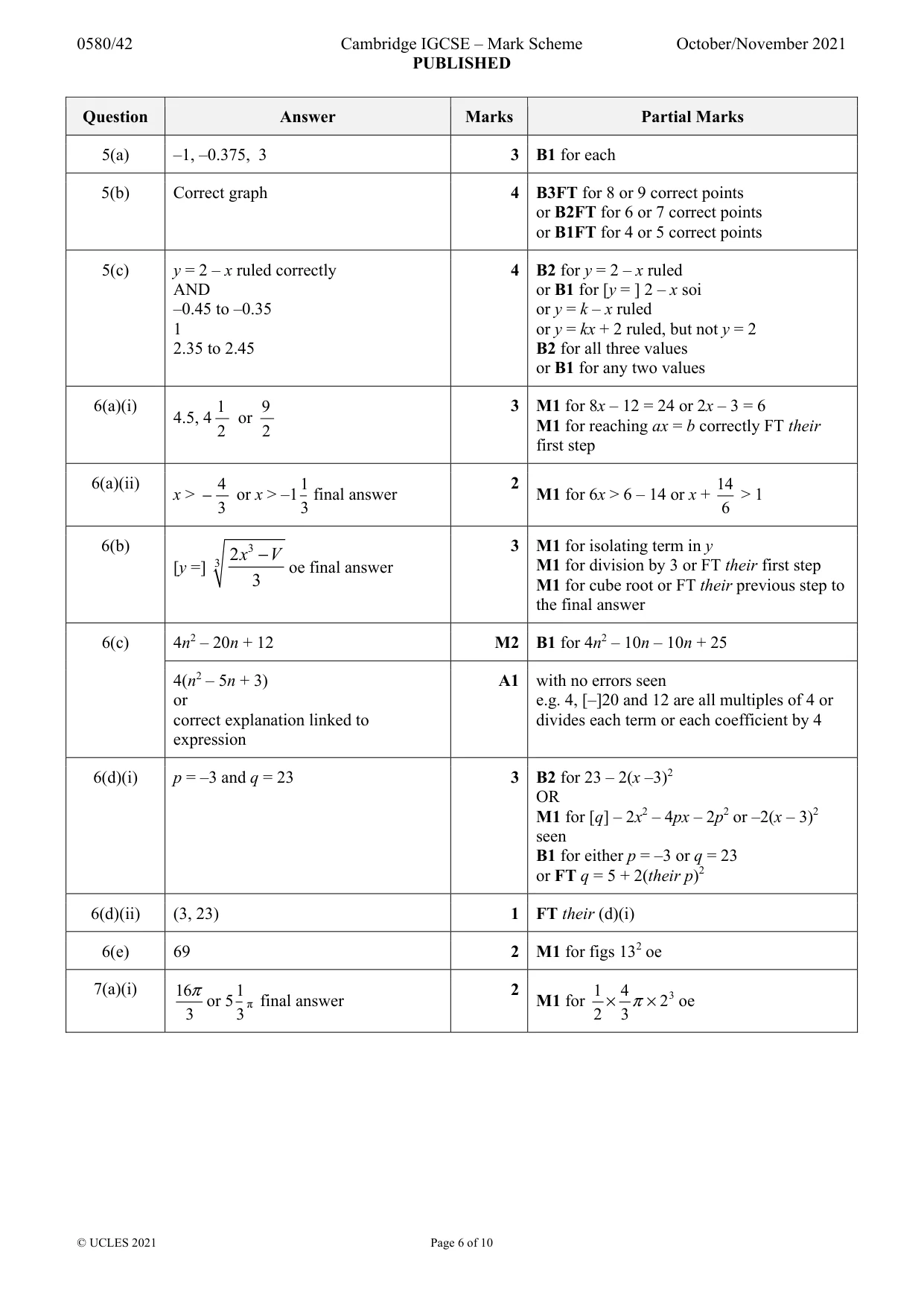
Mark scheme: 5(a) –1, –0.375, 3 3 B1 for each 5(b) Correct graph 4 B3FT for 8 or 9 correct points or B2FT for 6 or 7 correct points or B1FT for 4 or 5 correct points 5(c) y = 2 – x ruled correctly 4 B2 for y = 2 – x ruled AND or B1 for [y = ] 2 – x soi –0.45 to –0.35 or y = k – x ruled 1 or y = kx + 2 ruled, but not y = 2 2.35 to 2.45 B2 for all three values or B1 for any two values
Question 6
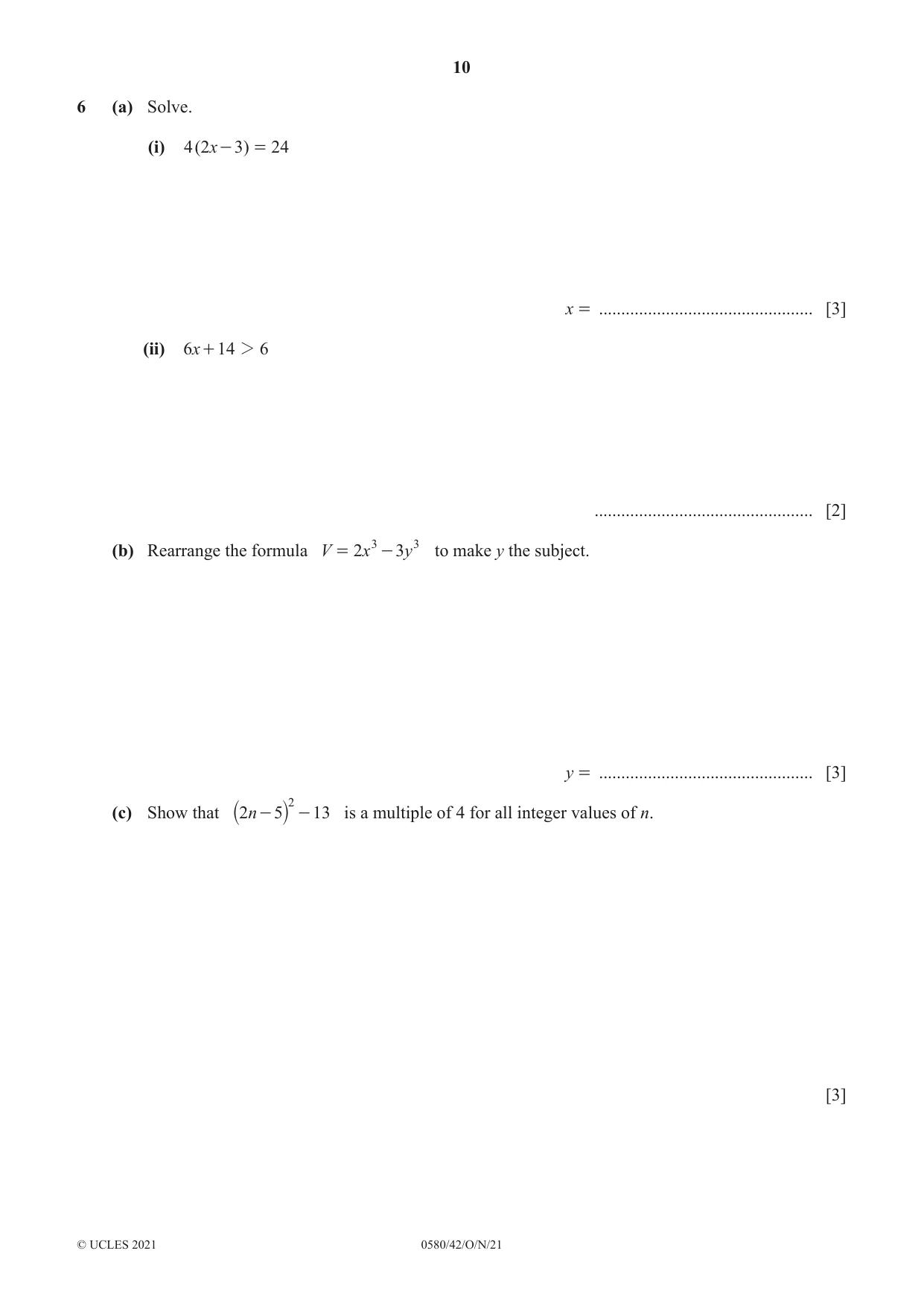
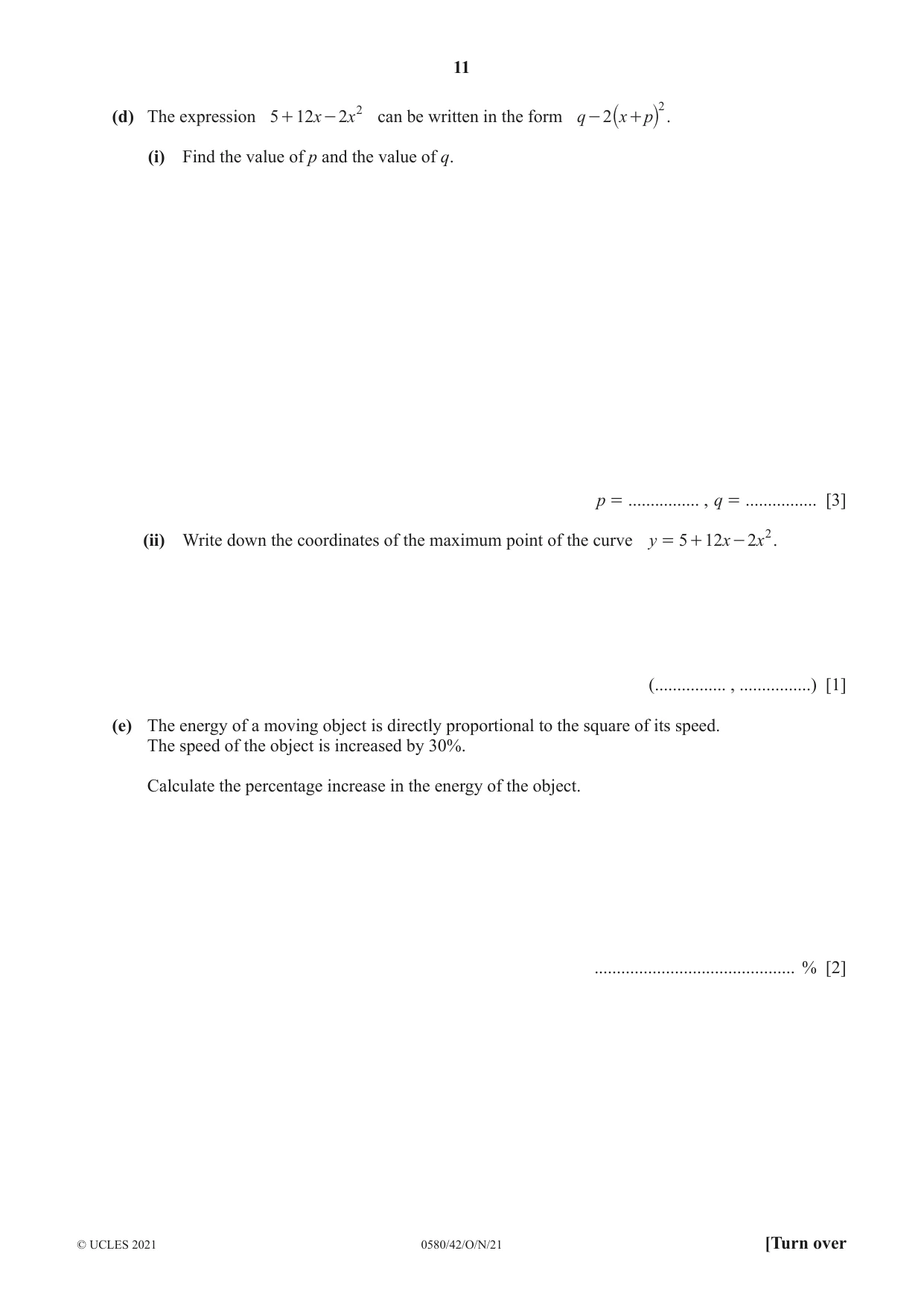
6 (a) Solve. (i) 4 ( 2x - 3) = 24 x = ................................................ [3] (ii) 6x + 14 2 6 ................................................. [2] (b) Rearrange the formula V = 2x 3 - 3y 3 to make y the subject. y = ................................................ [3] 2 (c) Show that 2n - 5 - 13 is a multiple of 4 for all integer values of n. ` j [3] 2 2(d) The expression 5 + 12x - 2x can be written in the form q - 2 x + p . ` j (i) Find the value of p and the value of q. p = ................ , q = ................ [3] (ii) Write down the coordinates of the maximum point of the curve y = 5 + 12x - 2x 2 . (................ , ................) [1] (e) The energy of a moving object is directly proportional to the square of its speed. The speed of the object is increased by 30%. Calculate the percentage increase in the energy of the object. ............................................. % [2]
Mark scheme: 6(a)(i) 1 9 3 M1 for 8x – 12 = 24 or 2x – 3 = 6 4.5, 4 or M1 for reaching ax = b correctly FT their 2 2 first step 6(a)(ii) 4 2 14 x > − or x > –11 final answer M1 for 6x > 6 – 14 or x + > 1 3 3 6 6(b) 3 3 M1 for isolating term in y 2 x − V [y =] 3 oe final answer M1 for division by 3 or FT their first step 3 M1 for cube root or FT their previous step to the final answer 6(c) 4n2 – 20n + 12 M2 B1 for 4n2 – 10n – 10n + 25 4(n2 – 5n + 3) A1 with no errors seen or e.g. 4, [–]20 and 12 are all multiples of 4 or correct explanation linked to divides each term or each coefficient by 4 expression 6(d)(i) p = –3 and q = 23 3 B2 for 23 – 2(x –3)2 OR M1 for [q] – 2x2 – 4px – 2p2 or –2(x – 3)2 seen B1 for either p = –3 or q = 23 or FT q = 5 + 2(their p)2 6(d)(ii) (3, 23) 1 FT their (d)(i) 6(e) 69 2 M1 for figs 132 oe
Q7 · The diagram shows a container for storing grain
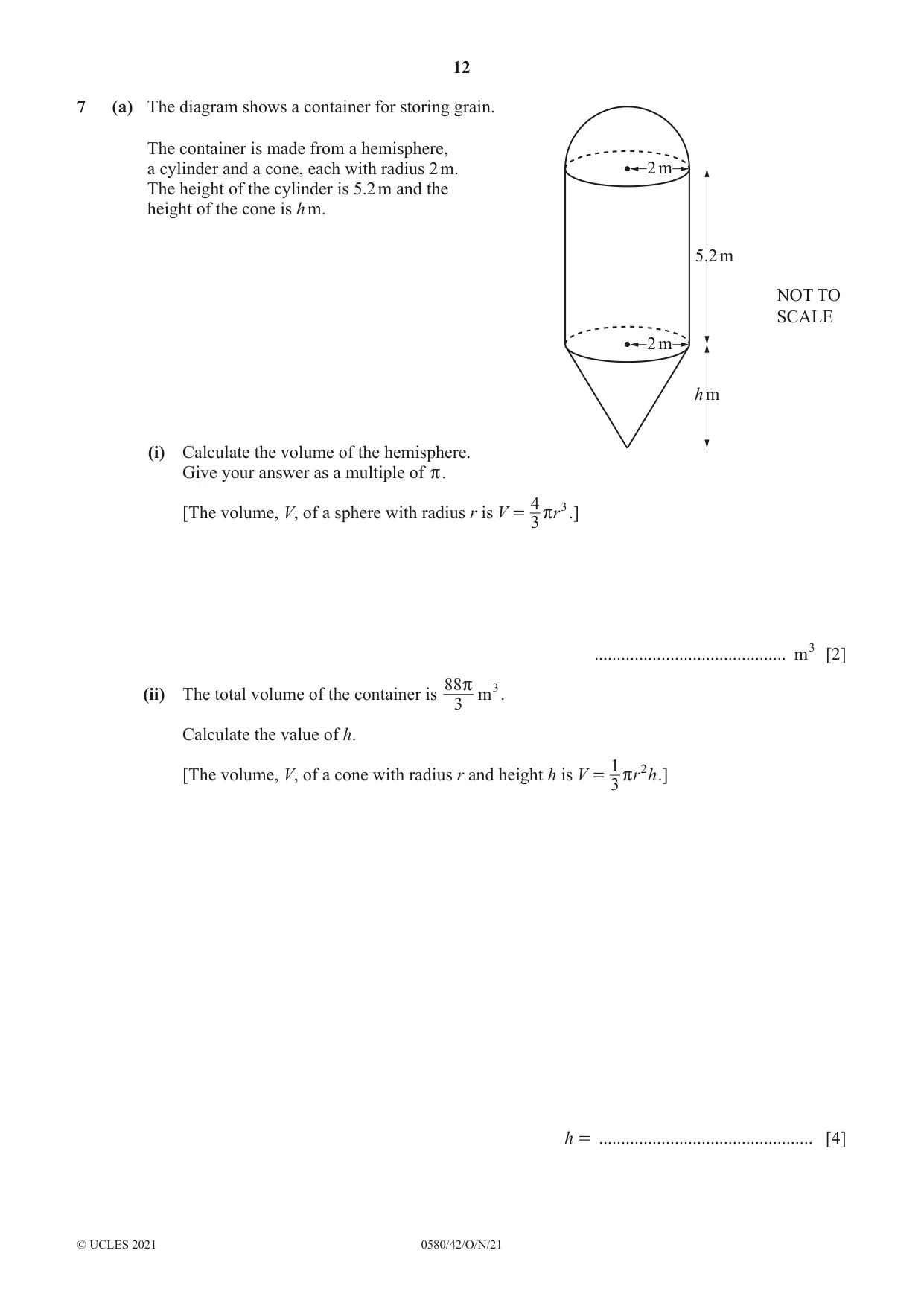
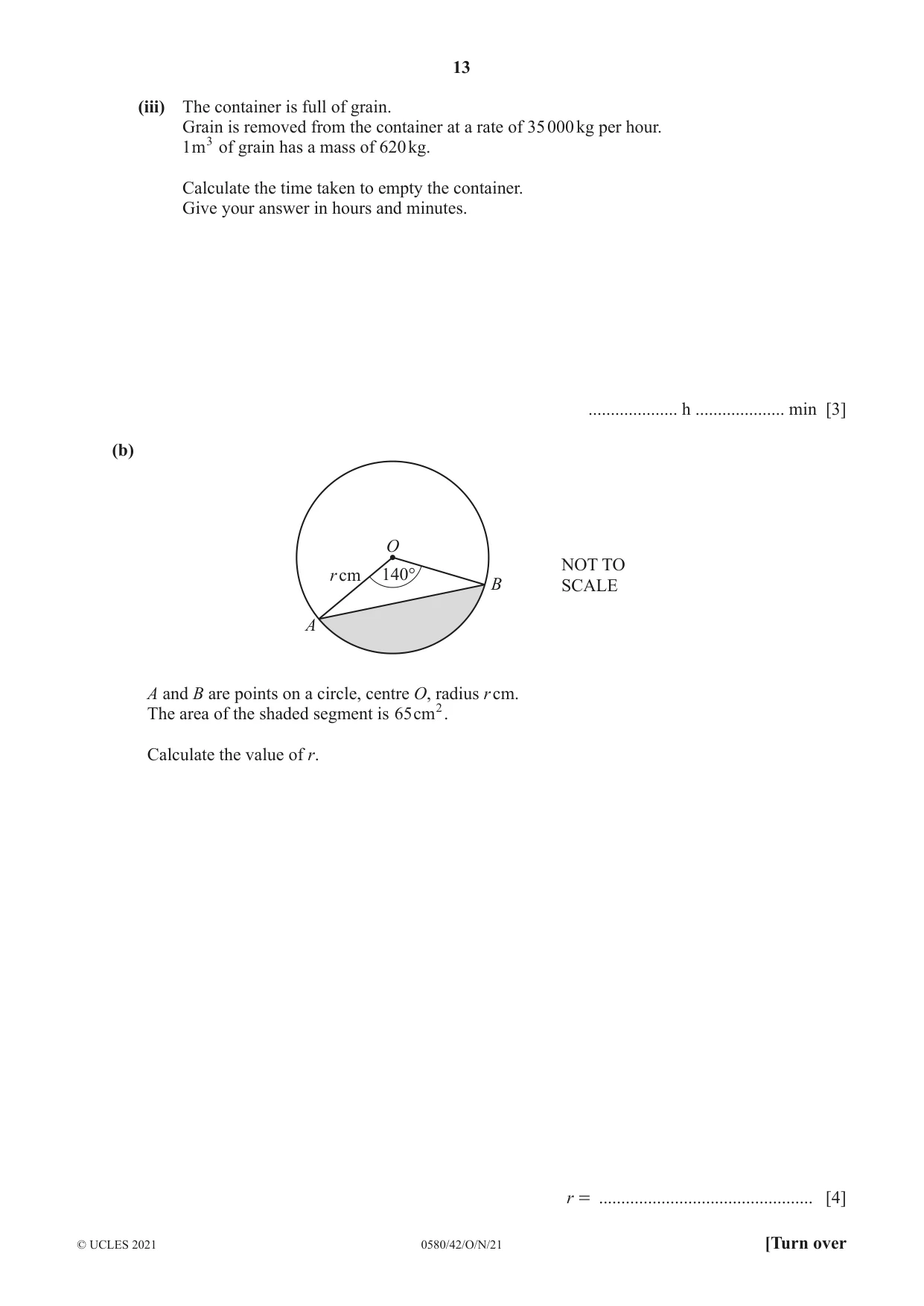
7 (a) The diagram shows a container for storing grain. The container is made from a hemisphere, a cylinder and a cone, each with radius 2 m. 2 m The height of the cylinder is 5.2 m and the height of the cone is h m. 5.2 m NOT TO SCALE 2 m h m (i) Calculate the volume of the hemisphere. Give your answer as a multiple of r. 4 3 [The volume, V, of a sphere with radius r is V = rr .] 3 ........................................... m3 [2] 88 r (ii) The total volume of the container is m3 . 3 Calculate the value of h. 1 2 [The volume, V, of a cone with radius r and height h is V = rr h .] 3 h = ................................................ [4] (iii) The container is full of grain. Grain is removed from the container at a rate of 35 000 kg per hour. 1m3 of grain has a mass of 620 kg. Calculate the time taken to empty the container. Give your answer in hours and minutes. .................... h .................... min [3] (b) O NOT TO r cm 140° B SCALE A A and B are points on a circle, centre O, radius r cm. The area of the shaded segment is 65cm2. Calculate the value of r. r = ................................................ [4]
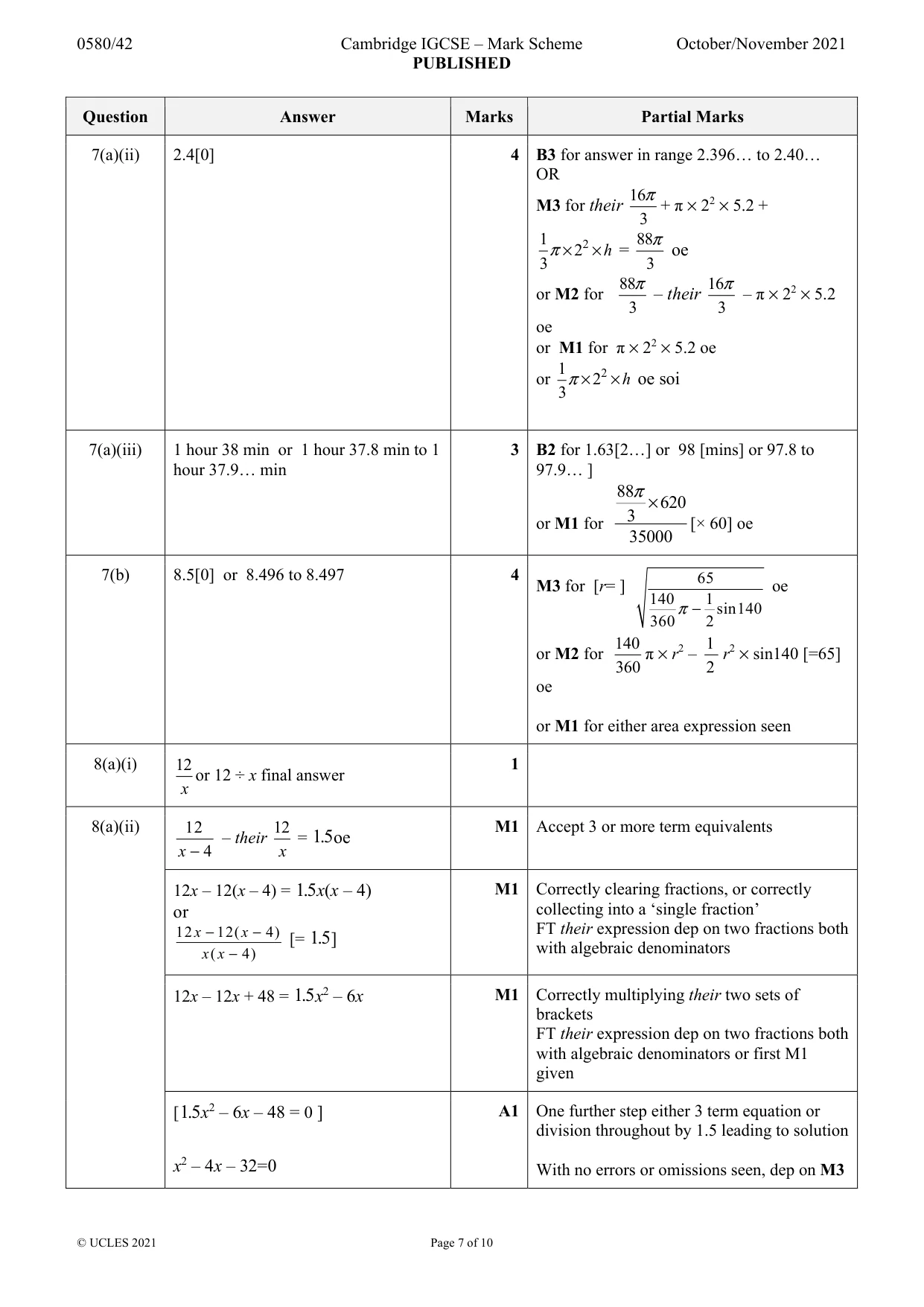
Mark scheme: 7(a)(i) 16π 2 1 4 3 or 51 π final answer M1 for × π × 2 oe 3 3 2 3 7(a)(ii) 2.4[0] 4 B3 for answer in range 2.396… to 2.40… OR 16π M3 for their + π × 22 × 5.2 + 3 1 2 88π π× 2 × h = oe 3 3 88π 16π or M2 for – their – π × 22 × 5.2 3 3 oe or M1 for π × 22 × 5.2 oe 1 2 or π× 2 × h oe soi 3 7(a)(iii) 1 hour 38 min or 1 hour 37.8 min to 1 3 B2 for 1.63[2…] or 98 [mins] or 97.8 to hour 37.9… min 97.9… ] 88π × 620 3 or M1 for [× 60] oe 35000 7(b) 8.5[0] or 8.496 to 8.497 4 65 M3 for [r= ] oe 140 1 π − sin140 360 2 140 1 or M2 for π × r2 – r2 × sin140 [=65] 360 2 oe or M1 for either area expression seen
Q8 · Kaito runs along a 12 km path at an average speed of x km/h
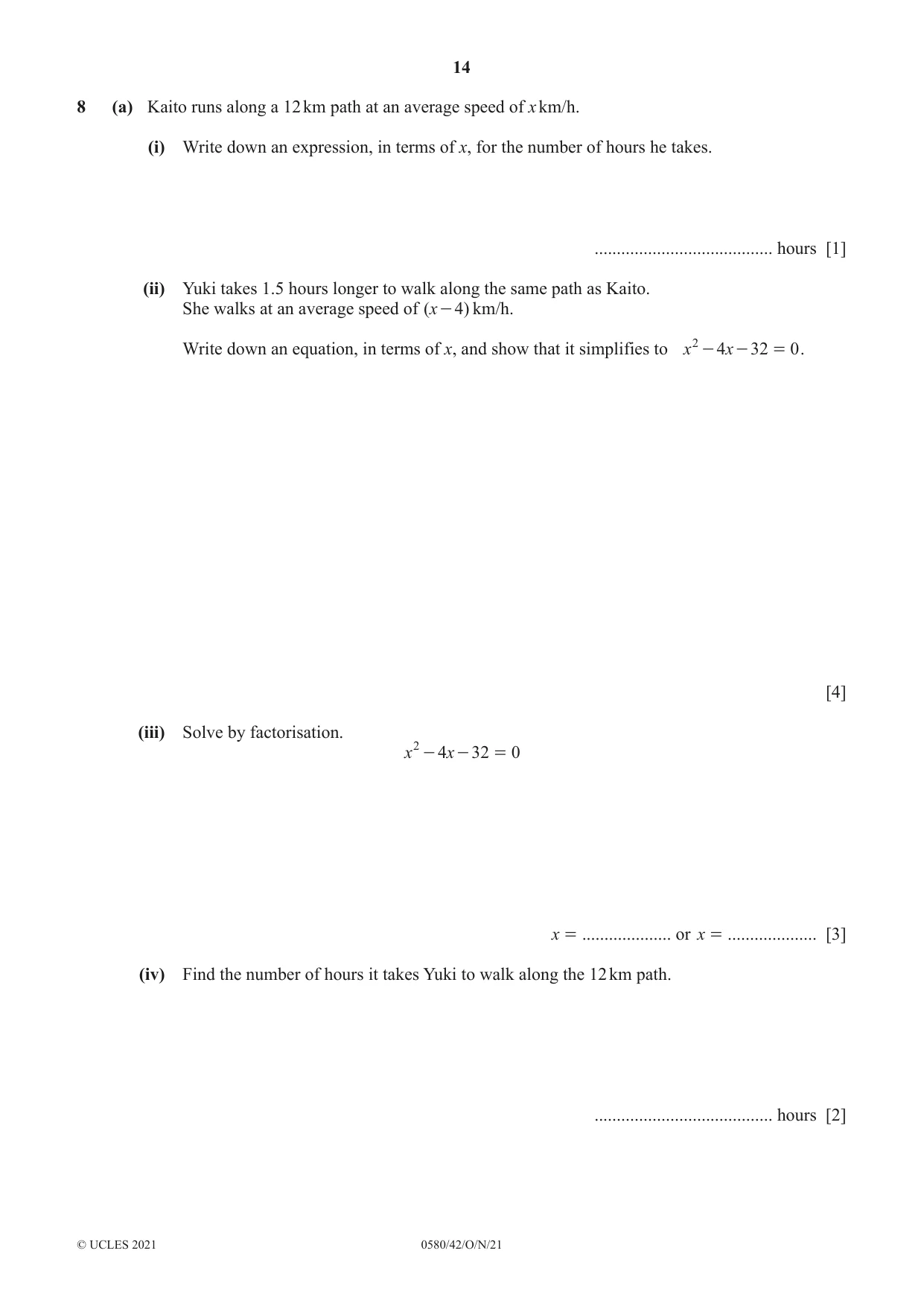
8 (a) Kaito runs along a 12 km path at an average speed of x km/h. (i) Write down an expression, in terms of x, for the number of hours he takes. ........................................ hours [1] (ii) Yuki takes 1.5 hours longer to walk along the same path as Kaito. She walks at an average speed of ( x - 4 ) km/h. Write down an equation, in terms of x, and show that it simplifies to x 2 - 4x - 32 = 0 . [4] (iii) Solve by factorisation. x 2 - 4x - 32 = 0 x = .................... or x = .................... [3] (iv) Find the number of hours it takes Yuki to walk along the 12 km path. ........................................ hours [2] (b) A bus travels 440 km, correct to the nearest 10 km. The time taken to complete the journey is 6 hours, correct to the nearest half hour. Calculate the lower bound of the speed of the bus. ........................................ km/h [3]
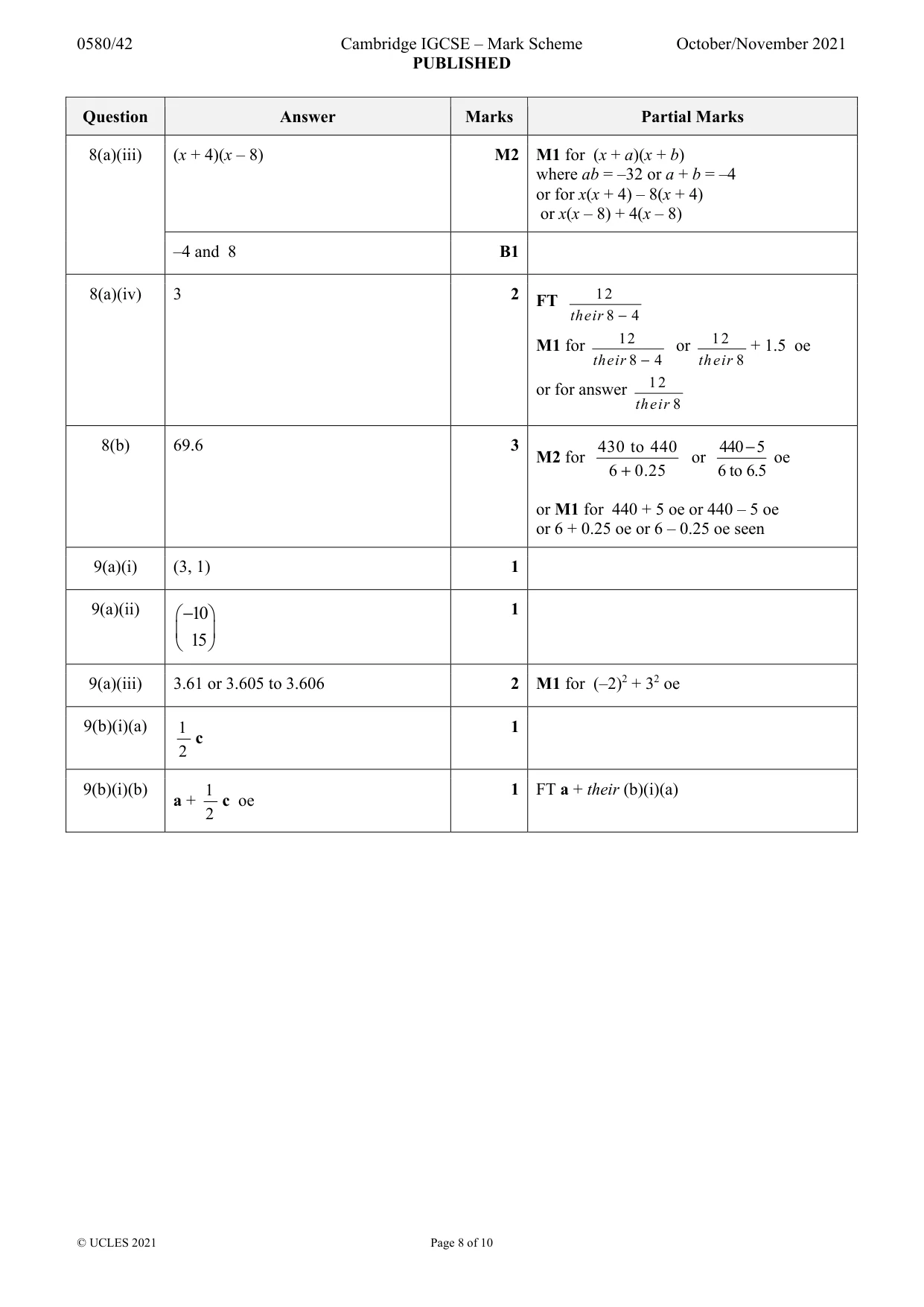
Mark scheme: 8(a)(i) 12 1 or 12 ÷ x final answer x 8(a)(ii) 12 12 M1 Accept 3 or more term equivalents – their = 1.5oe x − 4 x 12x – 12(x – 4) = 1.5x(x – 4) M1 Correctly clearing fractions, or correctly or collecting into a ‘single fraction’ 12 x − 12( x − 4) FT their expression dep on two fractions both [= 1.5] x ( x − 4) with algebraic denominators 12x – 12x + 48 = 1.5x2 – 6x M1 Correctly multiplying their two sets of brackets FT their expression dep on two fractions both with algebraic denominators or first M1 given [1.5x2 – 6x – 48 = 0 ] A1 One further step either 3 term equation or division throughout by 1.5 leading to solution x2 – 4x – 32=0 With no errors or omissions seen, dep on M3 8(a)(iii) (x + 4)(x – 8) M2 M1 for (x + a)(x + b) where ab = –32 or a + b = –4 or for x(x + 4) – 8(x + 4) or x(x – 8) + 4(x – 8) –4 and 8 B1 8(a)(iv) 3 2 12 FT their 8 − 4 12 12 M1 for or + 1.5 oe their 8 − 4 their 8 12 or for answer their 8 8(b) 69.6 3 430 to 440 440 − 5 M2 for or oe 6 + 0.25 6 to 6.5 or M1 for 440 + 5 oe or 440 – 5 oe or 6 + 0.25 oe or 6 – 0.25 oe seen
Q9 · - 2 9 (a) F is the point (5, - 2 ) and FG = e 3o
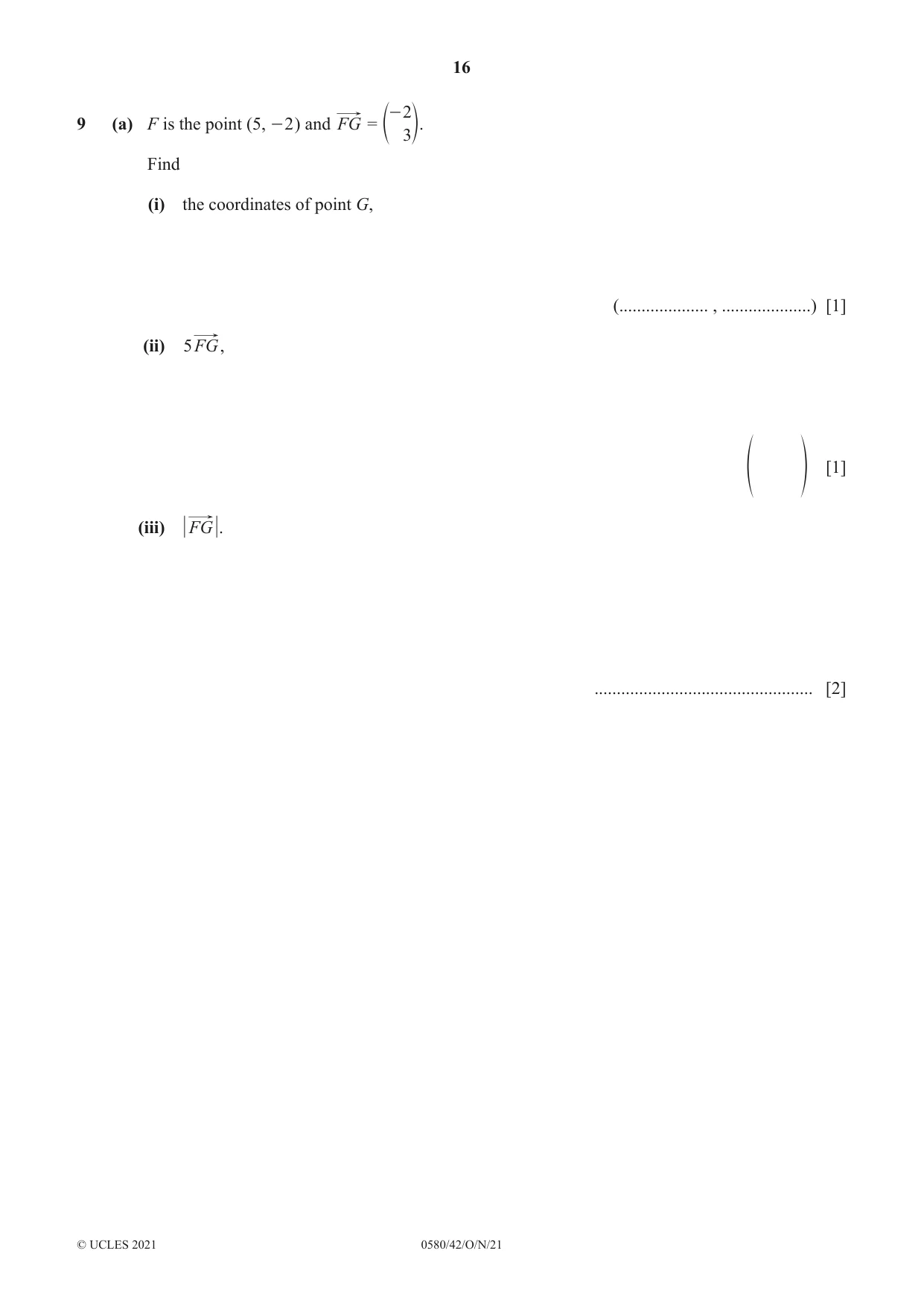
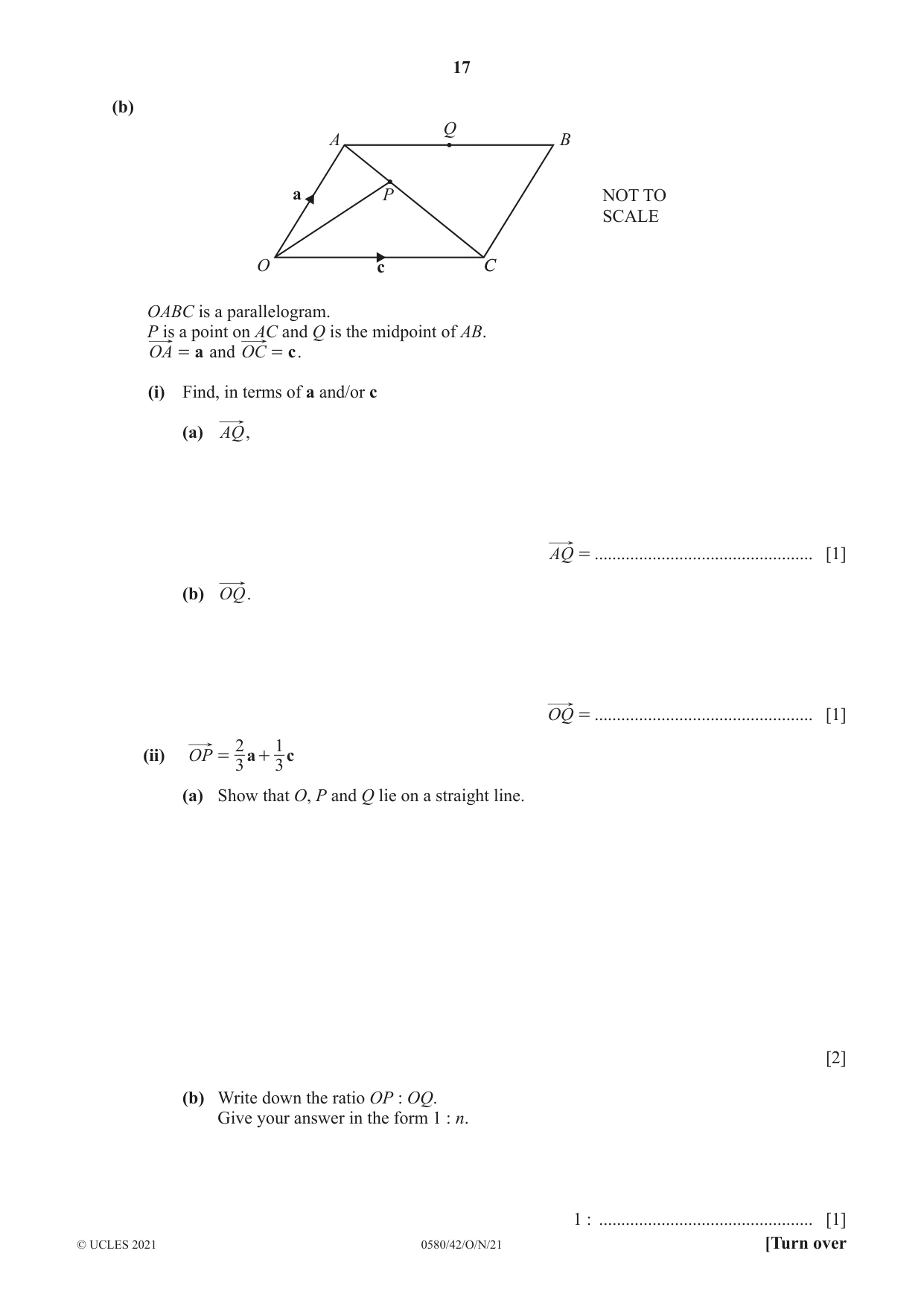
- 2 9 (a) F is the point (5, - 2 ) and FG = e 3o. Find (i) the coordinates of point G, (.................... , ....................) [1] (ii) 5 FG , [1] f p (iii) FG . ................................................. [2] (b) Q A B a P NOT TO SCALE O c C OABC is a parallelogram. P is a point on AC and Q is the midpoint of AB. OA = a and O C = c . (i) Find, in terms of a and/or c (a) AQ, AQ = ................................................. [1] (b) O Q . O Q = ................................................. [1] 2 1 (ii) OP = a + c 3 3 (a) Show that O, P and Q lie on a straight line. [2] (b) Write down the ratio OP : OQ. Give your answer in the form 1 : n. 1 : ................................................ [1]
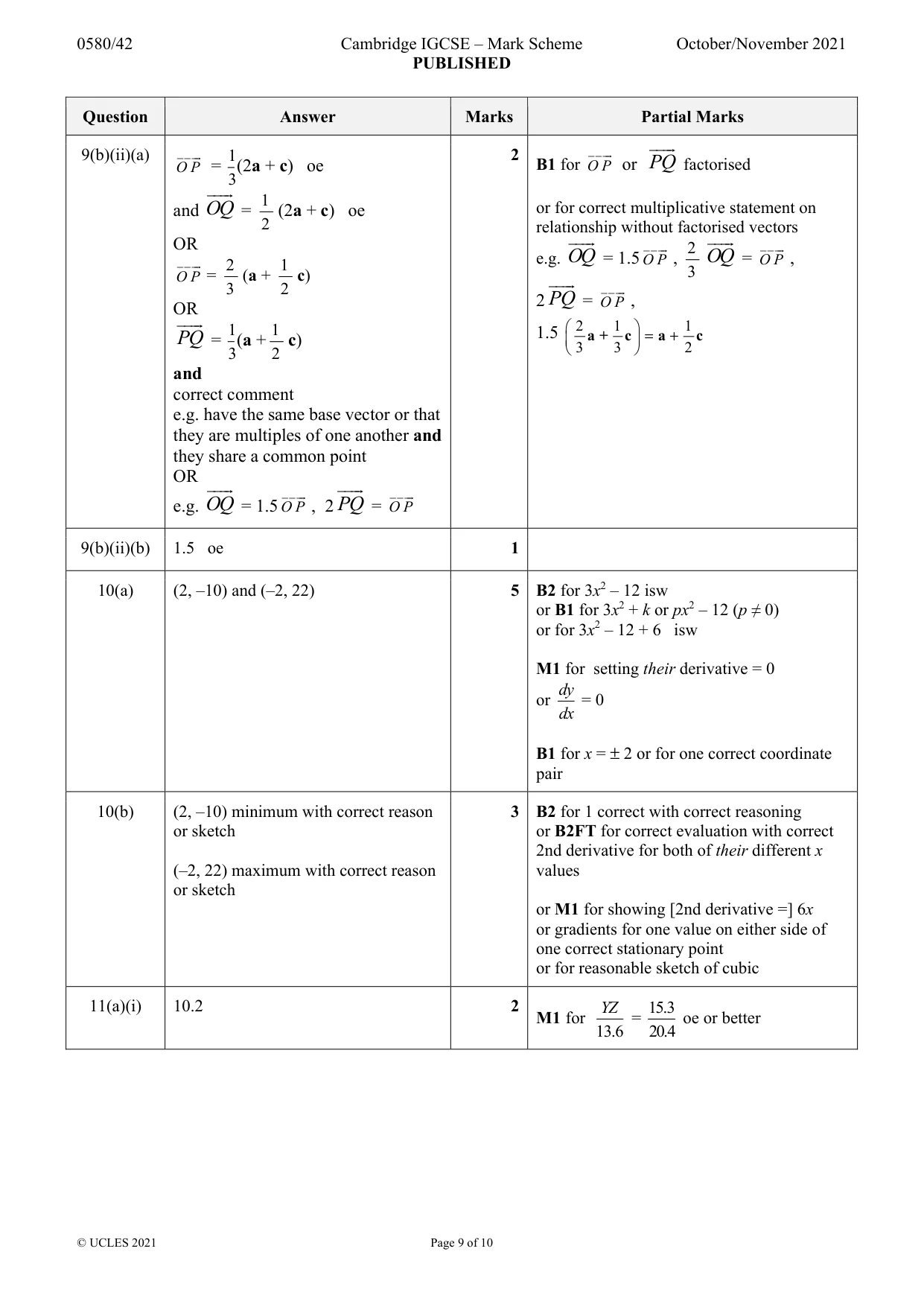
Mark scheme: 9(a)(i) (3, 1) 1 9(a)(ii) −10 1 15 9(a)(iii) 3.61 or 3.605 to 3.606 2 M1 for (–2)2 + 32 oe 9(b)(i)(a) 1 1 c 2 9(b)(i)(b) 1 1 FT a + their (b)(i)(a) a + c oe 2 9(b)(ii)(a) 1 2 O P = + c) oe B1 for O P or PQ factorised 3(2a 1 and OQ = (2a + c) oe or for correct multiplicative statement on 2 relationship without factorised vectors OR 2 e.g. OQ = 1.5 O,P OQ = O,P 2 1 O=P (a + c) 3 3 2 2 PQ = O,P OR 2 1 1 1 1.5 a + c = a + 1 c PQ = + c) 3 3 2 3(a 2 and correct comment e.g. have the same base vector or that they are multiples of one another and they share a common point OR e.g. OQ = 1.5 O,P 2 PQ = O P 9(b)(ii)(b) 1.5 oe 1
Q10 · Find the coordinates of the turning points of the graph of y = x 3 - 12x + 6
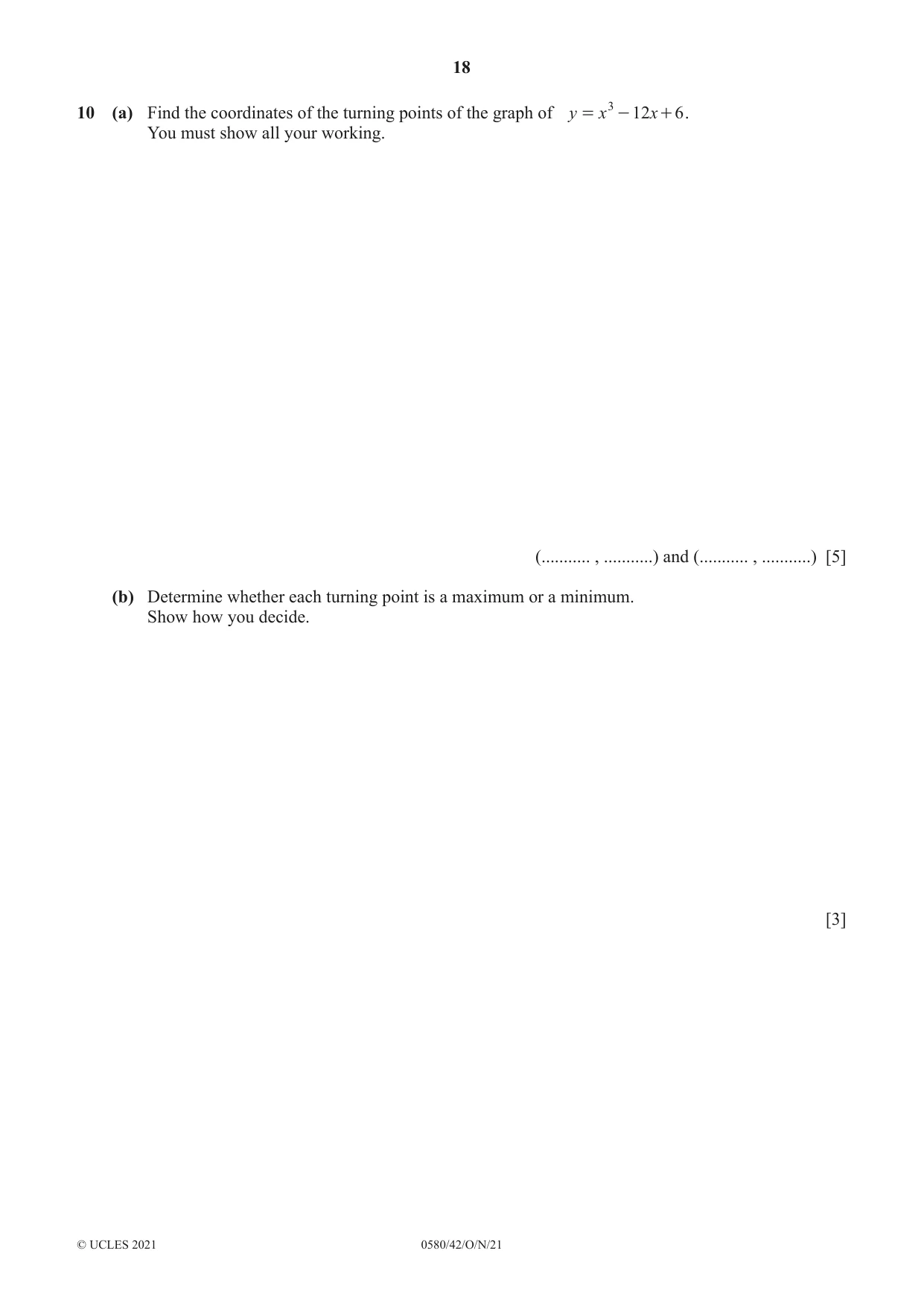
10 (a) Find the coordinates of the turning points of the graph of y = x 3 - 12x + 6 . You must show all your working. (........... , ...........) and (........... , ...........) [5] (b) Determine whether each turning point is a maximum or a minimum. Show how you decide. [3]
Mark scheme: 10(a) (2, –10) and (–2, 22) 5 B2 for 3x2 – 12 isw or B1 for 3x2 + k or px2 – 12 (p ≠ 0) or for 3x2 – 12 + 6 isw M1 for setting their derivative = 0 dy or = 0 dx B1 for x = ± 2 or for one correct coordinate pair 10(b) (2, –10) minimum with correct reason 3 B2 for 1 correct with correct reasoning or sketch or B2FT for correct evaluation with correct 2nd derivative for both of their different x (–2, 22) maximum with correct reason values or sketch or M1 for showing [2nd derivative =] 6x or gradients for one value on either side of one correct stationary point or for reasonable sketch of cubic
Q11 · R Z NOT TO 20.4 cm 15.3 cm 13.6 cm SCALE X Y P Q Triangle PQR is mathematically similar…
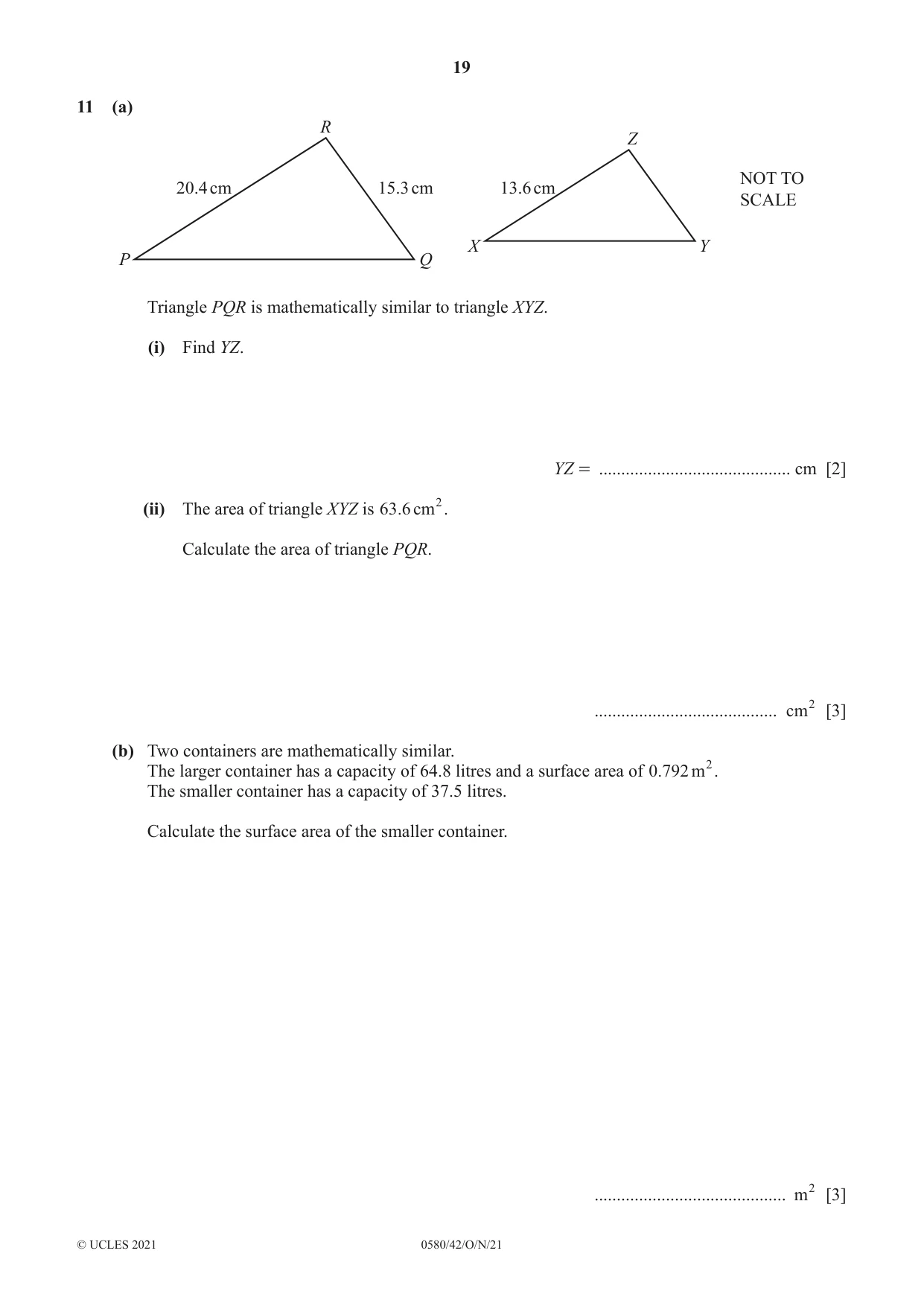
11 (a) R Z NOT TO 20.4 cm 15.3 cm 13.6 cm SCALE X Y P Q Triangle PQR is mathematically similar to triangle XYZ. (i) Find YZ. YZ = ........................................... cm [2] (ii) The area of triangle XYZ is 63.6 cm 2. Calculate the area of triangle PQR. ......................................... cm2 [3] (b) Two containers are mathematically similar. The larger container has a capacity of 64.8 litres and a surface area of 0.792 m 2. The smaller container has a capacity of 37.5 litres. Calculate the surface area of the smaller container. ........................................... m2 [3]
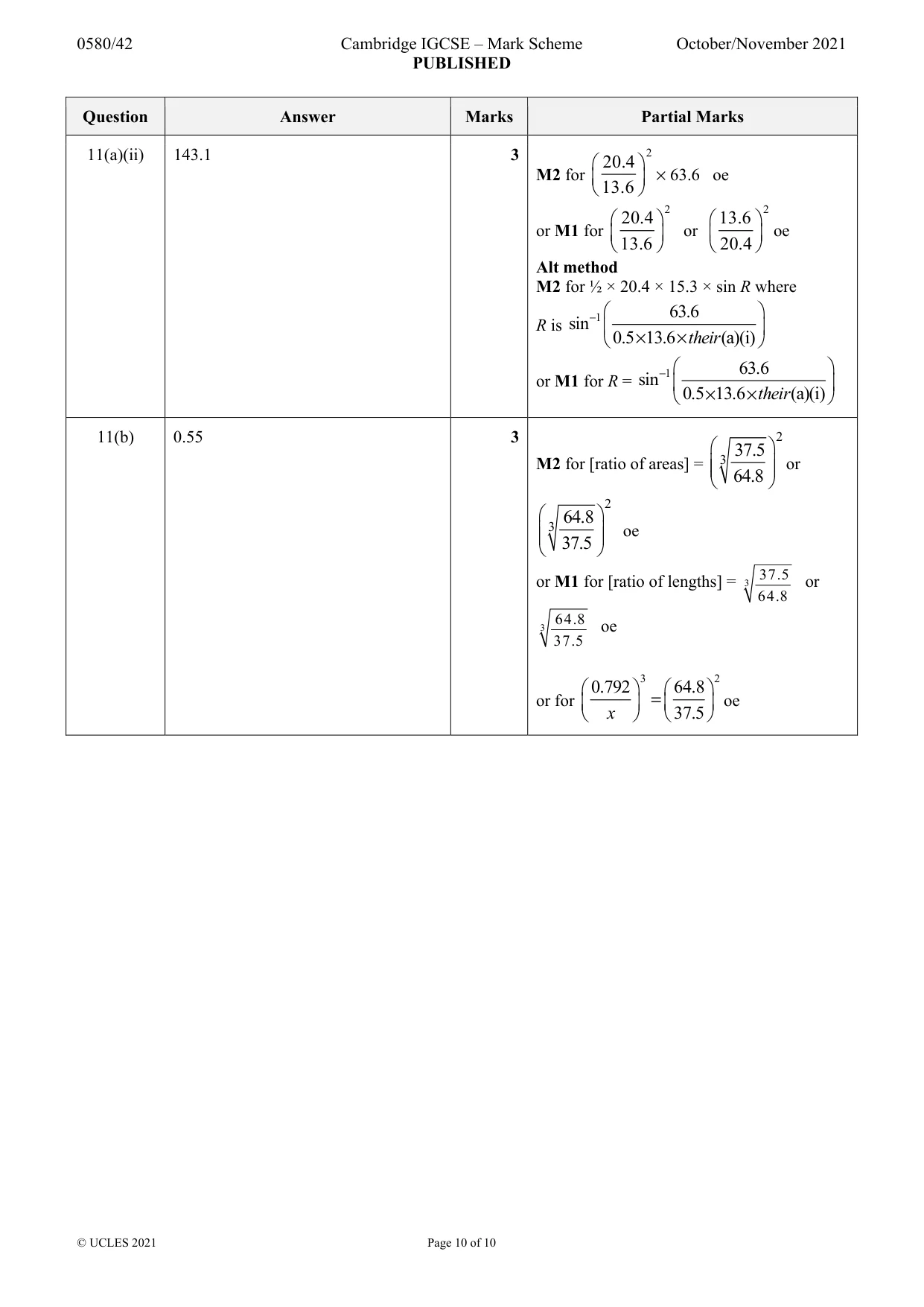
Mark scheme: 11(a)(i) 10.2 2 YZ 15.3 M1 for = oe or better 13.6 20.4 11(a)(ii) 143.1 3 2 20.4 M2 for × 63.6 oe 13.6 20.4 2 13.6 2 or M1 for or oe 13.6 20.4 Alt method M2 for ½ × 20.4 × 15.3 × sin R where −1 63.6 R is sin 0.5 ×13.6 × their (a)(i) −1 63.6 or M1 for R = sin 0.5 ×13.6 × their (a)(i) 11(b) 0.55 3 2 37.5 M2 for [ratio of areas] = 3 or 64.8 2 64.8 3 oe 37.5 37.5 or M1 for [ratio of lengths] = 3 or 64.8 64.8 3 oe 37.5 0.792 3 64.8 2 or for = oe x 37.5
What was in this paper
The subtopics covered by these 11 questions, and how many questions each got. Open one in a new tab to see every Cambridge question on it.
What you needed in this session
Cambridge’s own grade thresholds for 2021 Oct/Nov, Paper 4 · Variant 2. A higher threshold means an easier paper — the bar moves with how the cohort did.