Cambridge IGCSE Mathematics 0580 — 2013 May/June Paper 4 · Variant 2
0580/42/M/J/13 · 2 questions · 130 marks · ≈146 min
The question paper and its mark scheme, free to read here and free to download. This is Cambridge’s own paper, exactly as it was sat.
Question paper20 pages
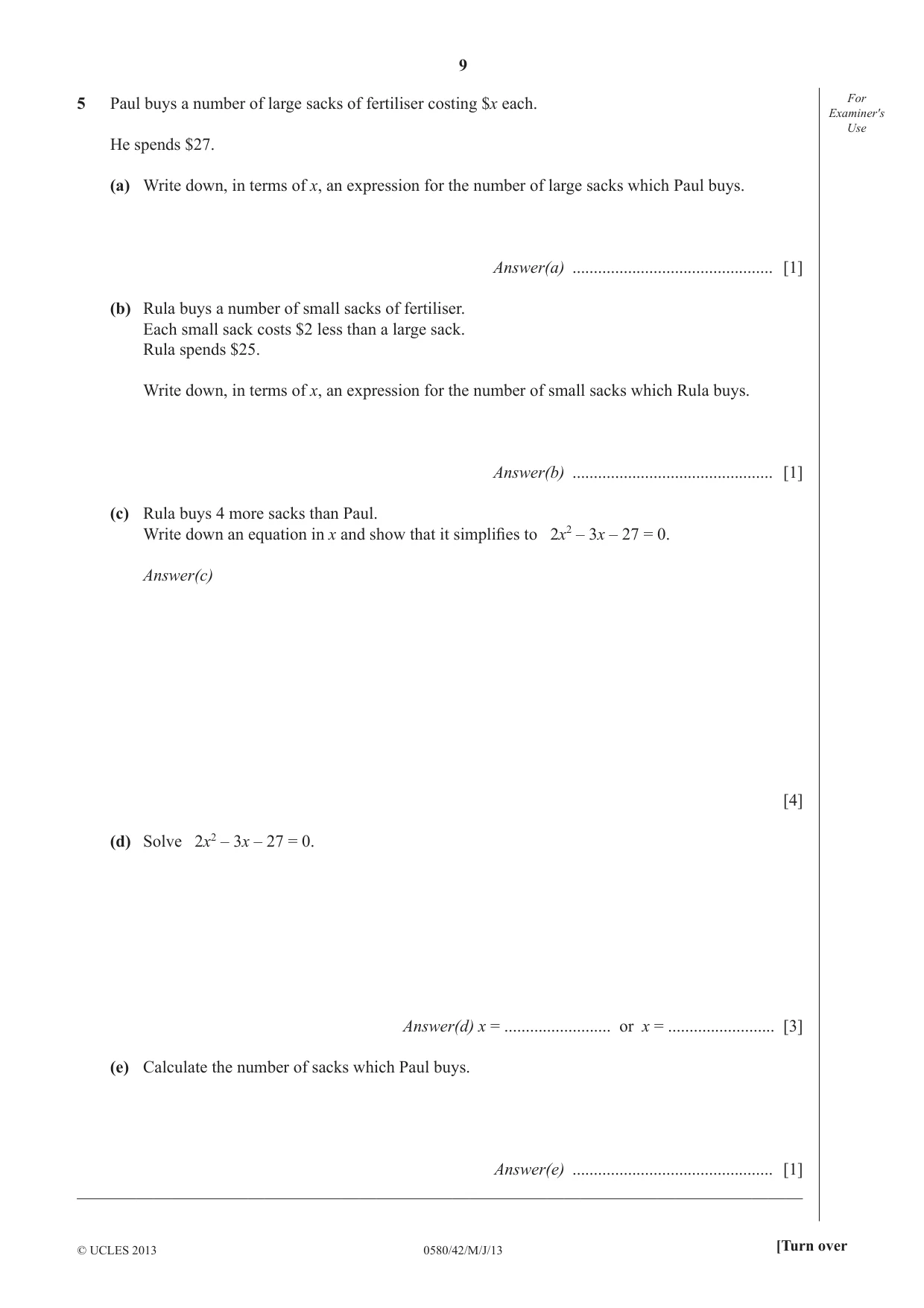
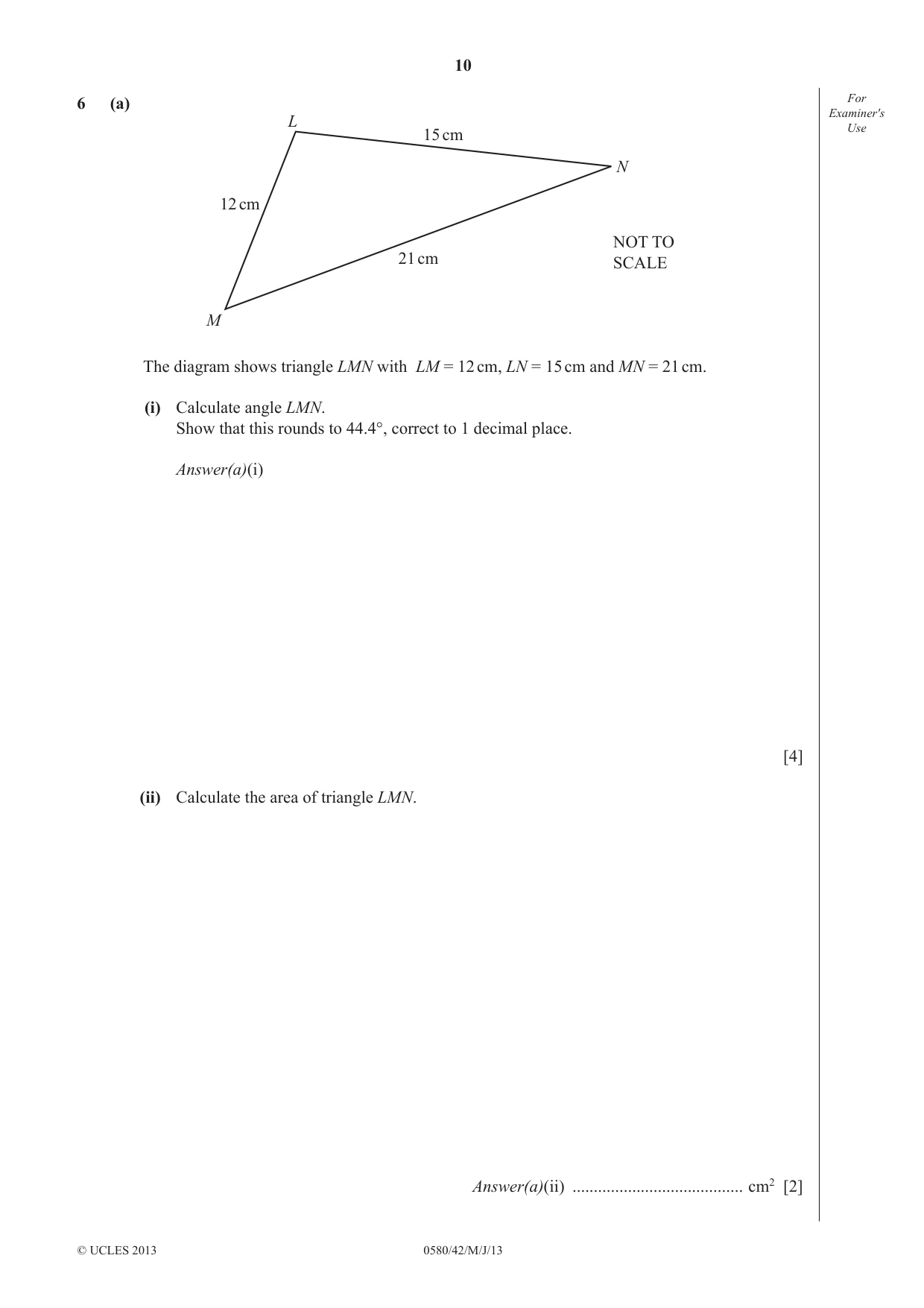
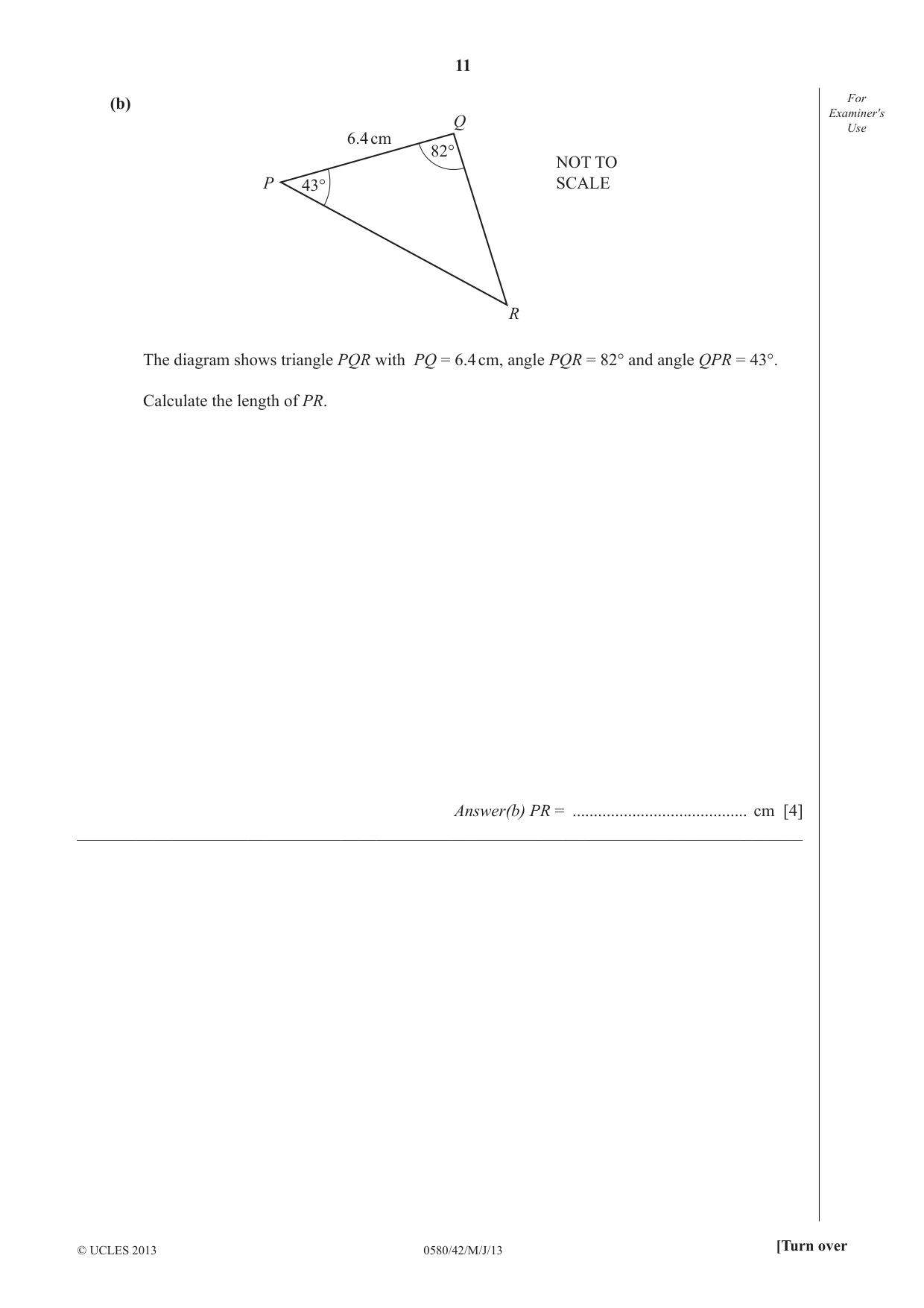
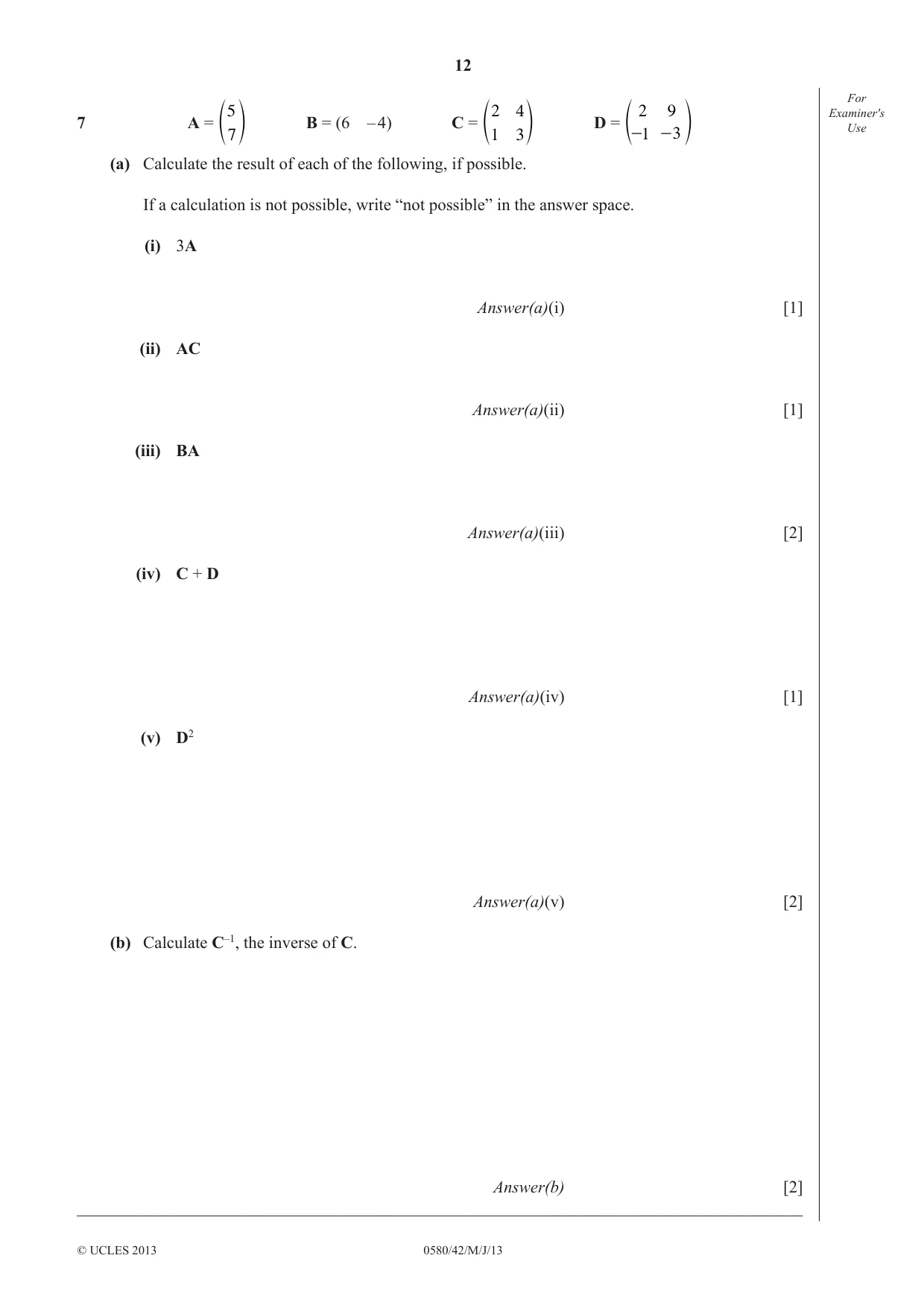
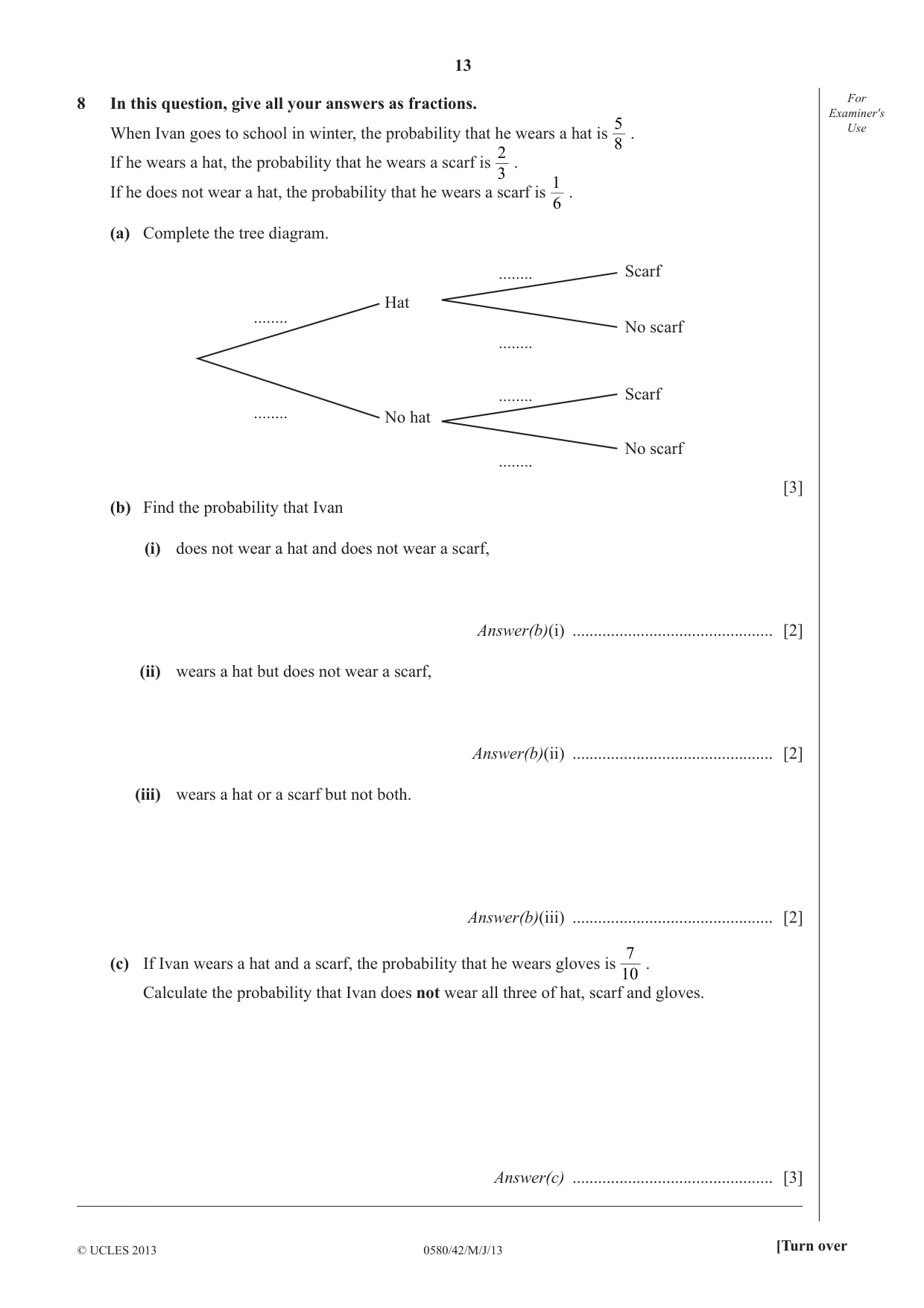
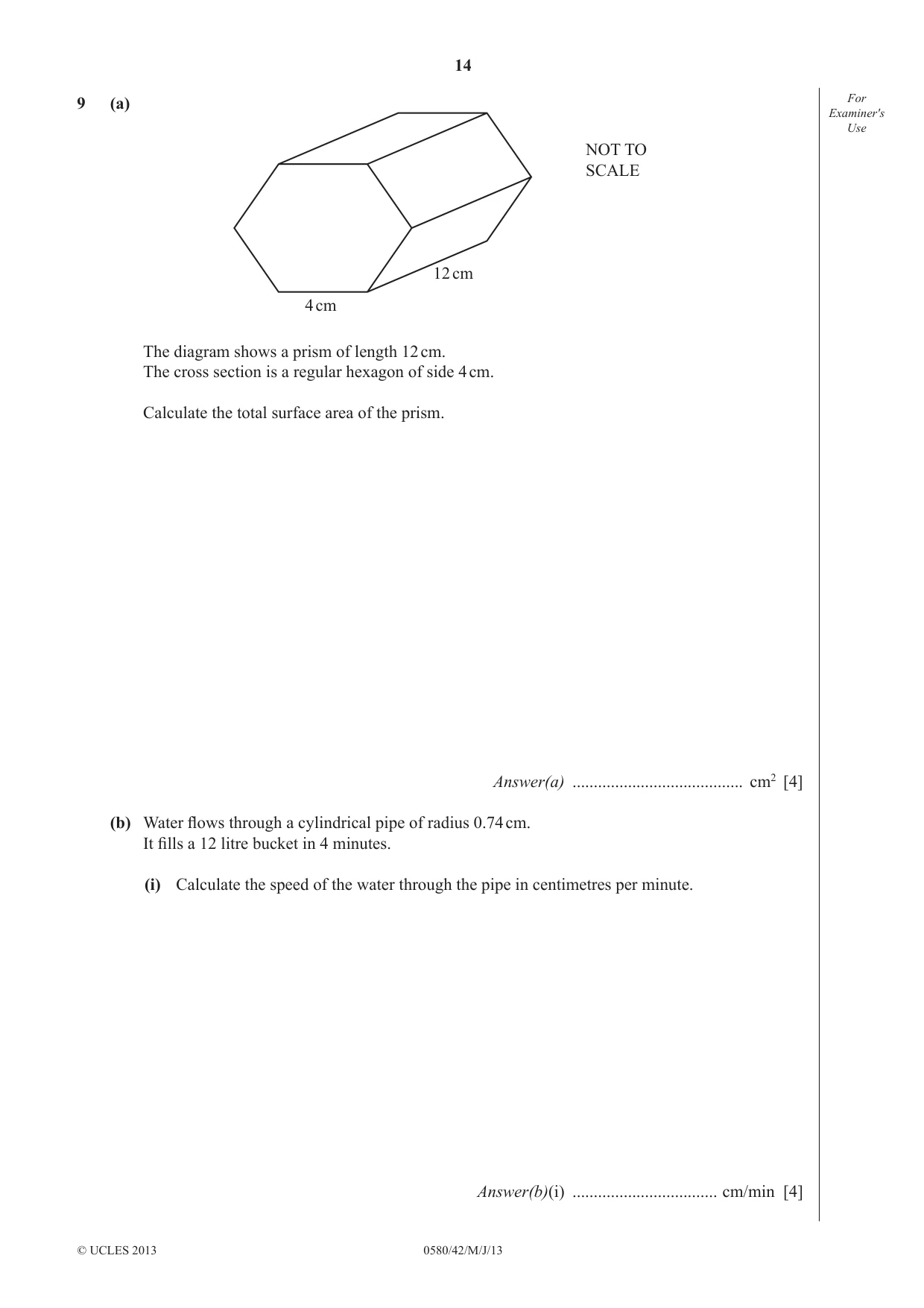
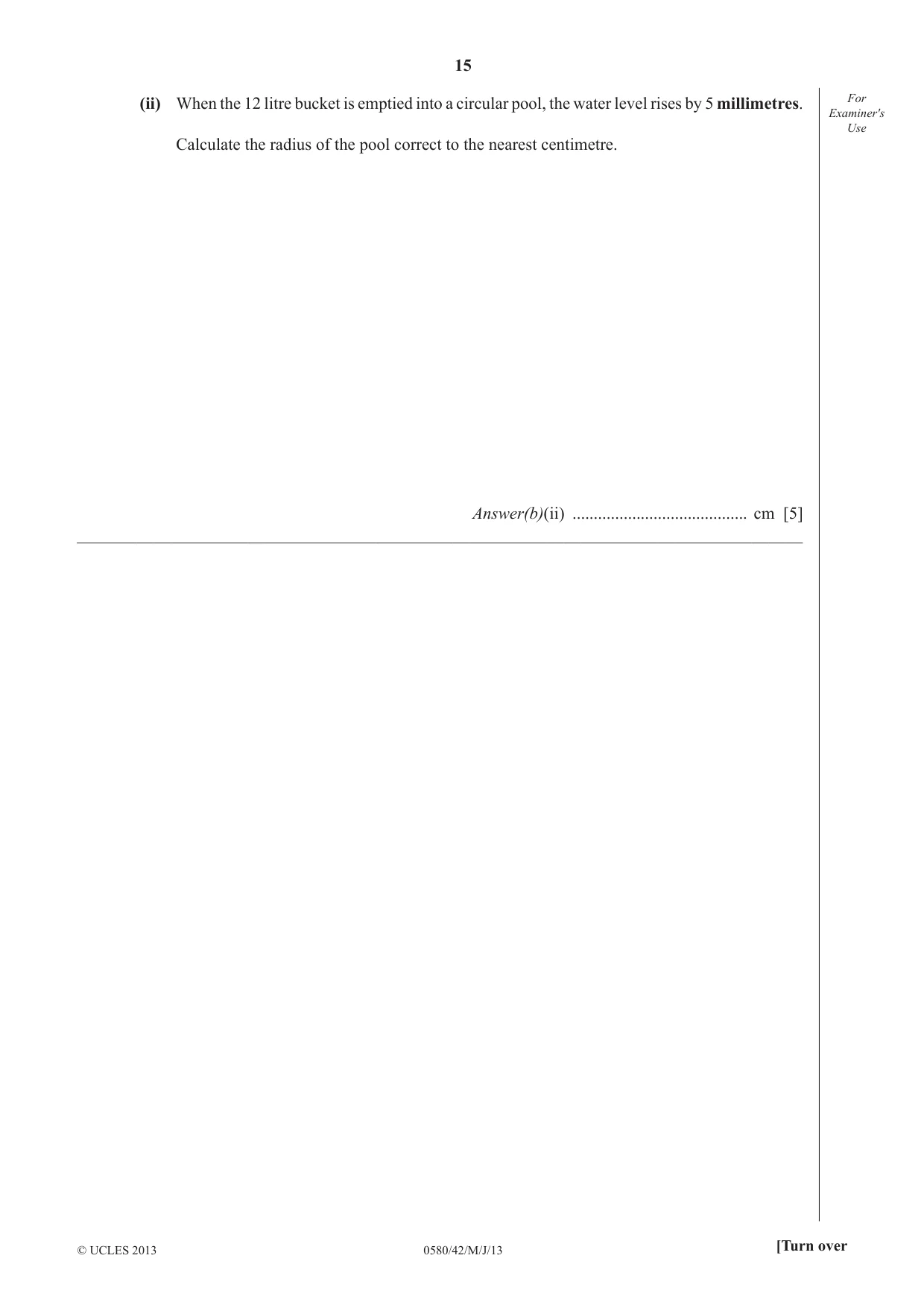
Mark scheme7 pages
Answers below. Sit the paper first if you are practising.
Questions as text
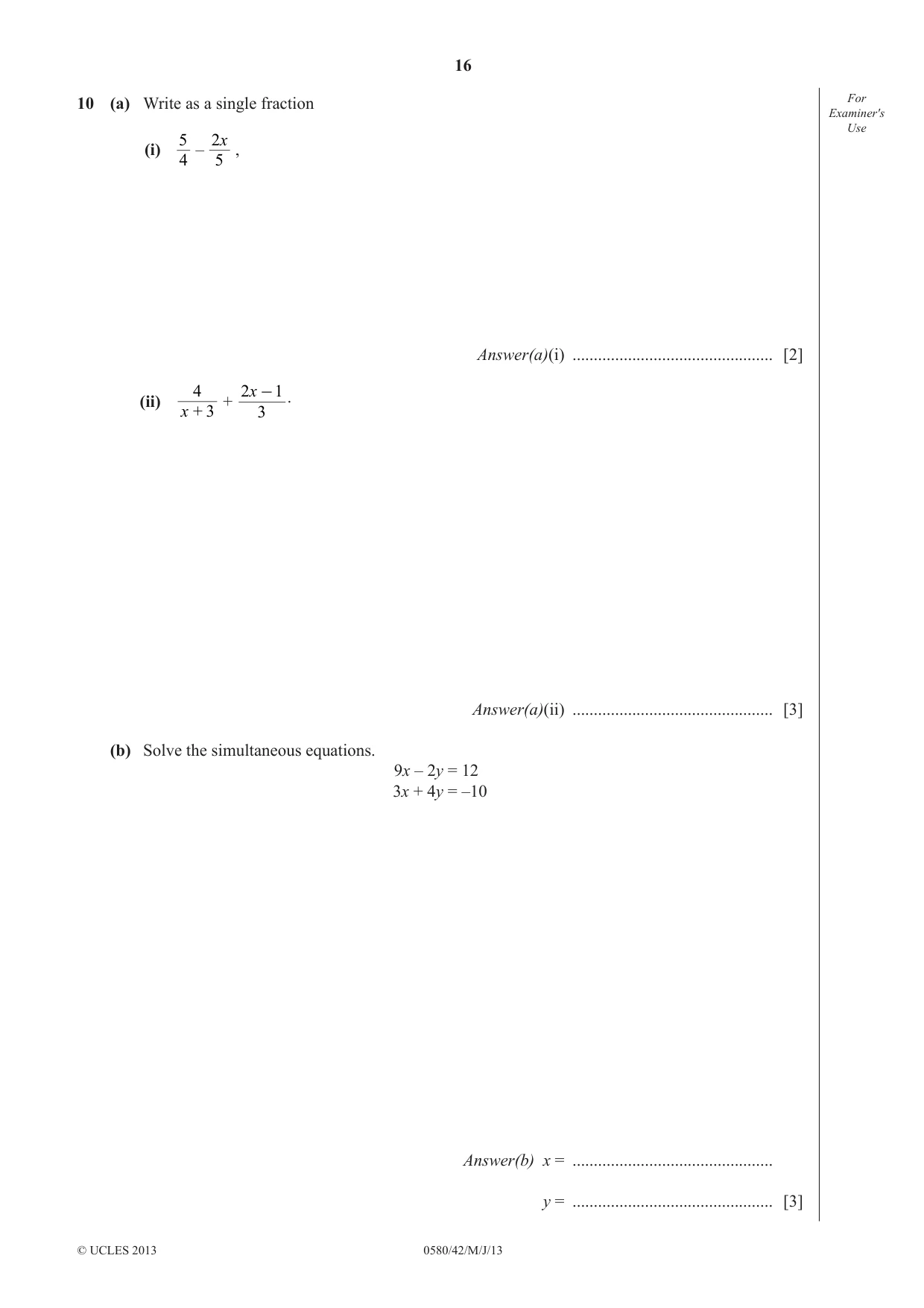
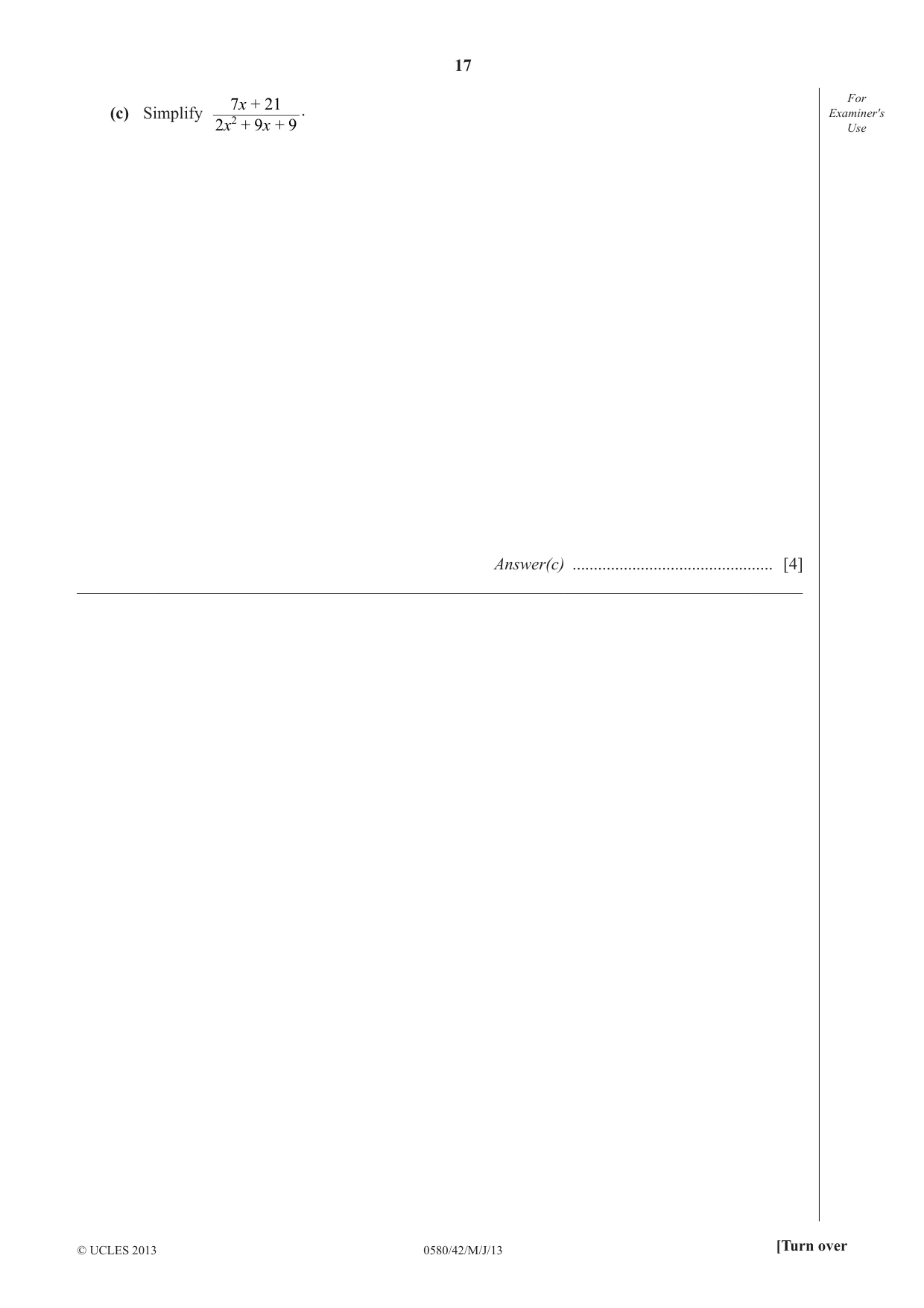
Q10 · Write as a single fraction For Examiner′s Use 5 2x (i) – , 4 5 Answer(a)(i)…
10 (a) Write as a single fraction For Examiner′s Use 5 2x (i) – , 4 5 Answer(a)(i) ............................................... [2] 4 2x - 1 (ii) + . x + 3 3 Answer(a)(ii) ............................................... [3] (b) Solve the simultaneous equations. 9x – 2y = 12 3x + 4y = –10 Answer(b) x = ............................................... y = ............................................... [3] 7 x + 21 For (c) Simplify 2 . Examiner′s 2 x + 9 x + 9 Use Answer(c) ............................................... [4] _____________________________________________________________________________________
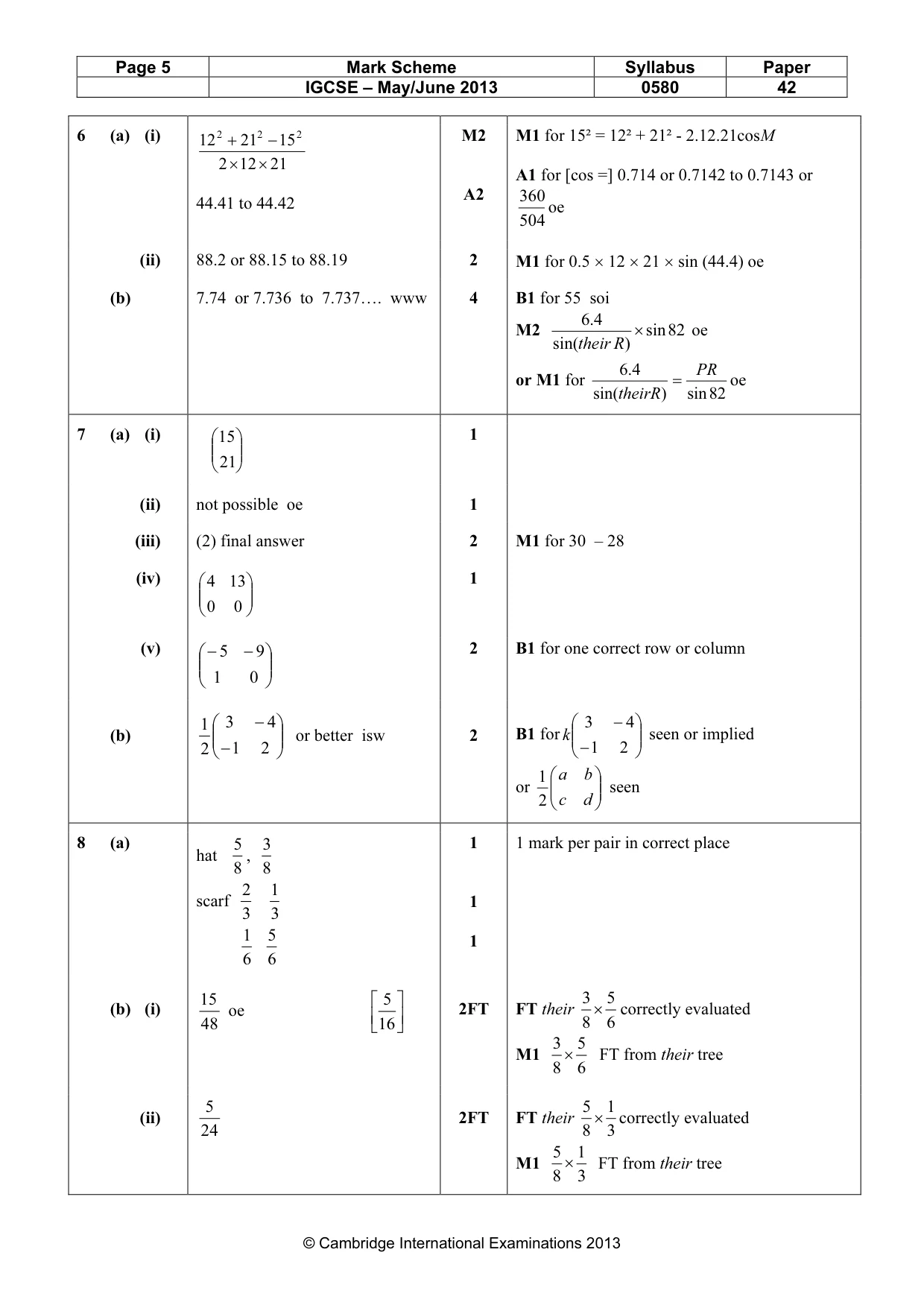
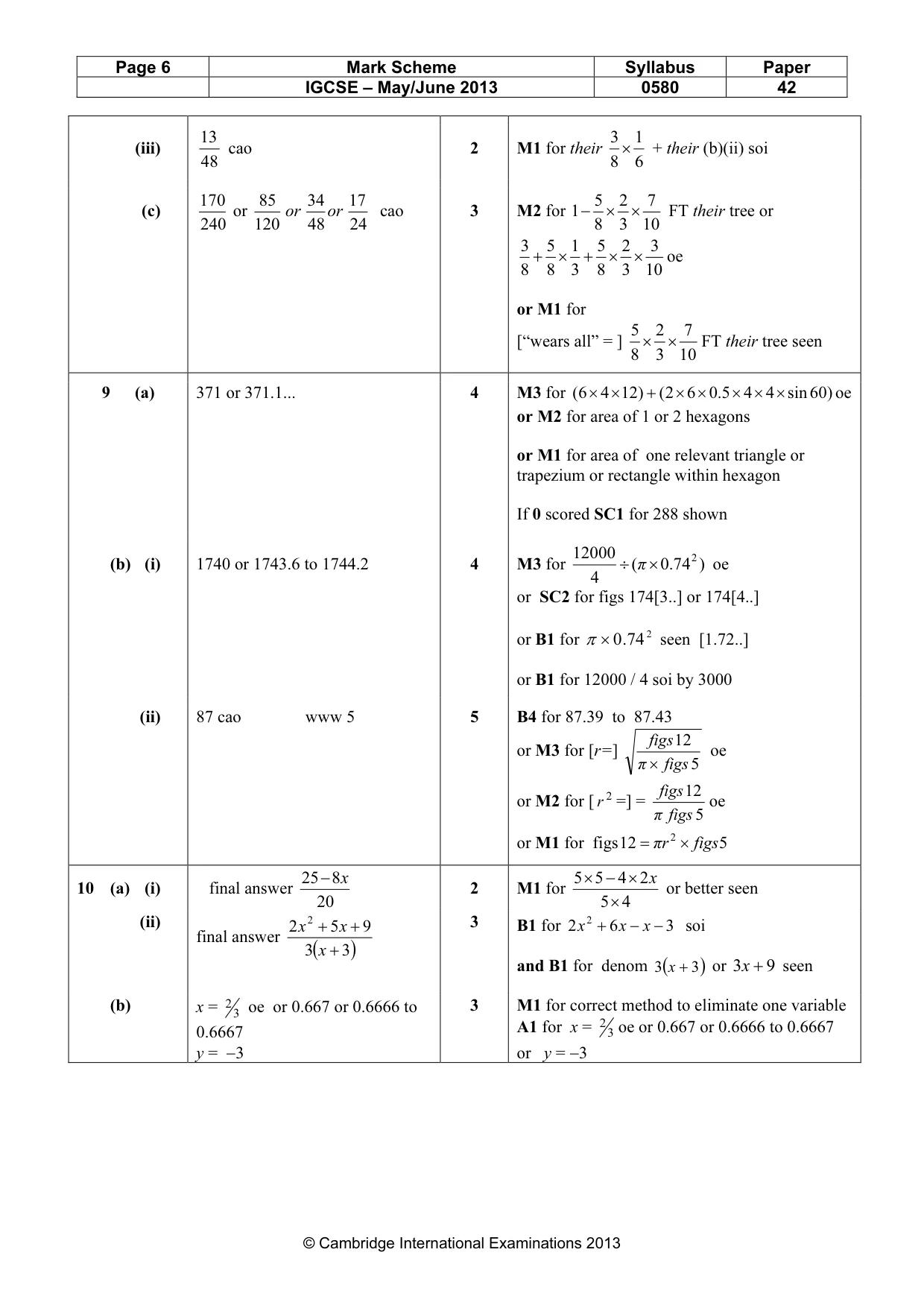
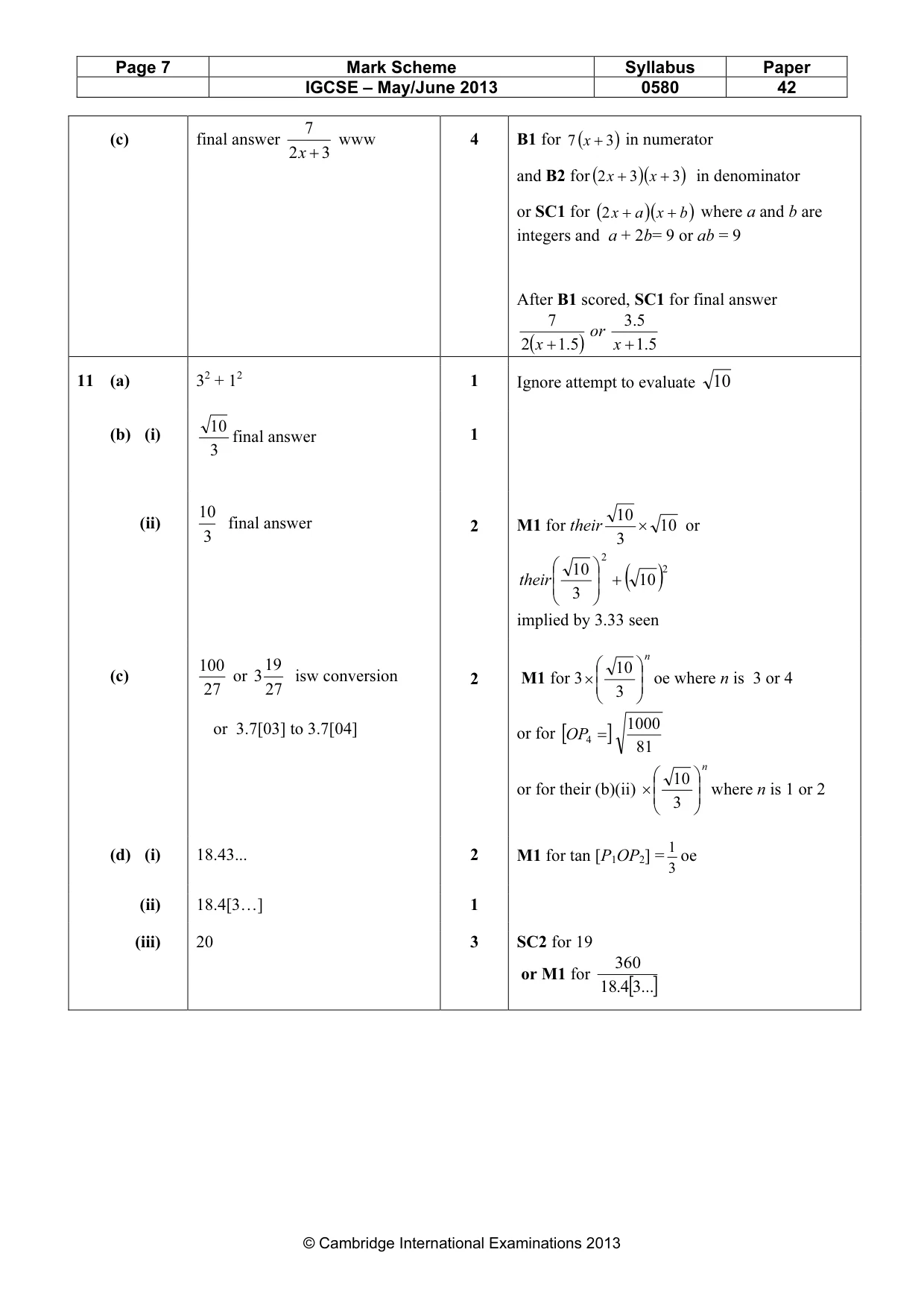
Mark scheme: 25 8 x 5 × 5 4 × 2 x 10 (a) (i) final answer 2 M1 for or better seen 20 5 × 4 (ii) 2 x 2 + 5 x + 9 3 B1 for 2 x 2 + 6 x − x − 3 soi final answer 3( x + 3 ) and B1 for denom 3( x + 3 ) or 3 x + 9 seen (b) x = 2 3 oe or 0.667 or 0.6666 to 3 M1 for correct method to eliminate one variable A1 for x = 2 3 oe or 0.667 or 0.6666 to 0.6667 0.6667 y = −3 or y = −3 IGCSE – May/June 2013 0580 42 7 (c) final answer www 4 B1 for 7 ( x + 3 ) in numerator 2 x + 3 and B2 for(2 x + 3 )( x + 3 ) in denominator or SC1 for (2 x + a )( x + b ) where a and b are integers and a + 2b= 9 or ab = 9 After B1 scored, SC1 for final answer 7 5.3 or 2( x + 5.1 ) x + 5.1 2 2
Q11 · Sidney draws the triangle OP1 P2
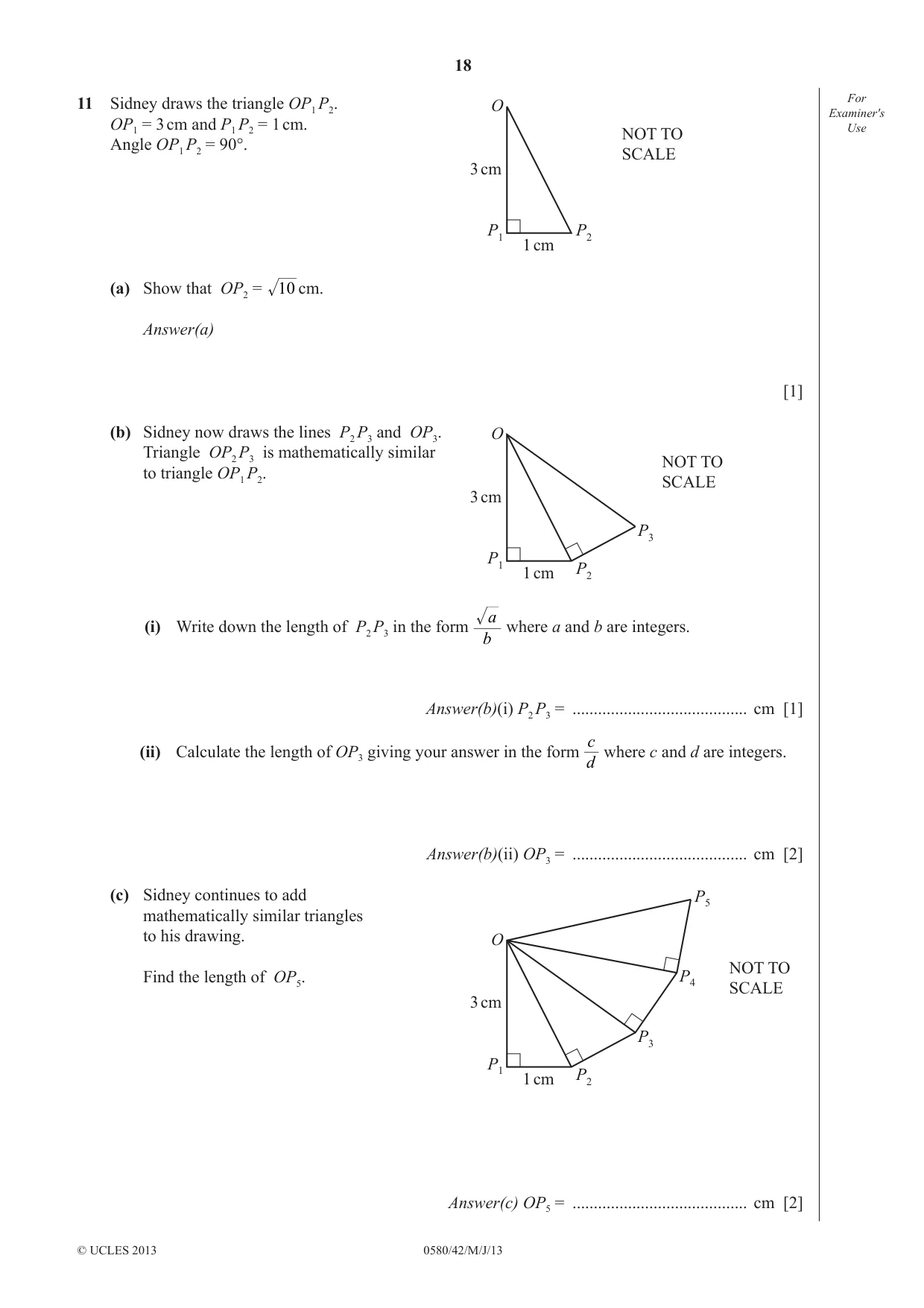
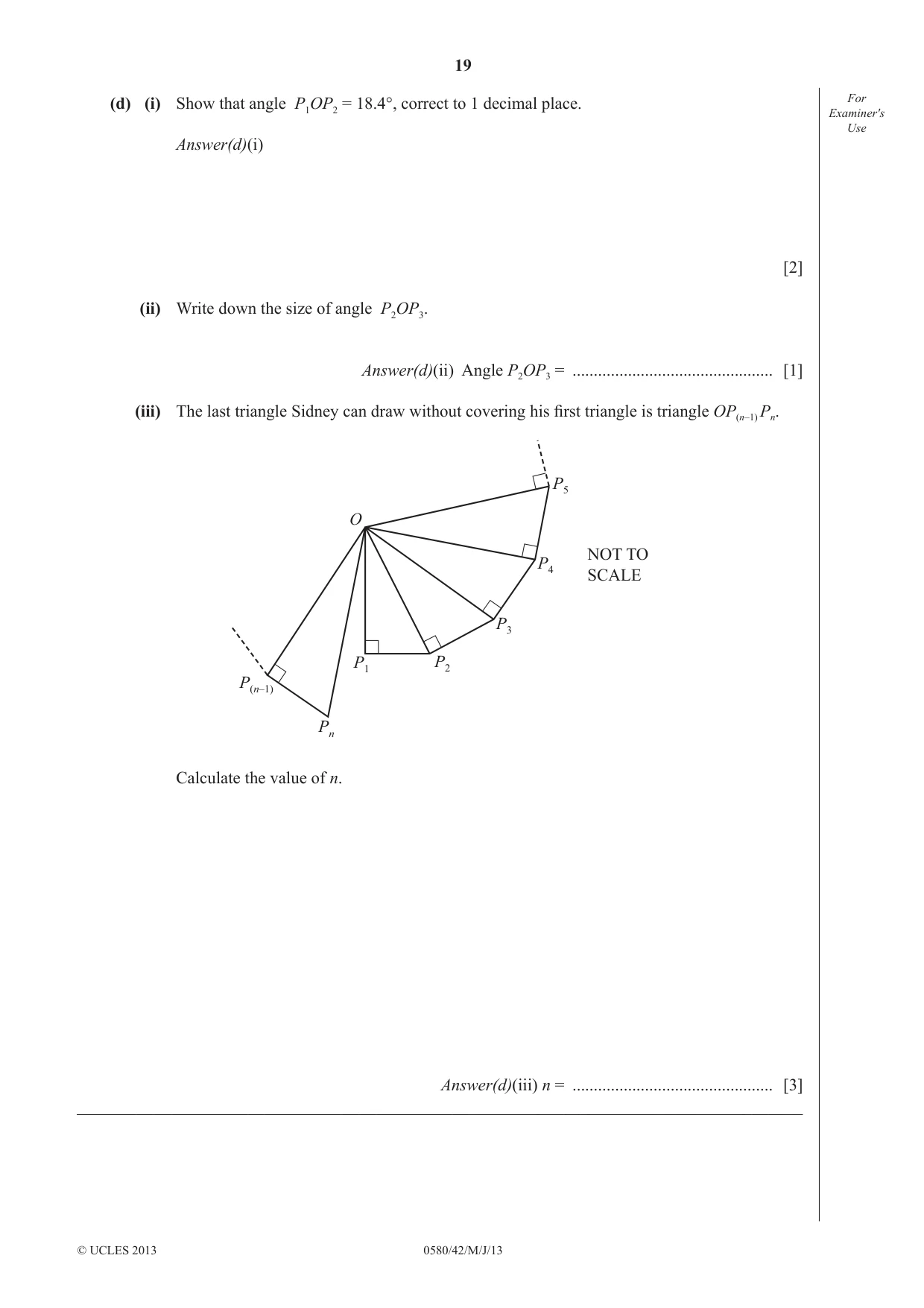
11 Sidney draws the triangle OP1 P2. O For Examiner′s OP1 = 3 cm and P1 P2 = 1 cm. Use NOT TO Angle OP1 P2 = 90°. SCALE 3 cm P1 P2 1 cm (a) Show that OP2 = 10 cm. Answer(a) [1] (b) Sidney now draws the lines P2 P3 and OP3. O Triangle OP2 P3 is mathematically similar NOT TO to triangle OP1 P2. SCALE 3 cm P3 P1 1 cm P2 a (i) Write down the length of P2 P3 in the form where a and b are integers. b Answer(b)(i) P2 P3 = ......................................... cm [1] c (ii) Calculate the length of OP3 giving your answer in the form where c and d are integers. d Answer(b)(ii) OP3 = ......................................... cm [2] (c) Sidney continues to add P5 mathematically similar triangles to his drawing. O NOT TO Find the length of OP5. P4 SCALE 3 cm P3 P1 1 cm P2 Answer(c) OP5 = ......................................... cm [2] (d) (i) Show that angle P1OP2 = 18.4°, correct to 1 decimal place. For Examiner′s Use Answer(d)(i) [2] (ii) Write down the size of angle P2OP3. Answer(d)(ii) Angle P2OP3 = ............................................... [1] (iii) The last triangle Sidney can draw without covering his fi rst triangle is triangle OP(n–1) Pn. P5 O NOT TO P4 SCALE P3 P1 P2 P(n–1) Pn Calculate the value of n. Answer(d)(iii) n = ............................................... [3] _____________________________________________________________________________________
Mark scheme: 11 (a) 32 + 12 1 Ignore attempt to evaluate 10 10 (b) (i) final answer 1 3 10 10 (ii) final answer 2 M1 for their × 10 or 3 3 2 10 2 their 3 + ( 10 ) implied by 3.33 seen n 100 19 10 or 3 (c) oe where n is 3 or 4 27 27 isw conversion 2 M1 for 3 × 3 1000 or 3.7[03] to 3.7[04] or for [OP4 = ] 81 n 10 where n is 1 or 2 or for their (b)(ii) × 3 1 (d) (i) 18.43... 2 M1 for tan [P1OP2] = oe 3 (ii) 18.4[3…] 1 (iii) 20 3 SC2 for 19 360 or M1 for 184.[3...]
What was in this paper
The subtopics covered by these 2 questions, and how many questions each got. Open one in a new tab to see every Cambridge question on it.
What you needed in this session
Cambridge’s own grade thresholds for 2013 May/June, Paper 4 · Variant 2. A higher threshold means an easier paper — the bar moves with how the cohort did.