Cambridge IGCSE Mathematics 0580 — 2019 Oct/Nov Paper 4 · Variant 1
0580/41/O/N/19 · 10 questions · 130 marks · ≈146 min
The question paper and its mark scheme, free to read here and free to download. This is Cambridge’s own paper, exactly as it was sat.
Question paper16 pages
Mark scheme8 pages
Answers below. Sit the paper first if you are practising.
Questions as text
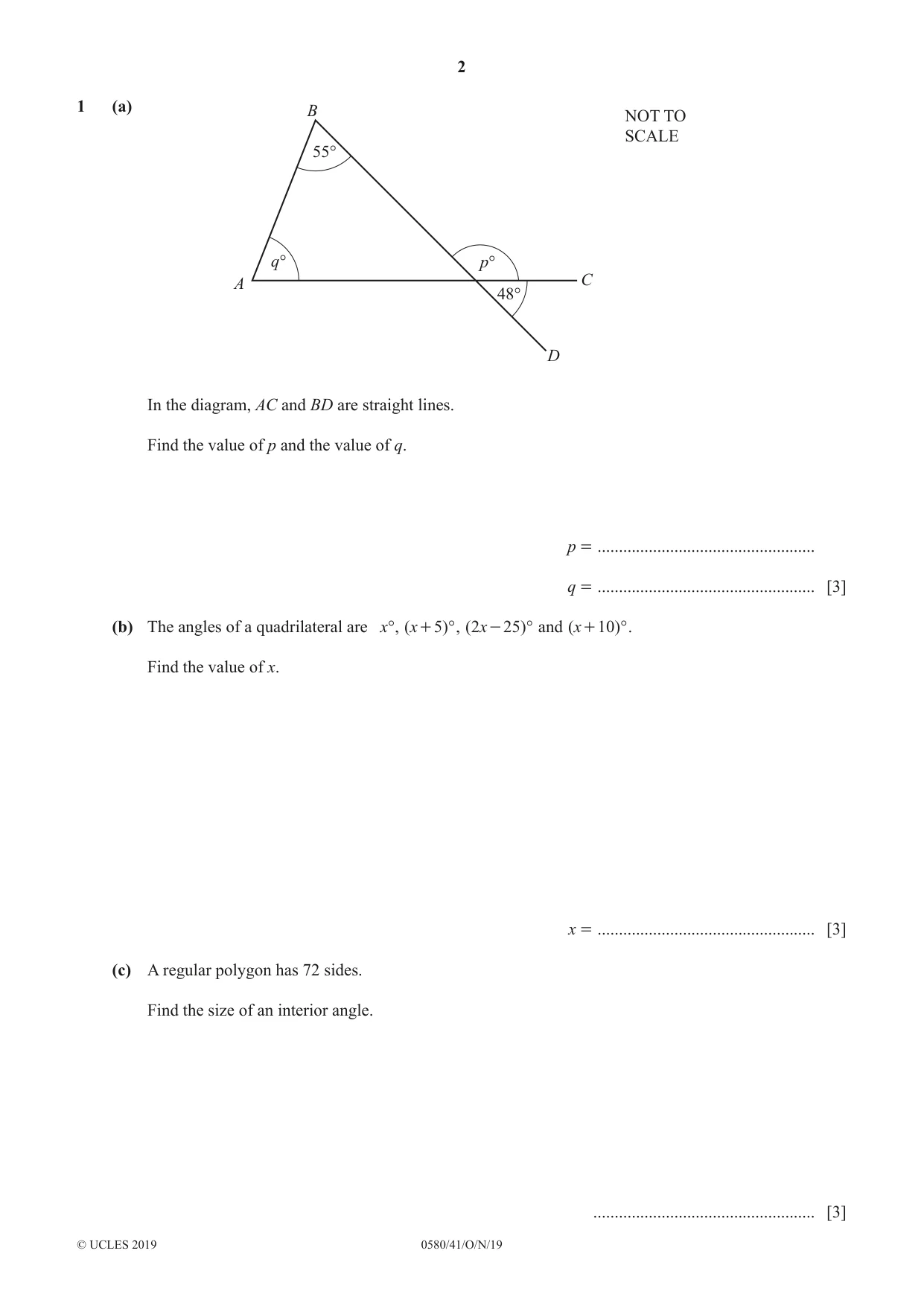
Q1 · B NOT TO SCALE 55° q° p° A C 48° D In the diagram, AC and BD are straight lines
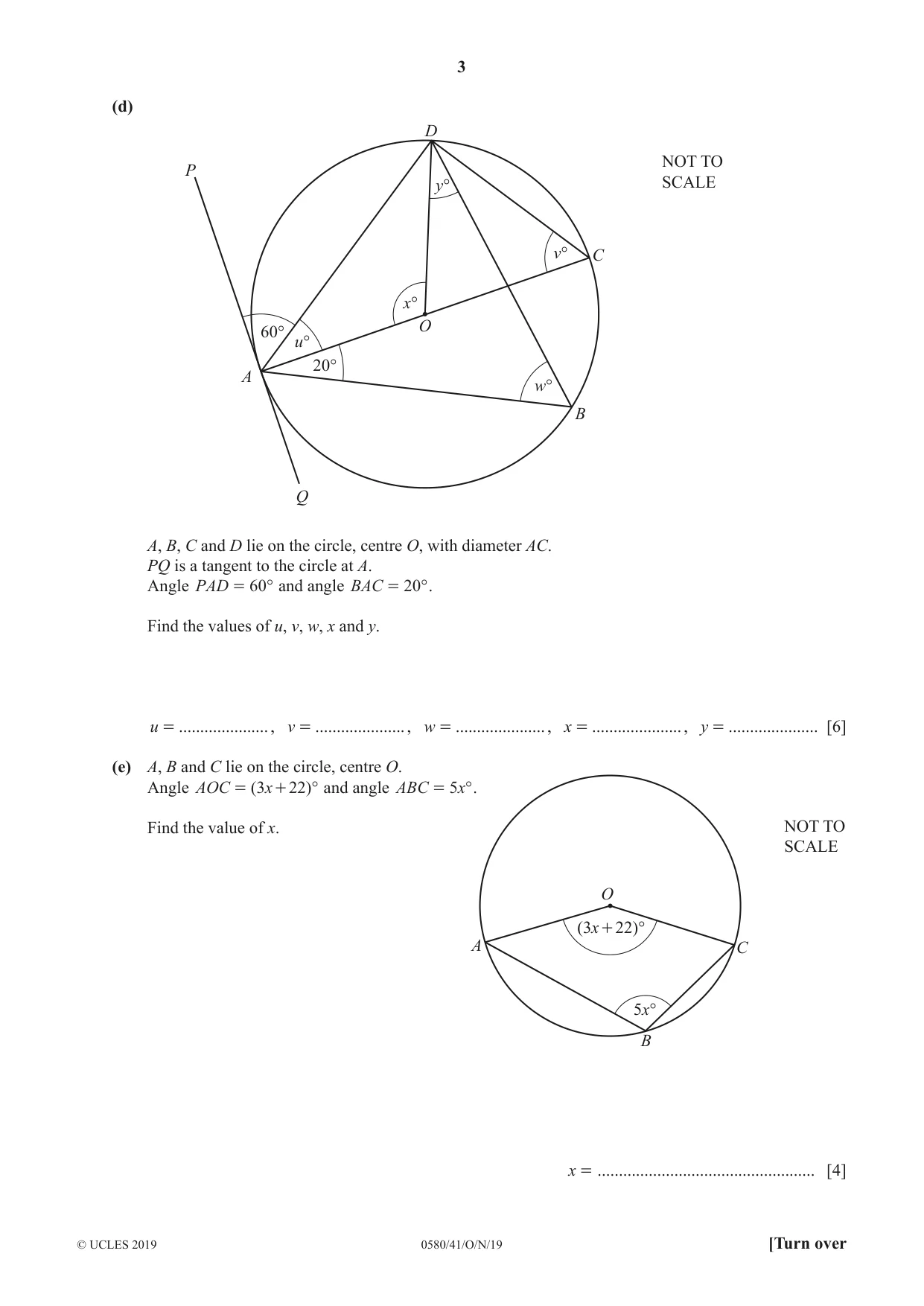
1 (a) B NOT TO SCALE 55° q° p° A C 48° D In the diagram, AC and BD are straight lines. Find the value of p and the value of q. p = ................................................... q = ................................................... [3] (b) The angles of a quadrilateral are x°, (x + 5)° , (2x - 25)° and (x + 10)° . Find the value of x. x = ................................................... [3] (c) A regular polygon has 72 sides. Find the size of an interior angle. .................................................... [3] (d) D NOT TO P y° SCALE v° C x° O 60° u° 20° A w° B Q A, B, C and D lie on the circle, centre O, with diameter AC. PQ is a tangent to the circle at A. Angle PAD = 60° and angle BAC = 20° . Find the values of u, v, w, x and y. u = ..................... , v = ..................... , w = ..................... , x = ..................... , y = ..................... [6] (e) A, B and C lie on the circle, centre O. Angle AOC = (3x + 22) ° and angle ABC = 5x° . Find the value of x. NOT TO SCALE O (3x + 22)° A C 5x° B x = ................................................... [4]
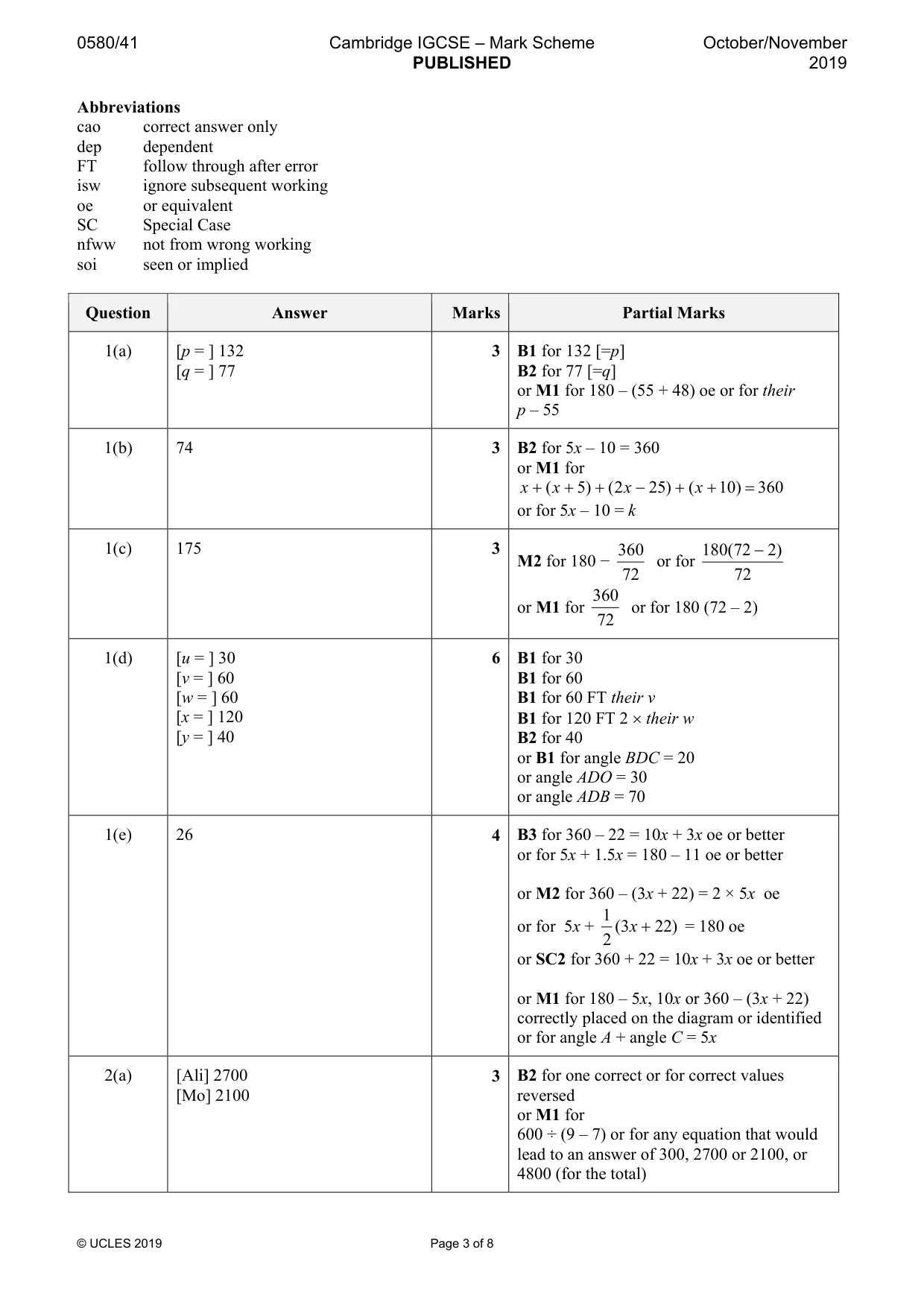
Mark scheme: Question Answer Marks Partial Marks 1(a) [p = ] 132 3 B1 for 132 [=p] [q = ] 77 B2 for 77 [=q] or M1 for 180 – (55 + 48) oe or for their p – 55 1(b) 74 3 B2 for 5x – 10 = 360 or M1 for x + ( x + 5) + ( 2 x − 25) + ( x + 10) = 360 or for 5x – 10 = k 1(c) 175 3 360 180( 72 − 2 ) M2 for 180 − or for 72 72 360 or M1 for or for 180 (72 – 2) 72 1(d) [u = ] 30 6 B1 for 30 [v = ] 60 B1 for 60 [w = ] 60 B1 for 60 FT their v [x = ] 120 B1 for 120 FT 2 × their w [y = ] 40 B2 for 40 or B1 for angle BDC = 20 or angle ADO = 30 or angle ADB = 70 1(e) 26 4 B3 for 360 – 22 = 10x + 3x oe or better or for 5x + 1.5x = 180 – 11 oe or better or M2 for 360 – (3x + 22) = 2 × 5x oe 1 or for 5x + (3 x + 22) = 180 oe 2 or SC2 for 360 + 22 = 10x + 3x oe or better or M1 for 180 – 5x, 10x or 360 – (3x + 22) correctly placed on the diagram or identified or for angle A + angle C = 5x
Q2 · Ali and Mo share a sum of money in the ratio Ali : Mo = 9 : 7
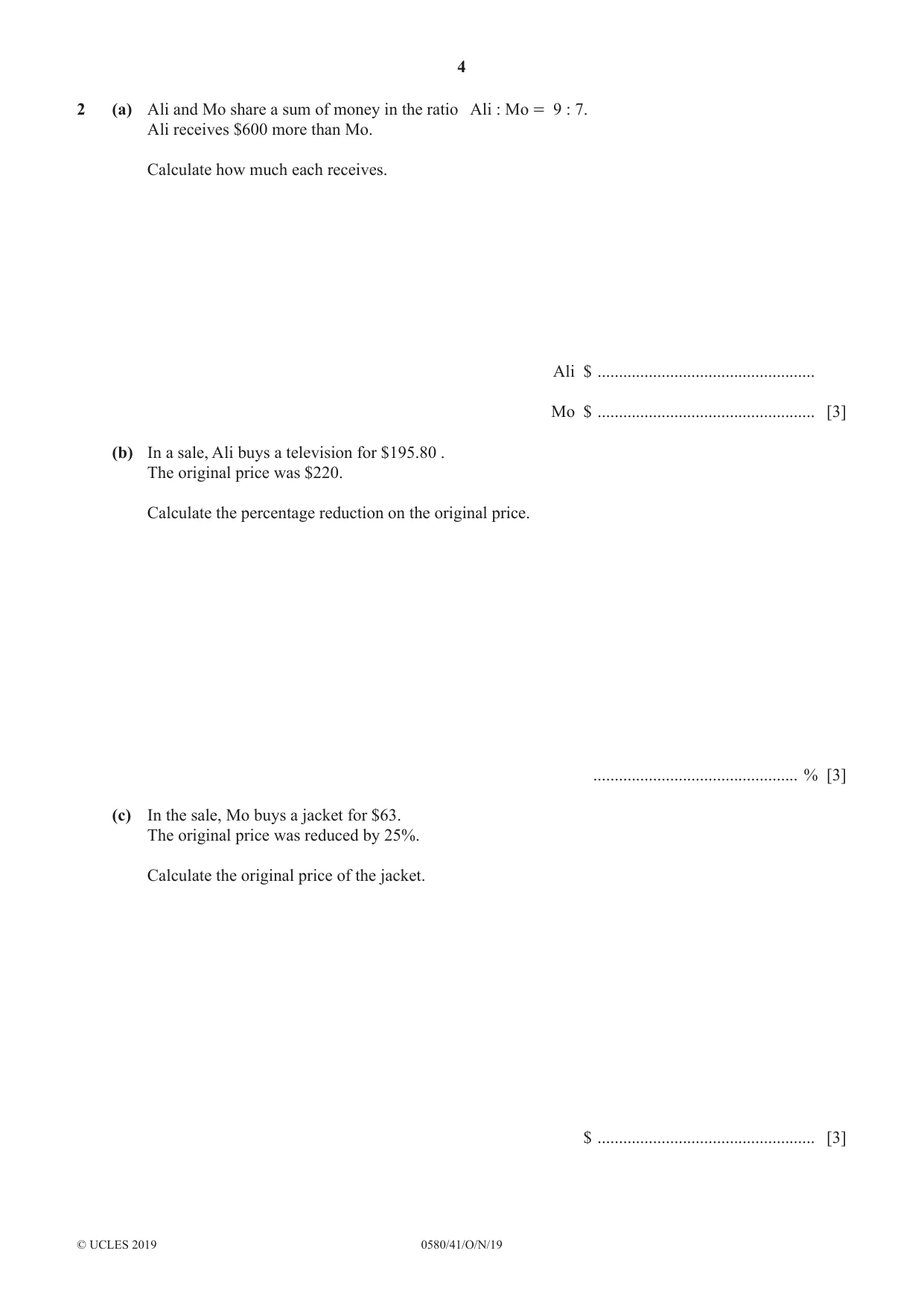
2 (a) Ali and Mo share a sum of money in the ratio Ali : Mo = 9 : 7. Ali receives $600 more than Mo. Calculate how much each receives. Ali $ ................................................... Mo $ ................................................... [3] (b) In a sale, Ali buys a television for $195.80 . The original price was $220. Calculate the percentage reduction on the original price. ................................................ % [3] (c) In the sale, Mo buys a jacket for $63. The original price was reduced by 25%. Calculate the original price of the jacket. $ ................................................... [3]
Mark scheme: 2(a) [Ali] 2700 3 B2 for one correct or for correct values [Mo] 2100 reversed or M1 for 600 ÷ (9 – 7) or for any equation that would lead to an answer of 300, 2700 or 2100, or 4800 (for the total) 2(b) 11 3 220 − 1958. M2 for [× 100] or for 220 1958. [100 − ] × 100 220 195 8. or M1 for 220 – 195.8 or for or a 220 correct implicit equation for percentage 195.8 − 220 reduction or for 220 2(c) 84 3 63 M2 for oe 25 1 − 100 or M1 for associating 63 with (100 – 25)% or a correct implicit equation for the original price.
Q3 · Dina invests $600 for 5 years at a rate of 2% per year compound interest
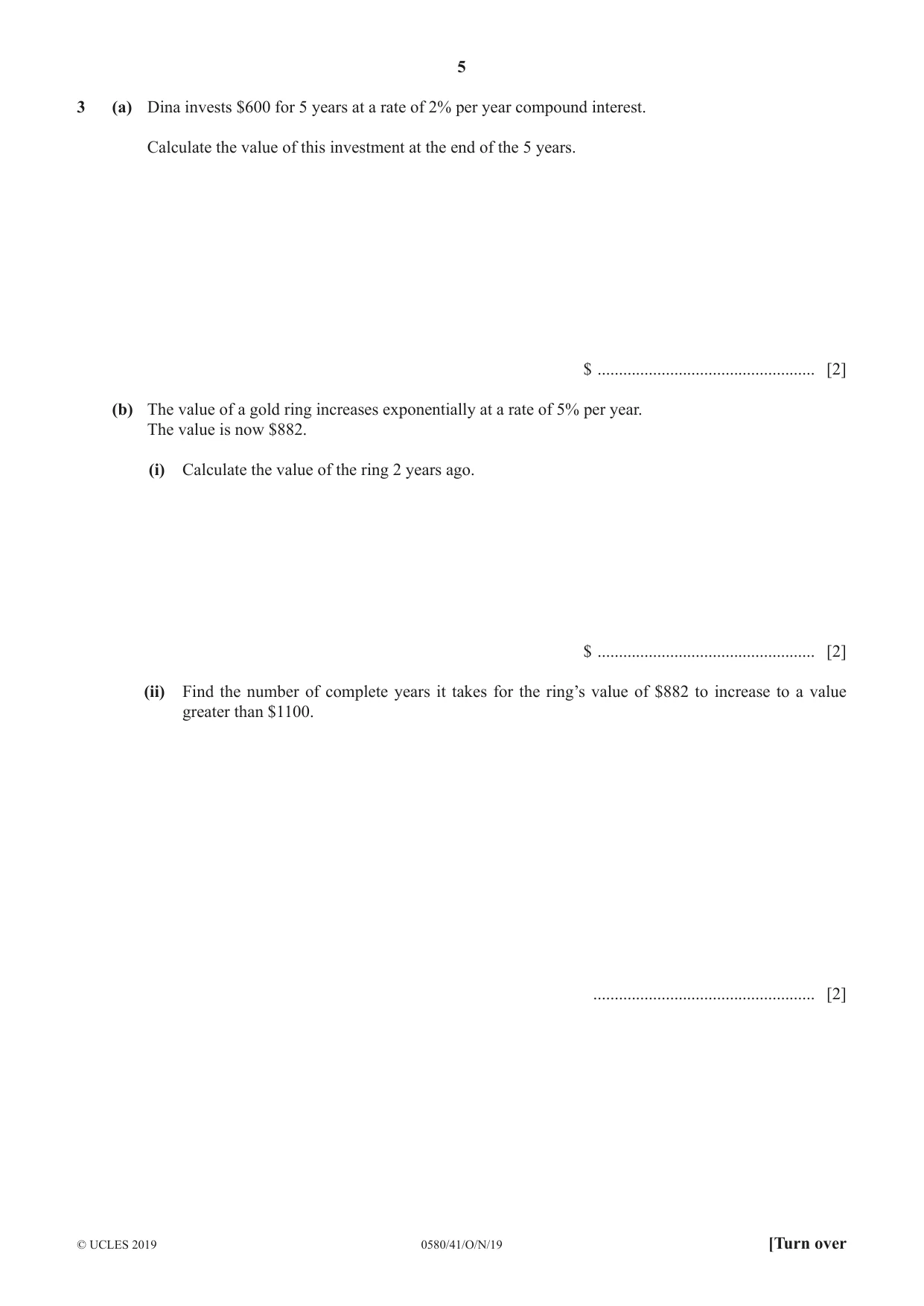
3 (a) Dina invests $600 for 5 years at a rate of 2% per year compound interest. Calculate the value of this investment at the end of the 5 years. $ ................................................... [2] (b) The value of a gold ring increases exponentially at a rate of 5% per year. The value is now $882. (i) Calculate the value of the ring 2 years ago. $ ................................................... [2] (ii) Find the number of complete years it takes for the ring’s value of $882 to increase to a value greater than $1100. .................................................... [2]
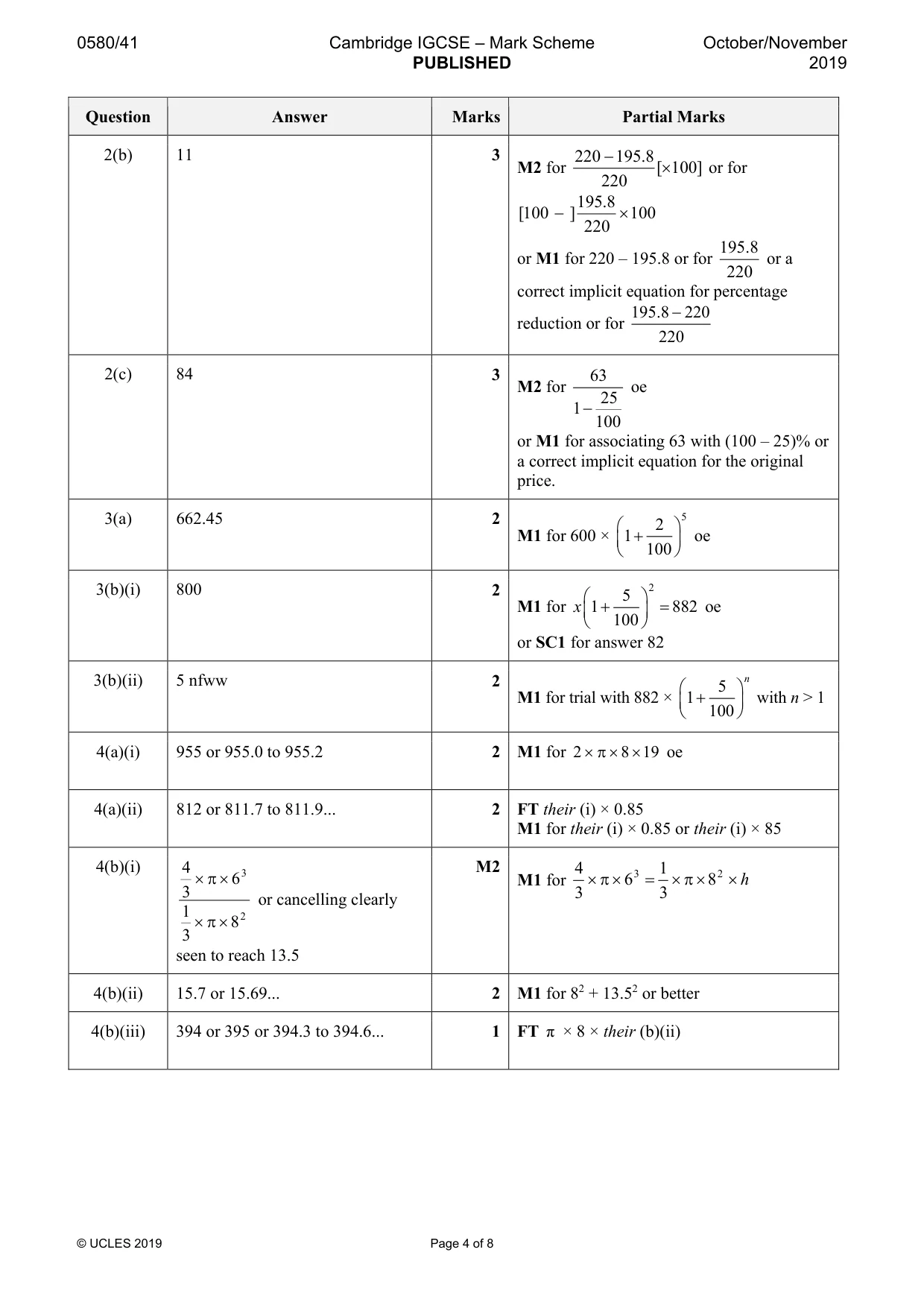
Mark scheme: 3(a) 662.45 2 5 2 M1 for 600 × 1 + oe 100 3(b)(i) 800 2 2 5 M1 for x 1 + = 882 oe 100 or SC1 for answer 82 3(b)(ii) 5 nfww 2 n 5 M1 for trial with 882 × 1 + with n > 1 100
Q4 · Calculate the external curved surface area of a cylinder with radius 8 m and height 19 m
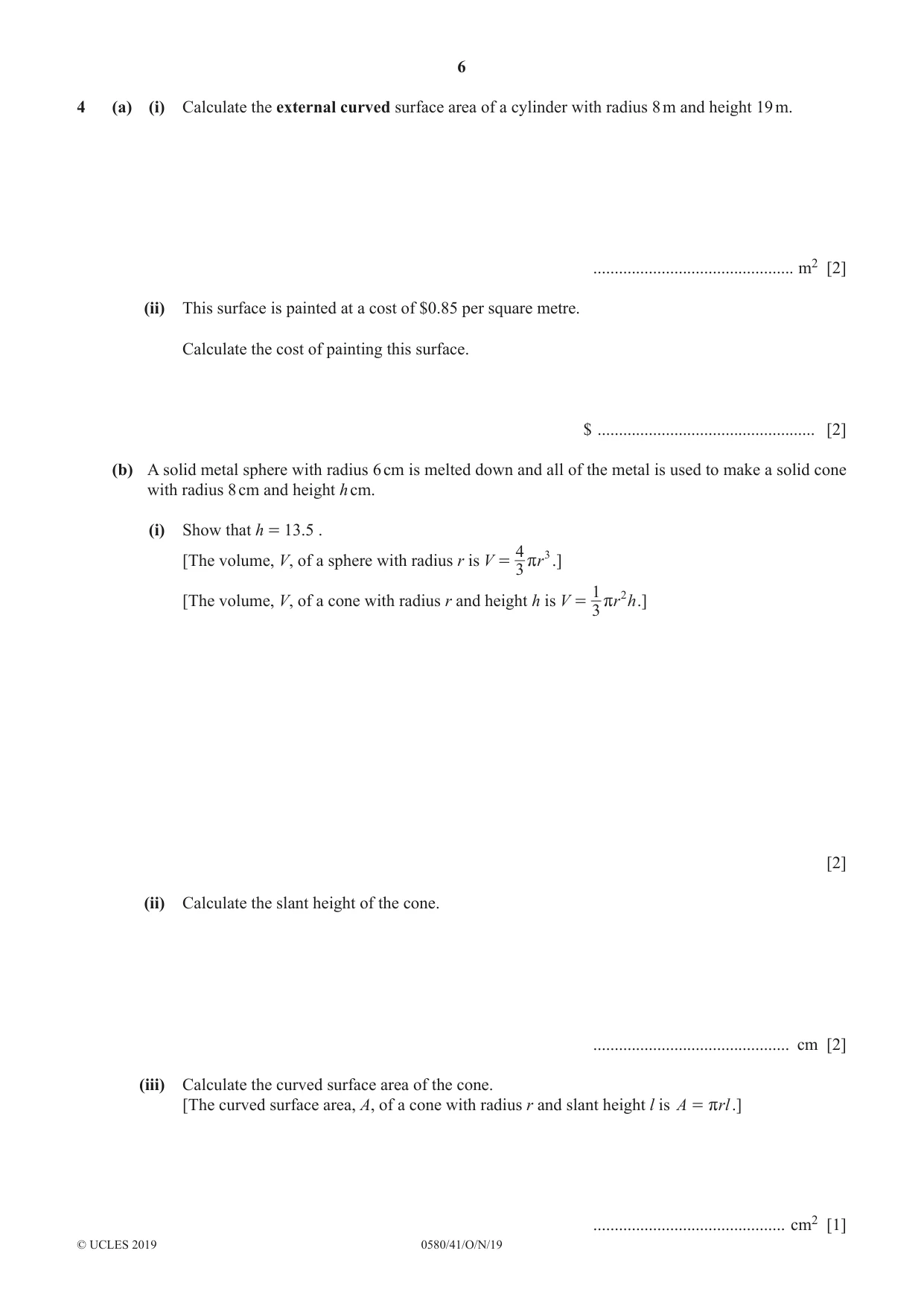
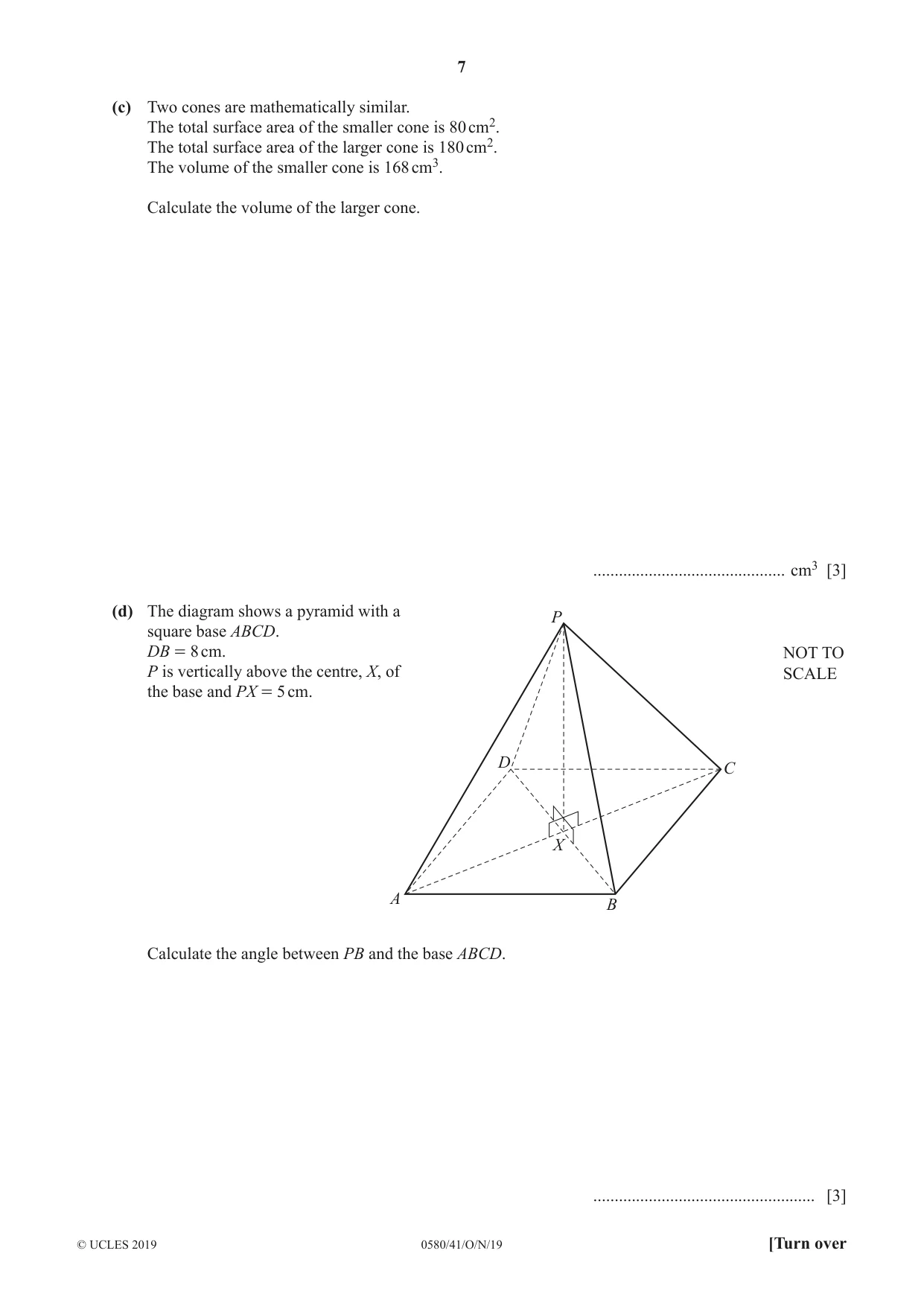
4 (a) (i) Calculate the external curved surface area of a cylinder with radius 8 m and height 19 m. ............................................... m2 [2] (ii) This surface is painted at a cost of $0.85 per square metre. Calculate the cost of painting this surface. $ ................................................... [2] (b) A solid metal sphere with radius 6 cm is melted down and all of the metal is used to make a solid cone with radius 8 cm and height h cm. (i) Show that h = 13.5 . 4 3 [The volume, V, of a sphere with radius r is V = r r .] 3 1 2 [The volume, V, of a cone with radius r and height h is V = r r h .] 3 [2] (ii) Calculate the slant height of the cone. .............................................. cm [2] (iii) Calculate the curved surface area of the cone. [The curved surface area, A, of a cone with radius r and slant height l is A = r rl .] ............................................. cm2 [1] (c) Two cones are mathematically similar. The total surface area of the smaller cone is 80 cm2. The total surface area of the larger cone is 180 cm2. The volume of the smaller cone is 168 cm3. Calculate the volume of the larger cone. ............................................. cm3 [3] (d) The diagram shows a pyramid with a P square base ABCD. DB = 8 cm. NOT TO P is vertically above the centre, X, of SCALE the base and PX = 5 cm. D C X A B Calculate the angle between PB and the base ABCD. .................................................... [3]
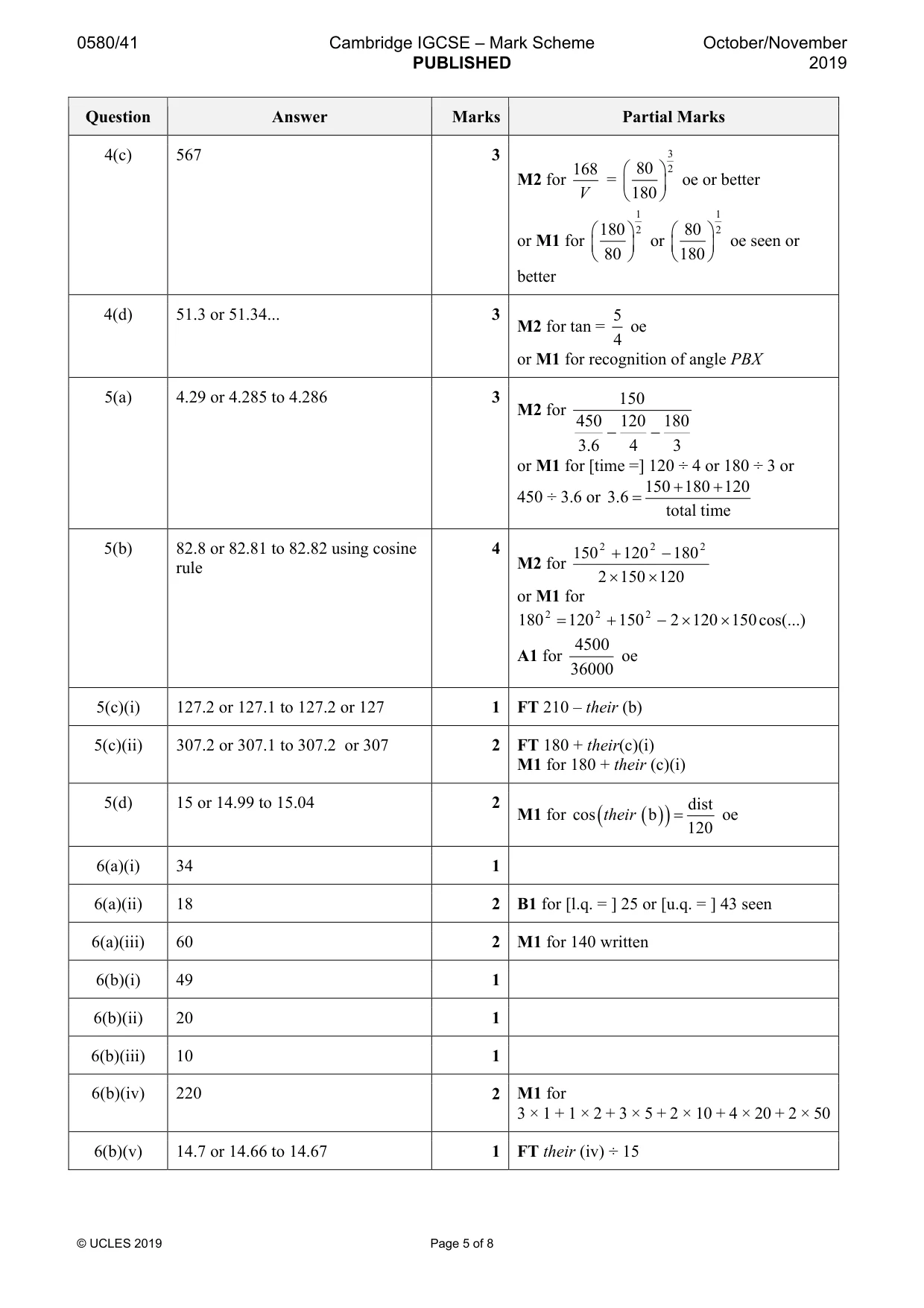
Mark scheme: 4(a)(i) 955 or 955.0 to 955.2 2 M1 for 2 × π × 8 × 19 oe 4(a)(ii) 812 or 811.7 to 811.9... 2 FT their (i) × 0.85 M1 for their (i) × 0.85 or their (i) × 85 4(b)(i) 4 3 M2 4 3 1 2 × π × 6 M1 for × π × 6 = × π × 8 × h 3 3 3 or cancelling clearly 1 2 × π × 8 3 seen to reach 13.5 4(b)(ii) 15.7 or 15.69... 2 M1 for 82 + 13.52 or better 4(b)(iii) 394 or 395 or 394.3 to 394.6... 1 FT π × 8 × their (b)(ii) 4(c) 567 3 3 168 80 2 M2 for = oe or better V 180 1 1 180 2 80 2 or M1 for or oe seen or 80 180 better 4(d) 51.3 or 51.34... 3 5 M2 for tan = oe 4 or M1 for recognition of angle PBX
Q5 · North NOT TO SCALE A 120 m 150 m B 180 m C The diagram shows a triangular field, ABC, on…
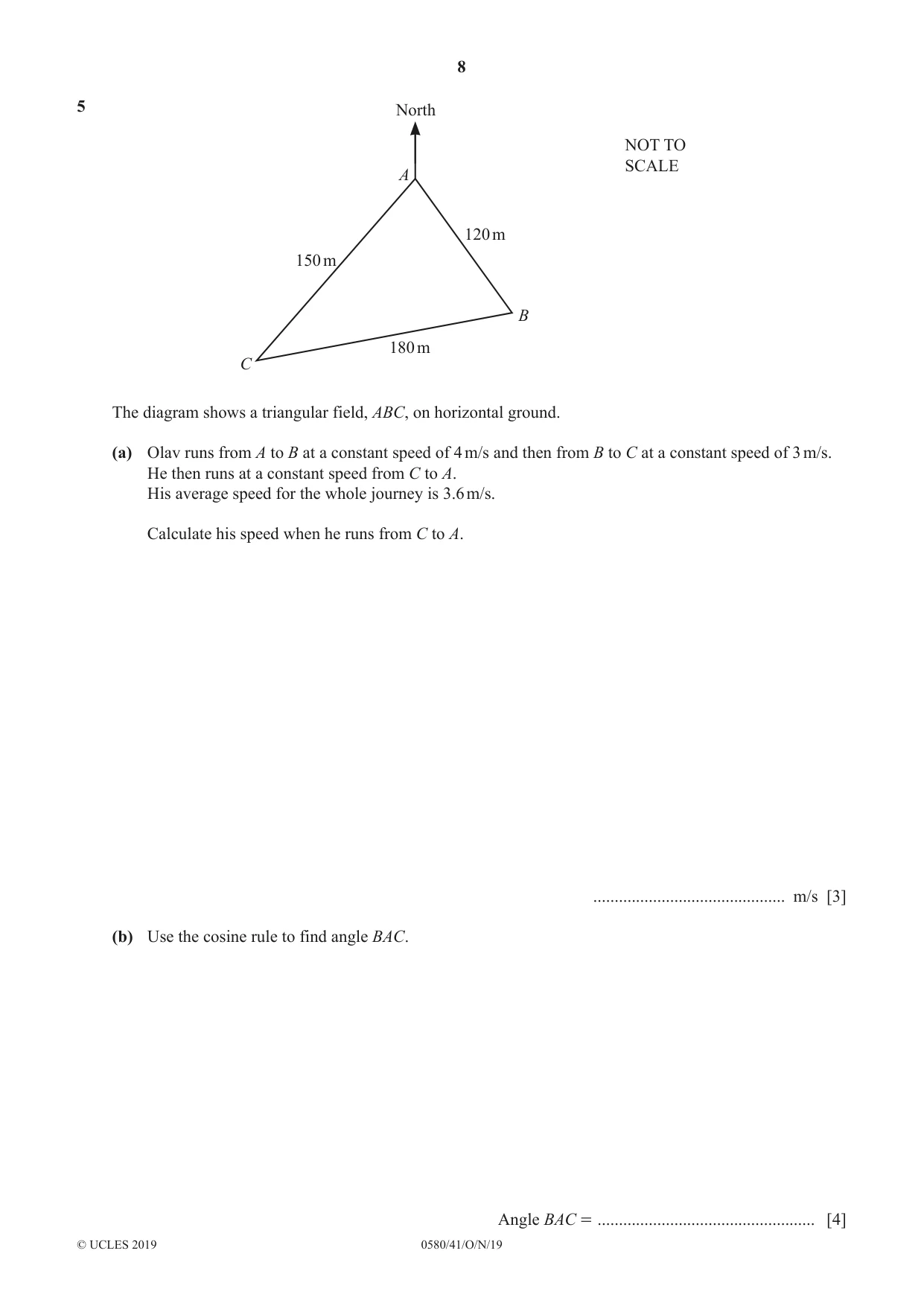
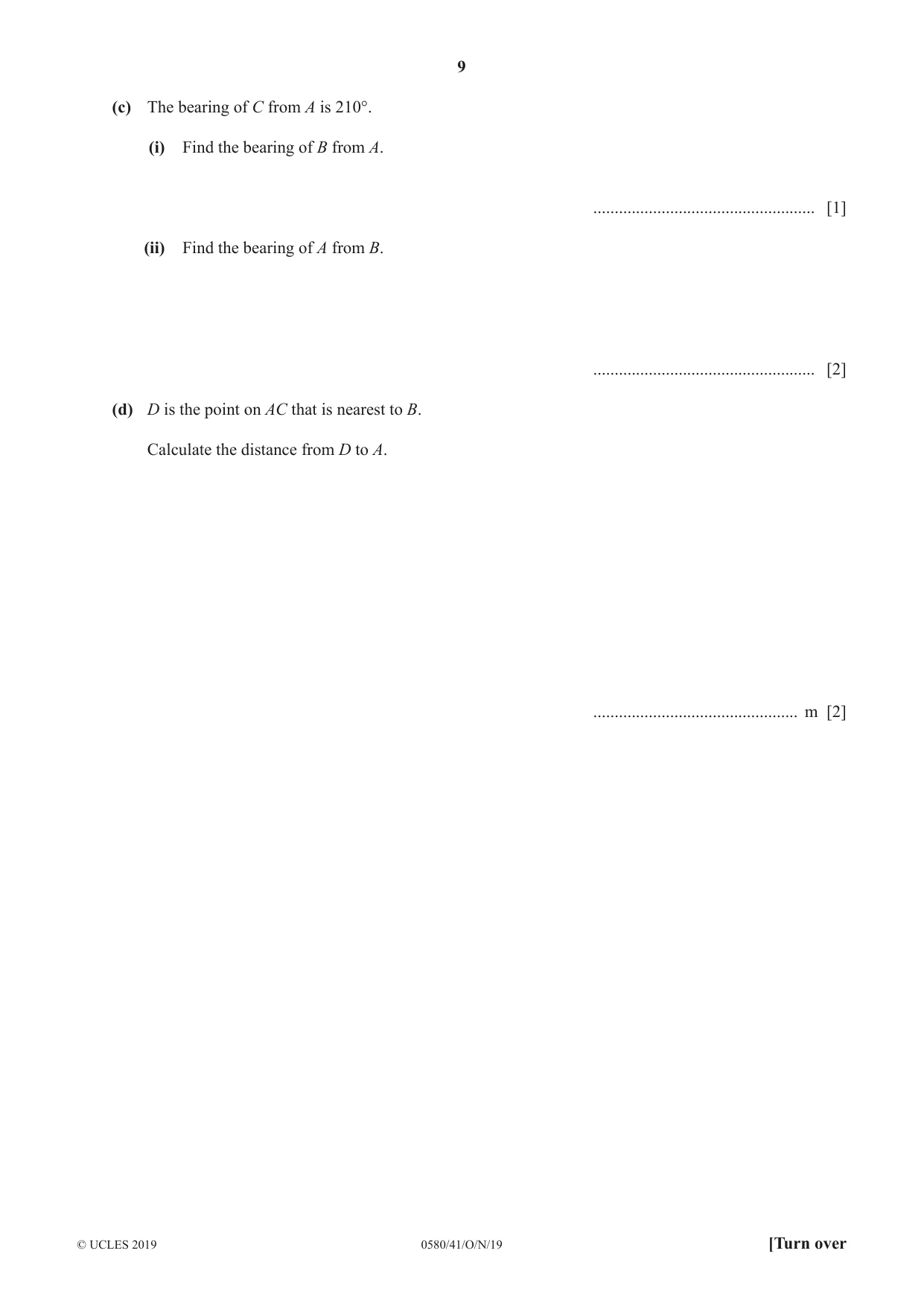
5 North NOT TO SCALE A 120 m 150 m B 180 m C The diagram shows a triangular field, ABC, on horizontal ground. (a) Olav runs from A to B at a constant speed of 4 m/s and then from B to C at a constant speed of 3 m/s. He then runs at a constant speed from C to A. His average speed for the whole journey is 3.6 m/s. Calculate his speed when he runs from C to A. ............................................. m/s [3] (b) Use the cosine rule to find angle BAC. Angle BAC = ................................................... [4] (c) The bearing of C from A is 210°. (i) Find the bearing of B from A. .................................................... [1] (ii) Find the bearing of A from B. .................................................... [2] (d) D is the point on AC that is nearest to B. Calculate the distance from D to A. ................................................ m [2]
Mark scheme: 5(a) 4.29 or 4.285 to 4.286 3 150 M2 for 450 120 180 − − 6.3 4 3 or M1 for [time =] 120 ÷ 4 or 180 ÷ 3 or 150 + 180 + 120 450 ÷ 3.6 or 3.6 = total time 5(b) 82.8 or 82.81 to 82.82 using cosine 4 150 2 + 120 2 − 180 2 M2 for rule 2 × 150 × 120 or M1 for 180 2 = 120 2 + 150 2 − 2 × 120 × 150 cos(...) 4500 A1 for oe 36000 5(c)(i) 127.2 or 127.1 to 127.2 or 127 1 FT 210 – their (b) 5(c)(ii) 307.2 or 307.1 to 307.2 or 307 2 FT 180 + their(c)(i) M1 for 180 + their (c)(i) 5(d) 15 or 14.99 to 15.04 2 dist M1 for cos ( their ( b ) ) = oe 120
Q6 · The cumulative frequency diagram shows information about the times taken by 200 students…
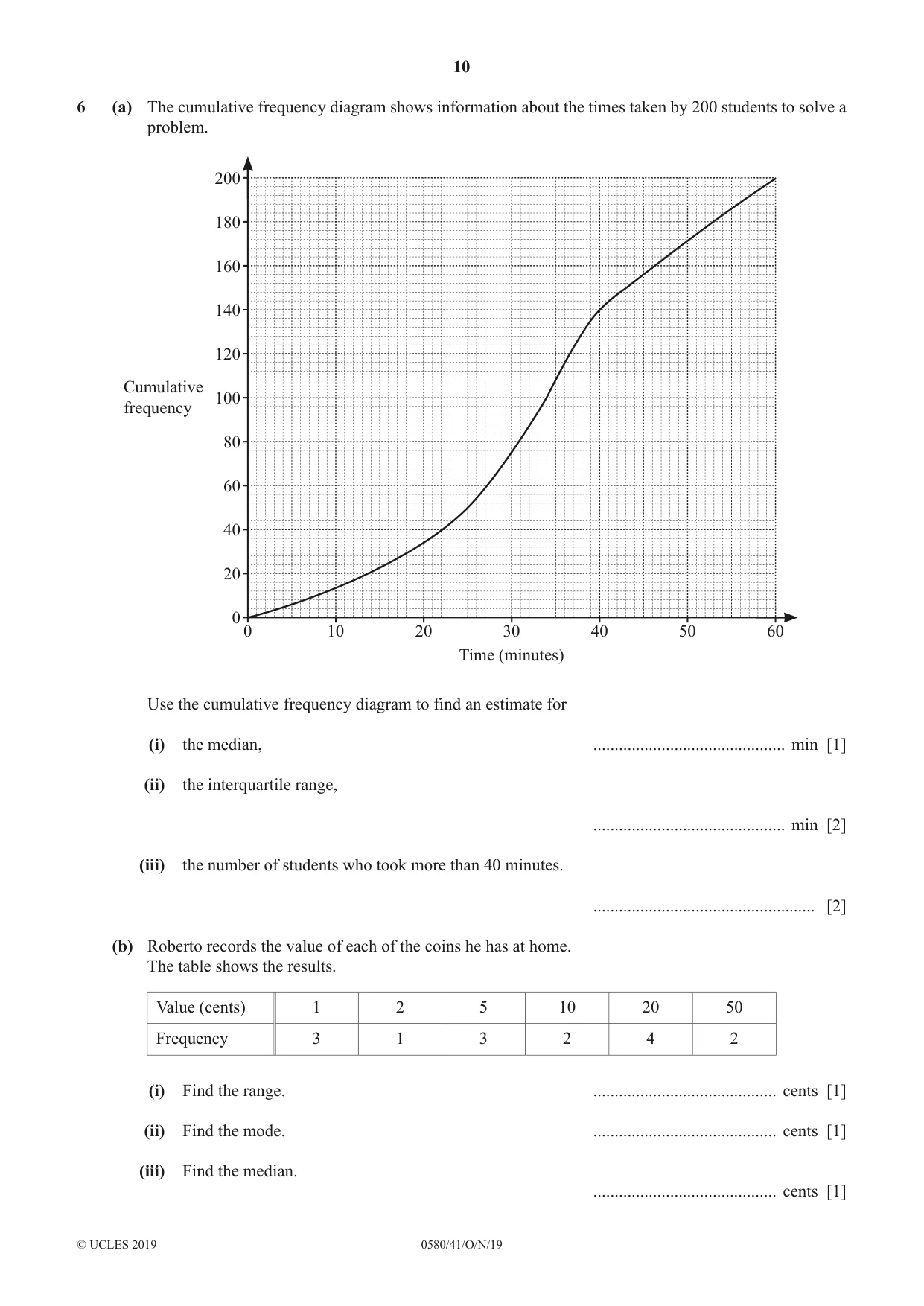
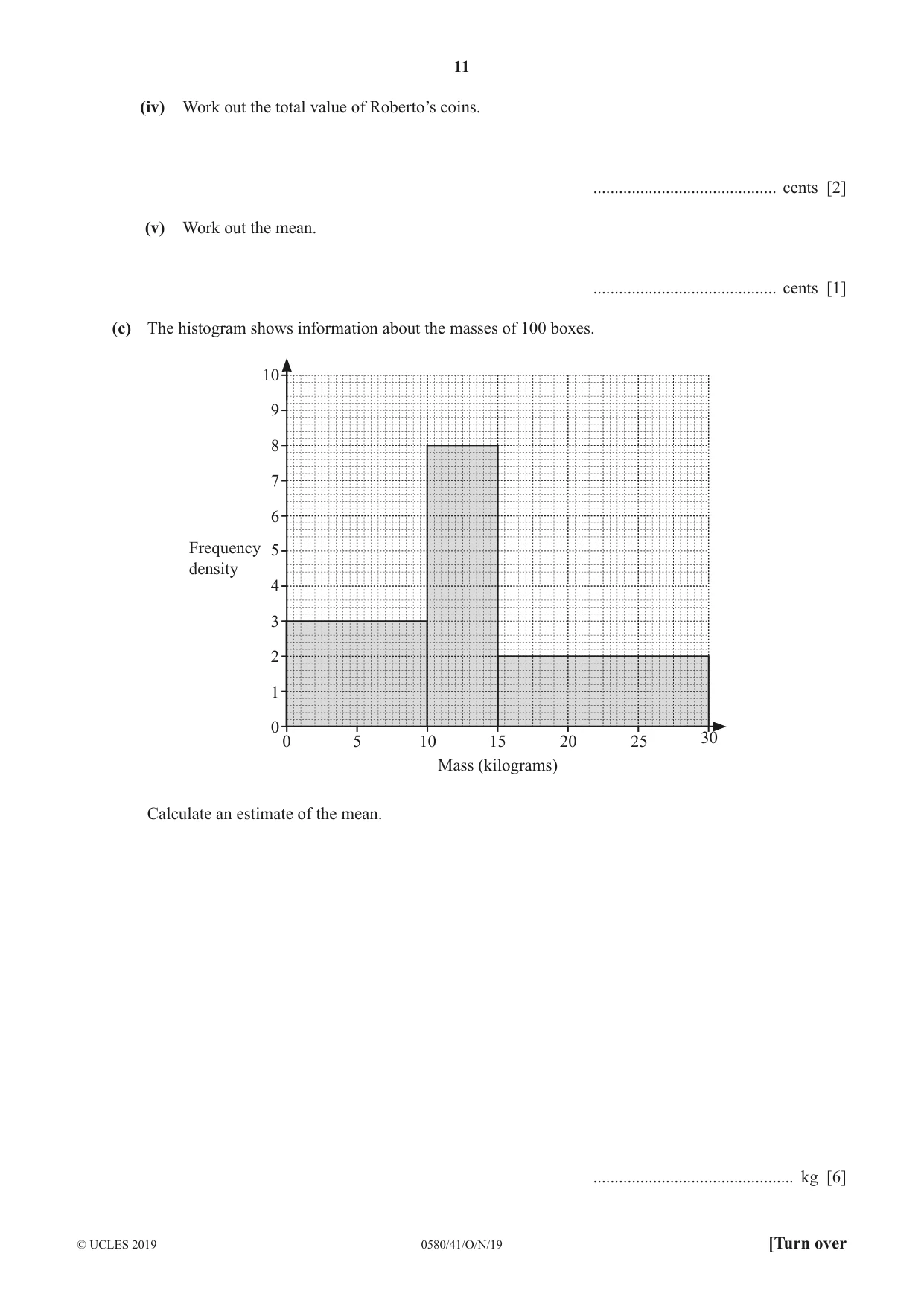
6 (a) The cumulative frequency diagram shows information about the times taken by 200 students to solve a problem. 200 180 160 140 120 Cumulative 100 frequency 80 60 40 20 0 0 10 20 30 40 50 60 Time (minutes) Use the cumulative frequency diagram to find an estimate for (i) the median, ............................................. min [1] (ii) the interquartile range, ............................................. min [2] (iii) the number of students who took more than 40 minutes. .................................................... [2] (b) Roberto records the value of each of the coins he has at home. The table shows the results. Value (cents) 1 2 5 10 20 50 Frequency 3 1 3 2 4 2 (i) Find the range. ........................................... cents [1] (ii) Find the mode. ........................................... cents [1] (iii) Find the median. ........................................... cents [1] (iv) Work out the total value of Roberto’s coins. ........................................... cents [2] (v) Work out the mean. ........................................... cents [1] (c) The histogram shows information about the masses of 100 boxes. 10 9 8 7 6 Frequency 5 density 4 3 2 1 0 0 5 10 15 20 25 30 Mass (kilograms) Calculate an estimate of the mean. ............................................... kg [6]
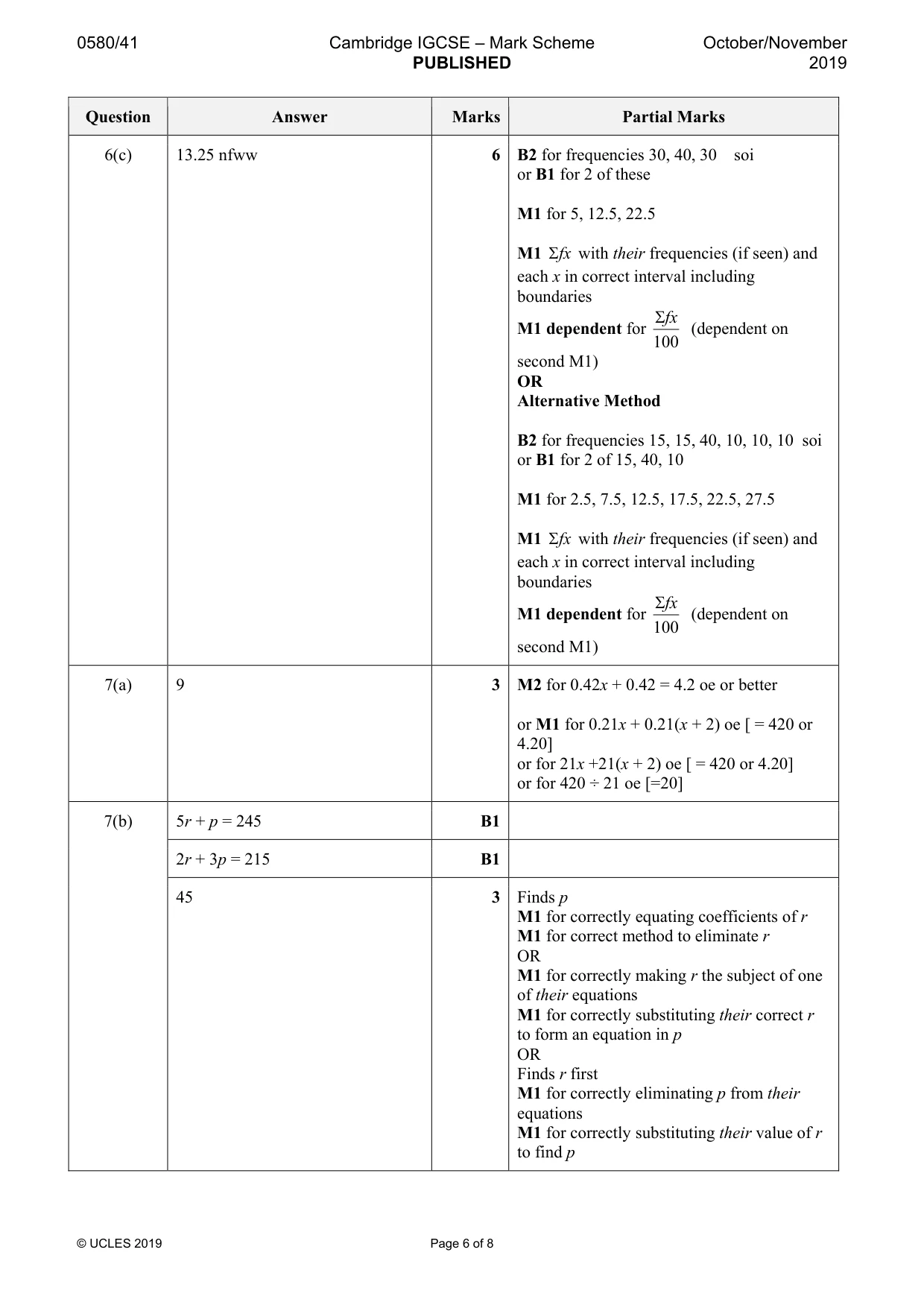
Mark scheme: 6(a)(i) 34 1 6(a)(ii) 18 2 B1 for [l.q. = ] 25 or [u.q. = ] 43 seen 6(a)(iii) 60 2 M1 for 140 written 6(b)(i) 49 1 6(b)(ii) 20 1 6(b)(iii) 10 1 6(b)(iv) 220 2 M1 for 3 × 1 + 1 × 2 + 3 × 5 + 2 × 10 + 4 × 20 + 2 × 50 6(b)(v) 14.7 or 14.66 to 14.67 1 FT their (iv) ÷ 15 6(c) 13.25 nfww 6 B2 for frequencies 30, 40, 30 soi or B1 for 2 of these M1 for 5, 12.5, 22.5 M1 Σ fx with their frequencies (if seen) and each x in correct interval including boundaries Σfx M1 dependent for (dependent on 100 second M1) OR Alternative Method B2 for frequencies 15, 15, 40, 10, 10, 10 soi or B1 for 2 of 15, 40, 10 M1 for 2.5, 7.5, 12.5, 17.5, 22.5, 27.5 M1 Σ fx with their frequencies (if seen) and each x in correct interval including boundaries Σfx M1 dependent for (dependent on 100 second M1)
Q7 · Oranges cost 21 cents each
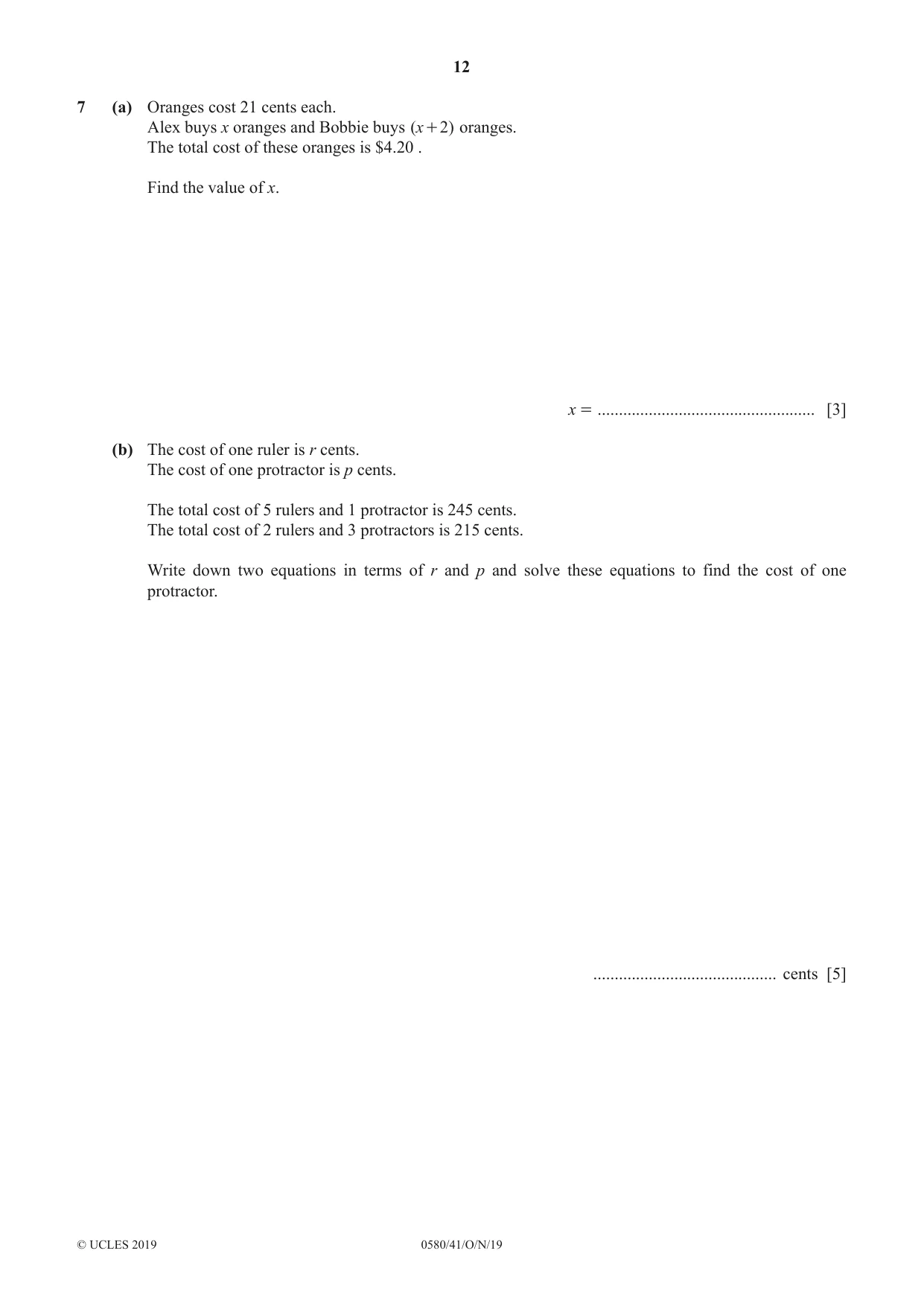
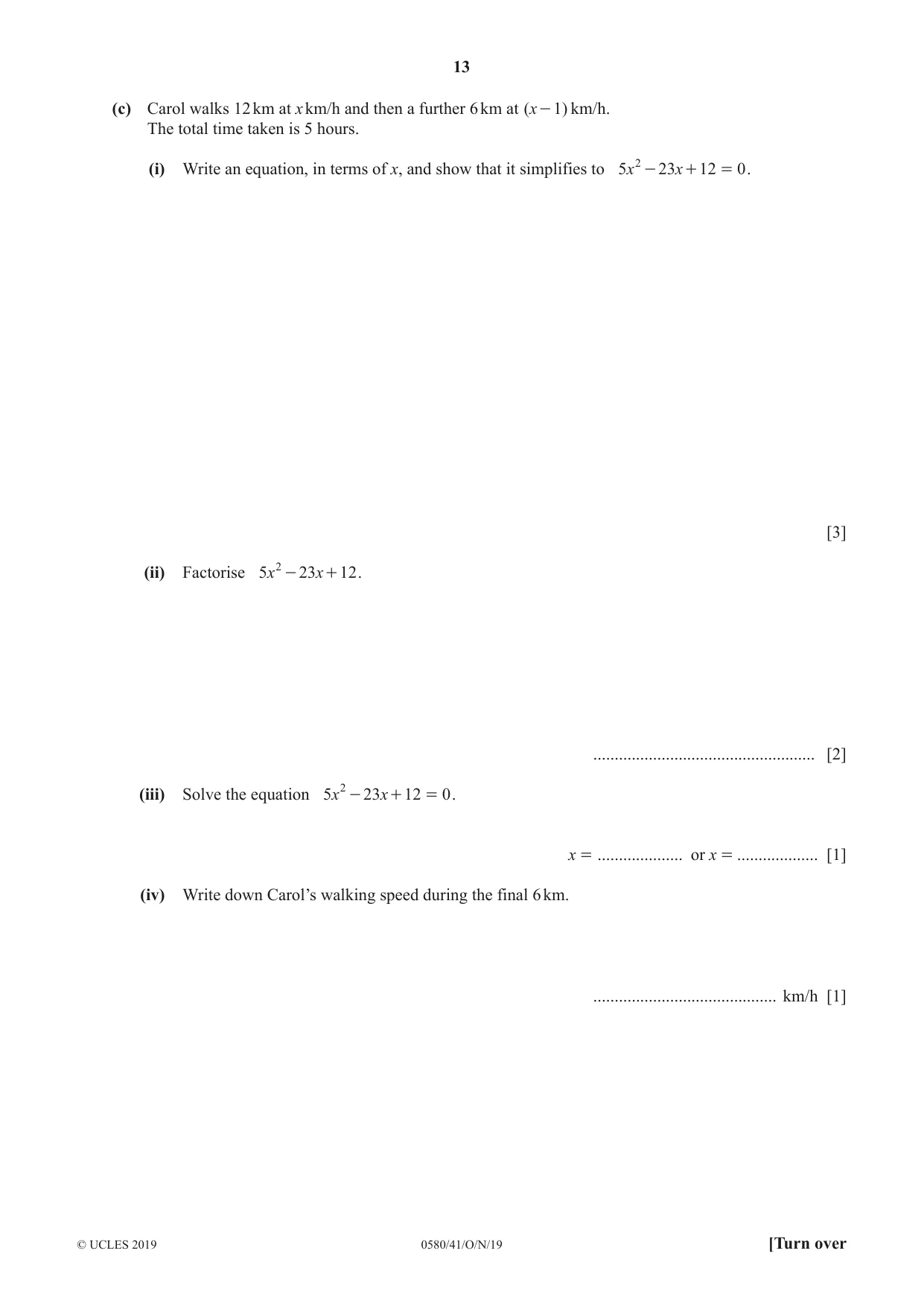
7 (a) Oranges cost 21 cents each. Alex buys x oranges and Bobbie buys (x + 2 ) oranges. The total cost of these oranges is $4.20 . Find the value of x. x = ................................................... [3] (b) The cost of one ruler is r cents. The cost of one protractor is p cents. The total cost of 5 rulers and 1 protractor is 245 cents. The total cost of 2 rulers and 3 protractors is 215 cents. Write down two equations in terms of r and p and solve these equations to find the cost of one protractor. ........................................... cents [5] (c) Carol walks 12 km at x km/h and then a further 6 km at (x - 1 ) km/h. The total time taken is 5 hours. (i) Write an equation, in terms of x, and show that it simplifies to 5x 2 - 23x + 12 = 0 . [3] (ii) Factorise 5x 2 - 23x + 12 . .................................................... [2] (iii) Solve the equation 5x 2 - 23x + 12 = 0 . x = .................... or x = ................... [1] (iv) Write down Carol’s walking speed during the final 6 km. ........................................... km/h [1]
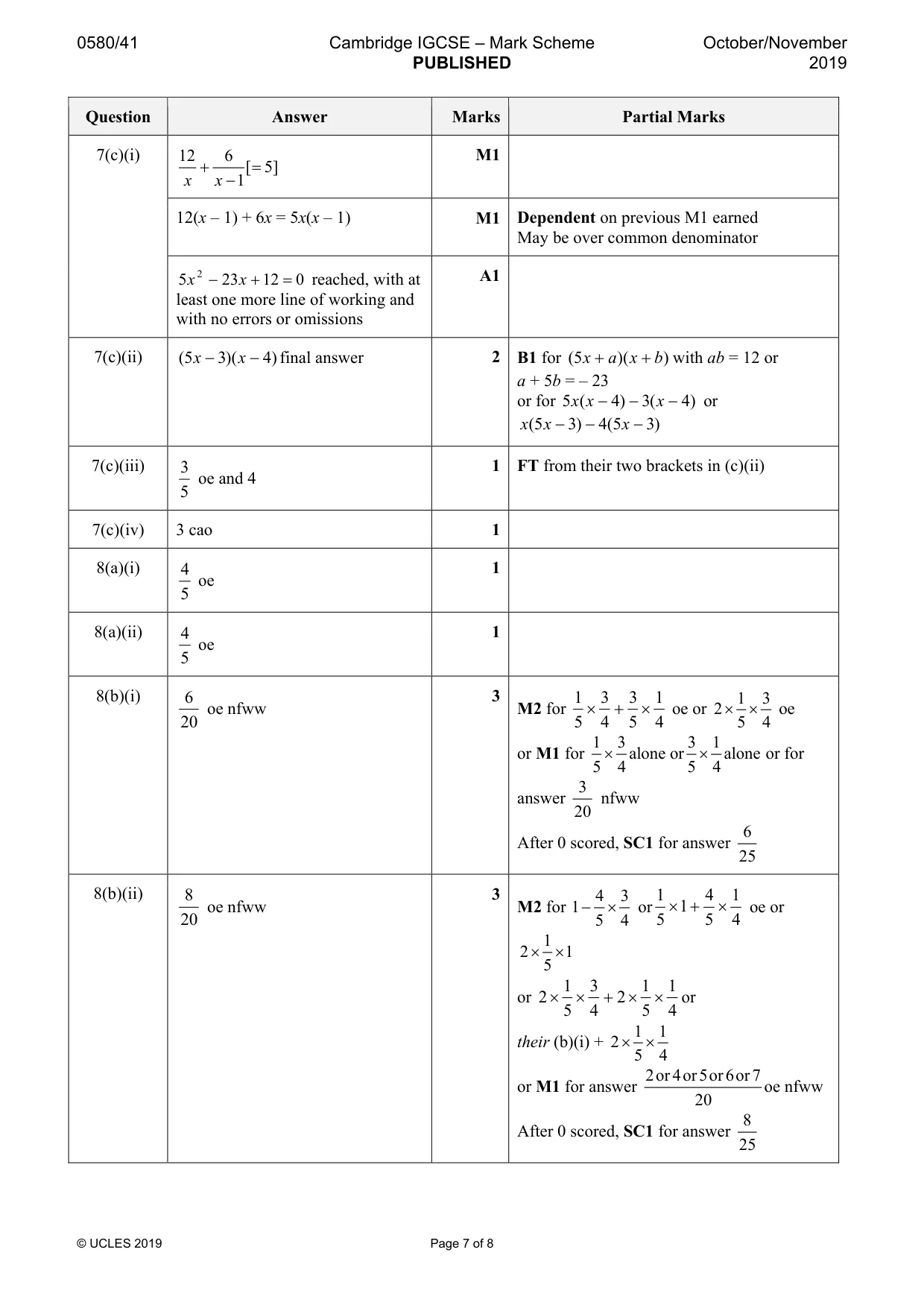
Mark scheme: 7(a) 9 3 M2 for 0.42x + 0.42 = 4.2 oe or better or M1 for 0.21x + 0.21(x + 2) oe [ = 420 or 4.20] or for 21x +21(x + 2) oe [ = 420 or 4.20] or for 420 ÷ 21 oe [=20] 7(b) 5r + p = 245 B1 2r + 3p = 215 B1 45 3 Finds p M1 for correctly equating coefficients of r M1 for correct method to eliminate r OR M1 for correctly making r the subject of one of their equations M1 for correctly substituting their correct r to form an equation in p OR Finds r first M1 for correctly eliminating p from their equations M1 for correctly substituting their value of r to find p 7(c)(i) 12 6 M1 + [ = 5] x x − 1 12(x – 1) + 6x = 5x(x – 1) M1 Dependent on previous M1 earned May be over common denominator 5 x 2 − 23 x + 12 = 0 reached, with at A1 least one more line of working and with no errors or omissions 7(c)(ii) (5 x − 3)( x − 4 ) final answer 2 B1 for (5 x + a )( x + b ) with ab = 12 or a + 5b = – 23 or for 5 x ( x − 4) − (3 x − 4 ) or x (5 x − 3) − 4(5 x − 3) 7(c)(iii) 3 1 FT from their two brackets in (c)(ii) oe and 4 5 7(c)(iv) 3 cao 1
Q8 · The diagram shows 5 cards
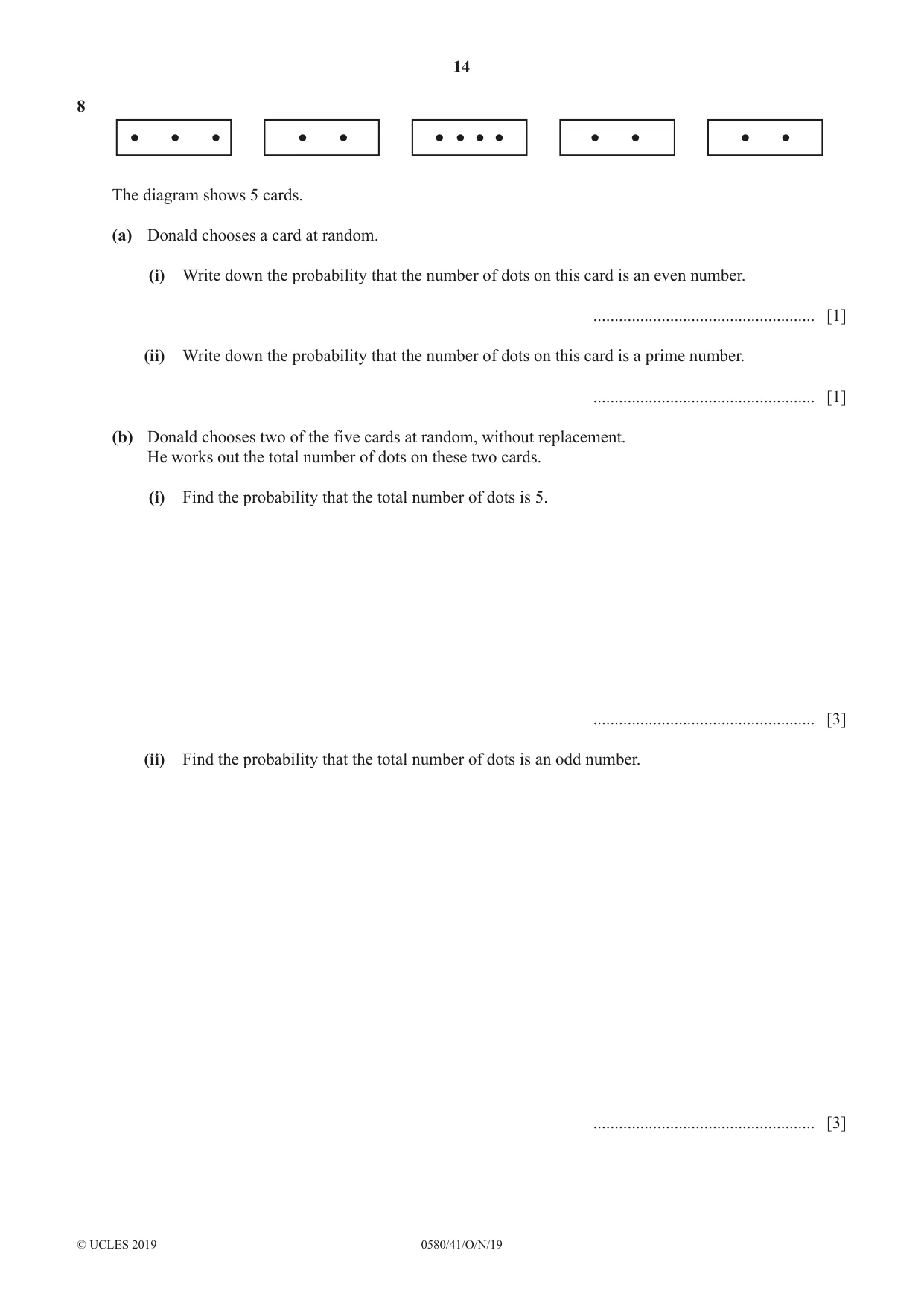
8 The diagram shows 5 cards. (a) Donald chooses a card at random. (i) Write down the probability that the number of dots on this card is an even number. .................................................... [1] (ii) Write down the probability that the number of dots on this card is a prime number. .................................................... [1] (b) Donald chooses two of the five cards at random, without replacement. He works out the total number of dots on these two cards. (i) Find the probability that the total number of dots is 5. .................................................... [3] (ii) Find the probability that the total number of dots is an odd number. .................................................... [3]
Mark scheme: 8(a)(i) 4 1 oe 5 8(a)(ii) 4 1 oe 5 8(b)(i) 6 3 1 3 3 1 1 3 oe nfww M2 for × + × oe or 2 × × oe 20 5 4 5 4 5 4 1 3 3 1 or M1 for × alone or × alone or for 5 4 5 4 3 answer nfww 20 6 After 0 scored, SC1 for answer 25 8(b)(ii) 8 3 4 3 1 4 1 oe nfww M2 for 1 − × or × 1 + × oe or 20 5 4 5 5 4 1 2 × × 1 5 1 3 1 1 or 2 × × + 2 × × or 5 4 5 4 1 1 their (b)(i) + 2 × × 5 4 2 or 4 or 5 or 6 or 7 or M1 for answer oe nfww 20 8 After 0 scored, SC1 for answer 25
Q9 · A car hire company has x small cars and y large cars
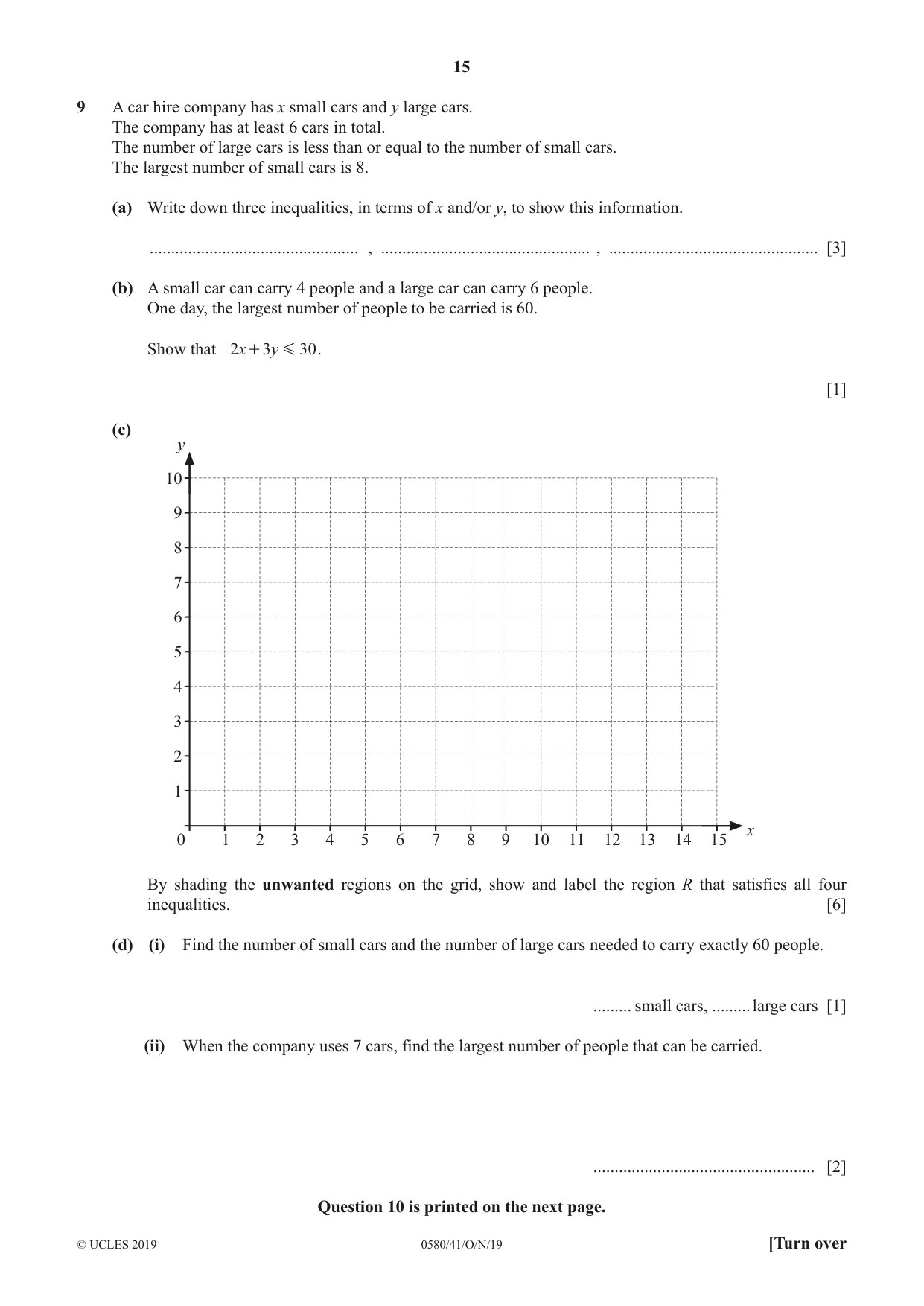
9 A car hire company has x small cars and y large cars. The company has at least 6 cars in total. The number of large cars is less than or equal to the number of small cars. The largest number of small cars is 8. (a) Write down three inequalities, in terms of x and/or y, to show this information. ................................................. , ................................................. , ................................................. [3] (b) A small car can carry 4 people and a large car can carry 6 people. One day, the largest number of people to be carried is 60. Show that 2x + 3y G 30 . [1] (c) y 10 9 8 7 6 5 4 3 2 1 x 0 1 2 3 4 5 6 7 8 9 10 11 12 13 14 15 By shading the unwanted regions on the grid, show and label the region R that satisfies all four inequalities. [6] (d) (i) Find the number of small cars and the number of large cars needed to carry exactly 60 people. ......... small cars, ......... large cars [1] (ii) When the company uses 7 cars, find the largest number of people that can be carried. .................................................... [2] Question 10 is printed on the next page.
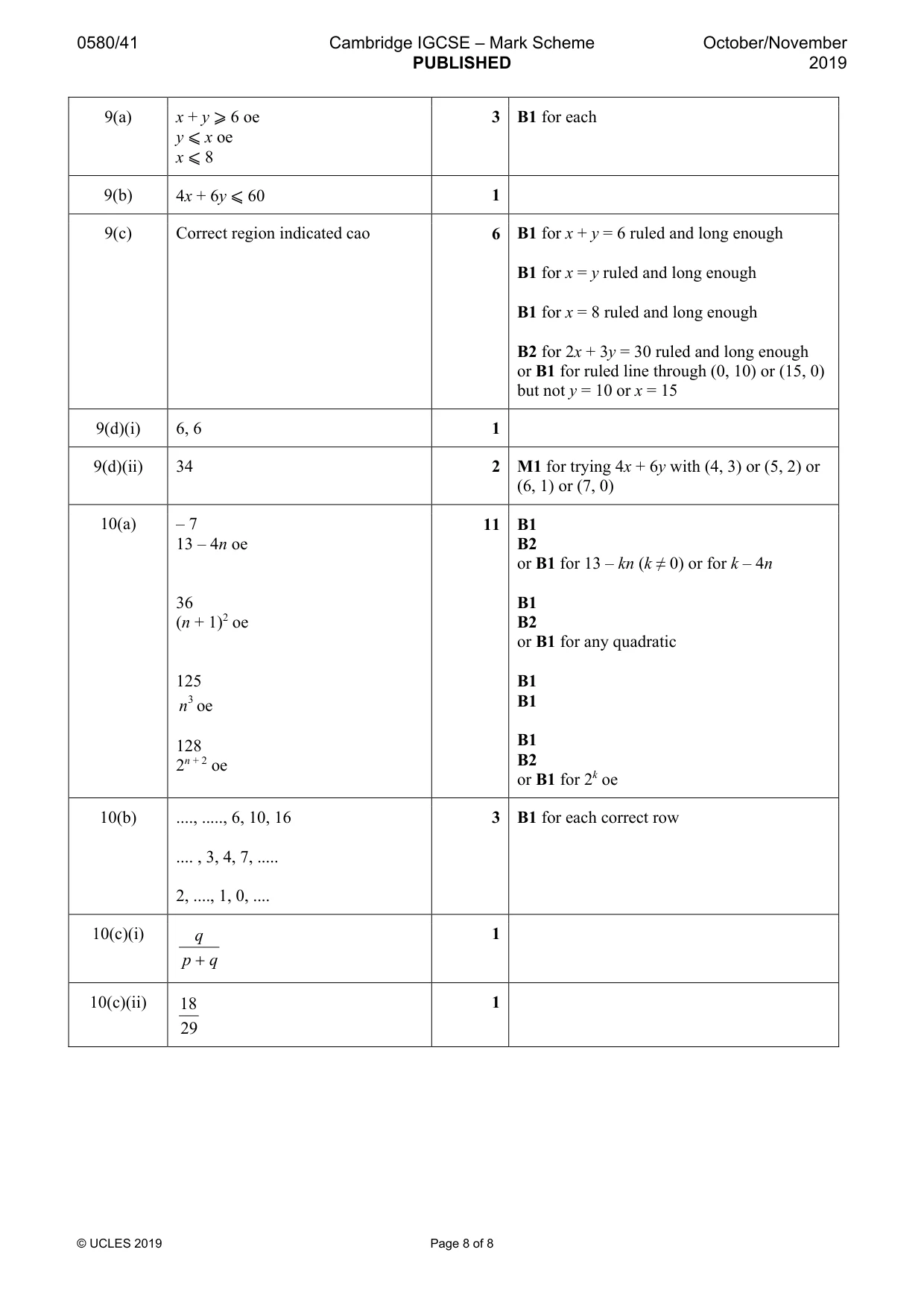
Mark scheme: 9(a) x + y ⩾ 6 oe 3 B1 for each y ⩽ x oe x ⩽ 8 9(b) 4x + 6y ⩽ 60 1 9(c) Correct region indicated cao 6 B1 for x + y = 6 ruled and long enough B1 for x = y ruled and long enough B1 for x = 8 ruled and long enough B2 for 2x + 3y = 30 ruled and long enough or B1 for ruled line through (0, 10) or (15, 0) but not y = 10 or x = 15 9(d)(i) 6, 6 1 9(d)(ii) 34 2 M1 for trying 4x + 6y with (4, 3) or (5, 2) or (6, 1) or (7, 0)
Q10 · Complete the table for the 5th term and the nth term of each sequence
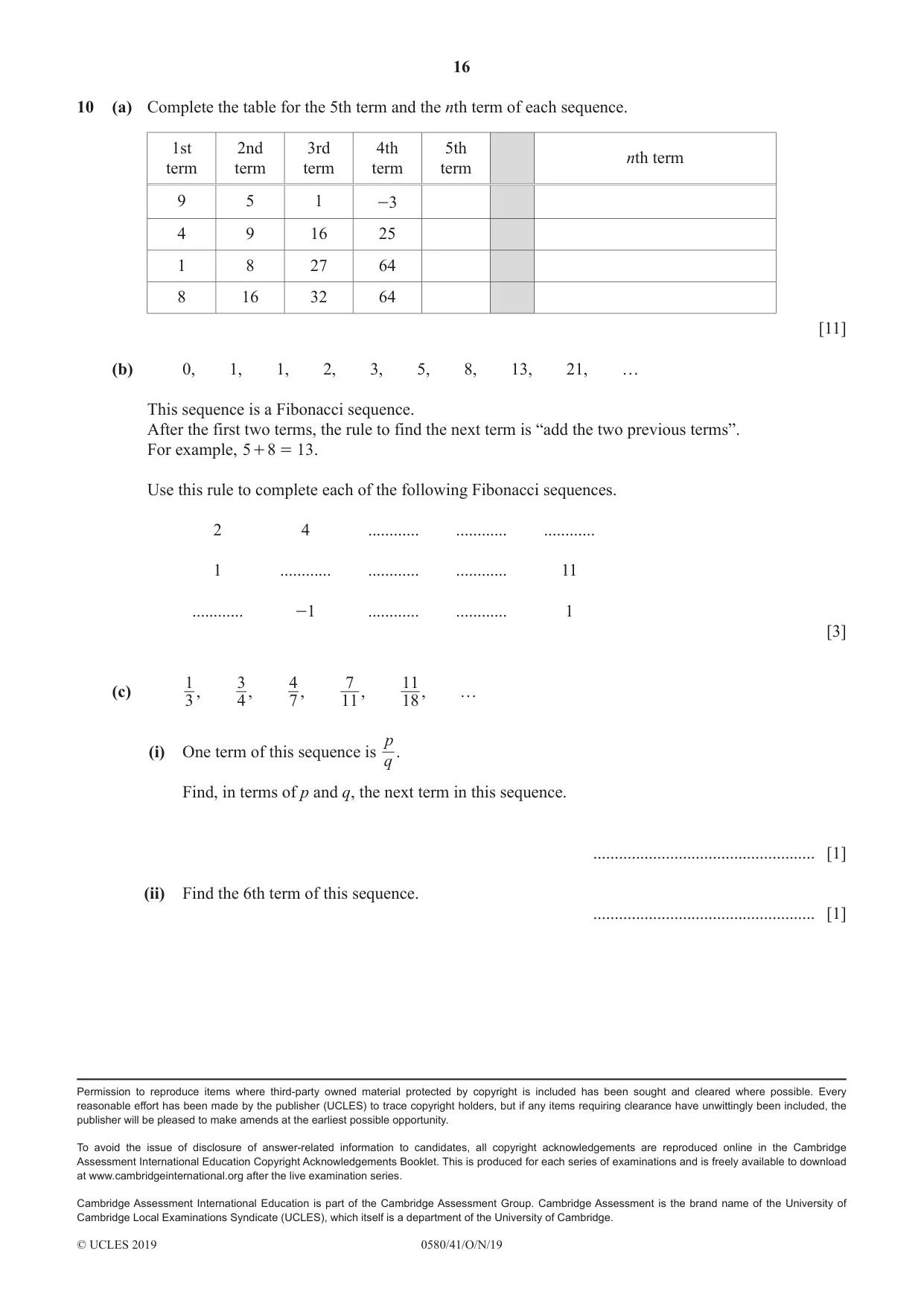
10 (a) Complete the table for the 5th term and the nth term of each sequence. 1st 2nd 3rd 4th 5th nth term term term term term term 9 5 1 -3 4 9 16 25 1 8 27 64 8 16 32 64 [11] (b) 0, 1, 1, 2, 3, 5, 8, 13, 21, … This sequence is a Fibonacci sequence. After the first two terms, the rule to find the next term is “add the two previous terms”. For example, 5 + 8 = 13 . Use this rule to complete each of the following Fibonacci sequences. 2 4 ............ ............ ............ 1 ............ ............ ............ 11 ............ -1 ............ ............ 1 [3] 1 3 4 7 11 (c) , , , , , … 3 4 7 11 18 p (i) One term of this sequence is . q Find, in terms of p and q, the next term in this sequence. .................................................... [1] (ii) Find the 6th term of this sequence. .................................................... [1]
Mark scheme: 10(a) – 7 11 B1 13 – 4n oe B2 or B1 for 13 – kn (k ≠ 0) or for k – 4n 36 B1 (n + 1)2 oe B2 or B1 for any quadratic 125 B1 n 3 oe B1 B1 128 2n + 2 oe B2 or B1 for 2k oe 10(b) ...., ....., 6, 10, 16 3 B1 for each correct row .... , 3, 4, 7, ..... 2, ...., 1, 0, .... 10(c)(i) q 1 p + q 10(c)(ii) 18 1 29
What was in this paper
The subtopics covered by these 10 questions, and how many questions each got. Open one in a new tab to see every Cambridge question on it.
What you needed in this session
Cambridge’s own grade thresholds for 2019 Oct/Nov, Paper 4 · Variant 1. A higher threshold means an easier paper — the bar moves with how the cohort did.