Cambridge IGCSE Mathematics 0580 — 2024 May/June Paper 4 · Variant 3
0580/43/M/J/24 · 11 questions · 130 marks · ≈146 min
The question paper and its mark scheme, free to read here and free to download. This is Cambridge’s own paper, exactly as it was sat.
Question paper24 pages
Mark scheme10 pages
Answers below. Sit the paper first if you are practising.
Questions as text
Q1 · In 2023 a football club had 50 adult members and 70 child members
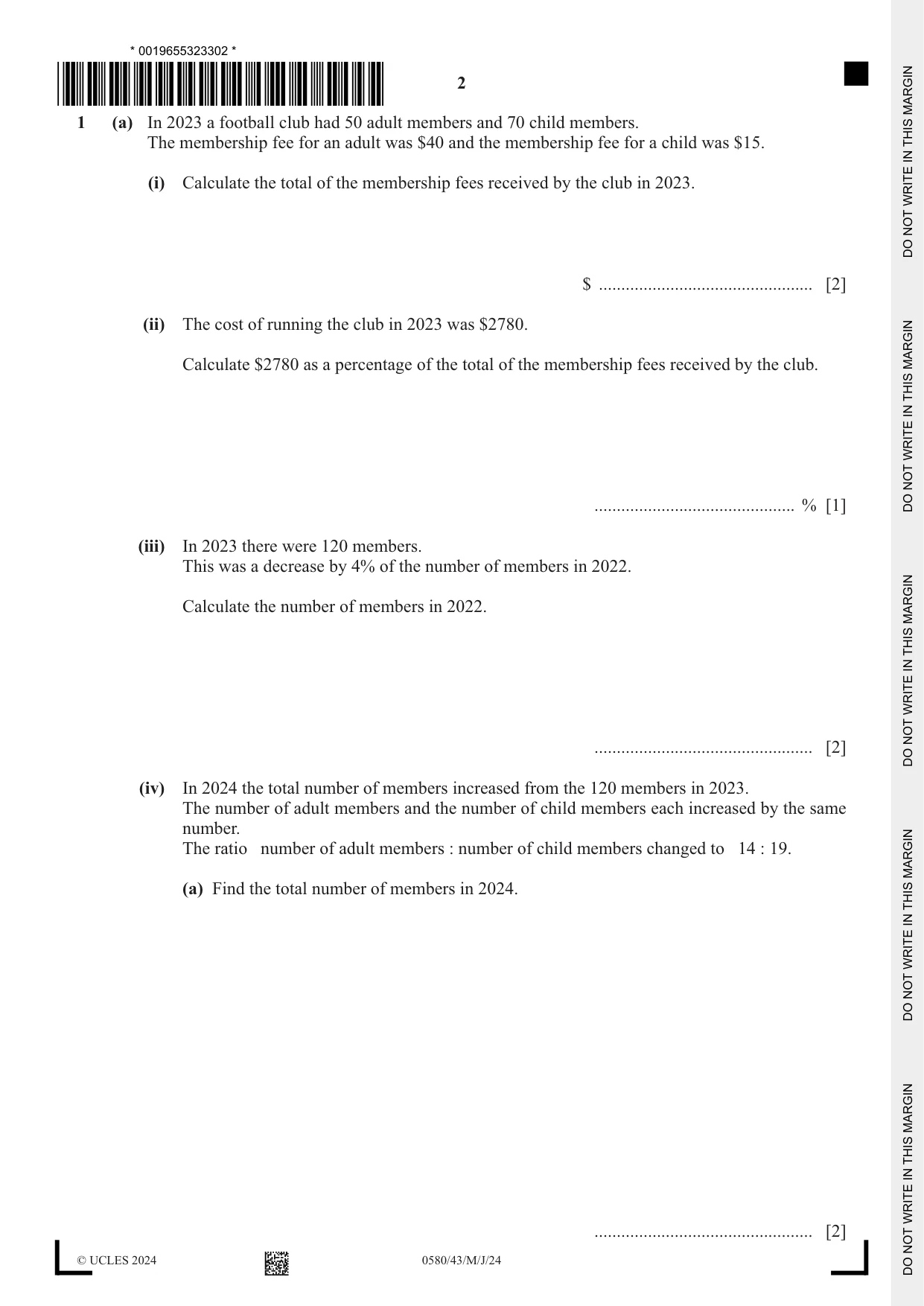
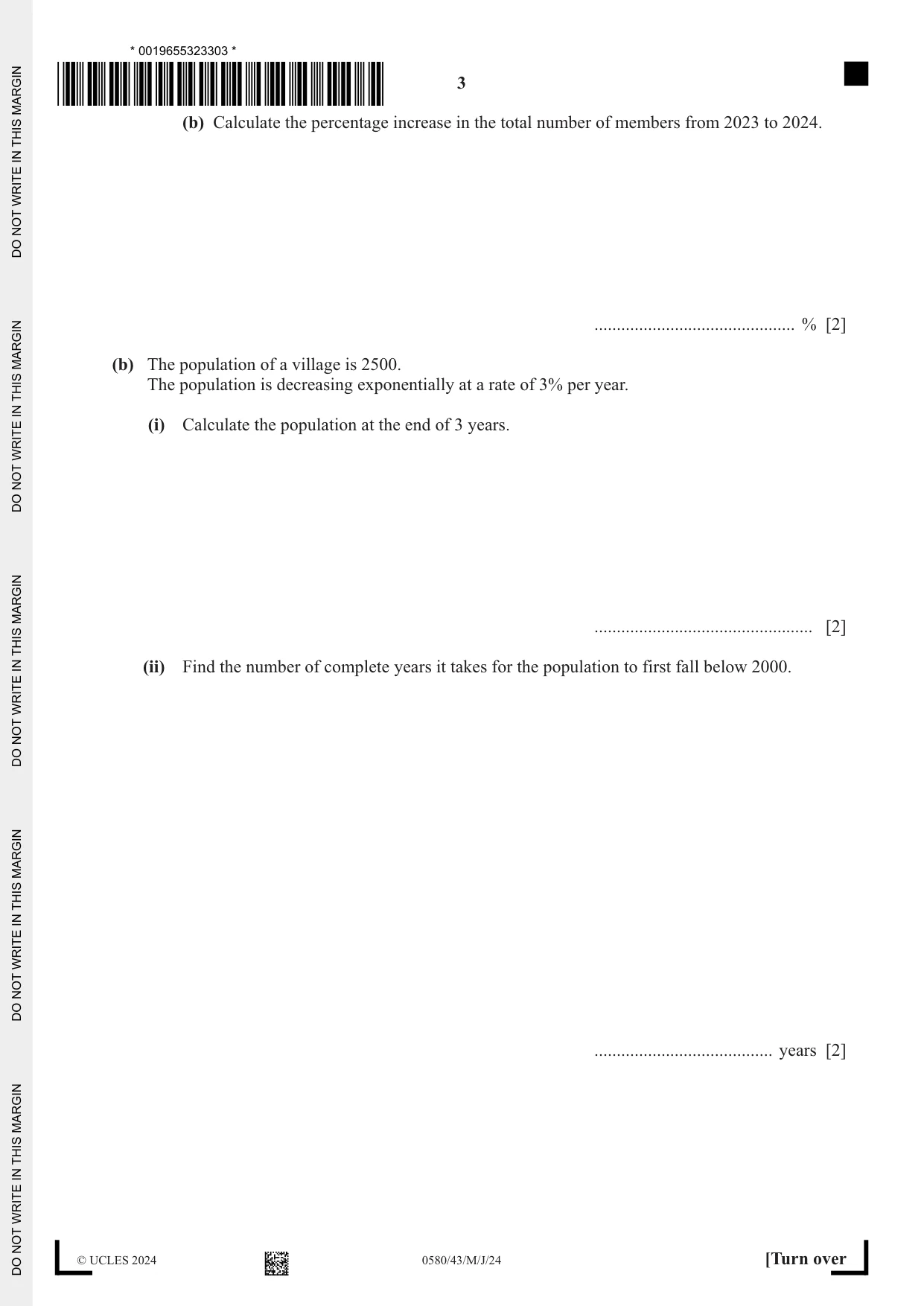
1 (a) In 2023 a football club had 50 adult members and 70 child members. The membership fee for an adult was $40 and the membership fee for a child was $15. (i) Calculate the total of the membership fees received by the club in 2023. $ ................................................ [2] (ii) The cost of running the club in 2023 was $2780. Calculate $2780 as a percentage of the total of the membership fees received by the club. ............................................. % [1] (iii) In 2023 there were 120 members. This was a decrease by 4% of the number of members in 2022. Calculate the number of members in 2022. ................................................. [2] (iv) In 2024 the total number of members increased from the 120 members in 2023. The number of adult members and the number of child members each increased by the same number. The ratio number of adult members : number of child members changed to 14 : 19. (a) Find the total number of members in 2024. ................................................. [2] (b) Calculate the percentage increase in the total number of members from 2023 to 2024. ............................................. % [2] (b) The population of a village is 2500. The population is decreasing exponentially at a rate of 3% per year. (i) Calculate the population at the end of 3 years. ................................................. [2] (ii) Find the number of complete years it takes for the population to first fall below 2000. ........................................ years [2]
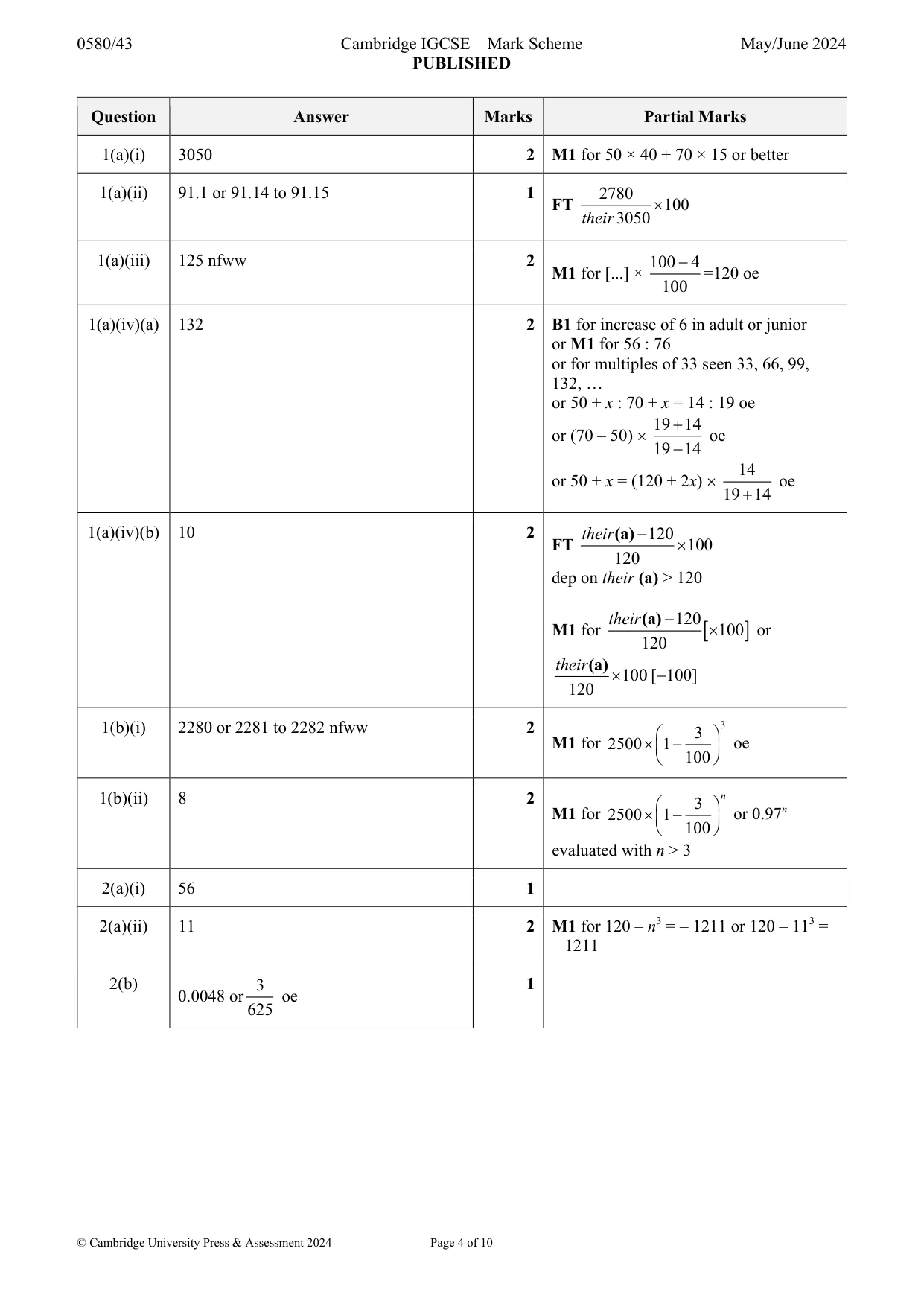
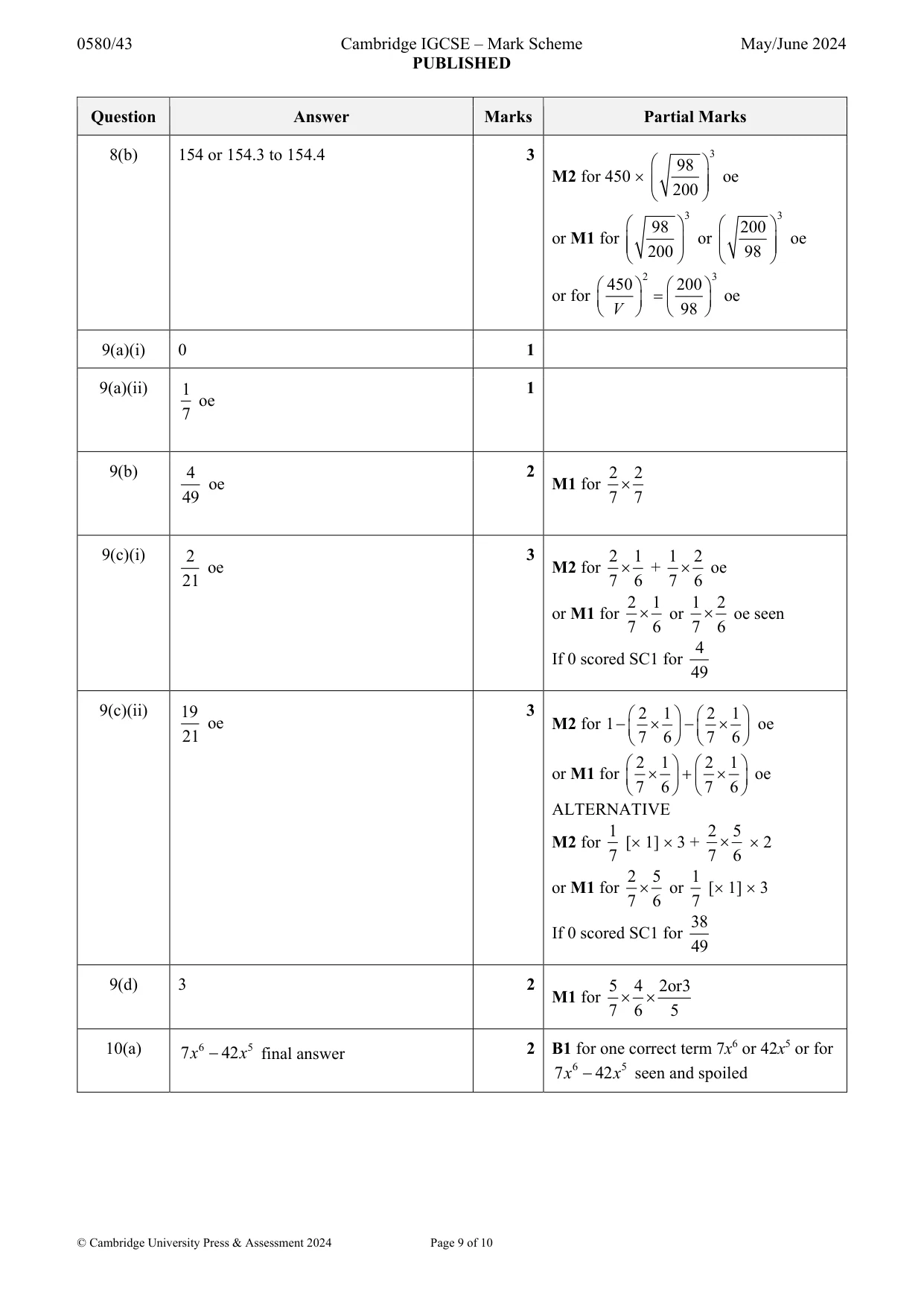
Mark scheme: Question Answer Marks Partial Marks 1(a)(i) 3050 2 M1 for 50 × 40 + 70 × 15 or better 1(a)(ii) 91.1 or 91.14 to 91.15 1 2780 FT 100 their 3050 1(a)(iii) 125 nfww 2 100 4 M1 for [...] × =120 oe 100 1(a)(iv)(a) 132 2 B1 for increase of 6 in adult or junior or M1 for 56 : 76 or for multiples of 33 seen 33, 66, 99, 132, … or 50 + x : 70 + x = 14 : 19 oe 19 14 or (70 – 50) oe 19 14 14 or 50 + x = (120 + 2x) oe 19 14 1(a)(iv)(b) 10 2 their (a) 120 FT 100 120 dep on their (a) > 120 their (a) 120 M1 for 100 or 120 their (a) 100 [ 100] 120 1(b)(i) 2280 or 2281 to 2282 nfww 2 3 3 M1 for 2500 1 oe 100 1(b)(ii) 8 2 n 3 M1 for 2500 1 or 0.97n 100 evaluated with n > 3
Q2 · The nth term of a sequence is 120 - n 3
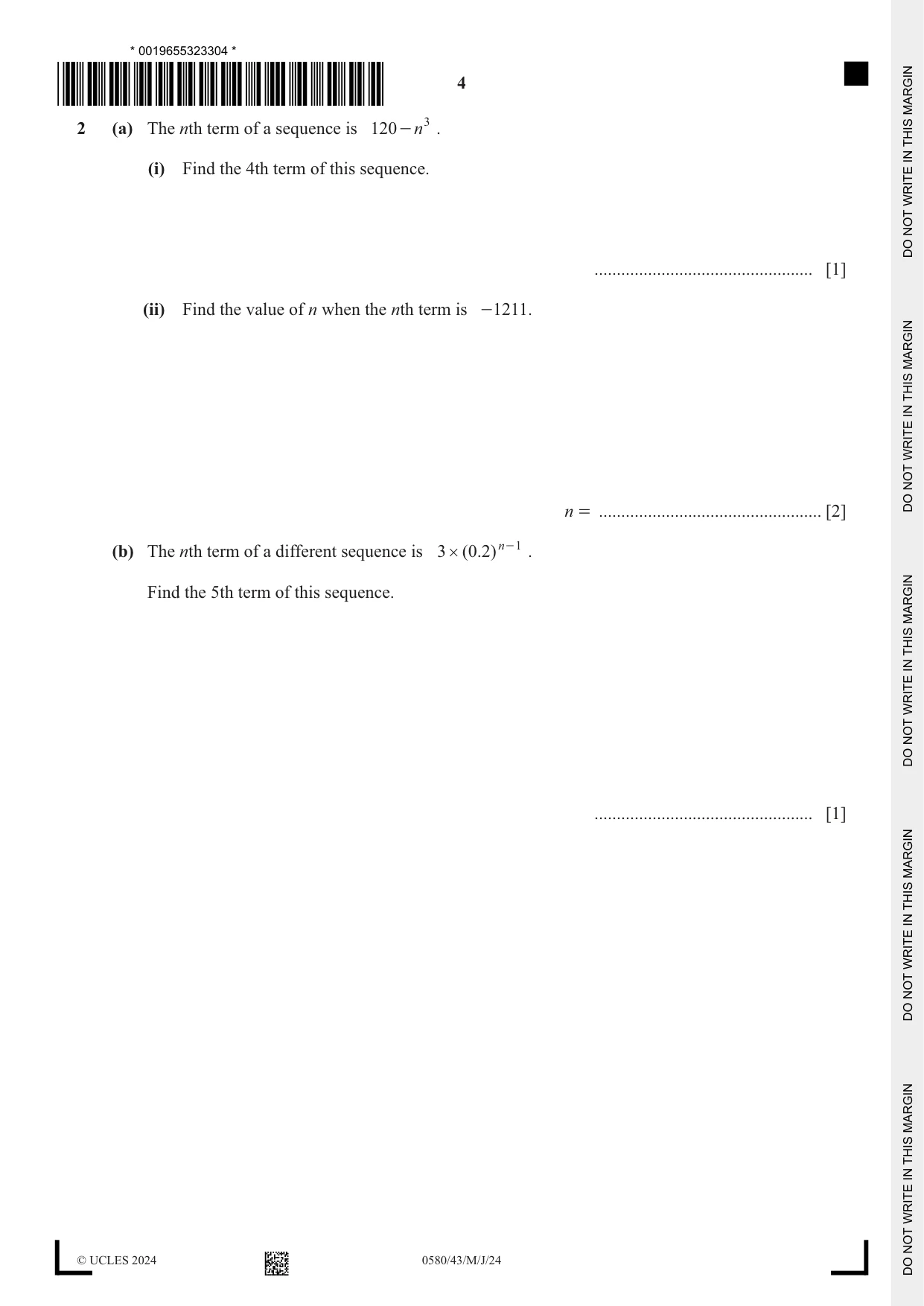
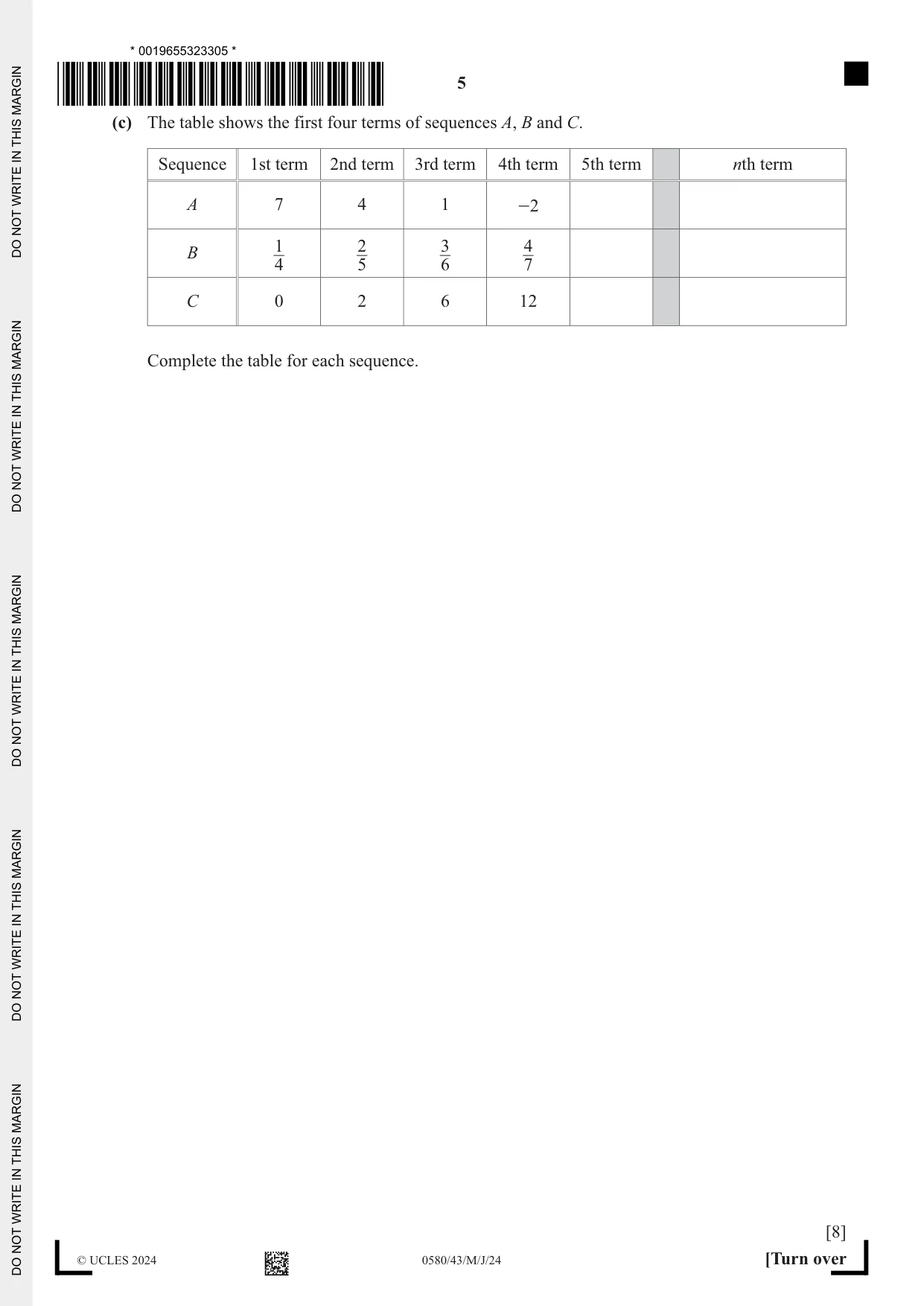
2 (a) The nth term of a sequence is 120 - n 3 . (i) Find the 4th term of this sequence. ................................................. [1] (ii) Find the value of n when the nth term is -1211. n = .................................................. [2] (b) The nth term of a different sequence is 3 # ( 0 .2 ) n - 1 . Find the 5th term of this sequence. ................................................. [1] (c) The table shows the first four terms of sequences A, B and C. Sequence 1st term 2nd term 3rd term 4th term 5th term nth term A 7 4 1 -2 1 2 3 4 B 4 5 6 7 C 0 2 6 12 Complete the table for each sequence. [8]
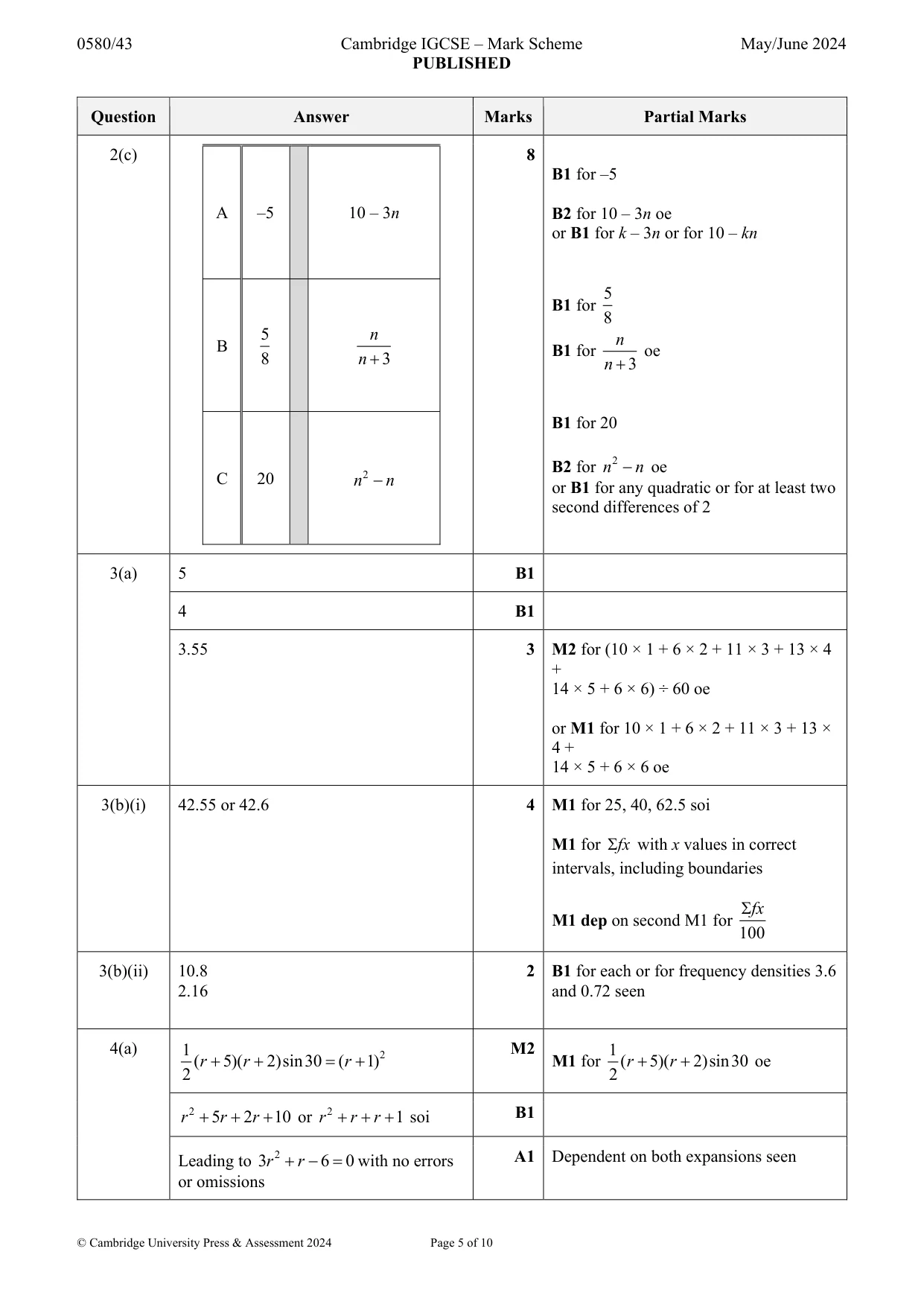
Mark scheme: 2(a)(i) 56 1 2(a)(ii) 11 2 M1 for 120 – n3 = – 1211 or 120 – 113 = – 1211 2(b) 3 1 0.0048 or oe 625 2(c) 8 B1 for –5 A –5 10 – 3n B2 for 10 – 3n oe or B1 for k – 3n or for 10 – kn 5 B1 for 8 5 n n B B1 for oe 8 n 3 n 3 B1 for 20 2 B2 for n 2 n oe C 20 n n or B1 for any quadratic or for at least two second differences of 2
Q3 · Rahul rolls a dice 60 times
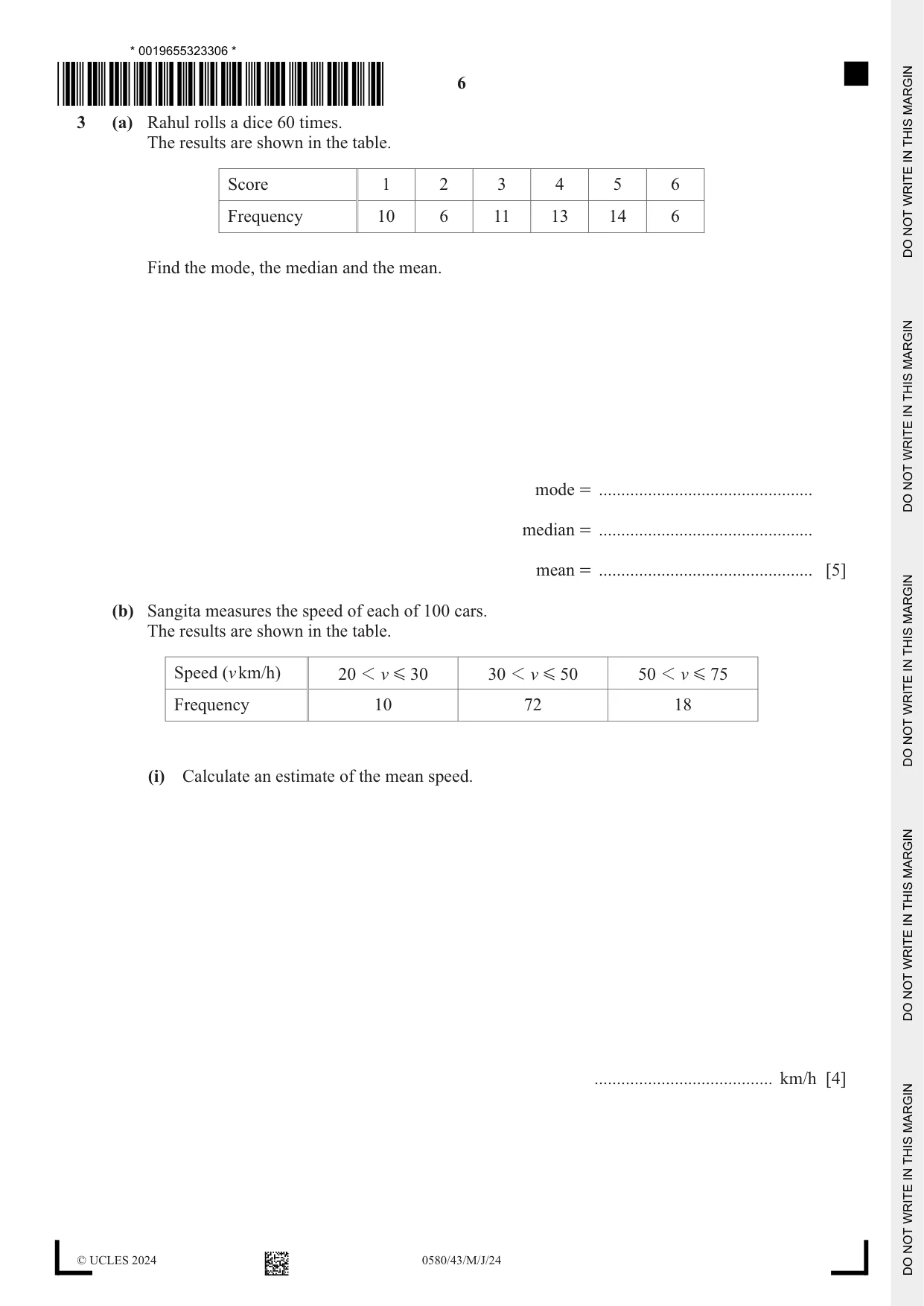
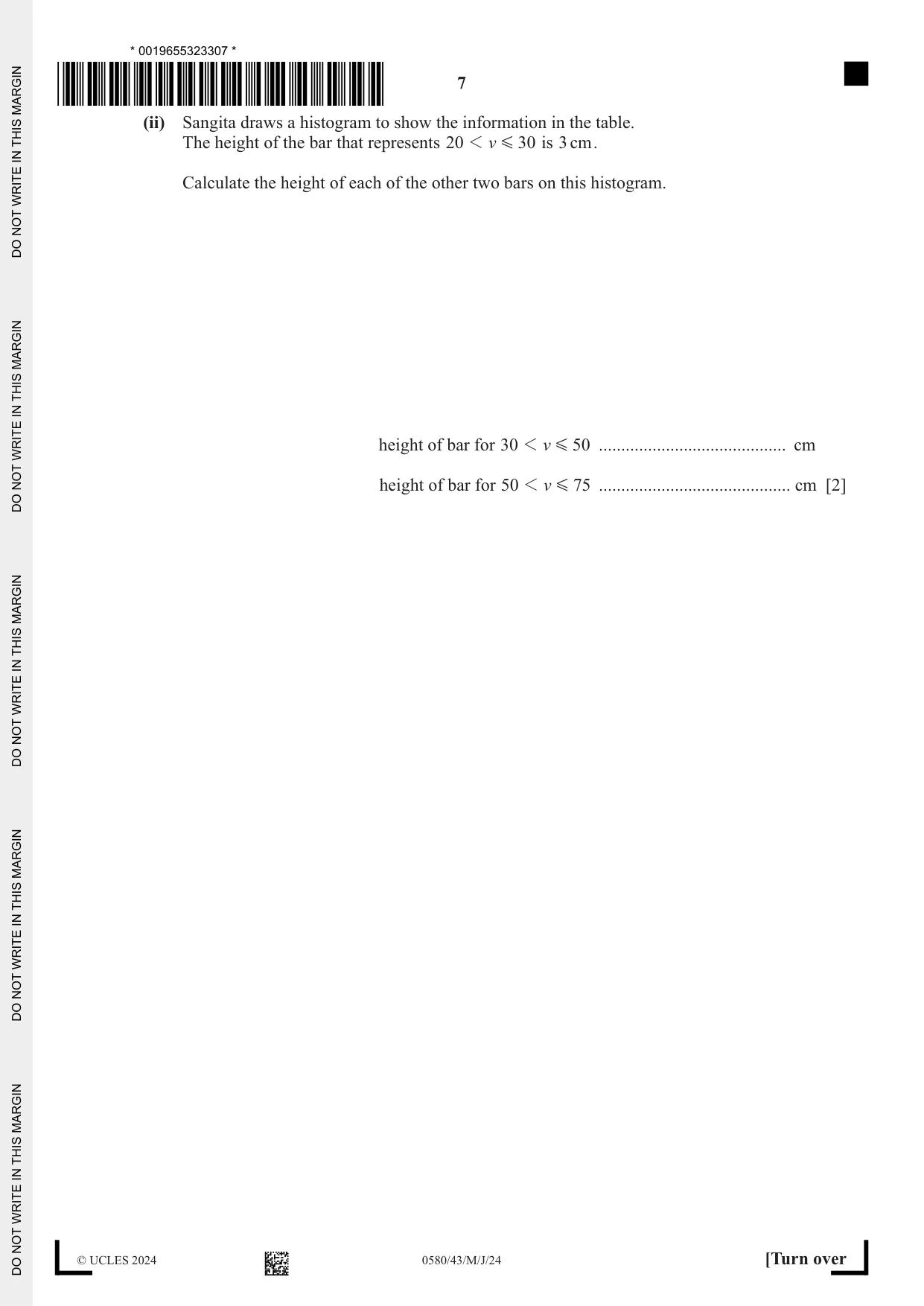
3 (a) Rahul rolls a dice 60 times. The results are shown in the table. Score 1 2 3 4 5 6 Frequency 10 6 11 13 14 6 Find the mode, the median and the mean. mode = ................................................ median = ................................................ mean = ................................................ [5] (b) Sangita measures the speed of each of 100 cars. The results are shown in the table. Speed (v km/h) 20 1 v G 30 30 1 v G 50 50 1 v G 75 Frequency 10 72 18 (i) Calculate an estimate of the mean speed. ........................................ km/h [4] (ii) Sangita draws a histogram to show the information in the table. The height of the bar that represents 20 1 v G 30 is 3 cm . Calculate the height of each of the other two bars on this histogram. height of bar for 30 1 v G 50 .......................................... cm height of bar for 50 1 v G 75 ........................................... cm [2]
Mark scheme: 3(a) 5 B1 4 B1 3.55 3 M2 for (10 × 1 + 6 × 2 + 11 × 3 + 13 × 4 + 14 × 5 + 6 × 6) ÷ 60 oe or M1 for 10 × 1 + 6 × 2 + 11 × 3 + 13 × 4 + 14 × 5 + 6 × 6 oe 3(b)(i) 42.55 or 42.6 4 M1 for 25, 40, 62.5 soi M1 for fx with x values in correct intervals, including boundaries fx M1 dep on second M1 for 100 3(b)(ii) 10.8 2 B1 for each or for frequency densities 3.6 2.16 and 0.72 seen
Q4 · In this question all the measurements are in centimetres
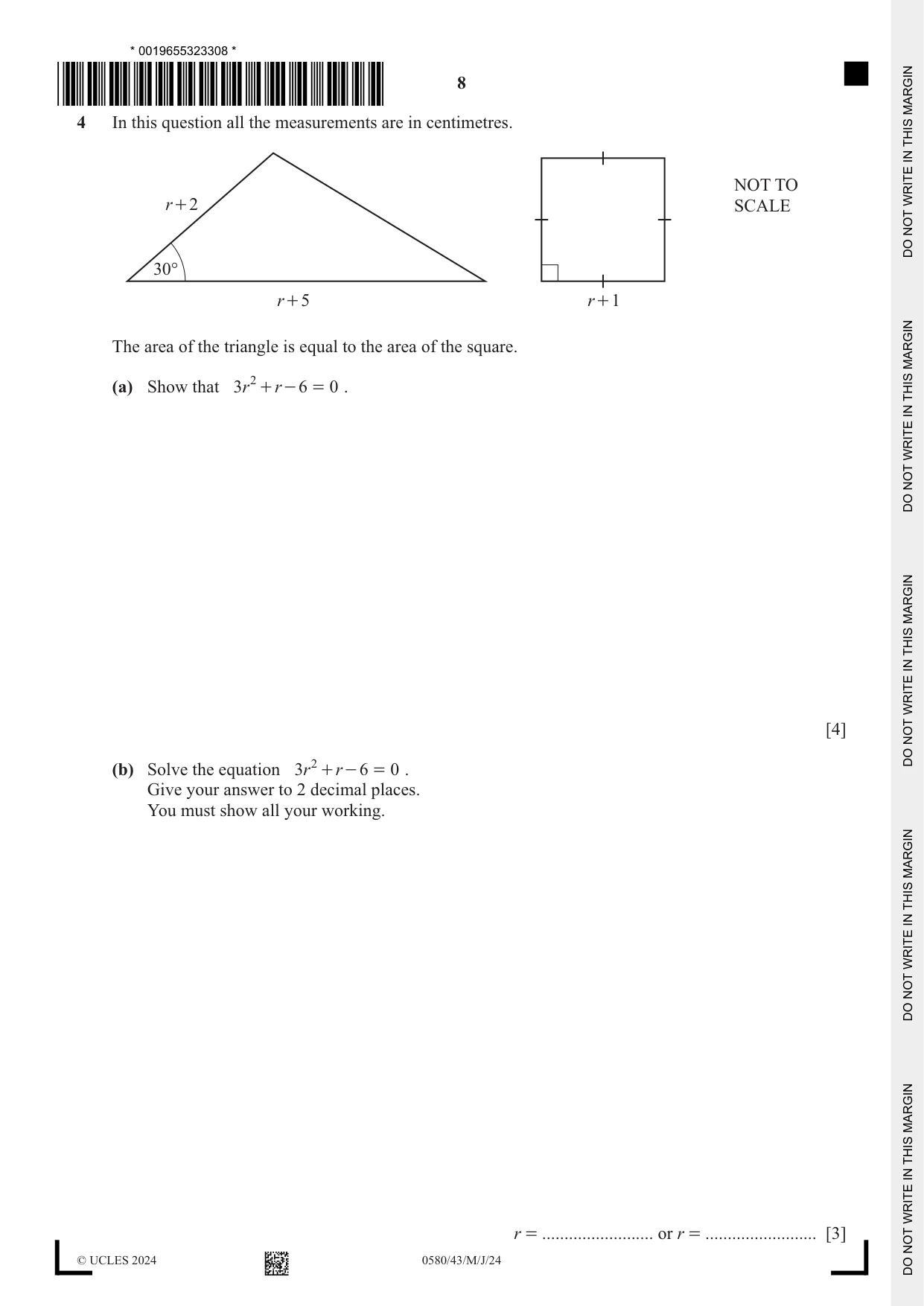
4 In this question all the measurements are in centimetres. NOT TO r + 2 SCALE 30° r + 5 r + 1 The area of the triangle is equal to the area of the square. (a) Show that 3r 2 + r - 6 = 0 . [4] (b) Solve the equation 3r 2 + r - 6 = 0 . Give your answer to 2 decimal places. You must show all your working. r = ......................... or r = ......................... [3] (c) Find the perimeter of the square. ............................................ cm [2]
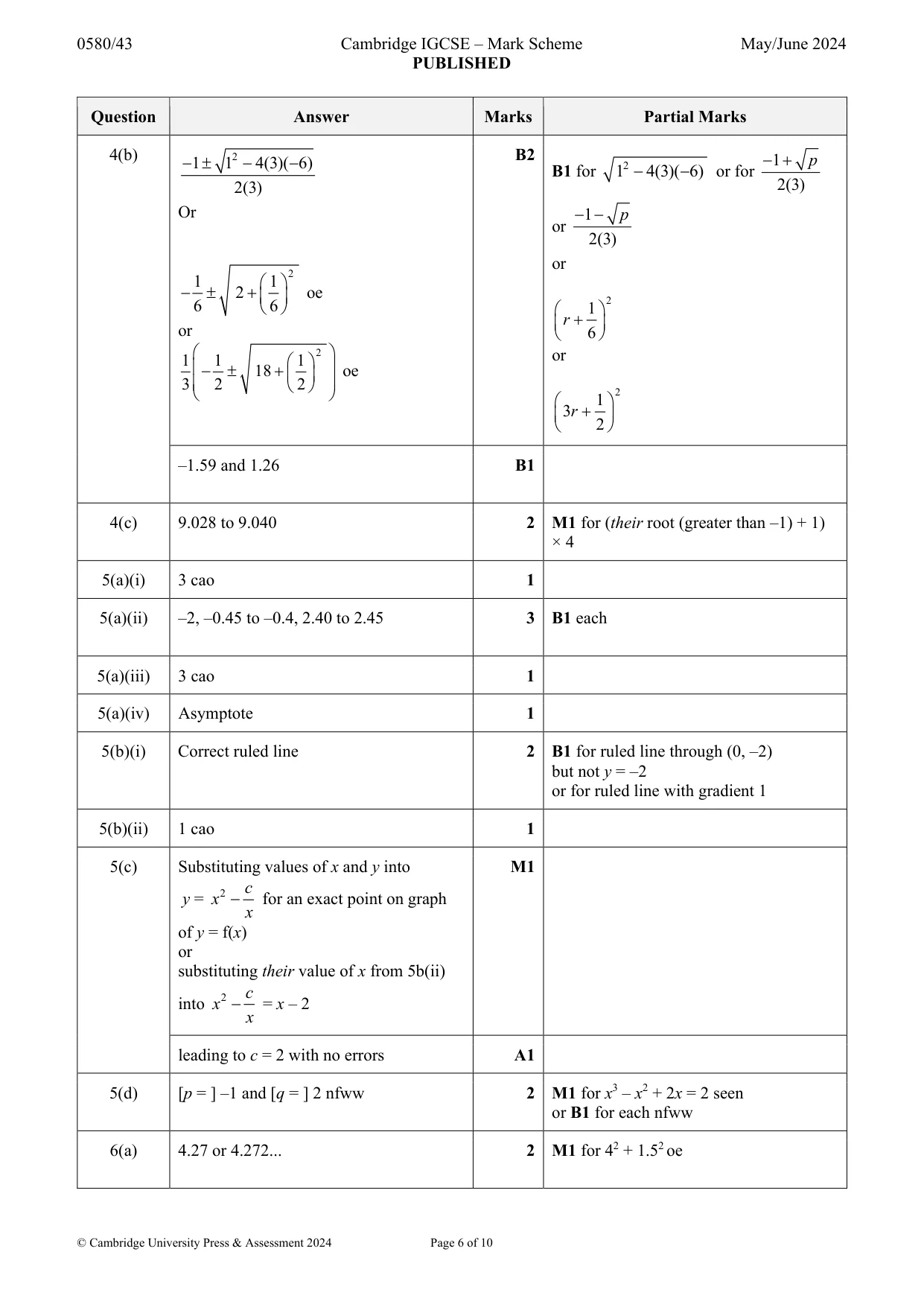
Mark scheme: 4(a) 1 2 M2 1 ( r 5)( r 2)sin30 ( r 1) M1 for ( r 5)( r 2)sin30 oe 2 2 r 2 5r 2 r 10 or r 2 r r 1 soi B1 Leading to 3r 2 r 6 0 with no errors A1 Dependent on both expansions seen or omissions 4(b) 2 B2 1 1 4(3)( 6) 1 p B1 for 21 4(3)( 6) or for 2(3) 2(3) Or 1 p or 2(3) or 1 1 2 2 oe 2 6 6 1 r or 6 2 or 1 1 1 18 oe 3 2 2 2 1 3r 2 –1.59 and 1.26 B1 4(c) 9.028 to 9.040 2 M1 for (their root (greater than –1) + 1) × 4
Q5 · Y 10 9 8 7 6 5 4 3 2 1 – 3 – 2 – 1 0 1 2 3 x – 1 – 2 – 3 – 4 – 5 – 6 – 7 – 8 The diagram…
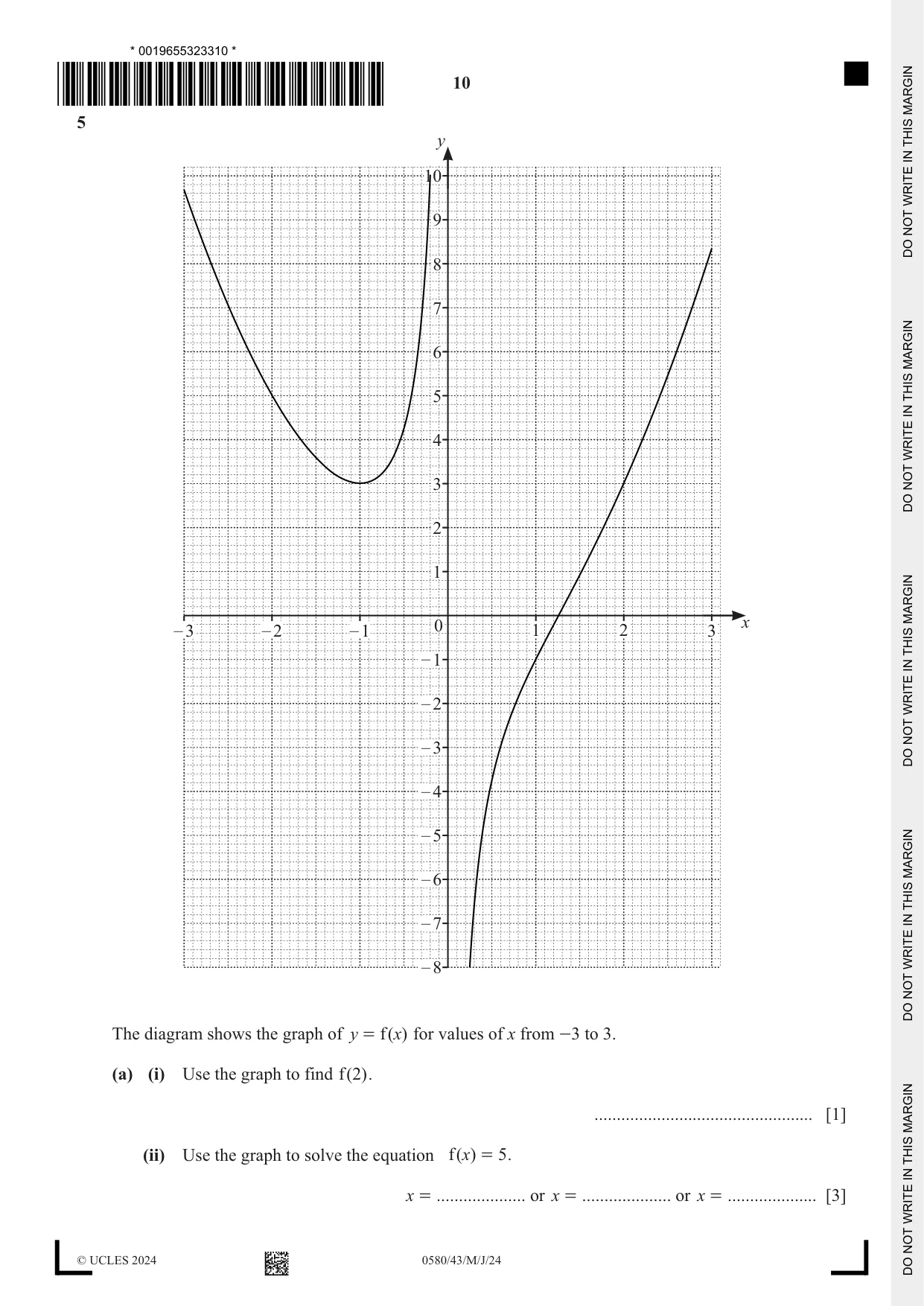
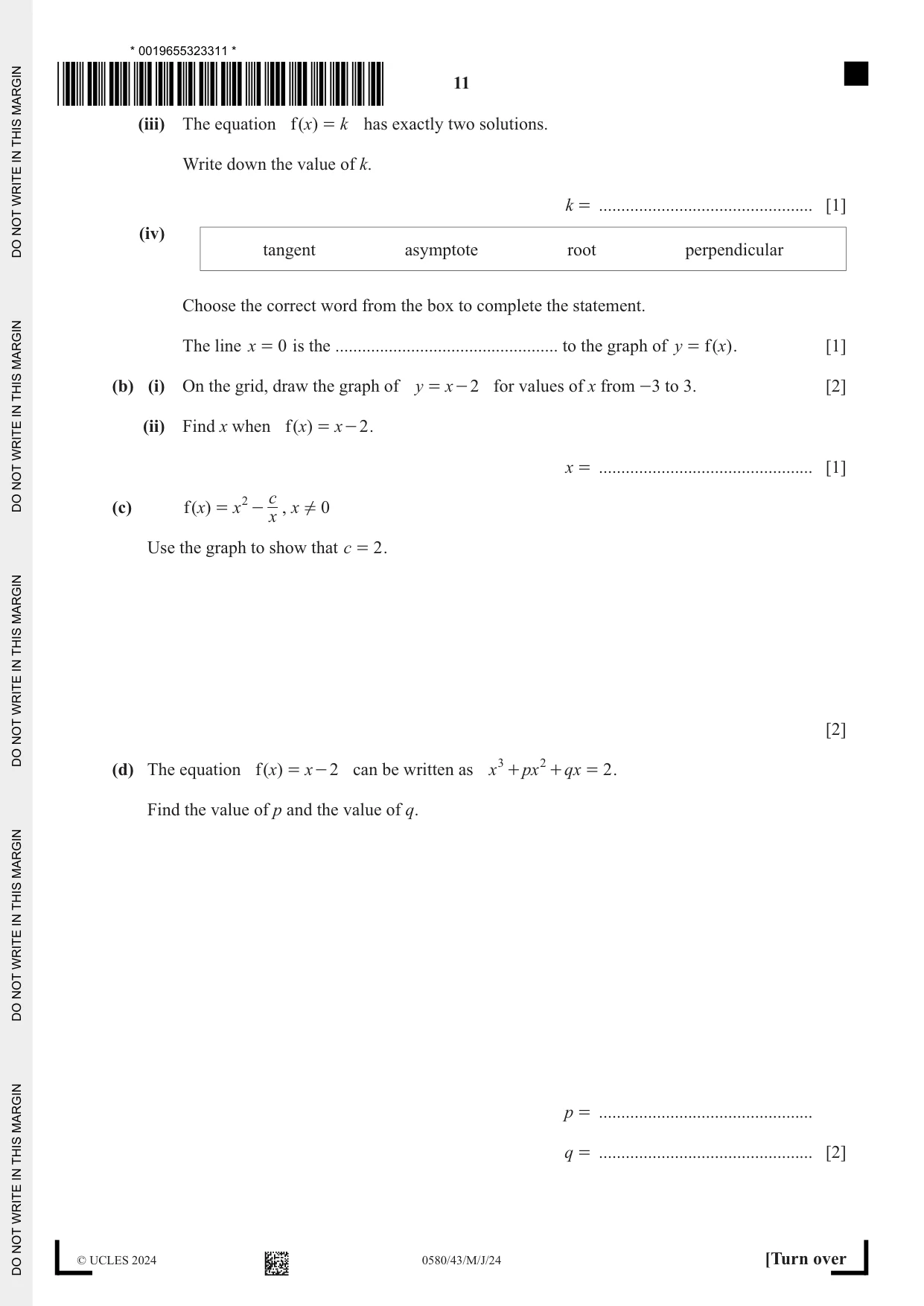
5 y 10 9 8 7 6 5 4 3 2 1 – 3 – 2 – 1 0 1 2 3 x – 1 – 2 – 3 – 4 – 5 – 6 – 7 – 8 The diagram shows the graph of y = f ( x) for values of x from -3 to 3. (a) (i) Use the graph to find f ( 2) . ................................................. [1] (ii) Use the graph to solve the equation f ( x) = 5 . x = .................... or x = .................... or x = .................... [3] (iii) The equation f ( x) = k has exactly two solutions. Write down the value of k. k = ................................................ [1] (iv) tangent asymptote root perpendicular Choose the correct word from the box to complete the statement. The line x = 0 is the .................................................. to the graph of y = f ( x) . [1] (b) (i) On the grid, draw the graph of y = x - 2 for values of x from -3 to 3. [2] (ii) Find x when f ( x) = x - 2 . x = ................................................ [1] 2 c (c) f ( x) = x - , x ! 0 x Use the graph to show that c = 2 . [2] (d) The equation f ( x) = x - 2 can be written as x 3 + px 2 + qx = 2 . Find the value of p and the value of q. p = ................................................ q = ................................................ [2]
Mark scheme: 5(a)(i) 3 cao 1 5(a)(ii) –2, –0.45 to –0.4, 2.40 to 2.45 3 B1 each 5(a)(iii) 3 cao 1 5(a)(iv) Asymptote 1 5(b)(i) Correct ruled line 2 B1 for ruled line through (0, –2) but not y = –2 or for ruled line with gradient 1 5(b)(ii) 1 cao 1 5(c) Substituting values of x and y into M1 2 c y = x for an exact point on graph x of y = f(x) or substituting their value of x from 5b(ii) 2 c into x = x – 2 x leading to c = 2 with no errors A1 5(d) [p = ] –1 and [q = ] 2 nfww 2 M1 for x3 – x2 + 2x = 2 seen or B1 for each nfww
Q6 · H NOT TO SCALE 4 m G F 1.5 m The diagram shows a ladder, GH, on horizontal ground…
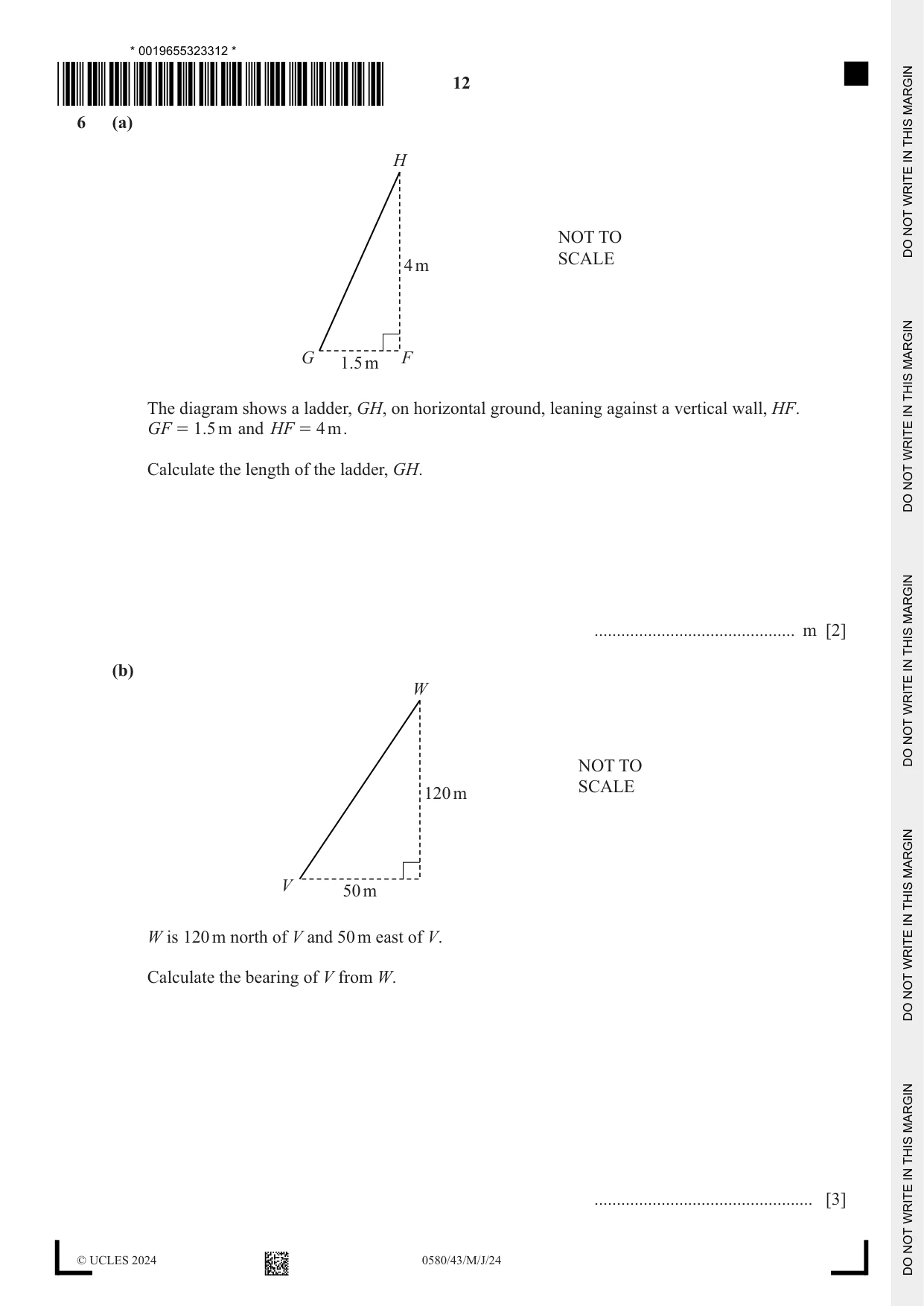
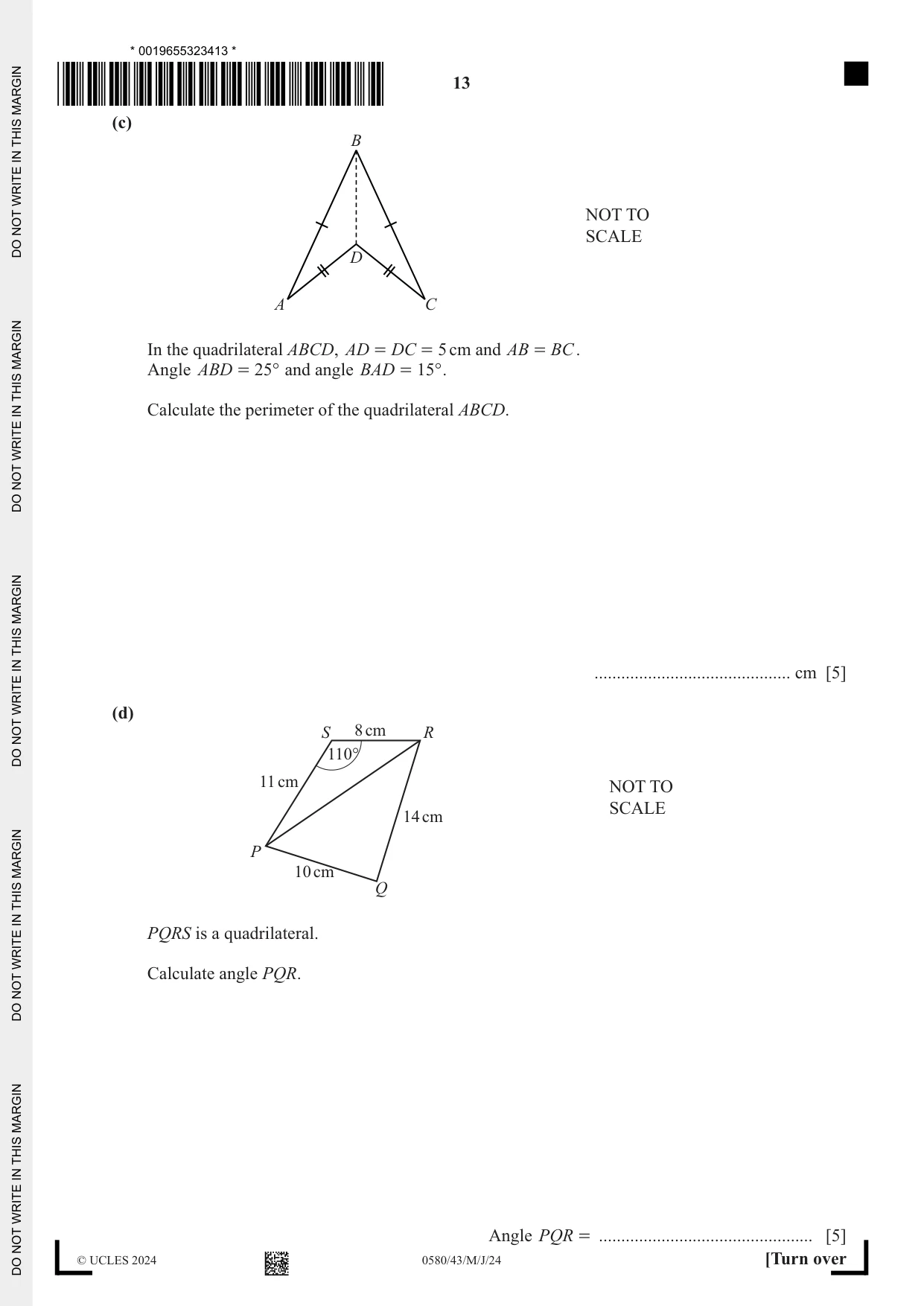
6 (a) H NOT TO SCALE 4 m G F 1.5 m The diagram shows a ladder, GH, on horizontal ground, leaning against a vertical wall, HF. GF = 1.5 m and HF = 4 m . Calculate the length of the ladder, GH. ............................................. m [2] (b) W NOT TO SCALE 120 m V 50 m W is 120 m north of V and 50 m east of V. Calculate the bearing of V from W. ................................................. [3] (c) B NOT TO SCALE D A C In the quadrilateral ABCD, AD = DC = 5 cm and AB = BC . Angle ABD = 25° and angle BAD = 15° . Calculate the perimeter of the quadrilateral ABCD. ............................................ cm [5] (d) S 8 cm R 110° 11 cm NOT TO SCALE 14 cm P 10 cm Q PQRS is a quadrilateral. Calculate angle PQR. Angle PQR = ................................................ [5]
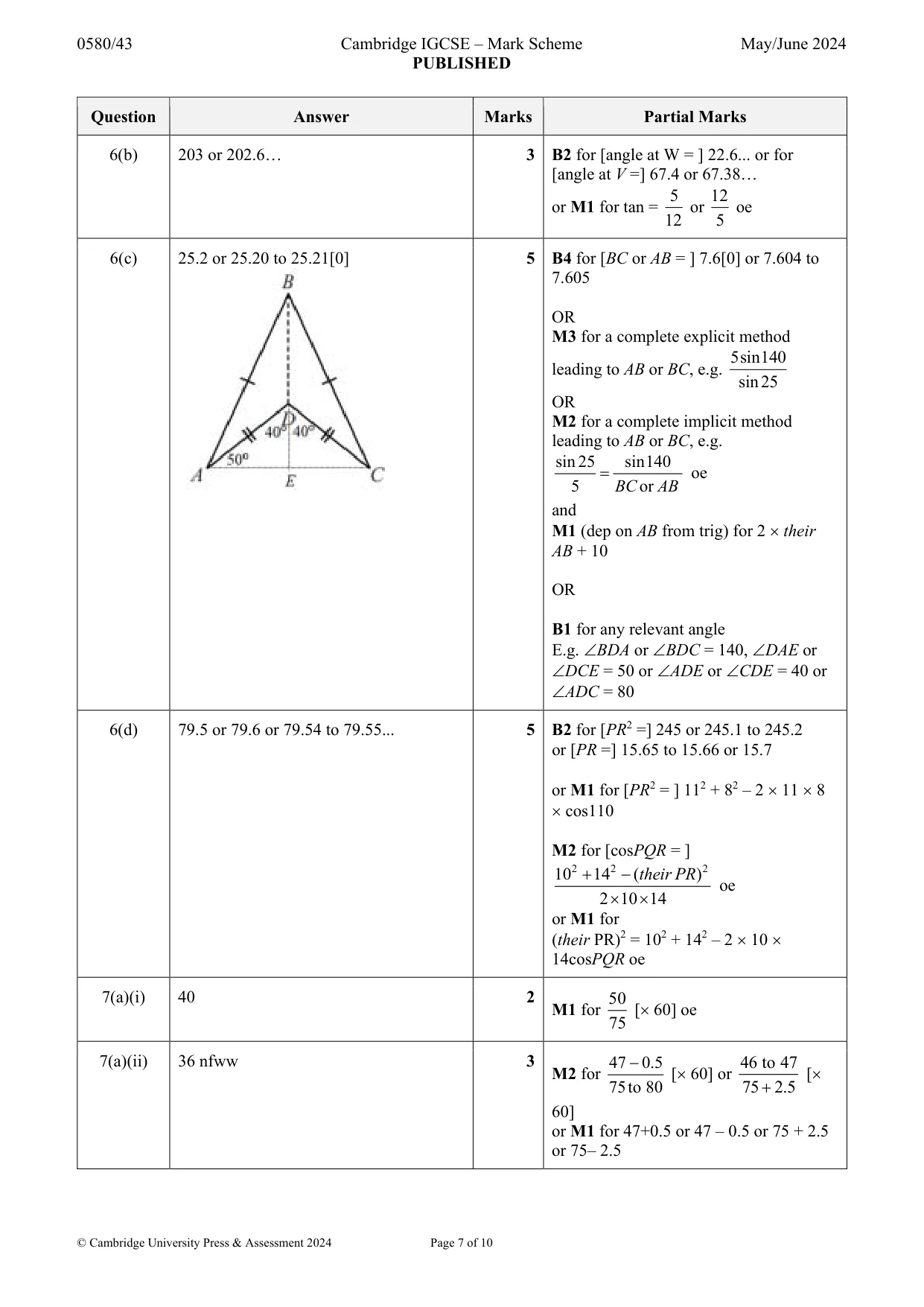
Mark scheme: 6(a) 4.27 or 4.272... 2 M1 for 42 + 1.52 oe 6(b) 203 or 202.6… 3 B2 for [angle at W = ] 22.6... or for [angle at V =] 67.4 or 67.38… 5 12 or M1 for tan = or oe 12 5 6(c) 25.2 or 25.20 to 25.21[0] 5 B4 for [BC or AB = ] 7.6[0] or 7.604 to 7.605 OR M3 for a complete explicit method 5sin140 leading to AB or BC, e.g. sin25 OR M2 for a complete implicit method leading to AB or BC, e.g. sin 25 sin140 oe 5 BC or AB and M1 (dep on AB from trig) for 2 their AB + 10 OR B1 for any relevant angle E.g. BDA or BDC = 140, DAE or DCE = 50 or ADE or CDE = 40 or ADC = 80 6(d) 79.5 or 79.6 or 79.54 to 79.55... 5 B2 for [PR2 =] 245 or 245.1 to 245.2 or [PR =] 15.65 to 15.66 or 15.7 or M1 for [PR2 = ] 112 + 82 – 2 11 8 cos110 M2 for [cosPQR = ] 10 2 14 2 (their PR ) 2 oe 2 10 14 or M1 for (their PR)2 = 102 + 142 – 2 10 14cosPQR oe
Q7 · A car travels 50 km at an average speed of 75 km/h
7 (a) (i) A car travels 50 km at an average speed of 75 km/h. Find the time taken. Give your answer in minutes. .......................................... min [2] (ii) Another car travels 47 km, correct to the nearest kilometre. The average speed of this car is 75 km/h, correct to the nearest 5 km/h. Calculate the lower bound of the time taken. Give your answer in minutes. .......................................... min [3] (b) A train travels a total of 240 km. The train travels for t minutes at an average speed of 100 km/h. It then travels for ( t + 60 ) minutes at an average speed of 110 km/h. Find the average speed for the whole journey. ........................................ km/h [6]
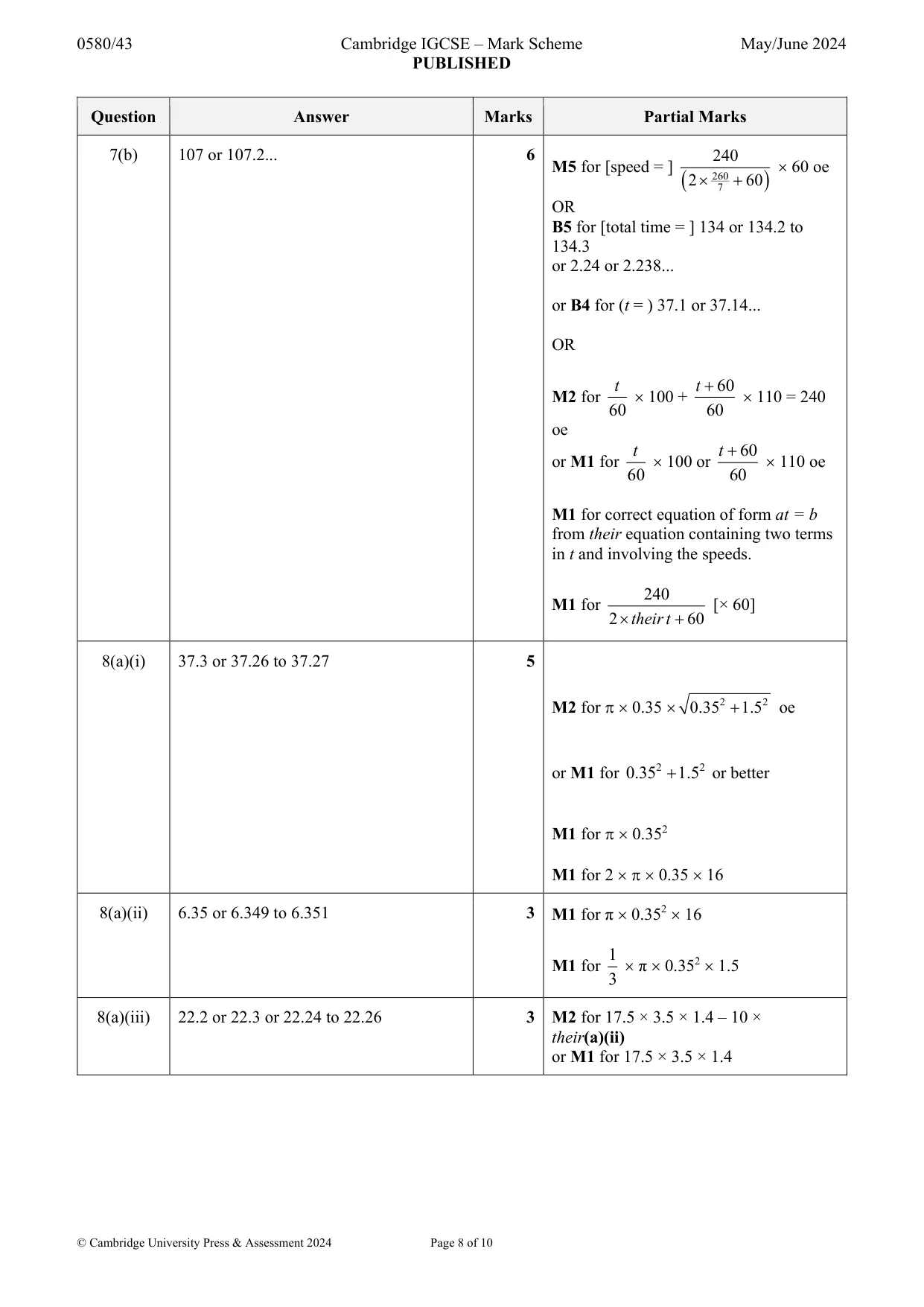
Mark scheme: 7(a)(i) 40 2 50 M1 for [ 60] oe 75 7(a)(ii) 36 nfww 3 47 0.5 46 to 47 M2 for [ 60] or [ 75to 80 75 2.5 60] or M1 for 47+0.5 or 47 – 0.5 or 75 + 2.5 or 75– 2.5 7(b) 107 or 107.2... 6 240 M5 for [speed = ] 60 oe 260 2 7 60 OR B5 for [total time = ] 134 or 134.2 to 134.3 or 2.24 or 2.238... or B4 for (t = ) 37.1 or 37.14... OR t t 60 M2 for 100 + 110 = 240 60 60 oe t t 60 or M1 for 100 or 110 oe 60 60 M1 for correct equation of form at = b from their equation containing two terms in t and involving the speeds. 240 M1 for [× 60] 2 theirt 60
Q8 · NOT TO SCALE 16 cm 1.5 cm The diagram shows a solid made from a cylinder and a cone
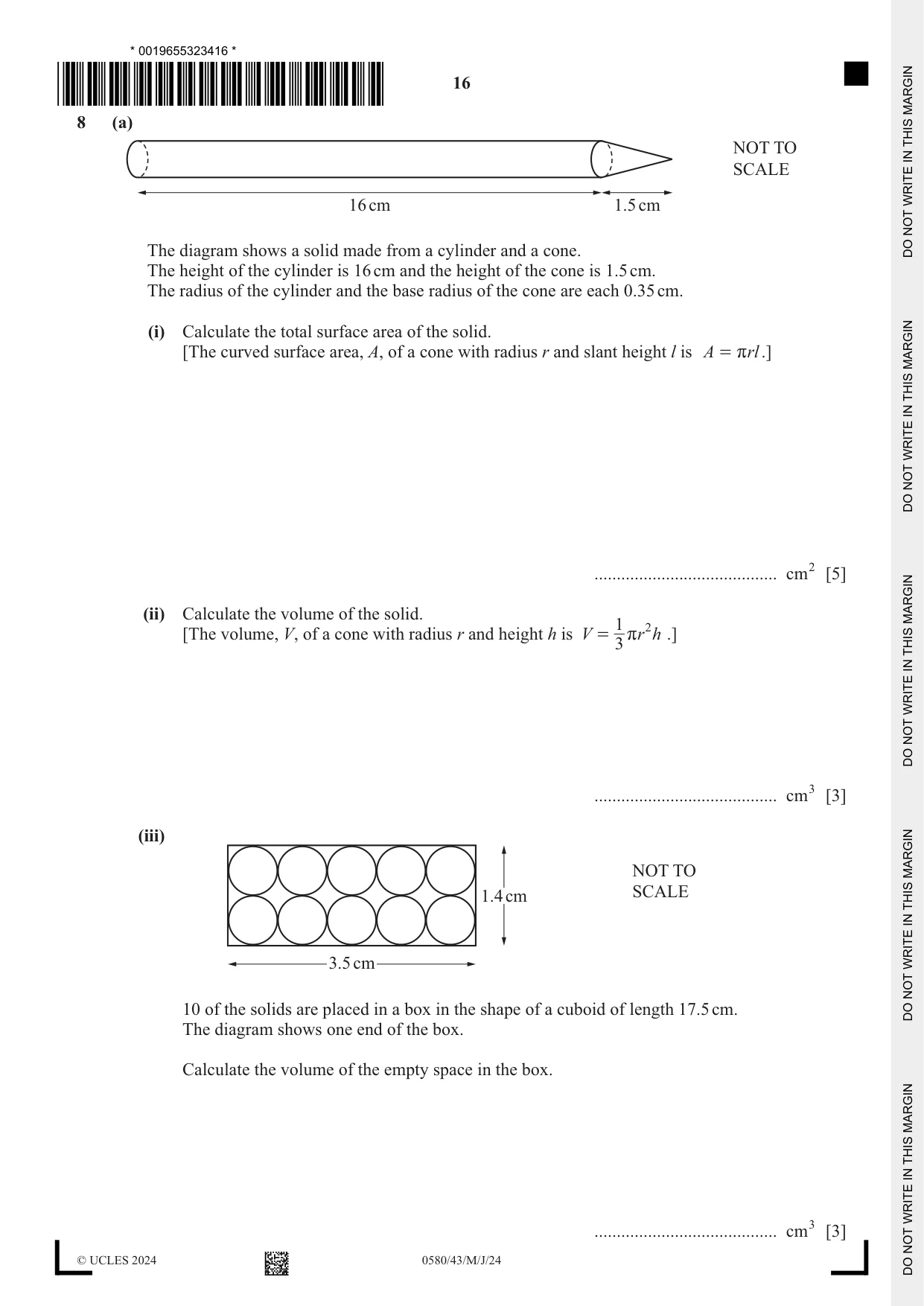
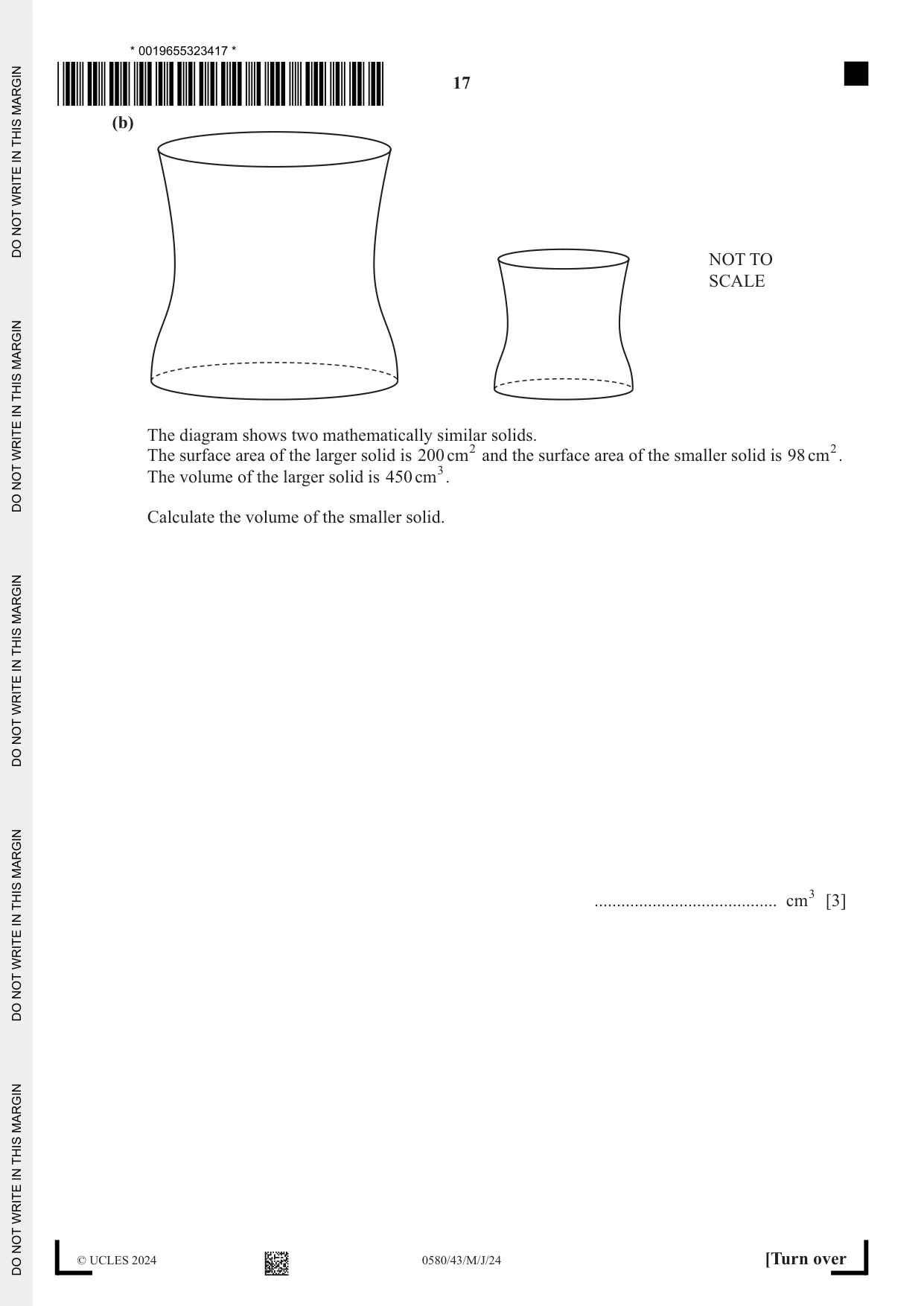
8 (a) NOT TO SCALE 16 cm 1.5 cm The diagram shows a solid made from a cylinder and a cone. The height of the cylinder is 16 cm and the height of the cone is 1.5 cm. The radius of the cylinder and the base radius of the cone are each 0.35 cm. (i) Calculate the total surface area of the solid. [The curved surface area, A, of a cone with radius r and slant height l is A = rrl .] ......................................... cm2 [5] (ii) Calculate the volume of the solid. 1 2 [The volume, V, of a cone with radius r and height h is V = rr h .] 3 ......................................... cm3 [3] (iii) NOT TO 1.4 cm SCALE 3.5 cm 10 of the solids are placed in a box in the shape of a cuboid of length 17.5 cm. The diagram shows one end of the box. Calculate the volume of the empty space in the box. ......................................... cm3 [3] (b) NOT TO SCALE The diagram shows two mathematically similar solids. The surface area of the larger solid is 200 cm 2 and the surface area of the smaller solid is 98 cm 2. The volume of the larger solid is 450 cm 3. Calculate the volume of the smaller solid. ......................................... cm3 [3]
Mark scheme: 8(a)(i) 37.3 or 37.26 to 37.27 5 M2 for 0.35 0.35 2 1.5 2 oe or M1 for 0.35 2 1.5 2 or better M1 for 0.352 M1 for 2 0.35 16 8(a)(ii) 6.35 or 6.349 to 6.351 3 M1 for π 0.352 16 1 M1 for π 0.352 1.5 3 8(a)(iii) 22.2 or 22.3 or 22.24 to 22.26 3 M2 for 17.5 × 3.5 × 1.4 – 10 × their(a)(ii) or M1 for 17.5 × 3.5 × 1.4 8(b) 154 or 154.3 to 154.4 3 3 98 M2 for 450 oe 200 98 3 200 3 or M1 for or oe 200 98 450 2 200 3 or for oe V 98
Q9 · N A M I B I A The diagram shows 7 cards
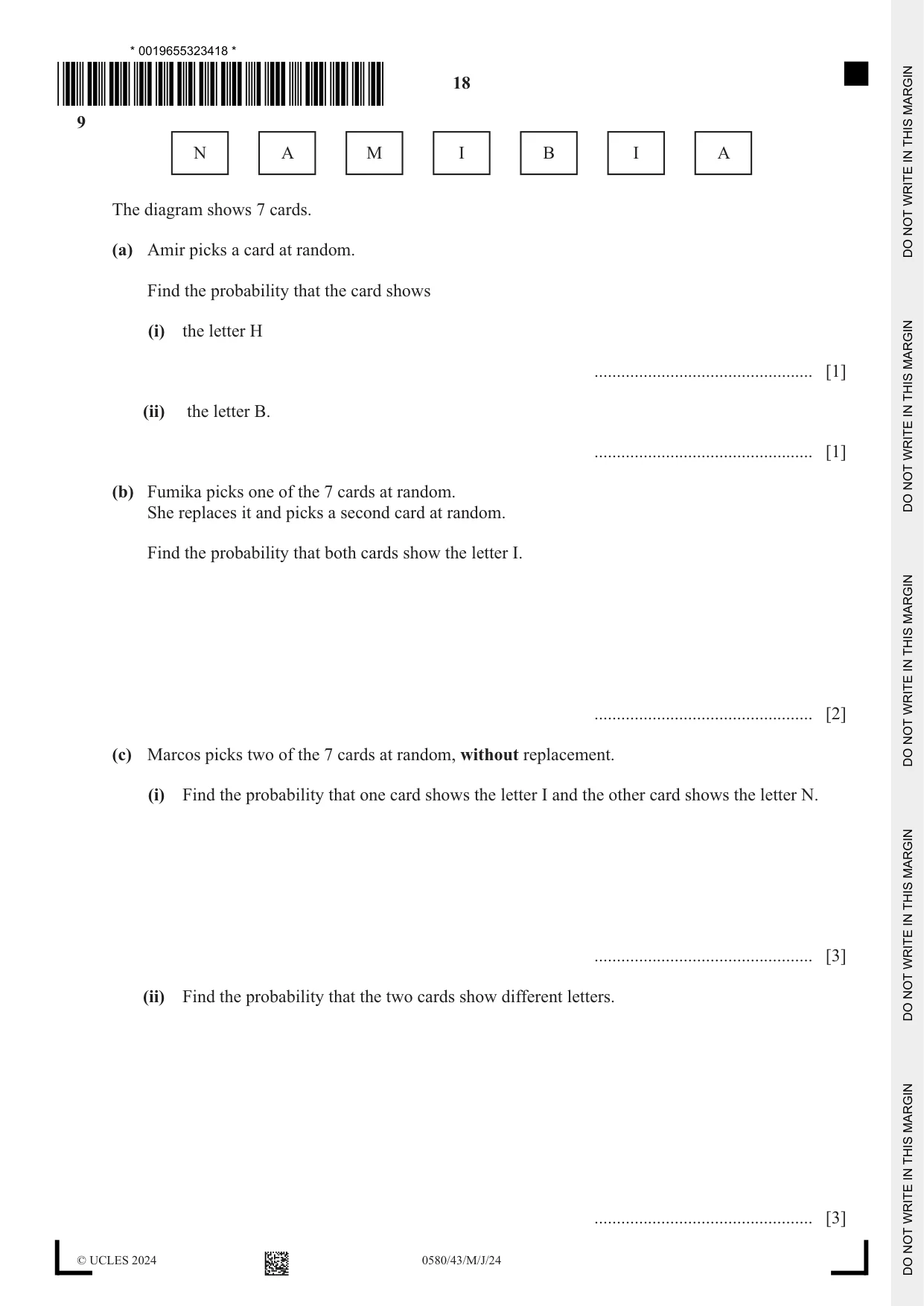
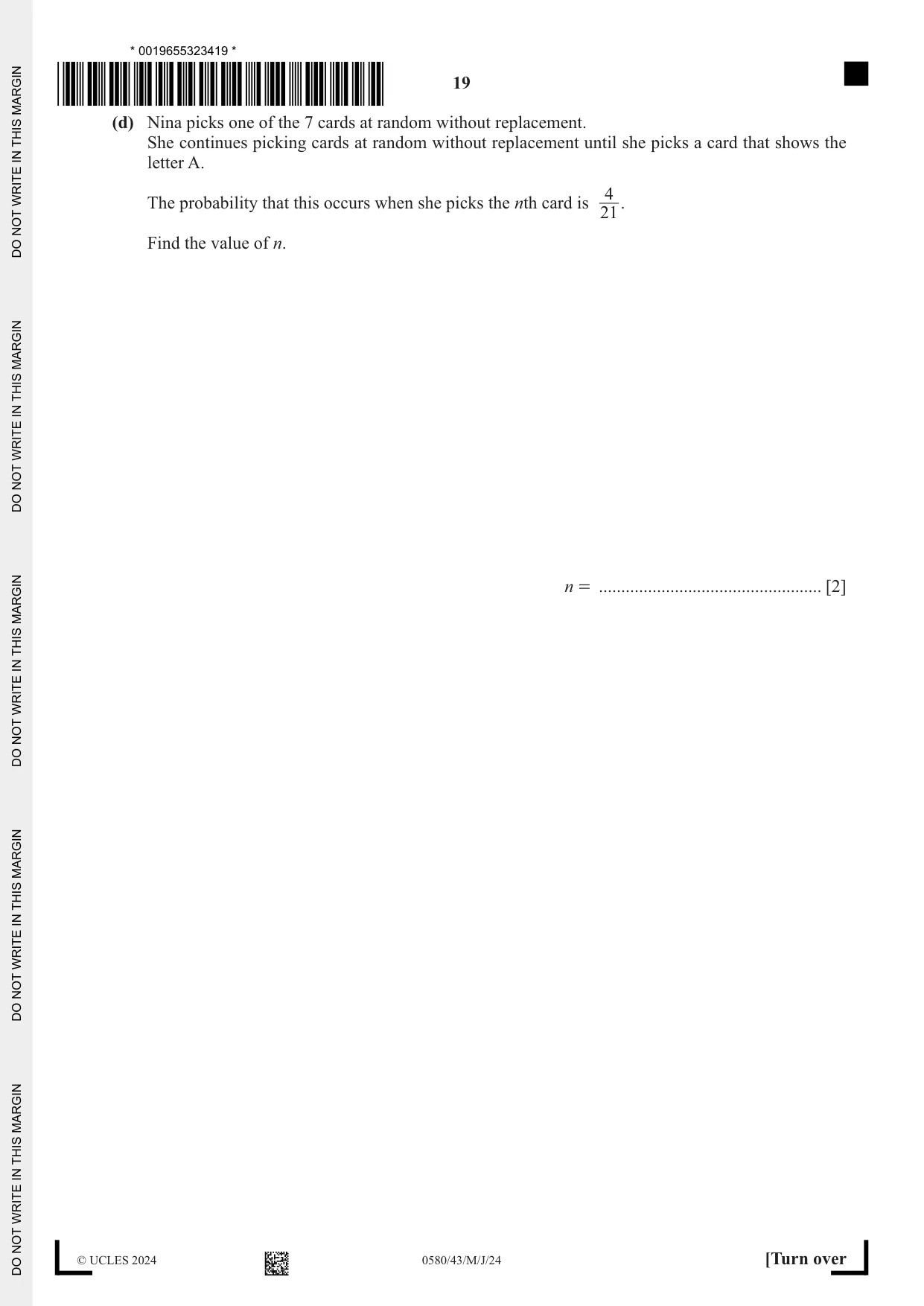
9 N A M I B I A The diagram shows 7 cards. (a) Amir picks a card at random. Find the probability that the card shows (i) the letter H ................................................. [1] (ii) the letter B. ................................................. [1] (b) Fumika picks one of the 7 cards at random. She replaces it and picks a second card at random. Find the probability that both cards show the letter I. ................................................. [2] (c) Marcos picks two of the 7 cards at random, without replacement. (i) Find the probability that one card shows the letter I and the other card shows the letter N. ................................................. [3] (ii) Find the probability that the two cards show different letters. ................................................. [3] (d) Nina picks one of the 7 cards at random without replacement. She continues picking cards at random without replacement until she picks a card that shows the letter A. 4 The probability that this occurs when she picks the nth card is . 21 Find the value of n. n = .................................................. [2]
Mark scheme: 9(a)(i) 0 1 9(a)(ii) 1 1 oe 7 9(b) 4 2 2 2 oe M1 for 49 7 7 9(c)(i) 2 3 2 1 1 2 oe M2 for + oe 21 7 6 7 6 2 1 1 2 or M1 for or oe seen 7 6 7 6 4 If 0 scored SC1 for 49 9(c)(ii) 19 3 2 1 2 1 oe M2 for 1 oe 21 7 6 7 6 2 1 2 1 or M1 for oe 7 6 7 6 ALTERNATIVE 1 2 5 M2 for [ 1] 3 + 2 7 7 6 2 5 1 or M1 for or [ 1] 3 7 6 7 38 If 0 scored SC1 for 49 9(d) 3 2 5 4 2or3 M1 for 7 6 5
Q10 · Y = x 7 - 7x 6 (a) Find the derivative of y with respect to x
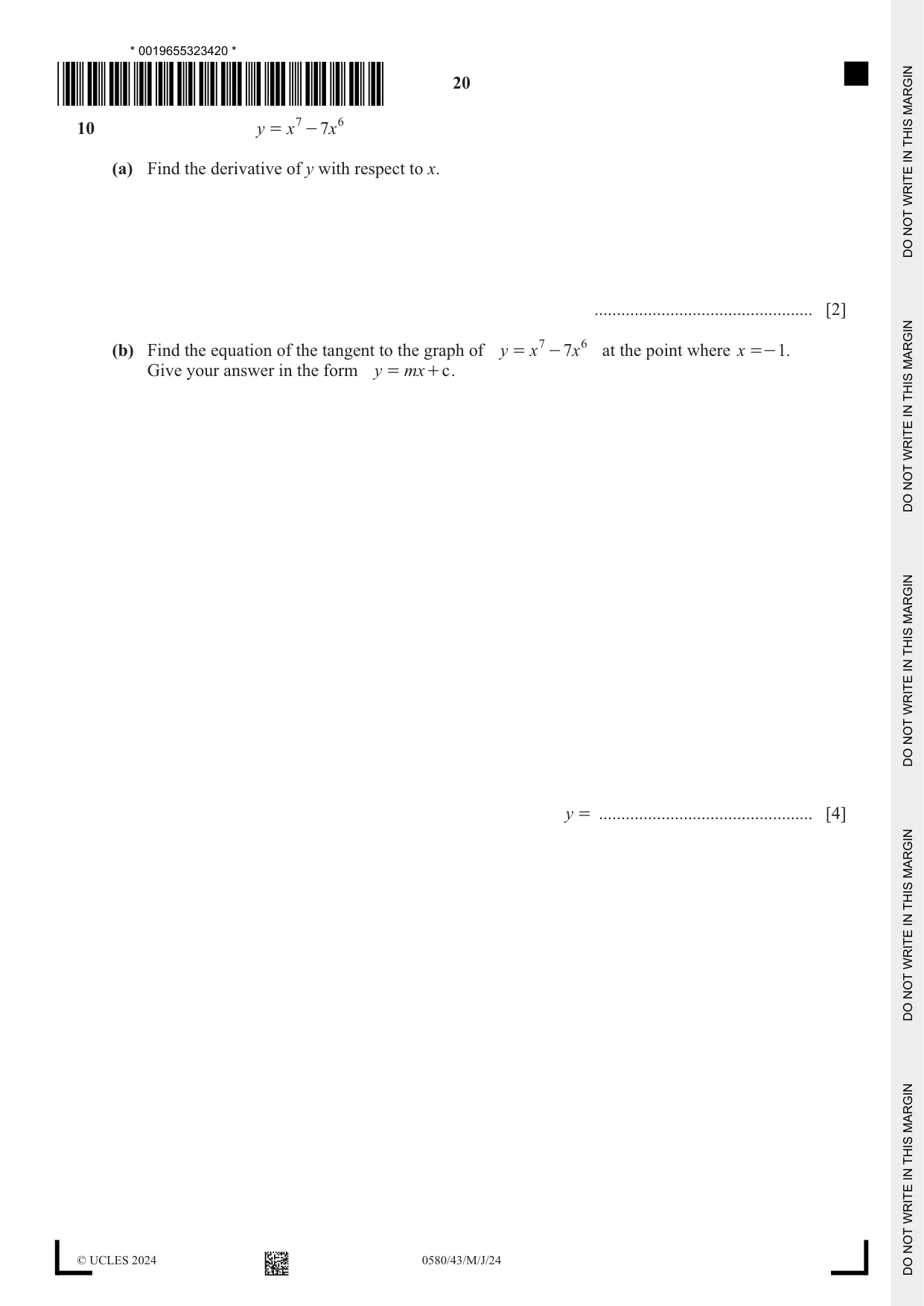
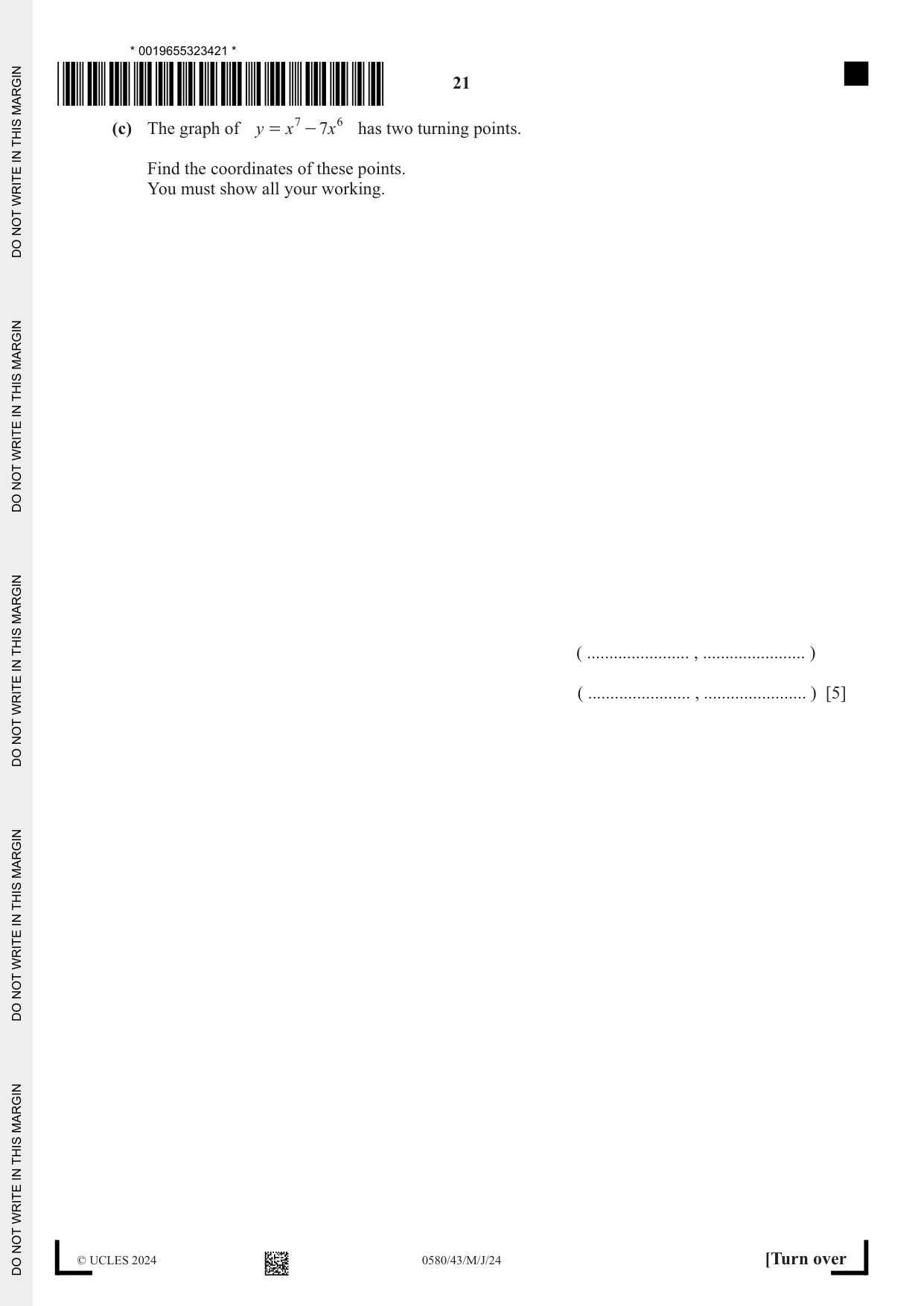
10 y = x 7 - 7x 6 (a) Find the derivative of y with respect to x. ................................................. [2] (b) Find the equation of the tangent to the graph of y = x 7 - 7x 6 at the point where x =- 1. Give your answer in the form y = mx + c . y = ................................................ [4] (c) The graph of y = x 7 - 7x 6 has two turning points. Find the coordinates of these points. You must show all your working. ( ....................... , ....................... ) ( ....................... , ....................... ) [5]
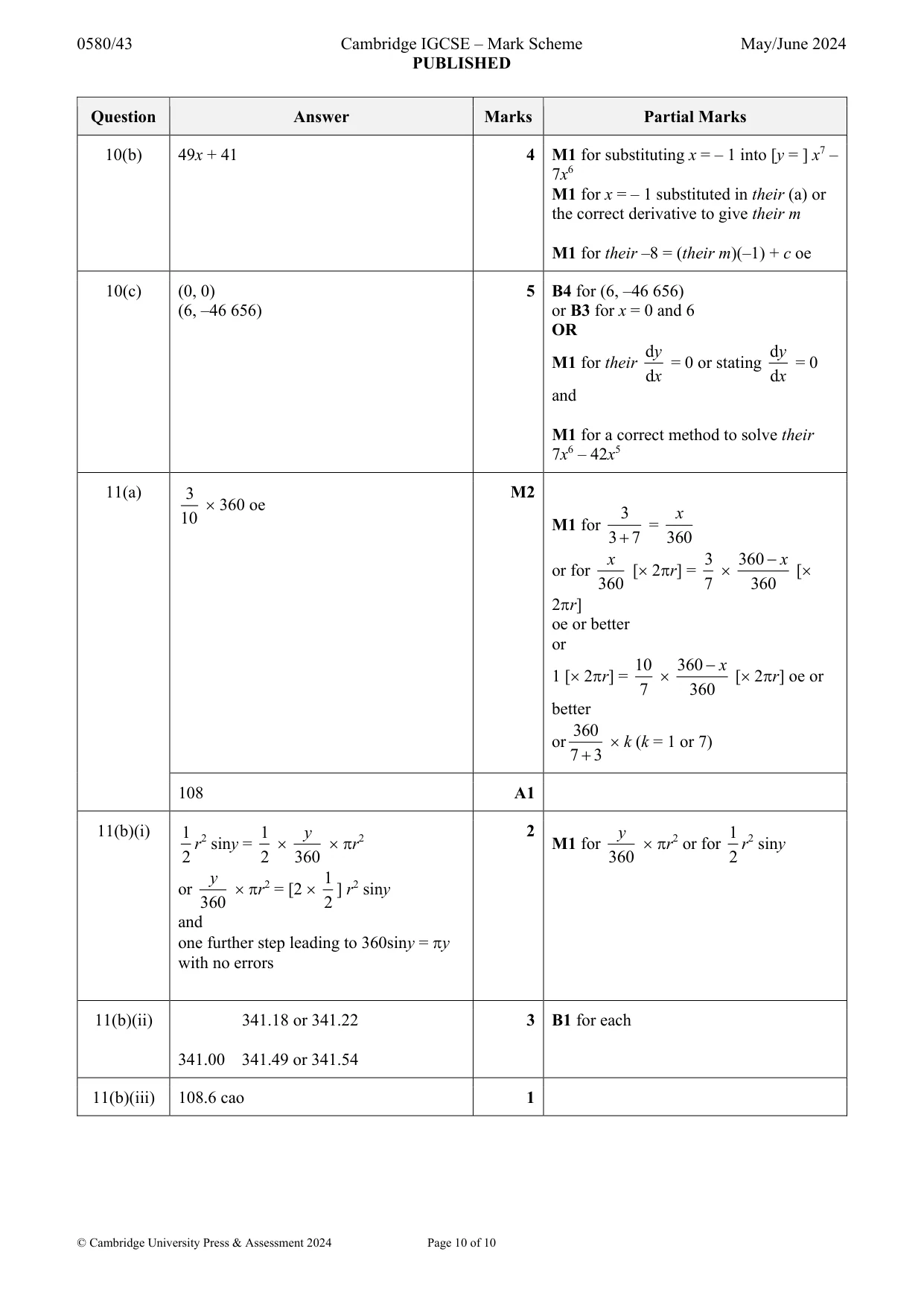
Mark scheme: 10(a) 6 5 2 B1 for one correct term 7x6 or 42x5 or for 7 x 42 x final answer 7 x 6 42 x 5 seen and spoiled 10(b) 49x + 41 4 M1 for substituting x = – 1 into [y = ] x7 – 7x6 M1 for x = – 1 substituted in their (a) or the correct derivative to give their m M1 for their –8 = (their m)(–1) + c oe 10(c) (0, 0) 5 B4 for (6, –46 656) (6, –46 656) or B3 for x = 0 and 6 OR d y d y M1 for their = 0 or stating = 0 dx dx and M1 for a correct method to solve their 7x6 – 42x5
Q11 · Q P NOT TO SCALE x° O 3 In the circle, centre O, the length of the minor arc PQ is of the…
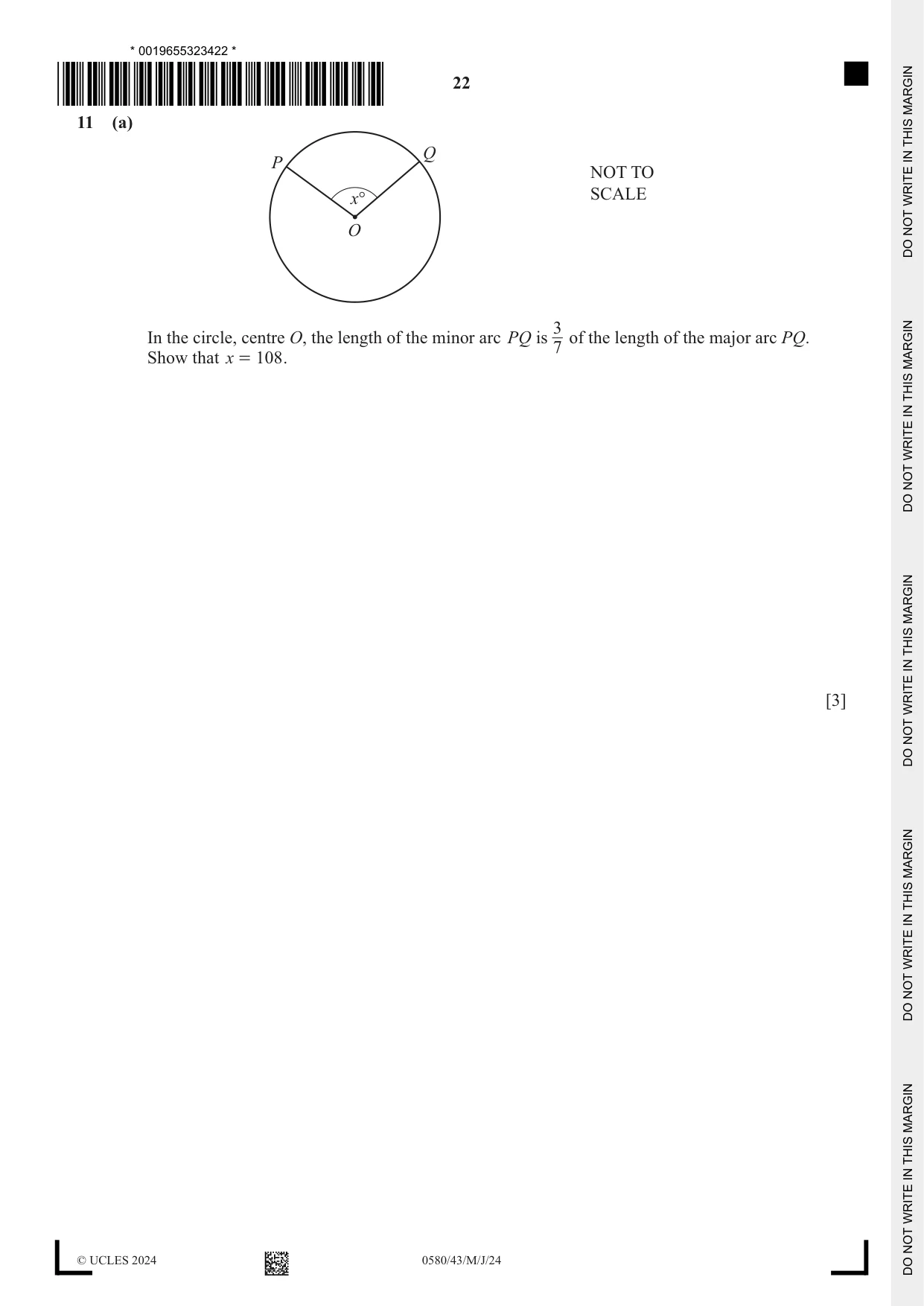
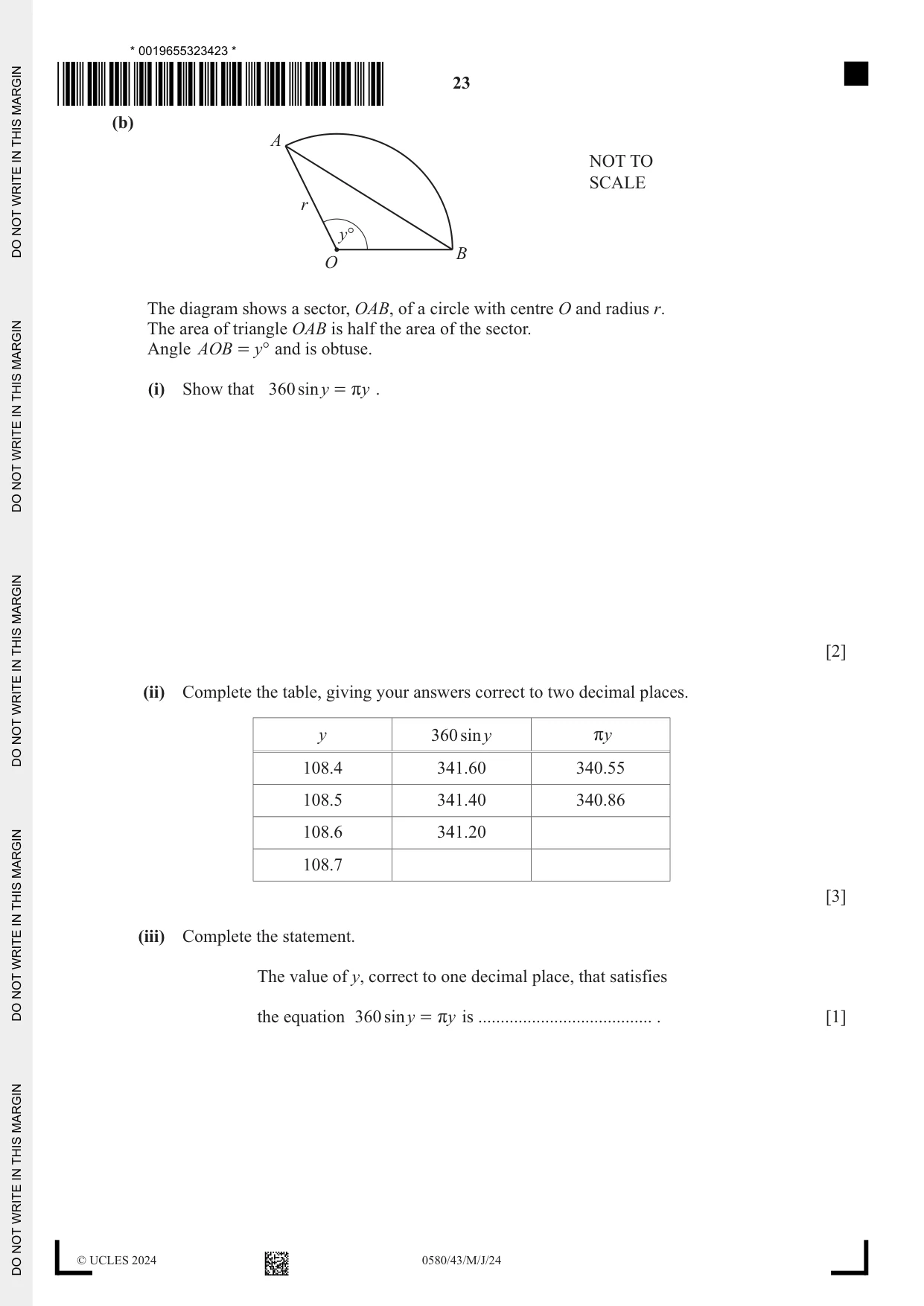
11 (a) Q P NOT TO SCALE x° O 3 In the circle, centre O, the length of the minor arc PQ is of the length of the major arc PQ. 7 Show that x = 108 . [3] (b) A NOT TO SCALE r y° B O The diagram shows a sector, OAB, of a circle with centre O and radius r. The area of triangle OAB is half the area of the sector. Angle AOB = y° and is obtuse. (i) Show that 360 siny = r y . [2] (ii) Complete the table, giving your answers correct to two decimal places. y 360 siny ry 108.4 341.60 340.55 108.5 341.40 340.86 108.6 341.20 108.7 [3] (iii) Complete the statement. The value of y, correct to one decimal place, that satisfies the equation 360 siny = r y is ....................................... . [1]
Mark scheme: 11(a) 3 M2 360 oe 3 x 10 M1 for = 3 7 360 x 3 360 x or for [ 2r] = [ 360 7 360 2r] oe or better or 10 360 x 1 [ 2r] = [ 2r] oe or 7 360 better 360 or k (k = 1 or 7) 7 3 108 A1 11(b)(i) 1 1 y 2 y 1 r2 siny = r2 M1 for r2 or for r2 siny 2 2 360 360 2 y 1 or r2 = [2 ] r2 siny 360 2 and one further step leading to 360siny = y with no errors 11(b)(ii) 341.18 or 341.22 3 B1 for each 341.00 341.49 or 341.54 11(b)(iii) 108.6 cao 1
What was in this paper
The subtopics covered by these 11 questions, and how many questions each got. Open one in a new tab to see every Cambridge question on it.
What you needed in this session
Cambridge’s own grade thresholds for 2024 May/June, Paper 4 · Variant 3. A higher threshold means an easier paper — the bar moves with how the cohort did.