Cambridge IGCSE Mathematics 0580 — 2015 Oct/Nov Paper 4 · Variant 3
0580/43/O/N/15 · 10 questions · 130 marks · ≈146 min
The question paper and its mark scheme, free to read here and free to download. This is Cambridge’s own paper, exactly as it was sat.
Question paper20 pages
Mark scheme8 pages
Answers below. Sit the paper first if you are practising.
Questions as text
Q1 · Kolyan buys water for $2.60
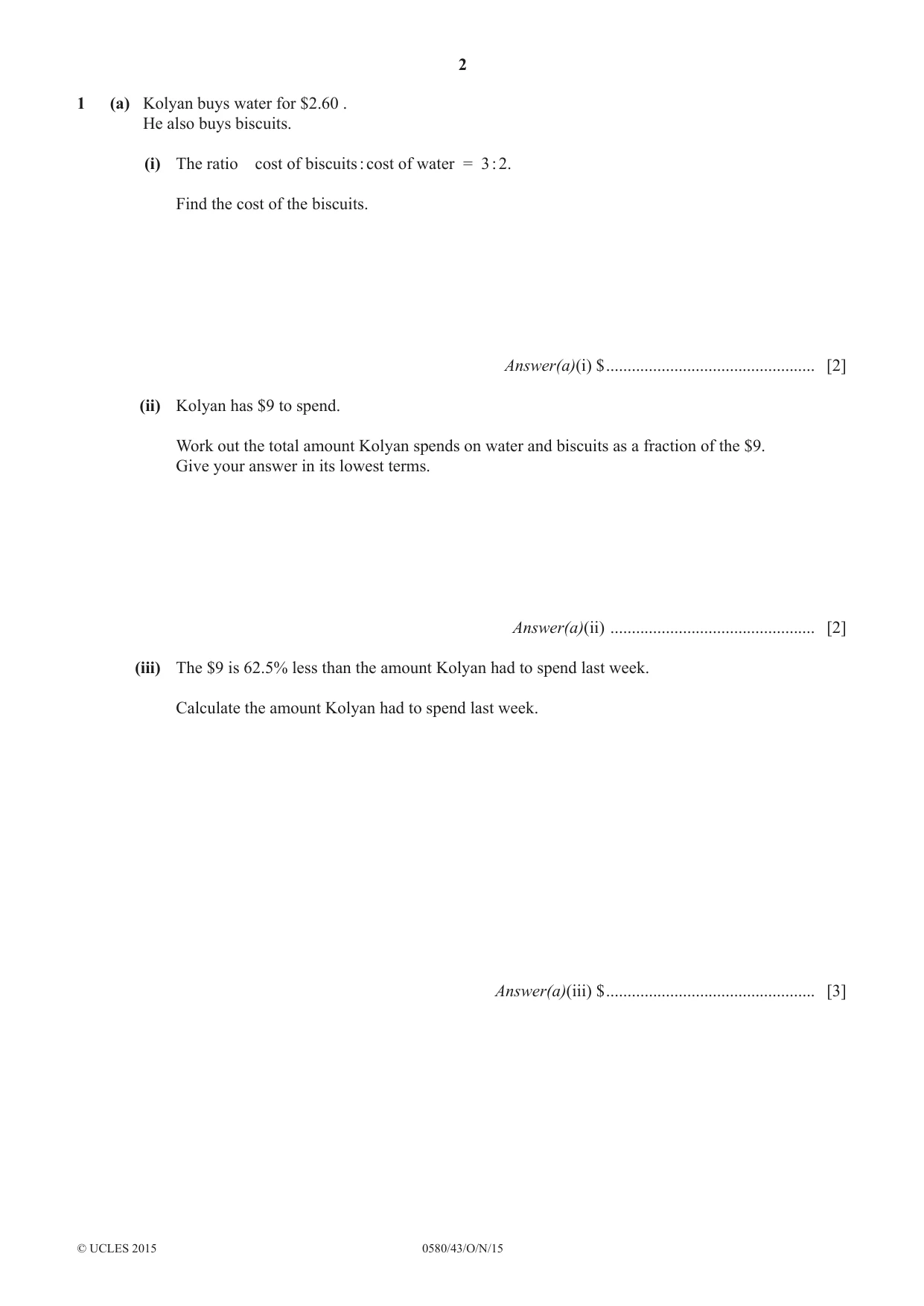
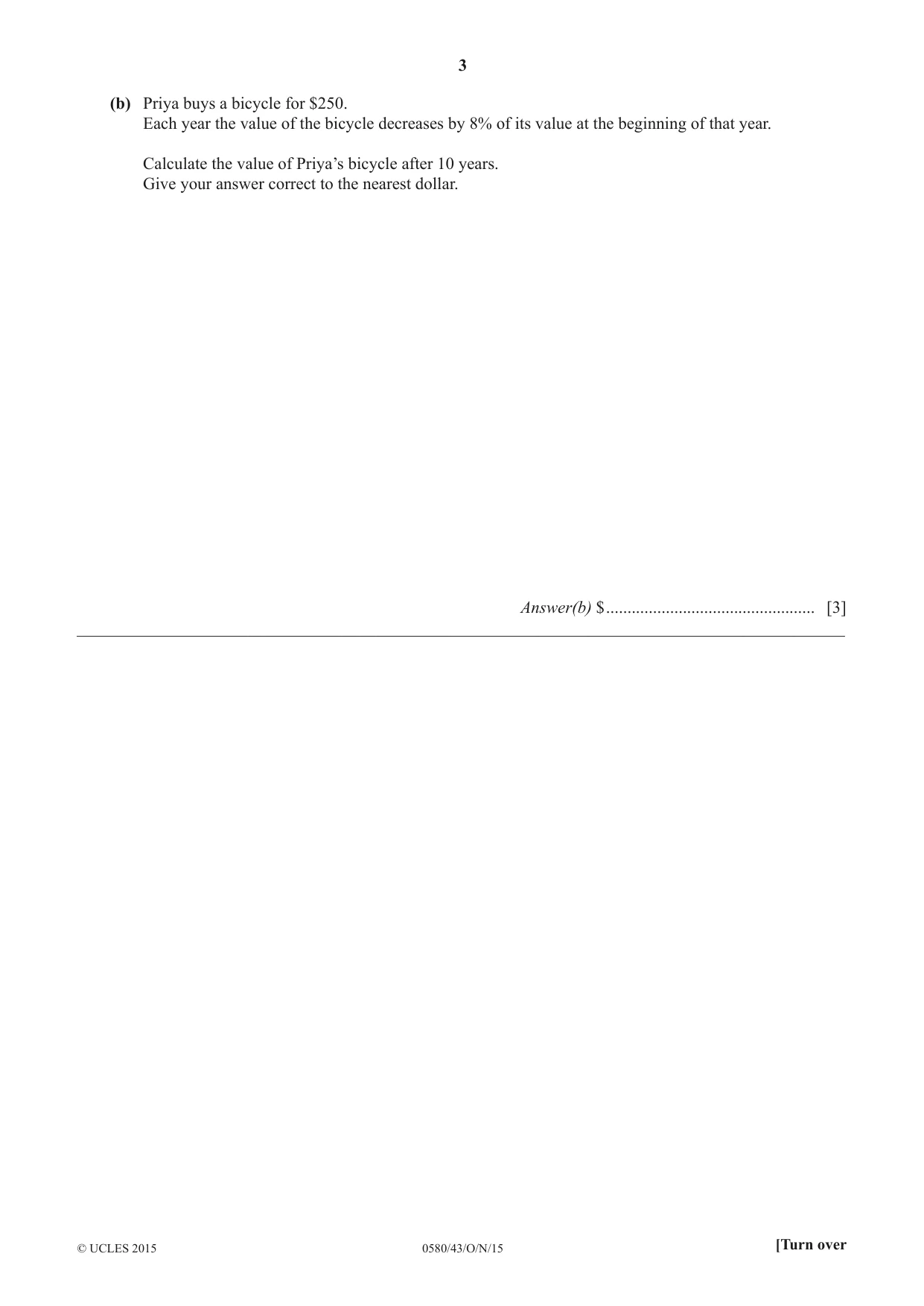
1 (a) Kolyan buys water for $2.60 . He also buys biscuits. (i) The ratio cost of biscuits : cost of water = 3 : 2. Find the cost of the biscuits. Answer(a)(i) $ ................................................. [2] (ii) Kolyan has $9 to spend. Work out the total amount Kolyan spends on water and biscuits as a fraction of the $9. Give your answer in its lowest terms. Answer(a)(ii) ................................................ [2] (iii) The $9 is 62.5% less than the amount Kolyan had to spend last week. Calculate the amount Kolyan had to spend last week. Answer(a)(iii) $ ................................................. [3] (b) Priya buys a bicycle for $250. Each year the value of the bicycle decreases by 8% of its value at the beginning of that year. Calculate the value of Priya’s bicycle after 10 years. Give your answer correct to the nearest dollar. Answer(b) $ ................................................. [3] __________________________________________________________________________________________
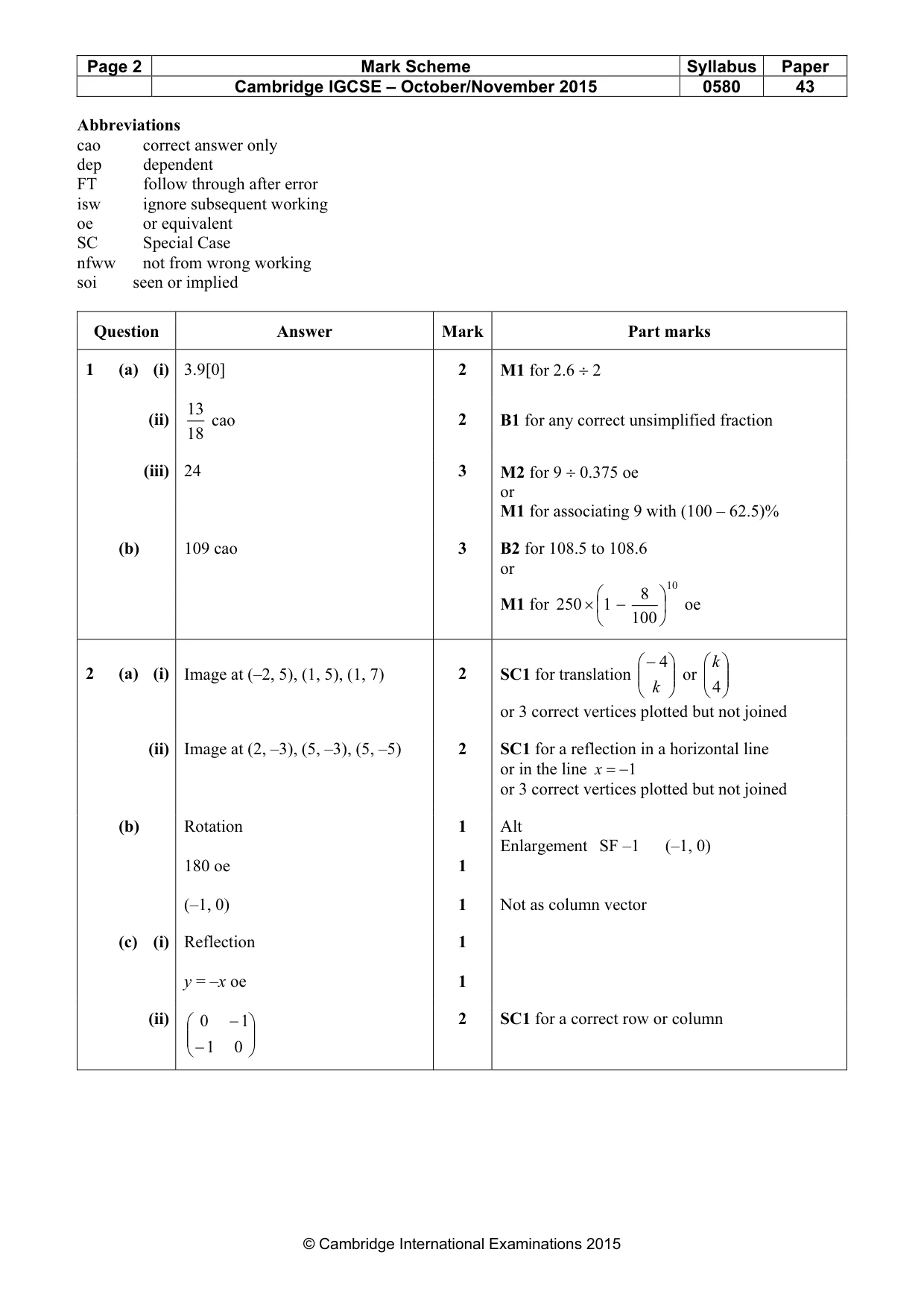
Mark scheme: Question Answer Mark Part marks 1 (a) (i) 3.9[0] 2 M1 for 2.6 ÷ 2 13 (ii) cao 2 B1 for any correct unsimplified fraction 18 (iii) 24 3 M2 for 9 ÷ 0.375 oe or M1 for associating 9 with (100 – 62.5)% (b) 109 cao 3 B2 for 108.5 to 108.6 or 10 8 M1 for 250 × − 1 oe 100 −4 k
Q2 · Y 8 7 6 5 4 3 2 T 1 x –8 –7 –6 –5 –4 –3 –2 –1 0 1 2 3 4 5 6 –1 U –2 –3 –4 W –5 –6 (a) On…
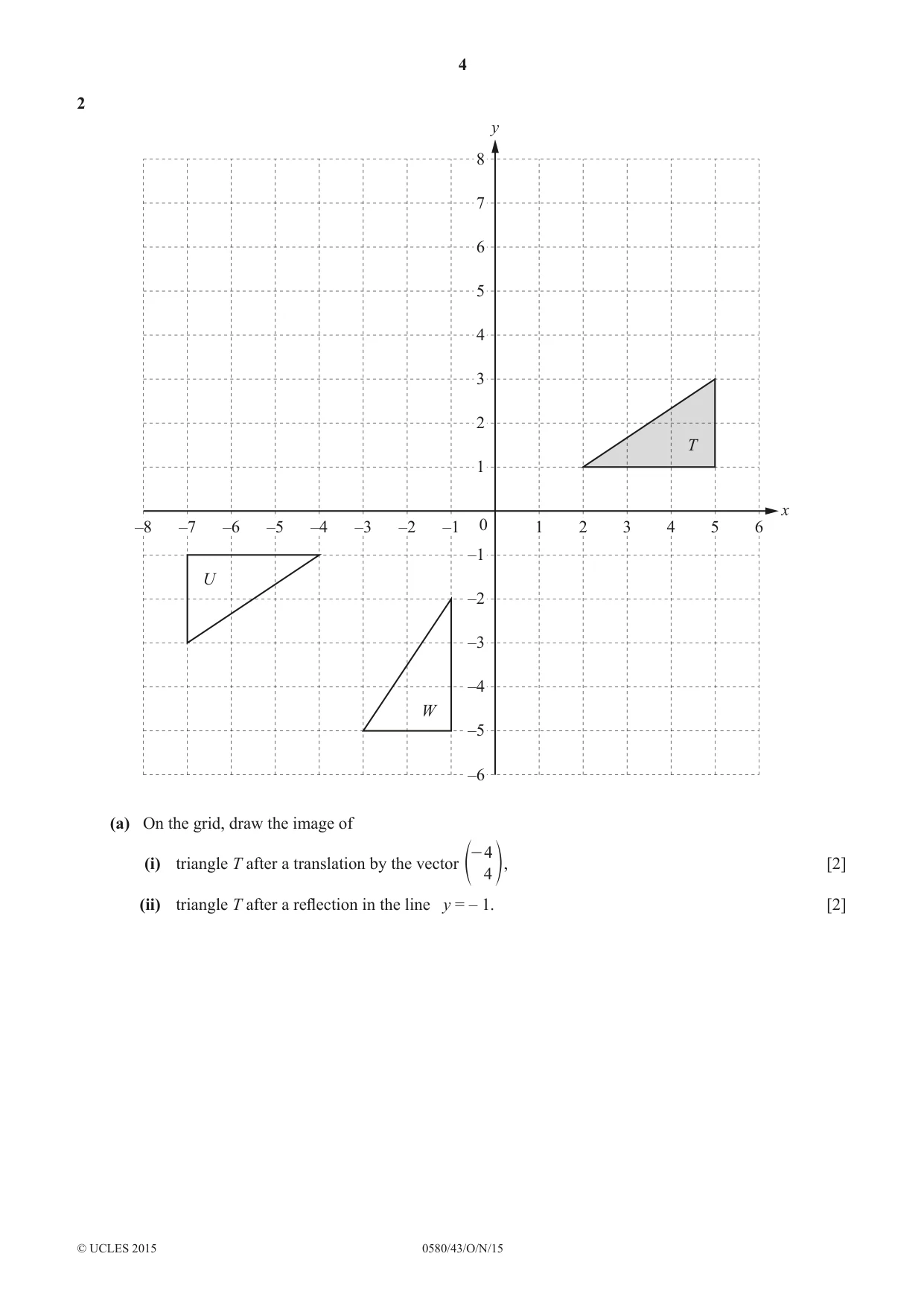
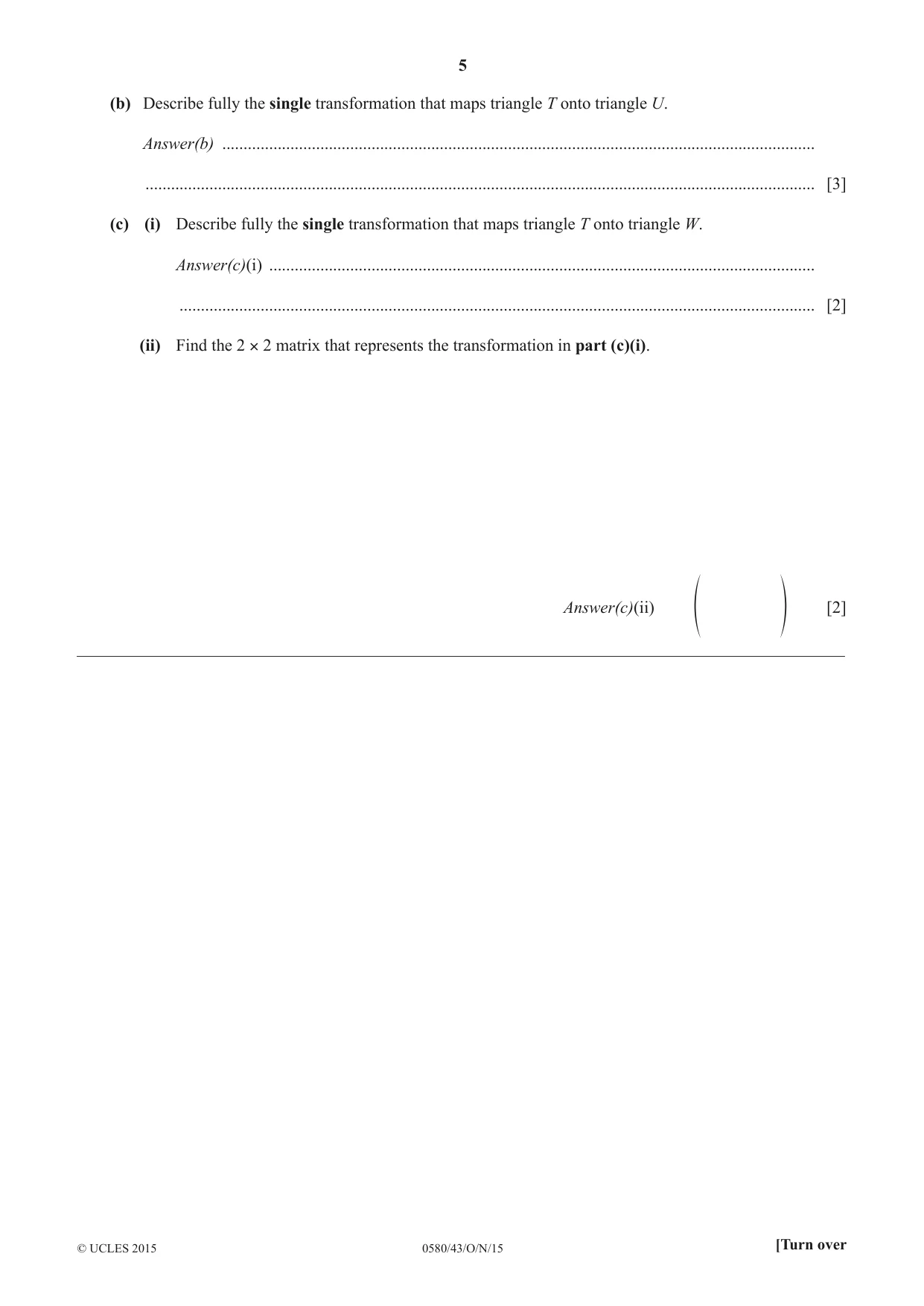
2 y 8 7 6 5 4 3 2 T 1 x –8 –7 –6 –5 –4 –3 –2 –1 0 1 2 3 4 5 6 –1 U –2 –3 –4 W –5 –6 (a) On the grid, draw the image of - 4 (i) triangle T after a translation by the vector [2] e 4 o, (ii) triangle T after a reflection in the line y = – 1. [2] (b) Describe fully the single transformation that maps triangle T onto triangle U. Answer(b) ........................................................................................................................................... ............................................................................................................................................................. [3] (c) (i) Describe fully the single transformation that maps triangle T onto triangle W. Answer(c)(i) ................................................................................................................................ ..................................................................................................................................................... [2] (ii) Find the 2 × 2 matrix that represents the transformation in part (c)(i). Answer(c)(ii) [2] f p __________________________________________________________________________________________
Mark scheme: 4 k 2 (a) (i) Image at (–2, 5), (1, 5), (1, 7) 2 SC1 for translation or k 4 or 3 correct vertices plotted but not joined (ii) Image at (2, –3), (5, –3), (5, –5) 2 SC1 for a reflection in a horizontal line or in the line x = − 1 or 3 correct vertices plotted but not joined (b) Rotation 1 Alt Enlargement SF –1 (–1, 0) 180 oe 1 (–1, 0) 1 Not as column vector (c) (i) Reflection 1 y = –x oe 1 (ii) 0 − 1 2 SC1 for a correct row or column − 1 0
Q3 · The diagram shows a horizontal water trough in the shape of a prism
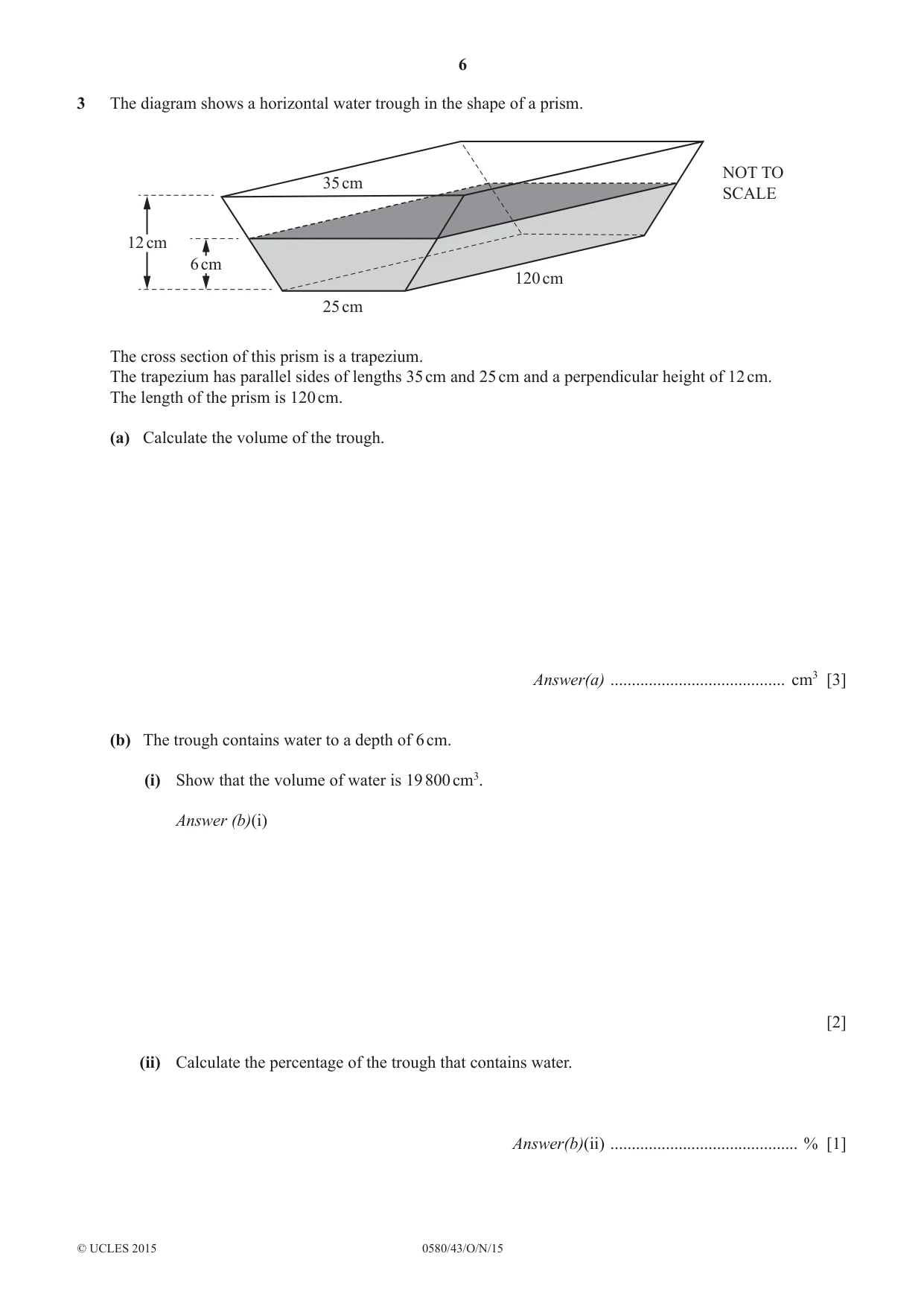
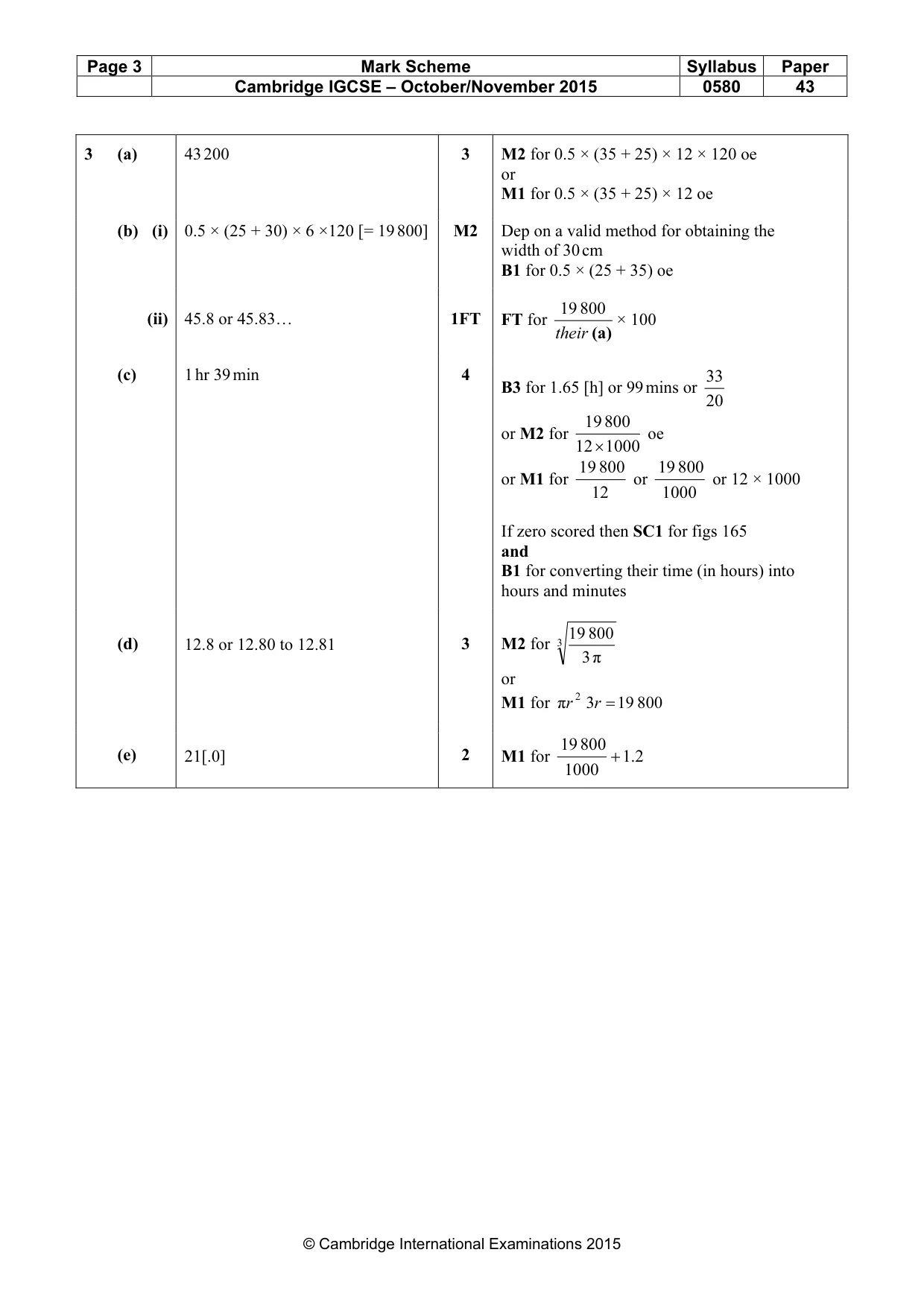
3 The diagram shows a horizontal water trough in the shape of a prism. NOT TO 35 cm SCALE 12 cm 6 cm 120 cm 25 cm The cross section of this prism is a trapezium. The trapezium has parallel sides of lengths 35 cm and 25 cm and a perpendicular height of 12 cm. The length of the prism is 120 cm. (a) Calculate the volume of the trough. Answer(a) ......................................... cm3 [3] (b) The trough contains water to a depth of 6 cm. (i) Show that the volume of water is 19 800 cm3. Answer (b)(i) [2] (ii) Calculate the percentage of the trough that contains water. Answer(b)(ii) ............................................ % [1] (c) The water is drained from the trough at a rate of 12 litres per hour. Calculate the time it takes to empty the trough. Give your answer in hours and minutes. Answer(c) ................. h ................. min [4] (d) The water from the trough just fills a cylinder of radius r cm and height 3r cm. Calculate the value of r. Answer(d) r = ................................................ [3] (e) The cylinder has a mass of 1.2 kg. 1 cm3 of water has a mass of 1 g. Calculate the total mass of the cylinder and the water. Give your answer in kilograms. Answer(e) ........................................... kg [2] __________________________________________________________________________________________
Mark scheme: 3 (a) 43 200 3 M2 for 0.5 × (35 + 25) × 12 × 120 oe or M1 for 0.5 × (35 + 25) × 12 oe (b) (i) 0.5 × (25 + 30) × 6 ×120 [= 19 800] M2 Dep on a valid method for obtaining the width of 30 cm B1 for 0.5 × (25 + 35) oe 19 800 (ii) 45.8 or 45.83… 1FT FT for × 100 their (a) (c) 1 hr 39 min 4 33 B3 for 1.65 [h] or 99 mins or 20 19 800 or M2 for oe 12 × 1000 19 800 19 800 or M1 for or or 12 × 1000 12 1000 If zero scored then SC1 for figs 165 and B1 for converting their time (in hours) into hours and minutes 19 800 (d) 12.8 or 12.80 to 12.81 3 M2 for 3 3 π or M1 for π r 2 3r = 19 800 19 800 (e) 21[.0] 2 M1 for + 2.1 1000
Q4 · F(x) = x – 2 , x 0 2x (a) Complete the table of values
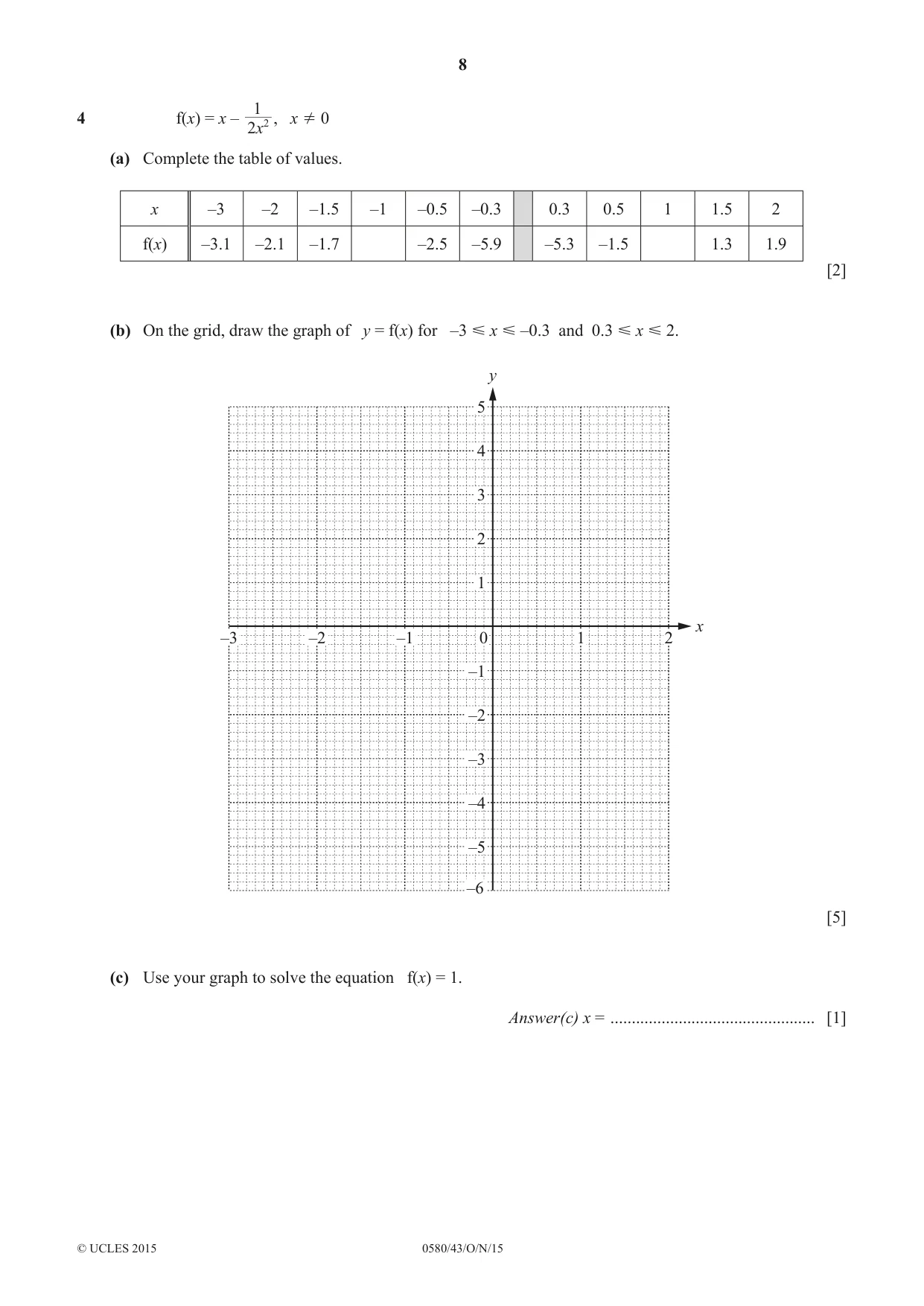
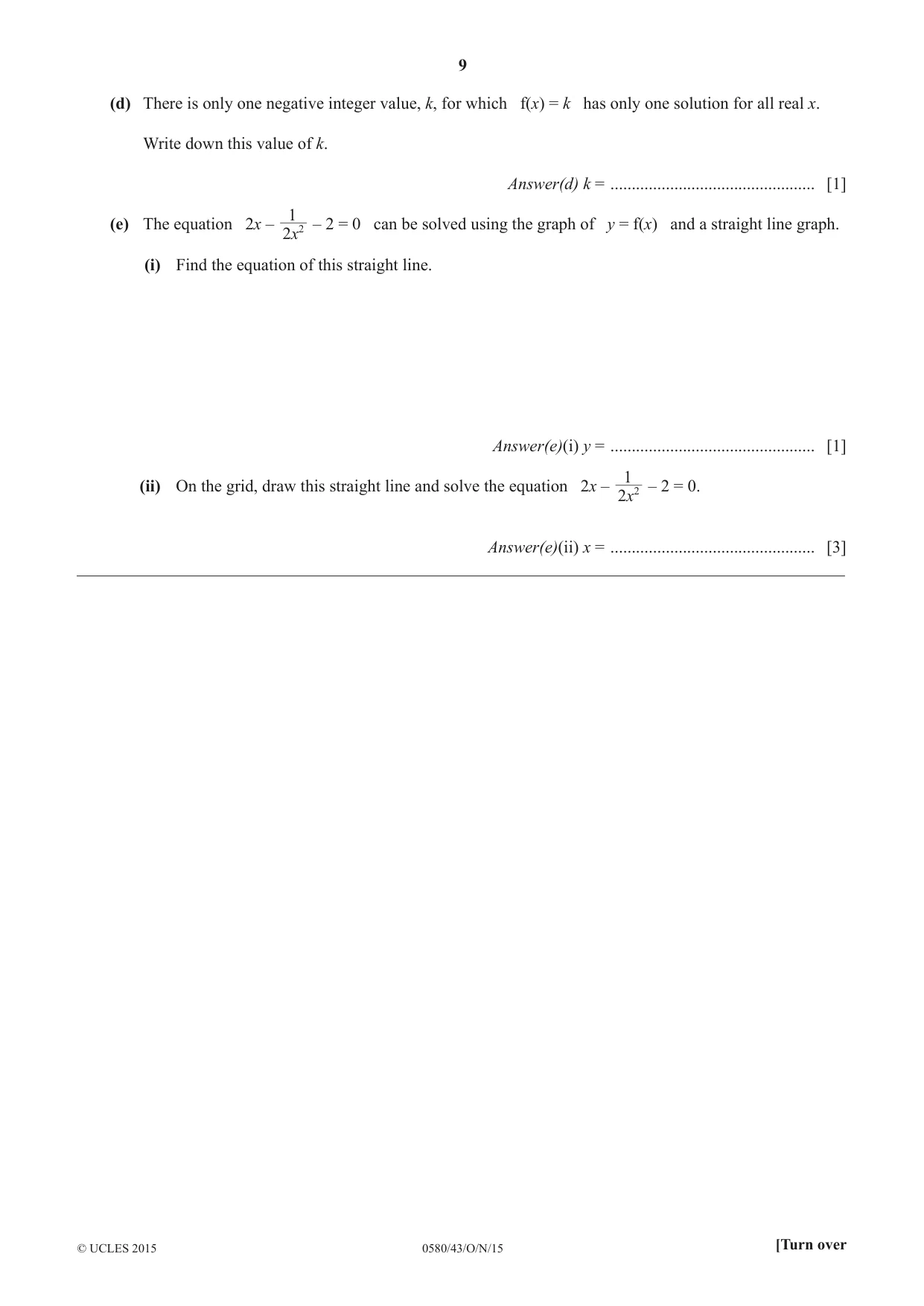
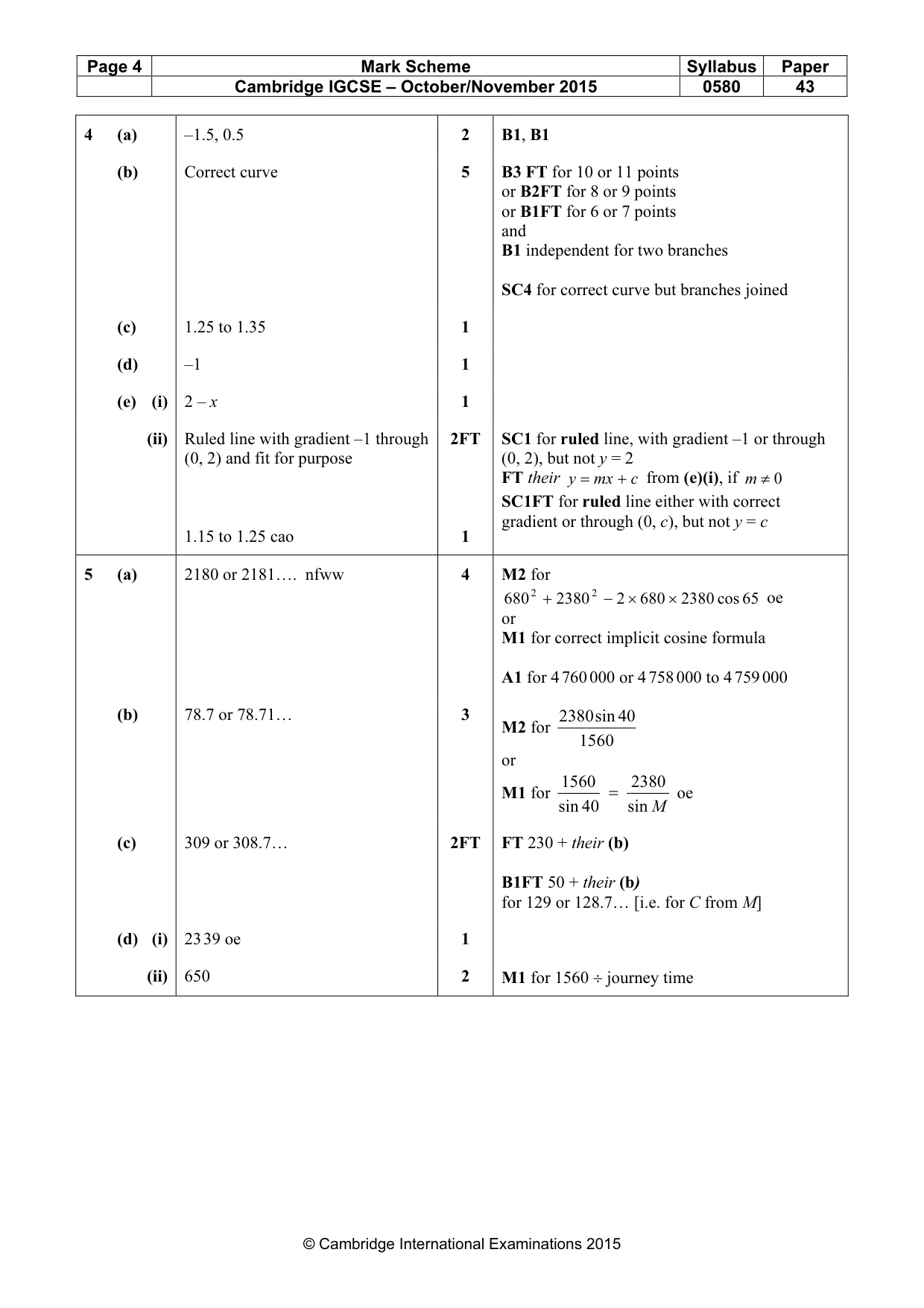
14 f(x) = x – 2 , x 0 2x (a) Complete the table of values. x –3 –2 –1.5 –1 –0.5 –0.3 0.3 0.5 1 1.5 2 f(x) –3.1 –2.1 –1.7 –2.5 –5.9 –5.3 –1.5 1.3 1.9 [2] (b) On the grid, draw the graph of y = f(x) for –3 x –0.3 and 0.3 x 2. y 5 4 3 2 1 x –3 –2 –1 0 1 2 –1 –2 –3 –4 –5 –6 [5] (c) Use your graph to solve the equation f(x) = 1. Answer(c) x = ................................................ [1] (d) There is only one negative integer value, k, for which f(x) = k has only one solution for all real x. Write down this value of k. Answer(d) k = ................................................ [1] 1 (e) The equation 2x – 2 – 2 = 0 can be solved using the graph of y = f(x) and a straight line graph. 2x (i) Find the equation of this straight line. Answer(e)(i) y = ................................................ [1] 1 (ii) On the grid, draw this straight line and solve the equation 2x – 2 – 2 = 0. 2x Answer(e)(ii) x = ................................................ [3] __________________________________________________________________________________________
Mark scheme: 4 (a) –1.5, 0.5 2 B1, B1 (b) Correct curve 5 B3 FT for 10 or 11 points or B2FT for 8 or 9 points or B1FT for 6 or 7 points and B1 independent for two branches SC4 for correct curve but branches joined (c) 1.25 to 1.35 1 (d) –1 1 (e) (i) 2 – x 1 (ii) Ruled line with gradient –1 through 2FT SC1 for ruled line, with gradient –1 or through (0, 2) and fit for purpose (0, 2), but not y = 2 FT their y = mx + c from (e)(i), if m ≠ 0 SC1FT for ruled line either with correct gradient or through (0, c), but not y = c 1.15 to 1.25 cao 1
Q5 · K 680 km 65° 40° D North NOT TO SCALE 2380 km M 1560 km C The diagram shows some…
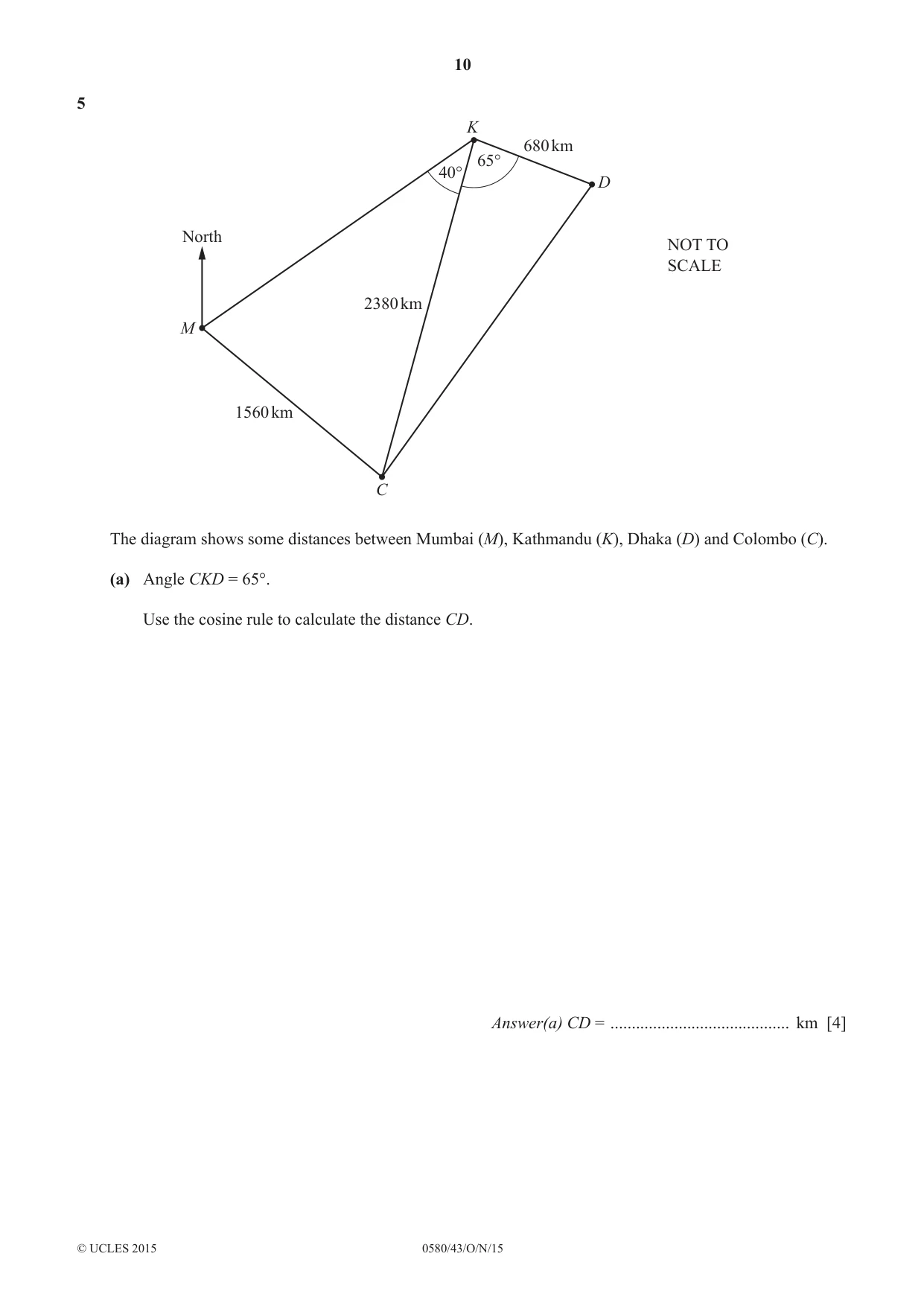
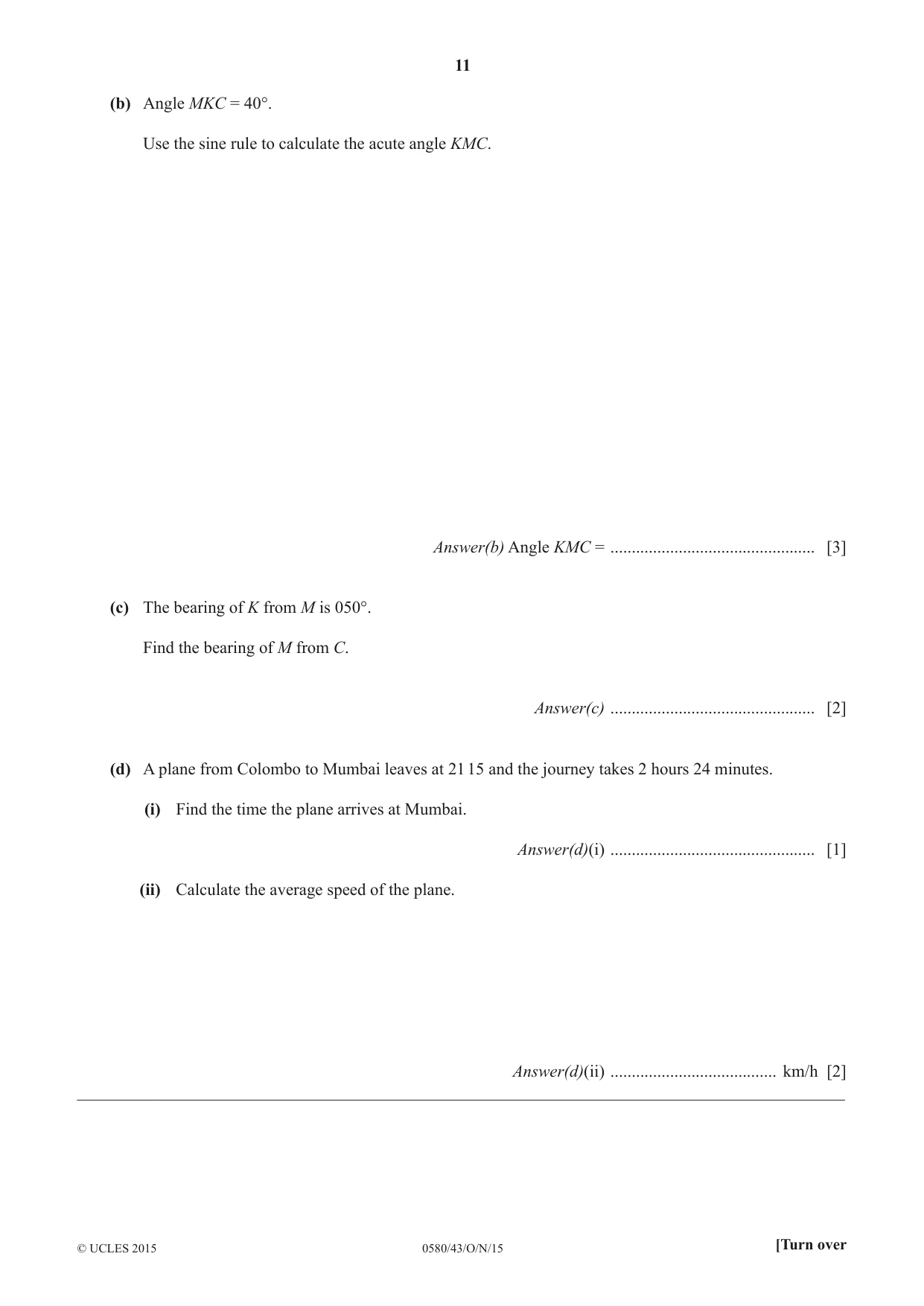
5 K 680 km 65° 40° D North NOT TO SCALE 2380 km M 1560 km C The diagram shows some distances between Mumbai (M), Kathmandu (K), Dhaka (D) and Colombo (C). (a) Angle CKD = 65°. Use the cosine rule to calculate the distance CD. Answer(a) CD = .......................................... km [4] (b) Angle MKC = 40°. Use the sine rule to calculate the acute angle KMC. Answer(b) Angle KMC = ................................................ [3] (c) The bearing of K from M is 050°. Find the bearing of M from C. Answer(c) ................................................ [2] (d) A plane from Colombo to Mumbai leaves at 21 15 and the journey takes 2 hours 24 minutes. (i) Find the time the plane arrives at Mumbai. Answer(d)(i) ................................................ [1] (ii) Calculate the average speed of the plane. Answer(d)(ii) ....................................... km/h [2] __________________________________________________________________________________________
Mark scheme: 5 (a) 2180 or 2181…. nfww 4 M2 for 680 2 + 2380 2 − 2 × 680 × 2380 cos 65 oe or M1 for correct implicit cosine formula A1 for 4 760 000 or 4 758 000 to 4 759 000 (b) 78.7 or 78.71… 3 2380 sin 40 M2 for 1560 or 1560 2380 M1 for = oe sin 40 sin M (c) 309 or 308.7… 2FT FT 230 + their (b) B1FT 50 + their (b) for 129 or 128.7… [i.e. for C from M] (d) (i) 23 39 oe 1 (ii) 650 2 M1 for 1560 ÷ journey time
Q6 · The table shows information about the masses, m grams, of 160 apples
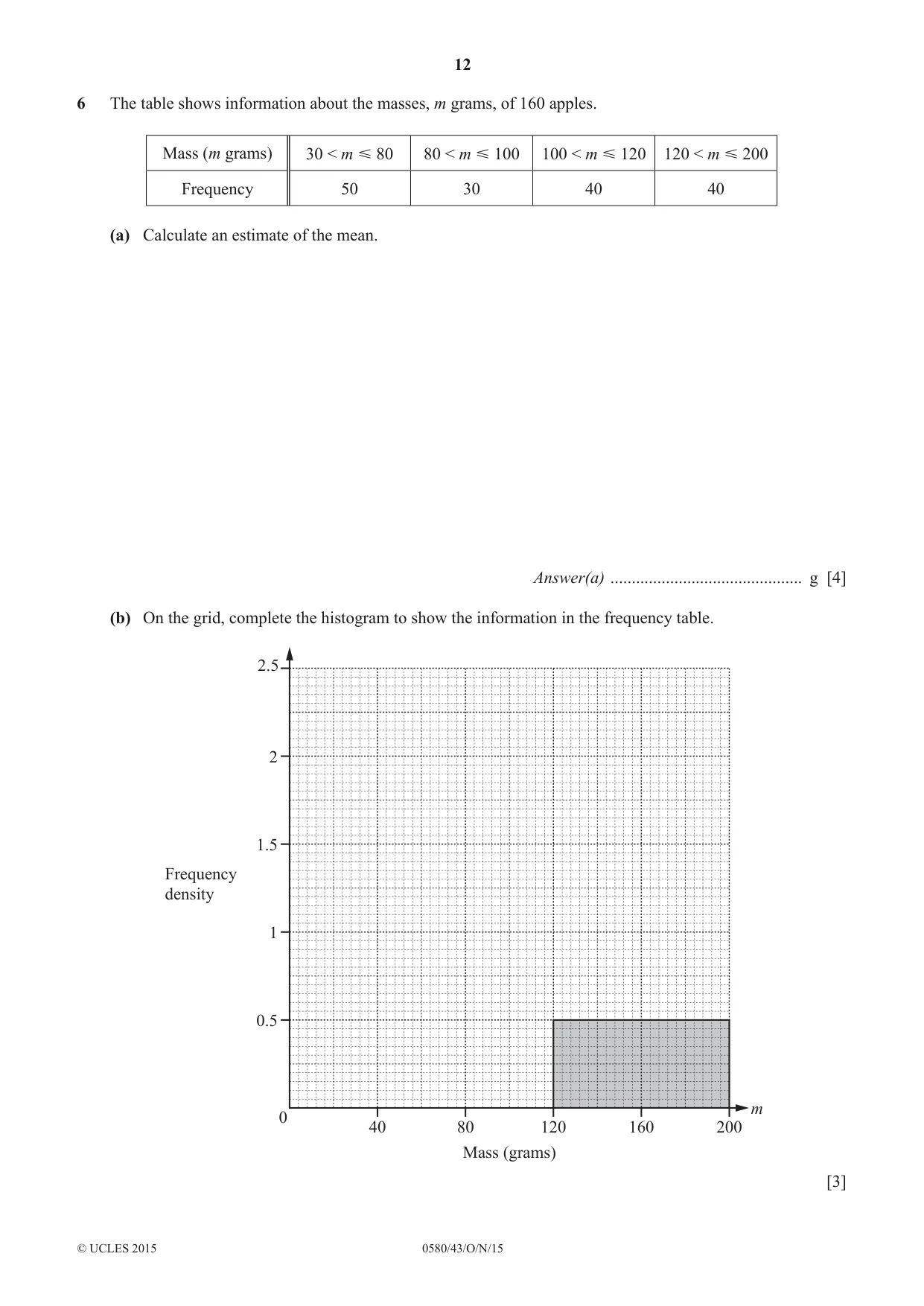
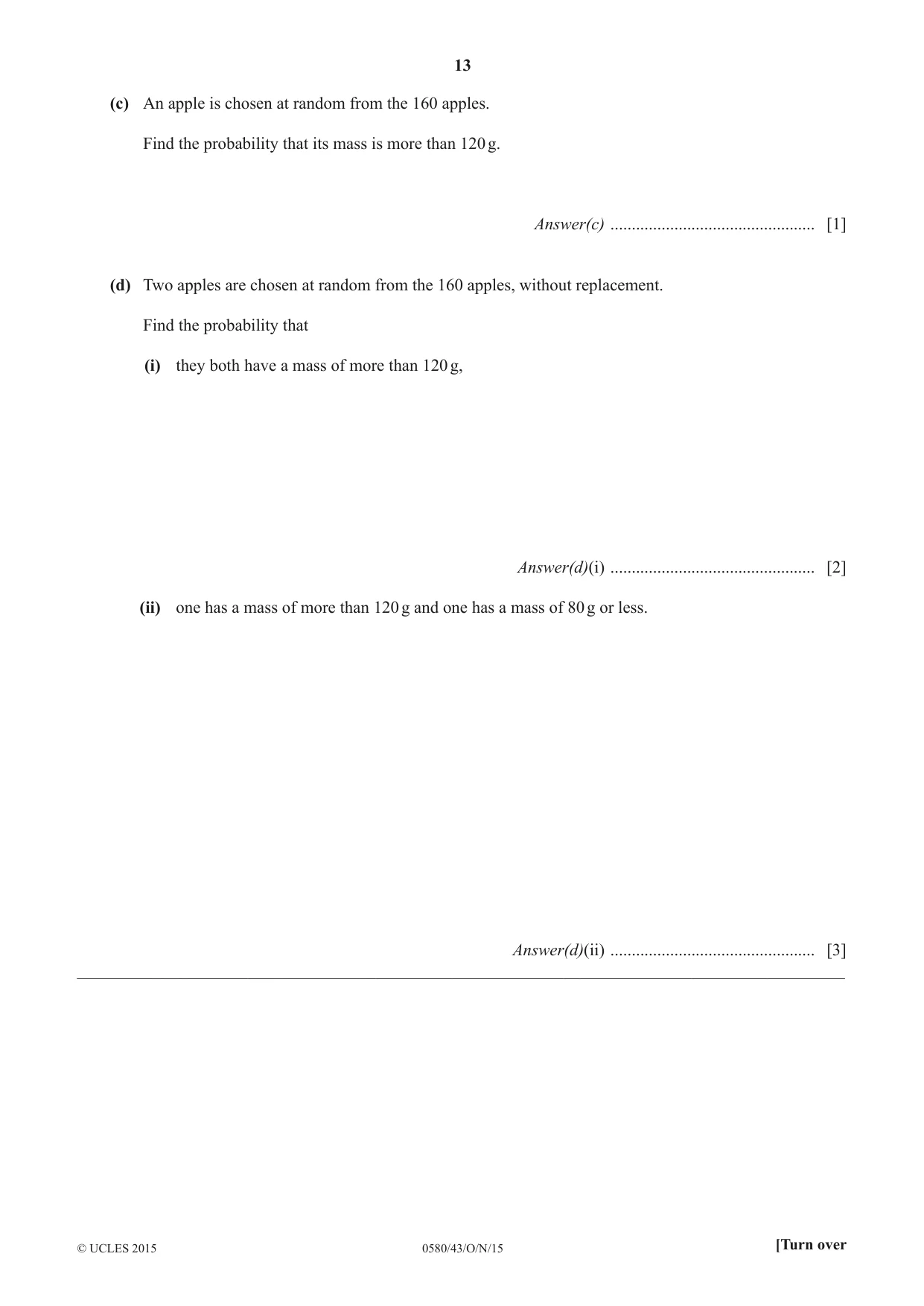
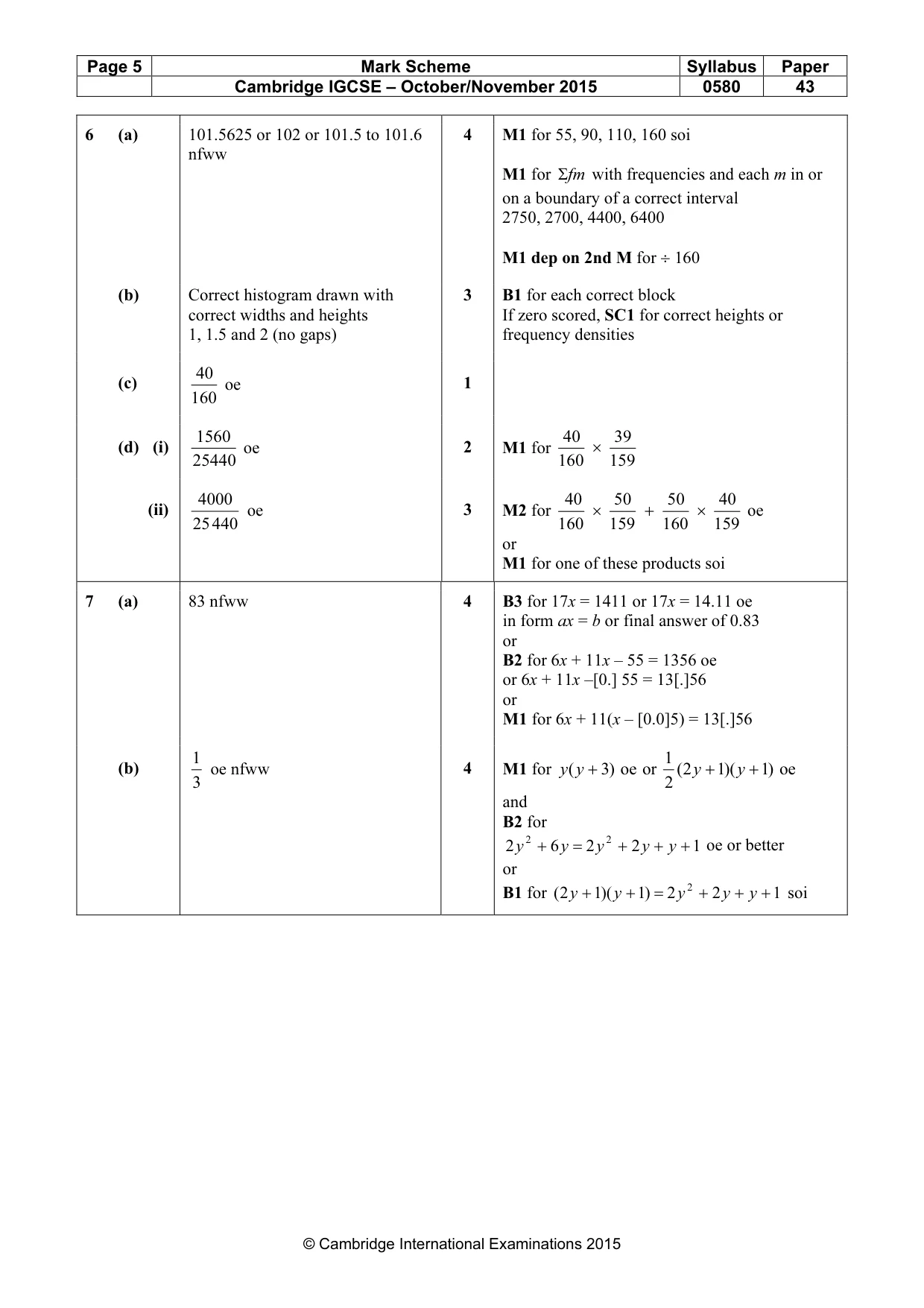
6 The table shows information about the masses, m grams, of 160 apples. Mass (m grams) 30 < m 80 80 < m 100 100 < m 120 120 < m 200 Frequency 50 30 40 40 (a) Calculate an estimate of the mean. Answer(a) ............................................. g [4] (b) On the grid, complete the histogram to show the information in the frequency table. 2.5 2 1.5 Frequency density 1 0.5 m 0 40 80 120 160 200 Mass (grams) [3] (c) An apple is chosen at random from the 160 apples. Find the probability that its mass is more than 120 g. Answer(c) ................................................ [1] (d) Two apples are chosen at random from the 160 apples, without replacement. Find the probability that (i) they both have a mass of more than 120 g, Answer(d)(i) ................................................ [2] (ii) one has a mass of more than 120 g and one has a mass of 80 g or less. Answer(d)(ii) ................................................ [3] __________________________________________________________________________________________
Mark scheme: 6 (a) 101.5625 or 102 or 101.5 to 101.6 4 M1 for 55, 90, 110, 160 soi nfww M1 for Σfm with frequencies and each m in or on a boundary of a correct interval 2750, 2700, 4400, 6400 M1 dep on 2nd M for ÷ 160 (b) Correct histogram drawn with 3 B1 for each correct block correct widths and heights If zero scored, SC1 for correct heights or 1, 1.5 and 2 (no gaps) frequency densities 40 (c) oe 1 160 1560 40 39 (d) (i) oe 2 M1 for × 25440 160 159 4000 40 50 50 40 (ii) oe 3 M2 for × + × oe 25 440 160 159 160 159 or M1 for one of these products soi
Q7 · The cost of a loaf of bread is x cents
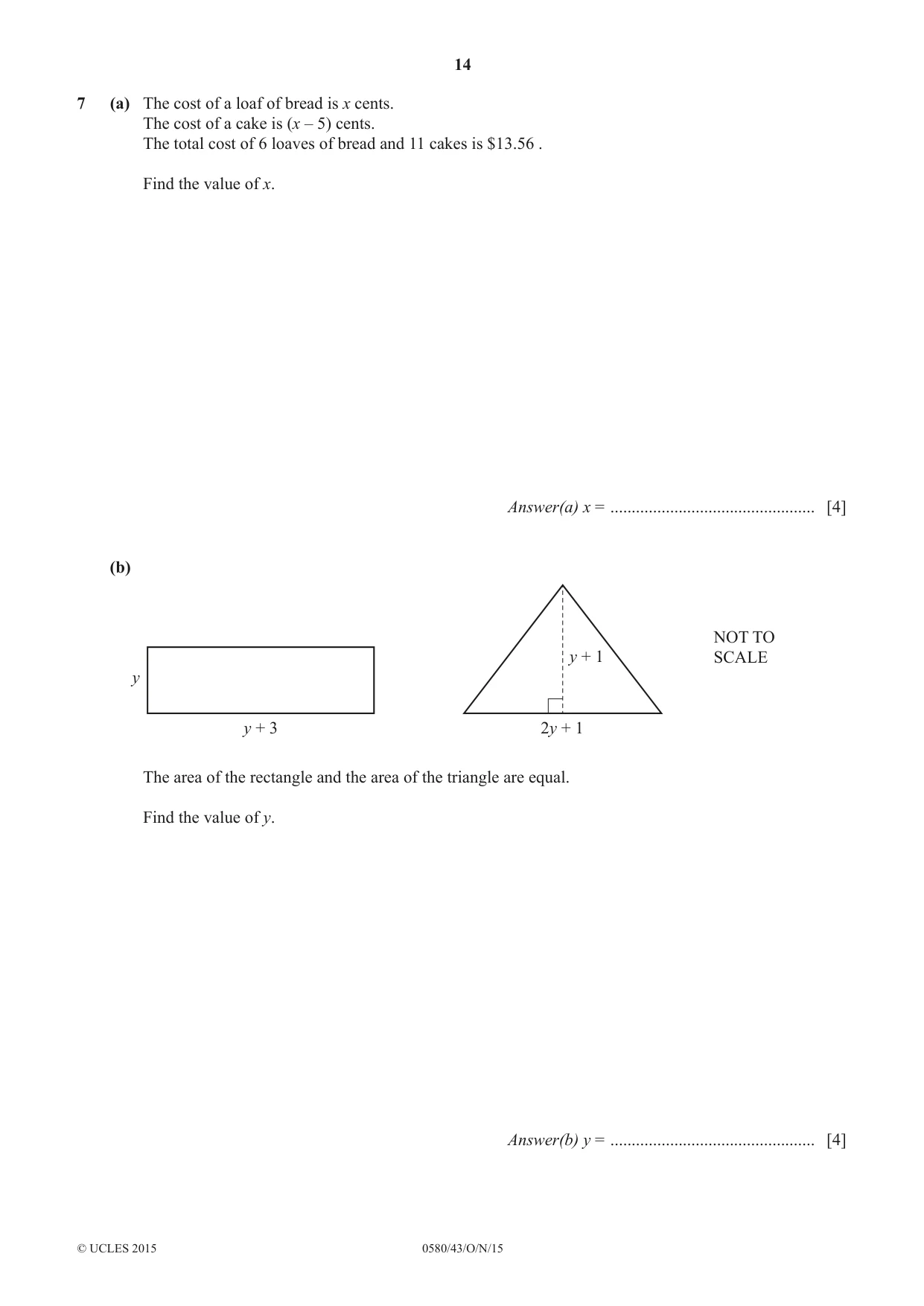
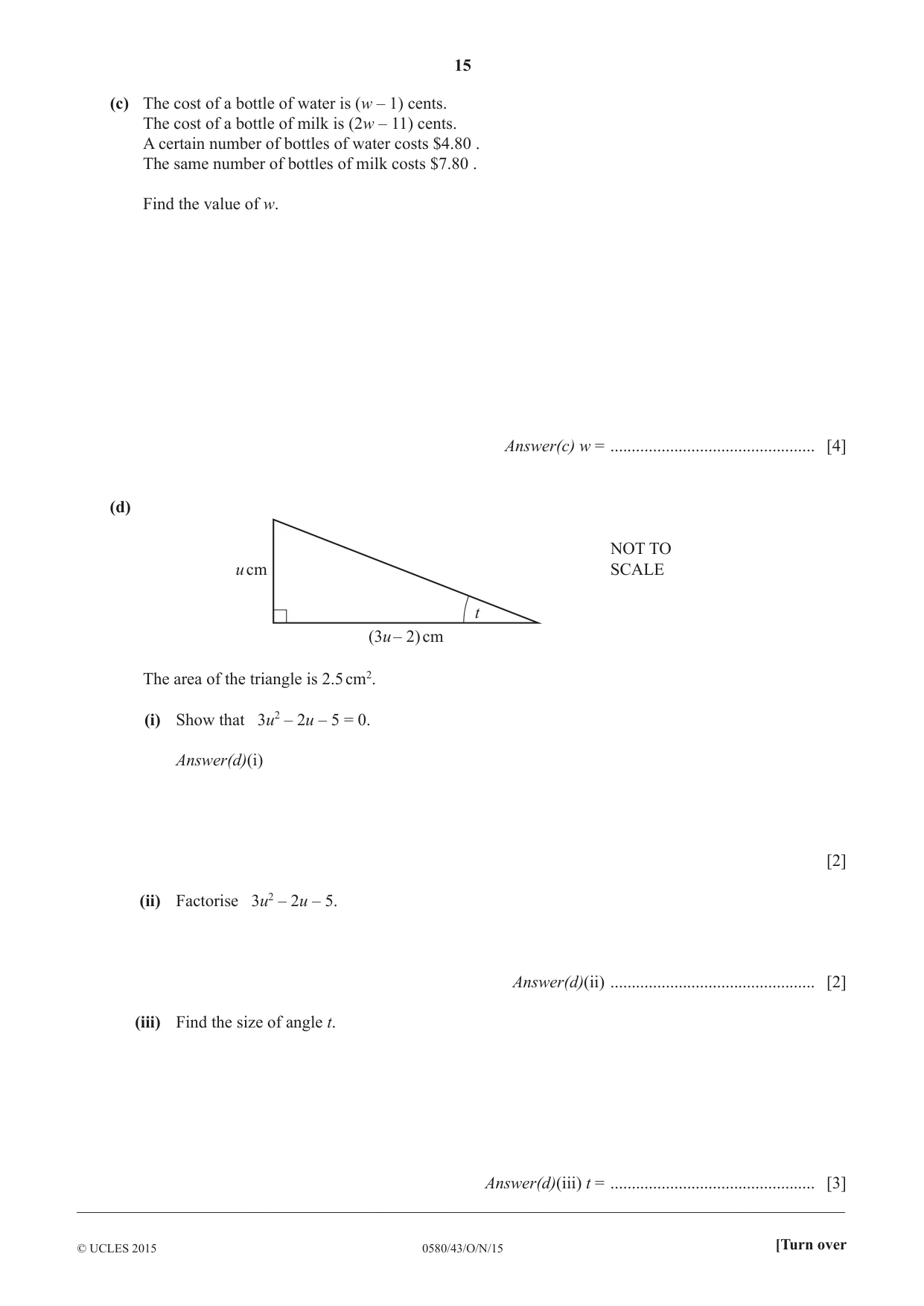
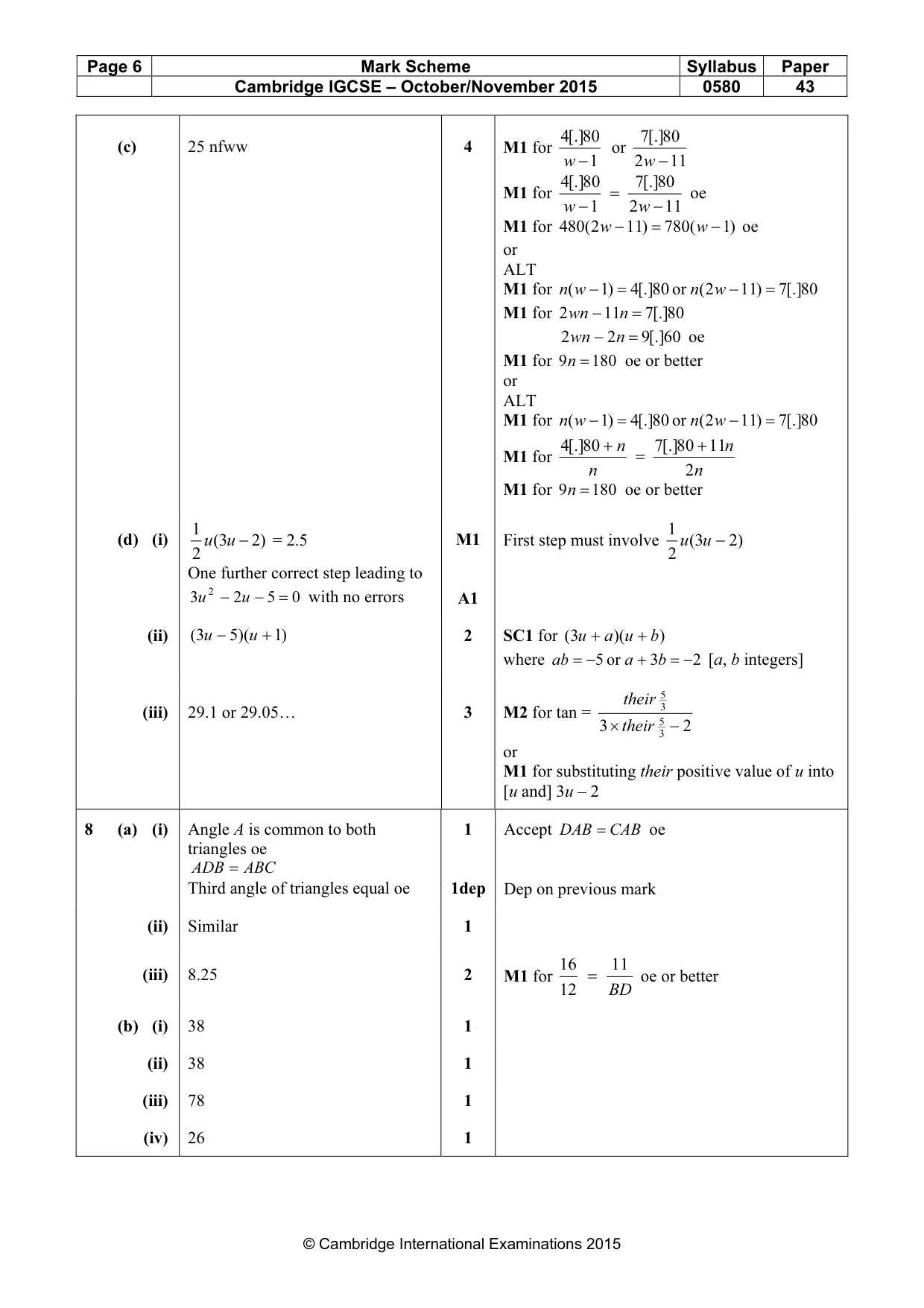
7 (a) The cost of a loaf of bread is x cents. The cost of a cake is (x – 5) cents. The total cost of 6 loaves of bread and 11 cakes is $13.56 . Find the value of x. Answer(a) x = ................................................ [4] (b) NOT TO y + 1 SCALE y y + 3 2y + 1 The area of the rectangle and the area of the triangle are equal. Find the value of y. Answer(b) y = ................................................ [4] (c) The cost of a bottle of water is (w – 1) cents. The cost of a bottle of milk is (2w – 11) cents. A certain number of bottles of water costs $4.80 . The same number of bottles of milk costs $7.80 . Find the value of w. Answer(c) w = ................................................ [4] (d) NOT TO u cm SCALE t (3u – 2) cm The area of the triangle is 2.5 cm2. (i) Show that 3u2 – 2u – 5 = 0. Answer(d)(i) [2] (ii) Factorise 3u2 – 2u – 5. Answer(d)(ii) ................................................ [2] (iii) Find the size of angle t. Answer(d)(iii) t = ................................................ [3] __________________________________________________________________________________________
Mark scheme: 7 (a) 83 nfww 4 B3 for 17x = 1411 or 17x = 14.11 oe in form ax = b or final answer of 0.83 or B2 for 6x + 11x – 55 = 1356 oe or 6x + 11x –[0.] 55 = 13[.]56 or M1 for 6x + 11(x – [0.0]5) = 13[.]56 1 1 (b) oe nfww 4 M1 for y ( y + )3 oe or ( 2 y + 1)( y + )1 oe 3 2 and B2 for 2 y 2 + 6 y = 2 y 2 + 2 y + y + 1 oe or better or B1 for ( 2 y + 1)( y + )1 = 2 y 2 + 2 y + y + 1 soi 4[.]80 7[.]80 (c) 25 nfww 4 M1 for or w − 1 2 w − 11 4[.]80 7[.]80 M1 for = oe w − 1 2 w − 11 M1 for 480 ( 2 w − 11) = 780 ( w − )1 oe or ALT M1 for n ( w − )1 = 4[.]80 or n ( 2 w − 11) = 7[.]80 M1 for 2 wn − 11n = 7[.]80 2 wn −n2 = 9[.]60 oe M1 for 9 n = 180 oe or better or ALT M1 for n ( w − )1 = 4[.]80 or n ( 2 w − 11) = 7[.]80 4[.]80 + n 7[.]80 + 11n M1 for = n 2 n M1 for 9 n = 180 oe or better 1 1 (d) (i) u (3u − 2) = 2.5 M1 First step must involve u (3u − 2) 2 2 One further correct step leading to 3u 2 −u2 − 5 = 0 with no errors A1 (ii) (3u − 5)(u + )1 2 SC1 for (3u + a )(u + b ) where ab = − 5 or a + 3b = − 2 [a, b integers] their 53 (iii) 29.1 or 29.05… 3 M2 for tan = 3 × their 53 − 2 or M1 for substituting their positive value of u into [u and] 3u – 2
Q8 · C NOT TO SCALE D A B In the diagram, D is on AC so that angle ADB = angle ABC
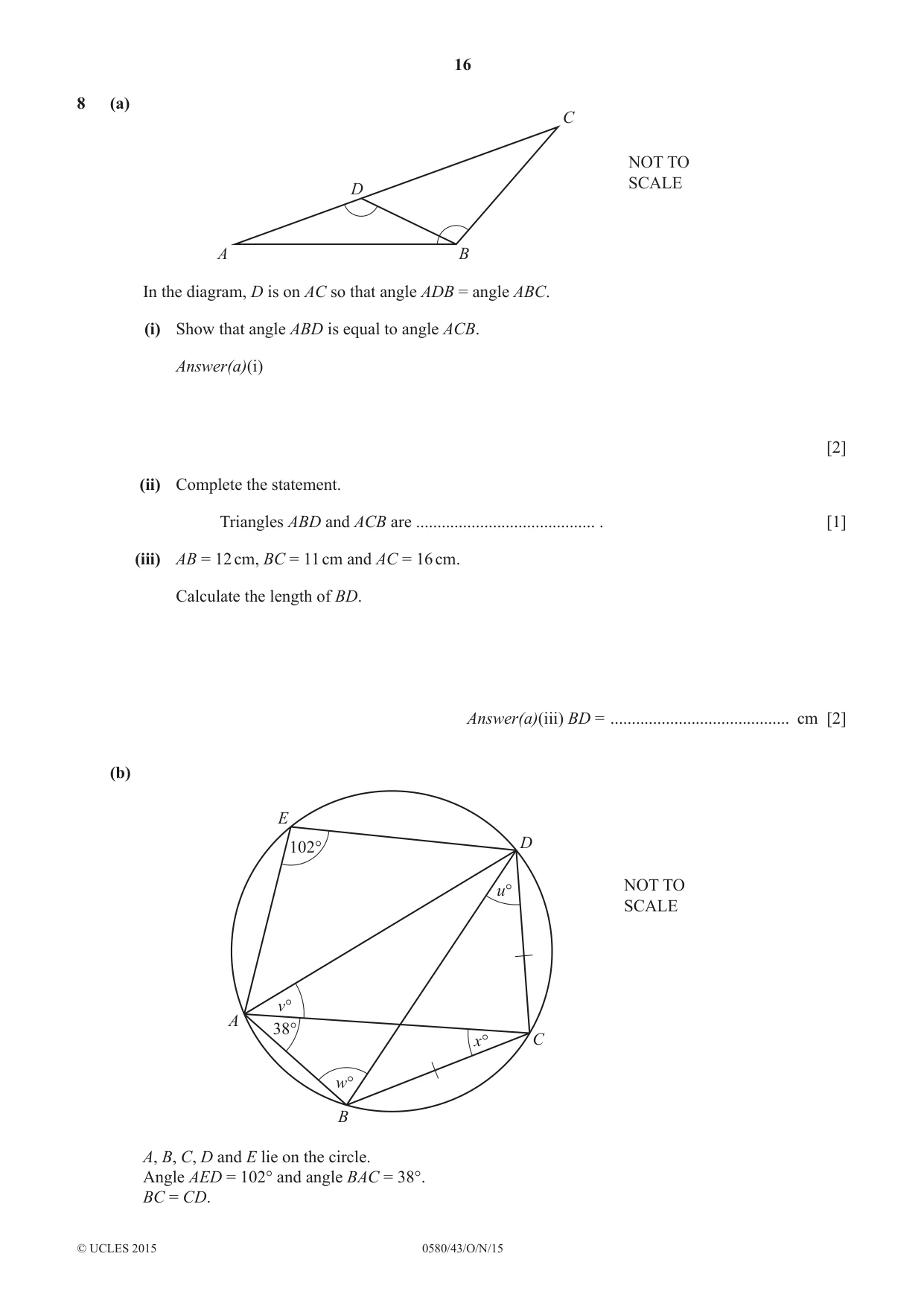
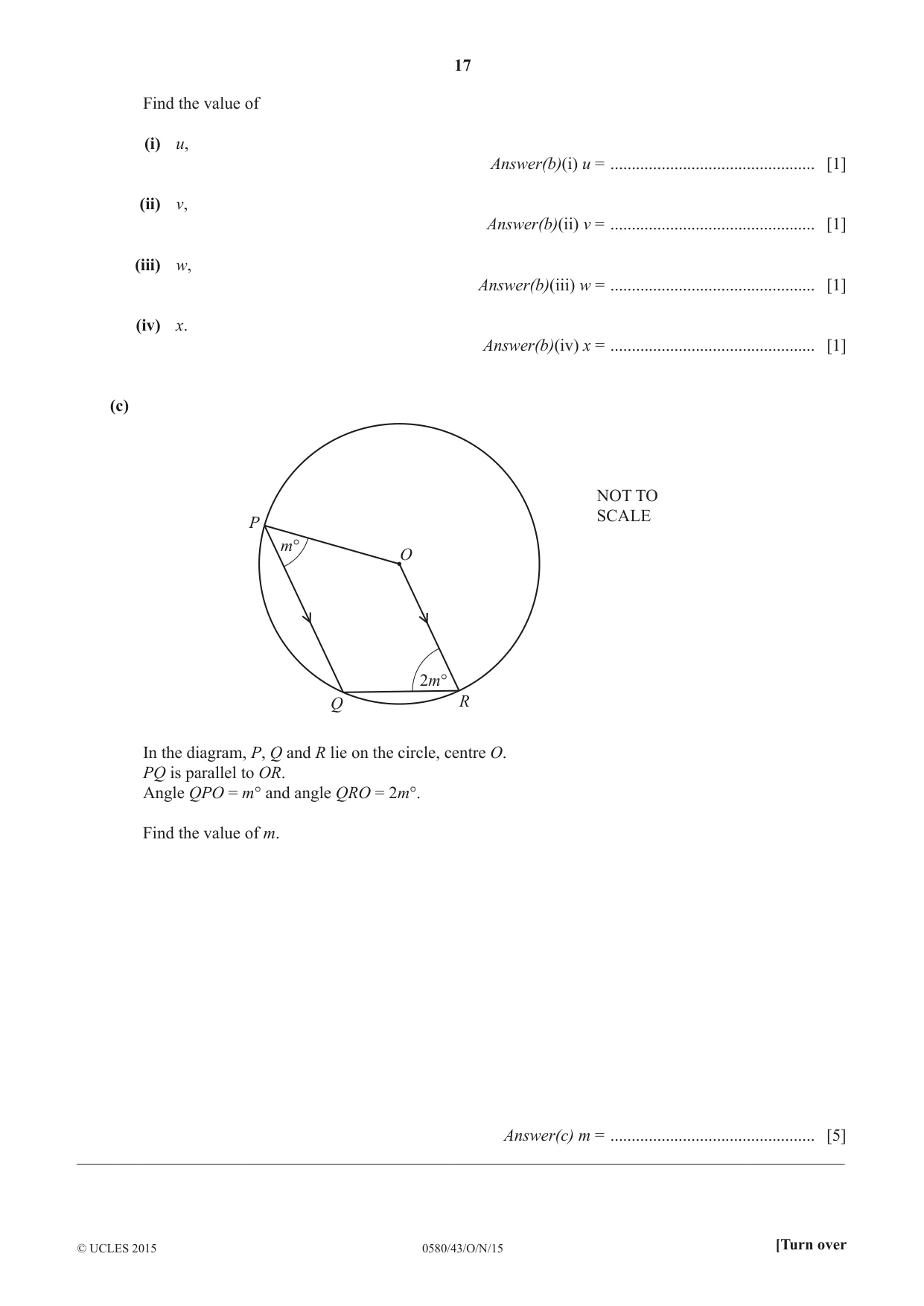
8 (a) C NOT TO SCALE D A B In the diagram, D is on AC so that angle ADB = angle ABC. (i) Show that angle ABD is equal to angle ACB. Answer(a)(i) [2] (ii) Complete the statement. Triangles ABD and ACB are .......................................... . [1] (iii) AB = 12 cm, BC = 11 cm and AC = 16 cm. Calculate the length of BD. Answer(a)(iii) BD = .......................................... cm [2] (b) E 102° D NOT TO u° SCALE v° A 38° x° C w° B A, B, C, D and E lie on the circle. Angle AED = 102° and angle BAC = 38°. BC = CD. Find the value of (i) u, Answer(b)(i) u = ................................................ [1] (ii) v, Answer(b)(ii) v = ................................................ [1] (iii) w, Answer(b)(iii) w = ................................................ [1] (iv) x. Answer(b)(iv) x = ................................................ [1] (c) NOT TO SCALE P m° O 2m° Q R In the diagram, P, Q and R lie on the circle, centre O. PQ is parallel to OR. Angle QPO = m° and angle QRO = 2m°. Find the value of m. Answer(c) m = ................................................ [5] __________________________________________________________________________________________
Mark scheme: 8 (a) (i) Angle A is common to both 1 Accept DAB = CAB oe triangles oe ADB = ABC Third angle of triangles equal oe 1dep Dep on previous mark (ii) Similar 1 16 11 (iii) 8.25 2 M1 for = oe or better 12 BD (b) (i) 38 1 (ii) 38 1 (iii) 78 1 (iv) 26 1 (c) 36 nfww 5 B4 for an equation in m that simplifies to 5 m = 180 or B1 for each of 3 of the listed angles expressed in terms of m, in it’s simplest form, stated or labelled on diagram Angle PQO = m Angle QOR = m Angle OQR = 2m m Angle PQR = 3m or 180 – 2m or 90 + 2 Angle POR = 180 – m or 4m or 360 – 6m Reflex angle POR = 360 – 4m or 6m or 180 + m
Q9 · F(x) = 2x – 1 g(x) = , x 0 h(x) = 2x x (a) Find h(3)
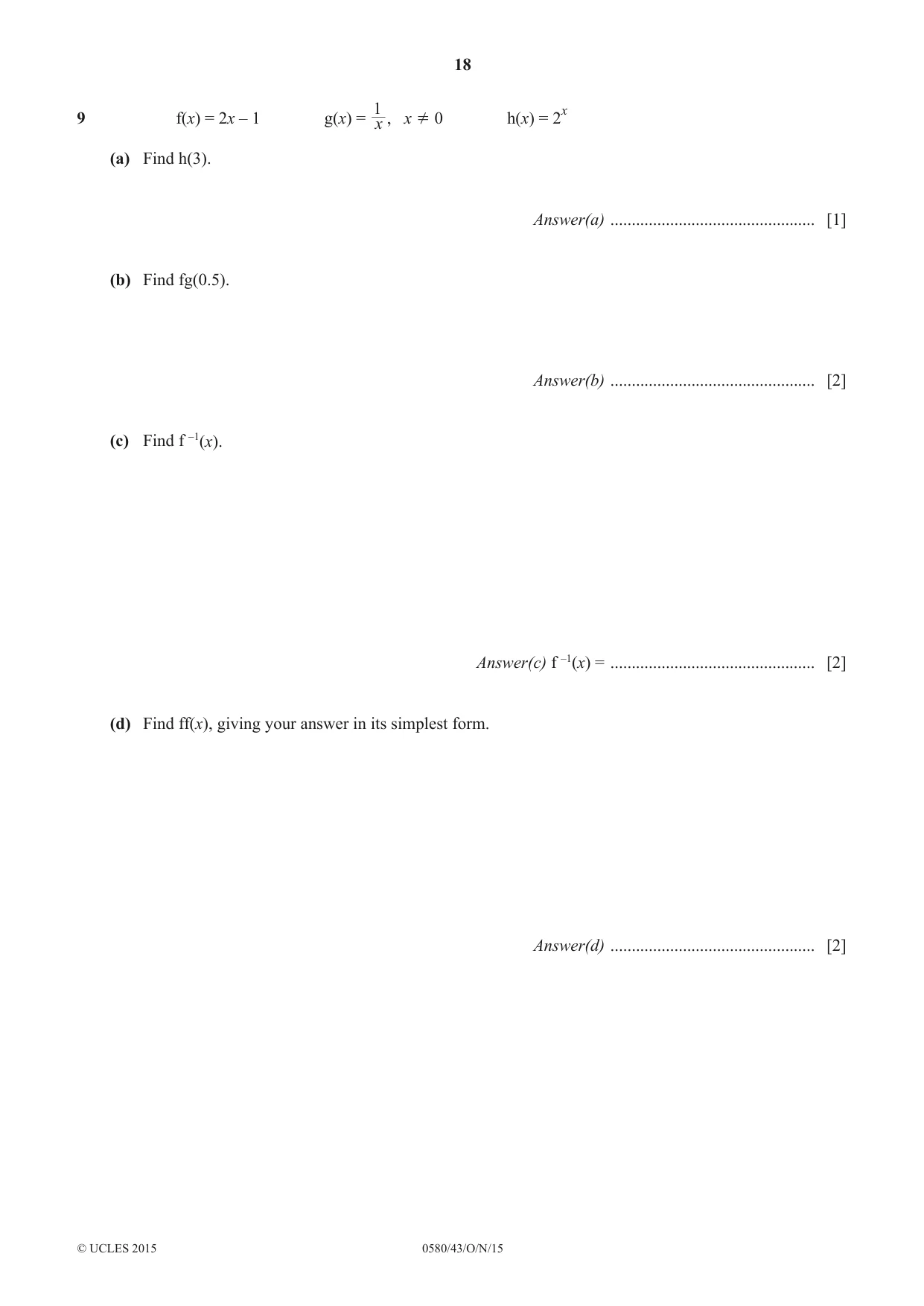
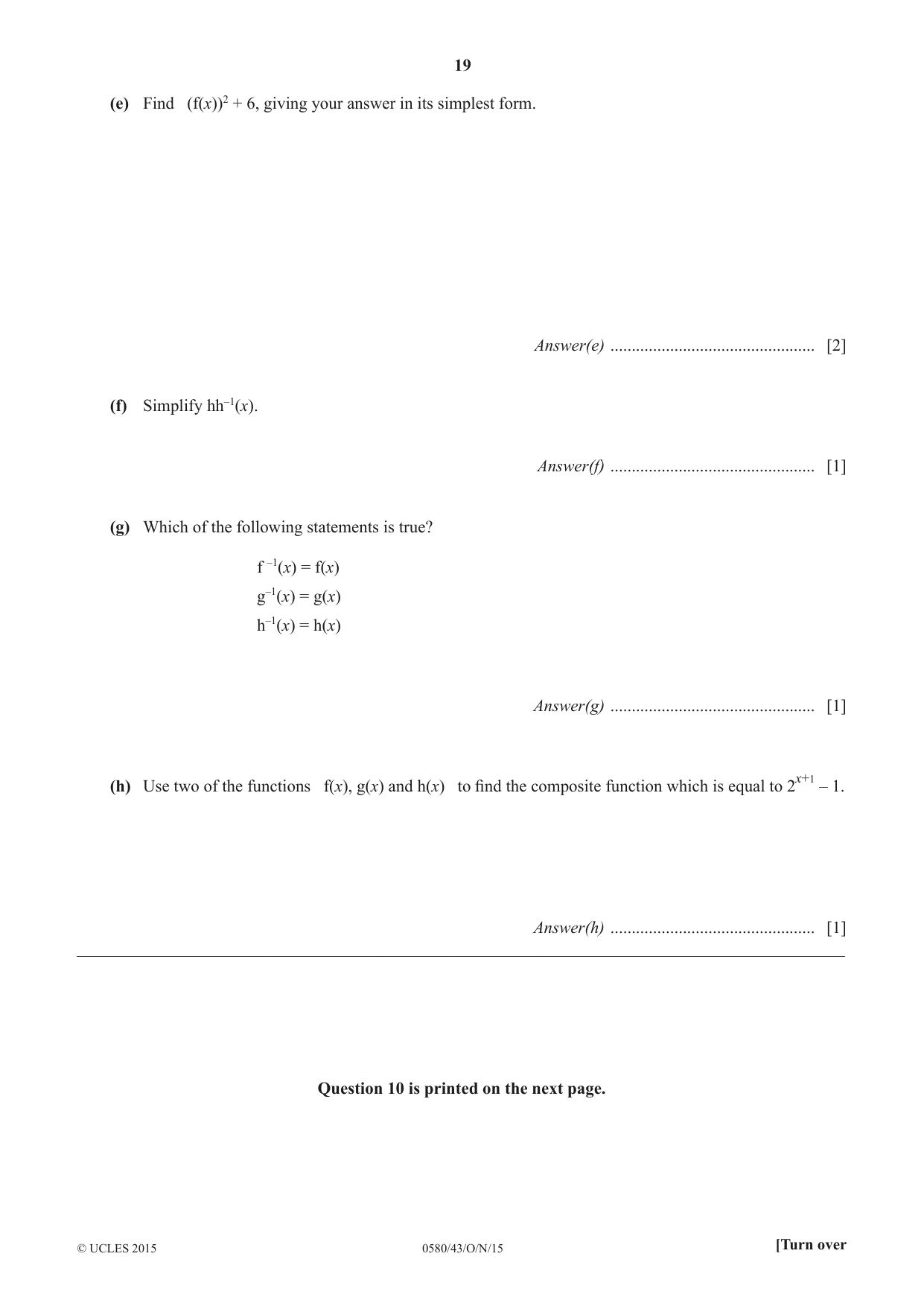
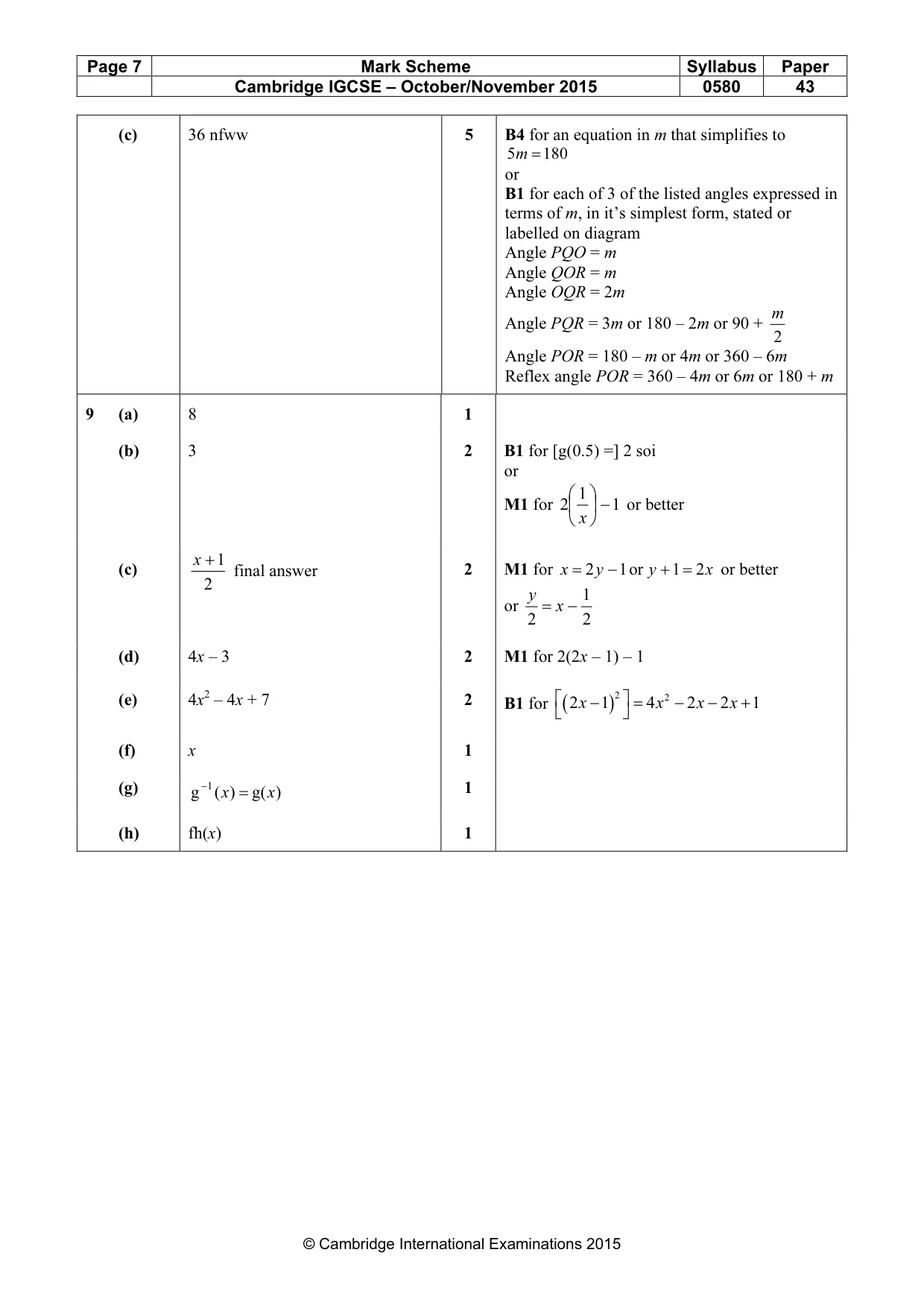
19 f(x) = 2x – 1 g(x) = , x 0 h(x) = 2x x (a) Find h(3). Answer(a) ................................................ [1] (b) Find fg(0.5). Answer(b) ................................................ [2] (c) Find f –1(x). Answer(c) f –1(x) = ................................................ [2] (d) Find ff(x), giving your answer in its simplest form. Answer(d) ................................................ [2] (e) Find (f(x))2 + 6, giving your answer in its simplest form. Answer(e) ................................................ [2] (f) Simplify hh–1(x). Answer(f) ................................................ [1] (g) Which of the following statements is true? f –1(x) = f(x) g–1(x) = g(x) h–1(x) = h(x) Answer(g) ................................................ [1] (h) Use two of the functions f(x), g(x) and h(x) to find the composite function which is equal to 2x+1 – 1. Answer(h) ................................................ [1] __________________________________________________________________________________________ Question 10 is printed on the next page.
Mark scheme: 9 (a) 8 1 (b) 3 2 B1 for [g(0.5) =] 2 soi or 1 M1 for 2 − 1 or better x x + 1 (c) final answer 2 M1 for x = 2 y − 1 or y + 1 = 2 x or better 2 y 1 or = x − 2 2 (d) 4x – 3 2 M1 for 2(2x – 1) – 1 (e) 4x2 – 4x + 7 2 B1 for ( 2 x − 1) 2 = 4 x 2 − 2 x − 2 x + 1 (f) x 1 (g) g − 1 ( x ) = g( x ) 1 (h) fh(x) 1
Q10 · Complete the table for each sequence
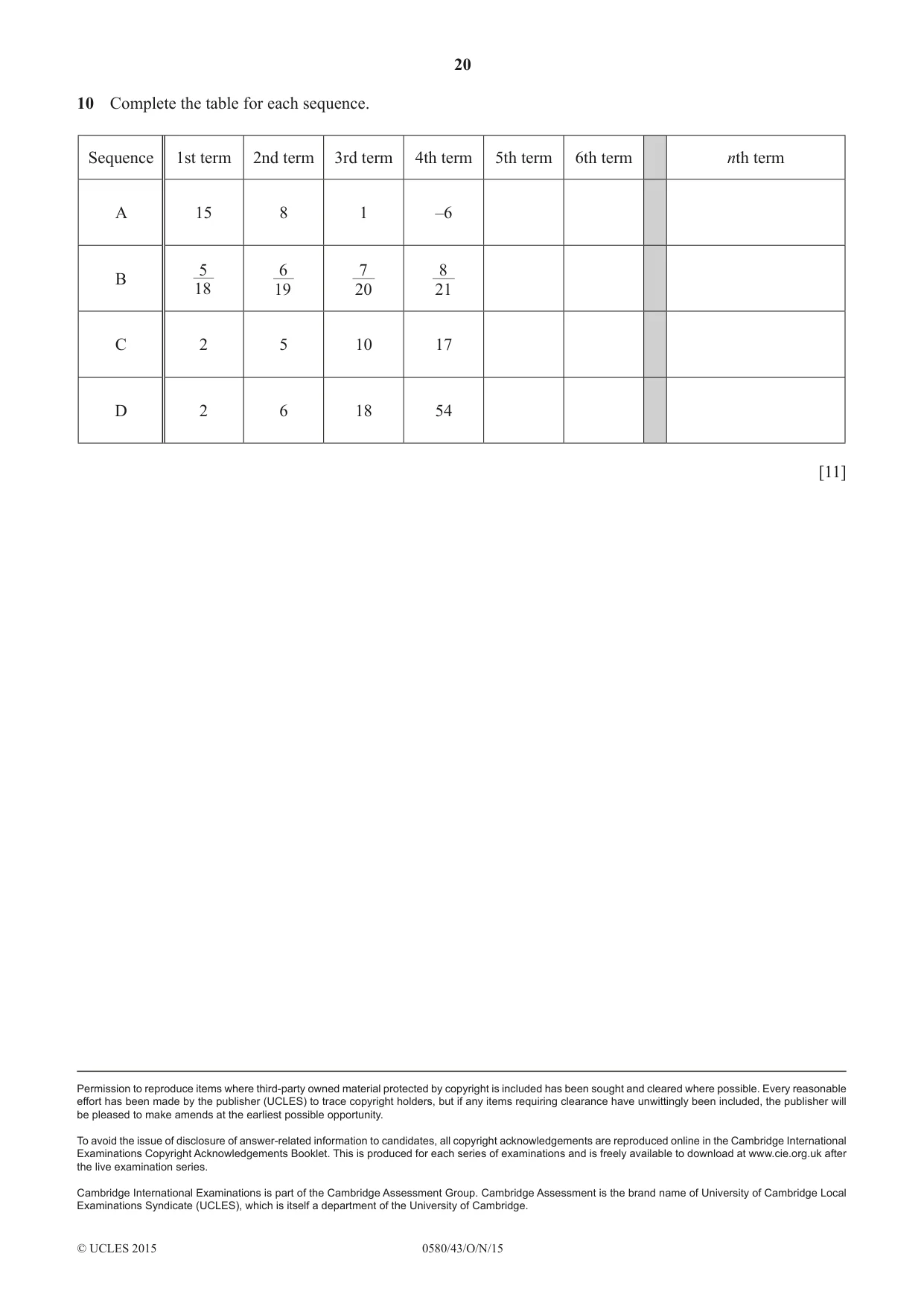
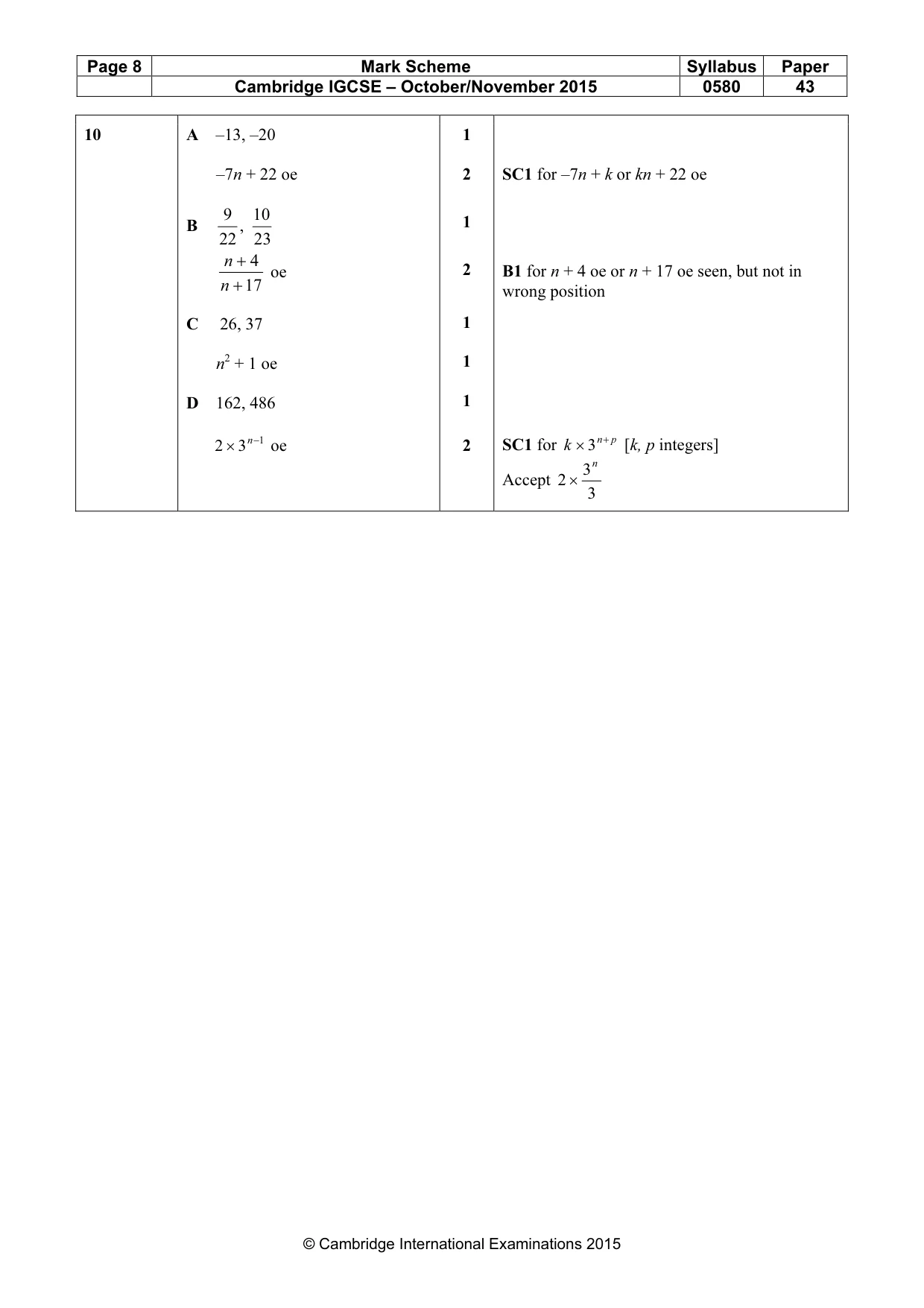
10 Complete the table for each sequence. Sequence 1st term 2nd term 3rd term 4th term 5th term 6th term nth term A 15 8 1 –6 5 6 7 8 B 18 19 20 21 C 2 5 10 17 D 2 6 18 54 [11]
Mark scheme: 10 A –13, –20 1 –7n + 22 oe 2 SC1 for –7n + k or kn + 22 oe 9 10 B , 1 22 23 n + 4 oe 2 B1 for n + 4 oe or n + 17 oe seen, but not in n + 17 wrong position C 26, 37 1 n2 + 1 oe 1 D 162, 486 1 2 × 3 n −1 oe 2 SC1 for k × 3 n + p [k, p integers] 3 n Accept 2 × 3
What was in this paper
The subtopics covered by these 10 questions, and how many questions each got. Open one in a new tab to see every Cambridge question on it.
What you needed in this session
Cambridge’s own grade thresholds for 2015 Oct/Nov, Paper 4 · Variant 3. A higher threshold means an easier paper — the bar moves with how the cohort did.