Questions as text
Q1 · What is most likely to cause queues of consumers to appear regularly outside shops in a… 0455/11 May/June 2006
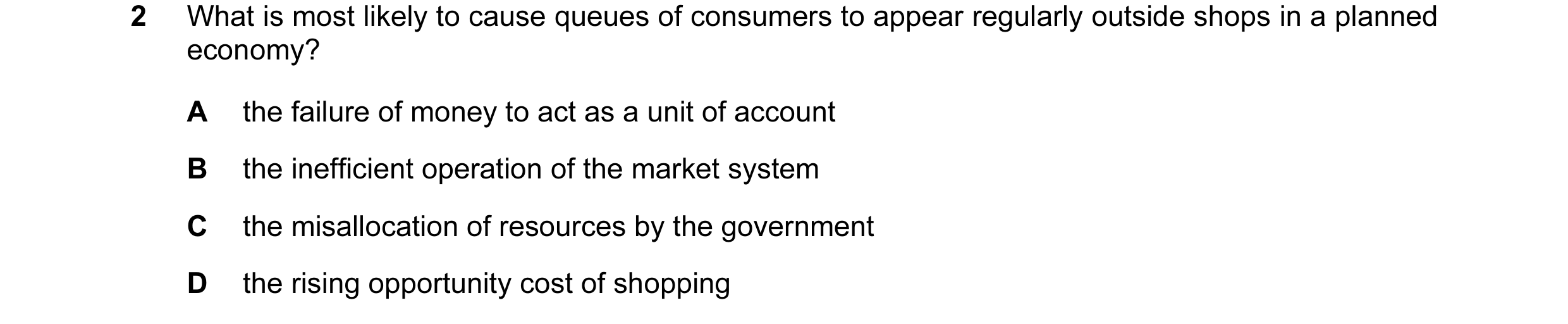
2 What is most likely to cause queues of consumers to appear regularly outside shops in a planned economy? A the failure of money to act as a unit of account B the inefficient operation of the market system C the misallocation of resources by the government D the rising opportunity cost of shopping
1 marks
Answer: C
This question in 0455/11 May/June 2006
Q2 · Countries that have changed from command to market economies will expect to find an… 0455/11 Oct/Nov 2006
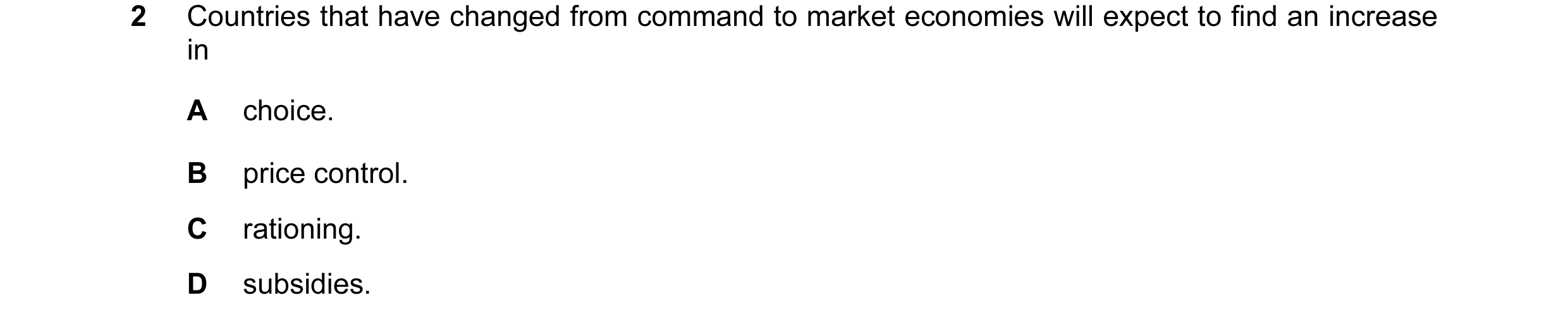
2 Countries that have changed from command to market economies will expect to find an increase in A choice. B price control. C rationing. D subsidies.
1 marks
Answer: A
This question in 0455/11 Oct/Nov 2006
Q3 · In a market economy, who determines the allocation of resources? 0455/11 May/June 2007
3 In a market economy, who determines the allocation of resources? A central authorities only B firms only C consumers and firms only D central authorities and firms only
1 marks
Answer: C
This question in 0455/11 May/June 2007
Q4 · What is found in a command economy but not a market economy? 0455/11 Oct/Nov 2007
1 What is found in a command economy but not a market economy? A banks B division of labour C price controls D profit motive
1 marks
Answer: C
This question in 0455/11 Oct/Nov 2007
Q5 · What can happen in a planned economy that does not happen in a market economy? 0455/11 May/June 2008
1 What can happen in a planned economy that does not happen in a market economy? A The allocation of resources can take account of the total effects on society. B There can be full employment of factors of production. C There can be inflation. D There can be international trade.
1 marks
Answer: A
This question in 0455/11 May/June 2008
Q6 · Which argument can be used in favour of the market economy? 0455/11 May/June 2009
5 Which argument can be used in favour of the market economy? A It enables consumers to show their preferences for goods. B It ensures that all capital resources are used. C It guarantees full employment. D It leads to an equal distribution of wealth.
1 marks
Answer: A
This question in 0455/11 May/June 2009
Q7 · A government decides that an economy should make more use of the market 0455/11 Oct/Nov 2009
5 A government decides that an economy should make more use of the market. Which policy might help to achieve this? A a decrease in controls on imported goods B an increase in government ownership of land C an increase in subsidies to industry D the fixing of minimum wage levels for workers
1 marks
Answer: A
This question in 0455/11 Oct/Nov 2009
Q8 · What is an advantage of the market economic system? 0455/11 May/June 2011
4 What is an advantage of the market economic system? A It aims for equality of income. B It ensures the provision of defence and law and order. C It gives an incentive to produce. D It reduces pollution and congestion.
1 marks
Answer: C
This question in 0455/11 May/June 2011
Q9 · What is an advantage of the market economic system? 0455/12 May/June 2011
3 What is an advantage of the market economic system? A It aims for equality of income. B It ensures the provision of defence and law and order. C It gives an incentive to produce. D It reduces pollution and congestion.
1 marks
Answer: C
This question in 0455/12 May/June 2011
Q10 · What is an advantage of the market economic system? 0455/13 May/June 2011
3 What is an advantage of the market economic system? A It aims for equality of income. B It ensures the provision of defence and law and order. C It gives an incentive to produce. D It reduces pollution and congestion.
1 marks
Answer: C
This question in 0455/13 May/June 2011
Q11 · How are economic decisions determined in a pure market system? 0455/11 Oct/Nov 2011
4 How are economic decisions determined in a pure market system? A by a mixture of market forces and government regulation B by central planners of production and consumption C by government regulation of the price mechanism D by the forces of demand and supply
1 marks
Answer: D
This question in 0455/11 Oct/Nov 2011
Q12 · Which person would wish to encourage the use of the market system? 0455/11 Oct/Nov 2011
8 Which person would wish to encourage the use of the market system? A someone who believes that people should have equal living standards B someone who believes that people should have freedom of action C someone who believes that profit maximisation is wrong D someone who believes that the government should correct peoples’ bad behaviour
1 marks
Answer: B
This question in 0455/11 Oct/Nov 2011
Q13 · How are economic decisions determined in a pure market system? 0455/12 Oct/Nov 2011
5 How are economic decisions determined in a pure market system? A by a mixture of market forces and government regulation B by central planners of production and consumption C by government regulation of the price mechanism D by the forces of demand and supply
1 marks
Answer: D
This question in 0455/12 Oct/Nov 2011
Q14 · Which person would wish to encourage the use of the market system? 0455/12 Oct/Nov 2011
9 Which person would wish to encourage the use of the market system? A someone who believes that people should have equal living standards B someone who believes that people should have freedom of action C someone who believes that profit maximisation is wrong D someone who believes that the government should correct peoples’ bad behaviour
1 marks
Answer: B
This question in 0455/12 Oct/Nov 2011
Q15 · Which person would wish to encourage the use of the market system? 0455/13 Oct/Nov 2011
4 Which person would wish to encourage the use of the market system? A someone who believes that people should have equal living standards B someone who believes that people should have freedom of action C someone who believes that profit maximisation is wrong D someone who believes that the government should correct peoples’ bad behaviour
1 marks
Answer: B
This question in 0455/13 Oct/Nov 2011
Q16 · How are economic decisions determined in a pure market system? 0455/13 Oct/Nov 2011
6 How are economic decisions determined in a pure market system? A by a mixture of market forces and government regulation B by central planners of production and consumption C by government regulation of the price mechanism D by the forces of demand and supply
1 marks
Answer: D
This question in 0455/13 Oct/Nov 2011
Q17 · What is true of a mixed economy but is not true of a free market economy? 0455/12 May/June 2012
4 What is true of a mixed economy but is not true of a free market economy? A There is a mixture of agricultural, manufacturing and service industries. B There is a mixture of central authorities, firms and consumers. C There is a mixture of external benefits and private costs. D There is a mixture of large and small companies.
1 marks
Answer: B
This question in 0455/12 May/June 2012
Q18 · What is true of a mixed economy but is not true of a free market economy? 0455/13 May/June 2012
4 What is true of a mixed economy but is not true of a free market economy? A There is a mixture of agricultural, manufacturing and service industries. B There is a mixture of central authorities, firms and consumers. C There is a mixture of external benefits and private costs. D There is a mixture of large and small companies.
1 marks
Answer: B
This question in 0455/13 May/June 2012
Q19 · Why might a free market economy be more advantageous than a mixed economy? 0455/11 Oct/Nov 2012
14 Why might a free market economy be more advantageous than a mixed economy? A Equality of income is encouraged. B In a mixed economy, governments use taxes which are inefficient. C Production is determined solely by consumer wishes. D Social costs are taken into consideration.
1 marks
Answer: C
This question in 0455/11 Oct/Nov 2012
Q20 · Why might a free market economy be more advantageous than a mixed economy? 0455/12 Oct/Nov 2012
4 Why might a free market economy be more advantageous than a mixed economy? A Equality of income is encouraged. B In a mixed economy, governments use taxes which are inefficient. C Production is determined solely by consumer wishes. D Social costs are taken into consideration.
1 marks
Answer: C
This question in 0455/12 Oct/Nov 2012
Q21 · In a pure market economy, which secondary factor determines the distribution of goods and… 0455/11 May/June 2013
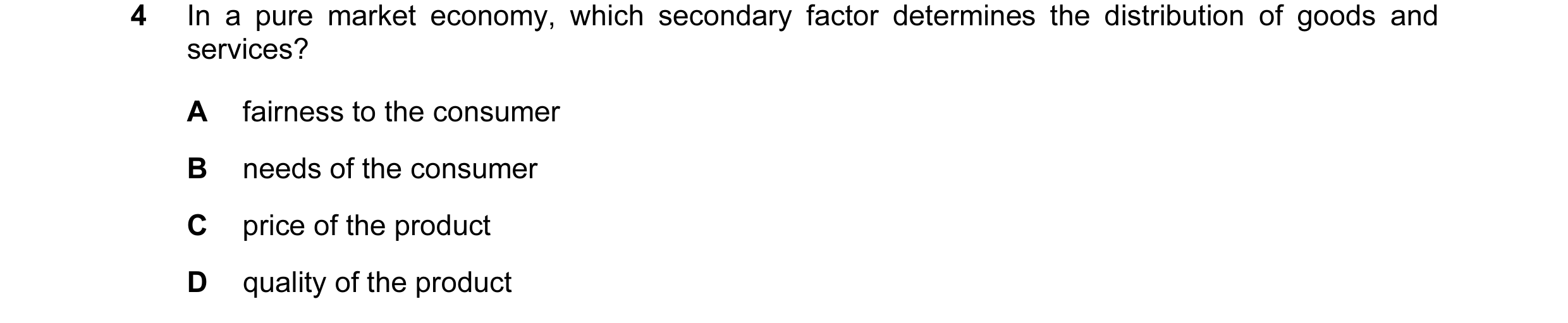
4 In a pure market economy, which secondary factor determines the distribution of goods and services? A fairness to the consumer B needs of the consumer C price of the product D quality of the product
1 marks
Answer: C
This question in 0455/11 May/June 2013
Q22 · A country needs extra nurses 0455/12 May/June 2013
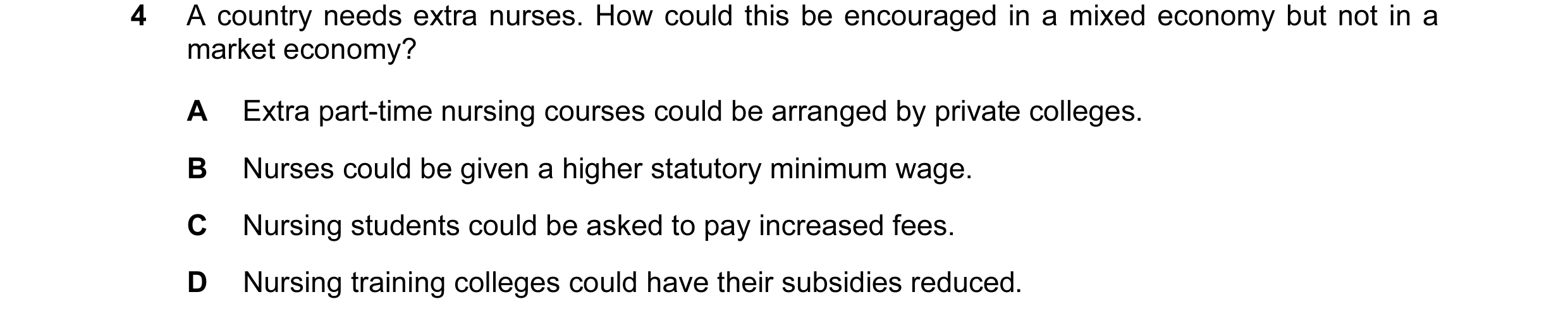
4 A country needs extra nurses. How could this be encouraged in a mixed economy but not in a market economy? A Extra part-time nursing courses could be arranged by private colleges. B Nurses could be given a higher statutory minimum wage. C Nursing students could be asked to pay increased fees. D Nursing training colleges could have their subsidies reduced.
1 marks
Answer: B
This question in 0455/12 May/June 2013
Q23 · In a pure market economy, which secondary factor determines the distribution of goods and… 0455/13 May/June 2013
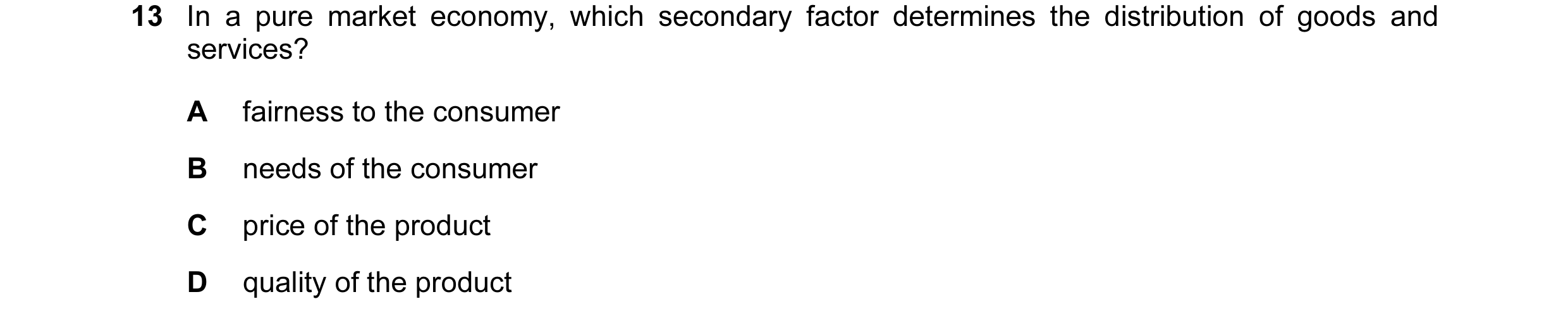
13 In a pure market economy, which secondary factor determines the distribution of goods and services? A fairness to the consumer B needs of the consumer C price of the product D quality of the product
1 marks
Answer: C
This question in 0455/13 May/June 2013
Q24 · Which pair of economic institutions can be found in a market economy? 0455/11 May/June 2016
5 Which pair of economic institutions can be found in a market economy? A charities and public corporations B multinationals and commercial banks C public corporations and private companies D stock exchange and government hospitals
1 marks
Answer: B
This question in 0455/11 May/June 2016
Q25 · Which pair of economic institutions is most likely found in a market economy? 0455/12 May/June 2016
5 Which pair of economic institutions is most likely found in a market economy? A free accident and emergency hospitals and charities B partnerships and public corporations C stock exchange and monopolies D trade unions and local government schools
1 marks
Answer: C
This question in 0455/12 May/June 2016
Q26 · Which pair of economic institutions can be found in a market economy? 0455/13 May/June 2016
5 Which pair of economic institutions can be found in a market economy? A local government and charities B monopolies and commercial banks C nationalised industries and partnerships D stock exchange and public corporations
1 marks
Answer: B
This question in 0455/13 May/June 2016
Q27 · What is a benefit of the market system? 0455/13 Oct/Nov 2017
5 What is a benefit of the market system? A Competition ensures choice for consumers. B Prices equal supply costs. C Unemployment is kept to a minimum. D Wage differentials are small.
1 marks
Answer: A
This question in 0455/13 Oct/Nov 2017
Q28 · What is a major advantage of a market economic system over a mixed economic system? 0455/12 May/June 2018
4 What is a major advantage of a market economic system over a mixed economic system? A All production of goods and services is determined by consumer demand. B Ownership of resources is divided between private and public sectors. C Producers include any external costs they create in the price of the good. D There will always be an even distribution of income and wealth.
1 marks
Answer: A
This question in 0455/12 May/June 2018
Q29 · What is a benefit of the free market system? 0455/13 May/June 2018
4 What is a benefit of the free market system? A Innovation is encouraged to increase profits. C Negative externalities can be controlled. B Subsidies can be used to encourage exports. D The distribution of goods and services is fair.
1 marks
Answer: A
This question in 0455/13 May/June 2018
Q30 · An economy operates entirely as a market system 0455/11 Oct/Nov 2018
4 An economy operates entirely as a market system. Which type of service would not be provided in such an economy? A commercial banking services B free government health services C private educational services D profitable retail services
1 marks
Answer: B
This question in 0455/11 Oct/Nov 2018
Q31 · China, the world’s second largest economy, is becoming more like a market economy 0455/12 Oct/Nov 2018
4 China, the world’s second largest economy, is becoming more like a market economy. Which policy would contribute directly to such a change? A abolishing state control completely B encouraging consumers to spend more and save less C reducing exports and encouraging more imports D transferring wealth from the state sector to the private sector
1 marks
Answer: D
This question in 0455/12 Oct/Nov 2018
Q32 · What can be found in a market economy? 0455/12 Feb/March 2019
4 What can be found in a market economy? A externalities and monopolies B interest rates and public goods C public corporations and market prices D tax rates and commercial banks
1 marks
Answer: A
This question in 0455/12 Feb/March 2019
Q33 · Cuba is implementing free market reforms 0455/12 May/June 2019
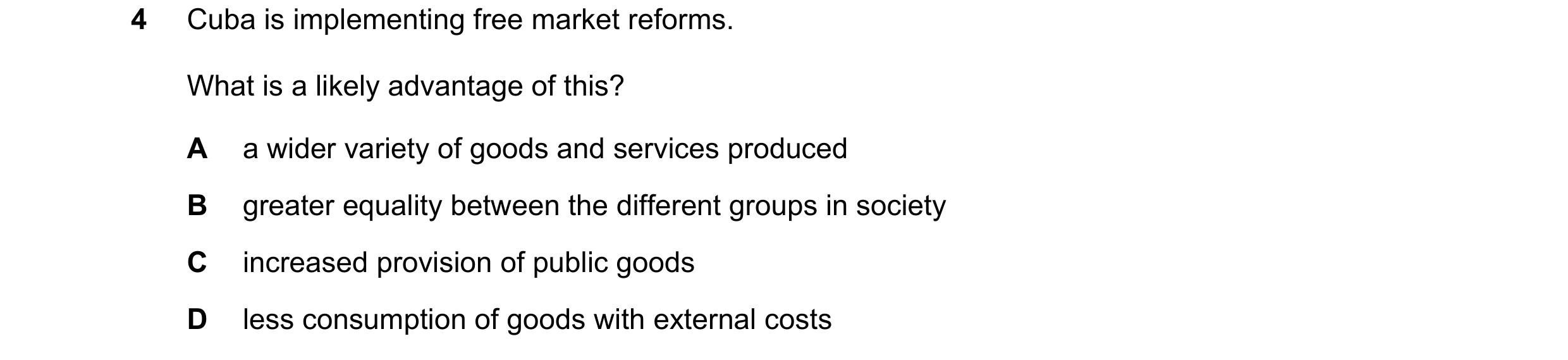
4 Cuba is implementing free market reforms. What is a likely advantage of this? A a wider variety of goods and services produced B greater equality between the different groups in society C increased provision of public goods D less consumption of goods with external costs
1 marks
Answer: A
This question in 0455/12 May/June 2019
Q34 · Which pair of economic institutions can be found in a market economy? 0455/11 Oct/Nov 2019
4 Which pair of economic institutions can be found in a market economy? A local government and charities B monopolies and commercial banks C nationalised industries and partnerships D stock exchange and public corporations
1 marks
Answer: B
This question in 0455/11 Oct/Nov 2019
Q35 · Which pair of economic institutions can be found in a market economy? 0455/12 Oct/Nov 2019
4 Which pair of economic institutions can be found in a market economy? A local government and charities B monopolies and commercial banks C nationalised industries and partnerships D stock exchange and public corporations
1 marks
Answer: B
This question in 0455/12 Oct/Nov 2019
Q36 · Which pair of economic institutions can be found in a market economy? 0455/13 Oct/Nov 2019
4 Which pair of economic institutions can be found in a market economy? A local government and charities B monopolies and commercial banks C nationalised industries and partnerships D stock exchange and public corporations
1 marks
Answer: B
This question in 0455/13 Oct/Nov 2019
Q37 · What is a disadvantage of a market economic system? 0455/13 Oct/Nov 2020
5 What is a disadvantage of a market economic system? A Entrepreneurs lack incentives to produce what consumers want. B Government intervention will reduce the efficiency of firms. C Market dominance by firms can lead to higher prices. D There is underproduction of demerit goods.
1 marks
Answer: C
This question in 0455/13 Oct/Nov 2020
Q38 · What is an advantage of a market economy in the allocation of resources? 0455/12 Feb/March 2021
5 What is an advantage of a market economy in the allocation of resources? A It ensures that all consumers are willing to pay the same price. B It fixes prices based on costs of production. C It guarantees suppliers will make a profit. D It indicates the relative demand for goods and services.
1 marks
Answer: D
This question in 0455/12 Feb/March 2021
Q39 · What is an advantage of competitive markets? 0455/12 May/June 2021
1 What is an advantage of competitive markets? A Competition causes inequalities of wealth. B Competition encourages the efficient use of resources. C The economic problem of scarcity is eliminated. D The right quantity of merit goods is guaranteed.
1 marks
Answer: B
This question in 0455/12 May/June 2021
Q40 · What is an essential feature of a market economy? 0455/13 May/June 2021
5 What is an essential feature of a market economy? A Central planners determine what, how and for whom to produce. B It aims for equality in the distribution of goods and services. C The market price reflects both the private and external costs of production. D The price mechanism sends signals to consumers and producers to allocate resources.
1 marks
Answer: D
This question in 0455/13 May/June 2021
Q41 · What is an advantage of a market economy? 0455/12 Oct/Nov 2021
5 What is an advantage of a market economy? A Equilibrium market price clears the market. B Producers and consumers have the same aims. C The government has no need to intervene in markets. D The lowest price possible is always charged.
1 marks
Answer: A
This question in 0455/12 Oct/Nov 2021
Q42 · What is an advantage of a country having a market economic system with a large private… 0455/11 May/June 2022
16 What is an advantage of a country having a market economic system with a large private sector? A Firms can become unprofitable if they do not produce what consumers want. B Market forces often fail to ensure maximum benefits for society. C Some goods may not be provided at all or not in sufficient quantity. D There is an unequal distribution of income which can increase over time.
1 marks
Answer: A
This question in 0455/11 May/June 2022
Q43 · In recent years, a government has started to make more use of the free market system 0455/12 May/June 2022
5 In recent years, a government has started to make more use of the free market system. However, they are doing it very slowly to avoid the disadvantages that a free market system might bring. What is a possible disadvantage of the free market system? A decreased incentive to work B decreased levels of pollution C increased efficiency D increased inequality of income
1 marks
Answer: D
This question in 0455/12 May/June 2022
Q44 · What is a disadvantage of a market economy? 0455/12 Oct/Nov 2022
4 What is a disadvantage of a market economy? A Consumer choice is ignored. B Consumers may lack information. C Government subsidies encourage efficiency. D There is no incentive to work.
1 marks
Answer: B
This question in 0455/12 Oct/Nov 2022
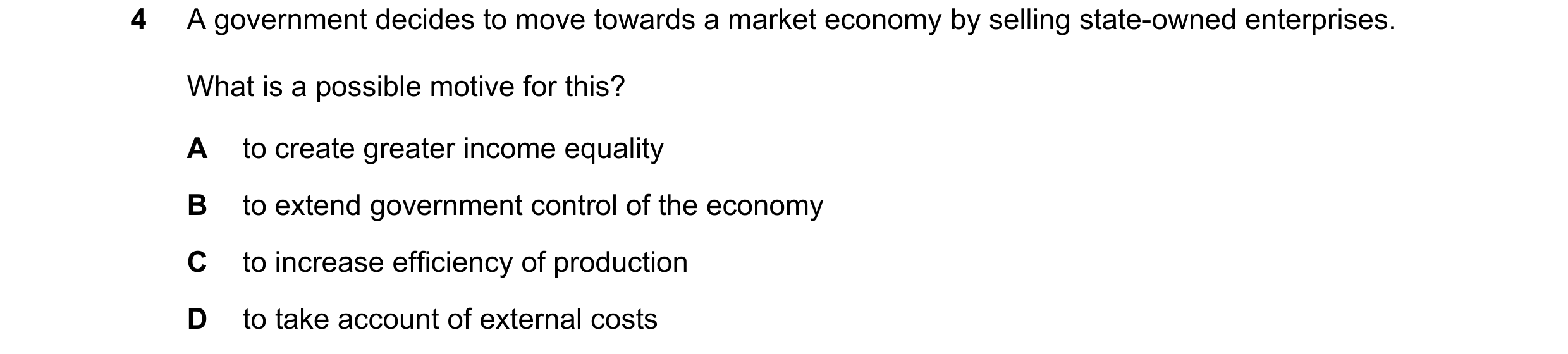
Q45 · A government decides to move towards a market economy by selling state-owned enterprises 0455/13 Oct/Nov 2022
4 A government decides to move towards a market economy by selling state-owned enterprises. What is a possible motive for this? A to create greater income equality B to extend government control of the economy C to increase efficiency of production D to take account of external costs
1 marks
Answer: C
This question in 0455/13 Oct/Nov 2022
Q46 · What is a disadvantage of a market economy? 0455/11 Oct/Nov 2023
8 What is a disadvantage of a market economy? A not enough competition B not enough merit goods C no consumer choice D state intervention
1 marks
Answer: B
This question in 0455/11 Oct/Nov 2023
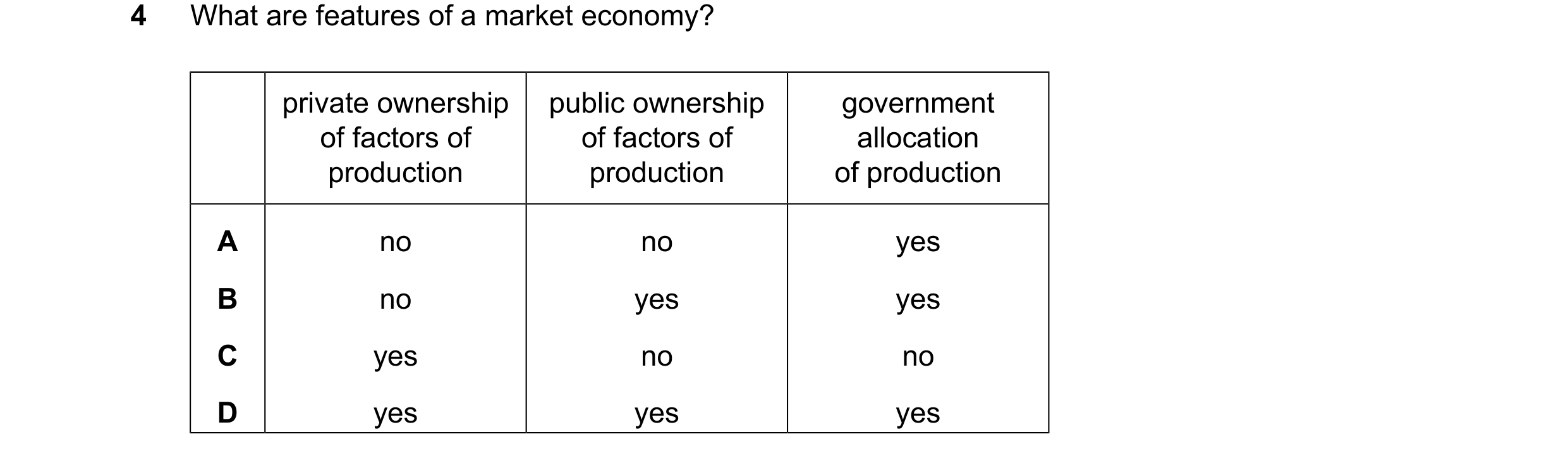
Q47 · What are features of a market economy? 0455/12 Oct/Nov 2023
4 What are features of a market economy? private ownership public ownership government of factors of of factors of allocation production production of production A no no yes B no yes yes C yes no no D yes yes yes
1 marks
Answer: C
This question in 0455/12 Oct/Nov 2023
Q48 · What is a likely benefit of a country moving from a mixed economy to a market economy? 0455/12 Feb/March 2024
7 What is a likely benefit of a country moving from a mixed economy to a market economy? A less inequality B more nationalisation C more public goods D reduced costs of production
1 marks
Answer: D
This question in 0455/12 Feb/March 2024
Q49 · What necessarily describes the market system? 0455/11 Oct/Nov 2024
5 What necessarily describes the market system? A all resources used to produce consumer goods B an economy with both a private and a public sector C limited resources but unlimited wants D resources allocated through demand and supply
1 marks
Answer: D
This question in 0455/11 Oct/Nov 2024
Q50 · What is a characteristic of a market economic system? 0455/12 Feb/March 2025
8 What is a characteristic of a market economic system? A consumers decide whether production is labour-intensive or capital-intensive B factors of production are government-owned C high levels of government intervention D land and capital are privately owned
1 marks
Answer: D
This question in 0455/12 Feb/March 2025
Q51 · What would a person believe who wished to encourage the use of the market system? 0455/11 May/June 2025
9 What would a person believe who wished to encourage the use of the market system? A people should have equal living standards B people should have freedom of action C profit maximisation is wrong D the government should correct people’s bad behaviour
1 marks
Answer: B
This question in 0455/11 May/June 2025
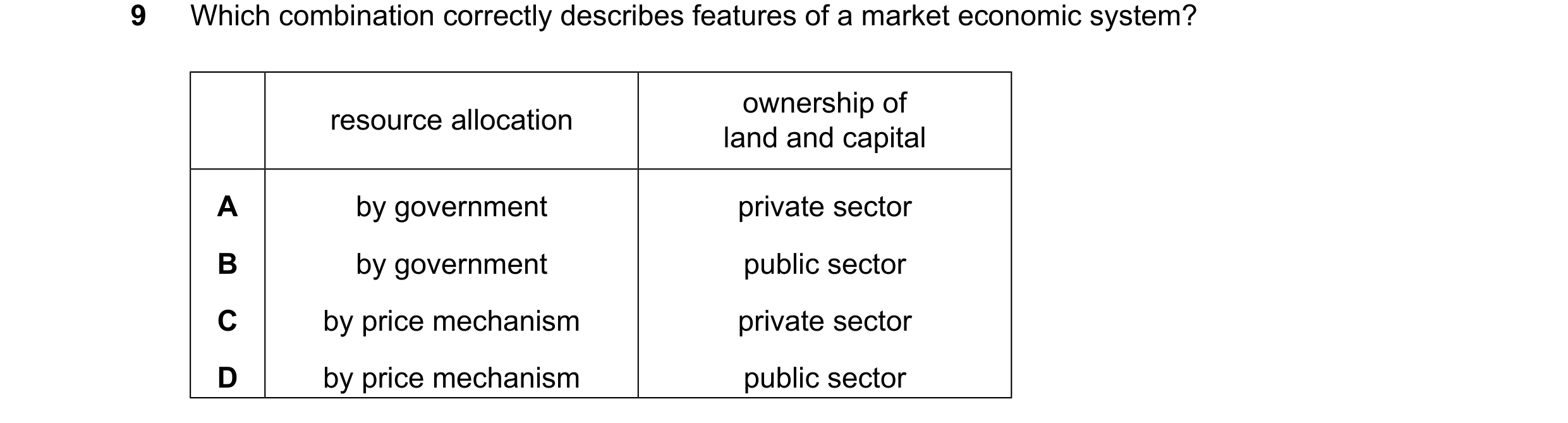
Q52 · Which combination correctly describes features of a market economic system? 0455/13 May/June 2025
9 Which combination correctly describes features of a market economic system? ownership of resource allocation land and capital A by government private sector B by government public sector C by price mechanism private sector D by price mechanism public sector
1 marks
Answer: C
This question in 0455/13 May/June 2025
Q53 · Which pair of economic institutions can be found in a market economy? 0455/11 Oct/Nov 2025
8 Which pair of economic institutions can be found in a market economy? A charities and public sector firms B multinational companies and commercial banks C public sector firms and private sector firms D stock exchanges and government-funded hospitals
1 marks
Answer: B
This question in 0455/11 Oct/Nov 2025
Q54 · How are economic decisions determined in a market economic system? 0455/12 Oct/Nov 2025
8 How are economic decisions determined in a market economic system? A by a mixture of market forces and government intervention B by central planners of production and consumption C by government regulation of the price mechanism D by the forces of demand and supply
1 marks
Answer: D
This question in 0455/12 Oct/Nov 2025
Q55 · What is not a function of prices in a market economy? 0455/13 Oct/Nov 2025
4 What is not a function of prices in a market economy? A prices allow income to be distributed equally B prices ration scarce resources among economic agents C prices rise and fall to reflect shortages and surpluses D prices send information to consumers and producers
1 marks
Answer: A
This question in 0455/13 Oct/Nov 2025



 1 / 10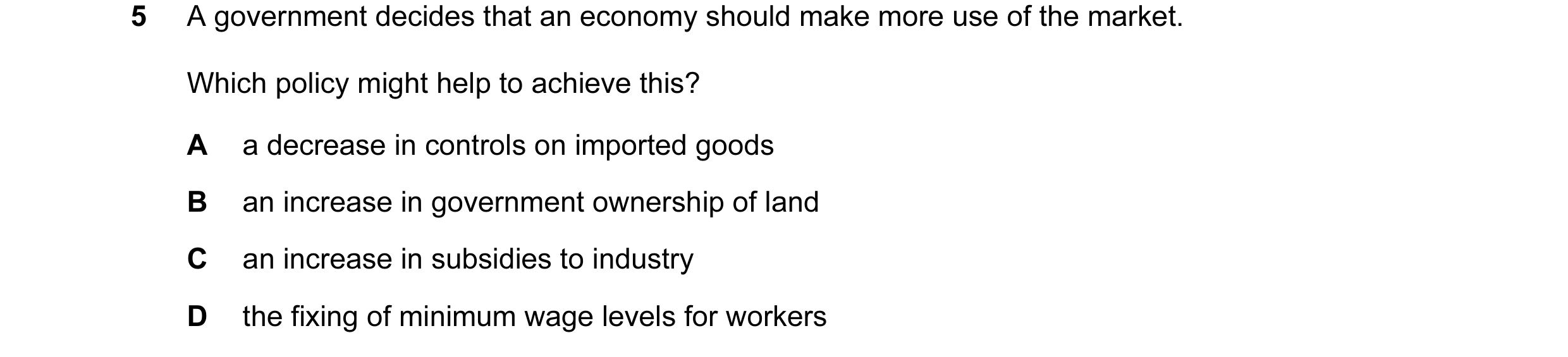




 2 / 10




 3 / 10

 4 / 10




 5 / 10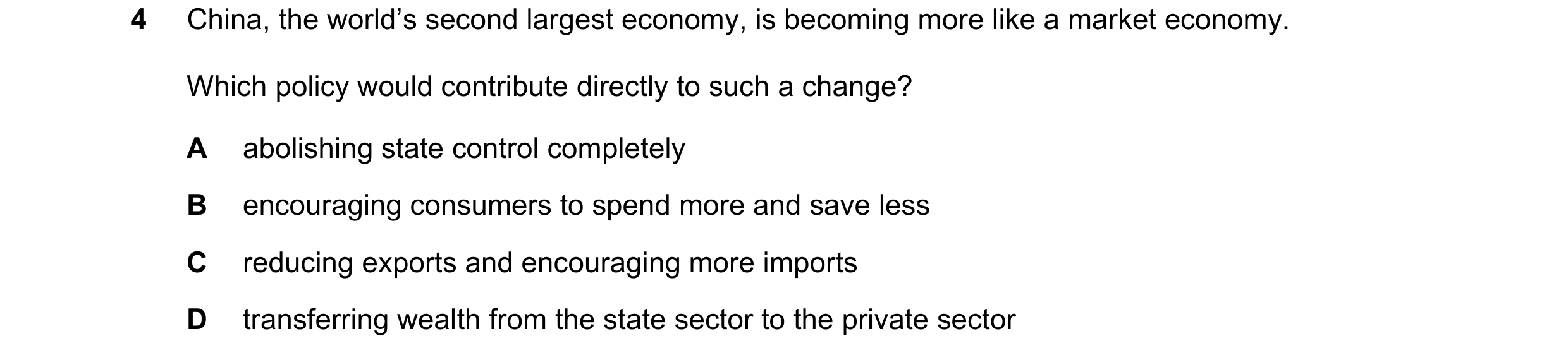



 6 / 10




 7 / 10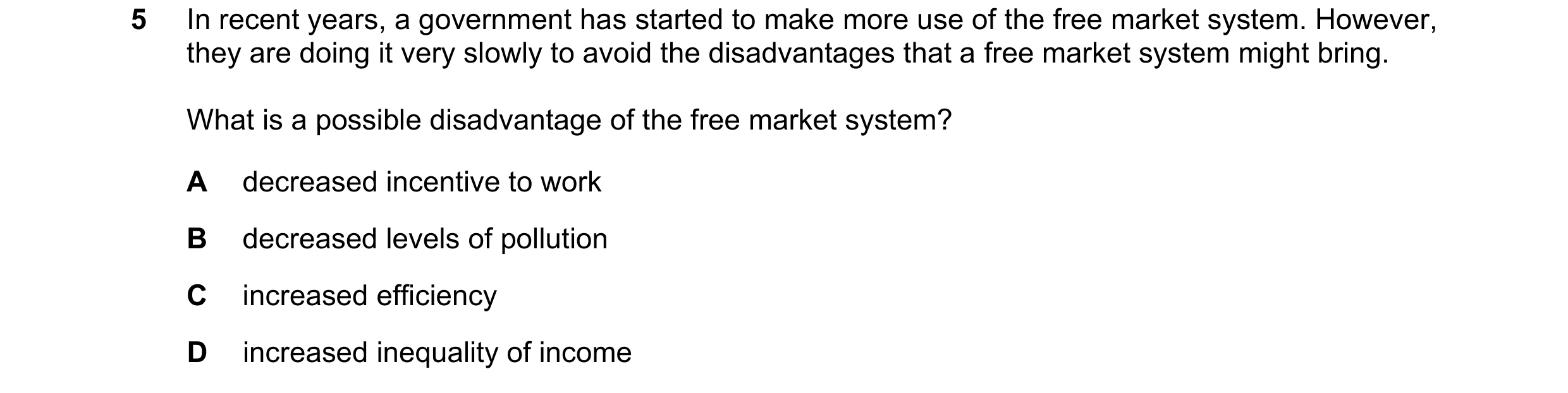


 8 / 10



 9 / 10
 10 / 10