Questions as text
Q1 · Crisis in the ice cream market Vanilla is used in the production of soft drinks, cakes… 0455/22 May/June 2018
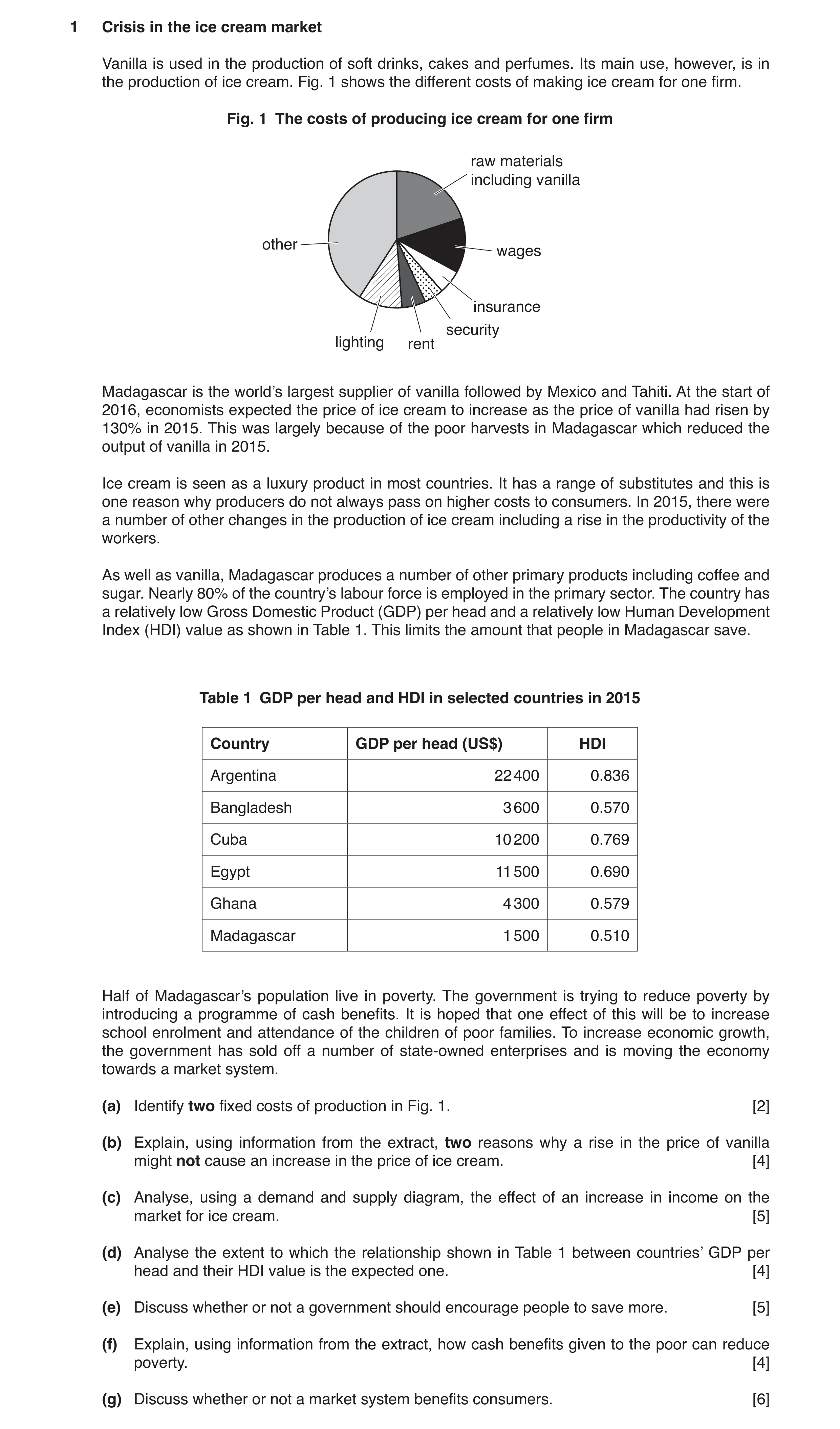
1 Crisis in the ice cream market Vanilla is used in the production of soft drinks, cakes and perfumes. Its main use, however, is in the production of ice cream. Fig. 1 shows the different costs of making ice cream for one firm. Fig. 1 The costs of producing ice cream for one firm raw materials including vanilla other wages insurance security lighting rent Madagascar is the world’s largest supplier of vanilla followed by Mexico and Tahiti. At the start of 2016, economists expected the price of ice cream to increase as the price of vanilla had risen by 130% in 2015. This was largely because of the poor harvests in Madagascar which reduced the output of vanilla in 2015. Ice cream is seen as a luxury product in most countries. It has a range of substitutes and this is one reason why producers do not always pass on higher costs to consumers. In 2015, there were a number of other changes in the production of ice cream including a rise in the productivity of the workers. As well as vanilla, Madagascar produces a number of other primary products including coffee and sugar. Nearly 80% of the country’s labour force is employed in the primary sector. The country has a relatively low Gross Domestic Product (GDP) per head and a relatively low Human Development Index (HDI) value as shown in Table 1. This limits the amount that people in Madagascar save. Table 1 GDP per head and HDI in selected countries in 2015 Country GDP per head (US$) HDI Argentina 22 400 0.836 Bangladesh 3 600 0.570 Cuba 10 200 0.769 Egypt 11 500 0.690 Ghana 4 300 0.579 Madagascar 1 500 0.510 Half of Madagascar’s population live in poverty. The government is trying to reduce poverty by introducing a programme of cash benefits. It is hoped that one effect of this will be to increase school enrolment and attendance of the children of poor families. To increase economic growth, the government has sold off a number of state-owned enterprises and is moving the economy towards a market system. (a) Identify two fixed costs of production in Fig. 1. [2] (b) Explain, using information from the extract, two reasons why a rise in the price of vanilla might not cause an increase in the price of ice cream. [4] (c) Analyse, using a demand and supply diagram, the effect of an increase in income on the market for ice cream. [5] (d) Analyse the extent to which the relationship shown in Table 1 between countries’ GDP per head and their HDI value is the expected one. [4] (e) Discuss whether or not a government should encourage people to save more. [5] (f) Explain, using information from the extract, how cash benefits given to the poor can reduce poverty. [4] (g) Discuss whether or not a market system benefits consumers. [6]
30 marks
Mark scheme: 1(a) Identify two fixed costs of production in Fig.1. One mark each for any 2 from: insurance, security, rent, lighting and wages. 2 are given, consider only the first three. 1(b) Explain, using information from the extract, two reasons why a rise in the price of vanilla might not cause an increase in the price of ice cream. Ice cream is a luxury product (1) likely to have elastic demand / producers will be concerned that a rise in price could cause a fall in revenue/profit/demand (1). Ice cream has substitutes (1) likely to have elastic demand / producers will be concerned that a rise in price could cause a fall in revenue / loss of customers / loss of demand (1). Rise in productivity of workers (1) fall in labour costs / lower costs may offset a rise in the price of vanilla (1). Fall in another cost identified in the pie chart (1) may offset a rise in the price of vanilla (1), 4 Question Answer Marks Guidance 1(c) Analyse, using a demand and supply diagram, the effect of an increase in income on the market for ice cream. Up to 4 marks for a diagram: • axes correctly labelled – price and quantity or P and Q (1) • demand and supply curves correctly labelled, S (1) • demand curve D1 shifted to the right D2 (1) • correct equilibriums identified either by lines drawn to both axes or equilibrium prices clearly identified e.g. E1 and E2 (1) 1 mark for written analysis: • an increase in income increases purchasing power (1) • people buy more ice cream when they have more money/income (1) • demand will increase as ice cream is a luxury good • price will rise 5 price of ice cream quantity of ice cream O P2 D1 D1 P1 Q1 Q2 D2 D2 S S Question Answer Marks Guidance 1(d) Analyse the extent to which the relationship shown in Table 1 between countries’ GDP per head and their HDI value is the expected one. Generally, in the same order / positively related / countries with highest GDP per head have the highest HDI (1) countries with high incomes generally spend more on education and healthcare (1) supporting evidence e.g. Argentina has highest GDP per head and highest HDI (1). Egypt higher in terms of GDP per head but lower in terms of HDI than Cuba (1). Cuba may have a high life expectancy (1) indicating good healthcare (1). Cuba may have a high number of mean and expected years of schooling (1) indicating a strong education system / more educated population (1). 4 Reward 1 mark for a supported conclusion that it is generally the expected relationship. Marks may be gained in relation to Cuba by mentioning Egypt may have less good healthcare and education. 1(e) Discuss whether or not a government should encourage people to save more. Up to 3 marks for why it should: More savings can fund investment / enable people to set up a business (1) higher investment can increase economic growth (1) higher economic growth can increase living standards (1). A government may make use of money in government-run saving schemes (1) e.g. to fund infrastructure projects (1). More savings can reduce consumer spending (1) which will lower total (aggregate) demand (1) which can reduce inflation (1). More savings can reduce demand for imports (1) improve the current account position (1). More savings can help people cope with emergencies / increase wealth / for future use (1) prepare for retirement (1) in case of unemployment (1) spend on education (1) reduce need for government expenditure e.g. pensions/education (1) enabling the government to spend on other named area (1). Up to 3 marks for why it should not: More saving may reduce output / cause recession (1) increase unemployment (1) cause deflation (1). More saving will increase deposits at banks (1) this may encourage them to lend to un- creditworthy customers (1) causing banks to collapse (1). 5 Accept response from the perspective of why it should not, by discussing why it would be better for the government to encourage spending, Reward change in consumer spending and total demand in either why it should, or why it should not, but not in both. Question Answer Marks Guidance 1(f) Explain, using information from the extract, how cash benefits given to the poor can reduce poverty. May enable them to send their children to school for longer (1) this may increase their children’s skills (1) qualifications (1) increase their job opportunities / start a business (1) increase their earning potential / living standards (1) enable them to purchase more goods and services (1) including basic necessities (1). 4 Maximum of 1 mark for a way cash benefits may reduce poverty, if not linked to education. Reward but do not expect reference to an implied multiplier effect resulting from the higher spending creating more jobs. 1(g) Discuss whether or not a market system benefits consumers. Up to 4 marks for why it might: In theory there will be consumer sovereignty (1) with firms being responsive to consumer demand (1). The price mechanism allocates resources automatically / profit motive provides an incentive to respond to consumer demand (1) avoiding delays in responding to changes in demand (1). There may be a high level of competition (1) keeping price low (1) increasing efficiency (1) keeping quality high (1) providing choice (1). Up to 4 marks for why it might not: Those with low incomes will lack purchasing power (1) the market will not produce what they want (1). Monopolies may develop (1) driving up price (1) reducing quality (1). Consumers may not always be fully informed (1) e.g. cigarettes (harmful / demerit goods) may be overconsumed (1) e.g. healthcare (beneficial / merit goods) under consumed (1) there may be external costs (1) market failure may occur (1). Some consumers may find too much choice confusing (1) advertising can distort consumer choice (1). 6 Reward but do not expect reference to public goods.
This question in 0455/22 May/June 2018
Q2 · Botswana has a number of conservation projects 0455/22 Feb/March 2019
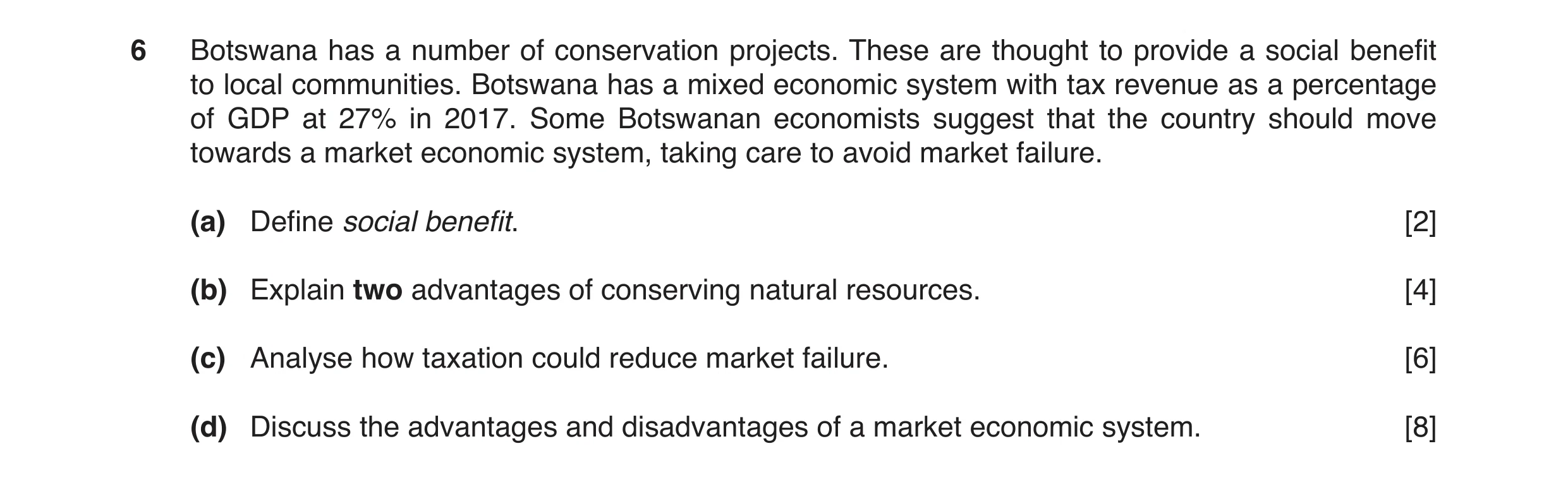
6 Botswana has a number of conservation projects. These are thought to provide a social benefit to local communities. Botswana has a mixed economic system with tax revenue as a percentage of GDP at 27% in 2017. Some Botswanan economists suggest that the country should move towards a market economic system, taking care to avoid market failure. (a) Define social benefit. [2] (b) Explain two advantages of conserving natural resources. [4] (c) Analyse how taxation could reduce market failure. [6] (d) Discuss the advantages and disadvantages of a market economic system. [8]
20 marks
Mark scheme: 6(a) Define social benefit. 2 The total benefit to society of an economic activity or external benefit + private benefit (2). A beneficial effect on society (1). 6(b) Explain two advantages of conserving natural resources. 4 • resources will last longer / decrease rate of depletion (1) future generations will be able to benefit from the resources (1) • economic growth / development may be more sustainable (1) income may be generated over time / value may rise in the future (1) • over use of natural resources (1) may cause external costs (1) • tourism may increase (1) increase export revenue / employment (1). 6(c) Analyse how taxation could reduce market failure. 6 Monopolies may be taxed (1) if they exploit their market power (1) by charging high prices (1). Production and consumption that generates external costs may be taxed (1) example (1) this will turn an external cost into a private cost (1) increase costs of production (1) reduce output (1). Tax revenue can be used to e.g. subsidise products with external benefits (1) example (1). 6(d) Discuss the advantages and disadvantages of a market economic 8 system. Up to 5 marks for why it might: In theory, there is consumer sovereignty (1) consumers determine what is produced (1) firms will respond to changes in demand (1). Prices may be low (1) quality may be high (1) high efficiency (1) due to competition (1) and the profit motive (1) A variety of products may be produced / there may be choice (1). Up to 5 marks for why it might not: Poor consumers will have little influence on what is produced (1) as they have little purchasing power (1). Monopolies may develop (1) which may charge high prices (1) and produce low quality (1). Products that provide external benefits will be under-produced (1) so under- consumed (1) example of such a product (1). Products that cause external costs will be overproduced (1) and so overconsumed (1) example of such a product (1).
This question in 0455/22 Feb/March 2019
Question 3 0455/23 May/June 2019
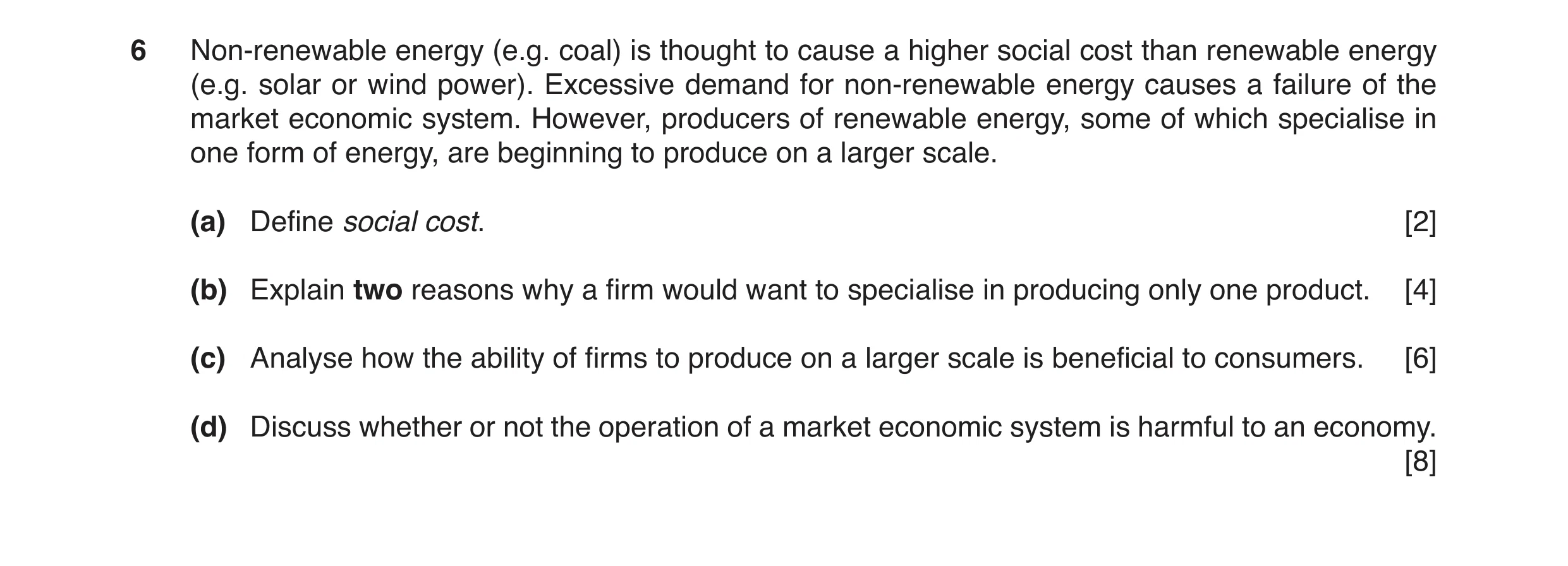
6 Non-renewable energy (e.g. coal) is thought to cause a higher social cost than renewable energy (e.g. solar or wind power). Excessive demand for non-renewable energy causes a failure of the market economic system. However, producers of renewable energy, some of which specialise in one form of energy, are beginning to produce on a larger scale. (a) Define social cost. [2] (b) Explain two reasons why a firm would want to specialise in producing only one product. [4] (c) Analyse how the ability of firms to produce on a larger scale is beneficial to consumers. [6] (d) Discuss whether or not the operation of a market economic system is harmful to an economy. [8]
20 marks
Mark scheme: 6(a) Define social cost. Social cost is equal to the sum of private costs (1) and external costs (1). Cost to the entire society (1). 2 6(b) Explain two reasons why a firm would want to specialise in producing only one product. • a firm can specialise in what it is best at producing (1) increasing efficiency / productivity (1) achieve economies of scale (1) decrease cost of production (1) leading to higher output / higher profits (1) • increasing global demand (1) which would raise revenue (1) • resources are well suited to the product (1) e.g. good climate (1) • a firm can gain a good reputation in producing the product (1) specialisation may improve the quality of the product (1) increasing demand for the product (1) 4 6(c) Analyse how the ability of firms to produce on a larger scale is beneficial to consumers. Producing on a larger scale may enable economies of scale (1) example (1) when average costs decrease (1). Price of the product may fall (1) enabling consumers to buy more of the product (1) improving living standards (1). Producing on a larger scale reduces shortages (1) increases the quantity of products available to consumers (1). Producing on a larger scale may enable more to be spent on R&D (1) increasing the quality of products available to consumers (1). 6 Question Answer Marks Guidance 6(d) Discuss whether or not the operation of a market economic system is harmful to an economy. Up to 5 marks for why it is: Poor consumers will have little influence on what is produced (1) because they have limited purchasing power / inability to afford products (1). Monopolies may occur (1) charging high prices (1) producing low quality (1). Products causing external costs will be overproduced (1) overconsumed (1) example (1). Products providing external benefits will be underproduced (1) and underconsumed (1) example (1). Income and wealth may be unequally distributed (1) e.g. those on fixed incomes disadvantaged (1). Up to 5 marks for why it is not: In theory there is consumer sovereignty (1) consumers determine what is produced (1) firms respond to changes in consumer demand (1). Competition between firms (1) and the profit motive (1) increases efficiency (1) leading to low prices (1) and high quality products (1). A variety of products may be produced / there may be choice (1). 8 Accept but do not expect reference to merit goods, demerit goods and public goods.
This question in 0455/23 May/June 2019
Q4 · Calculate the total number of people over 60 years old in Greece in 2015 0455/23 May/June 2020
1 (a) Calculate the total number of people over 60 years old in Greece in 2015. [1] (b) Explain what is meant by an unemployment rate of 24%. [2] (c) Identify two reasons for the recovery of the European economies, other than Greece. [2] (d) Explain the two supply-side policy measures being used by the Greek government. [4] (e) Analyse how two of Greece’s population trends may have affected its economy. [4] (f) Analyse the relationship between Greece’s GDP per head and its HDI value. [5] (g) Discuss whether or not having a strong foreign exchange rate is a problem for Greece’s economy. [6] (h) Discuss whether or not a market economic system improves living standards. [6]
30 marks
Mark scheme: Question Answer Marks 1(a) Calculate the total number of people over 60 years old in Greece in 1 2015. 27% × 10.8 million = 2.92 million 1(b) Explain what is meant by an unemployment rate of 24%. 2 Logical explanation which might include: 24% of the total labour force (1) is actively searching for jobs (willing and able to work) but cannot find work/job (1) 1(c) Identify two reasons for the recovery of the European economies, 2 other than Greece. successful supply-side policy measures (1) improving global economy (1) 1(d) Explain the two supply-side policy measures being used by the Greek 4 government. Logical explanation which might include: labour market reforms (1) making it easier to hire and fire workers / giving workers more skills to enable them to take various jobs / making it easier for workers to move from one place to another or one job to another (1) Privatisation (1) increasing efficiency due to the profit-maximising motive (1) 1(e) Analyse how two of Greece’s population trends may have affected its 4 economy. Coherent analysis which might include: The Greek population has been falling ever since 2010 (1) resulting in a smaller labour force (1). Ageing population (1) increase in dependency ratio (1). Emigration (1) loss of skilled workers (1). 1(f) Analyse the relationship between Greece’s GDP per head and its HDI 5 value. Coherent analysis which might include: Greece’s GDP per head has been falling from 2010–2015 (1) but HDI has been increasing (1) negative relationship (1) data for GDP per head (1) data for HDI value (1). This could be because of improving education (1) and healthcare (1). HDI consists of GDP per head / education / health (1) hence even though GDP per head is falling this is more than offset by rise in education / health (1). 1(g) Discuss whether or not having a strong foreign exchange rate is a 6 problem for Greece’s economy. Generic example mark Tax revenue may decrease… 1 ...because of reason e.g. incomes may be lower. 1 Tax revenue may increase because incomes may be higher i.e. 0 reverse of a previous argument. Tax revenue may increase because of a different reason i.e. not the reverse of a previous argument e.g. government spending on 1 subsidies may stimulate the economy more than spending on education. Up to 4 marks for why it might be a problem: Strong foreign exchange rate will lead to high price of exports (1) decreasing the quantity demanded for exports (1) decreasing value of exports (1) strong foreign exchange rate will lead to low price of imports (1) increasing the quantity demanded for import (1) increasing value of imports (1) decreasing net exports (1) decreasing total demand (1) decreasing economic growth (1) decreasing employment (1). Up to 4 marks for why it might not be a problem: Strong foreign exchange rate will lead to low price of imported raw materials, machines / capital, or semi manufactured goods (1) this could decrease cost of production (1) decreasing the price of domestically produced goods (1) increasing demand / consumption / exports (1) increasing total demand (1) increasing economic growth (1) increasing employment (1) 1(h) Discuss whether or not a market economic system improves living 6 standards. Up to 4 marks for why it does improve living standards: Economic freedom (1) consumers and producers can make their own decisions on what to consume and produce (1) no government intervention enables more efficient allocation of resources (1) firms react to the wants of consumers to gain profits for themselves then consumers are fairly likely to get what they want and gain high levels of satisfaction from their income (1) costs are lower and prices are lower (1) more affordable (1). Up to 4 marks for why it does not improve living standards: Instability and uncertainty (1) Unemployment especially when there is a recession (1) high inflation could decrease affordability (1) monopolies exploit consumers (1) workers paid low wages (1) pollution and other external costs (1) Unequal distribution of income and wealth (1) under provision of public goods (1).
This question in 0455/23 May/June 2020
Q5 · The use of supply-side policy measures, including deregulation, is moving China closer to… 0455/23 Oct/Nov 2020
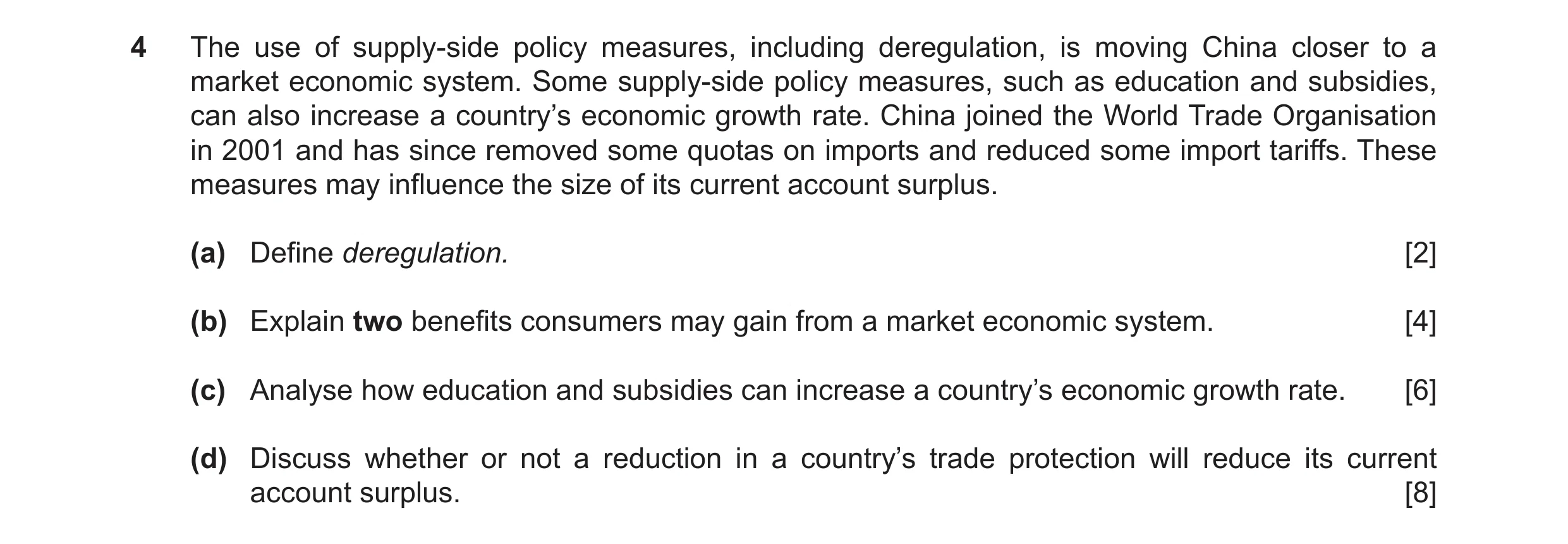
4 The use of supply-side policy measures, including deregulation, is moving China closer to a market economic system. Some supply-side policy measures, such as education and subsidies, can also increase a country’s economic growth rate. China joined the World Trade Organisation in 2001 and has since removed some quotas on imports and reduced some import tariffs. These measures may influence the size of its current account surplus. (a) Define deregulation. [2] (b) Explain two benefits consumers may gain from a market economic system. [4] (c) Analyse how education and subsidies can increase a country’s economic growth rate. [6] (d) Discuss whether or not a reduction in a country’s trade protection will reduce its current account surplus. [8]
20 marks
Mark scheme: 4(a) Define deregulation. The removal of rules/regulation (2). Less government intervention (1) to encourage competition (1). Actions making it easier for businesses to enter / operate in an industry (1). Supply-side policy (1) to increase competition (1). Question Answer Marks Guidance 4(b) Explain two benefits consumers may gain from a market economic system. Logical explanation which might include: Sovereignty (1) consumers decide what will be produced (1). Choice (1) there may be a number of firms producing a product (1). Low prices (1) competition may mean that firms have to charge low prices to keep their customers (1). High quality (1) the profit incentive may encourage firms to raise quality to attract more consumers (1). 4 One mark for each of two benefits identified and one mark for each of two explanations. 4(c) Analyse how education and subsidies can increase a country’s economic growth rate. Coherent analysis which might include: Education/training may increase qualifications/skills (1) raising the productivity of workers (1) increasing the mobility of workers (1) attracts MNCs (1) reduces unemployment (1) raising the quality (1) and quantity of output (1). Subsidies will lower firms’ costs of production (1) encouraging firms to increase their production (1) increasing supply (1) lowering price (1) a higher output is likely to be bought and sold (1). Subsidies for consumers e.g. education/health (1) may help in gaining skills/jobs and being more productive (1). 6 Question Answer Marks Guidance 4(d) Discuss whether or not a reduction in a country’s trade protection will reduce its current account surplus. In assessing each answer, use the table opposite. Why it might: • lower tariffs will reduce price of imports • removal of quotas may result in more imports being purchased • removal of a ban/embargo will permit imports of the product to enter the country • import expenditure may rise • higher import expenditure may reduce the gap between export revenue and import expenditure Why it might not: • foreign firms may not have the capacity to supply more products • demand for imports may be price inelastic • the quality of imports may have fallen • other countries may also reduce their trade restrictions • the exchange rate may fall, raising exports and reducing imports • export revenue may rise to match the higher import expenditure • may have large surplus on invisibles Example of Level 2 answer: The removal of quotas and tariffs on imports will make it relatively cheaper to import into the country. More imports will come into the country reducing its current account surplus. However, a reduction in a country’s trade protection will show the country’s willingness to have trading partners. 8 Level Descriptors Mark 3 A reasoned discussion which accurately examines both sides of the economic argument, making use of economic information and clear and logical analysis to evaluate economic issues and situations. One side of the argument may have more depth than the other, but overall, both sides of the argument are considered and developed. There is thoughtful evaluation of economic concepts, terminology, information and/or data appropriate to the question. The discussion may also point out the possible uncertainties of alternative decisions and outcomes. 6–8 2 A reasoned discussion which makes use of economic information and clear analysis to evaluate economic issues and situations. The answer may lack some depth and development or may be one-sided. There is relevant use of economic concepts, terminology, information, and data appropriate to the question. 3–5 1 There is a simple attempt at using economic definitions and terminology. Some reference may be made to economic theory, with occasional understanding. 1–2 0 A mark of zero should be awarded for no creditable content. 0 Question Answer Marks Guidance 4(d) As such, domestic firms will allocate more resources into producing exports at relatively lower costs and better quality so that they will be more competitive in the global economy. Other countries may be attracted to these exports and the demand for them will increase. Thus, the demand for local currency will increase, causing the current account surplus to increase. Thus, the current account surplus may increase or decrease depending on the extent of the fall in import prices and the rise in demand for exports. Principal Examiner comment: There is limited coverage of both sides.
This question in 0455/23 Oct/Nov 2020
Q6 · Calculate, in $, the total exports of Laos to China in 2017 0455/21 Oct/Nov 2021
1 (a) Calculate, in $, the total exports of Laos to China in 2017. [1] (b) Identify two roles of commercial banks. [2] (c) Explain how access to seaports may benefit an economy. [2] (d) Explain two benefits of the free market reforms introduced by the government of Laos. [4] (e) Analyse the impact of improved education on the economy of Laos. [4] (f) Analyse the relationship between a country’s Ease of Doing Business ranking and its GDP per head. [5] (g) Discuss whether or not strict rules and regulations benefit an economy. [6] (h) Discuss whether or not a slowdown of China’s economy will be harmful to the economy of Laos. [6]
30 marks
Mark scheme: 1(a) Calculate, in $, the total exports of Laos to China in 2017. 1.1832 billion / 1 183 200 000. 1 Accept 1.18 or 1.2 billion. 1(b) Identify two roles of commercial banks. Helps local entrepreneurs to borrow money (1). Encourages households to save / enables households to save (1). 2 Accept loan / lending 1(c) Explain how access to seaports may benefit an economy. Enables an economy to take full advantage of international trade / take greater advantage of international trading opportunities (1) enables immigration of skilled workers (1) Can export and import goods (1) goods can be transported more cheaply (than by rail or air / over longer distances) / may encourage specialisation (1) increases consumer choice (1). May encourage investment (1) attract MNCs (1) create economic growth (1) 2 1(d) Explain two benefits of the free market reforms introduced by the government of Laos. The free market reforms have enabled Laos to sell their abundant raw materials internationally (1) increases export revenue / improves current account balance / creates employment / encourages firms to expand / increases GDP (1). Encourages foreign investment (1) may lower costs of production / increases total demand / improves current account balance / creates employment / increase tax revenue (1). 4 One mark each for each of two benefits identified and one mark each for each of two explanations. Accept improved infrastructure. Question Answer Marks Guidance 1(e) Analyse the impact of improved education on the economy of Laos. Increased adult literacy rate (1) better skills/qualifications (1) increase productivity (1) / increase productive capacity / total supply (1) increase demand for labour (1) reduce unemployment / raise employment (1) raise wages (1) reduce poverty (1). More attractive for entrepreneurs / new businesses / investment (1) increase output / GDP (1) leading to higher living standards (1). Improvements in technology (1) due to workers having higher IT skills (1) Increase the consumption of merit goods / decrease the consumption of demerit goods (1) 4 1(f) Analyse the relationship between a country’s Ease of Doing Business ranking and its GDP per head. Expected relationship: Positive / direct (1) if ease of doing business (EDB) rank is high, GDP per capita is high (1). Supporting evidence: Singapore has the highest EDB rank and GDP per capita is highest (1) Timor-Leste has the lowest EDB rank and GDP per capita is the lowest (1). Exception: Brunei / Malaysia (1) has lower EDB rank than Malaysia but higher GDP per head (1). Alternatively South Korea / Brunei (1) Brunel has lower EDB rank but higher GDP per head (1). Analysis: The greater the ease of doing business, the more investment there is likely to be (1) higher investment is likely to increase GDP (1). 5 Question Answer Marks Guidance 1(g) Discuss whether or not strict rules and regulations benefit an economy. Award up to 4 marks for logical reasons why they might, which could include: • Environmental rules (1) e.g. cap on carbon emission, tax on polluting industries (1) reduce market failure (1) reduce external costs (1) e.g. could decrease pollution / protect natural resources (1) less health problems for the society (1) better standards of living (1). • Anti-competition rules (1) e.g. restrictions on monopoly power (1) improved consumer choice / lower prices / better quality (1) foreign companies will not dominate the market (1) opportunities for domestic firms to develop (1) increased future economic growth (1). • Restrictions on imports (1) may protect domestic industries / allow growth of domestic industries (1). • Bans e.g. prohibiting smoking in public places (1) may reduce market failure / reduce external costs (1). • Labour market legislation (1) protecting workers’ rights (1). Award up to 4 marks for logical reasons why they might not, which could include: • Strict regulation discourages business (1) Laos ranks one of the lowest in the World Bank’s Ease of Doing Business index (1) lack of investment / MNCs discouraged (1) lower productivity (1) lack of competition (1) lack of employment opportunities (1) decreased total demand (1) decreased economic growth / lower GDP (1) lower standards of living (1). 6 Apply this example to all questions with the command word Discuss (1(g), 1(h), 2(d), 3(d), 4(d) and 5(d)) Each point may be credited only once, on either side of an argument, but separate development as to how/why the outcome may differ is rewarded. Generic example mark Tax revenue may decrease… 1 ...because of reason e.g. incomes may be lower. 1 Tax revenue may increase because incomes may be higher i.e. reverse of a previous argument. 0 Tax revenue may increase because of a different reason i.e. not the reverse of a previous argument e.g. government spending on subsidies may stimulate the economy more than spending on education. 1 Question Answer Marks Guidance 1(g) • Bureaucracy / red tape increases the time and effort of doing business (1) increases cost of production (1) lowers profit (1). • Rules and regulations may lack clarity (1) causing them to be implemented incorrectly (1) • Takes time for the government to administer rules and regulations (1) opportunity cost of government spending (1). • Import restrictions reduce competition (1) may result in higher prices (1) lower quality (1) 1(h) Discuss whether or not a slowdown of China’s economy will be harmful to the economy of Laos. Award up to 4 marks for logical reasons why it might, which might include: • China is Laos’s largest trading partner / 58% of Laos’s exports are sold to China (1) China slowing down will lead to less demand for Laos’s exports (1) less export revenue / worsen current account (1) less total demand (1) less economic growth (1) may not be able to buy more, irreplaceable imports (1). • China is the largest source of foreign investment into Laos (1) less foreign investments will lead to less job creation (1) less employment / higher unemployment (1) lower standards of living (1). Award up to 4 marks for logical reasons why it might not, which might include: • Reduce dependence on China (1) find new markets and investors (1) other countries’ economies could be expanding (1) which could generate more exports (1) and jobs (1). • May lead to fewer environmental problems (1) less pollution (1) higher standard of living (1). • Domestic investors and firms could fill the gap (1) more employment (1) higher GDP (1). 6
This question in 0455/21 Oct/Nov 2021
Q7 · The US operates a mainly market economic system 0455/22 Oct/Nov 2021
5 The US operates a mainly market economic system. Life expectancy in the US fell in 2017, for the third year in a row. Although the US has a high GDP per head, it also has a high level of income inequality. The poor benefited from the US’s low and stable inflation rate. The government’s supply-side policy measures were partly responsible for reducing inflationary pressure. (a) Identify two ways a government could reduce income inequality. [2] (b) Explain two advantages of a market economic system. [4] (c) Analyse why life expectancy may decrease. [6] (d) Discuss whether or not supply-side policy measures can reduce inflation. [8]
20 marks
Mark scheme: 5(a) Identify two ways a government could reduce income inequality. Two from: • progressive taxation • state benefits • spending on state education / training • spending on state healthcare • equal pay legislation • minimum wage 2 Accept higher taxes on high incomes and lower taxes on low incomes but do not accept increasing taxes on incomes as this is TV. Redistributing income is TV – could be redistributing from the poor to the rich. 5(b) Explain two advantages of a market economic system. Logical explanation which might include: Consumer sovereignty (1) with consumers deciding what goods and services are produced (1). Low prices (1) due to competition (1). High quality (1) due to innovation (1). Consumer choice (1) variety of products produced (1). Greater efficiency (1) due to the profit motive (1). Automatic adjustment to changes in demand and supply / quick response to changes in demand and supply (1) via changes in price / with use of the price mechanism / increase consumer satisfaction (1). 4 One mark each for each of two advantages identified and one mark each for each of two explanations. Nothing for no taxes. Question Answer Marks Guidance 5(c) Analyse why life expectancy may decrease. Coherent analysis which might include: Incomes may fall (1) lowering living standards / reducing access to basic necessities (1). Reduction in healthcare (1) e.g limited access to medication (1). Reduction in education (1) people may lead less healthy lives (1) more smoking (1) more ‘junk food’ (1) less exercise (1). Rise in poor nutrition / malnutrition (1) eating more low-quality food / people not having enough food (1). More pollution (1) making people more susceptible to diseases (1). May be spread of new diseases / pandemics (1) wars / civil unrest (1). Climate change (1) may result in more natural disasters (1). More people employed in jobs with poor working conditions / more dangerous jobs (1) resulting in more sickness / accidents (1). 6 Question Answer Marks Guidance 5(d) Discuss whether or not supply-side policy measures can reduce inflation. In assessing each answer, use the table opposite. Why they might: • they may increase total (aggregate) supply, reducing cost-push inflation • they can allow total (aggregate) demand to increase without causing inflation • education and training can increase labour productivity, reducing labour costs • a cut in direct taxes may increase the incentive to be more productive and more innovative • labour market reforms may reduce power of trade unions and reduce rise in wages • subsidies can lower costs of production Why they might not: • privatisation does not always increase competition and so does not always lower prices • education and training can be expensive, may be in areas that are not in demand and will have a time lag • cuts in income tax may increase total (aggregate) demand as well as total (aggregate) supply • resource limitations / unable to increase productive capacity due to e.g. limited land available • inflation may be caused by rise in price of raw materials which have no domestic substitute e.g. oil 8 Only accept lower interest rates, if linked to increasing total supply. Level Description Marks 3 A reasoned discussion which accurately examines both sides of the economic argument, making use of economic information and clear and logical analysis to evaluate economic issues and situations. One side of the argument may have more depth than the other, but overall, both sides of the argument are considered and developed. There is thoughtful evaluation of economic concepts, terminology, information and/or data appropriate to the question. The discussion may also point out the possible uncertainties of alternative decisions and outcomes. 6–8 2 A reasoned discussion which makes use of economic information and clear analysis to evaluate economic issues and situations. The answer may lack some depth and development may be one-sided. There is relevant use of economic concepts, terminology, information and data appropriate to the question. 3–5 Question Answer Marks Guidance 5(d) Level Description Marks 1 There is a simple attempt at using economic definitions and terminology. Some reference may be made to economic theory, with occasional understanding. 1–2 0 A mark of zero should be awarded for no creditable content. 0
This question in 0455/22 Oct/Nov 2021
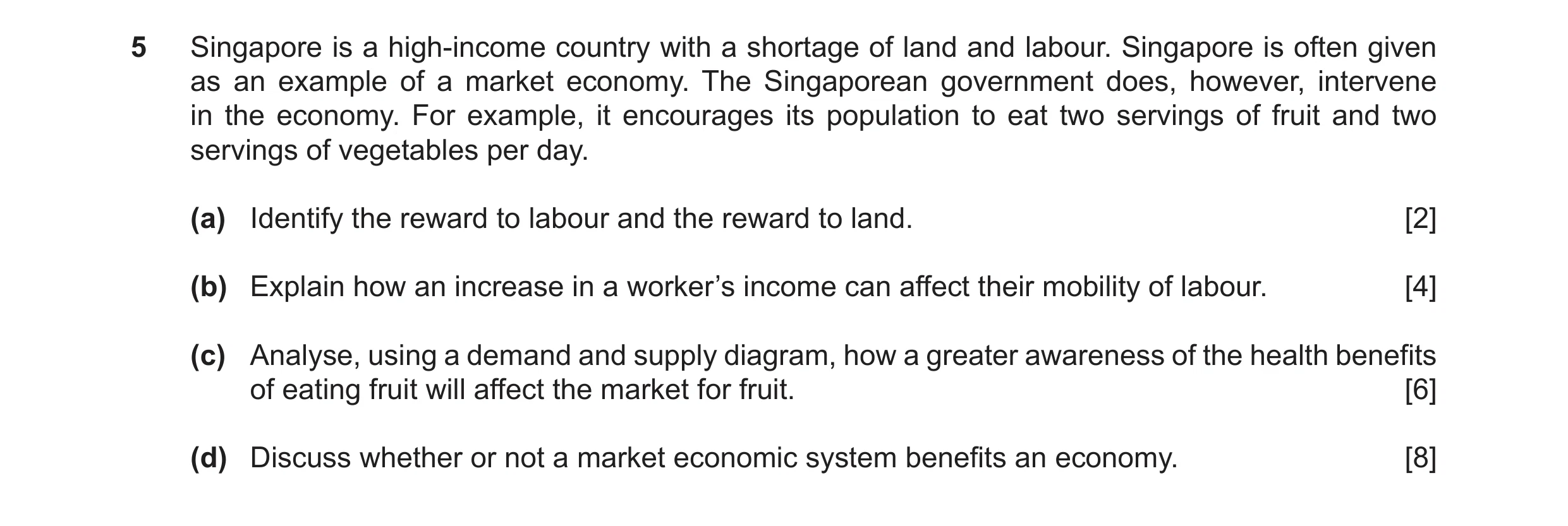
Q8 · Singapore is a high-income country with a shortage of land and labour 0455/21 May/June 2022
5 Singapore is a high-income country with a shortage of land and labour. Singapore is often given as an example of a market economy. The Singaporean government does, however, intervene in the economy. For example, it encourages its population to eat two servings of fruit and two servings of vegetables per day. (a) Identify the reward to labour and the reward to land. [2] (b) Explain how an increase in a worker’s income can affect their mobility of labour. [4] (c) Analyse, using a demand and supply diagram, how a greater awareness of the health benefits of eating fruit will affect the market for fruit. [6] (d) Discuss whether or not a market economic system benefits an economy. [8]
20 marks
Mark scheme: 5(a) Identify the reward to labour and the reward to land. Wages (1) rent (1). 2 Question Answer Marks Guidance 5(b) Explain how an increase in a worker’s income can affect their mobility of labour. Logical explanation which might include: An increase in income will enable a worker to spend more on their education (1) increasing occupational mobility (1). Higher income will make housing more affordable (1) increasing geographical mobility (1). Higher income will make high-tech products more affordable (1) enabling a worker to be better informed (1) increasing both occupational and geographical mobility (1). Higher incomes may discourage a worker from changing jobs / may be content with current job (1) may be satisfied with income level (1) reducing geographical and occupational mobility (1). Higher incomes make it easier to afford car / use public transport (1) increases geographical mobility (1). 4 No marks for causes of higher income. Question Answer Marks Guidance 5(c) Analyse, using a demand and supply diagram, how a greater awareness of the health benefits of eating fruit will affect the market for fruit. Coherent analysis which might include: Up to 4 marks for D & S diagram: Axes correctly labelled–price and quantity or p and q (1). Original demand and supply curves correctly labelled (1). New demand curve shifted to the right (1). Equilibriums–shown by lines P1 and Q1 and P2 and Q2 or equilibrium points E1 and E2 (1). Up to 2 marks for written analysis which might include: Greater awareness of health benefits will encourage more people to eat / demand fruit (1) Raise price / raise quantity traded (1). 6 Note Note: Axes do not have to be labelled price of fruit and quantity of fruit to get mark. No marks for stating price changes from P1 to P2 or quantity changes from Q1 to Q2. To get first mark in written analysis they must refer to fruit. Question Answer Marks Guidance 5(d) Discuss whether or not a market economic system benefits an economy. In assessing each answer, use the table opposite. Why it might: profit incentive and competition may increase efficiency wage differentials may encourage effort price may be low and quality high country’s products may be internationally competitive economic growth may be high consumer choice may be high consumer sovereignty may be high Why it might not: risk of market failure public goods will not be provided demerit goods are overconsumed and merit goods and under-consumed problem of pollution and other external costs unemployment may be high as lack of co-ordination some countries may lack the support structures e.g., legal system to enforce property rights to allow market forces to work efficiently. monopolies can be created 8 Level Description Marks 3 A reasoned discussion which accurately examines both sides of the economic argument, making use of economic information and clear and logical analysis to evaluate economic issues and situations. One side of the argument may have more depth than the other, but overall, both sides of the argument are considered and developed. There is thoughtful evaluation of economic concepts, terminology, information and / or data appropriate to the question. The discussion may also point out the possible uncertainties of alternative decisions and outcomes. 68 Question Answer Marks Guidance 5(d) Level Description Marks 2 A reasoned discussion which makes use of economic information and clear analysis to evaluate economic issues and situations. The answer may lack some depth and development may be one- sided. There is relevant use of economic concepts, terminology, information and data appropriate to the question. 35 1 There is a simple attempt at using economic definitions and terminology. Some reference may be made to economic theory, with occasional understanding. 12 0 A mark of zero should be awarded for no creditable content. 0
This question in 0455/21 May/June 2022
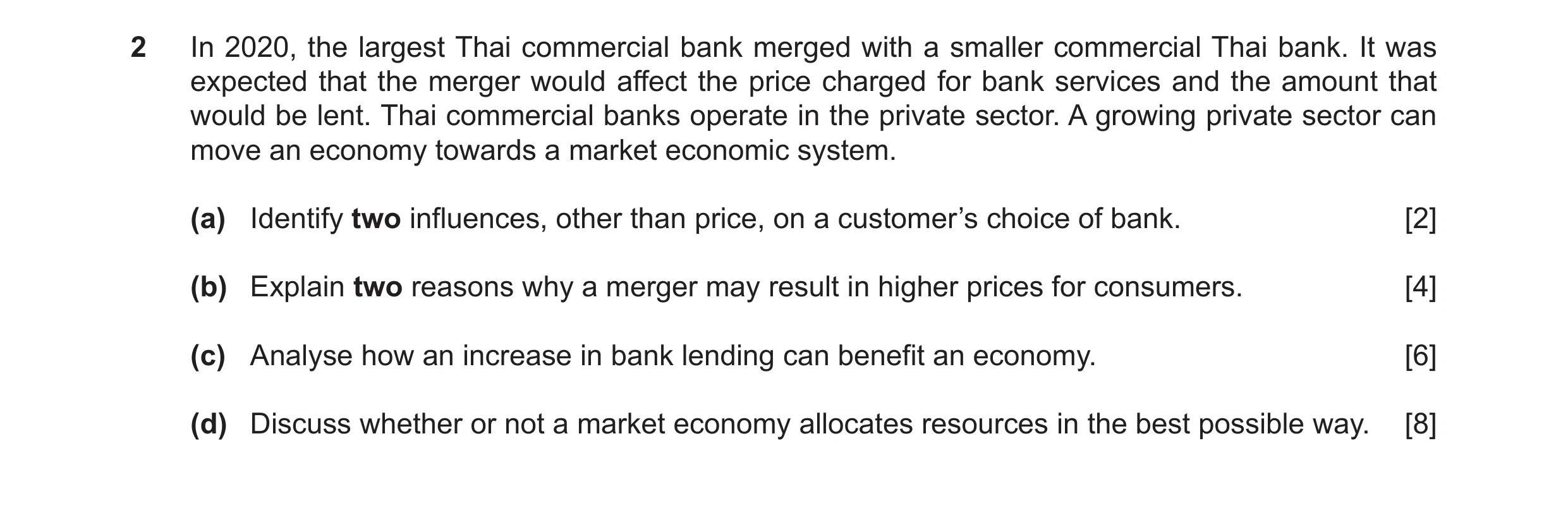
Q9 · In 2020, the largest Thai commercial bank merged with a smaller commercial Thai bank 0455/22 May/June 2023
2 In 2020, the largest Thai commercial bank merged with a smaller commercial Thai bank. It was expected that the merger would affect the price charged for bank services and the amount that would be lent. Thai commercial banks operate in the private sector. A growing private sector can move an economy towards a market economic system. (a) Identify two influences, other than price, on a customer’s choice of bank. [2] (b) Explain two reasons why a merger may result in higher prices for consumers. [4] (c) Analyse how an increase in bank lending can benefit an economy. [6] (d) Discuss whether or not a market economy allocates resources in the best possible way. [8]
20 marks
Mark scheme: 2(a) Identify two influences, other than price, on a customer’s choice of bank. Two from: services provided amount willing to lend size of bank online facilities location interest paid or charged where family banks advertising green investments community involvement reputation confidence in the bank / reliability / safety relationship with staff whether foreign currency can be exchanged 2 If more than two influences given, consider the first three. Not accepting brand loyalty. Accept whether the bank offers Islamic banking. Also accept interest on its own. 2(b) Explain two reasons why a merger may result in higher prices for consumers. Logical explanation which might include: More market power / less competition / monopoly power / may become a monopoly (1) can raise price as consumers will not be able to switch to other firms / demand may become more inelastic / can control price / become a price maker (1). May experience diseconomies of scale / example of a diseconomy of scale that may be experienced (1) raise prices due to higher (average) costs (1). Carrying out the merger may be expensive (1) price raised to cover the cost of e.g. retraining staff / making some staff redundant (1). 4 One mark each for each of two reasons identified and one mark each for each of two explanations. If more than two reasons given, consider the first three. Can accept higher cost if linked to diseconomies of scale or carrying out the merger. Not accepting the idea of higher costs because the firm will be larger (idea of higher total costs). Question Answer Marks Guidance 2(c) Analyse how an increase in bank lending can benefit an economy. Coherent analysis which might include: It could increase consumer expenditure (1) increase total demand (1) raise employment /reduce unemployment (1) reduce deflation (1). It could increase investment / increase spending on capital goods (1) benefit from advances in technology / innovation / better quality capital goods (1) increase productivity (1) raise the quality of products (1) lower price (1) increase exports (1) lower imports (1) improve the current account balance (1) cause economic growth / increase GDP / increase output / encourage firms to expand / new firms to set up (1). May enable the people to improve skills / to set up small business / buy basic necessities / reduce poverty (1). Lend to firms in financial difficulties (1) stop them going out of business (1). 6 Question Answer Marks Guidance 2(d) Discuss whether or not a market economy allocates resources in the best possible way. In assessing each answer, use the table opposite. Why it might: price moves to reflect changes in demand and supply resources move from products falling in demand towards those rising in demand profit incentive for firms to produce what consumers demand / consumer sovereignty competition results in efficiency which drives down costs and prices changes in wages move labour to those jobs most in demand Why it might not: merit goods are under-consumed so not enough resources are devoted to their production demerit goods are overconsumed so too many resources are devoted to their production no resources are devoted to public goods as there is no incentive to produce them there may be factor immobility monopolies may restrict output external costs and benefits will not be taken into account when deciding on the allocation of resources. 8 Level Description Marks 3 A reasoned discussion which accurately examines both sides of the economic argument, making use of economic information and clear and logical analysis to evaluate economic issues and situations. One side of the argument may have more depth than the other, but overall, both sides of the argument are considered and developed. There is thoughtful evaluation of economic concepts, terminology, information and/or data appropriate to the question. The discussion may also point out the possible uncertainties of alternative decisions and outcomes. 6–8 2 A reasoned discussion which makes use of economic information and clear analysis to evaluate economic issues and situations. The answer may lack some depth and development may be one-sided. There is relevant use of economic concepts, terminology, information and data appropriate to the question. 3–5 1 There is a simple attempt at using economic definitions and terminology. Some reference may be made to economic theory, with occasional understanding. 1–2 0 A mark of zero should be awarded for no creditable content. 0
This question in 0455/22 May/June 2023
Q10 · The central bank of Madagascar intervenes in the country’s foreign exchange market 0455/22 Oct/Nov 2024
3 The central bank of Madagascar intervenes in the country’s foreign exchange market. However, Madagascar has a largely market economic system. Nearly 70% of Madagascar’s population live in poverty. Most of the country’s industries are labour-intensive. In 2020, Madagascar had an economic growth rate of 6% and a deficit on the current account of its balance of payments of $0.6bn. (a) Define foreign exchange market. [2] (b) Explain two reasons why a firm may adopt labour-intensive production. [4] (c) Analyse how the macroeconomic aims of economic growth and balance of payments stability may conflict. [6] (d) Discuss whether or not a high level of poverty is likely to exist in a market economic system. [8]
20 marks
Mark scheme: 3(a) Define foreign exchange market. 2 An arrangement / place (1) where different countries’ currencies are bought/demanded (1) and sold/supplied (1) one currency is exchanged for another currency (1). 3(b) Explain two reasons why a firm may adopt labour- 4 One mark each for each of two reasons identified and one intensive production. mark for each of two explanations. Logical explanation which might include: • Labour may be low in price / wages may be low (1) which might make labour cheaper than capital / there may be a high supply of labour (1). • Labour may be very productive / efficient (1) which can make employment profitable / result in low costs of production (1). • The government may subsidise the employment of workers (1) to reduce unemployment (1). • The firm may provide personal services (1) with individual attention (1). • Labour may be more creative / adaptable / provide feedback (1) produce high quality products / improve methods of production (1) • Labour may be unskilled / low level of education (1) unable to use high-tech capital equipment (1). 3(c) Analyse how the macroeconomic aims of economic 6 growth and balance of payments stability may conflict. Coherent analysis which might include: Economic growth may increase employment (1) increase wages / incomes / purchasing power (1) this may increase imports (1). Higher consumer spending (1) may encourage firms to switch products to the domestic market (1) reduce exports (1) increase / cause a current account deficit (1). To produce more goods and services, firms may import more raw materials (1) capital goods (1). Economic growth may result in inflation (1) which would make domestic products less price competitive (1). Economic growth may deplete resources (1) increase need for imports (1). Economic growth may be export-led (1) may be achieved by restricting imports (1) result in a current account surplus (1). Migrant workers may send more money home (1). Export-led growth may increase the exchange rate (1) which may increase imports / reduce exports (1). 3(d) Discuss whether or not a high level of poverty is likely 8 Level Description Marks to exist in a market economic system. 3 A reasoned discussion which 6–8 In assessing each answer, use the table opposite. accurately examines both sides of the economic argument, making use of Why it might: economic information and clear and • may be unemployment logical analysis to evaluate economic • lack of welfare benefits issues and situations. One side of the argument may have more depth than • likely to be income inequality the other, but overall both sides of the • merit goods including healthcare and education may be argument are considered and under-consumed and so underproduced developed. There is thoughtful • monopolies may develop resulting in higher prices. evaluation of economic concepts, terminology, information and/or data Why it might not: appropriate to the question. The • competition / profit motive may result in low prices discussion may also point out the • efficiency is encouraged which can result in high wages possible uncertainties of alternative and high employment decisions and outcomes. • greater response to changes in consumer demand, may increase economic growth 2 A reasoned discussion which makes 3–5 • countries with efficient private sector firms may have use of economic information and clear relative poverty but low absolute poverty. analysis to evaluate economic issues and situations. The answer may lack some depth and development may be one-sided. There is relevant use of economic concepts, terminology, information and data appropriate to the question. 1 There is a simple attempt at using 1–2 economic definitions and terminology. Some reference may be made to economic theory, with occasional understanding. 0 A mark of zero should be awarded for 0 no creditable content.
This question in 0455/22 Oct/Nov 2024
 2 / 5
2 / 5![Question 4: (a) Calculate the total number of people over 60 years old in Greece in 2015. [1] (b) Explain what is meant by an unemployment rate of 24%.…](https://img.pastlit.com/crops/7071ffa7-db29-414f-a3b4-ea04bddb8fea/q1.webp)
![Question 6: (a) Calculate, in $, the total exports of Laos to China in 2017. [1] (b) Identify two roles of commercial banks. [2] (c) Explain how access…](https://img.pastlit.com/crops/a138a325-fbab-43b5-954f-0ca0669cd196/q1.webp) 3 / 5
3 / 5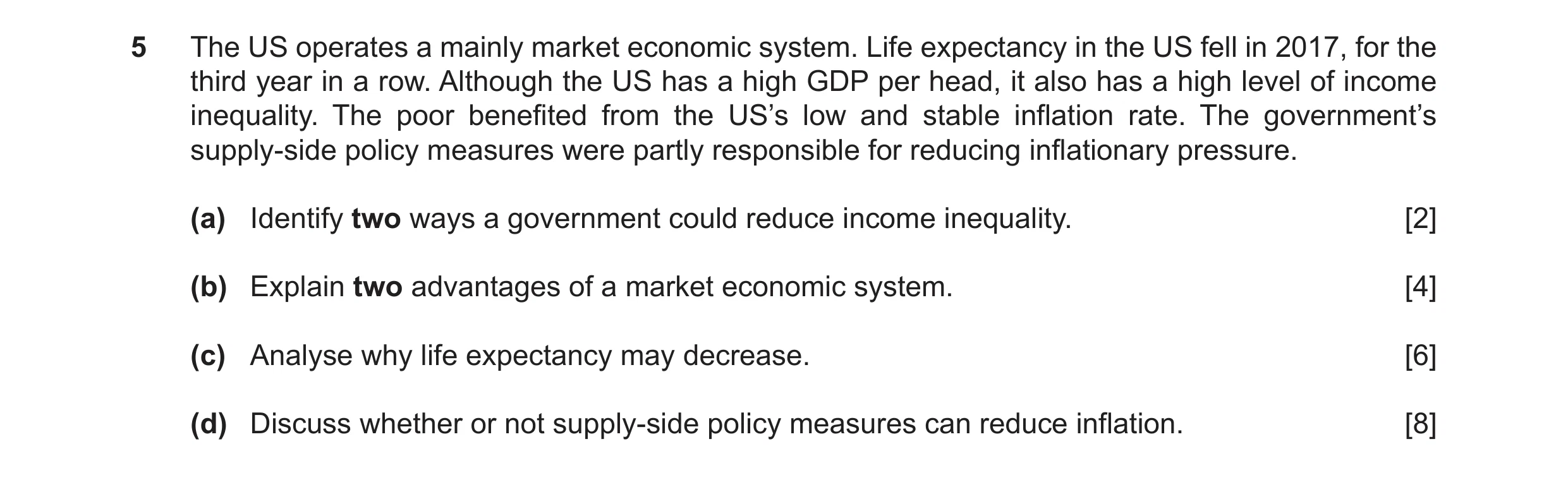
 4 / 5
4 / 5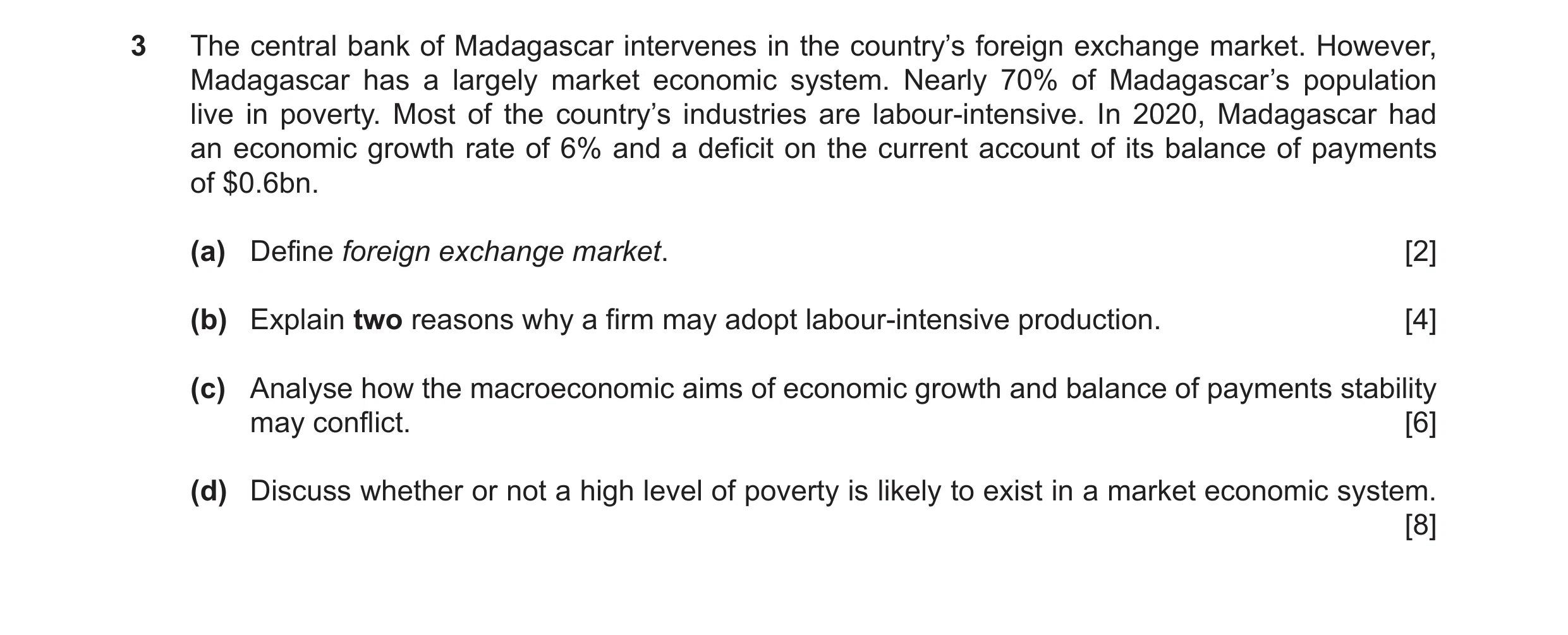 5 / 5
5 / 5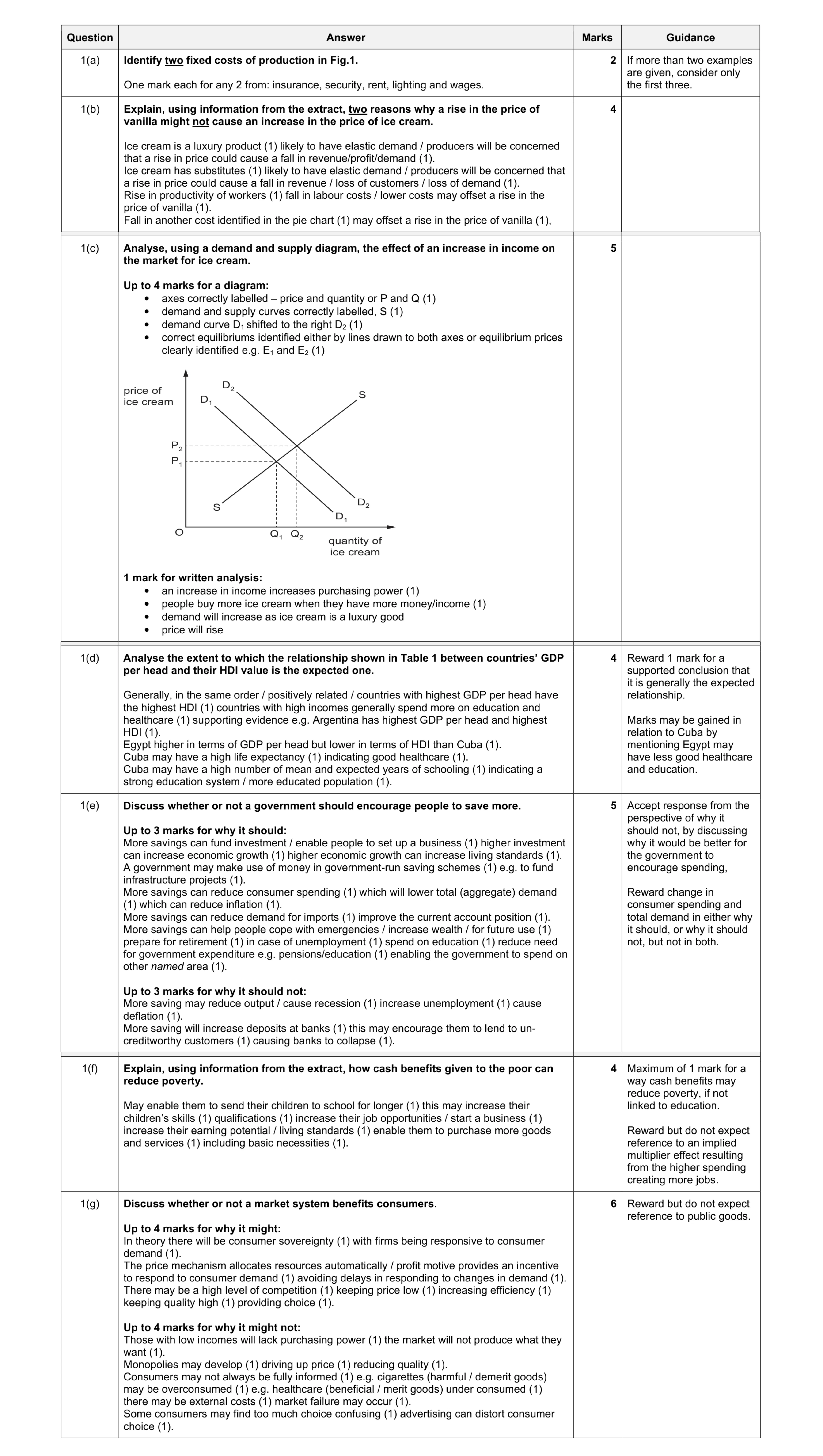 30
30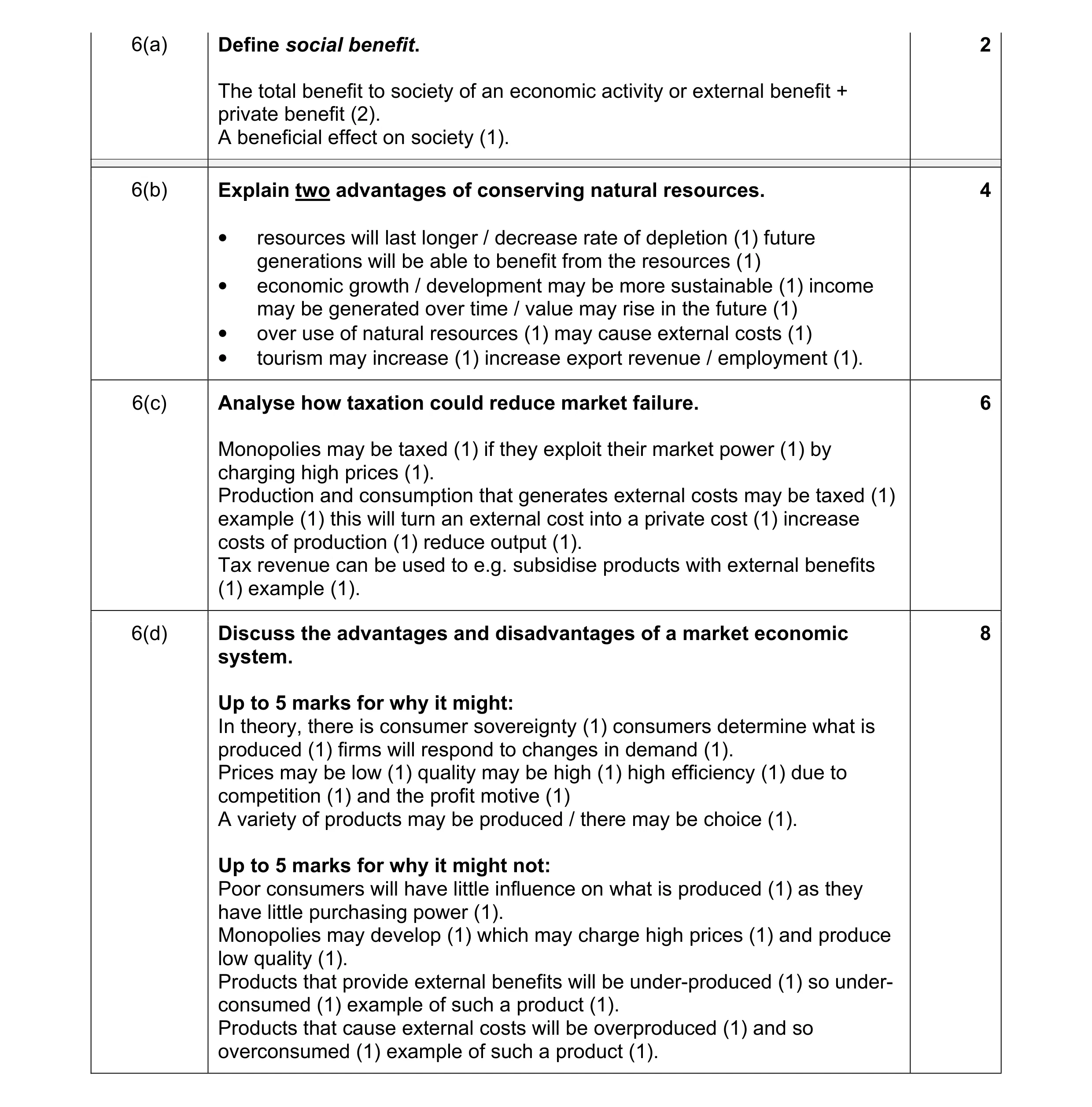 20
20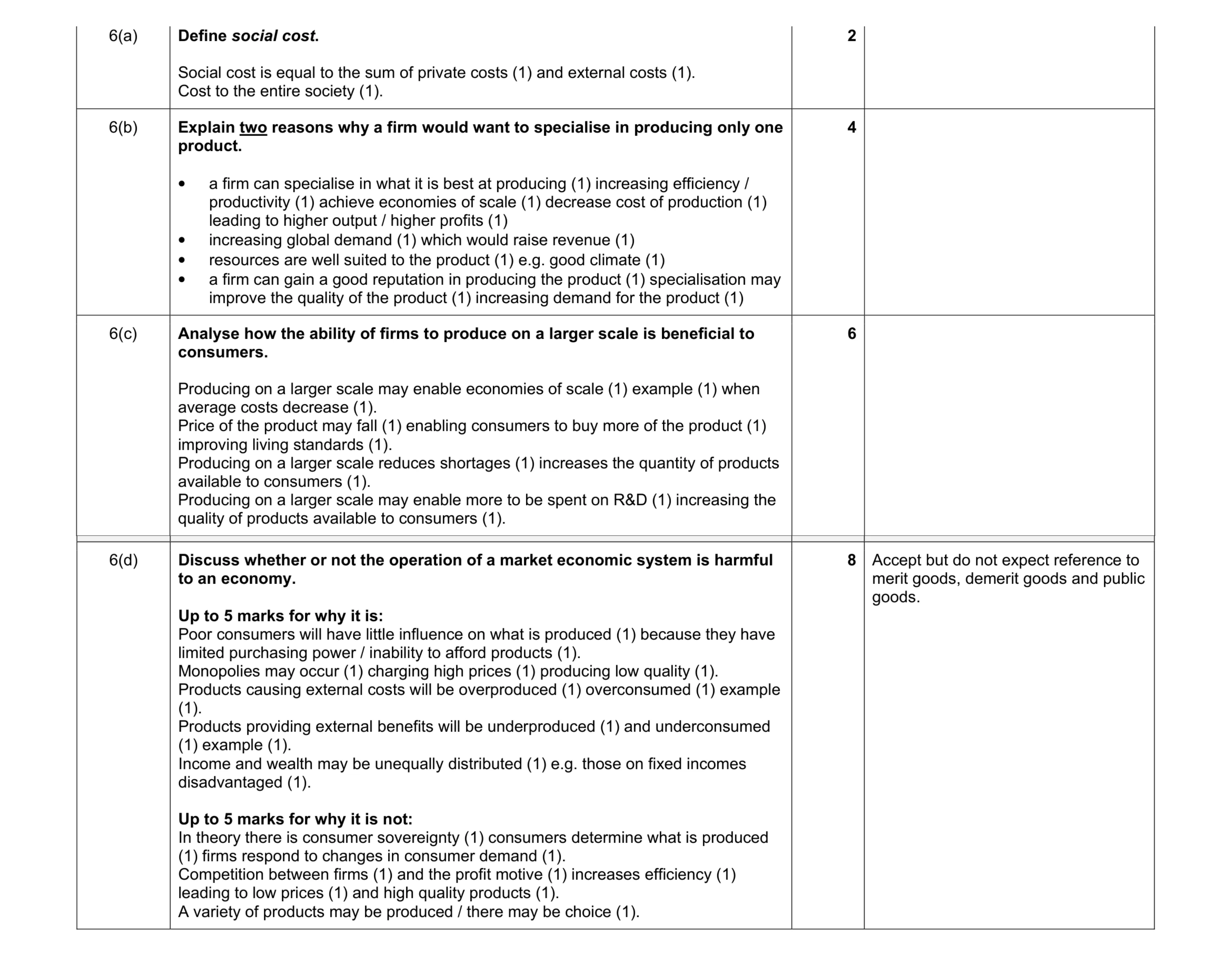 20
20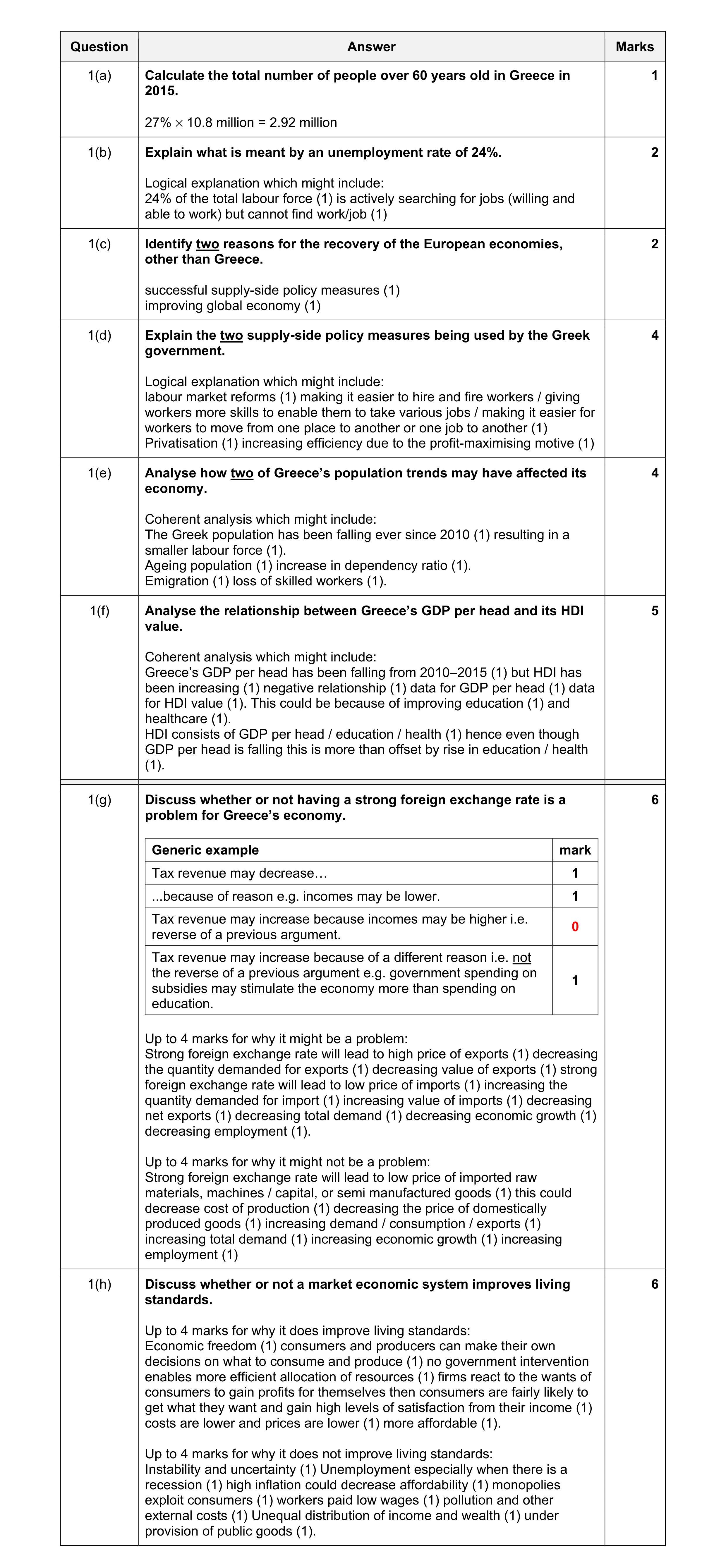 30
30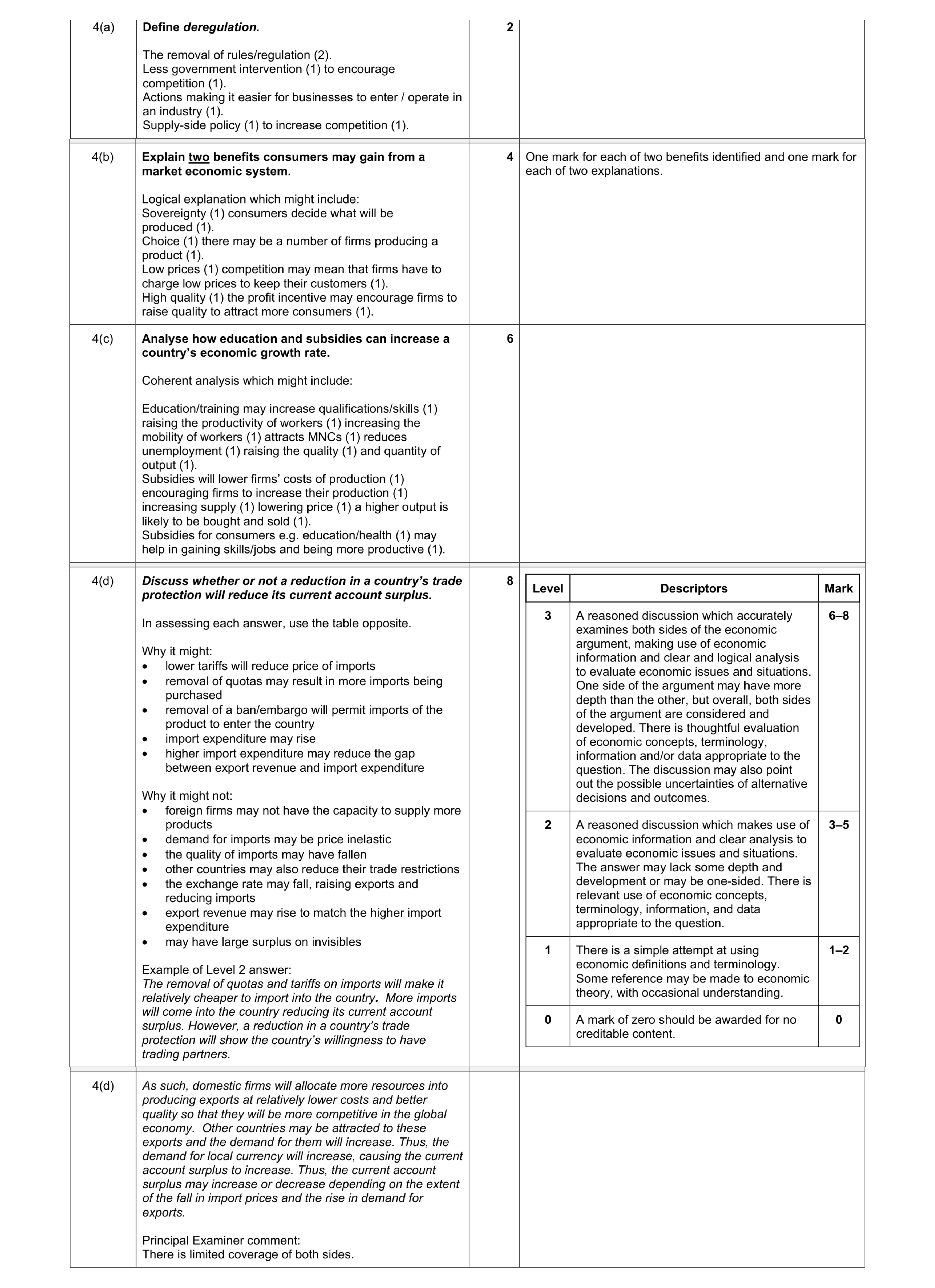 20
20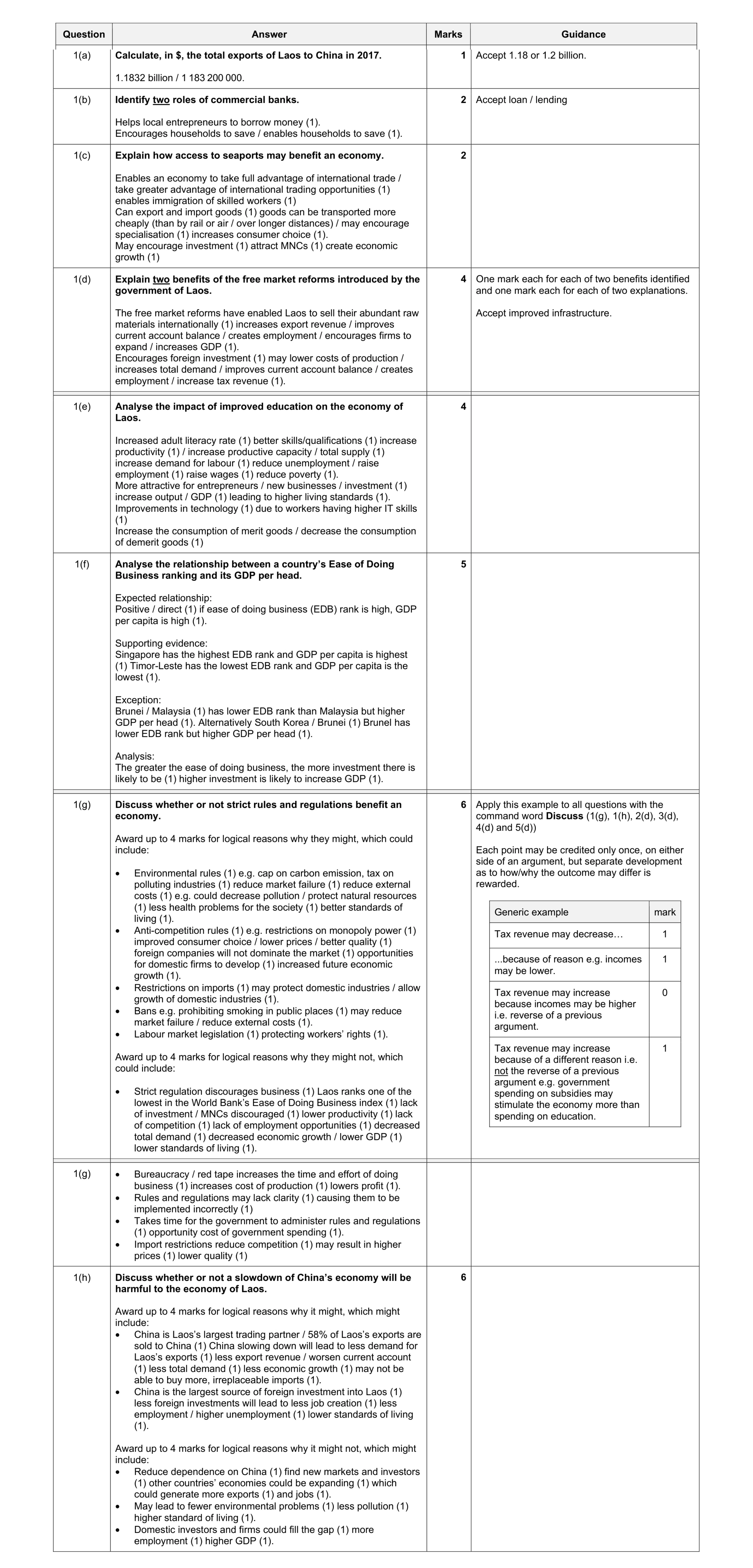 30
30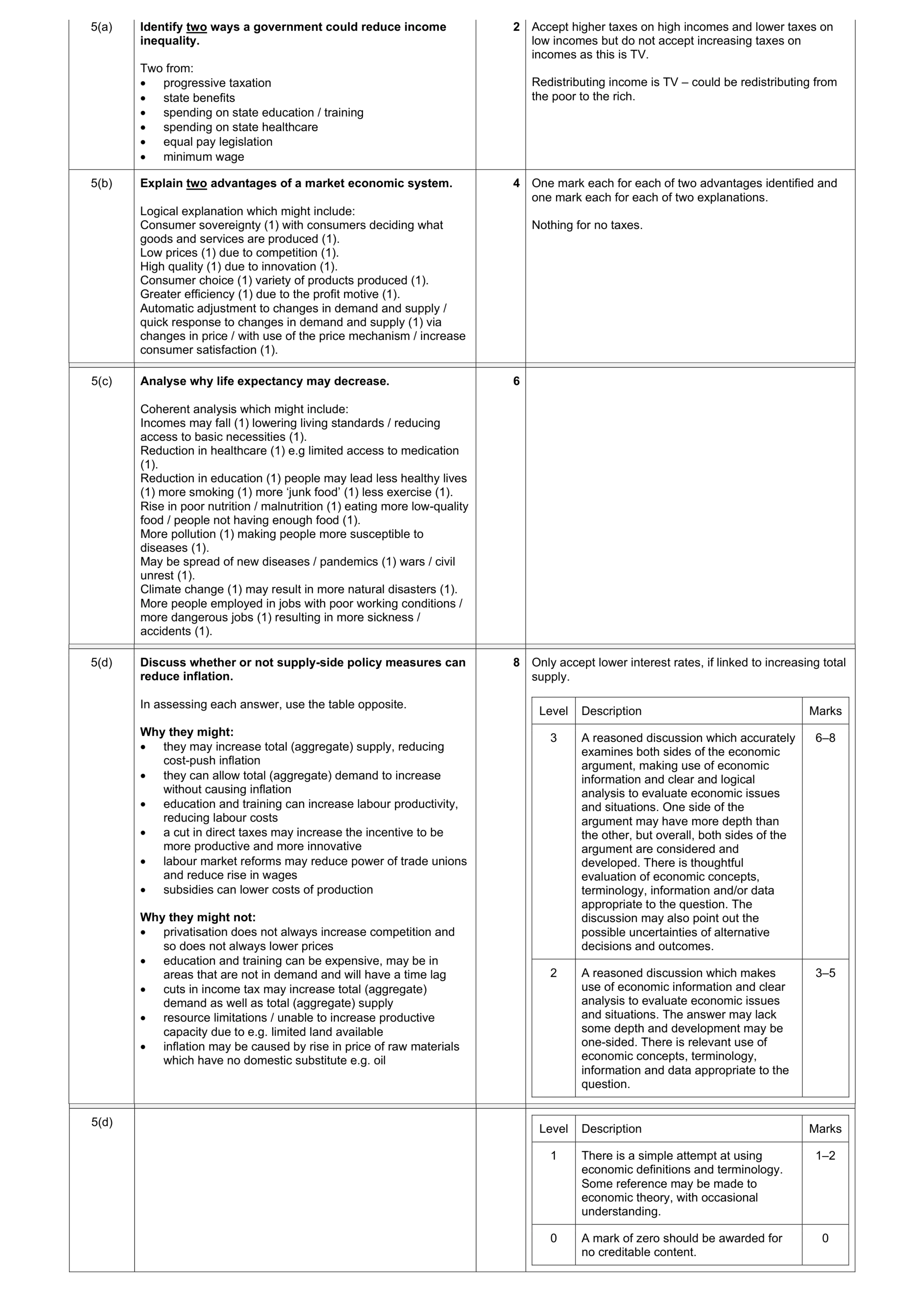 20
20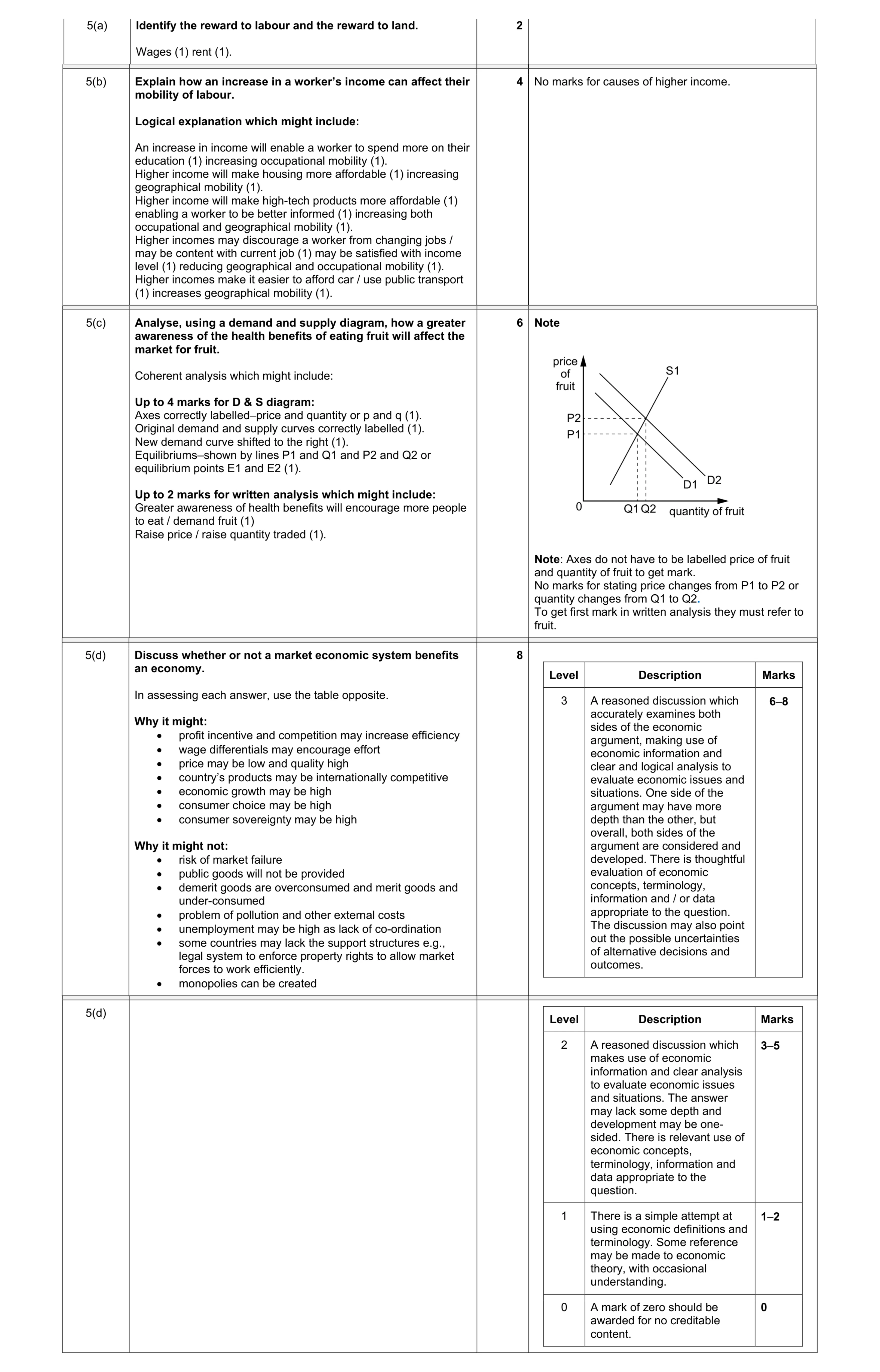 20
20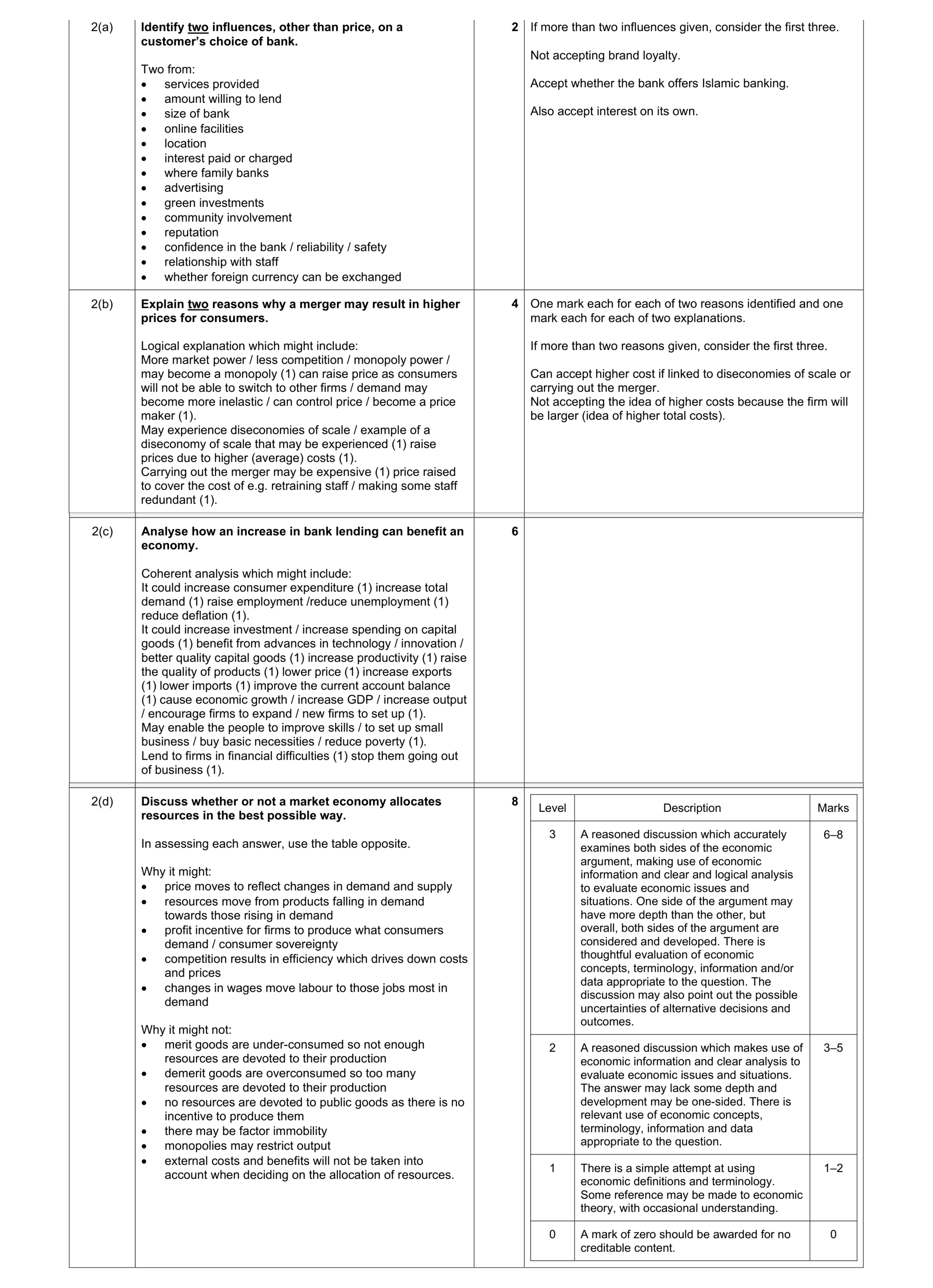 20
20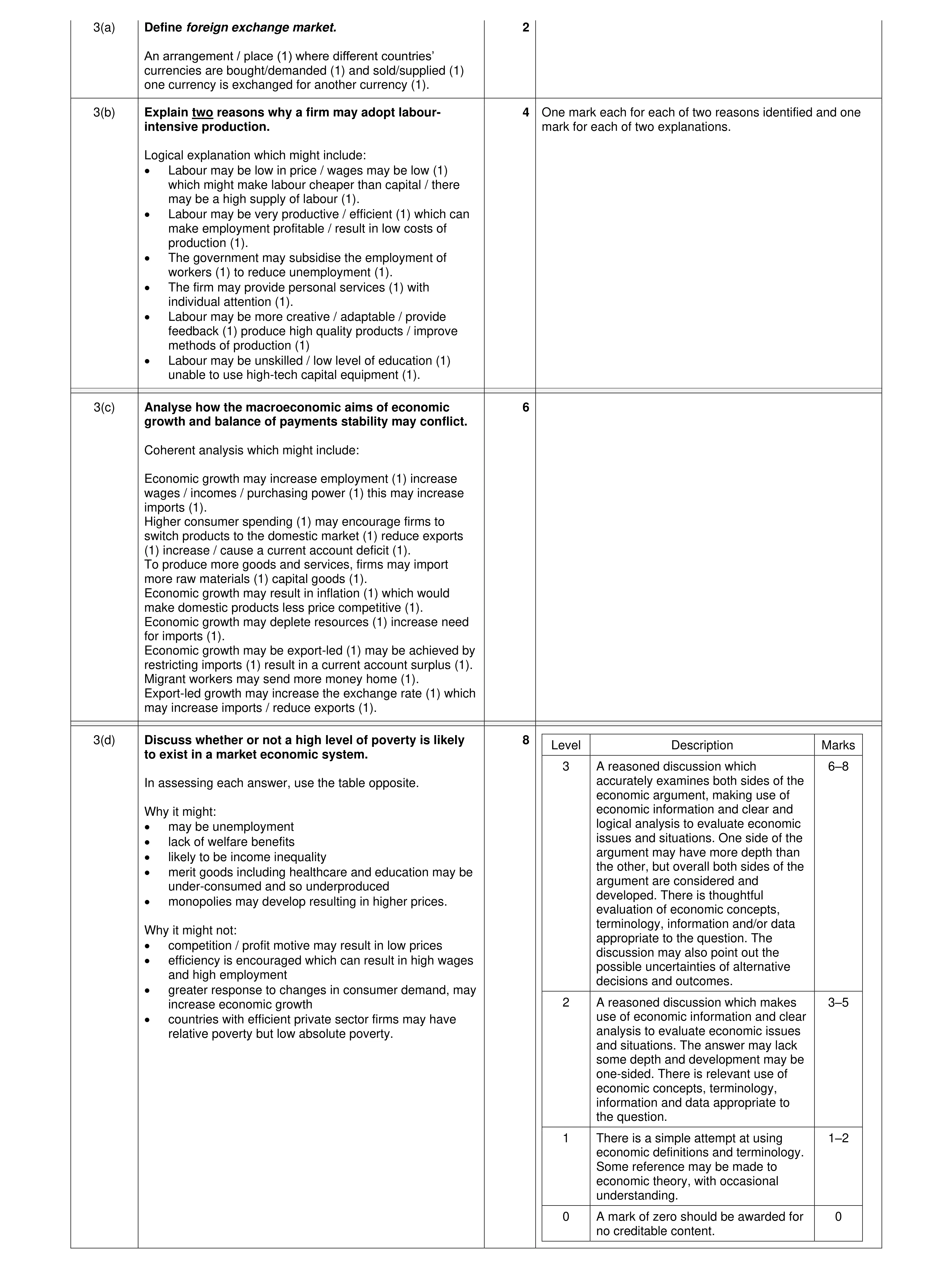 20
20